A publication of
Southern Lakes Newspapers LLC
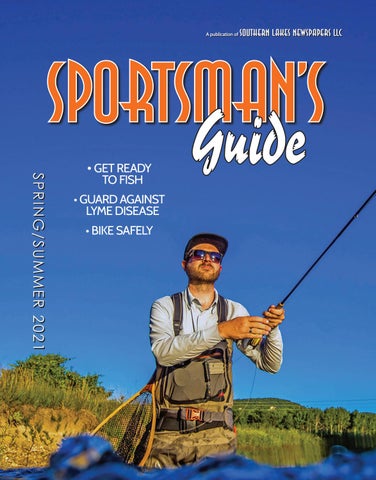
Sportsman’s SP R I N G/SUM M E R 2 021
• GET READY TO FISH
• GUARD AGAINST LYME DISEASE • BIKE SAFELY
Guide
CHECK US OUT! 2021 SPRING/SUMMER SPORTSMAN’S GUIDE
From lures to lighting, paddleboards to powertools you’ll find it all at Fleet Farm.
2
10 OFF
$
an in-store purchase of $50 or more Offer good April 12 - June 13, 2021
Use Code: SPRTSMN211 to buy online and pick up in store
3723
Limit 1 offer per customer, per visit. No photocopies or facsimiles will be accepted. Coupon must be presented at the time of purchase and must be surrendered upon redemption. Total purchase must reach $50 or more before state and local taxes. No adjustments to prior purchases. Returns will be credited as purchase price less the discount, and discount will be forfeited. Cannot be used in conjunction with Buy Get offer, or other coupons. Not redeemable on fuel, lottery tickets, tobacco, alcohol, gift cards, tickets, permits, registrations, licenses, warranties, Carhartt®, Striker®, YETI®, or Weber® items. Other exclusions may apply. See store for details.
Visit us at 1516 Geneva St., Delavan, WI
392928
The water is open
5 tips to relax and recharge on a boat this summer With boating restrictions lifting nationwide and the COVID-19 response dictating where and how far people can travel, boating and fishing are ideal activities to destress and unwind, while naturally allowing you to abide by social distancing guidelines. “The outdoors is a welcome remedy to stress and anxiety,” said Dr. Sue Varma, a nationally recognized psychiatrist. “Being in nature supports each of the four ‘M’s of mental health: mindfulness, mastery, meaningful engagement and movement. In particular, being on the water encourages mindfulness by helping you get away from distractions, it supports mastery by teaching you a new skill, it provides meaningful engagement through quality time with others you may be quarantining with, and it promotes physical movement by getting you outside without requiring a strenuous
workout. From a psychiatrist’s perspective, it’s a smart way to follow social distancing guidelines while prioritizing your health and wellness.” Here are tips from Discover Boating to help you find your way to the water this summer.
Purchase your dream boat Chart your own course to boat ownership by visiting DiscoverBoating.com, where you’ll find a boat finder and loan calculator tool to help determine your budget and identify the different types of boats that fit your lifestyle and interests. The site can connect you with manufacturers whose boats best fit your needs and wants, plus learn about new boat shopping processes during COVID-19. OPEN • CONTINUED ON PAGE 8
There are several easy ways to go boating or fishing, whether you’re ready to buy a boat, test the waters aboard different vessels, or seek solace fishing on water or ashore. STOCK PHOTO Sportsman’s Guide
SPRING-SUMMER 2021
Sportsman ’des G ui
FOR ADVERTISING OPPORTUNITIES:
Call (262) 725-7701 ext. 134 or email vicki@southernlakes newspapers.com
A publication of
Southern Lakes Newspapers 1102 Ann St., Delavan, WI 53115
Editor...............................................Tracy Ouellette Page Design.......................................Jen DeGroot Creative Director.................................Heidi Schulz Advertising Director...................Vicki Vanderwerff
2021 SPRING/SUMMER SPORTSMAN’S GUIDE
Looking to get away this summer while social distancing? With annual traditions such as camps and sporting events cancelled, the best way to seek relief and recharge with your loved ones may be to “Get On Board” for a summer on the water. Recent data suggests that interest in fishing and boating has grown amidst the COVID-19 pandemic. According to a recent Harris poll, one in five Americans said they’re more likely to try these activities than they were prior to the pandemic. And among parents, the statistic is one in four. Numerous marine dealers across the country are reporting strong spring sales with consumers eager to get on the water, and Discover Boating, the nation’s consumer boating resource, is seeing record growth in consumer web traffic and boat searches, signifying a high demand for close-to-home recreation.
3
Fishing season is here!
Anglers get your poles strung and tackle box stocked, opening day for general inland fishing is May 1 in Wisconsin. STOCK PHOTO Sportsman’s Guide
2021 SPRING/SUMMER SPORTSMAN’S GUIDE
Licenses, stamps, tags needed for all anglers older than 16
4
Wisconsin residents who are 16 years old or older need a fishing license to fish in any waters of the state. Residents need a fishing license to take rough fish by hand, hook and line or to spear fish where allowed. Residents do not need a fishing license to take smelt, rough fish, or minnows with nets, traps, and seines of legal size. The Wisconsin Department of Natural Resource’s Guide to Wisconsin Spearing, Netting, and Bait Harvest Regulations has more information on additional regulations. Nonresidents who are 16 years old or older need a nonresident fishing license to fish in Wisconsin waters with hook and line. Nonresidents need a fishing license to take rough fish by hand, hook and line, or to spear fish where allowed. Nonresidents of any age need a fishing license to take smelt, spear fish, or to take rough fish and minnows using nets, traps, and seines of legal size. Nonresidents may not sell minnows or smelt. The DNR’s Guide to Wisconsin Spearing, Netting, and Bait Harvest Regulations has more information and lists all the regulations. Fishing licenses are sold online at dnr. wi.gov.
Groups of disabled persons on fishing excursions conducted by nonprofit organizations may not need fishing licenses. All annual licenses are valid from date of purchase through March 31, 2022. Licenses • Resident individual (annual) fishing license, $20. • Fishing, first-time buyer, $5. • Resident one-day fishing license, $8 – In the event the angler purchases an annual fishing license later in the same license year, the cost of the one-day license will apply towards the purchase of the annual fishing license. • Resident combination (spousal) license, $31 – Issued to a legally married husband and wife who meet residency requirements. • Resident sports license $60 – This license allows for fishing and hunting of small game and gun deer. (Nonresident fee, $275) • Resident junior sports license (10 to 17 years old), $35 – (Nonresident fee, $36) • Resident reduced-rate fishing license, $7 – Required of anglers 16 and 17 years of age and anglers 65 years of age and older. Residents born before 1927 do not need a fishing license. Simply carry proof of age when fishing. Nonresident senior citizens must purchase a regular nonresident license. • Resident conservation patron license, $165 – This license serves as a substitute
for separate licenses and stamps for annual fishing, inland trout fishing, Great Lakes trout and salmon fishing, hook and line lake sturgeon harvest, hunting small game, turkey, pheasant, deer, waterfowl, archer hunting, and trapping (trapping for residents and qualified nonresidents only). You also receive an admission sticker for state parks, state forests and state trails, and a one-year subscription to Wisconsin Natural Resources magazine. (Nonresident fee $600)
Free Fishing Weekend returns The spring Free Fishing Weekend is set for June 5 and 6. The semi-annual event offers free fishing on all state lakes and streams; licenses are not required. Free fishing clinics for all ages are also available at many state parks and other locations for all ages. Bag limits and size restrictions apply. For more information, visit dnr. wisconsin.gov.
2021-22
fishing seasons Opening day for Wisconsin fishing is traditionally the first Saturday in May. Hook-and-line fishing for many species of fish on many Wisconsin waters begins on that day. However, to better manage Wisconsin fisheries, season dates are often specific to the species of fish as well as the water body. For a complete listing of all Wisconsin’s fishing seasons, visit drn.wi.gov.
Early inland trout
(catch and release) Jan. 2 (5 a.m.) to April 30
General inland trout
May 1 (5 a.m.) to Oct. 15 The local lakes will soon be hosting fishermen and women of all ages. Fishing is a family friendly activity that teaches kids a new skill.
General inland fishing May 1 to March 6, 2022
STOCK PHOTO Sportsman’s Guide
and that they are a resident on furlough or leave (includes the inland trout and Great Lakes salmon stamps). • Nonresident individual (annual) fishing license, $50 • Nonresident one-day fishing license, $10 – In the event the angler purchases an annual fishing license later in the same license year, the cost of the one-day license will apply towards the purchase of the annual fishing license. • Nonresident 4-day individual license, $24 • Nonresident 15-day individual license, $28 • Nonresident 15-day family license, $40 – Includes children 16-17 years old (Note: Family licenses do not include grandchildren ages 16 to 17 years old). • Nonresident annual family license, $65 – Includes children 16 and 17 years old (Note: Family licenses do not include grandchildren ages 16 and 17 years old). • Annual Inland Trout Stamp Privilege (residents and nonresidents), $10 – See the Guide to Wisconsin Trout Fishing Regulations for license restrictions. Required in addition to your fishing license to fish trout on tributaries to Lake Superior and all inland waters, except Green Bay and Lake Michigan tributaries up to the first dam or lake.
Largemouth bass northern zone harvest May 1 to March 6, 2022
Smallmouth bass northern zone harvest June 19 to March 6, 2022
Large and smallmouth bass southern zone harvest May 1 to March 6, 2022
Large and smallmouth bass catch and release At all other times of the year.
Musky - northern zone May 29 to Dec. 31
Musky - southern zone May 1 to Dec. 31
Northern pike
May 1 to March 6, 2022
Walleye
May 1 to March 6, 2022
Lake sturgeon
Sept. 4 to Sept. 30 (hook-and-line)
Free fishing weekends
FISHING SEASON • CONTINUED ON PAGE 8
June 5 and 6 Jan. 15 and 16, 2022
2021 SPRING/SUMMER SPORTSMAN’S GUIDE
• Resident junior conservation patron license (10–17 years old), $75 – (Nonresident fee $77) • Resident annual fishing licenses for the disabled, $7 – Anglers must provide one of the following as proof: Social Security Disability Award Notice issued within the past year, Letter from Social Security Administration advising the customer is currently receiving disability benefits, Letter or Notice of Railroad Retirement Disability, or signed statement from a licensed physician or optometrist indicating that the customer’s sight is impaired to the degree that he/she cannot read ordinary newspaper print with or without corrective glasses. Discount applies to resident fishing license only. Disabled nonresidents need to buy a regular nonresident license. • Resident annual disabled veteran’s fishing license, $3 – Veterans must provide one of the following as proof: Veteran’s Disability Award Letter showing benefits are being paid for a disability of 70 percent or more, or Letter from Veterans Administration that indicates customer is receiving benefits for a service-related disability of 70 percent or more. Nonresident disabled veterans must purchase a regular nonresident license. • Free annual resident armed forces fishing license for members of the U.S. armed forces who exhibit proof that they are in active service with the armed forces
5
A beginner’s guide to buying a
2021 SPRING/SUMMER SPORTSMAN’S GUIDE
Personal Watercraft
6
Personal watercrafts offer nimble handling and amazing performance in a package that’s affordable and easy to own. Some could argue that no boating option offers more value – or bang for the buck – than a personal watercraft. In much the same way Kleenex has became synonymous with facial tissue, a PWC is often referred to as a Jet Ski, WaveRunner or Sea-Doo, which are all known name brands of personal watercraft manufacturers including Kawasaki, Yamaha and BRP, sequentially. Buying the best PWC for your needs, similar to buying any boat, involves making a few important choices. Discover Boating offers these suggestions when considering the purchase of a PFC:
• Determine the number of passengers you want to carry; • Compare different models – rec-light, recreation, touring/luxury, performance, and stand-up; • Decide if you’d like to buy new or preowned; • Set your budget and explore financing options; • Start shopping – find out where to buy; • Research personal watercraft values and consult pricing guides; and • Work with a dealer – and close the deal. DiscoverBoating.com also has its “Comprehensive Boat Buyer’s Guide” to assist you in your purchase. Here’s a bit more information about they types of PWCs available:
Two or three passengers? Almost all new PWC models are rated to carry three people, but not all are really comfortable with three adults on board. Mid-size three-passengers models can carry three adults in a pinch but two adults and a child is really more realistic. Some of the smaller rec-light-category models, and some high-performance PWC, are rated for two passengers. A threepassenger model offers seat room and buoyancy to comfortably carry two adults for a long cruise. That three-passenger rating is also a requirement when using a PWC to tow tubers or wake boarders in most states. Rec-light models These most-affordable PWC models
Personal watercrafts offer excitement and fun on the lake. When purchasing a PWC, consider the size and amenities you desire and do some research on the types available. STOCK PHOTO Sportsman’s Guide
MPH. The large hull – over 11 feet long – is designed to offer a comfortable and stable ride in most water conditions. They also offer more storage and fuel capacity than the Recreation models. Electronic trim and reverse controls, adjustable speed and performance options, a touch screen display, a security system, adjustable handlebar angle are often standard equipment. There are models designed for specifically for touring, fishing and tow sports.
Recreation models The mid-rage offered by PWC manufacturers, these models are larger and faster than the rec-light models, and can come with more features. Engine options may range from about 120 to 180 HP, good for a top speed of 50 to 60 MPH. Features offered on Recreation models include electronic reverse control, speed control options, performance options (such as a fuel-saving ECO mode), security systems, and optional audio systems. Some models can be set up for long-range cruising with a bolstered seat, or for towing with a tow-line pylon.
Performance models Designed for experienced riders looking for no-compromise performance inspired by competition, a Performance PWC is often the quickest and fastest boat on any lake. The hull and deck is often molded from special lightweight material, the jet pump is enhanced with special components, and the highest horsepower engine is placed under the seat. The result is not just top speed approaching 70 MPH, but eye-popping acceleration and razor-sharp handling. These are not machines intended for beginning riders.
Luxury/touring models These feature-laden models offer the most-powerful engines, with more than 300 HP available and a top speed exceeding 65
Stand-up models This is where the sport began – a narrow
hull with a handlebar control mounted on a moveable pole. Riding a stand-up PWC requires some athletic ability and a lot of practice, but it’s that challenge that many riders find rewarding and entertaining. Currently the Kawasaki Jet Ski SX-R is the only Stand-Up model available for recreational riding. The Yamaha SuperJet is sold only for closed-course competition. Pre-owned models are an option for those who want to give a stand-up model a try. Gear and accessories Most PWC owners have a trailer to transport the craft, even if it’s kept on the water during the riding season. A trailer will be needed to transport the craft for service and off-season storage. A Type III personal floatation device must be worn when riding a PWC. Neoprene shorts or PWC trunks with a neoprene liner provide the PWC rider and passengers with a comfort and protection. A PWC wet suit can be worn for riding in cold water or for extending the riding season. Closed-toe boat shoes, water shoes or PWC riding booties provide better traction and protection than bare feet or flip-flops. For more information, visit discoverboating.com.
ICE V R E S L UR FUL ng
Your
Neighborhood Expert
17 S. Washington, Elkhorn
online parts & service: www.lylestv.com Custom Installation on Home Theatre and Sound Systems
li n Gril arters u
qu Head
• Grills • Smokers • Chips
• Rubs • Sauces • Pizza Ovens
The Appliance Store with So Much More
392927
YO
2021 SPRING/SUMMER SPORTSMAN’S GUIDE
can carry two adults (or two adults and a child), have a 60 to 100 HP engine, and can reach a top speed of about 45 MPH. They don’t really have enough power to tow a tube or boarder, and often don’t have some of the convenience features found on larger models. They also have a smaller and lighter hull that works fine in smooth water but can deliver a rougher ride when conditions get choppy.
7
OPEN • CONTINUED FROM PAGE 3 Join a boat club Find a boat club near you to access a variety of boats. You’ll pay a monthly fee and be able book your time on the water online. Most boat clubs take care of docking, cleaning, maintenance, and boat training courses, which all follow new CDC and social distancing guidelines. Rent a boat Rental options are available on most waterways and provide hourly, daily or weekly access to a variety of boat types. Rental outfitters give tutorials on operating a boat, provide safety instruction and offer suggestions on destinations.
8
to ensure a healthy transaction. Go fish There are thousands of bodies of water where you can cast a line. TakeMeFishing.org is an all-in-one resource to help anyone get started fishing in minutes. Features on the site include how-to guides, an interactive map of places to fish near you, and water access updates to help you fish safely while social distancing. You can even purchase your fishing license on the site. Whether you’re ready to purchase a boat or simply test the waters this summer, all marine businesses have new standard operating procedures following CDC guidelines to ensure the well-being of boaters and their staff. This includes personal protective equipment, socially distant classroom and on-water training, and enhanced sanitation protocol of boats. Visit DiscoverBoating.com for a host of resources and tips for getting on the water, boat shopping, safe practices amid the pandemic, public access maps and more. Planning to “Get On Board” this summer? Use the social media hashtag #TheWaterIsOpen to share your boating and fishing moments. (BPT)
• Annual Great Lakes Trout and Salmon Stamp Privilege (residents and nonresidents), $10 – Required in addition to your fishing license to fish trout or salmon on Lake Superior, Lake Michigan, Green Bay and the tributaries of Lake Michigan and Green Bay up to the first dam or lake. • Two-day Sports fishing license for residents and nonresidents, $14 – This license entitles a resident or nonresident to fish the outlying waters of Lake Superior, Lake Michigan, and Green Bay, as well as Lake Michigan and Green Bay tributaries upstream to the first dam or lake. License includes the Great Lakes Trout and Salmon stamp privilege. • Two-day Inland Lake Trout Fishing License (residents only), $14 – This license authorizes fishing for trout on inland lakes. A trout stamp is not required • Hook and Line Lake Sturgeon Harvest Tag, $20 – Anglers who intend to harvest a lake sturgeon must purchase this tag first, regardless of age or need for a fishing license. Harvest tags are available for either inland waters or Wisconsin/Michigan boundary waters. A fishing license is required to fish for sturgeon (unless you are exempt), but a harvest tag is not required for catch and release sturgeon fishing (Nonresident fee $50) For more information, visit dnr.wi.gov.
WE REPAIR, RESTORE & CUSTOMIZE FIREARMS CONTACT US TODAY!
6802 118th Ave, Dock B • Kenosha, WI 53142 AmericasGunsmithShop.com | 866.862.4570 | info@americasgunsmithshop.com
392918
2021 SPRING/SUMMER SPORTSMAN’S GUIDE
Share a boat Another rental option is peer-to-peer boat rentals. You can search by location or type of boat. Peer-to-peer rental services have tens of thousands of different boats available across the nation. You simply connect with the owner, find out what sort of gear is aboard the boat and included in the rental, and other details, and then hit the water. Most arrangements for boat sharing are made on an app or via computer, minimizing personal contact and eliminating the need to enter an office. You can also inquire with the owners about their boat cleaning and sharing procedures
FISHING SEASON • CONTINUED FROM PAGE 5
Get on the water with the right
Kayaking is a wildly popular paddlesport. Paddlesports offer people unique ways to enjoy nature while getting up close and personal with expansive waterways. Kayaking is remarkably accessible for people of all skill levels and interests. According to the Outdoor Foundation’s 2019 Special Report on Paddlesports and Safety, kayaking has seen a consistent upward trend in participation for the last five years. Today, recreational kayaking is the most popular paddlesport, with more than 11 million participants in the United States. And the activity is almost evenly split among men and women (51 percent and 49 percent, respectively). Many kayakers can enter the water with relatively no instruction in kayaking and take to the sport like a duck to water. Of course, the right gear can make all the difference for both experienced and novice kayakers. Anyone who plans to be a
consistent kayaker should probably invest in a kayak of his or her own. The right kayak depends on where kayakers plan to use it. Sea kayaks can sail easily through choppy conditions. Tandem kayaks carry two or more people and have more storage space. Touring kayaks are designed for long distance kayakers. Sit-on-top kayaks are ideal for beginners and casual paddlers. Some additional supplies also can help kayakers get the most out of this rewarding activity. • Paddle – Many kayaks are sold with compatible paddles. However, it is always a good idea to have a spare. Be sure to choose one made from sturdy materials, especially if it will be used in saltwater or brackish water. • Life jacket – A life jacket is a must when on the water. While kayaks are relatively stable, should a tip-over occur a life jacket can keep you afloat and safe until you are able to reboard the kayak.
• Kayak racks and carriers – Kayaks can be transported to the water on roof racks that strap on to SUVs and cars. Kayak carts and trailers can help you comfortably move the kayak to the water’s edge or dock, as kayaks can be heavy and cumbersome to move on your own. • Spray skirt – A kayak spray skirt keeps water from splashing up and onto your lap/ legs while in the kayak. Staying dry can make kayaking more comfortable in all seasons. • Dry storage – Dry bags and containers keep items like a phone, camera and GPS devices dry and secure. These containers are designed to be water-tight when splashed or submerged. Other kayaking supplies include dry shirts, special shoes, hats, and gloves. Coordinated fishing gear can even be purchased for those who want to catch some fish while kayaking.
Kayaking makes for a great day on the water. The right gear helps enthusiasts sail with ease.
(METRO CREATIVE)
2021 SPRING/SUMMER SPORTSMAN’S GUIDE
kayaking gear
HEIDI SCHULZ Sportsman’s Guide
9
Enjoy safe bike rides Riding a bicycle is not only a great way to help the planet by reducing vehicle emissions, but it’s also an ideal physical activity. According to Harvard University, biking at a moderate speed of 12 to 13.9 miles per hour will cause a 155-pound person to burn 298 calories in 30 minutes. At a faster rate of 14 to 15.9 miles per hour, a person of the same weight will burn 372 calories. People can ride bikes at any time of year, but cycling is most popular when temperatures are moderate and precipitation is low. Bike riding has always been in fashion, but it experienced a boost in popularity when people were asked to remain socially distant for COVID-19. Walks and bike rides at a safe distance from others became popular and accessible ways to get fresh air and exercise. Anyone who rides a bike needs to take certain precautions. Cyclists often share the roads with large and powerful cars and trucks. The National Highway Traffic Safety Administration warns there were 857 cyclists killed in traffic crashes in the United States in 2018. Safety is a two-way street, requiring diligence by drivers and bike
riders. • Bike riders should be dressed in bright clothing so they can be seen. A well-fitting bicycle helmet is a must, and should be worn every time a bike is ridden. • Equip your bike with a horn, bell and bright headlight. • Cyclists should ride in the same direction as traffic on the far right-hand side. • Ride a bike that fits you well. If the bike is too big, it can be difficult to control. • Carry items in a backpack or strapped to the back of the bike so belongings do not become obstacles. • Drivers should remain alert of cyclists sharing the road and give wide clearance when possible. • Vehicle drivers should look in their side mirrors and around them before opening car doors so they do not accidentally knock a cyclist passing by off the bike. • Safe Kids suggest using hand signals to alert others to your plans. Cyclists can extend the left arm out for a left turn; make a 90-degree angle with the left arm to indicate a right turn. Putting the left arm down with the palm facing backward indicates stopping or slowing. (METRO CREATIVE)
Cycling safety is important as temperatures rise and more cyclists are on the road. STOCK PHOTO Sportsman’s Guide
2021 SPRING/SUMMER SPORTSMAN’S GUIDE
BURTNESS
10
1389 West Main St., Whitewater, WI 53190
Your Spring Vehicle Shopping Headquarters
1421 West Main St., Whitewater, WI 53190
WHEN THE PRODUCTS ARE SIMILAR IT’S THE DEALER THAT MAKES THE DIFFERENCE 262-473-2522 • 262-473-3072 www.driveburtness.com
392919
How to reduce risk for
Lyme disease
When the weather warms up and hours of daylight increase, few people can resist the allure of the great outdoors. Nature beckons each spring, and those answering that call must do so safely. Lyme disease is a potential threat for people who live in certain regions. The Centers for Disease Control and Prevention reports that Lyme disease cases have been reported in nearly every state, though residents in certain states are more vulnerable than others. For example, CDC data indicates that incidence rates were highest in several states in New England, including Maine, New Hampshire and Rhode Island, while rates in Oklahoma, Missouri and Wyoming were especially low. Lyme disease is spread by the bite of an infected tick. Playing, hiking, camping, or working in wooded or grassy places where instances of Lyme disease are high increases a person’s risk of being bitten. But that doesn’t mean those in areas like New England, the mid-Atlantic or the upper-midwest must avoid such activities. However, they should take steps to prevent tick bites when going out into the great outdoors.
The CDC recommends wearing insect repellents registered with the Environmental Protection Agency. Repellents should contain DEET, picaridin, IR3535, oil of lemon eucalyptus, paramenthane-diol, or 2-undecanone. The EPA even has a tool on its website that can help people choose the right repellent products for them. That tool can be found at www. epa.gov/insect-repellents/find-repellentright-you. The CDC advises people to treat clothing and gear, including socks and tents, with products containing 0.5 percent permethrin, which can remain protective even after several washings. Pre-treated clothing may be protective even longer.
Check for ticks every day Ticks can be found anywhere on the body, and the CDC recommends checking for ticks every day. Pay particular attention to underarms, in and around the ears, inside the belly button, the back of the knees, in and around all head and body hair, between the legs, and around the waist.
Ticks pose a threat when spending time in the great outdoors. Various preventive measures can help people reduce their risk for Lyme disease. STOCK PHOTO Sportsman’s Guide
Recognize where ticks live The CDC reports that blacklegged ticks cause Lyme disease and that such ticks live in moist and humid environments. In addition, the Lyme Disease Association notes that ticks are most likely to be in certain areas, including woods, areas where woods meet
lawns and where lawns meet fields. Ticks also may be living in tall brush/ grass, under leaves, under ground cover, near stone walls or wood piles, or in shady areas. Ticks also may be drawn to areas around bird feeders or outdoor areas designated for pets. (METRO CREATIVE)
2021 SPRING/SUMMER SPORTSMAN’S GUIDE
Wear insect repellent
11
Q. Which is a recommended water skiing safety practice?
A. Safety is critical, so it’s important to have a few basics covered. Be sure you and your driver have an agreed-upon set of hand signals. Thumbs up to go faster, down for slower, the OK hand signal to indicate the speed is right. There are other signals such as patting the head to indicate you’re finished or want to get back on the boat. Always wearing a life vest, skiers and drivers should always be aware of their surroundings. Having an observer and a driver on board is much safer than just having a driver with a ski mirror. To learn more, be sure to refer to our Watersports Safety Guide. Q. How to slalom water ski? A. For people just starting out, there’s a
ski rope with a deep V that helps with deep water starts. You just put the tip of the ski inside the V of the rope, and that helps the ski remained pointed forward as the boat is taking off. The training
2021 SPRING/SUMMER SPORTSMAN’S GUIDE
WATER SKIING • CONTINUED ON PAGE 13
12
Try something new this summer Learn how to water ski Anybody who has ever watched a water ski show or competition has had the urge to go water skiing. The first towed sport in what has become an industry unto itself, water skiing has spawned offshoots such as slalom, trick and ski jumping, wakeboarding and wakesurfing, and even tubing and kneeboarding. And it all started behind a boat with a guy with two boards strapped to his feet. Today, the state of the art is the result of a century of progress and innovation.water skiing basics If you’re interesting in learning how to water ski, Discover Boating says to be sure to follow these basic steps to help you get started: How to get up on water skis Begin with a deep-water start, with your legs together. Let the boat do the work – stay in a
crouched position until you’re up on a plane. Once you’re up, straighten your legs. Coach your boat driver on the proper speed for towing – around 30 MPH for water-skiers. Once you feel comfortable on two skis, you can transition to slalom-style skiing by dropping one ski. With kids, the best water skiing tip is to start with the skis that are tied together with nylon rope. This keeps their legs together, and keeps them from doing a split as soon as they get on plane – then doing a face-plant. Even adults first learning to ski can feel like their being split from the groin up. Skiing on two skis will work muscle groups in your legs and back that don’t normally see that much stress. The hardest part of skiing is the hardest part of any water sport, and that’s the deepwater start. The important thing is to let the boat do the work. Trying to stand up too
392917
Water skiing FAQs
Wake skiing equipment Like any other towed sport, water skiing requires a fair amount of gear. To get out on the water and enjoy the sport you need at least the following four items: • A Boat; • Water ski rope and handle; • Water skis; and a • Life jacket or PFD (personal floatation device). Obviously, you need a boat to learn to water ski, or at the very least a friend with a boat, right? Some are better than others, and we’ll get to that in a bit. You’ll also need some water skiing equipment. Let’s start with water ski rope, which is a specific kind of rope. Water ski ropes have floating handles of various designs, and some measure of “give” to them, which means they stretch a bit when there is a skier in tow. For beginners just learning the deepwater start on one ski, the deep-V water ski handle is a must. The deep V lets you put the single ski right in front of you and it helps keep the ski pointed dead ahead when the boat begins to accelerate. As your skills improve, you won’t need a deep V, but you might want to advance to a slalom rope, which has colored sections to help you keep track when start skiing slalom at shorter rope lengths. Obviously you’re also going to need water skis, and this is where things can get pricey. Luckily for beginners, skis geared NEW • CONTINUED ON PAGE 14 Water skiing with the family is a fabulous way to spend the day on the lake. The sport can be learned by adults and children. PHOTO COURTESY OF DISCOVER BOATING Sportsman’s Guide
WATER SKIING • CONTINUED FROM PAGE 12 rope helps a lot because doing a deep-water start on a single ski is not easy. The same logic applies: Let the boat do the work to get you on plane before you try to stand up.
Q. What water skis should I buy, or how do I choose water skis? A. Skis are designed and built for people depending on their level of experience and their weight. Typically, they are sold in three categories: beginner, intermediate and advanced, and by weight. The heavier the skier, the longer the ski.
Q. How long are water skis? A. Adult skis are typically 63- to about 72-inches long. Skis for
children are obviously shorter.
Q. How do I teach a kid to water ski? A. With kids, it’s best to start with the skis that are tied together
with nylon rope. This keeps their legs together, and keeps them from doing a split as soon as they get on plane – then doing a face-plant. Kids need early successes to have fun, and having fun is what will keep them interested.
Q. How do I teach someone to water ski? A. There are schools around the country that teach water skiing,
but you don’t have to go to a professional school to learn to ski. Almost any experienced skier can teach another person to ski. The key to offering tips and corrections is to put them in between compliments. For example, tell them what they did right, offer corrections, then offer another compliment. That keeps the student in high spirits while he or she is learning.
Q. How do I tie water ski rope? A. If your boat has a tow pylon, push the rope through the loop
at the end of the rope and wrap the loop that creates around the pylon. This allows the rope to tighten when a skier is in tow. If you have a tow eye, twist the loop on the end of the rope to create a figure 8, then fold the 8 over itself and put both loops over the pin in the middle of the tow eye.
Q. How do I find water skiing near me? A. Here at Discover Boating, we have a top 10 list of water ski
schools, but there really isn’t an online database of slalom course locations. The best thing to do is to ask a local retailer. You can make your own course with kits available from major retailers like Bass Pro Shops or Cabela’s. Plus, there are a lot of resources online for building your own course.
Source: discoverboating.com.
2021 SPRING/SUMMER SPORTSMAN’S GUIDE
quickly makes things more difficult than they need be. Stay in the crouched position until you’re up on plane, then straighten your legs. Of course, we all want to go water skiing with one ski. One good way to learn is to get up on two skis and then drop one. If you’re on a lake or lagoon, just remember where you left the ski. If you’re skiing on a river, take the current into account when you go back to try to find the other one. This gets you accustomed to slalom-style skiing, and getting up in a deep-water start on two skis is much easier than trying to get up on one ski. Deep-water starts on a single slalom ski are more difficult, and that’s where the deep-V-handle ski rope can help. Once you’re up and running, the average water ski speed is around 30 MPH. Competition speed for pro slalom skiers is 36 MPH, but you can signal to your driver what speed your comfortable with.
13
Remember to employ the proper safety measures when water skiing and never attempt to ski without a life jacket or PFD.
PHOTO COURTESY OF DISCOVER BOATING Sportsman’s Guide
NEW • CONTINUED FROM PAGE 13
14
What type of boat? The reality is you don’t need a tournament boat to learn to water ski, but it helps. Seriously, you can learn to ski behind almost anything, the operative word being “almost.” You should have a V-hull boat with a decent amount of power. Pontoons or other low-power outboard driven boats make things more difficult if not impossible for the skier, particularly if he or she is new to the game. Lots of towboat builders make “multi-sport” boats that are good for wakeboarding and wakesurfing, but also skiing. At the top of the game lie the
tournament inboards, which have the engine located in the middle for even weight distribution and hulls designed to create flat wakes that make it easier to cut across behind the boat. The ski shows and competitions you saw when you were little inspired you to go water skiing. There is a learning curve to it, but it’s just as much fun as you think it is, and it’s a hobby you can participate in for a long time. All you need is some warm weather, some free weekends with your family and the right equipment. What could be better than that? For more information, visit discoverboating.com.
Live Bait MARTIN’S HARDWARE-RENTAL & PET & Tackle Let Us Help You Do It Best! Boat, Pontoon, 3288 Main Street Canoe & Kayak East Troy Rentals 262-642-3344 SPORTING GOODS 262 725-7007
3542 State Road 50 Delavan, WI 53115 www.Lakesidebait.com
392994
2021 SPRING/SUMMER SPORTSMAN’S GUIDE
toward novices are among the least expensive on the market. A pair of skis from a name brand manufacturer can run anywhere from $250 to $500 or so. More advanced skis can run upward of $1,800 a pair, but also as little as $500. Bear in mind you don’t have to have the best water skis when you’re first starting out. Learn more by reading How to Buy Water Skis. The last essential water ski accessory is the life jacket, and the current generation is more comfortable than ever. Pricey vests can run a little more than $100, but don’t be afraid to spend more for a PFD that fits well. Bright colors are also a good idea for making a downed skier in the water more visible.
HOURS: Monday-Friday 7:30 a.m.-7:00 p.m. Saturday 7:30 a.m.-5:00 p.m.; Sunday 9:00 a.m.-5:00 p.m. www.facebook.com/martinshardwarerentalpet.et 392998
Boating is a popular summer pastime. Few activities can be as relaxing and aweinspiring as a day spent on the water. Safety is an essential component of responsible boating. Veteran boaters know that the work is never done in regard to ensuring their vessels are safe for everyone on board. One potentially harmful component boaters must be aware of is carbon monoxide, often referred to as “CO.” Understanding CO and the threat it poses can help boaters and their passengers stay safe this summer. Understanding CO When carbon-based fuels burn, they produce CO. Gasoline, oil and propane are some common examples of carbon-based fuels. CO also can be a byproduct of gaspowered generators, cooking ranges and water heaters. CO buildup According to the Centers for Disease Control and Prevention, large boats, including houseboats, sometimes have generators that vent toward the rear of the boat. This venting makes people on the rear swim deck or water platform of the boat vulnerable to CO poisoning. The CDC also notes that traveling at slow speeds and
idling can lead to a buildup of CO in the cabin, a buildup that can increase due to wind coming from the aft section of the boat. Poorly ventilated canvas enclosures, enclosed spaces, which can trap CO, and blocked exhaust outlets are some additional ways that CO can accumulate on a boat. The signs of CO poisoning The CDC says that CO can poison or even kill people who breathe in too much of it. As a result, it’s imperative that boaters and people who plan to spend time on a boat, learn to recognize the signs of CO poisoning, which include: • Headache; • Dizziness; • Weakness; • Nausea; • Vomiting; • Chest pain; and • Confusion. When on a boat, it’s important that people do not write any of these symptoms off as seasickness. Maintaining a boat The CDC notes that symptoms of CO poisoning may not be evident, so it’s important that appropriate measures
are taken to ensure boats are always in proper working order. When purchasing a CO detector for your boat, make sure to buy one listed by the Underwriters’ Laboratories as appropriate for marine use inside the boat. The following are some additional measures boaters can take to maintain their boats and reduce their risk, and their passengers’ risks, for CO poisoning, courtesy of the CDC: • Properly install and maintain all fuelburning engines and appliances; • Educate all passengers about the signs and symptoms of CO poisoning; • Swim and play away from areas where engines vent their exhaust; • Watch children closely when they play on rear swim decks or water platforms; • Never block exhaust outlets, as blocking outlets can cause CO to build up in the cabin and cockpit areas even when hatches, windows, portholes, and doors are closed; and • Dock, beach or anchor at least 20 feet away from the nearest boat that is running a generator or engine. This is important because exhaust from nearby vessels can send CO into the cabin and cockpit of a boat. (METRO CREATIVE)
Boating is a popular summertime activity. Staying safe on a boat involves protecting yourself and your passengers from CO poisoning.
2021 SPRING/SUMMER SPORTSMAN’S GUIDE
The threat of boatingrelated CO poisoning
STOCK PHOTO Sportman’s Guide
15
Whether You Need A New Weber Charcoal or Gas Grill
Reineman’s Will Soon Have You Cooking! New Smart Grilling Technology
Weber®
Genesis® II Smart Grill EX-315 Black LP Gas Grill
Weber®
• 39,000 BTUs • Total cooking space = 669 sq. in. • Three stainless steel burners
Spirit® II E-210™ LP Gas Grill
T 272 134 1
• 26,500-BTU burners • 2 stainless steel burners • Total cooking area = 450 sq. in
Spirit Smart SX-315 Stainless Steel LP Gas Grill T 273 808 1
T 232 665 1
Premium Grill Cover T 232 681 3
Weber®
Weber®
SmokeFire EX4 Wood Fired Pellet Grill (2nd Gen)
Genesis® II E-310 Black LP Gas Grill
• 672 sq. in. grilling space area • 200–600º F temperature range • High capacity hopper
• 39,000-BTU burners • Total cooking area = 669 sq. in. • Three stainless steel burners
T 273 749 1
SmokeFire EX6 Wood Fired Pellet Grill (2nd Gen)
T 245 069 1
T 273 750 1
Genesis® II E-310 Black Natural Gas Grill T 245 086 1
Premium Grill Cover T 232 682 3
YOUR CHOICE
Weber®
Deluxe Sports or Oversize Padded Quad Arm Chair
Spirit E-310 Black LP Gas Grill
Polyester fabric. Built-in cup holder. Includes carrying case. 300 lb. weight capacity. T 243 411, 412 B4
• 32,000-BTU burners • Total cooking area = 529 sq. in. • Three stainless steel burners T 250 227 1
Char-Broil®
Performance Series 5-Burner LP Gas Grill
TIP: GRILL CLEANING
• Main burners 37,500 BTUs • Side burner 10,000 BTUs • Primary cooking area 480 sq. in. • Secondary cooking area 150 sq. in.
Use a halved onion on a hot grill to scrub off grime. It’s a cheap, non-toxic alternative to other grill cleaners.
VISIT OUR WEBSITE:
www.reinemans.com BEHIND EVERY PROJECT IS A
Four Seasons Courtyard®
T 272 356 1
BURLINGTON
417 Milwaukee Ave. reinemanstvburl@truevalue.net
phone: (262) 763-3577 fax: (262) 763-1853 Mon.-Fri. 7:00 a.m. - 7:00 p.m. Sat. 7:00 a.m.-6:00 p.m. Sun. 9:00 a.m. - 2:00 p.m.
PADDOCK LAKE 24708 75th St., Rt. 50
(262) 843-2422 Mon.-Fri. 8:00 a.m. - 7:00 p.m. Sat. 8:00 a.m.-5:00 p.m. Sun. 9:00 a.m. - 3:00 p.m.
392916