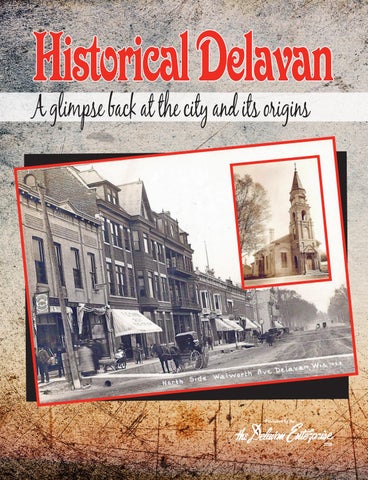
Historical Delavan A glimpse back at the city and its origins
Published by the
2018
Page 2
HISTORICAL DELAVAN • 2018
Not feeling well? Minor injury? Just call us.
When you are in pain, have an uncomfortable fever, pulled a muscle, or suffer from minor burns, you want to see a doctor or nurse as soon as possible. That’s why the health care experts at Mercy Delavan Health Center now offer same-day appointments for non-emergency concerns.
Call us for same-day appointment availability Monday-Friday 8 am-6 pm
Amanda Farrell, MSN Family Medicine Nurse Practitioner Rachel T. Gronau, MD Family Practice Physician Richard N. Terry, DO Family Medicine Primary Care Silvia M. Villegas Van der Linde, MD, FACOG Obstetrics and Gynecology Womens Health Lisa Wang, MSN, APNP, FNP-C, WCC Family Medicine, Nurse Practitioner, Primary Care
Mercy Delavan Health Center 1038 E. Geneva St., Delavan, WI 53115 (262) 728-4301 307125
HISTORICAL DELAVAN • 2018
Page 3
Remembering local historian
W. Gordon Yadon
When it came time to put together checking out the Delavan Historical By Tracy this historical section on Delavan, Society Exhibit and Resource Center Ouellette I had the pleasure of going back at 633 E. Ann St., Delavan. While EDITOR through more than a decade of W. the center has been closed recently Gordon Yadon’s weekly vignettes for reorganization, they plan to open that he wrote for the Delavan Enterprise. I up again sometime this spring. Operating was the editorial assistant in the Delavan hours, according to the website, are 10 a.m. offices from 2006 to about 2012 and during to 2 p.m. Monday and Saturdays, and by that time, it was my job to type up Yadon’s appointment. column. The center features displays of local The kind and unbelievably generous man artifacts that changes four times a year and a would bring in the hand-typed pages, and wealth of historical knowledge and artifacts photos to be scanned if there were any for from the area. that week, and almost every week, he would Since 2003, the Delavan Historical apologize for not using a computer and Society’s focus has been to educate and email, but he was “old school” and liked to preserve and create awareness for Delavan’s type on a typewriter. unique and storied past, according to the I never minded typing up his copy; in website. fact, I thoroughly enjoyed it as it gave me a Historical Society annual membership history lesson of the area I was now working is $15 for single, $20 for family, $30 for in. contributing membership, and $100 for So, when working on this section, I sponsoring business membership. All knew I wanted to honor the man whom membership levels receive a copy of the was known as “Delavan’s Historian.” With society’s quarterly newsletter. Sponsoring the help of the Delavan Historical Society business memberships in addition receive for a few photos and a general history of space in the society’s Preferred Business the area, I sprinkled in some of Yadon’s Pamphlet Rack at the Exhibit and Resource vignettes throughout the publication to Center. create something a little different than I’ve The Delavan Historical Society is a done before with these sections in other federally recognized 501(c)3 non-profit communities. corporation. Donation are tax deductible to I hope you enjoy this walk back through the extent of the law. time and maybe even learn a little something For more information, visit or have your interested sparked. delavanhistory.org, or call Historical Society If that happened, I highly recommend President Patti Marsicano at 262-745-9473.
In 2010, W. Gordon Yadon stands in the Paul Lange Arboretum, which he helped create in 1962. Yadon died June 21, 2013, at the age of 90. TRACY OUELLETTE Historical Delavan
W. Gordon Yadon •
1923-2013 •
W. Gordon Yadon was replace that,” Mayor Mel By Vicky Wedig known for his uncanny Nieuwenhuis said at the STAFF WRITER ability to recall facts about time of Yadon’s passing. the history of Delavan and its Nieuwenhuis said people and his respect for everyone. Yadon respected everyone and was “His knowledge of Delavan history continued on page 4 … I don’t know if anybody could ever
Historical Delavan 2018 A glimpse back at the city and its origins Published by Southern Lakes Newspapers LLC 1102 Ann St., Delavan, WI 53115 • (262) 728-3411 Editor:....................................................................... Tracy Ouellette Creative/Production Manager: ................................... Sue Z. Lange Advertising Director: ........................................... Vicki Vanderwerff For advertising opportunities, call (262) 763-3330.
On the cover:
GET ONE FREE! WITH THIS COUPON
Good only at Delavan Lake Store through 3/30/18
Buy One Glass of Wine
Get One Free! WITH THIS COUPON
Good only at The Lounge through 3/30/18
307051
The north side of Walworth Avenue in downtown Delavan buzzes with activity in the late 1800s. Photo courtesy of the Delavan Historical Society.
Buy One Ice Cream Cone
Page 4
HISTORICAL DELAVAN • 2018
• W. Gordon Yadon respected by everyone he knew. “I cannot recall him ever having a bad word about anyone,” said Delavan Town Board supervisor and former police chief Larry Malsch. Yadon died June 21, 2013, at the age of 90. His daughter, Caryl Eyre, a registered nurse from Cleveland, was by his side in hospice care at Aurora Lakeland Medical Center in Elkhorn. “It was a good passing,” said his son, Doug Yadon. “He wasn’t in any pain.” Doug Yadon said his father’s health began to decline when he fell and broke his hip in the middle of the night June 2. He was taken to Lakeland Medical Center for a few days and then was transferred to St. Luke’s Medical Center where he was admitted to the respiratory intensive care unit for treatment of chronic obstructive pulmonary disease. “He got world-class care up there at St. Luke’s,” Doug Yadon said. “It was just incredible the attention he got.” Doctors tried to stabilize Yadon’s breathing, “but it just never got much better,” he said. After 13 days at St. Luke’s, Gordon Yadon was returned to Lakeland Medical Center and admitted to its hospice unit where he died. “It was bad there that first day, but he was ready to go,” Doug Yadon said. “He got first-class care the last two weeks.” Doug Yadon said Eyre returned to Delavan from Ohio the day after their father fell. “She stayed right with him and slept in a chair,” said Doug, who relieved his sister with frequent visits. “He was never
•
Darien
•
alone.” Doug Yadon said up until the last four days of his life, Gordon accepted visitors and was able to talk to family and friends. “He was a special guy,” he said. “His mind was really sharp.”
The historian’s history
Gordon Yadon began freelancing for the Delavan Enterprise around 1950. He served as the paper’s sports editor from 1955 to 1970, wrote the book “History of Delavan,” published a series of historical tabloids for Delavan’s 150th anniversary and wrote articles on 130 local World War II veterans for the 50th anniversary of the war. He wrote a weekly history column, “Vignettes,” for the Enterprise until 2011. Writing is only one of the many careers Yadon had. His resume includes war hero, podiatrist, postmaster and arborist. Yadon was born at his parents’ home on Racine Street in 1923. His father, Marshal Yadon, left his mother, Stella Yadon, to raise their six children during the Depression when Gordon was a boy. “He had a tough upbringing,” Doug Yadon said. Gordon Yadon and his only brother served in World War II. His brother was killed in the war in an aircraft accident, Doug Yadon said, and Gordon was awarded a Purple Heart and Bronze Star after he was shot. “He told me circumstances of how he was shot, and he was a hero,” Doug Yadon said. However, Gordon Yadon would be the last person to call himself a hero. “Dad was just a tremendously humble man,” Doug Yadon said. “He never
Allens Grove
•
Sharon
•
•
Walworth •
• Lake Lorraine
Silver Lake
Best salt prices in town. 262-728-2731 • 262-723-2199
Mike Guiler
culligandelavan.com 307055
Sugar Creek • Elkhorn • Millard • Richmond • Turtle Lake
Whitewater Lake
•
•
Williams Bay
North Lake
Wandawega Lake
•
Proudly serving the Delavan Lake and surrounding areas for over 60 years.
Authorized Dealer for Over 60 Years
wanted any recognition. He was almost embarrassed about it.” After the war, Gordon married Dorothy Madar. They had four children – Caryl, Pamela, Doug and Robert. Robert, the youngest sibling, died about 10 years ago, and Pam died after an arduous battle with ovarian cancer about four years ago. Doug Yadon said his mother’s health began to decline at that time. “When my sister Pam died, my mother was never the same,” he said. Dorothy Yadon was in the beginning stages of Alzheimer’s disease and stayed first at Rosewood Manor in Delavan and then at RidgeStone Village where her husband visited her daily. “He was just really totally devoted to her,” Doug Yadon said. “All our lives, Mom waited on him. The last five years, he totally waited on her, and always made sure she was very well taken care of. It was incredible the devotion he had to his wife.” Dorothy Yadon died in September 2011 at the age of 84 at Willowfield Nursing Home. Gordon Yadon also attended and graduated from the Chicago College of Podiatry before being recalled to active duty in the Korean War where he served as a podiatrist on the USS Glynn, a naval troop carrier. Yadon set up a private practice in podiatry for one year, then life took another interesting turn. “I was appointed postmaster,” he said in 2010. “At that time it was more of a political appointment where anyone could hold the position without experience.” He served at Delavan’s postmaster
from 1954 to 1985 and among his accomplishments was the hiring of the first Hispanic letter carrier in Delavan four decades ago. Harvey Gonzalez retired from the Delavan Post Office in 2009 after 39 years of delivering the mail. Yadon was instrumental in creating the arboretum in Delavan along with Paul Lange in 1962. He was the city arborist for many years and served as president of the Parks Board before it was incorporated into the Parks Department and the director of the arboretum. He also served a stint on the school board and was on the Spring Grove Cemetery Board. He emceed the city’s Arbor Day celebration at the arboretum and its Memorial Day celebration at Spring Grove Cemetery. He also had extensive knowledge of the city’s circus history. “Dad liked to be involved in a lot of things,” Doug Yadon said. “He loved the community, the park system, the trees.” Nieuwenhuis served with Gordon on the cemetery board and said Yadon always thought things through before sharing his opinion. “He was just a good ol’ soul that will be sorely missed,” Nieuwenhuis said. Doug Yadon said although his father’s death is difficult, his family appreciates the years they had with him. The family celebrated Gordon’s 90th birthday with him at Lake Lawn Resort on Feb. 7 and continued to play his favorite big band music for him through his last days. “We had some wonderful times,” he said. Editor Tracy Ouellette contributed to this report.
Fontana
Lafayette
Delavan
(Continued from page 3)
www.farmcityelevator.com
Family Owned Since 1966 OWNERS RANDY AND ROGER WUTTKE
5 locations to serve you Or fordville (608) 879-2904 Milton (608) 868-7521 Brodhead (608) 897-2100 Zenda (262) 275-9500
Darien (262) 724-5757 Serving Southeast & South Central Wisconsin On Farm Pick-up State-Of-The-Art Equipment
104 Wisconsin Street, Darien, WI
307058
HISTORICAL DELAVAN • 2018
FILE PHOTO Historical Delavan
The above photo, taken Jan. 20, 1885, shows the faculty and honor students of Delavan’s Wisconsin Dental College winter graduation class. The college was located in the still-standing brick building at 124 E. Walworth Ave., now occupied by Delavan Downtown Deli. Pictured front from left are: Charles Ripley, H.P. Fahr,
W.H. Shaffer, David Runkle, Squire Arnold and W.W. McCallum. Faculty members standing in rear are: Drs. George Morrison, W.A. Arnold, A.J. Rodman and D.B. Devendorf.
A bit of the area’s history Delavan sits in the middle of what was at one time an inland sea. During the Ice Age, many glaciers, the last of which was known as the Michigan tongue, covered this area. The Michigan tongue descended down what is now known as Lake Michigan. A large section of this glacier broke off, pushing southwest into the area now known as Walworth County. Geologists have called this section of the glacier “the Delavan lobe.” The first humans known to inhabit the Delavan area were Native Americans around the era of 1000 B.C. Later, between 500 and 1000 A.D., Mound Builders lived in what is now the Delavan Lake area. Mound Builders were of the Woodland culture. The effigy mounds they erected along the shores of Delavan Lake numbered well over 200, according to an archaeological survey done in the late 1800s by Beloit College. Many were along the north shore of the lake where Lake Lawn Resort now stands. The Potawotomi Indians also settled around the lake in the late 18th century, although there were only an estimated 240 in the county. Some of their burial mounds are preserved in what is now Assembly Park. From the mid 17th century through the mid 18th century, this area was known as “New France” and was under the French flag. It came under British rule and a part of the Province of Quebec following the French-Indian War. In accordance with the Treaty of 1783, it was turned over to the United States and became a part of the newly established Northwest Territory.
Page 5
Between 1800 and 1836, the Delavan area was part of the Indiana Territory, followed by the Illinois Territory, finally becoming part of the Wisconsin Territory in 1836. Statehood was granted in 1848. Delavan’s first white settlers arrived in 1836, finding the area to be dense forests with prairies on the east and west sides with plenty of game available for hunting. Lakes and streams surrounded the area. The first known settler in the Delavan area was a man from the Rockford, Illinois, area named Allen Perkins. Arriving in the spring of that year, he built a log cabin for his family at the base of the hill along what is now Walworth Avenue. That same summer, two brothers from New York arrived in Chicago with the intention of starting a temperance colony. Samuel and Henry Phoenix were hoping to form a settlement “pledged to temperance, sobriety and religion; and where should a poor, despised colored man chance to set his foot, he might do it in safety,” according to the writings in Samuel’s journal. They traveled north of Chicago in search of the most desirable spot to settle. After traveling around this area and finding nothing to their liking, Henry returned to New York and Samuel continued the search. Samuel discovered what is now the Delavan area after spending a night in an abandoned Potawotomi wigwam. He later met Perkins and Perkins’ two brothers-in-law as they were traveling the same route to Spring Prairie to get provisions. They all returned to
continued on page 6
Remembering Delavan’s diplomamill dental college
Dr. George M. Morrison was one of Delavan’s most fascinating citizens. He was an itinerant dentist, circus proprietor who employed John and Al Ringling, seller of musical instruments and sewing machines, combatant in a local newspaper war and founder and president of a Delavan college of dentistry. Although a Delavan resident most of his life, Morrison was born in Malone, N.Y., on April 27, 1837. Following a basic education, he served an apprenticeship in the office of E.G. Fitch, an established dentist, then launched his own practice by traveling in the East by horse and buggy and conducting office hours in rented hotel rooms for a week or so before moving on. In addition to extracting teeth, Morrison bottled and sold a mouthwash solution that he claimed prevented dental problems. An extrovert, suave dresser and orator, Morrison first visited Delavan in 1871 and was so impressed with the community, he decided to locate here. He enhanced his professional reputation by patenting a
continued on page 6
HISTORICAL DELAVAN • 2018
• History
• Remembering
Delavan the next day. Samuel Phoenix stayed with the Perkins family until his provisions arrived from Racine. Phoenix was a successful businessman in New York and staked many claims in the Delavan settlement. It wasn’t long before he and the Perkins family were at odds over the naming of the colony. The Perkinses had filed for the settlement to be named “Wilksbarre” but the postmaster who received the request and was to have forwarded it to Washington for approval was a friend of Phoenix and returned it instead. Phoenix was joined in Delavan by relatives and they soon outnumbered the Perkins clan. Phoenix then filed the name of Delavan with the Belmont Legislature. Born in 1793, E.C. Delavan, whose surname the city now bears, was a temperance leader in New York state. He never saw the town that carries his name. He died in 1871. Phoenix also filed the name of Walworth County, taking the name from Chancellor Rueben Walworth, past president of the New York Temperance League. Perkins eventually moved from Delavan and Phoenix then took over his claims. Before long, Phoenix held claims on most of the area. The settlement was touted as a great temperance colony to those in New England and many came west to settle here. Most new settlers were successful farmers, good businessmen and financially secure. The majority of them traveled here via steamers on the Great Lakes and came west from their landing in Racine
tooth extractor and artificial dental plate. He was one of the first in the area to utilize nitrous oxide (laughing gas), which he advertised as “vitalized air,” to extract teeth without pain. Unable to confine himself every day to a dental office routine, Morrison turned the major portion of his practice over to his brother, John, then started the Delavan Music House, offering for sale organs, melodeons and other musical instruments. One day in 1877, he sold nine organs going door-to-door in Whitewater and seven in Johnstown the following day. In 1878, Morrison was a member of the group that started the Delavan Enterprise newspaper to rival the Delavan Republican, the only other paper in town. The following year, Morrison started Dr. George Morrison’s Coliseum Circus, which traveled by horse-drawn wagons. It featured two unknown performers, Al and John Ringling, who five years earlier started their own circus in Baraboo. Also performing with Morrison’s circus were 14 mixed acts and an all-girl orchestra. After each performance, Morrison set up a dental chair and offered to perform extractions on the spot. He also hawed his cure-all mouthwash. Due to heavy rains in northern Wisconsin throughout June, Morrison’s circus returned to Delavan following the Fourth of July. Morrison then launched a new venture when he founded the Wisconsin Dental College during the summer of 1880. It was evident from the start that Morrison’s college was going to be a bogus diploma mill because merit would be the qualification for graduation rather
(Continued from page 5)
continued on page 7
(Continued from page 5)
Dr. George M. Morrison
than matriculated hours of study. George Tallman, editor of the Delavan Republican and a nemesis of Morrison, had this to say about the proposed Delavan college in his Aug. 20, 1880, issue: “We allude to the organization in our midst of the Wisconsin Dental College. This scheme, we believe, is the exclusive product of the massive brain of our unanimous friend, Dr. George Morrison, dealer in sewing machines, musical instruments, traveling circus shows and soon to become Professor of Dental Jurisprudence in the college he has
founded. “At any rate it behooves the Republican to suitably notice the establishment of so important an industry among us as this tooth extracting institution promises to become. Knowing from the honorable character of the incorporator that no ‘honorary degrees’ will be conferred without the individual thus honored, exhibiting satisfactory guarantees that he is deserving of the compliment.” The college utilized the three-story brick building at 124 E. Walworth Ave. During the 1800 to 1885 period the college graduated hundreds of dentists. Mail order degrees were sold to European applicants for $200. Students attending the college for only a few weeks were graduated upon payment of registration fees ranging from $50 to $400. Faculty members included Morrison and his brother, John, local physicians F.L. Von Suessmilch, A.J. Rodman and D.B. Devendorf, and dentist W.D. Runkle. Von Suessmilch was instrumental in having the college closed in 1885. Morrison then returned to private practice but he died at his south Third Street home a year later on Jan. 14, 1886. He was 49 years old. Nearly 30 years later the Delavan Enterprise received a letter from Dr. W.H. Shaffer of North Manchester, Ind., a graduate of the Wisconsin Dental College who was in high praise of the Delavan institution. He said he studied at Northwestern and other schools of dentistry, but the Delavan college was the best of all. The building that housed the Wisconsin Dental College still stands at 124 E. Walworth Ave.
Family Owned and Operated Since 2007
W8896 County Hwy. A, Delavan
(608) 883-2100 Check out our hours at www.stallerestate.com
Rent our facility for:
Stop in to enjoy Complimentary Wine Tasting Relax with a glass of wine and a cheese platter in our sunroom and gazebo looking out at the vineyard. Watch Our Website for exciting Changes Coming Soon!
• Birthday Parties • Bridal Showers • Bachelor/Bachelorette Parties • Group Outings • Family Gatherings Groups and Buses Welcome
NEW Wines • NEW Food Options Wine Flights • Delicious Picnic Platters Wine & Chocolate Pairings Enjoy a Picnic Overlooking the Vineyard tO Get all OF Our uP tO Date event inFO
307052
Page 6
• History
HISTORICAL DELAVAN • 2018
Page 7
(Continued from page 6)
by wagon. Most stayed with Phoenix until their own cabins were built. He also had established the first general store in town. Land sold for $1.35 an acre and primarily was used for agriculture. Wheat crops were the most predominate and brought a good cash flow to the farmers. The Baptist church, organized in 1839 was the first church in the newly formed town. From this church grew the first anti-slavery and temperance societies in Wisconsin. The belief in temperance was so strong that it was included in all deeds that no alcohol could be bought or consumed on the premises. This unconstitutional inclusion was outlawed in 1845. Samuel and Henry Phoenix completed construction of the town’s first gristmill in 1839 at the current Mill Pond site. It could grind 100 barrels of wheat per day and was the main business in Delavan for the remainder of that century. The owners had rights to build a dam and control the water levels and the power used at the mill. Most of the settlers were from New England and were not tolerant of the Europeans that tried to settle in the area. Many travelers were turned away from the inn, operated by Israel Stowell. Now the oldest building in Delavan, it still stands at the southwest corner of Walworth Avenue and Main Street. The Phoenix brothers died within two years of each other, Samuel in 1840 from tuberculosis and Henry in 1842. Both are buried in Old Settler’s Cemetery, located in the 300 block of McDowell Street. About six months after Henry’s death, the first town meeting was held at Israel Stowell’s. William Bartlett, a half-brother of Samuel and Henry, was elected chairman. It is said that he did not possess their leadership qualities. The circus arrives In 1847, Edmund and Jeremiah Mabie, proprietors of the U.S. Olympic Circus — then the largest traveling show in America — chose Delavan for their winter quarters, a year before Wisconsin attained statehood and 24 years before the Ringling Brothers raised their first tents in Baraboo. The Mabie brothers chose Delavan due to its ability to support the circus horses and other animals. These animals were the most important assets to the 19th century circus, both for transportation and performance. Delavan’s abundant pastures and pure water provided everything the Mabies required. The Mabie Circus stayed at the present site of Lake Lawn Resort on Delavan Lake, where it created a circus dynasty that survived in Wisconsin for the next 100 years. As time passed, the circuses grew in strength and numbers; hundreds of clowns and circus performers from more than 26 circuses set up their winter quarters in Delavan from 1847 to 1894. The P.T. Barnum Circus, “The Greatest Show On Earth,” was founded in Delavan in 1871. But as times changed, so too did the circus era in Delavan. It came to an end in 1894 when the E.G. Holland Railroad Circus folded its tents. Except for a handful of local performers, who continued the tradition, the circus vanished from the community. Within a generation, the familiar ring barns and circus landmarks were gone. On May 2, 1966, the U.S. Postal Service selected Delavan to issue the 5 cent American Circus commemorative postage stamp. Today, more than 150 members of the old Circus Colony are buried in Spring Grove and St. Andrew’s cemeteries.
The Mabie brothers took over where the Phoenix brothers had left off. They were financially well off and soon owned more than 1,000 acres in the township. They purchased the Phoenix brothers gristmill, orchestrated the original plank road that was laid from Racine to Delavan and saw to the completion of the Racine-Mississippi railroad to this point in 1856. Edmund served a term as village president and they were both extremely fundamental in the development of Delavan during the preCivil War era. In the late 1840s, many new immigrants came to Delavan but were not welcomed by the Baptist element already established here. Many of the new arrivals were Irish and Catholic and settled in the Darien area. In 1856, many more Irish laborers arrived with the construction of the railroad and settled here. Wisconsin School for the Deaf is formed, manufacturing begins The Wisconsin School for the Deaf was founded on April 19, 1852. It is situated high on a hill, overlooking Delavan, on land donated to the state for its sole use by Franklin Phoenix. Phoenix was a friend and neighbor to the Ebenezer Chesebro family, whose daughter Ariadna was deaf. Chesebro had employed Wealthy Hawes to teach his daughter in 1850. Hawes himself was hard of hearing and had attended the New York Institute for the Deaf and Dumb. As Delavan’s population grew, so did the increase in the deaf population. By 1852, Hawes successor John A. Mills was teaching eight area children and the need for state assistance became apparent. The Chesebros, along with some help from friends and neighbors petitioned the state for a school, the land was donated and the school was opened. The first manufacturing plant was built in Delavan in 1861. Founded by Trumball D. Thomas, it manufactured windmills and wooden pumps. It employed 35 men. Over the years it grew and evolved and included a foundry and machine shop. Sixty-four Delavanites perished in the Civil War, more than all other wars combined. Following the Civil War, many manufacturers built in Delavan, including the Logan cheese factory, the VanVelzer cigar factory, the Jackson tack factory and the N.W. Hoag grain elevator. Delavan Lake developed Development at Delavan Lake didn’t begin until the first permanent residence was built by Dr. Fredrick L. VonSuessmilch in 1875 along the north shore. Mamie Mabie opened a small hotel at Lake Lawn three years later. A steamboat launch was built at that location also. The next 20 years saw a building boom of private houses, hotels and resorts. Most of the residents were summer retreats for Chicagoans who came up on the train, which at that time stopped here six times a day during the summer months. Livery buses took people from the train station in town to the resorts around the lake. Many changes came to Delavan in the last decade of the 19th century. Fires devastated the business district in both 1892 and 1893. A new school was built in 1894. Electricity was first brought to town in 1896. Delavan became a city in 1897. During the early 1900s, Delavan became a recognized art center. The Chicago Art Institute held summer classes here for 15
continued on page 9
A production of “St. Elmo” was held one night only at the Opera House on June 20, 1919. SUBMITTED PHOTO Historical Delavan
Recalling stage shows at Delavan’s Opera House For nearly 50 years the Delavan Opera House, located at the southeast corner of Walworth Avenue and Second Street, By W. Gordon Yadon CORRESPONDENT was the entertainment hub of the community. Erected in 1893 by Newton O. Francisco and J.F. Fishman on the site of the McKey’s Opera House, which was destroyed by fire on June 1, 1892. The two-story brick building was razed in 1991 agter a condemnation order. The building contained business spaces on the ground floor. The opera house was located on the second floor and contained a 60-by-28-foot stage, adjoining dressing rooms, a 520-seat auditorium and 120-seat balcony. An iron fire escape was installed against the west wall, which would descend to the street upon weight bearing. Since its July 18, 1893, grand opening, the opera house was used for various types of entertainment and assembling, including theatrical productions, variety shows, boxing and wrestling matches, an international poultry show, high school plays and graduations, a circus, dog shows, roller skating rink and various lectures and meetings. The only entrance to the opera house was located adjacent to the alley on South Second Street and required ascending 40 stairs to reach the ticket office and auditorium, which was laborious for most of the elderly. After the Delavan Theatre opened in 1929, the opera house declined in popularity. It was almost condemned several times as a “fire trap.” Its last known public performance was presented by the J.B. Rotnour players in 1944. The building was owned by Francisco-Fishman and their heirs for 60 years. After World War II, the opera house was used in the manufacturing of plastic items, baby bibs, soakers, tablecloths and storage. In 1964 an attempt was made to start a teenage music-dancing center. Joe Murphy rented space for Royal West Martial Arts. On Aug. 8, 1987, heavy rain was thought to be responsible for the collapse of the central portion of the roof, causing considerable damage to Joe and Patti Hamill’s Rexall Drug Store, located on the ground floor, and Murphy’s Martial Arts Center in the opera house auditorium. Delavan building inspector Jim Deluca condemned the building, which was razed in 1991.
HISTORICAL DELAVAN • 2018
5.00 OFF
$
$75 Beef Box
$25 g IN DraW y EvErtH MoN
$50 Variety Box of Beef & Pork
Promo Code Historical Delavan Reservations suggested for family entertainment at its Best!
try our al caPone roast
Regular Price 27.50 per person
$
Dancing Horses Theatre: Open Year Round! Animal Gardens Petting Zoo: Open May-Oct.
large Variety of Brats, hot dogs & more!
For further details www.thedancinghorses.com
Variety of snack sticks 5 kinds of jerky landjaeger and cheese curds • Beef sold whole, half or quarter • Pork or lamb sold whole or half
262-728-8200 5065 Highway 50, Delavan, WI 53115 Minutes west of Lake Geneva
Full Retail Counter of Fresh Meats
All cut, wrapped and freezer-ready. Sold by hanging weight, subject to cutting loss
WiScOnSin chEESE
307057
• Tune-ups • Exhausts • Lifetime Mufflers • Brakes • Large Range Passenger Tires • Automatic Transmission Service
On-Site Processing to Ensure Quality & Freshness!
24 HOUR TOWING Purcell’s (262) 728-9522
N4290 US Hwy 14 Darien, WI 53114
terry furseth, manager
(262) 728-5788
Sorg’s Gift Card
306958
262-724-5554 307053
Good neighbors you can count on. Community-focused, independently minded, locally grown. You live in the Stateline area, shouldn’t you bank here too? We think so. Relationships to us are more than business transactions, they’re about getting to know you – our neighbors – and helping families and local businesses flourish. We believe our rich history and strong connection to the community is what allows us to continue to provide great service and Sound Advice. With 16 locations in Southern Wisconsin and Northern Illinois, we are the most convenient local bank around!
Come visit us and we'll show you why banking local matters. Member FDIC
bankatfirstnational.com | 800.667.4401
307056
Page 8
HISTORICAL DELAVAN • 2018
• History
Page 9
(Continued from page 7) years. Famous artists that had studios here include William T. Thorne, Adolph and Ada Schulz, Frank Dudley and Frank Phoenix. The Bradley Knitting Company was established in 1904. The first major manufacturer in town, it employed up to 1,200 people over the next 30 years. Delavan saw a rapid growth in building after Bradley opened. The average new home during that period cost $1,800. Paving the way The first paved street in Delavan was Walworth Avenue between Terrace and Fourth streets in 1913. Bricks were laid at a cost of $1.79 per square yard. Sidewalks soon replaced the boards that had previously been used to walk on. In 1915, a three-block boulevard was built between Fourth and Seventh streets on Walworth Avenue. The brick streets still remain, although they were redone in the late 1990s. The boulevards still remain an attractive sight on the main street through town. During this same time period, Aram Public Library, the Delavan Post Office and streetlights were added to the downtown area. Horse and buggies gave way to automobiles and plumbing went from outdoors to indoors. Dairy farming took over as the leading agricultural income and milk was transported to Chicago by train. Delavan lost 16 servicemen during World War I. Influenza during that same time claimed the lives of many at home. Surviving the Great Depression Delavan’s strong economy helped to see it through the Great Depression, keeping it a bit less devastating than it was for many areas of the country. The resorts and ballrooms around the lake were instrumental in keeping the economy alive. Slot machines were abundant in the ballrooms and were known to have caused a few gang warfare incidents. As the Depression wore on, Bradley Knitting Company fell into hard times. A Chicagoan by the name of George W. Borg came in and loaned the business some capital. He also opened a small manufacturing plant that made clocks for automobiles. Borg was also largely responsible for the development of the automobile clutch. Around this same time, William C. Heath developed Sta-Rite Products that manufactured water systems. Heath later designed landing gears for B-17 and B-29 bombers and developed a high-speed submersible pump that was used in the capture of a German submarine. In 1940, Thomas B. Gibbs started a factory that manufactured timing and electrical devices. During World War II, Borg and Gibbs completed more than 30 contracts for the U.S. government. Because of the number of government contracts, Delavan was listed as one of the top 10 prime targets for enemy sabotage. Delavan was immediately affected by the bombing of Pearl Harbor when Walter Boviall, a DHS graduate, went down with the Arizona. Twenty-three Delavan servicemen lost their lives in this war. Government contracts kept Delavan’s economy healthy during this time. The late 1940s and early 1950s brought a building and baby boom to Delavan once again. The Korean War took the lives of three Delavanites. Progress brought a new water tower, which is still in use in Tower
continued on page 10
SUBMITTED PHOTO Historical Delavan
The 1899 Delavan High School baseball team included: catcher Harrie Utley (front from left), student manager Martin Kelley, pitcher Fred Coulthard; standing: shortstop John Burrows, pitcher and third baseman Charles Sturtevant, first baseman Ray Lowe, right fielder Bradley Tyrrell, left fielder Charles Hanover, second baseman Earle Horton, center fielder Howard Sturtevant and utility Harley Jones.
What happened to the DHS baseball team of 1899? For several years an enlarged photo of the 1899 Delavan High School baseball team appeared on the wall of Max Schmaling’s food market and later Pick’n Save and Piggly Wiggly. When the latter’s historical photo collection was discontinued it was offered at silent auction with proceeds to the Delavan Historical Society. Tim Sturtevant, whose grandfather and a cousin are shown as team members, was presented with the 5-by-3 photo by the successful bidders, his children. Following is a capsulation of what happened to the team players after this 111-year-old photo was taken, starting with the trio posed in front. From the left: Harrie Utley – Married Bernice Langley and for several years was associated with his father’s meat market. Later traveled 29 years as a sales representative for Armour and Co. Died Dec. 24, 1947. Buried in Spring Grove Cemetery. Survived by a daughter, Jan (John) Lehman. Martin Kelley – Graduated from DHS, 1901. Attended DePaul University. Was traveling auditor for Libby, McNeill and Libby. Joined Yellow Cab Co. and was general manager and organizer of its fleet in Australia. Later became auditor for Maytag Co. Upon retirement served as county supervisor and as member of Walworth County Selective Service Board during World War II. Remained single and died Dec. 15, 1945. Buried in St. Andrew’s Cemetery. Fred Coulthard – Became a baker and worked for his brother-in-law, Fred Ebbers in Burlington. Returned
to Delavan and purchased bakery from Goodrich and Son at 310 E. Walworth Ave. Lived with wife Elinor in apartment above 322 E. Walworth Ave. Moved to Milwaukee where he was involved in the baking business for several years prior to his death. Standing from left: John Burrows – Graduated DHS, 1901. Obtained engineering degree. Became vice-president of International Chemical Corp. of New York City, which operated mines in Florida. Later attained presidency of Potash Chemical Co., Carlsbad, N.M. Died while on business trip to Rapid City, S.D., April 27, 1943. Survived by wife, Ann, and two children, Barbara and Richard. Charles Sturtevant – Was employed 20 years at Bradley Knitting Co. Served on Delavan Fire Department, 1899-1927, responding to 750 fire calls. Married Ella Collins, 1909. Children: Charlotte (Brad) Liddle, David (Vicki) and Charles. Employed as custodian at Delavan Public School. Was an avid sports fan. Died March 22, 1968. Buried in Spring Grove Cemetery. Roy Lowe – Graduated DHS, 1901. Operated furniture and undertaking business in Kewanee, Ill., for 14 years. Returned to Delavan and became purchasing agent at Bradley Knitting Co., later an accountant at Thomas B. Gibbs Co. President of Delavan School Bard for 12 years. Married Ethel Hewes. Children: Laverne, who died in infancy, and Kathleen (Donald) Knight. Died April 18, 1950. Buried in Spring Grove Cemetery. Bradley Tyrrell – Graduated from
DHS in 1901 and Beloit College in 1905. Vice-president and director of sales at Bradley Knitting Co. for 25 years. Vicepresident at Beloit College, 1938-39, and acting president from 1942-44. Married Kate Root in 1907. Children: William, Bradley, John, Katherine and Nancy. Died March 8, 1964. Buried in Spring Grove Cemetery. Charles Hanover – His father was Delavan physician. In 1899, infant sister was killed when a marble mantel fell on her. Child’s mother died of heart attack while trying to lift mantel. Both are buried in St. Andrew’s Cemetery. Charles moved to Seattle in 1907 and became engaged in the pharmaceutical profession. Earle Horton – Graduate of DHS, 1901. Married Mande Van Velzer. Farmed in Saskatchewan for six years, returned to Delavan and became partner with father in operation of Horton Milling Co. Caught hand in mill machinery resulting in serious infection and tetanus, which claimed his life Jan. 8, 1915. Interred in Spring Grove Mausoleum. Howard Sturtevant – Married Alma Coxe and farmed west of Delavan. During the flu epidemic of World War I, contracted double pneumonia, which claimed his life March 17, 1919. Had two brothers, Robert and Frank, and a sister, Nellie (Peter) Lerwick. Buried in Spring Grove Cemetery. Harley Jones – Was successful farmer in Darien Township. Enjoyed hunting and fishing. In retirement moved to Florida. While visiting his nephew, Royal Jones, died at Lakeland Hospital Nov. 21, 1951. Buried in Darien Cemetery.
Page 10
HISTORICAL DELAVAN • 2018
• History
(Continued from page 9)
Park. Borg Industries and Ajay Industries joined the industrial firms of Delavan. The Mill Pond was dredged during this time and began to be used for swimming and ice skating. It still serves those purposes today. The new Delavan-Darien High School was built and the first senior class to graduate from it was the class of 1958. The 1960s brought the assassination of President John Kennedy, who had stopped in Delavan during his presidential campaign. George Borg, son of George W. Borg was elected to the State Senate. A D-DHS graduate, Gary Burghoff launched his acting career in the role of Radar O’Reilly in the movie “M*A*S*H” followed by the TV series. The Vietnam War took the lives of six area servicemen. Local attorney, Ernst John Watts became Walworth County Circuit Judge. Delavan was chosen as the First Day Cover city for the issuance of a 5-cent commemorative American Circus postage stamp. The Lange Memorial Arboretum opened, and a large section of the north shore of Lake Comus was donated to the city by Ben Dibble for use as a wildlife and botanical refuge. The 1970s through the 1990s saw more growth both in industry and residential aspects. Joining the businesses in Delavan were Swiss Tech and Andes Candies. Highway 15 was expanded to a four lane interstate highway and became Interstate 43, running from Beloit to Milwaukee. Delavan’s first female mayor was elected in 1976. Beth Supernaw had served on the common council, representing the second ward. Fires devastated the city during this decade. In 1978-79, The Colonial Hotel, the American Legion and the Ajay South Second Street buildings were all destroyed by fires. Since then, Delavan has become the home of Waukesha Cherry-Burrell, Stock Lumber, Bergamot Brass and other
industrial companies. Ajay closed is doors in the 1990s. Geneva Lakes Kennel Club brought greyhound racing to the lakes area. Two shopping centers built in the late 1980s on the east side of town added many
shopping alternatives to area residents. A few additional businesseshave been built along Highway 50 since then. The information in this article was taken from History of Delavan as published by
The Delavan Enterprise and the website Wisconsin School for the Deaf State of Wisconsin. The original text was condensed and paraphrased by Carla R. Strating and is courtesy of the Delavan Historical Society.
SUBMITTED PHOTO Historical Delavan
Remembering the Delavan boys band of 1922
During the 1921-22 school term, Delavan High School boasted an outstanding boys band directed by Oscar Kluck. On Nov. 3, 1921, it was selected to perform in the Milwaukee Auditorium during the opening session of the Wisconsin Teachers Convention. During the following winter the band presented a series of concerts at many schools throughout the state. Band members included: Brad Liddle and Richard Sheehan (sitting on drums), Tom Lynch (front from left), Russell DeVitt, Theodore Richards, Jay Reader, Howard Haase, Harvey Haase, Howard Kenney, Edwin Nichols; second row: Lloyd Heiss, William Campbell, Martin Morrissy, Russell Phillips, director Oscar Kluck, Newton Heiss, Raymond Sullivan, Lawrence Ells, Clarence Ravn, Ralph Bashaw and John Heiss; back row: William Bicey, DeVall Robinson, Eber Crosby, George Gould, Daniel LaBar, Harold Kenney, Mark Goodger, Donald Meracle and Donald Kenney.
Meet the Delavan Gun Club of 1875
The Delavan Gun Club, acting postmaster at the By W. Gordon Yadon Delavan post office after organized by John B. CORRESPONDENT Delany, was comprised of Adele Barnes was found several noteworthy citizens. $2,500 short during an Delany’s parents were Delavan’s inspection. first Irish settlers having arrived here Although not even distantly related, in 1847. His birth took place on St. Delany married Margaret Delany in Patrick’s Day 1850. 1880. They had no children and for After attending Delavan’s school many years lived at 112 S. Sixth St. through eighth grade, he served an Delany died May 22, 1927. His apprenticeship under a local carpenter, funeral was conducted at St. Andrew then traveled to the Black Hills in a Catholic Church in Delavan by the Rev. gold prospecting venture. After a year J.J. Shanahan, followed by burial in the he returned to Delavan and opened a parish cemetery. grocery story. In 1886 he sold the store No story on Delany would be and opened a cigar factory. complete without the mention of his For nine years, commencing in hunting dog, which was lost near 1887, he managed the Lake Lawn hotel Deadwood in Black Hills country and during the summer months. He then somehow managed to travel more than assisted James Weed in the operation of 900 miles to its Delavan home. the Mettowee hotel on Delavan Lake’s Other members of the Delavan south shore until it burned to the ground Gun Club included Harrison Doane, in 1900. a druggist who was killed during a For several summers, Delany fire-explosion at his store on April 24, operated the food concessions at 1890; Charles Sage, part owner of the Assembly Park. In partnership with Highland Resort on the north shore his brother-in-law, J.F. Fishman, he of Delavan Lake and a local lumber purchased the Delavan House Hotel, company; Newton Francisco, former and with Newton Francisco became part Delavan mayor, blacksmith and wagon owner of the Delavan Opera House. maker; and Seth Hollister, who served In 1905 Delany was appointed two terms as Walworth County sheriff.
SUBMITTED PHOTO Historical Delavan
Members of the Delavan Gun Club, and their well-trained dogs, posed for this 1875 photo taken by local photographer Charles Wilkins. Pictured front from left are: Charles Sage, John B. Delany, A.R. Barer and Seth Hollister; back row: Tom Crocker, Newton Francisco and Harrison Doane.
George L. Collie won recognition as scientist-educator HISTORICAL DELAVAN • 2018
George L. Collie was a member of Delavan High School’s first graduation class in 1875. Following graduation from Beloit College he served two years as principal of Delavan’s public school prior to obtaining a master’s degree and Ph.D. at Harvard. Commencing with 1893 he launched a 38-year career at Beloit College, which included professorship of geology and anthropology and two terms as acting president. During World War I he took a leave of absence to accept a YMCA position as counselor to combat troops in France. During his tenure at Beloit, Collie led many scientific expeditions to Africa, Alaska, Italy and mountainous areas throughout Europe. As early as 1890 Collie maintained the birth of mankind took place in Africa. In 1910, after completing a 40,000-mile expedition throughout a major portion of the world, he announced that Africa, if properly managed, would eventually become the most important continent on this planet. Collie further stated that all colonialism in Africa should stop and sanitation, land and wildlife conservation practices immediately implemented. Collie was also a strong proponent of women’s rights, state in 1922, “It is the duty of western nations to pave the way
for enfranchisement of women throughout the world, especially in occidental countries as no civilization can rise above the status of its womanhood.” George Lucius Collie was born Aug. 8, 1857. His father, Joseph, served as pastor of the Delavan Congregational Church for 41 years. His mother, the former Anne Elizabeth Foote, was the daughter of Rev. Lucius Foote, who was pastor for the Delavan Congregational Church from 1847 to 1854. Following graduation from DHS and Beloit College, Collie accepted employment in the office of the Burlington, Quincy & Alton Railroad and a summer position in the management of Camp Collie, a Christian retreat in Williams Bay started by his father and uncle. During this period Collie became interested in the Indian history of the area, chartering existing effigy mounds and collecting artifacts. He also took a keen interest in glacial studies and authored several articles on the subject. In 1885 he established the first weather reporting station in the county. During this time he took a keen interest in temperance and presented a lecture at a meeting of the Delavan Temperance Union. A teaching opportunity arrived in 1885 and he accepted the assistant principalship
A Cut Above the Rest
Family Owned & Operated Since 1974
Ohio. They later adopted two children, Tannissee and Kenneth, and settled in their Beloit home at 905 Church St. In 1910-11 Dr. Collie headed a worldwide expedition. Too old for military duty in World War I, he offered his services as YMCA counselor and was assigned to the U.S. 1st Army in France, where he served during the Battle of Verdun. After the war he returned to Beloit and was instrumental in establishing the Legan Museum. On two separate occasions he served as acting president of Beloit College. In 1928, at the age of 71, Dr. Collie made his last expedition, traveling to Algeria, accompanied by his former student, Paul Nesbitt, who later gained fame as a pioneer nature film producer. Approaching his 74th birthday, Collie retired from Beloit College in 1931, but remained active in research, writing and speaking for the following 22 years. His wife died in 1953 at the age of 83. The following year he suffered a fractured hip, following a fall in his home, pneumonia developed and his death took place Dec. 28, 1954, in his 97th year. Services were conducted at the Beloit Congregational Church followed by burial in Delavan Spring Grove Cemetery.
George L. Collie
of the Delavan public school. Two years later he became principal. He resigned the post in 1889 to accept a Morgan fellowship to Harvard University where he obtained a master’s degree in geology in 1890 and a Ph.D. in 1893. The same year he accepted the position of geology professor at Beloit College. In 1896 he married Kathering Evelyn Burrow, a registered nurse from Xenia,
Your Full Service Grocery Store
Page 11
• Full Deli Department, Party Trays Available • Fresh Salad and Hot Food Bar • Produce Delivered Fresh Daily • Full Service Meat Department, Will Cut To Order • In-House Bakery, Custom Cakes • Floral Arrangements and Plants for All Occasions • Complete Liquor, Wine & Beer Department
Open 7 Days a Week 6 a.m. to 10 p.m. Quality From Our m Fa ily To Yours
tly Delavan nien e v n d o 1414 E. Geneva St. C ate Loc in the Shopko Shopping Center
262-728-2638
Stinebrink’s Liquor Store (Next Door) Largest Liquor Store in the Area
262-740-0541
Lake Geneva 100 East Geneva Square in the Geneva Square Shopping Center
262-248-8798 307123
Page 12
HISTORICAL DELAVAN • 2018
Write Your Chapter
140 Years in the Making
LakeLawnResort.com
ϮϰϬϬ ĂƐƚ 'ĞŶĞǀĂ ^ƚƌĞĞƚ͕ ĞůĂǀĂŶ͕ t/ ϱϯϭϭϱ ͮ ϴϬϬ͘ϯϯϴ͘ϱϮϱϯ Where memories are made and stories are relived
Delavan The Heart of Walworth County, Wisconsin Proudly an Serving Delav since 1878ŬĞƚ
Chamber of Commerce Building
Ăƌ dŚĞ ĞůĂǀĂŶ D ĞĚ ŝŶ ŝnj ĂŶ ƌŐ Ž Ŷ ŝŽ ƐƐŽĐŝĂƚ ŐĞƐ ĂŶ ĐŚ Ğ Ăŵ ϭϴϳϴ͘ E ŝǀŝĐ ŝŶĐůƵĚĞ ĞůĂǀĂŶ ĂŶ ůƵď ĂŶĚ ĞůĂǀ Ğ͘ Ƶ ĂŐ >Ğ Ɛ ĞŶ ŝƚŝnj ǁĂƐ Ğ Ăŵ Ŷ Ğ ƚŚ /Ŷ ϭϵϮϵ ĞůĂǀĂŶ ĐŚĂŶŐĞĚ ƚŽ ƚŚĞ ŵĞƌĐĞ͘ ŵ ŚĂŵďĞƌ ŽĨ Ž
ĞůĂǀĂŶ ,ŝƐƚŽƌŝĐĂů ^ŝƚĞ
ĞůĂǀĂŶΖƐ ŽůĚĞƐƚ ďƌŝĐŬ ďƵŝůĚŝŶŐ͕ ĞƌĞĐƚĞĚ ŝŶ ϭϴϰϭ͘ dŚĞ ďƌŝĐŬƐ ǁĞƌĞ ŵĂŶƵĨĂĐƚƵƌĞĚ ďLJ ƚŚĞ ĞůĂǀĂŶ ƌŝĐŬ ŽŵƉĂŶLJ͘ dŚĞ ďƵŝůĚŝŶŐ ǁĂƐ ƚŚĞ ĐĞŶƚĞƌ ŽĨ ůŽĐĂů ĐŽŵŵĞƌĐĞ ǁŚĞŶ ŝƚ was built as Delavan’s General Store. The building has been a post office, residence, ĐŚƵƌĐŚ ĂŶĚ Ăƌƚ ŵƵƐĞƵŵ ŽǀĞƌ ƚŚĞ LJĞĂƌƐ͘ ^ŝŶĐĞ ϭϵϳϴ͕ ŝƚ ŚĂƐ ďĞĞŶ ƚŚĞ ĞůĂǀĂŶͲ ĞůĂǀĂŶ >ĂŬĞ ƌĞĂ ŚĂŵďĞƌ ŽĨ ŽŵŵĞƌĐĞ ŽĨĨŝĐĞ ĂŶĚ ǁĂƐ ƚŚĞ zĂĚŽŶ ,ŝƐƚŽƌŝĐĂů DƵƐĞƵŵ͘ dŚĞ ĞůĂǀĂŶ ,ŝƐƚŽƌŝĐĂů DƵƐĞƵŵ ŝƐ ĐƵƌƌĞŶƚůLJ ŚŽƵƐĞĚ Ăƚ ϲϯϯ ŶŶ ^ƚ͘ tĞďƐŝƚĞ͗ ĚĞůĂǀĂŶŚŝƐƚŽƌLJ͘ŽƌŐ
Founders & Tem
p
erance Beginning KŶĞ ŽĨ ƚŚĞ ŵƵƌĂů s Ɛ ƉĂŝŶƚĞĚ ŽŶ ƚŚĞ ǁ ĂůůƐ ŝŶ ĞůĂǀĂŶ ŝƐ ŽŶ ƚŚĞ ŚĂŵďĞ ƌ ďƵŝ history of Delavan ůĚŝŶŐ͘ dŚĞ ŵƵƌĂů ĚĞƉŝĐƚƐ ƚŚĞ ’s ,ĞŶƌLJ WŚŽĞŶŝdž ĂŶĚ beginning. In 1836, brothers Žů͘ ^ĂŵƵĞů WŚŽĞŶ tŝƐĐŽŶƐŝŶ dĞƌƌŝƚŽƌ ŝdž ĐĂŵĞ ƚŽ ƚŚĞ LJ ĨƌŽŵ E ƚŽ ĞƐƚĂďůŝƐŚ Ă dĞŵ Ğǁ zŽƌŬ ƚŽ ĨŝŶĚ Ă ůŽĐĂƚŝŽŶ ƉĞƌĂŶĐĞ ŽŵŵƵŶ ŝƚLJ͘
delavanwi.org
307124
ĞůĂǀĂŶͲ ĞůĂǀĂŶ >ĂŬĞ ƌĞĂ ŚĂŵďĞƌ ŽĨ ŽŵŵĞƌĐĞ ϱϮ ĂƐƚ tĂůǁŽƌƚŚ ǀĞŶƵĞ͕ ĞůĂǀĂŶ͕ t/ ϱϯϭϭϱ ͮ ϮϲϮ͘ϳϮϴ͘ϱϬϵϱ