JOURNAL SISTER TO SISTER:
CARING FROM A
DISTANCE
EDITION 4
NOW IS THE TIME. WORKING THROUGH A
PANDEMIC
WELCOME
W
hat a year it’s been, our lives have been turned upside down, covering our faces has become second nature and we have been forced to care for others from a distance. We have stood on our doorsteps, smiled at neighbours we have never met and joined in the common goal of applauding our National Health Service heroes. In this edition, we will be reflecting, celebrating and discussing the issues we have all faced in 2020. Read two stories from incredible colleagues who have been supporting the COVID-19 response as they share their experiences and reflections in ‘Working through a pandemic’. We can’t reflect on the past year without talking inequality. Brace yourselves for a frank and open discussion with Paul Draycott, our Director of Workforce and Communications. Read his opinion-led piece around inequalities facing Black Asian and minority Ethnic colleagues within the NHS. Paired with a moving reflection piece from our Equality and Diversity Lead Sarbjit Birk, who focuses on her experience of COVID-19.
CONTENTS
Our regular feature ‘We’ve got it covered’ dives into the topic of recovery. We spoke to The Recovery College, discussing what recovery is and what it can mean for different people and conditions.
02
Welcome
03
Contents
04
Working Through A Pandemic
We talk to Louise, a carer who has been caring for her sister for over 45 years. She tells us about the darker side of caring for someone and about how things have changed now she has been forced to care from a distance.
07
What Are You Grateful For?
08
What is this ‘Thing Called Recovery’?
09
The Doctor Will See You Now:
Jane Collard
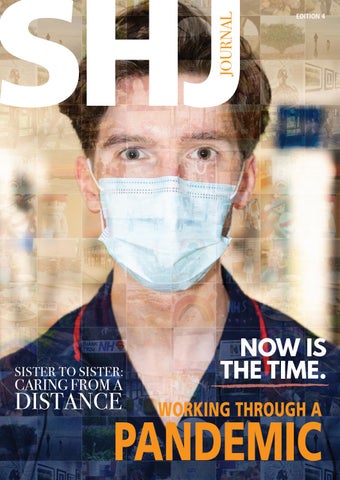
Our front cover image of the fourth SHJ, shares a mosaic of many images taken during this difficult year. An image which reflects some of the good in 2020, the strength and beauty of a community coming together.
10
Now Is The Time
12
Sister To Sister: Caring From
A Distance
14
Under The Skin of: Clare Singleton
From the bottom of the SHJ team’s heart,
15
Show Yourself Some Love
we want to say thank you…
16
Our Charity’s Response to COVID-19
17
Youthful Reflections
18
A Winter Warmer Recipe
19
Take a Break
20
Ways To Stay Well This Winter
GOT SOMETHING TO SHOUT ABOUT? We’re always on the lookout for stories and guest writers! Contact the team by emailing communications@southernhealth.nhs.uk
MEET THE TEAM! What we are looking forward to in 2021…
NDS,
Y, FRIE FAMIL EDITOR: Amy Donelan
EDITOR: Jessica Reading
EDITOR: Paula Quigley
Getting married (in the way that we have originally planned it!).
Being together without fear. I miss big family dinners and I’m looking forward to a year with a little less stress!
International travel! I missed out on South Africa in 2020 and I’m keeping everything crossed for safari sundowners in 2021!
07
health
, INESS
APP ND H
LIFE A
What are you grateful for? Our lives have changed significant during the COVID-19 pandemic and we have all become so much more grateful for the small things in our lives. We asked our staff what Natalie Duffy
Alisha Hepworth
Daniel Clark
I am looking forward to seeing my family & friends in person and giving them a huge hug! Plus being able to travel again!
Going on holiday, socialising freely and hopefully getting back to some normality!
Not being in 2020!
2
SHJ MAGAZINE
Photography by Freepix, Pixabay, Shutterstock & Unsplash
they are grateful for now, after a really challenging year. This is what they told us…
FEATURES 04 Working through a pandemic
We spoke to two of our colleagues who, like all those across the NHS, have been working tirelessly through the COVID-19 pandemic. Meet Hayley and Mathew, two of our very own NHS heroes.
08
We’ve got it covered: Recovery We asked our Recovery College, ‘what’s this thing called recovery’ in our latest ‘We’ve got it Covered’ article. We discuss what can be involved in someone’s mental health recovery and how the Recovery College might be able to help.
10
Now is the Time Read an opinion led piece by Paul Draycott, about tackling inequalities facing Black Asian and minority Ethnic colleagues within the Trust, as well as a reflective article from Equality and Diversity Lead, Sarbjit Birk.
12
Sister to Sister: Caring from a Distance Learn about the darker side of caring, as Louise shares her experience of being a carer during the COVID-19 pandemic.
04
17
Youthful Reflections Read some reflective poetry from June, a young patient at Austen House, who has been inspiring those around her with her new-found gift.
12
04
10
17 SHJ MAGAZINE
3
WORKING THROUGH A PANDEMIC Reflecting on the challenges of 2020. The COVID-19 pandemic has affected each and every person across the nation, and indeed the rest of the world. Many people have been isolated, some have lost their jobs and even loved ones. We spoke to two people who have been working through these challenging times, caring for patients and enabling NHS services to continue. Meet two of our very own NHS heroes.
4
SHJ MAGAZINE
M
athew Saunders works on Sultan Ward at Gosport War Memorial Hospital, which provides nursing and rehabilitation care. Mathew took on the role of ward manager at the beginning of the COVID-19 pandemic, stepping up from his usual role of charge nurse. “During the COVID-19 pandemic, I was responsible for leading the team on Sultan Ward. This involved implementing policy and procedure onto the inpatient ward and ensuring staff were well supported. Becoming a manager of a ward is a learning curve in any case, but commencing the role at the beginning of a global pandemic was very different. Elements such as recruitment, HR processes, budgetary control, audit and clinical governance were all new to me, and each posed a new challenge, with the added pressure of COVID-19. Caring for our patients has remained our number one priority, whilst also contending with PPE, an increase in clinical care requirements, additional challenges to prevent the spread of COVID-19, as well as our own anxieties. I was, and continue to be, so incredibly proud of the staff at Gosport War Memorial Hospital and indeed across Southern Health and our incredible National Health Service. Staff have worked diligently to continue to provide excellent patient care; from domestic staff, porters, health care support workers, registered nurses, sisters, charge nurses, therapy teams, physiotherapy, occupational therapy, doctors and the leadership teams across the inpatient wards. These past months have been the most difficult emotionally and physically – but this has enabled us to form better bonds, find new ways of working, improve communication skills and bring the teams closer together. I am grateful for my family and friends, and the support they have shown me outside of work. COVID-19 has separated families, communities and friends – but at the same time brought people together in ways no one could have imagined.”
Staff have worked diligently to continue to provide excellent patient care; from domestic staff, porters, health care support workers, registered nurses, sisters, charge nurses, therapy teams, physiotherapy, occupational therapy, doctors and the leadership teams across the inpatient wards.
These past months have been the most difficult emotionally and physically – but this has enabled us to form better bonds, find new ways of working, improve communication skills and bring the teams closer together. HAYLEY SMITH Hayley Smith has worked as part of the Trust’s People Development Team as Admin Lead and PA for three years. At the beginning of the COVID-19 pandemic, Hayley was seconded into the Recruitment Team to provide essential support in filling vital clinical roles across all services. “Working through a pandemic was never going to be easy. I was seconded to a new team as part of the NHS’s response to recruitment right at the beginning of the pandemic in March 2020. The team and I had to ensure we were getting interviews booked and outcomes in as quickly as possible so we could ensure hospitals were adequately staffed to care for our incredibly poorly patients. I was also involved in various projects during the pandemic, including the mini-heroes project, where we sent out certificates and thank you messages to the children of our staff. We also started up a new Listening Ear service for staff, who needed support during the really dark days. I would take the initial calls from staff and arrange a call back. It’s these things that I think reflect what the NHS is all about; care, community and gratitude. Little positives have kept me going, photos of colleagues’ smiling children with their certificates or a call from a candidate to say they had been successful in their role after working with them to arrange their interview. To be honest, just being part of the NHS has kept me going during the hard days, and there have been quite a few hard days. I have always been proud to work for the NHS but this year even more so. I hope we can all take something positive from this year. The sound of communities clapping on their doorsteps and the overwhelming pride. My colleagues on the frontline, putting their own lives at risk for their patients. Let us remember those days, let us remember how we came together, and let’s remember to always be kind; we never know the battles people are facing behind a smiling face.”
Photo © DICSON on Unsplash
SHJ MAGAZINE
5
I have always been proud to work for the NHS but this year even more so.
6
SHJ MAGAZINE
What I am grateful for now... We asked staff across the Trust, what they are grateful for now after the challenges of 2020. This is what they said…
My
health
The awesome humans
WHO I’M UGH TO LUCKY ENO CTED WITH BE CONNE
FAMILY, F R
IENDS,
health
LIFE AND
, HAPPINE SS
famnidlys, frie
&
H
Library
friends family AND
BEING CLOSE BY
MY FAMIL Y AND HAV ING A JOB I C AN DO PART LY AT HOME !
RE
ALTHCA
IRE HE AMPSH
My
E, MY HOM LTH MY HEA E AND TH IN PEOPLE MY LIFE
E!
SERVIC
OUR A MAZI NG NHS PEOP LE your ded icat & com passi ion on is awe-i nspir ing
Our
S SATION R E V N O C
SHJ MAGAZINE
7
WHAT IS THIS
‘THING CALLED
RECOVERY’? When we use the term recovery we are meaning that “a person with mental illness can recover even though the illness is not ‘cured’.” Recovery is a way of living a satisfying, hopeful and contributing life even with the limitations caused by illness. Recovery involves the development of new meaning and purpose in one’s life as one grows beyond the catastrophic effects of mental illness.”– Bill Anthony 1993. Mental illness can affect us all. Around one in four of us will experience a mental illness at some point in our lives and it is important to access the help you need. The Recovery College has been open for 6 years and we have lots of experience in supporting mental health, wellbeing and recovery. In our busy lives, things can sometimes get on top of us, so how can the Recovery College help? Our aim is to help increase awareness and understanding of recovery and self-management whilst challenging stigma related to mental health. We offer educational courses about mental health recovery and self-management to complement existing services. What is usually involved in someone’s recovery? It usually starts with someone educating themselves on what recovery is. Accepting recovery, embracing hope and using self-management as tools are all involved in aiding recovery. Is the journey to recovery different for everyone? Yes. Recovery is individual and at the college, we help people to explore their journeys and what helps them to manage their wellbeing day to day.
8
Mental illness can affect us all. Around one in four of us will experience a mental illness at some point in our lives and it is important to access the help you need. And how can I access the Recovery College courses? You can access the College courses by enrolling and this can be done online at www.southernhealth.nhs.uk/recovery or by calling the college on 07880 004 828.
SHJ MAGAZINE Joshua Ness on Unsplash
Hello Jane! Let’s talk about your role at Southern Health… I’m the Activities Coordinator at Antelope House in Southampton – one of our mental health inpatient units. I host weekly meetings with patients to find out what they like, and then organise everything from table tennis, to quizzes, bingo and baking! I particularly enjoy arts and crafts, and I organise an annual Arts and Film Festival for the Trust called the Excited Orange which is great fun. How long have you worked here? Almost six years now and counting… because I believe my job is about bringing sunshine and happiness to our patients wherever possible. That’s a great outlook. So, next question, if you were a superhero, what would your super power be? Well I love animals, cats especially, so maybe I’d have the power to turn unkind humans into an army of cats who would do my bidding, saving animals across the globe! Love it! Need a sidekick?! OK, time for a more whimsical question – where is your ‘happy place’? Can I travel back in time? I’d like to go back to Christmas 1966 – I was 5 years old, I’d been gifted Sindy and Patch dolls, it was snowing outside, and I was inside with my family and a real fire in the hearth. Got to be the most uncomplicated and happiest time of my life.
THE DOCTOR WILL
SEE YOU NOW
Jane Collard Activities Coordinator
Looking to the future, is there something daring or unusual you’ve always wanted to do? To be honest there isn’t much I haven’t done! Scariest thing was probably doing stand-up comedy back in 2001 when Graham Norton was in the audience. I’m delighted to say he encouraged me to keep making people smile!
in time, when their traditions and way of life were undisturbed. OK, some final quick fire questions… what’s your favourite ice cream flavour? Well, I don’t eat dairy but Ben and Jerry do a fantastic dairy-free salted caramel ice cream! What did you want to be when you were younger?
What do you do in your spare time?
A zoo keeper. No question.
I’m studying hard for a Masters in mental health recovery and social inclusion. I also make documentaries – the latest one is focused on creativity and OCD. If I have any spare time after that, I mainly drink wine!
What’s your favourite film?
What’s your favourite season?
And favourite music?
Definitely winter (but I mean a proper winter!) I love snow, seeing the countryside wrapped in a snug white blanket with the delicate pattern of animal footprints criss-crossing it.
I love dance music, the 1970s and a good old-fashioned diva! But my teen hero was undoubtedly Siouxsie (and the Banshees).
If you could swap lives for one day with someone, who would it be? I really would like to experience a day in the life of a Native American Indian – but back
I love ‘Harold and Maude’ a dark comedy about a young man fascinated by death and an old woman who is full of life. Worth a watch.
A truly eclectic mix! Thanks Jane – it’s been fun!
SHJ MAGAZINE
9
NOW IS THE TIME. In this in-depth and impassioned op-ed, Paul Draycott, Director of Workforce, Organisational Development and Communications at Southern Health NHS Foundation Trust, delivers a withering summary of inequalities facing Black Asian and minority Ethnic colleagues within the NHS and sets out how we can all take action to make the Trust a more diverse and inclusive place.
Nobody will have missed the changes in our world over the past year. Covid-19 has had a profound impact on what we do and how we do it; and so has the death of George Floyd in the US and the rise of Black Lives Matter — a movement trying to fight the centuries of discrimination and environments that don’t value diversity and inclusivity. Diversity brings richness to our world. Different heritage, ideals, values, education, talents, likes and dislikes. In teams diversity brings greater success especially when considering problem solving and innovation. Being inclusive and enabling people to thrive is essential to this organisation and in us being able to deliver the best possible services to our diverse population.
We do not allow our colleagues to progress — and it can’t be related to their ability otherwise people wouldn’t be employed. We (I) am getting this wrong. We have not been enabling people of colour to flourish in the same way as white colleagues. There are 38% of Black Asian and minority Ethnic colleagues reporting experience of bullying/harassment in the past 12 months from patients/service users/public (compared to 26% white colleagues); 12.7% experienced discrimination from their manger (5.5% white) and 72% Black Asian and minority Ethnic colleagues having equal access to career progression compared to 87% white colleagues. It isn’t pretty reading and we know it isn’t.
NOW IS THE TIME. Being inclusive — welcoming everyone and embracing difference — has to be the bedrock of our culture. Southern Health is here to be inclusive. Let’s look at the NHS. According to UK census data (2011), people from Black Asian and minority Ethnic backgrounds make up 13% of the national population (about one in eight people). However, 20.8% (more than one in five) of NHS workers are from Black Asian and minority Ethnic backgrounds: a significant overrepresentation. The richness of that diversity is part of what makes our NHS great. www.freepik.com Harryarts
Our representation of Black Asian and minority Ethnic colleagues at Band 2 is 12% and at Band 5 it is 13% — these bands are important because they are typical levels for people first entering the NHS. As we move to higher paid roles representation plummets. At Band 7 this moves to 5% and by Band 8c it is down to 3%. We attract colleagues then we “superglue their shoes to the floor.”
10
SHJ MAGAZINE
As a Trust we have committed to being fully representative of the population we serve at all levels within the next 5 years. Alongside this we have also committed to a number of other things including: following up every incident of racism reported, looking closely at Black and Minority Ethnic candidates and appointments to understand why we might not make an appointment and to publish statistics on Black and Minority Ethnic recruitment and representation within the Trust the same we publish Director pay or treatment times. It feels that we are very much at a critical point in the movement to improve social justice and eliminate racism. Diversity and inclusivity are beautiful things and reap such reward. I sincerely hope that we can look back in 10 years and say 2020 and the Black Lives Matter movement changed things for the better here at Southern Health, across the NHS, the UK and around the world.”
61% of the doctors and healthcare workers who have died from COVID-19 have been from a Black Asian and minority Ethnic background
“Covid19 has affected us all in different ways. 2020 will be the year that we all remember, the year that redefined who we are and how we feel. The year that made us all re-evaluate life.”
“THE VIRUS QUICKLY BECAME VERY REAL FOR ME AND CLOSE TO HOME”
Commented Sarbjit Birk, the Trust’s Diversity and inclusion lead
“My uncle was taken into hospital with COVID-19 for 11 weeks and he spent the majority of that time in a coma. Fortunately, he is now on his recovery journey, but I am well aware that not every family has been so fortunate. We started quarantining parcels, arranging food deliveries and of course – the obligatory video calls. It was isolating, scary but also very necessary.
“Evidence shows that those from a Black Asian and minority Ethnic background and males have been disproportionately impacted, with age and specific underlying conditions associated with more severe illness.”
As with many of my other co-workers, I started working from home, which for a sociable person to be isolated from their team colleagues, was far harder than I previously envisaged. Whilst the morale of home working is not my preferred choice, I am lucky in that my role has never been busier which has been a welcome distraction at this time.
“This is a disproportionate statistic that truly floors us all. In March, we battened down the hatches for almost half a year. I don’t think anyone could have understood what an impact the pandemic would have. “
One of my central and arguably most important projects that I worked on over the first wave was the Wellbeing Assessment Tool. I worked closely with colleagues from our Vox Pop groups to ensure the tool was accurate and robust to ensure our workforce is protected. This period has been very difficult for us all and I’ve learnt that whatever this virus throws at us we need to keep reaching out, support each other and keep connected.”
SHJ MAGAZINE
11
SISTER TO SISTER:
CARING FROM A
DISTANCE
12
SHJ MAGAZINE
When we went into our first national lockdown, my sister would call to ask what was happening. She couldn’t understand the rules put in place to protect us, she was left to just ‘figure it out’ like the rest of us, despite being vulnerable. Caring for a loved one is both rewarding and challenging. On the one hand, I wouldn’t have it any other way. However, there is a darker side to caring; the feeling of exasperation, the overwhelming responsibility, the anger at the unfairness of watching them suffer, the feelings of frustration and the feelings of guilt. Throw in a global pandemic and the challenges have become even harder, now that we are forced to care from a distance. My sister has suffered with paranoid schizophrenia for the past 45 years and is on regular medication that helps manage the symptoms, but every now and then will stop taking them. The illness at its worst makes her delusional, paranoid, confused, and very upset. I have been caring for her ever since her diagnosis, helping her to manage her condition and being there whenever she needs me, day or night. Her condition also impairs her cognitive abilities and means that my sister is unable to rationalise simple situations or understand the consequences of her actions. This often leads to a string of minor offences, where she does not understand what she has done wrong. The COVID-19 pandemic is affecting everyone and looking after our mental health has never been so important. However, what support is available to those people with existing mental health problems? When we went into our first national lockdown, my sister would call to ask what was happening. She couldn’t understand the rules put in place to protect us, she was left to just ‘figure it out’ like the rest of us, despite being vulnerable. I had no guidance or support; it was tough enough trying to get my own head around this situation, let alone having to explain to my sister that she could no longer go out and that I could no longer visit. Rules such as social distancing and wearing a facemask were hard for her to understand. I remember her getting so upset in the street when people would shy away from her – she just didn’t understand. She would get angry when I would stand outside her door to social distance and would tell me I was rude and that she didn’t want me near her – it was heart-breaking.
HAMMERSLEY HOMES There needs to be more support for vulnerable people, like my sister, living with a mental illness. I have started a charity called Hammersley Homes, working to provide a home for life for adults suffering from enduring mental illness. This is specifically for those who will not recover from their illness, giving them the same safety, security,
As a carer you feel helpless, seeing someone you love experiencing so much pain and not being able to help them. On the days when I was feeling down and she called I would feel incredible guilt; guilt that I may have been a little frustrated and tired on the phone that day. It’s surprising how little support there is out there about how other people’s mental illnesses affect our own mental health. Eventually it all got too much for her and she was admitted onto a mental health unit. This gave me conflicting feelings – on one hand I knew she was in the best place, but on the other hand I felt angry. Angry that the system had let her down once again, angry that no one had really given her or me the guidance and support to be able to manage her condition at home.
Caring for a loved one involves such a whirlwind of emotions. But no matter how hard it can be, it is nothing compared to what my sister has to experience when the illness takes her. I was unable to get vital information about her care when contacting the hospital, even as her main carer. This was incredibly frustrating and seemed so unfair. My sister just was not prepared for the outside world. The new rules we were all living with hadn’t been explained to her and this only heightened her emotions and led to her becoming extremely upset and frustrated. It’s tough seeing the frustration in the minds of those who don’t feel understood, especially when it’s no fault of their own. Caring for a loved one involves such a whirlwind of emotions. But no matter how hard it can be, it is nothing compared to what my sister has to experience when the illness takes her. She is such a strong and beautiful person inside and out. I will always, always be here for her and we will continue to fight this illness even if, right now, we have to do it at a distance.
comfort, community and friendship for life – things we all need to survive and thrive. We aim to open our first home here in Hampshire in spring 2022. To donate or get involved, or to find out more please visit: hammersleyhomes.org SHJ MAGAZINE
13
UNDER THE SKIN OF...
CLARE SINGLETON AKA... CLINICAL TEAM LEAD FOR THE SCHOOL AGED IMMUNISATION SERVICE
Growing up, I always knew I wanted to be a children’s nurse. From school to college I completed a pre-nursing course before undertaking my training at University Hospital of Southampton in 1985. I worked in hospitals until I became a practice nurse in 2001 where I led on the childhood immunisation programme.
In 2005, I joined the school nursing team. When the HPV vaccination was commissioned in 2008, I helped lead on the delivery of the programme. The school age immunisation programme now includes the yearly nasal flu vaccine, teenage boosters that include the Meningococcal ACWY vaccine, and the HPV vaccination, now offered to boys as well.
Year on year we tend to see a high uptake of the nasal flu spray but this year, in light of COVID-19, we have noticed more parents are willing to have their children vaccinated. I am optimistic that this will continue throughout the delivery of the nasal flu programme.
We, the School Aged Immunisation Team, have been very busy continuing to vaccinate and protect children this year and have adapted to new ways of working. We all carry a picture card that shows our faces so the children can see what we look like under our PPE!
Children are super spreaders. Since the introduction of the nasal flu spray for school age children there has been a significant reduction in the number of children who attend A&E or GP surgeries with respiratory related illness. There has also been a reduction in adults presenting with respiratory related illnesses, which is fantastic.�
In light of COVID-19, we have noticed more parents are willing to have their children vaccinated. 14
SHJ MAGAZINE
matters
Every Life MATTERS
!
Life
Detach here and keep safe
every
This year has been so much about looking after those around us, especially those who may be isolated or lonely. With so much focus on caring for others, it has meant that many of us have neglected our own wellbeing. Showing yourself some love can make a huge difference to your mental and emotional health.
1 2 3 4 5
Take a look at these 5 things you can do, either now or in the future, to show yourself some love. Fresh air Whether you can go for a long brisk walk or just open the window for a deep breath of fresh air, this can help to relieve those daily pressures and hit the reset button. Rest In a world of always doing or going, rest can be hard to come by. However, it is an essential part of self-care. Prioritise getting enough sleep and listen to your body when it wants to rest. You could also try a short meditation to practise the art of doing nothing. Be present Thoughts can be so overwhelming when we are thinking about the past or worrying about the future, especially as we all navigate a new world of much uncertainty. Try to bring yourself into the present moment by practising some mindfulness. What can you see? Smell? Feel? Taste? Hear? Focusing on these five points will help to reduce your anxiety and make you feel more present.
COULD
talking therapy
HELP ME?
Here at italk, we’re often asked this question. Talking therapy could help when you feel you could benefit from support, or you’ve noticed symptoms of a common mental health condition. However, we know noticing changes or possibly symptoms of a mental health condition is difficult. Here are a few to look out for: Self-crititical thoughts: If you’ve been judging yourself for things you’d forgive from a friend. Losing motivation: If it’s been weeks since you did any of the things you enjoy. Feeling on-edge: If you’ve been jumpier or noticing more distractions lately. Easily annoyed: If you’ve found yourself irritated by things that wouldn’t usually bother you. italk has a few options that are handy for just boosting your resilience, and they don’t need an assessment.
Do something you love Whether is baking your favourite chocolate brownies, reading a real page-turner, or getting out on your bike, making time for something you enjoy is a great way to show yourself love.
SilverCloud: Great for a busy or changeable schedule, it’s a website full of useful tools and activities to address the things we’ve mentioned.
Connect with others We have all become accustomed to connecting with others from a distance or virtually. However, connecting with people who are important to you is a great way to lift your mood.
Managing Moods: Ideal if you’re curious about what else we can help with. Our 6 week online course covers a wide range of skills for feeling more relaxed and getting more out of life.
Every Mind Matters is a national campaign by NHS England, focusing on self care. You can create your own Mind plan by answering five quick questions. Find out more here www.nhs.uk/oneyou/every-mindmatters/your-mind-plan-quiz
But if these things affect your life most days, we’d recommend booking an assessment to talk it through with a practitioner. Visit: www.italk.org.uk
or call 023 8038 3920
to arrange any of the options above.
SHJ MAGAZINE
15
Looking at getting
INVOLVED? Are you looking for a way to be more involved in your local NHS Trust? We have lots of ways you can get involved with Southern Health and help to support those who use our services and their
A TIME OF
GIVING
carers, including: • Become a member of the Trust • Volunteer with us
Brighterway is the charity of Southern Health NHS Foundation Trust and throughout the challenging months of 2020, they have been raising money to support the Trust’s COVID-19 appeal.
• Help us to fundraise • Share your experiences • Support our charity. If you would like to get involved or find out more about any of the above, please visit our website at: www.southernhealth.nhs.uk/ get-involved
The money was raised through a variety of fundraising efforts, donations from the local community and grants from NHS charities together. “Many of our staff were working around the clock, putting their lives at risk to provide the highest standards of care during the pandemic”, commented Ian Hynd, Head of Brighterway. “I have been so impressed by their resilience, tenacity and selflessness. I want to take this opportunity to say thank you to them and also our fundraisers without whom we would not be able to provide the level of support that we have to our staff.”
The money raised from the COVID-19 appeal has already funded more than 8,000 items for staff and patients, including wellbeing packs (with basics such as toiletries), right through to hospital gardens and relaxation rooms. Brighterway recently received a £50,000 grant from NHS Charities Together, which will have a focus on reducing loneliness and isolation within the community of Hampshire.
If you would like to find out more about Brighterway please visit www.brighterway.org.uk
@SHFTbrighterway Brighterway Brighterway Brighterwaycharity
16
SHJ MAGAZINE
The charity for Southern Health NHS Foundation Trust, your local community and mental health provider.
YOUTHFUL
REFLECTIONS 2020 has been a year for reflection – and what better way to reflect than through poetry, one of the many creative outlets that have helped to sustain us during a challenging year.
J
une is a young patient at Austen House and has been inspiring all those around her with her new-found gift for poetry. “I started getting into poetry about a year ago. I was in my old unit and I was upset and stressed, so I just started writing how I felt in that moment. That’s when I realised I had made a poem. The next day I googled poems and that’s when I knew I wanted to continue writing like this.
I write how I feel down on a piece of paper. Most of these emotions include being low, happy, in love, angry. “I write how I feel down on a piece of paper. Most of these emotions include being low, happy, in love, angry. Sometimes I write about how I feel when I’m dancing, singing or supporting other people. “The first book of poetry I ever read was ‘The poetic underground’ by Erin Hanson – which I would recommend. I also hope you enjoy these two offerings from me. Both poems feel particularly relevant to lockdown, the virus and the face masks that are a new normal now…”
UI knnowknown
feel alone, you’re scyou ar ed but so am I of the unknown take m d, come hyerehan and I’ll holmdy yfrouiencld ose by my g en rose, I knowolydou but so do I feel exposed
s e y e e th n i Truth
to another ie l t o n n a c I r o f f o w o d in w e of eyes. protect them th ir e a r p a s e y e e h T w shall I o h t u b l u o s the e truth? another th m o r f y a s they not hurt ue I tr n s a c it w o ss ’ h e u g Yes, I erson? p I say n o ti c y refle I ask want but u o y as I look intoinmdow ll a y tr You can upon the w y eyes eyes, r u o m Y to in k oo Il yes and ask themw: how to hide the My re eyes Ou Do you kno ays speak w l a ll a h S truth? to me the truth. They speak t s untrue, and say tha ’ SHJ MAGAZINE
©pixabay.com
17
CAULIFLOWER AND SWEET POTATO
WINTER CURRY The SHJ team spoke to fitness expert and all round foodie, Claire Buck, to see what handy tips and tasty recipes she could share to help us stay warm this winter.
W
ith the winter nights drawing in and much shorter days, time is definitely not on our side. Between juggling work and two young boys, I feel like I run out of time for ‘me’. That’s why I’m making it my mission to make a meal out of meals this winter. Cooking delicious recipes from scratch can be a great way to wind down after a busy day. Why not have a go at my cauliflower and sweet potato winter curry full of fresh ingredients that are guaranteed to warm you up!
Food photo by valeria_aksakova - www.freepik.com
Ingredients: • 1 tbsp: coconut oil • 1 head small/medium cauliflower • 380g sweet potatoes • 1 white onion • 1 inch ginger minced • 2 cloves of garlic finely chopped (top tip – use a spoon to peel the skin off!) • 400g chickpeas • 400g chopped tomatoes • 1tbsp curry powder (level of spiciness depends on your preference) • 2 tbsp red Thai curry paste
Method: 1. Heat the coconut oil in large pot. Add the onions and cook until soft and translucent. Then add the garlic, ginger and fresh coriander. Sauté until fragrant (about one minute). 2. Add the cauliflower and sweet potatoes along with the red Thai curry paste, curry powder, turmeric, ground coriander and cumin. Season with salt, pepper and then sauté for a further five minutes until the vegetables are coated with the curry paste. 3. Next, add the tinned tomatoes, chickpeas and coconut milk. 4. Add two cups of water and bring to the boil. Simmer for 20 minutes, stirring occasionally, until the cauliflower and potatoes are fork tender. 5. Put the rice in the microwave for two minutes and once finished let it stand for one minute.
• 1½ tsp cumin
6. Time to serve! Add the rice to a bowl or plate, pour over the curry, garnish with fresh coriander and lime slices.
• 2 tsp turmeric
7. Eat-up and enjoy!
• 1½ tsp ground coriander • 3 tbsp fresh chopped coriander (extra for garnish) • 400ml light coconut milk • Lime wedges • Salt and pepper to season.
18
SHJ MAGAZINE
Another useful tip to combat those winter blues is to keep moving! It’s really important, especially as we start to feel the funk of multiple lockdowns. Check out my website to find out more about my online fitness classes. www.clairesfitnessandwellbeing.co.uk
WORD SEARCH 2020 has seen the creation of many new words, reflecting the many new ways of living we have all had to become accustomed to! Whether it’s social distancing or telling a friend ‘you’re on mute’ during our more regular Zoom calls, many words and phrases have become part of our everyday vocabulary – see how many you can find! CORONAVIRUS TURNYOURCAMERAON LOCKDOWN OUTBREAK VIRUS WORKFROMHOME MASK SOCIALDISTANCING QUARANTINE YOUREONMUTE MASKFACESPACE PANDEMIC SELFISOLATION
THE DIFFERENCE
SPOT Have you had your flu jab? Amy in the Media and Communications Team has! How many changes can you find in this picture taken of Amy whilst she protected herself from the flu?
HOW DO YOU
TAKE A BREAK? Have you taken a break today? We all find it hard to step away from work or look away from our screens, even if just for a few minutes. However, regular breaks, regular movement, nutrition and hydration are essential for your wellbeing. Could you spare just 20 seconds to show yourself some love today? Watch our simple, 20 second mindfulness videos and give your brain a well-deserved rest. www.youtube.com/watch?v=SeufNkfYnCs&list=PLTi4UC1v5J_kMMBhF98KLvJuto3UmE-0z
SHJ MAGAZINE
19
STAY WELL THIS WINTER PROTECT YOURSELF FROM CORONAVIRUS
LOOK AFTER YOUR PHYSICAL NEEDS
If you are in a room with other people who are not in your household/bubble open up windows and let the fresh air in a few times a day (don’t get cold though!)
Keep warm – Heat your home to at least 18°C (65°F) if possible, wear layers and blankets
Regularly wash your hands with soap and water for at least 20 seconds or use hand sanitiser
Stock up on medications – over the winter period Keep moving – try to do light exercise if you can Get your free flu jab if you are eligible
Always wear a face mask in public or when in a room with other people who are not in your household or bubble
LOOK AFTER YOUR MENTAL HEALTH Keep active – regular exercise can boost your self-esteem, help you concentrate, sleep and feel better
Always maintain a safe distance of approximately 2 metres from anyone who is not in your household or in your bubble (unless you are in a workplace where you are unable to do so)
Get enough sleep – getting 8 hours sleep will help improve your mental health Connect with others – this can be in person at a distance, by phone or online
HELP AND SUPPORT
Take a break – regular breaks are essential to give your brain a rest
Visit your Pharmacist – for minor illnesses, headaches, stomach upsets, bites and stings Call your GP – for persistent symptoms, chronic pain, long term conditions and new prescriptions
MENTAL HEALTH SUPPORT
Call 111 or visit 111.nhs.uk – if you need urgent medical support
Call 111 or visit 111.nhs.uk and speak to our Mental Health Triage Service
Visit your nearest Urgent Treatment Centre – for breaks and sprains, x-rays, cuts, grazes and rashes
Samaritans call 116 123, available 24/7
Call 999 – for any life threatening emergencies
CONTACT DETAILS
Solent Mind wellbeing line: 023 8017 9049 Mon-Fri 8am-9am and 5pm-8pm, Sat-Sun, 9am-5pm Hub of hope www.hubofhope.co.uk – find mental health support in your local area Age concern 01962 868 545 www.ageconcernhampshire.org.uk
Got some news you’d like to share? Contact us at:
Southern Health NHS Foundation Trust, 1-3 Sterne, Tatchbury Mount, Calmore, Southampton SO40 2RZ Email: communications@southernhealth.nhs.uk
@SouthernHealthNHS
@Southern_NHSFT
SouthernHealth.nhs.uk
@SouthernHealth_NHSFT
SHJ is published by Southern Health NHS Foundation Trust and produced by the Media and Communications Team E: communications@southernhealth.nhs. uk W: southernhealth.nhs.uk. SHJ is available in other formats on request. This publication was printed on sustainable paper. Please help us save the trees and pass to others to read and recycle.