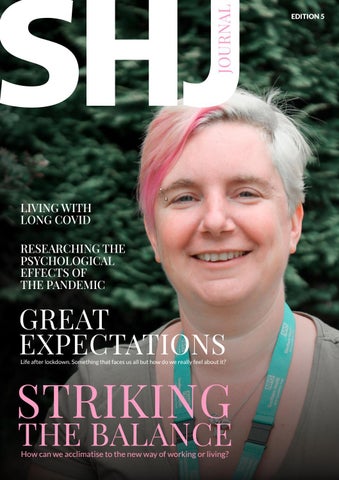
JOURNAL LIVING WITH LONG COVID RESEARCHING THE PSYCHOLOGICAL EFFECTS OF THE PANDEMIC
GREAT EXPECTATIONS Life after lockdown. Something that faces us all but how do we really feel about it?
STRIKING
THE BALANCE How can we acclimatise to the new way of working or living?
EDITION 5
WELCOME Cast your mind back to January 2021. Did you ever think we would see the light after being in a very long and dark tunnel of restrictions on our daily movements and human contact? We have gradually experienced the joy and relief of returning to normality, doing the things that make us happy. In this edition, we will be delving into the minds of staff members to unpick what their ‘great expectations’ are as we move back to reality and figure out how to strike a balance between new found learnings and old ways. We also hear first-hand how a crisis service in Southampton adapted to become ‘virtually’ next to you. The team give some handy advice on what to think about if you need to support someone virtually during a mental health crisis.
CONTENTS 4 5 8 10 11 12
GOT SOMETHING TO SHOUT ABOUT?
14 16 17 18
We’re always on the lookout for stories and guest writers! Contact the team by emailing: communications@southernhealth.nhs.uk
19
This last year has taught us the importance of looking after our wellbeing. Feeling in need of a little uplift? Look no further than our wellbeing journey page and follow each step throughout the day. We share actions you can take to improve your mental and physical wellbeing as well as providing a space for you to journal your thoughts and feelings.
STRIKING THE BALANCE GREAT EXPECTATIONS VIRTUALLY NEXT TO YOU DR WILL SEE YOU NOW RESEARCHING THE PSYCHOLOGICAL IMPACT OF COVID-19 WELLBEING LIFE CHANGES: FROM THE MILITARY TO THE NHS LIVING WITH LONG COVID UNDER THE SKIN OF... NATURE AND NURTURE TAKE A BREAK
Meet the team: our well-being tips are...
2
SHJ MAGAZINE
Jessica Reading
Alisha Hepworth
Jess’s wellbeing tip:
Alisha’s wellbeing tip:
Find time every day to do something for you. Sometimes it is a walk and sometimes is binge watching a series on TV. Whatever it is – find time every day for you.
Do something you enjoy. For me it’s meeting up with friends/family or getting outdoors and exercising.
Amy Donelan
Natalie Duffy
Amy’s wellbeing tip:
Nat’s wellbeing tip:
I exercise regularly and switch off the news. Listening to my favourite playlists always puts me in a good mood!
Always try and take some time out for yourself. Every day I love going for a run with my dog in the countryside!
Paula Quigley
Daniel Clark
Paula’s wellbeing tip:
Daniel’s wellbeing tip:
Make time for at least one thing each day that makes you happy. For me, it’s laughing with family or friends, long walks at sunset and sitting quietly with a good book.
Spend more time outside now the sun is coming back, doesn’t matter what you’re doing, just doing it outside is nice!
04 06 08 12 14
04
FEATURES STRIKING THE BALANCE Striking the balance can be difficult when working at home. We explore how our colleagues are acclimatising to this new way of working.
GREAT EXPECTATIONS Life after lockdown. It’s something that faces us all but how do we really feel about it? The SHJ team wanted to unpick what it’s been like for our colleagues across the Trust.
VIRTUALLY NEXT TO YOU Weeks before the announcement of the first UK lockdown in March 2020, The Lighthouse, a mental health crisis drop in service, opened its doors for the first time. So what happened next?
WELLBEING Feeling in need of a little uplift? Look no further than our wellbeing journey page and follow each step throughout the day.
LIFE CHANGES: FROM THE MILITARY TO THE NHS As a Trust, we are working hard to support veterans and their families as they make the leap from Armed Forces to ‘Civvy Street’. We’ve signed up to the Armed Forces Covenant Pledge as the first step in our ambition to become a ‘Veteran Aware’ NHS Trust this year.
06
08
14
16 SHJ MAGAZINE
3
Gosport Integrated Community Care Team. Photo taken before COVID-19 restrictions. Ingrid pictured bottom right
STRIKING
THE BALANCE Life after lockdown. It’s something that faces us all but how do we really feel about it? The SHJ team wanted to unpick what it’s been like for our colleagues across the Trust, and see if they’ve been able to strike the balance as we ease out of restrictions. We caught up with Ingrid Mead, Community Matron, from the Gosport Integrated Community Care Team;
INGRID MEAD, COMMUNITY MATRON, FROM THE GOSPORT INTEGRATED COMMUNITY CARE TEAM “What strikes me initially is how little we knew back in March 2020, none of us suspecting that we would still be living and working differently over a year later. The increased workload has meant working more wisely, promoting self-care where possible, supporting carers with care plans for them to follow with the team and providing more remote support when appropriate. I made regular calls to all of the
4
SHJ MAGAZINE
staff to check in and see how they were doing. We hope that in the future we will be able to retain a degree of home working for staff who prefer this, but that our daily face-to-face handovers return as we value the opportunity for discussion and peer support. We have recognised that a downside to home working has been that staff can fall victim to the “virtual leash” failing to take regular breaks and working more hours. Our biggest hope is for a bit more living, being able to reconnect with our friends and families, which gives us balance and helps us to build resilience to cope with the stresses and challenges of work.”
NATALIE BROWN KENNEDY, CLINICAL LEAD STAFF SUPPORT HUB “From talking to staff members, the impact of the pandemic has varied however, one common theme is that pre-existing personal difficulties have become harder to manage.
Natalie
The latest easing of lockdown restrictions has had a hugely positive impact on the mood of colleagues. Staff members are becoming more optimistic about the future as they are able to return to doing activities, which they would usually do to help lift their mood and manage stress. They are also hopeful about being able to return to workplaces and have much needed face to face contact with colleagues in person. As restrictions continue to lift, there is hope that staff will be able to get more of a work/ life balance and this may include a combination of working from the office and homeworking.”
EMILY PHILLIPS | MUSCULOSKELETAL CLINICAL LEAD PHYSIOTHERAPIST & ALLIED HEALTH PROFESSIONAL (AHP) EDUCATOR “As a physio you expect to be a hands on therapist. Over the last 12 months, I have only seen five patients face to face - on an average year, I would usually see over 900 new patients, not to mention the follow-ups. When I’m not working as a physio, I am an AHP practice educator; helping place students and run the preceptorship programme for newly qualified practitioners. For students, especially those on their last year of placement, it is an interesting time having to go about things in an unnatural and new environment. I believe it has enhanced their knowledge and it has made me realise we need to have more faith in our students and their capabilities; I have been very impressed with how they have stepped up to the roles. I miss being in the office surrounded by my team… not to mention Jody making me a cup of tea! I love to travel and I look forward to being able to leave the country for a cycling holiday in Europe around some of the gorgeous vineyards. Moving out of lockdown, I think people requiring physio appointments will start to expect more faceto-face appointments again. I believe there is a place for balance between the virtual and physical world. We will continue carrying out virtual appointments with an element of face-to-face based on clinical needs and focus groups.”
Emily
SHJ MAGAZINE
5
GREAT EXPECTATIONS We chatted to Hazel Nicholls, Director of Psychological Therapies, to see if she could shed any light on the great expectations people have or will face in the next few months... “The last year has been, without doubt, like no other in my lifetime. However, it has also brought hope, change, connection and growth. It has also brought opportunities to grow and develop things that, without the pandemic and the urgency, would have taken years. For example, the vaccination programme and working digitally and remotely to maintain services. None of this would have been possible without the power of people, working together as a whole. There has also been a real focus and awareness on the impact of mental health and wellbeing. Right now, we need to be especially careful of the ‘great expectations’ we may be putting on each other or ourselves to get everything back to the ‘new normal’. We need to be aware of the ‘Subtle Negative Aspects of Goals’ (SNAG) or kick back. This means the things that we don’t articulate, could unconsciously lead to us abandoning or sabotaging our goals and progress. It’s all too easy to assume that, once infection rates have dropped and restrictions are eased, life and people will simply slot back into where they were before. We all experienced achieving without many of our normal sources of support. That does not happen without cost. Once the pressure is removed, the individual and the system needs to recover, to have time to breathe from the inevitable kick back, the tiredness, and the re-adjust to business as usual. I know many of us have also been asking, do we want to get back to things exactly how they were? We have been gifted a vision of how much we can achieve; how rapidly things can change. This is what I call power. This is potential. The opportunity to reflect outside of ‘the normal’ can enable that vision to be seized and utilised so that the new normal reality is the better normal; and we can see the change we want.
“ We have been gifted a vision of how much we can achieve; how rapidly things can change. This is what I call power. This is potential. ”
6
SHJ MAGAZINE
If you feel you might need some help... ...adjusting to life after lockdown, there are lots of services available to help. Whether it is a conversation with a mental health professional or just someone to have a friendly chat about your worries with, take a look at the services below.
For staff: HIOW STAFF SUPPORT HUB We have all been working incredibly hard in difficult and unfamiliar circumstances especially those who work in health and social care. Find the support you need in our resources or start a conversation by visiting: www. HIOWstaff.nhs.uk. STAFF SUPPORT LINE A free and confidential staff support line, operated by the Samaritans and free to access from 7:00am – 11:00pm, seven days a week. This support line is here for when you’ve had a tough day, are feeling worried or overwhelmed, or maybe you have a lot on your mind and need to talk it through. Alternatively, you can text FRONTLINE to 85258 for support 24/7 via text. WELLBEING HUB ON THE STAFF INTRANET We have set up a hub of information for you to navigate around depending on the type of support you need. Whether it’s fast track to physio or a listening ear, take a look and see what we can offer to support you.
For members of the public: ITALK - We support people to improve their mental wellbeing through education, guided self-help tools and evidence-based talking therapies. Visit www.italk.org.uk/home/about-us/ for more information.
SAMARITANS - 116123 offers a safe place for you to talk any time you like, in your own way – about whatever’s getting to you. You don’t have to be suicidal.
NHS111 - Are you or someone you know experiencing a crisis and need urgent mental health support? Call 111 or visit www.111.nhs.uk and speak to the NHS Mental Health Team
Visit www.southernhealth.nhs.uk/help for information on other services available.
Photograph by Lukasz Unsplash ©Photograph bySzmigiel, Lukasz Szmigiel, Unsplash
VIRTUALLY RIGHT NEXT TO YOU PROVIDING SUPPORT TO SOMEONE IN CRISIS OVER THE PHONE. Weeks before the announcement of the first UK lockdown in March 2020, The Lighthouse, a mental health crisis drop in service, opened its doors for the first time. When the dust settled on the opening, the nation was told to ‘stay at home’ and the service had to close its doors. However, with the country now struggling with the uncertainty of a global pandemic and many now facing months of isolation, the service quickly established a virtual service and continued to support people through the darkness via phone calls and text conversations. Louise Brown, The Lighthouse Team Lead, explains “The pandemic pushed a lot of vulnerable people into crisis. Whilst some have been able to access support, some have suffered alone or relied on friends and family for support. We want to help people to help others. We want to share what we have learnt about providing mental health support virtually, so people feel more confident about what they can say to someone when they’re on the edge of a crisis.” Here are some things to think about when supporting someone virtually during a mental health crisis… www.southernhealth.nhs.uk/lighthouse
1 2
LIGHTH
Remember, it is ok that you don’t have all the answers. You don’t need to try to fix everything.
3
Listen to them and validate their emotions. Let the person know you hear them and that they are not alone.
4
Share your lived experience. Show you are human too and connect on a personal level.
5
Remind them of their attributes, unique capabilities and skills and help them identify their worth.
6
Try to focus the conversation around keeping them safe, because that person matters.
7
Remember to show your interest in them as a person and not just their crisis.
8
Let them know where they can get extra support by signposting to additional services.
9
8
Actively listen and be compassionately present. Create a safe space for this conversation and give the person your full attention.
Be kind. This person is not choosing to feel this way and giving them a safe space to talk and be heard will make a huge difference to them. Being heard, validated and connected is a lot, even if the situation and the pain is still there at the end.
SHJ MAGAZINE Joshua Ness on Unsplash
“ I honestly don't think I would have come through the last year and be in the place I'm in now without The Lighthouse. The nurses and peer supporters have helped me so much, whenever I've needed it, by actually listening to me, by taking an interest in who I am as a person and what is happening in my life. What's been important to me has been important to them.”
HOUSE
©Photograph by Alex Tipa, Pexels
SHJ MAGAZINE
9
THE DOCTOR WILL
SEE YOU NOW ADE WILLIAMS
Follow on Twitter @adewilliamsnhs
Hello Ade! Let’s talk about your role at Southern Health… I’m a Non-Executive Director - which means I work as part of the Board, providing independent strategic guidance, support and constructive challenge, and holding the management to account to ensure we’re all working to provide the best care. I’ve got lots of experience to draw on - including time as a mental health support worker while studying pharmacy in Portsmouth… How long have you worked forSouthern Health? I formally started my role in March, but I have been a part of the Trust, meeting people and learning a lot, in the months before that too. We’ve kept you busy then! And what do you do in your spare time (when you have some!)? I love doing creative things - painting is my favourite, but also writing poetry. I’m part of a Christian faith community, and I love supporting our values-driven social justice projects.
10
SHJ MAGAZINE
Change of pace…if you were a superhero, what’s your super power? Making people smile! The last year of mask wearing has really helped me to focus on smiling eyes. I have also seen too many sad eyes. What a lovely sentiment. Talking of cheering people up, where’s your ‘happy place’? Diggerland! My son is fascinated by construction machinery. Also, as most of our family live in Southeast Asia, I enjoy travelling across the borders and discovering the diverse cultures and food! Is there something daring you’ve always wanted to do? Yes - ride a motorbike. My wife already does, but risk-conscious me holds serious reservations… What’s your favourite season? It has to be autumn. The changing colours… the urgency to treasure what you have, even as it seems to be passing through your hands.
If you could swap lives for one day, who would it be with? An art therapist. I’m amazed how art unlocks emotional healing, implicitly reinforcing selfworth, creativity and expression. What’s your favourite film? Schindler’s list. I’m haunted by a closing scene where the protagonist says: “I should have done more…” The story inspires me to make a positive difference. As should we all. Thanks Ade – it’s been great getting to know you!
“ Make people smile. The last year of mask-wearing has really helped me to focus on smiling eyes.”
Psychological Impact of COVID-19 Researchers from the Trust have been leading the fight to understand the psychological impact of COVID-19. As the global impact of COVID-19 continues to affect the lives of billions around the world, the Trust has been reviewing other pieces of research in an effort to find common theme and further our understanding of COVID-19.
An evalutation of the mental health impact on patients, the general public and health care progressions showed the following... There were differences in the frequency of mental health issues such as anxiety, depression, and post-traumatic stress disorder (PTSD) among health care professionals when compared with the public during the pandemic. Interestingly, given the intense pressure on frontline services during the height of the pandemic, the sense of wellbeing was higher for healthcare professionals when compared to the general public (52.6% compared to 28.2%). However the analysis also revealed that, amongst healthcare professionals, the prevalence of suicidal thoughts/ideation or self-harm almost doubled from 5.8% to 11% compared to the public.
The second major review was aimed at examining the prevalence of adverse mental health outcomes among Severe Acute Respiratory Syndrome (SARS) patients, healthcare workers and the general public of SARS-affected regions between 2003 and 2020. Research shows that the occurance of an anxiety disorder, depressive disorder, or PTSD among SARS survivors, either clinically diagnosed or probable, was 19, 20 and 28%, respectively. The studies also showed certain aspects of mental health-related quality of life measures among SARS survivors remained impaired well after 6 months post-discharge. This ties into our current understanding around so-called ‘long-COVID’ and its effect on people’s mental health. Further analysis revealed those working in environments withSARS patients to be a risk factor for adverse mental health in healthcare workers.
Last year, the Trust led an international study into the psychological impact of the Coronavirus pandemic and lockdown which over 100,000 people took part in. Data from a range of countries including, Canada, India, Greece, Singapore and Holland ensured our understanding of how the pandemic was affecting different cultures and communities greatly increased, enabling healthcare professionals to better support those in need.
For more information on our research team visit our website www.southernhealth.nhs.uk/research ©Illustrations by Joez Huang and , Vecteezy
SHJ MAGAZINE
11
Wellbeing
Journey
Feeling in need of a little uplift? Look no further! Looking after our wellbeing is essential to living a happy and healthy life. Here is our guide on a journey that you could start today...
Fuel your body Do you need some inspiration for a healthy and uplifting meal? Scan the QR code and browse the Mindful Chef recipes, such as honey chicken with stir-fried rice, sweet potato curry, Vietnamese noodle salad and
Movement Exercise is a great way of lifting your mood as it releases endorphins that make you feel good. Why not get your heart rate pumping and try out one of these workouts? Or remember, that getting outside for a short walk can also boost your mood and help with your general fitness. Scan the QR code for more details.
12
SHJ MAGAZINE
much more.
Mindfulness 1. Take a few moments to relax and focus on your breath. 2. Let your breath flow as deep down into your belly as is comfortable, without forcing it. 3. Breathe in through your nose and out through your mouth gently and regularly. 4. Some people find it helpful to count steadily from 1 to 5. You may not be able to reach 5 at first. 5. Then, without pausing or holding your breath, let it flow out gently, counting from 1 to 5 again, if you find this helpful. 6. Keep doing this for 3 to 5 minutes.
List three things you are grateful for today.
SHJ MAGAZINE
13
Life Changes:
from the Military to the NHS The past 18 months have been all about life changes. More home working for some, fewer social interactions for us all, increased anxiety for many and the need to adapt to a new ‘normal’. But life changes aren’t limited to those imposed on us by coronavirus. As a Trust, we are currently working hard to support military veterans and their families as they make the seismic leap from a life in the Armed Forces to ‘Civvy Street’. We’ve signed up to the Armed Forces Covenant Pledge as the first step in our ambition to become a ‘Veteran Aware’ NHS Trust this year. By signing this forces-friendly pledge, we’re committed to the best possible healthcare for veterans and their families, whilst also supporting their employment into the NHS. And we’re building a network of ex-military staff ambassadors to help lead the charge! One such ambassador is Pete McCullagh, who is the manager of our West Hampshire community learning disability team… “For many veterans, leaving the armed forces will be the first time they’ve had no support network – they need to find doctors, schools, dentists, a job, a house…all the things that others have spent years acquiring are suddenly needed in a very short space of time. This is where we want to help. I was made redundant from the Army back in 1994 and, as part of that, I had a significant amount of support - including interview prep and CV writing for a new job. I still use that template CV now when applying for new roles! But today many others won’t receive this level of support and I’d like our Trust to develop more of a presence in resettlement centres. We can showcase what we provide in terms of careers (as it isn’t just doctors and nurses!) and we can partner with forces support networks, like HIVE and SSAFA, to provide clearer information and signposting.
14
SHJ MAGAZINE
“ For many veterans, leaving the armed
forces will be the first time they’ve had no support network – they need to find doctors, schools, dentists, a job, a house… all the things that others have spent years acquiring are suddenly needed in a very short space of time. This is where we want to help.”
“ For other veterans considering a career in the NHS, I’d say “do it!” It’s the best move I ever made. Whilst I’ll always be a squaddie in my head, the team work and camaraderie you get here is almost as good!”
I must admit, as a musician in the army, I initially doubted what transferrable skills I’d have, but in reality my administration and leadership skills were very transferrable indeed and led directly to my first role within the NHS. For other veterans considering a career in the NHS, I’d say “do it!” It’s the best move I ever made. Whilst I’ll always be a squaddie in my head, the team work and camaraderie you get here is almost as good! If you break me in half, you will see that I am a military man, it’s in my blood. Those in the military (and their families) give up a lot for us, often to the detriment of their health and so, just as military service was my duty, I now find myself feeling duty bound to support those leaving the forces. At Southern Health, we have an abundance of experience from across the military landscape which we can capitalise on to help us shape excellent support for those from military communities that need it. I’m excited to be a part of it!”
Did you know? •
Veterans make up between 3% and 9% of our population.
•
Hampshire has a strong military presence with 13 bases across the county.
•
Military medics, nurses and other staff have many transferrable skills to suit the NHS.
•
Some leave the military with complex medical and psychological health issues which need specific support.
SHJ MAGAZINE
15
LIVING WITH
LONG COVID We have seen an increase in people who continue to feel unwell months after having COVID-19, which we now recognise as Long COVID. Southern Health, alongside partner NHS organisations, has opened six Long COVID clinics across Hampshire and the Isle of Wight to help people recover from their ongoing symptoms. LISA BROWN, PHYSIOTHERAPIST, TALKS ABOUT HER EXPERIENCE OF LIVING WITH LONG COVID “I began to feel unwell while on a snowboarding holiday in Spain last February 2020. When I arrived, I struggled to breathe, my chest was crackling, and I had a headache, fever and a continuous cough. My husband took me to hospital where I received oxygen. Of course, we didn’t know it then but I had COVID-19. Although I recovered from the initial illness, I’m still unwell and I suffer with symptoms to this day. I get very tired, struggle to breathe and suffer with a tightness and burning sensation in my chest. It’s very scary. In January, I was referred to a Long COVID clinic. It’s helped so much. Karen, who runs my sessions, gives me tips on how to manage my symptoms and helps me when I feel anxious. All my appointments are via zoom or by telephone. It’s so reassuring knowing that there is help out there and I’m not alone. I feel so lucky to have this service; it’s going to help a lot of people.” Susanna Preedy manages our Long COVID clinics across Hampshire and she added: “Having Long COVID can be scary, the symptoms are wide-ranging and can include pain, breathlessness, chronic fatigue, brain fog, anxiety and stress. However, many patients recover with support, rest and symptomatic treatment. While we have learned lots about COVID-19, we are still yet to learn more about its long-term effects. What we do know is that Long COVID is also affecting young and fit people too. These new clinics not only give us an opportunity to support those in need but will help us learn more about Long COVID and find new ways to help people affected by it.” Long COVID clinics are available by GP referral and are available to anyone experiencing symptoms of COVID-19 for more than 12 weeks.
16
SHJ MAGAZINE
UNDER THE SKIN OF...
KAREN CUBBON Being a Nurse has allowed me to work in so many different areas of healthcare
My career aspiration has only ever been to be a Nurse. I started out as care assistant in a local nursing home, aged 16, and went on be an Auxillary Nurse before I was able to start SRN training three months after my 18th birthday in 1981. Since then, I have been fortunate to have a number of varied roles within the NHS. This includes setting up a domiciliary care service for physical health and a senior management role working on transformational programmes of care. I also implemented the famous “Hello my Name is.” campaign across the Trust; a campaign that I am very passionate about. When the pandemic hit, I had a couple of whistle stop career changes. I first worked alongside our HR team, recruiting extra staff using zoom (which I had previously never heard of!) Then, just before Christmas last year, I started supporting the vaccination team to provide clinical validation for new recruits.
This year I was unable to administer the flu and COVID-19 vaccinations, due to shielding after having treatment for lymphoma. This was very difficult to accept but by doing the validation and supporting the vaccine team, I was able to feel that I played my part. I am now working in partnership with Age Concern Hampshire to further develop the Hospital to Home project and have just managed to extend its funding. This incredible service helps older patients, with no family, return home to be cared for and helps reduce hospital re-admissions. We are aiming to roll this out across our older person’s mental health and physical health wards.
“ Being a Nurse has allowed me to
work in so many different areas of healthcare, caring for all kinds of patients and working with so many amazing colleagues that I now call friends.”
Being a Nurse has allowed me to work in so many different areas of healthcare, caring for all kinds of patients and working with so many amazing colleagues that I now call friends.
SHJ MAGAZINE
17
NATURE
©Photograph by Filip Urban, Unsplash
AND
NURTURE Brighterway is Southern Health’s charity and, through the money raised from our COVID-19 appeal, the team are enhancing the recovery of our patients. The use of outdoor space is incredibly important to help improve the physical and mental wellbeing of inpatients throughout their hospital recovery. For some, courtyards within a ward are the only outside space they have access to during their stay. There is also increasing evidence to show the therapeutic impact that getting outside can have on individuals.
We gathered feedback from patients about the importance of the courtyard with one commenting, “Being able to go into the garden and experience the cold fresh air when I am struggling with difficult emotions is one of my main ways of grounding myself in that moment, and is something I can replicate when at home.”
Brighterway is working alongside staff at Melbury Lodge to create a new and improved courtyard for the patients in their care. The plan is to renovate the outdoor space in the Mother and Baby Unit followed by the Adult Mental Health ward.
If you would like to learn more about the project, or others, please visit www.brighterway.org.uk.
Laura Bradshaw, Charge Nurse, explains, “Due to limited leave on the ward, having an outside space where people can enjoy nature and grow things is so important to mental wellbeing. The new and improved courtyard will be sensory based to create a calm, therapeutic space for patients to enjoy on their own, with peers, staff or family members. It will include a multi-textured walkway, seating area and a play area for the babies.
@SHFTbrighterway
Brighterway
Brighterway
Brighterwaycharity
The charity for Southern Health NHS Foundation Trust, your local community and mental health provider.
18
SHJ MAGAZINE
COFFEE and connected Written by Hazel Nicholls, Director of Psychological Therapies.
One morning I was scanning through the Trust updates for any important information when I noticed a ‘Randomised Coffee Trial’. I read it, smiled to myself thinking, ‘who has time for a coffee break?’ and moved on. A few times during the week when I grabbed my empty cup and refilled it from my flask the trial popped into my mind. I decided to treat myself to a 30-minute break one day so sent off my details and signed up. I had an email pop into my inbox identifying who I had been matched with. A name I had heard of but never had any contact.
touched on some personal life challenges of family members and how Covid was affecting our loved ones. The 30 minutes flew past. I felt connected with another person, even for a short while, not because of a work task but as two people going through similar struggles and finding a way forward.
I have signed up for the next ‘Randomised Coffee Trial’ as it was such a positive experience. I now make a point of occasionally having an odd 15 min coffee break with others in
Taking breaks throughout the working day has huge benefits - boosting productivity and helping
We used Zoom to introduce ourselves in our work capacity and chatted about previous roles as well as the good things about our current jobs. It was really uplifting to hear. We
you to retain information. Why not take a break now and give this crossword a go?!
1 2
3 4
5
6 7
8
ACROSS 4. Brighterway are working with staff at Melbury Lodge to improve this space 5. Diagnosis when feeling unwell months after contracting COVID-19 7. Impact of COVID-19 that the research department are evaluating 9. The Trust is ‘aware’ of this group 10. Important for ourselves, both mentally and physically
9
DOWN 1. Finally able to eat and drink in this part of a restaurant 2. Best protection against COVID-19 3. We signed a covenant to support these collective professions 6. Ade’s favourite season 8. The service that is ‘virtually next to you’
10
SHJ MAGAZINE
19
“I can’t see a way through.” said the boy. “Can you see the next step?”
“Yes.” “Just take that.” said the horse.
Got some news you’d like to share? Contact us at: @SouthernHealthNHS
@Southern_NHSFT
Southern Health NHS Foundation Trust, 1-3 Sterne, Tatchbury Mount, Calmore, Southampton SO40 2RZ
SouthernHealth.nhs.uk
@SouthernHealth_NHSFT
communications@southernhealth.nhs.uk
SHJ is published by Southern Health NHS Foundation Trust and produced by the Media and Communications Team. E: communications@southernhealth.nhs.uk W: southernhealth.nhs.uk. SHJ is available in other formats on request. This publication was printed on sustainable paper.Please help us save the trees and pass to others to read and recycle.