the Southern Health
JOURNAL
SPRING 2018
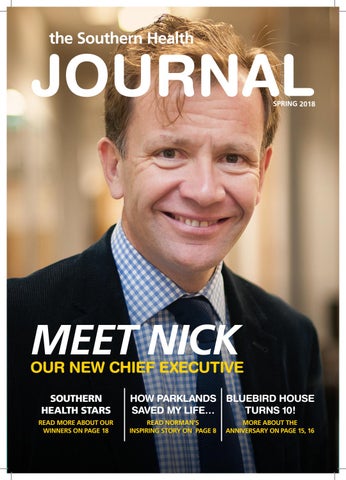
MEET NICK
OUR NEW CHIEF EXECUTIVE SOUTHERN HEALTH STARS READ MORE ABOUT OUR WINNERS ON PAGE 18
HOW PARKLANDS BLUEBIRD HOUSE SAVED MY LIFE… TURNS 10! READ NORMAN’S INSPIRING STORY ON PAGE 8
MORE ABOUT THE ANNIVERSARY ON PAGE 15, 16
Welcome
WHAT’S INSIDE
to the latest edition of the Trust magazine
Welcome from Lynne Hunt
1
It’s been a busy few months for us all and there’s a lot for us to talk about! We have been making positive steps forward in improving how we, as a Trust, engage with our patients, their carers and families, as well as working more closely with our Governors. We all know that the NHS is under pressure, and in order to make the right changes and improvements we must involve the people who use our services every day and hear their feedback as customers about how that care is delivered.
Meet Nick
2
Our new Quality Improvement programme will be a big focus for us as we move forward. This way of working has been used very successfully in other Trusts that are regarded as high performing. It gives staff the skills and tools to be able to constantly improve their services in ways that work best for them and their patients. It is well known that if we provide the right care, first time, every time we make the best use of our resources and that this culture of continuous improvement provides an exciting environment in which staff can work and develop. We’ll keep you updated through Nick Broughton’s regular blogs and future magazine editions. I’m hoping that staff who are involved in this new and exciting area of work will want to share their stories through future publications. I had the honour of co-hosting the Star Awards, our staff awards ceremony, back in December, and it was a really enjoyable event with some truly inspirational and heart-warming stories of dedication. I was so impressed to see how our staff are really living the values of our organisation every day – putting patients and people first, working together in partnership, and respecting each other. I’m often reminded of this when I visit teams and meet the people who deliver great care every day. It makes me very proud to be a part of Southern Health. I hope you enjoy reading about the awards and all the other articles we’ve included in the magazine, and as ever if you have any feedback don’t hesitate to get in touch by e-mail communications@southernhealth.nhs.uk or calling 023 80 874666 - we’d love to hear from you.
Winter Pressures
3/4
Star Awards
5/6/7
Norman’s story
8
Phlebotomy
9
Article about Membership
10
Family Nursing Partnership
11
Readdressing the Balance for People with a Learning Disability
12
Quit4Life is 10!
13
Extended Primary Care Team: Fareham and Gosport
14
Bluebird House’s 10th Birthday
17
Southern Health Stars
18
You’ve GOAT to be joking!
19
Our Social Reach:
8,000
110K IMPRESSIONS IN APRIL
PROFILE VISITS IN APRIL
10,000
32,642
OPENS OF THE ADVENT CALENDAR CAMPAIGN
people reached in April
893 NICK’S DECEMBER
Nick’s interview with BBC South Today had
9,300 views 99.3%
BLOG HAD 893 VIEWS
POSITIVE STORIES IN FEBRUARY
SOUTHERN HEALTH STARS NOMINATED IN 4 MONTHS 3 Winners Already Announced
£1,010
1
15/16
Crisis Lounge
92x Lynne Hunt Chair
meet
raised by a patient’s CHARITY RUN
4,866
impressions on our tweet about snow
2000+
OVER 2000 NOMINATIONS FOR STAR AWARDS IN 2017
Nick
Nick Broughton is our new Chief Executive
We sat down with Nick to have a chat about his aspirations and what made him join Southern Health. What attracted you to Southern Health? I have worked in mental health services for almost 25 years. The opportunity therefore to lead an organisation which provides a large range of mental health services was particularly attractive. I feel passionately that it is essential patients receive truly integrated care that addresses both their physical and mental health needs. Clearly the organisation has been through some difficult times and faces a number of challenges. I felt the time was right for me to take on such a challenge and hopefully ensure that Southern Health realises its undoubted potential. Who is a role model in your life? It would probably be Dr Robert Dolan who sadly died just over a year ago. Robert was a very fine man. He was a forensic psychiatrist, like myself, and became the CEO of East London NHS Foundation Trust. He led that organisation to become an outstanding Trust in every respect and he has left a huge legacy. He also provided me with a huge amount of support and guidance. Name something on your bucket list? We spend valuable time in meetings that don’t always make a difference to patient care and add value to what we are doing. I firmly believe that we need to ensure that every meeting helps us improve the quality of care that we ultimately provide to our patients. Doing away with unnecessary meetings therefore would definitely be on my list. What are you passionate about? Raising awareness regarding the importance of mental health and wellbeing, and ensuring that all health care is psychologically informed. On a personal level the thing that provokes my strongest passions is Manchester United. The last few seasons have been disappointing to say the least! What are you most proud of? All the outstanding care we provide to our patients. Colleagues across the Trust are continuously doing amazing things and providing fantastic care. What are your goals for the next six months? To improve the quality of care we provide across the Trust, through developing a programme of quality improvement,
and linked to this improving staff engagement. The people who work for Southern Health are our greatest asset and it’s absolutely essential that they are properly supported and feel valued. Can you name a person who has had a tremendous impact on you as a leader? Why and how did this person impact your life? Matthew Patrick, another psychiatrist and the CEO of the South London and Maudsley NHS Foundation Trust. He is a remarkably calm, measured and focussed leader. I learned a huge amount from him and believe I am a better leader as a consequence. How are you going to empower staff who have great ideas to turn them into reality? Doing this is absolutely essential and one of my top priorities. To do this we have to ensure staff have the autonomy and freedom to innovate. We need to ensure that colleagues are not bogged down with excessive administration and that clinicians are properly supported by our corporate services. What was your first job? What lesson did you learn on that job that you keep with you today? Picking potatoes on a farm during one summer holiday, while I was at school. It taught me the importance of hard work and treating people with courtesy and respect. What keeps you enthused about working for the NHS? Quite simply it is the opportunity to make a difference and improve people’s lives. We are currently working to provide better resources for our members, with chances to get more involved with the Trust. What do you want our members to get from their contact with Southern Health? We are very lucky that someone has taken the trouble to join the Trust and become a member. This to me shows their commitment and interest in the healthcare of the population of Hampshire and beyond. I would value any thoughts our members may have regarding how we can further improve our services and the quality of care we provide.
2
Battling this year’s Winter Pressures
We spoke to Sandra about the South East
Sandra Spong ead Of Nursing and Allied Health Professionals H Based in East Hampshire “This year has been particularly difficult in the East area. Some of our Heads of Nursing and Area Matrons have been supporting Queen Alexandra Hospital (QA) on a regular basis to help with the speed of discharges. This increased speed meant that the patient flow out of the hospital was faster which relieved QA from additional pressures. Our community teams worked extremely hard with this extra pressure on top of juggling their day to day case loads.” With discharges being an essential element in the flow of patients, Sandra says “Managers on duty have been taking calls on a daily basis to identify blocks in discharging patients and then removing those barriers to get patients getting home as soon as they are well enough.”
Message from Nick Broughton, Chief Executive 3
“This Winter the NHS has been under significant pressure and, as a result, we have seen a significant rise in the demand for our services. It’s been fantastic hearing all the different ways that teams across the Trust have been helping to
overcome these challenges. I would personally like to thank you all for your hard work, without you we wouldn’t have been able to continue to deliver a high quality and patient centred services to the people we support.”
Sarah England We spoke to Eleanor about the South West
Eleanor Corbett Interim Matron for the Wards at Lymington Hospital “When Winter was starting to hit we had a 25% deficit in our staffing model meaning that we would have a large staffing gap to fill. Our staff coped fantastically with this immense pressure. I would like to say an enormous thank you to all the ward staff at Lymington Hospital, both day and night staff. They have been working incredibly hard through a particularly challenging winter, with lots of unwell patients with respiratory conditions and a large number of patients that have rapidly deteriorated. Staff have really gone the extra mile to cover unfilled shifts to ensure that patients have continued to receive a high level of care. This has been reflected in recent conversations that I have personally had with patients on the wards. They talked about receiving “excellent care” from “friendly, helpful staff”. The staff are an absolute credit to the Trust and should be really proud of the services they provide.”
“
General Manager for Mid and North Hampshire “The Mid and North Area had a robust structure in place in preparation for the Winter and they have confirmed that it was effective! One of the many teams that were particularly crucial during the winter months was the Enhanced Recovery and Support at Home Team (ERS@Home Team). This team provides patients care within their own home and ensure that patients are safely discharged from hospitals. Whilst the ERS@Home team are enabling patients to be discharged and assessed at home, our intermediate care ward, Anstey Ward, based at Alton Community Hospital has a dedicated team of Nurses, Physiotherapists, Occupational Therapists and lots of other health care staff which includes a Geriatrician. This Geriatrician developed their skills to ensure that the best care was delivered while getting patients returned home when possible. During the winter period the ward did not have a single delayed transfer of care which means that our patients were seen quickly and efficiently.”
...an enormous thank you to all the staff that has been working incredibly hard through a particularly challenging Winter!
“
During the winter months, the NHS faces an enormous rise in vulnerable patients and a continuous battle with short-staffing numbers. We’ve asked those on the front line what it’s like during winter and what we have been doing differently, in order to tackle these problems.
We spoke to Sarah about the North
4
The Star Awards’17 Celebrating what we do
Our Winners... Every year our staff and the people we support nominate teams and individuals for a star award to celebrate and thank them for the fantastic work they do every day and, as unusual, the Star Awards 2017 did not disappoint. We received an overwhelming 610 nominations that is over 2000 individual members of staff nominated! The quality of nominations submitted was phenomenal and reflected the amazing work our staff do and the real impact they have not only on their colleagues but on people’s lives. In September 2017, divisional tea parties were held across the Trust to celebrate everyone who had received nomination. Staff enjoyed afternoon tea and a presentation ceremony where they were awarded a certificate and thanked for all their hard work. Shortlisted nominees were then announced and invited to the main award ceremony.
The ceremony On Friday 8 December over 200 members of staff, dressed in their finest, attended the Southampton Grand Harbour Hotel, ready to celebrate and find out this year’s winners. As guests arrived they enjoyed a champagne reception and had their photo taken before entering the main Mayflower suite where they enjoyed a two course dinner. Nick Broughton, the Trust’s Chief Executive, and Chair, Lynne Hunt, opened the main ceremony by welcoming everyone and thanking all staff for all their hard work. There were nine awards based on our new values and priorities;
5
Quality Care
Valuing People & Achievement
Partnership
Hollybank Staff Members
Hants Liaison & Diversion Team
Nominated by Carol Barnard:
Nominated by Liz Read and Julie Philips:
cheers echoed throughout the room as our Chair, Execs and Non – Exec Directors and Governors announced the nominees for each category. Winners were then presented with their trophy and certificate on stage. For the lifetime achievement and public choice awards, staff enjoyed hearing from the people who nominated them (their colleagues and the people they support) on heartfelt videos explaining the impact they have had on their lives and why they feel they deserve a Star Award. Nick Broughton closed the ceremony, expressing how proud and honoured he was to be Chief Exec of a Trust where staff were so passionate about what they do: “It was an honour to host the awards this year. Every nomination we received is a reflection of the passion, hard work and commitment our staff provide to the people they support every day. I am proud to be leading an organisation that really cares about not only the people they work with but the people they support.” Once the ceremony had closed, guests made their way to the dance floor to enjoy the disco! It was an evening full of pride and respect by everyone who had been nominated and an opportunity to really celebrate the important work that our staff do and the real difference they make to people’s lives.
IT Training Team Nominated by John Newell:
“The creativity and hard work that has gone into this project in scarcely more than six months, in addition to continuing the day job, whilst designing new processes around it, at zero cost, with no measurable drop in quality, marks this team out as one that goes the extra mile, loves to create, and knows its business.”
“This team with all its diversity and differences always works together to deliver the best care for the patients in the unit. It is because we all have opinions and views on issues, but by allowing everyone to express their thoughts I believe ensures togetherness as a team. Donuts and laughter helps too.“
“The team work every day in both Basingstoke Police Custody and Basingstoke Magistrates Court and I believe that the relationships that the team have managed to build with the staff in both of these areas in such a short amount of time are fantastic.”
6
Transformation
Patients & People First Respecting Others
Integrated Care and Therapy Team Lead
Heart Failure Community Team
Florence Chihowa
Nominated by Jamie Hawthorne:
Nominated by a member of the public:
Nominated by Laura Pemberton:
Katy Gold,
“In the last 12-18 months Katy has managed to ‘turn around’ a therapy team that was poorly staffed and performing poorly in a lot of respects. This has been clearly shown in the stats. She has appointed a whole new therapy team and lead us towards performing at a level that satisfies both the Trust but also provides better quality of care to our service users.”
Delivering Value for Money
“They provide excellent help and support to my husband and I. They are all patient and kind. Whenever we have a concern. There is always someone there to offer support and advice.”
Lifetime Achievement
Andover Wound Clinic
Pamela Grocock
Nominated by Lisa Rice:
Nominated by multiple nominators:
“The clinic are passionate about high quality care and standards and achieving the best results for the patient. They have embraced the new Leg Ulcer Pathway and have changed the management of patients with venous and mixed aetiology ulcers from bulky, expensive compression bandages to the hosiery kits which has significantly reduced cost.”
Team Lead and Senior Physiotherapy
“With every year that Pamela gets closer to retirement she seems to be more motivated and works even harder. Pamela is hardworking and dedicated, both as a clinician and as a team leader, putting in hours way beyond what she should. Pamela has now given the NHS her clinical expertise, excellent teaching and mentorship and superb leadership skills for more than 30 years!”
Clinical Ward Manager at Southfield
How Parklands saved my life… We talked to Norman about his stay at Parklands and the impact it had on his life
“Florence is the Ward Manager of the female ward in Southfield low secure unit. We are nominating Florence for this award for a number of reasons, but in particular her ability to continually engage, develop and drive forward care with the service user and carers at the heart of what she is doing.”
Chair & Chief Executive Exceptional Individual
Charlotte Bye
ANP/Clinical Lead for MIU and the Practice
Nominated by Dean Garrett:
“Charlotte Bye is an exceptional nurse, service lead and colleague who has a seemingly limitless determination to improve services, find solutions and promote the role of nursing and its possibilities.”
We were privileged to have Steven Broomfield, a service user at Crowlin House, join us on the evening – Steven not only helped to judge the Patients and People First Award, but presented the trophy to the winner on the evening. A huge congratulations to everyone who received a nomination, to all of our finalists and to our nine winners. We would also like to say a huge thank to everyone who took part in celebrating their colleagues and nominated this year.
These awards go beyond the main ceremony, every nomination is a reflection of the passion, hard work and commitment that you provide to the people you support every day. 7
In 2016, Norman Bareham - a retired Coldstream Guard and Police Officer - was working as a Community Safety Officer in Hythe and Dibden. Having moved back to the area to be closer to his family, he was happy to be supporting his local community and enjoying his work. However, in April that year, a series of events led him to experience severe depression. Unable to do the job he loved, Norman’s depression deepened and culminated in him planning to end his life. Norman tells us his story and explains why he credits a nineweek stay on one of our wards at Parklands Hospital with saving his life. Everything I‘ve ever done, career-wise, has been about helping or protecting others. I’m very passionate about that. But looking back, in the Army and during my police career, things happened that I just sort of ‘parked’ and never talked to anyone about. You didn’t in those days, you just carried on because that was the job. However, in April 2016, an incident at work happened which was really stressful for me. I noticed my behaviour change but I didn’t feel able to talk about it and which led to me bottling it all up. Things got worse and I got to the point where I had made plans to take my life. Luckily my wife spotted this and called an ambulance, and the team were magnificent. I know how stretched they are but they spent hours with me. They took me to my GP who got a psychiatrist out to my home to assess me and recommended I go to hospital. I went to Beechwood Ward at Parklands Hospital in Basingstoke. I just remember coming onto the ward and the nurse and health care assistant were waiting for me. They said that I shouldn’t worry and that I was going to be ok. I think that’s when it hit me and I broke down and cried. They just kept repeating that I would be ok. I remember that as soon as I was admitted, all the staff made me feel safe and that was a big help for me. The ward team - my consultant and all the nurses and support workers - were brilliant. To begin with, I didn’t really want to do anything. Parklands Hospital has a garden but it needed tidying up and so I started
to do that for a few hours every day. The physicality really helped, I remember that it felt good to be doing things, which led to me opening up a bit and it went from there. So gardening was my first bit of therapy really! As I started to improve, we began walking to some local shops and then eventually into Basingstoke. It was in Basingstoke that I had a flashback which is when I really started to talk about things. After a while, I went on unescorted leave and this led to me socialising a bit more and each day I felt better and better until I was eventually well enough to be discharged. Since leaving hospital, I’ve retired from my old job and I have started working as a call handler for the emergency services. The next step for me is to become a peer support worker for Southern Health. I had such amazing support from people at each step of my journey that I’d like to try and give something back. After everything they did for me, it would mean so much to be able to pass that on in some way, to someone else who might be struggling. So that is the goal going forward, and something I am greatly looking forward to! I learned in hospital that things happen in life and sometimes you need to take a step back and reevaluate things. Easier said than done, but true. I will be forever indebted to Parklands Hospital and the staff on Beechwood Ward. They saved my life. In fact this sums it up for me - going to hospital saved my life, but being in hospital gave me my life back.“
meet our governors:
Margaret and Alia
Marie Simms
Margaret Martins is a Team Manager in the West Hampshire Learning Disability service and Alia Gomez is a Team Leader in Southampton Adult Mental Health service. We sat down for a chat about their role in representing their colleagues and what they think the Trust needs for the future.
We visited Marie at her workplace to talk about what it takes to be a phlebotomist..
Tell us a little about yourself Marie, and the important work that you do. Hello my name is Marie Simms and I’m a phlebotomist, working as part of our phlebotomy service covering our clinic at Havant Health Centre, where we do blood tests for seven local GP surgeries, hospital consultants and patients on warfarin drugs (medicine that stops blood clotting). I’m part of a wider team of nine phlebotomists, and between us we cover in-GP practice blood tests, a new phlebotomy clinic at Chase hospital for three GP surgeries, as well as our three booking clerks that set up everyone’s appointments. Together, we see more than 5000 patients a month – for many their first entry point into the NHS and our Trust.
How did you become a phlebotomist? I have been in the healthcare for profession for nearly 40 years and worked in a hospital ward. Following a car accident in 2000, I had to seek other options and started as a phlebotomist. I’ve never looked back since.
What does a phlebotomist do? We take people’s blood, when they have been referred for a test from their GP, the hospital or for
The staff are so lovely here and they always make me feel at ease. It’s convenient, local and they can always fit me in. - Mrs Marina Ford, patient their regular check linked to their medication. But it’s important to remember that for many patients a blood test can be scary. Nobody likes needles and many patients are nervous when they come as they know this test can give them clarity on potential serious illnesses. We understand how important it is to the patient and that they can be scared, so I make everything as light-hearted as possible.
What do you enjoy the most about your role? The patients are great. The radio is on, we have a chat and I try to distract them. We have a great laugh! While we don’t tend to see them more than five minutes, we cover of a lot. I signpost them to other services in Southern Health and elsewhere in the NHS. I also see many recurring patients and can be from a diagnosis until the last blood test to see if they are given the all-clear. It’s very rewarding.
My team works incredibly hard to help patients. Today, more illnesses are diagnosed via a blood test. Being a phlebotomist is a great role, as you have frontline patient contact. As staff you may have done 10,000 blood tests but for that patient it could be very first one and we are sensitive to that and their circumstances. When we see someone fearful and know they leave our appointment feeling okay that is very satisfying. My team do a great job every day.
- Jane Croughan
Clinical Manager of the phlebotomy service
Why did you become a Governor? M: I recognised that there was no representation on the Council of Governors for learning disabilities. I wanted the voices of learning disabilities staff to be heard, so they can help drive changes within the Trust. A: When I became a Staff Governor I had been seconded and wanted to keep in touch with what the Trust was doing. I love being part of an informed and active group, and honestly feel I have influence and can ensure that the effects of change on clinical and frontline staff are considered, which is really important. M: You often hear or read that ‘staff have been consulted’, but many don’t recognise this to be true. I want to give a bigger platform to community teams, often it seems there is a focus on inpatient teams, and our community staff are just as important. I want everyone to be visible to the leaders in the Trust. A: I know the frustrations staff can feel and I want to help make that better, so they can see an improved flow of information, feel more informed and are involved in the areas they can influence.
How do you think things have changed for Governors? M: The questions I ask of senior management are now met with much more openness and discussion, and more questions in return. I do feel like Governors are having an effect and are listened to and this gives us more of a platform to carry out our roles as Staff Governors with our divisional colleagues.
What is the biggest issue for staff in your divisions right now? A: It’s not unusual for staff to take work home with them, or write notes in the evenings. I have spoken to people who lose sleep worrying about their patients,
because they spend large amounts of their time attending meetings and miss out on clinical time. This is something that is happening across the NHS and requires a wider system change to ensure we can properly support our patients and staff in the right way. M: I agree that there’s a real need for change. The staff working in clinical and frontline services come to work every day to help people, and that’s why our roles are important in representing them, driving changes that make their jobs easier and allow for more focus on our patients.
What do you want to gain from being a Staff Governor? A: I felt really empowered being involved in the process for new leadership, where I got to sit in on interviews and ask candidates questions. I want to make sure the qualities we see in these new leaders are able to filter down through the organisation. I’d like to see an effect on clinical practice and a constructive environment where patients and staff can flourish. It’s often the smallest changes that can have the greatest impact and help deliver these things. M: I’d like for the visions we have for staff engagement and wellbeing across the Trust to become a reality. I feel that the Council of Governors has become a much stronger voice and I’d like to see this continue. For every discussion about change we should always be asking ‘what does it mean for our patients’. I want Southern Health to be the best it can be; for people to have confidence in the reputation of the Trust, and for staff to feel a real sense of pride in the organisation and what they do.
10
Family Nurse Partnership (FNP)
The Family Nurse Partnership (FNP) is a voluntary programme, offered to first time young mums (and dads) aged 19 or under in Basingstoke, Rushmoor, Havant and Gosport via a referral from the midwife. This year nationally the Family Nurse Partnership celebrated 10 years, Southern Health is still a relative toddler though having started the programme in April 2015. Our FNP nurses work with 25 families at a time initially meeting weekly, then fortnightly until the child reaches two years.
We are so proud to be able to share with you one of our graduates stories. Thanks so much to the mother Stacey (whose name has been changed) for allowing us to share this with you. Clare Kemp, Family Nurse in FNP, tells us about Stacey... Stacey was 18 and 12 weeks pregnant when I first met her, living between her mum’s house and friends’ houses. Her partner was living in homeless accommodation.
We are working hard to tackle this inequality and have introduced a range of measures to support the people we work with and to ensure an equal playing field for them.
I supported her to learn about the importance of responsive parenting and developed a strong bond with her unborn child. When her baby was born Stacey breastfed her baby for a short period and was immensely proud of this. Immediately after her birth her partner was convicted of a violent offence and went to prison. During this stressful period Stacey maintained the bond with her baby and her positive attitude towards parenting. She has also been brave enough to speak to our community mental health team about her anxiety.
11
Within the Trust’s learning disability services, there is a team of strategic health facilitators working hard to improve the health of people living with a learning disability. One of the team, Amy George, explains why they’re so driven… People with a learning disability experience poorer physical and mental health than the general population, and can often die earlier. This is partly because they are more likely to have multiple conditions and communication difficulties but it’s also because of an inequality in how they are treated by health and social care services.
She admitted she smoked, drank heavily, was out of control and had periods of anxiety and depression. Stacey’s pregnancy had changed her behaviour and she wanted to change and become a good parent to her unborn daughter.
Stacey’s baby thrived and this a huge credit to her. Stacey is constantly attentive to her needs and keeps her safe all of the time. At two her baby is out of nappies, can speak in sentences, knows her numbers and colours and is such a happy, beautiful child.
Readdressing the balance for people with a learning disability
“..Ensuring local people with a learning disability get clear information and access to the best primary healthcare services possible”
Stacey says that she is now a different person to when I met her. She refers to me like a fairy godmother that has changed her life but this is not true – Stacey has changed her own life.
In 2017 we helped Wessex Local Medical Committees to organise a free conference for more than 140 GPs and practice nurses across Hampshire and the Isle of Wight. The event was to encourage practices to offer annual health checks for people with a learning disability. By offering health checks, any health issues can be spotted early and GPs can offer advice and support.
In addition, our team has been working collaboratively to make sure GP registers of people with learning disabilities are as accurate as possible. We’ve also been involved in the production of posters for doctors’ surgeries, advertising annual health checks and, excitingly, we’ve worked with the Transforming Care Partnership to help develop a ‘Learning Disability Friendly’ accreditation for GP practices. Already we’ve had six practices across the county that have achieved the status, with 25 others in the pipeline. The accreditation can only be achieved after months of hard work to embed LD-friendly criteria within a practice, ensuring local people with a learning disability get clear information and access to the best primary healthcare services possible. For example, allowing extra time for patients with learning disabilities and, if they don’t attend for check-ups, arranging to see individuals at home to build a rapport. Our hope is that, over time, all GP practices in Hampshire will work towards the accreditation and will offer better quality care to people with a learning disability.
12
Extended Primary Care Team: Fareham & Gosport
Quit4Life turns 10!
We are constantly looking at new ways of working in the NHS ensuring patients get the right care, in the right place, at the right time. In the past few years under the Better Local Care programme a lot of initiatives have been piloted across Hampshire. Now Fareham and Gosport has been selected by NHS England to collate the best of these finding and accelerate this programme in the local area.
A new Complex Care Team is being put in place and will support patients with the most needs, ensuring they will be less likely to require a hospital admission, and more likely to remain independent in their own homes. Key new roles include Care Planners and Care Co-Ordinators supporting patients with the most complex health and social care needs.
Find out more about the Extended Primary Care Team here: www.betterlocalcare.org.uk/about/what-are-we-doing/extended-primary-care-teams/
meet Donna Simpson
The start of 2018 saw an exciting innovation from Quit4Life: the launch of a new vaping voucher scheme. Quit4Life are now offering a revolutionary support service to help smokers who are interested in vaping as a means to give up cigarettes, by helping them to access e-cigarettes effectively. Smokers who receive support from Quit4Life can exchange their £25 voucher for a Vaping Starter Kit, when they are ready to give up cigarettes. Julia Robson, Clinical Service Manager of Quit4Life said: “Quit4Life are excited to be supporting Public Health England in their message to embrace quitting smoking through the use of electronic cigarettes. E-cigarettes can be extremely effective as means to giving up smoking, especially when combined with additional support from a stop smoking service, which is proven to give a big boost to your chances of quitting. This cost-effective and popular way to switch
2,739 smokers
IN 2017
QUIT
At Quit4Life, we proudly celebrated our 10th birthday in the autumn of 2017, and we are delighted to have continued to help 2,739 smokers to successfully quit over the last year.
SUCCESSFULLY
from smoking cigarettes has already helped many smokers in Hampshire to quit tobacco. Quit4Life aim to support as many people as possible who would like to improve both their health and wealth by quitting smoking, either with a vape or more traditional medication.” The current advice from health experts is that, although not completely risk-free, vaping and the use of e-cigarettes carries a fraction of the harm of smoking tobacco. Recent studies have shown that vaping reduces the risk of harm to both the smoker and those around them. E-cigarettes have far fewer harmful substances that are present in cigarettes: such as tar and carbon monoxide. Smoking tobacco is still the biggest cause of premature death in England and each year it accounts for over 100,000 deaths in the UK.
Save a Life - refer yourself or a patient to Quit4Life. It’s simple and fast to do at www.quit4life.nhs.uk
Donna Simpson has worked at Gosport Borough Council for 16 years and has supported the work in Gosport since it started in 2015, as part of her role leading the work on Gosport’s Health and Wellbeing Board. She has joined the Complex Care Team on secondment from the Council, in the role of Health Connector Lead. What is this new role all about? It’s about working alongside a care coordinator (a clinician) with patients, understanding their needs from a clinical, social and general wellbeing perspective. We will develop a tailored Health and Wellbeing plan with them to explore and identify how they might better manage their long-term condition (such as diabetes, respiratory conditions etc.). It is about motivating and encouraging the person to make informed choices that are right for them about their health and wellbeing, and make the best use of their local support network in the community.
...It is about motivating and encouraging the person to make informed choices that are right for them about their health and wellbeing... How does this benefit the patients? We are looking for the Health and Wellbeing plan to be on the patients’ record for all NHS organisations to see what their goals are. It will provide continuity in supporting people to achieve goals they’ve set out within their plan. For some this may be something small, like going to a coffee morning in the community avoiding social isolation, for others
this could be a larger plan addressing dietary issues in order to help their diabetes.
How is it different to what we do now? The people we engage with will be supported to better manage their health and wellbeing. In providing services for people, we have sometimes had a tendency to disempower people by doing everything for them. The health and wellbeing plan will support people in setting achievable goals and empower them to do more to manage their own long term condition and health and wellbeing. The Complex Care Team will maintain contact with people to ensure goals are being met with continued support and encouragement. It’s about patients taking ownership of their own healthcare and us connecting them out to the wider community.
What are you most excited about in this new role? I’m hoping to bring a non-clinical view point and solutions to supporting people’s complex care needs. This is an opportunity to embed voluntary and community sector services more into primary care, and provide support to people when they might benefit from it most. Longer term we want to see the number of Health Connectors grow and look to work more preventatively and be involved in supporting a larger proportion of the population.
14
“What is the best thing about working at Bluebird?”
“Definitely making difference to the people it matters to” - Graham Trench, Art Teacher at Bluebird House
Bluebird’s 10th Birthday Tuesday 27 February marked the 10th anniversary of Bluebird House and we celebrated by inviting all staff who work at the unit, both past and present, to thank them for the work they do both for the Trust and their patients. The day was a fantastic opportunity to showcase the incredible staff that work with the young people, and the mental health services Southern Health provides. Opening in 2008, Bluebird House was the first of its kind, a purpose-built Secure Forensic Mental Health unit for young people with complex mental health problems. Now it is one of just six inpatient units in the UK with 20 rooms over three wards, offering assessment, treatment and complex care to young people between the ages of 12-18. The celebrations were held in the gymnasium and the room was full of people and laughter. Bunting made up from individually crafted triangles, hung down from all corners of the room, representing the young people and the staff who have been a part of Bluebird over the last 10 years. The celebrations included a special thank you to staff who have been working with Bluebird house, recognising their service of up to five and ten years. All staff were given a certificate for their great work, as well as a thoughtful gift bag, full of heart-felt items to symbolise the fantastic ways they have supported the young people who they care for. Once everyone had enjoyed the amazing display of food, it was time to commemorate this wonderful anniversary with a specially made flag which would
15
be put up in Bluebird House’s garden. Art Therapist, Jenny Downie explained how the team at Bluebird “wanted a feature to commemorate 10 years of Bluebird and to have something to use in the future to put up for birthdays or for when young people move on from the wards. The young people chose a bird to represent each of the three wards. Each ray of sunshine represents ‘a ray of hope’ and the young people here. The bird’s nest is made up of feathers hand-picked by every young person here.” Dr Nick Broughton, Chief Executive, joined the celebrations with the rest of the Trust Board and were welcomed by one of the young people at Bluebird with a singing performance, joined by the staff band, who played behind her. This was a fantastic celebration of the everyday services provided at Bluebird House and the care and consideration given by the staff that work there. A decade on, and Bluebird is still a brilliant place to work and to be cared for.
“You get to do the most amazing work with the most amazing people and really get to change their lives here “ -
Laura Pemberton, Head of Nursing and Quality
“Working with the Young people and clearly seeing the difference they make as they improve” - Matt Burdock, Psychologist
“No day is ever the same, although there are challenges, everyone works together. Everything we do is for the young people and that is what has kept me here for 10 years. It’s a very caring team of people to work with.”
“It’s so rewarding working with adolescents and a different approach from working with adults as you get to make a real difference early on, teaching them lifelong skills in OT” - Jay Blach, OT Technician
- Head of Education, Gail Mott
As one of the longest patients at Bluebird says
“This is the best hospital I have been to; it’s the most caring place”
Congratulations to our Southern Health Stars! Southern Health Stars is the Trust’s monthly reward and recognition scheme. In February and March we received 73 nominations for teams and individuals. Nominations are judged by Execs and are based our Trust values and behaviours. Winners are presented with a certificate, a golden lanyard and a box of chocolates and nominees receive thank you cards.
The Trust has offered an exciting new mental health service in Southampton. The Crisis Lounge is a new service for adults living in the city who experience a crisis with their mental health. Based at Antelope House, it complements the care currently provided to this vulnerable group of people. Sarah Leonard, Antelope’s acute care matron, explains how the new service has come about…
By offering a safe haven, the new Crisis Lounge will avoid people having to visit Southampton General‘s A&E, as they currently do. Whilst there is a psychiatric liaison service at A&E, we know that an emergency department is not the most suitable place for people in mental health crisis or who may be experiencing highly distressing symptoms but who have no urgent physical health needs. The Crisis Lounge will reduce the risks to patients themselves, the risks to others at A&E who may be vulnerable and also reduce the risk of people leaving an A&E waiting room without even being seen or
Mental Health Beds for Serving Military
The specialist services comprise a six-bedded ward at Parklands
17
Value: Partnership
It will mean improved and more rapid triage, assessments, interventions, advice and support. Patients will be cared for by mental health nurses, as well as peer supporters who have lived experience of mental illness themselves. By using the Crisis Lounge, people may be able to avoid an unwanted admission to an inpatient unit, instead benefitting from intensive support whilst remaining in their homes.”
The Trust is delighted to have successfully retained the contract to provide specialist inpatient care for serving MoD personnel from the south of England. This is the first time an NHS organisation has been awarded the contract for the third consecutive time – testament to what MoD inspectors called our “exceptional” clinical team on a recent visit.
Hospital in Basingstoke, treating around 85 Army, Navy and Air Force personnel every year. Manned by dedicated team including a consultant psychiatrist, lead nurse, psychologist and junior doctor, the service treats a range of conditions from post-traumatic stress disorder, adjustment disorder and panic disorder to schizophrenia, depressive conditions and bi-polar.
Basingstoke School Nursing Team
Community Team Lead/Senior Occupational Therapist
assessed. It will offer a calm environment away from the noise and energy of a busy A&E department.
Due to its success, the service is increasing the number of hours it is open to people and will operate from 9.00am to midnight each day, with plans to become 24/7 at some point in the near future.
Emma Cahill
Value: Partnership
Nominated by Kathy Steward, Area Matron:
Nominated by Gillian Vince, Community Team Leader (School Nursing)
“Emma is an excellent clinician and team member. She always gives high standard clinical care which improves outcomes for patients. She is a fantastic team member, who by her friendly and supportive attitude has improved working relationships between the different professions within the team. For example she stayed for four hours after the end of her shift with a patient whose transport was severely delayed to ensure that this wheelchair dependant patient, who had no verbal communication, was kept safe. She then followed the patient home to check they had what they needed.”
“The administrators and apprentice administrator have provided strong leadership and work together to streamline processes. They’ve built solid relationships with schools to deliver the immunisation programme. They support each other and display a positive “can do” attitude. The strength of this team and the way they have cared for each other ensures each member feels valued. Flu vaccination figures showed the team vaccinated 11,862 young people, in 67 schools, and beat the 45% target to reach 75%.”
Southern Health Individual Star:
Southern Health Team Star:
Rochelle Sampson
Estates Services and Medirest
Value: Respect
Value: Patients and People First
Nominated by Liz Vernon-Wilson, Outcomes Researcher
Nominated by Trish Bone, Estates Services Area Support Manager:
MARCH 2018
“The Crisis Lounge is part of a wider programme of investment and improvement, following Southampton City Clinical Commissioning Group’s Mental Health Matters strategy.
Southern Health Team Star:
FEB 2018
Crisis Lounge Opens in Southampton
Southern Health Individual Star:
“Rochelle is the first point of contact for most service users, carers and staff who contact the Recovery College. They want to thank her for her warm welcome, consideration, patience, understanding and humanity. They commented on how Rochelle eased their anxieties and had taken the time to listen to their concerns and answer them in good faith; her honesty and respect for their situation stood out. She respects students and helps people achieve good outcomes and have a positive experience. “
“Petersfield had a major incident where a pipe had frozen due to the snow and the kitchen was flooded and the patients had no heating. The estates guys battled through the snow even though they were turned back by police due to road closures as the Fire Brigade and council authorities were on site. The receptionist directed everyone to where they needed to be and the Medirest team made sure the patients were still fed warm meals without having a kitchen for the whole weekend. They are brilliant.”
18
You’ve GOAT to be joking!
Have you heard of Goga? It’s the new fitness trend which combines goats and yoga! Ellie Dobson from the Communications Team has recently tried the new exercise and we wanted to hear about it. We interviewed Ellie to find out about her unique experience... What made you want to try Goga? Well I heard about it on the radio and a few of my friends had mentioned that it was good fun so I tried my hand at it. I hadn’t had a particularly huge interest in regular yoga previously but I had heard that it was good for destressing and surely it would be made even better by a goat? I have always loved animals and I have heard that they are often used in therapy which can help release endorphins. So on that basis decided to give it a go! What was your experience like? Well I would describe it as different. The session of yoga was really relaxing and having goats there just made it fun! The yoga combines laughing therapy which has been proven to help your mental health. It was just a lot of fun. The only downside was the goats occasionally leaving their droppings around while you’re in an awkward yoga position! Who should you contact if you want to give Goga a go? I contacted Mucky Bucket Farm in Fareham. To find out when there next session is you can visit their website. For more information visit www.muckybucketfarm.co.uk/goga
Gosport War Memorial Hospital Café The refurbishment of Gosport War Memorial Hospital café has been completed. The café was re-opened and renamed to Friends Café in February by the Mayor of Gosport following ideas from staff and visitors and final sign off by the hospital’s League of Friends (LOF). LOF kindly donated funds towards the refurbishment. The café is open Monday – Friday 8.30am – 5.00pm.
Do you have a story you’d like to share with us? We’d love to hear from you! Give us a call on 023 8087 4666 or email us at communications@southerhealth.nhs.uk. For daily updates follow us at:
/SouthernHealthNHSFoundationTrust
@Southern_NHSFT
We recently wrote to all our members, either by letter or email, about two important issues. On May 25, new General Data Protection Regulations (GDPR) come into effect, which have an impact on how we collect, store, and use information on our members. It’s very important that people consent to having their information kept and used in this way, so if you’d like to remain as a Member you must respond to us by 29 June. We are also holding Governor elections, and you will soon receive information on the candidates, so make sure you cast your vote!