The Scottish Bee Company promises to increase British bee population by 20 percent - one jar at a time The Scottish Bee Company, a family-owned brand that prides itself on producing uniquely flavourful honey ethically and sustainably, has renewed its pledge to increase the local bee population by 20 percent over the next three years, and to raise awareness of what the British public can do to help pollinators. CoCo-founder, Iain Millar, renewed the pledge during a panel discussion at the 2021 Brodies Food and Drink Conference, which was focused on the importance of sustainability in the food industry, why pollinators are critical to daily life, and advice for businesses keen to pursue more sustainable goals. “I’m often asked why we founded The Scottish Bee Company, and why we’re so passionate about bees and other pollinators. I respond with my own questions. Did you have a cup of coffee this morning, or grab an apple for a snack? If so, you can thank pollinating insects, which are responsible for roughly one third of the foods that we eat,” explains Iain. “They are also behind most wildflowers that you have ever admired, with 80 percent of Europe’s wildflowers being insect pollinated. A continuing decline in pollinators would have an enormous impact on biodiversity, and ultimately our day to day life. That is what led to the founding of our business, and our commitment to bolstering pollinator populations.” fa The Scottish Bee Company has increased the bee population in Scotland by 23 million, So far, working in collaboration with artisan bee farmers. They have also started Scotland's first bee farming apprenticeship and a charity, RePollinate, which aims to build wildflower spaces for honey bees and other pollinators, and provide education and awareness programmes. “Education and increasing awareness is a significant focus at the moment,” says Iain. “One of our missions is to shout as much as we can about the qualities of Scottish honey. More demand and production of honey means we can pour even more investment back into the work that we’re doing to support pollinators, whether that’s through breeding or helping beekeepers deal with the challenges and unpredictability of their own businesses. “Scottish heather honey is up there with Manuka as far as its health attributes go, but it doesn’t have the same profile yet. We have done some initial work with researchers from Fera Science Limited, which revealed that heather honey contains significantly higher levels of the essential micronutrient, manganese, than other honeys. We will continue to invest in that scientific research, as the results will help us tell an important story around how Scottish honey can actually contribute to your wellbeing, along with tasting really good. "The Manuka companies in New Zealand have done an excellent job over the past thirty years, which has been of huge value to their bees. Our dream is to see British bees enjoying the same benefits from an increase customer demand, and awareness of how to support honeybees in a sustainable way.”
Co-founders, Iain and Suzie Millar, launched The Scottish Bee Company in 2017 because they were saddened at the decline in bee numbers. Their aim was to increase hive numbers in Scotland by giving hives to artisan bee farmers and selling honey on their behalf. Since then, their honey products have won multiple awards, pl including a platinum award at the London International Honey Awards, and their Scottish Heather Honey has become the first ever food product in the UK to be awarded the new British Standards Institution (BSI) Kitemark for Food Assurance. The Scottish Bee Company products are now stocked in retailers across the UK, including Selfridges. Many of their plans had to be put on hold due to Covid-19. Now, with restrictions easing, the couple are renewing their efforts, with a focus on: - Building spaces for all pollinators to thrive (honeybees and the many other species of pollinating insect), both by working with other companies/organisations and buying their own land. - Educating the public on the environmental benefits of all types of pollinators. Increasing understanding of why they are important, and how we can all help protect them. - Engaging the government to help develop strategies to protect the UK’s wildlife, and working with commercial bee-farming businesses and trade associations to increase the number of beekeepers. - Supporting scientific research into the protection of the environment, the health properties of honey. Customers can further support the cause by buying a jar of honey from The Scottish Bee Company – with 10p from every unit sold going towards RePollinate’s charitable activity. All fully packaged gift options come with a pack of wildflower seeds. There are also several sponsorship options available, with pollinator-lovers able to sponsor a queen bee, a hive, or a brood box. A percentage of the cost goes to RePollinate to help the UK’s bee population, and the recipient also receives a gift box. Those sponsoring a hive are even recognised with a plaque with their name on it specially made and attached onto their hive, along with updates and photos throughout the year. For more information on The Scottish Bee Company, visit scottishbeecompany.co.uk. For more details on their charitable work, visit repollinate.org.uk. Release from Salt and Pepper PR Limited
14 WAYS FOR SOMERSET FARMERS TO WIN GRANTS Somerset farmers are being invited to bid in a revamped auction for works to reduce flooding, boost agriculture, and improve the environment. The event is being organised by the Farming & Wildlife Advisory Group SouthWest (FWAG SW) for Somerset Rivers Authority (SRA) and Bristol Water. The funding available is £60,000, with £40,000 coming from the SRA, and £20,000 from Bristol Water. The auction will run online from Monday 14th March to Monday 28th March at https://somerset.naturebid.org.uk
As the main purpose of NFM activities in Somerset is to slow the flow of water down through the higher parts of river catchments, the online auction system at www.somerset.naturebid.org.uk will not allow bids to be made for most of the low-lying land in Internal Drainage Board areas. The only exception – because of Bristol Water’s involvement – is the chunk of the Somerset Levels near Westbury-sub-Mendip. Bristol Water funding £20,000 from Bristol Water is reserved for two areas, around Westbury-sub-Mendip and near Frome. These areas are highlighted in green on the map below.
The auction is the sixth to be held since 2017 - and this year there is one big change. The focus this year is on the upper and mid-level catchments of the Axe, Brue and Frome rivers within Somerset, and the upper and mid-level catchments of rivers and streams within West Somerset. The River Parrett and River Tone catchments are not included, to avoid duplication with the Somerset Levels Catchment Market being run by Wessex Water's EnTrade. Cllr David Hall, Chair of Somerset Rivers Authority, said: “Auctions funded by the SRA were first held only in the Parrett and Tone catchments, and that is where they have been most popular over the years. Now that Wessex Water is funding dozens of nature-based projects in that area, we want to encourage farmers in other parts of Somerset to make the most of the opportunities they are being offered. "This year farmers have a choice of up to 14 different improvements to bid for, more than ever before. "Hundreds of hectares of land, and many local communities, could benefit from activities that help to reduce flooding and improve farmland and the environment. "I strongly urge farmers to get involved and give it a go." How it works The online system works by letting farmers pinpoint places on their land where they believe selected activities would get good flood management results, then they bid for funding. After the auction closes, bids get checked by FWAG SW. Grants from the SRA and Bristol Water are given to the best, most competitively priced ideas. The 14 activities n The 14 natural flood management (NFM) measures for which grants will be given this year are: Maize management, Grassland subsoiling, Grassland slitting, Flow Spreaders, Grass buffers to intercept run-off, New grassed shallow ditches (grass swales), Cross-slope hedge planting, Cross-slop hedge planting on banks, Restoration/enhancement of existing cross-slope hedgerows, Cross-slope woodland plant ing, Leaky dams, Offline storage ponds, Filter fences and – only available in the Bristol Water areas – watercourse fencing to help improve water quality and livestock’s safety.
a The first area is within roughly four miles of Westbury-sub-Mendip and includes Chewton Mendip, Wookey, Wedmore, and Cheddar. The second area is the Egford Borehole catchment north of Nunney, near Frome. Bristol Water especially wants to reduce the amount of soil and nutrients running off into watercourses and reservoirs or leaching into the ground. Cleaner water lowers water treatment costs, and is healthier for wildlife. Matt Pitts, Catchment Strategy Manager at Bristol Water, said: “We’re really looking forward to participating in this auction alongside Somerset Rivers Authority, FWAG SW and local farmers again this year. By working together, we can do much more for the local environment – we can help create better habitats for our wildlife and for people to enjoy, and at the same time have cleaner water in our lakes and rivers. This is a win-win for wildlife and our customers." Farmers' views Ben Hutton, of New Manor Farm in Witham Friary near Frome, urged farmers to participate. Last year Mr Hutton got grants for maize management and grassland slitting. He said: “It took just minutes to place my bid online, and in return I’ve been able to make farm improvements which have had a really positive environmental impact. I would definitely not miss out on this opportunity.” David Cotton, of Bridge Farm near Glastonbury in the Brue river catchment, also got a grant last year. Mr Cotton said: "Entering the auction to bid for support towards grassland subsoiling was a simple process. Liaison with the FWAG SW team was excellent and with the right weather conditions we achieved the outcomes desired by myself and the catchment team to reduce over winter run-off. An exercise that I would happily do again."
Premium Products & Services
Photo by Markus Spiske on Unsplash
Premium Products & Services
Variety advice? Ask the breeder… Bold new RAGT branding designed to jolt growers into making more informed decisions when choosing and growing crop varieties will be launched in the press and social media outlets from next week. The campaign will be built around short, sharp and sometimes controversial messages designed to encourage growers to rethink what variety information they need and where to access it. RAGT managing director Lee Bennett says: “RAGT Seeds puts an enormous effort into its breeding programmes, with a key focus on delivering novel and robust crop traits through top quality varieties. “We want growers to reap the full benefits of this work. With that in mind, we are changing the way we talk about our varieties, aiming to provide best-use guidelines based on our own data.
“Even the best varieties benefit from management intervention to make the most of the good points and fix imperfections to optimise yield and quality.” That starts with location, soil type, and Th rotational position, and continues with agronomy, fine-tuning areas such as seed rate, drilling date and input rates and timings to optimise key areas such as tiller management, grain site development and grain fill. “The campaign is much more mo than brand awareness,” says Lee. “We want to continue to build confidence and trust in the RAGT brand – the people, the methodologies we use to bring products to market and the experience we gather along the way – so growers feel confident in coming to us for additional support to help optimise their crop additiona performance and returns.”
“The new branding is very much part of this, as n reflected in our new strapline, Intelligent Seed Breeding for Forward Thinking-Farmers. We want growers to question the status quo and ask if they really understand what lies behind a variety. “Most growers rely on Recommended List data or other information carried out to specific protocols, which doesn’t allow for individual management that varieties require. “We want to encourage growers to speak directly to us. Our team has been developing these varieties for several years before they come to market, so we have reams of valuable data to help make the most of them.” Growers can be sure they will get open and honest opinions and advice. “We shall be clear about managing expectations – what a variety will do and what it won’t,” says Lee.
As well as eye-catching imagery, RAGT’s new branding will provide clear guidance on accessing key technical information to help optimise variety performance.
ADVERTISEMENT FEATURE
To find out more, contact Craig Stephen 01263 860609 craig.stephen@solana.de www.solana.de
AMANDA - PREVIOUSLY MISUNDERSTOOD – NOW DYNAMICALLY ALIGNED manda is a dual resistant and tolerant PCN variety (Ro1&4, Pa 2&3) which provides a real alternative for UK potato growers. German breeders Solana is one of the most respected potato breeders in Europe. The Solana Seeds UK office has been created to identify the next generation of potato varieties for specific sectors & markets within the UK. Amanda is enjoying a new resurgence with both growers and Fish & Chip shops alike. Craig Stephen, Solana’s UK managing director, says” he’s delighted that Amanda’s new lease of life is being led by one of their UK’s customers, rather than individual seed house pushing only their own varieties direct to growers”. He follows on to say, “It gives a total unbiased & honest opinion”
A
SOLANA.UK
We identified Amanda’s real potential for the UK chipping sector. We had the right variety, but it was put in the wrong slot. Initially it was thought that Amanda was an out & out crisper, so when people tried to grow Amanda as a chipping crop, the agronomy advice & information was totally wrong, mirroring the Markies route, which was also seen to be a crisper in its early days, similar to Markies, grown as a chipping crop, Amanda can lend itself to batch fried crisps. On-going observations enabled Solana to update the growing advice to achieve the required size and the high specification for the modern chip fryer. With a diminishing agricultural chemical list, including certain nematicides in recent years, plus escalating production costs, it is a fact that Amanda can produce a similar yield to its competitors but requires 25-40% less seed input. An average typical seed rate of 35/55 seed would be in the region of 1.85T Ha. Pro-rata, that’s the same saving on polypropylene containers and fossil fuel used for the delivery. With current trends & attitudes towards the carbon footprint Amanda gives something back. Although Amanda has outstanding PCN resistance and demonstrates good tolerance it is susceptible to free living nematodes. Avoid any sites with any history of Spaing. Craig comments that “current legislation is giving uncertainty of a continental seed supply which is reliant for some chipping varieties & certain growers, however, this could be an ideal opportunity to take advantage and revert back to UK produced seed”.
Peter Lankfer, Laddus Drove, Wisbech, grew 20 acres of Amanda on good fenland silt during the pandemic in 2020 and despite the unsurety of lock down, he sold his last load of Amanda ware in mid July 2021. In his own words “Amanda produced the best potato return on the farm”. Equally, Oliver Buckingham at Alder Farm, Suffolk, has grown Amanda for 2 years during the same lock down restrictions. He sold the <60mm fraction for crisping, which allowed him to market his >60’s as a very attractive & well received premium bagging sample for chipping. You don’t need to have a Pallida problem to grow Amanda, the fens didn’t have one until the arrival of Maris Piper, Cara and latterly Markies. It is my opinion that “Amanda is one of the very best varieties to maintain sustainability in potato growing in the UK at present. There are very few examples in life of getting something extra without additional cost. Amanda is the exception”
28/2/22
r fo 1/22 w 02 e N r2 e t n i
w
-Chel Ca Mitigate frost
stress factors with
MAS-Power Active Frost™
MAS-Power Active Frost™
› Coats plant tissues to disrupt the formation of ice crystals which induce thermic reduction.
Mas Power Active Frost is a nutritional, powerful antistress liquid package designed to mitigate frost stress factors and reduce accumulation of ice crystals which are so damaging to young plant tissues and blossom. Active Frost is a combination of Boron, combined with carefully chosen plant amino acids and the addition of 30% of Engage Agro’s proprietary MAS anti-stress concentrate. Crops Brassicas, leafy salads, root crops, legumes, tree fruit, vines, fruiting vegetables, soft fruit, citrus fruit and ornamentals.
Benefits
› Provides localised changes in intracellular fluids to slow ice formation and cell damage.
❱ Active Frost coats plant tissues to disrupt the formation of ice crystals which induce internal thermic reduction to increase the formation of ice in cells. ❱ It provides localised changes in intracellular fluid content which increases the time it takes to form ice in cells and reduces the risk of long-term tissue damage. ❱ Active Frost also penetrates tissues to provide and stimulate the production of compounds within cells and intracellular spaces. This dramatically reduces the stress response induced compounds produced during cold stress, again reducing long term damage, and aiding rapid tissue recovery.
10 litres
› Stimulates the production of natural compounds to dramatically reduce cold stress damage. › Fully tank mixable with crop protect products and fertilisers.
Contact us today for more information
email info@engage-agro.com or call + 44 (0) 1257 226590
engageagroeurope.com
Premium Products & Services
Engage Agro Advance Foliar Frost Protection Engage Agro are known as the innovators of the agricultural industry across the world when it comes to fertilisers and crop enhancement products. 2022, they will take a prominent position in the industry as hold a product launch set to bring new hope to farmers and growers across Europe with an exciting new addition to thei their range, Mas Power ‘Active Frost’. As 2020 will testament, frost is still a significant factor in yield reduction and crop loss every year. The damage a frost can make to plant quality even when protected by fleece can make or break a crop and even extended cold periods limit the potential of crops to reduce overall return due to increased cellular stress. In 2018 Engage Agro began looking at the mechanisms of frost damage in plants and if possible, how to mitigate them. s 2020 saw successful invitro trials in ornamental species and leafy salads. In the challenging cold spring this year, field trials were undertaken in to gather as much data as possible. With the exceptionally cold spring this season the on farm trials were incredibly challenging, however, results proved very positive and yielded significant increases in plant protection across a range of agricultural and horticultura horticultural crops. Most importantly the technology was able to offer protection from multiple frost events to -4oC with just one application per week. So, what is Mas Power ‘Active Frost’ and how does it protect crops? Active Frost and is a powerful blend of boron, cold anti-stress compounds, selected plant L-amino acids and cryo-protectants.
Applied just 24-48 hours before a frost event, results of the invitro and farm trials of the advanced foliar technology has proven to: • Coat plant tissues to disrupt the formation of ice crystals which induce internal thermic reduction which normally leads to the formation of ice in cells. i • Support localised changes in intracellular fluid content which increases the time it takes to form ice in cells and reduces the risk of long-term tissue damage. • Penetrate plant tissues to provide and stimulate the production of anti-stress compounds within cells and intracellular spa spaces. This dramatically reduces the production of stress response induced compounds during cold stress, aiding rapid tissue recovery and reducing long term damage. And Andrew Aspinall, sales director of Engage Ago is very excited about the launch in the New Year. h ‘I have been a grower, agronomist and advisor for over 30 years and have tried many purported frost protection products. I can say with no hesitation that ‘Active Frost’ has both impressed and surprised me in its ability to protect plant tissues against frost. Not only can it provide up to a week’s pr protection from just a single application but unlike other products I have tried, it is affordable in use even for multiple applications. The Engage team are excited to soft launch the product in at Croptec in November to a great response and look forward to speaking to farmers and growers in 2022 about the potential protection ‘Active p Frost’ can provide. For more information visit Engage Agro at www.engageagroeurope.com
Premium Products & Services
ProCam continues trials expansion Leading agronomy firm, ProCam, has further expanded its UK trials network, with the number of herbicide trials it conducts increasing from nine to fifteen for this season, and trebling over the last three years. This comes on the back of earlier enlargement in ProCam’s fungicide testing capacity during 2021, when it established two new fungicide trials hubs in Cambridgeshire and Dorset to complement its existing main research hub at the Stockbridge Technology Centre, Cawood in Yorkshire. “This expansion in trials is in response to an increased number of new cereal fungicides and herbicides that are currently in development or that have recently been introduced,” explains ProCam trials officer, Rebecca Tunnicliffe. “As well as testing the efficacy of these new treatments to identify their individual strengths and how they might fit into programmes, we also evaluate how they perform in mixtures, sequences and at different locations. Our herbicide trials programme, for instance, now stretches from Devon to North Yorkshire and from Essex to Wales. Our overall fungicide trials programme stretches as far north as Aberdeen. In total across the UK we had over 1,000 fungicide trial plots last year. “The aim of all this work is to ensure our agronomists around the country are equipped to advise on new treatments by the time they come onto the market. Farmers like the impartiality with which we do this testing,” she adds. But while road-testing new crop protection products is a crucial element, Rebecca says this is just the tip of the iceberg of ProCam’s increased trials focus. What often excites growers more is the effort the company puts into researching solutions to farming’s wider Ryegrass trial agronomic challenges and The number of herbicide trials ProCam carries out has trebled over the last three years opportunities, she adds. “With the withdrawal of certain crop protection products, for example, we actively look for alternatives. Evaluating chemistry to replace the loss of the important multi-site fungicide chlorothalonil is one area we’ve looked at. However, with azole fungicides now also being withdrawn, we’re exploring alternatives to these – in particular so that cereal growers can continue to tackle rust. This is important because we’ve seen all-too-often how quickly variety rust resistance can break down.” Allied to this, Rebecca says ProCam evaluates winter wheat and barley varieties. But it also goes further, by assessing how they perform over a wide range of drilling dates – not only in terms of yield but also how drilling date affects disease development within varieties and the time it takes to reach key growth stages for fungicides. “This is important because varieties aren’t always drilled when planned, or drilling might be delayed to reduce grass weeds or barley yellow dwarf virus. So it’s vital to understand how varieties perform under these circumstances. Also, with reduced curative activity among fungicides, knowing how to react if fungicide spraying intervals become lengthened has become increasingly important. “In addition to this, with growing interest in using biostimulants and micronutrients to build healthier, more resilient crops, ProCam has a joined-up programme to evaluate these treatments. This starts by screening in glasshouse pot tests to identify those giving the greatest improvements, for example in root growth, before testing in field trials. Finally, we work with interested growers to test them on-farm. “Similarly, as interest in cover crops has grown, driven by environmental issues and the benefits they can offer – from weed suppression, to improving soil health, to providing pollen and nectar for beneficial insects and, in some cases, providing forage for livestock – ProCam has also embarked on a testing programme for these.
ProCam trial plots ProCam’s overall UK trials network now extends from Devon to northeast Scotland and from East Anglia to Wales
“Working with our specialist forage and cover crop seeds division, Field Options, we evaluate various cover crop species and mixtures for their short and longer-term benefits, as well as looking at cover crop management. “Additionally, Field Options has its own comprehensive trials programme evaluating forage crops. These includes multi-year grass and clover leys, maize and fodder beet variety trials, but also evaluations such as beet grazing systems and the use of primed fodder beet seed. Rebecca Tunnicliffe “We also conduct trials on v ProCam’s trials expansion is partly to evaluate egetables and in innovative new crop protection treatments that are in deareas including tailored velopment, but there is also a focus on finding nutrition, nitrogen use solutions to farming’s wider agronomic chalefficiency and adjuvant testing. lenges and opportunities, says ProCam trials Plus, we road-test upcoming officer, Rebecca Tunnicliff technologies, such as disease detection tests, to evaluate how they might be used on-farm.”
Different levels of ProCam trials and research • Glasshouse testing • Replicated field trials • Demonstration trial plots • On-farm evaluations – e.g. split fields Examples of crops where ProCam undertakes trials and evaluations • Wheat • Barley • Rye • Oilseed rape Suga beet • Sugar • Maize* • Fodder beet* • Grass mixtures and clovers* • Cover crops* • Vegetables e.g. carrots, brassicas • Salad crops e.g. lettuce, celery * With Field Options division
The search is on for the Courteenhall Snowdrop The Courteenhall Estate is on the hunt for a very special variety of snowdrop called ‘Courteenhall’ that was identified many years ago in the grounds by Oliver Wyatt, former headmaster of Maidwell school and a great and much respected galanthophile, (otherwise known as a sn snowdrop expert!). Unaware of the variety of snowdrop and its history, it wasn’t until a photograph of Abney, one of the estate’s Jack Russell dogs was posted on social media exploring the carpet of snowdrops one glorious morning, that a follower messaged to ask if the snowdrops pictured were the ‘Courteenhall’ variety. The snowdrop in question is compact, clump-forming, bulbous perennial with narrow, strap-shaped, grey-green leaves and, in winter, fragrant, nodding flowers with three large, green-tipped, white outer petals and green inner petals, white at the petal margins. Est Estate director Dr Johnny Wake commented ‘After discovering that we have our very own variety of snowdrop, I instantly wanted to try and find out more about its history and whereabouts. I spoke to my grandmother who told me of Oliver Wyatt’s connection, plus his collection of Snowdrops. When lunching one day with her and the late Sir Hereward Wake at Courteenhall, he noticed these particular Snowdrops. He told them he had never seen this variation
before. Having taken a bulb or two ,(with permission!) to propagate ,he subsequently asked permission to name it ‘ Courteenhall’. The search is now on to rediscover the Courteenhall snowdrop whilst they are emerging in all their glory across the estate. Anyone who has a connection to the history of the Courteenhall snowdrop or can direct to a garden nursery / breeder who may have the variety should get in contact by emailing info@courteenhall.co.uk In the meantime, the grounds staff at Courteenhall will be keeping a close eye out for the elusive variety that may emerge this spring.
Groundskeeper Darron Wilks searching for the Courteenhall Snowdrop
MAKE SURE THE STORMS HAVEN’T DAMAGED YOUR FENCES
DO THE GALLAGHER CHECK!
HANDY TESTERS FOR THE GALLAGHER CHECK
Neon tester
£ 35.99
Fault finder for electric fencing
£ 154.00
Digital voltmeter
£ 85.99
All the steps are of course explained in detail in the Gallagher Check video. Go to www.gallagher.eu/check for more information or scan the QR code.
THE POWER TO FARM www.gallagher.eu
Farming Recruitment New jobs every week!
r ness
rr lity ness
r lity
CONTROL
SLUGS Simply and efficiently Better spreadability Fe-est pellets spread further and more evenly than competitor pellets.
Better spreadability Better attractiveness Better attractiveness Persistence Better Better persistence spreadability
New for
APPROVED FOR
2020: POTATOES
Better attractiveness Colzactive’s formulation makes Better Fe-est more potent than any spreadability competitor pellet.
Better
Better spreadability palatability Fe-est pellets are made from a palatable high quality durum wheat.
Better palatability
Persistence Better Better persistence
Better palatability
Fe-est has high environmental Persistence Better resilience, resulting in extended persistence and effective protection.
De Sangosse ferric phosphate pellets are manufactured with the finest durum wheat using our advanced wet process. They are proven to attract slugs, are fatal once ingested, and offer premium performance with excellent environmental credentials.
persistence
Persistence Better attractant technology persistence The essence of science and nature
Engineered with exclusive
Colzactive ferric phosphate pellets have pioneered the incorporation of an enriched blend of brassica oils and extracts proven for their attractant properties for all common species of slugs. Attractiveness is a crucial feature and Colzactive’s unique formulation makes it more potent than any competitor.
Experts in the science of slug control
01223 811215 info@desangosse.co.uk www.desangosse.co.uk
IronMax Pro, Fe-est, Ferrimax Pro, X-Ecute and Sigon contain ferric phosphate. Always read the label. Use pesticides safely.
Farm Animal Health
Photo by Thomas Bormans on Unsplash
Molasses Blends The Essential Ingredient
Make the most of home grown forage Improve dry matter intakes Reduce sorting Reduce wastage Promote better rumen function & fibre digestion Use Freshguard to prevent ration heating
Want to know more? Contact your local Commercial Manager: Danielle Goatley
07710 075824
Georgina Chapman
07485 192774
Nutritionist | Technical Support Manager
Freephone 0800 3898450 www.edfmanliquidproductsuk.com @EDFMan_Molasses
Feeding Britain’s Farms
Planning now to improve forage utilisation will be vital to maximising the benefits of higher milk prices and moderating the effect of higher feed prices to improve margins next winter
COULD YOU USE FORAGE BETTER? Improving forage utilisation by feeding more of the forage you produce and extracting the maximum nutritional benefit will help reduce the cost of feeding cows according to Georgina Chapman from liquid feed specialists ED&F Man. “Even allowing for increased fertiliser and fuel costs, forage can still be the cheapest feed for dairy cows as well as being the feedstuff they are designed to eat,” she comments. “In 2021, on a three-cut grass silage system producing12t/ha of utilised dry matter, the cost per tonne of dry matter was £87/t. This year, allowing for higher input costs, this is anticipated to be closer to £128/tDM. “At an average of 10.8MJ/kgDM, a tonne of grass dry matter will produce enough energy for 2037 litres/tDM. So in 2021, the cost to produce milk from silage would be 4.27ppl, rising to 6.28ppl this year. This is a big increase, but still represents a low cost per litre. “When you consider that a litre produced from concentrates at £270/t works out at closer to 13ppl, you can see why maximising forage utilisation is so important for margins. Taking control of feed costs with forage will be particularly important this year given the uncertainty building as a consequence of the political instability in Ukraine.” Ms Chapman advises there are three core elements to improving forage utilisation. The first is to reduce waste allowing more of the forage made to be fed. The second is to improve intakes so cows are consuming more forage while the third is to supplement effectively to promote better rumen function and fibre digestion. Dry matter losses in the silage making
process still represent a significant drain on dairy farm profitability and the challenge is to focus on improving all stages of the process to reduce losses in the field, during time spent in the clamp and at feed out.
She says cane molasses-based liquids also have a significant impact on the rate of rumen fermentation. By promoting faster and more active fermentation, they will increase rumen throughput and drive dry matter intakes.
“There are farmers achieving very low levels of waste which results in more, and usually better quality, forage being available as the basis for the overall diet. Yet average dry matter losses are around 10%. Each 1% reduction in waste means you will have 10kg/DM more available to feed per tonne of silage dry matter made, so it will pay to focus on management to cut waste and save on purchased feed.
A review of 11 independent feeding trials found that when molasses based liquid feeds are added to the TMR, increasing the sugar content from 3% to 6%, dry matter intakes were increased on average by 1.1kg/day and milk yield by 1.5kg/day.
Ms Chapman says that achieving high intakes and ensuring forage is well digested is the next crucial stage. “Once you have invested in the forage, it is important to maximise the return on that investment. Cows need to be encouraged to consume large quantities of forage and crucial to this is ensuring good rumen health and function. It is important to maintain a stable pH with good populations of fibre-digesting micro-organisms and feeding molasses-based liquid feeds can play a significant role.” Cane molasses is a complex product which contains sugars and numerous organic acids. The sugar fraction is a combination of different sugars including sucrose and glucose which are the important six carbon sugars. “Six carbon sugars are proven to be more beneficial to dairy cows than the five carbon sugars found in fermentation co-products, wheat syrup, processed feeds and silages. “They are more highly rumen fermentable and more effective at improving fibre digestion, increasing microbial protein production and stimulating rumen fungi.”
Ms Chapman advises ensuring the diet is presented well, correctly mixed and pushed up regularly. She emphasises the importance of following the filling sheet produced by the nutritionist, using the correct filling order and ensuring mixing times are correct. Never overload the feeder wagon as this will impact on the quality of mixing. The objective is to ensure a consistent feed and to minimise diet sorting which is a common cause of reduced rumen health and increased nutrient waste. When rumen pH is compromised through diet sorting, there can be a dramatic decrease in intakes and nutrient utilisation. Ms Chapman explains that molasses based liquid feeds can help reduce the incidence of sorting and unlike starch-based feeds they have been shown not to decrease rumen pH. Steps should also be taken to maximise intakes of TMR and buffer feeds during the summer which are both at risk of heating during hot weather, increasing the risk of aerobic spoilage. “When forage is exposed to the air, the bacteria present begin to grow and ferment the feed. This results in the feed heating up, the production of distinct off odours and deterioration of feed quality. The end result is reduced
feed intake, poorer animal performance and increased feed wastage. “A 5% reduction in DM due to heating in the TMR would mean a loss of around 1.0kg DM per cow per day in a typical herd. If half of the lost DM is from forage, this equates to a 200-cow herd wasting 100kg of forage DM per day, which at an average of 30% DM equates to 330kg/day of fresh silage or 10 tonnes per month wasted. “To prevent ration heating, adding Fresh-Guard which is a ration conditioner to the liquid feed in the diet will cut bacterial growth, reduce heating and maintain intakes. Ms Chapman emphasises that the financial benefits from paying close attention to forage utilisation can be significant. For a farm carrying a 200-cow herd producing 4400tDM of grass silage a year, she calculates that each 1% saving in dry matter through reduced waste or improved utilisation adds up to an extra 44tDM available to feed. This is enough to produce 88000 litres or save over 40 tonnes of concentrates, worth around £10,800. “By increasing fibre digestion and maintaining rumen health, molasses-based liquid feeds can help increase dry matter intakes which will be important to make better use of silage. Combined with taking steps to reduce silage waste, this can help reduce the requirement for purchased feeds and help maintain margins.”
Farm Animal Health
Effective Hygiene for the Modern Dairy Farm Evans Vanodine is an independent British family business; we have been sharing our expertise since 1919 and operating within the agricultural industry since 1962. The business believes in manufacturing consistent, efficient, and cost-effective products whilst maintaining optimum quality across all divisions. Evans Vanodine is a BSI registered company which operates to ISO 9001 for quality compliance and ISO 14001 for environmental compliance. The company produces an extensive range of disi cleaning and disinfection products for multiple applications within the Dairy and wider animal health sectors. An effective hygiene programme is an essential step in modern dairy farming, aiding the production of quality milk and meeting the highest standards of livestock protection. At our site in Preston, Lancashire, we produce a broad range of hygiene chemicals, from pre and post teat disinfectants, which combat mastitis pathogens whilst ensuring good teat condition, to parlour circulation and livestock housing disinfection. Evans Vanodine’s livestock range meets the criteria of an effective hygiene programme, including DEFRA and Veterinary Medical Directive (VMD) regulated products. We have multiple products within our VMD range, many are also Iodine based teat disinfectants, including Masocare RTU and further teat care products based on alternative approved active materials. We also have a number of DEFRA approved disinfectants, including FAM30 the worlds no 1 iodophor general purpose disinfectant, which is biodegradable, stable and active in the presence of organic matter. Iodine is medicinal by function, as well as being virucidal. Additionally, it assists in eliminating many teat skin problems such as warts. elimin
Our complete dairy teat disinfectant range includes concentrates, ready to use, high emollient, thickened and film formers. All of our teat dips are registered unde the Biocidal Products under Regulation (BPR), which regulates what products can be placed on the market and the type of biocides used in these products. On-site in Preston we house th three laboratories, Research D and Development, Quality Control and Microbiology; which has been UKAS accredited for nearly 30 years. Our laboratories ensure the products you receive are of the highest quality, comply with industry regulations and meet any claims we make. Our extensive range is complimented by the hands-on approach we offer, from technical support and farm visits, comprehensive literature, support materials and micro profiles, to our in-house testing facilities. We provide you with the tools and our expertise impleme a successful and effective hygiene programme. . If you are to implement struggling with elevated Bactoscans and high Somatic Cell Counts and require help to reduce them, Evans Vanodine is here to offer advice and have the expertise to assist you to achieve the results you desire. To find your local Evans Vanodine distributor, contact sales@evansvanodine.co.uk To find the full range of Evans Vanodine products visit the website here: www.evansvanodine.co.uk
SeedSock from Spaldings makes drill and spreader emptying so much easier It is often said that the simplest ideas make the best solutions; and that is certainly the case with the SeedSock, a device that makes emptying a seed dril drill or fertiliser spreader hopper a whole lot easier. Arable farmer Olly Harrison came up with the idea and a neighbour who manufactures bouncy castles enabled him to turn i the idea into a practical product – a sheet of heavy-duty PVC with lifting loops in each corner and a flexible discharge chute in the middle.
Early buyers have found other uses for their SeedSock; emptying a fertiliser spreader hopper after a mechanical break-down, for example, and preparing a cover crop seed mixtu mixture on the floor – like mixing concrete with a shovel – and then loading it from the SeedSock into a drill.
With the SeedSock laid out on the floor and the drill positioned overhead, surplus seed can be quickly emptied and gathered up.
Available for £257 / €309 from Spaldings, the device is ful fully tested for CE/UKCA approval with a maximum load rating of 400kg SWL and comprises a 3m x 3m sheet of cross-webbed PVC with strong lifting hoops stitched in from corner to corner. Grower Olly Harrison demonstrates how the SeedSock’s discharge chute gives controlled transfer of seed into a sack.
The 1.4m long outlet ‘sock’ at the centre is tied off for filling and then released to give controlled discharge into a sack or other container.
“A lot of drills are awkward to empty and mostly involve dumping seed on to a concrete floor then sweeping and shovelling it into a sack,” explains Mr Harrison. “The Agricontract SeedSock makes this job a whole lot quicker and easier by discharging on to sheet that turns into a temporary container when lifted off the ground.” He suggests the most obvious time to use it is when drilling and changing from one crop or variety to another. With the SeedSock laid out and the drill positioned overhead, the hopper is emptied, the drill moved out of the way, and the sheet gathered up and lifted using pallet or other forks, or a hook attachment on a loader. The contents can then be held in temporary storage or transferred to a sack or bulk bag using the tied-off flexible discharge chute. Mr Harrison points out: “It’s a great time-saver because if you need to change varieties or crops during the day, you can do so out in the field using the SeedSock instead of running back to the yard.” ackn While acknowledging that others have made something similar before, it was a chance conversation with his bouncy castle manufacturing neighbour that led to the strong and durable Agricontract product being made. “Boun castle structures are quite complex to cut and “Bouncy stitch, and they obviously have to be tough enough to take a fair bit of punishment,” says Olly Harrison. “So, I didn’t invent the idea, I just happened to find the right man with the expertise to make the SeedSock in the right way and at the right price.”
Grower Olly Harrison demonstrates how the SeedSock’s discharge chute gives controlled transfer of seed into a sack.
“It’s a big sheet, 4m from corner to corner so apart from using it to empty the seed hopper you can use it to cover bags on a trailer as weather protection,” notes Olly Harrison. “And there’s no set colour because that depends on what material is available when another batch is made – we’ve had them in green, grey and pink with yellow seams!” Like all products supplied by Spaldings, the SeedSock is available to order either online via the spaldings.co.uk website; by calling the dedicated telesales team; and by contacting the nationwide on-farm sales team that covers the United Kingdom and Ireland.
Flexible contact herbicide provides a clean start in potato crops Potato growers can create a clean start to crops by switching the foundation of their broadleaved weed control plans to Shark (carfentrazone-ethyl). But, as with diquat, timing is key to success.
A further opportunity to apply Shark onto non cropped land prior to planting is also a tried and tested method of tidying up both grass and broadleaved weeds, allowing for a clean start.
Capable of controlling weeds typical of a broad range of potato-growing soils and regions, Shark is highly effective when used either alone or in in a mix with other residual herbicides when applied just prior to crop emergence, says Jeff Fieldsend, Commercial Technical Manager at FMC.
"Mixing Shark with glyphosate allows growers to get on top of difficult weeds that glyphosate does not control when used alone,” advises Jeff. “There is real improvement in the control of annual nettle, cranesbill and willowherbs with the mix and can allow for lower rates of glyphosate to be used. A one-month interval following application exists when using this mix prior prio to planting a crop but this is not an issue in most situations.”
It is recommended that Shark is applied at 5-10% emergence (5% emergence on early varieties and 10% emergence on maincrop varieties) but operators should be cautious when it comes to timings, warns Jeff. application at 5-10% emergence is attractive “While applic in terms of timing flexibility, it is best to use the product as soon as the weed flush has developed and not risk applying too late, crops are moving very quickly around this time and late applications can knock them.” Agronomist Rob Ramsey reports; “Shark has been a reliable diquat replacement for my customers, and we've seen good results from well-timed applications, with the crop coming back strongly even when 5-10% has emerged, so there is a fair window of application, much like there was with diquat.” Trials conducted by FMC and AHDB have proved that Shark is extremely crop safe when applied at the correct timing. However, if application is delayed onto emerged potato plants greater than 5-10%, necrotic spotting will occur, which will be quickly outgrown leading to no long-term effects on vigour or yield. “Shark is particularly effective on a wide range of broadleaved weeds, notably polygonum species, cleavers, annual nettle and speedwells up to the young plant stage when applied at 0.33L/ha rate, with excellent activity being observed within 2-3 days following application.” Jeff adds. "It is suited to use with all potato varieties and crop types, including both ware and seed, and in terms of application has no buffer zone requirement, and is rainfast in an hour.”
Agronomist's viewpoint New fields rented by growers as clean potato land bring new weed management challenges, points out Rob Ramsay, who provides agronomy on around 160ha of fresh and processing potato crops as part of 1,600ha he crop-walks in north Lincolnshire. "We're often up against unknowns when dealing with management of new land, in terms of weed burdens among other factors, so beginning with clean land is important. "While it doesn't does have any grassweed activity as such, it picks up on those weeds that residual chemistry is a bit weaker on, and gives us a good, clean start to the crop, helping it to get away strongly. And if the weed burden is low, there is scope to tweak the rate a little, perhaps reducing it to 0.3 or even 0.25 litres/ha if dealing with only small weeds, which is often the case. "Potato land rents aren't cheap, so it's important to invest what's necessary to get maximum yields. Add a residual such as Artist (flufenacet + metribuzin) or Praxim (metobromuron), plus perhaps Defy (prosulfocarb), for the addition of grassweed and further broadleaved weed control, and we have a good belt-and-braces approach for a clean start to the crop."
Farming Energy
Natural Generation leading the way for Endurance owners Endurance 3120 Bedplate The Endurance E3120 wind turbine has a well-documented issue with the cracking of its original bedplate. There are a number of options available on the market, but only Natural Generation provide the most complete and viable solution. It became apparent that replacing the bedplate once it had cracked was the only long-term option. But with the collapse of Endurance in 2016 Natural Generation had to set out to find a company to design and manufacture that replacement. After conducting extensive research into manufacturers from around the globe, we were impressed by the engineering experience and
extensive knowledge of the technology demonstrated by Gale Force Designs and their new bedplate solution. bedplate design is significantly stronThe GFD bedpl ger than the original Endurance design (60% stronger). The new bedplate also better distributes the stress of normal operation throughout the bedplate. Their design has been put through accelerated testing to simulate 20 years of stress, with zero signs of fa tigue or cracking and we are therefore confident in offering a 10 year warranty. To date we have installed over 75 bedplates within our portfolio of 500 turbines and have accrued over one million run-time hours of data. These turbines have shown increased availability and efficiency since the bedplate upgrade. Endurance 3120 Mainshaft The original Endurance shaft was also identified as having critical cracking issues propagating from the keyway and down-wind bearing. This resulted in hub slip due to the two sleeves slipping together on the shaft. The new design sees the upwind taper built in as part of the new shaft, thus eliminating hub slip. Plus, the original keyway design has been removed to alleviate any associated weak point from the stress load. This has now eliminated shaft fracturing and breakage and we are able to offer a 10 year warranty. If you would like to know more about these upgrades and the research behind it, please feel free to get in contact with us. We are more than happy to invite you to our head office and show you around our workshop. Please contact Paul Bassett on 01872 571700 (option 1) or paul.bassett@naturalgen.co.uk.
Farming Energy Leading independent renewable energy company RES is celebrating its 40th anniversary. The privately-owned UK company has seen exceptional growth over the last four decades. From a small team of wind energy pioneers in the 1980s, RES has grown into the world’s largest independent renewable energy company and employs more than 2,000 people across 10 countries. After delivering its first wind farm with an installed capacity of 6MW, RES has gone on to develop and construct more than 22GW of renewable capacity. Including Southern Oak, one of the largest bi-facial solar projects in the US, Björnberget Wind Farm in Sweden using 60 turbines, each with greater capacity than RES’ first wind farm and Murra Warra – the largest onsho onshore wind farm in the Southern hemisphere. Caroline Gilpin, RES Property Manager, commented: “Over the last 40 years renewable energy has moved from the margins to the mainstream and RES has been there every step of the way. We’re now a truly global company, our vision for a future where everyone has access to affordable zero carbon energy remains steadfast." RES’ approach to development involves building strong relationships with all stakeholders the company prides itself on getting to know the community to ensure local people benefit from the project, whether that’s through job creation, an injection of new business into the local economy, or enhancing the local infrastructure. RES also know the importan importance of building strong relationships with landowners and farmers. They have a transparent approach and a reputation for taking into account landowners’ and farmers’ needs.
“COP26 in November is a reminder of the critical role we all have in helping to tackle Climate Change. Renewables has a key role to play in decarbonising our economy and society and RES will continue to play central role in this sector in the years ahead.” The company has played a pivotal role in the success of renewables and has seen its development and construction portfolio double in the last five years. Alongside development and construction, RES is a major provider of support services (asset management and O&M) to the global renewables market working with some of the largest renewable assets owners and oper operating 7.5GW of assets across wind, solar and storage. RES is also a leader in the development of solar energy, with a track record of initiating projects from scratch. Their in-house highly skilled staff use cutting edge tools, plus state-of-the-art meteorological and mapping studies to identify potential sites with the best natural resource and suitable grid connections.
In the UK RES currently has a total of 23 new solar projects ranging from 12MW to 120MW which are being developed using the latest technology. The projects identified will use bi-facial panels, technology that enables solar panels to absorb light on the front and back. In addition to the new projects RES has also secured planning consent for 230MW of sola capacity in Ireland. This was bolstered most solar recently by Ballymoneen, a 105MW solar farm located in Co. Galway, which was approved in March. “Having worked with RES to develop a wind farm 20 years ago, I was happy to work with them again in developing a solar farm. They kept me fully informed throughout the process, delivered on their promises and I would recommend RES to anyone wanting to benefit from hosting a wind or solar farm on their land.” John Vincent, Landowner at Four Burrows Farm, Cornwall
Farming Energy
Reducing Emissions by Uncovering the Truth about Breather Vent Performance The Anaerobic Digestion industry is experiencing rapid growth with Biogas technology enabling the effective use of accumulated animal waste from food production and municipal solid waste from urbanisation to be turned into energy.
up to 6”. The shame is that only 2 out of the 20 worldwide manufacturers test to this standard. This ultimately has led to a huge problem with the majority of breather valves that are installed at facilities are not leak tight and will allow huge volumes of vapour to release into the atmosphere.
With inc increased focus on climate change, reducing emissions and mitigating risk, there has never been such an important time for the AD storage industry to stay compliant, safe and profitable.
With over 1500 sites in the UK having more than 10 storage tanks with capacity ranging from 10 to 8000 tonnes of flammable or toxic liquid the potential for leakage is immense. In a recent case study on a biogas plant we recorded annual emissions of 161 tonnes of global warming potential from each valve installed. This is equivalent to 112 double decker buses by volume per year. We reduced this huge volume of leakage down to 159kg per year which is approximately the same as 10% of one double decker bus. So we saved the customer over £12k in lost methane per valve and an incalculable value to our environment. This was a true win/win deal.
Most of the UK population live in towns and cities and often cheek by jowl with industrial activity including bulk chemical/petrol storage and biogas generation. We are lucky to have a legal infrastructure that ensures all UK operators follow strict safety and environmental guidelines intended to keep us safe. But there is always room for improvement. We passionately believe that huge reductions in emissions from tank farms can be achieved using best available techniques and reference to international standards. The speed of change and increasing rate of adoption of new, cleaner technologies is literally breath-taking as we all wake up to the damage we have inflicted on our world.
It has taken us many years to develop an automated test bench to record these huge imp improvements using state of the art artificial intelligence and neural networking. Now, with it officially launched in August 2021 we are receiving a lot of interest, enquiries and orders from operators seeking to reduce emissions and meet ESG commitments. With the challenges we all face to reduce emissions as part of our journey to tackle climate change, we need collective energy and focus to ensure that operators adapt to these new challenges and are supported by the regulators. The first step is to raise awareness of this huge industry problem and ask that you all take note of this huge issue.
Assentech has been developing techniques to measure and reduce emissions from tank farms for over a decade. The key is keeping volatile compounds inside the tanks but allowing them to breathe when required such as filling/emptying and fluctuations in temperature. At all other times a breather valves should remain closed with minimal leaks
Ou Our simple advice is to ensure that End Users, Regulators, and Insurers insist on a valid individual leak test certificate on both vacuum and pressure ports for all the breather valves purchased, installed or serviced.
These valves have immense flow capacity so if not functioning or set correctly can leak hundreds of tons of invisible GWP emissions along with company profits into the atmosphere.
We would recommend that these assets are inspected yearly and given a full service at intervals no longer than 3 years. Adhering to the best available practices and careful due diligence of your supplier will ensure global emissions are substantially reduced.
Two international standards regulate design, application and production of breather valves. These are ISO28300 and API2000. Both standards have specified maximum leak rates for all production vents, i.e. 0.014m³/h for vents
Assentech has an enviable reputation as one of the most knowledgeable resources available for reduction in fugitive emissions from breather vents worldwide.
Equestrian Matters
Equestrian
HorseHage – The Forage With A History! HorseHage – a brand synonymous with high quality, dust-free forage for horses. The company was established when the late Mark Westaway (Snr) became increasingly concerned about his event horses persistently coughing. His veterinary surgeon expressed the view that the coughing was dust-related and that since hay was the major dust source, the problem would continue unless someone could come up with a dust-free forage designed specifically for the horse. So the challenge was set and from that chance but significant remark, the idea for HorseHage was born. The company, Mark Westaway and Son, which has developed the HorseHage brand into a global name, is now headed by Mark’s son, (also named Mark but known as ‘Buster’) and his brother-in-law, Chris Tar. Buster comes from a farming background and the Westaway family has been based at Love Lane Farm in Marldon, Devon since 1952. This is now also the Head Office of the HorseHage operation, which has three regional licensed producers in the UK - Friendship Estates in South Yorkshire, Fox Feeds in Hertfordshire as well as producers in Northern Ireland, Germa ny, Sweden and New Zealand. Mark Westaway & Son was awarded the Royal Warrant in 1983 after Her Majesty the Queen’s horse, Burmese, was fed HorseHage when suffering from a respiratory problem. She was just one of tens of thousands of horses and ponies, from Shetlands to Thoroughbreds that have benefited from HorseHage’s dust-free properties.
HorseHage has been supplied to the British Equestrian Teams at every Olympic Games from Los Angeles in 1984 through to the present day and is the Official Forage Supplier to Equestrian Team GB. The original Ryegrass variety has been joined by High Fibre HorseHage, Timothy HorseHage and the specialist product, Alfalfa HorseHage. It is consistent, contains no additives, comes with a 100% qualit quality guarantee and has BETA NOPS Image taken of HorseHage production back in certification. As the day well as these products, HorseHage is also well-known for the Mollichaff range of high fibre chaffs and complete feeds. Bus Buster gives two main reasons for the success of HorseHage: “Firstly it is a natural product with no additives and is the nearest thing you can get to grass in the field. Secondly, it not only benefits a horse’s respiratory system, but its digestive system too. Over 40 years of production has given us all the knowledge and experience we need to make a top quality product.” HorseHage is fed by several top riders to their competition horses, including event riders, Mary and Emily King; para-dressage rider, Bert Sheffield and, as they realise the importance of feeding a high quality, dust-free forage. For more information or advice on feeding your horse, pony or donkey please call HorseHage on 01803 527257 or visit www.horsehage.co.uk
Save the Date!
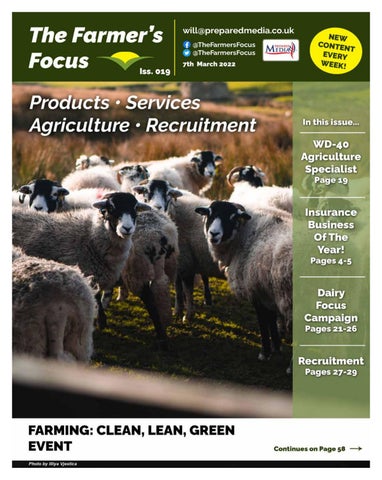
Helping Farmers to meet net zero targets Reducing farm emissions and carbon. Introducing innovative equipment. What impact does your farm business have on climate change? What measures can be put in place to mitigate your carbon output? Are you considering a more regenerative farming system with a holistic approach but don’t know which way to turn? All these questions and many more will be answered at the Farming: Clean, Lean, Green event being organised by Anglia Rural Consultants on Wednesday 11th May at the University of Cambridge’s Park Farm at Madingley, supported by HSBC and Volac. An informative event is being organised with high profile speakers from Cambridge University, Map of Ag, Gentle Farming and Felixstowe Hydro cycle project, who will discuss how farmers can improve systems by adopting high tech innovation, explore inn environmental and resource management case studies as well as managing clean resources. Subject to the weather, there will be working field demonstrations of silage production using the well-researched additive, Ecosyl, and machinery powered by alternative energy sources. All-electric all-terrain and utility vehicles can be test driven and specialists in the design, construction and installation of AD plants, crop stores, controllers, refrigeration equipment, clean water irrigation and energy saving solutions will be on hand to offer expert advice. Host for the event is Paul Kelly, Cambridge University’s Farm Manager who commented ‘Following the success of the 2021 event, we are delighted to be holding such an innovative and hands-on event at Madingley once again. Our site stretches across 692 ha and includes state of the art technology including an anaerobic digester, robotic milking arms and robotic silage pusher used to provide a teaching resource to the Department of Veterinary Medicine. As farmers, we have a huge challenge in reducing our impact on climate, whilst working with nature to enhance the environment in which we operate. It is achievable, and many of the exhibitors and field demonstrators will highlight exactly how this can be done.’
We are going to show farmers what’s coming and how to handle it, especially in terms of the environment and energy. We will have the best as speakers, as exhibitors and as demonstrators, to inspire farming businesses to change, adapt and make the most of the opportunities and challenges facing the industry. Come and see; come and listen; come and ask; come and think – we’d love to see you.’ At the event, there will be: • State of the art machinery and vehicle demonstrations powered by methane, hydrogen or electric including a static display of the New Holland T6.180 Methane tractor, winner of the 2022 sustainable tracto of the year. • Working demonstrations of the silage harvest from the field to clamp • Talks will be themed on Improving high tech innovation in agriculture; agricultu environmental and resource management and reviewing clean resources on farm • Exhibitors who have the equipment, knowledge and skills to help farmers meet the new regulations • Test drive the latest EPV’s on the market • Expert advice and support to help you wherever you are in the country and type of farm business • Information on enhanced silage preservation to retain more of its I feed value and reduce dry matter (carbon) losses The event is free to attend but it would be handy to register in advance to receive regular updates. Refreshments will be available to purchase at the event.
To book a place for the Farming: Clean, Lean, Green event please click here to register: https://www.eventbrite.co.uk/e/farming-clean-lean-green-tickets-243836069247 To stay up to date with a list of exhibitors, information and what to expect visit: https://www.angliaruralconsultants.com/news-events-and-insights/ or follow on Facebook, Twitter or Instagram: @AngliaRuralConsultants Hashtag #FarmingCleanLeanGreen Current COVID-19 regulations and recommendations will be followed. BASIS points have been applied for.
Commenting further, Howard Gilbert of event partner, Volac, said: ‘We are delighted to be part of this innovative gathering to have the opportunity to discuss with farmers how they can improve silage as a highly sustainable homegrown feed. Reducing losses in silage dry matter and nutrient content by improving its conservation not only means less carbon is lost from it, but it is also a highly practical way that livestock producers can reduce reliance on bought-in feeds to improve feed efficiency and reduce feed miles.’ imp The event is the brainchild of Anglia Rural Consultants founding member Richard Rampton who remarked ‘It may be trite but it’s also true that farmers are faced with more changes now than at any time since the 1947 Agriculture Act. Back then, Dan Archer was telling them what to expect, at 6.45 on the Home Service. Now it’s a Field Day on May 11th run by Anglia Rural Consultants, working with the University of Cambridge and supported by HSBC and Volac.
www.angliaruralconsultants.com
Your one stop shop for game & poultry supplies!
Contact us for a FREE catalogue!
“Easy to use website, plenty to choose from, orders despatched quickly”
www.collinsnets.co.uk - 01308 485422
Farming Business of the Week
HOW FARMPLAN IS HELPING FARMERS TO BE MORE SUSTAINABLE Data is a driver for massive change in farming, and more and more within the sector are seeking solutions that allow them to take full advantage of the benefits it brings. A new partnership between Farmplan, the UK’s leading agricultural software specialists, and Sustainable Landscapes, a landscape-based programme initiated by Future Food Solutions, demonstrates initi just what the future of sustainable farming can look like – and how it can mean a win-win for farmers and their partners within the supply chain. “About eight years ago, we began to specifically examine resilience in supply chains for our major clients,” says Steve Cann, Director of Future Food Solutions. “Working closely with farmers demonstrated that their data is incredibly important, and that Gatekeeper, which many of them used, offered a value adding platform, as the more data farmers had, the better it would be for mo them in terms of managing their business.” The goal of Sustainable Landscapes is to improve soil quality and water management for more resilient and profitable farming. In Gatekeeper, Steve found widely used software that recorded all the essential data for effective sustainability planning and execution. “We sat down with Farmplan and discussed how we could work together,” he says. “As a result, with the farmers agreement, we can now pull vital information directly out of Gatekeeper to perform a full carbon audit very quickly.” This partnership helps farmers to improve soil health and farm in a more sustainable way, including the use of cover crops to cultivate biomass and increase soil organic matter (SOM) in their fields – a major sink and source of soil carbon. As Steve explains, a 1% increase in SOM per hectare allows that area of land to absorb an additional 240 tons of water. additiona
“In one example, we saw a farmer increase their SOM from 2% to 6%,” says Steve. “They have close to 1,000 tonnes of water available in that hectare of land that would not have been there a few years ago. All of this is verified and driven by independent soil testing and assessment. We’re not marking our own homework. It’s a real win-win, creating a virtuous circle where farmers, win water companies, and brands all benefit.” For UK growers, this means being able to farm more sustainably and demonstrate compliance to their supply chain partners – all by simply using the data which they already capture as part of their existing practice. This extends to nutrient capture, offering a further financial benefit. For example, one farm tested their cover cov crops and discovered 305 kgs of N pulled in per hectare – a hugely valuable gain, especially with the current pricing. “Fundamentally, this is data that’s already being recorded for compliance,” says Scott Millar, Account Manager at Farmplan. “This partnership just means farmers see an extra benefit from their work, from better utilisation of nutrients to more effective farm management. It’s an exciting prospect for UK farmers who are eager to derive more value from their business in a sustainable mo way.”
A Quick, Easy and Clean Solution to Biosecurity on Your Farm. At Waste Spectrum, our ethos of Prevent and Protect is at the heart of what we do. We understand the importance of biosecurity and we have the solutions to your problems.
If you value trust and honesty, we should talk.
Speak to a member of our team today. Call us on: +44 (0)1905 362 100 Email us at: sales@wastespectrum.com Visit us at: www.wastespectrum.com