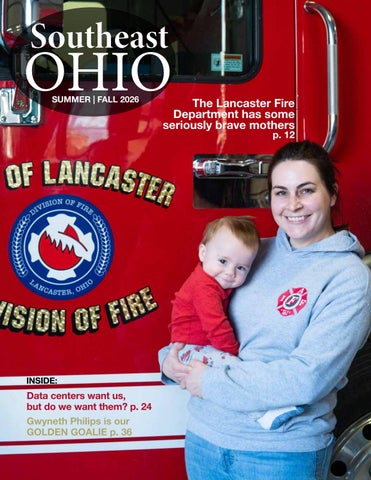
Southeast
OHIO SUMMER | FALL 2026
The Lancaster Fire Department has some seriously brave mothers p. 12
INSIDE:
Data centers want us, but do we want them? p. 24 Gwyneth Philips is our GOLDEN GOALIE p. 36 s o ut he a s t o hio ma ga zi ne .c om A
EDITOR’S NOTE
I
doubt I need to tell anyone from Southeast Ohio that this region is dynamic. From writer Bobby Keegan’s profile of Southeast Ohio’s Olympic gold medalist hockey player Gwyneth Philip and Darcie Zudell’s story about a compassionate car club in Noble County, to coverage of data centers and proposed development, our stories showcase an area consistently oiling its gears. The writers, photographers, writers and editors of Southeast Ohio magazine capture the region’s triumphs and challenges with utmost respect and skill in the 20 stories affixed to these pages. In Behind the Bite, Donovan Varney sits down with Cheryl Dodson, the owner
ON THE COVER
Lancaster firefighter Carlie Goodchild holds her son Aaron at the firehouse. Photo by Olivia Trowbridge.
MISSION STATEMENT
Southeast Ohio content strives to spotlight the culture and community within our 21-county region. The student-run magazine aims to inform, entertain and inspire readers with stories that hit close to home.
SOCIALS and DIGITAL
Southeast Ohio Magazine @SEOhioMagazine @seohiomagazine @southeastohiomagazine2609 @SEO/AMD Magazine
CONTACT US
Southeast Ohio Magazine E.W. Scripps School of Journalism 1 Ohio University Athens, OH 45701-2979
2 Sum m er | Fal l 20 26
of Dodson’s on Broadway, a restaurant revived with the help of Perry County after being burnt down. Maia LeClair takes us on the ground in Talking Points to discuss a series of earthquakes shaking up Noble County. Copy chief Liam Syrvallin primes us for the data center debates with his essay, “Renewed Resistance,” which digs into the history of Southeast Ohio’s labor movements, while Mia Kraus, Emma Wilson and Maggie Amacher bring us stories of proposed technology development in our region. In the Feature Well, Lucy Schaefer tackles the discourse and events impacting high school football in 0ur region and beyond. Together, the mix of stories in this issue illustrate the never-back-down attitude of Appalachia that continues to shine, no matter the weather. Hope you enjoy,
Logan Adams
MASTHEAD EDITOR-IN-CHIEF: Logan Adams MANAGING EDITOR: Zachary Knight COPY CHIEF: Liam Syrvalin DEPARTMENT EDITORS: The Scene, What’s Your Story: Maggie Malone Behind the Bite: Suzanne Piper In Your Neighborhood: Lucy Schaefer Talking Points: Maggie Amacher Feature Well Editor: Darcie Zudell WRITERS: Jude Hannahs, Olivia Trowbridge, Mia Kraus, Maia Leclair, Donovan Varney, Emma Wilson, Ashley Fry, Jessica Thrasher DIGITAL DIRECTOR, broadcast liaison: Parker Kopronica AUDIO EDITOR: Scarlett Wagner SOCIAL MEDIA EDITOR: Anna Parasson DESIGN DIRECTOR: Lucy Riley Faculty Advisor: Elizabeth Hendrickson
For these stories and more:
www.southeastohiomagazine.com
CONTENTS summer-fall 2026
DEPARTMENTS THE SCENE
4 Nobe County Cruzers are much more than a car show
Pg. 8
BEHIND THE BITE
6 Dodson’s on Broadway rises from the ashes 8 Oddfellows offers pizza, fun and games in Chillicothe
10 The old roots and new recipes of Pike County’s Sully’s in the Valley 11 The Busy Bee restaurant creates a new buzz in Washington County
TALKING POINTS
22 Feeling unsteady in Noble County 23 A reminder that wildlife is wild life
Pg. 36
IN YOUR NEIGHBORHOOD
12 The women of the Lancaster Fire Department embody two selfless jobs 16 Reimagining the lost treasures of Monroe County’s “Buckchitawa” 18 The young service organization in Jackson is good for the soles 20 Hamden’s Hammond Hardware has heart (and ducks)
WHAT’S YOUR STORY?
46 Spud Run Golf Course is one man’s green
FEATURE WELL 36 Gwyneth Philips is Athens’ golden goalie 42 Captivating author and hard news journalist Cyn Mackley tells one story at a time Data Discord 24 Ohio’s renewed resistance to outside forces wanting inside access 26 Meta hopes to plant in Pike County 28 What’s happening in Waterford? 30 Strata Expanse pushes big tech on a small town High Stakes, High School Sports 32 Follow the money with NILs 34 Recruiting scandals score a GAME OVER
s o ut he a s t o hio ma ga zi ne .c om 3
BEHIND TH
MORE THAN A CAR SHOW
How the Noble County Cruzers turned a small-town car club into a tradition of generosity Story by DARCIE ZUDELL
4 Sum m er | Fal l 20 26
O
n a gray Saturday at the Noble County Fairgrounds, Donna Shimer and Eddie Gillespie, with help from their spouses, unfold a quilt stitched from a decade’s worth of car show T-shirts. Each illustration captures vehicles that won the previous year’s “Best in Show” and “Best Truck.” “I could tell you stories about every one of them,” Shimer says. The shirts have become a collector’s item in Caldwell, with attendees lining up early each Independence Day to get their hands on the newest designs. But for the Noble County Cruzers, the cars adorned on the shirts are only part of the story.
THE SCENE
“We’re not just showing cars and burning rubber on the road; we’re here to help the whole community.” -Donna Shimer, Noble County Cruzers member
HE BITE
The organization remains deeply rooted in giving back to the community since its founding in 2010 by Steve Hall. Hall founded the group to connect with the community while raising funds for 4-H camps, veterans, domestic violence shelters and more. Discussing how many organizations the Cruzers have donated to in the past, Gillespie says, “How much time do you have? There’s a lot, and we want to help even more.” Shimer and Gillespie are two members who have been involved with the organization for over a decade. Shimer was the club’s president for seven years before passing the torch to Gillespie in 2025. Decades of experience between the two, along with Hall’s dedication, have helped cement the club’s reputation, especially when it comes to hosting the annual
Fourth of July car show. It is the event to be at in Caldwell. At a typical Fourth of July car show, one can expect a classic chicken dinner, free water and unbiased judging. “Finding a good judge is hard,” Gillespie says. The group must make a diligent effort to find car show judges from across the region who give all cars a fair shot: Fords, Chevys and Hondas alike. It’s also important for Shimer and Gillespie to nourish young people’s interest in cars and get them involved in their community. “It’s hard to get the younger generation excited,” Shimer says. “I try to get excited for them so they can grow their interest in cars ... There’s something special about working on an old antique car.” Every year, Shimer and Gillespie strive to surpass their previous donation records. In the past, the Cruzers consistently gave $2,000 to local 4-H Camps from the profits raised at the Fourth of July car show and donations. Even when poor weather affected attendance, Shimer says Hall would silently take cash out of his own pocket to make up the difference. “That’s just how Steve Hall was,” Shimer says. In recent years, as participation has grown, the group has given closer to $3,000, a testament to the foundation Hall built. The Cruzers’ dedication to supporting their community is what keeps members and sponsors coming back year after year, according to Shimer and Gillespie. Beyond their public service initiatives, members of the car club provide a support system for one another. Whether they’re grieving a loss or celebrating a win, the Cruzers have built a strong circle of support. “We’re not just showing cars and burning rubber on the road; we’re here to help the whole community,” Shimer says. s o ut he a s t o hio ma ga zi ne .c om 5
B
ehind the rebuilt walls of Dodson’s on Broadway is a story of destruction, determination and a neighborhood of people that refused to let an act of arson be its final chapter. From the outside, the Perry County restaurant feels untouched by time — the home-grown, welcoming atmosphere, the same steady stream of regulars. Inside, the diner’s stone walls echo with conversations, kitchen orders and the sound of chicken crackling in the fryer. Cheryl Dodson was born and raised in Corning, a small village in Perry County marked by a single stop sign. She became the owner of Dodson’s on Broadway nearly 20 years after her brother purchased the building from a struggling pizza shop, and then sold it to her. After some touch-ups, the diner became synonymous with its fried chicken, all-day breakfast and southern comfort. “At first, I thought I bit off more than I could chew,” Dodson says. “But now, I wouldn’t go a day without it.” In those 20 years, she barely has; Dodson says she’s only had seven weeks off work since she’s had the diner. “It’s nonstop because I want to be part of it,” Dodson says. “Most people own [diners] and just sit back and put people in positions ... I don’t do that.” Dodson is hands-on with all things related to her diner. From the menus and specials to the bills and payroll, she does it all herself. But after tragedy struck, she wasn’t alone. On the
6 Sum m er | Fal l 20 26
morning of Mother’s Day, May 11, 2025, a shed outside of the diner was set ablaze and spread to the building’s main structure just moments after. The diner suffered such significant damage that Dodson was left with two options: rebuild or say goodbye. In that moment of desperation, Dodson’s family, employees and town all came to the rescue. “If it wasn’t for them, I’d have probably lost all hope,” Dodson says. “I bet I had 2,000 of them stop by within a week; or call and text to me to see what they can do.” After the outpouring of support, Dodson says she knew she had to rebuild. Her surrounding village helped raise over $52,000 in an account set up for her by Peoples Bank in New Lexington. Because of the donations, Dodson was able to keep her entire staff after the fire, including her employee of nine years, Tequilla Hinkle. “Once we had our fire, everybody came together and helped [Cheryl],” Hinkle says. “She does a lot for the community, so everybody just wanted to give back.” One of Dodson’s priorities as a business owner over the past 20 years is engaging in philanthropy. She helped start the Kat Dodson Foundation in honor of her late sister Kathy, a non-profit that raises money for the Perry County Cancer Alliance. In addition, she donates to dozens of charitable causes each year and supports local athletics. The support
BEHIND THE BITE
RISING FROM THE ASHES After a devastating fire caused by arson, Dodson’s on Broadway rebuilds and opens its doors to the county that never gave up on it Story and Photos by DONOVAN VARNEY
Dodson has received in her county of roughly 35,000 is, in her eyes, second to none. “You couldn’t put me anywhere in the world that I’d be happier than right here in Perry County,” Dodson says. In just four months, Dodson had gutted what was left of the diner and rebuilt it from the ground up. Dodson says she knew it’d be busy once she reopened, so she decided to hire more employees. She received nearly 150 applications to work for the diner in a matter of weeks. Of her 23 employees, seven of them are members of Dodson’s own family. She says once you join the team, you become a Dodson for life. “This is my family,” Hinkle says. “I don’t think I’d ever leave. I think I’m glued to this place for the rest of my life.” Since reopening, Dylan Davies, 30, was charged with and sentenced for a felony of the first degree for his crimes against the diner. The New Lexington Police Department says it caught Davies on the diner’s surveillance camera lighting the fire. Dodson says she has no connection to Davies, but later discovered she catered his mom’s funeral just weeks before. “I gave him my catering hall for free because [his mom] died of cancer, and we’re big cancer supporters,” Dodson says. “Come to find out, it was him that caught the place on fire.” In the months following the fire, Dodson has been redecorating the diner with relics that she salvaged during
the demolition: A melted metal clock, frozen in time at 3:51 a.m. when the fire engulfed the diner’s interior, hangs on the wall next to a partially melted door. They serve as reminders of what she overcame with the help of her family and neighborhood. There may be a chicken hanging on the storefront of Dodson’s on Broadway, but its new symbol isn’t a bird that they cook in a fryer. Instead, it’s a phoenix. Dodson says a regular called her after the fire and says that she’d be “like a phoenix rising from the ashes.” Now, she wears a chain with a phoenix pendant around her neck every day. Today, the restaurant’s interior is plastered with the mythical bird’s memorabilia and family photos with people who helped bring Dodson’s on Broadway back to life.
Dodson’s on Broadway dodsonspizza.com (740) 342-1100 313 W Broadway St, New Lexington Open: Mon.-Thurs. 8 a.m. - 9 p.m., Fri. 8 a.m.-8 p.m. Closed: Sat. - Sun.
s o ut he a s t o hio ma ga zi ne .c om 7
DELICIOUSLY OFFBEAT How a former meeting hall for one of America’s oldest fraternities became Oddfellows, a Portsmouth destination Story and photos by JUDE HANNAHS Although the idea for Oddfellows started as a blueprint for an alcohol and cigar shop, it has since transformed into the ultimate local hangout. Since 2024, the smoke has cleared to make room for the smell of fresh pizza, the glow of arcade games and the crash of duckpin bowling pins. The Portsmouth restaurant has only been open for two years, but it has gained significant popularity in Scioto County, mainly due to its family-friendly appeal. The building was bought by a local couple, Maddie and Jeremy Burnside, in 2019. Previously, Oddfellows served as a meeting hall for the Independent Order of Odd Fellows, a fraternal organization from which the restaurant’s current name originated. The Burnsides were close to selling the building after Jeremy was diagnosed with a terminal illness. “A year and a half later, he passed, and I was going to sell the building,” Maddie says. “My dad, while [Jeremy] was sick, had finished out the renovations.” Jeremy died in June 2022, and to honor him, Maddie had a mural of him completed on one of the restaurant’s interior walls so customers do not forget who helped bring Oddfellows to life. Maddie eventually met her second husband, John Ke-
8 Sum m er | Fal l 20 26
hoe. Kehoe worked as a chef, and the two of them decided to pursue the dream Maddie and Jeremy had laid the blueprint for. Oddfellows lacks subtlety about making its brand visible to the public, with its logo and name being the first things a pedestrian may see when walking by the building. Compared to a lot of the other buildings on the same street, Oddfellows has a lively presence like none other. What both Maddie and John are proud of is the positive experience noted by locals in Portsmouth and from those farther out in neighboring counties such as Jackson County, Pike County and Adams County. “It’s definitely a family atmosphere,” John says. “We’re definitely a restaurant with a bar, not a bar with a restaurant.” Maddie’s favorite pizzas are the Reuben and the Brisket Bliss, while John prefers the Local Boomer as a specialty pizza. According to Oddfellows’ website, the Reuben is “house-made corned beef, tangy sauerkraut, and creamy Thousand Island dressing on an everything-seasoned crust.” As for the Brisket Bliss, it is made with “green peppers, caramelized onions, white cheddar and a tangy BBQ drizzle.” In addition to pizza, Oddfellows offers appetizers,
BEHIND THE BITE
“We’re definitely a restaurant with a bar, not a bar with a restaurant.” -John Kehoe, Oddfellows co-owner
PHOTO, OPPOSITE PAGE: A mural of previous building owner (left) and Maddie Burnside’s deceased husband, Jeremy (right) watches over diners. THIS PAGE, ABOVE: The Hogfather pizza in all its glory. THIS PAGE, TOP RIGHT: The Oddfellows logo keeps its eye on 2nd Street in Portsmouth. THIS PAGE, RIGHT: Arcade games are ready for players.
soups, salads, desserts and a kids’ menu. Maddie and John create menus specifically for the four seasons to reflect fresh ingredients. For spring and summer, the menu shifts to lighter flavors and refreshing beverages. For fall and winter, Oddfellows opt for heartier ingredients and comforting soup specials. The second floor of the building is for weddings, parties, receptions and corporate events. As time progresses, the space will venture out to include other events. “We have an adult prom called the Odd Ball in March,” Maddie says. “In April, we have a comedy show coming out. Word is getting out more about the venue on the second floor.” With a little over two years under their belts, Maddie and John plan to expand Oddfellows to surrounding locations. “It was designed that way from the get-go,” John says. “We are looking at other places already and we’ve reached the point that it’s OK to begin looking forward at expansion.” It’s a unique type of restaurant, and for being in southeast Ohio, it generates a special presence among the population of Portsmouth.
ODDFELLOWS
pizzasandpins.com (740) 529-2470 hello@pizzasandpins.com 526 2nd St., Portsmouth
s o ut he a s t o hio ma ga zi ne .c om 9
BEHIND THE BITE
SULLY’S DELIGHT Story and Photo by EMMA WILSON
I
n the center of Pike County, Sully’s in the Valley is a central gathering place built on a blend of local history, family legacy and classic comfort food. The veteran-owned and family-operated restaurant opened in 2023 and is co-owned by Steve Adams, son & daughter-in-law Josh and Christy Adams, and his cousin Eric Sullivan. Together, they created a warm diner and pizzeria that reflects both their family’s deep roots in the region and their commitment to serving the community. The Adams family has lived in the Beaver area for more than 200 years. Sullivan noted Adams Road is named after their family, a reminder of how long the name has been part of the local landscape. That sense of heritage is central to the restaurant’s identity. The walls are covered with photographs of Beaver’s past, including basketball teams from the 1930s, images of old school buildings and pictures of historic structures from the village. One of the most striking pieces on display is a sign from Adams Dry Goods, the family’s original business that dates to the 1800s. “Some of the family launched a dry goods store, and Adams Dry Goods has been part of the community ever since,” Sullivan says. The land where Sully’s now stands also carries a piece of Pike County history. Before the restaurant was built, a pre–Civil War mercantile store stood in its place. When Morgan’s Raiders passed through the county in July 1863, during the Confederate cavalry’s raid through southern Ohio, they looted the store. For over 100 years, the building remained unoccupied, left as a lost piece of Pike County history. When the Adams and Sullivan families purchased the property with the intention of giving it a new life and purpose, the building had already deteriorated beyond repair. “It was
1 0 Sum mer | Fal l 20 26
A veteran‑owned, family‑run diner and pizzeria, Sully’s in the Valley fuses 200 years of Beaver heritage with comforting classics and a warm, community‑rooted atmosphere. cheaper to demolish the old building and construct a new one than to try repairing it,” Sullivan explains. Construction began, but progress slowed almost immediately due to the unavailability of contractors during the recent COVID-19 pandemic. Finally, they were able to open in 2023. Despite the setbacks, the owners remained committed to creating a space that honors the town’s past while offering something new for residents and visitors. Today, Sully’s in the Valley is known for its inviting atmosphere and its extensive menu. The restaurant sits at 5642 Beaver Pike, just off Main Street and a short drive from State Route 32. Inside, the retro decor and soft, nostalgic music create a cozy environment that feels familiar from the moment guests walk through the door. The menu is equally memorable. Sully’s serves fire brick oven pizzas, smashburgers, subs, chicken sandwiches and a variety of finger foods. The diner often recommends their homemade chips, the potato skins and the popular pickle fries. The Sully Burger has become a signature item, known for its freshly made patties and toasted buns. This classic leans on locally sourced ingredients, and customers often mention that they can taste the difference. Families also come for the desserts, which feature Perry’s brand of hand-dipped ice cream. The banana split is a favorite, along with sundaes, milkshakes and the hot fudge brownie.
SULLY’S IN THE VALLEY sullysinthevalley.com (740) 226-8292 5642 Beaver Pike, Beaver
BEHIND THE BITE
A NEW BUZZ FOR THE BEE
Busy Bee’s 82-year legacy of scratch-made meals continues with new owner, long-time employee Stephanie Cowart Story and Photo by EMMA WILSON
I
n Historic Harmar Village, where the brick streets of Marietta meets the slow bend of the Ohio River, the Busy Bee Restaurant continues to be a long-standing fixture of daily life. Founded in 1944, the rustic diner has weathered generations of change while maintaining its reputation for home‑style cooking and strong community roots. Now, the historic landmark is entering a new era shaped by reinvention and continuity. Long‑time employee Stephanie Cowart and her parents, Belinda and Craig Winsett, are now the official owners of the restaurant, carrying forward a piece of history that has defined the neighborhood for 82 years. The transition follows the tenure of previous owner Larry Sloter, who purchased the Busy Bee in 2014 and operated it alongside his adult sons. Under Sloter, the restaurant strengthened its identity as a farm‑to‑table, scratch‑kitchen operation, and found ways to source a variety of different ingredients and products locally. When Sloter announced in early January, via the Parkersburg News and Sentinel, that he planned to sell the business, he emphasized one priority above all: finding “another family to come in and continue the legacy.” For many longtime customers and employees, the news sparked nostalgia and concern. Busy Bee is more than a breakfast spot. It’s a community anchor, a place where regulars know the staff by name, and newcomers are greeted with the same familiarity; its warm, homey interior and coffee-scented air make strangers feel like they’ve been coming for years. Cowart, who has been connected to Busy Bee for years, shared her thoughts on the change. “This place has been part of my life for so long,” she says. “It’s part of a lot of people’s lives.” When the opportunity arose for her family to purchase the restaurant, the decision felt deeply personal. Cowart and her mother, Belinda, form the mother‑daughter leadership duo at the heart of the operation. Their goal is simple: preserve what makes the Busy Bee beloved while ensuring its future remains rooted in the same values that have sustained it since 1944. The restaurant continues to serve its classic breakfast and lunch offerings. Hearty omelets, biscuits and gravy, hand‑patted burgers and daily specials have remained largely unchanged.
The scratch‑made philosophy remains intact, as does the emphasis on local sourcing. The Busy Bee’s hours remain unchanged as well, opening daily from 6:30 a.m. to 2 p.m., with Sunday service beginning at 8 a.m. For regulars who have been dining at 226 Gilman Avenue for decades, predictability is part of the charm. The Winsett’s recognize the restaurant’s longevity is tied to its reliability and its ability to offer the same comforting experience across generations. The community’s reaction to the ownership change has been overwhelmingly positive. Many customers expressed relief that the restaurant would remain in the hands of people who understood its history and culture. Employees, too, welcome the transition, noting the easy adjustment to the day‑to‑day rhythms of the kitchen and dining room. For the previous owner, Larry Sloter, the change is an opportunity for the Busy Bee to grow while staying true to its roots. After more than a decade of stewardship, he welcomes the change. As the Busy Bee approaches its 82nd year, its new owners are not rewriting its story; they are preserving it, one plate, one morning rush and one familiar greeting at a time.
BUSY BEE
busybeerestaurant.com (740) 373-3755 226 Gilman Ave., Marietta s o ut he a s t o hio ma ga zi ne .c om 1 1
TWO SELFLESS JOBS
Women of the Lancaster Fire Department demonstrate the intersectionality of motherhood and firefighting Story and Photos by OLIVIA TROWBRIDGE
IN YOUR NEIGHBORHOOD
F
irefighting is a physically challenging job. In the midst of high heat, heavy gear and strenuous lifting, firefighters have the most important job of all — saving lives and preventing harm to others. Lancaster Fire Department (LFD) firefighters and paramedics Carlie Goodchild, Meryah McDonald and Kaylee Eber understand the demands of the job. But last year, runs looked a little different for the three women; they each went through pregnancy on the force. Between April and September, Goodchild, McDonald and Eber gave birth to three healthy baby boys and are now back to work at the three fire stations under LFD jurisdiction. Built in 1899, LFD is one of the oldest operating fire stations in Ohio. Coworkers have become a community, since 24-hour shifts mean they often see their fellow firefighters more than their families. “It’s possible to have it all,” Eber says. She and Goodchild were on active duty with LFD until their uniforms no longer fit. About four months into their pregnancies, they switched to light duty, when firefighters are unable to work on the truck for a multitude of reasons. “I have my inspector card, and I was trained as a community paramedic,” Goodchild says. “I rode around with gentlemen from our fire inspector Bureau on inspections.” McDonald worked in LFD’s downtown office throughout her pregnancy due to various medical complications. Motherhood gave the women a unique perspective they didn’t have before. “I would just treat [a pediatric run] like a patient. Now, I treat it like my kid,” McDonald says. Pediatric runs are cases where children need emergency medical services from firefighters.
1 4 Sum mer | Fal l 20 26
Eber’s daughter attends St. Mary Elementary School, where recess is held at Firehouse Park, which is directly connected to LFD. “It’s just a different pride watching your kids watch you and what you do for a living,” Eber says, as she’s able to observe her child while working on the force. Beyond fighting fire, 86% of LFD’s 11,000 runs last year were emergency medical service runs. Those types of cases provide emergency medical treatment for the public, usually alongside ambulance and paramedic services. In this profession, firefighters know the reality of loss; it’s a physical sacrifice in the face of danger. “On my shift, we will sit at the table and talk about it,” Goodchild says. “We’ll check up on each other the next day.” Goodchild also says LFD is working to make the peer support team more present in the department. The intersection of parenthood and firefighting is a balance many firefighters face. “You’ve got to hug the babies tight, every chance you get. You have to love on them as much as you can, because life can change in an instant,” Goodchild says. In a traditionally male-dominated profession, women stand as a testament that they have a place in any field. “Don’t let anything stop you. If that’s what you want to do, pursue it,” Goodchild says. “We know it’s an example for young girls out there.” Humble and devoted to their jobs, the women joked about their own newsworthiness “Just another day,” Eber says. PHOTO, BELOW: Firehouse Park, directly connected to Lancaster Fire Department, offers children the chance to dream big.
PHOTO: Firehoses at Lancaster Fire Department, which was built in 1899 and is one of the oldest operating fire stations in Ohio.
REIMAGINING THE LOST TREASURE OF “BUCKCHITAWA” A local legend becomes the inspiration for a modern-day treasure hunt Story by SUZANNE PIPER
C
asey Bott grew up watching The Goonies, a 1985 film about children on the hunt for lost treasure, wishing he could live in that same adventurous scenario – until he made it possible for kids in 2025. Bott, a board commissioner at the Monroe County Park District, created the Lost Treasure of Buckchitawa event to connect folklore to an imaginative storyline for a kids’ treasure hunt. The Lost Treasure of Buckchitawa is a treasure hunt that launched in June 2025 in Piatt Park, located in Monroe County. The event, which had small prizes and a grand prize of $1,500 worth of silver, used poems as
1 6 Sum mer | Fal l 20 26
clues for contenders to find the treasure. Growing up in Monroe County, community members often hear how Native Americans lived in the caves of Piatt Park. Bott was familiar with the legend, making it a perfect foundation for a treasure hunt. The event was inspired by a 1968 article in “True Treasure” magazine (a pulp magazine focusing on “Lost Mines and Buried or Sunken Treasures”), titled “The Lost Lead Mine of Buckchitawa” by David Hartline. The crux of that story involved a hidden lead mine in Buckchitawa, now known as Sunfish Creek in Monroe County, that was never found.
IN YOUR NEIGHBORHOOD
Photo, opposite page: Monroe Central High School head football coach Jonathan Calder, his wife, Vickie and their two sons, Cy and Camden, smile while holding their winning treasure chest in Piatt Park. Photo provided by Jonathan Calder. Photo, this page: “Lost Treasure of Buckchitawa” contenders prepare to take a dive in Piatt Park’s gorge, in hopes of finding the lost treasures. Photo provided by Casey Bott.
According to the article, the mine’s existence came to light during the Northwest Indian Wars around 1795, when American Indians captured settler Martin Whetzel and took him to the Buckchitawa Creek. The article claims that Whetzel was taken on a canoe about ten miles upstream when several of the American Indians disappeared into the rocks, returning with large amounts of lead. They started a fire and used hot coals to melt pieces of the lead, molding a supply of bullets. Whetzel was able to escape; however, when he tried to return to the lead mine, he couldn’t find it. Hartline writes that Silas Jackson, a tavern owner, claimed an American Indian told him his tribe used lead from the Buckchitawa, but never gave an exact location. Hartline adds that a 92-year-old man, Sam Pfalzgraf, said he doesn’t believe there was a “mine,” rather a series of small veins that contain limestone, which lead is usually found around, and Monroe County is “filled with limestone.” The writer mentions that Pfalzgraf believed the American Indians mined the lead and stored it by Sunfish Creek, but, according to Hartline, several people have tried to find the Lost Lead Mine of Buckchitawa, and have never had any luck, thus beginning the local legend of the lost lead mine. While the tale may not hold up to historical scrutiny, the summer event had other objectives. Families
explored a local park together, using poems as guides through the landscape and learning about local history, fictional and non-fictional. “It’s just playing with history and having some fun with it and not being literal,” Bott says. Monroe Central High School head football coach Jonathan Calder, his wife, Vickie and their two sons, Cy and Camden, won the grand prize: a treasure chest that contained pure silver coins. Calder says he will keep the prize and pass it down to his sons, in hopes that they will give it to their kids. But the treasure wasn’t what made the event so special to the Calder family; it was the chance to get outside and get involved in the community. “I’ve lived here my whole life, been to Piatt Park many times, so I was excited they were trying something new,” Jonathan says. Connecting the local lore of Monroe County’s land to a fun, exciting event which gets kids away from screens is more valuable to families like Calder’s than any prize money. Although the silver from inside the treasure chest may collect dust, the memories of the Lost Treasure of Buckchitawa summer event stay fresh. “Hopefully, more people come out for the next one, because it was a lot of fun,” Calder says. The next hunt for the Lost Treasure of Buckchitawa has yet to be announced, but Bott hopes to make it a recurring event.
“I’ve lived here my whole life, been to Piatt Park many times, so I was excited they were trying something new.” Jonathan Calder
s o ut he a s t o hio ma ga zi ne .c om 1 7
IN YOUR NEIGHBORHOOD
GOOD FOR THE SOLE
From a grassroots idea to a registered non-profit, three former Jackson County high school students are changing lives, one name-brand shoe at a time. Story by ASHLEY FRYE
B
y delivering name-brand shoes to students who might otherwise go without, Southern Ohio Soles (SOS) is doing more than providing a basic need; it’s giving Southeast Ohio students a chance to feel like they belong. SOS began with three Southern Ohio students. Dayne Neff and Isaac Slark at Jackson High School, and Max Gentry at Oak Hill High School, all seniors at the time, bonded over buying and reselling sneakers. They spent their weekends combing through outlet malls and studying resale markets. “We all resold sneakers,” Neff says. “Isaac started in eighth grade, Max and I in tenth grade, and we wanted to find a way to channel our passion into something positive.” As graduation approached and the prospect of leaving Jackson County became a reality, the three students knew they wanted to give back to the communities that raised them. That sense of responsibility led to action. What started as a Google form sent to guidance counselors in the Jackson, Oak Hill and Wellston school districts quickly grew into a quiet system of care. When a school counselor identified a student who needed new shoes, they submitted the form. Slark would then search online for the right size and brand, purchase the shoes, and the three students would personally deliver them to the student in need. SOS exclusively gifts students name-brand shoes, setting it apart from other footwear nonprofits. “Whether people like to admit it or not, everybody notices what people have on,” Slark says. “Everything holds a status to it. When you’re in school, you can’t control your economic situation, what shoes go on your feet every day, so we thought having those namebrands could give a kid the confidence to make new friends, to feel like they fit in.” Less than a year after its creation, Southern Ohio Soles evolved from a grassroots idea, becoming a registered 501(c)(3) nonprofit organization supported by
1 8 Sum mer | Fal l 20 26
sponsors across Southeast Ohio and donations from around the country. Its impact is growing steadily, now reaching beyond Jackson County into the Vinton and Pike County school districts. “This was our way to not only help the kids in Southeast Ohio but also to show them that they can do whatever they put their mind to,” Slark says. “A lot of kids from our area stay in their lane; they don’t think they can go above and beyond where they’re from. We want to show by example that this couldn’t be further from the truth.” Slark and Gentry now both attend The Ohio State University, studying operations management and civil engineering, respectively, while Neff is enrolled at Yale University, pursuing an economics degree. Back in Southeast Ohio, the organization relies heavily on its school district’s student representatives. The three co-founders say they are the heart and soul of the organization. Student representatives from each school district are tasked with identifying students in need, placing and organizing orders and delivering them to schools. Samuel Gentry, Max’s younger brother, serves as a senior student representative at Oak Hill. “This is an opportunity unlike any other,” Samuel says. “It’s very cool to see the orders come in, and deliver on them, then to walk into school and see the smiling faces of the kids, and the confidence boost it gives them. To know that I had a part to play in that, it means the world to me.” Gentry, Slark and Neff are deeply committed to running the organization from college and have no intention of slowing down. The Southern Ohio Soles website provides ways to donate, contact the team, and information on how to become a sponsor. Neff, Slark and Gentry emphasize that without the support of their surrounding communities, none of this would be possible, and with the help of their supporters, they can fulfill their dream of helping Southern Ohio kids never give up on theirs.
Images courtesy of southernohiosoles.com.
s o ut he a s t o hio ma ga zi ne .c om 1 9
IN YOUR NEIGHBORHOOD
HARDWARE AND HEART
From wind chimes and hammers to 3D-printed geese, Hammond Hardware blends tradition, local goods and neighborly support to keep a tight-knit village connected. Story and photos by MIA KRAUS
H
ammond Hardware’s Facebook page reads, “We are so much more than a hardware store.” The sentiment becomes clear as customers step into the cozy building tucked away in the village of Hamden. Hammond Hardware sells everything you’d expect from a typical hardware store, plus items unique to it, such as 3D-printed geese with matching costumes. Owner Steve Hammond credits his wife, Melissa Hammond, for the idea. “People go crazy for them,” Hammond says. Hammond and his wife live in McArthur, where he works as the city’s mayor. But the family is from Hamden, the town where he bought the store from former owners, Don and Louis Souders, in 2021. For Hammond, the building’s history motivated him to look into ownership of the property. “I like old buildings,” Hammond says. “[It] sat empty for probably six-to-eight years... I called Don on the phone and said we wanted it. He said, ‘OK, it’s yours.’” The building’s history dates to 1902 when local banker C.C. Roberts built it. It was originally a two-story building before an explosion from a gas leak leveled part of it in the 1930s. The destroyed section was rebuilt into
a one-story building, and the damage to the remaining section was repaired. The store attracts most of its customers in the spring and summer, but with the intense snowfall this winter, customers flocked to Hammond Hardware. “It was crazy,” Hammond says. “About three days before, if [a product] put out heat or if it moved snow, it sold. I had people calling from Ashland [to] Kentucky, looking for kerosene heat.” Hammond Hardware also offers local products, from Silverbridge coffee to honey from a local apiary called Rose Farms. Bringing the small town together is what makes the job so appealing to Hammond. “It’s a small town, and people get to know you,” Hammond says. “I know a lot of the people that come in here, and I know their parents or grandparents.” The townspeople support each other when they need it most. When snow buried much of Ohio this winter, Hammond Hardware provided residents with supplies and offered to help with plumbing issues and snowfall buildup. Hammond explained that togetherness can make or break a small town. “We help the fire departments when we can, such as when they need a donation for dinner or an auction,” Hammond says. “I think we have a pretty good relationship with the [community].”
HAMMOND HARDWARE 106 N Main St, Hamden 45634 (740) 855-4178
Photo, opposite page: What could be box about Hammonds more Info exciting than a Santa statue and candy jars? Possibly, a stone goose in a costume (right, out of costume). This page: Steve Hammond stands amidst his cornucopia of goods for sale. Photo courtesy Hammond Hardware’s Facebook page.
s o ut he a s t o hio ma ga zi ne .c om 2 1
TALKING POINTS
FEELING UNST
EADY?
Many earthquakes can be linked to hydraulic fracturing efforts in Noble County, affecting residents
I
Story by MAIA LECLAIR
n recent years, Julia Coyle-Wheeler has been woken up by earthquakes rattling her house in Noble County more than once. She notes it was “alarming” when in the middle of the night, the shaking caused books and belongings to fall off her bookcase and nightstand. According to the Ohio Department of Natural Resources’s seismic database, the magnitude of many of these earthquakes usually fell below 2.0 on a scale ranging from 1.0 to 8.0. However, these quakes were still concerning enough for Coyle-Wheeler to seek information and assistance, leading her to contact her insurance company. “The first thing a lot of us did, especially with big farms and animals, was call our insurance agent,” Coyle-Wheeler says. “I don’t know if anything’s covered, like cracks in your foundation or your house or your barn … there were a lot of calls about that.” Residents in Noble County have felt an uptick in earthquakes. According to the ODNR, 69 earthquakes were reported in the first half of 2025. “It was definitely affiliated with Encino,” Coyle-Wheeler says, referring to the energy company Encino Acquisition Partners, acquired by EOG Resources. “I think it’s connected to the shallow-well drilling.” In 2018, EOG took over some drilling and completion operations on a massive Utica Shale position it acquired from Chesapeake Energy Corp. The Utica Shale is an organic-rich, hydrocarbon-bearing formation buried thousands of feet deep in the Appalachian basin and the primary source for natural gas and oil operations in Southeast Ohio, according to the U.S. Energy Information Administration. In 2026, 16 wells have already been drilled in this basin, which is expected to yield higher production volumes, according to Oil Gas Leads, an industry source which provides intelligence for the energy sector. Celia Hawk, a Save Ohio Parks volunteer and a senior at Ohio University studying environmental studies, is keeping a close eye on Ohio’s fracking operations. She says Ohio parks are “being sold for fracking and to the oil and gas industry.” Over the summer with Save Ohio Parks, she studied mapping software, including ODNR’s interactive seismic map, to help document the increase in earthquakes in Ohio and how fracking may be linked. “Initially, researchers thought that injection wells were the only aspects of fracking that [are] linked to earthquakes because injection wells shoot fracking fluid into the ground and then that lubricates the plate boundaries and can lead to earthquakes,” Hawk says. “But recently,
researchers have discovered that other fracking wells do the same thing because ODNR’s disturbing the boundaries underground.” In May 2025, ODNR halted operations at a Noble County well pad operated by EOG. This well pad was used to dispose of wastewater from oil and gas extraction. However, this has not stopped minor earthquakes from occurring altogether. Earthquakes that people cannot feel, below a magnitude of 3.0, can still pose risks, according to Hawk. These risks, according to Science Advances, a peer-reviewed scientific journal, include impacts on tectonic tremor synchronization. This means earthquake activity that may not fall on a fault line can still influence how large a fault breaks into segments. For human health, the risks have not yet been studied. “What’s most concerning to me about that is that truly, there hasn’t been a ton of research done exploring the long-term impact of large quantities of earthquakes,” Hawk says. “We don’t quite know what the long-term impacts of a ton of low-magnitude earthquakes really are on Ohio land.” Concern about long-term effects has not reached all areas of Ohio’s government yet. Ohio Republican Sen. Brian Chavez, representing Ohio’s 30th district, previously served as the CEO of Deeprock Energy and Deeprock Disposal Solutions, which owns various injection wells located in Noble County. According to Hawk, Chavez has received substantial political contributions from the oil and gas industry. Chavez has also been appointed to serve on Ohio’s Oil & Gas Commission, but faces an ethics complaint by a local advocacy group, Washington County for Safe Drinking Water, over his undisclosed ties to the aforementioned Deeprock companies. The complaint states in part that he has significant power over energy-related legislation, including Senate Bill 219, which would revise laws governing oil and gas wells and introduce more drilling in the region. In the meantime, Noble County residents continue to manage their lives around earthquake effects. Residents like Kimberly Smith commented on an Ohio Weather Network Facebook post about 2025 earthquakes with “Woke me up and shook the whole house,” and Christina Blattner Todd wrote, “Yes, I felt it, I thought my house would cave in.” People like Todd, Smith and Coyle-Wheeler are directly dealing with, or have dealt with, the fracking decisions made by Ohio’s oil and gas industry. “The thing is, they know that fracking causes earthquakes,” Hawk says. “They’re just willing to make the sacrifice.”
TALKING POINTS
WHEN FAWNS BECOME BUCKS
Story and photo by JESSICA THRASHER
J
How to put good intentions toward wildlife to good use
odi Proger, a former Belmont County resident, was known by her family as an animal lover to her core, with one member of that family being an actual animal. In 2013, when Proger saw a doe killed by a car and a distressed fawn nearby, she scooped it up, took it home, named it Wheezer and raised it as if it were a dog. Proger obtained a permit to keep deer on private land, and in 2019 adopted a doe she named Daisy. Six years later, in November 2025, Proger was killed by a different adult buck she was rehabilitating on her property who was ‘in rut,’ or attempting to mate, which increases a buck’s state of aggression and energy and reduces caution. This fatality is an unfortunate anomaly, but it highlights dangers that can accompany wildlife rehabilitation or domestication. State law dictates that keeping most wildborn animals is illegal, though permits have been issued (usually to wildlife sanctuaries) to keep “non-releasable” animals that are too injured to return to the wild. In addition, only spotted fawns can be housed for three days before being released into their natural habitat. In Proger’s case, she knew Wheezer could not survive in the wild and would be euthanized if confiscated by the state, so she received a permit to keep him in 2016. In 2024, she obtained a deer propagation permit. Although she did not have a license to rehabilitate wildlife and despite the deer-rehab ban, Proger shared her efforts on Facebook with her online supporters, whom she called “Wheezer Warriors.” But aside from domestication concerns, reasons for restrictions include the potential for rapid spread of disease in deer populations, public safety concerns about unpredictable animal behavior and animal welfare. Mike Rex, chairman of the ODNR Wildlife Council and treasurer of the Buckeye Big Buck Club, explains the ‘powder-keg’ potential for disease among deer with the recent example Epizootic Hemorrhagic Disease (EHD). An “unprecedented” number (9,281) of sick or dead
deer associated with EHD was reported in 2025. Herds become especially vulnerable once they reach the land’s carrying capacity, requiring a different type of human intervention for “the good of the herd,” Rex says. Flight animals, such as deer, adapt poorly to captivity and are highly sensitive to stress. Deer are also prone to contracting capture myopathy, a fatal condition triggered by extreme stress and often induced by captivity, in addition to harm caused in attempts to flee. Fortunately, most calls to the ODNR about orphaned fawns turn out to be false alarms. “Does leave their fawns to go feed, and then they'll come back to them to nurse them,” Rex says. “People find those fawns, and they think they're orphans, but they're really not.” Fawns are prepared for the wait, being virtually scentless and covered in white spots that provide camouflage. Miller offers simple advice to those who find a fawn they believe is orphaned: “Just call. Before you touch it, before you feed it, just call.” If you think you have found an orphaned fawn, observe it from a distance, so as not to leave a scent behind or attract predators. Although fawns are still more likely to receive a second chance through wildlife rehab than deer, Erica Miller, owner and operator of Erica Miller Wildlife Rehab, says she finds it necessary to heed the three-day maximum and maintain distance between fawns and humans. “They’re wild, so they grow up wild,” she says. As one of few rehabbers licensed to rehab fawns, Miller has seen successful cases and those beyond help. Miller notes that social media platforms often add to this dilemma, as posts with animal content tend to be popular, especially posts featuring unusual pets, and baby animals. “They got their selfies and cute pictures, and then they don’t see the end—I do,” Miller says. “I have to deal with the devastation of an animal that was failed by humans."
s o ut he a s t o hio ma ga zi ne .c om 2 3
C
P OR
C
O
N IO T RA GR
DATA S R ENTE
S
GOV
EE
UTILITY RATES D
ERN POW MENT ER
BIG ESTS R E T IN
N
TIO A T I
LO
P EX
Renewed Resistance?
After intense struggles with extractive industries a century ago, Southeast Ohioans made international labor history. Could it happen again?
D
Story and Photo by LIAM SYRVALLIN
eep in the Hocking Valley Coal Fields—a region comprised of Athens, Perry and Hocking counties—the boom of explosions and the drilling roar of metal on stone is a symphony as common as jazz in the streets of New Orleans. According to a 1963 Ohio State graduate thesis by John William Lozier, coal in the Southeast Ohio region had been mined for personal use by settler-colonists as early as the late 1700s. Nearly a century later, exploitative corporate mining operations expanded throughout the area, eventually employing an estimated 6,000 workers within the towns of the Hocking Valley Coal District. Lethal working conditions, including falling shale and shoddy fuses, were a constant problem, worsened by the industrialized expansion of mining operations. Miners knew that, for coal barons, the company store was sometimes a bigger source of revenue than the coal sales, reinforcing miners’ sense of exploitation. A large surplus of miners also meant most worked three days a week, as opposed to five or six, and rarely had money for necessities. Tensions between workers and coal capitalists in the Hocking Valley Coal District were extraordinarily high, and in 1882 miners in the region formed a statewide union called the Ohio Miners’ Amalgamated Association (OMAA). A new merger known as the Columbus and Hocking Coal and Iron Company (derisively named by most miners in the region as “the Syndicate”), understood labor’s structural weakness in negotiations: an excess of miners meant they were easily replaced. The min-
FEATURE WELL
“They did not have fewer obstacles than we have today. They overcame them by building networks of people.”
-Kellye Blosser, Little Cities of Black Diamonds (LCBD) board member
ers were merely a source of profit for these companies. Kellye Blosser, a project manager and board member with the non-profit Little Cities of Black Diamonds (LCBD), joined the community organization with her fiancé, Tyler McDaniel, because of her passion for preserving the history, character and future of the collection of coal towns in the Hocking Valley and those who resided in them. According to Blosser, in 1884 the Syndicate forced pay reductions from 70 cents per ton of coal to 50 cents per ton. She notes that from her research, she found that pay reduction was “roughly equivalent in 2025 to a $11,100 being cut to a $7,400 annual salary.” Miners were also forced to purchase their own equipment for work and repair it themselves when necessary. This left miners with just over $6,000 in 2025 dollars, Blosser adds. “I found a newspaper article that talked about a woman in New York City buying a painting for $20,000, and that’s not adjusted,” Blosser says. “That’s $20,000 in 1884. You’ve got miners that you want to pay 50 cents per ton, while the people paying them are buying decorations for their houses for $20,000. This was class warfare.” In addition, the new contracts for miners included “ironclad” clauses, preventing miners from unionization or strikes. Increasingly frustrated, union miners in Hocking decided that a strike was the only way to move forward. Three days after their pay was again cut, miners stayed home from work. To combat the leverage labor utilized to gain pay during the strike, the Syndicate brought strikebreakers and laborers from Europe, known to miners as ‘blacklegs.’ Contrary to long-lasting dominant narratives of “reckless labor violence” against “helpless strikebreakers,” research published in Ohio History notes that despite the occasional social friction, there existed tremendous solidarity and cooperation among strikebreaking labor and unionizing miners. Union leaders in the area, like John McBride, thought of the new laborers as “deceived,” and understood that the strikebreaker was not their enemy, rather the coal baron himself. Eventually, many of those strikebreakers left in solidarity, and empathy between groups of miners grew. Tyler McDaniel, president of the LCBD, says that he was inspired by the historical example of worker unity. “All these different ethnic groups and races came together, and a lot of the blacklegs, once they found out what was happening, joined the union cause.”
The Athens Messenger reported in July 1884 that strikers even treated the strikebreakers to breakfast. However, this early victory in solidarity was a losing strategy, as hundreds of strikebreakers arrived steadily taking the places of striking miners. Meanwhile, the Syndicate began evicting striking miners with force, leaving already vulnerable workers without housing or income. “When you’ve had people who, for years, have been working a job that is literally killing them... and they are doing this for $11,000 a year, and then you decide you’re going to cut that almost in half, and make them sign a contract saying they’ll never ask for more?” Blosser says. “You can talk about surplus of labor all you want, what caused the strike was not treating people like human beings.” By this time, Hocking strikers threatened the coal operators with property destruction if evictions were carried out. These threats turned real on Oct. 11. According to a 1936 issue of Time magazine, “They placed timber in coal cars, soaked them with oil and kerosene, ignited them, and pushed them into five separate mines near New Straitsville.” The rebellion caused multiple mine fires, a few of which are commonly said to have lasted for decades. Union miners also attacked any company property that was poorly guarded. Eventually, striking miners were forced into the Syndicate’s terms, and the OMAA lost the fight for better pay. A lost battle, however, does not mean a lost war. The strike inspired other miners to assert their own rights and gain better conditions in the workplace across the state and the nation. Nearly 25 years later, a nationwide miners’ union, United Mine Workers of America (UMWA) formed, a direct consequence of the Hocking strikes. “They did not have fewer obstacles than we have today,” Blosser says. “They overcame them by building networks of people.” The history of the labor movement in Southeast Ohio captures more than the fight for better conditions; it highlights the undying political spirit of resilience and resistance to big interests that characterize the region today. “If you know the story, a lot of things make sense,” Blosser says. “We are very anti-authoritarian down here, very untrusting of corporate power or government power. There’s a strong sense for people that they’ve got to make it out on their own, and I truly think that it came from that era... I wish more people did know this story, because I think there’s a lot to be proud of.” s o ut he a s t o hio ma ga zi ne .c om 2 5
A SECOND HALF-LIFE? Meta nuclear project means mega cleanup of Pike County’s cold war contaminants Story by MAGGIE AMACHER
P
at Marida has been following nuclear projects in Southeast Ohio since 1981. Now, as a Columbus-based coordinator with the Ohio Nuclear Free Network, she works closely with Pike County residents as new projects bring fresh attention and concern to the region. For her, Pike County is not just the site of a new proposal; it’s a place where people are still living with the aftermath of an older one. Just outside Piketon, the Portsmouth Gaseous Diffusion Plant once operated around the clock, enriching uranium for the nation’s nuclear weapons program and employing thousands across Southeast Ohio. When production ended in 2001, many of those jobs disappeared, leaving behind both an industrial footprint and a decades-long federal cleanup effort. More than 20 years later, nuclear development could return to the same stretch of land. Last winter, Oklo Inc. and Meta Platforms, Inc. announced plans to build up to 1.2 gigawatts of advanced nuclear energy on 206 acres in Pike County. The power would support Meta’s data center operations. According to a Jan. 9 press release, the project would be built in phases, with pre-construction and site characterization slated to start in 2026. The first phase could be operational as early as 2030, with additional units added through 2034. Instead of a single large reactor, the campus would include multiple smaller units constructed over time. The project site, formerly owned by the U.S. Department of Energy, sits near the Portsmouth Gaseous Diffusion Plant, a Cold War-era facility central to the country’s nuclear weapons and energy programs, according to the U.S. Department of Energy. Cleanup at the site has continued for years under federal oversight. Marida says that history shapes how many residents view the new proposal. “There is contamination down there,” Marida says. “The Department of Energy has not been careful. They are dismantling this plant, this old plant ... Now they are dismantling it uncovered, which we think it should be covered.”
2 6 Sum mer | Fal l 20 26
Through her work, she stays in contact with residents in Pike County and nearby communities. Some have organized support groups and advocacy efforts, including one community organization focused on cancer cases in Scioto Valley. “They have over 1,000 people in their group that they’ve identified that have cancers in that small area,” Marida says, stressing the scale of cancer cases she says the group has tracked locally. Those experiences, she says, are part of why some people are wary of new nuclear development, especially on land already tied to uranium enrichment. The technology proposed for the site is also new. Oklo plans to use its “Aurora” powerhouses, sodium-cooled fast reactors that rely on high-energy neutrons, unlike the light-water reactors currently operating in the United States. No commercially operating advanced fast reactors exist in the U.S. today, according to the World Nuclear Association. Marida says that lack of a domestic track record adds to her concern. “They are starting to build a prototype at the Idaho National Lab,” Marida says. “That is a sodium-cooled fast breeder reactor. Sodium catches fire when it’s exposed to air, so we think it’s dangerous in that way.” Daniel Carney, an associate professor of economics at Ohio University, says the proposal reflects a larger trend tied to the rapid growth of data centers. “There’s been a significant nationwide increase in projected energy demand from data centers, and there
FEATURE WELL Left, top photo by Maggie Amacher: The current Pike County plant will require extensive cleanup and redevelopment to evolve into the technology campus envisioned by Southern Ohio Diversification Initiative partner OKLO, pictured left, bottom, image courtesy of OKLO.
are many [data centers] being built or proposed in Ohio generally,” Carney says. “So it’s not surprising that this has come to Southeast Ohio.” Each of Oklo’s powerhouses is expected to produce between 50 and 75 megawatts, meaning the 1.2-gigawatt campus will require roughly 16 to 24 reactors, Carney says. The project’s potential economic impact is another major part of the conversation. Oklo estimates the project will bring more than 700 skilled-trade positions for construction phases and more than 500 full-time roles once the site is complete. Each powerhouse is expected to support roughly 35 permanent positions, with staffing increasing as more units become operational. Oklo also says the campus will generate local and county tax revenue to support schools, emergency services and infrastructure. “The big one for local effect is going to be tax base,” Carney says. “It’s unclear exactly what the financing is of this ... Will there be local property taxes paid on the site or is it going to be a federal site?” Pike County Auditor Davida Brown says the project may be subject to local property taxes. Oklo purchased the site from the Southern Ohio Diversification Initiative, and the property will be added to the county’s tax rolls for tax year 2026, payable in 2027. Because the site will be classified as commercial or industrial property, Brown says it should not directly affect residential property taxes. However, it might increase the county’s overall tax base as the property’s value is added. Revenue generated from the site will be distributed through the standard property tax process, with funding going to local governments, school districts, the joint vocational school district and the township. Carney says the Pike County location may offer advantages because of existing infrastructure from the former enrichment facility. The modular design of the reactors could also reduce financial risk compared with traditional nuclear plants. “You can start generating revenue earlier before you’re at full capacity,” Carney says, which lowers what he and economists call the capital carrying cost of building the facility. Carney says large construction projects like this can have ripple effects in rural economies, though the extent of those impacts often depend on who fills the jobs and whether they stay. “These are presumably going to be relatively high-paying jobs,” Carney says. “It’s an interesting question about will the people that work at the site live in the area, or will they commute down from Columbus or Cincinnati, for instance, or Athens?” Marida says that uncertainty is one of the concerns she hears from residents. “The really high technical jobs,
they bring other people in,” Marida says. “Then when the plant, if it goes out of business, and inevitably they do, then there are more people there without jobs.” She believes investment in renewable energy would be a better path forward. “We think that jobs in solar and wind are better and safer and cleaner and far less dangerous,” Marida says. “That’s the kind of thing that we want the Department of Energy to be proposing.” The Oklo-Meta partnership is structured differently than a traditional power plant. Under the agreement, Meta will prepay for electricity, helping fund development while securing energy for its operations. Oklo says that model allows the project to move forward without shifting costs to ratepayers, describing it as an “additive clean generation” that expands grid capacity. Nuclear power provides about 20% of the nation’s electricity and about 55% of its carbon-free generation as of 2024, according to the World Nuclear Association. The Pike County site would connect to the PJM Interconnection grid, where demand is expected to grow later this decade, driven in part to data centers and other large users. For some Pike County residents, the proposal brings hope of jobs and new tax revenue. For others, it brings back concerns they feel never fully went away. “There’s no solution whatsoever to being done with the waste, and that will be around for millions of years,” Marida says.
Above: Pat Marida, coordinator with the Ohio Nuclear Free Network, works with Pike County residents. Photo provided by Pat Marida.
s o ut he a s t o hio ma ga zi ne .c om 2 7
Remixed image of Technoparc Montreal, author is Jeangagnon, via Wikimedia Commons.
BIG TECH -V- small town As AI data center construction begins in Lawrence County, a resident pushes for answers and transparency amid concerns over environmental impact and economic motives
O
Story and photo by MIA KRAUS
n Dec. 17, 2025, Danielle Fletcher watched construction workers build on an empty parcel of land adjacent to her home in Hamilton Township. Nestled by the river with a population of just over 1,500, the residents realized they were getting a new neighbor: an AI data center. The next day, Fletcher began piecing together the details by reading stories from media outlets in the nearby city of Ironton reporting on a ribbon-cutting ceremony. Wanting more answers, she went to the construction site to take a closer look. “I woke up to more construction and went over there. “I’m still in my pajamas, and I just started filming. Just updating the community, like, ‘Hey, this is happening,’” Fletcher says. She quickly learned that her new neighbor, an AI data center, was the product of a joint venture between companies from Texas and Washington, Strata Expanse and RAVEL, which are working with another company called Supermicro. Data centers have existed as long as the modern computer has, storing information, hosting websites or providing cloud services, such as streaming. AI data centers are used to support AI computing, providing space to store AI technology. Texas and Virginia have the highest concentration of centers, but Ohio is quickly catching up. Strata Expanse practically acts as an ‘AI landlord’: they build data centers, which companies rent, looking for digital space. The construction itself is outsourced to several companies, often based in other states like Utah and California, supplying energy-storage technology and the infrastructure for hydroelectric power. Meanwhile, RAVEL supplies parts for computing systems, and Supermicro provides large language models (LLMs) and generative AI programs. Simply, RAVEL provides the hardware, Supermicro creates the software and Strata Expanse builds the facility it is all stored in. Strata Expanse calls the facility in Lawrence its first
2 8 Sum mer | Fal l 20 26
AI “Center of Excellence”, or COE, and details plans for more facilities in a press release posted on Dec. 19, 2025. Jacob Hock, a member of Ironton’s City Council, was confused when he saw the city of Ironton cited in the press release. “[The facility] is outside of the jurisdiction of Ironton City proper,” Hock says, adding he had no idea the company was moving in, nor did anyone else on the city council. “It kind of raised some red flags because they use Ironton in the press release, and they use Ironton on their website as a representation of their project spotlight.” Realizing that officials in Ironton had as few answers as she did, Fletcher began to look elsewhere. One of her biggest concerns about the Strata expansion and the emergence of data centers in Lawrence is how these outof-state companies plan to contain the growth. Zoning was brought to the table as a potential solution for regulatory check, or at least a means to prevent the construction of more data centers. Zoning laws divide land into districts, each with its own dedicated regulations on how parcels of land can be used. None of the 14 townships in Lawrence County currently have zoning laws. This means that there is no regulation on what can be built on a plot of land. The lack of these laws makes it easy for companies to build freely in the area, Fletcher says. Despite her best efforts, Fletcher’s attempt to bring zoning to the attention of her township’s trustees has been rocky. “[Zoning] is a long, lengthy process,” Fletcher says. “I was trying to push for a special meeting, but that got shut down [quickly] by Bobby Blankenship [Hamilton Township Board of Trustees Member]. I think that he puts the interests of the LEDC ahead of the interests and the well-being of the citizens of Hamilton Township.” The LEDC, short for the Lawrence Economic Development Corporation, is a nonprofit organization that works with companies seeking to expand their business-
FEATURE WELL
“I woke up to more construction and went over there. “I’m still in my pajamas, and I just started filming. Just updating the community, like, ‘Hey, this is happening.’” Danielle Fletcher, Hamilton Township resident es to Lawrence County. They essentially operate as a real estate agent, buying property in the area from the local community, and then selling it to incoming companies. The Strata Expanse sale was a three-parcel, 40acre deal, totaling $1.8 million, according to Lawrence County auditor records. The purchase was finalized late last year. The LEDC started in 1983 and has worked closely with the community and board of trustees; Blankenship, who didn’t respond to requests for comment, serves on its board of trustees. “No one wants to do business in the dark,” Fletcher says. “People want information. We want to know how this is going to affect our lives right now. Most of the information people are gathering is from other communities and other areas in our county.” Data centers are suspected to be popping up in rural areas of Ohio for two reasons: cheaper land and lower energy costs. However, building in rural areas places a strain on existing energy grids and affects local communities already facing economic stress. Strata Expanse asserts that they will create an “independent microgrid” to power the facility and claims it will have no impact on the local power grid. Hock, however, remains skeptical. “I started reading more on what’s going on with investments from larger companies that are driving the infrastructure that they’re building,” Hock says. “They’re focusing on building these data centers in places that are economically disadvantaged and where they don’t feel like they’re going to get much public pushback.” Lawrence County has a population of over 57,000 as of 2023, with 17.5% living below the poverty line. Approximately 68% of the county’s population participates in the workforce. Strata Expanse claims they want to provide the area with jobs to energize the community, writing in a statement that “During development, projects typically support construction jobs over an approximately two-year period … In addition to construction employment, workforce training for long-term operations is a core component of the project approach.”
However, for many citizens of Lawrence County, the benefits do not outweigh the concerns, and pushback has become vocal. A Change.org petition created by one resident to stop the project has more than 5,000 signatures. Most of the signers have left messages with their concerns, with a majority worried about the environmental impact of data centers. Although the true environmental consequences won’t be understood for several years, it is no secret that data centers require an exorbitant amount of water and electricity to operate; some large data centers consume 1 to 5 million gallons of water daily. With excessive water usage comes the possibility of hazardous chemical runoff, posing a substantial risk to those who live nearby. For Fletcher, this is even more troubling because she uses well water on her property, as do her neighbors. Strata Expanse claims in a written statement that they plan to use a combination of energy sources, such as solar, geothermal and gas, but Fletcher says those efforts at harm reduction simply aren’t enough. “We as citizens want to know what their impact study is,” Fletcher says. “What’s the exact layout of the engineered plan, and what is it going to look like [and] how is it going to operate? There are three main things I’m concerned about... the water usage, how much my electricity is going to go up, and how loud it’s going to be.” Despite the lack of answers, Fletcher remains vocal within her community. “We’re limited with what we can do, but there are proper channels for zoning,” Fletcher says. “Don’t treat it like it’s a done deal. It’s not a done deal.” She points out Ironton as an example of how to push back with legal means, which Hock brought up as a point of progress. “We can’t zone them outright,” Hock says. “But by making certain stipulations, they’re not going to be interested in building one here because it would mean that they would have to put too much money into it.” As for the bigger picture? Well, Fletcher is not afraid to make a direct impact. In 2027, we got a couple of chairs up for election in Hamilton Township,” Fletcher says. “So, if I have to be that change… I’ll work on it and see what I can do to better my community.”
s o ut he a s t o hio ma ga zi ne .c om 2 9
WHAT’S HAPPENING IN WATERFORD?
O
n a gray February morning, where Wolf Creek meets the Muskingum River, Waterford looked the same as it usually does. Calm roads, long stretches of fields, with a few trucks lined up in diner parking lots. Washington County is no stranger to minor changes to the area. New businesses. New families. A new residence every now and then. Online, however, the previously peaceful tone of the quiet community appears to have shifted at the possibility of a large-scale data center in Waterford. “They’re selling out our farmland, and we are not even allowed to know who it is. How are we supposed to trust a deal we can’t even see?” one person wrote in a fast‑growing public Facebook group named, “Waterford Community Data Center Information Group.” The Facebook group, which as of March 2026 had over 2,800 members, was formed in January, providing a forum for residents to weigh in about the concerns of welcoming data centers to the community. A proposal to build what officials describe as the largest development project in Washington County in 50 years has stirred a mix of worry and curiosity. Residents in Washington County express that they have a right to know what this data processing center will mean for their farmland, their schools and the future of a region that has stayed rural for generations.
3 0 Sum mer | Fal l 20 26
Proposed data center construction in Waterford sparks debate about what the project could mean for the future of this rural community. Story and photo by EMMA WILSON
At the most recent Washington County Board of County Commissioners meeting, the board repeated that the project is still in its early phase of review. Even so, community members feel like they aren’t getting the full story. In January, the commissioners silently signed a non-disclosure agreement with the developers and approved a letter of intent. The commissioners have stated that the agreement is simply a routine procedure. Nonetheless, many residents see it as a wall between them and the information they feel they deserve. County officials have only described the project in broad terms. They say it would be a large data processing center that could support industries like banking, health care, emergency services and education. Commissioner Charlie Schilling has said the project could be the most significant economic opportunity the county has seen in half a century. What people in Washington County do know of, however, is negations that will mediate the possibility of raising taxes as a result of this large center; NE Edge, the company who will operate the center if it’s built, has proposed a 100% tax abatement for at least 15 years, freezing the current cost of property taxes. In response, Commissioner Eddie Place said in a statement that commissioners will refrain from further negotiations until a public meeting is held.
FEATURE WELL
“We can’t afford to gamble with our water. One dry summer and this facility could be competing with farms and households for the same supply.” -Waterford Community Data Center Information Group commentor
For many residents, the concern is simple: if the county gives up tax revenue now, what will the community gain in return? Residents like Barbara Stewart of Marietta want to see numbers, not just vague promises. At city council meetings and other public forums, Stewart argues that the project will help large technology companies more than local families. Stewart says the residents and council members still lack the solid scientific information to make a sound decision, and insists the entire effort needs to slow down. Commissioner Greg Nohe recognizes why many residents are uneasy about the proposed data center and has emphasized that the board’s role is to negotiate the strongest possible terms if the project moves forward. At previous public meetings, he’s assured residents that the only document the county has signed is the NDA. Nohe told attendees at a city council meeting in March of this year, “That public meeting will happen. To have it prematurely would be a disservice if we can’t answer all those questions that you have.” Environmental concerns have also become a central part of the conversation. At both council meetings and online forums, residents are presing officials for clarity on how a large data center would fit into the landscape. People want to know how much water the facility will use, whether its cooling systems will strain local supplies during dry months, and what kind of energy demand it will place on an already aging grid. “We can’t afford to gamble with our water. One dry summer and this facility could be competing with farms and households for the same supply,” a commentor writes from the Waterford Community Data Center Information Group. “If they’re going to build something like this without filling in about the details, we at least deserve to know exactly how much power it will pull and who pays the price.” Others worry about the physical footprint of the project,
including how much farmland could be cleared and how construction might alter drainage patterns. For families who have lived on the same acreage for generations, the fear is not just about environmental impact but about losing the rural character of the county. “I don’t think anyone is against progress,” Kurtis Sanderson, a former resident of Marietta, says. “That’s not the case at all. Everyone just wants to know what that kind of progress is. People feel a little cheated about the whole thing.” Not evry resident of Washington County is against the Waterford data center project. Some community members, like Justin Arthur, are intrigued by the possibility of job creation and long-term economic impact. Arthur hopes the project could help keep young workers in the county. Commisioner Charlie Shilling is particularly excited about the possibility of new jobs in the area, as he voiced at a previous city council meeting. He explained that he has lived in Beverly his whole life. He’s watched major employers leave, often taking stability from schools and local budgets with them. A project of this size, he said, could help steady those systems. However, Shilling admits that the commissioners do not yet have firm numbers on job creation, or how long those jobs could last. Nohe says that the board is still weighing both the advantages and the drawbacks. “They simply say it’s going to be a net positive — trust us,” Stewart says. “But there’s no guarantee those jobs are going to go to local people.” The county commissioners have postponed a vote on the letter of intent to allow more time for public discussion. But in Waterford, the questions feel bigger than the paperwork, and many feel that information is moving too slowly. Residents want to know what kind of place they’re building toward, and whether the future being drawn up in meeting rooms still looks like the home they know. s o ut he a s t o hio ma ga zi ne .c om 3 1
GAME OVER
Ironton Recruiting Scandal Highlights Controversy in High School Sports
LEFT | The night before the OHSAA announced the team’s postseason ban due to recruiting violations. (Photo: Eva Greene, WOUB Public Media)
Story by LUCY SCHAEFER
“
Let’s Play Football!” the Ironton High School football team chanted on the steps of the City Schools building on Oct. 24, just hours before the Ohio High School Athletic Association (OHSAA) would release a statement banning the team from postseason play. The protest came after Ironton was found to have violated numerous recruiting and transfer rules under OHSAA bylaws 4-7 and 4-9. The OHSAA opened an investigation into the school ahead of the team’s week six matchup against Wheelersburg. OHSAA Director of Media Relations Tim Stried says several sources alerted the organization to Ironton’s potential recruiting activity, but he was unable to disclose the names of those sources. OHSAA bylaw 4-9 prohibits Ohio high schools from recruiting prospective students between grades 7-12 for any reason; in light of the alleged violations, student eligibility for several Ironton transfers was suspended. One of the transfers was senior running back Kylan Grace, whose family filed a lawsuit against the OHSAA in response to its investigation. Grace transferred from Hurricane High School, in West Virginia, to Ironton High School in Lawrence County in May 2025, and missed two games at the time of the filing Oct. 8. According to court documents, Grace’s suit alleged that “Kylan and his parents will suffer irreparable harm as he loses the ability to play during his senior season, which will negatively affect his collegiate prospects.” During a hearing on Oct. 9, the OHSAA denied injunctive relief to Grace, which prevented any immediate changes in his eligibility. Desperate to get Kylan back on the field, the Grace family filed for a temporary restraining order, which prevented the OHSAA from taking any immediate ac-
3 2 Sum mer | Fal l 20 26
tion, allowing their son to resume playing football. OHSAA bylaw 4-7-2 provides requirements for transfers into Ohio high schools. In the first academic year after transferring, student-athletes are only permitted to play half of the team’s regular season games and are prohibited from participating in any postseason play. The bylaw has 11 exceptions that can rule a student-athlete fully or partially eligible for the season. The Grace family filed for Exception 1, which states that if an athlete’s immediate family completed a bona fide change of residence and maintains that residence for a full year, the previously stated ineligibility period would be waived. Grace’s affidavit required for Exception 1 approval was submitted to the OHSAA on Sept. 8, four weeks into Ironton’s football season. Following the Grace family’s request for a temporary restraining order, the OHSAA filed a memorandum via email that said the organization did not find grounds for the affidavit’s “late submission,” which occurred nearly halfway into the Ohio football season. The organization also claimed the Grace family did not have appropriate reasons to request a temporary restraining order and filed a motion to dismiss the case on Oct. 24, 2025. “Our office is not convinced that this alleged move compelled [Kylan’s] transfer, and instead believes that desire to transfer [Kylan] to Ironton High School is what compelled the move to Ironton to avoid a period of ineligibility,” OHSAA Associate Executive Director Kristan Ronai writes in the memo. The case was formally dismissed on Feb. 2, nearly four months after the initial filing. The Fighting Tigers are three-time state championship winners, most recently in 2024. Although the OHSAA allowed the school to retain its most recent title, the team suffered multiple consequences. These included a 2025
postseason ban, a suspension of specific coaching members during the 2026 postseason, three years of probation, and a $7,500 fine. Additionally, Ironton’s last game of the 2025 season, a 55-13 win against Portsmouth, was ruled a forfeit. Despite no restoration of his eligibility by the OHSAA, Grace played this game and scored a touchdown. Ironton’s coaching ban applies to head coach and athletic director Trevon Pendleton, among others. Pendleton is the winningest football coach in Ironton history, boasting a 90-16 record in his seven seasons with the team. With Pendleton at the helm, Ironton has gone to the OHSAA tournament every season except 2025 and has made it past the first round in six of those seven seasons. In January, the Ironton School Board voted to keep Pendleton as the Fighting Tigers’ head coach, but relieve him from his duties as athletic director. Ironton’s athletic department made significant changes, reimagining the Athletic Director title to Director of Transportation, Food Service, and Athletics, which is now run by Toben Schreck, the former Director of Transportation. Pendleton did not respond to interview requests for this story. Senior receiver Maddix Markel told WOUB in November that when his team received news of its postseason ban, they cried together, but their spirits were lifted the day of the game. He said he was grateful to play in Tanks Memorial Stadium one last time with his guys. Seth Sammons, father of Ironton star running back Zayne Williams, describes the hurt that tore through his family because of the OHSAA-sanctioned consequences, particularly the postseason ban. “Nothing can be done for my two sons to get their season back,” Sammons says. “They have moved on, and we prefer to do so as well.” Ironton’s controversy is one of several that reveal the complexity of high school athletics across the nation. Whether at the professional, collegiate or high school levels, scandals occur in all forms, mainly stemming from recruiting issues. Here are two others:
Villa-Angela St. Joseph High School (Cleveland)
Like Ironton, the Cleveland-based St. Joseph’s football team found itself in turmoil around OHSAA tournament time in 2021. The scandal centered around Vikings head coach Jeff Rotsky, who violated bylaw 4-9 by having impermissible contact with prospective student-athletes and their families at a basketball tournament he attended. This was brought to the OHSAA’s attention after the St. Joseph’s football team grew to 94 members from 61 the previous year. Rotsky was suspended from the first three rounds of postseason play, and the school was fined $5,000 for the program violations. Rotsky sued the OHSAA, a lawsuit where he partly claimed antisemitism played a role in his suspension and obtained a temporary injunction to coach in the playoffs. The Vikings made it to
FEATURE WELL
the second round before losing to Glenville. A similar incident occurred in 2023 at Elyria Catholic High School, whose head football coach, Chase Farris, was accused of having impermissible contact with students who weren’t yet enrolled. The Elyria athletic department was placed on probation for the rest of the academic year, and the football staff was required to attend a recruiting seminar. Although allegations were never confirmed, Elyria was “publicly reprimanded,” according to the OHSAA’s statement on the matter. Walsh Jesuit High School (Cuyahoga Falls) Walsh Jesuit High School’s wrestling and women’s soccer programs faced recruiting allegations in the winter of 2020. The high school self-reported its infractions of the OHSAA bylaw 4-9 by accepting donor-funded scholarships for 11 student-athletes. Bylaw 4-9-4 states that “providing financial aid based on athletic ability” is prohibited and is considered a violation. “For both public and non-public schools, recruiting is not permitted,” Stried says. “There aren’t separate rules.” The scandal led to the termination of historic Walsh -Jesuit women’s soccer coach Dino McIntyre, who founded the program in the early 1990s. He coached for nearly 30 years and led the team to 10 state championships. The school also suspended wrestling coach David Mariola Jr., who was reinstated over a month after the controversy. Although Ironton was unable to compete in the OHSAA tournament in 2025, they’ll pick back up in the summer, hoping to end the 2026 season on a higher note. The Fighting Tigers will open their season against Williamsburg in August. As for the OHSAA, Stried highlighted the importance of integrity in high school athletics but said that the organization will proceed as usual. “The situation with Ironton will not result in any changes to OHSAA bylaws,” Stried says. “When a member school commits an infraction, it doesn’t change the mission and purpose of the OHSAA.”
RIGHT | In 2024, the Ironton football team won its third state title in program history, at Tom Benson Hall of Fame Stadium in Canton. (Photo: HG Biggs, WOUB Public Media) s o ut he a s t o hio ma ga zi ne .c om 3 3
FOLLOW THE
MONEY
Changes to high school football NIL rules could change the game forever
S
Story by ROBERT KEEGAN
hortly after the 2025 football season, Chillicothe head coach TJ Carper called his team together for a routine meeting. Postseason meetings are not uncommon in high school football; teams often gather several times after the season to discuss ordinary team happenings. This particular meeting, however, was anything but ordinary. This time, Carper was responsible for addressing his team about a topic that could change high school football in Ohio forever. On Nov. 24, 2025, the Ohio High School Athletic Association, or OHSAA, passed an emergency referendum allowing the use of name, image and likeness (NIL) in high school athletics. A total of 447 schools voted in favor, 121 voted against and 241 abstained. As defined on OHSAA’s website, NIL is “allowing Ohio student-athletes to enter into agreements and receive compensation for the use of their name, image and likeness. This includes payments for appearances, licensing, social media content, endorsements and other forms of personal branding linked to their public recognition.” Ohio became the 45th state to pass a similar referendum. B. David Ridpath, a sports management professor at Ohio University with a background in college athletics, says people should not be surprised to see this change coming to the high school level. Since 2021, college athletes have been able to profit from NIL, and Ridpath says trends at the college level will eventually trickle down to high school sports. Many high school football rules regarding safety and penalties originated from NCAA policies adopted shortly before. NIL rules are just another example. So, what does this mean? Will high school football athletes become millionaires in Southeast Ohio? Probably not.
FEATURE WELL
Most high school NIL deals range from a few hundred to a few thousand dollars. For some deals, money is not even involved, as companies can use an athlete’s likeness in exchange for free food, merchandise or other material benefits. That does not mean earning a seven-figure contract before 18 is impossible for some high school athletes. In fact, it’s already happening in other states, like California. The potential for high school athletes to become millionaires before age 18 has become a contentious topic throughout the country. In Ohio, the debate has caught the attention of lawmakers. Republican state Reps. Adam Bird and Mike Odioso recently introduced House Bill 661, which would “prohibit a middle or high school athlete from earning compensation from the athlete’s name, image, or likeness.” If passed, the bill would overturn the OHSAA referendum. “We should not be turning our students into influencers,” Bird said during an Ohio House Education meeting Feb. 4. “Our students should not have to hire an agent [or] hire a tax advisor.” However, professionals like Ridpath and coaches like Carper see no issue with high school athletes outearning their parents, teachers or coaches thanks to their abilities. Ridpath shared that his own daughter has been rewarded with money for her talents in high school – just not in sports. She entered a singing competition and left with a cash prize. “She won $5,000,” Ridpath says. “Nobody blinked. In fact, people thought it was pretty awesome.” For Carper, he believes that if students could put themselves in the public eye, they should be able to profit from it. In Southeast Ohio, high school football has been in the public eye for decades, with nationally recognized athletes like Joe Burrow getting their start in the area. However, with financial incentives lingering, there is a steady fear that high school athletes will transfer out of their schools in Southeast Ohio for more attention elsewhere. Locals care about athletics in the region, but money talks. Larger programs in Columbus or Cincinnati may outshine the schools in the area and draw students away from local school districts. For some coaches, however, the possibility of their athletes transferring for bigger opportunities isn’t necessarily a bad thing. “If a kid and his family can benefit from it, then by all means, let them benefit from it and go make a living,” Carper says. Legislators in Ohio are confident that not all coaches will share Carper’s views on the matter. Bird claimed that the bill has 13 co-sponsors, and he expects that varsity coaches across the state will testify in its favor. Another concern among coaches across the state is how NIL will open the door for harmful recruiting practices. Recruiting scandals aren’t foreign to Ohio high
schools, with programs receiving penalties for unlawful recruiting practices in which alumni secretly pay high schoolers to play at certain schools. “This NIL change will undoubtedly make [recruiting problems] way worse,” Bird said during the Feb. 4 meeting. “This is about protecting our children from what I would believe are some predators out there that would like to take advantage of that child’s athletic ability.” However, shady recruiting practices are a key factor the OHSAA has already accounted for. The referendum states that athletes cannot receive payment directly from their school. In college, a university has the right to pay players directly. If a coach really wants a specific player, the program can negotiate a lawful contract. In high school, this isn’t allowed, and the new NIL rule will not change that fact. Recruiting is just one of several concerns for those supporting House Bill 661. Reps. Odioso and Bird are equally concerned about how the referendum will affect academics. With students earning lump sums for their athletic abilities, the two fear their focus will be pulled away from their schoolwork. “High school sports are an extension of the classroom,” Bird said in a Feb. 3 press release. “They teach character, discipline, leadership, work ethic, and fitness ... This bill is about protecting kids, keeping the focus on learning and development, and ensuring students across Ohio compete on a level playing field.” Rather than place blame on the student-athletes for being swept away from their classes, Ridpath says if that does happen, he will look toward school districts for not adapting to change. He thinks that if high school athletes are being paid greater sums of money, then schools should be responsible for implementing a more in-depth curriculum about finances and money management. It’s unlikely that House Bill 661 will come to fruition anytime soon, but for now, NIL is here, and coaches across the state will have to learn how to adapt. For Ridpath, he’s pessimistic that the state will succeed in banning NIL at the high school level, and he’s ready for what he calls a much-needed change to occur. “We just have to kind of let go of the old views and realize that things do change, and we’re going to watch the sports regardless, so let’s just be fair to the athletes,” Ridpath says. As for Carper and his team, the one emotion that was clear by the end of his team meeting was confusion. Students were asking, “What’s going to happen next?” and “Where will we go from here?” Though he can’t predict how much the game will change, Carper remains hopeful. “Man, I’m excited for the kids of the state to be able to experience it,” Carper says. “It kind of broadens the game for Ohio.” s o ut he a s t o hio ma ga zi ne .c om 3 5
FEATURE WELL
Philips wears USA hockey attire with an American flag before taking the ice for the first game of the Olympics in Milan, Italy. Photo courtesy of Gwyneth Philips’ Instagram.
ATHENS’ GOLDEN GOALIE Athens-native Gwyneth Philips gives us something to rally around during her epic two-week Olympic run to win a gold medal. Story by ROBERT KEEGAN
A
s Olympic officials awarded the U.S. Women’s Hockey Team its gold medals, tears and laughter overcame the group. For Gwyneth Philips, a replay of her career raced through her head, one that started in southeastern Ohio. “That was the coolest moment of my life,” Philips says. “We were lined up, and every once in a while, it would hit one of us, and all of a sudden one of us would just start tearing up for a second. We would think about how cool it is that a gold medal is getting put around our necks, and we’d start tearing up again.” Philips says she never imagined reaching her level of success. She’s a former NCAA Goaltender of the Year, a First-Team All-American, a member of the U.S. Women’s national team for multiple years and a finalist for the Professional Women’s Hockey League’s (PWHL) Rookie of the Year and Goaltender of the Year awards. Philips approaches hockey with superstitions and a laidback attitude she attributes to her hometown, Athens, home of Ohio University. The town, which quadruples in size during the school year, is often described as a little bit quirky and carefree, and it’s never far from Philips’ mind when she takes the ice for each game.
Gwyneth Phillips (kneeling, third from right) and her youth hockey team pose for a photo at Bird Ice Arena. Photo courtesy of Linda Phillips
“I wouldn’t be here if I didn’t grow up in such an amazing, diverse community,” Philips says. This community also included access to sporting facilities, such as Bird Ice Arena on Ohio University’s campus. When Philips and her brother, Guy Clark Philips, were children, they practiced at the rink, and the future Olympic goalie says she fell in love with hockey then and there. Philips’ father, Guy Philips, notes the essential link. “If it had not been for our Athens youth hockey program, none of this would have started,” he says. “We’ve got a very nice hockey rink here at Ohio University. The college students help, they train and have clinics for the kids.” Like many younger siblings, Philips followed her brother everywhere growing up. The two practiced at Bird before joining travel hockey teams in Columbus. Soon after, the two attended the same prep high school in Pittsburgh. Now, Philips’ brother remains one of her biggest supporters.
3 8 Sum mer | Fal l 20 26
“I was pretty close to tears myself just watching her realize her dream and just seeing her skating out there after the game enjoying herself,” Philips’ brother says. “All her hard work paying off, it was pretty surreal.” Philips credits Athens for shaping her as a player and as a person, but to get to the next step in sports, Philips’ parents drove her to practices four days a week from Athens to Columbus. “Driving them to hockey practice and to the games was not a negative experience. They would do their homework in the car, or we’d be talking about things,” Philips’ dad says. “It was a wonderful experience for the family and it was fun to watch my children play the sport that they loved.” With every accomplishment Philips has achieved in her career, she remembers the time and money that her parents put into setting her up for success. “Making the Olympic team was also a big thank you to a lot of people who have supported me in the past,”
“It was never on my radar until kind of recently that maybe people knew who I was, or that little kids or little girls playing hockey could start looking up to me.” -Gwyneth Philips, Gold Medalist
Philips says. “My parents were driving two hours, one way, two [or] three times a week for me and spent so much money over the years... I would hope they see it was worth it.” Evidenced by press interviews, it’s all about Athens for Philips; meanwhile, during her two-week Olympic run, Philips was all Athens could talk about. Banners hung in the streets wishing her luck, while bars and restaurants adjusted their hours so people could come together for her games. Even the city council talked about Philips and how Athens can recognize her accomplishments. “I think having an athlete from Athens being in the Olympics, people [can] forget about political views or differences in other things, and are able to come together to support Gwyneth,” longtime Athens’ resident and Philips’ soon-to-be sister in-law Riley Sole says.
Philips and the USA Women’s Hockey team pose for a photo with their gold medals during the closing ceremonies of the Milan Olympics. Photo courtesy of Gwyneth Philips’ Instagram.
One local business that supported Philips at the Olympics was a personal favorite growing up: Avalanche Pizza. After Avalanche reached out to Philips to find a way to honor her, they learned her go-to pizza was, “The Godzilla.” The business then renamed the popular pizza, “The Gwynzilla” to celebrate Philips. In addition, when people ordered “The Gwynzilla,” a fraction of all sales were donated to another local sports star’s non-profit, the Joe Burrow Foundation, which supports hunger relief efforts in Athens. “Elite athletes on the world stage come from here,” Duncan Hadley, an employee at Avalanche, says. “I think that is kind of important to be able to say they’re from Southeast Ohio, a place that, on paper, is where this shouldn’t happen. I think that’s kind of beautiful.” Although Avalanche was one of the first local businesses
to recognize Philips publicly, its traction inspired other companies to follow suit by the time the gold medal game came around. “It’s just mind-blowing to me that it reached this many people, and it meant that much,” Hadley says. “I think it’s a fun thing for everyone. I kind of see it as a morale boost for the town. We’ve got some legendary people from here. It’s pretty sick.” In return, Philips says, she wants the community to know their support didn’t go unnoticed. “That’s what the Athens community is about, just supporting one another,” Philips says. “It was really special. I really did feel the love and support from everyone. It really made me have a lot of pride in my hometown. Because, man, we are an eclectic group, but we are a loving group.” After the Olympics ended, Philips returned to Ottawa, Canada, where she is the starting goalie for the PWHL’s Ottawa Charge. However, she promises as soon as her pro season ends, she’ll bring her gold medal to Athens to celebrate with all the people who supported her. Philips says she hopes her Olympic win, the first for an Athens athlete, will inspire future female athletes from Southeast Ohio. “It was never on my radar until kind of recently that maybe people knew who I was, or that little kids or little girls playing hockey could start looking up to me,” Philips says. “I didn’t have a role model to look up to, but I think it would be great to have someone there now to be able to help kids or be someone to strive for.” Those closest to Philips’ agree that a bit part of her winning demeanor and fierce determination is a product of the opportunities and support received from the Athens community. “Both ABOVE | A young Gwyneth Philips prepares to take the ice for my kids love Athens, and to see that support come back just Athens County. Photo provided by Linda Philips. solidified in their minds and ours why we love it here,” Philips’ mom, Linda Philips, says. “It is a small town. People do support BELOW | Part of Gwyneth’s profile on the Professional Women’s each other. People come and try to do whatever they can to be Hockey League website, www.thepwhl.com/en/ on your side.”
ABOVE | A banner hangs on the outside of Avalanche Pizza on State Street in Athens, congratulating Philips on her accomplishments. BELOW | Philips depicted on the ice by the artists at PassionWorks Studios in Athens. Photo provided by Passion Works Artists: Jerry Johnson, Kylee Smith and Wendy Viny.
s o ut he a s t o hio ma ga zi ne .c om 4 1
Storyteller Confidential
Whether she’s scouring police logs for news or writing novels based on her journalistic work, Cynthia Mackley’s voice of reason is clear Story by JUDE HANNAS | Photos provided by CYNTHIA MACKLEY
The Birth of a Storyteller
For Cynthia Mackley, the world has always been a collection of stories. Long before she became an established journalist and a published novelist, she was a six-year-old girl living in an Appalachian housing project. Mackley says her passion for creating and writing stories has been an important part of her life since childhood. “I can clearly remember being sick one day when I was about six and putting together a book out of folded paper,” Mackley says. “I folded the paper, so I had pages, and I drew and illustrated it. It was about two brothers who lived in a windmill and fished. I think I was confusing a lighthouse with a windmill.” Short stories Mackley wrote as a child influenced her love for storytelling from an early age. Her love of writing eventually blossomed into a career in publishing crime novels and other fictional works. Mackley is responsible for works such as “A Girl Of His Dreams: A Midwestern Mystery” (2017), “Big
4 2 Sum mer | Fal l 20 26
Break: A Ballardville Mystery” (2021) and most recently “It Happened One Knight” (2026), which is the third entry in Mackley’s Camelot West Virginia Mysteries series. In elementary school, Mackley’s teachers recognized her writing talent and encouraged her to continue. One writer Mackley has always looked up to is none other than Laura Ingalls Wilder. Wilder was an American author, journalist and schoolteacher known for writing the Little House on the Prairie book series between 1932 and 1943. “I was obsessed when I first read the Laura Ingalls Wilder books, and I wanted to write something like that,” Mackley says. With dreams of being a writer, Mackley knew she needed an upgrade from crafting paper booklets. Her uncle previously worked at Norfolk Southern Railroad, which transitioned from manual to electric typewriters. There, Mackley’s mother obtained a manual typewriter for her.
FEATURE WELL “Being able to just say that I write for a living is pretty darn exciting for me. Considering where I came from, not a lot of people get to do the thing they wanted.” -Cyn Mackley, journalist and author Since then, Mackley has kept numerous files containing handwritten notes, papers and stories she wrote during her youth. One of those was a guide she wrote in sixth grade about the basics of essay writing for students. That guide also covered the convergence of storytelling and technology, an intersection Mackley would explore in depth later in life.
Overcoming “Appalachian Fatalism”
Mackley grew up in the Wayne Hills Housing Project in Portsmouth. Her family, she says, faced economic struggles, and this specific housing project has been associated with reports of deterioration and community safety issues. “I grew up in a housing project in Appalachia with very poor people,” Mackley says. “The generation before me and my cousins, and our parents, didn’t get the chance to finish high school.” Mackley’s drive for writing wasn’t just based on a childhood whim, but also sprang from an urge to avoid feeling stuck. She wanted to prevent what she calls
OPPOSITE PAGE | Cynthia in 1981 at age 15, with her mother Alma. BELOW | Cynthia in 1984 during her first year at Shawnee
State. “At the time I knew that because I was 18 and because of my mom’s poor health, I really wouldn’t be able to live there much longer,” Mackley says. “I’ve been very glad over the years to have that photo.
“Appalachian fatalism.” This, according to Mackley, is the idea that those in Appalachia cannot improve their lives. Writing stories was her way of getting out of that bubble as well to show the world what she had to offer as an author. When the time came for Mackley to go to college, she initially planned on attending Ohio University for creative writing. However, her mother faced serious health problems at the same time, so Mackley could not attend. As a result, she chose a college closer to home and attended Shawnee State University in Portsmouth. After starting college, a colleague of Mackley’s informed her of a program for those interested in working in radio, television and film at Bowling Green State University. Intrigued, Mackley transferred to BGSU to complete her bachelor’s degree. She says her college tenure was difficult because of her mother’s death; at the same time, she met her husband and fell in love with television and media. After graduating, Mackley began writing news segments for television, eventually working in other areas of production.
The Evolution of a Journalist
Mackley started her professional life working for WCHS-TV (Channel 8) in Charleston, West Virginia, covering topics ranging from crime to emerging technology. As technology shifted from linear to digital, Mackley found herself at the center of that change, moving from marketing into the newsroom. In the mid-1980s, the internet began taking off. Mackley remembers working with reporters to modify print news stories for an online audience. Her willingness to adapt led her to web production and tech writing, where she helped decipher complex systems for everyday people. “I worked once with an engineer who really didn’t have the patience for news people,” Mackley says. “I ended up being his intermediary in trying to explain technology to them.” Today, Mackley and Scioto County Daily News strive to write about complex ideas in “plain language.” The publisher, Mark Craycraft, is passionate about avoiding “mind-numbing” jargon, instead favoring accessibility. “We don’t dumb down anything; we just really believe in everyday plain speech,” Craycraft says. “We make it as accessible to every person as we can.”
s o ut he a s t o hio ma ga zi ne .c om 4 3
Mackley and a sampling of her novels at a Jackson City Library event in 2023. Photo by Tim Mackley.
4 4 Sum mer | Fal l 20 26
“This old lady called the deputy one time and asked if she could be given a soda and laid to bed. That’s just one example of many where I made sure to make note of and include somewhere in a book.” -Cyn Mackley, journalist and author
Mackley is a standout local reporter with her ability to go beyond the data when breaking news on crime in addition to her lengthy research. There is, as Mackley points out, more to a story than just “a bunch of random facts.”
Novel Idea
Mackley’s perspective as both a crime reporter and author is deeply rooted in her upbringing. She understands that social mobility, or the ability to change one’s economic strata, is not easy from her time living in affordable housing; as a crime reporter, she also knows what those in Scioto County are up against. According to an article published by The Ohio Newsroom, between 2020 and 2023, Scioto County had the highest rate of unintentional drug overdose deaths in the state of Ohio. Substance abuse disorders and the effects of poverty are aspects Mackley does not shy away from in her novels, especially in her Camelot West Virginia book series. Those novels are creative in their reimagining of the tales of King Arthur. Mackley takes classic tropes of knights and noble quests and transforms them into stories about modern-day West Virginia coal towns. Her novels are inspired by real-life incidents that stuck with her years later. Mackley tends to focus on the “human bits” of daily life and trauma that first responders face. A story Mackley adores is inspired by one deputy’s interaction with an elderly woman. “This old lady called the deputy one time and asked if she could be given a soda and laid to bed,” Mackley says. “That’s just one example of many where I made sure to make note of and include somewhere in a book.” Craycraft enjoys Mackley’s ability to include these humanizing details in her literary works and compliments on her narrative skills that make newswriting more compelling. “I allow her to weave some of those stories into her characters, and it makes for even more interesting and compelling reporting,” Craycraft says. “It gives her ideas for more scenarios.” True crime is a subgenre that has always held Mackley’s attention. Her curiosity in the genre ties back to her time reporting crime and shuffling through police
reports. However, Mackley is the kind of writer who cannot be tied down to one genre. One day, she may be drawn to write a Western and perhaps on another she’ll create stories filled with drama like a soap opera. Mackley goes “spelunking,” as she calls it, into records to find patterns that some understaffed outlets may miss. She accomplishes this by monitoring scanner logs, putting out daily public information requests for police logs and cross-referencing court indictments. It’s no wonder, Mackley says, that this background knowledge helps her craft true crime novels.
A Legacy of Optimism
Despite the sometimes dark subject matter, Mackley does not like to sensationalize crime in any way, especially when reporting real people close to her own community. Instead, she believes it’s never too late for people to turn their lives around. “I really like to see that [fatalism] kicked into some Appalachian optimism,” Mackley says. “Because clearly, if you can survive some of the stuff these folks have survived, you could build up and shine forth.” Just as she shows up for her community, she shows up for her colleagues. Craycraft knows Mackley will swiftly take control when he needs extra support. “She knows when I’m having a couple of bad days,” Craycraft says. “We still carry on business as usual. She’ll cover all the bases until I can get myself back in shape.” Scioto County Daily News is not immune to the challenges of sustaining a local publication in the modern news industry; Mackley remains steadfast in her belief of earnestly reporting on local issues like mental health and homelessness, believing journalism must be robustly fact-checked and human-centered. “Being able to just say that I write for a living is pretty darn exciting for me,” Mackley says. “Considering where I came from, not a lot of people get to do the thing they wanted.” For more information, visit Mackley’s website:
cynmackley.com
s o ut he a s t o hio ma ga zi ne .c om 4 5
WHAT’S YOUR STORY?
ONE MAN’S GREEN
Chillicothe man’s visionary backyard golf course is a hot commodity with the tee-off crowd Story by DONOVAN VARNEY
Photos provided by KIMBERLY and JEREMY FORCUM
C
hillicothe native Jeremy Forcum, 48, considers himself to be a “regular guy.” But there’s nothing regular about his turning a childhood golf dream into a handcrafted course built from scratch at his Ross County home. In 2020, Forcum established Spud Run Golf, a one-hole golf course which features nine different tee boxes to play from. The design allows visitors to come from out of town, stay at a cabin that Forcum renovated on the property, and play golf on the same hole in a variety of ways. While Spud Run Golf is not his full-time job, Forcum maintains the course on his own with the occasional help from some friends. He says the time he spends working on the course is a “getaway” from the pace of daily life. Since opening the course, Forcum has launched social media pages dedicated to his work that have amassed over 159,000 followers across four platforms. Spud Run Golf is open April 1 through Nov. 1. Why the name “Spud Run Golf”? Back in high school, a friend of mine that lives just down the road, they have a big farm, like a 4,000-acre farm. They grew and harvested potatoes on this farm. As kids, we always said we’re going to build a golf course on this farm. It was just perfect topography, perfect layout, perfect pastures. And since they grew potatoes – you know, a potato is a spud – we came up with this name in high school that we [were] going to build a golf course and call it Spud Run Golf. How did the rental property come about? [I was] getting requests from people from all over America to come visit. That’s when the Airbnb project came about. It was an old, dilapidated house that sat next door to our main property, and I bought it. It took me about six months to rebuild this old building into the nice cabin that it is now. I guess you can say [the cabin] organically came into play just from people wanting to come and play. I was able to use my skills and do all the work in-house, and kind of build what we have today. What does it take to build and maintain this? I’ve got bulldozers, the dump trucks from my concrete and excavation. Having the equipment to operate this stuff efficiently has been critical. That part, and I’ve always golfed. When it comes to location of tee boxes or how I’ve laid the green out and contoured it all, that was the easy part. That’s all stuff that just [came] from years of experience of running equipment, and playing golf helped.
4 6 Sum mer | Fal l 20 26
ABOVE | Kimberly and Jeremy Forcum with one of their Golden Retriever dogs, and the view from one of the nine tee boxes.
What has been the biggest course challenge? The biggest kicker was the bent grass green. It is so temperamental with heat, with too much rain, not enough rain, the chemicals and the organic care we have to tend to that bent grass to keep it healthy was something I never dreamed would be that tough. It’s like a baby. Every day I’ve got to check on it, or mow it, or adjust the watering, or spoon-feed it some fertilizer. I always say in videos that if you look at it the wrong way, it’s out. What has the online reception been like? It’s been crazy. It’s been unexpected. I’m just a normal guy doing, I feel like, normal things. It rejuvenates my momentum when I get folks that’ll fly in from California, or they fly into Columbus from Hawaii and then come down. The first thing they do if I’m here when they arrive, they get their phone out and they’re just videoing and taking pictures. They’re very excited to meet me; just seeing that happiness to be there, because the social media has been the biggest component. They watched all these videos and they feel like they’ve been on the journey with me, and when they finally get there and I get to see that look on their face? It’s really encouraging. Are there any new additions to the course in 2026? The only two big plans I can really speak of that I hope and I think are going to happen this year would be a fairway sand trap and some asphalt cart paths. It’s something I never dreamed of when I built it. We have these guests coming in the spring when it’s really rainy and muddy. Last spring, they tore the heck out of the grass. A cart path would really help save the turf – hashtag save the turf – and keep people playing even if it’s wet and rainy.
spudrungolf.com email: spudrungolf@gmail.com
Making health care more convenient Whether you’re on the go, or there’s just not enough time in your day, Holzer is making care more convenient for you. Online scheduling makes seeing your provider easier than ever! Click. Schedule. Connect. Think Holzer First.
1-855-4HOLZER www.holzer.org
Southeast
OHIO
E.W. Scripps School of Journalism 1 Ohio University Athens, OH 45701-2979
NON-PROFIT ORGANIZATION U.S. POSTAGE PAID ATHENS OH PERMIT NO. 100
Dodson’s on Broadway’s famous fried chicken is on full display in the Corning restaurant. p. 6
A Sum m er | Fall 2 02 6
s o ut he a s t o hio ma ga zi ne .c om A