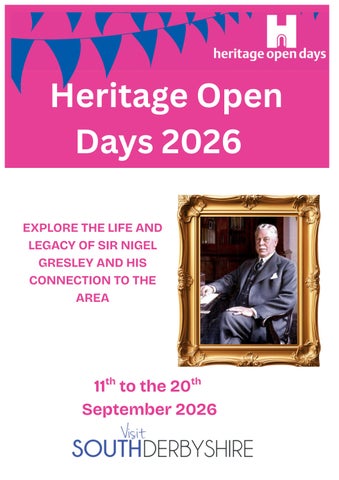
Heritage Open Days 2026 EXPLORE THE LIFE AND LEGACY OF SIR NIGEL GRESLEY AND HIS CONNECTION TO THE AREA
11th to the 20th September 2026
The Gresley Dynasty: A Norman Legacy in South Derbyshire
The story of the Gresley family stretches back almost a thousand years to the Norman Conquest of England. Their origins can be traced to the force of 6,000 men who accompanied William the Conqueror when he landed at Pevensey Bay on 28 September 1066. Ralph and Robert de Toeni Among William's supporters were Ralph and Robert de Toeni. Following the conquest, Ralph was granted manors in Norfolk and became the ancestor of the Clifford family. Robert received lands and lordships in Derbyshire, Leicestershire and Staffordshire, adopting the surname de Stafford. Through generations of intermarriage and inheritance among Norman noble families, the de Stafford line became connected to the manor of Gresley in South Derbyshire. By the 12th century, descendants had adopted the surname 'de Gresley', taking their name from the estate that would remain associated with the family for centuries. Name Change In time, a branch of the family chose to take its name from the local area of South Derbyshire, becoming known as the ‘de Gresleys’. The name is thought to derive from the Old English words meaning "grassy clearing" or "grassy meadow". A Castle During this period, the family's influence grew, and a motte-and-bailey castle was constructed at Gresley. Although the castle was abandoned by around 1250, the earthwork mound survives and is still known locally as Castle Knob. Legacy Through centuries of political change, the Gresley family remained closely connected to the landscape and communities of South Derbyshire, leaving a legacy that can still be traced in the area's historic sites and place names.
Drakelow Hall: The Gresley Family Manor
The Gresley family had been associated with Drakelow and the surrounding area since the Norman Conquest. The manor of Drakelow was recorded in the Domesday Book and remained in Gresley ownership for around nine centuries, one of the longest continuous family associations with a single estate in England. Drakelow Hall was the principal seat of the Gresley family and, over the centuries, was home to generations of baronets, Members of Parliament, High Sheriffs and local landowners. The family played an important role in the economic and social life of the area, with interests in agriculture, coal mining and canal development. The hall passed through successive generations of the Gresley baronets until the twentieth century. Sir Robert Gresley, 11th Baronet, was one of its last longterm occupants, and his cousin, Sir Herbert Nigel Gresley, the renowned railway engineer responsible for locomotives such as Flying Scotsman and Mallard, spent part of his childhood at Drakelow. The family finally left the Hall in 1931 after twenty-eight generations had occupied the estate. The building was demolished in 1934, and the site was later developed as Drakelow Power Station Interesting fact: The Gallows The manor also played an important role in medieval justice. During the time of the 2nd Sir Geoffrey de Gresley, gallows were erected at Drakelow for the execution of convicted felons, demonstrating the authority and influence held by the Gresley family within the region.
Drakelow Hall
The medieval gallows at Drakelow symbolised the authority of the Gresley family as Lords of the Manor. Although there is no evidence that they were ever used, they reflected the family's status and influence in the area.
Drakelow Hall: The Power Station
Although the Gresley family's connection with Drakelow had ended by the mid20th century, Drakelow Hall was demolished in 1936, the site continued to play an important role in the area's history. Power Station By the 1940s, the former estate was owned by Sir Clifford Gothard, and plans were made to transform part of the land into a major electricity-generating centre. Planning permission for Drakelow Power Station was granted in 1950, and construction began on what was then a £23 million project, regarded as a significant technological achievement of its time. For generations of local people, the towering cooling towers of Drakelow became one of the most recognisable landmarks in South Derbyshire. Visible for miles around, they dominated the skyline and served as a reminder of the area's industrial heritage. Many residents of Gresley, Swadlincote and the surrounding villages remember the sight of the towers rising above the landscape. The station operated for several decades, supplying electricity to homes and businesses across the region. As technology advanced and older generating methods became less efficient, parts of the station gradually closed. The A Station ceased operation in 1984, followed by the B Station in 1993. Demolition of the Power Station The demolition of the cooling towers became a major local event. On 20 December 1998, the first towers were brought down, marking the beginning of the station's disappearance from the skyline. The final six towers were scheduled for demolition in July 2006, but a fault with the detonators delayed the event, disappointing the thousands of spectators who had gathered to watch. A second attempt took place on 20 September 2006. Even then, events did not go entirely to plan. Three towers remained standing after rabbits had reportedly chewed through part of the detonation cord. Fifty minutes later, the remaining towers were successfully demolished, bringing an end to the era of Drakelow Power Station. Today, the site has been redeveloped as a new residential community. While the cooling towers are gone, their memory remains a powerful part of local identity.
Drakelow Power Station was granted in 1950, and construction began on what was then a £23 million project
Drakelow Hall: From Hall to Housing Drakelow: From Historic Estate to Modern Community The story of Drakelow reflects the changing history of South Derbyshire. Once a medieval manor and the ancestral home of the Gresley family, it later became the site of one of Britain's largest power stations. Today, it is entering a new chapter as Drakelow Park, a growing residential community. The former power station site is being transformed into a development of more than 2,000 homes, with green spaces, lakes, woodland walks and community facilities. Current developments include homes by David Wilson Homes and Dracan Village, offering a range of two, three and four-bedroom properties. Located just 10 minutes from Burton upon Trent town centre, with easy access to the A38, Derby, Lichfield and Tamworth, Drakelow combines modern living with its rich local heritage.
New Housing At Drakelow
Parts of the original Drakelow Hall estate still survive today, including the entrance gates and remnants of the stable buildings
The Sunken Gardens at the site of Drakelow Hall still survive, even though Drakelow Hall was demolished in 1934
Notorious and Remarkable Members of the Gresley Family For more than 700 years, the Gresley family played an important role in the history of South Derbyshire. Alongside their influence and achievements, family records reveal a cast of colourful, determined, and sometimes controversial characters. Notorious Men of the Gresley Family The medieval Gresleys were no strangers to conflict. In 1293, William de Gresley was declared an outlaw for murder, a serious offence that placed him outside the protection of the law. Another family member, Robert de Gresley, was accused of four murders. Seeking redemption, he joined the King's army on campaign against the Scots. His military service was considered so valuable that he was eventually granted a royal pardon. During the early 15th century, John de Gresley became involved in a dispute over an inheritance. The disagreement escalated when his grandson arrived with a band of armed men and carried off property and valuables, demonstrating how fiercely inheritance rights could be contested in medieval England. Remarkable Women of the Gresley Family The women of the Gresley family could be just as formidable as their male relatives. Joanna Gresley, widow of Sir Peter Gresley, gained a fearsome reputation when she was accused of horse-whipping a man to death. Despite the seriousness of the charge, she was later acquitted. One of the family's most romantic stories concerns Dorothy Gresley, daughter of Sir Thomas Gresley, 2nd Baronet. Born at Drakelow Hall in 1655, Dorothy fell in love with Thomas Ward, a servant, when she was just sixteen years old. Her parents strongly opposed the match and Ward was dismissed from service. Undeterred, Dorothy left Drakelow Hall at one o'clock in the morning and travelled through the night to Tutbury, where the couple married the following day. Her mother later forgave her, and the marriage lasted for more than forty years until Dorothy's death.
Willfull Women and Baronets Sir Nigel was the grandson of Sir William Nigel Gresley, 9th Baronet of Drakelow Hall, linking him directly to the family that had owned the Drakelow estate for centuries. Although he grew up at Netherseal Rectory, his family roots remained firmly connected to Drakelow and its long line of Gresley baronets. Among Sir Nigel's predecessors was Sir Roger Gresley, 8th Baronet, whose life was shaped by a determined and strong-willed mother. When Sir Roger inherited the title at the age of eight, trustees proposed sending him to Westminster School. His mother strongly objected, insisting that he be educated at home, and ultimately got her way. Her influence continued into his adult life. When Sir Roger fell in love with Lady Sophia Coventry, his mother opposed the match and even refused to attend the wedding. Nevertheless, the couple married in 1821. Tragically, their only child died in infancy. When Sir Roger died in 1837 without a surviving heir, the baronetcy passed to his cousin, Sir William Nigel Gresley, 9th Baronet, from whom Sir Nigel Gresley was descended. This ensured that the family's connection with Drakelow continued for almost another century.
Sir Roger (8th Baronet) → Sir William Nigel (9th Baronet) → Rev. Nigel Gresley → Sir Herbert Nigel Gresley (Flying Scotsman engineer)
Titles, Trades and a Global Legacy From Knights to Baronets The first known member of the family to be knighted was Sir Geoffrey Gresley (1245-1305). As the family's wealth and influence grew, so did its standing within English society. In 1611, King James I introduced the hereditary title of Baronet, and Sir George Gresley became the first member of the family to receive the honour. The Gresley baronetcy remained associated with Drakelow for more than 300 years. Among the descendants of this distinguished family was Sir Herbert Nigel Gresley (1876-1941), the celebrated railway engineer who designed Flying Scotsman and Mallard. Through his grandfather, Sir William Nigel Gresley, 9th Baronet, Sir Nigel was directly connected to the long line of Gresley baronets of Drakelow. The Gresleys Around the World Over the centuries, members of the wider Gresley family left Britain to build new lives overseas. Today, descendants can be found in Australia, Canada, South Africa and the United States. Their story reflects the wider history of British migration across the world. Yet their roots remained firmly linked to South Derbyshire and Drakelow, the ancestral home of the family for centuries and the historic lineage from which Sir Nigel Gresley emerged.
Gresley of Drakelow Coat of Arms
The Baronetcy of Gresley of Drakelow was created in the Baronetage of England on 29 June 1611 for George Gresley of Drakelow Hall, Derbyshire, who was later High Sheriff of Derbyshire and Member of Parliament for Newcastle-under-Lyme.
11th Baronet
d. 1976 13th Baronet No children
Sir Thomas
1894 - 1974 12th Baronet No descendants
Sir Nigel
1866 - 1936
Sir Robert
Sir Thomas 1832 - 1868 10th Baronet
THE GRESLEY FAMILY
Maud Victoria 1909 - 1977
1904 -1976
1870 -1915
Nigel Bowyer
1866-1950
Beatrice Georgina
1839 - 1921
1834 - 1897
Louise Gresley 1939 -1999
Timothy Dan B. 1938
1904 -1976
Violet
1909 -1988
Marjorie
B. 1942
Benjamin Michael
1906 -1960
1903 -1962
Geoffrey Edward Michael Godfrey 1902 -1997
Roger
1874 - 1929 1876 - 1941 Sir Nigel, Knight 1936
Nigel
Ethel Francis Fullagar
Herbert Nigel
1867 - 1903 Mabel Constance Talbot (Canadian) D. 1957
Joanne Beatrice Wilson
Revd Nigel
Arthur Spencer
1811-1904
Georgina Ann Reid
Seven further children
9 Baronet
Eleanor Constance
1865 - 1938
Revd George Nigel
1806-1847
th
Revd Sir William Nigel
ABRIDGED TREE SHOWING RELATIONSHIP BETWEEN SIR NIGEL KNIGHT AND SIR NIGEL 12TH BARONET
The Name Nigel One name appears repeatedly throughout the history of the Gresley family: Nigel. Passed down through successive generations, it became one of the most recognisable names in the family lineage. The tradition continued with Sir Herbert Nigel Gresley (1876-1941), the celebrated railway engineer who designed The Flying Scotsman and The Mallard. Engineering, Industry and Innovation Long before Sir Nigel Gresley became famous for his locomotives, earlier members of the family showed a keen interest in engineering, industry and innovation. Sir Nigel Gresley, 6th Baronet (1726-1787) served in the Royal Navy before inheriting the family estates. Working with the renowned engineer James Brindley, he helped develop mining and transport projects and promoted the construction of Sir Nigel Gresley's Canal, linking the family's collieries at Apedale with Newcastle-under-Lyme and improving the movement of coal and other goods. His son, Sir Nigel Bowyer Gresley, 7th Baronet, continued the family's industrial interests, including mining, ironworking and pottery manufacture. In 1795, he established a porcelain factory at Church Gresley that produced the highly regarded Gresley China.
Sir Nigel Bowyer Gresley, 7th Baronet
Introducing Sir (Herbert) Nigel Gresley Sir Herbert Nigel Gresley (Known as Sir Nigel Gresley) (1876-1941) was born into the historic Gresley family, whose roots in South Derbyshire stretched back for centuries. Although born in Edinburgh during his mother's visit to a specialist, he grew up at the Rectory in Netherseal, near Drakelow Hall, the ancestral home of the Gresley family. Nigel was the youngest son of Reverend Nigel Gresley and Joanna Beatrice Gresley (née Wilson). He had three older siblings: Beatrice Georgina, Arthur Spencer, and Nigel Bowyer Gresley. Family members affectionately used nicknames such as"Ni", "Vi", "Dodger" and "Boxie", reflecting the close family bonds that remained important to Sir Nigel throughout his life.
As a boy, he developed a fascination with engineering and railways, inspired by the trains he saw operating near his Derbyshire home. After attending Marlborough College, he began an apprenticeship with the London and North Western Railway, starting a career that would change railway history.
A Young Sir Nigel Gresley
House in Edinburgh Scotland where Sir Nigel Gresley was born 19th June 1876
Sir Nigel Gresley: Education and Early Interests Sir Nigel began his education at Barham House Preparatory School in St Leonards. In September 1890, he entered Marlborough College, where he quickly demonstrated academic ability. In 1892 he was awarded a Form Prize and, in his final year, won a Science Prize for excellence in Chemistry and German. At the age of 17, he chose not to continue his academic education through the Sixth Form and university. Instead, he opted for practical engineering training, a decision that would ultimately lead to one of the most distinguished engineering careers in British history. His father had a strong interest in engineering, which helped inspire the young Nigel. He also showed considerable talent in mechanical drawing and carpentry, skills that would later prove invaluable in locomotive design. Although he was never a school prefect, he excelled in sport. Throughout his life he enjoyed golf, shooting and horse racing. His love of racing is reflected in the names of several of his famous locomotives, many of which were named after racehorses and famous races.
Marlborough College
Sir Nigel Gresley: Hard Work, Determination & Promotion Gresley's rise through the railway industry was remarkably swift. Ambitious, hardworking and highly talented, he progressed from railway pupil to a senior management position in just seven years. Career Progression 1898: Joined the Lancashire & Yorkshire Railway as a pupil under J.A.F. Aspinall at Horwich Works. c.1899-1900: Became Foreman of the Blackpool running sheds, gaining practical experience in locomotive operations. 1901: Appointed Outdoor Assistant in the Lancashire & Yorkshire Railway's Carriage and Wagon Department and Assistant Manager at Newton Heath. 1902-1903: Promoted to Works Manager at Newton Heath. 1904: Became Assistant Carriage and Wagon Superintendent of the Lancashire & Yorkshire Railway. 1905: Appointed Carriage and Wagon Superintendent of the Great Northern Railway at Doncaster, aged just 29.
By the age of 29, Gresley had risen from railway pupil to Carriage and Wagon Superintendent of the Great Northern Railway, one of the most important railway management positions in Britain.
Sir Nigel Gresley Portrait
Sir Nigel Gresley: Early Career and Apprenticeship Sir Nigel Gresley's journey into railway engineering began in 1893 when, aged 17, he joined the London and North Western Railway works at Crewe as a premium apprentice. Starting on just four shillings a week, he spent five years learning every aspect of locomotive construction and maintenance, gaining the practical experience that would become the foundation of his success. By the end of his apprenticeship in 1898, Gresley had qualified as a fitter and earned an excellent reference praising his character and ability. Determined to advance his career, he then moved to Horwich to work under the respected railway engineer John Aspinall, Chief Mechanical Engineer of the Lancashire and Yorkshire Railway. Although Aspinall was initially uncertain about the young engineer's future prospects, Gresley quickly proved his worth through hard work and dedication. He secured a position in the railway's Materials Testing Laboratory, where he gained valuable knowledge of engineering materials, design and testing methods. These early experiences helped shape the innovative engineer who would later design some of Britain's most famous steam locomotives.
Sir Nigel Gresley Apprenticeship Papers
Sir (Herbert) Nigel Gresley : Home and Family Life As Sir Nigel Gresley's railway career flourished, his growing success was reflected in the family homes he occupied. One of the most notable was Salisbury Hall, a historic moated manor near St Albans. It was here that Gresley lived during the 1930s while leading the LNER and designing some of Britain's most famous locomotives. The grounds of Salisbury Hall included a pond inhabited by wild mallard ducks. It is widely believed that these birds inspired the name of The Mallard, the streamlined locomotive that would later achieve the world steam speed record. Sir Nigel and his wife, Ethel Frances Gresley, enjoyed an active family life, raising their four children while balancing the demands of his increasingly prominent career. The household was known for its hospitality, with family gatherings, music and social events playing an important role in daily life. The Loss of Ethel In 1926, Nigel and Ethel celebrated their Silver Wedding Anniversary, marking 25 years of marriage. Sadly, Ethel was later diagnosed with cancer and died in 1929. Her death was a profound personal loss for Sir Nigel. Thereafter, his daughter Violet ("Vi") became an important source of support, often accompanying him at social and professional engagements and helping him maintain the family hospitality for which the Gresley household was known.
Sir Nigel Gresley Feeding Ducks
His bir
Young Nigel Gresley with his dog Sam
Sporting in later years
Feeding his Mallards in the garden of Salisbury Hall 1937
Edin burg h
Doctor of Science University of Manchester 1937
The Gresley family at the time of parents Silver Wedding in 1926
With Queen Mary’s formal visit to Stafford works
Netherseal Rectory
th p lace in
stand ing by
resley ’
igel G
‘Sir N
A4
Marjorie Gresley with Cecil Parker in the Film ‘Tony Draws a Horse’ 1950
Nigel
Violet Gresley - Vi , who later became her fathers companion
Nigel Gresley 1916
Nigel Herbert Gresley 7991 Age 17
Ethel and Nigel on their Wedding Day 17 October 1901
Standing at the side of the CPR 2-10-4 with Vi leaning from the cab 1929
Nigel and Ethel with a baby
Ethel and Nigel on their Wedding Day October 1901
Plaque by Lytham St Annes Civic Society showing the place where Sir Nigel Gresley married Ethel Fullagar in October 1901
Sir Nigel Gresley family at the time of their Silver Wedding Anniversary 1926
Sir Nigel Gresley: The Railway Visionary Sir Herbert Nigel Gresley (1876-1941) was one of Britain's greatest railway engineers and the most famous member of the Gresley family. Born into a historic Derbyshire family, he rose to become Chief Mechanical Engineer (CME) of the London and North Eastern Railway (LNER), a position he held from 1923 until his death in 1941. During his career, Gresley transformed railway travel through innovative locomotive design. His engines combined speed, power and reliability, setting new standards for railway engineering. Many of his locomotives remained in service for decades and continued hauling Britain's premier express trains long after his death. His achievements brought national recognition. He was appointed Commander of the Order of the British Empire (CBE) in 1920 for services connected with the First World War and was knighted in 1936, becoming Sir Nigel Gresley. In 1927, the LNER paid him a rare tribute by naming its 100th Pacific locomotive No. 4498 Sir Nigel Gresley. Naming a locomotive after a serving railway engineer was exceptionally unusual and reflected the esteem in which he was held throughout the railway industry. The locomotive Sir Nigel Gresley entered service as LNER No. 4498, was later renumbered 7, and then 60007 under British Railways.
Sir Nigel Gresley Year 1911
Sir Nigel Gresley
Sir Nigel Gresley: LNER No: 4498 Sir Nigel Gresley (LNER No. 4498 / BR No. 60007) was the 100th Gresley Pacific locomotive, built at Doncaster Works in 1937 and officially named at Marylebone Station on 26 November that year. Based primarily at London King's Cross, it later served at Grantham during the Second World War and was subsequently renumbered No. 7 and then No. 60007 under British Railways. The locomotive achieved fame hauling the Royal Train on 3rd June 1956, carrying Queen Elizabeth ll and setting the official post-war British steam speed record of 112 mph in 1959. In 1963 it moved to Scotland for express services between Aberdeen and Glasgow.
Saved from scrapping by the A4 Preservation Society in 1966, Sir Nigel Gresley returned to steam in 1967 and has since become one of Britain's most celebrated preserved locomotives. Following a major ten-year overhaul, the locomotive remains operational on main line railtours and heritage railways throughout the UK. Notably, in 2008 it demonstrated the enduring performance of the A4 class by producing around 2,500 indicated horsepower on Stoke Bank.
Sir Nigel Gresley: LNER No: 4498
Sir Nigel Gresley train in blue livery
Sir Nigel Gresley: A 150th Birthday Celebration
Built at Doncaster Works, the A4 Class 4-6-2 Sir Nigel Gresley was the 100th locomotive constructed to the designs of Pacific type engines of LNER Chief Mechanical Engineer Sir Nigel Gresley. Entering service in the distinctive Garter Blue livery, it featured red-centred wheels, fine red and white lining, and silver-gilt lettering with blue shading. In December 1937, the original lettering was replaced with stainless steel numerals and nameplates.
Innovation at Doncaster: Coach Design and Innovation In 1905, Gresley was appointed Carriage and Wagon Superintendent of the Great Northern Railway at Doncaster. In this role he was responsible for the design and development of the company's coaches and wagons, building on the practical experience he had gained throughout his railway career. Working closely with colleagues, Gresley developed a series of innovative carriage designs that combined passenger comfort with operational efficiency. His coaches incorporated features such as improved gangways, buckeye couplers and better ventilation, helping to raise standards of safety and travel on Britain's railways. Gresley became particularly associated with the elegant teak-panelled coaches used by the Great Northern Railway and later the London and North Eastern Railway. These vehicles earned a reputation for quality, durability and distinctive appearance. Some coaches designed under Gresley's supervision remained in service for more than fifty years, while others were adapted for departmental use after their passenger-carrying careers had ended. Today, preserved Gresley coaches can still be seen on heritage railways including the North Yorkshire Moors Railway and the Severn Valley Railway, where they continue to demonstrate the craftsmanship and innovation of their designer.
Gresley Royal Mail teak coach set, Great Central Railway Centre, 1980s
Buffet lounge car no 1852 - Sir Nigel Gresley
Line Drawings and Designs
Flying Scotsman - The Peoples Engine Designed by Sir Nigel Gresley and built at Doncaster Works in 1923, The Flying Scotsman became one of the world's most famous steam locomotives. It gained international attention after appearing at the British Empire Exhibition in 1924, where it was named after the famous London to Edinburgh express service. On 1 May 1928, The Flying Scotsman hauled the first non-stop London to Edinburgh service. Its innovative corridor tender allowed crews to be changed while the train was moving, enabling the 392-mile journey to be completed in around eight hours. In 1934, it became the first steam locomotive in Britain to be officially recorded travelling at 100 mph, securing its place in railway history. Withdrawn from service in 1963, The Flying Scotsman was saved from scrapping and entered preservation. It later toured North America and Australia, becoming the first steam locomotive to circumnavigate the globe and setting a world record in 1989 for a 422-mile non-stop steam journey. Following a major restoration by the National Railway Museum, The Flying Scotsman returned to service in 2016 and continues to operate on heritage railways and special rail tours locomotives.
The Flying Scotsman being prepared for the 1924 British Empire Exhibition
The Flying Scotsman - The People’s Engine
The driver is pictured beside the Flying Scotsman nameplate, mounted on the legendary steam locomotive renowned for its speed and history.
A speed-recording device used to monitor and record a train's speed during operation.
The Mallard: A World Record Yet To Be Broken for Steam Locomotives Built at Doncaster Works in 1938, The Mallard was one of Sir Nigel Gresley's streamlined A4 Pacific locomotives, designed for high-speed express passenger services. Named after the wild duck, it combined striking appearance with advanced engineering. Featuring streamlined casing and a Kylchap double blastpipe, The Mallard was one of the most advanced steam locomotives of its era. Wind-tunnel testing helped refine its design and improve visibility for the driver. On 3 July 1938, The Mallard reached 126 mph (203 km/h) on Stoke Bank south of Grantham, setting the world speed record for a steam locomotive, a record that still stands today. The achievement was carefully planned by Sir Nigel Gresley and carried out by driver Joe Duddington, fireman Tommy Bray and inspector Sid Jenkins. The Mallard remained in service until 1963, covering almost 1.5 million miles before being preserved at the National Railway Museum in York, where it remains one of Britain's most iconic locomotives.
The Mallard descending Stoke Bank in June 1962
The Mallard in York Railway Museum
Recording the 100 miles per hour reached by the Mallard
Sir Nigel Gresley in later years sat on a train
The Final Years Despite declining health, Sir Nigel Gresley remained deeply involved in railway engineering throughout the late 1930s. Suffering from bronchial and heart problems, he continued to lead the London and North Eastern Railway's mechanical engineering department during the early years of the Second World War. Gresley's connection to Netherseal remained strong throughout his life. His father, the Reverend Nigel Gresley, was Rector of St Peter's Church, continuing a remarkable family tradition that saw five generations of Gresleys serve consecutively as rectors of the parish. The village, where Sir Nigel spent much of his childhood, remained closely associated with both the family and his legacy. Sir Nigel Gresley died on 5 April 1941 at the age of 64 while still serving as Chief Mechanical Engineer of the LNER. He was buried in St Peter's Churchyard, Netherseal, alongside the community with which his family had been connected for generations. Today, his grave continues to attract railway enthusiasts from around the world, linking one of Britain's greatest engineers with the village that helped shape his early life
Final resting place of Sir Nigel Gresley St Peter Churchyard, Netherseal
St Peter’s Church Netherseal
Sir Nigel Gresley Statue - King Cross Station
CoCommerative Plaque Celebrating the life of Sir Nigel Gresley at King Cross Station
Acknowledgements South Derbyshire Visitor Information Centre would like to extend its sincere thanks to Graham Nutt for his invaluable support, artefacts and memorabilia used in the creation of this exhibition. Special thanks go to Lyndsay Thompson, whose dedication, research and hard work have helped bring this exhibition together, celebrating a snapshot of the life and achievements of Sir Nigel Gresley. We are also grateful for the use of information from Geoffrey Hughes' excellent book, The Engineer and His Family, reprinted in 2004, which has provided valuable insight into Sir Nigel Gresley, his family and their remarkable legacy. Exhibition created by South Derbyshire Visitor Information Centre
Opening Hours Tuesday - Saturday 10am - 2pm No 1 High Street, Swadlincote, Derbyshire, DE11 8JG Contact: South Derbyshire Visitor Information Centre Tel: 01283 223333 Email: info@visitsouthderbyshire.co.uk