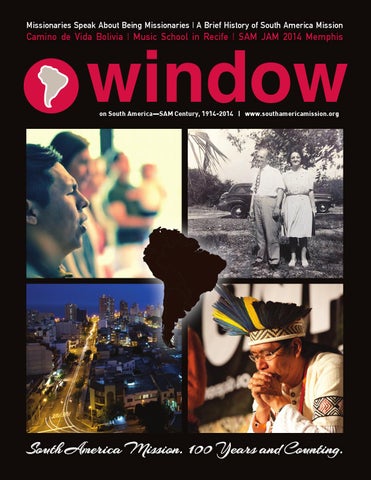
Missionaries Speak About Being Missionaries | A Brief History of South America Mission
window
Camino de Vida Bolivia | Music School in Recife | SAM JAM 2014 Memphis
on South America—SAM Century, 1914-2014 | www.southamericamission.org
South America Mission. 100 Years and Counting.
Multiplying Churches living a s
ling transfor b a ma en tio s r med commu r o f ni s n
repr of God o ren d u ild c i n ch s and ch e g u h r c ed h urc n ch et ng d lives b e a me u ee
ives t a i it n i l a n s tie
red ee m mu ltip lyi re d
ples of Jesu disci s tic en th training godl y au l ea ks d or e w churches t r ul a tif
Across South America @SAMSouthAmerica www.southamericamission.org
SouthAmericaMission |
www.firstofallpray.org
southamericamission |
samsouthamericablog.org
A STRANGE PRIZE 1914-2014
Kirk Ogden, Executive Director REDEEMED LIVES | BEAUTIFUL CHURCHES | TRANSFORMED COMMUNITIES
VISION The church of Jesus Christ multiplied across South America transforming local communities and the world by embodying the Kingdom of God.
MISSION We Live as redeemed children of God, Reproduce authentic disciples of Jesus, Multiply dynamic churches and church networks, Train godly leaders, and Enable transformational initiatives.
IDENTITY An abiding, loving, redemptive, suffering and growing community.
“Let us go with you, for we have heard God is with you.” Zechariah 8:23
South America Mission is building for God’s Kingdom in response to the gospel of grace. It is this gospel that gives us hope for Redeemed Lives, Beautiful Churches, and Transformed Communities. We are a community of dedicated missionaries, responding and hoping together. Join our community. Contact us.
South America Mission, Inc. 1021 Maxwell Mill Rd, Suite B, Fort Mill, SC 29708 mobilization@southamericamission.org • 803-802-8580 www.southamericamission.org • t: @SAMSouthAmerica fb: southamericamission • youtube: southamericamission
Click the “Publications/Video” tab on our website and enjoy a video celebrating 100 years of South America Mission.
@SAMKirkO
L
ongevity is a strange prize for a mission agency. You see, missionary societies are born at the intersection of several convictions: the desperate need of a sin-ruined creation, the unique and all-sufficient provision of Jesus’ death and resurrection, and the keen awareness of our King’s impending return. It’s that last conviction that makes longevity so strange. We don’t just expect Jesus’ return, we long for it. Oh, that glorious day! The certainty of His coming and the beauty of the fulfillment are too much for words. Our hope is built on nothing less. Yet as missionaries—odd people whose love for the Lord has spilled into an unreasonable love for the world—we wait patiently for it. Every day Jesus tarries is another day to share the love of the Father and the hope of salvation with someone else. Jesus’ coming means shalom. It also means a reckoning. Bono and U2 express this disconcerting tension melodically. In their song “Forty,” based on Psalm 40, they celebrate God’s rescue and their new song. But their awareness of the world’s brokenness also leads them to ask, “How long to sing this song?” My own heart resonates deeply with the concluding lyrics of Andrew Peterson’s “The Reckoning”. How long until the burden is lifted? How long is this the song that we sing? How long until the reckoning? And I know that I don’t know what I’m asking, But I long to look you full in the face. I am ready for the reckoning. Missionaries with South America Mission have been yearning for Jesus’ return for 100 years. How much longer, Lord? Yet we celebrate the privilege of each day of waiting as we proclaim Christ to a world in need of a Savior. This issue of Window celebrates the legacy of active waiting. How long to sing this song? I don’t know. But I pray God would continue to give us the grace to sing it loudly and faithfully until the day of reckoning. May many “see and fear and trust in the Lord”. (Psalm 40) And may he find us ready when he returns. I can’t wait. REDEEMED LIVES | BEAUTIFUL CHURCHES | TRANSFORMED COMMUNITIES
www.southamericamission.org
3 window | SAM Century, 1914-2014
SAM
The Angel Aircraft, new addition to SAMAIR Bolivia.
Well Done,
Jim and Renee!
O
n October 19, 2014, South America Mission honored Jim and Renee Eifert in Peru upon their retirement after more than 55 years of missionary service. Above is the Eifert’s candidate class of 1960, photo scanned from the Mission’s official publication of the day, the Amazon Valley Indian. SAM Executive Director Kirk Ogden wrote these words for Jim and Renee at their retirement celebration: “Your compassion and effort is unparalleled. But your faithfulness and zeal are born from a crisper conviction. Your love for God and love for the souls of men—from every tribe and nation—has been unwavering. Many of us have stories about your stories! From the humblest jungle villager or urban addict to plane rides with presidents, you have exhibited a grace in ministry and witness that reveals a heart for the Lord and a passion for the lost. God has been honored and many have passed from darkness to light because of you. God is praised not only for your vision for and thinking about ministry, but for your tireless work in the harvest field. There is no way around it. Both of you, Jim and Renee, have been laborers in God’s harvest. You leave a legacy for others to follow.”
S
AMAIR Bolivia received a major donation in 2014: an airplane! A US-based businessman who has promoted and flown the Angel aircraft since 2002 graciously donated an Angel to SAMAIR Bolivia to see it used for the ministry it was designed to carry out. At right is the SAMAIR Bolivia team, and program director Greg Dahl with Carl Mortensen who designed and manufactured the Angel for the short, rough airstrips of South America. 4
window | SAM Century, 1914-2014
www.southamericamission.org
SAM JAM 2014
Memphis, Tennessee
I Left: Rivers Rutherford. Above: Friends, family, and other SAM JAM musicians: Austin Carroll of Memphisbased Austin Carroll Vocal Arts (top center); Memphisbased acoustic soulman Josh Threlkeld (mid left); and the SAM JAM praise band led by Craig DeLille.
www.southamericamission.org
t could be the beginning of a tradition (SAM JAM 2015 Charlotte?). If not, we’ll remember the one and only SAM JAM 2014 held on July 11 as a night of great music and good people gathered to raise awareness and funding for SAM ministries in Recife, Brazil. SAM Missionaries and Recife ministry leaders Craig and Mary DeLille planned the event with the help of friends and ministry partners from Faith Presbyterian Church in Germantown, TN. Held at Briarcrest Christian School (the story told in The Blind Side happened here), the headliner of the night was Rivers Rutherford, Nashville-based singer songwriter whose penned Number One hits for the likes of Dolly Parton, Brad Paisley, and Tim McGraw.
5 window | fall 2014
C
ongratulations to our most recent class of candidates who completed orientation in 2014: Mike and Marcy Brown (Peru), Antoinette Hendrickson (Peru), Maria Masemore (Colombia), Calvin and Katie Cooper (Bolivia), Eve VanDevender (Colombia), David and Lisa Speyers (Peru), Larry and Bonnie Secrest (Peru), and Sam and Margarita Tse (Bolivia). SAVE THE DATE for orientation 2015, June 14-26!
• 10
D•
SOUTH A M
2014 1419
SAM CENTURY MOMENT
MISSIO N, ICA ER
0
YE
AR
AR
Candidate Class and SAM’s US-based team, June 2014, Fort Mill, SC
S AND ON
W
Place your Holiday Coffee Order Today!
I
n the early 1900s, ISAMU—the organization to which SAM traces its roots—formed a trading auxiliary called “ISAMUTA” specializing in the sale of ceylon teas to “aid in the support of ” the Mission. Today, we carry on a spirit of entrepreneurism for Godly gain through our very own coffee endeavor called First Fruits Café. No ceylon teas, but we’ve got good beans that we sell to “get mission going” in South America.
6
window | SAM Century, 1914-2014
firstfruitscafe.com freshly roasted purely South American 100% Arabica fair-trade shade-grown
100% of profits support the work of South America Mission
www.southamericamission.org
one story • one god • one mission
give & GO TO
CoLomBiA
w w w . s o u t h a m e r i c a m i s s i o n . o r g
REDEEMED LIVES | BEAUTIFUL CHURCHES | TRANSFORMED COMMUNITIES
The view from the hills in Gaira, a community along the Northern Coast of Colombia. SAM missionaries in partnership with La Esperanza Church of Santa Marta are reaching Gaira with the Gospel of Grace.
C
BOLIVIA
In Santa Cruz, Bolivia, there are around 80,000 university students. They live and study in the most populous, economically empowered, industrious, and diverse city in the country, and many of them will one day lead it. Students and graduated young professionals are the heartbeat of this city and they are no different from the well-documented Millenial generation of the United States. In a survey of Millenials from Europe, Asia, Africa, South America, and North America, 64% said they believe they will make a local impact, and over 40% said they believe they will make a global impact. They are optimistic, passionate, global thinking world-changers, and South America Mission is working to harness that potential for the Kingdom. Years ago, Misael Lucano, a native Peruvian missionary with Bridge Builders International, was traveling through South America where he had a one-day stopover in Santa Cruz. Immediately impressed by the growth of the city and article by PJ Christensen the sheer number of young people, he felt called by God to move and minister there upon graduating college. After four years of being discipled and serving in a local church in Santa Cruz, Misael and his wife set out to launch a new church, and in 2012, the community of Camino de Vida was born. Camino de Vida is about being “people of the people� as Pastor Misael says. Just as Jesus made his home among
de V
8
window | SAM Century, 1914-2014
www.southamericamission.org
“…I pray the Lord will give us the guts and the courage and the wisdom to reach out to them, to form them, to shape them in the likeness of Christ, ordinary people—meeting their needs, addressing their doubts, and teaching them the way of salvation—so does this church exist for them to lead the next generation to be a safe place for searching, to love and welcome anyone who for the Lord.” walks in the doors without pretense or expectation. In a city where the average 20-something would admit they don’t feel safe and have a difficult time trusting people, offering love without pretense is a high and complicated calling. Because of political and legal corruption, and a variety of cultural factors, most Millennials have grown up learning to distrust first and trust later. Understandably, it is difficult for them to place faith in others, which is why it is so important to “just be real with people and be like Jesus—loving them and caring for them,” says Pastor Misael. Despite this major cultural hurdle, the young people of Santa Cruz are filled with potential. They are studying medicine, engineering, English, and theology. They want to travel, to learn, to find answers to their questions, and to influence the people and places around them. “I can just see in their eyes how they hope for things,” says Pastor Misael. “These are brilliant people. I always have this tug in my heart when I meet people like that. How far could these young people go with Christ in their hearts? I think about how much the Kingdom could grow by gaining people with this kind of potential. I pray the Lord will give us the guts and the courage and the wisdom to reach out to them, to form them, to shape them in the likeness of Christ, for them to lead the next generation for the Lord.” In a major step towards preparing the next generation of believers, Camino de Vida recently added a service completely in English. It has drawn a diverse group of people including missionaries from the US, Canada, and England; and students and www.southamericamission.org
9 window | SAM Century, 1914-2014
young professionals from Bolivia, Paraguay, Chile, and Peru. The church has also attracted a type of subculture in Santa Cruz made up of native Bolivians who grew up in the US or other English-speaking countries. Not identifying completely with Western or South American culture, they are looking for a place to feel invited and accepted. Beginning an English service was a logical next step based on the success and progress of other English ministries lead by SAM missionary Bethany Pyles and Misael. Since moving to Santa Cruz under South America Mission earlier this year, Bethany has been leading an English conversation club called “Immersion.” The club meets in two different locations on and near local university campuses, and touches the lives of 40 students and young adults on a weekly basis. In addition to pastoring Camino de Vida, Misael oversees a tuitionsupported English academy where he reaches out to students and young professionals as a teacher. After several months of investing in relationship and establishing many meaningful connections, Bethany and Misael joined forces in order to expand their ministry platform, and ultimately, introduce more people to Christ. They worked together to create an English service at Camino de Vida, which is already drawing around 50 About half of the attendants are nonpeople after just a few monthly gatherings. English is the ultimate common ground for students and young Christians and many have never adults in Santa Cruz. Seeking successful jobs in a global economy, in a city that receives the most foreign direct investment in Bolivia, stepped foot inside of a church before, they are incredibly driven to learn the language of opportunity. Many which is rare in a heavily Catholic attendants of the church’s new English service come just to listen to the language and practice with native speakers, and a good number country where one regularly sees “God of them became connected with the church through the conversation is Love” painted on the sides of city clubs and academy. About half of the attendants are non-Christians and many have never stepped foot inside of a church before, which buses. They are coming because of is rare in a heavily Catholic country where one regularly sees “God is the authentic community formed around Love” painted on the sides of city buses. They are coming because of the authentic community formed around a common goal and desire. a common goal and desire. “One female student told me that she feels really safe with us, that she feels really accepted,” says Bethany. “She sounded shocked, like she didn’t expect to feel that way inside of a church building. That’s the kind of feedback we get from them and I think that’s why they keep coming.” Adds Pastor Misael, “People know when you’re real, and these people are seeing that we’re honest. They see that we are loving and don’t care about their money or about them just coming to church, but that we care about them as people, as who they are.” REDEEMED LIVES | BEAUTIFUL CHURCHES | TRANSFORMED COMMUNITIES
10
window | SAM Century, 1914-2014
www.southamericamission.org
one story • one god • one mission
GIVE & GO TO
BOLIVIA
w w w . s o u t h a m e r i c a m i s s i o n . o r g
REDEEMED LIVES | BEAUTIFUL CHURCHES | TRANSFORMED COMMUNITIES
South America Mission and Bolivian partners—Fundación Raphá and FRALIC (Indigenous Christian Leader Organization of Bolivia)—are planning the development of an Indigenous Training Center for the Ayoré, Guarani, Guarayos and Chiquitano people groups of whom there are approximately 200,000 spread across a 46,000 square-mile area of eastern Bolivia. Join South America Mission. Join this SAM Boliviabased team. Email us at mobilization@southamericamission.org to begin your journey.
photo by Jason Weigner
NE HUND • O RE D
20 1
L IFU UT
ED
SAM CENTURY
DEEMED • BE RE A
4
•
191
S AND ONWA AR RD YE
4
• TRANSF OR M
MISSIONARIES
Speak
ABOUT BEING MISSIONARIES
12
window | SAM Century, 1914-2014
www.southamericamission.org
W
e asked a handful of missionaries— some barely out of college, others seasoned, a few retired—key questions to help illuminate the realities of the authentic missionary experience.
If you could speak key advice to new missionaries, what would it be and why? Shelly Dobosy—“Submit to suffering, but also learn from it and rejoice in it. Lamentations 3:22-29 tells us that it is good to experience suffering and to wait on God’s timing, especially for those of us who are young and impatient and competitively driven to be productive and efficient. There is nothing efficient or outwardly productive about burying one’s face in the dust, but there is no other way for God’s impossible things to be done in us.” Chris Himes—“Estimate the cost. Not all will be known or can be calculated, but leaving is difficult and costs us something. My life is not my own, I have been paid for by the blood of Christ. This encompasses my whole life.” Marshall Kitron—“Know your spiritual giftings and put them into practice daily. Make sure you are investing where you are gifted, in the way that the Lord made you. Also, remember that the Lord is the one who has purposed and authored your life, even your missionary journey. God has greater plans for your life than just being a missionary.” Laura Kienzle—“Guard against looking to the right or the left concerning other missionaries. It is so easy to play the comparison game; and that game leads to defeat. If in your comparisons you feel “less” than others, the enemy enters to speak countless lies and render you powerless. Comparing yourself to others always takes your eyes off of Jesus.” Bob Moyer—“Be aware that you are modeling the Christian life to people who are watching and listening to your every action, reaction, motivation, and filtering it all through their cultural understanding. Be authentic doers of what you believe and teach. Be able to have a good laugh at yourself.” Paul Kienzle—“Take care of your soul through daily interaction with the Lord of the Universe. It will take everything you have and then some in the culture where God has www.southamericamission.org
called you. I’m talking about taking care of the greatest gift you have to offer—yourself as a vessel for God’s use.” Kate Richter— “Enter your new culture seeking to understand, you will find truth and meaning behind cultural differences and your heart softened to appreciate them. Something that can help in this: pray to have a close friend from your new culture with whom you can share and enjoy life and be free to ask questions as they arise.” Steve White— “When raising support (especially for the first time) go and see the person you want to ask. Don’t just send a letter; people receive lots of letters. This turned our support-raising around.” Marilyn Simmons—“Be sure of your call. On the days when things seem to be falling apart, you can go back to the call and remember that you are where you are because God put you there. Rest in God’s sovereignty.” Nancy Mahon— “Be actively involved in the lives of others. Be ready to do what needs done at the moment. People everywhere are not driven by rigid schedules. Relationships take priority. When someone shows up at your door, will you see the person as a child of God (like you) and see the interruption as an opportunity to demonstrate the love of Jesus?” Dave Simmons—“Don’t be surprised at your reaction to the stressors you will experience. You can’t be prepared for everything. This is normal. But you need to be absolutely convinced of God’s call on your life, and that with time, you will learn to respond in a healthy and God-honoring manner.” Bethany Pyles—“Form good habits, and discover what motivates and drives you everyday before you get to the mission field. Far from the action packed, adrenaline pumping, National Geographic scenes is the everyday life of a missionary. When your unrealistic expectations collide into your new reality it gets messy.”
What are the greatest challenges you face today in 2014 and considering your life situation? Kate Richter—“ I am humbled over and over as I face how easily prone I am to doubt God. I question, will I have the 13 window | SAM Century, 1914-2014
Chris Himes-Brazil, Shelly Dobosy-Peru, Bethany Pyles-Bol, Steve White-Brazil, Paul Kienzle-Bol, Bob Moyer-Col, Marilyn Simmons-Peru
words to say in Spanish when I need them? Is this taxi really taking me where I want to go? Will my support come in this month? Is that group of people nearby going to be safe for me to walk by…I am driven to pray often when I go out.”
vs. becoming defeatist or resigned. It is a constant battle to knock down the idol of effectiveness and remember that my only task is to be obedient to what the Spirit calls me to in accordance to scripture.”
Dave Simmons—“Inadequacy. I do not feel adequate to meet all the demands placed upon me, and it worries me that because of some deficiency that I have, the Lord’s work or someone’s life may be adversely affected. Fortunately, I have a wonderful Savior, and wife, who speak truth into my life.”
Marilyn Simmons— “I have faced a number of health issues in recent years that have affected my ability to minister at times due to pain and tiredness. This has been discouraging and frustrating at times. Ultimately I have to rest in God’s sovereignty and His plan for my life in this area.”
Hana Kamiya—“The desire and longing to be truly known. There is a cycle of building close friendships and then having to mourn the loss when friends move away. God continues to show me that I am completely known, heard, cherished, and loved by Him. God gently calls me to name Him as my security, comfort, and constant.”
Bethany Pyles—“My greatest challenge is being creative to reach people in a meaningful and culturally relevant way. However, it’s most encouraging knowing I can commune with my Father who transcends culture and who is the most creative being in all the universe.”
Birgitta Kruzan—“Support raising! I know God is in control of the resources needed, but sometimes I wonder about God’s plan for my involvement in ministry when support does not come in. This has been rattling me for the last couple of years, especially since I still feel called to missions.” Laura Kienzle—“Knowing where I’m from! Paul and I have been married 30 years and served for 29, and we still have never purchased a home or have a “base camp” to return to. Sometimes this is hard as I want to provide a place to return to for our family. I watch other parents embrace their kids and grandchildren on a daily basis and I know that we will probably not be able to cling to this.” Steve White—“Trust God with your children. He is faithful and loves them more than you do.” Shelly Dobosy—“Letting go of my plans and of the future and trusting God to take control. This is especially true when I see little change or fruit. It is also difficult to walk the lines between improving vs. letting God take his throne 14
window | SAM Century, 1914-2014
If you could possess one talent or gifting, what would it be and why? Paul Kienzle—“Definitely being musically inclined. Better yet, if I could play guitar (“versatile” instrument of choice in South America) and sing well. And even better than that, doing both in a way geared toward the culture. So many people, who would otherwise not even darken the doors of a church, can be reached as His Word comes alive in music.” Chris Himes—“As much I would like to be able to fly…having the gift of evangelism is more along the lines of a talent that would have a direct impact on my ministry (more so than just cutting down on my daily commute).” Bob Moyer—“A better ability to learn languages. I never learned to speak Kogi, despite living among them for 15 years. I could have had a greater influence. We were able to communicate, but not on a deeper spiritual level.” Birgitta Kruzan—“I would love to be musically gifted. When I sing out loud, people runaway! Music opens many www.southamericamission.org
Laura Kienzle-Bol, Birgitta Kruzan-US HO, Marshall Kitron-Peru, Hana Kamiya-Bol, Kate Richter-Bol, Nancy Mahon-Peru, Dave Simmons-Peru
doors in a lot of cultures. It’s often a way to get hopeless youth involved. It can pull many barriers down by bringing joy, truth and life to people around the world.” Steve White—“Perfection in the language native of the people we serve. It’s the only way to get completely inside the thought processes of those we are ministering to.” Hana Kamiya—“I have often wished that I had training in Biblical counseling for missionaries and missionary children. It is always a blessing for a community to have an available and confidential place to process, grow, and heal.” Marshall Kitron— “Being fluent in Spanish so that I could present the Gospel in the Peruvuan context super clearly.” Bethany Pyles— “The talent to be a documentary filmmaker. There are countless stories I hear that make we ‘wow’ at God’s redeeming and restoring nature. I would love to tell these stories to the world through film.” Dave Simmons— “A clear sense of vision. To see what is possible. To sense trouble before it happens.”
What are key characteristics or habits a missionary should develop in order to be effective in ministry? Hana Kamiya— “Accountability. I have a group of handpicked friends and family who are invested in my personal spiritual vitality and my ministry in Bolivia. They have been crucial to my spiritual and emotional health. Hands down, my accountability group is the perfect group for me and has meant the difference between my surviving and thriving.” Marilyn Simmons—“Good stewardship of time. In the past, there were not so many distractions such as television, Facebook, e-mail, etc.”
Dave Simmons— “An unwavering trust in the God who has called you into His service, and an accurate understanding of the grace that has been extended to you and the grace that God desires you to extend to others in His name.” Paul Kienzle—“Flexibility and Adaptability. Roll with the ebb and flow of the South American culture. Do not become easily rankled when scheduled activities start late. Do not be enslaved to a culture of order and punctuality.” Chris Himes— “We must, even though we are doing God’s work everyday, take time to be alone with him. We must stay disciplined even when there are more ‘immediate’ items at hand. We must remain in the vine.” Bob Moyer—“Listening skills are extremely important. Learn from the people and culture around you what skills you need to sharpen. Be authentic, be known for who you are: a redeemed child of God.” Birgitta Kruzan—“Trusting (that with God all things are possible). Flexibility. Humor—sometimes it’s good to not take yourself so seriously. As I get older, I tend to raise my expectations unreasonably, which gets in the way of ministry and often leads to disappointment.” Nancy Mahon—“An invitational life that comes from being rooted in Jesus; a James 1:22 willingness to put action to the Word of God; and a desire to see the Gospel preached to every tribe and nation.” Kate Richter—“Be vulnerably accountable. Having partners both on and off the field who will pray for you, check in with you, and speak truth to you is invaluable.” Steve White—“A disciplined, daily time of Bible reading and prayer. Your relationship with God is where your strength and victory will always come from. Every day is different. God walks before you; learn to depend on Him.” REDEEMED LIVES | BEAUTIFUL CHURCHES | TRANSFORMED COMMUNITIES
www.southamericamission.org
15 window | SAM Century, 1914-2014
SAM Century, 1914-2014
A Brief History of ISAMUSAIMSAM September 7, 1914—Joseph and Mabel Davis, founders of
South America Mission, set sail from New York en route to Argentina. Direct routes to South America from the US had been discontinued because the world had gone to war a month before. All ship liners were sailing to England to mobilize troops. The Davis’ trip to Argentina required a stop and transfer in Liverpool, England.
1916—The Davis’ made their way into the interior of Paraguay after spending
a year in Entre Rio, Argentina, adjusting to the culture and learning the language. Mabel’s health began to decline as they endured a harsh climate and heavy demands from mission work and raising a family (Joseph and Mabel had three children by then: Faith, Joan and Sam). The Davis’ first term ended two years into their missionary journey. They returned to the States in 1916 for a much-needed furlough—to recover, study, and grow their team. Joseph, Mabel, their three children and four additional missionaries returned to Paraguay in late 1916. Shortly before their return, Joseph Davis met a gentleman named John Hay. The two likely crossed paths at Moody Bible Institute where Joseph was studying while on furlough. A Scotsman, John Hay founded the Inland South America Missionary Union (ISAMU), a work serving the indigenous peoples of the Paraguayan Chaco.
1919—The hot, humid, feverish climate of the lowlands where the Davis family lived was grueling to endure,
and again, Mabel Davis’ health began to deteriorate. She became severely anemic. The constant demands of a rigorous life and work produced heart problems. She was also in need of major surgery. Thus in 1919 the Davis’ returned to the United States permanently. Joseph’s meeting John Hay in 1916 proved providential. Upon Mr. Hay’s request, Joseph Davis became the United States Deputation Secretary for ISAMU. The Davis’ team whom they took back to Paraguay with them in 1916 became united under the ISAMU banner.
1921—Mr. James Cunningham was the first missionary recruited by Joseph Davis. Another early missionary
recruit was Hazel Chamberlain who eventually married Rev W.J. Anderson. Their son, Robert D. Anderson, would one day become the third General Director of the Mission. John Hay had also recruited new missionaries from North America: Miss Della Whited, Miss Anabel Case, Miss Annie Mason and Miss Christine Cameron.
1924-25—ISAMU had begun work in Brazil and Bolivia in 1912 and 1922. In 1924, Missionary 16
window | SAM Century, 1914-2014
www.southamericamission.org
Arthur Tylee was part of a contact group sent out from Cuiaba, Brazil, along the military telegraph line toward Brazil’s Madeira River. A 1,000 mile journey, Mr. Tylee and his team made contact with three people groups— the Parecis, Bororo, and Nhambiquara. The next year, Arthur along with his wife Ethel established a mission station near Juruena, Brazil, to share the gospel with the Nhambiquara people.
1930—After five years of Great Commission
work among the Nhambiquara, Arthur, his infant daughter, nurse Mildred Kautz and three Brazilian workers were martyred by the very people they went to love. Ethel was left for dead, but survived. She returned to the US, a champion for the cause of Christ on the mission field even in the midst of the greatest suffering. God used Ethel’s testimony in the years following her family’s tragedy to draw many unto Him, and to send many out into the world.
1932—ISAMU officially established a US entity in
1922, incorporating in the State of New York with a US Board of Directors. For the ensuing decade, the US entity maintained official ties with ISAMU International under the leadership of John Hay and with its headquarters in Edinburgh. In 1932, primarily because of strategic and emerging missiological differences, the US entity of ISAMU became independent with Joseph Davis as the leader of the organization.
1939—Joseph and Mabel Davis made their home
in New York, also the home of ISAMU since 1922 and the place from where the Davis’ embarked on their missionary journey in 1914. Despite their relatively young ages (60 and 50 respectively), Joseph’s painful arthritis and Mabel’s heart condition forced them to consider an environment and climate more suitable for aging. In 1939 the Davis’ bought a home in Lake Worth, Florida, and moved the headquarters of the Mission to a www.southamericamission.org
Clockwise: An early signature of Dr. Davis, signing off on a letter to missionaries; Joseph and Mabel, early 1950s; The Davis’ set sail in 1914 on a Lamport and Holt Line ship, which was likely the SS Tennyson. The rendering is of the Tennyson leaving the port of Liverpool in 1914; Arthur and Ethel Tylee with their daughter Marian, ca 1930. The martyrdom of Arthur, Marian, and nurse Kratz left a legacy of worthy suffering for the sake of Jesus’ name in South America. 17 window | SAM Century, 1914-2014
small bungalow office with a West Palm Beach address. The mission incorporated in Florida that same year, not as ISAMU, but as the South America Indian Mission (SAIM). The new name more precisely reflected the people and place which God had called the Mission to serve—the indigenous peoples of the great continent of South America.
1941-45—The world was at war again. The United States’ entry into
World War II right on the heels of the Great Depression presented challenges for the missionary enterprise—there was another mobilization effort taking place and financial resources were being diminished. Despite this, 12 new SAIM missionaries went to the fields between June of 1940 and ‘41. The missionary candidate class of 1941 comprised seven of whom only three ever made it to South America, included among them G. Hunter Norwood, Jr., and his fiancee, Edith Blackburn. Mr. Norwood would eventually become the second General Director of SAIM. Meanwhile, SAIM was sending missionaries to four countries of South America: Brazil, Bolivia, Colombia and Peru. During the decades of the 30’s and 40’s, Mr. Davis began to emphasize a mission strategy of training leaders for the indigenous church. Over the years, this emphasis developed into a true mission ethos: “Building Leaders to Build Churches” would decades later become the official slogan that framed the Mission’s Great Commission participation. Monthly Missionary By the end of the war in 1945, SAIM Allowance in 1945 missionary “allowances” as set by the Board of Directors were $600 per year, or $50 per month. This was an increase from $500 per year, taking into consideration that transportation costs to South America were rising. Traveling by air from Miami to South America had become convenient, albeit more costly.
$50
Above: An extant copy of the Mission’s newspaper dated 1940, the first edition that displayed the new name, SAIM, on the cover. Also to note on the cover is the West Palm Beach address. Below: The Norwoods before leaving for the field. Hunter and Edith departed for Colombia in December 1942.
1948-58—
Joseph Davis made his last visit to South America in 1948, at the age of 69. SAIM was 70 missionaries strong. Joseph and Mabel continued to lead the Mission for another ten years. On March 4, 1958, the founder and first director passed away in Long Island, New York. Joseph and Mabel had gone to New York in the autumn of ‘47 to visit their son, Sam, who was rector of St. Mark’s Episcopal Church on Long Island. Mabel lived another 13 years, until October 19, 1971. During the 50’s, the number of missionaries serving with SAIM surged past 100. The Guajira of Northern Colombia and The Amazon Valley, from the eastern jungles of Peru across the windswept lowlands of Bolivia to the plains and Amazon forests of central Brazil, set the geographical landscape for the mission. Missionaries were planting churches and identifying leaders among the Guajiro and Aruac of Colombia; the Shipibo, Conibo and Campa of Peru; the Ayoré and Chiquitano of Bolivia; and the Chavante, Bacaeri, Nhambiquara and Terena of Brazil. SAIM’s work, however, was expanding in scope. SAIM 18
window | SAM Century, 1914-2014
Below: Indigenous Campa people of Peru, ca 1948.
www.southamericamission.org
missionaries were reaching the mestizo populations in burgeoning locales like Riohacha (Colombia) and Cuiaba (Brazil), and in province towns like San Ignacio and Santiago (Bolivia). On May 2, 1958, Mr. Hunter Norwood, who embarked from the Port of New Orleans en route to Colombia in 1942 with his wife Edith, became the second General Director of South America Indian Mission after Mr. Davis’ passing.
1960’s—As the
Above: Nhambiquara Christians of Brazil listening to gospel music in Portuguese, ca 1948; Left Top Down: Kogi men of the Sierra Nevada, Colombia, with new missionary Bob Moyer, ca 1966; Newly baptized Ayoré youth from Zapocó, Bolivia, ca 1960; Ipegue Terena children, ca 1931. Ipeque was an out-station of the Bananal Indian Church; A Colombian national partner selling Bibles, ca 1947; Below: The book, Defeat of the Bird God, first published in 1967, tells the story of Bill Pencille’s successful contact with an Ayoré tribe of Bolivia.
world was enjoying the so-called Golden Age of flying in the 1960’s, things were “taking flight” for SAIM as well—both literally and figuratively—in the early years under Hunter Norwood’s leadership. Missionaries were exclusively flying (gone were the days of setting sail) to South America out of Miami. And within SAIM’s fields, airplanes were beginning to be used to transport missionaries to hard-to-reach places. In 1962, Don Gahagen founded Jungle Air in Peru, which would eventually be grafted into the mission as SAMAIR. Meanwhile, the Gospel continued to take root in indigenous communities across the continent. More and more churches were forming and indigenous leaders for the local churches were emerging as SAIM’s emphasis on Bible training centers continued. Missionaries developed new training centers in places like Tipishca, Peru, and Aquidauana, Brazil. SAIM missionaries continued to reach new indigenous groups as well. In Bolivia, Bill Pencille made successful contact with the Guiday Gosode tribe of the Ayoré on July 9, 1960, a story retold in the book Defeat of the Bird God by Peter Wagner. In Brazil, progress was being made reaching the Xicao people. Bob and Ruth Ann Moyer went to the Sierra Nevada mountains of Colombia in 1965 to work with the Kogi. Two new realities began to take shape for SAIM in this decade of “take off”. First, as ministry grew, the SAIM missionary corps grew and matured as well. Growing missionary families precipitated the need to assess the requirements for more formally educating missionary children. In 1966, the mission’s first dedicated MK school, the SAIM Academy, opened in Pucallpa, Peru. Second, the landscape of South America was changing; cities were on the rise.
www.southamericamission.org
19 window | SAM Century, 1914-2014
1970’s—Isaiah 54:2 inspired Mr Norwood’s vision for the 70’s:
“Enlarge the place of your tent, stretch your tent curtains wide, do not hold back; lengthen your cords, strengthen your stakes.” This expanded view of ministry to pursue—revealed in part through ministry innovations like radio and aviation, but moreover through the changing demographic landscape of South America—gave impetus to a name change for SAIM. In September of 1970, the mission completed its evolution from ISAMU to SAIM to SAM, the South America Mission. The lengthening and strengthening of ministries for SAM in the 70’s meant adapting theological and leadership training models to serve the cyclical agrarian lifestyles for many indigenous living in the jungles and countrysides, and the urban lifestyles for mestizos working days and able to study only at night. SAM expanded its gospel influence in other ways as well: teaching Bible in public schools, opening bookstores as distribution points for Christian literature, reaching the felt needs of those suffering from disabilities, and launching recording and radio ministries. The 70’s also opened up the era of short-term teams being mobilized through US churches to go and work alongside SAM missionaries. SAM began to receive medical and dental teams, and high school graduates and college students began to go as interns for 6-8 week stints during the US summers. And one of the greatest displays of SAM setting its stakes deeper in ministry in South America during the 70’s was the establishment of SAM legal entities in South American countries. The creation of these entities provided strategic operational advantages, but also affirmed SAM’s desire, with missiological implications, to be a committed presence in and among the people, societies and cultures of South America.
Top Right: El Cristo Redentor, Santa Cruz, Bolivia, ca early 1970s; Above Clockwise: SAM debuts its first logo; 1982 Summer Teams served in Bolivia, Peru and Colombia; El Refugio disabilities ministry, Pucallpa, Peru; SAMAIR among the Ashaninka in the highlands of central Peru. 20
window | SAM Century, 1914-2014
www.southamericamission.org
1980s—The first few years of the decade marked the twilight of Hunter Norwood’s career. However,
as he approached retirement at the end of 1983, the momentum of the organization he led in no way showed signs of slowing down or pulling back. Donated income to the mission had grown by 37% and SAM’s missionary team by 43% since the early 60’s. Missionaries from Canada had an organizational structure through which to be mobilized as Canadian South America Mission (CANSAM) formed in 1982. On the ground in South America the church was multiplying. Bill and Lennie Ogden led a team to Santa Marta, Colombia, in 1982 to plant La Esperanza Church. Bob and Ruth Ann Moyer joined the team, having been in Colombia since 1965, planting churches and developing leaders up and down the northern coast and in the Sierra Nevada. Work in Bolivia took off as SAM was planting churches and opening leadership training centers. And new regions of focus emerged in far eastern Bolivia as SAMAIR survey work pointed to areas such as Sandoval with tens of thousands of people, but with no gospel witness. The spiritual communities among people groups like the Terena of Brazil and the Shipibo of Peru were maturing; the indigenous churches were being shepherded by indigenous leaders, and the believers were beginning to go and make disciples among their own people who had not yet heard. This movement was like a wave beginning as a small swell that accelerated and crested in the 90s and into the new millenium. Indigenous leaders at the CONPLEI Congress in 2012 spoke of three waves of the gospel moving across South America. They referred to this era that encompassed the 80s as the second wave: national, indigenous missionaries continuing the growth and expansion of the faith. In 1984, upon Mr. Norwood’s retirement, Rev. Robert “Bob” D. Anderson became only the third General Director of SAM. Mr. Anderson’s mother was among the very first missionaries recruited by Joseph Davis in the 1920s. Bob and his wife Mary went to Peru in 1955. The Anderson’s careers were sealed in service, sacrifice and suffering. They lost their infant daughter, Bonnie, to drowning in Peru in the early days of their ministry. Their legacy of commitment even in the worst times reminds us that the suffering of God’s people is sometimes the method God chooses to proclaim the good news and prove His worthiness.
Clockwise: Henrique Terena, President of CONPLEI, inaugurating the 2012 CONPLEI Congress held at the Ammi Training Center, Chapada, Brazil; The Anderson’s leaving for the field in 1955; Bill and Lennie Ogden in 1982, with son Tim in the background, Santa Marta, Colombia. www.southamericamission.org
21 window | SAM Century, 1914-2014
1990s—Bob Anderson served as Director for a decade, until 1993. He fully embraced the opportunities for
expanded ministry that the urbanization of South America presented. From Santa Marta to Pucallpa, to Cuiaba and Santa Cruz, these urban centers were becoming SAM bases of operations. An additional base of operation was forming for SAM as well, in a new, or at least semi-new, country. For the first time since Joseph Davis’ pioneering days in South America, SAM returned to Paraguay—to Asunción—in 1991. Rev. Anderson retired in 1993. Bill and Lennie Ogden had gone to Colombia in 1982, before to Peru in 1969. Bill’s 25 years of service with SAM at the time, and experience in and passion for seeing the church multiplied across South America under a strong national leadership, shaped him into an excellent candidate to lead SAM into the 21st century as Executive Director. Bill coined SAM’s slogan “Building Leaders to Build Churches.” It reflected his ministry passions and missiological hopes. Leadership “development”—with deeper, more holistic import than leadership “training”—became SAM’s focus for ministry engagement. Leadership development within SAM emphasized leading in ways authentic to the spiritual transformation of hearts and minds. This required leaders steeped in high, godly character, as much as in biblical knowledge. The Integrated Theological Studies Center (CIET) in Santa Cruz and Ammi in Chapada dos Guimarães, Brazil, were significant, new initiatives in the 90s with authentic discipleship at the core of their platform.
The New Millenium
At the turn of the millenium, SAM’s missionary presence extended across five countries. Bill Ogden’s emphasis on leadership development and church planting was producing fruit; local expressions of the Church were forming in cities, and still in the jungles, led by strong national leaders. Ammi was attracting indigenous peoples from all across the great country of Brazil. In the early 2000s, a small group of 22
window | SAM Century, 1914-2014
www.southamericamission.org
Opposite page clockwise: Bill and Lennie Ogden, before going to Peru in 1969; The 2009 CIET graduating class, Santa Cruz, Bolivia; Paraguay church-plant; An aerial view of the Ammi Training Center, Chapada, Brazil. Above clockwise: The Amazon Night Bible Institute, Pucallpa, Peru; SAM Leadership celebrates with CONPLEI indigenous leaders at the 2012 Congress; Church-based theological training at Mil Palmeras church, Pucallpa, Peru; Kirk and Emily Ogden, in April 2012, at La Esperanza Church, Santa Marta, Colombia.
Ammi students gave impetus to a movement that today is known as CONPLEI. Represented by more than 3,000 people, CONPLEI stands for the National Council of Indigenous Pastors and Lay Leaders of Brazil. The Wayuu in Colombia, Shipibo and Ashaninka in Peru, and Ayoré in Bolivia were sending leaders to be developed through SAM in order to receive them back into their rural communities to plant churches and shepherd congregations. In Pucallpa, Peru, a team led by Peruvian SAM missionaries planted a church, largely among professionals in the city, called Mil Palmeras. Also in Pucallpa, the Amazon Night Bible Institute, with a similar demographic focus and strategy as CIET in Bolivia, was developing leaders. The new millenium brought significant change for SAM in Colombia. From 2000 to 2006, SAM called its missionary team back to the States because of danger imposed by Colombia’s decades-long armed conflict. These six years of separation, however, between SAM missionary presence and La Esperanza Colombian leadership were ultimately beneficial for the church, as it gained through these years a healthy independence from the SAM team who had been present and intimately involved in spiritual nurturing since 1982.
Onward
South America Mission experienced an infusion of missionaries in the 2000s. SAM’s Mobilization Director, Kirk Ogden, who had worked on university campuses with Intervarsity and spent a term as a church-planting missionary in San Ignacio, Bolivia, was leading the successful recruitment efforts.
www.southamericamission.org
23 window | SAM Century, 1914-2014
2
twenty
Upon Bill Ogden’s stepping down from executive leadership in 2008, the Board of Directors asked Kirk to become the next, and only the fifth, Executive Director in the Mission’s 100-year history. Kirk realized that while a century of God’s faithfulness gives great momentum and hope to the SAM community, great organizations have to guard against inertia and make necessary changes—personally, organizationally, sacrificially—to enable the realization of a beautiful vision. In 2010, SAM launched a dedicated change process called SAM2020. An initial year of listening to God and to each other across the SAM community gave impetus to a sharpening and expansion of mission, but a constant emerged as well: the vision to see the church of Jesus Christ multiplied across South America transforming communities and the world by embodying the Kingdom of God. Subsequent years of SAM2020 have focused on resourcing and the implemenation of SAM’s expanded mission. The leadership training model of Ammi has given impetus to the designing of a similar project to serve the indigenous peoples of eastern Bolivia. Lima has become the base for a SAM-led church multiplication and leadership development endeavor called the Lima Initiative. In Recife, Brazil, SAM missionaries are reaching communities through the Church in innovative ways, like opening a music school for young people to connect to the reality that their creative spirits are endowed by their Creator God. The long-standing Santa Cruz Christian Learning Center in Bolivia has evolved into less of a school for missionary children and more of a platform to reach Bolivian students and their families with the Gospel of grace. A thematic verse for the community of South America Mission emerged out of the SAM2020 process under Kirk Ogden’s leadership. The Lord said to the prophet Zechariah, “In those days ten men from all the nations will grasp the garment of a Jew, saying, “Let us go with you, for we have heard that God is with you.”” (Zechariah 8:23) It’s a reminder of the importance of missionary presence, of living in the world as redeemed children of God, and how the stories of God at work through us as they unfold on the mission fields are the greatest means for transformation, and the greatest testimonies to God’s faithfulness. SAM’s history is a testimony to God’s faithfulness. The future will tell the same story. The jungles of Brazil and Peru, the desert of Colombia and the dry forests of Bolivia are still home to much of our work, as are the urban centers of Santa Cruz and Lima, Recife, Asunción, Santa Marta and Riohacha. We keep going because the Great Commission and Great Commandment send us into the reality of the world’s brokenness, and brokenness still mars the beauty of God’s image in the people he created and loves. God created and loves 400,000,000 people today across the region where he calls us—it’s far too costly not to keep going. We are South America Mission. 100 years and counting. REDEEMED LIVES | BEAUTIFUL CHURCHES | TRANSFORMED COMMUNITIES
REDEEMED LIVES | BEAUTIFUL CHURCHES | TRANSFORMED COMMUNITIES
24
window | SAM Century, 1914-2014
www.southamericamission.org
★20 ★20
15★ 15★
Readying the Sails for God’s Movement
Centennial Celebration Centennial Celebration Panama Panama
September 21-26, 2015 SAM’s Mission-Wide New Century Launch www.southamericamission.org/panama2015
www.southamericamission.org
25 window | SAM Century, 1914-2014
Touch
Master of the
Music School article by PJ Christensen photos by Chris Himes
Brazil
is the fifth most populous nation on earth and growing economically, but the average income per person is just 22% of the average income in the US—or $11,429 per year. In Dois Unidos, an impoverished area of Recife, yearly income is less than half of the national average. Unemployment and underemployment are high, especially since 50% of those who do have jobs still suffer in poverty due to the low minimum wage. In an environment like this, it’s hard to find hope. When the fifth grade is the highest level of education ever attained by most adults, living under the oppression of poverty becomes an expected and accepted way of life. Substance abuse, illiteracy, and hunger are just a few symptoms of the cycle of brokenness here, which can only be redeemed by hope found in the Gospel of Jesus Christ. South America Mission desires to deliver that hope through transformational initiatives that address the most poignant spiritual and physical needs in Dois Unidos. The first time SAM missionaries Craig and Mary DeLille walked through forgotten neighborhoods in Dois Unidos, they felt a calling to provide adequate housing to replace the patch-work tin and tarp-covered homes where many families were living. Since the time of that initial calling, they’ve established SAM Recife Redemptive Ministries with a vision to bring Gospel transformation to a community in desperate need of it. Over the past six years, the DeLilles and their Brazilian ministry partners have worked through the local church to train leaders, lead Bible studies in the community, build homes, operate a food bank, and teach vocational skills. Each of these efforts has helped to establish a strong presence in the community and lay the foundation for the ministry’s newest project—a music school. cont’d
As one of the most impoverished areas of Recife, Dois Unidos has no major industry, not even a local gas station. But, in contrast to the many challenges common in a place like this, a love for music seems to positively influence all aspects of life in Brazil. “Connecting with people through their heart language is so important and music, just like soccer, runs deep in the lives of those in Dois Unidos,” says Carrie Himes, SAM missionary in Recife. Even in neighborhoods consisting of dirt roads and homes made of scrap metal, you can hear music blasting over radios. Where there is nothing else, there is at least music, and it seems that everyone in this community sings or plays some type of instrument. In the fall of 2013, South America Mission supporters and local Brazilian partners rented and renovated an old house in Dois Unidos. That house is now home to a music school named “Touch of the Master,” and there have already been 35 students enrolled since the school’s opening in February of this year. The school currently offers one hour of theory and one hour of practice per week per student in guitar, bass, drums, or keyboard,
Spread: The main avenue in Dois Unidos. The entrance to the music school is the first door to the right of this wall. Below: A young student contemplates his drumming lesson, and SAM Recife team members Carrie Himes, Vanuza Sabino, Djaniro Loureiro and Chris Himes.
28
window | SAM Century, 1914-2014
www.southamericamission.org
and hopes to add violin and voice lessons in the near future. All classes are taught by local partner in ministry, Djaniro Loureiro. As a long-time music teacher, worship leader, and mentor of young Christians, Djaniro is passionate about sharing the love of Christ with others through one of his great loves—music. The students are exposed to so much more than the practical and theoretical aspects of music because, as part of this ministry, they are much more than just students. They are valued children of God that need the truth and love of Christ spoken into their lives in a way that brings confidence and freedom. The school’s mission is to develop its students’ creative nature as a way of drawing them closer to God. Craig DeLille is passionate about the mission: “Music takes us beyond ourselves and reveals the intimate connection between created(us) and Creator(God).” Students are taught that the incredible, beautiful complexity of music is a form of expression that points to an ultimate Creator, and that creativity in general is a gift from God to be used in a way that is pleasing to Him. In a community that doesn’t understand God as the Creator of all things, the hope is that these students will embrace the truth that God permeates all of life, and that the way they choose to live is ultimately about worship. As the students train for recitals and other public performances, they also experience a greater sense of hope based on the confidence that they are capable of difficult things. In a culture that places low value on human life, this school is a bright light in the darkness—teaching all that enter its doors that they are valued, talented and purposefully gifted by God. REDEEMED LIVES | BEAUTIFUL CHURCHES | TRANSFORMED COMMUNITIES
Below: The school reaches multiple generations, from as young as 3 to 60-plus— the gentleman learning guitar, he’s 67; Djaniro teaches theory in the classroom.
www.southamericamission.org
29 window | SAM Century, 1914-2014
FIRST OF ALL, PRAY! 0
Y
D•
AR
• 10
V
MISSIO N, ICA ER
2014 1419
SOUTH A M
by Nancy Mahon, South America Mission, Peru
EA W eteran Peru Field missionaries Ken and Jan Hibbs had stayed behind that day in October, RS AND ON 2000. They were lining up patients for surgeries that a medical team would be performing in a few weeks at the Pucallpa Regional Hospital. Our large group formed a convoy of vehicles heading out the highway early that morning for the annual Angamos Day holiday picnic at the Boqueron of Padre Abad, a beautiful river valley that forms the gateway from the eastern jungles to the foothills of the mighty Andes. In those days, some sections of the highway toward this spot and the city of Huanuco beyond were still unpaved. Several hours into the trip, a fellow SAM missionary had just successfully passed us and a large tanker truck in a wide section of the road. The tanker was fairly slow-moving and the dust behind was blinding, so my husband, Mike, decided to do the same a little farther down the road. But the elevation was a bit higher, and the road clung to the steep hills, narrowing significantly. Enveloped in clouds of dust, we could not see that narrowness. Mike began to pass the tanker on the inside, the mountain side. As soon as he saw the road was too narrow to pass, he slammed on the brakes. Our daughter’s head hit a rear passenger window at impact. The tanker continued, curving around the inside of the cliff. As it did so, it sliced open the rear quarter panel of our truck, narrowly missing the fuel pipe. The rear panel looked like it had been opened by a giant can opener. We pulled over and radioed any missionaries who might be behind us. The tanker pulled over farther up the road. All were in agreement that the road conditions were at fault, especially the clouds of dust. Our pickup was still drivable, so we continued on and joined the group. On the way back from the Boqueron, we stopped at the scene of the accident and looked down over the precipice. There was no guardrail—it was a sheer cliff, more than a 100 feet to the ravine below. When we returned to Pucallpa, Jan Hibbs asked us what hour the accident had occurred. When we told her the hour, she said that at about that time she felt an urging to pray, that “someone was in trouble” on the trip. Jan obediently prayed for those involved. Could God have saved us without Jan’s prayers? Certainly. Could it have turned out differently? Definitely. We are commanded in I Thessalonians 5:17 to “....pray continually, giving thanks in all circumstances...”. All circumstances means in good times and difficult, when things are manageable in our world and when they are outside our control. In the jungles of Peru, there have been many circumstances beyond our control during our years there. We tend to cry out to the Lord as a last resort, when we have tried first in our own power to “fix” a situation. I believe God delights, or takes pleasure in acting on our prayers that intentionally focus, in faith, on His ability, and His alone, to act in accordance with our true and greatest needs. One of my favorite stories from the Bible is found in Luke 8:43-48. A large crowd is pressing in on Jesus, yet He knew that the woman with the seemingly incurable “issue of blood” had touched the hem of his garment. She intentionally reached out and “took hold” of Jesus in faith, knowing and believing He could heal her. I believe that when we intentionally “reach out” to “take hold” of Jesus, it pleases Him. The phrase, “First of All, Pray!”, inspired by 1 Timothy 2:1, is the name of South America Mission’s prayer ministry. It reflects the prominence of prayer within our community. It’s been a mark of our Mission for 100 years. The mark remains. First of all, pray—deliberately, intentionally, and in faith, with praise and thanksgiving. REDEEMED LIVES | BEAUTIFUL CHURCHES | TRANSFORMED COMMUNITIES
30
window | SAM Century, 1914-2014
www.southamericamission.org
LI
LIMAINITIATIVE Church I City I Transformation
A church-centered movement for the long-term transformation of the city and the nations. SAM Peru is building an international team of missionaries, pastors and church leaders.
Visit www.limainitiative.org to learn more.