window on South America—fall 2012
www.southamericamission.org
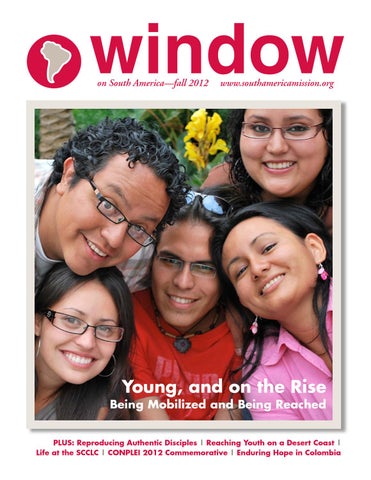
Young, and on the Rise
Being Mobilized and Being Reached
PLUS: Reproducing Authentic Disciples | Reaching Youth on a Desert Coast | Life at the SCCLC | CONPLEI 2012 Commemorative | Enduring Hope in Colombia
dois unidos frei damião
ccer from the so mião, viewed ey Da gr ei ng Fr lo of o, t ot The hear -right of ph id m srooms. t as an cl pl rs pitch, church y, white roof above cove tuar roof is sanc
We’ve dug into this community planted a church here, reaching kids for christ through soccer at the top of this hill, built more than 40 homes for those who desperately need it, feeding the hungry, sharing the gospel, valuing lives, to the Praise of his glory! Join SAM. Join this growing team based in recife, brazil.
recife
SAM Office (yes, that’s the team’s Fu The DU is a sca) in Dois suburb of R Unidos. ecife that co missaosulam ntains Frei Da ericana.wordp mião. ress.com
Brazil
Redeemed Lives | Beautiful Churches | Transformed Communities 2
window | fall 2012
www.southamericamission.org
[ On Discipleship [ by Reid Satterfield
I
t’s great writing about discipleship in a missions magazine; first, I don’t have to advocate for the importance of discipleship as taught in scripture…you already believe it; and secondly, I don’t have to make a case for the practice of discipleship…you are already doing it! Yet, our conviction for the biblical mandate to make disciples of all nations (Matt. 28.18ff ), and our commitment to carrying out Jesus’ commission is not enough. Why? Simply put, mission organizations are lead and populated by human beings that the apostle Paul described as “jars of clay”:
“But we have this treasure in jars of clay, to show that the surpassing power belongs to God and not to us. We are afflicted in every way, but not crushed; perplexed, but not driven to despair; persecuted, but not forsaken; struck down, but not destroyed; always carrying in the body the death of Jesus, so that the life of Jesus also may be manifested in our mortal flesh. So death is at work in us, but life in you” (2 Cor. 4.7-12). Paul makes it very clear that we are not finished products; far from it. In fact, we are by design weak, so that any pretense of our own sufficiency will never take root. Even more, that through our various struggles and trials, Jesus will be revealed; and His revelation will bring life to those we are ministering to. These verses at the first four chapters of 2 Corinthians lay at the heart of Paul’s theology of ministry; a ministry that was devoted to discipleship (Col. 1.28,29). Paul, and his missionary band, did not flee from their struggles, nor did they try to hide their struggles from those they discipled. Rather, they recognized and embraced their shared and revealed sufferings as the continuation of the very pattern, even ministry, of Jesus Christ (Col. 1.24-26). Understanding the certainty of struggle, as we reach out and disciple, how will we respond? When rocked with doubt, to the point of despair, will we pull back from others, or will we invite them to witness our weakness? Will we hide our afflictions or, in humility let those we disciple see us in a place of deep dependency upon the Lord and others? I believe that the words of Paul, as quoted above, make it abundantly clear that fruitfulness in ministry is dependent upon the revelation of Jesus Christ to those we disciple, When rocked with doubt, to the point of not our ability to avoid trials or to hide our struggles. So in this season, as we actively seek ways to renew our despair, will we pull back from others, or commitment to discipleship, let us begin by looking we invite them to witness our weakness? within; specifically as to how we integrate personal suffering with the ministry to others. Let us ask the Lord to show us where and how He is calling us to embrace His purposes in our struggles, personally and corporately. By God’s grace, as we accept His invitations, let us wait expectantly for the very life of Jesus to be revealed to and through us, for the Glory of God.
will
Reid Satterfield is a new addition to the SAM family. Reid and his wife, April, served as missionaries with the Africa Inland Mission to an unreached Muslim people group in northwestern Uganda where their daughter, Emma Jane, was born. In 2002, the Satterfields moved to Charlotte, NC, for Reid to pursue theological studies at Gordon-Conwell Theological Seminary. From 2005-2012 Reid served as the Southeastern Coordinator for the Pierce Center for Disciple-Building at Gordon-Conwell. Reid now serves as the associate pastor of spiritual formation and discipleship at St. Patrick’s Anglican Mission. St. Patrick’s is partnering with SAM so that Reid can serve SAM’s leadership team as it seeks to develop a culture of discipleship throughout the mission.
www.southamericamission.org
3 window | fall 2012
AND
YOUTH, SOCIETY, THE KINGDOM Article provided by Carlos Lamprea, JUCUM Colombia. Translated and elaborated by South America Mission.
A
young man I have worked with has a great ambition to be a film producer. He surprised me recently when he told me that he is not interested in film as a popular, mainstream medium, but rather as a medium to educate, to explore cultures, and to transform nations. Two years into pursuing film, he is not only making movies, but he is also training actors who see their role as fulfillers of the Great Commission. Today, emerging mission fields are being cultivated in the areas of art, business, politics, recreation and economics. The youth movement within the South American church is experiencing one of its most prosperous phases in history. Fruit is evident in numerical growth, the leveraging of technological advances, and opportunities to engage every area of society for the Gospel like never before. Youth are becoming more and more involved in daily societal inner-workings with unprecedented resolve in many South American countries. As members of the Church, they are viewing these areas of society as mission fields. They emphasize the horizontal aspect of the Church (taking Jesus out into the world as truth and beauty to bring about transformation) as well as the vertical (intimate connectedness to the Father).
The Youth Explosion within the Church We often hear of the significant expansion of the Church in South America over the last 100 years. In fact, just in the last 15 years in some countries in South America evangelical church 4
window | fall 2012
attendance has grown by 20 percent. And it is the Generation X-ers and Y-ers (those for whom a world not woven together by “www” is almost unimaginable) who are contributing most significantly to this growth. There are more young people than ever plugged into congregations and they are searching for ways to be useful, productive and fulfilled.
An Expanding Concept of the Mission Field Without a fear of failure or a strong sense of nostalgia to slow progress, Christian youth today are hopeful for the future. They aspire to a society free from oppression and injustice; the inaugural words of Jesus’ public ministry, given in Luke 4:18-19, are key in shaping the young generations’ rules of engagement with the world. They are fervent about challenging a status quo that persists solely on tradition. Christian youth today are eager to belong to a movement (or a network, as the explosion of social media demonstrates) that has eternal consequences and also bears tangible fruit in this life. God has charged humanity with a key role in building for His Kingdom. Authenticity, thoughtfulness and love are the Shalom-building characteristics of college students and twenty-somethings in the Church today. Young people are engaging the cities, seats of power and influence, calling for justice and considering how society can be transformed by Christ through a vision of Shalom. What could it look like for an entire nation, for society at every level, to be Christian? Young people know that if the Word of God is true, then it must affect every area of society. www.southamericamission.org
Through Leadership and Innovation Generation-Y understands the reality that confronted Joshua: a man who at a young age was given the great challenge of raising a people to a new level, to a land of prosperity, under the knowledge and guidance of a good, true God. Joshua displayed leadership potential in his youth. Moses noticed, trained Joshua and entrusted him to lead. Youth today believe that they are a critical part of God’s answer to a society in crisis. They must be given the chance to lead alongside their elder counterparts. As young leaders emerge today, they take the gospel with them to wage more than just an unrelenting fight against other religions competing for souls. Yes, the gospel is about redemption in Christ, about making disciples, but youth today take seriously an expanded vision of gospel impact. The gospel confronts modern philosophies, new concepts and mistakes of government, new leanings with respect to the meaning of family and the antagonistic practices of false prosperity. This leads the emerging generation down a significant path, where the Great Commandment and the Great Commission are both powerful influencers. A robust, comprehensive embrace of Shalom—of God’s Kingdom—must mobilize a great force for missions. Youth today are making a distinct gospel impact as they search for meaningful ways to take the profound truth of Christ to the world. Many are utilizing platforms like business and extreme sports as a form of mission, while others are entering into political and economic activism. My friend the movie producer is just one example. Thousands are taking to the streets of the major cities in order to give witness to Jesus who is alive and reigning.
In Response to Jesus We must not neglect our young people for simply being young. The sheer numerical growth brought about by the youth explosion makes youth one of the most strategic mission fields in Latin America today. As this young generation responds to Jesus and lives in light of the Gospel, they in turn are becoming a powerful mission force in the hands of the Creator. We must enjoy their innovations, their creativity, their strength, their chosen professions. They are the strength of a new missionary movement. They are people of influence in economics, government, arts and entertainment; in education, in communications, in religion, science and technology. The young generation of believers understands that if the Gospel is true, then every area of society can be transformed and every area of society represents a new mission field. God is on the move in ways that we never imagined. www.southamericamission.org
IMPACTO COLOMBIA HALF of Colombia’s population is 28-years old and younger. That’s approximately 23 million people whose worldviews are being shaped. Their potential to influence Colombian society is being incubated. One could argue that there is no mission field in Colombia now more strategic than the University. In Santa Marta (South America Mission’s base of operations in Colombia), momentum behind SAM ministry at the 15,000-student University of Magdalena is growing. As an extension of a local church known as La Comunidad Cristiana Esperanza, Impacto is the university ministry team that SAM works alongside. Impacto is reaching the University of Magdalena in partnership with CRU, known on campus as VPU–Vida Para la Universidad. A fledgling group of 20 students form the core of the Impacto movement. Leveraging the energy that the co-working campus ministry space provides, Impacto has plans to launch large-group meetings in the Spring of 2013 and form targeted small-groups across campus to foster evangelism and discipleship. Jesse Anderson, SAM Missionary in Santa Marta and an Impacto leader, is very hopeful as the ministry continues to take shape. “We have been forming relationships at la Universidad de Magdalena for several years. Impacto is beginning here but our vision reaches to other universities and technical institutes across northern Colombia. The young generation transformed by Christ, sowing for God’s Shalom, that’s what we long to see.” Does the Impacto vision resonate with the vision God has given you for ministry? Call and ask for Sam Tse at 803-8028580 to learn more about this growing SAM team in Colombia. 5 window | fall 2012
M
iracles happen here in this village on the coast of Peru. The supernatural is common be it through witches, the Saints, or a Pentecostal pastor. Stories of the recent past are filled with shape-shifting, spirits and dwarves. One cannot escape the realization that there are powers at war hovering over this barren desert landscape. I recently had the chance to talk with some dedicated young adults about what drew them into the Catholic Church. These individuals come from unhappy families plagued by abuse, alcoholism and the like– almost an assumption here in Puerto Supe. Ángel was rescued from drugs and life on the street by the Catholic Church, and now hopes to attend seminary. Julio was on death’s door, but when his parents prayed to Saint Martin he recovered, seeing a vision of the saint standing at his bedside. Celia was born dead, but when her mother prayed to Señor de los Milagros she lived. Each is in a brotherhood for one of the saints–a society formed to honor a certain saint by raising money and sponsoring processions and festivals. These three eighteen-year-olds are in some ways an exception from the spiritual dualism that characterizes Puerto. This is a culture where religion is inherited much like one’s blood type. God often has little to do with daily life until a crisis calls for an emergency transfusion of purpose or tranquility. Religion here often boils down to a search for power in a world in which so many are powerless. However, instead of leaning on Jesus, many in Puerto try to manipulate blessings from the saints. As there is little hope of advancement, Porteño youth use alcohol, drugs, sex, or religion to distract themselves from the black hole of their future. For the most part, responsible and hardworking youth go elsewhere to find work, leaving few role models for younger generations. Ángel, Julio and Celia have found the strength to keep going and better their lives through their participation
6
window | fall 2012
brotherhoods THE
in the brotherhoods. They have found hope in their own particular petitioners to a distant source of powers. But have they found the living Christ? Catholicism came to Peru during the Spanish conquest. The church planted here by threat of the sword was heavily tilted toward working one’s way to heaven. The seed sown among the native communities was a mix of truth and weeds, and over the centuries it has lacked tending. Growing free, pre-reformation Catholicism has interbred with native religions, unhealthy doctrines have thrived, and infighting has created a bramble patch where light does not enter and no man can pass. Puerto’s religious system converts the necessary sacrifice of Christ into a tragic farce, declaring that God’s holy ambassador incarnate is not enough. Historic martyrs have been turned into a cleverly marketed line of “Celestial PEZ Dispensers” –tweak St. Francis’ nose and get a treat. Kiss the Virgin’s foot. Light a candle.
www.southamericamission.org
the saints in puerto supe BY SHELLY DOBOSY
of
Present an altar on your doorstep during a saint’s procession and get a blessing for the next year. The Truth sown so long ago has been aggressively stunted by weeds. How can Ángel, Julio and Celia be taught how to recognize what is good and true and what is ill-founded convention? In many ways this place is far from the dim desolation of the 10/40 window, but the lostness is no less severe. Puerto’s garden needs to be tended. In Romans 15:20 Paul says he would rather go where no man has preached the gospel so as not to build on another man’s foundation. With nearly the entire world untouched by the Gospel, Paul had that luxury. Over the centuries, news of Jesus made it to most of the geographic world with some minor frontiers left. However, we have been lax in cultivating the truth planted in times past. Though the face of Jesus may be recognized, Luther’s scandalous revelation that faith alone can save is yet unknown in many corners of the globe. We are confronted with the necessity to build on the foundations of others—to teach these youth and adults how to discern between weed and wheat. Weeding and cultivating in this case is strangely similar to sowing the Gospel in unreached lands. To teach Ángel, Julio and Celia about the personal relationship we have with the man-whowas-God, we must have a personal relationship with them. Within the bounds of relationship we must be wise as foxes but gentle as
lambs as we question Puerto’s impregnable conventions and offer the good news that Jesus is alive and that he alone can save. But what can we do in a place where the battle is waged between heavenly forces? We can and must pray. No careful scheming or clever gimmick will prevail here. We must fast. We must petition. We must worship the God who is able to resurrect the dead and make all things new. We ourselves must be broken and humbled, willing to be changed by the Gardener when our good intentions overstep the bounds he has laid for us. The youth here, the church here, the problems here are the same the world over. People need Christ. The needy aren’t hidden behind affluence as in some places and they have a different skin color than others, but at root there is the same cosmic battle for souls. The same masses are dying. There is the same need for workers to stand against the tide and uncompromisingly hold a light in the murmuring darkness. Call upon the Gardener. Call upon the Spirit that is our life and breath. Call upon the one who walked among us. Ask the Lord of the harvest that he might send workers to this overgrown but desperately thirsty bramble patch. The harvest will be great, and there is much to be done in preparation. Shelly graduated from the University of Virginia in 2011. Soon thereafter she followed God’s heart to Puerto Supe, Peru, where she works alongside her SAM teammates: Cesar, Grace and Fabiola.
how “Fabi” makes this duo dynamic on the desert coast
I
met Fabi at midnight on January 18th. We stood on a stairway and looked out over the darkened housetops in Lima, talking about family and getting acquainted as much as my hesitant Spanish would permit. Now, nearly a year later, we have become an integral partnership, living and working together to reach children and youth in Puerto Supe. I did not expect to come to Puerto, and even less did I expect to work with Fabi, but both Fabi and this dusty little town have become rich blessings in my life. Fabi has been a Christian for almost ten years, coming to Christ at age fifteen. At that time her family was violently tearing itself apart and she was oppressed by a weight of self-hatred that drove her close to suicide. The change Christ worked in her brother and the testiwww.southamericamission.org
mony of his prayers ended up bringing her whole family to Christ, who knit them back together. Her family was so transformed that even when they later lost their house and business, their faith did not waver. Her parents planned for her to be an international ambassador and had the connections to make it possible. Fabi made it half way through law school, one of the top of her class and with many offers for 7 window | fall 2012
internships, but she felt that God had something different in mind for her, that the Christian life was something more. Years earlier her grandmother, a Christian, had planted the idea that God has a specific purpose for everyone, and Fabi was hungry to know what that might be. At a missions conference she was stirred to the recognition that she was being called to missions. She left her law degree much to the surprise of her friends and family and entered culinary school while seeking ways to learn more about missions. It took her a year of prayer and self-searching to finally tell her family what she truly felt called to do. To be sure that she was not being guided by emotion alone, she first set a series of tests for God: financial security, family approval and church support. Though broke, God provided her with funds when she asked and later on provided her entire missionary budget. God spoke to her parents, reminding them that they are only stewards of the children God has given them. God opened up doors in her church for her to receive training and support. Where God called he was faithful to provide in his time. She now realizes that “Missions, more than a job, is the satisfaction of doing the will of God. I don’t consider it to be a job,” she says, “for me missions is my life, my heart, my purpose.” While working as a secretary in her church and gaining experience with various other ministries, a missionary couple came for a visit from their post in the jungle. Upon seeing Fabiola they felt that she was the one they had been praying for to come help them. After talking with her they recognized her compassionate heart of service and obedience to the Lord and ended up taking her with them to the jungle for various terms to work with children in the tribal groups. She worked for multiple terms in the jungle and was even offered training for continued tribal work by a mission in Brazil, all expenses paid. Her church thanked them for the offer but declined to continue her training themselves. She was confused and a little upset, but submitted to church leadership. For another couple years she continued working with her church, itching all the while to get back on the field. In November of 2011, SAM started looking for someone to send to Puerto. She agreed to go straight away,
What are cultural constructs and social limitations to an eternal God? 8
window | fall 2012
She reminds me that we serve a God who is not contained by cultures and bound by local economic limitations. not even knowing where Puerto Supe was, so great was her desire to go wherever God might send her. I thank God daily for Fabiola. Every day I am overwhelmed and challenged by the way she serves with all of herself, loving in a way that makes no sense unless you read about the life of Christ in the gospels. Working alone as a cultural outsider I could not have found my way so quickly into the hearts and homes of Puerto as Fabi has with her genuine care and warm generosity. Before knowing Fabi, I would have said that missionaries in developing nations have excessively high barriers to entry. She reminds me that we serve a God who is not contained by cultures and bound by local economic limitations. We serve a God who calls and equips murderers like Moses and makes kings of the weakest son of the weakest family of the weakest tribe to rule his chosen people. What are cultural constructs and social limitations to an eternal God? It is such a privilege to see God’s hand working across cultural and national borders to call and equip workers for specific times and places. He knows best how to achieve his plan, even if it seems a little eccentric to pluck servants from both the amazon jungle and the rolling hills of Virginia to bring to completion his work in a tiny fishing town on the desert coast of Peru. Cultural differences have caused hiccups during our time here, but I would not trade the experience I have gained through Fabi’s patient teaching for anything. This is Fabiola’s counsel: “Friend, if you really have the desire and the passion to work for God, pray. Pray to God that he would give you a calling maybe to a new place or to the place you are—to your own family. I think the only way that God can grab a hold of other’s lives is through you. Be obedient to God’s will. If it’s time for you to study, to prepare for the future, prepare yourself. If it’s time to work, work and do it well. If it’s time for you to serve, serve and do it well.” Fabiola has modeled this advice in and out of season, working with all her heart at whatever is placed in front of her. Her testimony is a neon sign that points to the surpassing greatness of her Heavenly Father. www.southamericamission.org
the
Santa Cruz Christian Learning Center
I
www.southamericamission.org
t’s late September, spring time in Bolivia. August here is “El Mes de Los Vientos”—the month of the winds—but oththey still linger and push through now to make this oth erwise hot day pleasant on the soccer field at the Santa Cruz Christian Learning Center. JV and Varsity girls both play games today. Both will win. Parents, teachers, and students are all cheering and urging the girls on to victory; shouts of “Go Eagles” rise up through the lingering winds. The SCCLC girls’ soccer coach punches the air in satisfaction. Cokes and smiles abound. It’s a happy scene, pastoral and radiant, fleeting but a small vignette on a waning day that reminds everyone in attendance of the goodness that the SCCLC fosters: community, fellowship, sportsmanship, discipleship and learning. South America Mission’s pre-k through 12, ACSI accredited school in Santa Cruz, Bolivia, the SCCLC exists to see its staff, faculty and students transform society through God-honoring service in their homes, communities and professions. Bolivian kids and expatriate missionary kids make up the student body. The faculty and staff are missionary teachers; the school is their mission field. The SCCLC six-acre campus is home to 17 classrooms, modern computer and science labs, library, multi-purpose building, playgrounds…and soccer field! And while God creates the stage for this ministry through this backdrop in a city of two million people in the lowlands of eastern Bolivia, it’s the students and teachers to whom God has given the script. Casting calls are always open! Learn more about those who are filling the roles right now… 9 window | fall 2012
M
y story of being called into missions is one of surprise and speed. It boasts of God’s goodness and faithfulness. In January 2011, I found myself in a place of weariness and transition. I had recently stepped away from my teaching position at a school in North Carolina, despite teaching and students remaining my passion. I felt a bit aimless, confused. Yet I also relished this unusual season of stillness and rest, when I prayed for God to show me more of himself and reignite my fire for him. I knew God alone held the key to the healing and direction that I needed. Little did I know, God had big plans in store. Mid-January, a friend told me about a mission organization called South America Mission who was looking for missionary teachers to serve at a school in Bolivia. My friend encouraged me to consider the opportunity. Despite my initial reaction of spouting all the ways that I did not measure up to being a missionary—no Bible college training, never taught in a Christian school, not an extrovert, could not imagine living in a hut in a remote jungle—a small seed had been planted. Two weeks later, I attended a women’s conference, the theme of which was Hope. I felt God drawing me closer to him, urging me toward Jesus. God restored a peace and joy in my life. Within a matter of days, I began to live in the true hope and freedom that Jesus offers and I even had a new boldness to share this good news. As I grew during this time, so did the frequency of the reminders about teaching in South America. It dawned on me: as I drew closer to God I was hearing from Him more intimately. The reminders were God’s way of speaking to me; telling me to go, to go and serve as a missionary in Bolivia! I responded by contacting South America Mission and submitting an application for service. Soon thereafter I found myself on a plane on my way to visit Bolivia. In such a small window of time God had called me back to himself, only to then call me to follow him into missions. My first visit to the Santa Cruz Christian Learning Center was so encouraging. I saw an environment of care and community. I met other young missionaries who showed me, by example and through conversation, that being a missionary is more about following God wherever he leads than about being qualified, that missionaries offer different gifts and abilities, and that, despite being miles from home, I would be a part of an abiding community. I returned home eager to move forward. With the staff at SAM encouraging and supporting me each step of the way, I was able to begin my missionary journey in September 2011. While my life in Bolivia includes trials, unpredictability, and uncomfortable stretching, I have experienced the undeniable and immeasurable grace, strength, and love of God. Living and serving as a missionary is the most fulfilling and life-giving experience of my life. I am exactly where God wants me to be. I am so thankful he arranged the circumstances of my life—prompting me to leave my teaching job in NC, using my friend to encourage me, sending me to that conference on Hope—to bring me here. I praise God for writing my story. —Hana Kamiya teaches 2nd grade at SCCLC. 10
window | fall 2012
SCCLC seeks to draw students into a deeper relationship with Christ and to disciple them to be world changers as they enter the world beyond SCCLC. Our vision is to see students enter into an authentic relationship with Jesus and to gain a vision for proclaiming and demonstrating the Gospel to the nations by using their gifts and talents that God has given them. —Ally Lee, 1st grade Teacher
www.southamericamission.org
SCCLC Life: Teachers Give Testimony God has graciously provided me with two young girls to disciple and invest in while I have worked at the Learning Center. Naomi and HaEun, high school-ers, have been a huge blessing in my life. I can only hope they are equally blessed by our conversations, prayer times, picnics, scripture postcard exchanges, walks in the park, laughter, cake-making parties, and lunch dates. God has also gifted me with sensitivity in responding to typical teenager feelings, as well as the right words to say in responding to tricky questions, considering my general lack of eloquence with words. Which means it must be God!
Not only is there a fresh, positive feeling permeating the school, but I am also united with ALL of the staff. Personally my heart is exploding with joy as I continue to develop my relationships with my colleagues. They truly are incredible people and have so much wisdom and insight to offer, even beyond the classroom setting. —Rachel Rogers, Special Education Teacher
God has blessed me with both a Bolivian family and another missionary to live with. Coming as a single missionary to a new culture was hard at first. Yet God has given me an amazing community here. Weekly prayer and worship meetings with my fellow SAM Bolivia missionaries make all the difference.
—Danielle Potter, Art Teacher
—Kate Richter, 5th grade Teacher
I love being part of middle-school youth group on Friday nights. It’s so rewarding to take part in the lives of students outside of the classroom and in a safe place where I can really get to know them. I’m impressed and blessed by the students’ genuine desire for teachers to speak into their lives, and it’s so exciting to be part of a school that allows and frankly encourages relationship development outside of regular school hours. —Rachel Gentry, 7th grade Teacher www.southamericamission.org
11 window | fall 2012
in every
tribe a genuinely indigenous church
T
he above states the vision of CONPLEI, the National Council of Indigenous Evangelical Pastors and Leaders in Brazil. The quadrennial CONPLEI conference–this year known as CONPLEI 2012–took place at South America Mission’s Ammi Training Center in Chapada, Brazil, July 18-22. Ten years ago, in 2002, CONPLEI held a conference at Ammi. Eighty-three people attended. This year, more than 2,500 attendees representing 81 tribes and 14 nations participated in what is reported to be the largest gathering of indigenous evangelical Christians in the history of South America. The indigenous leaders of the CONPLEI movement like to speak of three waves of the gospel. The first wave was foreign missionaries who brought the gospel. The second was national missionaries who continued the growth and expansion of the faith. They see themselves, tribal Christians, as the third wave–not as mere recipients of the gospel but as evangelists and missionaries in their own right. This metaphor is a powerful and dignifying analogy, one often referred to. Yet one evening at the CONPLEI conference, a speaker from the Terena tribe offered an enlightened perspective on the analogy. He held up a cord and read Ecclesiastes 4:12, “A person standing alone can be attacked and defeated, but two can stand back-to-back and conquer. Three are even better, for a triple-braided cord is not easily broken.” (NLT) He said that the three-wave analogy was useful, but it has a flaw; waves are sequential, not simultaneous. One goes out, another comes in. The speaker appealed to all three groups–each wave–to find the strength and harmony of the cord, cooperating in evangelism (outreach) and building disciples (in reach) so that God be glorified in every tribe and tongue.
12
window | fall 2012
www.southamericamission.org
“And so the Lord forms His people, soul by soul—and place by beloved place.”
An indigenous leader from the Dourados region of Brazil wearing the traditional headdress of his people, the Kaiuwá. The CONPLEI 2012 Congress was a celebration of the growth of the culturally authentic, indigenous church. www.southamericamission.org
13 window | fall 2012
My People–My Place! by Eric Miller >>>>
“My Favorite Things” is a song most of us can hum. “My favorite places” is a list most of us can make. This past July I got to spend two unforgettable weeks at one of the places at the top of my list. The Ammi Training Center is its name, a SAM-founded Bible institute for the leadership development of indigenous believers, set high on Brazil’s majestic western savannah in the very heart of South America. While there this summer I had plenty of company—2,500 others, in fact, conferees of the seventh national congress of CONPLEI, the Portuguese acronym for the National Council of Indigenous Evangelical Pastors and Leaders. It turned out to be the largest gathering of indigenous evangelicals in the history of South America. And it was held at AMMI. cont’d
14
window | fall 2012
>>>>
www.southamericamission.org
The leadership of CONPLEI leads the congress in a worshipful celebration of the evangelistic outreach to Brazil’s indigenous peoples. Henrique Dias Terena, President of CONPLEI and Chancellor of the Ammi Training Center, is at left holding paper. The orange and white feathered headdresses are of the Zoro people.
www.southamericamission.org
15 window | fall 2012
AMMI takes its name from the Hebrew word for “my people.” A spectacular array of God’s people arrived there for the congress, from 81 ethnic groups and 14 nations, forged, by God’s grace, into one. CONPLEI, in the words of its president Henrique Dias Terena, had hoped to “draw everyone into celebration of the evangelistic outreach to Brazil’s indigenous peoples.” It had been 100 years since SAM missionaries had brought the gospel to Henrique’s tribe, the Terena, the first to be evangelized by Protestants; this work became the spearhead of a movement that CONPLEI has in its brief twenty years catalyzed, advancing toward its goal of establishing a genuinely indigenous evangelical church among each of the continent’s indigenous peoples. So celebration was the order of the day, and celebration was exactly what happened, in blazing color, with banging drums, and with hundreds of voices lifted heavenward in a massive hymn of praise. I was, I confess, ready to celebrate, and for many reasons. It had been twenty-eight years since I had last been to AMMI—a long time to be away from a favorite place. Back in 1984 I was just seventeen and AMMI wasn’t even called AMMI yet. In fact, it was barely a camp, still under construction, called simply Portão da Fé: Gateway of Faith. It truly became that for me, an MK whose parents were church planters in that part of Brazil. SAM missionaries Dave and Margie Snyder, whose children were the age of my siblings and me, had taken it upon themselves, with great affection, to shepherd the small group of MKs from the area into a youth group, and when SAM began to improve the property that would become AMMI they made it available to us for retreats. At least one of those was actually a work retreat. But the real work being done was the work of the Spirit, as friendships deepened and we glimpsed God himself more fully during those memorable days and nights. For many years my efforts to return to Brazil were thwarted by cost. But when a missions trip not just to Brazil but to AMMI itself opened up through a church my wife’s father was serving as interim pastor, we took it as the gracious hand of God Himself in motion. My oldest son and I found ourselves on a team of twenty-one that landed at AMMI to ready it for the conference, where, it turns out, in a wonderful reunion we met up with two of the Snyder boys—Dan, AMMI’s director, and Steve, leading a missions team from his church in Michigan. We erected temporary showers and lighting, painted dozens of signs, and just generally did whatever we could to keep the conference moving once it began. The work we did was rewarding. One of those rewards was the opportunity to see the conference from different angles, through others’ eyes. I witnessed every day a remarkable team of some twenty-five medical professionals, volunteers on hand to care for those at the 16
window | fall 2012
www.southamericamission.org
conference, many of whom had acute needs. They prayed audibly as they worked, a moving testament of the God who loves us body and soul. I got to know a security guard who had come to the congress from Haiti, having studied Portuguese there so that he could someday do missions work in Brazil. I listened as one of CONPLEI’s leaders, in the gentlest and humblest tones, informed some conferees of their need to move their tents in order to make room for “os nossos parentes”—“our relations”: people from other tribes who were arriving without tents and were thus in need of the site in question for the stringing up of their hammocks. I was also privileged to hear and see much of the main event itself: a conference filled with spiritual longing and Spirit-nurtured hopes. One CONPLEI leader, in an earnest and anguished public prayer, pled with God to reach the “anthropologists who don’t love the Lord, and who don’t know You”—scholars with whom many indigenous peoples have frequent contact. On the opening evening a group of six men from the Xavante tribe announced that they were about to “worship God in our own language,” and proceeded to perform a dance, accompanied by rattles and a chant; they concluded by declaring that they had come to the conference “to present ourselves as the servants of Christ.” And the conference itself closed with a powerful symbolic affirmation of the end to which the kingdom of Christ is moving: Two CONPLEI missionaries were wed before the entire congress, after which all present were invited to partake of the Lord’s Supper. As he performed the ceremony Henrique Terena reminded everyone of this profound truth: “Marriage was born in the heart of the Lord.” There’s a great wedding and feast on the way, in the new heavens and earth over which our Lord will graciously and generously rule. That earth, too, will be filled with special places, I’m sure. In his wise, wonderful, and panoramic book Christ Plays in Ten Thousand Places, Eugene Peterson notes that in the Christian story “Everything that is critically important to us takes place on the ground.” Love requires incarnation, Peterson insists, and that love-inspired incarnation happens at real places—places that end up becoming precious to us, we who love and are loved upon them. AMMI has long been that for many, and has just this summer become that for many, many more. And so the Lord forms His people, soul by soul—and place by beloved place. Eric Miller, Ph.D., is a professor of History at Geneva College, Beaver Falls, Pennsylvania. Opposite page clockwise: The Congress’ children’s ministry celebration, on-stage at the main event; Henrique Dias Terena, President of CONPLEI and Chancellor of Ammi, addresses the audience; A fraternal, and amorous cross-cultural handshake between a missionary and an indigenous church leader; This page clockwise: Closing night celebration replete with holy communion and a wedding; CONPLEI recognizes South America Mission’s Ammi missionary team and senior leadership present; Young Ammi students enjoy the fellowship that the CONPLEI Congress brings to campus; Volunteers from the local Brazilian church. www.southamericamission.org
17 window | fall 2012
Redeemed Lives | Beautiful Churches | Transformed Communities
VISION
Learn more about this important Colombia project at
www.southamericamission.org/enduringhope
B
ob and Ruth Ann Moyer’s enduring hope for Colombia—where they served more than four decades as missionaries with South America Mission—is the same Christ-given hope that compelled them to Colombia in 1965. It is a hope for redemption in Christ, made manifest through the Church, transforming communities by radiating God’s love, grace and compassion to the world. Santa Marta, Colombia, is witness to the transformative impact of the body of Christ in a congregation of believers known as Iglésia La Esperanza. The Moyers were instrumental in founding La Esperanza in the 1980s as part of a SAM missionary team. Today, La Esperanza is growing and impacting Colombia for Christ. New church plants in cities and towns surrounding Santa Marta, outreach to the local University community, a ministry to the Wayuu people of the Guajira Desert to the north, and a model school ranked second in the state with a vision to impact students and families for Christ, these are all born out of La Esperanza. The Moyer Enduring Hope Colombia Fund will amplify La Esperanza’s influence with $250,000 in Kingdom resources. More than 20 percent of the resources have been raised! Will you keep the momentum behind this important project by making a tax-deductible donation to South America Mission? You can use the envelope included in this magazine to complete your gift, or visit southamericamission.org and click Donate Now.
The church of Jesus Christ multiplied across South America transforming local communities and the world by embodying the Kingdom of God.
MISSION We will Live as redeemed children of God, Reproduce authentic disciples of Jesus, Multiply dynamic churches and church networks, Train godly leaders, and Enable transformational initiatives.
IDENTITY An abiding, loving, redemptive, suffering and growing community.
“Let us go with you, for we have heard God is with you.” Zechariah 8:23
BOLIVIA BRAZIL COLOMBIA PARAGUAY PERU
These are the places of our obedience, where Jesus is made famous and God glorified. South America Mission is building for God’s Kingdom in response to the gospel of grace. It is this gospel that gives us hope for Redeemed Lives, Beautiful
Churches,
and
Transformed
Communities.
We are a community of dedicated missionaries, responding and hoping together. Join our community. Contact us.
South America Mission, Inc. 1021 Maxwell Mill Rd, Suite B, Fort Mill, SC 29708 mobilization@southamericamission.org • 803-802-8580 @SAMSouthAmerica
SouthAmericaMission
youtube.com/southamericamission
REDEEMED LIVES
|
BEAUTIFUL CHURCHES
|
TRANSFORMED COMMUNITIES
a Vision for South America
DEAR SAM PARTNERS
C
armelo had a decision to make. It was the kind of decision you and I don’t usually ever face. With money enough for only one, should he pay for water or electricity? Maybe that seems like an easy choice, but let me give you a bit more context. Carmelo, his wife and two daughters lived in a peripheral neighborhood of a rural town of eastern Bolivia. In this new and poor neighborhood, nobody paid for water. They just all dug up the dirt street and bypassed the meter. Electricity was trickier, harder to get away with “borrowing.” Carmelo was on fire for the Lord. He had met Jesus in his 40s through the near death of his youngest daughter. Now he was growing rapidly in his faith and was helping lead a church plant in his neighborhood. He was a zealous student of the Bible. Electricity for a single naked bulb would give him the light he needed to study the Word and teach his children late into the night. In order to focus on ministry, Carmelo was doing odd jobs for me and supporting the church plant. It wasn’t much income, but other jobs were hard to come by, and this work allowed him to invest whole-heartedly in God’s work. When the first paycheck came, I could see Carmelo’s eyes light up with visions of electricity. Carmelo explained to me his intentions to rush off and pay the electric co-op. I asked about the water. The priority of the Word and the universality (and ease) of stealing water made the decision an obvious one for Carmelo. We talked about God’s perspective and the importance of Carmelo’s witness if his neighbors were ever going to find living water. I told Carmelo it was his decision and we prayed before he rode off on his bicycle, still laser-focused on electricity. The next day, Carmelo answered with a wide grin when I asked him what he’d done. Prompted by the Spirit living in him, Carmelo had chosen to pay the water bill. With receipt in hand, he pedaled home and arrived just as the white pick-up of the water company pulled up. They were systematically going house-to-house in the neighborhood to install new systems to lock down the water supply. Carmelo waived the proof of payment. Instead of cutting off his water, the crew connected his properly. There’s more! Because none of the neighbors had paid for water, they all trickled to Carmelo’s house daily for water to cook and clean. Guess who was waiting with generosity… and with a bold witness to the Living Water. Discipleship is not a course. It is shared lives, encouraging the work of God’s Spirit, pointing each other to the Word. The above story is one of my proudest (and most humbling) moments in twenty years of Gospel ministry. Telling it often brings me to tears. It’s a summary to me of the meaning of being a missionary. Pray with me that as we encounter Christ, the change wrought in us would lead others to encounter Christ, too. Yours in Christ,
Kirk Ogden, Executive Director www.southamericamission.org
19 window | fall 2012
Fall Issue 2012 | Volume 24 | Issue 1
NON-PROFIT ORG U.S. POSTAGE PAID FORT MILL, SC PERMIT #91
1021 Maxwell Mill Rd, Suite B Fort Mill, SC 29708 www.southamericamission.org twitter: @SAMSouthAmerica fb: SouthAmericaMission ADDRESS SERVICE REQUESTED
F
st
FIRST FIRSTFRUITS FRUITS cafe drink good coffee
|
get mission going
100% Arabica. Freshly Roasted. Whole Bean. Profits Support Missions. Brazilian and Peruvian. Medium and Dark Roasts. Reg and Decaf. order today: www.firstfruitscafe.com coffee@southamericamission.org
served up by