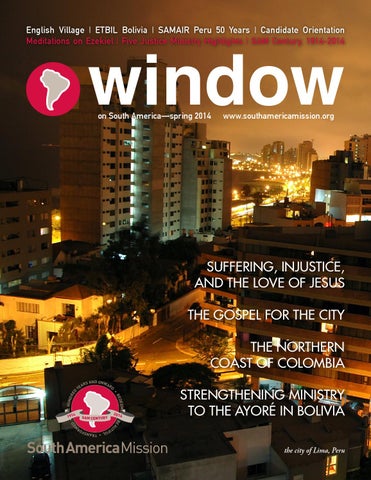
English Village | ETBIL Bolivia | SAMAIR Peru 50 Years | Candidate Orientation Meditations on Ezekiel | Five Justice Ministry Highlights | SAM Century, 1914-2014
window on South America—spring 2014
www.southamericamission.org
SUFFERING, INJUSTICE, AND THE LOVE OF JESUS THE GOSPEL FOR THE CITY
ED
SAM CENTURY
20 1
L IFU UT
4
DEEMED • BE RE A
191
S AND ONWA AR RD YE •
NE HUND • O RE D
THE NORTHERN COAST OF COLOMBIA
4
STRENGTHENING MINISTRY TO THE AYORÉ IN BOLIVIA the city of Lima, Peru
• TRANSF OR M
Multiplying Churches living a s
bling transform a n e at io rs ed comm m r un fo s i n
repr of God o ren d u ild c i n ch g hes and chur c ed h urc n ch e t ng d lives b e a me u ee
tives a i t i n i l na it es
red ee m mu ltip lyi re d
ples of Jesu disci s tic en th raining god t l y au le a ks de or w churches t r ul a tif
Across South America @SAMSouthAmerica www.southamericamission.org
SouthAmericaMission |
www.firstofallpray.org
|
southamericamission samsouthamerica.wordpress.com
ONE HUNDRED YEARS AND ONWARD! Kirk Ogden, Executive Director @SAMKirkO
Celebrate our SAM Century with us! South America Mission turns 100 this year.
J
As South America Mission stands on the brink of our second century, I believe God is calling us again to “consider it all joy when you suffer trials of many kinds.” I believe God is showing us his heart for the billions suffering unspeakable injustice every day. As we pray for a renewed season of fruitfulness, we need to know that the path of obedience may lead through valleys of suffering. May the worthiness of Jesus be proclaimed in our lives.
NE HUND • O RE D
REDEEMED LIVES | BEAUTIFUL CHURCHES | TRANSFORMED COMMUNITIES
4
SAM CENTURY
ED
191
S AND ONWA AR RD YE
20 1
L IFU UT
• TRANSF OR M
has included much suffering. Dr. and Mrs. Davis experienced hardship. Arthur Tylee and Mildred Kratz were martyred by those they were trying to serve (their stories can be found in Dr. Marvin Newell’s A Martyr’s Grace, pp. 161-176). Many others have suffered loss, persecution and worse. This suffering is also part of who we are. SAM missionary Toni Seng Mercado takes us back into Scripture in her “Meditations on Ezekiel” to help us better understand. Toni, a third generation SAM missionary, is uniquely qualified to challenge us on these matters. She reminds us that suffering is not just an occasional consequence of our preaching the gospel. Sometimes the suffering of God’s people is the method God chooses to proclaim the good news and prove his worthiness.
DEEMED • BE RE A
www.southamericamission.org
The worshiping church. La Comunidad Cristiana de La Esperanza, Santa Marta, Colombia.
•
oseph and Mabel Davis had no thought of this day when they departed New York in 1914 at the onset of World War I. Nevertheless, there were at least a couple of legacies they left for those of us who have followed. First, they were broken people redeemed by God. Their obedience led them to South America not because of their own worthiness, but because of Christ’s. Second, they were passionate about sharing Jesus and seeing real change in individuals and communities as they made disciples. Today, our missionary team reflects this heritage. We are not cut from perfect cloth. We are redeemed “people belonging to God that we may declare the praises of him who called us out of darkness into his wonderful light.” God’s grace and mercy applied to our brokenness is what makes us passionate to share the love and hope of Jesus with others. “He who is forgiven much loves much.” It’s exciting to launch our centennial celebration with this edition of Window. Inside you will read about some of the ways God is working through SAM missionaries. You can celebrate the fruitful ministry of marvelous partners. You’ll gain ways to pray us into our new century. Enjoy! A good celebration, though, needs some perspective. If we are really going to give God the praise he is due for the last one hundred years, we need to understand a little more of how we got here. That path, in addition to the highlights and happy stories,
4
3 window | spring 2014
NE HUND • O RE D
ED
SAM CENTURY
20 1
L IFU UT
4
DEEMED • BE RE A
191
•
SAM
S AND ONWA AR RD E Y
4
• TRANSF OR M
South America Mission English Village, held in Santa Cruz, Bolivia, in July 2013, saw a total of 30 students from Bolivia, Peru, Brazil, France, and Paraguay. A team of eleven from Calvary Church of Charlotte, NC, and five SAM missionaries taught language acquisition skills in a total English immersion environment. In this environment, the students were able to experience what it would feel like to be in a country that spoke a different language and be forced to communicate regardless of their skill level. In just ten days, the students of English Village improved their English skills, gained language acquisition techniques that will benefit them on any mission field, and formed unforgettable bonds with the team from Calvary. There were even two students who attended in order to practice their English but had no interest in missions, and left with a vision to give their lives to ministry. Email dwilson@southamericamission. org to learn more about English Village 2014.
100 years of ministry in 2014 Our centennial year will be full of remembering but also, and moreover, full of looking ahead. Our “SAM Century Campaign” will build on our momentum by inviting many to invest their time, talent and treasure in the future of SAM ministry. More than just celebrating longevity, we’re celebrating God’s faithfulness and His effectiveness through us! Stay tuned throughout 2014 for SAM Century highlights. Our next edition of Window (released in August) will have a commemorative focus. In the meantime, please visit www.southamericamission.org/samcentury to learn about our future ministry and how you can make an impact by giving.
ETBILBOLIVIA From January 14-17, 2014, forty-one pastors, missionaries, and other church leaders received an orientation to church-based theological education at SAM’s “El Atrio” educational center in Santa Cruz, Bolivia. The program, known in Spanish as ETBIL (Educación Teológica Basada en la Iglesia Local), motivates and teaches churches how to implement a long-term disciple-making and leadership >>
4
window | spring 2014
www.southamericamission.org
CONGRATULATIONS to our most recent class of candidates who completed orientation in 2013. After two weeks of receiving teaching, sharing testimonies, participating in personal assessments, and worshiping together, we welcomed 24 adults (and 11 children) into the SAM Community. We are privileged to come alongside these missionaries as they pursue God’s next steps for them. Each one has a unique story and passion that will be used for the glory of God in South America. SAVE THE DATE for candidate orientation 2014, June 16-27.
For the complete photo album of candidate orientation and other SAM events, visit our photostream at flickr.com/southamericamission www.southamericamission.org
5 window | spring 2014
development plan. Starting with small group studies known as “First Principles,” believers learn to think biblically and develop habits of the heart leading to growth in wisdom and authentic Christian living. As pastors train group facilitators, more and more members discover their leadership potential. These leaders, in turn, are mentored in deeper and more intensive theological studies right within their church. The ultimate goal is to grow leaders who grow and develop churches “after the manner of Christ and the apostles.” Prior to this conference, three leaders from Javier Velazquez facilitates a session at the recent ETBIL workshop held at SAM’s Bolivia – Pastor Felix Pedraza, SAM missionary El Atrio educational center in Santa Cruz, Bolivia. David Mozombite, and Pastor Arturo Guardia – were exposed to the ETBIL paradigm in a summit offered in Lima, Peru. The conference at El Atrio was the first time that instruction and orientation was offered in Bolivia. Teachers for the workshop were Pastor Julio Lugo of Lima and Javier Velazquez of Miami. A quote from a worskshop participant captures the potential of the program: “If church members simply complete the First Principles series, they will have more training than most pastors!” The Bible Society of Bolivia is printing the Primeros Principios books, the first of which is due to be available by January 31. Pray for the fruitfulness of this program in growing of biblical disciples and disciple-making churches.
SAMAIR Peru commemorates 50 Years of Service! On September 20, 2013, current and retired SAM missionaries, ministry partners, and local Peruvian dignitaries gathered together to celebrate SAMAIR’s milestone officially marked in 2012. The event was held at SAMAIR Peru’s base on Cashibo Cocha, Pucallpa, Peru. Since 1962, SAMAIR Peru has been a catalyst for the Gospel taking root in some of the most remote areas of South America. By using airplanes as tools to move people and equipment, we have mobilized thousands of missionaries, medical personnel, and development workers to share the love of Christ with people living in communities unreachable by road. As we look back on half a century of aviation ministry, we are in awe of God’s faithfulness as we’ve watched His story unfold in the jungles of Peru. 6
window | spring 2014
TEAM, The Evangelical Alliance Mission, is a sister and like-minded mission organization with missionaries all over the world. Beginning in 2014, SAM and TEAM are partnering together to pursue greater Kingdom impact around the globe. The two organizations will collaborate directly at the senior leadership levels, with the benefits felt across the organizations, most notably as opportunities for sharing the gospel around the world increase and as more and more people are invited into missionary service through strategic collaboration. To learn more about an exciting area in which SAM is working alongside TEAM, visit team.org/missions-place-by-team. www.southamericamission.org
THE GOSPEL FOR THE CITY
by Julio Chiang
I
had the privilege of growing up in the city of Lima, Peru. I loved Lima and never dreamed of ever living away from it. I have watched Lima change over the years. It, like many of the world’s great cities, has become in many ways synonymous with chaos, crime, poverty, and social injustice. One statistic is telling: there are almost 10 million people living in Lima today, but 60% of them live in shantytowns. Many came from the highlands in the 80’s as the terrorist group “The Shining Path” unleashed its persecution. Thousands of others have come simply looking for a better life, attracted by the hope of a scale-up in society, by better education, work opportunities and health services. Latin America is the most urbanized region in the world. People are migrating to the cities at unprecedented rates. In 1950, 100 million people lived in rural areas while only 80 million lived in the cities. Today, 120 million still live rurally, but more than 390 million live in the cities of Latin America. This reality should at least give us pause to consider what God intends for the cities that make up such a big part of creation’s landscape. God’s Design for Cities Sometimes we forget that the Gospel is good news for more than just our souls, but also for the restoration of the earth which includes the communities where we live. 27 So God created man in his own image… male and female he created them. 28And God blessed them. And God said to them, “Be fruitful and multiply and fill the earth and subdue it, and have dominion over the fish of the sea and over the birds of the heavens and over every living thing that moves on the earth.” Genesis 1:27-28 www.southamericamission.org
God’s instructions are to multiply and subdue what He gave us in creation. We were created to “create culture” and live in communities, bringing out the best of natural resources and the best of people living in community. The Lost Design 21 …“So will Babylon the great city be thrown down with violence, and will be found no more; 22and the sound of harpists and musicians, of flute players and trumpeters, will be heard in you no more, and a craftsman of any craft will be found in you no more…23and the voice of bridegroom and bride will be heard in you no more, for your merchants were the great ones of the earth…” Revelation 18:21-23 Above we read about the downfall of Babylon, one of the greatest cities of its time. We see the loss of genuine goodness and greatness that filled the city at the hands of virtuous image-bearers. Babylon’s future is devoid of the great musicians, artisans, business people—“the great ones of the earth”—who inhabited the city fulfilling God’s intended design for city life.
Jerusalem, coming down out of heaven from God, prepared as a bride adorned for her husband…Revelation 21:1-2 1 Then the angel showed me the river of the water of life, bright as crystal, flowing …2through the middle of the street of the city; also, on either side of the river, the tree of life with its twelve kinds of fruit, yielding its fruit each month. The leaves of the tree were for the healing of the nations. Revelation 22:1-2 When we read carefully the description of the “holy city”—the new heaven and the new earth—we see the remaking of the Garden of Eden. Perfection and wholeness that existed once in a garden will find its new, eternal articulation within the crystalline walls of the beautiful, holy city. We need to see the cities through redemptive lenses and be intentional in working for their transformation, knowing that God created us to create culture and live in community. The rate of city growth today is far surpassing the rate of church growth in the same place. What role will the church have in restoring God’s design to the great cities of the world? REDEEMED LIVES | BEAUTIFUL CHURCHES | TRANSFORMED COMMUNITIES
Restoring God’s Design 1 Then I saw a new heaven and a new earth.…2And I saw the holy city, the new
Julio Chiang is a SAM missionary and experienced church planter. He is leading a new church-planting initiative in the city of Lima. 7 window | spring 2014
the call to
G&O
L O V E by PJ Christensen
Injustice and suffering are all around us. Disease. Orphans. Poverty. Human trafficking. Sometimes it seems far away and untouchable. It can be so mediahyped, shrouded in politics, or just plain incomprehensible that we feel numb to it. And sometimes the injustice creeps inside our borders. Cancer. A careerending accusation. A local school shooting. Divorce. These things stare us in the face and overwhelm our hearts because they are unexpected and ugly. The suffering is thick and permeating and suffocating. It is real. No matter how hard we may fight it, there is always the temptation to ignore the brokenness in our neighbors and in ourselves. We unintentionally slip into complacent places of self-centeredness, considering that these problems are not ours to own. We have the best intentions. We have compassion and fortitude and a proclivity towards things that are good and right. We care about our world, our neighbors, our families, our roles in God’s plan for justice. But, we get caught up in our deadlines, our to-do lists and gadgets, and in our responsibilities and eventually find ourselves wading in a pool of apathy. And when the deep and personal sufferings surrounding us threaten like Goliath, too often we doubt the power in our sling and stone. We shrink back and wonder “why” rather than trusting in God’s perfect pursuit of justice, and the fact that he’s given us a role to play in it. Yet, engaging in that pursuit is exactly what God has called us to do. None of us are immune to the temptation of apathy, not even missionaries who intentionally make their homes in the trenches. But we fight against apathy and preoccupation because God desires for us to embrace something far greater— life that foreshadows his perfect Kingdom. When we think about being sent out to influence our world for Christ, our minds recall Jesus’ words to go and make disciples of all nations. The call of the Great Commission to go and proclaim the Good News is absolutely central to living in obedience to Christ and participating in His divine plan. Having equal influence on the way we engage our world, the Great Commandment calls us to love God fully and our neighbors as ourselves; we do this by demonstrating the love, grace and mercy of 8
window | spring 2014
www.southamericamission.org
Jesus, in tangible and practical ways. As N.T. Wright writes in his book, Surprised by Hope, “Every act of love, gratitude and kindness; . . . every minute spent teaching a severely handicapped child to read or walk; every act of care and nurture, of comfort and support, for one’s fellow human beings . . . and of course every prayer, all spirit-led teaching, every deed that spreads the gospel, builds up the church, embraces and embodies holiness rather than corruption, and makes the name of Jesus honored in the world—all of this will find its way, through the resurrecting power of God, into the new creation that God will one day make.” The justice and healing we seek now will prepare the stage for God’s final act. We have an integral role to play.
When we run from apathy and pursue justice, we become participants in the life-giving mission of Christ, joining in on the work that God is already doing through His Church.
We join Christ in pursuing Kingdom justice, not because we ought to or because we feel guilty. We join Christ in the pursuit of justice because all human life is sacred and all things broken are meant for restoration. We don’t have to be overwhelmed or intimidated by the breadth of injustice or depth of suffering around us because we are not called to do this on our own. Our story is not about us; we are not the main characters. Our story is God’s story and it’s about making all things new—righting wrongs, repairing the broken, restoring relationships, reconciling injustice. We are not called to bear all the world’s burdens upon our shoulders but we do play a vital role in God’s plan for renewal. Consider these words, again from N.T. Wright, “I do not know how our work for justice for the poor . . . will reappear in that new world. But I know that God’s new world of justice and joy, of hope for the whole earth, was launched when Jesus came out of the tomb on Easter morning, and I know that he calls his followers to live in him and by the power of his Spirit and so to be new-creation people here and now, bringing signs and symbols of the kingdom to birth on earth as in heaven. The resurrection of Jesus and the gift of the Spirit
photo: Ayoré youth and SAM missionaries celebrate the opening day of a nutrition clinic in Barrio Bolivar, an Ayoré community in Santa Cruz, Bolivia. SAM’s ministry to the indigenous and rural peoples of Bolivia focuses on meeting both spiritual and physical, felt needs. www.southamericamission.org
9 window | spring 2014
reorient DOING NOTHING ISN'T AN OPTION You’ve probably heard the quote, “All that is necessary for the triumph of evil is that good men do nothing” from Edmund Burke. As Christ-followers, we are charged with representing Jesus to a lost and hurting world, and we can’t claim to fully love God unless we are also engaged in loving our neighbors. EVALUATE YOUR LIFESTYLE Take a step back and evaluate how much time and energy you spend serving those who lack the advantages you have. What is keeping you from reaching out to the people around you who need help? Are you too busy? Are you afraid that getting too involved in someone’s life will complicate your own? Do you feel too overwhelmed by the injustice around you that you don’t know what to do? Ask God to make you aware of the needs of people around you and to help you plow through barriers to meet them. SEE PEOPLE LIKE JESUS SEES THEM It’s difficult to look beyond ourselves enough to see others as Christ does. Without even realizing that, we often put people into categories of “us” or “them,” but remember that we are all connected because God made us all in his image. Pray for God to open your eyes and expand your heart to recognize the needs of others, especially those our society doesn’t pay much attention to—like the disabled, homeless, elderly, and imprisoned. Think about a global injustice that concerns you and research ways that you can volunteer or support a non-profit that addresses the issue. Pray for those who are suffering and ask God to help you value them. PAY ATTENTION TO HOW YOU ACT TOWARDS OTHERS Whenever you interact with others, keep in mind their dignity as God’s children and treat them in a way that reflects how God treats you. Let your own suffering improve your ability to feel compassion for those around you and enter into their pain by listening, praying, and meeting their practical needs. 10
window | spring 2014
Isaiah 1:17 issues a direct charge: “Learn to do good. Seek justice. Help the oppressed. Defend the cause of orphans. Fight for the rights of widows.” The God who spoke the world into being and breathed life into our bodies also gave us the power to overcome brokenness.
mean that we are called to bring real and effective signs of God’s renewed creation to birth even in the midst of the present age.” God created us—as white-collar workers, as blue-collar workers, as missionaries, as human beings—to reflect his image to the world. He has enlisted us and equipped us to help in the work of setting the world to rights. He has invited us to join Him in the pursuit of justice and reconciliation and healing. Isaiah 1:17 issues a direct charge: “Learn to do good. Seek justice. Help the oppressed. Defend the cause of orphans. Fight for the rights of widows.” The God who spoke the world into being and breathed life into our bodies also gave us the power to overcome brokenness. No matter how unfathomable the sufferings around us, God is greater—so great, in fact, that he has already overcome them (John 16:33). When we run from apathy and pursue justice, we become participants in the life-giving mission of Christ, joining in on the work that God is already doing through His Church. “Ultimately, we’re not going to save the world. That’s Jesus’ job, and he’s already done that,” says Thomas Rowley, Executive Director of A Rocha USA, a Christian conservation organization. “We’re living in the already-but-not-yet Kingdom. And so our hope isn’t in what our efforts will bring about, but in being faithful, relying on God and looking to His Kingdom. He is in charge of the results—and our hope is in Him.” REDEEMED LIVES | BEAUTIFUL CHURCHES | TRANSFORMED COMMUNITIES
PJ Christensen is South America Mission’s communications manager. A millennial, she lives with her husband and beloved boxer in an immigrant community in urban Charlotte, NC. www.southamericamission.org
You have purpose and passion and a place in God’s story.
So does she.
Let your stories converge. Visit www.southamericamission.org or call 803.802.8580 to learn about service opportunities in South America.
REDEEMED LIVES | BEAUTIFUL CHURCHES | TRANSFORMED COMMUNITIES
THE WORD BECAME FLESH AND BLOOD, AND MOVED INTO THE NEIGHBORHOOD JOHN 1:14 MSG A snapshot of the ways South America Mission is being the hands and feet of Jesus in communities across South America
G
aira, a community within the metropolitan area of Santa Marta, is home to approximately 20,000 people living in more than 15 different neighborhoods. The majority in Gaira has very limited resources for adequate living. In many cases, the most basic needs of families—food, healthcare, shelter—go unmet. As the road to economic stability is steep here, so too is the spiritual road to the transformational knowledge of Jesus Christ. Most in Gaira believe thay they earn a good place in the afterlife by holding onto any one of a number of competing, morally upright religious strains. Many call themselves religious or full-of-faith because they celebrate traditional Christian holidays. SAM’s ministry team in Gaira is passionate to see lives transformed through an intimate, spiritual encounter with the one, true God. They are also passionate
Photo © Eric Schlenker
Photo: The streets of Gaira, Colombia. SAM missionaries in partnership with La Esperanza Church are working to plant a new congregation here. One of the ways they connect is through health brigades that meet some fundamental physical needs of the people. www.southamericamission.org
about building for God’s Kingdom through ministry that builds towards physical and social well being, in the here and now. SAM missionaries and partners from La Esperanza Church in Santa Marta make up the Gaira ministry team. By no means insular, La Esperanza is looking outward to transform communities through local expressions of the church. In fact, the ministry effort in Gaira is a church-planting initiative, an articulation of La Esperanza’s missional DNA. Reaching children and youth—and their parents—through small-group studies born out of OANSA-based (AWANA in the US) outreach plays an integral role in laying a foundation for a church plant. So does the The haircut and medical check-up corner at a March 2013 Health Brigade in Gaira. A local US church concerted effort to meet felt needs through team, SAM missionaries and Colombians from La Esperanza Church helped facilitate this outreach. “health brigades” held in a small, municipal stadium right in the heart of Gaira. SAM Colombia missionaries and volunteers from La Esperanza church host two to three health brigades each year. Typically, between 200 and 300 people attend. Licensed medical doctors and nurses from La Esperanza perform general medical check-ups. Other church volunteers and SAM missionaries get involved in a number of ways, from giving haircuts to teaching basic dental hygiene and distributing eye glasses.
S
outh America Mission has a long history of sharing the Gospel in word and deed among the indigenous peoples of eastern Bolivia, most notably among the Ayoré, but also the Chiquitano, Guarani and Guarayo. Over the years, the work has expanded to reach rural, mestizo peoples living in difficult situations. The worldviews among many of these communities are rooted deeply in superstition and syncretism, and they suffer through the difficult realities of brokeness—poverty, prostitution, and drug abuse. SAM’s Indigenous and Rural Outreach team (IRO) leads this important ministry in Bolivia. The ministry’s vision is to see self-sustaining indigenous and rural churches and communities flourish through the spiritual and physical wellbeing of their individual members. Developing disciples of Jesus and leaders for the church is a ministry priority, but because physical, felt needs carry a heavy, existential burden in many lives, equal attention is given to alleviating suffering and championing justice with a view to God’s coming Kingdom. Medical care is a key focus area for the IRO team, several members of who have advanced medical training. Providing outpatient medical care and needed surgeries in a local clinic in Santa Cruz, but also taking this care to indigenous and rural communities are part of the team’s regular ministry activities. Some of Medical Center www.southamericamission.org
Raphá
13 window | spring 2014
the communities visited are urban camps in the city, while others are more remote—scattered throughout the dry forests of eastern Bolivia or along a complex network of rivers in the Beni department to the north. In 2013, key ministry partners and the IRO team established a Bolivian national foundation called Raphá, which means “Healer” in Hebrew. Raphá will provide strategic grounding for launching major ministry projects in Bolivia. The first such major project, already in its early stages of development, is the Raphá Medical Center. The medical center’s purpose is to reflect the heart of Christ through excellent, compassionate and holistic care. In addition to medical care, the IRO team places great emphasis on economic and agricultural development, and prevention work among youth who are at-risk of falling to the sex trade and to drug and alcohol abuse.
R
ecife is the fifth largest city in Brazil with a metropolitan area population of four million, and it contains literally hundreds of small, impoverished communities. SAM’s Recife “Valuing Lives” ministry currently focuses on one of these communities called Frei Damião. Here, the average yearly income is just $4,200. Unemployment is high, and 50% of those who do have jobs still live in dire circumstances due to the low minimum wage. The fifth grade is the highest level of education that most adults complete, and it is this lack of education that feeds a pervasive cycle of poverty. Among the most prevalent symptoms of this cycle are substance abuse, economic oppression, illiteracy, and a pervasive sense of hopelessness. While there is often an evangelical church presence in the low-income communities of Recife, there is too often little attention given to alleviate the physical suffering that so many endure on a daily basis. The Gospel of Jesus Christ—embraced, taught, and lived out—is sufficient to break through oppression and bring hope. Our desire is for the local church to be the transformative change agent, delivering hope to those who are spiritually and physically hurting in Frei Damião. SAM’s work in Recife aims to demonstrate the gospel and carry out God’s heart for justice by ministering to the physical and emotional needs of the people. Over the past five years, SAM missionaries have been partnering with a local church, Igreja Renovada, to transform the community
Above: SAM missionary Bev Smith, a trained nurse, caring for patients who live in a village that sits along one of the hundreds of rivers winding through the Amazon basin in the Beni department of northern Bolivia. Right: An Ayoré urban camp in the city of Santa Cruz, Bolivia, Barrio Bolivar is a central place of ministry for the IRO team. To the left is a nutrition center for young children built through cooperation between SAM and other strategic partners.
Photo © Amber Zbitnoff 14
window | spring 2014
www.southamericamission.org
of Frei Damião. Building homes, operating a food bank, facilitating literacy courses, and leading Bible studies are just a few of the ministries that have been initiated. Igreja Renovada serves as the hub for the holistic outreach and educational programs initiated by SAM’s Recife-based ministry team. A major effort underway is the development of a dedicated training center, operated out of the church facility, focused on offering educational advancement opportunities. Core offerings center on adult literacy, developing basic computer skills and construction expertise. Partnerships with local individuals and non-profit organizations are integral to this effort. IBRAEMA (Institute of Education and the Environment), a Brazilian nonprofit, will provide training and materials for a volunteer teacher to effectively conduct an adult literacy class. A local computer science professor will teach basic computing and computer maintenance, and a local builder will teach basic mathematics and construction. God has given SAM’s team in Recife a distinct vision for ministry—the restoration of God-intended dignity and hope as the physical situation improves for many in Frei Damião. With the restoration of dignity and hope there is also the spiritual enrichment that comes as truth and grace manifests through the Gospel taught and lived out in the context of the local church. Top Right: The Igreja Renovda church facility in the heart of Frei Damião. Many of the transformational ministry initiatives guided by SAM’s Recife team are led out of this building. Middle: SAM Recife team leaders Craig and Mary DeLille and Brazilian ministry partners at “The Role of the Church in Society” conference put on by SAM. More than 50 people attended representing 16 local Recife churches. Bottom: Frei Damião. SAM’s Recife team has built more than 30 new homes for families living in this community.
P
uerto Supe is a desolate fishing town on the coast of Peru, about three hours north of Lima. Once thriving with industry during the “golden era” of the mid-1900s, the town is now in a state of physical and economic decay. The fish have been dynamited to near extinction, fields are under-cultivated, and those seeking jobs go elsewhere. In this impoverished environment, physical and sexual abuse are rampant, the majority of children grow up in single-parent homes or live with extended family, drug addiction and trafficking are prevalent and AIDS is not uncommon. SAM’s vision for Puerto Supe is to see its people put their hope in Christ and be discipled into www.southamericamission.org
15 window | spring 2014
followers who reflect Him and serve others. We also long to see the community, including local and regional leaders, characterized by justice and accountability. “Friends of Puerto,” founded and led by SAM’s missionary team in Supe, is a legal association of concerned citizens who believe a public voice can influence officials to make a difference in society. In 2013, the association sponsored several community and scholastic events involving 500+ school children and hundreds of local residents. This has allowed the community to come together to have some influence against injustice and corruption. Championing micro-enterprise, SAM has also partnered with Sewing Seeds International (SSI) to open a sewing school in Puerto Supe. SSI provided the machines, furniture, and funds to upgrade and equip an old building to house this ministry, which has been operating with a local teacher. Classes of 15-17 students have been able to use their acquired sewing skills to supplement family income. Two have even been able to purchase their own sewing machines! Top Right: The small harbor town of Puerto Supe, located on the Peruvian coast, 190km north of Lima. Right: Locals from Supe learn sewing at a school opened by SAM in partnership with Sewing Seeds International (SSI). Bottom: The local bingo parlor in Supe.
P
ucallpa is a city of 400,000 located in the jungle region of Peru along the Ucayali River, the headwaters of the Amazon. Mil Palmeras Church, founded in Pucallpa by a SAM missionary team eight years ago, has 90% of its members in on-going discipleship training. The result of this training is a grand vision for expanding God’s Kingdom in the city of Pucallpa and beyond. The church is engaging the local community in a number of ways. One way involves seeking justice for moms and their unborn children. 73% of all babies born in Peru are from unwed mothers. 1,100 abortions take place every day, despite abortion being illegal. 800 mothers die annually due to complications. Many women 16
window | spring 2014
www.southamericamission.org
Above: A giant statue representing the hard working spirit of the people from the jungle region of Peru. This statue towers over the main avenue entering into Pucallpa, Peru. Right: One of the volunteers with Latidos de Esperanza holding a child of a Latidos client.
who have to make difficult decisions regarding their pregnancies usually live in great poverty and have trouble providing for their children. In the face of such a great need for help, there are only six pregnancy centers in the entire country of Peru. The seventh center, Latidos de Esperanza (meaning “Heartbeats of Hope�), is located in Pucallpa and is the only center in the jungle region. Mil Palmeras in partnership with six other local churches founded Latidos. SAM missionaries and Peruvian volunteers share the love of Christ with single mothers who find themselves in desperate situations. Women facing crisis pregnancies are provided with information about their choices in a way that promotes the value of human life and the importance of purity and abstinence. They also receive pregnancy tests, ultrasounds, and counseling. The vision of the center, which is shaped by the local church, is to see Pucallpa become a community so transformed by the Gospel that the biblical teachings on purity, marriage, and the sanctity of human life are honored and upheld across all generations. REDEEMED LIVES | BEAUTIFUL CHURCHES | TRANSFORMED COMMUNITIES
I was made for more
MY LIFE
I give it away
and there in that place is gain
My mission: engage the world
for his
GLORY
FIND OUT HOW Contact mobilization@southamericamission.org Explore at www.southamericamission.org www.southamericamission.org
17 window | spring 2014
THE NORTHERN COAST of
COLOMBIA Ask any SAM missionary what they love most about living and working in Colombia, they’ll say “the people”. It doesn’t hurt either that God’s creative imprint graces the landscape of the Northern Colombian Coast where SAM has based its ministry for the last 80 years. The following pages offer a glimpse of the people and places that make Colombia such a special place to witness God’s redemptive plan unfold.
18
window | spring 2014
www.southamericamission.org
photos by Eric Schlenker
A www.southamericamission.org
Arelis stands with her children outside of their home in Gaira, Colombia. The photo to the left is the view from their home in the hills. The high rise condos in the distance are in Rodadero, a resort town along the coast. Gaira, a community of about 20,000, is part of the metropolitan area of Santa Marta. Arelis and her children faithfully attend outreach events led by SAM’s and La Esperanza’s church-planting team. >>
19 window | spring 2014
W
Wayuu friends at CENFOW, a pastoral training center in Uribia of the Guajira desert, wave goodbye to a visiting US partner church team. Below are team members’ words of reflection shared after four days of living and working in the desert helping to sustain the ministry of the training center.
During our time in Uribia, God called us from our places of comfort to places where fear, uncertainty and anxiety could reign. We were in a land unlike any we had been in before. We were outsiders. But, in His sovereignty, He met us their in the desert on those three still nights, where shadows could have overtaken the light from our flashlights. Where the quiet of the night could have broken through our will to serve, He saved us from our fears. God broke us down during the night only to build us up during the day. He was faithful. His work through us in the desert was everywhere—from friendships formed to those solidified. He was there. From unspoken love to worshiping with local children by the barbed wire and cactus plants—He was there. The discomfort He allowed, only made His presence more real. We left our time in Uribia aching to stay longer. The desolate, windblown landscape felt more like paradise than the hot and dry desert we had arrived to just days before. We felt like we were leaving a piece of heaven-on-earth; where God was ever-present and His people worshiped Him with every breath. We had come to the desert to serve the Wayuu. We had come to be Jesus’ hands and feet. All the while, it was the hands and feet of the Wayuu that served our small tribe, showing us how to love like Christ loved. —Andrew and Kim Block, Forest Hill Church, Fort Mill, SC Ricaurte, Wayuu pastor and head of CENFOW, sits among weathered stadium seats that provide a communal gathering place on his family’s ranchería. A desert wind storm tore the roof off their church building in the background. Ricaurte’s daughter, Aniris, smiles as she considers plans to study graphic design when she enters the university. SAM’s Norwood Scholarship Fund provides resources for Colombian pastors’ children to study. >> 20
window | spring 2014
www.southamericamission.org
www.southamericamission.org
21 window | spring 2014
P
22
window | spring 2014
Pastor Julio César Pinzon of La Esperanza Church looks intently as he shares about a discipleship training movement launching within his congregation; Sanchez Fair of Fort Mill, SC, and missionary Sam Tse spend time praying with guys living on the streets of Santa Marta; Olivia and Dionisio Mejía live in Riohacha and are the founders of El Castillo Fuerte Church. Their looks of contentment come as they talk about the church’s vision and express their genuine desire for SAM missionaries to join their Riohacha-based team; A worship collaboration event at La Familia de Dios Church in Valledupar. >>
www.southamericamission.org
T
www.southamericamission.org
Tatiana Pinzon is a university student, Norwood scholarship recipient and leader of the IMPACTO university ministry team; In Valledupar, a statue of a Vallenato dancer in the foothills of the Sierra Nevadas; Clint Hudson, leader of a US church team, walks the cliffs above Taganga, a small fishing village in Santa Marta; SAM missionaries and university students together enjoy the 2013 IMPACTO ministry retreat; Lucas Carillo, pastor of La Familia De Dios Church, sings How Great Thou Art by a scenic river in Valledupar; Deivis and Yeimi Rodriguez are the worship leaders of La Esperanza Church. REDEEMED LIVES | BEAUTIFUL CHURCHES | TRANSFORMED COMMUNITIES
23 window | spring 2014
24
window | spring 2014
www.southamericamission.org
BROKENANDBEING
REDEEMED Photos by Amber Zbitnoff
In eastern Bolivia, the Ayoré live largely isolated from the rest of society. Their population is spread throughout the tropical lowlands, with many living in dry forests unreachable by road and others in urban camps on the outskirts of cities and towns. But, they live separated from other Bolivians by more than just geography. Poverty and unresolved cultural differences push them to the social and economic fringes, where marginalization and exploitation are prevalent. South America Mission (SAM) has more than 70 years of fruitful Gospel ministry among the Ayoré. Disciple making, church planting, leadership development and social justice are the ministry focal areas that have a true, transformative influence in many Ayoré lives. SAM Bolivia’s missionary team uses their skill and training—and their status as “sent” to build for God’s kingdom—to serve the Ayoré, sacrificially. As a result, churches have been established; more are forming and Ayoré church leaders are developing. God is redeeming lives among the Ayoré. He is revealing His intended purposes to the Ayoré, many of who suffer greatly by the brokenness of the world. Meeting physical, felt needs is a hallmark of SAM’s ministry to the Ayoré. It’s about having a vision for God’s redemptive work in the world, allowing God to use His people to bring justice and healing. Whether it’s attending to medical needs, initiating micro-enterprise and agricultural development projects, or providing a platform to learn a trade, it’s about loving a neighbor as oneself. In recent years, exploitation of young, Ayoré girls has called SAM’s missionary team to a new articulation of Great Commandment love—education and empowerment for the prevention of sex trafficking. Several years ago, SAM in partnership with other mission organizations and ministries in Bolivia started holding annual camps and retreats for at-risk girls. Hundreds of girls have attended. Some under protest from their families who claimed that such camps would be “bad for business”. Praise God that these camps have been bad for that business. Many girls have found hope in >>
www.southamericamission.org
25 window | spring 2014
Christ and currently live in freedom from the shackles of prostitution. But the risks of losing girls are as high as ever. In South America, with two major world events coming to Brazil in 2014 and 2016, sex trafficking trends are on the rise. The extreme poverty in many Ayoré communities leaves young girls especially vulnerable. Remember Nhu is a non-profit ministry working to prevent the exploitation of children in the sex trade throughout the world through meeting physical, educational, social, and spiritual needs. Several years ago, Remember Nhu sent missionaries Peter and Callie Ledger to Bolivia. There, they saw the great need for prevention work among the Ayoré, and found a great ministry team in SAM to complement through their work. Peter spoke recently about his and Callie’s call to ministry, the cultural realities that make prevention work challenging, and how God is giving them a vision for their role in building for His kingdom. Tell us how God led you and Callie to this work? We had heard of sex trafficking and prevention work while in college. But, in November of 2010, Nhu, the girl that our organization is named after, visited our church in Brunswick, Ohio, along with the founder of Remember Nhu, Carl Ralston, and they both shared their testimonies at our church. And, specifically when Nhu was sharing her testimony, the Lord just awoke something in our hearts. It was very mutual between Callie and me…Callie says that during that service she was praying to God and asked Him, “Lord, if this is something you want for us I want it to come from my husband…would you lead him to lead me into this? I’m willing.” After the service Callie asked if I wanted to go talk to the people from Remember Nhu. I actually said no and went to wait in the car. Callie was bummed at my response. But when she got to the car I told her, “I didn’t want to go with you because I’m scared we’re going to move to Thailand.” We talked about it more that night. Two days later we had dinner with Nhu and the director of Remember Nhu, and then actually only two months 26
window | spring 2014
later we visited their ministry in Thailand for a couple of weeks. Just a few short months after that, we officially gave them our commitment that we’d be joining them full time. So it happened really quickly. The Lord just kept confirming; it seemed like weekly something kept happening. You worked in Thailand first, now in Bolivia. Can you share your ministry goals for Bolivia? Our vision includes having homes, run by loving families who love Christ, for girls who are at-risk. There’s a lot of really transformational ministry going on among the Ayoré. This ministry is like a strong, upper current. People are being baptized, sent to seminary, discipled, and churches are being planted. But at the same time, in the communities you have these undercurrents of drug abuse, alcoholism, physical abuse, and the sex trade. Both currents are so strong that a majority of the community is swirling www.southamericamission.org
We have to be proactively involved— the opposite of being numbed by abundance and convenience… in the middle, hitting the highs and lows of each. Our vision is to see the Lord using South America Mission and Remember Nhu to bring about a new generation committed to seeing the undercurrent depleted of its power. My hope is that in 10 or 20 years, those whom we have ministered to will be the doctors and lawyers and the kind mothers that will influence change in their own communities. Do you have statistics on how many girls in Ayoré communities are at-risk? I can tell you, as an example, about one of the communities where we work that has approximately 80 children. When we first arrived in April of 2012, of those 80 children, there were only five going to school and a dozen or so were involved in prostitution. I can’t definitively tell you that every girl in that village was at-risk, but many were. I would say that in any given village where we have worked, it would be a conservative estimate that at least half of the girls are at-risk. Tell us about some of the current projects you are involved with in the communities? Currently, we have projects going on in three. There’s a nutrition center that SAM helped build in one of the communities. A preschool operates out of the center; we’re actually sponsoring all the food and school supplies for about 50 kids to attend. In that village and in the other two where we are working, we have a scholarship program that is helping to send another 25 children to school. In one village, when we first arrived in 2012 there were www.southamericamission.org
about eight children in school. By the end of the school year in 2013, about 20 children were going to school. How are prostitution and the girls involved viewed from within the communities? Prostitution has become so culturally acceptable that a lot of Ayoré people consider it just another job. But at the same time, the word the Ayoré use to refer to the girls in the trade actually means “lost ones.” The girls sniff glue frequently and get picked up and dropped of by taxis on the corner. There’s something inside the people that recognizes the girls’ lostness. They recognize that the girls are gone mentally and spiritually. Do girls enter willingly or are they forced? For six months we lived in Thailand, the sex trade capital of the world, especially for children, and we never actually saw a child in the sex trade. We knew where they were and we knew where you could find them, but if you wanted to see a child in the trade they were behind closed doors, in cages, literally kept as slaves. And then we came here to Bolivia and saw Ayoré girls, most between the ages of 12 and 16, standing at crossroads being picked up and dropped off by taxis. The thing that really haunted us was that no one was watching them to make sure they were working. It was a different type of slavery than what we had seen in Thailand. Often, here in Bolivia, there’s never any mention of any other possibility. This lifestyle has been impressed on them so much that they think this is the only life available to them. I think these girls 27 window | spring 2014
are indirectly forced because the familial, cultural and economic pressures are so great. We may not see a slavery-like situation here, but there is great pressure to participate. Who manages or provides the care in the homes? In every home there would be one mother or a married couple to act as house parents. The big needs we fulfill in our Remember Nhu homes are physical, emotional, spiritual, and educational. Their education is taken care of. All of their food and nutritional needs are taken care of. Their emotional needs are met as they live in a family environment with loving “parents” who are there for them. And, as they encounter the love of Jesus, their spiritual needs are taken care of. At our Remember Nhu homes in other countries, it’s common for an elderly woman to be in the home and act as a grandma or auntie. Sometimes, younger ladies in their twenties or in college will act as big sisters. Ideally, the house parents will be Ayoré Christians, so our work will be tied into the Ayoré church. House parents could also be Bolivian mestizo believers. We don’t place international workers in our homes.
Some members of the SAM/ Remember Nhu team: (clockwise from top left) Doctor Sandra Jaldin, César and Mirtha Surubí, and Peter and Callie Ledger. Dr. Jaldin and the Surubís are Bolivian and have been working with SAM Bolivia’s team for many years. Below: The Ayoré Bible Church in a community in Santa Cruz.
What is the cost of sponsoring a girl to live in one of these homes? It’s $60 a month. It’s a little bit higher than other organizations like World Vision or Compassion International because we actually house the girls. Almost all our Remember Nhu homes are paired with a sponsor church. The girls in the homes are sponsored by individuals from the adopting churches. It’s been a really cool program because of the relationship that’s built between the church and the home. Are there barriers that make it hard to be effective in ministry with the Ayoré? I recently visited here in Bolivia a memorial for five missionaries who were martyred by the Ayoré in the 1940s. I am so grateful for the sacrifice and work that so many—SAM missionaries and others—have done for decades so that now, we can stand on their shoulders. We have been able to be effective in ministry in such a short period of time in large part because of our partnership with SAM missionaries who have already done decades of relationship building. Having to take so long to build credibility in relationships is a barrier we have not faced. I’m really grateful for SAM’s role in helping us jump this hurdle. What do you think keeps people from engaging in work that alleviates suffering in the world? Being from the United States, I know we crave convenience and ease, which can be blessings but these things can also incline
us towards sin. I think of Ezekiel chapter 16. In Ezekiel 16:48, God directs this to Israel, He says, “Sodom, your sister and her daughters have not done as you and your daughters have done.“ Then, this is key, “Behold, this was the guilt of your sister Sodom; she and her daughters had pride, excess of food and prosperous ease, but did not aid the poor and needy.” The Lord is pretty clear here on where Sodom went wrong. I’m realizing that our excesses and conveniences can make us go through this life without ever having to peer into the world of the poor. I think our role when it comes to doing justice in God’s Kingdom is in part about fighting against pride that comes from our abundance and easy access to everything which can numb us to the suffering around us. We have to be proactively involved— the opposite of being numbed by abundance and convenience—in seeking justice and help for the poor and needy. REDEEMED LIVES | BEAUTIFUL CHURCHES | TRANSFORMED COMMUNITIES
28
window | spring 2014
www.southamericamission.org
article cont’d from page 30
REDEEMED LIVES | BEAUTIFUL CHURCHES | TRANSFORMED COMMUNITIES
VISION The church of Jesus Christ multiplied across South America transforming local communities and the world by embodying the Kingdom of God.
MISSION We will Live as redeemed children of God, Reproduce authentic disciples of Jesus, Multiply dynamic churches and church networks, Train godly leaders, and Enable transformational initiatives.
IDENTITY An abiding, loving, redemptive, suffering and growing community.
“Let us go with you, for we have heard God is with you.” Zechariah 8:23
BOLIVIA BRAZIL COLOMBIA PARAGUAY PERU These are the places of our obedience, where Jesus is made famous and God glorified. South America Mission is building for God’s Kingdom in response to the gospel of grace. It is this gospel that gives us hope for Redeemed Lives, Beautiful
Churches,
and
Transformed
Communities.
We are a community of dedicated missionaries, responding and hoping together. Join our community. Contact us.
South America Mission, Inc. 1021 Maxwell Mill Rd, Suite B, Fort Mill, SC 29708 mobilization@southamericamission.org • 803-802-8580
Ezekiel was human, and after these very unpleasant revelations, “he went in bitterness and in anger of his spirit and sat for seven days overwhelmed”. However, “the strong hand of the Lord was upon him” and he got back up and faced what was to come. In this issue of suffering as part of an encounter with God’s glory and as a means of reaching the lost, Ezekiel is in good company. Throughout the Scriptures God-followers, after their encounter with glory and their call, were routinely asked to do counter-intuitive, dangerous things in order to make God’s Word visible, understandable and palpable. They were not called to deliberate stupidity, but to live the will of God, His way, no matter the consequences. It is all about God’s glory and making it known. This pattern continues through early church history and the history of missions. Few, if any, of those who made an impact for God’s kingdom – who made people realize a prophet had been among them – were “statesmen” elegantly dressed, comfortably fed and poshly lodged. Many were rough hewn, of questionable sanity and hygiene. One of my favorites, Isaiah, probably was quite elegant. Nevertheless, after he “saw the LORD, high and lifted up” he gave it all up to point to that glory and most likely was sawed in two for his pains. But, what about me? How long will I persist in avoiding suffering at all costs while still claiming to be his emissary? How long will self-protection and selfishness be my norm? Until I have seen His glory. What is God’s glory and how can I see it today when I am neither a prophet nor the daughter of a prophet? Men wiser than I have said that God’s power (and therefore His glory) “is declared chiefly through His mercy” (The Book of Common Prayer) – stretched to its extreme on the cross. They have also pointed out that when Moses asked to see God’s glory, the words he heard to accompany the vision of veiled glory were, “The LORD, the LORD, a God merciful and gracious…” So, to take away all my excuses, I have seen his glory: “And the Word became flesh, and dwelt among us, and we have seen his glory, glory as of the only Son from the Father, full of grace and truth.” (John 1:14 ESV) I, like Ezekiel, have seen His glory. Having seen that glory manifested through mercy, why should I expect a different call and how can I respond with anything less than obedience, no matter what the cost? REDEEMED LIVES | BEAUTIFUL CHURCHES | TRANSFORMED COMMUNITIES
@SAMSouthAmerica
SouthAmericaMission
youtube.com/southamericamission
www.southamericamission.org
Toni Mercado, MD, serves with SAM in Santa Cruz, Bolivia, alongside her husband Placido, also a medical doctor. Their selfless and sacrificial service to people groups of Bolivia preaches and demonstrates the Gospel to thousands. 29 window | spring 2014
MEDITATIONS ON EZEKIEL
A VISION OF A GOD WORTH DYING FOR by Toni Mercado
T
he book of Ezekiel opens with some version of these words: “On July 31 of my thirtieth year, while I was with the Judean exiles beside the Kebar River in Babylon, the heavens were opened and I saw visions of God.” (New Living Translation). This dear man, already in less than ideal circumstances, was about to be introduced both to God’s glory and to a call to unremitting suffering and sorrow as a means, not just a by-product, of showing God’s heart to a rebellious people. Through it all, he would amazingly keep the faith and persist in his calling! Where did the inner strength come from? Evidently it was the result of a clear vision of who God is – His power and glory – and a commitment to see that power and glory known, no matter what the personal cost. The obedience in suffering came from a position of having no honorable alternative when faced with the reality of who God is. The glorious God seen by Ezekiel was an overwhelming, indescribable, completely “other” God – not like us at all. He saw a God whose reason, power, labor and foresight placed Him above all spiritual powers and who could be absolutely trusted. He saw a dynamic God of victory and destiny and purpose. He saw a vision of a God worth dying for. Then, and only then was he ready to hear and able to obey the Divine call on his life. “Son of Man, stand on your feet and I will speak to you. As He spoke, the Spirit came into me and raised me to my feet…” This sounds somewhat frightening – like maybe Ezekiel was prostrate and like maybe this whole process was not entirely voluntary. At any rate it was at this point, extremely conscious of God’s glory and “otherness” and strengthened by the Spirit that he received the bad news about his marching orders. He would be sent to represent God, suffering bravely and willingly while carrying out a seemingly futile mission to a people who would not listen. He was to speak anyway. He was destined to fail. He was to persist anyway. He would be persecuted, but he was not to be afraid. He would be made to act psychotic and strange and would be socially unacceptable. He was to ignore the rejection. God would take his beloved wife but he was not to be allowed even the natural and almost inalienable right to mourn. He was certainly not to rebel. He was to take what was handed to him by God and find it sweet and nourishing and filling and enough. He was to depend on the fact that God was making him unyielding and strong and able to withstand. But why was he to go through all of this? It was so “the glory of the LORD might be praised” and that the people might know a prophet had been among them; that regardless of their hard hearts, God had reached out to them. God was basically going to use Ezekiel’s suffering as an object lesson for others, a means of drawing attention to a point He was trying to make. cont’d on previous page 30
window | spring 2014
www.southamericamission.org
100% Arabica freshly roasted whole bean coffee straight from South America
first fruits
CAFE
by
100% of profits support the work of South America Mission buy online at firstfruitscafe.com
Drink Good Coffee. Get Mission Going. www.southamericamission.org
31 window | spring 2014
Spring Issue 2014 | Volume 25 | Issue 1
NON-PROFIT ORG U.S. POSTAGE PAID FORT MILL, SC PERMIT #91
1021 Maxwell Mill Rd, Suite B Fort Mill, SC 29708 www.southamericamission.org twitter: @SAMSouthAmerica fb: SouthAmericaMission ADDRESS SERVICE REQUESTED
Raphรก Medical Center
Through excellent, compassionate and holistic care, to reflect the heart of Christ, to bring healing and hope.
sponsored by
Raphรก Fundaciรณn
Bolivia
In partnership with South America Mission, Inc. To learn more about how you or your local church body can be involved in this project, email raphabolivia@southamericamission.org