yearned for a strategic ministry to provide educational and theological resources. As Bolivia’s indigenous church continues to grow, its people look to seminaries which close their doors to students without high school diplomas. This vision for a discipleship center grew over many years through joint initiatives of Fundación Raphá, South America Mission’s (SAM) Indigenous Rural Outreach team (IRO), and other key local partners. Raphá is a Bolivian organization for the flourishing of indigenous communities founded by indigenous pastors with help from a group of SAM missionaries. Their president, Placido Mercado, is a Bolivian doctor who has served with his wife Toni through SAM in medical ministry for more than 20 years. Raphá’s partnership with SAM IRO missionaries Jason and Jenna Weigner, and with local indigenous leaders César and Mirtha Surubí, exemplifies the heart of this project: for Bolivians, by Bolivians. The discipleship center will serve as a safe space for mentorship, theological study, life skills training, agricultural sustainability practices and medical aid. The indigenous and rural communities of eastern Bolivia currently lack financial stability, education, and adequate training that are integral for the development of vibrant communities. Raphá and SAM’s IRO team have both seen what they describe as a “vacuum” in church leadership despite the evident hunger for growth in the indigenous church. Back in 2010 the IRO team visited the Ammi Training Center in Brazil to observe its facilities and gather inspiration for their own plans. Jason and Jenna 2 |
Front Page
Weigner participated in that trip and declared then that they “see something similar to this program as the future of the ministry of the Ayoré and other indigenous groups of Bolivia. Our team’s dream is to one day open a similar center where we can intensely invest in future leaders”. In February 2017, the IRO team traveled with Raphá members to the Semiraitá indigenous center in Brazil to gain excitement for their vision and learn from the ministry there. The witness of Semiraitá and solidarity built among the team proved to be the ultimate catalysts towards the realization of the dream. Two months after their return from Brazil, Raphá purchased the land for this discipleship center, and in late 2017 Raphá members and indigenous leaders broke ground together and set the foundation for the first building. Now, Raphá members and SAM missionaries are working in tandem to oversee the center’s development. As the Surubís, Mercados and Weigners relocate to live near the property, the excitement continues to grow. When asked about the hope and anticipation they feel, the Weigners enthusiastically declared, “It’s not just a North American thing. The church is in dire need of discipleship and while the North American church is helping, we are truly serving in supportive roles. We have seen plenty of projects over the years where the locals don’t see the purpose or the project doesn’t suit the culture, even though the projects sound good on paper. This center is truly an initiative being pushed by the local community, which means that it will last in the long term because of that shared vision!” >>>
BUILD THE FUTURE Help us build the discipleship center in Eastern Bolivia.
><
This center is truly an initiative being pushed by the local community, which means that it will last in the long term because of that shared vision! ><
REDEEMED LIVES | BEAUTIFUL CHURCHES | TRANSFORMED COMMUNITIES
Front Page FEBRUARY 2018
With the market at an all-time high, now is the time to be generous with appreciated assets like STOCK.
STOCK TRANSFERS are easy. For many, they’re a way to make larger impact gifts while realizing advantageous tax situations.
A
To start the STOCK donation process, visit our website & click DONATE, email legacy@southamericamission.org, or call 803.802.8580.
South America Mission 1021 Maxwell Mill Rd, Ste B Fort Mill, SC 29708 803-802-8580
80+8+12A 79+8+13A GENERAL and ADMINISTRATIVE
GENERAL and ADMINISTRATIVE
13%
12%
FUNDRAISING
FUNDRAISING
8%
8%
*2016 Expenses
*2015 Expenses
MINISTRY/PROGRAM
80%
MINISTRY/PROGRAM
79%
* From audited financial statements. 2017 report pending completion of 2017 audit.
@SAMSouthAmerica REDEEMED LIVES | BEAUTIFUL CHURCHES | TRANSFORMED COMMUNITIES
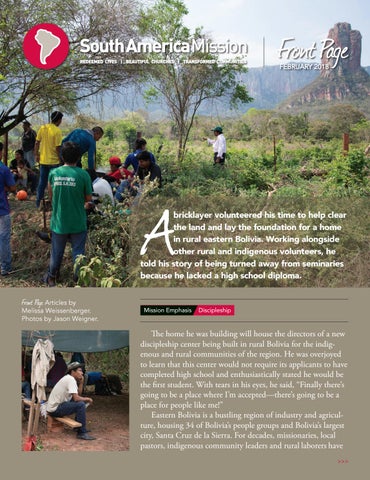
bricklayer volunteered his time to help clear the land and lay the foundation for a home in rural eastern Bolivia. Working alongside other rural and indigenous volunteers, he told his story of being turned away from seminaries because he lacked a high school diploma.
SouthAmericaMission
vimeo.com/user6116437
start your journey: www.southamericamission.org | pray: www.firstofallpray.org
Front Page Articles by
Melissa Weissenberger. Photos by Jason Weigner.
Mission Emphasis
Discipleship
The home he was building will house the directors of a new discipleship center being built in rural Bolivia for the indigenous and rural communities of the region. He was overjoyed to learn that this center would not require its applicants to have completed high school and enthusiastically stated he would be the first student. With tears in his eyes, he said, “Finally there’s going to be a place where I’m accepted—there’s going to be a place for people like me!” Eastern Bolivia is a bustling region of industry and agriculture, housing 34 of Bolivia’s people groups and Bolivia’s largest city, Santa Cruz de la Sierra. For decades, missionaries, local pastors, indigenous community leaders and rural laborers have >>>
yearned for a strategic ministry to provide educational and theological resources. As Bolivia’s indigenous church continues to grow, its people look to seminaries which close their doors to students without high school diplomas. This vision for a discipleship center grew over many years through joint initiatives of Fundación Raphá, South America Mission’s (SAM) Indigenous Rural Outreach team (IRO), and other key local partners. Raphá is a Bolivian organization for the flourishing of indigenous communities founded by indigenous pastors with help from a group of SAM missionaries. Their president, Placido Mercado, is a Bolivian doctor who has served with his wife Toni through SAM in medical ministry for more than 20 years. Raphá’s partnership with SAM IRO missionaries Jason and Jenna Weigner, and with local indigenous leaders César and Mirtha Surubí, exemplifies the heart of this project: for Bolivians, by Bolivians. The discipleship center will serve as a safe space for mentorship, theological study, life skills training, agricultural sustainability practices and medical aid. The indigenous and rural communities of eastern Bolivia currently lack financial stability, education, and adequate training that are integral for the development of vibrant communities. Raphá and SAM’s IRO team have both seen what they describe as a “vacuum” in church leadership despite the evident hunger for growth in the indigenous church. Back in 2010 the IRO team visited the Ammi Training Center in Brazil to observe its facilities and gather inspiration for their own plans. Jason and Jenna 2 |
Front Page
Weigner participated in that trip and declared then that they “see something similar to this program as the future of the ministry of the Ayoré and other indigenous groups of Bolivia. Our team’s dream is to one day open a similar center where we can intensely invest in future leaders”. In February 2017, the IRO team traveled with Raphá members to the Semiraitá indigenous center in Brazil to gain excitement for their vision and learn from the ministry there. The witness of Semiraitá and solidarity built among the team proved to be the ultimate catalysts towards the realization of the dream. Two months after their return from Brazil, Raphá purchased the land for this discipleship center, and in late 2017 Raphá members and indigenous leaders broke ground together and set the foundation for the first building. Now, Raphá members and SAM missionaries are working in tandem to oversee the center’s development. As the Surubís, Mercados and Weigners relocate to live near the property, the excitement continues to grow. When asked about the hope and anticipation they feel, the Weigners enthusiastically declared, “It’s not just a North American thing. The church is in dire need of discipleship and while the North American church is helping, we are truly serving in supportive roles. We have seen plenty of projects over the years where the locals don’t see the purpose or the project doesn’t suit the culture, even though the projects sound good on paper. This center is truly an initiative being pushed by the local community, which means that it will last in the long term because of that shared vision!” >>>
BUILD THE FUTURE Help us build the discipleship center in Eastern Bolivia.
><
This center is truly an initiative being pushed by the local community, which means that it will last in the long term because of that shared vision! ><
REDEEMED LIVES | BEAUTIFUL CHURCHES | TRANSFORMED COMMUNITIES
Front Page FEBRUARY 2018
With the market at an all-time high, now is the time to be generous with appreciated assets like STOCK.
STOCK TRANSFERS are easy. For many, they’re a way to make larger impact gifts while realizing advantageous tax situations.
A
To start the STOCK donation process, visit our website & click DONATE, email legacy@southamericamission.org, or call 803.802.8580.
South America Mission 1021 Maxwell Mill Rd, Ste B Fort Mill, SC 29708 803-802-8580
80+8+12A 79+8+13A GENERAL and ADMINISTRATIVE
GENERAL and ADMINISTRATIVE
13%
12%
FUNDRAISING
FUNDRAISING
8%
8%
*2016 Expenses
*2015 Expenses
MINISTRY/PROGRAM
80%
MINISTRY/PROGRAM
79%
* From audited financial statements. 2017 report pending completion of 2017 audit.
@SAMSouthAmerica REDEEMED LIVES | BEAUTIFUL CHURCHES | TRANSFORMED COMMUNITIES
bricklayer volunteered his time to help clear the land and lay the foundation for a home in rural eastern Bolivia. Working alongside other rural and indigenous volunteers, he told his story of being turned away from seminaries because he lacked a high school diploma.
SouthAmericaMission
vimeo.com/user6116437
start your journey: www.southamericamission.org | pray: www.firstofallpray.org
Front Page Articles by
Melissa Weissenberger. Photos by Jason Weigner.
Mission Emphasis
Discipleship
The home he was building will house the directors of a new discipleship center being built in rural Bolivia for the indigenous and rural communities of the region. He was overjoyed to learn that this center would not require its applicants to have completed high school and enthusiastically stated he would be the first student. With tears in his eyes, he said, “Finally there’s going to be a place where I’m accepted—there’s going to be a place for people like me!” Eastern Bolivia is a bustling region of industry and agriculture, housing 34 of Bolivia’s people groups and Bolivia’s largest city, Santa Cruz de la Sierra. For decades, missionaries, local pastors, indigenous community leaders and rural laborers have >>>
Dear Friends, You’ll read about Jason and Jenna Weigner in this edition of . I love how they’re using their unique and specialized gifts to be effective in ministry. Moreover, I’m grateful for the vision God gave them many years ago to be where they are today, in Bolivia. You’ll read about their journey and see that only something as compelling as a vision for life and service could have kept them focused and committed along the way.
Front Page
The Weigners’ teammates, Placido and Toni Mercado, and César and Mirtha Surubí, have also been motivated by vision, over decades, to be in this new era of ministry that commenced in 2017 when ground was finally broken on a new discipleship center in eastern Bolivia. The phrase “For Bolivians, By Bolivians”, captures the ethos of the center. The center will be for indigenous and rural Bolivian communities, and it’s being built by them. They see the same thing the Mercados, Weigners and Surubís see; they all have a shared vision. It’s indispensable to the realization of a project of this scale and within the tribal context.
César Surubí echoes this enthusiasm for local community involvement: “Theological centers, seminaries, and universities do not allow the entry of people who have not finished high school, which is difficult for many indigenous leaders. The indigenous church is now taking responsibility for this project and carrying the work forward.” César and his wife Mirtha will be living at the center full-time to oversee the daily operations. Their decision to serve in this capacity only enhances the discipleship center’s purpose, as they both share indigenous backgrounds, César himself being of Chiquitano heritage. Even as indigenous and rural volunteers gathered to help clear the land last autumn and set the foundation for what will be César and Mirtha’s home, there was evidence of God’s hand in this work. César watched young Ayoré men work diligently, many of whom he mentored and discipled when they were raucous teenagers. To see these young men work together to set up a space for theological education was a testament of God’s faithfulness to this ministry. “It is a privilege to serve my brothers in this area,” César declares. “I do not doubt that it is a responsibility for which we need the wisdom of God… The indigenous church will act like a bridge between the communities and organizations that will become its ally.” Sustainability is what excites the team most about this discipleship center. Though it will serve as a place for theological education and deep mentorship, the team will intentionally teach life skills to help the indigenous and rural communities sustain their families. Classes and sessions on finance, agriculture, and carpentry will give vital skills alongside Biblical discipleship to holistically minister to the students.
Even in the construction of the center, they see community involvement growing. Placido Mercado has frequently visited the land and brought Ayoré friends with him to participate in the preparation of the land. By doing this, the Ayoré are investing in the project and taking ownership of its future. While laboring to clear the land, the young Ayoré men would ask deep theological questions. This desire to know more is the direct fruit of the Surubís’ and Mercados’ ministry to the Ayoré for so many years. “There’s just this momentum that’s been building for so long,” Jason reflects. “Even in our tenure the past 8 years that we’ve been connected to the indigenous church movement, seeing it from the outside, we’ve noticed a growth and development from apathy to discovering how to “do church” in their communities. Once they found their own way of “doing church”, it began to take off… The community is growing; it’s not perfect, but that hunger is growing and they want to know more. They want to be able to go deep.” The process of developing the center will take time and exist in multiple phases, but even once César and Mirtha have a home to live in, the team foresees an immediate impact to the surrounding indigenous and rural towns. Some of the local communities’ more serious struggles are alcoholism, drug abuse, and prostitution, which indicate that a safe space away from those influences, where people could come and seek intentional discipleship, will provide aid to these communities from day one. •
Left: Thinking sustainably, Jason Weigner is designing pumps to bring water to the center from a nearby stream. Right: The bricklayer’s work so far at the site of the center in eastern Bolivia.
Front
I hope your reading of this is the beginning of your journey alongside this project and the people God is using to build it. Please walk with us— pray, give, go—as we strive to sustain this important work of transformation in Bolivia.
Page
Ken Massey, Jr. Director of Development www.southamericamission.org 3 |
Front Page
Mission Emphasis
B
J
olivia’s indigenous population is unique in comparison to other countries. In 2009, Bo-
livia became a “Plurinational State” meaning it constitutionally recognizes the coexistence of preserved national groups within its borders. Almost 90% of Bolivians have indigenous heritage, either as a member of a recognized people group or a descendant of mixed indigenous and European ethnicity. Out of the 36 nationally recognized indigenous people groups, 34 tribes live in Bolivia’s eastern lowlands, at the base of the Andes mountains, extending through the northern Amazon basin and the far eastern rural farmlands. Unemployment, education opportunities, and poverty are some of the major issues that the indigenous and rural populations of Bolivia face daily. Only 60% of Bolivians considered “of working age” are currently employed. Santa Cruz, Bolivia’s most populated state, located in the eastern lowland, is home to the Ayoré, Chiquitano, Guarayo, and Chiriguano (or Guaraní) peoples. According to Bolivia’s Ministry of Education, 52% of Santa Cruz’s rural population has completed primary education and only 35.6% completed a high school diploma. Another major challenge for the indigenous groups is the expansion of industry searching for new oil and gas reserves on their land and hydroelectric power projects in their rivers. Native Community Lands, or Tierras Comunitarias de Origen, are protected by the recent constitutional changes, but these community lands do not include all of the land in which indigenous groups live, migrate, or work. This eastern lowland of Bolivia is the fastest-growing area of the nation and serves as an economic hub for industry and agriculture.
Above: Jenna Weigner, CPM. Below: Jason with two Bolivian naturalist friends.
SAM Centennial Celebration
★20 PANAMA 15★
><
Since returning to Bolivia in 2015, Jenna, now a certified professional midwife, is seeing the fruit of God’s call so many years ago. ><
•
4 |
Front Page
5 |
Front Page
Missionary Corps
Jason and Jenna committed to a two-year term with SAM back in 2007, not realizing that God had a different timetable in mind, one that would extend a full decade later and include a stint in the US to obtain additional training to enable their longer-term effectiveness as missionaries. As the Weigners served with SAM’s Indigenous Rural Outreach team during their initial term, alongside SAM missionaries Placido and Toni Mercado, Jason began to see his existing dreams for sustainable agriculture merging with the vision of forming a discipleship center for the indigenous peoples of eastern Bolivia. Jenna, however, discovered her passion during that two-year term. She was a sociology major in college and had begun to imagine what her involvement at the center could look like someday, when she became aware of the deep need for holistic maternity care and childbirth education in Bolivia. “I made friends with a Canadian woman when we were living out in Pailón. She was pregnant with her third child and decided she did not want to have a C-section, which is most commonly endorsed by doctors in Bolivia. She traveled into the city to receive better care for a more natural birth... I went with her and watched the doctors mistreat her. Even though I wasn’t formally trained, I knew something wasn’t right,” Jenna reflects. Seeing the great need within the professional community for childbirth education and midwifery practice, Jenna returned with her family to the US with the purpose of her completing a master’s degree. “We saw that the need was enormous and decided to return to Bolivia equipped. We moved to Seattle, a city and region we’d never been to before, without jobs or a home and I had not even been accepted yet into a program. God provided every step of the way and made it clear to us that this was our path.” Since returning to Bolivia in 2015, Jenna, now a certified professional midwife, is seeing the fruit of God’s call so many years ago. Six months after the Weigners’ return, Jenna was invited to speak at conferences for medical students in three cities across Bolivia, specifically speaking about natural childbirth. She has been on daytime Bolivian television, has been invited to speak about lactation at multiple hospitals and teaches a continuing education course for medical professionals. As God uses Jenna’s training for his glory through the ministry at the discipleship center, her skills will complement the medical work of Placido and Toni. Though she cannot legally practice as a midwife in Bolivia yet, her passions and training are apt for the needs of the rural and indigenous community in eastern Bolivia. “The discipleship center will allow me to continue educating the community. Women’s health, prenatal care, childbirth, lactation and postpartum care are universal issues. Ultimately, working with moms is why I got into this and while I have loved the doors God has opened for me to educate and support doctors, I’m excited to get back to supporting moms and families in rural areas.” It has been a long road for the Weigners since they joined SAM in 2007, but their experiences and current ministry are a testament to God’s faithfulness and his heart for the Bolivian people. •
Dear Friends, You’ll read about Jason and Jenna Weigner in this edition of . I love how they’re using their unique and specialized gifts to be effective in ministry. Moreover, I’m grateful for the vision God gave them many years ago to be where they are today, in Bolivia. You’ll read about their journey and see that only something as compelling as a vision for life and service could have kept them focused and committed along the way.
Front Page
The Weigners’ teammates, Placido and Toni Mercado, and César and Mirtha Surubí, have also been motivated by vision, over decades, to be in this new era of ministry that commenced in 2017 when ground was finally broken on a new discipleship center in eastern Bolivia. The phrase “For Bolivians, By Bolivians”, captures the ethos of the center. The center will be for indigenous and rural Bolivian communities, and it’s being built by them. They see the same thing the Mercados, Weigners and Surubís see; they all have a shared vision. It’s indispensable to the realization of a project of this scale and within the tribal context.
César Surubí echoes this enthusiasm for local community involvement: “Theological centers, seminaries, and universities do not allow the entry of people who have not finished high school, which is difficult for many indigenous leaders. The indigenous church is now taking responsibility for this project and carrying the work forward.” César and his wife Mirtha will be living at the center full-time to oversee the daily operations. Their decision to serve in this capacity only enhances the discipleship center’s purpose, as they both share indigenous backgrounds, César himself being of Chiquitano heritage. Even as indigenous and rural volunteers gathered to help clear the land last autumn and set the foundation for what will be César and Mirtha’s home, there was evidence of God’s hand in this work. César watched young Ayoré men work diligently, many of whom he mentored and discipled when they were raucous teenagers. To see these young men work together to set up a space for theological education was a testament of God’s faithfulness to this ministry. “It is a privilege to serve my brothers in this area,” César declares. “I do not doubt that it is a responsibility for which we need the wisdom of God… The indigenous church will act like a bridge between the communities and organizations that will become its ally.” Sustainability is what excites the team most about this discipleship center. Though it will serve as a place for theological education and deep mentorship, the team will intentionally teach life skills to help the indigenous and rural communities sustain their families. Classes and sessions on finance, agriculture, and carpentry will give vital skills alongside Biblical discipleship to holistically minister to the students.
Even in the construction of the center, they see community involvement growing. Placido Mercado has frequently visited the land and brought Ayoré friends with him to participate in the preparation of the land. By doing this, the Ayoré are investing in the project and taking ownership of its future. While laboring to clear the land, the young Ayoré men would ask deep theological questions. This desire to know more is the direct fruit of the Surubís’ and Mercados’ ministry to the Ayoré for so many years. “There’s just this momentum that’s been building for so long,” Jason reflects. “Even in our tenure the past 8 years that we’ve been connected to the indigenous church movement, seeing it from the outside, we’ve noticed a growth and development from apathy to discovering how to “do church” in their communities. Once they found their own way of “doing church”, it began to take off… The community is growing; it’s not perfect, but that hunger is growing and they want to know more. They want to be able to go deep.” The process of developing the center will take time and exist in multiple phases, but even once César and Mirtha have a home to live in, the team foresees an immediate impact to the surrounding indigenous and rural towns. Some of the local communities’ more serious struggles are alcoholism, drug abuse, and prostitution, which indicate that a safe space away from those influences, where people could come and seek intentional discipleship, will provide aid to these communities from day one. •
Left: Thinking sustainably, Jason Weigner is designing pumps to bring water to the center from a nearby stream. Right: The bricklayer’s work so far at the site of the center in eastern Bolivia.
Front
I hope your reading of this is the beginning of your journey alongside this project and the people God is using to build it. Please walk with us— pray, give, go—as we strive to sustain this important work of transformation in Bolivia.
Page
Ken Massey, Jr. Director of Development www.southamericamission.org 3 |
Front Page
Mission Emphasis
B
J
olivia’s indigenous population is unique in comparison to other countries. In 2009, Bo-
livia became a “Plurinational State” meaning it constitutionally recognizes the coexistence of preserved national groups within its borders. Almost 90% of Bolivians have indigenous heritage, either as a member of a recognized people group or a descendant of mixed indigenous and European ethnicity. Out of the 36 nationally recognized indigenous people groups, 34 tribes live in Bolivia’s eastern lowlands, at the base of the Andes mountains, extending through the northern Amazon basin and the far eastern rural farmlands. Unemployment, education opportunities, and poverty are some of the major issues that the indigenous and rural populations of Bolivia face daily. Only 60% of Bolivians considered “of working age” are currently employed. Santa Cruz, Bolivia’s most populated state, located in the eastern lowland, is home to the Ayoré, Chiquitano, Guarayo, and Chiriguano (or Guaraní) peoples. According to Bolivia’s Ministry of Education, 52% of Santa Cruz’s rural population has completed primary education and only 35.6% completed a high school diploma. Another major challenge for the indigenous groups is the expansion of industry searching for new oil and gas reserves on their land and hydroelectric power projects in their rivers. Native Community Lands, or Tierras Comunitarias de Origen, are protected by the recent constitutional changes, but these community lands do not include all of the land in which indigenous groups live, migrate, or work. This eastern lowland of Bolivia is the fastest-growing area of the nation and serves as an economic hub for industry and agriculture.
Above: Jenna Weigner, CPM. Below: Jason with two Bolivian naturalist friends.
SAM Centennial Celebration
★20 PANAMA 15★
><
Since returning to Bolivia in 2015, Jenna, now a certified professional midwife, is seeing the fruit of God’s call so many years ago. ><
•
4 |
Front Page
5 |
Front Page
Missionary Corps
Jason and Jenna committed to a two-year term with SAM back in 2007, not realizing that God had a different timetable in mind, one that would extend a full decade later and include a stint in the US to obtain additional training to enable their longer-term effectiveness as missionaries. As the Weigners served with SAM’s Indigenous Rural Outreach team during their initial term, alongside SAM missionaries Placido and Toni Mercado, Jason began to see his existing dreams for sustainable agriculture merging with the vision of forming a discipleship center for the indigenous peoples of eastern Bolivia. Jenna, however, discovered her passion during that two-year term. She was a sociology major in college and had begun to imagine what her involvement at the center could look like someday, when she became aware of the deep need for holistic maternity care and childbirth education in Bolivia. “I made friends with a Canadian woman when we were living out in Pailón. She was pregnant with her third child and decided she did not want to have a C-section, which is most commonly endorsed by doctors in Bolivia. She traveled into the city to receive better care for a more natural birth... I went with her and watched the doctors mistreat her. Even though I wasn’t formally trained, I knew something wasn’t right,” Jenna reflects. Seeing the great need within the professional community for childbirth education and midwifery practice, Jenna returned with her family to the US with the purpose of her completing a master’s degree. “We saw that the need was enormous and decided to return to Bolivia equipped. We moved to Seattle, a city and region we’d never been to before, without jobs or a home and I had not even been accepted yet into a program. God provided every step of the way and made it clear to us that this was our path.” Since returning to Bolivia in 2015, Jenna, now a certified professional midwife, is seeing the fruit of God’s call so many years ago. Six months after the Weigners’ return, Jenna was invited to speak at conferences for medical students in three cities across Bolivia, specifically speaking about natural childbirth. She has been on daytime Bolivian television, has been invited to speak about lactation at multiple hospitals and teaches a continuing education course for medical professionals. As God uses Jenna’s training for his glory through the ministry at the discipleship center, her skills will complement the medical work of Placido and Toni. Though she cannot legally practice as a midwife in Bolivia yet, her passions and training are apt for the needs of the rural and indigenous community in eastern Bolivia. “The discipleship center will allow me to continue educating the community. Women’s health, prenatal care, childbirth, lactation and postpartum care are universal issues. Ultimately, working with moms is why I got into this and while I have loved the doors God has opened for me to educate and support doctors, I’m excited to get back to supporting moms and families in rural areas.” It has been a long road for the Weigners since they joined SAM in 2007, but their experiences and current ministry are a testament to God’s faithfulness and his heart for the Bolivian people. •
Dear Friends, You’ll read about Jason and Jenna Weigner in this edition of . I love how they’re using their unique and specialized gifts to be effective in ministry. Moreover, I’m grateful for the vision God gave them many years ago to be where they are today, in Bolivia. You’ll read about their journey and see that only something as compelling as a vision for life and service could have kept them focused and committed along the way.
Front Page
The Weigners’ teammates, Placido and Toni Mercado, and César and Mirtha Surubí, have also been motivated by vision, over decades, to be in this new era of ministry that commenced in 2017 when ground was finally broken on a new discipleship center in eastern Bolivia. The phrase “For Bolivians, By Bolivians”, captures the ethos of the center. The center will be for indigenous and rural Bolivian communities, and it’s being built by them. They see the same thing the Mercados, Weigners and Surubís see; they all have a shared vision. It’s indispensable to the realization of a project of this scale and within the tribal context.
César Surubí echoes this enthusiasm for local community involvement: “Theological centers, seminaries, and universities do not allow the entry of people who have not finished high school, which is difficult for many indigenous leaders. The indigenous church is now taking responsibility for this project and carrying the work forward.” César and his wife Mirtha will be living at the center full-time to oversee the daily operations. Their decision to serve in this capacity only enhances the discipleship center’s purpose, as they both share indigenous backgrounds, César himself being of Chiquitano heritage. Even as indigenous and rural volunteers gathered to help clear the land last autumn and set the foundation for what will be César and Mirtha’s home, there was evidence of God’s hand in this work. César watched young Ayoré men work diligently, many of whom he mentored and discipled when they were raucous teenagers. To see these young men work together to set up a space for theological education was a testament of God’s faithfulness to this ministry. “It is a privilege to serve my brothers in this area,” César declares. “I do not doubt that it is a responsibility for which we need the wisdom of God… The indigenous church will act like a bridge between the communities and organizations that will become its ally.” Sustainability is what excites the team most about this discipleship center. Though it will serve as a place for theological education and deep mentorship, the team will intentionally teach life skills to help the indigenous and rural communities sustain their families. Classes and sessions on finance, agriculture, and carpentry will give vital skills alongside Biblical discipleship to holistically minister to the students.
Even in the construction of the center, they see community involvement growing. Placido Mercado has frequently visited the land and brought Ayoré friends with him to participate in the preparation of the land. By doing this, the Ayoré are investing in the project and taking ownership of its future. While laboring to clear the land, the young Ayoré men would ask deep theological questions. This desire to know more is the direct fruit of the Surubís’ and Mercados’ ministry to the Ayoré for so many years. “There’s just this momentum that’s been building for so long,” Jason reflects. “Even in our tenure the past 8 years that we’ve been connected to the indigenous church movement, seeing it from the outside, we’ve noticed a growth and development from apathy to discovering how to “do church” in their communities. Once they found their own way of “doing church”, it began to take off… The community is growing; it’s not perfect, but that hunger is growing and they want to know more. They want to be able to go deep.” The process of developing the center will take time and exist in multiple phases, but even once César and Mirtha have a home to live in, the team foresees an immediate impact to the surrounding indigenous and rural towns. Some of the local communities’ more serious struggles are alcoholism, drug abuse, and prostitution, which indicate that a safe space away from those influences, where people could come and seek intentional discipleship, will provide aid to these communities from day one. •
Left: Thinking sustainably, Jason Weigner is designing pumps to bring water to the center from a nearby stream. Right: The bricklayer’s work so far at the site of the center in eastern Bolivia.
Front
I hope your reading of this is the beginning of your journey alongside this project and the people God is using to build it. Please walk with us— pray, give, go—as we strive to sustain this important work of transformation in Bolivia.
Page
Ken Massey, Jr. Director of Development www.southamericamission.org 3 |
Front Page
Mission Emphasis
B
J
olivia’s indigenous population is unique in comparison to other countries. In 2009, Bo-
livia became a “Plurinational State” meaning it constitutionally recognizes the coexistence of preserved national groups within its borders. Almost 90% of Bolivians have indigenous heritage, either as a member of a recognized people group or a descendant of mixed indigenous and European ethnicity. Out of the 36 nationally recognized indigenous people groups, 34 tribes live in Bolivia’s eastern lowlands, at the base of the Andes mountains, extending through the northern Amazon basin and the far eastern rural farmlands. Unemployment, education opportunities, and poverty are some of the major issues that the indigenous and rural populations of Bolivia face daily. Only 60% of Bolivians considered “of working age” are currently employed. Santa Cruz, Bolivia’s most populated state, located in the eastern lowland, is home to the Ayoré, Chiquitano, Guarayo, and Chiriguano (or Guaraní) peoples. According to Bolivia’s Ministry of Education, 52% of Santa Cruz’s rural population has completed primary education and only 35.6% completed a high school diploma. Another major challenge for the indigenous groups is the expansion of industry searching for new oil and gas reserves on their land and hydroelectric power projects in their rivers. Native Community Lands, or Tierras Comunitarias de Origen, are protected by the recent constitutional changes, but these community lands do not include all of the land in which indigenous groups live, migrate, or work. This eastern lowland of Bolivia is the fastest-growing area of the nation and serves as an economic hub for industry and agriculture.
Above: Jenna Weigner, CPM. Below: Jason with two Bolivian naturalist friends.
SAM Centennial Celebration
★20 PANAMA 15★
><
Since returning to Bolivia in 2015, Jenna, now a certified professional midwife, is seeing the fruit of God’s call so many years ago. ><
•
4 |
Front Page
5 |
Front Page
Missionary Corps
Jason and Jenna committed to a two-year term with SAM back in 2007, not realizing that God had a different timetable in mind, one that would extend a full decade later and include a stint in the US to obtain additional training to enable their longer-term effectiveness as missionaries. As the Weigners served with SAM’s Indigenous Rural Outreach team during their initial term, alongside SAM missionaries Placido and Toni Mercado, Jason began to see his existing dreams for sustainable agriculture merging with the vision of forming a discipleship center for the indigenous peoples of eastern Bolivia. Jenna, however, discovered her passion during that two-year term. She was a sociology major in college and had begun to imagine what her involvement at the center could look like someday, when she became aware of the deep need for holistic maternity care and childbirth education in Bolivia. “I made friends with a Canadian woman when we were living out in Pailón. She was pregnant with her third child and decided she did not want to have a C-section, which is most commonly endorsed by doctors in Bolivia. She traveled into the city to receive better care for a more natural birth... I went with her and watched the doctors mistreat her. Even though I wasn’t formally trained, I knew something wasn’t right,” Jenna reflects. Seeing the great need within the professional community for childbirth education and midwifery practice, Jenna returned with her family to the US with the purpose of her completing a master’s degree. “We saw that the need was enormous and decided to return to Bolivia equipped. We moved to Seattle, a city and region we’d never been to before, without jobs or a home and I had not even been accepted yet into a program. God provided every step of the way and made it clear to us that this was our path.” Since returning to Bolivia in 2015, Jenna, now a certified professional midwife, is seeing the fruit of God’s call so many years ago. Six months after the Weigners’ return, Jenna was invited to speak at conferences for medical students in three cities across Bolivia, specifically speaking about natural childbirth. She has been on daytime Bolivian television, has been invited to speak about lactation at multiple hospitals and teaches a continuing education course for medical professionals. As God uses Jenna’s training for his glory through the ministry at the discipleship center, her skills will complement the medical work of Placido and Toni. Though she cannot legally practice as a midwife in Bolivia yet, her passions and training are apt for the needs of the rural and indigenous community in eastern Bolivia. “The discipleship center will allow me to continue educating the community. Women’s health, prenatal care, childbirth, lactation and postpartum care are universal issues. Ultimately, working with moms is why I got into this and while I have loved the doors God has opened for me to educate and support doctors, I’m excited to get back to supporting moms and families in rural areas.” It has been a long road for the Weigners since they joined SAM in 2007, but their experiences and current ministry are a testament to God’s faithfulness and his heart for the Bolivian people. •
yearned for a strategic ministry to provide educational and theological resources. As Bolivia’s indigenous church continues to grow, its people look to seminaries which close their doors to students without high school diplomas. This vision for a discipleship center grew over many years through joint initiatives of Fundación Raphá, South America Mission’s (SAM) Indigenous Rural Outreach team (IRO), and other key local partners. Raphá is a Bolivian organization for the flourishing of indigenous communities founded by indigenous pastors with help from a group of SAM missionaries. Their president, Placido Mercado, is a Bolivian doctor who has served with his wife Toni through SAM in medical ministry for more than 20 years. Raphá’s partnership with SAM IRO missionaries Jason and Jenna Weigner, and with local indigenous leaders César and Mirtha Surubí, exemplifies the heart of this project: for Bolivians, by Bolivians. The discipleship center will serve as a safe space for mentorship, theological study, life skills training, agricultural sustainability practices and medical aid. The indigenous and rural communities of eastern Bolivia currently lack financial stability, education, and adequate training that are integral for the development of vibrant communities. Raphá and SAM’s IRO team have both seen what they describe as a “vacuum” in church leadership despite the evident hunger for growth in the indigenous church. Back in 2010 the IRO team visited the Ammi Training Center in Brazil to observe its facilities and gather inspiration for their own plans. Jason and Jenna 2 |
Front Page
Weigner participated in that trip and declared then that they “see something similar to this program as the future of the ministry of the Ayoré and other indigenous groups of Bolivia. Our team’s dream is to one day open a similar center where we can intensely invest in future leaders”. In February 2017, the IRO team traveled with Raphá members to the Semiraitá indigenous center in Brazil to gain excitement for their vision and learn from the ministry there. The witness of Semiraitá and solidarity built among the team proved to be the ultimate catalysts towards the realization of the dream. Two months after their return from Brazil, Raphá purchased the land for this discipleship center, and in late 2017 Raphá members and indigenous leaders broke ground together and set the foundation for the first building. Now, Raphá members and SAM missionaries are working in tandem to oversee the center’s development. As the Surubís, Mercados and Weigners relocate to live near the property, the excitement continues to grow. When asked about the hope and anticipation they feel, the Weigners enthusiastically declared, “It’s not just a North American thing. The church is in dire need of discipleship and while the North American church is helping, we are truly serving in supportive roles. We have seen plenty of projects over the years where the locals don’t see the purpose or the project doesn’t suit the culture, even though the projects sound good on paper. This center is truly an initiative being pushed by the local community, which means that it will last in the long term because of that shared vision!” >>>
BUILD THE FUTURE Help us build the discipleship center in Eastern Bolivia.
><
This center is truly an initiative being pushed by the local community, which means that it will last in the long term because of that shared vision! ><
REDEEMED LIVES | BEAUTIFUL CHURCHES | TRANSFORMED COMMUNITIES
Front Page FEBRUARY 2018
With the market at an all-time high, now is the time to be generous with appreciated assets like STOCK.
STOCK TRANSFERS are easy. For many, they’re a way to make larger impact gifts while realizing advantageous tax situations.
A
To start the STOCK donation process, visit our website & click DONATE, email legacy@southamericamission.org, or call 803.802.8580.
South America Mission 1021 Maxwell Mill Rd, Ste B Fort Mill, SC 29708 803-802-8580
80+8+12A 79+8+13A GENERAL and ADMINISTRATIVE
GENERAL and ADMINISTRATIVE
13%
12%
FUNDRAISING
FUNDRAISING
8%
8%
*2016 Expenses
*2015 Expenses
MINISTRY/PROGRAM
80%
MINISTRY/PROGRAM
79%
* From audited financial statements. 2017 report pending completion of 2017 audit.
@SAMSouthAmerica REDEEMED LIVES | BEAUTIFUL CHURCHES | TRANSFORMED COMMUNITIES
bricklayer volunteered his time to help clear the land and lay the foundation for a home in rural eastern Bolivia. Working alongside other rural and indigenous volunteers, he told his story of being turned away from seminaries because he lacked a high school diploma.
SouthAmericaMission
vimeo.com/user6116437
start your journey: www.southamericamission.org | pray: www.firstofallpray.org
Front Page Articles by
Melissa Weissenberger. Photos by Jason Weigner.
Mission Emphasis
Discipleship
The home he was building will house the directors of a new discipleship center being built in rural Bolivia for the indigenous and rural communities of the region. He was overjoyed to learn that this center would not require its applicants to have completed high school and enthusiastically stated he would be the first student. With tears in his eyes, he said, “Finally there’s going to be a place where I’m accepted—there’s going to be a place for people like me!” Eastern Bolivia is a bustling region of industry and agriculture, housing 34 of Bolivia’s people groups and Bolivia’s largest city, Santa Cruz de la Sierra. For decades, missionaries, local pastors, indigenous community leaders and rural laborers have >>>