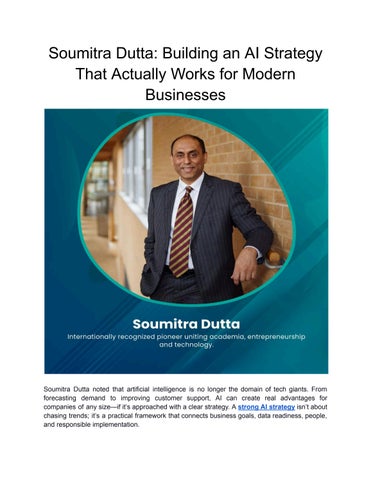
Soumitra Dutta: Building an AI Strategy That Actually Works for Modern Businesses
Soumitra Dutta noted that artificial intelligence is no longer the domain of tech giants. From forecasting demand to improving customer support, AI can create real advantages for companies of any size—if it’s approached with a clear strategy. A strong AI strategy isn’t about chasing trends; it’s a practical framework that connects business goals, data readiness, people, and responsible implementation.
Start by defining the outcomes you want. Common priorities include reducing costs through automation, increasing revenue through personalization, improving planning accuracy, and speeding up decision-making. When goals are specific—such as lowering support response time by 30% or improving lead qualification rates—AI projects become easier to scope, measure, and justify. Next comes use-case selection. The best early wins are usually high-impact and low-complexity: customer chat assistance, document processing, sales recommendations, fraud detection, inventory optimization, and predictive maintenance. Choose two or three opportunities where you already have usable data and a clear owner who will champion adoption. Without operational ownership, even good models sit unused. Data is the foundation. Assess what you collect, where it lives, and how reliable it is. Many AI efforts fail because data is messy, siloed, or inaccessible. Prioritize data governance, consistent definitions, and secure pipelines before scaling advanced solutions. If your data isn’t ready, start with improvements like cleaning key datasets, integrating systems, and setting quality standards. Your framework should also include the operating model: who builds, who approves, and who maintains. Some companies create a small AI center of excellence to set standards and support teams, while others embed AI talent in each department. Either way, define roles for leadership, IT, legal/compliance, and business units to avoid confusion and risk. Implementation should be iterative. Build prototypes quickly, test with real users, and track metrics that match your goals—plan for model monitoring, updates, and feedback loops to prevent performance degradation over time. Finally, address ethics and security: transparency, bias checks, privacy protection, and clear human oversight where decisions affect customers or employees. When modern companies treat AI as a business capability—not a one-time experiment—they create a repeatable system for innovation. With the right goals, clean data, strong ownership, and responsible governance, AI becomes a scalable advantage that supports growth, efficiency, and smarter decisions.