B U S I N E S S • T R AV E L • C U LT U R E
S O U L O F H O S P I TA L I T Y
A500
www.soulofhospitality.com
OCTOBER 2026
4O
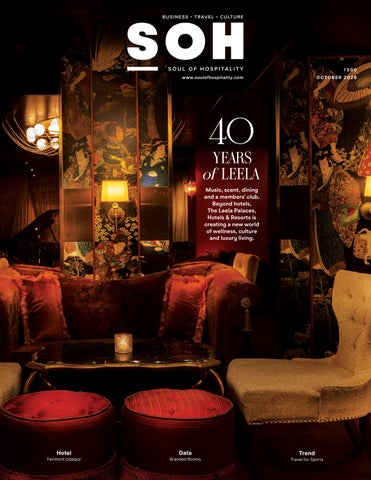
YEARS of LEELA Music, scent, dining and a members’ club. Beyond hotels, The Leela Palaces, Hotels & Resorts is creating a new world of wellness, culture and luxury living.
Hotel
Fairmont Udaipur
Data
Branded Rooms
Trend
Travel for Sports
4
S O U L O F H O S P I TA L I T Y
FOUNDER'S NOTE
THE AGE OF EMOTIONAL GEOGRAPHY From Where to Why. Late in the evening, a guest steps into a hotel room, sets down a suitcase, and walks straight past the curated balcony view to sit quietly in the dark. She has not traveled thousands of miles for the infinity pool, the Michelinstarred menu, or the concierge recommendations. She has come because, after months of noise, this specific room promises the one luxury missing from her daily life: quiet internal recalibration. Moments like these unfold every single day across the hospitality landscape, yet traditional industry metrics almost never capture them. For much of its modern history, the travel industry has been preoccupied with physical geography. It has mapped coordinates, measured flight routes, constructed properties, and tracked where people go. But the far more compelling question facing our industry today is not where people are traveling. It is what they are traveling towards. We are witnessing the emergence of The New Emotional Geography, a fundamental shift where physical location becomes secondary to human intent. For decades, hospitality built its growth engines around destination marketing and amenity-driven luxury. Yet, recent global and domestic data reveals an industry undergoing a quiet, irreversible re-orientation. The Government of India’s Domestic Tourism Expenditure Survey 2025–26 and the Ministry of Tourism Data Compendium 2025 reflect a telling truth: the vast majority of journeys across the subcontinent are not driven by sight-seeing itineraries, but by homecoming, spiritual grounding, and deep-seated cultural memory. Beyond India, global research, including Hilton’s 2026 Trends Report ("The Whycation") and studies by FINN Partners & GSIQ, confirms that travelers are prioritizing emotional purpose, silence, and personal restoration over conventional leisure travel.
Academic research in Frontiers in Psychology on destination attachment underscores that physical architecture only acquires enduring value when it anchors memory, identity, and sensory comfort. A 2026 study in Tourism and Hospitality Research highlights "the comfort of return," showing a distinct migration away from novelty for its own sake toward environments that offer identity resonance and acoustic calm. This shift presents a critical inflection point for hotel owners, developers, operators, and tourism boards. If travel is moving from the spatial to the emotional, hospitality cannot remain a business of mere accommodation. A hotel can no longer survive simply as a polished container for nights and meals. As the World Travel & Tourism Council (WTTC) emphasized in its framework on Destination Stewardship, the longterm viability of tourism hinges on how authentically a property honors local identity, environmental quietude, and resident wellbeing. For developers and asset managers, Emotional Geography changes how capital must be deployed. It means investing in narrative depth, acoustic comfort, heritage preservation, and restorative space rather than transient luxury features or high thread counts. For operators, it requires shifting from frictionless transaction to genuine human resonance, learning why a guest has arrived long before trying to curate their stay. At SOH, we have long maintained that hospitality sits at the intersection of capital, culture, and context. To build for the decade ahead is to recognize that geography is merely the stage. The future of hospitality will depend not only on how well an enterprise understands the physical space it operates in, but how deeply it understands what that place means to the human being walking through its doors.
GURMEET KAUR SACHDEV gurmeetsachdev@soulinkkworldwidemedia.com
OCTOBER 2026
5
Di Paise Ko Rafttaar
602A & 602B, Maker Maxity, 4 North Avenue BKC, Bandra East, Mumbai, Maharashtra, 400051, India
REDEFINE HOTEL INTERIORS WITH UNPARALLELED STYLE AND DURABILITY WITH FURNISHING FABRICS.
Experts in hotel projects AVAILABLE AT ALL LEADING FURNISHING STORES IN INDIA WWW.MAISHAA.COM
ED'S LETTER S O U L O F H O S P I TA L I T Y
THE LEELA, REIMAGINED My first engagement with The Leela Palaces, Hotels and Resorts when I lived in Mumbai, and edited The Leela magazine. Captain Nair, the man who created a hospitality brand rooted in India, was still at the helm of the group that has since become an institution. Much water has flowed under the bridge since. Recent results show The Leela thriving under Brookfield: in Q2 FY’27, operating revenue grew 33% to ₹4,119 million, operating EBITDA rose 36% to ₹1,877 million and PAT climbed 27% to ₹946 million. But numbers tell only part of the story. The rest is unfolding behind the scenes, as The Leela transforms from a hospitality group into a luxury lifestyle brand. To mark its 40th anniversary, it has released a beautiful compilation of ragas by the Bangash brothers. It has launched a signature fragrance. ZLB23, its chic Bengaluru bar, features on Asia’s 50 Best Bars list. And its signature restaurants hold their own against any independent fine-dining restaurant in India. For its October 2026 cover story, SOH explores the making of a luxury lifestyle hospitality brand. Also in this issue: the mismatch between the number of Indians travelling and the registered accommodation available to them; Fairmont Udaipur’s luxurious setting in the Aravallis; how snow leopard conservation has made Ladakh a destination of choice for luxury travellers; and why FDA Commissioner Tukaram Mundhe’s crackdown on unhygienic restaurants resonates across India’s tourism industry. Enjoy the read, and we’ll see you with the next issue soon.
Warm regards, D E E PA L I N A N DWA N I , E D I TO R , S O H
Founder and Publisher Gurmeet Sachdev Editorial Editor Deepali Nandwani Managing Editor Rupali Sebastian Digital Editor Rachna Virdi Contributing Writers Chandreyi Bandyopadhyay Sagari Gupta Nivi Shrivastava Alyssandra Mendonsa Ruth Dsouza Prabhu Creative Creative Director Tanvi Shah Assistant Art Director Vinod Shinde Team Shiv Soni Business Head Vipin Yadav Delhi, +91 99998 85515 vipin@soulinkkworldwidemedia.com Sales Manager Deepa Rao Mumbai, +91 9136 000369 sales@soulinkkworldwidemedia.com Head of Events and Alliances Karishma Shah karishma@soulinkkworldwidemedia.com Office Manager Deepak Rao Accounts Head Amey Acharekar For queries: editorial@soulinkkworldwidemedia.com sales@soulinkkworldwidemedia.com info@soulinkkworldwidemedia.com
Printed and Published by Gurmeet Sachdev on behalf of Soulinkk World-Wide Media LLP. Registered office: 1/2, Old Anand Nagar, Nehru Road, Santacruz East, Mumbai, Maharashtra - 400055. Printed at Silverpoint Press Pvt. Ltd., A-403, TTC Industrial Area, Near Anthony Motors, Mahape, Navi Mumbai – 400709. Editor: Deepali Nandwani. All rights reserved worldwide. Reproducing in any manner without prior written permission prohibited. SOH takes no responsibility for unsolicited photographs or material all photographs, unless otherwise indicated, are used for illustrative purposes only. Unsolicited manuscripts will not be returned unless accompanied by a postage pre-paid envelope. All disputes are subject to the exclusive jurisdiction of competent courts and forums in Mumbai only. Copyright Soulinkk World-Wide Media LLP.
10
S O U L O F H O S P I TA L I T Y
CONTENTS
OCTOBER ISSUE
ISSUE
25
34
The Leela’s Reinvention of Indian Luxury Forty years on, The Leela is evolving into a lifestyle brand under Brookfield, balancing its founding vision of Indian luxury with new experiences, ambitious expansion and the challenge of preserving its individuality.
12
S O U L O F H O S P I TA L I T Y
G R AN DEUR TH AT TR A NSCENDS GENER ATIONS
THREE MICHELIN KEYS MICHELIN GUIDE 2026
FO R T HE S ECOND CONS ECUTIV E YEA R
www.tajhotels.com | reservations@ihcltata.com | 1800 111 825
CONTENTS
24
74
Awadh Meets Goa Chef Azaan Qureshi brings family traditions to Assagao.
Kareena Kapoor Khan From Gstaad to Ladakh, her favourite places revisited.
84 Palace on High Fairmont Udaipur brings royal grandeur to the Aravallis.
26
16
On Leopard Trails Ladakh’s new wildlife safari combines conservation and tourism.
A Different Luxury Fashion designer Rahul Mishra’s Kumaon retreat puts nature first.
92 The Active Escape Sport shapes where luxury travellers go and stay.
80
10 0
The Hygiene Drive Tukaram Mundhe links better food safety to tourism growth.
The Missing Measure India's accommodation register obscures the industry's true capacity.
14
S O U L O F H O S P I TA L I T Y
A PAL AC E T HAT F LOATS IN TIM E
THREE MICHELIN KEYS MICHELIN GUIDE 2026
FO R T HE S ECOND CONS ECUTIV E YEA R
www.tajhotels.com | reservations@ihcltata.com | 1800 111 825
SOH | DESIGN
ABOVE: Expansive glazing frames Aatman’s forested setting. RIGHT: Timber and craft warm a quiet corner of Aatman. ABOVE: Designer Rahul Mishra, who takes his design vocabulary from couture to architecture. RIGHT: Timber, stone and glass shape the double-height living space. FAR RIGHT: Aatman follows the contours of its Kalakhet site.
WHEN COUTURE BLOOMED IN KUMAON
Designer Rahul Mishra’s hilltop venture, Aatman, reflects a broader shift in how luxury spaces are being considered today. From its architecture to its wellness spaces, the luxury homestay’s quieter corners promise solitude. N I V I S H R I VA S TAVA
16
What happens when a couture designer swaps the runway for a mountain, and excess for restraint? At 6,000 feet in Kalakhet, Uttarakhand, Rahul Mishra has translated his design vocabulary into an intimate retreat where the forest landscape, rather than architecture, takes centre stage. Aatman, his private residence built around the idea of disturbing as little as possible, is now being opened selectively to guests—a quietly radical take on luxury in an ecologically sensitive Himalayan setting, where exclusivity means slow retreat rather than spectacle. Built by hand without disturbing a tree or rock, the residence, with five elaborate rooms, follows the contours of the
S O U L O F H O S P I TA L I T Y
terrain rather than imposing a rigid footprint on it. The house is oriented 99 degrees east to capture the first light and winter sun, while expansive glass keeps up an almost continuous conversation with the valley.
Kumaon calling For Mishra, moving from fashion to architecture was never about adding a category to his portfolio, but about applying one design philosophy across disciplines. “Design has always been my real discipline,” he tells SOH in an exclusive. “I studied industrial design at NID Ahmedabad, and fashion almost happened to me through a classroom project that eventually led us to India Fashion Week. I have always looked at myself as a designer interested in how things function, how they are made and how they make people feel.” That distinction matters: a garment interacts with the body for a limited period; architecture interacts with daily life. The attention to proportion, material, craftsmanship and comfort that informs his couture extends here to furniture placement, movement of warmth through a room, sunlight on colour and circulation of air. Mishra calls it “a house that sustains itself and nourishes everything around it”.
OCTOBER 2026
17
SOH | DESIGN
Rooted in place, and not in excess Most interesting is the homestay’s relationship with the land. Rather than treating the mountain as a picturesque setting, the design began by observing it—movement of sun, wind patterns, water flow, mist and seasonal change—before deciding how the structure would sit. “Aatman was not designed with the idea that the land belongs to us,” Mishra says. “It was designed with the feeling that the land has been borrowed from nature.” Imagined almost like a Lego system, it could one day be dismantled and the land returned
to nature—a departure from luxury architecture’s conventional idea of permanence: longevity here means not leaving an immovable mark, but acknowledging that the landscape existed before the building and should remain capable of existing after it. Comfort comes from orientation, sunlight, ventilation and controlled use of windows. “The eastern glass façade welcomes the morning light, which became important to the experience. Sunlight is not only about warmth or beauty. It also affects your sense of time, your sleep and waking cycle. We
BELOW: Timber-lined interiors lead into the bedrooms. BELOW RIGHT: Dining beneath a glazed roof.
18
wanted guests to reconnect with that natural circadian rhythm. The sauna uses advanced Finnish equipment, but the experience is softened by local deodar wood. The cold plunge carries natural spring water. Sound healing, forest bathing, stillness, sunlight, air and water all come together as one continuous experience,” he says.
Craft quarters If fashion has taught Mishra anything, it is that craft is ultimately about people, and here that belief moves from textiles to architecture. Windows, doors, furniture, metalwork and smaller details were developed with craftspeople on site rather than sourced as finished products; the carpentry team made much of the furniture, while joinery and surfaces were shaped collaboratively. “Wherever we used craft, it had to be in dialogue with nature, not in competition with it. Flowers growing outside are echoed through hand embroidery inside. Art made in our atelier finds its place on the walls. When the landscape is so powerful, design has to know when to step back. Luxury, in that context, is not about filling every surface. It is also about negative space, relief and restraint. Through the glass, you are
S O U L O F H O S P I TA L I T Y
Bulk Laundry Loads Made Easy with COMMERCIAL LAUNDRY SOLUTIONS
WA S HE S FROM 11 KG TO 130 KG SMARTSAVE Impeccable hygiene Water savings Manpower savings Quick turnaround Higher productivity COMMERCIAL LAUNDRY RANGE
COMMERCIAL DISHWASHING RANGE
24X7 SERVICE ACROSS INDIA
COMMERCIAL ESSENTIALS
BIS CERTIFIED
Made in Italy
Washer Extractor
Always at your service. Anytime. Anywhere.
24x7
24×7 Support Warranty and post-warranty assistance
Tumble Dryer Undercounter Glass Washer
Undercounter Dishwasher
Nationwide Service Network 110+ trained engineers across India Spare Parts Always Available Inventory maintained at all major towns
Flat Work Ironer
Finishing Equipments
Hood Type Dish Cum Bottlewasher
080 45845678 / +91 95139 91116
Rack Conveyor Dishwasher
AMC & CAMC Options Flexible maintenance packages for peace of mind
query_industrial@ifbglobal.com
Scan here to visit our website
www.ifbappliances.com
SOH | DESIGN
air replaces mechanical cooling, local produce shapes the dining, reclaimed materials acquire another life, and the landscape participates in the experience rather than merely surrounding it.
Privacy matters
ABOVE: The living room opens towards the mountains. RIGHT: Wood and steel frame the sunlit interiors. BELOW: A garden setting for outdoor dining.
constantly reminded that nature is the greatest painter and the greatest couturier.”
Sustainability at its core The environmental ambition goes beyond a checklist. The residence produces more electricity than it consumes, harvests rainwater and can store close to three lakh litres of water. A natural pond provides habitat for birds and insects, while fruit trees, beekeeping, organic farming, composting and water recycling complete the ecosystem. The project employs people from nearby villages and works with local farmers and producers. Stone from old houses, some 200 or 300 years old, has been repurposed, with stone, wood and steel forming the core palette. Sustainability here is everyday practice rather than messaging: fresh mountain
20
Perhaps most distinctive is the decision to resist the conventional hotel model. “Since we opened Aatman from being only our private family retreat to a place that a few select guests could experience, the response has been very moving for us,” Mishra says. “I never imagined Aatman as a property that would sit on booking platforms or depend on public reviews. It is still our home, and we are sharing it carefully with people who understand its spirit. I would not describe it as a rental property or a hotel. When you arrive, you arrive at a private home. You are welcomed by local people from the village, by a chef and team who understand the space deeply and take care of guests with great warmth. There is no fixed rhythm imposed on you.” Exclusivity, then, lies not in grand entrances, formal service or abundant amenities, but in limited access, intimacy and freedom to set one’s own rhythm—a slow meal, a forest walk, sound healing, watching mist move through the valley or simply sitting quietly.
S O U L O F H O S P I TA L I T Y
SOH | BARS
THE RITZ CARLTON, BANGALORE TAKES THE SPEAKEASY ROAD With The Cloak Society, the luxury hotel has revamped its F&B offering.
C H A N D R E Y I B A N DYO PA D H YAY
It would be a mistake to think you could find
THIS SPREAD, LEFT TO RIGHT: The Cloak Society pairs familiar cocktail formats with unexpected flavours; Colin Tait, Director of Beverage, leads the bar’s cocktail programme; the menu moves from signature cocktails to rare whisky-based creations and zero-proof drinks; the food menu is deliberately concise, designed for a bar-hopping crowd.
Bengaluru’s latest speakeasy unaided. Tucked well away, the newly opened Cloak Society at The Ritz-Carlton, Bangalore bears an aura of unmatched exclusivity. Speakeasies, the Prohibitionera underground bar concept, have taken India by storm since the pandemic, as much for their clandestine entrances and secrecy as for the craft-led mixology discovered within. Luxury hospitality players weren’t initially part of the plan.
22
When Passcode Only (PCO) opened in New Delhi’s GK II in 2012, it drew NCR’s swish set, but its business model leaned on regulars rather than stupendous walk-ins. So why did The Ritz-Carlton, Bangalore choose to reopen its whisky bar as a speakeasy in 2026? The Cloak Society sets out to answer that, while appearing entirely confident of the needs it caters to and the crowd it attracts. Its name suggests a secret society: a hidden group or, here, a club. An inconspicuous gold card grants entry to this third space, and the concierge secures a reservation before sending guests on their way. Inside awaits an opulent, dark and intriguing room offering minimal interference to whispered conversation.
Leading with craft Behind the bar, Collin Tait, Director of Beverage, explains a menu structured as a “living chronicle”. The bar bills itself a ‘legend in the making’, future ‘chapters’ presumably unlocking new rituals, orders and initiates. An ambitious narrative arc, really. Reuben Kataria, GM, The Ritz-Carlton, Bangalore, says, “There is a growing appetite for bars that move beyond conventional dining and with this speakeasy, we wanted to create a space that stands true to its concept.”
S O U L O F H O S P I TA L I T Y
Rituals and ideas such as poison-and-antidote pairings create intrigue and draw guests deeper into the experience. Hence the menu opens with a signature section that is approachable yet covers all bases. “We want guests to see familiar formats—maybe a sour, a martini variation, a stirred drink, things they already understand. The surprise comes in the flavours, where we push the boundaries,” says Tait, a Scottish mixologist with deep roots in Asia. Each section holds eight signature cocktails, named like decrees of a dark, whimsical society of outlaws: Crimson Bloodline, Infernal Mandate, Eternal Order. Every drink carries a cryptic edict, sparking curiosity about theories and legends such as The Circle of 99. The Antique Collection reads like a timeline of cocktail scholarship, its prices mirroring the rarity of whiskies anchoring each drink. The Sober Circle is no afterthought.
A refreshed course A neatly bound food menu completes the experience. “Increasingly, diners are embracing a ‘bar crawl’ style of socialising— spending shorter periods at multiple
venues rather than settling into one location for the entire evening. An expansive menu at each stop becomes less relevant,” says Kataria. The hotel is revamping its entire F&B offering to stay relevant in the tech hub’s ever-evolving dining and nightlife scene. Zarqash by London’s Chef Rohit Ghai, a multiple Michelin star recipient known for his innovative yet rooted take on Indian cuisine, joins a fresh take on Chinese at Yan Yan and excellent Nikkei fare from Chef Noel Adrias at Izu. All sit within a conveniently located Residency Road address that has served the city for almost 15 years.
OCTOBER 2026
The Cloak Society plays its part with a deliberately concise menu that ensures speed, precision and consistency, while encouraging guests to explore the hotel’s other culinary destinations. A quirky inner passageway behind curtains even leads to high-energy Tequiro after a drink or two. “Our intent is not to overcrowd the space or turn it into a high-volume party venue,” explains Kataria. The Cloak Society, he insists, remains an elevated, adult space centred on conversation and craft, retaining its signature sophistication and intimacy; Tequiro offers the canvas for a livelier bar culture.
23
S O H | R E S TA U R A N T
THE QURESHI LEGACY, SLOW-COOKED IN GOA
Chef Azaan Qureshi’s Kesar Bagh carries the Awadhi tradition from Lucknow’s palace kitchens to Assagao in Goa. D E E PA L I N A N DWA N I
The Qureshi family is a legend for a reason. A family of professional Awadhi chefs, they made their way from Qaiserbagh Palace in Lucknow, the city of nawabs and nazaakat, to the modern culinary world, bringing with them a cuisine of royal lineage and flavours that are paradoxically bold and delicate. The late Padma Shri Chef Imtiaz Qureshi stepped out of Lucknow’s storied ‘Bawarchi Tola’ and travelled to Delhi, where he adapted Dum cuisine, a slowcooking tradition, at Dum Pukht in ITC Maurya. His descendants have carried this tradition forward. Among them is Chef Azaan Qureshi, grandson of the great chef and son of Chef Ghulam Qureshi, brand custodian of Dum Pukht restaurants at ITC Hotels. He brings Awadh’s flavours to Goa at Kesar Bagh, a restaurant he runs with
24
restaurateur Priyank Sukhija, whose portfolio includes Lazeez Affaire and Lord of the Drinks. Chef Qureshi is now in his 17th year of running kitchens, 15 of them alongside his father. Kesar Bagh is his third restaurant, after Pukhtaan, with eight branches in Delhi, and Silk, also in the capital, inspired by the Silk Road. “With Kesar Bagh, the idea was to create a restaurant that feels culturally rooted and designled,” says Sukhija. “Goa has evolved into a space where guests are looking for deeper experiences.” Kesar Bagh sits within a restored Indo-Portuguese home with thick walls, terracotta roofs and a generous courtyard in Assagao, the area currently synonymous with everything upmarket in Goa. It boasts the state’s Goa Mile, with more restaurants per km. than anywhere else (though I would say Panjim is beating it hollow), and yet, Kesar Bagh stands apart.
S O U L O F H O S P I TA L I T Y
CLOCKWISE FROM BOTTOM: Kairi Me plays raw mango’s sharp sourness against chilli; Murgh Dum Biryani, slow-cooked on dum with saffron; Chef Azaan Qureshi carries his family’s Awadhi culinary legacy into its third generation; Kesar Bagh’s courtyard anchors the restored 200-year-old Portuguese home in Assagao; Tabassum brings together bourbon, plum and spice; Lobster Khurchan, one of Kesar Bagh’s contemporary plates; Lab-e-Mashooq, kulfi layered with pistachios, roasted almonds and falooda; Mahi Gomti, red snapper with mustard and carom seeds, pan-grilled.
Not just because the restaurant is striking: its vibrant walls and cosy spaces, with seating designed as if for a mehfil, foster conversation and slow dining. But also because of the food. Chef Qureshi’s cuisine marries two strands: tradition and his own recipes drawn from it. On the paternal side is Dal Ma Qureshi, which has travelled generations to find a new home here, paired with Sheermal, a soft, mildly sweet, saffron-tinted flatbread. “This is black lentils, simmered overnight over tandoor, enriched with fresh Balai and finished with butter,” says Chef Qureshi. “It was my grandfather’s favourite, and he ate it with kebabs on the side.” The flavour comes from Kashipur chillies, garlic and cumin. Then there are dishes he has revived and refined, such as Malai Makhan. “Its base has no liquid, unlike malaiyo/ nimish/Daulat ki chaat,” he says.
Kesar Bagh Kakori is what the world comes for, though: the mutton, spiced with cloves and cinnamon and chargrilled, dissolves at a touch. The seafood menu pays tribute to Goa. Jhinga Dum Nasha, tiger prawns mildly marinated in cheese and hung curd, is flashed in tandoor and finished on dum with saffron bisque. Experimental Mahi Gomti, escallops of red snapper infused with mustard, carrom seeds and a special masala whose recipe the chef holds close, is pan-grilled. I ate mine with Gucchi Biryani, made with wonderfully umami Himalayan morels. Though I am a pescetarian, I love my veg kebabs, particularly Dahi Ke Shagofee, hung yoghurt kebabs spiked, interestingly, with pepper and garlic. It is the breads I veer towards most: Doodh Naan, flour kneaded with milk and finished with yoghurt; the Sheermal; and Hazaari Paratha, ajwain-flavoured and baked in the tandoor. Dining at Kesar Bagh is heightened by stories the chef narrates. “Take the seekh in a seekh kebab,” he says. “As a tool, it comes from the shish, used originally in Lebanon, Persia and Turkey.” Or how he uses sumac, popular in the Middle East and rarely available in India. “When I first saw sumac, I understood immediately that it was like anardana (dried pomegranate seeds), so we incorporated it where anardana would have been used,” he says. “After cooking it turns dark, so we call the kebab zikim, which means dark, or poison, because it looks so alien. It is fruitier, with a distinct note.” That, finally, is what sets Kesar Bagh apart on a stretch crowded with restaurants vying for attention. Chef Qureshi is not preserving Awadhi food behind glass. He is continuing a family conversation that began in Lucknow’s Bawarchi Tola, found its voice at Dum Pukht in Delhi, and has now settled into a courtyard in Assagao.
25
S O H | TO U R I S M
TRACKING THE GREY GHOSTS
26
Ladakh launches India’s first high-altitude snow leopard safari, opening a new frontier for wildlife and adventure tourism. D E E PA L I N A N DWA N I
S O U L O F H O S P I TA L I T Y
In Ladakh’s high-altitude cold desert, in the rain shadow of the Great Himalaya and wedged between the Zanskar Range to the south and the Ladakh and Karakoram ranges to the north, the snow leopard reigns as the apex predator. And it is holding its own, a conservation story rarely told in Indian wildlife circles, where the tiger still dominates. That is slowly changing, as Ladakh puts the elusive cat, and the region’s other equally beautiful wildlife, at the core of not just its conservation policy but also its tourism. Ladakh’s Lieutenant Governor, Vinai Kumar Saxena, has now launched India’s first high-altitude snow leopard wildlife safari. Conducted by the Snow Leopard and High-Altitude Nature Conservation (SHAN) Society in collaboration with the Department of Forest, Ecology and Environment, UT Ladakh, the safari will take travellers into areas where snow leopards are frequently sighted. Local youth are being trained to lead safaris and track the cats, often called the ‘ghosts of the mountains’. Leading safaris through Ladakh’s valleys is no easy task.
What it means for Ladakh’s tourism Ladakh received over 4,60,000 tourists till September 2026, over 35% higher than the total tourist footfall in 2025. In September alone, domestic arrivals rose from 29,888 to 49,188 year on year, while foreign arrivals increased from 4,722 to 6,394. Saxena attributes the growth to improved connectivity, events such as Ladakh Bike Week and the Ladakh Marathon, and recent initiatives including the high-altitude Lilium flower fields and the newly launched wildlife safari.
The ghosts of the mountains PHOTO BY SASCHA FONSECA
Snow leopards favour broken, steep and rocky terrain, typically between 3,200 and 5,000mts., cliff faces, ridgelines, narrow side gorges (locally called nullahs) and long scree slopes of loose, fan-shaped rubble beneath the cliffs. This terrain offers them cover to stalk and ledges to rest and watch from. They move along ridgetops and valley
OCTOBER 2026
bottoms like corridors, leaving scrapes and scent-sprays on overhanging boulders. Looking for a snow leopard is among the most forlorn of all quests. The chances of actually catching even the slightest glimpse of the grey-coated cat, especially in a short period, are slim. Its reclusive nature, vertical habitat, and the speed and dexterity with which it disappears stack the odds against a sighting. Yet, tracking this strikingly beautiful cat through its highaltitude terrain is perhaps one of the biggest adventures for any traveller, bringing together the thrill of the chase and wildlife in one package. The snow leopard inhabits the high mountains of Central Asia, in fragmented populations scattered across 12 countries. So elusive is the species that it is rarely sighted even by local communities, scientists and wildlife conservationists who actively track it. Accurate numbers are therefore hard to come by, with global population estimates varying widely, from 4,500 to 7,000 cats. India’s official estimate is 718. The Snow Leopard Population Assessment in India (SPAI), conducted between 2019 and 2023 by the Wildlife Institute of India with the Nature Conservation Foundation, Mysuru, and WWF-India, estimates 477 in Ladakh, followed by Uttarakhand (124), Himachal Pradesh (51), Arunachal Pradesh (36), Sikkim (21) and J&K (9). Tar village offers some of Ladakh’s closest snow leopard sightings, thanks to its bowl-like shape. When a snow leopard chases its prey downhill, the pursuit can bring the cat right to the village edge. Beyond the snow leopard, Ladakh's highaltitude wildlife includes bharal, Asiatic ibex and Ladakh urial, as well as the Tibetan wolf, Eurasian lynx and Pallas's cat. For now, though, the safari will follow trails through Rumbak, Shang and Uley, where sightings are good, while routes have also been identified through Hemis National Park, Changthang and Karakoram Wildlife Sanctuary. It envisages a conservation model that puts local communities at the core of protecting Ladakh’s fragile ecosystem and wildlife.
27
S O H | AV I AT I O N
BARS ABOVE THE CLOUDS
The Emirates A380 Onboard Lounge, where cabin crew trained as mixologists serve cocktails inflight.
In-flight bar services are undergoing a makeover as full-service airlines strive for a service edge.
C H A N D R E Y I B A N DYO PA D H YAY
At 35,000 feet, even a perfectly mixed drink can taste strangely flat. It's only physics. Taste sensitivity dulls as altitude rises, and unevenly: sweet and salty flavours become harder to detect, while sour and bitter notes sharpen. Dry cabin air, low pressure and engine noise all play a part, which is why caterers have long added extra seasoning to make airline food taste ‘normal’. Now the bar is having a reckoning too, with airlines rebuilding cocktails and wine lists around how flavour behaves at altitude. Emirates brings spectacle to the in-flight bar. The airline spends a considerable amount of time and money training over 6,000 flight attendants as mixologists to concoct 14 different cocktails served from the bar in the centre of their A380. They even welcome and encourage passengers to order speciality drinks beyond the bar's regular offerings. Like Emirates, Singapore Airlines offers a speciality cocktail for premium passengers to mark the beginning of their journey. Finnair takes a different route, offering its Northern Blush cocktail in an easyto-open can rather than training attendants as mixologists.
28
Airlines such as Cathay Pacific have seen a clear shift towards healthier, balanced and wellnessfocused dining. In response, they have been mindful about offering curated choices across cabins, with an emphasis on lighter preparations, fresh ingredients and well-balanced flavour profiles that perform well at an altitude. Cathay serves cocktails only in its Business and First Class cabins, where each beverage is selected for how it performs at altitude.
First Class menus The pleasures of First Class extend to the drinks menu. The latest enhancements to Emirates' First Class offering include a newly designed keepsake menu that tells the story of Emirates' wine selection and culinary inspirations. Royal Jordanian, the national carrier of Jordan, gets intimate in its approach. Its Crown Class welcomes guests with a qahwa ritual, serving cardamom-laced Jordanian coffee with jaggery, before moving into a considered cocktail programme with altitudeadjusted concoctions such as a Spiced Margarita and other signature drinks playing with citrus, umami and bitter profiles.
S O U L O F H O S P I TA L I T Y
OCTOBER 2026
29
S O H | AV I AT I O N
In the language of hospitality, it gives a sense of a country’s welcome, well before landing. Qantas takes a more pragmatic position, with a strong focus on pairing high-quality Australian wines with its gourmet meals, but the airline has also forged partnerships to expand its cocktail selection. In collaboration with RTD brand Curatif, it formulated Tommy’s Margarita, infused with agave nectar specifically to compensate for the altitude’s impact on how humans perceive sweet flavours, and a Jasmine Negroni by Maybe Sammy, an award-winning cocktail bar in Sydney, which elevates the umami and bitter profiles. Most full-service carriers operating international flights of more than 3.5 hours offer a selection of spirits across all classes. Malaysia Airlines offers six cocktail options for Business Class passengers, with adjustments sometimes made on select shorter routes to serve cocktails to premium travellers.
Given how umami profiles perform better at altitude, Singapore Airlines offers a wellrounded selection of cocktails, including a Bloody Mary, a zesty vodka-and-orange Jubilee Lining, and an elevated version of the Singapore Sling called the SilverKris Sling, topped with champagne, in its Suites, First and Business Class cabins. The 1915 classic Sling, made with dry gin, Dom Bénédictine, orange liqueur, cherry brandy, pineapple juice, a dash of Angostura bitters and grenadine, is available in Premium Economy. Malaysia Airlines now extends sparkling wine to Economy Class passengers too.
Indian carriers find their pour India's own airlines play by a different rule book. Alcohol stays off trolleys on domestic sectors, so any bar programme an Indian carrier builds lives only on its international routes. Within that window, Air India has moved fastest. In January 2026,
CLOCKWISE FROM RIGHT: Wine and cheese at altitude; beverage pairings with the meal service; Qantas builds its premium drinks programme around considered wine and food pairings; crafted cocktails at Qatar Airways’ A380 Inflight Lounge.
30
S O U L O F H O S P I TA L I T Y
TRUE INDIAN LUXURY, IN ALL ITS EXPRESSIONS Every destination has a story. Every journey reveals another facet of India. Along The Leela Palace Trail, experience grand architecture, cherished rituals, living cultures and the warmth of Atithi Devo Bhava, an expression of True Indian Luxury shaped over four decades.
Recognised as Travel + Leisure World’s #2 Best Hotel Brand in 2026 #3 in 2023, 2024 | #1 in 2020, 2021 For reservations: Call: 1800 1031 444 | Email: reservations@theleela.com | www.theleela.com @theleela
The Leela Palaces, Hotels and Resorts: Bengaluru | Chennai | Jaipur | New Delhi | Udaipur Bhartiya City Bengaluru | Delhi | Gandhinagar | Gurugram | Hyderabad | Mumbai | Ashtamudi | Coorg | Kovalam Opening Soon: Jaisalmer | Luxury Residences Mumbai
DISCOVER NOW
S O H | AV I AT I O N CLOCKWISE FROM BOTTOM LEFT: The details of premiumcabin service by Cathay Pacific; personalised service at the seat; a drink with in-flight entertainment.
the Tata-owned airline overhauled its international beverage list and, in what it calls a first for Indian aviation, began pouring tequila, an 1800 Reserva Añejo from Mexico, alongside Rampur Double Cask, an Indian single malt. First Class reaches for Aberfeldy 21-Year-Old single malt, Hennessy VSOP, Charles Heidsieck Blanc de Blancs and a Marchesi Antinori Brunello di Montalcino, while Business brings in Roku gin from Japan and Charles Heidsieck Brut. A Regional Wine Programme matches bottles to the destination a passenger is flying to, and a food and wine pairing menu sets a German Riesling against Seoul flamed prawns, or a Napa Valley Chardonnay against chicken roulade with goat’s cheese and caramelised onion. Premium Economy guests, for the first time, get a pour of prosecco shortly after take-off. Rajesh Dogra, Chief Customer Experience Officer, says the portfolio is built to “appeal to global travellers”.
32
The ritual begins on the ground. Air India’s flagship Maharaja Lounge at Delhi’s Terminal 3 has a Crystal Bar at the heart of its First Class section, pouring champagne and signature cocktails in a setting drawn from Indian motifs.
Leading with collaborations Qatar Airways enlisted Lorenzo Antinori, co-founder of Bar Leone in Hong Kong, last year to craft a 15-drink signature cocktail and non-alcoholic programme for its First and Business Class cabins and A380 Inflight Lounge. Built around citrus and umami-forward serves such as the Tokyo 75 and Italian Highball, the collaboration follows the altitude logic. Antinori notes that sweet and salty perception drops by roughly 30% at 30,000 feet, making citrus- and umamidriven cocktails the ones that hold up best. It’s a high-profile signal that star mixologist collaborations are becoming the new frontier in altitude-adjusted drinking.
S O U L O F H O S P I TA L I T Y
C OV E R S TO RY
THE LEELA AT
40
34
C OV E R S TO RY
Forty years after Captain C.P.K. Nair opened the first Leela in Mumbai, The Leela Palaces, Hotels and Resorts has a fragrance, a celebratory album with sarod maestros Amaan and Ayaan Ali Bangash, award-winning restaurants, a wellness philosophy, a private members’ club, and a speakeasy on Asia's 50 Best Bars list. Inside a luxury hospitality brand’s reinvention as a lifestyle house under Brookfield Asset Management. DEEPALI NANDWANI
CLOCKWISE FROM TOP LEFT: The connecting bridge at The Leela Palace Udaipur celebrates Mewar’s architectural heritage; Arq By The Leela’s vestibule sets a richly Indian tone; Jamavar at The Leela Palace Jaipur brings culinary heritage into focus; boat rides on Lake Pichola offer another perspective on The Leela Palace Udaipur; The Leela Palace Bengaluru reflects Mysore’s royal grandeur; the Forestlight Luxury Villa at The Leela Coorg Forest Sanctuary puts nature first; The Amber Terrace at The Leela Palace Jaipur offers dining amid Rajput-inspired architecture.
THINK OF A LUXURY HOTEL that represents the best of Indian artisanal craftsmanship. Not a contemporary one, where an embellished wall or a hand-painted fresco is a design flourish added as an afterthought, but one in which handmade craft and Indian design is a philosophy tied to the land it belongs to. Think of one steeped in India’s past and its present: where antiques rest nonchalantly against Thikri walls, modern Indian art shares wall space with hand-painted frescoes, and experimental cocktail bars stand cheek-by-jowl with restaurants serving classic Indian food. A bit like India itself, with a soul that is quintessentially desi, in an avatar that is global. Some evenings stay with you long after the meal is forgotten. Mine was at Sheesh Mahal, The Leela Palace Udaipur’s signature restaurant, at a table separated from Lake Pichola by a low latticed wall. Before dinner, a liveried server poured rose-scented water from a long-necked jug over my hands into a silver bowl of petals. At the end, he tied a red thread around my wrist for luck. None of it was on the menu. The Leela Palaces, Hotels and Resorts is building a lifestyle brand rooted in design, ideas and gestures like these. Its lobbies now play A Living Raga, fourteen compositions written for its 40th year by sarod maestros Amaan and Ayaan Ali Bangash. Tishya, its signature fragrance, draws on the lotus and the Neelakurinji, a flower that blooms once in 12 years. At dusk, mashaals are lit to Carnatic music at The Leela Palace Chennai, and diyas to Kalbelia dancers at The Leela Palace Udaipur. The picture is of a hospitality brand reinventing itself as a lifestyle house under Brookfield, which acquired it in 2019.
35
C OV E R S TO RY
THE SOUL OF THE LEELA HOW DO YOU DEFINE THE SOUL OF A HOSPITALITY group that spans so many lifestyle products, each drawing on the best of India? Its dining destinations, some built on global collaborations, are patronised as much by non-residents as by guests. Its wellness philosophy goes beyond the spa, extending to spaces, cuisine and the very approach to healing. Its private members’ clubs are more than networking spaces; they are cultural centres with luxury flourishes: rare whiskies, a great coffee programme, chefs who offer bespoke meals with provenance, and literary and cultural evenings. And its resplendent leisure hotels are design hotbeds, resonant with centuries of Indian luxury markers, from service to identity. For The Leela, luxury begins with how a guest feels, a point its leadership returns to often. “For us, luxury is not simply a question of scale or splendour. It is about creating a feeling, of being welcomed, understood and connected to a place in a way that feels meaningful and memorable,” says Anjali Mehra, Executive Vice President, Brand and Communications, The Leela Palaces, Hotels and Resorts.
36
S O U L O F H O S P I TA L I T Y
BELOW: The domes of The Leela Palace New Delhi evoke India’s royal architectural traditions. RIGHT: Intricate floor detailing at Arq By The Leela carries the brand’s commitment to Indian craftsmanship into its private members’ club.
OCTOBER 2026
37
C OV E R S TO RY
Ask her how she introduces The Leela to someone who has never stayed there, and she begins with the founder. “When Captain C. P. Krishnan Nair founded The Leela in 1986, his ambition was not simply to build a luxury hotel, but to present the finest expression of Indian luxury to the world. Forty years later, that ambition remains our compass.” The brand calls its philosophy ʻTrue Indian Luxuryʼ, and Mehra wants the phrase read as more than a slogan. “I often think of ʻTrue Indian Luxuryʼ as a point of view rather than a tagline.” Indian heritage, in her view, can define a distinct expression of luxury, holding its own against the highest global standards. In practice, India shows up across The Leela hotels and resorts in architecture and craftsmanship, art and cuisine, and rituals of welcome. “Each property has its own character, shaped by its destination, yet there is a common sensibility that connects them all.” At The Leela Palace New Delhi, that connecting thread hangs on the walls. The art collection includes works by Satish Gujral, Paresh Maity, Jayasri Burman and Seema Kohli, alongside revived crafts such as Bidri metalwork from Bidar, and inlay and miniature painting. Sculptor Satish Guptaʼs lotus works, including The Golden Lotus and Let a Thousand Lotuses Bloom, recur through the palace, and the flower has become part of the propertyʼs visual identity. The hotel, of course, stays at the centre of the brand. What has changed is how far The Leela reaches beyond the room. “For me, the distinction is between being a place where people stay and being a brand they choose to interact with, return to and build The Lobby Lounge at The Leela Palace New Delhi draws on Edwardian elegance for its refined setting.
38
S O U L O F H O S P I TA L I T Y
a relationship with,” says Mehra. “Hospitality remains at the heart of The Leela, but the world of luxury today extends well beyond the hotel stay. People seek distinctive dining experiences, meaningful cultural encounters, wellbeing, design and destination discoveries that reflect their interests and aspirations.” Numbers support the claim. In FY’26, non-resident guests accounted for 54% of covers at The Leela’s city hotels, up from 51% a year earlier. Anyone booking a table at ZLB23 or The Azulian House in Bengaluru, or at Megu in New Delhi, engages with The Leela without checking in. Other extensions take that Indian approach to luxury further. Arq By The Leela, a members-only club with a contemporary Indian design palette and a cultural programme that puts art and books at the forefront, opened in Bengaluru, followed by New Delhi, with Chennai due in November. Aujasya by The Leela takes the brand’s wellness philosophy beyond the space and into the wider stay. Anuraag Bhatnagar, Whole-time Director and Chief Executive Officer, The Leela Palaces, Hotels and Resorts, believes this sensibility should never harden into a formula. “We do not believe every property should conform to a standardised The Leela template. In fact, that would diminish what makes our portfolio special,” he says. “Consistency must never mean uniformity.” A palace in Udaipur, a city hotel in Mumbai and a forest sanctuary in Coorg should each reflect its surroundings. “What connects them is the quality of hospitality, the attention to detail, and the underlying commitment to making every guest feel genuinely cared for.” The Leela Coorg Forest Sanctuary, the group’s newest property, is a sanctuary where the forest, coffee estates and Kodava culture shape the stay, and luxury takes its cue from the Western Ghats. It is a first for The Leela: palace grandeur traded for forest quiet. “At The Leela Coorg Forest Sanctuary, the landscape, coffee heritage, nature and wellness become integral to the experience rather than simply a backdrop to a stay,” says Mehra. Coorg was a rebrand, launched in July 2026, and Bhatnagar says the brief was to work with what the estate already had. “The property already had extraordinary natural assets: 76 acres of forest and coffee plantations, the biodiversity of the Western Ghats and a strong connection to Kodava heritage. The opportunity was not to impose an identity on the destination, but to reveal and elevate what was already distinctive about it.” Sensory experiences are as much a part of the story The Leela is telling as its hotels. “Even our sensory expressions, from Tishya, our signature fragrance, to Melodies by The Leela, our sonic identity, allow the brand to be experienced beyond a physical property and a stay,” says Mehra. Every luxury brand that stretches its name faces the same risk: spread too thin, it loses meaning. So The Leela, Mehra says, has set itself a filter. “The important distinction is that we are not extending the brand simply to occupy more categories. Every new expression must have a reason to exist and a clear connection to our identity. A lifestyle brand is not defined by how many things it offers, but by how consistently its point of view comes alive across them. For The Leela, that point of view is rooted in Indian culture, thoughtful curation, personal service, and an understanding of what makes an experience truly memorable.”
OCTOBER 2026
39
C OV E R S TO RY
The vegetarian thali at Jamavar, The Leela Palace Jaipur, reflects the brand’s philosophy of preserving India’s culinary heritage through contemporary luxury hospitality.
40
S O U L O F H O S P I TA L I T Y
WHEN DINING BECOMES THE DESTINATION CONSISTENCY IS EASIEST TO JUDGE AT THE TABLE, where The Leela has placed some of its most visible bets. Restaurants have always been central to the brand, and none more so than Jamavar, with its flagship at The Leela Palace Bengaluru. So popular is it that The Leela reimagined Mohan Mahal at The Leela Palace Jaipur as Jamavar, a restaurant the brand considers its culinary legacy. Named after the 16th-century Jamavar shawls of Kashmir, fabled for their intricate weaves, it carries the same philosophy of craftsmanship into its interiors and cuisine. Over the years, The Leela has brought celebrated New York names such as Megu and Le Cirque to India. The group has single-handedly preserved the ultra-luxury, white-glove era of these brands while their US counterparts have faded away. The group has also created successful brands of its own.
OCTOBER 2026
41
C OV E R S TO RY
LEFT: The Charred Lamb Rack at The Peacock Lounge, The Leela Palace Jaipur, reflects the brand’s contemporary culinary ambitions. BELOW: Megu at The Leela Palace New Delhi brings Japanese fine dining into The Leela’s international culinary portfolio.
In FY’26, The Leela's F&B revenue grew 15% year on year. Anupam Dasgupta, Senior Vice President — Operations (North) and Head of Wellness, The Leela Palaces, Hotels and Resorts, traces the shift over several years. “I would see this as an evolution rather than a single turning point. As dining out becomes increasingly about discovery, social occasions and experiences, the opportunity for a luxury hotel is to create restaurants and bars that people choose, not simply because they are staying with us.” He watches one figure closely: the rise in non-resident covers at city hotels, from 51% to 54%. “These are important indicators of how our restaurants are building relevance beyond the resident guest. Ultimately, F&B has become a business pillar because it can generate demand independently, deepen our relationship with the city and strengthen the overall appeal of the property.” Building standalone culinary destinations has been the group’s stated goal for some years. In FY’26 alone, it introduced or upgraded seven F&B venues. “Le Cirque returned at The Leela Palace New Delhi with a refreshed FrancoItalian dining experience, while at
42
The Leela Palace Jaipur, the transformation included the arrival of Jamavar, the new The Aravalli Dining Room, The Peacock Lounge and The Amber Terrace. At The Leela Palace New Delhi, The Qube was also re-envisioned as an all-day dining destination,” says Dasgupta. “Each intervention has a distinct purpose, whether it is strengthening a signature restaurant, creating a new social setting or making better use of a space.” The Qube’s makeover shows how far that thinking goes. Its evenings now run on an à la carte menu by Chef Ashmeet Singh Jolly, alongside a Thai dining studio led by Chef Krung Thong from Kalasin in northeastern Thailand. An LED art wall, curated with Masha Art, rotates digital works by Indian artists including Seema Kohli and Shrikant Kadam. Behind the investment in F&B is a changed diner. “Today’s diners, particularly younger consumers, are engaging with food through a wider lens. The cuisine remains fundamental, but so are the story behind it, the atmosphere, the quality of service and the sense of discovery,” Dasgupta says. “For us, the answer is not novelty for its own sake, but concepts with a clear identity and the quality to encourage repeat visits.” That thinking plays out most clearly at The Leela Palace New Delhi, home to Jamavar and Megu. “A restaurant earns its reputation over time
S O U L O F H O S P I TA L I T Y
THE ART OF ANTICIPATION The Leela’s Palace Services team on reading a guest, and knowing when to step back.
A Leela butler is almost Wodehousian: anticipating needs before they are voiced, quietly smoothing over small problems, opening doors to the best a destination offers, and doing it all with unfailing courtesy. The Leela borrows the precision of the English great-house butler but softens it with Indian warmth, carried through eight touchpoints of a guest’s journey. Its butlers are polished without stiffness, attentive without hovering, personal without being predictable. Protocols and standards can be taught quickly. What takes years is learning to read a guest: noticing what matters to them, and sensing what might make their stay feel special.
OCTOBER 2026
So recruitment begins with temperament. The Leela looks for warmth, emotional intelligence, curiosity, discretion and a genuine fondness for people. Time on the floor adds judgement: distinguishing a guest who enjoys a chat from one who craves solitude, and learning that a gesture which delights one guest may be entirely wrong for another. Every guest arrives with different hopes. One wants digital ease and privacy, another a carefully curated itinerary, a third a family holiday where grandparents and grandchildren feel equally cared for. Meeting each, without being asked, is where an experienced butler earns a guest’s trust.
43
C OV E R S TO RY
through consistency, culinary integrity and the trust it builds with its guests. The responsibility is to protect those foundations while continuing to give people reasons to discover it, return to it and experience it differently,” he says. At Megu, that has meant new formats: an omakase for a chefcurated meal and an izakaya for shared plates and conversation. “A restaurant with a strong identity does not need to reinvent itself constantly. It needs to keep refining the experience, remain attentive to its guests and ensure that its food, service and setting continue to justify the choice.” Bars have become the sharpest expression of The Leela’s inventive approach. At The Library Bar in New Delhi, the Literary Mixology menu casts each cocktail as a character or theme from a novel. “We have always believed that storytelling is one of the most powerful tools in the industry, as it transforms a mere cocktail into a wholesome experience for each guest,” says Manish Kumar, Beverage Manager. Its Pablo Picasso, built on tequila with a house brine of vinegar, red chilli, cardamom, star anise and cinnamon, translates Indian pickling traditions into a glass. At The Leela Palace Jaipur, Beverage Manager Aditya Sharma’s Regal Rajasthan menu draws on royal traditions and local ingredients. “Without a story, a cocktail’s just a mix of liquids. But add a narrative, and suddenly you’ve got a memory in a glass.” Bengaluru, however, is where The Leela has been boldest. “It has a sophisticated, cosmopolitan audience, a strong dining-out culture and consumers who are open to discovering concepts with a distinctive point of view,” says Dasgupta. “That creates an opportunity to be ambitious, while remaining rigorous about the quality of the experience.”
44
ZLB23, the Kyoto-inspired speakeasy at The Leela Palace Bengaluru, ranked No. 31 on Asia’s 50 Best Bars in 2025.
ZLB23, a Kyoto-inspired speakeasy reached through a kitchen, climbed to No. 31 on Asia’s 50 Best Bars in 2025, up from No. 40 a year earlier. “ZLB23 has reinforced our belief that a hotel can be home to a destination that competes on the strength of its own identity, craft and following,” he says. “Its discreet entrance is part of the discovery, but the experience has to deliver long after that first impression.” Domestic and international bar takeovers keep it connected to the wider bartending community. “A destination bar needs a compelling concept, category-level credibility and the consistency to build a loyal audience.” Its newest layer, The Theatre, takes the idea further: an intimate cocktail room behind velvet curtains, where Head Mixologist Rajib Mukherjee performs against a screen telling each drink’s story. “This isn’t just another drink menu refresh; it’s a fully immersive sensory experience where mixology meets performance,” says Mukherjee. Bhatnagar describes it as “a laboratory, a place for the best mixologists to come and display and perform artistry through mixology”.
S O U L O F H O S P I TA L I T Y
ABOVE: The Salmon Teriyaki Bowl from Aujasya Sampoorna reflects The Leela’s approach to mindful, nutrition-led dining.
Also at The Leela Palace Bengaluru, The Azulian House is built around the idea of a botanist’s home. “It brings together three complementary influences: Peru’s rich culinary heritage, Bengaluru’s identity as India’s Garden City, and an agave-led beverage programme that gives the concept a distinctive point of view,” says Dasgupta. Its four spaces, The Living Room, The Glasshouse, The Lab and The Orchard, are set among herbs and fruit trees. “Storytelling is therefore not limited to the menu or the design; it runs through the entire experience, from the landscape to the glass.” Significantly, The Azulian House was created without a celebrity chef. “Building a concept in-house gives us the opportunity to develop the entire experience from the ground up, bringing together the culinary proposition, design, beverage programme and service philosophy under one cohesive identity,” Dasgupta says. “In that sense, The Azulian House is a brand in its own right, and intellectual property of The Leela.” Celebrated chefs still have a place. “But the partnership must go beyond a name.”
OCTOBER 2026
Will these brands leave the hotel? Possibly, though not as a goal in itself. “Not every restaurant needs to become a multi-city brand. Some concepts derive their appeal from their relationship with a particular property, its architecture or its destination. Others may have a more transferable proposition. The discipline is to recognise the difference,” says Dasgupta. What holds the portfolio together, in his view, is principle rather than format. “Our philosophy is not to make every restaurant look or feel the same. It is to ensure that each has a distinct culinary purpose, is authentic to the experience it promises and is delivered with the care and attention associated with The Leela. The menu may change from one city to another, but the principles of integrity, craftsmanship and thoughtful hospitality remain constant.”
45
C OV E R S TO RY
Arq By The Leela takes the brand’s luxury philosophy beyond hotels and into private members’ clubs.
LUXURY THAT LIVES BEYOND THE STAY 46
S O U L O F H O S P I TA L I T Y
TUCKED AWAY IN THE LEELA PALACE BENGALURU, far from the lobby and above a row of luxury stores, among them an art-filled Sabyasachi, is Arq By The Leela, a private members’ club. It is decidedly opulent and a treat for the senses: patterned, textured and art-inspired, with an inventive coffee bar where the barista experiments with beans and roasts, dining spaces where the chef sends out dishes not always on the menu, a bar stocked with rare spirits, a cultural calendar, and spaces to read, lounge and network. Arq has since opened in New Delhi, and Chennai follows in November. Bhatnagar calls it “an important evolution in how we think about luxury hospitality. It allows us to build a relationship with our guests that extends beyond the traditional hotel stay, through culture, community, discovery and meaningful connection”. Conceived as a Living Library of Wonders, Arq takes its identity from each city. Bengaluru draws on the Palace of Imagination and avant-garde Indian arts, New Delhi reinterprets the Dance of the Peacock, and Chennai looks to the Coromandel Coast and the Cadence of Madras. “This balance between a shared philosophy and a strong local identity is important. We see Arq By The Leela as a platform that evolves meaningfully in different cultural contexts,” says Bhatnagar. The response, he adds, “has been encouraging”, and more chapters may follow, though not in a hurry. “Our priority is to deepen the experience in our existing and upcoming locations, build engaged communities, and ensure that each club has a compelling reason to exist.” Branded residences take the idea home, allowing The Leela to build enduring relationships with guests. “We see luxury increasingly moving towards continuity, personalisation and a sense of belonging, rather than being confined to a particular visit,” says Bhatnagar. The Leela already has The Leela Ambience Gurugram Hotel & Residences and The Leela Residences in Bengaluru. The Leela Luxury Residences Mumbai is slated for FY’27. “Branded residences bring together the privacy of a home with the service, discretion and attention to detail. They also create an opportunity to leverage our brand and hospitality expertise in an adjacent segment, with a different capital and revenue model.” Bhatnagar sees the club, residences and hotels feeding one another. The wider idea is a connected ecosystem. “A hotel guest may become a club member; a club member may choose a Leela property for a celebration; and a resident may continue to engage with our hospitality experiences across the portfolio,” believes Bhatnagar. He is careful not to overstate it, though. “These are potential pathways for deeper engagement, rather than outcomes we take for granted.” Each new luxury extension still has to pay its way. “Each proposition must stand on its own commercial merits. But together, they can broaden our addressable market, create additional revenue opportunities and strengthen the lifetime value of our guest relationships.”
OCTOBER 2026
47
C OV E R S TO RY
THE LEELA VOICES
ANURAAG BHATNAGAR
Whole-time Director and Chief Executive Officer, The Leela Palaces, Hotels and Resorts "Our ambition is to build a portfolio of exceptional properties, not simply to maximise the number of destinations in which we operate. We will measure the success of our expansion not just by where The Leela Palaces, Hotels and Resorts is present, but by the strength of the position we build in each market and the long-term value those properties create. That starts with selecting the right asset and ownership partner. It continues through clear brand standards, operational oversight, investment alignment and the development of capable teams. The management agreement establishes the framework. But it is the quality of execution, every day, across the guest journey, that ultimately protects the brand."
48
S O U L O F H O S P I TA L I T Y
OCTOBER 2026
49
C OV E R S TO RY
A SENSE OF A SENSE PLACE
OF PLACE
50
S O U L O F H O S P I TA L I T Y
The waterfall at The Leela Mumbai recalls its original vision of a resort within the city, with landscaped gardens and water features central to its design.
AT THE LEELA PALACE UDAIPUR, AMRUT MAHAL sits in the Guava Garden, a 120-year-old structure where fishermen on Lake Pichola once stopped to rest. Today it is a dining room with low seating and windows that frame lit-up monuments across the water. Here, as across The Leela, destination writes the design narrative. “Our design language is fundamentally shaped by place,” says Vikram Choubal, Senior Vice President — Technical Services. “Each property draws its character from the architecture, artistic traditions, craftsmanship and cultural identity of its destination, interpreted for the expectations of the contemporary luxury traveller.” No single designer or architect is credited with that language. “It is a considered collaboration between our brand and hospitality teams, architects, interior designers, conservation specialists and skilled artisans, guided by a common philosophy: to preserve the individuality of each destination while ensuring that every property delivers the quality and sensibility associated with The Leela.” Walk through the palaces and the differences are obvious to the eye. “Udaipur draws on the grandeur and craftsmanship of Mewar’s royal residences; Jaipur reflects Rajasthan’s architectural traditions through frescoes, jaalis and ceremonial details; Bengaluru takes inspiration from the palaces of Mysore, with intricate woodwork, ornate ceilings and landscaped gardens; while New Delhi brings together the symmetry of Lutyens’ Delhi and Indian detailing,” says Choubal. “Each is different, but all express a strong sense of place.” This design instinct dates to the first Leela, opened in Mumbai in 1986 as a resort within the city, set in 11 acres of landscaped gardens with waterfalls and a lotus pond. Grandeur, gardens and Indian craft became signatures long before the brand reached Udaipur or Delhi. Which raises the question every luxury group in India now faces: can anyone still build a palace? Choubal refuses the either-or. “I do not see this as a choice between palaces and smaller, destination-led resorts. The question is not which format is more relevant, but which format is right for a particular destination, its demand profile and the experience we want to create.”
OCTOBER 2026
51
C OV E R S TO RY
The ceremonial ritual at The Leela Palace Udaipur brings Rajasthan’s living traditions into the guest experience.
ANJALI MEHRA
Executive Vice President, Brand and Communications, The Leela Palaces, Hotels and Resorts "A brand is experienced through all the senses, not just through what we see. Certain fragrances, sounds or even the quality of a welcome can become part of our emotional memory of a place. Hospitality is deeply sensory. A melody heard in a particular setting, a fragrance that becomes familiar, or a ceremonial welcome that connects you to the spirit of a destination can become part of how you remember a place. We have always believed that these seemingly small details can create an emotional connection far more enduring than the moment itself. Ultimately, the most meaningful luxury is what stays with you after you leave."
52
He is upfront about the commercial considerations. “A palace is a significant investment. Its economics depend on the strength of its location, the depth and diversity of demand, its ability to command a premium and the range of experiences it can support, from leisure and dining to weddings, celebrations and business gatherings. It must offer a compelling proposition beyond architectural grandeur alone.” Every format, he adds, requires a distinct investment case, grounded in demand, positioning, operating economics and long-term returns. “We must be disciplined about where we invest and ensure that the product is appropriate to the
S O U L O F H O S P I TA L I T Y
Bhim Singh Hada’s artwork at The Leela Palace Bengaluru adds another dimension to the hotel’s collection of Indian art.
destination rather than pursuing a single model across the portfolio.” The cultural argument is just as strong. “India’s architectural and artistic heritage is a remarkable source of differentiation, and travellers seek experiences that connect them meaningfully with a destination. But a palace in 2026 must be more than a magnificent building. It must bring its heritage to life through its design, art, cuisine, rituals, craftsmanship and hospitality.” Art walks are one way that heritage and cultural narrative connect with guests. “Our curated art walks allow guests to discover the cultural character of our properties,
OCTOBER 2026
from modern and contemporary Indian art collection in New Delhi to regional craftsmanship in Udaipur, palace storytelling in Jaipur and the distinctive architectural and artistic traditions expressed across our other destinations. The Leela Palace Trail extends this idea further, connecting nine palaces and resorts through a curated multi-destination journey,” says Choubal. For The Leela, destinations such as Coorg demonstrate that luxury need not be defined by scale or grandeur. At The Leela Coorg Forest Sanctuary, he says, “the setting itself becomes central to the experience.” Next is Jaisalmer, an 80-room desert resort near the fort. “A desert destination such as Jaisalmer calls for an interpretation rooted in the character of Thar and the region’s living heritage.” The responsibility to the destination also extends to how the hotels are constructed: The Leela holds South Asia's largest portfolio of EDGE Advanced green building certifications, covering five of its palace properties with a certified footprint of 2.41 million square feet. The future of luxury hospitality, Choubal argues, “is not one architectural formula. It is the ability to create experiences that could belong nowhere else, while ensuring that each one is commercially sustainable and true to its destination.”
53
C OV E R S TO RY
SHAKTI, SHANTI, SOUMYA How Aujasya by The Leela moves wellbeing out of the spa and into the stay. TOP TO BOTTOM: Aujasya by The Leela Spa at The Leela Palace Jaipur extends the brand’s wellness philosophy beyond treatments; Baked Eggs with Spinach and Tomato shows how Aujasya adapts familiar dishes to its wellness-focused menus; yoga at The Leela Palace Bengaluru makes wellbeing part of the everyday stay.
At breakfast in a Leela hotel, the paratha now has competition. A ragi idli, a millet dosa, a FAB pancake made from finger millet, amaranth and barnyard millet: this is Aujasya by The Leela, and it began, unusually for a wellness programme, at the table. Launched in 2022 and developed with nutritionist Dr Ankita Jalori, Aujasya was built for guests who travel constantly and eat out too often. Its menus pair familiar dishes with better grains, so an Indian traveller meets an idli and an international one a pancake, each quietly reworked. “Aujasya by The Leela was conceived around the belief that wellbeing is not a collection of treatments, but a way of life,” says Anupam Dasgupta, Senior Vice President — Operations (North) and Head of Wellness. “We wanted to move beyond standalone spa and yoga experiences to create a more holistic philosophy that reflects how people nourish themselves, move, rest and reconnect.” That philosophy rests on the Trinity of Balance: Shakti (energy), Shanti (peace) and Soumya (inner radiance). It
54
now runs well past breakfast. Aujasya Sampoorna offers curated meal plans, including anti-inflammatory, detox and high-protein, low-carb menus, so guests can keep their routines on the road. Zeroproof cocktails and wellness snacks sit on menus across the group. Yoga, Pilates and forest walks share the calendar with workshops in pottery, weaving and Indian toy painting. Next comes the Aujasya Signature Ritual, rolling out across hotels: a welcome elixir, sound healing, warm herbinfused oils, an Aujasya tea experience and a keepsake to take home. Retreats are planned too. Dasgupta sees no conflict between wellness as revenue and wellness as a reason to stay. “As travellers look for experiences that help them feel restored and reconnect with themselves, a thoughtful wellness philosophy can strengthen a hotel’s appeal and offer guests another reason to choose it,” he says. “The commercial opportunity and the guest benefit are therefore connected, rather than competing priorities.”
S O U L O F H O S P I TA L I T Y
ANUPAM DASGUPTA
Senior Vice President – Operations (North) and Head of Wellness, The Leela Palaces, Hotels and Resorts "Our food philosophy combines culinary integrity with a strong sense of place. Food is one of the most meaningful ways in which a guest experiences a destination, its culture and its traditions. Our responsibility is to honour that connection while bringing the precision, creativity and thoughtful hospitality that define The Leela. The philosophy remains consistent, but its expression must change with the destination. India’s culinary heritage is extraordinarily diverse, and we believe in reflecting that richness through regional ingredients, traditional techniques and the stories behind local cuisines."
OCTOBER 2026
55
C OV E R S TO RY
GROWTH WITHOUT A TEMPLATE WHEN BROOKFIELD ASSET MANAGEMENT ACQUIRED THE LEELA PALACES, HOTELS AND RESORTS, the new owners faced the question every buyer of a founder-led brand must answer: how much of the legacy do you retain? For Mehra, the answer began with intent. “What was important to preserve was the founding ambition: to create an exceptional expression of Indian luxury that could stand confidently on the world stage. Captain Nair gave The Leela a distinctive vision, one rooted in India’s cultural richness, individuality of place and a deeply personal approach to hospitality. Those remain central to our identity.” The machinery around that vision evolved. “A contemporary luxury hospitality business requires strong financial foundations, access to capital, technology, global distribution and the organisational capabilities to develop its portfolio sustainably,” she says. “The transition, therefore, was not about choosing between heritage and modernity. It was about recognising that a legacy can only remain relevant if it continues to evolve. Preserving the founding vision did not mean preserving every aspect of the way the business had historically operated.” Expansion now runs on a growth model that brings together selective ownership, management contracts and other capital-efficient opportunities. Bhatnagar says, “Each serves a different strategic purpose, allowing us to balance investment, control, returns and the pace at which we expand. But every opportunity must meet the same fundamental test: can we deliver an experience that genuinely merits The Leela name?” Coorg, acquired and rebranded, is owned; Jaisalmer, due to open under a management agreement, is not.
56
S O U L O F H O S P I TA L I T Y
The yoga deck at The Leela Coorg Forest Sanctuary makes the surrounding landscape part of the wellness experience.
57
C OV E R S TO RY
VIKRAM CHOUBAL
Senior Vice President – Technical Services, The Leela Palaces, Hotels and Resorts "There is a strong cultural case for the palace hotel format. Yet, destinations such as Coorg demonstrate that luxury need not be defined by scale or grandeur. The Leela Coorg Forest Sanctuary, set across 76 acres of forest and coffee plantations, draws its character from the landscape, Kodava influences, naturebased experiences and wellness. Here, the setting itself becomes central to the experience. For The Leela, the opportunity lies in having the breadth to express Indian luxury in different ways: through the grandeur of a palace, the intimacy of a forest sanctuary or the character of a desert retreat."
58
Before a property carries the brand name, it is examined well beyond its physical attributes to understand what makes a destination special. “It could be its landscape, architectural character, cultural heritage, craftsmanship or relationship with the local community. The fundamentals matter too: location, accessibility, asset quality, market potential and the ability to deliver exceptional hospitality sustainably. There must also be a compelling story that The Leela can bring to life,” he says. India remains the main market, with a pipeline spanning Jaisalmer, Agra, Ayodhya, Bandhavgarh, Ranthambore, Srinagar, Sikkim and Tadoba, alongside key cities. Palm Jumeirah in Dubai is the group’s first overseas venture. “It gives us an opportunity to bring The Leela’s distinctive expression of Indian luxury to a global audience while building our international presence in a measured manner,” says Bhatnagar. Discipline also means walking away when the economics, strategic fit or chance of a genuinely different experience fall short. “Growth also has to be financially disciplined. We must assess the investment required, the returns expected and the long-term strategic value of each opportunity rather than pursue expansion for its own sake,” he adds. The legacy, then, is not simply what the group inherits. It is what it chooses to carry forward, what it strengthens, and what it creates for the future. The challenge is to scale the business while retaining and retaining the soul of the brand.
S O U L O F H O S P I TA L I T Y
THE ROAD TO 50
Ten years from now, The Leela Palaces, Hotels and Resorts turns 50. Bhatnagar wants the brand to be recognised as one that has helped define what Indian luxury means on the global stage. Its operational and pipeline portfolio already spans 25 hotels and more than 5,200 keys, but size is not the target. Bhatnagar wants The Leela “not simply to be larger by 2036,” but “to be more relevant, more distinctive and more deeply connected to the guests and communities we serve. Growth must strengthen our brand, our business and our ability to deliver enduring value.” Five pillars will guide that growth: art, culture and heritage; culinary; wellness; mindful luxury; and service ethos. “Whether through India’s living artistic traditions, exceptional culinary experiences, holistic wellbeing, thoughtfully conceived destinations or our deeply personal approach to service, the focus will remain on creating value beyond the physical stay,” he says. For fellow hoteliers, he draws three lessons from the past five years. The brand and the business can grow together: “You can strengthen the business while elevating the brand, but doing so requires clarity of purpose, financial discipline and an uncompromising commitment to the guest experience.” Money and experience are linked: “In luxury hospitality, financial discipline is not separate from the guest experience; it enables us to invest in our properties, our people
A Living Raga, composed by sarod maestros Amaan and Ayaan Ali Bangash, marks The Leela’s 40th anniversary.
OCTOBER 2026
59
C OV E R S TO RY
KEEPERS OF THE CRAFT Preeti Makhija becomes the first woman to run a Leela hotel, and the training that ensures she won’t be the last. In 2025, Preeti Makhija took charge of The Leela Palace New Delhi, the group’s flagship. In four decades, no woman had run a Leela hotel before her.
ROHIT PANDEY
Head of HR, The Leela Palaces, Hotels and Resorts "The people who have grown with The Leela over the decades are an important part of our institutional legacy. I believe people stay when they find a combination of belonging, opportunity and pride in what they do. In hospitality, that sense of purpose is particularly meaningful because the work has a direct human impact. Our associates see how their actions shape a guest’s experience, and they have the opportunity to develop their skills and grow into leadership roles. For us, continuity does not mean standing still. It means carrying forward the values that define The Leela while giving each generation the opportunity to contribute to its evolution."
60
“Preeti is the first lady General Manager of a Leela Hotel and as such this is an important milestone for us,” says Rohit Pandey, Head of HR. The aim, he says, is to ensure women have “a clear pathway to positions of greater responsibility.” That pathway runs through The Leela Executive Accelerated Development Programme (LEAD), leadership initiatives with IIM and #LeelaEmpowersHer, while Shefs at The Leela draws women into kitchens. “The true measure of progress is not just being the first to open a door, but ensuring that we build the capabilities, confidence and opportunities for others to follow,” says Pandey.
In an industry where loyalty is increasingly fleeting, several associates have been with The Leela for nearly 40 years. For Pandey, tenure matters less than what is handed on. “The most meaningful measure of our legacy is not simply how long people have stayed with us, but how effectively they pass on the knowledge, values and standards that make The Leela distinctive.” The Leela Centre of Excellence (LCoE), developed with Le Cordon Bleu and GD Goenka University, does that at scale. “The idea behind setting up the Leela Centre of Excellence was to institutionalise the Leela culture and our service ethos,” says Pandey. It brings leadership, butler, Palace Services and culinary training under one roof, aiming to develop more than 3,000 associates and reach over 650 associates and managers each year.
S O U L O F H O S P I TA L I T Y
and the capabilities that sustain our competitive advantage.” And guests remain the final judge: “The guest experience remains the ultimate test of a hospitality brand.” None of it holds without an effective team. “Systems, processes and standards are essential, particularly as an organisation grows, but they cannot substitute for a culture of genuine care. Our philosophy of Atithi Devo Bhava must be lived by our associates in the everyday decisions and interactions that shape a guest’s experience.” In an increasingly competitive market, it is tempting to follow prevailing trends or replicate what
OCTOBER 2026
works elsewhere. “But,” says Bhatnagar, “lasting differentiation comes from understanding your own identity and expressing it consistently, while remaining responsive to changing expectations.” Forty years after Captain Nair set out to show the world what Indian luxury could be, The Leela team believes that growth creates opportunity, sound economics creates resilience, and a distinctive brand delivered through exceptional people creates lasting preference. The real achievement is bringing all three together without losing sight of what makes The Leela worth choosing.
ABOVE: Preeti Makhija became The Leela’s first woman General Manager in 2025, taking charge of The Leela Palace New Delhi. BELOW: The Leela Kovalam, A Raviz Hotel, draws on Keralam’s coastal setting for its distinctive resort identity.
61
Hotel façades control heat and daylight, absorb structural movement and shape arrival.
presents
AT THE EDGE OF DESIGN Five new-generation hotels across India and Nepal show that great design rarely starts with a blank sheet. It starts with an awkward plot, a height cap, a fault line, a punishing climate. The solutions often lie at the building's edge, where glass, frame and façade must hold back heat, monsoon and seismic sway while letting light and landscape in.
HOTEL DESIGN GETS INTERESTING when a narrow site, an airport height cap, seismic codes or a climate hostile to air-conditioning force architects to rethink how a hotel works. Five projects in Ahmedabad, Mumbai, Kathmandu and Kerala show what such limits produce at the building's edge, where façade, climate, structure and arrival meet. Too many international hotels in Indian cities are interchangeable: swap their lobbies and few guests would notice. DoubleTree by Hilton Ahmedabad is an exception. Owner and Managing Director, Hirise Hospitality, Tanmay Bathwal wanted a hotel rooted in the city, and Studio Symbiosis, the Noida practice of Zaha Hadid alumni Amit Gupta and Britta Knobel Gupta, shaped it as three waves drawn from the Sabarmati. Marriott Kathmandu takes a subtler, more convincing route. Architect Anil Kumar Sharma found Nepali identity in how space is organised, wrapping the tower around a central courtyard, a form that shaped Nepali towns for centuries. Strip away its stone and copper and it still belongs to Kathmandu. Fairfield by Marriott near Mumbai airport shows even a strict mid-market template has room to move. With rooms held to a 20sq.m. brand standard, architect Khozema Chitalwala of Designers Group focused on public areas: an all-day diner seating 136 instead of the usual 75 to 80, and parametric jaali screens drawn from Mumbai's Indo-Gothic buildings. Marriott now treats it as a prototype.
Airport rules shaped both Mumbai projects. At Fairfield, height limits turned a top-floor corner meant for a gym into a Presidential Suite overlooking take-offs. Aurika Mumbai Skycity faced a harder sum: 669 keys, India's largest count, on a compact plot with low ceilings. Architect Bobby Mukherji set a double-height pocket inside the glazed entrance before a lower reception, used mirror-encased columns and veined marble to suggest space the plan lacks, and added a second porte cochère and lobby to ease check-in. On Kathmandu's equally cramped site, Sharma's courtyard draws guests off a busy street into water and light before the Himalayas come into view. Climate and seismic risk shaped façades too. Highperformance glass controls solar gain at Aurika. After the 2015 earthquake, Sharma set Kathmandu's 17-storey tower on a moment-resisting steel frame, yet nothing feels fortified. Its dry-clad façade leaves a ventilated cavity that cuts heat gain, a modern reading of the valley's old lattice screens. Near Kozhikode, tulåh Clinical Wellness responds most radically to its setting. Founders Faizal Kottikollon and Shabana Faizal refused air-conditioning in a place of healing, and their engineers spent 18 months developing radiant cooling in gypsum ceilings, which they say India had not seen before. LAMI Architects of Dubai shaped the 30-acre campus on laterite without a single sharp angle, its curves tracing the Western Ghats, and moved some 150 trees rather than felling them. Across all five, façades control heat and daylight, absorb structural movement and shape arrival. Schuco India has worked in this territory since 1951; the Germanheadquartered group engineers aluminium envelope solutions for the entire lifecycle of a building, turning designs into façade systems suited to each site. Whether it is to let light flow in naturally or to resist harsh weathers, every solution is worked upon independently to suit the building’s need and the designer’s vision.
SHAPED BY THE GHATS Near Kozhikode, tulåh Clinical Wellness cools its rooms without conventional airconditioning and follows the curve of the Western Ghats. Co-founder Shabana Faizal explains why so many of its design decisions began as problems.
LAMI Architects took the Western Ghats as their inspiration, so the curves and spaces reflect the line of the mountains. Right and Far Right: Faizal Kottikollon and Shabana Faizal, Cofounders, tulåh Clinical Wellness.
WHEN WORK BEGAN ON TULÅH CLINICAL WELLNESS IN CHELEMBRA, near Kozhikode, the site was barren laterite. Co-founders Faizal Kottikollon and Shabana Faizal wanted a retreat pairing Kerala's Ayurvedic tradition with diagnostics and modern medicine, an idea born of Kottikollon's recovery from spinal degeneration after 21 days of Ayurvedic treatment. Their brief to the designers was short. "First, it had to be the best standards in the world," says Shabana Faizal. "And finally, it has to feel like home, so each time you come back, you feel you're coming home." Architecture was led primarily by Dubai-based LAMI Architects. "They took the Western Ghats as inspiration, so the curves and the way the spaces flow reflect the line of the mountains you see from the windows," says Shabana Faizal. The 30-acre campus has no sharp angles. Buildings bend with the slope, courtyards pull daylight inside, and local materials keep the palette close to the land. Cooling was the first real test. Kerala's heat and humidity
would normally call for heavy air-conditioning, which Shabana Faizal considered wrong for a place of healing. "So we said, this is the problem, now solve it." The engineers spent 18 months developing radiant cooling in gypsum ceilings, which, she says, had not been done in India before, testing it in a guest house through every season. "Now the room cools the way shade cools you. It's silent, and the air is always fresh." The andscaping changed course on site. "As we spent more time on the land, we felt it should look and feel like Kerala," she says. Planting moved to indigenous species, and around 150 trees were relocated instead of felled. One, a 35-year-old mahogany where the Pulse building had to go, survived the move against expectations and now holds a sunset deck in its branches. Soil dug out for the Sonorium, a sound-healing dome, became a patch of woodland called the Enchanted Forest, and rainwater that once ran off the laterite feeds a reservoir. Over 500 fruit trees supply the kitchen, and a herbal garden of more than 215 plants
from the Hortus Malabaricus, the 17th-century botanical record of the Malabar Coast, supplies the Ayurveda doctors. Inside, Shabana Faizal added warmth to the studios' calm, clean foundation through colour, textiles, art and craft. A signature maroon, the brand's colour, runs through the interiors. "People tell me it feels like a blanket," she says. The lights are made from Kerala banana fibre, and local craft extends into the clinical wing. "The clinical side at tulåh is brilliant, but you should never feel you're in a hospital." Her years of travel shaped some decisions. Double rooms fit two suitcases, and there are no sockets beside the bed, so guests put phones away at night. Shabana Faizal sees tulåh's way of working, rather than a fixed design language, as the template for future projects, with each specialist solving a problem on a specific piece of land. An artist-in-residence programme with Kizhakke Kotta is planned from January. "We'll listen to the land, understand the people and the place, and let it tell us what it needs."
A RIVER ON THE SKYLINE On Ahmedabad's western edge, DoubleTree by Hilton rises as three waves drawn from the Sabarmati River, shaped by an owner who eschewed a brand template, and the architecture firm Studio Symbiosis.
DoubleTree by Hilton’s fluid form rises as three waves drawn from the Sabarmati. Left: Tanmay Bathwal, MD, Hirise Hospitality.
AHMEDABAD'S CORPORATE LIFE HAS BEEN MOVING WEST FOR YEARS, towards the SarkhejGandhinagar Highway, while upscale hotels were slow to follow. "Ahmedabad has grown rapidly as a commercial and industrial hub, but its upscale hospitality supply hadn't kept pace with that growth," says Tanmay Bathwal, Owner, DoubleTree by Hilton Ahmedabad. His company, Hirise Hospitality, saw room for an international branded business hotel on that side of the city, and DoubleTree opened in Vikram Nagar, off Ambli-Bopal Road, in 2018. The challenge was delivering the hotel to a global brand standard while working within local construction realities. "The hardest part was execution, building to a global brand standard while adapting to local construction realities, timelines and costs," says Bathwal. He was also wary of what that brand standard might mean for the hotel's identity. "We were clear that the hotel needed to feel rooted in Ahmedabad, not like a template dropped into the city," he says. That brief went to Studio Symbiosis, the practice Amit Gupta and Britta Knobel Gupta run from Noida and Stuttgart. Both studied at the Architectural Association in London and spent about five years each at Zaha Hadid Architects before setting up on their own in 2010. The Ahmedabad hotel was one of their earliest commissions. The Hadid years show in the building's fluid form, which rises as three waves drawn from the Sabarmati, a river the architects read as a symbol of continuity in a city that has absorbed many cultures for over six centuries. The building is designed to stand out on the skyline through its form. The waves emerge from the ground in a smooth transition from horizontal to vertical. On lower
floors, they open into large public spaces, and higher up, they settle into a regular grid of standard rooms, with façade components repeated so the curves could be built economically. The public areas are tied together by what the architects call canyon-like formations, which let spaces see into one another while still working on their own. After dark, lighting traces the fluid form against the city. The arrival is where the design is most theatrical. Cars pull in under a column-less cantilever, while within, a grand staircase anchors the arrival sequence. Ahmedabad's summers, which regularly cross 40°C, also shaped this sequence. "The climate influenced how we approached public spaces and arrival experience, keeping comfort and shade in mind through the design," says Bathwal. The hotel has 173 rooms, including seven suites, all with floorto-ceiling windows over the city, and an Executive Lounge on the 10th floor. The roof and top floor hold the spa and gym, along with what was billed at opening as Ahmedabad's first outdoor rooftop pool. "We pushed to bring in local material, craft and sensibility wherever the brand standard gave us room to do so," says Bathwal. Paintings and photographs across the hotel were commissioned from Lucknow College of Arts and Crafts, most of them acrylic on canvas in bright greens and blues. Events occupy 15,000sq.ft., across six conference rooms and a pillarless Grand Ballroom. Asked what he refused to compromise on, Bathwal is candid. "Guest-facing quality and service consistency. There were places we optimised on cost, but never on the experience a guest actually feels," he says. Its architecture has since won an International Property Award as India's best hotel project.
A FAIRFIELD WITH A MUMBAI ACCENT At a hotel built to a tight brand brief and tighter airport constraints, architect Khozema Chitalwala and the Balwa Group found room to put the city into the design.
The Fairfield by Marriott, Mumbai façade has a parametric exterior with jaaliinspired patterns drawn from Mumbai's Indo-Gothic buildings. Right: Rafiq Balwa Executive Director & Vice President, Balwa Group. Far Right: Architect Khozema Chitalwala.
THE RUNWAY IS THE STAR attraction at Fairfield by Marriott Mumbai International Airport. From the 9th-floor Presidential Suite, aircraft taxi towards the terminal and take off against a wide stretch of sky; after dark, tarmac lights and red aircraft tails punctuate the view. It is an unusual proposition for a Fairfield, and this is an unusual Fairfield. Opened in 2022, the hotel was conceived by Balwa Group as a mid-market business property that could make more of its location near Mumbai's international airport. "There was no mid-market business hotel near the International Airport, and I think we have been able to maximise the revenue potential by maximising the capacity," says Rafiq Balwa, Executive Director & Vice President, Balwa Group. The strategy was to keep rooms close to Fairfield's standard while making more of the building, particularly its public spaces. That became the starting point for architect Khozema Chitalwala of Designers Group. "A blend of standardised rooms, except the suites, and customised public areas and façade creates a distinctive
experience for guests," he says. With room sizes largely dictated by the brand, the hotel could establish its own identity in the lobby, dining spaces, terrace pool and common areas. For Chitalwala, that identity had to come from Mumbai. He built the design around what he calls the city's "lifelines": its Indo-Saracenic and Indo-Gothic architecture, local trains, black-andwhite taxis and dabbawalas. These appear through artwork, screens, furniture and graphics rather than literal reproductions. "The colour palette, the artwork, installations, furniture are all a tribute to the audacious aspirations of the citydwellers," he says. Expansive windows bring daylight into Mado Mado, the coffee shop and all-day dining restaurant, while its long layout opens towards views outside. "Flooded with natural light pouring through expansive windows, it's a signature element in my design approach, prioritising a bright, welcoming ambience," says Balwa. The façade also steps outside the Fairfield template. Chitalwala developed a parametric exterior with
jaali-inspired patterns drawn from Mumbai's Indo-Gothic buildings. He carried the geometry inside into screens at the entrance, lift lobby and pre-function areas, where they work as both dividers and architectural elements. Large glazed openings connect public areas to the airport setting. Airport restrictions created another opportunity. Height limits meant a top-floor corner planned for a gym could not be used as intended, so Chitalwala and the owners turned it into a Presidential Suite overlooking the airport. The hotel now has two, an unlikely feature for a Fairfield. Late revisions played a part too. Chitalwala and Balwa realised the bed orientation was compromising the room. "We made a decisive change, rotating the bed and reworking the entire layout," he says. The drawings had to be redone, but the room became more efficient. Marriott has taken note. Balwa says the brand was initially hesitant about the departure from its guidelines but has since embraced the hotel as a prototype for future Fairfields.
WHERE KATHMANDU SHAPES THE HOTEL A central courtyard, a responsive façade and a structure designed for seismic resilience give Marriott Kathmandu a local identity without relying on applied motifs.
KATHMANDU IS NOT AN EASY CITY TO BUILD A LARGE HOTEL. Marriott Kathmandu's site was irregular, with a narrow frontage, hemmed in by dense urban fabric. The project began as a Courtyard by Marriott and was upgraded to a full Marriott as the market shifted. "Till about a few years back, Nepal was famous for backpack travellers, but in recent times many luxury travellers have started visiting the country, so we developed the concept of Marriott Kathmandu to cater to this particular segment," says Gaurav Agarwal, Managing Director, Everest Hospitality and Hotel. "We used them as the starting point for the design," says Anil Kumar Sharma, Principal Architect, A Sharma Associate, of the site's constraints. His firm designed and built the hotel around a central courtyard, drawing on the inwardlooking courtyards that have long shaped Nepali architecture and urban life, an idea that survived the upgrade. The courtyard brings landscape, daylight and openness into a tight site. It also reshapes arrival: instead of stepping from street into a conventional lobby, guests are drawn towards water, planting and natural light before the building opens to views beyond. It was also Sharma's clearest way to give a global hotel a Nepali identity. "We felt that a Nepali identity should emerge from space rather than ornament," he says. "Too often, local character is reduced to decorative motifs applied to otherwise generic buildings." That
thinking shapes the massing, the layering of public and private areas, transitions of scale and the framing of views. Materials and craft reinforce the character, but the architecture is meant to read as Nepali even without them. The façade follows the same logic. Himalayan stone cladding, carved copper panels and lattice screens draw on Kathmandu Valley architecture, and Sharma considered how each element would perform within the space, and not just how it looked. Lattice screens and layered façades once moderated sunlight, created privacy and gave buildings depth. Here, that principle becomes a dry-clad system: the gap between cladding and envelope forms a ventilated cavity that cuts heat gain, while the layers shift with the light through the day. At 17 storeys, performance matters more. The tower runs north-south to limit exposure to the western sun while maximising Himalayan views, and its glazing and cladding control solar gain and keep weather out. After the 2015 earthquake, resilience became fundamental, and the tower's moment-resisting steel frames shaped its planning, grid and circulation. "The question was not only how to make the hotel safer, but how to integrate resilience into the architectural thinking from the beginning," says Sharma. "The most successful resilient architecture is often invisible." That precision also had to coexist with handmade Nepali craftsmanship, whose
character comes from variation and the artisan's touch. Sharma resolved it through detailed interfaces that let both keep their qualities. Within, the courtyard is the hotel's social heart, linked to the lobby, all-day dining venue and upper-level public areas by an open staircase and lobby void. A cascading water feature cools the surrounding spaces, and the courtyard shifts from gathering space to a venue for celebrations, cultural events and corporate functions. From here, framed views reveal the Himalayas. Schuco proposed its SC 50.NI stick-construction façade, a mullion-and-transom system that let the architects use large areas of glazing while keeping the exterior's framed geometry, and Sai Glazing Corporation fabricated it.
Himalayan stone cladding, carved copper panels and lattice screens draw on Kathmandu Valley's architecture. Far Left: Gaurav Agarwal, Managing Director, Everest Hospitality and Hotel. Centre: Architect Anil Kumar Sharma.
ROOM TO BREATHE Aurika Mumbai Skycity's façade shapes how a room feels before any interior designer gets to work, and Schuco’s building-envelope systems are part of that first layer of experience.
The façade glazing keeps out the jet noise and heat while bringing daylight into rooms. Left Centre: Architect Bobby Mukherji.
AURIKA MUMBAI SKYCITY STANDS ABOUT AS CLOSE TO AN AIRPORT as a luxury hotel can, and that location wrote much of its brief. Aviation rules capped its height, aircraft take off and land a short distance away, and Mumbai's sun and humidity bear down on its glass for most of the year. Into that envelope, Lemon Tree Hotels fitted 669 keys on a plot of a little under 9,650sq.m., which makes it India's largest hotel by room count. For a hotel subjected to Mumbai's 40-deg heat and humidity, its façade decides how a room feels before any interior designer gets to work. The glazing has to keep out jet noise and heat while bringing daylight into rooms where ceilings are already lower than a luxury brand would like. Lemon Tree specified soundproof Ecosense glass, which admits light but holds back heat and so reduces air-conditioning load, while solar reflective paint on the roof limits heat gain in top-floor rooms. Almost 60% of the hotel's energy comes from renewable sources. "All these measures contribute to the hotel's green building certification by the Indian Green Building Council (IGBC)," says Aradhana Lal, Senior Vice President - Sustainability Initiatives, Lemon Tree Hotels. The height cap has shaped every public space. "Subtlety was the mantra we followed," says Bobby Mukherji, Principal, Bobby Mukherrji Architects, whose studio was briefed to deliver a hotel that would be, in the brand's words, "beyond the unusual". Working with Ritu Ranjan, Senior Vice President - Aesthetics and Design, Lemon Tree Hotels, he chose Art Deco, a style that shaped much of Bombay in the 1940s, and used volume where he could not have height. Glazed entrance doors open into
a double-height pocket that then steps down into a single-height reception, so arrival feels generous before check-in turns intimate. Mirror-encased columns multiply glass pendants from Moradabad, and Mukherji describes a palette of "an understated colour scheme uplifted in places with gentle veins of natural stone, deep jewel tones of upholstery". A hotel this size also has to check in large groups without choking its main lobby. A separate porte cochère leads to a second lobby beside the first, joined by a wide doorway. Mirasa, the all-day restaurant, shows how far Mukherji was willing to rework a plan. Its original footprint could not cope with the breakfast crowd a 669-key hotel sends down each morning, so he enlarged it by borrowing space from the hallway, kitchen and bar, then set furniture islands and flooring at angles to one another to disguise the awkward shape. Partitions of marble and chrome-framed fluted glass divide it into sections for small and large groups, and the buffet counter runs 120ft. The material choices answered to the site as much as to the brand. Heavy carpeting and dark wood gave way to finely grained marble and light rugs, which suit the site better and are easier to maintain, and most pieces were made in India. The hotel took five years to build, through the pandemic, with workers housed on site under periodic medical checks so construction could continue. "It was perfect teamwork, where each department supported the other fully, which allowed us to open Aurika, Mumbai Skycity," says JK Chawla, Executive Vice President - Projects & Engineering Services, Lemon Tree Hotels.
74
S O U L O F H O S P I TA L I T Y
PHOTOGRAPH COURTESY: TARUN TAHILIANI COUTURE.
S O H | VOYAG E S O F I N F L U E N C E
KAREENA KAPOOR KHAN’S ART OF THE GETAWAY
Gstaad Palace, a 1913 hotel on a hill above town, is Kareena's choice of stay when she is in the winter wonderland for a wellness holiday.
Gstaad in winte r, London in summer, and Ladakh for its landscapes. The actor on the destinations she returns to, the food she loves, and why comfort is the ultimate travel luxury. A S TO L D TO A L E S S A N D R A M E N D O N S A
OCTOBER 2026
75
S O H | VOYAG E S O F I N F L U E N C E
Ask Kareena Kapoor Khan which is the last destination she would want to visit, and she does not hesitate. She would want one final holiday in Gstaad, she says, calling the Swiss resort “the most beautiful and romantic place in the world”. The village in the Bernese Oberland was introduced to her by her husband, actor Saif Ali Khan, whose parents had holidayed there for years. After their wedding in October 2012, the couple went to the Swiss Alps, and Kareena made Saif promise he would bring her back every year for the rest of their lives. He has largely kept that promise. She calls “Gstaad in winter” their favourite destination. Their address there is Gstaad Palace, the 1913 hotel on a hill above the town. For New Year 2010, they checked into its Tower Suite before moving up to Walig Hut, a 300-year-old wooden chalet owned by the Palace at around 5,000 feet, restored with basic plumbing and solar-powered lighting. Kareena does not ski, so while Saif takes to the pistes, she shops and books spa treatments. Of her travel style, she says: “I’m not a backpacker; I’m a luxury traveller.” And they never travel light, “but after Taimur (her younger son) was born, we travel even heavier”. Gstaad is also a Bollywood winter address. During Christmas of 2019, with Karisma Kapoor joining them, the family ran into Virat Kohli and Anushka Sharma,
CLOCKWISE FROM ABOVE: Walig Hut, a 300-year-old wooden chalet owned by the Gstaad Palace at around 5,000 feet, restored with basic plumbing and solar-powered lighting; Claridge's in Mayfair is an art deco beauty; Kareena and Saif vacationing in Europe.
76
S O U L O F H O S P I TA L I T Y
and Varun Dhawan and Natasha Dalal. On another European trip, Adar and Natasha Poonawalla travelled with them, children in tow.
London in summer
BELOW AND FAR BELOW: Kareena dines on Chinese food at MiMi Mei Fair when in London; Biryani is a family favourite, particularly when they are in Delhi. BELOW LEFT: Bernese Oberland was introduced to her by Saif Ali Khan, whose parents had holidayed there for years.
If Gstaad is for winter, London is for summer. While in London, she often dines at MiMi Mei Fair, Samyukta Nair’s Chinese restaurant on Curzon Street, which Kareena believes offers “the best Chinese”. They stay at Claridge’s in Mayfair whenever they are in town. Kareena’s own London to-do list is more everyday. On one trip, she ordered coffee from Pret A Manger, chicken biryani from Copper Chimney, and took Saif and Taimur to a Rolling Stones concert. “But we do go to Annabel’s, a private members’ club, whenever Karisma (Kapoor) is in London.”
Italy, Greece and the Maldives
PHOTO COURTESY: GSTAAD PALACE BY MELANIE UHKOETTER_22
Italy is about wine and long lunches, she says, particularly Tuscany. “Saif and I love red wine from Tuscany.” The Amalfi Coast is another of her favourite destinations, and so is Venice. “Italy is beautiful, and I want to see it over time.” Greece has become a summer habit. She travelled to the country in July 2025, and then again, a year later with the entire family, when they hired a yacht: “Just me and the Aegean Sea, what’s not to like.” The Maldives predates both. “Actually, we’ve been to the Maldives many times,” she says. “That was Taimur’s first international visit, which is what made it special.”
India calling In India, Kareena’s destination of choice is Ladakh, where she and Saif shot Tashan and fell in love. “Ladakh has stunning landscapes and the best of nature, which is what we look for.” Then there is Pataudi Palace in Haryana, Saif’s ancestral home. Built in 1935, it was run as a heritage hotel by the Neemrana group until Saif took it back in 2014 and restored it. The family spends winter holidays and long weekends there. Breakfast runs to Makki ki roti and Saarson da saag, which
Kareena says, “comes from our very own ghar ka bagh”. In Mumbai, for a date night, they head for a meal at The Taj Mahal Palace in Colaba, which she says “is old world and vintage”.
Before the passport stamps Kareena grew up in Mumbai with Karisma and their mother Babita, and for a while money was tight. And there were no holidays, in India or abroad. And when Karisma began working, “it was to the film sets. I was
OCTOBER 2026
77
S O H | VOYAG E S O F I N F L U E N C E
“
In India, Kareena’s destination of choice is Ladakh. “It has stunning landscapes and the best of nature.”
ABOVE LEFT: The actor in Greece, for a beach holiday. ABOVE: The cerulean blue Aegean Sea is a summer haven.
drawn by the lights and the cameras. I used to bunk school a lot,” she says. She did end up going to Ooty on one of the shoots for a film starring her sister. Boarding school at Welham Girls’ School in Dehradun brought its own outings.
Food is best served at home Ask Kareena where her love for food comes from, and she puts it down to her “Punjabi roots”. She grew up on roti smeared with ghee and wants the same for her sons. She still takes a teaspoon of ghee every day, and Saif, she says, is the only one in the house who doesn’t like it. “In winter, we eat Sarson ka saag with Makki ki roti at least once a week, and Aloo paratha comes with ghee or white butter.” The Kapoor table is legendary, and the family is known to serve the best meals. “My father Randhir Kapoor doesn’t know the meaning of the word
78
vegetarian,” she says. Ask her who the family’s biggest glutton is, she doesn’t spare herself: “Toss-up between me, Armaan and Aadar,” referring to her cousins. Kareena has never taken a shine to street food, and “has never cared much for pani puri or chaat. The exceptions are pav bhaji and samosas, particularly from Punjab Sweet House in Bandra, Mumbai”.
Khichdi, wherever she lands For someone who travels quite a lot, Kareena’s eating habits remain remarkably consistent. Her nutritionist Rujuta Diwekar has often said that the actor has followed nearly the same plan for 18 years: paratha or poha at breakfast, a protein or dal and rice at lunch, cheese toast or a mango milkshake in the evening, khichdi with ghee at dinner. Dinner is at 6 pm, and lights go out by 9.30 pm. While she had gone vegetarian a few years back, she has added meat back to her food,
S O U L O F H O S P I TA L I T Y
PHOTO COURTESY: GETTY IMAGES& MARIO RAJ BOTH ON UNSPLASH
and now dinner could be a fish or chicken dish, too. But khichdi remains a personal favourite. “I start craving it after two or three days without it. I can’t survive without khichdi.” Biryani is the family’s favourite dish, particularly when they are in Delhi.
Dining out Away from the diet chart, Chinese food is the family CLOCKWISE FROM ABOVE: The stunning Ladakh landscapes are Kareena's destination of choice in India; Spaghetti al Pomodoro and khichdi are her comfort food; Pataudi Palace is Saif's ancestral family home.
default. “I have a weakness for Chinese food,” she says, “and Kapoor family lunches and dinners still run mostly to Chinese.” Her favourite restaurant is Yauatcha, where she orders dim sum. Her two pregnancies brought on a craving for pizza. In her book, Kareena Kapoor Khan’s Pregnancy Bible, she wrote of working through pepperoni pizzas at her local, Out Of The Blue, during her first, and later, when she couldn’t go out, ordering from Ray’s Cafe & Pizzeria in Bandra two or three times a week. She often dines at her close friend Malaika Arora’s Scarlett House, which Malaika opened with her son Arhaan in a 90-year-old Portuguese bungalow in Bandra. “Who do you think eats all the wings? It is an outstanding place and serves great food.” If Italy and Italian wines are her top choices, can Italian cuisine be far behind? Cheat days tend to mean a plate of Spaghetti al Pomodoro. Her idea of a perfect evening is modest: sitting in “my 20-year-old pyjamas,” sipping wine or coffee with friends, eating spaghetti.
The art of dressing for a flight Fashion magazines have often credited Kareena with starting the airport look trend, and photographers still track her through Mumbai’s terminals. Kareena herself believes there is nothing special about her dressing up for a flight. “We should all dress like normal human beings,” she says when asked about celebrity airport style. “I don’t dress for the airport, and I have no issues being photographed in chappals at the airport. I like to be comfortable.”
OCTOBER 2026
79
TO U R I S M
IS IT
MUNDHEAPPROVED?
State food regulators are walking unannounced into Irani cafés in Mumbai and five-star kitchens in Bengaluru, while Telangana is mounting its own enforcement drive. Inspired by Maharashtra FDA Commissioner Tukaram Mundhe, this crackdown on unhygienic restaurants may do more for Indian tourism than any glossy campaign.
D E E PA L I N A N DWA N I
80
S O U L O F H O S P I TA L I T Y
OCTOBER 2026
81
TREND
In July, Matt Damon, Tom Holland and Christopher Nolan stopped at Olympia Coffee House for tea and bun maska, a 15-minute detour before the Mumbai premiere of The Odyssey. Two months later, the 108-year-old Irani café was in the news for very different reasons. Maharashtra's Food and Drug Administration (FDA) had suspended its licence after inspectors found a urinal in its food-storage area, cockroaches and flies, unclean water and food being handled on the floor. For anyone who grew up on Mumbai's Irani cafés, it made for hard reading. For Tukaram Mundhe, IAS officer and Maharashtra's FDA Commissioner, it was further proof of what he has argued all year: India has a food safety problem it has never taken seriously, and we are paying for it in public health as well as in reputation. Under Mundhe, inspection has stopped being an occasional ritual. In July, the FDA suspended the licences of Shalimar, Noor Mohammadi Hotel and Rehmania, three of south Mumbai's most storied eateries around Bhendi Bazaar. An August drive across the state covered 89 establishments and suspended 13 licences. This month, 17 more food businesses in the Mumbai division lost licences or registrations, among them three Domino's outlets, Carnival by Trèsind, Hundo Pizza and quick-commerce operator Instakart, with inspectors reporting pest infestation, rat-gnawed food packets and missing records. Heritage café and global chain are held to the same rules. In Maharashtra's restaurant trade his name is now shorthand for a surprise visit, and people talk about 'Mundhe-approved' rather than 'Michelin-approved'.
82
His argument begins with the law. India has had a food safety framework under the Food Safety and Standards Act since 2006, with regulations in place since 2011; what has been missing is compliance. Every food business must be licensed or registered, and that comes with obligations. Speaking at Karnavati University in Gandhinagar last month, he warned that lapses in food safety were creating a public health crisis people had yet to recognise. “Rules do exist, acts do exist,” he said. Mundhe ties all of this to India's ambition of becoming a developed nation. Tourism is central to that ambition, he says, and the biggest obstacle to inviting the world is cleanliness in our meals. A traveller who falls ill is unlikely to return, or to recommend India to friends. "India mein khana nahi kha sakte, yeh nahi hona chahiye," he says. ("That you cannot eat in India: this should not happen.") For him, food safety is a pillar of tourism. Hoteliers have long acknowledged this in private. Upset stomachs are a fixture of travel forums and guidebooks on India, and many foreign visitors arrive braced for 'Delhi belly' before they have eaten a single meal. Mundhe also makes a pointed case on price: a finedining meal in a top Indian restaurant now costs about what €200 buys in Europe, and guests paying European prices are entitled to European standards in the kitchen. India is selling its gastronomy to the world, with chefs reviving forgotten local ingredients and states building food trails around them. That story falls apart if the kitchen behind it fails a basic inspection.
A traveller who falls ill is unlikely to return, or to recomend India to friends. Upset stomachs are a fixture of travel forums and guidebooks on India, and many foreign visitors arrive braced for ‘Delhi belly’ before they have eaten a single meal. S O U L O F H O S P I TA L I T Y
A fine-dining meal in a top Indian restaurant now costs about what €200 buys in Europe, and guests paying European prices are entitled to European standards in the kitchen. India is selling its gastronomy to the world, with chefs reviving forgotten local ingredients and states building food trails around them. That story falls apart if the kitchen behind its fails a basic inspection.
Karnataka has moved too, and its inspectors started at the top. In August, on the direction of Health Minister U.T. Khader, the state sent 30 teams of food safety officers into star hotels after a stream of public complaints. In Bengaluru, the first sweep took in 26 toptier hotels. Expired and substandard stock was ordered destroyed, samples went to labs, and the three-day drive eventually seized more than a tonne of food and other products. The kitchen at Skyye Lounge in UB City was sealed. Several hotels, however, contested reports. Khader’s reasoning was that once five-star hotels are held to account, everyone else will fall in line.
OCTOBER 2026
Telangana has gone further still, sending food safety officers out with police. Its regulator, TG SAFE, suspended the licence of Hyderabad’s much-loved Shadab Hotel in September, and in mid-October took action against restaurants along the HyderabadVijayawada highway, where officials found rodent infestations, rotten vegetables and raw meat stored alongside edible ice. Thailand offers a useful lesson. Bangkok’s street food and restaurants have become a national calling card, recognised by Michelin, while food-safety standards are explicitly designed to build confidence among tourists. India’s street food and restaurants are every bit as good, but travellers have yet to extend them the same trust. Some restaurateurs call these drives heavy-handed, and the loss of a beloved institution, even temporarily, stings. Mundhe and his counterparts in other states argue that regulation feels onerous only until it becomes routine. Inspect often enough and hotels and restaurants fall in line, until hygiene is part of the system rather than something enforced once in a while. Now that the Michelin Guide is set to make its way to India, the industry wants the world at its table, and cleaning up its act is a favour worth having.
83
H OT E L
A MODERN PALACE
IN ANCIENT ARAVALLIS 84
S O U L O F H O S P I TA L I T Y
Fairmont Udaipur Palace trades the city’s famous lakes for the hills, and inherited history for a palace willed into being through scale, luxury and craftsmanship, sharing its landscape with leopards that wander these hills.
ABOVE LEFT: Fairmont Udaipur Palace leaves the city's famous lakes behind for a dramatic perch amid the Aravallis. ABOVE RIGHT: The grand lobby draws the eye upwards to its intricately painted dome, with the hills framed beyond.
OCTOBER 2026
D E E PA L I N A N DWA N I
85
H OT E L
The view from Fairmont Udaipur Palace is of verdant, rolling Aravalli hills and, in distance, Sajjangarh, the monsoon palace. It is an unusual view for Udaipur, where hotels tend to sit below, in the valley, among placid lakes that made the city so favoured as a destination, and where clouds descend during misty monsoons. Fairmont chose the hills instead, to echo the palaces Rajasthan is famous for. This is leopard land: a green expanse runs to the horizon over rugged, ancient rock, the valley falling away, wildlife corridors threading through. The Aravallis are among the oldest mountain ranges in the world, their origins reaching deep into the Precambrian (the earliest vast stretch of Earth's geologic history). “Our vision was fairly simple: a venue for grand celebrations at a single address, bringing together the charm of the city, the sprawling Aravallis, and the hospitality Rajasthan is known for,” says Swati Agarwal, Founder, Rockwood Hotels & Resorts, which owns Fairmont Udaipur Palace. Spread across eighteen acres, the hotel follows the contours of the hills, leaving the original rock formations in place. It stands roughly 10kms. from the city centre and the lakes, Lake Pichola above all, around which many of the luxury hotels cluster. It is about as luxurious as a hotel can get, a modern-day palace of chhatris and verandahs, domes and courtyards, stepwells and terraces. “This new palace reflects Fairmont’s commitment to honouring the spirit of each location we enter, blending global luxury with deep local resonance,” says Omer Acar, CEO, Raffles & Fairmont Hotels & Resorts. The luxury leisure hotel is an exercise in engineered awe rather than inherited history, built at destination-wedding scale on the quiet, hill-facing edge of Udaipur. Over the past year, it has become
86
ABOVE: The main pool opens towards the palace and the surrounding hills. BELOW RIGHT: Some suites extend into generous living areas. BELOW FAR RIGHT: The Fairmont King room showases Mewar-inspired interiors.
a top destination for large weddings. Among its highlights are Jewel, one of the country’s largest ballrooms, and Mehfil, a ceremonial courtyard of more than 550 hand-carved marble columns. An entire palace has been willed into existence through craft, architecture, ritual and sheer ambition. The Mewar fortress architecture, the theatrical Raj Dwar arrival, the three-wing Surya/Chandra/Agni Mahal axis, the leopard motif running through Panther Patio, all of it is a constructed, well-executed narrative. What defines the hotel is its scale: a big hotel for big occasions, 327 rooms, eight dining venues, roughly 140,000sq.ft. of event space, one of Rajasthan’s largest ballrooms, and a 12,000sq.ft. spa. Vishrut Gupta, the general manager, calls it a “living palace” reimagined “for modern royalty,” where experiences let weddings and leisure coexist. On any given day, a large wedding may be underway. “Luxury leisure is what made Udaipur what it is today,” he says. “It was not the weddings.”
S O U L O F H O S P I TA L I T Y
TOP: A carved marble leopard at the entrance signals the hotel's connection to the wild landscape. ABOVE: Glass-walled Sitara shifts from a sunlit atrium lounge by day to an intimate salon after dark.
The royal entrance The entrance is announced in regal style: thick rubble walls reminiscent of Kumbhalgarh Fort, a majestic 15th-century hilltop fortress in the Aravallis, a carved white marble leopard, a pair of antique cannons, and monumental timber gates opening onto a walled garden of colonnades, chhatris, and jharokhas dripping with bougainvillaea. A horse-drawn carriage, or one of the vintage
OCTOBER 2026
87
H OT E L
Willys-Overlands—the Second World War-era jeep, a fixture of princely estates across Rajasthan—carries you up a cobblestone driveway before the palace comes into view. On a surprisingly pleasant May afternoon, the shaded lobby is peaceful, a rare lull before the wedding parties that would claim the public spaces two days later. From here guests ascend to the grand reception, which overlooks the Water Garden, the centrepiece of the whole composition, framing the terraced gardens and the Aravallis beyond.
The design matrix The hotel, owned by Swati and Somesh Agarwal of Rockwood Hotels & Resorts, was designed by Jeffery A. Wilkes of Design Wilkes, with landscape architecture by Joel Burega of BuregaFarnell and restoration expertise from Nikhil Mahashur. The palace, Swati Agarwal says, had to belong nowhere else: “We didn’t want a Fairmont that could belong anywhere in the world; we wanted one that could only belong in Udaipur.” Verandahs and carved Makrana-marble columns punctuate the space. Off the lobby, the glass-walled, domed Sitara moves easily from a lightfilled daytime bar to an intimate evening salon. At the other end, a grand painted dome rises above a star-shaped fountain, with Thikri mirror-work embellishing the adjoining walls. Unlike the flamboyant Rajasthani palette one expects, muted pastels—white and blue—define the hotel. The suites and most public areas are equally handcrafted: ceiling panels shimmering with hand-cut mirror-work, gilded lamps and carved screens, vintage-style textiles with gold accents, heritage Pichwais, and contemporary art by the Udaipur-based Shahid Parvez. “Rather than placing art and craft within the spaces, we made craftsmanship the foundation of the design,” Agarwal says. The Palace is the work of more than 500 master artisans, almost an entire village from Pindwara, a 100kms. away, who crafted its pillars, domes and stonework, alongside Thikri mirror-work revived from the
Amber Fort and Udaipur’s City Palace. “Authenticity cannot be manufactured,” she adds. “These techniques have been passed down through generations, and the people who carry them are as much a part of the Palace’s story as the finished work.” Many still return for restoration and new commissions, and are now shaping the forthcoming Haveli Wing. “Fairmont provides the framework,” she says, “but Udaipur provides the character.” The leopard is a recurring motif, rooting the hotel in its setting and never letting you forget where you stand. During construction, leopards were known to pad up to the highest point of the site, where the bar Dahaad now stands, to drink from a temporary water tank left out for the workers. “It was a reminder,” Agarwal says, “that we were building in a landscape that was theirs long before it was ours.” At Dahaad, a metal leopard sheathed in mirror mosaic keeps watch. Nearby, a family of these felines carved in wood by Jaipur
At Dahaad, a leopard keeps watch from the bar's perch at the highest point of the property.
88
LEFT TO RIGHT: Zaikaa serves traditional Rajasthani fare against an Aravalli backdrop; part library, part tea lounge, Dastaan hosts a panAsian omakase; Bahaar spans Mediterranean, Indian and Asian flavours.
artisan Akanksha Mathur rewards a longer look; Mathur spent nine months on the piece. From every corner of the hotel— terraces and verandahs, suites and landscaped gardens—the Aravallis rise as more than a backdrop. They are the actual story: one of the oldest mountain systems on earth, far older than the Himalayas, the narrative around which the hotel is built. The grounds, designed by Burega, rise and fall in green swells—grass, flowering plants, bougainvillaea—fringed by the
Swati Agarwal FOUNDER, ROCKWOOD HOTELS & RESORTS
“
We didn’t want a Fairmont that could belong anywhere in the world; we wanted one that could only belong in Udaipur.” OCTOBER 2026
89
H OT E L
Aravallis beyond. Wrought-iron benches painted a saturated Marrakech blue sit among poolside umbrellas printed with wildlife. At the heart of it all is the Water Garden, anchored by four hand-carved white marble chhatris: one pair welcomes guests into the Lounge Pool, the other guards the Infinity Edge Lap Pool. Inlaid marble floors weave across a terrace of date palms, frangipanis, fountains and fire columns. Water recurs everywhere—fourteen pools over seven floors, marble fountains, a ceremonial pool bordering the wedding lawn—and at the lowest point sits the Chand Baori, a stepwell carved from sandstone and marble, reserved for ceremonies and performances. Luxury is at the heart of it all. “We have a saying we’re fond of,” Gupta says. “Lose yourself in the allure of the palace, and you will discover yourself.”
The experiences Beyond weddings, the Agarwals want guests to linger. “We see it as a place to settle into for a few days, not just visit for an occasion,” Agarwal muses. A base for family gatherings and quiet retreats. At the heart of it are 327 meticulously crafted rooms and suites, the guestroom wings stretching across nine floors, each with sweeping views. Every suite has a private balcony or terrace, and many have a pool at the doorstep. The grandest, the Maharana and Maharani suites on the topmost floor, come with expansive living rooms, grand bedrooms, and—most remarkably—a private pool set within a chhatri, overlooking the gardens and the Aravallis; each spans two levels, with terraces made for entertaining. The signature rooms are more playful, with traditional indoor swings, private cabanas, and plunge pools. Throughout, the indoor-outdoor living is seamless, with every balcony and terrace giving onto the rugged silhouette of the hills. The Fairmont Spa is built for renewal as much as wellness, with the full gamut of indulgence and expansive therapy suites. On a table at the reception sit little glass bottles of oil that Charu Lal, the director of spa and wellness, told me she blends herself. The Fairmont Signature Massage is among the best I’ve had—long, unhurried, ritual-heavy. It opens with sound healing: you stand inside a large brass thali while the vibrations travel up through your body. Then the massage itself, and afterwards a cold plunge, some time in the Jacuzzi, and the sauna.
Dining in luxury
TOP: Chand Baori brings the geometry of Rajasthan's ancient stepwells into the palace landscape. ABOVE: The Rajputana Suite terrace makes the most of Fairmont Udaipur's hilltop setting.
90
The kitchens are led by Chef Sahil Sharma, for whom a meal is to be sampled, not sat through. “If you’re coming to a palace, it’s all about experiencing,” he says. “Like a beautiful perfume shop, you try everything, then reach a conclusion.” At Bahaar (‘The Gastronomical Garden’), which evokes spring, the menu blends Mediterranean, Indian and Asian dishes with local, farm-fresh ingredients. “At Bahaar we focus on the spices,” he adds. “It’s a food theatre; we never call it an auditorium.” The pan-Asian omakase with Chef Diksha is set in the charming, oldworld Dastaan, with its library, cosy sofas, telescopes and gramophones, as well as tea parties and a cooking school. At the Asian Omakase Chef’s Table—an immersive affair of small plates and interactive storytelling— Chef Diksha narrates each dish as it is cooked in front of you: Sichuan chicken baos, an avocado-basil salad, lemongrass prawns. The tea lounge doubles as a sanctuary for conversation, with game corners, tea and coffee appreciation sessions, and a craft-gin collection.
S O U L O F H O S P I TA L I T Y
TOP: The Maharana Suite bedroom layers carved wood, patterned textiles and warm metallic details. ABOVE: The Maharani Suite's expansive living room is conceived for entertaining on a suitably palatial scale.
OCTOBER 2026
Dahaad (meaning ‘roar’), the leopard-themed palace bar, opens only in the evenings and features cast-iron jaalis and leopard motifs. The programme is built around a single idea: drinks drawn from the region’s flora and fauna, each meant to tell what the hotel calls an “untamed story”. This is a serious craft bar: the mixologist pours citrus-smoked whiskies and fat-washed cocktails alongside a premium list of whisky and wine, with tapas, pintxos and small plates. It sits at the highest point on the hill, the very rise those leopards once climbed to drink. For a traditional Rajasthani thali, the chefs lay a decorated table under a chhatri at Zaikaa, in the palace courtyard, framed by the Aravallis. As the candles flicker, the dishes arrive one after another: ghee-glossed rotis, ker sangri, gatta curry, Rajputana kheeri nalli, a refreshing matera hara pyaaz (watermelon cooked with spring onion), a tangy-sweet orange-infused curry, and, to finish, mohanthal kurchan mithai and a paan truffle—dark chocolate wrapped in zingy paan leaf. For European flair, the newly opened Alchemist serves Italian food and views of the lawns. I dined on a bespoke menu before it opened—handmade durum-wheat pastas, Neapolitan pizza, 48-hour smoked duck, and Chilean sea bass “plated like poetry.” “The Alchemist serves Southern Italian cuisine,” Chef Sharma says. “No menu runs longer than three months—fifteen to twenty dishes that change with the season.” As dusk approaches, the property undergoes an almost magical transformation. The stark white marble takes on a honeyed glow, and the mirrored ceilings shimmer in the chandelier light. Strains of live Rajasthani music echo across the central courtyard, and the Aravallis are just silhouettes against the night sky.
91
TREND
THE GAME IS ON
Luxury travellers are no longer content to watch from the stands. From padel courts on Goan farms to detox retreats run by Grand Slam champions, sport is reshaping where India's affluent go and what they do when they get there. Destinations and hotels are responding.
92
S O U L O F H O S P I TA L I T Y
C H A N D R E Y I B A N DYO PA D H YAY
OCTOBER 2026
93
TREND
Golfing commands loyal guests as active participants at leisure destinations such as The St. Regis Goa Resort.
At Sangam Farms, a farm stay near Bhilwara in Rajasthan, a floodlit court has become the focal point after sundown. Entrepreneurs, industrialists and their friends gather here for a game of pickleball or tennis and the company that comes with it. The farm houses modern facilities, but the pull of outdoor play on the outskirts of an industrial city sharpens the appeal of Sol, the restaurant and bar attached to the court, which serves farm-fresh meals and cocktails built around the season's produce. Racquet sports have long been a marker of affluence, and the pickleball boom has pushed demand for good courts higher worldwide. "The question at the dinner table was always where. Where did you go this summer? The place was the whole answer, mostly a name drop,” says Krishan Anand, Founder, Secret, and host of the Secret Ski Party in Gulmarg, an invite-only boutique mini festival for adventurists. “It has changed now to what did you do? A ski week, a dive trip, a surf camp, a padel holiday. The destination has become the setting, the pursuit being the reason to go,” he says. Watching sport has always drawn travellers, but more of them now want to play rather than spectate. Triathlons are seeing greater participation from
94
Indians, as this author found in Tashkent in August 2025, and luxury travel is leaning into athlete-led tourism, with partnerships like the one between Novak Djokovic and Aman.
The supremacy of racquet sports Wimbledon continues to attract strong interest from travellers who plan well in advance and view attendance as a bucket-list experience. Ruchi Kohli, Chief of Experience at Away & Co., which organises luxury travel journeys, says, "Broadly, we are witnessing growing demand for journeys built around major global events. Whether it is Wimbledon, Formula1, FIFA World Cup, UEFA competitions, popular music festivals, or landmark cultural events, travellers are increasingly choosing their destination based on a specific event as they form compelling reasons to travel and create experiences that are both exclusive and time-sensitive." Padel, a paddle sport that rewards tactics as much as physical strength, like tennis or squash and their more casual cousin pickleball, is drawing players to dedicated venues and opening new avenues for health clubs at branded hotels and for boutique properties. "Unlike many traditional sports communities, paddle
S O U L O F H O S P I TA L I T Y
Secret Ski Party elevates the luxurious premise of travelling with active groups.
LEFT: Players at Coco Padel includes actor Arjun Rampal. BOTTOM: Wimbledon continues to draw travellers who build an entire journey around the tournament.
sports naturally bring together people across age groups, professions and experience levels," say Vishnu Malani and Kashish Malkani, founders of Coco Padel, a community built around the sport's social pull in Goa. Since opening in December 2024 with two courts, they have more than 2,000 active members and six to eight hours of daily court use.
Creating a community Malkani and Malani started the Coco Community Cup, a destination-led gathering that brings players from across the country to Goa for a weekend of sport and competition. "Padel works best when there's a strong playing ecosystem, which includes courts, but also spans consistent competition, player pathways and a sense of progression," they say. Three editions in, they want the Cup to become a platform where players can find the sport, train and compete regularly, and progress within a structured setup, supported by a year-round calendar of recurring formats. Padel Park India is taking a different approach. Backed by Parth Jindal and working with JSW Sports, Padel Park aims to build, manage and scale the sport nationwide. Its infrastructure arm is Sky Padel India. Competitions run through the Indian Padel Tour, and
OCTOBER 2026
training, both grassroots and elite, happens at the Indian Padel Academy with Westlife Foodworld. 7Padel MS Dhoni, India's largest padel court management operation, runs 54 owned and managed centres across Gurugram, Mumbai, Pune, Bengaluru and Chennai. For luxury travellers, Kohli says, the appeal is in pairing top-tier access to sport with the accommodation, destination and service they expect. Hotels have noticed. From Fairmont Udaipur Palace in India to Four Seasons Resort The Nam Hai in Vietnam, padel courts are now part of the standard activity offering. The Nam Hai has three professional-grade tennis courts (one grass, two hard-surface, and floodlit for evening play), two pickleball courts and a new padel court across its 27-hectare oceanfront site in Hoi An. The ‘Rendezvous Area’ at Fairmont Udaipur usually
95
TR D I NEIN ND G
EXPERTS SHARE INSIGHTS ON DRIVERS OF ACTIVE TOURISM
RONAN FEARON
GENERAL MANAGER, JW MARRIOTT BENGALURU PRESTIGE GOLFSHIRE RESORT & SPA “Golf is increasingly becoming an attractive addition to the leisure travel experience, even when it is not the sole reason for the journey. We see this during major tournaments, when golfers and their families choose to stay with us. As golf continues to find a wider audience in India, we believe this blend of sport and leisure has exciting potential.”
RUCHI KOHLI
CHIEF OF THE EXPERIENCE, AWAY & CO. “Whether it is Wimbledon, Formula1, FIFA World Cup, UEFA—travellers are increasingly choosing their destination based on a specific event as they form compelling reasons to travel and create experiences that are both exclusive and timesensitive.”
ALEXIA LAINE
DIRECTOR, COURCHEVEL TOURISM
KASHISH MALKANI AND VISHNU MALANI
“Visitors seek far more than just time on the slopes as they are looking for a fully immersive mountain lifestyle, combining sport, nature, wellbeing, culture and alpine art de vivre—a trend particularly strong among younger travellers and international luxury audiences.”
CO-FOUNDERS, COCO PADEL “Unlike many traditional sports communities, paddle sports naturally bring together people across age groups, professions and experience levels, and work best when there’s a strong playing ecosystem.”
DR. MITAALI SHUKLA
ASSISTANT MANAGER - WELLNESS IN SPA & RECREATION, THE ST. REGIS GOA RESORT “Our offering is designed for casual golfers, families, friends, and social groups. We occasionally host friendly competitions and informal tournaments, not professional or competitive golf events. It serves as a leisure amenity enhancing the overall guest experience.”
96
S O U L O F H O S P I TA L I T Y
KUNAL KHILANI FOUNDER & CEO, EVITY WELLNESS
“Recovery is emerging as a key part of this travel behaviour. Over the past months, we have seen a steady increase in demand for recovery-focused services. Cryotherapy, cold plunge, and compression and lymphatic flow therapies have grown as much as 40%. Most users visit post training.”
Hotel guests now expect thoughtful retreats to offer sporting infrastructure.
has premium guests sweating it playing pickleball, but it recently hosted its first Padel Up tournament with Sports Fusion over a weekend, where Dr. Lakshyaraj Singh Mewar, Custodian of the 1,500-year-old House of Mewar and Managing Director of the HRH Group of Hotels, felicitated the winners. India is moving in the direction of sports for leisure. The Lodhi in Delhi opened the city's first pickleball court in a luxury hotel, scheduled around the heat at 7am to noon and 5 to 10pm. At Oleander Farms in Karjat, the resort built a padel court after guests kept asking for one, then added pickleball a few months later, replacing an activity list that until recently ran to bowling and an arcade. The commercial case is quick to prove: when The Westin Gurgaon added two pickleball courts in late 2024, the weekend morning slots booked out within a month.
KRISHAN ANAND
“A padel court or a ski instructor is a service you book for an afternoon, but a pursuitled edition is something you commit to, alongside strangers, in a place none of you chose. The room, the people, the friendships comes after. But it's the pursuit that gets everyone through the door.”
OCTOBER 2026
PHOTO COURTESY: FREDERIK WISSINK
FOUNDER, SECRET
Upping the tee-time Golf has long drawn players to large facilities at hotels across Bengaluru, Delhi and Goa, where properties have invested in exclusive golfing experiences. At JW Marriott Bengaluru Prestige Golfshire Resort & Spa, the Prestige Masters Series has become a fixture for club amateurs and enthusiasts across the region, notes general manager Ronan Fearon. "Golf is increasingly becoming an attractive addition to the leisure travel experience,
97
TREND
even when it is not the sole reason for the journey. We see this particularly during major tournaments, when golfers and their families choose to stay with us and make a getaway of the occasion. As golf continues to find a wider audience in India, we believe this blend of sport and leisure has exciting potential.” In 2025, 840 golfers competed for ten spots a month between May and October, with 60 qualifiers reaching the finale. Started by the Prestige Group over a decade ago as one of India's open amateur events, it draws golfers from around the world each year. Golf tourism is a small and niche market in India and is predominantly domestic, notes Declan McCollam, General Manager, Prestige Golfshire Club. “India is still to be discovered as a golfing destination by the international market and what we encounter is mostly Indian OCI’s returning home for holidays or special events and are already aware of where they can play golf.” By contrast, The St. Regis Goa Resort offers golf for recreation and networking. "Our offering is designed for casual golfers, families, friends, and social groups. While we occasionally host friendly competitions and informal tournaments, the course is not intended for professional or competitive golf events. Instead, it serves as a leisure amenity that enhances the overall guest experience," says Assistant Manager - Wellness Dr. Mitaali Shukla. Alongside golf, The St. Regis Goa offers tennis, pickleball, basketball and volleyball, with friendly matches and social formats meant to get guests playing. Professional instructors are on hand for golf and tennis coaching. McCollam expects to see a greater utilization of the golf facility by hotel residents wishing to try golf for the first time with the opening of the Driving Range at Golfshire in September 2026.
Ski parties Skiing is a sport many Indian parents now want their children to take up early. Bengaluru entrepreneurs Anushree Kini and Pavandeep Singh ski in the French Alps every year with their two young children, and treat it as family time built around sport. At Courchevel, one of France's premier ski destinations, families across generations now arrive for lessons. As Alexia Laine, Director, Courchevel Tourism, says, "Visitors now seek far more than just time on the slopes as they are looking for a fully immersive mountain lifestyle, combining sport, nature, wellbeing, culture and alpine art de vivre, a trend that is particularly strong among younger travellers and international luxury audiences." That appetite may explain why Secret has now hosted a Secret Serve Party at a luxury resort in Seychelles. Anand says, “a padel court or a ski instructor is a service you book for an afternoon, but
98
a pursuit-led edition is something you commit to, alongside strangers who made the same commitment, in a place none of you would have chosen on your own. The room, the people, the friendships all of that comes after. But it's the pursuit that gets everyone through the door.” Gulmarg gives that scene its backdrop. A Britishera summer escape turned ski town in the Pir Panjal range, it runs one of the world's highest cable cars up Mount Apharwat and now draws powder skiers who once defaulted to Japan. The valley's luxury anchor is The Khyber Himalayan Resort & Spa, its only five-star property. In summer, the same slopes give way to one of the world's highest 18-hole golf courses and the state is pushing to move Gulmarg up the international ranks: the 2026 edition of Khelo India Winter
S O U L O F H O S P I TA L I T Y
TRAVELLING TO WATCH
LEFT: Ski destinations like Courchevel and Gulmarg are witnessing rising numbers of multi-generation skiers. BELOW: Post training recovery therapies are gathering takers in luxury clinics and hotels.
Games drew close to a thousand athletes, and Chief Minister Omar Abdullah framed building Gulmarg into an international ski destination as a sustained government aim. Kunal Khilani, founder and CEO of Evity Wellness, says 70 to 80% of their members are active in fitness or sport, including running, strength training, racquet sports like tennis and padel, and golf at the premium end. "Recovery is emerging as a key part of this travel behaviour. Over the past two to three months, we have seen a 15–20% increase in demand for recovery-focused services. Cryotherapy has grown by 60–70%, cold plunge by 50–60%, and compression and lymphatic flow therapies by around 40%. Around 40–45% of our users visit us after physical activity, which reflects a strong link between sport and structured recovery."
OCTOBER 2026
Indian fans treated the FIFA World Cup 2026 as a reason to see North America. "The FIFA trip currently spans 8–12 days, with popular host cities including Los Angeles, New York, Dallas, Seattle, Miami, Toronto, and Mexico City," says Hari Ganapathy, founder of PickYourTrail. Football was the anchor, but the itineraries were built around the wider trip, too, taking in culture and leisure alongside the matches. "As travellers seek more personalised and flexible journeys, we have seen a 60–65% growth in FIFA-linked outbound travel compared to the previous cycle," Ganapathy adds. Cricket is pulling demand well beyond India's metros. Frequent ICC events and a run of domestic competitions have spread travel across host cities, and Airbnb reports sharp year-on-year growth in searches and bookings in those cities as domestic fans travel to attend. Cricket is still the biggest revenue earner in India's sports tourism market, and its fastestgrowing segment.
For hospitality, Khilani says, this is a chance to design active-travel experiences that link sport, recovery and measurable results. Sport is working its way into itineraries for a broad range of travellers and pushing luxury hotels to fold physical wellness into what they offer. The floodlit court near Bhilwara points to where this is heading. A pool and a gym used to be enough to sell a stay. Now guests come to play, and they expect the coaching and the recovery to be part of the deal. The hotels paying attention are building for them. The destination used to be the draw. Now it’s as much about what the traveller does once they arrive: the court, the course, the piste, the recovery room that follows. Sport has stopped being an add-on at the luxury hotel and become a reason to choose one.
99
DATA
THE MISMATCH BEHIND INDIA’S BRANDED HOTEL BOOK India recorded 2,948.19 million domestic tourist visits in 2024. Against 58,852 registered units, that is one registered accommodation unit for every 50,095 domestic tourist visits.
S AG A R I G U P TA
The Ministry of Tourism's NIDHI+ register carries 58,852 accommodation units. Hotels account for 26,732 of them, or 45.4%, and only 1,637 of these hold a star classification. The other 32,120 units, 54.6% of the register, sit outside the hotel category. Read together, the two numbers describe an accommodation economy that has outgrown the system built to measure it.
100
The largest single non-hotel format is the bed and breakfast at 12,904 units, close to half the hotel count on its own. Guest houses follow at 5,778, homestays at 5,577 and resorts at 2,609. Those four formats together come to 26,868 units, 136 more than every hotel in the country. These figures come from the Ministry of Tourism's National Integrated Database of Hospitality Industry, the NIDHI+ portal,
extracted on August 22, 2026. The register is live and counts move daily. The question is not whether non-hotel supply is growing. The register settles that. The question is what a national database that counts properties rather than rooms, and that holds only the businesses that chose to appear on it, tells an operator, a lender or a state tourism department about the industry they are planning for.
S O U L O F H O S P I TA L I T Y
REGISTERED ACCOMMODATION UNITS BY FORMAT, ALL INDIA
FORMAT
REGISTERED UNITS
SHARE OF REGISTER
CUMULATIVE SHARE
HOTEL
26,732
45.4%
45.4%
BED & BREAKFAST
12,904
21.9%
67.3%
GUEST HOUSE
5,778
9.8%
77.2%
HOMESTAY
5,577
9.5%
86.6%
RESORT
2,609
4.4%
91.1%
LODGE & TOURIST HOME
1,859
3.2%
94.2%
FARM STAY
1,238
2.1%
96.3%
HERITAGE
381
0.6%
97.0%
TENTED ACCOMMODATION
324
0.6%
97.5%
HOUSEBOAT
282
0.5%
98.0%
APARTMENT HOTEL
249
0.4%
98.4%
MOTEL, TIMESHARE, LEGACY VINTAGE
48
0.1%
98.5%
SUB-TOTAL, 14 FORMATS
57,981
98.5%
ALL INDIA, ALL ACCOMMODATION UNITS
58,852
100.0%
Source: Ministry of Tourism, Government of India, NIDHI+ public directory (nidhi.tourism.gov.in), extracted 22 August 2026. Status: Counts are units, not rooms. The 871-unit difference between the format sub-total and the all-India figure is units not returned under any of the 14 format filters at the time of extraction.
What NIDHI+ counts, and what it leaves out Three boundaries fix this dataset before any argument is built on it. The register counts units, not rooms. A 300-key city hotel and a two-room homestay each count as one entry. The portal publishes no room inventory, no bed count and no occupancy figure. Answering Lok Sabha Unstarred Question No. 3574 on August 11, 2025, the Ministry stated that the function of the NIDHI platform is to gather data on registered and classified or approved units. Capacity was never part of the design. Registration is voluntary and self-initiated. A low state count means few registrations, not few properties. That distinction does more work than any other reading of this data. Registration and classification are separate. Registration issues an identity number. Classification
HOTELS ARE 45% OF INDIA'S REGISTERED ACCOMMODATION REGISTERED ACCOMMODATION UNITS ON NIDHI+ BY FORMAT, ALL INDIA, 22 AUGUST 2026.
12,904
BED & BREAKFAST GUEST HOUSE
5,778
HOMESTAY
5,577
1,859
LODGE & TOURIST HOME
1,238
FARM STAY HERITAGE
381
TENTED ACCOMMODATION
324
HOUSEBOAT
282
APARTMENT HOTEL
249
OCTOBER 2026
THE OTHER 54.6%: 32,120 UNITS
2,609
RESORT
MOTEL, TIMESHARE, VILLAGE
26,732
45.4% OF THE REGISTER
HOTEL
48
Hotels account for just 45.4% of all accommodation units registered under NIDHI+. Source: Ministry of Tourism, Government of India - NIDHI+ public directory (nidhi.tourism.gov.in), extracted 22 August 2026.
101
DATA
is an inspection by the Hotel and Restaurant Approval and Classification Committee, which awards a star grade to hotels and resorts and a gold or silver grade to homestays and bed and breakfasts. A registered unit is not an approved one.
The state distribution measures policy, not supply Uttar Pradesh holds the largest register at 6,193 units, followed by Maharashtra at 5,251, Tamil Nadu at 4,832, Gujarat at 4,261 and Himachal Pradesh at 4,240. Goa, with a land area smaller than most districts, sits sixth at 4,158.
The outlier runs the other way. Karnataka, which contains Bengaluru along with Mysuru, Coorg and the Malnad belt, has 909 units on the register. That is fewer than Sikkim at 1,737 and a fifth of Goa. West Bengal, with Kolkata and Darjeeling, has 1,299. Telangana, with Hyderabad, has 735. No plausible reading of tourist demand produces that ranking. What the table measures is how hard each state has pushed its operators onto the central register, usually by tying its own homestay or bed and breakfast scheme to a NIDHI registration number. Where a state built that link, the register
filled. Where it did not, the register stayed small and hotel-heavy. One ratio makes the scale of the undercount visible. India recorded 2,948.19 million domestic tourist visits in 2024. Against 58,852 registered units, that is one registered accommodation unit for every 50,095 visits. For Uttar Pradesh, with 646.81 million visits and 6,193 units, the ratio is one unit per 104,442 visits. For Tamil Nadu, at 306.84 million visits and 4,832 units, it is one per 63,502. Neither number describes real capacity. Both describe how thin the register is against the volume of travel it is meant to represent.
THE SAME REGISTER, A DIFFERENT INDUSTRY IN EACH STATE
Hotels
Every other format
REGISTERED ACCOMMODATION UNITS BY STATE/UT, HOTELS VERSUS EVERY OTHER FORMAT.
BIHAR
84% HOTELS 68% HOTELS
MADHYA PRADESH
67% HOTELS
KERALAM
66% HOTELS
GUJARAT ODISHA ANDHRA PRADESH
64% HOTELS 61% HOTELS 57% HOTELS
RAJASTHAN SIKKIM KARNATAKA
52% HOTELS 51% HOTELS 40% HOTELS
UTTARAKHAND
38% HOTELS
MAHARASHTRA
35% HOTELS
GOA
33% HOTELS
UTTAR PRADESH
30% HOTELS
TAMIL NADU DELHI
18% HOTELS 16% HOTELS
HIMACHAL PRADESH WEST BENGAL
15% HOTELS
Source: Ministry of Tourism, Government of India - NIDHI+ public directory (nidhi.tourism.gov.in), extracted 22 August 2026.
102
S O U L O F H O S P I TA L I T Y
REGISTERED ACCOMMODATION UNITS BY STATE AND UNION TERRITORY
STATE / UT
ALL UNITS
SHARE OF INDIA
HOTELS
NON-HOTEL
HOTEL SHARE
UTTAR PRADESH
6,193
10.5%
2,064
4,129
33.3%
MAHARASHTRA
5,251
8.9%
1,978
3,273
37.7%
TAMIL NADU
4,832
8.2%
1,473
3,359
30.5%
GUJARAT
4,261
7.2%
2,829
1,432
66.4%
HIMACHAL PRADESH
4,240
7.2%
674
3,566
15.9%
GOA
4,158
7.1%
1,452
2,706
34.9%
RAJASTHAN
4,031
6.9%
2,304
1,727
57.2%
UTTARAKHAND
3,780
6.4%
1,508
2,272
39.9%
KERALAM
3,079
5.2%
2,061
1,018
66.9%
MADHYA PRADESH
2,010
3.4%
1,359
651
67.6%
SIKKIM
1,737
3.0%
901
836
51.9%
ODISHA
1,648
2.8%
1,059
589
64.3%
BIHAR
1,643
2.8%
1,383
260
84.2%
ANDHRA PRADESH
1,527
2.6%
929
598
60.8%
WEST BENGAL
1,299
2.2%
192
1,107
14.8%
PUNJAB
1,133
1.9%
N/A
N/A
N/A
DELHI
1,107
1.9%
196
911
17.7%
HARYANA
1,071
1.8%
N/A
N/A
N/A
KARNATAKA
909
1.5%
468
441
51.5%
TELANGANA
735
1.2%
N/A
N/A
N/A
JAMMU & KASHMIR
687
1.2%
N/A
N/A
N/A
ASSAM
590
1.0%
N/A
N/A
N/A
ARUNACHAL PRADESH
561
1.0%
N/A
N/A
N/A
ANDAMAN & NICOBAR ISLANDS
421
0.7%
N/A
N/A
N/A
PUDUCHERRY
307
0.5%
N/A
N/A
N/A
MEGHALAYA
287
0.5%
N/A
N/A
N/A
CHHATTISGARH
268
0.5%
N/A
N/A
N/A
DADRA & NAGAR HAVELI AND DAMAN & DIU
246
0.4%
N/A
N/A
N/A
LADAKH
227
0.4%
N/A
N/A
N/A
CHANDIGARH
143
0.2%
N/A
N/A
N/A
MIZORAM
137
0.2%
N/A
N/A
N/A
JHARKHAND
123
0.2%
N/A
N/A
N/A
TRIPURA
89
0.2%
N/A
N/A
N/A
MANIPUR
59
0.1%
N/A
N/A
N/A
NAGALAND
50
0.1%
N/A
N/A
N/A
LAKSHADWEEP
13
0.0%
N/A
N/A
N/A
ALL INDIA
58,852
100.0%
26,732
32,120
45.4%
Source: Ministry of Tourism, Government of India, NIDHI+ public directory (nidhi.tourism.gov.in), extracted 22 August 2026. Status: live extract. Counts are units, not rooms. N/A marks States/UTs where the hotel-level query was not run. The all-India hotel figure is the national format count, not the sum of the seventeen states shown.
OCTOBER 2026
103
DATA
Nine registers, five different industries
Tamil Nadu, bed and breakfasts at 1,884 units outnumber hotels at 1,473 by 411. Uttar Pradesh is the most instructive case. Hotels lead at 2,064 units, but homestays follow at 1,921, close behind and 31% of the state register. That figure carries an independent check. Answering Lok Sabha Unstarred Question No. 73 on December 1, 2025, the Ministry reported 1,892 homestays registered in Uttar Pradesh under the Incredible India
Reading the format mix inside each state register is where the national average breaks down. Hotels lead the register in five of the nine largest states examined and lose it in four. In Himachal Pradesh, bed and breakfasts are 64.1% of the register and hotels 15.9%. In Delhi, bed and breakfasts are 68.7% and hotels 17.7%. In Goa, guest houses are 60.9% against 34.9% for hotels. In
Homestay scheme. The portal returned 1,921 on 22 August 2026, consistent with eight further months of registration. The live portal and the parliamentary record agree. At the other end, Keralam runs a hotel register: 66.9% hotels, with bed and breakfasts a distant second at 13.5%. Rajasthan is 57.2% hotels. These are the two states where the formal hotel category still dominates what gets registered.
COMPOSITION OF NINE STATE AND UT ACCOMMODATION REGISTERS
STATE / UT
ALL UNITS
HOTEL
B&B
GUEST HOUSE
HOMESTAY
RESORT
OTHER
LARGEST FORMAT
UTTAR PRADESH
6,193
MAHARASHTRA
5,251
2,064
954
712
1,921
71
471
HOTEL
1,978
1,565
76
139
305
1,188
HOTEL
TAMIL NADU
4,832
1,473
1,884
62
785
186
442
BED & BREAKFAST
HIMACHAL PRADESH
4,240
674
2,717
220
425
111
93
BED & BREAKFAST
GOA
4,158
1,452
43
2,533
73
38
19
GUEST HOUSE
RAJASTHAN
4,031
2,304
563
461
112
328
263
HOTEL
UTTARAKHAND
3,780
1,508
1,372
252
160
257
231
HOTEL
KERALAM
3,079
2,061
417
8
190
105
298
HOTEL
DELHI
1,107
196
761
16
106
2
26
BED & BREAKFAST
Source: Ministry of Tourism, Government of India, NIDHI+ public directory (nidhi.tourism.gov.in), extracted 22 August 2026. Status: live extract. Counts are units, not rooms. 'Other' holds farm stay, heritage, tented accommodation, houseboat, apartment hotel, lodge and tourist home and units returning no format.
Uttar Pradesh has 1,921 registered homestays, while Goa's 2,533 guest houses account for nearly 44% of India's entire guest-house register.
104
S O U L O F H O S P I TA L I T Y
HOTELS LEAD THE REGISTER IN ONLY FIVE OF THESE NINE STATES COMPOSITION OF EACH STATE/UT ACCOMMODATION REGISTER, SHARE OF ALL REGISTERED UNITS IN THAT STATE.
HOTELS
BED & BREAKFAST
GUEST HOUSE
HOMESTAY
RESORT
67%
KERALAM
14%
57%
RAJASTHAN
14%
40%
UTTARAKHAND
GOA
35%
UTTAR PRADESH
33%
30%
TAMIL NADU
DELHI
18%
HIMACHAL PRADESH
16%
10%
11%
36%
38%
MAHARASHTRA
OTHER FORMATS
8%
7%
30%
7%
7%
23%
61%
15%
11%
31%
39%
8%
16%
69%
9%
10%
64%
10%
Source: Ministry of Tourism, Government of India - NIDHI+ public directory (nidhi.tourism.gov.in), extracted 22 August 2026.
Two formats, two different maps The two fastest-registering nonhotel formats do not overlap geographically, and neither maps onto India's main hotel markets. Bed and breakfast registration concentrates in the hills and in two large southern and western states. Himachal Pradesh holds 2,717 units, 21.1% of India's bed and
OCTOBER 2026
breakfast register on its own. Tamil Nadu follows at 1,884, Maharashtra at 1,565 and Uttarakhand at 1,372. Delhi, with 761, holds 5.9% of the national bed and breakfast register from a single city. Homestay registration is concentrated in one state. Uttar Pradesh's 1,921 homestays are 34.4% of every registered homestay in India. Tamil Nadu is second at
785, or 14.1%. No other state holds more than 8%. Guest houses are more concentrated still. Goa's 2,533 guest houses are 43.8% of India's entire guest house register. Three formats, three completely different geographies, and none of them lines up with where India's branded hotel investment goes.
105
DATA
BED & BREAKFAST AND HOMESTAY REGISTRATIONS BY STATE
STATE / UT
BED & BREAKFAST UNITS
SHARE OF INDIA'S B&B REGISTER
HOMESTAY UNITS
SHARE OF INDIA'S HOMESTAY REGISTER
HIMACHAL PRADESH
2,717
21.1%
425
7.6%
TAMIL NADU
1,884
14.6%
785
14.1%
MAHARASHTRA
1,565
12.1%
139
2.5%
UTTARAKHAND
1,372
10.6%
160
2.9%
UTTAR PRADESH
954
7.4%
1,921
34.4%
DELHI
761
5.9%
106
1.9%
SIKKIM
744
5.8%
N/A
N/A
RAJASTHAN
563
4.4%
112
2.0%
KERALAM
417
3.2%
190
3.4%
WEST BENGAL
280
2.2%
N/A
N/A
GUJARAT
262
2.0%
N/A
N/A
MADHYA PRADESH
108
0.8%
N/A
N/A
GOA
43
0.3%
73
1.3%
JAMMU & KASHMIR
18
0.1%
N/A
N/A
STATES LISTED
11,688
90.6%
3,911
70.1%
ALL INDIA
12,904
100.0%
5,577
100.0%
Source: Ministry of Tourism, Government of India, NIDHI+ public directory (nidhi.tourism.gov.in), extracted 22 August 2026. Status: live extract. Counts are units, not rooms. N/A marks States/UTs where that format query was not run.
TWO FORMATS, TWO COMPLETELY DIFFERENT MAPS BED AND BREAKFAST AND HOMESTAY REGISTRATIONS, LEADING STATES/UTS.
BED & BREAKFAST (12,904 ALL INDIA) 2,717 (21%)
HIMACHAL PRADESH
1,884 (15%)
TAMIL NADU
1,565 (12%)
MAHARASHTRA
1,372 (11%)
UTTARAKHAND UTTAR PRADESH
954 (7%)
HOMESTAY (5,577 ALL INDIA) 1,921 (34%)
UTTAR PRADESH
785 (14%)
TAMIL NADU HIMACHAL PRADESH
425 (8%)
KERALAM
190 (3%)
UTTARAKHAND
160 (3%)
DELHI
761 (6%)
MAHARASHTRA
139 (2%)
SIKKIM
744 (6%)
RAJASTHAN
112 (2%)
DELHI
106 (2%)
RAJASTHAN
563 (4%)
Source: Ministry of Tourism, Government of India - NIDHI+ public directory (nidhi.tourism.gov.in), extracted 22 August 2026. States shown cover 90.6% of all registered bed and breakfasts and 70.1% of all registered homestays.
106
S O U L O F H O S P I TA L I T Y
Classification has become a rounding error
registered hotels in the state. Gujarat has 159. Maharashtra has 117. Rajasthan, India's bestknown heritage hotel market, has 32 classified hotels against 2,304 registered, a rate of 1.4%. Uttar Pradesh has 28 against 2,064, the same 1.4%. Eight states hold 76.5% of every classified hotel in the country.
Of 26,732 registered hotels, 1,637 hold a Ministry of Tourism classification. That is 6.1%. The concentration inside that number is the finding. Keralam alone accounts for 729 classified hotels, 44.5% of the national total, against 2,061
Delhi is the outlier in the other direction. It carries only 196 registered hotels, but 75 of them are classified, a rate of 38.3%. In a market built on corporate, diplomatic and government demand, the star plate still earns its inspection. Classification is thin in every format, not only in hotels. Bed and
REGISTERED HOTELS AGAINST CLASSIFIED HOTELS, BY STATE
STATE / UT
REGISTERED HOTELS
CLASSIFIED HOTELS
CLASSIFICATION RATE
SHARE OF INDIA'S CLASSIFIED HOTELS
KERALAM
2,061
729
35.4%
44.5%
GUJARAT
2,829
159
5.6%
9.7%
MAHARASHTRA
1,978
117
5.9%
7.1%
DELHI
196
75
38.3%
4.6%
TAMIL NADU
1,473
65
4.4%
4.0%
GOA
1,452
48
3.3%
2.9%
RAJASTHAN
2,304
32
1.4%
2.0%
UTTAR PRADESH
2,064
28
1.4%
1.7%
ALL INDIA
26,732
1,637
6.1%
100.0%
Source: Ministry of Tourism, Government of India, NIDHI+ public directory (nidhi.tourism.gov.in), extracted 22 August 2026. Status: live extract. Counts are units, not rooms. Classification is voluntary and awarded by the Hotel and Restaurant Approval and Classification Committee. The eight states listed hold 76.5% of India's classified hotels.
ONLY 6% OF REGISTERED HOTELS CARRY A STAR CLASSIFICATION SHARE OF A STATE'S REGISTERED HOTELS HOLDING A MINISTRY OF TOURISM CLASSIFICATION.
ALL-INDIA RATE 6.1% (1,637 OF 26,732) 38.3% (75 OF 196)
DELHI KERALAM
35.4%
MAHARASHTRA
5.9%
(117 OF 1,978)
GUJARAT
5.6%
(159 OF 2,829)
4.4%
TAMIL NADU GOA
3.3%
(729 OF 2,061)
(65 OF 1,473)
(48 OF 1,452)
RAJASTHAN
1.4%
(32 OF 2,304)
UTTAR PRADESH
1.4%
(28 OF 2,064)
Source: Ministry of Tourism, Government of India - NIDHI+ public directory (nidhi.tourism.gov.in), extracted 22 August 2026.
OCTOBER 2026
1 07
DATA
REGISTERED ACCOMMODATION UNITS BY FORMAT, ALL INDIA FORMAT
REGISTERED UNITS
CLASSIFIED UNITS
CLASSIFICATION RATE
HERITAGE
381
65
17.1%
HOTEL
26,732
1,637
6.1%
BED & BREAKFAST
12,904
709
5.5%
HOMESTAY
5,577
253
4.5%
RESORT
2,609
53
2.0%
SUB-TOTAL, FIVE GRADED FORMATS
48,203
2,717
5.6%
ALL REGISTERED ACCOMMODATION UNITS
58,852
2,717
4.6%
Source: Ministry of Tourism, Government of India, NIDHI+ public directory (nidhi.tourism.gov.in), extracted 22 August 2026. Status: live extract. Counts are units, not rooms. Hotel projects holding Ministry of Tourism project approval: 89. All classified entries across every NIDHI+ category, including non-accommodation: 2,744. Tourism service providers registered: 11,177.
NO FORMAT ON THE REGISTER IS MEANINGFULLY CLASSIFIED CREGISTERED UNITS AGAINST CLASSIFIED UNITS BY FORMAT, ALL INDIA, LOGARITHMIC SCALE.
HERITAGE
65
381
17.1% CLASSIFIED
1,637
HOTEL
26,732
709
BED & BREAKFAST
12,904
253
HOMESTAY
5,577
6.1% CLASSIFIED
5.5% CLASSIFIED
4.5% CLASSIFIED REGISTERED CLASSIFIED
RESORT
53
2,609
2.0% CLASSIFIED
Source: Ministry of Tourism, Government of India - NIDHI* public directory (nighi.tourism.gov.in), extracted 22nd August 2026.
Only 6.1% of India's registered hotels carry a star classification.
108
breakfasts run at 5.5%, homestays at 4.5% and resorts at 2.0%, the lowest rate of any format on the register. Heritage properties are the exception at 17.1%, which is what a category defined by its own grade tends to produce. Across the five graded formats, 2,717 units are classified. Measured against
the whole register of 58,852, that is 4.6%. The forward pipeline is smaller than most supply forecasts assume. Eighty-nine hotel projects hold Ministry of Tourism project approval, which a developer can apply for before commencing construction.
S O U L O F H O S P I TA L I T Y
Of India's 26,732 registered hotels, only 1,637 are classified, while non-hotel accommodation now makes up 54.6% of the national register.
The number the register does not carry The gap between what NIDHI+ counts and what the industry needs to know is a room count. NITI Aayog's August 2025 report on homestay policy records a Ministry of Tourism estimate of a shortage of over two lakh hotel rooms in India. The same report notes that one online travel platform, MakeMyTrip, had assembled a homestay portfolio of over one lakh rooms. Set those beside each other. The stated national room shortage is roughly twice the room inventory a single intermediary has already built in the non-hotel segment. Whether that inventory closes the gap, competes with it, or sits outside the definition of a hotel room is not answerable from any official dataset, because no official dataset counts it.
OCTOBER 2026
The weight of what is being planned makes that harder to accept. Tourism contributed ₹15.73 lakh crore to India's GDP in 2023-24, 5.22% of the economy, and supported 36.90 million direct and 47.72 million indirect jobs, 13.34% of total employment, on the Ministry's own figures. Foreign Tourist Arrivals stood at 90.2 lakh in 2025, down 9.4% on 2024, with foreign exchange earnings of ₹2,73,638 crore. A sector of that size is being planned against a register that reports properties and never reports beds.
What points the other way Three arguments run against reading this as failure, and each deserves stating properly. The register is voluntary, so a 6.1% classification rate measures take-up rather than compliance. A hotel that sees no commercial
return from a star plate is making a rational decision by skipping the inspection. Trust signals for Indian travellers have largely moved to platform ratings and review counts, which update continuously and cost the operator nothing. The register is also widening. The One India, One Registration initiative under NIDHI is designed so that a unit registered once is recognised across states, which addresses the duplication that has kept small operators out. A Ministry of Tourism statement in July 2021 put NIDHI registrations at 33,898 accommodation units. The register today is roughly 74% larger. That figure comes from trade reporting of a ministry statement rather than a traceable press release, so it is indicative rather than a verified baseline. Unit counts also answer some questions correctly. Registration density tells a state tourism department how much of its accommodation economy sits inside the formal system and is reachable through it, which is precisely what a homestay or bed and breakfast policy sets out to change. On that test, Himachal Pradesh and Uttarakhand have succeeded and Karnataka has not. What survives the counterargument is narrower and harder. India's only official quality tier for accommodation now covers 6.1% of registered hotels and 4.6% of the register overall, at the moment when the fastest-registering part of the accommodation economy is the part with no quality tier at all.
109
DATA
What this means if you are building or running rooms If you operate a mid-market hotel in a leisure destination, the register says your competitive set is not on the hotel list. In Himachal Pradesh, 84.1% of registered units are something other than a hotel. Pricing and distribution built against a compset of nearby hotels is measuring a minority of registered supply. If you are planning a new property, read the state register composition before the feasibility study rather than after. A market where the guest house or bed and breakfast format leads registration carries a different rate ceiling, a different cost base and a different regulatory path than the state arrival number alone suggests. Goa and Himachal Pradesh are the two clearest cases. For developers and lenders, the 89 approved hotel projects are a floor rather than a forecast, since project approval is voluntary and
most projects never seek it. The useful reading is proportional. A pipeline that small against a register of 26,732 hotels indicates that the formal approval route is not where new hotel supply is being organised. For investors, the discipline is simple. Unit counts are not capacity. Any model that converts NIDHI registrations into room supply, occupancy or revenue is inventing a denominator the source does not have. The tax line runs across formats rather than along them. Since 22 September 2025, rooms priced up to ₹7,500 a night carry 5% GST without input tax credit, and rooms above that carry 18%. A homestay, a guest house and a small hotel below the threshold sit in the same tax position, and the operator who loses most from the withdrawal of input credit is the one carrying the heaviest fit-out and maintenance bill against a sub-₹7,500 rate.
What to watch next Four numbers will show whether the measurement gap is closing or widening. The classified hotel count, at 1,637, is the cleanest test of whether classification is recovering commercial value. The second is the Karnataka-type registration gap, and whether One India, One Registration lifts registers in the states that have stayed small. The third is any Ministry publication that attaches a room or bed count to the NIDHI unit count, which would turn a directory into a capacity dataset. The fourth is the bed and breakfast line, at 12,904 units and 40.2% of all nonhotel registrations, and whether its classification rate moves from 5.5%. Until the first of those shifts, India will keep planning hotel supply from a register in which hotels are a minority and the majority is unmeasured.
India is planning accommodation supply from a register that counts properties, not rooms, and captures only businesses that choose to register.
110
S O U L O F H O S P I TA L I T Y
SOH NEWS
THE LATEST IN HOSPITALITY, TRAVEL, HOTELS, DESIGN & REAL ESTATE WORLDWIDE
WTTC 2027 Comes to Delhi
After 21 years, travel’s most powerful gathering returns to New Delhi. India beat 20 contenders to host it.
D E E PA L I N A N DWA N I
World Travel & Tourism Council (WTTC) will hold its 2027 Global Summit in New Delhi, its first in India since 2005. The decision, announced on 9 October at the close of the council’s Malta summit, followed a contest among 21 interested destinations. “New Delhi will provide the perfect stage for global leaders to come together, drive collaboration, and continue shaping the future of the sector,” said WTTC Chairman Manfredi Lefebvre d’Ovidio.
is a country with extraordinary tourism potential. Its scale, ambition and growing global connectivity make it a natural place to bring the world’s travel and tourism leaders together. This will be an opportunity to showcase the country to our global membership, and strengthen public-private partnerships,” said Gloria Guevara, President and CEO, WTTC.
Union Tourism Minister Gajendra Singh Shekhawat, who led India’s delegation, also received WTTC’s Global Champion Award. “India aims to reach 100 million foreign tourist arrivals by 2047 and is working with industry stakeholders to promote inbound tourism,” he said. “WTTC will be instrumental in positioning India as a premier destination in South Asia to host large global events, especially after successfully hosting the G20 in 2023 and the BRICS Summit last month.”
Inbound travel remains the weak link. International arrivals, including NRIs, slipped 2.4% to 20.09 million in 2025, while foreign tourist arrivals fell about 9% to roughly nine million. Rajesh Magow, Co-founder and Group CEO, MakeMyTrip, says, “India last hosted the WTTC Global Summit in 2005. Since then, domestic travel has grown into the backbone of the sector, and the next step is growing inbound travel. Bringing the world’s travel leaders to India lets them see the country’s range and promote India in their respective countries.”
Travel and tourism contributed $263.6 billion to India’s economy in 2025 and supported 46.2 million jobs. WTTC projects the sector will almost double to $527 billion by 2036, lifting India from the world’s tenth-largest travel and tourism economy to fourth. “India
The Indian government sees the summit as a lever for investment. “The strategy is to position India as a viable investment destination by securing investment decisions at an upcoming summit. The plan involves structured engagement, early conversations, and facilitating
OCTOBER 2026
investments, with a target of at least 5,000 attendees,” says Suman Billa, Additional Secretary and DG, Ministry of Tourism. Puneet Chhatwal, MD and CEO, IHCL, and Chairman, FAITH, adds, “India hosting the WTTC Global Summit 2027 presents a unique opportunity to showcase India’s extraordinary diversity and world-class hospitality while strengthening the partnerships that will define the future of travel and tourism.” K B Kachru, Chairman Emeritus and Principal Advisor, Radisson Hotels Group, South Asia, is enthused: “The Summit will send a strong message about the seriousness of our industry and government in making India a leading global tourism destination, while opening doors to new markets and attracting more international travellers. It is an opportunity we must collectively seize to put Indian tourism firmly on the global stage.” Turning goodwill into spending will hinge on the measures WTTC has been pressing for: e-visa reform, wider air connectivity, sharper marketing in priority overseas markets, and investment in heritage and eco-tourism that encourages longer stays.
111
SOH | NEWS
Faith fuels hotel investment
Nearly ₹2,000 crore has been committed to hospitality assets around religious destinations over the past 12–18 months, according to Noesis Hotel Advisors. The investments span Deoghar, Mathura, Saurashtra and Udupi. Separate research from HVS Anarock shows that religious and spiritual destinations hold about 6% of India’s branded hotel keys but nearly 14% of the branded pipeline, roughly 19,760 keys expected by 2030, with Ayodhya in the lead. Better infrastructure under schemes such as PRASHAD, and travellers who combine pilgrimage with leisure and wellness, are bringing hotel brands into towns that were once served largely by dharamshalas.
INDIAN HOTELS COOL OFF IN Q2 India’s hotel sector lost some momentum after a strong start to 2026. The latest HVS Anarock Monitor reports a slowdown in Q2 CY2026 compared with the first quarter. In Q1, average room rates (ARR) had climbed to ₹10,000– 10,200, up 6–8% year on year, with occupancy at 67–69%. The monitor puts the dip down mainly to escalating global geopolitical tensions and seasonality, since April to June usually brings a summer lull in many city and leisure markets. June was a bright spot, posting strong year-on-year growth on the back of resilient domestic demand and a weak base in June 2025.
112
KERALA BRANDS WAYANAD FOR RESPONSIBLE TRAVEL Kerala has unveiled ‘Brand Wayanad’ as part of its 100Day action programme to position the hill district as a diverse, sustainable tourism destination. The initiative brings Wayanad’s nature and wildlife, culture, tribal heritage, agriculture and local products together under one identity. Its focus is on homestays and responsible tourism, with the wider aim of creating more opportunities for local communities. Travellers get to experience Wayanad through its villages, forests and farms, and residents get a bigger share of the income tourism brings.
India rises to 31st in WEF Tourism Index India ranks 31st among 110 economies in the World Economic Forum’s 2026 Travel & Tourism Development Index, up nine places from 2024. Japan tops the list. India scores well on affordability, cultural assets, tourism infrastructure and business-travel facilities. Its weak spots are visitor services, general infrastructure, environmental sustainability and workforce skills. Closing those gaps will matter if the country is to turn a stronger global ranking into the international arrivals it has long struggled to attract.
S O U L O F H O S P I TA L I T Y
GOA TOURISM GROWS, BUT FOREIGN ARRIVALS SLIP Goa welcomed 7.69 million tourists between January and September 2026, up 0.76% year on year, according to the state tourism department. Domestic travellers did most of the work, rising 1.72% to 7.42 million. That leaves international arrivals at roughly 270,000, with international arrivals continuing to lag domestic growth, and explains why the state is now courting overseas markets harder. Its plan rests on building new international source markets, improving air connectivity, and promoting cultural, wellness and hinterland tourism to pull visitors beyond the beach belt and towards higher-value stays. For a state that has long relied on charter traffic, the inbound numbers are the ones to watch.
OCTOBER 2026
IHCL SKILLS UP CHAMPAWAT’S YOUTH Indian Hotels Company (IHCL), India’s largest hospitality company, has partnered with Pragyan TSPA Foundation to launch Project Unnati, a skilling initiative for young people in Champawat district, Uttarakhand. Covering the Lohaghat, Pati and Barakot blocks, the programme will equip youth with industry-relevant skills, improve their employability and create sustainable livelihoods within their own communities. In a hill state where young people often migrate to the plains and cities in search of work, the project aims to build careers closer to home.
Michelin Guide Is Coming to India India is set to join the Michelin map. At a conference in Chennai, Suman Billa, Additional Secretary and Director General, Ministry of Tourism, said the ministry expects to sign a deal with Michelin Guide by December. “It is coming,” he simply said. A six-month audit by anonymous inspectors will follow. Michelin long stayed away, citing a “lack of standardisation” in Indian cooking, but a new generation of gourmet restaurants has shifted that view. The guide could also lure high-value travellers who plan trips around starred tables.
Hotel growth heads beyond the metros
India is set to add 161,074 branded hotel rooms over the next five years, according to the Hotelivate-Savills 2026 Indian Hospitality Trends & Opportunities Report. Nearly 80% of that pipeline lies outside Tier 1 markets. It equals more than three-quarters of the 209,180 branded rooms the report tracks today, and 116,645 of the new rooms are in the active pipeline. Smaller cities are already leading growth. Udaipur, Dehradun, Lucknow and Amritsar posted the fastest supply gains in 2025-26, and more than 70% of new rooms opened in budget to upper-midmarket hotels. The report does flag one caution: demand growth slightly trailed supply, for the first time since 2020-21.
113
FA S C I N AT I N G FAC T S
BY DEEP ALI NAN D WA NI
The Luxury of Going Unseen After child-free and tech-free hotels, a new kind of sanctuary is emerging: the selfie-free hotel to protect guests’ privacy and preserve the experience of being there. On the French Riviera, the historic five-star Hôtel du Cap-Eden-Roc has tightened its photography rules, prohibiting photo shoots and restricting photography in certain shared spaces. At Estelle Manor, an 85-acre estate near the English Cotswolds, photography is banned inside the Manor House, restaurants, clubhouse, baths and pool areas, though discreet pictures outdoors are permitted. Even in the US, in West Hollywood, Château Marmont has long cultivated a reputation for discretion and privacy. In an age when every experience seems destined for a social-media feed, the privilege of being somewhere without being photographed is becoming a luxury in itself.
Agatha Christie’s Istanbul Connection 2026 marks 50 years since Agatha Christie’s death. The celebrated crime writer was also an inveterate traveller, and her journeys helped shape one of her best-known novels, Murder on the Orient Express. Christie stayed at Istanbul’s Pera Palace Hotel, built in 1892 to accommodate passengers arriving on the legendary train from Europe. The hotel is closely associated with her time in Istanbul and continues to celebrate the connection through its Agatha Christie Room, furnished with period pieces. For Christie fans, a stay here offers a glimpse into the world of a writer whose journeys often proved as compelling as her mysteries.
114
Full Circle at 21-A Janpath Chef Gaggan Anand’s new restaurant Raga occupies an address with culinary history. 21-A Janpath once housed Masala Library, founded by Jiggs Kalra, the food writer and restaurateur whose son Zorawar is Gaggan’s partner in the new venture. Masala Library helped popularise modern Indian tasting menus in Delhi. Now Raga’s 22-course menu brings the story full circle, in the very space where the city’s appetite for experimental Indian dining was once nurtured.
Lunch, Three Shillings The first meal served on a regular passenger flight was a modest affair: sandwiches and fruit in a pre-packed lunchbox, sold for three shillings aboard Handley Page Transport’s London–Paris service on 11 October, 1919. The aircraft was a modified First World War bomber, and the meals were served by 'cabin boys'. A century later, Singapore Airlines offers premium passengers its Book the Cook service, while some first-class cabins pour vintage champagne. In-flight dining has travelled a long way from that threeshilling lunchbox.
S O U L O F H O S P I TA L I T Y
ILLUSTRATION BY SHASHANK GAUTAM
WERE YOU AWAR E?
DISCOVER RESORTS AS UNIQUE AS YOUR TRAVELS
radissonhotels.com