B U S I N E S S • T R AV E L • C U LT U R E
S O U L O F H O S P I TA L I T Y
A500
www.soulofhospitality.com
J U L-A U G 2026
The
Anniversary Issue
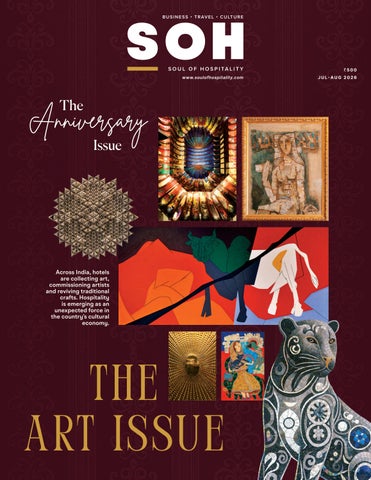
Across India, hotels are collecting art, commissioning artists and reviving traditional crafts. Hospitality is emerging as an unexpected force in the country’s cultural economy.
THE ART ISSUE
Year Two. From debut to benchmark.
750+
2000+
Leaders Featured
Stories Told
Follow us: soh_magazine
SOH Magazine
SOH (Soul of Hospitality) Magazine
Discover more at www.soulofhospitality.com
SOH celebrates 2nd Anniversary
23
Editions Published
55
Countries Represented
Connect with us: editorial@soulinkkworldwidemedia.com, sales@soulinkkworldwidemedia.com +91 99998 85515, +91 91363 69369
X
THE GLOBAL COLLECTIVE UNVEILS ITS FIRST EXPRESSION IN INDIA A 109-suite address arrives in Mumbai, the group’s newest culture-led destination.
#MeetRoswyn Fi’lia | Black Lacquer | The Third Room | Blu Xone Authentic Italian Restaurant | Japanese Listening Room | Business Lounge | Transformative Wellness
KNOW MORE
4
S O U L O F H O S P I TA L I T Y
FOUNDER'S NOTE
TWO YEARS IN Two years ago, we made a decision that, at the time, felt almost counterintuitive. In an age of infinite screens, fleeting attention and content designed to disappear within seconds, we chose to build a magazine in print, not because we were looking backwards, but because we were looking ahead. Two years on, that instinct feels even more relevant. Print has proved more resilient than its obituary writers predicted. Perhaps after years of being asked to scroll, people are ready to pause again. SOH was never about print versus digital. It was always about substance over noise, wherever the story lives. We set out to look at hospitality differently, not simply as an industry, but as a world where business, people, places, culture, travel and ideas intersect. That lens has taken us further than we imagined. SOH has grown from a print magazine into a multi-platform media brand. The numbers matter. But what matters more is the access and trust we have earned among the people shaping hospitality, from hoteliers and founders to investors, policy makers, hotel owners, architects, chefs and destination-makers. Somewhere along the way, we stopped simply reporting on hospitality. We became part of the ecosystem we set out to understand. And that ecosystem is changing fast. Hospitality now sits at the intersection of real
estate, investment, wellness, food, technology, sustainability, culture and identity. The traveller is changing. Expectations are changing. India is becoming more confident in how it presents its places, people and stories to the world. That makes our responsibility bigger. We never wanted SOH to be another magazine covering the industry. We wanted to understand it, question it and contribute to the conversation. Because reach can be measured. Influence is earned. It is earned when a story starts a conversation. When an idea travels beyond the page. When someone sees their business, destination or industry differently because of something they encountered through SOH. That is the standard we hold ourselves to. To everyone who has read an issue, followed a story, watched a conversation, shared our work, partnered with us, or simply told us that something we published made them think, thank you. The landscape ahead is bigger than the one we entered two years ago. Hospitality is evolving. Travel is being redefined. And Asia Pacific, with India at the centre of an increasingly consequential tourism story, is entering a new chapter. We intend to play a bigger role in it, not simply documenting the change, but helping shape what comes next. Two years in. We are only getting started.
GURMEET KAUR SACHDEV gurmeetsachdev@soulinkkworldwidemedia.com
J U L- A U G 2 0 2 6
5
Di Paise Ko Rafttaar
602A & 602B, Maker Maxity, 4 North Avenue BKC, Bandra East, Mumbai, Maharashtra, 400051, India
REDEFINE HOTEL INTERIORS WITH UNPARALLELED STYLE AND DURABILITY WITH FURNISHING FABRICS.
Experts in hotel projects AVAILABLE AT ALL LEADING FURNISHING STORES IN INDIA WWW.MAISHAA.COM
FR OM INDIAN HEARTS
INDIA’S STRONGEST BRAND ACROSS SECTORS 2026
SEVEN YEARS OF RECOGNITION
150+ HOTELS | 14 COUNTRIES | 100+ DESTINATIONS
TO THE GLOBAL STAGE
WORLD’S STRONGEST LUXURY HOTEL BRAND 2026
A TRIBUTE TO YOUR TRUST
Source: Brand Finance Reports 2020, 2021, 2022, 2023, 2024, 2025, 2026
TO KNOW MORE
A Dazzling DESTINATION Welcome to a new era of Art Deco splendour — where the grandeur of the 1920s meets contemporary elegance at a landmark address near Chhatrapati Shivaji Maharaj International Airport. Discover 446 elegantly designed rooms and suites, 75,000 sq. ft. of palatial event spaces, and distinctive culinary experiences across signature venues. Find balance at Blu Xone, nestled within Fairmont Spa & Longevity — India’s first luxury longevity suite, where rejuvenation and vitality converge in a transformative space. Here, we make special happen — creating moments that linger long after your check-out. +91 22693 32222 |
FOOD & BEVERAGE
+91 80975 55999 l
mumbai@fairmont.com
WELLNESS
ED'S LETTER S O U L O F H O S P I TA L I T Y
ART FINDS A HOME IN HOTELS My first encounter with art, and with an M.F. Husain painting, was at a hotel: the Taj Mahal Palace, Mumbai. The 'million dollar' triptych sits in the Palace Wing lobby, behind the main reception. Husain created it over nine months in 1999–2000 while living in the hotel, and it was the first work the hotel had ever commissioned. Since then, almost every hotel I have travelled to has put art on its walls. Paintings and sculptures in corners, walls painted with delicate trellis or the more flamboyant miniature and thikri work, abstract photographs and digital pieces that capture the spirit of the property. Art is no longer an afterthought; it is part of how these spaces are designed. For our second-anniversary cover story, we traced Indian hotels' rendezvous with art back to the years when the Taj Mahal Palace, Mumbai, and the ITC Maurya, Delhi, commissioned their most stunning pieces, painted on-site. This is our second anniversary, and I must thank everyone who has been part of the journey: colleagues, industry heads, hoteliers, restaurateurs, chefs, bartenders and so many more. This special issue takes you through the changes and happenings across the segments we cover. Alibaug is emerging as the next chic destination for hotels and branded residences. Jawai offers its mysterious jungle and other-worldly landscape. Hyderabad has a tony new bar from the indefatigable duo of Yangdup Lama and Minakshi Singh. Our new People's column features the art doyenne Kiran Nadar. We explore luxury hotels such as Roswyn and Rosewood, and understand the opportunities Puri's Rath Yatra offers the industry. I look forward to you joining us over the next year. I hope you enjoy the read.
Founder and Publisher Gurmeet Sachdev Editorial Editor Deepali Nandwani Managing Editor Rupali Sebastian Digital Editor Rachna Virdi Contributing Writer Chandreyi Bandyopadhyay Ruth Dsouza Prabhu Bindu Gopal Rao Sagari Gupta Neeta Lal Kalpana Sunder Alyssandra Mendonsa Creative Creative Director Tanvi Shah Assistant Art Director Vinod Shinde Team Shiv Soni Business Head Vipin Yadav Delhi, +91 99998 85515 vipin@soulinkkworldwidemedia.com Sales Manager Deepa Rao Mumbai, +91 9136 000369 sales@soulinkkworldwidemedia.com Head of Events and Alliances Karishma Shah karishma@soulinkkworldwidemedia.com Office Manager Deepak Rao Accounts Head Amey Acharekar
Warm regards, D E E PA L I N A N DWA N I , E D I TO R , S O H
For queries: editorial@soulinkkworldwidemedia.com sales@soulinkkworldwidemedia.com info@soulinkkworldwidemedia.com
Printed and Published by Gurmeet Sachdev on behalf of Soulinkk World-Wide Media LLP. Registered office: 1/2, Old Anand Nagar, Nehru Road, Santacruz East, Mumbai, Maharashtra - 400055. Printed at Silverpoint Press Pvt. Ltd., A-403, TTC Industrial Area, Near Anthony Motors, Mahape, Navi Mumbai – 400709. Editor: Deepali Nandwani. All rights reserved worldwide. Reproducing in any manner without prior written permission prohibited. SOH takes no responsibility for unsolicited photographs or material all photographs, unless otherwise indicated, are used for illustrative purposes only. Unsolicited manuscripts will not be returned unless accompanied by a postage pre-paid envelope. All disputes are subject to the exclusive jurisdiction of competent courts and forums in Mumbai only. Copyright Soulinkk World-Wide Media LLP.
16
S O U L O F H O S P I TA L I T Y
Bulk Laundry Loads Made Easy with COMMERCIAL LAUNDRY SOLUTIONS
WA S HE S FROM 11 KG TO 130 KG SMARTSAVE Impeccable hygiene Water savings Manpower savings Quick turnaround Higher productivity COMMERCIAL LAUNDRY RANGE
COMMERCIAL DISHWASHING RANGE
24X7 SERVICE ACROSS INDIA
COMMERCIAL ESSENTIALS
BIS CERTIFIED
Made in Italy
Washer Extractor
Always at your service. Anytime. Anywhere.
24x7
24×7 Support Warranty and post-warranty assistance
Tumble Dryer Undercounter Glass Washer
Undercounter Dishwasher
Nationwide Service Network 110+ trained engineers across India Spare Parts Always Available Inventory maintained at all major towns
Flat Work Ironer
Finishing Equipments
Hood Type Dish Cum Bottlewasher
080 45845678 / +91 95139 91116
Rack Conveyor Dishwasher
AMC & CAMC Options Flexible maintenance packages for peace of mind
query_industrial@ifbglobal.com
Scan here to visit our website
www.ifbappliances.com
CONTENTS
JUL-AUG ISSUE
ISSUE
23
46
How Art Is Becoming The Hotel's New Cultural Language Art is moving beyond decoration to shape identity, guest experience and placemaking in hotels, while airports and destinations such as Kochi are weaving culture into the traveller's journey.
18
S O U L O F H O S P I TA L I T Y
R e c o g n i s e d # 2 W o r l d ’s B e s t H o t e l B r a n d i n T r a v e l + L e i s u r e W o r l d ’s B e s t A w a rd s 2 0 2 6 , t h i s h o n o u r i s a t e s t a m e n t t o f o u r d e c a d e s o f Tr u e I n d i a n L u x u r y d e fi n e d b y e x c e l l e n c e .
CONTENTS
92
86
The Roswyn Story
More Than Miles
An eclectic Parisian spirit finds a home
Actor Aishwarya Rai Bachchan values
in Mumbai.
presence over pace.
38 A Second Life The Governor House revives an 1863 Circuit House in Amritsar.
10 4
34
The New Shore A coastal escape grows into a
Beyond Leopard Country Jawai adds wellness, trails and slower
hospitality market.
experiences.
26 The Museum Maker Kiran Nadar reshapes India's art landscape through institutions.
42
30
Hyderabad Gets Stormy Yangdup Lama takes neighbourhood bar culture south.
Dining Destinations At luxury hotels, gourmet dining is the new story
20
S O U L O F H O S P I TA L I T Y
WHERE LUXURY LIES DOWN World-class sleep meets timeless design. Crafted with orthopaedic precision and backed by decades of research, every mattress delivers a perfect balance of comfort and support. Guests may forget the lobby lights or the minibar—but they remember a great night's sleep. Make sure your rooms leave an impression that lasts well beyond checkout. Sealy mattresses offers that ensure your guests experience the comfort and support they need for a restful night's sleep.
SEALY PARTNERS WITH
enquiry@sealy.in |www.sealy.in
THE FINEDINING
ADDRESS
MOVES
BEYOND
THE METROS
As big-city dining habits spread to smaller markets, Sarovar
Hotels is redesigning its rooftops, bars, kitchens and delivery across 90 destinations to draw local diners, not just hotel guests. Rooftop dining used to be shorthand for Delhi, Mumbai or Bengaluru. An evening a big city could put on and a smaller one couldn't. That has stopped being true. What the metros taught, before the gap closed, was subtler than any menu. A hotel could no longer build its food and drink around the person asleep upstairs. To fill a restaurant, it had to pull in someone who lived ten minutes away and had every other option in town. The bar had to beat the standalone place down the road. The hotel had to become somewhere the city chose to eat, whether or not anyone at the table was staying the night. Sarovar Hotels has spent years learning that firsthand, often as the first branded hotel to open in a given city. Across 90 destinations it has watched local appetite catch up to metro expectations, fast. While the know-how carries over, what cannot be copied is the city's own palate. And that is where Sarovar's magnifying glasses come alive.
UP ON THE ROOF
Altura shows the idea at work. On the roof of Riviera Sarovar Portico in Pathankot, it opens at five each evening with Pan-Asian and Indian plates, grills and a full bar under a wide view of the city. Built for the guest choosing a night out rather than a room. But a view will bring those guests up once. Getting them back is the harder job, and it turns on whether the restaurant knows what city it is in. So no two Sarovar rooftops are alike. The Deck at Sarovar Portico Srinagar seats 60 indoors and out, leaning on Northern Frontier and Mediterranean food. Sky Lounge in Panipat sources from nearby markets and wraps a 360-degree view around the room. Terrace Grill in Jammu goes Tex-Mex and Mexican instead. The format comes from the metros. The menu comes from the city.
ZERO-PROOF, NOT ZERO-EFFORT
Once a hotel asks a whole city to take its restaurant seriously, the scrutiny does not stop at the food. It reaches the bar too. India's zero-proof drinking has moved well past fruit-heavy mocktails and started borrowing the craft of a serious cocktail bar, so Sarovar put both on one syllabus rather than treating either as an afterthought. At Sarovar Premiere Amritsar, cocktail and mocktail classes are taught together in small groups, covering flavour pairing, garnishing and preparation, so the guest who isn't drinking gets as considered a pour as the one who is. Again, a lesson from Tier 1, customised down stream.
THE CARAVAN COMES TO TOWN
Lift the setting and the service everywhere, and the diner is left with a simple question: why this restaurant, and not the place next door? The metros proved a restaurant needs a point of view of its own, and in a smaller city Sarovar rarely has to look far to find one. Culinary Caravan runs on regional recipes and indigenous ingredients that seldom reach a hotel menu, the kind of dishes that usually stay inside one family's kitchen. It grew out of real travel through Tier II and III India, and conversations with chefs and home cooks who had never written their recipes down for anyone outside their own town. The latest edition ran at Abbas Ka Wazwaan in Hyderabad, built around Kashmiri food and heritage, and it keeps moving to different cities like Alwar, Jaipur, Jodhpur, Delhi NCR etc. Sarovar would rather show a point of view like that than describe it. Its weekend classes at Sarovar Premiere Amritsar put guests at the counter with the chef, working through local dishes, seasonal specials and lighter, plant-forward recipes. The plant-based push is newer, driven by shifting guest expectations, and the hard part is never the cooking. It is the sourcing, the cost and the consistency, the same practical test every new idea faces in a smaller city, from stocking a proper cocktail bar to keeping a regional menu as good in week three as it was in week one.
ORDERING IN, MORE OFTEN
The same logic runs all the way to the front door. If the customer is the city and not only the overnight guest, Sarovar has to feed that customer even on the nights it stays in. Food-delivery transactions in Tier II and smaller cities have nearly tripled since FY21, according to Redseer's State of India's Food Services Market report, and FoodGully is built for exactly that: a multi-cuisine menu for dine-in at select hotels, takeaway and delivery on reputable food delivery aggregators. On a rooftop, the view and the service carry part of the meal. In a delivery box, the food carries all of it, holding its temperature, texture and identity with no dining room standing behind it to help. The larger truth is, Sarovar learned from the best of Tier-1 cities first hand. But it did not templatise the solutions for Tier-2 and Tier-3 cities. It understood each destination's preferences individually and then peppered it with the lessons from larger cities. That's the moat. Meanwhile, back at Altura, the first table is set at five, just as it is every evening. It looks like a small, ordinary routine. It is also the whole argument in one frame. A guest in Pathankot deciding how to spend an evening now has real reasons to stay in town, and Sarovar built almost all of them.
www.sarovarhotels.com | Toll free no.: 9886800049 For more information, reservations and upcoming updates, visit Sarovar Hotels’ official website or contact the participating Sarovar property directly.
A HYBRID OS&E BLUEPRINT™ WE CONSULT Strategic BOQ planning to eliminate waste and shortages.
WE CURATE Presenting you with the right brands and formats in Good-Better-Best options.
WE SUPPLY Global sourcing, quality checks, and consolidated doorstep deliveries.
WE EXECUTE On-ground setup and placement by trained AH teams—guest-ready guaranteed.
WE HANDOVER Digital asset register, warranty kits, and replenishment-ready support.
At AH International, we redefine hospitality solutions with innovation and excellence. Our commitment is simple yet profound: to provide tailor-made solutions that anticipate and exceed the needs of our clients.
2012
60+
16+
4
EST A B LI SH E D
B RAN D S
COUN T RIES
REGIONAL BASES
+91 - 141 - 2355333
info@ahinternational.in
www.ahinternational.in
Our Offerings FROM HOSPITALITY VISION TO GUEST-READY REALITY
IN ROOM SOLUTIONS
HOUSEKEEPING SOLUTIONS
F & B SOLUTIONS
KITCHEN SOLUTIONS
BANQUET SOLUTIONS
FRONT OFFICE SOLUTIONS
SI X C O NNE CT ED SOL UT ION CAT EGORIES AH International Private Limited
2nd Floor, Acropolis Avenues Building, Plot no 529-530, Nemi Sagar Colony, Vaishali Nagar , Jaipur, Rajasthan
THE WOMAN BUILDING INDIA'S MUSEUM OF THE FUTURE Collector, patron and institutionbuilder, Kiran Nadar has transformed Indian art over four decades. Her next act—a million-square-foot museum in Delhi—could redefine the country's cultural landscape. D E E PA L I N A N DWA N I
At the moment, Kiran Nadar is in the limelight for her museum, the Kiran Nadar Museum of Art (KNMA), and its London exhibition, The Meeting Ground, at Christie's King Street, mounted in collaboration with the art and auction behemoth Christie's as part of its summer programming. This is the first major institutional exhibition for India's largest and most eclectic private art museum. Nadar assembled the largest private collection of South Asian modern art more or less the way she plays tournament bridge, patiently and to win. A colossal figure in the world of Indian art and museums, she has been collecting for over four decades, starting with Rameshwar Broota's Runners (1982), a bold, graphic male nude, and now holds more than 16,000
works, including sculptures and installations. She opened KNMA in 2010, India's first private museum dedicated to modern and contemporary art, and put much of her collection on display. Since its founding, KNMA has been committed to situating South Asian artistic practices within broader international conversations. The Meeting Ground reflects the depth of her collection and the evolving role of KNMA as a multidisciplinary cultural institution. "Great art has no political borders," believes Nadar. "It has been appreciated globally from time immemorial. The region of South Asia is connected through a shared visual history and deep cultural resonances, and the exhibition presents these rich and complex conversations through
ABOVE: Raqib Shaw's When the Thing with Feathers Turned Red; acrylic liner and enamel on birch wood. RIGHT: Collector, patron and institution-builder, Kiran Nadar has transformed India's cultural landscape.
26
S O U L O F H O S P I TA L I T Y
IMAGE COURTESY: RAQIB SHAW AND KNMA
SOH | PEOPLE
IMAGES COURTESY: GAURI GILL, RAJESH C. VANGAD AND KNMA
CLOCKWISE FROM LEFT: Confessions of a Wall, a black-and-white series by Raghu Rai; Jivya Soma Mashe’s untitled rice paste and cow dung on paper; Gauri Gill and Rajesh C. Vangad’s Factory and River II; a fibreglass and resin sculpture by G. Ravinder Reddy.
an intergenerational mix of artists. The exhibition represents how we think about the museum and the possibilities within the collection, while also offering a slice of the museum's 15 years of exhibition history, which has evolved under the artistic direction of Roobina Karode."
J U L- A U G 2 0 2 6
pathbreaking design was unveiled at the 60th Venice Biennale. It will be "India's national modern and contemporary art museum, for all intents and purposes," Glenn Lowry, the director of New York's Museum of Modern Art, said at the unveiling. The 100,000sq.mtrs. (onemillion-square-foot) architectural marvel in New Delhi is envisioned as a dynamic cultural hub transcending boundaries and disciplines. "Our new home will feature 'Collection Galleries' dedicated to presenting the collection to the public." While the museum and the performing arts centre will be at its core, the
Behind the scenes, however, Nadar and her team have been working tirelessly on a larger project, one that could change the way we experience art in India. A new Kiran Nadar Museum of Art is due to open in about two to three years, near Delhi's Indira Gandhi International Airport. Its
new KNMA will span a variety of disciplines and formats. In addition to its 11 galleries, it will feature a rotating display of works, ranging from new video installations and 20th-century masterpieces to Nadar's neverbefore-seen collection of Indian miniature paintings. It will host conversations, art-fuelled salons and exhibitions. Designed by David Frank Adjaye, the Ghanaian-British architect behind Adjaye Associates, who has built many notable structures around the
27
SOH | PEOPLE
CLOCKWISE FROM LEFT: Birds in a tree is an oil on canvas by M.F. Husain; Square Composition 2 by Anwar Jalal Shemza; Kulpreet Singh's Indelible Black Marks uses ash from wooden stoves at farmer protest sites; F.N. Souza's 1957 work Man and Woman Grinding Their Teeth.
Known as the art world's patron saint, Nadar is also attempting to reach beyond India's borders to create platforms for South Asian art. KNMA is collaborating with the Samdani Art Foundation in Bangladesh to organise exhibitions between the two countries, and a recent group show at KNMA Saket, Pop South Asia, featured works on loan from Pakistan. Without a doubt, Nadar has profoundly shaped the Indian art world, giving India its most sophisticated modern museum
to date and inspiring a wave of others now taking shape. Her collection has grown from early personal purchases into a vast institutional holding that bridges historical gaps in Indian modernism. Long before Indian art was making ₹100-crore headlines, she was acquiring works by M.F. Husain, S.H. Raza, F.N. Souza, Tyeb Mehta, V.S.
28
Gaitonde, Nasreen Mohamedi, Bhupen Khakhar, Anish Kapoor and Subodh Gupta. The Meeting Ground, then, is really a rehearsal for what comes next: the vast museum rising near the Delhi airport, where the collection Nadar has chased for 40 years will finally have a permanent home. She is, as ever, playing a long hand.
S O U L O F H O S P I TA L I T Y
IMAGES COURTESY: KNMA
world, it will be, he says, his "most advanced museum concept to date", incorporating experimental technologies such as an "anti-dust repellent" added to the concrete mix to help protect the structure from Delhi's air pollution. The museum, as he envisages it, pays homage to centuries of India's architectural influences: the design of Hindu shrines, the geometry of Rajasthan's Mughal architecture, Edwin Lutyens's colonial-era Delhi, and the Modernist and Brutalist buildings of post-Independence India.
ADVERTORIAL
Maximizing Space and Style for great guest comfort, with P.C. Henderson Sliding Systems systems help create spaces that feel both luxurious and adaptable.
Experiential Luxury, Sustainable Design, and Smart Hospitality
The premium hospitality sector is being shaped by a growing demand for flexibility, personalization, wellness and experience-led design. Today's luxury guests expect more than elegant interiors. They seek adaptable spaces that can effortlessly transition between work and leisure, privacy and social interaction or wellness and entertainment. At the same time, hotels are under pressure to maximize space utilization, support diverse event formats and deliver memorable guest experiences while maintaining a sophisticated aesthetic. As a result, movable walls, sliding systems and flexible room configurations are becoming increasingly important elements of high-end hotel design.
Flexible and Multi-Functional Spaces Among the latest hospitality trends, the move is towards flexible and multi-functional spaces. Luxury hotels increasingly need ballrooms, conference rooms, private dining areas and event venues that can expand or contract depending on occupancy and event requirements. Here’s where Henderson, Part of ASSA ABLOY's Telescopic systems are in their element. Telescopic doors allow multiple
panels to move simultaneously and stack neatly to one side, creating large unobstructed openings while maximizing usable floor space. This makes them ideal for hotels seeking to transform a single venue into several smaller rooms or create adaptable restaurant or even an event environment without permanent walls.
Wellness, Personalization, and Privacy Luxury travelers increasingly expect suites and wellness spaces that can be configured according to their needs, whether that involves opening up a bedroom and lounge into one expansive area for an open concept living space or creating a private treatment, meditation, or work zone. For such trends centered around wellness, hyperpersonalization and guest privacy, Synchro systems offer the strongest fit. Henderson, Part of ASSA ABLOY Synchro doors enable multiple panels to move together smoothly and elegantly, delivering a premium user experience while supporting flexible room layouts. As five-star hotels invest in wellness suites, exclusive guest areas and personalized accommodations, synchronized sliding
Hotels are increasingly incorporating private dining rooms, VIP lounges, spa treatment rooms, co-working spaces and exclusive guest zones that require elegant but efficient separation. For experiential luxury, sustainable design and technology-enabled hospitality, single sliding doors and partition systems are particularly relevant. Henderson, Part of ASSA ABLOY's Sliding partitions allow operators to create intimate environments while retaining the flexibility to reopen spaces when needed, supporting both experiential and operational objectives. Meanwhile, single sliding doors provide a clean, contemporary aesthetic that aligns with modern luxury design and spacesaving requirements. Because these systems help properties adapt existing spaces rather than undertake major structural alterations, they also support the industry's growing focus on sustainable, long-life hospitality infrastructure For the five-star hotel sector, Henderson, Part of ASSA ABLOY's greatest value lies not in conventional sliding doors but in its ability to support flexible space management through advanced sliding hardware systems. Telescopic and Synchro solutions enable luxury suites and hospitality venues to transform spaces effortlessly, while partition systems help hotels maximize the utility of ballrooms, meeting rooms, restaurants, and lounges. Single sliding door systems complement these applications by providing reliable, premium-quality solutions for both guest-facing and operational areas. Together, these offerings position Henderson, Part of ASSA ABLOY as a strong enabler of adaptable, high-performance hospitality environments where operational flexibility and guest experience are equally important.
SOH | DINING
CHECK IN FOR DINNER How gourmet-driven hotels are redefining travel.
N E E TA L A L
Until recently, the hotel restaurant was an afterthought: a fallback for the weary traveller too tired to venture out, chosen for convenience rather than curiosity. That hierarchy has flipped. Travellers now pick where to stay based less on thread counts or spa menus than on what's simmering in the kitchen downstairs. From large urban properties to secluded wellness resorts, hotels are recasting themselves as culinary destinations. Food has moved from the margins of the stay to its centre, shaping itineraries, room bookings, and the way a property presents itself to the world.
30
The rise of the experienceled traveller The shift begins with the guest. Passive luxury holds less appeal than it once did; the modern traveller wants to inhabit a place, however briefly, rather than tick it off a list. Food offers the most direct way in. A single dish can compress a region's history into one bite, and hotels, long designed as neutral, globalised spaces, have begun to build on that power, shaping menus that draw on local heritage as much as contemporary technique. “Dining has become a powerful storyteller,” says Kamaljit Singh, General Manager, The Westin Jaipur Kant Kalwar
S O U L O F H O S P I TA L I T Y
Dining as a destination
CLOCKWISE FROM OPPOSITE PAGE, TOP LEFT: Masque’s Bombay Sandwich reimagines a Mumbai street classic; Chef Garima Arora's Tom Kha Pani Puri pairs Indian street food with Thai flavours; Michelin-starred Chef Garima Arora has helped redefine contemporary Indian cuisine; at Waldorf Astoria Kuala Lumpur, Yaari will reflect how signature cuisine is shaping the identity of luxury hotels; at Cena Pranzo, Grand Hyatt Gurgaon, Chef Mauro Ferrari brings the warmth and sociability of an Italian trattoria into the hotel experience.
Resort & Spa. “It allows guests to connect with a destination through local ingredients, authentic flavours, and thoughtfully curated menus.” At the Westin Jaipur, that thinking runs through the property. The all-day restaurant Harvest and the Indian speciality restaurant Ira balance regional cooking with broader appeal, while Haven Bar & Coffee Lounge and the poolside bar bring dining and drinking into more relaxed settings. Guests, Singh finds, increasingly plan their days around meals rather than fitting meals between activities: a Rajasthani dinner at Ira, a wellnessled breakfast at Harvest, a slow evening at the bar.
J U L- A U G 2 0 2 6
Marketing consultant Rhea Malhotra chose the property for exactly that reason. “I initially booked The Westin Jaipur for a quick wellness break,” she says, “but what stayed with me was the food. Dinner at Ira, with its beautifully plated Rajasthani dishes, felt like a cultural deep dive, not just a meal. The next morning, breakfast at Harvest had everything from local favourites to clean, wellness-led options. I didn't feel the need to step out at all.” After a day of travel, Singh adds, guests value “high-quality, carefully prepared meals without having to step out.” For families in particular, good food under one roof can decide the booking.
That appetite is changing how hotels position themselves. The restaurant, once a secondary space, is increasingly the headline act. At Grand Hyatt Gurgaon, the repositioning is deliberate. “Gastronomy has evolved into a primary driver of travel decisions,” says General Manager Tarun Seth. “Today's traveller is seeking experiences that are immersive, culturally rooted, and sensorially rich, and food delivers on all three.” A well-conceived restaurant, he argues, gives a hotel a personality of its own. “It doesn't just offer a stay. It offers a point of view.” The hotel tests that idea across two very different rooms. Maison Maiya serves a refined, globally inspired menu shaped by seasonality and technique; Cena Pranzo leans into the shared plates and easy noise of an Italian trattoria. For Bengaluru-based entrepreneur Arjun Mehta, the restaurants changed the shape of a work trip. “I was in Gurgaon for work and booked Grand Hyatt Gurgaon out of convenience,” he says. “But dinner at Maison Maiya completely changed my plans. The menu felt thoughtful and globally relevant, unlike that of a typical
31
SOH | DINING
LEFT: Cena Pranzo shows how a strong restaurant identity can shape the hotel experience. BELOW LEFT: Masque founder Aditi Dugar has spearheaded the thought of restaurants as destinations. BELOW RIGHT: Masque's ingredientled philosophy and immersive dining experience have become a benchmark for culinary programmes.
hotel restaurant. The next evening at Cena Pranzo was more relaxed and social. It felt like being in a lively neighbourhood trattoria. I ended up staying an extra night just to explore more of the food.” The restaurants now draw local diners and travelling food enthusiasts alongside hotel guests, some of whom choose the property for its kitchens alone. The restaurant becomes the destination; the hotel, its natural extension. Guests increasingly want the ease of eating in-house without compromising on quality, prompting hotels to replace generic dining rooms with chef-led, placeled concepts. The appeal sharpens when time is short. Few travellers want
32
to spend an evening researching restaurants or crossing a city for dinner. A hotel that feeds its guests exceptionally well removes the friction from the decision entirely.
Food as cultural expression Few chefs make the case for the hotel restaurant as compellingly as Chef Garima Arora, whose upcoming restaurant Yaari at Waldorf Astoria Kuala Lumpur is among the most anticipated openings of 2026. For the Michelin-starred chef, the hotel setting is both opportunity and challenge. “Inside a hotel like Waldorf Astoria, you are bringing something into an existing universe of excellence,
which raises the bar in a wonderful way,” she says. Yaari (friendship) sets out to capture the warmth and variety of Indian dining culture in a refined, contemporary format: elevated chaats, reimagined regional dishes, modern readings of traditional desserts. The room is built for range. “A hotel restaurant speaks to a beautifully wide audience,” Arora observes. “Travellers, locals, families, people celebrating. Everyone comes together in that space.” The gourmet-driven hotel is also a product of the digital age. A striking dish or a beautifully designed room can travel across the world in seconds, shaping perceptions and setting itineraries
S O U L O F H O S P I TA L I T Y
full arc of a meal, from service to space to mood, have become a benchmark for hotels rethinking their own dining. Masque turns 10 this year, and Dugar is marking the anniversary with a year-long celebration built around a new menu and nationwide pop-ups.
A new definition of luxury Hoteliers read the gourmetdriven hotel as part of a wider recalibration of luxury, one that prizes craftsmanship and memory over excess. Hotels that put gastronomy at the centre of the offering are selling a way of experiencing a place, one plate at a time. As Singh puts it: “Hotels that lead with food create deeper connections. They don't just serve meals. They create moments.” For a growing number of travellers, those moments are the reason to book.
in motion. “Dining has become a key part of how travellers document and define their journeys,” Seth notes. Hotels are investing accordingly, in spaces that photograph well, engage the senses, and give guests a reason to linger, share, and return. As competition intensifies, hotels are starting to behave like culinary brands, defined as much by their kitchens as by their rooms. But hotels are not shaping this food-centric movement alone. Influential standalone restaurants are helping redefine expectations as well. Part of the momentum comes from Masque, the Mumbai restaurant led by Aditi Dugar, which took home the Art of Hospitality Award at Asia's 50 Best Restaurants 2026 in Hong Kong. Dugar's ingredient-led cooking and her attention to the
J U L- A U G 2 0 2 6
ABOVE LEFT: With its relaxed, convival atmosphere, Cena Pranzo captures the spirit of a neighbourhood Italian trattoria. ABOVE RIGHT: Warm lighting, handcrafted details and regional influences give Ira a quietly contemporary Rajasthani character. RIGHT: Local flavours are reinterpreted with contemporary finesse at Ira.
33
S O H | T R AV E L
CLOCKWISE FROM ABOVE: Leading the sunrise session amidst Jawai's ancient boulders; International Yoga Day brings wellness to the heart of leopard country; Jawai's dramatic boulder hills shape both its wildlife and its tourism story; Aaramgah Resort & Spa offers a quieter counterpoint to the region's wildlife experiences.
34
S O U L O F H O S P I TA L I T Y
S O H | T R AV E L
A MARATHON THROUGH LEOPARD COUNTRY Jawai's ancient boulder hills have earned a reputation as a unique landscape where elusive leopards and Rabari herders coexist peacefully. Today, yoga at dawn and a newly introduced trail marathon are expanding the region's appeal to a diverse range of travellers. D E E PA L I N A N DWA N I
Jawai is home to one of India’s largest leopard populations, set within a landscape that can feel otherworldly to those with vivid imaginations. The area features only a handful of pathways into the jungle, scattered private properties, and a limited presence of the Indian forest department. Hill after hill of ancient, rounded boulders, some of the oldest exposed rock in the subcontinent and the colour of old bone, are stacked into low hills the locals call koppies. The sky shifts colour from a brilliant blue to rose to amber. Between boulder hills are scrublands, grass, fields, and the cerulean water of the Jawai Bandh, the reservoir held by the dam commissioned in the 1940s under Jodhpur’s Maharaja Umaid Singh. The blue sheet of water brings alive the boulder-dominated landscape, and is home to crocodiles basking along its margins, flamingos, cranes and bar-headed geese that fish in its shallows.
J U L- A U G 2 0 2 6
But the region itself is dominated by leopards, those shy, elusive big cats that camouflage against the boulders. You look at the hillside for a rather long time, following your safari guide’s instruction, and all you see is a huge rock, until an ear turns and the whole shape comes loose from the hill. Here, the leopard coexists with the Rabari community, many of whom farm in the fields within the granite hills, scrub and village commons around Jawai Bandh, largely outside any formal protected-area designation. Its leopards centre on the Jawai Bandh Leopard Conservation Reserve, notified in 2010, but range across a wider patchwork of village and revenue land, a looseness now under review, with courts and the forest department moving toward tighter protection and possible sanctuary status. The coexistence between leopards and the Rabari herders isn’t happening inside a managed reserve with buffer zones and core areas; it’s happening on
35
S O H | T R AV E L
The new story that’s unfolding Rajasthan tourism, the local Jawai administration under the district collector, and Aaramgah Jawai Resort & Spa, a member of Radisson Individual Retreats, are working to write a new story for the region, one that reaches past the leopard safari without leaving it behind. The cats remain the heart of the experience, but wellness and adventure now sit alongside them. On June 21, International Yoga Day, an early morning yoga session was organised by Aaramgah and the local administration amidst the boulders, with a view of the Jawai Bandh and its blue waters, and
the district collector, Dr Ravindra Goswami, in attendance. And then there is India’s first wildlife trail marathon, slated for 24 January, 2027, an Aaramgah initiative developed with Rajasthan Tourism and local authorities. Its first edition offers two categories, 12 and 24kms., on a route that starts and ends at the resort and dips through the dam’s catchment, dry ground once the water recedes. A professional organiser was brought in to survey the terrain for safety before a single runner was signed up. “Trail marathon is a niche within the marathon community, because not everybody runs trail,” says co-founder Devrang Agarwal.
THIS SPREAD, CLOCKWISE FROM TOP: The wildlife trail marathon is part of the region's expanding adventure offering; the waters of the Jawai Bandh bring life to the region's dramatic boulder country; perfectly camouflaged amongst the granite boulders, the leopard is Jawai's most celebrated resident; the search for Jawai's elusive leopards begins as the light begins to fade; arched forms and reflecting water create a calm arrival experience at Aaramgah Resort & Spa; stone, sand-toned walls and water echo the colours and textures of the surrounding landscape.
ordinary inhabited terrain, which is why the story is about tolerance and shared ground rather than about protected wilderness. This, while ideal in an ideal world, has a negative connotation in the real world: leopards are often chased by unchecked jeeps, people walk across the terrain, shout at each other from one jeep to another, while the big cat, for very good reason, hides from plain sight. But that’s a story for another day.
36
S O U L O F H O S P I TA L I T Y
“There is a higher level of endurance required.” Talks are on with Gujarat Tourism to draw runners from marathon chapters in Ahmedabad and other Gujarat cities. The yoga day and the marathon carry a single argument: that Jawai holds more than its wild cats. “When you search for Jawai, you just see leopards,” Agarwal says. “We want to show people there is a lot more.” He and his younger brother Tanay, hoteliers from Mount Abu, sited Aaramgah well away from leopard territory, the dam and the railway line, on former lemon-tree farmland ringed by a ten-foot boundary. What they call the boulder town sits on the Aravalli range, older and steadier than the Himalayas, and shelters crocodiles, sloth bears, foxes, nilgai and clouds of migratory birds. Because most of the terrain is privately held, the safari here runs unregulated, along hill drives and improvised paths instead of one fixed circuit. The property leans the other way from its adventure
J U L- A U G 2 0 2 6
programming, toward stillness. “Aaramgah is the easiest way to do nothing,” Agarwal says, pointing to washrooms fitted with brass lotas and bathing stools of a grandparent’s house, and rooms finished in age-old terrazzo and gutai, a lime technique that keeps interiors cool. In winter, when the region has no industry and the resort’s lights face downward to spare the sky, the stars come out in full. Culture completes the picture. Rabari, the shepherd community whose silver jewellery has drifted into big-city fashion, sing at the resort each weekend, and guests can be taken, on request, into a Rabari home to watch a meal cooked and a herd moved. It is, Agarwal says, an experience meant to be memorable rather than merely rough. For now, the leopard still draws the first glance. Jawai is making the case that it need not be the last. In time, the region hopes to be known as much for wellness, yoga amidst the ancient rocks, and its wildlife trail marathon, as for its enduring symbol.
37
S O H | R E S TO R AT I O N
THE 1863 HOUSE THAT BECAME A RESTAURANT
Within a restored 1863 Circuit House that is now The Governor House, Amritsar, colonial design pairs with regional Indian cuisine and cocktails. RUTH DSOUZA PRABHU
LEFT: The interiors of The Governor House transport you back to the colonial era. ABOVE: Kavish and Shruti Khurana, Managing Directors, Elgin Hospitality.
door entry is flanked by stone lions and leads you into a colonial-era structure, where chandeliers glow against dark wooden furniture, brass accents, framed portraits, and carefully sourced artefacts. Stepping inside immediately alters the pace of the evening and shuts out the chaos of the city. It’s easy to think you have time-travelled into the colonial era.
Searching for an Old House
In Amritsar, hospitality often unfolds at scale. Rooftop lounges, sprawling dining halls, and nightlife-led venues dominate much of the city’s restaurant landscape. The Governor House by Elgin takes a very different route.
38
Set within the premises of Sarovar Premiere near Rialto Chowk, but tucked away enough to feel entirely separate from the hotel itself, the standalone restaurant has an aura of old-world grandeur as you approach it. The double
The Governor House is the latest project from Kavish and Shruti Khurana, Managing Directors, Elgin Hospitality, whose portfolio already includes Elgin Hall in Dalhousie, along with Lord Elgin Bar and Elgin Café in Amritsar. But unlike their earlier ventures, the idea began with a search for the right property in Amritsar. “We were looking for a heritage space for a long time, but you don’t really find many here,” says Kavish. “Our search eventually led us to the former Government Circuit House, a colonial-era building
S O U L O F H O S P I TA L I T Y
“Hip-hop music, club culture, everyone doing the same food. We wanted Indian cuisine in an old heritage space.”
Restoring the circuit house dating back to 1863. The first conversations around the property did not immediately materialise. We were initially offered a rooftop space within the hotel premises instead, something we turned down immediately. I wanted the Circuit House,” explains Kavish. At one point, the couple had even moved ahead with another heritage property near the Golden Temple before discussions around the Circuit House reopened. When the opportunity finally came through, the decision was instant. Part of that conviction came
from what the Khuranas felt Amritsar was missing. Cities such as Jaipur and Goa have long transformed old residences and colonial homes into atmospheric cafés and restaurants, but Amritsar has very few restored spaces of this nature. The Governor House was conceived not as a nightlife venue but more as a place where architecture, mood, and hospitality could shape the dining experience together. “There was too much of the same thing happening everywhere,” says Kavish.
The restoration itself was deliberately restrained. The original arches, proportions, and structural framework of the house were preserved, while the interiors were rebuilt entirely around them. What once stood as a worn-down whitewashed structure gradually transformed into a colonial dining space filled with wooden panelling, antique-inspired furniture, mood lighting, chandeliers, and collected artefacts.
CLOCKWISE FROM TOP LEFT: The Governor House moves away from the culinary and aesthetic norms set in Amritsar; Sanchit Arora, Studio Head Architect, Renesa; the Durban Potato curry is a rich, gravy of potatoes, redolent with aromatic spices; a grand piano placed at the centre of the restaurant adds to the colonial setting.
J U L- A U G 2 0 2 6
39
S O H | R E S TO R AT I O N
Designed by Sanchit Arora, Studio Head Architect at Renesa, New Delhi, the project leaned heavily into the realities of the original building. Thick heritage walls restricted structural interventions, while the old layout shaped how rooms, passages, and dining spaces eventually evolved. Planning alone took several months before execution even began. Ceiling heights were restored rather than concealed, with parts of the house retaining heights of nearly 30 feet. The original arches were left untouched, while newer interventions—wooden panelling, flooring, lighting, and furniture—
were layered carefully into the existing shell. The result is a restaurant that feels residential rather than overtly commercial. Much of that comes from how intentionally fragmented the layout remains. Instead of maximising covers, the house retains a series of differently scaled rooms, including private dining spaces, creating a rhythm that feels closer to moving through an old residence than a restaurant. The Drawing Room sits beneath arches and mirrors with a quiet formality. The Reading Room softens into a more inward-looking space, while the Assembly Hall opens dramatically with soaring
ceiling heights that reach close to 30 feet in parts of the property. The Council Chamber feels enclosed and deliberate, almost like a preserved meeting room within the house. The interiors also avoid uniformity. Different colour palettes, varying room proportions, eclectic furniture selections, and shifts in lighting subtly alter the mood from one space to the next. “There were a lot of questions initially because people here are used to seeing one large restaurant space,” says Kavish. “But we wanted smaller rooms. People like having spaces to themselves now.”
The Private Quarters That idea extends into the Private Quarters, the restaurant’s whisky- and cognac-led bar space. Inspired loosely by the mood of a speakeasy, the room was conceived as a ‘brown bar’ centred around whiskies, cognacs, and cigars rather than a conventional cocktail-led nightlife space. The room bears an atmospheric setting
LEFT: The Governor's Bar is where you can stand and order a drink, while admiring the little artefacts that make up the space. ABOVE LEFT AND RIGHT: The food roots itself in Indian history and is a mix of Punjab, frontier and colonial cuisines coming together.
40
S O U L O F H O S P I TA L I T Y
toasted barley bourbon with melon and citrus notes into something warm and rounded, while The Red Ledger balances rum with house bell pepper cherry kombucha for a gentler funk and spice profile. Rice and Shine leans more contemplative, built around toasted rice brandy, waste wine, and pineapple shrub bitters.
Indian cuisine through movement
with heavy drapery, darker corners, cigars, brown spirits, and intimate seating that gives it a slower, lounge-like energy. The cocktail programme has been structured almost like the rooms themselves, moving between lighter, brighter drinks and deeper spirit-forward serves. The Governor’s Paloma layers watermelon, chilli, and citrus into a sharp highball with both freshness and heat, while the Kinnow Grove moves toward something more nostalgic through citrus and raw ginger kvass. From the savoury section, Pickle Garden stands out for its raw mango and cucumber brine sharpness, while I Say Pizza brings tomato basil soda and parmesan air into a vodka highball that feels playful without becoming gimmicky. The deeper spirit-led drinks are among the strongest on the menu. Barley No.1 combines
J U L- A U G 2 0 2 6
ABOVE: The Drawing Room is the first space you enter at The Governor House. BELOW: The Garden After Dark, as pretty as it is potent. BOTTOM: The Pickle Garden gets its flavour from raw mango and cucumber brine.
Leading the kitchen is consultant chef Anuj Wadhawan, whose menu follows the same larger philosophy as the house itself: rooted in Indian history and movement rather than trend-driven dining. The food traces influences that travelled through Punjab over time, from frontier cooking and colonial intersections to coastal and diasporic flavours. Small plates like the Truffle Bhel Puri, Tamatar Ki Chaat, Beetroot Chop, and Edamame & Gulkand Ki Tikki reinterpret familiar formats without overcomplicating them, while dishes like the Bombay Duck Goli and Prawn Cossimbri bring in sharper coastal influences. The Butter Chicken and Dal Makhani stay closer to familiarity but with greater restraint and balance, while the Country Captain Chicken Curry and Durban Potato Curry trace older colonial and diasporic influences through spice and technique. Modern breads such as the Thai Red Chilli Parantha, Black Garlic Naan, and Cheese Jalapeño Naan continue that balance between familiarity and experimentation. What The Governor House ultimately gets right is coherence. The architecture, the food, and the bar programme all move toward the same atmosphere. Nothing here feels rushed or oversized. Instead, the restaurant builds its identity through intimacy, detail, and the sense that the house still carries traces of the life it once held.
41
SOH | DRINK
LEFT: Bar Stormy marks Yangdup Lama and Minakshi Singh's first foray into south India. BOTTOM: Goodnight Stormy is the ultimate nightcap, a dessertstyle cocktail made using gin, campari, gingerbread, saffron bitters and condensed milk.
A ‘STORM’ BREWS IN HYDERABAD’S FINANCIAL DISTRICT After Sidecar and Cocktails & Dreams, Yangdup Lama and Minakshi Singh make their first foray south. Their Hyderabad bar folds curd rice into cocktails, rethinks the counter from the ground up, and asks to be judged on how often you come back. D E E PA L I N A N DWA N I
42
Bar Stormy was anything but 'stormy' when a group of us landed up for the launch, which is quite an anomaly for a Yangdup Lama-Minakshi Singh bar. Those who know, know that the evening may start languidly at one of their bars, but by the time it ends, it is raucous and fun. Not that the first evening at Bar Stormy was not fun. It was in so many ways. In the conversations, the drinks that were served, the space, and the eclectic menu. And we are sure that as Hyderabad discovers the duo's style of bonhomie and warmth they bring to their bars, laughter and conversation will soon reach stratospheric heights by the end of several evenings. For Lama and Singh, known for award-winning bars such as Sidecar and Cocktails & Dreams, this is the first foray down south. But Lama is more than just an entrepreneur or a bartender. He has shaped the cocktail bar revolution
S O U L O F H O S P I TA L I T Y
in India, which is why Asia's 50 Best Bars honoured him with its Industry Icon Award last year.
Why Hyderabad, why now? Back to Bar Stormy, then. The setting: Hyderabad's financial district. Not the first place you'd expect to have a nightlife. The office-park cluster around the ISB-Nanakramguda side is thinner on genuine nightlife, dominated by hotel bars and upscale multicuisine restaurants. But it has the right kind of audience: young professionals with disposable incomes, hungry for an afterhours culture. Hyderabad had been on Lama and Singh's radar for a while. "It still feels like a city where relationships matter, and the kind of bars we enjoy building depends on a sense of community," they say. "We felt it had reached a point where a neighbourhood bar built around cocktails, rather than occasion-led nightlife, could find its place here."
LEFT TO RIGHT: Graffiti-style murals by local artists reinforce Bar Stormy's neighbourhood spirit; Southern Storm transforms comforting curd rice into a surprisingly umami cocktail; Surf & Turf pairs juicy prawns with chicken wings in a clever twist on the classic.
J U L- A U G 2 0 2 6
43
SOH | DRINK
Bar Stormy is set to transform the district. The duo have partnered with Kishore Pallamreddy, who built Red Rhino Brewing Co. and knows how Hyderabad worked and partied. A little under 3,000sq. ft., this 75-seater is a warm space, encased in timber with street art and graffiti-style work by Hyderabad-based artists in collaboration with St+Art India and Guerrilla Art & Design.
Lama and Singh resist calling Bar Stormy a 'concept'. "A neighbourhood bar begins with people," they say. "The drinks may bring people through the door the first time, but it's hospitality that brings them back."
The innovative Yang’s Bar It is very rare that you talk about the actual bar counter in an article on a bar. But we need to here, given
CLOCKWISE FROM LEFT: Truffle Mushroom Hummus & Pita is comfort food with a rich, umami edge; Stormy Splash delivers a crisp, tart finish; Stormy Shenanigans layers berries and chilli over gin; warm, intimate and unhurried, Bar Stormy is built around conversation as much as cocktails.
the innovation Lama has brought to it. Years of bartending and mentoring the next generation have taught him what works and what doesn't: how big the counter should be, where ice sits, and how to split the ice well from the garnish station. To get around poor ergonomics, Lama has crafted the Yang's Bar, a 19-foot counter in specialised fingerprint-resistant stainless steel, with three identical workstations where every bottle, garnish, refrigerator and sink sits within easy reach. At 36 inches, it lets bartenders work upright, reducing back strain and putting them closer to guests. "In India, the steel is made for kitchen fabrication, which is back of the house. A bar needs a different steel," he says. "This one is matte, front of house, and shows no fingerprints. It is easy for a bartender to stand close to the guest, and talk to them while mixing your drink. There's an instant connection." A half-glass partition divides the bar from the prep room, so you can see the team at work. Walking in, I was amazed by the shelves, from bottles of fermented ingredients to a variety of teas, all of which will end up in a drink. For Lama, a good bar is judged by something else entirely. "It's whether the beer tastes better here than it does in your living room. If it does, there's something about the bar. That's the real test," he says.
Signatures, classics and a Dark 'n Stormy As eclectic as the space, the cocktail menu has three distinct parts. The thinking behind it follows the city's own palate: Hyderabad's diners are adventurous, but like flavours they recognise. "We looked at flavours people already know and enjoy: the Osmania biscuit, curry leaf, tamarind, and explored how they could work within a cocktail," says Lama. "The combinations might surprise you; the flavours themselves are recognisable."
44
S O U L O F H O S P I TA L I T Y
Mirchi, a dry, ripe red chilli, and fold it into the yoghurt for the raita."
The shift in the glass Largely, Hyderabad is known for its passion for dark spirits, particularly rum, and for a sweet tooth, which is why at a brewery, cider often outsells the more bitter craft beers. But as a younger generation of social drinkers comes of age, preferences are changing, and Lama and Singh have taken note. Every great cocktail city, they say, is built by a community. "We hope this bar just feels like it belongs in Hyderabad. We would also love to see it inspire young bartenders and contribute in some small way to Hyderabad's growing cocktail culture."
The 10 Stormy Signatures put desi ingredients and nostalgia centre stage. Southern Storm, built around comforting curd rice, curry leaves, toasted rice, mustard and vodka, is my favourite, a surprisingly umami riff on the south Indian staple. Stormy State is their take on a Manhattan, while Stormy Scene blends vodka, orange, vanilla, yuzu and cold brew. What's not to like? Timeless Tails offers eight of the team's most-feted cocktails from their other outposts. Then comes Dark & Stormy, a tribute to the cocktail that gave the bar its name, served in both classic and reinterpreted versions. From this section, I would recommend Stormy Shenanigans, a ginbased cocktail with raspberry, blueberry and a sharp finish of chilli tincture. The cocktails move from umami to light and floral, and from sour to savoury, the flavour of the season.
The kitchen holds its own In most bars, food is an afterthought, or just the right
J U L- A U G 2 0 2 6
accompaniment to great drinks. But at Bar Stormy, it assumes an identity of its own, in keeping with a city that likes to linger over a meal as much as a drink. The kitchen is headed by Chef Abhishek Haldar, whose tapasstyle menu is good enough to make you want to visit even if you don't drink. The Wai Wai Bhel, crumbled noodles tossed with sharp mustard oil and spices, is a tangy take on the regular bhel. The Mushroom Galouti, a spiced slider tucked inside a flaky paratha, reminds me of tired evenings when all you want is a comforting meal with a glass of wine. The Fried Yoghurt is crisp outside and gooey within. And the Kundapur Prawn Pil Pil is exactly what you need to wake up your taste buds on a really stormy monsoon evening. Then there is the Sweet Corn Custard, perhaps the most intriguing dish on the menu. "This is inspired by turnip cakes," Chef Haldar explains. "We make a custard from the sweet corn, then fry it like a turnip cake. We take chillies made from Pataniya
ABOVE: The tapas-style menu, led by Chef Abhishek Haldar, gives Bar Stormy a culinary identity beyond its cocktails. BELOW: Yang’s Bar rethinks the cocktail counter through bartender-first ergonomics.
45
C OV E R S TO RY
WHERE ART CHECKS IN INDIAN HOTELS NO LONGER USE A R T A S D E C O R AT I O N . From the M.F. Husain triptych at the Taj Mahal Palace, Mumbai to Fairmont Udaipur Palace's native art influences, art has become infrastructure, shaping identity, sustaining craft, and offering what no loyalty programme can. D E E PA L I N A N DWA N I I N P U T S B Y R U PA L I S E B A S T I A N
ABOVE: A Ram Kumar canvas anchors the Tata Suite at The Taj Mahal Palace, Mumbai, one of the abstract landscapes by which the artist is known. RIGHT: Lord Krishna imagery in Pichwai and Nathdwara-school miniatures is deeply tied to Udaipur and Mewar as a region, and you find them across Fairmont Udaipur Palace.
46
S O U L O F H O S P I TA L I T Y
J U L- A U G 2 0 2 6
47
C OV E R S TO RY
M.F. Husain's red triptych, Three Stanzas of the New Millennium anchors the lobby of The Taj Mahal Palace, Mumbai, painted by the artist during a stay at the hotel and unveiled by the Tatas at the turn of the millennium.
IT IS HARD TO MISS THREE STANZAS OF THE NEW MILLENNIUM as you walk into the lobby of The Taj Mahal Palace, Mumbai. The triptych by M.F. Husain hangs where every arriving guest must see it, bold and busy with the horses and women that recur across his work, with equations and molecules threaded between them. Less obvious is how it got there. Husain did not send the painting in a crate; he set up an easel in the lobby itself and, by his own admission, took far longer than he needed to—close to six months of living in the hotel—because he was in no hurry to leave. Commissioned by the hotel's then general manager Ravi Dubey around the turn of the millennium, it was the first artwork at the Taj created for a specific spot rather than bought and hung. That distinction—art made for a place versus art acquired and installed—is the story of Indian hospitality at the moment. For most of the last century, art in a grand hotel signalled wealth and permanence. But in the last two decades, it began to localise global brands, giving a room in a global chain a reason to feel like Mumbai or Mewar; it became the largest source of private patronage for crafts that state culture departments only promise to protect; it started shaping the guest's path through a building; and, increasingly, it became commerce in its own right, with collections that are catalogued, valued, walked through on guided tours, and occasionally sold.
48
S O U L O F H O S P I TA L I T Y
Ask the country's biggest hotel collector what the art is for, and the answer stays close to identity. "For over a century, Taj has celebrated India's rich cultural heritage," says Taljinder Singh, Senior Vice President, IHCL. "Our art collection, spanning more than 4,000 works and over 100 museum-quality masterworks, reflects the diversity of our country's artistic expression. These pieces serve as cultural touchpoints that connect guests with the contributions of some of India's most noted artists. We remain committed to preserving these works, creating an archive of modern Indian art." The Leela Palaces, Hotels & Resorts, which has built one of the country's fastestgrowing hotel collections, puts it more bluntly. "For us, art has never been an element of decor; it is an expression of identity and one of the defining pillars of luxury," says Anjali Mehra, Executive Vice President, Brand and Communications. "Today's luxury traveller seeks meaning, craftsmanship and experiences that cannot be replicated. Art creates an emotional connection to place, transforming a stay into an immersive cultural journey." Two of India's largest collectors describe their walls in almost identical terms: not as decoration, but as identity.
RIGHT: The leopard, native to the surrounding Aravalli hills, reappears across Fairmont Udaipur Palace— sculpted, carved and set in thikri mirrorwork.
J U L- A U G 2 0 2 6
49
C OV E R S TO RY
FROM TROPHY WALLS TO LIVED ENCOUNTERS
50
S O U L O F H O S P I TA L I T Y
OPPOSITE TOP Taj Ganges, Varanasi, designed by Bobby Mukherji, draws its palette from the city's ghats and temples—marigold yellows, auspicious reds and golden ochres carried through bespoke artworks, sculptural accents and stained glass. OPPOSITE BELOW: Chitrashaala, jüSTA's annual artist residency at Lake Nahargarh Palace, borrows its name from Bundi's storied painted gallery and gathers artists to paint in the spirit of that legacy.
J U L- A U G 2 0 2 6
THE OLD MODEL OF ART BOUGHT RATHER THAN COMMISSIONED ONSITE, IS BEST READ at the Taj Mahal Palace, Mumbai, whose collection traces Indian modernism from the mid-1960s to the early 1980s, with works by V.S. Gaitonde, Ram Kumar and Jehangir Sabavala, the last of whom had a personal association with the hotel, his father having been part of its senior management. Much of it was gathered through the Taj Gallery, which operated inside the hotel for decades. A 2002 cataloguing exercise rediscovered works that had slipped from view; two Gaitonde abstractions later travelled to the Guggenheim Museum in New York. The hotel has hosted Amrita Sher-Gil and, of course, Husain. Some pieces carry stories now part of history: in the Palace Wing reception hangs a canvas jointly painted by the modernist Laxman Shreshtha and Ratan Tata for the Khushi charity auction in 2006, valued then at around ₹75 lakh. Tata had offered to contribute a single brushstroke; Shreshtha insisted that real collaboration took time, and Tata reportedly spent several days working up to nine hours under the artist's guidance. Hidden in the finished work is one stroke that is his alone: "The Tata Stroke". ITC built its own version through corporate policy rather than a single family's taste, under a decades-old initiative called WelcomArt. At the ITC Maurya in Delhi, Krishen Khanna's The Great Procession was painted onto the lobby dome over years, and remains one of the most significant murals in modern Indian art. Tthe collection around it runs to hundreds of works and includes Akbar Padamsee's Metascapes. The new model of commissioned art looks nothing like this. At The Postcard Mandalay Hall in Kochi, five rooms have been turned over to artists entirely: Sushanta Maharana works through the idea that heaven always existed alongside the realities of earth in one; another holds Anju Acharya's work; another nods to Dibin Thilakan's Ode to Home; the topfloor room carries Giuseppe Stampone's drawings made with blue and black BIC pens. You do not walk past this art; you sleep next to it, and you engage with it in public spaces. Between these poles sits a third instinct, smaller and more personal. jüSTa Hotels, a two-decade-old Bengaluru group, has organised an entire brand identity around art, not by buying masters but by working with artists. Through an annual residency called Chitraashala, begun in 2009, it brings artists together, acquires what they make, and hangs it across its hotels. "We are not a cookie-cutter brand," says Founder and CEO Ashish Vohra. "One of the reasons we have got all these people here is that we want to own that art positioning very honestly. Because unless you communicate it and people talk about it, that association is never reinforced. It is truly a differentiator for us. That makes us feel proud." Vohra's foray into art was sheer serendipity. On a buying trip to China, he picked up art he thought was cheap and good, until a friend asked where he had found the trash, then took him to Shantiniketan instead. "I was really amazed and touched by the level of creativity, and the amount of poverty," Vohra recalls. One artist needed ₹50,000 for his pregnant wife; Vohra sent the money and told him to send back whatever he wanted, and 25 to 30 works arrived. He and his wife, designer Deepika Govind, began paying small monthly scholarships to young artists. Today the group buys 100 to 200 works a year, and Vohra is candid that his interest sits below the top of the market. "The moment you leave the top-end of the spectrum—the A-listers—the costs are not so prohibitive. Yet the value they deliver in terms of experience or visual delight is phenomenal." He wants each hotel to hold work it can sell, so the artists benefit too. "Art creates an identity," he says. "Over a period of time, it can only get strengthened."
51
C OV E R S TO RY
TOP: Vinyl record covers line the walls at Black Lacquer, Roswyn's subterranean vinyl bar inspired by Tokyo listening rooms. ABOVE: At Gallery 4 in The Postcard Mandalay Hall, Mattancherry, Jigesh Kumar converted the room into an extension of an archaeological museum.
52
S O U L O F H O S P I TA L I T Y
C OV E R S TO RY
THE MOST EXPENSIVE WALLS IN INDIAN HOTELS
THE TAJ MAHAL PALACE, MUMBAI, holds one of the country’s most valuable hotel collections: more than 4,000 works and over 100 museum-quality masterworks, tracing Indian modernism from the mid-1960s to the early 1980s. Its centrepiece, M.F. Husain's Three Stanzas of the New Millennium, was painted in the lobby itself around the turn of the millennium, the first work commissioned for a specific space in the building. Around it hang V.S. Gaitonde, whose abstractions have since travelled to the Guggenheim, Ram Kumar and Jehangir Sabavala, alongside a collaborative Laxman Shreshtha–Ratan Tata canvas valued at around ₹75 lakh when it was made in 2006. Context sharpens the number: in 2025, a single Husain—Gram Yatra—sold for $13.8 million, and in 2026 Raja Ravi Varma’s Yashoda and Krishna fetched close to $18 million, as India's art market pushed past $300 million on its way to a projected billion by 2030.
TOP: M.F. Husain's triptych Three Stanzas for the Millennium is one of the most storied pieces in a collection of over 4,000 artworks. RIGHT: Krishen Khanna's The Great Procession sweeps across the domed lobby ceiling of ITC Maurya, New Delhi, among the grandest works of public art in any Indian hotel, painted over four years across the vault's curved expanse.
J U L- A U G 2 0 2 6
AT THE ITC MAURYA, Krishen Khanna's dome mural The Great Procession makes the same case in a single work. It was painted on-site over years, now effectively priceless, and impossible to reassemble at any price.
53
C OV E R S TO RY
CURATING FOR HOSPITALITY
54
S O U L O F H O S P I TA L I T Y
FAR LEFT: At the grand staircase of Fairmont Mumbai, Kaleidoscope: A View of Mumbai's Art Deco Heritage maps the city in mirrored, hexagram-inspired geometry, drawing together landmarks like Chhatrapati Shivaji Maharaj Terminus. LEFT: Baaya Design's brass pinecone sculpture anchors the lobby of Hyatt Regency Dehradun, a nod to the Malsi Forest and the pine-clad Himalayan foothills just beyond the glass.
J U L- A U G 2 0 2 6
CURATING FOR A HOTEL IS A DIFFERENT CRAFT FROM CURATING FOR A GALLERY. A guest arrives to sleep, eat, work and leave, and the art has to work around all of that: without wall texts, in corridors designed for circulation, in coastal humidity, on surfaces guests will touch. Venu Juneja, who curated both Fairmont Mumbai and its eclectic neighbour Roswyn, A Morgans Originals Hotel, describes the job as storytelling before it is art-buying. "When I work, it is never about the artist. It is never about me either. It is about the story you have to tell," she says. "I am not looking for a fancy artist. I am looking for someone who can translate my story into the art they are really good at." That someone is often not an artist at all in the gallery sense. "It doesn't have to be an artist. Just someone really good at their craft. I have picked up people from the street. When I am walking, and I see someone doing great pottery, I know this person knows the inside of that pottery, and I would take that person." For the embroidered canvases behind the sofas at Roswyn, worked in Kantha and Phulkari, she went looking for a Kantha artist, "the typical people who do great work in villages". That emphasis on storytelling is echoed by Shibani Jain, Founder and Creative Director, Baaya Design, who describes her practice not as curation but as "art design": her team develops a narrative that runs through an entire property. "We create a story around the art across the property," she says. "For hospitality, you really have to tell a story and spin it across in an interesting way, giving the space an identity that resonates with its environment and, sometimes, with local crafts." Her sharpest point is one every honest curator makes eventually: freedom is a myth, and constraint is the point. "You work as a team, and you are the person who carries the story forward from the interior designer. It could be tough sometimes, but that is my job." What she fights for is not autonomy but meaning. Handed a business leadership club to fill, the kind of space that usually ends up with "corporate art, the typical leadership photographs, which is actually very, very boring", she built the room around wellness instead: playful, reflective work about the human body, a "brain vending machine," a thousand-book library on wellbeing. "Why would someone come here but for the money and the space? To look at the art? No." Interior designers and architects, who often make the actual art decisions, are blunter about the economics. Bobby Mukherji, Founder, Bobby Mukherrji Architects, points out that art frequently does a job nobody in the brochure will admit to. "In a more frugal interior spend on finishing the surfaces, art can play an important role in camouflaging that frugality," he says. "You can tastefully create an interior space where art distracts your eye, which covers up the flaws in the rest of the space. I do this often when budgets are tighter." Art here is not a trophy but a tool, cheaper than stone cladding. He is impatient with the lazy version of local flavour, "some scenes of the Brooklyn Bridge or a jazz scene of New York, which is so typical"; real sense of place means going
55
C OV E R S TO RY
deeper, not a clear photograph of Jantar Mantar, for instance, but its surreal geometric forms. For Asha Sairam, Principal, Studio Lotus, the danger is leaving art too late: once the building and its surfaces are resolved, the artist or craftsperson can easily be reduced to embellishment. Get in early and craft becomes structural—the façade, an enclosure, a floor, a piece of furniture. She is wary of the universal, brand-led look: "It may offer expediency, but it can also create a situation where you no longer know whether you are in Delhi, Mumbai, Gangtok or Paris." At RAAS Chhatrasagar, a flock of flamingos is hand-carved in relief along the bar counter, functional and sculptural at once, rooted in the birdlife outside. Ayush Kasliwal, Founder at AKFD and AKDS, puts it most flatly: the line between art and craft is not worth drawing. "The idea that they are different comes from traditions and social conventions we have inherited, not because they are fundamentally different," he says. "An object can be functional and still be deeply expressive. In India especially, these boundaries have historically been much more fluid than contemporary classifications suggest." His credo, "objects are messages in physical form", turns the commissioning question on its head: not what category this belongs to, but what it communicates.
56
A luminous sculptural installation lights the lobby of Taj Mussoorie Foothills, Dehradun, designed by Bobby Mukherji, echoing the Himalayan foothills that frame the hotel.
S O U L O F H O S P I TA L I T Y
THE PATRONAGE MATRIX AND THE CURATORIAL VOICES Art should never be an afterthought. When architects, designers and artists collaborate from the beginning, the art complements the built form instead of competing with it. That's what creates a timeless environment. Quick-fix art or generic prints rarely do.”
TALJINDER SINGH
Senior Vice President, IHCL
For over a century, Taj has celebrated India’s rich cultural heritage. Our art collection, spanning more than 4,000 works and over 100 museum-quality masterworks, reflects the diversity of our country’s artistic expression. These pieces serve as cultural touchpoints that connect guests with the contributions of some of India’s most noted artists. We remain committed to preserving these works creating an archive of modern Indian art.”
BOBBY MUKHERJI
Founder, Bobby Mukherrji Architects
J U L- A U G 2 0 2 6
57
C OV E R S TO RY
ASHA SAIRAM
Principal, Studio Lotus
SOMESH AGARWAL AND SWATI AGARWAL
Art and craft can be part of how a hotel itself is built—within the architecture, the landscape, the interiors, the furniture and the smaller things guests touch every day. The property is then not simply displaying craft; it is positioning itself as a patron of a particular form of knowledge and making.”
Co-Founders, Fairmont Udaipur
SUKHPREET SINGH BATH
Hotel Manager, Raffles Udaipur
Fairmont Udaipur Palace is the result of the dedication of over 500 master artisans, with almost an entire village of craftspeople from Pindwara, nearly 100 kilometres away, contributing to its creation. Their collective expertise shaped the Palace's signature pillars, domes, handcarved marble and intricate stonework, preserving techniques that have been passed down through generations.”
AYUSH KASLIWAL
Founder, AKFD & AKDS
58
Art and craft are most powerful when they are not treated simply as decoration. In hospitality, they become part of the architecture, the narrative and, ultimately, the memory of a place. Collaboration with artisans should be a dialogue, not simply the execution of a drawing.”
Rather than presenting art in a formal museum setting, the collection is woven into the everyday rhythm of the hotel, allowing each piece to be appreciated at a personal pace. For guests who wish to learn more, the Raffles Butler is always delighted to share the stories and significance behind the collection, creating meaningful conversations that deepen the connection to India's artistic heritage without ever interrupting the sense of effortless luxury.”
S O U L O F H O S P I TA L I T Y
SHIBANI JAIN
Founder & Creative Director, Baaya Design
ANJALI MEHRA
The thing about hospitality is that you have to tell a story through art. It should give a space its own identity, one that resonates with the environment, the local crafts and the place itself.”
Executive Vice President, Brand and Communications, The Leela Hotels, Palaces and Resorts
VENU JUNEJA
Curator, Fairmont Mumbai and Roswyn, A Morgans Original
Today's luxury traveller seeks far more than exceptional accommodation; they seek meaning, craftsmanship and experiences that cannot be replicated. Art enables that. It creates an emotional connection to place, transforming a stay into an immersive cultural journey. As The Leela celebrates Four Decades of True Indian Luxury, this philosophy continues to define who we are.”
ASHISH VOHRA
For artists, at the top end of the spectrum there is value. The moment you leave the top end of the spectrum, the costs are not so prohibitive, expensive. Yet the value they deliver in terms of expense, experience or visual delight are phenomenal. So, even now every year we buy 100 to 200 artworks for all our hotels constantly. Ideally, we want each of our hotels to have a few artworks on display, which we can sell, which will help the artists too.”
In Roswyn, it wasn't about depicting Mumbai. It was about the feelings of Mumbai—its layers, its contrasts, and its playfulness. We wanted guests to experience the character of the city rather than simply look at pictures of it. I'm not looking for a famous artist; I'm looking for someone who can translate that story into the art they do best.”
Founder and CEO, jüSTa Hotels & Resorts
J U L- A U G 2 0 2 6
59
C OV E R S TO RY
THE GUEST JOURNEY 60
S O U L O F H O S P I TA L I T Y
READ A HOTEL SPATIALLY, AND THE ART ARRANGES ITSELF BY FUNCTION. The arrival demands a statement: the Husain in the Taj lobby, the leopard motif at Fairmont Udaipur Palace (inspired by feline visits), Surendra Pal Joshi's Basant at The Leela Palace Chennai, a wash of mustard-field yellow with a British-era Pai Paisa coin at its centre. Corridors are where craft lives; rooms and suites offer more intimate encounters. "In an airport, people move quickly and process a great deal of information, so art there often needs to operate at an immediate, large scale," says Sairam. "In a hotel, a guest may pass the same object several times, and even notice a minuscule intervention on the third day that they did not see when they arrived. Those moments of surprise are etched into their memory of the space." Kasliwal calls it art that reveals itself in layers. "An immediate impression, but also layers of texture, detail and narrative that unfold slowly over time," which he built into the suites at Narendra Bhawan in Bikaner, where a strong first gesture gives way to references to the Maharaja's personal history the longer you stay. Juneja designed Roswyn's suites, which function as living spaces for long stays, on this logic, filling them with quieter readings of the same city—an artwork made of vintage Indian matchboxes echoing the visual density of Dharavi, embroidered golden waves standing in for a beach. "You are bringing in the contrast, bringing in India, and yet making it very eclectic," she says. "But nothing is that serious; everything is playful, and meant to be taken lightly." At Hyatt Regency Dehradun Resort and Spa, Baaya Design took the Himalayan landscape as the core principle. Pine forests became sixfoot timber sculptures in the arrival lobby, geometric wood carvings animated the restaurant, beaten brass echoed the concentric rings of tree trunks. The suites carried photographic impressions of misty pine forests alongside stoneworks embossed with fern motifs, the story unfolding differently in each space, what Jain calls "very differentiated art for different areas" while rooted in the landscape outside.
OPPOSITE: A hand-painted mural sets the backdrop at Raffles Udaipur, part of an art collection that runs from Mughal miniatures to colonial-era prints across the island resort. RIGHT: A study of Mumbai's colonial architecture lines the corridor at Roswyn, A Morgans Originals Hotel, one of the city-rooted artworks curator Venu Juneja wove through the hotel.
J U L- A U G 2 0 2 6
61
C OV E R S TO RY
In restaurants and bars across hotels, art increasingly defines the room outright. At Taj Mahal, New Delhi, Varq draws its entire identity from the murals of Anjolie Ela Menon; House of Ming is anchored by the Ming Princess, an installation of 565 hand-painted brass chains; the Chambers holds original works by the cartoonist R.K. Laxman. Some hotels are galleries in the older sense, where art is the daily route. The Imperial in New Delhi—a "living museum" that opened in 1936— was conceived as an art hotel from the start and already had a prized collection then, since having grown to more than 5,000 pieces of 17th to 19th-century colonial, Mughal and Sikh-era work: original Thomas and William Daniell, Emily Eden, James Baillie Fraser, William Simpson. Its corridors function as gallery space, part of a guest's ordinary movement through the building. The palace hotels carry this furthest, because in them the art was never separable from the building. At Taj Falaknuma Palace in Hyderabad—built between 1884 and 1892—hand-painted 19th-century wall and ceiling frescoes, adapted from European academic technique to royal and natural motifs, remain integral to the architecture, lit through an important collection of F.C. Osler chandeliers and a library whose rarest holding is the eleventh edition of the Encyclopaedia Britannica, gifted by King George to the sixth Nizam. At Rambagh Palace in Jaipur, art is woven through every carved surface, nowhere more so than in Suvarna Mahal, the grand dining room, whose post-Renaissance ceiling frescoes are believed to have been painted by an Italian prisoner of war under the architect Sir Samuel Swinton Jacob, framed by Venetian-glass chandeliers and gilt-carved mirrors. These are collections you cannot rehang, because the wall is the work. Umaid Bhawan Palace, Jodhpur’s collection includes Stefan Norblin's monumental Art Deco, including works in the Maharaja and Maharani suites—Indian mythology rendered in a 1940s European hand— made for these rooms and inseparable from them, with a dedicated Norblin Gallery.
62
BELOW LEFT: Sawn-wood textures run through the interiors at Hyatt Regency Dehradun, echoing the felled timber and pine-clad slopes of the surrounding Uttarakhand landscape. BELOW RIGHT: Bespoke brass artefacts thread through The Leela Palace Chennai, commissioned pieces drawn from southern India's artistic traditions and the grandeur of Chettinad palace design.
S O U L O F H O S P I TA L I T Y
THE OWNER'S EYE BEFORE THERE WERE CURATORS AND ART WALKS, there were owners with an eye and the conviction to trust it. In the 20th century, the great hotel collections were the work of individuals who bought Husains and Sabavalas before there was a market for them, and that instinct—personal, idiosyncratic, coherent—still produces some of the most distinctive collections in Indian hospitality.
J U L- A U G 2 0 2 6
HARSHAVARDHAN NEOTIA Ambuja Neotia Group
The Kolkata industrialist behind the Taj-operated 'Kutir' hotels comes from a family that has collected art across five generations, and treats his hotels as an extension of that sensibility, with Bengal's culture running through them in reference, motif and craft. He is disarmingly modest about it: "This artistic sensibility is intrinsically part of my nature, and the hotels are an expression of that. A lot of it developed through my experiences as a child being brought up in a family that loved art." He collects deliberately below the blue-chip tier: "except for one or two iconic pieces, most of the artists we buy are younger, aspiring ones." His guiding idea is restraint. In the mountain and riverside properties, art and interiors stay understated so the landscape dominates. "When we make these hotels, the deity is outside, whether it's the mountain, river or jungle. We need the space to be comfortable but silent." Having worked with B.V. Doshi and Charles Correa, he treats architecture, art and place as one commission.
63
C OV E R S TO RY
ARUN SARAF Juniper Hotels
The reticent developer behind Juniper Hotels— the Hyatt partner responsible for Grand Hyatt Mumbai and Andaz Delhi—has assembled one of the most serious commissioned collections in Indian hospitality. Grand Hyatt Mumbai holds over 100 works, curated with curator and art impresario Rajeev Sethi and inspired by Mumbai and the archaeological sites of nearby Elephanta Caves, in a roster that spans artists such as Jitesh Kallat, Bose Krishnamachari, Sudarshan Shetty, Atul Dodiya, Anju Dodiya, Laxman Shreshtha, Nalini Malani and Tanuja Rane, alongside local artisans. At Andaz Delhi, contemporary art forms the core of the design rather than an overlay. "Art forms an integral part of our business," as Saraf's company terms it. "It touches the soul and creates an intangible experience for our guests."
PRIYA PAUL
Apeejay Surrendra Park Hotels Priya Paul made contemporary art the public face of a brand. When she took over The Park Hotels in the 1990s, Indian hotels were formal, colonial-inflected places; she turned hers into design hotels where corridors were galleries and lobbies held contemporary Indian art and designer furniture, prizing aesthetic currency over traditional luxury. A Padma Shri, a Trustee of the India Foundation for the Arts and a Chevalier de l'Ordre National du Mérite, she is a serious collector in her own right. The Priya Paul Collection of Popular Art is one of India's finest archives of visual ephemera—old posters, calendars, textile labels and cinema posters from the late 19th and early 20th centuries, catalogued at over 4,200 images. The Park's New Festival, a contemporary performing-arts festival she backs, extends the instinct beyond the walls, making art the brand's argument rather than its decoration.
64
S O U L O F H O S P I TA L I T Y
JOERG DRECHSEL
The Malabar House and Malabar Escapes, Fort Kochi The German designer and hotelier first encountered Cochin in the 1970s and returned repeatedly before acquiring what became The Malabar House in the 1990s. For Drechsel, who owns the most complex and biggest collection among boutique hoteliers, collecting was never separate from designing the hotel. Architecture, furniture, antiques, contemporary art and craft all had to speak the same language. “The Malabar House has to tell you where you are,” he says, and the property does that through colonial furniture, reclaimed architectural elements and work by contemporary local artists, rather than through a neatly period-correct interior. The collection continues to evolve with the hotel. Ownership, Drechsel says, gives him the freedom to hold that line “from the layout to the smallest detail”. The result is less a collection of trophies than an accumulation of things that make sense together, and make sense in Fort Kochi.
J U L- A U G 2 0 2 6
65
C OV E R S TO RY
CRAFT
AS ART 66
S O U L O F H O S P I TA L I T Y
OPPOSITE: Embroidered and woven textile pieces feature among Fairmont Mumbai's 100-plus artworks, part of Venu Juneja's craft-led curation of the hotel's Art Deco interiors. ABOVE LEFT: At Taj Taal Kutir, Kolkata, tabletops carry Ganjifa-inspired painting and Kantha embroidery, Maharashtra and Bengal's regional crafts worked into the furniture as part of Studio Lotus's design drawn from the city's 19th-century social clubs. ABOVE RIGHT: A flock of flamingos runs in handcarved relief across the bar counter at RAAS Chhatrasagar, a nod to the birdlife of the lake it overlooks.
J U L- A U G 2 0 2 6
INDIAN HOTELS HAVE BECOME SIGNIFICANT PRIVATE PATRONS OF ENDANGERED CRAFT IN THE COUNTRY, and the crafts they have revived are not incidental finishes. They are the collection. Nowhere is this clearer than at Fairmont Udaipur Palace, which chose craft over a contemporary art collection deliberately. "The Palace draws from Mewar's own visual language rather than reaching outside it," say co-owners Somesh and Swati Agarwal. Makrana marble pillars rise to a hand-painted dome; Thikri mirrorwork catches light in a way no framed piece could. "Craft brings an authenticity that cannot be manufactured. It carries the memory of generations of artisans, the integrity of time-honoured techniques, and a sense of permanence that gives the Palace its soul." The palace is the work of over 500 master artisans, with almost an entire village of craftspeople from Pindwara, nearly 100kms. away, shaping its pillars, domes and hand-carved marble. Thikri work, seen at Amber Fort and Udaipur's City Palace, finds home in the modern palace hotel, and the relationship did not end at opening. "Many continue to work with us on restoration, conservation and new commissions, and are now helping shape our new Haveli Wing," the owners say. "Whenever we visited the artisans in Pindwara, they spoke with quiet pride about how projects like this helped sustain their families while allowing generations of craftsmanship to continue. Preserving craftsmanship is not just about restoring heritage: it is about supporting the communities that carry these traditions forward." Custom commissions can also push traditional crafts into unfamiliar territory. At Sarovar Premiere Tirupati, Baaya Design, working with architect Shimul Kadri, reinterpreted the Dashavatara theme through monumental abstract brass reliefs while encouraging local Dhokra artisans to work in new ways. Traditional Dhokra, prized for its organic irregularity, had to be painstakingly engineered into precise, fully functional door handles inspired by Vishnu's incarnations, with motifs such as Kurma, Rama's bow and the lotus associated with Narasimha. "It was very interesting for the artisans because they did something completely new," says Jain. The project won design awards and demonstrated how hospitality commissions can expand a living craft's vocabulary rather than simply preserve it.
67
C OV E R S TO RY
ART THAT PAYS HOMAGE TO THE LOCATION 68
S O U L O F H O S P I TA L I T Y
OPPOSITE PAGE ABOVE LEFT: Set by Udai Sagar Lake, the Trellis Room at Raffles Lakeshore Udaipur pairs reimagined regional Indian cooking with alfresco ease. ABOVE RIGHT: Hand-cut thikri mirror work shimmers under open skies in the courtyard at The Leela Palace Udaipur.
J U L- A U G 2 0 2 6
FAIRMONT UDAIPUR PALACE EVEN TOOK ITS CENTRAL MOTIF FROM THE LAND ITSELF. During construction, leopards from the surrounding Aravalli hills would climb to the highest point of the site—where the library bar Dahaad now stands—to drink from the construction team's water tank. "It was a humbling reminder that we were building within their habitat, that we were guests in a landscape they had called home long before us," the Agarwals say. The motif now runs through the palace: a sculptural metal leopard in mirror mosaic anchoring Dahaad, and a family of wooden leopards hand-carved over nine months by Jaipur-based artisan Akanksha Mathur. Asked whether Thikri risks becoming Rajasthan-luxury shorthand, the owners are clear: "It was never about using it as a symbol of luxury. It was about honouring a craft deeply rooted in the region's heritage. What matters is not whether Thikri is used, but how thoughtfully it is woven into the story a space is trying to tell." The Leela Palaces, Hotels & Resorts has built an entire brand identity on this fusion, and refuses to rank the gallery above the workshop. "We don't see contemporary art and traditional craftsmanship as separate worlds; they are complementary expressions of India's creative excellence," says Mehra. "One may take the form of a celebrated commissioned artwork, another the result of centuriesold techniques practised by master artisans, but each represents an equally important chapter in India's cultural legacy. Whether it is a contemporary canvas or an intricate handcrafted Thikri installation, every piece is curated because it contributes meaningfully to the identity of the space." That traces to the founding vision: "From the very beginning, Captain C.P. Krishnan Nair envisioned The Leela as a celebration of India's artistic, cultural and architectural heritage, where every palace would tell a story rooted in its destination rather than follow a uniform aesthetic." At The Leela Palace Jaipur, that principle came with a livelihood attached. "The revival of traditional craftsmanship was never intended as a decorative exercise," says the palace's VP and General Manager Anoop Pandey. The hotel sought out artisans across Rajasthan who had inherited skills—Thikri, Tarkashi, Bidri—but were seeing demand decline, and put teams of them to work for months and sometimes years. "While no single project can sustain an entire craft tradition, thoughtful and long-term patronage can play a significant role in preserving these living legacies," he says. At Raffles Udaipur, craft and architecture blur until you cannot say where one ends. "Much like the architecture, the collection brings together different artistic traditions in harmonious dialogue, creating an environment where heritage is experienced naturally rather than displayed in isolation," says Hotel Manager Sukhpreet Singh Bath. The building, designed by architect Clive Gray, folds European Palladian form into Rajput and Mughal elements, with local jaali panels and Thikri mirror work woven through. The designers who work across such projects see both the promise and the trap. Sairam is cautious about the word everyone reaches for. "I am a little careful about using the word ‘revive'. These are often living traditions that have continued to evolve; they do not necessarily need to be rescued by architects," she says. What design can do is give existing knowledge new applications; at RAAS Jodhpur, she notes, the luxury comes not from rare imported material but from the labour and knowledge invested in local sandstone, terrazzo and lime.
69
C OV E R S TO RY
INDIA'S NEW ART-HOSPITALITY ECOSYSTEM
70
S O U L O F H O S P I TA L I T Y
OPPOSITE PAGE ABOVE: Sculpture and artwork fill the Tree of Life Eila Art Hotel, Naggar, its custom-crafted spaces reading like a sculpted art museum against the Dhauladhar range. BELOW: The storied Delhi Art Gallery is known to collaborate with several luxury hotels to help build their art collection. THIS PAGE: A monumental Samudra Manthan mural anchors the auditorium at the Ayush Kasliwaldesigned Kshemavana, a wellness retreat, a fitting emblem for a retreat built around the tortoise's slow, steady path to wellness.
J U L- A U G 2 0 2 6
BEHIND THE COLLECTIONS SIT THREE DISTINCT MODELS. There is the owner's eye, the individual collector whose taste becomes the hotel's (a story told in the box above); there is corporate policy; and there is the institutional partnership. Corporate policy is ITC's route. WelcomArt is the clearest case: a collection that grew not from one family's eye but from a company's decision to treat patronage as part of its identity. The Leela, four decades on from Captain Krishnan Nair's founding vision, now runs a codified programme, an Art Walk that turns guests into gallery visitors across its palaces, and a philosophy Mehra describes as art being "a foundational element of placemaking, not a finishing touch." What that walk reveals, she says, is how much guests want the story rather than the surface. "One of the most rewarding aspects is seeing guests engage with the stories behind the works rather than simply admire them visually. They are often surprised by the scale of the collection, and the fact that many pieces were specially commissioned or created using traditional techniques that continue to thrive today." While the brand won't claim art directly moves room rates, Mehra is unhesitating about the return. "In luxury hospitality, the most enduring memories are often shaped by moments of discovery—the story behind a sculpture, the craftsmanship of a centuries-old technique, or a conversation sparked by an artwork. Art becomes more than an amenity; it becomes part of what makes a stay unforgettable." Then there is institutional partnership, where a hotel ties up with a gallery or art body to bring in expertise it doesn't hold in-house. Delhi Art Gallery has operated inside the Taj; Raffles Jaipur has partnered with the Jaipur Centre for Art. This is patronage professionalised. It points to where the ecosystem is heading: art as a managed programme rather than an accumulation.
71
C OV E R S TO RY
The most interesting properties now bake art in from the first blueprint. Fairmont Udaipur Palace and Roswyn were designed around their collections, not decorated after completion, which is why Juneja could describe the two as a married couple, "the man in a crisp black-andwhite tuxedo with a dash of gold, very structured," and "the other partner, a woman in a flowy silky gown, minimal but fresh," both speaking of Mumbai. Jain sees another advantage: art gives hotels a visual language guests remember long after check-out. "Art is a very visible part of a hotel," she says. "Brands can integrate their stories through it—the message they want to give, how people remember the property, and whether there is any recall value every time they visit." The best outcomes, according to Mukherji, come when artists, architects and designers collaborate from the earliest stages, and depend less on brand standards than on ownership. "It's not just about the brands," he says. "It's about how passionate the owner is about the art. That's when you see greater quality, when the owner understands the value of the art." Thoughtfully commissioned work creates "a timeless sort of an environment”, he says, which quick-fix art and generic prints rarely do.
➀ Frescoes by Jean Gaudier sweep across the ceilings and walls at Taj Falaknuma Palace, Hyderabad, painting the heavens with celestial figures floating along the cornices of the Nizam's former residence. ➁
➀
➁
➂
➃
Baaya Design's Dashavatar installations at Marasa Sarovar Premiere, Tirupati, render Vishnu's ten incarnations in Dhokra, the lost-wax brass casting of India's eastern tribal belt. ➂ Ancient frescoes of royal court life line the walls at Rawla Narlai heritage hotel, each heritage room individually decorated within the restored 17th-century hunting lodge of the Jodhpur royal family. ➃ Frescoes, Thikri mirror work and carved stone run through BrijRama Palace, Varanasi, its 18th-century artwork brought back to life above Darbhanga Ghat on the Ganga.
72
S O U L O F H O S P I TA L I T Y
SO, WHERE DOES IT GO FROM HERE ? ABOVE LEFT: Hand-carved by Jaipur artisan Akanksha Mathur over nine months, a family of wooden leopards echoes the big cats of the Aravalli hills across Fairmont Udaipur Palace. ABOVE RIGHT: Artist Raghunandan's sculpture anchors the art collection at Purity, the Malabar Escapes lakefront villa on Lake Vembanad. BOTTOM RIGHT: A carved brass door handle at Arq by The Leela, where craft and materiality shape every threshold.
J U L- A U G 2 0 2 6
TOWARDS PROGRAMMES RATHER THAN PURCHASES. Rotating collections, artist residencies such as jüSTa's Chitraashala, institutional partnerships, and site-specific commissioning are turning the hotel collection from a fixed asset into a living one. The Leela frames its next chapter around "new artistic collaborations, interdisciplinary practices and immersive cultural experiences," says Mehra. "The essence of our philosophy will remain unchanged, even as its expression evolves. The risk is obvious. When every hotel has an art programme, an art walk and a curator, the whole apparatus threatens to flatten into another amenity. The properties that will still mean something are the ones where the art answers a real question about the place: what is particular here, whose hands made this, why this work on this wall. The hotel should sell, Juneja says, but a guest should also walk a corridor on the third morning and notice something they missed on the first.
73
C OV E R S TO RY
KOCHI STAYS
GO ARTY K N O W N F O R T H E KO C H I - M U Z I R I S B I E N N A L E T H AT R E C E N T LY C O N C L U D E D I T S S I X T H E D I T I O N , the properties in Fort Kochi ensure your stay is as filled with art too. B I N D U G O PA L R AO
74
S O U L O F H O S P I TA L I T Y
OPPOSITE: At The Postcard Mandalay Hall, contemporary art brings local narratives into the guest experience. THIS PAGE: The Malabar House pairs antiques and contemporary art in a collection shaped by Fort Kochi's layered history.
PAST MEETS PRESENT J U L- A U G 2 0 2 6
THE POSTCARD MANDALAY HALL takes art to another level with five ‘galleries’ that are not just rooms; they are curated spaces where the walls, furnishings, and installations tell their own stories. Artist Sushanta Maharana explores the idea that heaven always existed alongside the realities of earth in one room, while Anju Acharya’s artworks on the walls are in another. Another room is a nod to artist Dibin Thilakan’s Ode to Home artworks, while artist Gopal Samantray's work makes a statement in another. Artist Giuseppe Stampone’s artworks drawn with blue and black BIC pens are seen in the room on the top floor. Similarly, Old Harbour Hotel is a late-18th-century heritage building located in the heart of Fort Kochi, directly opposite the iconic Chinese fishing nets. Dating back to 1788, the structure has been painstakingly restored by renowned Swiss architect Karl Damschen, preserving its soul while elevating its architectural character. “The hotel features 13 uniquely designed rooms, each furnished with period pieces, antiques, and carefully curated contemporary Indian art. Its serene courtyards and verandas create a timeless atmosphere that blends colonial charm with understated luxury,” says Edgar Pinto, Founder, Old Harbour Hotel.
FORT KOCHI'S LAYERED HISTORY HAS LONG ATTRACTED COLLECTORS as much as travellers, and few properties embody that dialogue better than The Malabar House. Conceived around architecture, contemporary craft and a carefully assembled collection of art and objects, the hotel was never intended to be merely a heritage stay. Instead, every antique, painting and handcrafted intervention is part of a larger conversation with Fort Kochi itself. "The collection is a dialogue with the surrounding world," says Founder and Curator Joerg Drechsel. "It is a personal story, a dialectic and emotional process." That philosophy runs through the property, where period furniture sits alongside commissioned contemporary works, and local craftsmanship shares space with carefully chosen collectibles.
75
C OV E R S TO RY
The Batavia model at Eighth Bastion by CGH Earth pays tribute to Kochi's centuries-old maritime legacy.
Rather than freezing the collection in time, Drechsel continues to commission artists and evolve it. "Today the input of reflective contemporary art is much stronger than in the beginning. We dialogue with artists and commission artworks." Drechsel is sceptical of hotels that use art as little more than decoration. "If a hotel group engages a curator and gives him the freedom to tell a story, bravo," he says. "Unfortunately, it is often only decoration with little substance and context." At The Malabar House, the collection instead reflects what he describes as Kerala's composite culture, shaped by influences from East and West, and by centuries of trade and migration that made Fort Kochi one of India's most cosmopolitan ports. Forte Kochi is another property where Fort Kochi’s layered past and the Biennale’s contemporary energy meet in one intimate, story-rich space. The restored colonial mansion on Princess Street, once home to a prominent Jewish trading family, gathers European traces in its stainedglass windows, arches, timber shutters and tiled floors, creating rooms that feel like carefully held fragments of another era. Most of the art that is presented here is from owner John Paul’s personal collection, and some artefacts were picked from antique stores in Jew Street. Likewise, Taj Malabar Resort & Spa, Cochin, is an iconic property that immerses guests in the history, culture, and artistry of Kochi. Perched on Willingdon Island, the heritage wing and interiors celebrate Kochi’s history. “These feature carefully preserved artefacts, black-and-white photographs, and metal sculptures that tell the story of the island’s conception and evolution. The lobby houses a significant artwork tracing Bristow’s history, while live cultural performances bring Kerala’s vibrant traditions to life,” says a property spokesperson.
HERITAGE VIBES AND AS YOU HEAD TOWARDS THE HISTORIC HARBOUR OF FORT KOCHI, Brunton Boatyard by CGH Earth offers front-row access to the creative pulse of the Kochi Biennale. Built on the site of a former colonial shipyard, the hotel reflects Kochi’s colonial past, with architecture that beautifully blends Portuguese, Dutch, and British influences. “At Brunton Boatyard, we take you back in time with an interesting collection of art. From hanging punkahs, ornate spice boxes, antique tea cabinets, palanquins, original paintings, lithographs, and historical maritime art, each space within the property is an ode to Kochi's tryst with the arts. With David Hall, a restored heritage Dutch bungalow, being in close distance, we ensure that guests can understand arts more intimately, as our guests can visit the gallery that is part of CGH,” says Radhakrishna Shenoi, Assistant Vice President, CGH Earth Experience Hotels. Kochi’s Dutch influence is seen at Eighth Bastion by CGH Earth, a property that perfectly blends design, history, and the contemporary
76
OPPOSITE, ABOVE LEFT: Inspired by Kerala's traditional rice barges, Rice Boat at Taj Malabar Resort & Spa, Cochin, celebrates the state's coastal culinary heritage. OPPOSITE, BELOW: Archival portraits and historic artworks at Brunton Boatyard by CGH Earth narrate Kochi's layered past.
S O U L O F H O S P I TA L I T Y
Marine-inspired artworks at Brunton Boatyard echo Kochi's enduring relationship with the sea.
spirit of Fort Kochi. “Our property has specific nautical themes that you can see in the many maritime-themed art pieces across. We have the model of the Batavia as a tribute to Kochi's rich maritime past. The Dutch East India Company merchant ship, whose tragic maiden voyage became one of maritime history's most compelling tales, is in the foyer. Dutch spice routes featuring the food from the different regions that were Dutch colonies are part of the cuisine,” adds Shenoi.
J U L- A U G 2 0 2 6
77
C OV E R S TO RY
THE GALLERY BETWEEN GATES
From monumental hand gestures and handcrafted bamboo to regional art programmes and digital scenography, INDIAN AIRPORTS ARE TURNING TRANSIT I N T O A C U LT U R A L E N C O U N T E R .
R U PA L I S E B A S T I A N
78
S O U L O F H O S P I TA L I T Y
OPPOSITE, EXTEME LEFT: Jaya He transformed Mumbai's Terminal 2 into one of the world's largest public art collections, where the journey itself becomes a museum experience. OPPOSITE, LEFT: Conceived as a ‘terminal in a garden’, Kempegowda’s Terminal 2 brings together sustainability, technology, and Karnataka’s art and culture. BELOW: At Lokpriya Gopinath Bordoloi International Airport, Guwahati, Wings of the Hornbill demonstrates how traditional bamboo craftsmanship can assume monumental architectural scale.
J U L- A U G 2 0 2 6
AIRPORTS ARE DESIGNED TO KEEP PEOPLE MOVING. Art asks them to stop, or at least to look. It seems an unlikely pairing, particularly in spaces filled with hurried, distracted or anxious travellers. Yet an airport is often a visitor’s first and last physical encounter with a city. To leave it anonymous is to miss an opportunity. Art in an airport has a harder job than art in a gallery. It must hold its own within vast volumes, remain visible to people moving at different speeds and coexist with security, sightlines and maintenance. Some works have only seconds in which to make an impression; others can invite a longer look. Across India, responses range from museum-scale collections and monumental installations to terminals in which the architecture tells the story. Increasingly, art and culture enter the conversation early, rather than being called upon to fill an empty wall when the building is almost done.
79
C OV E R S TO RY
MAKING PLACE VISIBLE
MUMBAI’S TERMINAL 2 PUT THE IDEA TO WORK at an extraordinary scale. Under its then GVK-led management, G.V. Sanjay Reddy commissioned scenographer and curator Rajeev Sethi before the SOM-designed terminal was built. The result was Jaya He, a roughly 3.2-kilometre Art Wall with more than 5,500 artefacts and over 100 installations. Architectural fragments, inherited craft traditions and contemporary work sit alongside one another. The airport has since moved from GVK-led to Adani-led management; the collection remains, now presented online as ArtBeat of New India. Along Arrivals, works line the travellators, making the journey itself the route through the museum. Delhi’s Indira Gandhi International Airport offers another instantly recognisable example at Terminal 3. Across a 240-metre Canyon Wall, nine monumental fibreglass and spun-copper hands form classical Indian mudras amid 675 copper discs. Elsewhere, Paresh Maity’s 850ft-long Indian Odyssey moves through India’s landscapes, monuments and festivals, while his Sound of Silence at T1 brings 4,000 brass-and-copper alloy bells together in a human form. At other airports, the cultural narrative begins with the building. New Delhi and Lucknow-based multidisciplinary architectural practice STHAPATI’s design for Maharishi Valmiki International Airport, Ayodhyadham, draws on Nagara temple architecture. Seven roofsupporting columns refer to the seven kandas of the Ramayana, while murals and artworks continue the story within. At Varanasi, the same firm detailed design and engineering for the ongoing terminal draw on the city’s shikhara form, decorative motifs and artistic traditions. CP Kukreja Architects designed the ongoing Bagdogra terminal, whose parametric aluminum fins evoke the Kangchenjunga range and Darjeeling’s tea estates; STHAPATI is handling the detailed architecture and engineering and project-management consultancy. HOK’s earlier T1 expansion at Bengaluru used a single curved roof to unite old and new, with internal landscaping reinforcing the city’s garden-city identity. Such references can, of course, slip all too easily into visual shorthand. Their success depends on whether they allow a traveller to discover something of the place, or simply announce it.
CLOCKWISE FROM TOP: Fifteen life-sized caparisoned elephants evoke Kerala’s Thrissur Pooram festival at Terminal 3 of Cochin International Airport; Santosh Kumar Chitragar’s The Symphony of Emotions brings Koppal’s Kinnala craft to Kempegowda’s Terminal 2, its winged figures expressing the nine rasas; nine monumental hands form classical Indian mudras across the Canyon Wall at Indira Gandhi International Airport's Terminal 3.
80
S O U L O F H O S P I TA L I T Y
FROM INSTALLATION TO PROGRAMME
One of Yayati Godbole’s 12 floor inlays at Kempegowda’s Terminal 2 draws on historic board games devised by Mysuru’s Maharaja Krishnaraja Wadiyar III.
At Guwahati Airport, Mianzi’s Rising Water evokes Assam’s river systems through a shoal of rohu fish handcrafted in bamboo.
A SENSE OF PLACE NEED NOT BE FIXED PERMANENTLY IN STONE. Terminal 2 at Kempegowda International Airport Bengaluru was planned around four pillars: a terminal in a garden, sustainability, technology, and art and culture. Bangalore International Airport Limited (BIAL) rooted its cultural programme in Karnataka rather than attempt another sweeping portrait of India. “We consciously refer to it as an art programme rather than an art project,” says Yamini Telkar, Head of Art Programme at BIAL. “A project has a start and an end date, whereas a programme is a long-term, evolving commitment. It allows us to continuously commission new works, rotate installations, and create opportunities for artists, ensuring that the airport remains a dynamic cultural space rather than a static gallery.” The Naurasa framework, based on nine emotions, provides the thread connecting the artworks while leaving artists free to interpret emotion, place, material and memory in their own ways. The commissioning process itself took nearly a year to develop. “We began with open calls, which was a conscious departure from how most large infrastructure art programmes are typically commissioned,” says Telkar. “It created opportunities for mid-career artists, emerging practitioners, and artists from rural and traditional backgrounds whose work is often not seen beyond craft or heritage platforms. Importantly, everyone selected was recognised as an artist.”
J U L- A U G 2 0 2 6
81
C OV E R S TO RY
The programme also acknowledges that people encounter airport art under very different circumstances. “We recognise that travellers are not a single, static audience,” she says. “They move through the airport at different speeds and in very different emotional states, whether they’re travelling for a celebration, a homecoming, a business trip, or a difficult personal moment.” The largest concentration of work is around the boarding gates, where passengers remain stationary for longer; elsewhere, it appears underfoot, overhead and at eye level. “The artworks are not hidden behind glass or cordoned off,” says Telkar. “They are designed to be encountered naturally, allowing every traveller to engage with them in their own way, whether through a passing glance or a longer pause.” Creative freedom still has to accommodate fire safety, structural integrity, durability and the elimination of sharp edges. Telkar cites a large Bidri panel made using traditional silver-wire inlay, which has not tarnished after four years. “That reinforces the value of preserving authentic techniques,” she says. “The objective was never to choose between authenticity and functionality, but to ensure that both could coexist seamlessly.”
RIGHT: L.N. Tallur’s 13ft bronze sculpture V+Mana at Kempegowda’s Terminal 2 plays on the idea of the vimana, linking temple form with the wonder of flight. OPPOSITE BOTTOM: Mumbai’s Terminal 2 brings together craft, architectural fragments and contemporary art in a vast celebration of India’s visual culture.
82
CULTURE, WRIT LARGE AT GUWAHATI’S NEW TERMINAL 2, BAMBOO DOES MORE THAN EVOKE THE REGION; IT BECOMES THE MATERIAL THROUGH WHICH ITS STORIES ARE TOLD. Inside the bamboo-rich terminal designed by architect Nuru Karim of Mumbai-based Nudes, art consultant Incubis commissioned Shashank Gautam and Ananta Varshney of Mianzi to develop three monumental installations inspired by Assam’s ecology: Lotus Bloom, Wings of the Hornbill and Rising Water, the last populated by woven rohu fish.
YAMINI TELKAR
Advisor - Art Programme, Bangalore International Airport Ltd.
At Guwahati Airport, Mianzi’s Lotus Bloom draws on the region’s wetlands, translating the flower into an immersive bamboo installation.
“Rather than producing decorative artworks, the intention was to create installations that felt integral to the space,” says Gautam. “They needed to respond to the scale and character of the terminal while introducing visitors to the ecological and cultural landscape of Assam through bamboo.” Together, they form what he calls “one ecological narrative” of the region’s wetlands, wildlife and river systems. The installations were fabricated primarily from Bambusa tulda, with Basor artisans from central India working alongside artisans from the northeast. The bamboo was split by hand using the baaki, following its natural grain and preserving its tensile strength. “Traditional craftsmanship remained at the heart of the process,” informs Varshney. Computational design helped the team work out the complex geometries before fabrication began. “By resolving geometry, tolerances and fabrication sequences digitally, we were able to provide precise visual references that reduced material waste, improved consistency and significantly shortened production time,” adds Gautam. Varshney calls the installations “handcrafted architectural artworks”. “They are rooted in heritage craft because every bamboo element is shaped and assembled by skilled artisans using techniques refined over generations,” she explains. “At the same time, they are conceived as public artworks that communicate stories, evoke emotion and shape people’s experience of a place.” At Noida International Airport, Paresh Maity shows the same confidence in scale. Jagriti, an 8ft by 100ft oil-on-canvas painting in six panels, travels through the cultural and spiritual landscapes of Uttar Pradesh. Mystic Abode, made from more than 8,000 brass bells, is entered rather than merely viewed, creating a moment of quiet near the boarding gates.
J U L- A U G 2 0 2 6
We consciously refer to it as an art programme rather than an art project. A project has a start and an end date, whereas a programme is a long-term, evolving commitment. It allows us to continuously commission new works, rotate installations, and create opportunities for artists, ensuring that the airport remains a dynamic cultural space rather than a static gallery.”
SHASHANK GAUTAM
Mianzi (Guwahati Airport)
Rather than producing decorative artworks, the intention was to create installations that felt integral to the space. They needed to respond to the scale and character of the terminal while introducing visitors to the ecological and cultural landscape of Assam through bamboo. Together, they form one ecological narrative of the region’s wetlands, wildlife and river systems.”
83
C OV E R S TO RY
RIGHT: At Navi Mumbai International Airport, Antar Yatra (part of the NaviGate programme) turns the check-in area into an interactive digital encounter, its circular LED portals responding to the movement of passengers. BELOW: At STHAPATI-designed Maharishi Valmiki International Airport, Ayodhyadham, a mural of Lord Ram’s return to Ayodhya forms part of a larger visual telling of the Ramayana.
NOW ON VIEW AND STILL EXPANDING, NAVIGATE AT NAVI MUMBAI INTERNATIONAL AIRPORT BRINGS US TO ANOTHER KIND OF AIRPORT ART. Designed and curated by Tamschick Media + Space, it extends across more than 5,000sq.m. of the Zaha Hadid Architects-designed terminal. Film, sound, interactive screens and kinetic movement interpret Maharashtra and Mumbai, with the bindi providing a recurring visual cue. In Maha Beats, 40 long fabric ribbons, animated by robotic motion systems and choreographed to an original soundscape by Ajay-Atul, translate Maharashtrian dance into kinetic form. At first, this seems far removed from Mumbai’s object-rich Jaya He. But “artefacts versus screens” is too simple a distinction. Jaya He was also conceived around moving bodies; Bengaluru’s evolving programme can include traditional and digital work; Guwahati’s handcrafted bamboo installations depended upon computation to reach their scale. What digital media changes is the possibility of renewal. Content, pace and mood can alter without the architecture around them changing. But that promise comes with a less glamorous requirement: the curation, budgets and technical support must continue long after the airport opens. Hotels curate for guests who have chosen to enter. Airports curate for almost everyone, from first-time flyers to people racing to a gate. Their art cannot depend upon every passenger stopping to understand it. A traveller may never identify the mudra in Delhi, the rasa behind an installation in Bengaluru or the rohu moving through Guwahati’s bamboo river. But they may remember the giant hand, the room of bells or the woven bamboo wing long after they have forgotten the gate number. The terminal will have told them something about where they were.
84
S O U L O F H O S P I TA L I T Y
PHOTO BY NOUGHTS AND CROSSES
THE GALLERY THAT CAN CHANGE
SUPPORTED BY
PARTNER STATE
FOCUS STATES
GOLD PARTNERS
SILVER PARTNER
SUPPORTING STATES
86
S O U L O F H O S P I TA L I T Y
S O H | VOYAG E S O F I N F L U E N C E
WALKING THE WORLD Now the face of JW Marriott's global campaign about presence, Aishwarya Rai Bachchan travels like someone with nothing to prove. London's parks, New York's neighbourhoods, Indian food wherever she goes and holidays built around family have shaped a life spent crossing continents.
A LY S S A N D R A M E N D O N S A
J U L- A U G 2 0 2 6
87
S O H | VOYAG E S O F I N F L U E N C E
She was eight the first time she left the country. Her father was a marine engineer, and the
CLOCKWISE FROM LEFT: The English countryside remains one of the actor's favourite escapes beyond the British capital; walking through Kensington Gardens is among Rai Bachchan's favourite ways to experience the city; Greenwich Village is one of the New York neighbourhoods the actor returns to time and again; Japan was Aishwarya Rai Bachchan's first journey beyond India, the beginning of a lifetime spent travelling.
This June, JW Marriott named her its first global brand ambassador, the human face of a platform it calls Stay in the Moment. The campaign sells stillness: well-being as a sequence of small, deliberate moments, luxury measured less by thread count than by how present a guest feels while enjoying it. There is a version of this collaboration that is pure commerce, and the numbers support it, since Indian outbound travel is now among the fastest-growing luxury segments in the world. Marriott wanted a face the whole of that market would recognise.
Family first But the more interesting thing about the pairing is how little Rai Bachchan has to pretend. "The most
88
S O U L O F H O S P I TA L I T Y
PHOTOS BY MARTTI SALMI, MAIK WINNECKE, BELINDA FEWINGS ON UNSPLASH
family flew to Japan, one of those journeys that, in her memory, has dissolved into all the others because there were so many of them. "Travel was a way of life for us," actor Aishwarya Rai Bachchan says, "and often we had our bags packed permanently." It is the kind of detail that explains a person before she has done anything to be explained. Long before the Miss World crown, the L'Oréal contract, the two decades of red carpets at Cannes, and the film shoots that put her atop the Great Wall of China and at Machu Picchu, she was a child who understood a suitcase as a permanent condition of life rather than an occasion.
PHOTOS BY CHRIS BARBALIS, QUENTIN BASNIER ON UNSPLASH
CLOCKWISE FROM LEFT: Central Park offers the same invitation to slow down that makes London's parks so memorable; Chola is the family's favourite address for Indian food in New York; Professional milestones have taken the global star to destinations across the world; a Broadway show is among her enduring New York recommendations.
meaningful experiences are often the quietest ones," she says of the partnership, "when you are fully aware of where you are and who you are with." What complicates it is that she has been saying versions of it, unprompted and off-brand, for the better part of 30 years. Ask her what a holiday means, and she does not reach for a destination. "It's family time, always," she says. "Before my daughter was born, we would take a lot of holidays; now Aaradhya is my constant travel companion." The romance of the airport is real for her in a way that is almost comic. " I love flights," she says. "I am psychotic that way." That enthusiasm, however, now exists within the practical realities of family life. Aaradhya's school calendar governs the itineraries now, and Rai Bachchan has turned herself into a kind of amateur logistician, arranging long-haul flights and jet-lag recovery around term dates, unwilling to spend a night away from her daughter when she can help it. One of Indian cinema’s most photographed faces plans her travel the way a slightly harried parent anywhere does, around a nine-year-old's timetable. The theme that surfaces in what she says is familiarity. She returns to a small set of cities rather than chasing the new one, and she talks about them the way you talk about a friend's house where you know which chair is yours.
Cities that feel like home London comes up first and most warmly. She spent a year there after the 1994 pageant, and the affection has the texture of habit rather than glamour. "This city has always felt like my home away from home, beyond Indian shores," she says. "I love walking around, the parks, museums, markets and quaint fairs, exploring the amazing food and the shows at West End theatre." Her advice for the city is almost defiantly unluxurious: walk it, drift through Hyde Park and Kensington Gardens, take the train into the countryside to see the castles. "I've had many of my professional and personal milestones in London," she says, "so I feel deeply connected to this iconic, global city."
J U L- A U G 2 0 2 6
89
S O H | VOYAG E S O F I N F L U E N C E
New York carries a private memory, since it is where Abhishek Bachchan proposed to her after the premiere of Guru. Rai Bachchan returns partly for the anonymity a city that size affords. Her recommendations read as a well-worn list passed between friends. "Spend some time in Greenwich Village, SoHo and Central Park," she says. "And, of course, you absolutely must take in a Broadway show. New York City has such a great energy, and a chutzpah similar to Mumbai." Food brings her back home: Because the subject of any city eventually turns to dinner, she names a restaurant: Chola, in Midtown East, the Indian kitchen run by the chef Hemant Mathur. "It's a family favourite," she says. It is easy to see why. The woman who has eaten at the best tables on four continents still wants, when she is far from home, a good plate of Indian food. On that, she has never wavered. Years ago, asked about her tastes, she said that she loves only Indian food, that her habits run to the ordinary roti-sabzi-daal-rice. Rai Bachchan’s ideal late dinner at home is small and early, grilled fish with boiled rice, a nod to the Mangalorean coast her family comes from. She has spent a career being called
LEFT: A vintage photograph of Bombay Port Trust's World War I Memorial in Ballard Estate, where Sabyasachi has spent many a evening walking and absorbing the ambience. BELOW: The Sabyasachi flagship store in Mumbai is a microcosm of all his passion for design, art, fashion, and colonial era homes and buildings.
90
S O U L O F H O S P I TA L I T Y
PHOTOS BY EDDIE KISZKA, WILLIAM OLIVIERI ON UNSPLASH
the most beautiful woman in the world, and she has never once performed the asceticism the title seems to
CLOCKWISE FROM ABOVE: Slovakia revealed a quieter side of Europe during the making of The Last Legion; in Istanbul, Rai Bachchan recommends leaving the hotel to experience the Bosphorus and its waterfront restaurants; Dubai remains an easy family getaway; Machu Picchu remains one of the most unforgettable landscapes encountered while filming; South Africa, where Rai Bachchan won Miss World in 1994, marked the journey that changed the course of her life; The Great Wall became one of many extraordinary locations in the actor's film career.
PHOTOS BY SAMUEL QUEK, K T ON UNSPLASH; TOP RIGHT: SHUTTERSTOCK
demand. "I have always enjoyed my food, and I have never been one for strict diets." Travelling for work: Rai Bachchan’s filmography has been a passport of its own, and she recounts it with real relish: dancing atop the Great Wall for Jeans, the strange thrill of Machu Picchu while shooting Robot, the "spectacular beauty" of Tunisia and the cold green of Slovakia during The Last Legion. When she reaches a place she does not know, her method is simple and physical. "I'll go out and experience a place. I love walking," Rai Bachchan says. "That way, you feel the pulse of the place, get to connect with the people and the culture." In Istanbul, first visited while filming Dhoom 2, she directs you to eat beside the Bosphorus, to the fish at Rumelihisarı İskele, and away from the hotel restaurant entirely. Even Dubai, which she likes for reasons of pure convenience, Rai Bachchan frames as familiarity: the proximity, the shopping, the restaurants, an easy weekend that happens to keep her and her family fed and occupied. The journey that changed everything: The destination Rai Bachchan speaks of with the most feeling is on the African continent. "South Africa has a special place in my heart," she says. "When I went there for the Miss World pageant in 1994, I realised I'd be away from
J U L- A U G 2 0 2 6
everyone for a month. I had this sense that my life was going to change, and it did." The trip that made her career reads, in her telling, as the trip that separated her from her family for the longest stretch of her young life, which is perhaps why every itinerary since has been engineered to prevent the same thing. What she brings back: What she brings home is characteristically modest. "Memories, lots of them," says Rai Bachchan. "Friends for a lifetime and, sometimes, clothes and lots of toys for my daughter. Occasionally, I pick up quirky things such as feathers and curios." In a world chasing adventures and Instagram likes, Rai Bachchan suggests that travel was always cheaper and more ordinary than that: a familiar city walked slowly, a daughter within arm's reach, the same Indian restaurant in a foreign country, a coastal fish dinner eaten early. There is one destination she is still waiting to visit. "I would like to go to the polar regions," she says, "once Aaradhya is a little older."
91
H OT E L
Where luxury �inds a
New Language Can a hotel become part of a city's culture? Roswyn Mumbai, Morgans Originals' first hotel in India, thinks so.
D E E PA L I N A N DWA N I
92
S O U L O F H O S P I TA L I T Y
Designed to feel like a grand residence rather than a hotel, the lobby sets the tone for Roswyn's distinctive hospitality.
J U L- A U G 2 0 2 6
93
H OT E L
Each of the 109 suites unfolds as a generous living space, complete with a lounge, private office, kitchenette and home bar.
The Mumbai airport stretch that snakes from Terminal 2 to the frenetic Western Express Highway is a microcosm of India's swishiest hotels, each competing closely on positioning and ARR. It is a tightly packed corridor where differentiation is not a luxury but a necessity. Within this starry neighbourhood sits Roswyn, Ennismore's first Morgans Originals in India: an all-suite property that brings luxurious stays, Italian dining, a Japanese-style listening bar and longevity-led wellness to Mumbai. Luxury hospitality is constantly evolving, but it is rare for a hotel to come along and shift the narrative. Not just a hotel The name 'Roswyn' belongs to this single property, not a chain. Under Morgans Originals, no two hotels are alike; each enjoys its own name, personality and design (see box). Rajiv Kapoor, Cluster General Manager, Fairmont Mumbai and Roswyn, A Morgans Originals Hotel, says the idea is to create a destination at the intersection of culture, design, wellness and community, a lifestyle space that is storied rather than just a place to sleep. Kapoor is candid about the distinction between the two. "Fairmont is a luxury hotel, 446 rooms. I call it volume luxury, a big box," he says. "The difference between luxury and lifestyle is simple: Roswyn is a home, Fairmont is a hotel. That is for everybody; this is for a few."
94
He traces the service idea back to something older. "Roswyn is about an old style of innkeeping," he says. "The story rolls like this: there was a couple next to the highway with a beautiful home. People would come and go, and the innkeeper knew who was staying two nights, three nights, one night. They knew your habits, your bed, how you slept. You met like family." For Kapoor, the proposition rests on two scarcities. "As a CEO, you have everything in life, but you don't have two things," he says. "The first is the luxury of time. The second is the luxury of space." Both, he argues, are what the hotel hands back, starting with a private office in every suite so the business comes to the guest.
S O U L O F H O S P I TA L I T Y
CLOCKWISE FROM ABOVE: A fully equipped kitchenette and home bar encourage guests to settle in rather than simply stay over; part members' club, part premium workspace, The Third Room blurs the boundaries between business and lifestyle; art-lined corridors encourage guests to slow down and engage with the collection.
A Parisian home in Mumbai Roswyn shifts the narrative that surrounds quintessential luxury hotels. Unlike other luxury hotels, including its Accor neighbour Fairmont which is built for cinematic grandeur, it is smaller in size but bigger in feel. Play along with the story the team has crafted, and it is the palatial home of a Parisian woman who has moved to Mumbai, bringing her European idea of luxury to the Bay city even as she draws on it. In a world obsessed with sleek, futuristic interiors, it blends French and Indian maximalism, with a refined restraint. Kapoor frames the same idea in terms of gender. "Fairmont is very masculine. This is feminine," he says. Enter a lobby that resembles a plush living room (the reception desk is tucked into the right-hand corner) and you see a, well, fireplace (whoa!), not real, I'm guessing, but placed there to mimic a Parisian home. There are books and artefacts; funny Parisian mirrors that make you taller, shorter, fatter; and comfortable couches and carefully chosen bric-a-brac, here, across the suites and in Fi'lia, their signature Italian restaurant. It is the first hotel by French designer Daphné Desjeux, whose eponymous atelier conceived it as a 'home in another city' shaped around comfort, connection and belonging. That fireplace in the ‘lobby’ is deliberate: the team blew up a familiar domestic object to an unexpected scale, a mischievous move in a tropical city where nobody has ever needed
J U L- A U G 2 0 2 6
95
H OT E L
96
S O U L O F H O S P I TA L I T Y
Nitan Chhatwal MANAGING DIRECTOR, SHREM AIRPORT HOTELS, at the launch of Roswyn, A Morgans Originals Hotel
“
Mumbai moves quickly, but people still seek spaces where they can slow down, connect, and spend time together. Roswyn was created to feel effortless to return to—whether for conversations, dining, or simply a pause in the day.” one. Other small surprises follow: carved wooden works that echo Mumbai's Art Deco geometry, and delicate flowers set in resin that catch the light differently through the day. The team did question the fireplace at first. "When we got the first rendering, we asked her, why do you want it? We are in Mumbai, not Shimla," Kapoor recalls. "She said: I come from the Alps, I come from France, I want to bring my home to Mumbai." The art, curated by Venu Juneja, is inspired by Mumbai: photographs, paintings and more across the public spaces and suites. The ceramics, embroidered artwork, and curiosities marry Europe and India; an Indian lota sits beside French-style ceramics, especially in Fi'lia, the Italian Fi'lia celebrates three generations of Italian cooking, inspired by recipes passed from grandmother to mother to daughter.
J U L- A U G 2 0 2 6
97
H OT E L
The only
ROSWYN IN THE WORLD
Roswyn is Ennismore's first Morgans Originals hotel in India, and the fourth in the world, after two in London and one in Greece. Morgans Originals is built on the idea that no two properties are alike: each carries its own name, design and character, with nothing repeated from one to the next. That is why there is only one Roswyn, and why there will never be another. The hotel shares an airport-side complex and its ownership, the Shrem Group, with its sister property Fairmont Mumbai, though the two could hardly feel more different.
BELOW: Vintage ceramics, woven cane and layered details reinforce Fi'lia's residential character. OPPOSITE: Part a Japanese-style listening bar, part a speakeasy, Black Lacquer, open only in the evenings, is built around the ritual of vinyl.
Rajiv Kapoor CLUSTER GENERAL MANAGER, FAIRMONT MUMBAI AND ROSWYN, A MORGANS ORIGINALS HOTEL
“
Roswyn is about an old style of innkeeping... They knew your habits, your bed, how you slept. You met like family." restaurant serving the home-style meals a nonna (grandmother) would have made, and which her filia (daughter) now calls her legacy. Look closer, and the pieces introduce themselves. Vintage portraits are embroidered over in bright thread, somewhere between memory and abstraction. Handmade ceramic plates are inscribed simply with the word 'Bombay'. A large photographic diptych of a Mumbai beach anchors one long corridor, calm against the scale of the building. In the suites, traditional Indian crafts turn up in contemporary form: Kantha and Phulkari embroidery reworked as modern artworks, ceramic wall pieces, and one work assembled entirely from coloured zippers, which captures the city's
98
S O U L O F H O S P I TA L I T Y
restlessness better than anything literal could. Desjeux talks about these pieces the way you might talk about things picked up on your travels. "Some objects are bold and expressive, like vintage portraits embroidered with vibrant threads, breathing new life into old faces, somewhere between memory and abstraction," she says. "Others are more subtle, like handmade ceramic plates simply inscribed with 'Bombay', a quiet, affectionate nod to the city. And then there's the large photographic diptych of a Mumbai beach, suspended in time, calm yet vibrant, capturing a slower, more
J U L- A U G 2 0 2 6
introspective rhythm of urban life." Roswyn's 109 suites start at 80sq.mtrs., spanning a fully-equipped office, lounge, kitchenette, home bar and bedroom, with art, custom furniture, a revolving bar, a chest of drawers packed with goodies, and views across the business towers to the airport. Desjeux, who describes the project in domestic rather than architectural terms, says, "I never approached Roswyn as a hotel in the traditional sense," she says. "I imagined it as a house of friends at the scale of a city, a place that already carries life within it. Spaces where people can eat, work, celebrate or retreat naturally, the way they would in a real home. Design then becomes less about composition and more about creating a place that feels alive." Those suites have a backstory. The 14,000sq.mtrs. building was originally designed to accommodate offices, with a deep floor plate that does not lend itself to conventional hotel planning. Rather than force a standard layout, the team built each suite as a single 19-metre-long living space. The detailing goes right down to the minibar, stocked less like a hotel's and more like a well-considered home: bath oils, peppermint strips that dissolve on the tongue, face masks for a night in.
99
H OT E L
Wellness
LONGEVITY AND SPA THERAPIES
Because of its proximity to Fairmont Mumbai (the two are connected internally and share owners, the Shrem Group), Roswyn guests have access to Blu Xone in Fairmont Mumbai, billed as India's first longevity-focused wellness offering, with anti-ageing and recovery therapies: cryotherapy, hyperbaric oxygen chambers, red-light therapy and a Technogym fitness centre. I spent an afternoon trying cryotherapy and other treatments that, they say, help you relax and slow ageing. The spa itself runs the expected luxury menu: deeptissue massages, aromatherapy and Ayurvedic treatments, in a seamless melding of futuristic wellness science and ancient healing wisdom. RIGHT: With two bedrooms and expansive living areas, the Gallery Suite is conceived for living, not merely staying. BELOW: Roswyn guests enjoy access to Blu Xone's longevity-focused wellness therapies, from cryotherapy to hyperbaric oxygen treatment.
100
S O U L O F H O S P I TA L I T Y
Daphné Desjeux FOUNDER, ATELIER DAPHNÉ DESJEUX
“
Perhaps this is our idea of true luxury: feeling at home in a foreign city, surrounded by objects chosen with intention..." Annam Lubana, the hotel manager, handpicks the brands that go into the minibar and the goodies closet. "We have one of the largest minibars in the country. If you start counting, it's almost 40 to 45 items," she says. "We wanted it to feel like a home bar." For the wellness products, she briefed a small homegrown brand on what guests forget to pack: a face mask, a makeup-removing balm, a shower oil, and a stress balm. For Desjeux, it all adds up to a particular idea of luxury. "Perhaps this is our idea of true luxury: feeling at home in a foreign city, surrounded by objects chosen with intention, each one naturally finding its place in this living, breathing kaleidoscope," she says.
Beyond a business club The business-meets-lifestyle philosophy extends into The Third Room, part private members' club, part premium workspace. Lubana defines it as not a “business centre, not a lounge, not a co-working space. We're a very cool cousin of all of this." The idea borrows from the 25hours hotel in Dubai. Spread across 20,000sq.ft., it holds private meeting rooms, libraries and
J U L- A U G 2 0 2 6
101
H OT E L
networking areas for work, cultural programming and social events. The art is equally interesting: sculptural works inspired by the human body, layered textiles, sculptural lighting and plush furnishings that feel like the study of a well-travelled collector. That art rewards a slow look. Embroidered forms of the heart, brain and ribs hang on the walls, a nod to the systems that keep us going while we work. At the centre of the room sits a life-size sculpture of a woman crafted from resin, flowers and twigs.
From Nonna's Kitchen to Black Lacquer The kitchens are led by Chef Mihir Kane, Director of Culinary, with Chef Matteo Arvonio as Executive Italian Chef at Fi'lia. The restaurant is rooted in generational cooking; with sister outposts in Dubai and Miami, the food revolves around what Chef Arvonio calls "three generations of cooking", recipes passed from grandmother to mother to daughter. The menu runs from handmade pastas and pizzas to seasonal dishes and the best tiramisu I've had in years, in generous portions the way it's done in Italian homes. "My cooking focuses on authentic regional Italian cuisine, handmade pastas and traditional techniques, even as I draw on my experience working across India and Asia," he says. Chef Kane keeps returning to one point. "We can have the best talent and the best machinery, but if the source ingredient is not great, the end
102
product isn't the best," he says. "At the core of our philosophy are the best ingredients, the right talent, and two spoons of love in every dish." The obsession shows in the sourcing: tomatoes from Sarga Farms near Pune, ghee for the burrata from Bengaluru, flours for the pizza and pasta imported from Italy. The room matches the food: hand-painted tiles that conjure sunlit Italian landscapes, planters spilling over, woven cane, and shelves of vintage plates and welltravelled wooden objects. The bar keeps the same spirit, with wines from across the country, vermouthforward cocktails and spritzes. Black Lacquer is a high-gloss speakeasy-meets-listening bar (most spaces here have dual identities), built around vinyl,
S O U L O F H O S P I TA L I T Y
THIS SPREAD, FROM LEFT: Collected art, sculptural lighting and layered furnishings give The Third Room the feel of a well-travelled private library; art at Roswyn is designed to engage, surprise and reward a closer look; furniture is selected as much for character as for comfort; Bespoke lighting pieces add warmth and drama to the interiors; at 90sq.mtrs., the Manor Suite continues Roswyn's philosophy of creating homes rather than hotel rooms.
shifting from lounge to high-energy social space as the night goes on, especially at weekends. For something more private, there's a hidden speakeasy for discreet gatherings. Vinyl is the whole point: records line the walls like an archive, their sleeves a visual history of music, while abstract black sculptures pick up the mood. The drinks are equally Japanese in spirit; sake, shochu and Japanese beer alongside the house pours, and the food leans towards izakaya, hand rolls and small plates made for sharing. As Kapoor says, "Roswyn gets naughty at night with Black Lacquer." Roswyn is about experiences: get the chefs to cook for you in the suite, at the kitchenette. Or, as I did, ask them to send in a tapas menu or a grazing board: five chefs arrived with platter upon platter of Mediterranean-style vegetables, salads, dips, hummus and more. The little rituals are worth arriving for. You're welcomed with a drink called the Kaleidoscope, Mumbai's flavours remixed; later a pour might arrive in a teacup rather than a glass; and back in the suite, the home bar is stocked with cocktail premixes, so you can carry the evening on at your own pace.
The Roswyn effect What stays with you about Roswyn is the sense of having been somewhere specific. It reads like a place someone imagined down to the last teacup and then asked you to live in for a while, rather than a hotel you pass through on the way to a flight. "The story is that it needs to feel like home," says Kapoor. "You feel like you're transported elsewhere once you're within this building." In a city that rarely pauses, on a stretch better known for its traffic than its charm, that may be the rarest thing Roswyn has to offer: a reason to stay in, and to stay longer.
J U L- A U G 2 0 2 6
103
MARKET
FROM
ESCAPE Alibaug, once a second-home destination, is fast evolving into a layered ecosystem of villas, food formats, and organised hospitality.
104
S O U L O F H O S P I TA L I T Y
TO
SYSTEM R U PA L I S E B A S T I A N
105
MARKET
ABOVE LEFT: A Lohono Stays’ villa, where scale, service, and curated experiences reposition the second home as a managed hospitality product. ABOVE RIGHT: Located at the Mandwa ferry terminal, IHCL's Soulinaire anchors Alibaug’s evolving food landscape at its primary point of entry.
For a long time, Alibaug worked because it felt just far enough. Not inconvenient, but not immediate either. The journey created a pause. It separated the city from what followed. Those who came here did so deliberately, and often quietly. Families built homes over decades, returning to the same stretches of land without much interest in turning them into anything more. That equation has shifted. The distance has not disappeared, but it no longer defines the place. What has changed is how easily Alibaug folds into everyday life. The journey is shorter, certainly. But more importantly, it is easier to repeat. People are not planning their way here in the same way anymore. They are simply coming. And then, increasingly, staying. That shift, as Gaurav Sharma, CEO, JLL India, points out, has moved the destination beyond its earlier identity. “Alibaug has moved past the stage of finding its footing and is now in a structured boom.”
The inflection was behavioural It is tempting to locate this shift in infrastructure. The Ro-Ro ferry changed access in a very real way, making it easier to bring vehicles across and move more freely once in Alibaug. But that change coincided almost exactly with the pandemic. Together, the two altered how the destination was used. Alibaug became somewhere people could move into, not just visit.
106
That shift has held. “Alibaug is witnessing a rise in short-haul leisure demand from Mumbai and Pune… the market, though anchored in weekends, is evolving beyond its traditional pattern,” says Somnath Mukherjee, Executive Vice President – Operations (West), Indian Hotels Company Limited (IHCL). “We are observing longer stays… flexible work-led travel, and a visible shift towards intimate celebrations and smallformat offsites.” The Atal Setu comes later in this story. It does not create the shift so much as reinforce it. As Sharma notes, it has “fundamentally redefined the region’s accessibility,” altering how frequently and fluidly the destination can be used. And the story does not end there. A series of infrastructure projects is now in various stages of development, each with the potential to further reshape how Alibaug is accessed and used. A planned Karanja–Revas bridge is expected to significantly reduce travel time, while longer-term projects such as the multi-lane Virar-Alibaug corridor could reshape regional connectivity more fundamentally. The Navi Mumbai International Airport could expand the destination’s catchment beyond its current Mumbaicentric base. Water-based connectivity is also being reimagined, with proposals for marina-led access that tighten the relationship among Mumbai, Alibaug, and the new airport.
S O U L O F H O S P I TA L I T Y
For those who have watched the region over time, this is not a single moment of change, but a sequence. The weekend still anchors demand. But it no longer contains it.
The villa takes centre stage Nowhere is this shift more visible than in the rise of the villa. What was once a loosely organised second-home market has, over the past few years, begun to take on a far more structured shape. Professionally managed villas now sit at the centre of Alibaug’s hospitality offering, but they do not all operate in the same way. Two parallel systems are now visible. On one side are operators like Lohono Stays, SaffronStays and StayVista, who have scaled the villa format into a managed network. On the other is amã Stays & Trails, through which IHCL has entered the market with a branded homestay model, bringing institutional hospitality into what was traditionally an informal segment. With Taj Alibag Resort & Spa, IHCL’s entry into the micro-market signals growing institutional confidence in Alibaug as a structured hospitality destination.
DR NIRANJAN HIRANANDANI
FOUNDER, HIRANANDANI COMMUNITIES
“Alibaug is transitioning from a second-home destination to a more organised real estate market.”
AN HOUR FROM THE GATEWAY Raigad district, 95km. from Mumbai Ferry (Gateway–Mandwa): 45–60 minutes
J U L- A U G 2 0 2 6
Mandwa to Alibaug town: 20km.
Improved access via Mumbai Trans Harbour Link has reduced travel time significantly
1 07
MARKET
The difference is subtle, but important. Together, they signal a shift in how the villa itself is understood, not just as a private home that can be rented out, but as a format that can be standardised, serviced, and positioned within a larger hospitality framework. For operators, the change is visible in how these homes are used. “Alibaug has evolved from a simple weekend escape into a lifestyle destination where living, working, and holidaying converge,” says Dhimaan Shah, Executive Director and Co-CEO, Lohono Stays by Isprava Group. That convergence has changed the nature of demand. “Earlier demand was largely from Mumbaibased weekenders. Today, we host multi-generational
BELOW: IHCL's amã Stays & Trails brings institutional hospitality into the villa ecosystem, combining private ownership with hotel-grade service. OPPOSITE: Villa stays are now becoming experience-focused. Expansive spaces—such as this living room of a Lohono Stays property— are now expected.
GAURAV SHARMA
CEO, JLL INDIA
“We’re seeing a clear shift from discretionary buying to more strategic investment, backed by sustained demand and enquiry volumes.” families, entrepreneurs blending work and leisure, and companies seeking elevated offsite experiences,” he says. Amit Damani, Co-founder, StayVista, places that shift within a broader pattern of consistency. Alibaug, he says, is “one of our most mature and highperforming markets,” with demand extending beyond weekends into festive periods and, increasingly, the week. As Sharma points out, the buyer profile now includes “high-net-worth individuals… acquiring large land parcels,” signalling a longer-term investment view. What has changed is not just demand, but how these homes are used. Proximity to access points such as Mandwa remains important, but it is no longer the only driver. For many guests, especially repeat visitors, space and privacy take precedence. Villas slightly removed from the beachfront—Awas, Kihim, Nagaon—are often preferred for larger plots, landscaped settings, and a greater sense of seclusion. Beach access continues to matter, but increasingly as a secondary consideration. The villa itself has also evolved in response. Private pools, expansive lawns, multiple bedrooms, and dedicated staff are now expected. Dining has shifted inward, with most family groups preferring in-villa meals, while younger groups move between ordering
108
S O U L O F H O S P I TA L I T Y
in and stepping out. Experiences are often curated within the property—barbecues, cocktail evenings, and small-format celebrations forming part of the stay.
The changing hospitality terrain Alibaug is slowly evolving from a villa and weekendhome market into a branded luxury resort destination. There is a clear pipeline forming: approximately 680 new hotel keys are expected to enter the market by 2031, a majority of them in the luxury segment. Alongside this, large-scale townships are incorporating hospitality components, effectively building selfsufficient ecosystems rather than standalone properties. Named hotel groups are now firmly part of that picture. IHCL’s Taj Alibaug Resort & Spa (formerly Radisson Blu Resort & Spa), a 156-key property that opened in May 2025, marks the group’s first entry into this micro-market and its most significant institutional bet on the destination to date. Industry announcements
SOMNATH MUKHERJEE
EXECUTIVE VICE PRESIDENT – OPERATIONS (WEST), INDIAN HOTELS COMPANY LIMITED (IHCL)
“The market may still be anchored in weekends, but the way people are using the destination is becoming far more varied.”
TWO MARKETS IN ONE WEEK
30–40%
80–100%
Stay types on the rise: Weekday Weekday occupancy Extended stays, Workations, occupancy across Celebrations and Offsites Villa stays are now becoming experience-focused. Expansive spaces— formats such as this living room of a Lohono Stays property—are now expected.
J U L- A U G 2 0 2 6
Visitor mix: Mumbai weekenders, Second-home owners, Corporate groups and Investors
109
MARKET
GAURI DEVIDAYAL
CO-FOUNDER, FOOD MATTERS GROUP
“We have a growing roster of clients who ask us to cater for events in their private villas— especially for big gatherings or on long weekends.”
ABOVE: Designed for larger groups, StayVista's Hamptons captures the growing demand for villas that function as social and experiential hubs. BELOW: In addition to a presence at Mandwa jetty, Kiki's now has a garden-cafe, envisoned as a restaurant-cum-events space.
DHIMAAN SHAH
EXECUTIVE DIRECTOR AND CO-CEO, LOHONO STAYS BY ISPRAVA GROUP
“The way Alibaug is being used has fundamentally changed—stays are longer, more layered, and far more experiencedriven than before.”
110
S O U L O F H O S P I TA L I T Y
AMIT DAMANI
CO-FOUNDER, STAYVISTA
“What we’re seeing now is a wider mix—families, founders, teams—using villas very differently from how they did even a few years ago.”
and developer disclosures indicate that JW Marriott is among the luxury brands associated with upcoming hospitality developments in Alibaug. Hiranandani Communities has publicly stated that it is in discussions with hospitality operators and investors to develop four luxury five-star hotels in Alibaug, one of the largest proposed hospitality pipelines in the market. Operators have not yet been formally confirmed, but the intent signals how seriously large developers are now reading this destination. "Hiranandani Sands is envisioned as a catalyst for Alibaug's real estate transformation, supported by improving last-mile connectivity and year-round access via sea, road, rail and air," says Dr Niranjan Hiranandani, Founder, Hiranandani Communities. The company has also confirmed plans to partner with global and Indian hospitality brands to develop five hotels in the region, targeted for completion within five years.
The larger story may ultimately revolve around branded residential hospitality rather than traditional hotels. Oberoi Realty is planning a resort and branded residences spread across approximately 81 acres, an integrated luxury coastal complex that would rank among the highest-profile developments of its kind near Mumbai. What is being built, then, is not just more inventory, but a different kind of destination, one layered with institutional hospitality, branded residences, and organised leisure. The food and experience economy that has grown alongside it is both a product of that shift and, for many visitors, the texture that makes it feel like somewhere, rather than just somewhere to stay.
THE COST OF ENTRY Land values ₹850/sq.ft. (2021) → ₹1,450/sq.ft. (2025)
J U L- A U G 2 0 2 6
Premium locations ₹6,000–₹10,000/ sq.ft.
Avg residential price ₹9,860/sq.ft.
Annual appreciation 13–14%
Luxury villas ₹2 crore to ₹15+ crore
111
MARKET
Food, in waves Food in Alibaug has not arrived all at once. It has built itself in layers. When Naina Goregaonkar began The Paisley Experience in 2018, it started as an experimental delivery kitchen operating out of an underutilised factory space, responding to what was then a fairly limited food landscape. Most options centred around fish thaalis or standard north Indian fare, with little diversity beyond that. What Paisley introduced was a different approach, rooted in SKP (Somvanshi Kshatriya Pathare) cuisine, and shaped by personal memory, regional specificity, and a deliberately experience-led format. That position has had to evolve. Now run by her daughter, Dhanashree Goregaonkar, Paisley is responding to a market that has grown both in scale and in expectation. “While there’s an abundance of thaali joints and seafood
spots, what we’re seeing is a growing appetite for experiences,” she says. “Guests are looking for meals that come with stories, context, and a sense of place.” The shift became particularly visible during the pandemic, when longer stays replaced short visits and private homes became the primary setting for travel. “Private dining and villa catering became far more prominent,” she says, as guests moved towards more contained, personalised formats. What began as a response to that moment has since become a core part of the offering. What has filled in around it is not a single dining culture, but a set of parallel ones. Mandwa, the primary ferry landing point connecting Mumbai to Alibaug, is central to this. For many visitors, it is the first and last point of contact with Alibaug, and over time, it has developed into a distinct food cluster. Flamboyante
WHAT THE RATES HOLD
Villas
Resorts
₹13,500–₹13,800
₹11,500–₹11,800
Dominant format Villa rentals
ADR ₹11,500–₹13,800
Rental yields (premium villas) 6.4%–9% annually
CLOCKWISE FROM LEFT: A lush and expansive StayVista property; an SKP (Somvanshi Kshatriya Pathare) thaali by The Paisley Experience; This contemporary villa from StayVista's portfolio reflects the shift in Alibaug’s stay format—from occasional second homes to fully serviced, design-forward rentals built for longer, more layered use.; an indulgent option from Lohono Stays' extensive portfolio.
112
S O U L O F H O S P I TA L I T Y
YOUHAAN KAPADIA
DIRECTOR, LIMESTONE HOTEL
“The opportunity today is not just in owning land, but in how that land is activated.” Boardwalk and Kiki’s, both located here, have long anchored the idea of stepping out. Alongside them, Soulinaire, by IHCL, located within the ferry terminal, operates at both ends of the journey—arrival and departure—while nearby formats such as Goila Butter Chicken extend that experience outward. For Gauri Devidayal, Co-founder, Food Matters Group, the Alibaug market is an extension of an existing audience rather than a new one. That translation happens through formats like the Mag St. pop-up, which now runs every weekend. “While Alibaug is a growing market, it is still very much limited to weekend traffic for now,” she says. A significant portion of Alibaug’s food economy also operates within villas, with private chefs, curated menus, and event-led dining becoming standard for many groups. Chef Sunil Tamang first assessed the Alibaug market while working on private catering assignments under his previous place of employment. He entered the market with a modest 10-seater, and as demand grew, expanded to a 50-seater while continuing to service villa orders alongside through his restaurant, Din Tie Fung Kitchen. Word-of-mouth has played a central role in that journey, with repeat guests and referrals steadily building his base. “Most of our larger orders go into villas rather than dine-in,” he says. Even production-led operations have found their place within this system. Impossible Foods operates
J U L- A U G 2 0 2 6
113
MARKET
WHAT'S BEING BUILT
680
60%
Hotel keys expected by 2031
in the luxury segment
Growth in integrated townships and plotted developments with hospitality components
its bakery out of Alibaug, supplying to multiple outlets in Mumbai while also serving local demand through takeaway.
From escape to occasion Long before Alibaug began to be read as a hospitality market, it was simply an accessible coastal escape. Shaant Beach Resort, established in 2001–02, belongs to that earlier phase. Shantanu Puro, who now runs the family-owned resort, has seen that shift unfold. Travel followed a predictable rhythm—families driving down for short stays, straightforward food, and limited choice. That has changed. “Experience is the keyword now,” says Puro. Expectations extend beyond the stay, with travel, food, and on-ground experiences increasingly linked. The guest profile has expanded alongside this. What was once largely a family-driven market now includes hybrid workers, corporate groups, and investors exploring the region. Spend levels have risen, and with them, the willingness to invest in more layered offerings. Improved connectivity has reinforced this shift. The Ro-Ro ferry and better road access have made travel
114
more flexible, opening up weekday movement and longer stays rather than tightly planned weekend visits. One of the clearest markers of this transition is how Alibaug is now being used. “Actor Varun Dhawan’s COVID wedding at Mansion House seeded a new thriving market—destination weddings,” Puro notes. What was once occasional is now increasingly visible, with smaller, more intimate formats finding a natural fit in the region’s scale and setting. Proximity to Mumbai and Pune, along with rising costs in Goa and Rajasthan, has only strengthened that shift. The nature of these weddings is telling—more contained, more design-led, and often built around the setting as much as the celebration itself. Stays, too, have diversified. Overnight trips continue, but now sit alongside extended weekends, wellness camps, and off-sites that use the setting more deliberately. For operators like Shaant, this is not just an increase in demand, but a more complex market. Villas have introduced a different kind of competition, but also widened the ecosystem. Guests have more options, and local businesses—from restaurants to activity providers—have grown alongside.
WHERE IT NOW SITS Transitioning from weekend getaway to premium second-home market Emerging as a near-Mumbai lifestyle extension
Positioned above Karjat, alongside or above Lonavala in the premium segment
Building the market If the last decade has been about discovery, the next phase is about structure. What was once an organic second-home market is beginning to formalise, with landowners, developers, and institutional players moving in with clearer intent. The shift is visible not just in scale, but in how the market is being evaluated. For long-time landholders like Youhaan Kapadia, that shift marks a significant transition. His family has been associated with land in the region for close to three decades, long before Alibaug entered the mainstream conversation. Today, that position is evolving—from holding land to actively developing it within a more organised hospitality framework. His company Limestone Hotel will soon bring JW Marriott to Alibaug, reflecting a broader move towards structured development. “When I was young, Alibaug was almost a secret,” he says. “People came here
OPPOSITE PAGE: Food Matters Group's brands extend Mumbai's dining vocabulary into Alibaug through weekend pop-ups and villa-led catering. BELOW: StayVista positions Alibaug as one of their most mature and high-performing markets.
J U L- A U G 2 0 2 6
quietly. Today, there’s a confidence to the place. People aren’t just coming to escape anymore; they’re coming to invest, to build, to stay longer. The opportunity today is not just in owning land, but in how that land is activated.” From an institutional standpoint, that shift is measurable. As Sharma points out, Alibaug has moved beyond the exploratory stage. “It is now in a structured boom,” he says. “We’re seeing sustained demand, strong enquiry volumes, and a clear shift from discretionary buying to more strategic investment.” That shift is also reflected in the way land is being acquired, with investors increasingly looking at larger parcels with a longer-term horizon. The numbers support that view. Land prices in the region have nearly doubled over the past five years, moving from roughly ₹850 per sq ft in 2021 to about ₹1,450 per sq ft in early 2025, with premium coastal parcels commanding significantly higher values. Residential prices have also seen steady appreciation, while luxury villas are expected to see further capital growth over the next few years. What is equally telling is the scale of development now underway. The market is seeing large-format projects by established developers, with plotted communities and integrated townships emerging across key belts such as Mandwa and Awas. These are no longer isolated second homes, but structured developments that combine residential, retail, and hospitality components. This is where the lines between real estate and hospitality begin to blur. Buyers are no longer thinking purely in terms of ownership, but in terms of usage, returns, and long-term value. The rise of managed villas, branded developments, and hospitality-led planning reflects a market that is beginning to organise itself. What lies ahead is not just expansion, but calibration. As Alibaug moves further into this next phase, the question is no longer whether it will grow, but how that growth is shaped—how much is built, how it is absorbed, and whether the qualities that made the place compelling in the first place can hold alongside what is being added to it.
115
M A N AG E R I A L I N S I G H T
Hotels as Urban Anchors Signature restaurants, cultural residencies and late-night bars have turned India's luxury hotels into social anchors for the neighbourhoods around them. Senior leadership of four luxury hotels tell us why the room night is no longer the point.
C H A N D R E Y I B A N DYO PA D H YAY
There was a time when the hotel was just a stay in the city. Today, however, it is where guests often spend their evenings, brunch, gather on Sundays, party at the coolest nightclub, or sip sophisticated cocktails at the speakeasy bar. Across India's metros, some hotel addresses have evolved from focusing on transient travellers to prioritising loyal locals, shaping neighbourhood perceptions through their sheer presence. This shift was engineered with care, through signature restaurants built to hold their own against the city's best diners, retail collaborations and cultural residencies, offering people a reason to return without a reservation, and a growing understanding that hospitality's real currency isn't the room night; it's the belonging a space fosters among its most frequent guests. We asked the GMs and senior leadership of India's leading luxury properties—JW Marriott Prestige Golfshire Resort & Spa, Fairmont Mumbai and Roswyn, A Morgans Originals Hotel, Taj Bengal, and The Leela Palace New Delhi—about how their hotels have reshaped their neighbourhoods, what keeps residents coming back to the same restaurant year after year, and why, in their cities, their hotel holds a place as a social landmark.
116
S O U L O F H O S P I TA L I T Y
J U L- A U G 2 0 2 6
117
MEASNI AG D GNERIAL INSIGHT
GMS AND SENIOR LEADERSHIP ON PLACEMAKING
K MOHANCHANDRAN SENIOR VICE PRESIDENT – OPERATIONS, THE INDIAN HOTELS COMPANY LIMITED (TAJ BENGAL) "Luxury hotels today are civic spaces as much as hospitality destinations. True luxury is not about being inaccessible; it is about creating experiences that are both aspirational and meaningful. At Taj Bengal, we have always believed that exclusivity and inclusivity can coexist, provided every experience is thoughtfully curated."
RAJIV KAPOOR
PREETI MAKHIJA
GENERAL MANAGER - FAIRMONT MUMBAI AND ROSWYN, A MORGANS ORIGINALS HOTEL
GENERAL MANAGER, THE LEELA PALACE NEW DELHI "Rather than simply being located in Chanakyapuri, we have become part of its identity, creating a place where residents, diplomats, business leaders and global travellers naturally come together. The magnificent architecture and interiors of the Palace is inspired by the grandeur of Lutyens' Delhi, enriched by Indian art, craftsmanship, culinary traditions and gracious hospitality."
"Guests want discovery, culture and a reason to return—a designer collaboration, an artist showcase, a culinary pop-up, a wellness activation—helping transform the property into a living, evolving destination. The strongest response from guests comes when experiences feel thoughtfully curated and connected to the personality of the hotel rather than simply being events for the sake of activity."
RONAN FEARON ANKUR CHOKSI'S PORTRAIT - ANKEETA CHAMPATIRAY
GENERAL MANAGER, JW MARRIOTT BENGALURU PRESTIGE GOLFSHIRE RESORT & SPA "As Indian cities expand beyond their traditional centres, luxury hotels can become anchors around which new business, leisure and social ecosystems develop. The contribution and frequency of visits from nonresident guests across dining, wellness, celebrations and social experiences have grown meaningfully over the years."
118
S O U L O F H O S P I TA L I T Y
What has your hotel's presence brought to the neighbourhood around it, beyond a great stay option? K Mohanchandran: Luxury hotels often become catalysts for the districts they inhabit. They enhance destination appeal, attract complementary businesses and contribute to the vibrancy of a neighbourhood beyond hospitality. Located in Alipore, one of Kolkata's established residential enclaves, Taj Bengal has long been woven into the social and cultural life of the area, home to business leaders, diplomats and prominent families who regard the hotel as their preferred venue for meetings, celebrations and dining. Over time, the hotel has helped strengthen Alipore's identity as one of the city's premier lifestyle precincts. Ronan Fearon: JW Marriott Prestige Golfshire is not an urban hotel trying to become a neighbourhood hub. The hotel has been part of a much larger evolution of this part of Bengaluru into a premium leisure and lifestyle destination. We sit within the wider Prestige Golfshire ecosystem, surrounded by the championship golf course and an established UHNI villa community whose residents are
J U L- A U G 2 0 2 6
ABOVE LEFT: Quirky design turns restaurants and bars into coveted spaces within luxury hotels. ABOVE RIGHT: Taj Bengal in Alipore has long been woven into the social and cultural life of the area residents.
among our regular guests. It has become a destination that Bengaluru deliberately travels to, whether for a weekend away, an exceptional experience or simply a change of pace. As North Bengaluru sees significant corporate movement, supported by proximity to the airport, Golfshire is well positioned to serve rising demand for premium stays, dining, events and leisure. Preeti Makhija: Chanakyapuri has long been a distinguished neighbourhood, home to embassies, government institutions and diplomatic movements, and a key hub for VIP delegations. More recently, the area has evolved as a luxury lifestyle location, and the hotel has evolved with a lifestyle and F&B-forward philosophy, becoming part of the neighbourhood's identity rather than simply being located within it. Time and again, we have been the choicest venue for our guests, whether they are celebrating any family milestone, revisiting their favourite menus or travelling for business. We even have guests who now come with a preferred room number and even a favourite table at the restaurant, and it's truly an honour. Rather than simply being located in Chanakyapuri, we have become part of its identity, creating a place where residents, diplomats, business leaders and global travellers naturally come together. The magnificent architecture and interiors of the Palace is inspired by the grandeur of Lutyens' Delhi—enriched by Indian art, craftsmanship, culinary traditions and gracious hospitality. Every aspect of the guest experience reflects the spirit of the capital and the richness of India.
119
M A N AG E R I A L I N S I G H T
Rajiv Kapoor: Luxury hotels today have a responsibility that extends beyond their own walls. When a destination such as Fairmont Mumbai and Roswyn enters a market, it creates a ripple effect through employment, footfall, new partnerships and the emergence of a broader lifestyle ecosystem. We're seeing more residents choose hotels not just for stays, but for dining, wellness, celebrations and social connection, and I believe that's when a hotel begins contributing to a neighbourhood's identity rather than simply operating within it.
What role do luxury hotels play in how Indian cities grow and gather?
ABOVE: Sophisticated restaurants like Le Cirque welcomes the crème de la crème of society. BELOW: JW Marriott Bengaluru Prestige Golfshire Resort & Spa sits on an expansive edge of the city, offering something for everyone.
K Mohanchandran: Luxury hotels today are civic spaces as much as hospitality destinations. True luxury is not about being inaccessible; it is about creating experiences that are both aspirational and meaningful. At Taj Bengal, we have always believed that exclusivity and inclusivity can coexist, provided every experience is thoughtfully curated. We provide trusted environments where business, culture, cuisine and community intersect, hosting celebrations, conversations, exhibitions and milestone events that contribute to the rhythm of city life. We see ourselves not simply as serving Kolkata, but as participating in its cultural and social narrative. Fearon: As Indian cities expand beyond their traditional centres, luxury hotels can become anchors around which new business, leisure and social ecosystems develop. The contribution and frequency of visits from non-resident guests across dining, wellness, celebrations and social experiences have grown meaningfully over the years. We're already seeing premium leadership
120
S O U L O F H O S P I TA L I T Y
offsites and large-format MICE bringing business audiences here, many of whom return with their families for leisure using the golf, spa, specialty dining and other specific amenities. Makhija: Beyond welcoming travellers, luxury hotels create spaces where global dialogue, cultural exchange and community engagement naturally converge. We've had the privilege of hosting delegations during the G20 summit, the AI Impact Summit and the upcoming BRICS summit, while our association with India Art Fair reflects our commitment to Delhi's cultural landscape. While our guest profile is ever evolving, our focus consistently remains on creating an environment where each guest feels recognised, valued and thoughtfully cared for in ways that they actually appreciate.
ABOVE: Contemporary design and well-curated art at Fairmont Mumbai elevates the lobby to an attractive meeting space.
Kapoor: I believe luxury hotels are becoming modern gathering places. At Fairmont Mumbai, that is reflected through our restaurants, bars, wellness offerings and extensive banqueting infrastructure, which allows us to host everything, from international conferences and leadership conclaves to large-scale social celebrations and cultural events. At Roswyn, the approach is more intimate—The Third Room, Fi'lia and Black Lacquer are designed to foster creativity, collaboration and cultural exchange. Both hotels have been built not only for travellers, but for the city itself. One offers scale and spectacle; the other offers intimacy and cultural connection. Both are equally important to how the city gathers today, and both contribute to making the hotels an integral part of Mumbai's social fabric.
How much do retail pop-ups, designer collaborations and lifestyle events matter to your positioning? K Mohanchandran: Luxury hospitality must respond to the cultural DNA of the city it serves. Kolkata's enduring appreciation for heritage, art, music and gastronomy has shaped Taj Bengal in ways that would naturally be different in another market. Hence, all such initiatives at Taj Bengal are anchored in authenticity. Recent highlights include the Nonna Mei chef pop-up at Souk alongside its newly launched menu and weekly Chef's Table experiences; Sonargaon's seasonal Hilsa à la carte menu celebrating Bengal's most iconic fish; and La Patisserie's refreshed menu. These ensure there is always something new to discover while reinforcing the sense of place that defines the hotel. Fearon: They are integral to how we have built Golfshire as a destination beyond the stay—the Luxury Dining Series, Marriott Bonvoy Golf Tournaments, luxury brand collaborations and curated conversations, alongside hosting large-scale music experiences such as DGTL. We curate at very different scales, from intimate evenings to major lifestyle events, while keeping each relevant to the Golfshire setting. Makhija: Guests often seek experiences that immerse them in art, culture, fashion and design. Our longstanding association with India Art Fair and the Jaipur Literature Festival underscores our commitment to contemporary culture, alongside collaborations with designers including Tarun Tahiliani, Amit Aggarwal and Manish Malhotra, and celebrated chefs such as Massimo Bottura, with us being the only hotel in India to host him twice. Kapoor: Increasingly, they are central to how a hotel builds relevance. Guests want discovery, culture and a reason to return—a designer
J U L- A U G 2 0 2 6
121
M A N AG E R I A L I N S I G H T
collaboration, an artist showcase, a culinary pop-up, a wellness activation— helping transform the property into a living, evolving destination. The strongest response from guests comes when experiences feel thoughtfully curated and connected to the personality of the hotel rather than simply being events for the sake of activity.
How do you programme dining, music and nightlife for city residents without diluting what the hotel stands for? K Mohanchandran: Our objective is to ensure that our restaurants continue to surprise even our loyal patrons. We do that by introducing new experiences that complement the identity of each outlet rather than redefining it. Each restaurant has a distinctive culinary point of view—the nuanced regional flavours of undivided Bengal at Sonargaon, the refined Chinese cuisine of Chinoiserie, the vibrant Eastern Mediterranean fare at Souk, complemented by The Junction, our timeless colonial-style bar. Seasonal menus, guest chef collaborations and curated experiences allow each outlet to evolve while remaining true to what guests value most. At Chambers, through initiatives such as the Rendezvous series, we bring together distinguished voices from business, entrepreneurship, public life and the arts for intimate conversations and curated member experiences. Fearon: We create experiences distinctive enough to merit the drive, while remaining true to the understated luxury of JW Marriott. For instance, regal Indian dining overlooking Nandi Hills, Asian cuisine by the lakeside, and destination brunches and lounges set against Nandi Hills views. Even
122
TOP LEFT: Roswyn's intimate lobby looks more like an upscale drawing room. TOP RIGHT: Relaxation at JW Marriott Prestige Golfshire. ABOVE: An evening view of The Leela Palace New Delhi's rooftop pool.
our hidden weekend bar, The WKND, is built around discovery and exclusivity rather than conventional nightlife. Makhija: Our approach is to create experiences that give guests compelling reasons to return, rooted in authenticity and our ethos of ‘True Indian Luxury’.
S O U L O F H O S P I TA L I T Y
A recent example is Literary Mixology, Volume II at The Library Bar, over two years in the making, drawing inspiration from more than 60 of the world's leading bars while remaining distinctly our own. Continued evolution is necessary to resonate with today’s discerning diner, but celebrating your roots and sticking to your original philosophy is the key to ensuring that guests choose you over and over. Kapoor: The key is having a clear point of view for every venue. At Fairmont Mumbai, restaurants such as Madeleine de Proust, Oryn, The Merchants and The Hedonist were designed to stand on their own merit. At Roswyn, Fi'lia and Black Lacquer have distinct identities rooted in food, music and culture. We don't programme for volume; we programme for relevance so that locals and travellers become part of the same community rather than separate audiences.
Is there a moment that captured the shift for you? K Mohanchandran: Rather than one defining moment, it has been the consistency of guest behaviour— business leaders hosting meetings
J U L- A U G 2 0 2 6
ABOVE LEFT: Restaurant Sonargaon at Taj Bengal naturally doubles up as a space to gather over food. ABOVE RIGHT: The Leela Palace New Delhi's prime location in Chanakyapuri puts it at the hub of activity.
over breakfast, families celebrating milestones over lunch, Chambers members attending an evening dialogue, and local patrons returning for dinner, all within the same day. That seamless coexistence of residents and guests is perhaps the clearest indication that Taj Bengal has become part of Kolkata's social fabric. Fearon: Our weekends capture it best, with families arriving for staycations, a bustling brunch, villa residents at our café and boulangerie, guests travelling across the city for dinner at Aaleeshan or EAST, others over drinks with views of the golf course and Nandi Hills. The resort begins to feel like a destination where the city naturally comes together. Makhija: It became particularly evident after the pandemic, when guests began seeking experiences that offered greater meaning, cultural depth and a stronger sense of connection—reinforcing that luxury hospitality is no longer defined solely by exceptional service, but by the ability to create experiences that are immersive, authentic and rooted in the place. Kapoor: Walking through both hotels on a busy evening, I see residents dining across Fairmont's restaurants, a major celebration in the banqueting spaces, business leaders over dinner and drinks. At Roswyn, The Third Room is hosting founders and creatives, Fi'lia is full of conversation, Black Lacquer drawing people together through music. In those moments, the hotel feels like an extension of the maximum city itself.
123
DATA
RISING TRAVEL COSTS AND INDIA'S PRICE EDGE Jet fuel taxes, a weaker rupee, and a new GST structure are pushing up the cost of flying and staying in India, even as government data show the country still ranks highly on price against global peers. Here is what the numbers say about where India stands, and where it is losing ground.
S AG A R I G U P TA
The Directorate General of Civil Aviation recorded 146.8 lakh domestic air passengers in March 2026, a number that looks steady on paper. The cost behind that number is not. Average jet fuel prices, announced on 1 April 2026, rose 9.2% from the previous month and 18.2% from the previous year, driven by the conflict in West Asia, according to rating agency ICRA. Aviation turbine fuel now makes up 30 to 40% of an Indian airline's operating cost, a share well above the global norm. When fuel moves this much this fast, ticket prices follow.
124
What is driving up the cost of flying India taxes jet fuel more heavily than most aviation markets. On top of an 11% central excise duty, which drops to 2% for flights under the Regional Connectivity Scheme, individual states levy a separate value added tax that has ranged from 1% to 30% depending on where a plane refuels. Tamil Nadu and Delhi have historically charged among the highest rates, at 29% and 25%. Facing airline pressure and rising fares, several states cut their rates sharply in 2025 and 2026.
Bihar moved from 29% to 4%. Madhya Pradesh moved from 25% to 4%. Jharkhand moved from 20% to 4%. Delhi cut its rate from 25%to 7% in May 2026, and Maharashtra cut its rate from 18% to 7% around the same time. Tamil Nadu's rate stayed at 29% as of the most recent reporting. The cuts help, but they are not permanent. Delhi's concessional rate is due to expire in November 2026 unless renewed, and an airline that has priced routes around a 7% VAT regime carries real exposure if that rate reverts to 25%. This is the structural risk behind India's
S O U L O F H O S P I TA L I T Y
STATE-LEVEL VAT ON AVIATION TURBINE FUEL, BEFORE AND AFTER THE 2025-26 RATE CUTS States Have Cut Jet Fuel VAT Sharply, But Rates Still Vary Widely 4%
BIHAR
29%
4%
MADHYA PRADESH
25% 7%
DELHI
25%
4%
JHARKHAND
20% 7%
MAHARASHTRA
18% 29% 29%
TAMIL NADU
0
5
10
15
20
25
30
STATE VAT ON AVIATION TURBINE FUEL (%) RATE AFTER 2026 CUT
EARLIER VAT RATE
Tamil Nadu's rate was unchanged in reporting as of mid-2026. A further 11% central excise duty applies on top of state VAT (2% for Regional Connectivity Scheme flights). Source: State government orders and Ministry of Civil Aviation, Rajya Sabha reply, December 2025.
GST RATE CHANGES ON AIR TRAVEL AND HOTEL ACCOMMODATION EFFECTIVE 22 SEPTEMBER 2025
RATE BEFORE 22 SEPT 2025
RATE FROM 22 SEPT 2025
NET DIRECTION
ECONOMY AIR TICKET
5%
5%
UNCHANGED
BUSINESS, FIRST AND PREMIUM ECONOMY TICKET
12%
18%
HIGHER
HOTEL ROOM UP TO RS. 7,500/NIGHT
12% (WITH INPUT CREDIT)
5% (NO INPUT CREDIT)
LOWER
HOTEL ROOM ABOVE RS. 7,500/NIGHT
18%
18%
UNCHANGED
CATEGORY
Source: 56th GST Council Meeting, Ministry of Finance
air fares: the tax burden on the
regime added a second layer of
economy tickets from 12% to 18%,
industry's highest single cost is set state by state, changes on short notice, and can reverse. The Goods and Services Tax
change in September 2025. The GST Council kept economy class air tickets at 5% but raised the rate on business, first and premium
effective 22 September 2025. On the accommodation side, the Council cut GST on hotel rooms priced up to ₹7,500 a night from 12% to 5%,
J U L- A U G 2 0 2 6
125
DATA
A weaker rupee raises the real cost for foreign visitors Currency adds a third pressure. The rupee was Asia’s worst-performing major currency in 2025, falling more than 5.5% against the US dollar for the year. It fell further in 2026, hitting an all-time low of 96.84 to the dollar on 20 May, before the Reserve Bank of India intervened with dollar sales and the rate eased back toward 94. For Indian outbound travellers, a weaker rupee makes every foreign trip and every dollardenominated hotel booking more expensive. For inbound visitors paying in rupees, it should in theory make India cheaper. In practice, the discount is being absorbed by higher jet fuel taxes, a higher GST slab on premium travel, and general price inflation across the hospitality chain, so the currency tailwind is not translating fully into a pricing advantage at the point of sale.
Government data on arrivals and earnings Foreign Tourist Arrivals to India have still not returned to the prepandemic level. The Ministry of Tourism recorded 10.93 million arrivals in 2019, a number that collapsed to 2.74 million in 2020 under COVID-19 restrictions. Recovery has been steady but incomplete: 6.44 million in 2022, 9.52 million in 2023 and 9.95 million
126
ATF STATE VAT: BEFORE V/S AFTER CUTS VAT AFTER 2025-26 CUT (%)
VAT BEFORE 2025-26 CUT (%)
TAMIL NADU
MAHARASHTRA
JHARKHAND DELHI MADHYA PRADESH
BIHAR
0%
5%
10%
15%
20%
25%
30%
INDIA'S FOREIGN TOURIST ARRIVALS, 2019-2024 India's Foreign Tourist Arrivals Have Not Recovered to 2019 Levels 12 FOREIGN TOURIST ARRIVALS (MILLION)
though hotels in this band lose the ability to claim input tax credit. Rooms above ₹7,500 a night stayed at 18%. The net effect favours budget and mid-market travel and adds cost to premium travel and stays in India's higher-end hotels, the segment most closely linked to foreign leisure and business tourism. Industry estimates put the additional government revenue from the premium air travel hike at ₹6,000 to ₹8,000 crore a year.
10.93M 9.52M
10 8
9.95M
6.44M
6 4
2.74M
2 0
2019
2020
2022
2023
2024
2021 excluded: pandemic-year figure not comparable. 2020 fall reflects COVID-19 travel restrictions. Source: Ministry of Tourism, Government of India (India Tourism Data Compendium 2025; Bureau of Immigration).
Three numbers are worth watching over the rest of 2026: the fate of Delhi's concessional ATF VAT rate, the growth of foreign exchange earnings against the 2024 base, and whether Vietnam's 20% arrivals growth in 2025 is a one-year surge or a durable shift.
S O U L O F H O S P I TA L I T Y
INDIA'S FOREIGN EXCHANGE EARNINGS FROM 20222025
FOREIGN EXCHANGE EARNINGS FROM TOURISM (US$ BILLION)
India's Tourism Foreign Exchange Earnings Kept Rising Through 2024
40
$35.0B
35
$28.1B
30 25
$21.4B
20 15 10
$11.6B
5 0
2022
2023
2024
2025 (JAN-APR, PROV.)
2025 figure covers January-April only (provisional, ₹98,289 crore, converted at approx. ₹85/US$) and is not annualised. Source: Ministry of Tourism, Government of India (India Tourism Data Compendium 2024 and 2025).
in 2024, still short of the 2019 count by nearly a million visitors. Foreign exchange earnings from tourism tell a more positive story. The Ministry's own compendium puts earnings at US$21.36 billion in 2022, US$28.08 billion in 2023 and US$35.02 billion in 2024, a rise of 31.5% and then 24.7% in successive years. Provisional data for January to April 2025 puts earnings at ₹98,289 crore, or roughly US$11.6 billion for four months, at broadly the same pace as 2024. Tourism contributed ₹15.73 lakh crore to India's GDP in 2023-24, or 5.22% of the economy, and supported close to 85 million jobs directly and indirectly, according to National Accounts Statistics and Periodic Labour Force Survey estimates cited by the Ministry.
Where India stands against competing destinations India is not losing on price by every measure. While the World Economic Forum's Travel and Tourism Development Index 2024
J U L- A U G 2 0 2 6
ranked India 39th overall out of 119 economies, down from a 38th position in 2021, it gave India a Price Competitiveness pillar rank of 18, one of its stronger scores alongside air transport infrastructure at 26th and natural resources at 6th. The Forum also noted, across all economies it ranked, a broad decline in price competitiveness scores since 2021 due to global inflation and constrained travel supply, a pressure India shares with its competitors rather than one unique to it. The volume gap with Southeast Asia is the sharper story. Thailand’s Ministry of Tourism and Sports recorded 32.9 million international arrivals in 2025, down 7.2% from 35.55 million in 2024 but still more than three times India’s count, and international tourism revenue of roughly US$45 billion. Vietnam had its strongest year on record in 2025, with international arrivals of about 21.1 million, up 20.4% year on year and 17.8% above 2019, and
tourism revenue that crossed 1 quadrillion dong, close to US$39 billion, for the first time. Sri Lanka, a far smaller market, crossed 2 million arrivals in 2025 with India as its single largest source market. Read together, the receipts-perarrival math cuts in India's favour. India earned close to US$3,520 in tourism receipts per foreign arrival in 2024, well above Thailand's roughly US$1,370 and Vietnam's roughly US$1,840 per arrival in 2025, reflecting India's mix of longer-stay leisure travel, medical tourism and business visits. But that per-visitor strength has not closed the volume gap, and volume is what fills hotel rooms, seats and covers across the industry.
The counterargument Not every indicator supports a story of eroding competitiveness. The GST cut in the budget, and mid-range hotel rooms should help exactly the segment most price-sensitive foreign and domestic travellers use. State
127
DATA
TOURISM RECEIPTS AND ARRIVALS, INDIA (2024) V/S THAILAND AND VIETNAM (2025)
10 0
9.9 M
20
21.1 M
30
INTERNATIONAL/FOREIGN TOURIST ARRIVALS (MILLION)
32.9 M
40
$39.0B
$45.0B
50
$35.0B
TOURISM RECEIPTS (US$ BILLION)
India Earns More Per Tourist, But Thailand and Vietnam Draw Far More Volume
INDIA (2024)
THAILAND (2025) TOURISM RECEIPTS (US$ BILLION)
VIETNAM (2025) ARRIVALS (MILLION)
Years differ by data availability: India's latest confirmed full-year figure is 2024; Thailand and Vietnam figures are for 2025. Sources: India - Ministry of Tourism; Thailand - Ministry of Tourism and Sports; Vietnam - Vietnam National Authority of Tourism.
The receipts-per-arrival math cuts in India's favour compared to Thailand and Vietnam, reflecting India's mix of longer-stay leisure travel, medical tourism and business visits. governments cutting jet fuel VAT, even if temporary, show political appetite to bring down the largest cost line airlines carry. And India's Price Competitiveness rank of 18th globally is still ahead of several countries with larger tourist economies. The honest reading of the data is not that India has become expensive relative to the world. It is that the direction of travel on premium air tickets, on jet fuel tax volatility and on the rupee is now working against the industry at the same time the country needs stronger
128
arrivals growth to close the gap left by 2019.
What this means for operators If you run a hotel, a tour operation or a travel desk, three numbers are worth watching over the rest of 2026: the fate of Delhi's concessional ATF VAT rate when it comes up for renewal in November, the pace of foreign exchange earnings growth against the 2024 base of US$35.02 billion, and whether Vietnam's 20% arrivals growth in 2025 proves to
be a one-year surge or a durable shift in regional market share. Each will shape how much room India's tourism and hospitality sector has to price competitively while absorbing higher input costs. Sources: Ministry of Tourism, Government of India (India Tourism Data Compendium 2024 and 2025; Annual and Quarterly Tourism Snapshots); Ministry of Civil Aviation and DGCA; ICRA aviation sector note, April 2026; GST Council, 56th meeting notifications; state government VAT orders (Bihar, Madhya Pradesh, Delhi, Jharkhand, Maharashtra cabinets); Reserve Bank of India reference rate data; World Economic Forum, Travel and Tourism Development Index 2024; Thailand Ministry of Tourism and Sports; Vietnam National Authority of Tourism; Sri Lanka Tourism Development Authority.
S O U L O F H O S P I TA L I T Y
SOH NEWS
THE LATEST IN HOSPITALITY, TRAVEL, HOTELS, DESIGN & REAL ESTATE WORLDWIDE
INDIA COURTS TOURISTS THROUGH SCREENS AND SKIES
experiences featured in Netflix India's films and series. Unveiled at an event marking 10 years of Netflix in India, the section builds on a memorandum of understanding signed last year. Officials said the aim is to turn cinematic inspiration into real-world travel and promote experiential tourism across the country. The airline deal is broader in reach. On 28 July, the Ministry signed a non-commercial, non-binding MoU with Air India to promote India under the Incredible India brand and strengthen its position as a global transit hub. Air India serves 40 international
India's Ministry of Tourism has struck two partnerships in July 2026 to widen how the country reaches international travellers, one with its
destinations across five continents and connects India to more than 1,000 destinations through its codeshare network. The partnership covers co-branded
national airline and another with the world's largest streaming service. The Ministry of Tourism and Netflix India have launched As Seen on Netflix, a first-of-its-kind section on the Incredible India website that helps audiences discover the real locations, cultural traditions and
campaigns across digital, social media and inflight branding, alongside roadshows, familiarisation trips and joint work with state tourism boards. Air India said it is the first global airline to enter this kind of partnership with the Ministry, tying destination promotion to its network expansion.
Antara Cruise bets ₹500 crore on the Brahmaputra Antara Cruises has announced an investment of over ₹500 crore (roughly USD 52 million) over the next five years to expand its river cruise fleet on the Brahmaputra and position Assam as India's leading luxury river cruise destination. The commitment follows discussions between Antara Founder and Managing Director Raj Singh and Assam Chief Secretary Ravi Kota. The company will deploy four purpose-built luxury vessels on the Brahmaputra, with the first launching next year and one added annually thereafter. Each is engineered for the river's navigational conditions, accommodates 80 guests, and features shallow-draft technology and full compliance with the Inland Vessels Act and Indian Register of Shipping standards. The ships will carry onboard sewage treatment plants, water filtration, shore power connectivity and WWF-approved dolphin deterrent technology to protect the river's ecosystem. They join the company's flagship, MV Ganga Vilas. The timing tracks a wider surge. River cruise voyages rose 19.4% during FY 2024-25, and the government's Cruise Bharat Mission targets 51 river cruise circuits across 14 states and three Union Territories by 2027. Kota estimated the investment could generate around 5,000 direct and indirect jobs across hospitality, marine engineering and local artisan communities.
J U L- A U G 2 0 2 6
129
SOH | NEWS
ITC Hotels deepens its owned portfolio in Ahmedabad RADISSON BRINGS LIVE HOTEL SEARCH TO CHATGPT
ITC Hotels is converting a hotel it already manages into one it owns, part of a push to build up assets in India's fastest-growing business markets. The company has signed a definitive agreement to acquire GHK Hospitality & Infrastructures for ₹155 crore (about $16.1 million), on a debt-free, cash-free basis, taking full ownership of the 130-room Welcomhotel Ahmedabad. ITC already runs the Ashram Road property under an operating services agreement. The acquisition is expected to close within the current quarter, subject to customary adjustments, and to be EPS accretive in the first full year after completion. It follows ITC Hotels' purchase of The Zuri Kumarakom Kerala Resort & Spa, extending the group's owned holdings across business and leisure markets. The Welcomhotel overlooks the Sabarmati Riverfront, near Sardar Vallabhbhai Patel International Airport and the Narendra Modi Stadium.
Radisson Hotel Group has collaborated with Accenture to launch an AI-powered hotel discovery app in ChatGPT, helping travellers move from trip intent to search, comparison and planning through natural conversation. Available as @RadissonHotels, the app covers more than 1,000 hotels across over 100 countries. Users start a prompt with the app's name and describe what they want, such as a family-friendly weekend in Amsterdam or a Paris hotel with a gym and spa near the Eiffel Tower. It returns live rates, amenities and map-based results, then directs travellers to complete bookings on the Radisson website. Chief Commercial Officer Gianni Di Fede said AI is transforming how people search for and book stays.
130
INDIAN PASSPORT CLIMBS TO 80TH, ADDS MALAYSIA AND KAZAKHSTAN
India has moved up five spots to 80th on the 2026 Henley Passport Index, tying with Algeria, with holders now able to access 55 jurisdictions without a pre-departure visa. The jump comes from last year's 85th position. Newly added to the visa-free list are Malaysia and Kazakhstan, which sources attribute to New Delhi's diplomatic outreach and digital-visa negotiations. Malaysia is a focus of the Visit Malaysia Year 2026 campaign, while Kazakhstan anchors India's outreach in Central Asia, easing short-term leisure and business travel across Southeast and Central Asia. For Indian companies, the rise eases travel for project teams and conference delegates to emerging markets, though the country still trails China at 64th and Brazil at 20th. India's ranking has fluctuated over two decades, from 71st in 2006 to a low of 90th in 2021.
S O U L O F H O S P I TA L I T Y
Gujarat commits ₹1,331 crore to an Olympics-ready Ahmedabad The Gujarat government has allocated ₹1,331 crore for sports as part of a broader ₹2,006 crore budget for sports, youth and cultural activities, aiming to prepare Ahmedabad as an ‘Olympic-ready’ city and support India's bid for the 2036 Games. The announcement was made in the state assembly by Minister Jitu Vaghani, on behalf of Deputy Chief Minister Harsh Sanghavi. Central to the plan is the SVP Sports Enclave near the Narendra Modi Stadium, spread across 335 acres, with an Olympic-standard aquatic centre, a 24,000-seat tennis centre and an 18,000-capacity indoor arena. A Games Village for around 17,500 athletes is planned at Bhat village, alongside a 50,000-seat athletics stadium. The state has also set aside ₹165 crore for new district sports complexes, ₹100 crore for Olympic-level facilities at Karai, and ₹90 crore for a hockey stadium.
TRAVEL HAPPINESS INDEX FINDS APAC TRAVELLERS BOOK FOR EMOTIONAL WELLBEING
Booking.com has launched its inaugural Travel Happiness Index, a survey of 10,136 travellers across 10 APAC markets, and the findings point to a shift in why people travel. Some 98% of respondents associate travel with positive emotion, 84% say it helps them reset mentally, and nine in 10 would rather adapt a trip than cancel it when disruption hits. Managing Director for Asia Pacific Laura Houldsworth framed travel as having moved from indulgence to necessity, describing it as the nutrients people need rather than the dessert. What makes a trip worthwhile, the data suggests, is natural scenery, time with travel companions and simple experiences over bucket-list moments. Family ranks highest of all: 59% say family trips give them their happiest moments.
J U L- A U G 2 0 2 6
WYNDHAM CROSSES 750 HOTELS IN EMEA, WITH INDIA IN THE FAST LANE
Wyndham Hotels & Resorts now operates more than 750 hotels with over 99,000 rooms across the EMEA region, after signing 25 new hotels and opening 13 properties in the first half of 2026. Growth was led by Türkiye and India, alongside continued expansion across Central Asia. India remains one of Wyndham's fastest-growing markets globally. The company signed 11 new hotels during the half, taking its portfolio to more than 150 hotels operating and in development. New projects span Vrindavan, Jaipur and Khajuraho, while the group opened Ramada Encore by Wyndham Ayodhya, reflecting rising demand beyond the country's traditional gateway cities. Türkiye accounted for the majority of openings, including Tryp by Wyndham Istanbul Maltepe and the country's first Ramada Residences by Wyndham. Dimitris Manikis, President EMEA, said many of hospitality's most exciting growth opportunities will come from markets previously outside the traditional development spotlight.
131
SOH | NEWS
Odisha is assembling a ₹1,500 crore tourism land bank across its major circuits to draw hotels, resorts and large hospitality investments. Under the scheme, around 5,500 acres of government and private land will be identified, with private parcels acquired as needed, and brought under a dedicated Tourism Land Bank in key tourism circuits, funded through an annual outlay of ₹300 crore over five years from FY2026-27 to FY2030-31. The state has approved more than 55 hotel and resort projects worth over ₹3,211 crore in the past two years, but many
ODISHA BETS ₹1,500 CRORE ON INVESTMENTREADY TOURISM LAND
stalled over land acquisition issues, which the land bank is meant to resolve by offering investors ready-to-use
Hirakud is set for its own transformation. Odisha is developing the region into a sustainable tourism
districts. The water resources department has issued site-specific clearances for niche tourism including
parcels. Destinations covered include Chilika, Konark, Puri, Hirakud, Satkosia, Similipal and Bhitarkanika.
hub with floatels, eco-resorts, cruise facilities, ropeways and adventure zones across Sambalpur and Jharsuguda
day cruising, floating hotels, a dam museum and a laser music show, though with environmental riders attached.
Fora turns unicorn as it courts India's travel entrepreneurs
Fora, the platform behind a new generation of travel advisors, has hit a $1 billion valuation months after entering India, one of its priority growth markets. The company has closed a $60 million Series D at a $1 billion post-money valuation, led by Forerunner and Tactile Ventures, with continued participation from Thrive Capital, Insight Partners and Heartcore Capital. New backers include PLUS Capital, alongside Amy Schumer and other members of its artist and athlete collective, BlackPines Capital Partners and Tribeca Venture Partners. Fora arrived in India in February 2026, targeting both Indian travellers and aspiring travel entrepreneurs as outbound tourism is projected to surge over the next decade and domestic luxury travel accelerates. The company is localising its platform with India-specific training and supplier partnerships, onboarding India-based suppliers, hosting in-person advisor events in major cities, and building a local advisor network. The valuation makes Fora one of the few femaleco-founded unicorns in travel tech. Founded in 2021, its advisors have booked more than $3 billion in travel across 180-plus countries. Part of the fresh capital will expand Via, Fora's AI assistant, which handles administrative work such as research and itinerary building.
132
S O U L O F H O S P I TA L I T Y
INDIA HALVES DUTY ON UK WHISKY AND GIN
J&K Governor says 90% of new Kashmir hotels are illegal Jammu and Kashmir Lieutenant Governor Manoj Sinha has said that 90% of the more than 5,000 hotels built in the Valley over the past six years are illegal. Speaking at the Ethical Tourism Conclave on 27 July, Sinha said the construction boom had drawn investments of ₹80,000 crore to ₹1 lakh crore. The scale of unregulated building has alarmed environmentalists. Experts identify Pahalgam and Sonmarg among the worst-affected destinations, where large-scale commercial construction has reshaped the landscape, while the boom has reached remote areas such as Gurez. Experts warn that without enforcement of building rules, land-use planning and carrying-capacity assessments, Kashmir's scenic landscapes could face irreversible degradation.
The India–UK Free Trade Agreement is reshaping the terms of trade for the alcoholic beverages sector. Under the deal, the tariff on UK whisky and gin has been halved from 150% to 75%, with the intention of reducing it to 40% within 10 years. The agreement came into effect on July 15, 2026. The change lands in one of the world's most important whisky markets. India is already the largest Scotch market by volume, with imports rising from about 192 million bottles in 2024 to more than 200 million in 2025. Consumers may not see an equivalent drop at the till. Final bottle prices in India are heavily shaped by state excise duties, VAT, distribution costs and retailer margins, so the headline cut will have limited effect on shelf prices. Analysts expect prices to fall by 8 to 20%, with the deal likely to accelerate premiumisation as buyers trade up to higherquality products.
J U L- A U G 2 0 2 6
ARUNACHAL PRADESH GETS ITS FIRST RAMSAR SITE
Glaw Lake in Arunachal Pradesh
has been designated a Ramsar Site, becoming the state's first wetland to receive international recognition under the Ramsar Convention. Union Environment Minister Bhupender Yadav announced the designation, taking India's total to 101. Locally known as Glaw Tuwi, the lake sits at 1,168 metres inside the densely forested Kamlang Tiger Reserve and Wildlife Sanctuary in the eastern Himalayas. It lies in the Wakro Circle of Lohit district and is fed by several perennial mountain streams, surrounded by dense vegetation. More than 150 tree species and 49 orchid species have been recorded within the wetland and its catchment, and the wider Kamlang landscape supports the tiger, hoolock gibbon and Mishmi takin. The lake also holds high-altitude aquatic biodiversity and hosts resident and migratory birds. A site-specific restoration plan is being prepared, with emphasis on the participation of local Mishmi communities. Yadav called the designation a milestone for biodiversity, water and climate security, and sustainable livelihoods. India's Ramsar network has grown quickly over the past decade, from 26 recognised wetlands in 2014 to 101 in 2026. The Convention, adopted in Ramsar, Iran, in 1971, promotes the conservation and wise use of wetlands; India became a party in 1982. The tag is expected to boost conservation and ecotourism while shielding the fragile ecosystem from climate pressures.
133
FA S C I N AT I N G FAC T S
BY DEEP ALI NAN D WA NI
Saudi Arabia is building an entire district around art Saudi Arabia has been furiously building futuristic cities and world-class infrastructure. Among the other things it is building is an entire cultural district centred on the arts. In April 2026, Diriyah Company awarded a $490 million contract to build SAMoCA, the Saudi Arabia Museum of Contemporary Art, in Diriyah near Riyadh. Riyadh University of Arts was established this year, with its first students due to begin classes soon. The art world is paying attention. Whether this is a genuine cultural shift or the most expensive rebranding exercise in history is the question nobody can quite answer yet.
Where Paris palace hotels keep the old masters At Le Bristol, the Jammet family collected the best of art across two generations. The hotel holds works from the 18th century to the present, including a portrait of Marie-Antoinette by François-Hubert Drouais and a Gobelins tapestry said to have been a gift from Napoleon I to his mother. Painter George Condo now shows several works in the Imperial Suite where he regularly stays. The Hôtel de Crillon shows the shift most clearly: in its restored suites, Élisabeth Vigée Le Brun's 1783 portrait of Marie-Antoinette was reworked by contemporary artists Pascal Dangin and Lauren Collin, while Karl Lagerfeld dressed Les Grands Appartements as one of his final projects.
134
The hotel that's also a free 24/7 art museum At 21c Museum Hotels, in the heart of several American cities, the art is the whole point. Founded by collectors Laura Lee Brown and Steve Wilson, who opened the first property in Louisville in 2006, the chain now spans Kentucky, Arkansas, North Carolina, Tennessee, Oklahoma, Ohio and Missouri, with public access free, 24 hours a day, seven days a week. Curated by a team led by Alice Gray Stites, the rotating exhibitions and sitespecific installations run through lobbies, hallways, event spaces and, in some properties, the restrooms. The founders wanted to bring art into everyday life, outside the imposing marble temple.
Sleeping inside a grain silo full of African art The offbeat Silo Hotel opened in March 2017 in the unusual grainelevator portion of Cape Town's historic Silo complex, once the tallest building in the city. It occupies six floors above the Zeitz Museum of Contemporary Art Africa, home to one of the continent’s most significant collections of contemporary African art, behind faceted pillow windows designed by Heatherwick Studio. The hotel keeps its own collection of over 300 African artworks, assembled by owner Liz Biden and chosen for each of its 28 rooms.
S O U L O F H O S P I TA L I T Y
ILLUSTRATION BY SHASHANK GAUTAM
WERE YOU AWAR E?
WHERE NATURE leads, HERITAGE lingers, DESIGN whispers Shaped by place, guided by craft and rooted in quiet authenticity, Brij invites you to experience India in its most poetic form. 1800 111 825 | reservations@ihcltata.com | www.brijhotels.com