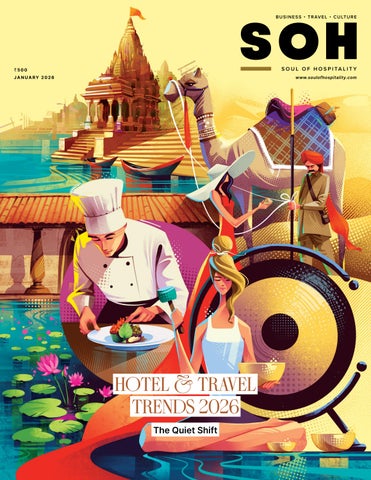
B U S I N E S S • T R AV E L • C U LT U R E
S O U L O F H O S P I TA L I T Y
A500 JANUARY 2026
www.soulofhospitality.com
HOTEL & TRAVEL TRENDS 2026 The Quiet Shift
CREATING LEGACIES WAS A ROYAL TRADITION. KEEPING THEM ALIVE IS OURS.
taj
www.tajhotels.com | reservations@ihcltata.com | 1800 111 825
taj
THE TAJ MAHAL PALACE
TAJ LAKE PALACE
UMAID BHAWAN PALACE
RAMBAGH PALACE
TAJ FALAKNUMA PALACE
MUMBAI
UDAIPUR
JODHPUR
JAIPUR
HYDERABAD
TAJ USHA KIRAN PALACE
TAJ FATEH PRAKASH PALACE
TAJ NADESAR PALACE
JAI MAHAL PALACE
SAWAI MAN MAHAL
GWALIOR
UDAIPUR
VARANASI
JAIPUR
JAIPUR
Mumbai Ashford Chambers, Old Citylight Theatre | Lady Jamshedji Road | 400 016 Mahim, Mumbai 022 2446 7750/51/52/54 | mumbai@pluschliving.com Bangalore No. 37, 4th B Cross, 5th Block | Industrial Layout Koramangala | 560 095 Bengaluru 080 2550 4444 | bengaluru@pluschliving.com Hyderabad Plot No, 761, Rd Number 39 | CBI Colony, Jubilee Hills | 500 033 Hyderabad +91 82972 25491 | hyderabad@pluschliving.com Delhi F 3/1, Okhla Industrial Area | Phase 1, Near Crowne Plaza | 110 020 New Delhi 011-41553333/6789 | delhi@pluschliving.com
6
S O U L O F H O S P I TA L I T Y
FOUNDER'S NOTE
A MEASURE OF CHANGE Every year, the industry is presented with a new list of trends. Some are genuinely new. Many are simply last year’s ideas with better marketing. And a few are wishful thinking dressed up as inevitability. Real change in hospitality rarely arrives that way. It comes through slower, more structural shifts—through where capital starts to flow, where travellers start to spend time, and where operators start to place their longer bets. 2026, to me, feels like one of those years where the noise matters less than the direction. Indian hospitality today is full of momentum. For the first time in decades, infrastructure is not lagging tourism ambition—it is leading it. The map of the country is being redrawn not by advertising campaigns, but by connectivity. Airports, highways, and new transport corridors are quietly changing what is possible, what is viable, and what will soon become inevitable. This is not just expanding the market; it is reshaping it. But momentum by itself does not guarantee distinction. For a long time, our industry has measured success by how efficiently we could replicate what worked elsewhere. That phase is coming to an end. India is no longer asking, “What is global?” It is finally asking, “What is original?” The next cycle will not reward scale alone. It will reward clarity of intent. One of the clearest places where this will play out is in branded residences. The category is already established. The real question now is whether we use it primarily as a financial instrument, or whether we treat it as a serious cultural and lifestyle proposition—or, ideally, both. The opportunity is no longer in proving demand. It is in deciding what these projects actually stand for. Whether they are conceived as extensions of real estate thinking, or as true extensions of hospitality thinking. Over time, that difference will matter far more than who signs them. The biggest under-monetised opportunity in Indian hospitality today is wellness.
Globally, wellness has already moved into a serious business—built around longevity, diagnostics, performance, recovery, and mental health. Markets like Bangkok and others have understood this early and turned it into a destination economy. India, despite its population, its medical depth, and its cultural familiarity with health and longevity, has barely begun to act. We are, quite simply, sitting on a goldmine and leaving it largely untouched. What makes this even more puzzling is that India is one of the few markets that can credibly operate across the full spectrum—from advanced medical and longevity science to deep, structured therapeutic systems—within a single, coherent framework. Very few countries can do both. Fewer still can do it at scale. This is not a question of philosophy. It is a question of timing and execution. Running through all of this is a third shift that will define the next phase: design. Not design as decoration. Design as strategy. Around the world, there are cities and destinations whose hotels are recognisable before a name is attached. In India, we still rely too much on branding to do that work for us. The next competitive advantage will come from presence—from architecture and spaces that communicate confidence, context, and taste without explanation. And this is not a question of budgets. Good design is not the privilege of luxury alone. A well-conceived midmarket hotel can have more character and clarity than an expensive but generic one. The difference is not money. It is good design. At Soul of Hospitality, we have never believed our role is to chase the industry’s noise. It is to look past it— to separate movement from direction, and fashion from future. 2026, for us, is not about being louder. It is about being sharper. More selective. More deliberate.
GURMEET KAUR SACHDEV gurmeetsachdev@soulinkkworldwidemedia.com
JANUARY 2026
7
ED'S LETTER S O U L O F H O S P I TA L I T Y
WHERE CONNECTION BECOMES LUXURY There are so many things we can do differently in 2026, particularly when it comes to hospitality and travel. After a year of living through uncertain times—when climate change and nature’s fury have transformed our surroundings and our lives, hitting us almost like a comet—and a year-end of indulgence followed by rest, what we are seeking now are pockets of comfort and familiarity. As we flip the calendar, we carry forward a year of discoveries—both unexpected and transformative—and look ahead to fresh horizons. This is where the hospitality and travel industries can play a stellar role. Our Trends 2026 cover story explores how the appetite for speed, scale and spectacle is quietly fading, replaced by a longing for depth, presence and feeling. Journeys are no longer about how far we go, but how deeply we arrive—into places, cultures and moments that linger. Hotels are becoming sanctuaries of belonging, tables are turning into sites of memory and conversation, and technology, at its best, is taking a backseat so human connection can take the lead. In this gentler future, luxury is no longer declared; it is felt. Flip through our exhaustive cover story to understand how the sands are shifting. Our other stories include an investigation into how the midmarket hotel segment is evolving; the craft of butlering, which owes its origins to the British Royal Family and has been honed to finesse by modern-day palatial hotels; how The Flavour Lab at The Good Craft Co. in Bengaluru is helping distil information, knowledge and new flavours through a mix of storytelling, R&D, beautiful ferments and great cocktails; and a meditation on travel and books through author Amitav Ghosh’s works. Enjoy the edition, and welcome to 2026. Happy New Year, and wishing everyone a great start to the year.
Warm regards,
Founder and Publisher Gurmeet Sachdev Editorial Editor Deepali Nandwani Managing Editor Rupali Sebastian Contributing Editor Suman Tarafdar Digital Editor Rachna Virdi Contributing Writer Chandreyi Bandyopadhyay Creative Creative Director Tanvi Shah Team Shiv Soni Contributing Artist Cover Illustrator: SAMji Business Head Vipin Yadav Delhi, +91 99998 85515 vipin@soulinkkworldwidemedia.com Sales Manager Deepa Rao Mumbai, +91 9136 000369 sales@soulinkkworldwidemedia.com Head of Events and Alliances Karishma Shah karishma@soulinkkworldwidemedia.com Office Manager Deepak Rao Accounts Head Amey Acharekar For queries: editorial@soulinkkworldwidemedia.com sales@soulinkkworldwidemedia.com info@soulinkkworldwidemedia.com
D E E PA L I N A N DWA N I , E D I TO R , S O H
Printed and Published by Gurmeet Sachdev on behalf of Soulinkk World-Wide Media LLP. Registered office: 1/2, Old Anand Nagar, Nehru Road, Santacruz East, Mumbai, Maharashtra - 400055. Printed at Silverpoint Press Pvt. Ltd., A-403, TTC Industrial Area, Near Anthony Motors, Mahape, Navi Mumbai – 400709. Editor: Deepali Nandwani. All rights reserved worldwide. Reproducing in any manner without prior written permission prohibited. SOH takes no responsibility for unsolicited photographs or material all photographs, unless otherwise indicated, are used for illustrative purposes only. Unsolicited manuscripts will not be returned unless accompanied by a postage pre-paid envelope. All disputes are subject to the exclusive jurisdiction of competent courts and forums in Mumbai only. Copyright Soulinkk World-Wide Media LLP.
8
S O U L O F H O S P I TA L I T Y
CONTENTS
JANUARY ISSUE
ISSUE
17
38
The Soulful Shift Shaping Hospitality, Travel and Dining In 2026, connection replaces scale as the ultimate currency. From tech-enabled human experiences to food, wellness, and design, a more intentional, emotionally resonant hospitality era is taking shape.
10
S O U L O F H O S P I TA L I T Y
CONTENTS
68
90
Heart Set on India Relais & Châteaux eyes India with passion and purpose.
Memories of Movement Amitav Ghosh reframes travel through history, climate, consequence.
74 Decade of Serendipity Sunil Kant Munjal on India’s most ambitious arts festival.
82
36
India’s Middle Shift Hospitality majors chase growth in Tier 2 and 3.
Japan via Delhi Oju by Karan Johar celebrates Japanese craft and cuisine.
10 6 Inside 25hours Zurich At Langstrasse, design meets play, culture, and character.
24
12
Spirited Storytelling Diageo’s Flavour Lab in Bengaluru reimagines Indian craft.
A Gateway in Bloom NMIA redefines Indian aviation with elegance.
JANUARY 2026
11
SOH | AIRPORT
A LOTUS FOR THE LONG HAUL At Navi Mumbai International Airport, Zaha Hadid Architects translate India’s national flower into form, light and movement—crafting an edifice that reflects the country's growing confidence on the world stage. R U PA L I S E B A S T I A N
The NMIA terminal unfolds like a lotus in bloom, merging cultural symbolism with contemporary airport design.
12
Indians are travelling like never before. Domestic passenger numbers have surged past pre-pandemic levels, international routes are expanding at pace, and airports are no longer treated as mere transit points but as powerful statements of intent. Increasingly, they function as destinations in their own right— places where first impressions are formed, time is spent, and identity is encountered. In the last decade
S O U L O F H O S P I TA L I T Y
alone, the country has quietly assembled a portfolio of aviation architecture that stands shoulder to shoulder with the world’s best—from Delhi’s light-filled Terminal 3 and Mumbai’s sculptural Terminal 2, to Bengaluru’s gardenled Terminal 2 and Hyderabad’s efficient, art-forward hub. It is into this confident, fastmoving landscape that the Navi Mumbai International Airport (NMIA) enters—not as an add-on or overflow facility, but as a longanticipated second act to India’s financial capital. Designed by Zaha Hadid Architects (ZHA), NMIA arrives with a clarity of ambition: to handle scale without stress, to embed cultural meaning without spectacle, and to offer travellers an
JANUARY 2026
experience that feels unmistakably Indian yet globally fluent. Now operational, the airport is more than an addition to India’s aviation infrastructure. It reflects a generational shift in how the country is beginning to imagine its gateways to the world. Inaugurated by Prime Minister Narendra Modi, the airport was framed as part of India’s next phase of infrastructureled growth, with emphasis placed on connectivity, regional development and the role of worldclass airports in shaping a confident global image for the country.
From catching up to setting benchmarks
expanding capacity, unclogging terminals, keeping pace with demand. That phase is decisively over. Mumbai’s Terminal 2, with its peacock-inspired columns and the monumental Jaya He GVK New Museum, demonstrated that scale and soul could coexist. Delhi’s Indira Gandhi International Airport brought efficiency and clarity to one of Asia’s busiest hubs. Hyderabad proved that passenger comfort and operational logic need not be mutually exclusive. And Bengaluru’s new Terminal 2, with its living walls and biophilic ethos, reframed the airport as a garden rather than a machine. NMIA enters this lineage with a
For years, India’s aviation narrative was defined by catching up—
slightly different emphasis. Rather than foregrounding narrative
13
SOH | AIRPORT
through applied art or interior interventions, ZHA’s approach allows form, structure and spatial sequencing to carry meaning. The story unfolds through geometry, light and movement—experienced gradually, rather than announced.
The lotus as structure, not motif At the heart of NMIA’s design lies the lotus—India’s national flower and a symbol layered with cultural, philosophical and artistic resonance. In Indian thought, the lotus stands for purity, resilience and transcendence, rising untainted from murky waters. It appears in Hindu, Buddhist and Jain traditions, in temple ceilings and palace reliefs, and in everything from classical painting to modern iconography. For ZHA, the lotus is not a decorative reference but a generative idea. The terminal’s roof unfolds as a series of overlapping, petal-like forms that radiate from a central point, creating a spatial logic that is both intuitive and expressive. The fluidity of these forms echoes the studio’s long-standing exploration
AIRPORTS AS CULTURAL STATEMENTS Across the world, major airports are increasingly conceived as expressions of place rather than neutral transit infrastructure.
14
Navi Mumbai International Airport, India
Changi Airport, Singapore
The lotus—purity, resilience and transcendence—reimagined through contemporary architecture.
Nature-led planning with gardens and immersive landscapes.
S O U L O F H O S P I TA L I T Y
of curves and movement—an architectural language closely associated with the late Zaha Hadid herself, often described as the Queen of the Curve. From above, the airport reads as a flower in bloom; from within, the geometry guides movement, light and orientation. The central terminal space is conceived as a metaphorical lotus pond, with concourses extending outward like petals. This radial planning simplifies wayfinding while also allowing the airport to expand in future phases without disrupting its core logic.
Engineering grace at scale
Light filters through sculpted columns, creating an interior that feels expansive without overwhelming scale.
What makes NMIA particularly compelling is how seamlessly its expressive form is reconciled with engineering discipline. The roof structure is supported by a sophisticated system of columns— some sculptural and visible, others massive and concealed—working together to carry vast spans while maintaining visual lightness. Daylight plays a starring role. Continuous skylights trace the curves of the roof, calibrated to admit soft, diffused light while
Denver International, USA
Beijing Daxing, China
Hamad International, Qatar
Tensile forms evoking the snow-capped Rocky Mountains.
Phoenix-inspired roof symbolising unity and movement.
Fluid forms referencing desert dunes and marine geography.
JANUARY 2026
15
SOH | AIRPORT
A new geography for Mumbai—and Maharashtra
minimising heat gain. Glass façades and carefully articulated latticework draw inspiration from lotus leaves and traditional jaali patterns, allowing natural light to filter through while providing shade and ventilation. In a city defined by humidity, monsoons and glare, these decisions are as pragmatic as they are poetic. The construction itself has relied heavily on modular, prefabricated components, allowing for precision at scale and faster assembly on site. It is a reminder that contemporary airport architecture is as much about logistics and sequencing as it is about form.
DESIGN HIGHLIGHTS:
NAVI MUMBAI INTERNATIONAL AIRPORT
NMIA’s significance extends far beyond architecture. For decades, Chhatrapati Shivaji Maharaj International Airport operated as one of the world’s busiest singlerunway airports, stretching capacity to its limits. Navi Mumbai was always envisioned as the release valve—but also as an opportunity to rebalance the region’s growth. The new airport will also serve passengers from Pune, western Maharashtra, Satara and Kolhapur. Located in Ulwe, NMIA anchors a new aviation geography for the Mumbai Metropolitan Region.
ARCHITECT
ZAHA HADID ARCHITECTS, UK
LOCATION
ULWE, NAVI MUMBAI
PLANNING LOGIC
CENTRALISED TERMINAL WITH INTUITIVE, PETAL-LIKE CIRCULATION
KEY SPATIAL ELEMENT
CENTRAL ATRIUM CONCEIVED AS A LOTUS POND METAPHOR
FAÇADE STRATEGY DESIGN MOTIF
LOTUS-INSPIRED ROOF AND RADIAL CONCOURSE LAYOUT
16
With direct links to the Mumbai Trans Harbour Link, upcoming metro corridors and suburban rail connections, the airport is designed as a true multimodal hub. Travel times from South Mumbai have already reduced dramatically, and the ripple effects on real estate, hospitality, logistics and employment are inevitable. At full build-out (by 2037), NMIA is expected to handle up to 90 million passengers annually, placing it firmly among the world’s major aviation hubs. Cargo operations are also set to expand over time, strengthening Mumbai’s role in global trade networks.
GLASS AND JAALIINSPIRED SCREENS FOR DAYLIGHT CONTROL AND VENTILATION
S O U L O F H O S P I TA L I T Y
THIS SPREAD, LEFT TO RIGHT FROM FAR LEFT: Curved ceilings soften scale and perception; structure and light guide intuitive movement; geometry replaces ornament across interiors; movement becomes measured and intuitive within a space designed for flow rather than haste.
NAVI MUMBAI INTERNATIONAL AIRPORT
AT A GLANCE LOCATION
ULWE, NAVI MUMBAI SITE AREA
~1,160 HECTARES PASSENGER CAPACITY
Sustainability as an operating logic Sustainability at NMIA is embedded quietly rather than advertised loudly. The lotus-inspired roof aids passive cooling and daylight optimisation. Water management systems are designed to respond to heavy monsoon cycles, with rainwater harvesting and recycling integrated into the airport’s operations. Renewable energy generation and future-ready infrastructure for cleaner aviation fuels form part of the airport’s longer-term vision. In many ways, Navi Mumbai International Airport feels less like a statement and more like a signal. Its ambition lies not in spectacle, but in how assuredly
JANUARY 2026
it handles scale, complexity and cultural reference without insisting on attention. The experience of moving through the terminal— guided by light, curvature and spatial clarity—reflects a growing maturity in how India is shaping its public infrastructure. For a city-region long defined by pressure—of density, demand and constant movement—NMIA offers a different rhythm. It suggests that growth need not always be frantic, that infrastructure can be expansive yet humane, expressive yet efficient. As travellers arrive and depart through its lotus-shaped roof, what they encounter is not a symbol to decode but an environment to inhabit.
PHASE 1: ~20 MILLION PASSENGERS ANNUALLY ULTIMATE BUILDOUT: ~90 MILLION PASSENGERS ANNUALLY
RUNWAYS
TWO PARALLEL RUNWAYS (PHASED ACTIVATION)
TERMINAL PLANNING
MODULAR, MULTITERMINAL MASTERPLAN ALLOWING EXPANSION WITHOUT OPERATIONAL DISRUPTION
ROLE
DESIGNED TO OPERATE AS PART OF MUMBAI’S MULTI-AIRPORT SYSTEM ALONGSIDE CSMIA
17
S O H | R E S TA U R A N T S
WHERE EVENINGS LINGER At 1932 Trevi in Jaipur, architecture, ritual and cuisine come together to reimagine dining as an act of memory—unhurried, layered and quietly immersive.
R U PA L I S E B A S T I A N
An arched opening sets up Trevi’s spatial rhythm, where architecture unfolds in measured sequences.
18
S O U L O F H O S P I TA L I T Y
CLOCKWISE FROM LEFT: Indoor dining balances Italian romance with the warmth and pace of Jaipur evenings; Italian technique surfaces quietly, calibrated for sharing rather than spectacle; Cuisine mirrors the space— layered, restrained, and meant to be lingered over; a quintessential Rajasthani bagh is reimagined as a serene white garden, anchored by a central fountain.
In the early evenings of Jaipur, when the air cools and
DESIGN CUES TO LOOK FOR
JANUARY 2026
The padma (lotus) motif recurring across architecture and tableware
The bagh as the spatial anchor
Shifts in colour and mood across dining zones
Bespoke elements conceived as memory triggers
the city exhales, gardens begin to reveal their true purpose. This is when peacocks appear without announcement, conversations stretch longer than planned, and leisure—once a royal privilege— feels quietly reclaimed. It is within this rhythm that 1932 Trevi situates itself, not as a restaurant to be visited, but as a setting to linger in. Trevi is imagined as a picnic hosted by a maharaja in his garden—not a grand feast, but an intimate, unhurried gathering shaped by memory, travel and indulgence. The idea is less about historical accuracy and more about atmosphere: the ease of dining outdoors, the pleasure of shared plates, the layering of cultures brought home from distant journeys. The restaurant is set within Santha Bagh, a family estate dating back to 1932 subsequently converted into a boutique hotel. Once the garden edge of a heritage haveli, this tract of land had gradually slipped into neglect, its role as a social garden all but
forgotten. Yet traces remained—the stillness of the trees, the presence of peacocks, the sense that this was always meant to be a place of pause. Rather than overwrite this history, 1932 Trevi builds upon it. What unfolds in the newly built space is neither nostalgia nor spectacle, but a contemporary reimagining of how people once gathered—slowly, intentionally, and with pleasure at the heart of it.
A vision rooted in time and place The founding intent behind 1932 Trevi is shaped by an understanding of hospitality as something experiential rather than transactional. For founder Namokar Jain, the restaurant was never meant to be a surfacelevel fusion or a stylised homage. Instead, it was conceived as an emotional bridge—between eras, cultures and states of mind. “From the beginning, the intent was to create a space that feels like stepping into a memory you didn’t know you had,” Jain explains. Italian romance lends the project its timeless elegance, while Indian
19
S O H | R E S TA U R A N T S
heritage brings warmth and depth. The relationship between the two is not performative but intuitive—old Jaipur meeting an imagined Rome of the 1930s.
The meaning of 1932 The number that anchors the restaurant’s name is not a branding device, but a deeply personal reference point. 1932 marks the year the heritage home at Santha Bagh was built—a space layered with family memory and lineage. For Jain, naming the restaurant became an act of continuity rather than reinvention. “1932 grounds the space in legacy,” he notes, “while Trevi evokes romance, travel and aspiration—together anchoring the restaurant emotionally, not just aesthetically.” This sense of grounding finds its most tangible expression not in symbolism alone, but in how the space itself is organised, proportioned and revealed. ABOVE: A coin-toss ritual at the fountain marks the close of the meal, extending the restaurant’s experience beyond food. BELOW: Colour becomes a tool for mood—moving from theatrical intensity to quiet calm across Trevi’s spaces.
Architecture as a sequence, not a statement Interior designer Shantanu Garg approached Trevi as a spatial narrative rather than a singular design gesture. Instead of one dominant dining room, the restaurant unfolds across multiple zones arranged around a central garden, each carrying its own emotional register. The 'bagh' forms the spatial and emotional anchor of the project. Rendered in whites and soft neutrals, it allows light, greenery and movement to take precedence. The effect is calming rather than dramatic—a space calibrated for lingering rather than display. From here, the experience shifts. The Plume Bar introduces
20
S O U L O F H O S P I TA L I T Y
deeper tones and a more intimate scale, drawing from the symbolism of the peacock. In contrast, the Vanity Room—washed in scarlet— embraces theatricality, imagined as a private chamber that brings indulgence into the narrative. The Tuscan Alley, narrower and more kinetic, references Italian street cafés, encouraging movement and informal interaction. Together, these spaces ensure that Trevi is never experienced in a single way.
Detail as memory-making At 1932 Trevi, detail is not decorative—it is mnemonic. Motifs, materials and objects are deployed quietly, designed to lodge themselves in memory rather than announce intent. This is also where the project’s experiential thinking begins to surface.
It was at this layer that experience designer Jai Sharma’s role became particularly pronounced. Working closely with the founder, and eventually coming on board as a partner on the project, Sharma approached Trevi as a permanent experience— one where recall would be shaped as much by the smallest gestures as by the architecture itself. “When a space has a reason for existing beyond its aesthetics, that’s when it starts telling a story,” Sharma notes. At Trevi, this translates into repetition, symbolism and tactile cues that operate subconsciously. The padma, or lotus, emerges as a unifying geometry, appearing across architectural details, bespoke tableware and furniture accents. Rather than
being applied ornamentally, it is extracted from the space’s underlying geometry, allowing it to function as a cohesive thread. Material choices follow a similar logic. Brass accents, handcrafted elements and textured surfaces sit alongside cleaner contemporary lines. Italian references—arches, fountains and colour cues—are filtered through an Indian sensibility, resulting in a space that feels layered rather than hybrid. Among the most emblematic design elements is a custom cake caddy, conceived not as a conventional tiered stand but as a sculptural tree. Branching into lotus-shaped leaves, it brings together the garden setting, the padma motif and the idea of shared indulgence.
The piano brings sound into the garden, lending evenings a sense of ceremony without formality.
JANUARY 2026
21
S O H | R E S TA U R A N T S
COUNTERCLOCKWISE FROM TOP RIGHT: The Vanity Room leans into saturated colour and drama; a planted corner offers moments of pause; miniature-style artwork draws from Rajasthan’s royal past; interactive dining moments turn preparation into performance; The Plume Bar deepens the mood with darker tones.
Experience as an extension of design While architecture and spatial details establish atmosphere, Trevi’s spirit is animated through experience. Here, experience is not applied after the fact; it is embedded within the design. A defining ritual concludes each meal: guests receive a custom coin, etched with the year 1932 and a peacock emblem, and are invited to toss it into the fountain at the heart of the garden. The gesture draws from Indian and Roman traditions alike, transforming departure into participation. “For me, experience can be as simple as the first greeting or the final moment when the bill arrives,” Sharma reflects. “It’s about what memory you take back from the space.” Sound and performance further animate the garden. A grand red piano beneath a banyan tree introduces live music, lending the outdoor setting ceremony without formality. Golden High Tea and the Pasta Atelier extend this philosophy, turning dining into an unfolding experience rather than a fixed event. Over time, these gestures revealed something essential. “Our guests showed us how they wanted to inhabit the space,” Jain observes. “Their rhythm shaped ours, allowing Trevi to evolve from a restaurant into a lived experience.”
Food as cultural conversation At 1932 Trevi, food mirrors the logic of the space. Rather than announcing itself as a fusion kitchen, the menu operates
22
S O U L O F H O S P I TA L I T Y
THE RITUALS THAT SHAPE TREVI
The coin-toss ritual at the fountain
Live piano performances beneath the banyan tree
Golden High Tea shaped by Jaipur’s evening culture
The Pasta Atelier as an interactive culinary moment
through restraint, allowing Italian technique and Indian sensibility to sit alongside one another without collapsing into mindless novelty. Classic Italian preparations anchor the offering, approached with sensitivity to place. Sauces are lighter, textures cleaner, and portions calibrated for sharing rather than formality—echoing the idea of a picnic rather than a coursed meal. Indian ingredients surface not as decorative twists, but as quiet inflections, introduced where they feel instinctive rather than imposed. There is no urge to overIndianise dishes or dramatise ingredients for effect. Instead, the conversation unfolds through balance—through warmth, familiarity and food designed to be lingered over. In Trevi’s ecosystem, cuisine does not perform in isolation. It works in quiet alignment with space and ritual, sustaining conversation and encouraging return rather than demanding attention.
A contemporary expression of legacy Within Jain’s wider hospitality portfolio, Trevi represents a moment of refinement and maturity. It signals a belief that fine dining can feel warm, and that heritage can remain alive rather than preserved. By allowing architecture, experience and hospitality to operate in quiet harmony, 1932 Trevi offers a measured interpretation of luxury—one rooted in intimacy rather than excess. As evening settles over Santha Bagh, the piano softens, the fountain catches the last light, and the garden returns to its rhythm. What lingers is not just the memory of a meal, but the feeling of being hosted—slowly, thoughtfully, and with intent.
JANUARY 2026
23
SOH | EXPERIENCE
WHERE INDIA’S LIQUID PAST IS DISTILLED FOR THE FUTURE Tucked away in an unlikely corner of Bengaluru, The Flavour Lab by The Good Craft Co. is where India’s ancient relationship with spirits meets modern science, storytelling and sensory exploration.
D E E PA L I N A N DWA N I
Within the Vydehi Institute
THIS SPREAD, CLOCKWISE FROM LEFT: A curated spirits showcase reflects the Lab’s role as a testing ground for Indian craft; The Flavour Lab by The Good Craft Co. in Whitefield, Bengaluru—a controlled sensorial environment where spiritmaking, fermentation and storytelling converge under one roof; Vikram Damodaran, Chief Innovation Officer, Diageo India, whose vision anchors The Good Craft Co.; a living archive of ferments underscoring the Lab’s experimental, process-led approach to flavour.
24
of Medical Sciences and Research Centre in Whitefield, Bengaluru, stands a centre dedicated to craftsmanship, innovation and experience in the world of spirits. The Flavour Lab by The Good Craft Co. is Diageo’s sensorial experience home, where a group of alchemists—from fermenters and chemists to bartenders—think up new ways to make spirits and ferment just about every ingredient. The location within a medical sciences research facility is mandated by government regulations, since the centre handles high volumes of spirit. Here, centuries-old traditions of spirit making and experimentation
S O U L O F H O S P I TA L I T Y
come together to create new expressions of Indian craft spirit. The Good Craft Co. and the Flavour Lab is where those deeply interested in the world of spirits and fermentation are offered experiences, workshops and talks by the passionate team that leads the venture. As Vikram Damodaran, Chief Innovation Officer, Diageo India, says, “The idea for The Good Craft Co. came from a simple question— what does ‘good craft’ really mean in the Indian context? India has a 4,000-year-old relationship with spirits and fermentation, yet much of that legacy has stayed hidden or undocumented. We wanted to celebrate that history while creating space for the new wave of Indian makers redefining what craft can be today. There was no dedicated space where people could see or experience the process behind the bottle or learn about our liquid heritage.” Yet, TGCC is more than just an experience centre. It works to put India’s rich spirits traditions on the map through storytelling of Indian spirits craftsmanship, bringing together R&D, craft stories, ideas and experiences under one roof to create a unique direct-to-consumer experiential ecosystem. Rich stories of sourcing, ingredients, provenance, indigenous craft distillation, and maturation and finishing processes are narrated. The centre also collaborates with homegrown players across spirit segments, offering R&D facilities to create new tipples and access to advanced equipment, technology and controlled environments for small-batch experimentation. “Our goal is to strengthen India’s craft ecosystem in every sense, from research and education to innovation and entrepreneurship,” says Damodaran. “For the industry and start-ups looking to create new products, the Lab provides
JANUARY 2026
25
SOH | EXPERIENCE
the tools and expertise needed to experiment with ageing, fermentation and flavour development.” Among the new iterations The Flavour Lab has helped nurture is Nao Spirits’ limited-edition Punk Gin, which used real Mahabaleshwar strawberries instead of flavour substitutes. On a balmy Bengaluru day, I explored this fascinating world where science meets spirits meets tradition. The sprawling space is divided into four zones, each with a different function and character, one segueing into another. The Entry Zone is where we are welcomed with a glass of refreshing sugarcane juice with lemon, fermented and aged by Payal Shah, Shepherd of Microbes and founder of Kobo Fermentary. From here, the experience moves through The Academy, The Walkthrough and the Bar and Fermentary, each zone building on the last to reveal the science, craft and flavour behind Indian spirits. “When consumers walk through the Lab, they see every stage of the process from grain to glass.
If it’s a gin session, for instance, they are introduced to botanicals like juniper and gondhoraj that they can touch, smell, or taste to understand how each ingredient contributes to the final spirit,” says Damodaran. The world of flavours and spirits I am introduced to finds resonance across the five-hourlong experience. It is present in the ingredients we sniff and understand during the whisky workshop; in the scents we encounter during the walkthrough, when we are asked to sniff and identify them; and in the fermentary, where Shah takes us through the wildly fascinating world of fermentation and flavours.
26
S O U L O F H O S P I TA L I T Y
THIS SPREAD, CLOCKWISE FROM BOTTOM LEFT: Warm materials and controlled lighting soften the technical nature of the space; Mugdha Gupta narrates research-led stories shaping India's evolving spirits landscape; curated walkthroughs introduce guests to the science and craft of fermentation and flavour development; at The Bar at The Flavour Lab, mixologist Neil Alexander draws directly from in-house ferments and Diageo’s Indian spirits portfolio.
PART LAB, PART EXPERIENCE CENTRE, PART LEARNING HUB. ENTIRELY IMMERSIVE. The Academy grounds the experience in history and context, anchoring whisky within India’s long and layered relationship with spirits. From there, the journey moves seamlessly into The Walkthrough zone, shifting the focus from storytelling to science, and from the past to the present. The segment is visually engaging, with ingredients used
JANUARY 2026
They’re different because of our microclimates, our ingredients, and the curiosity of people who want to try new things,” she adds. Right behind where we sat was The Real Spirits Map of India and, for a spirit nerd who likes to tuck away little bites of information, it introduced you to everything from fishtail palm toddy to Rohi from the northeast, Kesar Kasturi from Rajasthan, and Chhang from the Himalayan belt. Gupta reveals that they work with a historian for heritage spirits—the most niche of niches—founded and studied in universities. His role involves travelling across the country to understand what spirits are being made and served in different regions, going beyond recipes to trace their connection to land, people and memory. “Somewhere along the way, we realised that India has a very rich and very old history of spirits and distillation,” she says. Traces of distillation have been found in places like Mohenjodaro, pointing to a legacy that stretches back thousands of years and remains deeply embedded in local cultures.
The wall of alchemy in various whiskies being passed around, along with an audio-visual element. Mugdha Gupta, Senior Manager, Innovations speaks about how whisky historically came to India through the British, much like the railways. “Scotch was imported for British officers via the East India Company. Over time, Indians working alongside the British were exposed to these spirits and began to aspire to them. Imports were limited and expensive, so people began experimenting with what they had access to. That’s where the early story of Indian whisky begins.” The evolution from then to now has been startling. Today, “Indian single malts are unique.
An arresting stops on this journey is the Fermentary, where Shah ferments and matures a host of ingredients into sauces and pickles—some destined to find their way into the drinks you taste later at the bar. A vibrant wall lined with jars, some a week old and others several months into their transformation, reads like a living gallery of flavour. The air is thick with scent, pulling you into a world of aromas you didn’t know existed. Shah has worked with ingredients ranging from banana peel and citrus fruits to chillies, mangoes and grapes, a universe she has built alongside her friend and chef Candice Lock of Chinita. When I visited, more than
27
SOH | EXPERIENCE
50 ferments were stacked along the wall like layered artworks, each jar alive with microbes doing their quiet magic under her watchful eye. A few ferments are set out for tasting—mango and chillies among the standouts—offering a glimpse into how microbes shape flavour over time. “Microbes are in every one of these, doing fun things and making flavour,” Shah explains, referencing a spectrum that spans kombuchas, lacto-ferments, wines and vinegars, including experiments such as an old-style tonic made with cinchona bark. Here, fermentation is less about finish and more about exploration— ingredients tested, understood and, eventually, translated into the drinks served at the bar. Anchoring this zone is the interactive Wheel of Fortune, positioned between the Fermentary and the Bar, inviting a playful deep dive into Indian flavours—some
COUNTERCLOCKWISE FROM TOP: Ferments developed in the Lab find their way into sauces, pickles and select cocktails at the bar; fermentation as dialogue—guests smell, taste and observe flavour at different stages of transformation; Payal Shah leads fermentation and maturation experiments within the Lab.
scarcely documented. Spin it to pair sweet with tropical or herbal with masala; the outer wheel lists 36 ingredients, such as gondhoraj lemon and green peppercorns, offering a glimpse of what might soon be steeped in your glass.
The bar experience At the end of this flavourfilled journey is the Bar, where mixologist Neil Alexander brings together spirits such as Godawan’s range of whiskies, the results of the fermentary within the centre, and his own skills to create cocktails and tasting experiences that must be booked in advance. Among the whiskies we taste is Godawan Series 02, a rich, rounded single malt crafted in the arid Rajasthan climate and aged in a French cherry cask. “Cherry wood infuses the whisky with a little bit of
28
spice, a little woody note. It’s not overpowering, but it does have impact,” Alexander says. Also on the tasting list is the award-winning Godawan 173, the first artisanal liqueur cask-finished Indian single malt, along with Godawan 02 Fruit & Spice, Godawan 01, and gins from their vaults. Alexander doesn’t just introduce us to the whiskies; he walks us through peated and non-peated styles, introduces Indian Single Grain Whisky, and explores the use of ingredients such as gondhoraj lemon and raw mango in the drinks. The first cocktail features a fortified spiced wine with bergamot hydrosol, honey and a touch of hickory wood smoke—never too much. “Ultimately, balance is key,” he smiles. It is the best possible end to a day filled with flavour, discovery and scent.
S O U L O F H O S P I TA L I T Y
S O H | G L O B A L F O OT P R I N T
FROM NEW DELHI TO THE WHITE HOUSE Rasika, Washington D.C’s pioneering Indian restaurant, turns 20. Restaurateur Ashok Bajaj and Chef Vikram Sunderam reflect on the menus and mindset that took Indian cuisine to powerful tables.
N A I N A A R A J PA A L
Washington D.C. has no shortage of power lunches and diplomatic dinners, but few restaurants have become as synonymous with global leadership as Rasika. It was founded in 2005 by restaurateur Ashok Bajaj, a native of New Delhi who sought to transform perceptions of Indian cuisine in the United States. The restaurant’s name—Rasika—comes from Sanskrit and loosely means “one who appreciates flavour,” reflecting its focus on rich, layered tastes. The restaurant has played host to the likes of Indian Prime Minister Narendra Modi and the Obama couple, won a James Beard award for its chef, and has featured in the Michelin guide as one of the best Indian restaurants in the city. As the iconic restaurant celebrates 20 years this year, SOH sat down with restaurateur Ashok Bajaj and Chef Vikram Sunderam to trace the decisions that took Indian fine dining from India to the U.S.
30
Chef Sunderam, you are described as an ambassador for Indian cuisine, especially after winning the James Beard Award. How do you view that role? It is not something one could realistically aspire to. Growing up in Mumbai, I watched my mother whip up dishes in a jiffy. I was fascinated, and that’s when I realised Indian cuisine has one of the widest palates to play with— the flavours and ingredients from every corner of the country, every state and city come with a unique taste. I take pride in presenting these Indian flavours to the world.
Rasika’s menu eschews regional labels around food. How do you decide which Indian flavours translate best for an international audience? Ashok Bajaj: Rather than leading with geography, we lead with flavour and technique. For example,
S O U L O F H O S P I TA L I T Y
Dal Rasika doesn’t announce itself as a northern Indian dish, even though that’s where you’d commonly find it.
more stringent protocol to follow. There are discussions with the team, understanding their likes, dislikes, and allergens, of course.
Chef Sunderam: Yes, it’s slowcooked and deeply spiced, but restrained enough to feel familiar even as a European comfort food or soup. This approach allows guests to experience Indian cuisine instinctively, without needing to decode where a dish comes from.
Chef Sunderam: Honestly, we cook for every person like they are a VIP. When an order is placed at the restaurant, the kitchen gets genuinely excited to put its best foot forward. We love hearing feedback from anyone who comes to the restaurant.
Rasika has hosted several distinguished guests. How does that change the way you approach a menu?
Barack and Michelle Obama marked the former President’s birthday with a special meal from Rasika. Can you tell us more about the experience?
Ashok Bajaj: There is, of course, a THIS SPREAD, CLOCKWISE FROM BOTTOM LEFT: Chef Vikram Sunderam; New Delhi-born restaurateur Ashok Bajaj; Turkey Dum Potli; Chef Sunderam with PM Modi and President Biden; Rasika's contemporary interior; the Gujarati Lasagna, created as a modern fusion of regional Indian flavours.
Chef Sunderam: We made the Palak Chaat, Crisp Spinach, cooling yoghurt, all matched with the gentle sweetness of chutneys that are easy on the palate and appeal to seasoned Indian-food lovers and first-time diners alike—which is why they have remained on the menu for so long.
One of Rasika's most talkedabout moments was the
JANUARY 2026
creation of Gujarati Lasagna for Prime Minister Narendra Modi. How did that dish come together? Chef Sunderam: We wanted to honour Prime Minister Modi’s love for Gujarat. The Gujarati Lasagna is a modern dish with flavours familiar to him. It features Khandvi (thin rolls of gram flour, buttermilk, and turmeric) filled with a tomato sauce made with eggplant and zucchini, and topped with a sauce of mustard, fenugreek, and other spices. It is served on circular portions rather than traditional slices, along with Kadhi, a spiced gravy of chickpea flour and yoghurt.
After two decades, what defines Rasika beyond awards and high-profile diners? Ashok Bajaj: Consistency, or the ability to deliver the same level of experience every day. That is what builds trust, longevity, and might we say nostalgia? We believe Indian cuisine will rise to the same level of popularity in the U.S. as Italian and Mexican cuisines.
31
SOH | TRENDS
BHAJAN CLUBBING IS REWRITING THE NIGHTLIFE SCRIPT A reflective dive into a growing cultural phenomenon that is reshaping nightlife. R AC H N A V I R D I
32
It’s 10 p.m. on a Saturday. The city hums with its usual neon promise, but somewhere in a rooftop studio, the glow is softer, more saffron instead of strobe. The bass still thrums, the crowd still sways, the air still vibrates. But the soundtrack isn’t techno or Bollywood remixes. Chants of Om Namah Shivaya are layered over lo-fi beats. Hands are folded as often as they are raised. It’s tea, not tequila. And it’s a generation choosing to be high on harmony, not hangovers. Welcome to Bhajan Clubbing, Gen Z’s cultural pivot and the hospitality world’s newest frontier.
S O U L O F H O S P I TA L I T Y
CLOCKWISE FROM OPPOSITE PAGE: Young people gather at club-like spaces to chant bhajans in a modern, high-energy style; Bhajan Clubbing is the new nightlife; events by Krishna Das are attended by Virat Kohli and Anushka Sharma; American artist Krishna Das.
A new kind of night out Bhajan Clubbing is a new kind of nightlife that invites joy without judgment, community without chaos, celebration without intoxication. It blends India’s devotional tradition with the sensory pulse of modern nightlife. Think high-energy chanting in a club-like setting, minus the chaos or the cocktails. It’s not a satsang, not a rave, not a spiritual workshop, but a curated nightlife experience that replaces indulgent nighouts with some sort of 'spiritual' community jamming sessions. Here, Tulsi-rose mocktails sit where margaritas once did. Prasadinspired desserts follow the setlist. And the dance floor becomes a space of collective emotion. For a generation exhausted by hustle culture, performance pressure, and digital overstimulation, this cultural space offers a sense of peace and solace. A place where they can show up as they are, surrounded by strangers who chant like old friends.
JANUARY 2026
The artists turning devotion into a movement American artists such as Krishna Das have long drawn crowds that blur the line between concert and collective meditation. Today’s Bhajan Clubbing wave has its own heroes, who are young, and deeply rooted in tradition. Londonbased kirtan artist and Bhakti Yoga
teacher Radhika Das is the modern pied piper of kirtans and one of the brightest sparks of this movement. His concerts (spanning 30 cities) often sell out, drawing thousands of young people who crave spiritual connection without religious rigidity. His New Delhi event had 15,000 attendees, a record-breaking testament to this cultural rise.
33
SOH | TRENDS
For a generation exhausted by hustle culture, performance pressure, and digital over stimulation, the new cultural space offers a sense of peace and solace.
Before Bhajan Clubbing had a name, Sounds for the Soul, an initiative by singer Nirvaan Birla, started the spark. Birla’s experiential concerts brought sacred sounds to the dance floor, merging symphonic arrangements, devotional lyrics, and modern production. “You don’t need to party to feel alive,” Birla says. “You are the party.” His early shows laid the foundation for what is now a cultural shift sweeping cities. From Kolkata come Backstage Siblings Prachi and Raghav, the brother-sister duo whose viral bhajan jams reintroduced devotional music to an audience
34
that didn’t know it needed it. “Bhajan Clubbing isn't new. It’s just finally being recognised,” they say. “For us, it's not a trend but a deeper cultural movement. People are finally letting go of old stereotypes about bhajan sandhyas and realising that anything bringing them peace, even a bhajan, is worth embracing. That's what Bhajan Clubbing means to us, choosing peace, in whatever form it comes.” What started as childhood memories of following their father to satsangs blossomed into a full-time career after they quit their finance jobs to pursue music. “The energy and
the vibrations we would feel in that one hour felt truly magical. That feeling has stayed with us, and singing devotional songs brings us back to that moment.” The duo’s ticketed Sumiran Satsang events are intimate, baithak-style gatherings where guests sit on the floor, no food or drinks allowed; it is just shared breath, rhythm, and voice.
Who's going Bhajan Clubbing? Everybody, literally. You’ll find a teenager sitting beside a grandparent, young professionals next to parents on a family outing,
S O U L O F H O S P I TA L I T Y
even first dates, friends and solo seekers. The Backstage Siblings say: “We’ve had ages nine to 99 in one room. The magic isn’t the music; it’s 2,000 people chanting as one.” For Gen Z, who often feel disconnected, this togetherness is the draw.
Devotion over drinks For Gen Z, several forces are converging to drive Bhajan Clubbing as a trend: Wellness-first lifestyles: A spiritually charged environment feels more meaningful than traditional clubbing. Cultural reclamation: Bhajans feel familiar yet fresh when wrapped in contemporary soundscapes. Community and belonging: Group chanting releases an emotional high. In a lonely digital age, this collective experience is magnetic. The social media effect: Clips of saffron-lit rooms echoing with voices are wildly shareable. The aesthetic is perfect for Gen Z.
JANUARY 2026
Prachi and Raghav explain, “Today, everyone is busy, caught up in work, gadgets, and looking for an escape. We wanted to offer people a different kind of high, minus the alcohol. A high that comes from music, from bhajans, from sitting together and feeling those vibrations in your body. That feeling is stronger than any substance, and this is the escape we want people to experience.” With cafés in Gujarat hosting weekly bhajan concerts and artists planning multi-city India tours, the movement is becoming part of mainstream urban culture. Psychologist Dr. Mayur Sejpal says, “It’s the best example youth cafés have set across India.”
A hospitality trend in the making India’s spiritual market was valued at $58.5 billion in 2024, with Bhajan Clubbing as a new segment. There is a shift towards 'clean' partying and cultural reconnection, supported by social media buzz and platforms listing over 100 events. The Bhajan Clubbing movement is
ABOVE: Backstage Siblings Prachi and Raghav have reintroduced devotional music to the audience. BELOW: For the Gen Z Bhajan Clubbing is a cultural space that offers peace and solace.
definitely drawing large crowds. Backstage Siblings are planning an all-India Bhajan Jamming Tour starting January 2026, covering 6-10 major metros with 2,500-3,000 people per show. The opportunities are wide open—from culture to commerce. And hospitality players are taking notice. Imagine hotels programming mantra raves as wellness events, lounges hosting spiritual club nights, destination retreats built around devotional nightlife, and corporate off-sites with evening kirtan concerts. For a generation redefining what it means to unwind, this might just be the next long-term hospitality movement. And if the rising crowds, ticketed shows, and chai-fuelled midnight chants are any indication, the saffron glow is only getting brighter. Is the hospitality industry paying attention?
35
THIS SPREAD, LEFT (BELOW) AND RIGHT: Stylishly lit interiors combine natural stone, dark wood and Kyoto-inspired wallpaper. THIS PAGE, LEFT: With Oju, filmmaker Karan Johar brings a slice of Japan to India.
SOH | DINING
TOKYO’S SPIRIT FINDS A HOME IN DELHI Great ambience, innovative cocktails, and premium food—Oju, cofounded by filmmaker, chat show host, and fashionista Karan Johar—raises the bar for Japanese cuisine in India. S U M A N TA R A F DA R
Have you yearned for a Tokyo-style bar crawl— in India? Been spoilt by the unprecedented quality of premium Japanese cuisine in Delhi and the NCR lately? The bar has been raised again. With its innovative menu
36
and cocktail-forward philosophy, the newly opened Oju brings that dream closer. Named after the charming castle town of Ozu on Shikoku, Oju perfectly captures the essence of Japan. It helps that Oju is an extension of Neuma, part of Truepalate Hospitality, founded by Ankit Tayal, Anshul Goel, Vartik Tihara, and filmmaker Karan Johar. Designed by Aayushi Malik, the interiors transport you straight to Ginza—Tokyo’s elegant district of boutiques, restaurants, and coffeehouses. The stylish space features a combination of natural stone, dark wood, and Kyotoinspired wallpaper. Each table features a travertine table lamp, while the floor is interspersed with
S O U L O F H O S P I TA L I T Y
strategically placed floor lamps, imbuing it with a warm hue. The seating spaces in this 120-cover restaurant are uneven—a central open space surrounded by alcoves that lend themselves perfectly to more intimate cosy corners. Choose between high tables, alfresco seating, intimate sofas, small chairs, and, of course, a grand bar.
Cocktails+ But of course, we’re here for the cocktails—and the grub. At the bar, inspirations extend beyond Japan. Conceptualised with Countertop, India’s leading cocktail collective led by Pankaj Balachandran, and executed by Head Mixologist Siya Negi, the menu divides neatly between highballs and signatures. If the names are novel, the menu is a visual delight—each drink is accompanied by images, ingredients, and tasting notes. The Saketini (yep, the cuteness is deliberate) lists sake, vodka, gari brine, rice water, dry vermouth, Aperol, and malic acid—its notes described as “clean, light, floral.”
INSET, LEFT TO RIGHT: Grilled Octopus with Truffle Onion Lime Wafu and Smoked Aubergine Salsa; Black Miso Cod, with Yuzu Mizo Sauce, one of the more popular dishes at Oju.
JANUARY 2026
37
SOH | DINING
I tried the Strawberries and Cream—a house-favourite highball of strawberries, vodka, Lillet rosé, malic acid, and cream soda. Its notes—lush, soft, lingering—were as described. There are multiple enticing choices to explore—Call Me Complex, Yuzu and Koshu, Beet and Miso, Quinoa—the last perhaps a subtle hint to imbibe healthily. Spread your tasting over multiple visits; there’s too much to appreciate in one evening. Other spirits abound, of course—whiskies (blended, Irish, American), liqueurs, beer, pisco, brandy, and an extensive wine list. Sake and soju hold pride of place—premium but worth exploring, especially for Japan returnees nostalgic for Memento Mori, Apéro, or The Grey Room.
RIGHT: The space is peppered with floor and table lamps, adding to the moody ambience. BELOW: Pickled Tomato Sushi is just one of the many sushi options on offer.
Plates—big and small The food magically complements the beverages.. Led by Chef Mahmoud Mohamed Awadalla Gaber (Moh) and Chef Nitin Bhardwaj, both with impressive credentials (think Nobu, Michelin, World Sushi Cup), the menu is built on authenticity. Many ingredients come directly from Japan, while Oju makes its own ferments, pickles, and broths in-house— some simmering for days—to ensure quality. How does Oju stand apart in an already crowded scene? “Authentic with a twist,” says Chef Vinam
38
Bhasin, who’s holding fort this evening. “Japanese cuisine relies heavily on miso and soy. We use two to three types of miso and four to five kinds of soy,” he explains. Originally from Chandigarh, by way of Canada, Bhasin notes that everything—from sauces and shiso leaves to the robata grills—comes from Japan. A visit to Oju, he insists, is an experience. “We didn’t go for dishes India already knows. So, no ramen here. While sushi, sashimi, and tempura are on the menu, guests can explore Japan’s lesser-known comfort dishes such as donabe
S O U L O F H O S P I TA L I T Y
bowls, which are humble one-pot meals popular across Japan.” There are four donabe options; the Mushroom Donabe with Seaweed Butter is highly recommended. Noodle lovers can choose between udon and yakisoba. The Korean-influenced gochujang, which contextualises as the Japanese ‘garam masala’, appears in dishes like Baby Chicken with Ume Gochujang Butter and Crispy Baby Potatoes with Spicy Gochujang Ume Butter—a vegetarian favourite and one of Oju’s aforementioned clever tweaks. Miso soup fans get three variants. The Spinach with Gomadare Sauce deserves encores. There’s the familiar Tuna Tataki with Lime Wafu, or the less familiar options like the Octopus Carpaccio with Sweet Chili Spicy Kombu Sauce or Hamachi with Ponzu Sauce, a chef’s recommendation. The gyoza, mantou, and tempura selections are wide-ranging. Seafood fans can try the strikingly plated Seafood Gyozas with Ponzu Butter Sauce, each with a distinct filling. Signature mains include the Black Miso Cod and Grilled Salmon Robatayaki, both sublime. The Robatayaki section also showcases dishes like Hokkaido Scallop with Lime Soy Butter and Shiso, Octopus Kushi with Yuzu Red Kosho Vinaigrette and Crispy Onion. Or treat yourself with Otoro Kushi—a luxurious cut of seared, fatty bluefin tuna belly, seared and topped with Chili Kosho Vinaigrette and Bonito Flakes. Vegetarians and vegans are well catered for. The yasai tempura made from vegetables may not be common in Kyoto’s eateries, but in India, they are. A notable example is the Ume Mayo, made from Japanese tangy plums that impart a uniquely tart flavour to a dish. Tensuyu, made from dashi, mirin, and soy sauce, is another popular soy sauce.
JANUARY 2026
Sweet endings Informed patrons of the cuisine know better than to skip dessert. From the land of the rising sun and delectable food, Oju offers a mochi selection—go for the coconut. Harder choices come when faced with the Matcha Molten Cake, the Raspberry Yuzu Cheesecake, or the Coconut
Chawanmushi. The right selection? All of the above. It also offers Omakase, available with a day’s prior booking. A suggestion—go with an open mind. You’ll discover flavours both familiar and new, some you’ll likely want recipes for. As expected, the second Oju has already opened in Mumbai, the city KJo calls home.
CLOCKWISE FROM RIGHT: Tiger Prawn Tempura, for those looking for a slice of the familiar; Eggplant with Den Miso; the exotic Yuzu and Koshu combines grape pisco, yuzu cordial, jasmine lillet and olive brine; Beet and Miso is just one of the many unusual combinations in highballs.
39
C OV E R S TO RY
L BA ANCE BECOMES T H E N EW LUXURY In 2026, hospitality, travel, dining, and spirits rediscover their soul, embracing connection, meaning, and balance over excess.
D E E PA L I N A N DWA N I
40
S O U L O F H O S P I TA L I T Y
IF THERE IS ONE UNIFYING THREAD running through the forecasts shaping 2026, it is this: people are no longer optimising life for excess, acceleration or scale. Across food, travel, design and hospitality, the shift is quieter, more deliberate, and deeply human. According to Future Forecast 2026 by UKbased The Future Laboratory, consumers across generations—led by Gen Z and younger millennials—are rewriting the rules of enjoyment. The year ahead is less about singular trends and more about a cultural reset in how people eat, drink, travel, socialise and spend. Balance, presence and emotional meaning are emerging as the new aspirational currencies.
JANUARY 2026
41
C OV E R S TO RY
42
S O U L O F H O S P I TA L I T Y
T R AVEL AND HO S PITALITY Nowhere is this cultural reorientation more visible than in travel and hospitality. The future of the sector is no longer being written in lines of code alone, but in the quality of connection it enables—between people, systems and the senses. Technology remains indispensable, yet its role will increasingly recede into the background, quietly supporting human interaction rather than taking centre stage. Future Forecast 2026 by The Future Laboratory underscores this shift, urging hotels to move beyond fragmented digital touchpoints and think holistically about how guests connect with a brand— emotionally, spatially and intuitively—across the entire stay. Travel and hospitality are shifting towards experiences centred on renewal and reconnection, rather than simply sightseeing or leisure. This calls for journeys that connect travellers to people, place, culture and self-reflection. The Travel & Hospitality Futures report reinforces this direction, calling on brands to foreground humancentred narratives—from curated local engagement to reflective experiences that linger long after checkout. As the report notes, “the future of hospitality is connection between people, systems and senses rather than technology for its own sake.” Hotelivate India’s Hospitality Trends & Opportunities report similarly reframes travel not as escape, but as belonging. Experience-led stays, wellness-inflected itineraries and locally rooted storytelling are increasingly shaping destination choice. For hotels, this signals a move away from
JANUARY 2026
43
C OV E R S TO RY
isolated digital interventions towards coherent, human-centred guest journeys that span booking, stay and post-stay. Technology, in this context, plays a quietly enabling role. Horwath HTL’s Global Hospitality Outlook 2026 identifies AI-driven personalisation, predictive service and seamless digital infrastructure as baseline expectations, but only insofar as they amplify human care. The future is not contactless isolation, but frictionless connection: systems that anticipate needs, support staff empathy, and deepen emotional resonance. India’s hospitality landscape reflects these global shifts with particular clarity. Insights from ANAROCK and Hotelivate point to strong domestic demand, expanding branded supply beyond metros, and the rise of boutique, heritage and alternative stays. Luxury remains resilient, but it is experiential luxury—rooted in wellness, food and storytelling—that earns loyalty. Mid-market and alternative formats are redefining value through flexibility, localisation and hybrid models. Booking.com’s Travel Predictions 2026 further reveal a move away from generic holidays towards highly personalised journeys that express identity, curiosity and values. Travellers are rejecting standardised itineraries in favour of experiences that reflect who they are and what they care about. As travel shifts away from checklist-driven itineraries, value is increasingly measured by emotional impact—by how a stay makes people feel rather than what it lists on paper. Belonging, meaning, and human resonance are shaping journeys, with connection emerging as the defining theme of 2026. Dining mirrors this evolution. The MakeMyTrip– RedSeer Consumer Travel Insights report notes rising demand for experience-led formats—open kitchens, chef interactions, casual fine dining and sensory storytelling. Comfort has become the new luxury, casual dining the preferred social mode, and sustainability, provenance and wellness no longer differentiators, but baseline expectations.
44
S O U L O F H O S P I TA L I T Y
HOT ELS As India heads into 2026, the hotel sector is entering a phase of rare alignment—strong demand, rising rates and sustained investor confidence. Forecasts from Horwath HTL and Hotelivate suggest room demand will continue to outpace supply through FY2028, with occupancies projected at 72–74% by FY'26 and average room rates maintaining upward momentum. Branded hotels closed FY'24–25 at an average occupancy of 68%, among the strongest levels in recent years, supported by healthy ADR and RevPAR growth. Mature hotels—those operational before 2012—are leading performance, operating at around 74% occupancy and delivering significantly higher RevPAR than the national average. This renewed pricing power is already evident. Hotelivate and HVS India commentary points to premium stays bundled with experiential elements— wellness, curated activities and lifestyle-led programming—driving tariff increases of 10–20% on peak dates through late 2025 and early 2026. Indian hotels are entering 2026 with both strong occupancies and the confidence to price for value, underpinned by steady leisure and corporate demand. Supply, meanwhile, is expanding with intent. Horwath HTL estimates that India’s branded hotel pipeline will add over 114,000 rooms by 2030—a nearly 58% increase—taking total inventory past 300,000 rooms by 2029. What stands out is not just scale, but geography. Hotelivate and HVS data show accelerating investment beyond Tier 1 cities, with Tier 2, Tier 3 and emerging destinations drawing both domestic developers and global brands keen to tap India’s deepening domestic travel base. Nearly half of this upcoming supply sits in the mid-market and upper mid-market segments, reflecting sustained demand for branded stays that balance comfort with value. For travellers, this translates into better availability and more consistent standards across newer destinations, widening India’s travel map beyond the metros.
JANUARY 2026
45
C OV E R S TO RY
‘‘
LUXURY CONTINUES TO PULL AHEAD, WITH REVPAR GROWTH OUTPACING MID AND ECONOMY SEGMENTS, DRIVEN BY LEISURE DEMAND AND BUSINESS TRAVEL. Consumer behaviour is evolving in parallel. Insights from MakeMyTrip and Goibibo indicate earlier planning and more deliberate booking, with premium stays gaining traction even among valueconscious travellers. Price sensitivity is increasingly segmented rather than uniform. Spiritual and niche travel is also emerging as a powerful demand driver, with strong accommodation growth reported across pilgrimage destinations—positioning faith-led travel as a meaningful contributor to hotel demand in 2026. Operationally, hotels are adapting to longer and more flexible stays as workations and blended travel become embedded behaviours. Across luxury and upscale segments, technology adoption—from smart rooms to AI-led personalisation—is accelerating, aligned with efficiency and experience goals outlined by HVS and Hotelivate. Wellness-led programming is becoming core rather than ancillary, enhancing perceived value and supporting premium pricing. New business models are gaining momentum as well. MakeMyTrip data shows homestays now account for roughly 10% of room nights sold, reflecting demand for localised, personalised experiences. In response, hotels and OTAs are investing in technology partnerships, AI-powered discovery tools and data-driven revenue management as competition intensifies. Underlying these shifts are strong macro drivers. Corporate travel and MICE continue to anchor
46
performance in hubs such as Mumbai, Delhi and Bengaluru, while domestic tourism—across leisure, festivals and pilgrimage—remains the sector’s most resilient engine. As multiple industry reports underline, India’s hotel market is not just growing; it is maturing—more segmented, experience-led and confident in its long-term fundamentals. Luxury continues to pull ahead, with RevPAR growth outpacing mid and economy segments, driven by leisure demand, business travel and the gradual return of international guests. Yet, as Mordor Intelligence notes, India’s luxury supply remains modest by global benchmarks, leaving ample headroom for expansion. The mid-market, which dominates the pipeline, presents a more uneven picture, particularly in Tier 2 and 3 markets where supply risks outpace demand. Here, operational discipline, technology adoption and the ability to serve bleisure and extended stays will be decisive. Meanwhile, alternative stays—boutique hotels, heritage conversions, branded villas, and homestays— are emerging as experience-led disruptors. As Market Research Future, MakeMyTrip and Skyscanner’s travel trends for 2026 suggest, travellers are increasingly choosing meaning, story and place over standardisation. As India moves into 2026, segmentation, intent and experience are no longer peripheral—they are shaping the very structure of the hotel market.
S O U L O F H O S P I TA L I T Y
A FEW MACR O -TRENDS THAT WILL S HAPE THE HOSPITALITY INDUST RY
JANUARY 2026
47
C OV E R S TO RY
WEL L NESS Wellness tourism has become one of travel’s most powerful growth engines, now valued at over USD 1 trillion globally and set to expand sharply over the next decade. According to Precedence Research, the market reached approximately USD 1,032 billion in 2025 and is projected to surpass USD 2,185 billion by 2035, growing at a CAGR of nearly 8% between 2026 and 2035. Industry data shows rapid expansion in the wellness hotel segment, driven by higher-spending guests who stay longer. Demand is rising for fitness- and detox-led stays, personalised wellness programmes and holistic health retreats. Innovations such as AI-powered sleep tracking, biofeedback tools and sustainable wellness design are further enhancing guest engagement and satisfaction. Global Growth Insights 2026 notes that hotels are responding by embedding wellness into the core of the stay—from tailored programmes and fitness retreats to AI-assisted health features and digital detox experiences—positioning wellbeing as central to both value and differentiation.
48
S O U L O F H O S P I TA L I T Y
These developments blend hotel, residential, office and retail functions into integrated destinations that serve both business and leisure needs. The model is gaining traction in cities such as Mumbai, Delhi and Bengaluru, where demand for flexible living and hospitality formats continues to rise. For marketers, the opportunity lies in highlighting stay flexibility and the ease of balancing work and leisure. Packages designed for longer stays and workations—combining accommodation, workspace and lifestyle amenities—will be key to attracting remote workers and business travellers and capturing this growing segment.
MIXE D -USE DEVELOPMENTS JANUARY 2026
49
C OV E R S TO RY
S P IRITUAL TRAVEL Pilgrimage travel in India is gaining momentum. MakeMyTrip’s Pilgrimage Travel report notes a nearly 19% rise in accommodation bookings across 56 destinations, pointing to renewed interest in spiritual journeys. Established centres—Varanasi, Prayagraj, Ayodhya, Puri, Amritsar and Tirupati—continue to dominate, while destinations such as Khatushyam Ji, Omkareshwar and Thiruchendur are emerging, signalling a broader geographic spread of spiritual tourism. Trips are becoming shorter and more intentional: over half are single-night stays, nearly a third last two nights, and 63% of bookings are made within six days of travel. Group travel remains core, with almost half of pilgrims travelling with family, friends or community groups. While budget accommodation still leads, premiumisation is clearly underway. Mid-range rooms priced between ₹7,000 and ₹10,000 have grown by 24%, and demand for luxury stays is rising, supported by increased supply of hotels, homestays and serviced apartments at pilgrimage destinations. Nearly half of travel packages now combine spiritual visits with leisure or sightseeing, creating hybrid journeys that balance devotion with discovery.
50
S O U L O F H O S P I TA L I T Y
Hotels as destinations? Skyscanner’s Travel Trends 2026 report states that hotels are no longer just places to sleep; they are travel experiences in their own right. “Travellers book stays based on unique architecture, amenities, and on-site experiences, treating accommodations as integral to their trip. This happens especially when we are pressed for time, but are in desperate need of a vacation. A nice and comforting hotel stay could mean a lot at times.”
DESTINATION C H ECK-IN JANUARY 2026
51
C OV E R S TO RY
52
S O U L O F H O S P I TA L I T Y
R E STAURANTS AND F OOD Your table at a restaurant is no longer just about what’s on the plate. It has become a stage for storytelling, connection and experience. This shift sits at the core of Marriott International’s Future of Food 2026 report, which tracks how dining is evolving across India and the Asia Pacific. Drawing on insights from over 30 chefs, mixologists and F&B leaders, alongside data from 270 Marriott properties across 20 markets, the report shows how comfort, culture and technology are reshaping not just what we eat, but how we choose to eat. In India, dining is becoming increasingly personal and participatory. Guests are seeking multi-sensory, meaning-led experiences—chef interactions, themed evenings and immersive formats where ambience, narrative and performance are integral to the meal. Restaurants are turning dining into events, from tasting menus to sensory storytelling that heightens emotional impact. Diners are no longer passive consumers; they want to be part of the narrative. The report notes that 65% of Indian guests prefer experience-led dining, while 61% are drawn to interactive formats such as open kitchens and direct engagement with chefs. Today, a meal carries as much emotional and cultural weight as it does flavour. An equally strong trend is the convergence of theatre, art and food. Restaurants such as Dramique in Delhi, The Second House in Goa and Luna Et Sol
JANUARY 2026
53
C OV E R S TO RY
‘‘
ACROSS ASIA, ‘FINE-CASUAL’ DINING IS THE NEW SWEET SPOT. INDULGENCE FEELS RELAXED RATHER THAN CEREMONIAL.
in Mumbai exemplify this shift—fluid, mood-driven spaces where AI-led atmospherics meet menus built around shareable plates. Formality is also giving way to flexibility. Nearly two-thirds of Indian diners now favour quick, casual formats over traditional sit-down meals. This is not a retreat from quality, but a redefinition of luxury. Across Asia, the report identifies ‘fine-casual’ as the new sweet spot—where elevated comfort food replaces rigid multi-course dining, and indulgence feels relaxed rather than ceremonial. Think refined homestyle curries, premium interpretations of street food, and familiar dishes finished with unexpected finesse. Sustainability, meanwhile, has moved from the margins to the mainstream. Indian diners are asking sharper questions: 82% want to know where ingredients come from, and 73% actively enquire about eco-friendly practices. This reflects a growing awareness that what’s on the plate is inseparable from how it is sourced and produced. Across the region, chefs and social enterprises are working closely with farmers, reviving indigenous ingredients and championing biodiversity, quietly shaping a more responsible food ecosystem. Discovery is increasingly driven by screens as much as senses. Marriott's Future of Food 2026 notes that 84% of Indian diners rely on digital platforms to discover new restaurants, while 86% trust word-
54
of-mouth recommendations. Visual storytelling and creator-led content are shaping expectations before a reservation is made. Behind the scenes, technology is also transforming operations: over 75% of Asia Pacific properties are using AI-driven tools to manage bookings, personalise menus and streamline service— raising important questions about preserving warmth and human connection in an automated world. The message from Future of Food 2026 is clear: the future belongs to brands that can balance speed with soul, technology with touch, and comfort with character. Through live cooking stations, cultural storytelling, regional food festivals and thoughtfully elevated casual formats, the table is becoming a place where identity, memory and experience converge— long after the last bite. Globally, The Future Laboratory’s Now & Next foresight echoes this direction. Menus are shifting towards shared tasting boards and experiential flights that encourage connection, while sensory sips and texturally rich innovations gain ground. It urges hospitality brands to integrate multisensory moments—from aromatic presentations and textured beverages to interactive courses—and to use storytelling to guide diners through sensory journeys of crunch, aroma and temperature. Consumers, it adds, are drawn to offerings rooted in heritage and tradition: familiar flavours, classic pairings and ageold techniques, reimagined for the present.
S O U L O F H O S P I TA L I T Y
SOM E MAJ OR TREND S IN DI N ING OUT
JANUARY 2026
55
C OV E R S TO RY
WEL L NESS IN CUISINE As food and hospitality edge toward 2026, menus are becoming quieter, smarter and more intentional. Wellness is no longer a vague promise of “healthy eating” but a functional lens shaping choice. Reports from WGSN and Horwath HTL and Marriott International’s Future of Food 2026 highlight a clear shift toward gut health, immunity, proteinforward menus and ingredient transparency. In India, this shows up in protein-enriched dosas and breads, millet-led dishes, Ayurveda-inspired bowls, functional beverages and immunity-focused, calorieconscious menus driving restaurant success.
56
S O U L O F H O S P I TA L I T Y
According to Marriott’s report, India’s culinary imagination is turning inward. Hyper-local and regional cuisines are gaining prominence as chefs look beyond familiar geographies to northeast India, tribal regions and lesser-known culinary belts. Forgotten grains and micro-local ingredients are being reintroduced through contemporary plating and nuanced storytelling, allowing authenticity and modernity to coexist on the same plate.
HYPERLOCAL
Sustainability is no longer a peripheral talking point. Global hospitality research shows climate consciousness reshaping both menus and operations, with zero-waste kitchens, local sourcing, composting and even carbon labelling becoming everyday practice. In India’s urban markets, diners are gravitating toward restaurants that foreground seasonal produce, transparent farmer partnerships and eco-friendly packaging—clear signals that sustainability has moved from a narrative to operating principle.
SUSTAINABILITY JANUARY 2026
57
C OV E R S TO RY
Operational flexibility is defining the next phase of restaurant growth. Ghost kitchens, hybrid dine-in and delivery models, and tech-led efficiencies—from AI-driven forecasting to smart POS systems—are now foundational, not experimental. Restaurants are being designed to serve physical and digital guests with equal fluency, particularly in delivery-heavy markets. Smart formats range from automated QSR kitchens to digital-first premium concepts and hybrid cloud models, enabling sharper demand forecasting, reduced waste and better guest experiences. Even the dining room is evolving, with immersive tech, augmented visuals and sensory cues turning meals into a quiet theatre.
TECHNOLOGY 58
S O U L O F H O S P I TA L I T Y
FLAVOUR PROFILE Flavour is moving between comfort and curiosity. Global forecasts suggest 2026 menus will lean into nostalgia, but layered with international complexity—elevated comfort foods that feel familiar yet quietly surprising. In India, this plays out through reimagined regional classics, where local flavours meet global technique. Texture is becoming just as critical, with contrast and crunch shaping experience, while fruit-forward notes and unexpected accents are prompting chefs to rethink familiar palettes.
REVIVAL OF FORGOTTEN TECHNIQUES Cooks are digging into the past to redefine the future. Age-old methods such as smoking, pickling, fermenting, and dry-aging are sliding back into mainstream kitchens not as gimmicks, but as serious skill sets. These aren’t just nods to nostalgia. They bring depth, complexity, and preservation smarts that modern tech doesn’t replace, especially as food costs rise and sustainability tightens its grip on the industry.
JANUARY 2026
59
C OV E R S TO RY
BOUTIQUE FINE-DINING Guests are gravitating toward restaurants anchored in strong storytelling, refined ambience and tightly curated menus. Boutique fine-dining spaces with signature tasting formats, global-fusion expressions and thoughtful beverage programs are set to stand out. For seasoned hoteliers and chefs, this presents an opportunity to craft immersive dining journeys that command higher ticket sizes, attract affluent audiences and justify their place in prime urban locations.
MICRO FORMAT RESTAURANTS 60
S O U L O F H O S P I TA L I T Y
THE TOP 3 GLOBAL CONSUMER T RE N D S FOR 2 0 2 6 Relaxed Sociability The way people socialise is shifting—from formal, late-night, alcohol-led gatherings to more informal, daytime and healthconscious occasions. Innova Market Insights research shows that 59% of consumers prefer casual socialising, while 17% favour formal gatherings. Shared food has emerged as a central connector, with 45% citing eating together as a key source of social connection, second only to family. Smaller cities are displaying a strong appetite for quality dining and organised restaurant chains. Compact micro-formats—typically 400 to 800sq. ft—are set to define these markets. From biryani takeaways and kebab stations to South Indian breakfast spaces and Indo-Asian express kitchens, these smart, efficient layouts are both franchisefriendly and highly scalable, making them ideal growth vehicles beyond metros.
Me-time Solitude is being redefined as positive, restorative and essential to well-being. One in three consumers deliberately spends time alone to manage stress, while 29% view indulgent food and drink as part of their ‘me time,’ especially among Gen Z. As an Innova trendspotter notes, “It’s about the right to disconnect— switching off after work, declining social plans, prioritising sleep.” For hotels, this calls for soulful, restorative spaces that blend wellness and rejuvenation with opportunities for solitude.
Wellness Longer lifespans, a focus on healthy living, and greater access to health information and tracking are driving demand for solutions that optimise long-term vitality. Globally, the top physical health concerns are sleep, weight and energy. For hotels and restaurants, this translates into wellness programmes centred on holistic health. Amid stress and complexity, 29% of consumers have simplified their lives to boost mental well-being, while 31% turn to time outdoors in nature to manage stress.
JANUARY 2026
61
C OV E R S TO RY
REWRITING THE RULES OF TRAVEL VALUE Travelling for wellness Travellers are increasingly weaving beauty, wellness, and self-care into their journeys. Skyscanner notes a rise in trips focused on skincare, spa treatments, and beauty rituals. Destinations like Seoul, Tokyo, and Paris are emerging as hotspots for rejuvenation, from K-beauty experiences to French apothecaries. These ‘Glowmads’ travel not just to relax, but to restore, refresh, and reinvent themselves.
Culinary travel Shelf Discovery is a travel trend wherein travellers explore local markets, supermarkets, and speciality shops to uncover authentic flavours and hidden food gems. From sampling rare cheeses in France to street snacks in Bangkok, more travellers are experimenting with food— embracing the “eat like a local” ethos. This trend especially appeals to budget-conscious travellers seeking genuine culinary experiences without overspending.
Escape to the mountains The Skyscanner Travel Trends 2026 report talks about mountains being no longer just winter destinations. “Travellers are seeking high-altitude getaways throughout the year, drawn by serene landscapes, crisp air, and fewer crowds. They are booking stays in alpine lodges, mountain retreats, and hill stations, even outside peak season.”
62
Solo travel Solo travel is evolving into a purpose-driven experience. Travellers seek personal growth, emotional connection, and meaningful engagement with local communities. Solo travellers in 2026 are looking for destinations where they can volunteer, participate in local rituals, or join group activities.
Romantasy retreats Inspired by the global boom in fantasy and romantic fiction, Booking.com suggests that nearly 91% Indian travellers have expressed interest in destinations that recreate a mythical world of dragons and fairies.
Humanoid homes It signals the future of vacation rentals, with 94% Indians open to booking AI-and-robot assisted, states the Booking.com report. Travellers are drawn to cleaning bots, automated chefs, and energyefficient smart systems that blend convenience with novelty.
S O U L O F H O S P I TA L I T Y
FOOD FROM THE MARGINS Overlooked and historically marginalised regions are stepping into the fine-dining spotlight. Chefs are tracing personal lineages and travelling deeper in search of flavours that remain uncommodified. As indigenous and diaspora influences shape high-end plates, culinary maps are being redrawn— positioning once-untapped regions as the next gourmet frontier.
AI OPTIMISED MENUS Restaurants aren’t just guessing what you’ll want anymore, they’re using data to show up five steps ahead of you. By tapping into AI, chefs and managers are now predicting crowd preferences based on previous orders, local events, weather, and even what’s trending online that week. Seasonal demand? AI clocks it faster than any human could, helping kitchens prep smarter.
JANUARY 2026
63
C OV E R S TO RY
64
S O U L O F H O S P I TA L I T Y
DRINK
One of the clearest signals of the hospitality industry’s ongoing reset is visible in how people are choosing to drink. Future Forecast 2026 identifies the rise of “zebra-striping”—the practice of alternating between alcoholic and non-alcoholic beverages—as emblematic of how younger consumers are reshaping pleasure around longevity, choice and wellbeing rather than excess. This sentiment echoes across global outlooks such as London-based WGSN’s Future Consumer 2026 and Food & Drink Trends 2026, and The Future Laboratory’s foresight reports. Design cues such as biomorphic branding, softer visual languages and co-creation techniques point to a more immersive, intuitive engagement between consumers and products. WGSN notes a dismantling of binary ideas of indulgence versus restraint, particularly among Gen Z and younger millennials. Hospitality menus are already responding. According to Innova Market Insights, lighter cocktails, functional non-alcoholic beverages, dessert-led formats and shared tasting experiences are privileging togetherness over intoxication. The Future Laboratory’s Now & Next foresight highlights dessertflavoured soft drinks, nostalgia-driven profiles and heritage fermentation techniques as expressions of emotional comfort and familiarity. “The trends reflect a shift away from extremes toward more thoughtful, intentional eating and drinking practices,” it notes. This shift—from consumption to context—is playing out just as clearly in the spirits world. According to Hemanth Rao, founder of SMAC India, the bottle itself is increasingly only the starting point. What today’s consumer values is the story behind it: the craft, the provenance, the learning and the shared moment that unfolds around a drink. As Rao sees it, the experiential economy is less about selling spirits and more about creating environments where connection, curiosity and community take precedence over volume or velocity. Beverage lists are expanding to include textural, aromatic and multisensory drinks, while menus are moving towards shared boards, tasting flights and experience-led formats. This shift is now clearly playing out on the ground. Across India, bar formats are diversifying rapidly, moving away from cookie-cutter templates. “Entrepreneurs are increasingly well-travelled and thoughtful, even when they do not come from the bar
JANUARY 2026
65
C OV E R S TO RY
‘‘
WINE BARS ARE FINDING RENEWED MOMENTUM, ALONGSIDE NICHE-DRIVEN SPACES DEDICATED TO AGAVE, MAHUA AND MARTINI.
world,” says Vikram Achanta, Founder, Tulleho, and Co-founder, 30 Best Bars India and India Bartender Show. “In Mangalore, for instance, architect Akhila Srinivas has created multiple distinct concepts within a single space by aligning herself with professionals who understand bar culture and craft. The result is a layered, experience-led environment rather than a singular, one-note venue.” Several bartenders are stepping into ownership roles. Names such as Jishu from Eka, Aarti Mestri, and Avinash Kapoli in Bengaluru point to a deeper shift in authorship. With this, the sensibility changes. There is greater authenticity, a sharper understanding of rhythm and service, and a clearer sense of what makes a bar sustainable beyond novelty. Wine bars, too, are finding renewed momentum, alongside niche-driven spaces focused on specific categories—agave, mahua and other indigenous or specialist spirits, from Call Me Sofia, the aperitivo bar by AD Singh, to the Mahua Bar in Mumbai’s Bandra Born, or the Martini Bar at Indian Accent, Delhi. Operators are no longer trying to be everything to everyone. Instead, they are identifying a clear focus and building experiences around a singular point of view. Informality, Achanta notes, is often the common denominator behind success. Celebrity-backed brands are increasingly visible, particularly in vodka, tequila and whisky. Yet, as
66
Achanta points out, celebrity alone is no guarantee of success. Credibility, depth of involvement and longterm commitment to storytelling matter far more. This return to clarity is also evident in what’s being poured. Classic cocktails are making a confident comeback—not as rigid reproductions, but as thoughtful riffs. Manhattans, Old Fashioneds and other familiar templates offer comfort and recognition, even as bartenders layer in creativity. Their endurance lies in balance and restraint, a DNA that has kept them alive for decades. This emphasis on story and shared meaning sits at the heart of the experiential economy Hemanth Rao describes. Whether through curated whisky tastings for CXOs, intimate wedding celebrations built around rare bottles, immersive whisky trails in Japan or Scotland, or personalised bottlings that commemorate life milestones, spirits are increasingly being positioned as memory-makers. The value lies not in ownership, but in participation—in learning, in sharing and in belonging. Across sectors, the patterns are unmistakable. Consumers are no longer chasing novelty for its own sake. They are choosing rituals over products, meaning over momentum, and connection over spectacle. The future, as 2026 approaches, is being shaped less by disruption—and far more by discernment.
S O U L O F H O S P I TA L I T Y
BUSINESS
INDIA,
MON AMOUR
68
S O U L O F H O S P I TA L I T Y
Relais & Châteaux, which presents an unparalleled showcase of emotions, beauty and passion, eyes expansion in the “land of heritage and heart”.
S U M A N TA R A F DA R
OPPOSITE PAGE: Sitara Himalaya’s façade at dawn. THIS PAGE: SUJÁN's tented accommodations are a byword for luxury, such as the tent on the right.
JANUARY 2026
BUSINESS
Imbibe the gorgeously designed heritage at The Malabar House. Experience luxury at SUJÁN The Serai amidst the gilt-edged Jaisalmer desert; the spirit of a 1920s safari at SUJÁN Sher Bagh camp at Ranthambhore; the magic of the mountains at Sitara Himalaya; the life of the erstwhile maharaja of Patiala at Ran Baas. Or savour the best of gastronomy at Masque. Jaipur-
TOP: Ran Baas, an 18th-century palace in Patiala, Punjab, joined Relais & Châteaux this year. ABOVE: SUJÁN The Serai is inspired by the designs of Rajputana's royal caravan sites.
LAURENT GARDINIER
PRESIDENT, RELAIS & CHÂTEAUX
“We are very optimistic that in the next five-odd years, we could double the number of properties in India.”
70
based Sarvato restaurant is the most recent addition to the portfolio, part of the nine new additions announced in July 2025. For decades, Relais & Châteaux (R&C) has symbolised elegance imbued with luxury, and its outposts in India are no exception to this rule. Room to grow in India: However, India’s presence in the global Relais & Châteaux portfolio is just about 10-odd in a global strength of 580. “We have room to grow,” says Laurent Gardinier, President, Relais & Châteaux, expressing optimism about the prospect of growth in India. “We are very optimistic that in the next five-odd years, we could double the number of properties in India.” India’s recent clout as a thriving economy has been mirrored in the leaps and bounds with which domestic and outbound tourism has grown in the post-COVID-19 period, points out Gardinier. “A lot of Indians have discovered Indian Relais & Châteaux properties, and this trend continues.” Tracking the Indian traveller: Gardinier has been tracking the fastgrowing Indian outbound market, which neared about 30 million in 2024, about half the population of Italy. “Regarding the destination market, the more properties we have, the more we will have foreigners, including Relais & Châteaux guests coming to India. For the source market, depending on the channel, Indians make up three to five per cent of travellers. The number of Indians travelling has increased post-COVID-19. Currently, most Indians go to France and Italy. They go to Paris, the south
S O U L O F H O S P I TA L I T Y
of France, along with Tuscany, Roma and Umbria. In our system, we have about four per cent Indians travelling. In comparison to the size of the country, this is quite low.” Expanding with meaning and soul: A recent R&C business survey revealed that over 82% of Indian, Thai, and Sri Lankan customers of the association were booked for Europe, with France (28%), Italy (23%), Switzerland (9%), and the UK (6%) the most popular destinations. While Gardinier is not fixated on the type of property, certain parameters are paramount. “We can be any kind of property—the style can be anything. Thirty to 50 rooms are a very good number for a very individual way of welcoming guests. These properties have to mean something, whether through heritage and design, whether through architecture or gastronomy.” What makes R&C stand out: With 650 applications annually from hotels and an approval rate of just about 20, exclusivity is a byword for this association. Most of its members are in Western Europe, USA, and Japan, though now it is looking to plug the gaps, including in India. While there are several platforms that cater to boutique hotels, including Preferred Hotels & Resorts, The Leading Hotels of the World, Small Luxury Hotels of the World and others, these are all platforms rather than an association, which, according to Relais & Châteaux, makes a telling difference. “You join not a company but a family. Then we want the best of each country. We have to convince, but a lot of the time,
somebody owns a Relais & Châteaux property because they find a way of telling you in the first 10 minutes or the first 10 seconds of meeting you! It's really one of those great marks of hospitality,” says Gardinier. The pursuit of passion and perfection: “We are very focused on quality control. But we don't have any universal charters of quality. We don't say you have to answer after four ring bells. We don't say you need to have a uniform that is the same all over the world. We say you need to have the best uniform, the most locally meaningful uniform. We say you need to have the best local food, you need to have the best of the design, of the crafts, of everything. So this is a matter of passion, the passion of the owner or the general manager that is seen through the expression of their soul. It's very difficult to find that in a hotel.” Balancing growth with integrity: Gardinier is confident about the quality standards. “Of course, I don't see all the hotels. So you need to have the inspectors that are fully connected with the DNA of the brand, not to miss the good property and not to affiliate the property. That could be a mistake. So it's not a perfect silence. We make some mistakes sometimes.
LEFT: Cape Weligama is a coastal retreat perched on a quiet headland in southern Sri Lanka. BOTTOM: Scenic backdrop at The Sarvato, Jaipur, the newest R&C property in India.
we also have to refuse. Once you become a Relais property, it's a sign that you have arrived. I say that you always know when
JANUARY 2026
71
BUSINESS
RAN BAAS NEEL
DINING TENT, JAISALMER THE SARVATO
SITARA, HIMALAYA
SUJÁN JAWAI SUJÁN SHER BAGH
Relais & Châteaux in India Even though Relais & Châteaux has over 500 properties around the globe, just 10 of them are in India.
SUJÁN THE SERAI, JAISALMER
HIMACHAL PRADESH SITARA HIMALAYA
PUNJAB
RAN BAAS, NEEL
RAJASTHAN
MASQUE
HOTEL
SUJÁN JAWAI SUJÁN SHER BAGH SUJÁN THE SERAI, JAISALMER DINING TENT THE SARVATO JAIPUR
THE MALABAR HOUSE THE MALABAR JUNCTION
RESTAURANT
We say no to beautiful properties all the time. We sometimes accept ones that turn out to be average. But globally speaking, among the 580 properties worldwide, we can say that we achieve a huge margin of what we have to do regarding the respect we owe to guests. So this is something that we are absolutely passionate about. This is where you find emotion, you find beauty and you find passion.”
MAHARASHTRA MASQUE
KERALA
THE MALABAR HOUSE THE MALABAR JUNCTION
Masque offers modern Indian set menus with foraged ingredients in an eclectic, high-ceilinged industrial space.
Human touch in a digital age: Gardinier is hesitant to predict the future. “It is always difficult to estimate demand for the next 10 years. Sustainability will be obvious—if we don’t address that, we will be very much behind. AI will bring a lot of changes in the way the industry will work and operate. We are at the end of the chain and need to provide human intelligence. The more AI will be a gamechanger in the way the industry operates, the more we have to focus on the way we provide service—with humanity, smile, and care. The level of gastronomy required will not change though. When we are forecasting, we need to see what will change and also what won’t change.”
72
S O U L O F H O S P I TA L I T Y
Husky 120Pro
Transform Spaces with the Ultimate Sliding Door System
High performing sliding door system for wooden or metal door weighting up to 120kg
For more information, kindly reach us on info.saarc@assaabloy.com
assaabloy.com
THE INTERVIEW
A FESTIVAL WHERE IDEAS TAKE FLIGHT 74
S O U L O F H O S P I TA L I T Y
Celebrating its 10th edition, the Serendipity Arts Festival has transformed Goa into a global stage for art, culture, and ideas. Founder Sunil Kant Munjal speaks with SOH about building a festival of this scale and now expanding it beyond India’s shores.
D E E PA L I N A N DWA N I
THIS SPREAD, CLOCKWISE FROM BOTTOM LEFT: Everyday spaces turn cultural at Serendipity Arts Festival; Sunil Kant Munjal, Founder Patron, Serendipity Arts Foundation; The Legends of Khasak, curated by Anuradha Kapur, reimagined at SAG Ground; Sakuntalam, curated by Quasar Thakore Padamsee and Sankar Venkateswaran, staged at Serendipity Arts Festival 2024; a moment from The Legends of Khasak.
JANAURY 2026
75
THE INTERVIEW
Serendipity Art Festival is perhaps the world's, and not just India’s, largest multidisciplinary festival, where art coalesces with theatre, culinary arts enter into conversations about heritage, preservation and dystopic futures, where dance and music strike a chord that’s way beyond ephemeral, and where projects such as Barge, Goa is a Bebinca, and What does loss taste like? spark dialogues around food, memory, traditions and the coastal communities in ways that are part humorous, part thoughtful, and part spectacle. At the heart of this ambitious cultural ecosystem is the Serendipity Arts Foundation, helmed by Sunil Kant Munjal, Chairman, Hero Enterprises, though one who rarely foregrounds that identity. Munjal’s vision was rooted not in spectacle, but in reviving and democratising patronage of the arts in India—restoring access, encouraging dialogue across disciplines, and returning art to the public realm. The unassuming and articulate founder of Serendipity Arts Festival reflects on why Goa became Serendipity’s home, how art festivals are reshaping cultural travel for discerning audiences, and why Serendipity is increasingly designed to travel—beyond Goa and beyond India. What has the 10th edition of the Serendipity Arts Festival been like? Quite busy, actually. Overall, the response has been very good. However, several people missed attending the festival due to the recent flight disruptions. While attendance from locals and visitors from other parts of India has remained steady, I personally received 50–60 messages from overseas travellers—and I assume not everyone who faced difficulties reached out to me.
How have the locals—the Goans—responded to Serendipity? Goans seem to have embraced the festival as their own, which, to me, is
76
S O U L O F H O S P I TA L I T Y
THIS SPREAD, FROM LEFT TO RIGHT: A music concert at The Art Park; Sunil Kant Munjal with Goa CM Pramod Sawant; masked performers weaved through bamboo poles on Caranzalem Beach during the 2024 edition; Displacement by Rahab Allana, a work of art on migration and leaving home.
the most satisfying part. It has truly become a people’s festival. Acknowledging Goa as our host and the government as our partner, we focus heavily on Goan culture, crafts, and cuisine.
I attend the festival every year, and I’ve noticed a marked increase in coverage of Goa this year. Coverage naturally varies each year, and depending on individual interests, you tend to notice more of what you spend time around. We’ve consistently featured street theatre, including Konkani performances, and projects on Feni and various local spices. In the past two years, we’ve highlighted Goan culture at the Art Park and explored the diverse genetic strains of people who have historically lived in Goa. We’ve also showcased Goan cuisine in depth, bringing together Saraswat Brahmin dishes, Muslim specialties, and Christian foods from early and later communities. We believe it’s both fascinating and valuable for current generations to
JANAURY 2026
77
THE INTERVIEW
CLOCKWISE FROM ABOVE RIGHT: What does loss taste like?, curated by Chef Thomas Zacharias and The Locavore explores food in a dystopian future; Sounds of the Dranyen, from Abundance in Scarcity, curated by Sandeep Sangaru; Salim Merchant and Sulaiman Merchant perform live at Serendipity Arts Festival 2024; The Magdalen in Ecstasy by Caravaggio appears to float in a sea of darkness.
understand their history. Yet, the festival is not solely Goan; it’s a festival in Goa, and not even just an Indian one—we feature artists and projects from many countries.
You have now taken the festival overseas too. We’ve been to Birmingham, Dubai, and Paris. We’ve also been to Ahmedabad, Chennai, Varanasi, and Delhi, apart from being here in Goa. The festival is being designed to travel in the future. This year is special because it’s our 10th year, so we’re doing a little bit of extra celebration.
How does the character of the festival change when parts of it travel internationally? Wherever the festival travels, we are mindful of the ecosystem. What remains consistent, however, is our core messaging on values: civic responsibility, sustainability, and relationships. These values transcend time and geography. We convey them through entertainment, culture, art, theatre, and music. Music, in particular, is universal—even percussion, as when we had 17 percussionists in Connaught Place, Delhi, each playing instruments from different parts of India. Through this, we celebrate both uniqueness and commonality.
What made you choose Goa as a destination for Serendipity? We chose Goa because it has always had an inclusive, eclectic culture, and it has evolved dramatically over the years. Many creative people have settled here, and some of India’s best eateries—bakers, gelato makers, and not just conventional restaurants—have opened in the state. India does have a few cities where something like this could work— Delhi, Mumbai, Hyderabad, Bengaluru—but most are primarily business destinations. When people travel there, their minds are often elsewhere. Goa, by contrast, has a culture of relaxation—people come to do nothing, unwind, or simply have fun. That mental openness makes them far more
78
S O U L O F H O S P I TA L I T Y
receptive to art, theatre, music, and culture, and that was really the reason. December made sense as it is peak tourism season, enabling us to engage both locals and visitors. We never imagined people would plan their calendars around Serendipity, but they do now—and that has been transformative for Goa’s economy and ecosystem. Hotels and restaurants have certainly benefited.
When did you and your team first feel the need for something like Serendipity? And when you compare the first two or three editions with today’s world-class programming, how would you describe the scale of that evolution? The idea of engaging with the arts predates Serendipity by many years. I set up my first performing arts foundation in 1999 in Ludhiana, and even today, it is still functioning and remains one of the most active performing arts foundations in the country. That was really the trigger. Ludhiana, of course, is an unusual destination for a performing arts foundation. The motivation was simple: the city had no sustained cultural activity. There was business and agriculture, but this kind of cultural engagement was missing. That’s how the platform came into being. Later, when I moved to Delhi, friends began asking why I was doing high-quality performances and shows in Ludhiana and not in Delhi. My response was always the same: Delhi is a big city. It already has theatres, shows, galleries, and festivals—so why do more of the same here? When we began thinking about Serendipity, I realised two things were missing. First, access to the arts had become extremely limited and increasingly exclusive—a global phenomenon, not just an Indian one. Second, the way art forms were being appreciated had become largely Western in approach. Traditionally in India, art forms didn’t exist in silos. Theatre, music, and dance were viewed or practised together and experienced together. We wanted to experiment with returning to that idea. We also wanted to open up access to the arts for a much larger audience. As I built a personal art collection over time, I kept asking myself: how do you create access without inviting people into your home? The answer was to create a public space where people could come and appreciate art.
An unusual aspect of Serendipity is looking at food as a culinary art. How did that thought evolve? Can you think of a single Indian festival or a single milestone in a family’s
JANU AU ARY 2026
79
THE INTERVIEW
life that isn’t linked to food? During Eid, you share sevaiyan. Aloo puri marks one festival, halwa is offered at another prayer. And because our arts are rooted in our culture, they grow from the same source. We felt it was important to celebrate food, to heighten its awareness and visibility to the same level as any other art form. Take what we did with Italian artist Caravaggio's painting, The Magdalen in Ecstasy. We displayed a 15th-century artwork in a 17th-century nonmuseum building, surrounded completely by contemporary art and in an island of complete darkness with light focused only on the artwork. The culinary arts are approached in exactly the same way. Each project is conceived thoughtfully and meaningfully. If someone wants to skim through, they can simply have fun. But if you choose to engage deeply, you’ll discover layer upon layer in every single project.
How did you come to name the festival, Serendipity? My wife used to run a bookstore called Serendipity Arts and Books at The Claridges Hotel in Delhi. When the hotel shut down for a two-year renovation, she closed the bookstore but retained the name. So when
THIS SPREAD, CLOCKWISE FROM RIGHT: The Super Stranger Workshop taught participants a unique dance technique; INSTA STUDIO, a public art installation by Hanif Kureshi and Jyotindra Jain; accessibility curator Salil Chaturvedi leads visitors through Touched!; Secret Market Walk, curated by Edible Issues and facilitated by Assavri Kulkarni.
we began thinking about the festival, she suggested we call it Serendipity—because what we hope to create are happy accidents everywhere you go. With 260 projects and 650 performances, it’s impossible to see everything, even if you spend 100 days here. But serendipitously, you may encounter things that make you think. At its core, it’s about life and the journey of discovery. We’re trying to create a microcosm of that experience in a way that is interesting, engaging, experiential, and great fun. We want people to come with families, with friends, or by themselves. We are not positioning ourselves as a neutral platform, and we are certainly not preaching.
What role do you think festivals such as Serendipity or the Kochi Biennale play in shaping culture as part of travel, especially in relation to high-end tourism?
80
S O U L O F H O S P I TA L I T Y
“
Senior artists who typically engage only with commercial projects come here because they believe in what Serendipity stands for. They see it as a cultural institution with a heart, not a commercial enterprise.” Tourism has evolved from simply visiting a site to exploring a city, and now to seeking experiences. It’s a global shift, visible at every level. What we’ve attempted is a combination of all three. The festival stands on its own, but it is also deeply woven into the fabric of the city—whether it was the night market last year, or the river cruise and the Barge this year. These experiences draw in many people who are not regular visitors to art events or exhibitions. They hear about it, or come across it online, and sense that something distinctive is happening. And then they choose to experience it fully— bringing their children, coming with school friends, or exploring together. The result is a remarkably diverse mix of visitors. At times, simply standing at a venue and watching people pass by becomes an experience in itself—much like sitting at a café in Italy or France, observing the street. It offers the same quiet, immersive pleasure.
JANAURY 2026
Looking back, what’s the single most important metric of success for you—artist engagement, programming, or community impact? For me, it’s relationships and continuity. We don’t believe in one-offs; we prefer initiatives that grow over time. This year alone, we have 35 curators, and over the years, 62 have worked with us. We remain in touch with all of them, as well as with thousands of artists—5,000 of whom are physically present at the festival right now. That network is our biggest asset. Many initiatives operate as islands of excellence; we’re trying to build something sustained. Our long-term projects reflect that—whether it is Young Subcontinent, which brings together artists from Afghanistan to Myanmar, or Goa Familia, which traces Goan histories through photographs, objects, and stories. Senior artists who typically engage only with commercial projects come here because they believe in what Serendipity stands for. They see it as a cultural institution with a heart, not a commercial enterprise. Today, every major artist makes time for us. Even if we don’t know them personally, they know Serendipity—and we’re never refused a conversation.
Can you tell us about The Brij Incubator that you have set up? The Brij in Delhi, which we are building, will house multiple institutions, including Serendipity Arts Festival. We’re launching several even before the building is complete. One is The Brij Incubator, focused on startups in arts, crafts, and culture. The rest is the stuff of another conversation.
81
TRENDS
CLOCKWISE FROM TOP: Midscale hotels, such as the Lemon Tree Premier, have sprung up recently in Vijayawada; statues at the rock garden in Chandigarh; Zone Connect by The Park Jaisalmer has opened the midscale branded hotel segment for the city; Meenakshi Amman Temple, Madurai.
82
S O U L O F H O S P I TA L I T Y
TRENDS
INDIAN HOSPITALITY’S MID-MARKET PIVOT Indian branded hospitality has finally woken up to the fairly immense potential of the midscale and budget segments, and Tier 2 and 3 markets are seeing an unprecedented boom in signings.
S U M A N TA R A F DA R
For a nation whose hospitality offerings for decades were focused on either end of the market—luxury and unbranded standalones—the prevailing winds seem to finally align with most of the major hospitality markets around the world. Yes, the pot of gold lies—if not at the bottom of the pyramid— at least just a step above it. Numerous mergers, acquisitions, and strategic alliances have witnessed India’s top hospitality players invest in expansion into the hinterland. Globally, most hospitality majors have their largest number of hotels and revenue from their midsegment hotels. Admittedly, though, the definition of what constitutes mid-segment differs considerably from country to country. India’s hospitality majors are waking up to the low-hanging fruit provided by the midscale segment. This year has already seen expansion in this space with Accor's partnership with Banyan Tree group and Marriott’s global launch of its new collection brand for the midscale
JANUARY 2026
83
TRENDS
GAURAV BHUSHAN
CO-CEO, ENNISMORE; CEO, LIFESTYLE & LEISURE BRANDS; MEMBER - ACCOR’S EXECUTIVE COMMITTEE
"While we absolutely have a big focus on luxury and lifestyle, we will continue to drive the midscale and economic growth which Accor and InterGlobe has already been doing."
and upscale lodging segments—Series by Marriott, through a founding deal with Concept Hospitality Private Limited (CHPL) in India. Under the strategic agreement, CHPL’s flagship brands, The Fern, The Fern Residency, and The Fern Habitat, will affiliate with Series by Marriott on an exclusive basis across the country, and Marriott will make a small equity investment in CHPL. IHCL, India’s largest hospitality brand by number of hotels, recently announced a significant step to expand into the midscale segment. It entered into a strategic partnership, signing agreements to acquire a controlling stake in ANK Hotels Pvt Ltd and Pride Hospitality Pvt Ltd, and signed a distribution agreement with Brij Hospitality Pvt Ltd, catapulting
84
IHCL’s portfolio to over 550 hotels. With this acquisition, IHCL emerges as the leading player in the segment with 240+ hotels. "We are now leading the midscale opportunity," Puneet Chhatwal, Managing Director & Chief Executive Officer, asserted while making the announcement regarding the partnership. "In 2018-19, we reimagined and relaunched Ginger more in a lean luxury segment. This partnership (with ANK, Pride, and Brij) doubles our presence and helps us secure another platform, which will help us pivot. The idea is not to collapse, merge, and put it all under IHCL, but rather to use this as a platform to grow exponentially, and also to make it a much more attractive and profitable proposition. We have the possibilities of
S O U L O F H O S P I TA L I T Y
LEFT: Ranchi has been identified as one of the fastest-growing non-metro hub. ABOVE: Hotels such as Ramada by Wyndham Ranchi (left) and Grand Mercure Vadodara Surya Palace (right) are bringing branded names to smaller cities.
synergising with other group companies, so we can offer these companies big box assets." Paris-headquartered Accor, which already has a significant presence in the midscale segment in the country with its Ibis, Ibis Styles, Mercure, and, to an extent, Novotel brands, invested in Treebo earlier this year, a move designed to address the economy end of the market, the sub 100-room hotel space. The unified joint venture, along with InterGlobe, has made a strategic partnership with Treebo, "under which Treebo will take on a master license for the Ibis and Mercure brands and develop that nationwide," says Gaurav Bhushan, Chairman, Accor and InterGlobe’s proposed joint hospitality enterprise in India. "While we absolutely have a big focus on luxury, lifestyle,
JANUARY 2026
we will continue to drive the midscale and economic growth that it's already been doing." Sub 100-room hotels are what made the North American landscape, replete with highway properties over the past 75 years, points out Achin Khanna, Managing Partner – Strategic Advisory, Hotelivate. "With road connectivity improving by leaps and bounds across India, there is likely to be a similar opportunity across our nation. Sub 100-room hotels make business sense in various getaway leisure destinations as well. Lastly, small-format hotels can be a great FSI user as part of the mixed-use format in major markets, where excess built-up area is permissible, but it doesn’t make sense to build more retail or office space on the higher floors." The potential is immense. About 85% of the midmarket business in India is domestic, and we are wellpositioned to take advantage of the potential, says Rahool Macarius, Market Managing Director - Eurasia, Wyndham Hotels & Resorts. "Mid-market is a sweet spot, as you can draw from the upscale segment from an ADR standpoint, and you take occupancy advantage from an economic standpoint." All the global majors have their eye on the middle. Hilton is looking to grow in the midscale space with Hampton, while IHG is signing hotels for its Garner brand. Hyatt has a renewed focus on Hyatt Place. Even Dusit is looking to grow its presence in
85
TRENDS
RAHOOL MACARIUS
MARKET MANAGING DIRECTOR - EURASIA, WYNDHAM HOTELS & RESORTS
"Mid-market is a sweet spot, as you can draw from the upscale segment from an ADR standpoint and you take occupancy advantage from an economic standpoint."
India with expansion into smaller towns. Indian chains such as Lemon Tree and Sarovar have targeted this segment for long and both have some of the largest hotel inventories in the country, while newer brands such Bloom are also emerging.
Growth opportunities galore LinkedIn, in its recent report, The Cities on the Rise, mentioned that "Tier 2 and Tier 3 cities are at the heart of India's economic transformation. The influx of GCC investments, the local MSME boom, and the government's vision of a Viksit Bharat are collectively turning smaller cities into serious career hubs." It identified Visakhapatnam, Ranchi, Vijayawada, Nashik, and Raipur as the fastest-growing non-metro
86
hubs where professional opportunities are accelerating. It also highlighted emerging Tier 2 and Tier 3 growth pockets—Rajkot, Agra, Madurai, Vadodara, and Jodhpur—for professionals looking to relocate, tap into new industries, or grow their careers locally. "Newer markets offer a multi-pronged promise," points out Khanna. "Lack of branded competition offers a first-mover advantage. The local demography has also been embracing organised supply, and both restaurant and banqueting businesses benefit as a result. Land cost (as a percentage of overall development cost) tends to be lower, thereby enabling a faster project payback. Finally, improved connectivity (road, rail and air) has meaningfully
S O U L O F H O S P I TA L I T Y
ACHIN KHANNA
MANAGING PARTNER – STRATEGIC ADVISORY, HOTELIVATE
"What makes the budget hotel development that much more opportune is the fact that it takes less time, less money, less land & FSI, less space, and therefore less capital to develop these assets as compared to the higher positioned hotels."
THIS SPREAD, CLOCKWISE FROM ABOVE: Ginger Nagpur Airport Road; Accor’s Ibis Kolkata was the first iteration of the reimagined hotels in India for the brand; a view of Visakhapatnam’s coastline.
JANUARY 2026
increased visitations to several Tier 2, 3 and 4 markets across India, and there is a strong business case for organised and branded supply to be developed." IHCL has just signed off on a new greenfield project in Visakhapatnam in partnership with the Varun Group. The Park Hotels just opened Zone Connect by the Park, Jaisalmer. Lemon Tree has opened in Vijayawada, its fifth hotel in Andhra Pradesh. Ranchi has seen recent signings by Radisson and Ramada by Wyndham. Of course, there are multiple factors that are causing the shift to the next level of cities. More obvious factors such as a growing economy, an expanding middle class, an increase in domestic travel, better connectivity, and transport
infrastructure have all contributed to the growth of hospitality. However, there are sector-specific causes too. Rapidly rising real estate costs in metros and Tier 1 cities have made midscale hotels almost unviable in these cities, even though the emergence of micro markets in these cities, such as Whitefield in Bengaluru, Noida in Delhi NCR, New Town-Rajarhat in Kolkata, Kakkanad in Kochi, and many others. "The enablers of growth in Tier 2 and 3 markets include capital, connectivity, and multiple hybrid experiences," says Vikram Lalvani, Managing Director and CEO, Sterling Holiday Resorts Limited. Significantly, most of the expansion in Tier 2, 3, and even 4 and 5 markets is taking a different route from the past. Most chains are following the asset-
87
TRENDS
WILL GST HELP BOOST MIDSCALE FORTUNES?
light model in these destinations. IHCL, which has just revived its Gateway brand, has a greater focus on local F&B than in its previous avatar. Mid-market hotel groups are emphasising local culture and experiences As Khanna points out, the budget/limited-service segment presents the biggest promise of growth. "Organised supply that offers a consistent product, service, and experience is always sought after. However, what makes the budget hotel development that much more opportune is the fact that it takes less
88
As part of the next generation GST reforms announced last year, the GST rate on hotel rooms priced up to ₹7,500 per night was taxed at 12% with input tax credit (ITC), which, under the revised rates, will now fall under a 5% GST slab without ITC. While rooms priced below ₹1,000 per night will remain GST-free, premium hotels with tariffs above ₹7,500 will continue to attract 18%.
There has also been a revision in the GST for domestic air travel. Economy class tickets will attract 5% GST, down from 12%. Business class tickets will be taxed at 12%, compared to 18% earlier.
Both these moves are expected to support growth in the tourism and hospitality sectors. Lower taxes on hotels and flights are likely to improve consumer sentiment, making travel more attractive and affordable. In an economy faced with several headwinds, these cuts are designed to spur consumer spending during the upcoming festive season, traditionally the season that sees the most spending from domestic sources.
According to the Hotel Association of India, the tax reduction on hotel accommodation priced at ₹7,500 and below will provide relief to the extent of 7% on the room rate with the maximum of ₹525/room per night.
Reactions from the industry have been positive. Nikhil Sharma, MD & COO, South Asia, Radisson Hotel Group, told PTI that the simplified tax structure provides muchneeded clarity for hotel operators and travellers, enabling long-term planning and
time, less money, less land and FSI, less space, and therefore less capital to develop these assets when compared to the higher positioned hotels. Consequently, they are able to achieve higher GOPs and faster ROIs, thus making this a lucrative development model for both HNI and institutional investors." Chhatwal notes that India continues to be an underserved hospitality market, especially in the midmarket segment, where he sees considerable potential.
S O U L O F H O S P I TA L I T Y
reinforcing confidence in the industry's growth trajectory. For Ajay Bakaya, Chairman, Sarovar Hotels and Director, Louvre Hotels India, "The wide-ranging cuts in GST across a large swathe of goods and services will spur the economy.
The reduction to 5% on hotel tariffs makes domestic travel more inclusive, encouraging more families and young travellers to explore India, says Karan Agarwal, Director, Cox & Kings.
"For travel and tourism, the cut in GST on hotel rooms priced below ₹7,500 will make stays more affordable for a large share of Indian travellers, reinforcing demand in the domestic market," according to Rajesh Magow, Co-Founder and Group CEO, MakeMyTrip.
FHRAI, meanwhile, has noted that while the decision appears consumer-friendly, it is concerned over the simultaneous withdrawal of Input Tax Credit (ITC). "The denial of ITC undermines the foundational principle of GST to facilitate seamless credit flow across the value chain, creates structural imbalances within the sector, and severely impacts the cost structures of budget and midscale hotels. For smaller and midsegment hotels, which serve the majority of domestic travellers, the change effectively translates into a huge cost overrun. Presently, these establishments charge GST at 12% with ITC benefits, but under the new regime, they will charge 5% without ITC. This might look beneficial for consumers, but hotels will have to absorb unrecoverable GST at 18% on rentals, outsourced manpower, maintenance, utilities, and capital expenditure, fundamentally altering their cost equation and eroding competitiveness."
He has, in the past, mentioned that every district of India could have a Ginger, though in the light of this acquisition, some of them might well move to the rebranded Clarks portfolio. IHCL’s closest competitor and the world’s largest hospitality brand, Marriott, too, has been aggressively expanding its mid-market presence in India with the launch of a new global collection brand, especially for midscale hotel segments, called Series by Marriott, the first global launch of one of its brands from
JANUARY 2026
India. Under the arrangement, The Fern, The Fern Residency, and The Fern Habitat, owned by Concept Hospitality Private Limited (CHPL), will now become a part of Series by Marriott. This would allow the hospitality brand to bring regionally popular hotel brands under its umbrella while letting them retain their original identity, according to Rajeev Menon, President - Asia Pacific (excluding China), Marriott International. Wyndham, which has brands such as Ramada, Ramada Plaza, Days, Howard Johnson, Days Inn, and others, is bullish about its expansion in India. "We continue to strengthen our presence in key markets across EMEA where we lead while expanding into high-growth segments such as extended stay, branded residences, and reinforcing our position in midscale," Dimitris Manikis, President - EMEA, Wyndham Hotels & Resorts, said during a recent visit to India. The brand is looking to introduce its limited-service hotel brand in India, La Quinta, in partnership with Cygnett Hotels. The first locations are slated to open by late 2026 and the plan is to have 50 hotels under the brand. The group is also looking to move another of its budget brands, Microtel, to India soon. Growth in the midscale segment is not without its challenges, of course. Thinner margins, lack of connectivity, poor infrastructure, lack of cold chain facilities or indeed, uninterrupted electricity supply, skilled manpower have all played a role in the hitherto limited growth in the space. "The biggest challenge is fixed-cost mitigation, even more so in markets that may be seasonal," points out Khanna. Inability to adequately cater to larger groups and MICE demand is sometimes also a challenge. Operationally, managing rooms to manpower ratios can be difficult sometimes. Finally, small variations in operating costs tend to have a larger impact on GOP (which is a double-edged sword). Such hotels thus tend to both benefit and hurt from the challenge of high volatility in profit ratios." For Lalvani, too, there are still multiple significant challenges. These include ease of doing business, availability of skilled manpower, and destination marketing for virgin markets. As he puts it succinctly: "We have to give reasons for people to even search for newer destinations." Chandigarh to Bhubaneswar, Raipur to Vadodara, Tier 2 and 3 cities have seen hospitality expand rapidly into these cities, basically on the promise of higher returns on investments, lower operational costs, cheaper real estate, and a large talent pool that prefers the healthier lifestyle of these cities over that of metro cities. The promise of ‘smart cities’ could well unleash a spate of further growth, hopefully bucking the cyclical pattern of the sector’s trajectory in India.
89
CHRIS COLLS
S O H | VOYAG E S O F I N F L U E N C E
90
S O U L O F H O S P I TA L I T Y
S O H | VOYAG E S O F I N F L U E N C E
JOURNEYS WITHOUT ITINERARIES In author and Jnanpith Award Winner Amitav Ghosh’s world, travel is never an act of leisure but a condition of history. Movement—across oceans, borders and climates—becomes a way of understanding power, loss and survival.
A S TO L D TO D E E PA L I N A N DWA N I
OPPOSITE: Amitav Ghosh—writer, historian of movement, and chronicler of oceans shaped by power, trade and climate. BELOW: Venice, a city Ghosh has walked end to end—loved, understood, and worried over as waters rise.
JANUARY 2026
91
S O H | VOYAG E S O F I N F L U E N C E
In the books of Amitav Ghosh, travel is never indulgence. It is a necessity, rupture, reckoning. People move not to collect places, but because history, trade, climate and power leave them little choice. Oceans are crossed not for leisure but for survival; borders are negotiated not with visas but with memory and loss. To travel, in Ghosh’s universe, is to recognise that movement has always been the quiet architect of the modern world. This understanding is not merely literary. It is rooted in a life spent moving—between Calcutta and Cairo, Goa and Brooklyn, the Sundarbans and Venice, the Indian Ocean and the Mediterranean. Ghosh’s journeys are never incidental to his writing; they are its foundation. He travels
TOP AND RIGHT: Brooklyn and Goa are conducive to writing, reflection, and sustained attention. ABOVE: The Sundarbans, where shifting tides and fragile land shaped The Hungry Tide’s understanding of survival.
92
the way an anthropologist, a sailor and a historian might—slowly, attentively, alert to the stories embedded in land and water. Long before airlines sold distance as aspiration, Ghosh reminds us that the Indian Ocean was already a living map, dense with exchange, migration and encounter. In the Ibis Trilogy, ships become floating worlds, carrying indentured labourers, traders, lascars and exiles across colonial trade routes that once connected India, China, Africa and Europe. These journeys are not romantic. They are shaped by coercion, reinvention and survival. In The Shadow Lines, travel between Calcutta, London, and Dhaka reveals how invisible political boundaries can wound more deeply than physical distance.
That unease deepens in The Hungry Tide, in which movement is dictated not by human desire but by tides, storms and wildlife. Across Gun Island and The Great Derangement, travel turns existential. From Bengal to Los Angeles to Venice, the question is no longer where we want to go, but whether we will be able to go at all. Travel, Ghosh suggests, is not a transaction—but a relationship, with place, with people, and with a planet under strain. To move through the world is to inherit its histories, its inequalities, and increasingly, its ecological limits.
Memories of a travelling childhood That worldview can be traced back to early childhood. Amitav
S O U L O F H O S P I TA L I T Y
the region, including the history of colonialism and indentured labour. Third, they gave me a sense of the human cost of globalisation.” These insights feel particularly resonant at a moment when luxury travel is undergoing a quiet recalibration. “The pursuit of speed, scale and spectacle is giving way to something more measured— journeys rooted in meaning, memory and responsibility.” As Ghosh’s worldview suggests, “The most meaningful journeys today are not about how far we travel, but how deeply we engage.”
Destinations that shape his narrative
Egypt represents his intellectual awakening. During his early academic career, Ghosh lived and conducted fieldwork in a village
ABOVE: Amitav Ghosh, photographed in 1991 in Kolkata—then Calcutta—his birthplace and enduring emotional axis.
Goa and Brooklyn are the two places where Ghosh feels most at ease. He splits his time between them, finding Goa congenial for writing and reflection, and Brooklyn a base for his broader intellectual life. Calcutta, however, remains central. “Calcutta remains my emotional axis,” he says—both birthplace and enduring reference point.
near Beheira, where he studied rural life and absorbed local cultures. These experiences shaped his ethnographic sensibility and directly influenced In an Antique Land. “What drew me to Egypt in 1980 was a kind of xenophilia, a desire to embrace the globe in my own fashion, a wish to eavesdrop on an ancient civilisational conversation.”
BELOW: Guangzhou is part of the writer’s research into the opium trade and its long historical afterlives.
Ghosh’s life was shaped by constant movement. The son of a diplomat, he grew up across India, Bangladesh and Sri Lanka, absorbing geographies and histories long before he began to write about them. Educated at The Doon School in Uttarakhand, he was a contemporary of Vikram Seth—an early crossing of paths that would later feel quietly prescient. After choosing to study cultural anthropology at Oxford University and then becoming a writer, Ghosh travelled extensively. Reflecting on these journeys, he has said: “These travel encounters enriched my narratives in several ways. First, they gave me a deep appreciation for the beauty and diversity of the region. Second, they helped me understand the complex history of
JANUARY 2026
93
S O H | VOYAG E S O F I N F L U E N C E
Venice, too, occupies a special place in his imagination. In interviews around Gun Island, Ghosh has spoken of his deep attachment to the city and its waterways, as well as its vulnerability to climate change. “I have walked all of Venice, understood it, worried about it,” he says—words that capture both intimacy and foreboding. Among his most memorable journeys is his passage through the Tenasserim Archipelago, off the coast of present-day Myanmar and Thailand. Sailing through these remote Indian Ocean waters connected directly with the seafaring world he later portrayed in the Ibis Trilogy. “I have encountered a maritime world that felt strikingly untouched by modern tourism yet deeply embedded in older histories of trade, migration and seafaring life.” Before writing The Hungry Tide, Ghosh travelled extensively in the Sundarbans, a journey that profoundly shaped the novel’s sense of place. “Moving through its shifting waterways, remote islands and precarious settlements, I encountered a landscape where land is provisional, borders dissolve with the tide, and survival depends on an uneasy negotiation between humans, animals and water.” This instability becomes central to the novel, where travel is dictated not by human will but by tides, storms, cyclones and wildlife—most notably the Bengal tiger. On research trips tied to Sea of Poppies and his non-fiction work on the opium trade, Ghosh has travelled to China, particularly Guangzhou, and Mauritius. There, he met descendants of Indian labourers and engaged deeply with local histories. “I encountered landscapes marked by historical rupture. The ports that once connected India and China through legal and illicit trade now stand as palimpsests of empire, memory
94
and silence. My travels revealed how the violence of the opium economy—so central to British imperial power—has been unevenly remembered: deeply traumatic in China, often marginal in Indian and British narratives.” More recently, Ghosh travelled to Mexico City. “It’s a city of 20 million people—a New Delhi-scale city. And yet it is so well managed. I have this theory that any city that is over 20 million will have a problem.
S O U L O F H O S P I TA L I T Y
THIS SPREAD, CLOCKWISE FROM FAR LEFT: Beheira is where Ghosh’s early academic work focused on rural life and local cultures; Mauritius is part of the writer’s wider inquiry into indenture and Indian Ocean migrations; the author-historian finds the 20-million-strong Mexico City remarkably well managed, humane and culturally rich; The maritime world of the Tenasserim Archipelago informs the Ibis Trilogy, rooted in sea-bound lives and connected histories; Indonesia’s cultural complexity, and its affinities with India, draw Ghosh in.
You can go crazy being stuck for three hours in traffic. Somehow, it moves smoothly in Mexico City. People are friendly; there are these great museums, including the National Museum of Anthropology, where you can spend three full days.”
The next frontiers Ghosh hopes to explore Indonesia, Sub-Saharan Africa and South America more deeply. “In Indonesia, I am drawn by its cultural complexity and similarities to India, with its many worlds. I find Sub-Saharan Africa and South America compelling for their layered histories and connections to broader global narratives.”
A traveller's private rhythms Exploring restaurants is not on his agenda, but tea certainly is. He loves a good Muscatel Okayti— a sweet, complex Darjeeling tea
JANUARY 2026
with muscatel grape undertones. “I am a Calcutta boy, after all; so, yes, I grew up drinking tea.” He also loves cooking, and spices appear insistently in his writing, particularly in Wild Fictions. “Turmeric is like a keystone spice. It’s good for your body because it fights inflammation; it has a wonderful colour, and it adds a special something to everything that you put it in.” In Amitav Ghosh’s world, travel is never neutral. It carries memory, consequence and responsibility. And perhaps that is why his writing, which blends travel with economy, politics, and so much more, feels so urgently contemporary. At a time when the world is rethinking how—and whether—it should move, Ghosh reminds us that journeys have always mattered not for how far they take us, but for how deeply they bind us to the world we inhabit.
95
THE GOOD BUTLER
HOW THE WORLD’S FINEST HOTELS ARE REIMAGINING THE BUTLER This centuries-old Western tradition is serving modern hospitality with a graceful evolution.
C H A N D R E Y I B A N DYO PA D H YAY
96
S O U L O F H O S P I TA L I T Y
JANUARY 2026
97
THE GOOD BUTLER
HOSPITALITY VOICES ON THE NEW LANGUAGE OF BUTLERING
HARRY FERNANDES
REGIONAL DIRECTOR, AMAN, INDIA, BHUTAN AND SRI LANKA “An efficient butler embodies a blend of anticipation and personalised attention while maintaining the highest respect for privacy and space. This role demands not only adaptability and meticulous attention to detail but also cultural sensitivity and problem-solving skills.”
VANEETA ARORA
RAJESH NAMBY
“While the timeless qualities of discretion, grace, and attentiveness remain, we ensure that our butlers are also now in tune with modern professional dynamics, adaptability, and a refined sense of cultural awareness. ”
“Today, the butler remains a timeless symbol of genuine care, discretion, and emotional connection in an increasingly impersonal world. True excellence lies in the quiet confidence with which they orchestrate experiences—always present yet never imposing.”
CORPORATE DIRECTOR HOUSEKEEPING, ASPHL
GENERAL MANAGER, RAFFLES UDAIPUR
RAVINDRA MISHRA
ASSOCIATE DIRECTOR, THE LEELA PALACES SERVICES, F&B SERVICE - THE LEELA PALACE NEW DELHI “The role of a modern butler today defies boundaries of gender, age, or background. What unites our butlers is a shared sensibility, a rare combination of poise, empathy and intuitive understanding.”
98
S O U L O F H O S P I TA L I T Y
LEFT: The word butler is derived from the Old French word ‘bouteillier’, for cup-bearer or a custodian of the wine cellar in medieval England. RIGHT: Raffles' butler service dates back to 1887 when Raffles Singapore opened its doors. BELOW: Capella Culturists play an essential role in crafting guest delights.
On my solo trip to Patiala, solitude was the plan. But Relais & Châteaux's Ran Baas The Palace introduced me to Sonu Somani, my butler. Young, warm, and coincidentally from my home state, she turned polite check-ins into shared stories, gurudwara visits, and lassi-lined wanderings that softened an unfamiliar city. On this journey, the formal choreography of service gave way to genuine connection. Sonu didn’t merely anticipate my needs; she listened, remembered, and thoughtfully shaped each day to my rhythm. It’s this quiet, intuitive magic that Raffles’ recent The Butler Did It campaign celebrates—honouring the butler as the unseen force behind truly effortless, memorable stays. That, perhaps, is the enduring magic of butlering. Long before the role found its way into luxury hotels and private jets, the butler was a figure of trust and quiet authority. The word itself traces back to the Old French word ‘bouteillier’, or cup-bearer, a custodian of the wine cellar in medieval England. Across centuries— from ancient Rome and Egypt to Victorian Britain—the butler evolved from a manager of bread, wine, and silver into the most senior custodian of the household, prized for discretion, etiquette, and an almost invisible
JANUARY 2026
99
THE GOOD BUTLER
THE FIVE TAKEAWAYS FROM THE EVOLVING ROLE OF BUTLERS IN THE LUXURY HOSPITALITY INDUSTRY The butler role has evolved beyond tradition While core qualities such as discretion, grace, and attentiveness remain timeless, modern butlers now require emotional intelligence, cultural sensitivity, adaptability, and intuitive understanding to meet the demands of today's ‘emotional economy’ and diverse global guests.
Personal connection is the new hallmark of luxury The finest butler service transforms formal hospitality into genuine, human relationships— turning butlers into trusted companions, cultural ambassadors, and "emotional architects" who anticipate needs and create meaningful, memorable experiences.
100
Hotels are innovating with unique butler concepts Brands such as Aman (‘Batman’), Ritz-Carlton Reserve (‘Patih’), Patina (‘Essentialist’), Capella Hotels (‘Culturist’) and Shinta Mani (Bensley Adventure Butlers) are redefining the role with localised, immersive twists that blend personal service with storytelling, adventure, and cultural depth.
Inclusivity and diversity are reshaping the profession The modern butler defies traditional stereotypes of gender, age, or background. Women and young professionals from varied origins are excelling in the role, bringing warmth, empathy, and fresh perspectives to luxury service.
Structured training is essential for excellence Hotel groups such as Raffles, The Leela, The Park Hotels, and Aman invest heavily in comprehensive training programs focusing on emotional intelligence, cultural awareness, roleplay simulations, and discreet use of technology to develop and retain toptier butler talent.
efficiency. A compelling example is Alfred from Batman, who was much more than a mere servant; he is a guide, friend and advisor to the masked vigilante. In India, for over three decades, The Leela has been synonymous with delivering an uncompromising level of personalised experiences rooted in the true graciousness of Indian hospitality. The Leela Palace Service is a signature hallmark of this ultra-luxury experience and operates across all properties. Every
S O U L O F H O S P I TA L I T Y
LEFT: The role of the butler has changed with modern times, with travellers now seeking emotional intelligence from them. BELOW: Traditionally butlers are in charge of silverware and exquisite cutlery. RIGHT: Bensley Adventure Butlers add an edge to wild experiences at Shinta Mani hotels.
Palace guest enjoys the care of a dedicated butler, while suite and VIP guests at Leela Hotels also experience this service. At ARQ at Pichola, this evolves into a more exclusive expression. Today’s butlers may have traded grand estates for five-star hotels, but their essence remains unchanged— part professional, part confidant, and, at their best, the human thread that turns service into something deeply personal. Relais & Châteaux Ran Baas The Palace is the
JANUARY 2026
first The Park Hotel property to introduce a dedicated butler service. Vaneeta Arora, Corporate Director Housekeeping, ASPHL says, “The initiative was driven by the evolving expectations of luxury travellers who now seek not just comfort but highly personalised service, discretion, and exceptional attention to detail”. For Raffles, the story dates back to 1887 when the first Raffles hotel opened in Singapore. “From the very beginning, the concept of the butler was not merely about service but about the art of anticipating needs and creating a sense of belonging for every guest. This philosophy transcended time, evolving from the colonial era into a modern hallmark of intuitive hospitality,” says Rajesh Namby, General Manager, Raffles Udaipur. When I sat down for a sunset high tea alone at his hotel, Nikita, my butler, shared heartwarming insights about what she loves most about her job. “We get to be close to our guests and have an opportunity to elevate their time of stay with us, and I met some really wonderful people who often make my day with their kindness,” she beamed. Hailing from a small town in Madhya Pradesh, Nikita today holds
101
THE GOOD BUTLER
her head high and takes care of her ageing parents back home, being the eldest of three daughters. The butler’s role has evolved with time. True excellence lies in the quiet confidence with which a butler orchestrates experiences, being always present yet never imposing. Arora says, “while the timeless qualities of discretion, grace, and attentiveness remain, with the evolution in emotional economy, we ensure that our butlers are now in tune with modern professional dynamics, adaptability, and a refined sense of cultural awareness.” Highlighting the qualities of a great butler, Namby says, “A great butler must embody empathy, cultural sensitivity, and impeccable attention to detail. We seek individuals who carry not just the technical skill of flawless service but also the artistry of anticipating needs and creating meaningful connections.”
More than a butler Butlers come with different skill sets and roles today. At Aman-i-Khas in Rajasthan, the global brand’s sole tented luxury property in India, I was assisted by my ‘Batman’, Kuldeep. The tent was equipped with a service request button that instantly notified him to arrive promptly for any assistance. Part of an eleven-member team, Kuldeep delivered thoughtful touches to the stay. “The term ‘Batman’ originates from military camping traditions, where a batman served as a personal attendant to an officer, responsible for their comfort and day-to-day needs,’ explains Harry Fernandes, Regional Director for Aman, India, Bhutan and Sri Lanka. “They are far more than room attendants,” he goes on to explain the style of service. “They are your personal hosts, orchestrating every aspect of the experience for the ultimate round-the-clock convenience. Serving as a single point of contact, they eliminate the need for guests to coordinate with multiple departments.” At Mandapa, a Ritz-Carlton Reserve in Bali, butlering takes on a poetic, almost regal dimension through the ‘Patih’, a role inspired by the trusted assistants to kings in ancient Balinese courts. Assigned to each of the 60 suites and villas, the Patih is equal parts butler and storyteller, bringing to life the island’s myths, legends, and living traditions. Working closely with personal explorers and expert guides, they curate rare, deeply immersive journeys such as private blessings in centuries-old temples and dawn excursions. With an intuitive understanding of each guest’s rhythm and curiosity, the Patih crafts lasting memories with attentive service, woven into the cultural soul of the land. At Patina Maldives, Fari Islands, I was greeted by Shamoon, my ‘Essentialist’—Patina’s elevated take on
102
THIS SPREAD, CLOCKWISE FROM ABOVE: Crafting bespoke experiences is an important butler duty at the Manor at St. Regis Goa; luxurious indulgences at Mandapa, a Ritz Carlton Reserve in Bali attains added heights with their dedicated 'Patihs'; Raffles’ The Butler Did It campaign honours the butler as the unseen force behind truly effortless, memorable stays; Nikita holds pride in her job at Raffles Udaipur; butlers at the Manor at St. Regis Goa often double up to entertain tiny guests.
a personal butler. With a calm confidence and a warm smile, he anticipated our needs and answered questions we hadn’t yet voiced. From arranging a sunset dolphin cruise, securing the perfect table at Helios, the resort's Mediterranean restaurant, or suggesting a mindful sunrise snorkel, he navigated both the island and our preferences with an intuitive ease. Communicating with him felt personal—like checking in with a thoughtful friend rather than placing a request. In a destination defined by natural beauty and curated design, it was Shamoon’s quiet, attentive care that made each moment feel effortless and unforgettable. Capella Hotels, the group behind Patina, presents butlers as ‘Culturists’ or ‘Essentialists’. While gracious service remains the foundation, they operate as a culturally
S O U L O F H O S P I TA L I T Y
JANUARY 2026
103
THE GOOD BUTLER
intelligent ambassador—interpreting, anticipating, and personalising guest journeys with discretion and emotional awareness. At Shinta Mani Mustang (Nepal) and Shinta Mani Wild (Cambodia), the butler service comes with an adventurous spirit. Known as ‘Bensley Adventure Butlers’, these dedicated hosts are paired with guests to act as both personal concierge and knowledgeable guide throughout the stay. Their role goes well beyond conventional service, seamlessly handling spa appointments and dining arrangements while also curating and personally leading explorations across the dramatic Mustang landscape or Sihanoukville. With a deep understanding of the region’s culture, history, and terrain, they bring each journey to life through rich storytelling and rare, insider access. THIS SPREAD, CLOCKWISE FROM TOP: At Aman-i-Khás, 'Batmen' take care of the entire guest experience; butlers are embracing their inner persona in evolved roles as adventure guides; iconic hospitality like at Raffles brings modern sensibilities into the butler's traditional role; cultural awareness makes butlers the first window to a new destination.
104
An evolving industry need Sonu from Ran Baas The Palace, Nikita from Raffles Udaipur, Thungjano from Fairmont Udaipur, and Arjit from The Leela Hyderabad have made me feel comforted, cared for, and left lasting impressions as hard-working women who do this job with a smile. From planning an anniversary surprise (that I never
S O U L O F H O S P I TA L I T Y
told them about) to arranging my partner’s favourite cheesecake for a pre-birthday surprise (they followed us on Instagram to find this), they have proven how anticipatory service can elevate a hotel experience manifold. Butlering is serious business. Josephine Ive, one of the UK’s first female butlers, who has served Queen Elizabeth II, the Queen Mother, and senior British judges, is now a globally respected hospitality educator, author, and mentor blending traditional butlering with modern luxury service philosophies. At the exclusive 5-bedroom Tsubasa Chalet in Hanaridge, Japan, her legacy carries through in butler Patrick dela Cruz, trained under her supervision to deliver highly personalised, all-encompassing service as a single, intuitive point of contact for guests. Recognising the need for training and skill development in this segment, The Leela Palace Services Development Programme has been developed as an 18-month, holistic training journey that blends classroom learning with immersive, real-world experience. Drawing on expertise from global institutions such as The Butler’s Guild and Heibron Hospitality, it sharpens both the technical
JANUARY 2026
and emotional aspects of luxury service, with a strong focus on cultural sensitivity, body language, tone, and intuitive presence. Since launching in 2022, the programme has enrolled over 200 associates with a 71% retention rate, and has become a key talent pipeline, with many graduates progressing into the Leela Leadership Development Programme. Being new to this, Arora shares The Park Hotel’s training model. “It includes structured classroom sessions, role-play and real-time scenario simulations, shadowing experienced butlers to understand service dynamics, continuous feedback and learning through guest reviews and peer assessments, and collaborations with luxury service consultants.” At Aman, the training model emphasises on cultural awareness to meet the expectations of the brand’s diverse clientele, emotional intelligence to better understand guest needs, and the discreet use of technology to enhance service without intrusion. Evidently, the timeless craft of butlering is constantly evolving and hoteliers are making sure they provide the right impetus to young professionals to excel at this demanding role.
105
G L O B A L F O OT P R I N T S
WHERE SWISS PRECISION
MEETS
THIS SPREAD, LEFT TO RIGHT: Bold colour, graphic art and soft seating set the tone for Tonbandlounge; the informal, workshopstyle Atelier reflects the hotel’s philosophy of creativity and exchange; dessert as theatre at NENI, where shared plates and convivial energy define the dining experience; the hotel’s street-facing façade announces its presence with neon signage and unapologetic attitude; a hanging installation of FREITAG bags is a showcase of sustainable design culture.
106
S O U L O F H O S P I TA L I T Y
IMAGE 1 & 5: ANDREA DIGLAS; IMAGE 2, 3 & 4: STEPHAN LEMKE
PLAYFUL REBELLION In a country celebrated for clean lines and muted palettes, 25hours Hotel Zurich Langstrasse—the brand in which Accor has invested a considerable sum—embraces colour, clutter, humour, and contradiction.
MANJULIKA PRAMOD
JANUARY 2026
1 07
G L O B A L F O OT P R I N T S
The 25hours Hotel Zurich Langstrasse draws its style, substance and quirky character from the very nodal point that it inhabits. Set at the juncture between Langstrasse—once an epicentre of culture and a historic red-light district—and Europaallee, which has evolved with a sophisticated calm and urban vitality, the design philosophy of this creative boutique hotel does absolute justice to the two merging cultures. The hotel makers and design team have not only woven this dramatic contrast into a compelling design narrative but have executed it with remarkable flair. Pocket universe During my stay, I discovered that German designer Werner Aisslinger and his team shaped their creative vision around a concept they call the ‘pocket universe’. The intent was to create a miniature cosmos, where travellers from multiple cultures could meet, take pleasure in unique services, and lead the bandwagon of a new breed of urban nomads. From the very first glance at the façade and upon entering, expect no gentle hints here. Instead of leaving guests to hunt for subtle cues, the reception and lobby shout out loud as a self-contained pocket universe. An abundance of vibrant curios and a deliberately eclectic spirit demand full alertness. A wonderful kind of weirdness permeates the hotel. Quirky trinkets, giant globes, unusual books, cool vintage finds, funky art and recycled items—ranging from useful to beautiful—around the entrance and lobby elicit a sense of familiarity, and put the solo traveller in me at ease in a foreign land. So, is this a mini museum of eccentric finds and delightful oddities? One of the cherubic staff told me, “The hotel collaborates with sustainable brands, is always open to showcasing unique kinds of art and craft, and also doubles up as a pawn shop.”
CLOCKWISE FROM TOP LEFT: The living room reads like an artist’s loft—layered, eclectic, and designed for lingering conversations; Cinchona bar anchors the lobby with a relaxed, all-day energy that blurs social and spatial boundaries; curios, recycled objects and local art converge to create a space that feels both personal and theatrical.
108
At 25hours Hotel Zurich Langstrasse, guests not only get to admire the quirky treasures, but can also bring along something fabulous and pawn it to unlock a free stay. The odds may be slim, but the storytelling and playfulness are well worth it. Once guests realise that creative art, sustainable brands and neighbourhood culture lead the way here, everything falls into place—the playful FREITAG tree of bags hanging from the ceiling, travel hashtags and quotes adorning the walls, selected products at the 25hours things
S O U L O F H O S P I TA L I T Y
ANDREA DIGLAS
Pawn shop? Sounds thrilling, right?
shop. All of it adds to the charisma of the overarching design theme of ‘arrival’ and ‘departure’. Every piece of art or utility encourages interaction, curiosity and spontaneity.
Bold décor and a strong sense of authenticity Aisslinger, also associated with the exceptional living space LoftCube— which resembles a space pod with panoramic windows—is known for his experimentation with new materials and technologies. For this property, he collaborated with artists from Zurich to tap into the sub-cultural energy of Langstrasse. From an old typewriter to ships in bottles, from vintage furniture to electronics, antiques and sculptural centrepieces, the public spaces feel
JANUARY 2026
like an artist’s loft crossed with an antique shop. There is never a dull moment at 25hours Hotel Zurich Langstrasse. A laidback vibe and casual conversations flow around the clock in the lobby, the Cinchona bar and the restaurant NENI. The interiors come alive with eye-catching and meaningful collectives. Colourful walls, geometric patterns, natural materials and photographic wallpapers lend a strong sense of local character, with storytelling that is on point. Artistic inspiration is everywhere. You cannot miss the work of influential German artist Tobias Rehberger, who designed an entire wall with his ‘Porno Tiles’— colourful tiles that create bold mosaics. There is plenty of fun wall art by VELI and AMOS, both within the hotel and on the façade. An audio tape lounge has been designed in collaboration with Supersense, the Viennese specialist in analogue culture.
109
The generous outdoor seating featuring parasols adds a distinct European touch. Yet the bold interiors do not follow the conventional Swiss template. Neon letters decorate the hotel’s façade—words such as trainspotting, hug and surprise act as playful allusions to the hotel’s character. While neon lighting has a long tradition in Langstrasse, the colours are drawn from the hotel’s design language. This property truly lives up to its motto: Every cool city needs a 25hours hotel.
Neon lights, animation and witty quotes in the lift keep the quirkiness alive, following you all the way to your room—only to surprise you once again. It is not every day that you find pencils and a colouring book, a stuffed toy hanging by the bed, a toy car, an old-time Polaroid camera, sustainable cosmetics and a USB speaker system in a hotel room. The bedside area is thoughtfully appointed with reading material clipped onto rail rods above the comfortable bed, alongside reading lights. There is a playful yet practical range of items, from cushions to umbrellas, hot water bottles to running maps and newspapers. The bathroom is a game-changer. As Aisslinger puts it, “This is the element of surprise that you just won’t get at home.” The glass-fronted shower cubicle stands right next to the bed, almost at the centre of the room. Given the hotel’s proximity to Zurich Central Station, many rooms also offer a side view of the railway tracks and spotless Swiss trains gliding past. The fresh, fun and youthful collectives inside the room stand in contrast to traditional Swiss hospitality, typically defined by precision, understated luxury and comfort delivered with restraint.
CLOCKWISE FROM TOP LEFT: A playful yet practical guestroom where colour, comfort and unexpected details coexist effortlessly; the Trainspotting Suite frames Zurich’s rail lines as kinetic backdrops to everyday hotel life; behind the bar, materials and display reinforce the hotel’s relaxed, lived-in aesthetic.
Location, location, location The hotel’s location is a clear advantage. It is easy to discover, walk around and explore Zürich’s financial district as well as the multicultural grit of Langstrasse. The neighbourhood is undeniably diverse. One street leads towards interior design stores, banking offices and former industrial warehouses now home to gourmet markets and eateries; the other opens up to kebab shops, buzzing bars and nightclubs—standing in stark contrast to the familiar image of sophisticated Zurich.
110
S O U L O F H O S P I TA L I T Y
TOP LEFT AND RIGHT: STEPHAN LEMKE; BOTTOM: ANDREA DIGLAS
Where the story unfolds further
R s n a i d r Gua THE
OF GUEST JOY
In an era where yoga is often distilled into lifestyle shorthand, a handful of practitioners continue to uphold its deeper therapeutic and philosophical roots. CGH Earth's Varun Panchal belongs firmly to this lineage.
ooted in India’s ancient knowledge traditions, Varun Panchal embodies a quiet synthesis of heritage and healing, translating therapeutic yoga into a contemporary clinical context. His work integrates movement, breath, and cultivated awareness to support recovery, resilience, and holistic well-being— placing yoga not at the periphery of care, but at its centre. The path to yoga: Panchal’s formal training began at the Bihar School of Yoga and led him to the Kaivalyadhama Yoga Institute, where he completed a Post Graduate Diploma in Yoga Therapy. “Over the past nine years, I have taught yoga, conducted training programmes, and delivered personalised therapeutic interventions tailored to individual health needs,” he says, reflecting a practice shaped equally by discipline and discernment. Beyond the mat: His contribution extends well beyond the classr oom, collaborating with human resources to recruit qualified teachers, strengthened inter-departmental communication, and refined feedback and documentation processes—quiet yet essential work that embeds yoga more deeply within institutional care. Moments that matter: Panchal recalls a guest who once told him he knew nothing and was the worst teacher she had encountered. “Over time, trust grew. By the end of her stay, she left heartfelt notes of gratitude, and we remain in touch.” For him, the experience stands as a reminder of yoga’s quiet capacity to transform resistance into connection. Practice and philosophy: Guests are often drawn to grounding practices such as Shashankasana and Surya Namaskar, while his personal preference is Viparita Karani for its restorative depth. “Yoga Nidra and Bhramari Pranayama are particularly effective after indulgent nights,” he notes. “During Savasana, if patients fall asleep, we gently chant ‘OM’ to guide them back into awareness.”
VARUN PANCHAL
Yoga teacher, Kalari Rasayana, CGH Earth
JANUARY 2026
Future goals: His aspiration is to foster wider acceptance of authentic, scientifically grounded yoga—both in Western cultures and in modern India. “Yoga is not merely exercise; it is a holistic discipline that nurtures body, mind, and spirit,” he says. Panchal’s favourite time to practise is at sunrise, overlooking the hills, when stillness sharpens awareness and purpose.
111
THE BRAND EDIT
TÊTE-À-TÊTE
INDIA’S CRYSTAL MAN 116 Prof. Dr. Andreas Buske, Owner and Board Director of Zwiesel Fortessa AG, is committed to making his company a global leader in the tableware industry.
SOH lists out unique products and services that add value to the hospitality industry and redefine the guest experience.
112-121 112
1 1 3. 1 1 5.
I N S P OT L I G H T PRODUCT OF THE MONTH
1 1 6. 1 2 1.
T Ê T E - À -T Ê T E MADE IN INDIA
S O U L O F H O S P I TA L I T Y
&PRODUCTS
PARTNERS
IN SPOTLIGHT
MOST SOUGHTAFTER PRODUCTS
1 OREEN IS REDEFINING THE HOSPITALITY LANDSCAPE Oreen delivers curated tabletop and buffetware solutions, designed for contemporary hotels, restaurants, and chefs. Each of its collections unite refined aesthetics with exceptional performance, and elevate presentation while withstanding the demands of high-volume service. The range varies from highperformance porcelain and premium stoneware to handcrafted ceramics, studio pottery and metalware, and enables creative plating while ensuring consistency at scale. X-factor: Sustainable and collaborative design Website: www.oreen.in Contact: Tejasva (+917742477849)
JANUARY 2026
113
2 JVD DELIVERS A SPACE-SAVING SOLUTION FOR GARMENT CARE JVD’s Velyss 2-in-1 Steamer & Iron combines the performance of a traditional iron with the convenience of a vertical steamer. It allows garments to be refreshed and smoothed directly on the hanger, eliminating the need for an ironing board. The appliance features rapid heat-up for immediate use and intuitive, safe operation that ensures guest confidence. The wall-mounted design keeps rooms organised and secure, and the steaming function is ideal for delicate fabrics and quick touch-ups. X factor: Maximises space efficiency for hotel operators Website: www.ahinternational.in Contact: Abhas (+919660433222)
3
TRIBE KOMBUCHA BRINGS A QUIET BEVERAGE REVOLUTION
Through his unwavering commitment to natural ingredients, probiotic functionality, and transparent processes, Harshvardhan Chauhan, Founder and CEO, Mountain Tribe Foods, has pioneered India's wellness-driven beverage revolution. With consumers growing health-conscious, demanding lower sugar, clean labels, and purposeful nutrition, Tribe Kombucha has evolved into one of India’s most promising functional beverage categories. What sets it apart is not just philosophy but the amazing infrastructure. Tribe is a part of a movement toward better living, responsible consumption, and drinks that nourish rather than harm. X-factor: Promotes mindful drinking Website: www.mountaintribe.in Contact: Santosh Kolte (+917742477849)
114
S O U L O F H O S P I TA L I T Y
&PRODUCTS
PARTNERS
SOH RECOMMENDS
PRODUCT OF THE MONTH
SEALY INDIA BRINGS IN A NEW CHAPTER IN HOSPITALITY COMFORT Sealy India’s wholly-owned mattress manufacturing facility in Hyderabad delivers a world-class product with local, door-delivered convenience and reduced turnaround times. The brand serves both luxury and mid-scale hotel partners nationwide, consistently meeting tight timelines and simplifying procurement. What was once a seven to 10-week process has been reduced to just two weeks, with no import formalities required for hotel partners. More than a manufacturing milestone, this represents the brand’s commitment to strengthening partnerships and making premium sleep solutions accessible across the full spectrum of hospitality. X factor: Door-delivered convenience Instagram: www.sealy.in Contact: Vinod Khatri (+919910103851)
JANUARY 2026
115
TÊTE-À-TÊTE
THE MAN WHO REIMAGINED CRYSTAL FOR THE WORLD In conversation with 'India’s Crystal Man', Prof. Dr. Andreas Buske, Owner and Board Director of Zwiesel Fortessa AG, which has shaped the way the world experiences glassware.
For over 150 years, Zwiesel Fortessa AG has embodied the art of fine glassmaking, where heritage, craftsmanship and innovation converge. Founded in 1872 and revitalised through a dynamic relaunch in 2020, the company seamlessly connects its storied past with a forward-looking vision of design and sustainability. At the centre of this transformation is Prof. Dr. Andreas Buske, who joined in 1999 and rose swiftly to the Board of Directors, overseeing key divisions from marketing and finance to human resources and IT. His leadership was cemented through a management buy-out with Dr. Robert Hartel, laying the foundation for a new era of innovation. Under Prof. Dr. Buske’s direction, Zwiesel Fortessa has redefined glassmaking with the invention of Tritan® crystal glass and evolved into a global concept tabletop partner for the world’s most prestigious
116
hospitality brands. Deeply rooted in its Bavarian heritage yet global in outlook, the brand continues to expand its legacy, including a strong presence in India and the recent acquisition of Eisch, further strengthening its position as a pioneer of functional and artistic glass design.
A brand of many firsts There is hardly a milestone in the goblet glass industry that does not come from Zwiesel—including its first machine-blown lead crystal glass series in 1962. In 2002, the company made a quantum leap in crystal glass production with the development of the Tritan® glass set. Tritan® ensures glasses are highly resistant to breakage, scratches and dishwashers, making them exceptionally durable and therefore environmentfriendly. The conversion of the entire production process to innovative oxy-fuel technology in 2012
S O U L O F H O S P I TA L I T Y
&PRODUCTS
PARTNERS
CLOCKWISE FROM TOP LEFT: From versatile tumblers to wine glasses, Zwiesel Fortessa crystalware is designed for clarity, balance, and everyday professional use; pasta compositions presented on modern, Mediterranean-led tableware; a composed shellfish course finds its stage on vintage-style tableware, where form, restraint, and material quietly frame the dish.
further advanced sustainability, saving 30% of energy compared to conventional processes and significantly reducing carbon dioxide and nitrogen emissions. The brand continues to stay relevant in today’s fastevolving, design-driven world. Prof. Dr. Buske explains, “We reinvent ourselves every day. This is where heritage and innovation come together, by preserving our legacy not just for the next generation, but for the next 150 years, and challenging ourselves to innovate daily. That’s what glassmaking has been, and continues to be, for decades.” He took over the company with a clear vision: to make Zwiesel Fortessa the world market leader in high-end crystal for the hospitality sector. “For nine consecutive years, we’ve been recognised as the global leader in our segment,” he shares. “It’s a journey driven by the incredible people within our factory, those who make us who we are today.”
JANUARY 2026
The company’s success, particularly in the United States, stems from more than expertise in glassmaking. “We discovered that our deep understanding of hospitality sets us apart. That insight inspired us to expand our range to include flatware and dinnerware. We set the table, and we’ve been very successful at it. Today, 88% of four- and five-star hotels in America use our products to set their tables.” Building on that momentum, Zwiesel Fortessa began transferring its knowledge and products into the European and Asian markets. “The next natural step,” says Prof. Dr. Buske, “was to become a tabletop company. We evolved our vision not just to remain the world market leader in crystal glass, but to become one of the leading names in the global tableware segment.”
The India story Zwiesel Fortessa was among the first premium tabletop
117
LEADERSHIP LESSONS Most remarkable moment in building the global footprint When the brand Zwiesel Glas was relaunched in 2020 with a redefined logo and branding. As a glassmaker, it was extraordinary to see our product reborn into a great brand, now seen over 60 million times every year on every single glass.
What inspires him every morning Innovation. Our industry brings people together; it turns ordinary moments into inspiring ones. We create memories that connect human beings, and being part of that creative, emotional process is truly beautiful.
A challenge that shaped his perspective Leading through difficult times, like the 2009 financial crisis, taught me the power of resilience and motivation. Restructuring is hard, but keeping people inspired and aligned behind a shared vision is what defines true leadership.
On elegance—in glass, leadership, and life Elegance means timelessness. A truly elegant glass doesn’t shout; it speaks quietly through its presence. Just like in leadership, real elegance lies in authenticity and endurance.
Advice for newcomers building timeless brands A timeless brand must grow from deep tradition and clear values. Once you have that foundation, you can spread your wings—reliable, thoughtful, and true to your beliefs— while evolving into something new.
If Zwiesel Fortessa were a person It would be a great mentor, supportive, inspiring, and empowering. Like a coach who helps you bring out your best self, Zwiesel Fortessa enhances every moment, helping you shine in your own way.
Enoteca Colors is a line-up of mouth-blown wine glasses featuring subtly coloured stems.
118
brands to invest in India, entering the market in 2010. What inspired this early belief in India’s potential? “India has always been a gorgeous, tremendous and vibrant market,” says Prof. Dr. Buske. “We’ve long believed that India is one of the world’s leading countries. For us, it was essential to be part of that energy, to feel the vibrancy, to witness the growth firsthand and to bring the beauty of our products to this market. Over the years, we’ve seen the country flourish as a growing economy that celebrates hospitality, food and wine and, through that, appreciates our glassware.” Interestingly, Prof. Dr. Buske is affectionately known as ‘India’s Crystal Man’. He smiles when asked what the title means to him. “It’s both an honour and a responsibility. The honour comes from being part of this market for many years and leading the highend hospitality segment, and the responsibility lies in maintaining excellence in service and product quality while keeping pace with global trends and technologies,” he reflects. Zwiesel Fortessa takes that
S O U L O F H O S P I TA L I T Y
service levels become crucial. You need a partner who understands the industry, operates globally and can deliver locally. What customers are really looking for is a global approach that’s as local as necessary,” he explains. This service agility is one of the defining advantages that sets Zwiesel Fortessa apart from other hospitality brands. “We have an exceptional team and strong partners around the world. Our distributors keep our products in stock and can deliver quickly, providing a level of service that truly makes a difference. We’ve known many of our clients for decades. We understand their industries, their evolving trends and what it means to be a great host. That’s why Zwiesel Fortessa continues to be the partner of choice for leading hotels and restaurants worldwide,” he says.
Crafted through innovation
responsibility seriously and remains committed to delivering the very best for its customers worldwide.
Craft. Service. Scale. Zwiesel Fortessa delivers to over 160 countries with an exceptionally diverse range—from banqueting and room-service items to restaurant, fine-dining and barware collections. “We’ve now added flatware and dinnerware, making Zwiesel Fortessa a true onestop shop perfectly aligned with customer needs,” elaborates Prof. Dr. Buske. The brand has built its global reputation not only on craftsmanship but also on a holistic service model that sets the benchmark for reliability and responsiveness. “We’re able to move fast when it comes to service, and that’s exactly what our customers need. Imagine you have a major event in two or three days and need new glasses immediately. Or you’re operating an airline or cruise line, and part of your assortment is damaged— you need replacements at your next stop. That’s where
JANUARY 2026
Prof. Dr. Buske believes that evolving ways of connecting are shaping new trends in hospitality and glassware. “What we’re seeing is a completely new way of coming together. It’s no longer just about dining. Shaping moments has become central to what people value, and that’s where our products come in,” he says, pointing to shifting consumer preferences. “We’re observing interesting shifts in beverage culture. Yes, there’s innovation in alcoholic drinks, but there’s an even bigger movement toward non-alcoholic beverages. That’s exciting because our products aren’t just for wine or cocktails; they’re for all types of drinks. The non-alcoholic trend is huge and one of the most important directions to watch. Alongside that, the idea of sharing and pairing food—creating communal, multi-sensory dining experiences—is deeply inspiring. Having the right glassware to enhance those moments keeps us on the edge.” Design and innovation, therefore, lie at the heart of Zwiesel Fortessa. “Our designs are about expressing that moment through elegance, form and function,” says the man helming Zwiesel Fortessa. “Listening closely to interior designers, hotel and restaurant creators, and culinary artists helps us craft products that reflect how people dine and connect. That’s what makes our glassware truly come alive.” For a company rooted in tradition, can technology and craftsmanship truly coexist? “Tradition and innovation belong together if you want to keep your heritage alive. Zwiesel Fortessa has reinvented the glass industry time and again. We were the first to introduce machine-made glass, transferring the art of handmade craftsmanship into a technological process more than 60 years ago. We also developed a lead-free crystal glass that could be cut beautifully while maintaining its brilliance. These milestones are part of our DNA,” says Prof. Dr. Buske.
119
&PRODUCTS
PARTNERS
“
India has always been a gorgeous, tremendous and vibrant market. For us, it was essential to be part of that energy, to feel the vibrancy, to witness the growth firsthand and to bring the beauty of our products to this market.”
Sustainability, often just a platitude, has real substance at Zwiesel Fortessa. Nestled in the Bavarian Forest—a protected natural reserve—the company has embedded environmental stewardship into its identity for generations. “Being located in such a pristine environment comes with a responsibility. Our latest development, the oxy-fuel furnace, is a breakthrough for the crystal glass industry. Instead of burning gas with air, we use oxygen. This reduces energy consumption by 30% and cuts our carbon footprint by more than 70–75%. We source raw materials locally, reduce water consumption and ensure every step of our production is as environmentally friendly as possible. It’s not just technology; it’s our way of life,” he maintains.
The host with the most Zwiesel Fortessa recently acquired Eisch, a glass brand that represents the luxury tier of the industry, thereby solidifying its standing as the global leader in functional and artistic glassware. The marriage of Eisch’s decorative legacy and Zwiesel Fortessa’s technical mastery helps the brand fulfill its ultimate ambition to set the world’s most beautiful tables and become the host with the most. “Zwiesel Fortessa is well known for blown and machine-made glass, while Eisch is renowned for its decorative expertise. By combining these traditions and technologies, we’re able to create table settings that go far beyond eating and drinking. They’re about togetherness and celebrating life,” reflects Prof. Dr. Buske. Eisch’s collections, adorned with platinum and gold, sit at the pinnacle of what can be experienced at the table. “We’ve long served the banqueting, restaurant, and fine dining sectors; now, with Eisch, we can elevate the table on the luxury side as well. It’s the perfect complement to our technological and artisanal strengths. Enlightening tables is what we dream of, and Zwiesel Fortessa will continue to do that in the decades ahead,” he adds.
The vision
Blue Tritan® crystal vases in rich cobalt hues add sculptural form and colour to the table.
120
Prof. Dr. Andreas Buske’s commitment to making Zwiesel Fortessa a global leader in the tableware industry is unwavering. He envisions a vibrant future where craftsmanship and creativity define the next evolution. “We’re constantly developing new technologies and techniques, reinventing ourselves every day. We keep investing in growth, in the right products, the right partners, and in delivering excellence to our customers. We don’t just bring products to the table; we bring newer concepts, newer trends, and newer ways to make gatherings special. At Zwiesel Fortessa, we help transform an ordinary moment into a magical one. And that, ultimately, is what will keep us leading this industry,” he concludes.
S O U L O F H O S P I TA L I T Y
MADE IN INDIA
BEING VOCAL FOR LOCAL
JANUARY 2026
MAKE A BATHROOM STATEMENT WITH SENATOR The Expression Faucet blends modern design with everyday performance. Crafted under the Senator premium collection, it delivers a bold contemporary aesthetic that enhances your basin area’s visual appeal. The faucet is built with meticulous attention to detail and quality craftsmanship, and promises durability and reliable functionality for daily use. Ergonomically engineered, it provides effortless control and smooth water flow, balancing performance with water efficiency. More than just a utility, the Expression Faucet is a design feature that brings sophistication and personality to premium bathrooms. X-factor: Multiple finishes suit diverse interior themes Website: www.cera-india.com Contact: abhinav.wadhwa@cera-india.com
121
FA S C I N AT I N G FAC T S
WERE YOU AWAR E?
Desert Escapes Some of the world’s most compelling hotel openings this year unfolded beyond India. Set within Saudi Arabia’s dramatic Hejaz mountains, Desert Rock emerges from millennia-old granite, its arrival feeling almost geological. Designed by Oppenheim Architecture, the resort does not assert itself over the landscape; it yields to it. Stone quarried during construction is reintegrated into the architecture, allowing the building to belong to the terrain rather than sit upon it.
The Savoy’s Feline Guests Do you love travelling with your pets? Here’s a delightful nugget from the past. In the early 20th century, The Savoy in London famously welcomed the pet cats of its most elite guests—going so far as to create bespoke miniature rooms for them, complete with velvet cushions, silver bowls and a dedicated attendant. One oft-cited guest was a Persian cat named Santa, who reportedly arrived with steamer trunks and its own butler.
122
Enduring Island Few speak of or travel to Majuli, nestled in the heart of the Brahmaputra—yet it is the world’s largest river island and the cultural soul of Assam. Ancient satras (Vaishnavite monasteries) anchor life here, where monks sustain centuriesold traditions of dance, music and mask-making. Majuli is not merely a destination; it is a living classroom for those seeking to understand India’s spiritual and artistic heritage. But the Brahmaputra is rising, steadily eroding its shores as climate change tightens its grip. Travel here while you still can—before this irreplaceable island slips away.
Unworldly Island New destinations are truly off the grid in the purest sense of the term. Socotra is one of them. Home to landscapes that feel almost extraterrestrial—dragon’s blood trees, bottle-shaped succulents, dunes spilling into turquoise seas, and caves etched with ancient markings—the island defies easy comparison. Its isolation has shaped a singular ecosystem: nearly a third of its plant species exist nowhere else on Earth. This rare ecological isolation makes Socotra a modernday Shangri-La for naturalists and travellers drawn to the farthest edges of the map.
S O U L O F H O S P I TA L I T Y
ILLUSTRATION BY SHASHANK GAUTAM
BY DEEP ALI NAN D WA NI
Company Informations
Company Informations