Detail: Lot 16, Fontana
Detail: Lot 12, Ruscha
Detail: Lot 3, Ryman
Front Cover: Art © 2023 Kate Rothko Prizel & Christopher Rothko / Artists Rights Society (ARS), New York Inside Cover-Page 2: Art © 2026 Artists Rights Society (ARS), New York / SIAE, Rome Pages 3-4: Art © Ed Ruscha Pages 5-6: Art © 2026 Robert Ryman / Artists Rights Society (ARS), New York Above: The Baum Residence, Palm Beach. From left: Lot 3, Ryman; Lot 19, Klein; Lot 5, Rothko. Art © 2023 Kate Rothko Prizel & Christopher Rothko / Artists Rights Society (ARS), New York. Art © 2026 Artists Rights Society (ARS), New York / ADAGP, Paris. Art © 2026 Robert Ryman. Photograph by Diana Todorova
AUCTIONS IN NEW YORK
ALL EXHIBITIONS FREE
EVENING AUCTION
AND OPEN TO THE PUBLIC
16 NOVEMBER 2026 6PM DAY AUCTION
7 – 15 NOVEMBER 2026 For exhibition hours and details, please refer to Sothebys.com/NYSales
17 NOVEMBER 2026 9AM 945 MADISON AVENUE NEW YORK, NY 10021 +1 212 606 7170 FOLLOW US @SOTHEBYS #SOTHEBYS
IM P ORTAN T N OT IC E ALL LOTS IN THIS SALE ARE GUARANTEED. The seller of all lots in this collection has been guaranteed a minimum price. Sotheby's may engage a third party to provide an Irrevocable Bid that would be executed at a value that ensures the lot will sell.
The Baum Residence, Palm Beach. Lot 1, Lichtenstein. Photo by Diana Todorova. Art © 2026 Estate of Roy Lichtenstein/DACS
Specialists Lisa Dennison Chairman, Americas lisa.dennison@sothebys.com Grégoire Billault Chairman, Contemporary Art gregoire.billault@sothebys.com Oliver Barker Chairman, Europe oliver.barker@sothebys.com Claudia Dwek Chairman, Europe claudia.dwek@sothebys.com David Galperin Vice Chairman Head of Contemporary Art david.galperin@sothebys.com Charlotte Van Dercook Senior Vice President Head of Marquee Private Sales Specialist, Contemporary Art charlotte.vandercook@sothebys.com Leslie Prouty Senior Advisor, Contemporary Art leslie.prouty@sothebys.com
Enquiries Lucius Elliott Senior Vice President Head of Contemporary Marquee Auctions lucius.elliott@sothebys.com
SALE NUMBER
Serena Hildebrandt Assistant Vice President, Specialist, Contemporary Art serena.hildebrandt@sothebys.com
BIDS DEPARTMENT
Devon Mifflin Associate Specialist, Contemporary Art devon.mifflin@sothebys.com
Telephone bid requests should be received 24 hours prior to the sale. This service is offered for lots with a low estimate of $5,000 and above.
Carolyn Kim Associate Specialist, Contemporary Art carolyn.kim@sothebys.com Ashkan Baghestani Senior Vice President Head of Contemporary Day Auction ashkan.baghestani@sothebys.com Emily Miles Vice President Deputy Head of Contemporary Day Auction emily.miles@sothebys.com Alya Sama Assistant Vice President Specialist, Contemporary Art alya.sama@sothebys.com James Pease Associate Specialist, Contemporary Art james.pease@sothebys.com Yasmeen Sabet Associate Specialist, Prints yasmeen.sabet@sothebys.com
N12505 “VISION”
+1 212 606 7414 bids.newyork@sothebys.com
PRE-SALE COORDINATOR Abbey Flamm Senior Seller Operations Coordinator abbey.flamm@sothebys.com ACCOU N TS RECE IVAB LE & C LIEN T EX P E RIE NCE For invoices, payment inquiries, delivery & collection Please contact: +1 212 606 7444 US.CX@sothebys.com
Contents 12 VISION: THE EXTRAORDINARY COLLECTION OF THEODORE AND RUTH BAUM
22 EVENING AUCTION
198 DAY AUCTION
326 HOW TO BID
327 EXPLANATION OF SYMBOLS
329 INDEX OF ARTISTS
The Baum Residence, Palm Beach. From left: Lot 5, Rothko; Lot 215, Nara; Lot 228, Polke; Lot 22, Manzoni. Art © 2023 Kate Rothko Prizel & Christopher Rothko / Artists Rights Society (ARS), New York. Art © 2026 Artists Rights Society (ARS), New York / ADAGP, Paris. Art © 2026 Yoshitomo Nara. Art © 2026 Artists Rights Society (ARS), New York / SIAE, Rome. Art © 2026 Estate of Sigmar Polke / Artists Rights Society (ARS), New York / VG Bild-Kunst, Bonn, Germany. Photograph by Diana Todorova
SOT HE BY’S
11
Opposite: Theodore and Ruth Baum
E
mbodying the acumen and insight of two collectors united by a singular vision, Theodore and Ruth Baum assembled an extraordinary collection of twentieth- and twenty-first-century art distinguished by beauty, sophistication, and intellectual rigor. Across the gracious interiors of their homes in New Jersey, New York City,
Southampton, and Palm Beach, their selection of each artwork reflected a cultivated eye, deep personal conviction, and an enduring curiosity about the art of their time. Ruth’s advice to her grandchildren to “find your passions because they will serve to fulfill a special place in your lives” resonates throughout the collection. Partners in life and in the deeply personal pursuit of collecting, Ted and Ruth created not only one of the most significant private collections of its kind, but an enduring testament to their life together: one that captures, with remarkable prescience, some of the defining artistic achievements of the past century. Natural tastemakers, Ted and Ruth brought the same curiosity and independence of mind to every aspect of their lives. Ted’s intellect, intuition, and appetite for innovation made him especially attuned to the radical possibilities of Contemporary art. Ted was a leading pioneer in the cable television industry. It was his vision that led Vikoa, Inc. and Helicon Cable Communications into the fast-growing communications field that revolutionized twentieth-century society. In 1968, Ted was inducted into the Young Presidents’ Association at the age of thirtythree and was acknowledged as “the engineering, manufacturing and financial genius” of the company. He was later elected a Cable Pioneer at the National Cable TV Center in recognition of his legacy and leadership in the industry. Ruth possessed an equally instinctive ability to shape the world around her, expressed both through her work with Ruth Baum Interiors and through the myriad philanthropic causes she championed. The qualities that defined them individually— Ted’s enthusiasm for new challenges and Ruth’s refined eye and talent for curation—found their fullest expression in the collection they built together. To enter one of the Baum homes was unquestionably to encounter art of museum quality, yet never at the expense of intimacy. Each room retained the effortless style, furthered by their exquisite taste for Chinese Ming furniture, Fine English furniture, antiquities, and Art Deco, in addition to Contemporary masterworks. The Baums blended art and interior design with panache, creating homes for family and visitors alike that welcomed you with warmth, elegance, and ease.
12
V I SI O N | T H E EXT RAO RD IN ARY CO LLECT ION OF THEODORE AND RUTH BAUM
The Baum Residence, Palm Beach. From left: Lot 11, Pistoletto; Lot 23, Andre; Lot 213, Gormley; Lot 9, Mitchell; Lot 13, Wesselmann; Lot 468, Lou. Art © Estate of Joan Mitchell. Art © The Estate of Tom Wesselmann / Artists Rights Society (ARS), New York. Art © Carl Andre / Licensed by VAGA at Artists Rights Society (ARS), New York. Art © Antony Gormley 2026. Art © 2026 Liza Lou. All rights reserved. Art © 2026 Michelangelo Pistoletto. Photograph by Diana Todorova
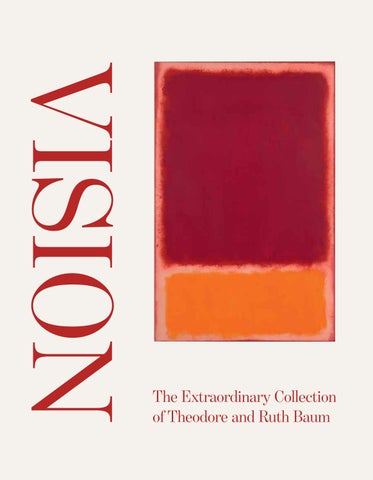
The enduring legacy of the Collection of Theodore and Ruth Baum lies in both its exceptional breadth and in the artistic dialogue it sustains across generations, movements, and geographies. Spanning the visionaries of American abstraction, the innovations of Pop, Minimalism, and Conceptualism, and the radical experimentation of Italian Arte Povera and the daring provocations of Contemporary Pop, the collection brings together best-in-class examples of artists who fundamentally redefined Postwar art. The Baums selected a deeply personal constellation of artists engaged in conversation with one another, each work challenging and illuminating its counterpart. Like many great collectors, the Baums began modestly in the late 1970s with a John Sloan sketch which Ruth acquired from a charity auction, leading to other drawings and watercolors on paper by twentieth-century Modern artists such as Fernand Léger and Pablo Picasso. However, the Baums quickly found their true passion for collecting in 1983, when they encountered a radiant red-andorange painting by Mark Rothko from 1967, their first contemporary art acquisition. They had imagined acquiring “one great painting.” In the Rothko, they believed they had found it. Instead, the painting became the catalyst for an extraordinary decades-long collecting journey. “The Rothko hit us. That was it,” Ruth later recalled. “We were children of the ’60s, and the art of that period spoke to us.” Both anchor and impetus, the Rothko established the emotional and intellectual coordinates from which the collection would grow. During the 1980s and 1990s, the Baums’ New Jersey home came to include works by Joan Mitchell, Sam Francis, Hans Hofmann, Adolph Gottlieb, and Franz Kline, creating a rich dialogue around the achievements of Postwar American abstraction.
SOT HE BY’S
15
“
ind your passions because they will serve F to fulfill a special place in your lives.” RUTH BAUM Although the Baums initially worked with New York dealers and benefited from the guidance of curator, dealer, and advisor Jeffrey Deitch, they quickly developed into collectors of striking independence. They relied on their own evolving aesthetic judgment, sophisticated sense of style, and meticulous research. By the end of the 1990s, their interests had expanded beyond Abstract Expressionism into the movements that followed. The acquisitions of outstanding works by Tom Wesselmann and Roy Lichtenstein marked an important new chapter, opening the collection to American Pop Art, Minimalism and Conceptualism. Works by Josef Albers, Carl Andre, Dan Flavin, Robert Indiana, Ellsworth Kelly, Sol LeWitt, Robert Morris, Claes Oldenburg, Ad Reinhardt, James Rosenquist, George Segal, and Wayne Thiebaud soon followed, forming an extraordinary panorama of mid-century American innovation. This classic pantheon of midcentury American art was crowned by the inclusion of two masterworks: Ed Ruscha’s Dimple, in its audacious red palette, which paid tribute to Ted’s love of witty wordplay, and Andy Warhol’s The Scream (After Munch), one of the most iconic examples of Pop appropriation of earlier imagery. Contemporary accounts of the acquisition noted that an anonymous telephone bidder, Ted Baum, had prevailed over a bidder renowned for possessing one of the world’s foremost collections of Warhol. When confronted with a work they believed to be truly exceptional, they were fearless in their determination to collect it. Active patrons of various art institutions, the couple served on boards and committees at the Solomon R. Guggenheim Museum and the Parrish Art Museum in New York, and opened their Palm Beach home for dinners and tours to benefit the American Friends of the Israel Museum and the Norton Museum of Art. Their most transformative and enduring legacy may be in their winter home of Palm Beach, where Ruth joined the Board at the Norton Museum of Art in 2007 and was a Co-Chair and Founding Member of the Contemporary and Modern Art Council. In 2008, the Baums funded the first Contemporary Curator at the Norton Museum of Art, later to be followed by the naming of the Theodore and Ruth Baum Gallery in recognition of their support toward the reopening of the Museum’s expanded building in 2019. Ruth was elected a Lifetime Trustee the following year. Over the last twenty years, Ruth prioritized local philanthropy as an impactful way to enhance public life in her community, including organizations such as the Palm Beach Zoo & Conservation Society, the Armory Art Center in West Palm Beach, Palm Beach Drama Works, Planned Parenthood, and The Council for a Beautiful Israel. Beginning in the late 1990s, a 1989 abstraction by Gerhard Richter and a boldly slashed red Concetto spaziale, Attese by Lucio Fontana from 1960 were among the first works of the European avant-garde to enter the collection. With characteristic determination and discernment, the Baums assembled an exceptional group of European postwar masterworks over the ensuing years. Three important works by Piero Manzoni were joined by further examples by Fontana, an iconic work in International Klein Blue by Yves Klein, and two paintings by Richter from the 1960s. This extraordinary sequence culminated in the acquisition of Alberto Burri’s phenomenal 1954 GA1. Their interest in ZERO was equally prescient. Ted and Ruth were among the earliest
16
V I SI O N | T H E EXT RAO RD IN ARY CO LLECT ION OF THEODORE AND RUTH BAUM
Ruth Baum with Lot 1, Lichtenstein. Photo © Jerry Rabinowitz. Art © 2026 Estate of Roy Lichtenstein/DACS SOT HE BY’S
17
Opposite: Theodore and Ruth Baum
and only American collectors to recognize the significance of the movement. Across Europe and America alike, the Baum Collection moved beyond the conventional boundaries of movements and schools to reveal affinities that are now fundamental to our understanding of Postwar art. Once acquired, each work began a new life within the Baums’ homes. Living among these masterpieces, they curated inspiring and defining installations: a Postwar painting placed beside an ancient Chinese object, a radical sculpture against fine European furniture, a work of uncompromising abstraction before the expansive view of the ocean. Continually balanced by intellectual rigor, from Mario Merz’s Iguana to Carl Andre’s Steel-Magnesium Plain and the social symbolism of David Hammons’ Basketball and Bricks, the Baums pursued not just a survey of art of their time, but a gathering of voices that continually questioned, expanded, and redefined the possibilities of their respective creative genres. The Baum Collection reveals a sustained fascination with artists who looked both backward and forward, challenging inherited traditions even as they extended them. This choreography of intertwined and competing sensibilities speaks to the Baums’ refined eye for the necessary friction from which new meaning and appreciation emerges. Few collectors of their time dared to pursue such ambitious juxtapositions, and fewer still achieved them with comparable breadth, coherence, and conviction. Paramount to the Baums’ singular eye was this instinct for artists in dialogue. While Rothko, Albers, and Klein are united in their tributes to color’s pure impact, Kline and Mitchell answer with the palpable force of painterly expression and gesture upon the canvas. Reflected in Warhol and Lichtenstein, Contemporary artists reimagine antecedent masterpieces through the irreverent and transformative language of Pop. In Ryman’s and Richter’s entirely new conception of painting through medium, vignettes of color transform into immersive worlds of unmediated visual abstraction. Echoes of Fontana’s iconic disruptions of the canvas, witnessed across multiple mediums within the Baums’ collection, reverberate throughout the collection from the raw burlap punctuated with red and gold in Burri to the folds and fibers of Manzoni. Across seemingly distinct movements and visual vocabularies, the collection is united by a conviction that artistic innovation emerges through provocation and response. In assembling one of the most distinguished private collections of Postwar and Contemporary art in America, the Baums advanced an argument of their own: that artists often understood as oppositional were, in fact, grappling with remarkably similar impulses. Across abstraction and Pop, Europe and America, materiality and image, their collection reveals artists united by a desire to portray a rapidly developing world through radically different means. Its achievement therefore lies not only in the caliber of the individual works, but also in its capacity to illuminate connections that might otherwise remain unseen. When Ruth remarked that “the fact is, you love things that you don’t get easily,” she spoke not only to the couple’s intrepid pursuit of extraordinary works, but to the enduring love for challenge that animated their collecting from the beginning. Within the intimacy of their homes, the Baums transformed collecting into an act of sustained inquiry and vision, collapsing conventional boundaries across oceans, cultures, and paradigms, and ultimately revealing that the greatest collections do not simply preserve art history, but breathe new life into it.
SOT HE BY’S
19
The Baum Residence, Southampton. Left: Lot 7, Warhol. Photo © Anastassios Mentis. Art © 2026 The Andy Warhol Foundation for the Visual Arts, Inc. / Licensed by Artists Rights Society (ARS), New York. Art © 2026 Al Held Foundation, Inc. / Licensed by ARS, New York, NY
EVENING AUCTION 16 NOVEMBER 2026 6 PM
TO LEARN MORE ABOUT THE PROPERTY IN THIS SALE, PLEASE VISIT SOTHEBYS.COM/N12505
The Baum Residence, Southampton. From left: Lot 205, Takis; Lot 2, Albers; Lot 211, Reinhardt. Photo © Jerry Rabinowitz. Art © 2026 The Josef and Anni Albers Foundation / Artists Rights Society (ARS), New York. Art © 2026 Takis / Artists Rights Society (ARS), New York / ADAGP, Paris. Art © 2026 Estate of Ad Reinhardt / Artists Rights Society (ARS), New York. Art © 2026 John McLaughlin. Art © 2026 Enrico Castellani / Artists Rights Society (ARS), New York / SIAE, Rome
1
ROY LICHTENSTEIN 1923 - 1997
T WO PA INTING S : S L E E PI N G M US E (ST U DY) signed and dated ‘83 (on the reverse) cut painted paper, cut printed paper, aluminum foil, acrylic, marker and graphite on board image: 35 by 46 in. 88.9 by 116.8 cm. board: 38 ¾ by 49 ¾ in. 98.4 by 126.4 cm. Executed in 1983.
$ 1,500,000-2,000,000
P ROV E N A N C E Leo Castelli Gallery, New York (LC D-399) James Goodman Gallery, New York William Pall Gallery, New York Ira J. and Marilyn Hechler, Roslyn Heights (acquired from the above in June 1986) James Goodman Gallery, New York William Pall Gallery, New York Keitelman Gallery, Brussels (acquired from the above in May 1999) Christie’s New York, 16 November 2000, lot 155 Acquired at the above sale by the present owner
EXHIBITED Roslyn Harbor, Nassau County Museum of Art, Long Island Collections: The Gilded Age to the 1990s, May - September 1993, p. 78, illustrated in color and p. 109 (text)
L I T E R AT U R E Susie Stanton Staikos, “A World of Wonder: Ruth and Theodore Baum Fill Their Homes with the Works of Artists from All Over the Globe. Here’s a Look at Some of Their Diverse Pieces,” Art & Culture of Palm Beach County, Fall 2019, p. 26, illustrated in color (detail) and p. 28 (text) Andrea Theil, ed., Roy Lichtenstein: A Catalogue Raisonné, New York 2023 - ongoing, RLCR 3284, illustrated in color (online) (accessed 30 October 2026)
24
V I SI O N | T H E EXT RAO RD IN ARY CO LLECT ION OF THEODORE AND RUTH BAUM
SOT HE BY’S
25
26
V I SI O N | T H E EXT RAO RD IN ARY CO LLECT ION OF THEODORE AND RUTH BAUM
Roy Lichtenstein Two Paintings: Sleeping Muse (Study)
“
I am nominally copying, but I am really restating the copied thing in other terms.” ROY LICHTENSTEIN QUOTED IN: LAWRENCE ALLOWAY, ROY LICHTENSTEIN, NEW YORK, 1983, P. 106
R
oy Lichtenstein’s Two Paintings:
York, 1983, p. 106) In artworks referencing
Sleeping Muse (Study) condenses
Cézanne, Picasso, Mondrian, and Van Gogh,
a century of modern art into a
he repackaged objects of highculture with the
single, intricately layered image,
vividness and flattened clarity of consumer
embodying the investigation of materiality
goods. Two Paintings: Sleeping Muse (Study)
and image-making at the heart of the artist’s
marks the same achievement, disregarding the
practice. Held in the Baum collection for nearly
perceived divide between avant-garde art and
three decades, the present work belongs to
popular culture.
Lichtenstein’s celebrated works of the 1980s,
The central reference in the present work
in which art history becomes an artistic subject
is the revolutionary Sleeping Muse, created
in itself. In this meticulously resolved 1983
by the Romanian pioneer of Modernism
collage,
celebrated
Constantin Brancusi in 1909. Initially conceived
bronze sculpture Sleeping Muse appears
as a marble portrait before being cast in bronze,
beneath the curving silhouette of a paper
Brancusi’s sculpture reduces the human head
cutout by Henri Matisse, with the edge of an
to an elliptical form resting precariously on one
Abstract Expressionist canvas encroaching
rounded cheek. As a consummate example
at right. This captivating collage brings
of Roy Lichtenstein’s masterful engagement
together three mediums—sculpture, paper,
with and reorientation of the art historical
and painting—rendering each in Lichtenstein’s
canons, from 1983 at once beautifully evokes
signature black outlines, graphic patterns, and
and radically advances Constantin Brancusi’s
bold, planar application of color.
paradigmatic Sleeping Muse from 1910.
Constantin
Lichtenstein’s
Left: The artist pictured with an edition of Sleeping Muse in his New York apartment, 1983. Photo © Bob Adelman. Art © 2026 Estate of Roy Lichtenstein/DACS
Brancusi’s
result
Composed of elegantly refined contours which
of reappropriations of his own oeuvre and
practice
is
the
enclose a void, Sleeping Muse achieves a sense
the canon, as well as exploration across
of volume precisely through the absence of
media and form. Lichtenstein insisted that
mass in the two-dimensional collage, probing
appropriation was a form of transformation,
the boundaries of the discipline of sculpture.
saying, “I am nominally copying, but I am really
Capturing the essence of Brancusi’s form with
restating the copied thing in other terms.”
bold lines which evoke those of mid-century
Through that process, “the original acquires
comic strips, Lichtenstein fuses the visual
a totally different texture.” (the artist quoted
vernacular of pop culture with an iconic symbol
in: Lawrence Alloway, Roy Lichtenstein, New
of Modernism.
SOT HE BY’S
27
Lichtenstein radically reverses this spatial
The same year Lichtenstein created
activation. His muse cannot be seen in the
this work, he also depicted Sleeping Muse
round but instead appears within a painted
in patinated bronze. Although cast in the
picture frame. The artist captures light through
same material as Brancusi’s most well-known
black lines, complicating the conventional
iteration of Sleeping Muse, Lichtenstein’s
relationships between shade and hue to
interpretation retains the essential qualities
establish the illusion of volume despite the
of a drawing: its shallow, hollow configuration
absence of mass. Brancusi relied on medium—
of lines occupies three dimensions without
the physical solidity and manipulability of marble
taking up actual space. Two Paintings: Sleeping
and bronze—whereas Lichtenstein relies on
Muse (Study) adds another level of remove,
media—the channels through which intangible
further flattening this sculptural form into two
images are circulated and recognized. The
dimensions. Moving from Brancusi’s original
original sculpture’s kaleidoscope of reflections
muse in three dimensions to Lichtenstein’s
fades into a network of symbols, stitched
own straddling of two and three dimensions in
meticulously together with collaged paper, as
bronze to this collage in two dimensions charts
in Matisse masterworks such as The Sadness
a path from Modernism to Pop. The present
of the King from 1952.
work references both the artist himself and
28
V I SI O N | T H E EXT RAO RD IN ARY CO LLECT ION OF THEODORE AND RUTH BAUM
Above: Constantin Brancusi, Sleeping Muse, 1910. Art Institute of Chicago. Image © Art Institute of Chicago / Arthur Jerome Eddy Memorial Collection / Bridgeman Images. Art © Succession Brancusi - All rights reserved (ARS) 2018 Opposite left: Pablo Picasso, The Dream, 1932. Private Collection. Image © Christie’s Images / Bridgeman Images. Art © 2026 Estate of Pablo Picasso / Artists Rights Society (ARS), New York Opposite right: Henri Matisse, The Sadness of the King, 1952. Musée National d’Art Moderne, Centre Pompidou, Paris. Image © Bridgeman Images. Art © 2026 Succession H. Matisse / Artists Rights Society (ARS), New York.
his predecessor, two individuals separated by
Although many of his most well-known pieces
nearly a century who were both interested in
are known for suppressing visible evidence of
rendering objects through their most basic
their construction, this example reveals the
geometric forms.
artist’s hand at work: the viewer can picture
The motif of the sleeping head also subtly
him shifting the compositional elements until
recalls Lichtenstein’s own Sleeping Girl of
they lock into place. The result is handmade,
1960. That image from a generation earlier
but its style masquerades as mechanical.
features a blonde woman whose tilted head is
Two Paintings: Sleeping Muse (Study)
tightly cropped to fill the canvas, her features
reaffirms Lichtenstein’s status as an icon
reduced to archetypal attributes of American
of twentieth-century Modernism. The artist
beauty standards: long golden hair, fluttering
distills Brancusi’s sculpture, Matisse’s cutout,
black eyelashes, full red lips. Returning two
and an anonymous Abstract Expressionist
decades later to another sleeping female
painting
subject, the artist appropriates his own
elements. By withholding access to the original
oeuvre. The ancient Greek idea of the muse—a
objects through his central painted frame,
goddess who inspires artistic production—
Lichtenstein reveals how widespread concepts
here becomes an endlessly reproducible icon,
of art depend on memory, reproduction, and
equally at home in a museum or a comic book.
tradition. Two Paintings: Sleeping Muse (Study)
As a physical object, the collage deepens
is a seminal example of Lichtenstein’s career-
questions of materiality and the creative
long engagement with paragons of the canon
process. Lichtenstein carefully cut pieces of
and Contemporaneous visual culture through
painted and printed paper, arranging them
his distinctive Pop idiom and revolutionary
across a board to fashion a map of seams
reassessment of its form, content, and
that serve as witnesses to his decisions.
meaning.
into
their
most
recognizable
SOT HE BY’S
29
2
JOSEF ALBERS 1888 - 1976
HO M AG E TO TH E SQUA R E : S E N T I N E L I I signed with the artist’s monogram and dated 68 (lower right); signed, titled, dated 1968 and variously inscribed (on the reverse) oil on Masonite 48 by 48 in. 121.9 by 121.9 cm. Executed in 1968. This work will be included in the Catalogue Raisonné of Paintings by Josef Albers currently being prepared by the Josef and Anni Albers Foundation, and is registered under JAAF 1976.1.905.
$ 1,500,000-2,000,000
P ROV E N A N C E Estate of the artist Josef and Anni Albers Foundation Waddington Galleries, London Acquired from the above in January 2002 by the present owner
EXHIBITED New York, Sidney Janis Gallery, New Paintings by Josef Albers, April May 1968 New York, Sidney Janis Gallery, Josef Albers: The 48 × 48” Homage to the Square, November - December 1993, no. 10, n.p. (text) Institut Valencià d’Art Modern Centre Julio González, Josef Albers: Vidrio, Color y Luz, November 1994 - January 1995 Château de Plieux, Josef Albers au Château de Plieux, July September 1998, no. 48, p. 47 (text)
L I T E R AT U R E Sarah Firshen, “Waterfront Idyll: Minimalist Art and Far-Flung Antiques Cohabitate in a Modern ‘Box’ by the Sea,” Hamptons Cottage & Gardens, Vol. 8, No. 1, June 2009, p. 65, illustrated in color
30
V I SI O N | T H E EXT RAO RD IN ARY CO LLECT ION OF THEODORE AND RUTH BAUM
SOT HE BY’S
31
Josef Albers Homage to the Square: Sentinel II
E
xecuted in 1968, Josef Albers’ Homage to the Square: Sentinel II is an outstanding example from the artist’s most celebrated
series. Composed of three concentric squares rendered in luminous shades of scarlet, the painting epitomizes Albers’ lifelong exploration of the expressive and perceptual possibilities of color. Layers of nuanced crimson coalesce to create a composition that is at once deceptively simple and intellectually profound. Held in the esteemed collection of Theodore and Ruth Baum for nearly three decades, and with comparable examples represented in numerous prestigious collections such as The Metropolitan Museum of Art, New York; Solomon R. Guggenheim Museum, New York; Tate, London; and Center Pompidou, Paris, the Homage to the Square series stands as the culmination of Albers’ pioneering research into chromatic perception, securing his position as one of the Twentieth Century’s most influential artists, educators, and theorists. The root of Albers’ practice is based on the principles of form and color he cultivated throughout his time at the Bauhaus in the 1920s. After becoming the first student to assume a teaching position in 1923, he began
Josef Albers teaching a class at Yale University, New Haven, 1955. Photo by John Cohen / Getty Images Above right: Paul Klee, May Picture, 1925. The Metropolitan Museum of Art, New York. Image © The Metropolitan Museum of Art. Image source: Art Resource, NY. Art © 2026 Artists Rights Society (ARS), New York / VG Bild-Kunst, Bonn
to develop his own chromatic theory, eventually leading to the Homage to the Square series, started in 1949. This highly celebrated group was an exploration of the behavior of colors when they are situated against one another within one of four predetermined templates of nested squares. Albers would create numerous paper studies of these chromatic contrasts,
SOT HE BY’S
33
“
I n visual perception, a color is almost never seen as it really is – as it physically is. This fact makes color the most relative medium in art.” JOSEF ALBERS, INTERACTION OF COLOR, NEW HAVEN, 2006, P. 1
devising
and
variation in form, space, and composition,
generating magnificent painted compositions.
optimal
optical
solutions
allowing color alone to command the visual
“The painter chooses to articulate with or
experience. Painted with pigment directly from
in color. Some painters consider color an
the tube and using a palette knife on textured
accompaniment of, and therefore subordinate
Masonite, Homage to the Square captures
to, form or other pictorial content. To others,
the essence of red in extraordinary depth,
and today again, in an increasing number, color
reverberating with the suffusive authority of the
is the structural means of their pictorial idiom.
color—in its scarlet authority, the presence and
Here color becomes autonomic. My paintings
stature of the present work evoke the same all-
are representative in the latter direction. I am
consuming chromatic power of Henri Matisse’s
interested particularly in the psychic effect-
The Red Studio from 1911. Albers’ minute
esthetic experience caused by the interaction
shifts in hue, saturation, and intensity go on to
of colors.” (the artist quoted in: Diane Waldman,
produce a mesmerizing optical tension as the
“Preface and Acknowledgments,” in: Exh. Cat.,
nested squares appear to advance toward and
New York, Solomon R. Guggenheim Museum,
recede from the picture plane at the same time.
Josef Albers: A Retrospective, 1988, p. 12)
The hypnotic vermillion squares transform
Homage to the Square: Sentinel II was
before the viewer’s eyes, exemplifying Albers’
created in one of the series’ three-square
interest in the permutability of color. “Stressing
configurations. Here, Albers eliminates all
(dominance) of the boundaries influences
34
V I SI O N | T H E EXT RAO RD IN ARY CO LLECT ION OF THEODORE AND RUTH BAUM
the direction in which we read the colors:
abstract expressionism and the preciousness
concentrically or excentrically, outwards or
of gesture-and yet his Homage to the Square
inwards, away from or towards us.” (the artist
paintings are a unique artistic statement, a
quoted in: Eugen Gomringer, Josef Albers, New
sort of anti-gesture, but a gesture all the
York, 1968, p. 138)
same.” (Kelly Feeney, “Josef Albers: Seen
At the heart of his philosophy was the
and Unseen,” in: Exh. Cat., Alexandria, Art
conviction that color could never be understood
Services International, Josef Albers: Works
in isolation. Instead, Albers believed every hue
on Paper, 1991, p. 8) Subtle, meticulous, and
derives its identity from its relationship to those
profound, Homage to the Square: Sentinel II
surrounding it, making perception itself the
represents Josef Albers’ mastery of color. The
true subject of his work. As he observed in his
impact of his innovations and seminal series
foundational text, Interaction of Color, “If one
is immeasurable; however, his pivotal role in
says ‘Red’... and there are fifty people listening,
the course of modern art history was formally
it can be expected that there will be fifty reds in
recognized in 1971 when he became the first
their minds.” (the artist quoted in: Josef Albers,
living artist to receive a solo retrospective at
Interaction of Color, New Haven 2006, p. 3) This
The Metropolitan Museum of Art. His reach
belief transformed color from a purely aesthetic
spread to countless artists, including those
device into a psychological and experiential
whom he taught personally at Black Mountain
phenomenon. His paintings therefore become
College, such as Robert Rauschenberg, Cy
carefully orchestrated experiments in which
Twombly, and Kenneth Noland. Stemming
the viewer actively participates, completing the
from a desire to control color’s infinite
work through the act of perception.
possibilities, Albers mastered every aspect of
“In many ways Albers sought to demystify,
color theory. This remarkable skill manifests
if not the art of his day, certainly the practice
with quiet reverence in the red glow of Homage
of art making. He avoided the individualism of
to the Square: Sentinel II.
Opposite Left: Henri Matisse, The Red Studio, 1911. The Museum of Modern Art, New York. Image © The Museum of Modern Art/Licensed by SCALA / Art Resource, NY Right: Robert Delaunay, First Disc, 1912. Private Collection. Image © Christie’s Images / Bridgeman Images
SOT HE BY’S
35
3
ROBERT RYMAN 1930 - 2019
UNTITL E D signed (on the reverse) oil on unstretched sized canvas 15 by 14 ½ in. 38.1 by 36.8 cm. Executed circa 1961. This work will be listed as number 61.026 in the forthcoming catalogue raisonné being organized by David Gray.
$ 2,000,000-3,000,000
P ROV E N A N C E The artist Galerie Konrad Fischer, Düsseldorf (acquired from the above in 2001) Acquired from the above in June 2001 by the present owner
EXHIBITED Düsseldorf, Galerie Konrad Fischer, Early and Recent Paintings, August - October 2001
L I T E R AT U R E Dorothee Fischer, ed., Galerie mit Bleistift Fischer: Ausstellungen bei Konrad Fischer, Volume 2: Düsseldorf, November 1992 – Oktober 2007, Bielefeld 2007, p. 136 (text)
36
V I SI O N | T H E EXT RAO RD IN ARY CO LLECT ION OF THEODORE AND RUTH BAUM
SOT HE BY’S
37
Robert Ryman Untitled
A
luminous
flurry
of
petal-
like swathes set against raw, unstretched canvas, Untitled is a timeless testament to Robert
Ryman’s radically innovative practice. Executed circa 1961, the present work dates from a critical early period in the artist’s career, during which he began investigating the expressive possibilities of surface and medium through
38
V I SI O N | T H E EXT RAO RD IN ARY CO LLECT ION OF THEODORE AND RUTH BAUM
Opposite: Ryman’s studio, c. 1998. Photo by Bill Jacobson, © The Greenwich Collection, New York. Art © 2026 Robert Ryman / Artists Rights Society (ARS), New York
Below: Vincent van Gogh, Wheatfield with Reaper, 1889. Van Gogh Museum, Amsterdam. Image © Bridgeman Images
his singular painterly intervention and deeply
obscuring it. For Ryman, white was not an
personal technique. Here, vigorous strokes of
absence of color but a means of clarifying the
white dance across a fervid underpainting of
material and perceptual conditions of painting.
orange and yellow, announcing the distinctive
He admired its capacity to interact candidly
visual language that would come to define his
with its surroundings, support and underlying
practice. Through its emphatic materiality,
colors, without imposing an illusionistic
Untitled explores the inherent character and
image. Through white, Ryman presented paint
vitality of paint itself, inviting the viewer to
at its most immediate, allowing its density,
encounter the hand of one of the Twentieth
texture, and reflectivity to become the work’s
Century’s most consequential painters. Untitled
principal subject. The ample, staccato strokes
is further distinguished by its exceptional
taper just before the perimeter of the canvas,
provenance, having been held in the Baum
progressively thinning to reveal the raw surface
collection for nearly three decades.
and accentuate the hilly terrain constructed
Across the present work, Ryman builds a
by the paint. Favoring the neutrality of the
topography of kinetic ridges and crests upon
square, Untitled exemplifies Ryman’s early
a raw, unstretched canvas. Over an animated
consolidation of the physical parameters that
ground of fiery orange, he vigorously layers
would sustain his practice and his enduring
daubs of velvety white impasto, tempering
decision to place supreme emphasis upon
the radiating energy beneath without entirely
material, surface, and environment.
SOT HE BY’S
39
Ryman’s paintings are emblems of
the image—the end product,” Ryman explained.
their own making, revealing his sustained
(the artist quoted in: Robert Storr, On the Edge:
exploration of medium as a tangible and active
Contemporary Art from the Werner and Elaine
presence. Untitled sublimely records the artist’s
Dannheisser Collection, New York, 1998, p. 114)
somatic engagement through its controlled
Dating from the formative years of his career,
application, each stroke building upon the last
Untitled is a rare and early articulation of his
in a continuous rhythm of invention. As Robert
lifelong commitment to working predominantly
Storr observed: “Rymans are the product of
in white and to rendering the constituent
the fingers and the hand, not the arm. Gesture,
elements of painting fully visible. Exploring the
for him, served paint rather than the painter;
complexities of light, stroke, color, composition,
painting was a question of application rather
density, texture, reflectivity, and scale, the
than of ‘action.’ Contrary, then, to Harold
present work anticipates the development of the
Rosenberg’s view of abstraction as an exercise
revolutionary principles that would define his
in the rhetoric of self-affirmation, Ryman
mature oeuvre. Although frequently associated
understood it even at that formative state as
with Abstract Expressionism and Minimalism,
a problem of material syntax. What paint had
Ryman resisted such classifications. Instead,
to say was its own name, and it said it best
he continually reinvented the conditions of
in measured tones.” (Robert Storr quoted in:
painting itself, pushing against the artistic
Exh. Cat., London, Tate Gallery, Robert Ryman,
conventions of his time through sustained
1993, p. 15) A self-described realist, Ryman
investigations into material and the experiential
sought to work with real light, real space, and
qualities of the medium. In Untitled, Ryman
real surface. He rejected pictorial illusion and
crystallizes the foundations of his artistic
had no desire to employ paint as a means of
philosophy, testing the properties of paint and
representing anything beyond itself. “There is
its response to his hand while establishing
never a question of what to paint but only how
the conceptual and material trajectory of the
to paint. The how of painting has always been
decades that followed.
40
V I SI O N | T H E EXT RAO RD IN ARY CO LLECT ION OF THEODORE AND RUTH BAUM
Left: Jasper Johns, White Target, 1957. Whitney Museum of American Art, New York. Image © Whitney Museum of American Art / Licensed by Scala / Art Resource, NY. Art © 2026 Jasper Johns / Licensed by VAGA at Artists Rights Society (ARS), NY Right: Kazimir Malevich, Suprematist Composition: White on White, 1918. The Museum of Modern Art, New York. Image © Fine Art Images / Bridgeman Images
Captivated by the modern masters Henri
of Rothko, whose paintings demonstrated
Matisse, Paul Cézanne, and Mark Rothko,
how color and surface could transform their
Ryman used his earliest paintings to explore
surrounding environment without recourse
the qualities he most admired in their work
to figuration. Ryman pursued a comparable
through an entirely original visual language.
immediacy, while redirecting attention from the
Having moved to New York with the intention of
emotive field of the image toward the physical
becoming a jazz musician, he worked as a guard
facts of paint, support, and light.
at The Museum of Modern Art from 1953 until
A meditation on the act of painting itself,
1960. Surrounded by the defining achievements
Untitled is an outstanding early example
of preceding artistic generations, Ryman
of Ryman’s lifelong investigation into the
developed his practice through sustained
objective properties of paint. Activated by its
and attentive looking. In the present work, he
environment and preserving the measured
draws upon aspects of each of these formative
serenity of the artist’s process, the present
influences while transforming them into a
work serves as an exceptional record of the
language distinctly his own. Ryman admired the
inquiry that would define his practice. It
apparent ease of Matisse’s paintings, seeking
challenges the notion of painting as merely
a comparable natural dynamism in his own
an end product, becoming an index of its own
mesmerizing white strokes. From Cézanne, he
creation. Through its extraordinary physical
absorbed an acute sensitivity to the handling
presence, Untitled fundamentally reorients
of paint and the expressive capacities of the
the viewer’s understanding of what a painting
medium. Yet perhaps the most profound
may be: a vital conjunction of paint, surface,
conceptual impact came from his close study
light, and space.
Right: Willem de Kooning, Excavation, 1950. The Art Institute of Chicago. Image © The Art Institute of Chicago / Art Resource, NY. Art © 2026 The Willem de Kooning Foundation / Artists Rights Society (ARS), New York
SOT HE BY’S
41
4
LUCIO FONTANA 1899 - 1968
CO NCE TTO SPA Z I A L E , N EW YO R K 5 incised with the artist’s signature (lower right) copper 46 ⅜ by 22 ⅝ in. 117.8 by 57.5 cm. Executed in 1962.
$ 2,000,000-3,000,000
P ROV E N A N C E
L I T E R AT U R E
Galleria Il Punto, Turin
Enrico Pellegrini, “Buchi e tagli di Lucio Fontana,” Edizioni Quaderni di Studio, No. 5, 20 May 1966, p. 23, illustrated
Cohen Collection, Turin (acquired by 1974)
Acquired from the above in December 2004 by the present owner
Jan van der Marck and Enrico Crispolti, Lucio Fontana: Essays par Jan van der Marck et Enrico Crispolti, Vol. I, Brussels 1974, no. 62 ME 1, pp. 134-35 (text)
EXHIBITED
Enrico Crispolti, ed., Lucio Fontana: Catalogue raisonné des peintures, sculptures et environnements spatiaux, Vol. II, Brussels 1974, no. 62 ME 1, p. 122, illustrated
Galerie Karsten Greve AG, St. Moritz
Milan, Galleria dell’Ariete, Lucio Fontana, New York, June 1962, no. 12 Palazzo Reale Comune di Milano, Lucio Fontana, April - June 1972, fig. 161, p. 210, illustrated Boissano, Centre International d’Expérimentation Artistique MarieLouise Jeanneret, Omaggio a Fontana, July - August 1983, no. 6, p. 13, illustrated Frankfurt, Schirn Kunsthalle and Vienna, Museum Moderner Kunst Stiftung Ludwig, Lucio Fontana: Retrospektive, June 1996 - January 1997, no. 83, p. 220 (text) Rome, Palazzo delle Esposizioni, Lucio Fontana, April - June 1998, no. 4/P/30, p. 289, illustrated in color
Enrico Crispolti, ed., Fontana, Catalogo generale, Vol. II, Milan 1986, no. 62 ME 1, p. 409, illustrated Angela Vettese, Lucio Fontana. I tagli, Cinisello Balsamo 2003, p. 49, illustrated in color Enrico Crispolti, ed., Lucio Fontana, Catalogo ragionato di sculture, dipinti, ambientazioni, Vol. II, Milan 2006, no. 62 ME 1, p. 596, illustrated and p. 1025 (text) Herbert Pérez-Vidal, “Modernist Leanings: Ted and Ruth Baum have Transformed Their Palm Beach Home into a Showplace for their Eclectic Art Collection,” Palm Beach Illustrated, January 2009, p. 108, illustrated in color
New York, Andrea Rosen Gallery, Sterling Ruby/Lucio Fontana, September - October 2011
44
V I SI O N | T H E EXT RAO RD IN ARY CO LLECT ION OF THEODORE AND RUTH BAUM
SOT HE BY’S
45
Lucio Fontana Concetto spaziale, New York 5
R Above: Alfred Stieglitz, From My Window at An American Place, North, 1931. The Metropolitan Museum of Art, New York. Image © The Metropolitan Museum of Art. Image source: Art Resource, NY
adiating
with
extraordinary
The occasion for Fontana’s New York visit—
Fontana’s
his first and only trip to the United States—was
Concetto spaziale, New York 5
his solo exhibition at Martha Jackson Gallery.
brilliance,
Lucio
is a resplendent example from
The show focused on his recent body of Venezie
his distinguished Metalli series. Held in the
oil paintings, characterized by their thick layers
esteemed Baum collection for over twenty
of pigment. New York City contradicted all his
years and among the earliest works in which
inspiration from Venice entirely. Fontana was
Fontana embraced metal as his primary
captivated by the never-ending bustle of the
medium, New York 5 marks the beginning of
city, the modernity of Manhattan, and most of
a profound creative transformation after the
all, the glistening glass towers that scraped the
artist’s pivotal 1961 trip to New York City. Its
sky. After visiting the Seagram Building during
luminous copper surface scintillates as light
his trip, he wrote, “yesterday I went to the top
catches the constellation of scratches, bends,
floor of the most famous of the skyscrapers...
and the jagged central incision anchoring the
the one made of bronze and gilded glass...
composition. Evoking the soaring silhouette
It seemed to contain the sun...” (the artist
of a skyscraper, Concetto spaziale, New York 5
quoted in: Exh. Cat., New York, Solomon R.
captures the frenetic energy of both New York
Guggenheim Museum, Lucio Fontana: Venice/
City and Fontana’s artistry.
New York, 2006-07, p. 42)
SOT HE BY’S
47
Left: Constantin Brancusi, The Bird in Space, 1941. Musée National d’Art Moderne, Centre Pompidou, Paris. Image © Bridgeman Images. Art © Succession Brâncuși- All rights reserved (ARS) 2026 Opposite: Lucio Fontana in his studio, 1964. Image © Ugo Mulas © Ugo Mulas Heirs. All rights reserved. Art © 2026 Artists Rights Society (ARS), New York / SIAE, Rome
Deeply inspired by New York’s iconic towers, Fontana returned to Italy in 1962 determined to create a work which captured their monumental presence. However, Fontana could only ask himself, “How can one paint this terrifying New York?” (the artist quoted in: Exh. Cat., New York, Solomon R. Guggenheim Museum, Lucio Fontana: Venice/New York, 2006-07, p. 45) Fontana felt that canvas could not allow him to replicate the brilliant aura of the buildings he so admired, but suddenly, a new idea dawned on him. The artist began experimenting with sheets of metal from his studio. As he tried scratching, puncturing, and bending the metals, he saw that “no other material captures the sense of this Metropolis made of all glass, of windowpanes, of orgies of light, and the dazzle of metal.” (the artist quoted in: Exh. Cat., New York, Solomon R. Guggenheim Museum, Lucio Fontana: Venice/ New York, 2006-07, p. 45) A striking testament to Fontana’s technical ingenuity and artistic vision, Concetto spaziale, New York 5 transforms an industrial sheet of copper into a work of remarkable luminosity and sculptural vitality. At the center of Concetto spaziale, New York 5, a bold and visceral vertical gash exposes the copper’s raw, ruptured edges. Framing the perforated metal, Fontana incised a precisely defined rectangle, reinforcing the verticality of the composition and quietly evoking New York’s colossal skyscrapers. Atop the rectangle, a flurry of linear scratches compound and radiate across the surface, recalling the sunlight glinting from the city’s glass towers. Together, these incisions, indentations, and bends animate the once-static sheet of copper, turning it into a 48
V I SI O N | T H E EXT RAO RD IN ARY CO LLECT ION OF THEODORE AND RUTH BAUM
SOT HE BY’S
49
Above: Giacomo Balla, Dynamic Expansion and Speed, 1913. Galleria Nazionale d’Arte Moderna e Contemporanea, Rome. Image © Stefano Baldini. All rights reserved 2026 / Bridgeman Images Opposite: The Baum Residence, Palm Beach. Lot 4, Fontana (62 ME 1). Photo by Diana Todorova. Art © 2026 Artists Rights Society (ARS), New York / SIAE, Rome
dynamic sculptural object that shifts with every
coexistence with nature. This aspiration is
change in light and viewpoint. As illumination
especially significant in the context of New
plays across its scored metal surface, Concetto
York City, an environment defined not by lush
spaziale, New York 5 glitters, allowing the
natural landscapes, but by endless innovation,
viewer to experience the city’s dazzling skyline
towering architecture, and unrelenting vibrant
through Fontana’s eyes.
energy. In the midst of this urban spectacle,
Concetto spaziale, New York 5 stands as a
Fontana found simplicity in a new form: by
magnificent example of Fontana’s persistent
reducing his experience of the city to its most
efforts in expanding the possibilities of art
essential spatial elements. The vertical forms
beyond the traditional canvas. As the founder of
of skyscrapers, the glow of steel and glass
the Spatialism movement, Fontana believed in
in sunlight, and the city’s unique energy are
activating space, light, and material as central
condensed into the singular, decisive moment
features of an artwork rather than viewing
of Concetto spaziale, New York 5 central
them as passive elements. His encounter
cut. To this end, Fontana transforms the
with New York City only enhanced these
complexity of modern life into a clear visual
ideas, offering a new version of modernity.
language, demonstrating that even in the
Rather than simply capturing architecture,
most technologically advanced environments,
Fontana was concerned with communicating
the path towards harmony lies in stripping
sensations. These Spatialist ideals reach their
lived experience down to its purest essence.
ultimate synthesis in Concetto spaziale, New
Through the lustrous copper surface, the
York 5 and the Metalli series, which distill the
violent incision, and the lambent reflections
full breadth of his artistic language into the
across the metal, Concetto spaziale, New York
extreme yet necessary act of a single linear
5 translates Fontana’s view into a physical and
tear breaking through matter and transforming
emotional experience. Beyond a reflection of
it into space. Rather than functioning as an
New York, the present work is a manifestation of
act of destruction, the incision becomes an
Fontana’s desire to capture the modern world
additive gesture of liberation, bringing a flat
and preserve it in a new artistic reality. Held in
surface into the third dimension. Through
important museum collections worldwide and
this radical intervention, Fontana rejects the
paired with its widespread impact on post-war
traditional limits of artistic creation, replacing
European art, Fontana’s Metalli have achieved
representation with direct spatial engagement.
an esteemed status within the artist’s career.
Fontana envisions a future in which
With its iridescent and alluring form, Concetto
humanity can break free from the bonds
spaziale, New York 5 encapsulates the very
that bind it to materiality and rise to a
best of the radical aesthetic central to Lucio
dimension of simplicity, harmony, and
Fontana’s seminal series. SOT HE BY’S
51
5
MARK ROTHKO 1903 - 1970
UNTITL E D oil on paper mounted on canvas 40 ½ by 26 in. 102.9 by 66 cm. Executed in 1967. The following work is being considered for inclusion in the forthcoming Mark Rothko Online Resource and Catalogue Raisonné of works on paper, compiled by the National Gallery of Art, Washington, D.C.
$ 10,000,000-15,000,000
P ROV E N A N C E
L I T E R AT U R E
Noah Goldowsky, New York
Rebecca Cochran et al., “The Top Collections: From 250 Collectors,” Art & Antiquities, March 2008, p. 108, illustrated in color and p. 109 (text)
Jeffrey Byers, New York Robert Elkon Gallery, New York Galerie Beyeler, Basel (acquired from the above in 1970) H.-J. von Cotzhausen, Mülheim (acquired from the above in 1971) Annely Juda Fine Art, London (acquired from the above) Chasa Holdings, Jersey (acquired from the above) Annely Juda Fine Art, London (acquired from the above) Marie-Suzanne Feigl Galerie d’Art Moderne, Basel (acquired from the above in 1980)
Herbert Pérez-Vidal, “Modernist Leanings: Ted and Ruth Baum Have Transformed Their Palm Beach Home into a Showplace for their Eclectic Art Collection,” Palm Beach Illustrated, January 2009, p. 110 (text) Susie Stanton Staikos, “A World of Wonder: Ruth and Theodore Baum Fill Their Homes with the Works of Artists from All Over the Globe. Here’s a Look at Some of Their Diverse Pieces,” Art & Culture of Palm Beach County, Fall 2019, p. 27, illustrated in color (detail) and p. 28 (text)
Solomon & Co. Fine Art, New York Acquired from the above in July 1983 by the present owner
EXHIBITED Edinburgh, Scottish National Gallery of Modern Art, Towards Abstract Art, December 1977 - January 1978, no. 3 (text)
52
V I SI O N | T H E EXT RAO RD IN ARY CO LLECT ION OF THEODORE AND RUTH BAUM
SOT HE BY’S
53
Mark Rothko Untitled
I
mbued with glowing hues of fiery scarlet
and Ruth Baum, Untitled is a landmark example
and brilliant tangerine floating above a
from the esteemed collection it has resided in
raw, earthy ground, Untitled from 1967
for nearly half a century.
affirms the prominence of Mark Rothko’s
Executed during the final years of his career,
paintings on paper as among the most intimate
this work recalls one of Rothko’s last great
and distilled expressions of his artistic thesis.
periods of luminous color before the palette
Executed just three years before the artist’s
of his final paintings dimmed considerably.
passing in 1970, the present work ranks among
Grounded in golden and blush tones, luminous
the greatest of Rothko’s mature paintings on
passages of crimson red and tangerine orange
paper, distinguished by the unique vibrancy
framed by a bed of rose pink and wisps of
that has been remarkably preserved. Untitled’s
cream lie upon the paper mounted to canvas,
feathery edges surround the two color fields
ready to burst with the chromatic intensity
in Rothko’s characteristic painterly technique,
that transcends mere scale, exuding palpable
here with exceptional elegance, resulting in the
warmth and revealing Rothko’s unparalleled
chromatic brilliance, emotional immediacy, and
command of color as an expressive vehicle.
meditative power that define Rothko’s greatest
Red examples from this period possess the
achievements. Invoking a magnetic field of
force of compressed infernos of visual impact,
radiant hues, Untitled demonstrates Rothko’s
appearing almost red hot to the touch, or as
unique
radiant sunbursts drawn directly out of the sky.
ability
emotional
harness
visual
force
extraordinary his
Following the completion and widespread
masterful command of color. As the first
appreciation of the historic series of paintings
contemporary work ever acquired by Theodore
for the Seagram Building in New York in the late
54
and
to
through
V I SI O N | T H E EXT RAO RD IN ARY CO LLECT ION OF THEODORE AND RUTH BAUM
Above: Arshile Gorky, Water of the Flowery Mill, 1944. The Metropolitan Museum of Art, New York. Image © The Metropolitan Museum of Art. Image source: Art Resource, NY. Art © 2026 The Arshile Gorky Foundation /Artists Rights Society (ARS), New York Opposite:: Roman Hall of the Great Fresco Lustration, 1st century B.C. Villa of the Mysteries, Pompeii. Image © Andrea Jemolo. All rights reserved 2026 / Bridgeman Images
1950s, today known as the Seagram Murals,
philosopher Kierkegaard, whom Rothko and his
Rothko’s engagement with red in his works
friends deeply admired, wrote movingly of red,
on canvas and paper alike attracts a specific
in terms that call to mind Rothko’s painting.
reverence within his oeuvre. The artist infused
‘The result of my life is simply nothing, a mood,
a unique living essence into his red works,
a single color. My result is like the painting of
saying he wanted these works to have such a
the artist who was to paint a picture of the
“presence” that “when you turned your back to
Israelites crossing the Red Sea. To this end, he
the painting, you would feel that presence the
painted the whole wall red, explaining that the
way you feel the sun on your back.” (the artist
Israelites had already crossed over, and that
quoted in: James E. B. Breslin, Mark Rothko: A
the Egyptians were drowned.’ (Diane Waldman,
Biography, Chicago, 1993, p. 275)
Mark Rothko, London, 1978, pp. 57-58)
“Red is the color that fascinates Rothko
In Untitled, these incandescent hues
above all others. No other color appears so
achieve a remarkable harmony between
insistently in his oeuvre from the time of the
intensity and repose, creating an image that
multiforms. It dominates Rothko’s work of the
simultaneously commands attention and
fifties and sixties and, in fact, was the color of
invites contemplation. The present work
his last painting. Red is so potent optically that
embodies the visual resonance and emotional
it overwhelms or obliterates other hues unless
essence of Rothko’s acclaimed large-scale
it is diluted or controlled by juxtaposing it, as
canvas works encapsulated in an intimate,
Mondrian did, with equally strong colors, such
immersive format. Indeed, Untitled epitomizes
as black and white, or the other primaries yellow
the best of this body of work as described
and blue. But Rothko frequently uses it alone,
by Clearwater: “Thus with their symmetry,
altering its tonality according to the emotion
tidy execution, and minimal gesture, the
he wishes to express. Perhaps Rothko was so
small works on paper often seem to be
drawn to red because of its powerful and basic
more quintessential Rothko than many of
associations: it is identified with the elements
his canvases.” (Bonnie Clearwater, Exh. Cat.,
and ritual - with fire and with blood - and thus
Washington, D.C. (and traveling), Mark Rothko:
with life, death, and the spirit. The Existentialist
Works on Paper, 1984-86, p. 39) While Rothko’s
SOT HE BY’S
55
Abstract Expressionist peers like Franz Kline
with each other. Rothko’s compositions
and Willem de Kooning deconstructed the
achieve a transformative sense of harmony
picture plane through an ostensibly unbridled
and balance through the subtle asymmetries
gestural fortitude, Rothko tested the absolute
and idiosyncrasies of their forms. Devoid of
limits of abstraction through radiant zones of
representation, the subject of Rothko’s work
pure color, hovering in metaphysical tension
becomes the pure expression of color and light.
Mark Rothko’s studio at 222 Bowery. Photo by Herbert Matter. Courtesy of the Department of Special Collections, Stanford University Libraries (M1446 Herbert Matter papers, circa 1937-1984, box 153, folder 33, Dept. of Special Collections and University Archives, Stanford University Libraries, Stanford, CA). Art © 1998 Kate Rothko Prizel & Christopher Rothko / Artists Rights Society (ARS), New York
“
aradox and splendor—the two poles that border his life’s P work—are here summed up. Rothko more than any artist I have known succumbed to the lure of light, light that, as the Byzantine inscriptions said, can be contained but never captured really.” DORE ASHTON, “INTRODUCTION,” IN: EXH. CAT., WASHINGTON, D.C., NATIONAL GALLERY OF ART (AND TRAVELING), MARK ROTHKO: WORKS ON PAPER, 1984-86, P. 9
clearing away that his life’s work represents.” (Dore Ashton, “Introduction,” in: Exh. Cat., Washington, D.C., National Gallery of Art (and traveling), Mark Rothko: Works on Paper, 198486, p. 9) Begun in the early 1930s and typically executed at a more intimate scale, Rothko’s works on paper, such as Untitled, afford a closer engagement with their viewers. As head author of the forthcoming Catalogue Raisonné of works on paper, Adam Greenhalgh notes, “This focus on public versus private is relevant because Rothko was extremely careful, controlling even, about how his works were displayed and to whom they were sold. The relationship between a work of art and a receptive viewer was quite possibly his most abiding concern.” Indeed, for Rothko, the viewer’s close engagement with his works was foundational to their meaning, and his works on paper championed that philosophy. Across his career, Rothko continually Rothko, like many of his peers, transitioned
returned to color as the primary means
to working at a smaller scale in the final years
through which to communicate the breadth
of his life. Paper was a foundational medium
of human emotion. His works do not depict
for Rothko throughout his career, operating as
feeling so much as embody it, translating states
an essential vessel for channeling chromatic
of ecstasy, melancholy, contemplation, and
force. As Dore Ashton observed, “Rothko more
wonder into radiant chromatic relationships.
than any artist I have known succumbed to
The present work stands among the most
the lure of light… light that envelops us and is
powerful examples of this achievement.
all things that are not… It was most certainly
Standing as one of the final red works on paper
his experience with the paradoxical nature of
of Rothko’s life, the present work seems to
paper—absorbing and reflecting at the same
pulse with life, offering an all-encompassing,
time—that set him on his course to the great
sun-bathed meditation upon each glimpse.
58
V I SI O N | T H E EXT RAO RD IN ARY CO LLECT ION OF THEODORE AND RUTH BAUM
Above: Mark Rothko, Untitled, 1969. Private Collection. Sold at Sotheby’s in May 2018 for $18.9 million. Art © 2023 Kate Rothko Prizel & Christopher Rothko / Artists Rights Society (ARS), New York
6
GERHARD RICHTER b. 1932
GRAT 3 signed, dated 1989 and numbered 689-3 (on the reverse) oil on canvas 24 ¼ by 32 ¼ in. 61.6 by 81.9 cm. Executed in 1989.
$ 3,000,000-4,000,000
P ROV E N A N C E
L I T E R AT U R E
Galerie Rolf Ricke, Cologne
Exh. Cat. (and catalogue raisonné), Bonn, Kunst-und Ausstellungshalle der Bundesrepublik Deutschland, Gerhard Richter: 1962-1993, Vol. I, 1993-94, no. 689-3, pp. 118, 142, illustrated in color
Anthony d’Offay Gallery, London Gallery HAM, Nagoya Jinno Collection, Nagoya Christie’s New York, 13 November 1998, lot 140 Acquired at the above sale by the present owner
EXHIBITED Tokyo, National Museum of Modern Art, Gerhard Richter, November December 1989
Gerhard Richter, Zhengzhou 2001, no. 19, n.p., illustrated in color Herbert Pérez-Vidal, “Modernist Leanings: Ted and Ruth Baum have Transformed Their Palm Beach Home into a Showplace for their Eclectic Art Collection,” Palm Beach Illustrated, January 2009, p. 109, illustrated in color Dietmar Elger, ed., Gerhard Richter: Catalogue Raisonné, Volume 4: Nos. 652-1 - 805-6, 1988-1994, Ostfildern 2015, no. 689-3, p. 217, illustrated in color
Cologne, Kölnischer Kunstverein, Aus meiner Sicht (From My Point of View), November 1989 - January 1990, p. 166, illustrated (in installation) Musée d’Art Moderne de la Ville de Paris; Bonne, Kunst- und Ausstellungshalle der Bundesrepublik Deutschland; Stockholm, Moderna Museet; and Madrid, Museo Nacional Centro de Arte Reina Sofía, Gerhard Richter, September 1993 - August 1994, no. 689-3, pp. 118, 142, illustrated in color and p. 179 (text) (Bonn); p. 134, illustrated in color and p. 182 (text) (Madrid) Tokyo, The National Museum of Modern Art and Kyoto, The National Museum of Modern Art, A Perspective on Contemporary Art: Painting ‒ Singular Object, November 1995 - February 1996, no. 24, p. 64, illustrated in color
60
V I SI O N | T H E EXT RAO RD IN ARY CO LLECT ION OF THEODORE AND RUTH BAUM
SOT HE BY’S
61
Gerhard Richter Grat 3
Opposite: Gerhard Richter photographed in Cologne, Germany, 1989. Photo by Chris Felver/Getty Images. Art © Gerhard Richter 2026 (28102026) Left: Gerhard Richter, Townscape (P1) [Stabtbild (P1)], 1968. The Art Institute of Chicago. Image © The Art Institute of Chicago / Art Resource, NY. Art © Gerhard Richter 2026 (28102026)
E
xecuted in 1989 and one of only
in the artist’s landmark 1993 retrospective at
five works from this group, Grat
the Musée d’Art Moderne de la Ville de Paris,
3 stands as an exceptionally rare
Grat 3 exemplifies the inventive complexity,
synthesis of Gerhard Richter’s twin
technical mastery, and intellectual ambition
artistic pursuits of landscape and abstraction.
that have established Richter as one of the
Occupying a pivotal position within the artist’s
most influential painters of the postwar era.
oeuvre, the present work belongs to a body of
Further
paintings that bridges the distance between
provenance, having remained in a single
Richter’s celebrated photorealistic landscapes
private collection for nearly three decades, the
and the revolutionary abstract paintings that
present work bears witness to one of the most
would define his mature practice. Featured
significant and consequential moments in the
alongside three other works from the series
artist’s career.
62
distinguished
by
its
exceptional
V I SI O N | T H E EXT RAO RD IN ARY CO LLECT ION OF THEODORE AND RUTH BAUM
Executed squeegee
using
Richter’s
technique,
demonstrates
signature
present
extraordinary
work
Practice of Painting: Writings and Interviews 1962-1993, London, 1993, pp. 119-20)
balance
The movements of the squeegee “seem
between control and chance that came to
strangely empty, since they behave visibly
define his mature abstraction. Methodical
indifferently to what they uncover, pull along,
layers of paint are pulled, scraped, and revealed
wipe, and cause to emerge.” (Gregor Stemmrich
across the surface, creating the impression
quoted in: Exh. Cat., Cologne, Museum
of a limitless pictorial space, seemingly
Ludwig (and traveling), Gerhard Richter Large
unencumbered by scale and absent any overt
Abstracts, 2009, p. 31) Entitled after the natural
trace of the artist’s hand. The implement
form of a ridge, whether mountainous or
facilitated his desire to introduce spontaneity
minuscule, Grat 3 occupies the terrain between
and chance into his creative approach, as the
two of Richter’s most important bodies of work:
artist himself stated, “it is a good technique for
the photorealistic landscapes that established
switching off thinking.” (Dietmar Elger, Gerhard
his early reputation and the monumental
Richter, A Life in Painting, Chicago, 2009, p. 251)
abstractions that secured his place among
and “letting a thing come, rather than creating
the most influential painters of the twentieth
it—no assertions, constructions, formulations,
century. The Grat series accomplishes the best
inventions, ideologies—in order to gain access
of both approaches, distilling the essence of
to all that is genuine, richer, more alive: to
landscape into a kaleidoscopic field of color,
what is beyond my understanding.” (the artist
texture, and movement that remains wholly
quoted in: Hans Ulrich Obrist, ed., The Daily
distinct within Richter’s wider corpus.
64
the
the
V I SI O N | T H E EXT RAO RD IN ARY CO LLECT ION OF THEODORE AND RUTH BAUM
“
he semblance that concerns Richter is of a ‘second nature’… a culture-becomeT nature bathed in the glow of the media, a semblance permeated with photographic, televisual, and now digital visualities.”
HAL FOSTER, “SEMBLANCE ACCORDING TO GERHARD RICHTER” IN: BENJAMIN BUCHLOH, ED., GERHARD RICHTER: OCTOBER FILES, MASSACHUSETTS, 2009, P. 126
The
Above: Anselm Kiefer, Monsalvat, 1996. Cincinnati Art Museum. Image © Cincinnati Art Museum / John J. Emery Fund / Bridgeman Images. Art © Anselm Kiefer Opposite: David Caspar Friedrich, Morning Mist in the Mountains, 1808. Staatliche Museen Heidecksburg Rudolstadt. Image © HIP / Art Resource, NY
was
Richter’s approach is revered for its progressive
affirmed in 1993, when the artist’s Paris
significance
of
the
series
vision that signified a critical departure from the
retrospective, featuring four of the five Grat
iconic geometricity that is the characteristic
paintings, received widespread critical acclaim.
manifestation of modernist abstraction and a
Reviewing the exhibition, critic Doris von
rejection of the expressionistic intentions of the
Drathen observed that “there are exhibitions
movement’s Postwar practitioners. Richter’s
that, like great milestones, reset the standards
unique painterly abstraction is the remarkable
in contemporary art. Richter’s retrospective,
product of a deep and clear understanding of
launching now at the ARC in Paris, is of this
these modes of abstraction and a response to
quality.” (Doris von Drathen quoted in: Dietmar
the tension between them and their contrasting
Elger, Gerhard Richter: A Life in Painting,
histories. Whereas the fundamental roots of
Cologne, 2002, p. 323) Presented within this
the abstraction of Kandinsky and Malevich,
landmark retrospective, Grat 3 belongs to a
for example, were founded on linear and
body of work that encapsulates the innovation,
systematic qualities in terms of conception and
ambition, and restless experimentation that
production, Richter’s introduction of chance
characterize Richter’s greatest achievements.
into his creative process radically undermines
Celebrated as a pioneer of abstract art,
these relatively contrived approaches.
SOT HE BY’S
65
He does not, however, rely entirely on gestural techniques as had been introduced by the action painting of Jackson Pollock, but maintains a consistent structure and attention to minute detail in his noncompositional works, essentially producing a sort of calculated chaos. “Richter’s deployment of texture, structure, and gesture in painting deliberately suspends itself between scientific and expressive conceptions of painterly process. It is oscillating with the same deliberation, between painting as an act and painting as an accident, between composition as a result of mere chance encounters of materials and structures, and composition as the tracing of a subject’s residual intentionality.” (Benjamin Buchloh, “Working on the Picture: The Discretion of Gerhard Richter” in: Exh. Cat., Cologne, Museum Ludwig (and traveling), Gerhard Richter Large Abstracts, 2009, p. 11) In this celebrated example from a pivotal moment within the artist’s oeuvre, Grat 3 crystallizes Richter’s enduring pursuit of bringing seemingly irreconcilable representation and abstraction, nature and artifice, control and chance. The painting distills the artist’s transition from the hyperrealistic visions of landscape that first earned him acclaim to the abstract languages that would come to define his mature practice. As Richter explained in a 1986 interview with Buchloh, “What I am trying to do in each picture is to bring together the most disparate and mutually contradictory elements, alive and viable, in the greatest possible freedom.” (the artist quoted in: Dietmar Elger and Hans Ulrich Obrist, eds., Gerhard Richter – Text: Writings, Interviews and Letters 1961 – 2007, London, 2009, p. 187) More restrained in palette than the chromatically charged abstractions of the following decades, the Grat series pays subtle homage to the mountains, clouds, and oceans that serve as the artist’s enduring muses. Neither wholly landscape nor wholly abstraction, Grat 3 announces an artist forging a radically new understanding of painterly possibility, transforming the visual memory of nature into a composition of extraordinary depth and possibility.
Opposite: Art © Gerhard Richter 2026 (28102026)
SOT HE BY’S
67
The present work installed in Gerhard Richter at the Moderna Museet, Stockholm, September 1993 - August 1994. Photo courtesy Moderna Museet. Art © Gerhard Richter 2026 (28102026)
7
ANDY WARHOL 1928 - 1987
T HE SCR E A M ( A F T E R M U N C H ) signed and dated 84 (on the overlap) acrylic and silkscreen ink on canvas 52 by 38 in. 132.5 by 96.5 cm. Executed in 1984.
$ 4,000,000-6,000,000
P ROV E N A N C E
L I T E R AT U R E
Private Collection
Nicolas Beytout, ed., “Collectionner l’art contemporain en Floridie,” Connaissance des Arts, December 2008, p. 111, illustrated in color
Christie’s London, 6 December 1985, lot 93 May-Britt Bøe, Oslo Sotheby’s London, 21 June 2006, lot 36 (consigned by the above) Acquired at the above sale by the present owner
EXHIBITED Hovikodden, Henie Onstad Kunstsenter, Andy Warhol, May September 1994 (on the exhibition poster) New York, 1018 Art, Andy Warhol: Warhol’s Munchs, September November 2007, illustrated in color (on the cover of the exhibition announcement)
70
Herbert Pérez-Vidal, “Modernist Leanings: Ted and Ruth Baum Have Transformed Their Palm Beach Home into a Showplace for their Eclectic Art Collection,” Palm Beach Illustrated, January 2009, p. 112 (text) and n.p., illustrated Sarah Firshen, “Waterfront Idyll: Minimalist Art and Far-Flung Antiques Cohabitate in a Modern ‘Box’ by the Sea,” Hamptons Cottage & Gardens, Vol. 8, No. 1, June 2009, p. 64, illustrated in color and p. 67 (text) Susie Stanton Staikos, “A World of Wonder: Ruth and Theodore Baum Fill Their Homes with the Works of Artists from All Over the Globe. Here’s a Look at Some of Their Diverse Pieces,” Art & Culture of Palm Beach County, Fall 2019, p. 30, illustrated in color (detail)
V I SI O N | T H E EXT RAO RD IN ARY CO LLECT ION OF THEODORE AND RUTH BAUM
SOT HE BY’S
71
Andy Warhol The Scream (After Munch)
D
istinguished
within
exceptionally
rare
Warhol’s series
sensibilities converge. Translating Munch’s most
as
emotionally charged image into fluorescent
the canvas that most closely
color and silkscreened layers, Warhol created
echoes the coloration of Munch’s
a new Scream for a mass-media audience—
original painting, Andy Warhol’s The Scream
repackaging a motif of existential anxiety into a
(After Munch) blends two artists whose
seductive, reproducible, unmistakably Pop icon.
public identities appear radically different in a
Warhol’s fascination with Munch developed
dialogue about legacy, creativity, and emotional
over two decades. When the Norwegian art
expression. Munch has long been regarded as the
historian Per Hovdenakk visited Warhol’s New
archetypal introspective artist, exploring private
York City studio in 1963, the artist expressed a
experiences of loneliness and psychological
particular admiration for Munch’s experimental
distress,
himself
printmaking. That interest deepened during a
as the consummate observer of fame and
1973 trip to Oslo, when Warhol visited the Munch
depersonalized surfaces. In this extraordinarily
Museum and began to collect the Norwegian
rare canvas, executed in 1984, the two
artist’s prints. For a twentieth-century American
72
while
Warhol
fashioned
V I SI O N | T H E EXT RAO RD IN ARY CO LLECT ION OF THEODORE AND RUTH BAUM
Above: Edvard Munch, The Scream, 1893. National Gallery, Oslo. Image © HIP / Art Resource, NY
visionary captivated by celebrity images, the
saturate modern culture. Munch conceived The
nineteenth-century Norwegian artist offered
Scream as part of his Frieze of Life, an 1890s
a revelation: an art that expressed intense
cycle of works that he imagined as a secular
and specific emotions but still resonated with
altarpiece possessing the gravity of sacred art.
audiences across time and place.
“One should no longer paint interiors with men
The immediate catalyst for The Scream
reading and women knitting,” he wrote. “They
(After Munch) was a 1982 exhibition at the
must be living individuals who feel, suffer,
newly opened New York location of Galleri
love, and breathe.” (Edvard Munch quoted in:
Bellman, owned by Norwegian dealer Tor
Exh. Cat., Ishøj, Denmark, ARKEN Museum
Uppstrom. The show assembled 126 paintings
of Modern Art (and traveling), Echoes of the
and prints by Munch, including a rare
Scream, 2001, p. 14) The Scream emerged from
lithograph of The Scream lent by the Munch
a psychological experience Munch recorded in
Museum. After Warhol repeatedly visited the
an 1895 edition of the work.
exhibition, Uppstrom commissioned him to
“I was walking along the road with two
create fifteen paintings after four Munch prints:
friends. / The Sun was setting – The Sky turned
Madonna, Self-Portrait with Skeleton Arm,
a bloody red /, And I felt a whiff of Melancholy
The Brooch (Eva Mudocci), and The Scream.
– I stood Still, / deathly tired – over the blue-
Warhol opted to recreate the lithograph of The
black / Fjord and City hung Blood and Tongues
Scream instead of the painting—the already
of Fire / My Friends walked on – I remained
reproduced version of an image destined to
/ behind – shivering with Anxiety – I / felt
74
V I SI O N | T H E EXT RAO RD IN ARY CO LLECT ION OF THEODORE AND RUTH BAUM
Above: Francis Bacon, Study After Velázquez’s Portrait of Pope Innocent X, 1953. Des Moines Art Center. Image © Des Moines Art Center. Image Source: Bridgeman Images. Art © The Estate of Francis Bacon. All rights reserved. / DACS, London / ARS, NY 2026 Opposite: Roy Lichtenstein, Woman with Flowered Hat, 1963. Private Collection. Art © 2026 Estate of Roy Lichtenstein/DACS
the great Scream in Nature” (Edvard Munch,
Botticelli and Leonardo da Vinci, the same
inscribed on the reverse of The Scream, 1895).
silkscreen treatment as Marilyn Monroe and
Warhol incorporated his silkscreen technique
Coca-Cola bottles. John Cage once observed
and hand-painted acrylic elements to preserve
that “Warhol has shown through repetition
Munch’s undulating contours. He painstakingly
that there is no repetition in art.” (John Cage
prepared transparencies slightly larger than
quoted in: Jörg Schellmann, Andy Warhol: Art
Munch’s prints, which he then transferred onto
from Art, Cologne, 1994, p. 9) The Scream
canvases over twice the size of the original
(After Munch) demonstrates how mechanical
lithographs. Warhol’s waving lines maintain
and repetitive processes continue to remake
Munch’s emotional intensity, while shades
meaning. Each of Warhol’s five canvases of
of orange, blue, turquoise, and yellow in his
The Scream, an unusually small number for
characteristic saturated color palette recast the
him, alters the emotional register of Munch’s
image as an object of consumption rather than
composition. The central figure appears
contemplation. Simultaneously incorporating
alternately incandescent, ghostly, and artificial,
Munch’s subject and Warhol’s style, The
while the fjord in the background dissolves into
Scream (After Munch) pairs a signature image
a succession of psychedelic bands.
with the signature artist to create a timeless study of the human experience. In the early 1980s, Warhol turned away from
contemporary
culture
Compared to his other encounters with canonical artists, Warhol’s treatment of Munch
toward
reveals a more intimate dimension in his own
the
work. “If you want to know all about Andy
history of art itself. His Details of Renaissance
Warhol,” the artist famously maintained, “just
Paintings series gave Old Masters, including
look at the surface of my paintings and films
SOT HE BY’S
75
and me, and there I am. There’s nothing
twentieth-century
behind it.” (the artist quoted in: Klaus Honnef,
technologies, collapsing the perceived division
Andy Warhol: Commerce into Art, Cologne,
into a seamless study of the expressive core
2000, p. 45) By reproducing another artist’s
behind a mechanical facade.
American
consumer
expression of terror, Warhol hints at the fears
Today, Munch’s image appears on mugs,
concealed under his carefully constructed
T-shirts, advertisements, and inflatable figures.
persona. He uses Munch’s panic as a vessel
Warhol both anticipated this transformation
through which to contemplate his own
and helped make it possible. By treating
concerns about mortality, alienation, and the
Munch’s anguished figure with the same
evanescence of fame. “The reason I’m painting
chromatic glamour he brought to movie stars
this way is that I want to be a machine,”
and soup cans, the New York City Pop pioneer
Warhol once explained. (the artist quoted
elevated the screaming motif within the canon
in: David Bourdon, Warhol, New York, 1995, p.
even as he revealed its latent promise as a
140) The Scream (After Munch) complicates
commercial product. Held in the esteemed
that impersonal quality through an image of
collection of Theodore and Ruth Baum for two
overwhelming human feeling. While Munch
decades, The Scream (After Munch) represents
relied on lithography to multiply his expression
a profound convergence between two artists
of private anguish, Warhol employed silkscreen
who understood that modern life depends
to expose its potential as public spectacle.
on shared images of hidden emotions—and
This dialogue bridges nineteenth-century
who created symbols that speak to global
Norwegian handmade print techniques and
audiences on an individual level.
76
V I SI O N | T H E EXT RAO RD IN ARY CO LLECT ION OF THEODORE AND RUTH BAUM
Above Left: Edvard Munch, The Scream, 1985, Private Collection. Sold at Sotheby’s New York in May 2012 for $119.9 million. Art © 2026 The Munch Museum / The Munch-Ellingsen Group / Artists Rights Society (ARS), New York. Above Right: Andy Warhol, The Scream (After Munch), 1984. Private Collection. Sold at Sotheby’s London in September 2025 for $8.8 million. Art © 2026 Andy Warhol Foundation for the Visual Arts / Artists Rights Society (ARS), New York Opposite: The Baum Residence, Southampton. Photo © Anastassios Mentis. Art © 2026 The Andy Warhol Foundation for the Visual Arts, Inc. / Licensed by Artists Rights Society (ARS), New York. Art © 2026 Artists Rights Society (ARS), New York / SIAE, Rome
“
ndy Warhol looks a scream / A Hang him on my wall” DAVID BOWIE, ANDY WARHOL FROM THE ALBUM HUNKY DORY, 1972 (SONG)
8
MARISOL 1930 - 2016
MA DISON AVE N U E acrylic and graphite on wood and plaster with potted plant and metal hardware 69 ½ by 19 ½ by 13 in. 176.5 by 49.5 by 33 cm. Executed in 1961-62.
$ 200,000-300,000
P ROV E N A N C E Victoriano Alberto and Sonja de Zorrilla, New York Christie’s New York, 11 November 2004, lot 237 (consigned by the estate of the above) MB Financial Bank, Rosemont (acquired at the above sale) Sotheby’s New York, 16 May 2007, lot 197 (consigned by the above) Acquired at the above sale by the present owner
EXHIBITED New York, Stable Gallery, Marisol, May 1962, no. 6
L I T E R AT U R E José Ramón Medina, Marisol, Caracas 1968, p. 147, illustrated in color (detail) and p. 193 (text) Delia Solomons, "Marisol's Antimonument: Masculinity, PanAmericanism, and Other Imaginaries," The Art Bulletin, Vol. 102, No. 3, September 2020, p. 106, illustrated (installed in New York, Stable Gallery, 1962), and p. 126 (text)
78
V I SI O N | T H E EXT RAO RD IN ARY CO LLECT ION OF THEODORE AND RUTH BAUM
P
osed in parodical stiffness and feigned propriety, Madison Avenue exemplifies
Marisol’s
lifelong
investigation of gender, class, and
social performance within the mid-century Manhattan scene. Portraying a woman walking her husband like a dog down the famed Upper East Side avenue, the present work speaks to the conflicting statuses of women within the household, the institution of marriage, and the high-society public. These conflicts of social performance mediated through alternative bodily forms were not out of place—they were the very questions of identity Marisol grappled with throughout her lifetime. Even her own Self Portrait (1961-62) exhibits no less than seven faces, in addition to multiple bodies and limbs. This abundance of self-representation is her effort to locate her mind and body alongside the Freudian conception of the uncanny double. Born in Paris to a wealthy Venezuelan family, Marisol’s early life was characterized by privilege and extensive travel; the family lived in Europe, Caracas, New York, and Los Angeles throughout her childhood and adolescence. However, Marisol encountered tragedy early in life; at the age of eleven, her mother committed suicide, an event that would lead Marisol to vow near silence for a number of years. She would pivot to art in her quiet solitude, later studying at the École des Beaux-Arts in Paris and the Arts Students League in New York. In the late 1950s, Marisol rose to prominence and fame in the white male-dominated New York Pop scene, becoming the first woman to both exhibit at and be given a solo show at the legendary Leo Castelli Gallery the year it opened in 1957. Known as a savvy ‘it-girl’ crowned as the “first woman artist with glamor” by friend Andy Warhol, Marisol also became a major society figure featured in fashion magazine spreads. Finding parody and humor alongside her explorations of the dynamic power shifts between her and her peers, Marisol uniquely and presciently mediated these alongside the male-dominant Pop sphere of the early sixties, asserting figurative sculpture’s contributions to the artistic conversation surrounding image, media, and a modern New York.
80
The present work installed in Marisol at the Stable Gallery, New York, May 1962. Art © Estate of Marisol / Buffalo AKG Art Museum / Artists Rights Society (ARS), New York
9
JOAN MITCHELL 1925 - 1992
GR E E N BOOK O F BA R BA RA GU EST titled (on the stretcher) oil on canvas 90 by 79 in. 228.6 by 200.7 cm. Executed in 1960.
$ 12,000,000-18,000,000
P ROV E N A N C E
L I T E R AT U R E
The artist
Sidney Tillim, “In the Galleries: Joan Mitchell,” Arts, Vol. 35, Nos. 8-9, May-June 1961, p. 85 (text)
Xavier Fourcade, Inc., New York Acquired from the above in November 1986 by the present owner
Irving Sandler, “Reviews and Previews: Joan Mitchell,” ARTnews, Vol. 60, No. 3, May 1961, p. 11, illustrated
EXHIBITED
James Monte, “Reviews: Directions – American Painting, San Francisco Museum of Art,” Artforum, Vol. II, No. 5, November 1963, p. 45, illustrated
New York, Stable Gallery, Recent Paintings by Joan Mitchell, April May 1961 Los Angeles, Dwan Gallery, Joan Mitchell, September - October 1961 Carbondale, Southern Illinois University, Mr. and Mrs. John Russell Mitchell Gallery, Joan Mitchell: Paintings, 1951–1961, November December 1961 Cambridge, The New Gallery, Hayden Library, Massachusetts Institute of Technology, Paintings by Joan Mitchell, April 1962, no. 9 San Francisco Museum of Art, Directions – American Painting, September - October 1963 Helsinki, United States Ambassador’s Residence, Art in Embassies, June 1965 - July 1968
82
James R. Mellow, ed., “The Gallery World,” Arts Yearbook, New York: The Art World, Vol. 7, 1964, p. 112, illustrated (installed in New York, Stable Gallery, circa 1964) Judith Bernstock, Joan Mitchell, New York 1988, pp. 57, 208 (text) Herbert Pérez-Vidal, “Modernist Leanings: Ted and Ruth Baum have Transformed Their Palm Beach Home into a Showplace for their Eclectic Art Collection,” Palm Beach Illustrated, January 2009, pp. 113-14, illustrated in color (detail) Susie Stanton Staikos, “A World of Wonder: Ruth and Theodore Baum Fill Their Homes with the Works of Artists from All Over the Globe. Here’s a Look at Some of Their Diverse Pieces,” Art & Culture of Palm Beach County, Fall 2019, p. 31 (text)
V I SI O N | T H E EXT RAO RD IN ARY CO LLECT ION OF THEODORE AND RUTH BAUM
SOT HE BY’S
83
Joan Mitchell Green Book of Barbara Guest
A
nnouncing vigorous brushstrokes
that synthesized the physicality of Abstract
of amethyst, fuchsia, lime green,
Expressionism with a profound sensitivity to
and
nature, memory, and place.
stark
onyx
black, Joan
Mitchell’s Green Book of Barbara
Entitled with reference to Mitchell’s friend,
Guest from 1960 stands as an exceptional
art critic, and poet Barbara Guest, the present
example from the artist’s first mature period
work is a rare example of a title that provides
in Paris. Executed at a pivotal moment in
a glimpse into Mitchell’s inner circle rather
Mitchell’s career, the present work captures the
than referencing landscapes or natural forms.
fearless gestural bravura of an artist forging an
Barbara Guest occupied a similar space within
entirely new mode of abstraction, realized with
the New York circle of artists as Mitchell, both
exceptional force, confidence, and chromatic
moving to New York within the same year and
intensity. Originally held in the artist’s own
socializing among the same painters and poets.
collection, since 1986, this work has remained
Mitchell befriended many poets, including Frank
in the extraordinary collection of Theodore and
O’Hara, whose poem also shares a title with a
Above: Claude Monet, Iris, c. 1924-25. Private Collection. Sold at Sotheby's Paris in October 2026 for $56.2 million
Ruth Baum. The present work embodies all the
Mitchell work from 1957, To the Harbormaster.
artistic vigor and assurance that distinguished
Guest credited much of her poetic development
Mitchell’s practice at the very climax of her
in her early years in New York to the art
mature practice. Following a transformative
scene within which she explored new creative
Opposite: Joan Mitchell in her studio, Paris, September 1956. Photo by Loomis Dean / The Life Picture Collection via Shutterstock. Art © Estate of Joan Mitchell
visit to Paris in 1955, the landscapes of France
philosophies and sources of inspiration. “In
would become an enduring source of inspiration
the youth of my poetry I was fortunate to be
throughout her career. By 1960, Mitchell had
surrounded by painters in the art movement
arrived at a wholly individual pictorial language
of Abstract-Expressionism, and I learned from
SOT HE BY’S
85
them. First I noticed these painters appeared
forged a distinctive position alongside other
to have a lot more joy than did the poets. They
Abstract Expressionist giants such as Willem de
were more playful! Their ideas were exploding
Kooning and Jackson Pollock. While de Kooning
on the canvas, and they had a sense of freedom
reintroduced the figure into the language of
the poets were only beginning to learn from
abstraction and Pollock pursued continuous
them… The entire city of New York liked their
movement through his all-over fields of drip
art. More importantly, the air around them was
paintings, Mitchell returned repeatedly to the
hesitating as it turned into the moment. The idea
landscape as a conceptual and emotional
of a moment with its special apparatus is a good
touchstone. Her paintings balance explosive
thing for poetry also.” (Barbara Guest, Forces of
energy with compositional control, translating
Imagination: Writing on Writing, Berkeley, 2003,
remembered sensations of nature into dynamic
p. 102)
arrangements of color, rhythm, and gesture.
This combination of playfulness and
Mitchell’s mark-making, however, was
gravitas that Guest distills is keenly applicable in
“more calculating, more consciously in search
the visual experience of Green Book of Barbara
of beauty than her predecessors,” artists
Guest. The late 1950s and early 1960s are
like Jackson Pollock, who allowed his drips
widely recognized among the most significant
to be unqualified, spontaneous expressions
years of Mitchell’s early oeuvre, giving rise to
of his inner creative drive. (Klaus Kertess,
such landmark works as City Landscape (1955)
Joan Mitchell, New York, 1997, p. 22) She
in the Art Institute of Chicago, Hemlock (1956)
methodically sketched before she started
in the Whitney Museum of American Art, and
painting, and she was constantly evaluating
Blue Tree (1964) in the Worcester Art Museum.
and judging her canvases throughout her
The present work belongs to this extraordinary
process. Further, Mitchell never adopted
moment of artistic flowering, when Mitchell
Pollock’s practice of laying his canvases on
was producing some of the most ambitious
the floor while applying paint; instead, Mitchell
and innovative paintings of her career. Mitchell
stood her canvases upright, allowing gravity
86
V I SI O N | T H E EXT RAO RD IN ARY CO LLECT ION OF THEODORE AND RUTH BAUM
Above: Jackson Pollock, Lavender Mist: Number 1, 1950. National Gallery of Art, Washington, D.C. Image © Bridgeman Images. Art © 2026 Pollock-Krasner Foundation / Artists Rights Society (ARS), New York Opposite: Lee Krasner, The Seasons, 1957. Whitney Museum of American Art, New York. Image © Whitney Museum of American Art / Licensed by Scala / Art Resource, NY. Art © 2026 Pollock-Krasner Foundation / Artists Rights Society (ARS), New York
“
ike Athena sprung fully formed from the head of Zeus, this L self-styled ‘lady painter’ had come abreast with her erstwhile peers to such an extent that it might be no great exaggeration to regard Mitchell in these years as the foremost female American abstractionist.” DAVID ANFAM, JOAN MITCHELL: PAINTINGS FROM THE MIDDLE OF THE LAST CENTURY, 1953-1962, NEW YORK, 2017, P. 7
to influence the downward flow of paint,
that would come to define many of her greatest
resulting in the smudges, drips, and pools of
masterpieces.
color that lend Green Book of Barbara Guest
intensity are produced structurally… by a whole
its remarkably dynamic surface. Across the
series of oppositions: dense versus transparent
canvas, Mitchell’s signature feathery strokes
strokes; gridded structure versus more chaotic,
punctuate the pictorial field, while surrounding
ad hoc construction; weight on the bottom of
passages of pigment drift, expand, and contract
the canvas versus weight at the top; light versus
with palpable vitality. Muted gemstone and
dark; choppy versus continuous brushstrokes;
earthy tones ebb and flow across the surface
harmonious
as flashes of fuchsia and olive animate the
of hue—all are potent signs of meaning and
composition with lyrical intensity.
feeling.” (Linda Nochlin quoted in: Exh. Cat.,
“Meaning
and
clashing
and
emotional
juxtapositions
The painting’s chromatic orchestration
New York, Whitney Museum of American Art,
achieves a remarkable equilibrium between
The Paintings Of Joan Mitchell, 2002, p. 55)
spontaneity and structure, immersing the
Mitchell embarked upon her artistic training
viewer in a visual experience that is at once
in 1947 at the Art Institute of Chicago, where
immediate and deeply sustained. Painted
she first encountered the works of such artists
during Mitchell’s first years in Paris, Green
as Vincent Van Gogh, Paul Cézanne, and Henri
Book of Barbara Guest possesses the sense
Matisse, the masters who would inspire her
of expansiveness and atmospheric resonance
work throughout her career. Upon moving to
SOT HE BY’S
87
“
hy from this window am I watching leaves? W Why do halls and steps seem narower? Why at this desk am I listening for the sound of the fall of color, the pitch of the wooden floor and feet going faster? Am I to understand change, whether remarkable or hidden, am I to find a lake under the table or a mountain beside my chair, and will I know the minute water produces lilies or a family of mountaineers scales the peak?” BARBARA GUEST, THE LOCATION OF THINGS, 1960
Eleanor Ward with the present work at Stable Gallery, New York. Photo by Mottke Weissman. Art © Estate of Joan Mitchell
New York in 1952, Mitchell was a rare female
“[Mitchell’s paintings] are meaning and
presence in the otherwise male-centric world
therefore do not have a residue of meaning
of the New York School. She moved in the
which can be talked about.” (John Ashbery,
same avant-garde circles as Jackson Pollock,
“An Expressionist in Paris,” ARTnews, April
Franz Kline, and Hans Hofmann, and was
1965, n.p.) Over the course of a career that
included in the seminal Ninth Street Show
reshaped the possibilities of postwar painting,
organized by Leo Castelli in 1951. Following
Mitchell expanded the ambitions of Abstract
her first solo exhibition at the New Gallery in
Expressionism
1952, Mitchell entered the artistic discourse
established by her contemporaries. Though
surrounding Abstract Expressionism as a
rooted in lived experience and inspired by
key voice, described as “one of America’s
landscape, her paintings transcend direct
most brilliant ‘Action-Painters.’ At a time
description, existing instead as independent
when many young artists are withdrawing
visual events whose meaning resides fully within
introspectively from the bold experimentation
their formal and emotional presence. Neither
of their elders … her art expands in the wake of
an expression of pure emotional impulse
her generous energy.” (Irving Sandler, “Young
nor an abstraction derived from figurative
Moderns and Modern Masters: Joan Mitchell,”
inspiration, Green Book of Barbara Guest
ARTnews, March 1957, p. 32) This moment
exemplifies Mitchell’s innovation in transforming
heralded a transformative period in Mitchell’s
memory, sensation, and nature into a majestic
career, during which she moved back and
orchestration of color, gesture, and space.
forth between New York and Paris, seamlessly
Executed at the dawn of one of the most
blending the expressive abstract machismo of
important decades of her career, the present
the New York School with an elegant European
work stands as a vivid testament to the authority
fidelity to nature.
and enduring power of Mitchell’s vision.
90
beyond
the
boundaries
V I SI O N | T H E EXT RAO RD IN ARY CO LLECT ION OF THEODORE AND RUTH BAUM
Above: Barbara Guest, Poems: The Location of Things, Archaics, The Open Skies, 1962
10
ELLSWORTH KELLY 1923 - 2015
RE D W HITE signed with the artist’s initials, dated 58 and numbered 141 (on the reverse) oil on canvas 28 by 42 in. 71.1 by 106.7 cm. Executed in 1958.
$ 3,000,000-4,000,000
P ROV E N A N C E Galerie Maeght, Paris Arthur Tooth and Sons, Ltd., London E. J. Power, London (acquired from the above in November 1958) David Richardson, London (acquired from the above by 1978) Waddington Galleries, London (acquired in July 1998) Stephen Mazoh, Rhinebeck, New York (acquired by July 2000) Grant Selwyn Fine Art, New York Judith Neisser, Chicago (acquired from the above in 2003) Acquired from the above in September 2005 by the present owner
EXHIBITED Paris, Galerie Maeght, Ellsworth Kelly, October - November 1958, no. 13, n.p. (text) (titled Direction Out) London, Arthur Tooth & Sons, Ltd., American Abstract Painters, January - February 1961, no. 4, n.p. (titled Direction Out)
L I T E R AT U R E Yves-Alain Bois, Ellsworth Kelly: Catalogue Raisonné of Paintings, Reliefs, and Sculpture, Volume Two, 1954-1958, Paris 2015, no. 236, pp. 85, 280, 344, 346-49, 352-53, 364, 367, 380 (text), p. 345, illustrated in color, and fig. 22, p. 381, illustrated (installed in Paris, Galerie Maeght, 1958)
92
V I SI O N | T H E EXT RAO RD IN ARY CO LLECT ION OF THEODORE AND RUTH BAUM
SOT HE BY’S
93
Ellsworth Kelly Red White
E
xecuted during Ellsworth Kelly’s
of visual tension whilst never relinquishing
most pivotal decade, Red White
the essential flatness of the composition. Red
stands as one of the artist’s
White encapsulates Kelly’s radical rethinking of
most dynamic and conceptually
abstraction and reveals how the artist pushed
ambitious canvases. At once energetic and
the boundaries of spatial relationships, laying
carefully balanced, and held in this exceptional
the groundwork for many formal innovations
private collection for over two decades,
that would define postwar American art.
the present work distills the artist’s lifelong
The present work reflects the profound
investigation of the essential relationships
impact of Kelly’s years in Paris, a period during
between shape, color, and perception, guided
which he distilled his visual language into the
by his direct observations of his surroundings,
rigorous, reductive vocabulary that would
in this case, some pieces of collage on his studio
define his seven-decade career. While studying
floor. Emerging as a bold red form that fractures
at the École des Beaux-Arts, he deepened his
and expands across the white ground, Kelly
engagement with Byzantine and Romanesque
transforms the canvas into a dynamic arena
frescoes, captivated by their flattened forms
94
V I SI O N | T H E EXT RAO RD IN ARY CO LLECT ION OF THEODORE AND RUTH BAUM
Above: Ellsworth Kelly at Galerie Maeght, Paris, 1958 © Ellsworth Kelly Foundation, courtesy Matthew Marks Gallery Opposite: Piet Mondrian, Composition No. II, 1930. Private Collection. Sold at Sotheby’s New York in November 2022 for $51 million
“
I n my own work, I have never been interested in painterliness (or what I find is) a personal handwriting, putting marks on canvas. My work is a different way of seeing and making something and which has a different use.” ELLSWORTH KELLY, “NOTES OF 1969” IN: KRISTINE STILES AND PETER SELZ, THEORIES AND DOCUMENTS OF CONTEMPORARY ART, BERKELEY, 1996, P. 93
and clear contours. The architecture of Paris
Kelly’s Parisian years were propelled by
also inspired him, where the interplay of light
his burgeoning relationships with the vibrant
and shadow transformed familiar structures
avant-garde community, where artists such as
into strikingly abstract compositions that
Georges Vantongerloo, Merce Cunningham and
resonated with his own perceptual approaches
Constantin Brancusi encouraged him to shed
to art. In a 1950 letter to John Cage, Kelly called
his early training rooted in gestural brushwork
for a return to more immediate experiences
and pursue other avenues of abstraction.
of the art form, writing: “I am not interested
Among
in painting as it has been accepted for so
encountered, Henri Matisse proved particularly
long—to hang on walls of houses as pictures.
revelatory, especially through his late cut-outs
To hell with pictures… We must make our
with their flattened forms and bold chromatic
art like the Egyptians… It should meet the
relationships. Yet while Matisse physically
eye—direct.” (the artist quoted in: Exh. Cat.,
constructed his compositions through collage,
New York, Solomon R. Guggenheim Museum,
Kelly took a more radical approach in Red
Ellsworth Kelly: A Retrospective, 1996, p.
White, beginning with the visual phenomenon
11) This conviction would remain central to
of overlapping forms and then stripping away
Kelly’s practice, informing his pursuit of forms
all evidence of layering, compressing depth
grounded in pure visual experience.
into a single image. In doing so, Kelly sought to
the
European
modernists
SOT HE BY’S
he
95
Ellsworth Kelly at his Coenties Slip Studio in New York, 1961. Photo by Fritz Goro via Shutterstock. Art © Ellsworth Kelly Foundation, Courtesy Matthew Marks Gallery
eliminate the artist’s hand altogether, replacing
elements. The vivid red possesses a remarkable
composition and gesture with forms derived
physical presence, asserting itself with a vitality
directly from observation.
that recalls the artist’s celebrated explorations
Following his return to New York in
of primary and high-keyed color. Ultimately,
1954, Kelly joined the vibrant Coenties Slip
Red White introduces a brisk new dynamism in
community where he translated the lessons
the artist’s pictorial language.
of Paris onto an increasingly ambitious scale.
Shortly after Red White was completed in
Offering a refreshing alternative to the gestural
the fall of 1958, it was flown to Paris to be shown
and impasto-driven surfaces that dominated
at Galerie Maeght, Kelly’s first solo show at the
New York painting, his works were rooted in
gallery. Considered a turning point in Kelly’s
precise observations of naturally occurring
career, the show was an immense success,
abstraction, distilled to their most essential
exhibiting some of Kelly’s most significant
forms. In doing so, Kelly grounded abstraction
early canvases, including Broadway and West
in the visible world while advancing a distinctly
Side. International collectors flocked to Paris,
postwar exploration of perception, space, and
leaving only eight paintings unsold; the present
representation.
work was one of the eight works purchased by
The origins of Red White can be traced to
the pioneering collector of American art, E. J.
a chance encounter in Kelly’s studio, when
Power, who was said to have been so excited
he encountered pieces of leftover collage
by the show that he attempted to buy three
overlapping on the floor. Intrigued by the
more works. More than a masterful exercise
illusion of spatial layering created by these
in form and color, Red White stands among
stacked paper fragments, Kelly sought to
the most compelling statements of Kelly’s
preserve the visual tension of the motif while
early artistic vision. Emerging from a simple
eliminating any sense of depth. By submerging
studio observation, the canvas is charged with
the intersecting forms into a monochromatic
a remarkable force and vitality, generating a
red field, he unified the image and allowed
palpable sense of movement while remaining
the singular form to animate the composition.
emphatically flat. Through the commanding
The deliberate horizontal format and exclusion
interplay of shape, scale, and color, Red White
of curved contours further underscore his
reveals Kelly’s singular ability to imbue the
desire to avoid anthropomorphic associations
most reduced forms with an enduring sense of
and reduce the image to its essential formal
life and presence.
98
V I SI O N | T H E EXT RAO RD IN ARY CO LLECT ION OF THEODORE AND RUTH BAUM
Below: Carmen Herrera, Untitled, 1952. The Museum of Modern Art, New York. Image © The Museum of Modern Art/Licensed by SCALA / Art Resource, NY. Art © Estate of Carmen Herrera
SOT HE BY’S
99
Third Avenue train in the Coenties Slip, New York. Photo by Charles Phelps Cushing/ClassicStock/Getty Images
11
MICHELANGELO PISTOLETTO b. 1933
T UR ISTA VE R D E signed twice, titled, inscribed 1962-1974, numbered N. 111 Numero centounidici and variously inscribed (on the reverse) silkscreen on polished stainless steel 90 ½ by 47 ¼ in. 229.9 by 120 cm. Executed in 1974, this work is unique.
$ 600,000-800,000
P ROV E N A N C E Private Collection, Rome (acquired directly from the artist) Sotheby’s Milan, 23 November 1993, lot 163 (consigned by the above) Berardo Collection, Lisbon (acquired at the above sale) Private Collection, Portugal (acquired from the above) Waddington Galleries Ltd., London Acquired from the above in October 2003 by the present owner
EXHIBITED Lisbon, Centro Cultural de Belém, The POP ‘60s: Transatlantic Crossing, September - November 1997, no. 242, p. 248, illustrated in color
L I T E R AT U R E Robert Violette, ed., The Berardo Collection, New York 1996, no. 123, p. 272, illustrated in color Herbert Pérez-Vidal, “Modernist Leanings: Ted and Ruth Baum have Transformed Their Palm Beach Home into a Showplace for their Eclectic Art Collection,” Palm Beach Illustrated, January 2009, p. 111, illustrated in color Susie Stanton Staikos, “A World of Wonder: Ruth and Theodore Baum Fill Their Homes with the Works of Artists from All Over the Globe. Here’s a Look at Some of Their Diverse Pieces,” Art & Culture of Palm Beach County, Fall 2019, p. 31, illustrated in color
102
V I SI O N | T H E EXT RAO RD IN ARY CO LLECTION OF THEODORE AND RUTH BAUM
SOT HE BY’S
103
The present work illustrated in the Baum Residence, Palm Beach. Art © Estate of Joan Mitchell. Art © Carl Andre / Licensed by VAGA at Artists Rights Society (ARS), New York. Art © Antony Gormley 2026. Art © 2026 Michelangelo Pistoletto. Photograph by Diana Todorova
“
I t is to be noticed that Pistoletto, instead of accepting the illusion of adding a subjective image within the arc of all the possible representations, has taken from the range of existing images a means of representation that can be verified through visual certainty. Instead of setting out from the blankness of a white canvas, he started with a surface full of images, a mirror…” TOMMASO TRINI QUOTED IN: EXH. CAT., NEW YORK, SIDNEY JANIS GALLERY, NEW PAINTINGS BY PISTOLETTO, NOVEMBER 1974, N.P.
R
adically challenging the visual
reflect, to mirror the viewer,” Pistoletto later
experience of both sculpture and
explained, “I decided to make a better reflection
painting, Michelangelo Pistoletto’s
with another material: polished stainless steel...
Mirror Paintings inject a fourth
The mirror becomes like a film that moves
dimension into these planes, questioning not
in the present forever and the fixed figure is
only the visual experience of sculpture, but
a photogram of it.” (the artist quoted in: Exh.
the temporal impression of a reflective work,
Cat., London, Serpentine Gallery, Michelangelo
created anew upon each viewer’s perception
Pistoletto: The Mirror Of Judgment, 2011, p. 18)
and reception of the work. In a metaphysical
More than a mere technical innovation, the
viewer experience, Pistoletto makes tangible
mirror embodies a philosophical proposition:
the Observer Effect in that this work is, in fact,
the collapse of the distinction between artwork
more than simply dynamic, but truly a different
and the surrounding world, between figure
object each second it exists.
and ground, between image and viewer. In the
Pistoletto’s breakthrough came in 1961
present work, the image of this foreign woman
when, painting a self-portrait on a dark,
is still, but the world around her and the viewer
reflective background, he caught sight of his
within it are in perpetual motion. The result is a
own face on the surface. What followed was a
work that reconstitutes itself in real time, held
redefinition of both medium and message. His
in the same renowned private collection for
Quadri specchianti, of which Turista Verde is an
over two decades. The present work becomes
exceptional example, constitute a rupture in
a living surface, a generative field in which each
the pictorial field: no longer is the background a
viewer sees themselves reflected—not simply
passive context but an active site of interaction.
physically, but psychologically, doubled, and
“Because when the background started to
momentarily transformed.
SOT HE BY’S
105
12
ED RUSCHA b. 1937
DIMP L E signed and dated 1964 (on the reverse) oil on canvas 28 by 30 in. 71.1 by 76.2 cm. Executed in 1964.
$ 10,000,000-15,000,000
P ROV E N A N C E Charles Cowles, New York John Berggruen Gallery, San Francisco Magnus Bromander, Goteborg (acquired from the above in 1973) Dickinson Roundell, London Acquired from the above in February 2002 by the present owner
L I T E R AT U R E Sam Hunter, “Narrative Art,” Critical Perspectives in American Art, Amherst 1976, p. 53 (text) Pat Poncy, ed., Edward Ruscha: Catalogue Raisonné of the Paintings, Volume One: 1958-1970, New York 2003, P1964.11, p. 142 (text) and p. 143, illustrated in color Christopher Bollen, “An Interview with Ed Ruscha,” The Believer, March 2006, p. 47 (text) and p. 51, illustrated in color Jerelle Kraus, All The Art That’s Fit to Print (And Some That Wasn’t): Inside The New York Times Op-Ed Page, New York 2009, p. 209 (text) Susie Stanton Staikos, “A World of Wonder: Ruth and Theodore Baum Fill Their Homes with the Works of Artists from All Over the Globe. Here’s a Look at Some of Their Diverse Pieces,” Art & Culture of Palm Beach County, Fall 2019, p. 31, illustrated in color (inverted) Jeffrey Weiss, “Words in Space,” in: Exh. Cat., New York, The Museum of Modern Art (and traveling), Ed Ruscha / Now Then: A Retrospective, 2023-24, p. 159 (text)
108
V I SI O N | T H E EXT RAO RD IN ARY CO LLECTION OF THEODORE AND RUTH BAUM
SOT HE BY’S
10 9
Ed Ruscha Dimple
Ed Ruscha in his Los Angeles Studio, 1985. Photo by Arnold Newman Properties/Getty Images. Art © Ed Ruscha
“
f particular interest is Ruscha’s concentration on virtually O disembodied block lettering and layout, presented in the slick graphic idiom of the advertising media where the artist briefly worked as a commercial artist. It is only a short step to the isolation of lettering in the decontextualized sign of Dimple.” SAM HUNTER, “NARRATIVE ART,” CRITICAL PERSPECTIVES IN AMERICAN ART, AMHERST, 1976, P. 53
T
he scarlet, sans serif characters of
each clamoring with an elemental graphic
“dimple” fill the pure white field of Ed
force. Perhaps nowhere is this more viscerally
Ruscha’s eponymous masterwork
impressed than in his C-clamp paintings, which
from
character
assert the word as both concept and object;
emblazoned with crisp, surgical precision. That
1964,
each
the image as one to be simultaneously read
is, however, until the final letter “e,” whose
and observed. Further testament to Dimple’s
mechanical order is stretched, squinched, and
incredible significance is its provenance,
compressed to the verge of illegibility by an
having remained in the collection of Ruth and
industrial C-clamp, warping the image with
Theodore Baum for over two decades.
the shrewd genius of the artist’s semiotic
Theatrical and cinematic, clever yet
subversion. Heralding not only a milestone in
incisive, Dimple sees Ruscha spell out its
Ruscha’s aesthetic and theoretical evolution
title in a bright, bold, and simplified typeface,
but also the emergence of the then-nascent Pop
echoing the commercial design of storefronts,
and Conceptual art movements, Dimple is one
signs, and windows. The letters remain flat,
of only 7 paintings featuring the tremendously
lying prone on the canvas as though simply
rare and important C-clamp motif, two of
enlarged for a billboard or poster. This playful
which reside in The Menil Collection in Houston
enlargement and the authority of the written
and the Museum Brandhorst in Munich. The
word, however, is undermined by the metal
present work is also notably one of just four
clamp that clenches the elastic skin of the final
works featuring this text, three of which feature
“e,” radically disrupting the ostensible flatness
the very clamp that ironically dimples the rote
of the text and giving it a sculptural physicality
plasticity of the script itself. Ruscha’s early text
and surreal bent. The C-clamp—a utilitarian
paintings from the 1960s remain the artist’s
metal device of mechanics and carpentry—
greatest contribution to the canon of Postwar
introduces a trompe l’oeil effect that elevates
painting, through which ordinary language is
text into object, language into art, colloquialism
transformed into arresting visual statements,
into critique: as art historian Sam Hunter
SOT HE BY’S
111
observes in the catalogue raisonné entry for the
the flat picture plane.” (Sam Hunter, “Narrative
present work, “Of particular interest is Ruscha’s
Art,” Critical Perspectives in American Art,
concentration on virtually disembodied block
Amherst, 1976, p. 53) As with the very best of
lettering and layout, presented in the slick
Ruscha’s seminal Text paintings, here the artist
graphic idiom of the advertising media where
transfigures the word “dimple” into a vehicle
the artist briefly worked as a commercial artist.
for his formal and conceptual investigations, a
It is only a short step to the isolation of lettering
signature interplay of semiotics that has since
in the decontextualized sign of Dimple. Here
shaped the cornerstone of his prolific career.
the Surrealist attitude is made manifest by
Ruscha’s Text Paintings of the 1960s were
the curious addition of a trompe l’oeil clamp
born out of his first road trip to California,
which crumples one of the letters. Pictorially, a
traveling to art school from Oklahoma on the
double meaning results from the intrusion of a
fabled Route 66. Ruscha, whose brief origins
modelled object in the context of a flat lettered
were as a commercial artist, found inspiration
sign, for the illusionist device not only hints at
in the stunning omnipresence of advertising
irrational violence, but violates the sanctity of
billboards, which spoke to America’s rising tides
112
V I SI O N | T H E EXT RAO RD IN ARY CO LLECTION OF THEODORE AND RUTH BAUM
of prosperity and consumerism. These colossal,
vernacular and graphics as his staple subject
de-contextualized words and the constant
matter, Ruscha would cunningly manipulate
barrage of images projecting onto the endless
the core tenets of Surrealism to reinterpret
expanse of the mythical West would constitute
the aesthetics of commercial Americana at
a major influence on his visual vernacular,
its height during the mid-twentieth century.
resulting in a career-long obsession with text
“I like the idea of a word becoming a picture,
and image. In Dimple, Ruscha plays with this
almost leaving its body, then coming back and
notion—that of painting as object and illusion,
becoming a word again,” the artist remarked,
with words functioning as visual constructs—in
“I see myself working with two things that
his most literal expression to that point. Indeed,
don’t even ask to understand each other” (the
the Surrealist facets of paintings like Dimple
artist quoted in: Thomas Beller, “Ed Ruscha” in:
can be directly attributed to a strong presence
Alexandra Schwartz, ed., Leave Any Information
of European Surrealism in Los Angeles during
at the Signal: Writings, Interviews, Bits, Pages,
the late 1950s, Ruscha first arrived in the
Cambridge, 2002, p. 282)
city and would witness key exhibitions of Man
Ruscha’s Text Paintings furthermore stand
Ray, Yves Tanguy, and René Magritte at the
as among the most foundational bodies of
Copley Gallery. However, adopting everyday
work in the early Pop movement. Ruscha’s
Opposite: Andy Warhol, Campbell’s Soup with Can Opener, 1962. Private Collection. Image © HIP / Art Resource, NY. Art © 2026 Andy Warhol Foundation for the Visual Arts / Artists Rights Society (ARS), New York Right: Roy Lichtenstein, I Can See the Whole Room! ... And There’s Nobody in It!, 1961. Private Collection. Art © 2026 Estate of Roy Lichtenstein/DACS
SOT HE BY’S
1 13
distinct, boundary-blurring practice distilled
Dimple monumentalizes the mundane,
the spirit of American consumerism and
standing as the height of Ruscha’s pioneering
mass media into a revolutionary interplay
and singular mode of painting that brought
between language and text, sign and symbol,
imaginative freedom to the regimented order
expression and image. Like Andy Warhol’s
of printed matter. An early paragon of Ruscha’s
Campbell’s soup cans and Coca-Cola bottles,
iconic early 1960s output, Dimple marks a
Ruscha adopted as his subject matter an
critical turning point in art history, during
eclectic vocabulary of common words sourced
which the tradition of painting collides with the
from his everyday surroundings. “There are
cacophonous visual deluge of contemporary
things that I’m constantly looking at that I feel
culture. “The term Pop Art made me nervous
should be elevated to greater status, almost to
and ambivalent,” Ruscha reflected, “It actually
philosophical status or to a religious status,”
goes beyond painting. It was culture, and it
said Ruscha, “That’s why taking things out
was so many other modes of making art …
of context is a useful tool to an artist. It’s the
A Pop artist can be anyone who has thrown
concept of taking something that’s not subject
over a recent set of values.” (the artist quoted
matter and making it subject matter.” (the artist
in: Exh. Cat., Washington, D.C., Hirshhorn
quoted in: Richard D. Marshall and Ed Ruscha,
Museum and Sculpture Garden, Ed Ruscha,
Ed Ruscha, New York, 2005, p. 133) Squeezed
2000, p. 150) In Dimple Ruscha not only
to reverberate with Ruscha’s acerbic wit and
throws over the authority of the written word
whimsy, Dimple refuses a straightforward
but indeed the tenets of traditional painting
reading, instead interplaying motifs of “high”
altogether, a triumphant, winking assertion
and “low” culture with an aesthetic irony that
of the values and vision that would define
summarizes the artist’s enduring legacy and
Ruscha’s titanic career.
Pop as a whole.
114
V I SI O N | T H E EXT RAO RD IN ARY CO LLECTION OF THEODORE AND RUTH BAUM
Above left: René Magritte, Le masque vide, 1928. Kunstsammlung NordrheinWestfalen, Düsseldorf. Art © 2026 C. Herscovici, Brussels / Artists Rights Society (ARS), New York Above right: Edwaert Collier, Trompe l’oeil with Writing Materials, c. 1702. Victoria & Albert Museum, London. Image © Bridgeman Images
Ed Ruscha’s C-Clamp Paintings
From 1958 to 2011, Ed Ruscha executed only 7 text paintings with the clamp motif, all painted in 1964. Furthermore, there are only 4 Dimple paintings: executed in 1964, three bear the C-clamp motif, with one other featuring text only. Testament to their incredible significance in Ruscha’s oeuvre, examples of these works belong in The Menil Collection, Houston and Museum Brandhorst, Munich.
DIMPLE, 1964 29 BY 30 IN. THE PRESENT WORK
SECURING THE LAST LETTER (BOSS), 1964 59 BY 55 IN. PRIVATE COLLECTION, NEW YORK SOLD IN NEW YORK FOR $39.4 MILLION IN NOVEMBER 2023
116
NOT ONLY SECURING THE LAST LETTER, BUT DAMAGING IT AS WELL (BOSS), 1964 59 BY 55 IN. MUSEUM BRANDHORST, MUNICH
V I SI O N | T H E EXT RAO RD IN ARY CO LLECTION OF THEODORE AND RUTH BAUM
DIMPLE, 1964
SQUEEZING DIMPLE, 1964
28 BY 30 IN. PRIVATE COLLECTION, CALIFORNIA
28 ¼ BY 29 ⅞ IN. PRIVATE COLLECTION, NEW YORK
HURTING THE WORD RADIO #1, 1964
HURTING THE WORD RADIO #2, 1964
59 ⅛ BY 55 ⅛ IN. THE MENIL COLLECTION, HOUSTON
59 BY 55 IN. PRIVATE COLLECTION SOLD IN NEW YORK FOR $52.5 MILLION IN NOVEMBER 2019
SOT HE BY’S
1 17
13
TOM WESSELMANN 1931 - 2004
STIL L L IF E # 2 2 signed, titled, dated 10/62 and variously inscribed (on the reverse) acrylic, enamel, paper collage and wood with metal brackets, radio and plastic bottle on panel 36 by 48 by 4 in. 91.4 by 121.9 by 10.2 cm. Executed in 1962. This work is included in the Tom Wesselmann Digital Corpus published by the Wildenstein Plattner Institute, and will be included in their forthcoming Tom Wesselmann Digital Catalogue Raisonné.
$ 1,500,000-2,000,000
P ROV E N A N C E
L I T E R AT U R E
Green Gallery, New York (acquired directly from the artist)
Slim Stealingworth, Tom Wesselmann, New York 1980, p. 27, illustrated
Arnold Glimcher, New York (acquired from above in November 1962) Waddington Galleries, Ltd., London Private Collection (acquired from the above in July 1989) Christie’s New York, 14 May 1999, lot 726 (consigned by the above) Acquired at the above sale by the present owner
EXHIBITED New York, Green Gallery, Wesselman Collages/Great American Nude & Still-Life, November - December 1962, illustrated (on exhibition poster) Paris, Fondation Louis Vuitton, Pop Forever, Tom Wesselmann &..., October 2024 - February 2025, p. 158, illustrated in color and illustrated in color (in video teaser for the exhibition)
Rebecca Cochran et al., “The Top Collections: From 250 Collectors,” Art & Antiquities, March 2008, p. 78, illustrated in color (detail) and p. 109, illustrated in color Herbert Pérez-Vidal, “Modernist Leanings: Ted and Ruth Baum Have Transformed Their Palm Beach Home into a Showplace for their Eclectic Art Collection,” Palm Beach Illustrated, January 2009, p. 113, illustrated in color Exh. Cat., New York, Mitchell-Innes & Nash, Tom Wesselmann, 2016, pp. 16-17, illustrated in color (installed in New York, Green Gallery, 1962 with the artist) Susie Stanton Staikos, “A World of Wonder: Ruth and Theodore Baum Fill Their Homes with the Works of Artists from All Over the Globe. Here’s a Look at Some of Their Diverse Pieces,” Art & Culture of Palm Beach County, Fall 2019, p. 31, illustrated in color (inverted) Davor Dimić, dir., “POP FOREVER, Tom Wesselman &..., Fondation Louis Vuitton, Paris 2025, Full exhibition overview,” c0ntemporary Art TV, 5 January 2025, 14:55, illustrated in color (installed in Paris, Fondation Louis Vuitton, 2024) (video) Wildenstein Plattner Institute, Tom Wesselmann Catalogue Raisonné Project, 21 October 2026, ref. no. TWDASV, no. CSL22, illustrated in color (online) (accessed 21 October 2026)
118
V I SI O N | T H E EXT RAO RD IN ARY CO LLECTION OF THEODORE AND RUTH BAUM
SOT HE BY’S
1 19
Tom Wesselmann Still Life #22
The artist with the present work at the Green Gallery, New York, December 1962. Photo by Jerry Goodman. Image courtesy of The Wildenstein Plattner Institute, Inc., New York, 2026. Art © Tom Wesselmann/Licensed by VAGA, New York, NY
I Above: The source image for the lower left element of the present work. The face of America is… advertisement, Canady Dry, 1962
n
of
1956 to study at Cooper Union, Wesselmann
painting, collage, and assemblage, Tom
a
spectacular
combination
encountered Abstract Expressionist pioneers
Wesselmann’s Still Life #22 recasts the
like Motherwell and de Kooning for the first
established tradition of still-life painting
time, yet ultimately understood that they
in the pop language of American consumer
had reached their limits in innovation, and he
culture. A landmark example from the artist’s
would thus have to explore different avenues
earliest and most groundbreaking body of work,
of expression. Wesselmann sought to renew
his still life series embodies the audacious
art genres like still life and nude painting
visual language through which Wesselmann
by infusing them with the visual language
established his place in the canon of American
of postwar consumer culture. His still lifes
Pop Art. Combining the flat picture plane
reconciled the traditions of European painting
with three-dimensional elements, including
with the imagery and vitality of contemporary
a functioning radio, Wesselmann transforms
American consumer life, positioning himself
the traditional genre into a vibrant, immersive
simultaneously within a centuries-old tradition
composition collapsing distinctions between
and at the forefront of Pop Art.
fine art and popular culture. Held in the Baum
In the early 1960s, as the hegemony of
Collection for nearly three decades, the present
abstraction came to its end, a new generation
work encapsulates the evolving landscape
of artists began to question what the place of
of Pop imagery and its establishment within
the original, autographic work of art was within
the artistic canon. Settling in New York in
a society where everything was producible and
SOT HE BY’S
121
reproducible. Wesselmann joined the emerging group of artists including Andy Warhol, Roy Lichtenstein, and James Rosenquist who looked to the imagery of everyday life, approaching the modern subject matter with an enthusiasm that
was
both
celebratory
and
deeply
visual. He was less interested in critiquing consumer culture than in exploring its formal possibilities, finding beauty in the bold colors, sharp graphics, and seductive advertising that stocked the American home. The present work derives much of its visual power from Wesselmann’s masterful orchestration of color. Sourced from the ready-made objects, Still Life #22 imbues the vivid orange of the Canada Dry soda bottle across the composition, setting it against brilliant passages of blue, creating a composition animated by complementary chromatic relationships. Yet the work’s ambition extends well beyond its palette. Throughout the series, Wesselmann became increasingly engaged with questions of space and the expansion of painting beyond the confines of the picture plane. The incorporation of ready-made and collaged elements reflects his desire to blur the boundaries between art and life, creating works that confront the viewer immediately. It also reflects his increasing concern with the relationship between subject matter and abstract content, believing that the found objects vividly intensified the objective content of his works, which he would attempt to balance out through painterly elements. As Slim Stealingworth later recalled, “During 1962 Wesselmann became more and more interested in form extensions. A kind of floodgate had opened, and he became interested in breaking out of his other restrictions about painting. The use of sound, light, TV, etc. expanded and intensified the painting situation. [ ... ] He used color to defuse the intrusive intensity of three-dimensional objects and disseminate that intensity throughout the painting.” (Slim Stealingworth
[Tom
Wesselmann],
Wesselmann, New York, 1980, p. 27)
12 2
V I SI O N | T H E EXT RAO RD IN ARY CO LLECTION OF THEODORE AND RUTH BAUM
Tom
Above: Tom Wesselmann, Still Life #30, 1963. The Museum of Modern Art, New York. Image © The Museum of Modern Art/Licensed by SCALA / Art Resource, NY. Art © Tom Wesselmann/Licensed by VAGA, New York, NY Opposite top: Andy Warhol, Green Coca-Cola Bottles, 1962. Whitney Museum of American Art, New York. Image © Whitney Museum of American Art / Licensed by Scala / Art Resource, NY. Art © 2026 Andy Warhol Foundation for the Visual Arts / Artists Rights Society (ARS), New York Opposite bottom: Robert Indiana, The Figure Five, 1963. Smithsonian American Art Museum, Washington, D.C. Image © Smithsonian American Art Museum, Washington, DC / Art Resource, NY. Art © 2026 Morgan Art Foundation Ltd. / Artists Rights Society (ARS), New York
In Still Life #22, Wesselmann assembles a
figures allowed Wesselmann to reinforce
constellation of instantly recognizable objects
the relationship between consumer and
and images: commercial packaging, food
commodity, painting a more accurate portrait
products, domestic appliances, and patriotic
of the cultural environment that defined
motifs coexist within a highly structured
middle-class postwar America. Still Life #22
pictorial field. A bottle of orange soda stands
stands as a compelling example from the
prominently at the center, flanked by a radio
daring series that established Wesselmann
and a bottle of pills, while the lower register is
as one of the pioneers of American Pop Art.
anchored by a child swigging another Canada
Bridging the visual seduction of advertising,
Dry beverage, this time in its iconic green
the familiarity of domestic objects, and the
bottle. Sourced directly from a Canada Dry print
legacy of the still life tradition, he constructs
advertisement he encountered on the subway,
an image that feels both deeply rooted in
the dynamic action not only captures the
its specific moment and strikingly timeless.
increasingly rapid creation and dissemination
Unfolding before the viewer as a masterfully
of mass imagery, but also introduces a distinctly
orchestrated assemblage, Still Life #22
human presence into the work. Unusual within
triumphantly
the still life tradition, the inclusion of human
singular contribution to Twentieth-Century art.
encapsulates
Wesselmann’s
SOT HE BY’S
1 23
124
V I SI O N | T H E EXT RAO RD IN ARY CO LLECTION OF THEODORE AND RUTH BAUM
“
hen I made the decision in 1959 that I W was not going to be an abstract painter; that I was going to be a representational painter...I only got started by doing the opposite of everything I loved. And in choosing representational painting, I decided to do, as my subject matter, the history of art: I would do nudes, still-lifes, landscapes, interiors, portraits, etc...” TOM WESSELMANN QUOTED IN: MARC LIVINGSTONE, “TOM WESSELMANN: TELLING IT LIKE IT IS” IN: EXH. CAT., TOKYO, ISETAN MUSEUM OF ART, TOM WESSELMANN, A RETROSPECTIVE SURVEY 1969-1992, 1993, P. 21
SOT HE BY’S
125
14
DAVID HAMMONS b. 1943
BASK E TBA L L AN D BR I C KS signed and dated 06 (on the reverse) charcoal on paper in artist’s frame with bricks frame: 82 ¼ by 55 ¼ in. 208.9 by 140.3 cm. overall: 89 ½ by 72 ½ by 19 ⅞ in. 227.3 by 184.2 by 50.5 cm. (installation dimensions variable) Executed in 2006.
$ 2,500,000-3,500,000
P ROV E N A N C E Acquired directly from the artist in May 2006 by the present owner
EXHIBITED West Palm Beach, Norton Museum of Art, 2015-16 (extended loan) West Palm Beach, Norton Museum of Art, Going Public: Florida Collectors Celebrate the Norton, February - June 2019
126
V I SI O N | T H E EXT RAO RD IN ARY CO LLECTION OF THEODORE AND RUTH BAUM
SOT HE BY’S
1 27
David Hammons Basketball and Bricks
12 8
V I SI O N | T H E EXT RAO RD IN ARY CO LLECTION OF THEODORE AND RUTH BAUM
“
I t’s an anti-basketball sculpture. Basketball has become a problem in the black community because kids aren’t getting an education. They’re pawns in someone else’s game ... you should have higher goals in life than basketball.” DAVID HAMMONS QUOTED IN: EXH. CAT., NEW YORK, MOMA PS1, DAVID HAMMONS: ROUSING THE RUBBLE, 1991, P. 29
A
Opposite: David Hammons in Harlem, New York, 1990s. Photo by Anthony Barboza/Getty Images
cross assemblage and sculpture,
of paper, leaving the circular ghosts of charcoal,
printmaking, performance, and
or in others, the dirt of Harlem. Propped askew
installation, the life and work of
on a pile of bricks, the totemic, ornate gilt
David Hammons has resisted
frame is thus destabilized, the work of High Art
establishment, permanence, categorization,
precariously balanced on ostensible rubble.
and,
commodification.
Testament to the significance of the Basketball
Simultaneously incisive and evasive, shrewd
Drawings in Hammons’ oeuvre, they are
and frank, the artist’s corpus of Basketball
widely represented in prestigious institutional
Drawings succinctly embodies the very themes
collections, including The Cleveland Museum
that have given rise to one of the most inventive,
of Art, Saint Louis Art Museum, Buffalo AKG
inimitable voices of the past century: Black
Art Museum, and the Pinault Collection, Paris.
cultural iconography, historical permanence,
Longstanding supporters of Hammons, Ruth
race and politics, and a searing refutation of
and Theodore Baum acquired Basketball
the artistic canon and commercial art world. In
and Bricks directly from the artist upon its
Basketball and Bricks from 2006, among the
execution in 2006. Hammons personally
most accomplished examples from this body
installed the work in their New York apartment
of work, we see Hammons reach his zenith.
and visited the couple in Palm Beach, reflecting
Here, the atmospheric, diffuse abstraction that
a relationship that extended well beyond their
blooms across the composition is the result not
passion for his work. The Baums subsequently
of a brush, pencil, or stick of Conté crayon but
placed this work on extended loan to the Norton
the repeated dribbling of a basketball on a sheet
Museum of Art.
above
all,
SOT HE BY’S
129
Above: David Hammons, Untitled, 1969. The Museum of Modern Art, New York. Image © The Museum of Modern Art/Licensed by SCALA / Art Resource, NY. Art © 2026 David Hammons / Artists Rights Society (ARS), New York
Standing at monumental scale, the sheet
Hammons’ work is its direct engagement and
of Basketball and Bricks is filled with the
preoccupation with race, class, and the Black
spectral chiaroscuro of hundreds of obsidian
American experience. “The bones, sans the
impressions. That
abstraction
missing/consumed barbecue, type of hair and
evokes the fluttering gesture of a Philip
grease…” Kellie Jones writes, “were employed
Guston or the absorptive, high-throttle
by Hammons specifically as intimate and
fullness of a Jackson Pollock. Like Pollock,
personal comments on the [African American]
who often placed his canvases on his barn
culture.” (Kellie Jones, “The Structure of Myth
studio floor to fling paint around and all over
and the Potency of Magic” in: Exh Cat., New
his pictures, Hammons’ process of dribbling a
York, MoMA PS1, David Hammons: Rousing
basketball on paper presents a radical gesture
the Rubble, 1991, p. 24) Indeed, while the pile
whose performance is forever ossified on flat
of bricks poses a sarcastic, cunning play on
ground. Yet Hammons ultimately parodies
words—the colloquialism for an unfulfilled
Formalism’s delight in nonrepresentation,
shot, or “throwing a brick”—it also imbues the
anti-narration, and abstraction’s apocryphal
work with a greater literal and metaphorical
promise of objectivity—what does Hammons
dimensionality. Hammons first introduced the
say by, for years, refusing to create flat,
theme of basketball to his work in the early
traditional, and hangable works only to disrupt
1980s, beginning with seminal performances
their sanctity by teetering them on found
such as his 1982 Human Pegs, Pole Dreams, and
bricks, suitcases, water bottles, and boulders?
continuing through to his 1987 Public Art Fund
Hammon’s work here does not merely offer an
installation Higher Goals in Brooklyn’s Cadman
extension of an extant canonical lineage: what
Plaza. The use of the basketball here, even if
is so radical, revolutionary, and defiant about
divorced from its image and haunted only by its
nebulous
SOT HE BY’S
131
impression, suggests the limitations for young
legendary “Bliz-aard Ball Sale” in 1983, the
Black Americans pursuing professional athletic
performance piece during which he sold
careers. Rather, Hammons’ work exposes
snowballs outside of Cooper Union, to spray-
the exploitative nature behind these paths to
painting and singeing expensive fur coats for
so-called enlightenment—sports and the arts
a 2007 show. Here, by forcibly reconciling art
alike. In describing Higher Goals, a group of five
and athletics, drawing and dribbling, Hammons
sculptures composed of bottle cap-studded
challenges the accepted notions of artistic
telephone poles mounted with basketball
creation. “Hammons,” Lowery Sims observes,
backboards, hoops, and nets, Hammons
“confronts
remarked, “It’s an anti-basketball sculpture.
perception of the dear, the beautiful, and
Basketball has become a problem in the black
transforms our perception of and reception
community because kids aren’t getting an
to the humble detritus of our society, and in
education. They’re pawns in someone else’s
doing so parodies the emphasis placed on the
game. That’s why it’s called Higher Goals. It
value of objects over and above their meaning.”
means you should have higher goals in life than
(Lowery S. Sims, “Art as a Verb: Issues of
basketball.” (the artist quoted in: Exh. Cat., New
Technique and Content” in: Exh. Cat, Baltimore,
York, MoMA PS1, David Hammons: Rousing the
Maryland Institute College of Art, Art as a
Rubble, 1991, p. 29)
Verb: The Evolving Continuum, 1988-89, n.p.) In
our
commodity-predicated
Hammons’ undermining of artistic tradition
Basketball and Bricks, Hammons situates the
continues a storied personal legacy of cultural
work in reality, only to remind us that what is
and capitalist commentary: from his now-
precious is always precarious.
13 2
V I SI O N | T H E EXT RAO RD IN ARY CO LLECTION OF THEODORE AND RUTH BAUM
Above: David Hammons, Untitled, 2000. Private Collection. Sold in New York in November 2013 for $8 million. Art © 2026 David Hammons / Artists Rights Society (ARS), New York
15
ALBERTO BURRI 1915 - 1995
GA 1 oil, gold paint, fabric collage and Vinavil on burlap 39 ½ by 34 in. 100.3 by 86.4 cm. Executed in 1954.
$ 4,000,000-6,000,000
P ROV E N A N C E
L I T E R AT U R E
Alfredo Delli, Milan
Milton Gendel, “Burri makes a picture,” ARTnews, Vol. 53, No. 8, December 1954, p. 68 (text)
Sotheby’s London, 21 October 1999, lot 28 (consigned by the above) Private Collection, Europe (acquired from the above) Sotheby’s London, 24 October 2005, lot 13 (consigned by the above)
James Johnson Sweeney, Burri, Rome 1955, no. 16, p. 39, illustrated Cesare Brandi, Burri, Rome 1963, no. 136, p. 198, illustrated
Acquired at the above sale by the present owner
Paolo Levi, “Nuove Glorie e Vecchie Storie,” Architectural Digest, 1988, pp. 20-24, illustrated
EXHIBITED
Nemo Sarteanesi, Burri: Contributi al Catalogo Sistematico, Città di Castello 1990, pl. 155, no. 54.8, p. 46 (text) and p. 47, illustrated in color
Prato, Museo Pecci, Burri e Fontana 1949-1968, April - June 1996, no. 21, p. 116, illustrated
Fiorella Minervino, “La mostra che Burri non voleva,” Corriere della Sera, Vol. 121, No. 104, 1 May 1996, p. 27 (text) Silvia Sperandio, “Alberto Burri and Lucio Fontana,” Atelier Magazine of International Art, No. 830, October 1996, p. 8 (text) Carolyn Christov-Bakargiev, “Labirinto Burri,” Quadri & Sculpture, Vol. 4, No. 22, October - November 1996, p. 52, illustrated in color Herbert Pérez-Vidal, “Modernist Leanings: Ted and Ruth Baum have Transformed Their Palm Beach Home into a Showplace for their Eclectic Art Collection,” Palm Beach Illustrated, January 2009, p. 111, illustrated in color Bruno Corà, ed., Alberto Burri: General Catalogue, Painting 1945– 1957, Vol. I, Città di Castello 2015, no. 451, inv. no. i.548, p. 192, illustrated in color Rita Olivieri and Chiara Sarteanesi, eds., Alberto Burri: General Catalogue, Chronological Repertory 1945–1994, Vol. VI, Città di Castello 2015, no. 451, inv. no. i.548, p. 86, illustrated in color
13 4
V I SI O N | T H E EXT RAO RD IN ARY CO LLECTION OF THEODORE AND RUTH BAUM
SOT HE BY’S
135
Alberto Burri GA1
A
highly accomplished example from
including
Alberto Burri’s canonical Sacco
Museum, New York; The Museum of Modern
paintings, GA1 from 1954 proffers
Art, New York; Tate, London; Centre Pompidou,
the
Solomon
R.
Guggenheim
the artist’s revolutionary, remedial
Paris; and the Kunstsammlung Nordrhein-
vision of art in the wake of war, a hauntingly
Westfalen, Dusseldorf, among others. Held in
beautiful indictment of what the painterly
the Collection of Theodore and Ruth Baum
surface had become in an uncharted age. Here,
for over two decades, GA1 and Burri’s corpus
each sheet of acetate, every stroke of oil, and
of Sacchi inaugurate new possibilities in the
torn, tattered patches of burlap construct not
purpose and practice of painting.
only a canvas but stitch together a world,
With a career marked by ceaseless
exploring the poetics of material degradation in
material exploration, Alberto Burri produced
an ingenious act of creative invention. Together,
several poetic, protean series of highly tactile
the Sacco works stand as an epic, unflinching
works, all investigating form and structure
challenge to the sanctity of the picture plane
using unconventional painterly supports.
after global calamity—no longer pure, pristine
These notably began with the found burlap
portals into a manicured composition, the
sacks of his Sacchi, followed by the insulation
Sacchi bear the wounds of conflict, using the
material in his Cellotex works begun in the
aesthetics and mechanics of destruction and
late 1960s, to the wood veneer, cold-rolled
discarded material to produce a profoundly
steel, and plastic sheeting of his Combustioni.
generative body of work. Examples from this
It is the Sacchi, however, that remains the
series are widely represented in prestigious
most critically acclaimed. Executed from
institutional collections around the world,
1950 to 1956, Burri’s Sacchi suture together
13 6
V I SI O N | T H E EXT RAO RD IN ARY CO LLECTION OF THEODORE AND RUTH BAUM
Above: Pablo Picasso, Still-Life with Chair Caning, 1912. Musée Picasso, Paris. Image © RMN-Grand Palais / Art Resource, NY. Art © 2026 Estate of Pablo Picasso / Artists Rights Society (ARS), New York Opposite: Alberto Burri in New York, 1955. Photo by Arnold Newman Properties/Getty Images
SOT HE BY’S
137
“
urri, however, was intent on addressing what painting (the body) B had become. For him, art was an act of rescue and recovery, and purity was never an option.” JOHN YAU, “ALBERTO BURRI’S CHALLENGE,” HYPERALLERGIC, 25 OCTOBER 2015 (ONLINE)
fragments of used, utilitarian burlap sacks,
Johnson Sweeney, legendary director of the
thus transforming them into a visceral, living
Solomon R. Guggenheim Museum in New York,
flesh impressed by its own corporeal weight.
observed, “He vitalizes the dead materials in
As with many of the works from this series,
which he works, makes them live and bleed;
GA1 was likely constructed from bags salvaged
then sews up the wounds evocatively and as
from the mill in his hometown, Città di Castello.
sensuously as he made them…He is an artist
Burri’s use of burlap is highly charged, having
with a scalpel–the surgeon conscious of what
been a material Burri encountered as medical
lies within the flesh of his compositions and
personnel during World War II, and again as
moved by it to the point that he can make the
a prisoner of war. The fabric—one used for
observer also sensitive to it… [Burri] knows
tents and curtains, as camouflage for helmets,
and feels with intense visualization what lies
trucks, and munitions—is transformed at
within the fleshy surface of his compositions
Burri’s command, working with an impassioned
and [is] an artist who is able to suggest this
yet sensitive redemptive resonance as he
to the sympathetic observer.” (James Johnson
literally stitches back the ruinous remains of
Sweeney quoted in: Exh. Cat., New York,
wartime. “Burri transmutates rubbish into a
Solomon R. Guggenheim Museum, Alberto
metaphor for human, bleeding flesh,” James
Burri; The Trauma of Painting, 2015-16, p. 55)
13 8
V I SI O N | T H E EXT RAO RD IN ARY CO LLECTION OF THEODORE AND RUTH BAUM
The construction of GA1 was meticulous but
as pictures, but neither state of existence—
iterative, as Burri worked between the front and
coarse matter or abstract composition—
reverse of the composition to create something
dominates the other.” (Emily Braun, “Touch
resolved in its absolute entirety—much like the
and Empathy,” in: Exh. Cat., New York, Solomon
ethos of the body of work as a whole. He weaves
R. Guggenheim Museum, Alberto Burri: The
burlap with black fabric, secures assemblages
Trauma of Painting, 2015-16, p. 46)
with Vinavil, and sews the pieces together with
Burri, who was trained as a doctor and
meandering trails of brown thread, leaving
spent time in a Texan prisoner of war camp
the “GENOA” stamp prominent on the burlap.
during the Second World War, was no stranger
Layered throughout the materials’ edges are
to the upheavals of war during his lifetime. The
bright daubs of brilliant vermilion oil, beautifully
composition is thus reminiscent of living flesh:
yet hauntingly evoking an image of physical
it becomes a sentient surface. Time and time
trauma, akin to a bloody gash shrouded in
again, Burri reminds his viewer that he is the
gauze. GA1 is undeniably grounded in both the
artist of wounds, a title that underscores his
ontology of the material and the ontology of
place within the canonical narrative of post-war
painting, simultaneous yet distinct. Despite
artists who sought to collapse and recalibrate
the semblance of dissolution, the sacks
the identity of the painted surface as it had
hold together fragments of fabric braced by
been previously understood. Much like his
stitched and glued seams with a restorative
contemporary Lucio Fontana, and the sharp
resilience. As Emily Braun, co-curator of
incisions of his Tagli, Burri radically challenged
Burri’s watershed Guggenheim retrospective
pre-existing definitions of painting through the
in 2015-16, observed, “[the Sacchi] test the
purity and subversion of his sutured surfaces.
limits of their materials and of their identity
Retrofitted with paint, an image of remediation
Above Opposite: Alberto Burri, Nero Cretto, 1976. Private Collection. Sold at Sotheby’s New York in May 2025 for $3.1 million. Art © 2026/ Artists Rights Society (ARS), New York / SIAE, Rome Right: Alberto Burri, Rosso Plastica 5, 1962. Private Collection. Sold at Sotheby’s London in October 2016 for £4.7 million. Art © 2026/ Artists Rights Society (ARS), New York / SIAE, Rome
SOT HE BY’S
139
surfaces in the face of damage, reconstructing
Combines to Michelangelo Pistoletto’s rag
the discipline of painting after the world has
works, the Sacchi paintings immortalize the
waged war on itself. “If Titian transformed oil
artist’s radical manipulations of matter that
paint into robust flesh, and Georges Seurat
would influence generations to come. The
turned it into particles of light,” John Yau
magnificent precarity of GA1’s absorptive and
observed, “World War II turned painting into a
all-consuming surface is redolent with Burri’s
permanently torn, scarred and seared body.
sensitivity to flesh, earth, time, and history:
It is painting’s permanently damaged body
isolating age from image, scar from body,
that Burri stitched together as well as burned,
GA1 sees the artist at his very best, breaking
sewed, cut, hammered, and glued. For him,
art historical precedent to repair a damaged
destruction and creation were inseparable.”
world order. “The painting leads you, it is true,”
(John
the artist once reflected, “but at the same
Yau,
“Alberto
Burri’s
Challenge,”
Hyperallergic, 25 October 2015 (online)) Above: Salvatore Scarpitta, Helikon, 1959. Private Collection. Sold at Sotheby’s New York in May 2025 for $1.1 million. Art © 2026 Salvatore Scarpitta
time it is always you who leads it. … Allow
Conflict, material, and memory collide in
yourself to be led, by all means, but it is up to
one of the most important bodies of work
you to decide when it is finished.” (the artist
to come out of the Postwar years: Burri’s
in 1955, quoted in: Giuliano Serafini, Burri: La
Sacchi.
misura e il fenomeno, Milan 1999, p. 225)
From
Robert
Rauschenberg’s
SOT HE BY’S
141
16
LUCIO FONTANA 1899 - 1968
CO NCE TTO SPA Z I A L E , AT T ES E signed, titled, numbered 1 + 1 - 771AE and marked with the artist’s fingerprint (on the reverse) waterpaint on canvas 36 ⅝ by 45 ⅝ in. 93 by 115.9 cm. Executed in 1960. This work is accompanied by a photo-certificate of authenticity issued by the Fondazione Lucio Fontana, Milan.
$ 4,000,000-6,000,000
P ROV E N A N C E McRoberts & Tunnard, London Miles Breedan, London Sotheby’s London, 29 June 1989, lot 541 (consigned by the above) Larsen Kunsthadel AB, Sweden (acquired at the above sale) Private Collection Sotheby’s London, 15 October 1992, lot 349 (consigned by the above) Sun Art Corporation, Geneva (acquired at the above sale) Private Collection, Italy Sotheby’s London, 25 October 2000, lot 39 (consigned by the above) Acquired at the above sale by the present owner
L I T E R AT U R E Enrico Crispolti, ed., Lucio Fontana, Catalogo ragionato di sculture, dipinti, ambientazioni, Vol. I, Milan 2006, no. 60 T 162, p. 508, illustrated
14 2
V I SI O N | T H E EXT RAO RD IN ARY CO LLECTION OF THEODORE AND RUTH BAUM
SOT HE BY’S
143
Lucio Fontana Concetto spaziale, Attese
F Above: Cy Twombly, Leda and the Swan, 1962. The Museum of Modern Art, New York. Image © The Museum of Modern Art/Licensed by SCALA / Art Resource, NY. Art © Cy Twombly Foundation Opposite: Lucio Fontana, 1960. Photo by Charles Wilp. Art © 2026 Artists Rights Society (ARS), New York / SIAE, Rome
our striking lacerations command
declares before the entire world that the canvas
Lucio Fontana’s vibrant crimson
is no longer a pictorial vehicle and asserts that
canvas
spaziale,
easel painting, a constant in art heretofore, is
Attese, transforming its pristine
in
Concetto
called into question. Implied in this gesture
surface into a site of tension, movement, and
is both the termination of a five-hundred-
discovery. Concetto spaziale, Attese belongs
year evolution in Western painting and a new
to Fontana’s seminal Tagli series, begun in
beginning, for destruction carries innovation
1958 when he revolutionized the definition of
in its wake.” (Erika Billeter in: Exh. Cat., New
painting by transforming the pictorial plane
York, Solomon R. Guggenheim Museum, Lucio
with his slashes through canvas. Executed
Fontana: Venice/New York, 2006-07, p. 21)
in 1960 and held in the Baum collection for
The ethos behind Concetto spaziale, Attese,
nearly three decades, Concetto spaziale,
and the Tagli series was initially developed in
Attese is an early example from the series
his 1946 Manifesto Blanco. It was in this text
that captures Fontana’s founding role in
that Fontana developed the idea of Spatialism.
Spatialism, grounded in the belief that the
Seeking to go beyond the previous limits of
canvas could become more than a surface for
painting, Fontana sought to create a dialogue
representation. Fontana’s innovations with the
with the dimensionality of the medium. Inspired
Tagli series propelled the possibilities of art
by Futurism, Fontana explained, “We refuse
forward. “With one bold stroke,” art historian
to think of science and art as two distinct
Erika Billeter observed, “he pierces the canvas
phenomena... Artists anticipate scientific
and tears it to shreds. Through this action he
deeds, scientific deeds always provoke artistic
SOT HE BY’S
145
deeds.” (the artist quoted in: “Primo Manifesto
Highlighting
the
materiality
of
the
dello Spazialismo (First Spatialist Manifesto)”
composition through his violent intervention,
in: Exh. Cat., London, Hayward Gallery, Lucio
Fontana’s
Fontana, 1999-2000, p. 185) With the influence
interpretations of a ‘figure-ground’ relationship;
of his Manifesto Blanco, the first of the Tagli
rather than achieving the illusion of perspectival
paintings were created at the end of 1958,
depth, Fontana’s slashes create forms within
partly in response to the developments in the
the canvas that truly embody a third dimension
international Contemporary art scene. Bridging
of space. Fontana’s explorations into the
the saturated monochromatic intensity of Yves
unexplored territory of the broken canvas were
Klein’s blue canvases with Jackson Pollock’s
also broadly relevant to the world events of
unfettered physical action, the Tagli represent
the 1950s and 60s, as he developed the Tagli
the start of a new visual language for Fontana.
alongside the concurrent advances in space
While Pollock’s painterly drip technique left
travel. Beginning in 1955, the ‘Space Race’
an indexical record of his every movement,
set the moon as the next frontier for human
Fontana’s gesture departed from this proclivity
exploration and dominated the global political
toward additive mark-making, instead replacing
and social zeitgeist. Consequently, Fontana
it with a vandalistic destructiveness.
sought to emulate the burgeoning scientific
14 6
cuts
challenge
classical
V I SI O N | T H E EXT RAO RD IN ARY CO LLECTION OF THEODORE AND RUTH BAUM
Left: Mark Rothko, Brown and Blacks in Reds, 1957. Private Collection. Sold at Sotheby’s New York in May 2026 for $85.8 million. Art © 1998 Kate Rothko Prizel & Christopher Rothko / Artists Rights Society (ARS), New York Right: Pierre Soulages, Peinture 195 x 130 cm, 4 août 1961, 1961. Private Collection. Sold at Sotheby’s New York in November 2021 for $20.1 million. Art © 2026 Artists Rights Society (ARS), New York / ADAGP, Paris
“
ith the slash I invented a formula that I don’t think I can perfect. W I managed with this formula to give the spectator an impression of spatial calm, of cosmic rigour, of serenity in infinity.” LUCIO FONTANA QUOTED IN: ENRICO CRISPOLTI, ED., LUCIO FONTANA, CATALOGO RAGIONATO DI SCULTURE, DIPINTI, AMBIENTAZIONI, MILAN, 2006, P. 105
and technological developments in his artistry.
Rather, it emerges from Fontana’s delicate
To this end, the telleta (the strips of black
negotiation between calculated intention
gauze placed behind each cut) are as integral
and the unpredictable nature of a cut. Here,
to the interpretation of Concetto spaziale,
Concetto spaziale, Attese balances between
Attese as the sculptural cuts themselves. They
the engineered and the aleatory, allowing the
allude to the intense black and endless void
composition to appear effortless, as though
of the cosmos. Fontana directly referred to
the canvas had opened of its own accord.
this influence, citing that, “The discovery of
Completing the work, Fontana attached
the Cosmos is that of a new dimension; it is
strips of black gauze behind his cuts,
the Infinite: thus I pierce the canvas, which
transforming each aperture into a gateway to
is the basis of all arts and I have created an
an imperceptible depth. Although its fiery red
infinite dimension… which for me is the basis
commands immediate attention, the quiet
for all Contemporary Art.” (the artist quoted in:
sophistication of Fontana’s artistry ultimately
Exh. Cat., New York, Solomon R. Guggenheim
defines the extraordinary power of Concetto
Museum, Lucio Fontana: Venice/New York,
spaziale, Attese.
2006, p. 19)
Emerging from a delicate balance between
Rendered in a sumptuous, velvety red, Concetto
spaziale,
Attese,
control and impulse, Concetto spaziale,
immediately
Attese is a truly remarkable example from
captivates with the extraordinary richness
Fontana’s most prolific body of work. As
of its monochromatic surface. This saturated
a critical part of Spatialism and a major
expanse of color is a result of Fontana’s
inspiration to artists such as Piero Manzoni
meticulous staining process. The canvas is
and Constantin Brancusi, the Tagli have been
first soaked in emulsion paint, producing a
cemented as a pivotal contributor to the
seamless swath of color that conceals the
development of post-war and contemporary
physicality of the cotton canvas, making way
art. Rhythmically traversing the immaculate
for his decisive intervention: swiftly drawing
plane of searing red, the four exquisitely
a knife across the canvas in a series of
precise incisions of Concetto spaziale, Attese
irrevocable gestures. In Concetto spaziale,
epitomize the very essence of Lucio Fontana’s
Attese, two longer slashes gracefully frame a
iconic career, allowing the canvas to become
smaller pair, creating a striking equilibrium.
a threshold for the exploration of space, light,
However, this harmony is not predetermined.
and endless possibility.
SOT HE BY’S
147
17
PIERO MANZONI 1933 - 1963
AC HROM E signed and dated ‘61 (on the reverse) fiberglass on velvet-covered board 40 ½ by 28 ½ by 9 in. 102.9 by 72.4 by 22.9 cm. framed under Plexiglas: 40 ⅞ by 28 ⅞ by 9 ¼ in. 103.8 by 73.3 by 23.5 cm. Executed in 1961.
$ 700,000-1,000,000
P ROV E N A N C E
L I T E R AT U R E
Galerie Mathias Fels, Paris
Germano Celant, Piero Manzoni: Catalago generale, Milan 1975, no. 8 fv, p. 215, illustrated
Private Collection (acquired from the above) Michael Werner Gallery, New York Acquired from the above in July 2001 by the present owner
EXHIBITED London, Serpentine Gallery, Piero Manzoni, February - April 1998, pp. 184, 287 (text) and p. 185, illustrated in color (incorrectly numbered 24fv)
Freddy Battino and Luca Palazzoli, Piero Manzoni. Catalogue raisonné, Milan 1991, no. 809 BM, p. 397, illustrated Germano Celant, Piero Manzoni, Catalogo generale, Vol. I, Milan 2004, no. 990, p. 333, illustrated in color Germano Celant, Piero Manzoni, Catalogo generale, Vol. II, Milan 2004, no. 990, p. 539 (text) Brioni Fer, The Infinite Line: Re-Making Art After Modernism, New Haven 2004, no. 24, p. 38 (text) and p. 41, illustrated Exh. Cat., Naples, MADRE Museo d’Arte Contemporanea Donnaregina, Piero Manzoni, 2007, no. 248, p. 253, illustrated and p. 390 (text) Exh. Cat., New York, Gagosian, Piero Manzoni: A Retrospective, 2009, no. 306, pp. 290, 344 (text) and p. 291, illustrated in color Germano Celant, Su Piero Manzoni, Milan 2014, p. 169, illustrated Exh. Cat., Musée cantonal des Beaux-Arts de Lausanne, Achrome. Piero Manzoni, la peinture sans couleur, 2016, p. 125, illustrated in color Susie Stanton Staikos, “A World of Wonder: Ruth and Theodore Baum Fill Their Homes with the Works of Artists from All Over the Globe. Here’s a Look at Some of Their Diverse Pieces,” Art & Culture of Palm Beach County, Fall 2019, p. 30, illustrated in color
150
V I SI O N | T H E EXT RAO RD IN ARY CO LLECTION OF THEODORE AND RUTH BAUM
SOT HE BY’S
1 51
Piero Manzoni Achrome
E
thereal and alluring, Piero Manzoni’s
meaning ‘without color’, these works are
Achrome from 1961 is a remarkable
unrelated to any pictorial phenomenon or
example from one of the artist’s
anything extraneous to the painted surface.
most celebrated series. Distilling
By dislocating artistic agency and gesture
Manzoni’s contributions to Postwar Italian art,
from the surface of his works, Manzoni sought
the Achrome challenged media and form to
to eschew representation and thereby obtain an
elevate their core, nonrepresentational tenets.
entirely self-generated metaphysical image of
As seen in the present work, which shapes
absolute purity. Such aesthetic preoccupations
fiberglass like a hypnotic, spectral cloud, this
were vital tenets of the ZERO art movement, of
series emerged within the post-war appetite
which Manzoni was a crucial part. Emerging from
for artistic innovation and hails from the pivotal
the devastation of World War II, these artists
years in Manzoni’s radical career.
aimed to explore the relationship between art
Constituting a primordial sign, the Achrome
and nature against the backdrop of a new age
does not signify or represent anything but its
of technology, further seeking to overturn the
own existence—each work possesses its own
boundaries of painting and supplant tangible
autonomy. In the present work, an array of
and fixed appearances in art. Achrome was
pristine white fibers appear to float within a
executed at the pivotal moment of the group’s
green velvet-lined box frame. Here, Manzoni
first solo and group exhibitions held in Milan
elevates the fibers into the realm of fine art,
in 1960, the height of the ZERO movement’s
as the pilose form becomes an immaculate
advancements.
sculptural element. As curator Jon Thompson
referentiality, Achrome can be seen as a paragon
Expressly
eschewing
any
has elucidated, the Achrome are material
of Manzoni’s ground-breaking visual oeuvre.
tautologies and refer only to themselves as
During a tragically brief life cut short at the age
reiterations of their own composition. (Jon
of only thirty, Manzoni adopted a revolutionary
Thompson, “Piero Manzoni: Out of Time and
conceptual approach to making and viewing art,
Place,” in: Exh. Cat., London, Serpentine Gallery,
emphasizing the surface and materials as the
Piero Manzoni, 1998, p. 43) Etymologically
true subject of the work.
“
white that is not a polar landscape, not a material A in evolution or a beautiful material, not a sensation or a symbol or anything else: just a white surface that is simply a white surface and nothing else (a colourless surface that is just a colourless surface).” PIERO MANZONI, “FREE DIMENSION” IN: EXH. CAT., LONDON, SERPENTINE GALLERY, PIERO MANZONI, 1998, P. 132
18
GERHARD RICHTER b. 1932
GE B IRG E signed, dated 68 and incorrectly numbered 179/2 (on the reverse) acrylic and charcoal on canvas 40 ¼ by 36 ¼ in. 102 by 92 cm. Executed in 1968.
$ 2,000,000-3,000,000
P ROV E N A N C E
L I T E R AT U R E
The artist
Exh. Cat., Städtische Kunsthalle Düsseldorf, Gerhard Richter, Bilder 1962-1985, 1986, p. 75, illustrated
Private Collection, Bern Galerie Buchmann, Basel Private Collection, Switzerland (acquired from the above circa 1986)
Exh. Cat. (and catalogue raisonné), Bonn, Kunst-und Ausstellungshalle der Bundesrepublik Deutschland, Gerhard Richter: 1962-1993, Vol. III, 1993-94, no. 179-3, p. 27, illustrated in color
Sotheby’s London, 22 June 2005, lot 19 (consigned by the above)
Kunstzeitung, September 2005, p. 29, illustrated
Acquired at the above sale by the present owner
Exh. Cat., Bern, Galerie Kornfeld, Alois Lichtsteiner, 2007, p. 114, illustrated in color
EXHIBITED Prague, Národní galerie v Praha, Gerhard Richter, April - September 2017, p. 73, illustrated in color
Dieter Weidmann, “Gerhard Richter,” Sammler Journal, June 2008, p. 41, illustrated in color Dietmar Elger, ed., Gerhard Richter: Catalogue Raisonné 1962-1968, Vol. 1, Ostfildern 2011, no. 179-3, p. 364, illustrated in color Susie Stanton Staikos, “A World of Wonder: Ruth and Theodore Baum Fill Their Homes with the Works of Artists from All Over the Globe. Here’s a Look at Some of Their Diverse Pieces,” Art & Culture of Palm Beach County, Fall 2019, p. 31 (text) and p. 33, illustrated in color
154
V I SI O N | T H E EXT RAO RD IN ARY CO LLECTION OF THEODORE AND RUTH BAUM
SOT HE BY’S
1 55
Gerhard Richter Gebirge
A
from
painting, translating a time-honored artistic
Gerhard Richter’s first mountain-
tradition into the modern day. While Richter’s
inspired landscapes in 1968,
landscapes range from photorealistic to
Gebirge captures a transformative
abstract, he always worked from a photograph.
moment in the artist’s engagement with the
For Gebirge, Richter drew upon an image
natural world. Through its highly abstracted
cut from a book; however, throughout his
forms
palette,
career, the artist employed found imagery
Gebirge distills the elements of a landscape
from a wide variety of sources, including
into its most essential forms, creating an
magazines, newspapers, postcards, family
image that hovers between abstraction and
albums, and his own photography. As art
realism. Other examples from the Gebirge
historian Hubertus Butin notes, “these
series have been included in distinguished
paintings and drawings are not based on
exhibitions at the 1972 Venice Biennale and
the direct, immediate experience of a real
the Centre Georges Pompidou, Paris, while the
landscape but on the foundation of reality
present work has been held in the esteemed
mediated by…photography as the primary
Baum Collection for over two decades. At
medium of the production of images in our
once austere and deeply evocative, Gebirge
society.” (Hubertus Butin, “Gerhard Richter’s
exemplifies Richter’s extraordinary ability
Landscapes,” in: Exh. Cat. Kunsthaus Zurich,
to reimagine the conventions of landscape
Gerhard Richter: Landscape, 2021, p. 14)
156
remarkable
and
restrained
example
grisaille
V I SI O N | T H E EXT RAO RD IN ARY CO LLECTION OF THEODORE AND RUTH BAUM
Through this process, Richter expands the
historical resonance of the landscape tradition
traditional understanding of visualization and
while challenging its capacity to convey a
representation. The layered transformation
singular, predetermined meaning.
from nature, to photograph, to reproduced
only white, grey, and black, Richter is able
image, to paintings reveals a complex path
to create a dimensional and atmospheric
between reality and its pictorial construction. In
depiction of a mountain scene. His meticulous
Gebirge, this multi-stage abstraction underlies
articulation of light and shadow creates an
the work’s existence on canvas, transforming
image of striking immediacy, transporting
a borrowed image into a meditation on
the viewer to this vast, frozen expanse. The
perception, memory, and representation.
composition’s forced perspective further
Unlike his artistic predecessors, Richter’s
magnifies the mountain’s imposing presence.
engagement with landscape was not intended
Its craggy surface, blurred through Richter’s
to communicate a fixed message or moral
controlled brushwork, occupies the majority
to the viewer. Instead, the artist’s work both
of the canvas, leaving only a narrow area of
responds to and subverts the conventions of
cloudless grey sky along the upper edge of the
German Romantic landscape painters, such as
canvas. The mountain’s peak nearly touches
Caspar David Friedrich, who sought to imbue
the top of the composition, and the tightly
the natural world with spiritual and religious
cropped perspective gives the impression of a
significance. Richter’s approach retains the
boundless, monumental terrain.
Using
Opposite: Casper David Friedrich, The Polar Sea, 1824. Hamburger Kunsthalle. Image © Bridgeman Images Right: René Magritte, Le Domaine d’Arnheim, 1949. Private Collection. Sold at Sotheby’s New York in May 2023 for $19 million. Art © 2026 C. Herscovici, Brussels / Artists Rights Society (ARS), New York
SOT HE BY’S
157
Gerhard Richter in Düsseldorf, 1971. Photo © bpk / Angelika Platen / Art Resource, NY
158
V I SI O N | T H E EXT RAO RD IN ARY CO LLECTION OF THEODORE AND RUTH BAUM
“
tightrope walk between A realism and abstraction, between the imitation of the landscape and the autonomous value of form.” HUBERTUS BUTIN, “GERHARD RICHTER’S LANDSCAPES,” IN: EXH. CAT., KUNSTHAUS ZURICH, GERHARD RICHTER: LANDSCAPE, 2021, P. 18
Richter’s
exceptional
ability
to
simultaneously replicate and abstract his source material shines in Gebirge. The painting unmistakably recalls the photographic image upon which it is based, yet a close examination reveals the artist’s deliberate process of construction. The snowy layer resting atop the mountain’s rocky surface was painted first, with the underlying rock formations carefully added afterward. By reversing the expected order of depiction, Richter demonstrates an extraordinary painterly understanding of visual perception. The artist states, “I don’t believe in the absolute picture. There can only be approximations, experiments and beginnings, over and over again.” (the artist quoted in: Hans Ulrich Obrist, ed., Gerhard Richter: The Daily Practice of Painting, London, 1995, p. 199) An exemplary work from Richter’s earliest exploration of the mountain landscape, Gebirge encapsulates the beginning of a lifelong engagement with the natural world and the possibilities of its representation. As both a significant work within Richter’s oeuvre and a work of the development of Postmodernism, Gebirge challenges traditional notions of originality,
authenticity,
and
perception.
Oscillating between recognition and dissolution, Gebirge demonstrates Richter’s investigation into the dynamism of pictorial representation, ultimately reconstructing the very mechanism of vision itself.
SOT HE BY’S
1 59
19
YVES KLEIN 1928 - 1962
IK B 175 signed and dated 57. (on the overlap) dry pigment and synthetic resin on canvas mounted on panel 19 ⅝ by 19 ⅝ in. 49.8 by 49.8 cm. Executed in 1957.
$ 1,800,000-2,500,000
P ROV E N A N C E Jacques and Madeleine Matarasso, Nice (acquired directly from the artist) Francis Briest Commissaire Priseur Paris, 27 October 2000, lot 74 (consigned by the above) Galerie Gmurzynska, Cologne Acquired from the above in June 2002 by the present owner
L I T E R AT U R E Paul Wember, Yves Klein, Cologne 1969, p. 75 (text) Gérard-Georges Lemaire, Soto, La Differénce, Paris 1997, p. 18 (text) Loredana Parmesani, Art of the Twentieth Century: Movements, Theories, Schools and Tendencies, 1900-2000, Milan 2000, p. XL, illustrated in color Françoise de Perthuis, “The Little Matarasso Music,” L’Œil, No. 520, 1 October 2000 (text) (online)
EXHIBITED
Emily King, ed., Designed by Peter Saville, London 2003, p. 38, illustrated in color
Musée d’Art Moderne de Saint-Étienne Métropole, Figures de la négation, Avant-gardes du dépassement de l’art, November 2003 February 2004, p. 113, illustrated in color
Marcela Labraña, Ensayos sobre el silencio. Gestos, mapas y colores, Madrid 2017, no. 96, p. 212, illustrated in color
16 0
V I SI O N | T H E EXT RAO RD IN ARY CO LLECTION OF THEODORE AND RUTH BAUM
SOT HE BY’S
16 1
Yves Klein IKB 175
16 2
V I SI O N | T H E EXT RAO RD IN ARY CO LLECTION OF THEODORE AND RUTH BAUM
“
ever using the line, one has been able to create in painting N a fourth, fifth, or whatever other dimension - only color can attempt to succeed in this exploit. The monochrome is the only physical way of painting - permitting us to attain the spiritual absolute. If we imagine that cinema always existed, that one only knew moving pictures, then the creator of a fixed image would today have been considered a genius!” YVES KLEIN, L’AVENTURE MONOCHROME: L’ÉPOPÉE MONOCHROME, PARIS, 1960, P. 164
I Opposite: Yves Klein’s Saut dans le Vide, Fontenay-aux-Roses, France, 1960. The Metropolitan Museum of Art, New York. Photo by Harry Shunk and Jean Kender. Photograph: ShunkKender © J. Paul Getty Trust. Image © The Metropolitan Museum of Art. Image source: Art Resource, NY. Art © 2026 Artists Rights Society (ARS), New York / ADAGP, Paris
n its uncompromising field of pure
found himself gazing up at the sky and out
International Klein Blue, IKB 175
at the sea, confronting the vast blue void
embodies
proposition
that became his unshakable muse. He was
the
radical
at the heart of Yves Klein’s artistic
ultimately preoccupied with the singularity
project: that color alone could transcend
and profound impact uniquely accomplished
representation and gesture to become a
by the blues of the universe around him,
direct conduit to the immaterial. Executed
insisting that art, and the prevailing Realist
in 1957, just three years before his landmark
sensibilities of his time, make way for such
exhibition at Galleria Apollinaire in Milan
an undeniable force, one requiring no other
announced International Klein Blue to the
mode of realization beyond color itself. “And
world, the present work, held in the same
so I paint the pictorial moment that is born of
private hands for over two decades, stands
an illumination by impregnation in life itself.
among the earliest and purest articulations of
To feel the soul without explanation, without
the monochrome that would fundamentally
vocabulary, and to represent that feeling…
reshape the postwar understanding of
For me, the art of painting is to produce,
color, abstraction, and the sublime. The
to create freedom in the first material
“spiritual absolute” guided Klein’s short-
state.” (the artist quoted in: Yves Klein, “The
lived yet prolific six years of radical artistic
Monochrome Adventure,” in: Klaus Ottman,
exploration. Throughout his young adulthood,
ed., Overcoming the Problematics of Art: The
lying on grass and sandy beaches alike, Klein
Writings of Yves Klein, Putnam, 2007, p. 141)
SOT HE BY’S
163
Central to this schema of immaterial
They are about the individual looking
freedom was the color International Klein
at them and his or her experience with
Blue,
hue
the immaterial caused by the blue in the
developed by Klein. Blue stands as the
painting; Klein’s work… attempts to harness
cornerstone of the artist’s visual lexicon as a
a sacred power that creates that ‘degree of
representation of immateriality: “Blue has no
contemplation’ that allows color to transcend
dimensions. ‘It is’ beyond dimensions, while
‘pure sensibility.’” (Kerry Brougher, “Involuntary
the other colors have some. … All colors bring
Painting,” in: Exh. Cat., Washington, D.C.,
forth associations of concrete, material, and
Hirshhorn Museum and Sculpture Garden
tangible ideas, while blue evokes all the
(and traveling), Yves Klein: With the Void, Full
more the sea and the sky, which are what is
Powers, 2010, p. 31) Much as IKB employs pure
most abstract in tangible and visible nature.”
color to embody the sea and sky, the present
(the artist, “Speech to the Gelsenkirchen
work employs scale to distill the essence of
Theater Commission,” in: Klaus Ottman,
Klein’s artistic thesis. Measuring just 20 by
ed., Overcoming the Problematics of Art:
20 inches, this idealized field of a single color
The Writings of Yves Klein, Putnam, 2007, p.
draws the viewer ever closer until an intimate,
41) Klein rejects in bold defiance both the
almost magnetic or hypnotic encounter
notions of traditional representational art
encompasses the visual field entirely. These
and Abstract Expressionist aesthetics; his
quadrilateral monochromes formed the basis
work refuses to box itself in by the meaning of
of Klein’s landmark articulation of his new
decipherable symbols or the physical gesture
pictorial language.
an
ultramarine
resin-bound
of the artist, instead immersing the viewer
Reflecting upon the exhibition, Klein wrote,
in pure sensibility. Ultramarine transcends
“Each of these blue propositions, identical
beyond the artist and reaches towards, as
in appearance, was nonetheless perceived
Klein noted, “something far more important...
by the public as entirely different from the
16 4
V I SI O N | T H E EXT RAO RD IN ARY CO LLECTION OF THEODORE AND RUTH BAUM
Opposite left: Mark Rothko, Untitled, 1968. Private Collection. Sold at Sotheby’s in November 2023 for $23.9 million. Art © 2023 Kate Rothko Prizel & Christopher Rothko / Artists Rights Society (ARS), New York Opposite right: Michelangelo Buonarroti, The Last Judgment (detail), c. 1540. Image © Bridgeman Images Right: Yves Klein, Sculpture éponge bleue sans titre (SE 167), 1959. Private Collection. Sold at Sotheby’s New York in November 2025 for $19.1 million. Art © 2026 Artists Rights Society (ARS), New York / ADAGP, Paris
others. Viewers moved from one to the next as they wished, instantly entering into a state of contemplation within the worlds of blue. Yet each blue world, though painted in the same blue and with the same technique, revealed itself to possess a distinct essence and atmosphere; none resembled the other, just as pictorial or poetic moments never resemble one another.” (the artist quoted in: Yves Klein, L’aventure monochrome: l’épopée monochrome, Paris, 1960, p. 145) Before the experimental sculptures and reimaginings of iconic forms that would characterize Klein’s later career, this series of swatch-like canvases declares the pigment itself to be subject, material, and meaning in one. His subsequent sculptural innovations would remain indebted to these foundational conceptual monochromes, extending their radical proposition into new forms while continually returning to the revelatory simplicity first realized here. In the present work, Klein demonstrates that a single field of color can transcend medium, scale, and objecthood, encompassing an entire world within one uncompromising vision.
SOT HE BY’S
165
20
FRANZ KLINE 1910 - 1962
FI GUR E signed and dated ‘56 (on the reverse) oil on canvas 71 by 44 ½ in. 180.3 by 113 cm. Executed in 1956.
$ 4,000,000-6,000,000
P ROV E N A N C E
L I T E R AT U R E
Sidney Janis Gallery, New York
Meyer Levin, Modern Art Has its Day, 1956, p. 2, illustrated (installed in New York, Sidney Janis Gallery, 1956)
Culver Orswell, Connecticut (acquired from the above in November 1956) deCordova Sculpture Park and Museum, Lincoln, Massachusetts (acquired from the above as a gift in 1958) Sotheby’s New York, 2 May 1995, lot 9 (consigned by the above) Acquired at the above sale by the present owner
EXHIBITED New York, Sidney Janis Gallery, Recent Paintings by Seven Americans, September - October 1956 New York, David Herbert Gallery, Initial Exhibition, October 1959, no. 8, n.p. (text)
Exh. Cat., New York, Sidney Janis Gallery, 8 Americans: Albers, de Kooning, Gorky, Guston, Kline, Motherwell, Pollock, Rothko, 1957, n.p., illustrated (installed in New York, Sidney Janis Gallery, 1956) Jayne Merkel, “Franz Kline. Cincinnati Art Museum,” Artforum, March 1986, p. 124, illustrated “Bilder zur Ausstellung, Teil I,” Vernissage, November 1994, p. 26, illustrated Carol Vogel, “Inside Art,” The New York Times, 10 March 1995, p. C26, illustrated Richard Eldridge, Leading a Human Life: Wittgenstein, Intentionality, and Romanticism, Chicago 1997, illustrated in color (on the cover) Exh. Cat., Castello di Rivoli Museo d’Arte Contemporanea, Franz Kline: 1910-1962, 2004-05, pp. 375, 392, 402 (text)
Durham, New Hampshire, Scudder Gallery and Small Gallery, Paul Creative Art Center, University of New Hampshire at Durham, A Century of American Art: 1866-1966, January - February 1966, no. 25, p. 25, illustrated
Sarah Firshen, “Waterfront Idyll: Minimalist Art and Far-Flung Antiques Cohabitate in a Modern ‘Box’ by the Sea,” Hamptons Cottage & Gardens, Vol. 8, No. 1, June 2009, p. 64, illustrated in color
Sandwich, Massachusetts, Heritage Museums and Gardens, Cape Cod as an Art Colony, April - October 1977, p. 17, illustrated in color
Robert Mattison, ed., Franz Kline Paintings, 1950-1962: Digital Catalogue Raisonné, ongoing, no. 101, no. FKJ4UDOC, illustrated in color (online) (accessed 30 October 2026)
Cincinnati Art Museum; San Francisco Museum of Modern Art; and Philadelphia, Pennsylvania Academy of the Fine Arts, The Vital Gesture: Franz Kline in Retrospect, November 1985 - September 1986, no. 102, p. 106, illustrated Lincoln, Massachusetts, deCordova Sculpture Park and Museum, Selections from the Permanent Collection, April - June 1990 Barcelona, Fundació Antoni Tàpies; London, Whitechapel Art Gallery; Madrid, Museo Nacional Centro de Arte Reina Sofía; and Saarbrücken, Germany, Saarland Museum, Franz Kline: Art and the Structure of Identity, March 1994 - February 1995, no. 35, p. 96, illustrated and p. 202 (text)
16 6
V I SI O N | T H E EXT RAO RD IN ARY CO LLECTION OF THEODORE AND RUTH BAUM
SOT HE BY’S
167
Franz Kline Figure
over three decades, is distinguished within Kline’s oeuvre by the degree to which its abstraction feels unmistakably personified. Measuring nearly six feet, Figure possesses the commanding physicality of Kline’s most powerful canvases. A dense, muscular passage of black anchors the upper register, extending outward with rough, jagged edges that appear at once deliberate and urgent. The composition seems to stand before the viewer, not as a figure rendered from life, but as an abstract presence held in a state of charged becoming. In this respect, Figure occupies a particularly compelling position in Kline’s practice: it embraces the full force of abstraction while retaining the sensation of encounter. Kline’s paintings have often been discussed in relation to the urban environment, and the present work powerfully manifests the artist’s internalized response to the gritty, brash atmosphere of
F
mid-century New York. As Kline explained, igure, from 1956, is a commanding
“When I look out the window – I’ve always
early example of Franz Kline’s
lived in the city – I don’t see trees in bloom
celebrated
or mountain laurel. What I do see – or rather,
black-and-white explosive
not what I see but the feelings aroused in me
gestural velocity with the structural elegance
by that looking – is what I paint.” (the artist
that defines the artist’s mature practice.
quoted in: Exh. Cat., Washington, D.C., The
Executed at the very apex of the artist’s mature
Phillips Collection, Franz Kline: The Color
black-and-white abstraction, the present work
Abstractions, 1979, p. 16) In Figure, these
demonstrates Kline’s unparalleled ability to
feelings are not translated into any literal
transform the most elemental components of
cityscape, machine, or structure, but into an
painting into an image of extraordinary vitality
image of remarkable embodied force. The
and presence. Across the soaring vertical
painting is informed by the same energies
canvas, emphatic black strokes surge, collide,
that shaped Kline’s most iconic abstractions,
and stabilize against an activated white
the pace of the city, the force of modern
ground, creating a composition that is at once
construction, the thrust of industrial forms
rigorously architectural and unrestrainedly
and the immediacy of physical experience. Yet
dynamic. Figure, held in the extraordinary
here, those forces coalesce into something
collection of Theodore and Ruth Baum for
that feels almost animate.
16 8
abstractions, fusing
V I SI O N | T H E EXT RAO RD IN ARY CO LLECTION OF THEODORE AND RUTH BAUM
Above: Marcel Duchamp, Nude Descending a Staircase, 1912. Philadelphia Museum of Art. Image © Philadelphia Museum of Art / The Louise and Walter Arensberg Collection, 1950 / Bridgeman Images. Art © 2026 Artists Rights Society (ARS), New York / ADAGP, Paris / Estate of Marcel Duchamp Opposite: Franz Kline in his studio, 1961. Photo by Fred W. McDarrah / The New York Historical via Getty Images. Art © 2026 The Franz Kline Estate / Artists Rights Society (ARS), New York
This tension between abstraction and
language. In Figure, that process reaches a
figuration lies at the heart of Figure. Like
particularly resonant conclusion. However, the
the work of his contemporaries Willem de
painting never resolves into likeness; the bold
Kooning, Jackson Pollock, and Joan Mitchell,
black forms only imply a body through their
Kline’s paintings possess an enduring power
rhythm, scale, and gravitational pull. The title
traceable to their fusion of painterly action
heightens this perception, giving language
and emotional intensity. However, Kline’s
to what the viewer instinctively senses: an
achievement was singular. More consistently
abstraction that has assumed the authority
than many of his fellow Abstract Expressionists,
of a figure. The present work also belies the
he was able to subsume references to the
persistent misconception that Kline simply
visible world into a wholly abstract pictorial
painted black strokes over white grounds.
Construction of a skyscraper at 59 Maiden Lane, New York, 1964. Photo by Martin Duckworth/ NFB/Getty Images
Rather, his compositions were built through
That sense of organization is central
a complex and highly intuitive alternation of
to the force of Figure. Though the painting
black and white, each color operating with
appears
equal force. In Figure, the white is not passive
its power lies in the precision of its internal
space, but an active agent that cuts into,
structure. The commanding upper black form
surrounds and shapes the black. It opens
is counterbalanced by the vertical thrust below;
passages of air, interrupts mass, and gives
the sweeping horizontal passage is stabilized
the black forms their monumental clarity. The
by the descending strokes; the white ground
result is a tautly unified composition in which
both absorbs and resists the black. Kline’s
figure and ground are continually shifting. As
genius was to make this compositional rigor
Kline himself explained, “These are painting
feel inseparable from action. As he observed,
experiences. I don’t decide in advance that
“the immediacy can be accomplished in a
I’m going to paint a definite experience, but
picture that’s been worked on for a long time
in the act of painting, it becomes a genuine
just as well as if it’s been rapidly.” (the artist
experience for me… I paint an organization
quoted in: David Sylvester, “Franz Kline,” 1960,
that becomes a painting.” (the artist quoted
in Interviews with American Artists, New Haven,
in: Katherine Kuh, The Artist’s Voice: Talks with
2001, p. 71) In Figure, the surface retains all the
Seventeen Artists, New York, 1962, p. 144)
urgency of the artist’s hand while achieving
172
immediate,
even
spontaneous,
V I SI O N | T H E EXT RAO RD IN ARY CO LLECTION OF THEODORE AND RUTH BAUM
Above: Jackson Pollock, Number 17, 1951, 1951. Private Collection. Sold at Sotheby’s New York in November 2021 for $61.2 million. Art © 2026 Pollock-Krasner Foundation / Artists Rights Society (ARS), New York Opposite: Nicolas de Staël, Parc des Princes, 1952. Private Collection. Image © Christie’s Images / Bridgeman Images. Art © 2026 Artists Rights Society (ARS), New York / ADAGP, Paris
the monumental equilibrium of a fully resolved
is,” in: Carolyn Christov-Bakargiev, ed., Franz
image. No less an observer than Elaine de
Kline: 1910-1962, 2004, p. 28) Although Figure
Kooning famously stated, “It was Kline’s unique
is structured around a powerful verticality
gift to be able to translate the character and
rather than a sweeping diagonal, it is similarly
the speed of a one-inch flick of the wrist to
animated by inner rhythm. Its black strokes
a brushstroke magnified a hundred times.”
seem to move with the force of a body shifting
(Elaine de Kooning quoted in: Exh. Cat.,
through space: leaning, bracing, rising and
Washington, D.C., Gallery of Modern Art, Franz
holding itself upright. The work is not merely
Kline Memorial Exhibition, 1962, p. 16) That
seen; it is encountered physically. Painted in
gift is brilliantly evident in Figure, where each
1956, Figure belongs to the decisive years in
stroke feels at once magnified, embodied, and
which Kline’s mature language had reached its
alive. The jagged edges, drips, and textured
greatest clarity and force. The liberation of line
passages retain the immediacy of physical
from likeness, the stark opposition of black and
action, while the scale of the composition
white, and the fusion of spontaneous gesture
transforms gesture into architecture. The result
with structural command all converge in the
is a painting that vibrates with visceral vitality,
present work.
its bold black forms appearing to press beyond
Its importance lies not only in its formal
the confines of the canvas even as they remain
strength, but in the rare emotional and bodily
held within its vertical field.
presence it achieves. Kline once stated, “If I
Dore Ashton’s description of Kline’s
feel a painting I’m working on doesn’t have
process is especially resonant in relation to
imagery or emotion, I paint it out and work
the present work: “Every nerve was enlisted
over it until it does.” (the artist quoted in:
while he was at work. His emphasis on ‘feeling’
Exh. Cat., Turin, Castello di Rivoli Museo d’Arte
as the proper criterion for a painter was not
Contemporanea, Franz Kline 1910-62, 2004,
casual. Those great diagonals he favored
p. 110) Figure possesses both in abundance.
reflected his inner rhythms, his own way of
Its imagery is never literal, but it is deeply
vaulting into the grand spaces he envisioned.”
felt; its emotion is never sentimental, but it is
(Dore Ashton, “Kline as he was and as he
unmistakably present.
SOT HE BY’S
173
The present work installed in The Vital Gesture: Franz Kline in Retrospect at Cincinnati Art Museum, November 1985 - September 1986. Photo courtesy Mary R. Schiff Library & Archives, Cincinnati Art Museum. Art © 2026 The Franz Kline Estate / Artists Rights Society (ARS), New York
21
LUCIO FONTANA 1899 - 1968
CO NCE TTO SPA Z I A L E signed (lower right); signed, titled and dedicated a Jo (on the reverse) oil on canvas 24 by 18 ⅛ in. 61 by 46 cm. Executed in 1960.
$ 1,000,000-1,500,000
P ROV E N A N C E
L I T E R AT U R E
Galleria Blu, Milan
Enrico Crispolti, ed., Lucio Fontana: Catalogue raisonné des peintures, sculptures et environnements spatiaux, Vol. II, Brussels 1974, no. 60 O 67, p. 76 (text) and p. 77, illustrated
Private Collection, Pavia Finarte Milan, 6 June 1989, lot 79 Private Collection, Milan Waddington Galleries, London Sperone Westwater, New York (acquired from the above in 2002)
Enrico Crispolti, ed., Fontana, Catalogo generale, Vol. I, Milan 1986, no. 60 O 67, p. 263, illustrated Enrico Crispolti, ed., Fontana, Catalogo generale, Vol. II, Milan 1986, no. 60 O 67, p. 769 (text)
Acquired from the above in March 2004 by the present owner
Enrico Crispolti, ed., Lucio Fontana, Catalogo ragionato di sculture, dipinti, ambientazioni, Vol. I, Milan 2006, no. 60 O 67, p. 427, illustrated
EXHIBITED
Enrico Crispolti, ed., Lucio Fontana, Catalogo ragionato di sculture, dipinti, ambientazioni, Vol. II, Milan 2006, no. 60 O 67, p. 1039 (text)
Ferrara, Palazzo dei Diamanti, Fontana, September 1994 January 1995, no. 61, p. 109, illustrated in color
176
Sarah Firshein, “Waterfront Idyll: Minimalist Art and Far-Flung Antiques Cohabitate in a Modern ‘Box’ by the Sea,” Hamptons Cottage & Gardens, Vol. 8, No. 1, June 2009, p. 66, illustrated in color
V I SI O N | T H E EXT RAO RD IN ARY CO LLECTION OF THEODORE AND RUTH BAUM
SOT HE BY’S
17 7
Lucio Fontana Concetto spaziale
“
e Spatialists feel W ourselves to be the artists of today, since the conquests of technology are by now at the service of the art we profess.” LUCIO FONTANA ET. AL., TELEVISION MANIFESTO OF THE SPATIAL MOVEMENT, 1952
P
ierced and slashed by the artist’s
Theodore and Ruth Baum, pioneering collectors
hand, Concetto spaziale is a gesturally
and philanthropists. Each of the Fontanas
intense and conceptually rigorous
included in the Baum Collection represents a
example
Fontana’s
distinct, significant moment from the artist’s
buchi series. Executed in 1960 on a canvas
career. The Baum Collection has held Concetto
covered in oil paint the color of tarnished silver,
spaziale for more than two decades, testifying to
the work marks a fundamental transitional
the couple’s immense commitment to curating
moment in Fontana’s practice, bridging the
a collection that represented contemporary art
punctured canvases of the Buchi series and the
at its intellectual pinnacle.
from
Lucio
material experimentation of the later metalli
In 1949, inspired by the dawn of the global
works; the work thus provides insight into
Space Age, Fontana abandoned traditional
Fontana’s constant conceptual, aesthetic, and
artmaking, performing one of the Twentieth
material process. Concetto spaziale is further
Century’s most radical artistic acts by
distinguished by its exceptional provenance,
puncturing his otherwise monochromatic
emerging from the esteemed collection of
surface with a sharpened point, thereby
178
V I SI O N | T H E EXT RAO RD IN ARY CO LLECTION OF THEODORE AND RUTH BAUM
Above: Jackson Pollock, Eyes in the Heat II, 1947. Private Collection. Image © HIP / Art Resource, NY. Art © 2026 Pollock-Krasner Foundation / Artists Rights Society (ARS), New York
“
he piercing eye of the artist progresses with sentiment and T savage irony directly to the execution of nothing more nor less than convulsive icons. The medium, worked with every kind of mark in Fontana’s repertoire, responded exactly as he required.” LUCA MASSIMO BARBERO, “LUCIO FONTANA: VENICE / NEW YORK” IN: EXH. CAT., NEW YORK, SOLOMON R. GUGGENHEIM MUSEUM, LUCIO FONTANA: VENICE / NEW YORK, 2006-07, P. 28
Opposite: The Baum Residence, Southampton. Lot 21, Fontana (60 O 67). Photo © Jerry Rabinowitz. Art © 2026 Artists Rights Society (ARS), New York / SIAE, Rome
incarnating his first Buchi. In doing so, Fontana
space, have gradually imposed unprecedented
deconstructed the sacrality of the pristinely flat
conditions on mankind. / The application
pictorial plane, exploring both the physical and
of these discoveries to all aspects of our lives
metaphysical capabilities of space through the
brings about a change in human nature. Man’s
aesthetic interrogation of the third and fourth
psychological make-up is transformed. We are
dimensions. Of the Buchi, Concetto spaziale
living in a mechanical age, in which plaster and
is one of his most gestural and formally
paint on canvas are no longer meaningful.” (the
experimental. Fontana heavily scrapes the
artist, “Manifesto Bianco” (1946) in: Guido Balla,
surface, creating ripples and textural variations
Lucio Fontana, New York, 1971, p. 189)
in the paint that resemble the warps and beads
Concetto spaziale, with its highly worked
of heated and welded aluminum. In the upper
surface and unusual material presence,
center of the painting, Fontana scars the canvas
exemplifies the concerns that animated
and paint with raised and interlinking circular
Fontana’s practice at the beginning of
scrawls, juxtaposing their three-dimensionality
the 1960s. Remarkably metallurgical and
with the ranging voids created by the Buchi.
simultaneously painterly, sculptural, and
Concetto spaziale triumphantly represents
conceptual, the work represents the artist’s
the conceptual thesis of Spatialism. Founded
Spatialist project, reflecting a rapidly changing
by Fontana through a series of highly influential
world amid the era’s technological advances
manifestos written between 1946 and 1952, the
and a society grappling with them. Fontana and
movement outlined a new spirit for art, rejecting
his Spatialist contemporaries chose to embrace
the traditionally flat canvas to unify science
the quickly coming new world, translating its
and art. Fontana described the necessity for a
impact into deeply moving and psychologically
new approach to artmaking, saying: “The great
striking artworks. More than six decades
scientific discoveries are directed towards this
later, Fontana’s ruptured surfaces continue to
new organization of our lives. / The discovery of
articulate the exhilaration and uncertainty of
new physical forces, the mastery of matter and
a world transformed by technological change.
SOT HE BY’S
181
22
PIERO MANZONI 1933 - 1963
AC HROM E kaolin and canvas 35 ⅜ by 27 ½ in. 90 by 70 cm. Executed circa 1959.
$ 1,800,000-2,500,000
P ROV E N A N C E Galleria Il Punto, Turin Elvira Garrone, Turin Vezio Tomasinelli, Turin (acquired by 1990) Private Collection, Brussels Studio Casoli, Milan Acquired from the above in January 2002 by the present owner
L I T E R AT U R E Freddy Battino and Luca Palazzoli, Piero Manzoni. Catalogue raisonné, Milan 1991, no. 543 B, p. 322, illustrated Germano Celant, Piero Manzoni, Catalogo generale, Vol. I, Milan 2004, p. 93, illustrated in color Germano Celant, Piero Manzoni, Catalogo generale, Vol. II, Milan 2004, no. 452, p. 460 Exh. Cat., New York, Gagosian, Piero Manzoni: A Retrospective, 2009, no. 137, p. 165, illustrated in color and p. 339 (text) Germano Celant, Su Piero Manzoni, Milan 2014, p. 34, illustrated Susie Stanton Staikos, “A World of Wonder: Ruth and Theodore Baum Fill Their Homes with the Works of Artists from All Over the Globe. Here’s a Look at Some of Their Diverse Pieces,” Art & Culture of Palm Beach County, Fall 2019, p. 27, illustrated in color (horizontal orientation) (detail) and p. 30 (text)
18 2
V I SI O N | T H E EXT RAO RD IN ARY CO LLECTION OF THEODORE AND RUTH BAUM
SOT HE BY’S
183
Piero Manzoni Achrome
R
adiant and rigorous, Achrome,
hailing from the Baum collection, where it has
executed in 1958, is a commanding
been held for nearly three decades. Achrome’s
example
composition, void of color, marks of authorship,
of
groundbreaking
Piero
Manzoni’s the
and gesture, highlights materiality. First
same name. The Achromes would come
devised in 1957 as a conscious rejection of the
to be legendary in Manzoni’s oeuvre and
machismo action of Abstract Expressionism in
transformative in the history of postwar
the United States and the painterly gestures of
European art. A pristine view of Manzoni’s
Art Informel in Europe, the Achrome paintings
innovative use of kaolin, a white porcelain
represent Manzoni’s attempt to entirely divorce
clay, Achrome encompasses the very best
the painted surface from the active participation
of Manzoni’s creative efforts and, further, is
of the artist and to vanquish the fetishism of
distinguished by its exceptional provenance,
artistic gesture from contemporaneous taste.
18 4
series
of
V I SI O N | T H E EXT RAO RD IN ARY CO LLECTION OF THEODORE AND RUTH BAUM
“
Manzoni’s Achrome aspired to cut the umbilical cord between artefact and artificer; it aimed at reducing art’s dependency on the artist… the Achrome represent no hue, no chromatic memory at all. Nothing that might recall the nature of the artist’s own passion.” GERMANO CELANT IN: EXH. CAT., LONDON, SERPENTINE GALLERY, PIERO MANZONI, 1998, P. 22
The result of these efforts is works which
Manzoni began experimenting with Kaolin
are intensely process-driven. Achrome’s four-
in 1958, the same year he created the present
by-three grid, alternating between squares
work. He sought to expand the possibilities
of thin horizontal and vertical fabric folds, is
of artistic practice, stating that, “I am quite
rendered frozen by Manzoni’s application of
unable to understand those painters who,
Kaolin. Blending physical indeterminacy and
whilst declaring an active interest in modern
artistic intervention, this mode of creation
problems, still continue even today to confront
transforms Manzoni’s process into the
a painting as if it was a surface to be filled with
artwork itself. As such, the Achrome paintings
color and forms...Why shouldn’t this surface be
inhabit a position of unassailable significance:
freed? Why not seek to discover the unlimited
the unalloyed primacy of material form
meaning of total space, of pure and absolute
crystallized as pure signifier posits one of
light?” (the artist quoted in “Free Dimension”
the most radical conceptual gestures in the
(1960) in: Exh. Cat. London, Serpentine Gallery,
history of twentieth-century art.
Piero Manzoni, 1998, p. 130) For Manzoni, it was
Opposite: Salvatore Scarpitta, Housing Developed, 1960. Private Collection. Sold at Sotheby’s London in October 2019 for £2.5 million. Art © 2026 Salvatore Scarpitta Left: Jasper Johns, Figure 7, 1955. Los Angeles County Museum of Art. Image © 2026 Museum Associates / LACMA. Licensed by Art Resource, NY. Art © 2026 Jasper Johns / Licensed by VAGA at Artists Rights Society (ARS), NY Right: Nike tying her sandal, 5th BCE. Image © Acropolis Museum, Athens, Greece / Art Resource, NY
SOT HE BY’S
1 85
imperative to traverse beyond the traditional guidelines for art and lead the innovation of something completely new. Manzoni applies this perspective magnificently in Achrome, where the signs of his hand have completely dissolved as Manzoni relinquished artistic control to the natural output of his materials. After organizing his grid of canvas squares, allowing for organic creases to shape the composition, he adds the layer of alabaster kaolin, freezing the seemingly fluid fabric in space and time. In this way, Manzoni indicates his presence in Achrome without dominating the composition with his direct interventions. Alluding to the tactful rendering of drapery in Renaissance sculpture, Manzoni has facilitated a dramatic play of light and shadow along the grooves of the composition. With canvas and clay, Manzoni achieved a complete transformation, turning a blank white surface into a dynamic three-dimensional display of the possibilities of material exploration. While the creases in Achrome may appear static, the spontaneously formed valleys and ridges reshape the colorless plane into a composition filled with unexpected tonality and range, arresting the viewer as they peer into every nook of surprising complexity. This tension between the fixed and mutable is what imbues Achrome with its mesmerizing and magnetic qualities. One of the most forwardthinking voices of postwar European art, Manzoni revealed what is possible when the artist surrenders to the power of material. Stripping art down to its most elemental state, Achrome is thus elevated to a pure expression of Manzoni’s visionary experimentation. Truly ahead of his years, Manzoni’s interventions into the strength of medium anticipated several
forthcoming
movements,
such
as Conceptualism and Arte Povera. This immeasurable influence and impact situate Achrome’s richly layered composition at the center of Piero Manzoni’s tremendously innovative and avant-garde artistic legacy.
SOT HE BY’S
1 87
23
CARL ANDRE 1935 - 2024
STE E L- M AG NES I U M PL A I N 18 steel and 18 magnesium plates each: ⅜ by 12 by 12 in. 7 by 30.5 by 30.5 cm. overall: ⅜ by 72 by 72 in. 7 by 182.9 by 182.9 cm. Executed in 1969. This work is accompanied by a certificate of authenticity signed by the artist and will be included in the forthcoming catalogue raisonné of Carl Andre sculpture.
$ 800,000-1,200,000
P ROV E N A N C E
EXHIBITED
The artist
New York, Solomon R. Guggenheim Museum, Carl Andre, September November 1970, no. 32, p. 56, illustrated in color (in installation) and p. 75 (text) (as part of 37 Pieces of Work)
Paula Cooper Gallery, New York Daniel Templon, Paris (acquired from the above in 1983) Thomas Ammann Fine Art, Zürich Private Collection, Switzerland
Saint Louis Art Museum, Carl Andre, May - June 1971, no. 32 (as part of 37 Pieces of Work)
Private Collection
Andover, Addison Gallery of Art, Phillips Academy, Six Alloy Plains, March - April 1973
Christie’s New York, 10 November 2004, lot 10 (consigned by the above)
New York, John Weber Gallery, Carl Andre: Wood and Metal Sculptures 1960-1975, January 1976
Acquired at the above sale by the present owner
Washington, D.C., Corcoran Gallery of Art, Carl Andre, Richard Long and Barry LeVa, December 1976 - January 1977, p. 7 (text) and p. 9, illustrated (in installation) (as part of 17 Pieces of Work) Kunstmuseum Winterthur, Une Collection Imaginaire, April - May 1984, pl. 57, p. 42, illustrated Zurich, Stiftung für konstruktive und konkrete Kunst, 256 Farben & Basics Form: Werkdialog zwischen Analogie und Widerspruch, September 1989 - January 1990, p. 100, illustrated and p. 104 (text) Haus Lange und Haus Esters Krefeld and Kunstmuseum Wolfsburg, Carl Andre Sculptor 1996, February - April 1996, no. 45, pp. 170, 248, 252, 258, 285 (text) (incorrectly numbered 1969-65) and p. 171, illustrated in color and p. 176 (as part of 37 Pieces of Work)
18 8
V I SI O N | T H E EXT RAO RD IN ARY CO LLECTION OF THEODORE AND RUTH BAUM
L I T E R AT U R E Peter Schjeldahl, “High Priest of Minimal,” The New York Times, 18 October 1970, p. 23, illustrated (as part of 37 Pieces of Work installed in New York, Solomon R. Guggenheim Museum, 1970) Exh. Cat., Bern, Kunsthalle, Carl Andre Sculpture 1958-1974, 1975, no. 1969-62, p. 42 (as part of 37 Pieces of Work) and p. 49 (text) “Carl Andre: Wood and Metal Sculpture 1960-1975,” Newsletter of the John Weber Gallery, 1976, illustrated (as part of 37 Pieces of Work installed in New York, Solomon R. Guggenheim Museum, 1970) Exh. Cat., London, Whitechapel Gallery, Carl Andre: Sculpture 195978, 1978, n.p., (as part of 37 Pieces of Work) Exh. Cat., New York, Jaap Rietman Inc., Carl Andre Sculpture 19591977, 1978, p. 33, illustrated (as part of 37 Pieces of Work installed in New York, Solomon R. Guggenheim Museum, 1970) Exh. Cat., Berlin, Berliner Künstlerprogramm des DAAD, Carl Andre: Die Milchstraße, Der Frieden von Münster, und andere Skulpturen, 1985, p. 44, illustrated (as part of 37 Pieces of Work installed in New York, Solomon R. Guggenheim Museum, 1970) Exh. Cat., The Hague, Haags Gemeentemuseum (and traveling), Carl Andre, 1987, no. 65, p. 46 (text) and pp. 49-50, illustrated (as part of 37 Pieces of Work installed in New York, Solomon R. Guggenheim Museum, 1970) Frances Colpitt, Minimal Art: The Critical Perspective, Ann Arbor 1990, pl. 36, p. 170, illustrated and pl. 37, p. 171, illustrated (as part of 37 Pieces of Work, installed in New York, Solomon R. Guggenheim Museum, 1970)
William Feaver, “Who, What, and Where is The Cutting Edge,” ARTnews, October 1996, p. 12, illustrated Frances Colpitt, Minimal Art: the Critical Perspective, Seattle 1997, pl. 36, n.p., illustrated Daniel Marzona, Minimal Art, Cologne 2004, p. 28 (text) and p. 29, illustrated in color Carl Andre and James Meyer, Cuts: Texts 1959–2004, Cambridge 2005, p. 141, illustrated (as part of 37 Pieces of Work installed in New York, Solomon R. Guggenheim Museum, 1970) Herbert Pérez-Vidal, “Modernist Leanings: Ted and Ruth Baum have Transformed Their Palm Beach Home into a Showplace for their Eclectic Art Collection,” Palm Beach Illustrated, January 2009, p. 112 (text) and p. 114, illustrated in color Julia Bryan-Wilson, “Queerly Made: Harmony Hammond’s Floorpieces,” The Journal of Modern Craft, Vol. 2, Iss. 1, March 2009, fig. 2, p. 62, illustrated Urszula Szulakowska, Alchemy in Contemporary Art, Surrey 2010, p. 61 (text) (incorrectly dated 1960) Eva Meyer-Hermann, “Carl Andre: Place Matters,” Chinati Foundation Newsletter, Vol. 16, October 2011, fig. 8, p. 38 (text) and p. 39, illustrated in color Alistair Rider, Carl Andre: Things in Their Elements, New York 2011, fig. 99, p. 79, illustrated in color (as part of 37 Pieces of Work installed in New York, Solomon R. Guggenheim Museum, 1970)
Jonathan Fineberg, Art Since 1940: Strategies of Being, New York 1995, fig. 10.10, p. 302, illustrated
Exh. Cat., Dia: Beacon (and traveling), Carl Andre: Sculpture as Place, 1958–2010, 2015-16, pp. 38-39, illustrated (as part of 37 Pieces of Work installed in New York, Solomon R. Guggenheim Museum, 1970)
Doris von Drathen, “Carl Andre Sculptor,” Kunstforum International, Vol. 134, 1996, p. 378, illustrated in color (installed in Haus Lange und Haus Esters Krefeld, 1996)
Patricia Sant’Anna and Paulo Sérgio Trevisan, Estética e história da arte, London 2017, p. 226 (text)
Exh. Cat., Staatliches Museum Schwerin, Sigmar Polke: Transit, 1996, p. 15, illustrated
19 0
Susie Stanton Staikos, “A World of Wonder: Ruth and Theodore Baum Fill Their Homes with the Works of Artists from All Over the Globe. Here’s a Look at Some of Their Diverse Pieces,” Art & Culture of Palm Beach County, Fall 2019, p. 31, illustrated in color
V I SI O N | T H E EXT RAO RD IN ARY CO LLECTION OF THEODORE AND RUTH BAUM
Carl Andre Steel-Magnesium Plain
“
o more artifice. No more glue. Only material that he could N handle himself. No monumentality, which does not mean no monuments. No more narrative unfolded through matter. Sculpture was moved to its material edge. Space and matter were the smallest common denominators of sculpture, the only necessary ones.” PHILIPPE VERGNE, “CARL ANDRE AND ALDEN CARR: THE SCULPTOR, THE POET, AND THE FORGER” IN: EXH. CAT., NEW YORK, DIA ART FOUNDATION, CARL ANDRE: SCULPTURE AS PLACE, 1958-2010, 2014, P. 231
A
rranged in a precise pattern of
titled each of the discrete artworks within
checkered metallic tones, Steel-
this series by their composite substances,
Magnesium
1969
creating a seminal series of artworks that,
epitomizes Carl Andre’s singular
including the present work, revolutionized
and seminal contribution to the Minimalist
sculpture by pioneering work that lay flat
movement. A seminal example of Andre’s
on the ground with vast extensions rather
iconic Squares from the most important
than rising with elevated heights. Other key
decade of his career, the present work
examples from this seminal series reside in
eloquently demonstrates the repetition of
prominent museum collections including Tate
form and clarity of material which typify his
Modern, London; San Francisco Museum of
groundbreaking oeuvre. The present work was
Modern Art; Art Institute of Chicago; Museum
originally presented as a critical segment of
of Contemporary Art Chicago; and Museo
Andre’s iconic 37 Pieces of Work, a multi-part
Nacional Centro de Arte Reina Sofía, Madrid,
work designed for the artist’s seminal early
while the present work has been held in the
retrospective at the Solomon R. Guggenheim
same esteemed private collection for over two
Museum in 1970, where Andre encouraged
decades. Executed at the genesis of Andre’s
viewers to walk across 37 Pieces to experience
conceptualist ideas in the late 1960s, Steel-
an enhanced tactile engagement with the
Magnesium Plain brilliantly employs elemental
medium. Comprised of 36 discrete sculptures
materials to investigate the principles of
– each painstakingly arranged within 6
geometry, simplicity, and repetition in space.
ordered rows of 6 squares each—37 Pieces
Uniting Minimalism with experiential and
of Work included elements of aluminum,
sensory art, the present work represents a
copper, steel, magnesium, lead, and zinc, each
radical shift in sculpture and its place within
alphabetically displayed by their chemical
the artistic-philosophical debates of the mid-
symbols. Following the exhibition, Andre
20th century.
Plain
from
SOT HE BY’S
191
The present work installed as part of Carl Andre’s 37 Pieces of Work installed at the Solomon R. Guggenheim Museum, New York, 1970. Photo by Gianfranco Gorgoni. Art © 2026 Carl Andre / Licensed by VAGA at Artists Rights Society (ARS), NY
24
MARIO MERZ 1925 - 2003
IGUA NA taxidermied Uromastyx aegyptia and neon 64 ⅞ by 6 ⅛ by 4 ⅛ in. 164.8 by 15.6 by 10.5 cm. Executed in 1971. This work is registered in the Archivio Merz, Turin.
$ 500,000-700,000
P ROV E N A N C E John Weber Gallery, New York Private Collection, New York (acquired by 1983) Galerie Hans Mayer, Düsseldorf
Turin, Galleria Civica d’Arte Moderna e Contemporanea; Castello di Rivoli – Museo d’Arte Contemporanea; and Turin, Fondazione Merz, Mario Merz, January - October 2005, fig. 128, pp. 190-91, illustrated in color (installed in Castello di Rivoli, 2005)
Daros Collection, Switzerland (acquired from the above) Christie’s London, 16 October 2006, lot 250 (consigned by the above) Acquired at the above sale by the present owner
EXHIBITED New York, John Weber Gallery and Sonnabend Gallery, Mario Merz, December 1971 Minneapolis, Walker Art Center, Mario Merz, January - March 1972, no. 7, n.p. (text) New York, John Weber Gallery, De Europa, April - May 1972, no. 1, n.p., illustrated Vienna, Galerie nächst St. Stephan, Über Mario Merz, October 1983, p. 105, illustrated San Marino, Palazzo Congressi ed Esposizioni, Mario Merz, November 1983 - January 1984, no. 59, p. 8, illustrated (installed in Minneapolis, Walker Art Center, 1972), fig. 54, p. 66, illustrated in color (installed in Minneapolis, Walker Art Center, 1972), fig. 59, p. 70, illustrated and p. 202 (text) New York, Solomon R. Guggenheim Museum, Mario Merz, September - November 1989, no. 55, pp. 27, 103, illustrated (installed in Minneapolis, Walker Art Center, 1972), pp. 29 (text) and p. 102, illustrated in color Barcelona, Fundació Antoni Tàpies, Mario Merz, March - June 1993, no. 10, pp. 64-65, illustrated in color and p. 67 (text)
L I T E R AT U R E Caroline Tisdall, “Mario Merz,” Studio International, January/February 1976, p. 15 (text) Marlis Grüterich, “Mario Merz,” Data, Vol. 21, May - June 1976, p. 57, illustrated (installed in New York, John Weber Gallery, 1972) Exh. Cat., Paris, Musée d’Art Moderne de la Ville de Paris (and traveling), Mario Merz, 1981, n.p., illustrated Rachel Barnes, Martin Coomer and Carl Freedman et. al, The 20th-Century Art Book, London 1996, p. 304, illustrated in color (installed in Minneapolis, Walker Art Center, 1972) Lynn Gamwell, Exploring the Invisible: Art, Science, and the Spiritual, Princeton 2002, pl. 278, p. 277, illustrated “Italian idealist inspired by stuff of the everyday,” The Sydney Morning Herald, 29 November 2003 (text) (online) “Mario Merz doubles in Turin,” Domus, 19 January 2005 (text) (online) “Mario Merz,” exibart, 12 January 2005 (text) (online) Marnie Campagnaro, “Letteratura per l’Infanzia, Visualliteracy e Contaminazioni Artistiche,” MeTis, Vol. 6, No. 2, December 2016, p. 356 (text) Fabio Cafagna, “Artisti italiani alla John Weber Gallery. Strategie commerciali e curatoriali (1971-1975),” Ricerche di storia dell’arte, No. 132, 2020, fig. 1, p. 41, illustrated (installed in New York, John Weber Gallery, 1972) and p. 48 (text)
Berlin, Martin-Gropius-Bau, Die Epoche der Moderne Kunst im 20 Jahrhundert, May - July 1997, no. 304, p. 388, illustrated in color London, Tate Modern; Minneapolis, Walker Art Center; Los Angeles, Museum of Contemporary Art; and Washington, D.C., Hirshhorn Museum and Sculpture Garden, Zero to Infinity: Arte Povera 19621972, May 2001 - January 2003, no. 84, p. 256, illustrated in color 19 4
V I SI O N | T H E EXT RAO RD IN ARY CO LLECTION OF THEODORE AND RUTH BAUM
Mario Merz Iguana
“
I n the rejection of that control… lies the choice to use natural materials—what we would today call biological or organic. Materials, therefore, that rejected the synthetic and, in a kind of idealistic luddism, mocked the machines. Or mechanical materials as well, but reinterpreted as elements of a landscape in which, for the first time, the issue arose of giving a place to waste.” ANGELA VETTESE, “MARIO MERZ. QUALCHE QUESTIONE APERTA” IN: EXH. CAT., TURIN, CASTELLO DI RIVOLI, ARTE POVERA INTERNATIONAL, 2011-12, P. 292
The present work installed in Mario Merz at Walker Art Center, Minneapolis, January - March 1972. Photo by Eric Sutherland. Courtesy Walker Art Center Archives. Art © 2026 / Artists Rights Society (ARS), New York / SIAE, Rome
19 6
V I SI O N | T H E EXT RAO RD IN ARY CO LLECTION OF THEODORE AND RUTH BAUM
P
resaging the large neon animals
of expanding materials viewed also as vital living
and igloos of Mario Merz’s later
lives.” (the artist quoted in: Exh. Cat., New York,
oeuvre, Iguana is a significant
Solomon R. Guggenheim Museum, Mario Merz,
early work by the artist utilizing
1989, p. 102)
the Fibonacci sequence to invoke the natural
By explicitly depicting the neon sequence
alignment between organic forms and organic
visually flowing from the animal itself, Merz
processes. As if stalking the walls in a natural
insists upon the mystical brilliance of the
cove, the Iguana climbs upwards upon the wall,
natural world and sculpture’s capacity to take
leaving in its path the descending Fibonacci
such organic majesty and let it loose on the
sequence— 1, 1, 2, 3, 5, 8, 13, 21. This infinite
walls of human spaces. As Merz explained, “The
sequence, first introduced to the Western
numbers unload in the way music unloads the
world in the 13th century, occurs throughout
chemical density of the atmosphere. Music too
nature, including the geometric spiral forms
has mathematical or numerical equivalences.
found in plants, the breeding patterns of many
Time is a tap root immersed in the ground
animals, and other elements which Merz often
(the date of birth). Time then develops in an
incorporates into his works, including leaves,
objective and relatively free reality the way
reptile skins, deer antlers, pinecones, and
the tree develops from the tap root into the
seashells. As Merz recalled, it “inspired [his]
atmosphere.” (the artist quoted in: Exh. Cat.,
idea that it was possible to represent with new
New York, Solomon R. Guggenheim Museum,
faculties all the examples that occur in the world
Mario Merz, 1989, p. 102)
SOT HE BY’S
197
DAY AUCTION 17 NOVEMBER 2026 9 AM
TO LEARN MORE ABOUT THE PROPERTY IN THIS SALE, PLEASE VISIT SOTHEBYS.COM/N12506
Lot 215, Nara
201
LYNDA BENGLIS b. 1941
C HICAG O CA RYAT I DS # 2 chicken wire, cotton, plaster, gesso, oil-based size and gold leaf 45 by 19 by 10 in. 114.3 by 48.3 by 25.4 cm. Executed in 1979.
$ 120,000-180,000
P ROV E N A N C E Paula Cooper Gallery, New York Mr. & Mrs. Eugene P. Gorman, Huntsville (acquired from the above in 1981) Oscarsson Siegeltuch Gallery, New York (acquired from the above in 1987) Private Collection, Beverly Hills Margo Leavin Gallery, Los Angeles Acquired from the above in March 2009 by the present owner
EXHIBITED Chicago, Dart Gallery, Lynda Benglis: New Works, May - June 1979 San Francisco, Hansen-Fuller Goldeen Gallery, Lynda Benglis: Bodies and Fans, October - November 1979 New York, Marilyn Pearl Gallery, All that Glistens…, December 1980
200
V I SI O N | T H E EXT RAO RD IN ARY CO LLECTION OF THEODORE AND RUTH BAUM
SOT HE BY’S
20 1
202
LEE BONTECOU 1931 - 2022
UNTITL E D signed and dated 63 (on the reverse) charcoal, soot and aniline dye on muslin diameter: 23 ⅞ in. 60.6 cm. Executed in 1963.
$ 300,000-500,000
P ROV E N A N C E Leo Castelli Gallery, New York Dr. Milton Gardner, Long Island (acquired from the above in 1965) Private Collection, Long Island (acquired by descent from the above in 2007) Sotheby’s New York, 27 September 2010, lot 8 (consigned by the above) Acquired at the above sale by the present owner
EXHIBITED Rotterdam, Museum Boijmans Van Beuningen, Lee Bontecou, April - June 1968, p. 23, illustrated
202
V I SI O N | T H E EXT RAO RD IN ARY CO LLECTION OF THEODORE AND RUTH BAUM
SOT HE BY’S
203
Lee Bontecou in her Wooster Street Studio, 1963. Photo Ugo Mulas © Ugo Mulas Heirs. All rights reserved. Art © 2026 Lee Bontecou
E
xecuted in 1964, Lee Bontecou’s Untitled is a compelling meditation on the unknown, encapsulating the wondrous and haunting sublime
that defines the artist’s most celebrated body of work. Dating from a pivotal moment in Bontecou’s career, the present work is a rare example of her investigations into canvas and sculptural form during the early 1960s, a period in which she developed the extraordinary visual language that would establish her as one of the most singular artistic voices of her generation. An intimate and meditative scale, Untitled possesses a commanding presence, its concentric, circular structure drawing the eye inexorably towards an impenetrable black center. At once an opening and an obstruction, this profound darkness evokes the infinite depths of the cosmos, embodying the central tensions of Bontecou’s oeuvre: between the organic and the mechanical, the cosmic and the terrestrial, and mortality and transformation. The work’s distinctive circular format is fundamental to its enigmatic power. A succession of concentric rings, rendered in muted tones of ochre, charcoal and black, appears to recede towards a central aperture, creating
an
almost
hypnotic
sensation
of infinite spatial recession. Subtle tonal modulations and the interplay of light and shadow lend the surface an extraordinary sense of dimensionality, as though the viewer were peering into the interior of an unfamiliar machine or the depths of an organic cavity. The circular composition evokes at once the mechanical precision of an engine, the anatomy of an eye and the celestial forms of planets and eclipses. The absence of corners or conventional pictorial boundaries reinforces the impression of an autonomous, selfcontained universe, while the repeated rings
SOT HE BY’S
205
establish a compelling rhythm of expansion
the traditional boundaries between painting
and contraction. The profound blackness at
and sculpture, their projecting surfaces and
its centre is not simply an absence of light
cavernous openings simultaneously occupying
but an almost palpable presence, drawing the
physical space and suggesting an unknowable
viewer into a space that remains tantalisingly
realm beyond it. Within this context, Untitled
beyond
is particularly compelling for its translation
comprehension.
Bontecou
thus
transforms the intimate dimensions of the
of
work into an experience of seemingly limitless
an intimate painterly surface. Its layered,
depth, collapsing the distinction between the
seemingly receding planes impart a painterly
microscopic and the cosmic.
illusion of depth while retaining the visceral
Bontecou’s fascination with such enigmatic
Bontecou’s
sculptural
vocabulary
to
materiality of her celebrated constructions.
cavities emerged from her radical experiments
Fiercely independent and resistant to
with industrial materials and unconventional
artistic categorization, Bontecou occupied a
methods
Scavenging
unique position within the New York avant-
discarded canvas from conveyor belts at
garde of the 1960s. As the sole female artist
the laundromat beneath her East Village
represented by Leo Castelli during much of the
apartment, the artist stretched fragments of
decade, she exhibited alongside such influential
fabric across welded steel armatures, fastening
figures as Jasper Johns, Robert Rauschenberg
them with twisted wire and incorporating soot
and Donald Judd, while cultivating an artistic
to achieve the extraordinary intensity of her
language entirely her own. Executed at the
blacks. Her resulting wall reliefs challenged
height of her early artistic experimentation,
206
of
construction.
V I SI O N | T H E EXT RAO RD IN ARY CO LLECTION OF THEODORE AND RUTH BAUM
Untitled belongs to the defining period in which
expanse of the universe. In Untitled, these
her exploration of material presence and spatial
associations
absence reached an extraordinary intensity.
economy: the circular structure possesses the
The
artist’s
preoccupation
with
converge
with
remarkable
the
precision of an engineered mechanism yet
mechanical and the organic was deeply
seems equally capable of breathing, expanding
rooted in her experience of an increasingly
or consuming, its ambiguous interior oscillating
technological world. Both of Bontecou’s parents
between the familiar and the otherworldly.
were involved in industrial manufacturing:
Ultimately, Untitled exemplifies Bontecou’s
her mother worked wiring transmitters in a
extraordinary
submarine factory during the Second World
proportions with a sense of monumental
War, while her father invented an all-aluminum
psychological and spatial depth. Its concentric
canoe. Such early exposure to the mechanics
forms draw the viewer towards a darkness that
of production, combined with the anxieties
remains resolutely unknowable, transforming
of wartime conflict and the exhilarating
the void into a site of both existential
possibilities of the Space Age, informed
apprehension and boundless possibility. Rare
an artistic vision in which technological
amongst her paintings from this crucial early
advancement was inseparable from existential
period, Untitled offers a distilled and profoundly
uncertainty. Her blackened apertures might
evocative expression of the artist’s enduring
suggest the mouth of a machine, the pupil of
fascination with the infinite, the unseen and
an eye, a bodily orifice or the unfathomable
the sublime.
ability
to
invest
intimate
Left: Alberto Burri, Sacco e Rosso, circa 1959. Sold at Sotheby’s London in February 2016 for £9.109 million. Art © 2026 / Artists Rights Society (ARS), New York / SIAE, Rome Right: Eva Hesse, Ringaround Arosie, 1965. Image © 2026 Museum of Modern Art, New York. Art © 2026 Reproduced with the permission of the Estate of Eva Hesse / Galerie Hauser & Wirth, Zurich
SOT HE BY’S
207
203
JEAN DUBUFFET 1901 - 1985
GROUP E DE QUAT R E A R BR ES signed and dedicated à Paul Weidlinger 72 (lower edge of B) vinyl epoxy on polyurethane in 4 parts overall: 37 ¾ by 39 ⅜ by 34 ¼ in. 95.9 by 100 by 87 cm. Executed in 1970-71, this work is a unique example from a series of 4 unique variants.
$ 500,000-700,000
P ROV E N A N C E Paul and Solveig Weidlinger, New York (acquired as a gift directly from the artist in 1972) Sotheby’s New York, 15 May 2008, lot 173 (consigned by the above) Acquired at the above sale by the present owner
EXHIBITED Frankfurt, Schirn Kunsthalle, Jean Dubuffet 1901-1985, December 1990 - March 1991, no. 218, p. 183, illustrated (another example exhibited)
L I T E R AT U R E Max Loreau, ed., Catalogue des Travaux de Jean Dubuffet, Fascicule XXV: Arbres, Murs, Architectures, Lausanne 1974, no. 106, p. 107, illustrated
208
V I SI O N | T H E EXT RAO RD IN ARY CO LLECTION OF THEODORE AND RUTH BAUM
E
merging from Jean Dubuffet’s
and white fields, animated by organic rhythms
celebrated
Hourloupe
cycle,
and fluid forms sought not to depict reality
Groupe
de
Quatre
Arbres
but rather to evoke the fertile workings of
embodies
one
of
most
the human imagination itself, shrouding the
the
ambitious and iconic sculptural expressions
spectator into the artist’s imaginative realm.
of the artist’s mature career. Conceived within
The Hourloupe cycle, spanning the years
the extraordinary visual language Dubuffet
1962 to 1974, was the most sustained and
developed from a series of spontaneous pen-
expansive
and-ink doodles, the work transforms the
Representing a dramatic departure from the
seemingly incidental into the sculptural. The
heavily textured surfaces and raw aesthetic
artist’s interlocking network of black contours
of his earlier Art Brut works, L’Hourloupe
2 10
series
of
Dubuffet’s
V I SI O N | T H E EXT RAO RD IN ARY CO LLECTION OF THEODORE AND RUTH BAUM
career.
introduced a radically new visual language defined
by
bold
contours,
interlocking
forms, and a restrained palette. Through this invented lexicon, Dubuffet transformed the familiar into the fantastical, constructing a parallel universe that challenged conventional notions of reality. Inviting viewers to enter and navigate this imagined realm, he blurred the boundaries between perception and invention, encouraging a more fluid and imaginative way of seeing. This remarkably fertile period gave rise to some of the artist’s most celebrated biomorphic forms, culminating in sculptures such as the present work, which stands among the most compelling manifestations of the L’Hourloupe vision. In Groupe de Quatre Arbres, Dubuffet demonstrates the full confidence of his sculptural
imagination,
translating
the
distinctive visual language of L’Hourloupe into a work of remarkable vitality and invention. Rising as a cluster of four interrelated
Left: Jean Dubuffet with his costumes for Coucou Bazar, 1972. Image © René Saint-Paul. All rights reserved 2026 / Bridgeman Images. Art © 2026 / Artists Rights Society (ARS), New York / ADAGP, Paris
Right: Jean Dubuffet, The Group of Four Trees, 1972 installed at Chase Manhattan Plaza, New York. Image © Collection Artedia / Bridgeman Images. Art © 2026 / Artists Rights Society (ARS), New York / ADAGP, Paris
arboreal forms, the composition is animated
commission that brought Dubuffet’s vision into
by sweeping curves, abrupt shifts of contour,
the public realm. In 1969, David Rockefeller
and looping passages of black line that
selected Groupe de Quatre Arbres from a group
articulate the surface with rhythmic energy.
of proposed projects for realization at Chase
Rather than describing trees in a naturalistic
Manhattan Plaza in New York. Unveiled three
manner, Dubuffet distills them into a network
years later, the monumental sculpture became
of biomorphic forms, transforming a familiar
one of the defining artistic landmarks of Lower
motif into an imaginative construct that exists
Manhattan, translating the labyrinthine forms
somewhere between nature, architecture, and
of L’Hourloupe into an immersive architectural
fantasy. Their dramatically curved elements
presence that continues to command the
lend the work a striking sense of movement,
urban landscape today.
as though the forms are gently swaying within
Intimately
scaled
to
invite
close
the dreamlike realm of the Dubuffet’s universe.
contemplation, Groupe de Quatre Arbres offers
Unlike the dense materiality and compressed
a rare opportunity to experience the ingenuity
surfaces of his earlier works, Groupe de
of Dubuffet’s sculptural imagination at its
Quatre Arbres embraces openness and formal
most distilled. Capturing the moment in which
simplicity, revealing Dubuffet’s extraordinary
the artist’s visionary L’Hourloupe vocabulary
ability to reduce the world to its essential
achieved full three-dimensional realization,
elements while simultaneously expanding it
the work stands as a compelling testament
into a space of boundless creative possibility.
to Dubuffet’s recurring alphabet of forms
Executed in 1972, the present work is intimately connected to the landmark
that reflect his lifelong effort to disrupt and refashion our modes of perception.
SOT HE BY’S
211
20 4
GÜNTHER UECKER 1930 - 2025
OBJ E KT W E ISS I I signed, titled and dated 60 (on the reverse) nails, kaolin and sand on canvas mounted on board 23 ⅝ by 23 ⅝ by 2 ⅛ in. 60 by 60 by 5.4 cm. Executed in 1960.
$ 200,000-300,000
P ROV E N A N C E Rosemarie Delil, Cologne Christie’s London, 21 June 2007, lot 315 (consigned by the above) Axel Vervoordt Gallery, Antwerp (acquired from the above) Acquired from the above in October 2007 by the present owner
2 12
V I SI O N | T H E EXT RAO RD IN ARY CO LLECTION OF THEODORE AND RUTH BAUM
SOT HE BY’S
213
20 5
TAKIS 1925 - 2019
T É L ÉSCUL PTUR E V I BRAT I V E signed twice, titled, dated 1963/71 and numbered #7 (on the reverse) painted wood, needles, cork, magnets, thread and found objects 51 ⅛ by 39 ⅜ by 9 ¼ in. 129.9 by 100 by 23.5 cm. Executed in 1963.
$ 50,000-70,000
P ROV E N A N C E The artist Galerie von Bartha & Co., Basel (acquired from the above circa 1972) Acquired from the above in June 2008 by the present owner
EXHIBITED Paris, Centre National d’Art Contemporain, Takis, September November 1972 Paris, Galerie Nationale du Jeu de Paume; Pully-Lausanne, FAE Musée d’Art Contemporain and Madrid, Fundación La Caixa, Takis, July 1993 - May 1994, no. 73, p. 297 (text)
L I T E R AT U R E Sarah Firshen, “Waterfront Idyll: Minimalist Art and Far-Flung Antiques Cohabitate in a Modern ‘Box’ by the Sea,” Hamptons Cottage & Gardens, Vol. 8, No. 1, June 2009, p. 65, illustrated in color
2 14
V I SI O N | T H E EXT RAO RD IN ARY CO LLECTION OF THEODORE AND RUTH BAUM
SOT HE BY’S
215
20 6
ISAMU NOGUCHI 1905 - 1988
MITOSIS bronze with gold patina 14 ½ by 22 ¼ by 16 ½ in. 36.8 by 56.5 by 41.8 cm. Executed in 1962 and cast in 1963, this work is number 2 from an edition of 8 plus 1 artist’s proof.
$ 500,000-700,000
P ROV E N A N C E Nina and Gordon Bunshaft, New York (acquired as a gift from the artist in 1964) Museum of Modern Art, New York (acquired as a gift from the above in 1995) Christie’s New York, 14 November 1995, lot 3 (consigned by the above) Private Collection, Miami (acquired from the above) Sotheby’s New York, 16 May 2001, lot 186 (consigned by the above) Private Collection, New York (acquired from the above) James Francis Trezza Fine Art, New York (acquired from the above in 2001)
Northampton, Smith College Museum of Art, Dorothy C. Miller: With An Eye to American Art, April - June 1985, no. 49, n.p. (text) (another example exhibited) Tokyo, The National Museum of Modern Art and Kyoto, The National Museum of Modern Art, Isamu Noguchi Retrospective 1992, March July 1992, no. 73, p. 131, illustrated (another example exhibited) Monterrey, Museo de Arte Contemporaneo and Mexico City, Museo Rufino Tamayo, Noguchi and the Figure, February - May 1999, no. 26, p. 108, illustrated (another example exhibited) New York, Pace Gallery, Isamu Noguchi: Bronze and Iron sculpture, May - June 1988 (another example exhibited)
Acquired from the above in February 2006 by the present owner
EXHIBITED
L I T E R AT U R E
New York, Cordier & Ekstrom Gallery, Isamu Noguchi, April 1963, no. 21 n.p. (another example exhibited)
Annette Michelson, “Noguchi: Notes on a Theater of the Real,” Art International 8, no. 10, December 1964, p. 21, illustrated
Paris, Galerie Claude Bernard, Isamu Noguchi, June - July 1964, no. 28, n.p. illustrated (another example exhibited)
Tobi Tobias, Isamu Noguchi: The Life of a Sculptor, New York 1974, p. 32, illustrated
Zurich, Gimpel & Hanover Galerie, Noguchi, October - November 1968, no. 10, “n.p. illustrated (another example exhibited)
Sam Hunter, Isamu Noguchi, New York 1978, p. 124, illustrated
New York, Whitney Museum of American Art, Isamu Noguchi, April - June 1968, no. 38, p. 43, illustrated , and p. 59 (text) (another example exhibited) Tokyo, Minami Gallery, Sculptures by Isamu Noguchi, May - June 1973, no. 19, n.p. illustrated (another example exhibited) (as Mytosis) Dusseldorf, Stadtische, Japan Tradition und Gegenwart, May - June 1974, p. 97, illustrated (another example exhibited) (as Mytosis)
2 16
Diane Botnick and Nancy Grove, The Sculpture of Isamu Noguchi, 1924-1979: A Catalogue, New York 1980, no. 526, n.p., illustrated and p. 96 (text) Herbert Pérez-Vidal, “Modernist Leanings: Ted and Ruth Baum have Transformed Their Palm Beach Home into a Showplace for their Eclectic Art Collection,” Palm Beach Illustrated, January 2009, p. 107 and p. 109, illustrated in color
V I SI O N | T H E EXT RAO RD IN ARY CO LLECTION OF THEODORE AND RUTH BAUM
SOT HE BY’S
217
“
I t is my desire to view nature through nature’s eyes, and to ignore man as an object for special veneration. There must be unthought heights of beauty to which sculpture may be raised by this reversal of attitude.” - ISAMU NOGUCHI IN HIS GUGGENHEIM FELLOWSHIP APPLICATION, 1929; QUOTED IN ISAMU NOGUCHI, A SCULPTOR’S WORLD, NEW YORK 1968, P. 16 ADOLPH GOTTLIEB: WORKS ON PAPER, 1966–1973, 1990, P. 11.
E
xecuted in 1964, Isamu Noguchi’s
the metaphysical potential of assembly.
curving Mitosis exudes a striking
Both circular components rely on the other
sense of harmony between form
for equilibrium, embodying Zen philosophical
and formlessness, fusing mass
treatises on balance and stability as well as
and aperture with remarkable balance. Bronze
transforming the act of artistic construction
ovoid forms, one larger than the other, are held
into a metaphor for interdependence and
in perfect tension, poised on an exact moment
harmony. In this sense, Mitosis belongs to a
of separation. Mitosis, the division of biological
long lineage of works through which Noguchi
cells into more cells, the very essence of life and
sought not only to render form, but to sculpt
growth itself, is manifested in the fluid bronze
relationships themselves; to sculpt the invisible
structures. In his rendering of independent
connections that bind both organic and human
organic
a
systems. In the quiet purity of Mitsosis, Noguchi
suspended, liminal moment which questions
forms,
Noguchi
conceives
of
testifies to his artistic greatness. Executed
the joining or separating of the objects,
in perfectly orchestrated accordance with
embodying his study of energy itself. Mitosis
bronze’s material properties, the present work
incorporates positive and negative space to a
symbolizes the mature paragon of Noguchi’s
point of aesthetic asceticism, a concept arrived
technical virtuosity and philosophic gravity. A
at after decades of investigation, in which only
testament to the work’s singular importance,
the essential remains.
an edition of the same cast of Mitosis resides
The barely interlocking sculptural bodies of Mitosos reflect Noguchi’s fascination with 2 18
in the collection of the Museum of Modern Art, New York.
V I SI O N | T H E EXT RAO RD IN ARY CO LLECTION OF THEODORE AND RUTH BAUM
Above: Constantin Brancusi, The Kiss, 1908-1909. Private Collection. Image © Christie’s Images / Bridgeman Images. Art © Succession Brancusi All rights reserved (ARS) 2018 Opposite: Robert Delaunay, Rythme sans Fin, 1934. Image © Tate, London / Art Resource, NY
Among the defining experiences of
which would become increasingly important
Noguchi’s youth was his enrollment shortly
in Noguchi’s mature career, exuding a
after his high school graduation in the
minimalism born of his interactions with
Leonardo da Vinci Art School in downtown
East Asian visual culture, particularly the
Manhattan, where he studied and worked
religions he experienced in India, China, and
under sculptor Onorio Ruotolo. His exposure
Japan. This duality, between the animate and
to Constantin Brancusi’s work in 1926 at the
the constructed, would become central to
Brummer Gallery would also play a pivotal
Noguchi’s sculptural lexicon following World
role in his artistic development. In 1927,
War II, as he sought to reconcile human
he applied for a Guggenheim Fellowship to
experience with universal form.
support his travels to France and several
Mitosis belongs to a pivotal moment in
countries in Asia. Later that year, Noguchi
Noguchi’s later career, proving his mastery
arrived in Paris and in an enormously
of
fortuitous turn of fate, began as Brancusi’s
bronze, stone, and marble. In these works,
studio assistant. The present work reflects
Noguchi appears to explore the energies of
the personal and intimate influences of
transformation and forms, evoking perpetual
European Modernism traceable in Noguchi’s
movement. The smooth bronze finish of
oeuvre;
and
Mitosis seems to furnish the work with the
precision nod to Noguchi’s deep engagement
compressions and inflections of geologic time
with modernist structure and architectural
and its conceptual undertaking–biological
logic. Simultaneously, Mitosis also recalls
mitosis–renders the piece both ancient and
the philosophical tenets of Zen Buddhism,
contemporary, cosmic and earthbound.
the
sculpture’s
geometry
abstracted
sculptures
in
SOT HE BY’S
biomorphic
219
207
WILLEM DE KOONING 1904 - 1997
UNTITL E D signed (upper right) oil on newsprint mounted on board 23 ¼ by 29 ½ in. 59.1 by 74.9 cm. Executed in 1968.
$ 500,000-700,000
P ROV E N A N C E Joyce Grimes, New York (acquired directly from the artist) Cheim & Read, New York Private Collection, New York Gasiunasen Gallery, Palm Beach Acquired from the above in March 2001 by the present owner
L I T E R AT U R E Susie Stanton Staikos, “A World of Wonder: Ruth and Theodore Baum Fill Their Homes with the Works of Artists from All Over the Globe. Here’s a Look at Some of Their Diverse Pieces,” Art & Culture of Palm Beach County, Fall 2019, p. 30, illustrated in color
2 20
V I SI O N | T H E EXT RAO RD IN ARY CO LLECTION OF THEODORE AND RUTH BAUM
SOT HE BY’S
221
20 8
ADOLPH GOTTLIEB 1903 - 1974
SP L ATTE R signed, titled and dated 1973 (on the reverse) oil, enamel and alkyd resin on canvas 71 ¾ by 83 ⅞ in. 182.2 by 213 cm. Executed in 1973.
$ 900,000-1,200,000
P ROV E N A N C E Estate of the artist Adolph and Esther Gottlieb Foundation, New York (acquired from the above in October 1976) IBM International Foundation, New York (acquired from the above by 1989) Sotheby’s New York, 2 May 1995, lot 31 (consigned by the above) Acquired at the above sale by the present owner
EXHIBITED New York, André Emmerich Gallery, Adolph Gottlieb: Large Scale Paintings 1968-1973, March - April 1980, illustrated in color (on the cover) New York, IBM Gallery of Science and Art, 50 Years of Collecting: Art at IBM, September November 1989
L I T E R AT U R E James Lawrence and Sanford Hirsch, Adolph Gottlieb: A Powerful Will to Art, New York 2024, no. 195, p. 278, illustrated in color
222
V I SI O N | T H E EXT RAO RD IN ARY CO LLECTION OF THEODORE AND RUTH BAUM
SOT HE BY’S
223
E
xecuted in 1973, just one year
chaos, stillness and movement, and restraint
before
the
and spontaneity. The result is a composition of
Adolph
Gottlieb’s
a
artist’s
commanding
death,
Splatter
is
remarkable psychological and visual intensity,
expression
of
in which seemingly elemental forms assume a
the elemental dynamism and extraordinary painterly force that define his celebrated oeuvre.
Juxtaposing
three
suspended
monumental, almost cosmic significance. A striking late example of Gottlieb’s celebrated
Burst
compositions,
Splatter
orbs against an explosive constellation of
represents the culmination of the artist’s
gestural splatters and sweeping, calligraphic
decades-long investigation into the expressive
brushstrokes, the present work exemplifies
possibilities of abstraction. First developed in
the distinctive visual language that Gottlieb
the late 1950s, the Burst paintings established
cultivated throughout his career. Against a
a radical pictorial vocabulary through the
richly saturated scarlet ground, the imposing
juxtaposition of suspended, often circular
central black orb, flanked by two luminous
forms and energetic passages of gestural
white
compelling
abstraction. In the present work, Gottlieb
tension with the frenzied gestures unfolding
expands upon this signature configuration,
below. Arresting in both its compositional
introducing a dynamic interplay of three
economy and chromatic intensity, Splatter
hovering orbs above an intricate network of
synthesizes the opposing forces of order and
black, looping brushstrokes. The effervescent
2 24
spheres,
establishes
a
V I SI O N | T H E EXT RAO RD IN ARY CO LLECTION OF THEODORE AND RUTH BAUM
Above: Clyfford Still, Untitled, 1956. Image © Whitney Museum of American Art / Licensed by Scala / Art Resource, NY. Art © 2017 City and County of Denver, Courtesy Clifford Still Museum / Artists Rights Society (ARS), New York, NY Opposite: Matthias Grunewald, The Resurrection of Christ, from the right wing of the Isenheim Altarpiece, 1512-1516. Unterlinden Museum, Colmar. Image © Bridgeman Images
red ground unifies these disparate elements, its
an objective way. I have to let my feelings go
extraordinary chromatic intensity heightening
and it is only afterwards that I become aware of
the contrast between the controlled geometry
what my feelings really were. And for me, this is
of the upper register and the unrestrained
one of the fascinations and great experiences
spontaneity of the lower composition. The
of painting, that I become aware of myself”
resulting equilibrium reflects Gottlieb’s singular
(Exh. Cat., Los Angeles, Manny Silverman
position
Expressionism,
Gallery, Adolph Gottlieb: Works on Paper, 1966–
bridging the seemingly divergent concerns of
within
Abstract
1973, 1990, p. 9). In Splatter, this uninhibited
Color Field painting and Action painting. Rather
expression of the subconscious manifests in
than subscribing exclusively to either tendency,
the tangled network of gestural marks that
Gottlieb combined the contemplative, emotive
animates the lower portion of the canvas.
power of color with the visceral immediacy of
Sweeping arcs of black pigment intersect
gesture, forging an artistic language in which
with delicate drips and splatters, their varied
opposing forces coexist in dynamic harmony.
rhythms suggesting an almost instinctive
Central to Gottlieb’s artistic philosophy was
choreography of movement. In contrast, the
a profound fascination with the psychological
three hovering orbs possess an enigmatic
dimensions of abstraction. An admirer of the
stillness, their seemingly weightless forms
Swiss psychologist Carl Jung, whose theories
establishing a powerful visual counterpoint
explored the relationship between conscious
to the restless activity below. Through this
and
Gottlieb
interplay, Gottlieb gives tangible form to the
understood painting as a means of articulating
unconscious
experience,
dialogue between conscious control and
the tensions and contradictions inherent in the
unconscious impulse.
human psyche. As Jung observed, “Nothing can exist without its opposite; the two were one in the beginning and will be one again in the end” (Carl Jung quoted in Mary Davis MacNaughton, Adolph Gottlieb: Works on Paper, 1966–1973, 1990, p. 11). This conception of opposing yet interdependent forces finds compelling expression in Splatter, where the poised stillness of the suspended orbs is counterbalanced by the vigorous, seemingly spontaneous gestures beneath them. Neither element exists independently of the other; instead, their contrasting visual energies establish a profound sense of psychological and compositional unity. For Gottlieb, the act of painting was itself an intensely personal process of discovery, through which instinct and emotion could find expression beyond the limitations of conscious thought. Reflecting upon his creative process, the artist explained: “When I feel I am fully charged and ready to let go on the canvas, I’m not in a position to analyze and view myself in
SOT HE BY’S
225
The remarkable spatial ambiguity of
between containment and release, solidity and
Splatter further amplifies its psychological
dissolution, lends the painting an extraordinary
resonance. By eliminating conventional notions
sense of depth and movement despite the
of perspective and horizon, Gottlieb allows his
deliberate flatness of its pictorial field. The
elemental forms to inhabit an indeterminate
forms suggest celestial bodies hovering
pictorial realm, suspended between material
above an elemental eruption, evoking the
presence and infinite space. The central
fundamental dualities of the natural world:
black orb appears to float above the scarlet
light and darkness, creation and destruction,
ground, while the two white spheres introduce
life and death.
a luminous contrast that intensifies the
Writing of Gottlieb’s distinctive pictorial
composition’s chromatic drama. Below, the
language, the esteemed critic Brian O’Doherty
looping black forms seem to expand beyond
observed: “His
the boundaries of the canvas, their explosive
electrifying new fields of color, the horizon
movement challenging the apparent stability
dropping
of the suspended shapes. This interplay
usually single, now taking on a new radiance,
away
motif
has
completely,
orbited the
into
globes,
Above: The present work installed in Adolph Gottlieb: Large Scale Paintings 19681973 at André Emmerich Gallery, New York, March 1980. Image © Bettina Sulzer. Art © Adolph and Esther Gottlieb Foundation/ Licensed by VAGA, New York, NY. Artwork pictured (left to right): Cafe au Lait, 1971; Echo, 1972; Splatter, 1973 Opposite: Robert Motherwell, Elegy to the Spanish Republic No. 110, 1971. Image © The Solomon R. Guggenheim Foundation / Art Resource, NY. Art © Dedalus Foundation, Inc. / Licensed by VAGA at Artists Rights Society (ARS), New York
raised with an almost palpable transgression
extraordinary
of gravity as they dip and swim steadfastly
psychological and existential concerns into
over
explosive
calligraphs
to
distill
complex
below—
a visual language of elemental simplicity
writhing, kinking, hooked, twisted, contracted,
and profound expressive force. Through the
precisely exploded—all the verbs are active
dynamic opposition of suspended forms
in this extraordinary visual grammar” (Brian
and explosive gestures, the artist achieves
O’Doherty, “Adolph Gottlieb: The Dualism of an
a compelling synthesis of structure and
Inner Life,” The New York Times, 23 February
spontaneity, transforming the canvas into a
1964, p. 17). O’Doherty’s evocative description
site of both introspection and unrestrained
captures the extraordinary tension between
emotional
weightlessness and explosive movement that
culmination of his remarkable career, Splatter
animates Splatter. Here, the orbs appear at
stands as a powerful testament to Gottlieb’s
once suspended and charged with potential
enduring investigation into the relationship
energy, while the gestural passages beneath
between color, form and the subconscious,
them convey a restless vitality that threatens to
embodying the monumental ambition and
disrupt the composition’s delicate equilibrium.
singular vision that established him as one of
Ultimately, Splatter exemplifies Gottlieb’s
the defining figures of Abstract Expressionism.
“
the
ability
expression.
Executed
at
the
othing can exist without its opposite; the two were one in N the beginning and will be one again in the end” CARL JUNG QUOTED IN MARY DAVIS MACNAUGHTON, ADOLPH GOTTLIEB: WORKS ON PAPER, 1966–1973, 1990, P. 11.
SOT HE BY’S
2 27
20 9
ALFONSO OSSORIO 1916 - 1990
WH E R E YOUR T R E ASU R E I S mixed media assemblage on panel 33 by 24 ⅛ by 3 ¼ in. 83.8 by 61.3 by 8.3 cm. Executed circa 1963.
$ 120,000-180,000
P ROV E N A N C E Estate of the artist Ted Dragon, East Hampton (acquired from the above) Ossorio Foundation, Southampton (acquired from the above as a gift) Michael Rosenfeld Gallery, New York Acquired from the above in February 2002 by the present owner
EXHIBITED New York, Cordier & Ekstrom, Inc., Alfonso Ossorio: ‘62-’63, October - November 1963, no. 22 n.p.
228
V I SI O N | T H E EXT RAO RD IN ARY CO LLECTION OF THEODORE AND RUTH BAUM
SOT HE BY’S
229
2 10
RICHARD POUSETTE-DART 1916 - 1992
WIND OW OF UN KN OW I N G, R E D signed twice (on the reverse) acrylic on canvas 72 ⅛ by 72 ⅛ in. 183.2 by 183.2 cm. Executed in 1984-85.
$ 250,000-350,000
P ROV E N A N C E Estate of the artist Marisa del Re Gallery, New York Le Marié Tranier Gallery, Washington, D.C. (acquired from the above circa 1992) Knoedler & Company, New York (acquired from the above circa 1998) Henry Luce III, New York (acquired from the above in 1999) Christie’s New York, 10 September 2007, lot 280 (consigned by the above) Acquired at the above sale by the present owner
EXHIBITED New York, Marisa del Re Gallery, Richard Pousette-Dart: Recent Paintings, April - May 1986, no. 6, n.p., illustrated in color Washington, D.C., Le Marié Tranier Gallery, Richard Pousette-Dart, February - March 1992, no. 26, n.p. (as Window of Unknowing) New York, Knoedler & Company, Summer Group Show, July - August 1998, no. 7, n.p.
L I T E R AT U R E Hilton Kramer, “Pioneer of New York School Merits Full Retrospective,” New York Observer, 12 November 1990, p. 19, illustrated (as Window of Unknowing) Sam Hunter and Joanne Kuebler, eds., Richard Pousette-Dart: The New York School and Beyond, Milan 2005, no. 119, p. 190, illustrated in color Herbert Pérez-Vidal, “Modernist Leanings: Ted and Ruth Baum have Transformed Their Palm Beach Home into a Showplace for their Eclectic Art Collection,” Palm Beach Illustrated, January 2009, p. 110, illustrated in color
230
V I SI O N | T H E EXT RAO RD IN ARY CO LLECTION OF THEODORE AND RUTH BAUM
SOT HE BY’S
231
211
AD REINHARDT 1913 - 1967
RE D PA INTING oil on canvas 50 by 25 ½ in. 127 by 64.8 cm. Executed in 1953.
$ 600,000-800,000
P ROV E N A N C E Reginald H. Kade, Munich American Contemporary Art Gallery, Munich Acquired from the above in June 2000 by the present owner
EXHIBITED Ludwigshafen am Rhein, Wilhelm Hack Museum, Kunst im Aufbruch: Abstraktion zwischen 1945 und 1959, October 1998 -January 1999, p. 184 (text) and p. 185, illustrated in color Aarau, Aargauer Kunsthaus, Painting as Memory - the Memory of Painting, August - November 2000, p. 282, illustrated in color Mestre, Centro Candiani, The ‘Irrascibles’ and the New York School, March - June 2002, no. 104, p. 209, illustrated in color
L I T E R AT U R E Sarah Firshen, “Waterfront Idyll: Minimalist Art and Far-Flung Antiques Cohabitate in a Modern ‘Box’ by the Sea,” Hamptons Cottage & Gardens, Vol. 8, No. 1, June 2009, p. 65, illustrated in color
232
V I SI O N | T H E EXT RAO RD IN ARY CO LLECTION OF THEODORE AND RUTH BAUM
SOT HE BY’S
233
John Stool, 1966. © 2026 of Ad Reinhardt / Artists Rights SocietyBAUM (ARS), New York 234 Loengard,VAd I SIReinhardt O N | T H on E EXT RAO RDArt IN ARY COEstate LLECTION OF THEODORE AND RUTH
A
luminous meditation on color, form,
and
perception,
Ad
Reinhardt’s Red Painting stands among
his
most
compelling
achievements from his celebrated series of monochromatic
Red
Paintings.
Executed
in 1953, a pivotal year within the artist’s career, the work belongs to the moment when Reinhardt’s uncompromising pursuit of abstraction first received widespread critical recognition. Distinguished by its alluring palette and subtle tonal layers, Red Painting embodies the rigorous formal language that established Reinhardt as one of the twentieth century’s most influential advocates for art reduced to its essential terms. Among the most significant examples of the artist’s red canvases, the present work demonstrates Reinhardt’s mastery of chromatic subtlety and geometric order. At first glance, the painting appears as a unified field of radiant crimson, yet sustained viewing reveals a carefully orchestrated structure of nuanced tonal variations. Subtly shifting bands of red emerge from the surface, animate the composition from within and create a visual experience that oscillates between stillness and vibration. The result is a work of remarkable optical intensity, rewarding prolonged contemplation through the gradual revelation of its internal architecture.
SOT HE BY’S
235
“
here was something very magnificent about his presence. It was one T of those things where I felt shaken to my feet; that has happened very few times in front of very few people. That was Reinhardt.” RICHARD SERRA, “THOU SHALL NOT,” THE BROOKLYN RAIL, 2013, (ONLINE)
Masterfully exhibiting the visual language
of red, blue, and ultimately black, pursuing an
that would define his mature practice, Red
ever more refined language of abstraction.
Painting
symmetrical,
Liberated from direct narrative, the present
trisected structure and central cruciform
work directs attention solely to the experience
configuration that became hallmarks of his
of seeing, inviting viewers to engage with color
oeuvre. Divided into vertical and horizontal
in its most elemental and concentrated form
sections, the composition is governed by
as an autonomous object. The present work
absolute symmetry, transforming the canvas
vibrates with chromatic intensity, engulfing the
into a disciplined arena in which color and form
viewer into his artistic realm.
incorporates
the
exist in perfect equilibrium. The rich crimson
Although
frequently
associated
with
bands pulse across the surface, creating a sense
the generation of Abstract Expressionists,
of depth while remaining firmly committed to
Reinhardt occupied a singular position within
the flatness of the picture plane. Throughout
postwar art. His paintings draw equally upon
the early 1950s, Reinhardt progressively
the legacies of geometric abstraction and the
limited his palette to monochromatic fields
emerging concerns of Minimalism. By stripping
236
V I SI O N | T H E EXT RAO RD IN ARY CO LLECTION OF THEODORE AND RUTH BAUM
Above Left: Kazimir Malevich, Abstract Composition, 1915. Yekaterinburg Museum of Fine Arts. Image © Fine Art Images / Bridgeman Images Above Right: Barnett Newman, First Station, 1958. National Gallery of Art, Washington, D.C. Art © 2026 Barnett Newman Foundation / Artists Rights Society (ARS), New York Opposite: Ad Reinhardt in his New York Studio, 1 April 1961. Photo by Fred W. McDarrah/The New York Historical via Getty Images. Art © 2026 Estate of Ad Reinhardt / Artists Rights Society (ARS), New York
the rectilinear form of any representational
complexity, Red Painting reveals the full
function, he transformed geometry into a
sophistication of Reinhardt’s monochromatic
neutral optical structure, one capable of existing
vision.
without image or subject. In doing so, Reinhardt
red surface lies a remarkably nuanced
extended the radical reductions explored by
orchestration
artists such as Kazimir Malevich while pursuing
transforming the act of viewing into one of
chromatic austerity. Reinhardt was guided by
gradual discovery. Simultaneously austere and
his contemporaries but ultimately sought an
deeply evocative, the present work exemplifies
almost complete reduction in his painting
Reinhardt’s unparalleled ability to generate
which for him opened up limitless possibilities
profound visual experience through the most
for artistic expression.
restrained means, securing its place among the
Entrancing in both scale and chromatic
Beneath of
its
seemingly
tone
and
uniform geometry,
defining achievements of his practice.
SOT HE BY’S
237
212
EDUARDO CHILLIDA 1924 - 2002
MÁ R M OL INCRUSTAC I Ó N PLO M O incised with the artist’s signature and monogram (lower left) marble and inlaid lead 34 ¼ by 23 ⅝ by 1 in. 87 by 60 by 2.5 cm. Executed in 1965.
$ 250,000-350,000
P ROV E N A N C E Palais Galliéra Paris, Livres et manuscrits. Tableaux modernes au profit des intellectuels espagnols condamnés en Mars 1966, 20 June 1966, lot 16 (donated by the artist) Mr. and Mrs. H. Gates Lloyd, Haverford (acquired from the above) Sotheby’s New York, 2 November 1994, lot 118 (consigned by the above) Private Collection, Dusseldorf (acquired from the above) Anthony Meier Fine Arts, San Francisco (acquired from the above in 2003) Acquired from the above in March 2003 by the present owner
EXHIBITED Basel, Galerie Beyeler, Artistes espagnols: Gris, Picasso, Miró, Chillida, Tàpies, May - July 1969, no. 7 (as Incrustations)
L I T E R AT U R E Herbert Pérez-Vidal, “Modernist Leanings: Ted and Ruth Baum have Transformed Their Palm Beach Home into a Showplace for their Eclectic Art Collection,” Palm Beach Illustrated, January 2009, p. 109, illustrated in color Ignacio Chillida and Alberto Cobo, Eduardo Chillida, Vol I (1948-1973), Catalogue Raisonné of Sculpture, Nerea 2014, no. 1965006, p. 220, illustrated
238
V I SI O N | T H E EXT RAO RD IN ARY CO LLECTION OF THEODORE AND RUTH BAUM
SOT HE BY’S
239
E
xecuted in 1964, Eduardo Chillida’s
identity of his homeland. His characteristic
Mármol
Plomo
use of forged iron and steel reflected the
represents a rare and significant
region’s traditions of industry, architecture and
exploration of material, light and
agriculture, while the physical resistance of
space within the artist’s celebrated sculptural
these materials offered a means of investigating
practice. Departing from the oxidised iron and
the relationship between matter and space.
burnished steel for which he is best known,
Equally fundamental was his fascination with
Chillida turns here to the luminous purity of
the distinctive atmospheric conditions of
white marble, interrupting its surface with a
the Basque coast, particularly the subdued,
rhythmic configuration of dark lead inlays. The
mysterious luminosity of the Bay of Biscay,
resulting composition embodies the profound
which he described as ‘black light.’
Incrustación
dialogue between opposing forces, light and
A transformative encounter with the
darkness, solidity and emptiness, permanence
Mediterranean landscape in the early 1960s
and movement, that lies at the heart of his
introduced Chillida to an altogether different
artistic vision.
conception of luminosity. Travelling through
Born in San Sebastián in Spain’s Basque Country,
maintained
a
Greece, he became captivated by the brilliant
lifelong
southern light and its relationship to the
attachment to the landscape and cultural
marble architecture and sculpture of classical
24 0
Chillida
V I SI O N | T H E EXT RAO RD IN ARY CO LLECTION OF THEODORE AND RUTH BAUM
Above: Various works in Eduardo Chillida’s studio. Photo: Jesús Uriarte. © Zabalaga-Leku, VEGAP, New York, ARS, 2026. Courtesy of the Estate of Eduardo Chillida and Hauser & Wirth
Below Left: Antoni Tàpies, Maleri 2 C, 1960. Nasjonalmuseet, Oslo. Image © CNAC/MNAM, Dist. RMN Grand Palais / Art Resource, NY. Art © 2026 Artists Rights Society (ARS), New York / ADAGP, Paris Below Right: Julio González, “Monsieur” Cactus (Homme Cactus I), conceived in 1939, cast 1953-1954. Musée National d’Art Moderne/Centre Georges Pompidou, Paris. Image © Erich Lessing / Art Resource, NY. Art © 2026 Julio González / Artists Rights Society (ARS), New York/ ADAGP, Paris
antiquity. In contrast to the dark, diffused light
Chillida’s engagement with marble also
of his native Atlantic coast, the Mediterranean
establishes a compelling dialogue with the
offered a radiant clarity that seemed to
classical tradition. Yet rather than employing
emanate from the marble itself. Between 1962
the material to represent the human figure, as
and 1965, Chillida produced a remarkably small
generations of sculptors had done before him,
group of approximately fifteen marble works,
he liberates it from representation, allowing its
of which the present example is an especially
intrinsic properties to become the subject of
compelling expression.
the work. The contrast between the marble’s
In Mármol Incrustación Plomo, the artist
radiant whiteness and the lead’s dark opacity
transforms the marble surface into a poetic
recalls the philosophical and poetic concerns
meditation on the relationship between light
that informed his practice, particularly the
and shadow. The irregular, interlocking bands
notion that space is defined as much by
of lead traverse the luminous stone with an
absence as by presence.
almost calligraphic energy, establishing a
Exhibited in Paris in 1966 and subsequently
dynamic tension between the weight of the
at Galerie Beyeler in Basel in 1969, the present
material and the apparent fluidity of the
work occupies an important position within
composition. Suggestive of shifting horizons,
this brief but pivotal period of experimentation.
tidal movements or an abstracted landscape,
Ultimately,
these dark forms evoke the ceaseless rhythms
exemplifies Chillida’s extraordinary ability to
of the natural world. The lead appears at once
reconcile material substance with immaterial
embedded within and suspended across the
sensation, transforming an enduring classical
marble, complicating the distinction between
medium into a profoundly modern meditation
surface and depth.
on light, space and the infinite.
Mármol
Incrustación
SOT HE BY’S
Plomo
24 1
213
ANTONY GORMLEY b. 1950
U NTITL E D lead, fiberglass, plaster and air 23 ⅝ by 31 ½ by 24 ⅜ in. 60 by 80 by 61.9 cm. Executed in 1988.
$ 200,000-300,000
P ROV E N A N C E Burnett Miller Gallery, Los Angeles Private Collection, Switzerland (acquired from the above in 1988) Christie’s London, 8 February 2006, lot 54 (consigned by the above) Acquired at the above sale by the present owner
L I T E R AT U R E Herbert Pérez-Vidal, “Modernist Leanings: Ted and Ruth Baum have Transformed Their Palm Beach Home into a Showplace for their Eclectic Art Collection,” Palm Beach Illustrated, January 2009, p. 106, illustrated in color Susie Stanton Staikos, “A World of Wonder: Ruth and Theodore Baum Fill Their Homes with the Works of Artists from All Over the Globe. Here’s a Look at Some of Their Diverse Pieces,” Art & Culture of Palm Beach County, Fall 2019, p. 31, illustrated in color
24 2
V I SI O N | T H E EXT RAO RD IN ARY CO LLECTION OF THEODORE AND RUTH BAUM
SOT HE BY’S
24 3
2 14
ANSELM KIEFER b. 1945
DE IN G OL DE NES H A A R , M A RGA R E T H E JO HA NNIS- NAC H T titled (center left and upper right) oil, acrylic, emulsion and straw on canvas 51 ⅛ by 63 in. 129.9 by 160 cm. Executed in 1981.
$ 450,000-650,000
P ROV E N A N C E Sonnabend Gallery, New York Private Collection, New York (acquired circa 1987) Phillips New York, 16 November 1999, lot 36 (consigned by the above) Acquired at the above sale by the present owner
EXHIBITED Chicago, The Art Institute; Philadelphia Museum of Art; Los Angeles, The Museum of Contemporary Art and New York, The Museum of Modern Art, Anselm Kiefer, December 1987 - January 1989, no. 52, p. 105, illustrated in color
24 4
V I SI O N | T H E EXT RAO RD IN ARY CO LLECTION OF THEODORE AND RUTH BAUM
SOT HE BY’S
24 5
215
YOSHITOMO NARA b. 1959
T HE L ITTL E P ILGR I M S (N I GH T WA L KI N G) acrylic, lacquer and cotton on fiber-reinforced plastic, in 5 parts each: 28 by 19 ¾ by 16 ¾ in. 71.1 by 50.2 by 42.5 cm.
Executed in 1999, this work is artist’s proof number 4 from an edition of 10, plus 4 artist’s proofs. $ 1,200,000-1,800,000
24 6
V I SI O N | T H E EXT RAO RD IN ARY CO LLECTION OF THEODORE AND RUTH BAUM
SOT HE BY’S
247
P ROV E N A N C E
L I T E R AT U R E
Galerie Jöhnen & Schöttle, Cologne
Shigeo Goto, ed., Yoshitomo Nara: Ukiyo, Tokyo 1999, n.p., illustrated in color
Brett Mitchell, Cleveland (acquired from the above circa 2001) Sotheby’s New York, 16 May 2007, lot 446 (consigned by the above) Acquired at the above sale by the present owner
EXHIBITED Tokyo, Setagaya Art Museum, Art/Domestic, February - March 1999, no. 44, pp. 3-5, illustrated in color, and pp. 70, 75 and 79, illustrated (another example exhibited)
Bijutsu Techo Monthly Art Magazine, vol. 52, no. 790, July 2000, pp. 20-23, illustrated in color Bijutsu Techo Monthly Art Magazine, vol. 53, no. 813, December 2001, p. 77, illustrated in color Exh. Cat., Yokohama Museum of Art, I Don’t Mind, if You Forget Me, 2001, no. 38, p. 132, illustrated in color Exh. Cat., Institut für Kunst Nürnberg, Yoshitomo Nara: Lullaby Supermarket, 2002, pp. 13, 140-141, 146, 197-198, illustrated in color
Santa Monica, Blum & Poe, Yoshitomo Nara: An Exhibition of Sculpture in Two Parts (PART I), February - March 1999 (another example exhibited)
CREAM 3: Contemporary Art in Culture: 10 Curators, 100 Contemporary Artists, 10 Source Artists, London 2003, p. 242, illustrated in color
Chicago, Museum of Contemporary Art, Walk On, March - June 2000 (another example exhibited)
Yoshitomo Nara, The Little Star Dweller, Tokyo 2004, pp. 141 and 145, illustrated in color
Cologne, Galerie Jöhnen & Schöttle, In the Empty Fortress, March - April 2000
Mark Coetzee, Not Afraid: Rubell Family Collection, New York 2004, p. 87, illustrated
Nuremberg, Institut für Moderne Kunst and Munich, Michael Zink Gallery, Yoshitomo Nara: Lullaby Supermarket, September November 2002, pp. 13, 140-141 and 198, illustrated in color (another example illustrated)
Woodrow Phoenix, Plastic Culture: how Japanese toys conquered the world, Tokyo 2006, pp. 88-89 and 93, illustrated in color Noriko Miyamura and Shinko Suzuki, eds., Yoshimoto Nara: the Complete Works, Volume 1: Paintings, Sculptures, Editions, Photographs 1984-2010, Tokyo 2011, no. S-1999-009, p. 270, illustrated in color Exh. Cat., Yokohama Museum of Art (and traveling), NARA Yoshitomo: a bit like you and me…, 2012, pp. 52 and 55, illustrated in color Bijutsu Shuppan-Sha ed., Yoshimoto Nara: The Complete BT Archives 1991-2013, Tokyo 2013, pp. 13, 94-97 and 311, illustrated in color Susie Stanton Staikos, “A World of Wonder: Ruth and Theodore Baum Fill Their Homes with the Works of Artists from All Over the Globe. Here’s a Look at Some of Their Diverse Pieces,” Art & Culture of Palm Beach County, Fall 2019, p. 27, illustrated in color and illustrated in color (on the cover) Bijutsu Shuppan Sha and Yoshitomo Nara, Yoshitomo Nara: Catalogue Raisonné, Tokyo 2011 - ongoing, no. YNF2557, illustrated in color (online)
Opposite: The Baum Residence, Palm Beach. From left: Lot 228, Polke; Lot 22, Manzoni; Lot 215, Nara; Lot 7, Warhol. Art © 2026 Estate of Sigmar Polke / Artists Rights Society (ARS), New York / VG Bild-Kunst, Bonn, Germany. Art © 2026 Artists Rights Society (ARS), New York / SIAE, Rome. Art © 2026 Yoshitomo Nara. Art © 2026 Andy Warhol Foundation / ARS, NY. Photograph by Diana Todorova.
SOT HE BY’S
249
A
mong
the
sculptural
most
acclaimed of
left alone as a child, he immersed himself in
Yoshitomo Nara’s career, The
drawing, picture books, manga, and animated
Little Pilgrims (Night Walking) hail
films, cultivating the imaginative inner world
from a defining moment in which the artist’s
that would later define his work. In 1988, Nara
iconic cast of characters moved beyond the
moved to Germany to attend the Kunstakademie
painted surface and into the viewer’s physical
Düsseldorf, where he studied under A.R. Penck.
realm. Rarely encountered as a complete
Although frequently associated with the
set, this ensemble consists of five exquisitely
Superflat movement, Nara has consistently
realized
figures,
each
undertakings
Japanese and Western popular culture. Often
by
emphasized the autobiographical foundations of
individual attire. Together, they encapsulate
distinguished
his imagery, drawing inspiration from memory,
Nara’s exploration of sleep, consciousness, and
emotion, and imagination. As exemplified by The
childhood imagination. Occupying a threshold
Little Pilgrims (Night Walking), the dreamlike
between inward contemplation and outward
children and solitary wanderers that populate
journeying, these
his oeuvre reflect both childhood experience
wandering
sleepwalkers
evoke the curiosity and wonder of the transition from childhood into adulthood.
and a commitment to emotional authenticity. While the imaginative foundations of
Born in 1959 and raised in Hirosaki during a
Nara’s practice were established through the
period of profound cultural change in postwar
drawings and sketchbooks he produced in the
Japan, Yoshitomo Nara developed his artistic
1980s, sculpture also played an important role
vision through a personal engagement with
in his artistic development. Beginning with
250
V I SI O N | T H E EXT RAO RD IN ARY CO LLECTION OF THEODORE AND RUTH BAUM
Above: Yoshitomo Nara, Night Walker, 2001. Sold at Sotheby’s Hong Kong in April 2014 for 15.64 million HKD. Art © 2026 Yoshitomo Nara Opposite: Mini Jizo sculptures on a roadside in Tokyo. Photo by Zhang Peng/ LightRocket via Getty Images
small carved wooden figures, he gradually
expressive possibilities of sculpture. Suspended
translated his distinctive protagonists into
between sleep and wakefulness, vulnerability
three dimensions, exploring new possibilities
and self-possession, the pilgrims appear drawn
of scale, materiality, and presence. Working at
toward an unknown destination, guided by an
the intersection of Japanese popular culture,
invisible inner compass. Moving in a trance-
Neo-Expressionism, and personal imagination,
like procession, they transform the surrounding
Nara increasingly viewed sculpture as a means
space into a dreamlike landscape, inviting
of granting tangible form to the inhabitants of
viewers into the realm of imagination, memory,
his inner world, a trajectory that culminated
and introspection that has animated Nara’s
in ambitious works such as The Little Pilgrims
work since childhood.
(Night Walking).
Though each figure appears absorbed
In The Little Pilgrims (Night Walking), five
in a private dream, their proximity creates a
childlike figures emerge from Nara’s imagined
compelling collective presence, suggesting
world into the viewer’s own. With closed eyes,
an unspoken connection that transcends
outstretched arms, and softly rounded features,
conscious perception. Suspended between
they embody the artist’s distinctive visual
earth and sky, solitude and togetherness, Nara
language while introducing a new sculptural
transforms his familiar protagonists into poetic
dimension to it. Their serene expressions recall
emblems of innocence and self-discovery. First
traditional Japanese sculptures of Jizō, the
presented in 1999 and subsequently featured
Buddhist guardian of children and travelers,
in several of the artist’s earliest international
lending an added layer of poignancy to Nara’s
museum exhibitions, The Little Pilgrims (Night
wandering pilgrims. Their smooth, toy-like
Walking) quickly emerged as a touchstone of his
surfaces and serial repetition further reflect
singular artistic language and an emblem of his
his fascination with popular culture and the
sculptural oeuvre.
SOT HE BY’S
2 51
2 16
LUCIO FONTANA 1899 - 1968
CO NCE TTO SPA Z I A L E , T E AT R I N O waterpaint on canvas and lacquered wood 51 ⅛ by 51 ⅛ in. 129.9 by 129.9 cm. Executed in 1965.
$ 300,000-500,000
P ROV E N A N C E Galerie Alexandre Iolas, Milan E. Pisano Collection, Milan (acquired by 1970) Gazzaniga Collection, Monza (acquired by 1986) Private Collection, Ancona Sotheby’s Milan, 30 May 2001, lot 341 (consigned by the above) Private Collection, Lugano (acquired from the above) Private Collection, Italy (acquired by descent from the above) Christie’s London, 11 October 2012, lot 102 (consigned by the above) Galerie Gmurzynska, Zurich Acquired from the above in June 2013 by the present owner
L I T E R AT U R E Guido Ballo, Fontana: idea per un ritratto, Turin 1970, no. 280, p. 246, illustrated in color Enrico Crispolti, Lucio Fontana: Catalogue Raisonné des Peintures, Sculptures et Environnements Spatiaux, vol. II, Brussels 1974, no. 65 TE 65, p. 172, illustrated Enrico Crispolti, Lucio Fontana, Catalogo Generale, vol. II, Milan 1986, no. 64-65 TE 1, p. 608, illustrated Enrico Crispolti, Lucio Fontana, Catalogo Ragionato di Sculture, Dipinti, Ambientazioni, vol. II, Milan 2006, no. 65 TE 65, p. 795, illustrated
252
V I SI O N | T H E EXT RAO RD IN ARY CO LLECTION OF THEODORE AND RUTH BAUM
SOT HE BY’S
2 53
2 17
AGOSTINO BONALUMI 1935 - 2013
P ROV E N A N C E The aritst Barbara Mathes Gallery, New York (acquired from the above in 2012) Acquired from the above in June 2012 by the present owner
B LU signed and dated 71 (on the reverse) vinyl tempera on shaped canvas 27 ½ by 26 ½ by 7 in. 69.9 by 67.3 by 17.8 cm.
L I T E R AT U R E Fabrizio Bonalumi and Marco Meneguzzo, Agostino Bonalumi, Catalogo ragionato, Tomo secondo, Milan 2015, no. 503, p. 448, illustrated
Executed in 1971.
$ 30,000-50,000
254
V I SI O N | T H E EXT RAO RD IN ARY CO LLECTION OF THEODORE AND RUTH BAUM
218
AGOSTINO BONALUMI 1935 - 2013
ROSSO signed and dated 63 (on the reverse) vinyl tempera on shaped canvas 15 ¾ by 15 ¾ by 1 ½ in. 40 by 40 by 3.8 cm. Executed in 1963.
$ 20,000-30,000
P ROV E N A N C E Barbara Mathes Gallery, New York Acquired from the above in June 2012 by the present owner
L I T E R AT U R E Exh. Cat., Marca Museo delle Arti Catanzaro, Bonalumi, 2014, no. 11, p. 59, illustrated in color Fabrizio Bonalumi and Marco Meneguzzo, Agostino Bonalumi, Catalogo ragionato, Tomo secondo, Milan 2015, no. 83, p. 341, illustrated Antonella Soldaini, ed., Agostino Bonalumi: Small Gems, Milan 2021, no. 18, p. 78, illustrated in color
SOT HE BY’S
2 55
219
LEE BONTECOU 1931 - 2022
UNTITL E D signed and dated 1960 (on the edge) welded steel, canvas and wire 9 by 9 by 2 ⅝ in. 22.9 by 22.9 by 6.7 cm. Executed in 1960.
$ 250,000-350,000
P ROV E N A N C E Morris Dorsky, New York (acquired as a gift directly from the artist) Manny Silverman, Los Angeles Danese, New York Private Collection, New York Danese, New York Acquired from the above in March 2005 by the present owner
EXHIBITED New York, Danese, Black/White, November - December 2003 New York, Danese, Sculpture, February - March 2005
256
V I SI O N | T H E EXT RAO RD IN ARY CO LLECTION OF THEODORE AND RUTH BAUM
SOT HE BY’S
257
2 20
SALVATORE SCARPITTA 1919 - 2007
PO NTE S. F E L I C E signed, titled, dated 1958 and dedicated per Plinio. La Tartaruga - Roma (on the reverse) cotton bandages and mixed media on panel 12 ¾ by 17 in. 32.4 by 43.2 cm. Executed in 1958.
$ 150,000-200,000
P ROV E N A N C E Galleria La Tartaruga, Rome Tricia Collins Contemporary Art, New York Private Collection, Philadelphia (acquired from the above in November 1997) Sotheby’s New York, 15 November 2007, lot 123 (consigned by the above) Acquired at the above sale by the present owner
EXHIBITED Washington, D.C., Hirshhorn Museum and Sculpture Garden, Salvatore Scarpitta: Traveler, July 2014 - January 2015, n.p., illustrated in color
L I T E R AT U R E Luigi Sansone, Salvatore Scarpitta, Milan 2005, no. 205, p. 163, illustrated Exh. Cat., The Museum of Contemporary Art, Los Angeles (and traveling), Destroy the picture: Painting the Void, 1949-1962, 2012 - 2013, p. 127, illustrated in color
258
V I SI O N | T H E EXT RAO RD IN ARY CO LLECTION OF THEODORE AND RUTH BAUM
SOT HE BY’S
2 59
221
LYNDA BENGLIS b. 1941
SAKURA J IMA signed, titled and dated ‘93 (on the reverse) purified pigmented beeswax and dammar resin on Masonite 38 ½ by 5 ½ by 2 in. 97.8 by 14 by 5.1 cm. Executed in 1993.
$ 200,000-300,000
P ROV E N A N C E Private Collection, Australia (acquired directly from the artist circa 1993) Margo Leavin Gallery, Los Angeles Acquired from the above in June 2011 by the present owner
EXHIBITED Auckland City Art Gallery, Lynda Benglis: From the Furnace, October - November 1993, no. 28, p. 40, (text) Los Angeles, Margo Leavin Gallery, Installations, July - August 1994 Los Angeles, Margo Leavin Gallery, SCULPTURE, February March 2011
260
V I SI O N | T H E EXT RAO RD IN ARY CO LLECTION OF THEODORE AND RUTH BAUM
SOT HE BY’S
261
222
MARCEL BROODTHAERS 1924 - 1976
PANNE AU D E M OU L ES mussel shells and resin on panel 27 ⅜ by 19 ⅝ by 3 ¼ in. 69.5 by 49.8 by 8.3 cm. Executed in 1965.
$ 300,000-500,000
P ROV E N A N C E Private Collection, Belgium Jos Jamar, Antwerp Ronny Van de Velde, Antwerp Willy Dhuysser Gallery, Brussels Maurice Keitelman Gallery, Brussels Acquired from the above in March 2006 by the present owner
“
The Mussel This artful thing has avoided society’s mold. She has slipped into her own. Others, resembling her, share with her the anti-sea. She is perfect.” MARCEL BROODTHAERS, QUOTED IN: ‘THE MUSSEL’ TRANSLATED BY M. COMPTON, IN ‘SELECTIONS FROM PENSE BÊTE’, OCTOBER, NO. 42 (FALL 1987), P. 27
262
V I SI O N | T H E EXT RAO RD IN ARY CO LLECTION OF THEODORE AND RUTH BAUM
SOT HE BY’S
263
E
xecuted in 1965, Panneau de
Born in Brussels in 1924, Broodthaers
Moules belongs to the seminal
worked as a poet and writer for many years
body of works through which
before dedicating himself to visual art at the
Marcel Broodthaers forged one
age of 40. His early work shared affinities with
of the most distinctive artistic languages of
the provocative strategies employed by Les
the postwar period. Created shortly after the
Nouveaux Réalistes, who had gathered under
artist’s transition from poetry to visual art, the
the guidance of French critic Pierre Restany in
work demonstrates his ability to elevate the
1960 and included Yves Klein, Arman and Jean
most commonplace materials into objects of
Tinguely. In 1966, Broodthaers was invited to
profound visual and intellectual complexity.
exhibit at Galerie J in Paris, which was owned
Drawing upon the legacies of Surrealism and
by Restany’s wife, Janine de Goldschmidt.
Marcel Duchamp’s revolutionary concept of
Although Les Nouveaux Réalistes were similarly
the readymade, Broodthaers transforms the
interested in the relationship between art and
humble mussel shell into a vehicle for exploring
everyday objects, Broodthaers later distanced
authorship, representation and the very nature
himself from the group, growing sceptical of
of artistic creation.
their commercialisation and glorification of
264
V I SI O N | T H E EXT RAO RD IN ARY CO LLECTION OF THEODORE AND RUTH BAUM
Above: Marcel Broodthaers covered with mussels, Brussels, 1965. Photo © Maria Gilissen Opposite: Daniel Spoerri, Kichka’s Breakfast I, 1960. Digital Image © The Museum of Modern Art/Licensed by SCALA / Art Resource, NY. Art © 2026 Daniel Spoerri / Artists Rights Society (ARS), New York
modern society. His practice instead revealed
sculpture and assemblage.
a distinctly poetic and conceptual sensibility,
Enveloping the wooden surface in a
indebted to the Surrealist tradition and
dense accumulation of overlapping shells,
Duchamp’s radical reconsideration of the
Broodthaers transforms the panel into a richly
artistic object.
textured field that oscillates between painting by
and sculpture. The composition is animated by
Broodthaers during the formative years of
Among
the
materials
subtle variations in tone and luminosity: deep
his career, the mussel occupied a privileged
blacks and smoky browns are punctuated by
position. The artist regarded it as a perfect
flashes of iridescent silver, blue and green
form, a natural object that simultaneously
that catch and refract the light across the
embodied
self-generation
work’s surface. The rhythmic repetition of the
and independence. Its significance was
shells generates an almost abstract visual
further enriched by linguistic associations,
effect, dissolving individual forms into a unified
particularly the French word moule, which
composition of remarkable vitality and depth.
denotes both a mussel and a mould or cast,
The richness of the composition is
as well as its associations with Belgian national
tempered by a subtle sense of absence, the
identity. Such ambiguities lay at the heart of
shells being traces of a life no longer present.
Broodthaers’ practice, recalling the enigmatic
Their accumulation creates a paradoxical
investigations of his fellow Belgian René
tension between abundance and vacancy, a
Magritte, whose Surrealist paintings similarly
poetic contradiction that recalls the Surrealist
challenged the relationship between objects,
impulse to reveal the uncanny within the
images and language. Panneau de Moules also
familiar.
reflects Duchamp’s legacy of the readymade,
conceptual rigor, Panneau de Moules stands
elevating discarded materials into the realm of
among the most compelling expressions of
art through the artist’s deliberate selection and
Broodthaers’ early oeuvre. Through the simple
recontextualization. By covering the support
aggregation of discarded mussel shells, the
entirely with mussel shells, Broodthaers
artist transformed an everyday object into
replaces the conventions of painting with a
a meditation on language, perception and
surface constructed from found objects,
artistic invention, revealing the extraordinary
blurring the distinctions between painting,
possibilities concealed within the ordinary.
containment,
employed
Uniting
visual
seduction
SOT HE BY’S
with
265
223
GERHARD RICHTER b. 1932
PO RTRA IT LUN T Z signed and dated 65 (on the reverse) oil on canvas 19 ¾ by 15 ¾ in. 50.2 by 40 cm. Executed in 1965.
$ 700,000-900,000
P ROV E N A N C E Galerie Schmela, Dusseldorf Collection Luntz (acquired from the above) Hauswedell & Nolte Hamburg, 12 June 1982, lot 1224 (consigned by the above) Private Collection, Frankfurt Dickinson, London and New York Anthony Meier Fine Arts, San Francisco (acquired from the above in 2005) Acquired from the above in June 2005 by the present owner
L I T E R AT U R E Exh. Cat., XXXVI Venice Biennale, German Pavilion, Gerhard Richter, 1972, p. 37 (text) Exh. Cat. (and catalogue raisonné), Städtische Kunsthalle Düsseldorf (and traveling), Gerhard Richter: Bilder/Paintings 1962-1985, 1986, p. 23, illustrated in color and p. 360 (text) Exh. Cat. (and catalogue raisonné), Bonn, Kunst-und Ausstellungshalle der Bundesrepublik Deutschland, Gerhard Richter: 1962-1993, Vol. III, 1993-94, no. 48-3, n.p., illustrated in color Susanne Ehrenfried, Ohne Eigenschaften. Das Portrait bei Gerhard Richter, Vienna and New York 1997, p. 187, illustrated Dietmar Elger, ed., Gerhard Richter. Catalogue Raisonné, Volume 1: Nos. 1 - 198, 1962-1968, Ostfildern 2011, no. 48-3, p. 132, illustrated in color
266
V I SI O N | T H E EXT RAO RD IN ARY CO LLECTION OF THEODORE AND RUTH BAUM
SOT HE BY’S
267
E
xecuted in 1965, Portrait Luntz
firmness, so the gaze stays direct even as the
is an early example of Gerhard
contours around it soften. The present work
Richter’s Photo Paintings, the body
was acquired by the sitter from the Düsseldorf
of work on which his reputation
gallery of Alfred Schmela. It was Schmela who
was founded. By painting from a photograph
prompted Richter to take portrait commissions,
rather than from life, Richter set aside the
a natural continuation of the photographic
traditional process of portraiture and gave
source material he had used since 1962, and
his canvas the objectivity associated with the
the artist went on to paint numerous dealers
photographic medium. The sitter’s pale face
and collectors.
stands out against the black of his hair and shirt
Richter created his first Photo Painting,
and the even grey of the background. Richter
Tisch, in 1962. He drew on press images and
renders the brows and eyes with particular
family photographs, material he would later
268
V I SI O N | T H E EXT RAO RD IN ARY CO LLECTION OF THEODORE AND RUTH BAUM
compile in his Atlas. In the enlarged photograph
imagery to examine how ideology could be
rendered in oil he found a device for exposing
presented as reality on both sides of the Iron
the illusory nature of both photography’s
Curtain. In Portrait Luntz he brings the same
and painting’s claims to verisimilitude. In
detachment to a commissioned likeness,
Tisch, the sharply defined form of the table
declining to flatter or interpret his sitter.
is complicated by fluid overpainting, a
The approach found its fullest expression
combination of approaches developed with
in 48 Portraits, shown in the German Pavilion
far greater refinement in the present work.
when Richter represented Germany at the
Retaining something of the quality of the
1972 Venice Biennale. From an initial selection
photograph, Richter’s painterly translations
of 270 encyclopaedia photographs of writers,
establish a kind of visual equivalence, and the
composers, scientists and philosophers, he
blur allows him “to make everything equally
chose forty-eight, among them Albert Einstein,
important and equally unimportant” (Gerhard
Pyotr Ilyich Tchaikovsky, Oscar Wilde and Franz
Richter, Gerhard Richter: Writings, Interviews
Kafka. He painted each in the same format and
and Letters 1961 – 2007, London, 2009, p. 33).
hung them in a single row, their gazes turned
Oscillating between figuration and abstraction,
outward from the centre, in an arrangement
these paintings undo the descriptive qualities
that evoked a mausoleum. Richter wanted
conventionally
Realism,
these figures to become anonymous, their
emphasising instead the inscrutable nature of
literary and intellectual weight cancelled by
reality itself.
the painting (Gerhard Richter quoted in: Exh.
associated
with
The blur defines these paintings. Richter
Cat., New York, The Museum of Modern Art
worked a soft brush across the wet surface,
(and travelling), Gerhard Richter: Forty Years of
leaving the image slightly out of focus and
Painting, 2002, p. 63). Portrait Luntz anticipates
removing almost every trace of his hand. As
that ambition by seven years. Painted from a
Margrit Behm observes, “In a formal sense
photograph of Painted from a photograph of
the technique is employed to create distance
Luntz, it holds its sitter at the same measured
between reality and painting; in terms of
distance and marks an early stage in Richter’s
content, it is the expression of a painter’s
lifelong enquiry into what a painted image can
doubt about the possibility of really saying
claim to know.
anything about reality” (Margrit Behm, “The Constitution of Visual Truth During Painting” in: Jochen Poetter, ed., Richter, Polke, Rainer, Baden-Baden 1996, p. 51). Wavering between clarity and obscurity, the blurred image offered Richter “an opportunity to express the fleetingness of our ability to perceive” (Richard Calvocoressi, “Young Gerd” Gagosian Quarterly, Spring 2020, online). In the wake of the Second Above: The artist photographed in 1969. Photo: Gerhard Richter, portrayed by Lothar Wolleh. © Lothar Wolleh Estate, Berlin
World War, it was a significant position to take in
Opposite: Francis Bacon, Study for Portrait, 1976. Sold at Sotheby’s London in June 2026 for £4.36 million. Art © The Estate of Francis Bacon. All rights reserved. / DACS, London / ARS, NY 2026
artist trained in Dresden under the dogma
relation to visual culture, and one that reflects on the fragility of memory itself. Such restraint carried weight for an of Socialist Realism. After emigrating to West Germany in 1961, Richter joined Sigmar Polke in championing Kapitalistischer Realismus (Capitalist Realism), which used popular SOT HE BY’S
269
2 24
MARTIAL RAYSSE b. 1937
CONNUE- INCO N N U E signed, dated 67 and dedicated OTTO (on the reverse) photo-treated cloth with pink Rhodoïd on polystyrene in Plexiglas box 21 ¾ by 19 ⅜ by 4 ⅜ in. 55.2 by 49.2 by 11.1 cm. Executed in 1967.
$ 60,000-80,000
P ROV E N A N C E Otto Hahn, Paris (acquired as a gift directly from the artist circa 1967) Loudmer Commissaires-Priseurs Paris, 1 July 1996, lot 53 (consigned by the above) Galerie Guy Pieters, Knokke Private Collection, Paris (acquired from the above) Sotheby’s Paris, 26 May 2008, lot 28 (consigned by the above) Acquired at the above sale by the present owner
270
V I SI O N | T H E EXT RAO RD IN ARY CO LLECTION OF THEODORE AND RUTH BAUM
SOT HE BY’S
27 1
225
YAYOI KUSAMA 1929 - 2026
UNTITL E D ( MAN N EQU I N ) acrylic on wooden mannequin with synthetic wig 67 by 25 ⅝ by 15 ¾ in. 170.2 by 65.1 by 40 cm. Executed in 1966, this work is unique.
$ 200,000-300,000
P ROV E N A N C E Galleria d’Arte Naviglio, Milan Andrew Kreps Gallery, New York Michael Straus, Birmingham Acquired from the above in October 2010 by the present owner
EXHIBITED Milan, Galeria d’Arte del Naviglio, Driving Image Show, January February 1966 Miami, Bass Museum, Yayoi Kusama, December 2002 - March 2003, p. 27, illustrated (as Untitled (Female Mannequin))
L I T E R AT U R E Exh. Cat., New York, The Museum of Modern Art (and traveling), Love Forever: Yayoi Kusama, 1958-1968, 1998 - 1999, no. 71, p. 153, illustrated in color Susie Stanton Staikos, “A World of Wonder: Ruth and Theodore Baum Fill Their Homes with the Works of Artists from All Over the Globe. Here’s a Look at Some of Their Diverse Pieces,” Art & Culture of Palm Beach County, Fall 2019, p. 30, illustrated in color
272
V I SI O N | T H E EXT RAO RD IN ARY CO LLECTION OF THEODORE AND RUTH BAUM
SOT HE BY’S
273
The Driving Image Show, installation view at Galerie M.E. Thelen, Essen, 1966. Art © 2026 Yayoi Kusama
SOT HE BY’S
275
E
xecuted in 1966, Yayoi Kusama’s
tious early exhibitions in her career. First staged
Untitled
is
a
in 1964 at the Richard Castellane Gallery in
example
of
New York and later reprised in 1966 in Milan
the artist’s radical engagement
and Essen, the exhibition marked a pivotal
with the human form, created during the
moment in Kusama’s development, subsuming
extraordinarily fertile years she spent in New
everyday objects within her all-encompassing
York. Transforming a life-sized mannequin
visual language an anticipating the immer-
through an intricate accumulation of painted
sive environments for which she would later
marks, Kusama dissolves the boundaries
become renowned.
between sculpture, painting and the body. The
Kusama arrived in New York in 1958, deter-
work anticipates many of the defining concerns
mined to establish herself at the forefront of the
of
repetition,
international avant-garde. Recalling her arrival,
psychological immersion, self-obliteration and
she declared: “The first thing I did in New York
the infinite.
was to climb up the Empire State Building and
Testament to its singular importance within
survey the city (the artist quoted in an interview
Kusama’s oeuvre, Untitled (Mannequin) was
with Akira Tatehata, 1965).” She aspired, she
included in the artist’s seminal Driving Image
continued, to embrace the city’s extraordinary
Show in 1966 at Galeria d’Arte del Naviglio in
creative energy and achieve artistic stardom.
Milan, one of the most significant and ambi-
Immersing herself in its experimental milieu,
276
her
compelling
subsequent
(Mannequin) early
practice:
V I SI O N | T H E EXT RAO RD IN ARY CO LLECTION OF THEODORE AND RUTH BAUM
Below: Louise Bourgeois, Arched Figure, 2004. Sold at Sotheby’s London in July 2020 for £1.215 million. Art © 2026 The Easton Foundation / Artists Rights Society (ARS), New York Opposite: Giorgio de Chirico, Trovatore, 1971. Sold at Sotheby’s Milan in November 2021 for €226,800. Art © 2026 Artists Rights Society (ARS), New York / SIAE, Rome
Kusama developed a singular visual language
Giorgio de Chirico. Emerging during the First
that challenged the prevailing conventions of
World War and crystallizing as a movement in
Abstract Expressionism, Minimalism and Pop
1917, Metaphysical painting frequently replaced
Art. By 1966, her celebrated Infinity Nets and
human subjects with faceless mannequins,
Accumulations had established repetition as
statues and enigmatic surrogates. These
both a formal strategy and a deeply personal
unsettling figures conveyed the alienation, dis-
means of expression.
location and existential uncertainty of modern
Untitled (Mannequin) belongs to Kusama’s ear-
life. While Kusama’s mannequin similarly occu-
liest experiments with mannequins, in which
pies an ambiguous territory between animate
the human body became a three-dimensional
and inanimate, her intervention is distinct-
canvas for her obsessive patterns. Its dark
ly more psychological and immersive. Rather
surface, animated by a dense constellation
than merely suggesting human absence, she
of pale markings, simultaneously reveals and
transforms the body into a site of infinite pro-
obscures the female figure. The mannequin’s
liferation, where identity is simultaneously
individuality is subsumed within an apparently
asserted and erased.
limitless network of marks, evoking Kusama’s
Following Kusama’s passing in August 2026,
concept of self-obliteration: the dissolution of
aged 97, Untitled (Mannequin) assumes
personal identity into an infinite, interconnect-
renewed poignancy as a testament to the
ed universe. Here, the familiar human silhou-
audacity and originality of her early vision.
ette becomes an uncanny, almost otherworldly
Created at a pivotal moment in her career, it
presence.
encapsulates the extraordinary ambition of an
The work also invites comparison with the
artist who sought not simply to represent the
mannequin figures of Italian Metaphysical
world, but to envelop it entirely within her own
painting, particularly those associated with
boundless imagination. SOT HE BY’S
27 7
2 26
RICHARD HAMILTON 1922 - 2011
FASH ION- P L AT E (COS M E T I C ST U DY X I I ) signed and titled (on the verso) pastel, cosmetics and paper collage over lithograph on paper image: 29 ½ by 23 ¾ in. (74.9 by 60.3 cm.) sheet: 39 ⅜ by 27 ⅜ in. (100 by 69.5 cm.) Executed in 1969.
$ 300,000-500,000
P ROV E N A N C E
L I T E R AT U R E
Eric Franck, Geneva (acquired directly from the artist circa 1970)
Exh. Cat., Museu d’Art Contemporani de Barcelona and the Ludwig Museum, Cologne, Richard Hamilton Retrospective Paintings and Drawings 1937-2002, 2003, no. 194, p. 59, illustrated in color
Waddington Galleries, Ltd., London Private Collection, Lugano (acquired from the above) Sotheby’s London, 5 February 2004, lot 26 (consigned by the above) Acquired at the above sale by the present owner
EXHIBITED London, Tate Gallery; Eindhoven Stedelijk Van Abbemuseum and Bern Kunsthalle, Richard Hamilton, March - August 1970, no. 169, p. 89, illustrated New York, Solomon R. Guggenheim Museum, Richard Hamilton, September - November 1973, no. 133, p. 77, illustrated in color Kunsthalle Bielefeld; Kunsthalle Tübingen and Kunstverein Göttingen, Richard Hamilton Studies - Studien 1937-1977, April - July 1978, no. 132, p. 172, illustrated London, Tate Gallery and Dublin, Irish Museum of Modern Art, Richard Hamilton, October 1992 - January 1993, no. 68, p. 112, illustrated in color and p. 171, illustrated Museu d’Art Contemporani de Barcelona and the Cologne, Ludwig Museum, Richard Hamilton Retrospective Paintings and Drawings 1937-2002, 2003, no. 194, p. 59, illustrated in color
278
V I SI O N | T H E EXT RAO RD IN ARY CO LLECTION OF THEODORE AND RUTH BAUM
SOT HE BY’S
279
2 27
ANDY WARHOL 1928 - 1987
JACQUE L INE K E N N E DY I I (JAC KI E I I ) signed (on the reverse) acrylic and silkscreen ink on Plexiglas 22 by 29 ⅞ in. 55.9 by 75.9 cm. Executed in 1966. This work is stamped by the Andy Warhol Authentication Board, Inc. and numbered A163.0911 on the reverse.
$ 300,000-500,000
P ROV E N A N C E Gordon Locksley Gallery, Minneapolis Private Collection, New York (acquired from the above) Private Collection (acquired as a gift from the above) Christie’s New York, 11 March 2010, lot 24 (consigned by the above) Acquired at the above sale by the present owner
280
V I SI O N | T H E EXT RAO RD IN ARY CO LLECTION OF THEODORE AND RUTH BAUM
SOT HE BY’S
281
2 28
SIGMAR POLKE 1941 - 2010
FR EUNDINNE N signed and dated 67 (lower right) dispersion on paper image: 22 ½ by 28 ¼ in. (57.2 by 71.8 cm.) sheet: 25 ¼ by 30 ⅝ in. (64.1 by 77.8 cm.) Executed in 1967.
$ 80,000-120,000
P ROV E N A N C E Galerie h., Hanover Private Collection (acquired from the above circa 1968) Christie’s London, 8 February 2006, lot 8 (consigned by the above) Acquired at the above sale by the present owner
EXHIBITED New York, Museum of Modern Art, Alibis: Sigmar Polke 1963-2010, April - August 2014, p. 161, illustrated in color
L I T E R AT U R E Stefan Gronert, Girlfriends, London 2017, no. 4, n.p., illustrated in color (installation view) Susie Stanton Staikos, “A World of Wonder: Ruth and Theodore Baum Fill Their Homes with the Works of Artists from All Over the Globe. Here’s a Look at Some of Their Diverse Pieces,” Art & Culture of Palm Beach County, Fall 2019, p. 27, illustrated in color
282
V I SI O N | T H E EXT RAO RD IN ARY CO LLECTION OF THEODORE AND RUTH BAUM
SOT HE BY’S
283
229
MIMMO ROTELLA 1918 - 2006
T HE M ISF ITS signed (lower right); signed, titled and dated 1963 (on the reverse) printed paper collage on canvas 54 ¾ by 39 ¼ in. 139.1 by 99.7 cm. Executed in 1963.
$ 100,000-150,000
P ROV E N A N C E Galerie Heinz Holtmann, Cologne Acquired from the above in June 2001 by the present owner
284
V I SI O N | T H E EXT RAO RD IN ARY CO LLECTION OF THEODORE AND RUTH BAUM
SOT HE BY’S
285
230
ROBERT INDIANA 1928 - 2018
SIX titled (center); signed and dated 19 60 62 (on the base) gesso, oil and wire on wood with iron wheels 62 ⅛ by 18 by 22 ⅛ in. 157.8 by 45.7 by 56.2 cm. Executed in 1960-62.
$ 250,000-350,000
P ROV E N A N C E
L I T E R AT U R E
Stable Gallery, New York
Grace Glueck, “New Aldrich Museum Show ‘Noisiest’,” Bridgeport Post, October 30, 1966, p. E8, illustrated
Kimiko and John Powers, Carbondale (acquired from the above in January 1966) Christie’s New York, 17 May 2001, lot 127 (consigned by the above) Acquired at the above sale by the present owner
EXHIBITED New York, Stable Gallery, Robert Indiana, October - November 1962 Ridgefield, Aldrich Museum of Contemporary Art and Lincoln, De Cordova Sculpture Park and Museum, Selections from the John G. Powers Collection, September 1966 - January 1967, no. 36, illustrated Washington, D.C., Smithsonian Institution, National Museum of American Art and Portland Museum of Art, Wood Works: Constructions by Robert Indiana, May - October 1984, no. 22, p. 16, illustrated (installed in the artist’s studio), p. 36, illustrated and p. 55 Indianapolis Museum of Art, Crossroads of American Sculpture: David Smith, George Rickey, John Chamberlain, Robert Indiana, William T. Wiley, Bruce Nauman, October 2000 - January 2001, p. 33 New York, Whitney Museum of American Art and San Antonio, McNay Art Museum, Robert Indiana: Beyond LOVE, September 2013 May 2014, p. 34, illustrated (installed in the artist’s studio)
Noel Frackman, “Contemporary Scene at Ridgefield; ‘Westerns’ at Katonah,” Scarsdale Inquirer, October 6, 1966, p. 9, (text) Paul Richard, “The ‘Love’ Man Turns to Wood,” Washington Post, May 29, 1985, p. C3, (text) Carl Weinhardt, Jr., Robert Indiana, New York 1990, p. 70, illustrated (installed in the artist’s studio) Susan Elizabeth Ryan, Robert Indiana: Figures of Speech, New Haven 2000, p. 58, illustrated (installed in the artist’s studio) and p. 68 (text) “New Robert Indiana Work: What’s Love Got to Do With It?” ArtNewsletter, February 4, 2003, (text) Herbert Pérez-Vidal, “Modernist Leanings: Ted and Ruth Baum have Transformed Their Palm Beach Home into a Showplace for their Eclectic Art Collection,” Palm Beach Illustrated, January 2009, p. 109, illustrated in color Exh. Cat.., Galerie Gmurzynska, New York, Robert Indiana: The Monumental Woods, 2013, p. 83, illustrated (installed in the artist’s studio) Ken Johnson, “It Wasn’t All He Needed, or All He Did,” The New York Times, 27 September 2013, C31, illustrated in color Exh. Cat., Yorkshire Sculpture Park, Robert Indiana: Sculpture 19582018, 2022 - 2023, p. 23, illustrated (installed in the artist’s studio) Simon Salama-Caro, ed., The Robert Indiana Catalogue Raisonné, New York 2010 - ongoing, no. S-1962-2, illustrated in color (online)
286
V I SI O N | T H E EXT RAO RD IN ARY CO LLECTION OF THEODORE AND RUTH BAUM
SOT HE BY’S
2 87
“
I ’m particularly interested in [...] six because my father was born into a family of six members in the month of June, he worked for Phillips 66, and he went west on Highway 66 when he left my mother, passing all those little signs on farmers’ fences that say “use 666,” which is also the sign of the devil—that’s how my mother felt about him because he had left her, you see. And it’s a nice number. I’m not fond of all numbers, but I’m very fond of two and six.” THE ARTIST, QUOTED IN: JAN GARDEN CASTRO, “MORE FAMOUS THAN JOHN DILLINGER: A CONVERSATION WITH ROBERT INDIANA,” SCULPTURE 28, NO. 2 (2009), P. 45.
E
xecuted
between
1960
and
messenger god and protector of travelers.
1962, Robert Indiana’s Six is
Living among a vibrant community of artists
a compelling example of the
at Coenties Slip in Lower Manhattan, Indiana
artist’s celebrated early sculptural
scavenged
discarded
wooden
beams,
practice, encapsulating the distinctive fusion
industrial fragments and metal objects from
of language, symbolism and autobiography
the surrounding waterfront and demolition
that would define his singular contribution
sites. Transforming these remnants of a rapidly
to American Pop Art. Belonging to his
changing urban landscape into imposing,
seminal series of Herms, the present work
anthropomorphic totems, he established
marks a pivotal moment in Indiana’s artistic
a sculptural vocabulary that anticipated the
development, when the found materials of
iconic numerical and textual compositions of
his immediate surroundings became vehicles
his mature career. Indeed, Indiana regarded
for a profoundly personal visual language.
these
Combining the industrial character of salvaged
his practice, with words and numbers first
wood and iron wheels with the striking graphic
appearing on the Herms before finding
immediacy of stenciled lettering and vibrant
expression in his celebrated paintings. The
color, Six embodies the tensions between
present work, with its striking verticality and
movement and stasis, personal memory and
monumental proportions, exemplifies this
collective American identity that animate
remarkable synthesis of classical reference,
Indiana’s oeuvre. Its importance within the
industrial assemblage and contemporary
artist’s early production was underscored by its
American imagery.
constructions
as
foundational
to
inclusion in the landmark retrospective Robert
Visually arresting in its elegant economy,
Indiana: Beyond LOVE, held at the Whitney
Six juxtaposes the imposing black surface of
Museum of American Art, New York, in 2013–14
its central wooden column with six vivid red
at the Breuer.
circles arranged in two vertical rows, while the
Indiana began constructing his Herms in
word “SIX” appears in brilliant yellow lettering
1959, drawing inspiration from the classical
beneath. The composition evokes the graphic
Greek pillars associated with Hermes, the
language of roadside signage, advertising and
288
V I SI O N | T H E EXT RAO RD IN ARY CO LLECTION OF THEODORE AND RUTH BAUM
Above: Robert Rauschenberg, Coca Cola Plan, 1958. Image © NPL - DeA Picture Library / Bridgeman Images. Art © 2026 Robert Rauschenberg Foundation / Artists Rights Society (ARS), New York Opposite: Bust of Demosthenes, 384-322 BC (Roman copy of an original of 280 BC), Glyptothek Museum, Munich, Germany. Image © Tarker / Bridgeman Images
industrial markings, transforming familiar visual
from the family along Route 66. Through
codes into an enigmatic personal emblem. Two
these layered associations, Six transforms
iron wheels flank the base, suggesting the
an ostensibly impersonal numeral into a
possibility of movement while paradoxically
poignant meditation on memory, identity and
reinforcing the sculpture’s static, sentinel-like
loss. Its wheels evoke both the mythology
presence. This tension between mobility and
of Hermes and the American automobile,
immobility resonates with Indiana’s enduring
collapsing ancient symbolism and modern
fascination with journeys, displacement and
experience into a single commanding form.
the elusive promises of the American Dream.
At once ancient and modern, monumental
The
number
six
held
particular
and intimate in meaning, Six stands as a
autobiographical significance for Indiana,
powerful testament to Indiana’s enduring
recalling his father’s birth in June, his
exploration of the intersection between art,
employment at Phillips 66 and his departure
language and identity.
SOT HE BY’S
2 89
2 31
GEORGE SEGAL 1924 - 2000
MA N L E A NING O N CA R D O O R plaster, wood, glass and metal 96 by 50 by 44 in. 243.8 by 127 by 111.8 cm. Executed in 1963. This work will be included in the artist’s forthcoming Catalogue Raisonné currently being prepared by the George & Helen Segal Foundation and is registered under CR#0054.
$ 200,000-300,000
P ROV E N A N C E
L I T E R AT U R E
The Green Gallery, New York
William C. Seitz, Segal, New York 1972, p. 33, illustrated
Ethel and Robert C. Scull, New York (acquired from the above in 1963)
Jan Van Der Marck, George Segal, New York 1975, no. 30, p. 88, illustrated in color
Onnasch Galerie, Cologne (acquired by 1972) Galerie Mueller, Stuttgart (acquired by 1975) Christie’s New York, 20 November 1998, lot 808 Private Collection, Germany Galerie Daniel Blau, Munich Acquired from the above in March 2003 by the present owner
EXHIBITED Museu d’Art Contemporani de Barcelona, Onnasch, Aspects of Contemporary Art, November 2001 - February 2002, p. 113, illustrated in color and p. 200 (text)
2 90
Phyllis Tuchman, George Segal, New York 1983, p. 49 (text) Sam Hunter and Don Hawthorne, George Segal, New York 1984, no. 21, p. 363 and no. 138, p. 147, illustrated in color Sam Hunter, George Segal, New York 1989, no. 8, n.p., illustrated in color Axelle Corty, “Collectionner l’art contemporain en Floride,” Connaissance des Arts, no. 666, December 2008, p. 111, illustrated in color Herbert Pérez-Vidal, “Modernist Leanings: Ted and Ruth Baum have Transformed Their Palm Beach Home into a Showplace for their Eclectic Art Collection,” Palm Beach Illustrated, January 2009, p. 111, illustrated in color, and p. 112 (text) Susie Stanton Staikos, “A World of Wonder: Ruth and Theodore Baum Fill Their Homes with the Works of Artists from All Over the Globe. Here’s a Look at Some of Their Diverse Pieces,” Art & Culture of Palm Beach County, Fall 2019, p. 33, illustrated in color
V I SI O N | T H E EXT RAO RD IN ARY CO LLECTION OF THEODORE AND RUTH BAUM
E
xecuted in 1964, Man Leaning
on modern life and human presence. This rare
on a Car Door stands as a pivotal
convergence of artist and patron, at a formative
example of George Segal’s ability
moment in Segal’s career, lends Man Leaning
to reconcile the formal concerns of
on a Car Door a singular importance within
abstraction with the immediacy of everyday life.
his oeuvre, marking a decisive stage in the
Rendered in Segal’s signature white plaster, the
development of the sculptural environments
work brings together the commonplace and the
that would come to define his practice.
unfamiliar: a single automobile door salvaged
The genesis of the present work reflects
from a junkyard and a seemingly anonymous
Segal’s enduring fascination with the ordinary
figure gazing into the distance. Originally
experiences of contemporary American life.
conceived as a portrait of Robert C. Scull, one
Accustomed to the daily drive between his
of the most visionary and influential collectors
South Brunswick home and Manhattan,
of the twentieth century, the present work was
the artist naturally gravitated towards the
Segal’s first commissioned sculpture. Having
automobile as a subject, a particularly fitting
built his fortune in New York’s taxi industry
choice for a portrait of Scull, whose fortune
as a taxi medallion owner, Scull’s personal
in New York’s taxi industry had enabled him
connection to the automobile lends particular
to become one of the era’s most influential
significance to Segal’s choice of subject. At
collectors. Discovering a striking three-toned
once portrait and assemblage, the work reveals
1956 Mercury sedan in a junkyard, Segal
Segal’s extraordinary capacity to transform
initially intended to incorporate a larger section
familiar materials into a compelling meditation
of the vehicle before settling on a single door
2 92
V I SI O N | T H E EXT RAO RD IN ARY CO LLECTION OF THEODORE AND RUTH BAUM
Above: Edward Hopper, Gas, 1940. Museum of Modern Art, New York. Image © Fine Art Images / Bridgeman Images Opposite: Portrait of Robert & Ethel Scull as they pose with artists George Segal, Andy Warhol, and James Rosenquist, at the Scull’s home, November 1973. Photo by Jack Mitchell/Getty Images. Art © 2026 The George and Helen Segal Foundation/Licensed by VAGA at Artists Rights Society (ARS), NY
“
heavyset man with a vacant stare leans on a car door. His confident pose and A possessive gesture could be those of a used-car salesman. How did the model, Robert C. Scull, feel being cast with his hand on that door? Segal admits that his portraits tend to develop in the direction of anonymity or archetype, so to save Scull ‘s portrait, his first commission, from the anonymous, he stressed Scull’s earthy business activities, since he wanted to avoid conventional , flattering society portraiture. A failure in terms of the sitter’s opinion of himself, Man Leaning on a Car Door turned out to be a Segal work true to form and very much an archetype.” JAN VAN DER MARCK, SEGAL, NEW YORK 1979, P. 89
mounted against a plywood panel painted in
1960s. Having studied under Hans Hofmann,
a rich blue tone. Removed from its utilitarian
Segal absorbed his teacher’s conviction that
purpose and isolated within the artist’s
figuration and abstraction could coexist within
constructed environment, the automobile
a single expressive language. After spending
fragment becomes both an allusion to Scull’s
a decade working primarily as a painter, he
commercial origins and a symbol of the
began incorporating plaster figures into
everyday American experience. The weathered
constructed environments in the early 1960s,
surface of the salvaged door retains traces
fundamentally expanding the possibilities of
of its former function, introducing a tangible
his practice. Executed only a few years after
sense of lived experience that heightens
this transformative development, Man Leaning
the sculpture’s emotional resonance. This
on a Car Door demonstrates the remarkable
juxtaposition of an authentic, manufactured
confidence with which Segal had already
object with the ghostly presence of a plaster
established his distinctive sculptural vocabulary.
figure exemplifies Segal’s pioneering approach
The tension between the figure’s expressive
to sculpture, anticipating the increasingly
physicality and the abstract arrangement of
complex relationships between figures and
color, form and space reveals the continued
their surroundings that would characterize his
importance of his painterly training.
mature work.
Although not the only portrait Segal made
Segal occupies a crucial position between
of Robert Scull, Man Leaning on a Car Door is
the expressive abstraction of the 1950s and
particularly evocative in its transformation of
the object-centered sensibility of Pop Art in the
a specific individual into a broader archetype,
SOT HE BY’S
293
capturing not only the collector’s celebrated
profound psychological resonance in seemingly
brashness but also a distinctly American vision
unremarkable moments.
of ambition and self-fashioning. Through the
More than a testament to the relationship
eloquent interplay of figure and found object,
between artist and collector, Man Leaning on
Segal transcends conventional portraiture,
a Car Door crystallizes the central concerns
creating a work that is at once deeply personal
that would sustain Segal’s artistic vision for
and profoundly universal. The rough white
decades: the elevation of ordinary experience,
plaster retains the immediacy of the casting
the
process, while the figure’s apparent anonymity
representation, and the transformation of
invites viewers to project their own experiences
individual identity into a universal expression of
onto the scene. The figure’s relaxed yet
the human condition. As his first commissioned
introspective pose suggests a moment of
sculpture and a compelling example of his
quiet reflection, endowing the scene with a
formative sculptural environments, the work
contemplative quality. Much like the paintings of
occupies an exceptional position within Segal’s
Edward Hopper, whose depictions of everyday
broader body of work, embodying the originality
encounters frequently evoke solitude and
and ambition that established him as one of the
introspection, Segal’s environments discover
defining figures of postwar American sculpture.
2 94
dialogue
between
abstraction
V I SI O N | T H E EXT RAO RD IN ARY CO LLECTION OF THEODORE AND RUTH BAUM
and
Above: Portrait of Robert & Ethel Scull as they pose with artists George Segal, Andy Warhol, and James Rosenquist, at the Scull’s home, November 1973. Photo by Jack Mitchell/Getty Images. George Segal Artwork © 2026 The George and Helen Segal Foundation/ Licensed by VAGA at Artists Rights Society (ARS), NY Opposite: Art © 2026 The Andy Warhol Foundation for the Visual Arts, Inc. / Licensed by Artists Rights Society (ARS), New York. Art © 2026 The George and Helen Segal Foundation/Licensed by VAGA at Artists Rights Society (ARS), NY. Used by permission. All rights reserved. Photograph by Diana Todorova.
SOT HE BY’S
295
2 32
JOHN WESLEY 1928 - 2022
RA B B IT G IR L signed, titled and dated 1966 (on the reverse) acrylic on canvas 42 ⅛ by 42 in. 107 by 106.7 cm. Executed in 1966.
$ 30,000-50,000
P ROV E N A N C E Robert Elkon Gallery, New York Laura G. Thorne and Loren B. Jenkins, Aspen (acquired from the above circa 1967) Fredericks & Freiser Gallery, New York Acquired from the above in April 2010 by the present owner
EXHIBITED Robert Elkon Gallery, John Wesley, January - February 1967 Venice, Fondazione Prada on San Giorgio Maggiore Island, John Wesley, June - October 2009, no. 153, p. 97, illustrated in color
2 96
V I SI O N | T H E EXT RAO RD IN ARY CO LLECTION OF THEODORE AND RUTH BAUM
SOT HE BY’S
297
233
JOHN CHAMBERLAIN 1927 - 2011
UNTITL E D painted steel and staples mounted on Masonite 12 ½ by 14 ½ by 6 ½ in. 31.8 by 36.8 by 16.5 cm. Executed in 1962.
$ 300,000-500,000
P ROV E N A N C E Private Collection, New York (acquired as gift directly from the artist circa 1962) Sotheby’s New York, 10 November 2005, lot 162 (consigned by the above) Acquired at the above sale by the present owner
L I T E R AT U R E Susie Stanton Staikos, “A World of Wonder: Ruth and Theodore Baum Fill Their Homes with the Works of Artists from All Over the Globe. Here’s a Look at Some of Their Diverse Pieces,” Art & Culture of Palm Beach County, Fall 2019, p. 29, illustrated in color
2 98
V I SI O N | T H E EXT RAO RD IN ARY CO LLECTION OF THEODORE AND RUTH BAUM
SOT HE BY’S
299
234
JAMES ROSENQUIST 1933 - 2017
FRUIT SA L A D signed, titled and dated 1964 (on the reverse) oil on canvas 33 ⅛ by 33 ⅛ in. 84.1 by 84.1 cm. Executed in 1964.
$ 200,000-300,000
P ROV E N A N C E
L I T E R AT U R E
Leo Castelli Gallery, New York
William Wilson, “Reviews, Los Angeles: James Rosenquist, Dwan Gallery,” Artforum 3, December 1964, p. 13 (text)
Dwan Gallery, Los Angeles Dr. and Mrs. Eugene A. Eisner, Scarsdale, New York (acquired from the above circa 1964) Sotheby Parke Bernet New York, 15 May 1980, lot 548 (consigned by the above) William B. Zierler, New York (acquired from the above) Sotheby Parke Bernet New York, 13 November 1980, lot 34 (consigned by the above) Private Collection, Chiasso (acquired from the above) Sotheby’s New York, 18 May 2000, lot 310 (consigned by the above) Acquired at the above sale by the present owner
EXHIBITED
Marvin Elkoff, “Leo Castelli: The Artful Entrepreneur, Holiday Magazine 37, no. 6, June 1965, pp. 95–97, 99, 101–102, 104–106 Art: Rebellion and Innovation,” TIME Magazine, Vol. 87, No. 18, 6 May 1966, p. 72, illustrated in color Judith Goldman, James Rosenquist, New York 1985, p. 138, illustrated in color Virginia Tillyard, “New York, Whitney Museum Retrospective,” The Burlington Magazine 128, no. 1003, October 1986, p. 772, (text) Judith Goldman, James Rosenquist: The Early Pictures, 1961-1964, New York 1992, p. 100, illustrated Herbert Pérez-Vidal, “Modernist Leanings: Ted and Ruth Baum have Transformed Their Palm Beach Home into a Showplace for their Eclectic Art Collection,” Palm Beach Illustrated, January 2009, p. 111, illustrated in color
Los Angeles, Dwan Gallery, James Rosenquist, October - November 1964, no. 7 Providence, Rhode Island School of Design, Museum of Art, Recent Still Life, February - April 1966, no. 60, n.p. Public Education Association of the City of New York, Seven Decades, 1895-1965: Cross Currents in Modern Art, April - May 1966, no. 368, p. 86, illustrated Cologne, Kunsthalle, James Rosenquist: Gemälde—Räume—Graphik, January - March 1972, no. 75, p. 127 (text) Kunsthalle Bielefeld, Das Große Fressen. Von Pop bis heute, January April 2004, no. 15, p. 48, illustrated in color Bilbao, Solomon R. Guggenheim Museum and Kunstmuseum Wolfsburg, James Rosenquist: A Retrospective, May - June 2005
3 00
V I SI O N | T H E EXT RAO RD IN ARY CO LLECTION OF THEODORE AND RUTH BAUM
SOT HE BY’S
301
235
DAN FLAVIN 1933 - 1996
RE D A ND G R E E N A LT E R N AT I V ES ( TO SO NJA) 2 red and green fluorescent light 11 by 48 by 3 ½ in. 27.9 by 121.9 by 8.9 cm. Conceived in 1964 and fabricated in 1988, this work is number 1 from a proposed edition of 5, of which 3 were fabricated. This work is accompanied by a certificate of authenticity signed by the artist
$ 150,000-200,000
P ROV E N A N C E
L I T E R AT U R E
Private Collection, New York (acquired directly from the artist)
Exh. Cat., Paris, Galerie Daniel Templon, Daniel Templon: dix ans, 1978, p. 30, illustrated
Sotheby’s New York, 16 May 2001, lot 2 (consigned by the above) Acquired at the above sale by the present owner
Michael Asher, Michael Asher: Writings 1973-1983 on Works 19691979, Halifax 1983, p. 86, illustrated
EXHIBITED
Michael Govan and Tiffany Bell, Dan Flavin: The Complete Lights, 1961-1996, New Haven 2004, no. 52, p. 233, illustrated in color (diagram)
Cologne, Wallraf-Richartz Museum, Sammlung Hahn, May - July 1968, no. 73, n.p., illustrated (another example exhibited) Cologne, Galerie Heiner Friedrich, Dan Flavin, March - April 1971 (another example exhibited) Paris, Galerie Daniel Templon, Groupe: Andre, Flavin, Judd, LeWitt, Morris, January 1972 (another example exhibited)
Ann Hindry, 40 ans Galerie Daniel Templon, Paris 2006, p. 87, illustrated Herbert Pérez-Vidal, “Modernist Leanings: Ted and Ruth Baum have Transformed Their Palm Beach Home into a Showplace for their Eclectic Art Collection,” Palm Beach Illustrated, January 2009, p. 111 (text) and p. 113, illustrated in color
Seattle, Donald Young Gallery, Dan Flavin: Selected Works 1964-1990, January-March 1994 (another example exhibited) Leipzig, Museum der bildende Künst, My Name: Sammlung Falckenberg, January 1999, p. 125, illustrated in color (another example exhibited) New York, Paula Cooper Gallery, Carl Andre, Dan Flavin, Sol LeWitt, January - March 2015 (another example exhibited)
3 02
V I SI O N | T H E EXT RAO RD IN ARY CO LLECTION OF THEODORE AND RUTH BAUM
SOT HE BY’S
3 03
236
CLAES OLDENBURG AND COOSJE VAN BRUGGEN 1929 - 2022 and 1942 - 2009
STUDY FOR B E AC H E D LU T ES - V E RS I O N O NE
EXHIBITED
signed with both artists’ initials and dated 2005 (on the underside)
New York, PaceWildenstein, Claes Oldenburg/Coosje van Bruggen: The Music Room, April - June 2005, pp. 12 and 32-33, illustrated in color, and p. 17, illustrated in color (installation view)
latex on muslin, wood, string and polyurethane foam 14 ½ by 12 ½ by 20 in. 36.8 by 31.8 by 50.8 cm. Executed in 2005.
London, Waddington Galleries, Double Vision: The Poetic Focus of Claes Oldenburg and Coosje van Bruggen, October 2007, no. 18, p. 45, illustrated in color, and p. 5 (text)
$ 50,000-70,000 P ROV E N A N C E
L I T E R AT U R E
PaceWildenstein, New York
Exh. Cat., Turin, Castello di Rivoli, Museo d’Arte Contemporanea (and traveling) Claes Oldenburg and Coosje van Bruggen: Sculpture by the Way, 2006 - 2007, p. 342, illustrated in color
Waddington Galleries, London (acquired from the above in November 2006) Acquired from the above in December 2012 by the present owner
3 04
Exh. Cat., London, Waddington Galleries, Sculpture, 2007, no. 26, p. 53, illustrated in color
V I SI O N | T H E EXT RAO RD IN ARY CO LLECTION OF THEODORE AND RUTH BAUM
2 37
SOL LEWITT 1928 - 2007
CUB E ST RUCT U R ES BAS E D O N FIV E M O DU LES
P ROV E N A N C E
wood painted white
Private Collection, New York (acquired directly from the artist circa 1974)
24 ¼ by 24 ¼ by 24 ¼ in. 61.6 by 61.6 by 61.6 cm.
Barbara Mathes Gallery, New York (acquired from the above in 2004)
Executed in 1972.
Acquired from the above in March 2005 by the present owner
$ 100,000-150,000
SOT HE BY’S
305
238
JOSEPH BEUYS 1921 - 1986
SCHL ITTE N stamp-numbered 34 (on a plaque affixed to the sled) wooden sled with felt blanket, belt, flashlight and fat 13 ¾ by 35 ½ by 13 ¾ in. 35 by 90 by 35 cm. Executed in 1969, this work is number 34 from an edition of 50 plus 5 hors commerce examples, published by Edition René Block, Berlin.
$ 60,000-80,000
P ROV E N A N C E Galerie René Block, Berlin Private Collection (acquired from the above) Sotheby’s London, 22 June 2006, lot 204 (consigned by the above) Acquired from the above by the present owner
L I T E R AT U R E Jörg Schellmann, ed., Joseph Beuys: Multiples, Catalogue Raisonné of Multiples and Prints 1965-85, Munich 1985, no. 11, (another example illustrated) Jörg Schellmann, ed., Joseph Beuys: Die Multiples, Werkverzeichnis der Auflagenobjekte und Druckgraphik 1965-86, Munich 1992, p. 53, no. 12 (another example illustrated in color)
3 06
V I SI O N | T H E EXT RAO RD IN ARY CO LLECTION OF THEODORE AND RUTH BAUM
SOT HE BY’S
307
239
BRUCE NAUMAN b. 1941
DOUB L E P OK E I N T H E EYE I I neon and white aluminum box 24 ½ by 36 ¾ by 10 in. 62.2 by 93.3 by 25.4 cm. Executed in 1985, this work is from an edition of 40, plus 8 artist’s proofs lettered A-H.
$ 350,000-450,000
P ROV E N A N C E The Foundation for Contemporary Performance Arts, Inc., New York (acquired as a gift directly from the artist in 1985) Pacific Enterprises, Los Angeles (acquired from the above by 1991) Nestlé USA, Arlington (acquired from the above) Margo Leavin Gallery, Los Angeles Acquired from the above in January 2007 by the present owner
St. Louis, Washington University Gallery of Art, Steinberg Hall, Bruce Nauman: Light Works, January - March 1993 (another example exhibited) Ridgefield, The Aldrich Museum of Contemporary Art & The Cleveland Center for Contemporary Art, Bruce Nauman: 1985-1996, Drawings, Prints and Related Works, May 1997 - April 1998, pp. 38-39, illustrated in color (another example exhibited) New York, United States Mission to the United Nations, Art in Embassies, 2000 (another example exhibited)
EXHIBITED Cologne, Daniel Bucholz Gallery, Multiples, September - October 1987 (another example exhibited) New York, Josh Baer Gallery, Schizophrenia, September 1987 (another example exhibited) Syracuse, Everson Museum of Art; Cincinnati, Contemporary Arts Center; New York, I.B.M. Gallery of Science and Art; Miami, Center for the Fine Arts, Digital Visions: Computers and Art, September 1987 - September 1988, p. 144, illustrated 1987-1988 (another example exhibited) Cleveland Museum of Art, Illuminations: The Art of Light, September December 1987 (another example exhibited) New York, Leo Castelli Gallery, Art Against AIDS, June 1987 (another example exhibited) Indianapolis Center for Contemporary Art, Herron Gallery, Welcome Back, Painting, Sculpture and Works on Paper by Contemporary Artists from Indiana, January - February 1988 (another example exhibited) New York, Kent Gallery, Altered States, April - May 1988 (another example exhibited) Montréal, La Cité des Arts et des Nouvelles Technologies de Montréal, Images du Futur, June - September 1988 (another example exhibited) New York, Brooke Alexander Editions, Selected Prints, March - May 1989 (another example exhibited)
New York, Marianne Boesky Gallery, Penetration, June - August 2002 (another example exhibited) Milwaukee Art Museum; Indianapolis Museum of Art; North Miami, Museum of Contemporary Art; Seattle, University of Washington, Henry Art Gallery; Musée d’art contemporain de Montréal; Victoria, Australian Centre for Contemporary Art and South Brisbane, Queensland Art Gallery, Elusive Signs: Bruce Nauman Works with Light, January 2006 - August 2008, no. 69, p. 78, illustrated in color (another example exhibited) Venice, U.S. Pavilion at the Giardini della Biennale, Bruce Nauman: Topological Gardens, June - November 2009, no. 2, p. 116, illustrated in color (another example exhibited) Tel Aviv, United States Embassy in Tel Aviv, Art in Embassies, 2009 (another example exhibited) Denver Art Museum, Focus: The Figure, 2008-2011 (another example exhibited) Denver Art Museum, BLINK! Light, Sound and Moving Image, March May 2011 (another example exhibited)
L I T E R AT U R E Jeanne Silverthorne, “To Live and to Die,” Parkett, no. 10, Zurich 1986, n.p., illustrated Pacific Enterprises Art Collection, Los Angeles 1991, p. 118, illustrated in color
Chicago, Donald Young Gallery; Los Angeles, Earl McGrath Gallery; Santa Monica, Pence Gallery, Bruce Nauman: 1970-89, September October 1989 (another example exhibited)
Neal Benezra, Bruce Nauman Catalogue Raisonné, Minneapolis 1995, no. 333, p. 294, illustrated
Los Angeles, Marc Richards Gallery, Multiples, October-November 1989 (another example exhibited)
Eugen Blume, Bruce Nauman, Berlin, 2010, no. 41, pp. 136 and 212, illustrated in color Peter Plagens, Bruce Nauman: The True Artist, New York, 2014, pp. 196-197, illustrated in color
3 08
V I SI O N | T H E EXT RAO RD IN ARY CO LLECTION OF THEODORE AND RUTH BAUM
SOT HE BY’S
309
24 0
ROBERT MORRIS 1931 - 2018
UNTITL E D ( BAT T E R I ES WI T H S LOT )
EXHIBITED
signed, dated 1964 and inscribed Germany (on the reverse)
Dusseldorf, Galerie Schmela, Robert Morris, October 1964
lead on wood 19 ¾ by 35 ⅝ in.
New York, Guggenheim Museum SoHo, Robert Morris: The Mind/ Body Problem, February - May 1994, no. 81, p. 196, illustrated
50.2 by 90.5 cm. Executed in 1964.
$ 50,000-70,000 P ROV E N A N C E Galerie M.E. Thelen, Essen
L I T E R AT U R E Herbert Pérez-Vidal, “Modernist Leanings: Ted and Ruth Baum have Transformed Their Palm Beach Home into a Showplace for their Eclectic Art Collection,” Palm Beach Illustrated, January 2009, p. 111, illustrated in color
Steven Hassefeld, New York Margo Leavin Gallery, Los Angeles Private Collection, Beverly Hills Peter Freeman, Inc., New York Acquired from the above in December 2004 by the present owner
3 10
V I SI O N | T H E EXT RAO RD IN ARY CO LLECTION OF THEODORE AND RUTH BAUM
241
HEINZ MACK b. 1931
L ICH TR E L I E F
P ROV E N A N C E
signed and dated 66 (on the reverse)
The artist
aluminum on wood in artist’s frame
Beck & Eggeling International Fine Art, Dusseldorf
79 ⅞ by 78 ⅞ in.
Acquired from the above in April 2010 by the present owner
202.9 by 200.3 cm. Executed in 1966.
$ 150,000-200,000
L I T E R AT U R E Robert Fleck, Heinz Mack: Reliefs, Munich 2015, no. 177, p. 280, illustrated
SOT HE BY’S
311
24 2
GÜNTHER UECKER 1930 - 2025
P ROV E N A N C E Henk Peeters, The Hague (acquired directly from the artist) Sotheby’s Amsterdam, 8 June 2004, lot 95 (consigned by the above) Kunsthandel Borzo, Amsterdam (acquired from the above)
VOG E L
Acquired from the above in March 2005 by the present owner
signed and dated ‘63 (on the underside) nails and acrylic on canvas-wrapped board in iron frame on wooden pedestal 15 ¾ by 12 ⅝ by 12 ⅝ in. 40 by 32.1 by 32.1 cm.
EXHIBITED Hanover, Kestner Gesellschaft, Günther Uecker, May - June 1972, p. 26, illustrated (installed in the artist’s studio) and p. 104, illustrated
Executed in 1963.
$ 80,000-120,000
L I T E R AT U R E Dieter Honisch, Uecker, New York 1986, no. 323, p. 82, illustrated (installed in the artist’s studio) and p. 192 (text)
3 12
V I SI O N | T H E EXT RAO RD IN ARY CO LLECTION OF THEODORE AND RUTH BAUM
24 3
GIUSEPPE PENONE b. 1947
P ROV E N A N C E Konrad Fischer Galerie, Düsseldorf Acquired from the above in September 2011 by the present owner
LO SPA Z I O D E L L A SCU LT U RA bronze and gold tag 65 ¾ by 33 ½ in. 167 by 85.1 cm. Executed in 2003.
$ 150,000-200,000
SOT HE BY’S
313
24 4
ARMAN 1928 - 2005
P ROV E N A N C E Sidney Janis Gallery, New York Private Collection, London (acquired from the above) Sotheby’s London, 26 June 2003, lot 146 (consigned by the above)
GENE RA L HA R DWA R E
Acquired at the above sale by the present owner
metal hardware in polyester resin in artist’s frame 31 ⅝ by 23 ⅛ in. 80.3 by 58.7 cm. Executed in 1964.
EXHIBITED New York, Sidney Janis Gallery, Arman, December 1964 - January 1965, no. 35, n.p., illustrated (as General Hardware 29¢)
$ 20,000-30,000 L I T E R AT U R E Denyse Durand-Ruel, Arman Catalogue Raisonné, Vol. III, Rome 1994, no. 233, p. 121, illustrated
3 14
V I SI O N | T H E EXT RAO RD IN ARY CO LLECTION OF THEODORE AND RUTH BAUM
24 5
JEAN TINGUELY 1925 - 1991
UNTITL E D signed (on the lower element) painted iron with electric motor 41 ⅛ by 18 ⅛ by 13 ¾ in. 104.5 by 46 by 34.9 cm. Executed in 1962.
$ 40,000-60,000 P ROV E N A N C E Galerie Beaubourg, Paris Achenbach Art Consulting, Düsseldorf Private Collection, London (acquired from the above) Sotheby’s London, 20 October 2008, lot 236 (consigned by the above) Acquired at the above sale by the present owner
EXHIBITED London, Faggionato Fine Arts and Mendrisio, Massimo Martino Fine Arts & Projects, Jean Tinguely Sixties Sculptures, December 1998 February 1999, no. 4, n.p., illustrated
L I T E R AT U R E Christina Bischofberger, Jean Tinguely: Catalogue Raisonne, Sculptures and Reliefs 1954-1985, Vol. II, Küsnacht/Zürich 1990, no. 690, p. 233, illustrated
SOT HE BY’S
315
24 6
MARK DI SUVERO
P ROV E N A N C E Private Collection, New York (acquired as a gift directly from the artist)
b. 1933
Sotheby’s New York, 5 May 1994, lot 124 (consigned by the above) Private Collection, New York (acquired from the above)
U NTITL E D
Sotheby’s New York, 13 November 2003, lot 178 (consigned by the above)
painted steel with iron
Acquired at the above sale by the present owner
12 ¾ by 16 by 13 in. 32.4 by 40.6 by 33 cm. Executed in 1962.
$ 15,000-20,000
3 16
V I SI O N | T H E EXT RAO RD IN ARY CO LLECTION OF THEODORE AND RUTH BAUM
247
JOHN CHAMBERLAIN
EXHIBITED
1927 - 2011
New York, Gagosian Gallery, John Chamberlain: Masks, September October 2017
UNTITL E D
L I T E R AT U R E
painted steel
Herbert Pérez-Vidal, “Modernist Leanings: Ted and Ruth Baum have Transformed Their Palm Beach Home into a Showplace for their Eclectic Art Collection,” Palm Beach Illustrated, January 2009, p. 111, illustrated in color
16 ½ by 8 by 7 ¼ in. 41.9 by 20.3 by 18.4 cm. Executed in 1998.
$ 100,000-150,000 P ROV E N A N C E Estate of the artist Gagosian Gallery, New York Acquired from the above in 2017 by the present owner
SOT HE BY’S
3 17
24 8
RUDOLF STINGEL
P ROV E N A N C E Margo Leavin Gallery, Los Angeles
b. 1956
Acquired from the above in June 2008 by the present owner
U NTITL E D signed and dated 96 (on the reverse) oil and enamel on canvas 32 by 32 in. 81.3 by 81.3 cm. Executed in 1996.
$ 80,000-120,000
3 18
V I SI O N | T H E EXT RAO RD IN ARY CO LLECTION OF THEODORE AND RUTH BAUM
249
WALTON FORD b. 1960
P ROV E N A N C E Paul Kasmin Gallery, New York Douglas S. Cramer, New York (acquired from the above in 2002) Paul Kasmin Gallery, New York
DIRTY D I C K BU RTO N ’S A I D E D E CAM P
Acquired from the above in July 2014 by the present owner
signed with the artist’s initials (lower right); titled (upper right) watercolor, gouache, ink and graphite on paperboard 59 ⅝ by 40 in. 151.4 by 101.6 cm. Executed in 2002.
$ 200,000-300,000
EXHIBITED New York, Paul Kasmin Gallery, Walton Ford, October - November 2002 New York, Brooklyn Museum, Tigers of Wrath: Watercolors by Walton Ford, November 2006 - January 2007, no. 9, n.p., illustrated in color” after “January 2007
L I T E R AT U R E Bill Buford, Walton Ford: Pancha Tantra, Cologne 2009, p. 147, illustrated in color SOT HE BY’S
319
250
LIZA LOU
P ROV E N A N C E L&M Arts, Los Angeles
b. 1969
Acquired from the above in April 2011 by the present owner
SP IN
EXHIBITED
gold-plated beads and thread on wooden spinning wheel
Los Angeles, L&M Arts, Liza Lou, March - May 2011
39 by 43 by 18 ½ in. 100.3 by 109.2 by 47 cm. Executed in 2010-11.
$ 40,000-60,000
3 20
V I SI O N | T H E EXT RAO RD IN ARY CO LLECTION OF THEODORE AND RUTH BAUM
2 51
WILLIAM KENTRIDGE b. 1955
UNTITLE D V I I I ( N OS E O N H O RS EBAC K ) bronze 27 ½ by 26 by 18 ¾ in.
P ROV E N A N C E Marian Goodman Gallery, New York Acquired from the above in December 2009 by the present owner
EXHIBITED New York, Marian Goodman Gallery, William Kentridge, January February 2008 (another example exhibited)
69.9 by 66 by 47.6 cm. Executed in 2007-08, this work is artist’s proof 2 from an edition of 6 plus 2 artist’s proofs.
$ 30,000-50,000
SOT HE BY’S
321
2 52
YAYOI KUSAMA 1929 - 2026
MOON NIG HT signed, titled in Japanese and dated 1984 (on the underside)
P ROV E N A N C E Private Collection, Tokyo Private Collection, Nagano (acquired from the above by the present owner) Sotheby’s New York, 15 May 2014, lot 221 (consigned by the above) Acquired at the above sale by the present owner
acrylic, synthetic fibers, plastic and sewn stuffed fabric in wooden box 15 ¾ by 9 ⅞ by 4 ¾ in. 40 by 25.1 by 12.1 cm. Executed in 1984.
$ 120,000-180,000
322
V I SI O N | T H E EXT RAO RD IN ARY CO LLECTION OF THEODORE AND RUTH BAUM
253
YAYOI KUSAMA 1929 - 2026
P ROV E N A N C E Robert Miller Gallery, New York Private Collection, New York (acquired from the above) Sotheby’s London, 2 July 2008, lot 459 (consigned by the above)
SE A
Barbara Mathes Gallery, New York (acquired from the above)
signed, titled twice and dated twice 1981 and 81 (on the underside)
Acquired from the above in December 2008 by the present owner
acrylic, spray paint, plastic and sewn stuffed fabric in fabric-lined wooden box 21 ½ by 12 ¾ by 5 ¼ in. 54.6 by 32.4 by 13.3 cm Executed in 1981.
$ 120,000-180,000
SOT HE BY’S
323
254
WILHELM MUNDT
P ROV E N A N C E Buchmann Galerie, Berlin
b. 1959
Acquired from the above in December 2011 by the present owner
T RASH STONE 5 36 polyester, fiberglass and waste paper 27 by 30 by 40 in. 68.6 by 76.2 by 101.6 cm. Executed in 2011.
$ 10,000-15,000
3 24
V I SI O N | T H E EXT RAO RD IN ARY CO LLECTION OF THEODORE AND RUTH BAUM
255
LI CHEN b. 1963
P ROV E N A N C E Goedhuis Contemporary, New York Acquired from the above in October 2007 by the present owner
HA R MO N I Z E W I T H OU T CO M PRO MIS E incised with the artist’s signature and number EA 4/4 (on the reverse) black patinated bronze 50 ¼ by 23 by 17 ½ in. 127.6 by 58.4 by 44.5 cm. Executed in 2000, this work is number 4 from an edition of 4.
$ 120,000-180,000
SOT HE BY’S
325
How to Bid
1. BROWSE
2. REGISTER
3. BID
Go to sothebys.com or the Sotheby’s app to find works you are interested in.
Sign up to place bids.
Bid before and during the auction, from anywhere in the world.
FOR ASSISTANCE WITH REGISTRATION AND BIDDING Enquiries@sothebys.com US +1 212 606 7000 UK +44 (0) 20 7293 5000 HK +852 2822 8142 sothebys.com/bidonline FOLLOW US @SOTHEBYS
CF_231305101_Catalog Back Matter Page_HOW TO BID_210x270_FINAL.indd 1
2/9/23 11:00 AM
We have provided these materials as a convenience for our clients. Please note that all lots are being offered for sale subject to Sotheby’s Conditions of Business for Buyers (which include our Authenticity Guarantee) that can be located on the relevant sale page on www.sothebys.com or by scanning the QR code below, the Conditions of Business for Sellers (which are available upon request), glossary of terms, and any other notices or announcements in the sale catalogue on the relevant sale page on www.sothebys.com or in the saleroom. Please contact enquiries@sothebys.com to request a physical copy of our Conditions of Business.
SYMBOL KEY
□ Reserves Unless indicated by a box (□), all lots in this catalogue are offered subject to a reserve. A reserve is the confidential minimum hammer price at which a lot will be sold. The reserve is generally set at a percentage of the low estimate and will not exceed the low estimate of the lot. If any lots in the catalogue are offered without reserve, such lots will be designated by a box (□). If every lot in a catalogue is offered without a reserve, the Conditions of Business for Buyers will so state and this symbol will not be used for each lot.
○ Guaranteed Property The seller of lots with this symbol has been guaranteed a minimum price from one auction or a series of auctions. This guarantee may be provided by Sotheby’s or jointly by Sotheby’s and a third party. Sotheby’s and any third parties providing a guarantee jointly with Sotheby’s benefit financially if a guaranteed lot is sold successfully and may incur a loss if the sale is not successful. A third party providing a guarantee jointly with Sotheby’s may provide an irrevocable bid, or otherwise bid, on the guaranteed property. If this auction has a printed catalogue, a PDF catalogue or both and the guaranteed property symbol for a lot is not included in such catalogue or if there is no printed catalogue or PDF catalogue and the guaranteed property symbol for a lot is not included at the time the digital catalogue is initially available for viewing, then Sotheby’s will notify bidders that there is a guarantee on the lot by one or more of the following means: the lot’s specific webpage will be updated to include the guaranteed property symbol, a notice will be added to the Sotheby’s webpage for the auction, or a pre-sale or pre-lot announcement will be made indicating that there is a guarantee on the lot.
⋑ Irrevocable Bids Lots with this symbol indicate that a party has provided Sotheby’s with an irrevocable bid on the lot that will be executed during the sale at a value that ensures that the lot will sell. The irrevocable bidder, who may bid in excess of the irrevocable bid, may be compensated for providing the irrevocable bid by receiving a contingent fee, a fixed fee or both. From time to time, a Sotheby’s shareholder may be an irrevocable bidder. If the irrevocable bidder is the successful bidder, any contingent fee, fixed fee or both
(as applicable) for providing the irrevocable bid may be netted against the irrevocable bidder’s obligation to pay the full purchase price for the lot and the purchase price reported for the lot will be net of any such fees. From time to time, Sotheby’s may enter into irrevocable bid agreements that cover multiple lots. In such instances, the compensation Sotheby’s will pay the irrevocable bidder is allocated to the lots for which the irrevocable bidder is not the successful purchaser. Under such circumstances, the total compensation to the irrevocable bidder will not exceed the total buyer’s premium and other amounts paid to Sotheby’s in respect of any lots for which the irrevocable bidder is not the successful bidder. If this auction has a printed catalogue, a PDF catalogue or both and the irrevocable bid is not secured until after such catalogue is finalized or if there is no printed catalogue or PDF catalogue and the irrevocable bid is not secured until after the digital catalogue is initially available for viewing, then Sotheby’s will notify bidders that there is an irrevocable bid on the lot by one or more of the following means: the lot’s specific webpage will be updated to include the irrevocable bid symbol, a notice will be added to the Sotheby’s webpage for the auction, or a pre-sale or pre-lot announcement will be made indicating that there is an irrevocable bid on the lot. From time to time, Sotheby’s or any affiliated company may provide the irrevocable bidder with financing related to the irrevocable bid. In addition, from time to time, an irrevocable bidder may have knowledge of the amount of a guarantee. If the irrevocable bidder is advising anyone with respect to the lot, Sotheby’s requires the irrevocable bidder to disclose his or her financial interest in the lot. If an agent is advising you or bidding on your behalf with respect to a lot identified as being subject to an irrevocable bid, you should request that the agent disclose whether or not he or she has a financial interest in the lot.
⊻ Interested Parties Lots with this symbol indicate that parties with a direct or indirect interest in the lot may be bidding on the lot, including (i) the beneficiary of an estate selling the lot, or (ii) the joint owner of a lot. If the interested party is the successful bidder, they will be required to pay the full buyer’s premium and overhead premium (as applicable). In certain instances, interested parties may have knowledge of the reserve. If this auction has a printed catalogue, a PDF catalogue or both and the interested party’s possible participation in the sale Is not known until after such catalogue is finalized or if there is no printed catalogue or PDF catalogue and the interested party’s possible participation in the sale Is not known until after the digital catalogue is initially available for viewing, then Sotheby’s will notify bidders that an interested party may bid on the lot by one or more of the following means: the lot’s specific webpage will be updated to include the interested parties symbol, a notice will be added to the Sotheby’s webpage for the auction, or a pre-sale or pre-lot announcement will be made indicating that an interested party may bid on the lot.
◉ Restricted Materials Lots with this symbol have been identified at the time of cataloguing as containing organic material which may be subject to restrictions regarding import or export. The information is made available for the convenience of bidders and the absence of the symbol is not a warranty that there are no restrictions regarding import or export of the Lot. Please also refer to the section on Endangered Species in the information on Buying at Auction.
∏ Monumental Lots with this symbol may, in our opinion, require special handling or shipping services due to size or other physical considerations. Bidders are advised to inspect the lot and to contact Sotheby’s prior to the sale to discuss any specific shipping requirements.
✧ Premium Lot In order to bid on “Premium Lots” (in print catalogue or ✧ in the lot’s specific webpage) you may be required to complete a Premium Lot pre-registration application. You must arrange for Sotheby’s to receive your preregistration application at least three working days before the sale. Please bear in mind that we are unable to obtain financial references over weekends or public holidays. Sotheby’s decision whether to accept any pre-registration application shall be final. If all lots in the catalogue are “Premium Lots”, a Special Notice will be included to this effect and this symbol will not be used.
⊖ US Import Tariff Please note that this lot is subject to an import tariff. The amount of the import tariff due is a percentage of the value declared upon entry into the United States. The amount of the import tariff is not based on the final hammer price. The buyer should contact Sotheby’s prior to the sale to determine the amount of the import tariff. If the buyer instructs Sotheby’s to arrange shipping of the lot to a foreign address, the buyer will not be required to pay the import tariff. If the buyer instructs Sotheby’s to arrange shipping of the lot to a domestic address, or if the buyer collects the property in person, or if the buyer arranges their own shipping (whether domestically or internationally), the buyer will be required to pay the import tariff. The import tariff is included in the purchase price and, where applicable, sales tax will be added to the purchase price as per our Sales and Use Tax section.
Cryptocurrency Payments We will accept cryptocurrency as payment for lots with this symbol, within the parameters specified in the Conditions of Business for Buyers (or where applicable, in the Conditions of Sale and Additional Conditions of Sale for Payment by Cryptocurrency) applicable to the sale and only on the terms and conditions set out therein as of the date of the sale. Please review those terms and conditions if you are interested in paying in cryptocurrency, and contact Post Sale Services for more information.
¤ Financing Eligible Lots with this symbol indicate that financing of up to 50% of the lot’s low auction estimate is available for eligible borrowers through Sotheby’s Finan-cial Services. More information is available at sothebys. com/bidnowpaylater or by speaking to your Sotheby’s Relationship Manager.
❖ National Heritage Lot Lots with this symbol are part of the National Heritage of Mexico and cannot be permanently exported from Mexico. Accordingly, the lot will be offered for sale in New York but will not be available in New York for inspection or delivery. The lot will be released to the buyer in Mexico in compliance with all local requirements. Prospective buyers may contact Sotheby’s representatives in Mexico City and Monterrey at sothebys.mexico@sothebys.com for an appointment to view the work.
FOLLOWING PAGES Pages 328-29: Art © Ellsworth Kelly Foundation, Courtesy Matthew Marks Gallery Pages 330-31: Art © 2026 Gerhard Richter Page 332-Inside Back Cover: Art © 2026/ Artists Rights Society (ARS), New York / SIAE, Rome Back Cover: Art © Estate of Joan Mitchell
SOT HE BY’S
3 27
Detail: Lot 10, Kelly
328
V I SI O N | T H E EXT RAO RD IN ARY CO LLECTION OF THEODORE AND RUTH BAUM
Index Albers, Josef 2 Andre, Carl 23 Arman 244 Benglis, Lynda 201, 221 Beuys, Joseph 238 Bonalumi, Agostino 217, 218 Broodthaers, Marcel 222 Burri, Alberto 15 Chamberlain, John 233, 247 Chillida, Eduardo 212 Dubuffet, Jean 203 Flavin, Dan 235 Fontana, Lucio 4, 16, 21, 216 Ford, Walton 249 Gormley, Antony 213 Gottlieb, Adolph 208 Hamilton, Richard 226 Hammons, David 14 Indiana, Robert 230 Kelly, Ellsworth 10 Kentridge, William 251 Kiefer, Anselm 214 Klein, Yves 19 Kline, Franz 20 Kusama, Yayoi 225, 252, 253 Lewitt, Sol 237 Li, Chen 255 Lichtenstein, Roy 1 Lou, Liza 249 Mack, Heinz 241 Manzoni, Piero 17, 22
Marisol 8 Merz, Mario 24 Mitchell, Joan 9 Morris, Robert 240 Mundt, Wilhelm 254 Nara, Yoshitomo 215 Nauman, Bruce 239 Noguchi, Isamu 206 Ossorio, Alfonso 209 Penone, Giuseppe 243 Pistoletto, Michelangelo 11 Polke, Sigmar 228 Pousette-Dart, Richard 210 Raysse, Martial 224 Reinhardt, Ad 211 Richter, Gerhard 6, 18, 223 Rosenquist, James 234 Rotella, Mimmo 229 Rothko, Mark 5 Ruscha, Ed 12 Ryman, Robert 3 Scarpitta, Salvatore 220 Segal, George 231 Stingel, Rudolf 248 Takis 205 Tinguely, Jean 245 Uecker, Günther 204, 242 Warhol, Andy 7, 227 Wesley, John 232 Wesselmann, Tom 13 De Kooning, Willem 207 Di Suvero, Mark 246 SOT HE BY’S
329
Detail: Lot 6, Richter
Detail: Lot 15, Burri