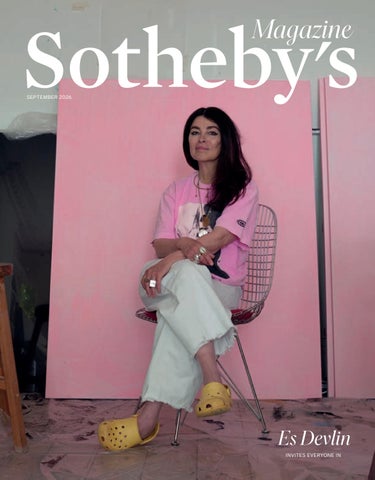
SEPTEMBER 2026
Es Devlin INVITES EVERYONE IN
cd: ROBB AARON GORDON
- A n I s l a n d S a n c t u a r y l i k e n o o th e r
LOVELANAI.COM
“ I “I wowork rk ininlaye frag mnetns ts layers rs of of colo colo rr aan n ddfra gme of of li ght— t ha t tran tra n sla te inintotoj eje welr y. ”y.” l igh t— h ahar r mmo o nnies ies that slate welr BIIL LY YU ––SSYYB UR RM MAANN
MERCER COLLECTION WOMEN
ARMORY COLLECTION MEN
SEPTEMBER 2026
PROLOGUE 26 30 32 34 38
86
The Editor’s Letter The Contributors The Auction Highlights The Chinese Art Specialist The Modern Art Specialist
ACT 1 From top: Photography by Nigel Shafran; © 2026 Estate of Roy Lichtenstein/DACS; BORN XDS.
42 THE OPENING BID News from the worlds of art, books, culture, design, fashion, food, philanthropy and travel.
42 THE GLOBAL AGENDA Must-see exhibition openings in September.
ACT 2 54 COLLECTED WISDOM Laurent Asscher, tech entrepreneur and founder of AMA Venezia, reflects on building a focused collection and why he’d rather have works on hiswalls than numbers in his bank account. By James Haldane
56 COLLECTOR’S ITEM
102
Dieter Rams remains a quietly radical force in design. Klaus Klemp, managing director of the Dieter and Ingeborg Rams Foundation, unpacks the attitude behind the objects. By Klaus Klemp, as told to James Haldane Photography by Henry Leutwyler
62 COLLECTOR’S CELLAR A Château Haut-Brion sale presents collectors with a rare opportunity to acquire some of the finest first-growth Bordeaux. By Lettie Teague Illustration by Joanna Neborsky
64 COLLECTOR WALLS John Stefanidis, who befriended Cy Twombly in the ’50s, recalls his summers with the artist and the painting that he thought had disappeared. By Lucas Oliver Mill
on the cover Es Devlin in her home studio, where many of the objects in her major retrospective at London’s Design Museum took shape. Photography by Nigel Shafran follow @sothebys on all platforms 20
From top: Es Devlin at home in London; Roy Lichtenstein’s “Nurse,” 1964; a 1951 letter and design sketch sent from Alexander Calder to the dealer Pierre Loeb.
38
In-store interior design & 3D modeling services.(1) Quick Ship program available.(2)
Bubble Curve. Curved sofa and armchairs, designed by Sacha Lakic. Hydro. Cocktail table and end tables, designed by Sacha Lakic. Atlas. Floor lamp and table lamp, designed by Fabrice Berrux.
Photos by Flavien Carlod and Baptiste Le Quiniou, for advertising purposes only. TASCHEN. DDM Architectuur. (1)Conditions apply, contact store for details. (2)Quick Ship Program available on select products in stock, subject to availability. Images are for reference only and models, sizes, colors, and finishes may vary. Please contact your local store for more information.
French Ar t de Vivre
ACT 3 68 THE ARTIST PORTFOLIO Layers of history define the ancient city of Dougga, in northern Tunisia. Its remarkably preserved Roman remains offer a glimpse into how life was once lived. Here and at Tunis’ National Bardo Museum, the remnants of Dougga’s ornate mosaics and monumental stonework evoke a romantic vision of archeology and adventure. Photography by Brett Lloyd Styling by Tony Irvine
86 THE EVERYTHINGIST For decades, artist and stage designer Es Devlin built worlds for others. Now, ahead of a major London retrospective, she brings her own creative language into focus. By James Haldane Photography by Nigel Shafran
94 SHINE OF THE TIMES
68
94
An assortment of the latest high jewelry— and one porcelain Lalanne egg cup—form an expressive, richly layered vignette. Photography by Louis Dewynter Prop styling by Camille Tricoire
102 BECOMING ROY LICHTENSTEIN
108 CHANGE OF SCENERY
From top: Model Erika Barletta in an Akris dress at the National Bardo Museum in Tunis, Tunisia; Tiffany & Co.’s Legendary Bird: The Sapphire Edition brooch in 18-karat yellow gold and platinum with an oval sapphire, black opal, mother-of-pearl, silver pearls, rubies and diamonds, price upon request; Dieter Rams’ Braun T1000 world receiver, featured on a 2018 postage stamp celebrating Germany’s design history.
Newly minted art agent Cristopher Canizares and his husband, tech executive Dan Friedman, explore their evolving interests in a sprawling Connecticut farmhouse. By Sarah Medford Photography by Stephen Kent Johnson
EPILOGUE 112 EXTRAORDINARY PROPERTIES Partner content by Sotheby’s International Realty.
120 GOING, GOING, GONE As (RED) marks its 20th anniversary, co-founder Bobby Shriver recalls the 2008 auction that proved the art market could be mobilized to save lives. By James Haldane
24
56
From top: Photography by Brett Lloyd, styling by Tony Irvine; Photography by Louis Dewynter, prop styling by Camille Tricoire; Photography by Henry Leutwyler.
A new biography of the painter recounts the eureka moment when he abandoned abstraction and embraced his destiny as a pop art star. By Avis Berman
My Dior
dior.com – 800.929.dior(3467)
The Editor’s Letter
SEPTEMBER 2026
From participatory installations and open institutions to democratic design and collective action, this issue explores what happens when culture invites us not merely to look, but also to take part.
F
26
Pablo Picasso, “Tête d’homme, profil,” 1963. €3,000,000-€4,000,000, “Modernités,” Sotheby’s Paris, October 23.
T1000 world receiver, which stands as both a technical achievement and, in postwar Germany, a declaration of openness. Participation takes a more personal form in Sotheby’s second collaboration with FRAME, a collection of wardrobe staples available now online and in boutiques, modeled by colleagues from across the company—including Lisa Dennison, who expanded the Guggenheim’s reach during her tenure as director, and Ashkan Baghestani, who has brought Middle Eastern artists and collectors into a contemporary conversation. Across these pages, participation takes many forms. Collector Laurent Asscher reflects on sharing art’s pleasures, and we enter the cellars of Château Haut-
Brion ahead of the first auction devoted to the estate. As (RED) marks its 20th anniversary, we revisit a landmark sale, initiated by co-founders Bono and Bobby Shriver, that brought artists, collectors and Sotheby’s together to support AIDS programs in Africa. Its achievement lay not only in what it raised, but in the scale of the response. As Shriver asks, “Has there ever, anywhere, been such an act of artist generosity?”
Kristina O’Neill, Editor in Chief @kristina_oneill
BORN XDS.
or British artist and designer Es Devlin, participation is not an afterthought but a medium. Across installations built from contributed words, faces and encounters, she asks how identities might be assembled rather than imposed—and how imagined divisions between us might become less fixed. Ahead of her largest exhibition yet, opening at London’s Design Museum on October 2, we visit Devlin at home to discuss national identity, artistic independence and what she calls “engineering encounters without words.” Sotheby’s, too, is turning its global locations into places of encounter. In New York, September 27 marks 60 years since the Breuer building opened as the Whitney Museum of American Art. Now home to Sotheby’s New York, the landmark will welcome a wider art world community as the Independent Art Fair takes over the building, bringing visiting galleries and artists into dialogue across its spaces. The Whitney, meanwhile, which called the Breuer home for nearly five decades, opens “Roy Lichtenstein: 1997” on September 5. An excerpt from Avis Berman’s “Becoming Roy Lichtenstein: The Path to Pop” traces the artist’s break from abstract expressionism and his embrace of a visual language familiar to millions. A Disney cartoon and Ben-Day dots helped him collapse the distance between everyday culture and fine art. Dieter Rams pursued another kind of openness through design. At 94, the author of the 10 principles of good design remains synonymous with useful, lucid objects. For our Collector’s Item series, we visit the Dieter and Ingeborg Rams Archive at Frankfurt’s Museum of Applied Arts, exploring his designs and the tools used to create them—including the Braun
The Contributors
Avis Berman Writer
Brett Lloyd Photographer
Camille Tricoire Stylist
Louis Dewynter Photographer
Avis Berman is the author of “Rebels on Eighth Street: Juliana Force and the Whitney Museum of American Art”; “James McNeill Whistler”; “Edward Hopper’s New York”; and “Roy Lichtenstein: The Impossible Collection.” She also works as an oral historian, interviewing over 500 art-world figures for museums, archives and foundations.
Brett Lloyd was born in the north of England. Now living in London, he spends a lot of time in Naples, Italy. Lloyd’s photography combines his love for Italian Renaissance art and neorealist cinema with contemporary culture. His editorial work can be seen in Vogue Italia, Another Man, Vanity Fair and Dazed & Confused.
Camille Tricoire is a Paris-based designer and stylist. A graduate of the École Supérieure d’art et design de Saint-Etienne (ESADSE) in Product Design, she is recognized for her refined eye, delicate aesthetic and timeless approach to still life. She collaborates with leading fashion houses, magazines and tableware brands.
Louis Dewynter is a French photographer known for his meticulous yet raw visual approach. Working with light, shadow and color as structural elements, he explores purity of form mainly through still life, but also fashion and portraiture. His distinctive style has led to collaborations with prominent luxury houses and publications.
Becoming Roy Lichtenstein, p102.
The Artist Portfolio, p68.
Shine of the Times, p94.
Shine of the Times, p94.
PARTNERSHIPS
Italy
General Inquiries
Head of Global Partnerships – Eleonore Dethier
Bernard Kedzierski and Paolo Cassano K. Media bernard.kedzierski@kmedianet.com paolo.cassano@kmedianet.com
sothebysmagazine@sothebys.com
Editor in Chief – Kristina O’Neill Creative Director – Magnus Berger Editorial Director – Julie Coe Director of Editorial Operations – Rachel Bres Mahar Executive Editor – James Haldane Visuals Director – Dana Kien Art Director – Anyela Mohlin Entertainment Director – Andrea Oliveri for Special Projects Editorial Assistant – Adia Elcock CONTRIBUTING EDITORS
Akari Endo-Gaut, Frank Everett, Cary Leitzes, Sarah Medford, Lucas Oliver Mill CULTURESHOCK
Chief Executive Officer – Phil Allison Managing Director – Charlotte Regan Head of Creative – Tess Savina Head of Editorial – Rachel Potts Production Editors – Emma Nicklin, Antonia Wilson Picture Editor – Olivia Howitt Art Editor – Gabriela Matuszyk Designers – Michael Kelly, Ieva Misiukonytė Chief Subeditor – Mark Grassick Subeditors – Evan Hughes, Sean McGeady, Bobby McGee
30
PUBLISHING US (New York and Northeast)
Fashion – Judi Sanders LGR Media Plus judi@lgrplus.com Jewelry & Watches – Lisa Fields lisa.fields.consultant@sothebys.com Design – Angela Okenica aokenica@gmail.com Galleries and Museums – Ian Scott ian.scott.consultant@sothebys.com US (Southeast and West Coast)
Mark Cooper TL Cooper Media markcooper@tlcoopermedia.com UK
Harriet Holder Cultureshock harriet@cultureshock.com France
Guglielmo Bava Kapture Media gpb@kapture-media.com
Switzerland
Neil Sartori Media Interlink neil.sartori@mediainterlink.com India and GCC Region
Please note that all lots are being offered for sale subject to Sotheby’s Conditions of Business for Buyers (which include our Authenticity Guarantee), which can be found on the relevant sale page on www.sothebys.com. Sotheby’s, Inc. License No. 1216058. © Sotheby’s, Inc. 2026. Information here within is correct at the time of printing. All content in this magazine is protected by copyright and may not be reproduced, published or redistributed without the permission of the relevant copyright owner. Every effort has been made to identify and contact copyright holders and obtain permission to reproduce the material. Please get in touch relating to any omission or inquiry.
Marzban Patel Mediascope marzban.patel@mediascope.co.in Asia
Matthew Farrar Mezzomedia mfarrar@mezzogroup.com SOTHEBY’S
Chief Executive Officer – Charles F. Stewart President, Sotheby’s Partners – Jean-Luc Berrebi Chief Marketing Officer – Gareth Jones Chief Public Relations Officer – Karina Sokolovsky Global Head of Brand – Jacqueline King Global Head of Content and Campaigns – Nick Marino Global Head of Growth – Tracy Heller Global Head of Social Media and Editorial – Anne Johnson Global Head of Video Production – Rachel Roderman Head of Events and Preferred, Americas – Richard Drake Head of Events, UK – Lydia Soundy Head of Procurement – Eduardo Guerra
From left: Brad Berman; Courtesy of Brett Lloyd; Courtesy of Camille Tricoire; Charlotte Sobral Pinto.
The Masthead
The Auction Highlights PARIS OCTOBER 23
NEW YORK SEPTEMBER 16
HONG KONG SEPTEMBER 29-30
THE PARIS SALES
ASIAN ART
Presenting works by titans of the 20th and 21st centuries.
Offering fine Asian works of art across millennia of artistic excellence.
THE HONG KONG SALES
Alberto Giacometti, “Tête crâne,” 1934. €2,000,000-€4,000,000, “Modernités.”
NEW YORK OCTOBER 7
CONTEMPORARY CURATED
Modern and contemporary works from Asian and global masters.
A rare and impressive archaic jade cong, Neolithic period, Liangzhu culture. $200,000-$300,000, “Chinese Art.”
Pierre-Auguste Renoir, “Paysage avec figures,” 1890-93. HK$15,500,000HK$25,000,000, “Modern & Contemporary Evening Auction.”
PARIS OCTOBER 1
HONG KONG SEPTEMBER 4 - OCTOBER 30
CHÂTEAU HAUT-BRION
ASIAN ART
The first auction dedicated to the wines of Château Haut-Brion, marking 90 years of stewardship by the Dillon family.
Presenting works from the Okada Museum of Art collection, reflecting the rich artistic dialogue between Japan and China.
An exceptional array of works from postwar masters to today’s cutting-edge artists.
Alexander Calder, “Odalisque,” 1945. $200,000-$300,000, “Contemporary Curated.” 32
A Linley 75th anniversary console, two bespoke Château Haut-Brion carafes, 12 engraved glasses, Buccellati silverware and eight historic vintages from 1935 to 2009. €130,000-€260,000, “Château Haut-Brion, Domaine Clarence Dillon.”
A rare Cizhou sgraffiato “peony” jar, Northern Song dynasty. HK$600,000HK$1,200,000, “Masterpieces of Asian Art from the Okada Museum of Art II.”
SEPTEMBER 2026
PARIS SEPTEMBER 15
LONDON SEPTEMBER 29
ROCHAS COLLECTION
MODERN & CONTEMPORARY SOUTH ASIAN ART
A tribute to 20th-century decorative arts, inspired by the worlds of fauna and flora.
The finest examples from the region’s established and emerging artists, spanning a variety of mediums.
Vivan Sundaram, “Sacrifice,” 1966. £70,000-£90,000, “Modern & Contemporary South Asian Art.”
NEW YORK OCTOBER 21-23
HONG KONG SEPTEMBER 17-24
MAGNUM OPUS
LUXURY WEEK
Exceptional art and objects spanning continents and millennia, from classical antiquity to the masterpieces of the 20th century.
Offering the finest jewelry, watches, handbags, wine and spirits.
Diego Giacometti, “Hommage à Böcklin” console, specially commissioned, circa 1980. €2,000,000-€3,000,000, “Rochas Collection.”
LONDON OCTOBER 15-16
THE LONDON SALES Trailblazing works from modern and contemporary masters and designers.
Barbara Hepworth, “Small Form (Amulet),” 1960. £600,000-£800,000, “Modern British & Irish Art Evening Auction.”
A Marble Torso of an Emperor, Roman Imperial, Julio-Claudian, first half of the 1st century A.D. $8,000,000-$12,000,000, “Magnum Opus Evening Auction.”
Cartier, Crash, Reference WL420047. A limited-edition pink gold and diamond-set bracelet watch, circa 2014. HK$1,600,000-HK$3,000,000, “Important Watches.” 33
The Chinese Art Specialist
Among the mAsterpieces of Asian art from the Okada Museum of Art, few objects transport us as powerfully to the foundations of Chinese civilization as this superb bronze jue (tripod drinking vessel). Standing just 19.5 centimeters high, it is intimate in scale but immense in implication. Cast during the late Shang or early Western Zhou period in the 11th century B.C., it belongs to a moment when key political principles—divine legitimacy, sacred authority and moral order—were taking shape. Beneath the handle is a single pictogram: Ge (戈), or dagger-axe. Like a noble banner or seal of rank, it marks the vessel for the great
Ge clan, one of the few lineages to claim descent from Yu of the Xia. For me, the fascination lies in how much history is held within this single elemental mark. Prominent during the late Shang and Zhou dynasties, the Ge clan was distinguished by its martial and ritual authority, symbolized by the dagger-axe, a weapon native to ancient China. Its influence extended beyond warfare to political and religious spheres, shaping regional and imperial power dynamics. Archaeological finds and oracle bone inscriptions identify the Ge as an elite lineage wielding military and ritual power. Its legendary descent from Yu the Great, founder of the Xia dynasty, placed the clan within a divine genealogy. Although direct evidence remains elusive, tradition suggests that the clan claimed to inherit Yu’s wisdom, virtue and divine legitimacy—claims that bolstered its status and linked its martial and ritual authority to a sacred past.
BY NICOLAS CHOW Chairman, Sotheby’s Asia, and Worldwide Head of Asian Art
Centuries later, Confucian thinkers would idealize virtuous aristocrats rooted in ancestral legitimacy. Seen through this later lens, the Ge clan, with its prestigious lineage, embodied such authority. Its revered status shows how moral virtue and divine kinship could together form the foundation of rightful authority in Chinese political thought. In China’s Yellow River heartland, the Ge clan was active in the great capitals of Anyang and later Luoyang, raising soldiers and casting bronzes for both war and ritual. It is also believed to have shifted allegiance to King Wu, aligning itself with the founding of the Zhou and continuing its bronze production in Shaanxi. Across the rise and fall of dynasties, the name Ge has endured for more than three millennia in the bronzes that survive today. Most surviving Ge clan bronzes are now preserved in prominent museums, including the Palace Museum in Beijing and the National Palace Museum in Taipei. The emblem has proved equally enduring. The dagger-axe first appeared in neolithic China as a functional stone blade or tool, later becoming a ceremonial object in jade and, by the Bronze Age, a weapon cast in metal. As a written character, ge remains associated with warfare and state power, forming part of the character for “martial” and appearing within the traditional character for “state” or “country.” From weapon to clan symbol to the character still used today, ge distills warfare, authority and the foundations of civilization into a single mark, laying bare an enduring human instinct: to conquer, to command and to be remembered.
The Ge Jue, an inscribed archaic bronze ritual wine vessel, late Shang dynasty. HK$300,000-HK$600,000, Masterpieces of Asian Art from the Okada Museum of Art, September 4, Sotheby’s Hong Kong.
34
Photo: Courtesy of Sotheby’s. Illustration: Joe McKendry.
Cast into bronze more than 3,000 years ago, a dagger-axe pictogram proclaims the power and mythic lineage of ancient China’s Ge clan.
UNLIKE THE REST Experience the Yachting Lifestyle From iconic islands to coveted coasts, every voyage is designed around discovery — and around you. Enjoy seamless inclusions with Michelin-inspired dining, expert-led exploration, and warm, personalized service.
RITZCARLTONYACHTCOLLECTION.COM
The Modern Art Specialist
“Have you still not received the mobile that I sent a little over two months ago to Lefebvre-Foinet for you?” Alexander Calder wrote to his friend Pierre Loeb on February 27, 1951. “If you have received it, I hope you like it, and Sylvia too, as it was intended for her.” Written in Calder’s energetic French from Roxbury in Connecticut, the letter carries a note of concern. The mobile had been dispatched to Paris through Lefebvre-Foinet, the artists’ materials supplier and shipper, but no confirmation had arrived. “Tell me what happens,” Calder continued, “its arrival or non-arrival.” That uncertainty makes the letter—which is offered with the work alongside a design sketch—feel immediate. This was not a great artist chasing a sale, but a man wondering whether his present had reached his dear friends. The present in question was “Untitled,” created in 1950.
Pierre Loeb opened Galerie Pierre in 1924. Before World War II, it became a crucial venue for surrealist and cubist art, promoting artists including Pablo Picasso, Joan Miró, Jean Arp and Alberto Giacometti. In 1925 alone, it staged a major Miró exhibition and the landmark “La Peinture surrealiste,” placing Loeb at the center of the movement in Paris. Calder knew this was a work that would be fully understood. To create a mobile for Pierre and Sylvia was to make something for two people intimately familiar with the most sophisticated art of their time. The gift came at a fertile moment in Calder’s career. In 1950, Galerie Maeght mounted an exhibition of his mobiles and stabiles in Paris; it later traveled to Amsterdam, Stockholm, London and Vienna. Even against this fervent creative backdrop, the mobile made for Sylvia is particularly experimental. It possesses one of the richest palettes in Calder’s work, bringing together the three primary colors—blue, red and yellow—with black, white and a rare orange: all the colors Calder ever used in his mobiles gathered into a single work. The wires, painted black and red, participate in this explosion of color. Nothing feels incidental. The result is almost an artistic testament.
BY THOMAS BOMPARD Co-Head of Modern and Contemporary Art, Sotheby’s France
The mobile has a distinctly feminine poise and delicacy. Certain shapes recall the work of Miró, Calder’s close friend and one of Galerie Pierre’s defining artists. The central form echoes Miró’s biomorphic language—not as quotation but as tribute. It is as though Calder were addressing both recipients at once: a personal gift to Sylvia and, for Pierre, an acknowledgment of the artists he had championed. Calder’s generosity extended beyond friendship. During World War II, he donated works to France Forever in support of the French Resistance. Here, that impulse finds intimate expression. Made in the United States but attuned to Parisian proportions, the 1.7-meter-wide mobile has the presence to command a room while remaining at home in a classic Haussmannian apartment—a work conceived to live above and among people. The gift reached Paris and remained with the Loeb family until Léon and Natalie Seroussi acquired it in the mid1980s. Later, in their dreamlike house, built in 1951 by the visionary modernist architect André Bloc, it floated among other Calders and surrealist masterworks by Picabia, Dalí, Tanguy and Brauner. The architecture and collection formed a single imaginative world. I have known the Seroussi family for 20 years and for almost as long have hoped to bring this mobile to auction. Its appearance in the centenary year of Calder’s arrival in France, following the Fondation Louis Vuitton’s landmark retrospective, feels especially resonant. Its debut at auction marks the re-emergence of a private gesture, still moving through the air more than 75 years later.—As told to James Haldane Alexander Calder, “Untitled,” 1950. €2,000,000€3,000,000, “Surrealism and Its Legacy,” October 23, Sotheby’s Paris.
38
Photo: Courtesy of Sotheby’s. Illustration: Joe McKendry.
A mobile made as a gift gathers Calder’s visual vocabulary into an intimate tribute to friendship and the Paris avant-garde.
THE GRACE COLLECTION PHOTOGRAPHED BY FRANÇOIS HALARD
RUGS, CURTAINS, BEDDING & DECOR
6 GREENE STREET NEW YORK
130 MOUNT STREET LONDON
BIRGER JARLSGATAN 58 STOCKHOLM
SHOP ONLINE NORDICKNOTS.COM
RM 64-01 COLNAGO Skeletonised manual winding tourbillon calibre 65-hour power reserve (± 10%) Baseplate and bridges in grade 5 titanium Fast-rotating barrel Case in white and blue Quartz TPT® Limited edition of 50 pieces
A Racing Machine On The Wrist
Act One: The Opening Bid, in which we present news from the worlds of art, books, culture, design, fashion, food, philanthropy and travel—alongside the Global Agenda, which highlights not-to-be-missed exhibitions opening in September.
The Opening Bid
Edited by Julie Coe
FRESH TAKES
When SWiSS luxury brand Akris debuted its signature Ai bag in 2009, among its distinguishing traits—a trapezoidal shape and origami-like folds—was its material: woven horsehair. Known for its durability and subtle luster, it’s also a textile frequently found in works by Colombian artist Olga de Amaral. More than a decade and a half later, Akris’ creative director Albert Kriemler, a longtime follower of Amaral’s, finally had the chance to partner with the 94-year-old artist herself on the brand’s fall 2026 collection. “I always wanted to do a collaboration with an artist who works with textiles, who is as obsessed with fabrics as I am. Fabrics are everything to me, and they are too for Olga,” says Kriemler, from Akris’ headquarters in St. Gallen, Switzerland. While the brand has worked with several notable artists in the past, this was its first collaboration with a textile artist. Rather than simply draw on Amaral’s aesthetic sensibility, the resulting collection evokes notable works from her extensive career, many of which featured in a recent retrospective at the Fondation Cartier. A showstopping cocoon coat constructed from shimmering gold jacquard, for example, pays homage to Amaral’s “Estelas” series, cotton weavings transformed with gesso, acrylic paint and gold leaf into rigid sculptural objects.
SEPTEMBER
Instante/revelación: Moments in Mexican Photography opens at the Getty Center in Los Angeles.
42
1
Dresses of layered organza tiles and appliquéd squares, meanwhile, echo Amaral’s “Alquimia” tapestries, while horsehair—in the form of a swingy fringe skirt—also appears. Kriemler, known for his spectrum-spanning use of color, found a like-minded spirit in Amaral’s own palette of magenta, turquoise and emerald, but perhaps their shared hallmark transcends the runway: their trusted aids. Kriemler, who has worked with many of his pattern makers and tailors for more than two decades, expresses his admiration of Amaral’s own reliance on her longtime studio assistants: “She called them ‘seven lives and fourteen hands.’ It’s such a beautiful description.” akris.com —Laura Neilson
2
Frieze Seoul opens.
Clockwise from above: Akris merlot-red layeredorganza Tiles midi dress with asymmetrical panels, inspired by Olga de Amaral’s work ($9,990, akris.com); Amaral’s 2014 work “Lienzo A,” in linen, cotton, gesso and acrylic; the artist in her studio in Bogotá, Colombia, in 1965.
6
Mary Cassatt: After Impressionism opens at the Art Institute of Chicago. Maverick Kings: Three Visionary Pharaohs of Egypt’s Golden Age opens at the MFA Boston.
Left, clockwise from bottom: Courtesy of Akris; © 2026 Olga de Amaral © Photo: Diego de Amaral / artist’s archive; © Diane-Witlin / artist’s archive. Below: Rodrigo Moya, “The Girl, Old Railroad, Mexico-Cuautla,” 1966, printed 2010. Getty Museum, Gift of Daniel Greenberg and Susan Steinhauser, © Estate of Rodrigo Moya; Yagwang, “Raw Proof,” 2024. Courtesy of the artist; Mary Cassatt, “The Family,” 1893. Chrysler Museum of Art, Gift of Walter P. Chrysler, Jr.
From the Same Cloth
STYLE SHEET
L.A. STORY Celine’s recently opened Rodeo Drive boutique injects a big dose of Parisian style into the City of Angels with Haussmann-style oak parquet and speaker systems by young French designer Matéo Garcia. Visitors to the 5,500-square-foot location also have access to exclusive in-store offerings, such as a Rectangle bag in exotic porosus crocodile.
Right, from top: Courtesy of Celine; Stephen Kent Johnson. Below: Leonardo da Vinci, “Portrait of a Woman,” incorrectly known as “La Belle Ferronnière,” circa 1490-97. Musée du Louvre, Paris, © GrandPalaisRmn (Musée du Louvre) / Michel Urtado; Bayeux Tapestry, England, about A.D. 1072-77. Photo © La Fabrique de patrimoines en Normandie / Antoine Cazin; Tintoretto, “Portrait of a Man,” circa 1548. Besançon, Museum of Fine Arts and Archaeology, © Besançon, Museum of Fine Arts and Archaeology, photo by E. Chatelain.
Celine Rectangle bag in porosus crocodile, price upon request; celine.com
FINE PRINT
WATCH THIS SPACE Before any furniture is built, any millwork commissioned, design duo Jane Keltner de Valle and Giancarlo Valle create petite models of the rooms they’re envisioning, populated with handmade twig-and-twine chairs, cardboard staircases and clay sofas. One of these maquettes appears on the cover of their new book, “Studio Valle de Valle: Interiors,” though it takes a moment to register that it’s not life-size. The meticulous character of these dollhouse-like constructions, which echo Jane’s childhood toys, demonstrates the exacting attention the pair give to their work, whether it’s bringing a breezy freshness to a Rhode Island seaside pile or referencing local wildlife in a sleek Mexican hotel villa. “Judd with the corners softened” is their description of the pine stools in their own Brooklyn loft, but it’s also an apt metaphor for their broader sensibility, which appreciates found objects and custom furnishings alike. $75; rizzoli.com
Left: The library of a Toronto home designed by Studio Valle de Valle.
9
10
The Bayeux Tapestry opens at the British Museum in London. Maurizio Cattelan. Night opens at the Neue Nationalgalerie in Berlin.
Masterpieces of the Renaissance from the Musée du Louvre opens at the National Art Center, Tokyo.
11
Timeless Tintoretto opens at the Musée JacquemartAndré in Paris. Georgia O’Keeffe: Architecture opens at the Detroit Institute of Arts. Tokyo Gendai opens.
43
THE WRITE STUFF
Montblanc’s “High Artistry A Tribute to Craftsmanship Limited Edition 1” pen in progress.
EvEry yEar, Montblanc rElEasEs a High Artistry collection that exemplifies the fountain pen brand’s innovative and technical prowess. Behind the scenes, a small group of stone setters, engravers, goldsmiths and other craftspeople has worked to materialize the intricate plans dreamed up by the creative team, a years-long process from start to finish. This artisan atelier, in Hamburg, is led by Thorsten Hering, who joined more than 40 years ago as a 16-year-old apprentice. Training for roles in his department requires extreme patience: it can take three years just to learn how to grind a nib. “As much as these pieces are objects of art, in the end we are looking to pro-
duce functional writing instruments,” says Alexa Schilz, Montblanc’s Director of Writing Culture and Brand Strategy. Montblanc also turns to its sister maison, Van Cleef & Arpels, for hand-enameling, tricky on a cylindrical surface. But the thousands of hours each artisan puts into each pen certainly pay off. The latest High Artistry range, inspired by Japanese culture, includes an edition of five featuring, among many other details, a reproduction of 17th-century artist Kanō Tan’yū’s tiger panels from Kyoto’s Nanzen-ji temple and an edition of one laced with black-onyx and pink-sapphire sakura blossoms and topped by an enameled silver pheasant guarding a diamond. montblanc.com
Courtesy of Montblanc.
OBSESSIONS
AWAY GAME
Right, from top: Courtesy of Villa D’Este La Collezione; courtesy of Tomokazu Matsuyama. Below: Eugène Delacroix, “Étude d’un étalon alezan doré” (avant restauration). © Musée du Louvre, dist. GrandPalaisRmn / Tony Querrec; Portrait of Liu Wei. Photo by Jumbo Tsui, courtesy of Liu Wei Studio; Pablo Picasso, “Dora Maar,” 1940. © Succession Picasso / Bildrecht, Vienna 2026, photo © bpk / Nationalgalerie, SMB, Museum Berggruen / Jens Ziehe.
ROOM WITH A CRU Now opeN oN Lake Como, Miralago Luxury Apartments is Villa d’Este La Collezione’s first branded residential concept, occupying the restored former Hotel Miralago, a graceful old presence on Cernobbio’s waterfront. Its eight apartments pair the privacy and independence of a home with housekeeping, turndown service, breakfast delivery and access to Villa d’Este’s floating pool, fountain-filled Renaissance gardens and the Sporting Club. The most persuasive amenity may be tucked inside each kitchen: a wine cabinet, personalized before arrival from the hotel’s legendary cellar of some 17,000 labels. Guests can specify their preferences—or surrender to the sommelier’s judgment—then have a private chef prepare dinner. Miralago, it seems, takes the house pour personally. miralagoluxuryapartments.com —James Haldane Villa d’Este’s Miralago apartments, on Italy’s Lake Como.
VIEW FINDER
Shared Space more thaN two deCades after Tom Wesselmann’s death, the downtown Manhattan studio he used for the last 10 years of his life will host an exhibition September 19-27 titled “Wesselmann x Matsuyama.” Organized by the Almine Rech gallery, the show couples the work of contemporary artist Matsuyama with that of the late pop master. Of note is Matsuyama’s 2025 canvas “We The People,” which relocates Jacques-Louis David’s 1787 painting “The Death of Socrates” to a modern-day grocery store. It’s fittingly matched with Wesselmann’s 1963 work “Still Life #35,” a jumble of cola bottles, cigarettes, white bread and canned beef stew. alminerech.com
Matsuyama’s 2025 work “We The People.”
12
Delacroix: Horses and Other Animals opens at the Musée National Eugène-Delacroix in Paris.
17
18
The Genesis Facade Commission: Liu Wei opens at the Metropolitan Museum of Art in New York City.
Picasso – Bacon: What It Feels Like To Be Human opens at the Albertina Museum in Vienna. Remedios Varo opens at the Louisiana Museum of Modern Art in Humlebæk, Denmark.
45
DESIGN FORWARD
ALFRESCO APPEAL Stephen Burks, a designer with multiple solo museum shows to his name, has been collaborating with Roche Bobois for more than a decade. Catalina, his latest collection for the French brand, is an outdoor range that mixes ceramic-top tables and comfy lounge seating, all with slightly flared steel legs that give the pieces some kick.
TREASURE HUNT
Modern English ShakeSpeare’S “A Midsummer Night’s Dream” employs the double cherry as a metaphor for an adoring couple: “two lovely berries molded on one stem.” American jewelry brand FoundRae has taken the conjoined fruit as the signature symbol for its new London store, in a nod to the Bard’s legacy and the wild cherry’s proliferation across the UK. It punctuates the ceiling of the Mayfair boutique, where cherry-red display cases hold the brand’s gem-studded offerings. It’s also rendered in diamonds and garnets on an 18-karat gold medallion, available exclusively at the London shop, which is FoundRae’s first stand-alone address outside the United States. foundrae.com FoundRae’s new London store and its exclusive medallion with oversized mixed clip extension chain, £28,515, available at FoundRae London.
18
19
Taryn Simon opens at the Guggenheim in New York City. William Kentridge: I Am Not Me, The Horse Is Not Mine opens at the Bozar Centre for Fine Arts in Brussels.
46
John Baldessari opens at UCCA Beijing. Bruce Nauman: Identical opens at the Nasher Sculpture Center in Dallas.
20
Spectacular Freedom: Andrew Wyeth and the Modern American Watercolor opens at the Cleveland Museum of Art. Textile Alchemy: The Art of Reiko Sudō and NUNO opens at LACMA.
Top: Courtesy of Roche Bobois. Left: Courtesy of FoundRae. Below: Taryn Simon, “A squad agent informed me I’d be babysitting” (detail), 2026. © 2026 Taryn Simon; John Baldessari, “The Studio,” 1987. Private collection, © 1987-2025 John Baldessari Family Foundation, courtesy of the Estate of John Baldessari and Sprüth Magers; Andrew Wyeth, “Self-Portrait,” 1939. Wyeth Foundation for American Art Collection, B0008. © 2025 Wyeth Foundation for American Art / Artists Rights Society (ARS), New York.
Designer Stephen Burks and the Roche Bobois Catalina chair, price upon request; roche-bobois.com
SHORE ENOUGH
22
Comporta, on portugal’s Alentejo coast, is a slow burn of a hot spot. “Rice, pines, dunes, ocean,” says German real estate developer Dietrich E. Rogge, describing the area. Across 35 acres, Rogge is constructing Atlantic Club Comporta, a group of 24 villas available for sale or vacation rental, accompanied by all the amenities of a five-star hotel. Rogge recruited Comporta resident Jacques Grange, designer for the likes of Yves Saint Laurent and Francis Ford Coppola, for
23
48
Atlantic Club Comporta, on Portugal’s Alentejo coast, south of Lisbon.
24
Cézanne and Us opens at the Grand Palais in Paris.
The Lucas Museum of Narrative Art opens in Los Angeles.
the interiors; Grange, in turn, brought in landscape designer Madison Cox to install native plants. As Comporta’s hospitality sector grows—Sublime Comporta recently doubled in size and Na Praia, designed by Studio KO, is set to open in 2027—Atlantic Club’s siting will ensure that it maintains its views of the rice fields and the wild Atlantic beyond. atlanticclubcomporta.com
Arthur Jafa: I Am Tony opens at the New Museum in New York City. The Armory Show opens at the Javits Center in New York City.
Left: Francisco Nogueira. Below: Aerial view of the Lucas Museum of Narrative Art construction, September 2025. © 2025 Lucas Museum of Narrative Art. Photo by Pedro Ramirez, courtesy of Hathaway Dinwiddie; Paul Cézanne, “La Montagne Sainte-Victoire au grand pin,” circa 1887. Courtauld Gallery, London, photo © Courtauld; Arthur Jafa, “Monster,” 1988, printed 2017. © Arthur Jafa, courtesy of the artist and Gladstone.
GRAND TOUR
YOUR NEXT CHAPTER. TIMELESS.
On the shores of Lake Zurich, Switzerland, Kusnacht Practice delivers world-leading, highly personalised clinical care in mental health, addiction, and precision medicine, through an in-house team of doctors across three disciplines, enabling profound healing, lasting transformation, and a life fully reclaimed.
K U S N AC H T P R AC T I C E .C O M
NEW COLLECTIBLES
at the 1925 Paris Expo that birthed art deco, Marie-Louise Idestam-Blomberg won a gold medal for her chess set, which reimagined the pieces almost like avant-garde fairy-tale characters. The Finnish-born sculptor had studied in both Stockholm and Paris, but her early arts education took place during her St. Petersburg childhood, thus the Russian-peasant garb of her tubby pawns. Her downcast queens are clearly expecting, as she was at the time. Long out of production, the set will be reissued in pewter and brass by Svenskt Tenn this fall. svenskttenn.com
Svenskt Tenn’s reissue of Marie-Louise Idestam-Blomberg’s 1920s chess set, $12,800.
LOT FOR THOUGHT
STARE QUALITY DaviD Bowie was a serious collector, with an eye as distinctive as the personas he created. In 2016, Sotheby’s transformed its New Bond Street galleries for “Bowie/ Collector,” revealing the private taste behind one of music’s most carefully fashioned public images. A decade later, the collector again becomes the collected. Bowie confronts his image in this uncompromising 1996 self-portrait, rendered in acrylic and charcoal on paper. Its raw handling and psychological intensity reflect his fascination with German expression-
ism and affinity for forceful figurative painting. He collected works by Frank Auerbach, David Bomberg and Leon Kossoff, and once said of Auerbach’s work, “I want to sound like that looks.” At once masklike and exposed, the portrait feels less like celebrity self-fashioning than another inquiry into identity from an artist moving among genres. Estimated at £30,000-£50,000, “Self-Portrait” appears in Modern British Art at Sotheby’s London on October 16: Bowie looking back at himself—and directly at us.—J.H.
David Bowie’s 1996 self-portrait.
27
25
Broken: The Power of the Fragment in Sculpture opens at the Palazzo Strozzi in Florence. Shimmer: Dreaming the Posthuman opens at the Frist Art Museum in Nashville, Tennessee.
50
30
Abstract Expressionism: The East End, 1940 to Today opens at the Parrish Art Museum in Water Mill, New York. Full Disclosure: The Edge of Information Design opens at MoMA in New York City.
Monet: Painting Time opens at the Musée de l’Orangerie in Paris. Look! 40 Ans de Mode au Musée opens at the Musée des Arts Décoratifs in Paris.
Left, from top: Henrik Lundell; BORN XDS. Below: Right Hand of Colossal Statue of Constantine, circa 313-324 A.D., Roman. Rome, Sovrintendenza Capitolina ai Beni Culturali, Musei Capitolini, MC S 786, © Vanni Archive / Art Resource, NY; Marina Adams, “Let the River Answer,” 2021. Courtesy of the artist; Claude Monet, “Le pont japonais,” 1918-19. Paris, Musée Marmottan Monet, photo © Musée Marmottan Monet / Christian Baraja SLB. Opposite, from top: Ralph Mecke; © Ugo Mulas Heirs, © 2026 Artists Rights Society (ARS), New York / SIAE, Rome; courtesy of the artist and Esther Schipper, Berlin/Paris/Seoul, Pierre Huyghe © VG BildKunst, Bonn, 2026.
Next Move
CREATIVE COLLABORATION
BIG IDEAS Art deAler And entrepreneur Elizabeth Dee has dreamed of curating a show in the landmark Breuer building on Manhattan’s Upper East Side—now Sotheby’s global headquarters—ever since she arrived in the city more than two decades ago. That vision only strengthened when Dee launched the Independent Art Fair in 2010, featuring a group of curators and gallerists in dialogue with artists, with the aim of challenging the traditional jampacked art fair model. “I think I’ve reached out to every single occupier of the building over time,” says Dee. That list includes original and longtime resident, the Whitney Museum, followed by the Met Breuer and the Frick Collection. The stars finally aligned for Dee after Sotheby’s acquired the building in 2023, in what she calls a “fortuitous” development. Sotheby’s CEO Charles F. Stewart, whom she describes as “a visionary and an ideas man,” immediately took to the idea when she pitched it. “It checks so many boxes for him, including how the entire art ecosystem can better work together,” says Dee. The fall iteration of the fair, subtitled “20th Century,” is 75% bigger than the previous edition, with 57 exhibitors. Taking place September 24-27, it will coincide with the 60th anniversary of the Breuer’s debut. “Every inch of the building will be curated by Independent,” says Dee. Look for what Dee calls “rigorous in-depth presentations,” such as the display from Berlin’s Esther Schipper highlighting 40 years of “relational aesthetics” and the collaboration between new exhibitor Lévy Gorvy Dayan and veteran Nahmad Contemporary, who will stage works by Yves Klein and Lucio Fontana respectively, in front of the building’s trapezoidal fourth-floor window. Klein and Fontana happen to have been lifelong friends and mutual admirers who, Dee notes, “shared this obsession and fascination with physical space and breaking boundaries of traditional painting.” independenthq.com—Eileen Kinsella
From above: Elizabeth Dee, the co-founder and CEO of Independent; Lucio Fontana’s hand, throwing stones, photographed by Ugo Mulas in 1966; Pierre Huyghe’s “La Toison d’Or,” 1993.
51
Ever wish you loved your home insurance as much as you love your art? We help responsible owners of the finest built homes care for the things they love, like art. Learn more at purein.com/sothebys
high value home | auto | watercraft | jewelry, art & collections | umbrella | flood | cyber & fraud PURE Insurance is the marketing name for Privilege Underwriters Reciprocal Exchange (PURE), a Florida domiciled reciprocal insurer. PURE Risk Management, LLC (PRM) serves as attorney-in-fact for a fee and is a subsidiary of Privilege Underwriters, Inc., a member of the Tokio Marine Group of Companies. This material is descriptive only. Actual coverage is subject to the policies issued. Trademarks are property of PRM and used with permission. ©2026 PRM. 1 North Lexington Avenue, Suite 1900, White Plains, New York 10601. PURE HNW Insurance Services, CA Lic. 0I78980.
Act Two: In which we delve into creating and collecting, discussing favorite finds and the long-sought works that got away, learning from creators’ innovations, tracking the place art has on our walls and exploring the world of wine connoisseurship.
Collected Wisdom
Laurent Asscher collects to share the pleasure dividends of art. The Belgian tech entrepreneur and founder of AMA Venezia reflects on building a focused collection, commissioning the largest-ever Jenny Saville painting and why he’d rather have works on his walls than numbers in his bank account. BY JAMES HALDANE
Describe your collection in three words. Americanfocused, contemporary and abstract—with a few exceptions on each count. How has your taste changed through time? I grew up with Joan Mitchell, Sam Francis and Basquiat on the wall. There were also impressionists, including Pissarro and Renoir. My parents were good collectors, but their approach was to have one of each. When I started collecting, I was obsessed with Basquiat, then Twombly. Then I expanded to test other things—at one point, I was buying 10 to 15 paintings a year. Now my taste has narrowed again and my collection is mostly Christopher Wool, Twombly, Marden, Koons, alongside Fontana and a few others, because I like to collect deeply. I also support younger artists, from Justin Caguiat to Jordan Wolfson. I know what I’m looking for and don’t hesitate to redeploy resources when a piece no longer belongs.
Why do you collect? That’s the most difficult question. When I was a kid, a friend 54
of my father’s who was sadly very ill told me: “Laurent, you have to collect. You can collect whatever you want—Post-it notes, wallets—but you have to collect something, because it’s one of the only things that you can transmit to the next generation.” So I collect because of passion, addiction and for transmission. Do you have a family heirloom, inherited or acquired, to pass on? I kept nothing from my parents’ collection except memories because I wanted to create my own path. My collection is completely new,
built since 2012. It will go to my children, who can decide whether to keep it or sell it. I have three kids, and it’s difficult to split a painting. Happily, most paintings will ultimately end up in museums. How do you live with your collection? I try to rotate pieces between my homes in Monaco and Venice, though it isn’t always easy. In Monaco, I live on the 14th floor and the elevator can only fit two people, so I need a crane. Then I have AMA Venezia, my foundation’s 1,000-square-meter exhibition space in Venice, where we do
Right: Joseph Yaeger, “Abruptly the gradual is realised,” 2025, and “Clean windows kill birds,” 2025. Far right: Sang Woo Kim, “Clarity 001,” 2020.
© Ed Ruscha, courtesy of the artist and AMA Collection. Photo: Sebastiano Pellion di Persano. © Joseph Yaeger, courtesy of the artist and AMA Collection. Photo: Installation view by Sebastiano Pellion di Persano. © Sang Woo Kim, courtesy of the artist and AMA Collection. Photo: Installation view by Sebastiano Pellion di Persano
Opposite: Laurent Asscher with Ed Ruscha’s “Venezia, Venice,” 2026, commissioned for AMA Venezia, the collector’s art space set within a former Venetian soap factory.
one public show a year, mainly with my collection. The mission is to show living artists. The current exhibition, “Aura,” puts Joseph Yaeger and Sang Woo Kim alongside Wool. What’s the point of owning art if it’s to keep it only for yourself?
York, you’re competing with fashion, movies and business. In Venice you become part of a route between institutions like Fondazione Prada, the Pinault Collection, the Peggy Guggenheim Collection, the Biennale itself and, I hope, AMA.
How do you connect with artists? I arrange studio visits to meet artists beyond the brushes and understand their techniques. Once you’re connected, you can do projects together. A good example is Jenny Saville. We have commissioned the largest painting she has ever made: a four-meterhigh, eight-meter-long, single-panel work. She almost never accepts commissions. The project began seven years ago at the Venice Biennale, where I hosted a birthday dinner for her. In my apartment, she saw some large Richard Serra drawings and said she loved the format. I replied: “Okay, let’s do one.” I’ve never seen it and I don’t know what it’s about. We’ll unveil it in Venice next year.
How has your career influenced your collecting and vice versa? I invest in tech, where it’s all about innovation and following young companies. Artists are similar. An artist who does not invent something, who does not have a clear position, will not survive one generation max. And like a startup, you can hold a position for more than a decade before you know whether it’s truly successful.
Which collectors do you admire? Steve Cohen. He has the eye and the instinct. Favorite city for art and why? I based my foundation in Venice because art people come for art only, so you get their full attention. In London, Paris or New
Best advice from another collector? When I started to collect, Steve Wynn told me: “You can’t be with 20 galleries. You have to choose two galleries, maximum. Otherwise you don’t have their attention and support, so you can’t do what you want.” When you’re obsessed with Twombly, it helps to be close to Larry Gagosian. He gave me access to some amazing Twomblys and Mardens. Best impulse buy? My Basquiat—my first major acquisition. In 2012, I bought a Basquiat at Christie’s. The next day,
I saw another Basquiat at Phillips, “Irony of Negro Policeman,” 1981, and immediately thought: “This is the one I need.” I was still new to collecting, so I called an art advisor friend. We negotiated a deal with Phillips: If I made an irrevocable bid above the low estimate, they would accept the painting I had bought the previous day as part-payment. I didn’t even know what an irrevocable bid was at that point. Then I called Christie’s and asked if they could find a buyer for my painting. “Why?” they said. “You bought it yesterday.” In the end, Christie’s resold the first Basquiat for me— with a $100,000 profit—and I bought the painting I really wanted. What was your wildest white-knuckle moment at auction? Buying a Wool painting at Sotheby’s New York. I was bidding against another collector, and we went crazy. I prefer nice paintings on my wall and fewer digits in my bank account. You have smaller financial dividends, but you have the pleasure dividends.
What’s the piece that got away? A Lichtenstein painting. It’s always felt too expensive. It might happen one day, but the prices are still going up. Favorite art-related book? I collect catalogues raisonnés. I have around 20. Most recent acquisition? Ed Ruscha created a work for the foundation that begins in Venice Beach in L.A. and ends in Venice, Italy. One side is day, the other night. What is the best compliment someone has paid to your collection? Apparently a visitor arrived at the entrance of the foundation and told the team that Miuccia Prada had advised them: “You have to go to AMA. It’s the best place in Venice.” I don’t know if it’s true, but I choose to believe it.
•
55
Collector’s Item
Dieter Rams: The Hard Work of Simple Things BY KLAUS KLEMP, AS TOLD TO JAMES HALDANE PHOTOGRAPHY BY HENRY LEUTWYLER
At 94, Dieter Rams remains a quietly radical force in design. Klaus Klemp, managing director of the Dieter and Ingeborg Rams Foundation, reflects on the attitude behind the objects—and how an archive can carry it forward.
“Dieter has never wanted to be a star designer. He is not a showman.” —Klaus Klemp
A WORLD AT HAND Opposite: Braun’s T1000 world receiver, circa 1960, brought global stations within reach; the German government later bought examples for major embassies, carrying its outward-looking vision into diplomatic life. This page, clockwise from top: Rams’ tracing paper, favored Faber-Castell 6B pencil and cutting ruler chart his process of refinement. His Goethe glass, used for water and wine, and red ashtray. Bespoke spectacles—his name inside one arm—remain in daily use.
LINES OF THOUGHT From left: Rams’ sketch of two versions of the Braun T1000 world receiver shows his habit of thinking through drawing. In a photograph from Otto Apel’s Frankfurt practice, he appears at the back, head bent over his desk, before the chance application that took him to Braun in 1955.
i first met dieter in 1995, when he was president of the German Design Council. It was a brief encounter. I was young; he was already the great designer. We began working together about 10 years later, when I was asked to help develop an exhibition for the Suntory Museum in Osaka with its design curator, Keiko Ueki. It was intended as a small exhibition. It did not remain one. It became “Less and More,” an international tour and an 808-page catalog. When it ended in 2012, I suggested making an archive from the material. That was the beginning of the work that eventually brought me to the Dieter and Ingeborg Rams Foundation. Dieter’s career began almost as a game. He had trained as an architect and, in 1955, was working at Otto Apel’s practice in Frankfurt when he and a colleague spotted Braun’s advertisement for an interior architect. They both applied: whoever got the job would win. Dieter did. He has said that otherwise he might have remained a normal architect. Instead, design became his life. It still is. You can begin a conversation with him on almost any subject, but after five minutes you will be talking about design. Braun would shape his private life too: through the company he met his late wife Ingeborg, who worked there as a photographer. The Braun language did not appear fully formed from one man’s mind. Nobody knew exactly what this new design should be. Dieter and Gerd Alfred Müller were the young in-house designers. The Ulm-trained designers brought theoretical ideas; technicians and modelmakers brought the realities of production. There was competition. Everyone wanted to be the better one. 58
Proximity mattered too. The external designers came every few weeks, presented their ideas and left. Dieter and the others were there every day, working door-to-door with the technicians, changing things, making mock-ups, discussing them and beginning again. There was theory, but there were also workshops and stubborn technical problems. There was also a fruitful sense of competition. The new design language came out of this atmosphere. Dieter was the right person to manage it. Dieter has never wanted to be a star designer. He is not a showman. He wants to make solutions for people. He says that what matters in design is not the spectacular, but the unspectacular. I would not call this a philosophy. Philosophy is Socrates. This is an attitude. Before he sketches, Dieter asks: Is the object necessary? Is there already something better? How will people use it? “Less, but better” is not a look. It is a way of thinking before making. That attitude passes through people. Dietrich Lubs called himself Dieter’s first student. Much later, Jony Ive said Apple learned from Dieter and Braun—not by copying products, but by making complicated things simple. When the iPhone appeared, Jony sent Dieter one with a letter. Dieter was very pleased. At home, Dieter uses his own furniture and keeps some of his designs around him. They are not relics. They are simply part of his life. That is also how I understand our work at the foundation. We preserve drawings, photographs, letters and speeches to show how the work was made and what attitude lies behind it. The objects are still useful. The archive should be useful too.
•
SIGNAL COLORS Braun’s hi-fi color manual drew on the RAL system to assign function through color: blood orange for FM, leaf green for power. Restrained and immediately legible, the palette made color part of the interface rather than decoration. 59
60
OBJECT LESSONS Opposite, clockwise from top left: A Lady Braun shaver in pop art packaging; travel hair dryers shown beneath a black mock-up; Rams’ recently reissued 1986 FSB door handles; a tonearm pressure scale in its gray box; his own late-1950s pocket radio; a 1959 loudspeaker housing British technology in a simple steel form; an early slide projector; colored control knobs; Rams’ 1955 proposal for a Braun exhibition room. This page: Braun clocks and radios by Dietrich Lubs, who joined the company in 1961 and co-designed some of the examples with Rams. 61
Collector’s Cellar
The Treasures of Château Haut-Brion A direct-from-the-cellar sale presents collectors with a rare opportunity to acquire some of the finest first-growth Bordeaux—and experience the château in all its glory. BY LETTIE TEAGUE ILLUSTRATION BY JOANNA NEBORSKY
Of all the five fabled first-growth Bordeaux, only one was ever name-checked by a famous 17th-century London diarist. The great Samuel Pepys was so impressed by “a sort of French wine called Ho Bryan” that he noted its consumption with an exact date, April 10, 1663, and offered these words of praise: it “hath a good and most particular taste.” When Pepys wrote his note, Château Haut-Brion was already famous, and it has continued to garner further acclaim over the past 300-plus years, recognized not only as one of the best wines in Bordeaux but among the greatest wines in the world. In a tribute to its illustrious history and the 90th anniversary of American financier Clarence Dillon’s purchase of Château Haut-Brion, Sotheby’s will hold a historic auction in Paris on October 1. The sale, “Château Haut-Brion, Domaine Clarence Dillon: Celebrating Our 10th Decade of Family Stewardship,” features not only a collection of remarkable wines from top vintages sourced directly from the château cellars but also extraordinary access to the château itself, with special “wine experience” lots. These lots were created by Sotheby’s in conjunction with Prince Robert of Luxembourg, Chairman and CEO of Domaine Clarence Dillon and the great-grandson of Clarence Dillon. Prince Robert, at the helm since 2008, has long sought innovative ways to bring wine lovers closer to the company’s multiple châteaux. “We’ve always been ahead of the game historically,” he says, “we’ve always tried to do things a little differently.” Frédéric Guyot du Repaire, Head of Wine, Europe, for Sotheby’s and a Sotheby’s Senior Specialist, acknowledges Prince Robert’s forward-thinking approach. “The sale not only celebrates the 10th decade of the Dillon family ownership, but it is looking at the future as well,” he says, adding that the sale was the first to “focus fully on Haut-Brion.” The Dillon family has been at the vanguard of positive change in Bordeaux ever since Clarence Dillon, an American financier and impassioned Francophile, purchased Château Haut-Brion in 1935. Although the château was long-established when Dillon made his purchase, it was struggling financially. Under the 62
stewardship of the Dillon family—with guidance from legendary winemaker Jean-Bernard Delmas and his son and successor Jean-Philippe Delmas (whom famed wine critic Robert M. Parker Jr. once dubbed “wine deities”)—the château has evolved into one of the most modern and progressive in all Bordeaux. Prince Robert has overseen much of the contemporary revitalization of the historic estate and cellars, including an extensive renovation of the château, a new visitor center and, most recently, a new and expansive library set to open in 2027. At a moment when vineyards across Europe are confronting increasingly unpredictable environmental challenges—such as the wildfires that were happening at press time—the structure’s carbon-neutral design, by New York-based Selldorf Architects, feels especially pointed. It will house an extraordinary collection of wine and gastronomy books curated by Prince Robert himself. Prince Robert and Sotheby’s have enjoyed a long relationship—for his part, Prince Robert sees wine auctions as a way of “connecting with consumers” while bringing “perfectly sourced wines to market.” The wines offered in the October 1 sale are certainly of impeccable provenance: sourced directly from the cellars of the Domaine Clarence Dillon châteaux. The selection is unprecedented and includes not only the wines of Château Haut-Brion but also those of Le Bahans Haut-Brion, Le Clarence de Haut-Brion, Les Plantiers du Haut-Brion and La Clarté de Haut-Brion. Perfectly curated bottles are also highlighted in the “wine experiences” auction lots designed to offer wine lovers a better understanding of the Dillon family’s nine decades of work. There are six experiences included in the sale. For example, “The Soul of Château Haut-Brion,” with a €40,000 to €80,000 estimated sale price, features a visit to Château Haut-Brion, lunch in a private dining room prepared by a guest chef and six 100-point Château Haut-Brion wines. Other experiences include an intimate family lunch at Château Haut-Brion accompanied by a tasting of Domaine Clarence Dillon wines, a vineyard walk, a private view of the château and a vertical tasting of Château Haut-Brion conducted by the cellar
Château Haut-Brion, one of Bordeaux’s five first growths, owned by Prince Robert of Luxembourg’s family since it was purchased by his great-grandfather Clarence Dillon.
“We’ve always been ahead of the game historically. We’ve always tried to do things a little differently.” From left: © Brice Braastad; © Clémence Losfeld (2); courtesy of Château Haut-Brion.
—Prince Robert of Luxembourg
master. There is an “Intimate Visit to Château La Mission HautBrion” and a “Collector’s Wine and Art Journey,” featuring eight historic vintages of Château Haut-Brion, alongside a limitededition console designed by Prince Robert of Luxembourg in collaboration with English furniture maker David Linley (estimated between €130,000-€260,000). Perhaps one of the most remarkable lots is a barrel of the yetto-be-bottled 2025 Château Haut-Brion rouge, the first-ever such offering by a first-growth château. (It’s estimated to go for somewhere between €100,000 and €200,000.) The 2025 Château Haut-Brion rouge has collected multiple 100-point scores and been heralded by critics as a near-perfect wine, one of the greatest wines of an outstanding vintage. Longtime Sotheby’s clients and collectors such as Harry Ansell in London are eagerly awaiting the opportunity to
bid on such lots. Ansell will be bidding remotely with a group of like-minded friends, he says, “hopefully at a Sotheby’s lunch in London.” Ansell is particularly keen on securing more bottles of the legendary 1989 and 1990 vintages of Château Haut-Brion, which he has been fortunate enough to drink many times. Both vintages are featured in the auction, including a 12-bottle case of the 1989 (estimated at €20,000 to €26,000) and a magnum of the 1990 (€700 to €2,400). Although he maintains a deep Bordeaux cellar, he says it’s Haut-Brion that has his heart: “It’s the wine that gives me the most pleasure, without a shadow of a doubt.” Ansell acknowledges that auction prices are likely to be high and the competition to be keen, or as he puts it: “Every man and his dog will be bidding.” Auction winners—canine and otherwise—can count themselves quite fortunate indeed.
•
63
Collector Walls
The Twombly That Got Away John Stefanidis, who befriended Cy Twombly in the ’50s, recalls his summers with the artist on Patmos and the painting that he thought had disappeared. BY LUCAS OLIVER MILL
WHEN I SHOWED John Stefanidis a photograph of Cy Twombly in his Rome apartment in 1961, in the middle of painting a canvas that would eventually hang in Stefanidis’ own dining room, something shifted in his expression. He had never seen the photo before, and he was reminded of a time in his life that now feels impossibly distant. Stefanidis, a cosmopolitan, sharply curious interior designer, now 89, first met Twombly in Rome in the late 1950s, while living a short walk from Twombly’s fabled apartment on the Via di Monserrato. Stefanidis would often visit Twombly and his wife, Tatiana Franchetti, at home. The young designer found their apartment endlessly astonishing. Within its walls unfolded a series of rooms filled with fragments of the past: busts of emperors, pieces of classical statuary, ornate chairs. “One day you would go and it was a sitting room,” he recalls, “and on the next visit it would be a bedroom. It was constantly changing.” Nothing stayed fixed for long, and Twombly would set up his monumental canvases throughout the rooms and work on them, rearranging objects around them. The apartment was a reflection of Twombly’s lifelong obsession with Greek and Roman mythology: a meticulously constructed world of marble and ruins, a world away from the clapboard houses and Blue Ridge Mountains of the artist’s childhood in Lexington, Virginia. As a friendship between the two men blossomed, Twombly and his companion Nicola Del Roscio soon went to stay with Stefanidis and the painter Teddy Millington-Drake at their house on Patmos. The Greek island offered refuge for a small 64
circle of artists and aesthetes, far removed from the machinations of the art world. “We spent that whole summer laughing together,” Stefanidis recalls. It was around this time that he bought a painting from Twombly—the monumental 1961 “Untitled [Rome],” brimming with energy, its paint dripping, Twombly’s own finger marks visible across the surface. Stefanidis took the canvas back to London, where he hung it in his home in Chester Square. “No one knew what it was,” Stefanidis says. He believes he was the first person ever to have a Twombly hanging in a private home in London during the ’60s and remembers vividly how confused visitors were by the sight of it, as if it were an alien object that had arrived in the city unannounced. One afternoon, Stefanidis’ godchild wandered up to the painting and started picking at it, thinking that food had been flung on the surface. In those early years, it was only Fred Hughes, the longtime business manager of Andy Warhol and close friend of Stefanidis’, who understood the painting’s significance. But “things began to change when the prices went up for Twombly’s work,” Stefanidis notes. “People started to take notice in London.” In the 1970s, Stefanidis crossed paths with a bright young art dealer, Thomas Ammann. Completely taken by Ammann’s charm and handsome looks, Stefanidis confided in Ammann about the Twombly painting he had hanging in London. “Thomas inspired confidence,” says the designer. “I deeply admired him.” Stefanidis made the decision to sell his painting to Ammann, a choice that he still reflects
on to this day. “I had made a plan with Thomas for the painting to end up in a museum, but you see, then his death happened,” Stefanidis says, his voice trailing off. Ammann died unexpectedly in 1993, at the age of 43. The painting remained with his gallery until 1999, after which Stefanidis didn’t hear of it again. As the decades passed, the friendship between Stefanidis and Twombly faded, not through any kind of falling out, but simply through distance. Twombly never came to London, spent less time in Rome and began wintering in America. “We would send each other fond messages,” Stefanidis says, “but that was all that was left.” Meanwhile, Stefanidis’ painting had made its way to the U.S. In 2009, it reappeared when the art dealer Richard Gray placed the work with the collector Mitchell Rales, who was building out the collection for his Glenstone Museum in Potomac, Maryland, then just a few years old. Rales, an ardent admirer of Twombly’s work—a similar canvas had once taken pride of place in his Manhattan apartment—had long sought out the artist’s finest work for the museum he and his then-wife, Emily Wei Rales, had built. He acquired the painting, and it has hung in Glenstone’s galleries ever since. As we sit in his living room, Stefanidis tells me he often revisits the photographs of the painting hanging in his former home in London, and the memories of vacationing with Twombly on Patmos, with a hint of regret for letting go of something so special. But unbeknownst to him, his old hope that the painting might one day end up in a museum had in fact come true after all.
•
Clockwise from top left: © Mario Dondero / Bridgeman Images, artwork © Cy Twombly Foundation; © John Stefanidis archive, artwork © Cy Twombly Foundation; © James Mortimer, Art Archive, artwork © Cy Twombly Foundation; © Dieter Eikelpoth courtesy Thomas and Doris Ammann Foundation, artwork © Cy Twombly Foundation.
Clockwise from left: Cy Twombly in his apartment in Rome, working on “Untitled [Rome],” 1961, photographed by Mario Dondero in 1961; John Stefanidis at home with the Twombly painting (detail), photographer unknown, circa 1970s; the Twombly (detail) hanging in Stefanidis’ London home, photographed by James Mortimer in 1972; Thomas Ammann at home with the Twombly painting (detail), photographed by Dieter Eikelpoth in 1988.
65
Iconic Japanese grandeur and a heritage stretching back to 1915, seamlessly blending historic charm with modern comfort in the heart of Tokyo. For travellers seeking a harmonious fusion of history, luxury and convenience, The Tokyo Station Hotel is an unparalleled choice, providing an enchanting Tokyo experience.
Act Three: In which we speak to the visionary Es Devlin about her upcoming projects, join a stylish archeological expedition in Tunisia, succumb to the charms of the latest high jewelry, witness Roy Lichtenstein’s conversion to pop art and drop by the home of a newly minted “art agent.”
The Artist Portfolio by Brett Lloyd STYLING BY TONY IRVINE
Layers of history define the ancient city of Dougga, in northern Tunisia, where Numidian, Carthaginian, Greek, Roman and Byzantine civilizations all left their mark. Its remarkably preserved Roman remains offer a glimpse into how life was lived on the empire’s frontier. Here and at Tunis’ National Bardo Museum, the remnants of Dougga’s ornate mosaics and monumental stonework evoke a romantic vision of archeology and adventure.
Model Erika Barletta at the third-century A.D. Roman baths in the ancient city of Dougga, in Tunisia. Barletta wears a Tory Burch sweater, Acne Studios shirt and Brunello Cucinelli pants. Following pages, from left: At Dougga’s theater, which dates to the second century A.D., Barletta wears an Our Legacy jacket, Stella McCartney shirt and pants and model Nima Drame wears Our Legacy pants. Barletta in Ralph Lauren.
69
70
71
ANCIENT SECRETS At the ruins of the Roman cisterns of Aïn El Hammam. Prada shirt, sweater and shorts. Opposite: Under the olive trees near the Arch of Alexander Severus. Barletta in Nili Lotan shirt, T-shirt and pants. Drame in Louis Vuitton pants. 72
73
74
75
CLASSICAL EDUCATION Above: A room at the National Bardo Museum, housed in Tunis’ 19th-century Beylical palace. Model Fares Ben M’Barka in Giorgio Armani pants. Barletta in a Chanel jacket, shirt and skirt and Acne Studios boots. Opposite: At the second-century A.D. Forum of Dougga, Drame wears a Prada shirt and pants. Previous: Third-century A.D. mosaic flooring from Bulla Regia, a site north of Dougga, now installed at the Bardo museum. Acne Studios shirt and shoes and Brunello Cucinelli pants. 76
77
78
PAST PERFECT This page, clockwise from above: In the Bardo museum’s Dougga room, Drame in Louis Vuitton blazer, shirt and pants. In front of a fourth-century A.D. mosaic at the Bardo, Barletta wears an Acne Studios top and Louis Vuitton men’s pants. In the Sidi El Béchir district in Tunis, Barletta in a Dries Van Noten coat, Prada sweater, Brunello Cucinelli shirt and Miu Miu pants and shoes. Drame (left) and M’Barka with a second-century A.D. sculpture, found at Bulla Regia. Tank tops, stylist’s own. Wandering among Dougga’s capitol and Temple of Augustan Piety in a Miu Miu jacket and pants, Acne Studios shirt and Tory Burch shoes.
DAYS OF YORE Opposite, clockwise from left: In the Tunis room at the Bardo museum, Barletta wears a Victoria Beckham shirt, Tory Burch pants and Miu Miu shoes. Near the Arch of Alexander Severus, Barletta in a The Society Archive hat, Our Legacy jacket, Nili Lotan shirt, Tory Burch dress and shoes, Prada belt and Stella McCartney pants, and Drame in Louis Vuitton shirt, Dolce & Gabbana sweater and pants and Tory Burch shoes. Barletta in a Brunello Cucinelli jacket and pants, Tory Burch sweater and Acne Studios shirt. Drame at the Temple of Augustan Piety in an Akris coat and Prada shorts. Dougga’s second-century A.D. Square of the Wind Rose, with Barletta in a Brunello Cucinelli jacket and pants, Tory Burch sweater and Acne Studios shirt. At the Forum of Dougga with a Corinthian pillar in the foreground, Barletta wears a Ralph Lauren sweater and pants and Tory Burch shoes. 79
CENTER STAGE At Dougga’s theater, Drame in a Zegna jacket and pants. Opposite: An ancient doorframe at the Bardo museum with Barletta in a Loewe dress and Tory Burch shoes. 80
81
82
CONTEXT CLUES A small ninth-century A.D. mosque situated within the Temple of Piety, with Drame in Giorgio Armani. Opposite: Barletta in front of a fragment of Corinthian carving at the Dougga forum, in Louis Vuitton top and pants. 83
OBJECT LESSON Above: In the Bardo’s early Christian room, Barletta in a Ferragamo dress and Nili Lotan shirt. Opposite: Second-century A.D. sculptures at the Bardo, with M’Barka (left) in Hermès pants and Drame in Our Legacy pants. Tank tops, stylist’s own. Talent, Erika Barletta at Oui Management; Nima Drame at 16 Paris Management; Fares Ben M’Barka at Success Models; casting director, Rachel Chandler at Midland; makeup artist, Ben Sedrine Nihel; hair stylist, Joe Burwin; production, Total London, Baker & Co; postproduction, Imagine.
84
85
THE EVERYTHINGIST BY JAMES HALDANE PHOTOGRAPHY BY NIGEL SHAFRAN
For three decades, artist and stage designer Es Devlin built worlds for others. Now, ahead of a major London retrospective, she is bringing her own creative language into focus.
Es Devlin in her studio in Dulwich, south London, surrounded by models, materials and works in progress.
Devlin among the long grasses and wildflowers in a garden created with landscape designer Declan Buckley.
88
E
s Devlin is on the path toward the kind of institutional embrace most artists spend a lifetime chasing. Having transformed national theaters, opera houses and music arenas the world over as perhaps the most in-demand set designer alive—with Lady Gaga, U2 and Sam Mendes among her collaborators— she has lately begun to draw a different kind of applause for a more personal practice. On October 2, the largest exhibition of her career opens at the Design Museum in her hometown of London, surveying three decades of work. Still, she seems determined to wriggle free of the gilded frame. We meet on a warm day in late May, at her home in Dulwich, south London, an Edwardian house that keeps up a conventional frontage trimmed in yellow brick before opening at the rear into a 60-footwide sweep of glass with the polish of high-end tech retail. Devlin, 54, lives here with her husband, the theatrical costume designer Jack Galloway, and their two children. Though her personal studio is divided from the living space by a run of mirror-clad walls, a stack of books and papers has spilled out onto a rug, evidence of one of her current projects. “We’ve been sat in that corner for three days working on the ‘Ring’ cycle,” the artist says of developing her production of Wagner’s four-opera epic for the Metropolitan Opera in New York with director Yuval Sharon, who had flown in for the planning sessions. “It doesn’t open until 2028, but you have to get ahead.” It’s a glimpse of Devlin’s restless range, though theatricality, in one form or another, remains the common thread. In June, “Library of the Four Winds,” a literary installation inside a folly at Castle Howard, the great Yorkshire estate created by the playwright turned baroque architect John Vanbrugh, opened to the public. In July came “The Everythingists” at V&A East Storehouse, a commission responding to Russian artist Natalia Goncharova’s 1926 painted backcloth for the Ballets Russes production of “The Firebird.” Whatever the setting, Devlin keeps finding the stage. Her family moveD to rye, a coastal town in Sussex, when Devlin was six, and by her teenage years she was eager to move on. “To me, the main purpose of going into tertiary education was to leave home,” Devlin explains. “I didn’t want to go to art school
because you didn’t leave home back then. You would go to the local foundation course in Canterbury.” Instead, she applied to the University of Bristol, drawn less by any grand academic plan than by the promise of a different bedroom from the one she had occupied since she was 13. What happened to be appended to it was a three-year, in-depth study of English literature, “including a first year entirely dedicated to the study of Anglo-Saxon,” Devlin recalls wryly. In rebellion, she returned to the idea of art school, later moving to London to complete a foundation course at Central Saint Martins, with plans to stay on for a degree in printmaking and photography. But a visit to the studio changed her mind. “It was a white room—empty—and it became apparent that it would be me, myself and I. I guess I’m about ready to have that encounter now in my 50s, but I wasn’t when I was 22.” She found her way instead to the Motley Theatre Design Course, an independent program then housed in the scene dock of Theatre Royal Drury Lane. “One of the key deciding factors was that the studio was open 24 hours, whereas Saint Martins closed at 6 p.m., and I knew I was going to go hard.” After graduating in 1995, she won the Linbury Prize for Stage Design, took on her first professional commission—a production of Christopher Marlowe’s “Edward II”—and was soon working at the National Theatre. That hands-on education is still visible in the way Devlin runs her own studio, which has something of a medieval workshop about it. Assistants tend to stay for several years, training alongside her before leaving with her blessing to make work of their own. The team is small and mostly female. “We’ve got one guy, but generally it’s eight women,” she says. For years, the operation was based in the house, until William Kentridge, a longtime mentor, visited and told her: “This is all great, but you’ve got to have a place of your own.” More than space, he meant permission. “You need to be able to walk into a studio knowing that no outcome is necessary,” Devlin recalls. as Devlin’s work Has reached ever larger audiences, one subject has sharpened: national identity and the fragile group feelings that sustain it. In June 2016, she watched Adele’s Glastonbury debut from the side of a stage she had designed, the day after the Brexit referendum result was announced. During “Someone Like
You,” the timing gave the song a different national weight. “Everybody was weeping,” she remembers. Afterward, she got into a taxi back to London, planning to sleep before rehearsals the next day. When she mentioned the vote, the driver told her he had voted “Leave.” “Of course, I didn’t go to sleep—I spent the whole journey explaining to him,” she says. His answer was simple: “I just wanted a change.” In the years that followed, Devlin made a series of works that seemed to test whether a politically fragmented Britain might be pieced back together through language, one public encounter at a time, often with the aid of algorithmic text. In 2017, at the invitation of Hans Ulrich Obrist, “PoemPortraits” asked guests at the Serpentine Summer Party to offer a single word to a collective composition. The following year, “Please Feed the Lions” installed a temporary fifth lion in Trafalgar Square in Devlin’s signature fluorescent red-orange, a poetry machine that swallowed words from the public and projected verse from its mouth after dark. By Expo 2020 Dubai, where her “Poem Pavilion” represented the UK, the proposition had become explicitly national: Britain as a chorus of contributed words rather than a fixed emblem. That logic now extends to portraiture. In May, the National Portrait Gallery opened “A National Portrait,” made with Google Arts & Culture Lab, inviting people across the UK to submit their faces to an evolving collective image of the nation. The invitation is geolocated rather than passport-bound, widening the idea of who gets to appear in the national image. The portraits are generated by an AI system trained on Devlin’s own drawing process, translating each face into the restless charcoal-and-chalk language of her hand. The medium has shifted from words to likenesses, but the proposition has become more hopeful, imagining identity as something assembled by participation rather than bestowed from above. When I press Devlin on the tension of making participatory works with tech companies whose power many artists regard with suspicion, she does not pretend there is a clean position to occupy. Her early career, she points out, was spent largely insulated inside state-subsidized theater. “The first time I heard the word client was in 2016,” she says. She disliked it enough to ban the term in her studio. 89
“I want to make pictures like the picture of Dorian Gray that continue to change.” —Es Devlin
In theater, hierarchy was hardly absent, but the authority was different. “The show was the boss.” Money, she has come to think, is never quite as distant as artists might like to imagine. “We are all entangled in the systems we wish to change,” she adds. Her own entanglements are not incidental. Devlin sits on the board of Bloomberg Philanthropies and is a fellow at Oxford University’s Stephen A. Schwarzman Centre for the Humanities, developed with support from the Blackstone co-founder. But she is less interested in speaking about institutions than about the people she finds inside them. “I tend to see how I feel about rooms and people,” she says. She mentions Amit Sood, director of Google Arts & Culture, and Damien Baines, her collaborator at Meta, as figures negotiating systems they do not necessarily find simple. “I am drawn to those people and the reasons why they’re there,” she says. “There’s no doubt that’s very complicated and quite painful, and probably it would be much easier to say I’ll have none of it, but that hasn’t been my instinct.” The same concern with encounter has also led her toward organizations working at the edge of some of the most charged questions of belonging and displacement: how people divided by circumstance or conviction might be brought into one another’s presence. In 2024, with UK for UNHCR, a charity partner of the UN Refugee Agency, Devlin made “Congregation,” a choral installation of portraits of 50 Londoners who had experienced forced displacement. The project took shape amid what she saw as a national contradiction: Britain’s embrace of Ukrainians fleeing war on one hand, and the rhetoric of “stop the boats,” the slogan associated with efforts to curb migrants and asylum seekers crossing the English Channel, on the other. “If this confusion and dissonance is at work in my culture, my community, my 90
city, my country, it’s probably in my body and in me as well,” she says. “I should meet it so that I understand it better, so I can be more of service to changing it.” The method also drew on Zen practice at Thich Nhat Hanh’s monastery in the South of France, which Devlin encountered through climate diplomat Christiana Figueres. What interested her was the broader idea that people might first be quietly present with one another—meditating, washing dishes—before anyone had to declare a position. “When it gets to the fourth day and the thorny issues of entrenched positions arise, they’re much more broachable,” she says. For “Congregation,” each sitter entered without talking, and Devlin drew them before interviewing them. She has since imagined repeating the format around the country, bringing together people otherwise unlikely to meet. The aim, as she puts it, is “engineering encounters without words.” When “es Devlin: Other WOrlDs” opens at the Design Museum, it will gather a practice that has spent three decades resisting easy containment. Expanding significantly on her 2023-24 Cooper Hewitt exhibition in New York, the show is her first retrospective in Europe, a distinction that carries its own charge. It will deepen her standing, but its real test may be whether it can bring into view the personal practice now moving out from behind the spectacle. Though there will be some clear departures, Devlin offers only hints of what that may look like. One strand involves painted televisions and mobile phones, objects that draw the screen back into the older languages of portraiture. The idea began, she says, after seeing a work by Michal Rovner at the home of Mollie DentBrocklehurst, the art curator and former president of Pace Gallery in London, about
a decade ago. “I thought it was a painting, and it kept twitching,” Devlin recalls. “I want to make pictures like the picture of Dorian Gray that continue to change,” she says. The works are “ambitious,” she adds, including “a portrait that never sits still.” As part of this new phase, Devlin is also opening up to the idea of selling artworks to collectors. Earlier this year, when she opened an exhibition at Casa Bradesco, a cultural space in São Paulo, curator Marcello Dantas posed the practical question: “What will you sell?” Though cautious, she is drawn to this evolution in sharing her vision. “That’s the next step, to sit in that room and make stuff,” she says, signaling to the space. “At the moment, my studio isn’t quite set up like that.” Before any of these works are likely to find collectors, however, one more institution has a claim on Devlin’s year. Two weeks after the Design Museum exhibition opens, she will serve as artistic director of the British Museum Ball, this year shaped by the return of the Bayeux Tapestry to Britain for the first time in nearly a millennium. The evening’s honorary chair is Igor Tulchinsky, the Belarusian-born, US-based quant entrepreneur whose reported £5 million support helped secure the loan of the famed embroidery depicting the Norman Conquest of 1066. For Devlin, the ingredients are familiar: patronage, national memory, spectacle. It may test which identity appears—the maker of grand institutional theater or the artist now making room for something less easily contained. But perhaps those selves were never so separate. “Quite a few times I’ve made work where I’ve entirely put on the glasses of another person’s point of view and been in service of it,” she says. “I didn’t mind losing myself…” Devlin reflects. “My own work has come through it, like those weeds cracking through the pavement outside.”
•
Right: A bird sculpture hangs above the studio, reflecting Devlin’s focus on London’s biodiversity in works including “Come Home Again,” 2022, installed in Tate Modern’s garden and made with guidance from London Wildlife Trust.
Left: The artist’s studio, with an alphabetized library of artist monographs and art theory books, supporting a practice steeped in language and symbolism. Below: Devlin in the glass-walled living space at the rear of the Edwardian house that adjoins her studio.
91
92
Opposite page: Devlin in the garden’s wildflower meadow.
Courtesy of Es Devlin Studio; Photo: Richard Round-Turner © The Design Museum.
This page, from top: A monumental image of Adele’s eyes fills the stage in Devlin’s design for the singer’s 2016-17 world arena tour; Devlin’s fluorescent red-orange poetry machine “Please Feed the Lions,” 2018, in Trafalgar Square; model segments from Devlin’s 2016 work “Mirror Maze,” to go on display in her Design Museum retrospective; Devlin’s set for Georges Bizet’s “Carmen” at the 2017 Bregenz Festival, built around a cascade of playing cards.
93
Shine of the Times PHOTOGRAPHY BY LOUIS DEWYNTER PROP STYLING BY CAMILLE TRICOIRE
A selective assortment of the latest high jewelry—and one porcelain Lalanne egg cup—form an expressive, richly layered vignette.
BRILLIANT FINDS Bulgari high-jewelry ring in 18-karat white gold with one round diamond and pavé-set diamonds, price upon request. Bulgari.com Opposite: Tiffany & Co. Bird on a Rock brooch in yellow gold and platinum with diamonds and rubies, price upon request. Tiffany.com
flash mob
Buccellati Serenissima Collection tiara in white gold set with 512 brilliant-cut diamonds and 11 drop-cut diamonds, price upon request. Buccellati.com Opposite: David Yurman high-jewelry Liberty drop earrings in 18-karat gold with diamonds, $86,000. Davidyurman.com
ANIMAL MAGNETISM François-Xavier Lalanne, “Poule” egg cup, circa 1990, €300-€500, “Rochas Collection,” September 15, Sotheby’s Paris. Cartier Le Chœur des Pierres high-jewelry brooch, 18-karat white gold, sapphires, emeralds, onyx and diamonds, price upon request, available October. Cartier.com Opposite: Dolce & Gabbana Alta Gioielleria earrings in yellow and white gold with aquamarines, blue-green tourmaline, yellow beryl, rubies and black, brown and colorless diamonds, price upon request. Dolcegabbana.com
ROCK ON Graff high-jewelry white round diamond and pear- and heart-shaped ruby necklace, price upon request. Graff.com Opposite: Messika Terres de Contrastes high-jewelry collection Luminescence necklace in white gold and diamonds, price upon request. Messika.com Studio manager, Charlotte Sobral Pinto; production, Annabelle Tichet.
At first, Roy Lichtenstein was taken aback by what he had done. Then he was spellbound. It was June 1961, and the painter, a 37-year-old assistant professor of art at Douglass College, was in the upstairs bedroom that served as a studio in his suburban home in Highland Park, New Jersey. A new biography of the painter, by Avis Berman, recounts the eureka moment when he abandoned abstraction and embraced his destiny as a pop art star.
For many months, he had been producing paintings composed in the shadow of abstract expressionism. The canvases consisted of stripes—broad, wavelike ribbons of bright and lusciously swiped pigment. Vertical bands of three or four harmoniously chosen colors were usually balanced by horizontal ones in the same hues. The canvases were deliberate and accomplished, but they could not have existed without the example of Willem de Kooning or Franz Kline. Indeed, by the late 1950s, abstract expressionism had devolved into a semi-academic exercise as flotillas of artists around the United States emulated its mannerisms of angst and edginess, purveyed through slashing brushstrokes. The New York dealers that Lichtenstein hoped would show his work did not warm to yet another version of diluted de Kooning. In truth, he had not been in a serious gallery since 1957, and unsold pictures were piling up around him. He supported his wife, Isabel Lichtenstein, and young sons, David and Mitchell, by teaching, and he could not afford to jeopardize his job. Fortunately, Lichtenstein had a way with his students, who described him as “wide open,” “fun to be with,” “down to earth,” and “a natty dresser,” but it was not enough. A paramount reason for his joining the faculty at Douglass, the women’s branch of Rutgers University in central New Jersey, was its proximity to the New York City art scene. As a colleague said, he was “hell-bent on getting recognized” there. Lichtenstein had been preoccupied with reaching the top since the mid-1950s, but nothing he did had attracted enough 102
notice. Then one June day in 1961, Lichtenstein paid unusual attention to a book that his sons had. It was titled “Walt Disney’s Donald Duck, Lost and Found.” On the cover, Donald Duck and Mickey Mouse are on a raft, making for the shore. Because the book was a Disney product, readers discovered that “shore” inevitably meant the “Tom Sawyer Island” attraction at Disneyland. Lichtenstein was struck by an inside-the-book illustration of Donald and Mickey fishing in a cove. Donald, perched on the end of the dock, has hooked the edge of his own sailor jersey in the act of casting, and he is pulling himself skyward as he struggles to land a fish. Mickey, standing behind him, covers his mouth to suppress a guffaw as Donald quacks, “Look, Mickey, I’ve hooked a big one.” Unlike the slapstick setup, with its potential for disaster and confusion, the illustration is artistically sophisticated. Readers see a variety of colors—reds, yellows, blues, oranges, browns, greens, blacks and whites. Donald and Mickey are in the foreground, but the planks of the dock recede behind them, leading the eye to three people in the distance walking by some trees. The composition is not simple, primitive or reductive. Cartoon characters and human beings coexist in a peaceable and nicely planned universe. The economies and shortcuts typical of comic strips are absent. Instead, the illustration is a model of the lavish and genteel visual touches that make for an alluring picture book that parents will buy for their children.
Photo: Stanley Twardowicz. Artwork © 2026 Estate of Roy Lichtenstein/DACS.
This was not Lichtenstein’s first professional encounter with Mickey and Donald. In early 1958, while teaching in upstate New York, he produced several paintings inhabited by a smiling Mickey Mouse, a yawping Donald and a particularly insouciant Bugs Bunny. But these refugees from the lowly comic books were too unrehabilitated for art, and Lichtenstein sought to legitimize them by embedding them in rough, swirling backgrounds once again indebted to de Kooning. Lichtenstein was not ready for the implications of such recombinant contrasts— they must have struck him as art Frankensteins. He destroyed the canvases but kept several drawings as mementoes. Form and content had not coalesced, and in the parochial artistic and political environment of Oswego, New York, where he lived and worked, there was little encouragement for him to take a creative leap. On the verge of a walloping discovery, he turned away. Three years later, Lichtenstein could saturate himself in the New York art world, which consisted not only of the elders of abstract expressionism, but also the emergent risk-takers who personified alternatives to it. Rutgers and Douglass were essential to Lichtenstein’s burgeoning artistic emancipation too, because the university was a cradle of freethinkers. Allan Kaprow, the father of “happenings,” which dispensed with the canvas and turned the work of art into a participatory event, taught at Rutgers and galvanized everyone around him. Lucas Samaras and Robert Whitman had been undergraduates there. Nascent Fluxus artists Robert Watts and Geoffrey Hendricks taught at Douglass, and George Segal was an important presence in both places. Moreover, as Kaprow said of the entire group, “We were also active in the New York studio and gallery world.” Their alchemy made New Brunswick a place of creative vitality, where all varieties of aural and visual experiences from everyday life had the potential to be the new stuff of art. This shift in Lichtenstein’s milieu, from isolation to a high-functioning artists’ community, sparked a shift in style. Lichtenstein admitted that his metamorphosis from prosaic abstract painter into someone who blatantly questioned the nature of art with pictures that “had every quality that abstract expressionism eschewed” had the appearance of a miraculous event,
and he credited Douglass for it. “I am sure that if I had stayed in Oswego,” he further stated, “nothing would have happened.” When Lichtenstein noticed the little tableau of Mickey and Donald, he hooked the big idea of a lifetime. He decided to render the silly scene, but not in an artistic way. He would forgo the application of abstract expressionist frosting to use the language of the day—the same flat style found in comic strips, a byproduct of the cheap printing processes of newspaper reproduction. In fact, Lichtenstein did not copy the composition or palette of the Disney original; he cropped it to strip out everything but the foreground action, and he changed the rainbow of colors to a set of tightly limited choices—the primaries of red, blue and yellow, plus white. Along with black, this was the costsaving palette of comic strips and bubble-gum wrappers rather than higher-echelon children’s publications. Lichtenstein made his alleged facsimile cruder, ruder and more aggressive than the source that inspired him. He wanted to remind people of a real comic book panel, so he adopted a graphic style and dropped the hallmarks of 1950s painting, like modulations of thick and thin paint and calligraphic lines. “I just thought, ‘Gee, suppose I paint this without the painterliness,’” Lichtenstein remembered. “I realized that this was a marked change from prevailing taste, because, although almost anything seemed to be fair subject matter for art … commercial art and particularly cartooning were not considered to be one of those possibilities.” The notion of presenting a cartoon image so it looked like a cartoon was more than outrageous: it was subversive. This canvas, which Lichtenstein later called his “first painting with no expressionism in it,” was titled “Look Mickey.” The results stunned Lichtenstein. As someone with more than 20 years of training and preparation to be an artist—he had a BFA and an MFA from Ohio State University (OSU), and he had been making art since his adolescent years—he had never considered commercial art or illustration on the same plane as high art. The paintings of Jackson Pollock, de Kooning and Kline were sanctified totems; this rebellion against the artists he venerated was almost psychologically unbearable for him. Veering so dramatically from being an abstractionist striving for seriousness and depth to a representational painter whose work was riddled with satire and irony was by no means easy. Up to that 103
Clockwise from left: An illustration from Walt Disney’s “Donald Duck, Lost and Found”; the cover of Walt Disney’s “Donald Duck, Lost and Found”; Lichtenstein’s “Look Mickey,” 1961. Previous page, from top: Roy Lichtenstein on a beach in Long Island, 1960; Lichtenstein’s “Untitled,” 1960.
104
Opposite, clockwise from top: Artwork ©1960 Disney. Artwork ©1960 Disney. Artwork © Board of Trustees, National Gallery of Art, © 2026 Estate of Roy Lichtenstein/DACS.
moment, Lichtenstein had accepted the notion that figurative painting was retrogressive and commercial art was contemptible. Harold Rosenberg, the critic who coined the term “action painting” and was closely identified with the New York School, dismissed Lichtenstein as “an abstract expressionist suddenly retooled to blow up comic strips.” Rosenberg incorrectly suspected that Lichtenstein’s stylistic transformation was motivated by expediency, but he was accurate in defining his aesthetic heritage and the wrench the artist had given to it. Yet unlike in 1958, Lichtenstein’s fresh new strength was his willingness to abandon the direction he was taking. This time he was dominating his material, as opposed to seeing this unruly new development as a distraction from a perceived goal. “Look Mickey” negated everything he knew. The first cartoon paintings were “what people thought of as non-art,” Lichtenstein said. “But it was just an impulse—based on something, obviously, or I would have thrown it away, I guess. The rationales came in later.” Yet there was no question about what had happened—Lichtenstein had finally invented himself. Lichtenstein displayed “Look Mickey” in his studio for about a week, intending to return to abstraction. But this disreputable new canvas was so compelling that before long he knew there was no going back. “I did it as sort of a tryout to see what it would look like,” he remembered. “I put it up in my studio, and everything else looked like mush.” Lichtenstein burst forth with paintings taken from comic books and advertisements—including “Popeye,” “Wimpy (Tweet),” “Washing Machine,” “The Engagement Ring,” and “Girl with Ball”—without hesitation. They depicted things that Americans lived with—trash cans, transistor radios, spare tires, laundry soap—but, wrote the art historian Robert Rosenblum, “had always been kept far away from the sacred spaces where art was to be worshipped.” Trying to articulate an underlying principle for his breakthrough, Lichtenstein explained, “I usually say that my ability was above my awareness. I think that’s something that happens with inspiration. I mean, that defines inspiration in a way, where, generally speaking, your awareness is above your ability. You can conceive of playing the piano, but you know you’re not Mozart. But once in a while you become kind of a crazed genius for a second, and you invent something beyond what you’re really aware of. It’s not quite that simple, because you have to … be aware—because you would throw it away, obviously. So you have to recognize that you’ve done something.” Throughout the summer, Lichtenstein stayed up in his studio, painting and laughing out loud, reveling in the flash of his own Mozartian moment. He finished close to a dozen paintings executed in a deadpan simulation of cartoon-style reproduction. He had asked every friend, every relative, every artist, every neighbor who dropped by for their opinion. Some of Lichtenstein’s first viewers smiled their acceptance or laughed too. Others tried to hide their puzzlement and horror or reached for understanding, but his unease had vanished. For these paintings, Lichtenstein would not countenance marking time in the second- or thirdtier galleries that had previously been venues for his work. Allan Kaprow made an appointment for him at the Leo Castelli Gallery, the premier showcase for groundbreaking contemporary art in New York, in the early autumn of 1961. Lichtenstein had been going to Castelli’s gallery since the late 1950s and longed to be a part of it, but that would have been in the realm of fantasy. A few weeks after he brought in the canvases for Castelli to see,
the dealer agreed to represent him and scheduled a solo show for February of 1962. Critical response was mixed, ranging from astonished delight to equally astonished indignation, but there was blanket press coverage and the show sold out. The media and the market anointed Lichtenstein and pop art as desirable. Lichtenstein’s career as a modern artist was streaking toward a stratosphere of success so spectacular that not even a futurist could have predicted it.
O
n January 31, 1964, two years after his electrifying debut at Castelli and less than three years after the creation of “Look Mickey,” Roy Lichtenstein was inescapable. He was such a redhot subject that Life magazine ran a story about him headlined “Is He the Worst Artist in the U.S.?” Lichtenstein’s crime, as Life and other critics saw it, was that he had sullied the good name of art. He had pressed forward with his practice of taking dozens of images from comic books, advertisements and other plebeian sources that he went on to enlarge and transfer to canvas. He had shown them in galleries and even in eager museums—and enough influential people had bought them. By monumentalizing ordinary objects, from hot dogs to soda siphons, and imbuing them with an iconic status, Lichtenstein celebrated and debunked the glorious dumbness of American things in a startling new manner. But the artist’s most heretical act—and supreme brainstorm—was the method he still dared to use: imitating the cheapest processes of commercial printing. His trademark device was the Ben Day dot, the minute mechanical patterning used in newspaper illustrations and comic strips to convey texture and gradations of color. In Lichtenstein’s hands, the dots were weaponized to attack every reigning convention that cloaked high art in solemnity and angst. As he would explain it, “The use of dots to produce half-tones or 50% red or 50% blue changed what is in art an aesthetic problem into a seemingly insensitive mathematical problem. So if somehow I could produce a work that had unity of both drawing and tonality, but was done in a style which signaled the exact opposite of that, it would be just what I was looking for.” Lichtenstein, said curator Diane Waldman, “claimed for the Ben Day dot a role that only a short time earlier had belonged to the drip.” Infusing crude form and crass content with an unprecedented punch of irony, Lichtenstein struck at the heart of deeply held aesthetic pieties— what makes good taste “good” and bad taste “bad,” and who gets to decide? If someone’s art does not look “original,” then what does it mean to be an artist? Life’s headline writers were confident that they knew the answers to those questions already, but for Lichtenstein, earning an article like that was a triumph in itself. Roy Lichtenstein was one of the artists responsible for an earthquake that shook the landscape of modern art so dramatically that its tremors became an international phenomenon. After his recognition in the early 1960s, he became one of the leading artists of the second half of the 20th century. Lichtenstein is synonymous with pop art, the movement he helped invent, and, as we have seen, his first fully achieved works were paintings based on imagery that had no business being associated with fine art. Yet precisely because he did create something that did not look like the heroic high art of the day, and then stripped that art of its godlike status, Lichtenstein took his place among the new avantgarde. When Lichtenstein began his first pop pictures during that summer of 1961, it was at the same time as the emergence of Andy Warhol, James Rosenquist and Tom Wesselmann, who 105
had recently found signature styles of their own. Sculptor Claes Oldenburg first made his mark in New York with a show in 1959, and in 1960 painter Jim Dine was constructing autobiographical environments and theater pieces that were raw affronts to traditional sculpture and performance. All these artists were following in the wake of Robert Rauschenberg and Jasper Johns, who dispensed with abstraction in the early 1950s. Taken together, they constituted a generational revolt. Inevitably, there were naysayers—to the veteran critic Max Kozloff, Lichtenstein was one of the “new vulgarians,” and Clement Greenberg, the champion of Jackson Pollock and a lion among American critics, wrote off pop as a novelty that lacked staying power—it was too frivolous to qualify as art. The New York Times’s Brian O’Doherty gloomily noted that Lichtenstein had added “an unworthy graft to the
Lichtenstein’s “Woman with Flowered Hat,” 1963. Opposite: Lichtenstein’s “Masterpiece,” 1962.
body of art, and there seems to be nothing one can do to stop it.” Yet writers, curators, collectors and artists hungry for change saw the insurgents as invigorating the energies of the 1960s, which ranged from the Kennedy administration and the Beatles to the Civil Rights Movement, the sexual revolution and the Vietnam War. The artists of the ’60s, approaching middle age, became unwitting symbols and prophets of a youth-oriented decade to come. Richard Hamilton, creator of the first pur106
posely pop work of art in 1956, forecast the cheeky excitements to come a year later, listing the salient characteristics of pop art as: “popular, transient, expendable, low-cost, mass-produced, young, witty, sexy, gimmicky, glamorous and Big business.” Lichtenstein’s iconic cartoon images only lasted five years. He went on to create an oeuvre of more than 5,000 paintings, drawings, prints, sculptures and other objects acclaimed for their wit and invention. He remained committed to experimentation throughout his career, intent on changing the way we think about art, always pushing himself toward more complex pictorial statements. Lichtenstein did not rest with his acclaimed paintings and sculptures of pop objects and narratives. He created provocative reinterpretations of the art of his personal gods—Picasso, Cézanne, Monet and Mondrian—and expert meldings of surrealism, expressionism and purism. These works proclaim Lichtenstein’s ongoing fascination with both art history and the nuts-and-bolts components of painting: he left no aspect of art practice untouched. He produced intimate and casual sketches that offer clues to his inner life, and grandly scaled public sculptures and mural commissions. There are perfect encapsulations of the zeitgeist, tapping into political and social issues, and there are forays into esoteric subjects and styles and unusual materials. There are canvases of enormous pictorial intricacy undreamed by an earlier artistic self, and souvenirs of Lichtenstein’s youth, well before he found the idiom that propelled him into history. Today, nearly 65 years after the debut of the pictures that made him notorious and more than a quarter-century after his death in 1997, Roy Lichtenstein has not faded away. Museums around the world still compete to acquire and show his work, and commercial galleries to sell it. Scholars and critics have never stopped studying or writing about him, and streams of catalogues, monographs, articles and reviews flood his ever-expanding bibliography. Market valuations are a notoriously imperfect guide to the lasting worth of a work of art, and Lichtenstein himself avoided dwelling on his good fortune—his sales and commissions ultimately made him a multimillionaire. He was uncomfortable in judging his art by price or equating it with money. Nevertheless, financial imperatives have to be acknowledged. The appetite for Lichtensteins has been enthusiastic and unstoppable since late 1961. In 1962, Lichtenstein painted “Masterpiece,” a cartoon narrative that turned out to be an uncannily prescient forecast of his own future. When he created it, Lichtenstein was poking fun at himself and all other artists who fantasize about fame and fortune: a young blonde speaks in a dialogue balloon to the black-haired, granite-jawed comic-strip hero at her side. She gushes, “Why, Brad darling, this painting is a masterpiece! My, soon you’ll have all of New York clamoring for your work!”
From left: Artwork © 2026 Estate of Roy Lichtenstein/DACS. Artwork © 2026 Estate of Roy Lichtenstein/DACS.
The comic format is a perfect match for the message—the artist is the archetype of the nerdy kid who discovers that he is a wizard. Through the superpower of his talent, the obscure outsider triumphs in the battle for success. For Lichtenstein, the superhero metaphor turned into a reality that surpassed his imagination. He had dreamed the impossible, and it had come true. As for “Masterpiece” itself, in 2017 it was privately sold to Steven A. Cohen, a hedge fund manager and soon-to-be owner of the New York Mets, for $165 million. “Nurse,” from 1964, is a theatrical close-up of a nurse in a state of alarm. Shock and doubt play across her face; no clues are given for her freeze-framed terror. The canvas established an auction record for the artist in 2015 when it sold for more than $95 million. Lichtenstein obviously did not live to see these surreal prices, but the hundreds of thousands of dollars that he could receive for a picture must have appeared at least as bizarre to someone of his age and experience. Born in 1923, he grew up in New York City during the Depression, where he saw hoboes camped along the Hudson River and watched his father press money into the hands of the men selling apples on the streets. Nor was he so far removed in spirit from the long decade of 1949 to 1961, when he strained to make a living, and was lucky to make $35 to $50 from selling a picture. Lichtenstein’s sensibility and focus were responsible for the expansiveness of his oeuvre, his alertness to the moment, his democratic outlook and his energy in tackling myriad genres, methods and materials. In 2007, New York Times critic Roberta Smith, who would not have known about Lichtenstein’s unpublished remark about Mozart, compared him to the nonpareil musical genius on her own. “Despite other candidates, Roy Lichtenstein’s elegant, buoyant canvases may be as close as 20th-century painting gets to Mozart,” she wrote. “There is a boundless optimism to his work, expressed in its unwavering celebration of popular culture; its cool, straightforward craftsmanship; and its intricate, eye-popping, often witty perfection.” From the first, Lichtenstein believed that art is not based on nature. Instead, it is built on other art, which guides what we see and what we think we see, and this tenet remained the crux of all his work. Both Picasso and Paul Klee, another artist Lichtenstein admired and learned from, stated that
nature was an obstacle that artists should do without. In his extremely hard-used copy of an exhibition catalogue on Picasso that he bought in 1941 and held on to for the rest of his life, Lichtenstein bracketed in pencil several of Picasso’s statements, including this one: “They speak of naturalism in opposition to modern painting. I would like to know if anyone has ever seen a natural work of art. Nature and art, being two different things, cannot be the same thing. Through art we express our conception of what nature is not.” Lichtenstein’s habit of rifling through the canon of art history and restating it in his own work is a trope of modern art and establishes Lichtenstein irrevocably in that camp no matter the look or subject of his work. As Robert Motherwell so trenchantly observed, “Every intelligent painter carries the whole culture of modern painting in his head. It is his real subject, of which anything he paints is both an homage and a critique, and anything he says is a gloss.” A century after his birth, Lichtenstein’s achievement can best be described as indispensable: American painting would not be the same without him.
•
Excerpted from “Becoming Roy Lichtenstein: The Path to Pop,” by Avis Berman, New York: Abbeville Press, 2026. Text by Avis Berman © 2026. All Rights Reserved.
107
Change of Scenery
Newly minted art agent Cristopher Canizares and his husband, tech executive Dan Friedman, explore their evolving interests in a sprawling Connecticut farmhouse. BY SARAH MEDFORD PHOTOGRAPHY BY STEPHEN KENT JOHNSON
Cristopher Canizares and Dan Friedman’s home in Washington Depot, Connecticut. Opposite, from left: Rashid Johnson’s November 2nd, 2020, “Anxious Red Painting” hangs in the dining room; Allison Katz’s 2014 painting “Rumours” is flanked by wooden beams.
Photos: Stephen Kent Johnson. Artwork: © Rashid Johnson, courtesy of the artist and Hauser & Wirth; Allison Katz artwork courtesy of the artist and Hauser & Wirth.
I
n the fall of 2023, interior designer Robert Stilin got a text from his friends Cristopher Canizares and Dan Friedman. They’d found a farmhouse in Connecticut’s Litchfield County, much bigger than their current place nearby, but of a similar style and 19th-century vintage. It would need some attention, though—could he help? Stilin was immediately enthusiastic. “I knew they would be kind of chill, professional clients,” he says of the couple. “They know what they like, but they can’t do it. They just don’t have the time. They both have very busy careers.” Canizares, an art agent, and Friedman, a senior tech executive, had been living—maybe commuting is a better word—between Manhattan, Philadelphia and their snug Connecticut farmhouse for years. The idea behind the new place was to consolidate into one appreciably bigger, more restorative home base where they could host family and friends. At least Stilin was under no illusions about the process; after meeting at the new house that winter, the three men barely saw each other until it was finished.
“Cristopher travels a lot, and he would send very detailed voicemail messages that were easy to respond to,” says Stilin. “And Dan moves around, too. We did a lot over email. And text, to be honest.” For many of his clients, a key part of Stilin’s job is to help build an art collection or show one off to its advantage. Here, his friends took care of all that. In the entry hall, Isa Genzken’s wryly dystopian radio, “Weltempfänger (World Receiver)” (2015), is nestled onto a Shaker-style chest beneath a sharply observed oil portrait by Maia Cruz Palileo. Around the corner, one of Rashid Johnson’s looping oil paintings from his “Anxious Red” series occupies prime wall space in the beamed dining room. It’s an important piece for Canizares—he and Johnson worked together when Canizares was a partner at Johnson’s gallery, Hauser & Wirth, and Johnson is now a client of Artist Legacy Bureau, the agency that Canizares opened in May 2026. This summer the couple joined Johnson in Menorca for the opening of the Residency at Casa Gràcia, a retreat for artists and writers that Johnson co-founded with artist Sheree Hovsepian.
Friedman describes the Connecticut house as “a rambling-over-the-centuries kind of story,” in this case one centered on an 1850s farmhouse pushed up against an 1870s schoolhouse and later joined, via an alleylike mudroom, to an 1890s tobacco barn. You can barely tell where the three were stitched together thanks to several adept renovations, including this one. Because two of the structures are modestly sized, the rooms often have facing windows, catching the sun as it glides across Stilin’s urbane, lived-in decorating. “It’s a country house that’s not too country,” he observes. “And their taste is definitely masculine, but with a little granny chic mixed in.” Editing the couple’s extensive furniture collection to suit the house became his focus, Stilin says. “I think he’s probably underselling his contribution,” Canizares suggests. “Robert made some spectacular and incredibly satisfying additions.” He mentions a French metal desk with grasshopper-style legs from the 1960s, holding its own in a guest room beneath a Frank Bowling painting, and a pair of industrial-style stools pulled up to an oval wine-tasting table in the
110
2010 after a decade at Matthew Marks and Richard Gray and progressing to partner there before leaving last spring. “I’ve always found working with artists on long-term career development to be the most gratifying part of my job,” Canizares says. However, fitting in those searching, ongoing conversations alongside more immediate gallery priorities proved next to impossible. “So I decided that now, a quarter-century into my career, seemed like a good time to rebalance.” Artists’ representatives have existed in one guise or another for decades now, but lately a number of upstart agencies have been looking towards the film, fashion and sports ecosystems for new business models and revenue streams— from collaborations, sponsorships and brand partnerships to anything else an artist might dream up at 4 a.m. “Those are valuable tools to have in one’s toolbox,” Canizares says. “But my approach is probably much more
consistent with the orthodoxy of the way that artists’ careers develop. I think the main business of an artist is to make art. And most of the artists I know want to be in the studio.” He’s taking on the fundamentals, he says, unsexy but essential things such as coordinating international gallery representation, strengthening institutional relationships, building a publishing program and establishing a legacy plan, whether that takes the form of a foundation or something else. Less Hollywood-style deal-brokering, then, more everyday career management. Agencies like his, Canizares believes, are cracking open new opportunities not just for artists but also for galleries, “who have a million different things on their plate,” he says. “This is a chance for the art world to embrace a more advanced level of specialization.” And maybe a chance for one of its own to shape a new vision of the future, starting from his Connecticut kitchen table.
•
Photos: Stephen Kent Johnson. This page: © 2026 Roni Horn / Artists Rights Society (ARS), New York; © Marc Swanson; © Stanley Whitney. Opposite: © Phyllida Barlow Estate, courtesy the Phyllida Barlow Estate and Hauser & Wirth. © Melanie Willhide, courtesy of Von Lintel Gallery. © Peter Cain, courtesy of Matthew Marks Gallery. © Ellsworth Kelly Foundation; © 2026 Frank Bowling, All Rights Reserved / Artists Rights Society (ARS), New York / DACS, London; © Maia Cruz Palileo 2026, courtesy of the artist and David Kordansky Gallery. Isa Genzken artwork © 2026 Artists Rights Society (ARS), New York / VG Bild-Kunst, Bonn, courtesy of the artist and David Kordansky Gallery; Jeff Grant artwork courtesy of Keijsers Koning.
library. Stilin’s acumen for sourcing vintage factory lighting has blown them away, Friedman adds. The couple’s own contributions tend toward mid-century European pieces hovering between stylish and practical— appropriate for a farmhouse that sees frequent weekend guests—if not exactly burnished by provenance. “That’s something we’ve learned to appreciate from Robert,” Canizares says. “Beautiful design doesn’t necessarily have to be famous.” Stilin’s grounded approach has gone a long way with the couple, who like to shop the flea markets when they travel to, say, Paris for an art fair. “Cristopher has an addiction to buying furniture there, and at auction,” says Friedman, who’s chosen the garden as his domain. “I’m kind of curious where all of it is living, actually.” “There’s always an opportunity to own things that are not on view,” Canizares jokes. He’s been in the art business since high school, joining Hauser & Wirth in
Clockwise from left: Near the staircase, Maia Cruz Palileo’s “Red Camisas,” 2019, is mounted over a 2015 Isa Genzken sculpture titled “Weltempfänger (World Receiver)”; a Jeff Grant drawing on mylar leans against the bathroom wall; Cristopher Canizares (left) and Dan Friedman on their front porch; fresh produce on the kitchen island; a bedroom with drawings by Rashid Johnson, Phyllida Barlow, Matthew Day Jackson and Peter Cain, a print by Ellsworth Kelly, and photographs by Nan Goldin and Melanie Willhide; Frank Bowling’s “Repose for SO,” 1976, overlooks a desk. Opposite: An untitled 2020 Stanley Whitney work is perched on the living room fireplace, with Roni Horn’s photographic diptych “Dead Owl,” 1997, displayed over the sofa and Marc Swanson’s 2009 sculpture “Untitled (Golden Crate)” in the far corner.
111
Toronto, Ontario, Canada
Find your one. Explore our exclusive collection of inspiring homes.
sothebysrealty.com/id/htg55k Sotheby’s International Realty Canada Christian Vermast: +1 416.888.4867 christian.vermast@sothebysrealty.com Paul Maranger: +1 416.400.1222 paul.maranger@sothebysrealty.com $12,200,000 CAD
© 2026 Sotheby’s International Realty. All Rights Reserved. Sotheby’s International Realty® is a registered trademark and used with permission. Each Sotheby’s International Realty office is independently owned and operated, except those operated by Sotheby’s International Realty, Inc. All offerings are subject to errors, omissions, changes including price or withdrawal without notice. Equal Housing Opportunity.
Panoramic Sky Mansion in Worli Sea-facing approximately 3,250 sq. m. penthouse with panoramic views, customizable interiors, private terraces and world-class amenities.
Mumbai, Maharashtra, India
Multi-Level Residence in Juhu
Mumbai, Maharashtra, India
sothebysrealty.com/id/9YZ38V India Sotheby’s International Realty Sudershan Sharma: +91 982 123 7087 sudershan.sharma@sothebysrealty.in
Spread across 11 floors with one triplex, two quadruplexes, private lifts, sea views and bare-shell flexibility—this is an exceptional multi-generational legacy home. *Furniture is virtually staged.
sothebysrealty.com/id/8SWBZN India Sotheby’s International Realty Juhi Nataraj Singh: +91 981 905 6419 juhi.nataraj@sothebysrealty.in
Price Upon Request
Price Upon Request
Waterfront Estate in Siridao
Goa, India
Exclusive Estate in Sitla
Uttarakhand, India
Four-bedroom residence is spread across four levels on approximately 3,250 sq. m. plot, with a private lift, lap pool, expansive lawns, direct beach access and uninterrupted Arabian Sea views.
sothebysrealty.com/id/5C5CC2 India Sotheby’s International Realty Karan Singh: +91 999 979 5189 karan.singh@sothebysrealty.in
This 10-bedroom home is sprawled over a 9,710 sq. m. plot with panoramic Himalayan views, home theatre, gym, landscaped grounds, fireplaces and exceptional privacy.
sothebysrealty.com/id/K3WHJ6 India Sotheby’s International Realty Vishal Chadha: +91 987 163 3855 vishal.chadha@sothebysrealty.in
Price Upon Request
Price Upon Request
One of Ireland’s finest private residences Melfort is a distinguished Edwardian residence of elegant proportions situated on Shrewsbury Road, Ireland’s most prestigious residential address, only a short stroll to Dublin city center. This wonderful family home of approximately 5,000 sq. ft. sits within magnificent landscaped gardens of approximately 0.7 acres offering immense privacy, tranquility and complete seclusion. Dublin, Ireland Melfort, Shrewsbury Road, Ballsbridge, Dublin 4 sothebysrealty.com/id/LX3VN2 Lisney Sotheby’s International Realty David Byrne: +353 1662 4511 dbyrne@lisney.com Price Upon Request
Sans Souci Sans Souci is one of Lyford Cay’s most iconic beachfront estates, offering 359 ft. of pristine beach, 29,000 sq. ft. of luxury living, resortstyle amenities, unrivaled privacy and panoramic Atlantic views.
Lyford Cay, Nassau, The Bahamas sirbahamas.com/id/PF5HCX Bahamas Sotheby’s International Realty George Damianos: +1 242 424 9699 george.damianos@sirbahamas.com Price Upon Request
Easton’s Point
Middletown, Rhode Island
Enjoy beach living in this ideally located fully renovated retreat near Second Beach. Open concept design with five en-suite bedrooms, plus expansive decking and roof-top oasis.
sothebysrealty.com/id/LL4ZM5 Gustave White Sotheby’s International Realty +1 401 849 3000 gustavewhite@gustavewhite.com $6,245,000
Champ Soleil
Newport, Rhode Island
Tree Haven
Newport, Rhode Island
Iconic Gilded Age French chateau surrounded by five gated acres off famed Bellevue Avenue. Reimagined for modern living with grand rooms, paneled library, theater and seven bedrooms.
sothebysrealty.com/id/5BG3Z2 Gustave White Sotheby’s International Realty +1 401 849 3000 gustavewhite@gustavewhite.com
sothebysrealty.com/id/KG8NMV Gustave White Sotheby’s International Realty +1 401 849 3000 gustavewhite@gustavewhite.com
$18,000,000
Remarkable property set behind towering trees on more than one and a half private acres. Features a three-bedroom residence and two-bedroom cottage—a versatile compound in Newport’s Ocean Drive area.
Rumstick Estate
Barrington, Rhode Island
Westport Harbor Retreat
Westport, Massachusetts
A rare Rumstick Point waterfront estate offering more than three private acres, elegant renovations, sweeping water views, a custom pool and world-class outdoor amenities.
sothebysrealty.com/id/VP9MNK Mott & Chace Sotheby’s International Realty The Coleman Group: +1 401 529 3763 thecolemangroup@mottandchace.com
Custom-built exquisite Westport Harbor estate showcasing bespoke craftsmanship, elegant en-suite accommodations, a private guest residence, scenic views and access to the waterfront.
sothebysrealty.com/id/NKM2B5 Mott & Chace Sotheby’s International Realty Liz Kinnane: +1 401 835 1030 liz.kinnane@mottandchace.com
$5,395,000
$7,200,000
$2,995,000
Architectural Brilliance in Harvard Square Designed by Cafasso Design Group, this masterpiece blends Japanese, Scandinavian, Italian and French influences with walls of glass, spainspired luxury and indoor-outdoor living tucked off Brattle Street.
Custom Waterfront Home on Smith Cove Set on over three acres, this exceptional waterfront estate offers over 8,000 sq. ft., sweeping water views, a heated saltwater pool, spa, elevator, wraparound deck and private water access.
Cambridge, Massachusetts
Crown Jewel in Back Bay
Boston, Massachusetts
sothebysrealty.com/ID/N4Z98J Gibson Sotheby’s International Realty Beth Dickerson: +1 617 510 8565 beth.dickerson@gibsonsir.com
Extraordinary four-level penthouse with private elevator, grand entertaining spaces, chef’s kitchen, lavish primary suite, private roof deck, walk-out headhouse and heated parking.
sothebysrealty.com/id/MN44TY Gibson Sotheby’s International Realty The Robinette Team: +1 617 515 1411 robinetteteam@gibsonsir.com
$12,995,000
$10,995,000
Manchester, Massachusetts
Wing House Farm
Dartmouth, Massachusetts
sothebysrealty.com/id/V2XWDB Gibson Sotheby’s International Realty KMG Group: +1 781 631 1898 kmggroup@gibsonsir.com
Remarkable over-12-acre estate blends refined pastoral beauty with coastal country living. Features a renovated antique Colonial, equestrian barn, guest cottage, pool, spa, fenced paddocks and trail access.
sothebysrealty.com/id/CX6FJG Gibson Sotheby’s International Realty Team MCM: +1 508 995 2444 teammcm@gibsonsir.com
$10,250,000
$5,995,000
Cedar Cliff Cedar Cliff is a waterfront Mediterranean villa set on a private peninsula with more than 1,250 ft. of Long Island Sound frontage and sweeping views to the Manhattan skyline. Set on nearly three acres of lush lawn, the estate offers resortstyle amenities including a seaside pool, spa and tennis court. Riverside, Connecticut CedarCliffCT.com Sotheby’s International Realty Greenwich Brokerage Leslie McElwreath: +1 917 539 3654 leslie.mcelwreath@sothebys.realty $100,000,000
111 West 57th Street, 12N
New York, New York
126 East 74th Street
New York, New York
Rare opportunity to own a meticulously renovated home that seamlessly blends modern luxury with the grandeur and scale of the prewar era. Offering 3,353 interior sq. ft. and an 817 sq. ft. terrace.
111W57St12N.com Sotheby’s International Realty East Side Manhattan Brokerage Nikki Field | Ben Pofcher | Jeanne H. Bucknam: +1 212 606 7669 nikki.field@sothebys.realty
The renowned designer Miles Redd has delivered a timeless townhouse featured in Elle Decor—a beautiful private home offering a rare balance of architectural pedigree and modern livability.
126E74St.com Sotheby’s International Realty East Side Manhattan Brokerage Nikki Field | Jeanne H. Bucknam: +1 212 606 7669 nikki.field@sothebys.realty
$12,500,000
$10,500,000
The West Falls Estate in Lonesome Valley This six en-suite mountain modern estate in Lonesome Valley centers around breathtaking mountain views with a guest house, perfected outdoor spaces and a wellappointed indoor design. Enjoy an amenitized private community only minutes from the town of Cashiers.
Sapphire, North Carolina sothebysrealty.com/id/FLHY4V Cashiers Sotheby’s International Realty Liz Harris: +1 828 342 3194 elizabeth.harris@sothebysrealty.com $7,995,000
The Lodge at Mountaintop Golf and Lake Club Welcome to The Lodge at Mountaintop Golf and Lake Club— framed by Whiteside Mountain views. Reclaimed wood, stone, and floor-to-ceiling glass create timeless interiors with six suites and a striking belvedere. A rare retreat in the premier club of Cashiers, NC.
Cashiers, North Carolina sothebysrealty.com/id/FFTHBC Cashiers Sotheby’s International Realty Liz Harris: +1 828 342 3194 elizabeth.harris@sothebysrealty.com $12,750,000
Foxhill Estate Welcome to Foxhill—minutes from Highlands, set against Whiteside Mountain. A two-story library, five fireplaces, two primary suites and a Parisian fountain courtyard define this reimagined estate of old-world romance and mountain grandeur. Highlands, North Carolina sothebysrealty.com/id/7MTEQJ Cashiers Sotheby’s International Realty Liz Harris: +1 828 342 3194 elizabeth.harris@sothebysrealty.com $8,700,000
Going, Going, Gone
Painting the Town (RED) As (RED) marks its 20th anniversary, co-founder Bobby Shriver recalls the February 2008 auction at Sotheby’s New York that proved the art market could be mobilized to save lives.
On Valentine’s Day 2008, Bono took to the rostrum at Sotheby’s New York to lead a chorus of the Beatles’ “All You Need Is Love”—a fitting overture for a sale benefiting (RED), the nonprofit initiative he co-founded with activist Bobby Shriver to support the Global Fund’s AIDS programs in Africa. Staged two years after its launch, the auction carried (RED) from consumer partnerships to the top of the art market. Yet Shriver admits he had early doubts. “It seemed risky to expect enough big buyers to show up and spend big money for AIDS in Africa,” he recalls. He prayed the effort would raise $5 million; $7 million would count as victory. At Bono’s request, Damien Hirst agreed to curate the sale, soliciting works from around 50 artists, many keyed to the color red. When Shriver saw Hirst’s own contributions, his reservations fell away. “I changed my prayers: ‘Please, God, let me win the lottery so I can buy one of these beauties.’” With Larry Gagosian lending his gallery for the preview, the evening merged celebrity, market and cause. Among the buyers, 120
model and activist Christy Turlington took home a Francesco Clemente watercolor for $170,500. “I’ve attended many ‘charity’ auctions before,” Shriver reflects. “Never one like this.” A total of 82 works sold for $42.6 million—double the low estimate—with 17 artists setting new records. Sotheby’s waived its seller’s fees, while Hirst’s works accounted for more than a third of the total. “Here is the math,” says Shriver. “$42.6 million meant that almost 500,000 people stayed alive for a year—500,000 people contributing to their families and communities.” Jenny Holzer supplied the sharpest reminder of what was at stake. Having used text as her medium since the 1970s, Holzer began making paintings in 2004 based on declassified government documents released under the Freedom of Information Act. “I live in the NSA’s collection,” she once told The New York Times. Her contribution, “Situation Room Note” (2007), reproduced a confidential 1987 White House memo on the AIDS epidemic. Her sole intervention was the addition of a Rothko-like red ground behind its bureaucratic language. Amid the spectacle, it returned attention to policy, power and the lives behind the numbers. —James Haldane
Photos: Artwork by Jenny Holzer; Getty Images/Brian Ach; BORN XDS.
Clockwise from left: Jenny Holzer, “Situation Room Note,” 2007, in oil on canvas, sold for $60,500 against an estimate of $25,000-$35,000; Bono shakes hands with auctioneer Oliver Barker, a collaborator on the (RED) sale during its 18-month planning and now chairman of Sotheby’s Europe; catalog for the (RED) auction, its cover reproducing a detail from one of Damien Hirst’s works in the sale. This copy signed by Bono and Hirst.