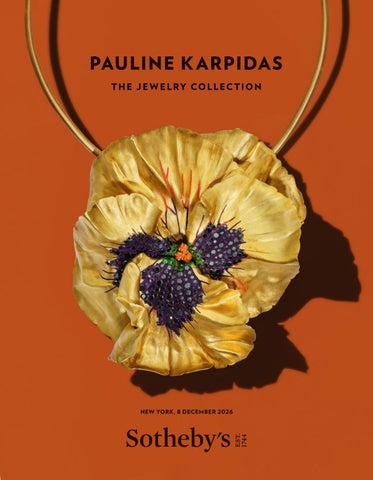
NEW YORK, 8 DECEMBER 2026
FRONT COVER LOT 65 BACK COVER LOT 28 THIS PAGE LOT 27
NEW YORK | 8 DECEMBER 2026 | 6 PM
ALL EXHIBITIONS FREE AND OPEN TO THE PUBLIC
December 2, 2026 10AM – 5PM
December 3, 2026 10AM – 5PM
December 4, 2026 10AM – 5PM
December 5, 2026 10AM – 5PM
December 6, 2026 1PM – 5PM
December 7, 2026 10AM – 5PM
December 8, 2026 10AM – 5PM
945 Madison Avenue New York, NY 10021 +1 212 606 7000 sothebys.com FOLLOW US @SOTHEBYS #SOTHEBYSJEWELS
CONTENTS 1 AUCTION & EXHIBITION INFORMATION
3 SPECIALISTS & ENQUIRIES
4 FOREWORD
12 PAULINE KARPIDAS: THE JEWELRY COLLECTION LOTS 1–68
134 HOW TO BID
135 EXPLANATION OF SYMBOLS
136 INDEX OF MAKERS
Photographer: Ruvén Afanador Stylist: Bernat Buscato Hair: Chuck Amos Makeup: Joanne Gair Manicure: Pika
LOT 67
SPECIALISTS Quig Bruning SVP, Global Head of Jewelry quig.bruning@sothebys.com +1 212 606 7392 Andres White Correal Global Chairman, Jewelry andres.white.correal@sothebys.com +44 7921 685 721 Frank Everett SVP, Vice Chairman, Jewelry frank.everett@sothebys.com +1 212 894 1902 Catharine Becket SVP, Global Head of High Jewelry catharine.becket@sothebys.com +1 212 894 1027 Emily Barber Senior Director, Head of Fine Jewelry EMEA emily.barber@sothebys.com +44 7890 300080
ENQUIRIES AMERICAS
SALE NUMBER
Robin Wright SVP, Senior Specialist, Jewelry robin.wright@sothebys.com +1 212 894 1246
N12381“PAULINE”
Anna Ruzhnikov VP, Head of High Jewelry, New York anna.ruzhnikov@sothebys.com +1 212 894 1041
+1 212 606 7414 bids.newyork@sothebys.com
Kathleen Craig AVP, Head of Fine Jewelry, New York kathleen.craig@sothebys.com +1 212 894 1507 Haley Jaras Abbott Specialist, Interim Head of Fine Jewelry, New York haley.abbott@sothebys.com +1 212 894 1249 Beth Zwiacher Specialist, Jewelry, Beverly Hills beth.zwiacher@sothebys.com +1 919 619 2238 Yvonne Teng Senior Manager, Jewelry, Beverly Hills yvonne.teng@sothebys.com +1 310 621 8192 Alexia Palmer Senior Cataloguer, Jewelry, New York alexia.palmer@sothebys.com +1 212 894 1368 Hannah Chinsky Associate Cataloguer, Jewelry, New York hannah.chinsky@sothebys.com +1 212 894 1025 Barbara Waginski AVP, Business Operations Associate Director barbara.waginski@sothebys.com +1 212 894 1033 Nina Sael Vara-Rosas Department Assistant, Jewelry, New York nina.vara-rosas@sothebys.com +1 212 894 1506
BIDS DEPARTMENT
Telephone bid requests should be received 24 hours prior to the sale. This service is offered for lots with a low estimate of $5,000 and above.
PRE-SALE COORDINATOR
Parker Chastain Seller Operations Coordinator, Jewelry, New York parker.chastain@sothebys.com +1 917 279 0958
POST SALE SERVICES
For payment, delivery and collection uspostsaleservices@sothebys.com +1 212 606 7444
IM P ORTAN T N OT IC E The seller of all lots in this collection has been guaranteed a minimum price. Sotheby’s may engage a third party to provide an Irrevocable Bid that would be executed at a value that ensures the lot will sell.
TO LEARN MORE ABOUT THE PROPERTY IN THIS SALE, PLEASE VISIT SOTHEBYS.COM/N12381
FOREWORD BY OLIVER BARKER
CHAIRMAN, SOTHEBY’S EUROPE
Since my first meeting with Pauline Karpidas nearly three decades ago, I have admired the confidence, curiosity and originality that define her approach to collecting and to life. It is an honour to present her remarkable jewellery collection, the latest in a trilogy of sales spanning three places central to her cosmopolitan world. In 2023, we offered the collection from her legendary retreat on Hydra. In 2025, we presented the works that filled her extraordinary London home. Now, in New York, we turn to something more intimate: the jewels she has collected with such inimitable flair. When I think of Pauline’s jewellery, I think first of the way she wears it: her elegant, dancer-like arms, her distinctive gestures setting flashes of colour and form in motion. For all their extraordinary presence, it is Pauline herself who commands the eye. She makes even the most extravagant pieces seem entirely natural. I have seen the same instinct in her approach to works of art and design, and in the remarkable environments she creates around them. Her first encounter with Andy Warhol captures this perfectly. In 1978, a portrait commission brought Pauline and her husband, Constantinos “Dinos” Karpidas, to the Factory. As Pauline poured a cup of tea, Warhol appeared beside her and began admiring her jewellery, moving from one piece by Suzanne Belperron to another before noticing the JAR at her neck. “Have you got more?” he asked. Pauline explained that she had been collecting jewels from the 1930s and ’40s “when nobody wanted them.” Warhol, who shared her enthusiasm for the bold designs of the period, replied that he had done much the same.
At one point, the artist even offered a portrait in exchange for one of the pieces he admired. Pauline declined, unwilling to deprive their mutual friend, the art dealer Alexander Iolas, of his commission. Warhol later came to dinner at the Karpidas home in London, where the safe was opened and more of the collection revealed. “That was when we bonded,” Pauline recalls. It is an irresistible scene, showing how a shared passion for beautiful things could give rise to friendship. Born into a working-class family in Manchester, Pauline modelled in her teenage years, an experience that sharpened her sense of style. She settled in Greece and opened a boutique called My Fair Lady—a nod to a favourite film— where she met her future husband, Dinos. Their marriage immersed her in a cosmopolitan life of international horse racing, Parisian couture, grand dinners and New York society. Rather than simply adopt its conventions, however, she embraced its possibilities with characteristic energy and theatricality, fashioning an identity unmistakably her own. Iolas became a close friend and mentor. Through his trusted right-hand man, André Mourgues, Pauline met Yves Saint Laurent and Pierre Bergé, becoming a devoted client of the former’s couture. For Pauline, couture and collecting were expressions of the same sensibility. An early patron of Joel Arthur Rosenthal, or JAR, she championed his originality long before his work gained international acclaim. She belongs alongside Peggy Guggenheim, São Schlumberger and Dominique de Menil, formidable collectors and patrons who recognised and nurtured artistic
Pauline with her late husband Constantinos “Dinos” Karpidas, wearing an orchid necklace created by artist and friend Claude Lalanne, and a kunzite and sapphire ring by JAR, offered as lot 15. PHOTO: FRANÇOIS-MARIE BANIER, COURTESY OF THE KARPIDAS FAMILY ARCHIVE.
ABOVE, FROM LEFT:
Pauline Karpidas with artists Tracey Emin, Nicole Eisenman, Cecil Brown, Sarah Lucas, Rachel Feinstein. PHOTOGRAPHS BY JOHNNIE SHAND KYDD
FACING PAGE:
Detail of Andy Warhol’s Portrait of Pauline Karpidas, 1978. ART © 2026 ANDY WARHOL FOUNDATION FOR THE VISUAL ARTS / ARTISTS RIGHTS SOCIETY (ARS), NEW YORK
talent, and whose taste found expression as fully in their lives as in their collections. Pauline brings to this tradition a flamboyance entirely her own. I have never known her to be stuffy, still less a shrinking violet. My late friend and colleague Michel Strauss, who led Sotheby’s Impressionist and Modern art department, once recalled a marvellous early encounter with Pauline in London in 1975. She arrived in a T-shirt and jeans, asking to see the pictures in an upcoming sale. Michel showed her the collection and was struck by the seriousness with which she looked and listened. She returned for the auction in evening dress and, in his words, “magnificent diamonds.” She and Dinos proceeded to acquire paintings by Pissarro and Degas. The contrast is delightful, but what matters is the constancy beneath it. Whether in jeans before the exhibition or diamonds in the saleroom, she was there first and foremost to look. Pauline and Dinos were active participants in the great single-owner auctions of their time, acquiring jewels with distinguished histories, several of which are presented here. At Sotheby’s celebrated 1987 sale of the Duchess of Windsor’s jewels in Geneva, Pauline purchased a pair of ruby bead earclips and matching ring by Cartier (lots 19 and 20), their royal associations matched by the strength of their design. A Jacques Lacloche bracelet-watch (lot 34) believed to have been commissioned in 1938 for the style-maker
“Baba” de Faucigny-Lucinge similarly reflects her fascination with jewels bearing the imprint of an earlier owner. More personal still are the pieces once owned by Warhol, among them a circa-1945 rock crystal bracelet by Seaman Schepps (lot 4) and an amethyst and diamond demi-parure by Verdura (lot 5), both acquired at Sotheby’s New York in 1988. There has always been something of the magpie about Pauline’s collecting, a delight in the unexpected and in combinations others might never imagine. She has never confined herself to a single jewellery house or school of art, trusting her own judgement ahead of fashion. The collection ranges from Cartier, Van Cleef & Arpels and Boucheron to the more idiosyncratic creations of Belperron and JAR. What might appear eclectic in another collection becomes, in hers, an expression of a remarkably consistent eye. Her appetite extends to the inventive, the sculptural and, at times, the gloriously improbable. Throughout, refinement meets daring and tradition is worn lightly. Beauty is understood not as something passive, but as a form of invention. There is a poetic symmetry in seeing these jewels return to the saleroom, where Pauline herself discovered so many of them. On behalf of everyone at Sotheby’s, I am profoundly grateful to Pauline and her family for once again placing their trust in us. For all their individual brilliance, these jewels form something still more remarkable: a selfportrait, composed in colour, wit and exuberance.
Pauline Karpidas’ London home, photographed in 2025.
LOT 4
LOTS 1 – 68 NEW YORK | 8 DECEMBER 2026 | 6 PM
CHANEL
When Cole Porter introduced Gabrielle ‘Coco’ Chanel to Fulco di Verdura in Venice in the late 1920s, no one could have foreseen the lasting impact of their creative collaboration. Chanel was a well-established Parisian couturier and had already expanded her clothing and accessories empire to include jewelry and fragrance. Verdura, titled yet somewhat limited financially, had come to Paris to seek his fortune. A match was made. Verdura would work for Chanel for eight years, first designing textiles and later refashioning jewels from Chanel’s personal collection. Chanel and Verdura formed a close bond, both professionally and personally, and traveled together frequently. One trip included a visit to Ravenna, Italy, and the Basilica of San Vitale which changed the course of jewelry forever. Both were taken with the beautiful designs and rich colors of the mosaic murals, and the opulence of the Byzantine Empire became the inspiration behind all Chanel jewels, both fine and costume. An early example includes the Gripoix glass pendant-cross in the Karpidas Collection (lot 1).
It was at this time that Verdura designed the legendary pair of white cuff bracelets featuring the Maltese Cross design in cabochon colored gemstones. Now, a century after they were first produced, the cuffs remain as popular as ever, still in production by the House of Verdura. And Chanel’s costume jewelry line, wildly popular since the mid-century, continues to find its inspiration in the same Byzantine designs, season after season. These iconic cuffs appear in many of the most recognizable images of Chanel herself and are now permanently in Verdura’s archives. Verdura eventually moved to the United States in the mid-1930s and established himself as one of the most important jewelry designers of the 20th century. But his influence has remained strong, informing the DNA of Chanel jewelry to this day. Lots 2 and 3 are wonderful rare and early examples of this influence, each incorporating a cobblestone of faceted and cabochon colored gems. As luxurious and wearable today as they were in the 1930s.
Fulco di Verdura and Coco Chanel. in his studio on Rue Cambon. Paris, 1937. © BORIS LIPNITZKI / ROGERVIOLLET FULCO SANTOSTEFANO DELLA CERDA DUCA DI VERDURA, MARCHESE MURATA LA CERDA
1 CHANEL
GRIPOIX GLASS PENDANT-NECKLACE The foxtail chains suspending a cross set with red and green Gripoix glass cubes, length approximately 31 inches, signed Chanel. LITERATURE
Mauriès, Patrick, Jewelry by Chanel, London, 1993, p. 124 for an illustration of a similar pendant cross. $ 2,000-3,000
13
2 CHANEL
GOLD, CITRINE, EMERALD, PINK SAPPHIRE AND SAPPHIRE BANGLE-BRACELET, FRANCE Composed of pink and yellow gold, set with ovalchaped citrines, emerald and pink sapphire cabochons and round sapphires, internal circumference approximately 6¾ inches, signed Chanel, with French assay marks; circa 1930s. PROVENANCE
Christie’s Geneva, Jewels, 15 May 1980, lot 319. $ 80,000-120,000
14
3 CHANEL
GOLD, ENAMEL AND COLORED STONE CUFF-BRACELET, FRANCE Of bombé design, applied with beige enamel, bezel-set with variously shaped colored stones including garnets, sapphires, rubies, aquamarines, citrines, tourmalines and rock crystal, internal circumference approximately 6½ inches, signed Chanel, with French assay and workshop marks; circa 1930s. $ 80,000-120,000
15
LOTS 2 & 3
LOTS 2, 3 & 47
PAULINE & ANDY
‘ANDY AND I FIRST BONDED OVER MY BELPERRON JEWELLERY— WE BOTH SHARED A PASSION FOR 1940S JEWELLERY, AND THAT WAS THE START OF FORGING A SPECIAL RELATIONSHIP. TO BEGIN WITH, HE WASN’T EVEN REMOTELY INTERESTED IN TALKING ABOUT ART WITH ME, ONLY MY JEWELLERY. AND WHEN HE CAME TO LONDON, HE WAS DESPERATE TO SEE MY JEWELLERY COLLECTION, WHICH I MUST SAY HE THOUGHT WAS FABULOUS.’ –PAULINE KARPIDAS
Andy Warhol, Pauline Karpidas, polaroid, late March 1979. ART © 2026 ANDY WARHOL FOUNDATION FOR THE VISUAL ARTS / ARTISTS RIGHTS SOCIETY (ARS), NEW YORK
4 SEAMAN SCHEPPS
ROCK CRYSTAL, COLORED STONE AND DIAMOND BRACELET Featuring a rock crystal plaque and links, decorated with carved emeralds, rubies and sapphires and old Europeancut diamonds, accented by triangle-shaped emeralds and rock crystal baguettes, the clasp set with round sapphires and a cabochon ruby, internal circumference approximately 6½ inches, signed Seaman Schepps; circa 1945. PROVENANCE
Sotheby’s New York, The Andy Warhol Collection, Jewelry and Watches, Part II, December 4, 1988, lot 160. $ 50,000-70,000
19
5 VERDURA
AMETHYST AND DIAMOND CLIP-BROOCH AND PAIR OF EARCLIPS Of stylized floral design, set with amethyst cabochons and round, old European- and single-cut diamonds, clip-brooch partially signed Verdura, earclips unsigned. PROVENANCE
Sotheby’s New York, The Andy Warhol Collection, Jewelry and Watches, Part II, December 4, 1988, lot 88. $ 20,000-30,000
20
JOEL ARTHUR ROSENTHAL (JAR)
‘THERE HAS ALWAYS BEEN SOMETHING MAGICAL ABOUT WEARING A WORK OF ART. JEWELRY HAS ALWAYS HELD A SPECIAL PLACE IN MY LIFE BECAUSE, MORE THAN ALMOST ANY OTHER OBJECT, IT HAS THE POWER TO CARRY MEMORY.’ –PAULINE KARPIDAS
It’s difficult to imagine a world in which Pauline Karpidas and Joel Arthur Rosenthal (JAR) would not meet. Pauline is drawn to talent, and talent to her. Whether on Hydra, in London or anywhere Pauline mixes with like-minded individuals, she creates a place of enchantment where ideas flow freely and creativity is brought to full flower. She has long championed emerging artists, playing the dual role of patron and collaborator, a relationship clearly seen in her collection of jewels by JAR.
Pauline discovered JAR well before most of us, long before his landmark retrospectives at Somerset House (2002) and the Metropolitan Museum of Art (2013), and well before his work became the most sought-after jewelry at auction by any living artist. Many of the qualities frequently ascribed to Pauline and her collecting ethos—bold, exuberant and innovative, to name but a few—apply equally to JAR. And then there is their shared love of the surreal. Magritte, Tanguy, Dalí and Lalanne filled Pauline’s London home, and even more Lalanne has adorned her person. Her oversized pansy necklace by JAR may be seen as an evolution of her beloved Claude Lalanne flower necklaces, a progression from copper and bronze to gold and precious stones. The tissue paper fragility and intricate folds of a flower that blooms for but a week are rendered in monumental permanence. To view JAR’s work is to engage with the unexpected. A yellow diamond turned on its head (lot 62). A pink diamond encased in unyielding chalcedony (lot 61). Seen through his lens, the quotidian becomes extraordinary: padlocks are things of beauty (lot 27) and thorned vines rest innocently on ears (lot 26). With her expansive imagination and passionate approach to both life and collecting, Pauline is among the fortunate few who have been invited into this intoxicating alternate universe that is JAR.
6 JAR
PAIR OF WOOD, PEARL AND DIAMOND EARCLIPS, PARIS The boteh-shaped carved wood enhanced with round diamond drill-set pearls, signed JAR Paris, with French assay and workshop marks. Please note the pearls have not been tested for natural origin. Please note this property cannot be shipped internationally due to endangered species materials.
⦿ $ 30,000-50,000 23
7 JAR
GOLD, STAR SAPPHIRE, AMETHYST AND DIAMOND PENDANT, PARIS One side set with cabochon star sapphires, the other with cabochon amethysts, accented by round diamonds, signed JAR, with French workshop marks; circa 1989. $ 60,000-80,000
24
25
26
8 DAVID WEBB
GOLD, CULTURED PEARL AND HARDSTONE SAUTOIR Composed of strands of blue hardstone, turquoise, green chalcedony and amethyst beads and cultured pearls, interspersed with textured gold links and terminating in a tassel, approximate length 34 inches, with a 4-inch tassel, signed Webb. $ 20,000-30,000
27
LOT 8
LOT 8
9 DAVID WEBB
GOLD PENDANT-NECKLACE Composed of textured rectangular links, suspending a medallion depicting a nude female figure, gross weight approximately 391 grams, length approximately 40 inches, medallion diameter approximately 3½ inches, necklace signed David Webb, numbered. $ 25,000-35,000
30
10 CHOPARD
GOLD, CORAL AND ONYX BRACELET-WATCH The rectangular dial set with coral and onyx plaques, on a textured gold bracelet, manual movement, internal circumference approximately 6¾ inches, gross weight approximately 104 grams, signed Chopard Genève, numbered; circa 1970. Please note this property cannot be shipped internationally due to endangered species materials.
⦿ $ 5,000-7,000 31
RETRO JEWELRY
Pauline Karpidas’ jewelry collection reflects a deep love and appreciation for dramatic designs from the 1930s and 1940s. It was an admiration she shared with Andy Warhol and was the impetus for their friendship and collaboration. These pieces were contemporaneous with many of the Surrealist paintings that formed the heart of her extraordinary art collection, and they share some of their exuberant and irreverent spirit. “Retro” is a term used to describe jewelry from the period from roughly 1935 to 1950. The label was first used in the 1970s when such styles were outdated and even beginning to evoke nostalgia, but when they were new there was nothing backward-looking about these jewels. Evolving from the Art Deco jewelry of the 1920s and early ‘30s, the new style was larger, bolder and more colorful, with geometric precision now enhanced by a profusion of curves, spirals, volutes, scrolls and ribbons. Yellow gold became the preferred metal for most jewelry after several decades of dominance for platinum. After a period that favored abstraction, figurative designs were beginning to return to prominence. The characteristics of the new aesthetic were evident in the jewelry exhibited at the 1937 Exposition Internationale des Arts et des Techniques Appliqués à la Vie Moderne held in Paris, where the preeminent French jewelers displayed their latest designs. The Karpidas Collection includes remarkable and characteristic examples from these houses. A Van Cleef & Arpels ‘Ludo Héxagone’ bracelet (lot 37), a style first introduced in 1935, exemplifies the substantial but streamlined look of the period with its bulky clasp and its juxtaposition of straight lines and curves. An emerald and diamond cuff-bracelet by Boucheron (lot 20) combines robust diamondset scroll motifs with colorful emerald cabochons and beads. A Cartier diamond necklace-bracelet
PAULINE KARPIDAS’ JEWELRY COLLECTION REFLECTS A DEEP LOVE AND APPRECIATION FOR DRAMATIC DESIGNS FROM THE 1930S AND 1940S. IT WAS AN ADMIRATION SHE SHARED WITH ANDY WARHOL AND WAS THE IMPETUS FOR THEIR FRIENDSHIP AND COLLABORATION.
combination (lot 60) suspends sculptural bouleshaped drops set with baguette and single-cut diamonds. The sole Italian example, a Bulgari suite of gold, sapphire, ruby and diamond jewels (lot 49) reflects both the popularity of thick, flexible tubogas chains and of convertible jewelry. The motifs on the bracelets and earclips can be detached for wear as dress clips, which contemporary fashion magazines illustrated attached to necklines, lapels, hats and purses. The outbreak of World War II brought shortages that had dramatic effects on the jewelry industry in the first half of the 1940s. Precious metals were rationed in many countries and clients often had to provide the gold from which new pieces were made. The shortage of metals used as gold alloys led to an increase in the use of copper, which gives much gold from this period a characteristic rosy hue. Access to traditional gemstone sources was also interrupted, leading to the increased use of large semiprecious stones that could be mined in South America such as amethyst, smoky quartz, citrine, aquamarine and tourmaline. The disruptions of the war also left an opening for a new generation of American jewelry designers to take a more prominent position. The Karpidas Collection has numerous jewels from American designers such as Paul Flato, Seaman Schepps and Ruser. A Paul Flato citrine and sapphire bangle-bracelet (lot 45) exemplifies the look of the 1940s with its massive emerald-cut citrine. An amethyst suite by Ruser that was part of the collection of Joan Crawford (lot 46) also uses large emerald-cut stones to great effect. Pauline was a particularly avid collector of “Reflection” jewels by Trabert & Hoeffer Mauboussin (lots 11, 12, 13, 32, and 50). This partnership between an American firm and a venerable French jeweler introduced this line in 1938 with the slogan “Your Personality in a Jewel.” The work of designer Gustave Toth, it allowed clients to commission customized jewelry combining premade motifs with gemstones of their choice. The partially preassembled nature of the products allowed these pieces to be offered at a lower price than fully custom jewelry and the company encouraged clients to further reduce costs by recycling gemstones from existing pieces, declaring, “We do not remount. We reflectionize.” The results, combining fanciful scrolling motifs, large precious and semiprecious gemstones and oversized floral bouquets, are among the most inventive jewelry of the era.
11 TRABERT & HOEFFER MAUBOUSSIN GOLD, EMERALD, CITRINE AND DIAMOND ‘REFLECTION’ CLIP-BROOCH
Featuring a cushion-shaped cabochon emerald, in a scrolled mounting set with citrine baguettes and round and singlecut diamonds, signed Trabert & Hoeffer Mauboussin and Reflection, numbered; circa 1940s. $ 15,000-25,000
33
12 TRABERT & HOEFFER MAUBOUSSIN GOLD, EMERALD, SAPPHIRE AND DIAMOND ‘REFLECTION’ CUFF-BRACELET
Featuring a cabochon emerald set within a collar edged with calibré-cut sapphires, accented by round and single-cut diamonds, gross weight approximately 106 grams, internal circumference approximately 6 inches, signed Trabert & Hoeffer Mauboussin and Reflection, numbered; circa 1940s. PROVENANCE
Sotheby’s New York, Important Jewelry, June 12, 1990, lot 85. $ 20,000-30,000
34
13 TRABERT & HOEFFER MAUBOUSSIN GOLD, SAPPHIRE, RUBY AND DIAMOND ‘REFLECTION’ CLIP-BROOCH
Set with cushion-cut sapphires, round sapphires and rubies and single-cut diamonds, signed Trabert & Hoeffer Mauboussin and Reflection, numbered; circa 1940s. PROVENANCE
Sotheby’s New York, The Andy Warhol Collection, Jewelry and Watches, Part I, April 27 1988, lot 2021. $ 5,000-7,000
35
14 GOLD AND DIAMOND BANGLE-BRACELET Decorated with ribbing and a hinged hoop, accented by old European- and single-cut diamonds, gross weight approximately 124 grams, internal circumference approximately 6½ inches; circa 1940. $ 12,000-18,000
36
15 JAR
GOLD, KUNZITE AND SAPPHIRE RING, PARIS Centering an oval cabochon kunzite, accented by pentagonal cabochon sapphires, size 4¼, signed JAR Paris, with French assay mark. $ 15,000-25,000
37
16 CARTIER
TWO-COLOR GOLD, TURQUOISE, GARNET AND DIAMOND CLIP-BROOCH Composed of gold wire loops, the center set with a cluster of turquoise beads drill set with single-cut diamonds and surrounded by square garnets and round diamonds, signed Cartier; circa 1940s. $ 10,000-15,000
38
17 CARTIER
TURQUOISE, SAPPHIRE AND DIAMOND BRACELET, FRANCE Featuring a turquoise cabochon surrounded by rows of sapphire beads accented by round diamonds, on a sapphire bead torsade, internal circumference approximately 6¾ inches, signed Cartier Paris, with French assay and maker’s marks; mid-twentieth century. $ 30,000-50,000
39
THE DUCHESS OF WINDSOR
The lives of the Duke and Duchess of Windsor have passed into legend. The story of the king who gave up an empire for love still retains its fascination 90 years after the Duke (as Edward VIII) signed away his inheritance to marry American divorcée Wallis Simpson. The influence of the Windsors is still clearly felt in fashion, collecting, decoration, entertaining and so many other aspects of contemporary style and design. And nowhere is their influence felt more strongly than the world of jewelry. The landmark 1987 exhibition and sale of the Duchess of Windsor’s jewels at Sotheby’s Geneva was a cultural event, setting a world record in terms of value (at the time) and a standard of significance that remains firmly in place. Of all the Duke and Duchess’ collections, nothing was more personal than the jewelry. They worked closely with all the great Parisian houses, commissioning pieces for every milestone occasion, resulting in some of the most important jewels of the 20th century. One house stands out as the favorite: Cartier. The extraordinary panther bracelet, the flamingo brooch, and the iconic amethyst and turquoise necklace are among the hundreds of unforgettable creations by the venerable firm. Each one unique, and uniquely hers. Jewels by Cartier using colored stone beads were popular with many style icons during the post-war years. In 1948 the house created a pair of similar ruby and sapphire bead rings, without diamondset profiles, for Daisy Fellowes. In the early 1960s Cartier updated the design of the ring to include the diamond panels present in lot 18 offered here. An additional illustration of the 1960s design may be viewed in Cartier Collection: Jewelry by François Chaille, page 284. The earclips (lot 19) as well as the ring incorporate unusually large beads for this design, indicating they may have been commissioned especially for her. Both lots were part of the collection of the Duchess of Windsor sold in 1987.
The Duchess of Windsor at the Metropolitan Museum of Art’s Costume Institute Gala in 1974 wearing one of her legendary panther brooches and a pair of sapphire bead earclips, similar in design to lot 19.
FULL PAGE IMAGE OF DUCHESS OF WINDSOR (FINDING OUT WHICH ONE AND WHERE WE ARE GETTING RIGHTS
18 MONTURE CARTIER
RUBY AND DIAMOND RING
19 MONTURE CARTIER
PAIR OF RUBY AND DIAMOND EARCLIPS
Featuring four rows of ruby beads, accented with round diamonds, size 4½, signed Monture Cartier, with French maker’s marks; circa 1963.
Set with rows of ruby beads extending from openwork plaques enhanced with rose-cut diamonds, signed Monture Cartier, numbered, with French assay and maker’s marks; circa 1950.
PROVENANCE
PROVENANCE
Sotheby’s Geneva, Jewels of the Duchess of Windsor, 2 April 1987, lot 49.
Sotheby’s Geneva, Jewels of the Duchess of Windsor, 2 April 1987, lot 4.
$ 40,000-60,000
$ 60,000-80,000
42
20 BOUCHERON
EMERALD AND DIAMOND BRACELET, FRANCE The centerpiece of scroll design, featuring emerald cabochons and drops, further set with round and baguette diamonds, on a sprung tubogas strap, internal circumference approximately 6¼ inches, signed Boucheron-Paris, numbered, with French assay and partial workshop marks; circa 1940. $ 80,000-120,000
45
THE HOUSE OF JANESICH
Founded by Italian jeweler Leopold Janesich in 1835, the House of Janesich established a presence in turnof-the-century Paris and, during the 1920s and 1930s, built a reputation for jewels distinguished by their refined geometry, exceptional craftsmanship, and sophisticated use of color. Favored by an international clientele that included aristocrats, collectors, and leading figures of European society, the firm produced some of the most elegant interpretations of Art Deco design. This emerald and diamond sautoir exemplifies Janesich at its finest. Delicately articulated geometric links punctuated by vivid emeralds culminate in a striking fringed motif, uniting the linearity of Art Deco design with a sense of movement and grace. A trio of emerald drops forms a delicate pendant at the nape of the neck, transforming even the clasp into a considered element of the composition. Both decorative and architectural, the necklace reflects the meticulous craftsmanship and thoughtful detailing that are the hallmarks of Janesich’s greatest creations.
Name Surname © COPYRIGHT
LOT 21
48
21 JANESICH
EMERALD AND DIAMOND SAUTOIR, FRANCE Featuring variously shaped cabochon emeralds and emerald drops, decorated throughout with round, single-cut, baguette, square- and triangle-shaped diamonds, length approximately 32 inches, signed Janesich, numbered, with French assay and partial workshop mark; circa 1925. Accompanied by SSEF report no. 12824 dated 4 April 2023 stating that the emeralds are of Colombian origin, clarity enhancement: minor to moderate. PROVENANCE
Christie’s Geneva, Jewels III, 14 November, 1985, lot 474. $ 300,000-500,000
49
22 CARTIER
RUBY AND DIAMOND BRACELET Of ‘escalier’ design, set with graduated oval-shaped cabochon rubies, framed by baguette diamonds and calibré-cut rubies, length approximately 7¼ inches, signed Cartier, numbered; circa 1940. PROVENANCE
Christie’s Geneva, A Selection of Cartier Jewellery Sold by Order of the Former Owners of the Firm, Final Part, 11 November, 1977, lot 972. $ 100,000-150,000
50
23 DIAMOND BRACELET, FRANCE Designed as a wide, openwork geometric band set with old European-cut and baguette diamonds, internal circumference approximately 6¾ inches, with French assay marks; circa 1930. $ 30,000-50,000
51
24 DIAMOND NECKLACE-BRACELET COMBINATION Of rivière design, set with 70 graduated emerald-cut diamonds, length approximately 14½ inches with detachable 7-inch section for wear as a bracelet. Accompanied by three GIA reports: nos. 2241096578 dated October 2, 2026 stating that the diamond weighing 3.71 carats is E color, VS1 clarity; 2241096575 dated October 2, 2026 stating that the diamond weighing 3.10 carats is E color, VVS2 clarity; and 2245096573 dated October 5, 2026 stating that the diamond weighing 2.98 carats is E color, VVS2 clarity, improvable. $ 250,000-350,000
52
25 JAR
SAPPHIRE RING, PARIS Featuring an octagonal-shaped sapphire stated to weigh 24.64 carats in a matte platinum mounting, size 8¼, signed JAR Paris, with French assay and workshop marks. Accompanied by AGL report no. 1160447 dated 16 October 2026 stating that the sapphire is of “Classic” Madagascan origin, with no indications of heating. Accompanied by SSEF report no. 140954 dated September 11, 2024 stating that the sapphire is of Ceylon origin, with no indications of heating. $ 300,000-500,000
55
26 JAR
PAIR OF BLACKENED SILVER AND GOLD EARCLIPS, PARIS Designed as spirals accented by gold spikes, unsigned, with French assay and workshop marks. $ 20,000-30,000
56
27 JAR
SAPPHIRE AND DIAMOND NECKLACE, PARIS Featuring a series of lock motifs, each centering an ovalshaped sapphire, highlighted by round diamonds, internal circumference approximately 15¼ inches, signed JAR Paris, with French assay marks. Accompanied by SSEF report no. 140955 dated 13 September 2024 stating that the sapphires are of Ceylon origin, with no indications of heating. $ 200,000-300,000
57
LOTS 1 & 28
28 COLORED STONE, DIAMOND AND ENAMEL RELIQUARY PENDANT Centered by a faceted sapphire, further set with cut-cornered rectangular mixed-cut peridots and citrines, emerald-cut rubies and emeralds and rose-cut diamonds, the reverse with rock crystal-covered compartments stated to contain five relics including those of the True Cross, Saint Paul, Saint Peter, Saint Philip Neri and Saint Francis and decorated with blue, black and white enamel, the central compartment containing a red wax seal, on a later chain, dimensions approximately 3¼ x 3 inches, chain length approximately 15½ inches; 17th to early 18th century. PROVENANCE
Christie’s Geneva, Jewels III, 13 November 1975, lot 425. Originally in the collection of Francesco Martelli, Nuntio of Pope Clemens X of Poland, Patriarch of Jerusalem, cardinal from 1706 until his death in 1717. Thence by family descent until 1975. $ 80,000-120,000
59
RELIQUARIES
Reliquaries, precious containers for the remains, clothing or objects of Christian saints, were among the most prized and venerated objects of Medieval and Early Modern Europe. They were frequently adorned with the costliest and most intricately worked of materials, their outer splendor meant to reflect the spiritual power of their contents. They came in many shapes and sizes to accommodate artifacts ranging from whole human skulls to a few threads from a sacred textile. Many of the smaller ones were meant to be worn on the body, a way for the devoted to maintain an intimate connection with the divine. According to the provenance provided when the piece was auctioned in 1975, this cruciform reliquary pendant belonged to Francesco Martelli, an important Italian prelate born in 1633 who began his career in Florence and went on to occupy a series of important positions in the church, culminating in 1706 when he was made a Cardinal. He died in 1717, leaving the jewel to his family. In that year Horazio de Mazzel, the Canon and Vicar of the Archbishop of Florence, issued a document attesting to the authenticity of its relics, likely upon the occasion of the property bequest.
Dating to the seventeenth or early eighteenth century, the pendant is unusual in its inclusion of particularly large, vibrantly colored gemstones including a very large sapphire as well as citrines, peridots, rubies, emeralds and diamonds. The reverse is decorated with deep blue, black and white enamel and features glass-covered compartments containing five labeled relics. According to Horazio de Mazzel’s testimony, the center compartment holds a tiny fragment of the True Cross, on which Jesus is believed to have been crucified. The arms of the cross contain relics of Saints Peter, Paul, Francis, and Philip Neri, a sixteenth century missionary who was canonized in 1622. At the front, the sapphire-set lid open to reveal a wax bishop’s seal attached to the relics with silk cords, ensuring that the precious fragments are original and have not been tampered with. The seal includes the fleur de lys, the symbol of Florence, and may be that of the Archbishop whose representative certified the relics in 1717. It is a truly powerful object in many senses, combining visual impact with exquisite craftsmanship and what may be the holiest of objects.
LOT 28
29 GOLD AND RUBY RING, FRANCE The polished gold mount set with an oval-shaped ruby, size 4, with French assay mark and partial workshop mark. One prong missing.
30 GOLD NECKLACE, JEAN MAHIE, WITH GOLD AND SYNTHETIC RUBY PENDANT
Accompanied by SSEF report no.140952 dated September 11, 2024 stating that the ruby is of Burmese origin, with no indications of heating.
The textured gold chain suspending a repoussé pendant representing Ganesh set with synthetic ruby cabochons, gross weight approximately 210 grams, necklace length approximately 16 inches, pendant length approximately 4¼ inches, necklace signed Jean Mahie, numbered with French assay and maker’s marks.
$ 75,000-100,000
$ 10,000-15,000
62
LOT 30
63
31 EIGHT GOLD BANGLE-BRACELETS AND A GOLD NECKLACE Comprising one white gold and seven yellow gold banglebracelets, the necklace composed of a mesh chain, total gross weight approximately 280 grams, five bracelets internal circumference approximately 7½ inches, three hinged bracelets internal circumference approximately 7¼ inches, necklace length approximately 13¾ inches. $ 10,000-15,000
65
32 TRABERT & HOEFFER MAUBOUSSIN GOLD, RUBY AND DIAMOND RING
Of domed design, featuring star-set round rubies and diamonds, size 4¼, signed T & H M, numbered; circa 1940s. $ 2,000-3,000
66
33 GOLD, RUBY AND DIAMOND NECKLACE Of fringed design centering an old European-cut diamond pendant and decorated with round rubies and round, old European- and single-cut diamonds, internal circumference approximately 13½ inches; circa 1940s. $ 15,000-25,000
67
LACLOCHE
According to a 1987 insurance valuation by Bernard Danenberg Ltd, the bracelet-watch offered here as lot 35 was commissioned by Prince de Faucigny-Lucinge as a gift for his wife. Based on the piece’s approximate date of creation, the statement likely refers to Prince Jean-Louis de Faucigny-Lucinge (1904-1992), a French aristocrat and celebrated chronicler of mid-20th century high society. In 1923, he married Baroness Marie Liliane Matilda d’Erlanger—or “Baba,” as she was more widely known—at Westminster Cathedral. The stunningly beautiful and stylish Baba and her elegant husband were the perfect Jazz Age couple, straddling the worlds of café society Paris and London’s “Bright Young Things.” Baba was a favorite subject of Cecil Beaton who noted “she was the first to bring into fashion the exotic…(the) grace of the jungle, and thereby created an astonishing effect of originality.” The prince and princess were proponents of the avant-garde and patrons to surrealist artists such as Salvador Dalí and Man Ray.
Baba was also among the first to champion Jean Schlumberger, acquiring early costume jewels created with flea-market finds and wire. From discarded cameos, shells and porcelain flowers, he made brooches and buttons for his friends, eventually catching the eye of Elsa Schiaparelli. The princess commissioned from him a bed covered entirely in velvet, a piece which finds parallels with the fabric- and furcovered works of surrealist artists such as Méret Oppenheim. The commonalities between the lives and interests of the Prince and Princess de Faucigny-Lucinge and Pauline and Constantinos Karpidas are striking. Reflecting on her collection, Pauline has shared that, for her, “jewelry…more than almost any other object, has the power to carry a memory.” The Lacloche bracelet-watch, like her other jewels with noteworthy histories, serves as a vessel of life experience. Through her collecting, Pauline has inherited and preserved these stories, and has added her own compelling chapter.
Baba d’Erlanger, Princesse Jean-Louis de Faucigny-Lucinge. Photographed by Cecil Beaton. © Cecil Beaton Archive / Condé Nast
34 JACQUES LACLOCHE
GOLD, EMERALD, AND DIAMOND BRACELETWATCH, FRANCE Composed of graduated semicircular links, the flip-top cover set with round emeralds and single-cut diamonds, opening to reveal a square dial, manual movement, internal circumference approximately 6½ inches, signed J. Lacloche, with French assay and workshop marks; circa 1940. LITERATURE
Mouillefarine, Laurence and Véronique Ristelhueber, Lacloche Joailliers, Éditions Norma, Paris, 2019, page 255 for an illustration of a similar bracelet-watch set with sapphire cabochons. $ 30,000-50,000
69
35 JAR
PAIR OF GOLD AND DIAMOND EARCLIPS, PARIS Designed as hoops with branches terminating in bezel-set pear-shaped diamonds, accented by single-cut diamonds, with Swiss workshop marks, unsigned. Four branches deficient. $ 80,000-120,000
70
36 GOLD AND EMERALD RING Featuring a sugarloaf cabochon emerald, size 6. Accompanied by SSEF report no. 128326 dated April 4, 2023 stating that the emerald is of Colombian origin, clarity enhancement: minor, type: traditional. $ 450,000-650,000
71
LOT 36
LOT 36 & 68
37 VAN CLEEF & ARPELS
PLATINUM AND DIAMOND ‘LUDO HÉXAGONE’ BRACELET, FRANCE The strap composed of hexagonal links, set with round, single-cut and baguette diamonds, gross weight approximately 139 grams, length approximately 6½ inches, signed Van Cleef & Arpels, numbered, with French assay and workshop marks; circa 1940. With signed fitted box. LITERATURE
Possémé, Évelyne, Van Cleef & Arpels: The Art of High Jewelry, Paris, 2012, p. 97 for an image of a platinum and diamond ‘Ludo Héxagone’ bracelet dated to 1939. $ 80,000-120,000
74
Established almost two hundred years ago, the Parisian house of Dusausoy achieved great acclaim during the interwar years for their avant garde approach to design and construction. Yet, despite winning numerous awards at international expositions, little has been written or is known about them today.
38 ATTRIBUTED TO DUSAUSOY
PEARL AND DIAMOND BROOCH, FRANCE Suspending a cascade of pearls, the surmount terminals framed by button-shaped diamond drill-set pearls and old mine-, old European- and single-cut diamonds, unsigned, with French assay marks and partial workshop marks; circa 1935. Accompanied by GIA report no 2245104649 dated October 21, 2026 stating that a random sample of the pearls are Natural, Saltwater, with no indications of treatment. $ 20,000-30,000
Under the direction of Justin Dusausoy, son of founder Paul-Jules, the firm became a leading force in modernist French jewelry. Their creations from the 1920s and early 1930s typically share the pared-down, flattened geometry favored by contemporaries Raymond Templier and Jean Fouquet. With this remarkable jewel, however, possibly dating to the late 1930s, pearls unfold and twist on sprung wires, cascading from a diamond-set surmount that provides a brilliant architectural counterpoint. The interplay of pearls in varying sizes and subtle hues furthers the sense of movement—a stark contrast to the Dusausoy’s aesthetic of just a few years prior— exemplifying the house’s ability to challenge traditional conventions by marrying technical ingenuity with artistic expression. A 1986 invoice from Bernard Danenberg Ltd describes the jewel as “massive” and supporting pearl “tentacles.” More interestingly, the gallery credits the piece to Suzanne Belperron. It is not an unreasonable attribution: the innovative style and construction, in addition to the lack of signature, could lead one down this path. Fortunately, with the marked increase in jewelry scholarship over the last two decades, lesser known but pioneering firms such as Dusausoy will soon be rediscovered by the current generation of collectors. 75
PAUL FLATO
Paul Flato was one of the biggest names in American jewelry in the mid-20th century; yet, until fairly recently, appreciation for his work’s distinctive style and exuberance was maintained by a small circle of knowledgeable collectors. A gregarious and charming young man with a great sense of humor, Flato was a natural salesman. He opened an elegant salon at the corner of Fifth Avenue and 57th Street, the location itself a sign of his growing success. He mixed amongst high society, hosting and attending events, collecting clients along the way. While much of his business was word-ofmouth, he provided jewels to Vogue and Harper’s Bazaar, making his name synonymous with high glamour. He developed a fiercely loyal clientele which allowed his business to remain remarkably unaffected by the stock market crash of 1929. In fact, it was against the backdrop of the Great Depression that he created some of his most spectacular designs.
THE EXTRAORDINARY RANGE OF HIS WORK, FROM THE WHIMSICAL TO THE SENSATIONAL, OFTEN TOGGLED BETWEEN THE ECCENTRIC AND SURREAL: THERE WE FIND CUFFLINKS DESIGNED AS FEET, LOBSTER CLAW BROOCHES AND NECKLACES MADE FROM SALVAGED BRASS BELLS.
Flato’s dramatic works found a particularly appreciative audience among the Who’s Who of Hollywood and, in 1938, he opened a salon on LA’s Sunset Boulevard. His timing was perfect. It was the Golden Age of Hollywood, and the studios expected
their stars to radiate glamour both on-screen and off. Flato’s lavish statement jewels were easily picked up by the cameras, serving to enhance the escapist fantasies of moviegoers and readers of the Hollywood press. The influx of large colored stones from Brazil such as citrines and aquamarines in the 1940s further amplified the size and visual impact of his jewels, as found in lot 45 from the Karpidas Collection. Flato maintained he wasn’t a draughtsman, and part of his early success is attributable to his ability to recognize talent, especially in those with fine pedigrees. He engaged a crop of highly imaginative designers that ensured his creations remained fresh, inventive and thoroughly enticing. His chief designer, Adolphe Klety, excelled at creating more formal, diamond-set jewels, often in foliate motifs, and may be the mind behind the sapphire and diamond bracelet offered as lot 39. Fulco di Verdura, after beginning his career with Coco Chanel, was introduced to Flato by Diana Vreeland. Verdura, like Flato, was embraced by New York society but held additional appeal as the 5th Duke of Verdura. Flato’s eye for exceptional talent is further evidenced by his correspondence with Suzanne Belperron during WWII, entreating her to come to New York to lend her genius to his already inspired designs. She declined, finding plenty of success on her own in Paris. Paul Flato’s inventive designs signal an independence from the European houses that so greatly influenced American design, particularly in the early to mid-20th century. The extraordinary range of his work, from the whimsical to the sensational, often toggled between the eccentric and surreal: there we find cufflinks designed as feet, lobster claw brooches and necklaces made from salvaged brass bells. His creations are very much at home in the collection of Pauline Karpidas, a woman who, over decades of patronage, has championed those who dare to be different.
39 PAUL FLATO
SAPPHIRE AND DIAMOND BRACELET Centering a pair of openwork leaves set with round, singlecut and baguette diamonds, on a tapered strap composed of sapphire cabochons accented by round and singlecut diamonds, with a diamond leaf motif clasp, internal circumference approximately 6¾ inches, signed Flato; circa 1935. $ 80,000-120,000
77
LOT 39
LOTS 39 & 60
SUZANNE BELPERRON AND THE AVANT GARDE
Suzanne Belperron (1900-1983) was one of the most influential and celebrated jewelers of the twentieth century. In Belperron, Pauline Karpidas discovered not only a skilled interpreter of the avant-garde, but a fellow trailblazer who followed instinct over trends. Known for her large-scale, sculptural pieces that combine a modern, pared-down aesthetic with an innovative use of materials and colors, Belperron’s work shares commonalities with contemporary artists such as le Corbusier and presaged and shaped the development of the “Retro” jewelry style that characterized the 1930s and 1940s.
IN BELPERRON, PAULINE KARPIDAS DISCOVERED NOT ONLY A SKILLED INTERPRETER OF THE AVANT-GARDE, BUT A FELLOW TRAILBLAZER WHO FOLLOWED INSTINCT OVER TRENDS.
Belperron began her career working as a designer for René Boivin in 1919 and was promoted to co-director in 1924 before leaving the firm to form a partnership with gem dealer Bernard Herz in 1932. Her jewels found great success with discerning and prominent
clients and were frequently featured in contemporary fashion magazines. Though she was the most famous female jeweler of her time, Suzanne Belperron always declined to sign her work, and her jewels must be identified by their inimitable and idiosyncratic style backed up by archival research and the presence of the workshop marks of her dedicated workshop, Groëné et Darde, and its later iterations. When asked why she didn’t use her own maker’s mark, she replied, “My style is my signature.” The Belperron pieces in the Karpidas collection display many of the telltale characteristics that make her designs so unique. A pair of cuff-bracelets dating to between 1937 and 1942 (lot 64) exemplify her use of curved volumetric forms and fondness for rich high-karat gold. Intended to be worn one on each wrist, the bracelets have a weight and presence that challenge the notion that jewelry is an insignificant or trifling art. A series of striking aquamarine and diamond jewels created in stages over several years (lots 40, 41 and 42) combines large angular aquamarines and unusual geometries and reflect Belperron’s love of richly colored gemstones and innovative shapes. A citrine and topaz ring and bracelet (lots 43 and 44) display her penchant for juxtaposing stones with subtle variations in color to create harmonious compositions.
LOT 40
40 SUZANNE BELPERRON
PAIR OF AQUAMARINE AND DIAMOND EARCLIPS AND PENDANT, FRANCE The tops and single articulated pendant set with variously shaped aquamarines and round diamonds, one drop deficient, with French assay marks and workshop marks for Darde et Fils; circa 1955-1970. Accompanied by a Certificate of Authenticity by Olivier Baroin dated November 11 2024, stating that the pair of earrings was manufactured by Suzanne Belperron between 1950 and 1970. LITERATURE
Raulet, Sylvie, Jewelry of the 1940s and 1950s, New York, 1988, page 181 for an image of the earclips with both pendants. $ 15,000-20,000
82
41 SUZANNE BELPERRON
AQUAMARINE AND DIAMOND CUFF-BRACELET, FRANCE Featuring an oval-shaped aquamarine, framed by calibrécut and round aquamarines, decorated with round, old European- and single-cut diamonds, internal circumference approximately 6¼ inches; 1940-1960. Accompanied by a Certificate of Authenticity by Olivier Baroin dated November 10, 2024 stating that the cuff was manufactured by Suzanne Belperron between 1940 and 1960. LITERATURE
Sylvie Raulet, Jewelry of the 1940s and 1950s, New York, 1987, p.181 for an image of this cuff-bracelet. $ 100,000-150,000
83
42 SUZANNE BELPERRON
AQUAMARINE AND DIAMOND NECKLACEBROOCH COMBINATION, FRANCE Of geometric design, set with variously-shaped aquamarines and round and single-cut diamonds, the central kite-shaped element detachable for wear as a clip-brooch, internal circumference approximately 14¾ inches, with French assay marks and workshop marks for Groëné et Darde and Darde et Fils; clip-brooch circa 1942-1955, necklace mounting circa 1950-1960. Accompanied by a Certificate of Authenticity by Olivier Baroin dated November 8 2024, stating that the necklace was manufactured by Suzanne Belperron between 1950 and 1960. Accompanied by a Certificate of Authenticity by Olivier Baroin dated November 9, 2024, stating that the brooch was manufactured by Suzanne Belperron between 1942 and 1955. LITERATURE
Raulet, Sylvie, Jewelry of the 1940s and 1950s, New York, 1988, page 181 for an image of this necklace. $ 150,000-250,000
84
43 SUZANNE BELPERRON
GOLD, CITRINE AND TOPAZ ABSTRAITE RING Of bombé design, set with emerald-cut citrines and topazes, size 6¾; 1960. Accompanied by a Certificate of Authenticity by Olivier Baroin dated 2 November 2026 stating that the ring was manufactured for Suzanne Belperron in January 1960. $ 10,000-15,000
86
44 SUZANNE BELPERRON
GOLD, CITRINE AND TOPAZ BANGLE-BRACELET Set throughout with emerald-cut, oval-shaped and round citrines and topazes, internal circumference approximately 6½ inches, workshop mark for Darde & Fils; 1960. Accompanied by a Certificate of Authenticity by Olivier Baroin dated 2 November 2026 stating that the bracelet was manufactured for Suzanne Belperron in July 1960. $ 40,000-60,000
87
45 PAUL FLATO
GOLD, CITRINE AND SAPPHIRE BANGLEBRACELET Featuring an emerald-cut citrine, the shoulders set with cushion-cut and oval-shaped sapphires, internal circumference approximately 6¼ inches, unsigned; circa 1940s. LITERATURE
Bray, Elizabeth Irvine, Paul Flato: Jeweler to the Stars, Woodbridge, 2010, p. 118 for an image of this bracelet. $ 12,000-18,000
89
JOAN CRAWFORD
While many stars are associated with the style known as Old Hollywood Glamour, few of them actually defined it. Joan Crawford certainly did. Her iconic look and larger-than-life persona were as carefully orchestrated as the big-screen musical numbers that marked the beginning of her career. Crawford’s image as we know it was literally created for the screen and nothing was left to chance. Through hard work and sheer determination, she became the master of her own craft. With the help of photographers, lighting designers, costumers and makeup artists, Crawford learned how to control everything her public would see. Strong eyebrows, shoulder pads, sculpted hairstyles and overscale jewels became her trademarks. Her dramatic pieces were chosen not only as adornment, but also symbols of her power, success, and refinement. In the golden age of Hollywood, from the 1930s to the 1950s, film stars did not borrow jewels as they do today. Actresses bought their own jewelry (or were sometimes gifted), building collections that were often worn on screen as well as in their very glamorous personal lives. Some of the greatest collections of the 20th century belonged to Hollywood stars including Merle Oberon, Ava Gardner, Gloria Swanson and, of course, Joan Crawford.
JOAN CRAWFORD LEARNED HOW TO CONTROL EVERYTHING HER PUBLIC WOULD SEE. STRONG EYEBROWS, SHOULDER PADS, SCULPTED HAIRSTYLES AND OVERSCALE JEWELS BECAME HER TRADEMARKS. HER DRAMATIC PIECES WERE CHOSEN NOT ONLY AS ADORNMENT, BUT ALSO SYMBOLS OF HER POWER, SUCCESS, AND REFINEMENT.
Lot 46, the suite of amethyst jewelry, is formerly from Joan Crawford’s personal collection. The jewels were made by Ruser and typify the “Crawford look” with large emerald-cut stones set in yellow gold. Willliam Ruser opened his firm located on Rodeo Drive in Beverly Hills in 1949 and was one of Hollywood’s most sought-after jewelers. His designs appeared in many films including one of Crawford’s biggest hits, ‘Sudden Fear’, in 1952 for which she received her third and final Academy Award nomination.
Joan Crawford circa 1944. Photo via John Kobal Foundation/ Getty Images.
(Not actual size)
46 FORMERLY FROM THE COLLECTION OF JOAN CRAWFORD
RUSER
GOLD AND AMETHYST SUITE OF JEWELS Comprising a necklace, bracelet and earclips, each set with emerald-cut amethysts, the earclips with removable fittings for wear as clip-brooches, necklace approximately 15 inches with an extra detached ½-inch link, bracelet internal circumference approximately 6⅜ inches, necklace and bracelet signed Ruser, earclips unsigned; circa 1940s $ 30,000-50,000
93
47 JAR
GOLD AND SAPPHIRE RING, PARIS Featuring an oval-shaped sapphire within a spiral-shaped mounting, decorated with round sapphires, size 4¼, signed JAR Paris, with French assay and workshop marks. Accompanied by SSEF report no. 140953 dated September 11, 2024 stating that the sapphire is of Ceylon origin, with no indications of heating. $ 75,000-100,000
94
48 FOUR GOLD NECKLACES Total gross weight approximately 367 grams, lengths approximately 35½, 15, 14¼ and 13¾ inches. $ 15,000-25,000
Necklaces not shown actual size.
95
Alternate view
49 BULGARI
GOLD, SAPPHIRE, RUBY AND DIAMOND SUITE OF JEWELS Comprising a pair of tubogas bracelets set with cushion-cut sapphire and round ruby and diamond fasteners, further enhanced by removable floriform clips set with oval-shaped sapphires and round rubies and diamonds, and a pair of earclips set with emerald-cut sapphires and round rubies and diamonds with removable fittings for wear as a pair of clip-brooches, total gross weight approximately 201 grams, bracelet internal circumferences approximately 5¾ and 6 inches stretching to 6 and 6¼ inches, clips signed Bulgari, with Italian assay and registry marks; circa 1940s. $ 50,000-70,000
96
97
50 TRABERT & HOEFFER MAUBOUSSIN TWO-COLOR GOLD, SAPPHIRE, RUBY AND DIAMOND ‘REFLECTION’ NECKLACE
Of stylized floral and scroll design, set with cushion-cut blue and yellow sapphires, oval-shaped and round rubies and round and single-cut diamonds, internal circumference approximately 13¾ inches, signed Trabert & Hoeffer Mauboussin and Reflection, numbered: circa 1940s. One sapphire and one ruby missing. $ 25,000-35,000
98
51 GOLD, SAPPHIRE, RUBY AND DIAMOND CUFFBRACELET Set with cushion-cut blue and yellow sapphires, round rubies and single-cut diamonds, internal circumference approximately 6 inches: circa 1940s. $ 10,000-15,000
99
52 GOLD, RUBY AND DIAMOND NECKLACE, FRANCE The tubogas chain enhanced by flared motifs set with ruby cabochons and round and single-cut diamonds, gross weight approximately 230 grams, length approximately 14 inches, with French assay and workshop marks: circa 1940s. $ 12,000-18,000
100
53 VAN CLEEF & ARPELS
TWO GOLD, COLORED STONE AND DIAMOND ‘PÉLOUSE’ BRACELETS, FRANCE Composed of beaded gold links, set to the front with round diamonds, one accented by lines of round rubies and one by lines of round sapphires, total gross weight approximately 191 grams, internal circumferences approximately 6¼ and 6½ inches, signed Van Cleef & Arpels, numbered, with French assay and workshop marks; circa 1950s. $ 40,000-60,000
101
54 DAVID WEBB
RUBY, DIAMOND AND ENAMEL PENDANTNECKLACE The gold links alternately applied with black enamel, suspending a heart-shaped pendant featuring a cabochon ruby, surrounded by round diamonds, total gross weight approximately 242 grams, length approximately 31 inches with 2¾-inch pendant, signed Webb. $ 25,000-35,000
102
55 JAR
RUBY, COLORED DIAMOND, LACQUER AND DIAMOND RING, PARIS Featuring a cushion-cut ruby within a round black diamond surround, the shank featuring single-cut diamonds and black lacquer, size 8, signed JAR Paris, with French assay and workshop marks. Accompanied by an SSEF report stating that the ruby shows indications of heating, with minor oil. Please note the black diamonds have not been tested for natural origin of color. $ 200,000-300,000
103
LOT 54
LOTS 54 & 55
56 CARTIER
ONYX AND DIAMOND BRACELET Composed of onyx plaques set with old European-cut diamonds alternating with rows of baguette diamonds, internal circumference approximately 6¼ inches, signed Cartier, numbered; circa 1920. $ 60,000-80,000
106
57 JAR
DIAMOND AND BASALT RING, PARIS Of carved basalt set with an emerald-cut diamond, decorated with boules pavé set with single-cut diamonds, size 4¼, signed JAR Paris, with French assay and workshop marks; 1990. LITERATURE
JAR Paris 1, Art Books International, 2002, plate 7 for an illustration of this ring. $ 450,000-650,000
107
LOTS 24, 56 AND 57
LOT 57
58 CARTIER
DIAMOND NECKLACE-BRACELET COMBINATION Of geometric design, set with old European-, single- and rose-cut diamonds, comprised of 10 segments: two segments measuring approximately 7½ inches, four segments measuring approximately 3⅞ inches, two clasp segments measuring approximately 3½ and 1⅝ inches and two centerpiece sections measuring approximately 1¾ and 1⅜ inches, signed Cartier London; circa 1930. $ 300,000-500,000
110
LOT 58
59 CARTIER
EMERALD, ENAMEL AND DIAMOND BRACELET Of Japanese inspiration, with cabochon emerald flowers and buds, the branches applied with black enamel, the panels set with old European-, single-cut and round diamonds, length approximately 7 inches, signed Cartier, numbered, with French import and sponsor mark for Cartier; circa 1925. One emerald missing. LITERATURE
van Osselt, Estelle Niklès and Yau Sum Yin eds., Cartier & Women, Hong Kong, 2023, p. 268 for an image of a similar bracelet set with diamonds, emeralds, rubies and onyx. $ 200,000-300,000
112
60 MOUNTED BY CARTIER DIAMOND NECKLACE
Featuring boule-shaped motifs, set with single-cut and baguette diamonds, spaced and accented by baguette-, square-, triangle-shaped, French-cut and round diamonds, length approximately 15¼ inches, detachable into 6¾and 8½ -inch sections, signed Cartier Mtg, numbered; circa 1935-50. $ 200,000-300,000
113
61 JAR
CHALCEDONY, FANCY INTENSE ORANGY PINK DIAMOND AND DIAMOND RING, PARIS Of carved light gray chalcedony, featuring a pear-shaped Fancy Intense Orangy Pink diamond weighing 10.10 carats, bordered by single-cut diamonds, size 10¼, signed JAR Paris, with French assay and workshop marks. Accompanied by GIA report no. 6234386098 dated September 17, 2024 stating that the diamond is Fancy Intense Orangy Pink, Natural color, VVS1 clarity. $ 2,500,000-3,500,000
114
LOT 62
‘NO DOUBT, JEWELLERY WILL NEVER BE ASSESSED IN THE SAME MANNER AGAIN. ROSENTHAL’S DESIGNS SEEM TO EMERGE FROM A DREAMWORLD AND CARRY A SECRET MESSAGE FROM AN UNKNOWN LAND.’ HANS NADELHOFFER, ON JAR’S 1987 RETROSPECTIVE AT NEW YORK’S NATIONAL ACADEMY OF DESIGN
LOT 61
62 JAR
COLORED DIAMOND AND DIAMOND RING, PARIS Featuring a reverse-set diamond of yellow hue in a bezel setting, the shank decorated with single-cut diamonds, size 4, signed JAR Paris, with French assay and workshop mark. Accompanied by GIA report no. 6243097436 stating that the diamond is Natural color. PROVENANCE
Christie’s Geneva, Jewels III, 13 November 1975, lot 448, later mounted for Pauline Karpidas by JAR. $ 700,000-1,000,000
118
63 JAR
GOLD AND SAPPHIRE NECKLACE AND RING, PARIS The necklace featuring cabochon sapphires and star sapphires, the ring similarly set, total gross weight approximately 692 grams, necklace length approximately 15¼ inches, ring size approximately 4, necklace signed JAR Paris, ring signed JAR, each with French assay and workshop marks. $ 100,000-150,000
119
LOT 63
LOT 63
64 SUZANNE BELPERRON
PAIR OF GOLD CUFF-BRACELETS, FRANCE The domed cuffs of torsade design, total gross weight approximately 175 grams, internal circumference approximately 6 inches, with French assay marks and worlshop marks for Groëné & Darde; circa 1937-1942. Accompanied by a Certificate of Authenticity by Olivier Baroin dated November 12, 2024 stating that the pieces were manufactured by Suzanne Belperron between 1937 and 1942. $ 60,000-80,000
122
Suzanne Belperron, photographed by Horst P. Horst in 1934 ©Getty Images
‘THERE HAS ALWAYS BEEN SOMETHING MAGICAL ABOUT WEARING A WORK OF ART. JEWELLERY HAS ALWAYS HELD A SPECIAL PLACE IN MY LIFE BECAUSE, MORE THAN ALMOST ANY OTHER OBJECT, IT HAS THE POWER TO CARRY A MEMORY. A JEWEL BECOMES PART OF YOUR STORY, ACCOMPANYING YOU THROUGH MOMENTS BOTH ORDINARY AND EXTRAORDINARY, AND GATHERING FRIENDSHIPS, EXPERIENCES, AND MEANING ALONG THE WAY. FROM MY ADMIRATION FOR THE EXTRAORDINARY CREATIONS OF JAR TO THE SHARED LOVE OF JEWELS THAT FIRST BROUGHT ANDY WARHOL AND ME TOGETHER, EACH PIECE HOLDS A PLACE IN MY COLLECTING JOURNEY. I HAVE ALWAYS FELT A DEEP CONNECTION TO OBJECTS AND THE ENERGY THEY HOLD, AND IT NOW FEELS LIKE THE RIGHT MOMENT FOR THESE JEWELS TO FIND THEIR NEXT HOME.’ –PAULINE KARPIDAS
65 JAR
GOLD, GARNET, BLACK DIAMOND AND ENAMEL PENDANT-NECKLACE, PARIS Designed as a pansy, the center set with round spessartine and demantoid garnets and black diamonds, accented by green, purple and orange enamel, on a rigid choker necklace, gross weight approximately 265 grams, pendant approximately 3½ x 3½ inches, internal circumference approximately 14½ inches, signed JAR Paris, with French assay and workshop marks; 1996. LITERATURE
JAR I, Exhibition at Somerset House, November 2002-January 2003, no. 283. $ 250,000-350,000
124
125
LOT 66
LOT 65
66 SAPPHIRE AND DIAMOND RING Featuring a bezel-set sugarloaf cabochon sapphire, flanked by tapered baguette diamonds, size 6½. Accompanied by AGL report no. 1148259 dated May 14, 2025 stating that the sapphire is of Classic Kashmir origin, with no indications of heating. Accompanied by a copy of Gübelin report no. 12090157 dated 1 October 2012 stating that the sapphire is of Kashmir origin, with no indications of heating. Accompanied by a copy of SSEF report no. 64501 dated 22 August 2012 stating that the sapphire is of Kashmir origin, with no indications of heating. $ 500,000-700,000
129
CARTIER AND INDIA
Few sources proved more transformative to Cartier’s design vocabulary than Jacques Cartier’s travels to India and the relationships he forged with Indian royalty, gem merchants, and collectors in the early twentieth century. Through these encounters, the house gained access to carved emeralds, rubies, pearls, and other gemstones associated with the artistic traditions of the Mughal courts. Rather than merely reproducing historic Indian jewels, Cartier reimagined these materials through a distinctly Parisian lens, creating some of the most imaginative and influential jewels of the Art Deco era. The brooch and earrings offered as lots 68 and 69 are two rare and enchanting expressions of this enduring fascination. The brooch, conceived in the celebrated ‘Tutti Frutti’ style, transforms carved emerald leaves, ruby fruits and berries, pearls, and diamonds into a richly textured composition that is at once exuberant and meticulously ordered. While unmistakably Art Deco, its carved gemstones and boteh shape speak to the romance and exoticism of India as perceived by the Western world.
The earrings, by contrast, more closely resemble traditional Indian jewelry. Centered on portrait-cut diamonds and suspending pearls, the composition is framed by carved emerald leaves that seem to float around the stones like a verdant garland, lending the jewels an air of movement and vitality. Their generous scale and sculptural presence are balanced by extraordinary elegance and refinement. Both jewels highlight Cartier’s unparalleled ability to reinterpret the forms, materials, and decorative traditions of Mughal India. The earrings have been a particular favorite of Pauline Karpidas, worn and enjoyed throughout her life, a testament to the timelessness of Cartier’s Indian-inspired creations.
67 CARTIER
EMERALD, RUBY, DIAMOND AND PEARL ‘TUTTI FRUTTI’ CLIP-BROOCH Of boteh design, set with carved emeralds and rubies, ruby beads, round, single-, rose-cut, baguette and trapezoidshaped diamonds and pearls, signed Cartier London, numbered; circa 1930. With signed fitted box. Please note the pearls have not been tested for natural origin. $ 150,000-250,000
130
Pauline Karpidas wearing lot 68
68 CARTIER
PAIR OF DIAMOND, EMERALD AND PEARL PENDANT-EARCLIPS, FRANCE Of Mughal inspiration, featuring round and pear-shaped portrait-cut diamonds, carved emeralds, round and old European-cut diamonds and barrel- and drop-shaped pearls, the pendants detachable, signed Cartier Paris, numbered, with French assay and maker’s marks. Please note the pearls have not been tested for natural origin. PROVENANCE
Sotheby’s Parke Bernet Geneva, Jewels, 8 May 1981, lot 546. LITERATURE
Meylan, Vincent, Van Cleef & Arpels: Treasures and Legends, Woodbridge, 2011, p 29 for an image of an Indian diamond and emerald necklace of similar design originally belonging to the Maharani of Baroda and possibly sold to the Duchess of Windsor. This or a similar jewel may have served as inspiration for these earclips. $ 60,000-80,000
133
How to Bid
1. BROWSE
2. REGISTER
3. BID
Go to sothebys.com or the Sotheby’s app to find works you are interested in.
Sign up to place bids.
Bid before and during the auction, from anywhere in the world.
FOR ASSISTANCE WITH REGISTRATION AND BIDDING Enquiries@sothebys.com US +1 212 606 7000 UK +44 (0) 20 7293 5000 HK +852 2822 8142 sothebys.com/bidonline FOLLOW US @SOTHEBYS
We have provided these materials as a convenience for our clients. Please note that all lots are being offered for sale subject to Sotheby’s Conditions of Business for Buyers (which include our Authenticity Guarantee) that can be located on the relevant sale page on www.sothebys.com or by scanning the QR code below, the Conditions of Business for Sellers (which are available upon request), glossary of terms, and any other notices or announcements in the sale catalogue on the relevant sale page on www.sothebys.com or in the saleroom. Please contact enquiries@sothebys.com to request a physical copy of our Conditions of Business.
SYMBOL KEY
□ Reserves Unless indicated by a box (□), all lots in this catalogue are offered subject to a reserve. A reserve is the confidential minimum hammer price at which a lot will be sold. The reserve is generally set at a percentage of the low estimate and will not exceed the low estimate of the lot. If any lots in the catalogue are offered without reserve, such lots will be designated by a box (□). If every lot in a catalogue is offered without a reserve, the Conditions of Business for Buyers will so state and this symbol will not be used for each lot.
○ Guaranteed Property The seller of lots with this symbol has been guaranteed a minimum price from one auction or a series of auctions. This guarantee may be provided by Sotheby’s or jointly by Sotheby’s and a third party. Sotheby’s and any third parties providing a guarantee jointly with Sotheby’s benefit financially if a guaranteed lot is sold successfully and may incur a loss if the sale is not successful. A third party providing a guarantee jointly with Sotheby’s may provide an irrevocable bid, or otherwise bid, on the guaranteed property. If this auction has a printed catalogue, a PDF catalogue or both and the guaranteed property symbol for a lot is not included in such catalogue or if there is no printed catalogue or PDF catalogue and the guaranteed property symbol for a lot is not included at the time the digital catalogue is initially available for viewing, then Sotheby’s will notify bidders that there is a guarantee on the lot by one or more of the following means: the lot’s specific webpage will be updated to include the guaranteed property symbol, a notice will be added to the Sotheby’s webpage for the auction, or a pre-sale or pre-lot announcement will be made indicating that there is a guarantee on the lot.
⋑ Irrevocable Bids Lots with this symbol indicate that a party has provided Sotheby’s with an irrevocable bid on the lot that will be executed during the sale at a value that ensures that the lot will sell. The irrevocable bidder, who may bid in excess of the irrevocable bid, may be compensated for providing the irrevocable bid by receiving a contingent fee, a fixed fee or both. From time to time, a Sotheby’s shareholder may be an irrevocable bidder. If the irrevocable bidder is the successful bidder, any contingent fee, fixed fee or both
(as applicable) for providing the irrevocable bid may be netted against the irrevocable bidder’s obligation to pay the full purchase price for the lot and the purchase price reported for the lot will be net of any such fees. From time to time, Sotheby’s may enter into irrevocable bid agreements that cover multiple lots. In such instances, the compensation Sotheby’s will pay the irrevocable bidder is allocated to the lots for which the irrevocable bidder is not the successful purchaser. Under such circumstances, the total compensation to the irrevocable bidder will not exceed the total buyer’s premium and other amounts paid to Sotheby’s in respect of any lots for which the irrevocable bidder is not the successful bidder. If this auction has a printed catalogue, a PDF catalogue or both and the irrevocable bid is not secured until after such catalogue is finalized or if there is no printed catalogue or PDF catalogue and the irrevocable bid is not secured until after the digital catalogue is initially available for viewing, then Sotheby’s will notify bidders that there is an irrevocable bid on the lot by one or more of the following means: the lot’s specific webpage will be updated to include the irrevocable bid symbol, a notice will be added to the Sotheby’s webpage for the auction, or a pre-sale or pre-lot announcement will be made indicating that there is an irrevocable bid on the lot. From time to time, Sotheby’s or any affiliated company may provide the irrevocable bidder with financing related to the irrevocable bid. In addition, from time to time, an irrevocable bidder may have knowledge of the amount of a guarantee. If the irrevocable bidder is advising anyone with respect to the lot, Sotheby’s requires the irrevocable bidder to disclose his or her financial interest in the lot. If an agent is advising you or bidding on your behalf with respect to a lot identified as being subject to an irrevocable bid, you should request that the agent disclose whether or not he or she has a financial interest in the lot.
⊻ Interested Parties Lots with this symbol indicate that parties with a direct or indirect interest in the lot may be bidding on the lot, including (i) the beneficiary of an estate selling the lot, or (ii) the joint owner of a lot. If the interested party is the successful bidder, they will be required to pay the full buyer’s premium and overhead premium (as applicable). In certain instances, interested parties may have knowledge of the reserve. If this auction has a printed catalogue, a PDF catalogue or both and the interested party’s possible participation in the sale Is not known until after such catalogue is finalized or if there is no printed catalogue or PDF catalogue and the interested party’s possible participation in the sale Is not known until after the digital catalogue is initially available for viewing, then Sotheby’s will notify bidders that an interested party may bid on the lot by one or more of the following means: the lot’s specific webpage will be updated to include the interested parties symbol, a notice will be added to the Sotheby’s webpage for the auction, or a pre-sale or pre-lot announcement will be made indicating that an interested party may bid on the lot.
◉ Restricted Materials Lots with this symbol have been identified at the time of cataloguing as containing organic material which may be subject to restrictions regarding import or export. The information is made available for the convenience of bidders and the absence of the symbol is not a warranty that there are no restrictions regarding import or export of the Lot. Please also refer to the section on Endangered Species in the information on Buying at Auction.
✧ Premium Lot In order to bid on “Premium Lots” (in print catalogue or ✧ in the lot’s specific webpage) you may be required to complete a Premium Lot pre-registration application. You must arrange for Sotheby’s to receive your preregistration application at least three working days before the sale. Please bear in mind that we are unable to obtain financial references over weekends or public holidays. Sotheby’s decision whether to accept any pre-registration application shall be final. If all lots in the catalogue are “Premium Lots”, a Special Notice will be included to this effect and this symbol will not be used.
⊖ US Import Tariff Please note that this lot is subject to an import tariff. The amount of the import tariff due is a percentage of the value declared upon entry into the United States. The amount of the import tariff is not based on the final hammer price. The buyer should contact Sotheby’s prior to the sale to determine the amount of the import tariff. If the buyer instructs Sotheby’s to arrange shipping of the lot to a foreign address, the buyer will not be required to pay the import tariff. If the buyer instructs Sotheby’s to arrange shipping of the lot to a domestic address, or if the buyer collects the property in person, or if the buyer arranges their own shipping (whether domestically or internationally), the buyer will be required to pay the import tariff. The import tariff is included in the purchase price and, where applicable, sales tax will be added to the purchase price as per our Sales and Use Tax section.
Cryptocurrency Payments We will accept cryptocurrency as payment for lots with this symbol, within the parameters specified in the Conditions of Business for Buyers (or where applicable, in the Conditions of Sale and Additional Conditions of Sale for Payment by Cryptocurrency) applicable to the sale and only on the terms and conditions set out therein as of the date of the sale. Please review those terms and conditions if you are interested in paying in cryptocurrency, and contact Post Sale Services for more information.
¤ Financing Eligible Lots with this symbol indicate that financing of up to 50% of the lot’s low auction estimate is available for eligible borrowers through Sotheby’s Finan-cial Services. More information is available at sothebys. com/bidnowpaylater or by speaking to your Sotheby’s Relationship Manager.
❖ National Heritage Lot Lots with this symbol are part of the National Heritage of Mexico and cannot be permanently exported from Mexico. Accordingly, the lot will be offered for sale in New York but will not be available in New York for inspection or delivery. The lot will be released to the buyer in Mexico in compliance with all local requirements. Prospective buyers may contact Sotheby’s representatives in Mexico City and Monterrey at sothebys.mexico@sothebys.com for an appointment to view the work.
∏ Monumental Lots with this symbol may, in our opinion, require special handling or shipping services due to size or other physical considerations. Bidders are advised to inspect the lot and to contact Sotheby’s prior to the sale to discuss any specific shipping requirements. 135
INDEX OF MAKERS BULGARI 49 BOUCHERON 20 CARTIER 16, 17, 18, 19, 22, 56, 58, 59, 60, 67, 68 CHANEL 1, 2, 3 CHOPARD 10 DAVID WEBB 8, 9, 54 DUSAUSOY 38 JACQUES LACLOCHE 34 JANESICH 21 JAR 6, 7, 15, 25, 26, 27, 35, 47, 55, 57, 61, 62, 63, 65 JEAN MAHIE 30 PAUL FLATO 39, 45 RUSER 46 SEAMAN SCHEPPS 4 SUZANNE BELPERRON 40, 41, 42, 43, 44, 64 TRABERT & HOEFFER MAUBOUSSIN 11, 12, 13, 32, 50 VAN CLEEF & ARPELS 37, 53 VERDURA 5
136
LOTS 58 & 59
NOTES
138
NOTES
139
LOT 59