e h t
s i r S p t a o rs S A youth newspaper powered by The Sopris Sun
Volume 2, Number 1 | October 29 - November 25, 2026
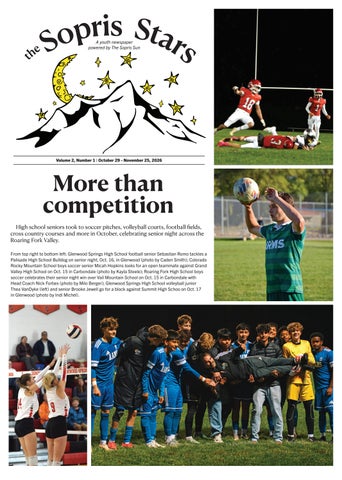
More than competition High school seniors took to soccer pitches, volleyball courts, football fields, cross country courses and more in October, celebrating senior night across the Roaring Fork Valley. From top right to bottom left: Glenwood Springs High School football senior Sebastian Romo tackles a Palisade High School Bulldog on senior night, Oct. 16, in Glenwood (photo by Caden Smith); Colorado Rocky Mountain School boys soccer senior Micah Hopkins looks for an open teammate against Grand Valley High School on Oct. 15 in Carbondale (photo by Kayla Steele); Roaring Fork High School boys soccer celebrates their senior night win over Vail Mountain School on Oct. 15 in Carbondale with Head Coach Nick Forbes (photo by Milo Berger); Glenwood Springs High School volleyball junior Thea VanDyke (left) and senior Brooke Jewell go for a block against Summit High Schoo on Oct. 17 in Glenwood (photo by Indi Michel).
The newly rising Stars The Sopris Stars is back for its second year of youth-led audience and share ideas in a welcoming environment. news in the Roaring Fork Valley. I am thrilled to continue As a teen we often find ourselves stuck in a bubble of this newspaper allowing more youth than ever to have the friends, family or even school work, rarely meeting and opportunity to gain hands-on learning experience in jourconnecting to the world around us. However The Sopris nalism. This year we have seen an influx of interns leading Sun fosters this connection. “It has given me a lot more to more content than ever! A few bylines perspective on other people's beliefs … it has return: Aurora Egan, Arthur Cherith and also opened up connections and I made a lot myself, Lou Gall. Along with that, our new more friends through it [The Stars],” returninterns include, Caden Smith, Aya Robinson, ing Stars Correspondent Aurora Eagan said. Layla Reiss, Luke Incze, Donovan Gutierrez Having been with the program for multiple Gonzalez, Austeja Vaskaite, Kyra Chopra, years Aurora shared how much fun she has, Yaritza Lopez Perez, Kayla Steele, Arabelle watching new interns “find their footing” Moffitt, Owen Furderer and Indi Michel. Viviand using this opportunity to write about enne Shapiro, one of last year’s Stars, might her passions, spreading news of live theater, contribute from afar, and a couple more bands or just thoughts on the world. interns may still join the team. Every intern was asked to share what This year's array of interns are excited to they look forward to in the coming year and get to work, from sports reporting to the fuevery intern shared excitement for various ture of local scholarships; we are committed passions, some have a desire to cover EDITOR'S to share it all. We strive to deliver trustworthy sports, others want to discuss upcoming DESK and reliable news every month keeping the scientific studies. Despite the varying kids, tween and teens of the Roaring Fork interests the office is full of life with students By Lou Gall Valley informed. The Sopris Stars is for everycollaborating and laughing at every turn Sopris Stars Editor one; we aim to work with the community. If working toward a common goal. you have any opinions, events or corrections to share, reach The Sopris Sun is nothing if not welcoming, from your out to us with your ideas at youthnews@soprissun.com very first day to the very last The Sun feels like a big hug. The Sopris Stars are also taking to the air waves, plan“I feel very believed in at The Sopris Sun,” third-year Stars ning a monthly takeover of “Everything Under the Sun,” Correspondent Arthur Cherith said. The Sopris Sun’s weekly radio show on KDNK, from 4 to Having a space to belong has been instrumental in my 4:28pm on the same Thursday that The Stars prints each high school experience and I know most of our returning month. Along with that we are partnering with the Andy students share the sentiment. Growing up is scary and Zanca Youth Empowerment Program (AZYEP), bringing confusing; having the space to feel heard and seen not only audio versions of your favorite Sopris Stars stories to your allows for growth but acceptance, helping students to flourlocal radio! ish in whatever they choose to pursue after high school. In a time of social media many interns describe feeling Personally having been with The Sopris Sun for three years a need for self expression in a productive way. “The youth, I have found a passion for journalism and plan to continue we need to express ourselves, seriously because if we can’t that passion throughout my life, taking what I have learned get our opinion out there, who is going to get our opinion here into the world! out there for us?” said Stars Correspondent Luke Incze, who I have yet to see a student walk away from The Sopris felt strongly about the prospect of allowing teens a place to Sun worse off than they started. Every single person pours publish their work. their heart and soul into this paper and it shows. We are The growth of The Stars has allowed so many young made by the community for the community so if you feel so adults to find their voice. I myself have grown so much inclined reach out to us at youthnews@soprissun.com Let through the continuation of this program. I continue to us know what you want and thank you for another amazing watch my peers grow alongside it learning to engage an year of The Sopris Stars!
the
Sopris Stars Youth Editor Lou Gall lou@soprissun.com Senior Correspondents Arthur Cherith arthur@soprissun.com Aurora Egan auroa@soprissun.com Vivienne Shapiro Vivienne@soprissun.com Correspondents Kyra Chopra kyra@soprissun.com Owen Furderer owenf@soprissun.com Donovan Gutierrez Gonzalez donovan@soprissun.com Luke Incze luke@soprissun.com Yaritza Lopez Perez yari@soprissun.com Indi Michel indi@soprissun.com Arabelle Moffitt arabelle@soprissun.com Layla Reiss layla@soprissun.com Aya Robinson aya@soprissun.com Caden Smith caden@soprissun.com Kayla Steele kaylasteele@soprissun.com Austeja Vaskaite austeja@soprissun.com Youth Journalism Director Skyler Stark-Ragsdale skyler@soprissun.com Youth Journalism Instructor James Steindler james@soprissun.com Graphic Designer Terri Ritchie terrir@soprissun.com The Sopris Sun, Inc. is a 501(c)(3) nonprofit corporation with a mission to inform, inspire and build community by fostering diverse and independent journalism. Donations are fully tax deductible. The Sopris Stars is made possible thanks to The Sopris Sun. Support The Sopris Stars Youth News Bureau by making a donation at www.soprissun.com/donate
CORRECTION: The May issue of
The Sopris Stars incorrectly stated that the Roaring Fork baseball player on the cover was pictured with his parents, when the two folks accompanying him were in fact the parents of Trent Goscha, whose memory is honored each year during the annual Trent Goscha Tournament.
Letters to the Editor
The Sopris Sun's youth news bureau works to meet deadline from the Third Street Center on Oct. 21, putting together the first 2026-27 edition of The Sopris Stars. Photo by James Steindler
2 THE SOPRIS STARS | The Sopris Sun Youth Journalism Publication | October 29 - November 25, 2026
Have something to shout about? Email letters to the editor birthday shout-outs and more for publication in The Sopris Stars to youthnews@soprissun.com
Is artificial intelligence really that intelligent? The future of AI locally and nationally INDI MICHEL Sopris Stars Correspondant EDITOR'S NOTE: Indi Michel is a student of both Gregory Sustad and Paul Freeman. Since its inception, artificial intelligence (AI) has grown rapidly over the past six years. From its use in the consumer market, to the tools many researchers use nowadays; it continually remains closely involved with the day-to-day activities of the general public. As the years go by, AI’s dangers and benefits become readily apparent, with it quickly becoming a concern across many populations, according to Stanford University’s public opinion survey on the outcomes of AI. Danger from the usage of AI comes in many forms, as a report from Anthropic’s own Threat Intelligence team has demonstrated over the past eight months, covering December 2025 to September 2026. Notable instances come in the form of a “Covert frontier model access for orthopoxvirus research,” which saw an anonymous randomly generated account use the cover of an Orthopoxvirus laboratory to gain access to data involving bioengineering viruses, the report stated. Anthropic’s Claude AI system was also used for, a “Russia-based operation using Claude to engineer an autonomous military drone swarm,” which folded out as a Russian-based actor utilizing Claude to code a chain of drones with built in behaviors like return-to-base settings, a geolocator for opposing drone operators and a call to detonate the drone remotely. The uses aren’t limited to biological and conventional warfare either, with China utilizing Claude to create a “deceptive dating app network,” that saw “more than 4,700 distinct AI personas that engaged in conversations with at least 25,000 unique individuals.” The report comes after the first espionage campaign using AI was discovered not three months earlier. Strategies among malicious actors and government are evolving at breakneck pace and Anthropic has even admitted that, “the barriers to performing sophisticated cyberattacks have dropped substantially.” The dangers of AI pose a threat to the general public’s safety at large, demonstrating state actors’ ability to create massive amounts of disruption within governments at a much cheaper cost. Locally, the implications aren’t great, leading to the potential targeting of power grids, across the western United States, according to the U.S Government Accountability Office, which could leave millions without access to internet or basic lighting. Local history professor
Gregory Sustad from Colorado Mountain College expressed concern over the effects of AI in our daily lives. “We’re not ready for the levels of disruption it [AI] is going to create,” he told The Stars. This comes after reports of the Hugging Face Incident broke out on Aug. 26 by tech giant OpenAI. The incident involved over 1,200 individual instances of a new model of AI breaking out of their secure sandbox server and blazing a trail across the internet. The situation coalesced into a catalyst for what leaders of the industry have begun recognizing as a degree of sentience never before seen in machines. Despite AI’s disconcerting aspects of what it could lead to in the future, there are benefits to reap as well. Glenwood Springs High School Principal Paul Freeman sees some potential uses for AI as a tool. As an administrator, Freeman has already begun implementing it in ways that save him time and allow him to create accessibility for students within the school. Freeman mentioned students may, “[use] AI not to do the work for me [as a student], but to teach me how to do it.” Additionally, he described its use as, “an infinite number of very patient, very knowledgeable, but also capable of being very stupid, interns for me.” Ultimately, Freeman recognized it as a technology that wasn’t going to go away, so he chose to make the most of it. Afterwards, he demonstrated an aspect that proved very useful both to him and the dual language speakers within the high school; translating an article into around six different levels of Spanish and English, making it easy for every group to understand. With some human review and slight tweaks, it became a very useful tool that allowed Freeman to complete a weeks-long task in less than a day. There are numerous concerns and benefits that are intricately intertwined with the rise of AI as a technology. As individuals, it’s important to separate the two and recognize that the technology itself creates a very fine line to walk on. The policy locally is remaining unchanged for now, according to Principal Freeman, who has stated the Roaring Fork School District advisory is to “be very careful.” This could change in the future, as Freeman has demonstrated with his thought process, but for now that remains to be seen. The situation is best put by Professor Daron Acemoglu, part of the Economics Department at MIT, who said, “AI could be either a blessing or a curse,” as quoted from the United Nations Department of Economic and Social Affairs.
Normandy Discovery Tours Guide Thomas Neighbour teaches a group of students from a hill above Omaha Beach using a photo booklet on June 30. Photo by Caden Smith
A legacy in transition: Questions lie ahead for ACF’s Normandy Academy scholarships CADEN SMITH Sopris Sun Correspondent EDITOR’S NOTE: Caden participated as a 2026 ACF student on the Normandy Academy trip. When Francisco stood among the rows of graves at the Normandy American Cemetery, the scale of the loss was hard to take in. “There are things that no matter how good of a picture it is, you will not get the impact of it until you see it with your own eyes,” said Francisco Santana, an Arizonan student who joined one of the 2026 Normandy Academy trips. “Standing in the middle of the cemetery and seeing how the graves have no end was a truly life-changing thing for me.” For nearly a decade, Aspen Community Foundation (ACF) scholarships have helped local high school students travel to New Orleans, Normandy and Paris to study World War II. The 2027 funding is now indefinite following the passing of Paul Bushong, the Korean War veteran and philanthropist who established the fund behind it. In an email to The Stars in early October, ACF Program Officer Scott Kenner explained that the 2027 program funding remains uncertain due to the lengthy process of estate planning. “Bushong made a planned gift to the foundation intended to sustain the scholarship program, but the foundation does not know when the funds will be distributed,” he said. “Settling an estate can take several months and, in some cases, up to a year.” This leaves students, families and educators without a clear answer about whether next year’s cohort will be able to go. Bushong established the Normandy and World War II Education Fund at ACF in 2017. Its purpose was to help students understand the significance of the Battle of Normandy by learning about it in
the places where it happened. ACF reported in December 2025 that the fund has supported 93 local students’ participation in the 11-day Normandy Academy. The program is open to eligible 10th and 11th graders from the Aspen to Parachute region. The 2026 tuition was listed at $5,895 per student; students were asked to contribute $1,200, with the scholarship covering the remaining $4,695. Students apply through the National WWII Museum, with ACF as the local scholarship contact. The museum describes the academy as an 11-day program that includes New Orleans, Normandy and Paris. Bushong’s aim went beyond sending students on a trip. ACF said that he wanted them to return home and share what they learned so the history would not be forgotten. “We have deeply appreciated the opportunity to honor something he was so passionate about,” ACF CEO Erica Snow said via a spokesperson. “His dedication to our local students cannot be overstated, and it is with immense gratitude that we mourn his passing alongside his family and friends.” In a 2025 foundation article, Bushong remarked, “What happened in Normandy in 1944 is one of the most important events of recent history. I created this to help our local students understand this history, experience it firsthand and return home to share what they learned with friends and family.” ACF also described students researching an individual veteran during the academy and sharing their reflections with local groups and classrooms. The emphasis on sharing history is part of what students said made the experience remarkable. For Santana, the trip was also a lesson in encountering people and cultures beyond his own. “Going to a whole new country, it’s more than learning continued on page 8
THE SOPRIS STARS | The Sopris Sun Youth Journalism Publication | October 29 - November 25, 2026 3
RFSD Report
The superintendent got a good review. So why was the board disappointed?
KYRA CHOPRA Sopris Stars Correspondent
Getting a good review is usually something to celebrate. But at the Roaring Fork School District's Oct. 21 Board of Education meeting, Superintendent Dr. Anna Cole's positive evaluation came with one big concern: Only about half as many people filled out the community survey as last year. Cole received an overall rating of "effective," and board members had plenty of good things to say about her work. Still, several were disappointed by the low participation. Just 214 people responded to this year's survey, compared with 426 last year. Of the 214 people who responded, 56.1% were parents and 24.8% were certified employees, including teachers. Students made up only a small part of the responses. For a district with more than 5,600 students, the drop in responses stood out. Board Member Jasmin Ramirez wanted to make sure the drop wasn't ignored. "I want to make sure someone notes ... the drop in feedback we received this year," Ramirez said during the meeting, adding that the board should talk more about how to get feedback from different people across the community. Board Member Kathryn Kuhlen-
The Roaring Fork School District Board of Education discussed Superintendent Dr. Anna Cole's evaluation on Oct. 21 at the Roaring Fork Schools District Office in Carbondale. Photo by Skyler Stark-Ragsdale
berg called the drop disappointing and suggested changing when the district sends out the survey to encourage more people to respond. The survey, which ran from Sept. 18 through Oct. 4, showed that 80.4% of respondents agreed Cole supports the district's goals for student learning. Another 78.5% agreed that she works to make students feel safe, welcome and included at school. During the meeting, one board member pointed out how much blue was on the survey's pie charts, representing positive responses, and said they appreciated the progress the district was making.
Board Member Lindsay Defrates also talked about the positive feedback, saying that many community members seemed to appreciate Cole's work. And the discussion went beyond just the survey. Kuhlenberg brought up something else: how many people actually understand what a superintendent does? Most students could probably name their principal without even thinking about it. They see their teachers every day and know who to go to when something happens at school. But the superintendent? That's someone students might have
heard of without really knowing what they do. While principals are in charge of individual schools, Cole oversees the whole district. Her job includes decisions about staffing, school programs and the district's priorities. Kuhlenberg suggested the district could do more to help people understand that role and how it affects students. Though Cole received a positive evaluation, the board still had things it wanted her to work on, including improving student achievement, strengthening classroom instruction and communicating better with the community. The board also recognized Cole's work supporting school leaders, hiring staff and making district finances more transparent. Toward the end of the discussion, the focus shifted from Cole's performance to the evaluation process itself. Kuhlenberg suggested looking at the timing of the survey, while Ramirez emphasized making sure more community members have a chance to share their opinions. One board member suggested the evaluation have more regular checkins throughout the year instead of just once a year, and said the process was "due for an evolution."
Glenwood Springs Demons make their mark across fall sports OWEN FURDERER Sopris Stars Correspondent
Steamboat Springs high schools in their final two games. The Glenwood boys soccer team From Friday night lights to packed also played its senior night this past gyms, Glenwood Springs High Thursday, Oct. 15, with a convincing School’s fall sports teams have been 6-0 win against Rifle High School, competing across the state. In an interview with Glenwood Athletic Direc- bringing the Demons’ season record to 8-6 as it faces tor Jordan DeCrow, Steamboat and The Sopris Stars Summit in its final takes a closer look two games. at how these teams That said, the are performing and men’s soccer team the challenges they isn't the only team have faced so far in Glenwood this year. with success; the As the fall sports - Jordan DeCrow, Demons’ girls season continues, volleyball team Glenwood Springs Glenwood Athletic Director currently has a has competed across multiple sports with many ups 12-4 record, ranking No. 2 in the 4A Western Slope League. They conand downs; here are some of the recent scores and updates. Glenwood’s tinued this winning streak taking on Eagle Valley on Oct. 21 in a 3-2 win high school football team recently for senior night. competed during their senior night, Regardless of the season's rewhere they lost to the Palisade High School Bulldogs 6-42, with their only sults, DeCrow emphasized that high school sports are about more than touchdown scored by sophomore wins and losses. With 18 to 19 varsity Oliver Furlong, bringing their record sports, including cheer, DeCrow said to 0-8 as they face Eagle Valley and
“MY GOAL IS TO MAKE EVERY SPORT FEEL LIKE THEY’RE THE ONLY SPORT AT THE SCHOOL.”
Glenwood Springs High School Football player Patrick Jewett (No. 4) faces off against the adjacent Palisade player in the final Glenwood home game on Oct. 16, 2026. Photo by Caden Smith
one of the biggest challenges is making sure every program receives the support and attention it deserves. “My goal is to make every sport feel like they’re the only sport at the school,” DeCrow said. DeCrow also highlighted the role the Glenwood Springs community plays in supporting its student-athletes, pointing to local sponsors and community partners who help provide resources for the school’s athletic programs. “Our community is super giving, and they’re willing to … rally together to make sure that our kids have what-
4 THE SOPRIS STARS | The Sopris Sun Youth Journalism Publication | October 29 - November 25, 2026
ever they need,” DeCrow said. Although winning remains a goal for Glenwood’s teams, DeCrow said the lessons athletes learn through competition are just as important as their results. From commitment and dedication to learning how to overcome adversity, DeCrow believes sports help prepare students for life beyond high school. “Winning’s obviously our goal, but it’s not our purpose,” DeCrow said. “And our purpose is to create young men and women of character and people who will thrive in a changing world.”
When your best still doesn’t feel like enough
I feel like school is about more than just getting good grades. It feels like I am working towards something bigger than myself, something I cannot explain. As a Hispanic student, I sometimes feel pressure to do well because I want to make my parents proud and show them that their hard work means something. Even when nobody directly tells me I have to be perfect, I feel like I should be doing more. The hardest part is that I do not always know what doing my best is supposed to look like. Sometimes I wonder how I am supposed to meet an expectation that I cannot even define for myself. I know that my parents want the best for me, and I believe many of their expectations come from wanting me to have a good future. When I think about how hard parents work to provide opportunities for their children, I sometimes feel like I owe it to them to succeed. I want them to be proud of me, and I want them to see that their efforts weren't in
vain. Growing up in a Hispanic family, I have sometimes connected academic success with the sacrifices my family makes. I cannot speak for every Hispanic student, but for me, that connection can make school feel more personal than just completing assignments or earning a grade. What makes this pressure difficult is that I do not think it always comes from my parents. Sometimes, I put more pressure on myself than anyone else does. I get caught up thinking about what I should be doing, what grades I should be getting and how much further ahead I could be. Even when I accomplish something, I sometimes focus on what I could have done better instead of recognizing what I have already accomplished. Eventually, that pressure became more than I knew how to handle. It stopped being just about schoolwork and started affecting my mental health. I struggled with depression and anxiety, and it became difficult to man-
OPINION By Yaritza Lopez Perez Sopris Stars Correspondent age the expectations I had placed on myself. I had spent so much time trying to do enough that I did not realize how much I was struggling along the way. One moment that stands out to me is when a teacher asked me if I was okay. It might have seemed like a simple question, but it made me stop and think about what I had been going through. Until then, I had been so focused on keeping up with everything that I had not fully recognized how
much I needed help. Having someone notice and ask me that question helped me realize that I did not have to keep everything to myself. I eventually reached out for help, and that became an important step in my journey. Looking back, I realized how much it mattered that someone took the time to ask instead of assuming I was fine or believing the mask I put on every day. Getting help did not suddenly make every expectation disappear, but it helped me learn how to face them differently. Eventually, I was able to feel that academic pressure again without feeling completely consumed by it. I could care about my grades and my future without letting them define every part of me. In a way, I started to understand that I did not have to choose between wanting to succeed and taking care of myself. I could still have goals, work hard and make my family proud while also recognizing when I needed support. That experience changed how I look
at success because it showed me that pushing through everything alone is not the same as being strong. I also think about how difficult it can be for students and parents to understand each other when it comes to academic pressure. From my perspective, parents may worry about their children’s futures, while students may worry about disappointing the people they love. Sometimes, both sides care deeply but struggle to communicate what they are feeling. I do not believe that wanting your child to succeed is wrong. However, I think it is important to recognize that a student’s grades do not always show what they are going through. I wish it were easier for students to explain when things become overwhelming for them and to feel that asking for help does not make them a disappointment. And if there is one thing my experience has taught me, it is that sometimes, the most important thing someone can hear is a simple question: “Are you okay?”
Telling others they’re hell-bound won’t make you heaven-bound Christianity has changed the lives of many people. For me, this has been a fundamentally positive change that has transformed my life for the better. Unfortunately, and undeniably for many others, the push for Christianity has also harmed, either through personal experiences or the treatment of others. The shame I feel when I realize that the same belief that has given me so much joy has hurt others is immeasurable. For a long time, I couldn’t reason with this catch-22 and held the belief that so many other Christians today grasp onto: Those who have a distaste towards Christianity are simply just hateful. However, through the experiences I have lived and the observance of those close to me, I have come to realize that this disdain many Christians feel comes down to a miscalculation, one often
reached through an attempt to bring others to the religion. Many Christians fear what challenges their beliefs. Because the values of Christianity are so deeply important to so many, when they are tested the immediate reaction can be inspired by hate.
a Christian personally views homosexuality as un-Godly, it is hard to deny that it gets a lot more flak than other ways of being or actions that Christians view as sinful. Homophobia creates an unbreakable cycle that runs rampant in churches and
“THOU SHALT LOVE THY NEIGHBOUR AS THYSELF.” - Matthew 22:39
Hate is highly scrutinized in the bible. Even those who have never read the bible or practiced Christianity know the infamous verse of Matthew 22:39: “Thou shalt love thy neighbour as thyself.” One extremely popular and controversial example is homophobia. It's hard to comprehend the egregious amount of homophobia in Christian circles today. Regardless of whether or not
Christian communities. A queer person may be shamed, ostracized or rejected when attempting to join a Christian space that has such hate-filled views. Then, that person most likely will not return to that space, feeling shunned. It’s likely that separation from the community will not end there, and they may feel a sense of contempt towards Christians. Seeing people leave or
separate themselves from the church hurts Christians. Some might focus their hurt outward onto the group that left the faith, creating more bitterness and anger. This will continue to fester and repeat once another person from the group joins and is treated the same way. The divide grows every time. This same cycle can be observed in countless other spaces, including other religions and cultures. Regardless of the situation, it has a constant output of rejection, hurt and hate. Many Christians are so passionate that what they believe is right that they find shame and humiliation are reasonable reactions. It’s no surprise when someone doesn’t feel welcome in church that they will not want to come back. It may be hard for many Christians to come to terms with, but the only way to bring people into
OPINION By Aurora Egan Sopris Stars Correspondent this faith is through kindness, a willingness to put aside differences to seek common ground and showing the love expected of every Christian. There is no possible way to spread the ever-loving and forever forgiving love of Jesus if you yourself lack love towards others, even if they are different from you, even if they don’t share your belief and even if they don’t return the love you give. The only way to demonstrate God’s love is through kindness, acceptance and tolerance, not hate.
THE SOPRIS STARS | The Sopris Sun Youth Journalism Publication | October 29 - November 25, 2026 5
The case against Flock cameras With the modernization of new technology and AI, different technology has surfaced. One of those specific technologies is known as “Flock” cameras. A Flock camera is a privately held American manufacturer and operator of surveillance technology primarily automated to store data on license plates, and details of cars that pass such cameras. If you're driving on Highway 82 headed toward Carbondale from the north, you have passed one of these cameras, which subsequently registers time, date and direction along with licence plate, car make, color, roof racks and even bumper stickers. This data is held within the database for up to 30 days where it is eventually discarded. Within this time period private owners of the camera (usually law enforcement) are able to freely access the data on your whereabouts. Within Garfield County, there are 31 documented Flock automated license plate reader (ALPR) locations. According to the February Post Independent article, “Glenwood Springs restricts outside access to police license plate reader data,” there are 21 cameras currently operated within the city of Glenwood Springs.
Flock cameras, for a lot of concerned citizens, have raised the argument against mass public surveillance. It reminds some, including myself, of literary works like George Orwell’s “1984,” or at least the start of it. The
officials across the country have been accused or charged for misuse of the technology, most using cameras to stalk ex-partners. According to ABC15 Arizona’s “Kentucky officer accused of using police cameras to track ex
the duty of removing Flock, vandalizing and destroying cameras across the country, as reflected in the August NPR article, “Amid intense backlash, people are vandalizing Flock surveillance cameras.” Vigilantism is a complicated debate of right and wrong, however these actions do prove something specific. If individuals are willing to risk the criminal charge of vandalising police property, it truly shows how some feel about the technology and its implications. Those advocating for their rights legally have taken every approach to keeping Flock cameras out of their counties, to the point where Darth Vader became involved. A viral social media clip recently surfaced of a San Diego City Council meeting, in which a particular individual dressed as Darth Vader spoke to council about how he favored the cameras as they would help progress his evil agenda and allow him to stalk Luke Skywalker across the galaxy. As a teenager growing up with this technology, it bothers me. I feel as though technology, though invented for the right reasons, can too easily be corrupted. I don't want to drive on highways
"AS A TEENAGER GROWING UP WITH THIS TECHNOLOGY, IT BOTHERS ME. I FEEL AS THOUGH TECHNOLOGY, THOUGH INVENTED FOR THE RIGHT REASONS, CAN TOO EASILY BE CORRUPTED." - Luke Incze Fourth Amendment of the United States Constitution has dictated laws, trials and courts system in the attempts to protect citizens from unlawful search and seizure. The use of Flock cameras in recent years have been a heavily debated issue within the U.S. courts, which begs the question, what is the expectation of privacy on public roads and what makes it different from an officer writing down a license plate. The answer is simply, a cop couldn't track thousands of cars within an hour and retain the vast detail and information the cameras store. Within the time that Flock cameras have been installed, over 50 law enforcement
over 2,000 times,” written in August. “Investigators found Zahir had conducted 2,048 Flock searches from January into May to track two vehicles registered to the victim, his child’s mother, in Kentucky and Indiana, court records show,” the article states. Furthermore, individuals have hacked into the Flock database, allowing someone without authorization to get ahold of such vast information and highlighting how, if the technology falls into the wrong hands, catastrophic consequences can incur. The public’s reaction to Flock has generally been received negatively. Many individuals across the country have taken upon themselves
OPINION By Luke Incze Sopris Stars Correspondent that can track my every move and feel that if these companies can get away with this level of mass surveillance, it may only be the start. Within no time their capabilities may grow into monitoring our driving, conversations or even personal lives; this is a future which may be closer than imagined. The brightside, however, is that on a community level, we have the power to decide. Carbondale Town Manager Ryan Hyland said in a May board of trustees meeting that, “With respect to the Flock cameras, there’s no plans to bring any proposals for Flock cameras to the board from the police department at this time.” However you may feel about the new technology of Flock, you're entitled to your opinion, whether it's spreading the word, voting or community involvement. Just remember you have a choice.
The evolution of Oktoberfest
In downtown Carbondale, under the cover of a tent the yearly celebration of a wedding took place. Although this wedding occurred nearly 216 years ago across the world its legacy remains today. Throughout the world, Oktoberfest is celebrated as one of the world’s largest folk festivals. In fact, over 1.7 million gallons of beer are consumed every Oktoberfest. Millions of locals, tourists and global beer corporations use this as an opportunity: locals for fun and festivity, tourists as an excuse to travel and corporations as a way to build corporate value. What began as a localized royal wedding in Bavaria has transformed into a globally franchised enterprise, revealing a shift from authentic community culture to modern corporate capitalism. In October 1810, Bavarian Crown Prince Ludwig I and Princess Therese von Sachsen-Hildburghausen were married, marking the
OPINION By Arabelle Moffitt Sopris Stars Correspondent first royal wedding in Germany to celebrate unity and the regional pride of Bavaria. People celebrated with beer and music gathering in Munich Germany on Theresienwiese, featuring horse races and local agricultural displays centered around civic unity and sports. The festival continued yearly in Munich and soon spread worldwide, keeping Bavarian culture and community spirit alive across generations. Oktoberfest started as a celebration of localized Bavarian agricultural heritage and royal marriage. Early traditions resonated deeply with the Bavarian people. However, as the Industrial Revolution swept across Europe in the late 19th century, small family-owned shops and taverns were gradually replaced by large commercial
venues. A small family-run pub has a much lower capacity than the giant beer halls sweeping across the nation. These new venues and factories created the industrial infrastructure required for mass commercialization. Whether Oktoberfest takes place in Munich or Carbondale, visitors expect to find the same iconic cultural markers: giant warm pretzels, traditional brass bands and heavy glass beer steins. Over time, these traditional symbols provided beverage companies and travel agencies with a readymade template for global marketing campaigns. Commercial advertisers quickly recognized that they could leverage the festival’s authentic, rustic origins to market these regional customs to an international audience. While the original beer stands at Oktoberfest were operated by small, independent local brewers, today the festival’s lucrative
A paper lantern dangles at Carbondale’s Oktoberfest, full of live music across from Peppino’s Pizza on Oct. 17. Photo by Arabelle Moffitt
beverage market is strictly dominated by Munich's Big Six breweries: AugustinerBräu, Hacker-Pschorr, Hofbräuhaus, Löwenbräu,
6 THE SOPRIS STARS | The Sopris Sun Youth Journalism Publication | October 29 - November 25, 2026
Paulaner and Spaten. These brands, which once operated as local businesses, have grown into giant commercial continued on page 8
What ‘Coraline’ teaches about societal collapse and the age of AI Henry Selick’s adaptation of Neil Gaiman’s 2002 classic, “Coraline,” pairs whimsical characters and striking silhouettes with a darker story, but still grounded in warmth. Its carefully crafted details make for a memorable film. And, upon closer inspection, its plot echoes a civilization-wide extinction theory known as the comfort paradox. A theory that can also explain how reliance and dependence on AI can lead to these consequences. Coraline struggles to adjust to her new life in a gloomy Oregon town. At the Pink Palace, where she lives, she discovers a tiny door leading to a near-perfect replica of her world. There, everything is better, thanks to the “Other Mother,” or Beldam, who seems able to shape reality around Coraline’s desires. (Think of AI's ability to generate surreal hallucinations with modern technology.) On Coraline’s third visit, Beldam offers her a life in this new world in exchange for sewing buttons over her eyes. (A technology was
OPINION By Donovan Gutierrez Gonzalez Sopris Stars Correspondent introduced to a population guaranteeing ease, but the trade off is to give up a previous world or purely human-generated creativity and tenacity.) Coraline refuses and tries to undo the choices that led her there. The comfort paradox describes a cycle in which a drive for safety and convenience helps societies prosper, but also can erode resilience. As people become less able to tolerate hardship, societies grow more vulnerable. This may end in collapse, as populations lose the capacity to respond to problems or become so absorbed in comfort that their will to live gradually fades. This loss of physical and psychological resilience and passion leads to systemic hibernation, and even rejection of new experiences and advancements. A population with no problems left to face or goals left to conquer remains stagnant.
So Coraline rejects Beldam's offer and attempts to reset her previous decisions. Coraline’s desire to find peace leads her to a solution that would allow her to experience her most outlandish fantasies in a near-symmetrical world of her own. The film clearly mimics the comfort paradox, except that Coraline breaks the pattern by choosing to detach from the Other World. But first, her search for peace leads her to a world where her fantasies can come true. Was breaking from the Other World the right choice? And is it ethically or morally wrong to surround ourselves with a kind of “other world?” Despite a lack of studies, we can still make an educated guess about the decision Coraline could have made. In the Other World she would have full bodily autonomy, except for her eyes becoming buttons. Imaginative wonders would forever surround her, and anything she could wish for would be manufactured to her heart's content. Coraline clearly has compassion for her parents, so
Graphic by Donovan Gutierrez Gonzalez
why would that change with her “other” parents? Looking past their physical differences, her other parents could provide levels of love unmatched to that of her real ones, along with fulfilling her needs for shelter, safety and survival. In terms of evolution and bioengineering, Coraline should have chosen to stay in the Other World. So what drove her to stray from that decision? It was the mere thought of sewing her eyes shut that steered her away from a more optimized reality. It was also clear that she yearned for “real” love. In humans there is a difference between a manufactured
personality and a genuine one, but, seemingly, the line can be blurred. Americans overwhelmingly prefer human-created products and creativity, as opposed to AI. Due to a push toward AI integration in everyday life, there are a terrifying number of people who are in favor of its increasing prevalence. Implementing highly advanced AI systems into routines is not only considered optimal by some, but as inevitable by most. But the film shows the complete opposite in the most beautifully illustrated way. Near the end, Beldam continued on page 8
THE SOPRIS STARS | The Sopris Sun Youth Journalism Publication | October 29 - November 25, 2026 7
Roaring Fork highlights outstanding students of the month PRESS RELEASE Roaring Fork High School EDITOR’S NOTE: These write ups were cleaned up using AI, according to Roaring Fork High School, and edited by The Sopris Stars. Every month, Roaring Fork High School will highlight its students of the month in The Sopris Stars. This is the result of a collaboration between RFHS and The Sopris Stars.
Josephine Brasier, 10th grade
Sophomore Josephine Brasier thrives at the intersection of structure and creativity, listing math and art as her favorite subjects. Beyond her schoolwork, she stays busy crocheting, painting, drawing, practicing archery and reading. Brasier looks up to her art teacher, Ms. Carpenter, who has taught her the importance of self-compassion. Proud of her Cherokee heritage, Brasier dreams of visiting the Cherokee Reservation, as well as studying abroad, traveling the world and simply spending time restoring cars with her dad. Teachers Carmen McCracken and Michael Black praise her as a kind, caring and thoughtful student who consistently shows respect for others.
NORMANDY from page 3 about the Eiffel Tower or the beaches,” he said. “It’s more like understanding the cultures, more like understanding other people.” Madalynn Casey, another student on a 2026 trip, said visiting the D-Day beaches made history feel immediate in a way textbooks could not. “Being able to step foot on those beaches and just see how much land and how much they had to take control of in such a short amount of time really opens your eyes to WWII itself,” Casey said. She also came home with a stronger grasp of the subject. “I’m able to say a whole lot more about what I learned when I talk about World War II and D-Day specifically than I was before,” she said. Both students emphasized the lasting connections they formed with their fellow travelers. Santana said that after spending two weeks together, students who had started as strangers felt like family. Casey said she still talks with the students she became close to on the trip. Those experiences are why the ambiguity of the 2027 scholarships reaches beyond a line in ACF’s budget. The scholarships give students access to an intensive history program and ask them to bring what they learn back to their communities. Whether that opportunity is offered in 2027 depends, for now, on when Bushong’s planned gift becomes available and what support can sustain the program in the meantime. Academy slots are not generally awarded until January or February, and Kenner said ACF is still waiting on information before determining whether the program will be paused for the 2027 cohort. For Francisco, the value of the trip is clear: “We should really support these types of events, because they really change people … and keep expanding them.”
Eric Barajas-Medina, 11th grade
Gianna Baiardo, ninth grade
Freshman Gianna Baiardo brings warmth and curiosity to her school community. Her favorite subject is Spanish, as she loves learning new ways to connect with local community members and is building a foundation for Italian — another language she is working at. Outside the classroom, Baiardo enjoys baking creative dessert combinations, cooking and diving into good books, especially when she can discuss them with friends or compare them to film adaptations. A fun fact about Baiardo is that she was born on Christmas Day. She looks up to her grandmother, Gemma, for her constant guidance, as well as activist Emma Watson. Her future goals include attending a college that helps her explore her passions, with sights set on a career in English. Teachers Ed Danahey and AJ Crowley describe Gianna as a conscientious, helpful and a welcoming presence, and someone who instantly brightens any room.
Junior Eric Barajas-Medina excels in English class, where he feels in his element, expressing his ideas through writing. When he isn’t in class or working outside of school, Barajas-Medina loves playing soccer. He draws his inspiration from his mother, admiring her strong work ethic and how she taught him to be a caring, supportive person. Driven and ambitious, Barajas-Medina is striving for a 4.0 GPA, while building toward a stable future career. Teachers Meg Ravenscraft and Mary Groome have been thoroughly impressed by his rigorous study habits and exam scores, noting that he is genuinely kind and always steps up to help others without being asked.
Viri Chimal Moreno, 12th grade
Senior Viridiana "Viri" Chimal Moreno finds her passion in anatomy and physiology, captivated by the inner workings of the human body. The oldest child in her family, Chimal Moreno spends her free time reading and journaling about her daily experiences. She credits her hard-working parents as her greatest role models. Her primary goal after graduation is to pursue a career path she truly loves. Described by teachers Leslie Keery and Eric Sgambati as a curious and natural leader, Chimal Moreno is known for her helpful nature and her exceptional ability to lift up the students around her.
OKTOBERFEST from page 6 enterprises or state-backed entities that produce millions of barrels annually. Ultimately, what was originally created as a simple civic gathering focused on community unity has been systematically repackaged into a highly profitable corporate venture. This corporate takeover creates a profound paradox for modern communities by disrupting the genuine desire for local festivals and community gatherings. In an increasingly digital world, opportunities for real human connection have been restricted. Humans are social beings and by nature, need other human interactions. Yet, those interactions have become increasingly confined to screens. The perseverance of local festivals such as Oktoberfest has kept traditions alive across generations, giving people a reason to gather in person. However, multinational corporations frequently dilute small festivals by prioritizing profit margins over the community, turning cultural celebrations into standardized marketing opportunities. By replacing authentic local craft and heritage with mass-produced merchandise, these corporations threaten the true originality and spirit of the event. Ultimately, this tension between cultural heritage and corporate interests is not unique to Oktoberfest. Across the globe, countless local gatherings face the pressure of commercialization. In our own small valley, local traditions like Mountain Fair, Dandelion Day and Potato Days remain deeply cherished because they are built on neighborhood volunteers, local artists and genuine community pride. These festivals reflect the authentic character of our town, standing in stark contrast to globalized corporate events. The evolution of Oktoberfest serves as a powerful reminder for small towns everywhere: as local celebrations grow, communities must actively protect their cultural roots to ensure that shared human connection remains at the heart of the festival.
CORALINE from page 7
Josephine Brasier (left), Eric BarajasMedina (center) and Viridiana Chimal Moreno. Photo by Christi Gubser
and her facade completely crumble to dust as Coraline peels back the curtain of novelty and pleasure to reveal Beldam’s true reality and nature. At the film's climax, she watches the Other World collapse into instability, mirroring the potential outcome of AI-dependent societies. Coraline embraces her real parents, real love. Coraline choosing the real world parallels the eventual erosion of AI, which would become an unfathomable risk to the inner workings and infrastructure of such a dependent civilization. Of course, singularly relying on the comfort paradox cannot 100% accurately depict how an AI-based civilization may play out. However, I believe that when you closely examine the film's parallels, the themes fit together in a way that can help you form a personal stance on the possible role AI can play in humanity's future.
HAPPY HALLOWEEN! 8 THE SOPRIS STARS | The Sopris Sun Youth Journalism Publication | October 29 - November 25, 2026