60 slmag.net
THE SIREN SONG OF CAPRI
At Pazziella, a Luxury Collection Hotel, Capri, timeless glamour, storied traditions, and the irresistible pleasures of la dolce vita reveal why this legendary Italian island continues to enchant. Written by Claire Williams Photos courtesy of Pazziella, a Luxury Collection Hotel, Capri
Lounge Bar image by Lutz Vorderwuelbecke
In Homer’s Greek Epic The Odyssey, the fabled hero Odysseus, while navigating the troubled waters of Poseidon, ties himself to the mast of his ship and instructs his crew to plug their ears with beeswax to avoid falling under the spell of the Sirens, whose sweet melodies lure sailors toward their demise. The mythical encounter has long been associated with the waters off southern Italy. While no Sirens sing their tantalizing tunes today, some 3,000 years later, Capri remains every bit as enchanting. For generations, Capri has been synonymous with luxury and indulgence, a place where, within roughly four square miles, visitors can rub shoulders with celebrities, shop both local artisans and international fashion houses, and savor the splendors of la dolce vita. Unlike its volcanic neighbors, Capri is a limestone outcropping once connected to the Sorrento Peninsula, giving the island its distinctive landscape of precipitous cliffs, lush greenery, brilliant blue seas, and rugged sea stacks. Just a short boat ride from mainland Italy, visitors arrive at Marina Grande, greeted by a kaleidoscope of pastel buildings climbing the hillside. From there, Capri’s iconic open-top convertible taxis whisk them upward toward the town center. La Piazzetta, Capri’s famous central square, is a beguiling fusion of Italian charm and modern extravagance, where centuries-old architecture mingles with contemporary luxuries. Tucked among the narrow lanes just beyond its bustle, boutique hotel Pazziella, a Luxur y Collection Hotel, Capri (pazziella.it) offers a serene counterpoint. slmag.net
61
Hotel entrance photo by Lutz Vorderwuelbecke
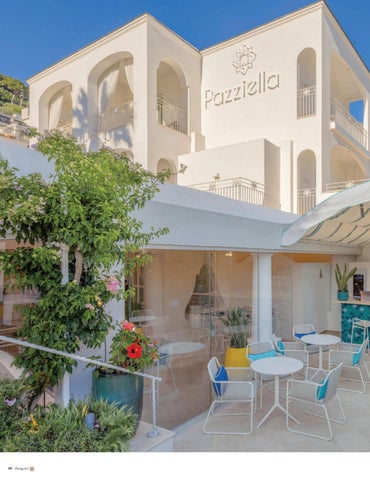
Passing through Pazziella’s white gates just off Via Fuorlovado, guests enter a lush sanctuary of greenery and lemon trees. At its heart, a generous patio and swimming pool sit secluded between the hotel’s two wings, seemingly worlds away from the lively streets just beyond. Pazziella’s story began in the early 20th century as a private family villa and gathering place before becoming a hotel in the 1950s. On the heels of a significant multiyear renovation that concluded in 2024, the property joined Marriott’s Luxury Collection in spring 2026. While thoroughly refreshed, the hotel retains the character of the original villa through preserved flooring and select pieces of handsome furniture. Its aesthetic is one of refined simplicity: clean lines, Mediterranean influences, local art, and a palette of crisp whites and blues, all bathed in abundant natural light. With just 25 rooms and suites, Pazziella possesses an alluring intimacy. Accommodations range from Deluxe Sea 62 slmag.net
View Rooms with private balconies to the aptly named La Dolce Vita Suite, complete with its own patio and plunge pool. Mornings begin with breakfast on the patio—I highly recommend the Caprese Eggs Benedict—and later in the day, the space transitions into P Garden Lounge Bar. The main culinary event, however, is Campanella, Pazziella’s signature restaurant. Here, straightfor ward preparations allow seasonal ingredients to shine, delivering the vibrant flavors of the Mediterranean through fresh local seafood, handmade pasta, and other regional specialties. For those seeking deeper relaxation, one of the hotel’s more distinctive amenities is the opportunity to privatize its spa suite, enjoying the plunge pool and sauna before adding a massage to the experience. If your version of unwinding includes a workout, P Fit offers a fully equipped gym inside a panoramic glass studio with sweeping views.
Within Pazziella’s walls, guests can experience one of the region’s most famous creations: limoncello. The lemon liqueur has deep roots in this corner of southern Italy, where fragrant citrus has long flourished. During Pazziella’s Aperitivo Ritual, guests hand-press freshly picked lemons alongside the resident bartender to create their own limoncello spritz. The hotel has also introduced its Caprese Ravioli Cooking Class, an intimate cooking class in which guests make pasta alongside a local recipe guardian while learning the techniques and traditions she has perfected over a lifetime. Many of Pazziella’s staff are passionate locals, eager to make recommendations that venture beyond the typical Instagram itinerary. On our first night, they suggested sunset cocktails across the island at Punta Carena Lighthouse in Anacapri, a quieter community on Capri’s western side. Far removed from the bustle of Capri town, we sipped Aperol Spritzes alongside locals, watching the sun slip into the sea.
Capri Suite bedroom photo by Lutz Vorderwuelbecke
slmag.net
63
The hotel’s garden and pool
Al fresco lunch at Campanella
On a brisk evening, while sipping that limoncello spritz, you may find a scarf draped over your shoulders courtesy of Farella (farella.it), whose storefront sits just in front of the hotel. Run by generations of women, Farella keeps Capri’s traditional hand-weaving techniques alive through its creations and workshops that invite visitors to try their hand at the loom. For the family, the work is about more than producing something beautiful; it is about preserving an island tradition, one thread at a time. Pazziella’s location places guests squarely within the pulse of Capri. Running parallel to Via Camerelle, the island’s premier shopping promenade, the hotel is mere steps from boutiques bearing names 64 slmag.net
such as Gucci and Louis Vuitton. Standing confidently among these international luxury houses, Emanuela Caruso (emanuelacaruso.com/us) offers another expression of Caprese craftsmanship. In less than an hour, a pair of handmade leather sandals are fashioned before your eyes, customized from understated leather straps to sparkling Swarovski embellishments. Capri may be celebrated for its glamorous façade, but its true character reveals itself through traditions such as these—and through the people committed to carrying them forward. “The value of Capri lies in the unity between nature and the work of man,” Italian art historian and critic Roberto
Pane wrote in his 1954 book, Capri. His observation still rings true. Amid the island’s dramatic landscape and ancient ruins, crafts once born of necessity evolved into distinct artisanal traditions. Over time, Capri became a haven for artists, writers and affluent travelers, each adding another layer to the island’s enduring mystique. Over millennia, Capri has passed through countless hands, from the Greeks and Romans to later invaders and rulers, while attracting generations of writers, artists, aristocrats and adventurers. Yet for all that has changed, the island’s essential allure remains remarkably intact. From ancient myth to modern-day travelers, people have struggled to resist Capri’s siren song. sl