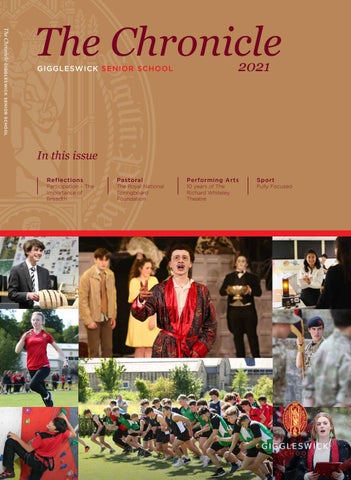
The Chronicle GIGGLESWICK
The Chronicle 2021
GIGGLESWICK SENIOR SCHOOL
SENIOR SCHOOL
In this issue Reflections
Pastoral
Performing Arts
Sport
Participation – The Importance of Breadth
The Royal National Springboard Foundation
10 years of The Richard Whiteley Theatre
Fully Focused
W E L C O M E
W E L C O M E
CONTENTS Welcome 4-9
Sport 62-77
Chair of Governor’s Welcome
Fully Focused
Back to the Future
Elite Sports - What have we learnt?
Reflections 10-27
North v South Virtual Activity Fixtures Catteral Shield
Why Reading Matters
Scarrig
Internationalism in Education
The British Open Golf Championship
Music for a While
Sports
Innovative Education Participation - The Importance of Breadth 21st Century Learning - A Vision for Education
CCF 78-83 CCF Review
Walter Morrison - A Man of Many Parts
Inter-house Drill Competition
Academic 28-43
Outdoor Pursuits 84-89
Why do we need a Liberal Education? The Role of Women in the Nineteenth Century ‘Wuthering Heights’ and ‘Jane Eyre’ Wollstonecraft’s influence on the 21st century feminist imagination
Outdoor Pursuits
Pastoral 90-117 The Covid Year
Colonialism and Empire
GSPA Fundraising Initiative
Gigg Reads – Colston’s statue: a long time in going
The Royal National Springboard Foundation
The Science Behind Hypnosis: Is It Real?
A Year in the Chaplaincy Woodland Trust
Young Enterprise
Back to Nature
Chemistry and Maths Olympiads
Walter Morrison Memorial Walk
Performing Arts 44-61
House Reports
Performing Arts Review
The Record 118-138
The Tempest The Addams Family Catteral Production, ‘Joseph and the Amazing Technicolour Dreamcoat’ Music Review Rock Concert 2021: The Lockdown Sessions Young Musician of the Year The Richard Whiteley Theatre - Ten Years of our Theatre
2
THE
CHRONI CLE
2 02 1
T HE
C HR O NI C L E
2021
3
W E L C O M E
W E L C O M E
INTRODUCTION I would like to welcome you to the 2021 edition of the Giggleswick Senior School Chronicle.
T
his last year may have been one of the most challenging in the school’s history with COVID lockdowns creating an incredibly hard environment for teachers, students and parents. If there is a word that describes how this wonderful school has reacted to the COVID crisis, it is ‘resilience’. For the pupils, teachers and other staff to move to a digital school and back again to the physical school at short notice has, frankly, been outstanding. Not only that, but students and teachers alike have demonstrated a remarkable level of ambition both in an out of the classroom. It would have been all too easy to lose motivation, enthusiasm and academic drive, particularly with the cancellation of public examinations, and yet, nevertheless, our students have embraced all the opportunities and support that the school provides to not just achieve but excel. Despite all the challenges, this has been a year of outstanding achievement for the pupils at Giggleswick. They have shown their
4
ability to adapt and get the most out of their time with us at school. They have exemplified the school’s core values of ambition, respect and participation and, with this grounding, I continue to be astounded by what our students can achieve, both here at Giggleswick and in their working lives. The future of the school is assured if we continue to invest for the students of today and tomorrow. The last year has presented us with opportunities to further develop Giggleswick School and we have used this time to put together a five to ten year strategy. The Giggleswick Curriculum and the
“The future of the school is assured if we continue to invest for the students of today and tomorrow.” THE
CHRONI CLE
2 02 1
Giggleswick Learner Profile are at the heart of our strategy, which is to support every child in their lifelong journey of learning so they have the skills to lead fulfilling lives and make a valuable contribution to society. Alongside this we remain committed to being a non-selective boarding school with a strong academic and co-curriculum offering. The next five to ten years will see investment across four themes: technology; retaining, attracting and developing great teachers; investing in our boarding facilities; and investing in outstanding teaching and co-curricular facilities. We anticipate that we will need £4m-£8m for investment over this time and the challenge will be to raise money from multiple sources for this. In so many ways Giggleswick continues to go from strength to strength, and this edition of the Chronicle gives a flavour of what makes this such a very special school. Alex Thursby Chairman, Giggleswick School Board of Governors T HE
C HR O NI C L E
2021
5
W E L C O M E
W E L C O M E
BACK TO THE FUTURE Speech Day this year was delayed in the hope that we would all have had the opportunity to meet in person. It was fortunate therefore that the decision to pre-record the principal speeches, a lesson taken from last year, meant there was no loss of the central messages when the government pushed back the release from lockdown. In his speech, the Headmaster drew inspiration from our Learner Profile to highlight how well the pupils and staff had adapted to the changing learning environment created by the pandemic.
S
peech Days are times to celebrate the many great achievements of the students but as every successful individual will know, their achievement rests upon a community of people who work together to support them. If we have learned anything from the pandemic it is to value what we have and how the enduring nature of our relationships formed at Giggleswick have supported us through times of stress. So, we have chosen as this year's theme for Speech Day 'Back to the Future'. We had thought that a playful reference to the iconic 1985 Robert Zemeckis film, starring Michael J Fox, would resonate with many, but it turns out it probably means much more to parents than their children, and I might go even further and suggest that even then it may well be the older parents. There is something in the saying that you know you are getting old when all the police look younger but, for a Head, perhaps it is when all the parents are much younger. So 'Back to the Future' for Speech Day is all about looking at how brilliantly the staff and pupils have coped with school in the pandemic and how we can take so much of what we have
6
learnt over the past four terms and use it to help shape the lives of the pupils and the life of the school in the future. A Giggleswick education reflects what is self-evident to us all: that school should not only be an enjoyable experience, but it should provide the foundation for leading a fulfilling life, in the awareness that, as individuals, we cannot expect every person to fit a particular prescribed pathway. This is why our learning is bespoke. We have always emphasised at Giggleswick the importance of a breadth in education, recognising THE
CHRONI CLE
2 02 1
that academic results are important, but our job here is to work alongside the pupils to help develop in them the skills and attributes they need to go on to lead fulfilled lives. We have to acknowledge that, not before time, there have been significant cultural shifts that have accompanied lockdown: Black Lives Matter, Everyone's Invited, and, whisper it quietly, the rolling back of cancel culture. Alongside these have been catastrophes that have caused us to recognise that what we took for granted may not be as certain as we had thought. Consider our own
resistance to disease and the economic consequences of a pandemic, the urgent threats to climate, and even how we will organise our working lives in the future. As we address each of these and learn to adjust and accommodate, we should not be thinking about how we can prepare children for the specifics of the future, but rather how we can ensure that they can remain flexible, resilient and adaptable for the future. You can take the reading from Ecclesiastes heard by the Leavers in Chapel or the popular version sung by The Byrds in the ’60s: there is and there will be a time for everything and everyone. What we have to do is make sure our children are ready. We of course articulate these attributes through our Learner Profile and I think it is worthwhile exploring how these have exhibited themselves over the course of the past year. Curious: actively enquiring Every lesson in a good school should cater for this but a good example of this beyond the classroom is the series of talks put on by the Liberal Arts faculty. These have explored stimulating topical issues such as Miss West's examination of if Utopia is possible or whether we are hard-wired
to descend into the savagery portrayed in last year's production of Lord of the Flies, or whether we can feed our positive social nature, our friendliness, in order for a supportive community to emerge. Or Mrs Peacock's examination of cancel culture, and the importance of challenging the echo chambers that we anxiously lock ourselves into on social media. After all, we need to ensure that we have a school that allows experimentation, risk taking and mistakes. Or James Clay's linking of our attitudes towards race today to our long colonial history and his exploration of how easy it is to ignore the place of those in our history who have fought for equality. Or Mollie Bratt's examination of Mary Wollstonecraft's Vindication of the Rights of Woman and the belief that gendered behaviour is learned rather than something that we are born with. Our thanks also go to Miss Cooper for leading a week of tutorials that reflected upon our attitudes to gender in our community. Skilled: becoming adept and accomplished at things through new learning and practice This is certainly something we have all shared over the course of the past year as we have developed our digital skills. T HE
C HR O NI C L E
2021
What a catalyst it has been for building skills. Need a weather forecast in German? Use Flipgrid. Need to energise some Shakespeare quotes whilst stuck online? Use Minecraft. Not only does learning now no longer have to stop when we are away from school but also, by using new tools, we are able to be more inclusive, give more of the community their voice and shape learning around the needs of the individual. I am pleased that all teaching staff in the senior school are now recognised with Microsoft Innovator status, that the school is one of a select few schools with Microsoft Showcase status and that, through building links with schools across the international community, we are delivering future-ready skills for our pupils that include: 1. Collaboration rather than just connection 2. Skilled communication across the various technologies that we use 3. Knowledge construction from the vast sea of information with which we are faced 4. Self-regulation in a world where there are no fixed models of behaviour 5. Real-world problem-solving and innovation
7
W E L C O M E
Aware: tolerant and compassionate Throughout the COVID crisis there has been an emergence of the voice of injustice. The Black Lives Matter movement, and more recently the tragedy of Sarah Everard, have given voice to long-held injustices that have resulted in important cultural shifts in our perspectives. The response of the school has been carefully considered, exploring some sensitive issues at the end of the Spring Term through the tutorial programme, and considering how sexism emerges through some unconscious bias. The responses to a questionnaire of 237 pupils made some important points, such as the need to educate teachers and parents and the question of how much we can listen to the student voice. In seeking to celebrate the achievements of all Giggleswickians, it is important to realise how much further we still have to travel in achieving full equality and how we cannot afford to assume that everyone within the community shows respect to others. In getting back to the right future we should not avoid the necessity to have the difficult conversation and be open enough to have some uncomfortable debates about how we should aspire to treat
8
W E L C O M E
“In getting back to the right future, we acknowledge the huge compassion that exists across the community for others, the fundraising that has gone on in Houses, the service across the community, and support of others beyond our own bubble.” each other and how we actually behave. Alongside these significant discussions must go the huge compassion that exists across the community for others, the fund-raising that has gone on in Houses, the service across the community, and support of others beyond our own bubble. Creative: innovative and original It might well be that when it comes to creativity we would normally look to the Performing Arts for examples of how pupils have been innovative and original and, whilst there is plenty of evidence to illustrate this, this year I want also to highlight the innovation that has gone on in Sport to ensure that all the pupils remain active. Being away from school has been no excuse for not being active as Ed Buck and the THE
CHRONI CLE
2 02 1
Sports Department have delivered excellence in breadth, intensity and competitiveness. With numbers in the eighties for some online classes, who can doubt the commitment of their teachers when you see Mr Cook deliver his HIIT session, and the ambition of the department with speakers such as Gail Emms, Sam Quek, and Jacob Umaga dropping in to inspire pupils? Indeed, the innovation of the department impressed so far afield that we were able to develop the first online inter-school sports fixture. Pro-active: dynamic and enterprising The determination of the Drama Department to put on three productions in the Autumn Term was impressive. Congratulations go to Mike Offland and his team on getting an
audience into the RWT to watch. The annual Shakespeare performance was aptly chosen as The Tempest, and the fantastic young cast produced a work of magic performed with conviction and flair, that made the very best of COVID spacing through its staging almost in the round. The Addams Family was the tonic for some dark times with its wit and style, lifting the school in November – a remarkable achievement from the whole cast with the dynamism and drive of the Drama Department achieving what many professional companies could not in the pandemic. And just when other drama departments might have pulled down the curtain on the term, Gareth Warburton and his team had the enterprise to use the marquee, placed on the Flat, to provide sheltered social distancing and as a stage for Year 7 and 8’s abridged version of Dickens’ A Christmas Carol.
teamwork in restricted surroundings, or others following a passion for Chemistry or performing their Original Song C. Resilient: tenacious and adaptable The tenacity and adaptability the new Director of Music has shown in delivering music over the past three terms has allowed so many pupils to continue to enjoy taking part in music making. Nothing seems to have prevented the musicians from continuing to perform, from Fauré’s Requiem, socially distanced in Chapel, to orchestra rehearsals on the Flat, to beautifully sung Christmas concerts, to the Young Musician of the Year online. And if Singing and Speaking might
have lost something of the essential audience interaction by going online, Darren Everhart was left in no doubt about the remaining appetite for music when we reintroduced hymn singing to Chapel in the Summer Term. Assured: confident not arrogant What it all comes down to is young people who, through making the very most of the opportunities they have been privileged enough to receive, can look to the future assured in who they are, undaunted by what may lie ahead and with confidence in who they are. Mark Turnbull Headmaster
Passionate: aspirational and spirited Ultimately, in the future, we want Giggleswick to continue to be a school which nurtures passion in all our pupils. Take the DofE-ers, for example, who continued to train throughout the autumn, not losing sight of their goal, or the outdoor pursuits participants, who found ways to transfer their skills to new environments, or the business leaders of the future, taking the opportunity to build and develop their own company through Young Enterprise, or the CCF finding new ways to develop leadership and T HE
C HR O NI C L E
2021
9
W E L C O M E
R E F L E C T I O N
Reflections
R E F L E C T I O N S
R E F L E C T I O N S
‘HE THAT LOVES READING HAS EVERYTHING WITHIN HIS REACH.’ Subject Lead for English, Karen Peacock asks: in a world where 140 characters is the norm, why is it still so important to read?
W
e are fortunate, in this day and age, to have the world at our fingertips. The progress of technology is such that, at the click of a button, we can access information, view images and find an answer to any question instantaneously. Not only that, but the information that we seek comes to us neatly packaged in easily accessible chunks. Highlights from world news are filtered and sent through to us on our phones; Google picks the most useful search results for us; our social media accounts show us posts and adverts specifically chosen for us based on our search history. Websites such as the Guardian Newspaper flag up for us how long it will take us to read an article online so, if we don’t fancy committing to a lengthy 10 minutes of reading time, we can choose something more manageable. Information is fed to us in bite sized morsels which, to quote Basil Fawlty, are dropped in while we’re breathing in the right direction. Really, in the 21st century, we don’t need to do anything; technology
“When all we encounter on a daily basis is carefully filtered, easy to navigate, simplified and reduced nuggets, we lose the drive to delve and dig further.” 12
makes sure that everything is done for us. Clearly, technology has many benefits. Our breadth and depth of knowledge has the potential to increase exponentially and there are more opportunities to find solutions to our problems. We can communicate with others anywhere in the world with relative ease. However, in a world where 140 characters is the norm, what are we in danger of losing? When I was younger, my family owned a well-thumbed copy of the Pears Encyclopaedia. By the time I got to secondary school, it was at least 20 years old. Nevertheless, it was the go-to for homework tasks. I remember trying to find the best term to search for in the alphabet, poring through paragraphs of explanation and following the links between entries in order to garner the knowledge that I needed. If it wasn’t in the Pears, then there were other options: a couple of volumes THE
CHRONI CLE
2 02 1
of the Encyclopaedia Britannica, the dictionary, Roget’s Thesaurus, the hard-backed books on Natural History. There were copies of classic novels, collections of poetry, maps and atlases, the Bible, the day’s newspaper. Much later, there was a CD-Rom to be inserted into the Amstrad computer which housed ‘Encarta’, a digital encyclopaedia. Nevertheless, without a visit to the local library, this was the limit of the information that was readily to hand. This no doubt seems like anathema to a 21st Century student. Today’s students would no doubt ask: wasn’t your experience of the world affected by the fact that the wealth of information that we have access to today was inaccessible? Weren’t you less knowledgeable? Weren’t you limited by the lack of technology? Well, yes and no. Yes, I didn’t always have the most up to date research and yes, there were some subject areas with which I wasn’t familiar. However, the very process of searching, reading
and evaluating made me a much more active participant in the transfer of knowledge. At the heart of this process was reading. As a child, I read copiously and as Dr Seuss puts it, the more I read, the more I knew. Whilst searching for information about Roman religion, I inevitably happened upon other details that were perhaps more interesting than the topic I was researching in the first place. Understanding what the Romans thought about the world, I was curious about what the Greeks and the Egyptians thought. Reading ‘Frankenstein’, I looked up information about electricity which led me to Benjamin Franklin, which in turn led me to Archimedes, Newton and beyond. As I was reading, I found that whilst there was a lot that I didn’t need to know, there was a lot that I wanted to know. I think it is this curiosity that we are at risk of losing if we rely only on technology for our knowledge. When all we encounter on a daily basis is carefully filtered, easy to navigate, simplified and reduced nuggets, we lose the drive to delve and dig further.
In my weekly tutorial ‘big quiz’, I’m often asked ‘but how do you know this stuff?’. There is no secret – it’s just through reading. Thinking back to a recent quiz: I know that Columbus ‘discovered’ America in 1492 but that Amerigo Vespucci might well have got there first, hence the name ‘America’. I know that the Declaration of Independence was in 1776. I know that the villain in ‘Othello’ is called Iago. I know that Prometheus stole fire from the gods and that ‘Frankenstein’ is subtitled ‘The Modern Prometheus’. I know all of these things because I’ve read about them. My experience of reading as a child has had a profound impact throughout my life. Had I not been ‘a reader’, I wouldn’t have been cast as the narrator in the school nativity play and I wouldn’t have developed those skills of public speaking which now, as a teacher, feel like second nature. Had I not been ‘a reader’ I wouldn’t have engaged with characters, places and situations that allowed me to experience more about the world than I could physically. Had I not been ‘a reader’, I would not have felt the moments when – as Alan Bennett puts it – a hand comes out and T HE
C HR O NI C L E
2021
takes yours and you understand more about yourself. This is why reading matters. Author, CS Lewis argued that ‘we read to know that we are not alone’ and this year, more than any other, this sense of connection through reading has been important. Despite being physically restricted and isolated, the readers among us have maintained that sense of being part of something bigger through the books that we have read. We might not have been physically able to step out of our houses, but we have stepped out of our bubbles in our imaginations. Books matter because they empower us with knowledge, they cultivate empathy and they allow us to be free. Reading is an escape from reality and a way of creating a new reality. Former US President and avid reader, Barack Obama famously said: ‘reading is the gateway skill that makes all other learning possible.’ So, if we can foster a love of reading in our children, then we are setting them up to be the thinkers, doers and leaders of the future. Karen Peacock Subject Lead for English
13
R E F L E C T I O N S
R E F L E C T I O N S
INTERNATIONALISM IN EDUCATION
Subject Lead for Modern Languages, Jessica Mahler considers the importance of community both within school and on a global scale.
I
n a time of bubbles, isolation and separation, never before has the importance of internationalism been so great. The OED defines internationalism as: ‘the advocacy of cooperation and understanding between nations’ or ‘the state or process of being international’. Interestingly, these definitions can be interpreted in many ways in our educational setting at Giggleswick due to our diverse student body and experiences over the last academic year. On a practical level, cooperation and understanding between nations has truly been put to the test as Senior
14
House Staff collaborated with parents around the world to enter the minefield that is flight companies and COVID testing, to ensure safe, secure solutions for all our international students. Pleasingly, internationalism prevailed during our Giggleswick Virtual School 2.0 in which 25 students from across the world stayed in school to access their learning and opportunities within the school grounds. Our new International Praeposter for 21/22, Kian, reflected on his experience in school: “Overall there was a great sense of community throughout the entire lockdown. Everyone obviously THE
CHRONI CLE
2 02 1
had their own ups and downs, but it only helped us to adapt to new situations and make the best out of every opportunity that came up. Due to all of this, great friendships have been forged that will last a long time.” Kian’s experience clearly evidences the process of cooperation and understanding that has led to a positive outcome, thanks to the hard work of all those involved, and encompasses the very definition of internationalism. One could argue that the state of internationalism has been achieved at Giggleswick due to our constant
efforts to advocate cooperation, participation and respect. However, our attention must now be turned to the term ‘process of being international’. In the times of a global pandemic and post-Brexit, our students are constantly exposed to insular views from the media in which the chasm between ‘us and them’ is increasing at an alarming rate. Consequently, welcoming and integrating our international students into our community is not enough. Internationalism requires explicit teaching to prepare our students for life after Giggleswick in order that they may go on to develop and nurture a sense of community on a global scale. Our focus must be turned to the skills required to bridge cultural and social differences, to provide a safe platform for discussion and debate on similarities and differences between nationalities in order to promote meaningful and lasting understanding and respect. Within school, internationalism also offers our learners the scope for both
individual as well as collaborative enquiry, thus developing positive relationships founded on cultural understanding and inter-dependence. Fortunately, many inroads have already been made thanks to the development of GVS in which discussion platforms such as the Lib Ed talks and Giggleswick Sport ‘Extra Time’ have opened up a wealth of different views and experiences, as well as on-going developments in teaching and learning methods to support online global communication and collaborative learning both within school and hopefully other schools internationally as part of our Microsoft Showcase School status. Giggleswick staff and students are arguably well on the way to ‘being international’ and the beauty of education is that it will be a forever ongoing process, as we react and are proactive in our response to the world around us. Jessica Mahler Subject Lead for Modern Languages T HE
C HR O NI C L E
2021
“Our focus must be turned to the skills required to bridge cultural and social differences, to provide a safe platform for discussion and debate.” 15
R E F L E C T I O N S
R E F L E C T I O N S
MUSIC FOR A WHILE Director of Music, Darren Everhart considers the importance of Music and sets out Giggleswick’s vision for the musical life of the school.
M
usic has a fundamental role in all our lives, from singing to our babies, rituals, such as weddings and funerals, to our personal playlists, sporting singalongs, favourite film scores, concerts, and music festivals. Music allows us time to think and to be in touch with our feelings. At Giggleswick, the aim of the Music department is not just to develop the next generation of musicians, but it is also to inspire the next generation of music-lovers. The benefits of music to literacy, numeracy, academic performance, behaviour, and well-being are well documented. However, we need to remember that we teach music for its own intrinsic value. We must enable the students to explore the heritage of music around the world and through time. It is also important that students
16
experience music as a vital element of public art and culture through concerts and live music. Music’s position in school is unique, occupying three inter-connected areas. All students access music in the classroom and the focus of our curriculum music is on developing students’ musical understanding, getting to know how music works and how it conveys meaning. Alongside this, students have the opportunity to learn an instrument, with individual
music lessons taking place during the school day, and to rehearse and then perform in instrumental and vocal groups. Of equal importance is a series of musical events running through the year. These include assemblies and Chapel services, ‘Singing & Speaking’ and ‘Young Musician’ music competitions, student concerts, staged musical productions, workshops, visiting artists, cross-curricular projects, and trips to professional concerts, in which students experience
“At Giggleswick, the aim of the Music department is not just to develop the next generation of musicians, but it is also to inspire the next generation of music-lovers.” THE
CHRONI CLE
2 02 1
music as a vital element in public culture. In recognition of the importance of Music, the government has recently produced the Model Music Curriculum for Key Stages 1-3, which presents us with an exciting opportunity to review our own Music curriculum. The main strands are: • Performing, which includes singing and ensemble performing • Listening, which includes an understanding of the context of music from different time and different parts of the world • Composing, which includes improvising and also starting to understand how music can be notated As we move out of the COVID year and look to the future, we need to ensure that every student has the opportunity to learn an instrument and that they have the dedicated practice time they need. Similarly, we need to encourage participation in the wide variety of music ensembles available at Giggleswick. We will continue to offer highquality, staged musical productions in collaboration with the Drama department and regular Music Tours to as many students as possible. Our highly innovative, cross-curricular projects for Years 7-10 allow students to explore sounds and music in creative, practical ways, and we will continue to develop this further as part
of the Giggleswick Diploma which will be launched in September 2021. We need to encourage our students to develop their improvising skills and to be given opportunities for their own original compositions to be heard. Organising visiting musicians and concert trips to hear professional concerts will further encourage our musicians to understand the role of music in society. Music Technology skills are also a vital part of every musician’s toolbox in the Twenty First Century. During this last year, we have used a cloud-based music software programme called
T HE
C HR O NI C L E
2021
Soundtrap that has been very popular with the students in Years 7-11. We are fortunate to be able to offer A Level Music Technology and we are currently developing a dedicated space for this which will hopefully develop over time into a recording studio. I am keen to develop collaborative links with other schools and organisations and we already have a number of connections with the local music colleges. Similarly, I am interested to hear of possible connections with those involved in the music industry or the world of music in general and always welcome new contacts. At the time of writing this article, we have just experienced two incredible weeks of congregational hymn practices (known as Congo in Gigg-speak). The enthusiasm and gusto with which the students have embraced these sessions proves just how important a part of their lives music is at Giggleswick School. We work hard here to create as many exciting performance opportunities as possible for our students. We know that they will continue to rise to the challenges we set them, and we must all encourage them to be ambitious and to take advantage of, and more importantly enjoy, the opportunities on offer. Darren Everhart Director of Music
17
R E F L E C T I O N S
R E F L E C T I O N S
INNOVATIVE EDUCATION Giggleswick’s mission sees learning as lifelong and the lockdowns provided opportunity for all staff to model learning beyond school. Head of Digital Learning, Lindsey Styler reflects on the personal and educational benefits of the Microsoft Innovative Educator and Expert programmes.
A
s a Microsoft Showcase School, Giggleswick has long been committed to developing the use of technology for teaching and learning and, prior to the first lockdown, we were already ahead of the game in terms of being ‘tech-ready’ to face the challenges of virtual school. Over the last two years, teachers have become Microsoft Innovative Educators and have embarked upon the journey to become Experts. This has not only been personally enriching but also hugely beneficial to the school and the fulfilment of its ambition that all students should be digitally literate and well prepared for technological life in the twenty first century. Microsoft has developed the MIEE programme in order to give teachers the confidence to use Microsoft tools in the classroom and so develop the learning experience of our students. One of the biggest benefits of involvement in the MIEE programme is the community to which one gains access. There is a wealth of resources, video help guides and tips that can be shared with colleagues and pupils to develop their digital literacy skills. The MIEE programme provides us with a constant flow of professional development materials that we have been able to build into our own staff INSET sessions and from here, teachers have been able to take the new resources and knowledge into the
18
classroom to develop and enhance their lessons. Another advantage of the MIEE programme is that we get early information and demonstrations of the new functionality which Microsoft is going to introduce. This was invaluable during the virtual school and kept us ahead of the game. This extra insight allowed us to plan ahead and train staff before the second lockdown happened. An example of this was the breakout rooms in Teams calls which were so popular amongst pupils as we were able to get different small groups of pupils working collaboratively without the constant gaze of a class full of students and the teacher. These breakout sessions were recordable so could then be assessed after the lesson – a fantastic tool for role-plays in Languages for example. The MIEE community has also enabled us to participate in some global meetings this year and this chance to interact with educators across the globe means that we can keep looking outwards for solutions. For Giggleswick, which is often accused of being a ‘bubble’, this global perspective is another significant advantage. More staff have now submitted their Sway applications to become MIEEs and it has been fantastic to see how effectively digital skills have been incorporated into lessons. These applications will be scrutinised by THE
CHRONI CLE
2 02 1
Microsoft before the awards are made and it will be exciting to see the number of Educator Experts in Giggleswick grow. Adapting to new ways of using technology has been both challenging and exciting. For many of us, it has been a case of pushing ourselves out of our comfort zones and perhaps even our subject specialisms. But isn’t this what lifelong learning is about? Lindsey Styler Head of Digital Learning
“The ambition to develop our own knowledge and skills is what carries us forward and ensures that we are working at the cutting edge of digital technology.” T HE
C HR O NI C L E
2021
19
R E F L E C T I O N S
R E F L E C T I O N S
PARTICIPATION THE IMPORTANCE OF BREADTH Senior Master, Neil Gemmell reflects on the importance of breadth within the Giggleswick curriculum.
G
iggleswick prides itself on its philosophy of positive participation and ‘giving it a go’. This year, the introduction of a more structured co-curricular programme (CAS: Creative, Active, Service) has allowed pupils to venture further into life beyond the curriculum with even more opportunities offered and undertaken. It has given students the ability to challenge themselves, take risks and be ambitious in the choices that they make. The programme this year has seen the CAS brand be fully incorporated across the different year groups. Firstly, there are now structured creative sessions embedded into students’ timetables in Years 7-10. This has allowed a full cross-
20
curricular mix of Drama, Music, Art and Design which has fostered a sense of real engagement and challenge. The topics covered have been: Year 7 & 8 A Victorian Christmas The Myth of Icarus Carnival Year 9 & 10 The Tempest - Shakespeare The School of Rock Anthony Gormley – Art & Community An excellent example of the programme’s ambition and dynamism was the collaboration of the four areas in presenting ‘A Victorian Christmas’. The Year 7 & 8 students THE
CHRONI CLE
2 02 1
performed a promenade version of ‘A Christmas Carol’ around the Flat, set wonderfully in the growing darkness of early evening. This was supported by other students performing carols and music from that era. To make the backdrop more stunning and realistic the Art & Design students had crafted and decorated displays to match the period. The active element of the programme, like most of school life, was adapted to fit a very different timetable, one shaped around year group bubbles. The adaptions here were to run more clubs and activities at 4:30, so the breadth of the programme remained. Cricket in September was certainly a novel idea, one that might catch on! The Elite Sports students had a wide range of virtual talks from leading sports people to inform and spark lively debate. There was also the addition of external dance teachers covering contemporary dance and ballet This has been well supported by students, along with a formal link to Skipton Tennis Club who now provide coaching for a large number of students across two nights. The re-introduction to fixtures in late summer brought some normality to proceedings, with Cricket, Tennis and Golf the first to move forward. Summer leagues in the ‘legacy’ sports of Rugby, Hockey and Netball have also proved to be very popular in the enhanced 4:30 programme. The service element has adapted
where possible to bounce back after the lockdown. The Giggleswick Certificate is a great example of the breadth on offer; it challenges students to work as a team in a myriad of different challenging situations. Likewise, the CCF has managed to operate successfully within the new restrictions of the school environment and has offered leadership opportunities to a large Year 11 cohort of pupils. The volunteering projects outside of school have been curtailed under government guidance. Nevertheless, the Guerilla Gardeners group, comprising sixth form pupils and the
intrepid Miss Wood have secured a new allotment and helped maintain the environment around the school by cutting back hedges and shaping some new areas with wild flowers. Having lived through the limitations of the pandemic, now, more than ever, having the opportunity to take part in a broad range of co-curricular activities is hugely beneficial for Giggleswick students. It is important, through participation, to continue to develop interests, nurture aspirations and contribute to the wider community. Neil Gemmell Senior Master T HE
C HR O NI C L E
2021
“The Giggleswick Certificate is a great example of the breadth on offer; it challenges students to work as a team in a myriad of different challenging situations.” 21
R E F L E C T I O N S
R E F L E C T I O N S
21ST CENTURY LEARNING A VISION FOR EDUCATION Deputy Head Learning, Anna Wood gives her view on the curriculum of the future.
H
.H. Almond, the headmaster at Loretto, famously listed the educational priorities at his school as: “First character, second physique, third intelligence, fourth manners, fifth information”. This quotation has led me to question what our educational priorities and ambitions should be in the twenty first century. The last two years of teaching in the time of the COVID pandemic have made many teachers ask some fairly fundamental questions about the future of education. We currently have a golden opportunity to rethink education and to put together a long-term vision that could improve what we offer our students. As Dame Alison Peacock recently remarked in an interview for the Chartered College, ‘What curriculum do we need to be offering our youngsters? Is it as relevant as it might be? What are some of the issues to relieve the mental health strain on our young people? Is assessment fit for purpose?’ To these questions, I would add a few of my own: is the school year calendar fit for purpose? Should there just be one exam board? Do students need to write exams under strict invigilation to evidence their skills? Do we need the constant shadow of school accountability measures? This article sets out to explore some of these questions and offer some possible answers from the perspective of a teacher, not a politician. Where to start? A quick flick through the history of education is helpful as, by looking back, we can potentially see a way forward. In 1868, the Taunton report influenced education for the next 100 years by stratifying education into three categories of parents: gentry, middle and working classes. The “first
22
grade” wished for their children to be educated up to and beyond the age of 18 and had “no wish to displace the Classics from their present position in the forefront of English education”. The “second grade” wished their children to be educated to the age of 16. These parents would “approve of a curriculum which included not only Latin, but also a thorough knowledge of those subjects which can be turned to practical use in business” meaning English, Maths, Science, and a modern language. The “third grade” wished for their children to be educated to the age of 14. These parents belonged to “a class distinctly lower in the scale” and wanted a curriculum with no Classics but only reading, writing, and arithmetic. In 1902, the Balfour Act established Local Education Authorities which became responsible for secular curriculum in all schools. The curriculum for the county and municipal schools now included Science and Languages. In 1904 the Board of Education mandated a fourTHE
CHRONI CLE
2 02 1
year subject-based course of English, Geography, History, a foreign language, Mathematics, Science, drawing, manual work, physical training, and, for girls, housewifery. For the first time in the history of education, the broad curriculum was available to all. It wasn’t until 1988 and the Baker Act that changes were made again. The Act introduced a compulsory National Curriculum consisting of 14 subjects. Teachers were no longer in charge of the curriculum, but they were accountable for it through the introduction of compulsory assessments at ages 7, 11, 14 and 16. League tables became the evidence of excellent teaching or otherwise. In terms of school curriculum, school structures and school calendar, we have seen very little change in well over 100 years; a design that was fit for purpose in educating the masses during and post-industrial revolution is pretty much the model we still have today. Not only has technology moved on at an incredible speed, but cognitive science has also given us a greater
understanding of how the human brain works and so it seems ludicrous that we still persist with a three-term year, consisting of 195 days with pretty much the same core subjects which were introduced in 1904. Therefore, in my vision for what the future of education could look like, I want to focus on three areas: when, what and how. Starting with the ‘when’, research into learning has shown us that, on average, pupils lose two months of Maths skills and 2.6 months of reading skills during the summer holiday. We all recognise that if we do not practise a skill for eight weeks, it is hard to pick up at the standard where you left off. So why not cut the summer holiday? Why not have more shorter terms and shorter breaks throughout the year? This is, in my view, a much more ‘brain friendly’ approach and would help to mitigate against memory decay from which most pupils will suffer during eight weeks of summer holiday. Moving to the ‘what’, I am not advocating getting rid of challenging subjects, but I do feel that we should be doing more to look at relevance and the development of skills that are going to be beneficial to our pupils,
not just in terms of their future careers, but also in terms of encouraging them to enjoy being lifelong learners. I have recently been invited to attend a lecture called ‘Greening the Curriculum’. This conference will discuss recent proposals for a new qualification in Natural History, as well as wider considerations around incorporating the environment and sustainability themes into education provision in England. This has come about after the campaigning by youth movements, such as Teach the Future and School Strike for Climate, for the integration of further discussion on climate change into school curricula and faster action on tackling climate change. Surely now is the time to start to include in our curriculum a better understanding of the natural world, as well as fostering an awareness of environmental issues. Lessons learnt in COVID would also support a move out of classrooms. Outdoor learning (green skills) would also undoubtedly have a positive effect on pupils’ mental health. Finally, to the ‘how’. We must not lose the amazing progress we have made with on-line learning. We need to continue to be ambitious and strive to embrace the huge opportunities T HE
C HR O NI C L E
2021
that technology gives us to connect with the wider world. The chance to collaborate with other pupils from around the world opens minds to other cultures and promotes teamworking and communication skills which are so vital for future employment. As a Microsoft Showcase School, we have been invited to talk to classes from around the world as well as hear from experts in fields ranging from polar exploration to space travel. Leveraging technology to broaden horizons will be, in my opinion, vital in creating enjoyable learning activities. I believe that we are already leading the way towards this vision. At Giggleswick we pride ourselves on our learner profile which promotes not only academic achievement but also the skills which young people need to be able to thrive in the modern world. We believe in ambition, participation and respect and we have tailored our curriculum and our cocurricular activities to give students the opportunity to develop their knowledge, skills and understanding looking ahead to what might be the careers of the future. More than that, we aim to foster a joy in learning that goes beyond the rigid educational models of the past. This brings me to my final point: whatever the future of education, learning needs to be enjoyable and memorable. If it is, it will encourage us to be passionate about learning for the rest of our lives. The world needs people who are culturally aware, articulate and open-minded if we stand any chance of overcoming some of the current issues that face us. To me, that should be the goal of education in the future. Anna Wood Deputy Head Learning
23
R E F L E C T I O N S
R E F L E C T I O N S
WALTER MORRISON A MAN OF MANY PARTS Archivist, James Bellis celebrates the life and legacy of polymath and philanthropist, Walter Morrison.
A
s lockdown restrictions began to lift in the summer term, the boys of Morrison House, including former heads of house and their housemaster, James Giles, made something of a pilgrimage to lay a wreath on the very unassuming grave in Kirby Malham Churchyard of the man after whom their house is named. They then processed to Tarn House on the banks of Malham Tarn where the great man lived for most of his life. Their purpose was to contribute most poignantly to the commemoration of the life of this ‘Grand Old Man of Craven’ whose impact upon our school can never be underestimated. In fact, his contribution across the region should never be underestimated and, as those of us involved in putting together the Walter Morrison Festival did their work, it became patently clear that what we, the people of Craven and the pupils of Giggleswick School, past and present know about him is woefully inadequate. Perhaps what follows will correct this error of omission at least to some degree. The 18th of December this year marks the 100th anniversary of the death of perhaps the greatest character in the modern history of Craven District. In this era of statue demolition and attempts to rewrite history, it is the anniversary of a man who should by rights already have the grandest of statues erected in a location of prominence. In fact, probably the greatest memorial to this remarkable man of letters, politics, learning and
24
philanthropy is our wonderful chapel at Giggleswick School. Morrison was the grandson of a publican in Hampshire, his father James becoming a haberdasher in Todd’s warehouse in London. A man of considerable business acumen, James soon became a partner and married Mr Todd’s daughter, Mary Ann. He took over the business and rapidly expanded it based upon selling goods of quality at the keenest prices by securing the raw materials to manufacture in bulk. He is believed to be the first to sell goods for 1 shilling and 11 pence rather than 2 shillings, thus giving the purchaser the feeling that they had bought a keenly priced item. He also cornered the market in black chiffon just before the country
“In fact, probably the greatest memorial to this remarkable man of letters, politics, learning and philanthropy is our wonderful chapel at Giggleswick School.” THE
CHRONI CLE
2 02 1
went into mourning upon the death of Queen Charlotte! James’s wealth grew and he became the wealthiest commoner in the country, his means far outstripping many of the aristocracy. Using his wealth and status, he entered public service as an MP, believing fervently that one’s talents and advantages should be used to the benefit of those less fortunate than oneself. Mixing with artists, inventors and thinkers of the day, Walter grew up surrounded by beautiful things and interesting people. Unlike many Victorian fathers, James seems to have had a very open relationship with his children, and from an early stage they were able to be very honest and outspoken in their ideas and suggestions to him – he
treated them very much as equals. This was the world of business endeavour, learning and public service in which the young Walter Morrison grew up. One of eleven siblings including four other brothers, Walter was given responsibility on reaching his 21st birthday for the Malham Tarn Estate in 1857. Thus began his 64-year association with Malham Dale and Craven District. Educated at Eton and Balliol College, Oxford, Morrison had acquired considerable sporting success as an oarsman and had a love of the outdoors. His first-class degree acquired he completed his education as was common for the gentry by embarking upon the “Grand Tour”. His spirit of enquiry and endeavour brought him to extend his “tour” however, from continental Europe to the near east, north Africa, and the Americas. On returning to Malham he threw himself into involvement in the region. His belief and interest in the power of education lead him to be totally responsible for building two schools: Kirkby Malham United School and the small one at Malham Tarn. He provided the site and paid the costs of building the new school and a schoolhouse. Always at the forefront of donors to Eton and Oxford he gave £30,000 to the university, £10,000 for a Readership of Egyptology, £10,000 for its first professorial pension scheme and £10,000 for the study of agriculture. This was followed in 1920 by an unprecedented donation of £50,000 to the Bodleian library. Nearer to home he gave £10,000 for a new Agricultural School at Leeds University. A member of the Court of the University, he had a close relationship with Leeds; it was the Vice Chancellor, Sir Walter Sadler, who gave the address at his funeral. People often ask why we have the rather old fashioned but unique diorama of Palestine in the wall outside the Memorial Library. This is because amongst the many interests such as eastern architecture, raised by his travels on the Grand Tour, Morrison had become fascinated by the lands of former Palestine or the “Holy land”. He became a trustee of the Palestine
Exploration Fund and gifted them their headquarters in central London. The fund exists to this day. Despite all the wealth at his disposal Morrison lived a simple life, his house at Malham Tarn was modest for a man of his great means, not having eleven children to provide for as his father had. He was an incredibly generous man, giving funds widely to a variety of causes. Hating publicity, many of his gifts were made anonymously and came to light only after his death. A man of great integrity, he would never use his money to buy political advantage and certainly not to buy honours or titles. Thus, he died a commoner whose memorials were the deeds he performed for the locality. It is his relationship with Giggleswick School that is of the greatest T HE
C HR O NI C L E
2021
pertinence of course for us. Never simply a figurehead, he was involved for sixty years as Governor for all that time and Chairman of the Governors twice. Taking a detailed interest in all the school’s affairs even when unable to attend meetings because of his political or other commitments, he wrote long detailed letters expressing his views on items on the agenda, as he did with other organisations. Famously when attending governor’s meetings at the school he would walk the five miles from Tarn House over Attermire and back in the day and in all weathers. Morrison made two fundamentally important impacts upon the future of the school during this time. His gift of the chapel is of most common knowledge but prior to this he was prominently involved in the governors
25
R E F L E C T I O N S
committee which planned and executed the “break out” from the original site on St Alkelda’s Garth to the building of the ”Fourth School” on the present “new” site above Mill Hill Lane. This project allowed the first building of the integrated boarding houses in one purposebuilt location. It also coincided with the appointment of George Style as Housemaster in 1869. Mr Style wished to advance the organised structure of boarding as seen in the great schools in the south, recognising the personal benefits of an ordered and structured boarding community where young men learned, endeavoured and grew up together. Hitherto boarding had been a haphazard system where young men from far flung villages and towns “lodged” with senior masters including the Headmaster and Usher (Deputy Head) as well as with land ladies in the town. Members of the latter system were said to be in Town House. This “breakout” therefore facilitated the expansion of the school from 80 scholars in 1860 to 200 by 1875. The school thus became one of the preeminent schools in northern England
266 2
R E F L E C T I O N S
able to directly challenge established institutions such as Stonyhurst and Ampleforth. Dr Style, with the keen encouragement and support of Mr Morrison went on to make groundbreaking changes to the curriculum from the classical curriculum to a science-based curriculum which was effectively unheard of at the time amongst the great schools. Such foresight and imagination which were Morrison’s trademarks remain at the heart of thinking in the school to this day. During this time this remarkable man was also expanding his commercial interests in Argentina and applying his formidable energies to a political life which began with election to Parliament in 1861 as the member for Plymouth at the age of 25. He stood down in 1900 after two further terms as the member for Skipton. He remained heavily involved however, until his death in 1921. A man of prodigious energy and principle he was noted for never simply following the party whip if he disagreed with his party’s policies and this led to him crossing the floor from the Liberals to THE
CHRONI CLE
2 02 1
the Unionists over the issue of home rule for Ireland. Already a wealthy man when he inherited Malham Tarn estate, Morrison spent a lifetime nurturing and extending his business interests with increasing wealth. At his death he had shares in several hundred companies the most significant of which were the Craven Bank and the Argentine Railway Company. The Craven Bank served the local rural population and with Mr Morrison as its Chairman it ensured a sympathetic and tailored service which was almost unique at the time. The Craven Bank was absorbed by Martin’s Bank and later that was subsumed by the Midland Bank, which itself was absorbed by HSBC, which still has a branch in Settle. In Argentina, as a result of his family involvement with the Central Argentine Railway Company, which he chaired for 20 years, he is perhaps best known and remembered. Indeed, a whole town in the Province of Cordoba is named Morrison given the positive impact that the opening up of the interior of that vast country by the railway had.
Not untypical of the era, Walter Morrison was intensely patriotic (thus his opposition to home rule for Ireland) and as such he was a great supporter of the local “Craven” volunteers which he helped found as the North Craven Rifle Corps. Later that year the Settle volunteers rifle range was established on Attermire Hill, which later also included the practice trenches in the same place. Morrison paid for the construction of the Drill Hall in Settle, which of course is another important social facility in the town to this day. The North Craven Volunteers became the Craven Territorials and were eventually absorbed into the 1/6th Battalion of the Duke of Wellington’s (West Riding) Regiment serving across all the theatres of the Great War in Flanders. In great ill health by the time of the armistice, Mr Morrison had one last gift for the area. It took the form of a book entitled ‘Craven’s Part in the Great War’, which was to be presented to every ex-serviceman or to the family in the case of men who had been killed. The original idea was to have details of all the men who had
served in the war, but this proved to be an impossible task, so it became a memorial book which listed the facts, mostly with photographs, of over 1500 men who died. Each area had its own presentation of the books and the one for Malhamdale took place on Saturday September 24th 1921 when Morrison unexpectedly turned up to make the presentations. He was too frail to get out of his car and it turned out to be his last public appearance as he passed away in December of that year. It was fitting that it should be his last task, thanking the people of the Dale he loved for fighting for the country he loved. Morrison was indeed a man of many parts, so much more than a “Grand old Man”, which indeed he became. Such polymaths seem to be few and far between today. Walking up to “the knoll above the cricket field” with local builder and joiner Thomas Brassington in March 1897 Morrison pushed his umbrella into the ground and told his companion “We’ll have it here Brassington”. The governors of Giggleswick had been debating for some time a suitable way to mark T HE
C HR O NI C L E
2021
Queen Victoria’s Diamond Jubilee and Mr Morrison famously wrote his letter to “Style” proposing the building of a chapel for the school, adding that it should have a dome as an architectural experiment as a hint to others as the country has so few domed churches. This latter stipulation almost certainly was a product of Morrison’s travels on the Grand Tour. The chapel stands today as the most visible reminder of the great man’s philanthropy, his vision and commitment to the places that he valued and loved. At Giggleswick School this remarkably finished building is the place where alumni all return first, to meet fellow OGs, to be married or eventually even to make their final journey. As such there can be no greater memorial more highly prized by us. The writing of this piece would not be possible without the extensive research into Morrison by the late Rosemary Bundy for the Malhamdale Local History Group and by Mrs Barbara Gent for the Giggleswick Chapel Guide. James Bellis Archivist
2277
A C A D E M I C
A C A D E M I C
Review Academic
A C A D E M I C
A C A D E M I C
WHY DO WE NEED A LIBERAL EDUCATION?
30
THE
CHRONI CLE
2 02 1
U6 History and Politics student, James Clay considers the importance of a liberal education.
I
n the twenty first century, it is clear that cultural issues dominate political discourse within Britain. Central to this is the constant search for British identity and what we should value as a society. Brexit and Black Lives Matter, amongst other things, have exposed the deep cultural divisions that prevail within society. Anyone who engages with current affairs would tell you that debates over these issues have become increasingly vehement and emotive, so much so that some commentators claim that we are currently living through a ‘culture war’. In order to sustain respectful and well-mannered debate, engagement from a scholastic or academic approach is necessary. Central to this, is the role of education within schools, namely prospering the capacity for critical thought and a curiosity for intellectual discussions. Over the past year, the Liberal Arts Faculty has been running the Lib Ed Talks which have provided an excellent opportunity to broaden academic horizons through watching and discussing weekly video lectures on a range of topics. Since 1997, New Labour, led by Tony Blair, has cemented the neo-liberal economic consensus which, in turn, has shifted debates away from privatisation vs nationalisation, amongst other economic issues. Instead, issues over British identity and cultural values have taken their place. Some would argue that the British tendency to value exceptionalism and an innate feeling of being separate from the European Continent helped swing the balance in favour of Brexit, back in 2016. Furthermore, since 2020 and the Black Lives Matter protests, racism and how western countries should perceive their past has dominated political discourse not just within fringe intellectual and academic forums but within the pages of mainstream broadsheet newspapers. Many conservative commentators, writing for publications like the Daily Mail and The Daily Telegraph, have found it their duty to fight the ‘war
against woke’. Numerous institutions within Britain, from the BBC to the National Trust, have come under fire for impartially promoting an agenda which goes against the British value of patriotism. On the other side, progressive and typically left-leaning individuals have argued for the need to revaluate our past, in particular the British Empire, in order to gain a better understanding of the structural inequalities that still hinder certain minorities today. Without doubt, there is a need for scholasticism and intellectual openmindedness which should, in turn, transcend the discordant and bigoted manner that so dominates political discourse today. All over western civilisation today, there is a worrying trend in which people, from across both sides of the cultural argument, cannot converse both rationally and respectfully. The rise of extremism, whether that is on the far right or the more violent wings of radical leftwing groups is concerning and can only be dealt with through rational conversations exposing the flaws in both their arguments and their chosen means in pursuing their own interests. Brexit, in particular, has deeply divided us as a nation and clearly escalated tensions that shouldn’t have existed in the first place. The primary purpose of education is to develop the capacity to think, both rationally and critically hence it is of paramount importance that schools provide an opportunity for students to engage with intellectual debate and develop a fervent passion for mindexpansion. Far too readily students go
through the school system despising the mere concept of learning, never mind thinking critically about what they have just learnt. All young people should have an understanding of how we are as a country and how their lives are affected by exterior events outside of their control. Central to the values of Giggleswick School and the learner profile are ambition, curiosity and awareness. Not just for academic scholars but for anyone else as well, the weekly Lib Ed talks, have provided students at this school with an opportunity to really expand their knowledge. Each week, a teacher or student has delivered a short video, talking about an academic topic of their choice, often with great eloquence and expertise. Particular highlights of mine were Mrs Peacock’s talk on how the 15th century thinker, Niccolò Machiavelli, still influences the behaviour of politicians today and Miss McGee’s talk on polytheism in Ancient Greece. Both in school and during the virtual school, these talks have stirred fascinating, and occasionally passionate, discussions amongst both students and teachers alike. I would highly recommend to any student that they immerse themselves in this scheme and take a proactive approach when it comes to academia outside of the classroom. As Christopher Hitchens, the now deceased leading atheist intellectual, once said, “the essence of the independent mind lies not in what it thinks, but how it thinks.” James Clay U6, Nowell
“All young people should have an understanding of how we are as a country and how their lives are affected by exterior events outside of their control.” T HE
C HR O NI C L E
2021
31
A C A D E M I C
A C A D E M I C
THE ROLE OF WOMEN IN THE NINETEENTH CENTURY ‘WUTHERING HEIGHTS’ AND ‘JANE EYRE’
T
In this extract from her EPQ, U6 English Literature and History student, Jessie Silk explores the role of women in Nineteenth Century Britain.
he ‘role’ of a woman has changed significantly over time to become what it is today. In the Nineteenth Century, the expectations and duties of women were vastly different to the ones faced by women today. With specific focus on the time-period of 1800-1899, I have researched the expectations placed upon women and how they came together to create a woman’s ‘role’. The requirements placed on women of this time depended on a variety of factors, such as: her social status, her wealth, her class, and her age. Each of these factors could drastically alter the expectations placed upon her; a middle-class woman would not be expected to provide a wage to support herself and her family as a workingclass woman might. The Nineteenth Century was a time of immense change with the Industrial revolution and, with this change, came friction. As we moved towards the end of the 1800s, more progressive ideas were starting to be explored, especially in terms of equality between men and women. These progressive ideas were being featured through many different media but most notably, through novels. From the late 1800s onwards, feminist movements such as that of the Suffragettes, were taking Great Britain by storm. Novels such as ‘Wuthering Heights’ by Emily Bronte (1847) and ‘Jane Eyre’ by Charlotte Bronte (1847) were just two examples of texts in which we can see messages of female empowerment. The Bronte sisters created characters of various social
32
standings, making it so that almost all women who were literate could relate, in some way or another, to one or more of the female characters. By being able to relate to a character, the messages are more likely to resonate with the reader. The novels are also useful in allowing us to see the expectations placed upon the women of this time within the domestic sphere and outside of it. I chose this topic due to my fascination THE
CHRONI CLE
2 02 1
with seeing the differences between the way our societies function today in comparison to how they did in the past. By focusing my topic on the historical role of women, shown through classic novels of the time, I was able to explore an area which I have not had chance to study in detail but that I have a great interest in. Jessie Silk U6, Style
WOLLSTONECRAFT’S INFLUENCE ON THE 21ST CENTURY FEMINIST IMAGINATION As part of her research for her Lib Ed Talk, U6 History and English Literature student, Mollie Bratt explored the impact and legacy of Mary Wollstonecraft’s ‘A Vindication of the Rights of Women’.
M
ary Wollstonecraft is not in the position that she deserves in terms of the history of political thought. Her originality as a thinker meant that she not only expanded the language of Enlightenment towards private sphere, gender roles, and private relations, laying the foundations for modern feminism, but also spoke the language of women's rights before the term even existed. In Virginia Woolf’s words, “we can hear her voice and trace her influence even now among the living.” It is therefore an inadequate portrayal to assess Wollstonecraft simply as the liberal feminist thinker who applies 18th century Enlightenment theoretical arguments to the “woman problem”. Although she uses theoretical arguments of her era, she is a thinker who has unique and specific characteristics, because her classical writings, which integrated political theory with gender roles, meant that she attributed particular importance to “woman” but also to all oppressed groups. Furthermore, Wollstonecraft took a different position from the modern male thinkers of her era, expanding such ideas as “reason”, “natural rights” and “social contract” towards relations between genders and patriarchal authority of the family. Furthermore, Wollstonecraft considers “family” as a volunteer unity between the equals and as a model for society too; a genuine justice, virtue and society are possible only between equal individuals. Therefore, it will be impossible to establish a real society unless women who make up half of
the society have the same as rights and freedoms as men. Such terms as reason, natural rights, social contract, should be expanded in a way to include women and should be valid for all people. Otherwise, the fungus of hierarchal and unjust social/political structures of the old regime will continue to spore in another name into contemporary society. Contemporaneous events, namely the Sarah Everard case, as well as the murder of Blessing Olusegun, expose our society as treating genderbased issues abysmally and, as a manifestation of society’s mindsets, our current Conservative government has not treated such issues with enough severity. Furthermore, advocates are urging for a major shift toward prevention which would involve comprehensive sexual education in T HE
C HR O NI C L E
2021
schools from a young age, addressing gender stereotypes, respect for women and girls, clarifying that GBV will be prosecuted. As a society, we are accountable in our institutions to ensure those who are sexist experience sensitisation on how to behave properly. However, governments tend to approach GBV with knee-jerk reactions such as telling women not to walk home alone at night, rather than investing in long-term systemic change, or training police and authorities to adequately handle and prevent abuses against women. For Wollstonecraft, the state should perform its duty properly. Protecting those in need, it should terminate the inequalities and should make initiatives in order to improve people’s virtue. Wollstonecraft’s emphasis on rational education for both men and women suggests that pedagogy is the vehicle to drive changes in human nature in order to solve the basic problems of society. A new and egalitarian society will be born when education methods of men and women are based upon reasonable principles. For me this confirms the fact that Wollstonecraft was not only ahead of her own time, but ahead of our time. Mollie Bratt U6, Carr
33
A C A D E M I C
A C A D E M I C
COLONIALISM AND EMPIRE In his Lib Ed Talk, U6 Historian, James Clay explores the political and historical impact of colonialism.
"The White Man's Burden (Apologies to Kipling)." by Victor Gillam, 1899
I
n the light of the murder of George Floyd by an American police officer and the Black Lives Matter Protests last year, racism and how western countries should perceive their past have dominated political discourse not just within fringe intellectual and academic forums but within the pages of mainstream broadsheet newspapers. So much so that some political commentators claim that we are currently living through a culture war: on one side, progressive, typically leftwing activists who are quick to criticise the past and, on the other, more conservative political commentators claiming to stand up for patriotism and the more traditional views of history. Along with every country, Britain’s past is blemished by atrocities, unforgivable according to any moral code and events which at the time were seen as perfectly normal but now seem
34
barbaric and inhuman. When it came to the debates around the removal of controversial statues, individuals involved in Britain’s colonial past and in particular the slave trade were targeted for removal. In simple terms, colonialism is the act of domination by one country over the geographical area of another, usually for economic reasons. Once an individual state comes to dominate and rule over an extensive number of states or countries, it is typically considered an empire. Even as far back as ancient times, empires have inevitably come and gone like rather aggressive and brutal tidal currents. The European empires originated in the late 15th century with such events as Christopher Columbus’ discovery of America in 1492 and Sir Walter Raleigh’s swash buckling adventures around the New World. Continuing THE
CHRONI CLE
2 02 1
intermittently for the next four centuries, the major European powers fought both on land and in the oceans for colonies stretching across the whole of the globe, carving territory up for themselves often without considering the political implications of where they drew their borders. The British Empire is often described as the land in which the sun never set. During every single minute of the day at one time throughout history, there was always some territory ruled by the British which was in sunlight. The British influence abroad was something considered by many at the time as a great achievement and for the next few decades looked back at with adoration. To state one predominant reason as to why European powers desired colonialization would be very difficult if not impossible but historians often consider the financial benefits as at
least a reason sustained throughout the longest period of time. Influencing many anticolonial Marxist thinkers at the turn of the 20th Century, John A. Hobson clearly stated his belief that colonialism was simply the product of the expansion of capitalism. Hobson’s view was simply that colonialism was just another form of oppressive capitalism in which those with wealth and power exploited those without. As the 20th Century developed, historians began to criticise Hobson’s view that economic motivations were the primary reason for colonialism. Cambridge professor, David Fieldhouse dismissed economic motivations. He believed that empires were primarily either the product of overly zealous statesmen hell bent on expansion for the sake of personal glory and military power or intrepid explorers keen to discover the furthest corners of the globe. Two individuals who certainly fit into these categories are Mussolini and Cecil Rhodes. Fascist Prime Minister of Italy, Benito Mussolini was ashamed of Italy’s perceived decline within Europe. To remedy this, he invaded Abyssinia in 1935, modern day Ethiopia, expanding Italy’s influence within the horn of Africa in a bid to inherit the mantel of the Roman Empire. Leader of the British South Africa Company during the 1890s, Cecil Rhodes was also inclined in this way. Quoting from his final will and testament, he wrote “To think of these stars that you see overhead at night, these vast worlds which we can never reach. I would annex the planets if I could; I often think of that. It makes me sad to see them so clear and yet so far.” Despite his romantic tone, this desire to annex the night sky clearly demonstrates his Napoleonesque greed and personal ambition. As the 20th Century moved into its final few decades, non-British historians began to receive more attention, highlighting the conditions of the oppressed natives often suffering from exploitative forced labour or brutal unjustified violence, dismantling previous notions that colonialism was a force for good in the world. Although most famous for being the author of The Jungle Book, Rudyard Kipling
is also credited as one of the most pro-empire authors within literature. In 1899, Kipling wrote the poem White Man’s burden, a seven-stanza piece about the Filipino-American War of the same year. As someone who believed that colonialism was a force for good due to the theoretical expansion of civilisation, democracy and western values of liberty and Christianity, Rudyard Kipling is encouraging American men to go to the Philippines and civilise another corner of the world. In the final line of the first stanza, Kipling describes the natives as Half devil and Half child, clearly demonstrating his chauvinistic belief that certain foreigners were either mentally, physically or intellectually inferior to the white man. Although this is clear racism, Kipling should still be studied and read due to his poetic and literary skill as an author. The notion of the white man’s burden suggests that there is a moral responsibility to civilise people of other races in a well-meaning manner. Although British notions of parliamentary democracy, liberty and Christianity, along with considerable infrastructure and transport, have had a positive effect on once British ruled nations, the reality for those natives who experienced colonial rule was far too often one of brutal suppression and violent subjugation due to the pseudo-scientific racial theories of the time. Eugenics, a science often practised by doctors on native populations was the belief that certain people were racially inferior so, in order to improve the stock of humankind, the inferior races had to be wiped out either through sterilization or, in the most extreme cases, genocide. Violent atrocities happened in every empire but one of the most brutal instances occurred during Belgian rule of the Congo Free State between the years of 1885 to 1908. Under the rule of King Leopold the 3rd, native Africans were forced to work on the rubber plantations faced with the penalty of death not only if they refused to work but also if they failed to meet certain quotas of rubber supply. Once shot, the Belgian soldiers cut off the hands of the victims in order to record T HE
C HR O NI C L E
2021
how many had died. Events such as these make one really question the disposition of human nature and the capacity for morality and integrity. Living in the 21st century, we often presume that such evil is a thing of a past but one would be mistaken to think that colonialism is a thing of the past. Still today, there are border disputes between states once ruled by the colonial powers. Particularly delicate are the disputes between India and Pakistan over the area of Kashmir after the partition of India in 1947 or between Israel and Palestine over the Gaza Strip and Jerusalem. Both disputes are the result of the cartographic incompetence of British map makers drawing lines through the earth without a thought for geopolitical or religious factors. Many modern political scientists talk of neo-colonialism. It has been argued that through the use of global financial institutions, wealthy western states still exploit less developed countries for economic considerations. Although designed with the aim of poverty reduction and sustainable economic growth, the International Monetary Fund and World Bank have been accused of doing the exact opposite. Attached to their monetary loans to poorer countries are Structural Adjustment Programmes. In order to receive the financial help of these global institutions, poorer countries are often forced to adopt neoliberal economic policies such as privatisation and reduced tax rates for major corporations. Many anticapitalistic protestors blame wealthy western states for the increase in global inequality and the exploitation of less developed nations, believing that these countries should be left alone in order to help themselves and reduce domestic poverty. I, like many people, am patriotic and proud to be born in Britain, yet it is still important to reflect on the past and learn from the errors of previous generations so that we go into the future valuing morality and selflessness. James Clay U6, Nowell
35
A C A D E M I C
A C A D E M I C
GIGG READS – COLSTON’S STATUE: A LONG TIME IN GOING Maud Humphries reflects on the toppling of the Colston Statue and explores the cultural significance attached to physical artefacts.
T
he Guardian Editorial: ‘Colston’s statue: a long time in going’ focuses on how the slave owner’s statue deepened the racial divisions within Bristol. This object stood in the centre of the city since 1895, until 2020. What changed? The murder of George Floyd re-sparking the BLM protests globally, no doubt had a large role in the toppling of Colston. However, the “affront” his image caused has never changed, but the attachment to it has. Edward Colston not only brought wealth to Bristol, endowing schools and houses of the poor too, but also gave substantial amounts to charity. For this benevolent work, his name was given to many features of the city. However, it cannot be overlooked that the reason he could demonstrate this benevolence was due to his being a “leading figure” in the slave trading Royal African Company. His selling of slaves for labour is how he generated this revenue. Arguably, he cannot be judged justly except against his historical background and, although he did all this through his appalling trade of human life, slavery was generally condoned at the time. Initially then, gratitude was associated with his memorial. However, in the present day all groups of society can recognise whether with privilege or not, the inequalities and injustices the object represents. Humans have always attached emotions to inanimate objects, whether it be flags or statues, and they often evoke powerful feelings within groups in society. However, in my opinion, it was not the object attachment that was the cause of the division in opinions, it was the violence
36
in which it was taken down. The frightening act would have heightened any lingering positive associations with the statue, creating a resentful sense of loss. Not only this, but the symbolic dumping of the object in the Avon represented the slaves’ journey and death across the Atlantic. Nevertheless, there is an argument that this violence, despite being seemingly just, is not the answer. Martin Luther King Jr fought for the use of love within the civil rights movement, insisting that love and not violence would create goodness that went deeper than racial hatred. To love, was to show the greatest sense of humanity; it is a way of life. Nonviolence is a way of making people listen who would not otherwise. The statue is now in the city’s museum and has a new rightful place within contextual history. According to museum authorities, the new, temporary display is intended to “start a conversation about its future”. Not only did it create a conversation, it created a protest and a realisation that racism is not just systemic, but often goes unnoticed by the privileged majority. After it was taken down,
Colston’s effigy was briefly replaced with a new sculpture by British artist Marc Quinn. The statue depicted a black woman with her fist raised in the BLM salute. This is a much stronger way of countering the prejudice, like the famous black American author, Zora Neale Horston promoted: focusing on black lives rather than black deaths is a much more compelling refute of racism. Likewise, due to object attachment, taking it away does not necessarily make any difference. Colston Hall, the main music hall in Bristol was renamed the Bristol Beacon: a pleasant offering to a more hopeful and united future. However, the probability of it being referred to like this by the locals is slim; not only this, but the hall is still housed on Colston street. His looming figure will forever be imprinted on the city of Bristol, and the way forward to me seems, instead of erasing him, exposing him and the conversation it represents to all members of society and ensuring his place in history is securely with racism and not praise. Maud Humphries L6, Carr
“Humans have always attached emotions to inanimate objects, whether it be flags or statues, and they often evoke powerful feelings within groups in society.”
THE
CHRONI CLE
2 02 1
T HE
C HR O NI C L E
2021
37
A C A D E M I C
A C A D E M I C
THE SCIENCE BEHIND HYPNOSIS: IS IT REAL? L6 Scientist, Martha Richmond asks if hypnosis has any scientific explanation or if it is simply an example of the placebo effect.
H
ypnosis is a well known and much doubted treatment that has been around for centuries. The procedure claims to reduce the effects of mental health issues, stress, and addictions, and is used for long term pain management or even weight loss. Another intriguing use of hypnosis is to tap into dormant memories in order to aid law enforcement. However, the majority of the public still view hypnotism as the stereotype seen in film and TV. Contradictory to the brainwashing and enslaving concept of hypnosis explored in many movies you will have seen, subjects in a hypnotic trance have absolute free will. For example, if you want to, you can bring yourself out of the hypnotic state. And you can hypnotise yourself. Furthermore, clients are not really in a semi-sleep state, they are instead hyperattentive, with heightened concentration; you are fully conscious, just focused intently on the subject at hand, excluding any other stimuli around you. It may also be more common than you think. In fact, it is even prescribed by the NHS and is widely used across the UK. After trying everything from cognitive behavioural therapy (CBT) to herbal remedies, some people turn to hypnosis as an alternative technique, as the waiting lists for talking therapies can be extremely long. This technique is very effective for anxiety because people who are in this special mental
38
state (where any imagined scenario seems real), feel relaxed and they have their focus taken away from their worries and doubts. The patient’s suggestibility is also increased; however, their sense of safety and morality remains intact. Therefore a hypnotist could not get a patient to do something they are against doing. Many people liken hypnosis to a state of meditation; it is just about engaging more of your imagination. Thousands of women across the world swear by hypnotism to get them through childbirth, and many cancer patients say that it helps to manage the pain of chemotherapy, with some former patients claiming their recovery was due to hypnotherapy. This technique has been used historically as anaesthetic. In World War I and World War II, hypnosis was used in cases such as battle fatigue, again leading to its use in anaesthesia and in the post-surgery management of pain. This works by reducing or eliminating the secondary components of pain which are the total emotional
responses (including anxiety, muscle tension and apprehension), with the first component being the physical stimulus. It aids the reprocessing of pain perception by blocking neurophysiologic paths. Hypnosis is a way of accessing your subconscious mind directly (the part that regulates your bodily sensations, emotional feelings and stores your memories). This is because, during the treatment, your conscious mind is calmed and subdued by the complete relaxation and intense focusing techniques used. Therefore, your conscious mind has a less active role in your thought process and so the subconscious can take over. To the patient, it would seem like the hypnotist's suggestions are coming directly from their own subconscious, not from another person, and therefore they react automatically to these impulses and suggestions, just as you would to your own thoughts. However, there are many arguments against the effectiveness of hypnotherapy, which limit the
“The patient’s suggestibility is increased; however, their sense of safety and morality remains intact. Therefore a hypnotist could not get a patient to do something they are against doing.” THE
CHRONI CLE
2 02 1
acceptance rates. This is partly due to the many misconceptions about hypnosis, despite the fact that spontaneous hypnotic trances occur in almost everyone, for example when you daydream, or watch TV. Currently, there are no UK laws in place that indicate the level of training an individual must have in order to perform hypnotherapy to clients on a professional level. Therefore, private hypnotherapists can vary in their work and so the effects of hypnotherapy can differ hugely depending on the practice. In addition, hypnosis doesn't work if you don't want to be hypnotised, and this is where a lot of the scepticism derives from. Some believe it is the social pressure and the influence of the hypnotist that causes the patient to think they are in a trance-like state. Others put it down to the placebo effect, with the mind influencing all aspects of the body. The efficiency of the treatment depends on the mindset you go in with, and
therefore, it takes a specific type of person for it to work. Depending on the person's mental state and personality, the entire hypnotism process can take anywhere from a few minutes to more than a half hour. You also shouldn’t use hypnotherapy if you have psychosis or certain types of personality disorder, as it could make your condition worse. Evidence for hypnosis comes from the data collected by electroencephalographs. These are measurements of the electrical activity of the brain. Research in this field has demonstrated that brains produce different brain waves, rhythms of electrical voltage, depending on their mental state. Patients who are under hypnosis showed an increase in the lower frequency waves (which are associated with dreaming and sleep), and a decrease in the higher frequency waves (associated with being fully awake). This backs up the idea theorised by psychologists that hypnosis is the accessing of the T HE
C HR O NI C L E
2021
subconscious whilst the conscious mind takes a back seat. Furthermore, evidence for this idea has also come from research done on the patterns that take place in the cerebral cortex during hypnosis. The studies found that whilst under hypnosis, patients have decreased activity in the left hemisphere of the cerebral cortex (which controls deduction, reasoning and convention), whilst the right hemisphere activity is increased (controls imagination and creativity). In conclusion, even if hypnosis is just the placebo effect, it still has the same end result as the trance theory. If you absolutely convince the patient that you've accessed their subconscious and are making changes, they will register this information as a fact. Then this information, just like any other fact, will settle in the subconscious mind, and the hypnotism has worked. Martha Richmond L6, Carr
39
A C A D E M I C
A C A D E M I C
YOUNG ENTERPRISE Subject Lead for Business and Economics, Kyle Holland and L6 student, Tom Valentine discuss the ambitions and successes of this year’s Young Enterprise group.
T
he Young Enterprise Company Programme exists to help young people succeed in the changing world of work by equipping them with the work skills, knowledge and confidence they need. Young Enterprise starts with the view that the potential of the UK’s young people is unlimited, and an academic education on its own is not enough to create the entrepreneurs and workforce of tomorrow. This was more evident in 2020-21 than any previous year. The 2020-21 Giggleswick Company, Puzzled? had the challenge to design, produce and sell their product with limited face-toface contact with advisers, suppliers and customers. This was a challenge they more than met and that will leave a lasting legacy upon the skills of all those involved. Below is the excerpt of their company report highlighting the impact of their product and experiences of Young Enterprise. Kyle Holland Subject Lead Business and Economics, YE Link Teacher
40
Impact of Puzzled? Our mission is to provide entertainment and challenge for people of all ages in order to improve mental health within our community. This means that our goals focus on raising awareness of the importance of mental health. Interaction at a time where people are more isolated than ever is a fundamental component of our wellbeing. Our secondary goals, is to help people become more interested in their local area. Linked to the idea of appreciating our local area, is creating a company which places an emphasis on environmentally friendly production. Hence, we chose a supplier who produces the books with carbon neutral, and with recyclable paper (FSC Certified), thus ensuring that our model is both green and sustainable. As part of our choice in supplier, we also considered carbon emissions from travel and delivery, and therefore chose our supplier based on their locality to the company’s base of operations. Every company aims to leave a legacy which will contribute positively to society, even after the company THE
CHRONI CLE
2 02 1
has gone. We hope our efforts to stress the importance of sustainable, environmentally friendly, and mental health-oriented endeavours has left an impression on those around us. Furthermore, every member of our company will be able to go forwards knowing that there are ways in which businesses can operate and produce beneficial outputs both for themselves and for their community. By creating products which provide value to people’s lives, whether that may be by raising awareness of the importance of mental health or just general wellbeing, whilst minimising its impact on our planet, a company can be a force for good. Team Journey At Puzzled? we see teamwork as the most essential component of any company and, in this respect, we have embodied this quality throughout the company’s timeline. This is reflected in our regular, weekly meetings, where everyone is expected and encouraged to contribute, and each person’s ideas are considered with
equal weight. In running the company, we have frequently enjoyed the advantages of the cohesive nature of the collaboration between various departments of the company. For example, in designing the product, the design and digital/social media teams worked closely when analysing the layout of the books, as well as their marketability and attractiveness to potential customers. Additionally, the Managing Director and Director of Operations frequently conversed on the feasibility of suppliers, as well as the materials of the products and the logistics of delivering the books to customers. Evidently, our primary challenge throughout our journey has been the limitations imposed by COVID-19 and the subsequent national lockdowns, and restrictions on travel and interactions. However, this challenge has allowed us to streamline our methods of marketing and conducting sales. Therefore, we place an emphasis on having an online presence using social media and advertisements.
Furthermore, we prioritise encouraging customers to make use of the YE Trading Station, which proved to be an invaluable asset to the company. It allows a straightforward and wellintegrated, direct system of payment between our company and the customer. As part of this experience, we have gained skills which are important in school, work, and the wider world. Firstly, we recognise the importance of setting and meeting goals which are realistic, optimistic, and clear both to yourself and those around you. By doing so, it is easier to increase productivity and, if you need help, it will make it more efficient for others to assist you. Next, by being prepared to adapt in a proactive fashion, events which may initially seem like challenges can in fact become opportunities to improve workflow. When in lockdown, we organised meetings over Microsoft Teams and often were as productive, if not more, than when we met face-toface. Thirdly, being comfortable with stepping outside your comfort zone T HE
C HR O NI C L E
2021
is an invaluable quality. Occasionally, when a member of the company was unable to complete a certain task due to outside commitments, it was necessary for someone outside of their department to fill in the role. However, a lack of experience can be made up for by an abundance of perseverance and members were able to take on tasks that they were unfamiliar with and could succeed, despite their unfamiliarity. Whilst we feel that we have done very well throughout the company’s journey, have developed new skills and put lots of effort into improving our product, inevitably there have been lessons to learn. Looking back, if we could enter the competition again, we would aim to be more decisive when choosing our product. Obviously, market research and prior planning are both very important to ensuring capital and time is not wasted on products which are not popular. However, we spent a lot of time deciding on the optimal product, which meant that we were delayed in advertising and shipping the product to customers, hence we did lose some ground in the beginning of the competition. Overall, our journey as a team has been a unique learning experience and has given us an excellent opportunity to explore the aspects of establishing and running an enterprise. Despite the difficulties we have faced, each of us has found many positive takeaways from the challenge. Young Enterprise has encouraged us to proactively take on responsibility and to work cohesively as a company, stressing the importance of teamwork and ambition. We have learnt that, despite the circumstances, success can be achieved with ingenuity and passion, and learning to adapt to your circumstances is essential in all facets of life. We have achieved so much more than we could have anticipated. Our journey has not only seen us transform into a successful company but also a team and has hopefully shown that a company can be so much more, and mean so much more, than the numbers on a balance sheet. Tom Valentine L6, Nowell
41
A C A D E M I C
A C A D E M I C
CHEMISTRY AND MATHS OLYMPIADS
T
he Chemistry and Mathematical Olympiads challenge the best sixth form students across the country. They apply the A Level course in new and unfamiliar ways and require a high level of problem-solving skills to succeed. This year all Upper Sixth Chemists were asked whether they would like to take part in the online Chemistry Olympiad. Virtually all my class took the opportunity to put our Chemistry knowledge to the test. Beforehand, a few friends and I met virtually and went through some past papers together and we even held a tutorial for one of the topics we had not yet covered. We then took a 2 hour exam, which included questions on many relevant topics, including ‘social distancing’ in molecules, possible life on Venus,
42
carbon capture and the chemistry of Donald Trump’s ‘not so scientific’ methods to prevent Coronavirus. Overall, we did very well with many students obtaining high scores, including Toby Lloyd’s bronze, Ebeni Lenka’s silver and my gold certificates. The competition was great fun, and we
“I really enjoyed taking part as it challenged me without the pressure of exams and showed me the breadth of ways in which Maths can be applied.” THE
CHRONI CLE
2 02 1
all improved our critical thinking as a result. After taking part in the UKMT Senior Maths challenge, I was one of 1000 students who qualified for the British Mathematical Olympiad. The 2.5 hour test is used to select the six members of the UK’s Maths team. The seven questions covered a large range of Maths from the more familiar topics of geometry and algebra to the less familiar topics of game theory and Mersenne Primes (prime numbers, which are one less than a power of two). Overall, I managed to obtain a Merit. I really enjoyed taking part as it challenged me without the pressure of exams and showed me the breadth of ways in which Maths can be applied. Sophie Hume U6, Carr T HE
C HR O NI C L E
2021
43
P E R F O R M I N G
A R T S
P E R F O R M I N G
A R T S
Review Performing Arts
P E R F O R M I N G
A R T S
P E R F O R M I N G
PERFORMING ARTS IN A TIME OF PANDEMIC Faculty Head for the Creative Arts, Gareth Warburton reflects on the vital role played by the Arts in a time of pandemic.
S
torytelling is not just entertainment; it is a fundamental part of the human condition. Stories help us to understand the ever-shifting world in which we live, and each other. The process of watching, creating and listening to narrative is cathartic, and allows us to empathise and to see the world from multiple perspectives. These narratives, be they theatrical or musical, can transcend the moment and reside in our hearts to embolden us in times of difficulty. The impact of the pandemic upon the Arts has been devastating, systematically closing down this vital facet of the human experience. Theatres and concert halls remain in darkness; theatre makers, musicians
46
and creatives across the country have been forced to seek alternative modes of communication or, in the worst case scenario, employment. Despite this, grass roots growth and a hunger for a return to normality, to theatres, concerts, cinema and culture, are unrelenting. The urgent need to realign ourselves with storytelling, music and a shared human experience will, I am sure, provide a new renaissance for the Arts once a green light has been provided. Throughout the pandemic, the Giggleswick Performing Arts Faculty has continued to support the Arts by providing COVID secure rehearsal and performance spaces, allowing pupils to excel in the world of theatre and music. The positive impact of performance THE
CHRONI CLE
2 02 1
upon the lives of all those who have been involved should not be underestimated. For many, this became an escape route back to some kind of normality and some respite from isolation and anxiety. Through live streaming and secure management of cast and rehearsal rooms, Giggleswick was able to provide productions of The Tempest, The Addams Family musical and an open-air promenade production of A Christmas Carol, as well as open mic nights, the inter-house Singing and Speaking competitions, Young Musician of the Year, Christmas Music and a Rock Concert. Students studying Drama & Theatre Arts at both GCSE and A level used their experiences of isolation and
lockdown to produce some outstanding and highly personal theatre. This work provided a platform for young people to examine and communicate their experiences live. The work was pertinent, incredibly powerful and a fitting reminder of how important the Arts are in providing a voice to young people. The introduction of curricular-led inter-disciplinary Arts teaching has provided innovative opportunities to explore themes and ideas through the Arts, resulting in exciting performance outcomes and allowing pupils to make connections across a range of artistic media. The outcome of all our efforts is assured, resilient and skilled students who strive to be the best. Many of our students leave Giggleswick to undertake study at the best acting and music schools in the country. The experiences we afford them place them at the top of their game. This year Jack Harrison has been offered a place at The Central School
of Speech & Drama (BA in Musical Theatre). To gain this place he undertook a series of rigorous auditions involving acting, singing and dance. Jack was offered an unconditional place, having competed with thousands of applicants for 13 places. Similarly, Maddison Goode applied and auditioned for a place at the best conservatoires in the country. Her outstanding abilities ensured offers from RNCM, Royal Birmingham Conservatoire, Trinity Laban, LIPA
A R T S
and Leeds. Even as I write, the vaccination programme has given new hope to us all. At the end of the summer term, pupils from Years 7 and 8 performed in an outstanding production of Joseph to a live audience at the RWT on the very same night that Hairspray opened in London to rapturous applause, re-igniting our hopes for the future. Gareth Warburton Faculty Head: Creative Arts
“The outcome of all our efforts is assured, resilient and skilled students who strive to be the best. Many of our students leave Giggleswick to undertake study at the best acting and music schools in the country.” T HE
C HR O NI C L E
2021
47
P E R F O R M I N G
A R T S
P E R F O R M I N G
“WE ARE SUCH STUFF AS DREAMS ARE MADE ON”
48
THE
CHRONI CLE
2 02 1
A R T S
One of Shakespeare’s final plays, The Tempest celebrates not just the power of magic but the magic of theatre.
E
ach year we stage an abridged version of one of Shakespeare’s plays in order to introduce students to the thrill of taking a play from the written text on the page to the living performance on a stage. This year's was a 30-minute adaptation of The Tempest, a play about magic and about the magic of the theatre. Indeed, it was magical to be able to invite an audience in to see the pupils’ hard work, especially in the midst of a global pandemic. Performed by a young cast, it is not a play without challenges, not least of which is how to stage the opening scene - a full-scale tempest - on a stage. However, this was a production full of skill and imagination, particularly in the convincing creation of a stormy ocean simply using torches, a toy boat and the shipping forecast. The ensemble cast’s performance in the opening was gripping and very effective. Ferdinand seemed to float in slow motion through the water, before bobbing up above the waves, snapping into the real, noisy world. This dramatic opening set the tone for what was an accomplished and original production, with the Richard Whiteley Theatre transformed into Prospero’s island. A steel bathtub represented Caliban’s lair, areas of flotsam and jetsam indicating the seashore and Prospero's cave being no more than a simple collection of artefacts salvaged from the boat which Prospero and Miranda were cast into when exiled from Naples. Yet the real art of this apparent simplicity in staging was that it was not simple at all for it relied heavily on pieces of careful choreography, excellent teamwork and confidence in performance to create a believable illusion for the audience. This was a production which overflowed with careful thought and clear vision. The ensemble was focused and disciplined throughout the
performance and created a series of stunning stage pictures, such as the shipwreck and the use of freeze frames to tell the story. A special mention should go to Imogen McIntosh for stepping in and taking on an additional role at the last minute. There was a real sense of dedication in the cast’s performance as they worked hard to stage a professional production with just 15 hours of rehearsal time. At the centre of the action was a strong performance from Lily Whewell as Prospero, who had tremendous stage presence. Tegan-Leigh Tudor was ethereal as Ariel, and there were excellent performances from Ben Kelt as Ferdinand and Sophia Henson as Miranda. There were some dramatic performances from Phoebe Cook as Alonso, a king in mourning for the son he thinks has perished in the storm, and Will Scholey as Gonzalo, the king’s wise companion who helps to navigate a path across the magical island. Phoebe Allenby and Millie West were wonderfully villainous as Sebastian and Antonio, the scheming duo who plot to take Alonso’s throne. The production
T HE
C HR O NI C L E
2021
also embraced the comedic elements of the story, especially during the scenes between Trinculo, Stephano and Caliban. Arabella Hall, Isabella Mitchell and Roland Hodgson put in great comic performances all round. The integration of music and action was essential in supporting the shifting atmosphere on stage. The music was a focal part of the whole performance and was entirely created by students in Year 9 and Year 10, which was very impressive. The sensitive use of music to underscore the mood throughout the production was done in a way which complemented the piece rather than intruding on it. Ollie Atack, Michael Atkins, Rachel Chen, Archie Clark, Isaac Fairburn, Toby Green, Joe Martin, Thomas Reeson, Katie Simpson, William Smith-McShee, Annabelle Taylor and Emma Thornton worked hard to compose original music commissioned especially for this production. Congratulations go to all concerned on a very thoughtful and imaginative interpretation. Katie Baskeyfield Teacher of Drama
49
P E R F O R M I N G
A R T S
P E R F O R M I N G
A R T S
sense of normality to the Autumn Term and provided some much-needed escapism for both the cast and audience. The Arts have suffered, and continue to suffer, owing to the pandemic, yet we were able to do what many professional theatres and companies have found impossible. The cast was truly remarkable with members pushing themselves to achieve fantastic results in the face of real adversity. In dark times it was an ideal tonic, indicative once again that committed children are able to get the balance right in achieving the best learning outcomes.
THE ADDAMS FAMILY
“The cast put on an outstanding show which we were pleased to be able to stream online, as well as welcoming a small, socially distanced audience.”
The cast of this year’s school production of The Addams Family worked incredibly hard to put on a fantastic show despite the COVID-19 restrictions.
T
he restrictions were implemented to keep our cast and staff as safe as possible but they inevitably had a major impact on the way the show was rehearsed and performed. Typically, the size of the cast for our musical productions is 35-60 students but, to ensure the cast could maintain social distancing backstage, this year we had a cast of just 17 students. This meant each cast member was required to play both a principal role and an ensemble role, with some cast members playing two principal roles. The cast had their own individual costumes and props to eliminate any cross-contact and the school band was separated by
50
protective screens backstage. We cannot praise the students involved enough for their hard work, dedication and boundless energy and enthusiasm in their approach to the production, particularly under challenging conditions and with the prospect of the production potentially having to be cancelled at any moment. The cast put on an outstanding show which we were pleased to be able to stream online, as well as welcoming a small, socially distanced audience to watch the performances in the Richard Whiteley Theatre. Although it might be an unexpected reaction to such a wonderfully macabre musical, The Addams Family helped to bring a THE
CHRONI CLE
2 02 1
T HE
C HR O NI C L E
2021
51
P E R F O R M I N G
A R T S
P E R F O R M I N G
A R T S
“Every member of the cast approached each rehearsal with energy, enthusiasm and determination, whilst working incredibly hard to create a professional and engaging performance.”
CATTERAL PRODUCTION: JOSEPH AND THE AMAZING TECHNICOLOR DREAMCOAT Joseph and the Amazing Technicolor Dreamcoat is one of the world’s most beloved family musicals. Released as a concept album in 1969, this multi award-winning show has been performed hundreds of thousands of times, including multiple runs in the West End and on Broadway, international tours, and productions in over 80 countries.
T
old entirely through song with the help of the narrator, the show follows the story of Jacob’s favourite son Joseph and his eleven brothers. After being sold into slavery by the brothers, Joseph ingratiates himself with Egyptian noble Potiphar, but ends up in jail after refusing the advances of Potiphar’s wife. While imprisoned, Joseph discovers his ability to interpret dreams, and he soon finds himself
52
in front of the mighty, but troubled showman, Pharaoh. As Joseph strives to overcome Egypt’s famine, he becomes Pharaoh’s right-hand man and eventually reunites with his family. Unfortunately, owing to the lockdown in January, the show was delayed until the summer term. This meant that this tenacious cast had just six weeks to rehearse and learn the show. Every member of the cast approached each rehearsal with energy, enthusiasm THE
CHRONI CLE
2 02 1
and determination, whilst working incredibly hard to create a professional and engaging performance. There was an air of excitement and nostalgia as Mr Everhart brought in the band for the overture. Out stepped the narrator, Lily Truscott, with a clear presence and immediate command of both stage and story. The audience was captivated from the first few notes and the ‘hour or two’ requested by Lily in the opening song flew by in an array of
stunning lighting, vibrant costumes and infectious smiles from all the cast! The students involved showed nothing but full commitment throughout. Elodie Martin’s performance of the Pharoah was particularly memorable, revealing her to be a standout character actress. Martha Lloyd’s smooth tones created an evocative and moving performance of ‘Close Every Door’, and Adam Riaz as Judah was fantastically animated throughout his scenes with the other brothers. After too many months of darkness, this was a truly fantastic show, which has breathed life back into the theatre. Katie Baskeyfield Director T HE
C HR O NI C L E
2021
53
P E R F O R M I N G
A R T S
P E R F O R M I N G
A R T S
MUSIC Director of Music, Darren Everhart looks back at a year of Music.
W
ith so many activities around the world having been cancelled this year, you might have been forgiven for assuming that the Music Department would be having a quiet year. In fact, nothing could be further from the truth. Led by a terrific team of seniors, the Concert Band, Orchestra, Folk Group, Chapel Choir, and Schola Cantorum have rehearsed without fail throughout the year. These rehearsals took place on the Flat and then under the marquee until it really did get too cold, at which point we rehearsed in the music room in staggered sessions using protective screens to isolate players within individual booths. During Virtual School, we rehearsed online and prepared virtual performances. Our chamber choir, Schola Cantorum, was the first of our ensembles to perform this year, when they presented a recorded broadcast of Gabriel Fauré’s
54
Requiem Mass on Remembrance Day. They raised over £500 in the process for the Royal British Legion. The students presented three highly successful rock concerts this year under the expert guidance of our drum kit and Music Technology teacher, Gareth Maybury. The first was an Open Mic Night held in October on the Flat under the marquee. It was superbly organised by Natasha Elsworth and Toby Lloyd. The second was presented online during the lockdown in February and included several virtual band performances. The third was almost a return to normal as we held our Rock Concert in the Summer Term in the Richard Whiteley Theatre. This included visiting professional musicians and tour-deforce performances from our Year 7 to Upper Sixth students. Unbelievably, we have managed to continue to produce staged musical productions this year. The Addams THE
CHRONI CLE
2 02 1
“Unbelievably, we have managed to continue to produce staged musical productions this year, with many of the school’s top singers performing on stage, very ably accompanied by highly talented musicians.”
Family was tremendous fun, with many of the school’s top singers performing on stage, very ably accompanied by a band of highly talented musicians. In the final week of the year, we enjoyed the Catteral production of Joseph and the Amazing Technicolor Dreamcoat, which showcased some of the talented performers in the younger year groups. We also produced two senior school concerts this year. Our Christmas Concert was recorded on the coldest day of the term with the Chapel Choir, led by Florrie Braithwaite and Toby Lloyd, filming in the snow, and the Concert Band providing the
marching band music for the CCF drill competition on the Flat. Having returned to school for the final two weeks of the Spring Term we managed to quickly record our annual Spring Concert, which was then broadcast for students and parents to enjoy from home. During Giggleswick Virtual School, we managed to maintain daily online rehearsals, as well as virtual, online and recorded performances, and our 1:1 individual music lessons. We even had a number of students enter music exams digitally this year. Maud Humphries impressively passed two ARSM diplomas on the piano and T HE
C HR O NI C L E
2021
violin, achieving merit and distinction respectively. Our ‘Young Musician of the Year’ competition was held virtually this year with, incredibly, 56 video submissions being received from students. The overall winner was our Music Praepostor, Maddison Goode, for the sixth year running. The incredible amount of music performed this year would not have been possible without the enthusiasm and commitment of our Upper Sixth musicians, supported by a dedicated team of Lower Sixth students. Darren Everhart Director of Music
55
P E R F O R M I N G
A R T S
P E R F O R M I N G
ROCK CONCERT: THE LOCKDOWN SESSIONS As one of the most popular music events in our school calendar, and following the success of the Open Mic Night, we were delighted to host the much-anticipated Rock Concert: the Lockdown Sessions.
T
he evening began with a superb duet from Imogen Crombie and Sophie Smith who sang You Are the Reason by Calum Scott. Songs ranged from rock classics to noughties’ hit Sk8er Boi by Avril Lavigne, and musical
favourites from The Greatest Showman. It was brilliant to see some group performances too, which included a standout delivery of Every Breath You Take and Paramore’s Misery Business. To have taken the time and effort to record challenging solo
performances from home shows remarkable commitment and resilience. Congratulations go to everyone who took part or who supported the pupils, and, in particular, to Mr Maybury for coordinating the whole project.
“To have taken the time and effort to record challenging solo performances from home shows remarkable commitment and resilience.” 56
THE
CHRONI CLE
2 02 1
A R T S
‘YOUNG MUSICIAN OF THE YEAR’
W
e were delighted to receive over fifty video submissions for our 'Young Musician of the Year' competition this year. Considering this was undertaken during Giggleswick Virtual School, this was a truly remarkable achievement by these students and a testament to their resilience and commitment. In a change from previous years, and in the light of the current circumstances, we decided not to adopt the usual
structure of classes. Instead, we organised the performances into three Open classes. Our ‘Young Musician of the Year’ competition was held virtually this year, with an incredible 56 video submissions being received from students. The overall winner was our Music Praepostor, Maddison Goode, for the sixth year running. These were broadcast as three separate videos. Our adjudicator this year was Ruth Gibson, who is principal violist with the Manchester Collective. T HE
C HR O NI C L E
2021
‘Young Musician of the Year’ Winner – Maddison Goode Highly commended - Florrie Braithwaite and Abigail Hutchinson
57
P E R F O R M I N G
A R T S
P E R F O R M I N G
“School life has always been at the heart of what the Richard Whiteley Theatre is for and, much like other areas of the school, the theatre has taken on its own unique identity over the last decade.”
THE RICHARD WHITELEY THEATRE TEN YEARS OF OUR THEATRE
I
Theatre Manager and OG, Mike Offland takes a trip down memory lane to reflect on a decade of the Richard Whiteley Theatre.
n early 2010, I was given a tour of the empty shell that was the former Sports Hall, Covered Playground or Walled Playground, depending on your vintage. It was hard to imagine at that stage the outstanding work that would be produced by it in the future. Even the designers were sceptical that the school’s wish to have ‘the most flexible space possible’ would ever
58
be fully implemented. Later that year we opened the doors with Alice, a new piece which merged elements of Alice in Wonderland and Through the Looking Glass. With its circus-based design and audience seated in traverse, it not only proved the flexibility of the space, but was also a very steep learning curve for its new custodians! School life has always been at the heart THE
CHRONI CLE
2 02 1
of what the Richard Whiteley Theatre is for and, much like other areas of the school, the theatre has taken on its own unique identity over the last decade. It has allowed us as staff to harbour more ambition and for this to impact itself on the children. Largescale musicals such as Les Misérables, West Side Story, Sweeney Todd and Bugsy Malone have gone alongside
plays like Lord of the Flies, A Christmas Carol and Wendy and Peter Pan. All these productions have been realised to the most professional standards possible, allowing students to give passionate and assured performances to their peers, parents, staff and the wider public. The development of our new theatre at Giggleswick was always seen as a bigger opportunity than just providing an excellent school resource. This resource was to be shared with the local community and be used as an opportunity to bring some of the latest in performing arts to the region for the benefit of not only the community but also Giggleswick students. A programme of professional touring shows was developed and relationships formed with artists that endure to this day. We have hosted performances about alcohol abuse, personal debt, death in conflict and eating disorders.
Cheery, feel-good shows? Not really, however they have all contributed to the curiosity and awareness of Giggleswick students across the school, allowing them to grow not only in their academic development but in their personal development as well. Community engagement was at the heart of our ambition from day one and, through the touring work coming to Giggleswick, we have reached new audiences from right across the local area. Combined with this we have hosted local orchestras, choirs, dance schools and other groups for rehearsals, performances and events. As I look back over ten years of ‘events’, it is hard to pick favourites. The high-profile ones are up there: the BBC Broadcast of Any Questions?, Glover Lectures with Dame Tanni Grey-Thompson and Michael Buerk, and the return of home-grown talent in T HE
C HR O NI C L E
2021
A R T S
WithWings. The events that are etched most firmly in my memory are not the professional ones, but the ones where those involved are honing their craft or just doing it for the sheer pleasure. Like the 2011 visit of a choir from Durban Girls’ College, which saw the chapel full on two days to hear them sing, the Settle Orchestra concert with Darren Everhart dressed as a dinosaur, or the joy on the face of a local primary school pupil who had just spent an hour entranced by the world of King Arthur. The greatest satisfaction, however, goes almost unnoticed. Standing in the control room over the last ten years (which undeniably has the best view in the house) I have watched hundreds of children take to the stage, from Mill House to the Sixth Form. They are nervous, but confident. They have developed skills through a process that has been as professional as possible, and they have made memories that will last a lifetime. As an Old Giggleswickian, I can relate to the journey our students go on. I think back to a cold December evening in Chapel at the end of the last millennium. At some point during a performance of Jesus Christ Superstar something clicked – this was what I wanted to do with my life. Watching students have that same experience at whatever level day in day out is what makes our theatre so special. At the end of March our theatre, like all others around the country, went dark. As lockdown arrived, we cancelled a number of professional and community performances, which sadly still cannot be rearranged. However, there is hope. In October, we staged our first performance of the academic year, with a small, select, live audience. It’s not easy to deliver a performance in this world of uncertainty, but we must. We will continue to fill our theatre with joy, performance and creativity so that when we can, we will welcome back as many people as possible to enjoy it together. The arts are important; please embrace this reality in whatever way you can, knowing that our theatre is here and will be for many more years to come. Mike Offland Theatre Manager, OG
59
S P O R
Review Sport
S P O R T
S P O R T
FULLY FOCUSED Far from being marginalised due to the restrictions this year, sport moved centre stage at Giggleswick as Ed Buck, Director of Sport, reports.
W 62
ith over 500 years of history, Giggleswick has witnessed and navigated the most unsettled time in modern-day education. As the national lockdown began in late March 2020, we were forced to suspend all on-campus sport
This resonated and provided a consistent starting point for our planning and also drove standards as the Sports Department designed a new programme which encapsulated our values of participation, ambition and respect. We knew that everyone’s physical and
programme on pupils’ physical fitness was even measurable as we monitored student progress using Microsoft Teams, Microsoft Forms, fitness-based apps and videos. We have always prided ourselves on the choices we give to students as they discover through which sport they best
and explore opportunities for online provision as part of what became the Giggleswick Virtual School for the Summer Term. No one could predict what lay ahead for PE and Sport, but as the Headmaster simply said throughout the year: “We are still Giggleswick”.
mental health should be central to what we did, and we realised just how important this is in ‘normal’ times. The Virtual Sports programme took centre stage each afternoon in every pupil’s timetable, allowing them to remain active, healthy and competitive on a daily basis. The impact of the virtual
express themselves, and in the virtual programme we were successfully able to deliver a wide range of virtual options which were adapted to promote individual skills and physical activity. Across the Spring and Summer Terms, these included Rugby, Hockey, Netball, Tennis, Circuit Training,
THE
CHRONI CLE
2 02 1
CrossFit, HIIT, Running Club, Yoga and Speed Training. The completion of a Virtual Sports Day and weekly House Challenge enabled pupils to cover a distance of 7,000km and maintain house spirit, which was another boost to school morale. We also added a series of weekly Giggleswick Sport ‘Extra Time’ webinars which featured some of the best players and coaches in the world, including Stuart Lancaster (ex-England Head Coach and Leinster Rugby coach), Lizzie Simmonds (former European backstroke champion and Olympian), Peace Proscovia (Ugandan netball captain) and Dougie Lampkin MBE (seven-times World Trial Bike champion). We wanted to implement a diverse and impactful programme which would continue to benefit pupils’ mental, physical and social well-being. Creating a programme that allowed pupils a safe and gradual return to physical activity was at the forefront of my mind. Pupil well-being was again the main focus of the programme after everyone had been away from school for so long, and we came up with a holistic programme which continued to reflect traditional games, the arts and individual sporting options such as yoga, cross-country and many more. Whether it is scaling the Fells on our National Fell Running Championship course, understanding fundamental movement skills in Athletic Development lessons, or facilitating
games in a wide variety of elite team sports, we wanted our pupils to have had the opportunity to participate and remain ambitious in their performances, while finding their own niche. Inter-school fixtures were not previously possible but, now we were back on campus, enhanced intraschool competitions combined an elite level of performance with high levels of participation within each year group. Intra-school and vertical whole-school competitions were held for Rugby, Hockey and Netball, with teams named after the powerhouses in each respective sport – Exeter Chiefs, Wasps and Bath in Rugby, Belgium, Netherlands and Great Britain in Hockey.
And then there was Scarrig, a 112-yearold cross-country race in which every pupil in the school competes in the T HE
C HR O NI C L E
2021
Spring Term. This year, we moved it forward to encourage running in the Autumn Term, knowing that there would be no COVID-based impediment to elite performance, a move that was more than justified as long-standing records tumbled and the whole school came together for an event which captured group imagination and individual ambition. COVID did not beat us on this one and we successfully implemented a full-scale, socially- distanced race. Pupils covered a total distance of 584 miles on some of Yorkshire’s most challenging hills. No one quite knew what the future held for school sport in the new year. Loosely scheduled fixtures with local rivals and whispers of adapted sports had given us some hope, but with the third wave of COVID upon us, we were not quite so sure. As a department, we tried to take the best of the previous two terms and implement a programme which was modern and fit for purpose – one to enable pupils to develop their physical, mental and social well-being. We were adamant that, whatever the picture looked like, our values would be lived throughout the Sports Programme on a daily basis. Participation, ambition and respect would be ever present, and PE would be at the centre of our pupils’ learning. Ed Buck Director of Sport
63
S P O R T
S P O R T
ELITE SPORTS WHAT HAVE WE LEARNT? Our Elite Sports Programme went virtual for the majority of the academic year. Owing to pupils being in different year groups and bubbles, they were unable to meet in person as they have in previous years.
T
he programme was developed into a virtual offering and pupils were able to benefit from talks by the department in a range of different areas such as Nutrition, Strength and Conditioning, Psychology, Well-being, and how best to manage their time when not involved in sport. There were also talks on academic choices at GCSE, A
64
Level and university to support pupils fully in their education. Each session was designed to encourage pupil participation and reflection on what has been a challenging year for all sports. Pupils were also able to look at some goal setting for when their sport returned. This was particularly useful for a number of pupils who then went on to qualify for Lancashire Hockey, THE
CHRONI CLE
2 02 1
Yorkshire Rugby and the England Hockey Futures Cup squad. Looking forward to next term, the programme will hit the ground running in September and include sessions such as goal setting, athletic development screening, nutrition, and advice on the next steps in pupils’ sports if they wish to progress to representative levels.
NORTH V SOUTH VIRTUAL ACTIVITY FIXTURES Not even a global pandemic could get in the way of Giggleswick’s competitive spirit.
T
he North v South Virtual Fixtures were a particular highlight of the virtual term. The effort and participation from pupils in Y7-Upper Sixth were amazing and Giggleswick was one of the best out of the six schools involved. This competition was designed alongside North Schools - Ashville College and RGS Newcastle, and from the South were Dulwich Prep London, St Paul’s School and KCS Wimbledon. Each pupil could select to run, walk or cycle a particular distance which was
specific to their Year over the weekend and submit their result via a Microsoft Form. The weekend provided sunshine and fine weather in both parts of the country and it allowed all pupils to get out and participate in some physical activity. The event was a huge success in terms of participation with 500 entries from the six schools. The distance travelled by pupils, siblings and supportive parents as they took on the challenges was particularly impressive. The results could not have been closer with one T HE
C HR O NI C L E
2021
point dividing the North and South (17-16). However, the wider scale of the event and participation were the real winners and success story.
“The event was a huge success in terms of participation with 500 entries from the six schools.” 65
S P O R T
S P O R T
SCARRIG
CATTERAL SHIELD The inter-school Catteral Shield cross-country championships is always a highlight in the Giggleswick School sporting calendar, and this year was no exception.
F
ifteen schools (totalling almost 350 pupils) took part in the opportunity to compete virtually by completing a run over a set distance and recording their times with a trusted fitness app. Each school then sent in their results and the winners for each category. We wanted to adapt to ensure pupils maintained their levels of physical activity even in the lockdown. The level of participation was overwhelming, which stemmed from every teacher encouraging pupils to
66
take part. Our hope to support pupils’ well-being and participation through a virtual event was keenly endorsed by all schools, which shows the level of support pupils in the local and wider vicinity as far away as London and Edinburgh are receiving. The appetite for more events like this was shown by all teachers and they expressed great thanks to all pupils and parents who were running or cycling alongside pupils. The education sector continues to be innovative and at the leading edge of THE
CHRONI CLE
2 02 1
supporting pupils’ well-being through different sporting initiatives and I am pleased Giggleswick can play a small role in that with this event.
“We wanted to adapt to ensure pupils maintained their levels of physical activity even in the lockdown.”
Last year’s Scarrig was initially postponed owing to flooding and then a week later the country went into lockdown for the rest of the academic year owing to COVID-19, meaning for the first time in over 100 years there was no event!
W
ith COVID-19 restrictions in place at the start of the Autumn Term, and no external sports fixtures on the calendar, it was decided to move Scarrig forward to keep the excitement of Saturday afternoons alive and have a marquee event before half-term. The races had to be run in age-group bubbles, before the Year 7-8 Minors, Year 9 and Year 10 results, the Junior races and then the Year 11, Lower Sixth and Upper Sixth races were combined to work out the Senior results. Overall House results were then calculated by combining the Junior and Senior results.
After a fair bit of rain during the week the afternoon was dry and mild and made for great racing conditions. There were some excellent races at the top end of the fields, particularly in the Minor and Junior Girls’, but equally some good battles in the middle and back-end of the races, ensuring the values of respect, ambition and participation came to the fore. Matilda Evans won the Minor Girls’ race breaking the previous record, and Lucinda Leeming in second also finished inside the previous best mark. In the Junior race Lily Whewell was six seconds outside the record and chased all the way to the line by Madeleine Evans. Jemima Jaggar had a very T HE
C HR O NI C L E
2021
strong race to win the Senior Girls’, leading from start to finish, with Emily Hutchinson and Alison Fry coming in second and third respectively. In the boys’ races, Stanley Hollinshead ran with energy to win from Jake Robinson and Will Teal in the Minor race. The Junior Boys’ race was also close, Oliver Brummitt leading home with Luke Robinson just holding off Roland Hodgson for second. In the Senior race, Jack Hutchinson fulfilled his billing as a hotly tipped favourite by taking the gold medal and completing an impressive Scarrig career. Peter Moffat was second with another strong run and was 20 seconds ahead of Joe Braithwaite.
67
S P O R T
S P O R T
GOLF This year, those wanting to play golf joined Giggleswick and Settle Golf Club directly, a new venture that seems to have worked well.
D
uring the Summer Term, about 15 pupils played regularly and could access the course in games sessions and in their free time. A few players were new to the sport, and it was great to see their enthusiasm and perseverance pay off as they improved during the term. Our team of six enjoyed two matches, with a third being cancelled owing to COVID restrictions. At Sedbergh, we faced a very strong opposition and were well beaten in two of the games, but the other was a draw after the nine holes. It was decided, therefore, to try to play the game to a conclusion, but after a further nine holes it was still all square! The following weekend Sedbergh and Ampleforth came to Giggleswick, and the team, using a shotgun start, played well, beating Ampleforth five games to one, but losing against Sedbergh 4-2. It was great to see everyone developing their skills and knowledge of the game and to see some fantastic golf played by Kiara Salegui Zubimendi who was unbeaten in her games, and Kian Schmidt who captained the team ably.
68
THE
THE BRITISH OPEN GOLF CHAMPIONSHIP
T
he 149th British Open Golf Championship took place at Royal St George’s, Sandwich, Kent. The Open is a world-class sporting event and the oldest of the golf major championships. For over 30 years Giggleswick has provided a team of scorers to operate the hole by hole and leadership scoreboards. After a year’s break owing to COVID-19 the school sent a team of 15 Sixth Form and Year 11 pupils escorted by three members of staff to continue the tradition. We camped at Lillyroo’s near Deal, just a nine-minute bus trip to the course. The team had to get up very early for a long day at the venue, which included shifts on the scoreboards and enjoying the opportunity to watch the world’s best golfers practise and compete for the Claret Jug. The team demonstrated excellent teamwork skills and great timekeeping on and off the course. Compliments were drawn from the public and campsite owner on the excellent behaviour throughout the week. Highlights for the pupils were the chance to have free golf lessons by PGA pros, celebrity spotting, and collecting souvenirs such as golf balls and gloves from players as they left the 18th hole. We also met up with OG Chris Woolsy, who remembered his time as a Giggleswick and the Open with fondness.
CHRONI CLE
2 02 1
TENNIS Tennis has been a popular activity this year.
T
his year we have seen record numbers attending private tennis lessons and a number of new additions to the evening tennis practices which take place on the iconic Chapel Courts. The Senior Boys’ and Senior Girls’ sides were led with passion and ambition by Tom Stephens and Katie Bagshaw in the fixtures that did take place in the shortened season. The boys’ sides experienced both a win and a loss in their two matches; most notably, a win against St Peter’s School, York to kick off the season was an excellent performance. Later on in the term, the boys travelled to Ampleforth where they experienced
some tougher opposition and came out second best. The side has been led well by Tom Stephens and is very much in the development stage as we look to improve over the winter months. The Senior Girls followed suit and experienced a win and a loss in their two matches. A convincing win over St Peter’s School, York and a narrow defeat to Ampleforth concluded the
term for the Senior Girls. It is a shame that we were unable to play more matches owing to assessments and COVID. We are, however, looking forward to the next season as the majority of the senior tennis sides are made up of Year 11 and Lower Sixth pupils.
“We have seen record numbers attending private tennis lessons and a number of new additions to the evening tennis practices.” T HE
C HR O NI C L E
2021
69
S P O R T
S P O R T
HOCKEY The ongoing global pandemic has caused disruption and disappointment for many. However, Giggleswick pupils have remained resilient and, when permitted, there has been lots of Hockey played.
D
espite the lack of Saturday matches, there have been a number of quality experiences provided with pupils continuing to embody the school values of respect, participation and ambition. Mid-week games lessons have been used to shape the skills and understanding of pupils; working in year group bubbles has allowed for good quality focus on individual skill development. During the first term, Saturdays were used to replicate some good competitive match play. With each year group divided into either the GB or Belgium team, there was an opportunity to win points for an overall total. With skills challenges added in the later weeks, the Saturdays were a festival of Hockey with every year group engaging well in their own individual development, as well as working in a team for their given nation. Sadly, much of the boys’ term was interrupted. Many pupils engaged superbly with the Virtual School, both girls and boys alike keeping their
70
individual skills finely tuned and ready for a return to the pitch. The Virtual School offered the pupils a weekly Hockey session, replicating advanced individual skills as well as performance analysis sessions. Both were essential to ensure pupils continued to develop and advance their Hockey. Thankfully, the boys did see their chance to get onto the pitch. In a short but intense term, a lot was learnt. Following on from the girls, there was good detail work on skills and development during the week, with the Saturdays used for some healthy competition within year group bubbles. An interrupted year meant that Hockey flowed over into the Summer Term. Catteral House, junior year groups and the seniors all participated in a summer league, so some relaxed but very competitive game play was enjoyed by all. The easing of restrictions and recommencement of fixtures in the Summer Term meant there was some light at the end of the tunnel. Fixtures for the senior teams were arranged and teams had been selected. Sadly THE
CHRONI CLE
2 02 1
though, in another cruel blow, the threat of COVID loomed and with positive cases in the Giggleswick community, the decision was taken to cancel the fixtures. It has been a difficult year, especially for several Upper Sixth pupils, most of whom have been at the school since Year 7, representing Giggleswick School Hockey teams throughout. During this time they have all shown excellence and a commitment that deserves to be admired.
“The Saturdays were a festival of Hockey with every year group engaging well in their own individual development, as well as working in a team for their given nation.”
RUGBY Rugby this year may have been disrupted but the students have remained undaunted.
I
n a season that has turned out to be a non-event owing to COVID restrictions, Tim Atkinson had the rather unfortunate honour of becoming the first Giggleswick 1st XV Captain never to captain the 1st XV in a game! As the first term progressed, we looked to play adapted games of Rugby, with pupils having input on the games and deciding on any rule changes that could be introduced. There were some great games played where the passing, catching and space identification improved considerably at this stage. This said, the pupils were still crying out for some ‘contact’. The final year at school is a time the boys look forward to as they will be the strongest, fastest and fittest they have
been while at school, and playing in the 1st XV gives them a chance to pit their wits against some very strong teams. Some of the boys may have played in the team since Year 11, gradually getting used to the pace and physicality of the matches. It is a great shame that we have not been able to see this Upper Sixth in action; playing non-contact rugby on Papes
has not fully filled the void of passion, pride, respect and integrity that playing in the 1st XV gives. The 1st XV pitch at Lords was left fallow for the season. Hopefully, these boys will continue to play Rugby long after they leave Giggleswick behind and be able to account for themselves at the highest level they possibly can.
“The passing, catching and space identification improved considerably at this stage. This said, the pupils were still crying out for some ‘contact’.” T HE
C HR O NI C L E
2021
71
S P O R T
S P O R T
CRICKET
F
NETBALL Against all the odds, netball at Giggleswick is thriving.
N
etball at Giggleswick this year has come in many forms, including the traditional format in Games which included intra-school competitions and practices, preseason in the first term, and also some summer leagues which were open to all age groups. Netball is on the rise at Giggleswick and the pandemic has got in the way of its development in relation to fixtures and being able to test ourselves against other schools. However, the programme went on despite COVID and we welcomed Mrs Lofthouse to develop pupils’ skill sets and techniques across the year groups.
72
Mrs Lofthouse is an internationally recognised coach and has played and coached England and Leeds Rhinos. She was able to help and support all pupils in their return to netball. The weekend competitions saw Years 7–11 play different formats of netball, which encapsulated the core values of participation, ambition and respect. During Giggleswick Virtual School, pupils were given the chance to participate in various skill and fitness challenges which were delivered through Teams. Given that not all pupils had access to netballs, they overcame this by using different balls, sock cones, and even toilet paper for agility ladders. THE
CHRONI CLE
2 02 1
In response to the pandemic and our return to school in September 2020, we were lucky enough to have Cricket at the forefront of the Games programme.
rom September to October, a fully functioning Cricket programme was delivered to both boys and girls in all year groups. There was a range of House competitions and internal competitions held on Saturdays not only to fill the void of no fixtures, but also to ensure that pupils’ competitive appetites were met. Cricket was part of the online Sports programme and offered live technical sessions and analysis sessions on a weekly basis as well as athletic
with support from Jonny Scott, Seb Eastell and Alfie Lampkin, a competitive total was posted. The RGS Lancaster batters struggled against the tight bowling of Max Seddon and Charlie Voss, supported by spinner Will Bagshaw, but eventually chased the total down for the loss of four wickets. We bid farewell to Jack Harrison (Captain 1st XI) who unfortunately has missed out on leading the side with his fast bowling and aggressive batting. His contribution and appetite to improve have been an example for all.
development sessions which enabled pupils to remain fit for when Cricket returned. We were also joined by several ex-professionals and current first-class county coaches, such as Fritha Morris (England Ladies, Hampshire, Western Storm) and Kevin Sharp (England Cricket Coach, Worcester Cricket Club Coach and former first-class cricketer). The winter prep continued in person throughout March with senior nets, both girls’ and boys’ sessions being well attended. Owing to circumstances and weather, the 1st XI only took to the Top Pitch against RGS Lancaster. The team worked hard throughout the match and, led by Barney Wood’s innings,
Tim Atkinson, a destructive batsman, will be missed by the squad for his calmness under pressure and pure enjoyment of the game. Barney Wood leaves on a high, after a belligerent 62 off 32 balls in his last match, which will act as inspiration for his teammates next season. September will see Senior matches against MCC and XL club, giving us the chance to use the fantastic Top Pitch for even more matches, plus the start of the winter programme for both boys’ and girls’ Cricket across the school. It looks like 2022 will bring Cricket back to schools as we know it and the senior squad will be fully prepared for the start. T HE
C HR O NI C L E
2021
“There was a range of House competitions and internal competitions held on Saturdays not only to fill the void of no fixtures, but also to ensure that pupils’ competitive appetites were met.” 73
S P O R T
S P O R T
SPORTS DAY Sports Day 2021 was one of the first and last whole-school sporting events this year and the occasion was littered with maximum participation, individual triumph and House success in the various team events.
I
t was disappointing not to welcome parents to Sports Day this year but our efforts to live broadcast the day through our YouTube Channel enabled all parents to applaud their children through the TV or computer screen. The glorious Giggleswick sunshine did not disappoint and it allowed perfect conditions for pupils to compete in the track and field events. Success came in many forms, whether at individual, team or House level. The afternoon captured the very best of pupils’ endeavours to be ambitious in their performances.
74
Boys’ Competitions
Girls’ Competitions
Catteral Competitions
Junior Boys
Morrison
Junior Girls
Carr
Minor Boys
Bowland
Intermediate Boys
Paley
Senior Girls
Carr
Minor Girls
Malham
Senior Boys
Morrison
Overall
Carr
Overall
Bowland
Overall
Paley
Victor Ludorum Senior Boys – Joe Braithwaite Intermediate Boys – Morgan Healing Junior Boys – Alexander Bird Minor Boys – William Team Victrix Ludorum Senior Girls – Katie Wright Junior Girls – Lily Whewell Minor Girls – Mathilda Evans / Elodie Martin
THE
CHRONI CLE
2 02 1
Records Jack Hutchinson – Jack ran one of the best 800m races the school has seen and broke J Todd’s long-standing record from 1973. He ran the Senior Boys’ 800m race in a time of 1.58.12 which is an outstanding achievement. Emily Hutchinson – Emily broke the record for Senior Girls’ Javelin which was set by M Rockliffe-King in 2018 by over 1m and is now the new record holder. T HE
C HR O NI C L E
2021
75
C C F
C C F
C C F
Review CCF
C C F
C C F
“We are very proud to have the strength, experience and depth of staff to have been able to deliver a four-day summer camp, when the majority of cadet units around the country were only able to deliver one-day camps, and many had to cancel altogether.”
CCF REVIEW Lt Col Darren Richmond reflects on the ambition and resilience of the CCF over what has been a challenging yet highly successful year.
I
have often been asked to defend the position of the cadet experience in education. At a time when the role of the military, both nationally and globally, divides opinions, the relevance and value of giving students military training could be questioned. However, for me, the unique and rich package of activities provided by the CCF and the skills it nurtures and promotes, reap such obvious rewards that it needs no defence. The Combined Cadet Force states that its ambition is to enable the development of personal responsibility, leadership and self-discipline amongst young people in a format that is based on the ethos of the Armed Forces. Like
78
our own Learner Profile, the CCF develops the skills and mindset which will enable students to become passionate, assured and resilient. Watching cadets gaining these skills and participating in all the opportunities that the CCF has to offer, leaves me with no doubt of its value. Indeed, a four-year study into the positive social and personal impacts of the CCF was published in 2020 by Professor Simon Denny, Institute for Social Innovation and Impact, at the University of Northampton. Prof Denny said: “Our research has concluded that the Cadet Forces provide structured challenge, discipline, training, THE
CHRONI CLE
2 02 1
education and, importantly, fun. Cadets and their adult volunteer instructors gain new skills and qualifications which increase their education and employment opportunities... The positive impacts on social mobility are, frankly, amazing.” The paper identified that for every £1 of taxpayers’ money spent on the cadet experience, more than £10 was returned in measurable financial benefit to the national purse. There was also no doubt that the benefits went considerably beyond the measurable. The well-being benefits from participation may result in fewer visits to the GP or less use of mental health support services, a benefit
which seems increasingly important in the Twenty First Century and, more specifically, post-COVID. The challenges of 2020 and 2021 have really allowed the CCF to demonstrate its principles of resilience, selfdiscipline and perseverance. We have managed to successfully deliver a basic training programme for Year 10, Methods of Instruction for Year 11, L2 BTEC for Lower Sixth and Silver and Gold DofE programmes for all cadets. We even managed to squeeze in the third CCF Scarrig and Capt. Wharton revived enthusiasm for Sailing Club. We managed our bubbles by teaching to year groups rather than sections, although the identity of each of our
sections was preserved by its seniors. We are very proud to have the strength, experience and depth of staff to have been able to deliver a four-day summer camp, when the majority of cadet units around the country were only able to deliver one-day camps, and many had to cancel altogether. Almost one-third of Friday afternoons were lost to lockdowns yet between 20 and 40 cadets attended online CCF activities each week. There were some exceptional examples of leadership from Cdt Sgts Foely Smith and Emily Guy and Cdt Cpls Isaac Larkin, Martha Richmond, Oliver Newbury and many others who delivered online fieldcraft training with some excellent Kahoots. T HE
C HR O NI C L E
2021
Standing out week after week though were RAF Cdt Cpls Sophie Smith and Bryony Moffatt with their STEM sessions, including winches, aircraft, missile launchers and bottle rockets. One of my highlights of the year was maximising the marquee on the Flat and delivering the first House Drill competition in collaboration with Mr Everhart and the band. Marching to a live band is incredibly challenging yet performances by some houses would not have looked out of place on the Square at Pirbright. Congratulations go to Carr for being the first winners and we hope that this event will become a firm favourite at the end of the Christmas Term.
79
C C F
C C F
hopper-fed system. Training with these markers brings together two or three years of fieldcraft, weapons handling, communication and leadership training in a variety of scenarios from CQB to section attack or TIBUA. Summer camp this year took a very unusual course steered by COVID and regulatory changes, some of which gave some new and very positive experiences. The MoD provided a fantastic experience at Catterick: fieldcraft, signals, field gun drill and Close Quarter Battle training with paintball markers. Returning to woods near Giggleswick, and an unexpected downpour, cadets showed some real resilience when they realised the lights below were school. Pool drills, climbing, further paintball, fieldcraft, rocket building, drill, first aid, full-bore shooting, survival training, and finally the return of our annual patrols competition saw a full, varied and memorable experience for the cadets provided by Giggleswick CCF staff and its team of volunteers.
Fantastic leadership was seen throughout the year from Cdt CSM James Gaynor who seems to have developed as many new online skills as our staff. His application of Teams and Excel Online has greatly improved our communication and coordination. His cohort of 38 Sixth Form cadets is our largest team of seniors for many years and has allowed my ambition of having the CCF run by cadets, for cadets, to be realised. Cdt Sgts Foely Smith, Katie Bagshaw and Oliver Kelt provided excellent support as heads of sections and could be relied upon to ensure that the team of Sixth Form instructors was
80
THE
CHRONI CLE
2 02 1
always well prepared ahead of Friday afternoons. We have increased our provision of radio and signals training, initially provided by a generous donation from the Giggleswick Annual Fund. This also makes excellent use of new staff – Flt Lt Dave Fitzgerald has been able to complete his first F2F training with us and he will assume the role of OC RAF in September 2021. We have also invested in some specialist paintball resources, known as markers, not weapons, to avoid confusion. These are magazine-fed systems which require far more thought than a conventional
The competition afternoon was won by 1 Section, well led by Cpl Oscar Russell. Best shot was won by Cdt Hugo Walton. Then, voted for mostly by the cadets themselves: • Most Improved was French student Cdt Adrien Martin • Best Junior was Cdt Sophia Henson • Best Senior was Cdt Sgt Oliva Henson • Best on Camp was Cdt Ben Kelt
It is also really encouraging to see so many new staff volunteering to join the CCF. Some are from school, some are from beyond, but all bring a richness of character that helps to continually shape the cadet experience at Giggleswick. If anyone reading this article has skills or experiences that they think could contribute, I would be delighted to hear from you. Lt Col Darren Richmond Contingent Commander
INAUGURAL INTER-HOUSE DRILL COMPETITION
A
s a new venture this year, the CCF and Music department collaborated to develop a new inter-house competition, the result of which contributes to the overall Bull’s Head trophy, presented to the house with the most inter-house competition points at the end of the academic year. Each senior house was tasked with demonstrating a range of pre-prepared basic and complex drill movements in time to music performed by the Concert Band. The six senior houses provided a team of 12 cadets and were given three weeks to prepare, which was particularly challenging as Years 10 and 11 had only received, at most, two hours of drill instruction. To the beat of Liberty Bell, the first CCF inter-house drill competition marched its way through sleet and snow onto the Flat and into the only dry spell of the afternoon. Each house delivered a well-prepared series of movements to demonstrate confidence and composure, under the rigorous scrutiny of our experienced adjudicators, WO2 Scott and Flt Lt Fitzgerald. More intimidating for participants were the eyes of other cadets, peers, and members of staff assembling an audience and providing a competitive atmosphere. The pavilion on the Flat became a Tower of Babel as the marching NCOs bellowed their commands and teams stamped their attention, turns and salutes. The adjudicators looked for rigid teamwork, which can only be achieved with clear command and individual confidence, and this was seen to a high degree from all houses. Strong performances came from Paley and Style, but for their consistent uniformity in all movements, Carr was the unanimous choice of the adjudicators as the winning team. CSgt Foely Smith collected their prize from the Headmaster before CSM James Gaynor marched the parade off the Flat to celebratory Christmas music from the fantastic Concert Band. Ben Harris
T HE
C HR O NI C L E
2021
81
D o f E
D o f E
C C F
Review Outdoor Pursuits
O U T D O O R
P U R S U I T S
O U T D O O R
OUTDOOR PURSUITS
Head of Outdoor Pursuits, Oliver Roberts celebrates Giggleswick’s extensive OP programme.
D
uring the lockdowns of 2020 and 2021, much of the population realised that they perhaps took for granted the use of outdoor space for recreation. For outdoor pursuits this has resulted in a huge growth in participation in climbing, cycling, walking and many other outdoor activities. Similarly, here at Giggleswick, we have had an increase in participation, from our extra-curricular clubs to Saturday games activities, as well as substantial numbers of students taking part in the Duke of Edinburgh’s Award Scheme. As for all aspects of Giggleswick life, we adjusted to periods of the year in our Virtual School, with weekly
84
outdoor pursuit activity sessions encouraging students to explore their local surroundings through such activities as navigation exercises and practising mountain biking skills. The students’ resilience and ambition to continue to learn about the outdoors through the medium of a screen was incredible and every opportunity to get them outside was used. Back in school, restrictions made it hard to leave campus for periods of time but we were very lucky to have such incredible grounds and facilities in which to hone our skills during both our Year 9 Giggleswick Certificate Programme and our outdoor groups on Saturday afternoons. As restrictions THE
CHRONI CLE
2 02 1
began to lift, we were able to access our local area to put our skills into practice. Our Saturday groups headed out climbing on the local crags of Giggleswick Scar and Birchshow Rocks, as well as Hostel Rocks within the school grounds, whilst the mountain bike group made use of the school track and many local bridleways. For the Year 9 group there was an intensive number of sessions in the lead-up to their Giggleswick Certificate Bronze DofE Expedition. For this year’s expedition, the groups planned their routes in nearby Wensleydale over three days and two nights. The groups began their journeys in Leyburn and travelled down the valley to finish in
P U R S U I T S
Bainbridge. The students did incredibly well over the course of the expedition as it was very hot and the going was tough as they carried all their tents, sleeping and cooking equipment, as well as the group food. It was great to enable the students to explore a new area whilst transferring the skills they have learnt this year. I am looking forward to further developing the Giggleswick Certificate through the coming years as Outdoor Pursuits becomes a pathway which now begins within the Junior School. The Giggleswick Gaggle returned this year! It has been three years since we were last able to organise this event and only a few students will remember the last one that took place on Yorkshire’s three peaks. We had 24 groups on the hill with 349 people taking part, which is possibly the biggest Gaggle ever as Year 11 and U6 have usually left school by this point. The ambition shown by students was incredible, with each of the routes a personal challenge both in distance and in terms of climbing some of Yorkshire’s finest hills. It was my first Gaggle, and it was great to see the whole school outside in our amazing local area. I am thoroughly looking forward to creating a new route and challenge for students in two years’ time. This year’s assessed DofE expeditions took place midway through the Summer Term, once Year 11 and Upper Sixth students had completed their exams. These expeditions took students to the Lake District, with Year 11 completing their Silver assessed expedition and Upper Sixth their Gold. Day one of blistering sunshine led the groups through the Lowther Valley and along Ullswater to each respective wild camp in the hills. They woke to a day of low cloud, strong winds and persistent rain for the hardest day of the expeditions over the mountains and through the passes of Nan Bield and for the Gold students, Kirkstone as well. The groups showed bucket loads of resilience and determination to counteract the bucket loads of rain coming down on them. There were certainly some low points where the draw of hopping in the minibus was nearly too much, but they continued T HE
C HR O NI C L E
2021
85
O U T D O O R
P U R S U I T S
O U T D O O R
and had a second brilliant night camping wild in the hills above Kentmere. Day three brought more sunshine and a final day for the Silver groups, and a more relaxed day for the Golds whose spirits were lifted in the evening sunshine of their third camp at Mosedale Cottage. The Upper Sixth students had one last pack-up on their fourth and final day, when they walked over from Mosedale to Haweswater to complete their final expedition here at Giggleswick School. I hope that many of the Year 11 students who took part this year carry on to Gold in Lower Sixth and that their stories will motivate their peers to sign up directly to their Gold awards next year. The final DofE course this year was run from school, providing Year 10 and Lower Sixth with the opportunity to practise their navigational and expedition skills and to prepare for their upcoming assessment in October. We refined existing skills from previous expeditions and added new ones to their toolbox of skills to draw upon. The groups had to think carefully about their routes owing to a tricky weather
86
THE
CHRONI CLE
2 02 1
forecast of thunderstorms and they coped with plenty of rain extremely well. It was certainly more akin to the weather that they are likely to face in the Lake District in October. Participating in outdoor sports is different from more mainstream sports, with no position, winners, or losers or, if there are, levels of achievement are far harder to quantify. Achievement is measured in alternative ways: through internal gratification and the sharing of experiences in a group; the feeling of accomplishment at reaching the
P U R S U I T S
summit or top of a climb; battling the weather and conditions which pushed you further than you thought you could have gone; and keeping going in situations that you never thought that you could overcome. Outdoor Pursuits at Giggleswick School facilitates and enables this alternative achievement across a broad spectrum of opportunities, disciplines, and pathways. Oliver Roberts Head of Outdoor Pursuits
“The Giggleswick Gaggle returned this year! It has been three years since we were last able to organise this event and only a few students will remember the last one that took place on Yorkshire’s three peaks.” T HE
C HR O NI C L E
2021
87
P A S T O R A L
Review Pastoral
P A S T O R A L
P A S T O R A L
THE COVID YEAR Housemistress of Style, Emily Walker looks back on a remarkable year in the boarding houses and reflects on pastoral care and well-being during a global pandemic.
A
s I excitedly accepted the post of Housemistress of Style House from my balcony in balmy Singapore in early 2020, I could not have predicted what was to follow. Having been a Housemistress previously, I had a good idea of what to expect in my new role, but COVID-19 was about to throw the norm out of the window and provide challenges for us all. These are my reflections and the pastoral lessons I have learnt during my first year at Giggleswick School. Young people like to talk, and they like to communicate with others. It is key for teachers to read the expressions on students’ faces to understand if they are happy, sad, worried, or even lying. However, the introduction of masks and social distancing put a barrier between students and teachers that proved to be a daily challenge. It was tiring and required more effort from staff and students to form new relationships and rekindle old ones. At first it seemed like it was all rules, rules, rules as we worked hard to maintain year group bubbles and keep everybody safe. I was able to see the first real example of Style House spirit with the virtual Singing and Speaking competition and it enabled our Upper Sixth to take the lead with the younger students. These opportunities have been so precious this year, but I cannot wait to see the real thing later this year! After enjoying and working hard through one term of restricted contact, we were thrown into another national lockdown after the Christmas holidays. At times it felt like an uphill struggle for us all. Nevertheless, the co-curricular sessions provided students with the opportunity to get outdoors and
90
“When I look back at the time, it was really nice. I was in a house with my friends and was able to make new friends even though there was a lockdown.”
exercise. I think we have all realised how vital this is for our mental health, so we are very lucky that this is something fundamentally embedded into normal school life at Giggleswick. As a tutor and Housemistress, it was noticeable that the students reacted very differently to being in lockdown. It is not true to say that everyone found it challenging; some students enjoyed the additional independence and time saved in their day from commuting. However, when the initial novelty had worn off, the majority of students admitted to finding it a struggle. Some didn’t always have the confidence to speak up in a virtual classroom, some missed asking their peers for support and some were frustrated to be sitting in front of a screen all day. The use of technology this past year has been absolutely transformed beyond recognition. However, whilst THE
CHRONI CLE
2 02 1
the benefits of a comprehensive virtual school have enabled students to make excellent academic progress, there have been some drawbacks with regards to mental health. Students have found themselves tied to the screen, completing lessons and prep on their devices. Their social life has also been via their screens, and many have had to learn to balance the distractions of messages and alerts with the need to switch off. We specifically used our tutor periods to talk to the students about their device usage, their habits and what they were finding challenging. It is now true that educating students about ways to maintain a healthy digital balance and to control their digital footprint is a fundamental part of my role as a pastoral leader, and ours as a school. I think it is also important that I set a good example, to the girls, and to
my own children. I spoke to my tutor group about using ‘Do Not Disturb’ at night-time. I tried it myself and now use it every night so that I do not wake to messages that do not need to be seen until the morning. If this year allowed us to have a highlight, mine was spending eight weeks locked down with our cohort of international students. This enabled the students to access virtual lessons with their peers and, as a residential team, we were able to improve the well-being of the students by providing activities to keep them busy, with favourites being working out in the gym, chess, cooking and art. As a mum of two boys, I recognise how food plays a big part in their lives and the lockdown period was no different for the students here. The catering team rose to the challenge and worked tirelessly to provide the students with variety, goodness and nutrition. One student showed me a picture of the delicious eggs benedict he had for breakfast; what could be better to maintain
morale? Despite being limited to campus it was a period of time where new and strong relationships were formed. One Style girl commented, “At the beginning I wanted to go home, but when I look back at the time, it was really nice. I was in a house with my friends and was able to make new friends even though there was a lockdown.” Although we will hopefully never be in the same situation again, we have confirmed the value and importance of learning to live with others, and to deal with change positively when it arises. 8th March was eagerly awaited, but there were some anxious students and staff as we returned to site. It was a delight to hear so many students say they were looking forward to coming back to school, and it was nearly a full house the evening before as the corridors filled with chatter again. It was immediately clear that the roller-coaster of assessment scenarios was taking its toll on the Year 11s and Upper Sixth, but they were glad to get T HE
C HR O NI C L E
2021
back into the classroom with their teachers and to be able to talk about it with their friends. I realised how much the students do benefit from, and appreciate, the routine of boarding school life. It took some getting used to again, for all of us, but the resilience shown by the students was, again, remarkable. It is well documented that levels of anxiety have risen during the pandemic: a YouGov survey in December 2020 revealed that 65% of Britons thought the pandemic had taken a toll on their mental health. This could potentially get worse as we continue the roadmap to normality. I have seen this effect in the boarding house, with increased incidents of anxiety surrounding academic work, time management and friendship issues. Our pastoral teams, house parents, tutors and matrons are here to listen, to support and to help the young people through this turbulent time. I have encouraged the girls to look out for one another now more than ever and I have seen some shining examples of being a good friend. We all need to remember that it is okay not to be okay as we navigate our path back to normal. Perhaps it is a hidden benefit of the pandemic that mental health is being talked about so much. Our older students, in particular, recognise the impact this year has had on their
91
P A S T O R A L
mental health and are keen to help each other and the younger students to talk about their feelings and make changes to help them feel more positive. The Mental Health committee, led by the Mental Health Praeposter, will be working hard to promote and improve positive mental health within the school. So, what lessons have we learnt this year? Fundamentally, that young people love being together and have really missed out when that social contact was cut off. The girls are desperate to crowd into the common room for line again to feel the sense of
P A S T O R A L
house spirit and celebrate each other’s successes. Nevertheless, the development of tutor time each morning has been a huge success, with tutors having more contact with students and really having a chance to get to know them. We plan to introduce a hybrid model in September, with some mornings as whole-house line and some still in tutor groups so the students have the best of both worlds. We know that the aftermath of the pandemic in young people will continue for much longer than the virus remains in the population. This
may show itself as stress surrounding academic progress, as increased anxiety and insecurity or as anger at missed opportunities. But this COVID generation has also demonstrated resilience, independence and a maturity beyond their years and I believe this will ultimately lead them to great success in later life. For now though, I encourage them to continue to show respect, participate and have ambition, but most importantly, talk to their friends. As I write this in the sunshine, feeling positive about the future, I know I am more grateful for simple pleasures: time with my family and chats over a cup of tea in the common room. I do not believe there is a better setting in which our young people can re-set, and they will go into the next academic year ready to thrive and able to make the most of every opportunity presented to them. Our students are more grateful for being outdoors, sharing a room with their friends, and even, dare I say it, exams! I am thoroughly excited to experience a ‘normal’ year at Giggleswick School. In fact, as we use the lessons learnt in this past year to move forward, I am excited to experience an even better year than ‘normal’. Emily Walker Style Housemistress
92
THE
CHRONI CLE
2 02 1
SUPPORTING OUR LOCAL NHS STAFF
A
t the start of our third lockdown in January, the Giggleswick School Parents’ Association launched their fund-raising initiative to provide gift packs for as many ITU care staff at Airedale Hospital as possible. After speaking with Anita, a medically retired ITU Sister, they heard that many frontline NHS staff were struggling to cope both mentally and physically with the second surge of COVID-19, and so with Anita’s help they provided a gift pack of Temple Spa goodies to frontline nurses/carers for every £10 raised. The pack included a ‘thank you’ card, with the front of the card designed by student Poppy Coultas, the winner of a postcard competition, launched by Imogen Crombie. Following the success of the fundraiser, members of the Parents’ Association, alongside Poppy and Imogen, were delighted to be able to deliver 50 gift packs on Wednesday,
which covered all the ICU staff at Airedale Hospital. Sarah Crombie, Chair of the Giggleswick School Parents’ Association, said: “I’m absolutely thrilled with how successful our fundraiser has been to support frontline NHS staff. We can’t thank them enough for the enormous effort they have made during the crisis. The ICU staff have worked tirelessly for a year now, and this is just our way of showing support. Owing to its success we hope to continue our relationship with Airedale Hospital and continue fundraising to support them in any way we can. It was brilliant for students to be involved in the process. Poppy’s illustration has been wonderfully received and provides the opportunity for each gift pack to contain a personal message from the donating family.” Jodie Hearnshaw, Charity Manager at Airedale Hospital, said: “We are delighted to receive these wonderful gifts from Giggleswick School and T HE
C HR O NI C L E
2021
would like to say an enormous thank you to everyone who has supported the fund-raising campaign. The kind thoughts and wishes of our local communities have been a huge boost over the past year and have kept our teams going through a very challenging time. We look forward to strengthening our new friendships into the future.”
“Owing to its success we hope to continue our relationship with Airedale Hospital and continue fund-raising to support them in any way we can.” 93
P A S T O R A L
P A S T O R A L
ROYAL NATIONAL CHILDREN’S SPRINGBOARD FOUNDATION Head of Middle School, Emma Wharton reflects on Giggleswick’s ambition that the chance to thrive should be available to all children and young people, regardless of their family circumstances.
A
t Giggleswick, we are proud of our partnership with the Royal National Children’s SpringBoard Foundation and feel very strongly that we can play a key role in transforming the lives of young people born into disadvantaged or vulnerable circumstances. The Royal National Children’s SpringBoard Foundation is the UK’s biggest boarding school bursary charity, providing opportunities in state and independent boarding schools for young people who need them the most: those who have faced challenging circumstances, children and teenagers in or on the edge of care or growing up in households and communities of high socio-economic deprivation where opportunities to flourish are limited. The Foundation’s aim is to have a long-term impact on social change within the UK, ensuring that their alumni will be supported and empowered, and positively contribute to society. To date the Foundation has supported 828 students, with 98% securing two or more A levels or equivalent, a percentage that is significantly above the 35% national average for disadvantaged students
94
nationwide. In addition, 89% of these students have secured university places, apprenticeships or employment compared with the national average for disadvantaged students of 69%. As one of the 105 accredited SpringBoard schools in the UK, Giggleswick’s close-knit, round-theclock school community, with the House system at its heart, means that it is well placed to provide a crucial supportive and stable pastoral environment necessary for SpringBoard alumni to develop their intellectual capabilities, resilience and confidence, and encourage ambition. Giggleswick has welcomed eight SpringBoard students over the last four
years and two more will be joining the school in September 2021. For Gabrielle, who joined the Sixth Form at Giggleswick in 2019, the SpringBoard programme was an opportunity for her to expand her horizons and to believe that she could be ambitious in her targets for life beyond school. “Before coming to Giggleswick, I never planned to go to university and I am the first person in my family to do so, and the only one of my peers from home who is seriously planning on going.” she explained. “I am now much more ambitious regarding my future and I see myself as having a better future as a result.” Gabrielle admits that, whilst she
“The Foundation’s aim is to have a longterm impact on social change within the UK, ensuring that their alumni will be supported and empowered, and positively contribute to society.” THE
CHRONI CLE
2 02 1
was excited to have been awarded a SpringBoard bursary, she was nervous about leaving home and coming to a boarding school, but the reality of life in our community was very different from what she had imagined. “I am really glad that I took this amazing opportunity and I feel that over the last two years I have grown a lot as a person. The chance to experience different cultures and to learn to live with other people has really prepared me for my next steps in life. I am a lot more confident now and have learnt that I do have a voice and can speak openly about my own opinions.” SpringBoard’s aim is to build a powerful movement of role models who raise aspirations and serve as an engine for social mobility and, throughout her time at Giggleswick, Gabrielle was mentored by a former SpringBoard alumna who is now at university. This valuable support will continue as Gabrielle embarks upon her own university career. The SpringBoard Alumni Network ensures that bursary recipients are supported until the age of 25 and Gabrielle
herself is very much looking forward to becoming a mentor and role model for future SpringBoard alumni, sharing her experiences, and playing an active role in “…helping people learn more about the SpringBoard programme and why it is such a good thing to do”. She hopes that in the years to come she, like other Giggleswick SpringBoarders, will be able to advocate and influence further advances in social mobility. Gabrielle is extremely proud to have been the recipient of a SpringBoard bursary and is very glad to have been given the opportunity to explore a “different way of life” from the one she had known prior to coming to Giggleswick. For Gabrielle, the opportunity to see that it is possible to be different and not to have to follow the crowd has been paramount in shaping the person that she now is: “Where I am from you have to act in a certain way and make certain decisions... being at Giggleswick has shown me that it doesn’t have to be that way and the easier option isn’t always the best option.” The Royal National Children’s SpringBoard Foundation’s focus is not T HE
C HR O NI C L E
2021
simply raising individual life chances, but rather to have a profound and far-reaching impact on social mobility. Their hope is that SpringBoarders will challenge stereotypes and inspire others through the positive contributions they make in their school communities, and this has certainly been the case here at Giggleswick. This year alone our SpringBoard alumni have been great academic and pastoral role models with SpringBoard students being represented on the Praepostor body and scooping Year group academic prizes, as well as Gabrielle being awarded the much-deserved Sean Whiteside Memorial Open Prize. Gabrielle’s advice to future SpringBoard alumni is to “celebrate the fact that you are a SpringBoarder, which is something to be very proud, of and to take every opportunity that you can throughout your time here. Get fully immersed in life at Giggleswick you’ve got so many opportunities at your fingertips so make the most of them all!” Emma-Jane Wharton Head of Middle School
95
P A S T O R A L
P A S T O R A L
A YEAR IN THE CHAPLAINCY Giggleswick Chaplain, Revd. Alex Ladds reflects on a challenging and uplifting year for the chaplaincy.
I
t has been a very different year in the Chaplaincy, to say the least. Whilst we may not have always been physically together, we have remained together in spirit. The Chapel – even when empty – has stood as a beacon of hope for us all. Regardless of whether we have ‘gathered’ in person or virtually, our faith has united us. It has been a joy to see worship at Giggleswick not only surviving but thriving. One of the challenges that faced the Chaplaincy this year was getting to grips with the technology to both broadcast live services from the Chapel and to record services and assemblies to be shared with the Giggleswick community. The IT department did a great job to get the Chapel connected to the school WiFi network (no easy task in a listed building with very thick walls) and, thanks to the wonders of technology and the hard work of students and staff from the Music Department and choirs, even though we could not be physically in the Chapel, we were able to enjoy some excellent music and carols for Christmas. The brief respite from restrictions meant that we were able to have a socially-distanced Midnight Mass on Christmas Eve and, although congregational singing was not possible, Mr Everhart on the piano and the vocal skills of Mr Rice-Bowen combined to produce some truly memorable Christmas Music. The Easter term saw a continuation of the lockdown restrictions and remote Chapel services and it was marvellous to see the imaginative ways in which both students and staff were able to
96
take part in and contribute to these acts of worship. Once again, the musicians proved their adaptability by recording a range of performances, both choral and instrumental, for inclusion in these services. The Summer term saw a very welcome return to live chapels, with each year group being able to attend a short service once per week. One of the great benefits of our Chapel is its location; the short walk up to the building and the time spent in quiet contemplation and prayer were particularly welcome at a time when we were all spending so many hours in front of screens. The Chapel’s distinctive other-worldly atmosphere allows one to find a sense of inner calm and in turn makes it easier to connect with the Divine. The theologian Sarah Coakley observed that, “Buildings in which ‘prayer has been valid’ are more like people than stone or brick, because of their vibrant association with the folk we and others have loved. They are not so much haunted as ‘thin’
to another world in which past, present and future converge.” Our school Chapel certainly has the feel of a ‘thin’ place, where the barrier between God and Humanity is far easier to bridge. It was with great joy and enthusiasm that, as we approached the half-term break, we were once again able to sing together in our Chapel. It was marvellous to hear the voices of students and staff raised in song and hear the words of Giggleswick classics such as Jerusalem and Guide me o thou great redeemer being sung with great gusto. I would like to thank all the students and staff who have worked so hard and contributed so much to the Chaplaincy this year and I would like to say a particular thank you to Mr RiceBowen and wish him every blessing as he leaves Giggleswick to pursue his training for the Priestly Ministry at St. Hild College. Reverend Alex Ladds Chaplain
“One of the great benefits of our Chapel is its location; the short walk up to the building and the time spent in quiet contemplation and prayer were particularly welcome at a time when we were all spending so many hours in front of screens.” THE
CHRONI CLE
2 02 1
T HE
C HR O NI C L E
2021
97
P PA AS ST TO OR RA AL L
P PA AS ST TO OR RA AL L
SERVICE AT SCHOOL S@S Servant leadership is at the heart of the Christian message.
I
n Saint Mark’s Gospel we read the words of Jesus as he teaches his disciples. “Jesus called them together and said, ‘You know that those who are regarded as rulers of the Gentiles lord it over them, and their high officials exercise authority over them. Not so with you. Instead, whoever wants to become great among you must be your servant, and whoever wants to be first must be slave of all. For even the Son of Man did not come to be served, but to serve, and to give his life as a ransom for many.’” (Mark 10:42-45) The Service at School (S@S) volunteering scheme seeks to foster this teaching and to give students the opportunity to find the reward in being of service to others. The lockdown restrictions posed many challenges, not least when it came to arranging volunteering placements within our local community. However, ever resourceful, the Giggleswick students were able to come up with a number of imaginative and innovative ways to help in the local community and in and
98
around the school. Some of our Sixth Form students spent time seeking out areas in and around the school that needed some care and attention and put in many hours of work tidying up grass verges, pathways and footpaths. One highlight was clearing the pathway and area around the plague stone that can be found on the road from Giggleswick village towards Giggleswick Station. Plague stones had hollow troughs in them which contained a mixture of water and vinegar to act as a disinfectant. People would meet at these stones to trade goods, and they would wash the money in the trough before handing it over to reduce the risk of spreading infectious diseases. The Giggleswick plague stone dates back to at least the 1500s and, sadly, it seems all too relevant to us today. The stone was preserved and put in its present location in memory of Thomas Brayshaw, Old Giggleswickian, School governor and local historian. The S@S volunteers also took part in a joint project with the Woodland Trust THE
CHRONI CLE
2 02 1
charity and planted over 130 native trees to form a new area of wildlife habitat on some land to the west of our School Chapel. The woodland will take some years to mature but it will have a long-lasting and positive impact on local wildlife and the environment. Reverend Alex Ladds Chaplain
“Ever resourceful, the Giggleswick students were able to come up with a number of imaginative and innovative ways to help in the local community and in and around the school.”
BACK TO NATURE L6 student, Tom Valentine discusses the benefits and rewards of volunteering.
O
ver the past academic year, I have volunteered as part of the school’s Gardening Club, forming the service component of the CAS programme. I felt that it was the ideal way of broadening my interests and contributing to the school community through an activity of service, whilst also giving me some time away from my academic studies. Throughout the year, the Gardening Club has undertaken various tasks around school, in an effort to take advantage of the school’s proximity to nature, and how well situated we are. We have developed one of the school’s allotments by Style house, constructing composting bins, cultivating the soil, and installing a fence. We have also worked on clearing areas of the woods behind the main building and replanting to
improve accessibility and appearance of the area. By the Chapel, we have planted dozens of trees aiming to increase biodiversity in the area, also with the consideration of the positive environmental impacts of planting native trees. During the summer term, I participated in the Peer Education Project, an initiative which aims to increase awareness and understanding of mental health. This involves Year 12 students leading a series of lessons which are presented to Year 7s, and focuses on the causes of mental health issues, how they manifest themselves, and how they can be dealt with or prevented from occurring. One of the key preventative measures we can all take to improve our mental health is spending time in nature, something that the Gardening Club provides the perfect opportunity for. As well as T HE
C HR O NI C L E
2021
enabling volunteers to help others by making tangible improvements to the school environment, by engaging more closely with nature through gardening, students are given some time to relax and better appreciate the world around them. Volunteering for Gardening Club has taught me the importance of contributing to the community in any way possible, and of the positive impacts both on yourself and others in doing so. I have learned to work with power tools, various gardening tools and with others to create a tangible difference to the school grounds. I have personally benefited from volunteering because it has given me a chance to feel as though I am giving back, and to fully integrate into school life. Tom Valentine L6, Nowell
99
P A S T O R A L
P A S T O R A L
WALTER MORRISON MEMORIAL WALK
O
nce the boys in Morrison became aware that it was 100 years since the death of Walter Morrison, they were very keen to mark this anniversary in an appropriate and meaningful way. They quickly adopted the idea of a fundraising walk, that would take in Walter Morrison’s grave, in Kirkby Malham, and Tarn House, on the banks of the water. Isaac Larkin and Oliver Kelt took charge of the planning and sought a charity for which we could fundraise. They settled on SELFA, which is a Skipton organisation that supports vulnerable children and their families. The boys felt that this was fitting, given Morrison’s local philanthropy and passion for education, having built 2 schools and funded the building of the school chapel. The walk started with the laying of a wreath at the grave of Morrison. Oliver Kelt, (Head of House) placed the wreath, accompanied by 2 former
1 00
THE
CHRONI CLE
2 02 1
Heads of House, David Clarke and Edward Buck. Each member of the house started the walk by passing the grave and reading the poem Getters and Givers, (Amos Russel Wells), also laid on the grave. We lunched in the gardens of Tarn House, before making the long walk back to school, where all gathered at the Chapel for a photograph. We managed to raise £2000.90, and
once gift aid contributions were added, there was a total of £2417.38. This was a staggering amount and way beyond our initial target of £750. It is all money that will have made a great difference to what SELFA are able to do and a super way to commemorate 100 years since the death of this outstanding man. As the Morrison boys like to say, when exhorting each other to great things, ‘For Walter!’
Getters and Givers by Amos Russel Wells Know yourself not of the light, if you hide at home; Know yourself not of the heat, if aught can hold you; Know yourself not of God, if the widest dome That ever a hermit soul built up for itself enfold you. There are only two kinds of men among all that live,— The men that live to get, and the men that get to give.
T HE
C HR O NI C L E
2021
101
P A S T O R A L
P A S T O R A L
CATTERAL HOUSE “The future rewards those who press on. I don’t have time to feel sorry for myself. I don’t have time to complain. I’m going to press on.”- Barack Obama.
T
here is no doubt that this has been the over-riding spirit of the Giggleswick community over the last twelve months. We have, and are still, faced with unprecedented times, yet moulding and adapting to this has become second nature to us all. However, it has been a relief, as well as a joy, to witness the gradual ‘re-opening’ of the world, as well as our ‘new normal’ being established. I want to applaud all the Catteral children for their relentless desire to ‘press on’, and how they have done this with such exuberance and energy! The excitement and clear desire to engage with school, whether virtual or face to face, has been front and centre. The children have embraced the opportunity to be back in school, regaining that invaluable contact with
1 02
it is both longed for and dreaded in equal measure. However, it is an afternoon where children of all abilities can gain so much from taking part. At the front of the field there is real competition and a keen desire to succeed. Equally, the same desire is seen in others for whom getting to the finish line is a huge achievement and should not be underestimated. I would like to commend the whole house for their endeavour, determined attitude, and clear house spirit. Special congratulations go to the medal winners, who for the girls were: Mathilda Evans, Lucinda Leeming and Elodie Martin and for the boys were: Stan Hollinshead, Jake Robinson and William Teal. their peers, filling Catteral with their enthusiasm. If there is one thing that we must all now recognise from this year’s experience, it is how important the relationships we have are, and how we must never lose sight of the need to cultivate these and work hard to build and retain them. Positive relationships are the foundation for positive mental health and contentment, something we all thrive on. Relationships are a bit like playing a musical instrument; you need to practise them little and often or you soon forget how to play. Scarrigg It was a fantastic achievement that on 10th October the school was able to organise the annual Scarrig crosscountry run. As a whole-school event, THE
CHRONI CLE
2 02 1
Singing and Speaking One of the main highlights in our school calendar is the annual inter-house Singing and Speaking competition and, although it was presented in a very different format this year, it was still an excellent opportunity for getting the whole house involved. As usual, Catteral managed to punch well above their weight, producing a polished and disciplined performance. It was testament to the many rehearsal sessions that the children were able to pull it out of the bag when it counted! The overall theme was G7 countries, and Catteral drew ‘Canada’ out of the bag. We therefore adopted the Canadian national colours of red and white, and looked particularly coordinated altogether on stage! We were able to highlight a range of
voices, together with some unknown skills and talents. The pupils were diligent and committed in their approach, learning their lines and actions with accuracy and precision. Spring 2021 It was incredibly rewarding for us all that we were able to get back to school for the final three weeks of the Spring Term. We all welcomed the return of those all too important daily face-to-face contacts once again. Being able to connect with each other has been incredibly reassuring, reestablishing our routines. We have all been required to dig deep, summoning the strength and resilience to ride out a second national school closure over the last 12 months, due to the Covid-19 pandemic. However, once again, Giggleswick was able to deliver a robust and exemplary Virtual School by building on the many successes of our first Virtual School back in March, which provided the necessary breadth and depth to maintain the required levels of effort and participation. I have been particularly impressed with the way in which the Catteral children have not only embraced the Virtual School, but also that they have done so with such positive spirit and enthusiasm. They never cease to make the most of the opportunities on offer to them, accepting the many challenges and activities provided. One bonus was that we missed the darkness of January and the extreme weather that this can sometimes bring. Therefore, as the light began to drift back at either end of the day, it was great to witness the gradual shoots of spring beginning to push through,
“Once again, the resilience and determination of the children involved was on display in bucket loads.”
in both the garden and among the children of Catteral. Experiencing the extended day due to the lighter nights was welcomed by the pupils and, once again, they were able to get outside a little more and reap the benefits of our stunning surroundings. Sport Taking part in sport can help us feel fitter, healthier and mentally strong, and that is just the start of it. Sport can also be fun, especially when played as part of a team or with family or friends. There are the obvious physical advantages of being involved in sport, but there are so many more positive outcomes: • Better sleep • Making new connections • Increases confidence • Reduces stress • Improves mental health • Sport helps to build leaders • Sport helps to build stronger relationships There is no question that we would all wish to encourage all of the above, recognising the part that sport plays in all our lives. This is why the children have benefited in so many ways by getting back out onto the sports field. Sports Day Saturday 26th June was marked as the day when we were going to be able to gather together as a community and celebrate everything that is ‘Giggleswick’: what we have T HE
C HR O NI C L E
2021
been, are now, and will be into the future. Unfortunately, the day had to be adjusted owing to the current restrictions being extended. However, in true Giggleswick style, we moulded and adapted to the global situation, taking the opportunity to re-schedule one of the main events in our calendar and delivering a memorable day for all our pupils. In Catteral, our pupils once again rose to the challenge, and participated with real conviction. The afternoon began with the usual 8 x 300m relay, which always proves to be a great opening event. In first place was Malham, second Bowland, and third Craven. The overall tutor group competition was won by Bowland with 163 points, and only four points behind was Malham in second place with 159, and in third place was Craven with 122 points. A key message to all Catteral pupils would be that we must do our very best to value the relationships we had in the past, prioritise those we currently have, and look forward to those we will build into the future. It cannot be underestimated how crucial it is to empathise with others, appreciating and respecting everyone’s differing opinions and perspectives. I would hope that we all appreciate the opportunity for face-to-face contact that bit more now and do our very best to show that appreciation. Christine Gemmell Housemistress
103
P A S T O R A L
P A S T O R A L
CARR HOUSE
Head of House: Lillaby Morse Deputy Head of House: Foely Smith
A Year to be proud of as winners of the ‘Bull’s Head Trophy’.
I
t has been the most extraordinary year for the girls of Carr House this year and, my goodness, they have risen to the challenge. It is a year that we hope our children will never face again. However, every single one of them knows that they can face adversity and show their strength of character and achieve fantastic things. The girls returned with purpose and drive and demonstrated incredible resilience. We welcomed 26 new girls this year and they have all added to the character of the house in their own unique way. Lillaby Morse and Foely Smith have been a formidable leadership team and have driven us on to win a significant number of house events. Singing and Speaking was a fantastic opportunity to involve all the girls in house and Abi Hutchinson, Foely and Lillaby were able to incorporate aspects of inclusivity, humour and Italian culture, whilst dealing with the restrictions that COVID has placed upon us. This year’s small group of Lillaby Morse, Abi Hutchinson, Martha Richmond, Sophie Smith and Eleanor Warburton was absolutely brilliant and helped to secure the victory. Winning Singing and Speaking, both the overall competition and the audience prizes, certainly spurred the girls on to continue this winning streak and the pride that this has undoubtedly instilled in the girls is wonderful. Scarrig was our first inter-house sporting event of the year and I was delighted with the level of positive participation across all our year groups and the level of house spirit was something to behold. Despite the very different nature of the event, the girls
1 04
gave their all to ensure an overall victory for Carr House! Special mention goes to the following for their positions: Year 9 Sofia Edwards (2nd); Phoebe Cook (4th); Year 10 Madeleine Evans (2nd); Carla Hiddermann (4th); Year 11 Lily Coward (4th); Lower Sixth Alison Fry (1st); Emma Wood (3rd); Upper Sixth Jemima Jaggar (1st); Lily Verity (2nd); Abi Hutchinson (3rd). It was a superb effort by everyone involved. House Drill was another new house competition that was created this year, requiring discipline and leadership. All the girls had a positive attitude and steely determination to succeed. Foely Smith showed exceptional leadership
and her compelling words of command made it easy for the rest of the parade to follow. Congratulations go to the team of Foely, Lillaby, Sophia Henson, Madeleine Evans, Olivia Henson, Hettie Cossens, Ella Blundell, Martha Richmond, Sophie Smith and Sophie Huber, and to Lily Coward and Alison Fry who were in the band. Within the Performing Arts, Carr has once again excelled with fantastic performances. Sophia Henson, Arabella Hall, Phoebe Cook, Phoebe Allenby and Imogen McIntosh all ensured a superb performance of The Tempest with some wonderful acting in very challenging circumstances and social distancing rules. The Addams Family
Praepostors: Sophie Hume, Abigail Hutchinson (Deputy Head of School), Isobel Butters, Jemima Jaggar House Seniors: Gabby Porter, Lily Verity Isabella Blundell, Rosie Allenby, Mollie Bratt, Natasha Elsworth, Aimee Warburton, Isabelle Thompson Salvete: Robyn McChesney, Alanah Broxon-Clarke, Phoebe Cook, Elyse Cullen, Sofia Edwards, Jolie Francis, Phoebe Allenby, Imogen McIntosh, Katie Simpson, Annabelle Taylor, Emma Thornton, Isabelle Winsor, Arabella Hall, Catherine Woodward, Silvia Zhang, Alicia Liu, Isabelle Bolles, Rachel Curry, Claudia ParravanoTomasso, Sofie Pohlmann, Julietta Rabe, Lucy Rawlins, Cecily Rigby, Emma Wood Valete: Rosie Allenby, Angelina An, Isabella Blundell, Mollie Bratt, Isobel Butters, Natasha Elsworth, Sophie Hume, Abigail Hutchinson, Jemima Jaggar, Lillaby Morse, Gabrielle Porter, Foely Smith, Isabelle Thompson, Lily Verity, Aimee Warburton, Lin Zhong, Sofie Pohlmann, Charlotte Lecanda, Charlotte Madley, Alanah Broxon-Clarke, Katie Simpson
was another fantastic show where Carr was ever present. Olivia Henson was fabulous as Morticia, Sophie Huber and Martha Richmond were both excellent in the role of Wednesday. Abi Hutchinson was brilliant as the sadistic Pugsley and Rachel Curry was terrific as the lovestruck Fester. Isabelle Bolles THE
CHRONI CLE
2 02 1
and Alice Hellewell were marvellous as the repressed Alice and Sophie Smith and Isabelle Thompson were outstanding as Grandma Addams. Maud Humphries and Natasha Elsworth were also fantastic in the accompanying band. All the girls brought an irrepressible energy to rehearsals and rose to every challenge, resulting in a wonderful production! The Music department ensured that we were able to continue to showcase the musical talents in the school. The Carr girls featured heavily in the Rock Concert where there were some great performances by Sophie Smith, Phoebe Allenby, Martha Richmond and Rosie Allenby, who sang both beautifully and passionately. Although a very different atmosphere, it made for brilliant listening. In the Young Musician Competition we had Phoebe Allenby, Phoebe Cook, Lily Coward, Sophie Smith, Isabelle Bolles, Martha Richmond, Maud Humphries, Abi Hutchinson and Tash Elsworth, with Maud playing two pieces no less, and Abi Hutchinson and Sophie Smith both achieving commendations. I thought there were some amazing and varied pieces of music displayed and all the girls should be proud of their performances. I admire everyone who has the courage and talent to perform in such events. In addition to this, Maud Humphries has also achieved a Diploma in Violin and Piano, which is an incredibly challenging feat and to have achieved a Diploma in two instruments is very impressive indeed. It would be remiss of me not to acknowledge the January lockdown, where we had two Carr girls here for the term: Julietta Rabe and Charlotte Lecanda, and they should be proud of themselves for managing this challenging time so incredibly well. A number of girls managed some wonderful things during the lockdown period, such as Martha Richmond having her article Immortality in Animals published in the Murray Edwards College (University of Cambridge) She Talks Science blog, keeping herself active in the world of science, alongside an incredibly complex EPQ project too. Phoebe Allenby also took part in a fantastic singing video to help raise money for T HE
C HR O NI C L E
2021
‘Young Minds’, raising over £1,940. It was such an important time to support charities that have been hit so hard by the pandemic. Sophie Huber began creating her new podcast Giggles With. Giggleswick now has its very own podcast made and hosted by Sophie. This podcast is designed to help students learn more about one another in a fun and interactive way, as well as bringing the Giggleswick community together. This is an impressive idea by Sophie and can be enjoyed by many. Sophie Hume participated in the UK Chemistry Olympiad where chemists develop critical problem-solving skills and learn to think more creatively and test their knowledge in new, real-world situations. Sophie achieved Gold standard, which only 8.9% of the students achieve. We are incredibly proud of all Sophie has achieved and she has done so with such humility. Carr finished the year with a spectacular performance on Sports Day. It was a perfect day and all the girls participated fully. In all we had 14 individual winners and a relay-winning team. Special mention must go to Katie Wright who won the Victrix Ludorum, winning the 100m, long jump and triple jump and forming part of the 4 x 400m winning relay team. It was not only the winning individuals who were impressive on the day, but also every girl who participated to gain that valuable point, taking themselves far beyond their comfort zones for the good of the house and team. All these efforts were rewarded when Carr was announced as victorious in both the senior and junior competitions. This year it has been a pleasure and a privilege to be Housemistress of Carr and this is not because of all of the above achievements, but that at the core of Carr House there is a strong moral compass and values held dear to all – the sense that we are all in this together and can take immense pride in each other and our house. This is what will stay with each and every girl forever and make them wonderful parts of society when their time comes to leave Giggleswick. Hannah Wright Housemistress
105
P A S T O R A L
P A S T O R A L
MORRISON HOUSE Morrison House showed the value of community in this most challenging of years.
W
alter Morrison was a most generous, local philanthropist, who died 100 years ago. He paid for the building of the School Chapel and for the building of two schools in the local area. It is, then, with tremendous pride that we can look back on the Walter Morrison Memorial Walk, where the boys raised £2,000 for local charity, SELFA. A charity that supports vulnerable local children and their families is the perfect cause for the boys to commemorate Morrison. When this year’s Head of House laid the wreath at the grave, it was fitting that he was joined by Harry Spellman (Deputy Head of House) and two former Heads of House, David Clarke and Edward Buck. Michael Robinson (OG) also joined us, choosing to walk to Kirkby Malham from Skipton, before completing the walk with his former house. Given the challenges we have faced this year, in just being together as a house, it was so lovely that we were able to do something as a community. The Upper Sixth have been central to our community. If they were a stick of rock, they would surely have the words Morrison and the house crest printed all the way through them. Joe Braithwaite, Jay Cafferkey, Oliver Kelt, Oliver Stanton and Harry Spellman have shaped the house over the past few years. Their amiability, sporting drive and positive role modelling have made our house a great place to be. When they were younger, they benefited from the welcoming nature of many older boys and brought that same quality to their time at the head
1 06
of the house. Joe, Oliver and Harry have all worked for the NHS, not only developing their own skills and profile but, more importantly, contributing to the national effort to vaccinate the adult population. Their communitymindedness stretches beyond the walls of Morrison House. I am so pleased that we managed to have the Morrison House Dinner early in the school year. Although we were sitting in year groups and were socially distanced, it was still tremendous to bring the house together to eat, chat and listen to speeches. I urged the boys to take advantage of the opportunities afforded them at Giggleswick, to use Morrison as a launch pad for their wider ambitions and for the
house not to become an end in itself. Oliver Kelt spoke with conviction and addressed each member of the house individually. The dinner had a lovely, warm atmosphere and thanks must go to Harry Spellman for putting together a quiz, with baby photos and the ritual questions about how many stairs there are in Morrison. The spring lockdown provided us with plenty of challenge and one way of staying engaged with the outside world was by re-introducing the Friends of Morrison initiative and it was great to see the boys enjoying the words of some of our Old Morrisonians. Euan Brennan, who only left in 2019, spoke about life at York University and how he has managed to combine his studies whilst still keeping fit. We
“If they were a stick of rock, they would surely have the words Morrison and the house crest printed all the way through them.” THE
CHRONI CLE
2 02 1
learnt that his GB fell running and cross-country career is now playing second fiddle to his academic studies. Tom Driver (2015) and Oliver Driver (2017) also joined us. Tom spoke about his career in the building industry and Oliver talked about the transition from Giggleswick to Oxford University, as well as his current Master’s degree studies at the same university. During this lockdown, when most had to stay away from school, Thomas Beau spent the whole time, including half-term, at Giggleswick. Thomas’s resilience and stoicism are qualities we have all had to show and develop over these past 12 months. Oliver Kelt’s resilience was displayed as he staggered across the line at the end of Scarrig in obvious pain. He and the other Upper Sixth Formers had trained hard and pushed the rest of the house to train hard so there was no way he was not going to complete the course, regardless of the pain he was feeling. His example was matched by the excellence of others. Oliver Brummitt and Luke Robinson scorched home first in their junior boys’ races,
as did Max Rayner in his race. Joe Braithwaite came second in the Senior Boys’ competition, which showed his determination to lead by example as the school’s Praepostor in charge of sport. The spirit of Morrison was epitomised by Yuntao, recently arrived from China, completing his first Scarrig and being clapped home by all of those watching. Sports Day provided us with a final opportunity to come together as a house and to engage with enthusiasm and pride. The junior and senior boys both won their competitions, with Joe Braithwaite taking the Victor Ludorum trophy, after winning the 100m, 400m, long jump and 4 x 100m relay. The junior boys, along with the senior boys, won their age group. More than anything, though, the intermediate boys epitomised the school value of participation as they were small (in number and stature) and competing against houses with both a Year 10 and 11.
Head of House: Oliver Kelt Deputy Head of House: Harry Spellman Praepostors: Jay Cafferkey, Joe Braithwaite House Senior: Oliver Stanton Salvete: Stanley Bannister, Oliver Brummitt, Archie Clarke, Toby Green, Hugo Warburton, Charlie Yule, Yuntao Zhang, Thomas Beau Valete: Joe Braithwaite, Jay Cafferkey, Oliver Kelt, Harry Spellman, Oliver Stanton, Alexander Lukyanov, Alexander Martin, Alistair Meiring
James Giles Housemaster T HE
C HR O NI C L E
2021
107
P A S T O R A L
P A S T O R A L
NOWELL HOUSE
Head of House: Toby Lloyd Deputy Head of House: Elliot Taylor, Alex Wood Head of Boarding: Tom Corry
Despite a year of unprecedented challenges Nowell continued to strive for success in all areas.
T
he start of term was different in so many ways – multiple entrances and exits, year group corridors, no wholehouse meetings, staggered brew times – but there was still stidge, there were still friends and housemates, and there was still being back at school after six months and Giggleswick Virtual School. After a very productive physical Virtual School, competing and dominating the house challenges, the house seniors approached Scarrig confidently. The format of the races was different this year with each year group running on their own and the times deciding the positions in the junior and senior races. Throughout the races it was fantastic to see each group supporting the others (from a distance) and hanging around to support each other. After a set of fantastic junior races, with George Topliss and Alex Bird standing out, the three senior races started. The Year 11 race saw a huge effort from the entire year group with Peter Moffat winning the race. Leo Gorner followed closely behind with the effort from Morgan Healing and Toby Brown standing out, while Tom Stephens, Ramsey Smith and Alistair Styler all fought hard to gain places on Papes field. Also memorable was the effort from Seb Eastell and Matthew Corry to gain an extra place and reduce their time by a few seconds. The Lower Sixth race saw their Scarrig debut and they did not disappoint, with Rowan Tweedale leading the way and dragging Hendrik Heimsoth, Joseph Power and Max Ritter behind him. The encouragement of Kyle French-Wollen as he entered Papes demonstrated the respect this group has for the house.
1 08
The Upper Sixth entered their last Scarrig and they left nothing out there to secure victory. I must mention Jack Hutchinson who dominated the race from start to finish and inspired the rest of the house to dominate the top ten positions and secure the senior race and the Overall trophies by a significant margin. It was a pleasure to be standing on the Catteral Pavilion balcony and watch Anton Paulick, Alex Bolles and Toby Lloyd all charge in to secure top ten finishes. Like so many events, this year's Singing and Speaking was vastly different with no audience for the boys to engage with during their performance. The Upper Sixth created a varied script for the topic of ‘France’, taking everybody on a voyage from Le Mans to Nice, from the Revolution to the Battle of Verdun, with some Pixar magic stirred in. It is always remarkable to see how the house comes together over the days leading up to the performance. While the Judges’ attention was drawn elsewhere when they awarded the trophies, the boys can be pleased with how they worked together in difficult circumstances to create a French masterpiece! The quiz team of Hendrik Heimsoth, Elliot Taylor and the captain Janes Clay were successful in the house virtual quiz nights, ranging from the television classics of Pointless to Blankety Blank. The team worked hard under the astute leadership of James and demonstrated the intellectual power of Nowell House in the virtual quiz world. The main school production of The Addams Family was fantastic to watch, and to see such well-balanced performances which portrayed the THE
CHRONI CLE
2 02 1
humour of the show in young performers was a privilege. It was a particularly proud moment for the house with Leo Gorner in one of the lead roles as Gomez Addams, utilising his outstanding language skills to complement his singing and acting. I was delighted that the boys have supported the collection of Christmas treats for our local Skipton Foodbank and, as we were not able to hold our entertaining Secret Santa this year in all its glory, the house has supported ‘Mission Christmas 2020’, providing presents for disadvantaged children in North and West Yorkshire this winter. Once again, the Nowell boys have looked beyond themselves to help others, although their posing for photos with happiness and Christmas spirit needs a little work. There were some highlights from both the Virtual School and the physical school after Christmas, from the Rock Concert performances from Toby Lloyd and Leo Gorner, to the North versus South inter-school running challenge which saw tremendous efforts from Jack Hutchinson, Peter Moffat, Alex Bird and Louis Roberts to secure podium finishes. The Young Musician of the Year saw the Nowell boys step forward with their videoing and editing skills to upload their efforts. Congratulations on all their efforts go to Alistair Styler, James Clay, Leo Gorner and Toby Lloyd. We saw in the final Assembly a host of accolades for the house, with Nowell once again being the top boys’ house for Academic Credits, demonstrating the collective effort to push themselves academically and winning the boys’ Virtual House Challenge. Alex Bird and
Shintaro Nagamine were both second in their Year group for credits, while within the house Kian Senior, Toby Brown, Angus Roberts, Tom Valentine and Eliott Taylor came top in their house year group for Academic Credits. It was fantastic to see Toby Lloyd, the Choir Captain and Senior Orchestra lead, receive his Full Colours, with Leo Gorner receiving a special commendation. James Clay, Morgan Healing, Jack Hutchinson and Joe Power were selected in the 1st XI squad for boys’ hockey. Special commendations were received by Rowan Tweedale, Toby Brown and Alex Bird for their continued efforts throughout the Virtual School online physical activities. Into the Summer Term and resemblance of normality started to appear, especially with the cocurricular programme when I was able to enjoy watching an endless stream of rucksacks heading out of the house front door for their Duke of Edinburgh expedition, from Alex Bolles and James Clay completing their Gold, to our entire Year 11 departing for their Silver expedition in the Lakes. This was followed by the house’s efforts in the Gaggle with our Upper Sixth completing all the three peaks, and by Rowan Tweedale, Shintaro Nagamine and Toby Brown, with Alex Bird, on their bikes. A host of other boys completed both Ingleborough and Pen-y-ghent in preparation for next year’s Gigg to Gigg challenge. This was all before the Year 9s and Year 10s departed on their expedition and CCF camp respectively, which they threw themselves into with energy and gusto. Sports Day was a fantastic spectacular which parents were able to watch via a live steam. The house fought valiantly despite the sore feet after Tuesday’s three peaks, but we fell five points
short of pipping Paley to the Overall Winner’s victory. We did receive the Relays trophy for our outstanding team effort in these events, plus Morgan Healing and Alex Bird won their respective age group Victor Ludorums. Most people and viewers will remember this year's Sports Day for Jack Hutchinson’s incredible recordbreaking run in the 800m and his last-leg heroics in the 4 x 400m. Jack was also selected for the English Schools Athletics Championship. While I was impressed by the PPRs which I read through at the end of term, it is right that those pupils who show ambition to excel in their academic subjects should be rewarded at Prize Giving, so to see Shintaro Nagamine win two prizes and Isaac Fairburn the Spanish prize, alongside Leo Gorner (two prizes), Toby Brown (two prizes), Alistair Styler (two prizes), Angus Roberts (two prizes), Kyle French-Wollen, Tom Valentine (two prizes), James Clay and Toby Lloyd. This is a long list which clearly shows the house’s approach to their academic studies. We were able to celebrate further after the Open Prizes were announced, with Jack Hutchinson winning both the Andrew Beaver Design Prize and the award for Outstanding Sporting Achievement. Oliver Fairfoot received the Williams Memorial for General Merit while Elliot Taylor was awarded the Peacock Memorial for General Merit and Angus Roberts was honoured with the Warwick Brookes Junior Merit Prize, rounding off a fantastic Prize Giving for Nowell House once again. Alongside these awards it was fantastic to see Alex Bird and Kian Senior coming top with the number of credits they received this term. This year’s House Seniors have all contributed to a fantastic year despite T HE
C HR O NI C L E
2021
Head of Entertainment: Ben Holland Head of Academic: James Clay Praeposter: Jack Hutchinson and Oliver Fairfoot Valete: Toby Lloyd, Elliot Taylor. Alex Wood, Ben Holland, James Clay, Jack Hutchinson, Oliver Fairfoot, Alex Bolles, Anton Paulick, Tom Corry, Hendrick Heimsoth, Frederick Wilkens, Morgan Healing, Jenson Hurst Salvete: Rowan Tweedale, Joseph Power, Kyle French-Wollen, Max Ritter, Tom Valentine, Hendrik Heimsoth, Myles Carr-Oddie, Alex Bird, Ted Huber, Jenson Hurst, Lo, Frederick Wilkens
all the hurdles placed in their way. They can be proud of their efforts and how they have conducted themselves. They will have a bond that will last many years with each other, and we will all be delighted to see them visit the house in the future. Well done to Toby Lloyd, Elliot Taylor, Alex Wood, Ben Holland, James Clay, Jack Hutchinson, Oliver Fairfoot, Alex Bolles, Anton Paulick and Tom Corry. Good luck to our new House Seniors – Rowan Tweedale (Head of House), Joseph Power (Deputy Head of House), Max Ritter (Deputy Head of House), Kyle French-Wollen (Year 9 Mentor) – plus congratulations to Tom Valentine who will be Head of School next year. Andy Galley Housemaster
109
P A S T O R A L
P A S T O R A L
PALEY HOUSE
Head of House: James Gaynor Deputy Head of House: Tom Fox-Tristram Headboy: Nico Overbeck Praeposters: Clayton Moore, Timothy Atkinson.
Pride and resilience shone through as Paley navigated the ever changing seas of an unprecedented year.
W
ith the ever-changing sea of COVID protocols that we have had to adhere to, the school year has, in some ways, been disrupted beyond belief. Nevertheless, I have been really proud of the resilience shown by the Paley boys through these tough times. Everybody has stuck to what has been required to ensure that both the house and school stay safe. House events have had to take into account social distancing, avoiding close contact and being in enclosed spaces. This has affected events such as football, games night, dodgeball and movie nights, to mention but a few. Nevertheless, what has been established is the power of pizza, which is very much the icing on the cake when it comes to whether or not house nights have been a success. The big events during the first term were Singing and Speaking, Scarrig, The Addams Family production and the CCF Drill competition. This being the Housemaster’s first Singing and Speaking competition, it truly was an eye-opener in terms of the ideas that were put forward by the boyse. The whole house worked together to gel as one proficient unit, bouncing ideas and advice around to come up with a performance that not only fitted in with the concept of representing the UK, but also brought about the balance of serious points with some comedy interludes. James Gaynor, Tom FoxTristram, Tim Atkinson, Clayton Moore and the rest of the Upper Sixth were able to lead the group to the Overall Speaking Prize. They used the theme of Top Gear presenters, taking us on
1 10
“Nevertheless, what has been established is the power of pizza, which is very much the icing on the cake when it comes to whether or not house nights have been a success.”
whistle-stop tours of various British icons. The effort of the house could not be faulted during Scarrig. This is always a tough event with some boys training hard, some even in secret and others just mustering up the courage to take on the hills of Giggleswick. There were no excuses as every member of the house took part, motivating each other and showing great ambition; whether this was to try and win or just in getting round the course, they can each be proud of their efforts. The respect that the pupils showed to both the event and each other showed great team spirit. The boys put in a great shift with the top finishers in each year being Max Seddon, Alfie Lampkin, Oscar Russell and Tom Fox-Tristram. Throughout the year the pupils THE
CHRONI CLE
2 02 1
have also shown great resilience by participating in the numerous activities which have taken place during the Virtual School, in addition to all the virtual lessons which they have attended. At this point I must mention Head of School Nico Overbeck, Finn Karp and Harry Cook who all received commendations in the end-of-term assembly for being particularly engaged with the activities on offer during Virtual School. I must also thank the pupils, parents and families who took part in some of our weekly challenges. Paley was top of the boys’ houses on several occasions with the likes of Matty Jeffries, Ryan Meng, Max Seddon and Dylan Sampson amongst others who were regular participants in these events. It was great to see so many pupils and families getting stuck into these challenges.
The summer provided us with one of the busiest and most inclusive weeks of the year, with the Giggleswick Gaggle whole-school walk and Sports Day all within days of each other. The Gaggle provides a great challenge with a range of three walks over the Yorkshire Three Peaks, the long walk being 24 miles from Whernside back to school. It was really pleasing to see all of the Paley Sixth Form (plus one Year 11) taking part and completing the long walk, the rest of the house opting for the medium walk (18 miles) which is not for the faint-hearted either. What a fantastic day Sports Day was, with some outstanding individual performances. The endeavour that the Paley pupils displayed was tremendous and this cohesive effort brought the Overall Sports Day Winners’ trophy to Paley. Along with the Overall Winner’s trophy, the most coveted prize on Sports Day is the Bellis trophy for House Tug of War. The Paley boys took a cool, calm and collected approach to this event, winning the final against Morrison and leaving themselves undefeated on the day. Our performers have also been very busy; not only have they been making sure that they have attended their music lessons, but they have also
taken part in the Spring Concert, which took place virtually. There were some top performances from the likes of Oliver Newbury, Clayton Moore and Benjy Clarke. These three were called upon again for the Rock Concert which was a great evening, and what tremendous talent these boys have to be able to go on stage and perform in front of so many people. The school production this year was The Addams Family, where three of the Paley Sixth Form undertook principal roles in the show: Clayton Moore as Uncle Fester/Mal Beinekie, Oscar Russell as Lurch and Tim Atkinson as Lurch/Mal Beinekie. They all played their parts fantastically well in what was a high-quality performance of a professional standard. A number of Paley boys have been involved in CCF and the Duke of Edinburgh Awards which have at last been able to involve overnight trips. James Gaynor has been the Head of the CCF assisted by Oliver Newbury, Oscar Russell, Duncan Brocklehurst and Harry Cook in helping run the annual CCF Summer Camp. The Gold, Silver and Bronze DofE awards have run with the majority of our Year 10, Year 11 and some Sixth Formers involved, where they have had great, though often challenging, T HE
C HR O NI C L E
2021
Salvete: Ryan Meng, Alward Al Khaledi, Benjy Clarke, Michael Atkins, Timo Moehle, Moritz Schmiedeknecht, Marcus Hanley-Keenan, Duncan Brocklehurst, Barney Wood Valete: Tim Atkinson, Tom Fox-Tristram, James Gaynor, Clayton Moore, Nico Overbeck, Yuyang Peng, Zayan Shareef, Artur Shilov, Barney Wood, Moritz Schmiedeknecht, Timo Moehle, Alward Al Khaledi
experiences. A highlight of our year, and one of the things we were able to carry on with, was our Upper Sixth trip to Carlisle to pay our respects to William Paley on the anniversary of his death in 1805. The Upper Sixth came up with the idea to go to Carlisle on the beautiful Settle to Carlisle Railway. On arrival in Carlisle we went directly to the cathedral where the Dean of Carlisle, Mark Boyling, met us for a tour of the cathedral, finishing at the tomb of William Paley. Head of House James Gaynor then laid a wreath on behalf of all the boys on Paley’s tomb. All in all this has been a roller-coaster ride of a year where, despite having restrictions in place, we managed to create togetherness and support for each other, as well as motivation to carry on working hard no matter what was going on. Dan Cook Housemaster
111
P A S T O R A L
P A S T O R A L
SHUTE HOUSE
Head of House: Reuben Mander Deputy Head of House: Robert Falshaw House Senior: Jack Harrison Salvete: Reuben Mander, Robert Falshaw, Jack Harrison, Antony Howard, Nicholas Keil, Johann Moser, Koby Miller
Shute House has shown the value of being an all-rounder.
T
he most obvious starting point for the story of 2021/22 is our boys’ resilience and boundless capacity to thrive regardless of the circumstances. Reuben Mander’s leadership of the house has been outstanding and the rest of the Upper Sixth have been superb. Robert Falshaw and Jack Harrison stepped up to coordinate the rehearsals for Singing and Speaking, which were even more tempestuous than usual given their fragmented nature. Antony Howard has assumed the unofficial ‘father of the house’ role, ever present to offer rationality and perspective – usually in the form of caustic humour. This year’s Lower Sixth have also been outstanding, with Charlie Voss achieving an incredible 60 credits in the Autumn Term, a clear distance ahead of all other Lower Sixth pupils. James Cobley came fourth in the year group and Will Scott was also well placed with well
1 12
over 30. Nelson Delailomaloma has remained connected to the Yorkshire U18s in spite of the travel and playing restrictions, and Kian Schmidt has built an incredible breadth of experience through academic success, CCF leadership and peer mentoring. Sam Johnson has had a most difficult journey, having been quarantined twice in the Autumn Term, but showed such fortitude throughout that he cannot but have become stronger, and Sherief El-Defrawi has built on the great success of the Virtual School to make good progress in lessons and has made the most of what rugby opportunities there have been to prepare for what promises to be a superb Shute XV. In Year 11, four excellent new pupils joined the house – Svyat from Russia, and Rasmus, Johann and Nico from Germany. Year 11 have also been outstanding in terms of academic credits; we have been by far the
THE
CHRONI CLE
2 02 1
highest-scoring senior boarding house (per pupil) and proved that girls are not predestined to ‘win’ this category. In the Autumn Term, our Year 11 scored 500 of Shute’s 1200 credits and deserve huge applause for this. I know that Doug Rice-Bowen had no choice other than to give them credits for their credits! Year 10 have been prolific in their engagement in the extra-curricular programme. Will Scholey seems to participate in just about every facet of school life to quite an incredible degree – a strong academic and sportsman, talented musician, committed dramatist, outdoor pursuits enthusiast and very capable cyclist in his ‘spare’ time outside of school! Also worthy of note is the horrific weather that Year 10 endured on their DofE expedition. They pitched their tents without even flinching on what transpired to be the wettest weekend in a long time. Quite the opposite of the more cosmopolitan Year 11, Year 10 are exclusively local boys and seemed to thrive in the poor weather and general adversity. Our new Year 9s were already very familiar to us, having all come from Catteral. The boys slotted seamlessly into Shute with Koby’s maturity and focus, Ryan’s quiet and thoughtful nature, Stanley’s steely determination, Kit’s intellectual (if rather chaotic) talent and Joe’s very genuine sense of integrity. I have always believed that the character of Shute is transient, and this year it has been lucky to have been shaped in such a positive way by its incumbents. The surreal experience of having overseas pupils arrive in Shute on 5th January as the Prime Minister announced that schools will close
for eight weeks kicked off another strange term. Adult conversations at the time were very much around how different this lockdown was from the first, but most of the pupils slotted straight back into the routines very well. Most notably, the Year 10s were immediately engrossed in every virtual activity, with Will Scholey and Roland Hodgson leading the way in just about every house challenge. The Year 9s were also regular contributors to Mr Buck’s weekly tournament, with Koby and Ryan regularly showing the Sixth Formers how it’s done, and Joe and Stanley putting in some impressive bike rides too. To their credit, the pupils adapted very quickly, particularly the nine Shute boys who remained on site for the duration. Koby, Ryan, Nico, Johann, Rasmus, Kian, Nelson and James were very welcoming hosts as all overseas boys on site temporarily moved to Shute so that staff could more easily supervise one group rather than four distinct ones. Tommy, who was a new starter at the beginning of the term, settled in with admirable speed thanks to the warm welcome he received. The lockdown weeks had a very different tempo to a normal term. Chess, dog walks and baking were regular features of daily life on campus and lessons were shorter and sharper, which seemed to bring urgency to the process of learning. I will never forget watching Nico Overbeck (U6 Paley, Head of School and rigorous academic) engrossed in a game of
chess with Nelson in the common room and reflecting on something quite remarkable that would not necessarily have happened under ‘normal’ circumstances. Over the course of the Summer Term some semblance of normality returned, at least to some aspects of life in Shute. Even though we have had students quarantining, self-isolating and taking part in completely unconventional examination processes, we nonetheless had most students on site for most of the time, so were able to enjoy house trips, competitions, house nights and a marginal relaxation of the rules for pupils. From my perspective, Shute has been a calm and kind place, as pupils and staff empathised with each others’ respective challenges. On a practical level, house nights have certainly been re-energised as we have made the most of the opportunities when they have become available. I particularly enjoyed the company of Year 11 during our recent weekend trip to go for a wild swim at Catrigg Force, and was pleased that they embraced the experience of a new activity that I don't think has been run before as a school trip. This year we say goodbye to two stalwarts of the Shute tutor team. Dougie Rice-Bowen and Kevin Smith both joined in 2018 and have been vital hands in steadying the ship over the last two years. Both have enormous experience and have shown a genuine love and care for the boys, albeit in very different ways. Kevin’s quiet and T HE
C HR O NI C L E
2021
Valete: Stanley Brown, Joseph Martin, Kit Falshaw, Ryan Ma, Koby Miller, Svyatoslav Popov, Nicholas Keil, Johann Moser, Rasmus Meyer-Loos, Tommaso Pecchia
caring manner, not to mention his dry sense of humour, have been a lifeline for many of the boys of Shute and Dougie’s passionate oratory has inspired a whole generation of boys who have thrived under his tutelage. They will both be greatly missed and we wish them well. Next year, the challenge for us as staff will be to support the boys in dealing with the demands of a constantly changing landscape without creating an overbearing atmosphere. In that respect, I am delighted that we have exactly the right student leadership team in Will Scott and Sherief ElDefrawi. Will was an overwhelmingly popular choice as Head of House amongst students and staff and has become legendary for his calm and common sense approach (unless he’s watching football…). Sherief has also demonstrated throughout Lower Sixth his capacity to energise and enliven house nights with his great sense of humour and positive participation. The 2021/22 academic year therefore gives us a great deal to be positive about and we look forward to new faces joining as well as familiar ones returning for new challenges. Peter Keron Housemaster
113
P A S T O R A L
P A S T O R A L
STYLE HOUSE
Head of House: Emily Guy Deputy Heads of House: Florrie Braithwaite and Ebeni Lenka Praepostors: Katie Bagshaw, Florrie Braithwaite Maddison Goode
Style House spirit shone through the pandemic.
T
his was the most unusual year to join Style House as Housemistress, but the Style girls of all ages have shown themselves to be determined and resilient young women. The Upper Sixth have demonstrated excellent leadership skills and commitment to their studies despite the challenges of national lockdowns. They really have set the bar high for other girls to reach, both academically and with regards to their enthusiastic participation in all that Giggleswick School has to offer. The annual Singing and Speaking competition was the first time I saw the Style spirit and it was a joy to watch. The performance focussed on Germany and was cleverly scripted by Florrie Braithwaite and Maddie Goode, with Emily Guy and Millie Scott chivvying the girls along at rehearsals. Huge congratulations to the Small Group Choir consisting of Florrie, Maddie, Imy Crombie, Briony Moffat and Yasmin Abdul-Nabi who deservedly won their category with their rendition of David Bowie’s Heroes. Our German students Zoe Kirschhoeffer, Hannah Terfehr, Leona Muenz and Emily Hoecker moved the audience as they translated two powerful real-life stories. I was disappointed not to be able to host the usual parents’ drinks after this event, and will look forward to this greatly next year. Giggleswick’s first socially-distanced production of the year was The Tempest and Lily Whewell, Isabella Mitchell, Tegan Tudor and Millie West led the way with their amazing talent. I look forward to seeing what these promising actresses can produce next year in Much Ado About Nothing and Chicago.
1 14
The Addams Family was my first live performance in the infamous Richard Whiteley Theatre and it was a musical delight. I couldn’t stop clicking my fingers. The dedication of Florrie (a terrifying Morticia), Briony (who as Pugsley seemed to enjoy being tortured too much) and Maddie and Emma Belshaw in the band was phenomenal and a true example of determination. Well done to all the girls who entered the Young Musician competition, not an easy task virtually. Congratulations to Florrie and Briony who received Highly Commended awards, and to Maddie who won her overall category. Having missed the buzz of performing, a number of the Style girls performed in a live rock concert after the Easter break. Imy assisted in organising the extravaganza and Maddie, Imy, Briony, Georgia Voss, Tegan and Millie all performed. Well done girls, it was such THE
CHRONI CLE
2 02 1
a delight to hear live music again. Scarrig was Giggleswick School at its best, on a sunny day in the Yorkshire hills. Another first for me, and I thoroughly enjoyed seeing the participation of all the Style girls in their yellow and black face paint. Lily, Isla Webber and Laila Rostron excelled for the Junior Girls and Style House won this category overall! Emily Hutchinson, Jemimah Allmand-Smith and Freya Cope achieved first, second and third in the Year 11 race, with Emily finishing second in the Senior Girls category. Lots of opportunity for more success here next yea!. Whilst we remain frustrated that COVID has scuppered most fixtures, there have been lots of sporting positives this year. Freya and Eleanor Warburton in Year 11 began training with the senior netball squad. Tegan and Georgia in Year 9 faced the hard ball with the senior cricket squad.
Cricket has proved really successful with the Style girls, and there is a lot of talent coming through the year groups. Well done to Becca Harrison, Poppy Ribbons and Sophie Kershaw in Lower Sixth who have started training with Settle Cricket Club’s Ladies’ Team. The enthusiasm shown by the Style girls on the Gaggle was amazing and particular congratulations go to all who completed the three peaks. However, well done to everyone who pushed themselves out of their comfort zone, there were a lot of sore feet the next day! Style girls excelled at Sports Day with a number of individual wins as well as both 4 x 100m relays, and of course the most important, the Tug of War. Congratulations to all of the girls, and to Katie Bagshaw, Millie and Isabella Fox-Tristram for organising the teams. Special mention to Polly Stapleton who was fiercely competitive and led the Tug of War team to victory with her shouts. Congratulations to: Lily (high jump and javelin), Eleanor (shot put), Emily (300m and javelin) and Briony (discus). Lily also won the Victirix Ludorum for the Junior Girls. Style came first, second and third in the senior javelin, with Hannah Wade breaking the school record but then being beaten by Emily to further advance the record. Amazing efforts from Emily, Hannah and Millie! Academically, the Style girls have shown commitment and determination with their studies. Congratulations go to all of our academic prize winners and to all of the Year 11 and Upper
Sixth students for their resilience in completing their assessments for their TAGs. A special mention goes to our Upper Sixth prize winners: Ebeni Lenka (Biology, EPQ and Style Memorial for High Endeavour), Millie Scott (Business Studies), Poppy Coultas (English), Jessie Silk (History and French), Maddie Goode (Spanish and Music), Katie Bagshaw (Sport and Headmaster’s Prize), Emily Guy (Head of House) and Florrie Braithwaite (Peacock Memorial for General Merit). Our House Seniors have tried their very best to keep the Style spirit alive despite the number of challenges this year has posed so thank you and best wishes to all of the Upper Sixth for their support and encouragement. They pass the baton to a fabulous and enthusiastic Lower Sixth and I am delighted to appoint Holly Warburton as Head of House, with Alicia Birchall and Polly Stapleton as Deputies, along with Olivia Lumb, Poppy Ribbons, Sophie Kershaw, Zoe Lenka, Briony Moffat and Becca Harrison as House Seniors. Congratulations also to Emma Belshaw, Isabella Fox-Tristram and Imy Crombie on their whole-school Praepostor roles. This year Style House has said goodbye to Miss McGee, Mrs Darch and Miss West, but we have welcomed Mrs Giles, Mrs Keron and Miss Gardiner to the team. It has been a challenging and unforgettable year but we emerge stronger, more independent and more appreciative of how lucky we are to live, work and play in such a T HE
C HR O NI C L E
2021
House Seniors: Se Eun Kim, Hannah Wade, Imogen Johnson, Millie Scott, Katie Bagshaw Maddison Goode, Yasmin Abdul-Nabi Salvete: Tegan Tudor, Amelia West, Poppy Eastell, Laila Rostron, Farrah Francis, Megan Corry, Isla Webber, Lauren Widdup, Lucy Topliss, Georgia Voss, Penelope Cordwell, Kate Williams, Emily Hoecker, Rachel Chen, Zoe Kirschhoeffer, Hannah Terfehr, Kristie Meng, Poppy Ribbons, Sophie Kershaw, Olivia Lumb, Alicia Birchall, Rebecca Harrison, Leona Muenz Valete: Zoe Kirschhoeffer, Hannah Terfehr, Mollie Howarth, Amelie Rogers, Klara Salegui, Leona Muenz, Emily Guy, Millie Scott, Yasmin Abdul-Nabi, Imogen Johnson, Maisie Harrison, Se Eun Kim, Katie Bagshaw, Hannah Wade, Eva Nolan, Jessie Silk, Florrie Braithwaite, Maddison Goode, Poppy Coultas, Ebeni Lenka
fantastic environment. There has been such positivity and friendship shown between the girls; amongst those who leave Giggleswick now with friends for life, and those who will return in September with old friends and ready to make new ones. Emily Walker Housemistress
115
T H E
The Record
R E C O R
T H E
R E C O R D
T H E
R E C O R D
HONOURS LIST Music
Perfoming Arts
Tennis (Boys & Girls)
Young Musician of the Year: Maddison Goode voice and alto saxophone Maddison Goode continued her studies on soprano, alto and tenor saxophone, and singing at the Junior Royal Northern College of Music. Maddison will continue her musical studies at Trinity Laban Conservatoire of Music and Dance. Intermediate Young Musician of the Year: Thomas Reeson Key Stage 3 Young Musician of the Year: Autumn Hitchen Imogen Crombie continues to study songwriting and Music Technology at Leeds Junior Conservatoire. Maud Humphries successfully passed her ARSM diplomas in both piano and violin with a merit and a distinction respectively.
Jack Harrison has gained an unconditional offer from the Royal Central School of Speech & Drama for the BA Hons Musical Theatre course. This is a remarkable achievement as places are based purely on auditions. 15 places awarded from thousands of applicants
Thomas Stepehens – Tennis - Cumbria Tennis Squad
Pupils achieving Grade 8 Maddison Goode Singing with distinction ABRSM, Abigail Hutchinson Singing with distinction Trinity, Elizabeth Morse Singing with merit Trinity, Florrie Braithwaite Singing with distinction Trinity, Martha Richmond Singing with distinction Trinity
Speech and Drama Grade 8 LAMDA Isabelle Bolles (L6 C) Speaking of Verse and Prose, Grade 8, Distinction Anton Paulick (U6 N) Spoken English, Grade 8, Distinction Isabelle Thompson (U6 C) Speaking of Verse and Prose,Grade 8, Distinction Lily Verity (U6 C) Interview Technique, Grade 8, Distinction
1 18
Rugby (Boys) Harry Cook – Rugby - U15 Yorkshire Rugby Academy DPP Nelson Delailomaloma – Rugby - U17 Yorkshire Rugby Academy Sid Holden – Rugby - U15 Yorkshire Rugby Academy DPP Marcus Hanly-Keenan – Rugby - U17 Yorkshire Rugby Academy DPP
Hockey (Boys & Girls) Archie Clarke - Hockey - North Yorkshire U14 Academy Max Rayner – Hockey - West Yorkshire Hockey Emily Hutchinson – Hockey Lancashire U17s Squad Oliver Laxton – Hockey - England Performance Pathway Centre, England Hockey Futures Cup
Athletics (Boys & Girls) Jack Hutchinson – Athletics - 9th in the English School Championships Emma Wood – Athletics - North Yorkshire Athletics, English School Championships
Motorcycle Trials (Boys) Alfie Lampkin – British Solo Motorcycle Trials Championships
CCF Army Section prize to Cdt CSM James Gaynor.
Duke of Edinburgh’s Award James Clay won the Swann Prize in OP, for progression and commitment in his development in OP during his time at Giggleswick.
Outdoor Pursuits Shute House won the Douglas Seybold Award in Outdoor Pursuits.
Cricket (Boys) Max Seddon – Cricket – North Yorkshire Cricket / Taverners
Football (Boys) Luke Quintana-Robinson – Football - Bradford City Development Centre. Selected for the elite development squad
THE
CHRONI CLE
2 02 1
T HE
C HR O NI C L E
2021
119
T H E
R E C O R D
T H E
COLOURS
PRIZE LIST
Year 7
Full colours Toby S Maddison Timothy Jack Abigail Clayton A Florrie Natasha
1 20
Lloyd Goode Atkinson Harrison Hutchinson Moore Braithwaite Elsworth
Art Computing Design Technology Drama Waugh English Hurst Geography Moore History Style Mathematics Howson Modern Language Music Religious Education Science Junior Sport
Half colours 13 13 13 13 13 13 13 13
R E C O R D
NO ST PA SH CA PA ST CA
Music Music (re-award) Drama Drama Drama Drama Music Music
THE
Leo H Isabelle Rachel Briony Martha R Florrie Olivia Sophie K Oscar Sophie Imogen F Alison E Maud MA Oliver
CHRONI CLE
Gorner Bolles Curry Moffat Richmond Braithwaite Henson Huber Russell Smith Crombie Fry Humphries Newbury
2 02 1
11 12 12 12 12 13 12 12 12 12 12 12 12 12
NO CA CA ST CA ST CA CA PA CA ST CA CA PA
Drama Drama Drama Drama Drama Drama Drama (re-award) Drama (re-award) Drama (re-award) Drama (re-award) Music (re-award) Music (re-award) Music (re-award) Music (re-award)
Year 9 Isabella Roberts Oscar Snell Isabella Roberts Rafferty Bannister Molly Mackey Elodie Martin Lucinda Leeming Adam Riaz Jemima Escreet Autumn Hitchen Grace Kavanagh-Hogg Adam Riaz Lucinda Leeming John Mitchell
Year 8
Art Computing Design Technology Drama Waugh English Hurst Geography Moore History Style Mathematics Howson Modern Languages Music Religious Education Science Junior Sport
Evelyn Robinson Woody Salt Jackson Whewell Robert Miller Millie Cross Jackson Whewell Olivia Cullen Cicely Cossens Ned Smeaton Martha Lloyd Millie Cross Woody Salt Cicely Cossens Archie Siddons
T HE
Art Computing Drama Waugh English Hurst Geography Moore History Latin Style Mathematics Howson Modern Languages, French Howson Modern Languages, German Howson Modern Languages, Spanish Music Religious Education Science Junior Sport
C HR O NI C L E
2021
Katie Simpson Koby Miller Phoebe Cook Sofia Edwards Amelia West Lauren Widdup Emma Thornton Laila Rostron Phoebe Cook Emma Thornton Stanley Bannister Katie Simpson Phoebe Allenby Koby Miller Georgia Voss Archie Clark
121
T H E
R E C O R D
T H E
Lower Sixth
Art Biology Business Studies BTEC Business Turnbull Chemistry Design Technology Drama and Theatre Studies Economics Waugh English Geography Moore History Style Mathematics Howson Modern Languages, French Howson Modern Language, German Music Music Technology Allan Physics Physical Education Political Studies Religious Education
Open Prizes
Jessica Rudden Zoe Lenka Kyle French-Wollen Jessica Rudden Martha Richmond Finn Karp Sophie Smith Tom Valentine Rachel CurryHurst Oliver Newbury Maud Humphries Tom Valentine Sofie Pohlmann Alison Fry Maud Humphries Imogen Crombie Kian Schmidt Isabella Fox-Tristram William Scott Alicia Birchall
Upper Sixth
Year 10
Art Biology Computer Science Turnbull Chemistry Design: Product Design Drama EAL Waugh English Hurst Geography Moore History Latin Style Mathematics Howson Modern Languages, French Howson Modern Languages, German Howson Modern Languages, Spanish Music GCSE Physical Education Physics Religious Studies Sport
1 22
Year 11 Cicely Evan Cicely Evans Roland Hodgson Oliver Laxton Michael Atkins Sophie Henson Shintaro Nagamine Lily Whewell Emily Hoecker Dylan Sampson Thomas Reeson Shintaro Nagamine Hettie Cossens Will Scholey Isaac Fairburn Sophia Henson Max SeddonAllan Thomas Reeson Ryan PhillipJunior Lily Whewell/ Max Seddon THE
Art Biology Turnbull Chemistry Computer Science Design: Product Design Drama & Theatre Arts EAL Waugh English Hurst Geography Moore History Latin Howson Modern Languages, French Howson Modern Languages, German Howson Modern Languages, Spanish Style Mathematics Music Allan Physics Religious Education Trilogy Science Junior Sport
CHRONI CLE
2 02 1
Emily Hutchinson Leo Gorner Alistair Styler Toby Brown Toby Brown Leo Gorner Kseniia Polukhina Angus Roberts Eleanor Curtis Freya Cope Jemimah Allmand-Smith Klara Salegui Zubimendi
Art Biology BTEC Business Studies BTEC Sport Business Studies Chemistry Classical Civilisation Design Drama and Theatre Studies Economics Waugh English Hurst Geography Moore History Modern Languages, French Howson Modern Languages, German Howson Modern Languages, Spanish Style Mathematics Music Allan Physics Political Studies Textiles
R E C O R D
Jemima Jaggar Ebeni Lenka Natasha Elsworth Izzy Butters Millie ScottTurnbull Sophie Hume Abigail Hutchinson Barney Wood Abigail Hutchinson Artur Shilov Poppy Coultas Isabella Blundell Jessie SilkHowson Jessie Silk James Clay Maddison Goode Sophie Hume Toby Lloyd Sophie Hume Robert Falshaw Jack Harrison
Music Maddison Goode Russell Harty Drama Prize Jack Harrison Andrew Beaver Design Prize Jack Hutchinson Simpson Craft Prize Barney Wood Partridge Art Prize Clayton Moore Hyslop Geography Prize Barney Wood Butler Literature Prize Aimee Warburton Barry Brewster Cup for Martha Richmond Academic Excellence (Highest GCSE average) Extended Project Qualification Ebeni Lenka Award Jack Hutchinson Sutcliffe Memorial James Gaynor (Achievement in Army) Pape Memorial Trophy not awarded (Achievement in RAF) Silver Kukri Trophy not awarded (Achievement in Royal Marines) Swann Outdoor Pursuits Prize James Clay Brocklebank Media and not awarded Photography Trophy David Houston Trophy Katie Bagshaw (Sporting Contribution) Joe Braithwaite Marshall Memorial Jemima Jagger/ (Sporting Achievement) Jack Hutchinson Heads of House Awards Lillaby Morse (C)/ Oliver Kelt(M) Toby Lloyd (N)/ James Gaynor (P) Reuben Mander (S)/ Emily Guy (St) Deputy Heads of School Jay Cafferkey Abigail Hutchinson Old Giggleswickian Club Prize Foely Smith Clayton Moore Warwick Brookes Junior Angus Roberts Merit Prize Sean Whiteside Memorial Prize Gabby Porter Wigfield Trophy (Unsung Hero) not awarded Peacock Memorial Florrie Braithwaite/ (General Merit) Elliot Taylor Williams Memorial Oliver Fairfoot (General Merit) Mollie Bratt Style Memorial (High Endeavour) Ebeni Lenka Sophie Hume Headmaster’s Prize Katie Bagshaw/ Nico Overbeck
Angus Roberts Eleanor Warburton Emily Hutchinson Alistair Styler Eleanor Curtis Harry Cook Harry Cook Johnny Scott/ Emily Hutchinson T HE
C HR O NI C L E
2021
123
T H E
R E C O R D
T H E
Singing and Speaking 2020
Speech and Drama Examination Results LAMDA Exams (London Academy of Music and Dramatic Art) Kian Schmidt Solo Acting Grade 6 Morgan Healing Duologue Acting Grade 7 Leo Gorner Duologue Acting Grade 7 Alice Hellewell Solo Acting Grade 7 Isabelle Bolles Speaking of Verse and Prose Grade 8 Isabelle Thompson Speaking of Verse and Prose Grade 8
Merit Merit Distinction Distinction Distinction Distinction
New Era Academy of Speech and Drama Leona Münz Spoken English Grade 1 Jason Yang Spoken English Grade 1 Stanley Brown Duologue Acting Grade 5 Koby Miller Duologue Acting Grade 5 Archie Clark Group Acting Grade 5 Joseph Martin Group Acting Grade 5 Hugo Warburton Group Acting Grade 5 Tegan-Leigh Tudor Duologue Acting Grade 5 Amelia West Duologue Acting Grade 5 Katie Simpson Duologue Acting Grade 5 Isla Webber Duologue Acting Grade 5 Dylan Sampson Duologue Acting Grade 6 Will Scholey Duologue Acting Grade 6 Rasmus Meyer-Loos Solo Acting Grade 6 Thomas Stephens Speaking in Public Grade 6 Anton Paulick Spoken English Grade 8 Lily Verity Interview Technique Grade 8
Distinction Distinction Distinction Distinction Distinction Distinction Distinction Distinction Distinction Merit Merit Merit Merit Distinction Distinction Distinction Distinction
1 24
THE
R E C O R D
CHRONI CLE
2 02 1
A huge congratulations to all seven Houses which took part in a particularly challenging year of the Inter-House Singing and Speaking Competition, and for delivering a superb evening of entertainment. The theme this year was ‘Countries of the G7’, with the themes allocated as follows: Catteral: Canada Carr: Italy Morrison: United States Nowell: France Paley: United Kingdom Shute: Japan Style: Germany Students were given one week to rehearse their whole-house spoken and small group singing pieces, with all houses continuing to adhere to year group bubbles and social distancing. Judges Vicki Offland (OG), and Chief Examiner for A level Drama and Theatre Jacqueline Porteous, commented on how wonderful it was to be involved in the event, and how impressed they were with the high standard of work produced regardless of the challenging conditions. Performances were recorded in the Richard Whiteley Theatre, with a link available for students, parents and their families to watch the event and vote for their favourite house performance. The winners were as follows: Overall Winning House: Carr Small Group Singing: Style Whole-house Speaking: Paley Audience Prize: Carr
T HE
C HR O NI C L E
2021
125
T H E
R E C O R D
T H E
R E C O R D
LEAVERS FORENAME
SURNAME
DESTINATION
COURSE
Isaac Fairweather Oxford Brookes Robert Falshaw York Thomas Fox-Tristram Bath James Gaynor Sheffield Maddison Goode Trinity Laban Emily Guy Manchester Met Jack Harrison Central School of Speech And Drama Maisie Harrison White Rose College of Beauty Leeds Benjamin Holland Apprenticeship Antony Howard Leeds Becket Sophie Hume St Andrews Abigail Hutchinson York Jack Hutchinson Loughborough Jemima Jaggar Bath Imogen Johnson Liverpool Oliver Kelt Gap Year Se Kim Manchester Ebeni Lenka Applying 2022 Toby Lloyd Leeds Reuben Mander Leeds Clayton Moore Degree Apprenticeship Elizabeth Morse Applying 2022 Eva Nolan Oxford Brookes Nico Overbeck Amsterdam Anton Paulick Manchester Met Yuyang Peng Kings College London Gabrielle Porter Applying 2022 Millie Scott Newcastle Zayan Shareef Applying 2022 Artur Shilov University of Moscow Jessie Silk Edinburgh Foely Smith Manchester Met Harry Spellman Exeter Oliver Stanton Northumbria Elliot Taylor Leeds Isabelle Thompson Birmingham Lily Verity Essex Hannah Wade Aberdeen Aimée Warburton Bristol Alexander Wood Exeter Barnaby Wood Bristol Lin Zhong Uca London
1 26
THE
CHRONI CLE
2 02 1
Motorsport Engineering International Relations Sport and Exercise Science International Business Management Music Fashion Buying and Merchandising Acting Beauty Therapy Property Development Business Management and Marketing Maths Theatre Writing, Directing and Performance Architecture Sports Management and Coaching Veterinary Science Raleigh Accounting and Finance Chemistry Business Management Project Management at Atkins ABRSM EXAM RESULTS Real Estate Management Business and Economics Business Managemnt and Marketing Mathematics Marketing and Management Government and International Affairs French and History Fashion Marketing Marketing and Management Business Management Science Psychology In Education Art History Environmental Science Anthropology Theology and Religion Geography Fashion Visual Merchandising and Branding
Associated Board of the Royal Schools of Music Rosie Braithwaite Grade 2 Singing Distinction Autumn Hitchen Grade 5 Singing Distinction Maddison Goode Grade 8 Singing 130/150 Distinction Maud Humphries ARSM diplomas in piano (merit) and violin (distinction) Trinity College London Lily Truscott Jemima Escreet Phoebe Cook Sophia Henson Phoebe Allenby Annabelle Taylor Yasmin Abdul-Nabi Briony Moffat Sophie Smith Oliver Newbury Abigail Hutchinson Elizabeth Morse Florrie Braithwaite Martha Richmond
Grade 2 Grade 2 Grade 3 Grade 3 Grade 3 Grade 5 Grade 5 Grade 6 Grade 6 Grade 7 Grade 8 Grade 8 Grade 8 Grade 8
T HE
Singing Singing Singing Singing Singing Singing Singing Singing Singing Singing Singing Singing Singing Singing
C HR O NI C L E
Distinction Distinction Result pending Merit Distinction Pass Distinction Merit Merit Merit Distinction Merit Distinction Distinction
2021
127
T H E
R E C O R D
T H E
R E C O R D
A LEVEL SUCCESS FOR STUDENTS AT GIGGLESWICK Students at Giggleswick School have secured places at a range of higher education institutions, both home and abroad, after receiving excellent A Level results.
A GIGGLESWICK SCHOOL GCSE SUCCESS Giggleswick School staff have praised their pupils’ ‘strength and resilience’ during ‘unprecedented times’ after they recorded excellent GCSE results.
T
his year our pupils worked incredibly hard to achieve some excellent results in unprecedented times. We can’t praise them highly enough for the way they have applied themselves to their studies whilst also remaining engaged in the full breadth of the opportunities available at Giggleswick.” Eleanor Curtis, from Whalley, near Clitheroe, was awarded 11 9s, and will be studying A Level Maths, Biology, Chemistry and Spanish in Sixth Form. She said: “It’s what I was hoping for, but I was nervous about opening them with all the uncertainty of how things would be assessed this year. “I have to say the teachers were really supportive and helped us to
1 28
get through it all with as little stress as possible. I’m really pleased to be staying at Giggleswick. I’ve enjoyed the sports here, the drama department is brilliant and all of the opportunities in music.” Peter Moffat from Addingham will be studying Maths, Physics and Design for his A Levels after receiving six 8s, three 7s, a 6, and an A in PE. He said: “Giggleswick is much more than grades. I am very happy with my results, but it’s all the other things you can do at the school that makes it a brilliant place to be. I love rugby and they have great facilities and coaching. But there have been so many great opportunities to do outdoor activities such as the Combined Cadet Force. “So while it’s been kind of tough with THE
CHRONI CLE
2 02 1
the Covid situation, I also know it’s been a great all round experience.” Leo Gorner, from Settle, achieved 11 9s, and will be studying Maths, History, Theatre Studies, German. He said: “I’m very happy and I’m looking forward to the A Levels now. “I’ve been coming to Giggleswick since I was three, and it’s such an important part of my life. I’ve made some great friends here, the teacher’s all try to tailor things to you, and I’ve loved the drama and sport opportunities. I’ve done my Duke of Edinburgh Bronze, a silver expedition and enjoyed the Combined Cadet Forces activities.” The pupils can be extremely proud of all that they have achieved and I know they will continue to excel as they move on to Sixth Form studies.”
total of 59 students took their A Levels at Giggleswick this year, including three Craven area students –Jack Harrison from Settle who has been accepted into the prestigious Royal Central School of Speech and Drama; Jessie Silk from Skipton who has secured a much sought after place at Edinburgh University and Tash Elsworth from Skipton who will be attending Leeds Conservatoire. The Headmaster said: “After facing unprecedented challenges during their Sixth Form, the students achieved some excellent grades. “The grades our pupils have achieved are a triumph for them and they should all be very proud. “There is no comparison with previous years – the students have had an extraordinary final four terms at school, the likes of which no one has experienced before. The way they have overcome the obstacles to their learning is a testament to their perseverance and creativity. When coming in to receive their results this morning I was struck by the warmth of their gratitude towards their teachers which is a testament to how hard everyone has worked in support of these fantastic outcomes.” Alongside their A level study, all sixth form students at Giggleswick also take the highly regarded Extended Project Qualification (EPQ) – which allows students to research an area of interest away from their other A Level studies. Jack Harrison, from Settle, had an unconditional offer to study at the prestigious Royal Central School of Speech and Drama, being one of 12 successful applicants from a field of
around 30,000. He was delighted to receive an A in Drama, A* in Textiles, an A* in his EPQ (Extended Project Qualification) and a Merit 1 in Art. He said: “I fell in love with performing arts and when I decided I wanted to do it as a career, the support I received from the school, and in particular Gareth Warburton (Director of Performing Arts), was fantastic.” Jack added: “Lockdown was really difficult and definitely affected me as I’m quite a social person, but the school were very supportive. “The motto my parents always use, “you get out what you put in”, is something I’ve really taken on board.” Jessie Silk from Skipton will be studying History and French at Edinburgh University after receiving an A* in History, A in French, B in English Literature and an A* in her EPQ. She said: “I was kind of shaky when I opened the results but I’m really happy with them. I was a bit nervous about some of the subjects, but I do think the T HE
C HR O NI C L E
2021
results reflect the hard work I put in over the exam period. “It was a difficult and stressful time, but the teachers really helped and have been incredibly supportive all the way through it.” Tash Elsworth from Skipton joined Giggleswick for the sixth form as a music scholar. She will now be attending Leeds Conservatoire to study a degree in Music Business after receiving a double Distinction* in BTEC in Business, and an A in A Level Music. Tash, who plays clarinet and piano, said: “I found the music really challenging so I’m delighted to get an A. “I had originally planned to go to a music school in Australia, but with Covid, I decided to postpone that until after university. “I’m incredibly grateful for the amount of support from teachers, including the pastoral care, it’s been a truly brilliant experience.”
129
T H E
R E C O R D
T H E
STAFF LEAVERS LEONIE DARCH Leonie first joined Giggleswick in 2013 as a parent when her two daughters, Sophie and Laura, joined Carr House. In September 2015 Leonie joined the staff at Giggleswick as Matron in Style House. The skills that she had learned as a Norland Nanny made her indispensable to the girls and to the three housemistresses with whom she worked. The students and staff of Style benefited from her clear, nononsense approach to life and her caring attitude. A short time after starting in her role as Matron, Leonie also started to work in the School Uniform shop, as well as continuing in her role as Matron. Leonie was always calm in a crisis, and she could always be relied upon to give sound, considered advice. She was also immensely practical, with a wide range of skills including sewing and needlework. The Attermire Room looks resplendent with the bespoke Giggleswick School cushions that she made and Gatsby, the school bear, keeps a careful eye on the school reception. Leonie will be missed by all at Giggleswick as a diligent and hard-working member of staff and firm friend to all. James Atkinson JAMES ATKINSON James has been a fantastic servant of the school. He has been an invaluable member of the Science Faculty, a tremendous resident tutor in Morrison and a knowledgeable coach on the sports field. His approach in all of these different roles has been characterised by a keen eye for detail, consummate professionalism and, always, a desire to get better. He leaves behind him a sizeable gap in each of these areas. Friday evenings and house nights in Morrison have been brilliant, largely because of James’s enthusiasm. I know the boys in house will miss his creativity in coming up with ideas, ranging from darts to Jenga to frisbee to dodgeball and many more. His Sixth Form tutees, too, will miss his dedication and care, always acting in their best interests and helping them to succeed and shape their futures. We wish him the very best as he moves into his newly married life with Sophie in East Yorkshire. JENNY BALDOCK The end of the summer term 2020 saw Jenny leave Giggleswick after more than 17 years of dedicated service looking after the children in Catteral. In that time, Jenny had seen countless children arrive as nervous Year 5 boarders and leave as confident, maturing Year 8s. She was primarily responsible for their care whilst they were away from home, providing numerous ‘bundles’, applying many plasters, and finding lots of ‘lost’ clothes, socks and shoes. We wish Jenny the very best as she moves towards semiretirement. Until then Jenny can be found volunteering in ‘Age Concern’, where her wealth of experience and knowledge will be invaluable.
1 30
THE
ANGELA GRIFFITHS Angela was a valued member of the properties team during her time at Giggleswick, she worked along side a number of Properties Managers and knew the ins and outs of the school better than anyone. Angela helped keep the department ticking and would step up and keep things running at times of need. Angela was well respected throughout the whole school and people knew who to contact to sort any problems in school, She will be missed by everyone in the department and school as a whole Angela arrived at Giggleswick as Receptionist in November
2003, before moving on to the Properties department where she was a valued member of the team. During her time at Giggleswick, she worked alongside a number of Properties Managers and knew the ins and outs of the school better than anyone. Angela helped keep the department ticking and would step up and keep things running in times of need. Angela was well respected throughout the whole school and people knew who to contact to sort any problems. She will be missed by everyone in the department, and in the school as a whole. Angela is looking forward to the next chapter in her life, pursuing her interests in gardening, walking and playing the ukulele. FIONA HAMILTON Fiona Hamilton has worked in the school Medical Centre since November 1991. She started in a very different era of the school, originally living and working in the Sanitorium, before its conversion to the Glover Art building. Having started as the only medical provision, she has guided the Medical Centre, as the Senior Nurse, through the re-homing process and the expansion into the 21st century facility that we have today. She has supported generations of Old Giggleswickians, who will be able to remember her caring and dedicated manner throughout this time. She leaves us to pursue family interests, but the legacy that she has created will continue for many more years to come. ALISON HARRISON Alison took on a number of roles within her time at school, including working on the main school reception and as a house matron in Nowell, where she supported the senior house staff, ensuring all day-to-day organisation and routines ran smoothly. Latterly, Alison took on the challenging role of travel coordinator, something that was crucial to the pupils and their families travelling to and from school. Alison was conscientious and thorough in the way she executed her role. It involved a great deal of careful negotiation between the many strands that this role involved. This was made even more challenging when the weather was against us: this included volcanic ash from Iceland, plus various storms which impacted significantly on the travel arrangements. Latterly, Alison was involved with linking eight separate daily bus routes, where her eye for detail was always sharp. We wish Alison the very best as she moves on from Giggleswick. JULIE JONES Julie joined the school in 2000 as a nurse, and has been an ever-present beacon of support and care for Giggleswick students. She has seen many changes in her time in the Medical Centre, and yet has helped maintain the consistent levels of medical and emotional support to staff and students alike. Her calm and caring demeanour has helped many students over the years, and she will be missed by all.
Leonie Darch
CHRONI CLE
2 02 1
GRACE MCGEE Grace was appointed teacher of Latin and Classics in 2016 T HE
R E C O R D
and quickly established herself as an intelligent, passionate and somewhat idiosyncratic member of the Languages and Liberal Arts faculties. These attributes, alongside her first-class subject knowledge, were on display daily in the classroom and made her a popular member of the teaching staff. Grace left Giggleswick having made a significant contribution to the teaching of not only Latin and Classical Civilisation, but also the popular enrichment activity of Greek Club. Grace always found new ways to encourage pupils to be curious about our past and inspired many of them to pursue their paths, especially in her role as EPQ supervisor. Grace was always loyal to school, the departments she taught in and most of all, her profession. For that we are very grateful to her. We are grateful as well for all the help and understanding she gave to the Liberal Arts faculty and Languages Department during her time at Giggleswick. Grace was quite literally in her element during the Sixth Form enrichment trips to Italy in 2017 and 2019. I was privileged enough to witness her tour of the Roman Forum – the site which was once the civic and political heart of the Roman Empire – in our 2017 tour of the Bay of Naples and Rome. Grace was a kind and dedicated resident who showed care and compassion to the girls in Style over a course of two and a half years. A respected academic tutor also, I know Grace made an impact on the girls under her care who will always hold fond memories of her tutelage.We wish her all the best as Grace moves to teach closer to home. JENNY PALMER Jenny joined Giggleswick in September 2019 to teach Chemistry to those in Year 10 and above and general science in Years 7, 8 and 9. Her professionalism and her enthusiasm for her teaching, on both the subject and pastoral sides, shone through from the beginning. Jenny’s planning also brought fresh life to the weekly STEM Club and she was instrumental in developing the new Key Stage 3 Science format that began roll-out in September 2020. In the short time that Jenny was with us she developed into an accomplished classroom practitioner with a willingness to support all students in their progress. She was also a valued member of the tutor team in Paley House and an enthusiastic netball and hockey coach. She leaves us to further her career at Harrogate High School. Her positive attitude and her diligent approach mean that she will be missed by colleagues and students alike. DOUGLAS RICE-BOWEN Douglas joined Giggleswick as the Head of Philosophy and Theology in 2018. In his relatively short time here at Giggleswick he has implemented changes to the PT curriculum, led the Paley Society, coached rugby, sung in the Chapel Choir, been a tutor in Shute House and been editor of the Chronicle. He has also been an invaluable member of the Chaplaincy team, leading and preaching at our Chapel services, helping with the Christian youth groups at the school and offering pastoral support to students and staff alike.
C HR O NI C L E
2021
131
T H E
R E C O R D
T H E
Dougie Rice-Bowen
Sue Shepherd
Particular highlights from Douglas’s time include singing with the Chapel Choir at Westminster Abbey, leading a joint Philosophy and Theology and History trip to Rome and the Vatican City, and singing the solos at our lockdown Midnight Mass service in 2020. Douglas will be missed by all at Giggleswick for his dynamic and energetic approach to all aspects of learning and pastoral care and for his excellent, and load, singing voice (prior to working at Giggleswick he was a professional musician, singing for the English National Opera as well as for a range of other groups and events). Douglas leaves Giggleswick to begin training for ordination in the Church of England and we wish him well in his future studies and ministry.
and Bursar’s Secretary. Over the years Sue has shown her adaptability in coping with new technology, changes in Bursar and Headmaster, recessions and COVID lockdowns. She is well known across the school and in the local community and is always willing to go the extra mile to help, even if it is to assist in an area that she knows little about. Sue has shown that she is completely committed to her work and has a willingness to go the extra mile to get the job done, diligently checking emails even when she is supposed to be on holiday! A deeply loyal and caring person, provider of excellent cakes, Sue will be missed when she retires and we wish her the very best for the coming years.
SUE SHEPHERD Sue Shepherd is retiring after 24 years working at Giggleswick School. Sue will be known to parents, pupils and staff as the friendly lady in the Bursary who, despite outward appearances, had one of the more challenging and sensitive jobs in the school as the Fees Officer. Sue’s role meant that she was responsible for sending school fee bills to parents and assessing bursary applications, and always approached her work with great sensitivity and professionalism. A friendly face to parents and pupils, great to work with, and absolutely loyal to Giggleswick School are just some of Sue Shepherd’s many qualities. Sue has worked across several departments in Giggleswick School, starting work at the School in February 1997 as the Campaign Secretary in the Development Office. Sue’s excellent interpersonal skills were clearly recognised at an early stage and she then went on to be the Secretary to the Director of Music, Tim Harvey, working for two mornings a week. In August 1999 Sue brought her talents to the Bursary, becoming the Administrative Assistant to the Bursar at the time, Tony Ford. When Giles Bowring was appointed Bursar he quickly promoted Sue in 2000 to be Fees Officer
ANTHONY SIMPSON Tony first arrived at Giggleswick in September 2002 as a Maths teacher who quickly became a head of the subject, as well as filling other roles such as resident tutor in Shute. Embodying the ambition for learning that he instils in all his students, after eight years he was ready for the challenges of leadership in the maintained sector and went on to be Assistant Principal of North Liverpool Academy and Vice Principal of University Academy Keighley. Such was his reputation as an excellent teacher, it was no surprise that many voiced their support for Tony’s return when the school was looking for a new Deputy Head Pastoral in 2017. Eschewing the maxim to never return to your past, Tony stood out in his candidacy for it was clear that he possessed no less passion for the Giggleswick way than his much-respected predecessor. Tony was to bring the efficiency and accountability of the maintained sector, but to this he has added a huge dose of personal care for colleagues and pupils alike and invested time in others that has seen pupils and staff grow in confidence in their abilities. He has brought the highest standards of teaching, innovative organisation in the way the school is run, a reassuring eye for detail and the warmth of
1 32
THE
CHRONI CLE
2 02 1
R E C O R D
Anthony Simpson friendship to so many staff. Such is the role of the Deputy Head that Tony would regularly be required to investigate a tale of wrongdoing. No matter what was uncovered, and whatever web of accounts he had to untangle, he would never lose his patience, always understanding that ultimately schools are here to educate, and whatever a miscreant had got up to, the important point was to learn how their actions impacted upon others. There is a very competitive side to Tony, yet in the best possible way: the sort that drives him on to greater ambition, to a first class degree and then a Masters in Maths, to represent GB in triathlon, and always to ensure his pupils receive the very best teaching that they can. It is no surprise, therefore, that his personal drive now leads him to be Head at Stewarts Melville in Edinburgh. Somehow we doubt this will be his final stop for he is destined for many great offices, and he goes with the resounding applause and gratitude of the whole school. A talented teacher showing that sometimes the best classroom practitioners also make the best leaders. KEVIN SMITH Having joined us in January 2019, Kevin has been an inspirational teacher in the Design department. Both his engineering and prior leadership roles led him to set very high standards and ensure the best from every pupil. He has also been an enthusiastic leader in the development of projects for CAS. His innate ability to incorporate digital learning into his teaching led to Kevin quickly adapting to the Virtual School environment. He has been a House tutor in Shute and both a Sixth Form T HE
tutor, supporting pupils with apprenticeship applications, and latterly a Year 10 tutor. He is a passionate cyclist (including rarely even using his car) and has spent many an afternoon coaching the Games sessions for both Catteral pupils and senior school pupils. He has also been a great asset to the Outdoor Pursuits department through his commitment to DofE including coordinating a cycling trip in Scotland as well as the Gaggle cycling event.
Kevin Smith
C HR O NI C L E
2021
133
T H E
R E C O R D
Ellie West ELLIE WEST In 2017, Ellie moved from an English school in the Dominican Republic to teach History and Politics at Giggleswick and was promoted to Subject Lead for History in 2020. Ellie developed a number of new initiatives in the department and undertook the challenges of teaching during the COVID pandemic with characteristic cheeriness and professionalism. For example, Ellie was responsible for devising a brand new A Level Politics bridging course prior to our launching of Giggleswick Virtual School during the first lockdown. Indeed, she was committed to developing her IT skills,signing up to become a Microsoft Innovative Educator. She was a successful collaborator and a valued member of the team in the History and Politics departments. In her short tenure as Subject Lead, Ellie overhauled Key Stage 3, introducing a variety of new topics. Ellie also made a valuable contribution to enrichment within the department; specifically in running Model United Nations. This went from strength to strength under the leadership and guidance of Ellie. Furthermore, participation in local election hustings and a trip to Edinburgh to the Scottish parliament have allowed our pupils to experience the excitement of live debate. Ellie also made a valuable contribution to the wider life of the school. She was a popular member of the Sixth Form tutor team and guided her Upper Sixth cohort through the UCAS process, including the responsibility of writing their academic references. Furthermore, as a previous resident and house tutor from 2018, Ellie was a valued member of the house team in Style where I am sure she will be thoroughly missed by the girls who have appreciated her patience and kindness.
1 34
THE
Jayne Woods JAYNE WOODS Jayne Wood joined the school as a nurse in 2011, and has been an extremely dedicated and conscientious member of staff. She has been a constant source of help and support for the students, and would consistently demonstrate levels of care above and beyond the call of duty – particularly on match days, when she managed to keep order amongst all of the visitors from the sports pitches. She will be missed by her colleagues and all of the students who used to see her in the Medical Centre and around the school on a regular basis.
CHRONI CLE
2 02 1
Giggleswick School, Settle, North Yorkshire, BD24 0DE Tel: +44 (0) 1729 893 000 Email: enquiries@giggleswick.org.uk
www.giggleswick.org.uk Giggleswick is a registered charity no 1109826