Automating for Efficiency: Robotic Process Automation (RPA) in Business

In today's fast-paced business landscape, organizations are continually seeking innovative ways to streamline operations, increase productivity, and reduce costs. Robotic Process Automation (RPA) has emerged as a transformative technology that holds the potential to revolutionize the way businesses function. By automating repetitive, rule-based tasks, RPA enables companies to enhance efficiency, accuracy, and scalability, freeing up valuable human resources to focus on more strategic and creative endeavors. In this article, with the help of Sonia Randhawa, we will delve into the world of RPA and explore how it is reshaping various aspects of modern business
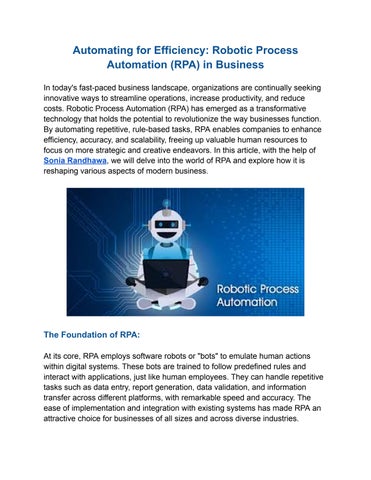
At its core, RPA employs software robots or "bots" to emulate human actions within digital systems These bots are trained to follow predefined rules and interact with applications, just like human employees. They can handle repetitive tasks such as data entry, report generation, data validation, and information transfer across different platforms, with remarkable speed and accuracy. The ease of implementation and integration with existing systems has made RPA an attractive choice for businesses of all sizes and across diverse industries.
The Foundation of RPA:Streamlining Business Processes:
One of the most significant advantages of RPA is its ability to streamline business processes

By automating mundane tasks that once required significant human effort, RPA reduces the risk of errors and ensures consistent performance. As a result, organizations can achieve higher levels of operational efficiency and productivity Additionally, RPA allows for seamless data exchange between different systems, eliminating the need for manual data input and reducing the likelihood of data discrepancies.
Scalability and Flexibility:
According to Sonia Randhawa, Unlike human employees, software robots can work 24/7 without breaks, making RPA an ideal solution for businesses operating across different time zones or dealing with large volumes of data As the demand for certain tasks fluctuates, RPA offers the flexibility to scale up or down as required, providing cost-effective solutions that align with business needs. This scalability enables companies to handle peak workloads without the need for significant human resources
Enhanced Accuracy and Compliance:
RPA's ability to consistently execute tasks with precision significantly reduces the occurrence of human errors. By eliminating manual data entry and repetitive tasks, businesses can minimize data discrepancies and enhance data accuracy Moreover, RPA can be programmed to adhere strictly to regulatory requirements and industry standards, ensuring compliance with laws and regulations in a meticulous and auditable manner
Empowering the Workforce:
Contrary to the fear that automation would lead to job losses, RPA empowers the existing workforce by freeing them from repetitive tasks Employees can focus on higher-value activities, such as strategic decision-making, customer relationship management, and innovation. This shift from menial work to more creative and meaningful tasks not only boosts employee morale but also drives overall business growth.
Conclusion:
Sonia Randhawa says, robotic Process Automation (RPA) is transforming the business landscape by optimizing efficiency, accuracy, and scalability By automating repetitive tasks, RPA empowers organizations to make the most of their human resources, fostering a more agile and innovative work environment. As RPA continues to advance and integrate with emerging technologies like artificial intelligence, businesses will find even more opportunities to automate complex processes and drive operational excellence. Embracing RPA today is a strategic move that promises significant benefits for businesses, paving the way for a more efficient and competitive future