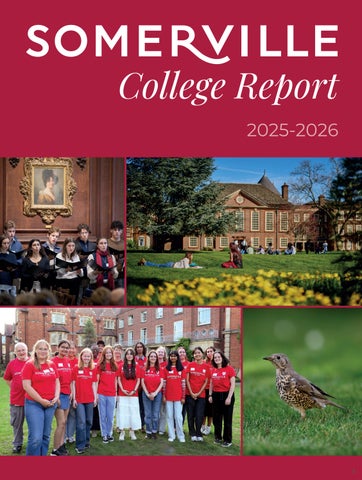
College Report 2025-2026
1
College Report 2025-2026
Contents
Visitor, Principal, Fellows, Lecturers, Staff
3
The Year in Review Principal’s Report
10
Treasurer’s Report
13
Fellows’ and Lecturers’ Activities
14
Subject News
16
Junior Research Fellows’ Activities
18
Library Report
20
A House of Prayer for All Peoples: Somerville Chapel
21
Members’ Notes Somerville Association Report
24
Alumni Reunions
26
Reading Somerville
28
Members’ News and Publications
30
Marriages and Births
37
Deaths
38
Obituaries
40
Academic Report Examination Results
64
Prizes
66
Students Entering College
70
Somerville Development Council Members and Distinguished Friends
75
Legacies
76
Editor: Em Pritchard Telephone: 01865 270632 Email: development.office@some.ox.ac.uk Cover photos by (from top left, clockwise): Oxford Atelier; Charlotte Darvill, Fisher Studios; Em Pritchard; Charlotte Darvill, Fisher Studios
Fellows Visitor, Principal, Fellows, Lecturers, Staff
(in order of seniority) Almut Maria Vera Suerbaum, MA, (Dr phil, Staatsexamen, Münster), Associate Professor of German and Tutor in German Fiona Stafford, (BA DLitt Leic), MA MPhil DPhil, FBA, FRSE, Professor of English Language and Literature, Tutor in English Literature
Visitor The Rt Hon Lord Hague of Richmond, BSc (MBA INSEAD), Chancellor of the University
Principal Catherine Royle, MA (MScEcon Wales), Principal
Vice-Principals Benjamin John Thompson, MA DPhil, (MA PhD Camb), FRHistS, Associate Professor of Medieval History and Liz Cooke Fellow in History and Tutor in History
Lois McNay, MA, (PhD Camb), Professor of the Theory of Politics, Shirley Williams Fellow in Politics and Tutor in Politics Charles Spence, MA, (PhD Camb), Professor of Experimental Psychology and Tutor in Experimental Psychology Philip West, MA, (MA MPhil PhD Camb), Associate Professor of English, Times Fellow and Tutor in English Julie Dickson, (LLB Glas) MA DPhil, Professor of Legal Philosophy and Tutor in Law Annie Sutherland, (MA Camb), MA DPhil, Professor of Medieval Literature, Rosemary Woolf Fellow and Tutor in English Daniel Anthony, MA, (PhD Lond), Professor of Experimental Neuropathology and Tutor in Medicine Michael Hayward, MA DPhil, Professor of Inorganic Chemistry and Tutor in Chemistry Beate Dignas, MA DPhil, (Staatsexamen Münster), Associate Professor of Ancient History, Barbara Craig Fellow and Tutor in Ancient History Natalia Nowakowska, MA MSt DPhil, Professor of Early Modern History and Tutor in History
Jonathan Burton, MA, (PhD Camb), Professor of Organic Chemistry and Tutor in Chemistry
Elena Seiradake, (PhD Heidelberg), Professor of Molecular Biology and Tutor in Biochemistry
Luke Pitcher, MA MSt DPhil, (PGCert Durh), Associate Professor of Classics and Tutor in Classics
Faridah Zaman, (BA MPhil PhD Camb), Associate Professor in History and Tutor in History
Simon Robert Kemp, BA, (MPhil PhD Camb), Associate Professor in French and Tutor in French Christopher Hare, BCL, (Dip. D’Etudes Jurid. Poitiers, MA Camb, LLM Harvard), Associate Professor of Law and Tutor in Law Charlotte Potts, (BA Victoria New Zealand, MA UCL), DPhil, FSA, Sybille Haynes Associate Professor of Etruscan and Italic Archaeology and Art, Katherine and Leonard Woolley Fellow in Classical Archaeology and Tutor in Classical Archaeology Karen Margrethe Nielsen, (Cand mag, Cand philol Trondheim, MA, PhD Cornell), Professor of Ancient Greek and Roman Philosophy and Tutor in Philosophy and Dean Dan Ciubotaru, (BSc MA Babeş-Bolyai, PhD Cornell), The Diana Brown Fellow and Tutor in Pure Mathematics; Professor of Mathematics Damian Tyler, (MSci PhD Nott), Professor of Physiological Metabolism Francesca Southerden, BA MSt DPhil, Professor of Italian and Tutor in Italian Louise Mycock, (BA Durh, MA PhD Manc), Associate Professor of Linguistics and Tutor in Linguistics Renaud Lambiotte, (MPhys PhD ULB Brussels), Professor of Networks and Nonlinear Systems and Tutor in Mathematics
Samantha Sebastian, (PhD Sydney), Associate Professor in Music and Tutor in Music Michelle Jackson, (BSc PhD Lond), Associate Professor of Zoology and Ernest Cook Fellow and Tutor in Biology Robin Klemm, (PhD Dresden), Associate Professor in Medicine and Tutor in Medicine Patricia Owens, (BSc Brist, MPhil Camb, DPhil Aberystwyth) FBA, Professor of International Relations and Tutor in International Relations Konstantina Vogiatzaki, (MSc NTUA), MA, (PhD Imp), Associate Professor of Engineering Science, Tutor in Engineering Science Emily Flashman, (BSc S’ton), DPhil, Associate Professor in Molecular Plant Sciences and Tutor in Biology Thaddeus Komacek, (BS BA Chicago, MS PhD Arizona), Associate Professor of Physics and Tutor in Physics Anastasia Ignatiava, (BA Dub, MSc Edin, PhD Warw), Associate Professor of Statistics and Tutor in Statistics Markos Koumaditis, (BA Ionian, MA RHUL, PhD KCL) FCIPD, Human Resources Director Francesca Arduini, BA MPhil, (PhD UCL) College-only Fellow in Economics and Tutor in Economics Dale Dorsey, (D. 13 April 2026), (BA Drake, MA Tufts, PhD California at San Diego), Associate Professor in Philosophy and Tutor in Philosophy
3
Professorial Fellows
Manuele Gragnolati, (Laurea in Lettere Classiche, Pavia), MA, (DEA Paris, PhD Columbia)
Danijela Trenkic, (BA Belgrade, MA, MPhil PhD Camb), Professor of Applied Linguistics
Stephen Roberts, MA DPhil, FIET, FREng, FRSS, MIOP, RAEng-Man Professor of Machine Learning
Sarah Gurr, MA, (BSc PhD London) ARCS, DIC, Professor of Molecular Plant Pathology
Renier van der Hoorn, (BSc MSc Leiden, PhD Wageningen)
John Ingram, (BSc KCL, MSc R’dg, PhD Wageningen)
Roman Walczak, MA, (MSc Warsaw, Dr rer nat Heidelberg)
Pelagia Goulimari, (BA MPhil Thessaloniki, MA Essex, PhD S’ton), Feminist Studies
Stephen Weatherill, (MA Camb, MSc Edin), MA
Jim Harris, (BA MA PhD Courtauld) Ashmolean
Jennifer Welsh, (BA Saskatchewan), MA DPhil, FRSC
Radhika Khosla, BA MPhys, (PhD Chicago), Conservation Biology
(in order of seniority)
Steven Simon, MA, (PhD Harvard), Professor of Theoretical and Condensed Matter Physics Iyiola Solanke, Academic Bencher, Honourable Society of the Inner Temple (BA Lond, MSc, DPhil LSE), Jacques Delors Professor of European Law Colin Phillips, BA, (PhD MIT), Professor of Linguistics
Administrative Fellows Sarah Butler, (BA Leeds, MA UCL) MCLIP, Librarian and Head of Information Services Sara Kalim, MA, Director of Development Andrew Parker, (BA Liv), MA, ACMA Treasurer Stephen Rayner, MA, (PhD Durh), FRAS, MInstP, Senior Tutor, Tutor for Graduates and Tutor for Admissions
Senior Research Fellows Amalia Coldea, (MA, PhD Cluj-Napoca) Stephanie Dalley, (MA Camb), MA, (PhD Lond), FSA Colin Alexander Espie, (BSc MAppSci PhD DSc (Med) Glas), CPsychol, FMedSci, FBPsS, FRCGP(Hon), FAASM, Professor of Behavourial Sleep Medicine Sir Marc Feldmann, AC, BSc (Med), MB BS, PhD, Hon MD, Hon DMSc, FAA, FMedSci, FRCP, FRCPath, FRS, Emeritus Professor of Cellular Immunology
4
Joanna Innes, (MA Camb), MA Muhammad Kassim Javaid, (BMedSci, MB BS PhD Lond), MRCP, Professor of Osteoporosis and Adult Rare Bone Diseases Patricia Kingori, (BA MSc RHUL, MSc UCL, PhD LSHTM), Professor of Global Health Ethics Philip Kreager, DPhil Simon Kyle, (MA PhD Glas), Professor of Experimental and Clinical Sleep Research
Senior Associates Aaron Maniam, MA, MPP, (MA Yale), DPhil
Catherine Mary MacRobert, MA DPhil
Susan Thomas, (BA Manc, MA Liv)
Nicholas McKeown, (BEng Leeds, MS PhD Berkeley)
Alexandra Vincent, MBE, (BA MSc BSc Open)
Boris Motik, (MSc Zagreb, PhD Karlsruhe), Professor of Computer Science
James Ravi Kirkpatrick, (BA R’dg, MLitt St And), MA BPhil DPhil
Frans Plank, (Statsexamen Munich, MLitt Edin, MA Regensburg, PhD Hanover)
Flavia Galvani, (BA Brasilia, MSc Reading, MSC Birkbeck Lond, DEA DPhil Universidad Complutense de Madrid)
Franklyn Prochaska, (PhD Northwestern University), FRHS (D. 15 February 2026) Tessa Rajak, MA DPhil, FSA Owen Rees, MA, (PhD Camb), ARCO, Professor of Music Rajesh Thakker, OBE, (MA MD ScD Camb), MA DM, FMedSci, FRCP, FRCPath, FRS
Justin Sirignano, (BSE Princeton, PhD Stanford), Mathematics
Caroline Lytton, MPhys
Jane Robinson, MA
Mason Porter, (BS Caltech, MS PhD Cornell), MA
Lisa Forsberg, (BA Stockholm, MA, PhD KCL), Philosophy
Matthew John Andrew Wood, Byrony Sheaves, (BSc Card), DClinPsy DPhil, Experimental (MB ChB Cape Town), MA Psychology DPhil, FMedSci
Aditi Lahiri, CBE, (BA MA PhD Calcutta, PhD Brown)
Philip Poole, (BSc PhD Murdoch), FRS
Charlotte Doesburg, (BA Groningen, MA Helsinki, PhD UCL), Music, Leverhulme Research Fellow
Research Fellows Naveed Akbar, (BSc MSc PhD Dundee), FHEA, Associate Professor of Cardiovascular Science Siddharth Arora, (BTech DAIICT), DPhil, Healthcare/ Energy Liliia Bespala, (BA MA Zaporizhzhia National, PhD Odesa Mechnykov), Linguistics/ Healthcare Communication, Marie Skłodowska-Curie Postdoctoral Fellow
Junior Research Fellows Andy Anker, (BSc MSc PhD Copenhagen), Chemistry, Fulford Junior Research Fellow Georgina Benn, (BSc KCL, PhD UCL and NPL), Biochemistry, Fulford Junior Research Fellow Joshua Booth, BA MPhil DPhil (PGCE Gloucester), Linguistics, Fulford Junior Research Fellow Kuang-Yu Chen, (DVM MS National Chung Hsing University, PhD Paris), Medicine, Fulford Junior Research Fellow Amy Chu-Antypas, (BSc MRes Bath), DPhil, Biochemistry, Fulford Junior Research Fellow Harini Desiraju, (MA Hyderabad, PhD (SISSA) Trieste), Mathematics, Fulford Junior Research Fellow Martin Fellermeyer, (BSc Bonn), MScRes DPhil, Medicine, Fulford Junior Research Fellow Lucy Garner, (BA Camb), DPhil, Medicine, Fulford Junior Research Fellow
Hilary Ockendon, MA DPhil, (Hon DSc S’ton) Josephine Peach, BSc MA DPhil Stephen Guy Pulman, (BA Lond, MA PhD Essex), MA FBA Frances Julia Stewart, MA DPhil, FAcSS Richard Stone, MA DPhil, FREng, FSAE, FIMechE Angela Vincent, (MB BS MSc Lond), MA FMedSci, FRS
Naijing Liu, (BA Central China Normal, MA PhD ANU), Linguistics, Fulford Junior Research Fellow Christiana Mavroyiakoumou, (BSc Imp), MSc, (PhD Michigan), Mathematics, Fulford Junior Research Fellow Daniel McDonald, (BA MA Massachusetts Amherst, MA PhD Brown), History, Fulford Junior Research Fellow Juan Neves-Sarriegui, (BA Buenos Aires, MA Coimbra), MSt DPhil, History, Fulford Junior Research Fellow Connor O’Pray, (MEng Bath, MRes PhD Camb), Engineering Science, Fulford Junior Research Fellow Raffaele Sarnataro, (BSc MSc Pisa, Diploma di Licenza Pisa Scuola Normale Superiore), MSc DPhil, Medicine, Fulford Junior Research Fellow Lachie Scarsbrook, (BSc MSc Otago), DPhil, Archaeology, Fulford Junior Research Fellow Helen Smith, (MChem MSc PhD Warw), Chemistry, Fulford Junior Research Fellow Mariana Sontag Gonzalez, (BSc Heidelberg), MSc, (PhD Wollongong), Archaeology and Ancient History, Fulford Junior Research Fellow
Foundation Fellows
Vicky Tan, (BBiomed PhD Melbourne), Medicine, Fulford Junior Research Fellow
Career Development Fellow
Anna Wilmore, BA PGCE MSt DPhil, German, Mary Somerville Junior Research Fellow
Fay Probert, (BSc MSc PhD Warw), Chemistry, Dorothy Hodgkin Career Development Fellow
Sarah Woodward, (BMEDSci Western Ontario, PhD British Columbia), Medicine, Fulford Junior Research Fellow
Emeritus Fellows
Ashley Younger, MScRes (BA Duke, MSN Boston College, MPH Harvard, Dip LSHTM, PhD California at San Francisco), Medicine, Fulford Junior Research Fellow
Pauline Adams, BLitt MA, (Dipl Lib Lond)
British Academy Fellow
Margaret Adams, MA DPhil
Lesley Brown, BPhil MA Marian Ellina Stamp Dawkins, CBE, MA DPhil, FRS Karin Erdmann, MA, (Dr rer nat Giessen)
Shahnaz Batmanghelidj, BA Oxf, (MA Princetown, MBA Harvard Business School) Lord Glendonbrook, CBE Radford Klotz, (BA Virginia) Sir Geoffrey Leigh Vicky Maltby, MA Melhi Mistry Natarajan Chandrasekaran (BSc Coimbatore Institute of Technology, MCA National Institute of Technology, Tiruchirappalli) Robert Ng Lord Powell of Bayswater, KCMG, OBE Gavin Ralston, MA
Ammar Azzouz, (BA AlBaath, MSc Salf, PhD Bath), Geography
Judith Heyer, MA, (PhD Lond)
Early Career Fellow
Carole Jordan, (D. 3 Feb 2026), DBE, MA, (PhD Lond), FRS
Wafic Rida Saïd
Norma MacManaway, (MA MPhil Dub), MA, DEA Paris
Susan Scollan, MA
Aradhana Cherupara Vadekkethil, (BA LLB National Law Delhi), BCL MPhil DPhil, Law, Lord and Lady McNair Early Career Fellow in Law
Julianne Mott Jack, (MA Edin), MA
Anne Manuel, (LLB R’dg, MA, MSc, PhD Brist), MA
Peggie Rimmer, DPhil Martin Ritchie
Kevin Scollan, MA
Gopal Subramanium, SA, Hon Bencher, Gray’s Inn.
Helen Morton, (MSc Boston, MA Camb), MA
5
Honorary Fellows (in order of election)
Dame Kiri Jeanette Te Kanawa, DBE, AC ONZ, Hon DMus Dame Carolyn Emma Kirkby, DBE, OBE, MA Hon DMus, (Hon DMus Bath, Hon DLitt Salf), FGSM Dame Averil Millicent Cameron, (D. 7 April 2026), DBE, MA DLitt (PhD Lond), FBA, FSA Onora O’Neill, Baroness O’Neill of Bengarve, CH, CBE, MA, (PhD Harvard), Hon DCL, FBA, Hon FRS, FMedSci Dame Kay Elizabeth Davies, DBE, CBE, MA DPhil, (Hon DSc Victoria Canada), FMedSci, FRS Margaret Jay, Baroness Jay of Paddington, PC, BA Irangani Manel Abeysekera, MA (D. 10 September 2026) Paula Pimlott Brownlee, MA DPhil Dame Julia Stretton Higgins, DBE, CBE, MA DPhil, Hon DSc, FRS, CChem, FRSC, CEng, FIM, FREng
6
Doreen Elizabeth Boyce, MA, (PhD Pittsburgh)
Catherine Royle, MA (MScEcon Wales)
Ruth Hilary Finnegan, OBE, BLitt MA DPhil, FBA
Dame Nancy Rothwell, DBE, BSc, DS, (PhD London), FMedSci, FRS
Janet Margaret Bately, CBE, MA, FBA Margaret Kenyon, MA Clara Elizabeth Mary Freeman, OBE, MA Jenny Glusker, MA DPhil Ann Rosamund Oakley, MA, (PhD Lond, Hon DLitt Salf), AcSS Lucy Neville-Rolfe, Baroness Neville-Rolfe DBE, CMG, MA Judith Ann Kathleen Howard, CBE, (BSc Brist), DPhil, FRS Victoria Glendinning, CBE, MA Nicola Ralston, BA Anna Laura Momigliano Lepschy, BLitt MA Rosalind Mary Marsden, DCMG, MA DPhil Harriet Maunsell, OBE, MA Hilary Spurling, CBE, BA
Shriti Vadera, Baroness Vadera, PC, BA Dame Elizabeth Mary Keegan, DBE, MA Carole Hillenbrand, CBE, OBE, BA, (BA Camb, PhD Edin), FBA, FRAS, FRHistS, FRSE Dame Angela McLean, DBE, MA, (MA Berkeley, PhD Lond), FRS Michele Moody-Adams, MA, (BA Wellesley College, PhD Harvard) Dame Judith Parker, DBE, KC, MA Dame Esther Rantzen, DBE, CBE, MA (D. 30 September 2026) Caroline Barron, OBE, MA, (PhD Lond), FRHistS Emma Rothschild, CMG, MA Sir Venkatraman Ramakrishnan, Kt, (BSc Baroda, PhD Ohio), Nobel Laureate, FRS
Tessa Ross, CBE, BA Joanna Haigh, CBE, MA DPhil (MSc Imp), FRS, FRMetS Akua Kuenyehia, (LLB Ghana), BCL Alison Wolf, Baroness Wolf of Dulwich, DBE, CBE, BA MPhil Lorna Margaret Hutson, MA DPhil, FBA Caroline Mary Series, CBE, BA, (PhD Harvard), FRS Sacha Romanovitch, OBE, MA Alice Prochaska, MA DPhil, FRHistS Margaret Casely-Hayford, CBE, MA Dame Elan Closs Stephens, DBE, BA June Raine, DBE, CBE, BA BM BCh MSc, MRCP Clair Wills, MA DPhil, HMRIA, FBA Farhana Yamin, BA Julia Yeomans, OBE, MA DPhil, FRS
Bolanle Awe, DPhil, (MSt St And) Afua Kyei, MChem
Susan Bilynskyj Dunning, (BA MA Seattle Pacific, PhD Toronto), Ancient History
Patricia Davies (née Owtram), BLitt
Kamel El Omari, (BSc Paris VII, MSc PhD Paris VI), Biochemistry
Sir Simon Russell Beale, CBE, (BA Camb)
Rachel Exley, (BSc Leeds, PhD Paris XI), Medicine
Kamila Hawthorne, MBE, MA, BMBCh
Helen Flatley, (BA MPhil Camb, MA American University of Paris), History
Anne Makena, DPhil MBA Emma Smith, MA DPhil
John Aaron Henry, BA BMBCH, MRCP, Medicine
Jan Royall, Baroness Royall of Blaisdon, PC, MA (BA Lond)
Matthew Hosty, BA MSt DPhil, Classics
Stipendiary Lecturers
Giovanni Italiano, (BMath MMath Pisa, Dip Corso Ordinario PhD Scuola Normale Superiore Pisa), Mathematics
Stephanie Anderson, (BSc MSc Glasgow, BSc Open), DPhil, Medicine Rasmus Bakken, MSc (MA Edin), Philosophy Grace Barnes, BA BMBCh, Medicine Alice Barron, (BA Nott, MMus RAM), DPhil, Music Jacob Bird, (BA Camb), MSt DPhil, Music Richard Brearton, MPhys DPhil, Physics Kieran Brown, (BA BA(Hons) BCom (Hons) UCT), MSt DPhil, English Esther Cavett, (BMus Lond, PhD KCL), Music David Chapman, (BA MSc PhD Camb), Engineering Science Vilma de Gasperin, (Laurea Padua), DPhil, Modern Languages Clea Desebrook, (BA Manc), MSc DPhil, Psychology Maximilian Doré, (BSc RWTH Aachen, MA LMU Munich) DPhil, Computer Science
Quentin Miller, (BMath Waterloo), DPhil, Computer Science
Kerstin Timm, (PhD Camb), Medicine John Traill, (BA MMus UEA), DPhil, Music Sophie Treacy, BCL (Bachelor of Laws Trinity College Dublin), Law Damian Tyler, (MSci PhD Nott), Medicine Timothy Walker, MA MHort, Plant Biology Silvia Zanoli, (BPhys MPhys Milan, PhD München Technische), Physics Amina Zarzi, (BA, MA Constantine), French
Retaining Fee Lecturers Susan Anthony, MBBS, MRCP, FRCR, Medicine
Ain Neuhaus, MA DPhil BMBCH, Medicine
Richard Ashdowne, MA DPhil, Linguistics
Thomas Nicol, (BBMedSc Victoria Wellington, PhD MRC Harwell), Medicine
Ana Sofia Cerdeira, (MD PhD Porto), Medicine
Isabel Parkinson, BA (MSt Sheff), German
Vilma de Gasperin, (Laurea Padua), DPhil Modern Languages
Antonio Pattori, BA MSt, History Naomi Petela, MBioChem DPhil, Biochemistry Abigail Punt, BA BMBCh, Medicine Matthew Rattley, MChem, Biochemistry Clare Rees-Zimmerman, (MA MEng PhD Camb), Engineering Science Jessica Richards, MMathCompSci, Computer Science
Oliver Harmson, (MD Tartu), DPhil Medicine Felix Pflücke, (LLB Maastricht), MPhil DPhil, Law Tommy Pitcher, MChem DPhil, Chemistry
Lecturer in Medicine Helen Ashdown, BM BCh DPhil, (MA Camb, PGDip (Health Res), DCH, MRCP, MRCGP, Janet Vaughan Tutor in Clinical Medicine
Academic Office Becky Cotton-Barratt, MESc, (PhD Warw), Assistant Senior Tutor Lucy Young, (BA Aberystwyth), Academic Registrar Richard Brennan, Academic Office Assistant Ali Davies, Academic Office Assistant Helen Johnson, Executive Assistant to Fellows and Senior Tutor Saphire Richards, Graduate and Tutorial Officer Alison Shapton, Tutorial and Graduate Admin Assistant Clare Simmonds, (BA Hons Buckinghamshire New University) Academic Office Administrator Sam Warburton, BA, BCL, Decanal Officer Victoria Wilson, Scholarships and Funding Officer
Departmental Lecturers
Access and Outreach
Dean Sheppard, MChem DPhil, Chemistry
Hannah Pack, (MA Camb, PGCE Oxford Brookes), Access and Outreach Officer
College Lecturers
Aarthee Parimelalaghan, BA, Access and Outreach Support Officer
Nisha Singh, MSc DPhil, Medicine
Hanne Eckhoff, (BA MA DPhil Oslo), Russian
Graeme Smith, MPhys DPhil, Physics
Hannie Lawlor, BA MSt DPhil, Spanish
7
Chapel
Joy Shorter, Catering & Conference Office Assistant
Philip Hinkson, College Plumber
Arzhia Habibi, (BA Nott, IMICS National Chengchi University), DPhil Chapel Scholar and Director
Arnoldas Slepetis, Senior Chef de Partie
Gardens
Dwayne Titley, Sous Chef
William Dawes, ARAM, (PGDip RAM, BMus Edin), Director of Chapel Music
Ben White, Senior Catering Assistant
Alastair Mallick, Head Gardener
Evelyn Brenkley, Chapel and Music Administrator
Conferences and Catering Dave Simpson, FBII, Catering and Conference Manager Richard Vowell, Dining Services Manager Paul Fraemohs, Head Chef Agata Biel, Food Preparation Assistant Sam Bishop, Apprentice Commis Chef Erika Bohusova, Senior Catering Assistant Joanna Carr, Commis Chef Chloe Chaplin, Terrace Supervisor Fidel do Nascimento, Kitchen Porter Haydon Harris, Senior Catering Assistant Sandy Jin, Catering Supervisor Jordan Leclaire, Sous Chef Benedito Marques, Kitchen Porter Viktor Martinek, Catering Supervisor Ann Miller, Chef de Partie Maria Oliver, Pastry Chef Declan Powell-Quince, Senior Terrace Assistant Ambika Sarkar, Conference & Events Co-Ordinator
8
Anna Hart, Gardener
Hayden Whiting, Senior Chef de Partie
Annie Owen, Assistant Gardener
Communications
Housekeeping
Matt Phipps, (BA York, MPhil Camb), Communications Manager
Teresa Walsh, Housekeeping and Accommodation Manager
Em Pritchard, (BA MA York), Communications Officer
Development and Alumni Relations Clare Finch, Deputy Development Director
Oluwaseun Alabi, Assistant Housekeeping Manager Tina Abulime, Housekeeping General Assistant Titilayo Adisa, Housekeeping General Assistant Adunni Apakala, Housekeeping General Assistant
Aleksandra Matejska, Housekeeping General Assistant Loulieta Michalari, Housekeeping General Assistant Lina Fernanda Mosquera, Housekeeping General Assistant Aneta Owczarska-Pirog, Housekeeping General Assistant Ioana Paraschiv, Senior Housekeeping Assistant (Senior Scout) Monica Porras Perez, Senior Housekeeping Assistant (Senior Scout) Songyan She, Housekeeping Supervisor Cipriano Simoes do Rego, Housekeeping General Assistant
Rebecca Coker, (BA Durh, MPhil Camb), Senior Development Executive
Patty Cicha, Housekeeping General Assistant
Lisa Gygax, MA, Secretary to the Somerville Association
Dirce Da Silva Barros, Housekeeping General Assistant
Honey Hinkson, (BSc Hons Bournemouth) Development and Alumni Events Assistant
Cecylia Gluszak, Housekeeping Supervisor
Human Resources
Marycel Herrera Munoz, Housekeeping General Assistant
Salome Hughes, PGCE, (BA Hons Staffs, MA Oxford Brookes, ACIPD), HR Manager
Alex Turchyn, Data Systems and Research Officer Jackie Watson, MA PGCE, (MA PhD Lond) Secretary to the Somerville Association
Mara-Lane Joel Marcal, Housekeeping General Assistant Anibal Jose, Housekeeping General Assistant
Olga Smith, Housekeeper to the Principal Tun Tun Soe, Housekeeping General Assistant
Sarah Talbot, Human Resources Administrator
IT
Jackie Yip, (BA Card), Regular Giving and Alumni Relations Executive
Beatrice Kasai, Housekeeping General Assistant
Chris Bamber, Systems Manager
Estates
Tayo Kilanko, Housekeeping General Assistant
Abdur Razzak, IT Systems Engineer
Steve Johnson, Estates Manager
Anzelika Kupcevic, Housekeeping General Assistant
Lee Gibbons, IT Support Technician
Chris Wells, Head of Maintenance
Malgorzata Kurysia, Housekeeping General Assistant
Sam Wetmore, AV Technician
Alex Fox, Maintenance General Assistant
Giovani Lopez Betancur, Housekeeping General Assistant
Matt Jackson, College Carpenter
Saroj Masih, Housekeeping General Assistant
Suzanna Bikar, Weekend Lodge Receptionist
Richard Moss, Lodge Receptionist
Anna Davies, Weekend Lodge Receptionist
Margarita Pavlova, Lodge Receptionist
Marvin Doondeea, Night Porter/Receptionist
Tamsyn Prior, Night Porter/ Receptionist
John Forrester, Night Porter/ Receptionist
Chris Puffett, Lodge Receptionist
Radhika Khosla, MPhys, (PhD Chicago), Research Director
Jonny Franklin, Lodge General Assistant
Carmen Rodriguez Romani, Weekend Lodge Receptionist
Siddharth Arora, DPhil, Programme Director
Joan Guiste, Weekend Lodge Receptionist
Jazzala Whitworth-Jones, Weekend Lodge Receptionist
Claire Cockcroft, MA (PhD Camb), MTST Programme Director
Neeraj Shetye, (BA SNU, MSc SOAS), Partnerships and Communications Manager
Kaltoon Hassan, Weekend Lodge Receptionist
Laura St Juste Kidd, Weekend Lodge Receptionist
Nursery
Narhitya Nawal, OICSD Administrative Officer
Lucas Hewson, Operations Assistant (weekdays)
Principal’s Office
Jennifer Inness, Lodge Receptionist
Alice Tattersall, Executive Assistant/Office Manager to the Principal
Library Susan Elizabeth Purver, MA, Assistant Librarian Matthew Roper, MA, (MA Durh), Library Assistant
Margaret Thatcher Scholarship Trust Jessica Mannix, (MA St Andrews), Campaign Director and MTST Director
Karen Hopkins, Nursery Manager
Lucy Parsons, Nursery Nurse Rebeka Power, Nursery Nurse Asma Talat, Nursery Assistant Selina Weston, Nursery Nurse
Oxford India Centre
Porters’ Lodge
Paul Chandler-Toal, Deputy Nursery Manager
Mark Ealey, Lodge Manager
Aanchal Kumar, Lodge Receptionist
Megan Baxter, Nursery Nurse
Agnieszka Rzad, Deputy Lodge Manager
Rebecca Lawry, Weekend Lodge Receptionist
Lesley Douglas, Nursery Nurse
Julian Smith, Deputy Lodge Manager
Harvey Lott, Weekend Operations Assistant
Modupe Fadero, Nursery Nurse
Manjuma Asheka, Weekend Lodge Receptionist
Aleksander Mazurkiewicz, Night Porter/Receptionist
Diane Berry, Payroll Officer
Nimota Ishola, Nursery Cleaner
Dylan Ball, Operations Assistant (weekdays)
Vito Nigro, Weekend Lodge Receptionist
Sue Pedersen, Treasury Assistant
Treasury Damian Clements, College Accountant Elaine Boorman, Assistant College Accountant
Ian Wooldridge, Treasury Officer (Fees & Battels)
Welfare Joanne Ockwell, (BA MA Gloucester), Welfare Support and Policy Officer Jenny Fitzgerald, College Nurse Chibuzor Ogamba, Student Welfare Advisor Jess Schiff, Student Welfare Advisor Jerry Song, Student Welfare Advisor
Credit: Charlotte Darvill, Fisher Studios
9
Principal’s Report
Credit: Oxford Atelier
It is a pleasure to report on another happy and successful year at Somerville, at the end of my own first year as Principal. At the start of the year, we began construction on our new capital project the Ratan Tata Building, which will provide Somerville with much-needed new teaching and learning space, and will be ready for students in 2027-28. Mr Natarajan Chandrasekaran, Chairman of Tata Sons and Tata Group, was elected as a Foundation Fellow of Somerville College in recognition of the instrumental role that he has played in enabling this transformation of the Somerville College estate. In other news, our Governing Body approved a new Early Career Fund to strengthen Somerville’s support for early career researchers navigating the critically underfunded transition from postdoctoral study to senior academic posts. College also approved the creation of the Richard Stone Scholarship in Engineering Science, with the support of Richard’s former student, Nicolas Geiger (2004, Engineering Science), which will continue Richard’s impressive legacy in novel transportation and space exploration systems. We were also proud to launch The Laura Liswood Archive of Women World Leaders to coincide with the centenary of our alumna Margaret Thatcher’s birth with a special event featuring former Canadian PM the Rt. Hon. Kim Campbell.
10
Alongside these gains, the Somerville community also marked several, deeply felt losses from the SCR. At Somerville’s annual Commemoration service in June, we remembered the historian and co-founder of our JS Mill library Dr Frank Prochaska (1941-2026), the astrophysicist Professor Dame Carole Jordan, the medieval historian Barbara Harvey CBE FBA (19282025) and our tutor in modern philosophy Professor Dale Dorsey (1976-2026).
THE LAURA LISWOOD ARCHIVE OF WOMEN WORLD LEADERS LAUNCH
Academically, our students had an outstanding year. In Biology, Molly Ross (2023) won the Gibbs Proxime Prize for her Part I, while Marcus Williamson (2022) received both the Gibbs Proxime Accessit Prize for his FHS Part II and the Keymer Prize for his dissertation, and Pippa Threlfall (2022) secured the Harley Prize for best dissertation in “Grand Green Challenges”. Sophie Liu (2023) was awarded Best Practical Portfolio in Experimental Psychology while Charlotte Gardhouse (2022) received a Congratulatory First in the same discipline, and Luca Marzin (2023) secured the Gibbs Proxime Accessit Prize for FHS Biochemistry. Somerville’s medics also excelled this year. Newly qualified doctor and Margaret Thatcher Scholar Sarafina Otis (2020) secured the prestigious LJ Witts Prize, Essa Syed (2025) the Gibbs Prize for First BM Part I, and Pippa Boering (2022) the Sir John Stallworthy Prize for Best Clinical Performance in Reproductive Health. Somerville’s exceptional pedigree in languages and the humanities continued, too, this year. Oscar Brant (2022) received the Gibbs Prize for best performance in Philosophy in the Honours School of Literae Humaniores, Corinna Watts (2022, Spanish and Linguistics) received the Fred Hodcroft Prize for Spanish, Charlie Ripley (2025, French and German) the Lidl Prize in German, and Regn Pooley (2025, Philosophy and Linguistics) the Stephen Parkinson Prize Proxime Accessit in Introduction to Linguistics. Finally, Somerville students continue to demonstrate how academic excellence can tackle global issues. Oxford Qatar Thatcher Scholar Sawsan El-Zahr became Oxford’s first recipient of the prestigious Brendan Murphy Award for her pioneering method to measure the carbon footprint of internet traffic. In the JCR, Evan Garg (2025, Engineering) and Reyna Bulchandani (2025, Maths and Computer Science) won the OVHcloud Frontier Builder Prize for their sustainable food app at Oxford Edge’s Global South Hackathon. Our Fellows, too, have given us cause for pride. Radhika Khosla, Research Director of the Oxford India Centre for Sustainable Development, and our Tutorial Fellow in Philosophy, Karen Margrethe Nielsen, were both awarded the title of full professor through the University’s Recognition of Distinction scheme. Senior Research Fellow Professor Aditi Lahiri received the Linguistic Society of Germany’s Wilhelm von Humboldt Award for Lifetime Achievements in Linguistics, while our Fellow and Tutor in International Relations, Professor Patricia Owens, was elected a Fellow of the British Academy and awarded a threeyear Leverhulme Major Research Fellowship. Professor Elena Seiradake, our Fellow and Tutor in Biochemistry, meanwhile, was elected an EMBO Member in recognition of her outstanding achievements in the life sciences. Somerville Fellows also demonstrated the power of collaboration across disciplines. Tutorial Fellow in Engineering Professor Konstantina Vogiatzaki and Professorial Fellow in Machine Learning Professor Stephen Roberts joined colleagues from Oxford’s Department of Engineering Science to develop a pioneering AI framework capable of replacing hundreds of hours of simulation with near-instant predictions of droplet size distributions. We were also were delighted to see the
OPEN DAY JULY 2026
groundbreaking research of our Junior Research Fellow Dr Lachie Scarsbrook – which pushes back the earliest evidence for dogs by more than 5,000 years – recognised with a front cover of Nature. In changes to the SCR, we said a fond farewell this year to our Treasurer and Domestic Bursar Andrew Parker. In his 14 years at Somerville, Andrew had a truly transformative impact on our finances and estate, and we wish him a happy retirement. Andrew will be replaced by Katherine Gardiner as Treasurer and Chris Gillham as Domestic Bursar. We will also welcome three new fellows to Governing Body this year. Dr Curt von Keyserlingk and Associate Professor Robert Baines will join us as tutorial fellows in Physics and Engineering, respectively. We will also have great pleasure in welcoming back our former fixedterm fellow Dr James Kirkpatrick as a tutorial fellow in Modern Philosophy, following his stint at Magdalen. Somerville has redoubled its commitment to access and outreach this year. Our Access team engaged with an extraordinary 3,683 students in person through 18 external visits and by welcoming 23 schools to College. In addition, a record 289 students attended our Virtual Year 12 Study Days – more than twice last year’s number. Our sustained partnerships with schools in link areas with lower progression to higher education are also bearing fruit: applications to Oxford from the Isle of Wight have doubled since Somerville began working there in 2020, while those from Portsmouth have increased eightfold. Across our link schools, applications rose to 470 in 2025, of whom 81 received offers – an offer rate significantly above the University average. Interest in Somerville was also high at this year’s Open Days, where our student ambassadors welcomed a phenomenal 5,315 visitors over two days in July, almost twice the previous year’s figure, helped by the opening next door of the Schwarzman Centre for the Humanities.
11
Together, all of these efforts are translating into real progress as we work to deliver on Somerville’s founding promise to include the excluded. This year, 72% of our incoming students came from state schools, compared with 66.8% across Oxford, while 7% of new students were former recipients of Free School Meals, up from 5.6% the previous year. Across our wider community, the Somerville spirit remains buoyant. Our Choir released two new albums, with choir member Christopher Churcher’s disc of original choral works ‘Moonrise’ named Essential Classics Album of the Week on BBC Radio 3. The choir also embarked on an ambitious 17-day tour of China, and will next year welcome Grammy Award-winning composer and conductor Eric Whitacre as Musician in Residence. On the river, Somerville College Boat Club enjoyed another outstanding Summer Eights, achieving 17 bumps across five crews. Our commitment to sustainability also found new expression through our social media series ‘Green Fridays’, led by MCR Environmental Representative Ashima Gulati, while two of our Sudanese Sanctuary Scholars travelled with Development Director Sara Kalim to the Royal Courts of Justice to support a landmark case against the Government’s emergency brake on student visas. Somervillians continue to blaze trails beyond College, too. Afua Kyei (2000, Chemistry), CFO of the Bank of England, topped the 2026 Powerlist, while Honorary Fellow Professor Dame Elan Closs Stephens (1966, English) became the first woman President of the Learned Society of Wales. Katie Ghose (1988, Jurisprudence) was appointed Chief Executive
THE SOMERVILLE COLLEGE CHOIR ON TOUR IN CHINA
12
SOMERVILLE AT SUMMER VIIIS
Credit Roger Close at the Oxford Clarion
of the Refugee Council, and alumnae Katerina Kaouri (1999, DPhil Mathematics) and Dawn Ohlson (1990, Engineering and Computer Science) received significant recognition in mathematics and engineering respectively. These achievements, across music, sport, public service and scholarship, are typical of the Somerville spirit we have seen all year, where academic excellence is allied to trailblazing values and a determination to make a difference in the wider world. Long may it continue. CATHERINE ROYLE Principal of Somerville
Treasurer’s Report
ANDREW PARKER, COLLEGE TREASURER
At the time of writing, early August, we are just starting to collate our results for 2025-26. Early indications are that it will be a good year, despite ongoing pressure on our payroll costs (from increased employers’ national insurance and increases to the Oxford Living Wage), and significant investment in the estate, largely because donations and legacies have been strong and commercial revenues have held up. With a following wind we may be able to strengthen our unrestricted free reserves this year. The accounts will also show the receipt of £6.5m in the period, being the second tranche of the £10m from the Tata Group towards the cost of the Ratan Tata building (see below).
Thus far, despite turbulent global markets and the retention of strong ethical restrictions on how funds are invested, targets have been comfortably exceeded at the same time as management risk has been diversified.
We are also hopeful of some good news on the endowment. Early valuations (albeit based on June valuation for OUEM) indicate that the endowment is worth around £115m, which is a total return in excess of 12% after allowing for the normal annual drawdown of just under 4% to help fund the college in the year. During the year we undertook a comprehensive review of our endowment managers, taking advantage of the considerable knowledge of three of our alumni, Nicola Ralston, Jo Greenslade and Doug Abbott. The outcome of that review was threefold;
As this is my final report as your Treasurer, I would like to thank you all for your support. Somerville’s alumni community is exceptional in the engagement, commitment and support it gives to the college. If we have had success in my time, it has been in large part down to your ongoing contribution.
• we divested from all our holdings with Newton Investment Management, who had hitherto managed about 40% of our endowment, • we retained our investment with Oxford University Endowment Management, but reduced our holding with them from 60% to c. 33%, • and we split the remaining two thirds equally between Brown Advisory and the exchange-traded fund Amundi ESG Global Low Carbon Fund.
Construction of the Ratan Tata building on the Radcliffe Observatory Quarter has now begun in earnest, with the project currently on time and on budget – due to open in time for Michaelmas 2027. The building will provide a much-needed home for the Oxford India Centre for Sustainable Development, as well as precious teaching rooms and seminar rooms for the college and a flexible events/receptions space.
And we can, I think, point to some success over the last 14 years. The endowment has grown from £40m to £115m (fuelled by the best Development Director in Oxford). We have added over 100 student bedrooms, as well as eight shops on Little Clarendon Street and Walton Street, and we now own all the freehold on the main college site. And, lest we forget, we came through Covid. Finally, I would like to wish my successor Katherine Gardiner every success. Somerville is a special place, with special people, and I’m sure its finances and infrastructure will continue to thrive under Katherine’s stewardship. ANDREW PARKER August 2026
13
Fellows’ and Lecturers’ Activities Biochemistry Elena Seiradake’s research team has made breakthrough discoveries in the life sciences now published in three leading journals: one paper in Nature Communications (Zhou et al 2026, Raoelijaona et al 2026 and BerbeiraSantatna et al 2026), one in EMBO Reports (Zhen-Gerard et al. 2026) and one in Current Biology (Sangster et al 2026). For example, in their work they have established a new platform for characterising autoantibodies from autoimmune patients together with clinical collaborators in Dublin, London, Bath and Oxford, and seen patterns emerge that link disease symptoms to autoantibody features. The team have also made progress in understanding how cells send signals between one another to form tissue structures during brain cortex development, which is a key process during embryonic development. In other news, they have welcomed Tiina Leinonen, a Montessori-trained teacher, to the team, who is leading the lab’s school science outreach activities. Tiina and the team developed an 8-lesson strong KS2 teaching programme at CoE Beckley primary school, and are in the middle of delivering this programme at Somerville’s partnered school St Frideswide in Cowley. Please get in touch with Hannah Pack for photos and teacher quotes on how well received this is. The team hope to roll this out to more schools in due course and depending on funding. Elena was happy to be elected a fellow of EMBO, a prestigious network that promotes research excellence across Europe. It is an indicator of esteem and testimony to her team’s research success. Elena was one of three Oxford researchers who received this honour this year.
Biology This year, the Flashman Group, led by Emily Flashman, published an important new finding in Nature which describes how plants deal with the stress they experience at the end of a flood: counter-intuitively the rapid return of oxygen creates oxidative stress which can be damaging to plants,
14
THE SEIRADAKE LAB’S OUTREACH ACTIVITIES
but in fact plants use this oxidative stress to rapidly direct their molecular machinery to switch on protective measures to enhance survival. They also published a paper which describes their first attempts at engineering plant oxygen-sensing enzymes to help plants improve their resilience to flooding, and received funding from BBSRC to support a project that aims to commercialise a protective biostimulant treatment for plants that can improve their flood tolerance.
Classics Luke Pitcher published an article on how the Third Century historian Herodian grappled with the idea of civil disturbance, in the context of the Roman Empire.
Economics Francesca Arduini had a paper titled “Focal Pricing Constraints and PassThrough of Input Cost Changes” published in the International Journal of Industrial Organization.
Engineering Stephen Roberts’ interests continue to lie in the theory and methodology of intelligent algorithms for largescale, real-world problems. Recent work has shed light on the dynamics of learning in large AI models and,
with Prof. Vogiatzaki (Somerville Engineering Fellow) how AI may be used to accurately predict droplet behaviour in complex fluid dynamics problems. Continuing projects also include research in AI security, understanding human values and bioacoustic monitoring for invasive species detection (funded by the UKRI). He continues as lead of the Schmidt AI in Science Programme and the Schmidt Africa & India Faculty Fellowships.
English 2025-26 has been a very busy year for Jane Austen scholars, including Fiona Stafford. Among many 250th celebrations, including a wonderful event in November at Somerville where Kathryn Sutherland dazzled the audience with a lecture on the special contribution of Somerville to Austen studies, Fiona was delighted to be invited to give a keynote lecture at the Austen Conference in Porto, which attracted scholars from all over the world. She also had the nervewracking experience of appearing on BBC News on 16 December to mark Austen’s birthday. It’s very heartening to see a great woman novelist being celebrated globally. Fiona continues to work and supervise students working on the literature of place and nature, and enjoyed compiling a collection of stories relating to walking, which is due out
from Everyman in October 2026. She has also written essays on John Keats, William and Dorothy Wordsworth, John Clare and Irish environmentalism, as well as contributing to an episode of ‘In Our Time’ on John Keats. This year Annie Sutherland has been able to take some leave to work on two longstanding book projects. She has a chapter on a twelfth-century hermit, Wulfric of Haselbury, forthcoming in a volume of collected essays, and is now at work on a keynote paper for a conference on thirteenth-century women and their prayers.
History In autumn 2025, Natalia Nowakowska gave a keynote lecture to an international workshop on ‘The Futures of the European Past’, organised in Oxford by the European consortium of leading European universities. While on college sabbatical in Trinity term 2026, she went on a research trip to Nuremberg and its environs, looking at traces of Polish-Lithuanian royal women in Renaissance Germany. She spent most of her sabbatical writing an article on global history, ‘Tatars and the Jagiellonian dynasty of Eastern Europe’. Natalia published an essay entitled ‘Decline or Rebirth? Debating the Death of Sigismund Augustus and the End of the Jagiellon House in PolandLithuania (c.1572-1600)’ in the volume Interregnum: Reassessing ‘Decline’ and ‘Rebirth’ in Late Sixteenth-Century Poland-Lithuania, edited by R. Tomczak (2026). Faridah Zaman has worked on a number of research strands this year, including the mobile lives of colonial intellectuals and the role of universities as sites of intraimperial political and religious connections. In connection with this latter work, she is part of a funding application to the German Research Foundation (DFG) that would establish a research network focused on universities across the colonial world. A preliminary meeting among collaborators was held earlier this year at Goethe University in Frankfurt to discuss the future direction of this project. Outside her research, Faridah has served as Director of the Oxford Centre for Intellectual History for a second year. In September, she begins a sabbatical term and will take up a Fernand Braudel Senior Research Fellowship at the European University Institute in Florence.
International Relations
Linguistics
Patricia Owens received four book awards for Erased: A History of International Thought Without Men (Princeton, 2025); was elected a Fellow of the British Academy and a Trustee of the British International Studies Association.
Louise Mycock had three chapters published this year, two on ProTags in historical varieties of English and one titled ‘One of the greatest Indian ornithologist: a corpus-based study of number variation in partitives in regional Indian newspaper Englishes’. A prize-winning Linguistics project she supervised has now been published in the journal World Englishes (Tan & Mycock Acceptability Judgements in Colloquial Singaporean English). Her monograph The Typology of Constituent Questions will be published by Oxford University Press in autumn 2026. As well as being invited to speak to members of the Systemic Functional Linguistics Association of Tunisia and presenting her work at a conference in Salzburg in September, Louise has been invited to teach a course in Brazil at Pontifical Catholic University of Rio Grande do Sul in spring 2027. With colleagues in Germany, she will be organising a panel on pragmatic markers (items such as ‘well’, ‘you know’, and ‘I mean’) in learner language at the International Pragmatics Conference meeting in Helsinki in summer 2027. In College, Louise ran two outreach sessions in March 2026 to introduce Linguistics to school pupils that might not otherwise know about the subject. As a mentor, this year she has been working with Dr Naijing Liu, who holds a Marie SkłodowskaCurie Postdoctoral Fellowship and Fulford Junior Research Fellowship at Somerville, and Dr Gian Franco Moretto, who holds a CAPES fellowship from the Brazilian Government and is a Visiting Researcher at Somerville.
Law Julie Dickson has worked on and had published or is about to have published the following publications: J Dickson, ‘Ronald Dworkin: Law’s Empire’ in T Brooks (ed.), Leading Works in the Philosophy of Law (Routledge 2026); J Dickson, ‘Law Unromanticized: Law in a Negative Light and Experience-Sensitive Engagement’ in A Green, J Jowitt, S Shah (eds.) Dialogues on Jurisprudence: Bridging the Analytic-Critical Divide (forthcoming, Routledge 2026); and J Dickson, ‘Authority and Methodology: can theories “come out negative”?’ 20 Problema (2026). In September, she will be giving an invited talk in Rome, Italy, on Brian Leiter’s latest book. Iyiola Solanke began her tenure as Director of the Institute for European and Comparative Law (IECL) in the Faculty of Law. She delivered talks at the CJEU (Grande Salle d’audience, Luxembourg); ESSEC, Paris; the National University of Singapore; Stockholm University Centre for Commercial Law; and Maastricht Centre for European Law as well as the UNIV Annual Beacon Lecture. Publications include ‘Decolonising/ Re-imagining EU law’, European Law Review; ‘Un-imagined and Un-deserving Groups in Antidiscrimination Law’, International Journal of Discrimination Law; ‘Decolonial Theory and Diversity in the European Commission’ in Mitchie and Cooper Why the Social Sciences Matter. Contributions to policy include the Generation Delta Policy Brief: ‘Raising Outcomes for Racially Minoritised Women on Doctoral Degrees in England and the IECL Submission to the UK Government consultation on Dynamic Alignment (with Steve Weatherill, Professor Emeritus in EU Law, Oxford University and Hafstein Kristjansson, Professor of EU Law, Reykjavik University). Finally, she established the Research Network on Decolonial Theory and De-/Coloniality at the Council for European Studies (CES).
A highlight of Colin Phillips’ exciting past year as Head of Department (“Faculty Board Chair”) in Linguistics was supporting the faculty’s move into the Schwarzman Centre for the Humanities, a facility that is made even more fabulous by being right next door to Somerville. The new building spans the full range of humanities scholarship, ranging from the psycholinguistics lab that Colin and team have been setting up on the top floor to the beautiful concert hall that sits almost directly beneath it (the sound isolation is excellent!). One of the many surprises of the first year in the new building was an opportunity to speak at the public Open House event in April that brought 12,000 visitors to the centre on a single day. This was probably the first and last time that Colin would have a snaking line of people
15
Subject News
COLIN PHILLIPS AND OTHER RUNNERVILLE RUNNERS BEFORE THE TOWN AND GOWN
RENAUD LAMBIOTTE ON A RESEARCH VISIT TO NANJING
waiting to get into a talk of his. He also got to give presentations in several locations further afield, ranging from Paris, Berlin, and Mannheim in Europe to Boston, Rochester, and Toronto in North America. In addition to academic and administrative pursuits, Colin coordinated a Thanksgiving dinner for North Americans in late November, and he worked with the college’s Comms Team on Somerville’s first team merch for the Town & Gown 10K in May. After overseeing a very busy couple of years that have seen major changes in Linguistics — new building, renewal or growth in several research areas, growth in student numbers, closer connections with more departments — Colin is happy to have passed the administrative baton to a successor, and is looking forward to immersing himself in teaching and research, enjoying the fruits of the recent efforts.
ECRs, held not with posters, but each of the ECRs taking a position under one of Somerville’s beautiful trees.
Mathematics This year has been particularly productive and eclectic for Renaud Lambiotte. His research has investigated subjects as diverse as hippocampal ripples, the polar vertex, schistosome transmission in rural Uganda and the dynamics of gentrification in cities. Applied mathematics is definitely beautiful in its universality.
The amazing Family Day was an opportunity to connect with former students and their families; it was a particular pleasure (with many thanks to the Librarian and her team!) to be able to show them one of the college’s treasures, a fifteenth century prayer book made in all likelihood for a female owner, and to discuss her research on medieval women and their spirituality and networks.
Modern Languages
Music
For Almut Suerbaum, the academic year started with a major international conference on ‘Posthuman Perspectives on Pre-Modern Culture’, the 28th Anglo German Colloquium which she hosted at Somerville College. It’s a biannual conference series inaugurated in the post-WW2 years by two colleagues from Germany and the UK to foster inter-cultural exchange and collaboration - more important than ever. The Somerville conference included a presentation session for
16
During her research leave in TT26, Almut was fortunate enough to spend three weeks as a Mercator Visiting Professor at the University of Munich, at the invitation of their Collaborative Research Cluster ‘Cultures of Vigilance’, and four weeks in July at the Collaborative Research Cluster ‘Alternative Aesthetics’ at the University of Tübingen. Both were wonderful opportunities to deepen long-standing research collaborations. It has been wonderful to see our students flourish, with a group of finalists returning from successful placements abroad, ranging from internships with German banks to work with German-Polish volunteer organisations supporting Ukraine.
Samantha Sebastian continues to work on her project ‘Voicing Global Labour Migration’. In addition to her book, Samantha is working on a policy paper (working title ‘The Right to Sing’) with Professor Jean Encinas-Franco, a political scientist from the University of the Philippines Diliman. Over the summer she presented a symposium paper in Yerevan for the International Council for Traditions of Music and Dance study group on ‘Music and Minorities’
Biochemistry The Biochemists had a very strong year, with all our students passing their exams with flying colours. Third-year student Luca Marzin won a prestigious departmental prize for his performance in his part I exams, where he came second in his cohort of over 100 students (Proxime Accessit prize). All our fourth-year students finished with a first-class result. Elena Seiradake Biology The Biology students have excelled as usual, both within and beyond their degree courses; it’s been a joy to watch them all develop academically over the year. Particular congratulations to Molly Ross and Marcus Williamson who both won Departmental prizes for their exam successes. The fourth-years spent the whole year embedded in research groups to conduct projects on topics including plant immunity, freshwater invertebrates, algal evolution, TB vaccines and foraging behaviour in fish. Notably Marcus Williamson and Pippa Threlfall were awarded Departmental prizes for their research project dissertations which were the best in the year in the fields of Infectious Diseases and Green Grand Challenges, respectively. Meanwhile the second-years enjoyed developing their research skills in ecological monitoring (at Wytham Woods, in Marston Meadows and in Somerville’s gardens!), in the lab to monitor transient gene expression in plants and in tropical forest ecology in Borneo. Many of the students have been conducting self-organised summer research and conservation placements over the vacation in a range of scientific and geographical settings, which will all be very valuable in supporting their future careers. Emily Flashman Classics This was the first year of the latest revision to the First Public Examinations (“Mods” and “Prelims”) in Classics and its associated Joint Schools. Luke Pitcher
Economics Andrew Elliot, who has taught at Somerville for several years and is a Fellow at Catz, is now a long-term Stipendiary Lecturer with us. This will contribute to continuity and excellence in Economics teaching for our PPE and HECO students. Francesca Arduini History History had an excellent year at Somerville, culminating in some brilliant examination results, with one student, Harry Stewart Dilley (2023, History), gaining the very top first in the University. Another highlight was the Alumni History Day in March, where the college celebrated the endowing of the Barbara Harvey Tutorial Fellowship. The day included research presentations by current Fellows and Lecturers, doctoral students and also undergraduate students (talking about their BA research dissertations). There was also a dinner, and the Memorial service for Barbara Harvey was held in Chapel the same weekend. In addition to our History tutors Benjamin Thompson, Natalia Nowakowska, and Faridah Zaman, History at Somerville has greatly benefited from the work of SCR historians Helen Flatley (Lecturer), Antonio Pattori (Lecturer for Natalia in Trinity 2026), Hannah Elias (Sassoon Fellow then Academic Visitor) and Daniel McDonald (Fulford JRF). Benjamin Thompson and Natalia Nowakowska
and Linguistics student was awarded a Sarah Smithson Prize for ambitious, substantial Year Abroad work. One of our current Modern Languages and Linguistics student is a Thatcher Scholar. Somerville’s Linguistics students have benefitted from the opportunity to interact with two post-doctoral researchers that I am currently mentoring and who are members of the SCR at Somerville. Dr Naijing Liu shared her perspectives on creating a writing system for Tsum, the endangered Tibeto-Burman language which is the subject of her research, and Dr Gian Franco Moretto shared his research work on academic writing. Our termly Linguistics teas and annual subject dinner continue to be well attended and are a valuable chance for our community to catch up with one another outside tutorials, lectures, and meetings. Once again, several Linguistics students were on hand at the College’s Open Days in July to spread the word about Linguistics at Somerville. They were, as ever, a wonderful advertisement for the subject and the College. Colin Phillips Music Samantha Sebastian returned to her role as the Music Faculty’s Access and Outreach officer this year. She collaborated with several colleagues and postgraduate students to deliver the first UNIQ residential in the new Humanities building. This was a bumper
year for the music programme, as 18 students from underrepresented educational and socioeconomic backgrounds encountered the wide range of activities involved in studying music. They played historical versions of their instruments, made beats in the studio, studied 19C songbooks, analysed film soundtracks, and visited Somerville Chapel for a workshop involving the harpsichord, Steinway piano, and organ! It’s been a great year for the Music School and, as ever, our Finalists have done the college proud. The end-of-year coursework showcase evidenced the richness and rigour of their individual projects, demonstrating academic maturity and well-rounded musicianship. The teaching team is delighted with their collective achievements, with four of five students attaining Firsts. The Music School is sad to farewell two key members of our teaching team. Jacob Bird, who has been with us since 2023, is taking up a post as Departmental Lecturer at the Music Faculty. Esther Cavett, Somerville’s inaugural Music Analysis Stipendiary Lecturer, has been with us since 2019. Esther has been foundational to the growth and stability of Music at Somerville, and a truly committed teacher in matters curricular and extracurricular. We wish them both the best. Samantha Sebastian
Law Our students have done really well in both their first year and their finals examinations. One of our first-year students won the prize for coming top of the year in the Law Faculty in Criminal Law. Julie Dickson Linguistics This has been an exciting and successful year for the Linguistics students at Somerville, with the first MSci Psychology and Linguistics students successfully completing their course and our finalists in Philosophy and Linguistics and Modern Languages and Linguistics graduating. One of our Spanish and Linguistics finalists received the Fred Hodcroft Prize for the best FHS performance in History of Spanish Language or Spanish dialects. Another Modern Languages
COLIN PHILLIPS IN THE SCHWARZMAN CENTRE
17
Junior Research Fellows’ Activities As always, a particularly vibrant part of the Somerville College Community is our collection of Junior Research Fellows, who are pursuing postdoctoral research in a huge range of topics.
18
Georgina Benn is a Wellcome Trust early career fellow in Biochemistry. Her research investigates organisation and biophysical properties of bacterial membranes. Georgina is looking at how and why the outer membrane of species like E. coli are kept organised and highly immobile. These are intriguing properties, since cells must be dynamic to survive. They must insert new proteins and lipids to grow, move molecules laterally to migrate, and deform the membrane to divide. She investigates these properties using atomic force microscopy, bacterial genetics and super resolution microscopy.
associated with cancers. Amy is driven by the aspiration that her scientific contributions will one day lead to the development of various drugs that ultimately save lives.
Joshua Booth is a phonologist interested in the historical development of sound structures in Germanic languages. He is also interested in how speech sounds are represented in the minds of current speakers. For example, he has recently published a psycholinguistic experiment exploring how English–German bilinguals process similar-sounding Germanic words in their second language, e.g. pepper–Pfeffer. Joshua is currently working on a book exploring rhythmic structures in mediæval German.
Martin Fellermeyer works in Ricardo Fernandes’ group in the Nuffield Department of Medicine, studying how immune cells recognise their “targets” and how to redirect them against cancer. Each immune cell carries a receptor that inspects protein fragments on other cells to tell diseased from healthy – a distinction that must be precise if the resulting therapies are to be safe. Martin combines protein engineering with largescale sequencing to map what these receptors bind, including targets they were never designed to see.
Amy Chu-Antypas is a biochemist and biophysicist at the Centre of Medicines Discovery, in the lab of Dr. Oleg Fedorov. She uses high-throughput methods to screen drug candidates for a variety of human diseases, by measuring specific thermodynamic and kinetic properties of drug binding. Amy’s research projects focus on characterising drugs involved in epigenetics and the ubiquitin system, both of which are heavily
Lucy Garner is a Senior Postdoctoral Scientist in Professor Paul Klenerman’s group within the Nuffield Department of Medicine. Lucy’s research focuses on how the human immune system responds to infections and vaccinations. She specialises in T cells and uses advanced omics tools to study the types, functions, and interactions of immune cells during disease. Lucy also works closely with the Oxford University Clinical
Harini Desiraju works in Mathematics or Mathematical Physics. She enjoys thinking about questions in mathematical physics and her research mostly focuses on integrable systems, conformal field theories, and recently, probability. She got her PhD in Geometry and Mathematical Physics from SISSA, Trieste. She has since held positions at University of Birmingham, SLMath, and SMRI, University of Sydney.
Research Unit in Vietnam to study major infectious diseases in Southeast Asia, with the long-term goal of developing new vaccines and treatments. Mariana Sontag Gonzalez works on spatially-resolved luminescence approaches to date early archaeological sites. This is achieved by determining the last time individual sand grains were exposed to sunlight. In her fellowship, Dr. Sontag González is targeting sites relevant for human evolution studies of up to 1 million years to test the limits of state-ofthe-art luminescence dating of sediment through innovative methods using feldspar minerals. Her work has focussed on samples from Spain, Kenya, Germany and Indonesia. Naijing Liu’s research interests are phonology, prosody, and anthropological linguistics. She works on endangered language documentation in the Manaslu region of Nepal and has been working as a research assistant on various anthropological and linguistics research projects in Botswana, Ethiopia, and Australia. She is currently a Marie Skłodowska-Curie Postdoctoral Fellow at the Faculty of Linguistics, Philology, and Phonetics. Her research focuses on the typology of prosody in tonal languages and examines prosodic interfaces through a fine-grained analysis of Tsum, an endangered Tibeto-Burman language spoken in Nepal. Christiana Mavroyiakoumou is a Hooke Research Fellow at the Mathematical Institute. As an applied mathematician she develops models and computational methods to gain insights into systems of industrial and biophysical relevance. Recent topics include the aerodynamics of bird flight formations, membrane flutter in unsteady flow conditions, and the interactions between vortices and free surfaces. She is also involved in outreach work for the Oxford Mathematics YouTube channel, and has recently received a chargée de recherche CNRS position in Paris. Daniel McDonald’s research and teaching centre on modern Latin American and global history with focuses on inequality, religion, the Cold War, and comparative urban history. At Oxford, he is a postdoctoral research fellow for the “Global Pontificate of Pius XII: Catholicism in a Divided World” project supported by the German Historical Institute in Rome. His book, Peripheral Citizenship: Popular Movements and the Progressive Catholic Church in Urban Brazil, was published by the University of California Press in August. Connor O’Pray is a post-doctoral research associate at the Oxford Thermofluids Insitute. They work within a team lead by Professor Paul Beard that is developing novel cooling technologies for gas turbines. Connor’s research is conducted in OTRF: a unique high-speed rotating rig that matches engine representative conditions for the high pressure turbine stage. Connor is also developing a new experimental facility for heat-exchanger research. Their broader goal is to research experimental topics in fluid dynamic that contribute to netzero technologies. Raffaele Sarnataro has recently joined the Francis Crick Institute in London as a Postdoctoral Fellow. His research investigates how the need to sleep is encoded at the cellular level and plastically reshaped through brain circuits. His most recent work has discovered that brain mitochondria encode the sleep need and how oscillations that spark sleep are generated.
Lachie Scarsbrook is a Postdoctoral Researcher at Oxford’s School of Archaeology. A biologist by training, Lachie’s research sits at the interface between the human and life sciences, employing the “celebrity science” of ancient DNA to investigate the role that humans and the environment play in shaping global animal populations. More specifically, he is focused on unravelling the causes and consequences of millennia of interaction between humans and their closest evolutionary companion, dogs. Helen Smith is a Postdoctoral Research Associate in the group of Prof. Christopher J. Schofield, FRS, jointly based in the Department of Chemistry and Ineos Oxford Institute. Her research centres on the discovery and development of novel antibiotics to combat multidrug-resistant bacterial infections. In particular, she is pioneering innovative methodologies to elucidate the interactions between advanced antibiotic candidates and their bacterial targets to enable their progression to clinical candidacy. Helen undertook outreach activities with the Chemistry Outreach Team and received a University of Oxford Public Engagement with Research award for this work. Vicky Tan is a cancer cell biologist in the laboratory of Professor Richard White at Ludwig Cancer Research. Her current research focuses on understanding how skin pigmentation may influence how skin cells communicate with one another and potentially be involved in tumour initiation. The White Laboratory have previously shown that skin cells communicate through electrical signalling and, intriguingly, melanin has electrical properties. Vicky aims to understand whether pigmentation is involved in initiating melanoma, which could ultimately inform new therapeutic strategies targeting cancer. Anna Wilmore is undertaking a project on ‘Play and Piety in Pre-Modern Women’s Religious Writing’, a comparative project which will look at the interplay between the devotional and the ludic in French, German, and Dutch material. This grew partly out of a thematic strand of her doctoral research, ‘Late Medieval Marian Lyric in Urban Spaces’ which explored poetry about the Virgin Mary in competitive contexts, through which she developed an interest in how the playful manifests itself in devotional writing and even enriches the articulation of piety. Sarah Woodward is a Postdoctoral Researcher at the Sir William Dunn School of Pathology. Her research involves studying the interaction between vaccine-induced antibodies and these sugar structures to understand how the immune system can recognize harmful pathogenic microbes and distinguish them from the ‘good’ gut-resident microbes which promote human health. Understanding this interaction is vital to inform the design of effective vaccines. Ashley Younger’s research focuses on improving maternal healthcare delivery and addressing inequalities in access and quality of care. She examines how biases in medical technologies and healthcare systems affect access to antenatal care, particularly for ethnic minority and socioeconomically disadvantaged communities. By engaging diverse stakeholders including patients, clinicians, engineers and regulators, her work seeks to redesign and implement inclusive maternal health solutions.
19
Library and Archives Report From its very beginnings, the Somerville College Library has benefited hugely from the generosity of its donors. From its earliest (Helen Taylor donating the library of John Stuart Mill, and Amelia Edwards her extensive and diverse collection of texts centred on archaeology) to those listed here, all have contributed to the amazing collection the library currently cares for. The library continues to be a major draw for new students, and we are grateful to our donors for their willingness to contribute to the collection. We may no longer be able to take every book offered to us, but we will strive to take any which support the needs of our end users, the students and academics.
The archives work closely alongside the library, and is another collection which happily receives donations in very specific subjects. As the record of the history of the college, the archives collect documentation and histories of the college. If alumni find themselves with ‘keepsakes’ from their time at Somerville which they no longer wish to hold onto, then the archives might be a natural home for these items. The archives will not necessarily be able to accept everything offered, but if the items are directly relevant to the history of Somerville, there is a high likelihood they will say ‘yes’. To offer donations, please contact the Archivist, Kate O’Donnell, on archives@some.ox.ac.uk. SARAH BUTLER, College Librarian
List of Library Donors 2025-2026 Anonymous donor
Shawnya L. Harris
Susan Reigler (Zoology, 1977)
Frances (Fran) Barker (Flint, Chemistry, 1958)
(The estate of) Barbara Harvey
Matthew Roper
Anita Howard (English and Modern Languages) and Mary Horbury (Oriental Studies) (both 1993)
Monica Seccombe (BCL, 1975)
Caroline Jarrett (Sankey, Maths, 1977)
Iyiola Solanke
Martha Barnette
D.B. Singer (PPE, 1997)
Ena Blyth (Franey, Maths, 1954) Alan Boyle
Charles Spence Kieran Brown
Susan Jordan (Taylor, English, 1969)
Malika Chandoo (Maths, 1993) Judith Collier (via Jackie Watson)
Meriel Kitson (De Laszlo, Medicine, 1968)
Richard Stone
(The estate of) Elizabeth (Liz) Cooke (Greenwood, History, 1964; alumni relations 1987-2023)
Kinga Koźmińska (DPhil Linguistics, 2012) Philip Kreager
Dominique Vaughan Williams (Modern Languages, 1976)
Corpus Christi College Library (including some from the library of Clive Burgess, 1952-2023)
Mansfield College Library
Jackie Watson
Kate (Catherine) McLoughlin (English, 1988)
Sarah Wedderburn (English, 1971)
Alistair Fair (History, 2000) Angelina Giannino (Modern Languages, 2022) Eden Greaves (Modern Languages, 2022)
20
Alexander Starritt (History and Modern Languages, 2004)
Professor Rajesh V. Thakker
Music Faculty Library
Jane Wickenden (Stemp, English, 1980)
New College Library
Wolfson College
Rosie Oliver (Maths, 1976)
A House of Prayer for All Peoples
On Curating a Multifaith Space in the Somerville Chapel Arzhia Habibi is the outgoing Chapel Director of the Somerville College Chapel, in which role she has co-curated the Choral Contemplations programme held each Sunday in College since 2023, as well as convening wellbeing and community initiatives for the Somerville community. Here she reflects on the sense of kinship she developed with the Chapel’s founder, Emily Kemp. Over the course of my three years as Chapel Scholar, I have become ever more intrigued by one person. Emily Georgiana Kemp (1860–1939) was a noted adventurer, author and artist who, having been one of Somerville’s earliest students, returned to College years later with a bold scheme: to create a chapel for the College at her own expense. The idea inevitably caused a stir in College. As many of you will know, Somerville was founded on “undenominational” lines, an anachronistic term that nonetheless captures the ambition of Somerville’s founders to create an institution that was not without religion, but which refused to prescribe which form of Christianity people professed. The decision of Somerville’s founders to be “undenominational” was made in active opposition to the group of academics and supporters of women’s education that went on to found Lady Margaret Hall. Originally all one group, the Lady Margaret Hall
contingent envisaged a hall modelled on the ‘life of a Christian family’, enforcing conformity to Anglicanism and taking a religious figure as their titular model. Somerville’s founders, who were mostly Liberals and encompassed a broad spectrum of belief, did not wish to enforce religious conformity, and so proposed as their model for an academic institution ‘the life…of an English family’, and named it for the greatest secular woman of the day, the trailblazing woman of science Mary Somerville. The pattern of religious life developed by Somerville’s founders from this starting point was quietly yet distinctly radical. Sunday prayers were held during those early years, but were not compulsory (though they were widely attended). More importantly, the prayers that were written syncretised Presbyterian and Catholic traditions so those from different backgrounds could worship together. Critically, the absence of a chapel removed the need for a male chaplain to officiate; Somerville’s prayers would be read by women, to women. Continued on page 22
21
The religious life of Somerville proceeded on this footing for the first fifty-three years of the college’s history, through the triumphs (Somerville gaining admission as a constituent college of the university, the first degrees for women) and the awful tribulations (the Great War). Then in 1932, along came Emily Georgiana Kemp with an anonymous offer to donate an undenominational religious building “for the promotion of the spiritual life, mainly by prayer and meditation, for those of all creeds and nations”. Kemp is a fascinating character who leaps fully-formed from the pages of history. She had a strong Baptist faith, yet also possessed a passionate interest in non-Christian cultures. Most importantly to her future story, she was an early member of the World Congress of Faiths, the first interfaith organization of its kind in the British Empire, which sought to gain greater understanding of what members believed was the mystical unity of the world’s religions by encouraging fellowship between religious leaders and intellectuals. Inspired by her acquaintance with the World Congress of Faith’s founder, the mystic and explorer Sir Francis Younghusband, Kemp undertook several journeys through Asia, traversing some of the highest mountain passes in the world and visiting Christian, Muslim, and Buddhist sites. These experiences shaped her broad-minded yet ardent views on religion, which are narrated in her self-illustrated travel books (Kemp 1909, 1910, 1914, 1921). The Chapel she bequeathed to Somerville is the unmistakable product of Kemp’s inclusive views on religion, as well as the College council’s concern not to deviate too far from the pattern of undenominational religious life set by Somerville’s founders. Kemp proposed a space where those of all faiths could pray and where the students, in addition to continuing their tradition of Sunday prayers, could also stage plays and concerts. Kemp also suggested the Greek epigram (taken from Isaiah 56:7) which is inscribed above the chapel entrance: “A house of prayer for all peoples”.
THE EXTERIOR OF THE CHAPEL AT THE TIME OF ITS OPENING IN 1935
The process of translating Emily Kemp’s vision for the Chapel into a reality was not without difficulty. The announcement of the donation to create the chapel by the principal, Helen Darbishire, at the 1932 gaudy precipitated a heated dispute among alumnae. This famous incident may well have inspired Dorothy L Sayers, who was present, to include not only a slightly unflattering description of the chapel in her 1935 murder mystery Gaudy Night, but also to use some of the febrile internal arguments on display in her plot. The students subsequently organised a ‘College Meeting Extraordinary’ to debate the impact of the proposed chapel, and there were frequent disagreements between Kemp and the council, to the extent that Kemp later acted independently to influence the building project. Despite the tensions, Emily Kemp’s plans were eventually realised, and in 1935, the Chapel opened. Two years later, Kemp was able to see some of her interfaith aspirations for Somerville realised when the chapel hosted a residential conference of the World Congress of Faiths held between Balliol and Somerville colleges. Kemp herself died two years later, in 1939, at the age of seventy-nine. Bringing Emily’s Vision into the Present Day In January 2023, I was appointed to the role of Chapel Director while completing my DPhil on global citizenship education (GCE) in China. I found out during my research for the interview that the founder of Somerville’s chapel, Emily Kemp, had also spent time in China. Not long after, I searched out a copy of her 1909 book The Face of China, and read these words from the opening: "Every intelligent person that I have met whose good fairy has led him to the Celestial Empire has fallen under the spell of that marvellous people and marvellous land. I am fired with the ambition to cast that spell even on those who have never been there, by showing them as accurately and vividly as I can, with pen and brush, what the face of China actually is…" (1909, P.VII)
THE PLAIN INTERIOR OF THE CHAPEL SOON AFTER ITS OPENING, SHOWING THE 'UNADORNED' COMMUNION TABLE.
22
This moment created an immediate sense of kinship in me towards Emily, because I was raised and schooled in China from an early age, and returned there in adult life driven by much the same sense of wonder, curiosity and gratitude
Meadow to participate in walking meditations, nurturing connections with the local ecology, land and beauty there. We have also hosted ASEDA’s Annual Gospel Showcase, a children’s book launch, fashion shows, collage-making, student fairs and a performance of Macbeth. Finally, for Ramadan this year, the Chapel was lovingly tended by MCR student Fatima Elhag, as she welcomed students to the daily Taraweeh prayers that follow Iftar. I took part one evening, wrapping a woolly scarf round my head and kneeling on the beautiful coat a Muslim sister lent me to pray on. For me, this was the apex of interfaith life as Emily Kemp envisioned it for Somerville, where Bahá’I and Muslims from multiple cultural contexts came together in compassion and respect, in an undenominational chapel with Christian roots.
COMMUNITY FILLING THE CHAPEL
as Emily expressed in these lines. I was also struck by the fact that I had inadvertently emulated Emily Kemp’s habit of depicting her experiences in China through art; in my own PhD, I habitually used watercolour to represent the visions of teacher and student collaborators. Another coincidence, I felt, between Emily and myself was our views on multifaith worship. I am myself a follower of the Bahá’i faith, which stresses the unity of all people as its core teaching and regards the world's major religions as fundamentally unified in their purpose – both of which views share a certain resonance with Emily’s position.
These circles of faith, care and community have overlapped joyously and tenderly during my three years at Somerville. And, like all circles, in due course they bring you back to the start. This summer, at the close of my three years as Chapel Director, I returned to China as lead translator and welfare support to the Somerville College Choir as they embarked on their biggest choir tour to date, giving 10 concerts in 7 cities, over 17 days. And though there were a few headaches with bureaucracy and permits, there was also a little magic or 缘分[yuan fen destiny] in the air as I heard the choir sing in Mandarin. I like to think that Emily would have been proud.
Back in England, at Oxford, I began to develop my ideas of how the Somerville Chapel could perform a vital role at the heart of the community. In all my thinking, Emily was a guiding presence. I began to reach out to local activists and poets, educators and community builders, musicians and academics to come and speak at our Choral Contemplations. I drew inspiration from the marvellous diversity of the Somerville College Choir’s alternative canon project, and made treasured connections with students, SCR and staff across the Somerville community. I drew on my own background as an academic and educator to frame our activities within a set of inclusive social and spiritual principles and practices, to help facilitate the development of caring and ethical citizenship actions among the student body. Gradually, I formed a vision of the Somerville Chapel as a constant wheel of activity throughout the year, one that would offer spiritual and intellectual sustenance, care and community to all members of our College, and the wider public, for those of all faiths and none. Over the past three years, we have had some great successes and made many good memories doing this work. There was our beautiful Diwali Contemplation in 2024, and our moving Pride Contemplation in 2025. There have been nights of spoken-word poetry and Odissi Dance. We have formed enduring relationships with community groups, such as the Care-Experienced Community, and provided a space for students grappling with questions of social justice within an environment of tolerance, peace and care. Our wellbeing programme has seen students, staff and SCR members not only try out meditation and yoga, but venture up to Port
DIWALI 2025 IN THE CHAPEL
This article is indebted to Anne Manuel’s “Breaking New Ground: A History of Somerville College as Seen Through Its Buildings” (2013) and “A House of Prayer for all Peoples? The Unique Case of Somerville College Chapel, Oxford” by Daniel Moulin-Stożek & Fiona K A Gatty (Material Religion, 14:1, 83-114)
23
The Somerville Association President’s Report 2025-2026 Our varied, stimulating and enjoyable events calendar is at the heart of the Somerville Association as this remains a wonderful way for Somervillians of all ages, professions and interests to stay connected not only with the College but also with each other. This has certainly been true for the past academic year, with an important distinction namely, the first year of Catherine Royle’s Principalship. Notwithstanding the multiple demands on her time, Catherine has generously participated in the events calendar and been there to meet with Somervillians at college or gatherings elsewhere, including in India and the US. Appropriately so, the year’s flagship events were a nod to Somerville’s contribution to British diplomacy, encapsulated in a lovely exchange between our outstanding Bryce lecturer, Dame Karen Pierce, former ambassador to Washington and Catherine Royle, her longstanding friend and colleague. The Somerville Association Spring meeting featured a fascinating discussion between Gill Bennett OBE (1969, History), former Chief Historian, Foreign and Commonwealth Office and Sir John Scarlett, Former Chief, UK Secret Intelligence Service on how Russia’s complex history has shaped its present psychology, resulting in critical implications for today’s world order. The day included a unique fundraising concert, with a stage for Somerville’s Sanctuary Programme scholars who shared their journeys and hopes, reminding all of the continued relevance of our college’s long-standing commitment to sanctuary. The Somerville Medics led by the newly appointed chair Professor Kamila Hawthorne (1978, Clinical Medicine) organised an excellent full day programme that examined the three shifts reshaping the NHS, namely, Hospital to Community, Analogue to Digital, and Treatment to Prevention. Given the subject and speaker line-up, not surprisingly the attendees included several non-medics, highlighting the contribution of the Association’s sector groups to the entire Somerville community, who are very welcome to attend all events irrespective of the sector. The David Bowie immersive event that was equally well attended provided a fun counterbalance to our calendar, whilst the memorable Jane Austen anniversary outing to Lyme Regis at the end of last year attracted Somervillians from across the country. On behalf of us all I sincerely thank our college for organising and hosting these stellar events that so many of us attend and
24
DR NERMEEN VARAWALLA
enjoy. Although Somerville volunteers contribute to identifying themes, inviting speakers and organising venues, it is the Alumni Engagement team, Development Office and Catering Team, notably Jackie Watson, Lisa Gygax and Sara Kalim that do the heavy lifting in organising, hosting and attending events in addition to their hectic day jobs. As no other Oxford or indeed Cambridge college has this wonderful gift of regular alumni events, we are indeed lucky at Somerville to have this. The Association and College will be progressing towards a more measured events calendar but rest assured that the flagship events will continue to go from strength to strength. I look forward to seeing very many of you at these through the year ahead. DR NERMEEN VARAWALLA (1989, Clinical Medicine)
Somerville Association Officers and Committee as of March 2026 President
Horsman Awards The Alice Horsman Fund was established in 1953. Alice Horsman (1908, Classics) was a great traveller who wished to provide opportunities for former Somerville students. The award’s purpose is (a) to provide alumni with opportunities to travel in order to broaden their experience of other countries or carry out research and (b) to support alumni in a significant career change. Applications are accepted each term. More details are on the Somerville website or from the Scholarships and Funding Officer (scholarships.funding.officer@some.ox.ac.uk).
Dr Nermeen Varawalla (1989, DPhil Clinical Medicine)
Secretary Jackie Watson (1986, English)
Committee Members Virginia Ross (MCR, 1966) Hilary Manning (1977, History) David Blagbrough (2011, PPE) Chris Broughton (2014, Mod. Langs.) Clare Latham (1985, PPE) Judy Moir (1974, Law) Jane Aspell (1995, Biological Sciences) Pavel Rahman (2018, Chemistry)
The Somerville Senior Members’ Fund This Fund is intended to facilitate attendance at College events for alumni who would otherwise be unable to attend for financial reasons, by subsidising event tickets and travel. Please do not hesitate to call upon the Fund, for yourself or a friend. We are always grateful for donations to this Fund. Applications for grants should be addressed to development.office@some.ox.ac.uk
Fellows Appointed by the College Luke Pitcher (Fellow and Tutor in Classics) Francesca Southerden (Fellow and Tutor in Italian) Fiona Stafford (Fellow and Tutor in English) Benjamin Thompson (Fellow and Tutor in Medieval History)
Ex Officio Lisa Gygax (1987) 25
Alumni Reunions Every year, Somerville’s alumni team host a range of reunions. To find out more, visit our website or email development.office@some.ox.ac.uk
1965 MATRICULATION
1965 Diamond Reunion At a very enjoyable Diamond Reunion for the 1965 year group, held on 4th-5th September 2025, the celebratory dinner was attended by two principals – Jan Royall and our own Alice Prochaska – while Alison Skilbeck’s brilliant monologue vividly evoked the presence of Dame Janet Vaughan. Earlier, Librarian Sarah Butler had introduced us to some of the College’s art works, and the following morning, we were treated to a fascinating tour of the College gardens – an amazing mass of colour produced by minimal watering. We enjoyed Somerville’s now sophisticated cuisine and the luxury of rooms in the newest building! There were plentiful opportunities to reminisce and catch up with friends, and we are immensely grateful to Jackie Watson for her thoughtful organisation of the event and her warm welcome.
At the Diamond Reunion for the 1965 group, a few of us found that we shared the experience of having carer responsibilities for our partners because of their health issues. This has an impact on our lives, and we decided it would be helpful if we met online to share how things are for us, what is difficult, what helps us and how we keep positive. We had a first meeting at the end of October, found it valuable to connect with each other, and agreed to continue the meetings once a month or so. There are just four of us in the group at present, but if others would like to explore being involved, we would welcome contact. Jackie Watson has been very supportive and would assist in linking us with potential new members Sarah Cemleyn (1965, Modern Languages)
Around a third of those who matriculated in 1965 came to the reunion – English and Zoology students being particularly well represented. We had worked in a wide range of fields, including academic research, medicine, teaching, librarianship and publishing. Most were still busy. There were at least three poets, several academics engaged in writing and publishing, climate activists, and one with a business dealing in glass paperweights. Between us, we had over forty grandchildren and there was some interesting research going on into family history. People were active in their local communities too, in areas ranging from politics to bellringing, editing the community magazine, and acting as a Chaperone Matron for child actors.
UNIVERSITY CHALLENGE - INCLUDING STUDENTS FROM 1965
Perhaps the most surprising thing was our round table conversation about imposter syndrome, which many had felt when they came up, especially those who were the first from their family or school to go to university. But that had obviously changed over time. Their presence at the reunion showed their deep and lasting affection for Somerville. Gillian Cross (1965, English)
26
1965 REUNION
1975 Golden Reunion I don’t think we could believe it when we walked into the main quad of Somerville in September 2025 to celebrate 50 years since our matriculation. The quad itself brought memories flooding back - both how much it had changed and how little. Most notable was the tree at the top of the quad and many of us remembered Harold Macmillan planting that tree during our time – a sapling then, and a fully grown tree now. It was almost symbolic of our own journey at Somerville and the many years afterwards. About 40 of us out of almost 100 in our year group were able to attend our Golden Reunion. And Somerville made us feel so very welcome for the event. The two days were extremely enjoyable and they had organised a great programme of events (including a quiz!) culminating in a superb dinner in the hall. A lot had changed in college: the old West building had been renamed Park after Daphne Park, the Somerville principal 1980-1989; the pigeon holes had disappeared; there was no longer a bar adjacent to the hall; and far more in-college accommodation had been built, including a very fine ROQ building where many of us stayed over the two days – all rooms with ensuite bathrooms! On the tour of the college, it became very clear that the college is now but a stone’s throw from both the new Centre for Humanities and the Mathematics department. The location of Somerville College is now very attractive, especially for those who struggle to get out of bed in the morning! Also, all students can now live in College for their entire course, thanks in part to the many donations from ex-students which has enabled the college to build a lot more accommodation.
1975 REUNION
A group of seven of us who had been friends throughout college and who had maintained that friendship over the years had dinner at Browns the evening before the festivities, reminiscing on its opening in 1976, during our first year in college. It was lovely to return to it, as it was also part of our ‘home’ in Oxford 50 years ago. Our reunion coincided with the first year on the job for Catherine Royle as the new Principal – and it was very encouraging to hear that she has inherited a college in a very strong financial position as well as a strong academic one. I think we all left energised by the event which coincided with an open day on the Friday for potential students. We were able to meet some of them as well as current ones and I would like to think we now play the role of living ambassadors for the college. Our collective thanks must go to Jackie Watson who organised the event with such care and precision. We are all already looking forward to our 60th reunion. Ceiri Roberts (1975, Physics)
1975 MATRICULATION
27
Reading Somerville
JACKIE WATSON, Alumni Relations Executive
One of the best things about working at Somerville is that alumni are in touch regularly about books they’ve written and I have the absolute joy of reading the work of those who have studied here. Below are short reviews of some of the books I’ve enjoyed this last year. It’s a personal selection from the wide-ranging works of fiction and non-fiction available. They’re not all recently published, but all are still available in print.
The Rapture, Liz Jensen With a BBC1 series airing this summer based on her novel, Liz Jensen has been interviewed by our Comms team, for a piece you can read on the Somerville website - so I’ll be brief here. If you’ve seen the TV adaptation of Jensen’s thriller, you may think you don’t need to read it – but (without spoilers!) you’ll find the original rather different, especially the end. With a wheelchair-using psychologist as its protagonist, the book shows her trying to work out what really happened to a young woman she is working with: a daughter who has been convicted of matricide. Exploring a family turning to a new kind of religion, in a world facing the impact of climate change, Jensen’s intelligent writing demands that her readers look afresh at this intersection of science, theology, psychology, and ecology.
Written in Blood, Fiona Forsyth The latest in Forsyth’s sparkling series of whodunnits starring the exiled Ovid as leading detective, and set in Tomis, where he was sent by Emperor Augustus, these books of Classical ‘cosy crime’ just get better. The mixture of excellent classical research (product of a degree in Lit Hum from Somerville and a teaching career as Head of Classics at Manchester Grammar School), gripping stories, and a wry sense of humour is irresistible. The third book sees us in the reign of Tiberius, and his wily fixer, Sejanus, and Ovid’s life by the Black Sea is – even at that distance – driven by politics in Rome. LMH may have Lyndsey Davies and her Falco series, but we have Forsyth, and I highly recommend more Somervillians seek them out!
28
The Lost Orchid: A Story of Victorian Plunder and Obsession, Sarah Bilston Most of us will have heard of 17th century ‘tulipomania’, where fortunes were made and lost around each bulb, but who has told us, until now, about the passion for orchids two centuries later? Bilston’s wide-ranging account of the plant’s cultural significance brings together the stories of plant collectors with those of people who propagated and sold them, revealing the destruction in colonised countries of European horticultural fashion. From the competition to find new species across the world to Darwin’s theories about plant variants, from fascinating letters and advertisements to accounts of some of the earliest women gardeners, Bilston’s research shows the impact of the orchid’s changing social cachet through the century. You’ll never be able to read a Victorian novel again without noticing how often hot-house plants play a part…
The Butcher’s Daughter, Victoria Glendinning If, like me, you tend to think of Glendinning as a biographer (and she is, of course, splendid in that genre), then you too might be less familiar with her fiction. Her 2018 novel, The Butcher’s Daughter, shows her ability to use in another medium the superb capacity for historical research upon which her biography relies. Set during the dissolution of the monasteries in a part of the country that Glendinning knows well, the book tells the life of the fictional Agnes Peppin, daughter
of a butcher in Somerset, who finds herself a novice at the powerful Shaftesbury Abbey. Cardinal Wolsey, often nicknamed The Butcher to mock the poverty of his Ipswich birth, has been thrust from power and, as the religious institutions of Catholicism are soon threatened, Agnes meets at the Abbey the mesmeric figure of his daughter, Dorothea – another butcher’s daughter. Establishing historical fact through research as she always does, but able here to embroider that much more liberally with imagined emotion and thought, Glendinning’s book revels in the freedom of fiction.
The Long Room, Francesca Kay My enjoyment of Kay’s most recent book, The Book of Days (also, coincidentally, like Glendinning’s, set in the 1540s) drove me back into her earlier novels, and I was delighted to discover The Long Room, published in 2016. Set amongst the listeners of the intelligence services as they search out IRA plots, the book’s focus is on Stephen Donaldson, whose high hopes for a thrilling life of espionage have been destroyed by the mundanity of his work. Then he falls in love with the wife of one of his subjects, and the novel swirls
us through fact and fiction, what Stephen finds out, what he imagines, and what he creates. Kay’s great skill is to transport us to a specific time and place, so that we can see, feel, and think as if we were part of it – part of the 1540s Oxfordshire village of her latest novel and, here, part of a southern England of 1981 that, in some ways, feels just as lost to us as the Reformation.
The Pupil, Ros Carne I began these reviews with a book recently televised and Ros Carne’s psychological thriller set in the world of legal pupillage is ripe for a film version. Structured around the relationship between London barrister, Mel, and a capable trainee, Natasha, with whom she would not have chosen to work, the book explores the situation’s inherent power imbalance, the rivalry between pupil and mentor, and the intellectual thrill of legal argument. As Mel’s life out of work puts pressure on her, her pupil shows her ability and expects professional reward, but what ensues instead is a series of increasingly more unexpected outcomes. Carne’s book is a compelling read!
29
Members’ News and Publications If you have a news item which you would like to appear in the next College Report, please send in your contribution before July 31st to development.office@some.ox.ac.uk
1946 Elizabeth Kirk (née Graham) writes: Always very glad to have news to read, but I am housebound, very deaf, and rely on very kind rural neighbours and other friends and family to get anywhere. Very good memories of Somerville, reading Greats immediately post World War II.
1950 Rowena MacKean (née Patterson) writes: Now living in a retirement village in Tasmania, I’m putting the findings of my PhD research (Utas 2018) into practice. After busy Third Age years starting and running groups and tutoring at U3A, I sought answers to the question: Why do older people join groups? The answers: social contacts, new friends to replace losses; enjoyable, stimulating activities; to find or add new meaning and purpose to life; to give and receive support. In a word – Wellbeing. And we prefer to join groups that we run ourselves, the way we like them. Good fun!
1953 Marjorie Harding (née Aitken) writes: I have moved to live with my daughter and son-in-law in Hoylake, Wirral – a good move, since although I loved Edinburgh and my house and friends there, I lived alone with no relatives within 200 miles. My life is now rather limited by mobility difficulties, but I succeed in many things with the help of the internet. I sold my Edinburgh house quickly and well, then bought a house in Hoylake for three of us (plus adult grandson occasionally). The house promises well, but had been unoccupied for years and needed much renovation. After delays and frustrations, we hope to be in soon.
1956 Helen Brock (née Hughes) writes: Continuing to work from the records of excavations of sites in Minoan Crete (2nd millennium B.C.), particularly Knossos, concentrating on my speciality, beads. One article with a Greek co-author
30
is going in a Festschrift for a Greek colleague. I miss travelling to Greece! Hannah Edmonds (née Oppenheimer) writes: I have moved from south London where I have lived all my life to Hampstead Garden Suburb in north London. My husband Herbert died in 2022 and I have two of my four children living in the Suburb. The other two live in Switzerland and the USA respectively. I have 11 grandchildren, ranging in age from 9 to 26. I keep busy mainly with U3A classes!
1959 Catherine Dahlström (née Sandbach) writes: I continue to be active in the University of the Third Age both as an organiser and a lecturer. I concluded a series on Virginia Woolf and the philosophy of The Waves this spring. I became a great-grandmother 18 months ago; a little girl called Aila who is a very happy little soul. I released a book about my forebears, (Unseen Presences) my upbringing and the years before I moved to Sweden. The reception has been generally positive. I continue to be in amazing, good health, and count my blessings.
1961 Vivette Glover (née Luttrell) writes: Jonathan and I just celebrated our 60th wedding anniversary (diamond). I still work a bit reviewing papers and doing joint research. We showed over 20 years ago, that if the mother was anxious or depressed during pregnancy her child was at greater risk of being anxious or depressed or having ADHD. We are now about to study the grandchild generation. We have also shown how music can reduce antenatal anxiety and depression, and are conducting trials in Africa.
1962 Christine Pounder (née Lee) writes: I was at the forefront of treating and contributing to the understanding of transfusion transmitted disease during the years 1987 to 2005 as consultant
haematologist and Professor of Haemophilia working at the Royal Free Hospital. I spent the years 2018 to 2024 providing evidence and undergoing interrogation to the UK Infected Blood Inquiry. My publication in the journal Haemophilia describes evidencebased medicine in the context of transfusion transmitted disease and recommends ‘no fault compensation’. It is an attempt to describe the contribution of many physicians including Dame Janet Vaughan.
1964 Alison Skilbeck writes: In 2025 I performed my show ‘Mrs Roosevelt Flies to London’ at Edinburgh, and I have been invited by Cunard to do it on one of their QE2 cruises in 2027, along with my show about Shakespeare’s older women, ‘The Power Behind The Crone’. (Lovely to look forward to during this rather challenging year, health-wise.) I’ve kept busy: I recently revived my first show, ‘Are There More Of You?’, notably for the King’s Lynn Festival, where I was ambitiously placed in the 800-seater Corn Exchange! At Somerville last September I performed my Janet Vaughan monologue for the 1965 Gaudy. I’ve also continued my Communications Skills work, for RADA, the LGA, and with inspiring young Somervillians.
1965 Patricia Townsend (née Marsden) writes: This has been an eventful year for me. Towards the end of 2025, I published a book Bridging Time 19442024: Letters to my father. It consists of my letters to my father, in the form of sonnets, responding to his letters to my grandparents during World War 2. I was delighted that the book was short-listed for the Selfies Memoir Prize. In October 2026 there will be a related exhibition at the Royal Engineers Museum so I am busy preparing for that.
I very much enjoyed the Somerville Diamond reunion last September. It was good to reconnect with physicists Chris Eagle and Deirdre Pope and to make contact with many other fellow Somervillians from our era. Our third grandchild, Chloë, was born in January and she is a delight. We are looking forward to seeing our children and grandchildren in August to celebrate our Golden Wedding Anniversary. So life goes on, as rewarding as ever, even if my energy is beginning to flag!
1966 Vicki Archard (née Lloyd) writes: I continue with my philatelic research and am now a Fellow of the Royal Philatelic Society of London (FRPSL) and recently gave a Zoom display of 'Insured Mail' to the East Africa Study Circle. We (with husband Rodney - Jesus 1964) are still taking amateur radio equipment up Marilyn hills (prominence of 150m) in the British Isles under the international SOTA (Summits on the Air) programme where we have both reached 4 x Mountain Goat status (4000+ points) but we know that our legs won't get us to 5000! I specialise in the 70cm band and am currently the top English activator but I am soon likely to be overtaken by a much younger and fitter activator. I continue to sort and price books for the Hereford Oxfam bookshop and have worked for Oxfam for over 20 years.
1968 Meriel Kitson (née De Laszlo) now has six grandchildren, including identical twins. Her son Robert is now a consultant oncologist in London, and her eldest granddaughter Matilda is off to Cardiff University in September.
1970 Sabina Lovibond writes: In November 2025 I gave a talk to the recently formed Oxford Iris Murdoch Society: my title was ‘What is a “Sunday metaphysician”? Iris Murdoch and the Representation of Philosophy’.
1971 Sarah Wedderburn writes: My work as a freelance writer in arts and architecture publicity came to an end around 2023. However, for many years I had been developing another career — one that I could not, previously, have afforded to give my full attention to: poetry. This year, I was thrilled when Jennifer Grigg’s Green Bottle Press published my first collection, The I of My Storm. It was recently long listed for one of the Forward Prizes, the Jerwood Prize for Best First Collection. This book has fulfilled a long-held dream, and I owe a great debt to my late mother (Marigold Freeman-Attwood, née Philips, also a Somervillian) for infecting me with her own passion for poetry almost as soon as I could speak. It was she who inspired me to pursue an English degree at her own college, and she always encouraged me to keep writing. I am very lucky in having a wonderful, sprawling family of brothers, cousins and friends. I also have two lovely children, who both have European partners (one Spanish, one Dutch). Now in their forties, each of my children long ago gravitated towards the arts. My son is a bookseller within a London gallery, and my daughter is a singer-songwriter who performs and records with bands and teaches singing to new mothers, often with postnatal depression. Their father is an artist, and my second husband is the sculptor John Davies. Today we live in East Kent, overlooking the marsh, with a succession of unruly dogs. A highlight of my life is the time I spend with my gorgeous eight-year-old granddaughter. What a privilege to have her living nearby.
1973
MERIEL KITSON WITH GRANDDAUGHTER MATILDA
Barbara Bleiman writes: In June 2025 I published a collection of poems for children called Snap!, with illustrations by my husband Adam Sharples. (We met when I was at Somerville and he was a
student at Corpus Christi.) One of the poems in the collection was chosen for the Poetry by Heart website and others feature in magazines and anthologies for children. I continue to work part-time at the English and Media Centre, a development centre for English teachers, am a fellow of the English Association and campaign vigorously for the subject and its wellbeing. Last summer, I was delighted to be invited by Jackie Watson to talk to Somerville teacher alumni about the value of oracy in school learning. This year we welcomed a third grandchild, a little girl called Lula. Janey Fisher (née Anstey) sadly lost her husband Martin (Balliol, 1972) to cancer in May 2026. They had been married for nearly 49 years! Celia Stuart-Lee (née Hogarth) writes: Keeping very busy in retirement. Was recently elected Mayor of Gerrards Cross. I grew up in what was a rural village and returned after 40 years to find that it had become a town. My focus at the moment is to get the town cleaned up as it is looking rather neglected. I am enjoying being invited to community events and also to our local schools.
1974 Olwyn Hocking writes: Climate campaigning devours even more time; after 30 years of it, astonished that we’re still emitting so much greenhouse gas that we’re dooming the next generation to food/water/ social/financial insecurity and – even worse – triggering irreversible tipping points. Recent heatwaves, wildfires, torrential floods (such as Valencia) are the BEST conditions today’s toddlers will experience, unless we change rapidly. It’s a lovely relief to have a break to proofread/edit (non-fiction authors) and learn how to sprint – great camaraderie and boosts those endorphins and cannabinoids! (I didn’t know either apparently, similar to cannabis “high”!)
1976 Gaynor Fryers (née Smith) writes: Since retiring from AstraZeneca, I have discovered that I am not ready for full retirement. I continue to coach and support start-ups, particularly in the biotech and pharmaceutical sectors at the Cambridge Judge Business School. This keeps me engaged and gives
31
me the satisfaction of helping young entrepreneurs turn ideas into businesses.
provides and I hope that this will continue to be true for years to come.
Family is also a large part of my life. My three children are all married and, luckily, live close by. I now have four grandchildren, including two born in the last year.
For myself I have always counted myself blessed to be a part of my patients’ healthcare journeys. It has been my pleasure and my privilege to be a GP in Bromley for the last 33 years. During that time I have enjoyed supporting patients “from the cradle to the grave” - just as Nye Bevin intended when he founded the NHS 78 years ago. (When I first started at Forge Close I had patients who knew me when I was in nursery school, the Girl Guides, Girl Crusaders and even one lady who had been a fairly formidable School Secretary at my old school!) I enjoyed being part of my patients lives, seeing children growing up, young people becoming parents, parents becoming grandparents, and senior citizens aging. Latterly working, in the Care Homes, I met again with frail elderly patients some of whom I had known since they were the age that I am now; our relationship has lasted over half my lifetime.
I also paint and was recently accepted into the Cambridge Drawing Society. Between coaching, family and painting, life remains busy and fulfilling. I am very happy—and certainly not ready to slow down! Teresa Gwilt (née Teighe) writes: I’ve finally turned my back on the arcane world of legal management and regulatory compliance to apply what’s left of my mind to ghost-writing and editing alongside my partner Ian. In our cosy little home office, the only interruptions are our cats Ronnie and Reggie having a separation anxiety moment. The commute takes 15 seconds, my messy hair is easily clipped out of sight, and there’s no need for diplomatic niceties when Ian and I disagree. I can also confirm that two age-related genes have switched on – gardening and trawling antique fairs. Glorious fun. Crazy Cat Lady (1976).
1977 Cindy Gallop has launched a sex education expansion of her business MakeLoveNotPorn - MakeLoveNotPorn. Academy. She has partnered with MP Samantha Niblett on a campaign to integrate lifelong sex education into Britain systemically and culturally – ‘Yes Sex Please We’re British’ in the run up to the debate Samantha will hold in Parliament in late 2026 on the importance of lifelong sex ed. The campaign has received the support of Emma Thompson and the sponsorship of John Lewis - Cindy and Samantha are delighted to have the Best of British rallying around them! Susan Reigler writes: I am the cocreator and content director of a brand new whiskey certification course that participants can complete entirely online. It just launched recently and is called American Whiskey Scholar and consists of 10 modules across three learning tracks – sensory, food pairings, and cocktails; science and production; history and economics. It’s intended for anyone wishing to gain true expertise - serious enthusiasts, bartenders, hospitality professionals, and spirits retailers.
32
SUSAN REIGLER
1980 Jane Wickenden (née Stemp) has been retired since December 2021, but doesn’t seem to be able to leave her 20year stint as Historic Collections Librarian at the Institute of Naval Medicine in Gosport behind: “Not only am I trying to write a novel set in the Royal Navy of 1845, but I have applied for, been offered, and accepted a place to read for an M.Res. (Master’s by Research) at the University of Portsmouth (Humanities and Social Sciences department, specific subject ‘The Royal Naval Medical Service in the First World War’). I will be living in a student block on the edge of Southsea Common, and shall be delighted to catch up with any Somervillians in the area between September 2026 and June 2027. The hope is to come out of the course with the makings of a book, which when published will enable a one-year distance-learning PhD by publication. Wish me luck! Sarah Young (née Gbedemah) writes: I have just fully retired from NHS general practice. I retired as a GP Principal and Senior Partner at Forge Close Surgery, Hayes, Kent in April 2021. At that time I was already working as a GP Clinical Lead and GP Vaccinator for the Bromley GP Alliance’s Covid Vaccine Service and have continued to work for this service from January 2021 until November 2025, as an independent contractor, working initially in their mass vaccination clinics and latterly as Lead GP providing a Covid and Flu vaccine service to Care Home residents in Bromley. At 78 this year, the NHS has been around all of my lifetime and so it stuns me to think that I have worked for the service for 40 of those 78 years. So much has changed during that time and yet so much remains the same. The doctor-patient relationship remains a key component of the service the NHS
Meanwhile I have been married to David for 42 years and along the way I managed to bring up three delightful individuals. Sam born 1989, Alice born 1990 and Grace born 1997. Now I look forward for spending more time walking in the Shrophire Hills with David and training my working gundogs, Flatcoated Retrievers. For the last four years I have been channelling my organisational skills in the role of Hon Working Test Secretary of the Flatcoated Retriever Society, UK and have been heavily involved in setting up and running a national training programme for the Society, the Working Flatcoated Retriever Development Programme. I remain in touch with various friends from college, mainly via social media, and regularly meet up with my ex tutorial partner Judith Sumnall (Aldred) and her husband Andy.
1982 Bridget Micklem (née Scopes) writes: I graduated this summer with a first class degree in carving – BA (Hons) Carving: Architectural Stone – from City & Guilds of London Art School. Going to art school fulfilled a long-held ambition, and I'm delighted to have learned a whole host of traditional skills, which I put to good use in carving my final year Renaissancestyle portrait bust. My husband and I will move next year, when he retires, to
a place where I can set up a permanent carving studio: I’m looking forward to many years of carving! Madhura Swaminathan writes: In 2026, I retired from the Indian Statistical Institute after a 35-year academic career in India. I continue to engage in field-based rural research, through the Foundation for Agrarian Studies, a nonprofit based in Bengaluru. I also serve as Vice Chair of the FAO’s High Level Panel of Experts on Food Security and Nutrition, an opportunity to engage and intervene in critical global debates on food security.
1983 Andrea Turner (née Sharman) writes: I've happily started a new phase of my life, sharing retirement with my husband Steve. Time is full, enjoying U3A Cambridge, travel and the Picturehouse cinema. Helen Williams (née Parnell) writes: I have just moved to Cornwall having been appointed Archdeacon Designate of Bodmin and will be collated as archdeacon in October.
1984 Professor Farah Bhatti OBE has been appointed as President of the British Medical Association in June 2026. Collette Lux writes: Over the past year, I stepped back from full-time work to embrace a portfolio career. My new Non-Executive roles include Chair of Governors at Walthamstow Hall, Advisor for the Pinsker Centre, and Associate Consultant for SMRS. Moving to a portfolio model has also freed up time for travel with my husband, my daughters, and our Labrador! Fatma Zohra Nouri writes: I have been promoted to Professor Emeritus in applied mathematics since 11th March 2025. My son Aymen who is an Associate Professor in pharmacy got married on 2nd January 2026. I have published more than 100 papers since 1988. I have been the first female dean of a faculty (Faculty of Sciences at Badji Mokhtar University-Annaba-Algeria 2000-2003). I have published 3 papers in 2025 and 2 in 2026. I have supervised more than 50 MSc students and 25 PhDs since 1994. Michelle Veater (née Tsujino) writes: I am currently still living between England and Spain. My teaching ‘career’ has
been in decline since 2011 and I am still hopeful about redirecting skills and energy to related areas: language tuition, writing, editing ‘go between’. My eldest and youngest sons are now married and settled in London and Darlington. The recently engaged middle son is still in Tokyo, and my daughter’s family is in Woking.
1985 Caroline Morrell writes: My major, and surprising, news is that I’m in an Oxford punk band called The Hormones. There are nine of us and our age range is from 52 to 80. I’m one of the backing singers and I shake a maraca and shout a bit. We started off in a small way performing at FloFest in 2023, but we’ve subsequently performed at a lot of local music venues and in July this year we had our biggest gig yet, Electric Heart, on the same bill but lower down, as Happy Mondays and Supergrass. We have two singles out and a documentary about us is being shown at the Ultimate Picture Palace in November. Life is surprising!
1986 Henriette Meissner writes: To mark the end of my career in the German pension funds industry and to show the high regard in which I was held throughout the legal and actuarial community of experts, I was honored to receive a Festschrift. I served for many years as a board member of the Arbeitsgemeinschaft für betriebliche Altersversorgung, the German association for occupational pensions and was widely published especially on legal aspects of the industry.
1987 Denise Wang (née Bush) writes: I was living and working and raising a family in China for almost twenty years (1998-2017). More recently I have reconnected with my Oxford days – partly because for the last three years my daughter was studying in Headington at the same time that I was part-time at Ripon College, Cuddesdon, studying theology and preparing for full time ministry with the Church of England. I recently was ordained (28th June 2026) by the Bishop of Gloucester Rachel Treweek, and am now serving as a curate in the Rivervale Churches ie the Benefice of Quinton, Welford, Weston, and Marston Sicca, living in Meon Vale (near Stratford-upon-Avon). So my new
ROSE GEORGE – EVERY LAST FISH
title is Reverend Mrs Denise Wang! Two of my four children (Ben and Josiah) are now married, the younger two (Kezia and Lydia) have just finished degree/ A levels.
1988 Rose George writes: My book Every Last Fish was published in 2025 by Granta Books (UK) and WW Norton (USA). It has now been shortlisted for the Royal Society Trivedi prize 2026, and it has also been longlisted for the Wainwright Conservation Prize 2026. Caragh Little (née Devlin) writes: I retired from a long and satisfying teaching career in August 2025, having been Head of English and Senior Teacher at Loreto College Coleraine. The first year of retirement has been spent coming to terms with life without teaching, but with chronic pain. I keep very busy: daily walks, weekly Pilates, lots of reading, occasional theatre trips, stumbling piano playing, and some informal, continuing study. I’ve been working on my photography, and enjoy seeing my photos of the N. Irish North Coast included in BBC Weather Watchers.
1989 Since retirement in 2016, aged 73, Angela Vincent has received three international prizes and, last year, the First Myasthenia Gravis Foundation of America Lifetime Award. In June this year she published, with 39 international
33
co-authors, a description of the unexpected global distribution of a rare form of myasthenia that she discovered in 2001.
1990 Following her appointment as Professor of Feminism, Law and History at the Open University, Caroline Derry will give her inaugural lecture in 2027. Her edited collections Legal History in the Curriculum: Comparative perspectives, critical approaches and future directions and Celebrating Women in Legal History: Making and Shaping a Discipline were published this year; her monograph Legal Temporalities of Sexual Consent (Edinburgh University Press) is newly available in paperback. Samantha Knights writes: I am leading on a botanical garden project at a state comprehensive in Lyme Regis, Dorset where I live and my children are at school! One of the school’s alums is Hugo Bugg who came recently to do a talk about his work as part of an awareness raiser for the project. We have been given a Wildlife Friendly Award by Dorset Wildlife Trust, and the Garden Museum in London is going to feature us to in a forthcoming newsletter.
1995 Jane Aspell was interviewed by BBC World Service, BBC Radio 4, The Times and Irish National Radio about her new research on links between self, body and memory.
1998 Anastasia Byard (née Berriman) writes: 2025/26 has been an unforgettable year! This year I was appointed to the Department for Education’s Support Staff Reference Group, providing a voice for non-teaching staff in education policy-making. I also had the huge
ANASTASIA BYARD AND HUSBAND
34
STILL FROM IN THE WOMB - ANIMAL STORIES, PRODUCED BY PETER COLLINS
STILL FROM GERONTO, PRODUCED BY CHRISTOPHER SHERWOOD
honour of being invited to the Royal Garden Party at Buckingham Palace back in May - a once in a lifetime experience of being hosted by the King and Queen in recognition of my services to education. The cakes were amazing, as was seeing the King and Queen up close! The year has ended with me being appointed as CFO-designate of the Blessed Chiara Badano Catholic Education Trust – a new 43-school Multi-Academy Trust which will be one of the largest in the UK when fully formed. I will be starting my new role in September.
Liberty on In Our Time back in January. I’m now Professor of Political Theory at the University of Nottingham, having been promoted to Professor in September 2025.
2001 Peter Collins writes: I’m now an executive producer and head of factual at Emmy award winning production company Pioneer Productions in London. We make a variety of premium documentaries about science, history, arts, wildlife. I currently have a series on Disney + called ‘In the Womb - Animal Babies’ which tells the stories of four animals mums-to-be in the Wild and their babies’ development in the womb – my zoology background came in useful! And last year I produced a documentary about Elton John which is currently on YouTube and has had 27million views. It’s called Elton John – Touched by Gold.
2003 A short film written and produced by Christopher Sherwood, GERONTO, starring Jason Watkins and Noah Valentine, had its World Premiere at the Rhodes Island Film Festival in America where it won the Grand Prize - Alternative Spirit Award (LGBTQ+). It also had its European Premiere at the Edinburgh International Film Festival in August and will be screening in October at the BFI London Film Festival. It now qualifies for Oscar, BAFTA and BIFA consideration. Huw Thomas writes: Following the elections in May 2026, I was elected to the Welsh Parliament (Senedd) as a Welsh Labour member for Caerdydd Penarth (Cardiff). For the previous 9 years I’d been Leader of Cardiff Council (representing the Splott ward in the city since as a Councillor 2012). I *think* I'm the first Somervillian to be elected to the Assembly/Senedd, which is quite nice!
2004
Erlick Pereira writes: I was promoted to Professor of Neurosurgery, City St George’s, University of London.
Leanne Reynolds writes: I am now working next door to Somerville, at the Nuffield Department of Primary Care!
2002
2005
Helen McCabe writes: My main update is that this year a new edition of On Liberty was published (by Hackett) which puts Harriet Taylor’s name on the front cover as co-author with John Stuart Mill. I was part of the team that co-edited this new volume, which is connected to my MPhil and DPhil at Somerville (2005-2010) but I thought might also be of interest given the Mill Library at Somerville. I also talked about On
Helen Vaterlaws (née Whiteside) writes: I've just been awarded a Churchill Fellowship. Here’s a short summary of the project: What do you do when the app says go, but the dog says no? That question sits behind my 2026 Churchill Fellowship. People with a disability are too often forced to choose between their assistance dog and new technology, when the real benefit comes from using both. I’ll be learning from organisations
Mangaldas, one of India’s best law firms in August 2026. I served as an Assistant Professor of Legal Practice at Jindal Global Law School, O.P. Jindal Global University in India for 3 years after completing my BCL in 2023 (matriculation in 2022).
2023
Jemima Storey writes: In June 2025, I graduated from a master’s in International Energy Transitions from Sciences Po, Paris. In August 2025, I started a position as an analyst at the International Energy Agency in Paris, where I’ve contributed to several reports including the (quite famous in the energy world) World Energy Outlook. I have also led the IEA’s Southeast Asia Energy Outlook, published in June 2026. If there are any alumni in Paris who’d like to connect, or undergrads interested in careers in energy and climate, please do get in touch.
Amanda Banda writes: This summer, I introduced and hosted Cara Williams, a second-year Somervillian, with a local youth-led community organisation in Malawi working on global health, providing a genuine taste of international development in practice. Claire Cockcroft connected us through the Skills Hub, which has in many ways been my anchor to Somerville as a visiting student to Oxford every 6-8 weeks. Blending into college life socially was never straightforward, and the Hub's virtual offerings kept me connected when most events were in person. Through the Skills Hub I joined a panel of alumni working in international development, advising Cara and other students. I was also introduced to newer cohorts of Somervillians on my own Masters (MSc Global Healthcare Leadership), whom I might otherwise never have met. I hope to continue connecting curious students with handson projects across Malawi and wider Africa region.
2022
2025
Meghmala Mukherjee writes: I am rejoining corporate legal practice as a Senior Associate at Shardul Amarchand
Nicolas Ossandon Cerda writes: I got training contract at Clifford Chance, which I’ll begin on September 7th.
PUPPY SOCIALISATION WITH HELEN VATERLAWS
SAM PONTHIER'S AWAY WITH WORDS © RESHOOT PRODUCTIONS
in the USA, Australia and Japan, then cocreating a framework with assistance dog partnerships here in the UK. Ultimately this isn’t just about dogs. It’s about how trusted relationships and new technology can work best together, a question facing many organisations right now.
true love. It’s called Away with Words and it’s being distributed by Journeyman Pictures.
2010 Daniel Yon was made Professor of Cognitive Neuroscience at Birkbeck, University of London.
2018 Bianca Maus (née Kuckertz) writes: There are several exciting new developments in my career. From January 2027, I will be joining the University of Marburg, working in the field of dental sleep medicine alongside my clinical and research activities. I am currently completing my PhD and expect to publish two papers next year, with further studies underway in collaboration with both Marburg University and Charité Berlin.
2020
All of this builds on the MSc in Sleep Medicine at Oxford, which truly transformed the direction of my professional life. Since graduating, I have specialised in dental sleep medicine, become a co-owner of two sleep laboratories in northern Germany, and developed sleep retreats for leading healthcare resorts, bringing sleep more prominently into the field of longevity medicine.
2019 Sam Pothier writes: I’m writing with a publication update: a feature film I made (my first) is now available to stream on Amazon Prime Video. It’s a silent comedy-drama that incorporates footage from 32 silent-era films and six public domain Betty Boop shorts into a newly filmed story involving films-within-films, a mad scientist, crippling poverty, and Credit Charlotte Darvill Fisher Studios
35
Publications by Somervillians
A non-exhaustive list of recent publications by Somerville alumni Dena Attar (1973) Gendered and Cultural Paradoxes in Trans-themed Children’s Literature (2026)
Richard III’ in An Alternative History of Shakespearean Acting: Contexts, Practices and Cultural Authority, 2026.
Christine Pounder (1962) ‘The UK Infected Blood Inquiry: A Personal Reflection’, Haemophilia, 2025.
Nina Bawden (1943) The Odd Flamingo (2025 reissue, first published 1954)
Susan Jordan (1969) The Box (2026)
Ella Roads (2010) Robota (2026)
Tamar Kasriel (1989) Could: The Smart Thinking Handbook for When Nothing is Certain (2025)
Margaret Clunies Ross (1963) Skaldic Poetry as Christian Propaganda (2026)
Margaret Kennedy (1915) Lucy Carmichael (1951, new edition 2025)
Daniel Singer (1997) Singularity and Loneliness by D. B. Singer (2026)
Sabina Lovibond (1970) ‘Critical Naturalism and the Crisis of Nature’, in Critical Horizons: A Journal of Philosophy and Social Theory (2026)
Helen Stevenson (1981) translated Dealing with the Dead (2025) by Alain Mabanckou
Barbara Bleiman (1973) Snap! (2025) Catherine Dahlström (1959) Visible and Invisible Presences (2025) Marian Dawkins (1963) Who is Conscious? A Guide to the Minds of Animals (2026) Caroline Derry (1990) edited the collections Legal History in the Curriculum: Comparative perspectives, critical approaches and future directions (2025) and Celebrating Women in Legal History: Making and Shaping a Discipline (2026) Alistair Fair (2000) Building Modern Scotland: A Social and Architectural History of the New Towns, 1947– 1997 (2025)
Kathryn Sutherland (1972) Jane Austen in 41 Objects (2025) Patricia Townsend (1965) Bridging Time 1944-2024: Letters to my Father (2025) Xand van Tulleken (1996) Make Me Well (2026)
Helen McCabe (2002) edited new edition of On Liberty, John Stuart Mill and Harriet Taylor (2026)
Ruth Finnegan (1952) The Strange Tools of Human Communication: The Voice, the Pen, and the Lyre (2025)
Angela Vincent et al. (1989) ‘Relative frequencies of muscle specific kinase antibody myasthenia in 46 centres worldwide’. Brain. (2026)
Kate McLoughlin (1988) Silence: a Literary History (2026)
Sarah Wedderburn (1971) The I of My Storm (2026)
Fiona Forsyth (1984) Written in Blood (2026)
Mariko (Dorothy) McCarthy (1971) The Mystery of the Empty Pram (2026)
Jane Wickenden (1980 Wawrzynczak EJ, Wickenden JVS. ‘Hospital ships of the Royal Navy in World War One: from prewar planning to the aftermath of Jutland’. International Journal of Maritime History (Nov 2025). Also stories published as Jane Stemp in Myths in Isolation, Ed. Katherine Soutar-Caddick (2026)
Julia Gasper (1979) The Life and Novels of Isabella St. John: The Regency Revisited (2025) Rose George (1988) Every Last Fish (2025) Kat Gordon (2004) The Swell (2025) Frances Hardinge (1992) Traitor’s Nest (2026) Daisy Johnson (2012) Long Wave (2026) Essaka Joshua (1988) Disability and the Gothic: The Nineteenth Century (2026) and ‘Disability and the Great Tragedian: Kemble, Kean and
36
Catherine Mary MacRobert (1970) ‘Continuity in the Cyrillo-Methodian translational tradition’, КирилоМетодиевски студии, xxxv (2025), 243-258, and ‘Aims, Methods and Problems of Editing Church Slavonic Biblical Texts with Special Reference to the Psalter’, Studi slavistici, xxii, Special Issue (2025), 95-109.
Meghmala Mukherjee (2022) Dr. Nemika Jha, Meghmala Mukherjee, and Parth Maniktala, ‘The Return of Crown Preference – Perspectives from India and the UK’, International Insolvency Review, 34(2), 390–405. Rosie Oliver (1976) A Truth Beyond Sense (2026) Susan Owens (1990) Constable’s Year (2026) Alison Peden (1971) ‘To share a great God’s pain’: Bertrand Brasnett (1893–1988) and the consolation of sorrow.’ Theology in Scotland 32.2 (2025), 75-85.
Kate Williams Regina: A New History of Women and Power (2026) Laura Wilson (1982) writing as Jamie Costello. The Mystery of Hinxford Court (2026) Andrew Wood (2017) Noble Nine: The Story and Science of the World’s Favourite Wines (2026)
Marriages
Births
GOULTY
LORD-HILLIER
THOMAS
Carne – Goodwin
Goulty
On 12 September 2025 Ros Carne (1968, English) to Alan Goodwin (Balliol). Ros’ first granddaughter, Leyla Rosalind Joy Zankawan Wood, was born on 28 December 2025.
To Michelle Goulty (2005) and Ed Fuller, a son, Rory, born April 2026. A brother to Theo.
Lord – Hillier On 5 December 2025, Calypso Lord (2015, PPE) to Adam Hillier (2015, Maths and Computer Science).
Sankey To Dave Sankey (2007) and wife Alex, a baby girl, Harriet Rose Sankey, born 13 October 2025.
Thomas To Amanda Thomas (2016) and Stephen Thatcher, a daughter, Josephine Thatcher-Thomas, born 20 September 2025.
37
Deaths Fellows and College Lecturers Cameron Averil Cameron née Sutton (1958) on 7 April 2026, aged 86. Literae Humaniores. Honorary Fellow.
Dorsey Dale Dorsey on 13 April 2026, aged 50. Fellow in Modern Philosophy.
Jordan Carole Jordan on 3 February 2026, aged 84. Fellow in Physics.
Prochaska Franklyn Kimmel (Frank) Prochaska on 15 February 2026, aged 85. Senior Research Fellow.
Alumni Agrell Chitra Kamini Agrell née Wickremsinghe (1964) on 8 February 2026, aged 85. Anthropology.
Alexander Gina May Vere Alexander née Pirani (1953) on 9 January 2026, aged 91. History.
Bennett Helen Rachel Bennett (1967) on 18 March 2026, aged 76. PPP.
Catlin Susan Mary Catlin, Sr Mary Simon (1960) on 31 May 2025, aged 88. English.
Chancellor Aylwin Patricia (Patricia) Chancellor née Humphrys (1949) on 17 October 2025, aged 95. Botany.
Close Nicola Rose Close (1970) in July 2026, aged 75. Mathematics.
38
Cookson
Griffiths
Elizabeth Ann (Pippa) Cookson née Hobday (1954) on 28 October 2024, aged 87. Chemistry.
Rachel Isabel Griffiths née Cullen (1967) on 24 December 2025, aged 72. English, and MSc in Applied Social Science.
Currie
Handford
Rothes Ann Elizabeth (Ann) Currie née Mansfield-Robinson (1953) on 31 May 2026, aged 90. History.
Diana Marjorie Handford (1961) on 4 November 2025, aged 83. History.
Heaman Cordeaux Wilde Shirley Cordeaux Wilde née Legge (1952) on 19 March 2026, aged 92. Modern Languages.
Courtney Rowena Courtney née Walton (1950) on 21 January 2026, aged 92. Mathematics.
Dobson Heather Ann Dobson née Williams (1963) on 26 June 2025, aged 80. Modern Languages.
Donnelly Jill Donnelly née Challener (1967) on 9 February 2025, aged 76. Physiological Sciences.
Drewett Pamela June (Pam) Drewett née Evans (1947) on 28 September 2025, aged 96. English.
Duckett Rosemary De Neufville Duckett née Matthews (1954) on 6 October 2025, aged 88. Zoology.
Fletcher Louis Fletcher (2009) on 19 December 2025, aged 35. English.
Gascoigne Laura Agnes Gascoigne née Warner (1969) on 18 October 2025, aged 75. Literae Humaniores.
Isabel Margaret Heaman née Garner (1952) on 27 April 2026, aged 91. Modern Languages.
Hindson Helen Felicity (Felicity) Hindson née Lambert (1953) on 13 March 2026, aged 91. History.
Howarth Jane Mary Howarth (1966) on 18 February 2026. DPhil Philosophy.
Hucker Nerys Hucker (1990) on 18 February 2026. Physics.
Malvern Sandra Malvern née Strachan (1969) on 9 January 2026, aged 75. Physics.
Maslen Elizabeth Jessie Maslen née Thomas (1957) on 29 September 2025. Dip. Comparative Philology.
McMillan Minnie McMillan (1960) on 28 January 2026, aged 84. Chemistry.
McMurray Joyce Isabel Agnes (Joy) McMurray née Little (1950), aged 94. Physiological Sciences.
Moon Okpyo Moon (1975) on 27 November 2025, aged 75. DPhil Social and Cultural Anthropology.
Morris
Price
Toynbee
Judith May Morris née Sharp (1965) on 23 September 2025, aged 78. Mathematics.
Priscilla Leslie (Cilla) Price née Pantin (1964) on 4 October 2025, aged 80. Physiological Sciences.
Jean Constance Toynbee née Asquith (1940) on 14 January 2026, aged 105. Physiological Sciences.
Noone Pamela Ahilya Noone née Nehaul (1959) on 2 January 2026, aged 85. PPP.
Pearce Eleanor Jane Pearce née Hartwell (1973) on 4 December 2025, aged 71. Mathematics.
Peters Helen Ruth Katherine Peters (1972) on 8 January 2026, aged 83. DPhil English.
Porter Margaret Mackay Porter née Wallace (1951) on 4 January 2026, aged 92. English.
Segerman Alison Djilda Macleod Segerman née Glass (1962) on 4 June 2026, aged 82. Physics.
Snape Katherine Elizabeth Snape née Faulkener (1970) in July 2025, aged 76. MLitt Turkish Studies, BLitt Oriental Studies
Sullivan Margaret (Rita) Sullivan née Rivera (1951) on 22 November 2025, aged 93. History.
Tillotson Sarah Tillotson (1957) on 17 November 2025, aged 86. Biochemistry, Dip. Public and Social Administration
Williamson Daphne Williamson née Gloag (1952) on 27 March 2024, aged 91. Literae Humaniores.
Winter Jill Prudence Winter (1964) on 4 July 2026, aged 80. Chemistry.
Winteringham Tresca Winteringham née Davis (1953) on 21 February 2025, aged 90. Physiological Sciences.
Zeiner Fiona Margaret Zeiner née Milligan (1990) on 25 December 2025, aged 53. Chemistry.
39
Obituaries FELLOWS AND HONORARY FELLOWS Averil Cameron, née Sutton (Literae Humaniores, 1958): Honorary Fellow (1993-2026)
Dale Dorsey: Fellow in Modern Philosophy (2025-2026)
We were deeply saddened at the news of the death of our Honorary Fellow and alumna, Professor Dame Averil Cameron, on 7 April 2026.
Somerville College was honoured to welcome Dale as Tutorial Fellow in Modern Philosophy in September 2025, and he rapidly became known throughout college as an outstanding colleague, tutor and friend. His sudden death on 13 April 2026 was all the more shocking as he had just begun the next chapter in a deeply impressive career.
Averil was a highly distinguished historian of late antiquity and Byzantium. She grew up in North Staffordshire and came to Somerville in 1958 to study AVERIL CAMERON Literae Humaniores. Here, she enjoyed seminal encounters with the Professor of Latin, Eduard Fraenkel. She then completed a PhD at Glasgow University, before teaching classical languages and literature as an assistant lecturer at King’s College, London, where she would go on to teach for almost 30 years. Averil was Warden of Keble College from 1994-2010, the first woman to hold this role. Previously she had been Professor of Late Antique and Byzantine History at King’s College London, and the first Director of its Centre for Hellenic Studies. She held a Leverhulme Emeritus Fellowship in the Oxford Faculty of Theology between 2011-2013, and was Chair of the Oxford Centre for Byzantine Research until 2020. Her expansive research interests included, among others, the Roman empire, historiography, the roles of women in antiquity, the history of Christianity, early Islam and the dialogue form in Byzantium. In 2021, Averil published an article in The Catholic Historical Review entitled ‘The Accidental Scholar’, in which she reflects upon the formative moments and defining achievements of a long and illustrious career. In this article, she emerges as the epitome of a Somervillian academic, fiercely intelligent, perennially curious and unfailingly gracious in acknowledging the value and influence of other scholars.
40
DALE DORSEY
Dale came to us from the University of Kansas, where he rose to become both Chair and Dean’s Professor of Philosophy. He had been based at the University of Kansas from 2009, having previously taught at the Universities of Alberta and California, San Diego, where he also gained his PhD in 2007. At the University of Oxford’s Faculty of Philosophy, Dale held the post of Professor of Moral Philosophy. His research focused mainly upon ethics, with a particular interest in the normative authority of morality to inform our lives and the history of ethics, especially the British Moralists from Hutcheson to Mill. Dale was a prolific and highly regarded academic throughout his career. He published three full-length works, authored over 70 articles and monographs, and was in global demand as a lecturer. The titles alone of some of these works testify to the extraordinary breadth, wit and acuity of his thought, varying as they do from ‘The Hedonist’s Dilemma’ to ‘What’s Happiness Got to Do With It?’
On her decision to apply to Somerville, Averil wrote, ‘No one from my family or my school had gone to Oxford, but [a] teacher took me to a summer school in Greek led by John Pinsent of Liverpool University, and he told me I must go to Oxford and to Somerville College, so that is what I did. For all I knew about either, they might as well have been on the moon.’
Outside his academic work, Dale was a devoted husband and father and a keen amateur musician, who was often to be found digging through boxes of old LPs in local record shops. His next major work was entitled ‘On Fellowship’, and will be published posthumously. It is a fitting title for so excellent a colleague, typifying the warmth and kindness of one who, despite being here with us for too short a time, shall be deeply missed.
Dame Averil was elected an Honorary Fellow of Somerville in 1993, and was appointed a DBE in the 2006 New Year’s Honours.
Dale is survived by his wife Erin, their two children and a devoted extended family. Our thoughts are with them all, and especially his immediate loved ones, at this time.
Credit Fisher Studios
Carole Jordan: Fellow in Physics (1976 to 2008); Fellow Emerita Carole was an internationally renowned authority on the coronae of the Sun and cool stars, and a trailblazer for women in her subject. She was one of the first female professors of Astronomy at the University of Oxford and head of its Rudolf Peierls Centre for Theoretical Physics from 2003 to 2008. Made a DBE in 2006 for her services to physics and astronomy, she was the CAROLE JORDAN first woman to be President of the Royal Astronomical Society, from 1994 to 1996, and only the third to win the RAS Gold Medal, in 2005. Her fellow Physics tutor at Somerville, Roman Walczak, remembers how strongly Carole wished to encourage women’s science research. ‘If you ask me what was Carole’s highest priority’, he remembers, ‘I would say: promotion of women. After she retired, whenever we met, she was always asking me the same question: How many of our female students continue to a PhD? And her comment to my answer was always the same: try harder’. Educated at Harrow County Grammar School for Girls, Carole was an undergraduate at University College London, where she moved on to PhD study under the supervision of Australian astronomer, C. W. Allen. After time at the University of Colorado, Boulder, she worked at Culham, initially with the UK Atomic Energy Authority. In 1976 Carole became tutorial fellow in natural sciences at Somerville, remaining at Oxford until her retirement, serving as reader in physics (1994-96) and professor (1996-2008). Carole Jordan’s career centred on the use of x-ray and UV spectra as plasma diagnostics. She was a pioneer of the
calculations required to determine the relative number densities of elements in different stages of ionization. Her observations of ultraviolet spectra with Skylab, a NASA space station that orbited the Earth from 1973 to 1979, helped to develop understanding of helium-like ions — also known as two-electron atoms. As her career progressed, she became heavily involved with observations of stellar spectra, especially ones obtained from space platforms such as the International Ultraviolet Explorer (IUE) and the Hubble Space Telescope. Throughout her career Carole worked on the interpretation of solar spectra. In both solar and stellar areas, she was the first to identify the atomic or molecular origins of many emission lines, including molecular fluorescence in cool giants that has revealed the inhomogeneous structure of their chromospheres. Students and colleagues at Somerville valued Carole’s total commitment to science, her honesty, hard work and a forthright, no-nonsense approach to people and problems. She was tutor to generations of Somerville undergraduates and worked with graduate students across the Department. Current Lecturer in Physics at Somerville, Graeme Smith, whose DPhil was supervised by Carole comments that she was ‘completely dedicated to her work, and fiercely intelligent’. Many of her students recognise that fierce demand for their best work, yet she could be unexpectedly empathic and supportive in times of need. Meeting her years later at a College subject reunion, some of her early Somerville students remember, showed her to be very warm in valuing those who did not go on to pursue Physics. Throughout her career Carole was active in the research community, and was an editor of Monthly Notices of the Royal Astronomical Society, Solar Physics, and The Observatory. A Fellow of the Royal Society since 1990, she was also a council member for both the Science and Engineering Research Council and the Particle Physics and Astronomy Research Council, and under SERC, Chair of the Solar System Committee. She served twice on the Council of the Institute of Physics and was its first Vice-President, Science.
41
Frank Prochaska: Senior Research Fellow Franklyn Kimmel Prochaska was born on 15 February 1941 and died on his 85th birthday, 15 February 2026. We had been married for nearly fifty-five years, during which time we lived and worked in academic positions mostly in Britain but also in America, and he taught parttime and published prolifically on British and sometimes also FRANK PROCHASKA American history. Frank grew up in Cleveland Ohio, descended on his father’s side from Bohemian emigrants and on his mother’s from a Scots-Irish hillbilly family who had migrated north from Kentucky during the Depression. His father’s death when he was eleven led to other misfortunes, and at the age of seventeen he joined the US Air Force in search of escape and an education. Most of his first degree was earned at night school while posted to Japan in the preventive medicine part of the USAF. (Preventive medicine in the USAF in that time and place often involved VD control, and he became known to friends in later life for some unprintable anecdotes.) He earned credits from the University of Maryland which provided higher education to the US forces overseas, completed his fouryear stint of service back in the United States, and went on to graduate school. His work for a PhD in British history at Northwestern University eventually brought him to Britain. Frank and I met at the end of 1969. He was working on an eighteenth-century Unitarian divine, and I was doing my DPhil on the early movement for parliamentary reform. Ours was one of quite a few love affairs that developed in that temple of learning, the old round reading room of the British Library (then still the British Museum). He completed his PhD dissertation in short order and looked around for a new subject. I handed over some research notes on a charitable institution which had turned out not to be connected to my own chosen subject. From that source Frank uncovered a rich seam that had not been explored in depth before: the importance of women in developing the charitable traditions that grew to be such an important part of British life. Frank’s first book, Women and Philanthropy in NineteenthCentury Britain, published by Oxford University Press in 1979, was path-breaking and remains an important part of the historical literature. It is a monument to his underlying respect for values and beliefs that he himself did not necessarily espouse. A lifelong atheist, he nevertheless wrote with real empathy about the Christian ladies who made up so much of the subject matter of that first book. He remained fascinated by people’s religious motivations, as he was also moved by some of the music that religion inspired. Together, we always enjoyed hearing the beautiful voices of Somerville College choir in the college’s proudly ecumenical chapel.
42
Over three decades, many articles and some twelve more books followed, each one developing themes that arose from the evidence as Frank uncovered it, and most of them perversely unfashionable. His commissioned history of the King’s Fund, Philanthropy and the Hospitals of London, led him towards the philanthropic work of the royal family, and the way the monarchy embedded itself in the nation’s civil society through its many hundreds of charitable patronages and other activities, even while its political power and prestige declined. ‘The rise of a welfare monarchy’, he termed it. That in turn developed into an interest in comparing the British and American constitutions, including in his book The Eagle and the Crown. He concluded his writing career with an experimental work inventing the autobiography of the 19th-century constitutional expert Walter Bagehot. Frank’s fundamental belief in the importance of Britain’s amazing charitable community may be summed up in a few sentences from his short book The Voluntary Impulse: ‘…finding an effective balance … in the provision of welfare is likely to be as elusive in the future as it has been in the past. In the search for it, we must not lose sight of philanthropy’s other meanings … For in the diversity and principled rivalry, the love of the ad hoc remedy and the seemingly inefficient muddle that typify voluntary activity, the nation has gained immeasurable democratic benefits.’ Frank and I shared a career that took us to jobs on both sides of the Atlantic. One brief role that he delighted in was as a visiting fellow at All Souls College in the 1990s. When I became head of the University Library at Yale in 2001, he taught in the Directed Studies programme for selected students. When we returned to Britain for my post as Principal of Somerville, in 2010, one of his contributions was to reanimate the John Stuart Mill Library, making it properly known as a scholarly resource for the study of that great liberal thinker (who had figured in Frank’s book Eminent Victorians on the American Constitution). He is still remembered also for his regular perch in a favourite arm chair in the Senior Common Room, often joined there by friends. He loved his time at the college and was touched to be named a Senior Research Fellow. One American friend describes Frank’s acerbic but affectionate personality as ‘a marvellous mixture of vinegar (just a bit) and sweetness (sometimes hidden).’ He had, says another, an ‘endearing combination of brilliance, incisiveness, piercing wit, intellectual honesty, and … underlying warmth.’ Others write about his helpful mentoring and generous sharing of ideas. One friend has said, ‘Because Frank disdained institutional ambition, he had a quiet wisdom about what mattered and what was not worth bothering about.’ One who cannot write is the homeless man Tony, suffering from serious mental illness and a background of minor crime, who lived for many months in our garage in New Haven Connecticut. Frank helped him claim social security dues and get settled in proper accommodation, before we left Yale. Always true to his values of integrity and honesty, and possessed of a sometimes-biting wit, Frank was also capable of great, unobtrusive kindness. Alice Prochaska, Somerville Principal 2010-2017
ALUMNI Jean Toynbee, née Asquith (Physiological Sciences, 1940)
lesson in her life, she succeeded in her Oxford degree as well as meeting her future husband, Lawrence Toynbee, at a Town Hall dance. She completed her medical training at the John Radcliffe hospital in Oxford and became a GP in Cowley, while Lawrence was an Art Master at St. Edward’s School.
At her death in January 2026, Jean Toynbee was 105 and her long life had seen an extraordinary number of changes. The second daughter of Brigadier-General Arthur Asquith and Betty Manners, and grand-daughter of former Prime Minister, H. H. Asquith, Jean was born on 6 November 1920, and her young life was full of the advantages of being born into a JEAN TOYNBEE wealthy world. She loved horses and became a passionate rider. Reputedly inspired by Jean’s passion for horses, her mother’s friend, author Enid Bagnold, wrote the famous novel, National Velvet, later turned into a Hollywood film with Elizabeth Taylor. Travelling for family holidays to Clovelly, in Devon, involved taking the horses there on the train too.
In 1955, with six daughters, Jean moved with Lawrence to the Yorkshire countryside and was a doctor there for many decades, supporting established GPs in the villages of around Terrington and acting as medical officer at Ampleforth College, where Lawrence worked. She was a great ‘joiner-in’ and, working into her 70s, became a much-loved part of the community, shown by the full church at her funeral.
Like many young women born into wealthy families in the inter-war years, Jean did not attend school. There were governesses at home, but going to Oxford was not the obvious route. She was expected to be a debutante but her ambition was instead to follow the path of her father, who had studied at New College before World War One. On his deathbed, he had drawn a promise from Betty to let Jean too go to Oxford, and a scholar from Somerville, Phoebe Poole, was hired to tutor her. After volunteering as a VAD nurse in London in 1940, Jean came up to Somerville to read History, but found herself, after a conversation with Dorothy Hodgkin, studying instead to be a doctor. Never having had a science
Three of her daughters were to follow her to Somerville, and one of her grand-daughters.
Josephine Millar, née Hamilton (Modern Languages, 1945) Born into a family of public service in Edinburgh in 1927, Josie was evacuated in the war to the Lake District before, at its end, coming to read French at Somerville. She later remembered vividly the contrast between the young men just up from school and those returning from the war. After her degree, Josie took a shorthand course and went, as a secretary, to the World Council of Churches in Geneva. She loved living abroad, using her languages and meeting people. Skiing at the weekends became a passion and she was still skiing at 74. A family connection took Josie to the YWCA in India and she crossed the country by 3rd class rail in 1952 and 1953. Back in Edinburgh, she took a law degree. After moving to London in 1962, Josie worked at the Citizens Advice Bureau, a job she
43
loved for the variety of people she was trying to help. She met David Millar, a fellow Edinburgh exile in London; they got married in 1965 and had two children. In 1973, the family moved to Luxembourg. Josie volunteered with a service providing advice and support to other new arrivals. After 16 years there, they retired to Peebles in the Scottish Borders. JOSEPHINE MILLAR As well as sailing on the West Coast of Scotland, Josie travelled, including to Romania and Iran, volunteered with the Chest, Heart and Stroke and Music in Peebles, and gardened. She maintained regular contact with several of her close friends from Somerville throughout their lives, saddened to lose them gradually in later life. By then a widow, her final long-haul trip to China and Japan at the age of 90 allowed her to see the Great Wall and the Terracotta Army, two things on her international bucket list. She passed away shortly after her celebrating her 98th birthday with her sons, daughters-in-law and five grandchildren. Written by Josie’s sons from their tribute at her funeral
Pam Drewett, née Evans (English, 1947) At Pam’s funeral, her son Richard told how she had prepared things for them, with practical guidance about managing her affairs, a list of people to inform of her departure, and a draft Order of Service. ‘I have outlived most of my generation’, she wrote, ‘so would not expect a big attendance at the church. However, except in PAM DREWETT school holidays or on Saturdays, parking can be a problem, so best to go for a time between 11.00 and 1:30’. The church at her funeral was, of course, full. A former vicar’s wife, she showed no fear of dying and her faith underpinned her approach to life and death. Born in 1929, Pam grew up above the family shop. Leaving school in 1947 with the School Certificate, Higher School Certificate, University Entrance and a Major Scholarship, she read English at Somerville and was member of the Christian Union, rowing in a Somerville 4. She was awarded The Coombs Prize for English and The Shaw-Lefevre Exhibition in 1949, and in Oxford too she met her great friend Dorothy Collin and her future husband Mervyn. After College, she joined The Home Office to become a probation officer and completed a two-year Certificate in Social Studies in one year at Nottingham. With a Fulbright Travel
44
Award and the Smith and Mundt Scholarship, she took parts of Masters’ Courses as a graduate student at The New York School of Social Work at Columbia University. Returning to the UK to look after her terminally ill mother, Pam then moved to Bristol and married Mervyn. Supporting his ministry soon became a full-time job, alongside their three children, and their house welcomed family members and lodgers. Amongst other responsibilities, Pam continued her work with The Mothers’ Union, started two more preschool playgroups and as Chair of The Bristol Pre-School Playgroups Association co-ordinated the work of 112 groups, administering LEA grants and courses. In 1971 she took a two-day-a-week job which she relished as a Psychiatric Social Worker with Her Majesty’s Prison Service. A decade later, she finished her work with the Prison Service and began a new job with Wiltshire Social Services, which lasted until she and Mervyn retired in 1994. When her father’s and Mervyn’s health deteriorated, she looked after them until their deaths, and then continued living independently amongst family and friends for 15 years.
Patricia Chancellor, née Humphrys (Botany, 1949) Named for the title character of a book written by her greatgreat-great-uncle, Theodor Watts-Duncan, Aylwin Patricia Humphrys was for most of her life known by her middle name. The younger of two daughters, she grew up in rural Essex, on a fruit farm. Her mother, Mabel, from a family of entrepreneurs and horse breeders, managed the household wonderfully at a time of great PATRICIA CHANCELLOR austerity and was a gifted pianist. A solitary but idyllic childhood clearly inspired Patricia’s deep and enduring love of the countryside, though, on a flight path between London and mainland Europe during the War, the family sheltered from air raids. Thriving at school in Chelmsford, she applied to Somerville. Her interview was non-traditional, she recalled, in a typically selfdeprecating manner: ‘I arrived in the dark on a very cold January evening. It was about 7pm and after I’d sat down, the admissions tutor began: “Well, your entrance papers weren’t up to much I’m afraid, is there anything ELSE you can do?” When I said I played the piano and organ her tone changed completely. “My dear, we haven't had an organist at Somerville for years – come along and I’ll show you the chapel”. Fortunately, I must have been able to impress her sufficiently to be awarded a place, and I also received a £10 annual bursary for playing in the chapel services twice a week!’ Initially, reading Chemistry, following an apparently alarming incident involving volatile chemicals in the laboratory fume
cupboard, it was suggested she might be more suited to a Botany Degree. She duly transferred, and met there her future husband, Richard Chancellor. In 1953, Patricia obtained a job in the Unit of Experimental Agronomy, in the Department of Agriculture of Oxford University, set up after the war to record the effects of regulator herbicides in order to boost the production of crops, due to ongoing food shortages. Researching world publications on the subject and preparing weekly reports, she also produced and published papers on the subject in her own name. Three years later, Patricia and Richard were married, followed by the birth of four daughters and establishing a family home in Stonesfield in rural Oxfordshire. As the children were growing up, Patricia helped with voluntary work in the village and trained as a Citizens Advice advisor. She really enjoyed this work and her kindness to others was well received. In 1996 they relocated to Norfolk to be closer to their children who were now all living in Norwich, with growing families of their own. Despite health issues, Patricia enjoyed spending time with her grandchildren, who remember her ‘kindness, her intelligence, her amusing storytelling and her delicious shortbread and shepherd’s pie’.
Elspeth Orrom, née Oliver (Mathematics, 1949) Elspeth was born on the outskirts of Dundee in 1931. She and her sister were educated at home until war broke out, when Elspeth went to St Leonard’s School in St. Andrews. She excelled at mathematics and gained her solace from birdwatching. In 1949 she came up to Somerville to study Mathematics and whilst there she met Martin, studying forestry at Worcester. They ELSPETH ORROM married in 1952 and started their family with Jane, followed soon by Caroline and Jamie. An excellent cook, well ahead of her time, Elspeth enjoyed entertaining. She taught and was always busy but always had time for her family, and was definitely a hands-on mum, teaching her family essential life skills and encouraging their autonomy. Martin’s job took them to Watford, where Elspeth managed the accounts in an architect’s office, then to Selborne in Hampshire. There Elspeth turned a stone outhouse into a small studio to develop her artistic talents, with space to offer an exhibition area for other local artists. Here she first turned her hand to weaving, using a loom that her father had designed and made. She also spent a lot of time developing the garden, connecting her with nature. Devoted to Martin, Elspeth followed him wherever his career took him. In Bath, she had the opportunity to further develop her weaving skills under the mentoring of renowned artist
Kirston Glasbrook from the Bath Academy of Art, who became a close friend. Elspeth had an affinity for wool and weaving, a good eye for detail and an appreciation of colour and texture, and her first exhibition was by invitation from the Somerset Guild of Craftsmen in Frome in 1985. From this point her work was included in twenty-nine exhibitions across the country and in Europe over the next 25 years, and her work was commissioned from buyers in the United States. Following Martin’s retirement, they returned to South Lakeland and Elspeth continued her passion for weaving, working tapestries on a loom that Martin made for her that were inspired by the colours and elements of nature and of animals. Elspeth’s mobility declined due to arthritis and three hip replacements, but with the assistance of Martin, she still managed to put much into her life, and get a lot out of it. There is no doubt that Martin will miss Elspeth’s presence, and in particular, the intellectual companionship they shared for 73 years.
Joy McMurray, née Little (Physiological Sciences, 1950) Joy Little was born in London in 1932 to Scottish parents. Seeing herself first and foremost as Scottish, then British, and eventually as South African, Joy was fiercely proud of her roots. She came up to Somerville in 1950 to read Physiology, qualifying in 1956 for a BM BCh degree. While at Oxford, she met Roy JOY McMURRAY McMurray, a South African postgraduate scholar working for a DPhil in Experimental Physics. They married in 1957 and moved to Pretoria, where Roy was employed by the Council for Scientific & Industrial Research while Joy completed her internship at a teaching hospital in Louis Trichardt. Their first child, William, soon arrived quickly followed by Margaret, Cathy, Helen and Richard. Joy ceased working professionally for an eight-year period and dedicated herself to raising her family. In 1960, Joy was granted South African citizenship. She applied for this to vote against the establishment of the Republic of South Africa and the entrenchment of the Apartheid regime. Never particularly ‘political’, Joy strongly objected to Apartheid. When Roy took up a post to establish the Southern Universities Nuclear Institute near Cape Town, they purchased a ramshackle farmhouse in Somerset West which became their lovingly restored home for the rest of their respective lives. Joy resumed work and served as the resident doctor in her local Family Planning clinic for some years. Subsequently joining a group of cytologists in Cape Town, under the tutelage of Drs. Fry, Linder & Bull, she became highly proficient in the discipline and greatly enjoyed her years with this dynamic group of professional women.
45
In 1982, Joy & Roy acquired property in a nearby seaside hamlet called Bettys Bay and built a holiday home. She always greatly loved being there, in the heart of the Cape floral kingdom. Joy’s other interests included playing tennis, at which she was much better than Roy, and literature, of which she was an avid reader and lifelong Book Club stalwart. She also loved music, gardens and conversation. Roy passed away in 1998 and Joy spent her remaining years largely in the company of her South African children and grandchildren, with Helen and Richard having emigrated to Australia. Margaret and her family lived with Joy for her elderly years and gently and lovingly cared for her. Joy’s true talent lay in her capacity to love and to instil the ability to love in others. She was and remains greatly loved and is sorely missed. William McMurray, Joy’s son
Margaret Mackay Porter, née Wallace (English, 1951)
MARGARET PORTER
Margaret, who died in January, came up in 1951 to read English. She chose the language- based course, saying that she could explore the literature for herself. A Scottish father and Yorkshire mother made for a lively mix. She was an excellent mimic, particularly of the distinctive voice of our Principal, Dr. (later Dame) Janet Vaughan, and enthused many of us with the love of Scottish dancing. Margaret lived from her marriage in 1962 in the same house in Ealing, where she happily raised two daughters and entertained neighbouring cats. She enjoyed the garden as well as musical events on offer locally. She was endlessly creative, always making something – if not clothes (even her wedding dress) then birds or other creatures from any materials that came to hand. Many years as a successful teacher employed her gifts to the full; beyond the everyday, she wrote and directed plays for her pupils to perform. Also, with her husband John, she volunteered at the Kew Steam Museum where she helped with visitors and planted a garden. She was also a great support for elderly aunts and her older sister Betty, who developed Alzheimer’s cruelly early. John died in 2021; Margaret is survived by her daughters Jane and Alison. Helen Bond (English, 1951)
46
Rita Sullivan, née Rivera (History, 1951) Margaret (or Rita, as she was known), was the eldest of four daughters of immigrant parents. Her mother arrived in Manchester aged 16 during the Great War from rural Ireland and her father, as a merchant seaman, from an equally small village in North West Spain. Times were hard for their family in the 1930s, and luxuries unheard of.
RITA SULLIVAN
A studious child with a steely determination, Rita’s strong work ethic and unusual ability meant that, even as an evacuee child during the War in Ireland, she won the school prize for Gaelic. She applied her quickthinking skills, quietly and industriously, but never thought of herself as anyone out of the ordinary. Her sisters, who were twins, were accustomed to having Rita held up as a paragon and conceded the point without too much argument. They were even proud of her, secretly! This increased after Rita secured a place at Somerville, the first pupil to go to Oxford from her convent school in Manchester. (Partly thanks to her advice and coaching, later on one of her sisters was the second). She did not find it easy to begin with but she was helped by the kindness of Janet Vaughan and her tutors, and by the summer term she had found her feet, inviting her young sisters to visit and sample life at College. As well as being studious, Rita was also gifted physically, gaining a Blue in netball. She met her future husband, Brian, a Chemistry undergraduate at Hertford, at the Oratory, and love blossomed over tennis games and Catholic Society dances: a husband she later nursed devotedly through 20 years of early onset Parkinson’s disease. She loved her time at Somerville and to the end of her life she looked back on her years in Oxford as a turning point. Later, Rita trained to be a teacher and prepared generations of girls to follow in her footsteps. As well as her younger sister Madeleine, who came to study Oriental Languages at St Anne’s, years later her son Jonathan also came up to read Law at University College. In a career that moved from Cheshire to Blackheath to Kent, Rita was absolutely unwavering in her commitment to her students. She brought History to life with energy and humour, knowing how to command attention and make her lessons memorable. Much loved as a wife, mother, sister, grandmother and trusted friend, Rita was reserved by nature with an ironic sense of humour. A generous and hard-working contributor to her village community until her own failing health caused her to curtail her activities, Rita’s family miss her witty comments, kindness and good sense enormously.
Shirley Cordeaux Wilde, née Legge (Modern Languages, 1952)
Isabel Heaman, née Garner (Modern Languages, 1952)
Born in 1933 in Middlesbrough, Shirley’s family soon moved to Aberdeen, then Halifax, before returning to Middlesbrough after the War. At this point educated at Kirkby Grammar School for Girls, she gained entrance to Somerville to read French and German. After graduating, she joined the BBC as a Trainee Studio Manager, and worked in BBC External Services. Joining the SHIRLEY CORDEAUX WILDE training school as technical aid to the Overseas Training Officer, John Cordeaux, she went on to marry him. He was seconded to Radio Sarawak for two years, so Shirley resigned from the BBC and accompanied him to the Far East, working unpaid for Radio Sarawak.
Isabel Garner was born in Woolwich and raised in Aylsham, Kent, where her parents taught in the local school. From Simon Langton Grammar School in Canterbury, she entered Somerville to read German and Russian, involving ten months studying Serbo-Croat in Sarajevo on a British Council scholarship.
Returning to London, she rejoined the BBC and became a producer in the African Service, until John was appointed to BBC Stoke on Trent, one of the first local radio stations, where Shirley then spent two years helping (again unpaid). When John was appointed Manager of Radio Humberside, Shirley, again, moved to Hull with him and helped where needed at the station. The Cordeaux family had long had a connection with Southwold in Suffolk, where John’s father had been a GP and they had property in the town. When John retired from the BBC, they moved to Southwold for good. After almost ten years of retirement, alongside a black labrador, John died, and Shirley lived independently in a place she loved. She became Fabric Officer for Southwold PCC, a job which chimed in with her great interest in medieval churches. She later became Church Warden, and NADFAS (as it then was) Church Recorder, leading the Group through the intricacies of recording eight local churches until forced to give up through ill health. In 2001, Shirley married Maurice Wilde, whom she met bell-ringing at St Edmund’s in Southwold, and with whom she spent 18 happy years. An aunt remembered for her bright blue eyes, excellent conversation, and wicked sense of humour, she is much missed by her many nieces and nephews!
Credit Fisher Studios
After graduation she worked ISABEL HEAMAN writing abstracts at the Imperial Forestry Institute in Oxford, where she became very close to a New Zealander studying forestry, Ray Culbert. He was on the ill-fated Oxford Expedition to Haramosh in the Karakoram range in 1957, and lost his life rescuing another climber who had been caught in an avalanche. He had planned to return to New Zealand, and Isabel was to have joined him. (Isabel appears in the book about the expedition by Ralph Barker, The Last Blue Mountain, as Greta, which was her nickname from childhood). Wishing to make a break from the memories of Oxford, she accepted the temporary position in the British Columbian Forest Service, intending to go on to New Zealand and then come back to England one day. However, in Canada, at the local Ski Club, she met John Heaman, a good friend of Culbert’s, who also studied forestry at Oxford. When he proposed, Isabel decided to stay in British Columbia. Isabel first worked as a librarian in the British Columbian Forest Service Library, then took an MA in Linguistics and taught Russian language and literature at the University of Victoria, working as a translator and researcher. During the 80s, an academic interest in Indigenous languages led her to activism on behalf of Indigenous rights. She was, in addition, an enthusiastic skier and gardener, and a ferocious tennis player. Isabel died two days short of her sixty-fifth wedding anniversary. She was a brilliant, erudite, principled, and caring person, who will be very much missed by her family.
47
Daphne Williamson, née Gloag (Literae Humaniores, 1952) Daphne Gloag read Classics and Philosophy at Somerville, and spent most of her career working as a medical journalist. She was a Sub Editor of the British Medical Journal and Editor of Thorax before she retired. Her real passion, though, was poetry and it was through a shared talent for this that she met her husband, Peter DAPHNE WILLIAMSON Willliamson. They were both long time members of the Poetry Society. Her poetry has been widely published, especially since her retirement, in magazines and in anthologies. Among her prizes and commendations are first prizes in a Poetry on the Lake competition (the Silver Wyvern award), a Scintilla competition, and a Second Light long poem competition. Many poems have been translated into Italian and a few published in Italy, and an article about her work was published in the Italian journal Humanitas. Her collection Diversities of Silence was published in 1995 by Brentham Press and A Compression of Distances by Cinnamon Press in 2009. Daphne was fascinated by Cosmology and had several poetry anthologies published based on the subject. Further anthologies were published by Cinnamon Press in 2013 (Beginnings) and 2018 (How Long is not Long?)
In 1965, during an acute teacher shortage, Gina and I became part-time teachers at a girls’ school in Bermondsey, with no training other than our Somerville education. After transforming History at Aylwin, Gina moved to Kidbrooke School, a vast experimental comprehensive. Her reputation and experience there led to her role as one of Her Majesty’s Inspectors of Education for 14 years. Gina became a stalwart in matters concerning the legitimacy and significance of historical thinking for young people. One of her memorable qualities was that she held on to her own values but was always respectful of other people’s views. In retirement, Gina moved to Oxford, near to where I had also retired, and once again we were in regular contact. Gina became Chair of trustees at Mulberry Bush, a remarkable school in Oxfordshire supporting traumatised children, to which she brought her considerable skills, energy and determination. After she was widowed, Gina led a typically busy and wellorganised life making space for all the people and issues she cared most about. She continued to give support, service and time to Oxford Cathedral - her funeral service was full of love and respect for her as a close friend and a valued member of the congregation. Gina’s death was very sudden and a great shock to us all but I am consoled by the thought that she did not experience a loss of independence nor her fierce intellect. I shall miss you very much, Gina. I still think ‘I must tell Gina that!'. You were a woman who used all the gifts you had been given. Life would have been much poorer without you, and Somerville, I am sure, is proud of you. Janet Harland (History, 1952), Gina’s friend
Gina Alexander, née Pirani (History, 1953)
Ann Currie, née Mansfield-Robinson (History, 1953)
Gina and I were a year apart in Somerville – she matriculated in 1953, I in 1952 – but we often met in the small room in the library, now used for the JS Mill legacy, but previously dedicated to History. Gina would be settled at the table surrounded by a pile of books while I headed to the sunny window seat. Even then I was learning from Gina’s grit, self-control and strong desire to learn.
Ann Mansfield-Robinson was born in 1935, daughter of a Naval Captain and granddaughter of an Admiral. She and her sister were entirely schooled at home by a governess until 1947 when she left for boarding school in Switzerland. These were happy days where she skied, learnt beautiful French, loved the variety of nationalities and excelled academically, sufficiently to win a place to read History at Somerville.
GINA ALEXANDER
After graduating, Gina pursued her PhD but by great good chance, we met again later as we were each delivering our 3-year-old daughters to nursery in South London. From there on, we were close neighbours as our well-matched families grew. Gina and her husband Laidon had four children and I have always admired the way they sought out such highly varied life journeys, supported by the love and interest of their parents.
48
ANN CURRIE
Although in the early 1950s it wasn’t customary for a young woman of her background to pursue an academic career, she was determined and eventually it was agreed that she could take up her place. Thus was born a life-long relationship with Somerville. It was at Oxford that she met her husband Giles, and two daughters, Rothes and Lorna, duly arrived, and there followed 62 years of very happy and devoted married life.
Ann adored Music from an early age and she introduced the Jazz-loving Giles to the great classical works. His love of Richard Wagner took them both to many opera festivals eventually turning into a close and enduring link with Welsh National Opera. It was typical of them that they sought to support a smaller organisation, where their contribution could make a real difference. Ann’s work conserving, ordering, and cataloguing a collection of papers from a successful merchant-shipping business from the late 18th and early 19th centuries was described by naval historian and former Deputy Director of the Maritime Museum Roger Knight as ‘unassuming scholarship of the highest order’, put together with a rigour that came straight from her time at Oxford. The Museum published her work as a monograph, still much consulted. It brings her the princely annual sum of £130 in royalties. She was rightly proud of that. Her Somerville education set her up to be able to do this and in time, she and Giles wanted to give back. A generous donation to Somerville helped fellows and students in Margaret Thatcher’s name. When the then-Principal wrote to Somervillians in 2013, following the death of Lady Thatcher, a correspondence began about a new project which went on to establish a Trust that would fund Thatcher Scholars at Somerville in perpetuity. In consultation with Ann and Giles, their original donation was used to set up an office to raise the endowment for the Margaret Thatcher Scholarship Trust. That fund now stands at over £12 million. In the last ten years, 78 Thatcher Scholarships have been awarded, a lifechanging opportunity for the brightest minds. In recognition of what they helped to achieve, the College named one of the scholarships for Ann and Giles. Their happy years in Aldbourne saw them completely immersed in village life, supporting others wherever they could, including the archaeological dig at Blick Mead which lies within the grounds of Amesbury Abbey. Professor David Jacques, head of the dig, became a great friend and visited Ann in the nursing home, after her illness was diagnosed. He describes visiting her in her new room where a lively discussion ensued, ranging from Queen Eleanor of Provence, an update on Blick Mead, Malta and the evidence for the world’s earliest longest sea voyage, and the D Day landings. Ann’s daughter comments that she was one of those rare people who just got better and better as she got older. She was very accepting of all life threw at her, and adjusted with the times, without ever losing sight of the values that she held dear. Never fussing, always practical, curious to the end. Proud of her four grandchildren, she never stopped saying how lucky she felt.
Felicity Hindson, née Lambert (History, 1953) Felicity Hindson (née Lambert) passed away peacefully at home after 91 full and remarkable years, surrounded by the love of her family. Born in October 1934, Felicity spent her first four years in Nice, before her family returned to England in early 1939. They settled in Hampshire, so FELICITY HINDSON beginning her lifelong affection for the Meon Valley. She was educated at Rooksbery School and Downe House, before winning a place at Somerville, to read History in 1954.She followed her sister Margaret Pelly (née Lambert) and aunt Catherine Lambert, making lifelong friends, Doreen Boyce and Ann Currie in particular. She was taught by Barbara Harvey who then tutored her daughter Christina, some 30 years later. Somerville held an important place for her; she helped bring Somervillians together by hosting parties in Hampshire with Daphne Park in attendance and she enjoyed a Somerville cruise with Doreen and Ann to the Black Sea during Glasnost. In 1959 she married William Hindson in Portsmouth Cathedral and the couple settled in London, where she worked for Conservative Central Office. Her husband’s career with Barclays took her overseas to Libya, and then to Sudan, Ghana, Trinidad, Jamaica, and Barbados, often arriving with little more than her faithful sewing machine. With their children Toby and Christina, the family settled in Surrey, before moving in 1979 to Aysgarth in Yorkshire. Felicity always immersed herself in local politics and the local community. Following the death of her husband in 1982, Felicity and her children returned to the Meon Valley, settling in Exton, where she became an active member of village life: serving as church warden, singing in the choir, and rising to become both Chairman and President of the Winchester Conservatives. She was appointed MBE in 1991 for political service, later serving as County Councillor for the Meon Valley and as Executive Member for both Adult and Children’s Services. She was also made an Honorary Alderman of Winchester City and an Honorary Fellow of Winchester University. Bishop Christopher of Portsmouth honored her with the St Thomas award, recognizing her honest and generous service without personal gain. Felicity retired shortly before her 80th birthday, devoting her later years to family, friends, and her much-loved garden. A keen historian, she treasured her Swan Hellenic cruises with Doreen and was a devoted grandmother and greatgrandmother who adored hearing of her family's adventures. She is remembered for her boundless energy, warmth, sharp intelligence, strong faith, and deep sense of duty. Christine Bayly (History, 1984), Felicity’s daughter
49
Tresca Winteringham, née Davis (Physiological Sciences, 1953)
Pippa Cookson, née Hobday (Chemistry, 1954)
Tresca Davis was born in Reading in 1934, joined three years later by her brother, Adrian. She attended Abbey and Kendrick schools in Reading and later St Paul’s Girls’ School, Hammersmith. Very academic, she won an exhibition to Somerville to read medicine, and after qualifying in 1962, she specialised in psychiatry and TRESCA WINTERINGHAM worked in London. In January 1976, after a short courtship Tresca married Peter Winteringham, who held a senior scientific position with UNESCO. In March that year she gave up her medical career, moving to Vienna to start a very different life: one which brought with it international travel, something which she found fascinating.
Pippa Hobday married Frank Cookson, who had read Physics at St Peter’s, in 1959 and moved to Liverpool, as he was working for Pilkington Glass in St Helens. She studied for a PhD in Chemistry in Manchester and soon after this the couple emigrated to Australia.
Music was Tresca’s greatest passion. An extremely accomplished pianist, her most treasured possession was her Steinway grand piano. She worked her way up the RCM exam ladder and although a career as a professional pianist was briefly considered, she was persuaded otherwise as she had a weak arm from an injury at birth. Throughout her life, though, she was actively involved with music groups and gained immense pleasure from attending concerts and recitals. She travelled to attend the Three Choirs Festival, the IMS Prussia Cove concerts in Cornwall and joined a specialist music tour to Europe when she was in her seventies. Tresca adored animals. She enjoyed the company of her own cats and dogs, and loved the wild birds, so much so that she kept her own cats in the house to protect the birds. When Peter retired in 1980, they returned to the UK to spend many happy years at Darbod, the home that they had bought together situated in an enviable position overlooking the sand dunes and the sea in Harlech. When the decision was made that Darbod had become too much for them to maintain, Tresca was reluctant to turn her back on North Wales and to live exclusively in a flat. Bryn Mawr, a remote house with a rich and fascinating Quaker history was purchased by her and lovingly renovated. After Peter passed away Tresca chose to reside exclusively at Bryn Mawr. Although Tresca had numerous strengths, time keeping was not one of them. Her farming neighbours called her ‘the owl’ as there were invariably lights on during the night and the piano could often be heard in the early hours. Tresca cared deeply about her family and friends. She remained fiercely independent until the end, refusing to accept help or to share any of the inevitable difficulties that came with age. She will be sadly missed but fondly remembered by all who knew and loved her.
50
Pippa worked part time at the Commonwealth Scientific and Industrial Research Organisation, PIPPA COOKSON and some of her papers can still be found online. They had three sons, before changing work circumstances led to the family coming back to the UK. The couple then trained as teachers at Oxford and joined Sibford Friends School, a Quaker boarding school. Around this time, she read of a man who at 18 was involved in IRA activities. Her Quaker upbringing led her to reach out to him, trying to understand how he had become involved. Over time she ended up writing to paramilitary prisoners from both sides and visiting maximum security prisons. When her marriage to Frank ended amicably, she felt called to go to live in Belfast. Her choice of location was on a segment of the Springfield Road above Lanark Way that was mixed, rather than wholly Catholic or wholly Protestant. Pippa became sufficiently known as someone interested in peace that she was invited to be in the audience for one of Bill Clinton’s visits to Belfast. Gradually, Pippa changed from being a Quaker to being a Bahai and she visited Bahai residents in what is now the Republic of North Macedonia. Despite her sons’ concern over issues such as residency and health care, she was determined that Macedonia was where she should be. She moved to Ohrid, an historic city on the beautiful Lake Ohrid, which in turn also borders Albania. After a little while, the residency issue caught up with her and she spent some years shuttling between Ohrid and Pogradec in Albania. Eventually a Macedonian friend persuaded the authorities she should be given residency and this led to access to the health care system. Pippa lived very modestly and got around on a distinctive tricycle. As arthritic knees restricted her more and more, she was less able to travel to the UK. Mobility issues and other factors eventually led her to stay with a Bahai friend in Bitola, where he could provide the necessary care. She was diagnosed as being in the early stages of dementia, which had not progressed too far when she passed away peacefully in her sleep.
Rosemary Duckett, née Matthews (Zoology, 1954) Rosemary Matthews was born in Cambridge to a clan of intellectuals, distinguished scientists and - unusually several generations of highly educated women. She quickly learnt to be self-reliant and independent; characteristics that stayed with her. Rosemary remarked that with both her ROSEMARY DUCKETT siblings reading science, both her parents being chemists, and an uncle an eminent zoologist, it was hard for her to be anything but a zoologist too. Her scholarship paid for tuition but not living expenses. Her impoverished brother and a kind aunt helped to cover these. Throughout the rest of her life, Rosemary quietly helped girls in need, some known to her and some not, with their education. An accomplished singer, Rosemary’s early days with her husband were filled with music. She and Johnny sang in the Schutz Choir with Roger Norrington, and toured Lebanon with The Cambridge Singers. These were golden times. She became a Biology teacher and later worked in the biochemistry lab at University College London, examining Oand A-Levels for the Cambridge Syndicate, a twice-yearly vein of work that continued for almost 60 years. Examining took her on her first trip to Uganda, and there began a deep and lifelong love for East Africa and its wildlife. Having witnessed women carrying water for miles, she vowed never to waste it again.
Credit Fisher Studios
Rosemary’s early days of motherhood weren’t easy and she was initially dogged by post-natal depression. The family moved to a decrepit house in Islington, with no internal bathroom and no running water, which took many years to renovate, but her 30 years there were hugely happy. As Johnny’s job took him to Malaysia, Rosemary played the corporate wife dutifully, adored more time with Johnny, and relished the freedom to explore the rainforests and coral reefs. She was a founding member of the Malayan Nature Society, where her awareness of the need for conservation, already acute, intensified. Returning to the UK, she and Johnny separated. She mourned him terribly but eventually came to love living alone. She moved to Westbury and found a low-maintenance bungalow that could be locked up and left while she travelled to all over the world observing plants and animals in their natural habitats. She discovered the Wiltshire Botanical Society, a highlight of her time here, and could ‘read’ a landscape and the stories it told. Her pride and utter joy in all her grandchildren were palpable. She enjoyed wonderful neighbours and in local trivia groups she was practically unbeatable - except on questions of sport or pop culture. She enjoyed competing with herself to see how frugal she could be, not out of meanness but because it was fun and she hated waste. A completely unadorned woman, who never wore make-up or jewellery, her only concession was to rinse her hair in rainwater to keep it shiny. Death didn’t come easily but the end was a relief to her. She remarked often that she’d had a wonderful life and had done everything she wanted. As the youngest child and youngest cousin in her extended family, Rosemary was one of the very last in a generation of self-reliant survivors, people who knew and remembered the privations of the war, and were adept at finding joy in simple things.
51
Elizabeth Maslen, née Thomas (Comparative Philology, 1957)
Sarah Tillotson (Biochemistry, 1957)
Elizabeth Maslen passed away peacefully a little after her 90th birthday. Born in 1935 in Manchester, she was educated at Manchester High School and Westfield College, University of London, from which she graduated with a first-class Honours degree. She went on to a Postgraduate Diploma in Comparative Philology at Somerville and afterwards became a well-known scholar in ELIZABETH MASLEN a remarkably wide range of areas, moving through every stage of English Literature from Old and Middle English to contemporary fiction and poetry. She was also a poet and translator, who worked on fiction in French, Polish, Czech and Turkish and remained attached throughout her life to colleagues and friends in the Universities of Warsaw and Singapore, at which she worked in the 1960s. She taught at Westfield College for over thirty years and was closely involved in the merger with Queen Mary University of London in 1989.
Sarah Tillotson was born in Cambridge in 1938. Her parents were well known Cambridge University people: her father the University librarian and her mother with a degree at Cambridge before women were allowed to receive them. The eldest of four, Sarah was educated at the Perse in Cambridge, where her love of science developed and she read Biochemistry at Somerville.
In the course of her career at Westfield and Queen Mary, Elizabeth wrote many important essays and two books: Doris Lessing and Political and Social Issues in British Women’s Fiction 1928-1968. After her retirement from Queen Mary in 2000 she was appointed Research Fellow at the Institute of English Studies, University of London, where she completed her highly regarded monograph Life in the Writings of Storm Jameson: A Biography. In 2005 she moved to Tavistock, Devon, where she took up a new role as counsellor to members of the congregation of Tavistock Parish Church. This involved regular visits and phone calls to distressed, lonely, bereaved and sick people; she only gave up this role six weeks before her death. Elizabeth was a mother, grandmother, aunt, cousin and friend, as well as an adviser – both academic and personal – to a vast range of individuals in many different places. She lived a long and complex life and was fascinated by the ways in which memory works. In her old age she took a lot of trouble considering the relationship between one person’s view of events and people and another’s. She wrote: Human beings love stories, stories are so much more interesting than facts … [W]e weave a story out of what has just happened, and we weave stories out of our past, the past of our families, of our group, our tribe, our nation. Facts become flexible, even a matter of choice – we ease them into the contours of our tale, we erase or set aside what doesn’t fit. We may do this innocently. [But] Sometimes of course our shaping of a tale is not so innocent – especially when we want to present ourselves or some happening in a good light. And sometimes we try to make others admit that their memory is a false one […] So, memories are vulnerable things, open to manipulation, suggestion, correction, even erasure.
52
SARAH TILLOTSON
At Oxford she made many friends and one of the academic aspects of college life she found most stimulating was being supervised by Dorothy Hodgkin, who became Nobel Laureate in 1964. Sarah developed a love of theories of chemical bonding and structure from this. She met her ex-husband, Ian Dodd, while at Oxford and they had three daughters. Ian was still studying when they got married and so Sarah did a diploma in Public and Social Administration and they bought a home together on Osney Island. From there they moved to Bury, Manchester and then Cheltenham with Ian’s work. Sarah remained in Gloucestershire ever since. In the early 1970s Sarah started working as a lab technician at Cheltenham College and learned to drive. In 1973 she and Ian divorced, and she continued to work and raised her three daughters as a single parent. She wanted a professional fulltime career and at that time a career as a scientist was not easily open to her. Building on her qualification in Public and Social Administration, she undertook social work training and was a practising social worker until she retired. Retirement gave her more time to tend a garden. She moved into a house with a large garden that she remodelled and she shared this passion with many of her friends in Winchcombe. She also had the time to engage in her life-long love of reading, and had an extensive set of collectible old books, lots of classics and a rather intimidating number of contemporary detective novels set in many different countries which she described as her way of exploring the world. She took several art history trips to Italy, kept relatively up-to-date with scientific knowledge and insights and could not be more engaged in her life-long connection with Somerville College. In 2017 she joined the 60th celebration of her matriculation and at this time there was a project about Dorothy Hodgkin running. Somerville students who were leading this were very interested in Sarah’s stories about visiting Dorothy Hodgkin’s house as a student. It was very poignant in the last few years that dementia robbed her of the quality of mind which she had cherished over anything else.
Ahilya Noone, née Nehaul (PPP, 1959)
Susan Catlin, Sr Mary Simon (English, 1960)
Ahilya Nehaul was born and schooled in Guyana, then moved to the UK where she went to Badminton School in Bristol. She studied Philosophy, Physiology, and Psychology before completing her clinical studies at Somerville. After working in district general and teaching hospitals she became a GP in London. She then studied for a masters in community medicine AHILYA NOONE at the London School of Hygiene and Tropical Medicine and her public health career took off.
Susan’s life falls into three stages. From the beginning she was a reserved person with a sense of privacy about what mattered most to her. When older, speaking of the death of her mother from cancer when she was five years old, she remembered asking her grandmother, “Why did my mummy die?" and her grandmother, dead-heading roses, answered, “When God wants flowers for his house, he takes the most beautiful flowers in the garden”. Her understanding that the best is for God underlies all the subsequent choices of her long and varied life.
Ahilya joined the Oxford Regional Authority and then the Aylesbury Vale Health Authority. As a consultant in public health medicine, she worked on a wide remit of healthcare service planning, disability, and smoking impacts, before specialising in HIV/AIDS in the late 1980s. She became a national expert and was employed by the English National Communicable Diseases Surveillance Centre. In this role she led the national implementation of anonymous HIV/AIDS screening of all pregnant women and injecting drug users in England, supporting national learning on the epidemiology of the disease. She worked across Europe and internationally with the US Centers for Disease Control. She also shared her expertise as a consultant medical epidemiologist with the Scottish Centre for Infection and Environmental Health, which then became Health Protection Scotland (HPS). She was recognised as an expert in the epidemiology of healthcare associated infection (HAI). She established national surveillance of HAI in Scotland and she shared her learning and expertise with colleagues from Europe and the US. She and her colleagues in HPS shared ideas enthusiastically and developed training, best practice, and research in national surveillance systems. She worked closely with all the health boards in Scotland, the Scottish government, European partners, and the World Health Organization. She described her time in this role as the favourite period of her career. Ahilya published widely in medical and public health journals, contributed to national policy and guidance, and was a mentor and developer of others and a lifelong learner. During her retirement, she undertook a master’s degree in Literature and Theology at Glasgow University and volunteered teaching English to asylum seekers. She was also secretary to Milngavie Music Club for many years, often hosting visiting performers in her home, and encouraging up and coming musicians in practical ways.
So, as a young adult she chose both teaching and religious life, marking the decision with the new name of “Simon”. A born teacher, she adapted her style to her audience and developed it over the years. Old girls have testified to how lucky they felt to have been taught English by her; how she broadened their horizons and made them think. One speaks of being introduced to opera, another to learning about ancient bog burials, a third to the writing of the notoriously bad poet William McGonagall. But times change and for Simon the next phase had less formal teaching and an opening of her own new horizons. She became a founder member of a community in a poor part of Poplar, where her friendliness was noticed and appreciated. She was co-opted on to the East London area ecumenical committee of the diocese, leading to her involvement with a Methodist clergy renewal group and later to the inter-faith world of Muslims and Hindus. Beyond this local life there was also a wider involvement in the religious Congregation she had joined. She was successively Secretary, Councillor and finally Provincial (i.e. leader) but poor health led to her early retirement. So, to her final years. She was diagnosed with Alzheimer’s disease and it became more and more difficult for her to express herself and for her sisters and carers to understand her. While still self-aware she explained some of her routines: I am assigned to do the sacristy work, I do it well but at times I forget where I put the matches and the tabernacle key. Sometimes, I am frustrated as I forget the day of the week. Finally, when she was prompted to share what was most important to her, her answer sums up her life: God is important to me. It is to do with respecting people. I am willing to enter into their concerns. This is me. Sr. Maureen Connor (English, 1964), friend and fellow sister
53
Diana Handford (History, 1961)
Kamini Agrell, née Wickremsinghe (Anthropology, 1964)
Diana was born in 1942 in Lichfield, and in 1961 she took up a place at Somerville to read Modern History. During her time at Somerville, she was the Junior Librarian, and after graduation Diana always kept in touch with her tutor and the librarian.
My mother Kamini Wickremesinghe’s life was changed forever by her decision to leave Sri Lanka and come to Somerville to study social anthropology as a graduate student. She was the adored middle child of a Cambridge and Guy’s trained doctor from a comfortable upper middle-class family that believed in education and opportunity for girls as KAMINI AGRELL well as boys. She had a close coterie of friends from Bishop’s College in Colombo, where they had received an excellent English education and got up to antics worthy of any school story. Her degree in English from Peredeniya university led to university teaching in Colombo. But she wanted to study a subject unavailable in her home country, so she applied to Somerville (her cousin Manel Kannangara’s college) and left Sri Lanka forever.
Diana always wanted to teach and gained her Diploma in Education at the Oxford Department of DIANA HANDFORD Education immediately. The following year, she took her first post at Cheltenham Ladies’ College, teaching history to girls between 11 and 18. She especially enjoyed teaching A level and broadening their knowledge of current affairs, in which she had always been interested. After eight years she returned to Staffordshire to the School of St Mary and St Anne at Abbots Bromley. During her ten years there she became a House Mistress and the Head of the History Department. After a brief time at All Hallows School in Ditchingham, she spent some time with her parents who by then had moved to Suffolk. Diana had always loved East Anglia and spent many happy holidays at Blakeney and Sheringham in Norfolk and Aldeburgh in Suffolk. In 1985 she became Head of History and Senior Housemistress at St Michael’s School in Limpsfield, Surrey; another area she loved, especially for its historic houses. Finally, between 1989 and 2000, she moved to Fleet as Head of History at St Nicholas’ School. Her eventual Headteacher at St Nick’s was a former pupil of Diana’s at Cheltenham Ladies College. Over the years pupils and staff from all the schools and Somerville kept in touch with her and she enjoyed receiving their letters, to which she always replied. Holidays either with her parents or on her own were spent in Great Britain, especially Bournemouth, Eastbourne, Sidmouth and East Anglia. She had also enjoyed European holidays with various schools. In 2000 Diana took early retirement to look after her parents who had now returned to live in Lichfield. Following her parents’ passing she stayed for a further five years. Her Christian faith had always been an essential part of her life, and she regularly attended services at Lichfield Cathedral where she also volunteered as a “Greeter”. In 2012 Diana returned to Fleet, enjoying All Saints Church, the Art Society and days out with friends. In early 2023 though, life became more difficult, and she moved finally to Fleet Hall Care Home.
Kamini was one of the first students to move in to Margery Fry, to a corner room on the top floor, where her first encounter with Dame Janet Vaughan was with a tweed-clad figure who exhorted her to hold the other end of a tape measure as she measured for carpets. I know of her Oxford life as a series of vignettes – Kamini the novice cook setting fire to lamb chops, the wildly eccentric anthropology dons drinking whisky by the mug, thinking the beautiful, ethereal, sari-clad Kamini too much of a lady to take to the pub, hours spent chatting with her friends. She loved her student life. While at Somerville, my mother met my father, Peter Agrell, a tall, thin Balliol classicist. They became friends – Kamini was dating someone else. They married in 1970 and my mother worked as a Montessori teacher in the East End before I was born in 1975. The family then moved to Sevenoaks, a market town half an hour by train from central London, chosen as an easy commute for my father, who was by then a civil servant. Kamini spent the rest of her life in Sevenoaks. She was a consummate actress but found it hard to fit into an overwhelmingly white, conservative society. She found her metier volunteering for the Citizens Advice Bureau, where her charm and intelligence enabled her to help others, especially the local Romany community who trusted another outsider, and where she became an expert debt counsellor. Kamini’s great joy in life from age three was her animals. All my memories of her include an entourage of pugs – she became a leading show breeder – and, as she aged, they became ever more important. My father died in 2013 and within a couple of years Kamini began the slow, sad slide into dementia. I arranged wonderful carers to ensure she could remain at home. She died at home, with her cat beside her, just as she wished. Sophie Agrell (Ancient and Modern History, 1992), Kamini’s daughter
54
Corinna Balfour (PPE, 1964)
Cilla Price, née Pantin (Physiological Sciences, 1964)
After graduating from Somerville, Corinna joined the Bank of England, and then the Bank for International Settlements (BIS) in September 1991. While there, she helped to set up and design the courses for the Joint Vienna Institute in Vienna, along with other international financial institutions, to help train central bankers from central and eastern Europe and the Commonwealth CORINNA BALFOUR of Independent States to move from centrally planned economies to market-based economies. She also developed a hatred of cooked salmon, which was usually badly cooked and always served at the board meetings! Amongst other things, she was Secretary to a working group on the security of banknotes, so her influence extends into everyone’s pockets. She retired from the BIS in April 2004.
Cilla was born in 1945 and grew up in the Isle of Man, an idyllic childhood with her family and lots of friends’ children. She taught herself to read by the age of four and ‘always had her nose in a book’. Cilla followed her sisters to Howell’s boarding school in Denbigh, North Wales, and thrived academically. The home-loving, party-hating, bookworm then went to Somerville to study CILLA PRICE medicine - one of the limited number of female students – and her social life was now so hectic that she even had to re-sit some exams!
From when she first moved to Switzerland, Corinna grew to love singing in the choirs in Basel and Zurich. She first joined the Cantate Choir, then changed to the Mottenchor when Monica Buckland took over as conductor. She followed Monica to Zurich when she set up the Ars Cantata, and was also active in the Anglican Church Choir in Basel. Corinna also loved the outdoors. She had a deep interest in and knowledge of wild flowers and logged all of her sightings, so that she had two full A4 ring-binders of notes on her death. She led the Hiking Section at the BIS for many years (though she had a slight tendency to just keep walking when someone stopped to tie their shoelaces or blow their nose!) She was always out and about every day for a walk, except in the very worst weather. Her Swiss transport general pass was perhaps her most prized possession, allowing her to travel all around Switzerland for her walking but also to attend concerts and visit art exhibitions. Her knowledge of transport timetables was the memory most mentioned by those at her memorial in August; it was truly encyclopaedic. As a friend, Corinna was quiet, level-headed, and steadfast, and always supportive of friends in crisis, with an occasional flash of sharp sense of humour. Summing up, as one of those friends put it: “She was our friend for 35 years, and we miss her.” Written with help from Janet Montgomery, a friend of Corinna’s
She moved to London for her clinical years at her father and mother’s old training hospital, Guys, and qualified in 1969, trained then as an anaesthetist. Asked why she had chosen that specialism she always said tongue in cheek: ‘The patients don’t talk.’ Soon after moving to Finsbury Park, Cilla and a friend joined Varsity Club walk on the North Downs, where they met a young man with a map, who not only directed the walkers but also asked Cilla to a concert. This was Tim Price. The two soon married and had two children, Hugh and Stella, who adored their mother. They recall the long walks where Cilla would tell them stories the whole way, stories of King Arthur, Grimm Fairytales, and the Old Testament. She shared her extensive knowledge of historical tales, and books in the house spilled out of the official library into all the other rooms, with bookshelves doublestacked to render them more efficient. The children were very aware of how special their mother was and Tim comments: ‘Despite knowing the Latin names of every plant and which ones would work in the shady place in our garden where nothing seems to grow, and despite working in a high pressure role as an anaesthetist, putting up with the limited social skills of the mainly male surgeons, Mum never advertised her intelligence or talents: In fact, the thing she was most proud of was that she could touch the tip of her nose with her tongue.’ Even in her final days, when plenty of things might have made her gloomy, she was still joking that she might as well die by means of 'wallpaper-paste' (her name for the medicine she had to drink). Her humour was an outworking of her stoicism: she faced the ups and downs of life, Pooh Bear-like, armed with bon mots: ‘well, there we are, then’ or ‘It’s all rather trying’. She never wanted a fuss made or to be in the spotlight; it was with great difficulty that she consented to having an 80th birthday celebration, which was poignant in retrospect as the last time many saw her and the last time she was fit and healthy.
55
Judith Morris, née Sharp (Mathematics, 1965)
Jane Howarth (DPhil Philosophy, 1966)
Judith May Sharp was born in Liverpool in 1946. She gained her A levels and a place at Somerville from Aigburth Vale High School for Girls. In Judy’s undergraduate years at Somerville she met her first husband Ian Barker, another Oxford student. After graduation, she did a PGCE in London and her first job was as a maths teacher at Roedean.
Jane took her first degree at University College London, when Richard Wollheim was there as Grote Professor of the Philosophy of Mind and Logic. His teaching and thought had a considerable impact on her, which may be apparent in her continuing engagement with Continental Philosophy and Aesthetics in her own teaching and publications JANE HOWARTH (in such journals as Radical Philosophy, Philosophical Quarterly, and Analytic Philosophy).
JUDITH MORRIS
She and Ian were married in 1970. Ian had a job as a nuclear physicist at Daresbury and they bought a house in Rainford. Judy then taught at a comprehensive school in Kirkby (quite a change from Roedean!) and later at Blackburne House. Their son James was born in September 1975 but they separated a year later and subsequently divorced. I started courting Judy in January 1980, at which time she was teaching at Birkenhead Technical College. We married in August 1981 and moved to Rochdale, the nearest place where she could find a job to Blackburn where I was then working. She taught maths for four years at the toughest secondary school there, during which she obtained a qualification in statistics and gained a job as Head of Mathematics at Oldham Hulme Girls Grammar School. She was very successful there and at least one year she taught the lower maths set and obtained better results than the person teaching the higher set. After eleven years she resigned to help me run my expanding cinema business, becoming Company Secretary when we became incorporated. She had said she wanted to finish teaching when she was fifty and still at the ‘head of her game’. It came as quite a shock to the school, however. At about this time we moved to a house in the Lake District, thereby fulfilling her wish to have a house in the country and preferably in that area. She soon became treasurer of the Parochial Church Council when we moved to Lindale in South Cumbria. After our first grandchild was born in 2005, Judy decided that she needed to try and secure a better world for him to live in. She then became very active and influential in various climate change pressure groups and became quite an authority. However, she rather despaired when President Trump came to power the first time round. Judy had already succumbed to some neurological condition, never diagnosed, which progressively impaired her mobility. This, combined with other afflictions including sepsis, reduced her mobility to zero and necessitated daily visits by carers. She nevertheless remained positive against all the odds, maintained her interest in maths and had embarked on an online chemistry course shortly before she died. Charles Morris, Judy’s husband
56
But by 1966 she had come up to Somerville for her DPhil in Philosophy. Here also at that time was Rosalind Hursthouse (now the leading proponent of contemporary Virtue Ethics). They became friends, and remained in communication after Rosalind returned to New Zealand, including of course shared philosophical interests - which then fed into developments in Jane’s work at Lancaster University. She had joined the University in its early years (1972) as Lecturer in the Dept of Philosophy, and in 1998 became a Senior Lecturer there and a tutor for the Open Studies Programme. Jane loved teaching. She was a brilliant and very popular lecturer, rated highly in the student magazine. In 1989, she was one of the founding staff of the M.A. in Values and the Environment and led many seminars on that course, one of the most challenging being Phenomenology, which she was well suited to tackle. She engaged deeply in the relation of this and other philosophical concerns to the environment, including Aesthetics and Ethics - and to the latter, Rosalind contributed greatly. As well as discussion with Jane, she took part in a seminar series on Ethics for the Lancaster M.A. programme; and her involvement with this and subsequent publications related to its topics were seminal in the development of environmental virtue ethics. Jane continued to publish articles and contribute to introductory texts (and to review publications) on many aspects of philosophy in relation to ecology, including writing for the Environmental Values journal launched by Lancaster in 1992. She still read widely on the subject and discussed it (and much else, reading and conversing and the appreciation of the natural world being central joys in her life) after she retired as lecturer in 2003 and was offered an Emeritus role. She died on February 18, 2026, at her home in Galgate near Lancaster. Catherine Butler (Lit Hum, 1970), Jane’s friend
Helen Bennett (PPP, 1967) Helen Rachel Bennett, who matriculated at Somerville in 1967, passed away peacefully on March 18, 2026, at the age of 76. Born in 1949, Helen arrived at Somerville during a vibrant era for the college, choosing to read Philosophy and Psychology in her PPP degree. Her time at Oxford fostered a lifelong love for intellectual pursuit, and she was HELEN BENNETT an active member of Somerville’s successful University Challenge team. Throughout her years at Somerville, she formed deep, lasting friendships with fellow Somervillians and met her future husband, Sean Disney, a Rhodes scholar and Fellow of New College in Mathematics. After graduation she emigrated to Sydney Australia with Sean and married there. She started to work as a Clinical Psychologist. Unfortunately, the relationship failed and she decided to return to England. On her return she read law and made her career in the Civil Service, in legal departments ranging from DEFRA to the Rail Regulator and the Civil Service college. Helen married Richard Pocock and had one son Tom and they settled in Surrey. She had numerous hobbies from orienteering to quilt making. She also loved pottery and built a lovely studio next to her house with all the requirements for her hobby. She always read very widely and with her superb memory was a fund of facts. At home she was an excellent English cook, using her big Aga with skill. As a teenager she liked to visit country churches and do brass rubbings and her love of church architecture continued all her life.
Jill came to Somerville in 1967, part of a group of five medics who bonded as close-knit friends and have remained so to this day. The bond was forged through an intense work life with lectures, practicals, daily anatomy dissection sessions and weekly tutorials (with essay!) with Jean ‘Minnie’ Bannister, but was strengthened with our many overlapping extracurricular interests such as theatricals, travel, choral singing and generally enjoying the whole college and university experience. Jill met and married Kevin Donnelly, a fellow Oxford medic a year or two ahead of us; she specialised in Paediatrics while Kevin headed for General Practice and they made their home in St Ives in Cambridgeshire. Jill became a Consultant Paediatrician at nearby Hinchingbrooke Hospital and eventually became a Medical Director there, a position she did not entirely enjoy, although she did continue for a time after retirement as a NonExecutive director, seeing her old hospital through turbulent times of change. Jill’s main interests in retirement were her involvement in the local Arts Society, including becoming a no doubt highly efficient organiser of trips to visit castles, gardens and historic houses; foreign travel with Kevin, singing and gardening. She also delighted in the success of her son James, who followed Jill in choice of career and is now a Consultant Paediatrican himself; and above all, she got huge pleasure from her two grandsons, Joe and Ollie. Joanna French, née Raeburn (Physiological Sciences, 1967), Jill’s friend
Rachel Griffiths, née Cullen (English, 1967)
Jill Donnelly, née Challener (Physiological Sciences, 1967)
Rachel’s funeral was a long time in the planning. I can’t remember a time when my mother didn’t occasionally hear a song she liked and exclaim, ‘Ooh! I want that for my funeral!’ It took me a while to realize other kids’ mothers didn’t talk like that. They even thought it was odd. She had a cupboard in her kitchen that she called ‘the crematorium’, because of the way RACHEL GRIFFITHS it opened and came out. People blinked a bit at that, too. But there was nothing odd about it at all. She always understood that death was a part of life. She loved life, and she wouldn’t want you not to grieve, but she knew it can’t last forever. The funeral didn’t, either: the version with two full orchestras ended up on the cutting room floor.
Jill Donnelly died in February 2025 after a diagnosis of pancreatic cancer at Christmas 2024. This followed several years of declining health, with renal and lung issues as well as Parkinson’s disease. Fortunately for Jill, she had sensibly retired from clinical practice in 2010, meaning that she was able to enjoy and make the most of several years of retirement before ill health took over.
As a girl she moved around a lot, following her mother’s work as a nurse, including a period living in an old people’s home—and another period living in apartheid South Africa, until the police chased them out again. After her very disrupted schooling, few would have predicted that Rachel would win a scholarship to read English at Somerville. She was more surprised than anyone: for the whole of her first term, she wouldn’t let them take her luggage away, in case the college or the university suddenly
Later in life she developed a blood disorder which caused her fatigue and made her prone to infection. Her husband Richard passed away in 2021 leaving a large gap in her life. She will be deeply missed by her family and friends. Helen is survived by her son Tom and her three sisters, Julia, Diana and Clare. Diana Bennett (Clinical Medicine, 1969), Helen’s sister
57
decided to kick her out. In the end, they begged her to stay on and do a doctorate; she ‘broke Dame Helen Gardner’s heart’ when she took a different path. Social work might have seemed a radical departure from sixteenth-century literature; even from the archaeological digs she’d worked on in the holidays to make a bit of money. (Her bookshop bill at the end of that first term had been another surprise.) But her omnivorous intelligence always went together with a deep-seated egalitarianism and commitment to the disadvantaged, which her experiences in Africa had only strengthened. Ultimately, she became a national authority on the Mental Capacity Act, combining rigorous attention to the legislative detail with a passion for the human rights of some of the most vulnerable people in society. Her MBE in 2017 for Services to the Vulnerable recognized the contribution she had made. And when she was there on the podium, receiving it from the king (as he now is), he must have asked a question about the MCA: maybe he was expecting a deferential halfsentence, but you saw the hands go up... She was explaining the point. And I bet he understood it. After her nomadic childhood, Oxfordshire became her home for the last fifty years—Lower Heyford in the twentieth century, where she raised me and Rupert, and Chipping Norton in the twenty-first. She loved the county’s landscapes and its unostentatious beauty, and made lifelong friends; and she was always entertained by the funny side of local society. She was clever, and kind, and hilarious, and it’s a duller world without her in it; but I know she inspired and helped so many people, and I know her memory still will. Edmund Griffiths, Rachel’s son
Laura Gascoigne, née Warner (Literae Humaniores, 1969) Laura Gascoigne’s father, Colonel Esmond Warner, was stationed in Apulia after the invasion of Italy and met Emilia Terzulli there, working as an interpreter for the Allies when the Germans bombed Bari in 1943. Married in 1944, the couple lived in London after the war where their first daughter was born before they moved to Egypt.
They went to Paris, staying near Montpellier with the sculptor John Skeaping and his future wife Maggie. Brian thinks this was a turning point in her life: ‘Skeaping brought out Laura’s instinctive understanding of painting the way painters see it, rather than the way art historians see it.’ They went on to live on the edge of Hampstead Heath for many years. She brought up the children and then became a freelance journalist, reviewing art for The Spectator and The Tablet. When her ovarian cancer was discovered, she was still at the top of her game, and a very much-admired critic. At the end, her husband Brian told family and friends: ‘She was at peace, asleep, and in discomfort but not in pain, and I was holding her hand. She had been receiving palliative care at St John’s Hospice, a place beyond praise.’
Sandra Malvern, née Strachan (Physics, 1969) After graduating in Physics at Somerville in 1972, Sandra Malvern lived with her parents in Ealing and initially worked at the Prudential as a software programmer. This was not to her liking, so after a year she started worked at the Institute of Geological Science, which as a research organisation suited SANDRA MALVERN her better. This was followed by working the research department at the Greater London Council (GLC) on population statistics. Having married Alan in 1974, they had a son, Robert, and she carried on working part time, commuting to London from Sunningdale where they lived. This was already hard work, and during this time she also studied and was awarded the Master in Statistics degree, having studied for this in London.
LAURA GASCOIGNE
Laura was just two years old when King Farouk was overthrown and life in Cairo, the smart parties for the British set, ended. The family moved across Europe to Brussels where Esmond managed a branch of WH Smith. Her elder sister, the historian Dame Marina Warner, recalled their childhood in her 2021 memoir Inventory of a Life Mislaid. The two sisters attended a convent school, learning Flemish and, by her own admission, bad French.
58
Laura read Greats at Somerville, and while there she acted, playing Diana in a student production of All’s Well that Ends Well with Harriet Walter as her mother, and appearing alongside the then Prince of Wales in one of his sketches for the Dryden Players. In London she moved to the end of King’s Road, where she met the pianist and composer Brian Gascoigne. She married him in 1977 and they had two sons.
Unfortunately, the GLC was shut down and at the same time Alan’s job was relocated to Plymouth in the defence industry. In Plymouth she studied for a PhD in Economics, though she never managed to finally complete this. Her interests were very much in classical music, playing the cello and singing in a choir, to which her husband and son used to listen. Alan comments: ‘As you can imagine we had a great time together for over 50 years of married life which was marred in the final months by skin cancer which she was reluctant to get treatment for.’ She is greatly missed.
Katherine Snape, née Faulkener (MLitt Turkish Studies, 1970)
Helen Peters (DPhil English, 1972)
As graduate students we turned up in Autumn 1970, before decimalisation, beginning to get to know Somerville, the Margery Fry House, Little Clarendon Street, and each other. One look and you could tell Katherine was from the USA, obviously, because we had seen big slouchy hats and floaty outfits like that on the television. 1960s, peace and KATHERINE SNAPE love, all that, and here it was in one very peaceable and lovable person.
Helen Ruth Katherine Peters (1942-2026) came to Somerville as a graduate student from Newfoundland in 1972. Although she had originally followed a scientific path, training as a lab technician, her innate love for English literature then took her down a different route. She came to Oxford to work on Donne’s ‘Paradoxes and Problems’ under HELEN PETERS the supervision of Dame Helen Gardner—the ‘Great Dame’ as Helen jestingly and admiringly referred to her. A true scholar and bibliographer, in 1975 she was awarded the Mary Somerville Junior Research Fellowship by the College. Her DPhil. was awarded in 1978, and in 1981 her edition of Donne won the British Academy’s Rose Mary Crawshay Prize.
Outfits aside, there was nothing floaty about Katherine; she was dependable and steady while the rest of us struggled somewhat to take much of it in. One instance always comes to mind. We were invited to welcome drinks by the Principal. As we milled around, glasses of Vouvray in hand, the esteemed Principal was heard to say “Another American. They are ubiquitous.” And what did Katherine do? Nothing but smile, her famous all-encompassing happy smile with that little extra edge as if to say, as we might say now, don’t sweat it, everything will be all right. Working for her BLitt in Turkish studies was no bar to a range of other activities—photography (fine black-and-white studies of her small niece, and of a Turkish child fishing, adorned the walls of her room in Margery Fry); cooking (when she taught us about cake-and-ice-cream for celebrating birthdays, her banana cake was much in demand); running a Guide company. Gifted and warm-hearted, humorous and level-headed, she was a cherished friend, and we were lucky to have her. Mollie Bickerstaff (MSc Applied and Computational Maths, 1970) and Elizabeth Knowles (DPhil English, 1970), Katherine’s friends
Credit Fisher Studios
Helen’s intellectual gifts would always have caused her to stand out, but it is the whole person that one remembers with such affection. Arriving in Oxford with her two bluepoint Siamese cats, Clarence and Gloucester, she made an immediate impression (not least on the Librarian’s cat, who regarded with horror the spectacle of two strange cats on a lead inspecting the College grounds). Those of us who had the good fortune to know her quickly learned that her academic prowess was complemented by a range of practical skills (cooking and gardening were particular pleasures), by humour and kindness, and above all by her ready hospitality and her gift for generous, loving, and supportive friendship. Decades after she had returned to her much-loved Newfoundland, first to an academic career at Memorial and then working with Newfoundland theatre, she was ready to open her doors to visitors who had had been lucky enough to meet her at Somerville all those years ago. She was a very special person, and will be remembered as such. Elizabeth Knowles (DPhil English, 1970), Helen’s friend
59
Eleanor Pearce, née Hartwell (Mathematics, 1973)
Richenda Milton-Daws, née MiltonThompson (English, 1975)
Eleanor, known as Elly, was born July 1954 in Worcester, the first child and only daughter of Bill and Gwen Hartwell. She started school in Worcester but only managed a few days there before the whole family moved to Cheltenham, where she attended Pate's Grammar School. After a gap year working for the DHSS, she went up to Somerville to ELEANOR PEARCE read Mathematics.
Richenda was born in Malta in 1956 to Godfrey and Noreen Milton-Thompson, the middle of three daughters. The family returned to England when Richenda was two, living in a historic gatehouse in the Dockyards, and her love for learning became apparent even at this early age. When her elder sister started attending a local RICHENDA MILTON-DAWS strict Victorian-style nursery school, Richenda cried so much about not being allowed to go to school as well that her mother and the nursery teacher eventually allowed her to attend.
She met David Pearce, a student at University College, and they were married in July 1977 at Norton Lane Church, Cheltenham. Her father conducted the ceremony and her eldest brother gave her away. Elly and David set up home in Walthamstow. For a while she worked for Bethnal Green Medical Mission, first as an administrator and then as the practice manager. Elly and David had three daughters – Rebecca, Deborah and Hannah. Elly enjoyed her time being at home with the children; involved in church, pre-school group and volunteering at the children’s school. When Hannah was in her last year at primary school, Elly got a job as the administrator at the local Toy Library. To further her accountancy skills, she trained as an Accounting Technician (AAT). At a church camp Elly talked to her friend who had recently trained to be a dyslexia specialist. Elly felt a calling to do similar and studied for the Hornsby Diploma in Dyslexia and Literacy. This began a new career path for her and opened doors to many new arenas connected to dyslexia. She worked for Avon House School Dyslexia Centre (now the Sheila Ferrari Dyslexia Centre), starting as a one-to-one tutor, and gradually taking on the admin side as well. She also worked for a while as literacy support teacher at a local school. Soon after training, Elly got involved (and very busy) with Waltham Forest Dyslexia Association as Treasurer and screening primary aged children. 2009-10 was a very busy period as all three of their daughters were married within twelve months! 2025 was spent preparing to move to Exeter to be near two of their daughters and five of their seven grandchildren. Everything seemed to be in place for the move, but Elly died in early December. David has managed the move in 2026. David Pearce, Elly’s husband
After a year in Chatham, the family moved to Devon then back to Malta, before, in 1966, the family moved permanently back to the UK, settling in Menheniot. This became a much loved family home for 52 years, with decades of Cornwall family Christmases. Richenda attended St. Dunstan’s Abbey School in Plymouth, where she excelled at most subjects, was popular with fellow students and staff, and became Head Girl. Despite her shyness, her confidence blossomed when it came to the theatre. When her school and Plymouth College, the local boys’ school, joined forces to stage plays, she took on many lead roles. The first student from her school to go to Oxford University, she read English at Somerville and her passion for reading lasted throughout her life. Initially, she forged a career in publishing; specialising in medical and nursing books and working for firms including Wiley and Macmillan before going freelance as an editor and proof reader. She was always curious to learn new things. In 1988 Richenda married Mike, and with two children they settled in Midhurst. Although the marriage didn’t last, she was a devoted parent and a fierce advocate for her children. She also retained her lifelong love of animals, and pets were much loved members of the family. In December 2000, with the children spending Christmas with their father, Richenda didn’t want to be in the UK without them and decided to do something where she could make a difference. She ended up travelling to the Sahara Desert, spending time volunteering with a Sahrawi refugee community in Algeria. Profoundly affected by this experience, she went on to complete a master’s degree in Interfaith Dialogue, and a major part of her Church life involved trying to foster meaningful dialogue and friendship between people of different faiths. Richenda met Christopher Daws in 2004 and they married four years later. She warned him before their marriage that her ministry would always come first in her life and soon she became a lay minister of the Church of England, admitted at Bristol Cathedral in 2011. As she was an experienced editor,
60
she soon led the quarterly C of E magazine, which was called The Reader and is now Transforming Ministry. It was her dream job. Her compassion was deeply rooted. She always had a care for those less fortunate: several times she walked many miles raising money to fight breast cancer; she demonstrated in Trafalgar Square against invasion and war; every day she mourned the suffering in Gaza and the agony of their innocent people. When Richenda learned she had pulmonary fibrosis, her reaction was characteristic. She let people know about the rheumatoid arthritis but withheld the other information as she knew very well that pulmonary fibrosis has no escape route. So although her family were horrified at the speed of her decline, she was spared years of frustrating and debilitating pain. They thank God for all she achieved, and her for being Richenda.
Okpyo Moon (DPhil Social and Cultural Anthropology, 1975) Professor Okpyo Moon was the first female Korean to gain a doctoral degree in Oxford, and the first anthropologist from Korea to specialise in the study of Japan, just two early achievements in a rich life, cut short too soon in November 2025 while she was still very active. She gained her B.A. and M.A. degrees at Seoul National OKPYO MOON University in 1973 and 1976 and then came to Somerville, where she completed a Diploma, MLitt and finally a DPhil in 1984. She was a research associate at Tokyo University during fieldwork in Japan, and her thesis was published in a monograph about the persistence of the traditional house in a Japanese mountain community that turned from farming to running a ski resort. Okpyo was born to a famous legal family, based in Seoul, but displaced during the 1950 Korean War when they were forced to flee on foot, a journey which precipitated her birth on a railway station platform in Daegu – claimed by Okpyo to be the source of her destiny to travel and become a social anthropologist interested in other people and places, child of a family of high status, but absorbing an experience which made her ready to serve those of any class. Okpyo and I became friends when she helped me to found the Japan Anthropology Workshop (JAWS) while writing up her fieldwork in1984, and she remained an active member, co-editing a volume inspired by a JAWS conference with Sylvie Guichard-Anguis on Japanese Tourism and Travel Culture in 2008. She spent most of her working life at the Academy of Korean Studies, carrying out much further research and publishing in
many books and journals. She also served as a visiting scholar at famous universities in Japan, as well as Oxford, Harvard, Paris and China and after her formal retirement in 2015, became a professor at Shandong University, PRC. Not just travel and study, then, but serving the highest-ranking universities in the world. Professor Moon trained many professional anthropologists, most specialising on the study of Japan, but to offset the tendency at the time for anthropologists of Japan to write for Western audiences, using Western theoretical approaches, she became a founding member of the East Asian Association of Anthropologists, to share their own approaches and build an Asian rapport. All these achievements have been accomplished in a maledominated world which Okpyo negotiated with a gentle, but persistent determination. She was always supported by her husband and life-partner, Kwang-ok, with whom she travelled to Oxford, although his own fieldwork was in Taiwan, so as students they worked in parallel. Okpyo was awarded a Japanese government grant for her doctoral fieldwork just before she gave birth to the first of their two sons, so she travelled alone, a city girl in a mountain village, trusting her new baby to Kwang-ok and his mother, and still producing a ground-breaking piece of ethnography. Her own experiences have undoubtedly helped her to encourage many more young women to succeed in academic life, as the many letters and tributes received by her family testify. I remain in awe of my friend, Okpyo, and saddened that we have lost her too early to enjoy a few more years. Joy Hendry, Professor Emerita, Oxford Brookes University: fellow Anthropologist and Okpyo’s friend
Nerys Hucker (Physics, 1990) After graduating from Somerville, Nerys Hucker moved to Chelmsford Essex in 1994 to train and work as a Patent Attorney for Marconi (which became GEC, then E2V over the years). We were married in 1995 and continued living in Essex. We then moved to Malmesbury in Wiltshire in 2003 where she worked at Dysons continuing as a patent NERYS HUCKER attorney until she took a short career break around 2016/17, when she learned to drive and volunteered with Malmesbury and district food bank. Then finally she gained a position again as Patent attorney for Airbus in Filton, near Bristol, in 2017-18 where she continued until her untimely passing. During that time, we also became aunty and uncle to my nephew Owen, and godparents to our friends’ children Eve and Seth, of all of whom Nerys was hugely proud. We are all missing her immensely. Steve Berrow, Nerys’s husband
61
Fiona Zeiner, née Milligan (Chemistry, 1990)
February 2025, a heart breaking diagnosis confirmed that the cancer was terminal, yet she completed her last cross-country race and climbed the Cuillin Ridge on Skye supported by her friends. Fiona died in Edinburgh on 25th December 2025. Karl Zeiner, Fiona’s husband
Fiona attended Somerville College from 1990 to 1994 where she formed many close friendships. After graduating, Fiona worked for Birmingham City Mission: challenging, demanding, busy years. At Newcastle University in 2003, Fiona completed a master’s degree in Computer Science. She became a software FIONA ZEINER tester with Atos NHS Scotland team in Edinburgh, a trusted presence and valued colleague, remembered with deep respect and great affection by the team. Away from work, Fiona became increasingly involved in hillwalking in Scotland. She joined the Jacobites Mountaineering Club in 2004, achieving her first Munro at the Ring of Steall in Glen Nevis. In 2007, Fiona met Karl Zeiner, quickly bonding over their mutual love of the outdoors, Fiona joining Karl in a passion for endurance events. After many triathlons, Fiona completed her first duathlon at the World Championships, Edinburgh 2010. A year later came her first Ironman in Austria, with Karl’s coaching and support. They married in October 2017. In 2012 Fiona ran the Lochaber Marathon, recording an excellent time. This was definitely going to be her only marathon, until the prospect of a Good For Age place at the London Marathon in 2013 proved compelling. Success in triathlons continued and just before her wedding, she competed in the European Championships in Kitzbühel. Further Munros were added and she ran the Ring of Steall Skyrace, marking how far her fitness and confidence had progressed since that very first ascent. Approaching her 50th birthday, Fiona resolved to complete all 282 Munros. She chose Spidean Coire nan Clach on Beinn Eighe near Torridon, climbing alongside Karl and many friends. Fiona’s life was enriched by the club and by the mountains, but she also gave so much back to the club. Her pragmatism, cando attitude was influential, indeed essential, when she took on role of president in time for a global pandemic. Articles were written for the Jacobites journal, and the mountains were a place of inspiration and wonder, shared with some special friends: ‘I’d never seen anything like this before… the clouds billowed up against the mountains and poured through passes, it flowed and boiled along on a strong wind and above it, the sun shone out of a clear blue sky.’ In 2023, Fiona was diagnosed with an aggressive cancer. Throughout her treatment, she continued to travel with Karl, refusing to allow illness to define the limits of her life. In
62
Louis Fletcher (English, 2009) As a child Louis was a caring, sensitive and considerate child who always wanted to please; this he carried over into adulthood. Louis was very family orientated and although he and his brother had different interests and personalities, they were very close and spent many happy hours together. Louis enjoyed the Arts and read LOUIS FLETCHER a wide range of books from the classics to contemporary authors and could not pass a book shop without being lured in. He loved the theatre, watching plays, ballet and opera, interests we both shared and enjoyed. He would also enjoy going to see bands with his brother, but was not so keen on the festival scene. That was too far from Louis’ comfort zone. Louis was never comfortable at large social gatherings but would get into character for them by dressing rather dapper, in waistcoat, bow tie and a rather over-the-top jacket and accessories, not forgetting bright nail polish. All this would introduce Louis rather than he himself talking. Louis would soon be the life of the party and could even move well on the dance floor: a skill he had learned from his days of ballet training in younger life. I suppose you could say that Louis was an introvert; he didn't like to express his feelings verbally but these feelings would come out through the character he used for his standup comedy. Through going to see him perform many of his friends learned more about what had happened to Lou or how he felt, such as the passing of his father. Louis studied English Language and Literature at Somerville and it took him until the second year to really get into the student ethos. Whilst there he made some good and long-lasting friendships and always took an interest in their wellbeing, writing and meeting up with them after his Oxford days. Louis loved writing and would express himself in this way but rarely sharing these writings with others and would file them away. Louis would spend many an hour in his room writing or planning his next trip away. He wrote two plays when at Oxford and had started a book. He would often send the finished chapters to me and, although the book was not completed, I had asked him recently if he should dust the Quantum Kid off and continue with his adventures. Louis also wrote poetry, articles for magazines on games and films as well as educational literature. If he wasn’t doing this, he would be playing video
games or watching films. Louis always needed to engage his brain and be occupied; to relax before bed he would take to the cryptic crossword. Louis was quite a confident traveller; he loved to travel and was especially fond of Norway. He would plan his trip himself involving all modes of transport and cramming as much into his week as he could and not forgetting to book in each day with me to tell me his experiences of that day and what he had planned for the following day: this he would accompany with photographs. Louis never wanted to fail in anything in his life. He wanted to be an achiever and successful in whatever he did. He would however put himself in some situations, such as his comedy, which I would really worry about as I always felt that keeping his self-esteem high was paramount. Back up plans were always on the agenda, without him knowing of course. A pen portrait by Sandra Fletcher, Louis’s mother
Bethany Smith (Biology, 2019) It is both an honour and privilege to be able to say a few words about Bethany. By any measure Bethany was an outstanding student of Biology. In 30 years of teaching Oxford University Biology students, I have neither met nor taught an undergraduate with a greater passion for a group of organisms than Bethany’s passion for understanding (and thus protecting) sharks from the extinction that so many of them currently face. She did this not out of a desire for personal fame and advancement, but because she knew that it was The Right Thing To Do. I am immensely proud of the way that she went out into the field and become personally involved in shark conservation. For example, winning the trust of Taiwanese fishermen in her search for the elusive megamouth sharks is a testament to her genuine integrity and her talent for building bridges where only distrust existed before. Her desire to study and protect sharks was genuinely unquestionable. I was very moved on several occasions by Bethany’s presentations on the needless waste of healthy sharks that results from the bycatch in the fishing industry.
During the biology course she came to me for tutorials in a range of subjects, and in preparation for writing this appreciation I looked back through my termly reports for Bethany. This is a small selection: • Her essay covered a vast amount of material in an exceptionally clear and coherent manner • Her performance in the tutorial was outstanding • Her presentation on the future of coral reefs was outstanding, and she spoke from the heart about the subject • She wrote an outstanding essay that revealed her true outstanding academic ability • Bethany is a first-class biologist and great pleasure to teach. For the last two years of the 4-year course I was her personal tutor. This gave me the opportunity to engage with her not only as a student but also a young person about to embark on a career. Bethany threw herself into the 4th year project with an enthusiasm matched by very few other students before or since. Her dissertation on how satellite vessel tracking can be utilised for an ecological risk assessment of shark bycatch in industrial fisheries was awarded a very good 1st class mark. This level of excellence in the final year of the integrated master’s course showed that she possessed first-class research skills. Her determination, her academic abilities, her social and her communications skills were those of a much older person. She achieved far more in the first 24 months since graduation than some graduates do in many years. What I saw during her time in Oxford was a schoolgirl grow into a young woman who was already making a positive difference to the world. College tutors are not supposed to have favourite students. Of course, we do. I was one very proud tutor when in June 2024 Bethany was invited by the BBC to present a live piece on Springwatch. I told everyone I knew that this was going to happen. Bethany spoke not only fluently and passionately without a single note, but also with that authority that only comes from being irrefutably knowledgeable about your subject. My abiding memory of Bethany will be that programme because her face was full of passion and joy because she was talking to millions of people about sharks. Memorial tribute from Timothy Walker, Bethany’s tutor at Somerville
The start of my interaction with Bethany began six years ago when she applied to study Biology at Somerville. As I read her Personal Statement it was clear that Bethany was already well ahead in her understanding of the practicalities of conservation. Her EPQ at A-level looked at the causes of shark population decline and innovative strategies to prevent this decline such as sustainable tourism and ocean sanctuaries. She concluded that ‘international cooperation and research into species conservation is vital for effective protective legislation’. She was 17 when she wrote this. At her interview we instantly saw her potential, and she did not disappoint us in any way. Each year when we start interviewing for the next cohort of Biology undergraduates, I feel that if just one of the applicants in ‘another Bethany’ I shall be very happy.
BETHANY SMITH
63
Academic Report 2025-26 Examination Results UNDERGRADUATE RESULTS
Engineering Science (MEng)
Medicine – Graduate Entry
Class I Class II.I Class II.II
Distinction 1 Pass 4
2 3 1
English Language and Literature All subjects listed below are three year BA courses, unless prefixed by a M (i.e. MPhys Physics) in which case they are a four year Undergraduate Masters course. Where a (BA) appears under an Undergraduate Masters course, the student has taken the lower BA award and finished in their third year rather than progressing to the fourth. Foundation Year is a one year course below a BA (Year 0).
Class II.I
Ancient and Modern History
Class I
Class II.I
History
2
Biochemistry (MBiochem) Class I Class II.I
4 1
Class I Class II.I
2 3
Biology (BA)
2 3
Modern Languages
Class II.I
Class II.I
2
European and Middle Eastern Languages Class II.I
1
Experimental Psychology (MSci Exp Psych)
Class I Class II.I
1
Modern Languages and Linguistics Class I Class II.I
1 2
Music Class I Class II.I
4 1
Philosophy, Politics and Economics 5 4
History and Economics 2
History and English Class II.I
7
1
Class I Class II.I Class II.II
1 7 1
Physics (MPhys) Class I Class II.I Class II.II
1 4 2
History – Foundation Year
Physics (BA)
Merit 1
Class III
Chemistry (MChem)
Law (Jurisprudence) Class I Class II.I Class II.II 1
Philosophy and Linguistics
Class I Class II.I
Class II.I
2
4 2
Classical Archaeology and Ancient History Class I Class II.I
2 1
1 5
Class II.I
Distinction
Results breakdown per grade:
1
Class I Class II.I
Distinction
2
Classics and Modern Languages
Mathematics and Computer Science (MMathCompSci)
Class II.I
Distinction
1
Distinction
2
Computer Science (BA) Class II.I
1
2
Mathematical and Theoretical Physics (MMathPhys) Mathematics (MMath)
1 4
Class II.I
1
Psychology and Linguistics (MSci)
Classics (Literae Humaniores)
Computer Science (MCompSci)
64
Class I Class II.I
English and Modern Languages
Class II.I
Biology (MBiol)
9
Medicine - Preclinical
1
Mathematics and Statistics (MMaths and Stats) Distinction
2
Medicine - Clinical Pass 6
2
Undergraduate Masters / GEM Distinction 7 Pass 10 BAs Class I Class II.I Class II.II Class III
31 65 5 1
Astrophoria Foundation Year Merit
1
POSTGRADUATE RESULTS Bachelor of Civil Law Distinction
4
Merit
2
MSc Energy Systems
MSc Sleep Medicine
Distinction
Distinction
1
Pass
5
1
MSc Financial Economics Merit
1
MSc Sustainability, Enterprise and the Environment
Magister Juris (MJur)
MSc Global Healthcare Leadership
Distinction
Distinction
3
MSc Social Anthropology
Pass
1
Merit
1
MPhil International Relations Merit
2
MPhil Linguistics, Philology and Phonetics Merit
1
Pass
1
MPhil Politics: Comparative Government Merit
1
MPhil Politics: European Politics and Society Distinction
1
BPhil Philosophy Merit
1
Master of Public Policy Merit
4
Pass
3
MSc Archaeology Distinction
1
MSc Advanced Computer Science Distinction
1
MSc Biodiversity, Conservation and Management Pass
1
MSc Clinical Embryology Merit
2
Pass
1
MSc Criminology and Criminal Justice Merit
1
MSc Global Health Science and Epidemiology Pass
1
Merit
1
1
MSt Classical Archaeology Merit
1
MSt Creative Writing
MSc Mathematical and Theoretical Physics
Distinction
Distinction
MSt English (1900 – Present)
1
MSc Mathematical Modelling and Scientific Computing
4
Distinction
2
Merit
1
1
MSt Film Aesthetics
Merit
1
Merit
Pass
1
Distinction
1
MSc Mathematical Sciences
MSt History of Art and Visual Culture
Distinction
1
Merit
Merit
1
MSc Mathematics and Foundations of Computer Science Distinction
1
1
MSt Late Antique and Byzantine Studies Pass
1
MSt Linguistics, Philology and Phonetics
MSc Modern South Asian Studies
Merit
1
Pass
Pass
1
1
MSc Nature, Society and Environmental Governance Merit
1
Pass
1
MSt Modern Languages Distinction
MSt Music (Musicology) Distinction
MSc Refugee and Forced Migration Studies Distinction
1
Pass
1
MSc Russian and East European Studies Merit
1
2
Results Breakdown per grade: Distinction Merit Pass
27 25 20
1
MSc Education Pass
1
65
Scholarships and Exhibitions awarded to students for work of especial merit Archibald Jackson Scholarship James Gooding (BA Modern Languages), Jess Scott (BA Modern Languages), Leo Woodward (BA Modern Languages and Linguistics)
Carys Bannister Exhibition Hannah Abdu (Medicine - Preclinical), Rachel George (Medicine - Preclinical), Gauri Narendran (Medicine - Preclinical), Tiffany Bowyer-Howell (Medicine Preclinical), Stella Redfern (Medicine - Preclinical)
Downs Exhibition Saafia Jinadu (BA History), Samantha Martin (BA History), Petra Dijur (BA History), Helen Matthews (BA Ancient and Modern History), Harry Stewart Dilley (BA History), Yueshi Yang (BA History)
Edith Haynes Scholarship Matilda Kennedy (BA Classics and Modern Languages)
Emma Clarke Beilby Scholarship Alfred Kelsey (BA Music), Nancy Sparrowhawk (BA Music), Miles Tickell (BA Music)
Ethel A Jones Scholarship Thomas Bainbridge (BA English Language and Literature), Mary Scorer (BA English Language and Literature), Eden Smith (BA English Language and Literature)
Florence Hughes Scholarship Lizzy Abel (BA Modern Languages and Linguistics), Wesley Lim (BA Jurisprudence)
Georgina Haliburton Nicholson Exhibition Marion Boudec (MEng Engineering Science)
Gilbert Murray Scholarship Rozzie Weir (BA Modern Languages)
Herbert Bull and Ethel Mary Bull Exhibition Rhys Ponsford (BA English Language and Literature), Oscar Brant (BA Literae Humaniores), Sam Drew (BA Philosophy, Politics and Economics), Hannah Flaherty (BA Philosophy, Politics and Economics), Ruizhuo Ji (BA Philosophy, Politics and Economics), Anastasia Jones (BA Literae Humaniores)
Madeleine Shaw Lefevre Exhibition Lewis Blake (MEng Engineering Science), Ollie Eyre (MBiol Biology), Mariam Mehrez (MPhys Physics)
Madeleine Shaw Lefevre Scholarship Hanpeng Cai (MChem Chemistry), Nathan Chapplow (MBiochem Molecular and Cellular Biochemistry), Jude Collings (MChem Chemistry), Joe Endacott (MMathPhys Mathematical and Theoretical Physics), Adam Ghosh (MPhys Physics), Linkai Jin (MPhys Physics), Tarini Kadambi (MBiochem Molecular and Cellular Biochemistry), Jinzhao Liang (MPhys Physics), Charlotte Lim (MChem Chemistry), Matthew Lurie (MChem Chemistry), Alphonsus Neo (MChem Chemistry), Ziyuan Nie (MMathPhys Mathematical and Theoretical Physics), Harry Roberts (MBiol Biology), Molly Ross (MBiol Biology), Reuben Smith (MChem Chemistry), James Smyth (MChem Chemistry), Jess Sutton (MBiol Biology), Diane Tang (MChem Chemistry), Pippa Threlfall (MBiol Biology), Marlena Van Der Ploeg (MBiol Biology), Anna Wang (MBiochem Molecular and Cellular Biochemistry), Beth Wang (MBiochem Molecular and Cellular Biochemistry), Myles Wilkinson (MBiol Biology), Marcus Williamson (MBiol Biology
Maria and Tina Bentivoglio Scholarship Isobel Jessop (BA Classics and Modern Languages)
Sir William Bousfield Exhibition Angelina Giannino (BA Modern Languages), Leena Kharabanda (BA Modern Languages), Oliver Sandall (BA Modern Languages)
Vernon Harcourt Exhibition William Carr (MEng Engineering Science), Linus Davies (MMath
66
Mathematics), Charlie Parker (MEng Engineering Science), Dylan Russell (MMath Mathematics), Cynthia Zhang (MEng Engineering Science)
Vernon Harcourt Scholarship Tilly Cairney-Leeming (MCompSci Computer Science), Ben Carter (MCompSci Computer Science), Zak Crane-Whatmore (MEng Engineering Science), Sheng Dong (MCompSci Computer Science), Alessandra French (MEng Engineering Science), Yang Gao (MMathCompSci Mathematics and Computer Science), Alfred Harrison (MMath Mathematics), Callum Scott (MEng Engineering Science), Jacca Smart-Knight (MEng Engineering Science), Jonathan Stam (MMath Mathematics), Ritchie Usherwood (MEng Engineering Science), Yusuf Usumez (MCompSci Computer Science)
Exam Prizes to Undergraduates and Graduates This list is accurate at the time of print and some awards may be made after this date. Awards with an * were not listed in the 2024-25 report, and are therefore included here.
Alyson Bailes Prize Maya Heuer-Evans (BA History)
Archibald Jackson Prize Annabel Bird (MSt Creative Writing), Pippa Boering (Medicine - Graduate Entry), Hamish Burns (MSc Mathematical Sciences), Niamh Campbell (MSt Creative Writing), Tom Chambers (MSc Sleep Medicine), Ashlyn Cheong (Bachelor of Civil Law), Ryan Dancy (MSc Mathematics and Foundations of Computer Science), Ellie Davies (MSt English), Daniel Dias (MSt History - Medieval History), Jake Fletcher (MSt Music), Costas Gavriel (MSt Modern Languages), Pulkit Goyal (Bachelor of Civil Law), Troels Hansen (MSc Global Healthcare Leadership), Suzie Harding (MSt English), Eva Hennell (MSc Refugee and Forced Migration Studies), Ashraf Ibrahim (MSc Mathematical and Theoretical Physics), Nathanael Illies (MPhil Politics: European Politics and Society), Sarah Issever (MSt Creative Writing), James Kirkwood
(MSc Energy Systems), Lea Leonhardt (Bachelor of Civil Law), Haibei Li (MSc Mathematical Modelling and Scientific Computing), Gurpal Liddar (MSc Global Healthcare Leadership), Joshua Miller (MSc Archaeology), Isaac Omari (MSc Global Healthcare Leadership), Nicolás Ossandón Cerda (Magister Juris), Dayaar Singla (Bachelor of Civil Law), Synne Sollie (MSt Creative Writing), Natalie Tero (MSt Music), Ben Wilop (MSc Advanced Computer Science)
Cerrie Hughes Prize Mary Scorer (BA English Language and Literature)
College Prize Caitlin Adair (MPhys Physics), Sophia Alexiou (MSci Psychology and Linguistics), Stanley Arlidge (BA History), Vigaashan Asokan (MChem Chemistry), Cara BacigalupoCookman (BA Classical Archaeology and Ancient History), James Bowater (BA Classical Archaeology and Ancient History), Josh Bream (BA Music), Ryan Cao (BA Philosophy, Politics and Economics), Sura Cao (BA Philosophy, Politics and Economics), Ben Carter (MCompSci Computer Science), Chelsea Chen (MSci Experimental Psychology), Rebecca Codd (MBiol Biology), Zak Crane-Whatmore (MEng Engineering Science), Oliver Daniels (BA History and Economics), Oran Docker (BA History), Sheng Dong (MCompSci Computer Science), Zoe Faure Beaulieu (Medicine - Graduate Entry), Alexei Fellows (MBiol Biology), Jake Flattery (MMath Mathematics/ Mathematics and Statistics), Adam Ghosh (MPhys Physics), Eddy Gowland (MMath Mathematics/ Mathematics and Statistics), Will Grunstein (BA Jurisprudence), Alfred Harrison (MMath Mathematics), Dylan Heydon-Matterface (MMathCompSci Mathematics and Computer Science), Ollie James (MChem Chemistry), Linkai Jin (MPhys Physics), Elinor Lewis (MBiochem Molecular and Cellular Biochemistry), Jinzhao Liang (MPhys Physics), Sophie Liu (MSci Experimental Psychology), Matthew Lurie (MChem Chemistry), Darius Mafi (MMath Mathematics), Luca Marzin (MBiochem Molecular and Cellular Biochemistry), Ollie Masters (MBiochem Molecular and Cellular Biochemistry), Mariam Mehrez (MPhys Physics), Alphonsus Neo (MChem Chemistry), Kai Ng
(MEng Engineering Science), Isabelle O'Callaghan (BA History and Modern Languages), Juochukwu Orji (MBiochem Molecular and Cellular Biochemistry), Josh Parsons (MMathCompSci Mathematics and Computer Science), Regn Pooley (BA Philosophy and Linguistics), Alex Quinton (MPhys Physics), Charlie Ripley (BA Modern Languages), Molly Ross (MBiol Biology), Caitlin Ryan (MPhys Physics), Callum Scott (MEng Engineering Science), Disha Shetty (BA Philosophy, Politics and Economics), Jacca Smart-Knight (MEng Engineering Science), Reuben Smith (MChem Chemistry), James Smyth (MChem Chemistry), Daisy Soni (BA European and Middle Eastern Languages), Jonathan Stam (MMath Mathematics and Statistics), Jessica Sutton (MBiol Biology), Diane Tang (MChem Chemistry), Hillary Tsui (BA Jurisprudence), Ilham Uddin (MMath Mathematics/Mathematics and Statistics), Ritchie Usherwood (MEng Engineering Science), Marlena Van Der Ploeg (MBiol Biology), Anish Vedantham (BA Philosophy, Politics and Economics), Martyna Wojcik (MChem Chemistry), Lucy Wong (MSci Experimental Psychology), Shayne Wood (MMath Mathematics), Tom Wright (MPhys Physics), Justin Wu (BA Jurisprudence), Alissa Xue (BA Jurisprudence), Nico Zeng (BA Music), Jiaxin Zhang (MEng Engineering Science), Zhimian Zhou (MPhys Physics)
Margaret Kohl Prize James Gooding (BA Modern Languages)
Mary Somerville Prize Hannah Abdu (BA Medical Sciences), Clara Bauby-Just (BA Jurisprudence), Lewis Blake (MEng Engineering Science), Oscar Brant (BA Literae Humaniores), Hanpeng Cai (MChem Chemistry), Nathan Chapplow (MBiochem Molecular and Cellular Biochemistry), Daohan Chen (MMath Mathematics and Statistics), Kostadin Chuchulayn (MPhys Physics), Benjamin Chung (MMath Mathematics), Jude Collings (MChem Chemistry), Joseph Endacott (MMathPhys Mathematical and Theoretical Physics), Alessandra French (MEng Engineering Science), Yang Gao (MMathCompSci Mathematics and Computer Science), Charlotte Gardhouse (MSci Experimental Psychology), Jack Garland (MMath Mathematics and Statistics), Luca Hayes Lorente (BA Music),
Saafia Jinadu (BA History), Tarini Kadambi (MBiochem Molecular and Cellular Biochemistry), Tasfia Karim (MChem Chemistry), Alfred Kelsey (BA Music), Matilda Kennedy (BA Classics and Modern Languages), Francesca Lamberti (BA Music), Yan Lam Eliam Lau (BA Music), Yu Ming Lee (BA Classical Archaeology and Ancient History), Charlotte Lim (MChem Chemistry), Lucy Pollock (BA History), Jack Potter (BA Philosophy, Politics and Economics), Hannah Ruck (BA Medical Sciences), Anaya Shah (MMath Mathematics), Poppy Shaw (BA Classical Archaeology and Ancient History), Joseph Simkin (MCompSci Computer Science), Harry Stewart Dilley (BA History), Madeleine Storer (BA History), Pippa Threlfall (MBiol Biology), Yusuf Usumez (MCompSci Computer Science), Anna Wang (MBiochem Molecular and Cellular Biochemistry), Beth Wang (MBiochem Molecular and Cellular Biochemistry), Marcus Williamson (MBiol Biology), Leo Woodward (BA Modern Languages and Linguistics), Yueshi Yang (BA History)
Principal’s Prize Tarka Abraham (MBiochem Molecular and Cellular Biochemistry), Benjamin Chung (MMath Mathematics), Miranda Conn (MMathCompSci Mathematics and Computer Science), Joseph Endacott (MPhys Physics), Aneira Farrelly (BA History), Jack Garland (MMath Mathematics and Statistics), Alan Gatehouse (BA History), Louis Govani (MChem Chemistry), Reuben Hillyard (MMath Mathematics), Anna Hull (BA Modern Languages), Caitlin Morgan (BA Literae Humaniores), Franek Noga (BA English Language and Literature), Flora Prideaux (BA History), Yusuf Usumez (MCompSci Computer Science), Wuwen Wong (BA Philosophy, Politics and Economics)
Alumni Awards Alice Horsman Scholarship Juan Cote Orozco 2022, Charlotte Finegold 2019, Danielle Welbeck 2019 Funding is available to support alumni with travel costs or a significant career change. Applications are accepted each term. More details are on the website (www.some.ox.ac.uk/funding-andopportunities) or from the Scholarships and Funding Officer (student.funding@ some.ox.ac.uk).
67
(DPhil Criminology), Jack Wiggin (BA Literae Humaniores), Cara Williams (BA English and Modern Languages), Jessica Yan (MSc Sustainability, Enterprise and the Environment)
Lena Ashooh (BPhil Philosophy)
Audrey Sunderland Travel Grant
Cooper Travel Grant
Alcuin Award
Rhys Ponsford (BA English Language and Literature)
Alan Hodge Travel Grant
Oran Docker (BA History), Elle Jardine (BA Ancient and Modern History), Tabitha Jarman (MSt History of Art and Visual Culture), Diana Röthlinger (MSt History – Women’s, Gender, and Queer History), Isabelle Rothwell (BA Ancient and Modern History), Madeleine Storer (BA History)
Alice Horsman Grant Lewis Blake (MEng Engineering Science), Oscar Brant (BA Literae Humaniores), Harriet Breakey (BA Literae Humaniores), Amelie Coumans (MSc Medical Physics with Radiobiology), Betsy Elliott-Fricker (BA Philosophy, Politics and Economics), Oliver Gillam (BA English Language and Literature), Zoe Howell (BA Modern Languages), Nathanael Illies (MPhil Politics: European Politics and Society), Leena Kharabanda (BA Modern Languages), Yan Lam Eliam Lau (BA Music), Yu Ming Lee (BA Classical Archaeology and Ancient History), Boyi Li (BA History and English), Senay Mengistu (MSc Translational Health Sciences), Gabriel Perez Pineda (MChem Chemistry), Antonia Rogers (BA Classical Archaeology and Ancient History), Erik Rydow (DPhil Atomic and Laser Physics), Jamie See (BA History and Economics), Poppy Shaw (BA Classical Archaeology and Ancient History), Joseph Simkin (MCompSci Computer Science), Madeleine Storer (BA History), Sonny Wilson (BA Jurisprudence), Jessica Yan (MSc Sustainability, Enterprise and the Environment)
Anne Clements Travel Grant Hadeel Abdelseid (MSc International Health and Tropical Medicine), Adam Bollt (MPhil International Relations), Daniel Dias (MSt History - Medieval History), Tejas Dongare (MSc Education (Higher Education)), Nathanael Illies (MPhil Politics: European Politics and Society), Zeinab Mohamed (MSc Translational Health Sciences), Daniel Radford-Smith (Medicine - Graduate Entry), Grace Rogers (BA Philosophy, Politics and Economics)
68
Ann Cobbe Travel Grant Sawsan El Zahr (DPhil Engineering Science), Ziyun Liang (DPhil Engineering Science), Harry Woodfin (DPhil Engineering Science)
Awards for Travel, Projects and Internments
Barbara Craig Travel Grant Rebecca Hind (BA Classical Archaeology and Ancient History), Grace Kind (BA Classical Archaeology and Ancient History), Eva Murphy (BA Literae Humaniores), Selina Whiteman-Gardner (DPhil History)
Bethany Smith Environment Award Ravi Shukla (MSc Water Science, Policy and Management)
Carmen Blacker Travel Grant Rosa Chen (MSt Classical Archaeology)
Catherine Hughes Grant Hadeel Abdelseid (MSc International Health and Tropical Medicine), Hannah Abdu (Medicine - Preclinical), Stanley Arlidge (BA History), Daiyan Bhuiyan Syed (MPhys Physics), Michelle Chen (MBiochem Molecular and Cellular Biochemistry), Md Nafees Rahman Chowdhury (MSc Global Health Science and Epidemiology), Amelie Coumans (MSc Medical Physics with Radiobiology), Tejas Dongare (MSc Education (Higher Education)), Mikolaj Dziak (BA History), Dipto Ghosh (Bachelor of Civil Law), Will Grunstein (BA Jurisprudence (with Law in Europe)), Ashima Gulati (MSc Sustainability, Enterprise and the Environment), Kratika Indurkhya (MSc Criminology and Criminal Justice), Ollie James (MChem Chemistry), Tabitha Jarman (MSt History of Art and Visual Culture), Simon Klees (MSci Experimental Psychology), Senay Mengistu (MSc Translational Health Sciences), Gerda Mickute (Medicine - Clinical), Zeinab Mohamed (MSc Translational Health Sciences), Mariana Pires (MBiochem Molecular and Cellular Biochemistry), Amrit Rooprai (Medicine - Preclinical), Diana Röthlinger (MSt History - Women's, Gender, and Queer History), Edward Speirs (MChem Chemistry), Madeleine Storer (BA History), Sara Tillaih (MSci Psychology and Linguistics), Neetika Vishwanath
Kratika Indurkhya (MSc Criminology and Criminal Justice), Harry Roberts (MBiol Biology), Beth Waterfield (MBiochem Molecular and Cellular Biochemistry), Jiaxin Zhang (MEng Engineering Science)
Dr Stephanie Dalley Internship Award Odetta Edoja (BA History)
Enid Starkie Travel Grant David Cao (DPhil Clinical Medicine), Cara Williams (BA English and Modern Languages)
Geiringer Travel Grant Fee Benz (Medicine - Graduate Entry), Josh Bream (BA Music), Riju Dey (DPhil Inorganic Chemistry), Adam Ghosh (MPhys Physics), Thomas Hazell (DPhil Politics), Nethmi Jayaratne Kariyawasam (DPhil Geography and the Environment), Tobias Johnson (DPhil Experimental Psychology), Zython Lachica (DPhil Primary Health Care), D Tejashwari Naidu (MSc Evidence-Based Social Intervention and Policy Evaluation), Sarafina Otis (Medicine - Clinical)
Hansell Travel Grant Tim Rafferty (DPhil Engineering Science), Amy Shapiro (MMath Mathematics)
Joan and Don Dixson Travel Grant Corinne Clark (DPhil English), Charlie Ripley (BA Modern Languages), Diana Röthlinger (MSt History – Women’s, Gender, and Queer History)
Margaret Macbeth Travel Grant Justin Daniels (DPhil International Relations), Greta Latvėnaitė (MPhil International Relations)
Maria and Tina Bentivoglio Travel Grant Ata Adam (DPhil Wind and Marine Energy Systems and Structures), Ashlyn Cheong (Bachelor of Civil Law), Tejas Dongare (MSc Education (Higher Education)), Evan Garg (MEng Engineering Science), Lara Hauge (MBiol Biology), Lea Leonhardt (Bachelor of
Civil Law), Chuqiao Lin (DPhil Theoretical Physics), Chloe Phillips (DPhil Primary Health Care), Pornchai Pukdee (DPhil Biology), Shreya Sharma (DPhil Inorganic Chemistry), Savannah Verhage (DPhil Clinical Medicine), Neetika Vishwanath (DPhil Criminology), Xiangyu Wang (MPhil Linguistics, Philology and Phonetics), Jessica Yan (MSc Sustainability, Enterprise and the Environment), Sifei Zhang (DPhil Atomic and Laser Physics), Erica Zhao (DPhil Physiology, Anatomy and Genetics), Alan Zhuang (DPhil Physiology, Anatomy and Genetics), Sana Zuberi (DPhil Clinical Neurosciences)
Marya Antonina Czaplicka Travel Grant
Rita Bradshaw Travel Grant Hannah Abdu (Medicine - Preclinical), Francess Adlard (Medicine - Graduate Entry), Caitlin Gardner (Medicine Clinical), Dipto Ghosh (Bachelor of Civil Law), Alisha Kenward (Medicine - Clinical), Gerda Mickute (Medicine - Clinical), Amy Moynihan (Medicine Clinical), Deng Pan (DPhil Experimental Psychology), Ravi Shukla (MSc Water Science, Policy and Management), Shatakshi Tripathi (Bachelor of Civil Law), Myles Wilkinson (MBiol Biology), Muhammed Zeyn (DPhil Migration Studies)
Samuel Dukinfield Darbishire Travel Grant
Ubaid Sayedi (MSc Environmental Change and Management)
Pippa Boering (Medicine - Graduate Entry), Amelia Henley (DPhil Clinical Medicine)
May Quinche-Berthoud Travel Grant
Wilma Crowther Travel Grant
Tabina Manzoor (MSc Water Science, Policy and Management)
Monica Britton Travel Grant Liam Gibney (BA History), Ellen Lane (BA Classical Archaeology and Ancient History), Evelyn Pye (BA Modern Languages and Linguistics)
Monica Fooks Travel Grant Ezgi Bakircioglu Duman (DPhil Clinical Neurosciences), Rosa Littlewood (BA Jurisprudence), Matthew Lurie (MChem Chemistry), Mariana Pires (MBiochem Molecular and Cellular Biochemistry), Ellie Rothman (MBiochem Molecular and Cellular Biochemistry), Anoushka Sharma (DPhil Psychiatry), Chris Souillac (BA Jurisprudence), Diane Tang (MChem Chemistry), Arielle Tang (MSci Experimental Psychology), Ritchie Usherwood (MEng Engineering Science), Yiyi Wang (DPhil Engineering Science), Tom Wright (MPhys Physics), Yijia Zhao (MPhys Physics)
Rachel Bladon Travel Grant Stan Toyne (BA History)
Parikshit Dongarsane (MSc Environmental Change and Management), Ellie Walker (Medicine Clinical)
Katherine Duncan-Jones Shakespeare Award Thomas Bainbridge (BA English Language and Literature), Hannah Trowell (BA English Language and Literature)
Margaret Irene Seymour Music Award Josh Bream (BA Music), Amy Griffiths (BA Literae Humaniores), Eliam Lau (BA Music), Miles Tickell (BA Music)
Medical Fund Scholarship Frances England (Medicine - Graduate Entry), Cecilia Jay (Medicine - Graduate Entry), Jem Jiang (Medicine - Clinical), Amy Moynihan (Medicine - Clinical), Daniel Radford-Smith (Medicine Graduate Entry)
Pat Harris Spirit of Somerville Award Daniel Dias (MSt History - Medieval History), Ismail Rahman (MSci Psychology and Linguistics)
Sports and Wellbeing Award
Other Awards Chloe and Helen Morton Choral Scholarship Helen Matthews (BA Ancient and Modern History), Yueshi Yang (BA History)
Daphne Robinson Language Award Hannah Abdu (BA Medical Sciences), Livia Demetriou Erdal (BA Philosophy, Politics and Economics), Oran Docker (BA History), Sam Drew (BA Philosophy, Politics and Economics), Rebecca Hind (BA Classical Archaeology and Ancient History), Mariana Pires (MBiochem Molecular and Cellular Biochemistry), Grace Rogers (BA Philosophy, Politics and Economics), Andrew Zhu (BA Literae Humaniores)
Rhabanus Maurus Award
John M Cockcroft Choral Scholarship
Isobel Jessop (BA Classics and Modern Languages), Cara Williams (BA English and Modern Languages)
Christopher Churcher (Student at Lady Margaret Hall), Francois De Robert Hautequere (BA Music)
Ata Adam (DPhil Wind and Marine Energy Systems and Structures), Francess Adlard (Medicine - Graduate Entry), Sophia Alexiou (MSci Psychology and Linguistics), Francesca Bahadur (BA History), Rohan George (MChem Chemistry), Sienna Jacobs (MMath Mathematics), Ollie James (MChem Chemistry), Tiger Li (BA Philosophy, Politics and Economics), Patrick O'Donovan (MChem Chemistry), Julian Perry-Poletti (BA English Language and Literature), Chloe Phillips (DPhil Primary Health Care), Amrit Rooprai (Medicine - Preclinical), Ching-Syuan Shen (MPhil Linguistics, Philology and Phonetics), Joseph Simkin (MCompSci Computer Science), Ilham Uddin (MMath Mathematics/Mathematics and Statistics), Thomas Wassermann (MBiol Biology), Lily Wei (Medicine Clinical), Jessica Yan (MSc Sustainability, Enterprise and the Environment), Alan Zhuang (DPhil Physiology, Anatomy and Genetics)
69
Undergraduate Students Entering College
English and Modern Languages
History and Economics
Ava Goddard Simon Langton Girls' Grammar School
Oliver Daniels Highgate School
English Language and Literature Ancient and Modern History
Hollie Brown Kenilworth School
Akheel Kale Queen Elizabeth's School, Barnet
Zoe Lim West London Free School Alan Thomas Bablake School
Poppy Davis King Edward VI College, Stourbridge
History and Modern Languages
Tomas Dimbleby Weber The Glasgow Gaelic School
Isabelle O'Callaghan Emanuel School
Biology
Alice Edmunds-Lindberg Monmouth Comprehensive School
Jurisprudence
Rebecca Codd Y Pant Comprehensive School Isaac Dutson Bedford School Alexei Fellows The Charter School North Dulwich Eliza Hamid Solihull Sixth Form College Charlotte Van Reenen James Allen's Girls' School Thomas Wassermann Alexandra Park School
Yasmin Islam Waldegrave School
Timur Balametov The Kinkaid School, Houston, USA
Josh Jakrzewski St Anselms College, Birkenhead
Vybhavi Singu King Edward VI High School for Girls
Ned Kearns Colfe's School
Hillary Tsui Diocesan Girls' School, Hong Kong
Luke Lee City of London School Loyiso Mothibatsela Maru A Pula School, Botswana Esme Powell Henley College, Henley on Thames
Chemistry Zara Andhyarujina The Cathedral and John Connon School
European and Middle Eastern Languages
Rohan George St Paul's School, London
Daisy Soni Magdalen College School, Oxford
Ollie James Royal Grammar School Guildford
Justin Wu Apply Online Overseas Alissa Xue Ascham School
Jurisprudence (With Law in Europe) Hannah Clayton Guildford High School Will Grunstein Runshaw College
Literae Humaniores Matilde Baiesi Liceo Classico Marco Minghetti, Italy
Keir Leonard Brighton Hove and Sussex Sixth Form College
Experimental Psychology
Patrick O'Donovan St Mary's Catholic High School, Chesterfield
Anjali Sivasundaram Impington Village College
Spencer Thackray St Robert of Newminster RC School & VI Form College
Arielle Tang Anglo-Chinese School (Independent)
Classical Archaeology and Ancient History
History
Cara Bacigalupo-Cookman Sheffield High School for Girls
Giulio Devenuto The American School of Milan
James Bowater Royal Grammar School Guildford
Oran Docker Forest School, Snaresbrook
Mathematics and Computer Science
Isabella Hilliard Haberdashers' Aske's Hatcham College
Reyna Bulchandani Lady Eleanor Holles School
Nellija Ivanova Harris Westminster Sixth Form
Edgar Fedorcenko Townley Grammar School
Alex Jameson-Ridge Stoke Newington School and Sixth Form
Debby Trajtenberg Greene's Tutorial College
Evan Garg Kings School, Grantham
Vikasita Joshi Woodhouse College, Finchley
Nanako Ueda Rugby School
Clara Gaveau Latymer Upper School
Jessica Scriven Reigate College
Saud Hashim Pate's Grammar School
Eliza Spooner The King's School, Ely
Charlotte Topping King's High School Warwick
Rebecca Yeung Haileybury & Imperial Service College, Hertford
Computer Science Jaiden French Tupton Hall School Emily Rainbow Holt School, Wokingham Apaar Agarwal St Xavier's Sr. Sec. School, Jaipur, India
70
Madeleine Hall Queens Park Community School
Tom Boyd Peter Symonds College
Stanley Arlidge Latymer Upper School
Ella Bareham The Godolphin and Latymer School Bee Barrett The Nelson Thomlinson School Anna Crowther Ysgol Brynhyfryd Eva Murphy Runshaw College Andrew Zhu Melbourne High School, Australia
Mathematics and Statistics Jonathan Andrews Hurstpierpoint College Emma Bayer Lord Williams's School, Thame Alex Cooper Cockermouth School, Cockermouth Jake Flattery John Mason School, Abingdon Beau Goding Eton College Eddy Gowland Conyers School, Yarm Laura Lynch King's College London Mathematics School Ilham Uddin John Cabot Academy
Medical Sciences Brady Butcher The Judd School, Tonbridge Elena Chilton The Tiffin Girls School Mairi Duncan Roedean School Tom Scott-Gall Mossbourne Community Academy Imogen Smith Godalming College Essa Syed Williamwood High School Alice Ward Newport Girls’ High School
Molecular and Cellular Biochemistry
Medicine - Graduate Entry
Emma Gwilliam King Edward VI College, Stourbridge
Zoe Faure Beaulieu The University of Oxford
Elinor Lewis Stanwell School
Harriet Thomas The University of Oxford
Modern Languages Emily Cadman Bartholomew School, Witney Olivia Reid Redmaids High School Charlie Ripley Beaumont School, St Albans Daria Tkachenko Kyiv National University, Ukraine Constance Wilson Hills Road Sixth Form College Katie Worrall The Pingle Academy
Modern Languages and Linguistics Willow Brennan St Michael’s Catholic Grammar School
Shirley Ding Ravenswood School for Girls Noel Lau Pui Ching Middle School, Hong Kong Edward Rowbotham St Albans School
Ollie Masters Queen Mary's College
Disha Shetty Altrincham Grammar School for Girls
Ellie Rothman University School Of Nashville
Poj Tanavongchinda NIST International School Anish Vedantham Providence Day School
Music Josh Bream Hills Road Sixth Form College
Physics
Will Eckford Noble and Greenough School
Caitlin Adair Loreto College, St Albans
Maya Patel University College School Nico Zeng Royal Latin School
Vibhaas Tripooraneni Dartford Grammar School for Boys
Philosophy and Linguistics
Natalie You Belilios Public School, Hong Kong
Regn Pooley Washington International School
Bryant Zhou Nanjing Jinling High School Hexi Campus
Philosophy, Politics and Economics
Will Morrison Repton School
Zhimian Zhou Shanghai World Foreign Langauge Academy
Edie Osmond King Edward’s School Bath
Ryan Cao Shanghai Star-River Bilingual School
Julianna Zajda Chigwell School
Sura Cao Apply Online Overseas
Sophia Alexiou Lady Eleanor Holles School
Livia Demetriou Erdal Durham Johnston Comprehensive School
Asya Kaya Notre Dame Catholic VI Form College
Psychology and Linguistics
71
Graduate Students Entering College Bachelor of Civil Law Ashlyn Cheong UK The University of Oxford Dipto Ghosh IN O. P. Jindal Global University Pulkit Goyal UK The University of Oxford Lea Leonhardt UK King's College London Dayaar Singla IN National Academy of Legal Studies and Research University Shatakshi Tripathi IN Symbiosis International University
Bachelor of Philosophy Lena Ashooh US Harvard University Ben Schmidt DE Ruprecht-Karls Universitat Heidelberg Germany Emily Shurmer UK The University of Oxford
Doctor of Medicine Anton Pick UK The University of Bristol Aye Thu ZA University of KwaZulu-Natal
DPhil Biochemistry Benjamin Bouzâbia DE Eberhard Karls Universitat Tubingen Germany Macha Trembley FR Universite de Grenoble I (Universite Joseph Fourier) France
DPhil Chemistry Enting Chen UK Imperial College of Science, Technology & Medicine Adrienne Daroczi US University of Oklahoma
DPhil Classical Archaeology
Magister Juris
Neetika Vishwanath US Harvard University
Nicolás Ossandón Cerda UK The University of Oxford
DPhil English
Master of Public Policy
Katherine Parish UK The University of Exeter
Friso Ages FR Institut d Etudes Politiques de Paris , France
DPhil Experimental Psychology
Shifa Kusumaningrum UK The University of Lancaster
Faisal Bin Mohammad Feroz UK The University of Oxford
Kodai Nonaka JP University of Tokyo
Tobias Johnson UK The University of Oxford
Bachelor of Medicine and Bachelor of Surgery
DPhil International Relations
Ursula Batchelor UK The University of Oxford
Justin Daniels UK The University of Oxford
Ben Liow UK The University of Oxford
DPhil Mathematics
Tasneem Mazai UK The University of Oxford
Chenghao Dong UK The University of Oxford
Sophie O'Mahony UK The University of Oxford
DPhil Music
Dominic Sloper UK The University of Oxford
Alicja Knap UK The University of Oxford
DPhil Paediatrics Yang Kai Ng SG National University of Singapore
DPhil Philosophy Luke Jennings UK The University of Oxford
DPhil Physiology, Anatomy and Genetics Erica Zhao UK Imperial College of Science, Technology and Medicine
DPhil Politics Alberto Lopez Yagüe ES Universidad Carlos III de Madrid Spain
Yiyi Zhang UK University College London
DPhil Primary Health Care
DPhil Clinical Medicine
Sahar Seidl UK The University of Cambridge
Ashish Giri UK The University of Oxford Rebecca Perez UK The University of Oxford
72
DPhil Criminology
DPhil Socio-Legal Studies
Claudia Tremble UK The University of Oxford
MPhil Economics Arran Yang-Cawood UK Queen Mary University of London
MPhil History Mariya Murashko UK University College London
MPhil in Modern Languages Alice Zhang US New York University
MPhil International Relations Adam Bollt US Clarkson University
MPhil Late Antique and Byzantine Studie Yiang Zhou UK King's College London
MSc Advanced Computer Science Nathan Medros US Occidental College CA
Fatima Elhag SD University of Khartoum
DPhil Clinical Neurosciences
DPhil Statistics
MSc Criminology and Criminal Justice
Sarah Almutawa SA King Abdulaziz University
Ole Jorgensen UK The University of St Andrews
Kratika Indurkhya IN Dr. Ram Manohar Lohiya National Law University
MSc Education Tejas Dongare IN Mahatma Phula Krishi Vidyapeeth, Rahuri
MSc Energy Systems Katherine Metz UK The University of Oxford
MSc Environmental Change and Management Parikshit Dongarsane IN University of Pune
MSc Global Healthcare Leadership (PT)
MSc Mathematical & Theoretical Physics
Bell Chung HK Chinese University of Hong Kong
Ashraf Ibrahim UK The University of Oxford
Erin Kinsella US University of Southern California Michelle Kwok CA McGill University
MSc Mathematical Modelling and Scientific Comp
MSc in Applied Digital Health
Zhangjing Chen CN Beijing Normal University - Hong Kong Baptist University United International College
Emily Fujii Kyriakidou UK The University of Manchester
Ubaid Sayedi University of Central Asia
MSc in International Human Rights Law
MSc Evidence-Based Soc Int & Pol Eva
Fatema Ahmadi US American University DC
D Tejashwari Naidu Naidu IN Tata Institute of Social Sciences, Mumbai
MSc Integrated Immunology
Rahul Singh UK The University of Oxford
MSc Global Health Science and Epidemiology Md Nafees Rahman Chowdhury BD University of Dhaka Tej Patel UK The University of Oxford
Bingrang Liu UK University College London
Wesley Ng UK The University of Oxford
MSc Mathematical Sciences Hamish Burns UK The University of Edinburgh Jay Lin US Brown University Zeyun Wang UK The University of Nottingham
MSc Mathematics and Foundations of Comp Sci
MSc International Health & Tropical Medicine
Mahabba El Sahili LB Lebanese American University
Hadeel Abdelseid SD University of Khartoum
Shaun Quek SG National University of Singapore
73
MSc Medical Physics with Radiobiology Amelie Coumans SE Stockholms Universitet Sweden
MSt History
Ahmad Alroobi GB The Royal College of Surgeons of England
Ella Mae Cromie IE Trinity College Dublin, the University of Dublin Daniel Dias US Rutgers University
MSc Modern South Asian Studies
MSc Sustainability, Enterprise and the Environment
Abi Mor IN Lady Shree (Shri) Ram College, Delhi, India
Ashima Gulati UK The University of Oxford
MSc Refugee and Forced Migration Studies Eva Hennell UK The University of Edinburgh
MSc Russian and East European Studies
MSt History of Art and Visual Culture
MSc Translational Health Sciences
Tabitha Jarman UK The University of Oxford
Senay Mengistu OO Overseas Other Zeinab Mohamed SD University of Medical Sciences and Technology
MSc Water Science, Policy and Management
MSc Sleep Medicine
Ravi Shukla SE Royal Institute of Technology, Sweden
Xiaoting Huang SG National University of Singapore
MSc(Res) Clinical Neurosciences
Andrew McGinn CA Camosun College, British Columbia, Canada
Fiona Shi UK Imperial College of Science, Technology and Medicine
Dana Ritterbusch US Nashville State Technical Community College
MSt Classical Archaeology
Theresa Wong MY Universiti Malaya Malaysia
MSc Sleep Medicine (PGDip Conversion) Nadia Benbakhti UK The University of Oxford Kate Schacherl US Marquette University WI
MSc Statistical Science Jiayi Gong UK University College London
Diana Röthlinger DE Universitat Bielefeld Germany
Jessica Yan UK The University of Oxford
Nikita Vorobiov US Bard College NY
Michael Tong US University of California, Irvine
74
MSc Surgical Science and Practice
Rosa Chen CA University of Waterloo
MSt in Modern Languages Costas Gavriel UK The University of Oxford
MSt Late Antique and Byzantine Studies Elijah Scheinson US Columbia University
MSt Linguistics, Philology and Phonetics Chenjun Wei HK University of Hong Kong
MSt Music Jake Fletcher UK King's College London
MSt English Maddison Brown UK The University of Oxford
Natalie Tero UK The University of Cambridge
Ellie Davies UK The University of Birmingham
Visiting Non-Matriculated Programme
Guan Xiong Lam UK The University of Oxford
Cornelius Mülke DE University of Tübingen Germany
MSt Film Aesthetics Niamh Hoyland UK University of Durham
Distinguished Friends of Somerville Elizabeth Bingham (Loxley, 1957)
Karen Richardson (1972)
Eleanor Sturdy (Burton, 1984)
Kay Brock (Stewart Sandeman, 1972)
Sue Robson (Bodger, 1966)
Caroline Totterdill (1984)
Ginny Covell (Hardman Lea, 1973)
Virginia Ross (1966)
Judith Unwin (1973)
Charlotte Morgan (1969)
Susan Scholefield (1973)
Mai Yamani (1979)
Somerville Development Council Members Co-Chair – Sybella Stanley (1979)
Honorary Development Board Members
Basma Alireza (1991)
Tom Bolt
David Blagbrough (2008)
Doreen Boyce (Vaughan, 1953)
Judith Buttigieg (1988)
Paddy Crossley (Earnshaw, 1956)
Omar Davis (1997)
Clara Freeman (Jones, 1971)
Sophie Forsyth (Wallis, 1989)
Sam Gyimah (1995)
Emma Haight (1999)
Lynn Haight (Schofield, 1966)
Niels Kröner (1996)
Margaret Kenyon (Parry, 1959)
Vicky Maltby (Elton, 1974)
Nadine Majaro (1975)
Dan Mobley (1994)
Harriet Maunsell (1962)
Nicola Ralston (Thomas, 1974)
Hilary Newiss (1974)
Sundeep Sandhu (1994)
Roger Pilgrim
Judith Unwin (1973)
Sian Thomas Marshall (Thomas, 1989)
Co-Chair – Ayla Busch (1989)
For full details see the college website at www.some.ox.ac.uk/alumni/the-development-council
75
Legacies Gifts in wills are a vital source of support for Somerville. Here, we name all those whose legacies have been received by the College in 2025/26, as we record our deep gratitude for the gifts made to generations of future Somervillians. We would particularly like to take the opportunity to honour two individuals whose recent legacies have made a significant and indelible difference.
Legacy Benefactors in 2025/26 Sir Neil Butterfield Bridget Davies (1950, Physiological Sciences) Heather Dobson (Williams) (1963, Modern Languages) Diana Handford (1961, Modern History) Pauline Harrison (Cowan) (1944, Chemistry) Gillian Hayward
Sir Neil Butterfield
Sandra Skemp
(1950, Mathematics) Jill Longmate (1978, Modern History) Christine Maclean (1942, English Language and Literature) Sandra Malvern (Strachan) (1969, Physics) Corinne Petford (Chambers) (1951, Physics) Sandra Skemp (Burns) (1957, Jurisprudence) Rachel Sykes (1943, English Language and Literature) Jean Velecky (Stanier) (1941, Physiological Sciences) Daphne Williamson (Gloag) (1952, Literae Humaniores)
76
Dates for the Diary (events in Somerville unless otherwise stated)
2026
2027
NOVEMBER
FEBRUARY
08
Art History Network hybrid talk Helen Glanville (1975) on Poussain
06 Supporters’ Lunch
13
Monica Fooks Memorial Lecture with Rachel Upthegrove
MARCH 06 Medics Day
DECEMBER
09 Dorothy Hodgkin Memorial Lecture
07
Alumni Carol Concert in the College Chapel
13 Spring Meeting
08
Alumni Carol Concert at All Saints, Margaret St, London
MAY 18 John Stuart Mill lecture 22 Penrose Lunch 29 Boat Club Dinner
JUNE 03 Gardening Network - Lunch and Oxford College Gardens 12 Commemoration Service
Woodstock Road, Oxford OX2 6HD T: +44 (0) 1865 270600 www.some.ox.ac.uk Registered charity no. 1139440