Scan here for the interactive version.
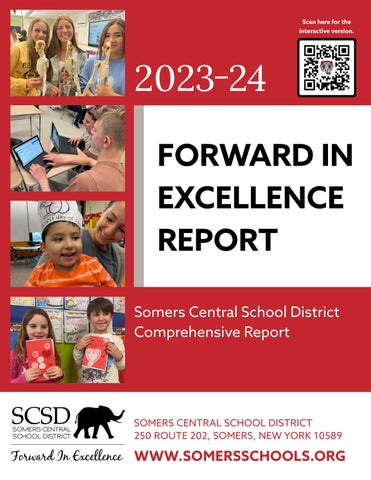
2023-24 FORWARD IN EXCELLENCE REPORT Somers Central School District Comprehensive Report
SCSD SOMERS CENTRAL SCHOOL DISTRICT
SOMERS CENTRAL SCHOOL DISTRICT 250 ROUTE 202, SOMERS, NEW YORK 10589
Forward In Excellence WWW.SOMERSSCHOOLS.ORG
MISSION Somers Central School District will ignite a passion in each student by engaging all learners at a personal level to ensure success in a global society.
Table of Contents 4
A Message to Our Community
5
About the Report
6
About Somers Schools
ELEMENTS OF EXCELLENCE Professional Learning Communities Social, Emotional & Physical Wellness 21st Century Knowledge & Skills Global Citizenship March 2024
Fiscal Stewardship April 2024
Family and Community Engagement May 2024
A Message to Our Community Welcome to the Somers Central School District. We are a community that strives to ignite a passion in all students and to instill a lifelong love of learning. It matters deeply to us that all children feel that they belong in our schools and we invest in their education and well-being in hopes of providing a better future for all. We focus on educating the whole child by equipping each with 21st century knowledge and skills, emphasizing social, emotional, and physical wellness, and modeling a spirit of global citizenship. This past year we engaged in a community-wide effort to evaluate our mission, vision, and collective commitments, to ensure that we have consensus on how we are moving forward in excellence in Somers schools. You can read more about the results of the process in the following pages. I am grateful for the tireless efforts of teachers, parents, students, staff, and community members who work to prepare our children for success in a global society. In partnership, Ray SUPERINTENDENT OF SCHOOLS Dr. Raymond H. Blanch
4
2023-24
About the Report The annual Somers Central School District Forward in Excellence Report is a comprehensive overview of the accomplishments related to the mission of the Somers Central School District. The district uses the Elements of Excellence, clearly defined below, as the framework to guide decision-making to ensure the development of the Whole Child. At different times during the year, the data and information about an individual Element will be presented to the community at Board of Education meetings. Some Elements were presented this year before the creation of this overall report. Links to those presentations are in the table of contents.
ELEMENTS OF EXCELLENCE Professional Learning Communities
SCSD will cultivate a community of professional learners focused on advancing student success.
Social, Emotional & Physical Wellness
SCSD will advance social, emotional, and physical wellness in all learners to successfully navigate current and future experiences.
21st Century Knowledge & Skills
SCSD will ensure the intellectual growth and development of critical skills so that all learners can thrive in an ever-changing world.
Fiscal Stewardship
SCSD is committed to responsible financial planning and allocation of resources to ensure a safe learning environment where all students achieve excellence.
Family and Community Engagement
SCSD will strengthen and nurture connections across the Somers community through engagement, constructive partnerships, and the inclusion of all voices.
Global Citizenship
SCSD will nurture a sense of responsibility, belonging, and acceptance in all students and foster a respectful understanding of broader perspectives.
5
FORWARD IN EXCELLENCE
About Somers CSD Somers is a suburban community located in Westchester County about 45 miles north of New York City. It is home to some of the finest schools in New York State. Our two campuses are the hub of activity in the town of Somers and foster collaboration between the school district and the community. Our district is committed to the development of the whole child, encompassing three fundamental areas: 21st Century Knowledge & Skills Social, Emotional, & Physical Wellness Global Citizenship The programs and teaching methods are designed to meet the needs of each individual learner, focusing on the knowledge and skills necessary to solve problems, think critically and creatively, and work collaboratively and cooperatively with others.
*Excludes out of district enrollment **Employee data for 2023-24 school year
6
4 Schools
2,600* Students
**
285 Teachers 183 71
(Full time)
(Part time)
Support Staff
17 Administrators
SCSD Demographics Somers Central School District is an increasingly diverse district. In the year 2022-2023, at least seven languages were spoken in district homes. In the last 11 years, the number of students in the district identifying as non-white increased from 8% to 23%. By 2030, that number is projected to increase to 25%. 100% 90% 80% 70% 60% 50% 40% 30% 20% 10% 0%
2016-17
2017-18
American Indian
Asian
2018-19 Black
Hispanic
2019-20
2020-21
2021-22
Native Hawaiian or Pacific Islander
2022-23
2023-24
Two or More Races
White
Building Enrollment The number of students enrolled in Somers public schools has been decreasing since 2012, due to declining birth rates. At the elementary and middle schools, enrollment has reached the lowest projected level of 175-200 students per grade, where it is expected to remain. As those smaller classes progress through the high school, total enrollment at the high school will level out at approximately 800 students. As enrollment decreases, SCSD is reducing staffing through attrition.
Total Enrollment Over a 5-Year Period 3,000 2,500
2,948
2,862
2,781
2,709
2019-20
2020-21
2021-22
2,600
2,000 1,500 1,000 500 -
2018-19
Information based on latest data available from the New York Basic Education Data System
7
2022-23
ELEMENTS OF EXCELLENCE
Family and Community Professional Learning Communities Engagement SCSD and nurtureofconnections the SCSD will will strengthen cultivate a community professionalacross learners Somers through engagement, constructive focused community on advancing student success. partnerships and the inclusion of all voices.
SCSD strategically engages adult learners in being active contributors to a professional learning community (PLC) by continuously engaging the following questions: “What do we want our students to know, be able to do, and understand?” “How do we know what our students know, are able to do, and can understand?” “What do we do when students don’t know, aren’t able to do, or can’t understand?” “What do we do when they already know, are able to do, and understand?”
8
Stakeholder Engagement The Learning Office provides professional learning for faculty and staff, including teaching assistants and aides, clerical workers, monitors, bus drivers, and food service workers. We also ensure that families, community members, and students are engaged in learning throughout the year.
9
When, What, and How We Learn
Faculty & Staff
FOCUS AREAS
G
N R N I
0-9 Years 0-9 Years 10-19 10-19 Years Years
AR D
MI
LY
SS
Kn ow led ge &
R
P E
& PHYSICAL WELLNESS
20-29 30+ Years 20-29 YearsYears 30+ Years
Average Years of Experience per Teachers by Years of Experience
I
Social, Emotional FA
IO
NT UR Sk Y ills
A
SH
& COMM U
N
I
TY
N
CHILD
L STEW
21 ST C E
whole
SCA
I
—
FE
FI
A
S—
A L
E D
G
I
Z
ENT— PRO
N
IE
O N
L
M GE
U
T
S
E
M
P
A
L
ALi p OBn s h GcLi t i z e
N
RNING COM
A LE
98%
E
in 2022
98% in 2023
Teacher Retention Rate
All faculty and staff participated in professional learning during the 2022-23 school year. Opportunities include professional learning days, faculty meetings, teacher-facilitated workshops, and conferences. New in 2022-23, increased opportunities for support staff. 10
97%
of Teachers have a Masters Degree
64
Average Professional Learning Hours per Teacher for 2022-23
What Drives Our Professional Learning The Learning Office works closely with faculty and staff to design the district’s professional learning experiences. Our professional learning priorities: Increase teacher voice, choice and agency through: •
Surveys - Professional Learning Interest Survey and Professional Learning Reflection Tool
•
Focus Groups – Building-based with faculty and staff
•
Teacher-designed and facilitated learning opportunities
•
Student Learning Data – formal and informal
•
Student Focus Groups
Provide learning opportunities that are: •
Aligned to New York State curriculum standards
•
Aligned to SCSD mission, vision, collective commitments
•
Aligned to expressed need
•
Focused on increasing student engagement
•
Supportive of SMART goals
•
Easily applied 11
Targeted Professional Learning Objectives In addition to the ongoing professional learning that is available to all faculty and staff, we also provide targeted learning opportunities to effectively support student growth.
Participation Teachers, teaching aides, teaching assistants, and administrators come from across the district to work together to learn about specific topics related to curriculum, standards, technology, assessments, and other areas.
Examples • International Baccalaureate and Middle Years Programme workshops • Best practices in literacy instruction and assessment K-8 • IXL training • In-service courses (evidenced-based grading, executive functioning, technology integration)
12
Summer Work While students are on summer break, our teachers invest time in professional learning to improve their educational practices and materials.
SUMMER LEADERSHIP SUMMIT
Every year before the start of school, leaders from kindergarten through high school gather to ensure K-12 alignment in professional learning and goals. Objectives 1. Determine strengths, opportunities, and aspirations related to SCSD professional learning communities. 2. Reflect upon individual and team leadership styles and strengths. 3. Draft team goals in alignment with district and building goals, and district and building success plans. 4. Engage in interdisciplinary and cross-grade and/or building-level communication and collaboration.
Participation Administrators and teacher leaders including: grade-level leaders, curriculum area leaders, team leaders, and teachers on special assignment.
Summit Feedback Participants rated the success in meeting the summit’s learning objectives on a scale of 1-4. Objective 1 - 3.6 ★ ★ ★ ★ Objective 2 - 3.7 ★ ★ ★ ★ Objective 3 - 3.6 ★ ★ ★ ★ Objective 4 - 3.6 ★ ★ ★ ★
SUMMER CURRICULUM WORK Click to view our public Curriculum Maps Objectives Teams and individuals work on adapting, creating, or aligning curriculum, instruction, and assessment to appropriately reflect student experiences in the classroom.
Participation •112 proposals approved, representing all four schools and 42% of SCSD faculty. •1,704 hours of work completed. •Work conducted across all subject and support areas.
Examples New course materials developed in math, science, social studies, ELA, advisory, literacy, world language at SIS, content literacy instruction during WIN, MYP, IB, embedded honors, special education, Tusker 101, technology, DBT-Steps A, evidence-based grading, executive functioning, and arts.
13
TUSKER U: FACULTY FOCUS Professional learning sessions created and facilitated by faculty and staff for their colleagues that are aligned with the SCSD mission, visions, and collective commitments. Objectives 1. Practical, responsive to expressed needs, and focused on increasing student engagement 2. Provides time and structure for faculty and staff to learn from and with each other 3. Encourages interdisciplinary and cross-grade and/or building level collaboration
Participation •242 teacher and teaching assistant participants •17 sessions offered •All grade levels represented
Feedback To what extent did we meet these objectives? Objective 1 - 97% Objective 2 - 93% Objective 3 - 93%
TUSKER U: FAMILY FOCUS Objective To be responsive and proactive in engaging families and community members in learning that is related to a variety of student experiences.
Participation All SCSD stakeholders: families, guardians, community members.
Examples • English as a New Language Night • Community Conversations - Recommitting to the district mission, vision, and collective commitments • Annual Wellness Summit (2022 topic: Covitality Wellness Screener)
14
TUSKER U: STUDENT FOCUS Objectives To engage students in summer learning activities that maintain the home-school connection and provide meaningful opportunities for developmentally appropriate learning and collaboration with teachers.
Participation •73 registered students
Examples Course offering schedule
Feedback “We learned to cooperate with each other.” - SCSD student “We are so happy that he was open to trying these sessions with you and give you so much credit for him wanting to come back and do more.” - SCSD parent “My daughter is really enjoying the classes - she loves attending them.” - SCSD parent
15
ELEMENTS OF EXCELLENCE
Family and Social, Emotional Community & Physical Engagement Wellness SCSD and emotional, nurture connections across the SCSD will will strengthen advance social, and physical Somers through engagement, constructive wellnesscommunity in all learners to successfully navigate current partnerships and the inclusion of all voices. and future experiences.
There are many innovative and proactive approaches in our schools that support our students’ social, emotional, and physical wellness. Programs and skills are developmentally appropriate and flexible, and designed to engage students according to their unique needs.
16
Wellness Team Mission The mental health team teaches and models for all students the life-long skills of self-regulation, self-management, and effective social engagement.
School Social Workers facilitate classroom lessons and work with greater emphasis on Tier 2 individual and group counseling. They also provide unique connections between our families and community agencies and support services. Student Assistance Counselors (SAS) are employed in partnership with the Student Assistance Services Corporation for our middle and high schools. SAS counselors offer a unique level of confidentiality with a focus on drug and alcohol counseling. They also provide Tier 1 classroom lessons to students and Tier 2 individual support.
Tiers of Support
Tier
3
School Psychologists facilitate classroom lessons and provide Tier 2 assistance through individual counseling, assessment, and Individualized Education Plan (IEP) planning. They also provide school-based Tier 3 support, as well as transition support for students in outof-district Tier 3 programs.
The Whole Child Success Team is a proactive, collaborative approach to support the social, emotional, physical, and academic growth of our students. This data-driven process supports students who are struggling by examining all aspects of the child’s life - from academics to social to family situations.
Tier
Re f
2
Tier n tio c e
Individually focused, more intensive interventions
Re fl
Targeted interventions to work on specific skills Core instruction for all students
17
WHOLE CHILD SUCCESS PROCESS
P r o gr e
05
1
Im pl e
on tati en m
ral r e
ring nito mo ss
School Counselors provide direct services to all students at Tier 1, students who need support at Tier 2, and help to identify and support students who need Tier 3 assistance.
The Path to Social and Emotional Wellness Tier 1 lessons are part of the core instruction
Second St
for all students. They
Develops em regulation sk strategies.
are developmentally appropriate and build upon each other each
School to school transition support (K, 3, 6, 9, 12)
year. The common focus is teaching practical strategies to manage emotions and to be present for learning.
Responsive Classroom (K-5) Teaches students to be engaged as a learner and to be a positive member of the classroom community.
18
Zones of Regulation
Develops emo identification regulation skil
tep (2-5)
motion kills and
n (K-3)
otion and lls.
JCK and Self-Care Programs (9) Explores the importance of talking about mental health and practical self-care strategies.
College & Career Planning (10-12)
DBT Steps-A (6, 8, 10) Teaches students the concept of dialectics and the core skills of mindfulness, emotion regulation, distress tolerance, and interpersonal effectiveness.
19
Tier 2 support is targeted intervention that helps develop specific skills in individuals and groups of students who need support beyond the core classroom instruction. Counseling check-ins are part of the Tier 2 process in all Somers schools. These visits create a consistent adult connection and routine monitoring of students, as well as encourage effective coping skills and decision-making.
Small Groups – Elementary At our two elementary schools, various small groups meet to build personal connections, practice routines and play, share personal experiences, and process transitions. Social Skills
Changing Families
Problem-Solving
Small Groups – Secondary At the middle school, small groups are largely focused on peer relationships and further development of interpersonal skills and self-awareness. Groups at SMS help students form positive social connections and mitigate feelings of isolation. Newcomers
Selfcare
Peer Guidance
At the high school level, Tier 2 support focuses on individual check-ins and building-level counseling services. There are also targeted efforts in partnership with the SHS Student Life Coordinator to help students engage in the school community through clubs and extra-curricular activities to create a greater sense of belonging. Small groups were launched in 2022 through the Wellness Wednesday series.
20
CoVitality Social and Emotional Survey 2022-23 The Co-Vitality Survey is administered each fall and spring to students in grades five through 12, with fourth grade also participating next year. The survey helps identify students who need extra support beyond the social-emotional wellness Tier 1 lessons.
TIERS OF STUDENT NEEDS AND DIRECT SERVICE INTERVENTIONS as identified by the CoVitality Survey
Fifth Grade
157 students participated
5% 19% 76%
Tier
3
2
Tier
1
05 Struggling
Tier
3
12%
Tier
668 students participated
466 students participated
8%
Tier
Somers High School
Somers Middle School
7%
Tier
2
80% Striving
12%
Tier
05
81%
1
Thriving
3
Tier
2
Tier
05
1
This survey captures a moment in time and does not define the student. It is one of many valuable tools SCSD uses as part of the overall screening used to determine the needs of each individual student. Note: some students choose to opt out of the survey. What happens when the survey indicates that a child is struggling? Those students are contacted by a wellness team member, followed by a phone call to the family. Working with the student and the family, the wellness team designs and implements a support plan when appropriate.
21
Faculty/Staff/Community Learning Youth Mental Health First Aid This training helps middle and high school faculty and staff understand and identify common mental health challenges in youth. The course teaches how to help young people in both crisis and non-crisis situations.
60
Executive Functioning Training Professional learning for faculty in kindergarten through 12th grades to learn how to best support students’ executive functioning, including organization, time management, and initiation of tasks.
42
faculty/staff members trained in the middle and high schools (ongoing)
faculty members trained (ongoing)
Social Emotional Wellness Advisory Council (SEWAC) Students, Parents, Teachers, Administrators, Board of Education Members, Community Members
SEWAC is a resource and a springboard to aid the district in better fulfilling the district’s mission of supporting the social, emotional, and physical wellness of all learners. tUsker University: Family Focus
7th ANNUAL WELLNESS SUMMIT Understanding and Unpacking the CoVitality Wellness Survey •
How to read the results of your child’s survey.
•
Practical strategies that parents and students can use at home to best support students’ social and emotional well-being.
Tier 3 is highly individualized support for students who have not found success in Tier 1 or Tier 2 interventions. These supports may include specialized, school-based programs (True North and Transitional Support Program) and out-of-district special education placements. 22
Extra-curricular Engagement If students are socially and emotionally connected and engaged in school, attendance, grades, and graduation rates increase.
“I am satisfied with my athletic experience at Somers High School.”
595
96%
Number of unique athletes at Somers High School 2022-23
SHS Clubs
SMS Clubs
SIS Clubs
72 clubs
22 clubs
6 Clubs
565 unique members
214 unique members
194 members
“The car club provided a new perspective on leadership and a sense of belonging with a different group of friends.”
“The drama club’s spring musical helps me develop self confidence and helps me with socializing.”
“The investment club allows me to learn about financial freedom.”
Primrose Book Club
SIS Activity Club
SMS Club Fair
In 2023-24, SHS and SMS students will participate in a survey to capture student experiences and impact from club and extra-curricular involvement. 23
Foward In Excellence SOMERS CENTRAL SCHOOL DISTRICT 250 ROUTE 202, SOMERS, NEW YORK 10589
WWW.SOMERSSCHOOLS.ORG