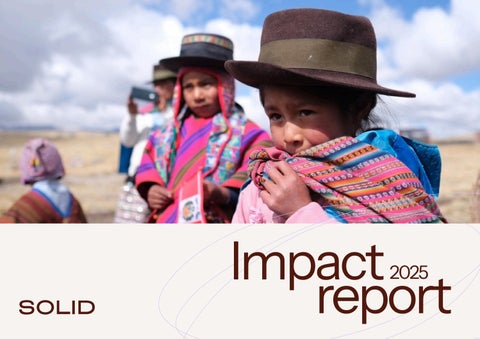
Impact report 2025
Together we enable communities to lead change Our mission
Foreword by
We believe that real and lasting change grows from within communities. One of our greatest strengths lies in our local teams in Peru, Kenya and India.
Lyn Verelst Co-founder General manager
They live in the communities we serve and understand the context, challenges and potential. With decades of collective experience, they don’t bring temporary solutions—they help build systems that work, last and truly belong to the people themselves. We are proud to stand beside them. Today, we operate in times of global uncertainty. Economic pressure, geopolitical tension and a growing tendency toward protectionism are turning people and institutions inward. Despite this context, we have remained resilient. We continued our work and safeguarded our core mission. However, our crafts projects in India and Kenya were not immune to this. Reduced demand led to fewer orders, resulting in a lower impact for the women involved in these programmes, in 2025.
We believe in being transparent about this— impact is not linear, especially in uncertain times. As you read this Impact Report, you will find targets, numbers and outcomes. Behind every metric, however, is what truly matters: a woman earning an income, a child accessing care and education, a community moving from survival to self‑determination. That is the impact we exist for, and the responsibility we carry forward— together with you. With gratitude and conviction, Lyn
Behind every metric, is what truly matters: a woman earning an income, a child accessing care and education, a community moving from survival to self‑determination. 3
Table of contents
Solid Impact Report 2025
5
What we do
6
Our standards
7
Economic impact
18
Social impact
28
Environmental impact
39
Looking forward to 2027
41
Financials 2025
4
What we do
We produce premium crafts for brands. With artisans in Peru, Kenya and India. And we provide those communities with fair jobs, training and social support.
© Evelyne Mertens
© by Sunniva Midtskogen
Premium crafts
Jobs & training
Social support
Made by hand, traded fair Premium knitwear from Peru. Handcrafted homeware from Kenya. Colorful pieces from India. You bring your designs and your market. We’ll handle production and logistics, with care.
Setting people up for life In our workshops, women get safe and stable jobs. Our career training helps people across the community - like young farmers build a solid future.
Because it takes a village Next to a job, a support system is crucial. We set up childcare in our workshops and run programs in the community that protect girls from gender violence and support young mothers with education, housing and parenting.
5
Our standards Economic Fair work and entrepreneurship create income, confidence and choice—so families can invest in what matters most to them, in the ways they know best. Progress feels different when you build it with your own hands — and it lasts longer, too. We focus on women and young people, because when they move forward, communities move with them. Yet many of the communities we work with face deep inequality. That’s why removing barriers is just as important as creating opportunity. Our businesses see more than just the employee. Every person is known by name and valued, with personal development woven into our work. Fair trade and respect for local living wages are not the goal—they are the starting point.
Social Where poverty and inequality have lasted for generations, people can lose a sense of possibility.
Believing that change is out of reach becomes a form of survival. Our projects exist to gently shift that mindset—restoring confidence, agency and the courage to imagine a different future. Saying no to violence and inequality is key. We stand for safety, respect and dignity. At the same time, we protect those who are most vulnerable. Girls at risk and teenage mothers receive safety, care and support—but always in ways that strengthen ownership and self‑belief.
Environmental We build our businesses with respect for nature and the places we work in. By using local materials and products, we strengthen ecosystems as much as livelihoods—from organic quinoa farming to reforestation projects. We bring nature education to young people and communities, because caring for the land is inseparable from caring for yourself.
© by Hadithi
6
Economic impact
Jobs & trainings © by Isabel Corthier
Our economic impact strategy
01
Empower the agents of change
02
Ensure fair wages
03
Build skills that increase value on the labour market
Supporting those who drive change from within.
Fair wages as a non‑negotiable standard.
Practical training that opens doors.
Empower the agents of change
01 Supporting women and youth In many of the communities we work with, inequality and poverty have been present for generations. Over time, this can lead to acceptance, where opportunities are no longer imagined. We therefore focus on women and young people. Women are driven to create a better future for their children. Young people are more open to change and new ideas, even when their surroundings are not. They still see possibilities where others no longer do. Their motivation, courage and energy spark movement beyond the individual. When they grow, families follow. When families change, communities begin to shift. By empowering those ready to move forward, impact accelerates and lasting progress becomes possible.
9
Peru
Young rural entrepreneurs Results
45
new students start the program, 50% are women. 45 students from the previous cohort continue.
This project supports rural young entrepreneurs (age 16 - 35) in Ayacucho to become agents of change in their own communities. Through an 18‑month learning‑by‑doing programme, participants gain entrepreneurial, agricultural and personal skills, and set up viable businesses in the countryside. Supported by coaching and a youth cooperation, they show that rural livelihoods can be profitable, innovative and less physically demanding when knowledge and technology are applied wisely. in partnership with Colruyt Group Foundation
70%
of graduates implement their own business, from dairy products and livestock to native potatoes, strawberries to vegetables.
2 hours a day
that's all it takes for a trained young person to maintain their agricultural business and earn as much as their parents — compared to a full day's work needed to reach a similar income (S/600, roughly €150/month).
When I first started growing vegetables, I was worried that I wouldn’t be able to sell them in my community, but people now prefer to eat healthier and fresher products. Ronald Paquiyauri Student from the community of Manallasacc.
11
02
Ensure fair wages Fair pay as the baseline Creating employment through handicrafts is our way to ensure fair and dignified pay for the women we work with. In an industry where low wages remain the norm, we choose a different path: we respect local minimum wage standards, guarantee fair income for every worker, and continuously assess whether earnings match real working conditions and realistic production expectations. Flexibility through piece‑rate work We deliberately work with a piece‑rate system because it offers the flexibility many of our workers value most. It allows them to combine income‑generating work with caring for children and managing households. It also acknowledges differences in experience, efficiency and quality. Finally, this system encourages learning and growth, as workers see a direct link between their efforts and their pay.
To ensure fairness, alle rates are carefully calculated based on realistic, regular production speeds, so earnings reflect fair conditions rather than pressure or overwork. Support beyond wages A living wage must do more than cover survival. It should allow people to plan ahead, care for their families and participate in their communities with dignity. That is why we work to strengthen income security beyond wages alone. We support access to health insurance, childcare and social protection, recognising that fair pay loses its meaning if illness or unsafe working conditions push families back into vulnerability. We actively reconnect families with government programs, ensuring they can access support they are already entitled to. This reduces financial stress and builds resilience beyond the workplace.
Ensure fair wages Fair Trade textile workshops
Invest in workers
+2,000 artisans
© Evelyne Mertens
women earn a stable and fair wage in a safe environment.
Peru
India
Kenya
Custom knitwear
Handweaving, crochet & kantha
Change communities
+10,000 lives
Handwoven baskets
families get access to new opportunities through a stable income or social support.
© Evelyne Mertens
Ensure fair wages Exciting updates!
Fair -trade textile workshops
India
Peru
Our textile workshop in India secures a new client, Pomax. We gradually transition daily management to a local manager and his team to strengthen long‑term local ownership.
Kenya We ordered our first full container of baskets from our basketry workshop in Kenya!
Worldwide clients
+ 191,000
USA
Austria
Germany
Belgium
employment hours
€ 864,000 of turnover
Our baskets reach an even wider audience through a new line of corporate gifts.
30,237
Download our catalogue here
handmade products
UK The netherlands & others
Handknitting
Basic skill 80%
20%
Expert skill
No charity, just work Fairtrade original
Made possible by our partners and clients
…and many more whose support we value, even if not named here.
15
Build skills that increase value on the labour market Skills that build on education Strengthening technical skills begins with restoring the basic learning foundations many people — especially women and girls — never had the chance to complete. Early interruptions through teenage motherhood, violence or instability erase essential building blocks, making new techniques harder to learn and limiting access to the labour market. That’s why we support women and girls to finish education and obtain a degree: in Peru, even cleaning jobs increasingly require certification. A diploma opens doors, and skills help you move forward once they’re open. Growing skills, growing futures Good skills and knowledge prevent costly mistakes. Whether it’s crops that survive, animals that stay healthy or hand‑knitted pieces that pass quality control, the right techniques matter. That’s why we train farmers in agriculture and why our textile workshops focus on speed, precision and
03 craftsmanship. It strengthens people’s income and independence — and helps our social companies grow in expertise while communities climb the income ladder or start their own businesses. Where learning flows into the community We share everything we know because keeping knowledge to ourselves would never create the change we work for. Good practices spread through our model farm Montefino, where farmers, visitors and students learn hands‑on about crops, animals, diseases and soil health; through our handicrafts workshops, where women strengthen technical skills; and through organic quinoa coaching, where producers improve quality and resilience.
A diploma opens doors — and skills help you walk through them.
Build skills that increase value on the labour market Training Peru
Women go back to school
14 women in our handicrafts workshop successfully advanced their education by completing a school year of primary, secondary or technical training.
Teenage mothers continue their studies
156
teenage mothers in our programs return to school and complete the school year — with a 95% success rate, compared to just 38% among teenage mothers in Ayacucho.
Share knowledge
Capacity building
people visited or participated in trainings at our model farm Montefino
capacity‑building trainings delivered to our artisans and team on technical skills, personal development and Fair‑Trade principles.
+ 5,500
+ 430
Social impact
Communities
© by Isabel Corthier
18
Our social impact strategy
01
No economic without social
02
Protect those who are most vulnerable.
03
Always strengthen ownership and self‑belief.
Building confidence and creating the conditions to thrive at work
Girls at risk and teenage mothers receive safety, care and support.
Restoring confidence, agency and the courage to imagine a different future.
19
No economic without social support
01
Economic progress only works when people feel safe, respected and when we take away some barriers. In our businesses and youth programmes, we see every day that there is no economic without social. Jobs, training and entrepreneurship only thrive when people have the confidence, protection and support to stand tall. That is why personal development is not an “extra” — it is the foundation. What we stand for Zero violence, anywhere — Many women and young people have never been told that violence is unacceptable, that discrimination is not normal, or that their voice matters. We create workplaces where people are safe, heard and treated with respect, and we invest strongly in training so that zero violence becomes the standard not only at work, but also at home. Listening as leadership — We invest in emotional resilience, communication and leadership — the skills that help people manage stress, give and receive feedback, and make decisions with confidence. Many stay with us for over a decade because they feel truly seen as individuals. Self‑belief and resilience — Many arrive with their heads down, convinced they won’t be respected or seen. With patience and encouragement, they discover their worth. Teenage mothers, people who stutter, or those long labelled “lost” become confident entrepreneurs and role models.
20
Peru
Caring for children while parents work Childcare is essential for women to participate fully in work. By offering daycare linked to our handicrafts workshops, we remove a major barrier to employment. When children are nearby, safe and cared for, women can focus on their work, learn new skills and engage with confidence. Results
36
babies (6 - 36 months) benefit from daily onsite childcare
13
children (3 - 5 yo) make use of the on-site pre-school program
43
children (6 - 10 yo) come to the afterschool childcare, next to the workshop, to play and get homework support
in partnership with Rotary Club Jabbeke
376
individual workshops and 48 group workshops are given on personal skills, technical skills or parenting skills.
70
highly vulnerable artisans, receive regular home visits and close follow‑up, to build personal skills and tackle individual issues. (Peru)
178
artisans receive individual emotional and practical support, with referrals to specialised services for domestic violence, legal aid and mental health services, when needed. (Peru)
22
Protect those who are most vulnerable. We believe strongly in investing in people who are ready to shape change. That approach often creates the widest ripple effects. But not everyone can begin there. Some groups are excluded long before opportunity becomes an option. Teenage mothers in Peru are one example: for them, training is not the first step—safety is. Reaching where others don’t We work with minors who have experienced sexual abuse, very young mothers close to homelessness, and families living far beyond urban reach—in extreme poverty, where no other organisations are present. Their reality is shaped by insecurity, isolation and survival. We deliberately reach those who are overlooked because they are too young, too poor, or too far away. Support must be multidimensional: combining food safety, safe housing, healthcare, psychosocial care and protection, all at the same time. Addressing only one need is not enough.
02 Staying until support is no longer needed We stay as long as necessary, for as long as these groups remain unseen by existing programmes. We look beyond direct support by actively sharing our knowledge with other organisations, schools and public services, helping build networks and raise awareness around overlooked issues such as teenage pregnancy. Through training, dialogue and advocacy, we work to place these realities on the political and social agenda. Our aim is not to replace systems, but to strengthen them—so that, eventually, our involvement becomes unnecessary.
Our aim is not to replace systems, but to strengthen them—so that, eventually, our involvement is no 23 longer needed.
Peru
A strong start for young mothers This project aims to support young teenage mothers in Ayacucho, as many of them face maternity without support. Through home visits and group workshops, the program strengthens parenting skills, emotional wellbeing, builds support networks, and promotes autonomy, helping them create a more stable and promising future.
Results
100
teenage mothers aged 12– 18 with children under the age of three are supported over the course of one year.
88
teenage mothers say NO to physical violence, 6 file an offical complaint.
100%
of the girls in the program prevent a second pregnancy.
26
teenage mothers, victims of domestic violence find a safe space in our shelter home. Preventing a second unwanted pregnancy
Rights awareness and violence prevention
in partnership with the Old Dart Foundation
Parenting child attachment skills
Goals Emotional and life skills
Access to education
My name is Ariana, I am 16 years old, and I have an 11-month-old baby. Together with my two brothers, we live with my grandmother and aunt since my mother passed away. Last year, I had to leave school due to my pregnancy, but I was determined to return. This year, I resumed my studies, attended classes every weekend, and even completed high school. My dream is to study nursing. Through the support of the project, I learned many things no one had ever taught me - especially how to give love to my son. Ariana Teenage mother
25
Always strengthen ownership and self‑belief. Change starts from within We work in communities where, after years of emergency aid, support is often expected to come from the outside and participation in trainings depends on financial incentives. We encourage a different approach—one where learning is driven by motivation and ownership rather than material benefits. When people choose to engage, investing their own time, effort and small resources, they build pride, ownership and responsibility, and results last. Even in conditions of deep poverty, we stand beside the poorest farmer or the most vulnerable girl as they take the steps they choose, recognising them as capable actors.
When people choose to engage without incentives, commitment deepens and results last.
03 Informed choices Self‑belief also grows when people understand that they can make their own decisions—because they have access to clear, reliable information. Knowing about family planning, understanding their rights, or choosing to return to education gives people the confidence to shape their own future. Confidence that moves people forward People can only create real change when they can look up—when they feel proud of who they are and what they can do. When people trust their abilities, they take initiative, try new things and keep going even when it’s difficult. That’s why we invest so much in personal development in every project. For many, this becomes the part they value most, because it’s often the first time someone visits them, listens to them, encourages them, and makes them feel seen for who they are and what they could become.
Peru
No taboos, informed choices for sexual health After years of providing Comprehensive sex education in high schools, we opened a dedicated youth space, in partnership with local health care services. The space offers young people free, confidential access to accurate information on sexuality and contraception, through individual or small‑group conversations in a judgment‑free setting—filling a critical gap in youth‑friendly care in Ayacucho.
Prevention of unwanted teen pregnancies
1249
adolescents receive comprehensive sex education in high school
642
adolescents (12–17 yo) receive contraceptives at our youth space.
825
young people (18 - 29 yo) find our youth space for individual counseling and contraceptives.
In partnership with the Wilde Ganzen Foundation
Environmental impact
Planet
28
Our environmental impact strategy
01
Respect nature as a foundation
02
Restore what sustains us
03
Grow care through knowledge
Building businesses with local, natural materials that protect land, resources and livelihoods.
Rebuilding ecosystems through reforestation, water restoration and regenerative practices.
Sharing nature education with young people and communities, reconnecting with traditional or innovative practices.
29
Respect nature as a foundation If we must leave a footprint, let’s make it a small one. An honest footprint In our crafts activities, we choose materials that make sense locally—alpaca wool in the Andes, recycled sari fabrics in India, and sisal fibre in Kenya—always favouring natural or recycled options that minimise our footprint. Our products travel far, on the other hand — from Peru, India and Kenya to clients around the world — and that transport footprint is real, one we're not proud of. That's why we monitor water use, electricity consumption, transportation, packaging and waste, and continuously work to bring it down. Agriculture that sustains people and planet The same mindset drives our agricultural projects. We promote organic quinoa and
01 Discover our latest sustainability report here!
organic farming in our rural youth training to show that sustainable impact depends on protecting both nature and people’s health. We teach families conscious water use, recycling, and how to find more environmentally friendly alternatives to chemicals. We look for low‑tech solutions that improve their living or working conditions and that communities can afford and maintain, such as solar lights made from recycled bottles that work without electricity, or solar pumps that bring water to higher areas. By protecting energy, water and soil at the same time, we demonstrate that sustainable choices are possible even in challenging conditions and that respecting nature is not an abstract principle but a practical, everyday commitment. 30
Peru
Organic quinoa, grown with purpose Results
80
farmers and families supported in Ayacucho.
> 300 T
Solid Food builds on Solid’s legacy by exporting premium, organic quinoa from Ayacucho, Peru to Europe. Strengthening local income can go hand in hand with protecting soil fertility and making rural livelihoods more resilient. Read more on their website
In partnership with Colruyt Group
of organic quinoa was exported from Peru
> 12K
from Colruyt enabled us to rent multiple harvest machines, purchase protective wear for the farmers, and organise two training sessions within the project.
Restore what sustains us
Building landscapes that last Working in high‑altitude communities shows us how essential it is to restore nature. Years of erosion, irregular rainfall and exhausted soils have weakened the ecosystems families rely on. When land loses its capacity to retain water and nourish crops, daily life becomes more fragile. That is why restoration is not an optional effort but a necessity for communities whose livelihoods depend directly on the health of their environment. Reviving ancestral water systems One of the projects closest to our hearts is the revival of ancient cochas—traditional water‑capture basins that store rain and runoff in natural depressions. When restored, these cochas refill slowly, feeding the soil and providing water for crops long after the rains have passed. They bring back a natural rhythm the land once knew, giving families a buffer against unpredictable seasons and helping fields recover their fertility.
02 Agroforestry for resilient landscapes Another solution we invest in is agroforestry, using native trees alongside crops to rebuild soil health, protect fields from wind and sun, and create microclimates where food can grow again and animals find shelter and patches of grass again.
That is why restoration is not an optional effort but a necessity for communities whose livelihoods depend directly on the health of their environment. 32
Peru
Reviving ancestral water systems In 2025, we partnered with the Bartolomé Aripaylla Association to restore five ancient high‑Andean cochas, to ensure year-round water availability for Montefino and neighbouring communities. At over 3,500 meters, these rain‑harvesting basins stabilise pasture growth, secure water for livestock and crops, and help families face increasingly unpredictable climate conditions.
33
As a child, my father instilled in me a passion for caring for trees. Watching a tree grow and feeling the energy it brings to nature is unique. Seeing many trees in harmony with their surroundings create even a sense of magic—the magic of giving life. At university, I came to understand that this magic is science: the science of life. I chose the path of environmental conservation – where I was trained to see deforestation and large‑scale planting as paths to development. Today, research shows a different truth: lasting productivity comes from balance within the agro‑ecosystem. It is this knowledge that is being passed on to the youngsters in our project. Teaching these topics to young people is key, because they will be the future stewards of their land. José Gálvez CHAVELÓN Peruvian team member
34
Grow care through knowledge
03
Environmental education In many Andes communities development arrived fast, and many simple habits— recycling, composting, caring for water, managing waste safely—were lost along the way. Some families never learned that plastic does not decompose like organic waste, or that compost can restore soil without chemicals. Through practical demonstrations, f.e. with ecological pestcontrol, we rebuild these skills and help families understand how small actions protect their land, health and future harvests.
Food systems We also teach families, youth and schools how to grow food at high altitude through bio-intensive gardening, helping communities complement diets that often lack vegetables and fruit. We innovate local agriculture with agroforestry using native trees and plants, hydroponics or rich compost — even testing multi-layer greenhouses that stack crops to maximise space. In Kenya, we brought workshops on kitchen gardening to the artisans, a way to produce food using very little water and space.
Safe housing through low‑tech solutions Many families live in fragile houses where smoke, humidity, waste and a lack of hygiene affect health. We teach practical low-tech solutions with locally available materials, that make homes safer, strengthen wellbeing and create cleaner, healthier communities.
Children and young people absorb these topics quickly and motivate their families to apply them daily, turning knowledge into environmental care.
Peru
Healthy living through sustainable practices Results
90
families across 6 communities are accompanied
5
school gardens were set up and produce vegetables, and improve diets in communities with high desnutrition rates.
74%
of families show considerable improvements in all 5 or more intervention areas.
One of our rural projects supports families in the high Andean communities of Ayacucho to build healthier lives. Relaunched in 2025 after several years of pause, the program combines home visits, community workshops and school gardens to strengthen nutrition, hygiene and (mental) health. Despite rough conditions, change is carried entirely by the families themselves— through their own commitment, investment and daily practice. in partnership with Associación Por Eso and Creemos.
photo by Solid
© by Isabel Corthier
Made possible by our partners and donors
Stichting Huize Buitenveldert …and many more whose support we value, even if not named here.
38
Looking forward to 2030 Our ambition is clear: to deepen the impact of fair work, strengthen local leadership and scale the solutions that work for the communities we work with. 1. Grow our ethical business We aim to grow our Peru revenue by 20% and triple our income in Kenya and India (300%). To achieve this, we are launching a new corporate‑gifts strategy and expanding long‑term partnerships with brands and retailers that choose quality, fair production and measurable impact.
+6500
baskets are sold yearly, to support our artisans in Kenya.
2. Strengthen local leadership Our teams and partners in Peru and Kenya remain at the heart of our work. Many colleagues have been with us for over 15 years, growing into highly skilled leaders
who increasingly drive programmes and enterprises themselves. Their expertise, local networks and access to local funding have expanded so strongly that international involvement becomes less necessary each year. By 2030, we expect our companies and social programmes to operate with deeper local embedment, stronger local ownership and reduced international support. 3. Scale what works “If something works, it will be picked up locally,” said one of our donors — and we see this happening. Our programmes prove their value: they win local awards, attract local companies and funds, and are requested across provinces as word spreads.
x3
by 2030, our programs reach three times as many people — and each year, more of that growth is funded locally, through private funding or grants.
39
© by Isabel Corthier
Financials 2025 We raised
We allocated
€2.230.137
€2.125.992
Other income 2%
Overhead* 10%
Contribution family
€ 296.000
Social causes 30%
Donations 43% Ethical Handicrafts 55% Solid Crafts 60%
*We provisioned € 308.364 for 2026.
*this is fully self-funded and not covered by donations
This amount is entirely covered by our founders.
To see more of our financials, please visit our website. Based on our information available in September 2026
41
Alone, we go far. Together, we go further! Business owner? Gift with purpose. Cherish your team, champion our mission. Discover our corporate gifts catalogue — every order helps us grow!
Believe in change? Support our social programs — 100% goes where it matters.
Become a client. Build a partnership. Support a programme. Help communities lead change.
As founders, we made a clear commitment: we cover our own overhead costs. A structure that allows every donation, to flow directly into our projects on the ground. To our partners and sponsors, we can confidently say: your support is used exactly where it creates the greatest impact. You are not funding an organisation — you are helping change lives, strengthen families, and empower entire communities to shape their own future with dignity and resilience.
43
www.solidinternational.be solid.international hello@solidinternational.be
www.craftsbysolid.com solid.crafts hello@craftsbysolid.com
Solid, Kortijksesteenweg 697, 9000 Gent, Belgium +32 15 45 98 10
Pictures by : Isabel Corthier, Sunniva Midtskogen, Evelyne Mertens, Hadithi & Solid. Responsible publisher: Solid vzw, Kortrijksesteenweg 697, 9000 Gent (Belgium) Graphic Design: creatively reimagined by Josworld — supported by Colruyt Group Foundation.