SOL MEDIAN CHE DE
november - December 2019. No. 20 - ANCHORAGE, ALASKA
Bilingual edi t ion
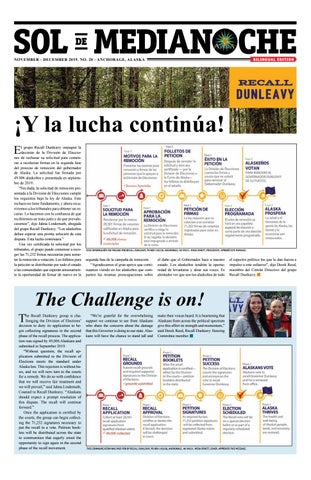
¡Y la lucha continúa! E
l grupo Recall Dunleavy impugnó la decisión de la División de Elecciones de rechazar su solicitud para comenzar a recolectar firmas en la segunda fase del proceso de remoción del gobernador de Alaska. La solicitud fue firmada por 49.006 alaskeños y presentada en septiembre de 2019. “Sin duda, la solicitud de remoción presentada a la División de Elecciones cumple los requisitos bajo la ley de Alaska. Este rechazo no tiene fundamento, y ahora recurriremos a los tribunales para obtener un recurso. Lo hacemos con la confianza de que recibiremos un trato justo y de que prevaleceremos”, dijo Jahna Lindemuth, abogada del grupo Recall Dunleavy. “Los alaskeños deben esperar una pronta solución de esta disputa. Esta lucha continuará.” Una vez certificada la solicitud por los tribunales, el grupo puede comenzar a recoger las 71,252 firmas necesarias para someter la remoción a votación. Los folletos para la petición se distribuirán por todo el estado a las comunidades que esperan ansiosamente la oportunidad de firmar de nuevo en la
T
Esta información fue pagada por Recall Dunleavy, PO Box 210228, Anchorage, AK 99521. Meda DeWitt, presidente, aprobó este mensaje.
segunda fase de la campaña de remoción. “Agradecemos el gran apoyo que continuamos viendo en los alaskeños que comparten las mismas preocupaciones sobre
el daño que el Gobernador hace a nuestro estado. Los alaskeños tendrán la oportunidad de levantarse y alzar sus voces. Es alentador ver que son los alaskeños de todo
el espectro político los que le dan fuerza e impulso a este esfuerzo”, dijo Derek Reed, miembro del Comité Directivo del grupo Recall Dunleavy.
The Challenge is on!
he Recall Dunleavy group is challenging the Division of Elections’ decision to deny its application to begin collecting signatures in the second phase of the recall process. The application was signed by 49,006 Alaskans and submitted in September 2019. “Without question, the recall application submitted to the Division of Elections meets the standard under Alaska law. This rejection is without basis, and we will now turn to the courts for a remedy. We do so with confidence that we will receive fair treatment and we will prevail,” said Jahna Lindemuth, Counsel to Recall Dunleavy. “Alaskans should expect a prompt resolution of this dispute. The recall will continue forward.” Once the application is certified by the courts, the group can begin collecting the 71,252 signatures necessary to put the recall to a vote. Petition booklets will be distributed across the state to communities that eagerly await the opportunity to sign again in the second phase of the recall movement.
“We’re grateful for the overwhelming support we continue to see from Alaskans who share the concerns about the damage that this Governor is doing to our state. Alaskans will have the chance to stand tall and
make their voices heard. It is heartening that Alaskans from across the political spectrum give this effort its strength and momentum,” said Derek Reed, Recall Dunleavy Steering Committee member.
This communication was paid for by Recall Dunleavy, PO Box 210228, Anchorage, AK 99521. Meda DeWitt, Chair, approved this message.
2
N O Vem b er - decem b er 2 019
SO L DE MEDIAN OC HE
AN C HORAGE, AL ASK A
Nota de opinión
Apropiación cultural Por Itzel Zagal
“L
a gente quiere mi ritmo, pero no mi tristeza”, así es como Sonya Hunte abrió la Conversación Comunitaria sobre Apropiación Cultural en octubre pasado. La frase se refiere a escoger y elegir partes de una cultura sin preocuparse por las hostilidades que encaran las personas herederas de esa cultura. Un ejemplo de apropiación cultural es lo que pasa con la tradición del Día de Muertos, donde las grandes corporaciones se benefician económicamente de la venta de objetos y “disfraces” producidos en masa en el contexto de Halloween. La celebración latinoamericana se ha hecho popular y, al mismo tiempo, el sentimiento antiinmigrante contra los latinoamericanos ha crecido. El mensaje de “queremos tu cultura, pero no queremos a tu gente” es perjudicial para todos. Especialmente ahora, cuando las familias inmigrantes enfrentan políticas deshumanizadoras que, en miles de casos, las separan y encarcelan a los niños. El Día de Muertos es una celebración que invita a toda la comunidad sin distinción, como la Muerte, que no discrimina. Es una celebración con raíces espirituales, como la práctica del yoga o el budismo, que no se restringe a un tipo de personas. Sin embargo, cuando uno es invitado a participar, es importante aprender de qué se trata la tradición, cómo es la manera respetuosa de comprometerse y mostrar solidaridad con los herederos de esa tradición. Baila al ritmo y sé consciente de las tristezas, interésate por la comunidad
con la que estás participando. Una excelente manera de apoyar es comprar un objeto artesanal del Día de los Muertos hecho a mano por una persona indígena y pagar un precio justo, tomarse el tiempo para conocer a dicha comunidad. Melissa Shaginoff señaló que uno de los efectos nocivos de la apropiación cultural en las comunidades indígenas y nativas es que crea confusión de identidad, especialmente para las generaciones más jóvenes. La apropiación cultural es una forma colonialista de decidir qué partes de la cultura son aceptables, y cuáles no. Esta tergiversación crea una versión simplificada de lo que es un indígena y hace que sea muy difícil para los jóvenes nativos ejercer y representar su propio patrimonio cultural. E.J. David, un inmigrante filipino y profesor de la Universidad de Alaska, explicó que una forma de ser un aliado es quitarse del camino y no tratar de ser un salvador. También dijo que para poner fin a este tipo de opresión contemporánea hay que dejar que los miembros de la comunidad lideren y amplifiquen sus voces y si realmente uno se preocupa y quiere ayudar, debemos estar dispuestos a arriesgar nuestros propios privilegios. Riva Symko dijo que la apropiación cultural se trata de relaciones de poder, y como una colona blanca que quiere ser una aliada es esencial renunciar a los privilegios, aceptar la crítica y escuchar. Finalmente, Lorena Medina nos recordó la importancia de preocuparse por el “indio vivo” y no sólo glorificar al “indio muerto”.
opinion Note
Panel de conversación con Melissa Shaginoff, Itzel Zagal, Sonya Hunte, Lorena Medina, Riva Symko y E.J. David, moderado por Indra Arriaga.
Cultural Appropriation
“
By Itzel Zagal
Folks want my rhythm but, they don’t want my blues,” that is how Sonya Hunte opened the Community Conversation about Cultural Appropriation last October. The phrase is referring to the picking and choosing parts of a culture without caring about the struggles of people inheritors of that culture. One example of cultural appropriation is what is happening with the Día de Muertos (Day of the Dead) tradition, where big corporations profit from selling mass-produced objects and “costumes” within the Halloween context. On the other hand, this Latin American celebration has become popular, and at the same time, the anti-immigrant sentiment against Latin Americans has grown. The message of
“we want your culture, but we don’t want your people” is very harmful to everybody. Especially now, when immigrant families face dehumanizing policies that, in thousands of cases, have separated them and imprisoned their children. The Día de Muertos is a celebration that invites the entire community, without distinction, to participate, the same way Death does not discriminate against anybody. It is a celebration with spiritual roots, such as the practice of yoga or Buddhism, which are not restricted to a specific type of people. However, when one is invited to participate, it is important to learn what the tradition is about, and what is a respectful way to engage and show solidarity with the heirs of that tradition. Dance to the rhythm, and be aware of the blues, care
about the community with which you are participating. A great way to support is to appropriately and fairly buy a handmade Día de los Muertos artisan object from an indigenous person, this will allow you to know their community better. Melissa Shaginoff pointed out that one of the harmful effects of cultural appropriation in the indigenous and native communities is that it creates identity confusion, especially for the younger generations. Cultural appropriation is a colonialist way of deciding what parts of the culture are acceptable and which ones are not. This misrepresentation creates a simplified version of what is to be indigenous and makes it very difficult for the young natives to exercise and represent their own cultural heritage.
E.J. David, a Filipino immigrant and University of Alaska professor, explained that one way of being an ally is to get out of the way, to not try to be a savior. Also, he said that to end this kind of contemporary oppression, one should let the members of the community lead and amplify their voices, and if one genuinely cares and wants to help, to be ready to risk one´s own privilege. Riva Symko mentioned that cultural appropriation is about power relations, and as a white settler who wants to be an ally, it is essential to step down of privilege and accept critic and listen. Finally, Lorena Medina reminded us of the importance of caring about the “living Indian” and not just glorifying the “dead Indian.”
Sol de Medianoche is a quarterly publication of the Latino community in Anchorage, Alaska (907) 891 2636 | www.soldemedianochenews.org | info@soldemedianochenews.org Publisher: Sol de Medianoche Editorial Board | Editor: Fernanda Gracida | Graphic Design: Manelik Guzmán | Advertising: Lina Mariscal | Thank you to our contributors: Itzel Zagal, Indra Arriaga, Pedro Graterol, Natsuki Nakamura, Pilar Marrero, Princess Daazhraii Johnson, Lorena Medina, Nicolas Dirksen, Lisa Demer, Joan Ryan Estay, Dr. Samarys Seguinot Medina, Benjamin Wagnar, Ellen Lee Alderton, J. J. Harrier. Sol de Medianoche is published by Sol de Medianoche Co. The contents are copyright 2016 by Sol de Medianoche Co. No portion may be reproduced in whole or in part by any means including electronic retrieval systems without the express written permission of the publisher. | ISSN (print) 2473-6880 | ISSN (online) 2473-6899.
S O L DE ME DIA N O C H E
N O Vem ber - december 2 019
A N C HO R AG E , A L A SK A
Día de Muertos: de puro corazón E Por Indra Arriaga
ste mes se celebró en Anchorage el 15º. aniversario del festejo del Día de Muertos, tradición mexicana que honra a los antepasados y seres amados que han fallecido. El festival de Día de Muertos da vida a la comunidad, refuerza la identidad latina y abre espacios para vincular diversas comunidades. El festival se inauguró frente al Museo de Anchorage con la invocación por Itzel Zagal a los cuatro puntos cardinales y los antepasados, invitando así a los difuntos y agradeciendo a los pueblos de Alaska por su generosidad con los que ahora también comparten estas tierras. Este año, la procesión introdujo dos catrinas nuevas, Agripina y Frida. Agripina, la quinceañera, fue elaborada por Macuca Cuca e Indra Arriaga Delgado. Frida honró a Frida Kahlo y fue elaborada por Paula Cerda. A la procesión se unieron el catrín y la catrina del año pasado, así como otros abanderados y personas luciendo su maquillaje del Día de Muertos. Más de 200 personas se unieron a la procesión que llego al teatro en el 411 D, donde fue recibida por más gente, altares y el mariachi Agave Azul. Se calcula que llegaron más de 500 personas al evento. El programa incluyó danzas de los grupos Uatzi y Xochiltquetzal Tiqun. Este Día de Muertos se sintió con mucho corazón. Fue hecho con mucho amor y conscientes de que la comunidad Latina está pasando por momentos difíciles. Los artistas y miembros de la comunidad tocaron temas muy dolorosos y controversiales con respeto y dignidad. También hubo un altar dedicado a los niños que han fallecido en los campos de concentración en la frontera, así como altares personales; también se trató el tema de apropiación cultural, y hubo charlas sobre como empoderar a los latinos para que sus voces sean escuchadas y reconocidas. El próximo año se elegirá a un presidente nuevo y los latinos debemos votar para cambiar políticas que nos han llevado hacia la oscuridad. Este año los preparativos para Día de Muertos empezaron desde septiembre. Bajo la dirección de Macuca Cuca, muchos niños aportaron su tiempo y talento en hacer flores y pintar calaveras, por ejemplo, Itandehui Dominguez Gomez de 12 años aprendió a cortar papel picado, a pintar y a trabajar la cartonería. Carolina Vidal, Ju-
Day of the Dead: From the Heart
T
By Indra Arriaga
lio Millan y Estuardo Sánchez entre muchos otros, pintaron caras en el evento—en fin— fueron muchos quienes pusieron todo su corazón en este evento y a quienes no alcanzaríamos a mencionar por falta de espacio. Los organizadores del evento quieren agradecer a todos los colaboradores: Out North, Atwood Foundation, Sol de Medianoche, French Oven Bakery, Gabriela Olmos, Lauren Horn, Lorena Medina, la familia Ba-Lescas, Anchorage Downtown Partnership y el Anchorage Museum. La celebración cerró con broche de oro, con el público bailando y con gran ilusión por la celebración del siguiente año.
his month is the 15th anniversary of the Day of the Dead in Anchorage, a Mexican tradition honoring ancestors and deceased loved ones. The Day of the Dead festival brings the community to life, reinforces Latino identity, and opens spaces in which diverse communities can come together. The festival opened in front of the Anchorage Museum with Itzel Zagal’s invocation of the four cardinal points and ancestors, thus inviting the dead and thanking the Alaska Native peoples for their generosity to those who now also share these lands. At the procession two new catrinas, Agripina and Frida, were introduced. Agrippina was the quinceañera, she was a collaboration betweeen Macuca Cuca and Indra Arriaga Delgado. Frida honored Frida Kahlo and it was made by Paula Cerda. The catrin and catrina from last year were also present, as were many more people carrying colorful elements, and wearing their Day of the Dead makeup. More than 200 people joined the procession, which travelled to the theater at 411 D, where even more people, altars, and the Mariachi Agave Azul awaited them. It is estimated that there were more than 500 people at the event. The program also included dances by the groups Uatzi and Xochiltquetzal Tiqun. This Day of the Dead was felt deeply and with great heart. It was done with a lot of love and with the awareness that the Latin community is going through
very difficult times. Artists and community members touched on very painful and controversial topics with respect and dignity. There was an altar for the children who have died in the concentration camps at the border, as well as personal altars; the issue of cultural appropriation and conversations on how to empower Latinos to have their voices heard and recognized were also discussed. A new president will be elected next year, and Latinos must vote to change policies that lead us towards darkness. This year preparations for Day of the Dead began in September. Under the direction of Macuca Cuca, many children gave their time and talent in making flowers and painting skulls, for example, 12-year-old Itandehui Dominguez Gomez learned to make papel picado, paint and work the traditional Mexican art of cartonería (a type of paper mache). Carolina Vidal, Julio Millan, and Stuart Sanchez painted faces at the event— anyhow— there were many people who put their whole heart into this event, and unfortunately there is not enough room to mention them all here. Event organizers would like to thank all the partners: Out North, Atwood Foundation, Sol de Medianoche, French Oven Bakery, Gabriela Olmos and Lauren Horn, Lorena Medina, Ba-Lescas family, Anchorage Downtown Partnership, and Anchorage Downtown Museum. The celebration closed with a grand finale, the audience dancing and with anticipation for next year already building.
3
4
N O Vem b er - decem b er 2 019
SO L DE MEDIAN OC HE
AN C HORAGE, AL ASK A
Impeachment. ¿Qué es y a dónde va? a presidencia de Donald Trump ha sido altamente controversial. Aquellos que lo oponen argumentan que muchas de sus acciones son un riesgo para el bienestar institucional y para el orden de alianzas internacionales. Los que lo apoyan dicen que es un aire refrescante para las instituciones oxidadas y un cambio de ritmo político a favor de grupos que se autodenominan como olvidados. De este tema se pueden escribir muchas páginas. Sin embargo, es un hecho que esta presidencia ha sido una ruptura de la tradición política estadounidense y ha creado mucha tensión entre diferentes instituciones. Esta tensión llegó a su punto máximo el 24 de septiembre de este año cuando la Vocera de la Cámara de Representantes del Congreso, Nancy Pelosi, anunció una investigación formal para activar un juicio político que puede terminar en la separación del presidente del cargo- proceso conocido como impeachment en inglés. No existe una traducción exacta en español, por lo que de ahora en adelante será referido como juicio político. El evento de un juicio político al presidente es muy poco común. Es el equivalente a un eclipse total de sol en el mundo de la ciencia política. Nada más ha ocurrido en dos ocasiones en la historia de Estados Unidos. En 1868, en la presidencia de Johnson y en 1998, en la presidencia de Clinton. En ninguna de estas ocasiones el presidente ha sido removido del cargo. Como este fenómeno va a ser parte de las discusiones en los próximos días, es pertinente saber los detalles del proceso. El juicio político tiene sus orígenes en el artículo dos, sección cuatro, de la constitución, el cual dice: “El Presidente, el vicepresidente y todos los funcionarios civiles de los Estados Unidos serán separados de sus puestos al ser acusados y declarados culpables de traición, cohecho u otros delitos y faltas graves”. Cabe destacar que la cláusula de “delitos y faltas graves” no está limitada a crímenes. Alexander Hamilton argumenta en el ensayo federalista n.65 que estos procedimientos juzgan el abuso de la confianza conferida por el electorado. El argumento de la vocera Pelosi, de acuerdo con un artículo del New York Times sobre el tema, tiene que ver con una llamada telefónica entre el presidente Trump y el presidente de Ucrania, Volodymyr Zelensky en la cual Trump le pidió investigar a su rival político Joe Biden y a su hijo Hunter Biden. Pelosi argumenta que es razón para proceder con el juicio político en base a que las acciones
Impeachment
What is it and where is it going?
T
By Pedro Graterol
he presidency of Donald Trump has been highly controversial. Those who oppose him argue that his actions are a threat to the institutional well-being and the international system of alliances. Those who support him argue that he is a refreshing figure inside of a rigid political ecosystem and a change of political rhythm that favors groups that claim to have been forgotten. Many pages can be written about this divide. However, it is a fact that this presidency has ruptured political tradition and has created a lot of tension between different institutions. This tension reached its zenith on September 24th of this year when Nancy Pelosi, Speaker of the House of Representatives, announced a formal inquiry to activate an impeachment, which can lead with the removal from office of the president. The impeachment of a president is a very unusual event. In the world of political science, it is the equivalent of a total eclipse of the sun. It has only happened twice. In 1868, during the Johnson presidency, and in 1998, during the Clinton presidency. In neither of these instances was the president removed from office. Because this phenomenon is going to be part of the discussions of the coming days, it is pertinent to know the details of the process. The impeachment has its origins in article two, section four of the constitution which states: “The President, Vice President and all civil Officers of the United States, shall be removed from Office on Impeachment for, and Conviction of, Treason, Bribery, or other high Crimes and Misdemeanors”. It is important to highlight that the clause of
del presidente representan una ruptura del juramento presidencial, la seguridad nacional y la integridad electoral. En caso de llevarse a cabo, este procedimiento tiene un componente político y otro judicial. El primer paso, sería que la Cámara de Representantes presente cargos de juicio político. Tradicionalmente, el comité de asuntos judiciales presentaría cargos en la Cámara de Representantes después de una investigación al presidente. La inves-
Fotos: Archivo / Photos: Archive.
L
Por Pedro Graterol
Nancy Pelosi and Donald Trump
“high Crimes and Misdemeanors” is not limited to criminal actions. Alexander Hamilton arguments in the Federalist Paper #65 that these proceedings judge an abuse of electoral trust. The argument of Speaker Pelosi, according to a New York Times article on the topic, has to do with a phone call between President Trump and Ukrainian President, Volodymyr Zelensky, in which Trump asked him to investigate his political rival, Joe Biden and his son, Hunter Biden. Pelosi argues that this is enough reason to pursue impeachment because the actions of President Trump break the presidential oath, place a risk in national security and damage electoral integrity. If the procedure happens, it would have a political and a judicial component. The first step would be that the House of Representatives will present articles of impeachment. Traditionally, the House Judiciary Committee presents those articles after an investigation. The
tigación fue aprobada por la Cámara el día 31 de octubre. El próximo paso es que el comité responsable de investigar presente cargos. Una vez los cargos se hayan presentado, estos serán votados por la Cámara de Representantes. Si reciben una mayoría simple, se llevarían al Senado donde, de acuerdo con un artículo de The Hill, se realizaría un juicio presidido por el jefe de la Corte Suprema y en el que delegados de la Cámara funcionarían como fiscales.
House approved the investigation on October 31st. The next step is that the committee responsible for the investigation presents the articles of impeachment. Once these are presented, they will be voted in the House of Representatives. If they receive a simple majority, it goes to the Senate where, according to an article from The Hill, there will be a trial presided by the Chief Justice of the Supreme Court and in which managers designated from the House of Representatives serve the function of prosecutor. The Senators serve as the jury and, if a majority approves the articles in question, then the president is removed from office. It is important to highlight, however, that there is not an established timeframe for the trial. The prospect of an impeachment is incredibly unusual and it´s a landmark for the generation that lives through it. It is worth following this story as it develops.
Los senadores tienen el lugar del jurado y si una super mayoría de dos tercios de los senadores decide a favor de los artículos propuestos, entonces el presidente es removido. Cabe destacar que no existe ningún plazo establecido para la realización de este juicio. El evento de un juicio político es Increíblemente inusual y es un hito de la generación que lo vive. Vale la pena prestar atención a los eventos por venir.
S O L DE ME DIA N O C H E
N O Vem ber - december 2 019
A N C HO R AG E , A L A SK A
5
Manifestación para cerrar los campos de concentración en la frontera
“N
Por Natsuki Nakamura
adie es ilegal en tierras robadas,” dijó Christina Edwin en sus palabras de apertura en la manifestación en el viernes previo al Día de los Pueblos Indígenas (conocido también como el Día de la Raza). Edwin—una organizadora comunitaria con raíces en Anchorage, el río Yukón, y México—representó a Movimiento Nativo, una organización enfocada en alzar las voces y la soberanía de los Indígenas. Nos reunimos en frente a la oficina de nuestros legisladores como parte de una petición de acción nacional para cerrar los campos de concentración en la frontera. Edwin continuó: “No abogamos por condiciones más humanas en los campos de detención en la frontera de los Estados Unidos. Abogamos por la abolición de los campos y de ICE (inmigración y control de aduanas).” Inmigración y Control de Aduanas (ICE) fue creada en 2003, y desde entonces es un servicio que existe sólo para criminalizar y perseguir a las comunidades de inmigrantes en los Estados Unidos. Esta manifestación fue organizada por el Movimiento Nativo, los Socialistas Demócratas de América en Anchorage, la Asociación Unitaria de Anchorage (AUUF) y los Alaskeños por los Derechos Humanos en la Frontera. El objetivo de la manifestación fue solidarizarse con toda la gente
que sufre bajo ICE y exigir por el fin de las deportaciones, separaciones familiares y encarcelamientos. La petición de acción nacional se realizó cerca del Día de los Pueblos Indígenas para equiparar esta situación con el trauma infligido por el gobierno de los Estados Unidos a los pueblos indígenas como resultado de intereses corporativos y coloniales. Comunidades indígenas fueron expulsadas de sus hogares para extraer minerales de la tierra. Los niños indígenas fueron separados de su familia y cultura cuando tuvieron que ir a los internados de “asimilación”. Centroamérica todavía está luchando con las consecuencias de los dictadores militares apoyados por los Estados Unidos, y ahora crecientemente con los impactos del cambio climático. La mayoría de la gente que busca asilo en Estados Unidos son familias indígenas que tuvieron que abandonar su tierra nativa debido a situaciones violentas o condiciones de vida imposibles. Cada día, las familias se separan cuando son obligadas a tomar la difícil decisión de abandonar su hogar por la esperanza de una vida mejor para sus hijos. Dennis Arashiro, el presidente de la junta del AUUF por Acción de Justicia Social y el presidente de la Liga de Ciudadanos Japoneses en Alaska, también participó en la manifestación. “Existen dos visiones de este país. Una resultó en el Día de la Raza,” dijó Arashiro. “Esta visión resultó en el genocidio y la limpieza étnica de los pueblos Indígenas… La situación en la frontera sur no es nada nuevo. No es una aberración. Es una característica de la visión de los Esta-
Fotos: Archivo / Photos: Archive.
¡Ya basta! El objetivo de la manifestación fue solidarizarse con toda la gente que sufre.
dos Unidos.” Esta continúa cada año cuando el Congreso destina miles de millones de dólares para el servicio de inmigración y más militarización de la frontera en el nombre de la seguridad fronteriza. Nuestro gobierno continúa invirtiendo en más muros, cámaras, policías y cárceles en la frontera, y considera a cualquiera persona que la cruce como un criminal. Pasé seis semanas el invierno pasado como voluntaria en la frontera con una organización en El Paso, Texas. Toda la gente que conocí se entregó a ICE con la esperanza de obtener asilo. Muchas familias hablan español como su segundo idioma después su lengua nativa, y ahora están rodeados por el inglés en un país nuevo y hostil. Cuando finalmente llegan a nuestras puertas, estos viajeros cansados no tienen mucho más que la ropa que traen puesta y la manta de aluminio distintiva de ICE—la única protección contra los pisos de concreto y el aire helado de los centros de detención. Me alegró ver a la gente reanimada después de una ducha, comida caliente y la oportunidad de hablar con su
familia. Cuando vi a los niños jugando juntos, me impresionó mucho su resiliencia. Pero no podemos negar el increíble trauma infligido diariamente por el gobierno gracias al encarcelamiento innecesario de niños y personas quienes no hicieron nada más que nacer en el lado equivocado de una frontera arbitraria. Samuel Johns, un artista de hip hop y organizador comunitario de Ahtna y de ascendencia Athabasca, cerró la manifestación con unos versos escritos por el: “Vivo en una nación que no admite colonización, o el trauma histórico infligido en muchas generaciones, una nación que me dio un nombre bíblico”, dijó Johns. “No quiero tu dinero, solo quiero mi tierra reclamada. No más orgullo materialista para nuestros hijos porque ahora es el momento de un mundo sostenible.” Natsuki Nakamura es miembro de los Socialistas Demócratas de América en Anchorage—una organización impulsada por personas que luchan por una sociedad y economía más democráticos— y fue una coorganizadora de esta manifestación.
6
N O Vem b er - decem b er 2 019
SO L DE MEDIAN OC HE
AN C HORAGE, AL ASK A
Enough is Enough Rally to Close the Camps at the Border
“N
By Natsuki Nakamura
o one is illegal on stolen land,” stated Christina Edwin in her opening words at a rally held on the Friday before Indigenous People’s Day. Edwin—a community organizer who has roots in Anchorage, the Yukon River, and Mexico—spoke on behalf of Native Movement, a grassroots organization focused on empowering Indigenous voices and sovereignty. We gathered outside the office of our legislators as part of a national call to action to close the concentration camps at the border. Edwin continued on to say, “We are not advocating for better conditions at the U.S. border in the detention camps. We are advocating to end the camps and to abolish ICE.” ICE (Immigration and Customs Enforcement) was created in 2003 and has since been an institution that exists to criminalize and persecute immigrant communities in the United States. This rally was jointly put on by Native Movement, the Anchorage Democratic Socialists of America, the Anchorage Unitarian Universalist Fellowship (AUUF), and Alaskans for Human Rights at the Border. The focus of the rally was to stand in solidarity
with all those suffering at the hands of ICE and call for the end of deportations, family separations, and incarcerations. The national call to action was intentionally centered around Indigenous People’s Day to draw parallels with the trauma inflicted by the government onto Indigenous people here in the United States as a result of corporate and colonialist interests. Indigenous communities have been forced off their land in order to extract resources from the Earth. Indigenous children were separated from their family and culture when forced to attend “assimilation” boarding schools. Central America is still grappling with the aftermath of U.S.-backed military dictatorships and now also increasingly with the impacts of climate change. Many of those seeking asylum at the border are Indigenous families who have been forced to leave their native lands due to violent situations or unlivable conditions. Every day, families are being separated as people must make the hard decision to leave their homes in hopes of a better life for their children. Dennis Arashiro, the chair of the Social Action Council of the AUUF and board president of the Japanese American Citizens League in Alaska, also spoke at the rally. “There have been two visions of this country. One gave us Columbus Day,” said Arashiro. “This is a vision that
gave us the genocide and ethnic cleansing of Indigenous people… What’s happening at the Southern border is nothing new; it’s not an aberration. It is a feature of this vision of America.” This vision continues to be realized each year as Congress appropriates billions of dollars for ICE and the increased militarization of the border in the name of border security. Our government continues to invest in more walls, cameras, patrol officers, and prisons at the border, and treats anyone who crosses as a criminal. I spent six weeks last winter volunteering at the border with an organization in El Paso, Texas. Everyone I met had submitted themselves to ICE in hopes of being granted asylum. Many families spoke Spanish as their second language after their indigenous language, and now found themselves surrounded by English in a new and unwelcoming country. By the time they had reached our doors, these weary travelers often had little more than the clothes on their backs and that trademark foil blanket from ICE—their only defense against the concrete floors and frigid air of the detention centers. I was
relieved to see people start to come alive again after a shower, a warm meal, and the opportunity to talk to their loved ones. As children played together, I was always impressed by their resiliency. It is undeniable, though, the tremendous amount of trauma this government is inflicting on a daily basis by needlessly incarcerating children and individuals who have done nothing but been born on the wrong side of an arbitrary border. Samuel Johns, a hip-hop artist and community organizer of Ahtna and Athabascan descent, closed out the rally with some verses he wrote. “I live in a nation that doesn’t acknowledge colonization, or historical trauma instilled in many generations, a nation that gave me a biblical name,” Johns raps. “I don’t want your money, just my land reclaimed. No more materialistic pride for our boys and girls ‘cuz the time is now for a sustainable world.” Natsuki Nakamura is a member of the Anchorage Democratic Socialists of America—a peoplepowered organization working to democratize society and the economy—and was a co-organizer of this rally.
S O L DE ME DIA N O C H E
N O Vem ber - december 2 019
A N C HO R AG E , A L A SK A
7
Cinco cosas que usted debe saber sobre la “Carga Pública”
E
Por Pilar Marrero
n los últimos días, cinco tribunales federales prohibieron al gobierno de Donald Trump cambiar las reglas sobre el uso de beneficios públicos para solicitantes de residencia permanente o visa de no inmigrante y dejaron las cosas como están desde hace más de 20 años. Esta decisión quiere decir que hay una prohibición nacional de cambiar esta regla, la cual no ha entrado en vigor por el momento y que puede ser que nunca sea aplicada”, dijo la abogada Madison Allen, del Centro de Leyes y Políticas Sociales. Aun así, el temor al efecto migratorio de pedir cualquier servicio público sigue causando problemas. Estudios y casos anecdóticos señalan que “millones de inmigrantes dejarán de pedir ayuda para salud, nutrición y servicios sociales”, debido al temor causado por esta medida. Según explicaron varios expertos y abogados en los días pasados, muchos de esos inmigrantes ni siquiera están en peligro porque no pertenecen a categorías incluidas en la regla, ni solicitan el tipo de ayuda que les afectaría, o tienen otros factores a su favor que podrían beneficiarlos. Durante una teleconferencia copatrocinada por el National Immigration Law Center (NILC), El Centro de Recursos Legales para Inmigrantes (ILRC) y Ethnic Media Services (EMS), se enfatizó lo siguiente: Muchos inmigrantes NO son ni serán afectados por esta regla Hay varias categorías de extranjeros o migrantes que no entran dentro del nuevo reglamento de “Carga Pública” que fue emitido por el Departamento de Seguridad Nacional (DHS) del gobierno de los Estados Unidos el pasado mes de agosto y que ahora está en pausa por órdenes del tribunal. Los refugiados o personas con asilo, los que piden o tienen visas U para víctimas de la delincuencia, visas T para víctimas de
tráfico humano, WAVA casos de violencia doméstica, SIJS para menores abandonados, renovación de Estatus Temporal de Protección TPS o DACA, la mayoría de los residentes permanentes o ciudadanos NO se verán afectados por esta regla. “No importa lo que decidan los tribunales, estas personas no se verán afectadas directamente por ese potencial cambio en las reglas de Carga Pública”, dijo Allison Davenport, abogada supervisora de ILRC. Esta regla solo se aplicaría en dos situaciones El miedo en la comunidad se origina, en gran medida, por no saber exactamente a quién aplicaría la regla de Carga Pública, en caso de que los tribunales federales den el visto bueno, dijo Davenport. “Por una parte, el reglamento de Carga Pública ha estado en las leyes de Estados Unidos durante 100 años”, dijo. Este pretende garantizar que las personas que se hacen residentes u obtienen una visa de otra clase para residir en el país, no dependan de asistencia pública. No obstante, no se trata de una prohibición para obtener servicios, a muchos de los cuales, los indocumentados de todas formas no tienen derecho. “Solamente se aplicará en dos ocasiones: cuando una persona pide una visa para entrar a este país o quedarse en el mismo o cuando piden la residencia permanente”, agregó la letrada. Por otro lado, quienes teman verse afectados en el futuro, cuando pidan una visa o residencia, deben entender que, aunque usen servicios actualmente, esto no afectará su posibilidad de obtener una green card en el futuro, porque el beneficio no es retroactivo. Solo ciertos beneficios están incluidos en la lista del posible cambio No todos los beneficios públicos afectarían a la hora de solicitar visa o green card, explicaron.
La ley actual de Carga Pública, vigente desde 1999, solo toma en cuenta dos tipos de beneficios para los solicitantes de green card y visas: cuidado de largo plazo (long term care) y asistencia en efectivo, por ejemplo, cobros de “welfare” o bienestar social. La nueva reglamentación, que esta en pausa por el momento, añade varios más a esa lista: asistencia para subsidios de vivienda o Section 8, cupones de alimento y Medicaid. Sin embargo, esto no incluye el Medicaid recibido por menores de 21 años o por mujeres embarazadas y durante 60 días después del parto. Programas que NO están incluidos ni en el viejo ni en el reglamento nuevo (aún no en vigencia) incluyen: WIC, CHIP (Healthy Families en CA), asistencia alimentaria o almuerzos escolares, Head Start, cualquier tipo de beneficio ganado como Seguro Social o Discapacidad, créditos de impuestos o ciertos beneficios a familias militares. Los expertos indicaron que nadie debe suspender el uso de estos servicios e incluso aquellos que sí están incluidos en la nueva regla, sin consultar a una organización comunitaria especializada o a un abogado de inmigración. Históricamente, la regla de carga pública no ha afectado a mucha gente Los expertos estiman que el efecto real del reglamento, si es que llega a entrar en vigor, podría ser más limitado de lo que se teme, ya que la mayoría de los solicitantes de beneficios tiene factores atenuantes que también deben ser tomados en cuenta por los agentes que toman la decisión. “Nuestro análisis nos dice que 69% de los que recientemente recibieron green cards tienen al menos un factor negativo en contra, pero la mayoría tienen también características positivas que pueden hacer contrapeso”. Por ejemplo, si la persona que solicita
la green card ha usado cupones de alimentos, pero habla bien inglés, tiene un trabajo estable o algún otro factor positivo, éstos pueden compensar la marca negativa, explicaron. Un reciente análisis del Migration Policy Institute (MPI) reveló que, si bien el gobierno de Trump ha negado más visas que en el pasado, porque ya el Departamento de Estado está aplicando medidas más estrictas en sus consulados y embajadas, muchos de los rechazados logran eventualmente superar el obstáculo. “En 2016 negaron 1,000 visas de residente y ese número subió hasta 12,000 el año pasado. Sin embargo, la mitad de esos lograron apelar y ser aprobados”, dijo Jeanne Batalova, investigadora de MPI. “Al final, solo 1% de las tarjetas de residencia resultaron afectadas”. Beneficios recibidos por un familiar no afectan, pero el temor existe El temor a lo que puede ocurrir está resultando más grave que la realidad, afirmó Mayra Álvarez, presidenta de la organización Children´s Partnership, quien instó a la comunidad a no apresurarse en renunciar a beneficios a los que califican. “Las familias deben continuar usando los beneficios que necesiten”, dijo Álvarez. “Incluso, deben seguir usando los beneficios incluidos en la nueva regla mientras que los tribunales sigan prohibiendo su entrada en vigor. En caso de que estas demandas no tengan éxito, habrá un período para quienes quieran retirarse de ciertos beneficios y el efecto no es retroactivo”. Todo esto quiere decir que mientras la regla no entre en vigor, los beneficios que se usen en este período no afectarán una futura green card. La nueva regla de “Carga Pública” iba a entrar en vigor la semana del 15 de Octubre, pero jueces en Nueva York, California y el estado de Washington la bloquearon. El mismo día, otros dos jueces en Maryland e Illinois se sumaron a la orden.
N A T I O N S L A W G RO U P ABOGADOS DE INMIGRACION / IMMIGRATION ATTORNEYS Con más de 15 años de experiencia trabajando con casos de inmigración, estamos listos para ayudarle a sus amigos y familia con cualquier necesidad en el área de inmigración. Tomamos casos de:
Nicolas A. Olano, Esq.* * Practice limited to Immigration and Nationality Law
With more than 15 years of experience handling immigration matters we are ready to help you, your friends and family with your immigration needs. We handle the following cases:
Deportación/Remoción Asilo Residencia por matrimonio Perdones DACA/DAPA Apelaciones de Inmigración Representacion en Corte www.nationslawak.com
907 7700909
Deportation/Removal Asylum Residence via marrriage Waivers DACA/DAPA Immigration Appeals Representation in Court info@nationslawak.com
Lara E. Nations, Esq.
8
N O Vem b er - decem b er 2 019
SO L DE MEDIAN OC HE
AN C HORAGE, AL ASK A
Five Things You Need to know after Court Rulings on “Public Charge” By Pilar Marrero
F
ive federal courts have banned the United States government in the last few days from changing the rules on the use of public benefits for applicants seeking permanent residency or a non-immigrant visa, leaving things as they have been for more than 20 years. “There is now a nationwide injunction and it means that the Public Charge rule is not in effect while the litigation continues and …it may never take effect.” said attorney Madison Allen, of the Center for Law and Social Policy. “The plaintiffs had to show that they had a likelihood of winning on the merits and that they could prove imminent harm.” But fear in the community of the consequences of asking for public benefits fueled by misinformation threatens to have dire consequences for families. Reports by Migration Policy Institute estimate that “millions of immigrants will stop asking for help with health, nutrition and social services,” and social service organizations continue to report cases of people needlessly giving up benefits they need with the belief they are now banned from using them. According to experts and attorneys that held a national teleconference on Thursday, many of those immigrants aren’t even in danger of having a future visa being denied because of use of public services. Many are not in the categories included in the rule, aren’t using the benefits that would affect them, or have other factors in their favor that could be taken into account. During a teleconference co-sponsored by the National Immigration Law Center (NILC), the Immigrant Legal Resource Center (ILRC) and Ethnic Media Services (EMS), the following was emphasized: Many immigrants are NOT and will NOT be affected by that rule There are several categories of immi-
grants that do not fall under the new “Public Charge” regulation that was issued by the U.S. Department of Homeland Security (DHS) last August and is now paused by court orders. Refugees or asylum seekers, those who apply for or have U visas for victims of crime, T visas for victims of human trafficking, WAVA cases of domestic violence, SIJS for abandoned minors, renewal of Temporary Protected Status TPS or DACA, and most permanent residents or citizens will NOT be affected by this rule. “No matter what the courts decide, these people will not be directly affected by that potential change in the Public Charge rules,” said Allison Davenport, ILRC’s supervising attorney. The Public Charge Rule would only affect certain immigration benefits Fear in the community primarily comes from confusion about who would be affected by the Public Charge rule should the federal courts give the go-ahead, Davenport said. “The concept of public charge has been part of immigration law for 100 years. What is changed is how DHS now wants to interpret it. They want to apply a stricter standard,” said Davenport. Nor is it a ban on obtaining services,
Noticias de Inmigración
Immigration News
(Departamento de Seguridad Nacional)
(Department of Homeland Security)
ALERTA: USCIS extenderá hasta el 4 de enero de 2021 la validez de cierta documentación relacionada con TPS (Documentos de Autorización de Empleo; Formularios I-797, Notificación de Acción, y Formularios I-94, Registro de Entrada / Salida) para beneficiarios bajo las Designaciones de TPS para El Salvador, Haití, Honduras, Nepal, Nicaragua y Sudán, siempre que los beneficiarios afectados sigan siendo elegibles individualmente para TPS. Para más información, visite https:// www.uscis.gov/es/TPS
ALERT: USCIS will extend, through Jan. 4, 2021, the validity of certain TPS-related documentation (Employment Authorization Documents; Forms I-797, Notice of Action; and Forms I-94, Arrival/Departure Record) for beneficiaries under the TPS designations for El Salvador, Haiti, Honduras, Nepal, Nicaragua, and Sudan, provided that the affected beneficiaries remain individually eligible for TPS. Visit https://www.uscis.gov/humanitarian/temporary-protected-status, for more information
many of which undocumented immigrants aren’t entitled to anyway. “It will only be applied on two occasions: when a person asks for a visa to enter or stay in this country or when they ask for permanent residence,” she added. Moreover, those who fear their use of benefits will affect their chances of obtaining such visas in the future should understand that this rule is not retroactive. Not all public benefits are listed in the new rule, only a few specific ones The current Public Charge law, in effect since 1999, only limits visa applications for people who use two types of benefits: long term care and cash assistance, such as welfare payments. The new regulations that are currently on hold add several more to that list: assistance for housing subsidies or Section 8, food stamps and Medicaid. However, this does not include Medicaid received by children under the age of 21 or by pregnant women for 60 days after delivery. Programs that are NOT included in either the old or new regulations (not yet in effect) include: WIC, CHIP (Healthy Families in CA), Food Assistance or school lunches, Head Start, any type of earned benefit such as Social Security or Disability, tax credits, or certain military family benefits. The attorneys and community leaders said that no one should suspend their use of these services, even those that are included in the new rule, without consulting a specialized community organization or an immigration attorney. Historically, the public charge rule has had limited impact If the courts give the green light, the actual effect of the regulation may be more limited than feared, since most benefit applicants have other factors that may tilt the scales in their favor. “Our analysis tells us that 69% of those who recently received green cards have used at least one of the listed benefits, but
most also have positive characteristics that can counterbalance that and result in a favorable decision”, said Jeanne Batalova, a Migration Policy Institute (MPI) researcher who has studied the issue. As an example, if the person applying for the green card has used food stamps but speaks English and currently has a stable job, those may counterbalance the use of benefits. A recent analysis by MPI revealed that while the Trump government has denied more visas than in the past due to the State Department applying stricter measures at its consulates and embassies, many of those rejected eventually manage to overcome the hurdle. “In 2016 they denied 1,000 resident visas and that number rose to 12,000 this past year. However, half of those managed to appeal and be approved,” said Batalowva. “In the end, only 1% of the green cards were affected.” Benefits received by family members don’t count The fear of what might happen is proving more serious than reality, said Mayra Alvarez, president of Children´s Partnership, who urged the community not to rush into giving up benefits for which they qualify. The new rule does not penalize a person for benefits received by a family member, only those which they themselves may use.” “Families should continue to use the services they need,” Alvarez said. “People should feel safe using those benefits even if the injunction is lifted. This rule was not meant to be retroactive. It would only count benefits received after the date the new regulation goes into effect, if that ever happens and there is likely to be a grace period. The injunction is clear, that benefits received before that would not be considered.” The new “Public Charge” rule was to go into effect the week of October 15, but judges in New York, California and Washington State blocked it the Friday before. On the same day, two other judges in Maryland and Illinois joined the order.
S O L DE ME DIA N O C H E
N O Vem ber - december 2 019
A N C HO R AG E , A L A SK A
9
Molly de Denali La nueva serie PBS Kids muestra el poder de la representación
C
Por Princess Daazhraii Johnson
uando era niña, los alimentos tradicionales nativos de Alaska, como las tiras de salmón seco y la sopa de cabeza de alce, eran mis favoritos. Sin embargo, recuerdo que los chicos me avergonzaban en la escuela por las cosas que comía. El mensaje que mis amigos, familiares y yo recibimos a través de los medios de comunicación fue que todos deberíamos estar comiendo sándwiches de bologna, Twinkies y otros alimentos procesados. Esos alimentos eran aceptables, familiares, “normales,” pero la sopa de cabeza de pescado era “extraña”. Estos fueron los recuerdos que llegaron a mí en 2016, cuando me enteré de que WGBH en Boston estaba trabajando en un piloto para una serie de PBS Kids llamada Molly de Denali, que se estrenó el 15 de julio de este año. Mi corazón casi se me sale del pecho. ¿Una serie infantil animada con una chica fuerte, amable y aventurera nativa de Alaska como personaje principal? Lo primero que pensé fue: Sí, por favor. ¡Inscríbanme! Y después pensé: ¡Por fin! Como nativa de Alaska (Neets’aii Gwich’in) madre de dos niños pequeños y apasionada por la representación nativa en el cine, la televisión y la educación, me siento bendecida de haberme unido a un equipo tan creativo de personas tan ansiosas como yo por dar vida a Molly de Denali. La serie es una maravillosa oportunidad para nosotros como educadores nativos de Alaska, escritores, productores y actores para ayudar a crear un espectáculo que refleje quiénes somos de una manera positiva y respetuosa. Al crecer en la década de los 80´s, rara vez vi a personas que se parecían a mí representadas en la cultura popular. Las representaciones de los indígenas eran a menudo el tipo de imágenes estereotipo que Hollywood había presentado al mundo a través de las viejas películas de “indios y vaqueros”. Anhelaba ver imágenes e historias con las que pudiera identificarme. De hecho, las imágenes negativas que vi en películas, mascotas, noticias y otros medios de comunicación me trajeron sentimientos de duda y baja autoestima cuando era adolescente. Cuando era joven, aprendí más sobre el impacto que estas imágenes negativas tienen en la percepción pública de los pueblos indígenas. Me atrajo la industria del entretenimiento con la esperanza de cambiar la representación negativa y crear oportunidades para que narremos nuestras propias historias. Molly de Denali es esa oportunidad. Para desarrollar el espectáculo, WGBH visitó Alaska y se asoció con la comunidad nativa de Alaska, formando un grupo de trabajo nativo de Alaska, compuesto por Dewey Hoffman, Rochelle Adams, Luke Titus y Adeline Raboff. Este grupo ayudó
a dar forma a los personajes y a la aldea ficticia de Qyah (que significa “pueblo” en el idioma Dena’ina), donde ocurre la serie animada. El grupo también inspiró muchas de las historias que presentamos. En un episodio, Molly atrapa su primer pez, y, como es costumbre, se lo regala a su abuelo. Los valores de los nativos de Alaska se inculcan a lo largo de la serie. Poco después de la primera reunión, publicaron una oferta de trabajo buscando al Productor Creativo. Inmediatamente mande mi solicitud y también un correo electrónico explicando sinceramente por qué esta posición significaba tanto para mí y aquí estoy. El programa ha tenido mas de 15 actores como voces de los personajes, 8 guionistas (incluyéndome), un productor que trabaja en piezas cortas de acción en vivo, un asistente de producción y 3 pasantes, todos nativos de Alaska o miembros de las Primeras Naciones. También tenemos 6 asesores de la lengua nativa de Alaska, junto con un puñado de asesores adicionales que han sido traídos para trabajar en historias individuales. En nuestro lado educativo, tenemos asesores nativos de Alaska para ayudar con el desarrollo de lecciones en las escuelas que coinciden con el espectáculo. Además, el tema de la serie es interpretado por Phillip Blanchett y Karina Moeller del grupo de música del mundo indígena Pamyuaan de Alaska acompañados por el violín del artista de Gwich’in, Brennan Firth. Los niños de todas partes se relacionarán con Molly. Es curiosa, innovadora, boba, amable, llena de humor, y no tiene miedo de cometer errores, porque está rodeada de familiares y amigos que apoyan su crecimiento y desarrollo. Su comunidad es saludable y acogedora, y todos se cuidan entre sí. Básicamente, Qyah es una representación del hermoso estado de Alaska que llamamos hogar. Esta primavera, revisaba un episodio cuando mi hijo de 8 años señaló una escena que presentaba muktuk, una comida nativa tradicional de Alaska que consiste en grasa y piel de ballena. “¡Mamá!” dijo. “¡Ese episodio es mi favorito, y Molly está sosteniendo un Ulu (cuchillo) como el que tú tienes!”. Mi corazón se llenó de alegría y mis ojos de lágrimas. Recordé como otros niños me avergonzaban en la escuela por este tipo de comida, pero aquí estaba mi hijo, viendo su vida representada en una luz positiva. Estaba lleno de emoción y celebración. Ese momento de reconocimiento y orgullo en él me recordó que los medios de comunicación son poderosos; representación es esencial; y Molly de Denali está ayudando a lograr un cambio largamente esperado. SOBRE MOLLY DE DENALI Molly de Denali se estrenó en los Estados Unidos el 15 de julio en las estaciones de PBS, el canal 24/7 PBS Kids y las plataformas digitales PBS Kids. El programa es la primera serie infantil
distribuida a nivel nacional que presenta un personaje protagonista nativo americano con fines educativos. Esto significa que en cada episodio, Molly interactúa con una variedad de textos utilizados para transmitir información como libros, mapas, cartas, conocimientos indígenas de ancianos y su propio vlog. – (una página web o cuenta de red social personal con videos cortos) La serie se basa en un plan de estudios centrado en el texto informativo, un aspecto fundamental.
Para obtener más información sobre Molly de Denali, visite pbskids.org/molly La princesa Daazhraii Johnson es la productora creativa y escritora de Molly de Denali. Entre otras funciones, ha sido miembro del Comité Nacional de Nativos Americanos SAG-AFTRA desde 2007. Vive en Fairbanks. Este artículo apareció originalmente en la edición de Julio 2019 de la revista Más allá de Alaska, la publicación a bordo de los vuelos de Alaska Airlines.
Molly of Denali New PBS Kids series shows the power of representation
W
By Princess Daazhraii Johnson
hen I was a young girl, traditional Alaska Native foods, such as dry salmon strips and moose-head soup,were my favorites. Yet I remember being shamed by other kids at school for the things I ate. The message my friends, family and I got through various forms of media was that we should all be eating bologna sandwiches, Twinkies and other processed foods. Those foods were acceptable, familiar, “normal.” Fish-head soup was “weird.” These were the memories that replayed in 2016, when I learned WGBH in Boston was working on a pilot for a PBS Kids series called Molly of Denali, which premiered July 15, 2019. My heart nearly leapt out of my chest. An animated children’s series with a strong, kind and adventurous Alaska Native girl as the lead character? My first thought was: Yes, please. Sign me up! My second thought was: Finally! As an Alaska Native (Neets’aii Gwich’in) mother of two young boys, and as someone passionate about representation in film, television and education, I feel blessed to have joined such a creative team of people who are just as eager as I am to bring Molly of Denali to life. The series is a wonderful opportunity for us as Alaska Native educators, writers, producers and actors to help create a show that reflects who we are in a positive and respectful manner. Growing up in the 1980s, I rarely saw people who looked like me represented in pop culture. Depictions of
Indigenous people were often the sort of stereotypical images that Hollywood had presented to the world through the old “Cowboy and Indian” movies. I longed to see images and stories to which I could relate. In fact, the negative images I saw in films, mascots, news and other outlets led to feelings of self-doubt and low self-esteem as a teen. As a young adult, I learned more about the impact these negative images have on public perception of Indigenous people. I was drawn to the entertainment industry in the hopes of changing the negative portrayal by creating opportunities for us to tell our own stories. Molly of Denali presents such an opportunity. To develop the show, WGBH visited Alaska and partnered with the Alaska Native community, forming an Alaska Native Working Group, comprised of Dewey Hoffman, Rochelle Adams, Luke Titus and Adeline Raboff. This group helped to shape the characters and the fictional village of Qyah (meaning “village” in the Dena’ina language), where the animated series is set. The group also inspired many of the stories. In one episode, Molly catches her first fish, and, as is customary, she gifts it to her grandfather. Alaska Native values are imbued throughout the series. Shortly after the first meeting, a job posting went out for the creative producer position. I immediately applied with a heartfelt email explaining why this work meant so much to me, and here we are. Now, the show has had more than 15 Alaska Native/First Nations actors voicing characters, eight Alaska Native scriptwriters (myself included), one Alaska Native producer working on short live-action pieces, one
10
N O Vem b er - decem b er 2 019
Alaska Native production assistant and three Native interns. We also have six Alaska Native language advisers, along with a handful of additional advisers who have been brought in to work on individual stories. On our education side, we have Alaska Native advisers to assist with the development of classroom lessons that coincide with the show. In addition, the theme song for the series is performed by Phillip Blanchett and Karina Moeller of Pamyuaan Indigenous world music group from Alaska-with fiddle music by Gwich’in fiddler Brennan Firth. Kids everywhere will relate to Molly. She is curious, innovative, silly, kind, full of humor-and she is not afraid to make mistakes, because she is surrounded by family and friends who support her growth and development. Her community is healthy and welcoming, and everyone takes care of one another. Basically, Qyah is representative of the beautiful state of Alaska that we call home. This spring, I was reviewing an episode when my 8-year old pointed to a scene that featured muktuk, a traditional Alaska Native meal of whale blubber and skin. “Mom!” he said. “That’s my favorite, and
SO L DE MEDIAN OC HE
AN C HORAGE, AL ASK A
she’s holding that ulu (knife) you have!” Joy filled my heart, and tears filled my eyes. I remembered being shamed by other children in school for this kind of food, but here was my son, seeing his life being represented in a positive light. He was filled with excitement and celebration. That moment of recognition and pride in him reminded me that media are powerful; representation is essential; and Molly of Denali is helping to bring about a long-awaited change. ~ ABOUT MOLLY OF DENALI Molly of Denali premiered nationwide on July 15 on PBS stations, the 24/7 PBS Kids channel and PBS Kids digital platforms. The show is the first nationally distributed children’s series to feature a Native American lead character of literacy education. This means that in every episode, Molly interacts with a variety of textsused to convey informationsuch as books, maps, charts, Indigenous knowledge from elders and her own vlog. ( a personal website or social media account where a person regularly posts short videos) The series is grounded in a curriculum focused on Informational Text, a foundational aspect.
This story originally appeared in the July 2019 issue of Alaska Beyond Magazine, the inflight publication of Alaska Airlines. For more on Molly of Denali, visit pbskids.org/molly Princess Daazhraii Johnson is a creative producer and writer for Molly of Denali. Among additional roles, she has been a member of the SAG-AFTRA
Lina Mariscal de Sol de Medianoche y Princess Daazhraii Johnson
National Native Americans Committee since 2007. She lives in Fairbanks.
latinos sobresalientes
Creatividad literaria Gabriela Olmos ganadora del premio internacional al libro latino Por Lorena Medina Martínez Traducción de Nicolás Dirksen
E
l pasado 21 de septiembre, durante la 21ª edición de Latino Literacy Now, la escritora Gabriela Olmos se hizo acreedora al “Premio Internacional al Libro Latino”, reconocimiento otorgado a la creatividad literaria de escritores hispanos en los Estados Unidos. La ceremonia se llevó a cabo en Los Ángeles City College, en Los Ángeles California, siendo éste, uno de los reconocimientos de mayor importancia en los ámbitos de la cultura y literatura de la comunidad latina de este país. Gabriela Olmos, escritora mexicana residente en el estado de Alaska, obtuvó este reconocimiento gracias a su magnífico trabajo literario titulado Eyes Closed (Ojos Cerrados). Proyecto que se realizó con el apoyo de la fundación Keys to Life de Shirley Mae, una mujer excepcional que trabaja para y con la comunidad como educadora; y por supuesto con la tenacidad y talento de Gabriela Olmos. Además de contar con la participación de 19 niños y el invaluable apoyo de sus padres. Eyes Closed fue un proyecto de varios meses de trabajo en el que participaron niños que tenían en común sus diferentes orígenes culturales y étnicos. Niños de quienes sus voces, preocupaciones, experiencias e ideales no son habitualmente escuchadas en los principales discursos de los medios de comunicación. El tema
Gabriela Olmos Wins International Latino Book Awards
Literary Creativity
By Lorena mart’inez Translated by Nicolás Dirksen
O
n September 21, Gabriela Olmos won the “International Latin Book Award” for the 21st Annual edition by Latin Literacy Now, in recognition of the literary creativity of Hispanic writers in the United States. The ceremony was held at Los Angeles City College in Los Angeles, California, and is one of the most important awards in the culture and literature of Latinos in this country.
central de Eyes Closed giró en torno a los sueños de estos niños, sueños en torno a su familia, a su comunidad y por supuesto, en
The award was given to Mrs. Olmos, a Mexican writer living in the state of Alaska due to her magnificent literary work entitled Eyes Closed. This work was carried out with the support of the foundation “Keys to Life” and chaired by Shirley Mae, an exceptional woman who works for and with the community as an educator, and of course with the tenacity and talent of Gabriela Olmos. In addition, 19 children participated with the invaluable support of their the parents. The book Eyes Closed was a project of several months of work in which the participation of children with different cultural and ethnic origins
torno a ellos mismos y a su futuro. Por lo tanto, queremos expresar nuestro reconocimiento y felicitaciones a Gabriela
outstanding latinos
was involved. Children whose voices, concerns, experiences and ideals are not generally heard in mainstream media conversations. The central theme of the Eyes Closed revolved around the dreams of these children, dreams around their family, their community and, of course, around themselves and their future. Thus, we would like to express our appreciation and congratulations to Gabriela for her International Latin Book Award, one more for her collection of awards; and for her book, which adds to her long and successful literary production.
Olmos por este importante premio y por su libro Eyes Closed que se suma a su larga y exitosa producción literaria.
S O L DE ME DIA N O C H E
N O Vem ber - december 2 019
A N C HO R AG E , A L A SK A
11
latinos sobresalientes
Artistas premiados
Lisa Demer
La Fundación Rasmuson ha nombrado a 35 artistas en 18 comunidades de Alaska como acreedores al premio “Artista Individual” en 2019. Los ganadores fueron seleccionados de un grupo de 317 solicitantes por un panel de artistas de otros estados y líderes creativos de la comunidad. Estos premios apoyan a los artistas con $7,500 en todas las etapas de su carrera para proyectos específicos a corto plazo.
Indra D. Arriaga Delgado de Anchorage — originaria de Xalapa, México — creará “Etimologías Opacas”, con poesía y prosa, impresiones en calcografía, y una presentación que explora la descolonización, la identidad y el lenguaje. Esto se vincula con el “Año Internacional de las Lenguas Indígenas” de las Naciones Unidas. Indra es autora e investigadora que vive y trabaja en Alaska. Su trabajo ha sido exhibido internacionalmente en países como: Alemania, Omán, Bulgaria, Francia y Armenia, y a nivel nacional en: San Francisco, Nueva York y varias ciudades de Alaska. Arriaga trabaja además como consultora en investigación económica y social.
Fotos: Archivo / Photos: Archive.
Rasmuson Foundation anuncia a los ganadores del Premio Artista Individual 2019
outstanding latinos
Award-winning Artists
Rasmuson Foundation announces 2019 Individual Artist Award recipients By Lisa Demer
The Rasmuson Foundation has named 35 artists in 18 Alaska communities as Indi-
vidual Artist Award recipients for 2019. Recipients were selected from a pool of 317 applicants by a panel of Lower 48 artists and creative community leaders. Project Awards support artists with $7,500 at all career stages for specific, short-term works. The Individual Artist Awards have fellowship and project awards.
Indra D. Arriaga Delgado of Anchorage — originally from Xalapa, Mexico — will create “Opaque Etymologies,” with poetry and prose, intaglio prints, and a performance exploring decolonization, identity, and language. This connects to the United Nations International Year of Indigenous Languages.
Indra is an author and researcher living and working in Alaska. Her art has shown internationally in Germany, Oman, Bulgaria, France, and Armenia, in U.S. cities including San Francisco and New York, and around Alaska. Arriaga also works as a consultant in economic and social research.
12
N O Vem b er - decem b er 2 019
SO L DE MEDIAN OC HE
AN C HORAGE, AL ASK A
El despertar de Chile C
Por Joan Ryan Estay
hile era una olla a presión que acaba de estallar, su erupción comenzó por el alza del pasaje del metro a $30 pesos más, un equivalente a $0.40 centavos americanos y con el ministro de economía, Andrés Fontaine, diciéndole a los chilenos: “El que madrugue será ayudado con una tarifa más baja”. Esto creo el descontento de la gente y los estudiantes decidieron protestar evadiendo pagar el pasaje del metro el pasado 15 de octubre. Este hecho creo un efecto domino donde la población chilena se cansó de seguir esperando que el gobierno hiciera algo en los temas de salud, educación, pensiones, la desigualdad de sueldos gubernamentales en comparación al sueldo mínimo ($415 USD al mes en comparación a los $12,000 USD mensuales aproximados que ganan diputados y senadores). Y no es que la población no haya demandado esto antes, marchas ha habido por años en las distintas regiones del país, por lo que el gobierno sabía perfectamente cuales son los temas que afectan a sus ciudadanos. Esto no es algo nuevo, ni es culpa solamente de este gobierno. Chile se basa en una constitución escrita en los años ‘80 durante una dictadura militar. Uno de los ejemplos más graves de este descontento colectivo son las famosas AFP (Administradoras de Fondos de Pensiones), creadas principalmente por José Piñera (hermano del actual presidente Sebastián Piñera) durante la dictadura. En dichas pensiones los trabajadores están obligados a pagar un 10% del sueldo mensual para una futura ju-
bilación, invalidez o sobrevivencia y otro porcentaje por administración a las AFP. Al momento de jubilarse los trabajadores por lo general reciben menos de la mitad del sueldo mínimo, habiendo personas que solo reciben $15 USD al mes, y jubilarse por invalidez es casi imposible. Es un sistema vergonzoso, no sustentable y que empobrece a la tercera y cuarta edad del país. El efecto domino comenzó con los estudiantes evadiendo pagar el metro y siguió con la quema de 7 estaciones del mismo, saqueos y ataques a instituciones públicas los días siguientes. Gracias a estos eventos el gobierno decretó un estado de emergencia, poniendo a los militares en las calles e imponiendo toques de queda para establecer orden. Chile ya ha vivido esto antes, lo cual despertó la memoria de muchos. Para empeorar las cosas, el presidente declaro estar en guerra con un enemigo poderoso, su propio pueblo. El pueblo de Chile dice que no tiene ya nada más que perder, por lo que se ha seguido manifestando a lo largo del país. Las marchas son diarias y las demandas por sacar a los militares de las calles han sido a nivel mundial. El pasado viernes 25 de octubre se organizó la llamada “Marcha más grande de Chile” la cual reunió a más de un millón de personas solamente en la capital, exigiendo cambios a un gobierno que les ha dado migajas por años. El pueblo chileno está pidiendo vivir con dignidad y es hora de que el gobierno no solo escuche, si no que actúe a la brevedad. El pueblo chileno ha despertado, no tiene miedo y no se irá a dormir de nuevo.
The Awakening of Chile C
By Joan Ryan Estay
hile was a pressure cooker that has just exploded, its eruption began when the subway fares were raised by $30 pesos, an equivalent of $0.40 cents and with the Minister of Economy, Andrés Fontaine, telling the Chileans: “Those who get up early will get a lower fare.” This created discontent among the people and on October 15th, the students decided to protest by not paying subway fares. This created a domino effect when the Chilean population grew tired of waiting for the government to do something
about health, education, pensions, and government pay inequality ($415 per month compared to $12,000 USD for legislators and senators). The population has demanded a change to this situation in the past, marches have been going on for years in different regions of the country. The government knew full well what the issues affecting its citizens are. This is not something new and is not the fault of this government alone. Chile is based on a constitution written in the 1980s during a military dictatorship. One of the most serious examples of this collective discontent are the famous
AFP (Pension Fund Administrators), created mainly by José Piñera (brother of the current President Sebastián Piñera) during said dictatorship. In such pensions, workers are required to pay 10% of their monthly salary for a future retirement, disability or survival pension and another percentage to the administration of the AFPs. At retirement, workers typically receive less than half the minimum wage, with people sometimes receiving only $15 per month. Retiring because of a disability is nearly impossible. It is an embarrassing, unsustainable system that impoverishes the elderly
population of the country. The domino effect began with students refusing to pay the subway fares and continued with the burning of 7 subway stations and outbursts and attacks to public institutions the following days. Because of these events, the government declared a state of emergency, sending the military to the streets and established a curfew to establish order. Chile has lived through this before, and the current situation has brought back memories to many residents. To make matters worse, the President acknowledged that he was at war with a powerful
S O L DE ME DIA N O C H E
A N C HO R AG E , A L A SK A
N O Vem ber - december 2 019
13
El pueblo chileno está pidiendo vivir con dignidad y es hora de que el gobierno no solo escuche, si no que actúe a la brevedad.
enemy, his own people. The people of Chile say they do not have anything to lose anymore and continues to protest daily throughout the country. The marches and the demands to get the military off the streets have been worldwide. Last Friday, October 25, the “largest march in Chile” was organized gathering more than a million people and demanding change to a government that has given them crumbs for years. Chileans are asking to live with dignity. It is time for their government not only to listen, but to act fast. Chileans have woken up, are not afraid and will not fall asleep again.
Fotos: Archivo / Photos: Archive.
Chileans are asking to live with dignity. It is time for their government not only to listen, but to act fast.
14
N O Vem b er - decem b er 2 019
SO L DE MEDIAN OC HE
AN C HORAGE, AL ASK A
“¡Lucharé hasta que me derrita!” Cambio climático en la última frontera
Creemos que todas las personas tienen derecho a aire limpio, agua limpia y alimentos libres de tóxicos.
E
por Samarys Seguinot Medina
sas son las palabras de la respetada anciana, Annie Alowa, originaria de la aldea nativa de Savoonga, Sivuqaq, Alaska. Las palabras de Annie se refieren a brindar salud y justicia ambiental a su gente debido a la exposición a químicos tóxicos que dejó el ejército de los Estados Unidos en la era de la Guerra Fría y a los serios problemas de salud que enfrentan sus comunidades. La frase también expresa la realidad de lo que está sucediendo en su comunidad y en tantas otras actualmente; estamos literalmente derritiéndonos en Alaska. Según los hallazgos de la Cuarta Evaluación Nacional del Clima (2019), Alaska se está calentando más rápido que cualquier otro estado de los EE.UU.. Alaska y el Ártico se están calentando al menos dos veces más rápido que el resto del planeta. La investigación indica que una amplia gama de COP (contaminantes orgánicos persistentes) se han movilizado a la atmósfera ártica en las últimas dos décadas como resultado del cambio climático, lo que confirma que el calentamiento del Ártico podría socavar los esfuerzos mundiales para reducir la exposición ambiental y humana a estos químicos tóxicos (Ma et al. 2011). Este octubre, en la Convención de la Federación de Nativos de Alaska (AFN, por sus siglas en inglés), la reunión anual más grande en los Estados Unidos de todos los pueblos indígenas, se votó para declarar una emergencia de cambio climático en Alaska. El calentamiento global está teniendo un efecto significativo al cambiar los patrones climáticos, pone en peligro la seguridad alimentaria, amenaza los ecosistemas, la propiedad y la salud de la tierra,
a energías renovables limpias tiene que ser una prioridad ya que esto es vital para tener comunidades más saludables y seguras. Detener el uso de plásticos de un sólo uso y eliminar su uso innecesario en el hogar y el trabajo. Cuando compre electrodomésticos nuevos como refrigeradores, lavadoras y secadoras, busque productos con la etiqueta Energy Star; éstos cumplen con un estándar de eficiencia energética más alto que los requisitos federales mínimos. Cuando compre un automóvil, busque uno con el mayor rendimiento de combustible y las emisiones más bajas. También puede reducir sus emisiones al tomar transporte público, andar en bicicleta, caminar o compartir el automóvil cuando sea posible.
Annie Alowa
y está teniendo un gran impacto en la salud mental, física y emocional de sus ciudadanos. Pero este no es el final, podemos ayudar a la Madre Tierra a curarse a sí misma y ser administradores responsables para el beneficio de los jóvenes y las generaciones futuras. Las siguientes son sugerencias de acciones que podemos tomar para avanzar ha-
cia la justicia climática. Conservar energía como parte de su rutina diaria y sus decisiones como consumidor. Brindar su apoyo a iniciativas de cambio climático y a grupos u organizaciones que trabajan por la justicia climática. Concientizar a las personas sobre cómo el cambio climático perjudica la salud. Decirle a sus representantes que la transición de combustibles fósiles sucios
La Dra. Samarys Seguinot Medina es la directora del Programa de Salud Ambiental de Alaska Community Action on Toxics (ACAT), una organización sin fines de lucro de salud y justicia ambiental con sede en Anchorage, Alaska. Su misión: Creemos que todas las personas tienen derecho a aire limpio, agua limpia y alimentos libres de tóxicos. Impulsado por una creencia fundamental en la justicia ambiental, ACAT empodera a las comunidades para eliminar la exposición a sustancias tóxicas a través de la investigación colaborativa, la ciencia compartida, la educación, la organización comunitaria y colaboraciones e iniciativas de abogacía.
“I will fight until I melt!” Climate change in the Last Frontier
T
By Samarys Seguinot Medina
hose are the words of respected elder, Annie Alowa, from the Native Village of Savoonga, Sivuqaq, Alaska. Annie’s words referred to bringing environmental health and justice to her people because of exposure to toxic chemicals left behind by the US military from the Cold War era and an array of serious health issues that the communities are facing. But the phrase also expresses the reality of what is happening to her community and so many others right now; we are literally melting in Alaska. According to the findings of the Fourth National Climate Assessment, Alaska is warming faster than any other state in the U.S. Alaska and the Arctic are warming at least twice as fast as the rest of the planet. Research indicates that a wide range of POPs (persistent organic pollutants) have been remobilized into the Arctic at-
mosphere over the past two decades as a result of climate change, confirming that Arctic warming could undermine global efforts to reduce environmental and human exposure to these toxic chemicals (Ma et al. 2011). This October the Alaska Federation of Natives (AFN) Convention, which is the largest representative annual gathering in the United States of any Native peoples, voted to declare a climate change emergency. Global warming is having a significant effect changing weather patterns, jeopardizing food security, threatening ecosystems, property and land, and it’s having a major impact on mental, physical and emotional health. But this is not the end, we can help Mother Earth heal herself and be responsible stewards for the young and the future generations. The following are suggestions of actions that we can take to move towards climate justice. Conserving energy as part of your daily routine and your decisions as a consumer. Provide your support for
home and work. When buying new appliances like refrigerators, washers, and dryers, look for products with the Energy Star label; they meet a higher standard for energy efficiency than the minimum federal requirements. When buying a car, look for one with the highest gas mileage and lowest emissions. You can also reduce your emissions by taking public transportation, bicycling, walking or carpooling when possible.
climate change and climate friendly initiatives and groups that are working towards climate justice. Make people aware on how climate change harms health. Tell your representatives that transitioning from dirty fossil fuels to clean renewable energy must be a top priority because it’s vital for healthier and safer communities. Stop the use of single use plastics and eliminate unnecessary uses of plastic at
Dr. Samarys Seguinot Medina is the Environmental Health Program Director of Alaska Community Action on Toxics (ACAT). ACAT is an environmental health and justice non-profit based in Anchorage, Alaska. Its mission: We believe everyone has the right to clean air, clean water, and toxic-free food. Driven by a core belief in environmental justice, ACAT empowers communities to eliminate exposure to toxics through collaborative research, shared science, education, organizing, and advocacy.
S O L DE ME DIA N O C H E
N O Vem ber - december 2 019
A N C HO R AG E , A L A SK A
15
¿Por qué pertenezco a la Guardia Aérea Nacional de Alaska?
M
por Benjamin Wagar
uchos amigos en Paraguay me preguntan, — ¿Por qué decidiste servir en las fuerzas armadas de EU si sos paraguayo? — Ahora les cuento. Me llamo Benjamin Wagar, más conocido como Benji o SSgt Wagar. Nací en Asunción, la capital de Paraguay de padres estadounidenses. Crecí hablando inglés y español e inclusive un poco de guaraní ocasionalmente. Aunque tengo amigos y familiares en el país, nunca sentí que Paraguay fuese mi hogar. A los 19 años decidí mudarme a los Estados Unidos para seguir mis estudios universitarios en el estado de Illinois. Después de pasar tres años viviendo en Illinois, me di cuenta de que tampoco era lo que estaba buscando. Fue entonces que vine a Alaska. Aunque el clima es opuesto al de Paraguay, los paisajes indescriptibles, aunando a la gran diversidad de personas y nacionalidades captaron mi atención. Luego de dos años en este gran estado, sentí que mi trabajo no me daba la satisfacción de estar aportando algo valioso a mi comunidad por lo que empecé a investigar opciones militares. Lo que me generaba dudas es que no quería mudarme otra vez; Alaska era mi nuevo hogar, por lo que la Guardia Nacional Aérea de Alaska (Alaska Air National Guard o AKANG) fue la solución a mi dilema. AKANG es uno de los componentes de reserva de la Fuerza Aérea de los EE.UU.; como tal cumple dos funciones: servir a los EE.UU., pero enfocados en servicio al estado de Alaska. A diferencia del componente activo de la Fuerza Aérea en donde cada miembro cumple un tiempo determinado en cada base aérea (generalmente dos a tres años), los miembros del AKANG sirven indefinidamente sin necesidad de mudarse ni cambiar de trabajo. Además, el trabajo es de tiempo parcial, ya que trabajamos un fin de semana al mes, con dos semanas adicionales de entrenamiento al año. Posiblemente se pregunte, ¿Qué tipo de trabajos hay disponibles en el Air National Guard? Tenemos más de 60 opciones disponibles, entre
Why I joined the Alaska Air National Guard?
M
by Benjamin Wagar
any friends in Paraguay ask me, -- Why did you decide to serve in the U.S. military if you’re a Paraguayan? – Let me explain. My name is Benjamin Wagar, better known as Benji or SSgt Wagar. I was born in Asunción, the capital of Paraguay to American parents. I grew up speaking English and Spanish and even a little Guarani occasionally. Although I have friends and family in the country, I never felt Paraguay to be my home. At 19, I decided to move to the United States to pursue my college studies in Illinois. After spending three years living in there, I realized it wasn’t what I was looking for either. That’s when I came to Alaska. Although the climate is opposite to Paraguay’s, the indescribable landscapes, plus the diversity of people and nationalities you find here caught my attention. After two years in this great state, I felt that my work did not give me a sense of purpose or that I was not bringing something of importance to my community and I started researching military options. What left me with doubts was that I didn’t want to move again; Alaska was
las cuales encontrará computación, medicina, ingeniería civil o mecánica aeronáutica. Ofrecemos algo para cada individuo y perfil. Alaska Air National Guard brinda muchos beneficios similares o los mismos que ofrece el componente activo de la Fuerza Aérea, pero con algunas variantes adicionales por estado. Por ejemplo, el ANG de Alaska ofrece cubrir 100% de la matrícula universitaria de cualquier universidad pública estatal como por ejemplo University of Alaska An-
my new home. It was then that Alaska Air National Guard (AKANG) became the solution to my dilemma. AKANG is one of the reserve components of the U.S. Air Force. And as such, it fulfills two different functions: to serve the US. but focused on service to the state of Alaska. Unlike the active component of the Air Force where each member serves a certain time on each air base (usually two to three years), AKANG members serve indefinitely without the need to move or change jobs. Plus, the job is on a part-time basis. More specifically, we work one weekend a month, with two additional weeks of training. You are possibly asking: “What kind of jobs are available on the Air National Guard?” We have more than 60 jobs ranging from computer to medicine, from civil engineering to aeronautical mechanics. We offer something for everyone. The Alaska Air National Guard offers many of the same benefits or benefits similar to the US Air Force, but with some additional ones varying by state. For example, Alaska’s ANG offers to cover 100% of the university tuition at any state public university such as the University
chorage (UAA). También ofrece la cobertura médica y dental más accesible comparada con cualquier otro trabajo. Pero uno de los beneficios más importantes, en mi opinión, es que Alaska Air National Guard es una gran familia. Al no tener necesidad de mudarse cada dos a tres años, los miembros del AKANG trabajan juntos por años. Gracias a esto, forjamos mejores relaciones y vínculos entre nuestros miembros. Conocí a muchas personas que han llegado a ser amigos muy
Benjamin Wagar
of Alaska Anchorage (UAA). It also offers the most accessible medical and dental coverage compared to almost any other job. But one of the most important benefits, in my opinion, is that the Alaska Air National Guard is a big family. With no need to move every two to three years, AKANG members work together for years. Thanks to this, we build better relationships and ties between our members. I met many members who become very close friends thanks to AKANG. Now, my job is to help other people between the ages of 17 and 39 years old, who want to make a difference by serving this great country and the state of Alaska to find their place in the AKANG. If you are interested in receiving more information about Alaska Air National Guard, you can contact me via call or text message (907) 231-9697.
cercanos gracias a AKANG. Ahora, mi trabajo es incentivar a otras personas, con edades entre 17 y 39 años, que deseen hacer una diferencia sirviendo a este gran país y al estado de Alaska ayudándolos a encontrar su lugar en AKANG. Si usted está interesado/a en recibir más información acerca de Alaska Air National Guard, puede comunicarse conmigo vía llamada o mensaje de texto al (907) 231-9697.
Es posible evitar la diabetes
N
Por Ellen Lee Alderton
oviembre es el Mes de Concientización sobre la Diabetes y, lo más probable es que usted conozca a alguien que padece esta enfermedad. La diabetes plantea un enorme problema de salud en la comunidad latina/hispana. En los Estados Unidos, aproximadamente uno de cada diez latinos de 20 años o más es diagnosticado con diabetes. Y es posible también que muchas personas pueden tener la enfermedad sin darse cuenta. Hay dos tipos de diabetes, tipo 1 y tipo 2. La diabetes tipo 1 generalmente se desarrolla en la infancia y se produce cuando el cuerpo ataca a sus propias células productoras de insulina. La insulina es la sustancia que el cuerpo usa para absorber la glucosa (un azúcar simple) de la sangre. Las personas con diabetes tipo 1 requieren inyeccio-
nes de insulina para mantenerse saludables. La diabetes tipo 2, la forma más común de la enfermedad, se desarrolla generalmente a lo largo de nuestra vida. Con la diabetes tipo 2, el cuerpo no produce suficiente insulina o no usa la insulina tan bien como debería para absorber la glucosa de la sangre. Como resultado, la glucosa se acumula en la sangre y puede causar diferentes problemas con el tiempo, incluidos: daño en los ojos, riñones, nervios o el corazón. La diabetes tipo 2 se controla principalmente con la práctica regular de ejercicio, una dieta estricta y también con medicamentos. De acuerdo con la Asociación Latina de Diabetes (LDA) usted debe visitar a su médico para hacerse una prueba de diabetes si tiene alguno de los siguientes síntomas: micción frecuente, pérdida de
peso inexplicable, cambios repentinos en la visión, sensación de fatiga la mayor parte del tiempo, llagas que tardan en sanar, sed excesiva, hambre extrema, hormigueo o entumecimiento en las manos o los pies, piel muy seca o presentar más infecciones de lo habitual. La buena noticia sobre la diabetes tipo 2 es, que en gran medida, se puede prevenir. Los Institutos Federales de Salud han descubierto que las personas en riesgo de diabetes tipo 2 pueden reducir sus posibilidades de desarrollar dicha enfermedad al perder peso, realizando actividad física durante 30 minutos por día, cinco días por semana, y elegir alimentos más saludables que limiten la ingesta de una gran cantidad de calorías y grasa en la dieta. LDA enfatiza, “Lo has escuchado innumerables veces antes: come sano”. Al mis-
mo tiempo, no siempre está claro lo que significa “comer sano”. La organización proporciona algunas pautas muy simples para las personas que desean mejorar su dieta y reducir su riesgo de desarrollar diabetes tipo 2: Coma una variedad de frutas y verduras, y evite los bocadillos salados y llenos de grasa. Beba agua natural en lugar de refrescos o bebidas endulzadas. Pruebe alimentos a la parrilla u horneados en lugar de alimentos fritos. Si siente un antojo por los dulces, coma un pedazo de fruta en lugar de un postre. Si desea obtener más información sobre la diabetes, los Centros para el Control y la Prevención de Enfermedades ofrecen una línea de ayuda informativa al (800) 232-4636. Ellen Lee Alderton es la Directora de Educación de La Mano Amiga,una organización sin fines de lucro con sede en Colorado.
16
N O Vem b er - decem b er 2 019
SO L DE MEDIAN OC HE
AN C HORAGE, AL ASK A
You may be able to avoid diabetes
N
By Ellen Lee Alderton
ovember is Diabetes Awareness Month, and you’ll most likely know someone who has this disease. Diabetes poses a huge health problem in the Latino/Hispanic community. In the United States, about one in ten Latinos age 20 and older is diagnosed with diabetes, and many people can have the disease without realizing it. There are two types of diabetes, type 1 and type 2. Type 1 diabetes usually develops in childhood and occurs when the body attacks its own insulin-producing cells. Insulin is the substance your body uses to absorb glucose (a simple sugar) from your blood. People with type 1 diabetes require insulin injections to stay healthy. Type 2 diabetes, the most common form of the disease, usually develops later in life. With type 2 diabetes, your body doesn’t make enough insulin or doesn’t use insulin as well as it should to absorb glucose from your blood. As a result, glucose builds up in the blood and can cause a variety of problems over time, including damage to the eyes, kidneys, nerves or heart. Type 2 diabetes is treated primarily through exercise, a strict diet and also with medications. According to the Latin Diabetes Association (LDA) you should see your doctor for a diabetes test if you have any of the following symptoms: frequent urination, unexplained weight loss, sudden changes in vision, feeling fatigue most of the time, sores that take time to heal, excessive thirst, extreme hunger, tingling or numbness in the hands or feet, very dry skin or more infections than usual. The good news about type 2 diabetes is that it can be largely prevented. The Federal Institutes of Health has found that people at risk for type 2 diabetes may reduce their chances of developing the disease by losing weight, focusing on physical activity for 30 minutes a day, five days a week, and choosing healthier foods that limit the amount of calories and the amount of fat in your diet. LDA emphasizes, “You’ve heard it countless times before: eat healthy.” At the same time, it is not always clear what “healthy eating” means. The organization provides some very simple guidelines for people who want to improve their diet and reduce their risk of developing type 2 diabetes: Eat a variety of fruits and vegetables, and avoid salty, fat-filled snacks. Drink water instead of soft drinks or fruit drinks. Try grilled or baked foods instead of fried foods. If you feel like eating sweets, eat a piece of fruit instead of a dessert. For more information on diabetes, the Centers for Disease Control and Prevention offer an informational helpline at (800) 232-4636. Ellen Lee Alderton is the Director of Education for La Mano Amiga,a Colorado-based nonprofit.
Thread staff read to children during their annual Book Party in the Park, held each August for local families.
Thread provides professional development training to early childhood educators statewide.
La misión de thread thread’s Mission
Por JJ Harrier
E
legir educación de alta calidad para los hijos durante la infancia puede ser una decisión difícil y a menudo perturbadora para las familias. thread, la Red de Recursos y Referencias de Cuidado Infantil de Alaska, trabaja con las familias para asegurarse de que se les apoye en la búsqueda de cuidado infantil de alta calidad y accesible que ayudará a preparar a sus hijos para el éxito de por vida. En el núcleo del cuidado infantil de calidad se encuentra una relación de confianza y respeto entre el educador, el niño y la familia. La red estatal de profesionales de thread, esta integrada por la oficina principal en Anchorage, AEYC-SEA en Juneau, Thrivalaska en Fairbanks, y las oficinas en Kenai y Wasilla, no sólo está comprometida a apoyar familias de Alaska, sino también a brindar oportunidades de desarrollo profesional a los primeros educadores que cuidan a los niños de Alaska. Los estudios muestran que el indicador número uno de la educación de calidad en la infancia es el maestro. Los primeros educadores involucran a los niños con un plan de estudios y estrategias de aprendizaje apropiados para su edad. Para asegurar que los educadores tengan apoyo profesional, thread ofrece capacitación especializada, entrenamiento y consultas individuales. “El mayor beneficio para mí, como proveedor, es la capacitacion que ofrece thread”, dijo Belkis Rodriguez, de Facility 24 Hours en Anchorage. Belkis, un proveedor de habla hispana, quien está inscrita en Learn & Grow, el Sistema de Reconocimiento y Mejora de la Calidad (QRIS), auspiciado y gestionado por thread. A través de Learn & Grow, los programas de educación en la infancia funcionan bajo un conjunto de estándares de calidad y actividades que, en última instancia, mejoran la eficacia de la atención ofrecida. Belkis vio la necesidad de organizar sus aulas de una manera que tenía sentido para los diferentes grupos de edad que cuidaba. Con la ayuda del equipo de Desarrollo Profesional de thread, Belkis fue capaz de dar forma a los cambios que estaba buscando mientras elevaba la calidad de su programa. “Quiero ser el mejor educador posible”, dijo Belkis. “Creo que los niños se lo merecen todo. Para enseñar – apren-
By JJ Harrier
C
hoosing high-quality early childhood education can be a difficult and often emotional decision for families. thread, Alaska’s Child Care Resource and Referral Network, works with families to ensure they are supported in finding high-quality, affordable childcare that will help prepare their children for lifelong success. At the core of quality childcare is a trusting, respectful relationship between the early childhood educator, child and family. thread’s statewide network of professionals, consisting of its main office in Anchorage, AEYC-SEA in Juneau, Thrivalaska in Fairbanks, and offices in Kenai and Wasilla, are not only committed to supporting Alaska’s families, but also to providing professional development opportunities to the early childhood educators caring for Alaska’s children. Studies show that the number one indicator of quality early childhood education is the teacher. Prepared early educators engage children with age-appropriate curriculum and learning strategies. To ensure early educators have professional support, thread offers specialized trainings, coaching and one-onone consultations. “The biggest benefits to me, as a provider, are the trainings thread offers,” said Belkis Rodriguez of Facility 24 Hours in Anchorage. Belkis, a Spanish speaking provider, is enrolled in Learn & Grow, Alaska’s Quality Recognition and Improvement System (QRIS), housed and managed by thread. Through Learn & Grow, early childhood education programs work through a set of quality
der a enseñar – niños pequeños. El apoyo es maravilloso y me encanta”. Para ayudar a los padres a encaminar a sus hijos hacia el éxito de por vida en el hogar, thread conecta a las familias con recursos para satisfacer necesidades únicas. Ya sea a través de la orientación telefónica, talleres de crianza, eventos familiares, referencias a recursos comunitarios u otro apoyo a corto plazo, thread está listo siempre para ayudar a través de todos estos servicios bilingües y gratuitos. thread también está asociado con Help Me Grow, un sistema estatal que proporcio-
standards and activities that ultimately improves the quality of care offered. Belkis saw a need to organize her classrooms in a way that made sense to the different age groups she cared for. With the help of thread’s Professional Development team, Belkis was able to shape the changes she was looking for while elevating the quality of her program. “I want to be the best educator I can be,” said Belkis. “I think children deserve everything. To teach – to learn to teach – young children. It is wonderful and I love it.” To help parents guide their children to lifelong success at home, thread connects families with resources to meet their unique needs. Whether it’s through guidance over the phone, parenting workshops, family friendly events, referrals to community resources, or other short-term support, thread is ready to help with these free and bilingual services. thread also partners with Help Me Grow, a statewide system that provides child development information, parenting education resources, and free child developmental screenings, such as the Ages & Stages Questionnaire. With expanded training opportunities, a multitude of resources and a focus on quality, thread’s services are building stronger connections with Alaska’s early educators, families, and communities, working together to promote the healthy development of children. For more information on thread’s services to families and early educators, visit threadalaska.org
na información sobre el desarrollo infantil, recursos educativos para padres y exámenes gratuitos, como el Cuestionario de Edades y Etapas. Con oportunidades de capacitación ampliadas, una variedad de recursos y un enfoque en la calidad, los servicios de thread están construyendo conexiones más fuertes con los primeros educadores de Alaska, familias y comunidades, trabajando juntos para promover el desarrollo saludable de los niños. Para obtener más información sobre los servicios de thread a familias y primeros educadores, visite: threadalaska.org.