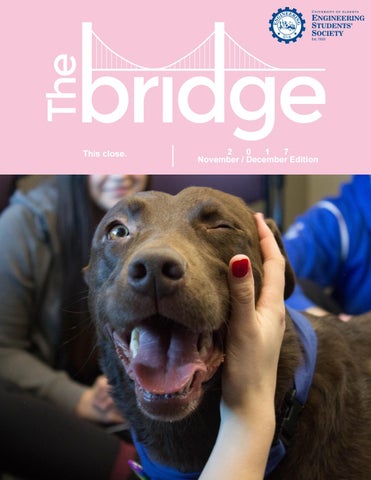
This close.
2 0 1 7 November / December Edition
The Bridge
November/December 2017
CONTENTS FEATURES Ask Stacey: Engineering Employment Centre (EEC)
3
Interview With a Professor: Dr. Hyun-Joong Chung
5
Interview With ZeroPlane
8
CAMPUS NEWS 2017 Glow Party
10
Bridge Builder Conference
11
WESST AGMR October 2017 in Victoria, BC
12
Delegates on Diversity
13
ASTM Symposium Commemorating 100 Years of E04 Development of Metallographic Standards
17
Trust me, I’m an engineer, and I compete: UAEC
18
Wellness Week
21
So ESS, What’s Happening? #3
22
DIVERSIONS Crossword Sudoku Comics Memes Corner
23 24 26 27
!2
AVP Publications Solbee Seo Jr. Editors Abby Paul Aishwarya Venkitachalam Derek Shultz Krizelle Mendoza Marianne Rosal Megan Rowbottom
The Bridge
November/December 2017
Ask Stacey: Engineering Employment Centre by Megan Rowbottom This month, The Bridge has paired up with Stacey Sayler from the Engineering Employment Centre to answer your pressing questions about resumes, interviews, and more! Q: How formal do we need to dress for the interviews? (2nd year Electrical/ Computer Engineering Student) A: Whether we like it or not, first impressions count. In a survey conducted by College Atlas, out of 2000+ hiring managers, 33% claimed to know whether or not they would hire a candidate within the first 90 seconds. Their research showed that 55% of a first impression is formed by how you dress and walk through the door (remember when you’re mom scolded you to stand up straight? This is why!); 38% is attributed to the q u a l i t y o f y o u r v o i c e , g r a m m a r, confidence; and 7% is based on the words you say. The key to knowing what you should wear to an interview is to research the company and understand their culture, as sometimes business-casual attire is acceptable. However, when in doubt it’s better to be dressed too formally (a business suit) rather than too casually – CompE’s would be an exception to this. If you plan on purchasing a suit for interviews it’s best to buy one in a neutral colour like navy or dark grey.
Q: How I build a better resume? (2nd year Electrical/Computer Engineering Student) A: In my opinion, the first step is to have a career focus and to consistently strive for excellence in all that you do. It’s hard to have a competitive resume without doing things that align with your career goals and that showcase your knowledge, abilities, and values. Therefore, it’s important to invest time in activities that show you are career-minded, and that help you develop the skills and attributes employers want. For example, if you’re hoping to work in aeronautics joining a relevant student project club (Aero SAE Heavy Lift, SPEAR, Zero Plane), choosing related electives (Aerodynamics – MEC E 537),
!3
The Bridge and getting involved with industry associations (www.casi.ca) will help you have a more competitive resume. Don’t have a specific career focus yet? Hiring managers consistently tell us they want “well-rounded individuals” – so getting involved with things that interest you, giving your best effort, and tracking your accomplishments will help you create a resume that stands-out. For ideas on student, project and industry groups, check-out our Engineering Your Career: Get Involved handout.
November/December 2017 Q: I will spend all 5 co-op terms at the same company, in a very similar role. How should I present this on my resume? (3rd year Mechanical Engineering Student) A: When it comes to formatting you have several options: • If you worked on the same team, type of projects, location, etc. you can combine them all together as one position (see example);
When it comes to best practices for writing and formatting a better resume, I’d encourage you to check-out our Resume Basics and Writing Skill Statement handouts. However, a few quick tips are: • Understand a company’s hiring need and ensure alignment with it – resumes are not a one-size fits all; you will need to use keywords to make it through the screening process. • Use a combination-style resume to showcase your engineering knowledge, skills and abilities. • Unless the information is confidential, incorporate #’s, $’s and %’s to define team size, project scale, value-added, etc. • If you had a generic job title (i.e., Summer/Co-op Student), include the Department Name. • Format, proofread and edit carefully! One error can get you screened out in a competitive job market.
• If you worked on two or three distinct projects with a wide diversity of responsibilities, you could use a similar approach, but include the project name as sub-headings with 3-5 bullet points under each; or • If you worked in significantly different roles in various locations it might be best to separate them into three distinct positions, even though they were with the same company. Whichever option you use, the thing to remember is that your employment history section should make it easy for the reader to: understand the scope and complexity of what you did, and see you as a fit to the position they’re looking to fill.
!4
Look for the Google Form in your weekly EnggLink to submit your questions for the EEC - to be answered in the next edition of The Bridge!
The Bridge
November/December 2017
Interview With a Professor: Dr. Hyun-Joong Chung by Marianne Rosal Dr. Hyun-Joong Chung joined the University of Alberta’s Department of Chemical and Materials Engineering in 2013 as both an Assistant Professor and a researcher in the biomedical field. His academic journey however, has taken him from Korea Advanced Institute of Science and Technology, where he obtained his bachelor’s degree, to University of Pennsylvania, where he completed his Ph.D. studying polymer blends and nanocomposite films. Q: How did you get into materials? A: When I was choosing my major, I was drawn to applying the physics that is related to the structure of the materials, atoms and molecules, and how it is related to the functionality that these substances exhibit. And I have always been interested in the biomedical application of it. That is why I am also doing biomedical for my research. Using the materials and chemical engineering principles, I’m making new materials and new electronic devices to be used in the biomedical applications.
!5
The Bridge
November/December 2017
Q: Does that mean you will be making
Q: In developing biomedical devices
the iron man suit?
for the human body, how do you bridge
A: Well some part of it, I would say. For
the gap between advanced technology
example, wearable sensors. Those things
and user wearability?
are what we do in my research group.
A: We need to collaborate with the
Before I came to the University of Alberta,
clinicians and researchers in surgery and
we developed a technology which is like a
rehabilitation medicine. Their primary
sock, where you can put a pacer, or a
focus is on people – how to communicate
defibrillator inside, but on top of it you can
and comfort the patients. They are always
have
in contact with the patients, and so they
a
pH
sensor,
or
an
electrocardiograph.
understand patients the most. Now, our
Another device I developed with my grad
engineers’ job is to learn how to
students here we basically used
communicate with them. They have
nanochemistry to convert a sponge
different priorities [from us].
material with graphene and zinc oxide, into an electricity generator. My students
This job is half collaboration skill and half
also developed a colorimetric pH sensor
genuine interest in how to help the
for potential application in smart wound
patients and how to make the world a
dressing, a temperature-responsive smart
better place. [The engineers need to] talk
window that auto-tunes its transparency,
with [the clinicians and researchers] and
and a self-healing flexible supercapacitor
get the idea on how to improve our sensor
that works greatly at low temperatures,
design, materials, and other small details
like Edmonton’s winter.
so that the patients can feel the least amount of discomfort or reluctance to use those new technologies. And we must have our own specialty in engineering to truly innovate the product to be used by the patient.
Figure 1. 3D Multifunctional Integumentary Membranes for Spatiotemporal Cardiac Measurements and Stimulation across the Entire Epicardium (left) and on a balloon catheter (right).
!6
The Bridge
November/December 2017
Figure 2. Sponge-Templated Macroporous Graphene Network for Piezoelectric ZnO Nanogenerator
Q: Having had industry experience, what
Q: How do you work through stress?
made you choose industry, but go back
A: No matter how [hard] you try, there are
to academia?
certain things only time can do. So, be
A: If you really want to change the world,
kind to yourself. Give yourself a time. Do
then you really want to go into industry and
everything to stay physically active and to
become a CEO. I mean, who is changing
try to distract yourself from being
the world, Elon Musk or the best professor
absorbed in distress.
in academia? I would say Elon Musk. However, the industry work is always profit-
Q: What is something fun you like
driven. You have to generate monetary
about your work?
value somehow. That limits the choice of
A: It comes from students, because they
what I want to do for my own curiosity-
are less experienced and more genuine.
driven interests. You can really call me a
And mostly cheerful, but sometimes
“nerd.”
rough. I always try to sit back and remind myself when I was in their age, only then I
Q: What are three things you wish you
can understand. I wasn’t a model student
knew when you were my age/undergrad?
when I was an undergrad.
A: 1. Cherish every moment 2. Pause and indulge whenever you find something is meaningful and fulfilling (whatever it is, it doesn’t have to be study) 3. Share it with your friends
!7
"No matter how [hard] you try, there are certain things only time can do. So, be kind to yourself. Give yourself a time."
The Bridge
November/December 2017
Interview with ZeroPlane INTERVIEWEE: Tasmia Sheikh (VP Finance, a first year Science student)
by Aishwarya Venkitachalam ZeroPlane is a student group at the University of Alberta whose goal is to design and build an all-electric, full scale aircraft, an idea among the first of its kind. As the catchy name suggests, it’ll have zero emissions. No, really. You might be thinking, “that’s rocket science!”. Well, close. After just one year following its conception, the team has already achieved milestones in its mission towards sustainable aviation, says Tasmia Sheikh, a first year Science student and ZeroPlane’s VP Finance. The team consists of numerous students like her with diverse backgrounds, striving to learn an equally diverse set of skills. ZeroPlane team members stem from all walks of academia, including science, arts, computer science and engineering. The team consists of four main sub-teams: Structural, Aerodynamics, Electrical/Control Systems and Business/Marketing. When asked to describe the group in one word, Sheikh retorted with “interdisciplinary”, and judging by its achievements thus far, you should take her word for it. ZeroPlane is making a mark on our university campus, and is hopeful to extend its influence beyond the U of A in the pursuit of changing the future of aviation. Sheikh believes that the power of their mission lies in the fact that the zeroemissions aircraft industry is itself in its exordium. Currently, only a few companies such as Zunum Aero are in the business of sustainable aviation, and there is plenty of room for innovation. Which is why in 2018, the ZeroPlane team is southbound and will compete in the AIAA Design, Build, Fly competition with their first prototype. The plane will have to fly through a course with 7-14 of passengers. Only the top 100 teams from around the world are selected to participate, and the University of Alberta is the only Canadian university represented. So
"...the power of their mission lies in the fact that the zeroemissions aircraft industry is itself in its exordium. Currently, only a few companies such as Zunum Aero are in the business of sustainable aviation, and there is plenty of room for innovation."
!8
The Bridge
November/December 2017
yes, this is a huge deal. But such an ambitious goal surely doesn’t come easy. Some challenges the team has experienced include getting their design down-pat to be in line with a competition they have never taken part in, as well as getting the right registration paperwork together as a Canadian team in an American competition. But thanks to dedicated team members and efforts by Faculty Advisor Dr. Hossein Rouhani, they’re well on their way to finish their competition with flying colors. So where are they now? Is this project just a flight of imagination? Not quite. Undergraduates and PhD students are hard at work with new research initiatives, taking inspiration from designs already in existence and coming up with effective solutions to problems. As of now, the initial proposal and design have been completed, and manufacturing and procurement of parts has begun. A lot of handson work will be required for the majority of the physical components of the plane. And if all of this wasn’t impressive enough, more outreach initiatives are to come in the future, targeting undergraduates and elementary students alike. But wait! You can jump on board with this exciting project, too! Whether you have technical skills to offer, or a desire to learn, or just want to be a part of one big family (seriously, they have camping trips and team bonding sessions) with a common mission to make the aviation industry ecofriendly, you should join ZeroPlane. Find them on your social media channels and attend their meetings; they’d be happy to recruit you!
!9
The Bridge
2017 Glow Party
November/December 2017
Glow sticks. Body paint. Drink. Glow like dat. Sept 29th, 2017 @ The Ranch
!10
The Bridge
November/December 2017
Conferences: Attendance sponsored ESS fund
Bridge Builder Conference
by Travis Strochinski (5th year Civil Engineering – co-op) Having the chance to go to the 2017 Bridge Builder Conference in South bend Indiana is a trip I will never forget. Not only did I make closer connections with my fellow U of A students, but I also got the chance to meet students from Toronto and all across the United States. Making these connections seemed to come pretty easy, and after thinking about it I think it is because we all have one common goal: to end poverty and support global development. It was very inspiring to see the endless opportunities we can achieve as a collective group, and listen to the stories of those who have travelled in country and completed a bridge project. While travelling in country it is important to remember the different cultures and communication methods we will be faced with, and was a big point we touched upon during the conference. We also went over the bridge design process, and the different construction methods used in country. The bridge builder conference was an unforgettable experience, and one I am thankful to have had to opportunity to be apart of. Thank you U of A for helping fund this experience.
!11
The Bridge
November/December 2017
Conferences
Western Engineering Student Societies Team (WESST) Annual General Meeting and Retreat (AGMR) October 2017 in Victoria, BC by Solbee Seo This year 2017’s WESST Annual General Meeting & Retreat was hosted by University of Victory at Camp Jubilee October 6th to 9th. WESST is an alliance of engineering student societies across western Canada including Manitoba, Saskatchewan, Alberta, and British Columbia. AGMR is a four-day conference in a camp setting, especially designed for first year engineering students. It involves Annual General Meeting, leadership development and organization management sessions as well as teambuilding exercises., to encourage improvement in student governance and networking between schools. University of Alberta first year students along with VP External Maha Adnan attended this year’s AGMR and shared some of the highlights from the conference. “I am very thankful to have been able to attend the WESST Annual General Meeting and Retreat in October of this year. This was a really great opportunity for me as a first-year engineering student. I was able to learn lots about what engineering student societies are about and to learn about the undergrad engineering community…I had a great time at AGMAR and it was a great to meet new people, get a feel for the engineering culture and to get me thinking about how could be involved in my own ESS in the future.” – Shaye Smith “[One of the sessions “Lollipop Moments” dealt with leadership as an idea and how it applies to both the retreat and life in general. It condensed leadership into an understanding under which the right mindset in an individual has the potential to positively and greatly affect the lives of other individuals and the collective. This session helped me feel more connected to my fellow delegates, and was the perfect way to end a day of sessions!” – Aline Ljubichich “The weekend I went on this trip was arguably the best weekend of my life. I loved all the people there, and I loved how they just happened to accept me for who I was. The people who went there were all obviously having a great time, and the atmosphere was one of acceptance, smiles and happiness. Everyone was so inviting, and I had a lot of amazing new experiences with new people. I didn’t know you could become such good friends with people you had only met a few days before.” – Tyler Veldhuis
!12
The Bridge
November/December 2017
Conferences
Delegates on Diversity: Student Responses to the Conference on Diversity in Engineering by Abby Paul From November 10 to November 12, five University of Alberta engineering students travelled to McMaster University in Hamilton, Ontario to attend the Conference on Diversity of Engineering. During the conference, delegates had the opportunity to learn from industry professionals, guest speakers, and fellow students about the challenges faced by the diverse groups of people within engineering, as well as the benefits of addressing these issues to promote a diverse and inclusive community. The delegates representing the University of Alberta were Muhammad Alam, Dorsa Nahid, Meghana Valupadas, Angela Xue, and Austin Zacharko. Two of the delegates from the University of Alberta, Meghana Valupadas and Muhammad Alum, shares their experiences from the conference in the responses below:
!13
The Bridge
November/December 2017
Meghana Valupadas: The Conference on Diversity in Engineering (CDE) is an important event as it allows universities across Canada to share strategies on inclusion, equity, and diversity as it pertains to students in the STEM fields. I chose to attend the CDE as the current president of Diversity in Engineering (DivE) to learn how we can make Engineering at the University of Alberta a healthier and inclusive space of which students are proud to be a part. Many of the sessions of the conference were eye-opening and informative, but the event that I enjoyed most was ‘Inclusion and FirstYear Orientation,’ as I found it to have the most actionable take-aways. The reason why this event spoke to me was because my first year orientation experience was far from inclusive. Engineering was presented to me as a program where women are tokenized, alcohol consumption is a normalized stress reliever, and inappropriate chants are revered and celebrated. In the session that I attended, I learned that a lot of schools still uphold age-old Engineering traditions, such as Nursing/Engineering mixers, chanting, and drinking events. But to create safer and healthier experiences, the focus is shifted to celebrate engineers and nurses for being awesome people (not for their assumed hetero-normativity), the chants are revamped to be fun but not encourage alcoholism, racism, misogyny, and other issues, and drinking events are advertised alongside alternative ‘dry’ events, to offer more options to be involved in student-life. In essence, my big takeaway was that we don’t "...we don t have to completely have to completely scrap our current engineering scrap our current e n g i n e e r i n g s t u d e n t student culture to make room for culture to make room for traditionally underrepresented t r a d i t i o n a l l y underrepresented demographics such as women, demographics such as racialized students, LGBTQIA2S+ women, racialized students, and more." students, LGBTQIA2S+ students, and more. !14
The Bridge
November/December 2017
The most impactful way I believe that we can become more inclusive is through role-modeling welcoming behaviours to our incoming students. First-year students will shape student culture, and we as current students shape how first-years see themselves: whether they belong in engineering student culture, or whether they do not. Diversity, inclusivity, and equity are often thrown around as buzzwords, but engineering is a profession that involves a huge amount of teamwork, collaboration, and trust in others. With more diversity in our future engineers, greater inclusivity in their individual practices, and more equitable treatment in jobs, the more likely we are to find innovative solutions to global issues that will work for everyone.
Muhammad Alum The Conference on Diversity in Engineering (CDE) was an astonishing event that helped me develop perspectives on issues such as the gender pay gap, the lack of inclusivity as well as the lacking knowledge on privileges and mental health that are so obvious, but often ignored on a global scale. The discussions and informative sessions during the conference helped me realize how ungrateful I have been for the privileges that I have continued to receive over the years. Aspects like financial stability and growing up in a safe environment are privileges that I have taken for granted, but for millions of people around the world, these are barriers that limit them from achieving their dreams. CDE is a vital step to solving these issues; it’s an event where asking the hard questions is encouraged as well as an event that brings together a significant number of future engineers and leaders from all over Canada.
!15
The Bridge
November/December 2017
CDE included a diverse range of seminars, but the one that really got me thinking was the ‘Mental Health’ session by Jack.org. The mental health seminar was the second discussion of the event, and the discussions that were held during that hour struck close to home; having a family member who’s been affected by fluctuating mental health for a long time has motivated me to learn more about it. One of the many lessons I learned during that hour was the significance of having the mental health “talk,” which is not as widely accepted or encouraged as the sexual health “talk.” Having this conversation is vital as it helps people with mental health problems feel comfortable and accepted. Moreover, our close friends and family play a big part in this aspect as they know what we usually act like, and can point out when we’re not feeling as good or struggling. All in all, self care is the primary method of staying mentally healthy, but if things are not controllable, the people surrounding the person "All in all, self care is the primary facing these problems method of staying mentally are the next best bet as they can connect you to healthy, but if things are not help as well as show controllable, the people care and concern.
surrounding the person facing these problems are the next best bet as they can connect you to help as well as show care and concern."
Because of attending this event, I have started to realize my purpose as an engineering student and one day as a professional engineer, and it’s not just to crunch numbers all day long, but also to work towards having an engineering student society and workplace customs that promote diversity and inclusivity. I know now that we as the leaders of tomorrow are more than capable of breaking the status quo and that it’s a long road ahead for each and every one of us, but we will soon see a day where people are hired as well as promoted by organizations based solely on skills, achievements, and work ethic and not because of the colour of their skin, or gender, or the religion that they follow.
!16
The Bridge
November/December 2017
Conferences: Attendance sponsored ESS Engineering Students’ Activities Fund (ESAF)
ASTM Symposium Commemorating 100 Years of E04 Development of Metallographic Standards
by Kallie Heniuk (3rd year Materials Engineering – traditional) On November 15-16th, 2017, I was given the chance to attend my first ever conference: ASTM E04 on Metallography. As an international standards organization that focuses on many materials science and engineering related issues, this symposium focused on various subjects related to metallographic examination, evaluation and characterization of microstructure. While this is indeed a place for many industry professionals to discover new standards being set alongside cutting-edge research advances, the recent addition of a student presentation competition opened up the event to a greater proportion of the next generation. It is a common perception that conferences are events to be undertaken only at the graduate level and beyond, but as an undergraduate I want to state that this is not the case. Not only did ASTM members appreciate my interests, but also they were eager to offer advice and suggestions to further my success. This came along with the usual benefit of developing my personal networking skills, while also setting up the foundations of my professional reputation in the real world. Most importantly, I made friends with like-minded individuals with a common goal for making the world a better place, regardless of the borders between them. I was also able to establish a positive representation of the Faculty of Engineering by being the farthest traveled student presenter – the only Canadian student – while demonstrating my strong commitment to the field. Metallography is crucial to the career of a materials engineer and this conference truly allowed me to witness innovations and applications of the same principles I am being taught. My presence at the ASTM E04 symposium was largely possible due to sponsorship by the U of A Engineering Student’s Society, which accounted a generous portion of my travel expenses. Thanks to the Engineering Student’s Society, I was able to have the experience of a life time and develop my public speaking skills.
!17
The Bridge
November/December 2017
Trust me, I’m an engineer, and I compete: University of Alberta Engineering Competition (UAEC) by Solbee Seo UAEC, annually-organized by ESS, was held on October 29th, 2017, and University of Engineering students from various disciplines and years competed to show the true spirit of engineering – creativity, nerdiness, metal agility, and competitiveness. The competition was comprised of eight design and presentation events: Programming, Senior Design, Junior Design, Impromptu Debate, Consulting, Innovative Design, Reengineering, and Engineering Communications. This year’s winners are: • Programming: Kyle Hennig and Jacob Reckhard • Senior Design: Nigel Rodriguez, Harry Singh, Carson Iwaniuk, and Rahul Ravin • Junior Design: Ibrahim Aly, Danish Dua, George Felobes, and Janukan Sivajean • Impromptu Debate: Sarthak Dhingra and Yugant Manchanda !18
The Bridge • Consulting: Meghan Farnell, Annika Kamminga, Natalie Arnold, and Aishwarya Venkitachalam • Innovative Design: Pengjie Hu and Andy Wong • Re-Engineering: Josh Goselwitz and Kyle Handfield • Engineering Communications: Kabir Nadkarni and Natasha Pye Winners get the opportunity to participate in the Western Engineering Competition (WEC) where they will compete against teams from other schools for spots in the Canadian Engineering Competition (CEC). “I have always been interested in design. The ability of engineers to create, something from just a concept idea is amazing. I have done UAEC in the past and have always enjoyed myself, so I decided to participate one more time before graduation.“ – Senior Design winner, Nigel (5th year Mechanical Engineering – Biomedical option, math minor) “UAEC is a chance to put your engineering knowledge and skills to the test in an intense one-day competition. Whether you are more interested in the technical aspects of engineering or the business aspects, or fall somewhere in between, there is a competition category for you. The best part is, if you win, you have the opportunity to attend WEC and perhaps CEC.” – Senior Design winner, Rahul (5th year Mechanical Engineering)
!19
November/December 2017
The Bridge
November/December 2017
“The best part of the competition was the time pressure of planning, designing, and then building a prototype for a foldable shelter to protect a spaceship from asteroids in space. It was like origami but with wooden sticks.” – Junior Design winner, George (2nd year Mechanical Biomedical Engineering) “I've always enjoyed programming competitions, especially group ones. It's a lot of fun to spend a couple hours on a weekend programming with a friend, and working on overcoming challenges.” – Programming winner, Jacob (2nd year Computer Engineering – software specialization) “I'm a first year engineering student, so I don't have a discipline yet. My main motivation for participating in UAEC was to gain more hands-on experience with solving engineering problems relevant to a favourite hobby of mine, software development. Additionally, I wanted the chance to meet other students in my faculty through friendly competition, which I believe was a major success of the competition. I would definitely recommend anyone interested in applying their theoretical engineering knowledge to real-world problems join UAEC next year, and I hope to sign up again myself.” – Programming winner, Kyle (1st year Engineering) “The best part of the competition for us was seeing the other team's presentations. Given the topic was very broad, it was interesting to see what other approaches the other teams had taken to solve the problem.” – Consulting winner, Annika (3rd year Mechanical Engineering)
!20
The Bridge
November/December 2017
Wellness Week by Solbee Seo As engineering students with heavy course load and challenging course material on top of extracurricular activities, we always joke about how engineering program drives us crazy, how little life we have, and how tired, hungry, and stressed we are. But, at the same time, we all know how unfunny all those situations are: not being able to focus, breakdowns, being sick during exams, panicking before major assignments/projects/ exams, and so many more. The Faculty of Engineering and ESS’s Services team have been working in cooperation to help students to learn how to deal with stress and to relieve stress, and to encourage students to take care of their mental and physical health. From November 27th to December 1st, 2017 Engineering Wellness Week offered engineering students: workshops on various stress coping methods, yoga, free tea, Take a Break, paint night, and relaxation with furry friends.
WELLNESS TIPS 1. Don’t sit on chair all day. Try to incorporate some forms of active physical activities, like walking or going up and down staircase, into your daily life. 2. We all have tried donair- or fries-only meal plans. Temporary happiness and convenience due to fast food goes away fast, once you start feeling bloated. Try to eat healthily. 3. Stay hydrated. Water fountains are literally everywhere. 4. Spend some time with your friends. 5. Avoid pulling all-nighters and get stable sleeping schedule. 6. It might feel bad when you abandon all your assignments and responsibilities to rest for a bit. Don’t. Your mental and physical health come before everything else. Just take a big breath and take a break.
!21
The Bridge
November/December 2017
So ESS, What’s Happening? #3 October & November 2017 Board of Directors Meeting Summary by Solbee Seo
ESS 2018-2019 President and Internal Elections Results - Rafael Rigon for President and Debosreee Mukherjee and Mandy Lim for VP Internal Progress in increasing FAMF - Town Hall on October 17th - Still aiming for $15-20 per semester per person from 2018/2019 - Proposal submission on Nov. 21st 2017 - This year 2017/2018 FAMF being audited by external source (expected to be done by mid December). 2017/2018 Yearbook sale for only $30 PD/Networking events - Career fair - Partnering with UAlberta Job Shadow Program for the Winter semester - Next Level Talks on Oct. 10th, Nov. 22nd, and Nov. 28th Engineering Undergraduate Equipment Fund (partially from semester fee) - Approximately $200 000 available to upgrade undergraduate labs - Trying to move funds outside of the faculty’s bank account Conferences - AGMR held by Western Engineering Student Societies Team in October - Conference on Diversity in Engineering in November - Congress held by Canadian Federation of Engineering Students (CFES) happening soon (Jan. 1st to 8th) Engineering Student Groups Fund (from faculty fundraising and other sponsorship channels) - Soon will distribute ~ $100 000 amongst 10 engineering student groups during Dec. and Feb. meeting ESS policy manual changes (not yet published) Rigorous fixes around phrases regarding funds like FAMF, ESAF (fund for individuals), and ESPF (fund only for project groups)
!22
The Bridge
Crossword by Krizelle Mendoza
!23
November/December 2017
The Bridge
Sudoku by Krizelle Mendoza
!24
November/December 2017
The Bridge
Crossword and Sudoku answers 
!25
November/December 2017
The Bridge
Comics by Derek Shultz
!26
November/December 2017
The Bridge
Memes Corner by Krizelle Mendoza
!27
November/December 2017
The Bridge
facebook.com/UAlbertaESS
@essualberta @UAlbertaESS bucklingESS
Join
The
Bridge
Are
you
artsy?
Are
you
a
crossword
ninja?
Are
you
a
pro
collector?
Do
you
Are
like
you
talking
talented
Do
you
Be
engineering
Be
you.
meme
give
at
advise
to
people?
reading to
students
the
people who
can
avp.publication@ualberta.ca
future?
all
the
time?
write/read.
!28
November/December 2017