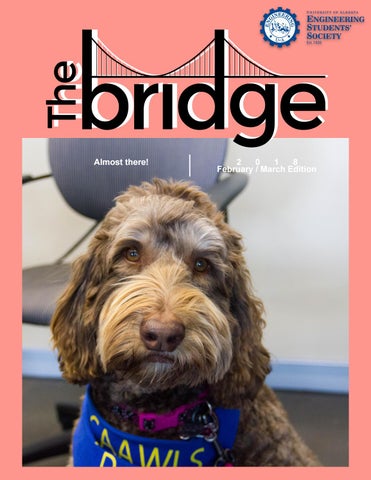
Almost there!
2 0 1 8 February / March Edition
The Bridge
February/March 2018
CONTENTS FEATURES Ask Stacey: Engineering Employment Centre (EEC)
3
Opportunities for Aerospace and You: Experience at Canadian Aeronautics and Space Institute (CASI)
8
How can we tell new engineering students what they ned to know to be successful in engineering?
9
CAMPUS NEWS Q & A with Execs
11
ESS Candidate Forum
13
Interview with a Professor: Dr. Patricio Mendez
14
DIVERSIONS Crossword Sudoku Comics Memes Corner
17 18 19 19
!2
AVP Publications Solbee Seo Marianne Rosal Jr. Editors Abby Paul Aishwarya Venkitachalam Derek Shultz Krizelle Mendoza Marianne Rosal Megan Rowbottom
The Bridge
February/March 2018
Ask Stacey: Engineering Employment Centre by Megan Rowbottom The Bridge has paired up with Stacey Sayler from the Engineering Employment Centre to answer your pressing questions about resumes, interviews, and more!
Question: How can I make my resume more relevant to field positions if I only have office experience or vice versa?
Answer: When applying to a job that you
don’t have directly related experience,
• What engineering skills and knowledge
it’s important that you identify and
are required to be able to get the work
emphasize your relevant engineering
done?
knowledge, transferable skills,
• What attributes/characteristics are
personal attributes and experiences
required to excel in the role?
that will enable you to get the work done.
• Which of my courses will I most likely
use on this job if I’m hired?
I’d recommend using a combination-
• How and why do I fit with the role and
style resume as it allows you to draw
company culture?
the hiring manager’s attention to your
• Why am I the best candidate and why
strengths versus what you don’t have.
do I want to work for this company?
The EEC’s Resume Basics for Traditional
Students & New Grads handout provides
Once you answer these questions
a sample layout of a combination-style
identify whether it’s your education, prior
resume, and identifies additional best
experience, or extracurricular activities
practices.
that best showcase them – and ensure
To help you identify what information and
the appropriate sections of your resume
details to include on your resume, when
reflect them.
looking at a job posting, ask yourself:
!3
The Bridge
February/March 2018
Using the example of a field
summary section and cover letter for
engineering role, in general, it could be
each opportunity.
important to emphasize: trouble-shooting
/ analytical experience, communication,
If applying for a design or project
teamwork, knowledge of and/or
engineering role be sure to leverage
experience with equipment and tools,
your capstone project experience, and to
industry knowledge, mechanical
communicate your knowledge and
aptitude, safety (including a CSTS
application of any relevant design codes,
Certificate and First Aid training),
CAD software, etc. Your capstone project
familiarity with construction processes
can be noted in your education section
and stakeholder roles, and driver’s
as it’s a requirement of your degree. Or, if
license and clean abstract.
you have more than one design project to showcase, you may want to consider
Attributes that would be helpful to
having a separate “Design Projects”
mention in your cover letter are: critical
section.
thinking, problem-solving skills, initiative,
attention to detail, accuracy, resilience,
If you’re just starting your degree be sure
work ethic / commitment to getting the
to spend time exploring career path
job done, ability to handle stress / remain
options and learning what employers’
calm and level-headed in stressful
look for when hiring the type(s) of role(s)
situations, willingness to work outside in
you’re most interested in after
all types of weather, and strong
graduation. This will give you an idea of
interpersonal and conflict resolution
the types of activities and skills you
skills. Also, to help them see you as a
should focus on developing during your
“fit”, consider identifying any of your
degree program, and will help you
hobbies that show you’re comfortable
choose electives, extracurricular
being out-of-doors and are a team
activities, etc. that will best align with
player. Of course, the specific
employers’ hiring needs. Getting
requirements for a field engineering
involved with a project club
position will vary by discipline and the
(AlbertaSat, EcoCar, Formula-SAE, etc.)
type of role – so always be sure to
is a fantastic way to gain experience and
carefully read and customize your
develop skills that can help you and your !4
The Bridge
February/March 2018
resume stand out. For a list of
The Conference Board of Canada is
engineering club and group options,
predicting that Alberta will fully recover
check-out the EEC’s Engineering Your
from the last recession and have a 2.8%
Career: Get Involved handout.
growth pace in 2018. Overall,
employment in the Province will be much
Question: Where are the most job
improved when compared to the last
opportunities in industry for new
several years. Some of the largest
grads?
sectors in the Province employing
Answer: Globally, some of the projected
engineers, by percentage distribution of
high growth sectors include: Artificial
GDP, are: Oil & Gas and Mining (17.0%),
Intelligence / Machine Learning, Virtual
Construction (10.7%), Transportation &
Reality, Block Chain, Robotics, Crypto
Utilities (6.2%), and Manufacturing
Currency, Green Energy and Technology,
(6.3%).[2]
and Cybersecurity.
Within Alberta, Computer and Software
According to the most current census
Engineers will likely have the easiest job
data, over 7,000[1] engineering jobs were
search following graduation. The
added in Canada last year.
provincial Occupational Demand and
Geographically, almost one third of them
Supply Outlook projects labour shortages
were created in Central Canada.
in their field ranging from 222 to 1,426
However, after Toronto and Montreal,
positions each year between now and
Edmonton and Calgary were the next
2025 – meaning there will be more jobs
strongest markets for newly created
available than qualified candidates. The
engineering roles. Unfortunately, the
same report forecasts that there will also
majority of these 7,000 roles would not
be labour shortages for Civil, Mechanical,
have been for new grads. However, it’s
and Chemical engineers over the next
likely that a good portion of them would
five years, but not to the same degree.
have been filled by engineers with 3-7
The Government of Alberta recently
years of experience, thereby freeing up
proposed $43m in funding for an
entry-level opportunities for new grads.
additional 3,000 post-secondary spaces
to train workers for the technology sector.[3] In addition, they announced tax !5
The Bridge
February/March 2018
credits for digital gaming and media
prioritizes health innovation with the
companies to level the playing field with
hope of expanding Edmonton’s current
BC and Ontario and encourage
biotech and pharmaceuticals, and
businesses to set-up in our province.
medical technology and devices
Alberta already has recognized expertise
subsectors.[6]
in interactive content, high-speed
simulation, and user interface
As a rule of thumb, you’ll find the most
technologies. According to Trent Oster,
employment opportunities with
co-founder of BioWare, “The next 20
companies that are growing the fastest,
years is going to be built on these
or where the most money is being spent.
technologies”.[4]
For ideas on companies that may be
hiring check-out sources like:
Furthermore, the Government committed
• Canadian Business: Innovation, Growth
to investing up to $1b over the next eight
500, and 2017 Industry and Regional
years in new partial bitumen upgrading
rankings of fastest growth for 2017
facilities to help spur corporate
(www.canadianbusiness.com).
investment and diversify the Province’s
• Government of Alberta: Alberta Major
energy sector.[5] This investment should
Projects Map
create opportunities for engineers in
(majorprojects.ualberta.ca)
facility design, construction, and
• Top 100: Canada’s Biggest
operations, etc.
Infrastructure Projects
(top100projects.ca)
According to Edmonton Economic
• Profit Guide: Rankings and Awards for
Development, the City’s key sectors are:
Profit 500, StartUp 50 and/or Profit
Information and Communication
W100 (www.profitguide.com)
Technology, Food and Agri-Industrial,
Health and Life Science, Advanced
For specific insight into where the
Manufacturing and Logistics,
opportunities are projected to be by
Construction and Engineering, Energy,
discipline and province, check-out
and Finance, Insurance and Real Estate.
Engineers Canada’s Engineering Labour
In 2016, the City announced its
Market in Canada: Projections to 2025
“Canada’s Health City” initiative which !6
The Bridge
February/March 2018
report (https://engineerscanada.ca/sites/
media-tax-credit-technology-
default/files/Labour-Market-2015-e.pdf).
training-1.4576678. March 14, 2018.
[4] CBC News, Edmonton: Alberta offers tax
Also, if you’re interested in details about
break to digital gaming, media companies.
a specific industry or a geographic region
http://www.cbc.ca/news/canada/edmonton/
– governments (municipal, provincial and
alberta-tax-break-to-digital-gaming-media-
federal) and industry associations (local,
companies-1.4577915. March 15, 2018.
provincial, national and international)
[5] Emma Graney: “Alberta to invest $1
generally provide economic data and
billion over eight years in bitumen upgrading”
reports that can help you identify the
– Edmonton Journal, http://
trends and where the opportunities are
edmontonjournal.com/business/energy/
most likely to be.
government-releasing-proposals-todiversify-alberta-energy-sector. Feb 26,
Look for the Google Form in your
2018.
weekly EnggLink to submit your
[6] Edmonton Economic Development: http://www.eedc.ca/invest-in-edmonton/key-
questions for the EEC. They may be
sectors/ {accessed: March 16, 2018}
answered in the next edition of The Bridge!
Sources:
[1] Randstad: Best Engineering Jobs in 2018. https://www.randstad.ca/best-jobs/bestengineering-jobs/
[2] Alberta Economic and Development Trade: Highlights of the Alberta Economy 2017: http://www.albertacanada.com/files/ albertacanada/SPEH_highlightsABEconomyPresentation.pdf
[3] CBC News: Alberta government bill proposes $43M to create 3,000 tech training spaces over 5 years. http://www.cbc.ca/ news/canada/edmonton/alberta-digital-
!7
The Bridge
February/March 2018
Opportunities for Aerospace and You: Experience at Canadian Aeronautics and Space Institute (CASI) AERO’17 conference by Solbee Seo From May 16th to 18th, 2017, two undergraduate engineering students from University of Alberta attended the annual CASI conference in Toronto. The conference that year was AERO’17 with the main theme of “Canada’s North: Roles and Opportunities for Aerospace”. During the conference, participants had opportunity to attend seminars on ongoing projects within Canada and research on various topics including aircraft manufacturing technologies and materials, and to connect with industries like Bombardier, Lockheed Martin, and Pratt & Whitney Canada as well as representatives from University of Toronto. Karina Sapelnikova, a participant, said, “I found it very interesting to see a presentation from a company [Solarship] which built an electric airship prototype; they hope to use it to transport large machinery, for example mining equipment for remote sites. Bombardier also did an in-depth
presentation about the entire testing and certification process of the C-series jet.”Karina also added, “I always have been interested in this field. When I attended the conference, I was absolutely blown away by the amount of work that is going on in the field, within Canada! After attending the conference, I felt really happy that this is what I want to in my career going forward.” Motivated by the conference, Karina wanted to connect students like herself with aerospace industry to share progress and research in Canada. She then launched a student branch of CASI at University of Alberta in 2017 and held an event called Aero Day in October 2017.
Upcoming CASI’s conference is an astronautics conference ASTRO’18, held from May 15th to 17th, 2018 in Quebec City. Four University of Alberta students will be attending the conference for this year with supported by the the ESAF.
“I really want to encourage each and one of you to enrich university experiences by attending conferences, attending competitions, or find an event that you can go and learn about the industry that you are interested in.”
- Karina Sapelnikova, AERO ’17 !8
The Bridge
February/March 2018
How can we tell new engineering students what they need to know to be successful in engineering? by Raymond Matthias
brutally honest, sharing that first year is all about "personal accountability" and that "you either suffer the pain of discipline or the pain of regret". Overall, the most common theme was ‘increased workload’, and the need to efficiently manage time.
The Bridge has paired up with the Engineering Faculty's Strategic Advisor to Associate Dean to discuss ways to help students succeed in Engineering.
"Doing my best in high school put me in the top academic tier of students, while doing my best in university put me at class average", "In high school, I could get over 90% by studying a night or two before the test". "First year midterms were my biggest wake up call. I realized that I had to actually keep up with lecture material each day and study weeks ahead of an exam in order to do well". "The hardest part of the first year engineering program was having less structure than in high school. In university you have to make your own study schedule and make your own versions of 'homework' in order to succeed and really know the material". "There is nothing worse than having to learn how to study and do homework in University when the pace is much faster and the material is a lot harder".
When you think of the transition into university, what kinds of ideas come to mind? If I asked you to identify a strategy that could be shared with High School students entering the faculty, what would it be?
Over the course of the coming 2018/2019 academic year, my goal is to curate the collective wisdom of the faculty on this topic, and put it into a multimedia project that can be shared with incoming students. Would you like to contribute or participate?
To get a sense of your initial thoughts, I recently sent out a survey, entitled "What do you wish someone would have told you before first year engineering?”
Some of the responses were humorous: "It's not as fun as on TV"; others were !9
The Bridge Of course, there is no "one way" to succeed, and this conversation is probably as old as the faculty itself. As one student shared, "to a certain extent I feel like there is nothing else I could have been told, I just had to come experience it for myself". The image at the top of this article comes from a document that was drafted in 1954, and further revised in 1967 by then Associate Dean, L.E. Gads. Through a series of articles, he set out to seriously and sometimes playfully communicate some strategies for success. Although the language is somewhat dated, we could probably share his words of wisdom as-is today (Professor Gads was born in Russian Turkestan in 1907, and lived in Harbin before coming to Canada to initially work as a farm-hand near Wetaskiwin; he ultimately began his engineering studies at the U of A at the age of 28).
February/March 2018
#Feb-March Throwbacks
I think that current students, especially those currently finishing first year, are uniquely positioned as experts that 21st century high school students will see as legitimate. Would you like to lend your voice to this project? For the next stage, I'd like to focus on the question of time management--would you be willing to share a screenshot of a typical 'weekly schedule’ (i.e. google calendar or wall calendar) in your life as an engineering student?
Interested in sharing your thoughts? Send an e-mail to Raymond in the Office of the Dean raymond.matthias@ualberta.ca]
!10
The Bridge
February/March 2018
Q&A with the Execs by Krizelle Mendoza In the beginning of March, the ESS held its executive elections. We thought we’d get to know our new executive team by asking them a couple of questions. Here’s what they answered:
Andrea Schmitz (VP Academic) Favorite class: Fluid mechanics
Worst class: MATE 202!
Favorite procrastination activity: Doing ESS work
Favorite study spot: the Agriculture building
Favorite meme: Tag urself
Favorite prof: Glaucia Carvalho do Prado (the nicest person ever)
Best study tip: Use colourful pens to brighten up your day
Iryna Roever (VP External) (Answered by Andrea)
Favorite class: next question please
Worst class: Math 102
Favorite procrastination activity: chatting with my friends
Favorite study spot: ESS office
Favorite meme: What are memes?
Favorite prof: Dominic Sauvageau (3 chilis on rate my prof)
Best study tip: Don’t join the ESS
Joanna Bibangco (VP Communications) Favorite class: ENGG130
Worst class: PHYS130
Favorite procrastination activity: planning and doing photoshoots
Favorite study spot: it shall not be shared
Favorite meme: no
Favorite prof: to be determined
Best study tip: start assignments before the day its due
!11
The Bridge
February/March 2018
Tyler Veldhuist (VP Operations and Finances)
Favorite class: My favorite class so far is Math 101. Being a first year, I hope to change that in the coming years.
Worst class: In my opinion, the worst class for first year is Chem 105. But then again, I didn’t really enjoy chemistry in the first place.
Favorite procrastination activity: My favorite procrastination activity is playing video games while sitting in DICE 8th floor.
Favorite study spot: Just like many Engineers, my favorite study spot is 8th floor of DICE, however i also enjoy going up into the Education building, and the second floor of CCIS is nice after everyone has left.
Favorite prof: My favorite prof would have to be Dragos for Math 101. He is just so random sometimes, but he is also such a great teacher.
Best study tip: Since i am in first year, I still haven’t really gotten any good ideas for studying, except for memorization, you should get flash cards. And do not consider writing the flash cards as the studying! You need to actually use them!
Aline Ljubichich (VP Operations and Finances)
Favorite class: the one not abusing me at the moment, they change
Worst class: all of them
Favorite procrastination activity: crying
Favorite study spot: if I tell everyone it won’t be my favourite anymore
Favorite meme: Dragos
Favorite prof: Dragos
Best study tip: drop out
ESS Executive Candidates 2018/2019
!12
The Bridge
February/March 2018
ESS Candidate Forum By Abby Paul/Marianne Rosal This month’s excitement comes in the form of the ESS Elections. Although far less scandalous and gripping than say, U.S. Elections, the future of the University of Alberta engineering student body rests on the (somewhat) capable hands of the selected representatives.
To find out how capable these representatives are, the Engineering Student Society held a candidate forum last March 6, where candidates and their platforms are formally, politely, and verbally criticized and stripped, making these engineering students learn what most engineering programs lack— learning to have quick, witty, public speaking skills.
candidates’ qualifications and how they viewed their fellow competitors, were juxtaposed with pragmatic problems such as, "how does the ESS intend to make events more attractive to international students?" and, “What are the standards for volunteer reimbursement and responsible spending?” And finally, the most profound question, “how does [the VP Student Life] intend to make ESS Events accessible to the busy students?” Rest assured, all along the board, the candidates echoed a similar tune—that there is an increase in inclusivity, and partnering with other clubs, organizations, and even interdisciplinary associations, in order to encourage attendance to events and promote camaraderie amongst the engineering student body.
Here’s how it works. The candidates are allotted a time to introduce themselves and their platform. Then, each candidate passes through the first round of questions from the public voters themselves. Fellow candidates are then given a chance to ask their questions, followed by another round of voter questions. At this point, perhaps the faculty should consider doing oral exams, no?
In all seriousness, the questions posed during the election forum were relevant. From questions concerning the !13
The Bridge
Interview with a Professor: Dr. Patricio Mendez By Marianne Rosal
This edition, The Bridge interviews Dr. Patricio Mendez from the Department of Chemical and Materials Engineering. While having a BSc. Mechanical engineering, his passion for designing mechanical machines has led him to the materials’ engineering, eventually obtaining his PhD in that field from Massachusetts Institute of Technology. Dr. Mendez is the Director of the Canadian Centre of Welding and Joining.
What motivated you to go into engineering? Ever since I was little, I wanted to invent machines and I was very excited about the ability to make machines. To give you an example, I remember I was washing dishes for a FORMULA 2 race car team just to be there. But I didn’t care about being the driver, I wanted to design the car. Same with airplanes. Like all boys, I liked airplanes. I wanted to design them. I never cared much about being a pilot.
!14
February/March 2018
The Bridge
February/March 2018
Having a mechanical engineering
welder. I enjoy welding, and welding has
background, how did you enter the
been amazing for me and the guys in the
field of materials engineering?
lab, but what we do about welding is we are learning to design welding machines,
So I wanted to make machines and I
we are learning to design welding
started doing research working on wind
procedures. So I’m doing what I wanted
turbines. And then, the same people on
to do.
[my] team, moved to work in a steel making company. I went there to design
Can you shed some light on what is
testing machines. So I designed some
the differences on academia and
fatigue testers and some tribological
industry?
testers for machine friction. And I’m very proud one of those that I did in the year
The most important difference is that in
2000 and 1993 is still working. They have
industry, the goals are very well-defined
used it recently to test a product…So
and the path to obtain the goals are
that was a steel making company and
typically well-known. So, if you’re smart
from then, I had good connections with
and you invest effort, almost always
the people doing steel research. I got a
you’re gonna get to where you want to
fellowship to study abroad it was
get. In academics, it’s the opposite—the
connected with these people who were
goals are not so clearly defined, and the
doing steel. Now the funny thing is that
path is unknown by definition because
although my PhD is from materials
you’re learning, you’re researching, the
engineering, my approach is very much
students are learning. So that’s the most
that of a mechanical engineer because
important difference that requires a very
it’s about the heat transfer, it’s about
different type of skillset. In industry, you
quantitative, deterministic, calculations
must accomplish. You get the job done.
and an approach to designing materials
In academics, it’s how you get there
processes. And eventually, I got into
more important than what you got. Also
welding. But for example, I’m not a
in industry, you are responsible for the
!15
The Bridge
February/March 2018
product of your work. Maybe you have a
them, and they’re not perfect but why
team. But in academics, the product of
that person and not another is not so
my work is the education of future
clear. [Perhaps] there’s this excitement
engineers, at all levels: from the
about [learning about] the fundamentals
bachelors in the classes I teach to more
and why we do the things we do…If
advanced in students doing their masters
anybody wanted to follow my path, the only thing I would suggest is to follow
and PhD’s.
what they love. And then they might follow a different path. The real challenge
Do you have any advice for students
is knowing what you love. And I think
who want to follow your path?
that’s the biggest challenge.
Well you realize, that advise is imparted
"I didn’t choose my path, as much as my path chose me."
by wise people. I’m not to sure if I’m in that crowd. But I can tell you my story. I didn’t choose my path, as much as my path chose me. To give you a little bit of my story, when I finished my PhD, I found myself unemployed, because I didn’t want to go back to industry, but I thought academics were working too hard for too little a reward. So my adviser thought I wasn’t interested in academics. So I finished [my PhD], and then I realized that’s what I wanted to do. And I didn’t plan an academic path. Regardless the things I said or I thought, that’s where my heart took me. And my choice of doing a PhD was not a cost-benefit. My choice of PhD was is because...it’s the way you marry a person. It’s because you like
!16
The Bridge
Engineering Crossword
!17
February/March 2018
The Bridge
Sudoku
ANSWERS
!18
February/March 2018
The Bridge
Comics
Memes Corner
!19
February/March 2018
The Bridge
facebook.com/UAlbertaESS
@essualberta
@UAlbertaESS bucklingESS
Join
The
Bridge
Are
you
artsy?
Are
you
a
crossword
ninja?
Are
you
a
pro
collector?
Do
you
Are
like
you
meme
talking
talented
Do
you
give
Be
engineering
Be
you.
at
advise
to
people?
reading to
students
the
people who
can
future?
all
the
write/read.
!20 Email
avp.publication@ualberta.ca
time?
February/March 2018