
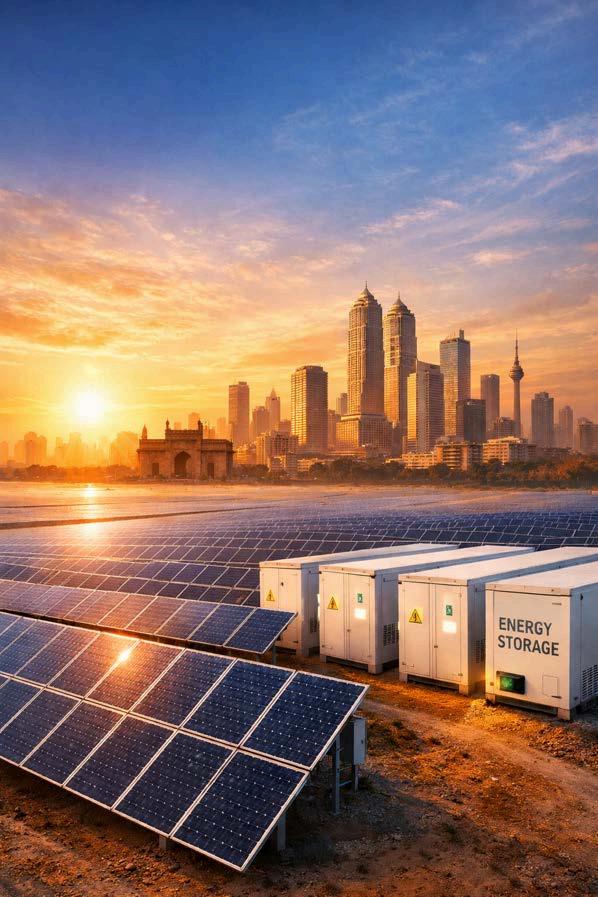









CERC Rejects TANGEDCO’s Plea For Detailed Power Drawal Data In ISTS Charges Dispute
The Central Electricity Regulatory Commission (CERC) rejected Tamil Nadu Generation and Distribution Corporation’s (TANGEDCO) request for detailed power drawal data from Inter-State GeneratingStations,inconnectionwithitsdispute overISTScharges.CERCruledthattheblock-wise data sought was not relevant to deciding issues under the CERC Sharing Regulations, 2020. TANGEDCO’s main petition on transmission chargeswillstillbeexamined.
RERC Approves New Intra-State Transmission Connectivity Framework For Rajasthan Power Grid
RajasthanElectricityRegulatoryCommissionapproveda new procedure for granting intra-state transmission connectivity after stakeholder consultations. The framework tightens timelines for projects to use granted connectivity, requires fees and bank guarantees, and strengthenstechnicalstandardsandmonitoring.Itaimsto prevent speculative capacity blocking and improve transparency and efficiency in grid connectivity for all applicants.
RERC Proposes Demand Flexibility And DSM Regulations 2026 To Tackle Rajasthan’s Duck Curve Challenge
TheRajasthanElectricityRegulatoryCommission (RERC) issued a draft of Demand Flexibility and DSM Regulations, 2026 to address solar-driven “duck curve” issues. The draft proposes shifting consumption to daylight hours and incentivizing efficiency,mandatesDISCOMstohaveDSMcells, and introduces aggregated load participation. It also includes targets and penalties to ease eveningdemandpeaksandreducecosts.
GERC Grants Final Hearing Chance In Wind-Solar Hybrid Tariff Petition In Gujarat

The Gujarat Electricity Regulatory Commission (GERC) granted one final hearing opportunity in a petition on a wind-solar hybrid tariff framework. Despite GUVNL saying the relief was already covered by existing tariff orders, GERCadjournedandaskedabsentpartiestoappearnext. Iftheyfailtoattend,theCommissionmaydecidebasedon recordswithoutfurtheradjournments.

Ministry of Environment, Forest, And Climate Change Expands GHG Emission Intensity Targets To Refineries, Petrochemicals, And Textiles Under 2025 Amendment
India’s Ministry of Environment, Forest, and Climate Change widened its GHG emission intensityreductiontargetsinthe2025amendmenttoincluderefineries,petrochemical,and textile sectors. This directs more industrial sectors to meet emission intensity standards underenvironmentalcompliance,strengtheningnationalclimateaction.
OERC Notifies Grid Support Charges Regulations 2026 For Captive Power Plants In Odisha
Odisha Electricity Regulatory Commission (OERC) notified the Grid Support Charges Regulations, 2026, defining charges applicable to captive power plants that utilise grid infrastructure. This new regulation will impact captive generators in Odisha, outlining grid supportcostresponsibilitiesandcomplianceforpowerplantsaccessingtransmissionand distributionnetworks.
RERC Approves Dual Power Supply For HT And EHT Consumers To Improve Reliability In Rajasthan
The Rajasthan Electricity Regulatory Commission (RERC)approvedaregulationallowinghigh-tension (HT) and extra-high-tension (EHT) consumers to havedualpowersupplies.Thisshiftaimstoimprove supply reliability by reducing outages and enhancing energy security for industrial and large consumersinRajasthan’selectricitysystem.

KERC Schedules Public Hearing On Draft Regulations To Reduce CrossSubsidy In Karnataka Electricity Sector
The Karnataka Electricity Regulatory Commission (KERC) set a public hearing for draft regulations targeting cross-subsidy reduction in the state’s electricity tariffs. This draft aims to lower crosssubsidy levels over time by defining reductions in cost allocations between consumer categories, aligning with equitable tariff principles for the Karnatakaelectricitymarket.
TheChhattisgarhStateElectricityRegulatoryCommission clarified operational aspects of group and virtual net metering to remove implementation ambiguities. The clarificationallowsmultipleconsumerstosharerenewable generation benefits under defined conditions, improves billing transparency, and streamlines eligibility norms. These measures are expected to accelerate rooftop and distributed renewable energy adoption across residential, commercial,andinstitutionalconsumersinthestate.
Ministry Of Power Unveils Draft National Electricity Policy 2026 To Transform Power Sector And Achieve Energy Independence
The Ministry of Power released the Draft National Electricity Policy 2026, outlining reformstostrengthenenergysecurity,expand renewable capacity, modernize grids, and improve the financial viability of DISCOMs. The policy emphasizes energy storage, demand flexibility, domestic manufacturing, and market-based mechanisms, aiming to supportIndia’sgoalofenergyindependence while ensuring an affordable, reliable, and sustainableelectricitysupplynationwide.
APTEL Upholds PSPCL Tariff Reduction, Remands Payment Structure to PSERC
The Appellate Tribunal for Electricity upheld the tariff reduction approved for Punjab State Power Corporation Limited, but remanded the payment structure issue back to the Punjab State Electricity Regulatory Commission. While affirming the tariff decision, APTEL directed PSERC to reassess payment-related aspects, ensuring regulatory consistency and fairness for stakeholders involved in the powerprocurementframework.
DERC Seventh Amendment Expands Virtual Net Metering 2025 And Cuts Solar Adoption Costs In Delhi
TheDelhiElectricityRegulatoryCommissionissuedtheSeventhAmendmenttoitsnetmetering regulations, expanding virtual net metering provisions. The amendment enables consumers without suitable rooftops to participate in solar projects and reduces overall adoption costs. It simplifies procedural requirements and broadens consumer eligibility, supporting Delhi’s renewableenergytargetsandencouraginggreaterparticipationindistributedsolargeneration.

Ministry Of Power Revises Row Compensation Guidelines For Faster Land Valuation
he Ministry of Power revised the Right of Way compensation guidelinestoacceleratelandvaluationandacquisitionfortransmission projects.Theupdatednormsaimtostandardizecompensation,reduce disputes, and speed up project execution. This move is expected to support faster expansion of transmission infrastructure critical for renewableenergyintegrationandgridreliabilityacrossstates.
CERC Recognizes GST Hike As “Change In Law,” Boosting Financial Security For Solar Projects
The Central Electricity Regulatory Commission ruled that the increase in GST on renewable energy equipment qualifiesasa“changeinlaw.”Thisrecognitionallowssolardeveloperstoseekcompensation,protectingproject economicsfromunforeseentaximpacts.Thedecisionstrengthensfinancialcertaintyforrenewableenergyprojects andreinforcesinvestorconfidenceinIndia’sregulatoryframework.
Himachal Pradesh Sets New Solar Tariffs For 2026-27, Ranging From ₹3.34 To ₹3.52 Per Unit To Boost Renewable Energy
The Himachal Pradesh Electricity Regulatory Commission approved new solar tariffs for FY 2026–27, ranging between ₹3.34and ₹3.52perunit.Thetariffsvarybyprojectsizeandcategory,aimingtopromotesolardeployment whilemaintainingcostcompetitiveness.Thedecisionsupportsthestate’srenewableenergygoalsandencourages privatesectorparticipation.

Rajasthan Approves Tariffs For 1000 MW/2000 MWh Battery Storage Project After Competitive Bidding
Rajasthanapprovedtariffsfora1,000MW/2,000MWhstandalonebatteryenergystorageprojectselectedthrough competitive bidding. The project will provide peak power support, grid balancing, and renewable integration services. This approval marks a significant step in scaling utility-scale energy storage and strengthening grid flexibilityinthestate.
Bureau Of Energy Efficiency Strengthens RE Push Through Draft Renewable Consumption Obligation Mechanism
The Bureau of Energy Efficiency released a draft Renewable Consumption Obligation framework to expand renewable energy usage beyond traditional power consumers. The mechanism proposes mandatory renewable consumptiontargetsfordesignatedentitiesandintroducescompliancepathways.Thisinitiativeaimstoaccelerate cleanenergyadoptionacrosssectorsandsupportIndia’sbroaderdecarbonizationobjectives.
HPERC Proposes New Solar Tariffs For FY 2026-27, Seeks Stakeholder Feedback
TheHimachalPradeshElectricityRegulatory CommissionproposednewsolartariffsforFY 2026–27 and invited stakeholder comments. The draft tariffs cover different solar project categoriesandcapacities,reflectingupdated costassumptions.HPERCaimstoensuretariff rationalitywhilepromotingrenewableenergy deployment aligned with the state’s power procurementrequirements.

DERC Extends Business Plan Regulations 2023 For FY 2026-27, Updates Distribution Loss And RPO Targets

The Delhi Electricity Regulatory Commission extended its Business Plan Regulations, 2023, through FY 2026–27. The extension includes revised targets for distribution losses and renewable purchase obligations. This move provides regulatory continuity for DISCOMs while reinforcing efficiency improvements, renewablecompliance,andlong-termplanning inDelhi’selectricitydistributionsector.

CERC Grants 25-Year Transmission License To POWERGRID Mandsaur Augmentation For Major Renewable Integration Project
CERC granted a 25-year transmission license to POWERGRIDMandsaurAugmentationLimitedfora key transmission project supporting renewable energy integration. The project will strengthen evacuation infrastructure in Madhya Pradesh and nearby regions, facilitating large-scale renewable capacity addition and enhancing grid reliability underIndia’sexpandingcleanenergylandscape.

India Introduces Battery Aadhaar System To Enable End-To-End Traceability And Sustainable Battery
ndia introduced a Battery Aadhaar system to digitally track batteries across their lifecycle, from manufacturing torecycling.Thesystemassignsauniqueidentitytoeach battery, improving traceability, compliance with Extended Producer Responsibility norms, and sustainable disposal.
Himachal Pradesh Unveils 2025 Grid Code To Modernize State Electricity Operations And Enhance Reliability
Himachal Pradesh notified the 2025 Grid Code to modernize power system operations and improve reliability. The code defines updated technical standards, scheduling, forecasting, grid discipline, and renewable integration requirements. It aims to enhance coordination among utilities, ensure system security, and align state grid operations with evolving renewable energyandmarket-basedelectricityframeworks.
MERC Approves MSEDCL’s Plan
To Procure 2000 MW/4000 MWh Battery Energy Storage
Capacity In Maharashtra
MERC approved MSEDCL’s proposal to procure 2,000 MW/4,000 MWh of battery energy storage capacity through competitive bidding. The procurement aims to support peak demand, grid balancing, and renewable energy integration. This approval marks a major step toward large-scale energy storage deployment in Maharashtra’s evolving power system.
Cupdated cost assumptions. This decision provides pricing certainty to developers while supporting diversified renewable energy growth and encouraging investment acrossmultiplecleanenergysegmentsinChhattisgarh.
Rebate Claim For Behind-TheMeter Solar Plants In Rajasthan
RERC rejected claims for load factor rebate by consumers using behind-the-meter solar installations. The Commission ruled that such plants do not qualify for rebates applicable to grid-connected consumption patterns. The decision clarifies tariff applicability and prevents unintended revenue loss for DISCOMs while reinforcing regulatory consistency in Rajasthan’s rooftopandcaptivesolarframework.
KSERC’s Third Amendment Removes Fuel Surcharge Ceiling To Reflect Actual Power Costs In Kerala
KSERCissueditsthirdamendment,removing the ceiling on fuel surcharge adjustments. The change allows utilities to recover actual power procurement costs more accurately. By linking tariffs to real fuel and purchase expenses, the amendment aims to improve utility cash flows while enhancing transparency in electricity pricingforKerala’sconsumers.
Invites Consultancy
For Finalizing Gujarat Electricity Grid Code Regulations 2026
GERC invited consultancy bids to assist in drafting and finalizing the Gujarat Electricity Grid Code Regulations, 2026. The consultant will support technical reviews, stakeholder consultations, and alignment with national standards. The initiative aims to update grid operation norms, strengthen system security, and support increasing renewable energy penetrationinGujarat.
GERC Invites Consultants To Finalize Grid-Interactive Battery Storage Regulations 2026 In Gujarat
GERCissuedatenderseekingconsultantsto develop the Grid-Interactive Battery Energy Storage Regulations, 2026. The assignment includes defining operational, technical, and commercial frameworks for storage systems. ThemovereflectsGujarat’sfocusonintegrating battery storage into grid operations to support renewable energy management and system flexibility.
CSERC Clarifies Wheeling, Distribution Losses, And DSM Charges For Open Access Consumers In Chhattisgarh
CSERC clarified the applicability of wheeling charges, distribution losses, and deviation settlementmechanismchargesforopenaccess consumers. The clarification addresses billing methodology and responsibilities of stakeholders, reducing disputes. It aims to improve transparency and consistency in open access operations, supporting competitive powerprocurementinChhattisgarh.
Unveils Guidelines For Secure And Centralized Monitoring Of Rooftop Solar Under PM Surya Ghar
MNREreleasedguidelinesforsecure, centralized monitoring of rooftop solar systems under the PM Surya Ghar scheme. The framework enables realtime data tracking, cybersecurity safeguards, & performance monitoring. These measures aim to improve system reliability, transparency, & accountability whilesupportinglarge-scaledeployment ofresidentialrooftopsolaracrossIndia.

TheMinistryofPowerissueddraftrules introducing flexibility in captive power arrangements. The proposal eases ownership and consumption norms, enabling renewable-based captive projects to scale efficiently. The draft aims to reduce compliance barriers, promote clean energy adoption by industries, and enhance operational flexibility while safeguarding grid and regulatoryinterests.
CERC Draft Regulations 2025 Pave The Way For Integrated Energy Storage In India’s Power Sector
CERC released Draft Regulations 2025 to facilitate integrated energy storage deployment acrossgeneration,transmission,anddistribution segments.Thedraftdefinesparticipationmodels, costrecoverymechanisms,andoperationalroles for storage assets. These regulations aim to supportrenewableintegration,gridstability,and market development in India’s evolving power sector.
CERC Allows Removal Of Former Power Buyers From Solar Change In
CERC allowed the removal of former power purchasers from a solar change-in-law dispute, noting they no longer had contractual obligations. The decision streamlines adjudication by limiting proceedings to relevant parties, reducing legal complexity, and ensuring faster resolution of compensation claims related to regulatory or tax changes affecting solar projects.

The Andhra Pradesh Electricity Regulatory Commission (APERC) has instructed all state distribution companies (DISCOMs) to begin monthly energy settlement for rooftop solar prosumers, replacing annual or seasonal settlement. The move aims to improve billing transparency and incentivize rooftop solar adoption by allowing prosumers to settle energy generation and consumption on a monthly basis, aligning billing with actual generation patterns and reducing financial uncertainty. This directive strengthens rooftop solar integration into the grid and could boost investment in decentralized clean energy across Andhra Pradesh by making prosumer economicsmorepredictableandfair.

"Monthly settlement for rooftop solar prosumers not only improves transparency but also strengthens grid integration, setting a practical model for sustainable energy governance in the state."
Battery-Backed Wind-
iharisadvancingatendertoprocure
190 MW of hybrid power combining wind,solar,andbatterystoragetobolster peak supply and grid reliability. The procurement is designed to provide dispatchable renewable power even during non-solar hours, reducing dependence on fossil fuels for peak demand.Thetariffforthisassuredpower
reflecting the value of storage-backed, reliable renewable delivery. A trading 0.07perkWhwillalsobepaid to SECI for facilitating arrangements between the generator and Bihar State
heCentralElectricityRegulatoryCommission (CERC)hasformallyadoptedtariffsdiscovered for 2,100 MW of firm and dispatchable renewableenergywithenergystoragethrough a competitive bidding process led by NHPC Limited. The order confirms tariff rates (approximately ₹4.37–₹4.38 per kWh) and approvesatradingmarginof ₹0.07perkWhfor NHPC as intermediary procurer. This move supportstheprocurementofrenewablepower that can meet peak demand by pairing generation with storage, enhancing grid stability, and advancing India’s transition to a dependablecleanenergysupply.
TNERC Approves 1500 MW RTC Power Procurement To Address Tamil Nadu’s Rising Energy Deficit
The Tamil Nadu Electricity Regulatory Commission(TNERC)approvedamedium-term procurement of 1,500 MW round-the-clock (RTC) power by Tamil Nadu Power Distribution Corporation Ltd (TNPDCL) for five years, combining an existing 800 MW requirement withanadditional700MW.Thisapprovalaims to tackle projected supply shortfalls due to rising demand and intermittent renewable generation. The RTC procurement under a Finance, Own, and Operate model is expected to provide stable, cost-effective power at around ₹5.50 per unit, reducing reliance on expensive short-term market purchases during shortages.
TheCentralElectricityRegulatoryCommission (CERC) granted change-in-law (CIL) relief to a 320MWsolarprojectinRajasthan,recognizing increasedcostsduetotheGoodsandServices Tax (GST) hike and Great Indian Bustard (GIB) protective measures. This relief adjusts the project’s tariff or compensation framework to account for additional mandated costs outside the developer’s control. By recognizing GST increases and environmental compliance expenses as valid CIL events, CERC aims to protect project viability, investor confidence, andlong-termrenewableenergycommitments, especially where regulatory or policy changes alterprojecteconomics.
The Central Electricity Regulatory Commission (CERC) dismissed TANGEDCO’s petition seekingdetailedpowerdrawaldatainitsdisputeoverInter-StateTransmissionSystem(ISTS) charges.TANGEDCOhadarguedthatdiscrepanciesindataimpactedchargecalculations,but CERCheldthattheexistingdataandchargeframeworkweresufficientandrejectedtheneed to mandate granular drawal details. The order upholds current ISTS charge procedures, reinforcing regulatory clarity and consistency in how transmission costs are allocated and calculatedamongutilitieswithoutrequiringexpandeddatadisclosure.
TadisputebetweenUltraDenimLtdandDakshinGujaratVijCo.Ltdconcerninga2MWcaptive solar project that injected power into the grid without formal wheeling or commissioning approval. Both parties agreed that a wheeling agreement would be executed going forward, withUltraDenimwithdrawingitslegalpetition.GERCdirectedDGVCLtosigntheagreement quickly so the commissioning certificate can be issued, enabling the project to achieve regulatorycompliancewhileformalizingsolargridaccess.
India’s Energy Surge: From Shortages to Surplus by 2025
In2025,India’spowersectormadeahistoricshift from chronic energy shortages to a robust surplus, as highlighted in the Ministry of Power’s Year-End Review. Peak electricity demand reached 242.49 GW while shortages dropped to just 0.03%, a dramatic improvement from a decade earlier. Non-fossil fuel capacity exceeded 50% of total installed capacity by October, five years ahead of target, driven mainly by renewables, especially solar. Rural electricity availabilityimprovedmarkedly,withaveragedaily supply rising to over 22 hours. National grid expansion and policy reforms underpinned stronger reliability, supporting economic activity andrisingper-capitaconsumption.
India’s renewable generation in 2025 reached 297,802.56MU,markingasignificantcontribution to the country’s electricity supply and reflecting rapid clean energy growth. Solar power led with 164,542.97 MU, propelled by large solar parks, rooftop systems, and open-access projects supported by government incentives and private investments.Windenergyadded104,006.54MU, highlightingitsongoingrole.Together,solarand wind accounted for over 85% of renewable generation, with other renewables like biomass, bagasse, and small hydro adding diversity. December solar output rose sharply, reinforcing renewablesasacorepillarofIndia’senergymix.
Rajasthan Leads With 27% Of India’s Solar PV Capacity In 2025, Gujarat At 18.8%, Strong 2026 Growth Forecast
By the end of 2025, India’s total installed solar PV capacity reached 135,809.94 MW, with Rajasthan leading at 36,658.35 MW — 27% of the national total — followed by Gujarat at 25,529.4MW(18.8%).Together,thetopthreestates,includingMaharashtra,contributednearly 60% of India’s solar capacity. Around 38 GW of new solar capacity was added in 2025, up nearly 39% year-on-year. India also expanded domestic solar module manufacturing capacity beyond 122 GW. Analysts forecast continued strong growth in 2026, driven by utility-scale projectsandsupportivepolicymeasures.
In 2025, India achieved an unprecedented solar capacity boom, adding 38 GW of new capacity, underscoring the sector’s role in driving renewable growth. This expansion was supported by favorable government policies, strong investor confidence, and accelerated project execution across utility, rooftop, and hybrid installations. Domestic solar PV module manufacturing capacity reached about 122 GW, strengthening self-reliance and reducing import dependence. By year-end, solar capacity accounted for over a quarter of the nation’s total installed power, contributing substantially to energy security, jobs, and rural electrification.Thesurgehighlightssolar’scentralroleinIndia’scleanenergytransition.
India’s renewable power transition is increasingly hinging on advanced energy storage technologies, according to the Central Electricity Authority (CEA). As solar and wind penetration rises, storage’s role has expanded from traditional pumped hydro to include batteries for grid support, frequency regulation, and energy arbitrage. Lithium-ion systems dominate current deployments, offering modular scalability, while emerging sodium-ion batteries promise cost and sustainability advantages. With storage critical for balancing intermittent renewables and stabilizing supply, a mix of technologies — including hydrogen andpumpedhydro—willbeessentialtosupportIndia’scleanenergygrowth.
16.6 Million In 2024 Amid Shifting Dynamics—IRENA Report
Globalrenewableenergyemploymentreachedarecord16.6millionjobsin2024,butgrowth slowedwithonlya2.3%increasecomparedto2023,accordingtothelatestIRENA-ILOreview. Solar photovoltaics remained the largest employer with about 7.3 million jobs, followed by biofuels,hydropower,andwind.Chinadominatedjobcreation,accountingforroughly44-58% of roles, while employment in countries like India and the United States rose modestly. The reporthighlightsunevengrowthacrossregionsandunderscorestheneedforinclusivepolicies tosupportworkforcedevelopmentasrenewabledeploymentacceleratesglobally.
India’s Solar Capacity Crosses 140 GW, Drives Renewable Energy Growth into 2026
India’s renewable energy sector maintained strong momentum in 2025–26, with total installed solar photovoltaic capacityreaching140,601.75MWbyJanuary2026.Solarnowaccountsfortwo-thirdsofthecountry’srenewablemix, excludinglargehydro.Theyear2025sawnearly37.95GWinnewsolaradditions,oneofthehighestever,withanother 4.79GWaddedinJanuary2026.Windandhybridprojectsalsogrew,pushingtotalnon-largehydrorenewablecapacity to around 212 GW. Ground-mount, rooftop, and off-grid solar installations all expanded. Government policies like PLI incentivesandtaxreformssupportedprojectexecutionanddomesticmanufacturing.

AcrossmanyAfricannations,utilitiesaredeployingsmartmetersandTime-of-Use(TOU)tariffs,whereelectricityprices varythroughouttheday,raisingcostsduringpeakdemand.Traditionalsolaraloneisn’tenoughunderthesesystems,so hybridsolarsolutions—combiningPVwithbatterystorageandintelligentinverters—arebecomingkey.Thesesystems let users store excess daytime solar power and discharge it during peak tariff periods, helping reduce expensive grid dependence.Theycanalsosmoothdemandspikesrecordedbysmartmeters.Incommercialsettings,hybridsystems cuthighpeakchargesandlowerrelianceondieselgenerators,improvingreliabilityandcost-effectiveness.
SouthAsia,hometonearlyaquarteroftheworld’spopulation, faces steep energy demand growth alongside heavy reliance on fossilfuelsandimports.About80%ofprimaryenergyproduction comes from fossil sources, and coal accounts for around 67 % of electricity generation, especially in India. Renewable sources like solar and wind are expanding but remain a small share of the overall energy mix. Ambitious renewable targets exist, yet financial, policy, and infrastructure challenges hinder progress. High public debt, weak utilities, subsidies, and import vulnerabilities further complicate the region’s energy transition towardcleanersystems.



According to the IEA’s Electricity 2026 report, global electricitydemandisexpectedtogrowbyover3.5%annually through2030.Renewableenergypairedwithnuclearpower isprojectedtosupply50%ofglobalelectricitybytheendof thedecade,upfrom42%today.Solargrowthispivotal,with renewables on track to surpass coal generation. Nuclear output also hit record levels. However, expanding grid infrastructure and enhancing flexibility are critical to integrating this capacity. Although natural gas use may increase in some regions, coal’s role is expected to decline, keepingCO₂ emissionsbroadlyflatthrough2030.
Hydropower, Reshaping The Global Power Grid – Rystad n2025,batteryenergystoragesystemssurpassedpumpedhydropowertobecometheworld’slargestoperationalenergystorage technology,withover250GWonline.Rapiddeployment,especiallyinChinaandtheU.S.,reflectsashifttowardstorageasacore gridcomponentthatbalancesvariablesolarandwindgeneration,offeringfastresponseandshiftingenergyfromlow-priceperiods tohighdemand.Installationsareexpectedtoexceed130GWin2026.Batteriesareincreasinglyreplacingfossilgenerationinplaces like Australia and California. Cost reductions and technological improvements extend system lifetimes, strengthening investment andgridstabilityworldwide.





Indiaiswitnessingadecisiveshiftinitscleanenergyjourneyassolarpowerandenergystorageincreasinglymove forwardtogether.Whatbeganasarapidsolarcapacityexpansionisnowevolvingintoamorebalancedandreliable hybrid energy model, where solar generation is paired with battery storage to address grid stability, peak demand, and round-the-clock power needs. This solar and storage surge is becoming central to India’s long-term energy securityandclimategoals.
Over the last decade, India has built one of the world’s largest solar markets, crossing the 70 GW installed capacity mark and continuing to add new projects at scale. However, the rapid rise of solar has also exposed structural challenges. Solar generation is concentrated during daytime hours, while electricity demand peaks in the evening. Thismismatchhasincreasedcurtailmentrisks,stressedtransmissionnetworks,andhighlightedthelimitsofasolaronlyapproach.Energystorage,particularlybatteryenergystoragesystems,isnowemergingasthemissinglink.
Policy direction has played a key role in accelerating this transition. Government tenders increasingly mandate the inclusion of storage alongside solar, especially for peak power supply and firm dispatchable renewable energy. Hybrid tenders combining solar, wind, and storage are gaining momentum, offering assured power delivery during non-solarhours.Viabilitygapfundingforbatterystorageprojectsandclearermarketsignalsforancillaryservicesare alsoimprovingprojectbankabilityandinvestorconfidence.
Fromatechnologyperspective,fallingbatterycostsarereshapingprojecteconomics.Lithium-ionbatterypriceshave declined sharply over the past decade, making large-scale storage commercially viable for grid applications. At the same time, improvements in battery efficiency, lifecycle performance, and energy density are supporting longerdurationstoragesolutions.Whilelithium-iondominatestoday,Indiaisalsoexploringalternativessuchassodium-ion batteries,flowbatteries,andpumpedhydrostoragetodiversifyitsstoragemixandreduceimportdependence.
The impact of solar and storage integration is already visible at the grid level. Storage-enabled solar plants can smooth power output, reduce ramping pressure on conventional power plants, and help manage the “duck curve” effect caused by high daytime solar generation. For distribution companies, storage offers a way to reduce peak powerprocurementcostsandimprovesupplyreliability.Forconsumers,especiallycommercialandindustrialusers, hybridsystemssupportenergycostsavingsandresilienceagainstoutages.
Domestic manufacturing is another critical dimension of India’s solar and storage surge. The production-linked incentiveschemesforsolarmodulesandadvancedchemistrycellbatteriesaimtobuildastronglocalsupplychain. Whilechallengesremainintermsofscale,rawmaterialaccess,andtechnologydepth,theseeffortsareexpectedto reduceimportdependenceandcreatelong-termindustrialcapacity.
Looking ahead, solar and storage together are set to redefine India’s power system. As electric vehicles, green hydrogen,andtheelectrificationofindustriesgrow,flexibleandreliablecleanpowerwillbeessential.Hybridenergy solutions provide that flexibility, enabling renewable energy to move from being a supplementary source to a dependable backbone of the grid. India’s solar and storage surge is not just about adding capacity, but about buildingafuture-readyenergysystemthatiscleaner,smarter,andmoreresilient.

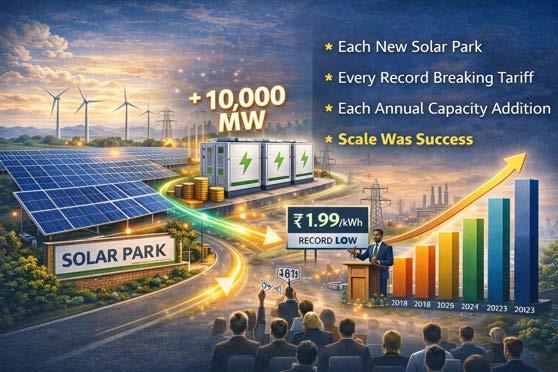
Formorethanadecade,India’srenewableenergyjourneywasmeasuredinmegawatts.Eachnewsolarpark,everyrecord-breaking tariff,andeachannualcapacityadditionreinforcedasingularnarrative:scalewassuccess.Thecountryracedtowardambitiousclean energytargets,builtsomeoftheworld’slargestsolarinstallations,andtransformeditselfintooneofthemostcompetitiverenewable marketsglobally.
Butas2026unfolds,itisincreasinglyclearthattheindustryhasenteredanewphase—onethatcannotbemeasuredinmegawatts alone.
Therealtransformationishappeninginmegawatt-hours.
AcrossGujarat,AndhraPradesh,Bihar,Rajasthan,Karnataka,MadhyaPradesh,andUttarPradesh,aclusteroflarge-scalebatteryenergy storage system (BESS) announcements is reshaping India’s renewable landscape. Standalone storage installations, hybrid solar-plusBESSbids,merchantstorageplays,andgigafactoryexpansionscollectivelysignalthatstorageisnolongersupplementarytechnology. Itisbecomingstructuralinfrastructure.
At the centre of this transition lies a simple grid reality: solar generation peaksduringtheday,butdemandoftenpeaksaftersunset.
As renewable penetration deepens in states like Gujarat and Rajasthan, midday power prices soften, curtailment risks rise, and evening ramp requirementsgrowsteeper.Thermalfleets—builtforbaseloadstability— struggle with flexibility demands. Transmission corridors face congestion duringsolarhours,yetshortagesappearduringeveningpeaks. Storageresolvesthisimbalance.
One of the clearest signals of this evolution is:
This large-scale, two-hour configuration marks KPI Green Energy’s decisive entry into utility-scale storage. The sizing is strategic. Two-hour systems are particularly suited for peak shaving,rampsupport,andcongestionmanagement—precisely thepressurepointsinGujarat’shigh-renewablegrid.
More importantly, this is not a pilot.
It reflects commercial confidence in storage as an investable infrastructureasset.
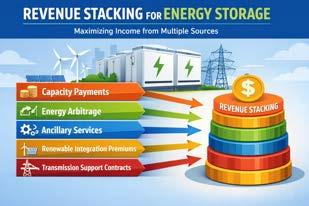
Standalone BESS is emerging as a new asset class. Developers are increasingly modelling revenue through combinations of capacity payments, time-of-day arbitrage, ancillary services participation,andgridsupportcontracts.Forindependentpower producers, storage is evolving into a parallel growth vertical ratherthananadd-on.
Equally significant is who is now leading storage procurement.
Bondada Engineering – 225 MW / 450 MWh BESS – Andhra Pradesh (Awarded by AP TRANSCO)
Theawardofthisprojectdemonstratesthattransmissionutilities areembeddingstoragedirectlywithingridplanning.Thisisnot merely about renewable integration. It is about strengthening transmission infrastructure, mitigating congestion, and enhancingreliability.
When storage becomes part of regulated transmission frameworks, its risk profile changes. Cost recovery improves bankability.Financingbecomesmorestructured.Long-termgrid integrationbecomesinstitutionalised.
That institutionalisation is even more visible in:


POWERGRID – 150 MW / 300 MWh Standalone BESS at Kalikiri Substation – Andhra Pradesh
By integrating BESS at the substation level, POWERGRID is positioning storage as core transmission infrastructure. Such systems can defer expensive line upgrades, stabilise voltage, providefrequencyregulation,andenhancecontingencyresponse.
Thismarksastructuralshift:storageismovingfromtheperipheryof renewabledeploymenttothecentreofgridarchitecture.
Eastern India is also entering the storage era with strategic intent.
India’s Largest Battery Energy Storage System –Bihar

Thisdevelopmentsignalsthatstorageisnolongerconfinedto high-solar western states. For Bihar, BESS represents grid modernisation, peak demand management, and reliability enhancement. Its importance lies not just in scale, but in geographic diversification — confirming that storage is becominganationalpriority.
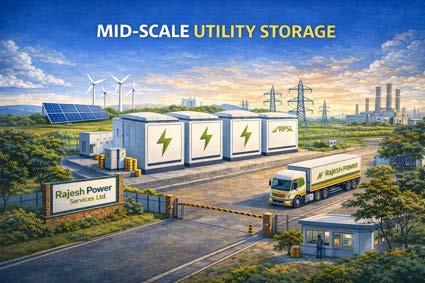
Not all projects are mega-scale, but mid-sized deployments are equally critical in deepening marketmaturity.
Power Services Limited (RPSL) – 65 MW / 130 MWh BESS – Gujarat
This project reflects how diversified energy players are stepping into storage. Mid-scale systems support distribution-level balancing, renewable smoothing, and industrial load management. These assets form the connectivefabricofadecentralisedstorageecosystem.
If standalone storage addresses grid stress, hybrid solar-plus-storage projects are rewriting procurement strategy itself.
The era of solar-only bids is steadily giving way to integrated renewable solutions. Dispatchability now commands premium value.
Pace Digitek – 250 MW Solar + 1100 MWh BESS – Pavagada, Karnataka
Pairing 250 MW of solar with 1100 MWh of storage suggests a roughlyfour-hourdischargeconfiguration—sufficienttodeliver firmeveningsupplyandcompeteinround-the-clocktenders.
Longer-durationstorageunlocksnewcontractualpossibilities.It reduces curtailment exposure, enhances grid alignment, and allows renewable assets to compete with conventional peaking resources.
Equally telling is tariff competitiveness.
ACME Solar – 220 MW Solar + BESS – Madhya Pradesh (₹2.764 per unit)
Thisbiddemonstratesthatintegratedsolar-plus-storagecanremain viable within India’s aggressively priced power market. The perception of storage as prohibitively expensive is rapidly fading. Falling battery costs, improved system optimisation, and refined revenuemodellingarecompressinghybridtariffs.
Hybridisationisnolongerexperimental.
It is becoming strategic baseline.
Another milestone in 2026 is the emergence of merchant storage.
Juniper Green Energy – 100 MWh
Merchant BESS – Rajasthan
Thisprojectrepresentsashifttowardmarket-basedrevenue optimisation. Merchant BESS relies on intraday arbitrage, peak price spreads, and ancillary service revenues rather thanlong-termcontractedofftake.
Thesignificanceliesnotinscalealone,butinsignal.
Developers are increasingly confident in the depth and liquidity of India’s power exchanges. Storage is stepping intocompetitivemarkets.

Deployment acceleration depends on supply chain resilience. India’s ambitions in storage cannot rely indefinitely on imported systems. Industrial capacity is scaling in parallel.
Ddev Plastiks – 5 GWh BESS Manufacturing Entry – India
This move reflects strategic diversification into a rapidly expanding energy segment and the convergence of industrial capability with clean energy demand.
GoodEnough Energy – 7 GWh BESS Gigafactory – Uttar Pradesh
Thecommissioningofthisgigafactorystrengthensdomesticsupplychainsand positions the company among India’s largest battery manufacturers. Domestic production reduces import dependency, mitigates currency exposure, and alignswithbroaderindustrialpolicyobjectives.
Storageisnotjustenergyinfrastructure.
It is industrial transformation.
Across these diverse projects, a new commercial architecture is emerging.
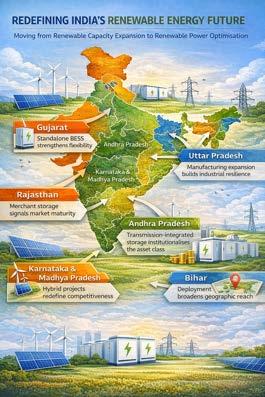
Viewed in isolation, each of these projects is noteworthy. Taken together, they represent a systemic pivot.
Standalone BESS in Gujarat and Andhra Pradesh strengthens flexibility. Transmission-integrated storage institutionalises the asset class. Hybrid projects in Karnataka and Madhya Pradesh redefine competitiveness. Merchant storage in Rajasthan signals market maturity. Manufacturing expansion in Uttar Pradesh builds industrial resilience. Deployment in Bihar broadens geographic reach.
The pattern is increasingly clear: India is moving from renewable capacityexpansiontorenewablepoweroptimisation.
The first phase of India’s solar revolution proved that megawatts couldbeaddedatscaleandatrecord-lowcost.
Thenextphasedemandscontrol—theabilitytodeliverrenewable powerpreciselywhenitisneeded,notjustwhenitisgenerated.
Beyond megawatts lies a more sophisticated metric of success: reliability,flexibility,anddispatchability.
The projects emerging across India in 2026 demonstrate that the industryunderstandsthisshift.Storageisnolongerperipheral.Itis strategic.Itisinvestable.Itisindustrialising.
Andinrewritingtherenewablepowerplaybook,Indiaisnotmerely enhancing its clean energy credentials — it is redefining the economicsofitspowersystemforthedecadeahead.
Financial institutions are adapting underwriting models to account for degradation curves, cycling frequency, and multi-stream cash flows. Bankability is strengthening, though regulatory clarity around ancillary pricing and long-term market design remains critical.
Forsolardevelopers,theimplicationsarestrategic.Pure solar projects face midday price cannibalisation and curtailment risks in high-penetration states. Hybridisation mitigates these pressures. Developers capable of integrating storage technically, financially, and operationally are likely to command stronger portfolioresilience.
INDIA’S RENEWABLE FUTURE IS NO LONGER JUST ABOUT MEGAWATTS, IT IS NOW ABOUT FLEXIBILITY, RELIABILITY, AND CONTROL.”
ndia’s solar-plus-storage market is moving from pilot projects to commercially scalable deployments, driven by falling battery costs, grid constraints, and the growing need for reliable power. As developers, investors, and consumers gain experience, clear business models are emerging—particularly around CAPEX versus OPEX structures, commercialandindustrial(C&I)adoption,andbundledenergysolutions.
Traditionally, CAPEX-based models have dominated India’s renewable energylandscape.Underthisapproach,projectownersinvestupfrontin solarandbatteryassetsandbenefitfromlong-termsavingsonelectricity costs. In the C&I segment, large manufacturers, data centers, and logistics hubs prefer CAPEX models because they offer direct control over assets and higher returns over a 15–25 year lifecycle. The addition of storage strengthens this model by enabling peak shaving, demand charge reduction, and backup power, improving overall project economics. Falling lithium-ion battery prices and improved system efficiencies are making CAPEX-funded solar-plus-storage increasingly attractive,especiallyforenergy-intensiveindustries.
However, OPEX models are gaining rapid traction, particularly among mid-sized C&I consumers. In this structure, a third-party developer owns and operates the solar-plus-storage system, while the customer pays a fixed tariff or monthly fee. This model reduces upfront capital requirements and shifts performance and maintenance risks to the service provider. For businesses focused on balance sheet efficiency, OPEX offers predictable energy costs and protection against grid outages without long-term asset ownership. As financial institutions become more comfortable underwriting hybrid solar-storage projects, OPEXmodelsareexpectedtoscalefasterinurbanandindustrialclusters.

C&I projects are currently the strongest growth driver for solarplus-storage in India. Rising grid tariffs, power quality issues, and stricter sustainability targets are pushing companies to seek reliable and clean energy solutions. Storage allows C&I users to increase solar self-consumption, avoid costly peak-hour power, and ensure business continuity. Sectors such as pharmaceuticals, IT parks, cold storage, and EV charging infrastructure are increasingly adopting behind-the-meter solar-plus-storage systems, supported by state-level incentives and open access regulations.
Bundled solutions are emerging as a key differentiator in the market. Instead of selling solar and storage as separate components, developers are offering integrated packages that combine generation, storage, energy management software, and long-term service agreements. These bundled models simplify decision-making for customers and improve bankability for lenders. Energy-as-a-service offerings, which include performance guaranteesanduptimecommitments,areparticularlyattractiveto C&Icustomersseekingreliabilityoverownership.
Fromabusinessperspective,winningmodelsinIndiabalancecost competitiveness with risk mitigation. CAPEX models work best for large, energy-intensive users with long-term planning horizons, whileOPEXandbundledsolutionsarebettersuitedforcustomers seekingflexibilityandlowupfrontexposure.Aspoliciesevolveand storage becomes integral to grid stability, solar-plus-storage business models in India are expected to mature rapidly, creating newopportunitiesacrossthevaluechain.

Investors evaluating solar and storage projects in India are increasingly focused on the bankability of these assets as the market matures and capital continues to flow into renewables. Bankability refers to the likelihood that a project will generate stable, predictable cash flows over its life, underpinned by strong technical, financial, and contractual fundamentals. For solar and storage, particularly in the Indian context, clear visibility on revenue streams, risk mitigation, credible off-takers, and robust technology choicesarecriticaldeterminantsofinvestorconfidence.
One of the foremost considerations for investors is the strength and predictability of revenue. In the Indian market, power purchase agreements (PPAs) with creditworthy counterparties are essential. Historically, concerns around the financial health of distribution companies (DISCOMs) have weighed heavily on investor sentiment. Projects with state-backed entities or those that have payment security mechanisms—such as escrow accounts, payment security funds, or letter of credit arrangements—are seen as more bankable. These mechanisms provide assurance that cash flows will not be interrupted by delayed payments, which is especially important for projects combining solarwithbatterystorage,wherethecapitalcostsarehigher.
Another key factor is the regulatory framework. Stable and transparent policy regimes at both central and state levels give investors confidence in the long-term viability of their investments. For solar projects, clarity on tariffs, customs duty, and GST treatment for equipment,andrenewableenergycertificatesisimportant.Forstoragesystems,evolving regulations around dispatch, grid services, and participation in ancillary markets create opportunitiesbutalsouncertainties.Investorslookforjurisdictionswithclearrulesonhow storage will be compensated, whether through capacity payments, energy arbitrage, or gridsupportservices,toensureadiversifiedandpredictablerevenuemix.

Technology risk is another significant aspect of bankability. Investors prefer proven photovoltaic (PV) modules and battery technologies with strong warranties and performance guarantees from reputable manufacturers. This minimizes the risk of underperformanceandexpensivereplacements.InsolarPV,thetrendtowardhigherefficiency modules and bifacial technology is attractive, but banks and funds often require conservativeyieldassessmentsandindependenttechnicalduediligence.Forstorage,the choiceofbatterychemistry,degradationprofiles,andsystemdesigndirectlyimpactsboth performanceandsafety,makingrigoroustestingandcertificationessential.
Operationalriskmanagementalsoinfluencesbankability.Investorsassessthestrengthof the engineering, procurement, and construction (EPC) contractor, as well as the operationsandmaintenance(O&M)strategy.Experiencedpartnerswithatrackrecordof delivering on time and within budget, and with robust O&M plans, reduce execution risk andenhanceconfidenceinstablelong-termreturns.
Finally, investors increasingly consider environmental, social, and governance (ESG) factors. Projects that demonstrate strong community engagement, land use compliance, and environmental stewardship tend to attract premium capital, including from global institutionalinvestors.
In summary, bankability in solar and storage projects in India hinges on secure revenue structures, clear regulatory support, tested technologies, competent execution, and solid riskmitigationframeworks.Meetingthesecriteriahelpsprojectsstandoutinacompetitive fundingenvironmentandunlockthecapitalneededtoacceleratethetransitiontoaclean energyfuture.
Indian Gigafactory 2026 Edition: The most critical infrastructure for 24/7 Green Power
In India’s varied solar irradiance zones, achieving a "Net Zero" facility requires more than just panels. It requires an integrated Power Management System (PMS). This infographic focuses on the three pillars: Generation Efficiency, Storage Longevity, and Grid Stability. In the2026landscape,intermittentpowerisaliability—yourSolar+BESSmustbe"Dispatchable."
Generation & Efficiency
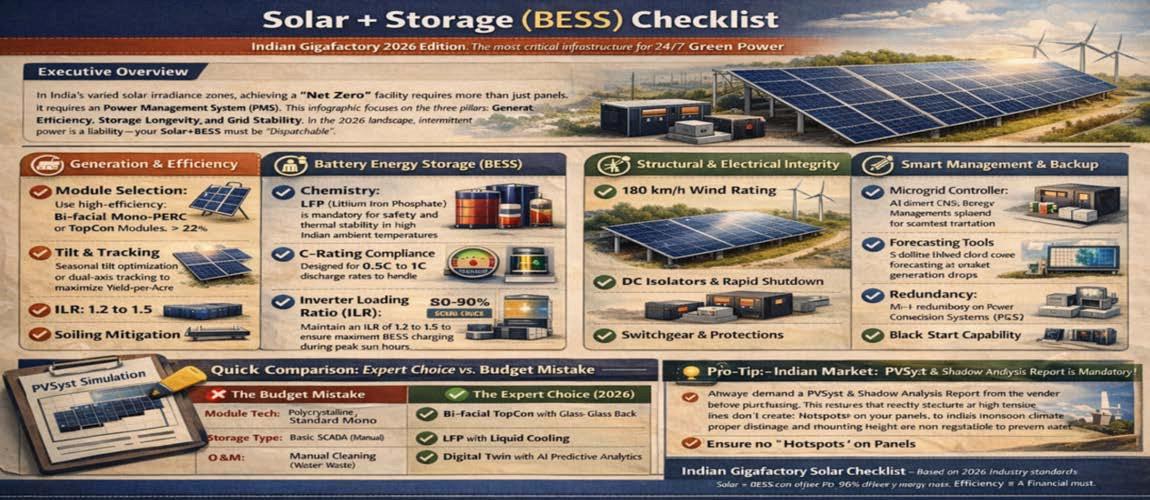
Feature
ModuleTech
StorageType
Monitoring
O&M
Polycrystalline/StandardMono
Lead-AcidorstandardNMC
BasicSCADA(ManualReporting)
ManualCleaning(WaterWaste)
Bi-facialTopConwithGlass-Glassback
LFPwithLiquidCooling
DigitalTwinwithAIPredictiveAnalytics
RoboticDryCleaning(Waterless)
Indian Gigafactory Solar Checklist :Basedon2026industrystandardsforRenewableIntegration. Solar+BESScanoffset70-90%offactoryenergycosts.Efficiencyisafinancialmust.
Disclaimer: This article is based on publicly available information. Readers are advised to verify details through official announcements or primary sources before drawing conclusions or making decisions.
Always demand a PVSyst & Shadow Analysis Report from the vendor before purchasing. This ensures that nearby structures or high-tension lines don’t create "hotspots" on your panels. In India’smonsoonclimate,properdrainage and mounting height are non-negotiable topreventwaterloggingdamage.


Energy storage, particularly battery energy storage systems, is increasingly seen asthemissinglinkinIndia’scleanenergytransition.Bystoringexcesssolarpower generatedduringthedayanddispatchingitduringeveningandnight-timepeak hours, storage helps smoothen load curves and reduces stress on the grid. This capability is especially important as thermal power plants face operational constraints and hydropower output becomes less predictable due to changing rainfallpatterns.
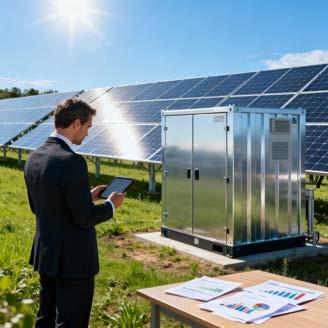
ndia’s energy demand is rising steadily, driven by economic growth, urbanisation, electrification of transport, and expanding industrial activity. At the same time, the country faces growing challenges in ensuring energy security, managing peak demand, and reducing dependence on fossil fuel imports. In this context, solar power combined with energy storage systems is emerging as a critical pillar of India’spowersectortransformation.
Solar energy has already become the backbone of India’s renewable capacity addition. With some of the lowest solar tariffs globally and strong policy support, utility-scale and rooftop solar installations continue to grow across states. However, solar generation is inherently intermittent and peaks during daytime hours, while India’s electricity demand often surges in the evening. This mismatch has highlighted the need for reliable storage solutionstobalancesupplyanddemand.
From an energy security perspective, solar and storage together reduce India’s reliance on imported coal, oil, and gas. Fossil fuel imports expose the country to global price volatility and geopolitical risks. Expanding domestic renewable generation backed by storage strengthens supply resilience and supports longterm price stability. It also aligns with India’s broader goals of reducing carbon emissionsandmeetingitsnet-zerocommitments.
Peakdemandmanagementisanotherareawheresolar-plus-storageisprovingits value.Severalstatesarewitnessingrecordpeakloadsduringsummermonthsdue to higher cooling demand. Traditionally, meeting these peaks required costly peaking power plants or short-term power purchases. Storage-enabled solar projectscannowprovideflexiblecapacityduringpeakhours,oftenatcompetitive costs. Policymakers are increasingly recognising this, as reflected in recent tendersthatmandatestoragealongsiderenewablecapacity.
Thegovernmenthastakenstepstoacceleratestoragedeploymentthroughpolicy frameworks, viability gap funding mechanisms, and inclusion of storage in renewable purchase obligations. Distribution companies are also beginning to see storage as a tool to improve grid reliability and reduce power procurement costsduringhigh-demandperiods.
As India moves towards a power system with higher renewable penetration, the role of solar and storage will become even more central. Together, they offer a practical solution to energy security concerns while enabling efficient peak demandmanagement.Theircombineddeploymentissettoplayadecisiverolein buildingaresilient,flexible,andsustainableelectricitysystemforthecountry.
"INDIA’S SOLAR-PLUS-STORAGE SHIFT MARKS THE TRANSITION FROM EXPERIMENTATION TO ECONOMICALLY DRIVEN, SCALABLE ENERGY SOLUTIONS."

India’s solar PV market has entered a decisive growth phase, crossing 135,809.94 MW of cumulative installed capacity by the end of 2025. This now accounts for over 26% of India’s total installed power capacity of around 514 GW, underlining the central role solar energy plays in the country’s power transition. The year 2025 alone recorded a strong 38.8% year-on-year growthcomparedto2024,reflectingbothpolicymomentumand marketmaturity.
Annual solar PV installations in calendar year 2025 reached approximately 37.945 GW, a sharp rise from 24.546 GW in 2024. Thismakes2025thebestyeareverforsolarinstallationsinIndia, breaking all previous records since large-scale solar deployment beganundertheNationalSolarMission(NSM)in2014.Thepace of installations highlights how solar has moved from a policydrivensectortoacorepillarofIndia’senergyinfrastructure.
A look at the yearly installation trend shows a temporary dip in 2020, when capacity additions fell to their lowest levels due to COVID-19 disruptions that brought economic activity to a near standstill. However, the post-pandemic recovery has been swift and sustained. Driven by the government’s ambitious target of 500 GW of renewable energy by 2030, with 280 GW expected from solar PV alone, the sector has regained and accelerated its growthtrajectory.
INDIA’S RECORD 38 GW SOLAR INSTALLATIONS IN 2025 MARK A DEFINING MILESTONE IN THE NATION’S CLEAN ENERGY TRANSITION.”
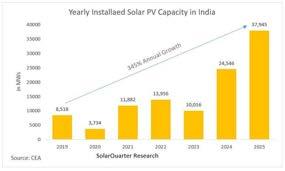
Between 2019 and 2025, annual solar installations increased from just 8.518GWto37.945GW,representingacumulativegrowthofover345%. Thisrapidexpansionhasbeensupportednotonlybydemandbutalsoby domestic manufacturing under the Atmanirbhar Bharat initiative. By December 2025, India’s installed solar PV module manufacturing capacity crossed 120 GW, as listed under the MNRE’s Approved List of ModelsandManufacturers(ALMM-l).Furthermomentumisexpectedwith the planned rollout of ALMM List-II for solar PV cells, likely from June 2026,whichwillstrengthenbackwardintegration.
Solar PV now accounts for over 65% of installed renewable capacity, excluding large hydro. On the generation side, renewable energy has recently crossed 50% of total power generation, temporarily surpassing coal.Withcontinuedpolicysupport,grid-scalestoragedevelopment,and falling technology costs, renewables—led by solar—are increasingly positioned to challenge coal not just in capacity, but also as a reliable sourceofbase-loadpowerinthecomingyears.
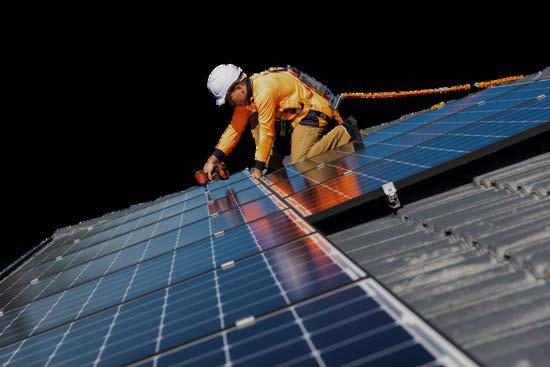

India’s power market is changing faster than ever. For many years, electricitytradingmainlydependedoncoal-basedgeneration,seasonal hydro output, and short-term demand fluctuations. Prices in the Day AheadMarket(DAM)andRealTimeMarket(RTM)movedlargelyonthe availabilityofthermalpowerandweather-drivenrenewablegeneration. Now, with the rapid rise of solar and wind capacity, the market is entering a new phase where energy storage could become the most decisivefactorinpricediscoveryandtradingstrategy.
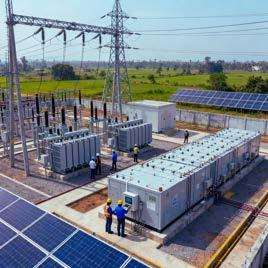
SolarpowerhasgrownatrecordspeedacrossIndia.Middaygeneration isoftenhigh,especiallyduringsunnymonths,pushingexchangeprices down.Atthesametime,eveningdemandpeakswhensolaroutputfalls, creatingpricespikes.Thisgapbetweenlowafternoonpricesandhigh eveningpricesisopeningupnewtradingopportunities.BatteryEnergy Storage Systems (BESS) are emerging as the bridge that can capture low-costpowerandreleaseitwhendemandandpricesrise.
TheevolutionofpowerexchangessuchastheIndianEnergyExchange andthePowerExchangeIndiaLimitedhasalreadyintroducedproducts liketheGreenDayAheadMarketandlonger-durationcontracts.Butas storagecapacityincreases,tradingpatternswillbecomemoredynamic. Instead of just buying or selling power based on immediate demand, market participants will increasingly think in terms of time-shifting energy. A megawatt-hour will no longer have a single value; its value willdependonwhenitisstoredandwhenitisdispatched.
For distribution companies, storage can reduce dependence on expensive peak power purchases. By charging batteries when prices are low and discharging during high-price hours, they can manage procurement costs more efficiently. For renewable energy developers, storage provides firm and dispatchable renewable energy, improving their ability to sign long-term contracts and participate in peak supply tenders.Thisisparticularlyimportantasregulatorspushforround-theclockrenewablepowerandfirmsupplyobligations.
Ancillaryservicesandgridbalancingmarketsarealsoexpectedto expand. Storage systems can respond within seconds, offering frequencycontrolandgridsupport.Asmoreintermittentrenewable energyentersthesystem,gridoperatorswillneedflexibleresources to maintain stability. Storage is well-suited for this role, and its participation in ancillary markets could create additional revenue streamsbeyondsimpleenergyarbitrage.
IN INDIA’S EVOLVING POWER MARKET, THE TRUE VALUE OF ELECTRICITY WILL NO LONGER BE DEFINED BY HOW IT IS GENERATED, BUT BY WHEN IT IS DELIVERED.”
The policy environment is gradually adapting to this shift. Governmenttendersforstandalonestorageandrenewable-plusstorage projects are increasing. Financial institutions are exploring new risk assessment models for storage-backed projects.Ascostsoflithium-ionbatteriesdeclineandalternative chemistriessuchassodium-ionandflowbatteriesadvance,the economiccaseforstorageisstrengthening.
However, challenges remain. Market rules must evolve to fully value the multiple services that storage provides. Clear frameworks for capacity payments, ancillary services compensation, and co-location with renewable plants are still developing.Thereisalsothequestionofhowstorageassetswill be treated in transmission planning and open access regulations.
The real transformation will be psychological as much as technical. Electricity trading will shift from a supply-driven mindset to a flexibility-driven one. Traders will analyze not only generationforecastsbutalsostoragestate-of-chargedata,price spreads, and grid congestion signals. The future power market mayrevolvearoundwhocanbestmanageflexibilityratherthan whocansimplyproducethecheapestkilowatt-hour.
AsIndiamovesdeeperintotheSolar&Storageera,thequestion isnolongerwhetherstoragewillreshapeelectricitytrading,but how quickly market participants can adapt. The next wave of competition may not be about generation capacity alone, but aboutmasteringtimeitselfinthepowermarket.
Hybrid solar plants are emerging as a game-changer in the renewable energy sector, combining traditional solar photovoltaic (PV) systems with energy storage solutions, advanced grid management,andartificialintelligence(AI)technologiestooptimize performance and efficiency. These plants are designed to address common challenges in solar energy generation, such as intermittency, variability in sunlight, and grid instability, while ensuringareliableandcost-effectivepowersupply.
The integration of AI in hybrid solar plants enables intelligent forecasting, predictive maintenance, and real-time optimization of energy generation and consumption. Machine learning algorithms can analyze historical weather data, solar irradiance patterns, and energy demand trends to predict output levels accurately. This allows plant operators to make informed decisions about energy storage, load management, and grid dispatch, reducing waste and increasing overall efficiency. AI-driven systems can also detect anomalies in equipment performance, such as inverter faults or panel degradation, before they cause significant downtime, minimizingoperationallosses.
Smart grid technologies complement AI by providing dynamic and responsive energy management capabilities. Hybrid solar plants connected to smart grids can adjust their output in real-time to
Energystorageplaysacrucialroleinhybridsolarplants.Batteriesor other storage technologies store excess energy generated during peak sunlight hours and release it during periods of low solar production or high demand. When integrated with AI and smart grid management, storage systems can be optimized to maximize economic returns and ensure grid stability. For instance, AI can determine the most profitable times to charge or discharge batteries basedonelectricitytariffs,renewableenergyincentives,orlocalgrid conditions,enhancingtheplant’sfinancialviability.
Several case studies worldwide demonstrate the benefits of hybrid solar plants with AI and smart grid integration. In Europe and North America, pilot projects have reported efficiency gains of up to 20% compared to conventional solar plants. These systems also contribute to decarbonization efforts by enabling higher penetration of renewable energy into the grid while reducing reliance on conventional power plants. As technology costs decrease and AI algorithms become more sophisticated, hybrid solar plants are expected to become a mainstream solution for utility-scale and commercialsolarprojects.
Hybrid solar plants integrating AI and smart grid technologies represent the future of solar energy generation. By combining intelligent forecasting, predictive maintenance, responsive grid management, and optimized energy storage, these systems deliver higher efficiency, reliability, and economic returns. They address the inherent challenges of solar power while supporting sustainable energy goals, making them a critical component of modern energy infrastructure and a key driver of the global transition toward clean


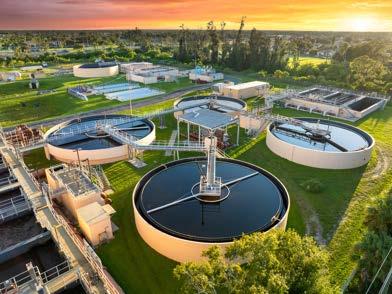
India’spowersystemischangingfasterthaneverbefore.Fordecades, electricity dispatch in the country was simple. Coal-based plants were scheduled to run steadily, hydropower filled some gaps, and demand patterns were predictable. But today, with solar and wind capacity expandingrapidlyacrossstateslikeRajasthan,Gujarat,TamilNadu,and Karnataka, the grid is facing a new reality. Renewable energy is clean and affordable, but it is also variable. This is where energy storage is quietlytransformingthewaypowerisdispatchedinsidethegrid.
Another major shift is happening in ancillary services. Earlier, frequencyregulationdependedlargelyonthermalgenerators.Now, storagesystemscaninjectorabsorbpowerinmilliseconds,helping maintain grid frequency close to 50 Hz. This improves overall systemhealthandreducesstressonconventionalplants.AsIndia’s renewablesharerisestowardthe500GWnon-fossiltargetby2030, suchfast-responsesystemswillbecomeessential.
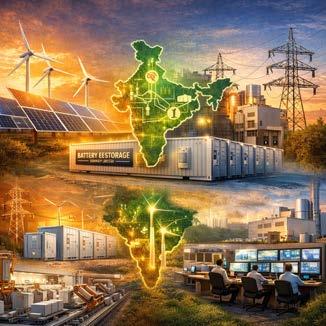
INDIA’S ENERGY TRANSITION IS NO LONGER JUST ABOUT GENERATING RENEWABLE POWER—IT IS ABOUT MASTERING THE ART OF DELIVERING IT AT THE RIGHT TIME.”
India has already crossed 212 GW of renewable capacity, with solar leading the growth. Solar generation peaks during midday, when demandisoftenmoderate.Intheevening,whenhouseholdsswitchon lights and appliances, solar output falls sharply. This mismatch creates what grid operators call the “duck curve.” Earlier, coal plants had to ramp up quickly to meet this evening's surge. However, coal units are notdesignedforfrequentramping,andthisaffectsefficiencyandcosts.
Energy storage is now stepping in as a flexible balancing tool. Battery Energy Storage Systems (BESS) can store surplus solar power during the day and discharge it within seconds during peak demand. This ability to respond instantly is changing dispatch strategy. Instead of only adjusting generation, grid operators can now schedule storage as a dispatchable resource. In simple terms, stored power can be treated almostlikeapowerplantthatturnsonexactlywhenneeded.
The policy ecosystem is also evolving. The Ministry of Power has introduced guidelines to support storage procurement, while agencies like SECI are bundling solar projects with storage to ensure firm and dispatchable renewable energy. Several states are issuing tenders for standalone BESS projects. These projects are not just about adding capacity; they are about enhancing reliability, frequency control, and gridstability.
Pumped hydro storage is also gaining attention. With longduration storage capability, it can support multi-hour peak demand and seasonal balancing. Several projects are under developmentacrosshillystates.Unlikebatteries,pumpedhydro can provide large-scale storage for extended durations, making itastrongcomplementtosolarparks.
Financial models are evolving as well. Earlier, power purchase agreements were based on energy supply alone. Now, new contracts are structured around availability during peak hours. This is redefining how value is measured in the power market. Storageisnotjustsellingunitsofelectricity;itissellingflexibility, reliability,andtime-shiftingcapability.
The most interesting transformation is invisible to consumers. When a light turns on in the evening, few realize that the electricity may have been generated hours earlier by a solar plant and stored in a battery hundreds of kilometers away. The grid is becoming smarter, more responsive, and more datadriven.
India’s transition is no longer just about adding renewable megawatts. It is about managing them intelligently. Storage is moving from being a supporting technology to becoming the backbone of modern power dispatch. As more projects come online and costs continue to fall, the real story unfolding inside the grid is not just about clean energy. It is about control, precision, and the power to deliver electricity exactly when it is neededmost.
In recent years, the integration of solar energy with storage systems has emerged as a critical solution for reducing dependence on the conventional electricitygridandpreventingblackouts.Ascountriesworldwideincreasetheir share of renewable energy, solar power has become an essential source of clean electricity. However, solar generation is inherently intermittent, as it depends on sunlight availability, which fluctuates throughout the day and is affected by seasonal and weather variations. This intermittency creates challenges for maintaining a stable and reliable power supply. Solar energy storage, typically in the form of battery systems, provides a practical and effective solution to this problem by storing excess energy generated during peak sunlight hours and releasing it when demand is high or sunlight is unavailable.
Energy storage systems enhance grid stability by balancing supply and demand. During the day, solar panels often generate more electricity than immediateconsumptionrequires.Withoutstorage,thissurplusiseitherwasted or fed into the grid, potentially causing voltage fluctuations and stress on the network. By storing this excess energy in batteries, households, commercial establishments, and utilities can use the stored power during peak demand periods,eveninghours,orevenduringgridoutages.Thisreducesthereliance on traditional grid electricity, which is often sourced from fossil fuel-based power plants, helping to cut greenhouse gas emissions and improve energy security.
Solar storage also plays a crucial role in mitigating blackouts, particularly in regions with weak or overburdened grids. Grid failures often occur when electricitydemandexceedssupply,orwhensuddenfluctuationsingeneration occur due to variable renewable sources. Battery systems act as a buffer, supplying power during these critical moments and preventing disruptions in electricity supply. In addition, advanced storage solutions can participate in demand response programs, automatically discharging power to stabilize the grid when required. This capability is increasingly important as more solar capacity is added, and traditional grids face challenges in managing the variabilityofrenewableenergy.
Theeconomicbenefitsofsolarstorageareequallysignificant.Forconsumers, investing in solar with storage reduces dependence on expensive peak-time gridelectricity,loweringelectricitybills.Forutilities,widespreaddeploymentof storage systems reduces the need for expensive infrastructure upgrades and emergency power plants to handle peak demand. Furthermore, by enabling a more decentralized energy system, storage supports the development of microgrids and off-grid solutions, particularly in rural or remote areas where grid connectivity is limited or unreliable. This not only ensures continuous powersupplybutalsofostersenergyindependenceforcommunities.
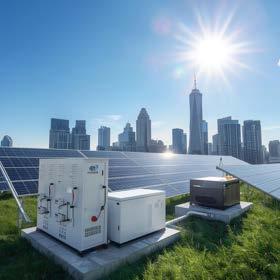
Government policies and incentives are playing an importantroleinacceleratingtheadoptionofsolar storage. Subsidies, tax benefits, and favorable regulatory frameworks encourage both residential and commercial consumers to integrate storage with their solar installations. Technological advancementsinbatteryefficiency,costreduction, and lifecycle management further strengthen the case for widespread adoption. Countries that have embraced solar storage solutions report lower blackout incidents, improved grid reliability, and higheroverallenergyresilience.
Solar storage represents a transformative advancementinmodernenergysystems.Bystoring excesssolarpoweranddeliveringitwhenneeded, it reduces dependence on the conventional grid, mitigatesblackouts,enhancesenergysecurity,and provides economic and environmental benefits. As technology continues to evolve and costs decline, the role of solar storage in creating resilient and sustainable energy systems will only grow, making it an indispensable component of the renewable energytransition.
India’s solar and energy storage sector is undergoing significant changes in 2026 as new policies and regulations encourage wider adoption of clean energy. The country is working to achieve its ambitious target of 500GW of non fossil fuel capacity by 2030,andrecentgovernmentinitiativesaredesignedtomakerenewablepowermorereliableandcost-effective.Thesemeasures are creating opportunities for both large-scale and decentralized solar projects while supporting the growth of energy storage solutions.
One major regulatory development comes from the Ministry of Power, which has mandated that future solar tenders include colocatedenergystoragesystems.Projectswillneedtointegratestoragewithatleasttwohoursofcapacityequivalentto10%ofthe solar installation. This requirement aims to reduce the impact of solar intermittency, stabilize the grid, and meet peak electricity demand.Analystsexpectthismovetodrivearound14GWofsolarand28GWhofstoragedeploymentby2030.
Inadditiontostoragemandates,thegovernmenthasextendedthewaiveroninter-statetransmissionchargesforenergystorage projects until June 2028. This policy helps lower one of the key cost barriers for battery systems linked to renewable energy, making storage deployment more attractive to developers and utilities. Industry groups are also urging the government to introducetargetedtaxreformsintheupcomingUnionBudget,expandProductionLinkedIncentiveschemesforsolarandstorage manufacturing, and rationalize GST and customs duties for storage equipment. These measures are expected to reduce project costsandsupportdomesticmanufacturing.
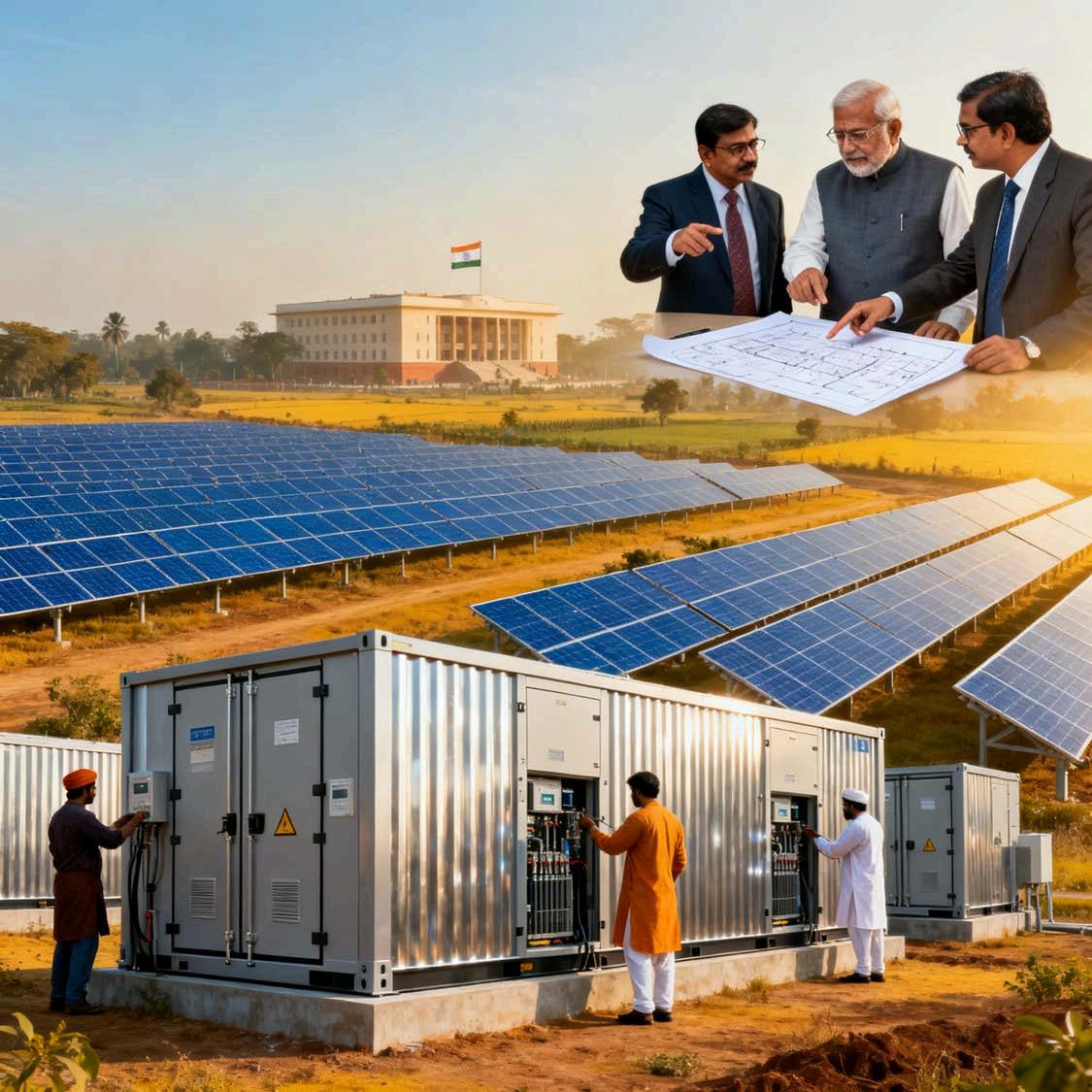
The government is also updating its Approved List of Models and Manufacturers framework. From mid-2026, solar projects will be required to use modules and cells meeting the revised ALMM criteria. This aims to ensure quality standards and boost domestic manufacturing,whilecarefultimingandexemptionrulesarebeingappliedtopreventdisruptionsinthemarket.
Regulatoryinnovationisalsovisibleatthestateanddistributionlevel.Someelectricityregulatorshaveapprovedgrid-scalebattery storagetoimprovesupplyreliabilityandsupportrenewableintegration.Forexample,Delhihasallowedtheinstallationofover55MW ofgrid-scalebatteries,whichwillhelpbalancepeakdemandandenablesmoothersolarintegration.
HouseholdadoptionofrooftopsolarcontinuestobeencouragedthroughschemessuchasPMSuryaGhar:MuftBijliYojana.These programs provide significant subsidies and net-metering benefits, driving decentralized solar installations. Early progress indicates stronguptake,particularlyinstateslikeRajasthan,Maharashtra,andGujarat.
Themarketoutlookforbatteryenergystorageisincreasinglyoptimistic.Large-scalesolar-plus-storagetendersareexpectedacross severalstatesin2026,withRajasthanemergingasakeyfocusarea.Theseregulatorydevelopments,combinedwithfiscalincentives andmanufacturingreforms,arehelpingIndiamovefromsettingcapacitytargetstoactualdeployment.Byfosteringbothgrid-scale and rooftop solutions, India is steadily creating a more reliable, integrated, and cost-effective solar and storage ecosystem that supportsthecountry’scleanenergyambitions.
ndia’s energy storage landscape is entering a decisive scale-up phase. Over the past few weeks, a wave of tenders from central utilities, state discoms,andpublicsectorundertakingshasunderscoredaclearmessage:BatteryEnergyStorageSystems(BESS)arenolongerpilotprojectsor regulatoryexperiments—theyarebecomingcoregridassets.
Themoststrikingdevelopmentcomesfrom M.P.PowerManagementCompanyLimited inMadhyaPradesh,whichhasinvitedbidsforamassive 750 MW/1,500 MWh BESS project. This is among the largest standalone storage procurements seen at the state level and signals a maturing understandingofstorageasfirmcapacitysupportratherthanmerelyancillaryinfrastructure.Attheotherendofthespectrum, Uttarakhand Jal VidyutNigamLimited(UJVN) hasissuedmultipletenderstotaling150MWhandanadditional40MWhacrossUttarakhand—demonstratinghow smaller,strategicallylocatedstorageassetscanaddresslocalizedgridchallengesinhydro-dominantsystems.
Transmissionutilitiesarealsosteppingfirmlyinto the storage domain. Power Grid Corporation of India Limited (POWERGRID) has floated several tenders, including 25 MW/100 MWh and 20 MW/80MWhBESSprojectsinOdisha,anda100 MW/400MWhpackageinTamilNadu.Inparallel, it has issued a 220 kV substation expansion tenderinRajasthantointegrate300MWofsolar along with BESS. This convergence of transmission augmentation and storage integration highlights a structural shift: grid planners are increasingly viewing storage as embedded within network planning, not as a downstreamafterthought.
The generation side is equally active. NTPC GreenEnergyLimited hasissuedatenderfora6 MW floating solar project coupled with 24 MWh of battery storage in Chhattisgarh—a hybrid configurationthatreflectsthegrowingpreference for firmed renewable power. Meanwhile, NTPC RenewableEnergyLimited (NTPCREL)has
INDIA’S ENERGY STORAGE MARKET IS MOVING DECISIVELY BEYOND PILOT PROJECTS, WITH BATTERY SYSTEMS RAPIDLY BECOMING CORE ASSETS IN LARGE-SCALE GRID PLANNING.
floated a global tender for a substantial 1,000 MWh BESS project at its Bikaner solar plant in Rajasthan. This project, given its scale, is expected to serve as a benchmark for tariff discovery and technologycompetitivenessinlarge-scale storagedeployment.
InsouthernIndia, NLC India Limited has issuedaglobaltenderfora250MW/500 MWh BESS project in Tamil Nadu. Such international tenders indicate growing confidence in India’s storage market among global OEMs and integrators. Competitive global participation is likely to drive down costs while enhancing technological standards, especially in advanced lithium-ion chemistries and integratedenergymanagementsystems.
States are also recognizing storage as a reliabilityenhancer. Punjab hasinvited
bids for 500 MW/1,000 MWh of battery storage aimed at boosting grid reliability and peak management. With agricultural loads and seasonal demand spikes, Punjab’s move could become a template for other agrarian states grapplingwithsimilarloadcurves.
Eastern India is seeing notable diversification. West Bengal State Electricity Distribution Company Limited (WBSEDCL) has floated 3.5 MWrooftopsolartendersintegratedwithbattery storage across West Bengal. While smaller in capacity, these distributed storage-linked rooftop projects point toward a future where behind-the-meter and distribution-level storage complement utility-scale installations. Similarly, Defence Research and Development Organisation (DRDO) has issued an EOI for a 5 MWsolarPVprojectwithBESSinOdishaunder the RESCO model, indicating that storage adoption is spreading across strategic and institutionalsegments.
Scale is accelerating
Projects ranging from 20 MW to 750 MW—and storage capacities touching 1,500 MWh—demonstrate that utilities are moving beyond demonstration scale. India’s target of 500 GW of nonfossil capacity by 2030 necessitates flexible balancing solutions, and BESS isincreasinglythepreferredinstrument.
participation
Procurement diversity is expanding
We see standalone storage tenders, hybrid renewable-plus-storage projects, rooftop solar with batteries, and even substation-level integration. This reflects regulatory clarity around storage as a distinct asset class, eligible for viability gap funding and long-term contracting structures.
With entities such as NTPC REL and NLC India issuingglobaltenders,Indiaispositioningitselfas
one of the most attractive growth markets for battery manufacturers and system integrators worldwide. Falling battery prices globally, coupled with domestic policy incentives, are aligning to make largescaleBESSincreasinglybankable.
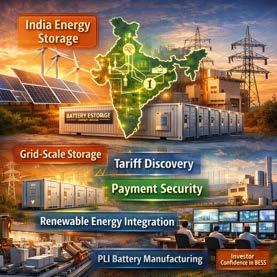
From Madhya Pradesh and Rajasthan in central and western India, to Tamil Nadu in the south, Odisha and West Bengal in the east, and Uttarakhand in the north— thestorageopportunityisnowpan-India. Thisdispersioniscriticalfordevelopinga balanced domestic supply chain and installationecosystem.

However, challenges remain Tariff discovery will be closely watched— especiallyforgigawatt-hour-scaleprocurements.
Thefinancialhealthofstatediscoms,paymentsecuritymechanisms, and clarity around ancillary service markets will significantly influence investor confidence. Additionally, localization of battery manufacturingunderinitiativeslikePLIschemesmustkeeppaceto reduceimportdependency.
Yet, the direction is unmistakable. The clustering of large tenders withinashorttimeframesuggeststhatstorageistransitioningfrom policy aspiration to procurement reality. For India’s renewable journey, this is a pivotal evolution. As solar and wind capacities surge, the grid’s need for flexibility, peak shaving, frequency regulation,andfirmpowerdeliverywillonlyintensify.
TherecenttenderpipelineindicatesthatIndiaispreparingforthat future—decisively and at scale. For developers, OEMs, financiers, and EPC players, the message is clear: the storage market is no longeremerging.Ithasarrived.
OPERATIONAL CAPACITY OF SOLAR WITH STORAGE IN INDIA
SOURCE:IESA
Solar projects integrated with battery energy storage systems (BESS) gained strong momentum in 2024, and the pace has continued steadily into 2025. The data shows a clear rise in both renewable energy (RE) capacity and storage deployment over the years.Fromamodest0.2GWofsolarand0.3 GWhofstorageduring2018–2022,themarket expanded to 1.4 GW solar and 0.9 GWh storage in 2023. The real jump came in 2024, with 8.7 GW of solar paired with 11 GWh of storage.In2025,whilesolarcapacitystandsat 6.5 GW, storage increased further to 15.3 GWh, reflecting growing focus on dispatchable renewable power. Overall, 42 projects account for 19.4 GW of solar and 34 GWh of BESS capacity. A significant share is already awarded (6.5 GW solar, 14.4 GWh BESS)orunderconstruction(5.7GWsolar,7.9 GWhBESS).Tariffshavealsodeclinedsteadily, making solar-plus-storage more competitive andattractiveforutilitiesanddevelopers.
SOURCE:IESA
The Viability Gap Funding (VGF) scheme has significantly transformed the standalone Battery Energy Storage System (BESS) market in India, accelerating both tender activity and overall capacity announcements. Under VGF Phase 1, which provided 30% financial support, 13.2 GWh capacityacross17tendershasalreadybeencompleted,settingastrongfoundationformarketconfidence.Buildingonthismomentum,VGFPhase 2 offers 16% support to enable 30 GWh of capacity, and it is already active with around 20 GWh across 11 tenders floated so far. The broader markettrendalsoreflectsrapidexpansion.TotalstandaloneBESStendersfrom2022to2026havereached61.7GWhacross68tenders.Capacity additionsrosesharplyfromjust1.3GWhin2022and0.6GWhin2023to10.2GWhin2024,followedbyamassivejumpto46.1GWhin2025,while 2026 has already recorded 3.5 GWh. In terms of project stage, 14.4 GWh is under construction, 19.5 GWh has been awarded, and 11.3 GWh remainsinthetenderopencategory,while10.2GWhhasbeencancelled.Bytendertype,BOOdominateswith44.2GWh(41tenders),followedby EPC at 14.4 GWh (20 tenders) and BOOT at 2.1 GWh (6 tenders). This data clearly shows that policy support through VGF has reshaped the standaloneBESSmarketandpositionedstorageasakeypillarinIndia’sevolvingpowersystem.

BY NHPC
Thedecisionbythe Central Electricity Regulatory Commission (CERC) toadopttariffsfora 2400MWsolar-plus-storageproject led by NHPC marks a defining moment for India’s hybrid renewablemarket.Unlikestandalonesolarbidsthatareevaluated purely on energy price, hybrid projects combine generation with storage—requiringregulatorstoassessnotjustcostperunit,but systemvalue.
By formalising tariffs for this large interstate project, CERC has providedcriticalclarityonhowintegratedsolar-plus-batteryassets will be priced and contracted. This move reduces uncertainty for developersandlenders,whohaveoftenviewedstoragerevenues asstructurallyambiguousduetoevolvingmarketmechanismsfor ancillaryservicesandpeaksupply.
The decision also signals institutional confidence in dispatchable renewables. As India’s renewable capacity rises, the grid increasinglyrequiresfirmedpower—energythatcanbedelivered during evening peaks and periods of variability. CERC’s tariff adoption effectively validates hybrid projects as mainstream capacityresourcesratherthannichesolutions.
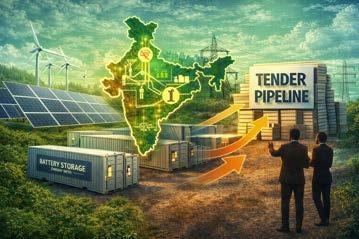
In a major state-level policy development, the Maharashtra Electricity RegulatoryCommission(MERC) hasapproved MSEDCL’splantoprocure 2000 MW / 4000 MWh of battery energy storage capacity. Thisapproval represents one of the largest structured storage procurement strategies undertakenbyastateutilitytodate.
Maharashtra, with its high demand density and significant renewable integration, faces mounting challenges in managing peak load and balancing variability. By sanctioning large-scale BESS procurement, MERC has effectively positioned storage as a strategic grid asset rather than a supplementalrenewableaccessory.

Forthebroadermarket,themessageisclear:solar-plus-storageis nolongerexperimental.ItisenteringtheregulatedcoreofIndia’s powerprocurementframework.
Theapprovedcapacity—designedtoprovidemulti-hourdischargesupport — is expected to play a critical role in evening peak management, curtailment reduction, and grid reliability enhancement. Importantly, the regulatory backing gives procurement visibility and contractual certainty, keyfactorsinattractinginvestmentintostorageinfrastructure.
For developers and financiers, this decision reduces demand-side ambiguity. It indicates that state distribution companies are beginning to incorporate storage into long-term planning frameworks, recognising its valueindeferringnetworkupgradesandstabilisingsupply.
Maharashtra’s move could serve as a blueprint for other high-load states navigatingthenextphaseofrenewableintegration.
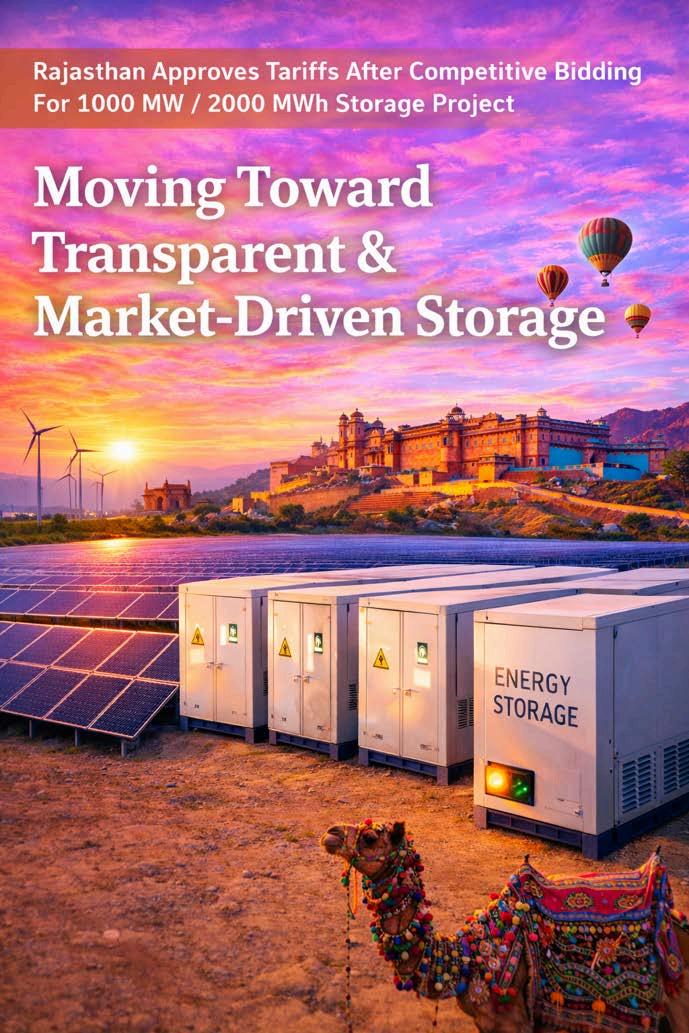
Rajasthan’spowerregulatorhasapprovedtariffsfora1000MW/2000MWhbatteryenergystorageprojectfollowingacompetitive biddingprocess—adevelopmentthatunderscoresthemarket’sgradualshifttowardpricediscoveryinstorageprocurement.
AsoneofIndia’slargestrenewableenergyhubs,Rajasthanexperiencesbothhighsolargenerationandcorrespondingvariability challenges.Thedecisiontoprocurestoragethroughcompetitivebidding,andsubsequentlyapprovethediscoveredtariff,reflects growinginstitutionalconfidenceinmarket-drivenpricingmechanisms.
Tariffapprovalaftercompetitionissignificant.Itprovidesabenchmarkforfuturestoragetenders,enhancestransparency,andoffers clearercostsignalstoutilitiesandinvestorsalike.Inasectorwhererevenuemodelsarestillevolving,regulatoryendorsementof competitivelydeterminedtariffsreducesperceptionofrisk.
Beyond the immediate project, Rajasthan’s decision suggests that storage is transitioning from policy ambition to commercially structuredinfrastructure.Asmorestatesadoptsimilarframeworks,tariffbenchmarkingwilllikelyacceleratecostoptimisationand scaledeployment.
Togetherwithnational-leveltariffadoptionandlarge-stateprocurementstrategies,Rajasthan’smovereinforcestheemergenceofa morestructuredandpredictablestoragemarketacrossIndia.

PowerPlantController(PPC)referstothecoordinatedmonitoringand regulation of a plant’s power generation and distribution systems to meet operational, safety, regulatory, and grid-compliance requirements. EnerMAN’s ETi-PPC is engineered to achieve these objectives with high precision by maintaining stable voltage, frequency, and load distribution—parameters essential for secure, efficient, and compliant plant operation. Unlike conventional control systems, the ETi-PPC offers intelligent, automated, and scheduled control capabilities that extend far beyond basic power management. Through highly accurate active power, reactive power, and power factor regulation, the system ensures full compliance with utility and electricity board mandates while minimizing energy losses and maintainingsuperiorpowerquality.
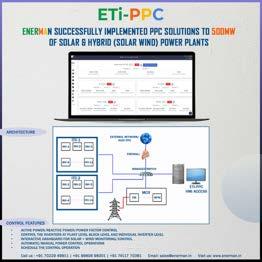
The ETi-PPC provides real-time grid-level voltage stabilization, preventing fluctuations that can otherwise lead to equipment stress, operational downtime, or regulatory penalties. Its autonomous and reliable performance particularly during unmanned operational hours ensurescontinuouscompliance,operationalassurance,andlong-term system stability. For engineers managing solar power plants, EnerMAN’sETi-PPCservesasacriticaloperationalbackbone
byofferingprecisecontrolinputs,livestatusfeedback,andautomated adjustments that simplify complex coordination tasks and enhance operational confidence. By optimizing power utilization, improving energy efficiency, and reducing operational costs, the ETi-PPC safeguards plant assets, protects the grid, and contributes to measurable long-term savings and sustainability across renewableenergyfacilities.
Aligned with IEC 62443, the global cybersecurity standard for industrial control systems (ICS) and operational technology (OT), EnerMAN’sETi-PPCincorporatesasecureHybridPPCarchitecturethat manages solar output in coordination with other on-site renewable sources.Itcontrolsplantpowerusingmultiplemethods,includingthe RampPowerMethodforsmoothgenerationtransitions,theScheduled Power Method for predefined power delivery, and SLDC Write/Read functionalityfordirectinteractionwiththeStateLoadDispatchCentre, enablingprecise,compliant,andgrid-synchronizedoperation.
In advanced inverter-based solar plants, the ETi-PPC plays a pivotal role in maintaining high-quality grid interaction and ensuring compliancewithstatutorycodes.CorefunctionssuchasPowerFactor (PF) Control are executed with high responsiveness, allowing the system to regulate inverter outputs by adjusting the phase angle between voltage and current to sustain the required PF, reduce electrical losses, and maximize overall efficiency. Equally important is Reactive Power Compensation, where the inverters dynamically inject or absorb reactive power to correct voltage deviations, reduce transmissionlosses,andstabilizeweakorfluctuatinggridsanessential requirement for modern renewable-energy systems. With sophisticatedalgorithmsthatregulateactiveandreactivepowerflows, theETi-PPCensuressmoothgridintegrationandreal-timecompliance with grid codes. Features such as automated scheduling, remote operability, and intelligent fault-handling logic further enhance operationalreliability,eveninfullyunmannedplantconditions.








Manufacturing


Excellence in Sustainable Solar PV Module
Novasys Greenergy Limited

Excellence in Solar Manufacturing Innovation & Quality
Sunora Solar

Emerging Solar Contractor of the Year - Residential
Somaa India Pvt. Ltd.
Excellence in Rooftop Solar Execution - Residential
Solexa Services Pvt Ltd

Excellence in Solar PV Module
Manufacturing – Utility & Commercial Scale
Saatvik Green Energy Limited
Emerging Solar Contractor of the Year - Industrial
N K Enterprises

PM-KUSUM Project of the Year



Earlymoverinhigh-efficiencyTOPConglass-toglassmoduleswithatechnology-firstapproach.
5 GW AI-enabled module facility, expanding into full backward integration (cells to polysilicon).
Backedbytier-onesourcing,expertteams,and a sustainability-led vision building world-class manufacturinginIndia.
QHowhasFutureSolarevolvedin technology,capacity,and marketpresenceovertheyears?
FutureSolar'svisionandmissionfromdayonehas been the latest technology-driven model manufacturingcompany.Socompanyhasfocused from day one on the latest technology which has been Topcon glass-to-glass modules. Higher efficiency, higher throughput, higher reliability. So it's been two years the company is into the manufacturing business, and from day one, it has focusedonTopconmodules,andit'soneofthefew companies to introduce Topcon high-efficiency modulesinthiscountry.
QCouldyousharethestrategic intentbehindthisexpansion anditssignificanceforIndia’s renewableenergylandscape?
So the government’s directive and government’s intentions are very clear to develop the entire ecosystem from polysilicon to the modules, basically. And as part of that, we started with modules,reachedatascaleof5gigawatt,whichisa verydecentscale.
Now,thenextplansarefurtherbackwardintegration from modules to cell, then to wafer, then to ingot, andhopefullyincomingyearstopolysilicon.Sothe companyplanstohave5gigawattofmanufacturing capabilityacrosstheentirevaluechain.
Our 2 gigawatt cell plant construction has already started and is expected to be commissioned in 2026.Another3gigawattcellplantconstructionwill bestartingsoon.So5gigawattofTopconcell,G12R cellmanufacturingwillbeoperationalbyearly2027. Oncethatisdone,thenwewillstartworkonwafer andingot.Thewholeideaistoreducedependency onothercountriesandhaveaself-reliantecosystem.
QHowisFutureSolarintegrating technologytoenhance precision,efficiency,andlong-
Sothecompanyhasbuiltaworld-classstate-of-theart plant at Karjan Vadodara. The plant has a manufacturingcapabilityof5gigawattsperyear.All the machines, all the utilities have been designed andestablishedinawaythatithasturnedouttobe oneofthefinestfacilitiesinthiscountry.Whatever therawmaterialthathasbeenusedtomanufacture themodulesarefromthetieronesuppliers.
The team that is monitoring the manufacturing process is highly experienced professionals who have been doing this for 20 to 25 years of their professionalcareer.Themachinesthataremaking themodulesarethefineststate-of-the-artfacilities. The technical, highly experienced skilled people andtherawmaterialthatisbeingusedarefromtier one suppliers. The ultimate finished product is alwaysthetieronemodules,basically.

QHowdoesFutureSolarensure consistency,compliance,and customerconfidenceasit continuestogrow?
Theorganizationisverycleartodeliverworld-class productslocallymanufactured.
For that, we have built a fantastic state-of-the-art, fully automated, AI-enabled 5 gigawatt manufacturingfacilityatVadodaraKarjan.Tomake suretheproductisofthefinestquality,wesource ourrawmaterialsfromtieronevendors.
Toensurethattheentiremanufacturingprocessis carried out very well, we have highly skilled technicalprofessionalsattheplantwhomakesure that each and every module manufactured at Future Solar comes with the best quality, high efficiency,andhighthroughput.
QWhatkeyinitiativesorpractices hasFutureSolarimplemented tominimizeitsenvironmental footprint?
Future Solar’s creation is done to reduce the carbonfootprint,basically,tocontributetowardsa sustainable tomorrow. The idea is doing this at gigawattscaleinashortspanandgoingbackward integrated.Weareputtingalleffortsthatcontribute towardsasustainabletomorrow.
QHowdoesFutureSolar differentiateitselfthrough technologyandclient partnerships?
Thecompany’smainfocushasbeenonresearch and development to deliver the latest technologyandlatestproductstoitscustomers.
That’s why we started with Topcon and are focusingonlyonTopconglass-to-glassmodules. Customer is the key for any business. We are gladtohavecustomerswhoaresolarinstallers, EPCplayers,orIPPplayerswhoareawareabout sustainabilityandthegreenertomorrow.
We want maximum people to visit the plant, understand the facility, understand the raw materialsbeingutilized,understandtheprocess, understand the quality parameters, and meet and interact with our experienced technical professionals.
That has been the core idea—to spread awareness and deliver the latest technology productstomaximumpeopleinthecountry.
QLookingahead,whatisthe long-termvisionforFuture Solar?
The company is already into module manufacturing,andcellmanufacturingisunder construction.Afterthat,wewillgoforwaferand ingot.So5gigawattofentirevaluechain—from module to ingot—is what we are trying to achieveinthenext2–3years.
Simultaneously,wewouldalsoliketocontribute on the BESS, battery energy storage system front.
India has set an ambitious target of 1,800 gigawatt of non-fossil fuel energy by 2047. Future Solar plans to contribute as much as possible in the next 20 years by building the entire value chain from ingot to modules, and going forward into battery energy storage systemsandotherrenewableenergyverticals.
Looking forward to your visit at the plant. Thankyou.

SolarpowerinIndiahasmoveddecisivelyfromthemarginstothe mainstreamofthecountry’senergyplanning.Withcapacitytargets rising and decarbonisation timelines tightening, the discussion is nolongeraboutwhethersolarwillscale,butabouthowreliablyit will perform once it does. For assets expected to operate for 25 years or more, the responsibility placed on manufacturing has increased,quietlybutsignificantly.
For developers, IPPs, and lenders, the cost of underperformance compounds over time. Degradation behaviour, thermal response, and batch-level consistency shape generation forecasts and cash flows long after commissioning. This is why procurement decisions, particularly for utility-scale and institutional portfolios, are slowly shifting away from headline pricing towards performance-led evaluation. It places sharper focus on how modulesaremade,notjustonwhatisprintedonadatasheet.
This shift calls for a different execution philosophy. Capacity additions alone offer limited comfort if processes cannot hold steadyatscale.Whatincreasinglymattersisprocesscontrol,how automationisdeployed,howqualitydataisactedupon,andhow manufacturing systems adapt to changing cell technologies without introducing variability. Backward integration is also being reassessed, less as a cost lever and more as a way to improve supplyassurance.
Withinthisbroadercontext,FutureSolarrepresentsoneexecutionled manufacturing approach. Its module capacity has been built through incremental expansion, with attention paid to stabilising processesasscaleincreases.Asof2025,thecompanyoperatesa5 GW ALMM-listed module manufacturing facility, supported by automatedproductionlinesandin-linequalitychecks.
Technology choices are guided by operating realities rather than shortterm optics. The company manufactures TOPCon glass-to-glass modules intheG12Rcategory,withoutputratingsrangingfrom620Wpto635Wp. These modules are selected for efficiency characteristics, degradation behaviour, and thermal performance under Indian conditions where environmentalstresscanmateriallyaffectlong-termgeneration.
Execution discipline also shapes the company’s integration plans. A solar cellmanufacturinglineisunderdevelopmentatthesamelocation,starting with 2 GW and planned for phased expansion. While this facility is still in progress, the intent is to allow closer alignment between cell characteristicsandmoduleassemblyasvolumesgrow.
Quality,inthiscontext,istreatedasacontinuousoutcomeratherthanan end-stage inspection. Manufacturing controls, testing protocols, and process checks run across production. Certifications serve as reference points,helpingalignproductswithtechnicalandcomplianceexpectations relevanttolargedevelopers,PSUs,andfinancinginstitutions.
As India enters the next phase of solar expansion, manufacturers that prioritise disciplined execution, measured scaling, and long-term performancearelikelytoshapeoutcomesasmuchasprojectdesignitself. By combining manufacturing scale with process-led decision-making, FutureSolarpositionsitselfwithinthisevolvingframework.
For developers and partners assessing manufacturing depth beyond specifications,thisapproachisbestunderstoodfirsthand.Stakeholdersare invited to visit the Vadodara manufacturing facility to see how execution discipline,automation,andprocesscontrolarebeingappliedinpractice.

GujaratUrjaVikasNigamLimited(GUVNL)awardedits335MW/670MWhPhase-VIIIstandaloneBESSauction. Advait Energy Transitions emerged as the L1 bidder, securing 150 MW at ₹2.10 lakh/MW-month. Equentia Natural Resources and Sun Drops Energia followed, winning65MWand120MWrespectivelyattariffsupto ₹2.12lakh. ThistrendmirrorsrecentBESSawardsseenintheindustry:
SECI Tranche-XXI: Awarded 1,200 MW solar with3,600MWhstorageat ₹3.12–3.13/kWh.
NVVN (Kerala): Awarded 500 MWh to Shreyas Sortexat ₹1.81lakh/MW-month.
TNGECL (Tamil Nadu): Concluded a 375 MW / 1,500 MWh auction with a discovered tariff of ₹3.15lakh/MW-month.
These projects, typically featuring 12–15-year agreements and dual charge-discharge cycles, underscoretheshifttoward"on-demand"gridassets tosupportpeakdemandandrenewableintegration.
SOLARQUARTER RESEARCH
In a significant move for India’s clean energy sector, the Solar Energy Corporation of India (SECI) recently concludedits 1.2 GW FDRE-VII Peak Power Tender. Major winners included Serentica Renewables (600 MW), ACME Solar (301 MW), AMPIN Energy (199 MW), and Adyant Enerso (100 MW), with tariffs discoveredbetween ₹6.27 and ₹6.28/kWh.
Thisfollowsrecentmomentumshownintheprovided reports,suchasSECITranche-XXI,whichawarded1.2 GW solar with 3.6 GWh storage at tariffs of ₹3.12–3.15/kWh. Additionally, state-level initiatives like NVVN Kerala’s 500 MWh BESS and TNGECL’s 1,500 MWh BESS highlight the growing reliance on standalone and integrated battery storage to ensure grid stability and manage peak demand sustainably acrossIndia.
India's energy storage landscape reached a turning point in early 2026 as Kerala and Tamil Nadu discovered groundbreaking tariffs for standalone Battery Energy Storage Systems (BESS). In Kerala, NVVN awarded a 500 MWh project at a record-low ₹1.81 lakh/MW-monthtoShreyasSortexIndustries,despiteglobalsupplychainvolatility.
Tamil Nadu’s TNGECL auction also set a milestone, discovering a tariff of ₹3.15 lakh/MW-month. This higher rate reflects the more rigorous 1.5-cycle-per-day requirement—a first for Indian tenders. These results, alongside SECI’s competitive solar-plus-storagebids(~₹3.12/kWh),signalthatutility-scalestorageisbecomingthe backboneofIndia’sgridstability.

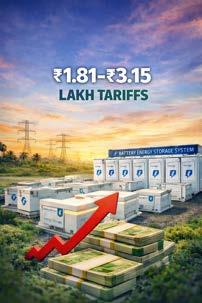
KarnatakacontinuesitsrenewableleadershipasHubballiElectricitySupplyCompany(HESCOM)awarded 423.7 MW for decentralized solar projects. Thirty developers, including Sri Srinivasa Constructions and Solar91 Cleantech, secured 80 projects with competitive tariffs ranging from ₹2.70 to ₹2.99/kWh. These RESCO-model projects aim to solarize feeders, reducing technical losses while improving local supply quality.
This decentralized push complements broader grid-scale advancements. Recent auctions in Kerala and Tamil Nadu established new standalone BESS benchmarks at ₹1.81 lakh and ₹3.15 lakh/MW-month, respectively. Additionally, SECI’s Tranche-XXI awarded 1.2 GW of solar with 3.6 GWh of storage at approximately ₹3.13/kWh,reinforcingtheshifttowardreliable,round-the-clockcleanenergy.

SECI Awards 1.2 GW ISTS-Connected SolarPlus-Storage Projects To Engie, NLC, RPIL, Oriana At ₹3.12–₹3.13/kWh
India’srenewableenergylandscapeisadvancingrapidlywithSECI’sTrancheXXI auction, awarding 1.2 GW of solar paired with 3.6 GWh of BESS. The tender discovered competitive tariffs of ₹3.12–₹3.13/kWh, with NLC India Renewables and ENGIE Energy India securing 600 MW and 200 MW, respectively.
Simultaneously, standalone BESS benchmarks were set in Kerala and Tamil Nadu.NVVN(Kerala)awardeda500MWhprojecttoShreyasSortexatarecord ₹1.81 lakh/MW-month. TNGECL’s auction for a 1,500 MWh system concluded at ₹3.15 lakh/MW-month, awarded to Eagle Construction. These projects highlighttheincreasingviabilityofutility-scalestorageforgridreliability.
INDIA’S SOLAR-PLUSSTORAGE MOMENTUM IS NO LONGER EXPERIMENTAL —IT IS COMMERCIALLY COMPETITIVE, GRIDRELIABLE, AND SCALING AT RECORD SPEED









10-Year Milestone of Inverter Excellence in India Award
State Market Leader AwardInverter
Sungrow India Pvt Ltd

Excellence in Solar PV Module Manufacturing and Supply Reliability
Saatvik Green Energy Limited

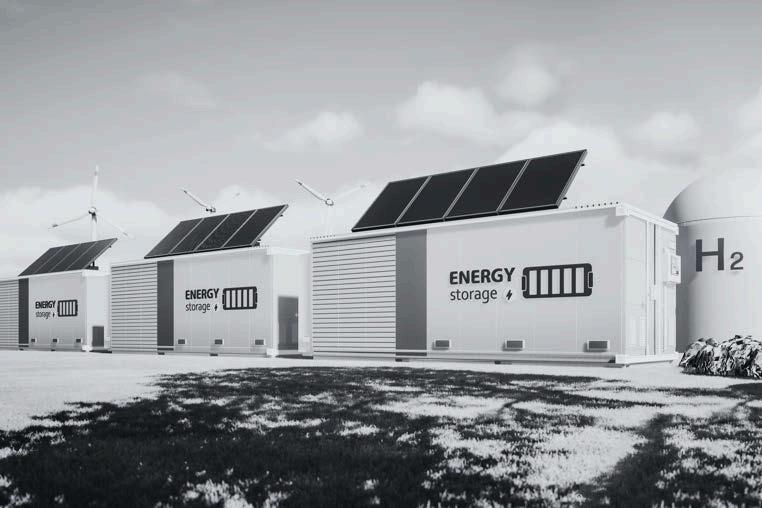
Technology Excellence Award for AI-Driven Solar Robotics
Taypro Pvt. Ltd.

Best Performing Solar Modules
Bluebird Solar Pvt. Ltd.

Excellence in Comprehensive Solar O&M and Generation Performance
SWAYAMURJA RENEWABLE
ENERGY PVT LTD
Excellence in End-to-End Rooftop Solar EPC and Asset Management
SOURURJA SOLUTION


Excellence in Utility-Scale and C&I Solar EPC Execution
Ecoteam Solar Private Limited
SUSTAINFY ENERGY PRIVATE LIMITED Excellence in Solar PV Quality Inspection, Risk Mitigation and Asset Bankability

Distributor of the YearRising Star
Celestial Renewexperts LLP


Solar System Integrator of the Year - C&I (Diamond)
SunMitra Solar Private Limited


Best Project Excellence for Commercial Solar with Best ROI
SWAYAMURJA RENEWABLE ENERGY PVT LTD
Best Project Excellence for Large-Scale Hybrid & GridIntegrated Renewable Project
Yanara

Solar EPC Company of the Year - Utility
Infisol Energy Limited
Solar EPC Company of the Year - Commercial
SES SOLAR NETWORK


Solar EPC Company of the Year - Industrial
Alligator Energies Private Limited
Solar EPC Company of the Year - Solar Parks & KUSUM Projects
SunInfra Energies Ltd
Solar System Integrator of the Year - C&I (Platinum)
Reinitiatives Energy & Infra Pvt. Ltd.

Best Project Excellence for Energy Storage & Smart Energy Systems
Kalpa Power Private Limited



Emerging Leader in Solar Electrical Infrastructure Innovation
DCLINK TECHNOLOGIES
PRIVATE LIMITED
Emerging Leader in Renewable Energy Solutions
Nutans Renewable Energies Pvt. Ltd.





Company of the Year: Sustainable EPC
Oorjan Cleantech Pvt Ltd
Excellence in Solar Training & Skill Development
LGPS HYBRID ENERGY PVT LTD

Best Marketing Team of the Year
Waaree Energies Ltd.

Legacy of Sales Excellence Award
Ashok Kumar Singh
President - Solar Business
Novasys Greenergy Ltd.
Business Development Leader of the Year
Mushtaq Patel
Business Development Head
Solaire - A Lagnuvo Initiative
Leader in Renewable Energy and Energy Transition

Best Quality & Engineering Team of the Year
Novasys Greenergy Ltd.

Best Engineering Team of the Year
Reinitiatives Energy & Infra Pvt. Ltd.

Surya Sekhar Panda
Senior Manager - Sustainability and Environment Mahindra & Mahindra Limited
Renewable Energy Entrepreneur of the Year PRESENTS





SOURCE:MNRE
In the pie chart, Renewable capacity additions continue to increase at a rapid pace in India, accountingforapproximately40.7%ofIndia’stotal powercapacityattheendofJanuary2026.India’s totalinstalledpowercapacitystoodatover520.5 GW at the end of January 2026 from all the sources,withrenewablesaccountingfor212GW, making up 28.34%, compared to cumulative renewable energy installations of 165 GW at the endofJanuary2025,whichrepresentedagrowth of over 28.34% year-over-year. Solar power accounted for approximately 140.6 GW of installations, which represents 27% of the total installed power capacity. Among the renewable, Wind and Solar constitute over 92.1% of the total renewable (excluding large hydro), Wind Power installedcapacityattheendofJanuary2026was over 54.65 GW, which represents 10.5% of the totalpowercapacityinstalled.
SOLARQUARTERRESEARCH
India achieved a remarkable milestone by installing an unprecedented 37,945.22 MW of Solar PV capacity in thecalendaryear2025.BytheendofJanuary2026,the country'stotalSolarPVinstallationssurpassed140GW. During this period, rooftop Solar PV installations reached approximately 24.30 GW. Rajasthan led the way,with37,925MWinstalled,accountingfor26.97%of the nation’s total Solar PV capacity. The county also addedaround4.8GWinthefirstmonthofthecalendar year2026.Rajasthan,Gujarat,Maharashtra,TamilNadu, and Karnataka together contributed over 75.74% of the total installed Solar PV capacities across the country. While Rajasthan and Gujarat maintained their leading positions, Maharashtra stepped up two spots to its position, pushing Tamil Nadu and Karnataka down to fourth and fifth place, respectively, compared to the installedsolarPVcapacitybyJanuary2025.Theoverall Solar PV installations saw a growth of over 40.1% compared to the 100 GW recorded by the end of January2025.
SOURCE:CEAJAN2026|SOLARQUARTERRESEARCH
SOURCE:CEA
RESEARCH
Total renewable energy generation in December 2025 reached 23331.39 million units, which is an increase of RE generation byaround18%year-over-yearfromDecember 2024, when the RE generations were 21,184.71 million units. Solar Power generation has also increased by around 39.60% year-over-year from December 2024 (10,707.21 million units) to December 2025 (14,946.83 million units). Wind Power generation has decreased by almost 12.85% in the same period and reached 5009.06 millionunitsinDecember2025.
SOURCE:CEA
SOLARQUARTERRESEARCH
SOURCE:MNRE(JANUARY2026)
SOLARQUARTERRESEARCH
AsofJanuary2025,India’sinstalledhybridprojectscapacityreached3,364.63MW,contributingaround2.39%tothecountry’stotalsolarPV capacity.Thisispartoftheoverallrenewableenergycapacityof212GW,excludinglargehydro.Hybridprojects,whichcombinesolarandwind power, are currently limited to just three states: Rajasthan, Gujarat, and Karnataka. Among these, Rajasthan leads with the highest installed capacity of 1,980 MW. This is mainly because the state has strong potential for both solar and wind energy. Rajasthan receives high solar irradiationandalsoexperiencesstrongwindspeeds,makingitidealforhybridenergygeneration.Theinstalledcapacityofhybridprojectshas shown a year-on-year growth of about 18.03% compared to January 2025, when it stood at 2850.7 MW. This steady growth highlights the increasingfocusonhybridprojectsasasolutiontoimprovegridstabilityandrenewableenergyutilization.
SOURCE:IEX
In January 2025, the Indian Energy Exchange (IEX) reached a total volume of 13,050 million units (MU), a 19.6% year-over-year increase. AccordingtogovernmentdatareleasedinJanuary2026,thecountry’senergyconsumptionreached142.74billionunits(BUs),markinga3.8% year-on-year increase. Higher generation from hydro, wind, solar, and sustained coal-based supply improved liquidity on power exchanges, resulting in a sharp decline in prices. The Day Ahead Market clearing price fell 12.9% YoY to ₹3.86 per unit, while the Real Time Market price dropped15.9%to ₹3.72perunit,benefitingdiscomsandC&Iconsumers.
NHPC1.2 GWISTS FDRE Tranche VI
NTPC1.2 GWISTS Wind-Solar Hybrid Power (Hybrid2) RUVNL 500 MW/1,000 MWh Standalon eBESS SJVN 1,200MW ISTSFDRE 3 GUVNL250 MWSolarPV ProjectsWith Greenshoe Opetion PhaseXXVl
NHPC1,200 MWSolar PowerWith 600 MW/1200 MWhBESS
1200Wind solar Hybrid03
MWWith 600 MW/2400 MWh
1200MW ISTSSolar With600 MW/2400 MWh BESS
MW/1000 MWh BESS
NHPC125 MW/500 MWh WithBESS SECI2 GWWith 1GW/4 GWhESS ISTS-XX SJVN1.5 GW/6000 MWFDRE With storage
440 MW/880 MWH With BESS
500 MW/2000 MWh Standalone BESS
SECI1200 MWWith 600 MW/3600 MWhESS (Tranche XXl)
TherolloutoftheApprovedListofModelsandManufacturers(ALMM)List-IforsolarPVmodules,alongwiththeforthcomingALMMList-IIforPVcellsset totakeeffectinJune2026,hasintroducednewcompliancechallengesfordevelopersparticipatinginIndia’ssolarauctions.Theseregulatorychanges, coupledwithongoingglobalsupplychaindisruptionscausedbygeopoliticaltensions—suchastheRussia-Ukraineconflict,U.S.tradetariffs,andvolatile currencyexchangerates—havecontributedtonoticeablefluctuationsinsolartariffs.
Whilethegovernmenthasextendedprojectcommissioningtimelinestoproviderelief,developerscontinuetofacerisingcostpressures.Initiativeslikethe GSTreliefonsolarPVmodulesandcomponents,effectivefromSeptember2025,andIndiaachievingover122GWofsolarPVmodulemanufacturing capacity,offersomesupport.Atthesametime,U.S.tariffhikesonsolarimportshavetightenedglobalmodulesupply,pushingpriceshigherandindirectly affectingtheIndianmarket.
Amidthesechallenges,thegrowingavailabilityofdomesticallymanufacturedsolarPVinvertersprovidesasignificantboost,instillingconfidenceamong developerstobidmorecompetitively.Asaresult,solartariffsinIndiathrough2024haveremainedvolatile,influencedbymaterialcosts,projectscale,grid connectivity,andnow,increasedrelianceondomestictechnology.




State Market Leader Award (Inverter)
Ningbo Deye Inverter Technology Co. Ltd.
DC Engineering & Consultancy Services of the Year

Excellence in Solar PV Module Manufacturing –Utility & Commercial Scale
Saatvik Green Energy Limited

Best Solar Contractor of the Year
KGDC Enterprises LLP
Innovation in Project Execution
Motive8 Group

Best Rooftop Solar Installer –Commercial & Industrial
HCK Solar Energy Limited

Best Rooftop Solar Installer of the Year
Preeti Engineering

Fast-Growing Solar Contractor









State Market Leader Award (Inverter)
Ningbo Deye Inverter Technology Co. Ltd.

Solutions
Ksolare Energy Pvt. Ltd.
Excellence in Utility-Scale and C&I Solar EPC Execution
Ensolite Technologies Pvt. Ltd.

India’s Best Solar Module Supplier
Adani Solar
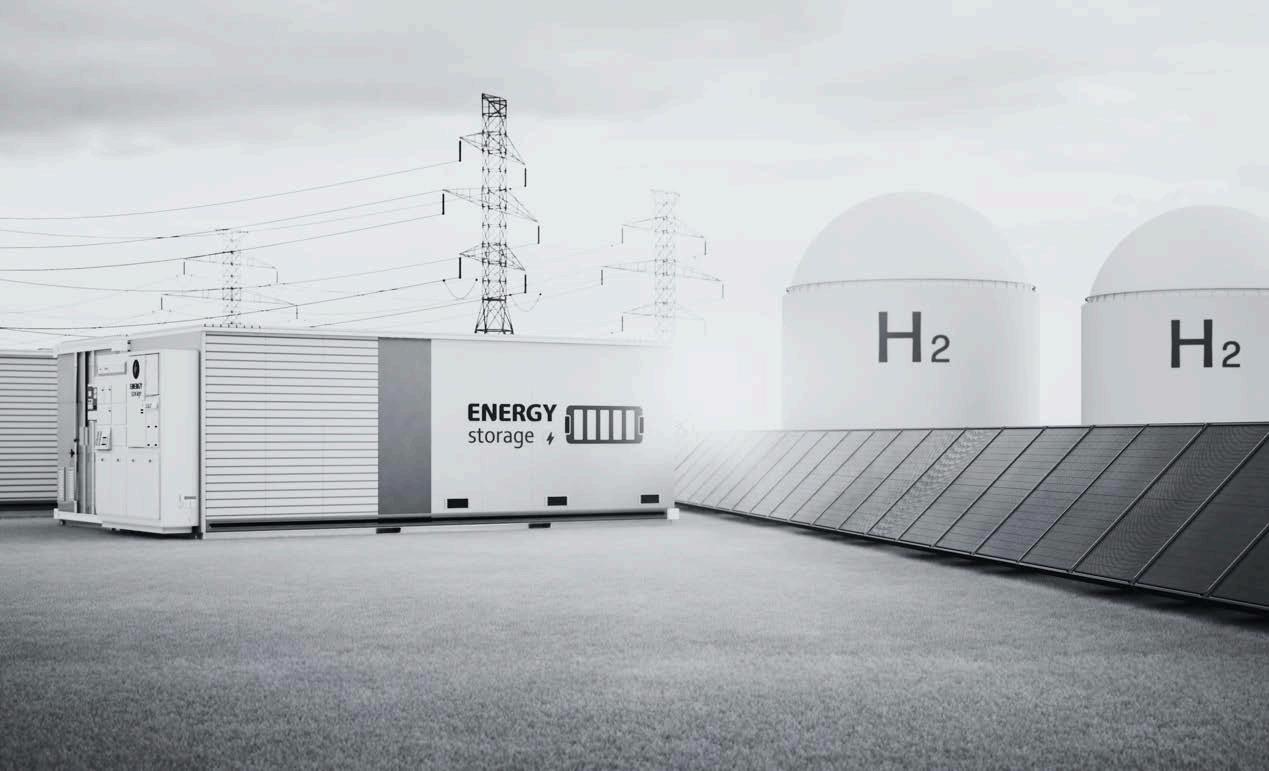

Best Turnkey Service Provider – EPC
SunWorks Energy Pvt. Ltd.
No 1 Solar Inverter Brand of India
SOLIS
Excellence in Solar PV Module
Manufacturing – Utility & Commercial Scale
Saatvik Green Energy Limited

Excellence in Comprehensive Solar O&M and Generation Performance

Excellence in End-to-End Rooftop Solar EPC Services
Mierae Solar Energy Pvt. Ltd.
Excellence in Next Gen (ENPHASE) Solar Technology Implementation
Neusol Energy

Excellence in Integrated Renewable Project Development
Ecoren Energy India Pvt. Ltd.
Fast-Growing Solar Company of the Year
Aadhi Vishwa Energy LLP

EPC Leadership Award –Rural Electrification
SM Renergy Private Limited

Solar EPC Company of the Year - PM SURYA GHAR Projects
SRI BALAJI SOLAR ENERGIES
Solar EPC Company of the Year - Residential
Ellvin Energy Private Limited


Emerging Solar System Integrator of the Year
Environ Energy Tech
Emerging Leader in Renewable Energy Solutions
Alpha Solar Energies
Emerging Solar Contractor of the Year
Attada Power and Energy Services Private Limited


Best Quality & Engineering Team of the Year
SunWorks Energy Pvt. Ltd.


Best Solar Contractor of the Year
Suhana Natural Power Systems
Top Solar Distributor of the Year
Anuki Technologies Private Limited

Emerging EPC Company of the Year – C&I
Prasha Energy Consulting

Varun Pandya
AGM - Engineering & SCM
TATA Projects Outstanding Leadership in Energy Development
BE-CIS Visionary Leader of the Year
Sreedhara Babu Korukonda Managing Director
Sandeep Reddy Chillakuri
Co-Founder and Director
Sunworks Energy Private Limited Entrepreneur of the Year