POWERING SMART, ELECTRIC, EFFICIENT MOBILITY
IN FOCUS: T E L E M A T I C S S P E C I A L
NOVEMBER - DECEMBER 2025 | VOLUME 7 | ISSUE 6
COVER STORY
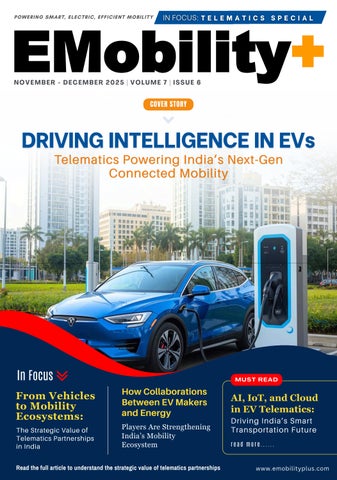
DRIVING INTELLIGENCE IN EVs Telematics Powering India’s Next-Gen Connected Mobility
In Focus From Vehicles to Mobility Ecosystems: The Strategic Value of Telematics Partnerships in India
MUST READ
How Collaborations Between EV Makers and Energy Players Are Strengthening India’s Mobility Ecosystem
Read the full article to understand the strategic value of telematics partnerships
AI, IoT, and Cloud in EV Telematics: Driving India’s Smart Transportation Future read more......
www.emobilityplus.com
There are many great reasons to become an EMobility+ Subscriber E-Mobility+ publications, distributed pan-India, sets a new standard in EMobiliy+ energy media. With over 200+ and a growing list of advertisers, we work with who's who in the industry across our platforms from print magazines to social media platforms put their brands first and ensure the best delivery of the marketing needs.
Ensures best delivery of the marketing needs Highest Circulation & Readership Customizable Product Layout Well Researched Editorial Content Most read by Key Decision Makers Get access to our upcoming events insights & updates
me Scan
CONTACT US
Sangeeta Sridhar Shalini Tandon
SUBSCRIBE NOW! +91-9372788472 +91-9821157794
sangeeta@firstviewgroup.com shalini@firstviewgroup.com
CONTENT BUSINESS NEWS
04
INVESTMENT
06
POLICY & REGULATIONS
07
THINK TANK
07
PARTNERSHIP
08
OTHER
IN CONVERSATION Abishek Reddy
17
CEO Naxion Energy India
INDUSTRY OPINION
19
EV Telematics: The Intelligence Layer Powering India’s Connected Mobility
EM+ RESEARCH
21
AI, IoT and Cloud Empower India’s EV Telematics
09
COVER STORY
22
From Vehicles to Mobility Ecosystems: The Strategic Value of Telematics Partnerships in India
10
TECH STORY
23
How Collaborations Between EV Makers and Energy Players Are Strengthening India’s Mobility Ecosystem
11
POLICY RESEARCH
12
26
AI, IoT, and Cloud in EV Telematics: Driving India’s Smart Transportation Future
CURRENT AFFAIRS
13
SPECIAL STORY
14
BUSINESS INSIGHTS
15
How Telematics Is Optimizing Real-Time Fleet Monitoring For India’s EV Logistics
16
INVESTMENT OUTLOOK
18
Telematics + Charging Analytics: Transforming India’s EV Operations With Predictive Insights
24
MARKET STATISTICS
20
Telematics In Action: How Real-Time Vehicle Battery Data Is Improving Uptime, Safety, And Costs For Indian EV Fleets
KNOWLEDGE BYTES
EDITING
ADVERTISING
CONTENT
DESIGNING
Sadhana Shenvekar Mohan Gupta editorial@firstviewgroup.com
Sangeeta Sridhar Shalini Tandon advertise@firstviewgroup.com
Sadhana Shenvekar Mohan Gupta publishing@firstviewgroup.com
Radha Buddhadev design@firstviewgroup.com
PUBLISHING
CIRCULATION
PRINTING
Firstview Media Ventures Pvt. Ltd.
Sadhana Shenvekar
Vaibhav Enterprises
BUSINESS NEWS INVESTMENT
VinFast Inaugurates USD 1 Billion EV Plant in Indonesia, Strengthening Southeast Asia Footprint VinFast officially opened its new electric vehicle manufacturing facility in Subang, West Java, Indonesia. The plant is VinFast’s first in Indonesia and Southeast Asia outside Vietnam, built in just 17 months with an investment exceeding USD 1 billion. It will initially produce 50,000 EVs annually and can scale to 350,000, supporting domestic and export demand.
GFCL EV Secures $50 Million IFC Investment For India’s First Integrated Battery Materials Facility GFCL
EV
Products
Ltd,
a
subsidiary
of
Gujarat
Fluorochemicals, secured about US$50 million from the International Finance Corporation (IFC). The funding will support India’s first fully integrated battery-materials plant in Bharuch, Gujarat, boosting domestic battery materials production and strengthening the EV supply chain while reducing import dependence.
Keto Motors to Invest ₹300 Crore in New Telangana EV Bus Plant, Signs MoU at Rising Global Summit 2025 Keto Motors announced a ₹300 crore investment to build a new electric bus manufacturing facility in Jadcherla, Telangana, signing an MoU with the state government at the Rising Global Summit 2025. The plant will produce 9to 13-metre EV buses for intra-city and inter-city transport, generating more than 2,000 jobs and boosting Telangana’s EV leadership.
04
Government Allocates ₹4,391 Crore for 14,028 E-Buses Under PM e-DRIVE to Cut Public Transport Emissions The Indian government has allocated ₹4,391 crore under the PM e-DRIVE Scheme for procuring 14,028 electric buses in nine major cities with populations over 40 lakh. The plan is aimed at cutting public transport emissions and includes priority deployment with major allocations such as 4,500 e-buses for Bengaluru, while boosting EV charging infrastructure rollout.
India’s EV Sector Poised For ₹20 Lakh Crore Growth By 2030, Says Union Minister for Road Transport and Highways Union Minister Nitin Gadkari said India’s EV market could reach ₹20 lakh crore by 2030, creating nearly five crore jobs across sectors. EV sales are growing faster than conventional vehicles, with the electric two-wheeler and threewheeler segments expanding rapidly. He highlighted declining battery prices and domestic lithium reserves supporting this growth outlook.
EV Breakthrough: Moonrider Attracts $6 Million to Scale RoadReady Electric Tractors Moonrider, an EV startup, raised $6 million to scale production of its road-ready electric tractors. The funding will help transition prototype agricultural EVs into commercial products, supporting sustainable farming and electrification of off-road utility segments beyond conventional passenger EV markets.
| INDIA | NOV-DEC ISSUE 2025
BUSINESS NEWS “INDIA’S EV ECOSYSTEM IS SCALING RAPIDLY, WITH PARTNERSHIPS BRIDGING GAPS ACROSS CHARGING, TECHNOLOGY, AND FINANCING TO ENABLE AFFORDABLE ELECTRIC MOBILITY.” INVESTMENT VinFast to Invest $500 Million in Tamil Nadu for Electric Bus and E-Scooter Production VinFast signed an MoU with the Tamil Nadu government to invest USD 500 million to expand its Thoothukudi facility. The investment, part of a broader USD 2 billion commitment, will build new production lines for electric buses, e-scooters, and supporting infrastructure, broadening its EV portfolio in India and strengthening the company’s manufacturing presence.
Lilypad to Deploy 1,000 Electric Two-Wheelers in Noida by Mid-2026, Backed by ₹3 Crore Funding Pipeline Electric mobility startup Lilypad plans to deploy 1,000 electric two-wheelers for last-mile delivery across Noida by mid-2026, supported by ₹3 crore funding from private investors and strategic partners, including Battery Smart and major delivery aggregators. The phased rollout begins with 150 EVs this month, with 250 added each quarter, aiming to cut costs and emissions while expanding in the NCR.
Capital Group Acquires 3% Stake In Cartrade Tech For ₹440 Crore Financial services firm Capital Group purchased just over 3 percent equity in CarTrade Tech through the open market, spending about ₹440 crore. The transaction involved acquiring around 14.44 lakh shares at an average price of ₹3,044.58 each, indicating strong investor confidence in CarTrade Tech’s position within India’s auto and mobility marketplace.
Neuron Energy Secures ₹31 Crore in PreSeries B Funding to Accelerate 3 GWh EV Battery Expansion Neuron Energy raised ₹31 crore in a Pre-Series B funding round led by Equanimity Ventures and other investors to expand EV battery production capacity to 3 GWh. The funding will support a new automated facility in Pune focused on batteries for EVs and buses, along with strengthened R&D and expanded domestic and global presence.
Government Reports ₹1,634.62 Crore Disbursed Under PM E-DRIVE Scheme As EV Push Expands The Government of India has disbursed ₹1,634.62 crore under the PM E-DRIVE scheme as of November 23, 2025, to boost electric mobility. The scheme dedicates ₹500 crore to e-ambulances and ₹2,000 crore for EV charging infrastructure, though no grants for charging points have yet been released. E-bus allocations include 1,500 for Mumbai and 2,800 for Delhi.
India Disburses ₹1,634 Crore Under PM E-DRIVE as EV Push Expands, Charging Infra Lags As part of the PM E-DRIVE initiative, ₹1,634.62 crore has been disbursed till November 23, 2025, covering subsidies and incentives to expand EV adoption. An earmarked ₹500 crore focuses on e-ambulances, and ₹2,000 crore is allocated for EV public charging stations —though so far no funds have been released for the charging component.
05
TDB Sanctions Funding for Indigenous EV Charger Commercialisation to Strengthen India’s Clean Mobility and Atmanirbhar Bharat Vision The Technology Development Board (TDB) approved funding for Electrowaves Electronics to commercialise fully indigenous EV chargers in India. The initiative aims to produce AC and DC fast chargers using home-grown technology, reducing dependence on imports and supporting India’s clean mobility and self-reliant industrial goals under the Atmanirbhar Bharat vision.
| INDIA | NOV-DEC ISSUE 2025
BUSINESS NEWS POLICY & REGULATIONS India Launches ₹7,280 Crore Scheme To Power EV, Wind Energy Sectors With Homegrown Magnets The Union Cabinet approved a ₹7,280 crore scheme to promote domestic manufacturing of rare earth permanent magnets (REPM), essential for EV traction motors and wind turbines. The initiative targets a production capacity of 6,000 MT per year and aims to secure the supply chain for EV and renewable sectors, reduce import reliance, and support net-zero goals.
Zypp Electric Accelerates Toward ₹600-Crore Revenue, IPO Plans as EV Fleet Expansion Gains Momentum Zypp Electric is targeting ₹600 crore in revenue by FY26, driven by strong growth in fleet size and profitability. Revenue jumped 48 percent year-on-year in FY25. The company plans a potential IPO and continued expansion of its EV fleet and services across cities, using technology like FleetEase.ai to enhance operations and generate new revenue streams.
Andhra Pradesh Signs ₹515-Crore MoU with ThunderPlus–ETO–Roqit Consortium to Build India’s First Integrated EV Mobility Network Andhra Pradesh signed a ₹515 crore MoU with ThunderPlus, ETO Motors, and Roqit to build a multimodal EV mobility and charging ecosystem statewide. The plan includes manufacturing, charging hubs, intercity corridors with high-power chargers, and the creation of 5,000+ jobs, advancing integrated mobility and green transportation across key urban corridors.
India Expands EV Ecosystem with 39,485 Charging Stations, New Policy Push Under PM E-DRIVE Scheme India’s electric mobility ecosystem continues to scale with 39,485 public EV charging stations installed nationwide, including 8,414 fast chargers for electric cars, under the PM E-DRIVE Scheme. The Ministry of Power has released updated guidelines for installing and operating charging infrastructure focused on interoperability, standardisation, and integration of public charging and battery-swapping networks. Charging is unlicensed, encouraging greater private sector participation. Additionally, around ₹2,000 crore has been allocated to boost public charging infrastructure, while complementary incentive schemes aim to strengthen EV manufacturing and accelerate electric adoption across transport segments.
Government Announces Eligibility and Subsidy Structure for EV Charging Infrastructure Under PM E-DRIVE Scheme The Government of India has outlined eligibility criteria and subsidy support for entities planning to develop electric vehicle public charging stations (EVPCS) under the PM E-DRIVE scheme, aimed at accelerating nationwide EV infrastructure deployment. Eligible participants include central ministries, public sector enterprises, state/UT governments, and their PSUs. The framework also provides capital subsidies for upstream infrastructure and electric vehicle supply equipment based on location type, which can be as high as 100% at government sites, with other categories receiving significant support to foster rapid expansion.
ACS Energy Secures ₹1.1 Crore Pre-Seed Funding from Inflection Point Ventures to Power India’s First UPI-Enabled EV Charging Network ACS Energy raised ₹1.1 crore in pre-seed funding from Inflection Point Ventures to build India’s first UPIenabled EV charging network. The investment will support the development of a charging platform that integrates UPI payments, aiming to simplify access and accelerate EV charging adoption across India’s emerging clean mobility ecosystem.
06
| INDIA | NOV-DEC ISSUE 2025
BUSINESS NEWS THINK TANK India’s EV Battery Demand to Jump 14x by 2032, CES Flags Chemistry Breakthroughs & Urgent Supply Chain Risks India’s electric vehicle (EV) battery demand is set to surge dramatically, increasing from about 17.7 GWh in 2025 to 256.3 GWh by 2032, according to the 2025 EV Battery Technology Review Report from Customized Energy Solutions (CES). This represents a rapid compound annual growth rate, reflecting strong consumer demand, rising fuel prices, more EV models, and supportive policies. Innovations in battery chemistry, like advanced LFP and next-gen NCM, are improving energy density and lowering costs. But despite strong growth, challenges remain, including China’s control of key materials, high capital costs, and limited domestic mineral reserves, highlighting the need for strategic policy and investment support.
India’s EV Adoption Rises to 7.5% in FY 2024-25 as Government Strengthens Incentives and Domestic Manufacturing Ecosystem Electric vehicle (EV) adoption in India climbed to 7.5 % in the financial year 2024-25, driven by stronger government incentives, rising consumer interest, and expanded manufacturing. Registered EVs jumped from 1.74 lakh in FY 2019-20 to nearly 19.68 lakh in FY 2024-25, according to official data. The government has supported growth through schemes like the Production Linked Incentive (PLI) for automobile and battery manufacturing and the ₹10,900 crore PM E-DRIVE Scheme, which includes support for EV charging and vehicle testing facilities. These efforts aim to boost domestic supply chains, increase local production, and reduce reliance on imports, positioning India’s EV market for continued momentum.
Airport EV Charging Market to Hit $2.41 Billion by 2033 as Electrification Speeds Up: Research Intelo The global airport EV charging management market is projected to grow from $532 million in 2024 to $2.41 billion by 2033, at an 18.2 % CAGR, as airports worldwide electrify ground service equipment (GSE) like baggage tractors, tugs, and shuttles. This shift is driven by aviation decarbonization goals and the need for reliable charging infrastructure to maintain efficient operations. Smart charging systems with real-time monitoring and predictive maintenance are becoming vital in airport environments. While challenges like high infrastructure costs and grid constraints remain, innovations such as AI-based systems, battery swapping, and weather-tolerant chargers are creating growth opportunities for equipment makers, airport operators, and tech developers.
07
PARTNERSHIP NavPrakriti Plans Partnerships with 150+ Battery Firms to Strengthen India’s EPR-Driven Battery Recycling Ecosystem NavPrakriti, Eastern India’s first largescale lithium-ion battery recycling company, plans to partner with more than 150 battery manufacturers and OEMs over the next three years to build a nationwide network for collecting, recycling, and refurbishing spent batteries under India’s EPR framework.
Pulse Energy Partners HPCL’s HPe Charge to Integrate 5,000+ EV Chargers on a Unified Access Platform Pulse Energy will integrate HPCL’s over 5,000 EV chargers into its unified access and payments platform, letting EV users find, access, and pay for charging through one interface, addressing fragmented charger networks and making EV charging more seamless nationwide.
Incharz Partners with Gaurs Group to Deploy Public EV Chargers Across NCR and Uttar Pradesh Incharz and Gaurs Group are collaborating to roll out public EV chargers at several high-potential sites in Uttar Pradesh and NCR, with Incharz managing installation, operations, and maintenance while offering discounted tariffs to enhance charging accessibility.
Greaves Electric Mobility Partners With Alt Mobility to Scale Commercial EV Fleet Across India Greaves Electric Mobility Ltd (GEML) has partnered with Alt Mobility to supply and lease Ampere Magnus SW S electric scooters for commercial use, aiming to accelerate EV adoption in India’s B2B and last-mile delivery sector.
Vayavya Labs and IIT Kanpur-Incubated SimDaaS Team Up to Boost India’s Autonomous Mobility Tech Vayavya Labs and IIT Kanpur-incubated SimDaaS will collaborate to co-develop and deploy autonomous mobility and ADAS testing solutions, combining AI-powered simulation with digital twin and virtual ECU technologies for real-world validation.
| INDIA | NOV-DEC ISSUE 2025
BUSINESS NEWS PARTNERSHIP
OTHER
Maruti Suzuki Partners with Chhattisgarh Gramin Bank to Boost Affordable Car Financing Across Rural India
Evera Scales Up to Become India’s Largest EV Car Mobility Platform; Targets 4,500Vehicle Fleet by June 2026
Maruti Suzuki India has signed an MoU with Chhattisgarh Gramin Bank to expand retail financing, offering competitive loan schemes and tailored repayment solutions to help customers in rural and semi-urban areas purchase vehicles more easily.
Evera, a leading electric cab mobility company, has announced a major expansion milestone, positioning itself as India’s largest EV car mobility platform. The company aims to scale its fleet to 4,500 electric vehicles (EVs) by June 2026, strengthening its leadership in the country’s rapidly growing electric mobility sector.
Odysse Electric Vehicles Partners with Shriram Green Finance to Boost Affordable EV Adoption Odysse Electric Vehicles has tied up with Shriram Green Finance to offer flexible and affordable financing options for its electric two-wheelers nationwide, aiming to lower cost barriers and make EVs accessible to commuters, small businesses, and families.
TERI Expands ‘Future-In-Charge’ Programme to Pune, Bengaluru, and Kolkata to Strengthen India’s EV Charging Workforce The Energy and Resources Institute (TERI), with Mercedes-Benz Research and Development India (MBRDI), has expanded its Future-In-Charge (FIC) EV charging workforce skilling programme to Pune, Bengaluru, and Kolkata, aiming to fortify India’s EV charging infrastructure talent pool with hands-on training and industry-aligned curriculum.
Ola Electric Rolls Out Same-Day ‘Hyperdelivery’ for Bharat Cell-Powered EVs in Bengaluru
Statiq and BMW Group India Power Up 4,000 km EV Charging Corridor to Drive LongDistance Electric Mobility Statiq and BMW Group India have teamed up to create a 4,000-kilometer EV charging corridor with strategically placed high-power chargers (120 kW or more) every ~300–350 km to support seamless longdistance electric travel across major Indian routes.
Ola Electric has announced the launch of Hyperdelivery, a same-day registration and delivery service for its 4680 Bharat Cell-powered EVs in Bengaluru, enhancing customer convenience by enabling buyers to complete their purchase and ride home on the same day. This is part of the company’s broader Hyperservice initiative.
Mahindra Launches 180 kW Charge_IN Ultra-Fast Network, Targets 1,000 EV Charging Points by 2027 Mahindra & Mahindra has inaugurated initial stations of its Charge_IN ultra-fast charging network, featuring 180 kW dual-gun chargers, and plans to deploy 1,000 EV charging points by 2027. The first stations have opened on key corridors to support faster four-wheeler charging across India.
Jio-bp Powers the Future: India’s Largest Integrated Mobility Hub with 28 Superfast EV Chargers Unveiled in Bengaluru Jio-bp has unveiled India’s largest integrated mobility hub at Devanahalli in Bengaluru, featuring 28 superfast DC EV chargers (up to 360 kW) alongside traditional fuel, CNG, and retail services, marking a milestone in EV charging infrastructure.
08
| INDIA | NOV-DEC ISSUE 2025
COVER STORY
DRIVING INTELLIGENCE IN EVs Telematics Powering India’s Next-Gen Connected Mobility
Telematics is rapidly becoming the technological backbone of India’s fast-expanding electric mobility ecosystem, transforming electric vehicles from simple transportation machines into intelligent, connected platforms. As the nation accelerates toward large-scale EV adoption, the integration of telematics systems—combining onboard sensors, GPS, cellular communication, cloud computing, and realtime analytics—is enabling unprecedented visibility, efficiency, and control over vehicle operations. India’s EV sector, driven by logistics fleets, shared mobility operators, and commercial transport companies, is increasingly recognizing that the future of competitiveness lies not only in electrification but in intelligent connectivity. The rise of telematics in electric mobility is closely linked to the operational challenges faced by the EV ecosystem. Unlike traditional internal combustion vehicles, EV performance is highly dependent on battery availability, charging efficiency, route planning, and predictive maintenance. Telematics platforms provide real-time data on battery health, range prediction, motor diagnostics, temperature variations, and charging patterns, allowing fleet operators and manufacturers to make data-driven decisions. For logistics companies, this means better route optimization, reduced downtime, improved delivery timelines, and enhanced safety performance. For end-users, it results in a seamless driving experience supported by remote vehicle controls, real-time alerts, and intelligent navigation. Telematics is also becoming essential to India’s national push for digital transport infrastructure. The government’s introduction of AIS140 guidelines for commercial vehicles has created a strong regulatory foundation for GPS-based tracking and emergency response capabilities. As EV adoption expands into public transport, last-mile delivery, and two-wheeler fleets, telematics solutions are being integrated from the design stage, enabling smart manufacturing and lifecycle oversight. With advancements like cloudconnected battery management systems and IoT-enabled remote diagnostics, OEMs can monitor vehicle performance across
09
distributed deployments and offer proactive service support. This is significantly reducing operational costs and improving fleet reliability, which is critical for boosting confidence in EVs. Industry analysts estimate that connected vehicle intelligence will soon represent one of the largest value segments within the EV market, supporting sectors such as insurance, financing, smart charging, and mobility-as-a-service platforms. For example, real-time usage and driver behavior data can help mobility financing companies design tailored repayment models, and insurers develop risk-based pricing. Charging analytics powered by telematics is enabling demand forecasting, station availability tracking, and energy consumption planning— addressing concerns such as range anxiety and grid overload. As India builds a dense charging network, telematics-enabled interoperability between charging infrastructure and vehicles will be crucial to ensuring a reliable and optimized user experience. Startups and technology innovators are playing a major role by developing advanced telematics architectures specifically suited for India’s diverse mobility landscape. Many EV manufacturers are incorporating 4G/5G connectivity, AI-based analytics, and edge computing into vehicle systems, enabling faster data processing and real-time automation. The next wave of innovation is expected to come from vehicle-to-everything (V2X) communication, autonomous driving technologies, and digital twins for fleet simulation. These advances will help integrate EVs into smart city frameworks, renewable energy grids, and intelligent transport networks. Telematics is no longer an optional add-on but a strategic enabler of operational efficiency, safety, and profitability. As India moves towards the next era of connected EVs, telematics is shaping a future where mobility is efficient, predictive, data-driven, and sustainable. The convergence of electrification and intelligent connectivity is defining a new paradigm—one in which vehicles are not just electric, but smart, aware, and deeply integrated with the digital fabric of the country.
| INDIA | NOV-DEC ISSUE 2025
TECH STORY
Real-Time Intelligence For EV Success: Telematics Technology Redefining Battery Health, Efficiency & Fleet Management The electric vehicle (EV) sector in India is undergoing a rapid transformation, driven by the twin imperatives of sustainability and urban mobility. As EV adoption accelerates, fleet operators and startups face the critical challenge of optimizing battery performance, minimizing
operational
costs,
and
ensuring
seamless
vehicle
management. In this context, telematics technology has emerged as a key enabler, providing real-time intelligence that is reshaping the way EVs are monitored, managed, and maintained. Telematics integrates GPS, sensors, and data analytics platforms to deliver continuous insights into the operational status of vehicles. For EVs, this means detailed monitoring of battery health, energy consumption patterns, charging behavior, and driving dynamics. Realtime data allows fleet managers to predict potential battery degradation, avoid overcharging or deep discharging, and schedule preventive maintenance before issues escalate. Such predictive insights are crucial in a market like India, where extreme temperature variations and varied road conditions can impact battery life. Efficiency is another domain where telematics is making a tangible impact. By tracking driver behavior, route patterns, and energy
Fleet management benefits significantly from telematics-enabled visibility. Operators can monitor location, speed, and vehicle health in real time, ensuring safety and regulatory compliance. Alerts for unauthorized use, battery anomalies, or route deviations allow rapid intervention, reducing risks and improving service reliability. Moreover, aggregated telematics data can support strategic decision-making, such as fleet expansion, vehicle replacement, and performance benchmarking against industry standards. In the Indian context, telematics also addresses the challenge of limited charging infrastructure. Real-time data helps fleet operators
utilization, operators can identify opportunities to reduce energy
optimize charging schedules, locate nearby fast-charging stations,
waste and optimize charging schedules. Data-driven strategies, such
and manage energy distribution across multiple vehicles. Integration
as dynamic routing based on traffic conditions or battery state-of-
with smart grid solutions further allows fleet operators to participate
charge, help maximize vehicle uptime while minimizing energy costs.
in energy arbitrage, charging during low-tariff periods and reducing
This operational intelligence is particularly valuable for commercial
operational costs.
fleets, including e-rickshaws, delivery vehicles, and cab aggregators, which rely on high utilization rates to maintain profitability.
The adoption of telematics in the Indian EV market is not just a technological upgrade; it is becoming a competitive differentiator. Startups leveraging real-time analytics can enhance battery longevity, reduce downtime, and offer reliable services that improve customer satisfaction. For fleet operators, the insights derived from telematics contribute directly to profitability by lowering energy consumption,
extending
battery
life,
and
improving
overall
operational efficiency. As EV penetration grows in India, the combination of telematics, predictive analytics, and IoT connectivity will continue to redefine the sector. Real-time intelligence enables stakeholders to transform challenges into opportunities, ensuring sustainable growth while maintaining high standards of performance and safety. In essence, telematics is not just a tool for monitoring EVs; it is the backbone of operational excellence and the key to unlocking the full potential of electric mobility in India.
10
| INDIA | NOV-DEC ISSUE 2025
POLICY RESEARCH
Telematics Mandates For Electric Fleets: How Indian Policies Can Boost Efficiency, Monitoring And Nationwide EV Adoption India’s electric vehicle (EV) sector is witnessing rapid growth,
Beyond operational efficiency, telematics mandates could
driven by government incentives, falling battery costs, and
enhance safety and accountability. Fleet managers can monitor
increasing environmental awareness. However, as the number of
driver behavior, track speed and braking patterns, and ensure
electric fleets expands, efficient fleet management, real-time
adherence to traffic regulations, contributing to safer roads.
monitoring, and data-driven decision-making have become critical
From a policy perspective, aggregated telematics data can
challenges. Telematics—the integration of GPS tracking, data
inform infrastructure planning, helping identify high-demand
analytics, and connected vehicle technologies—offers a powerful
routes, optimal locations for public charging stations, and
solution to these challenges, allowing fleet operators to optimize
patterns of energy usage that support grid management. This
routes,
data-driven approach could be crucial in expanding EV
manage
energy
consumption,
and
improve
overall
operational efficiency. Recognizing this, Indian policymakers are
adoption
increasingly considering regulatory mandates for telematics in
efficiency.
nationwide
while
maintaining
reliability
and
electric fleets to accelerate adoption and ensure sustainable growth.
Moreover, standardized telematics regulations can support
The potential of telematics in electric fleets extends beyond simple vehicle tracking. By collecting and analyzing data on battery health, energy consumption, driving patterns, and maintenance needs, fleet operators can enhance operational efficiency, reduce downtime, and extend battery life. For public transportation and commercial delivery fleets, such insights can lead to significant cost savings and lower environmental impact. Moreover, telematics enables predictive maintenance, alerting operators to potential system failures before they escalate into expensive repairs or operational disruptions. Indian
regulatory
frameworks
can
play
a
pivotal
role
in
telematics systems in electric buses, taxis, and logistics fleets could data
With
consistent protocols for data collection and reporting, EV fleets can seamlessly integrate with national transport management systems, urban mobility platforms, and smart city initiatives. This interoperability is particularly important in India’s diverse transportation landscape, which includes buses, last-mile delivery vehicles, and shared mobility fleets operating in urban and semi-urban areas. However, implementing telematics mandates in India will require addressing challenges such as upfront costs, data
mainstreaming telematics adoption. Mandatory installation of standardize
interoperability across fleet operators and regions.
collection,
ensuring
transparency
in
fleet
privacy, and technology standardization. Policymakers must consider frameworks for secure data handling, define minimum technical
standards
for
telematics
operations and energy usage. Policies could incentivize fleet
partnerships
could
operators through subsidies, reduced registration fees, or access to
government
incentives
government-supported
private telematics providers.
charging
infrastructure.
Integrating
devices,
and
provide
financial support to smaller fleet operators. Public-private accelerate with
deployment
technological
by
combining
expertise
from
telematics mandates with existing EV policies, such as the Faster Adoption and Manufacturing of Hybrid and Electric Vehicles
Telematics
mandates
for
electric
fleets
represent
a
(FAME) schemes, could create a comprehensive ecosystem that
transformative opportunity for India. By improving operational
supports both operators and policymakers.
efficiency, enabling predictive maintenance, enhancing safety, and generating actionable data for infrastructure planning, such policies can accelerate EV adoption across the country. Integrating telematics into the regulatory framework not only benefits fleet operators but also strengthens India’s broader transition
toward
sustainable
and
intelligent
mobility,
positioning the nation as a leader in the global EV revolution.
11
| INDIA | NOV-DEC ISSUE 2025
CURRENT AFFAIRS
Telematics Transforms India’s EV Landscape: Real-Time Data And Smart Connectivity Drive The Next Phase Of Mobility India’s electric vehicle (EV) ecosystem is undergoing a rapid
The business case for telematics in India is further strengthened
transformation, and telematics is emerging as a key driver of this
by declining costs of sensors, improved mobile connectivity, and
evolution.
smart
advancements in artificial intelligence. Startups specializing in
connectivity, and advanced analytics, telematics is reshaping how
EV telematics are collaborating with manufacturers to provide
EVs are operated, maintained, and managed across the country.
end-to-end solutions, from vehicle-level monitoring to fleet
This technology is enabling manufacturers, fleet operators, and
management
policymakers to unlock new efficiencies and revenue streams,
companies differentiate their offerings, improve operational
while simultaneously enhancing the overall user experience.
efficiency, and achieve regulatory compliance, creating a
By
combining
real-time
data
monitoring,
dashboards.
These
innovations
are
helping
competitive edge in a rapidly evolving market.
At
its
core,
diagnostics,
telematics
integrates
battery
management,
GPS
tracking, and
vehicle
cloud-based
Looking ahead, telematics is poised to become a central pillar of
communication into a cohesive system. For fleet operators, this
India’s EV growth story. As the adoption of electric two-wheelers,
translates into the ability to monitor vehicle location, battery health, energy consumption, and driver behavior in real time. Data-driven insights allow companies to optimize routes, minimize energy wastage, and plan maintenance proactively, reducing downtime and operational costs. In India, where urban traffic congestion and range anxiety remain major challenges, such capabilities are particularly valuable for commercial EV operators, ride-hailing platforms, and logistics companies. On the consumer side, telematics-powered EVs provide drivers with actionable information to improve driving efficiency and extend battery life. Features like predictive range estimation, adaptive charging alerts, and remote diagnostics are becoming increasingly standard in modern EVs, reflecting the growing importance of connectivity in influencing user behavior. In addition, telematics can facilitate insurance and financial services tailored to EVs, such as usage-based insurance, which rewards
three-wheelers, and commercial vehicles accelerates, real-time data and smart connectivity will play an increasingly critical role in optimizing vehicle performance, infrastructure planning, and business
profitability.
The
integration
of
telematics
with
emerging technologies, such as vehicle-to-grid (V2G) systems and AI-driven predictive analytics, will further enhance the efficiency and sustainability of India’s mobility landscape. Telematics is not merely a technological add-on for EVs in India; it is a transformative tool shaping the next phase of mobility. By enabling smarter, data-driven decisions for both consumers and fleet operators, telematics is helping unlock the full potential of electric mobility, driving operational efficiency, user satisfaction, and market growth. The ongoing synergy between connectivity, data analytics, and regulatory support positions India as a promising market for telematics-driven EV innovation.
safe driving and efficient energy use. Government initiatives are also reinforcing the adoption of telematics in India. Programs under the National Electric Mobility Mission Plan and state-level EV policies are emphasizing datadriven fleet monitoring and smart infrastructure development. Several pilot projects across major cities are testing integrated telematics platforms to manage urban EV fleets, optimize charging infrastructure, and ensure grid stability. By aligning vehicle data with broader urban mobility and energy management strategies, policymakers can foster a more sustainable and resilient EV ecosystem.
12
| INDIA | NOV-DEC ISSUE 2025
SPECIAL STORY
From Data To Decisions: The Rising Role Of Telematics In Accelerating India’s Electric Mobility Future
India’s electric mobility sector is witnessing a transformative shift, with
This real-time visibility not only improves operational efficiency but
telematics emerging as a critical enabler for growth, efficiency, and
also enhances rider safety, builds trust, and strengthens brand
profitability. Telematics, the integration of telecommunications and
credibility for EV companies.
informatics, allows real-time monitoring, data collection, and analytics of electric vehicles (EVs). For fleet operators and startups alike, this
Telematics is also reshaping the business models of EV operators.
technology is no longer a luxury; it has become a strategic tool that
Usage-based pricing, dynamic route planning, and battery-as-a-
informs operational decisions, enhances asset utilization, and ensures
service offerings are now feasible, powered by accurate, real-time
customer satisfaction. By leveraging telematics, stakeholders can
data. Investors increasingly recognize telematics as a differentiator,
track battery health, vehicle performance, driving patterns, and route
as
optimization, which are crucial in addressing range anxiety and
efficiency and scalability. Additionally, the integration of Artificial
operational inefficiencies—two major challenges in India’s EV
Intelligence (AI) and machine learning with telematics data is
adoption journey.
enabling smarter decision-making, from fleet expansion strategies to
The wealth of data generated through telematics facilitates predictive maintenance, reducing downtime and operational costs while extending vehicle lifespan. For EV startups, this translates into better fleet management and cost-effective scaling. Advanced analytics also enable intelligent charging management by suggesting optimal charging schedules based on usage patterns, grid load, and tariff variations, thereby reducing energy costs and supporting grid stability. In the Indian context, where electricity pricing and infrastructure vary widely across states, such data-driven insights are invaluable. Government
companies
harness
analytics
to
demonstrate
operational
predictive customer engagement. The potential impact extends beyond fleet management. Public transportation systems, last-mile delivery services, and shared mobility
platforms
are
leveraging
telematics
to
optimize
performance and reduce emissions, supporting India’s climate goals. By transforming raw data into actionable insights, telematics is driving both economic and environmental benefits, positioning EVs as a practical, reliable, and sustainable mobility solution. Telematics is no longer just a technical addition to India’s electric
initiatives
and
private
sector
investments
are
accelerating the adoption of telematics solutions. Policies promoting EV deployment, subsidies for connected vehicles, and infrastructure expansion are creating a conducive ecosystem for telematics integration. Moreover, the growing use of Internet of Things (IoT)
mobility sector—it is becoming the backbone of decision-making, efficiency, and innovation. By enabling precise data-driven insights, reducing operational costs, and supporting smarter business models, telematics is accelerating India’s journey toward a robust, sustainable, and technology-driven EV future. Its integration across
sensors, GPS tracking, and cloud-based platforms ensures seamless
fleets and mobility services marks a pivotal moment in the country’s
communication between vehicles, operators, and service providers.
transition to clean, connected, and efficient transportation.
13
| INDIA | NOV-DEC ISSUE 2025
BUSINESS INSIGHTS
From Connectivity To Profitability: Why Telematics Is Becoming The Competitive Edge For EV Startups And Fleet Operators In India The shift from simple connectivity to real business value is
Challenges remain: data standardisation across vehicle makes,
happening fast in India’s electric vehicle sector. As more two-
secure data handling, connectivity in rural areas, and upfront costs
wheelers, three-wheelers, buses, and light commercial vehicles go
for hardware and integration. Yet these are shrinking as domestic
electric, telematics — the combination of sensors, connectivity, and
telematics suppliers, local component makers, and cloud platforms
cloud analytics — is moving from a nice-to-have feature to a core
mature. Policy support for electrification and growing fleet
profit driver for startups and fleet operators. Telematics gives real-
electrification programs creates predictable demand that justifies
time visibility into vehicle location, battery health, charging status,
investment in telematics.
and driver behaviour. That visibility helps operators reduce downtime, extend battery life, plan charging, and run routes that
In short, telematics turns connectivity into a competitive advantage
save energy — all of which cut operating costs and raise utilization.
by lowering operating costs, improving asset uptime, enabling new revenue models, and reducing financial risk. For Indian EV startups
India’s EV market is growing rapidly. Recent government and industry reports show EV sales and stock rising sharply across segments, creating scale for telematics services and larger data pools for analytics. Scale is important because better data improves predictive
models
for
battery
degradation
and
and fleet operators that adopt telematics well, the technology is not just a feature — it is a profit center and a differentiator in a rapidly evolving market.
maintenance
scheduling — turning raw connectivity into actionable money-saving insights. As fleet sizes increase, small percentage improvements in range or uptime translate into meaningful gains in revenue and lower total cost of ownership (TCO). Practical use cases explain why telematics delivers profit. Intelligent route planning that factors battery state and charging points reduces range anxiety and avoids costly unplanned charges. Predictive maintenance based on temperature, charge cycles, and error codes prevents breakdowns and expensive repairs. Driver-score programs reduce harsh acceleration and idling, conserving energy and lowering wear. For e-buses and delivery fleets, depot energy management — coordinating charging to exploit lower tariffs and avoid peak demand charges — can shave operating costs substantially. These functions move telematics beyond tracking into operational optimisation. For startups, telematics enables new business models. Usage-based leasing, battery-as-a-service, and performance-based SLAs are all possible
when
reliable
vehicle
and
battery
telematics
feed
transparent metrics to both operators and financiers. Investors and banks prefer assets with remote monitoring because it reduces risk and supports higher lending or better lease terms. Telematics data also supports insurance products that reward safe driving with lower premiums.
14
| INDIA | NOV-DEC ISSUE 2025
KNOWLEDGE BYTES
How Telematics Is Optimizing Real-Time Fleet Monitoring For India’s EV Logistics In recent years, India’s electric vehicle (EV) logistics sector has
telematics platforms can provide recommendations to drivers for
witnessed remarkable growth, driven by government incentives,
more energy-efficient driving. In India, where energy costs and
rising environmental consciousness, and the increasing adoption
charging infrastructure availability vary across regions, this
of EVs in urban freight and last-mile delivery operations. Central
insight
to this transformation is telematics technology, which has
depletion rates, lowers electricity costs, and extends vehicle
emerged as a critical enabler for real-time fleet monitoring,
range,
operational
economically.
combines
efficiency,
and
cost
telecommunications,
optimization.
vehicle
tracking,
Telematics and
is
invaluable.
allowing
fleets
Optimized to
operate
driving more
reduces
battery
sustainably
and
data
analytics to provide fleet operators with actionable insights,
Telematics solutions also integrate data from multiple sources,
allowing them to manage EV fleets more effectively and make
such as traffic updates, weather forecasts, and warehouse
informed decisions based on real-time information.
inventories, to deliver a comprehensive operational overview. For
One of the most significant advantages of telematics in India’s EV logistics is its ability to provide precise vehicle location tracking. Through GPS-enabled systems, fleet operators can monitor the movement of each vehicle, plan optimal delivery routes, and reduce idle time. This is particularly important in congested urban centers such as Mumbai, Delhi, and Bengaluru, where traffic unpredictability can impact delivery schedules and energy consumption. By leveraging real-time location data, logistics companies can enhance route planning, minimize delays, and ensure timely delivery of goods, all while reducing the carbon footprint associated with traditional fossil-fuel-powered vehicles. Telematics also plays a crucial role in monitoring vehicle performance and battery health, which are key considerations for EV fleets. With detailed data on battery charge levels, energy consumption
patterns,
and
temperature
fluctuations,
fleet
managers can predict maintenance requirements and schedule
logistics operators managing large EV fleets across multiple cities, such integration enables centralized fleet management and coordinated decision-making. Advanced analytics can identify bottlenecks, forecast demand surges, and optimize vehicle dispatching, ensuring that fleet resources are utilized effectively. Furthermore, regulatory compliance and safety are enhanced through telematics. Fleet operators can track driver behavior, enforce speed limits, and monitor adherence to operational protocols. In the context of India’s evolving EV regulations and road safety standards, these features not only protect assets but also mitigate legal and reputational risks. Insurance providers increasingly reward telematics-enabled fleets with reduced premiums, creating an additional financial incentive for adoption. Telematics is reshaping India’s EV logistics landscape by
preventive interventions. This not only extends the lifespan of EV
enabling real-time monitoring, predictive maintenance, energy
batteries but also prevents unexpected downtime, which can be
optimization, and enhanced safety. As EV adoption continues to
costly in high-volume logistics operations. For startups and
accelerate, the role of telematics will become even more central
emerging logistics operators, this predictive capability reduces
in supporting efficient, sustainable, and profitable logistics
operational risk and enhances reliability, instilling confidence
operations. By harnessing the power of data, Indian fleet
among clients who depend on timely deliveries.
operators can navigate the complexities of urban mobility, maximize vehicle utilization, and achieve a competitive edge in a
Another vital contribution of telematics is energy optimization. By
rapidly evolving market.
analyzing driving patterns, speed variations, and load conditions,
15
| INDIA | NOV-DEC ISSUE 2025
INVESTMENT OUTLOOK
From Data To Decisions: The Rising Role Of Telematics In Accelerating India’s Electric Mobility Future The electric vehicle (EV) market in India is evolving at an unprecedented pace, and telematics is emerging as a key enabler of this transformation. Traditionally, telematics referred to vehicle tracking, but today, it encompasses a much broader ecosystem— connecting vehicles, infrastructure, and data analytics to unlock new business opportunities. For investors, telematics represents a powerful avenue to not just optimize operations but also create revenue streams in India’s rapidly growing EV landscape. Telematics allows fleet operators and EV startups to capture real-time data on vehicle location, battery health, charging patterns, and driver behavior. In a country like India, where range anxiety and charging infrastructure are major challenges, this data becomes a critical tool for ensuring reliability and operational efficiency. By leveraging predictive analytics, operators can optimize routes, reduce downtime, and improve battery lifespan, directly impacting profitability. The Indian government’s push toward electrification, with ambitious targets to achieve 30% electric mobility by 2030, has further catalyzed investment in telematics solutions. Policies like the Faster Adoption and Manufacturing of Hybrid and Electric Vehicles (FAME) schemes encourage smart fleet management, incentivizing startups to integrate advanced telematics. The result is a dual advantage—enhanced
Challenges remain, including data privacy, standardization, and interoperability among various EV brands. However, the potential returns from investing in telematics far outweigh these hurdles. As the EV market matures, companies that harness the power of realtime data to optimize operations and unlock new revenue channels will gain a significant competitive edge. Telematics is poised to become the backbone of India’s electric
vehicle performance and cost savings—which strengthens the
mobility revolution. From reducing operational costs to enabling
business case for investors.
innovative business models, it represents a strategic investment opportunity for stakeholders looking to capitalize on the country’s
Moreover, telematics opens doors to new monetization models.
transition to sustainable transportation. For investors, the message
Vehicle data, when anonymized and aggregated, can offer insights to
is clear: in India’s EV ecosystem, data is not just information—it is
urban planners, insurance companies, and energy providers. For
the next big dollar.
example, usage-based insurance models rely on telematics data to calculate premiums, providing personalized plans that reward safe driving. Similarly, charging station operators can use vehicle movement patterns to strategically expand their network, increasing utilization rates. These applications demonstrate that telematics is not just a tool for operational efficiency but also a gateway to diversified revenue streams. The rise of connected EVs in India also creates opportunities for technology providers. Hardware and software solutions for battery monitoring, over-the-air updates, predictive maintenance, and fleet analytics are witnessing growing demand. Startups offering integrated telematics platforms are attracting venture capital, as investors recognize that scalable data-driven solutions can be applied across multiple segments—from shared mobility to last-mile delivery services.
16
| INDIA | NOV-DEC ISSUE 2025
IN CONVERSATION
India’s EV Future Beyond Lithium
Abishek Reddy CEO Naxion Energy India KEY HIGHLIGHTS Sodium-ion batteries reduce India’s EV import dependence and strengthen domestic energy security. Higher thermal stability makes sodium-ion safer and better suited for India’s harsh operating conditions. Localized sodium-ion supply chains can lower EV costs across two-, three-, and heavyvehicle segments.
Why India’s automotive sector must diversify battery chemistry to reduce import dependence and EV safety risks. With increasing adoption of EV not just in the consumer vehicle segment but also in the industrial, agricultural and heavy-duty, India’s demand for batteries is set to explode. The challenge is that 99% of the cells used to manufacture those batteries are still imported. Since India has very limited Lithium reserves we remain heavily dependent on foreign supply chains for one of the most critical components of our future mobility and energy systems. This creates a major risk. If the global lithium supply is disrupted due to geopolitics, export restrictions or pricing shocks, India’s EV and manufacturing growth would be severely impacted. Adopting Sodium ion chemistry helps us avoid the above risk. We can localize 95% of the raw material supply chain that goes into its manufacture. This can help us to finally start building true domestic cell manufacturing capacity and to not only protect ourselves from external supply chains shocks but to also strengthen economic resilience.
How sodium-ion batteries can address cost, thermal stability, and sustainability challenges in EVs. Sodium ion can address the cost issue due to the abundance of its raw materials. This will not only reduce the processing costs due to shorter supply chains but also bringing down the absolute cost of the cells. Their inherent material properties make it more stable during charging and discharging. They also have higher onset temperatures for thermal runaway making them perfectly safe for EVs.
17
The extraction process of Sodium Chloride, the primary component of Sodium ion cells is orders of magnitude more sustainable than the extraction of Lithium. Alongside Sodium, even the other components of Sodium ion cells are extremely abundant and have very sustainable extraction processes.
The roadmap to building a fully local sodium-ion mobility supply chain—from materials to packs. This begins from growing the cell manufacturing industry. Invest in cell level research to promote local chemistries. Partner with international organization to license the technology and set up pilot manufacturing plants. This will help not only develop the local cell economy but will also help grow the technical talent. Parallelly the government should invest in organizing the supply chain and industrial processing ecosystems. Battery manufacturers will develop as local cell pricing becomes more economical helping pave the way for a fully localized pack. We started off with cell level research for the first few years of our company and then decided to get into the pack level. This allowed us to create a market for Sodium ion batteries via our Energy Storage Systems and EV batteries and work backwards to cell manufacturing.
What is the role of sodium-ion in enabling reliable electric two-wheelers, three-wheelers, commercial cargo vehicles, and farm/industrial machinery. Other than having the manufacturing advantage of a fully localised supply chain and hence cheaper cost. Sodium ion cells also have multiple performance advantages such as fast charging and discharging. Increased safety and wider operating temperatures.
The requirements of this segment are safety, high performance, low maintenance, rugged and low cost. SIBs offer all the above with their high safety standards, fast charging/discharging and wider operating temperatures. This makes them very well suited for two wheelers with smaller batteries but faster charging is important. For cargo and farm/industrial vehicles fast discharging is necessary when there is an increased power demand. Another issue with proliferating EVs in India’s harsh climates is the safety. SIBs are extremely non flammable and have a much lower rate of thermal runaway.We have seen very high promise in our 2-wheeler and 3-wheeler battery packs when tested in extreme conditions. All of the above results in lower maintenance, lower cost of ownership and longer life.
What opportunities to electrify heavy vehicles and specialized automotive systems with safer, low-cost batteries? The opportunities in these fields are immense. Low cost SIBs will make it extremely economical to electrify heavy machinery. As it will be the obvious choice compared to diesel power. Electrifying these vehicles will cut fuel costs and reduced servicing and upkeep. The safety benefits that SIB provide will also allow these machines to have reduced risk of breakdowns, fires and other safety hazards. Due to its ability to fast charge will allow for lesser downtime and better total cost of ownership.We have been actively prototyping our Sodium-ion battery systems in converted forklifts, agricultural harvesters, and other heavy specialized vehicles — and the performance results have been exceptional. We plan to launch our range of heavy vehicle batteries within the next year.
| INDIA | NOV-DEC ISSUE 2025
KNOWLEDGE BYTES
Telematics + Charging Analytics: Transforming India’s EV Operations With Predictive Insights The rapid growth of electric vehicles (EVs) in India has brought forth significant opportunities and challenges for fleet operators, startups, and energy providers. One of the most transformative developments in this sector is the integration of telematics and charging analytics, which offers predictive insights to optimize EV operations, reduce costs, and improve fleet efficiency. Telematics, which combines GPS tracking, vehicle diagnostics, and connectivity, enables real-time monitoring of vehicle performance, driver behavior, and route efficiency. By integrating charging analytics, operators can now anticipate energy needs, optimize charging schedules, and minimize downtime, creating a more seamless operational flow for EV fleets. In India, where urban congestion and inconsistent electricity supply can impact fleet performance, predictive telematics provides a critical advantage. Fleet managers can monitor battery health,
Another key benefit of telematics and charging analytics is
forecast degradation trends, and receive alerts on potential issues
data-driven decision-making. Operators gain granular insights
before they escalate, allowing for proactive maintenance. Predictive
into energy consumption patterns, driver efficiency, and fleet
insights
learning
utilization, enabling better resource allocation. For instance,
algorithms can determine the optimal time and location for
understanding which routes deplete battery capacity fastest
charging, reducing energy costs while ensuring vehicles remain
allows companies to assign vehicles strategically, optimize
operational throughout the day. This capability is particularly crucial
fleet size, and reduce unnecessary energy usage. Moreover,
for last-mile delivery services and ride-hailing operators, where
predictive analytics can help operators identify trends in driver
uptime directly affects profitability.
behavior, such as rapid acceleration or unnecessary idling, and
derived
from
historical
data
and
machine
implement training programs to enhance efficiency and safety.
Charging analytics also supports the strategic placement of charging infrastructure. By analyzing patterns of vehicle usage,
The integration of telematics and charging analytics also plays
route density, and energy consumption, companies can identify
a pivotal role in sustainability and regulatory compliance. With
high-demand areas and plan the deployment of fast chargers or
India pushing toward ambitious EV adoption targets, fleets
battery swap stations. This not only improves operational efficiency
need to track emissions reductions and energy usage to align
but also enhances customer satisfaction by reducing wait times and
with government incentives and environmental standards.
improving reliability. Furthermore, these insights aid in managing
Predictive insights provide verifiable data for reporting and
energy load and reducing peak demand charges, enabling operators
compliance, ensuring operators meet both operational and
to negotiate better tariff structures with utility providers.
environmental goals. Telematics combined with charging analytics is reshaping the EV landscape in India by providing actionable, predictive insights that enhance efficiency, reduce costs, and improve sustainability. As the EV ecosystem matures, the ability to anticipate
operational
challenges,
optimize
energy
consumption, and strategically plan infrastructure will become essential for competitiveness. For fleet operators and startups, leveraging these technologies is no longer optional—it is a strategic necessity to thrive in a rapidly evolving market and support
India’s
transition
to
a
cleaner,
more
efficient
transportation system.
18
| INDIA | NOV-DEC ISSUE 2025
INDUSTRY OPINION
EV Telematics: The Intelligence Layer Powering India’s Connected Mobility
India’s electric mobility transformation hinges on EV telematics— the IoT-powered intelligence layer that evolves vehicles into connected, data-rich ecosystems. Telematics Control Units (TCUs) with GNSS (GPS+IRNSS/NavIC), sensors, and 4G/5G connectivity stream real-time data on location, speed, SOC, and SOH to cloud platforms. NITI Aayog emphasizes robust datasharing systems as critical for scaling EV adoption.
deliver live GNSS tracking to control centers, enabling for
congestion
MicroLogi™ leverages EV telematics across 500+ deployed electric cargo cycles, e-trikes, and two-wheelers in six cities, targeting 5,000 by 2026. MicroLogi™ ingests real-time TCU data for
route
optimization,
predictive
maintenance
(cutting
geofencing—delivering 100+ tons CO₂ savings while integrating
AIS-140 certified VLTDs in commercial buses and trucks rerouting
At ElektrikExpress, our AI-powered urban mobility platform
downtime 30%), battery health monitoring with swap alerts, and
Real-Time Fleet Intelligence :
dynamic
ElektrikExpress: Telematics in Action :
or
weather
with quick-commerce APIs for seamless last-mile efficiency.
Scaling the Connected Ecosystem :
while
optimizing charger proximity and minimizing idle time. This
Ola/Uber pilots and OEMs like Tata, Ashok Leyland, and Hyundai
boosts asset utilization across India’s 2M+ connected
embed TCUs with V2X-ready features, geofencing, and OTA
vehicles.
updates. MoRTH’s 2025 AIS-140 expansions mandate VLTDs
Proactive Battery Insights :
nationwide, paving for NITI’s unified EV data platform— unlocking usage-based insurance and UPI-like services.[16][12]
TCUs monitor charging cycles, voltage, temperature, SOC, and SOH continuously, flagging degradation or imbalances
Telematics fuses vehicles, grids, and AI for cleaner, safer fleets
for timely intervention. Fleets retire or repurpose packs
targeting 80% two-wheeler electrification by 2030. This IoT
preemptively, enhancing safety and uptime in self-reporting
backbone powers India’s mobility scale-up.
EVs.
AI-Powered Predictive Maintenance : Telematics data fuels ML models for anomaly detection in motor temperature, torque, and diagnostics. EESL’s platform across 1,500+ government EVs has slashed unplanned downtime by ~12% and extended asset life ~20%, providing data-driven savings.
Dynamic Energy & Charging Optimization : Integrated with OCPP-compliant chargers and open APIs, telematics aligns fleets with off-peak solar and live availability data via portals like EV-Yatri. Adopters shift 60%+ charging to daylight hours, trimming bills ~20%.
19
Chintamani Sardesai Founder and CEO, Elektrik Express | INDIA | NOV-DEC ISSUE 2025
KNOWLEDGE BYTES
Telematics In Action: How Real-Time Vehicle Battery Data Is Improving Uptime, Safety, And Costs For Indian EV Fleets Telematics is fast becoming the invisible backbone of India’s
For fleet owners managing hundreds or thousands of vehicles,
electric vehicle fleet operations. As EV adoption accelerates
energy cost optimization is becoming a major focus. Telematics
across last-mile delivery, ride-hailing, employee transport, and
enables
logistics, fleet operators are realizing that buying vehicles is
consumption per route, per driver, and per vehicle. Fleets can
only half the journey. Keeping those vehicles running, safe,
identify inefficient routes, avoid peak electricity tariffs, and plan
efficient, and profitable every day is where telematics is making
charging around renewable energy availability where possible. In
a decisive difference.
a market like India, where margins are tight, even small efficiency
smarter
charging
decisions
by
tracking
energy
gains can have a big financial impact.
At its core, telematics combines GPS tracking, onboard sensors, battery management data, and cloud analytics to provide real-
Telematics
time visibility into vehicle and driver performance. For Indian EV
sustainability goals. Accurate data on energy usage, emissions
fleets,
avoided, and vehicle utilization support compliance reporting and
where
vehicles
often
operate
in
harsh
weather,
congested roads, and uneven charging infrastructure, this realtime intelligence is proving critical.
vehicle uptime. Battery-related issues remain the most common reason for EV downtime in India, especially in high-utilization fleets.
Telematics
platforms
continuously
monitor
battery
parameters such as state of charge, temperature, depth of discharge, charging cycles, and degradation trends. Instead of reacting to sudden breakdowns, fleet managers can now predict failures days or even weeks in advance. Preventive maintenance alerts help schedule servicing during off-peak hours, reducing unplanned stoppages and improving daily vehicle availability. Battery health monitoring is also directly impacting operating costs. Batteries account for nearly 40 percent of an EV’s total cost. Poor charging practices, over-discharging, and aggressive
also
helping
fleets
meet
regulatory
and
ESG disclosures. As investors and lenders increasingly look at data
One of the biggest advantages telematics brings is improved
is
transparency,
telematics-enabled
fleets
gain
a
clear
advantage. What makes telematics especially powerful in India is its integration with local realities. Many solution providers now offer region-specific analytics, vernacular dashboards, and AI models trained on Indian driving conditions. Combined with falling hardware costs and better connectivity, adoption is expanding rapidly beyond large corporate fleets to MSMEs and regional operators. Looking ahead, telematics will play an even bigger role as EV fleets adopt battery swapping, fast charging, and vehicle-to-grid technologies.
Real-time
data
will
be
the
foundation
for
autonomous maintenance, dynamic pricing, and fully optimized fleet ecosystems.
driving can significantly shorten battery life. Telematics systems flag such patterns instantly. Many Indian fleet operators have
In India’s EV journey, telematics is no longer just a tracking tool. It
reported measurable improvements in battery longevity simply
is becoming the intelligence layer that turns electric vehicles into
by using data-driven driver coaching and optimized charging
reliable, safe, and cost-efficient business assets. For fleet
schedules. Over time, this translates into lower replacement
operators focused on uptime, safety, and profitability, the
costs and better return on investment.
message is clear: data is now as important as the vehicle itself.
Safety is another area where telematics is delivering tangible gains. Indian roads pose unique challenges, and driver behavior plays a major role in fleet risk. Telematics captures data on harsh braking, sudden acceleration, overspeeding, and sharp cornering. This data is used not only for real-time alerts but also for driver scorecards and training programs. Several EV fleet operators have seen accident rates fall after introducing behavior-based incentives powered by telematics insights.
20
| INDIA | NOV-DEC ISSUE 2025
INDUSTRY OPINION
AI, IoT and Cloud Empower India’s EV Telematics India’s electric vehicle market is surging, driven by strong policy support. Government data show FAME-II incentives reached 16.16 lakh EVs (mainly e-2Ws) by March 2025. Yet penetration is still low – about 7.7% of vehicles in 2024, well shy of the 30% target by 2030. This push for electrification sets the stage for advanced telematics – the real‐time vehicle-d ata systems – to play a central role. Under schemes like FAME and now PM- E-Drive (₹10,900 Cr outlay for EVs and chargers, India is fast building EV fleets and chargers. Policymakers (MoRTH, MoP) are also tightening EV safety norms (e.g. updated AIS-038 for batteries) further encouraging smart vehicle electronics.
IoT Connectivity and the Cloud Modern
EV
telematics
hinges
on
IoT
sensors
and
Smarter Mobility: Safety and Sustainability
connectivity. Each EV can be equipped with GPS/NavIC
The marriage of IoT/AI/Cloud in EV telematics enhances user
modules, cellular (4G/5G) links and onboard IoT sensors for
experience, safety and sustainability. Drivers benefit from real-
speed, battery status, temperature, etc. These devices
time apps for nearest charging stations, smart navigation and
stream data continuously to cloud platforms. For example,
predictive range estimates. Safety improves via automatic crash
the AIS-140 standard (mandated on public buses) uses
alerts, SOS buttons and Geo-fencing (already built into AIS-140
GPS/NavIC and GSM to track vehicle location in real time. In
trackers), plus AI-based monitoring (e.g. detecting driver
practice, cloud servers collect this data to enable remote
fatigue). On the sustainability side, telematics optimizes energy:
features: Over-the-air (OTA) software updates, remote
EVs can adjust charging to off-peak or renewables-heavy times,
diagnostics,
and
and drive modes can be tuned for efficiency. Policymakers
integrated ride-hailing or fleet-management apps. The cloud
underscore these benefits – NITI highlights EVs’ potential to
also aggregates fleet data, allowing operators to monitor
boost grid Plant Load Factor and cut pollution (and aims for
vehicle health centrally.
30% EVs by 2030. In sum, India’s passenger EVs are becoming
real-time
charging-network
maps,
smart vehicles on wheels: IoT and cloud connect them; AI
AI and Big-Data Analytics
makes them adaptive. Supported by FAME/E-Drive and digital infrastructure initiatives, this tech synergy promises safer,
Artificial intelligence turns telematics data into actionable
greener and more convenient mobility for Indian consumers.
insight. Machine learning models on cloud platforms analyze patterns in battery usage, driver behavior and traffic to improve efficiency. For instance, predictive analytics can estimate remaining range, optimize charging schedules, or flag maintenance needs before failures. AI also powers advanced driver-assistance: connected EVs with cameras and LIDAR can support automatic emergency braking or lane-keep assistance (MoRTH’s AIS-156 standard). In fleet operations, big-data telematics algorithms dramatically improve routing: as NITI notes, “UPS’ ORION software uses big-data analytics from fleet telematics to optimise drivers’ delivery routes” Similar AI-driven routing can minimize range anxiety and energy use in India’s growing EV bus and taxi fleets.
21
Anmol Bohhre CEO & MD Enigma EV
| INDIA | NOV-DEC ISSUE 2025
INDUSTRY OPINION
From Vehicles to Mobility Ecosystems: The Strategic Value of Telematics Partnerships in India India’s automotive sector is rapidly shifting from isolated, vehiclecentric solutions to integrated urban mobility ecosystems. The connected-vehicle market in India was already $6.5 billion in 2024 and is projected to grow with a ~15% CAGR to over $27 billion by 2033. Cities are congested and customers demand efficient, safe transit – studies show data-driven mobility systems can slash travel times and accidents (for example, intelligent transport systems in Europe cut travel time ~22% and crashes ~22%) while improving fuel efficiency. In this context, telematics partnerships – blending OEMs with telecom, tech startups, and government programs – are strategic enablers of a smart mobility future.
geofencing, feeding a driver-behavior algorithm that automatically
Automakers are teaming with telecom and tech players to embed connectivity
and
analytics
into
both
passenger
cars
and
commercial fleets. For example, Kia India’s new Kia Connect 2.0 platform uses Airtel Business’s IoT Hub (5G/4G/NB-IoT/satellite) for real-time vehicle data. Similarly, MG Motor India has tied up with Reliance Jio: future MG models will carry an integrated Jio eSIM offering voice assistants, streaming apps and telematics. Such alliances allow OEMs to offer over-the-air updates, AI-powered voice controls, remote diagnostics, and SOS/emergency calling – turning cars into software-defined mobility devices. Counterpoint Research reports that already ~37% of new passenger cars in 2024 had built-in cellular connectivity, underlining how embedded telematics is becoming a brand differentiator. On
the
commercial
side,
partnerships
and
mandates
are
(TETHER CVP) has on-boarded over 500,000 vehicles (trucks, buses, cars) onto a unified platform. Its FleetEdge (CV), iRA (PV) and ZConnect (EV) solutions now deliver track-and-trace, geodriver-behavior
monitoring
issues safety/accident alerts and monitors speed patterns And by pooling data across vehicles, transport operators can dynamically reroute buses or delivery fleets to avoid jams. The environmental benefits are clear: integrating telematics into EV and hybrid fleets further
boosts
efficiency
and
grid
integration.
Europe’s
ITS
deployments, for example, achieved ~11% fuel-consumption savings; analogous gains are expected in India as connectivity expands. In sum, India’s move to mobility ecosystems hinges on collaborative telematics
initiatives.
Leading
OEMs
(Maruti
Suzuki,
Tata,
Mahindra, etc.) are linking arms with telecom giants, tech firms and governments
to
embed
connectivity
into
vehicles.
These
partnerships turn cars, buses and trucks into smart nodes in a larger mobility network, unlocking data-driven services – from dynamic
accelerating adoption. Tata Motors’ collaboration with Tata Elxsi
fencing,
platform enabled a carmaker to activate live GPS tracking and
and
fuel-efficiency
monitoring across fleets. Government mandates like AIS-140 (requiring GPS tracking and emergency buttons on public
navigation to predictive maintenance – that make urban transport safer, greener and more efficient. While it seems there is a lot happening on the heavy EVs, the real impact of telematics and connected solutions is quietly brewing in the small vehicle space. Light EVs (2Ws and 3Ws) are seeing a lot more benefit out of integrated telematics solutions in both fleet and retail usage.'
buses/CVs) and upcoming GPS tolling are further propelling truck telematics. Frost & Sullivan notes these rules have driven India’s connected-truck telematics market from roughly $51.6 million in 2022 to a projected $205.6 million by 2027 as fleets comply with tracking norms A new wave of Indian telematics startups (LocoNav, BlackBuck, Arya, etc.) is also entering this space, often partnering with OEMs and telcos to provide fleet analytics and IoT services. These partnerships pay dividends in urban mobility: real-time analytics and optimized routing reduce idle time and emissions, safety features (ADAS, emergency alerts) enhance security, and fleet management tools improve asset utilization. For instance,one telecom case study describes how a managed IoT connectivity
22
Sravan K Appana Founder iGo Wise Mobility | INDIA | NOV-DEC ISSUE 2025
INDUSTRY OPINION
How Collaborations Between EV Makers and Energy Players Are Strengthening India’s Mobility Ecosystem India’s switch to electric mobility has entered a critical stage, driven by strong policy support, rising consumer interest, and closer partnerships between vehicle makers and energy firms. Petrol prices have jumped nearly sixty percent over the last five years, making affordable and cleaner transport options more urgent. The country aims to electrify 30 percent of private cars, 70 percent of commercial vehicles, 40 percent of buses, and 80 percent of two and three wheelers by 2030, which puts collaboration front and center in this shift. The target translates to almost 80 million EVs on Indian roads alongside a push for homegrown manufacturing under the ‘Make in India’ initiative. ecosystem. These collaborations go beyond infrastructure and
Evolving Market Dynamics
are pushing advances in battery recycling, localised grids, and
India’s EV market has proved unusually resilient despite global
clean power distribution to ensure electric mobility supports
headwinds. While many international markets slowed in
economic and environmental goals.
2025, India still posted a 20 percent rise in EV sales. Indian automakers are preparing to introduce almost a dozen new electric models in 2025, many of which belong to the premium segment. This signals rising consumer confidence and a greater level of technological readiness. The continued success of this progress will depend on how effectively automakers,
charging
solution
providers,
and
energy
companies align their efforts to build a dependable and unified mobility network across the nation.
Collaborative Pathways Ahead The next phase of collaboration will stretch beyond vehicles and charging networks. Technology startups, fintech firms, and urban planners will partner to create new financing models, data analytics tools, and smarter mobility planning. Integrating artificial intelligence and digital twins can help predict charging demand, optimise routes, and cut congestion. Working with universities and research centres can speed up progress in battery chemistry and lightweight materials. Public private
Infrastructure Acceleration
partnerships will remain vital for scaling adoption through
The availability of a strong charging network is becoming the
incentives, R&D funding, and awareness programs. As sectors
backbone
converge,
of
India’s
EV
expansion.
Progress
has
been
India’s
mobility
ecosystem
will
evolve
into
a
substantial as public charging stations expanded nearly
connected, self reliant, and sustainable framework that supports
fivefold between FY22 and early FY25. Stations rose from
the country’s wider vision of clean and inclusive growth.
5,151 in 2022 to 26,367 by early FY25, an impressive 72 percent compound annual growth rate. This growth shows EV makers, utilities, and private energy companies working together on grid capacity, site selection, and integrating renewables. Hitting the 2030 goal of 1.32 million public charging
stations
means
adding
roughly
400,000
installations each year, so ongoing partnerships are essential.
Energy Synergies
Sameer Moidin
Energy companies have become central to the mobility landscape. Power distributors, oil marketers, and renewable energy providers are teaming up with EV makers to develop smart and sustainable energy solutions. Joint ventures around battery swapping, solar powered charging hubs, and energy storage innovations are becoming core elements of the
23
Founder and CEO EVeium Smart Mobility
| INDIA | NOV-DEC ISSUE 2025
MARKET STATISTICS
TOP EV TWO WHEELER SALES IN INDIA, OCT 2025 35,000
31,317
29,566
30,000
28,205
25,000 20,000
16,037
15,975
15,000 10,000
7,629
5,000
2,935
1,706
1,616
1,346
SOURCE: VAHAN DASHBOARD
IN TE LL IC O RP
RE VO LT
M O BI LI TY
G RE AV ES
RI VE R
PU R
BG AU SS
EN ER GY
AU TO
LI TY M O BI
EL EC TR IC
H ER O
O LA
M OT O CO RP
EL EC TR IC
EN ER GY AT H ER
CO M PA N Y
TV S
M OT O R
BA JA J
AU TO
0
SOLARQUARTER RESEARCH
TOP EV THREE WHEELER SALES IN INDIA, OCT 2025 11,856
12,000 10,000
8,034
8,000 6,000
3,500
4,000
2,863
2,263
2,000
1, 886
1,404
1, 132
1,115
1,036
24
(P )L TD J. S. AU TO
VE H IC LE S
EN ER GY
EL EC TR IC
EV
L. L. P
LT D
VE H IC LE S
M IN IM ET RO
PV T
LT D PI AG G IO
D IL LI
EL EC TR IC
AU TO
AU TO
PV T
PV T
LT D
LT D EL EC TR IC
CO M PA N Y SA ER A
VE H IC LE
M OT O R TV S
EL EC TR IC
LT D
SOURCE: VAHAN DASHBOARD
YC
AU TO BA JA J
M AH IN D RA
LA ST
M IL E
M O BI
LI TY
LT D
0
SOLARQUARTER RESEARCH
| INDIA | NOV-DEC ISSUE 2025
MARKET STATISTICS
TOP EV TWO WHEELER SALES IN INDIA, NOV 2025 35,000 30,328
30,000
25,551
25,000
20,340
20,000 15,000
12,206
2,566
1,800
1,340
SO LU TI O N S
1,072
& EN ER GY KI N ET IC
G RE EN
O LA
PO W ER
RI VE R
M O BI LI TY
AU TO BG AU SS
TE CH N G O RE LO AV G ES IE S EL EC TR IC M O BI LI TY
M OT O CO RP
H ER O
EL EC TR IC
EN ER GY AT H ER
TV S
M OT O R
BA JA J
CO M PA N Y
AU TO
0
EN ER GY
5,764
5,000
PU R
8,400
10,000
SOURCE: VAHAN DASHBOARD
SOLARQUARTER RESEARCH
TOP EV THREE WHEELER SALES IN INDIA, NOV 2025 12,000
10,590
10,000
8,764
8,000 6,000 3,457
4,000
2,871
2,274
2,000
2,056
1,711
1,395
1,340
1,384
25
LT D PV T
L. L. P M OT O RS
IN D IA
EV TE RR A
M IN IM ET RO
(P )L TD J. S. AU TO
LT D IN D IA
LT D IN N O VA TI O N
ZE N IA K
D IL LI
EL EC TR IC
AU TO
AU TO
PV T
PV T
LT D
LT D SA ER A
EL EC TR IC
CO M PA N Y
VE H IC LE
M OT O R TV S
EL EC TR IC
LT D
SOURCE: VAHAN DASHBOARD
YC
AU TO BA JA J
M AH IN D RA
LA ST
M IL E
M O BI
LI TY
LT D
0
SOLARQUARTER RESEARCH
| INDIA | NOV-DEC ISSUE 2025
INDUSTRY OPINION
AI, IoT, and Cloud in EV Telematics: Driving India’s Smart Transportation Future The transformation of smart transportation in India is inextricably linked to the convergence of Electric Vehicles (EVs) and nextgeneration technologies: AI, IoT, and cloud computing. This potent combination brings new innovations to efficient and green transport
Optimization of Road Safety & Efficiency The intersection of AI, IoT, and cloud computing in the Electric Vehicle Telematics Industry creates a powerful synergy. Together, they enable
and has laid the foundation for smart cities in every region of India.
smart transportation systems that react to evolving urban demands. AI
To function effectively, connected transportation networks require
minimize emissions, and enhance road safety. This knowledge is
vehicles that can communicate with the Internet and process data in real-time. Vehicle-to-Everything (V2X) technology facilitates this by enabling information sharing between vehicles, infrastructure (V2I), and even pedestrians (V2P). As connected vehicles emerge, they offer significant potential to revolutionize the transport of individuals and goods, providing sustainable solutions to India's long-standing issues of urban traffic congestion and road safety concerns.
algorithms analyze large datasets from IoT sensors to optimize traffic flow, invaluable for policymakers and infrastructure developers creating strategies for sustainable urban mobility and improved quality of life. Cities like Delhi, Pune, and Bengaluru are piloting integrated traffic management systems to merge vehicle data with urban mobility platforms.
Optimization of Road Safety & Efficiency India's journey to smart transport faces several obstacles. Key challenges include:
AI: The Driver Behind the Wheel Artificial Intelligence (AI) plays a crucial role in processing EV data to provide real-time insights into vehicle performance and driver experience. AI algorithms analyze historical consumption patterns and current conditions to optimize route planning, battery management, maintenance predictions, and vehicle responsiveness. AI-driven navigation and real-time diagnostics enhance the user experience, promoting greater EV adoption and more efficient fleet management.
IoT: The Nervous System of Connectivity
Infrastructure Readiness: Much of India's road infrastructure needs upgrading and maintenance, including 5G coverage and advanced roadside sensors. Cybersecurity Risks: Growing traffic technology requires strong data protection protocols and encryption to ensure user privacy. Standardization Requirements: Cooperation between automakers, telecom companies, and public bodies is needed to establish interoperability standards for data exchange protocols. However, India's path is promising. Government initiatives like the National Electric Mobility Mission Plan (NEMMP), the Smart Cities Mission, and
The Internet of Things (IoT) forms the backbone of EV telematics,
advancements in 4G/5G technology are providing a solid foundation.
supporting a seamless transition. Each electric vehicle acts as a multi-
Foreign tech firms are helping Indian automotive manufacturers integrate
data center, using sensors to collect valuable information about the
AI-powered navigation, real-time diagnostics, and automation software
vehicle and its condition. This data is transmitted to centralized
updates into vehicles.
systems for tasks such as remote diagnostics and real-time tracking, improving fleet management, enhancing security, and optimizing
AI, IoT, and cloud computing are central to the transition to EV telematics,
smart charging solutions. Technologies like 5G and embedded GPS in
revolutionizing India's transportation landscape. These technologies make
IoT sensors empower vehicles to make instantaneous decisions,
electric mobility more efficient, safe, and sustainable, advancing urban
preventing accidents, saving fuel, and optimizing routes.
living and contributing to a universal vision for sustainability.
Cloud Computing: The Central Hub of Data Power Cloud computing serves as a processing hub where vast amounts of data from connected EVs are stored, analysed, and distributed. This infrastructure allows EV telematics systems to move beyond centralized data silos, providing comprehensive data analysis for urban planning, seamless mobility services, and addressing urban challenges like traffic congestion and pollution. It assists in managing complexities associated with increased vehicle usage in rapidly growing urban environments.
26
Anurag Raizada Senior Director Tetra Tech | INDIA | NOV-DEC ISSUE 2025
CONNECTING THE EMOBILITY INDUSTRY LOCALLY AND GLOBALLY s
Save the Dates for EMobility's 2025 Physical Conferences!
ANNUAL FLAGSHIP EVENTS "INDIA'S
LARGEST E-MOBILITY SECTOR
15th May 2026
07-09 May 2026
UP
10th July 2026
EV
BATTERY
2 0 2 6
UTTAR PRADESH
Luckhnow
MEDIA NETWORK"
SHOW 2026 CONFERENCE
Hydrabad/Bengaluru
New Delhi
7th August 2026
EV
MANUFACTURING SHOW 2026 Chennai
27th November 2026
EV CHARGE
EXPO
EXHIBITION 2025 CONFERENCE, & AWARDS
Bengaluru/New Delhi
GET IN TOUCH: Sangeeta Sridhar
Shalini Tandon
sangeeta@firstviewgroup.com
shalini@firstviewgroup.com
+91 93727 88472
+91 98211 57794