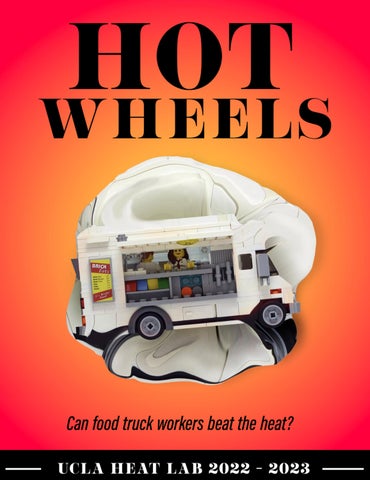
FOOD TRUCKS CAN GET REALLY
HOT.
Street food vendors in Los Angeles have employed migrant workers and served local communities for over a century, with the food truck industry having rapidly grown over the last five years. Food trucks comprise a $1.2 billion industry with nearly 40,000 employees, and 1 12.6% of these trucks are located in California alone. This growth coincides with an increase in local temperatures, due in part to climate change. Thus, the food truck serves as a prime location for investigating how people are affected by heat while they are working, and for developing sustainable solutions for businesses. In this zine, we present workers' oral histories alongside temperature data collected from five food trucks in Westwood Village, Los Angeles during February - May 2022. — Ashley Kenney, Kanishka Mehra, Sofia Sabra, Sierra Stevenson, Jason Sutedja, and Olivia Toledo
TABLE OF CONTENTS 4 BACKGROUND 6 RESPONSIBILITIES 9 Spatial Distribution of heat 10 Temperature DATA 12 HEALTH 14 NORMALIZATION OF HEAT 15 RACE AND HEAT 16 FOOD TRUCK DESIGN 19 REGULATIONS 20 SOLUTIONS 24 Research recommendations 27 acknowledgements 28 BIBLIOGRAPHY
"Let's say that L.A. is 101°F...We'll be like about 118°F...It's like we're getting the heat from the sun and then we're getting the heat from inside the truck. So it stands to gain at least 10 to 20 degrees hotter than normal." 2
"It has gotten hotter and hotter every single year. It may not feel hotter for most, especially here in Southern California. But unless you're inside one of these hot boxes, then you don't appreciate exactly how hot it is." 3
Beyond the Truck As temperatures rise globally, people’s exposure to heat is increasing every year.4 Between 2000 and 2016, the number of individuals exposed to heat waves increased by around 125 million, and these heat waves can last for days or even weeks at a time. Extended exposure to high temperatures creates cumulative stress on the body, exacerbating many conditions, like respiratory and cardiovascular diseases, diabetes mellitus and renal disease.5 There are also several conditions directly caused by heat exposure including heat cramps, heat rashes, heat exhaustion, heatstroke, and hyperthermia. While heat affects everyone, some groups, such as food truck workers, are more affected than 6 others. The lack of cooling, long hours, hot equipment, and other factors exacerbate the effects of rising temperatures. Moreover, racial and socioeconomic biases mean that certain kinds of people are more likely to go into this line of work.
5
RESPONS
AN AROUND THE
The life of food truck workers is a continuous series of responsibilities. Beginning on the night before a big day, workers have to plan and schedule different locations to work. Food truck workers are up by sunrise collecting fresh food for their customers, supplies and gas for the truck, and anything else they might need for their long day.
After this, it's time to prep the food and head to their first location. This can take hours depending on the food being sold, the harsh LA traffic, and how difficult it is to drive the truck.
6
IBILITIES CLOCK JOB
After hours of cooking in the hot truck, taking orders, serving customers, and feeding the community, workers occasionally get a quick break to eat, use the bathroom, etc. However, breaks do not always last long as each worker's help is needed in the truck. How long breaks last varies daily depending on business and staff size. Soon after, workers continue selling food either in the same location or a new location, incurring additional travel time. After further time cooking in the truck, food truck workers finally get to drive home. The cycle repeats and continues every single day... strenuous work in a hot truck with limited breaks, 2, 7, 8, 9, 10 support, or sleep.
7
"IF WE'RE DRIVING FROM LOCATION TO LOCATION, THAT'S USUALLY A BREAK. YOU KNOW,
IT'S NOT REALLY A BREAK, BUT AT LEAST YOU'RE SITTING DOWN. BUT THERE [ARE] REALLY NO BREAKS. THE ONLY BREAK IS LIKE YOUR RESTROOM BREAK. AND THAT'S LIKE YOU HAVE TO GO SO YOU JUST KIND OF 7 RUN..."
8
CRAMPED, HOT, & DRY
Heat is distributed unevenly within food trucks. Current regulations prevent optimal airflow, limiting cooling.
Cooking equipment like ovens and stoves generates the greatest amount of heat in the truck. Workers at these stations can experience heat exposure high enough to cause symptoms such as nausea and dizziness.
Illustration by Sierra Stevenson
Workers in prep and assembly spaces are exposed to less cooking heat, but working closely with others in such a small space exposes people to body heat.
The areas closest to the serving window and back door are cooled by outside air, but L.A. public health regulations prohibit large windows and open back doors due to food safety concerns.
9
TEMPERATURE
A T A T A DA D FOod Truck 1
We placed temperature-recording devices inside food trucks serving late-night dinners to students during a 61°F evening in April 2022. The devices were placed in three different locations:
Cooking area: Near fryers, ovens, and/or stoves;
10
1 where food is cooked area: Near truck center; where meals are 2 Prep assembled area: Near window where customers are 3 Window served
In both graphs, the cooking area was, unsurprisingly, the hottest part of the truck. But the difference is stark; the cooking area reaches as much as 35° Fahrenheit hotter than the serving area by the window. (Even on a cool night, some workers in the truck experienced temperatures exceeding 100° — on summer days, this would be even higher!) These differences in thermal microenvironment are important to understanding the experiences of food truck workers. Workers who spend more time cooking food may have higher need for water and/or breaks, and may be at higher risk for heat illness.
Food Truck 2
11
work varies. thermal comfort does too. The food truck worker stationed at the window taking orders and handing out food will be exposed to more outside airflow.
The most heat-exposed workers in a truck are the cooks working near hot equipment. From the blasts of hot air upon opening an oven to the sizzling oil on lit stoves, cooking emits a lot of heat, and those nearest suffer the most.
12
close calls Food truck workers are hit hard by heat: we heard numerous accounts of nose bleeds, headaches, exhaustion, dizziness, irritability, dehydration, nausea, and vomiting. Sometimes, it gets even worse.
"We try to avoid working during the day because there's some employees [from another truck] that fainted [because of] heat stroke." 7
"I had an employee that actually passed 2 out from heat stroke."
"[My colleague] quit because of a heart attack because of this heat 3 problem..." Despite severe (though relatively infrequent) heat illness events, most interviewees seemed relatively unconcerned for their safety. For many, 10 heat is simply par for the course...
13
NORMALIZATION OF HEAT Similar to how many have normalized rising global temperatures, many of our interviewees have normalized regular exposure to temperatures over 100 degrees Fahrenheit. They use language such as “you get used to it” or that you “got acclimated… it was fast.” 7
11
14
BUILT DIFFERENT? Race also can play a factor in w hat is a “normal” level of heat. To j ustify historical slavery and labor hie rarchies, colonial powers perpetuated the be lief that BI POC 12 people wer e more heat resilient. This perception p ersists today, and may result in racialized food truck hiring proce sses and racialized disparities in heat- related illnesses. This perception can also be internalized, which was cle ar w hen one interviewee said: “Like I coul d go through a w hol e eight hou r sh ift w ith no b reaks . And I don't know if it has t o do with the fact that my, my family l ike raised me to be a ha rd w orker or because … I s tar ted w orkin g since I was 16… I think the only issu e with t he h eat w ould be like at 8 night, you know, because I' m Me xican.” These historical beliefs on heat and race ma nifest t oday in different ways. First, because B I POC, on ave rag e, have a low er socioeconomic status, people may assume they e xperience more 13 hardship. Then according to the c ommon A merican p erce ption of “no pain, no gain,” they may further assume greater heat resilience. Second, Fleming note s a surprisingly c ommon belief that black bodies are fun dame ntally different in tha t they “ ha ve an extra muscle in the ir legs, breathe in more, ha ve lighter 14 bones..," which could also extend to heat resilience.
15
FLAWED FLAWED DESIGN DESIGN Most of the food truck operators emphasized that their trucks’ air conditioning failed to keep them cool. Truck interiors are relatively small, so it might seem that it would be easy for one A/C unit to cool the space. 3 7
As it turns out, A/C placement often prevents any cooling effects. Public health regulations limit where A/C units can be installed, and food truck operators have little say in the matter while their trucks are being built. 3
"Everybody's like 'Oh, well you have A/C' — It doesn't work! [The designer] put the vent windows right next to the A/C, so... you turn [on] the AC and all the air goes straight up..
So we never turn it up."
7
According to our oral history participants, A/C units must be mounted on the ceiling — right next to exhaust fans which suck hazardous cooking fumes and hot air out of the truck. This design means that the vents draw out the cold air from the A/C, leaving workers stuck down below with steaming air and little to no relief from above.
16
Food trucks often have roof ventilation, which can release the air cooled by AC units placed near the top of trucks.
AC units are not always turned on in food trucks because their typical placement in the truck renders them ineffective.
17
SPOILED FOOD AND MELTING TRUCKS Heat doesn't just injure workers, it debilitates their trucks. "It's so, so hot that your generator, which is your main power supply, is working so much more than it would on a regular basis to try and make sure that your refrigerators are staying within temperature...We've had times where your generator breaks and everything in your truck is gone. You can lose, you know, thousands of dollars of food because they couldn't get to repairing it in time. At that point you lost your food. You obviously made no money." 7
"Not only staff members get sick, but also the truck overheats or sometimes even parts melt. Many times we have to cancel events and take trucks to repair." 15
Would you break the rules to beat the heat?
The Los Angeles Public Health Department does not allow back doors to be open during operation.
"Employee entrance doors to food preparation areas shall be selfclosing and kept closed when not in use." 16 — California Retail Code, Section 114303a.
Keeping the back door closed can limit one of the most crucial strategies for heat mitigation within the food truck. Food truck workers are forced to choose between obeying this rule and keeping their employees cool. Some owners install mesh net screens over the doorways to let in outside air without letting in pests, but this strategy is not officially allowed by the Health Department. However, open-door strategies lead to concerns about robbery for many food truck owners.
19
COOLING OFF Some participants were engineers before they opened their food trucks. They had a lot to say about the design flaws of air conditioning in the trucks..
"I would actually put cooling towers right in between in either side of the windows. [I]nstead of putting it on the roof, I would actually put them vertically so that you get air flowing [towards employees]. So that even if the hood is sucking out the air, you still get a cooling airflow." 3
Vertical cooling towers could very well be effective. Why hasn't this design been implemented? According to our interviewees, it comes down to public health regulations as well as the status quo building plan for food truck designers. 3
20
"[A] lot of people only [focus] on the heat, but [...] the humidity [...] in the food truck is really low." "Especially with the A/C [...] because the heat itself is [...] evaporating [the moisture], and the A/C [is also] sucking up this [moisture]... so then it’s really dry out." "Like, your lips start cracking sometimes […] even though you’re drinking so much [water]... Instead of using A/C, how about [using] a swamp This interviewee's idea to start cooler?" 10 using swamp coolers would potentially cool the truck while retaining some humidity. Similarly to the vertical cooling towers, making this switch would require the public health department's approval.
The main roadblock with ensuring that food truck workers are cool enough is the conflict with the public health department's goal of ensuring consumer safety. This is why back doors can't be opened, and why there may be limitations on where an A/C unit can be placed (due to potential leakage, etc.) We spoke with Dr. Kevin Riley, the director of UCLA's Labor Occupational Safety and Health (LOSH) Program, about this tension between protecting food safety and protecting workers. He asked:
17
WHAT SHOULD CHANGE? A pilot program could be launched to re-design food trucks to better take advantage of cooling equipment and airflow. This program could aim to prove that better cooling systems improve worker safety without compromising food safety or consumer health.
Regulations regarding backdoor usage should be made more clear, and amended to formally allow barriers like mesh nets on open back doors. This would allow for air flow without enabling pests to enter the truck.
23
Recommendations for Future Research Our methodology has several limitations. First, we conducted a limited number (9) of oral history interviews. In addition, every participant except for one was a food truck operator (a.k.a a business manager). This was mostly due to the fact that we asked each truck who would be willing to speak with us, and the managers usually volunteered themselves. Thus, further research could build on our oral history framework to include more interviews and to ensure non-manager employees were participating equally.
Second, we only conducted interviews with trucks contracted by UCLA to provide food for students living in UCLA housing, primarily due to our travel limitations. These trucks seemed to be well-established and popular brands, suggesting that our sample could potentially represent more successful businesses. This could affect our data by showing us a sample of participants with higher affluence and more experience navigating the challenges (including heat) of the food truck industry.
24
Third, there are other forms of mobile food establishments (such as hot dog vendors and un-licensed mobile food carts) that were not included in our sample. Further research should aim to represent a broader, more geographically varied population, including smaller businesses and non-truck mobile food establishments.
Fourth, we collected quantitative temperature data during April 2022, mostly in the evenings. Future studies would benefit from collecting data from summer months in the daytime to chart the most extreme temperatures workers face.
Finally, the scope of our report was limited to Los Angeles County. Due to variability in local and state policy and regulations, more research should be done to understand the specific challenges of food trucks in other geographic regions of the United States and across the world.
25
26
Photography by Kanishka Mehra and Ashley Kenney
ACKNOWLEDGEMENTS We would like to thank all of the food truck workers who took the time to speak with us, and the food truck owners who allowed us to record temperature data in their vehicles.
We would also like to acknowledge the support and mentorship of the Director of the UCLA Heat Lab, Dr. Bharat Venkat. Finally, we would like to thank Dr. V. Kelly Turner and Dr. Kevin Riley for their expertise.
27
BIBLIOGRAPHY 1. Lang, Campbell. “Food Trucks in the US.” IBISWorld, January 2023. https://my.ibisworld.com/us/en/industry-specialized/od4322/industryperformance. 2. Anonymous, in discussion with author, March 5, 2022. 3. Anonymous, in discussion with author, May 6, 2022. 4. “Heat and Health.”. World Health Organization. Accessed March 15, 2023. https://www.who.int/news-room/fact-sheets/detail/climate-change-heat-andhealth. 5. “Heat Stress.” Centers for Disease Control and Prevention. Centers for Disease Control and Prevention, August 31, 2020. https://www.cdc.gov/niosh/topics/heatstress/default.html. 6. “Temperature-Related Death and Illness - Climate Change and Human Health.” National Institute of Environmental Health Sciences. U.S. Department of Health and Human Services. Accessed March 15, 2023. https://www.niehs.nih.gov/research/programs/climatechange/health_impacts/heat /index.cfm. 7. Anonymous, in discussion with author, April 1, 2022. 8. Anonymous, in discussion with author, March 1, 2022. 9. Anonymous, in discussion with author, February 21, 2022. 10. Anonymous, in discussion with author, March 5, 2022. 11. Fennell, Catherine. “‘Project Heat’ and Sensory Politics in Redeveloping Chicago Public Housing.” Ethnography 12, no. 1 (2011): 40–64. https://doi.org/10.1177/1466138110387221.
12. Derickson, Alan. “‘A Widespread Superstition’: The Purported Invulnerability of Workers of Color to Occupational Heat Stress.” American Journal of Public Health 109, no. 10 (2019): 1329–35. https://doi.org/10.2105/ajph.2019.305246. 13. Trawalter, Sophie, and Kelly M. Hoffman. “Got Pain? Racial Bias in Perceptions of Pain.” Social and Personality Psychology Compass 9, no. 3 (2015): 146–57. https://doi.org/10.1111/spc3.12161. 14. Fleming, Scott. “Racial Science and South Asian and Black Physicality.” `Race', Sport and British Society, 2002, 127–42. https://doi.org/10.4324/9780203187913-14. 15. Anonymous, in an email message to author, April 26, 2022. 16. CA Health & Safety Code § 114302, 2016. 17. Kevin Riley, in discussion with author, May 23, 2022.
28