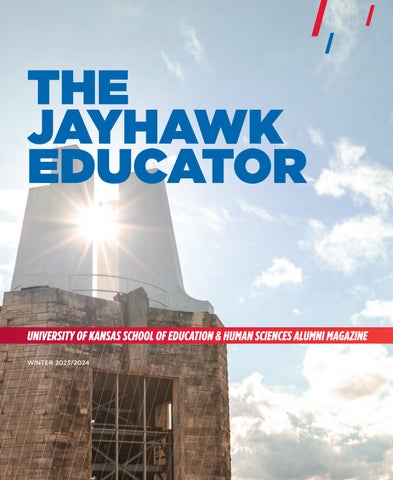
THE JAYHAWK EDUCATOR
UNIVERSITY OF KANSAS SCHOOL OF EDUCATION & HUMAN SCIENCES ALUMNI MAGAZINE WINTER 2023/2024
BY THE NUMBERS 10
No.
1
No.
School of Education & Human Sciences among all public schools and colleges of education, 2023
Department of Special Education among all public special education graduate programs, 2023
1
.
Department of Special Education No online master’s program
20
No.
Department of Curriculum & Instruction among all public schools, 2023
19
Department of Curriculum & Instruction No. online master’s program —U.S. News & World Report
FOR ACADEMIC YEAR 2022-2023 Scholarships: approximately $1 million awarded to 400 students Education-related research dollar expenditures: $77,466,993 (FY23)
Winter is another beautiful season on the University of Kansas campus. ANDY WHITE © UNIVERSITY OF KANSAS
2 From the dean
3
School recognized by CAEP
4
Positive progress
6
Lelon R. Capps Learning Resource Center
THE JAYHAWK EDUCATOR is published by the University of Kansas School of Education & Human Sciences for the School’s more than 25,000 alumni. Dean Rick Ginsberg, Ph.D. Editor Aspen Grender Design Robin Ward, The Write Design Thanks to Mike Krings/KU News Service, KU Alumni Association, Meg Kumin, George LaHood, Laura Meyer/KU Endowment Association, Steve Puppe, Katarina Moore, Belinda Reynolds, Gabby Tappan and Andy White Alumni updates and requests for more information may be sent to: KU School of Education & Human Sciences Attn: The Jayhawk Educator Joseph R. Pearson Hall 1122 West Campus Road, Room 214H Lawrence, KS 66045-3101 For more information, call (785) 864-3726 or e-mail argrender@ku.edu. State dollars were not used to pay for any part of this publication. ON THE COVER AND FACING PAGE Memorial Campanile set in a Kansas blue sky in winter ANDY WHITE © UNIVERSITY OF KANSAS
7
Research notes
10
Reading list
12 Reflections from a career in higher education
14 Going on: Alumni research
16 Bravo! Honors and awards for alumni, students and faculty
22 An educational journey to Kansas
24 In memoriam
28 Alumni updates
1
FROM THE DEAN
Elevating our excellence THE SCHOOL
of Education & Human Sciences is among the more widely recognized academic units at KU and across the country and globe. With the most severe deleterious impacts of COVID-19 behind us, we are charting the course for the next generation of students, programs, and faculty and staff. Enrollments at KU are up, with the largest freshman class this year in the university’s history. For our School, we were up at the undergraduate level, down a bit at the graduate level, no doubt reflecting our early entry into the online space being replicated by peers across the country. Our undergraduate programs in exercise science and sport management are among the fastest growing and most popular at the university. Even in teacher education, where nationally enrollments are struggling, we’ve maintained our undergraduate enrollments and are up slightly at the graduate level. Especially exciting are the new faculty and staff we’ve brought aboard over the past two years. This year we hired 13 new tenure-track and teaching professor faculty members, including two new Distinguished Professors in Special Education. That brings the number of distinguished professors across the School to eight. Add to this that we hired 11 new faculty members last year, which brings us to about a 25% change in our faculty ranks. While we honor the great work of our retirees, our new hires are terrific, bringing the latest skills, research and teaching expertise that will continue to propel us in the future. As evidence of our national prominence, the U.S. Secretary of Education, Miguel Cardona, launched a bus tour across the U.S. in September, visiting colleges and universities, K-12 schools and others in the hopes of promoting the importance of education. The very first stop on his tour was the University of Kansas, and he asked for a private audience with several of our renowned scholars to learn what we are doing to promote better student outcomes and learning.
2
What was to be a very brief session with Secretary Cardona went for about 45 minutes, with him requesting materials from our scholars so that he might understand our advances better and help promote them across the country. Our faculty and staff are undertaking exciting work to be as innovative and entrepreneurial as they can in their teaching, research and practices impacting our fields. We have faculty developing multiple new programs, certificates, majors and minors. One of them, a certificate in Name, Image and Likeness (NIL) in the Department of Health, Sport & Exercise Sciences, is the first in the country and has received national press accolades. The university has embraced a move to competency-based education, and three programs from the School will be the first that the university develops and delivers. Similarly, our scholars continue to be successful in receiving external funding and publications in major outlets covering a wide array of topics, notably with growing leadership in areas like artificial intelligence, neuroscience, special education, assessment and reading. In fact, the Chinese Ministry of Education recently approved a joint relationship in education with a key university in China, making our approved partnership the first one in the field of education. Suffice to say, it is an exciting time for the School of Education & Human Sciences. How lucky am I to be associated with so many promising scholars, thinkers, students and colleagues! I expect that we will have many more exciting innovations while we continue to adjust to and navigate the many challenges ahead. Finally, I need to emphasize how important our alumni and friends are to any success we may enjoy. Through advice on our multiple boards, support for events, and funding student scholarships and other needs, these combined efforts by people like you help us grow. They help us bring in great students. They help us support new faculty and staff in their efforts to serve KU students, as well as the global education and related health and exercise communities with whom we interact. Thank you for being part of our journey. Rock Chalk!
LEADERSHIP
School of Education & Human Sciences recognized for educator preparation The Council for the Accreditation of Educator Preparation (CAEP) announced in September 2022 that the University of Kansas is one of 32 providers to receive recognition for leadership and commitment to continuous improvement. The recipients of the 2022 Frank Murray Leadership Recognition for Continuous Improvement provided evidence and data trends to achieve accreditation with no stipulations or areas for improvement. Recipients are selected from the educator preparation providers (EPPs) that were granted accreditation by CAEP at the initial level from the previous year, who provided a full complement of evidence with demonstrated data trends and no stipulations or areas for improvement. Providers selected for recognition advance equity and excellence in educator preparation through purposeful use of self-study procedures and evidence-based reporting that assure quality and support continuous improvement to strengthen P-12 learning.
These EPPs use inquiry and assessments to establish quality assurance systems to drive improvement. “This accomplishment represents a team effort of the School of Education & Human Sciences accreditation team, school and department leadership, and faculty and staff from at least 24 programs across campus,” says Kelli Feldman, associate dean for teacher education and undergraduate programs in the School. “This recognition that we are among the top educator preparation providers in the country is possible because of the widespread engagement and contributions to continuous improvement by numerous colleagues in the School of Education & Human Sciences, the School of Music, and the College of Liberal Arts & Sciences. Thank you to all of our colleagues who do the day-to-day work to provide high-quality educator preparation for our students.” “We are very proud of our faculty, staff and partners who worked hard over the years to create a program that focuses on
continuous improvement and is being recognized by CAEP as among the top educator preparation programs in the country,” says Rick Ginsberg, dean of the School of Education & Human Sciences. “Not only have we sought out CAEP Accreditation, the gold standard for educator preparation; this recognition provides validation that our students and their families are investing in an education program that is second to none.” CAEP accreditation serves the dual purposes of accountability and continuous improvement. The CAEP accreditation process evaluates the performance of providers and focuses particularly on whether candidates will be prepared, by completion, for the challenging responsibilities that educators face in America’s classrooms. Approximately 600 educator preparation providers participate in the CAEP Accreditation system, including many previously accredited through former standards.
3
POSITIVE PROGRESS
Focusing on strengths, students counsel Kansans while earning service credits Shortly before the Positive Psychotherapy Clinic was to open on the Lawrence campus, the COVID-19 pandemic forced everyone to work and learn from home. But that temporary delay enabled the clinic to reach far beyond campus and provide hundreds of hours of free counseling services to people across the state.
4
MEG KUMIN © UNIVERSITY OF KANSAS
The Positive Psychotherapy Clinic now has a new group of graduate students providing counseling to Kansans via telehealth for a number of concerns — all while focusing on what is right in people’s lives. The counseling psychology program in the School of Education & Human Sciences has long required students to start seeing clients in their second year. Brian Cole, associate professor of educational psychology and director of training in the doctoral program, says there were plans to open a clinic to see clients in Joseph R. Pearson Hall about six weeks before the pandemic upended everyone’s lives. Plans shifted, and the resulting telehealth format that complies with federal law restricting release of medical information has proved to have a far broader reach. It enables students and faculty to serve far more people — so far, the clinic has provided more than 1,700 hours of services to people across Kansas. Kristen Hensley, associate professor in the Department of Educational Psychology, as well as program coordinator and training director of the master’s program in counseling psychology, runs the clinic along with Cole. Counseling psychology master’s students are required to complete 240 hours of service, which will soon
rise to 280. The clinical program helps students complete the required training without adding another year of schooling. “I started thinking of this clinic as a way to get more hours for our students while providing a service to the state. We do the traditional therapy, but the way we approach treatment is a bit different,” says Cole. “The idea of positive psychotherapy is there is more to life than being symptom free. It’s not about living in neutral.” Traditional psychotherapy focuses on treating symptoms. For example, if a person were experiencing depression rating at a negative six — meaning they had significant symptoms but were still able to make it through the average day — the goal might be to get them to a zero, meaning they did not experience symptoms, but they were not thriving or making positive gains either. Positive psychotherapy works with clients to focus on their strengths (what they do well, what is going well in their lives) and use those positive factors to set goals, work toward them and use strengths to address areas of concern. Students in the program have provided services for people dealing with pandemic-related stress as well as traditional concerns like depression, anxiety, divorce, academic stress and related areas. And KU’s Positive Psychotherapy Clinic, among the first of its kind in the nation, has proved to be effective: Evaluation of clients has shown that about 70% have made significant progress in their eightweek program, well above the traditional average, Cole says. Clients — some of whom live as far away as Garden City, about 350 miles from Lawrence — check in weekly to gauge progress. At the completion of the program, counselors can make referrals to other therapists if clients would like and also plan a one-month follow-up.
Brian Cole
“The idea of positive psychotherapy is there is more to life than being symptom free. It’s not about living in neutral.” —Brian Cole
About 65 graduate students have taken part in the program so far. KU has long been a leader in positive psychology and its application in positive psychotherapy. The late Rick Snyder was a pioneer in the area; he and one of his mentees, the late Shane Lopez, were both faculty members and highly respected in the field. For his part in launching the Positive Psychotherapy Clinic as well as research and service in the field, Cole was awarded the
American Psychological Association Society for Counseling Shane J. Lopez Award for Professional Contributions in Positive Psychology. “It means a lot, especially being named for my mentor,” Cole says of the award. “I learned about hope therapy, counseling psychology and so much more from Shane here at KU. Things have come full circle in a lot of ways.” —adapted from an article by Mike Krings, KU News Service
Interested in taking part? Potential clients (adults living in Kansas) may inquire at the clinic’s website: ampp.ku.edu/current-projects/clinic
5
At the dedication in October 2023
Lelon R. Capps Learning Resource Center named in honor of the late Dr. Lelon R. Capps The School of Education & Human Sciences honored the memory and distinguished education career of Dr. Lelon R. Capps with the naming of the Lelon R. Capps Learning Resource Center in Joseph R. Pearson Hall on KU’s Lawrence campus. Professor Capps began his career at the School in 1962, providing 44 years of service. His teaching and scholarship focused on elementary mathematics education. Dr. Capps authored a K–sixth grade mathematics textbook series published by Houghton Mifflin that was used by 70 percent of the schools in the U.S. For many years he provided professional development for teachers of elementary mathematics in the U.S. and in many international locations. While at the University of Kansas, Dr. Capps served as director of elementary education, assistant dean and associate dean for the School of Education. Dr. Capps died on January 19, 2019. The Capps family continues to support KU School of Education & Human Sciences students through the Mathematics Education Scholarship and other donations. The Lelon R. Capps Learning Resource Center offers students in the School of Education & Human Sciences unique learning features, such as a variety of educationrelated books, educational kits such as manipulatives for math, lesson-planning textbooks, journals and publications, and the Gertrude Way Strong Collection of literature for children and adolescents to use in classes and fieldwork.
6
Dr. Lelon Capps
Faculty research
Math, science and early identification If you ask someone if they are a math or science person, they may quickly tell you yes or no. It turns out that how people answer that question in ninth grade and even earlier not only can tell you what subjects they prefer in school, but how likely they are to go on to study STEM subjects in college and work in those fields as adults. The results of a study from the University of Kansas suggest the importance of fostering positive attitudes toward math and science early in students’ lives to address gender and socioeconomic gaps in STEM. KU researchers analyzed a nationwide data set that asked students if they consider themselves a math and/ or science person in ninth grade in 2009. The survey then followed up with those students in 11th grade to ask the same question, then three years after graduation to see who had enrolled in science, technology, engineering and math (STEM) majors, and whether they intended to have a related career when they turned 30. The results not only support the importance of student attitudes on academic outcomes; they also suggest efforts should be focused more on cultivating positive attitudes earlier in student careers, before they get to college, where most of such efforts happen currently. Rafael Quintana, assistant professor of educational psychology, and Argun Saatcioglu, professor of educational policy and sociology, both at KU, conducted a study in which they analyzed data from the High School Longitudinal Study of 2009. The data set includes responses from more than 21,000 students from about 940 schools across the United States. The study was published in the journal Socius: Sociological Research for a Dynamic World. Results showed that the odds of enrolling in a STEM major were 1.78 times larger for students with a science identity in ninth grade and 1.66 times larger for those with a math identity than those who did not identify with the subjects. The odds of expecting a career in STEM was 1.69 times larger and 1.6 times larger for those with high science and math identities, respectively. Those numbers are illustrative of how having positive experiences with math and science early can be influential both in higher education and later in life, the researchers say.
RESEARCH NOTES
Embracing transnational students as English teachers Thousands of students from around the world are pursuing a degree while learning in an additional language. A book from University of Kansas authors documents the stories of these students studying in the United States to be English teachers and suggests how their stories can improve education for others. “Transnational Language Teacher Identities in TESOL: Identity Construction Among Female International Students in the U.S.” follows the stories of 13 women studying to be teachers of English to speakers of other languages at universities across the country. Their experiences with sexism, racism and assumptions about their supposed linguistic deficiencies made for challenging times, but helped lead to recommendations on appreciating the value such unique students bring to the table. “All of us are former international students, so we wanted to discuss the unique experience we had in American higher education,” says Hyesun Cho, associate professor of curriculum & teaching at KU and the book’s lead author. “In the book we use the term transnational students instead of international students. It indicates more complex, fluid and ‘in-between’ identities of people who cross borders and are not just foreign sojourners in one other country. We wanted to demonstrate the wide range of experiences and diverse goals of these students.” The book, published by Routledge, was co-written with Reem Al-Samiri of the University of Jeddah, Saudi Arabia; and Junfu Gao of Nova Southeastern University. Al-Samiri and Gao are former doctoral students of the KU TESOL program in curriculum & teaching. The text establishes that transnational students are not a monolith. They come from countries around the world with a wealth of language and life experiences. Some are parents with established professional careers who will continue to work in the United States, while others return to their native countries or work abroad. The enrollment number of these students is expected to increase. At KU alone, there are roughly 1,700 transnational students from 110 countries, Cho says. Learn more: rockcha.lk/ transnationalenglish-teachers
7
The long game and school segregation Even though Brown v. Board of Education outlawed school segregation in 1954, racially segregated schools have persisted in practice. In recent years, the decades-long trend of White flight to suburbs has reversed in some areas as some White residents are moving to city centers. Research from the University of Kansas shows that in one such city that also has school choice policy, families are making decisions that perpetuate school segregation despite more opportunities for integration. Washington, D.C., is a major metropolitan area with a school district policy that allows parents to choose the school their children attend. Data has shown that White families are returning to the city’s core in recent years, and while in theory that could lead to more integrated schools in a city with large minority populations, a KU study shows that is not happening. As families regularly move among schools in search of the most desirable one, they do not use their voice in attempt to improve schools. Sometimes they even game the lottery system designed to assign students equitably among systems. Bryan Mann, assistant professor of educational leadership & policy studies at KU, was lead author of a study that interviewed nine White parents about how they chose their children’s schools. This was part of a broader study that interviewed 20 parents and triangulated findings with GIS mapping and quantitative data. This portion of the study used Exit, Voice, Loyalty — a framework common in organizational theory and political research. It examines why people choose to stay with or leave an organization. Exit is reflected by those who choose to leave, loyalty is reflected by those who stay, and voice is represented in the choice to advocate for changes and improvements to a system. The study, written with Annah Rogers of the University of West Alabama, was published in the journal Urban Education. “When you think about community-driven school reform, you think about loyalty and how parents use their voice to change things. I was curious about the school ecosystem in D.C. that has gentrification and if it still tracks with these ideas of loyalty and voice,” Mann says. “Here people can exit a school or exit the system altogether and go to a private school. We found those who have the tools to exit or work within the system to move are more likely to move. That’s part of what exacerbated school segregation.” Learn more: rockcha.lk/school-choice-policy
2023 RESEARCH & TEACHING FESTIVAL Want to see more KU faculty research? School of Education & Human Sciences scholars shared new research and developments in their fields during five-minute presentations at the February 2023 Research & Teaching Festival. Watch the full conference online: rockcha.lk/research-teaching-fest23
8
Athletes and coaches have long used forms of overtraining as part of their overall strength training regimen, such as “two-a-day” football practices, Fry says. They’ve known that there is a temporary reduction in strength and power, but that generally they recover and eventually post gains in performance. The study shows, however, that hyaluronic acid plays a role in that process, and may help explain overreaching’s detrimental effects. “Performance was very much impacted by this training, and the drop in hyaluronic acid accompanied that performance decrease,” Fry says. “Nobody progresses all of the time, but what we saw is the opposite of natural variation.” Learn more: rockcha.lk/overtraining-study
KU study sheds light on what happens inside muscle when athletes overtrain Athletes have long been known to push themselves as hard as possible to improve their performance, especially in the weight room. But not much is known about what happens inside the muscle when someone trains too hard. A University of Kansas study has shown that a key acid, though little studied, drops when someone overtrains in the weight room and the decline is accompanied by a reduction in muscle power. Researchers in KU’s Jayhawk Athletic Performance Laboratory regularly study how athletes function and how they reach full potential. In the study, they analyzed muscle biopsies of fit individuals who took part in an intense, 7 1/2-day weight training program. Several participants were deliberately pushed beyond normal weight training — known as nonfunctional overreaching, a type of overtraining — and others took part in a more standard program. The lab analyzed hyaluronic acid present in the subjects’ muscles and found those who overtrained had a significant reduction in their muscle tissue, and they also experienced a reduction in power, a key performance component for athletes. “Around the muscle, there’s a connective tissue matrix. That’s not new knowledge, but one of the components is hyaluronic acid,” says Andrew Fry, professor of health, sport & exercise sciences, lab director and study co-author. “There’s evidence in animal studies that it plays a role as muscles change shape. Hyaluronic acid acts somewhat as a lubricant, so having a critical amount is key to helping the muscle move and change shape as someone trains.” The study, published in the journal Applied Physiology, Nutrition and Metabolism, was co-written by Troy Purdom of North Carolina A&T University; Alexis Wayland, Bjoern Ludwar, Erin Shanle and Jake Giles, all of Longwood University; and Justin Nicoll of California State University in Northridge; as well as Fry. Purdom and Nicoll are former KU graduate students.
Boosting education for ASL speakers A research-based assessment of self-determination is effective with Deaf youth and speakers of American Sign Language, a study from the University of Kansas and the University of Texas at Austin has shown. Promoting self-determination is a way to give young people agency in their education and goals for their future, and the research highlights how self-determination assessment can be used to support Deaf youth to communicate about their self-determination and have better educational, career, health and life outcomes, according to researchers. The Self-Determination Inventory: Student Report, known as the SDI:SR, developed at KU, is an assessment to help young people identify their self-determination skills and abilities, informing their ongoing learning. While the SDI:SR has been used by students with disabilities in numerous studies, the current study is among the first to look at the SDI:SR ASL version with Deaf youth who use American Sign Language. KU researchers partnered with colleagues at the National Deaf Center on Postsecondary Outcomes at the University of Texas at Austin to translate the Self-Determination Inventory into ASL, then to test its use with that population. Results showed the SDI:SR ASL is as valid and effective as the original SDI:SR in American English. Researchers gave the Self Determination Inventory: Student Report to a sample of 3,309 young people, including 392 Deaf youth who used the ASL version. “We found the Self Determination Inventory is a valid, useful assessment for those who use ASL and can be another tool for educators, schools and others who work with Deaf youth to support them to gain ownership of their education, careers and lives,” says study co-author Karrie Shogren, director of the KU Center on Developmental Disabilities and professor of special education. “This translation provides access to the SDI for ASL users.” Learn more: rockcha.lk/self-determination-asl
9
READING LIST
Recently published books by faculty Teaching Students with Severe Disabilities This book, co-written by Jennifer A. Kurth (associate professor, SPED) and published by Pearson, presents thorough coverage of the major issues pertinent to teaching students with severe disabilities in a way that helps teachers easily understand and apply concepts in their own classrooms. Lauded as a book unparalleled for its level of currency and reality, the authors draw on their own personal experience and a broad array of professional literature to help make even the most complex research findings on severe disabilities understandable and usable in the real world of education today. Focusing on both methodology and curriculum, the authors present concise information that helps readers develop an understanding of the strengths and needs of individuals with severe disabilities, current service philosophies, and effective instructional practices for teaching these students. Thoughtful attention is paid to alternative assessments, the role of the paraprofessional, multicultural concerns, the effects of peer relationships, the use of assistive technology, early intervention and more. Duck and Cover: Confronting and Correcting Dubious Practices in Education In the 1950s and 1960s, students practiced ducking under their desks in case of an atomic bomb attack. We know that this was silly and provided no protection, and many school practices that are popular today are equally silly. Duck and Cover: Confronting and Correcting
10
Dubious Practices in Education, written by Rick Ginsberg (dean) and Yong Zhao (Foundation Distinguished Professor, EPSY; courtesy professor, ELPS), explores a wide range of what the authors label “duck and cover” policies — ideas that may have started for good reasons but whose usefulness has declined over time, ideas that may lack sound theoretical foundations or long-term evidence, ideas that violate basic logic and reasoning or cause serious and proven damage. At the Crossroads of Pedagogical Change in Higher Education: Exploring the Work of Faculty Developers Since the 1970s, colleges and universities have seen an increase in faculty development, or programs designed to help professors improve their teaching. These centers for teaching and learning have adapted their approaches just as pedagogy in the classroom has shifted to studentcentered and studentdirected approaches. At the Crossroads of Pedagogical Change in Higher Education: Exploring the Work of Faculty Developers, co-written by Heidi Hallman (chair, professor and Secondary English Education Program Coordinator, C&T), chronicles the history of the centers, drawing on interviews with faculty developers and the literature of the field and higher education.
Learning for Uncertainty: Teaching Students How to Thrive in a Rapidly Evolving World As technology evolves and changes the world at a faster pace than ever before, two veteran educators have written a book that explores how schools can prepare young people for a globalized future that is still taking shape. This book by G. Williamson McDiarmid and Yong Zhao (Foundation Distinguished Professor, EPSY; courtesy professor, ELPS), explores how today’s education system is not preparing students to be citizens of a changing world but that educators can prepare students for the future, even when they’re not sure exactly what it will be. The Youth Sports Handbook: A Kid’s Guide to Being the Ultimate Leader, Competitor, and Teammate When Jordan Bass (chair, associate professor, HSES) started a youth club baseball team, he wanted to give his players something to read on how to be a good teammate and leader and how to learn from athletic failure. To his surprise, he could find no books that directly covered those topics for young athletes. So, he decided to write the book himself. A teacher and researcher who works in sport management, amateur sport, organizational behavior, sport
in higher education and related topics, Bass is also a youth sports coach, parent, middle school athletics director and former college tennis player. When he could only find recommendations like encouraging youth athletes to read titles like “The Little Engine That Could,” he decided to fill a literature gap to help youth, coaches and parents alike. Korean as a Heritage Language from Transnational and Translanguaging Perspectives, edited by Hyesun Cho (associate professor, C&T) and Kwangok Song (associate professor, C&T), was published by Routledge in 2022. Good Blood, Bad Blood: Science, Nature, and the Myth of the Kallikaks, 2nd Edition, co-authored by Michael L. Wehmeyer (chair, SPED; Ross and Marianna Beach Distinguished Professor in Special Education; director and senior scientist, Beach Center on Disability), was published by the American Association on Intellectual and Developmental Disabilities in 2022.
Exceptional Lives: Practice, Progress, & Dignity in Today’s Schools, 10th edition, co-authored by Ann Turnbull (Ross and Marianna Beach Distinguished Professor Emerita, SPED), H. Rutherford Turnbull (Ross and Marianna Beach Distinguished Professor Emeritus, SPED), Michael L. Wehmeyer (chair & Ross and Marianna Beach Distinguished Professor, SPED) and Karrie A. Shogren (Ross and Marianna Beach Distinguished Professor, SPED), was published by Pearson in 2023.
Publishing in 2023.
Equitable and Inclusive IEPs for Students with Complex Support Needs: A Roadmap, co-written by Jennifer A. Kurth, was published by Brookes
The SelfDetermined Learning Model of Instruction: A Practitioner’s Guide to Implementation for Special Education, co-authored by Karrie A. Shogren, was published by Routledge in 2023.
Build Equity, Join Justice: A Paradigm for School Belonging, co-written by Amy McCart (courtesy professor and research professor, SPED), Wade Kelly (assistant director of content development, SWIFT Education Center, Life Span Institute) and Wayne Sailor (professor, SPED), was published by Norton Professional Books in 2023. Supports Intensity Scale — Adult Version, 2nd Edition, co-authored by James R. Thompson (professor emeritus, SPED), Karrie A. Shogren and Michael L. Wehmeyer, was published by the American Association on Intellectual and Developmental Disabilities in 2023. SelfDetermination and Causal Agency Theory: Integrating Research into Practice, co-written by Karrie A. Shogren, was published by Springer in 2022.
11
FACULTY PROFILE
Reflections from a career in higher education by Susan Twombly, professor of higher education, Department of Educational Leadership & Policy Studies
YOU COULD SAY
that studying and teaching about higher education is in my blood. Every year of my life to date has been associated with a college or university in some way. I literally grew up living on a two-year college campus. Following college and a master’s degree in counseling, I held student affairs positions at Nova Scotia Teachers College, St. Francis Xavier University (Nova Scotia), and then at Juniata College, where Jim Troha, one of my former KU doctoral students, is the current president. While at Juniata I decided to pursue a doctoral degree in higher education administration at Penn State. In August of 1985, I defended my dissertation and moved from State College, Pa., to Lawrence to assume my new job as an assistant professor of higher education. I was promoted to full professor in 1998, and in 2006 began a second stint as department chair of the Department of Educational Leadership & Policy Studies, a position I held until fall 2023. My scholarly interests are broad, which is reflected in the kinds of research I have done. My doctoral advisor hired me as a graduate assistant to work on a national study of community college administrators. In the mid-1980s relatively few scholars studied community colleges. My early research built on the administrator career study and focused on administrative labor markets. It then expanded to include community college faculty labor markets and then women in leadership roles.
Subsequently, KU colleagues and I collaborated on research on dual career couple hiring in higher education and also on international faculty, topics reflective of changing demographics of higher education faculty, specifically the growth in numbers of women faculty who tend to be partnered with other faculty members and of international faculty scholars. As a student of the history of higher education, I know that few of the changes and challenges we face today are truly new. That does not diminish their effects on our work lives today. Space allows me to Twombly focus briefly on one related set of changes: those having to do with faculty, especially expectations for tenure track faculty. Expectations for research productivity are higher than ever, but that’s not enough. Faculty must also become experts in use of technology and instructional design. They are expected to spend more time marketing their programs, recruiting students, teaching larger classes, and engaging in added work such as assessment of student learning outcomes.
“My advice: Take advantage of being where you are.” —Susan Twombly
12
© UNIVERSITY OF KANSAS
“One can also argue that universities such as KU have survived precisely because of the commitment students, faculty, staff and alumni have to a strong, shared culture.” —Susan Twombly
For the most part my colleagues are up for it. They come into their jobs better prepared to be productive researchers than ever and they are more productive. Many have had teaching experience. Graduate school has prepared them well for the research portion of their jobs. However, graduate school did not and perhaps couldn’t prepare them for the other demands, expectations and realities that impinge on time to do research. Add COVID-19 to the mix and, well ... I do not need to say more. One of the advantages university faculty and staff have is being able to participate in some form of shared governance of the institution providing them with some control over their work conditions. Today faculty governance faces enormous challenges requiring attention to those working conditions, rising expectations for research and teaching work against such participation. Some years ago, I saw a consultant’s PowerPoint slide that reminded its clients (KU administrators) that “culture is the enemy of change.” There may be some truth to this, but one can also argue that universities such as KU have survived precisely because of the commitment students, faculty, staff and alumni have to a strong, shared culture. Faculty, staff and students must participate in order to preserve shared governance and sense of culture.
Early in my career, I wanted to be anywhere but KU. My doctoral advisor gave me great advice: “You have to do the same things to stay or leave, so stop whining and do them.” After briefly flirting with leaving, I ended up staying. In so doing I have tried to take advantage of what KU has to offer and to give back in the process. I have had exceptional opportunities for involvement at the university level where I got to meet people from across campus and see issues from various points of view. Because higher education is my field of study, every such opportunity became a learning experience that informed my teaching, my research, and the way that I look at the world. Even if the connection isn’t so direct, it’s important to take an active role to influence what we can. My advice: Take advantage of being where you are. Despite the many challenges higher education — and KU — faces, I can’t think of a better, more privileged life or better place to work than as a university faculty member. Rock Chalk!
13
GOING ON
Alumni research Wayne L. Black Jr. seeks to make college athletics more equitable College athletics is often framed as the ultimate even playing field — one of pure opportunity, where anyone can succeed, so long as they’re willing to put in the hard work. It’s a notion that’s been rehashed time and time again by commentators, everyday fans and Hollywood Cinderella stories. KU researcher Wayne L. Black Jr. is challenging the simplicity of that narrative. A former college athlete himself, Black’s work is informed by his own firsthand experience and intimate knowledge of the industry’s bright spots, as well as its deep shortcomings. Now an assistant professor of sport Black administration at the University of Cincinnati, his doctoral research through KU’s Educational Leadership & Policy Studies program is shedding light on the complex inner workings of collegiate athletics, and exploring ways to make the industry a more equitable space for players. “My work is intentionally designed to disrupt the system by highlighting these issues,” he says. “I want a better system for future college athletes and that’s what motivates me.” Read more: rockcha.lk/Wayne-Black
Steven Johnson Jr. looks to deepen understanding of Black RAs’ experiences on campuses Black resident assistants, particularly those at predominantly White institutions, navigate a unique set of circumstances and biases in the workplace. And yet, qualitative research on their experiences is relatively limited. How do Black RAs make meaning of their radicalized experiences? What strategies do they utilize in their day-to-day duties and interactions? And what motivates them in their roles? Through his doctoral studies in KU’s Higher Education Administration program, alumnus Steven Johnson Jr. (Ed.D., 2022), who currently serves as the assistant dean of diversity, equity, inclusion and belonging (DEIB) in KU’s School of Business, is looking to fill these gaps in knowledge. Drawing on his own experiences as an RA and later as a full-time residence life staff member, he hopes to shed light on this important and understudied topic. “There is certainly an opportunity to continue to explore the experiences of Black RAs in research, especially Johnson in this time where racial tensions are differently amplified and when many campuses have expressed a commitment to diversity, equity and inclusion,” says Johnson. “As Black RAs are both personally and professionally impacted by racial incidents, it will be important to learn how to better support them in their roles.” Tell us what the focus of your research is. The focus of my research is to understand how Black resident assistants at predominantly White institutions make meaning of their racialized experiences at work. The qualitative study inquires about their motivations to pursue this role, explores how they make meaning of racialized experiences, and investigates any help seeking strategies they utilize when navigating racialized experiences as an RA.
Black in San Juan, Puerto Rico
14
How did you come to be interested in this topic? Originally, I was interested in learning more about why there were few Black RAs on the campuses where I worked. When I was an undergraduate student, I served as the only Black RA in my building and within the community of residence halls in my area. Because of this, I often felt as though I navigated situations in my role while others lacked full understanding of how different interactions impacted me. Later, I worked both as a graduate assistant at a public state institution, and as a full-time staff member in residence life at a different university. In these roles I supervised RAs and led departmental initiatives. These positions gave me experience with connecting with Black RAs differently than I had when I was an RA.
What advice can you share with other researchers on finding and securing funding? There are a number of different funding sources available to graduate students that can be tapped into. My recommendation is to work with your faculty advisor or department to secure any support necessary in applying for these opportunities. I have seen many emails throughout the doctoral journey encouraging me to apply for different things. In all of them, I put my name in the hat and went from there! I was able to accept two different sources of funding since being a doctoral student, both of which have either helped me finance the research study or conference participation. Johnson in his current role at a university function
Working with them to respond to biased incidents, engaging with them during staff training, connecting during team meetings and in a variety of other interactions, I learned that their experiences as undergraduate staff members were not too dissimilar from mine. They navigated challenging interactions with residents, responding to tragic current events, balancing competing demands of academic and personal obligations, and feeling responsible for doing so without blemish. The pressure to do well in all areas became overwhelming. As I reflected on these experiences, I realized that there was little infrastructure to support the unique needs and experiences of Black RAs. I found research about Black RAs limited. Further, there are few studies that focus specifically on how Black RAs’ role and racial identities intersect when having to navigate their campus role. My goal is to contribute to the growing literature that addresses this timely topic and understudied population.
What changes, developments or discoveries would you like to see occur in your field during your lifetime? I would like to see a greater attention on the ways national climate concerns permeate campus culture and impact the experiences of historically underrepresented populations. Moreover, this research should be done in a disaggregated approach, looking intentionally at specific social identities and at various intersections. Read more: rockcha.lk/Steven-Johnson-Jr
What’s one thing that you think everyone should take away from your research on this topic? There is certainly an opportunity to continue to explore the experiences of Black RAs in research, especially in this time where racial tensions are differently amplified and when many campuses have expressed a commitment to diversity, equity and inclusion. As Black RAs are both personally and professionally impacted by racial incidents, it will be important to learn how to better support them in their roles.
Johnson in his RA days at KU Homecoming
15
BRAVO!
ALUMNI HONORS SCHOOL OF EDUCATION & HUMAN SCIENCES HONORS 2022 AND 2023 DISTINGUISHED ALUMNI AWARD RECIPIENTS The University of Kansas School of Education & Human Sciences honored alumni John Heim and Stephen W. Smith with one of its top awards in 2022 and 2023. Stephen W. Smith was recognized with the 2023 Distinguished Alumni Award at the School’s spring convocation ceremony in May. Smith is a professor in the Special Education program at the University of Florida (UF), where he has served in his role since 1989. His research focuses on effective behavioral prevention strategies in educational Smith settings, executive function and the self-regulation of behavior (goal-directed effortful control of thought, action, emotion), issues related to aggression and violence in schools, and understanding verbal aggression of students with emotional and behavioral disorder. Prior to receiving his doctorate in special education from KU in 1989, Smith earned bachelor’s and master’s degrees from Missouri State University, and was a teacher of special education students for eight years. While at UF, Smith has received three teaching awards and a university research award. He has served twice as a UF Distinguished Research Professor. He was one of six recipients of a university-wide doctoral mentoring award in 2013-2014 for outstanding work with doctoral students. Smith was the Irving & Rose Fein Endowed Professor from 2012 to 2015. Most recently, he was awarded the 2018 Distinguished Researcher Award from the American Education Research Association, Special Education special interest group. He is a panel scientist for the U.S. Department of Education, Institute of Education Sciences, and is on the editorial board of numerous professional journals in education and special education.
16
John Heim, who was recognized with the 2022 Distinguished Alumni Award, is the executive director and CEO of the National School Boards Association (NSBA), where he has served in his role since 2021. NSBA is a federation of state associations that represent locally elected school board officials serving approximately 51 million public school students. A nonprofit organization, NSBA advocates for equity and Heim excellence in public education through school board leadership. Prior to joining NSBA, Heim served as the executive director of the Kansas Association of School Boards (KASB) from 2010 to 2021. Heim earned his bachelor’s degree in secondary education and teaching from KU in 1981. He later received a master’s degree from Fort Hays State University and a doctorate from Kansas State University. Before joining KASB, Heim served as the superintendent at Emporia Public Schools from 1997 to 2010, where he was also an adjunct professor from 2000 to 2010; as a visiting practitioner at Wichita State University from 1997 to 1998; and as executive director of the Educational Services and Staff Development Association of Central Kansas (ESSDACK) from 1994 to 1997. He has held leadership roles in various public education organizations, serving as president of the Kansas Association of School Administrators, as a member of the board of directors and legislative committee chair of the United School Administrators of Kansas, and as a member of the Mid-continent Research for Education and Learning Superintendents Forum. The Distinguished Alumni Award is the highest honor the School bestows upon its alumni. Award recipients demonstrate ongoing, exceptional professional, academic or research achievement and contribution to the community at the local, state, national or international levels.
ALUM RECEIVES FRED ELLSWORTH MEDALLION Kala Mays Stroup (M.S.E., 1964) was one of three Jayhawks selected to receive the 2022 Fred Ellsworth medallion for their faithful, longtime service to the University of Kansas and higher education. Stroup, a three-time KU graduate, met Fred Ellsworth when he visited Great Bend, Kansas, her hometown, to award her a scholarship to KU. After earning her bachelor’s degree in speech and drama in 1959, she remained on the Hill for graduate school, completing her master’s degree in education in 1964 and her doctorate in communication studies Stroup in 1974. She became a standard-bearer among women in higher education, going on to lead two universities as president and later the Missouri Commission of Higher Education. She also founded the National Nonprofit Leadership Alliance, which prepares and certifies undergraduate and graduate students to guide nonprofit organizations.
Craft
KU ALUMS COMPETE IN SUPER BOWL LVII TRAINING OPPOSING TEAMS As the Kansas City Chiefs claimed victory over the Philadelphia Eagles during Super Bowl LVII in 2023, two Jayhawk alumni supported both teams from opposite sides of the field. Trey Kunz and Evan Craft — both graduates from KU’s Class of 2009 — served as athletic trainers on each respective sideline. Kunz, who earned a B.S.E. from the School of Education & Human Sciences in sport science, is the physical therapist/athletic trainer for the Eagles, while Craft, who graduated with a B.S. in athletic training, serves as an assistant athletic trainer for the Chiefs.
Secure your future as you become the best possible resource for your students. You could see an annual salary increase of up to $7,000 with a graduate degree,1 so earn yours from the experts in the KU School of Education & Human Sciences. Our unparalleled professional training empowers you with the skills, knowledge and theoretical background to meet students’ needs in any location or circumstance.
Choose your specialty.
EDUCATORS WITH MASTER’S DEGREES EARN MORE.
Kunz
We offer NCATE/CAEP-accredited2 online master’s degrees, graduate certificates and licensure programs in: • Curriculum & Instruction • Special and Inclusive Education • Educational Administration & Leadership Policy
STUDENT ACHIEVEMENTS Mei McConnell, a sport management major, was selected for the 41st class of University Scholars. Competitively selected from KU’s sophomore class, University Scholars earn their distinction through rigorous academic achievement, intellectual promise, curiosity and leadership. For her project, McConnell was mentored by Katie Rhine, associate McConnell professor in the departments of African & African-American Studies and Geography & Atmospheric Science.
Myltin Bighorn, who earned his bachelor’s in physical education plus in May 2022 before returning as a master’s student in sport management in the fall, was one of 19 Jayhawks selected to receive the KU Madison and Lila Self Memorial Scholarship for the 2022-2023 academic year. The Self Memorial Scholarship is a merit-based scholarship awarded to outstanding undergraduate students from KU who transition into a full-time master’s or doctoral program at KU in the fall semester. Bighorn, right, with fellow KU Spirit Squad members at the 2022 Men’s Basketball NCAA Championship parade in downtown Lawrence
CJ Cleary, a doctoral student in exercise physiology, won the most outstanding podium presentation at the doctoral level award at the National Strength and Conditioning Association conference. Melania Piedra-Barrera, a doctoral student in the Department of Educational Leadership & Policy Studies, Andrea Garcia (Ph.D., ’23); and Bahaur Amini (Ph.D., ’23) were awarded KU doctoral student research funds from KU’s Office of Graduate Studies.
Moore
Thome
18
Kaitlyn Moore, a secondary English education major, was among 31 University of Kansas undergraduate students to receive the prestigious Benjamin A. Gilman International Scholarship to study or intern in countries around the world. Funded through the U.S. Department of State’s Bureau of Educational and Cultural Affairs, the highly competitive award provides up to $5,000 to apply toward the program cost to study or intern abroad. Students who additionally were awarded the Gilman Critical Need Language Award receive up to $8,000. Moore studied at J.F. Oberlin University in Japan during summer 2023. Additionally, Moore and Larissa Thome, a finance and exercise science major, were among 15 Jayhawks selected as KU 2022 Global Scholars, a program that recognizes and encourages undergraduate students with an interest in international studies and a strong academic record.
Additionally, Bighorn had the honor of attending Super Bowl LVII in 2023 as the inaugural LoneBear/H. Roe Bartle Rotational Intern for the Kansas City Chiefs, an initiative that “provides a candidate of American Indian heritage the opportunity to work with, learn from and offer input for various departments throughout the Chiefs organization.”
Bighorn at GEHA Field
Faculty updates RETIREMENTS These School of Education & Human Sciences faculty and staff members retired after the 2020-2021, 2021-2022 and 2022-2023 academic year. On behalf of the School, we thank them for their dedication and service to the university and to their respective fields. Thomas DeLuca (27 years) associate professor, C&T DeLuca’s expertise focused on literacy and content area reading, as well as the history of reading instruction.
Deborah Perbeck (27 years) professor of the practice, ELPS Perbeck’s expertise focused on foundations of education with an emphasis in philosophy of education.
Eva Horn (22 years) professor emerita, SPED Horn’s expertise focused on effective, instructional techniques for infants, toddlers and preschool children with developmental delays and/or at risk for disabilities and their families.
Suzanne Robinson (40 years) associate professor, SPED Robinsons’ expertise focused on teacher education, collaboration, multi-tiered systems of support, literacy and technical assistance.
Tamara Mikinski (22 years) multi-term lecturer, EPSY Mikinski’s expertise focused on counselor training, couples therapy and integrative healthcare.
The School of Education & Human Sciences hosted its annual Homecoming Party on the Patio at Joseph R. Pearson Hall as part of Homecoming festivities prior to kickoff of the Kansas vs. Oklahoma football game in October 2023. IN THE KNOW Keep up with news from the School: rockcha.lk/soehs-news
Paula Naughtin (29 years) Deans’ Office Naughtin served the School of Education & Human Sciences as an academic advisor, convocation coordinator and editor of The Jayhawk Educator magazine until her retirement in April 2023. Joseph Novak (9 years) senior lecturer and online faculty program coordinator, ELPS Novak’s expertise focused on educational administration with an emphasis in building level leadership.
Marlesa Roney (9 years) professor, ELPS Roney’s expertise focused on higher education administration. Alisa Branham (25 years) Deans’ Office Branham served the School of Education & Human Sciences as its licensure officer until her retirement in May 2022. Sherrie Saathoff (44 years) Deans’ Office Saathoff served the School of Education & Human Sciences in the Department of Special Education and then as assistant to the dean until her retirement in December 2021.
PROMOTIONS ANNOUNCED The School of Education & Human Sciences is pleased to announce that Chancellor Douglas A. Girod has approved promotion and the award of tenure to the following faculty. EFFECTIVE FALL 2023
EFFECTIVE FALL 2022
To professor Greg Cheatham, SPED Kelli Feldman, C&T David Hansen, EPSY Haiying Long, EPSY Michael Orosco, EPSY Matt Reynolds, EPSY
To professor Trent Herda, HSES
To associate professor Zak Foste, ELPS Susan Harvey, HSES Bryan Mann, ELPS
To associate professor M’Balia Thomas, C&T
19
FACULTY ACCOLADES Tamara Coder Mikinski, retired multi-term lecturer in the Department of Educational Psychology, was one of three KU faculty members to receive the 2022 Bob & Kathie Taylor Excellence in Teaching Award, which recognizes nontenure track faculty.
Mikinski
Saundra Gautt, professor emerita of special education, received the USD 497 2023 Outstanding Service to Public Education Award. Arpita Ghosh, assistant professor of counseling psychology, was elected as the American Psychological Association Division 19: Society for Military Psychology, ECP Committee chair. Division 19: Society for Military Psychology is an organization that encourages research and the application of psychological research to military problems.
Shogren
Karrie Shogren, professor of special education, senior scientist in KU’s Life Span Institute and director of the Kansas University Center on Developmental Disabilities, was named the Ross and Marianna Beach Distinguished Professor of Special Education in the KU School of Education & Human Sciences. The title became effective at the start of the spring 2023 semester. “I have sought to engage in work that advances selfdetermination for people with disabilities throughout my career,” Shogren says. “This professorship advances the recognition and impact of this work, which has been shaped by people with disabilities, school and community leaders, students and faculty at KU and across the world who have been part of it. It is a privilege to learn with and shape the direction of services and supports for people with disabilities in schools and communities.” Shogren’s research focuses on assessment and intervention in self-determination and supported decision-making for people with disabilities. She presents in countries from Italy to South Korea. She has been at the forefront of multiple grant-funded projects, including assessment validation and efficacy trials for self-determination interventions in school and community contexts. Shogren was also named as the Division on Autism and Developmental Disabilities’ 2022 Burton Blatt Humanitarian Award winner, which honors individuals who reflect the ideals of the Division and who have made significant contributions to the field.
20
Ghosh
Amanda Mollet, assistant professor of educational leadership & policy studies, was selected by the American College Personnel Association as a 2022 Association Award recipient in its Emerging Scholar category.
Mollet
Glennda McKeithan, associate teaching professor in the Department of Special Education, was selected as the NC Division on Autism and Developmental Disabilities Distinguished Service Award recipient. Kwangok Song, associate professor of curriculum & teaching, was selected as one of nine Mellon DEI Teaching Scholars. The initiative is designed to advance diversity, equity and inclusion at KU through teaching and leadership. It is jointly sponsored by the Center for Teaching Excellence and the Lied Center of Kansas. The scholars worked in tandem with a Mellon-funded project at the Lied Center with the work of Song performing artists from historically marginalized groups to promote diversity, equity and inclusion on stage and in classes.
Hines
Dorothy Hines, associate professor of curriculum & teaching and associate professor of African & African-American studies, is vice chair/chair-elect for the American Educational Research Association Classroom Management SIG #19. Hines was also selected for the Office of Diversity, Equity, Inclusion & Belonging Fellows Program at KU; her two-year appointment, focused on the theme of intersectional leadership, began in March 2023.
Lisa Wolf-Wendel, professor and interim chair in the Department of Educational Leadership & Policy Studies and associate dean of the School, was named a Roy A. Roberts Distinguished Professor at the University of Kansas in June 2022. Wolf-Wendel was instrumental in establishing work-family balance as a legitimate area of research. Her scholarship has been at the forefront of understanding the impact Wolf-Wendel of dramatic structural shifts in the professoriate on faculty work, primarily for women. She is an award-winning professor, highlighted by receiving the School of Education Faculty Research Achievement Award in 2004. “I am honored and humbled to have earned the title of distinguished professor at KU,” Wolf-Wendel says. “I got into this career to make higher education a better place. I have been able to do that through my teaching, service, scholarship and the integration of these domains with a happy life. I am eternally grateful for all the people who inspire me to be the best version of myself.”
Dean Rick Ginsberg, left, with Herda
Trent Herda, associate professor in the Department of Health, Sport & Exercise Sciences, was presented with the Salute to Faculty Excellence award at the Nov. 1, 2023 KU Men’s Basketball game in Allen Fieldhouse.
Wolf-Wendel’s research focuses on faculty issues, including studies of the academic labor market, particularly mobility of international faculty, factors affecting women faculty members, faculty from historically under-represented groups and faculty at mid-career, as well as several recent research projects on the policy response of academic institutions in the wake of demands for dual-career couple accommodations and work-life balance. At KU, Wolf-Wendel has served as faculty development fellow, graduate study fellow, senior administrative fellow and Faculty Senate president. Her tenure began as an assistant professor in 1995.
Lane
Kathleen Lane, Roy A. Roberts Distinguished Professor in the Department of Special Education and Associate Vice Chancellor for Research, was selected to receive the Council for Exceptional Children’s 2022 Special Education Lifetime Achievement Award “for her lifetime of achievement improving outcomes for students with and at risk for emotional and behavioral disorders and the educators who serve them.” Barbara Kerr, Williamson Family Distinguished Professor of Counseling Psychology in the Department of Educational Psychology, received a Fulbright U.S. Scholar Award to travel to Iceland to study creative communities.
Erin Yosai, associate professor of practice in the school psychology program, was awarded the Early Career Faculty scholarship from the Trainers of School Psychologists organization. Kerr Yosai
21
ADMINISTRATOR PROFILE
An educational journey to Kansas by Ngondi Kamatuka
MY ELEMENTARY SCHOOL
teachers in the Black Old Location township of Windhoek, Namibia, whetted my curiosity for learning. Their passion for imparting knowledge to their students is foundational in my journey. I left my home country of Namibia in 1974, traveling through Angola, Democratic Republic of the Congo, and living in Zambia as a refugee. The reason for leaving Namibia was to join the liberation movement for the independence of Namibia, which, at the time, was still under the colonial yoke of South Africa. Young, scared and finding myself in a new environment, and not knowing what the future held, the humanity of total strangers in these countries helped me hone and strengthen my power skills. A Mennonite missionary, Jacob A. Loewen, who had taught at Tabor College in Hillsboro, Kansas, was the catalyst in my gaining admission to Tabor College. The challenges of being a refugee and, sometimes, not having anything to eat for days provided me new lenses with which to see the world and its beauty. Sometimes I get this question: Would you do it all over again, traveling your journey? Probably not, but I do not know if I would be the person I am today, had it not been for the challenges of being a refugee. In that sense, I do honor that experience. During my junior year at Tabor College, I took a campus visit to Mount Oread, and fell in love with KU. I received a master’s degree and earned a doctoral degree in 1987 from the School of Education & Human Sciences. I now serve as the director of the Achievement & Assessment Institute’s Center for Educational Opportunity Programs. My affiliation with CEOP — locally, nationally and globally — has afforded me the space and platform to advocate for access to higher education and success in the academy by first-generation college students. I am that first-generation college student who just needed an opportunity and a support system to succeed. Our nation must continue investing in the human capital, our students. Also, I serve as an assistant dean in the School of Education & Human Sciences for Diversity, Equity, Inclusion & Belonging. SOEHS is my community and when Dean Ginsberg approached me to serve as an assistant
22
dean, I did not hesitate in accepting the offer as I wanted to be a part of the solution in making my community — our community, the School of Education & Human Sciences — a place that is not just performative, but intentional in its DEIB focus. “To belong is to feel valued, seen, appreciated and heard as an integral part of our campus community”, Kamatuka to quote Nicole Hodges Persley, vice provost for DEIB. The School’s action plans entail the following: • DEIB curriculum mapping by all departments, • creation of a community room, • affinity group meetings, • aligning SOEHS DEIB with Jayhawks Rising Strategic plan, • creation of the SOEHS Black Alumni Advisory Council (BAAC), • intentional DEIB focus on faculty and staff searches, • budget for SOEHS DEIB committee, and • DEIB-focused conversations and presentations. I join Dean Ginsberg in inviting our African American/ Black alumni to join BAAC to help the School chart a new “audacious vision to imagine ourselves differently,” as Hodges-Persley advocates. We need to be intentional in recruiting, retaining and graduating students of color. Similarly, we need to be intentional in recruiting and retaining faculty and staff of color. Let me conclude by saying I believe in the goodness of every member of my community, our community, the School and our alumni. We should recognize and harvest the reservoir of our collective expertise. Let’s all provide the best academic experience for our scholars to be world citizens. Let’s all provide the best space and support for our faculty to flourish. Let’s invite and welcome staff’s participation in School conversations and planning. We are better when we work together. And as an African American, I am honored to continue my journey in this community, my community, our community, the School of Education & Human Sciences.
“Sometimes I get this question: Would you do it all over again, traveling your journey?” —Ngondi Kamatuka
Kamatuka, seated, with schoolmates in Namibia
23
IN MEMORIAM
The School of Education & Human Sciences notes with sorrow the passing of these valued colleagues, alumni and friends FACULTY Wayne Osness, 90, on October 4, 2023. Osness, professor emeritus in the Department of Health, Sport & Exercise Sciences (HSES) was appointed to the faculty of the University of Kansas in 1966. In addition to teaching, he directed the graduate program and the Exercise Physiology Laboratory in HSES until 1973 when he was appointed chair of the department. He served as department chair for 35 years before retiring in 2002. Within HSES, Osness established the Wayne Osness Outstanding Doctoral Student Award, which provides an annual award to an outstanding doctoral student in physical education. He also provided funding for the department’s Osness Human Performance Laboratories, which includes the Applied Physiology Lab, the Jayhawk Athletic Performance Lab and the Neuromechanics Lab. Tom Skrtic, 75, on November 19, 2021. Skrtic came to KU in 1976 as an assistant professor in both the Department of Special Education and the Department of Curriculum & Instruction. He was promoted to associate professor in those departments in 1981 and to full professor of special education in 1990. He was named the Gene A. & Gretchen Budig Teaching Professor in Special Education for the 2005-2006 academic year and the Williamson Family Distinguished Professor of Special Education in 2015, a title he held until his death.
24
James Thompson on September 11, 2022. He had more than 30 years of experience in the field of developmental disabilities as a direct support professional, special educator, rehabilitation counselor, teacher educator and researcher. Thompson joined KU in 2016. He held positions at the School of Education & Human Sciences, where he was a professor of special education, and at the Life Span Institute. There, he was both a senior scientist at the Beach Center on Disability and associate director of the KU Center on Developmental Disabilities (KUCDD). Todd Wilkerson, 38, on August 30, 2022. Wilkerson started at KU in August 2022 as an assistant teaching professor in the Department of Health, Sport & Exercise Sciences. In addition to being a faculty member in the School of Education & Human Sciences, he also was director for the undergraduate sport management program. Flora Wyatt, 88, on September 25, 2023. Wyatt, former assistant professor in the Department of Curriculum & Teaching, began teaching at KU in 1968, She also completed her advanced degree work at KU. At the university, she taught undergraduate courses in reading, language arts, and middle school curriculum and instruction, as well as graduate classes in the supervision of student teachers and writing. Within the School, Wyatt served as chair of the scholarship committee, chair of the undergraduate field experience design committee and director of the Professional Development Schools Program. She retired from KU in 2005.
ALUMNI AND FRIENDS Ken Martinez, 87, on June 5, 2023. A three-time KU School of Education & Human Sciences alumnus, Martinez earned a B.S. in science education in 1960, an M.S. in educational administration in 1966, and an Ed.D. in curriculum & instruction/special education in 1971. He worked in the education field several years before joining a consulting firm in Rosslyn, Virginia, as vice president for research. In 1979, he and his wife, Sheila, founded A-S-K. Associates, Inc., a Lawrence-based consulting firm with two divisions providing conference and meeting management and IT support services throughout the nation and abroad. He led the Lawrence Chamber of Commerce’s small business committee, served as board chair for Bert Nash Community Mental Health Center and Lawrence Memorial Hospital, and as a member of the Lied Center Advisory Board. As Dean’s Club Lifetime Patrons (individuals who have made gifts of $25,000 and above over their lifetime to establish endowed and expendable scholarships and awards, underwrite lecture series, and provide unrestricted program support for students, deans, faculty and academic units), the Martinezes created the Ken and Sheila Martinez Scholarship to support both undergraduate and graduate students in the Department of Curriculum & Teaching.
Thomas “Tom” Richard Wilkerson, 76, on August 23, 2022. His professional career led him to serve his country and community. After working for a year at the Bureau of Recreation in Jefferson City, Missouri he accepted a position in KU’s recreation department. While at KU, he earned his master’s degree. He went on to spend 20 years at the City of Lawrence in the Parks and Recreation department, where he served as the assistant director, before retiring in 2002. Del Williamson, 83, on October 24, 2022. Although Williamson’s time as a student at KU lasted for only one year, he leaves a lasting mark on the University of Kansas and the School of Education & Human Sciences community. After finding success in business, he knew he wanted to give back to the university. Ultimately, he and his wife, Barbara, decided to do so by supporting the School, from which Barbara had graduated, as Dean’s Club Lifetime Ambassadors (individuals who have made gifts of $250,000 and above over their lifetime for the creation of distinguished professorships, established endowed scholarships and other program support) and Watkins Society Members (individuals who have developed an estate plan or other deferred gift arrangement with KU Endowment that will ultimately benefit the School) with the hope of inspiring others to do the same. Through their generous contributions, the Williamsons created two distinguished professorships for the School, one in the Department of Special Education and one in the Department of Educational Psychology program, as well as The Williamson Family Innovation and Entrepreneurship Fund.
ANDY WHITE © UNIVERSITY OF KANSAS
25
Areas of Support
SCHOOL OF EDUCATION & HUMAN SCIENCES Join us in making sure School of Education & Human Sciences Jayhawks continue to receive the skills, knowledge and experience they need — so that society benefits from gifted teachers, guides, coaches and human sciences professionals who inspire the next generation.
T O WA R D S H A P I N G T H E F U T U R E OF LEARNING
In October 2023, the University of Kansas launched its EVER ONWARD campaign — an ambitious effort to raise funds for numerous programs, projects and initiatives designed to transform education, spur discovery and create a healthier world. You can revisit Chancellor Douglas A. Girod’s remarks from that event by watching the video at kueveronward.org. NOW IS THE TIME TO MAKE A TRANSFORMATIVE GIFT TO THE SCHOOL OF EDUCATION & HUMAN SCIENCES. TOGETHER WE CAN ADDRESS THE FOLLOWING PRIORITIES: Providing renewable scholarships for students to grow our future professionals School of Education & Human Sciences graduates serve our communities and excite students about learning. Salaries have not kept up with the increased cost of higher education, however. Financial concerns cause aspiring teachers to give up their dreams at a time when many communities have positions to fill. More scholarships will mean more educators, administrators and mentors in schools and greater success for our students. Investing in the faculty who inspire tomorrow’s leaders in education and human sciences Our faculty members are leaders in teaching and research who raise the stature of our school and university. They are nationally known researchers with federal funding, textbook authors, creative innovators who are solving today’s societal challenges, and teachers who inspire the next generation. Expanding research funding and opportunities with additional Teaching and Research Fellows will develop the expertise, leadership capabilities and prestige of our faculty members and the entire school. Keeping these luminary faculty at KU and in higher education is important for the future. Fueling entrepreneurship and innovation Higher education is changing, and your support will ensure the School of Education & Human Sciences leads this evolution. We aim to develop and nurture new endeavors such as hosting annual Innovation and Entrepreneurship Incubators. We also are spearheading initiatives to provide short courses that teach in-demand skills and competencies needed today. We are fostering the collaborative environment that sparks new ideas and practices. Want to be a part of this historic campaign? Contact Laura Meyer at KU Endowment, LMeyer@kuendowment.org, 785-832-7372.
26
LIKE RECEIVING THE JAYHAWK EDUCATOR? Much of our work and our future would not be possible without support from our generous donors. We’re thrilled to share the achievements and latest news from our alumni, students, faculty, staff and friends with you in The Jayhawk Educator. If you’d like to help us keep this magazine available in print versions, please consider making a gift to the KU School of Education & Human Sciences. Visit rockcha.lk/soehs-give or connect with Laura Meyer (LMeyer@kuendowment.org or 785-832-7372) and our partners at KU Endowment to make your gift to the School. A hard copy of The Jayhawk Educator is available upon request. Email soehs@ku.edu to request a print copy.
27
ALUMNI UPDATES
Thanks for writing! We love hearing from you 1960s
Mindes
1990s
Gayle Dean (Taylor) Mindes (B.S. in elementary education, 1964), professor emerita at DePaul’s College of Education, edited Casebook: Developmentally Appropriate Practice in Early Childhood Programs Serving Children from Birth Through Age 8, published by the National Association for Education of Young Children in 2023.
Jeff Stolz (B.S.E., 1998) has been hired as KU’s new mental health and wellbeing director. Stolz, who began his role in March 2023, brings more than 10 years of experience working in the Stolz mental health field. Most recently he was a social worker and program coordinator at Van Go, Inc. in Lawrence, Kansas, where he was responsible for coordinating and implementing support for program participants on a variety of wellness-related efforts.
28
2000s
Dr. Danica Moore (M.S.E., 2013) was selected as the staff recipient of the Martin Luther King, Jr. Champion of Equity Award at Lawrence Public Schools in Lawrence, Kansas.
Joel Leader (B.S.E., 2006) completed his doctorate in educational leadership at the University of North Texas, and is currently an assistant professor of educational leadership and policy studies at the University of Texas at Arlington.
2010s
Dr. Phyllis Esposito (Ph.D., 2011) was named vice president and dean for institutional diversity at Reed College in Portland, Oregon. Esposito also will be part of the Esposito senior leadership team. Esposito told Diverse: Issues in Higher Education, “As an academic leader, understanding when and how to enter this work requires collaboration with others; understanding of evidence-based practices; and sensitivity and compassion for people’s lived experiences.” Lori Hasselman (M.S.E., 2019), Native American student success coordinator for the University of Kansas, was included in the 4th annual “I Am First Too” commemorative Hasselman poster for 2022. The annual poster, given by the TRIO SES & STEM office, honors KU first-generation students, alumni, faculty and staff who have excelled as role models, trailblazers and advocates of first-generation student success.
Moore
Wraye Royle (B.S.E., 2014), a seventh grade math teacher at Indian Hills Middle School in Prairie Village, Kansas, was named a Shawnee Mission All Star. Royale
2020s
Javen Betts (B.S.E., 2023), was named as one of three winners of the 31st annual Excellence in Community, Education and Leadership (ExCEL) Awards from KU Alumni Betts Association in October 2021. Betts was president of the Black Student Union and served as the Big XII constitution delegate for Black student government, in addition to serving an assistant for KU TRIO SES and STEM. Betts also received KU Student Affairs’ Agnes Wright Strickland Award that recognizes student leaders who demonstrate leadership in matters of university concern.
YES, I WOULD LIKE TO ASSIST THE KU SCHOOL OF EDUCATION & HUMAN SCIENCES IN MAKING A DIFFERENCE.
PLEASE PRINT CLEARLY:
Please check box if information is new so we can update our records. NAME*
Please send me information about: How to include KU SOEHS in my will/estate plans. How to establish a named scholarship, teaching professorship, or endowed professorship. How I can make a charitable gift to the KU SOEHS and receive income throughout my lifetime. I have included the KU SOEHS in my will/estate plans. Telephone (
)
B
H
*Previous name ADDRESS CITY/STATE/ZIP Telephone ( M
Circle B for Business; H for Home; M for Mobile
)
B
H
M
Circle B for Business; H for Home; M for Mobile
PLEASE INCLUDE TODAY’S DATE:
TELL US ABOUT YOU!
Please include your graduation year and degree along with your personal update.
Joseph R. Pearson Hall 1122 West Campus Road, Room 214H Lawrence, KS 66045-3101
Autumn Blakesley (B.S.E., 2023) and Gabriel Maldonado (B.S.E., 2023) were recognized in fall 2022 by the Kansas State Department of Education as Teachers of Promise at the 2023 Kansas Teacher of the Year Banquet.
Gardner
Nick Gardner (Ed.D., 2023) received the Vivan Scales Education Award from the Living the Dream organization and was promoted to principal of Ross Elementary in Topeka, Kansas.
Elaina Honas (Ed.D., 2023), special education coordinator of secondary transition programs and building administrator at East Heights in Lawrence, Kansas, Honas was named assistant principal for Lawrence High School.
Matt Kane (Ph.D., 2023) wrote Walk With Me: Stories of Black Men’s Resilience and Well-being through Twin Pandemics. This debut book published in April 2023 reached the No. 1 new release spot in both the minority studies and civil rights & liberties categories on Amazon.
Killian
Ric Killian (Ed.D., 2022) accepted the position of deputy provost at the U.S. Army War College, one of the nation’s highest leadership positions within professional military education. Maya McDaniel (B.S.E., 2023) was selected for a Fulbright English Teaching Assistantship in Spain.
McDaniel
Scheibel
Gretchen Scheibel (Ph.D., 2023) was selected to join the 14th cohort of the Council for Exceptional Children’s Division for Research Doctoral Student Scholars.
What have you been doing since you left KU? We want to know! Please complete the form above and mail it back to us in an envelope. Be sure to let us know if your name or address has changed so we can update our records if necessary. If you prefer, you may e-mail your information to us at argrender@ku.edu.
soehs.ku.edu
PREPARING EDUCATORS AND HUMAN SCIENCE PROFESSIONALS AS LEADERS SINCE 1909 Joseph R. Pearson Hall 1122 W. Campus Rd Lawrence, KS 66045 soehs.ku.edu