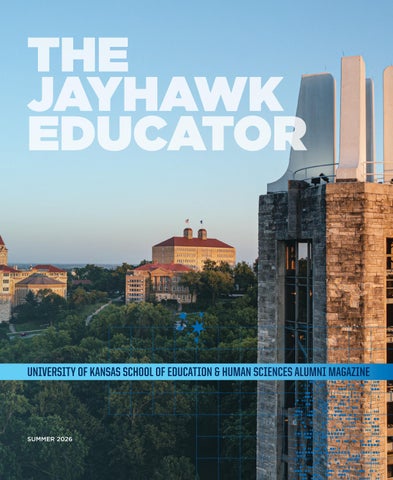
THE JAYHAWK EDUCATOR
UNIVERSITY OF KANSAS SCHOOL OF EDUCATION & HUMAN SCIENCES ALUMNI MAGAZINE
SUMMER 2026
BY THE NUMBERS #8 Best public graduate school of education (tie); #16 overall #1 Overall graduate program in special education (tie) #2 Online graduate program in education (tie) #1 Online education program for veterans #1 Online graduate program in special education #10 Online program in curriculum & instruction (tie) #13 Online program in educational administration and supervision (tie) —2026 U.S. News & World Report
FOR ACADEMIC YEAR 2025–2026 Scholarships: More than $2.3 million awarded to 565 students Education-related research dollar expenditures: $79,904,545 (FY25)
Summer clouds on full display above the Lawrence campus © UNIVERSITY OF KANSAS
3 From Dean Rick Ginsberg
5 Welcome, Dean Newman
6 School News
8 Faculty Spotlight
THE JAYHAWK EDUCATOR is published by the University of Kansas School of Education & Human Sciences for the School’s more than 35,000 alumni. Dean Rick Ginsberg, Ph.D. Editors Jacob Ward | Tiffany Reddig | Aspen Grender Design Robin Ward, The Write Design Thanks to Icelda Beltran, Blue Valley West High School, Everspring, Honest Game, KU Endowment, Mike Krings/KU News Service, Laura Meyer, Paula Naughtin, Prairie Trail Middle School, Belinda Reynolds Alumni updates and requests for more information may be sent to: KU School of Education & Human Sciences Attn: The Jayhawk Educator Joseph R. Pearson Hall 1122 West Campus Road, Room 101 Lawrence, KS 66045-3101
10 Research Notes
14 Reading List
16 Alumni Spotlight
18 Student Spotlight
19 Bravo! Honors and Awards for Students, Alumni and Faculty
26 We Remember
For more information, e-mail soehs@ku.edu. State dollars were not used to pay for any part of this publication.
29 Alumni Updates
ON THE COVER AND FACING PAGE
Summer makes a splash on the KU campus in Lawrence © UNIVERSITY OF KANSAS
1
WHERE JAYHAWKS LEAD NEXT
The KU School of Education & Human Sciences is preparing educators and human sciences professionals who are ready for today and also for the possibilities of tomorrow.
For KU alumni, we offer an open invitation: share your stories, join the conversation, and help shape what the next generation of Jayhawks will make possible.
2
FROM THE DEAN
The years flew by As many of you know, this spring was my last semester as dean of the School of Education & Human Sciences, with a projected return to faculty sometime this summer. It is hard for me to believe that 21 years have passed since I joined KU. Serving as dean beginning in summer 2005, for what was then the School of Education, has been the highlight of my professional career. Let me sum up my tenure this way: I have loved being the dean at KU. I’ve been around long enough that I have had a hand in hiring nearly all the current faculty and staff members — and, for the old-timers, I tried to support their personal growth and help them flourish. I certainly know that I’ll be leaving the School in very capable hands. There is so much about this role that I will miss — great people, wonderful students, friends, and alumni who care. And our School and university have some of the most remarkable and long-lasting traditions that permeate the culture. I daresay we were among the first schools in the country to host a breakfast/luncheon for donors and their scholarship recipients to get to know one another, a chance for donors to appreciate the importance of their generosity and gratitude from the students. And I can say with certainty there aren’t many universities where Ginsberg every student knows the words and can sing the alma mater. At the University of Kansas, we don’t just graduate our students; instead, they line up and walk through the Campanile and down the Hill before entering the football stadium to graduate — and without a long, drawn-out ceremony with multiple forgettable
SCHOOL OF EDUCATION & HUMAN SCIENCES ACHIEVEMENTS SINCE 2005
speeches from a series of unknown dignitaries. That just wouldn’t be the KU way. Many times on my travels across the country and the globe, I’ve been regaled with loud pronouncements of “Rock Chalk” when someone noticed my Jayhawk gear and wanted to share in the camaraderie that is part of our culture. Come on — every Jayhawk knows that you need only attend a single basketball game at Allen Fieldhouse to appreciate what we have at KU. My path to KU was never predestined. It was more of a circuitous route. I grew up in New York City, then off to Albany, New York, for college, then to Chicago for graduate school after working a few years in the Big Apple. After completing my doctorate, I worked in academic positions in New Orleans; Columbia, South Carolina; and Fort Collins, Colorado, before finally tapping my heels together and riding the wind gusts into Lawrence. I quickly came to appreciate KU and Lawrence, learning that nearly everyone at KU is quite humble, despite the obvious excellence that permeates our work. It was powerful enough that even a dang Yankee like me quickly realized this was a special university and place to be. And, yes, these days I actually tear up a bit when I hear a good rendition of “Somewhere Over the Rainbow!” During my stint as dean, we’ve taken many steps forward, and a few backward, but we’ve maintained our strength in our teaching and research, always with a student-first focus driving our efforts. My most cherished memories as dean all revolve around the people I’ve been blessed to work and interact with. Every chance I get to spend time with an alum is heartwarming. You’ve all been very kind and gracious to me.
Changed the School’s name to School of Education & Human Sciences Created the new welcome center, community room and Centennial Reading Plaza in Joseph R. Pearson Hall
—continued on next page
Hosted the Brown v. Board 70th anniversary conference Led the way as the first academic unit at KU with online graduate programs
3
—continued from previous page Personally, I’m continually awestruck by the quality of the work we produce, through our amazing research, dedication to teaching, and support for one another. There probably isn’t another major university in the country where a school like ours has produced some of the largest grants in the university’s history. Where a school like ours is the highest ranked among all the academic units on campus. Where a school like ours took the lead in adding online programs, is developing new competency-based programs, and has a partnership with a university across the globe where we send our faculty to teach hundreds of students who will be getting KU degrees from several of our programs. At a time when so many are languishing, we thrive. The special culture in our School and university permeates everything we do. As just one example, every fall semester our recruitment and student support specialists host an event for potential incoming Jayhawks and their families. We compile a panel of current students who answer a series of questions from the student perspective for those we are recruiting to join us. Typically, we ask, “Why did you choose to come to KU and our School?” The answers are consistently gratifying. The key theme is always that when they visited KU, something special and different drew them in —
“I see the potential to truly transform teaching and personalize learning in ways only dreamed about before.”
a sense of warmth, caring, and belonging. I would guess any alum reading this appreciates the zeitgeist that historically has been the essence of KU. Today, changes seem to come at warp speed, with new challenges seeming to dwarf life as it was when I started or when many of you were here. But I’m reminded of a line from the theme song for the movie, “The Way We Were,” where Barbra Streisand sings, “Can it be that it was all so simple then? Or has time rewritten every line?” Truth is that there have always been challenges and difficulties to endure, new approaches to embrace. Some are immutable realities — for example, we almost always have financial needs and insufficient state support, while new technologies keep emerging and pushing us in previously unfathomable ways. Those in the education fields know that we don’t seem to ever have enough teachers to meet the demands in many fields. And, sadly, the cost for attending college has risen to ridiculous levels. But just looking back over my career, we did cope with the devastating 2008 recession and handled new demands for accountability that emerged, while public confidence slowly started declining for higher education. Then there was COVID (remember COVID?), the life-altering pandemic that swept everything normal under the carpet. Of course, recent political changes have brought their share of unparalleled disruptions into higher education as well. Somehow, nastiness seems to be part of the new normal. And, perhaps most notably, nothing in our world’s history matches the speed of change and potential for disruption that artificial intelligence promises for altering our living and work spaces. I have no clue how it may upend higher education as we know it. So, although we have always lived in a dynamic environment, today really does feel different, as Bob Dylan so aptly put it many years ago, “The times they are a-changin’.”
—Rick Ginsberg
Established international degree programs through a joint institute agreement with Zhejiang Normal University Organized a mentoring program for the School’s new faculty and staff
Developed the Spring Research & Teaching Festival for the School’s faculty
Partnered with the Kansas State Department of Education to design the Annual Strategies for Educational Improvement Summer Conference
But with all this, I remain as optimistic as ever. My next phase at KU will include working in a center I co-created, focusing on reimagining teaching and learning. I hope to help the university as it evolves, as well. I see the potential to truly transform teaching and personalize learning in ways only dreamed about before. Going forward, graduates and current employees in all fields will need to learn to work with AI, and all universities and schools like ours must adjust to these changing circumstances. I find it somewhat chilling but terribly exciting at the same time. As smart as AI is, appreciating that it will become smarter every day in our future, one thing is clear — AI isn’t human. Our faculty, staff, and students will need to embrace their humanness, their social-emotional selves, and their ability to create and innovate, while employing the emerging technologies to grow and flourish. It is those human skills and capabilities that we need to integrate as we change how we work, and who better than Jayhawks to lead the charge? So, despite a good deal of growing uneasiness and anxiety that we all feel, the future truly is bright. The many changes that current and recent generations of students have endured have been dynamic. I suspect that will continue. But students learn to be resilient; they always embrace what we elders avoid, and I predict that those realities will endure. Though we live in a time that feels a bit like a game of musical chairs with the music never stopping, understand that our KU students, faculty, and staff are ready to embrace emerging needs. After all, each of us is a Jayhawk, that mythical bird that rises above and excels as few others can. These past 21-plus years truly have flown by. It has been my pleasure to be here with you. Thank you for all your kindness and patience and support over these past few decades. And now and forever … Rock Chalk!
WELCOME, DEAN NEWMAN The KU School of Education & Human Sciences turns a new page this summer as Joshua Newman joins as dean on July 1. Newman comes to KU from Florida State University, where he served as associate dean for research and oversaw a college research enterprise that grew from $17 million to more than $84 million in Newman
annual expenditures over five years.
A professor of media and cultural studies in sport management and a fellow of the National Academy of Kinesiology, Newman brings deep experience in research leadership, faculty development and building institutional partnerships. His work at FSU spanned more than 150 active research faculty, 36 scientific laboratories and three K-12 laboratory schools — a breadth of experience that positions him well to lead a school as wide-ranging as the School of Education & Human Sciences at the University of Kansas. Newman, who grew up in Tennessee as a
Established the Ginsberg Innovation Fund, giving future deans flexible resources to meet emerging needs
first-generation college student, has said his own educational journey will shape his approach at KU. “I know firsthand the sacrifices that students and their families make to pursue higher education — and the profound transformation it can bring when they do,” he said. “I am committed to
Instituted the Travel & Research Support Program
honoring and supporting students from every walk of life as they make their own
Built the Summer Technology Camp and Summer Curriculum Camp for faculty
journeys with us at KU.”
5
SCHOOL NEWS
TEACHING TOMORROW
How the School is leading the future of learning through AI and innovation As artificial intelligence reshapes nearly every corner of society, the KU School of Education & Human Sciences is ensuring that educators and communities are not simply keeping up — they’re helping define what responsible, learner-centered innovation looks like. The goal is steadfast: technology should amplify human potential, not replace it. Here, we spotlight three KU centers driving that mission forward.
6
Leading inclusive technology and AI integration nationwide
Pushing the boundaries of what teaching can look like
CENTER FOR INNOVATION, DESIGN, AND DIGITAL LEARNING (CIDDL) CIDDL, led at KU by James Basham, supports higher education faculty nationwide in preparing future teachers and leaders to use technology — including AI — in inclusive, equitable, and evidence-based ways. One of CIDDL’s recent signature achievements is its leadership in developing a national framework for responsible AI integration from PreK–20. Grounded in humancentered design, the framework emphasizes accessibility, meaningful educator preparation, and safeguards against algorithmic bias. CIDDL’s widely used “AI Office Hours” series further helps educators understand how AI can assist with tasks like generating feedback, adapting materials for students with disabilities, and reducing paperwork — while keeping human judgment at the core. CIDDL exemplifies KU’s longstanding commitment to inclusive learning design — now brought into the AI era.
FLEXIBLE LEARNING THROUGH INNOVATIONS IN TECHNOLOGY & EDUCATION (FLITE) Directed by Lisa Dieker, FLITE explores how emerging tools — virtual reality, intelligent agents, simulations, and adaptive software — can transform teacher preparation and K–12 practice. Rather than focusing on tools for tools’ sake, FLITE challenges educators to imagine entirely new learning experiences. Its “AI and Education” initiatives invite teachers, preservice educators, and school partners to ask bold questions: How might AI support co-teaching? What could classrooms look like when VR or intelligent tutoring systems become part of daily practice? A hallmark of FLITE is its collaborative model, working with districts, industry partners, and university teams to pilot innovations that feel both imaginative and practical.
Transforming schools through innovation, AI literacy, and student voice CENTER FOR REIMAGINING EDUCATION (CRE) Directed by Bart Swartz, with co-founders Dean Rick Ginsberg and Yong Zhao, the Center for Reimagining Education supports schools and districts ready to rethink long-standing structures — often with AI as both a catalyst and a content area for student inquiry. CRE’s work includes pilots where teacher teams and students co-design “schools-within-schools,” embrace flexible learning environments, and use AI tools to personalize instruction. But CRE also emphasizes the ethical and critical dimensions of AI. Students and educators examine questions like these: • Where might bias appear in AI systems? • How do we evaluate AI-generated information? • What remains uniquely human in a tech-rich classroom? By centering agency, curiosity, and community partnership, CRE positions KU at the forefront of educational transformation — where AI is not the destination, but a tool for reimagining what is possible.
2026 STRATEGIES FOR EDUCATIONAL IMPROVEMENT SUMMER CONFERENCE The KU School of Education & Human Sciences and the Kansas State Department of Education welcomed educators from across Kansas to the KU Edwards Campus in Overland Park on June 23 for the annual Strategies for Educational Improvement Summer Conference. This year’s conference, “Smart Tools, Strong Teaching, Successful Students,” explored the growing role of artificial intelligence in education, bringing together teachers, administrators and researchers to discuss how AI can strengthen instruction, support students and build workforce-ready skills. Watch highlights from the 2026 conference online: youtube.com/watch?v=0Rf2bLqTp8g
7
SPOTLIGHT ON FACULTY ZAK FOSTE
Guiding ELPS through a transformative moment in higher education Going into his ninth year at KU and second as department chair, Zak Foste, associate professor and chair of educational leadership & policy studies, brings a deep commitment to student development and campus environments to his leadership of the department. Foste joined the University of Kansas after completing his doctorate in higher education & student affairs at The Ohio State University, where he also served as a postdoctoral researcher. Foste His research examines how college students make meaning of their identities and experiences, and how campus climates shape belonging, learning, and personal development.
That scholarly lens continues to inform his approach as chair, where he focuses on supporting faculty excellence, strengthening academic programs, and preparing the next generation of school leaders, policymakers, and higher education administrators. “I’m incredibly excited about the opportunity to champion the great work of our faculty, staff, and students in ELPS,” Foste says. “The department plays such a pivotal role in preparing future school leaders, policy makers, and higher education administrators in Kansas and beyond. I’m excited as we continue to grow our programs and the reach of the department across the state and online. We’re also home to a tremendous group of faculty who are making a meaningful impact in the field of education via their teaching, research, and service.”
“ The department plays such a pivotal role in preparing future school leaders, policy makers, and higher education administrators in Kansas and beyond.” —Zak Foste
8
© UNIVERSITY OF KANSAS
“ When students discover that science is something they can do, not just memorize, the whole world opens up to them.” —Douglas Huffman
DOUGLAS HUFFMAN
Preparing the next generation of science educators For Douglas Huffman, preparing outstanding science educators goes far beyond content knowledge. It’s about equipping future teachers to nurture curiosity, build critical thinkers, and help students understand the world through inquiry and evidence. As a professor of science education and associate dean in the School of Education & Human Sciences, he is nationally respected for his work in teacher preparation, assessment, and STEM Education. Huffman Huffman’s research focuses on how teachers develop strong instructional practices and how preparation programs can better support them in navigating the complexities of today’s
classrooms. From integrating data literacy to helping teacher candidates evaluate emerging technologies — including AI-powered tools — his work ensures that new educators graduate ready not only to teach science, but to do science alongside their students. What distinguishes Huffman is his dedication to mentorship. Students routinely describe him as accessible, encouraging, and deeply invested in their success. His courses blend rigor with warmth, building a sense of community that future teachers often carry with them into their own classrooms. Whether he’s collaborating on program redesigns, studying the impacts of assessment on learning, or guiding a first-year teacher through their practicum, Huffman remains grounded in a core belief: great science teaching can change the trajectory of a student’s life.
Together, Zak Foste and Douglas Huffman represent the dual strengths of the School at KU — strategic leadership and transformative teaching. Their work intersects at a shared commitment to support students, empower colleagues, and strengthen the School’s capacity to navigate a fast-changing educational environment.
9
RESEARCH NOTES
Ever onward: Toward the future of learning and leading Preparing teachers for an AI-enabled classroom DEPARTMENT OF CURRICULUM & TEACHING + DEPARTMENT OF SPECIAL EDUCATION As artificial intelligence becomes a presence in K–12 classrooms, University of Kansas researchers are leading the charge in helping future educators navigate its possibilities and challenges. Faculty in curriculum & teaching, in collaboration with special education leaders such as Lisa Dieker, Williamson Family Distinguished Professor in Special Education, are integrating AI-powered simulations into methods courses — giving teacher candidates authentic practice before they stand in front of real students. Teacher candidates rehearse scenarios ranging from multilingual learner engagement to navigating challenging classroom dynamics. These immersive experiences create safer, more responsive preparation pathways — and help new teachers build confidence faster. “Many possibilities now exist for using AI and technology to support new teachers,” says Heidi Hallman, chair and professor of the Department of Curriculum & Teaching. “KU’s School of Education & Human Sciences is interested in using these tools to support preservice teachers, recognizing that AI can even play the role of co-teacher. In this era, we need to remain curious about how AI can enhance teaching.” KU’s approach blends researchHallman based pedagogy with emerging technologies, ensuring that innovation never overshadows the human side of teaching — a point emphasized by KU’s nationally recognized special education faculty. “AI will never replace the human connection of a great teacher. What it can do is serve as a powerful partner — handling routine tasks, analyzing data, and reducing
paperwork — so teachers can focus on what matters most: inspiring students,” says Dieker. “We are equipping educators with these tools to save time, reduce stress, and prevent burnout, ensuring our graduates elevate the human spirit and transform learning for generations to come in Kansas.” Together, the work of curriculum & teaching and special education faculty is helping transform teacher preparation at KU and beyond — preparing educators not only for today’s classrooms, but for the classrooms they will inherit in a rapidly changing world. DEPARTMENT OF EDUCATIONAL PSYCHOLOGY While many institutions are adding technology to traditional systems, KU’s Yong Zhao is asking a different question: What should schools become in an AI-shaped world? His latest work explores international models for personalized, competency- based learning that center creativity, agency, and student-designed experiences. Through international collaborations, keynote presentations, and new publications, Zhao is helping educators and policymakers imagine how AI can spark transformational change — not just incremental adjustment. “AI challenges us to rethink what humans do best,” says Zhao, Zhao distinguished professor, educational psychology. “Schools should nurture creativity, passion, and the human imagination — the things machines can’t replicate.” His research challenges institutions to prepare graduates not for a world of predictable pathways, but for a future where adaptability, imagination, and human ingenuity are highly valued.
“ AI challenges us to rethink what humans do best. Schools should nurture creativity, passion, and the human imagination — the things machines can’t replicate.” —Yong Zhao
10 6
Enhancing athletic performance, health, and human potential DEPARTMENT OF HEALTH, SPORT & EXERCISE SCIENCES KU’s health, sport & exercise sciences faculty continue to gain national recognition for research that reshapes athletic performance and well-being. Researchers including Dimitrije Cabarkapa, Brian Gordon, and Quincy Johnson are producing cutting-edge work on biomechanics, injury risk reduction, mental wellness, and strength development. A recent study led by Johnson, assistant professor and assistant director of the Jayhawk Athletic Performance Laboratory, used wearable GPS technology to examine the true physical demands placed on football athletes. The findings revealed that for certain position groups, practices can be up to 40 percent more demanding than games — a discovery with significant implications for training load management and athlete safety. “Quantifying these training loads is ultimately the first step,” Johnson explains. “It’s now getting to the point where we can turn the insights into action.” “Our mission is to translate sport Cabarkapa science into actionable strategies that enhance performance and promote athlete health at every level of play,” adds Cabarkapa, associate director of the Jayhawk Athletic Performance Laboratory. From uncovering how athletes move to identifying strategies for recovery and workload optimization, KU researchers are informing practices used by youth programs, collegiate athletics, and even professional sports organizations. Their work underscores KU’s growing impact in sport science — and its commitment to advancing human performance through evidence-based innovation.
Online sport management master’s degree program helps Jayhawks advance in the industry of sport DEPARTMENT OF HEALTH, SPORT & EXERCISE SCIENCES As the sport industry evolves at a rapid pace, KU’s online master’s degree in sport management program is preparing professionals to meet those demands with innovation, strategy, and confidence. The program pairs students with an alumni mentor from day one and connects them to the internal Jayhawks in Sports Management community — a powerful network spanning collegiate athletics, professional sports organizations, corporate partnerships, and emerging sectors of the industry.
Through applied coursework, faculty mentorship, and career-focused support, students transform classroom learning into measurable workplace impact. Two recent alumni exemplify this momentum: Cori Brungardt, who leveraged her KU education to launch a career in the NBA, and Ty Kelly Martin, who deepened her experience through internships and professional opportunities within Kansas Athletics while completing the program and now works Kelly Martin as manager of academic success with Honest Game. Designed for working professionals, the program emphasizes ethical leadership, innovation, and strategic decision-making — empowering graduates to elevate teams, strengthen organizations, and drive progress throughout the sport industry. Learn more: onlinesportmanagement.ku.edu
First-generation futures: Research that changes policy DEPARTMENT OF EDUCATIONAL LEADERSHIP & POLICY STUDIES First-generation students now represent a significant portion of the nation’s college-going population. Yet many institutions struggle to create campuses where first-gen students feel both supported and fully included. Dallas Doane, associate professor and coordinator of the higher education administration master’s degree program, is helping change that landscape. His research examines the lived experiences of first-generation students and the institutional conditions that allow them to thrive. This work led to the “First-Generation Statewide Advocacy Resource Guide,” now being used by universities across Doane the country to improve access, belonging, and student success. “Using Kansas as a model, my hope is that this resource guide empowers institutional leaders and policymakers to collaborate across their states to build coalitions that support, scale, and strengthen first-generation student advocacy,” Doane says. By centering student voices and focusing on systemic change, Doane’s research is shaping higher education policy and redefining what first-generation support can look like.
11
Human connection remains one of the most powerful drivers of student success, no matter how much technology evolves. Supporting student mental health through research and practice
KU’s legacy of innovation in special education continues
DEPARTMENT OF EDUCATIONAL PSYCHOLOGY With anxiety and depression at historic highs, EPSY faculty are investigating the psychological, developmental, and environmental factors that help students thrive. Researchers such as Arpita Ghosh are examining identity development, transition experiences, and the intersection of mental health, academic concerns, and career needs to promote resilience and persistence in higher education for student veterans. “Students are navigating complex pressures. Our research helps identify the protective factors that support Ghosh resilience,” Ghosh says. Their findings are shaping interventions used by psychologists, counselors, and mental health professionals nationwide.
DEPARTMENT OF SPECIAL EDUCATION For decades, the University of Kansas has been a national leader in special education research — a legacy that continues to grow through the work of scholars such as Kathleen Lane and Lisa Dieker. Lane’s recent publications on functional-assessment-based interventions are reshaping how schools support students with behavioral needs. Combined with KU’s leadership in inclusive teaching and evidence-based practice, the special education department continues to be a national model. “Our goal is to empower educators Lane with the knowledge, confidence, and skills to create positive, productive learning experiences for all students by meeting their individual needs,” Lane says. This work reinforces KU’s long-standing commitment to equitable education for all learners.
Language and identity are inseparable: Research honors multilingual languages and identities in the classroom and beyond DEPARTMENT OF CURRICULUM & TEACHING As classrooms become increasingly diverse, KU language/literacy scholars are exploring how to prepare teachers to support multilingual learners with care, insight, and cultural responsiveness. Research by faculty such as Hyesun Cho and Heidi Hallman examines how language, identity, and community shape student learning. Their work helps teachers see students not just as learners of English — but as multilingual individuals bringing rich linguistic and cultural resources Cho to school.
12
The power of connection: Student-faculty relationships in higher education DEPARTMENT OF EDUCATIONAL LEADERSHIP & POLICY STUDIES At a time when student belonging is more important than ever, Eugene Parker III is leading nationally recognized research on student–faculty relationships and their impact on motivation, retention, and academic success. His two-volume series on engagement continues to influence graduate programs, advising models, and leadership development across higher education. “When students feel connected to their faculty, everything changes — motivation, success, and their sense of belonging,” Parker says. His work illustrates a simple truth: meaningful human connection Parker remains one of the most powerful drivers of student success, no matter how much technology evolves.
NEW AND EMERGING PROGRAMS
Advancing injury biomechanics research at KU DEPARTMENT OF HEALTH, SPORT & EXERCISE SCIENCES Yu Song, assistant professor in the exercise science program, is advancing biomechanics research to improve injury prevention and rehabilitation — particularly for female athletes, who face a significantly higher risk of ACL injuries. Her recent study on backward hopping, featured by U.S. News/HealthDay, shows how this innovative assessment can detect lingering strength and stability deficits after
A BIG DAY MAKING A BIG IMPACT
ACL reconstruction, guiding safer and more accurate return-to-sport decisions. Song directs the Biomechanics Laboratory, where she mentors undergraduate and graduate students through hands-on research, motion analysis, and collaborations with athletic programs and clinical partners. Her students have earned competitive research awards and presented their work at regional and national conferences.
HSES professor launches football sport science program at KU DEPARTMENT OF HEALTH, SPORT & EXERCISE SCIENCES Collegiate football demands a highly coordinated approach to athlete health, safety, and peak performance. Yet despite decades of evidence that players are becoming faster, stronger, and more powerful, many programs nationwide have not fully invested in sport performance science. At KU, Quincy R. Johnson, assistant
The next BIG IDEA starts here. The power of community showed up in a big way during this year’s One Day One KU for 24 hours on April 28–29, 2026. Jayhawks rallied behind the KU School of Education & Human Sciences, raising $53,867.65 from 146 donors making 154 gifts.
director of the Jayhawk Athletic Performance Laboratory and director of football
Your generosity and support will help
performance science research, is changing that.
fuel the flame of innovation, contribute
Johnson has launched a comprehensive football sport science initiative modeled after emerging practices in the NFL. His program advances player monitoring, biomechanics, training-load analysis, and injury-risk reduction — while creating hands-on research opportunities for students across the School of Education & Human Sciences. Through this work, KU is helping shape a healthier, data-informed future for the sport and strengthening the university’s commitment to student
to cutting-edge research, transform student services, and build healthy and vibrant communities. The next BIG IDEAS are already in the hearts and minds of Jayhawks — and together, we are making them possible.
success, innovation, and community well-being. Stay up to date by visiting rockcha.lk/soehs-odoku
13
READING LIST
New publications by faculty BOOKS
On Bigotry: Twenty Lessons on How Bigotry Works and What to Do About It Nicholas Ensley Mitchell (C&T) Bloomsbury Publishing, 2025
In 20 brief but powerful lessons, Mitchell examines how bigotry is taught — across institutions, communities, and media — and offers practical pathways for educators committed to disrupting hate and fostering more just learning environments.
Handbook of Research-Based Practices for Educating Students with Intellectual Disability (2nd Edition)
Karrie A. Shogren, Evan E. Dean, LaRon A. Scott & Brad Linnenkamp, Eds. Routledge, 2024 A comprehensive and updated resource synthesizing the latest evidence-based practices for supporting students with intellectual disability across K–12 and transition settings — reflecting KU’s nationally recognized leadership in special education research.
STEM to STREAMS: Toward a More Equitable Vision of STEM Education Douglas W. Huffman (HSES), Imogen Herrick (C&T), & Kelli Feldman, Eds. Rowman & Littlefield, 2025
This innovative volume expands traditional STEM into “STREAMS” — integrating science, technology, reading, engineering, arts, mathematics, and social sciences to create richer, more inclusive learning experiences that connect classrooms with communities.
The Psychology of Liberty: Reclaiming Everyday Freedom Barbara A. Kerr (EPSY) Springer Nature, 2025
Drawing from anthropology, creativity research, and human development, Kerr explores how freedom is shaped — and constrained — by social, economic, and educational systems. The book challenges readers to rethink how environments can nurture people’s fullest potential.
Selbstbestimmung und Causal Agency-Theorie: Von der Forschung in die Praxis Karrie A. Shogren & Stacey Raley Springer Nature Switzerland, 2025
This German-language volume applies causal agency and self-determination theory to practice, offering educators and service providers an international perspective on empowering youth and adults with disabilities to direct their own lives.
Fix the Past or Invent the Future: Moving Beyond One-Size-Fits-All Education Yong Zhao ASCD, 2025
Zhao argues that decades of education reform have failed because they ignore individual students. He calls for a future-oriented, personalized approach — supported by technology and AI — that empowers learners to build on their unique strengths to solve real-world problems.
Leading for Refugees and Newcomers: Cases for K–12 Schools
Bryan C. Mann (ELPS) and colleagues Harvard Education Press, March 2026 A timely collection of case studies offering guidance for educators and leaders supporting refugee and newcomer students.
14
FEATURED ARTICLES AND STUDIES
“The Past, Present, and Future of Artificial Intelligence in Teacher Education” Mosher, Dieke, and Hines Journal of Special Education Preparation (2024)
A forward-looking examination of how AI is reshaping teacher preparation — from simulation tools to real-time feedback systems.
“Advancing Equity in Early Language Learning” Carta, Walker, Bigelow, Greenwood, and Schnitz Journal of Speech, Language, and Hearing Research (2025) Innovative approaches to reducing early language disparities by expanding equity-oriented models of early intervention and community-based practice.
“Rightful Presence? Inclusive Education for Students with Complex Support Needs”
Miller, Mansouri, Ruhter, Kurth, Morningstar and colleagues Exceptional Children (2025) A nationally recognized study exploring how teacher candidates develop inclusive mindsets and address systemic barriers in real classroom contexts.
“Using AI to Support Special Education Teacher Workload” Goldman, Taylor, Carreon, and Smith Journal of Special Education Technology (2024)
Demonstrates how AI tools can streamline planning, grading, and progress monitoring — freeing educators to focus on meaningful student engagement.
15
SPOTLIGHT ON ALUMNI ALDEN PENNINGTON
Community health in action
Pennington at the Campanile in 2024
“ The background of community health has shown me how to give a community what they need. We analyze, talk to people, get information, and provide better service.” —Alden Pennington
16
As demand grows for professionals who can understand — and respond to — the complex factors shaping community well-being, KU’s community health program graduates are stepping into meaningful roles with confidence and compassion. Alden Pennington, a 2024 graduate now in occupational therapy school, is one of those Jayhawks transforming what care can look like in real communities. Pennington describes the community health program as both academically rich and deeply grounding. “You get a very well-rounded course load in the community health program,” she says. “You’re getting some science and a lot of information on the social determinants of health that apply to a lot of career paths. The program set me up to be able to look closely at the person I’m treating but also understand how their environment and overall health is affecting them.” Her required internship took her to Britain Development, a preschool in Shawnee Mission, Kansas, serving children with disabilities. The experience became a pivotal moment in clarifying her path forward. “I would not have found that without help from the community health professors,” Pennington shares. “They go out of their way to make sure students are getting an internship that is a good fit for them. There’s even a class to help with getting that internship, which is so helpful.” Hands-on learning across the curriculum reinforced classroom concepts and helped Pennington develop the confidence to step directly into the field. “The way that so many of our classes are structured, you’re partnered with Lawrence community organizations. The real-world experience of working with a community partner, along with the personalized guidance from your professors, makes the experience so valuable.” As she prepares for her next chapter in occupational therapy, Pennington carries forward the holistic lens and community-centered mindset she developed at KU. “The skills I’ll get from OT school will be great, but the background of community health has shown me how to give a community what they need. We analyze, talk to people, get information, and provide better service. That comes from my background in this program.” Pennington’s story reflects what the community health program at KU does best — preparing graduates who understand people and systems, and who are ready to build healthier, more equitable communities from day one.
HEATHER BARNHART
From Jayhawk to creative classroom leader
When Heather Barnhart graduated from the KU School of Education & Human Sciences in 2022, she carried more than a diploma — she carried a vision for what creative, student-centered teaching could look like. Today, as a communications and art teacher at Blue Valley West High School in Blue Valley, Kansas, Barnhart is bringing that vision to life every single day. In her classroom, art is more than a product — it’s a process of discovering identity and voice. Barnhart creates an environment where students are encouraged to experiment, take risks, and explore the intersection of media, storytelling, and visual expression. Whether students are drafting speeches, analyzing digital communication, or building mixed-media projects, they know her room is a place where ideas can grow. One of Barnhart’s favorite moments recently came from a student who entered her class insisting they “weren’t artistic.” Through patient encouragement and a project centered on personal narrative, the student found a form of expression that clicked. When they finally presented their work — with trembling hands, but smiling — Heather saw the transformation. “That,” she says, “is why I teach.” Barnhart’s training at KU continues to shape her daily teaching philosophy. Courses focused on reflective practice, student relationships, and culturally responsive teaching helped her understand that empowering students starts with listening to them. Heather says those lessons prepared her not only to teach content, but to nurture confidence and creativity.
Above: A 3D creation for a recent project (scan code to see video) At top: Barnhart’s teaching philosophy is all about sparking imagination and building community
Barnhart is known for her positive energy and her ability to help students see their potential. She hopes to continue developing cross-disciplinary projects that blend communication skills with artistic expression, helping students see the power of storytelling in all its forms. Scan this code to watch a video about a recent project Barnhart developed for her high school students along with second graders from Sunset Ridge Elementary in Overland Park, Kansas.
17
SPOTLIGHT ON STUDENTS
Above and facing page: Students completed a six-week teaching practicum in South Korea
TEACHING AND LEARNING ACROSS CULTURES
Jayhawks gain global experience through South Korea practicum Each summer, KU students step beyond the borders of campus to learn, teach, and grow in dynamic educational settings across the world. A group of School of Education & Human Sciences students did just that in South Korea in 2025, completing a six-week teaching practicum at Kyunghwa Girls’ Private School — a program that blends instructional practice, cultural learning, and global exploration.
18
For many students, the TESOL (Teaching English to Speakers of Other Languages) practicum represents their first opportunity to teach abroad, apply multilingual teaching strategies in real classrooms, and deepen their understanding of how culture shapes education. Participants spent their days teaching English lessons, interacting with Korean educators and high school students, and developing intercultural competence in a vibrant, fast-paced school environment.
The program also prioritizes cultural immersion through language study, guided workshops, classroom meetings, and excursions to cities like Seoul, Sokcho, and historic coastal regions — giving students a richer awareness of Korean culture, history, identity, and daily life. One KU participant, Kate Heinzelmann, described what the experience meant to her: “This practicum has impacted me in many ways. I have grown as a person and an educator. It has made
SCHOLARSHIPS WORK
me eager to learn as much as I can about TESOL so that I can bring the knowledge, understanding, and empathy into my future classroom.” said Heinzelmann, a secondary education major. “Study abroad is an eye-opening and even life-changing experience for students,” said Hyesun Cho in the Department of Curriculum & Teaching, who has worked with the program since 2014. “At the same time, it can be stressful, especially when they initially face culture shock in a new environment. As a former English teacher in Korea, I now help students navigate their study/teach abroad journeys with less stress and anxiety.” This balance of challenge and discovery is part of what makes the practicum so impactful. Together, these experiences prepare KU students to enter diverse school settings with confidence, cultural humility, and a deeper understanding of multilingual learners. The South Korea practicum reflects the School’s commitment to preparing educators who see the world — and their future students — through a broader, more empathetic lens. By stepping boldly into new cultures and classrooms, these Jayhawks are discovering not only how others learn, but who they can become as compassionate and culturally responsive educators.
BRAVO!
MARK HARLEY Degree: B.S., secondary history & government education Scholarship: Mentored Student Program As a first-generation college student, Mark Harley describes the Mentored Student Program as transformative — a source of academic support, belonging, and confidence as he prepares for student teaching. Through monthly check-ins, personalized guidance, and structured accountability, it has allowed him to focus on strengthening his teaching practice and navigating the demands of KU’s educator preparation program. “The Mentored Student Program has granted me the support, sense of belonging, and resources for a firstgeneration student to succeed and thrive,” Harley says. “My check-ins provided Harley academic accountability, emotional wellness support, and motivation to keep going. Because of this scholarship program, I now have access to guidance and opportunities my family didn’t have — and it’s given me the confidence to believe I can achieve even more.” Harley will graduate this spring and hopes to create the same sense of belonging for his future students that the Mentored Student Program created for him. THANH NGUYEN Degree: M.S., exercise science Scholarship: Undergraduate Research Award Thanh Nguyen received a KU Undergraduate Research Award to support her biomechanics project exploring how holding a traditional Chinese lion dance costume affects jump performance. Under the guidance of Yu Song, Nguyen’s research bridges science and cultural identity — combining motion analysis Nguyen, at left with community storytelling. The award allowed her to dedicate time to collect and analyze data, and to present her work at the Undergraduate Research Symposium. Her experience strengthened her academic identity and pride in representing Asian cultural practices in scientific spaces. “This project let me explore something meaningful to my culture while contributing to research in human performance. I’m grateful for the support that made it possible to fully commit to it,” Nguyen says. She plans to pursue graduate study in biomechanics or physical therapy, inspired by the confidence and curiosity sparked during her scholarship-supported research. Scan this code to see more about Nguyen’s project.
19
JAYHAWKS LEADING THROUGH RESEARCH, SERVICE, AND CAMPUS IMPACT
Across the School of Education & Human Sciences, students are turning their passions into real world impact — in labs, classrooms, and communities close to home and around the globe.
STUDENT ACHIEVEMENTS 2025 UNIVERSITY AWARD HONOREES SOEHS students Abhishek Juneja (Ph.D., 2026) and Anna Korn (B.S., 2025) are among just 13 Jayhawks to receive 2025 University Awards — KU’s highest student honors — recognizing exceptional leadership, scholarship, and service. Juneja, who came to KU from India, earned his doctorate in educational psychology & research. “As a doctoral candidate in the School of Education & Human Sciences, I have learned that success is not solely driven by motivation, but by discipline, consistency and commitment to ‘showing up’ every day,” he says. “These values, alongside my passion for inclusion and human development, have Juneja shaped my academic trajectory and my desire to contribute meaningfully to the communities I work with.” Korn is a senior in sport management from Phoenix, Arizona. “I realize how fortunate I am to have found a home a thousand miles away from the place I once thought would be home forever,” she says. “KU has pushed me to become a new version of myself.” “It’s granted me the chance to grow academically, professionally and Korn personally. It’s bittersweet to know that this chapter of my life is coming to a close, but I know that the KU community will always be a part of me.”
Ikenberry
UNDERGRADUATE RESEARCH AWARD RECIPIENTS Forty-nine Jayhawks were selected to receive KU Undergraduate Research Awards of $1,000 in the spring of 2025, including exercise science students Anne Jordan and Thanh Nguyen, who are conducting mentored research with HSES assistant professor Yu Song in the Biomechanics Laboratory.
Jordan
20
STAFF FELLOW Kendra Ikenberry, who is working toward a master’s degree in higher education administration, was recently named a KU Staff Fellow. She balances graduate study with her role as recreation services education program coordinator. Through the fellowship, Ikenberry is helping advance campus initiatives while building her leadership skills in higher education.
Nguyen
ALUMNI HONORS STEPHANIE BANNISTER (M.S.E., 1995) was recently appointed president & CEO of FirstGen Forward — formerly NASPA’s Center for First-generation Student Success — where she now leads national initiatives to expand and elevate first-generation student support. MAGGIE GEORGE (Ph.D., EDUCATIONAL LEADERSHIP & POLICY STUDIES, 2005) was appointed to the Diné College Board of Regents, where she helps guide strategic direction and advance Native student success across the Navajo Nation. WINSTON HEILMAN (B.S.E., 2013) was named Elementary/Middle George School Teacher of the Year by the Kansas Council of History Education for his excellence in literacy-rich history instruction. This former Marching Jayhawk now teaches at Prairie Trail Middle School in Olathe, Kansas.
Swift, at left, with Dean Rick Ginsberg
2026 DISTINGUISHED ALUMNI AWARD: BOB SWIFT (B.S., 1976) was honored for his career in wealth advising and his commitment to financial education for young adults. In 2019, Swift founded 3rd Decade, a nonprofit dedicated to ensuring young adults build a foundation of financial literacy, and KU is the first university in the country to pilot the program. LUKE PARKER (Ph.D., CURRICULUM & TEACHING, 2024) received the Rising Star Emerging Scholar Award, part of the international A. Noam Chomsky Global Connections Awards honoring innovative global scholarship.
Red Corn
Heilman, front, second from left
ALEX RED CORN (Ed.D., EDUCATIONAL Parker LEADERSHIP & POLICY STUDIES, 2019) AND HOWARD P. WILLS (Ph.D., EDUCATIONAL PSYCHOLOGY, 2004) were recognized for securing a $13.98 million EIR Expansion Grant — a landmark faculty–alumni partnership expanding culturally responsive school systems nationwide. Red Corn is serving as interim president of Haskell Indian Nations University.
CELEBRATING THE ACHIEVEMENTS OF JAYHAWKS EVERYWHERE
Each year, Jayhawks throughout the School of Education & Human Sciences achieve remarkable milestones in teaching, research, leadership, and service. From students earning prestigious awards to alumni shaping their communities and faculty recognized on national stages, these accomplishments reflect the excellence and spirit that define KU. We are proud to celebrate their successes. Rock Chalk!
21
FACULTY AND STAFF ACCOLADES LISA DIDION Associate professor in special education Selected as a 2025–2026 KU Spotlight on Faculty Excellence recipient, a university-wide Didion honor recognizing outstanding faculty achievement in research, scholarship, and creative activity.
Dieker
LISA DIEKER Williamson Family Distinguished Professor in Special Education Honored with the 2025 Romaine P. Mackie Leadership Award and named an inaugural ASH Fellow. BRIAN GORDON Professor in health, sport & exercise sciences Recipient of a KU International Affairs travel grant for collaborative global research.
Gordon
Kamatuka
Kurth
NGONDI KAMATUKA Assistant dean and director of the Center for Educational Opportunity Programs Named an inaugural Educational Opportunity Association (EOA) Legend. JENNIFER KURTH Department chair and professor in special education Awarded the 2025 Distinguished Researcher Award from AERA’s Special & Inclusive Education Research SIG.
KATHLEEN LANE Roy A. Roberts Distinguished Professor in Special Education Received the 2026 HiguchiKU Endowment Research Achievement Award (Irvin Lane Youngberg Award in Applied Sciences), the state higher education system’s most prestigious recognition for scholarly excellence. MEAGAN PATTERSON Professor in educational psychology Appointed associate vice provost for faculty policy and recognition at KU. Patterson
22
KATIE TUCK Associate professor in special education Recognized among APBS’ 2025 “40 Under 40 to Watch” in Positive Behavior Support. Tuck
Wills
HOWARD P. WILLS Professor in educational psychology Awarded a $13.98M EIR Expansion Grant with SOEHS alumnus Dr. Alex Red Corn and partner Dr. Angelina Castagno. LISA WOLF-WENDEL Professor in educational leadership & policy studies Named a 2025 ASHE Fellow, the organization’s highest honor.
Wolf-Wendel
YONG ZHAO Professor in curriculum & instruction Ranked No. 51 nationally in the 2026 Edu-Scholar Public Influence Rankings, released by the American Zhao Enterprise Institute, recognizing his impact on educational thought and policy
HONORING SERVICE, ACHIEVEMENT, AND LEADERSHIP
The School is shaped by the dedication, scholarship, and heart of its people. We honor these distinguished careers that reflect the vibrant, collaborative spirit that defines the Jayhawk educator community.
FACULTY AND STAFF UPDATES RETIREMENTS The School of Education & Human Sciences thanks the following faculty and staff members for their dedication, service, and lasting contributions to KU and their fields. Andrew Fry Professor in health, sport & exercise sciences Joined KU in 2007 A leader in strength and conditioning and applied physiology, Fry influenced students, colleagues, and practitioners through nearly two decades of teaching, research, and mentorship. Retired August 17, 2025 Kim Huggett Student program manager Joined KU in 1999 For more than 25 years, Huggett supported generations of students with care, consistency, and expertise, and served as a trusted guide across programs. Retired June 20, 2025 Barbara Kerr Distinguished Professor in educational psychology Joined KU in 2005 An internationally recognized scholar in creativity and gifted education, Kerr did work that has shaped research, practice, and policy nationwide. Retired December 31, 2025 Mary Fry Professor in educational psychology Joined KU in 2007 A nationally recognized leader in sport and exercise psychology, Fry spent nearly two decades at KU studying how caring and task-involving climates help athletes, coaches and exercisers of all ages thrive. Retired May 22, 2026 John Poggio Professor in educational psychology Joined KU in 1970 A KU faculty member for more than 55 years, Poggio shaped the field of large-scale educational assessment, authoring more than 200 papers and helping education agencies across the country move toward modern, computerized testing systems. Retired August 7, 2026
Glennda McKeithan Associate teaching professor in special education Joined KU in 2016 With more than 20 years of experience in general and special education settings, McKeithan dedicated her career to supporting educators and improving learning outcomes for diverse student populations through practical, evidence-based strategies rooted in the belief that learning should be meaningful, engaging and accessible to all students. Retired August 17, 2026 PROMOTIONS The School of Education & Human Sciences is pleased to announce faculty promotions recognizing excellence in research, teaching, and service. Promoted to associate professor with tenure Ashley Herda Stephen Jackson Sean Joo Min-Young Kim Amanda Mollet Alison Zagona Promoted to full professor Jordan Bass Bass’s sustained record of scholarship, leadership, and mentorship continues to elevate KU’s reputation in sport management. Eugene Parker Parker’s nationally recognized research on student-faculty relationships continues to shape graduate programs, advising models and leadership development across higher education. NEW LEADERSHIP APPOINTMENT Zak Foste Associate professor in educational leadership & policy studies Appointed chair of the Department of Educational Leadership & Policy Studies Foste brings a collaborative, equity-centered approach to departmental leadership, building on his commitment to student success, transparency, and community engagement.
23
TAKING EDUCATION & HUMAN SCIENCES INTO THE FUTURE
24
Your generosity has the power to transform lives in the KU School of Education & Human Sciences. Together, we can support future leaders and make sure Jayhawks continue to receive the skills, knowledge, and experience they need — so that society benefits from gifted teachers,guides, coaches, and human sciences professionals who inspire the next generation.
As part of KU’s university-wide ONWARD campaign, the School has identified four priority areas where donor support creates immediate and lasting impact: DEAN’S OPPORTUNITY FUND
GENERAL SCHOLARSHIP FUND
DEPARTMENT GROWTH
Give support where it’s needed most. Your gift to the Dean’s Opportunity Fund provides flexible, unrestricted resources that allow the School to respond quickly to emerging needs and high-impact opportunities. From launching new initiatives to addressing unexpected challenges, your support ensures that students, faculty, and programs have access to the resources they need to succeed.
Make a lasting difference in the lives of KU students. Contributions to the General Scholarship Fund provide essential financial assistance to undergraduate, master’s, and doctoral students across the School of Education & Human Sciences. These scholarships — made possible by donor generosity — help remove financial barriers and support the diverse goals, backgrounds, and career paths of future educators and human sciences professionals.
Strengthen excellence across our academic community. Support for the School’s five academic departments — Curriculum & Teaching; Health, Sport & Exercise Sciences; Educational Leadership & Policy Studies; Educational Psychology; and Special Education — helps advance innovative teaching, research, and student experiences. Your investment fuels the work that prepares future teachers, practitioners, and scholars.
DEPARTMENT-SPECIFIC SCHOLARSHIPS Empower students within your area of passion. Gifts to departmental scholarship funds provide direct financial support to students pursuing degrees within a specific academic area. By investing in future professionals in your field of interest, you help students thrive as they develop the knowledge and skills needed to lead, teach, and make meaningful contributions in education and human sciences.
Want to be a part of this historic campaign? Contact Laura Meyer at KU Endowment, LMeyer@kuendowment.org, 785-832-7372. Scan this code or visit onward.kuendowment.org to learn more.
LIKE RECEIVING THE JAYHAWK EDUCATOR? Much of our work and our future would not be possible without support from our generous donors. We’re thrilled to share the achievements and latest news from our alumni, students, faculty, staff, and friends with you in The Jayhawk Educator. If you’d like to help us keep this magazine available in print, please consider making a gift to the KU School of Education & Human Sciences. Those who make a gift of any amount will receive a printed copy of The Jayhawk Educator. Visit rockcha.lk/soehs-give or connect with Laura Meyer (LMeyer@kuendowment.org or 785-832-7372) and our partners at KU Endowment to make your gift.
25
WE REMEMBER
Honoring the lives and legacies of Jayhawks who shaped our community LINDA LOUISE STUBBS (B.S.E., 1968) Lifelong educator whose legacy now supports future Jayhawk teachers Linda Louise Stubbs died January 12, 2024, at age 76. Her life reflects the core mission of the School: to prepare compassionate, dedicated educators who inspire and strengthen their communities. Her journey to KU demonstrated determination, resilience, and a belief in the value of education — qualities she later brought to her students for nearly four decades. After graduating with a degree in elementary education, she taught in four states, earning admiration for her creativity, steady leadership, and deep care for every child she served. Her work in Title I reading and special education, as well as her years as a principal and program manager, exemplifies the School’s commitment to equity and supporting diverse learners. Stubbs’ influence extended far beyond her own classrooms and schools. In honor of her passion for uplifting young people, her husband, Eugene (“Gene”) Stubbs, established a scholarship at KU to support aspiring educators. This fund ensures that her values — opportunity, compassion, and belief in students — continue to shape future Jayhawk teachers. She is remembered as a gentle, thoughtful mentor whose dedication enriched the lives of her students, colleagues, and the educators who will benefit from her scholarship. RUD TURNBULL Pioneering scholar and national leader whose work transformed special education Rud Turnbull, Distinguished Professor of Special Education & Law, died March 17, 2025, at age 87. Turnbull was one of the most influential scholars in our School’s history and a global leader in disability policy and family advocacy. From 1980 to 2014, he shaped KU’s identity as a leader in special education. As co-founder of the Beach Center on Disability, with his wife, Ann Turnbull, he helped build one of the nation’s most impactful research centers dedicated to improving the lives of individuals with
26
disabilities and their families. KU students trained under his guidance became educators, advocates, and policymakers whose work continues to ripple across the country. Turnbull’s scholarship informed cornerstone federal legislation — including IDEA and the ADA — fundamentally improving educational access for millions of children. His teaching emphasized dignity, inclusion, and listening to families — principles deeply aligned with the School’s mission to prepare educators who uplift all learners. As a teacher, mentor, and colleague, Turnbull inspired generations. His legacy lives on through the Beach Center, his students, and the enduring vision he instilled in our School: that every individual deserves the opportunity to thrive. NOLEN M. ELLISON (B.S.E., 1963) Educator, leader, and champion for access who embodied the Jayhawk mission Nolen M. Ellison died June 12, 2025, at age 84. His life exemplified the School of Education & Human Sciences’ core values — educational opportunity, service, and community uplift. A Kansas City, Kansas, native, Ellison came to KU as both a student and standout athlete, becoming one of the university’s early African American leaders on and off the court. His accomplishments in Allen Fieldhouse, including scoring more than 1,000 career points, reflected the discipline and leadership he later brought to education. Choosing service over a professional basketball career, Ellison dedicated his life to expanding educational access. After teaching and coaching in Kansas City, Kansas, he earned his doctorate and became one of the youngest college presidents in the nation. His transformational leadership at Seattle Central Community College and later at Cuyahoga Community College centered on widening pathways to education, strengthening community partnerships, and creating programs that enriched student lives. The KU Alumni Association honored Ellison with the Distinguished Service Citation in 1983, recognizing his national impact as well as his continued connection to KU. For our School and its students, he stands as a model of courage, purpose, and the belief that education can change communities.
MARY ANN WILLIAMS (B.S.E., 1973) Lawrence native, KU alumna, and longtime university employee whose warmth touched all who knew her Mary Ann Williams died September 24, 2025, at age 75, in Lawrence. A lifelong Lawrence resident, she earned a teaching degree from KU in 1973 before beginning a career in education and public service. After working as a substitute teacher and church secretary, Williams joined the University of Kansas, where she oversaw graduate records for more than 25 years. With good cheer and a keen eye for detail, she helped ensure that countless students registered for and completed exams, theses and dissertations on time to finish their degrees, often catching the small errors that could otherwise have derailed someone’s progress. She was a steady, familiar presence on campus, known for the genuine care she brought to her work and to the people around her. REBECCA (“BECKY”) GOODBAR GIBSON (B.S.E., 1964) Teacher, community leader, and devoted supporter of future educators Rebecca (“Becky”) Goodbar Gibson died November 12, 2025, at age 83. Her life embodied the values of service, community-building, and a deep commitment to education — qualities that speak directly to the heart of our School. A KU alumna who proudly represented the Jayhawk community throughout her life, Gibson began her career as an elementary educator in Kansas and Texas, earning Teacher of the Year honors multiple times. Her devotion to students and strong instructional leadership reflect the very best of KU-trained educators. Beyond the classroom, Gibson modeled the kind of service-minded citizenship our School hopes to instill in all future teachers. She held leadership and volunteer roles across four states, mentoring young people, supporting state and local institutions, and strengthening the communities she called home. Her contributions in Lawrence — including board service with United Way of Douglas County, the LMH Health Foundation, and KU’s School of Education Advisory Board — demonstrated her enduring commitment to the students and educators of KU. In 2019, she received the Elizabeth Watkins Community Caring Award for her extraordinary civic impact.
Gibson is survived by her husband, Harry; their family; and countless colleagues, students, and friends touched by her warmth, leadership, and generosity. Her life continues to inspire the Jayhawks who follow in her path. SCOTT “SCOOTER” WARD (B.S.E., 1991; M.S., 1993; Ph.D., 1996) Educator and administrator, counselor and mentor, and trusted presence who helped athletes believe in themselves D. Scott “Scooter” Ward died January 3, 2026, at age 59. He earned three degrees at KU — in exercise science, in athletic administration and sport psychology, and in sport psychology and counseling psychology. He taught in the Department of Health, Sport & Exercise Sciences and received the Meredith Geiger Gould Undergraduate Teaching Award before moving across the Hill in 2003 to join Kansas Athletics. Ward became a foundational figure in student-athlete support, most notably with men’s basketball and volleyball. In 2009 he was promoted to associate athletics director for academic and career counseling. In his final role as director of peak performance and leadership, he helped guide KU Leads, focused on life skills for personal, professional, and career development, and he counseled student-athletes across all 16 varsity sports on mental performance. Under his stewardship, Kansas men’s basketball became a national model for academic achievement. During his tenure, KU produced 35 Academic All-Big 12 selections — more than any other conference school — including two first-team Academic All-Americans. In 2015, the program received the NCAA’s Public Recognition Award after nine consecutive years of ranking in the top 10% nationally in academic performance. His daily example was all the more powerful given the physical challenges he shouldered without complaint. He never allowed those challenges to define him or to slow his commitment to others. Those who worked alongside him describe a man with a rare emotional intelligence — someone who made connection feel effortless and who made people feel seen, traits that colleagues say place him in a lineage of legendary Kansas Athletics figures whose influence was felt far beyond competition. He is survived by his wife, Robin; his mother and two brothers; and many friends, colleagues, and former students and student-athletes.
27
PHIL McKNIGHT Professor, mentor, community leader, and proud Jayhawk Philip Charles McKnight Jr. died January 25, 2026, in Lawrence at the age of 84. He was born May 20, 1941, in Newton, Kansas. While his father served in the South Pacific during World War II, McKnight was raised by his mother and his maternal grandparents in Walton, Kansas. McKnight completed his bachelor’s degree in history and English from the University of Kansas in 1963. He earned his doctorate in education and social psychology at Stanford University, followed by a postdoctoral position at the University of Stirling in Scotland. Always a proud Jayhawk, McKnight returned to join the KU faculty in the School of Education as assistant professor of curriculum & instruction in 1970, and was promoted to full professor in 1987. He also held several administrative positions within the School. His scholarly work focused on instructional improvement, teacher education, and micro-teaching. His carefully curated book collection established the Dr. Philip C. McKnight Reading Collection at Joseph R. Pearson Hall. A grateful recipient of numerous teaching awards, McKnight’s greatest professional honor was working with students. Whether mentoring undergraduates, teaching Western Civilization, serving as academic advisor to several fraternities and sororities, or guiding doctoral candidates, he was widely respected for his thoughtful advising and for the genuine relationships he built. He will be remembered as a humble, unfailingly kind, and gracious man with a heart of gold and a wonderful sense of humor.
QUENTIN RIALS (M.S.E., 2017) Educator whose commitment to students shaped schools Quentin Lamerle Rials, who earned his master’s degree in educational administration from the University of Kansas, died May 19, 2026, at age 49. A Lawrence native and proud Lawrence High School alumnus, Rials built a career devoted to expanding opportunity and supporting students in the community where he grew up. He served Lawrence Public Schools in several capacities, including as principal of Lawrence High School, where he was known for his steady leadership, deep care for students and families, and unwavering commitment to the school community. Rials embodied the values the School of Education & Human Sciences works to instill — that education has the power to transform lives and strengthen communities. AJ RAIN Academic advisor, saxophonist, and Marine veteran whose patience and compassion guided countless KU students AJ Rain, an academic advisor who spent more than a decade guiding students through the Undergraduate Advising Center and the KU School of Education & Human Sciences, died July 2, 2026, at age 44. A 2019 nominee for the KU Advisor of the Year award, Rain was known for his patience and genuine care in helping students find their path. After earning a master’s degree in social work from KU, he became a mental health therapist, extending that same commitment to the Lawrence community. An accomplished saxophonist, he served four years as a musician in the U.S. Marine Corps before coming to KU. He is survived by his partner of nine years, Janet Hart, and his daughter, Jade Rain.
28
YES, I WOULD LIKE TO ASSIST THE KU SCHOOL OF EDUCATION & HUMAN SCIENCES IN MAKING A DIFFERENCE.
Please check box if information is new so we can update our records. NAME*
Please send me information about: How to include KU SOEHS in my will/estate plans. How to establish a named scholarship, teaching professorship, or endowed professorship. How I can make a charitable gift to the KU SOEHS and receive income throughout my lifetime. I have included the KU SOEHS in my will/estate plans. Telephone (
)
B
H
*Previous name ADDRESS CITY/STATE/ZIP Telephone ( M
Circle B for Business; H for Home; M for Mobile
JES26
PLEASE PRINT CLEARLY:
)
B
H
M
Circle B for Business; H for Home; M for Mobile
PLEASE INCLUDE TODAY’S DATE:
TELL US ABOUT YOU!
Please include your graduation year and degree along with your personal update.
Joseph R. Pearson Hall 1122 West Campus Road, Room 101 Lawrence, KS 66045-3101
Once a Jayhawk, always a Jayhawk! We are proud of alumni for all you do in our communities, across the state and the nation, and throughout the world. You put your knowledge and experience to work for the greater good every day in big and small ways. What you are doing is important, and we can’t thank you enough.
Congratulations to these alumni for their recent accomplishments:
Jacqulyn S. Andrews Ashcraft (B.S.E., 1969) was inducted into the 2025 Kansas Teachers’ Hall of Fame, celebrating 55 years of dedicated service to Kansas classrooms and continued service as an active substitute teacher. Dr. Heather Haynes Smith (M.S.E., 1998), was honored with the SA Light Award in San Antonio for leadership and exceptional community impact in special education and teacher preparation. Bob Hopkins (B.S.E., 1965), an author, educator, and former KU yell leader, recently published his second book, “Philanthropy Understood,” a follow-up to his 2019 work, “Philanthropy Misunderstood.” This latest book explores the impact of service and giving back — including a remarkable personal story about finding an abandoned baby in the snow in Kansas City in 1982 and reconnecting with her
ALUMNI UPDATES
41 years later. A longtime advocate for community engagement, Hopkins remains passionate about sharing the importance of giving back and frequently speaks to audiences about philanthropy and leadership. He now lives in Dallas.
What have you been doing since you left KU? We want to know! Please complete the form above and mail it back to us in an envelope. Be sure to let us know if your name or address has changed so we can update our records if necessary. If you prefer, you may e-mail your information to us at soehs@ku.edu.
PREPARING EDUCATORS AND HUMAN SCIENCE PROFESSIONALS AS LEADERS SINCE 1909
Joseph R. Pearson Hall 1122 W. Campus Rd Lawrence, KS 66045 soehs.ku.edu