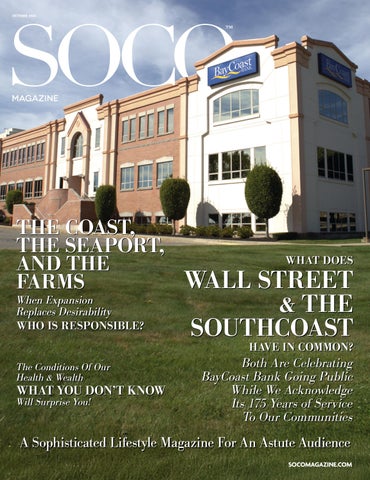
OCTOBER 2026
THE COAST, THE SEAPORT, WHAT DOES AND THE WALL STREET FARMS When Expansion Replaces Desirability WHO IS RESPONSIBLE?
& THE SOUTHCOAST HAVE IN COMMON?
The Conditions Of Our Health & Wealth
WHAT YOU DON’T KNOW Will Surprise You!
Both Are Celebrating BayCoast Bank Going Public While We Acknowledge Its 175 Years of Service To Our Communities
A Sophisticated Lifestyle Magazine For An Astute Audience SOCOMAGAZINE.COM
Maybe It’s Time…
Most people don’t wake up one morning and announce, “Today seems like an excellent day to sell the house.” Usually, the idea arrives more quietly, but not always as peacefully as we’d like or expect.
A
t times, the house that once fit perfectly now feels a little too big, a little too small, or is no longer suited to the life you’re living. For others, they’re at a point where less maintenance means fulfilling a desire for more adventure. Then, for some, it’s a need for a different view or fewer rooms filled with things your children insist they’ll “come get someday.” It’s not unusual to feel that staying in place is more like an anchor than the freedom you desire. Whatever brings you to the idea of selling, I believe the best place to start is simply with a conversation. There are plenty of decisions to make before a home ever reaches the market. What is it actually worth? Should you paint? Renovate? Declutter? Replace that light fixture you’ve disliked since you moved
into what was once your dream house? Sometimes the answer is yes; but, quite often, it’s a resounding “Please, don’t spend that money.” My job is to help you understand what will genuinely make a difference, what won’t matter, and how to position your home to achieve the best possible outcome. Thoughtful pricing, beautiful presentation, strategic marketing, and skilled negotiation all matter, but the strategy should always begin with you: your home, your timing, and what you hope comes next. And you don’t need to be ready to sell before you call me. Some of my favorite conversations begin with, “I’m just thinking about it.” If any of these thoughts has crossed your mind lately, give me a call. I’d love to hear what you’re thinking, and begin the conversation.
ERIN HOVAN, REALTOR® BROKER ASSOCIATE
SRS · ABR · RSPS · RENE · GREEN · PMP® PSI - Price Strategy Adviser SRS - Seller Representation Specialist
Start a conversation:
203.606.6033
erin.hovan@compass.com erinhovan.com · compass.com
HOVAN PROPERTY GROUP
SouthCoast · Cape Cod · South Shore Farm Coast · East Bay · Newport Compass is a licensed real estate broker and abides by Equal Housing Opportunity laws. All material presented herein is intended for informational purposes only. Information is compiled from sources deemed reliable but is subject to errors, omissions, changes in price, condition, sale, or withdrawal without notice. This is not intended to solicit property already listed. Photos may be virtually staged or digitally enhanced and may not reflect actual property conditions.
| LUXURY LIVING |
A Place That Feels Like Home
ACCEPTING OFFERS
T
here is something immediately welcoming about 39 Junior Street. From its distinctive architectural details to its beautifully maintained landscaping, this New Bedford home combines the warmth and character of a property thoughtfully cared for across generations with meaningful updates for today. A traditional front porch stretches across the façade, creating an inviting transition from the neighborhood to the home. Crisp white siding, decorative gable details, brick front steps, mature plantings, and a neatly maintained yard contribute to its timeless appeal, while a private driveway adds everyday convenience. Inside, that same sense of care continues. Bright white interiors provide a fresh backdrop for beautiful hardwood floors, classic crown molding, and exceptional craftsmanship. The renovated kitchen features handmade white oak cabinetry, thoughtfully designed to complement the character of the home while bringing a fresh, updated feel to the space.
ACCEPTING OFFERS
39 Ryder Lane, Marion $1,495,000
SOLD
6 Taunton Avenue, Marion $675,000
ACCEPTING OFFERS
5 Acorn Lane, Mattapoisett $869,000
SOLD
17 Fieldstone Lane, Marion $645,000
Important improvements extend well beyond what you see. A new furnace and central air conditioning were added in 2022, along with electrical updates. The kitchen was renovated in 2024, while a full exterior painting and distinctive copper gutters and downspouts were completed in 2021. These and many other thoughtful details reflect years of careful stewardship. Perhaps most appealing is the home’s overall feel. From the wonderful curb appeal to its warm interiors and carefully considered improvements, 39 Junior Street offers an uncommon combination of Craftsman character, modern comfort, and unmistakable pride of ownership. It invites its next owner to imagine what comes next: new memories, new traditions, and a new chapter of their own to write and live. Offered at $469,000.
UNDER CONTRACT
WINTER RENTAL
4 Oakland Street, Mattapoisett $799,000
15 Oakhill Road, Wareham $3,500/month
SOLD
414 Point Road, Marion $3,150,000
SOLD
180 School Street, Barnstable $950,000
Est. 2005 SOUTHCOAST PUBLISHING SOCO MAGAZINE 401 OCEANSTATE NEW ENGLAND MONTHLY REVEAL CONNECTICUT EDITORIAL MANAGING EDITOR Susan Fletcher SENIOR EDITOR & CONTRIBUTOR Steven Chan ASSOCIATE EDITOR James Holden CREATIVE & DESIGN DIRECTOR Rachel Kaznica PHOTOGRAPHY Lucki Schotz CONTRIBUTORS Sue Hough Linda Bertrum Catherine Hilderbrand Margo Roberts Rob Saint Laurent Robert Wright ADVERTISING & PROMOTION nemedia@earthlink.net MONTHLY COMPLIMENTARY DIGITAL SUBSCRIPTIONS SOCOmagazine.com 401OceanState.com NewEnglandMonthly.com REVEALConnecticut.com For information, share a tip, story, or idea, contact: nemedia@earthlink.net
OCTOBER 2026
SEPTEMBER 2026
JOIN THE SOUTHCOAST LIFESTYLE AND EXPERIENCE ITS UNRIVALED INFLUENCE AND ENDURING RELEVANCE
YOUR PASSPORT TO PREMIUM REAL ESTATE, MODERN CULTURE, AND INTELLECTUAL CURIOSITY
MAY 2026
SOCOMAGAZINE.COM
Welcome to the South Coast
2026
is gonna be a summer to Remember!
SOCOMAGAZINE.COM
The SouthCoast Over-Building In Small Coastal Communities It’s An Issue That Won’t Go Away It’s Our 21st Anniversary, And The End To A Decades-Long Battle
APRIL 2026
SOCOMAGAZINE.COM
Reflecting on What Makes Spring Special
APRIL 2026 | VISIT SOCOMAGAZINE.COM FOR A FREE DIGITAL SUBSCRIPTION
Both Are Celebrating BayCoast Bank Going Public While We Acknowledge Its 175 Years of Service To Our Communities
Happy Birthday America
JUNE 2026
MAY 2026 | VISIT SOCOMAGAZINE.COM FOR A FREE DIGITAL SUBSCRIPTION
Will Surprise You!
TODAY’S NEWEST LUXURY IS PRIVACY AND TO REMAIN UNSEEN
SOCOMAGAZINE.COM
JUNE 2026 | VISIT SOCOMAGAZINE.COM FOR A FREE DIGITAL SUBSCRIPTION
WHAT YOU DON’T KNOW
A COUNTRY UNDER SURVEILLANCE
JULY 2026 | VISIT SOCOMAGAZINE.COM FOR A FREE DIGITAL SUBSCRIPTION
The Conditions Of Our Health & Wealth
MEMORIES THAT NEVER FADE WRITE THE PROLOGUE FOR THE REST OF YOUR LIFE
JULY 2026
SOCOMAGAZINE.COM
AUGUST 2026 | VISIT SOCOMAGAZINE.COM FOR A FREE DIGITAL SUBSCRIPTION
When Expansion Replaces Desirability WHO IS RESPONSIBLE?
WHAT DOES
WALL STREET & THE SOUTHCOAST HAVE IN COMMON?
SEPTEMBER 2026 | VISIT SOCOMAGAZINE.COM FOR A FREE DIGITAL SUBSCRIPTION
OCTOBER 2026 | VISIT SOCOMAGAZINE.COM FOR A FREE DIGITAL SUBSCRIPTION
THE COAST, THE SEAPORT, AND THE FARMS
AUGUST 2026
SOCOMAGAZINE.COM
It Starts With Long Walks, Bushels of Flowers & Colorful Sunsets But, There’s Much More To Appreciate
250 Years Young
A Sophisticated Lifestyle Magazine For An Astute Audience SOCOMAGAZINE.COM
OCTOBER 2026
SEPTEMBER 2026
AUGUST 2026
JULY 2026
JUNE 2026
MAY 2026 APRIL 2026
HERE IT COMES! SCHOOLS AND COLLEGES OPEN THIS MONTH AND THAT CHANGES EVERYTHING
A Guide To Living Well NEWENGLANDMONTHLY.COM
The Best In Coastal Real Estate
In The Most Desirable Locations
Start Packing
We Have Ten Things To Love About Six Destinations Waiting For Your Arrival
Summer Shoes
For Dudes Revisiting The Classics
We’re Watching Out For You n n n
How To Make & Keep Your Money Growing How To Find A Date And Keep Them Around And, How Not To Die On Vacation—Yikes!
Get Out Of Town The Best Locations For Spending A Memorable Memorial Day Weekend
Keeping What’s Yours – An Attack On Financial Freedom & Choices The SouthCoast Faces A Formidable Challenge: Over-Building In What Were Rural Communities
BE THE FIRST TO GET YOUR MONTHLY EDITION OF THIS MAGAZINE ABSOLUTELY FREE DETAILS INSIDE
NEWENGLANDMONTHLY.COM
NEWENGLANDMONTHLY.COM
NEWENGLANDMONTHLY.COM
NEWENGLANDMONTHLY.COM
MARCH 2026 | VISIT NEWENGLANDMONTHLY.COM FOR A FREE DIGITAL SUBSCRIPTION
It’s October and Our Basket Is Filled With What You Need To Know This Month, Find Out What Is Going On With Your Money, Love, And Health
What Will It Take To Stop It?
Summer at Last
MAY 2026 | VISIT NEWENGLANDMONTHLY.COM FOR A FREE DIGITAL SUBSCRIPTION
Hosting the World, The City is Now a Frontrunner to NYC With Millions Planning to Visit for the Holidays
WELCOME BACK
JUNE 2026 | VISIT NEWENGLANDMONTHLY.COM FOR A FREE DIGITAL SUBSCRIPTION
BOSTON – WELCOMES INTERNATIONAL GUESTS
A Tribute To Those Who Thought Celebrating Those Who Fought And Recognizing Those Carrying The Torch Thank You, To All, For What You Have Accomplished
JULY 2026 | VISIT NEWENGLANDMONTHLY.COM FOR A FREE DIGITAL SUBSCRIPTION
WELCOME TO NEW ENGLAND
THE ASSAULT ON AMERICA HAS BEGUN
AUGUST 2026 | VISIT SOCOMAGAZINE.COM FOR A FREE DIGITAL SUBSCRIPTION
October Is When Leaves Replace Sunsets, Hot Chocolate Is Preferred Over Cocktails, And A/C Is In The Rearview Mirror
SEPTEMBER 2026 | VISIT SOCOMAGAZINE.COM FOR A FREE DIGITAL SUBSCRIPTION
SEPTEMBER 2026 | VISIT SOCOMAGAZINE.COM FOR A FREE DIGITAL SUBSCRIPTION
CHANGING THE VIEW
How Will You Celebrate Spring? Let Us Count The Ways
NEWENGLANDMONTHLY.COM NEWENGLANDMONTHLY.COM
OCTOBER 2026
SEPTEMBER 2026
INDULGE YOURSELF
MAY 2026
In the summer
SIGN UP FOR A COMPLIMENTARY ONE-YEAR DIGITAL SUBCRIPTION
Is front page news the next day
Special Taxes On The Rich Are Causing A Storm Of Controversy
Yachts, Trots & Beaches We’re Your Go-To Guide For The Memorial Day Weekend And The Rest Of The Summer
A Modern Registry For Exquisite Living 401OCEANSTATE.COM
401OCEANSTATE.COM
OCTOBER 2026
401OCEANSTATE.COM
SEPTEMBER 2026
CAPITAL MARKETS Separating the Noise and Confusion From the Reality of Today’s Economy The Truth Is Finally Exposed
FINALLY, A MAGAZINE WITH DEEP THOUGHTS FOR THOSE WHO THINK DEEPLY.
THE INVASION OF TECHNOLOGY
We Can Explore The Universe But Can’t Stop Spam And Robo Calls—It’s Time To Learn Why
Peace Is The Path Forward This 4th Of July 1776 -2026
It’s Up To You, But A Staycation Might Not Be A Great Idea This Summer WE CREATED A LIST OF GREAT CHOICES FAR FROM HOME ARRIVE EARLY & STAY LATE
APRIL 2026
A Travel Guide That Removes The Guessing And the Stress Of Planning The Memorial Day Weekend Aging: Do Genes Matter? We Investigate The Truth Vs. The Hype
GOVERNMENT MISMANAGEMENT WHAT’S MINE IS MINE & WHAT’S YOURS IS MINE TOO WHAT’S A GENERATION TO DO?
APRIL 2026 | VISIT REVEALCONNECTICUT.COM FOR A FREE DIGITAL SUBSCRIPTION
THAT COULD COOK ANYWHERE THEY’D LIKE Learn Where The Gourmets Can Be Found
THE END OF SUMMER & THE BEGINNING OF FALL
CHEERS!
Toasting The Season’s Return— Just In Time
401OCEANSTATE.COM
MAY 2026
APRIL 2026 | VISIT REVEALCONNECTICUT.COM FOR A FREE DIGITAL SUBSCRIPTION
CHEFS
Over-Building In Small Communities When Changing The Landscape Goes Too Far 401OCEANSTATE.COM
JUNE 2026
JUNE 2026 | VISIT REVEALCONNECTICUT.COM FOR A FREE DIGITAL SUBSCRIPTION
If You Haven’t Been To Connecticut Lately, You’re Missing New England’s Best Kept Secret
FOOD, FOOD, AND MORE FOOD
401OCEANSTATE.COM
JULY 2026
JULY 2026 | VISIT REVEALCONNECTICUT.COM FOR A FREE DIGITAL SUBSCRIPTION
WITH A COASTAL CHARM ONLY THEY HAVE
AUGUST 2026
AUGUST 2026 | VISIT SOCOMAGAZINE.COM FOR A FREE DIGITAL SUBSCRIPTION
VIBE & STYLE
SEPTEMBER 2026 | VISIT SOCOMAGAZINE.COM FOR A FREE DIGITAL SUBSCRIPTION
OCTOBER 2026 | VISIT SOCOMAGAZINE.COM FOR A FREE DIGITAL SUBSCRIPTION
A NEW YORK CITY
401OCEANSTATE.COM
APRIL 2026
Fleeing The Coasts
What goes on in Newport
FEBRUARY 2026 | VISIT 401OCEANSTATE.COM FOR A FREE DIGITAL SUBSCRIPTION
IF IT’S IN HERE, GUARANTEED IT’S WORTH YOUR TIME
JUNE 2026
MAY 2026 | VISIT 401OCEANSTATE.COM FOR A FREE DIGITAL SUBSCRIPTION
How Inflation and Social Media Have Made Them A Luxury Instead Of A Requirement
JULY 2026
AMERICANS CLAIM THEY ARE EXHAUSTED, UNDERPAID & ENTITLED TO MORE If So, Who Is At Fault?
JUNE 2026 | VISIT 401OCEANSTATE.COM FOR A FREE DIGITAL SUBSCRIPTION
TRANSACTIONAL RELATIONSHIPS
AUGUST 2026
SWEET MEMORIES OF A SUMMER PAST
JULY 2026 | VISIT 401OCEANSTATE.COM FOR A FREE DIGITAL SUBSCRIPTION
It’s Called The ‘Ocean State’ For A Reason
AUGUST 2026 | VISIT SOCOMAGAZINE.COM FOR A FREE DIGITAL SUBSCRIPTION
DECIPHERING FACT FROM FICTION You’re going to be surprised
SEPTEMBER 2026 | VISIT SOCOMAGAZINE.COM FOR A FREE DIGITAL SUBSCRIPTION
OCTOBER 2026 | VISIT SOCOMAGAZINE.COM FOR A FREE DIGITAL SUBSCRIPTION
BAD ECONOMY?
IT’S ABOUT TIME–I’VE BEEN WAITING FOR YOU Spring Has Sprung
The Journal of Cultivated Living
No part of this publication may be reproduced, copied, or duplicated, or used for promotional purposes by any method electronically or otherwise without written permission from New England News + Media. All information and contributions within this publication are deemed to be accurate and reliable. New England News + Media and its affiliate companies assume no responsibility or financial liability for misinformation, errors, or omissions in content and advertisements. Associated companies, the publishers, partners, managers, sub-contractors, and others contributing to this publication promote advertisers and may at times recommend services we provide or that of outside resources; however, we make no claims to satisfaction, promises, or guarantees to products and such services. All content is copyright protected: SouthCoast Publishing Group, New England News + Media and affiliated titles SOCO Magazine,™ 401 Ocean State Magazine,™ New England Monthly.® & REVEAL Connecticut.™
4 | OCTOBER 2026 | NEW ENGLAND NEWS + MEDIA
| AGENDA |
10
MEMORIAL
Over the Bar. Few have read or heard of this phrase, unless of course they’re an old salt: and the tide is coming in for them too. This month, we pay homage to our most important fan (he read and collected every issue ever published), and a supporter who got us through the tough times with words of inspiration and wisdom—a man everyone loved.
22
6 | OCTOBER 2026 | NEW ENGLAND NEWS + MEDIA
DOSSIER
Thoughts From The C-Suite: It’s Not Pretty, But It’s True. Are you sure you want to know what’s on our minds? Here’s a perspective on how restraining the progress needed to build a world-class tourist destination and support a deserving community that no longer lives up to its historic potential has been stifled for more than half a century. Poor decisions, the absence of a viable plan, and a rudder turned toward a reef. It’s time for a change, and we offer up an alternative. Oh yeah, we also call for stopping the City of New Bedford from dumping human waste into the local waterways while communities get lectured on the damage their septic systems cause.
13
LIVING WELL
Stress: If You’re Not Careful, It’ ll Kill You. And if that doesn’t do you in, then the false narratives and media manipulation might. It’s the second time the country has been so blisteringly divided, with little if any relief in sight. Power struggles shaded with deception and lies, inexperience and a lack of knowledge, and festering antisemitism create an evil agenda to reverse our way of life. Protests have become an industry, with common sense viewed as caustic intervention and assault. When there is little room to escape madness and corruption fueled by hate, we all face insurmountable stressors with a fear that our culture and society could collapse. Take a moment and a breath; release the knots in your shoulders and the pain in your neck; it’s going to be okay.
26
IN THE NEWS
BayCoast Bank Reaches Wall Street. We use this title more as a metaphor since The Bank will be listed under a different name and symbol on the Nasdaq found at Times Square. Still, the day will be just as exciting as the action at the New York Stock Exchange when its IPO goes live and thousands of investors on the SouthCoast and maybe around the world become owners of an institution that prides itself on knowing your name, your community, and what is important to your family.
34
INTIMACY
Transactions? This Line Please. Yes, unfortunately, single people seeking relationships have been slowly reduced to becoming consumers purchasing emotional closeness, tied to cost/benefit analysis and questions like, what can you do for me, and when is enough not enough? Ask anyone you know, and after looking both ways, they will quietly spill the tea about the turmoil and expense of dating in 2026. It doesn’t matter the age or the circumstances: it’s a pay-to-play game, and the payout, according to the players, “sucks.” NEW ENGLAND NEWS + MEDIA | OCTOBER 2026 | 7
8 | OCTOBER 2026 | NEW ENGLAND NEWS + MEDIA
38
CULTURE
44
FUTURE
Where to go, what to do, and how to get the most value from our adventures. The most striking and valuable asset for those calling the SouthCoast their home base has everything to do with its location. It’s been referred to as “perfectly positioned, close to everywhere,” and even to the extreme claim of being at the “center of the universe.” Could that be the attraction that brings new faces from every direction? It’s logical: live in a sleepy coastal area that hasn’t been overrun with development (although we’re getting very close), and travel a short distance to many of the most desirable destinations within or on the fringe of New England. We hope our review motivates and explains what’s available for creating the perfect fall weekend.
Visionaries Are Not Just Discovering Enlightenment, They’re Changing The World. Even though you witness disaster all around, take solace that just beyond is change that may eliminate your fears and trepidation about the direction society is heading. Sure, there’s lots of violence, corruption, and those who wish you harm, but if you allow the process to run its course and stop with the hair-onfire responses to every crazy person’s actions and agenda, the world will reset, and it won’t crumble. It’s easy to ignore advancements out of fear, but the pleasure and enjoyment to come will be discovered through existential usefulness. Give those who see around corners the ability to continue advancing our knowledge and expertise so we can do better than compete; we can lead.
46
CAPITAL
Doom & Gloom; We Don’t Think So. All it takes is a couple of minutes to tune into any one of a dozen reputable financial shows (excluding those listed as “sponsored”), newsletters, newspapers, or websites. The evidence they present seems clear: if you are not invested in something, you’re at a disadvantage in providing for yourself and your family. While media outlets might not always be that dramatic, the current industry rage often touts a “hurry, you better get in” mentality. This FOMO persists even though smart money dictates that new, intermediate, and seasoned investors should use a measured, scaled approach to investing and growing wealth. These two extremes cast investing in a negative light, making it personally valuable to understand exactly what you might be leaving behind through inaction.
IMPRESSIONS
Letting Go & Moving On. It can be the most challenging choice a person ever makes: walking away from someone who means so much but no longer fills the space they once did. Growing apart is painful, walking away is excruciating, and carrying memories that last forever can feel like a heavy burden. Once you recognize that the honor, respect, and boundaries you need are unavailable—and that it is not your responsibility to teach others what you have already learned—it is time to pack your bags. What they are showing you is the best they can provide.
50
NEW ENGLAND NEWS + MEDIA | OCTOBER 2026 | 9
10 | OCTOBER 2026 | NEW ENGLAND NEWS + MEDIA
| DOSSIER |
THE SOUTHCOAST— THERE’S ONLY ONE And It’s Like No Other Place You’ll Ever Visit or Leave THOUGHTS FROM THE C-SUITE
A
sk people about modern-day New Bedford, an integral piece of a puzzle labeled the SouthCoast, and you’ll often see them feel the answer before they can name it: a tug of uncertainty, somewhere between the gut and the heart. The city and the Seaport have a way of letting people leave for greener pastures and sandier beaches, and then, without warning, reel them back. Michael Corleone said it best in The Godfather Part III (1990): “Just when I thought I was out, they pull me back in!” The yanking doesn’t stop at the city line. It runs east along the coast to Fairhaven, Mattapoisett, Marion, and Wareham; north into Acushnet, Rochester, Freetown, and Berkley; west through Dartmouth, Westport, Somerset, and Swansea; and even across the state line to Tiverton and Little Compton, Rhode Island. Towns the SouthCoast has long claimed as sisters. Ask the people who live, work, and summer here what keeps drawing them back, and something curious happens. They squint toward the horizon, weigh the question, and nearly all arrive at the same answer: “I’m not sure.” That uncertainty is where this opinion begins. The tale (no pun intended) of New Bedford unfolds in three acts. Whaling made it one of America’s wealthiest cities, reaching its height between the 1820s and 1857. Textiles rose as whaling declined, with mills opening from 1846 until the industry collapsed after 1928. Commercial fishing carried the city from the 1930s onward, and it still does: New Bedford consistently ranks among the most valuable fishing ports in the country. It’s a business that comes with a host of interesting stories, many of which haven’t made it to paper or the screen. Efforts to write a fourth act have been earnest but too often aimed at the wrong target or purposefully suppressed by dark interests. Some of the progress is real. Route 18, once a highway that walled the waterfront off from what is referred to as “Downtown,” is now a boulevard friendlier to people on foot, though it’s still hazardous to cross and an eyesore. Commuter
rail has returned to the city after decades away. But neither has changed what the Seaport is for most visitors: a place to leave. The busiest attraction on the waterfront is the ferry dock, where travelers board for Cuttyhunk, Martha’s Vineyard, and Nantucket, leave their empty cars, and take their spending with them. It’s the missed opportunity no one wants to address. Nearly every historic port that has thrived learned the same lesson early: history draws visitors, but experiences keep them, and the money follows. New Bedford has history in abundance. What local and state leaders have yet to build is the surrounding infrastructure to keep them. Lacking a master plan to meld industry and tourism, both deemed important by all, could be modeled on the successful efforts of Portland, Maine; the choices that have been made only cause the climb to become steeper. To bring all readers up to speed, prime harborfront land with water access and magnificent views of the Elizabeth Islands (if a project included elevations) was developed into an obtrusive terminal for heavy industry, a staging area for massive components shipped to offshore wind farms. The few jobs matter, and a working port is part of New Bedford’s identity, but it is incongruent with the business of fishing. Today, the area is a wasteland: boat storage, dirt parking lots, and a steady stream of unflattering headlines telling the same stories that incentivize visitors to keep moving. What could and should be a Seaport of world-class branding won’t be built on a view of laydown yards encompassed by high fences and barbed wire. Much of the problem is who the city has been trying to please. Nearly every effort targets the people who already live there, or visitors with modest budgets. Meanwhile, affluent travelers are treated as passengers, hurried through the terminal’s gates to board the ferries. For now, a moat surrounds the status quo: restaurants that close far too early, few evening entertainment options, and very little shopping. Even the city’s branding sends mixed signals. Officials promote a contemporary, up-and-coming movement, while the “Port of New Bedford” image leans on a working waterfront that NEW ENGLAND NEWS + MEDIA | OCTOBER 2026 | 11
looks much as it did in the 1950s. Both stories are true, but they haven’t yet been told as needed. Off is a historic insistence on discouraging true entrepreneurship, which is viewed as money from “outsiders,” and a lack of interest in making investments for the advancement and ongoing improvement to enhance more mainstream lifestyles. Also noticeable is an unwillingness to meet the rest of the world’s desire for the best value for their travel dollars. Hosting the budget-conscious traveler and letting the affluent one pass with little more than a coffee shows a lack of economic prowess. It’s a social-cultural view that has proven ineffective and a drain on the local economy. The SouthCoast housing market outside of New Bedford has accelerated, with home values growing exponentially, as they have in many other areas throughout the country. And it’s not that those responsible don’t believe in capitalist theory; it’s that they hide their wealth and pretend otherwise. The dichotomy of persona: that is, who I am and what I want you to believe, is hidden but ever-present. Dare we explain the political strategy and influence? The painting would be completed. We hope to have captured and held your attention. Allow us to share a vision we have discussed with private investors. It begins with the most overlooked asset of all: New Bedford Regional Airport. Underused and often all but deserted, it is an extraordinary opportunity hiding in plain sight, though we doubt a proposal like this would even be heard, let alone considered. It’s the opportunity to create an exclusive, seamless luxury travel experience to a destination that cannot be duplicated. Imagine jet service into the city, with a black car waiting to take guests to the Seaport, where they check into a waterfront hotel, take a high-speed elevator to the 20th floor, and lose their breath at the stunning views of the Atlantic Ocean. Combine this with first12 | OCTOBER 2026 | NEW ENGLAND NEWS + MEDIA
class dining and entertainment, a day aboard a chartered yacht, or a flight by eVTOL (electric air taxis that are coming soon) to whisk them at will to the Islands, the Hamptons, Provincetown, or Boston—all the excitement and intrigue without ever sitting behind the wheel or enduring choking traffic. These are the elements of luxury travel that are within reach, but would require the ambition and desire to become the best destination in New England. Even though we have the insight, a plan, and marketing ability to complete the picture, we expect, as in the past, the same old script from those critical of a vision they cannot comprehend, let alone activate. We’ve heard it all before: “We don’t want that!” Our questions are: who do you speak for, and what influence does it have on you? And if you believe it can’t be accomplished, consider SpaceX, which can catch a rocket as it returns to Earth. If they can do that, the Seaport can at least look at such a proposal with clear eyes and zero influence. Unless, of course, you’re afraid of losing control of the rudder as you steer toward the reef. When we spoke with residents of the surrounding towns and villages, we found that few of them go into New Bedford. They cite crime, early closing hours, and a lack of choices. Yet the same people will happily list the places they visit regularly, most of them farther away, cost considerably more, and consistently deliver experiences worth remembering. Distance and price aren’t the obstacle. The experience is. Thousands call this area home in one sense or another, but many live with a genuine ambivalence. They love their communities, rich in culture and diversity in every sense. They want to feel safe walking in their neighborhoods after dark. They enjoy the many beaches and waterways, which are remarkable and draw sailors from around the world. At the same time, because of the expected protection of these amenities, we call out New Bedford and the state of Massachusetts to immediately take action to stop the sewage that overflows into the harbor and routinely fouls neighboring shores and closes shellfish beds. The damage has gone on for too long, and so has the finger-pointing and blaming of SouthCoast homeowners’ septic systems for damaging the ecosystem and not holding agriculture and recreation venues responsible. Everyone wants to share the Seaport and show guests what makes the SouthCoast an incredible place to live or visit. But there needs to be a starting point and a redirect, beginning with a new and improved airport, a true luxury hotel, better restaurants, and attractions worthy of visitors who travel well and spend accordingly. It doesn’t have to be a battle over resources or a squeeze on anyone. There is room for all who want change: the city already offers plenty of good options for everyday life—settling for less than what’s possible is a recipe for listless growth and eventual stagnation. At the same time, other destinations keep improving and reinventing themselves, becoming a drag on tourist and business income. If change doesn’t happen soon, under a plan shaped not by special interests but by those with vision and resources, the next 100 years will be the cradle that keeps rocking the same expectations, putting two major sectors that keep the city alive—fishing and the ferries—at risk of leaving the New Bedford Seaport. H
| MEMORIAL |
A Tribute to A Hero and North Star,
Stephen (Red) J. Turner Sr. A Lifelong Seafarer, News Photographer, and Father Devoted To His Family and Public Service
' C ro ss in g th e Bonar’ By Alfred , Lord Tennys
Sunset and evening star, And one clear call for me! And may there be no moaning of the bar, When I put out to sea, But such a tide as moving seems asleep, Too full for sound and foam, ess deep When that which drew from out the boundl Turns again home. Twilight and evening bell, And after that the dark! And may there be no sadness of farewell, When I embark; Place For tho’ from out our bourne of Time and The flood may bear me far, I hope to see my Pilot face to face When I have crost the bar.
May 17, 1929 – July 18, 2026 FOUR TIME S R ETIR ED Woods Hole, Martha’s Vineyard & Nantucket Steamship Authority April 4, 1946 – May 17, 1994 United States Navy September 1, 1950 – June 25, 1954 United States Coast Guard Reserve Group Woods Hole & Sector Boston August 28, 1973 – November 2, 1989 Padanaram Assistant Harbor Master May 1994 – May 2010
Stephen was a proud and distinguished member of a military family with a lineage dating back to the Civil War. He carried himself with readiness, honor, and a lifelong commitment to a country he loved and served his entire life. Boarding his first ship at 17 years old out of the New Bedford Seaport, he traveled the world’s seas, only to return to a harbor that held special meaning and purpose to him and his wife Mary, who were married for 74 years. He was always prepared, and in the end, it was no different. After his passing, his children found a poem on a small sheet of paper with his personal effects. It was a copy neatly folded and set aside long ago without their knowledge—a befitting, final message to them. As they had always wished, Stephen and Mary were interred together at the Massachusetts National Cemetery at Otis Air National Guard Base, Cape Cod, with Military Honors in a private ceremony. The antique chest holding the couple’s ashes includes a copy of the poem. NEW ENGLAND NEWS + MEDIA | OCTOBER 2026 | 13
17th Century Chinese Coromandel Lacquer Panels Kangxi-Period Attribution, Circa 1690
A
rare and complete set of six antique Chinese Coromandel lacquer panels, executed in the traditional kuancai (“incised and colored”) technique on a black lacquer ground with rich polychrome pigment and gilt detail. The scene depicts a sweeping imperial palace complex—multi-tiered pavilions, a garden procession of court officials and attendants, musicians, banner-bearers, guardian lion figures, and gnarled pine and rockery landscape elements—bordered above by a carved dragon-andlotus scroll frieze. The composition and subject matter are consistent with the palace-life narrative scenes associated with fine Qing-dynasty Coromandel production. Construction & Condition Each panel is built in the traditional layered manner: a wood core stabilized with a fabric ground, a gesso/ composition base, and multiple fine coats of lacquer incised and filled with pigment. The panels show fine, irregular surface craquelure and areas of lacquer lifting and loss consistent with age and material aging over time, along with wear in keeping with their history. The panels are currently configured for wall display (no folding hinges present) rather than as a freestanding screen. Each panel measures approximately 76" H x 18" W. Provenance The documentation describes the panels as ‘House Boiserie’, Paris, France, and their prior ownership and location within the residence of the famous novelist Alexandre Dumas (1802–1870). Offering A complete, matched set of six panels, sold together. Given their age and condition, these panels are best suited to an experienced collector or connoisseur rather than general decorative use. Full documentation, including the original dealer receipt, is available to serious inquiries. Contact for price and viewing.
Fletcher & Company fine art, antiques & collectibles
for more information, contact fletcher.company@yahoo.com or call 603.380.0740 Serving New England to New York
MARION, MASSACHUSETTS
EXCLUSIVELY LISTED AT $1,995,000
Set along the shores of Marion, this charming 2,200 sq. ft. Dutch Gambrel offers an exceptional opportunity to embrace quintessential seaside living with sweeping views of outerSippican Harbor and Buzzards Bay. Featuring 5 bedrooms and 3 full baths, the home also offers deeded access to the sandy beach just steps away. A rare special Marion offering where waterfront access, expansive water views, and the beauty of coastal living come together.
MARION, MASSACHUSETTS Beautifully maintained, this 3 bedroom, 2.5 bath Colonial offers over 2,450 sq. ft. of thoughtfully designed living space in one of Marion’s seaside enclaves that includes deeded rights to a sandy beach on Buzzards Bay. Built in 2011, this home offers an open concept with a kitchen that flows seamlessly into the dining area, family room, and screened-in porch. Effortless coastal living at its finest! EXCLUSIVELY LISTED AT $895,000
MATTAPOISETT, MASSACHUSETTS
EXCLUSIVELY LISTED AT $2,495,000
Rare opportunity to own a private coastal retreat set on 6.68 acres with direct ocean frontage in desirable Mattapoisett. Tucked away at the end of a private road, this contemporary post-and-beam residence offers 2,750 sq. ft. of living space surrounded by mature trees, sweeping water views, and exceptional privacy. The home features 3 bedrooms, 3 full baths, a private tennis court, attached 2 car garage, and direct access to a private beach. A truly unique waterfront estate offering an extraordinary lifestyle on the SouthCoast.
MARION, MASSACHUSETTS Discover timeless New England charm in this impeccably restored 1880 antique home located on highly desirable Water Street in Marion Village. Set on .81 beautifully landscaped acres, the house boasts 5,541 sq. ft. with 8 bedrooms and 5.5 baths. Sweeping water views, a detached garage/barn, gunite swimming pool, and deeded access to a shared dock on Sippican Harbor. Rich in original charm yet thoughtfully reimagined, this exceptional home is a rare opportunity to own a true New England classic.
UNDER AGREEMENT
ConverseCompanyRealEstate.com | 166 Front Street | Marion, MA 02738 | (508) 748-0200
WORK FREE OR DIE
COMMERCIAL SPACE AVAILABLE AT THE DEPOT PLAZA 264 MAIN STREET LINCOLN, NEW HAMPSHIRE (KANCAMAGUS HIGHWAY/ROUTE 112)
Property Overview:
WORK FREE OR DIE
Office/Retail/Mixed Use Approximately 1,370 sq.ft. Lease Type: NNN - CAM, Utilities (includes heat), taxes are tenant’s responsibility Available this Summer Lease Term Minimum of 3Yrs +
Key Features • Highly visible mountain location at a four-season tourist destination • Located between South Peak & Loon Mountain • Foot traffic from multiple condo developments and anchor tenants • Traffic count: Route 112 is a major conduit between Lincoln and North Conway, 6-9k vehicles passing daily • Excellent curb appeal, with the storefront facing a large parking lot and a roadway at ground level • Central heat & ac, security cameras, newly renovated as an office, offers a flexible floor plan for retail conversion • Large vertical roadside (double-facing) signage advertising tenants; one sign above the space • Fees, taxes & utilities: CAM: Utilities (includes heat), taxes are tenant’s responsibility
Current Configuration: reception area, partitioned work spaces, for four employees, primary office, conference room, kitchen & break area, secure storage and bathroom
Uses: Mortgages, Investments, Real Estate, Insurance, Child Care, Guest Services, Dental or Medical Office, Spa, Salon, Beauty Services, Attorney, Psychologist, Retail, Packaged Foods, Contracting Services, Showroom. Parking: Open lot
More Information: 603-380-0740
Caregiver Payments
Caring for someone at home? You may qualify for a monthly payment. Are you facing the challenges of caring for a loved one at home? Perhaps trying to wholeheartedly balance their needs and the daily demands life delivers you? If this sounds familiar, we are here to assist you in providing an unmatched standard of Adult Foster Care benefits for those striving to stay in their homes. Mass Care Link is evolutionary, providing a monthly payment to those caring for someone at home while supporting them with a personalized touch. Costing less than assisted living facilities and nursing homes, with a record of compassion and empathy, we cover the unique needs of our clients. Families and individuals rely on our services to: • Ensure caregivers receive a tax-free monthly
stipend/payment
• Review and verify MassHealth paperwork and
qualifications
• Train and assist with the management and demand
of providing 24-hour care
• Not be the legal guardian or legally married to the
person being cared for
• Provide necessary medical care and assistance that
meets the needs of the person they care for
For your family member or loved one to qualify for Mass Care Link services, they must meet these eligibility points: • Be 16 years of age or older • Be approved for MassHealth insurance • Live with the primary caregiver in the same home • Require supervision and cueing, or physical assistance
daily with at least one of the following needs: bathing, toileting, ambulation, transferring, eating, and/or dressing.
If this sounds attractive and meets your level of interest, contact us today for additional information or to schedule an appointment.
Mass Care Link, Inc.
You may not know this fact, but if you qualify as an at-home caregiver, you can earn up to $18,240 yearly.
99 South Main Street, Fall River, Massachusetts 02721 Hablamos Español | Falamos Português
For a caregiver to meet state requirements, they must:
call for more information or visit us online at:
• Be at least 18 years of age • Reside in the same home as the person they care for
ARE YOU READY FOR THIS?
Not for winter, your holiday sales promotion? Let’s face it: running a single ad four times a year is ridiculous and a waste of money—most people agree. Yeah, you’ve been told your ad will be seen and read over and over for 90 days—don’t believe it. If it worked, we’d do it too. Media research shows that readership spikes in the first 30 days of publication and then falls to about 5 percent of total views, and, in some cases, to zero.
OCTOBER 2026
OCTOBER 2026 | VISIT SOCOMAGAZINE.COM FOR A FREE DIGITAL SUBSCRIPTION
THE COAST, THE SEAPORT, AND THE FARMS When Expansion Replaces Desirability WHO IS RESPONSIBLE? The Conditions Of Our Health & Wealth
WHAT YOU DON’T KNOW Will Surprise You!
WHAT DOES
WALL STREET & THE SOUTHCOAST HAVE IN COMMON? Both Are Celebrating BayCoast Bank Going Public While We Acknowledge Its 175 Years of Service To Our Communities
A Sophisticated Lifestyle Magazine For An Astute Audience SOCOMAGAZINE.COM
OCTOBER 2026
OCTOBER 2026 | VISIT SOCOMAGAZINE.COM FOR A FREE DIGITAL SUBSCRIPTION
BAD ECONOMY? DECIPHERING FACT FROM FICTION You’re going to be surprised
INDULGE YOURSELF
The data also shows it takes three to four impressions for a person to recall and respond to your message. Given this fact, running an ad today with someone else might not work for about a year.
It’s Called The ‘Ocean State’ For A Reason
TRANSACTIONAL RELATIONSHIPS
How Inflation and Social Media Have Made Them A Luxury Instead Of A Requirement
A Modern Registry For Exquisite Living 401OCEANSTATE.COM
OCTOBER 2026
We reach a highly affluent and desirable audience every month, and we have done this for over 21 years—never missing a single issue.
OCTOBER 2026 | VISIT SOCOMAGAZINE.COM FOR A FREE DIGITAL SUBSCRIPTION
A NEW YORK CITY
VIBE & STYLE
FOOD, FOOD, AND MORE FOOD
WITH A COASTAL CHARM ONLY THEY HAVE
CHEFS
If You Haven’t Been To Connecticut Lately, You’re Missing New England’s Best Kept Secret
THAT COULD COOK ANYWHERE THEY’D LIKE Learn Where The Gourmets Can Be Found
CAPITAL MARKETS Separating the Noise and Confusion From the Reality of Today’s Economy The Truth Is Finally Exposed
You be the judge; be seen on our pages this year, or next year with the other guys.
The Journal of Cultivated Living
OCTOBER 2026
SEPTEMBER 2026 | VISIT SOCOMAGAZINE.COM FOR A FREE DIGITAL SUBSCRIPTION
CHANGING THE VIEW October Is When Leaves Replace Sunsets, Hot Chocolate Is Preferred Over Cocktails, And A/C Is In The Rearview Mirror
WELCOME TO NEW ENGLAND BOSTON – WELCOMES INTERNATIONAL GUESTS
To get started, contact us, and we’ll create an effective, affordable strategy that works from day one.
Hosting the World, The City is Now a Frontrunner to NYC With Millions Planning to Visit for the Holidays
It’s October and Our Basket Is Filled With What You Need To Know This Month, Find Out What Is Going On With Your Money, Love, And Health
A Guide To Living Well NEWENGLANDMONTHLY.COM
Contact: NEMedia@earthlink.net or 508-971-1969
| LIVING WELL |
STR ETCHED THIN
FACT FROM FICTION: WHAT IS DRIVING STRESS AND ANXIETY IN THE U.S.?
C
BY ROB SAINT LAURENT, M.ED. & JAMES HOLDEN
haos, uncertainty, distrust, pressure, helplessness, hostility, and growing despair. Not a picture of a world we should be living in, yet some have these experiences while others don’t. Unfortunately, blame is misplaced and based on outrage concocted from low-quality or inaccurate information amplified by the media. At the same time, economic instability is being fueled (pun intended) by Middle East turmoil, which has strained many household budgets to the breaking point. In the U.S., every week, the gas needle drops and budgets are exhausted. In the current K-shaped economy, some feel the soul-crushing weight of rising rents, not because their paychecks lag; in fact, by all data collected, they have risen over the last few years; the problem is more aligned with those relying on assistance and unemployed due to being held at ransom because they are on a fixed income. While the level of poverty has dramatically decreased over the decades, older adults and the most disadvantaged inhumanely suffer. Yet, the real culprit is core inflation, persistent as the dollar’s purchasing power continues to decline, tied to soaring diesel and gasoline prices, and a hot economy that adds fiscal pressure and pushes more Americans to rely on credit, buy now, pay later, and savings to buy food and medicine because, if you haven’t noticed, society isn’t actually running on ‘Dunkin’; it runs on petroleum. Even those driving an EV acknowledge that the power to charge them doesn’t come from the sky; it’s delivered, and it costs the proverbial arm and a leg.
22 | OCTOBER 2026 | NEW ENGLAND NEWS + MEDIA
Research funded by the Urban Institute reveals nearly half of families in the world’s wealthiest nation can no longer afford life’s basic necessities.1 However, many dispute this finding because life expectancy and what is called poverty in the U.S. are viewed as middle- to upper-class when compared to countries around the globe. Unfortunately, the nation remains deeply polarized along political lines, severing families and friendships. Meaningful conversations are harder after years of “otherization,” divide-andconquer conditioning. Truth has become difficult to discern in an endless livestream of noise and frequent misinformation. And on top of all this, the Socialists and self-adulatory Communists are looking to turn our way of life on its head and, believe it or not, extort the earnings of mainstream Americans with exhaustive taxes and theft of their property so it can be equally distributed to those who contribute little to nothing to the culture or society. You have heard of this: ‘equality and equity,’ disguised as righteousness, by those described under Biblical terms as false servants. With all this, and the effort to feed and clothe ourselves and our families, the tumult wears on the nervous system and the days become pitiful, reducing quality of life and jeopardizing well-being. Additionally, the inescapable, constant combat vitriol and physical confrontation found in nearly every social encounter each day places unnecessary stress on shoulders and minds for all, regardless of position, wealth, or lack thereof. SURVEYS TELL PART OF THE STORY Australian research published by the American Institute of Stress begins to paint an unbiased picture of what’s most feeding stress and anxiety in the U.S.2 Over 1,000 Americans across all 50 states were surveyed last year for a variety of stress categories, from finances to family obligations. The results (below) are revealing.
Stress Survey of 1,000+ Americans ADAPTED FROM THE AMERICAN INSTITUTE OF STRESS2
STRESSOR
Percentage of Respondents
Money (cost of living, unemployment, debt, etc.)
50
Lifestyle (isolation, sleep, poor nutrition)
29
Health (chronic pain, healthcare access, caregiving)
27
Work, school (burnout, deadlines, difficult coworkers, job change)
22
Relationships (marriage, divorce, friendships, personal death)
21
Environment (housing, living situation, essential services access)
17
Family obligations (children, parents)
15
Global issues, climate
11
Researchers narrowed data down to the state level, looking more in depth at stress related to finances (separating health expenses), work, school, mental health, and relationships. States were divided into the 25 most and 25 least stressed. Tennessee was the most stressed of all U.S. states, followed by Florida, Texas, Alabama, and then Georgia. Conversely, North Dakota was the least-stressed state, followed by Nebraska, Connecticut, Rhode Island, and then Hawaii. The remainder of New England also fell into this category, with New Hampshire ranking 10th, Vermont 14th, Maine 16th, and Massachusetts 17th. At face value, this raises eyebrows about the data’s veracity. We’re not alone in our hyper-stressed state, but these results seem oddly skewed. Another 2,000+ residents across Canada and Australia were also surveyed, revealing similar numbers to the U.S. Personal finance topped the list of stressors, at 50 percent of respondents for both the U.S. and Australia. In comparison, our northern neighbor was slightly more stressed at 53 percent. After that were health concerns, lifestyle, work or school, and lastly, relationships.3 Respondents aged 24–54 reported the highest levels of financial stress. Those aged 65+ reported the highest level of health concerns. In all three nations, affording groceries was the top financial stressor. Second place was utility bills for Australians, personal or credit card loans for Canadians, and insurance payments for Americans. A viral U.S. social media post highlights on-the-ground reality versus government claims: In 2020, a 28-item grocery list from Target cost $64.50; in 2026, those same items totaled $158.30— a 145 percent spike. Said the poster, “Just needed the same things we always needed. They told us inflation was transitory. They told us it was under control. They told us the economy was strong. Our cart didn’t get any of those memos.” The problem with this reckless, uninformed statement is that it doesn’t account for the increase in the standard of living and the higher cost of wages, which gets passed on to all of us and causes unnecessary stress. When a police officer can earn $300,000– $400,000 a year, a teacher $150,000+, and only work parttime—along with government workers at every level, unionizing and pulling in benefits well beyond the private sector—such an obvious imbalance reflects an unjust mechanism of competence and reward. At the same time, those untrained or uneducated bark loudly about the right to a ‘living wage,’ an alternative to a social welfare program, not funded by the state, but by the hard work of private individuals. It is a silent attack on our way of life as a capitalist society with necessary and convenient social programs because the U.S. isn’t heartless. But never were these programs created to support or become an extended parent, coddling those who refuse to participate in society or fund their radical and violent behaviors and attempts to overthrow the government. What has emerged is the pulling back of the curtain on a long list of deceptive cottage industries that keep the lower classes static and under control while the dishonest reap millions of taxpayer dollars. In Michigan alone, thieves have swindled countless dollars from those who need services. Because of this illicit campaign, covered up by public officials, we need to ask ourselves: Who or what is actually stressed? Our wallets, or those who depend on and rely on government services promised to them? It is a sad state of affairs when those in need become targets of the lowest of the low; NEW ENGLAND NEWS + MEDIA | OCTOBER 2026 | 23
to address adversity and learn coping mechanisms for restraint; rather, they are instructed to protest, destroy property, and assault those they view as targets.
individuals who take tax money, send it overseas, live like they hit the lottery, and hide behind a sign over a vacant building. AFFORDABILITY CRISIS The Urban Institute found several key reasons why 49 percent of American families no longer have financial security. “The cost of essential goods and services is rising faster than earnings.” Since 2017, home prices have risen about 88 percent faster than average wages and rents about 26 percent faster. Meanwhile, the least costly government healthcare plan on the Affordable Healthcare Marketplace has risen 77 percent, outpacing average earnings growth by 79 percent.1 Still, today, the average homeowner has become a millionaire by simply paying their mortgage and living within their means. It isn’t a given; it takes effort, but it pays off if you do the work. “Rising everyday expenses, including energy and transportation, are adding new pressures on households.” Since December 2025, consumers nationwide are averaging $40 more on electricity bills than in December 2017. At the same time, the national average gasoline price has spiked one dollar per gallon since the U.S.-Iran war began in February.1 Unfortunately, what is missing from this argument is that the workers have never made so much money in the history of these same companies. Higher electric and gas rates pay higher salaries and stockholder dividends. These are often the same people who own a piece of the company that funds millions and millions of retirements. Sorry, but without oranges, there is no orange juice. A survey of over 2,200 Americans showed that 62 percent remain “very or somewhat anxious” about current events and covering expenses, with more than half of respondents also worried about personal safety, health, climate change, and developing technology.5 Although stressful, it’s hard to pinpoint or blame any one thing or person for causing this reaction. As a result, and as maladaptive as it is, we are dealing with many who cannot stabilize their emotions, which are so severe that the public is told to accept them as is, even though they display antisocial and inappropriate behaviors primarily used to project personal anger or hostile actions towards others, only to complain if they become victims of the same attacks. No longer are children taught 24 | OCTOBER 2026 | NEW ENGLAND NEWS + MEDIA
THE MIND AND BODY UNDER STRESS Today’s cavalcade of stressors can weigh on the psyche; some tolerate in silence, others find escape or treatment, with a visible and careless group acting out in what they call civil disobedience, disguising their mental illness with an exhausting list of diagnoses. Stress and anxiety can be beneficial in small doses by compelling us to take steps toward a goal or to prepare for an eventuality. But when it becomes chronic, the pressures and demands are relentless, and serious physical problems can arise. As the American Psychological Association explains, prolonged stress can have systemic impacts: nervous, musculoskeletal, respiratory, cardiovascular, gastrointestinal, hormonal, and reproductive.6 It is for this reason that treatment and interventions are promoted and broadcast even if it is all too often ignored. For the most part, normal citizens, yes, there remains a group that can exercise self-control and recognize when they are chronically stimulating their autonomic nervous system, which controls involuntary/unconscious functions such as the “fight or flight” response to a perceived threat, which can drain the body of defenses, causing long-term illness due to the constant triggering of other bodily systems. Our reaction to stress causes muscles to tense, a response that guards against injury; however, chronic stress can lead to disorders like tension headaches from persistent tightness in the head, neck, and shoulders. Psychological stress and intense emotions can trigger breathing reactions, such as shortness of breath and rapid breathing. It can be problematic for people with respiratory issues; for instance, research shows rapid breathing from stress can bring about panic attacks in those susceptible. Population-level cardiovascular disease (CVD) research has shown a close association with stress. Stress is linked to common CVD risk factors: high blood pressure, smoking, insulin resistance, and obesity. It’s also been linked to CVD through hormonal, immune, and inflammatory pathways. Stress makes people with prior cardiovascular events more prone to repeat events than those with less stressful lives.7 Excessive stress can impact our emotional IQ. We lose our filter, move aggressively through the streets and grocery aisles, and ignore others’ feelings and needs. Just mild stress and anxiety can even distort our sense of reality. Long-term, stress can lead to cognitive impairment: difficulty concentrating, remembering, and objectively evaluating situations.8 WHAT IS THE CURE? Psychotherapist Gina Simmons Schneider, Ph.D., recommends that we don’t believe everything we see because stress and anxiety can make us jump to conclusions. We can wrongly assume that people are judging us harshly and inflate perceived social threats, causing unfounded worry and social isolation. 8 Schneider advises daily stress reduction through mindfulness
(being fully aware of and present in the moment with acceptance and without judgment), exercise, restful sleep, and relaxing in nature, which can help us notice more of our surroundings and promote greater happiness.8 Maintaining a healthy network for social support is also important, says the American Psychological Association.6 Another recommendation is to reframe stress as a challenge— an opportunity to learn and grow—rather than a threat, which research shows can reduce stress’ negative impacts by building resilience and problem-solving ability while reducing anxiety, for example, using positive self-talk (“I will overcome this”) and taking small, manageable steps toward achievable goals. Most people surveyed exercised to cope with stress, while half also listened to a podcast or music, and a third talked to a loved one, bonded with nature, gardened, or enjoyed a book.3 ON THE HORIZON In August, JPMorgan shook the internet when they predicted a looming food crisis in 2027 in a report titled, “Food Security Is National Security: A Compounding Storm.”9 If factors persist, they say a combination of fertilizer and grain disruption from the ongoing war in Ukraine and Iran, coupled with a diesel crisis and a potentially historic El Niño weather pattern, could reduce crop yields and raise global food inflation from 2.8 percent in the first half of 2026 to about 5 percent by 2027. Already stretched thin, how much more pain can average Americans endure before reaching a tipping point? Some would argue that cutting out the cancer known as a nuclear war is
worth the short-term pain of defending our freedom and that of generations after us; but is anyone listening? Those at the crux of the problem make wild accusations without knowledge or experience, because if they had any, they would be part of a solution, not associated with blaming the problem on people they don’t know or will ever meet. In closing, we blame everything and everyone, but did you notice that social media, technology, and a desire to reach the top were missing from this explanation of why we are stressed? Perhaps it’s not one belief, thought, or action that causes stress, but rather the breakdown of societal norms and the competitive drive to excel regardless of one’s competence and abilities. In all reality, frustration contributes to stress; it’s that simple. H 1. Jenkins, W. (2026, April 2). The American Affordability Tracker. Urban Institute. 2. The American Institute of Stress. (2026, January 21). We found how stressed Americans are across work, life, finance, and health - scored 1-50. 3. Grealy, S. (2025, September). The Leading Causes of Stress Worldwide. iSelect Health. 4. Snyder, M. (2026, July 17). A 28 Item Grocery Order from Target That Cost $64.50 in 2020 Is Now $158.30 in 2026. Economic Collapse Report. 5. American Psychiatric Association. (2026, May 12). Annual Mental Health Poll Finds Americans Anxious About Current Events, Personal Finances and Emerging Technology [Press release]. 6. American Psychological Association. (2024, October 21). Stress effects on the body. 7. Raggi, P. (2026, January). Mental stress as a trigger of cardiovascular events: A narrative review. European Journal of Clinical Investigation, 56(1). 8. Schneider, G. S. (2026, July 13). How Stress and Anxiety Distort Reality. The American Institute of Stress. 9. Savage, C. (2026, August 26). JPMorgan Warns of Global Food Crisis Looming Next Year. Energy News Beat.
Trust your face
to a specialist
Procedures and Services: • Facelift • Minilift • Rhinoplasty • Blepharoplasty • Browlift • Otoplasty • Mole Removal • Torn Earlobe Repair
• Wrinkle Reduction • Medical Skin Care • Botox • Voluma • Juvederm • Radiesse • Sculptra • Laser Treatments
Med Spa Services Available Schedule your facial today
ALBERT J. FOX M.D. Board Certified Facial Plastic Surgeon
299 Faunce Corner Rd. | N. Dartmouth, MA 02747
508-207-4455
FoxFacialSurgery.com NEW ENGLAND NEWS + MEDIA | OCTOBER 2026 | 25
| IN THE NEWS |
1851 to NARA
From Passbook to Nasdaq Inside the offering is a legacy, showing a savings bank growing but not changing its commitment to the communities they have served for generations. BY SUSAN FLETCHER
O
n December 1, 1851, a modest institution called simply The Savings Bank opened its doors in Tiverton, Rhode Island. It was the year Moby-Dick was published, and the schooner America won the silver cup that would carry its name. Along this shoreline, fortunes were measured in whale oil and cotton, and in the patient weekly deposits of people who worked the water and the mills. Today, that same institution is doing something it has never done in 175 years. BayCoast Bank, now a $2.90 billion enterprise headquartered at 330 Swansea Mall Drive, is selling stock. Through a newly formed holding company, Narragansett Bancorp, Inc., it has offered shares at $10.00 apiece, with priority reserved for its depositors, and it expects the stock to trade on the Nasdaq Capital Market under the symbol NARA. For a region that has watched one hometown bank after another fold into an out-of-state logo, the moment is worth pausing over. What makes it remarkable is not only what changes, but how carefully the bank has arranged for so much to stay the same.
1851
Chartered in Tiverton, R.I.
25
Full-service branches, plus the main office
$2.90B
$2.47B
$10.00
NARA
Total assets, March 31, 2026
Total deposits, March 31, 2026
Offering price per share
Expected Nasdaq symbol
THE BANK THAT CROSSED A STATE LINE WITHOUT MOVING BayCoast’s origin story contains a detail that delights local historians. The bank never relocated to Massachusetts; Massachusetts came to it. In 1862, the long-disputed boundary between the two states was redrawn under a settlement decided by the U.S. Supreme Court, and the neighborhood where The Savings Bank stood became part of Fall River. Eleven years after its founding, a Rhode Island bank woke up a Massachusetts one. Fall River would be its home for well over a century, through the city’s reign as a capital of American textile manufacturing, through the long decline of the mills, the Depression, and two world wars. The institution’s name shifted with the times. Operating for decades as Union Savings Bank, it combined in 1983 with Citizens Savings Bank of Fall River to become Citizens-Union Savings Bank. In 1998, it reorganized under a mutual holding company, Narragansett Financial Corporation, the structure that makes today’s offering possible. The modern chapter began at the start of 2011, when CitizensUnion absorbed Bank of Fall River, a Co-operative Bank. The merger prompted a rethinking of an old name that, as the branding agency behind the change later noted, was easily confused with larger competitors. Rather than unveil a new identity from on high, the bank ran a public “Guess Our New Name” campaign, dropping weekly clues until January 2012, when Citizens-Union Savings Bank became BayCoast Bank. The headquarters later moved across the Braga Bridge to Swansea.
SouthCoast banks that went public A short list, and where each road led Institution
Home
Public ownership
Outcome
New Bedford Institution for Savings
New Bedford
Stock savings bank, 1987 (NBB Bancorp)
Merged into Fleet, January 1995
Compass Bank
New Bedford
Seacoast Financial Services, public 1998
Acquired by Sovereign Bancorp, 2004 ($1.1B)
FirstFed America
Swansea
FirstFed America Bancorp
Acquired by Webster Financial, 2004 (about $465M)
BayCoast Bank
Swansea
Narragansett Bancorp, minority offering, 2026
Majority retained by its mutual holding company
Sources: FDIC institution histories; NBB Bancorp 1993 Form 10-K; Federal Reserve Bank of Boston, Bank Notes (February and June 2004); Providence Business News (2004); Narragansett Bancorp prospectus (August 11, 2026).
26 | OCTOBER 2026 | NEW ENGLAND NEWS + MEDIA
A fourteen-fold transformation The growth since has been Total assets, Citizens-Union era versus today striking. Under Nicholas M. Christ, the bank has expanded from roughly $200 million in assets in its Citizens-Union days to $2.9 billion today. BayCoast $2.9B now operates its main office and 25 full-service branches across the $200M SouthCoast of Massachusetts and Rhode Island, including its new Citizens-Union BayCoast Bank, Savings Bank 2026 Newport branch on Broadway, along with two loan production Sources: BayCoast Bank and Providence Business News (2026); Narragansett Bancorp offices, Financial Advisory prospectus (total assets of $2.90 billion at Services, and a Full-Service March 31, 2026). Insurance Company. Around the bank sits a family of businesses that most customers never see on a branch sign. BayCoast Mortgage originates conforming and jumbo home loans and, as of March 31, 2026, operated in 11 states. Plimoth Investment Advisors provides investment management and trust services and managed $1.07 billion as of that date. BayCoast Insurance serves consumers and businesses. Priority Funding finances manufactured homes in 21 states and works alongside its subsidiary, Teamwork Funding, which operates primarily in Arizona. The newest, Stack Ally, was established to provide data integration and automation to other organizations.
THE COMPANY IT KEEPS BayCoast is not the first SouthCoast institution to open its ownership to the public, and the stories of those that went before explain much about the path it has chosen. The New Bedford Institution for Savings, founded in 1825, was for generations the financial embodiment of the whaling city; its 1853 Russell Warren building remains a landmark. NBIS converted to a stock savings bank in 1987, and its holding company, NBB Bancorp, used its public capital to expand, acquiring Taunton Savings Bank, Sentry Savings Bank of Hyannis, and Attleboro Pawtucket Savings Bank. By the end of 1993, it held $2.5 billion in assets. In January 1995, NBIS was merged into Fleet. Compass Bank followed a similar arc. Its holding company, New Bedford-based Seacoast Financial Services, went public in 1998 and grew into the region’s largest locally headquartered bank, with 47 Compass branches across southeastern Massachusetts. In January 2004, Sovereign Bancorp of Pennsylvania announced it would acquire Seacoast in a $1.1 billion all-stock transaction. Only months earlier, Webster Financial had agreed to buy Swansea’s FirstFed America Bancorp, then the region’s second-largest local bank, in a deal valued at roughly $465 million. Local officials at the time voiced concern about lost jobs and lost philanthropy. Each earlier story ended the same way: a public bank, a larger buyer, a local name retired. BayCoast’s structure is designed to write a different ending.
How the new structure fits together The two-tier mutual holding company, after the offering Narragansett Financial Corporation Massachusetts mutual holding company since 1998 No stockholders; must hold a majority for as long as it exists
owns 55%
ANATOMY OF THE OFFERING The mechanics are sophisticated, but the idea is simple. BayCoast is selling a minority stake, not the whole bank. For nearly three decades, the bank has been wholly owned by Narragansett Financial Corporation, a Massachusetts-chartered mutual holding company with no stockholders at all. The reorganization inserts a new layer between the two: Narragansett Bancorp, Inc., a Maryland corporation formed in June 2026, which will own 100 percent of the bank and whose shares are being sold.
Narragansett Bancorp, Inc. Maryland corporation, June 2026 Mid-tier stock holding company Expected Nasdaq symbol NARA
Public & foundation 43% sold in the offering 2% to BayCoast Charitable Foundation
45%
owns 100% BayCoast Bank Massachusetts savings bank, Swansea Main office, 25 full-service branches, 2 loan production offices
subsidiaries
BayCoast Mortgage
Plimoth Inv. Advisors
BayCoast Insurance
Priority Funding
Teamwork Funding
Stack Ally
Source: Narragansett Bancorp prospectus, August 11, 2026.
Who will own Narragansett Bancorp Ownership after the offering; the percentages hold regardless of how many shares are sold
55% stays mutual
55% Narragansett Financial Corporation (mutual holding company) 43% Public stockholders, led by eligible depositors 2% BayCoast Charitable Foundation, Inc.
Source: Narragansett Bancorp prospectus, August 11, 2026.
NEW ENGLAND NEWS + MEDIA | OCTOBER 2026 | 27
That 55 percent is the heart of the design. Because the mutual holding company must hold a majority of the stock for as long as it exists, no acquisition of the bank can proceed without its consent, and the prospectus states plainly that it would not be obliged to approve a sale even if most public stockholders favored one. Further safeguards limit any other investor to 10 percent of the shares without regulatory approval. In practical terms, BayCoast gains access to public capital while the question of who ultimately controls the bank remains answered at home. PRICE AND VALUATION The offering price is the customary $10.00 per share. An independent appraisal by RP Financial valued the company at $160.0 million at the midpoint as of May 4, 2026, within a range of $136.0 million to $184.0 million. That translates to a sale of between 5,848,000 and 7,912,000 shares, and up to 9,098,800 shares if demand and market conditions warrant. Piper Sandler & Co. is serving as marketing agent on a best-efforts basis, and buyers pay no commission.
The offering range Gross proceeds at $10.00 per share, in millions of dollars
Employees are also woven into the structure. The new employee stock ownership plan expects to buy 8 percent of the shares sold in the offering and contribute to the foundation. Participants in the BayCoast 401(k) plan could direct up to 75 percent of their balances into the stock. The bank’s directors and executive officers, with their associates, indicated they would subscribe for 274,600 shares, paying the same $10.00 as everyone else. WHERE THE MONEY GOES The plan calls for at least half of the net proceeds to go directly into the bank. At the maximum of the range, with net proceeds of about $75.9 million, that means roughly $37.9 million to BayCoast Bank, a $6.6 million loan to fund the ESOP’s purchase, $600,000 in cash to the new foundation, and about $30.7 million retained by the holding company, primarily to repay $95.0 million in subordinated debt now held by Narragansett Financial Corporation.
Use of net proceeds at the maximum Approximately $75.9 million, in millions of dollars Foundation cash $0.6M
$90.99M
$79.12M $68.80M
Invested in BayCoast Bank $37.9M
$58.48M
ESOP loan $6.6M
Retained by Narragansett Bancorp (chiefly to repay sub. debt) $30.7M
Source: Narragansett Bancorp prospectus, “How We Intend to Use the Proceeds from the Offering.”
Minimum 5,848,000 sh.
Midpoint 6,880,000 sh.
Maximum 7,912,000 sh.
Adjusted maximum 9,098,800 sh.
Source: Narragansett Bancorp prospectus, offering summary. Appraisal by RP Financial, LC, as of May 4, 2026.
DEPOSITORS FIRST The plan of reorganization fixes the order in which shares are allocated, and it rewards loyalty. Anyone with at least $50 on deposit at BayCoast at the close of business on May 31, 2025, held priority. If orders exceed available shares, the higher categories are filled first. The order of priority How shares are allocated if the offering is oversubscribed
1. Eligible depositors. Accounts with aggregate balances of at least $50 at the close of business on May 31, 2025. 2. Tax-qualified employee plans. The new employee stock ownership plan and the BayCoast Bank 401(k) plan. 3. Insiders not otherwise eligible. Employees, officers, directors, trustees, and corporators of the bank and the mutual holding company. 4. Community offering. Remaining shares, with preference to residents of the cities and towns the bank serves, from Dartmouth, Westport and New Bedford to Tiverton, Little Compton, Newport and Bristol. 5. Syndicated offering. Any shares still unsold, through a broker-dealer syndicate managed by Piper Sandler. Individual orders ran from a minimum of 25 shares to a maximum of $300,000, with a $500,000 ceiling for any person together with associates—source: Narragansett Bancorp prospectus.
28 | OCTOBER 2026 | NEW ENGLAND NEWS + MEDIA
The stated reasons for the offering are candid: repay that holdingcompany debt, strengthen capital, support continued growth, fund the new foundation, and give depositors, employees and neighbors an equity stake in the bank’s future. A larger capital base also raises the bank’s legal lending limit, which means BayCoast can extend larger loans to a single borrower. The bank says it may pursue new branches, acquisitions or lift-outs of experienced teams, though it has no specific agreements for any at present. Sophisticated readers will notice the trade-offs, which the prospectus spells out. Public stockholders will not control most votes. Because Federal Reserve policy does not currently allow a mutual holding company regulated as a bank holding company to waive dividends, the company does not anticipate paying cash dividends for now. And as a “controlled company” under Nasdaq rules, it is exempt from some board-independence requirements. A future “second-step” conversion to full public ownership is possible under the regulations, but the board says it has no current plans for one. The subscription offering was scheduled to close at 5:00 p.m. on September 17, 2026, with the option to extend to November 2. Completion requires final approval from the Massachusetts Commissioner of Banks and the Federal Reserve, along with Nasdaq listing approval. When the offering closes, trading is expected to begin on or about the following business day.
CHANGING OF THE GUARD The offering arrives alongside a milestone leadership change, pairing a steward of four decades with a history-making successor in the president’s office.
Nicholas M. Christ, Chair of the Board and Chief Executive Officer Few people have shaped a SouthCoast institution as thoroughly as Nick Christ. He joined the bank in 1986, accepted a seat on its board in 1987, and became President and Chief Executive in January 2006. Before BayCoast, he worked at the Dedham Institution for Savings and in the Boston office of Wolf & Company. He holds a bachelor’s degree from Boston College and an MBA from Babson College.
In the 2026 transition, Christ remained Chief Executive and added the role of Chair of the Board. His four-decade tenure spans nearly every milestone in this story: the Bank of Fall River merger, the BayCoast rebranding, the move to Swansea, and the growth from roughly $200 million to $2.9 billion in assets. His civic commitments run just as deep, including the boards of the Bristol Community College Foundation and The Catholic Foundation of Southeastern Massachusetts, and the steering committee of the Fall River Historical Society, the keeper of so much of the history his bank has lived through.
“Marie truly exemplifies what it means to be a leader.” Nicholas M. Christ, on naming Marie Pellegrino President
MARIE PELLEGRINO, PRESIDENT Marie Pellegrino is the first woman to serve as President of the bank in its 175-year history. The appointment was announced in March 2026; the prospectus dates her service as President to December 2025. She also joined the board in 2025. Her path is a study in precision. A 1990 graduate of Providence College with a bachelor’s degree in accounting, and a graduate of the Massachusetts Bankers School of Financial Studies, she began in healthcare administration and accounting before moving into community banking in 2000 as accounting manager at People’s Credit Union in Middletown. She served as Vice President and
Controller at Newport Federal Savings Bank, joined BayCoast in 2013 as Vice President and Controller, and rose to Senior Vice President and Chief Financial Officer, then Executive Vice President and Chief Operating Officer. As President, she oversees the bank and its full family of subsidiaries. It is telling that on the Piper Sandler agency agreement, the document that set the offering in motion, hers is the signature on behalf of all three entities: the bank, the new holding company and the mutual holding company. A financial officer by training now leads an institution about to report to public shareholders for the first time. NEW ENGLAND NEWS + MEDIA | OCTOBER 2026 | 29
THE EXECUTIVE BENCH Behind them stands a team that blends long tenure with a new generation. Nicholas L. Christ became Executive Vice President and Chief Operating Officer in January 2026 after leading BayCoast Mortgage as President and Chief Executive from January 2024; he is the Chair’s son and spent a decade as a loan officer before joining the organization in 2015. Daniel J. DeCosta, a 25-year BayCoast veteran,
has been Executive Vice President and Chief Information Officer since January 2024. Carl W. Taber has served as Chief Lending Officer for 21 years and brings more than half a century of banking experience. Diana Taxiera, a CPA, became Senior Vice President, Chief Financial Officer, and Treasurer in January 2025. Casey N. Brouthers, Senior Vice President, Chief Risk Officer and General Counsel, was named to the ICBA Independent Banker “40 Under 40” list of community bank leaders.
Executive leadership Narragansett Bancorp, Inc. and BayCoast Bank Executive
Title
Background
Nicholas M. Christ
Chair of the Board and Chief Executive Officer
With the bank since 1986; Director since 1987; President and CEO from January 2006
Marie Pellegrino
President
First woman President in the bank’s history; joined in 2013; former EVP and COO, and CFO
Nicholas L. Christ
Executive Vice President and Chief Operating Officer
COO since January 2026; former President and CEO of BayCoast Mortgage
Daniel J. DeCosta
Executive Vice President and Chief Information Officer
CIO since January 2024; 25 years with the bank
Carl W. Taber
Chief Lending Officer
21 years as CLO; more than 50 years in banking; director since 2025
Diana Taxiera
Senior Vice President, Chief Financial Officer and Treasurer
CFO since January 2025; CPA
Casey N. Brouthers
Senior Vice President, Chief Risk Officer and General Counsel
ICBA Independent Banker “40 Under 40”
Sources: Narragansett Bancorp prospectus; BayCoast Bank leadership and newsroom pages.
Board of Directors Fifteen members serving staggered three-year terms, as listed in the final prospectus Director
Principal affiliation
Nicholas M. Christ, Chair
Chief Executive Officer, BayCoast Bank
Maria L. Aguiar
Certified Public Accountant; nearly 40 years in practice, retired in 2022
Gail M. Fortes
Executive Director, YWCA of Southeastern Massachusetts
Kenneth D. Furtado
Founder, President and CEO, OCI Software
Paul M. Joncas
President, Meganet Communications and Megaclear; commercial real estate principal
Steven W. Kenyon
CPA; Vice President of Administration and Finance, Bristol Community College; Corporate Secretary
Brian R. LeComte
President and Chief Operating Officer, Gold Medal Bakery
Eric B. Mack
Attorney and shareholder, Littler Mendelson P.C.
Mary Louise Nunes
CPA; Managing Member, Nunes & Charrier, LLC
Margarita Patricio
Assistant Treasurer and Director, Boston Consulting Group
Marie Pellegrino
President, BayCoast Bank
Christopher J. Rezendes
Chief Business Officer, Context Labs; founder, INEX Advisors
Carl W. Taber
Chief Lending Officer, BayCoast Bank
James F. Wallace
Former Chief Operating Officer and Chief Financial Officer, BayCoast Bank
Lawrence R. Walsh
Retired manufacturing executive; former CFO and COO
Sources: Narragansett Bancorp prospectus and registration statement (2026); BayCoast Bank leadership page. Each Director also serves on BayCoast Bank’s board.
The prospectus notes that every Director is a long-time resident of the communities the bank serves, and the roster reads like a crosssection of SouthCoast enterprise: a bakery, a software company, an internet provider, a community college, a YWCA, accounting and law practices, and a global consulting firm. 30 | OCTOBER 2026 | NEW ENGLAND NEWS + MEDIA
WHAT STAYS THE SAME, AND WHAT GROWS For the bank’s customers, the practical answer to “what changes?” is very little. Deposit accounts and loans remain exactly as they were, and deposits stay federally insured to the legal maximum. The stock itself, as the offering documents make clear, is not a deposit and is not insured. The more meaningful change may be philanthropic. As part of the reorganization, the bank is creating BayCoast Charitable Foundation, Inc., funded with shares equal to 2 percent of the company’s outstanding stock plus $600,000 in cash. At the midpoint of the range, that is 320,000 shares, worth $3.2 million at the offering price, for an initial endowment of about $3.8 million. As the prospectus describes, its purpose is to support charitable causes and community development in the communities the bank serves, now and in the future. Because the endowment is held largely in the company’s own stock, the foundation’s resources are tied directly to the bank’s long-term success. That matters on the SouthCoast, where the 2004 sale of Compass prompted public worry about what would become of the region’s corporate giving. BayCoast’s answer is to build a permanent charitable vehicle into the very transaction that brings in outside investors. The foundation will extend a giving record that is already woven through the region. BayCoast funded the full cost of an emergency winter shelter program run by Solomon’s Porch in Fall River when the city’s permanent shelter ran out of beds. It supported Community Action for Better Housing through the restoration of New Bedford’s Talbot Apartments after a fire displaced 26 residents. Its grants have reached the Boys & Girls Club of Fall River’s Camp Welch, Steppingstone’s Fall River Men’s Program, the Discovery Language Academy’s English program for adult immigrants in Greater New Bedford, early-learning work by the HEED Coalition, the Cape Verdean Recognition Committee’s music festival and parade, and a Fall River teenager’s Lemonade Day fundraiser for SouthCoast Oncology. Its stated giving priorities are education, health and human services, youth programs, affordable housing, community development and financial education.
What the bank lends against Loan portfolio composition at March 31, 2026 Residential, home equity, consumer & other 35.2%
Commercial real estate & multi-family 47.9%
Construction 8.1%
Commercial business 8.8%
Source: Narragansett Bancorp prospectus, Risk Factors. The residential and other share is the remainder of the stated categories.
175 years at a glance BayCoast milestones, with regional peers in gray Year
Milestone
1825
New Bedford Institution for Savings founded
1851
The Savings Bank opens in Tiverton, R.I., on December 1
1862
Boundary settlement places the bank in Fall River, Mass.
1983
Joins with Citizens Savings Bank to form Citizens-Union Savings Bank
1987
NBIS becomes a stock savings bank
1995
NBIS merged into Fleet
1998
Reorganizes under Narragansett Financial Corporation, a mutual holding company
2004
Sovereign agrees to buy Compass parent Seacoast; Webster completes purchase of FirstFed America
2006
Nicholas M. Christ becomes President and CEO
2011
Merges with Bank of Fall River, A Co-operative Bank
2012
Citizens-Union Savings Bank becomes BayCoast Bank
2026
Pellegrino named first woman President; Christ becomes Chair; plan of reorganization adopted June 8; prospectus issued August 11
Sources: BayCoast Bank; FDIC institution histories; Narragansett Bancorp prospectus; Federal Reserve Bank of Boston.
THE LONG VIEW BayCoast is following an old-fashioned logic. The mutual savings banks of the 19th century were built so that ordinary people could save safely, one passbook entry at a time, in institutions run for their benefit. The stock offering extends that idea in modern form: the first people offered a share of the bank’s future were the depositors who built it, followed by the employees who run it and the neighbors it serves. The capital will let a regional bank compete with national ones on technology, lending capacity, and reach; the mutual holding company ensures that decisions about its future continue to be made on this side of the Braga Bridge. The foundation, meanwhile, gives the community a permanent share in whatever success follows. In 1851, The Savings Bank asked its neighbors to trust it with their money. In 2026, BayCoast is asking them to own a piece of it. The ticker symbol is new. The address, as ever, is local. And over the next two months—another page will be added to the history books. H This article is for informational purposes and is not an offer to sell or a solicitation of an offer to buy any security. The offering is made only by prospectus. Shares of common stock are not savings accounts or deposits and are not insured or guaranteed by the FDIC, the Depositors Insurance Fund or any other government agency. Offering details are drawn from Narragansett Bancorp, Inc.’s prospectus dated August 11, 2026, and related SEC filings; figures are as of March 31, 2026 unless otherwise noted.
NEW ENGLAND NEWS + MEDIA | OCTOBER 2026 | 31
Apply Yourself Fall Model Call
Time waits for no one, and opportunities follow suit. Memories, on the other hand, will follow you forever—those you create, but especially the ones allowed to slip away. Most everyone has wondered what it takes to model for a ‘Cover’ of a magazine; yet, only a few will enjoy the experience. Time is valuable, memories are forever, and choices are personal. Let us know if you’d like to know more. Send an email to nemedia@earthlink.net or text 508-971-1969.
PROFESSIONAL PHOTOGRAPHY FROM NEW YORK RUNWAYS TO NEW ENGLAND COASTLINES
Your Coast. Your Culture. Your Complimentary Subscription Is Here.
New England is a place of seasons—of coastal summers and mountain winters, of old money and new ideas, of quiet elegance and unimaginable ambition. And for over 21 years, SouthCoast Publishing has delivered you to the center of it all.
OCTOBER 2026
OCTOBER 2026 | VISIT SOCOMAGAZINE.COM FOR A FREE DIGITAL SUBSCRIPTION
THE COAST, THE SEAPORT, AND THE FARMS When Expansion Replaces Desirability WHO IS RESPONSIBLE? The Conditions Of Our Health & Wealth
WHAT YOU DON’T KNOW Will Surprise You!
WHAT DOES
WALL STREET & THE SOUTHCOAST HAVE IN COMMON? Both Are Celebrating BayCoast Bank Going Public While We Acknowledge Its 175 Years of Service To Our Communities
For a limited time, we are offering a complimentary one-year subscription to any one of our four acclaimed titles:
A Sophisticated Lifestyle Magazine For An Astute Audience SOCOMAGAZINE.COM
› SOCO—culture, wealth, and luxurious coastal living
OCTOBER 2026
SEPTEMBER 2026 | VISIT SOCOMAGAZINE.COM FOR A FREE DIGITAL SUBSCRIPTION
CHANGING THE VIEW October Is When Leaves Replace Sunsets, Hot Chocolate Is Preferred Over Cocktails, And A/C Is In The Rearview Mirror
WELCOME TO NEW ENGLAND
› New England Monthly—the region, from coasts to mountains, attracting an International audience of curious visitors
BOSTON – WELCOMES INTERNATIONAL GUESTS
Hosting the World, The City is Now a Frontrunner to NYC With Millions Planning to Visit for the Holidays
It’s October and Our Basket Is Filled With What You Need To Know This Month, Find Out What Is Going On With Your Money, Love, And Health
› 401 Oceanstate—the Rhode Island shoreline’s definitive voice on style and substance
A Guide To Living Well NEWENGLANDMONTHLY.COM
OCTOBER 2026
OCTOBER 2026 | VISIT SOCOMAGAZINE.COM FOR A FREE DIGITAL SUBSCRIPTION
BAD ECONOMY? DECIPHERING FACT FROM FICTION You’re going to be surprised
INDULGE YOURSELF It’s Called The ‘Ocean State’ For A Reason
TRANSACTIONAL RELATIONSHIPS
How Inflation and Social Media Have Made Them A Luxury Instead Of A Requirement
A Modern Registry For Exquisite Living 401OCEANSTATE.COM
OCTOBER 2026
OCTOBER 2026 | VISIT SOCOMAGAZINE.COM FOR A FREE DIGITAL SUBSCRIPTION
A NEW YORK CITY
VIBE & STYLE
WITH A COASTAL CHARM ONLY THEY HAVE If You Haven’t Been To Connecticut Lately, You’re Missing New England’s Best Kept Secret
FOOD, FOOD, AND MORE FOOD
CHEFS
THAT COULD COOK ANYWHERE THEY’D LIKE Learn Where The Gourmets Can Be Found
CAPITAL MARKETS Separating the Noise and Confusion From the Reality of Today’s Economy The Truth Is Finally Exposed
The Journal of Cultivated Living
› REVEAL Connecticut—edgy, thoughtful, and from a place drenched in a metro vibe Delivered straight to your inbox every month, it’s one less thing to think about and one more reason to look forward to what’s next. Inside every issue, you’ll find sharp perspectives on culture, finance, and entertainment; the region’s most luxurious real estate; candid takes on relationships and modern life; plus exceptional editorial and photography for readers who expect the very best— and settle for nothing less. Read it anywhere—your phone, laptop, at work on your office desktop, or even better, turn the pages of our magazine on your tablet. However you move through your day, your subscription moves with you so you’ll never miss a beat. And as always: we don’t sell our readers’ information. Your privacy is part of the subscription.
Here are the steps to your next issue: Send an email to NEMedia@earthlink.net requesting a 1-year complimentary subscription. Please indicate the magazine of choice, your name, address, and phone number for verification that you’re not a ‘Bot’ or ‘Spammer.’
Get prepared to enjoy ‘Four titles,’ ‘One region,’ ‘Every season,’ at ‘Zero cost.’ It’s our gift to the communities we serve.
| INTIMACY |
The Cover Charge Before two people know whether they even like each other, the modern first date can often cost many thousands of dollars. Here are some observations, experiences, and a few thoughts on who’s paying, for what, and whether anyone is getting their money’s worth. BY STEVEN CHAN
V
ideo genre is so common on social media, it has become a kind of liturgy. A woman, beautifully lit and impeccably groomed, looks into her phone and explains, with the patience of a kindergarten teacher, what a man must do if he is serious about her. He should send a car, and not a rideshare, which apparently signals a fundamental lack of character. Secure a table at the restaurant nobody can get into, the one with an unlisted number and the maître d’ who looks through you like a pane of glass. There should be a custom cocktail to start the evening, mixed specifically for her, champagne to follow, wine chosen with some evidence of thought, four or five courses, and a dessert wine or digestif to close the evening in a proper glow. A man who balks at any part of this social encounter is dismissed and labeled with a small, pitying smile as cheap, a poser, insecure, a narcissist, or a more familiar remark, “He’s not up to my standards.” The comment section fills with odes of validation and agreement, focusing on how women deserve to be treated like women, and how men today refuse to level up, compounded by the condescending, “Maybe he can’t afford you?” And if you are unfortunate enough to wonder aloud whether this is a reasonable way to meet a stranger, you are cast as bitter, broke, or both. Still, I like to wonder aloud, because a curious contradiction sits at the center of this conversation that almost nobody seems to notice. We live in an era in which 34 | OCTOBER 2026 | NEW ENGLAND NEWS + MEDIA
women, often with good reason, speak about the ways the world has been unfair to them. Yet the modern first date, as described by its most vocal advocates, is an arrangement in which femininity itself functions as a kind of currency, one that grants access to experiences, attention, and considerable sums of money, almost entirely at the expense of the men being complained about in repetitive videos or feeds. At issue is that you cannot easily argue that you are disadvantaged while simultaneously presenting a man with a bill for the privilege of your company for a limited amount of time. Or rather, you can, and many do, but the arithmetic deserves a closer look. Let’s break it down. HER SIDE OF THE LEDGER To be fair and transparent, the woman walking into this date has spent money too, and she will tell you so over and over. That is, in fact, the heart, and sometimes the heat of the argument. She has invested in the evening, the reasoning goes, so he should invest as well. She has bought a new dress, naturally, despite a closet containing dozens of perfectly lovely ones, each disqualified for reasons she will never fully explain to a man. Some were worn to weddings where people from this social circle might have seen; others are too summery, while another 30 to 40 don’t feel right, which delivers a verdict from which there is no appeal. Call the new one $1,000. Add hair, color, and a blowout, perhaps $300. Makeup, professionally applied, another $150. She had her teeth whitened ($300 more) and visited the med spa for a little Botox and
a touch of filler, which we’ll put at $600. And because a first date can be stressful, she booked a massage that afternoon so she arrives relaxed, which is the sort of expense men find either charming or baffling depending on their mood—$200, including a tip. Her evening has cost roughly $2,550, and she hasn’t ordered a drink yet. Many women spend far less, and can, because guys usually care more about personal qualities than appearance; knowing this, the majority spend nothing beyond what they already own and revert to self-care for such an evening. And for women making the case for the black car and the tasting menu, this is a fair request; some of us are pleased to include it in the entry fee. But there is a caveat: many of these young ladies are working at a volume discount; meaning, they are experts at repurposing their wardrobe, they have a routine for primping that includes at home grooming with a makeup kit the size of a mechanic’s tool chest, only having to visit the spa once every three months or so, for a touch-up that is good for 12–14 weeks for possibly three to four dates per week, pulling their cost to a more realistic figure of about $130 weekly, meaning her cost per date is in the vicinity of $33–$44. HIS ACCOUNTING Now consider the man she expects to meet. He is not an abstraction; he is a very specific type, and she has described him in detail. He lives in the city, likely in a condominium he bought for $1–1.5 million or more, or he drives into the city and stays a couple of nights at a luxury hotel. (I didn’t
have the heart to add this expense ratio—but it does happen often and can’t be done for less than about $1,000–$1,200). He owns one or more vehicles that communicate success without shouting it: a Range Rover, G-Wagon, or Porsche (sometimes all three). She won’t see the inside of any of them this evening, because she’s in the black car he arranged and put on his AE Platinum card. If a second date is lined up, he’ll choose from his mechanical stable, depending on his mood; he’ll treat the evening like a stock option, investing, evaluating, and determining if performance targets are met. He arrives in a properly tailored suit, which runs $1,500 to $2,000. Accounting for wear and tear, they have to be replaced rather often. Split the difference at $1,750, and we won’t include this expense to the bottom line. The shirt, tie, shoes, belt, socks, and pocket square—details a woman of discernment will absolutely notice; add another $500 per suit. Again, we can let this dangle elsewhere. Then comes his own clinical expenses: a refresh of Botox, a dosing of lasers, and a facial ($1,400), followed by a haircut or trim, shaved with a straight razor, followed by the barber’s hot towel ($200), various services that a generation ago would have astonished his father and today are simply part of looking like a man who belongs at that table. In the high-end version of this fantasy, that’s $1,600. He parks in the city, which, in a major market, can approach $100 for a single evening, a figure that seems less like a fee than a ransom. And then there is dinner and, without question—flowers; if you have ever dated a Slavic woman, you’ll know what I mean. Anyone who has actually followed this path knows that two people at a serious restaurant, with the cocktails, the champagne, the wine, the courses, the dessert drinks, and a proper tip, can spend $1,600+ without anyone raising an eyebrow except the man, briefly, when the check arrives. Add grooming, parking, dinner, and flowers, and his evening investment is about $3,400 for the first date each month. That doesn’t include the condominium/hotel or
the cars, since he fortunately doesn’t have to buy a new Range Rover every time he meets someone, though the payments, the insurance, and the garage fees are quietly doing their part in the background. Anyone earning at this level is busy beyond belief and can often arrange only two to four dates per month at the going rate—as I mentioned—$3,400 for a single night, and approximately $1,800 for each of the remaining three. (Includes dinner, flowers, parking for each date). His out-of-pocket expenses per month are nearly $8,800! While that amount might be shocking, it shows how he can fly business or first class when traveling because he is constantly accumulating stacks of travel
points on his credit cards. You may be asking, what does the effort and expense get him? All too often, a revolving door of what is called ‘tire-kicker’ lookers, not participants. They have little interest in a relationship, but boy, do they enjoy the experiences and sharing them with strangers and girlfriends online. Understandably, these are the guys used as conduits to a lifestyle, evaluated, only to be given a Caesar’s thumbs up or down on whether they are invited back to perform in the colosseum of social economics. THE ARITHMETIC OF EFFORT In the worst case, add the maxed-out two figures, and the evening has generated $5,850 in combined spending. But in real terms, in fair and accurate numbers we've
reviewed, the generous gentleman's side of the ledger exceeds hers by $3,260, because in reality she barely parted with $40 of true cost. All for a date. Not an anniversary, not a proposal, not a long weekend in Paris. A first date, the social equivalent of a job interview, at which neither party yet knows if the other has a sense of humor, a temper, or a collection of porcelain dolls they talk to. But the raw numbers aren’t the most interesting part. What’s more revealing is where the money goes when the evening is over. When she walks out of the restaurant, she has the same repurposed dress, the same white smile, the hair you noticed when you introduced yourself; all of which will last through at least a few more social occasions, likely with other men. Her $40–$2,550 was an investment in herself, and she keeps the returns. The $1,600 dinner, meanwhile, has been consumed, digested, and forgotten by the time the valet brings the car around. His suit and grooming served him, certainly, but the portion of the evening he spent specifically on her is gone. It exists now only as a memory and a line on his credit card statement. The “I invested too” argument, however sincere, doesn’t quite hold together. The man accepted her as she first presented; he didn’t ask her to whiten her teeth. He didn’t request filler. He didn’t send over a list of approved dresses. Those were her choices about how she wished to impress him further, and they’re perfectly reasonable choices. But there’s a meaningful difference between making an effort to look wonderful and expecting someone else to compensate you for having made it. The first is romance. The second is an invoice, and very few men fall in love with an invoice. WHAT, EXACTLY, HAS BEEN PURCHASED? Let’s imagine that the evening goes beautifully. The champagne is cold, the room is lovely, the conversation flows. At the end of the night, she touches his arm and says she’d love to see him again. NEW ENGLAND NEWS + MEDIA | OCTOBER 2026 | 35
Wonderful. But consider what the two of them have actually learned from their investment in chance. He knows she looks terrific in good light. She knows he can afford the restaurant. They both know they can sustain pleasant conversation for three hours, as most people seated next to each other on a transatlantic flight can. Whether she is kind to staff when she’s in a bad mood, if he is generous with his attention and not merely with his wallet, or if either of them is loyal, patient, funny under pressure, or remotely compatible in the ways that matter after the lights go out: all of that remains a mystery. The most expensive first date in the world purchases an atmosphere. It does not purchase information! And that is the part a man with money understands better than almost anyone. He has spent his professional life learning the difference between price and value. He knows a $1,500 bottle of wine isn’t 15 times better than a $100 bottle; that a $2,000 suit isn’t four times better than a $500 one, and that a spectacular dinner does not produce 15 times the intimacy of a good one at the neighborhood Italian place where the owner remembers his name. The ability and willingness to pay are entirely separate things. In fact, the more successful the man, the less likely he is to mistake conspicuous spending for evidence of affection, in either direction. THE UNCOMFORTABLE QUESTION OF THE NUMBER Which brings us to the question men ask privately and seldom say out loud: Is she worth it? It’s a crude question, and I’d rather not pretend otherwise. But it’s the natural consequence of an arrangement in which the woman has already assigned a price to the man’s interest. If the conversation begins with what he must spend to earn her presence, it’s hardly surprising that he begins to calculate what her presence is worth. Men, being men, reach for the old 1–10 scale. And here’s the honest answer. Suppose she’s a 20 on a 1–10 scale, probably yes. But a 20 is not a face. A 20 is the whole remarkable package: beautiful, yes, but also intelligent, warm, funny, curious, loyal, emotionally steady, genuinely interested in him, a joy to be around at breakfast as well as dinner, and the kind of woman who makes his life better rather than simply 36 | OCTOBER 2026 | NEW ENGLAND NEWS + MEDIA
more expensive. A man who finds that woman, would happily spend the $1,600, and would do it again next week without being asked, because the spending would be an expression of feeling instead of a toll at the door. The difficulty is that the women most loudly demanding this level of economic commitment are rarely a 20. Being honest, as men are when discussing just about anything after a second bourbon, the woman who insists on the black car and the tasting menu is typically, at best, a very attractive 8, possibly a 9 on her best day. And that 8 is an 8 in New England, where a striking woman can genuinely stand out at a Newport dinner party, a Boston gallery opening, or a wine tasting on the SouthCoast. But transplant her to Manhattan, the Hamptons, Washington, D.C., Miami, or Los Angeles; cities where extraordinarily attractive, accomplished, and meticulously maintained women arrive by the plane load every day, and she doesn’t become less beautiful, but she does become less of a rarity. In those markets, the 8s tend to settle at a 6 or 7, not because anything about them has changed, but because supply has; so has the tribe’s competitive nature and its effort to stand out and mark its territory. Scarcity is one of the oldest principles in economics (supply and demand), and it applies to romance with an almost cruel indifference. It applies to men, too. The successful person in business who is a genuine catch in a coastal town of 20,000 may be reduced to just another guy in a good suit on the Upper East Side. Social markets recalibrate everyone. The difference is that the man in this scenario is being asked to pay a Manhattan premium for what may be, in Manhattan terms, a very pleasant mid-market asset. Most investors would call that a valuation problem needing adjustment.
“She doesn’t become less beautiful in Manhattan. She becomes less rare.”
THE OTHER MAN And now we come to the character who never appears in the videos, but who haunts every one of them. The other man. He does not have the condominium. He does not have the Porsche. He has never heard of the restaurant with the unlisted number, and if he had, he couldn’t get in. He owns one suit, bought for a cousin’s wedding, and it fits him the way a tent fits a small family. He is frequently between opportunities, which is a generous way of saying unemployed. But she likes him. She really likes him. He makes her laugh, he’s reckless in a way she finds thrilling, and, not to put too fine a point on it, the chemistry between them requires no reservation at all. With him, the rules evaporate. There’s no black car, no custom cocktail, no four courses. There may not even be dinner. There’s a text at 11:40 at night, and she goes. It costs him nothing, not a penny, and she doesn’t call him cheap. She calls him back. It’s this part of the story that men understand intuitively and resent quietly. The man paying for the tasting menu begins to suspect that he’s being evaluated as a provider while someone else is being enjoyed as a lover. The black car drops her at her door at 11:00, and by midnight she’s on the phone with a man who couldn’t afford the valet. At that point, our well-dressed gentleman can be forgiven for wondering whether he’s courting a woman or simply underwriting someone else’s love life, like a very generous, very unappreciated insurance company. None of this makes her a villain. Attraction has never obeyed a spreadsheet, and there’s nothing wrong with wanting both security and excitement. Sometimes they arrive in the same man. But when they don’t, the man providing the security is entitled to notice that the demands placed on him seem to rise in inverse proportion to the desire he inspires. That’s not bitterness. It’s pattern recognition—a.k.a., the hard truth. IT’S ONLY THE FIRST DATE Worth pausing, remember that everything described above is the cost of a single evening and allocated quite fairly. But coming out of the gate at full speed as an opening bid has ramifications. If the first date sets the standard at $1,600, then the second must match it, and the third, and
so on, because nothing announces a man’s declining interest quite like downgrading from the tasting menu to a very good steak. Somewhere around the sixth date, the man who was once praised as wonderfully generous suggests a quiet bistro with a $42 Chianti, and he is informed that the romance is dying, or those infamous words are uttered: “We should stay friends.” The princess has developed a maintenance budget, and he has become, without realizing it, the operator of a small luxury hospitality business with a staff of one and a clientele of the same size. But that is a column for another month. The first date alone is enough to make the point. IN FAIRNESS TO BOTH SIDES I want to be clear about something, because it matters. Most women don’t behave this way. A great many offer to split the check, suggest the wine bar instead of the tasting menu, and arrive in a dress they’ve owned for three years, perfectly happy and perfectly lovely. The women making these demands are a loud minority whose influence is amplified by an algorithm that rewards provocation, and the men reading this who’ve been on a first date with one of them would do well to remember the dozens of women who would never dream of it. It’s also true that men have their own version of this sin. There is the man who treats a dinner as a down payment on intimacy, who believes that picking up the check entitles him to something at the end of the evening, and who sulks when it doesn’t. That man is every bit as transactional as the woman with the black-car checklist, and considerably less
pleasant company. Women who object to being commodified are right to complain. It simply bears noting that the objection cuts in both directions: a woman who resents being valued for her appearance shouldn’t turn around and value a man for his net worth, and a man who complains about being treated like a wallet shouldn’t treat a woman like a purchase.
When either person approaches a first date as an acquisition, the date stops being a date. It becomes a negotiation, and nobody has ever fallen in love during a negotiation. THE REAL LUXURY Here’s what I suspect most men already know, and what the women in the videos may eventually learn. Men don’t resent spending money on women; we enjoy it. A man who has found someone he adores
takes genuine pleasure in the car, the table, the champagne, and the look on her face when she sees the view. What they resent is being told that the spending is the price of admission to find out whether the woman is worth knowing at all. The same $1,600 dinner feels entirely different depending on how he feels as he walks out of the restaurant. If he’s thinking, I can’t wait to see her again, the bill was the best money he has ever spent. If he’s thinking, well, that was expensive, the champagne has already gone flat. The check is identical. The experience isn’t. The real luxury on a first date was never the black car. It’s curiosity, the rare pleasure of someone genuinely interested in you rather than auditing or interviewing you. It’s humor, especially the kind that lets two people laugh at themselves. It’s conversation that makes three hours disappear, and just enough mystery left over to make a second evening feel necessary rather than obligatory. None of it requires a reservation made three weeks in advance, and none of it can be bought at any price. A man can afford the restaurant. A woman can afford the dress. Between them, they can certainly afford the champagne. What neither can afford is to forget that the person across the table is supposed to be the prize, not the bill. Perhaps the real trouble with the modern first date isn’t that men are spending too little or women are asking too much. It’s that we’ve made the evening so expensive that nobody can afford to find out whether they actually like each other. And that, of all the costs on the tab, may be the one neither side can recover. H NEW ENGLAND NEWS + MEDIA | OCTOBER 2026 | 37
| CULTURE |
WHAT DETERMINES THE SUCCESS AND GROWTH OF TOURISM? It’s Ultimately the Traveler Who Decides a Destination’s Fortunes COMPILED BY NEW ENGLAND NEWS & MEDIA STAFF WRITERS
In the Northeast’s premier coastal destinations, success is not decided by the average American traveler—the affluent do—booking more often, staying longer, and spending far more. Resonance Consultancy’s 2026 Future of Luxury Travel study, which surveys only top-income households, puts the scale plainly. The top 10 and 1 percent of American households will spend an estimated $544 billion on leisure travel in 2026. Top 10 percent households (income of $240,000 to $600,000, or net worth of $1.5 million to $13 million) take 4.3 leisure trips a year and spend $7,900 per trip. Top 1 percent households take six trips at $12,400 each. The average American takes 2.8 trips at $3,700. Future Partners’ national survey shows the same gap: travelers earning $200,000 or more budget $13,644 a year for leisure travel, about double the national average. The data demonstrates the audiences for Montauk and the Hamptons, Newport, Boston, and Connecticut’s Gold Coast and shoreline towns such as Greenwich, Westport, and Old Saybrook. Also, West Hartford, an inland Hartford suburb, serves as a useful contrast: an affluent destination with no waterfront to lean on. The regional stakes are large. Rhode Island drew a record 29.4 million visitors in 2024 who spent $6 billion. Connecticut welcomed 72.2 million visitors in 2025, growing 3.1 percent against 1.5 percent nationally. Greater Boston counted 38.7 million domestic visitors in 2025, spending $14.08 billion. Nearby locations didn’t share quite as much. (A note on the data: figures from Resonance, Virtuoso, and the $200,000-plus Future Partners cut describe affluent travelers specifically. State and city totals cover all visitors). WHAT THE AFFLUENT TRAVELER WANTS The well-off visitor is not chasing price. They want space, ease, and meaning, and they will pay generously for all three. Room to breathe. Virtuoso’s 2026 Luxe Report, drawn from more than 2,400 luxury travel advisors, names “Crowd Control” its top trend: comfortable climates and freedom from crowds are the new 38 | OCTOBER 2026 | NEW ENGLAND NEWS + MEDIA
luxury. Advisors report that 76 percent of clients ask for off-peak travel, and 75 percent prefer moderate weather. For New England’s shoreline, whose autumns are its best-kept secret, that is a gift. Wellness with substance. Among top 1 percent travelers, 34 percent plan a trip mainly for health and wellness in the next year, up from 23 percent in 2019. Among the top 10 percent, it is up 21 percent. Spa programming, sailing, cycling, and coastal walks are natural fits for this region. Intimate, high-touch lodging. Capital is flowing to luxury resorts of under 150 rooms, often paired with residences and private clubs. Luxury hotel rates rose 5.7 percent in 2025, while midscale and economy rates barely moved. Gurney’s in Montauk markets itself as the town’s only yearround waterfront luxury hotel, a direct bet on a longer season. Authentic food over formality. Travelers in several age groups value authentic local food and drink, with higher-tier incomes seeking “Chef Tastings” and Michelin-starred restaurants. Food and beverages are already the largest slice of Rhode Island visitor spending, at $1.5 billion or 26 percent. Slowness. Virtuoso describes a shift from “FOMO to slow-mo”: travelers still crave remarkable trips but want to linger. Places with enough depth to fill a week, rather than a Saturday, win the longer and more lucrative stay. Selling the shoulder season. With three out of four advisor clients asking for off-peak dates, September through November and early spring are the region’s growth frontier. Year-round lodging, dining, and events turn a 16-week economy into a durable one. Chasing value, not volume. Boston’s World Cup fortnight in June 2026 offers a useful lesson. Hotel occupancy held steady at 87 percent, yet spending on rooms and related activity rose 20 percent, driven by high-spending international fans. Higher-value guests beat more guests. Curating an ecosystem. Resonance advises integrating hotels, residences, clubs, and programming into one coherent offer. The affluent traveler wants the sailing charter, the dinner
reservation, and the private mansion tour to feel like one seamless trip. THE TURNOFFS: HOW PREMIER PLACES LOSE THEIR BEST GUESTS Gridlock. Traffic is the Hamptons’ most persistent reputational wound. More than 50,000 cars a day cross Montauk Highway at Southampton in July, according to state traffic counts cited in a 2026 report. An East Hampton Star guest essay described summer backups stretching 20 miles on the region’s two-lane main artery. Newport’s planning consultants have estimated a peak-season swing of roughly 13,000 additional cars a day, a figure still being refined. For a traveler whose scarcest resource is time, four hours in traffic erases the value of a premium room rate. Easy access appeals to travelers at all levels. Nickel-and-dime pricing. Wealthy guests will pay a high rate but resent feeling tricked. Mandatory resort and destination fees commonly run $75 to $150 a night. The FTC’s Junk Fees Rule, in force since May 2025, requires hotels to show the full price up front. The smarter move is to fold fees into an honest rate. A short season. Many East End businesses still revolve around a roughly 16-week summer. Shuttered restaurants and closed shops in October tell the off-peak travelers, precisely the one Virtuoso says is growing, that they are not welcome. A YARDSTICK FOR JUDGING DESTINATIONS The encouraging news is that every factor above is within local control. To compare the set (Montauk and the Hamptons, Newport, Boston, Greenwich, Westport, Old Saybrook, and West Hartford as the inland contrast), score each on these criteria. The Northeast’s premier destinations hold rare advantages: history, water, culture, and proximity to the country’s wealthiest households. The ones that thrive will protect what drew visitors in the first place and give them more reasons to come outside of July. H
Newport IN OCTOBER:
A Review for the Discerning Traveler
B
y October, the summer crowds have gone, and Newport returns to the people who know it best. The light over Narragansett Bay turns gold by late afternoon. The Cliff Walk is quiet enough to hear the surf against the rocks below. On the first weekend, artists converge on The Breakers; by mid-month, the wharves smell of chowder and woodsmoke. Tables that were impossible to book in July open up, and the grand hotels trade poolside bustle for firelit bars. For the traveler who prizes elegance without the crush, this is Newport's finest month. AT A GLANCE The month opens with Newport's most glamorous fall weekend and closes with a vineyard harvest party. The Breakers and Marble House are open daily from 9 a.m. to 5 p.m. from October 1 through November 1. Dates Oct 2 Oct 8 & 15 Oct 8–11 Oct 9, 23 Oct 11 Oct 17–18 Oct 25
Event Plein air painting class at The Breakers
Why it matters A full day painting on the estate grounds Intimate archive tours of a lesser-known Chepstow founding-families tours mansion Rogue Island Comedy Festival Columbus Day weekend evenings Newport Classical chamber concerts Piano trio and string quartet recitals Busiest day of the month; plan around road Amica Newport Marathon & Half Marathon closures Free waterfront celebration of the local Bowen's Wharf Seafood Festival catch Ninth annual celebration of the grape Harvest Festival at Newport Vineyards harvest
The Newport Symposium follows on November 5–6 at Rosecliff and Marble House, a strong reason to extend a late-October stay. THE REVIEW Space and calm. October is when Newport breathes. A city of roughly 25,000 year-round residents swells past 100,000 in peak summer and settles back toward its own scale. Midweek, the Cliff Walk and Ocean Drive feel almost private. The exception is Columbus Day weekend, when the marathon, comedy festival, and Broadway Street Fair converge. Discerning visitors should arrive Monday, October 12, and stay through the week. Access. It remains Newport’s weak point. The city sits on an island reached by bridge, and Rhode Island’s Washington Bridge reconstruction has made the I-195 approach through Providence unpredictable. T.F. Green Airport in Warwick is the nearest major gateway. For guests coming from New York or Boston, a car service timed to avoid Friday afternoons is worth the cost. Once in town, the free hop-on, hop-off trolley and a good pair of shoes cover most of what matters. Signature experience. Few American destinations own their story as completely. The Breakers, Marble House, and Rosecliff are open daily through November 1, with guide-led Beneath The Breakers and third-floor preservation
tours offering access most visitors never get. The Elms, where HBO's The Gilded Age has filmed, is preparing a new immersive visitor experience this fall. The Preservation Society's 2024 attendance of 871,683 shows the draw; October lets you enjoy it without the queues. Authentic food. Newport’s dining is at a high point. Aurelia at Castle Hill Inn was named a Forbes Five-Star restaurant for 2026, one of only three new fivestar restaurants nationally, serving a six-course farm- and sea-to-table menu. Audette and Giusto earned 2026 James Beard semifinalist recognition. For something rooted in place, the Bowen’s Wharf Seafood Festival celebrates the local harvest of the sea. Lodging quality. This is where Newport excels. Castle Hill Inn, a Relais & Châteaux property on 40 acres with half a mile of coastline, offers 33 rooms and beach cottages. The Chanler at Cliff Walk, a Forbes Five-Star hotel for 2026, has just 20 rooms and villas and runs an apple cider bar in the fall. The Vanderbilt Hotel Viking reopened in May after a centennial renovation. These are exactly the small, high-service properties affluent travelers are seeking. Wellness. Solid, not yet a headline. Castle Hill’s spa is well regarded, and the Cliff Walk, Ocean Drive, and the Norman Bird Sanctuary’s trails make for restorative days outdoors. Newport lacks a destination spa of the kind now drawing the wellness traveler, an opening for the next generation of hotels. Shoulder season. October is Newport at its best. The mansions stay open, the event calendar is full, and the city’s cultural institutions keep programming: Newport Classical hosts chamber recitals, and the Preservation Society runs lectures and archive tours. The Newport Symposium in early November gives serious travelers a reason to stay on. Honest pricing. Newport is expensive and makes no apology. Room rates at top properties remain high into autumn, and downtown parking can add up. Confirm the all-in price at booking; under the FTC’s 2025 rule, any mandatory fees must now be shown up front. At Newport’s best hotels, the value is evident in the service. Local character. Newport has managed the balance better than many resort towns. Thames Street and Bellevue Avenue still hold independent shops and galleries, and Broad Street and Broadway keep a year-round, lived-in character. The strain is real: consultants for the city’s comprehensive plan tie roughly 35 percent of local jobs to tourism and describe a large share of vacation housing. October, when locals reclaim their city, is when that character shows most clearly. SCOREBOARD AND VERDICT Newport earns 41 of 50, the strongest October score in the region for travelers who want culture, fine dining, and small luxury hotels in one walkable town. H NEW ENGLAND NEWS + MEDIA | OCTOBER 2026 | 39
Boston IN OCTOBER:
Our City of Lights & Surprises
O
ctober is the month Boston was built for. The maples along Commonwealth Avenue flare red and gold, and the brick of Beacon Hill glows in the low afternoon sun. Crews from around the world race beneath the bridges of the Charles, and Symphony Hall opens its season with Rachmaninoff. At the Museum of Fine Arts, the pharaohs of Egypt's golden age share the season with Picasso, Miró, and Dalí. Evenings end over a Riviera-style dinner in the Back Bay or a quiet nightcap overlooking the harbor. For the traveler who wants culture, cuisine, and autumn color in one elegant, walkable city, there is no better week in America. AT A GLANCE Boston's calendar is full all month. The Head of the Charles Regatta dominates the third weekend. Dates Oct 1–3 Oct 2
Event Boston Symphony Orchestra: All Rachmaninoff Handel and Haydn Society at Symphony Hall
Oct 12
Indigenous Peoples' Day at the MFA
Oct 16–18
Head of the Charles Regatta
Oct 15 onward
New exhibition at the ICA Boston Kawada Kikuji: Chizu (The Map) opens at the MFA Maverick Kings and Picasso, Miró, Dalí: Unbound at the MFA
Oct 24 All month
Why it matters Andris Nelsons conducts, with pianist SeongJin Cho Handel's L'Allegro, il Penseroso ed il Moderato Free admission for Massachusetts residents; out-of-state visitors plan around it The world's largest three-day rowing event, free along the river Opens October 15 on the Seaport waterfront Landmark Japanese photobook, on view into 2027 Two major exhibitions on view simultaneously
Regatta weekend is the city's busiest of the month. Hotels near the river book early, so plan well ahead or come the week before. THE REVIEW Space and calm. Boston is a city, and October is busy. Greater Boston drew 38.7 million domestic visitors in 2025, and regatta weekend brings crowds to both banks of the Charles. Hotels were already running at 87% occupancy during this summer's World Cup fortnight. Yet Boston absorbs its visitors well. Beacon Hill's side streets, the Public Garden, and the Isabella Stewart Gardner Museum's courtyard all offer calm within a few minutes' walk. The first half of the month, before the regatta, is the better window. Access. Unmatched in this series. Logan International Airport sits minutes from downtown, Amtrak's Acela links Back Bay and South Station to New York, and the core neighborhoods are best seen on foot. For the affluent traveler, whose scarcest resource is time, no other destination here is easier to reach. Signature experience. Few American cities offer this depth. The Boston Symphony Orchestra opens October with an all-Rachmaninoff program under music director Andris Nelsons. The Museum of Fine Arts is showing Maverick Kings: Three Visionary Pharaohs of Egypt's Golden Age through December 6, and Picasso, Miró, Dalí: Unbound through January. Add Kawada Kikuji's landmark photographic work from October 24, and a new exhibition at the Institute of Contemporary Art from October 15. The Head of the Charles, founded in 1965, is autumn pageantry at its most collegiate, and it is free to watch from the riverbank. Authentic food. Boston's dining scene is having a remarkable year. La Petite Maison, the French-Mediterranean restaurant from London and Miami, made its 40 | OCTOBER 2026 | NEW ENGLAND NEWS + MEDIA
Northeast debut this summer at the Four Seasons One Dalton, which is also home to Zuma. The Mandarin Oriental hosts a restaurant by Gordon Ramsay. Chef George Mendes, who once held a Michelin star in New York, is opening Agosto in the South End. Urban Hearth, a Michelin-recommended locavore favorite, moved to larger quarters in Inman Square in June. For something rooted in New England, the city's oyster bars and North End kitchens remain essential. Lodging quality. Superb. The Four Seasons One Dalton, Raffles Boston, the Mandarin Oriental, and the Boston Harbor Hotel at Rowes Wharf set a high standard. For something smaller, The Whitney on Beacon Hill has 60 rooms with neighborhood charm. The new Atlas Hotel in Allston, opened in January next to Harvard's Enterprise Research Campus, adds a fresh option on the river's western bank. Its restaurant, Ama, comes from a James Beard-recognized team. Wellness. Strong for a city. Robb Report names the Mandarin Oriental Boston's top spa hotel. The Esplanade along the Charles is one of the country's great urban running and walking paths, and at its October best. Shoulder season. Boston has no off-season in the sense the shore towns do. October is peak cultural season, with the orchestra, museums, theaters, and universities all at full stride. That makes Boston the most reliable destination in this series. Honest pricing. Boston's weakest mark. A 2025 ranking named Boston the most expensive city in the world for hotel accommodations, and five-star rooms in spring 2026 were listed at roughly $500 to $650 a night before seasonal premiums. Regatta weekend pushes rates higher still. Book early, and confirm the all-in price including taxes and any mandatory fees. Local character. Well preserved. Beacon Hill, the North End, and the South End remain lived-in neighborhoods, not stage sets, and Boston's universities keep the city young. International visitors dropped sharply in 2025, when Meet Boston expected Canadian arrivals to fall by a quarter. That leaves more room for domestic travelers, though some downtown retailers have felt the loss. SCOREBOARD AND VERDICT Boston earns 43 of 50, the highest score in this series. It is the easiest to reach, the richest in culture, and at its seasonal peak in October. Its one real weakness is price. Criterion Space and calm Access Signature experience Authentic food Lodging quality Wellness Shoulder season Honest pricing Local character Advisor and digital reach Total
Score 3 5 5 5 5 4 5 2 4 5 43 / 50
October note A busy city; calm pockets are close at hand Logan, Acela, and a walkable core BSO, MFA, ICA, and the Head of the Charles LPM, Agosto, Urban Hearth, and the classics Four Seasons, Raffles, Mandarin Oriental, The Whitney Top-rated hotel spa and the Esplanade October is peak cultural season Among the world's priciest hotel markets Neighborhoods remain lived-in Meet Boston and strong advisor presence
The Verdict: Arrive the first week of October for the symphony’s Rachmaninoff program, stay on Beacon Hill or in the Back Bay, and give a full day to the MFA. If rowing is your passion, book a riverside hotel for the Head of the Charles months ahead. Pay the premium; Boston in October earns it. H
Connecticut IN OCTOBER:
It’s the Best-Kept Secret We Know & Love
C
onnecticut in October is New England without the performance. Along the Gold Coast, Greenwich’s harbors fill with late-season sailors, and Westport’s riverfront trades summer for firelit dinners. Farther east, the Connecticut River meets Long Island Sound at Old Saybrook, and the marshes of the lower valley turn russet and gold. Essex’s 18th-century inn still pours by the hearth. Inland, West Hartford Center has quietly become one of the region’s most rewarding places to dine, with a French wine bar, an oyster bar, a Peruvian kitchen, and a hotel dining room all within a few blocks. Close to New York, easy on the calendar, and never overrun, it is the Northeast’s most underrated autumn escape. AT A GLANCE Connecticut’s October calendar is local and low-key. Its appeal is steady quality rather than a single marquee weekend. Dates Oct 3 Oct 3 Oct 17 Oct 18 All month
Event Westoberfest Craft Beer & Fall Festival Oktoberfest at Myrcene Ale Co. Quest for a Cure Gala Bauer Park Festival Fall foliage in the lower Connecticut River Valley
Why it matters Downtown Westport, 1-5 p.m. Old Saybrook Hyatt Regency Greenwich, Old Greenwich Madison, on the shoreline Essex, Old Saybrook, Old Lyme
The state’s momentum runs deeper than its calendar. Connecticut welcomed 72.2 million visitors in 2025, growing 3.1 percent against 1.5 percent nationally. Statewide hotel occupancy rose 4.3 percent through June 2026 while New England as a whole declined 0.8 percent. THE REVIEW Space and calm. Connecticut’s great virtue. Greenwich, Westport, and Old
Saybrook never experience the summer gridlock of the Hamptons, and in October they feel almost private. A walk through The Preserve, a 963-acre protected forest spanning Old Saybrook, Essex, and Westbrook, or along Old Saybrook’s waterfront at the mouth of the Connecticut River, offers the kind of uncrowded beauty that affluent travelers now prize above all. Access. Excellent. The Gold Coast towns lie roughly 40 to 50 minutes by train from Grand Central, and Westport’s station is a short walk from the Saugatuck riverfront. Old Saybrook has its own rail station on the Amtrak and Shoreline East lines. West Hartford is minutes from Hartford and Bradley International Airport. Nothing in this series is easier to reach from New York. Signature experience. Connecticut’s one real weakness. It lacks a single iconic draw on the scale of Newport’s mansions or Boston’s museums. Its strength is variety: the Katharine Hepburn Cultural Arts Center in Old Saybrook, the Connecticut River Museum in Essex, and the Griswold Inn, operating since 1776. Farther east, Mystic’s maritime heritage completes the picture. Governor Lamont has framed the state’s appeal as range rather than one attraction, and that is a fair summary. Authentic food, and the case for West Hartford. It’s here that Connecticut surprises. West Hartford Center, an inland suburb with no waterfront to lean on, has built a dining scene that rivals the coast. Le Mazet, a French wine bar on Farmington Avenue, wins praise for its Châteaubriand. Artisan at the Delamar West Hartford is the town’s premier upscale dining room. Max’s Oyster Bar is the destination for seafood and a raw bar. Bricco, a longtime favorite for Italian cooking, anchors celebrations and business dinners. The newer generation adds depth: Zohara for Mediterranean, Coracora for Peruvian, Gveenah for Jerusalem bagels and inventive small plates, and a’Vert Brasserie for French bistro fare. Harvest Wine Bar pairs a serious list with a farm-to-table menu. It is a genuine dining destination, and the best argument that a place can attract affluent visitors on food alone. On the coast, Greenwich’s Homestead Inn is home to Thomas Henkelmann’s award-winning French cuisine, and Westport awaits a new restaurant from chef Bill Taibe this fall. Food and beverage accounted for about a quarter of the $12.3 billion visitors spent statewide in 2025. Lodging quality. Refined and intimate. The Homestead Inn in Greenwich is a Relais & Châteaux property with just 19 rooms and suites. Saybrook Point Resort & Marina, named one of the Top 24 Hotels in the Northeast in the 2025 Condé Nast Readers’ Choice Awards, offers waterfront suites with fireplaces and balconies. The Delamar collection runs boutique hotels in Greenwich Harbor, Southport, Mystic, and West Hartford. Inland, Winvian Farm and the Mayflower Inn & Spa, Auberge Collection, extend the options for a country detour. Wellness. Good. Saybrook Point has an on-site spa, sauna, and steam room, and the Mayflower Inn & Spa is one of New England’s recognized spa retreats. The Preserve’s trails and the shoreline’s quiet roads are great for walking and cycling. Shoulder season. Solid. Connecticut’s economy does not collapse after Labor Day the way a 16-week resort town’s does. Restaurants, hotels, and cultural venues stay open, and harvest festivals fill early October. Honest pricing. Connecticut’s quiet advantage. In our judgment, luxury rates here generally run below Boston, Newport, or the Hamptons for a comparable standard, and the value shows most clearly at dinner. Local character. Well kept. Towns such as Essex and Old Saybrook retain independent shops and working waterfronts, and West Hartford Center is a livedin downtown, not a resort strip. Nearly all trips to Connecticut (99.4 percent in 2023) were made by domestic travelers, many from neighboring states, which keeps the feel local. SCOREBOARD AND VERDICT Connecticut earns 39 of 50. It is the calmest, best-value, and most accessible destination in this series, held back only by the lack of a single iconic draw and by promotion that undersells it. Scores are editorial judgments on a 1–5 scale. The Verdict: Make it a two-part trip. Spend two nights at Saybrook Point or the Homestead Inn, walking The Preserve and exploring Essex and the river valley. Then drive inland to West Hartford for a night at the Delamar and dinner at Le Mazet or Max’s Oyster Bar. It is New England at its most gracious, without the crowds or the markup. H NEW ENGLAND NEWS + MEDIA | OCTOBER 2026 | 41
The White Mountains IN OCTOBER:
It’s A Destination For Everyone—Every Year!
T
here is no finer theater of autumn in America. In the first days of October, the sugar maples of New Hampshire’s White Mountains ignite in orange and scarlet against gray granite and dark spruce. The color pours down from the high ridges into the notches and valleys, a little farther each day. A steam train climbs toward the 6,288-foot summit of Mount Washington, and the Kancamagus Highway threads 34 miles of blazing forest between Lincoln and Conway. At night, the grand hotel at Bretton Woods glows beneath the Presidential Range, and a country inn in Sugar Hill sets the table for a four-course dinner by the fire. Come midweek, come early, and the mountains will repay you with the most beautiful days of the year. AT A GLANCE Timing is everything in the White Mountains. As of September 27, forecasts put peak color in the White Mountain National Forest around October 4, with the best window October 3–6. High stands peak around September 30, and valley floors hold color until about October 9. Dates Oct 1–31
Event Return of the Pumpkin People, Jackson
Oct 9
Forecast peak foliage, White Mountain National Forest Forecast valley-floor peak
Oct 10–12
Sandwich Fair, Center Sandwich
About Oct 24
Color largely finished
Oct 25
Last day of Cog Railway summit service
Oct 3–6
Why it matters A long-running village tradition, with dozens of displays The heart of the season Lower Kancamagus and Bretton Woods village Columbus Day weekend agricultural fair on the Lakes Region edge Most years the show is over by this date From October 26, trains run to Waumbek Station, about 4,000 feet
The busiest weekends run from late September through Columbus Day, and spill over into early November. The WBUR forecast notes that a wet spring and snowy winter set up a stronger season than 2025’s drought-dulled display. THE REVIEW Space and calm. The White Mountains’ paradox: the most beautiful weeks are also the most crowded. New Hampshire expected about 3.7 million fall visitors in 2025. On peak weekends, traffic on the Kancamagus can run bumper to bumper, and a 45-minute crossing can stretch to several hours. Parking at Sabbaday Falls and Lower Falls is often full by lunchtime. Yet midweek, the same roads are open and the pull-offs easy. The affluent traveler’s move is simple: arrive Monday, drive the Kanc at sunrise, and let the weekend crowds come and go. Access. The region’s clearest weakness. There is no passenger rail or major airport in the mountains, so nearly every visitor arrives by car, most via I-93 from Boston, roughly a three-hour drive. Once there, the region’s drives are the attraction, but the dependence on one or two corridors means congestion concentrates quickly. A private driver removes the hassle; nothing removes the distance. Signature experience. Unrivaled. The White Mountains produce the Northeast’s most dramatic fall colors. Add the Mount Washington Cog Railway, the world’s first mountain-climbing cog railway, running since 1869 and climbing through peak color into the alpine zone. The Mount Washington Auto Road 42 | OCTOBER 2026 | NEW ENGLAND NEWS + MEDIA
offers the self-driven alternative. Franconia Notch, Crawford Notch, and the Kancamagus are American classics. Jackson’s Return of the Pumpkin People adds a whimsical village tradition now more than four decades old. Authentic food. Limited, very limited, but memorable. The Oaks at the Sugar Hill Inn, led by chef Val Fortin, has received the Distinguished Restaurants of North America award and the Wine Spectator Award of Excellence, serving coursed dinners built on regional ingredients. The Bretton Arms Dining Room at the Omni serves a five-course seasonal menu. The Inn at Thorn Hill in Jackson and The Notchland Inn’s prix fixe dinners round out a short list. Beyond these inn dining rooms, choices thin quickly, so reserve every dinner in advance. Lodging quality. Grand and historic rather than contemporary. The Omni Mount Washington Resort, with 269 rooms at the foot of the Presidential Range, is one of the great American mountain hotels, with a spa, golf, and guided nature walks and stargazing. Its sister, the Omni Bretton Arms Inn, offers a smaller, more intimate stay. The Mountain View Grand in Whitefield overlooks the Presidentials. The Sugar Hill Inn, a restored 1789 farmhouse, is adults-only with 14 rooms and cottages. The Inn at Thorn Hill pairs an alpine-lodge feel with a spa. The region lacks the ultra-luxury, small-resort product now drawing the top 1 percent of travelers from elsewhere. Wellness. A natural strength. Hiking, from gentle waterfall walks to Arethusa Falls and Mount Willard, is world-class, and the resort spas at the Omni, Mountain View Grand, and Thorn Hill complete the restorative picture. The one caution is the weather: Mount Washington’s summit can run 20 to 40°F colder than the base. Shoulder season. Compressed. October here is not a shoulder season but the peak itself, and it is brief. Color is largely over by about October 24, summit services close after October 25, and the weeks before ski season are quiet. The affluent traveler who misses the first two weeks of October misses the point. But for those seeking peace and the luxury of quiet, there is always something to discover. Honest pricing. Reasonable value for most of the year, with sharp peakweekend premiums. Guide prices at the Mountain View Grand start around $200 to $300 a night, far below coastal luxury, but October weekends sell out, and rates climb accordingly. Local character. Authentic. Sugar Hill has roughly 660 year-round residents, and villages such as Jackson and Franconia retain their inns and general stores rather than chain development. The Pumpkin People are a homegrown tradition, not a marketing invention. SCOREBOARD AND VERDICT The White Mountains earn 36 of 50. They offer the most spectacular natural show in this series, set in historic hotels and honest villages, but held back by car-only access, peak crowds, and a brief season. The Verdict: Book now for Monday, October 5, through Thursday, October 8, at the Omni Mount Washington or the Sugar Hill Inn. Drive the Kancamagus at dawn, ride the Cog to the summit on a clear day, and reserve dinner at The Oaks. Keep the plan flexible and check the state foliage tracker the week before. Timed well, it is the most unforgettable week in New England. H
I
n October, the East End gives back what summer took away. Montauk Highway, jammed bumper to bumper in August, becomes a quiet ribbon between potato fields and vineyards gone amber. The ocean off Montauk Point belongs to the wetsuit-clad surfers who wait all summer for autumn swells, and the light over the dunes turns the color of good champagne. Filmmakers and collectors arrive for the Hamptons International Film Festival, chowder simmers on the Montauk green, and the best tables in East Hampton finally answer the phone. These are the secrets of the Hamptons that its longtime devotees quietly keep for themselves. AT A GLANCE The first half of the month is the East End’s cultural high point; the second half belongs to those who want the beaches to themselves. Dates Oct 2–12
Event 34th Hamptons International Film Festival
Oct 10–11
45th Montauk Fall Fest
Oct 10
Montauk Clam Chowder Contest
Mid to late Oct
Vineyard harvest season
After Columbus Day
Seasonal closings begin
Why it matters 171 films and events at Guild Hall, East Hampton, and Southampton venues Free festival on the Montauk Town Green, 11 a.m. to 5 p.m. More than 20 local kitchens compete, New England vs. Manhattan Tasting rooms at their most atmospheric Confirm restaurant and hotel dates before booking
the Capri in Southampton, Camp Rubirosa in East Hampton, Bagatelle in Montauk, and La Goulue Sur Mer in Southampton. The more authentic pleasures are local: Montauk’s chowder contest, fish from the docks, and farm-stand produce at the season’s peak. Many of the summer imports close after the season, so October diners should favor year-round rooms and verify hours before arriving. Lodging quality. Strong and improving. Gurney’s markets itself as Montauk’s only year-round waterfront luxury hotel, precisely what an October visitor needs. Faraway Sag Harbor opened this summer after a roughly $54 million transformation of the historic Baron’s Cove into a 67-room waterfront property with a heated pool, spa residency, and the Amalfi-inspired Zagara. The Roundtree in Amagansett, a member of Small Luxury Hotels of the World, adds a quieter option. Confirm October operating dates before you book, since some properties scale back after the season. Wellness. A genuine strength. Ocean swimming gives way to beach walks, cycling past farm fields, and spa days. Gurney’s year-round spa and Faraway’s spa residency fit the wellness-minded traveler well, and the region’s yoga and fitness culture keeps running long after the summer crowd leaves. Shoulder season. Is half a story. The first two weeks of October are superb, anchored by the film festival and Fall Fest. After Columbus Day, the calendar thins
Montauk and the Hamptons IN OCTOBER:
The ‘Real’ Chill Everyone’s Looking For
Columbus Day weekend, October 10–12, stacks the film festival’s closing days on top of Fall Fest. It is the month’s liveliest and most congested stretch. THE REVIEW Space and calm. October is the Hamptons’ great redemption. In July, more than 50,000 cars a day cross Montauk Highway at Southampton, according to state traffic counts cited in a 2026 report, and summer backups can stretch 20 miles. By mid-October the ocean beaches from Southampton to Ditch Plains are close to empty, and a walk to the Montauk Point Lighthouse feels like the edge of the world again. Midweek after Columbus Day is the sweet spot. Access. Still the East End’s defining weakness. The region hangs on a single main artery, and the drive from Manhattan runs about four hours even on a good day. October helps, but a Friday departure can still test anyone’s patience. The Long Island Rail Road runs to Montauk, and private aviation into East Hampton Airport remains the preferred shortcut for those who can afford it. Plan arrivals midweek and hire a driver who knows the back roads. Signature experience. The ocean is the headline, but October adds culture. The 34th Hamptons International Film Festival runs October 2–12 with 171 films and events, including premieres and tributes, in intimate venues such as Guild Hall and the Southampton Playhouse. It is one of the few festivals where you can see an awards contender, then walk out onto a village green. Montauk’s Fall Fest offers the counterpoint: an unpretentious local celebration now in its 45th year. Authentic food. The East End’s dining is formidable but increasingly imported. Summer 2026 brought outposts of Manhattan and Riviera names: Maison Close at
quickly and seasonal businesses begin to close. The Hamptons have only begun building the year-round programming that Newport and Boston take for granted. Honest pricing. The Hamptons charge Manhattan prices for a four-month economy, and October rates, while lower, remain steep. Room rates at top Sag Harbor properties have been reported at around $800 or more a night in season. Confirm the all-in price at booking; mandatory fees must now be shown up front under the FTC’s 2025 rule. Advisor and digital reach. Excellent. The Hamptons generate more lifestyle coverage than any resort region in the Northeast, and the film festival publishes a detailed program online. Discover Long Island and the Montauk Chamber keep their event calendars up to date. SCOREBOARD AND VERDICT The Hamptons and Montauk earn 33 of 50. They offer extraordinary beauty and a first-rate film festival, but access, pricing, and over-promotion have held them back, causing travel pains. The Verdict: Go for the film festival’s first week, Tuesday to Friday, when screenings are easier to get into, and the roads are clear. Base yourself at Gurney’s or in Sag Harbor, book dinners early, and spend a morning at Montauk Point. Arrive midweek and leave before Friday, and October offers the Hamptons at their best. H NEW ENGLAND NEWS + MEDIA | OCTOBER 2026 | 43
| FUTURE |
VISIONARIES
PREDICTIONS HAVE ALWAYS ARRIVED ON SCHEDULE They happen to show up decades after someone pondered, recorded their ideas, and left them for others to discover and create BY JAMES HOLDEN
I
n 1865, a French novelist named Jules Verne sat down and imagined a trip to the Moon. He put three men inside a capsule, launched them from the coast of Florida, swung them around the Moon, and brought them safely home with a splash into the Pacific Ocean. A little over a century later, NASA did almost exactly that. Verne had no rocket to study, no computer, and no physics degree. What he did have is something far rarer: a way of looking at the world, noticing which way the lines were pointing, and then quietly following them right off the edge of the page. We call people like that visionaries. The word gets tossed around a lot these days, pinned to just about any founder with a stage and a microphone. The genuine article is much harder to find, and when you look closely, the real ones tend to have a great deal in common. It is a good moment to think about them. Air taxis are working their way through certification. Humanoid robots are walking factory floors. Scientists are debating faint chemical traces on distant worlds. So it seems fair to ask who saw all of this coming, and what it might take for any of us to see the next 100 years just as clearly.
THE ONES WHO CALLED IT Verne had plenty of company. In 1914, H.G. Wells published The World Set Free, a novel describing “atomic bombs” that kept on burning long after they fell. Nearly 20 years later, a physicist named Leo Szilard read it, and in 1933 he conceived the nuclear chain reaction. Wells didn’t simply predict the future. In a real sense, he handed it to the man who would go on to build it. A dozen years after that, Nikola Tesla sat down with Collier’s magazine. When wireless was perfected, he said in 1926, the whole Earth would become “a huge brain,” and people would speak to and see one another across oceans using an instrument small enough to carry in a vest pocket. Read that again with your phone in your hand. He was describing it about 80 years early. Even the word “robot” came from a storyteller. The Czech playwright Karel Čapek introduced it in his 1920 play R.U.R., a tale 44 | OCTOBER 2026 | NEW ENGLAND NEWS + MEDIA
of manufactured workers who eventually outnumber the people who made them. Two decades on, Isaac Asimov gave us the Three Laws of Robotics, the first serious attempt to think through how intelligent machines ought to behave. Today’s AI safety researchers are, in many ways, still working on his question. The year 1945 was a remarkable one for foresight. That year Arthur C. Clarke wrote a magazine article proposing communications satellites parked in a fixed orbit high above the equator. Within 20 years they were real, and that orbit now carries his name. The same year, Vannevar Bush described the “memex,” a desk that could store and link together all human knowledge. It was, in essence, the World Wide Web, arriving half a century ahead of schedule. Then there’s the flying car, that most beloved of broken promises. “Mark my word,” Henry Ford reportedly said in 1940, “a combination airplane and motorcar is coming.” He was right, just about 80 years early, and it came in a form he would hardly recognize: quiet, electric aircraft that lift straight up and are built for short hops across a city or the sea. And finally there’s the oldest question of them all: are we alone? Frank Drake turned it into an equation in 1961, and Carl Sagan turned it into a public fascination. In 2025, NASA reported that a rock sampled by the Perseverance rover in Mars’s Jezero Crater held the most compelling potential sign of ancient microbial life yet found. It isn’t proof, and scientists are careful to say so. But for the first time in history, the question is being answered with evidence instead of imagination.
A CENTURY OF ACCURACY Lay these predictions side by side, and a pattern comes into view. Predicted
Visionary
The vision
Became real
Lag
1865
Jules Verne
Crewed Moon voyage launched from Florida
Apollo 8 and 11, 1968–69
~104 yrs
1903
Konstantin Tsiolkovsky
Liquid-fueled rockets to reach space
Sputnik, 1957
54 yrs
1914
H.G. Wells
Atomic bombs
Trinity test, 1945
31 yrs
1920
Karel Čapek
“Robots” doing human labor
Humanoids in factory trials, 2020s
~100 yrs
1926
Nikola Tesla
Pocket device for global voice and video
iPhone, 2007
81 yrs
1940
Henry Ford
The flying car
eVTOL air taxis in certification, 2020s
~85 yrs
1945
Arthur C. Clarke
Geostationary communications satellites
Syncom 3, 1964
19 yrs
1945
Vannevar Bush
Linked archive of all knowledge
World Wide Web, 1991
46 yrs
1948
Wernher von Braun
Human mission to Mars
Starship test campaign, 2020s
In progress
1961
Frank Drake
A scientific search for life beyond Earth
Mars potential biosignature, 2025
In progress
1965
Gordon Moore
Computing power doubling on a steady cadence
Six decades of chips, through today’s AI
Held ~60 yrs
1976
Gerard O’Neill
Industry and habitats in space
Commercial stations planned, 2020s
In progress
The most telling column is the last one. On average, about half a century separates a credible vision from its arrival. That means most of the people on this list never lived to see their ideas come true. They planted trees knowing they would never sit in the shade.
THE INHERITORS Today’s visionaries differ from yesterday’s in one important way. They don’t just write the future down. They have the capital to go out and build it. Elon Musk is the clearest example. Konstantin Tsiolkovsky once wrote that “Earth is the cradle of humanity, but one cannot live in the cradle forever.” Pair that with Wernher von Braun’s 1948 plan for a mission to Mars, and you have, more or less, the founding idea behind SpaceX. In 2015, a Falcon 9 booster came back from space and landed upright for the first time, something much of the industry had dismissed as impractical. In 2024, a Starship booster was plucked out of the air by the arms of its own launch tower. The pattern repeats across his companies. Tesla made the electric car something people actually wanted. Its Optimus program is chasing Čapek’s robot. Neuralink placed its first implant in a human brain in 2024. Musk is less an inventor than a closer. He takes visions that are sometimes a century old and forces them onto a timeline. He is hardly alone. Jeff Bezos openly credits Gerard O’Neill’s dream of space colonies as the inspiration behind Blue Origin. Demis Hassabis of Google DeepMind shared the 2024 Nobel Prize in Chemistry for AlphaFold, which predicted the structures of nearly all known proteins, a puzzle biologists expected to take generations. Jensen Huang bet on Nvidia and parallel computing long before AI made that wager obvious. And Ray Kurzweil, who has spent some 40 years forecasting that machines will match human intelligence around 2029, no longer sounds the least bit eccentric. What ties them together isn’t genius alone. It’s a willingness to treat science fiction as an engineering to-do list. HOW THEY SEE SO FAR None of these people were fortune tellers. Look closely, and you find a handful of shared habits; the encouraging thing is that habits can be learned. First, they follow the curve, not the headline. The futurist Roy Amara once observed that we tend to overestimate what technology will do in the short run and underestimate what it will do in the long run. Most of us instinctively draw straight lines into the future. Visionaries notice when something is compounding, as Gordon Moore did with transistors in 1965, and let the math carry them further than feels comfortable. They also reason from first principles. Verne actually worked through the ballistics of his Moon shot. Clarke did the orbital mechanics for his satellites. Musk famously priced a rocket by the cost of its raw materials rather than what the market charged to build one. When you ask what physics allows, instead of what an industry happens to believe, the future moves closer. They have a gift for spotting patterns across fields, too. The biggest leaps tend to happen where disciplines collide: rockets meeting computers, biology meeting artificial intelligence, energy meeting new materials. A visionary sees the convergence coming while the specialists are still looking down at their own work.
Perhaps most reassuring of all, they are usually right about the direction and wrong about the timing. Ford expected flying cars within a few years. Stanley Kubrick’s 2001 put Pan Am shuttles in orbit and a base on the Moon by the year 2001. The destination was sound. Only the calendar was off, and that’s the normal shape of a good prediction. Finally, they refuse to accept the experts’ ceiling. In 1895, the eminent physicist Lord Kelvin declared that heavier-than-air flying machines were impossible. Eight years later, the Wright brothers flew. Clarke summed it up with a wink: when a distinguished but elderly scientist says something is impossible, he is very probably wrong.
FIFTY YEARS OUT: 2076 So let’s try it ourselves, and borrow those habits for a moment. Fifty years from now, there’s a good chance that people will be living on Mars. Not a quick flag-planting visit, but a real working settlement of a few thousand residents, with children born there who have never once seen Earth. Back home, we may well have learned to treat aging as a disease rather than a fate. Therapies that repair our cells and turn back biological age could be routine, and a healthy 100th birthday might barely raise an eyebrow. Our homes will likely have help, too. Humanoid robots that cook, clean, and care for elderly parents could be as ordinary as a dishwasher is today. Powering it all, fusion and cheap solar storage may push energy costs close to zero, quietly reshaping which regions and industries thrive. And by then, we’ll probably have an answer to Drake’s old question. Between samples returned from Mars, missions to the icy moons Europa and Enceladus, and telescopes reading the air of distant planets, we should know whether life has begun more than once in the universe. A CENTURY OUT: 2126 Stretch the lines another 50 years, and they begin to bend in wonderful ways. By 2126, humanity may be a genuinely multi-planet species, with cities on Mars, industry out in the asteroid belt, and slowly rotating O’Neill-style habitats circling in orbit. The line between mind and machine could blur as well. Brain-computer interfaces may be as common as eyeglasses, and the question of exactly what counts as a person could become a live legal debate. Looking outward, the first interstellar probes may already be on their way, tiny light-sail craft pushed by lasers toward Alpha Centauri, sending back pictures of other stars’ planets. Closer to home, we may manage the planet’s climate on purpose instead of simply enduring it, for better and for worse. And perhaps, just perhaps, contact with an alternative species. If life and discoveries turn out as they have for a century or more, we may, by then, have picked up the technological signature of another civilization, if not regularly communicating with them. Frank Drake, one suspects, would not be the least bit surprised. THE LONG VIEW Some of these predictions will arrive early, some late, and a few never at all. That’s how it has always gone. Verne was off by about a century, Tesla by 80 years, Ford by 85. And yet every one of them was right. The visionaries of the past didn’t see the future because they were lucky. They saw it because they looked a little longer and a little harder than everyone around them, and then they had the nerve to write it down. Somewhere today, someone is quietly recording their ideas and predictions for 2126. And not surprisingly, 100 years from now, they’ll be calling them a visionary too. H NEW ENGLAND NEWS + MEDIA | OCTOBER 2026 | 45
| CAPITAL |
GLOOM, DOOM, OR SUCCESS:
Following a Thesis of Building & Preserving Wealth Skipping, Pausing, or Ignoring the Possibilities That Await Affects the Economic Life of Your Children, Their Children, and Their Children as Well BY STEVEN CHAN
E
very generation believes its moment is uniquely dangerous. Ours has war in the headlines, inflation back above target, and a Federal Reserve that just raised rates for the first time in three years. For many families, that is reason enough to sit on their hands and do nothing.
46 | OCTOBER 2026 | NEW ENGLAND NEWS + MEDIA
Yet this same stretch of history has produced some of the strongest market returns in a century. It is also laying the groundwork for industries that did not exist at scale a decade ago: commercial space, humanoid robotics, a new generation of biotechnology, and an energy build-out not seen since the postwar era. Many on Wall Street describe it as a once-in-a-lifetime window to build legacy wealth, allowing generations to reap financial success, while lifting disadvantaged populations to levels never witnessed before. Whether that window becomes gloom, doom, or success depends less on the market than on the investor. The decisions made now, or avoided, will shape the economic lives of children and grandchildren, and great-grandchildren who have no vote in the matter. THE NUMBERS DON’T WHISPER— THEY SHOUT INSPIRATION The S&P 500 has roughly doubled an investor’s money since the start of 2023. Consider the year-by-year record, with dividends reinvested: Year
S&P 500 total return
2022
-18.1%
2023
+26.3%
2024
+25.0%
2025
+17.9%
2026 (through Sept. 23)
+13.5%
In plain dollars, $10,000 placed in an S&P 500 index fund on January 1, 2023, was worth about $20,830 by mid-September 2026. That is roughly 21.8 percent a year, more than double the index’s longrun average of about 10 percent. These investment values have translated into significant gains for people with self-funded mutual funds, IRAs, 401(k)s, and other retirement or educational savings accounts that benefit from this type of market return.
Of particular interest, notice the first row. The investor who panicked in 2022, when the index fell 18 percent and the Nasdaq fell 33 percent, locked in the loss and missed the recovery. The investor who held on, or added, was rewarded within 18 months. That lesson is the thesis of this article in miniature. Now compare the “safe” alternatives. The national average one-year CD pays about 2.07 percent, according to Bankrate’s September survey. The best online CDs pay 4 percent to 4.95 percent. Money market funds yield under 3.75 percent after fees. Consumer prices were running 3.4 percent a year as of July. After inflation and taxes, much of that “safe” money is standing still or quietly shrinking. Translation: The dollar in your pocket isn’t worth a dollar. TWO WAYS TO LOSE: FREEZING OR GAMBLING Fear pushes people in one of two directions, and both destroy wealth. The first is the freeze. Money sits in CDs, money market funds, and savings accounts for years, not months. It feels prudent. But the national median single-family home price rose just 3.3 percent from mid-2022 through August 2026, while consumer prices rose 13.3 percent. Even the asset most families treat as their inflation hedge lost ground in real terms. Cash parked for a decade in a 3 percent instrument, in a 3 percent inflation world, earns zero appreciation. The freeze is not safety; it’s a slow leak of personal wealth. The second is the gamble. Frustrated by slow money, people chase the opposite extreme: the “guaranteed” crypto platform, the investment club on a messaging app, the pyramid scheme dressed as a business opportunity. The FBI’s Internet Crime Complaint Center logged nearly $21 billion in reported losses in 2025, a 26 percent jump from the year before. Investment fraud was the single largest category, at more than $8.6 billion. Americans 60 and older reported about $7.7 billion in losses. And for the first time, the FBI tracked AI-assisted fraud, with nearly $900 million lost.
Between those extremes sits a quieter danger: walking into the market as if it were a casino. Buying on a tip, selling on a headline, trading options without understanding them. The market rewards patience and punishes impulse. The casino investor usually confirms that the house wins. THE THREE TYPES OF INVESTORS Most people who do invest fall into one of three stages. None is a permanent label. The goal is to move deliberately from the first to the third. The Beginner. They just started, or started years ago and never built a plan. Decisions are driven by emotion: excitement when prices rise, dread when they fall. The Beginner often owns what a friend recommended or what trended online. The best move for a Beginner is not a hot stock. It is a habit: automatic monthly contributions into broad, low-cost index funds, an emergency reserve held separately, and a firm rule never to invest money you can’t keep invested for five years. The Invested. Those people have insight and a portfolio, usually through a 401(k), an IRA, or a brokerage account. They stayed in the market through 2022 and were rewarded. But they are often passive by default, not by design. They may be over-concentrated in a handful of mega-cap stocks without knowing it, or hold too much idle cash “waiting for a pullback.” The next step for the Invested is intention: knowing why each holding is owned, what it should be worth, and at what price they would add or trim. The Long-Term Value Investor. It’s about the destination. The Long-Term Value Investor thinks in decades and in businesses, not tickers. They study balance sheets, management, and competitive position. They buy when fear makes quality cheap, and they are willing to hold through volatility that shakes out everyone else. They build positions in stages, keep reserves ready for opportunity, and treat the portfolio as a family enterprise meant to outlast them. Warren Buffett’s famous advice to be greedy when others are fearful is their operating system, not a slogan.
NEW ENGLAND NEWS + MEDIA | OCTOBER 2026 | 47
WHAT THE STREET EXPECTS NEXT Here is where analysts, pundits, and prognosticators gather to share what should be fine-tuned and honest predictions. It’s what separates a thesis from a sales pitch. The major firms’ 10-year forecasts for the broad U.S. index are modest, expected to yield what some would call anemic returns.
Firm
10-year expected annual return, U.S. large-cap stocks
BNY
7.6%
Schwab
5.9%
Morningstar
5.3%
BlackRock
5.2%
Vanguard
3.9% to 5.9%
48 | OCTOBER 2026 | NEW ENGLAND NEWS + MEDIA
The reason is valuation. After three strong years, the index is expensive, and several firms expect international and small-cap stocks to outperform U.S. large caps over the coming decade. Vanguard, notably, pairs its muted index forecast with a bullish view of an AI-led U.S. economic boom. That apparent contradiction is the opportunity. When the average is expected to be ordinary, the gap between the average investor and the disciplined one widens. Owning everything at today’s prices may deliver mid-single digits. Extraordinary results will come from owning the right businesses, bought at sensible prices, in the industries reshaping the economy. The next decade is likely to reward selection and patience more than the last.
FOUR FRONTIERS THAT WILL REMAKE THE ECONOMY Space. The global space economy was worth about $630 billion in 2023. The World Economic Forum and McKinsey project $1.8 trillion by 2035, growing almost twice as fast as global GDP, and Goldman Sachs now publishes the same figure. Most of that value will not come from rockets. It will come from what satellites enable on the ground: navigation, logistics, crop monitoring, disaster response, and phones that connect directly to orbit. Launch slots at some providers are booked two to three years in advance. Robotics. Morgan Stanley forecasts the humanoid robot market could exceed $5 trillion a year by 2050, about double the 2024 revenue of the world’s 20 largest automakers, with roughly 1 billion units in service. Adoption will be gradual, with about 13 million units expected by 2035, mostly in factories and warehouses. The driver is demographic: aging workforces in the U.S., Europe, China, and Japan need more hands. Biopharma. J.P. Morgan projects the market for GLP-1 and related metabolic drugs will reach $200 billion by 2030, with about 25 million Americans on treatment, up from roughly 5 million in 2023. The effects ripple outward. J.P. Morgan estimates these drugs could cut food and beverage industry revenue by $30 billion to $55 billion a year. One class of medicine is reshaping grocery aisles, insurance models, and life expectancy at once. Energy. After 15 years of flat demand, U.S. electricity use is climbing again, driven largely by data centers. The Electric Power Research Institute projects data centers could consume 9–17 percent of all U.S. electricity by 2030. Utilities, grid builders, natural gas, and a revived nuclear industry are all in the path of that demand. Big Tech firms are signing deals to restart retired reactors, and the U.S. government has announced an $80 billion partnership with Westinghouse owners. Why it matters even to non-investors. Such shifts will change what jobs exist, what medicine and energy costs,and which regions prosper. The family that owns a stake in these trends shares in the upside. The family that does not will still feel the change, in wages, prices, and opportunity, without the offsetting gains. Owning part of the future is how ordinary households keep pace with it.
THE LEGACY MATH Cerulli Associates estimates $124 trillion will pass from older Americans to heirs and charities through 2048, the largest transfer of wealth in history. Most of it is concentrated in a small share of households. What families do with their portion, and what they build before it passes, will decide whether it grows or evaporates. Compounding is the engine. $100,000 earning 4 percent a year grows to about $324,000 in 30 years. The same $100,000 earning 8 percent grows to about $1 million. Leave it for 60 years, two generations, and the gap becomes $1.05 million versus $10.1 million. The difference between freezing and investing wisely is not a few percentage points. It is whether a grandchild inherits a cushion or a foundation. The discipline required is not exotic: • Keep a cash reserve for emergencies and opportunity, and invest the rest. • Own businesses, not tips. Know why you own each one. • Build positions in stages, and add when
fear makes quality cheap. •T reat anything promising guaranteed high returns as a warning sign. • I nvolve the next generation early, so they inherit judgment along with assets. •M OST IMPORTANTLY: If you’re not invested, start tomorrow and never stop.
This article is for general information only and is not individual investment advice. Past performance does not guarantee future results. Consult a qualified financial professional before making investment decisions. Sources S&P 500 total returns by year, Slickcharts
GLOOM, DOOM, OR SUCCESS The gloom merchants will always have headlines; it’s human nature and a personality type. The doom scenario always feels one bad week away, they too are plagued by the cloud over their heads. But the record of the last four years, and of the last century, belongs to the patient owner of productive businesses. The industries now being built in orbit, on factory floors, in laboratories, and on the power grid will create enormous wealth. The only question is, Who will own it? Skipping this moment, pausing indefinitely, or ignoring it altogether is itself a decision, and its cost is paid by the people we love most, long after we are gone. Choose success deliberately. H
S&P 500 year-by-year growth of $10,000, Chartrow S&P 500 year-to-date 2026, Chartrow Current CD rates, Bankrate Top CD rates Sept. 25, 2026, Fortune Money market funds and CDs, Wolf Street Money market yields and home prices vs. CPI, Universe News Network 2025 Internet Crime Report, FBI IC3 FBI cyber fraud losses, The Record Experts forecast stock and bond returns 2026, Morningstar Schwab 2026 capital market expectations BNY 2026 capital market assumptions Vanguard return forecasts Space economy $1.8 trillion by 2035, World Economic Forum Goldman Sachs space economy forecast, TradingKey Humanoid robots $5 trillion by 2050, CNBC Morgan Stanley humanoid model, Humanoid.guide Weight loss drug demand 2026, J.P. Morgan Data center electricity demand, Quartz U.S. nuclear generation outlook, Reuters via Yahoo Great wealth transfer, Cerulli via Money Talks News
“Choose success deliberately. Start tomorrow and never stop.” NEW ENGLAND NEWS + MEDIA | OCTOBER 2026 | 49
| IMPRESSIONS |
UNKNOWN
Life is a journey of paths we have crossed, of words we’ve spoken, and time we’ve lost, It’s time we move on~ Deep as a well, and as shallow as the rain, a bond full of laughter is fading into pain The silence has grown, the narrative’s gone; the story is over, It’s time we move on~ It wasn’t your fault, and not your words; It was a call to my spirit that I heard. With hurdles to face and a hunger to grow, I don’t feel it’s selfish to pack up and go. An urge to explore where new horizons dawn—My future is calling, It’s time I move on~ I know that you wonder, I know that you care, and always, a lingering glow will be there. While seasons collapse and the present takes hold, a greater ambition is starting to unfold. It isn’t a choice, but a destiny drawn; I’m ready to seek it, It’s time I move on~
50 | OCTOBER 2026 | NEW ENGLAND NEWS + MEDIA
This road has an end, and it isn’t the first, but staying too long leaves the final days cursed, It’s time I move on~ We could drag it out, and our friendship would rebound, but that’s not how winners act; I’ve always found, It’s time you move on~ A difficult choice, we can easily see, for few hold a trust that was deeper than we, It’s time you move on~ Letting go hurts, but the result will heal; we’ll see down the line what the future reveals. If our paths cross again, then it simply will be, The journey is over, and we’re both free. H
DAY TRIPPING!
Catch a fast, fun, safe trip to beautiful Cuttyhunk Island on board the M/V Cuttyhunk! • Depart from New Bedford’s historic waterfront; a short walk to downtown New Bedford’s many restaurants, boutique shops, museums & galleries. • Enjoy the gorgeous views of Buzzards Bay as you make your way to the laid back island of Cuttyhunk. • Friday Night Sunset Cruises! Breathtaking scenery, comfortable accommodations, not to be missed excursion.
66B State Pier, South Bulkhead New Bedford, MA 508.992.0200
CuttyhunkFerryco.com FALL: SEPTEMBER 21, 2026-OCTOBER 12, 2026
Depart New Bedford *Additional trips Columbus Day – Monday 12 @ 1 pm. Friday night boat through October 9 SUN MON TUE WED THU FRI 9 AM
*9 AM
9 AM, *5 PM
Depart Cuttyhunk **Additional trips Columbus Day – Monday 12 @ 11 am. Friday night boat through October 9 SUN MON TUE WED THU FRI 3 PM
**3 PM
SAT 9 AM
SAT
3 & **6 PM
3 PM
FRI
SAT
WINTER: OCTOBER 13, 2026-APRIL 25, 2027 - CALL FOR ADDITIONAL HOLIDAY TRIPS Depart New Bedford SUN
MON
TUE
WED
THU
9 AM
9 AM
Depart Cuttyhunk SUN
MON 2 PM
TUE
WED
THU
FRI
SAT
2 PM
WEATHER NOTE: IF SEVERE WEATHER IS PREDICTED, IT IS ADVISABLE TO CALL IN ADVANCE OF DEPARTURE FOR POSSIBLE SCHEDULING CHANGES. 508.992.0200 RESERVATIONS ARE REQUIRED FOR ALL PASSENGERS AND FREIGHT
To get a ticket you must have a reservation through our online reservation system. No charge for children 2 years and younger. The office must be notified at the time of ticket purchase about each child 2 years and under that will be traveling with you, in order to accurately count all persons on board the vessel. Dogs, on leash, are welcome at no charge. For non-web or special group payments and for check, cash or different form of payment, please email reservations@cuttyhunkferryco.com or call 508.992.0200. You can leave a message and your reservation will be held.