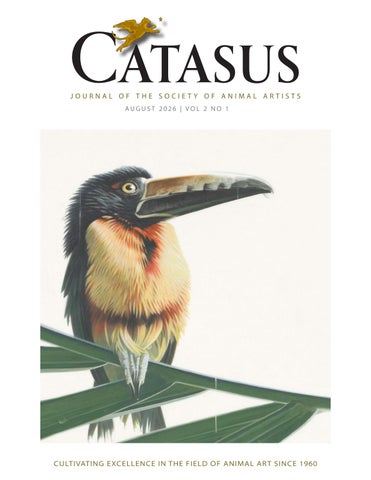
Catasus journal of the society of animal artists AUGUST 2026 | VOL 2 NO 1
CULTIVATING EXCELLENCE IN THE FIELD OF ANIMAL AR T SINCE 1960
2
Kathryn Ashcroft, Silly Little Brown Bird, oil on Belgian linen, 36 x 24 Art and the Animal – 66th Annual Members Exhibition
Catasus journal of the society of animal artists
Catasus, an online magazine published 3-4 times annually, is the official Journal of the Society of Animal Artists, Inc., a non-profit 501(c)(3) organization. The Society of Animal Artists (SAA), founded in 1960, is devoted to promoting excellence in the artistic portrayal of the creatures sharing our planet, and to the education of the public through art exhibitions, informative seminars, lectures, and teaching demonstrations. The SAA’s membership, past and present, represents a veritable who’s who of artists from around the world. Artwork in this publication has been contributed by our members or sourced from the SAA’s archives. Reproduction for other purposes is forbidden without written permission of the artist(s). Membership information is available at www.societyofanimalartists.com
THE 2026 SAA BOARD OF DIRECTORS Reneé Bemis, President Kim Diment, Vice President Kelly Leahy Radding, Vice President Cynthie Fisher, Assistant Secretary Rachelle Siegrist, Secretary Diane Mason, Vice President, Treasurer James Coe Deborah LaFogg Docherty
Shalese Sands, Ignis, scratchboard, 9 x 12 Art and the Animal – 66th Annual Members Exhibition
Table of Contents NOTES FROM THE SAA Letters – ED & President ................ 4 SAA News .......................................5 The Rumors Are True and Exciting! by Wes Siegrist.................................. 6 A Message from Alyson by Alyson Kinkade.............................7 Welcome Class of 2026................. 8 Member Promotions...................... 9 Get to Know Your BOD Members... 10
Yelena Lamm Jhenna Quinn Lewis Bob Mason Kelly Grace McNeil
FOLLOW THE TRACKS… Insights from our Archives by Wes Siegrist..................................11
Terry Miller Lisa Nugent David Rankin Jocelyn Russell Suzie Seerey-Lester Shalese Sands Heather Soos Amy L. Stauffer Wes Siegrist, Executive Director
MEMBER HAPPENINGS Algonquin Legacy: The Art of Michael Dumas by Michael Dumas......................12-13 When Miniatures Grew to Epic Proportions by Wes Siegrist........................... 14-15 IN PRACTICE Why What We Create Is Important by Diane D. Mason.................... 16-17
ON ANIMALS & ART The Space In Between: A Tribute to Chris Bacon by Ashley Bacon....................... 18-25 “Birdness”: Remembered by the Flock by Kelly Leahy Radding.............26-29 Explore. Create. Protect. by Dale Weiler......................... 30-33 FOUNDATIONS, FIELDWORK & FOCUS A Pilgrimage to the Heart of India: A Search for Ranthambore’s Striped Ghost by Tony Forrest................................ 34-41 Galapagos 2024 by Cynthie Fisher...................... 42-47 LINES OF THOUGHT Sketches & Studies by our Members............................... 48-55 BACK & FRONT COVER Chris Bacon Awareness, watercolour on rag board 62.54 cm x 27.30 cm (24.625” x 10.75”)
august 20 26
CATASUS
3
NOT E S
Catasus journal of the society of animal artists
Editor
Kelly Leahy Radding
Assistant Editor Wes Siegrist
Design/Production Kelly Leahy Radding
Editorial Submission
In 2026 Catasus will be published in August and December. We invite all members of SAA to submit content for inclusion in Catasus. Contact Editor Kelly Radding at kradding@mac.com to request space. If you have an idea for an article topic, or to suggest a person or event to be covered, email Kelly Radding. Products cited by article writers do not imply endorsement by the SAA. Catasus does not accept advertising.
Deadlines for Articles
August Issue: June 15 December Issue: November 15
Where to find our issues
Catasus is hosted on the online platform Issuu. Note: Issuu is a public space where Catasus will be available for the general public to read. All content is copyrighted.
Catasus Magazine
Learn more about Catasus Magazine and the SAA here.
Membership
Visit societyofanimalartists.com to learn about more about becoming a member of the Society.
F ROM
From Our President It has been a glorious spring, and I hope it has inspired all of you to let your creative juices flow and produce amazing artwork. The SAA Board is committed to creating many opportunities for our members. During this year’s opening weekend, we will be discussing several new initiatives we would like to implement, and we would love to hear your thoughts and suggestions. After all, our goal is to provide meaningful opportunities and experiences for you— our members. We are excited that this year’s annual exhibition will be hosted by The Elliott Museum in Stuart, Florida. Located right on the beach, the museum offers a beautiful setting for artists and art enthusiasts alike. Our host hotel, situated next to the museum on the Intracoastal Waterway, provides access to a variety of outdoor activities. Have you ever wanted to try surfing, paddleboarding, or wave running? These and many other adventures are available nearby. The area is rich with wildlife, including pelicans, ibis, herons, sandpipers, and egrets—truly a wildlife artist’s dream. We hope you will join us in October for an inspiring and memorable opening weekend. We look forward to seeing you in Florida this October.
Wes Siegrist, SAA Executive Director
Reneé Bemis, SAA President
august 2 02 6
S A A
Cat Herding Report By the time you read this, I will have moved from Tennessee to Texas. While the move was planned, it was moved up a few years by our finding and hiring a new executive director to replace me at the end of the year. However, due to a barrage of life issues impacting the dear man, those plans changed too, literally the week we sold our home. Thankfully, we quickly found a new energetic person to assume the role in Alyson Kinkade. I enjoyed training her for the job during my stay with the Masons in Colorado and know we are all going to have a GRAND time together in Florida for the opening weekend of our 66th Annual Exhibition. Rachelle and I will be driving to the show in our self-converted campervan: Allons-y. My job as executive director is to manage the affairs of the SAA per the direction of our Board of Directors. Having been behind-the-scenes with the Society for three decades, I continue to be impressed with how selfless and giving our Board members and officers are. They truly have your best interests at heart, so I encourage you to do what you can to participate and support the SAA activities they plan. Over the years, the foremost reason for failure of SAA plans is a lack of participation. The Board is striving to reduce costs, while increasing benefits, everywhere possible. Ultimately, it boils down to a sign I read many years ago: “Show up. Those who do rule the world.”
4
T H E
CATASUS
NOT E S
F ROM
T H E
S A A
Society of Animal Artists Upcoming Annual Exhibitions
Apply for Membership to the Society of Animal Artists
Support the Society of Animal Artists
2026 The 66th Annual Art & The Animal Exhibit The Elliott Museum, Stuart, FL August 6 – January 13, 2027
Would you like to be considered for artist membership in the SAA? Our deadline to apply to our jury is January 15th, 2027. For more information and to apply for membership us this link:
The SAA also welcomes donations and patron members. For more information, use this link, Patron Membership.
2027 The Booth Western Art Museum, Cartersville, GA
https://www.societyofanimalartists. com/how-to-join-the-society-ofanimal-artists/
2028 The Briscoe Western Art Museum, San Antonio, TX
Society of Animal Artists Special Shows 2027 Close to Home: Animals of North America by the Society of Animal Artists The Canton Museum of Art, Canton, OH April 27 – October 31, 2027 2028 The Arizona-Sonora Desert Museum, Tucson, AZ December 9, 2028 – February 11, 2029 Visit the Society’s YouTube channel for member interviews, opening weekend festivities and member happenings.
Daniel D. Glanz, Ocean Dance, Bronze, 15 x 10.25 x 5 Art and the Animal -66th Annual Members Exhibition
august 20 26
CATASUS
5
NOT E S
F ROM
T H E
S A A
The Rumors Are True and Exciting! Yes, it’s true: I will be retiring as the Executive Director for the Society at the end of this year. I discovered the Society of Animal Artists in the mid1990s via Wildlife Art Magazine and met Janet N. Heaton in 1998. At the time, she was a long-serving member of the SAA Board and encouraged me and my wife, Rachelle, to submit for membership. I became a member in the fall of 2000 and began serving as the SAA’s webmaster immediately to get us online. Working with artists whom I had admired for so many years prior was a thrill. I attended my first Annual Exhibition and opening weekend in 2006 by spending the $1,000 stipend the Board at the time voted to give me in addition to waived dues. While I had previously enjoyed talking with members on the phone or via email, it was life-altering to spend time with so many fellow animal artists. It is sobering to view the list of former members and see so many who are no longer with us, but I cherish all the memories with them.
joyous honor to work with so many artists and museum professionals. Of course, it’s also been challenging. As I like to say, it’s like herding cats into a bathtub… and that was before the pandemic and shipping issues! I’m excited to pass the baton to Alyson Kinkade, whom I’m sure you will all enjoy working with as much as I do. Of course, I’m still here with the SAA, and I look forward to getting to play more at our opening weekends. I have moved into a tiny home in Texas that Rachelle and I will use as a home base for our years exploring the western side of the country in our campervan.
The late Joe Vance was the person who called to convince me I could also help the Society by serving on the Board of Directors, so I joined the group in 2012 and soon became one of the vice-presidents and chairman of the special awards committee. In 2017, my SAA friends on the Board convinced me to serve as the Executive Director, following in the footsteps of the overwhelmingly admired Bob Mason. It has been a
6
august 2 02 6
CATASUS
Above: Reneé Bemis and Wes Siegrist presenting the Bott-Borghi-Bransom Award to Janet N. Heaton at the 2018 Annual Exhibition.
Above: L to R: Roxanne and Mark Susinno, Bob Mason, Karryl, Joy Kroeger Beckner, Diane Mason, Wes Siegrist at the 2006 Annual Exhibition. At left: Wes relaxing in the woods beside his campervan, Allons-y.
At left: Diane D. Mason, Jan Martin McGuire, Wes Siegrist, Bob Mason, and David J. Wagner discussing SAA tours at the 2009 Annual Exhibition.
NOT E S
F ROM
T H E
S A A
A Message from Alyson It is with great enthusiasm that I have accepted the position of Executive Director of the Society of Animal Artists. I’ve been fortunate to know and work with many of the organization’s talented members, past and present, through my role as Assistant Director of the National Sculptors’ Guild. What excites me most about this opportunity is that it brings together my love of animals and art in one role — one I know I’ll look forward to every day. My 30+ years with the Guild carry many parallels to the work ahead as SAA’s Executive Director. Building on what you’ve all created together will be an honor. I’m looking forward to working with our members, museum partners, and the Board to advance SAA’s mission and bring exemplary fine animal art to a broader audience. I hope to make positive strides for every member, and I look forward to meeting many of you in person at the 66th Annual Exhibition this October. — Alyson
More About Alyson Alyson Kinkade is a Colorado native who has been widely exhibited and collected throughout the U.S. since graduating from the Kansas City Art Institute in 1999. Her expressionistic paintings are held in the permanent collections of the cities of Paramount, CA and Loveland, CO, as well as Platte River Power Authority and Colorado State University. Her collaborative painted sculptures with Jane DeDecker can be found at the Robinson Center in Little Rock, Arkansas, and the Downey Theatre plaza in Downey, California. Editorial highlights include features in Southwest Art and American Art Collector magazines. In addition to her abstract landscapes, Alyson launched a series of custom pet portraits in 2015. Now numbering in the hundreds, these paintings have become widely popular, bringing smiles to pet owners across the country. Whether painting representational animals, works inspired by travel, or colorful abstracts, Alyson continues to create new pieces from her Loveland, Colorado studio as a means to uplift, inspire, and connect. “We’re all looking at the same sun —just with a different setting based on where we stand. May art be a unifier.”
As President of JK Designs, Inc. and Assistant Director of the National Sculptors’ Guild, Alyson has overseen large-scale projects and administration for NSG members’ public art placements since 1999. Her work with the design team shares the same goal as her own art: to uplift, inspire, and connect. Her contributions at JK Designs span artist liaison, design team coordination, proposal preparation, budgeting, shipping and installation logistics, and consultation for public and residential placements. “My approach to placing fine art is to first understand the intentions of the client and what the site needs, then complement those goals with the right art solution. It takes a team of artists, designers, and clients — constantly brainstorming — to create the unique place-making statements we achieve. I’m very proud of the work we’ve done and look forward to realizing many more exciting projects, connecting people through art.” Prior to its closing in 2023, Alyson served as director and curator of Columbine Gallery — three years at its Santa Fe, NM location following college, and more than 20 years at its
Loveland, CO location. She curated exhibitions for a roster of more than 45 painters and sculptors, helping make Columbine one of Colorado’s premier fine art destinations, with patrons visiting from around the world. When she’s not promoting other artists, Alyson is creating her own fine art, cheering on her nephew, traveling with friends, tackling home and garden projects, or spending time with her rescue dog, Jujube. She also loves showcasing the artful community of Loveland, Colorado, where she calls home.
Alyson and Jujube
7
NOT E S
F ROM
T H E
S A A
The Society of Animal Artists Welcomes the Class of 2026 New Members! The Society of Animal Artists would like to welcome our new members that were juried into the Society in January 2026. New Signature Members 1. Sherry Allen 2. Harvey Bodach 3. Diane Collins 4. Bradley Donner 5. Rebecca Engels-Reurslag 6. Maryam Fardinfard 7. Abraham Hunter 8. Len Jagoda 9. David Kuecherer 10. Allie Louise 11. Johanne Mangi 12. Peter Mathios 13. Greg Oakley 14. Kathe Umlauf New Associate Members Beth Bathe Kathleen Fietz Bobbe Jones Fred Lunger Elena Roche
7 13
3
6
8
14
4
11
1 9
12
5 2 10
8
august 2 02 6
CATASUS
NOT E S
F ROM
T H E
S A A
Member Promotions due to acceptance into the 66th Annual Exhibition
Signature to Distinguished Member Sue deLearie Adair 5
4
6
7
Repeating Reflections, graphite, 12 x 5.25
Associate Member to Signature Member 1. Nancy Ellen Allen 6. Anne McGrory 2. Kenn Kaufman 7. James Tennison 3. Paul Kratter 8. Richard Tesner 4. Debbie Lentz 9. Monique Wales 5. Linda Lunnon 10. Joyful Ward
3
10
1
8
2
9
august 20 26
CATASUS
9
NOT E S
F ROM
T H E
S A A
Get to Know Your Board of Directors Members
Shalese Sands To help our members connect more personally with the Society of Animal Artists leadership, we are inviting our Board Members to share a bit about their artistic paths and inspirations. These questions offer a glimpse into the experiences and influences that shape their work and strengthen our sense of community within the SAA.
Most people who know me well, know What subject matter my affinity for horses. I’ve been one or species do you feel of those horse-crazy girls since I was little. I collected model horses, drew most connected to, horses, visited the horse barn at the and why? fair, and rode horses with friends who had them. I eventually got my own mini horses as a young teen and had them for about 15 years when I was living with my parents. I’ve been drawing since I could hold a pencil, and I loved horses so much that for the majority of my school years, that was my primary subject. In fact, I had a teacher who suggested I try drawing something Golden Hour, scratchboard, 11 x 14 else for a change! Wildlife was also fun for me to draw, but As much as I love horses, moose have I always gravitated back to the horses. come in as a close second for a favorite subject matter. I’m really drawn to I can’t think of any particular reason ungulates in general, and especially why I love horses so much, but it’s not members of the deer family. Again, difficult to understand their appeal. there’s nothing in particular that I can As an artist (and honestly, as a human pinpoint as to why I love moose so much. who enjoys beauty), horses encapsulate They’re not exactly graceful animals like inspiration and beauty in every sense of horses, and they are particularly homely those words. The way they run, move, looking in the spring and summer their flowing manes and tails, and the months. However, during the fall rut, it’s variety of breeds and colors they come difficult to find a more incredible animal in are the epitome of the sublime. I have than a bull moose. The largest member yet to hear of someone who doesn’t of the deer family, a bull moose’s stature, admire horses in some way, shape, or antlers, and presence is enough to take form. They are stunning animals and I your breath away. The first time I was don’t think I could ever stop featuring able to see a large bull in his prime in them in my art!
10
august 2 02 6
CATASUS
Alaska, I was in awe. There is truly nothing like them!
First Light, scratchboard, 14 x 11
Between horses and moose, I could easily obsess on those two subjects for the rest of my life for my art. I’m thankful for the many opportunities I have had in the field to get my own reference of these amazing animals, and you can bet I’ll be drawing inspiration from them for the rest of my life!
Ever since I could hold a pencil, I have had a love of drawing and animals. My inspiration soared after a trip to Yellowstone National Park in 2009. Since then, I have wanted to excel in the field of wildlife art while continuing my passion for equestrian art. I graduated in 2011 with a B.S. in Studio Art, and quit my day job in July of 2023 to pursue my art full-time!
Website: www.shalesesands.com
FO L LOW
T H E
T R A C K S …
Insights From Our Archives
Insights from Our Archives story by Wes Siegrist
D
id you know that
culties securing opening
when the Society
venues when the tour
was first formed, exhi-
had been preemptively
bitions were not always
established, and con-
juried, members could
cerns from artists about
submit more than one
having their work “tied
work, and members
up” for extended periods.
could display reproduc-
Before
tions? Of course, we
those living in the United
before we reached 100 no competition for lim-
mem-
bership was limited to
went over a dozen years members, so there was
1969,
States and Canada. The Society has never sought
Elisabeth Rungius Fulda at an early Society of Animal Artists show.
high numbers of mem-
ited spaces in the exhibitions. The SAA started calling the
in 1972 due to the cost incurred by
members’ show our Annual Exhibi-
the Society to crate and ship all the
tion in 1979. [Reproductions were
works together to the first venue.
disallowed in 1969, and the SAA
The tour was revived starting in 1990
started jurying all shows in 1976.]
under the professional direction of Dr. David J. Wagner. For decades,
Did you know that the Society orig-
venues covered the costs, but as they
inally had tours after the annual
continued to climb, liability began
members’ show? Our founder, Pat
to creep into the SAA’s finances.
Bott, coordinated these that were
Starting in 2018, the SAA’s Execu-
limited to 2D. The Boston Museum
tive Director managed the return
of Science, which served as a tour
of the artwork to help offset costs.
venue, accepted 3D, but the artists
The SAA Board voted to discontinue
had to personally deliver the work
the tours in 2020, but honored con-
to the museum and pick it up af-
tracts through 2023. The variety of
terward. The touring aspect ended
reasons included rising costs, diffi-
bers, but rather those of established excellence. Because of this, our new member juries have always been tough. Typically, only 25% of entrants are successful. The bar of excellence has only increased with time, as competition has become tougher. Our membership peaked during the COVID-19 pandemic at 538 members, since the Board voted to waive membership dues requirements. Today, the Society has 434 artist members from 25 countries.
august 20 26
CATASUS
11
M E M B E R
H A P P E N I NG S
Algonquin Legacy: The Art of Michael Dumas
Foraging The Tangle: (White-throated Sparrows), Polychromos coloured pencils on Strathmore vellum bristol, 6 x 10.75 The tangle is a combination of natural leaf litter and the remnants of bird feeder seeds that have fallen to the ground. I enjoy the arrival of these beautiful little sparrows every spring.
Algonquin Legacy represents the influence and inspiration of firsthand experiences in the life of Canadian artist Michael Dumas. He was born in a Red Cross Outpost in 1950, at the eastern entrance of Algonquin Provincial Park, a sprawling maze of forest, granite outcrops, rivers, lakes, and ponds. His earliest memories are of Sunday drives into the park with his family, at a time when deer were plentiful and approachable enough to feed by hand. As a young man he worked as a park Canoe Ranger in Algonquin, maintaining portage trails and acting as remote park authority. Michael also worked an entire season establishing new canoe routes, becoming fully immersed in the spirit of the park uninfluenced by any human presence. The experience proved in-
12
august 2 02 6
sightful and inspirational to a young man whose interest in wildlife and wilderness was already providing the greatest single impetus to what would become a lifetime devotion expressed through his art. Algonquin Legacy is a compilation of text, photos, and artwork that provides insight into the artist’s background and early beginnings, to recent works of art, many of which became available just as the book was going to press. A forward by Michael, as well as captions he provided throughout the book for many of the visuals, lends a very personal flavour to the reading experience. It is essentially a visual experience, heavy in full page images, be they full colour paintings, or black and white graphite drawings. The
CATASUS
importance the artist places on drawing is evident in the many preliminary sketches presented alongside the finished work they gave birth to. ‘Early discussions with publisher/designer Andrea Hillo inevitably turned to what I hoped for in the finished product. Well, if I was to acquire a book of a favourite artist, I would want it to be personal, an opportunity to know the personality behind the work. I’d want large visuals, full page, some double page spreads, captions for additional insight. And finally, a format that set off the images to best advantage, but also an overall layout that was both effective and innovative.’
Book description and ordering procedure
Silent Steps: (Lynx), oil on canvas, 8.25 x 11, 2023 I’ve only seen a few of these amazing cats in the wild, most of them in Algonquin Park. To develop the idea I had for Silent Steps, I drew up many rough sketches to transfer things from my mind to the physical page. The final positioning is very close to one of these drawings, and I used several photos I was able to take of a captive animal to make sure the details were right.
The book is hard cover, 9” x 12, 108 full colour plates and 60 black and white drawings (many full page or double page spread.) Forward by Robert Bateman. Introduction and captions by Michael Dumas. Primary text, ‘The Artist in Algonquin’ by Leonard Pizzey. COST: $75.00 USD includes tax and shipping anywhere in Canada and the Continental USA. USA ORDERS: Make payment via PayPal to natures.studio.inc@sympatico.ca Provide full name and shipping address CANADIAN ORDERS: Payment can be made via PayPal to natures.studio.inc@ sympatico.ca OR by e-transfer to michaeldumaslegacy@gmail.com Provide full name and shipping address.
Canadian artist Michael Dumas was born September 20, 1950. Exhibitions: The Royal Ontario Museum, McMichael Canadian Collection, Suntory Museum of Art, MEAM – European Museum of Contemporary Art, National Museum of Wildlife Art. He has been featured in several television documentaries, and numerous awards for both his art and conservation projects.
Arrowhon Road II: Distraction (red fox), oil on birch panel, 8 x 10, 2022 A portrait of an animal I have come to know personally. Although wild, it allowed me proximity with remarkable tolerance and grace.
Website: artistsforconservation.org/michael-dumas Instagram: @michaeldumasartist Facebook: Michael Dumas Artist LinkedIn: Michael Dumas Artist
13
M E M B E R
H A P P E N I NG S
story by Wes Siegrist
Exquisite Miniatures at The Wildlife Experience
U
nlike large-scale grand works of art that beckon you from across a room, miniatures are subtle and easily overlooked. They are an intimate art form, one that begs you to step closer for examination. If done properly, they will capture your attention and draw you into their enchanting, diminutive world. Historically, most European and American miniature paintings were functional mementos of loved ones, until the advent of photography rendered them obsolete. Considered a bygone genre, miniatures found a revival in the 1890s when formal societies were established to promote, teach, and exhibit them to the public. Over the next century, they expanded in subject matter, style, and media, and were once again a lucrative business for artists. Wes and Rachelle Siegrist stumbled upon the world of miniature art serendipitous-
14
august 2 02 6
ly in 1997. Enamored and addicted, they chose to specialize in miniature painting in 2001 and grabbed instant recognition in both the realm of miniature art and traditional scale wildlife art shows. Both were juried into the Society of Animal Artists (SAA) in 2000 by submitting slides of their miniature paintings, which were subsequently annually juried into SAA exhibitions. In 2008, the Siegrists agreed to have David J. Wagner, L.L.C., represent their work as a touring museum exhibition with the understanding that it could take years to book an initial venue, and nothing was guaranteed. To their surprise, within weeks of the contractual agreement, David called to inform them he had a museum eager to exhibit their work. The prestigious R.W. Norton Art Gallery in Shreveport, LA had jumped at the opportunity. As one of
CATASUS
the top repositories of historical miniature paintings in the United States, they were aware of the Siegrists and were already considering contacting the artists to stage a follow-up exhibition to the museum’s previous exhibition on miniature painting that took place in 1976. While the Siegrists were still celebrating the news, David called and “broke” a promise he had made to them that they would not have to have two exhibitions at once. Another museum wanted the Siegrists’ paintings during the same span of time in July of 2010. Would the artists agree to both and commit at least 100 paintings to display? The Siegrists agreed to borrow work back from collectors and expand their currently available subject matter to include more portraits, still life, and landscapes. Wagner proposed that the Siegrists also produce a book highlighting their miniatures with
Top Row: Rachelle Siegrist teaching a workshop; Wes Siegrist lecturing on miniature art. Middle Row: Wes and Rachelle Siegrist; Wes and Rachelle Siegrist signing copies of Exquisite Miniatures. Bottom Row: Wes Siegrist gallery walk; Wes and Rachelle Siegrist with David J. Wagner at Exquisite Miniatures.
the artwork reproduced at actual size. Wes self-published Exquisite Miniatures by Wes & Rachelle Siegrist in 2008, followed by The World of Nature in Miniature: Paintings by Wes & Rachelle Siegrist in 2009. In 2010, he also wrote and published Modern Masters of Miniature Art in America, to celebrate the 25th anniversary of the Miniature Artists of America Society. Before the formal openings in May of 2010, additional venues had signed on to the tour. A snowball, built by Wagner’s business acumen and the Siegrists’ continued recognition and growth as artists, began to grow exponentially. No one expected the snowball to gain such momentum and size. It was a sought-af-
ter exhibition that appealed to a variety of museums and a diverse public of all ages. It grew to encompass 45 different venues in 15 years, not including venues that had to cancel due to the impacts of the COVID-19 pandemic or other reasons. The Siegrists decided to end the tour in 2025 to have the opportunity to display the tour’s 63 available paintings in their affiliated miniature art society exhibitions, and to simply slow down and enjoy life more. For decades, they had created and sold over 100 paintings annually between them and been hailed as the “World’s Ambassadors of Miniature Art,” introducing tens of thousands of people to their cherished art form. The historic tour included 47 different exhibitions (it returned to one
venue) and featured 284 paintings! The Siegrists traveled to many of the openings, enjoyed Gallery Walks discussing their work, and Wes gave presentations on the history of miniature art, or their career from “Big to Small.” It is happily ironic that choosing to go tiny resulted in the biggest thing that could happen to them!
Exquisite Miniature Video Exquisite Miniature tour venues website: www.artofwildlife.com
august 20 26
CATASUS
15
I N
I
Why What We Create Is Important story by Diane D. Mason
I still recall the impact seeing certain sculptures and paintings had on me when I was young – and how the inspiration provided by those works inspired me to pursue the arts later in life and provided the foundation for the past forty years of my life. I learned personally that art that touches your heart can change the direction of your life! Back in the age of the dinosaurs (the early 1970s) when I was at Purdue University studying ethology (my passion) and industrial psychology (so I could get a job when I graduated), I saw some wonderful prints in the window of a mall gallery. I’d never been to a gallery before but went in to see more. I fell head-over-heels in love with a print of a raccoon by Charles Fracé. It was only $45.00, but at the time, that was a fortune to me! But I loved the way he had depicted that raccoon as it sat in an awkward position and almost felt a direct connection with that creature. I remembered that piece for years, and when I could afford it, I purchased one of those prints. I still have it. It SPOKE to me in ways I couldn’t understand at the time...but I came to realize that is the power of art. At an art show in the Chicago area a couple of years later, I saw two small scratchboard renderings by Sally Maxwell. I was so impressed with what she had creat16
P R A C T I C E
august 2 02 6
ed in that medium that it inspired me to buy some scratchboards and start experimenting.
One of Diane’s scratchboards, Demure, an African black-footed penguin, scratchboard, 10 x 8; Art and the Animal – 57th Annual Members Exhibition
Several years later, I saw a sculpture in a gallery that was representing my scratchboard work. Titled “Primal Seas,” it depicted an ancient species of fish that appeared to be vanishing...as many parts of the fish were missing. I couldn’t afford it, but it totally captivated me by the power of the message it conveyed in a beautifully crafted composition. I remember that sculpture and its title, and the message, to this day. So...when you get discouraged, remember that what you create matters. Art is powerful and can change lives, as it did mine. It can
CATASUS
inspire passion for the arts, the subject matter portrayed, and the message which the artist is sharing from their soul. I can’t even imagine my life without being on this journey of learning, being inspired by SO many artists and their work, and being able to share MY passion for the animals and the arts with so many others through my work. It has been an adventure and an immensely important part of both my and Bob’s life for the past few decades – especially the years that I’ve been a member of the SAA. What we create really does matter. The power of that message is magnified when your work is shown in our special shows or annual exhibitions each year. I know that shipping is exorbitantly expensive these days...but getting your message out through your art is important, not only to the viewers of our exhibitions but also to keeping the SAA strong and vibrant. Please keep creating your work and sharing your passion and message through our exhibitions.
Diane D. Mason is a former SAA board president and served on the SAA Board of Directors for over 20 years. www.ddmason.com
Selections from: Art and the Animal – 66th Annual Members Exhibition
Top Row: Linda Lunnon Coming and Going, scratchboard, 14 x 10 ” Middle Row, L to R: Dan Chen, Shadow Play, watercolor and ink on silk, 28 x 36 Måns Bergendal, Morning Light, oil on canvas, 16 x 13 Bottom Row: Diane Mason, Overcoming Life’s Obstacles, bronze, 5 x 10 x 8
august 20 26
CATASUS
17
ON
A N I M A L S
&
A RT
techniques & inspiration
The Space in Between A Tribute to Chris Bacon
story by Ashley Bacon
18
august 2 02 6
CATASUS
Moon Lights, acrylic on rag board 16.50 cm x 40 cm (6.5” x 15.75”) Collection of David and Andrea Shemilt
“I shall stay on course and pursue my vision with childlike wonder and enthusiasm, until all that remains … is my body of work.” — CB august 20 26
CATASUS
19
CHRIS BACON (1960 – 2026)
C
hris was born in 1960, in England. His father Chris was an Englishman, his mother Norma a native of Hamilton, Ontario, in Canada. Chris II (his father) was employed by Cable & Wireless, and consequently the young Bacon family, including Chris and his sister, traveled the world. Chris’ earliest years were spent on Ascension Island in the South Atlantic Ocean. Every four years, the Bacons were stationed at the next exotic location, which included Fiji, Bermuda, and England, before settling in Canada in the mid1970s. The locales of Chris’ childhood had an immense influence on him, and his earliest memories are punctuated with intense visuals, sounds, and experiences. These no doubt only fueled his creative leanings.
ings of that sophistication. It took Chris drawing directly in front of the judges to convince them, winning himself his first set of watercolours. Chris called this one of those “pivotal” moments in life. As a result, watercolour was Chris’ first medium as a painter, and one he handled so uniquely that it can be difficult to distinguish his later acrylics from his watercolours.
Bateman had a few tips for Chris: more research, more fieldwork, and to “paint from the elbow,” as he did. Chris took the first two to heart, at least. By age 18, Chris lugged his portfolio into the Alice Peck Gallery in Ontario, convincing the owner to set up his first solo show. Several months later, 22 of Chris’ paintings hung on the gallery walls on opening night. Chris sat in his 1968 Triumph GT6+ across the street, wondering where all the people were coming from as they poured into the gallery. He entered the line-up, only to hear “There’s one painting left!” The man behind Chris shouted back, “I’ll take it!” A sell-out show in three minutes at the age of 19 may have had some influence on Chris respectfully declining his offer of admission to the art school, forever cementing his selftaught status.
Chris’ artistic gift was apparent from Still Life (Great Egret) a young age, drawacrylic on rag board, 50.8 cm x 44.45 cm (20” x 17.5”), Collection of the Estate of Chris Bacon ing the notice of his parents who always ensured that Chris painted at home incessant- Chris’ work through the ‘80s and Chris had enough materials with ly as a teenager, avoiding his high early ‘90s was exquisitely fine, which to draw. As an 11-year-old school studies enough that he failed diminutive in size and characterin England, Chris entered an art several classes, including art, iron- ized by intense detail, him often competition at a local fair, only to ically. He graduated a year later. painting with a magnifying glass be disqualified two years in a row. It Chris’ art teacher was neverthe- and one-hair paintbrush. Chris turns out the judges didn’t believe a less a great support, introducing would occasionally go to the exchild of that age could create draw- him at age 16 to Robert Bateman. treme of even painting the reflection 20
august 2 02 6
CATASUS
Sarus Crane 2003 alkyd on rag board, 29.25 cm x 28 cm (11.5” x 11”) Collection of Joe Donnell and Michelle Kachur
Chris described the three-year process of painting the Sarus Crane: “Cranes are primeval-looking, with gangly gait and shape. They are the smartest of birds…but the shapes of them seemed prehistoric. I was getting images and shapes in my head, how I was going to deal with them. Originally in one of these thumbnail ideas, I had a crane standing on top of a hill…it was very dramatic-looking. There’s this ominous, prehistoric shape and a last bit of sunlight hitting the top of this thing…the light being extinguished…the shadow was beginning to climb up the leg of the bird.” He explained that this speaks of a storm brewing that surrounds the bird, yet
the bird remains in the light. It became a self-portrait during a “rough time” in a former relationship. “He has his wing stretched out, because he is about to move on. The feelings I was having were beginning to manifest themselves in the painting… [the piece] was almost violent, it was so troubled. Originally it was a watercolour and I ran into technical problems… I [eventually] cut ten inches off the bottom and the composition changed…then I went at it in oil. As time went by, the painting developed a life of its own. They tell you what they need. Now, everything has mellowed, but I still have the drama [in the painting].” august 20 26
CATASUS
21
Flotilla (Polish Mutes) 2006 watercolour on rag board, 48.50 cm x 77.50 cm (19” x 30.5”) Collection of Paul and Hilde Singerr
“My goal was to produce the most beautiful, perfectly balanced, elegant piece of art that anybody had ever seen — that certainly I’d ever seen. And I just thought I can do this, I’m going to put my mind to it; and I spent the best part of seven months trying to achieve that. I think I got close to producing a very beautiful piece of art." -Chris
in a bird’s eye. Even more amazing is that Chris accomplished this with being born blind in his left eye. Though Chris later moved away from this intense level of detail, he explained in Wildlife Art magazine in 1997 that, “My work will always have this fineness. I’m not doing it to grab anyone’s attention. I hope that the original idea and the way I portray that idea is the lasting im22
august 2 02 6
pression as opposed to how I did after serious introspection, that I the reflection in the eye.” discovered the true meaning […] in these works. I reached a point in the Chris’ thirties marked a significant evolution as an artist, when I realevolution in his work. In 1996, he ized that my very life was beginning painted a portrait of a sandhill to reflect in my art…” (PT Explorcrane. He realized for the first time ers, 2017). in his career that this was actually a self-portrait. In a magazine article, Chris began to create more ethereal Chris reflected that “it wasn’t until paintings that at times did not reflect I reached the age of thirty and only naturalistically-accurate scenes. He
CATASUS
also introduced acrylics and bolder colour palettes. It has been noted that Chris’ art is often “unphotographable,” meaning it portrays something that cannot simply be represented by a photograph. “I never paint anything the way I see it; it’s always about the way I respond to it,” he explained (Wildlife Art magazine 2004). During this time, Chris also became fascinated with the concept of capturing what he called, “the space in between sounds, between movement… moments of stillness.” (Alight booklet 2010). He referred to it as the moment “when you toss a ball in the air and it says still for just an instant before it falls back to earth.” This fascination with the moment-in-between endured for decades for Chris. A slew of accolades followed. Chris’ art has been displayed worldwide. He is a Master Signature Member of the Society of Animal Artists with seven Awards of Excellence; he was the youngest artist at age 43 to be named “Master Artist” in the 2004 Birds in Art exhibition at LYWAM; in 2010 he held his retrospective exhibition, “Alight,” showcasing thirty years’ work at the Art Gallery of Burlington; and in 2012 he was awarded the Queen Elizabeth II Diamond Jubilee Medal for excellence in the arts. These are just highlights. So what is it about birds, for Chris? To me, they are an ideal vehicle to artistically express Chris’ subtlety, his sensitivity, his vulnerability yet resilience. He loved the challenge of capturing what he called their
Thin Air, (White-Tailed Tropicbird)
watercolor on Arches paper, 43.18 cm x 40.64 cm (17” x 16”) Private Collection
“birdness.” He explained, “I just like painting birds. I seem to have some kind of connection with them. The more I learn about them and watch them, the more fascinated I become. I […] can’t imagine what this place would be like without them.” From his own Instagram account, Chris described himself simply as “Painter… Subject matter drawn from nature, with an emphasis on birds.” He was beginning to venture into landscapes, nary a bird in sight, and looser watercolours of Bermuda scenes. Many of the paintings of Chris’ final years also emphasize negative space, birds in the skies, soaring in flight with light enveloping them, while others almost bor-
der into an abstract quality. Being an artist is not what Chris did, it’s who he was. It’s how he looked at the world. If he wasn’t painting, he was thinking about painting: about colour, form, composition, and light. Because Chris was an artist at the deepest part of him, his work has been incredibly important to me. I have loved sharing my life with an artist, and being invited “in” to his work. He always wanted my input, even when I was reluctant for fear of interfering with his vision. I loved the evenings when I’d check on what he was doing, and we’d sit at the easel and talk about his work. It was priceless and will forever mean the world to me. — Ashley
august 20 26
CATASUS
23
White Ibis 1988 watercolour, 8 cm x 7 cm (3.15” x 2.75”) Collection of David and Andrea Shemilt
Grab a magnifying glass and take it all in! Chris became renowned for incredibly fine detail in his earlier paintings, often working with a single-hair paintbrush and a magnifying glass to capture the smallest “barbs and barbules” of each feather, as he expressed it. Artist Raymond Harris-Ching once viewed several of Chris’ hyper-detailed paintings in person, exclaiming in awe, “Madness!” These are truly awe-inspiring pieces. Though Chris’ later work did continue to maintain a high level of detail and realism, he eventually employed 24
august 2 02 6
CATASUS
comparatively looser, more expressive strokes in larger-format paintings. This gradual shift was a natural evolution of his artistic vision, which always encompassed a self-reflective element. No matter the level of detail or size of painting, each piece in Chris’ body of work will always be a part of him, symbolizing his journey as an artist and individual through the years. Each piece retains a “Chris Bacon” quality that makes it obvious from across a room, just who painted it. –Ashley
Moon Lights
acrylic on rag board, 16.50 cm x 40 cm (6.5” x 15.75”) Collection of David and Andrea Shemilt
“None of the images I paint are photographic – meaning, I don’t paint things I’ve seen. Rather, I compose images in my head and spend a great deal of time drawing them out on paper, and tweaking that drawing until it is compositionally perfect. To me, these paintings are not
about birds; birds are simply a vehicle I use to compose paintings. The paintings themselves are things that will hopefully manipulate the viewer into an experience I may have had, an experience of vastness perhaps, or a certain emotional feeling.” –Chris
For this painting, Chris had spent an afternoon on a sandspit in Cape Hatteras sketching Least and Royal Terns, when he suddenly “thought about seeing things in a different light.” Once home, he created a clay model of the Least Tern in the foreground to study
and establish a believable shadow for the bird. This final painting distinguishes itself considerably from the sketch on the sandspit, venturing into an atmospheric wonderland representative of many of Chris’ imaginative pieces over the years. –Ashley august 20 26
CATASUS
25
M E M B E R
H A P P E N I NG S
“Birdness”
Remembered by the Flock
Chris Bacon spoke often of “birdness”, that elusive, unteachable quality he spent a lifetime chasing on the page and canvas: not just what a bird looks like, but what it is. Those who knew him will tell you the word suits him too. There was something of that same watchfulness, warmth, and quiet resilience in the man himself.
In the pages that follow, fellow members of the Society of Animal Artists share their own memories of Chris: the humor, the generosity, the quiet intensity at the easel, and the singular way he made everyone around him look a little closer at the birds around them. Here, in their words, is Chris as we knew him.
Synchronicity, (Wood Duck)
watercolor and acrylic on rag board, 45.72 cm x 50.8 cm (18” x 20”) Collection of the Leigh Yawkey Woodson Art Museum
Last year, Chris had a painting of wood ducks and spatterdock exhibited in the Woodson’s 50th Anniversary show of Birds in Art. The painting reminded me that I wanted to tell him how it inspired me to complete a pastel involving pickerelweed, not spatterdock, and not in summer but in spring, when the plants were at a stage where they were small. They 26
august 2 02 6
CATASUS
were almost reminiscent of hieroglyphics. I thought he would appreciate the comparison, if he could stop laughing. Only now he never will. Oh, How we will all miss him! His smile. His quiet genius. His lovely, precious, paintings. Thank you, Chris, for sharing your gift. —Cindy House
Chris Bacon was a gentle, steady presence throughout the decades I knew him while exhibiting artists and Master Artists at the Woodson Art Museum’s Birds in Art shows. He carried himself with quiet kindness—never a raised voice, never a moment of pretense. His art was the way he spoke to the world: thoughtful, curious, calm, and still. In both life and work, Chris embodied a rare duality – plain yet complex, introspective yet genuinely interested in others. His paintings offered a soft glimmer of light, dignified and soothing in a world that often feels loud and showy. They remain a testament to the depth of his spirit.
Liquidity
—Nancy Howe
watercolor and acrylic on rag board, 59.50 cm x 73 cm, (18” x 20”) Collection of the Leigh Yawkey Woodson Art Museum
We first met Chris back in 1999 at Birds in Art when we shared a table at lunch. We were immediately charmed by his humble and warm personality. Over the years, we enjoyed chatting with him at shows, including the time he shared his “secret” technique for achieving such soft atmospheric qualities in his work: watercolor pencils. We’ll never forget his humorous struggle with his Master’s speech at Birds in Art. We also had a delightful time with him when he served as an SAA juror for our Annual Exhibition alongside Rachelle. We all shared so many laughs and memories, despite the challenging task of selecting the show. We were certainly blessed to know him and privileged to see so much of his art in person.
Many years ago Chris and I ended up sitting next to each other at Birds in Art. He was actually a rather shy guy. But we ended up talking frequently over the weekend. And on the last day he quietly asked me about the SAA. “I know you are in the SAA… do you think that is something I might think about?” I enthusiastically encouraged him to submit at the next opportunity. Chris then did enter… and went on to win all of the major awards. Years later… on the “awards Night” at one of our SAA Art and the Animal Exhibitions… after he won yet another award… he came up to me afterwards and smiling said… “You know… you were right… I do like this organization!” As fellow watercolor painters I always ribbed him about his tiny masterpieces painted with what I called his tiny “Frog Hair” brushes. Years later… at an SAA demo I did in the St. Petersburg Museum in Florida… after watching me paint a pelican with my big wash brushes… he came up and smiling said… “I could paint my house with your brushes”…! Chris was a great artist member of SAA… and I value our long friendship. —David Rankin
—Wes & Rachelle Siegrist august 20 26
CATASUS
27
I had the pleasure of spending time with Chris on several occasions, and whenever you sat and talked with him, you knew you were in the company of a truly great and kind person, a gentle soul. Everyone knew Chris was a master of his profession, but it was the person he was inside that always shone through. We were fortunate to have Chris serve as a juror for several SAA Annual Exhibitions in the early days, and more recently, when we held the jurying at my home in St. Charles. He brought such a unique perspective to the process and was an excellent juror. His knowledge, thoughtfulness, and genuine appreciation for the work made his insight invaluable.
Water Music (White Ibis) watercolour & acrylic on rag board 50.16 cm x 46.35 cm (19.75” x 18.25”) Collection of Dan and Diana Lawrie
I didn’t know Chris very well, but I had the chance to meet him at Birds in Art a couple years ago. When we were at Point O’Pines, we had a lengthy conversation about birds, art, and everything in between. It was funny because he was a little quiet at first, but once he opened up, he ended up apologizing for taking up my time talking so much (which was absolutely not the case!). He was such a kind, humble person and wonderful artist. I told him how much I admired his work, and it saddens me we won’t be able to see more of it. He will be greatly missed! —Shalese Sands
28
august 2 02 6
CATASUS
I was chatting with Chris and Ashley at the opening at the Roger Tory Peterson Institute. They had traveled from Canada to be there. It was the first time I had met Ashley, and her warmth and sweetness so perfectly complemented Chris. He absolutely beamed as he told me the story of how they met, a beautiful and very romantic story. What I will remember most about Chris is his kindness and gentleness. His extraordinary talent could be seen in every piece he created, but it was his wonderful spirit and the person he was that made him so special. He will be deeply missed. —Reneé Bemis
A note from the editor: Chris Bacon was one of my very first wildlife art idols. I became an SAA member in 2012, still finding my way and my voice as an artist. Back then, and still today as a VP of the SAA, I made a point of attending our annual exhibition opening weekends even in the years I didn’t have a painting accepted — something I still tell newer members who don’t get in: show up anyway. You never know who you’ll end up sitting next to. That was certainly true for me. I found myself seated beside Chris at the Saturday night banquet, and I remember thinking, look at that, I get to sit next to one of my heroes. I was intimidated; here was a fellow watercolorist whose aesthetic I deeply admired, sitting right beside me. I needn’t have worried. Chris was down-to-earth and kind, and he treated me like a fellow artist from that very first conversation. Fast forward to getting into Birds in Art three years running, 2023 through 2025. In 2024, I walked into the show during artists’ time and found my painting hanging on the first wall, right alongside his. Over that opening weekend, we spent time together, talking about our work, about art, about life.
I have a funny Birds in Art memory, too. Arriving at Hazelhurst for the Saturday afternoon outing last year, I found a name tag lying on the driveway — it was Chris’. I brought it to the BIA staff and joked, “Can I switch name tags and be Chris, the Master?” We all laughed. Alice, our host at Hazelhurst, pointed him out in a nearby group, and when I handed it back to him, I told him the same thing, that I’d been tempted to trade, since our names could switch genders and no one would notice I wasn’t a Master like he was. He laughed right along with me. A signed copy of Chris’ book, ALIGHT has sat on the stack near my reading chair for years, one I return to often for inspiration. I’ve even caught myself thinking about a painting in homage to his body of work. I’ll miss the paintings I know were still swirling in his mind’s eye. But more than that, I mourn a genuinely kind person, one who took the time to make an insecure newcomer feel like she belonged. —Kelly Leahy Radding, editor, Catasus
C
hris was proactively made a Master Signature Member with the SAA, hav-
ing been one of the artists who set the bar for the Board to establish the new level of membership. In all, he received 7 Awards of Excellence, The Elliot Liskin Award for Representational Painting in 1996, and the Western Art Collector Editor’s Choice Award in 2013. Jackson Lake Trumpeters, 2012 Long-billed Curlew, 1998 Spring, 1997 White-Breasted Nuthatch, 1996 Stone Chat, 1994 Orinoco Goose Study, 1993
Jackson Lake/Trumpeters
Snake Bird, 1992
acrylic on rag board, 26.03 cm x 27.95 cm (10.25” x 11”) Private Collection
august 20 26
CATASUS
29
ON
A N I M A L S
&
A RT
Explore. Create. Protect. techniques & inspiration
story by Dale Weiler
I
when children connect with wildlife early in life, those experiences can stay with them for years to come.
At Champions for Wildlife, art and wildlife education go hand in hand. Working primarily with K–6 students, the organization believes that
Many native species are misunderstood or overlooked. Through creative, hands-on learning experiences, students are introduced to these underdogs. Art helps children slow down and spend time with the animals they are learning about. Students who participate in these Wild
Champions for Wildlife founder, Dale Weiler, assisting a student in sculpting a red wolf.
n classrooms across Western North Carolina, children bring that mission to life through creativity. They sculpt salamanders and Red Wolves, study native species, and create artwork inspired by the animals and habitats around them.
30
august 2 02 6
CATASUS
for Art programs often leave reflecting with pride on their creations, like a little boy who, after learning about the Eastern Box Turtle shared, “Look at how good my turtle looks! I can’t wait to show my mom and dad and teach them all about turtles!” That same connection between art and wildlife can be seen in the work of artist and Society of Animal Artists member Dale Weiler. His life-
sized hellbender sculpture not only introduced people to one of Appalachia’s most elusive native species, but eventually became part of the educational experiences helping students learn about wildlife and freshwater habitats. The eastern hellbender, North America’s largest salamander, lives in clean, rocky Appalachian streams and serves as an important indicator of freshwater ecosystem health. Because hellbenders rely on large rocks for shelter and nesting, even moving stones in a stream can unintentionally damage their habitat. To help introduce visitors to this species, Dale created Hellbender’s Rock, a life-sized stone sculpture of an Eastern Hellbender now displayed in the Streamside habitat at the North Carolina Zoo in Asheboro. Designed as an interactive, touchable experience, the sculpture invites people to slow down, look closely, and connect with an animal many people have never seen before. This piece would eventually become far more than a sculpture. Photographs of the artwork are now used in classrooms and educational programs to teach students about hellbenders and freshwater habitats. Through the artwork, children can study the animal’s unique features up close while learning why clean water and protected habitats matter. What began as an artistic creation evolved into a bridge between art, education, and wildlife connection. Whether students are sculpting wildlife, participating in nature journaling, or learning about spe-
Champions for
Wildlife foun d
er, Dale Wei ler, with his hel
16,724 pieces of
lbender rock
sculpture.
The impact extends beyond the classroom. By introducing children to wildlife at an early age, Champions for Wildlife hopes to inspire a lasting sense of curiosity and care for the natural world that reaches into families and communities. Students often carry those experiences home with them, teaching siblings about the animals they discovered, proudly displaying their artwork, and sharing wildlife facts with parents and caregivers. In many ways, the learning continues long after the class has ended.
wildlife art have
been created by the kids since 2022,
and the number is growing!
cies habitats through interactive experiences, they are encouraged to explore through curiosity, create through art, and begin building the kind of personal connection that can inspire them to protect what they have come to know and care about.
One recent story from a Champions for Wildlife volunteer perfectly captured the ripple effect of these programs. After hearing a teacher remark she had never seen her class so engaged, the volunteer later spotted one of those same students out in the community, excitedly pointing out flowers and teaching his family all about pollinators. Moments like
august 20 26
CATASUS
31
these remind us that these experiences stay with students long after a program ends. These experiences stick with students, shaping what they notice and inspiring them to share that curiosity with the people around them. Looking ahead, Champions for Wildlife hopes to continue expanding its creative wildlife programming and educational outreach, reaching more children and families through accessible, hands-on art experiences and a growing online exploration platform for kids that will launch soon. For artists who care about wildlife, there are many ways to become part of the Champions for Wildlife community. Whether through volunteering, sharing artistic skills, supporting programs, or making a donation, every contribution helps bring creative wildlife experiences to more children and communities.
Above: Champions for Wildlife volunteer, Cam, helping a student with his art project during a community event on pollinators. At left: Student proudly displaying his nature journal after a Nature in Your Backyard program with Champions for Wildlife.
Dale Weiler, a longtime member of the Society of Animal Artists, and his wife Loti Woods, founded Champions for Wildlife in 2022. Its mission is simple: to inspire and empower the next generation to become champions for wildlife through the magical power of art. Today, 100 percent of the proceeds from Dale’s sculpture sales support efforts to inspire the next generation through art and wildlife education.
Artists can play a meaningful role in shaping how the next generation sees and values wildlife. Art has the power to spark curiosity and create lasting emotional connections. That belief is at the heart of Champions for Wildlife’s work. Because sometimes it all begins with something simple like a lump of clay and a salamander most people have never seen before.
32
august 2 02 6
Website: championsforwildlife.org
Student sculpting a
CATASUS
Instagram: @championsforwildlife
Red Wo
lf out of
Facebook: @championsforwildlife
clay.
https://www.linkedin.com/company/champions-for-wildlife
ildlife pions for W m a h C h it w e program. loring outsid Student exp Nature in Your Backyard in their
Pollinato r students relief artwork cre in a Wild a for Art pr te by ogram.
ofacts.
Students exploring bi
Clay hellben der sculpte 3D printed h d by a student next to a ellbender m odel.
dent in
y stu of clay b . t u o d e t m der sculp for Art Progra Hellben Wild
a august 20 26
CATASUS
33
FO UN DA T I ON S ,
F I E L DWO R K
&
FO C U S
A Pilgrimage to the Heart of India: A Search for Ranthambore’s Striped Ghost story by Tony Forrest
There is a specific, electric silence that settles over the Indian jungle just before a tiger appears. A shift in the air that many years of observing wildlife has taught me to respect above all else. My art journey has always been defined by the pursuit of authenticity. While a studio provides the tools, the soul of
a painting comes from seeing your subject first hand. Last year, that pursuit led me away from the familiar and into the dense forests and scorched grasslands of India’s tiger reserves. My mission was simple yet daunting: to capture the raw, unfiltered reference material required to do justice to my subject: the Bengal Tiger.
Above: One of the first paintings to come off the easel.
34
august 2 02 6
CATASUS
One of many incredible encounters during field research in Ranthambore.
august 20 26
CATASUS
35
I
Above: Gateway to the tigers. Let the field research begin!
I am delighted to share this experience with my peers here at the Society of Animal Artists. The SAA has long been a cornerstone of excellence for wildlife and animal art, and it is a true privilege to be able to contribute to a community that understands that we don’t just paint animals; we tell their stories. The hope and expectation was palpable as we drove through the main gate of Ranthambore Tiger Reserve on the first morning; thirty-five years of professional art creation and the large cost of this trip had reduced me to an excited but very anxious artist! I was all too aware that I may see nothing and the jungle might remain silent during my narrow one-week window. But 36
august 2 02 6
within the first twenty minutes of our very first drive, the tension changed into pure joy as not one, but four tigers emerged from the dense forest to our right. Watching a mother and her three sub-adult cubs emerge from the forest, oblivious to our presence, meant I would indeed bag some valuable reference material. Little did I know at the time, this was not just any tiger; it was the famous tigress Arrowhead with her three sub-adult cubs. We spent the entire morning with her. What a scoop! During my visit to Ranthambore, I was lucky enough to have good sightings every day. The landscape is as important to me as the tigers, and I was delighted and excited to experience the
CATASUS
wild habitat for myself. The raw jungle and beautiful lakes are as much a part of my work as the animals. I could have seen nothing; but my wife, Margaret, and myself were blessed with one of the best experiences of my career. Returning home from a successful expedition is a moment of conflicting emotions; the physical journey and wild hands-on experience have ended, but the creative one is just beginning. With the memory of the numerous tigers still vivid and my cameras now loaded with new ideas waiting to emerge, I am returning to the studio fuelled by a huge sense of expectation and excitement. The heart of my artistic journey was forged in Africa - a life-chang-
ing path that began the moment I first set foot in Kenya at the age of 29. Something I learned very early on was that seeing the wildlife for myself, together with the wild habitat, meant that I could paint completely without restriction: everything was 100% my own and I could do what I wanted with my efforts. This might sound trivial to some, but to me that mental freedom was, and still is, very important. There is a unique, electric thrill in this stage of the artistic process. I begin the meticulous process of searching through all my images, waiting for some to leap from the screen and shout, “paint me”. Each sharp image fills me with excitement, bringing ideas for
new oil paintings that I know will stir my creative juices! I can already see the compositions forming: the way the colours of the tigers interact with the cool shadows of the trees or dry grasses. After thirty-five years, I still find this phase – the transition from the heat and dust of the field to the quiet focus of the easel – to be one of the most exhilarating parts of my work. I might be home, but after a week of waking to the alarm calls of langurs and peacocks, I find myself yearning for the wild where my spirit feels most at home. My heart has always belonged to the vast, open plains of Africa, a landscape I have returned to time and again. Yet India casts a spell of its own. The jungle, the stillness of the lakes, and the
Above: Completed this year, t
38
august 2 02 6
CATASUS
At left: Within minutes of entering the park for the first time, this is the sight that greeted me: one of these is Arrowhead, the famous tigress. Below: My photographs are a starting point: I love the freedom to do whatever I please.
this 20 x 10 inch canvas is painted from one of my favourite shots. There is something just perfect about that stride and focus.
august 20 26
CATASUS
39
haunting silhouette of ancient forts keeping watch over the park, create a new magic, one that’s deeply layered in history and myth. However, amidst this beauty, I remained acutely aware of the thin line separating two worlds. Just beyond the park’s boundary, the relentless bustle of the human race serves as a sobering reminder of the tiger’s fragile existence. As I return to my easel to translate these experiences into my art, I fear for the tigers’ safety and for their future. Conservation is the most vital item on the human agenda, and as artists, I feel it is our duty to ensure that tigers never fade into the shadows of history.
For 35 years, Tony Forrest has captured the spirit of global wildlife through classic oil painting. Rejecting fast-paced commercial shortcuts, Tony relies entirely on his own field research and photography to preserve the authenticity of wild habitats—from the megafauna of Africa to the lush tiger reserves of India. His work has been featured in premier UK galleries, Florida exhibitions, and the Safari Club in Reno, with two upcoming miniatures set to debut at the prestigious Settlers West American Miniatures show in February 2027. Tony lives in Cornwall, UK. Website: www.tonyforrest.com Instagram: tonyforrestwildlifeart
40
august 2 02 6
CATASUS
The ultimate artist’s reference trip starts right here. Ranthambore, let’s see what you’ve got… At left: From the moment I saw this scene, I knew it would be painted. Strangely, it was the light on the water that attracted me the most – the tigers were just there!
Above: There is more to Ranthambore than just tigers. Leopards are harder to see, but I saw three! This painting is a new 50-inch canvas and will be quite subdued in colour; the dry forests in March are full of subtle greys and very satisfying to paint.
august 20 26
CATASUS
41
FO UN DA T I ON S ,
F I E L DWO R K
&
FO C U S
Galapagos 2024
story by Cynthie Fisher
B
Being a zoologist, visiting the Galapagos has always been on my bucket list. So when an opportunity arose to join the National Geographic’s Leadership Giving expedition in October of 2024, I couldn’t wait! I’ve always been a big Nat Geo supporter, as they combine both of my loves for exploration of the natural world and scientific advancement and research. I immediately booked a spot, and when my mom found out, she said, “Me too!! ” 42
august 2 02 6
CATASUS
Above: The greeting party of Galapagos sea lions was very relaxed as we strolled on the beach. At left: Mom and I enjoy the company of a unique and impressive Galapagos giant tortoise.
august 20 26
CATASUS
43
W
We flew to Ecuador, where we met the gang we’d be traveling with. I was so impressed by the enthusiasm and commitment of both the staff and the participants. We traveled on one of the Nat Geo’s luxury ships, and enjoyed not only amazing food and social opportunities, but lectures and chats with folks like Sylvia Earle, the amazing marine biologist I have long admired. The Nat Geo 44
august 2 02 6
CEO, Jill Tiefenthaler, was with us, and all the NG folks were very attentive and supportive. Arriving at the islands, we used Zodiacs to gain access to specific sites, where we were led on hikes to see the iconic and unique wildlife. To finally gaze upon the critters I’d studied and learned about my whole life was very fulfilling. Of course we saw
CATASUS
the giant tortoises, along with the indigenous sea lions, iguanas, crabs, and the myriad bird species that call these islands home. The tameness of the wildlife was amazing, and such a privilege to witness. Being a diver, I also enjoyed what the sea had to offer, and got to see my first wild penguin and albatross, both unique to the Galapagos.
Above: A lovely pair of red-billed tropicbirds.
My mom was a trooper, and really seemed to enjoy the camaraderie of our group… many of us continue to keep in touch and I make a trip to Washington DC every year to see the Nat Geo headquarters and find out more about their research and missions. Knowledge is strength, and I am so glad to be involved with this group. I hope to create some artwork from this trip; there was much to be inspired by!
Top to bottom: Two species unique to the islands; the marine iguana and the waved albatross. And our amazing vessel, The Nat Geo Islander II.
august 20 26
CATASUS
45
Top: The Zodiac we used to access the islands; we often saw dolphins on our way to the beach. Above: Mom and I on the beach, enjoying the stunning scenery.
Everything in wildlife artist Cynthie Fisher’s world revolves around her love and admiration for animals, which is aided by her college studies in zoology. She chooses to share this love via her vibrant colorful paintings, scratchboards and bronzes of species from all corners of the world, most of which she has traveled to, including 25 trips to Africa. Cynthie has been a professional artist for over 35 years, working in eight mediums to showcase her expertise in animal behavior and beauty. Cynthie shows her work at the Sugarman Peterson gallery in Santa Fe and on her website. www.fisherart.com
46
august 2 02 6
CATASUS
On this page: Tame sea lions, a glimpse of the undersea life, including a green sea turtle, and the view from a hike of the often arid landscape.
august 20 26
CATASUS
47
L I N E S
O F
T H O U G H T
sketches & studies by our members
Mary Cornish “With my style of painting, my subject matter may vary from beautiful horses to the visual grotesqueness of a California Condor. Yet I have always strived to capture the inexplicable “magic” that permeates the essence of the subject. That “intangible something” fascinates me. In my artwork, I attempt to portray that feeling, as well as the physical attributes and personality of the subject through paint. I love creating the visual effect of a three-dimensional image on a two-dimensional surface.” www.marycornish.com
Hummingbird sketch
African Penguins
King Vulture
Marabou Stork
48
august 2 02 6
CATASUS
“Cookie”
A glimpse inside the creative process, where preliminary lines reveal the insight, intention, and curiosity behind our members’ finished works.
“Monolith, Turkey vulture, oil, 20” x 16”, was selected for Leigh Yawkey Woodson Museum’s Birds in Art exhibition. This will be my 15th year.” august 20 26
CATASUS
49
L I N E S
O F
T H O U G H T
sketches & studies by our members
Anik McGrory
“This summer I’ve tried to put aside painting finished art. Instead, I’ve been trying to learn as much as I can by getting out to the same few locations and observing nature and studying whatever comes along. Often, there’s no wildlife when I arrive, and I play with color and value and shape of the rocks, grasses, sand, and water, putting my emphasis on exploring and learning rather than trying to make a pretty picture. Birds show up before too long – conveniently just where I’ve been painting. Somehow this feels like a magical cheat every time. Going to the same places means I spend less time and energy figuring out where to go. It has the added benefit of exploring how changing light and tide affects the appearance of my subjects. And also of gaining insight into the daily rhythms of wildlife and seeing how animals are affected by the tide and the weather and the passage of the weeks. Most of these images are painted on
the same piece of watercolor paper folded together. The first two images show the front and back of the whole piece. The rest are mostly close ups of the individual sections. All of these were painted either directly from life or very shortly after returning home from photos that I took. The puffin and the eider both painted from older photos. The puffin was from a photo I took in Scotland earlier this summer, and I was working on getting down the shapes accurately and loosely and playing with the wetness and dryness of the watercolor. The study of the eider was from a photo from last summer from Hog Island and I was playing with the variations of light and shade on the feathers and with the play between warm and cool color.” Instagram: @anikmcg
Above: Eider study from a photo taken at Hog Island, ME.
Above: Detail from page 51.
At left: Puffin, from a photo taken in Scotland earlier this summer.
50
august 2 02 6
CATASUS
One side of the watercolor paper – unfolded.
august 20 26
CATASUS
51
L I N E S
O F
T H O U G H T
sketches & studies by our members
Anik McGrory
This page: Details from the watercolor sheet on Page 53.
52
august 2 02 6
CATASUS
The other side of the watercolor paper – unfolded. At left: Details from the watercolor sheet above.
august 20 26
CATASUS
53
L I N E S
O F
T H O U G H T
sketches & studies by our members
Chris Bacon (1960-2026) Chris was admired around the world for his masterful fine art, his remarkable eye for nature, and his gentle spirit. His work remains an enduring legacy of beauty, stillness, and wonder. Website: www.chrisbacon.com
“The Flamingo conceptual sketches eventually led to one of Chris’ all-time most popular paintings, “Warm Front”, a large, vibrant piece that found its home with a prominent collector in Canada.” —Ashley Stone Chat sketch — a plein-air watercolour that Chris captured while on an Artists for Nature Foundation trip to Extremadura, Spain, in 1994, which had a lifelong positive influence on Chris and his work.
Warm Front acrylic on rag board 21.5” x 30” 54
august 2 02 6
CATASUS
Trogon – a drawing by 3-year-old Chris!
Study for Needle & Thread Alley watercolour on arches paper 24.4 cm x 27.9 cm 10” x 11”
Needle & Thread Alley is one of our favourite spots in St. George’s, Bermuda. Many of the streets carry such whimsical names from eras gone by. We have both sat on that little step to the left, taking a breather during our walks through the historic village. Chris captured the spirit of this idyllic place so perfectly, I can feel the balmy atmosphere and smell the fragrant cedar creeping over the limestone wall. The house at the end of the alley
peeks at you with curiosity, the windows like eyes. Chris gifted me this painting, knowing how much I love it. It also represents a departure from Chris’ usual style of painting, one of several similar, looser watercolours he created depicting Bermuda scenes. He always thoroughly enjoyed painting them, both as a relaxing pastime for himself and a way to “visit” his favourite place on Earth. –Ashley august 20 26
CATASUS
55
“Consciousness without thought… Birds, animals and plants have a lot to teach us about how to live more deeply in the present and how not to get lost in thought.” -Chris
Chris Bacon
Awareness watercolour on rag board 62.54 cm x 27.30 cm (24.625” x 10.75”) Collection of Peri Kolivaris and Lisa Singer Kolivaris Front Cover: Detail of Awareness