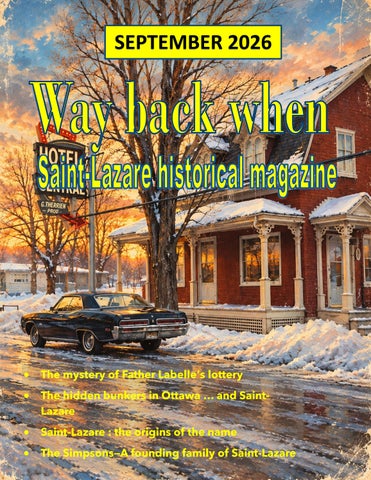
SEPTEMBER 2026
• The mystery of Father Labelle’s lottery • The hidden bunkers in Ottawa … and SaintLazare
• Saint-Lazare : the origins of the name • The Simpsons—A founding family of Saint-Lazare
2
In the magazine this month:
Way back when is the Saint-Lazare historical society’s historical magazine published 3 times a year, in January, May and in September. The content of this publication may be reproduced with the acknowledgment of the source on the express condition of having obtained prior permission from the SaintLazare historical society.
4
The mystery of Father Labelle’s lottery
11
The hidden bunkers in Ottawa … and Saint-Lazare
13
Saint-Lazare : The origins of the name
18
The Simpsons—A founding family of Saint-Lazare
Editor: Paul Lavigne Corrector: Lyne Boutin
Lifetime membership in the Saint-Lazare historical society as a civil member is free. By becoming a lifetime member, you will receive the link to our digital magazine 3 times a year and you will benefit from preferential rates for our events.
Saint-Lazare Historical Society’s board of directors
You can find the membership form on our website www.shsl.ca under the heading Becoming a member.
President: Donald Simpson
Vice-president: Anick Chevrier The rates for becoming a corporate or institutional member of the Saint-Lazare historical society are as follows: GOLD level member (1/4 page add) :
$200.00 per year
SILVER level member (1/8 page add) :
$150.00 per year
Treasurer: Manon Leroux Secretary: Paul Lavigne Administrator: Robert A. Rozon Administrator: Emma Mergl Administrator: Gisèle Gareau
BRONZE level member (1/16 page add): $100.00 per year
Administrator: Lyne Arbec
To become a corporate or institutional member, contact the SLHS via email at info@shsl.ca and we will gladly inform you about all the other advantages.
Administrator: Robert T. Rozon
3
The mystery of Father Labelle’s lottery By Paul Lavigne
What if, in 1884, the grand prize in a lottery created to finance colonization had been a farm in Saint-Lazare… a farm for which we can find no trace today?
of many French Canadians to the United States. Attracted by the jobs offered in New England factories, thousands of families were leaving rural Quebec in search of a better life.
This seemingly simple question takes us deep into a story where colonization, ambition, religion, chance and perhaps even a little marketing strategy come together.
To counter this exodus, the government and the clergy encouraged the colonization of the vast territories that were still sparsely populated throughout Quebec. It was in this context that a remarkable figure emerged: Antoine Labelle.
The “King of the North” In the 19th century, Quebec was facing a phenomenon that deeply concerned both political and religious leaders: the exodus
Born in Sainte-Rose in 1833 and ordain4
ned a priest in 1856, Labelle became parish priest of Saint-Jérôme in 1868. He would devote much of his life to the colonization of the Pays-d’en-Haut, the northern territories of the Laurentians. Nicknamed the “King of the North,” he dreamed of settling French Canadian families in these vast territories, establishing farms, creating new parishes and, above all, connecting these new communities with the rest of Quebec.
A Lottery like no other
For Labelle, however, colonization could not rely solely on the courage and determination of settlers. Roads, villages, transportation and, above all, the railway were essential. The railway would allow new communities to transport their agricultural products to market and become economically viable.
But one prize stood out above all the others.
The concept was bold. Since the laws of the time did not allow lotteries to simply offer cash prizes, the lottery instead offered goods and properties. For its first series, 100,000 tickets were sold at $1 each. The prizes included 1,921 lots with a total announced value of $50,000.
The grand prize was a farm measuring 15 arpents in frontage by 30 arpents in depth, including its buildings, with an estimated value of $10,000.
In 1879, he founded the Colonization Society of the Diocese of Montreal. But colonization was expensive. Land had to be acquired, families had to be helped to settle, and the infrastructure needed to support their development had to be built.
To understand the significance of that amount, one need only consider the wages of the time. A laborer earning approximately $1 a day would have needed to work nearly 50 years to earn the equivalent of the prize.
Labelle therefore sought innovative ways to finance his ambitious project.
For a family in 1884, winning this property was therefore far more than simply an extraordinary stroke of luck. It could have meant becoming a landowner, establi-
Thus, in 1884, the National Colonization Lottery was born. 5
Many thanks to our valued partners
6
Vincent-de-Paul district of Laval. He was ordained in 1869, thirteen years after Antoine Labelle. The possibility that the two men knew one another during their youth therefore seems limited. Their respective priestly careers do not appear to have brought them into close contact either. Labelle served as a priest in the parish of Saint-Antoine-Abbé, in Huntingdon, from 1859 to 1863, while Magloire Auclair became parish priest of neighboring SaintCyprien-de-Napierville in 1869. There is, however, an intriguing family connection. Magloire Auclair’s nephew, Father ÉlieJoseph Auclair, would become a priest, historian and theologian and, in 1930, would publish a biography of the famous parish priest of Saint-Jérôme.
shing a substantial farm and securing the future of several generations. And this farm was located… in Saint-Lazare. But why Saint-Lazare?
Could this family connection to Labelle’s history point to an earlier relationship or acquaintance between the two families? The documents consulted so far do not allow us to say so with certainty.
This is where our story becomes intriguing. Our research has attempted to determine why Father Labelle would have chosen Saint-Lazare for such a substantial prize, some 60 kilometers from Saint-Jérôme.
The parish priest of Saint-Lazare at the time of the lottery, Louis-Alfred Charbonneau, who served from 1882 to 1886, does not appear to have had any obvious connection with Labelle either.
The first parish priest of Saint-Lazare, Magloire Auclair, was born in 1846 in the Saint7
So, why Saint-Lazare?
And this is where the mystery deepens.
A farm that does not appear on the land records
Our examination of historical land records has not allowed us to identify a property in Saint-Lazare corresponding precisely to this description. Research into notarial records from the period has likewise failed to uncover a transaction involving the purchase or sale of a property of this size either before or after the lottery.
The question becomes even more intriguing when we examine the land structure of Saint-Lazare in 1884. At the time, the parish’s land division was still largely based on the former concessions of the Seigneurie de Vaudreuil. The traditional pattern was well established: farms generally measured 3 arpents in frontage by 30 arpents in depth. Yet the farm promised by the lottery measured 15 by 30 arpents. Mathematically, this was equivalent to five traditional three-arpent lots joined side by side.
So, where was this farm?
Some landowners did indeed possess several adjoining properties. Families established throughout the various ranges — including the Lalondes, Castonguays, Sabourins, Chevriers and Émards — sometimes operated substantial farms. But these properties generally resulted from the gradual consolidation of several individual lots.
And the winner? There is another question, perhaps even more surprising.
A single property measuring 15 arpents in frontage by 30 arpents in depth was something quite different.
Who won the grand prize?
8
Father Labelle appears to have placed great importance on the integrity of the draw. To prevent any possibility of manipulation, the winning numbers were drawn by blind young men from the Nazareth Institute. Two of them participated in the drawing: one drew the ticket number, while the other drew the corresponding prize number.
The famous $10,000 grand prize — that enormous Saint-Lazare farm — apparently was never claimed. And perhaps that is where the real mystery lies. A dream prize… or a clever marketing strategy? Two scenarios can be considered. The first is entirely plausible: the lottery may have intended to acquire five adjoining three-arpent lots, if necessary, to create the promised farm. Since the grand prize was apparently never claimed, such an acquisition may simply never have taken place. The second possibility is more daring.
The numbers were placed beforehand in sealed containers. The procedure was simple yet ingenious: those conducting the draw could not see the numbers they were handling.
Labelle and his associates may have taken advantage of the vast areas of land still available in Saint-Lazare — wooded areas, sandy lands or properties not yet developed — to present the image of a large estate whose precise configuration did not necessarily exist at the time the tickets went on sale.
The results were then published in newspapers, allowing the fortunate winners to come forward and claim their prizes. But here is the remarkable part.
In other words, was this 15-by-30-arpent farm a real property, ready to be handed 9
And perhaps the true achievement of his lottery was not simply to give people a chance to win land… but to make them believe that luck could change their lives.
over to its winner, or simply a sufficiently enticing promise designed to attract buyers? At present, we cannot say for certain.
More than 140 years later, one question still hangs over our local history:
One thing, however, remains clear: by associating the name of Saint-Lazare with a $10,000 prize, Antoine Labelle had found a remarkable way to make lottery buyers dream.
Where, exactly, was that mysterious Saint-Lazare farm?
Many thanks to our valued partners
10
The hidden bunkers in Ottawa … and Saint-Lazare By Robert T. Rozon
Between 1959 and 1961, the Canadian government oversaw the secret construction of a large underground shelter in Carp, near Ottawa. Designed to ensure the continuity of government in the event of a nuclear attack, this refuge later became known as the “Diefenbunker,” in tribute to Prime Minister John Diefenbaker, who ordered its creation.
doors, it stood as one of the most robust structures built in Canada during the Cold War. Although never used during an actual crisis, the site remained active for more than thirty years as a military communications center. In 1994, it was designated a National Historic Site and transformed into a museum, where visitors can explore period equipment, documents, and numerous artifacts related to government operations of that era.
The complex included offices, dormitories, technical facilities, decontamination areas, and advanced communication systems. Able to house more than 500 people for several weeks, it operated with its own power generation, air‑filtration system, underground water supply, and an entrance protected by a tunnel engineered to deflect the blast of an explosion. With its four subterranean levels, massive concrete wall, and reinforced 11
While Ottawa is home to this well known bunker, Saint-Lazare also has its own underground structure—smaller, more discreet, but older. This concrete shelter, built before the Cold War, is a valuable reminder of a time when fear of conflict and bombardment shaped everyday life. It is unclear whether it served primarily as a refuge or as a storage space, but its design suggests it could have fulfilled both purposes. Through a confidentiality agreement with the owner, I had the opportunity to visit this unique relic. Despite the decades that have passed, the concrete structure remains surprisingly solid, even though the doors are long gone. Stepping
12
into this space filled with history creates a striking impression: one can almost feel the anxiety people of the time must have experienced, imagining what it meant to take shelter underground while a potential threat loomed outside. Modest yet authentic, this small bunker is an important part of our local heritage. It reflects the fears, preparations, and resilience of the generations who lived through an era of international tension.
Saint-Lazare : The origins of the name By France Ferland and Donald Simpson
Why the Name Saint-Lazare?
Article inspired by a text by France Ferland and Donald Simpson, published in the Saint-Lazare Historical Society newsletter in June 2018.
The Dictionnaire des noms et lieux du Québec, published by the Commission de toponymie du Québec, explains that the geographical location of the new parish played an important role in the choice of its name.
Saint-Lazare: The Origins of a Name When the parish and later the municipality of Saint-Lazare were officially established in 1875, the territory had already been inhabited for several generations. But why was the name Saint-Lazare chosen? And, more importantly, who was this Lazarus whose name our town still bears today?
Saint-Lazare was located southeast of Sainte-Madeleine-de-Rigaud and bordered to the west by Sainte-Marthe. In the Gospel according to John, Lazarus is presented as the brother of Martha and Mary. This connection between the names of the neighboring parishes is therefore believed to have inspired the name given to the new parish.
The answer takes us through the history of our region, the biblical accounts, and a Christian tradition dating back many centuries.
The name Lazarus was reportedly chosen at the request of Bishop Édouard-Charles 13
Many thanks to our valued partners
14
Long before Saint-Lazare was officially established, the territory had welcomed several waves of settlers. Englishspeaking families, particularly from New England and Cumberland, England, settled there during the early 19th century. They were soon joined by FrenchCanadian families. Over the decades, this rural community developed amid vast farmlands and forests that would long characterize the Saint-Lazare landscape. Fabre, then Coadjutor Bishop of Montreal. The parish of Saint-Lazare, separated from Saint-Michel-de-Vaudreuil, was canonically and civilly established in 1875. The parish municipality was officially created on December 29 of that same year.
Now that we understand why the name Saint-Lazare was chosen, another question remains: Who was this Lazarus who became the patron saint of our parish?
Lazarus of Bethany
A few years later, in 1878, the post office was given the name Saint-Lazare-deVaudreuil. The addition of “Vaudreuil” not only reflected the fact that part of the territory had once belonged to the Seigneurie of Vaudreuil but also helped distinguish the community from another Saint-Lazare located in Bellechasse.
Lazarus of Bethany is a figure from the New Testament, known primarily through the Gospel according to John. He lived in Bethany, near Jerusalem, with his sisters Martha and Mary. The Gospels portray their home as a place where Jesus was welcomed during his visits to the region.
A Territory Already Settled
The most famous episode associated with Lazarus is, of course, his resurrection. 15
According to the Gospel of John, Lazarus became gravely ill and died before Jesus arrived in Bethany. By the time Jesus finally reached the village, Lazarus had been in the tomb for four days. Jesus then ordered that the stone sealing the entrance be removed and called upon his friend to come out.
Their persecutors are said to have placed them aboard a vessel without sails, oars, a rudder, or provisions, abandoning them to their fate on the Mediterranean Sea.
Lazarus returned to life.
Lazarus and his companions are then said to have begun evangelizing the region. Lazarus reportedly settled in Marseille, where tradition would later identify him as the city’s first bishop.
This account, one of the best-known episodes in the New Testament, made Lazarus an important figure in Christian tradition and, over the centuries, gave rise to numerous legends concerning the remainder of his life. From Bethany to Marseille: Between Tradition and Legend The Gospels tell us virtually nothing about what happened to Lazarus following these events. It was therefore Christian tradition, developed several centuries later, that continued his story. According to an ancient Provençal tradition, during the persecution of the first Christians, Lazarus, his sisters, and several of their companions were driven from Palestine.
16
Against all odds—and miraculously, according to tradition, the vessel eventually reached the shores of Provence.
This story has long held an important place in Provençal Christian tradition. It is important to note, however, that no historical source contemporary with Lazarus confirms his journey to Provence. We are therefore dealing more with religious traditions and hagiography than with documented history.
Lazarus, Bishop and Martyr of Marseille Tradition also tells us that Lazarus continued his work of evangelization in Marseille despite the persecution faced by the early Christians.
Refusing to renounce his faith or worship pagan gods, he is said to have been arrested, beaten, and imprisoned. According to tradition, he was eventually martyred by beheading on December 17, the date on which his memory is traditionally commemorated. Over the centuries, Marseille has preserved this tradition, and several religious sites in the city have been associated with Lazarus and the early Christians. Here again, some caution is necessary. Although this tradition is ancient and deeply rooted in the religious history of Provence, the details surrounding Lazarus’s presence, episcopacy, and martyrdom in Marseille cannot be considered historically established facts.
From Bethany to Saint-Lazare Whether viewed as a biblical figure, a person of Christian tradition, or a symbol of resurrection and hope, Lazarus travelled through nearly two thousand years of history before his name was given to our parish in 1875. The choice of his name takes on particular significance when we consider the religious geography of our region: Sainte17
Marthe, Sainte-Madeleine, and SaintLazare—three names closely associated in Christian tradition—are thus brought together within our region. Behind the name we use every day lies a story far older than our municipality itself. It is a story that begins near Jerusalem, continues, according to tradition, along the shores of the Mediterranean, and finally finds a new echo many centuries later, here in Quebec. Saint-Lazare: a name chosen in 1875, but a story that goes back nearly two thousand years. Main source: Saint-Lazare 1875–2000, supplemented by information from the Commission de toponymie du Québec and Christian traditions concerning Lazarus of Bethany.
The Simpson — A founding family of Saint-Lazare By Donald Simpson
The First Simpsons to Settle in the Seigneurie of Vaudreuil
When Saint-Lazare was officially founded in 1875, several families had already been living in the area for generations. Some had even been established there for nearly a century! The Côte Saint-Louis concession was opened as early as 1774, while the Côte Saint-Charles concession was established in 1811. Behind these dates are the stories of men and women who cleared the land, raised their families, and helped shape the community that would eventually become SaintLazare.
The story of the Simpsons of Côte SaintCharles takes us back to England, more specifically to Cumberland, where Robert Simpson was born in 1763. He died in 1818 in the parish of Kirkland. Robert Simpson married twice. On July 20, 1794, in the parish of Addingham, he married Hannah Pammerley, with whom he had two sons: John, born April 27, 1795, and Robert, born October 2, 1796.
In this feature devoted to our founding families, we present the story of one of them: the Simpson family.
Robert later married Ann Blenkinship on 18
March 23, 1802, also in the parish of Addingham. Six children were born of this union: Ann, born March 23, 1802; Joseph, April 15, 1805; Leah, November 11, 1807; William, July 29, 1812; Isaac, December 25, 1814; and Elizabeth, May 5, 1818.
Ann Simpson, born March 23, 1802, in the parish of Addingham, Cumberland, gave birth in England in 1826 to a daughter, also named Ann. After settling in the Seigneurie of Vaudreuil, she married Thomas Bird. The couple had no children.
Following Robert Simpson’s death, Ann Blenkinship married George Davidson on August 4, 1822, in the parish of Kirkland, Cumberland.
Joseph Simpson was born on April 15, 1805, in the parish of Addingham, Cumberland. On December 23, 1833, he married Caroline Grout in the Anglican parish of Coteau-du-Lac. The couple had ten children: Sebra, Robert, Ann, William, a second William, Solomon, Joseph, Elizabeth, John Ralph, and George. Joseph died on May 11, 1885, and was buried in the Anglican cemetery of St. James Church in Hudson. When the Municipality of Saint-Lazare was created in 1875, Joseph Simpson and Caroline Grout were among its founding families.
It was this couple who, in 1833, crossed the Atlantic and settled on Côte SaintCharles in the Seigneurie of Vaudreuil. All of Ann and Robert’s children accompanied them, with the exception of Leah, who remained in England. Their choice of the Seigneurie of Vaudreuil was likely no coincidence. Since the beginning of the 19th century, several families from Cumberland had settled in the region. When the Seigneur of Vaudreuil opened Côte Saint-Charles to settlement in 1811, it was primarily English families from Cumberland who came to establish themselves there. Thus began the Simpson family’s history in Saint-Lazare.
Joseph Simpson and Caroline Grout
Second Generation 19
Many thanks to our valued partners
20
William Simpson, born July 29, 1812, in the parish of Addingham, Cumberland, remained unmarried. He died on August 23, 1850, and was buried in the Anglican cemetery of St. James Church in Hudson.
With the third generation, the Simpson family story takes on a new dimension. Some descendants remained on Côte Saint-Charles and played an active role in the development of Saint-Lazare, while others left the region to pursue new lives elsewhere in Canada or the United States.
Isaac Simpson was born on December 25, 1814, in the parish of Kirkland, Cumberland. On February 14, 1842, he married Sarah Lancaster in the Anglican parish of St. James in Hudson. The couple had nine children: William Robert, Caroline, Joseph, Isaac, Mary Ann, John, Sarah Ann, Elizabeth Ellen, and Jacob Allan. Isaac died on February 18, 1881, and was buried in the Anglican cemetery of St. James Church in Hudson. When the Municipality of Saint-Lazare was created in 1875, Isaac Simpson and Sarah Lancaster were also among its founding families.
Descendants of Ann Simpson Ann Simpson, daughter of Ann Simpson, was born on November 5, 1826, in the parish of Kirkland, Cumberland. She died on September 25, 1849, and was buried in the Anglican cemetery of St. James Church in Hudson.
Descendants of Joseph Simpson and Caroline Grout
Elizabeth Simpson, born May 5, 1818, in the parish of Kirkland, Cumberland, married William Stephenson on November 13, 1839, in the Anglican parish of Coteau-du-Lac. The couple had three children: Nancy, Mary Ann, and William. Elizabeth died on March 11, 1852, and was buried in the Anglican cemetery of St. James Church in Hudson.
Sebra Simpson was born on September 18, 1834. On June 13, 1860, she married Martin Leroy at the Anglican church in Chatham, Grenville. The couple had one daughter, Abigail Caroline Leroy. Sebra died in 1864 and was buried in Barb Cemetery in Prescott-Russell County. Robert Simpson was born on May 4, 1836, on Côte Saint-Charles. In 1855, he immigrated to the United States.
Third Generation
21
He married Jennie Benson in Carson City, Nevada. The couple had four children: Sybil, Joseph Clay, Louis Bright, and Grace. Robert died on March 15, 1910, in Olympia, Washington.
Joseph Simpson was born on June 18, 1846, on Côte Saint-Charles. On March 4, 1890, he married Gertrude Marsh in Seattle. The couple had no children. Joseph operated a ranch and citrus groves in California. He died on September 24, 1919, in San Diego and was buried at San Jacinto Valley Cemetery.
Ann Simpson, daughter of Joseph Simpson and Caroline Grout, was born on April 5, 1838, on Côte Saint-Charles. She never got married. She died on March 2, 1895, and was buried in the Anglican cemetery of St. James Church in Hudson.
Elizabeth Simpson was born on February 21, 1849, on Côte Saint-Charles. On July 8, 1869, she married Albert Grisdale at St. James Anglican Church in Hudson. The couple had ten children: Joseph Hiram, George Marion, John William, Mary Amanda, Albert Bartley, Annie, Leah, Frank Sydney, Ralph Solomon, and Gertrude. Elizabeth died on August 30, 1917, and was buried in the Methodist cemetery on Côte Saint-Charles.
William Simpson was born on April 5, 1840, on Côte Saint-Charles. He died in childhood in 1842. A second son, also named William Simpson, was born on May 17, 1842, on Côte Saint-Charles. To date, no record of his death has been found.
John Ralph Simpson was born on August 24, 1852, on Côte Saint-Charles. On July 2, 1902, he married Sarah Ellen Wilson at the Methodist Church in Caughnawaga. The couple had one son, Lemual Frank. John Ralph died on September 20, 1912, and was buried in the Anglican cemetery of St. James Church in Hudson.
Solomon Simpson was born on August 31, 1844, on Côte Saint-Charles. Around 1874, he immigrated to the United States. The following year, he married Mary Gerrard in Carson City, Nevada. The couple had two daughters, Irene and Caroline. Solomon went on to have a remarkable career: he became the founder of the Simpson Timber Company in Washington State. He died on May 9, 1906, in Shelton and was buried at Lake View Cemetery in Seattle.
George Simpson was born on March 21, 1854, on Côte Saint-Charles.
22
He immigrated to the United States in 1874. On October 1, 1890, he married Emma Eaton in Elma, Washington. The couple had two children, Frances and Sol. George died on October 26, 1926, in Elma.
Caroline died on June 4, 1931, and was buried in the Methodist cemetery on Côte Saint-Charles. When the Municipality of Saint-Lazare was created in 1875, Caroline Simpson and James Wilson were among its founding families.
Descendants of Isaac Simpson and Sarah Lancaster
Joseph Simpson was born on March 27, 1848, on Côte Saint-Charles. In 1875, he married Sarah Stephenson at the First Baptist Church in Montreal. The couple had four children: Elizabeth Ann, George, Joseph William, and Mary Gertrude. Joseph died on September 2, 1883, and was buried in the Anglican cemetery of St. James Church in Hudson. When the Municipality of Saint-Lazare was created in 1875, Joseph Simpson and Sarah Stephenson were among its founding families.
William Robert Simpson was born on October 14, 1843, on Côte Saint-Charles. He remained unmarried. He died on November 13, 1907, and was buried in the Anglican cemetery of St. James Church in Hudson.
Isaac Simpson was born on August 6, 1850, on Côte Saint-Charles. A merchant by profession, he also became involved in local public life and served as a municipal councilor. On December 11, 1875, he married Adelina Seguin at Sainte-Madeleine Church in Rigaud. The couple had thirteen children: Joseph Allen, Norah, John Abraham, Martha Ann, Tessie Ann, William Thomas, Leah Melina, Laura Ida, Tessa Annie, Carrie Ellen, Martha Ann, James Isaac, and Roy Bancroft.
Caroline Simpson, James Wilson and their 9 children
Caroline Simpson was born on October 28, 1845, on Côte Saint-Charles. On November 27, 1865, she married James Wilson at Erskine Church in Montreal. The couple had nine children: Sarah Ellen, Mary Jane, Joseph Lewis, Martha Maud, Robert Isaac, Elizabeth Leah, Laura Isabella, James Roy, and Frank John, who would later serve in the First World War. 23
Isaac later married Marie Thérèse Bourgeois at St. James Anglican Church in Hudson. One daughter, Muriel Gertrude, was born of this second marriage. Isaac died on August 8, 1934, and was buried in the Methodist cemetery on Côte SaintCharles. When the Municipality of SaintLazare was created in 1875, Isaac Simpson and Adelina Seguin were among its founding families.
Sarah Ann Simpson was born on April 2, 1859, on Côte Saint-Charles. On November 14, 1882, she married James Ewart at the Methodist Church on Côte Saint-Charles. The couple had no children. Sarah Ann died on October 12, 1883, and was buried in the Anglican cemetery of St. James Church in Hudson. Elizabeth Ellen Simpson was born on November 3, 1861, on Côte SaintCharles. She died at the age of three on February 8, 1865, and was buried in the Anglican cemetery of St. James Church in Hudson. Jacob Allan Simpson was born on October 18, 1864, on Côte Saint-Charles. On January 25, 1887, he married Sarah Ann Ewart at the Presbyterian Church in Beauharnois. The couple had six children: Sarah, Isaac James, Hugh Walter, Ewart, Allan Ralph, and Foster. Their son Ewart served during the First World War and was killed in action.
Isaac Simpson et Marie-Thérèse Bourgeois
Mary Ann Simpson was born on February 22, 1853, on Côte Saint-Charles. She died on February 23, 1856, at the age of three, and was buried in the Anglican cemetery of St. James Church in Hudson. John Simpson was born on December 6, 1855, on Côte Saint-Charles. He played an important role in local public life, serving as Mayor of Saint-Lazare and Warden of Vaudreuil County. He never married. He died on January 24, 1919, and was buried in the Anglican cemetery of St. James Church in Hudson.
Jacob Allan later married Tessie Ann Simpson. One daughter, Elsie Marion, was born of this second marriage. Jacob Allan died on May 8, 1930, and was buried in the Methodist cemetery on Côte Saint-Charles.
24
A Family Deeply Rooted in the History of Saint-Lazare
Their story, however, did not end at the borders of Saint-Lazare. Some descendants remained deeply rooted in the community and contributed to its economic and municipal life, while others, in turn, followed the path of migration toward the American West. From Cumberland to the Seigneurie of Vaudreuil, and from Côte Saint-Charles to Nevada, California, and Washington State, their journey forms part of the great migratory movements of the 19th century.
The story of the Simpson family reflects that of many of Saint-Lazare’s pioneering families. Having arrived from Cumberland, England, in the early 19th century, members of the family put down roots on the lands of Côte Saint-Charles, where several generations lived, worked, and raised their families. By the time Saint-Lazare officially became a municipality in 1875, the Simpsons had therefore been established in the area for more than forty years. Several branches of the family were among the founding families of the new municipality.
More than two centuries after the birth of their English ancestors, the Simpson name thus remains closely intertwined with the history of Côte Saint-Charles and that of Saint-Lazare.
Many thanks to our valued partners
25