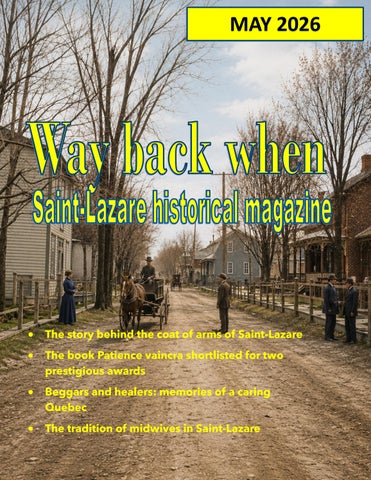
• The story behind the coat of arms of Saint-Lazare
• The book Patience vaincra shortlisted for two prestigious awards
• Beggars and healers: memories of a caring Quebec
• The tradition of midwives in Saint-Lazare
Way back when is the Saint-Lazare historical society’s historical magazine published 3 times a year, in January, May and in September.
The content of this publication may be reproduced with the acknowledgment of the source on the express condition of having obtained prior permission from the SaintLazare historical society.
Editor: Paul Lavigne
Corrector: Lyne Boutin
Lifetime membership in the Saint-Lazare historical society as a civil member is free. By becoming a lifetime member, you will receive the link to our digital magazine 3 times a year and you will benefit from preferential rates for our events.
You can find the membership form on our website www.shsl.ca under the heading Becoming a member.
The rates for becoming a corporate or institutional member of the Saint-Lazare historical society are as follows:
GOLD level member (1/4 page add) : $200.00 per year
SILVER level member (1/8 page add) : $150.00 per year
BRONZE level member (1/16 page add): $100.00 per year
To become a corporate or institutional member, contact the SLHS via email at info@shsl.ca and we will gladly inform you about all the other advantages.
The story behind the coat of arms of Saint-Lazare
The book Patience vaincra shortlisted for two prestigious awards.
Beggars and healers: memories of a caring Quebec
Erratum
The tradition of midwives in SaintLazare
Saint-Lazare Historical Society’s board of directors
President: Donald Simpson
Vice-president: Anick Chevrier
Treasurer: Manon Leroux
Secretary: Paul Lavigne
Administrator: Robert A. Rozon
Administrator: Emma Mergl
Administrator: Gisèle Gareau
Administrator: Lyne Arbec
Administrator: Robert T. Rozon
It was during the planning of the centennial celebrations of the municipality of Saint-Lazare that the organizing committee decided to provide this young town with its own coat of arms its first true symbol of collective identity.
In the spring of 1975, Mr. Réjean Boileau, an insurance broker, visited my father’s office as part of his professional activities. At the time, he was also serving as vicepresident of the centennial organizing committee. As was often the case during his visits, conversations extended beyond business into friendly exchanges. During one such discussion, my father invited me to show Mr. Boileau some of my work.
Impressed, he asked whether I would be
The story behind the coat of arms of Saint-Lazare
By Robert A. Rozon
able to design the municipality’s coat of arms.
Not being familiar with this type of project, I asked for more details. He outlined the general expectations, and I replied that I would first take time to research the subject before giving him an answer. At that time, in April 1975, I was a student in graphic arts in the Communications Graphics program at cégep Ahuntsic in Montreal.
Upon returning to the cégep, I immersed myself in the library’s resources to better understand the principles governing the creation of coats of arms. I consulted several specialized works that introduced me to the science of heraldry.
This discipline strictly regulates the design of armorial bearings, defining the selection and symbolic use of shields, colours, figures, supports, ornaments, and charges.
A month later, equipped with this new knowledge, I contacted Mr. Boileau to confirm that I would be able to design and produce an initial model of the coat of arms for Saint-Lazare.
From that point on, I undertook more indepth research and consulted Ms. Louise Chaîné Montpellier, then author of the municipality’s first historical publication. This collaboration helped me identify the key symbolic elements to incorporate: the values upheld by the community, its cultural foundations, its geographical and demographic characteristics, and the significant events of its history. Through this process, a motto also emerged one that would encapsulate both the community’s lived experience and its vision for the future.
A few weeks later, I presented a first model to Mr. Bernard Charlebois, president of the centennial celebrations committee. Following discussions and revisions, the project was submitted for approval and production by the Heraldic House of Montreal. It was only after the third version that the design was accepted in its final form, as it is known today.
The following month, I officially presented the model to the members of the municipal council, who approved it unanimously. I was then assisted by Mr. Laurent Chevrier in presenting the invoice associated with the production of the model to the city council.
On September 27, 1975, during the opening day of the centennial celebrations, the coat of arms of Saint-Lazare was officially unveiled. The presentation was made jointly by the mayor at the time, Mr. Roland Bédard, and me, during a press conference held in the presence of dignitaries and invited citizens.
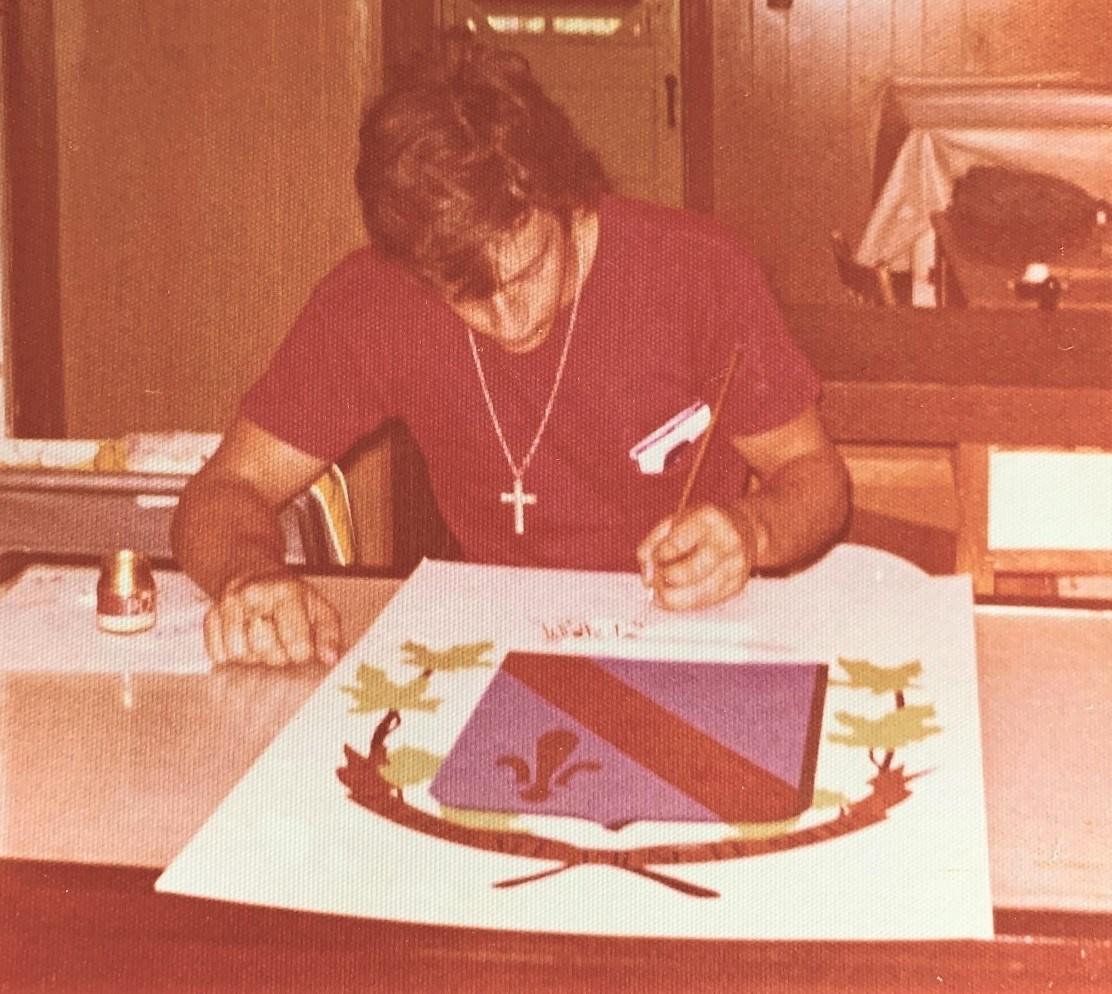
Robert Rozon, designer of the coat of arms of SaintLazare, created in 1975 for the municipality’s centennial celebrations, thereby establishing a strong and enduring symbol of identity for the Lazarois community.
In the weeks that followed, the unveiling generated notable media interest. A radio interview was conducted with Ms. Gabie Farmer Denis, journalist, author, and cultural columnist at the regional radio station in Salaberry-de-Valleyfield. This was followed by a television appearance on November 22, 1975, on CHLT Télé-7 in Sherbrooke, on the program La Soirée Canadienne, which featured the municipality of Saint-Lazare.
To this day, I remain deeply proud to have contributed, in my own way, to the history and identity of my community. I would like to thank the Saint-Lazare historical Society for recognizing this patrimonial contribution during the Builders’ Evening held as part of the celebrations marking the city’s 150th anniversary.
Many thanks to our valued partners
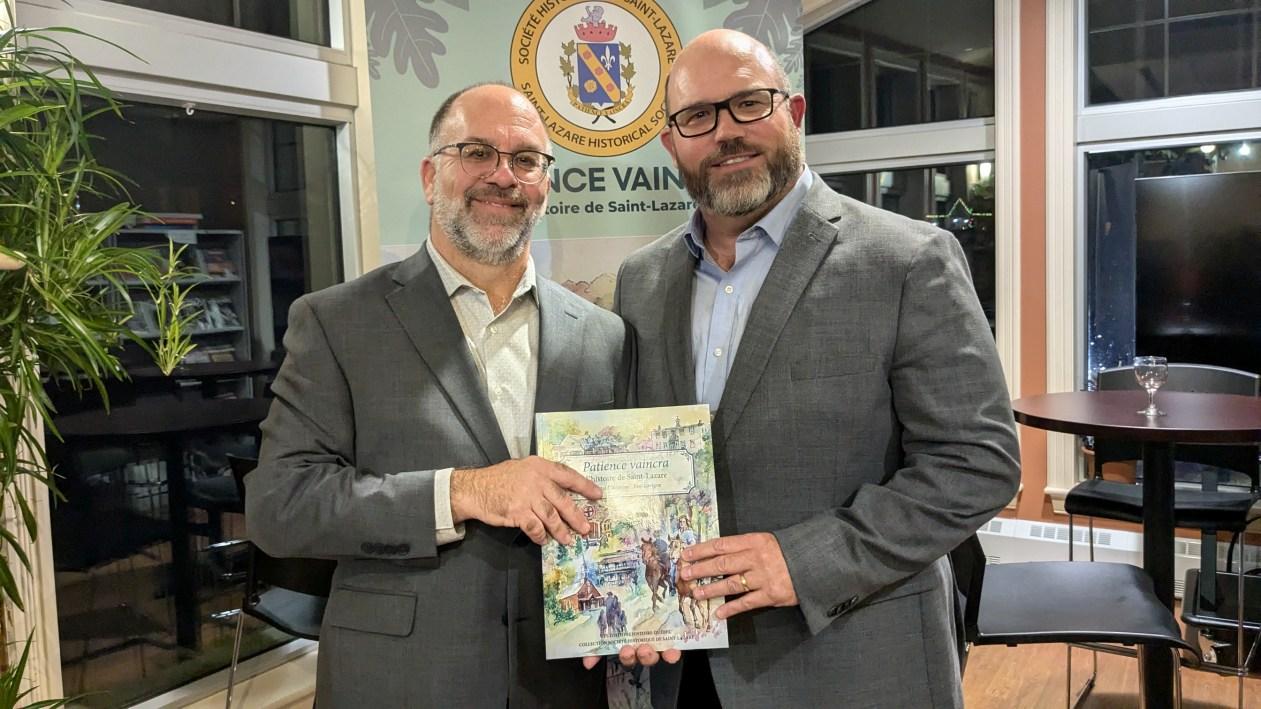
The book Patience vaincra The History of SaintLazare shortlisted for two prestigious awards.
The Saint-Lazare historical Society is especially proud to announce that the book Patience vaincra – L’histoire de Saint-Lazare, authored by Donald Simpson and Paul Lavigne, has been selected as a finalist for the prestigious Jean-Simard award, presented by the Société québécoise d’ethnologie.
This distinguished award recognizes exemplary initiatives in the preservation, transmission, and promotion of heritage. It highlights achievements that make a significant contribution to showcasing the knowledge generated by ethnological research in Quebec, while fostering its appreciation and accessibility among the public. The winner will be announced next October during the annual launch of the journal Rabaska, a key event in the field of ethnology.
It is worth noting that the Société québécoise d’ethnologie (SQE), a recognized non-profit
The Léonidas-Bélanger Award presented by the Fédération Histoire Québec.
The Jean-Simard Award presented by the Société québécoise d’ethnologie.
organization has, for several decades, supported ethnologists, researchers, heritage enthusiasts, and organizations dedicated to the study and promotion of both tangible and intangible heritage. Through its work, it actively contributes to the recognition and dissemination of knowledge related to traditions, cultural practices, and the history of Quebec communities.
In addition, the book, produced as part of the celebrations marking the 150th anniversary of Saint-Lazare, has already achieved notable recognition and is also a finalist for the Léonidas-Bélanger Prize, awarded by the Fédération Histoire Québec.
The Léonidas-Bélanger Prize aims to recognize excellence in the work and achievements of Quebec historical societies, both in publishing and in the organization of events. It honours initiatives distinguished by their rigor, quality, reach, and contribution to heritage promotion. Reflecting the spirit of social commitment embodied by Léonidas Bélanger, the prize alternately recognizes an outstanding publication or an exceptional event, highlighting the dynamism and vitality of Quebec’s historical community.
The winner will be announced during the annual congress of the Fédération Histoire Québec, to be held in Terrebonne on May 29 and 30, 2026 an essential gathering for those involved in the fields of history and heritage.
Through these nominations, Patience vaincra – L’histoire de Saint-Lazare not only affirms the relevance and quality of the work accomplished but also underscores the importance of preserving and transmitting local history as a fundamental component of our collective identity.
Many thanks to our valued partners
Beggars and healers: memories of a caring Quebec
By Robert T. Rozon
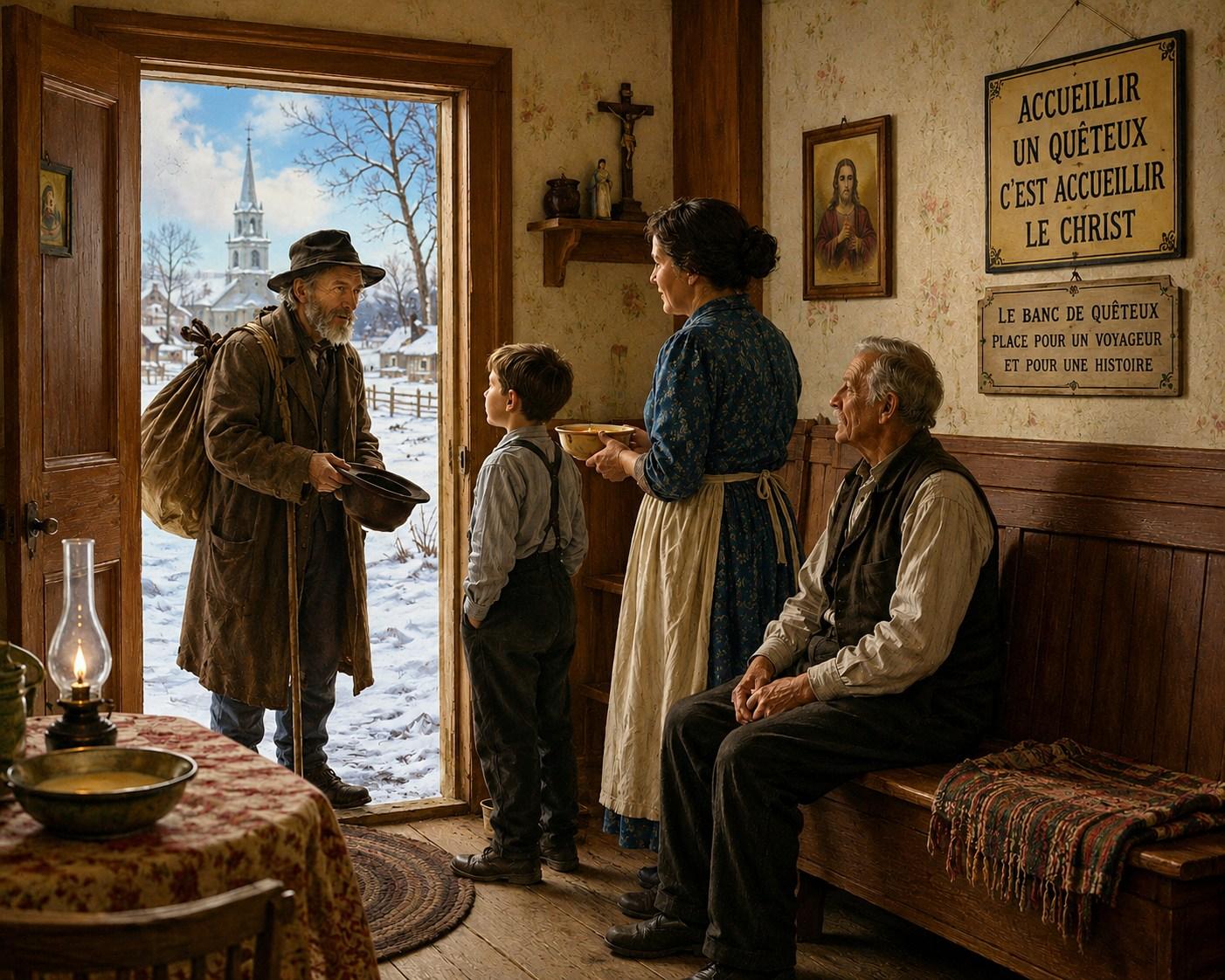
There was a time, not so long ago, when the countryside of Quebec pulsed to the rhythm of the seasons and the slow footsteps of the quêteux wandering beggars. These men, often elderly and sometimes crippled, traveled from village to village, carrying a worn bundle over their shoulder and, in their hearts, a life shaped by roads and silence. They asked for very little: a bit of bread, a bowl of soup, and above all, a place on the wellknown beggar’s bench.
This bench, placed near the door, was far more than a piece of furniture. It symbolized an era when charity was not an abstract idea, but a daily act.
The elders remember: a quêteux was never left outside in the bitter cold. He was offered shelter, sometimes a meal, and often a listening ear. For despite their poverty, these men were bearers of stories, witnesses of the land.
The era of the quêteux or beggar
The quêteux appeared in the 19th century, in a rural Quebec marked by poverty and the absence of social services. The Catholic faith encouraged charity, and welcoming a quêteux was seen as a Christian duty. They were numerous between 1850 and 1930, and some even followed regular routes, returning each year to the same parishes.
But this tradition came to an end in the 1960s, due to two major changes:
• The adoption of the Social Assistance Act in 1961 by the Liberal government of Jean Lesage, during the Quiet Revolution. This law guaranteed a minimum income to those in need and replaced traditional charity with an official system managed by the state.
• The enforcement of so-called “antibegging” regulations, which prohibited or discouraged public begging.
These measures, combined with the modernization of rural life, brought an end to the presence of the quêteux. The beggar’s benches, once found in nearly every home, disappeared, replaced by a formal system of support.
The Era of traveling healers
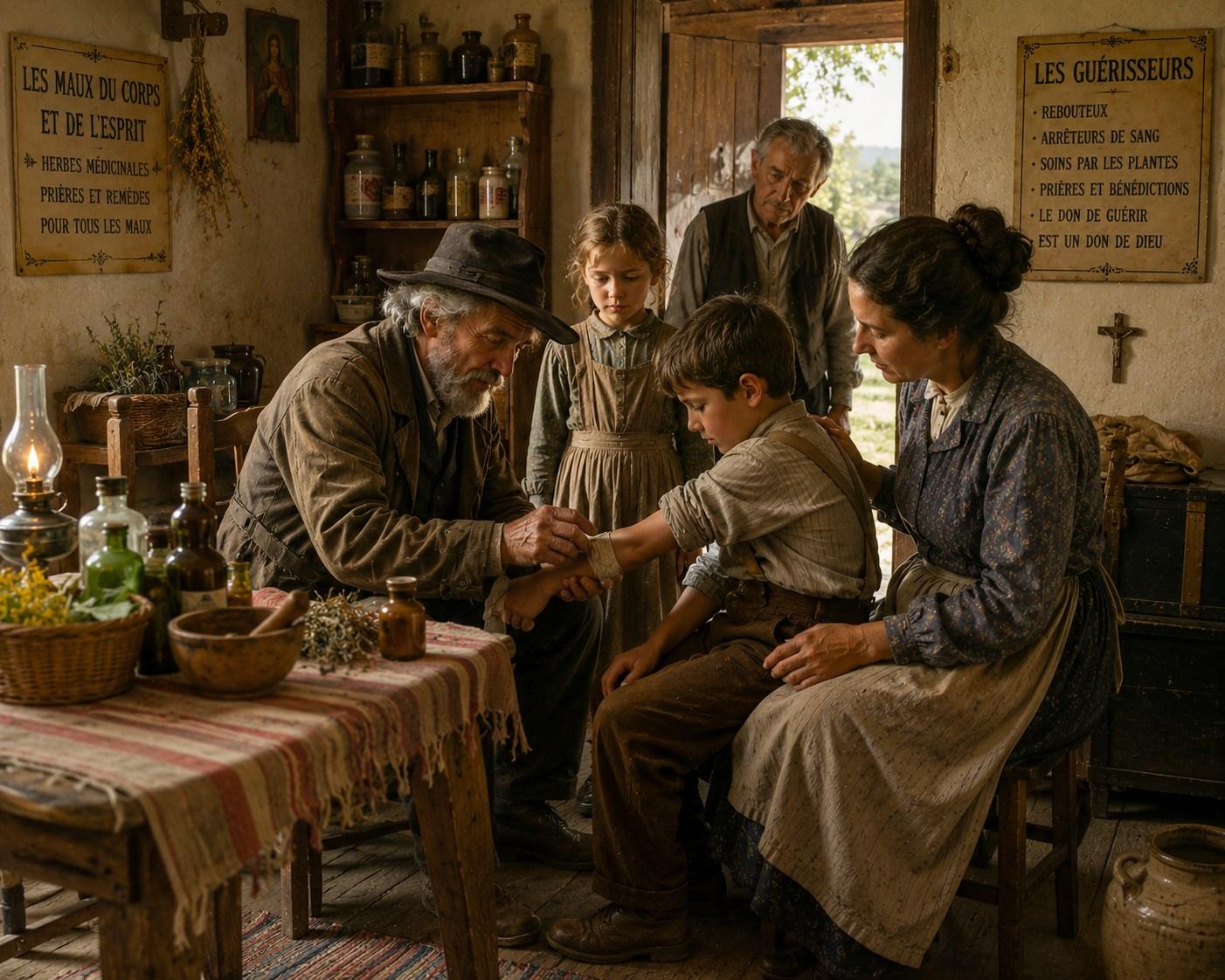
At the same time, the countryside also saw the passage of itinerant healers. These men and women, often self-taught, carried with them remedies made from plants, decoctions, and prayers. They went from door to door, offering their services to relieve ailments of both body and spirit. Some were known as bonesetters, able to reset a dislocated arm or leg after a fall.
Others knew the secrets of medicinal plants, preparing herbal teas for coughs, ointments for burns, or poultices for pain. Their knowledge, passed down from generation to generation, was an integral part of rural life.
The healers’ gift
It was said that some had not merely learned their craft but were born with a gift. Their simple touch soothed, their breath healed, and their prayers seemed to carry a special power.
A persistent belief held that the seventh son in a family was endowed with a natural gift of healing. Without formal training, he was thought capable of easing pain, healing burns, or driving away fevers.
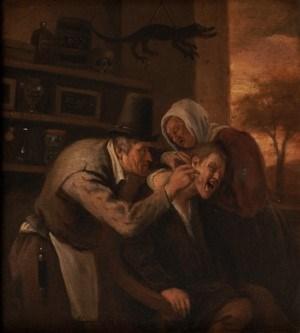
Le Guérisseur du village, Jan Havicksz, Musées Royaux des Beaux-Arts de Belgique.
There were also those known as stoppers of blood. It was believed they could halt a hemorrhage simply by thinking of the injured person or by reciting a secret prayer passed down through generations. In the countryside, people said it was enough to call upon them even from a distance for the bleeding to stop. This belief, deeply rooted in popular tradition, gave healers an almost mystical aura.
The End of an era
Thus, the quêteux disappeared in the 1960s, due to the modernization of rural
life, the Social Assistance Act introduced by the Lesage government, and antibegging regulations that outlawed public begging. Healers, too, were gradually replaced by modern medicine and local clinics. Yet their memory lives on in stories and recollections, as a trace of a Quebec where solidarity and folk knowledge were part of everyday life.
Memories of another Time
This text is for those who remember. For those who saw a quêteux sit on the bench or witnessed a healer prepare an herbal infusion, or who were told of the famous seventh son with his mysterious gift. For those who knew a blood stopper, whose mere thought could soothe a wound.
It is a page of our history, a living memory a reminder that Quebec has always known how to lend a hand to those in need, while preserving a touch of magic in its traditions.
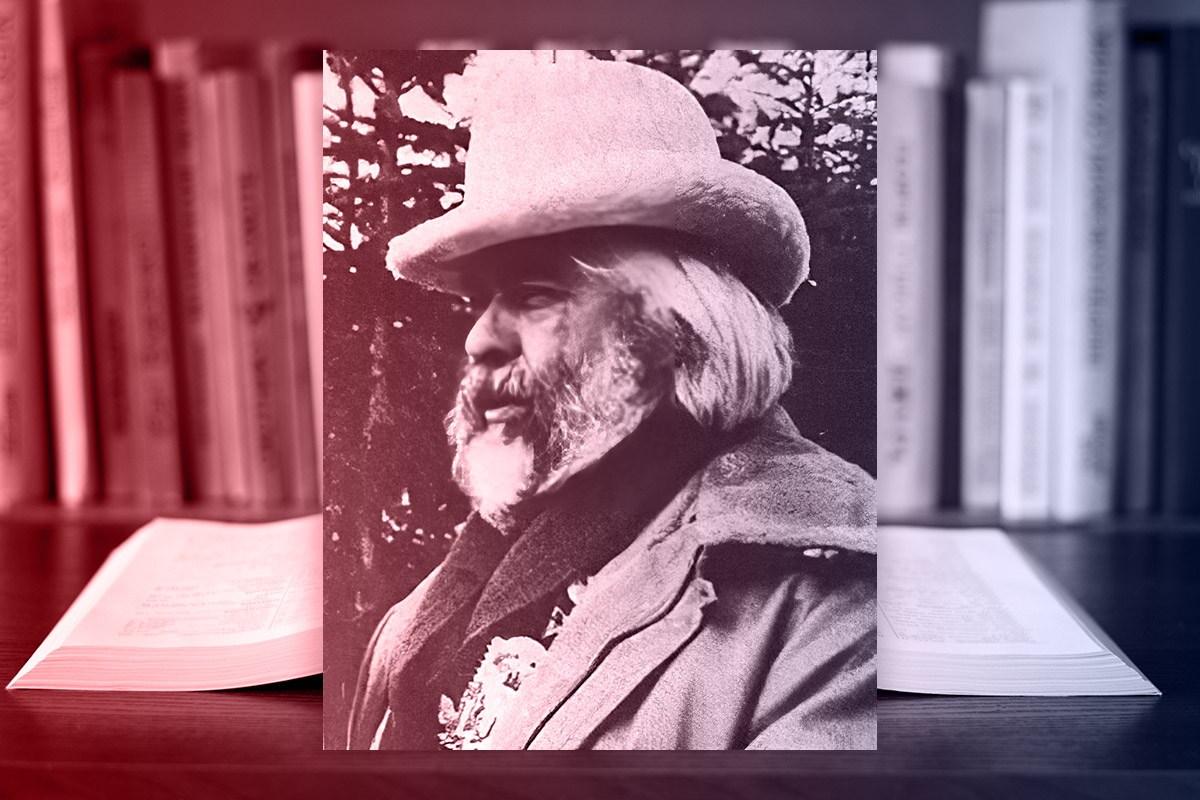
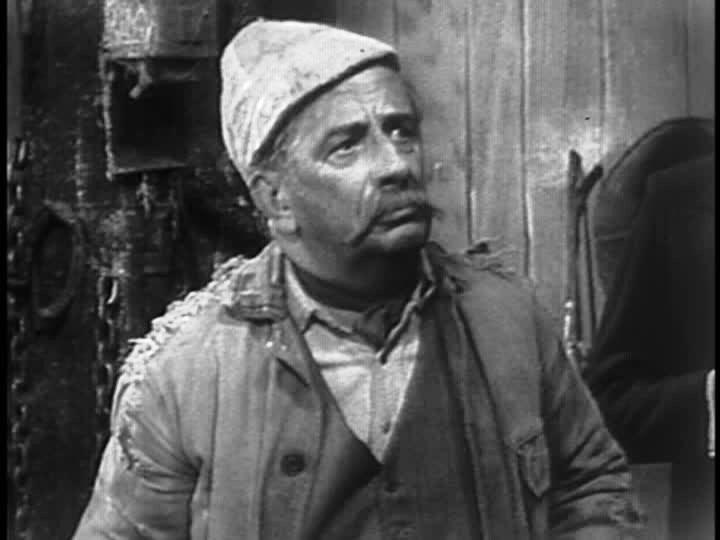
Henri Poitras – Jambe-de-Bois
• Full name: Joseph Alphonse Hospice Poitras
• Born: June 11, 1896, in Montreal
• Died: August 1, 1971, in Montreal
• Notable role: Jambe-de-Bois, the wandering beggar in Les Belles Histoires des pays d’en haut
Career: Actor, singer, author, and stage director. He worked in the theater, radio, cinema, and television. His portrayal of Jambe-de-Bois from 1956 to 1970 gave life to a character who embodied both hardship and wisdom, becoming a symbol of rural Quebec’s memory.
Georges Bouvier – Grand Capot
• Born: March 14, 1904
• Died: March 11, 1991
• Notable role: Grand Capot, a rustic and outspoken villager in Les Belles Histoires des pays d’en haut
Career: Radio and television actor. He was part of CKAC’s early programming with Nazaire et Barnabé and later appeared in several series, including Le Survenant and Les Belles Histoires des pays d’en haut. His character Grand Capot reflected the blunt, earthy voice of the rural community.
Erratum
Please note that certain errors inadvertently appeared in the texts dedicated to some of our Builders of Saint-Lazare, to whom we wished to pay tribute.
Despite the care taken in conducting the research including writing, internal verification, and proofreading in collaboration with the printer such inaccuracies can occasionally occur.
We sincerely apologize and invite you to take note of the following corrections, which have been made to rectify these errors.
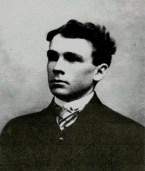
Builder Joseph Leduc
The photograph published is actually that of Pascal Leduc, Joseph’s father. This misidentification also appears in the 125th and 150th anniversary publications.
We extend our sincere thanks to Ms. Carole Vallée, a descendant of Joseph Leduc, for bringing this matter to our attention and enabling us to make the necessary corrections.
We also wish to clarify that Joseph Leduc and his wife, Marie-Joseph Couturier, had eleven (11) children, not eight (8) as previously indicated.
Builder Léo Paul Gareau
Please note that Léo Paul Gareau and his wife, Laurette Huneault, were married at SaintClet Church, not Sainte-Clotilde as previously stated.
We sincerely thank the family for informing us of this inaccuracy.
(continued on page 18)
In the rural regions of Quebec in days gone by, long before the sterile corridors of hospitals became the primary setting for childbirth, the arrival of a child into the world depended on an ancient form of knowledge deeply human and intimately tied to the community. At the heart of this life ritual stood the midwife, a discreet yet essential figure, the bearer of a tradition passed down from woman to woman, from one generation to the next. She embodied experience, gentleness, and resilience in a world where life and death existed side by side with a closeness that is difficult for us to imagine today.
Women of trust
The tradition of midwives in Saint-Lazare
By Paul Lavigne
Along each rang those long rural roads
lined with land cleared by hand was almost always a woman who was called upon when the time came. She was neither a doctor nor a nurse in the modern sense, but she possessed knowledge shaped by observation, experience, and oral tradition. Often, she herself had learned from her mother, an aunt, or a skilled neighbor. From an early age, she had been initiated into the gestures, the signs, and even the silences that herald an imminent birth.
An indispensable role
Her role began well before the first pains. She advised young women, reassured them in the face of their fears, and shared knowledge about the body, pregnancy, and postpartum care.
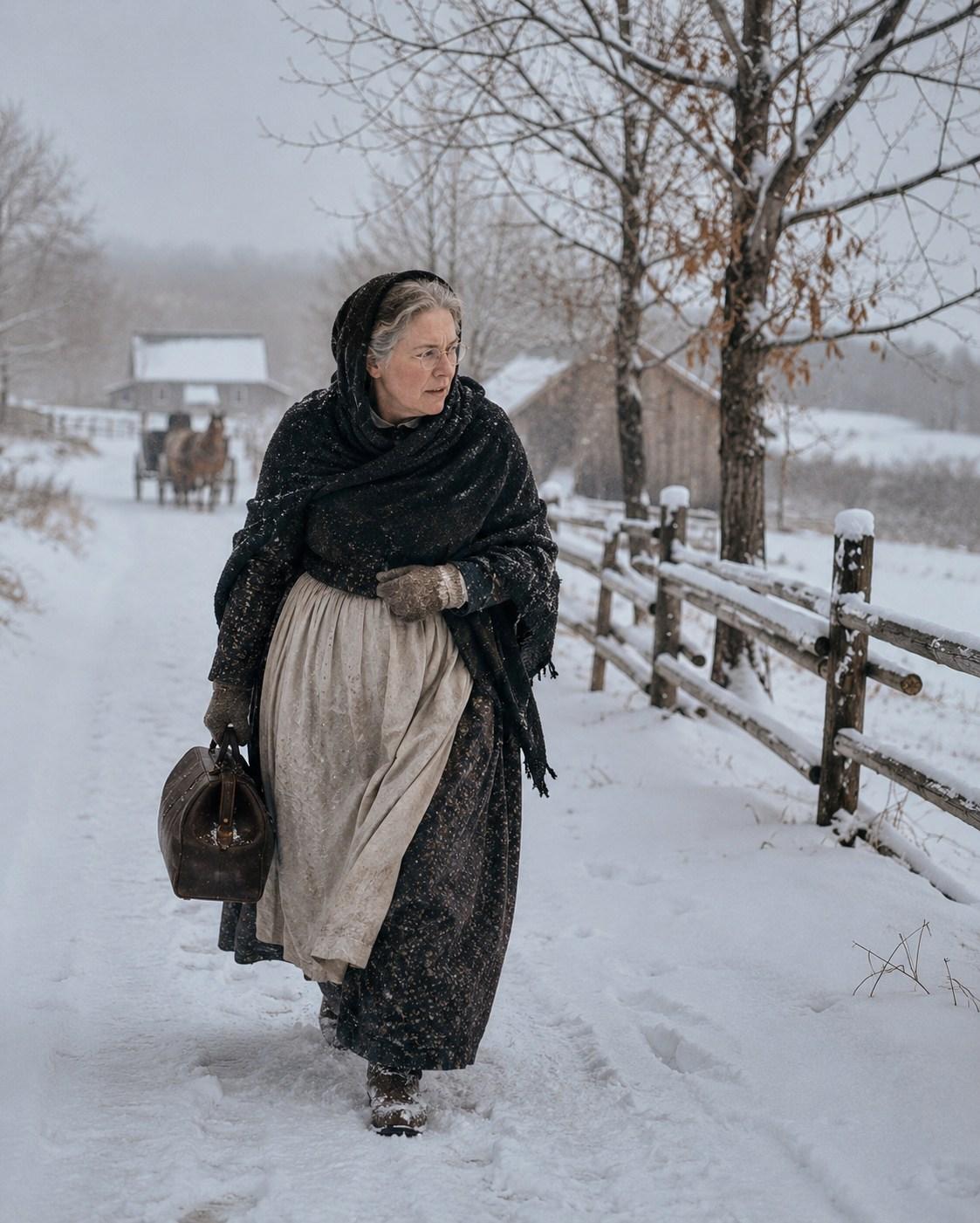
Whether it rained, the wind howled, or snow buried the roads, the midwife left her home without hesitation. She sometimes traveled several kilometers on foot, by carriage, or on horseback, guided by a sense of duty and the urgency of the moment. Upon arrival, she took charge of the room, transforming an ordinary space into a threshold between two worlds. She organized, prepared, and soothed. Her voice, often calm and steady, became a point of reference amid the storm of contractions.
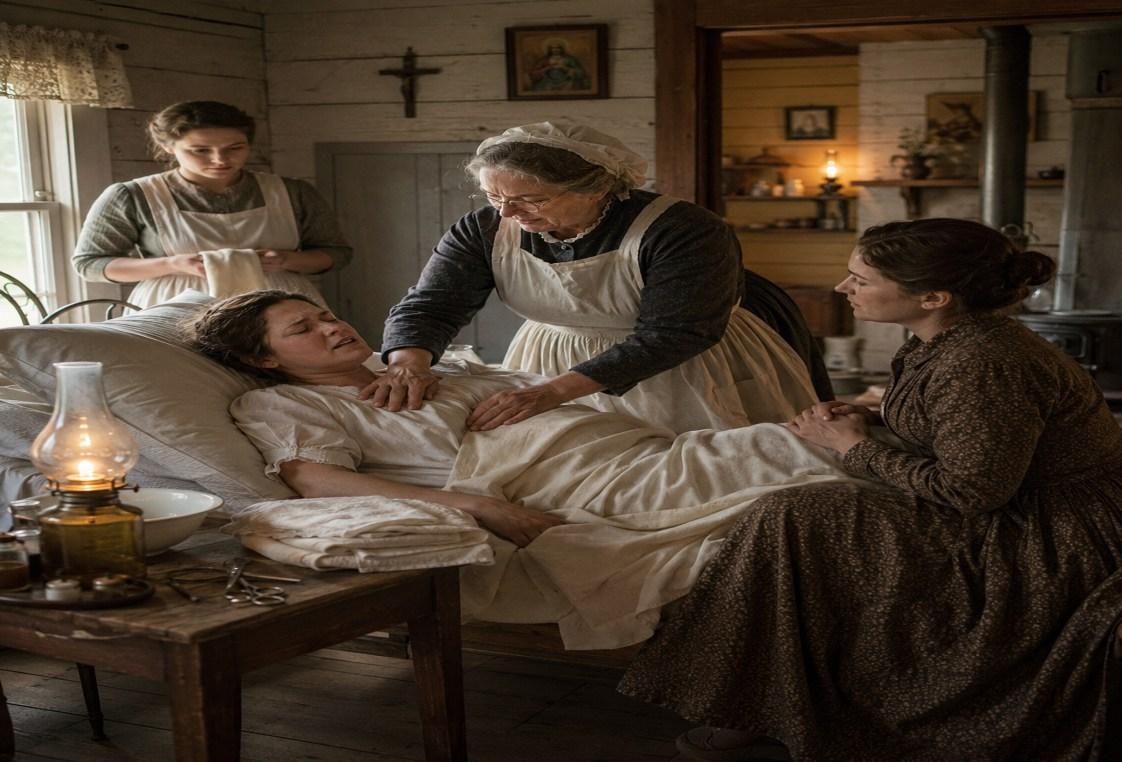
Childbirth was an intense and sometimes perilous moment. Without sophisticated instruments or advanced medical assistance, the midwife had to rely on her instinct, her experience, and her deep understanding of the human body. She guided each breath, each effort, supporting the mother both physically and emotionally. And when at last the newborn’s cry broke the silence, she performed the first acts of life: cleaning, wrapping, and presenting the child to its mother.
More than a strictly medical role
But her role did not end there. She continued her watch in the hours and days that followed, ensuring the mother’s recovery, offering advice, and monitoring for signs of complications. She became a confidante, sometimes even a kind of honorary godmother, forever linked to the family through that defining moment.
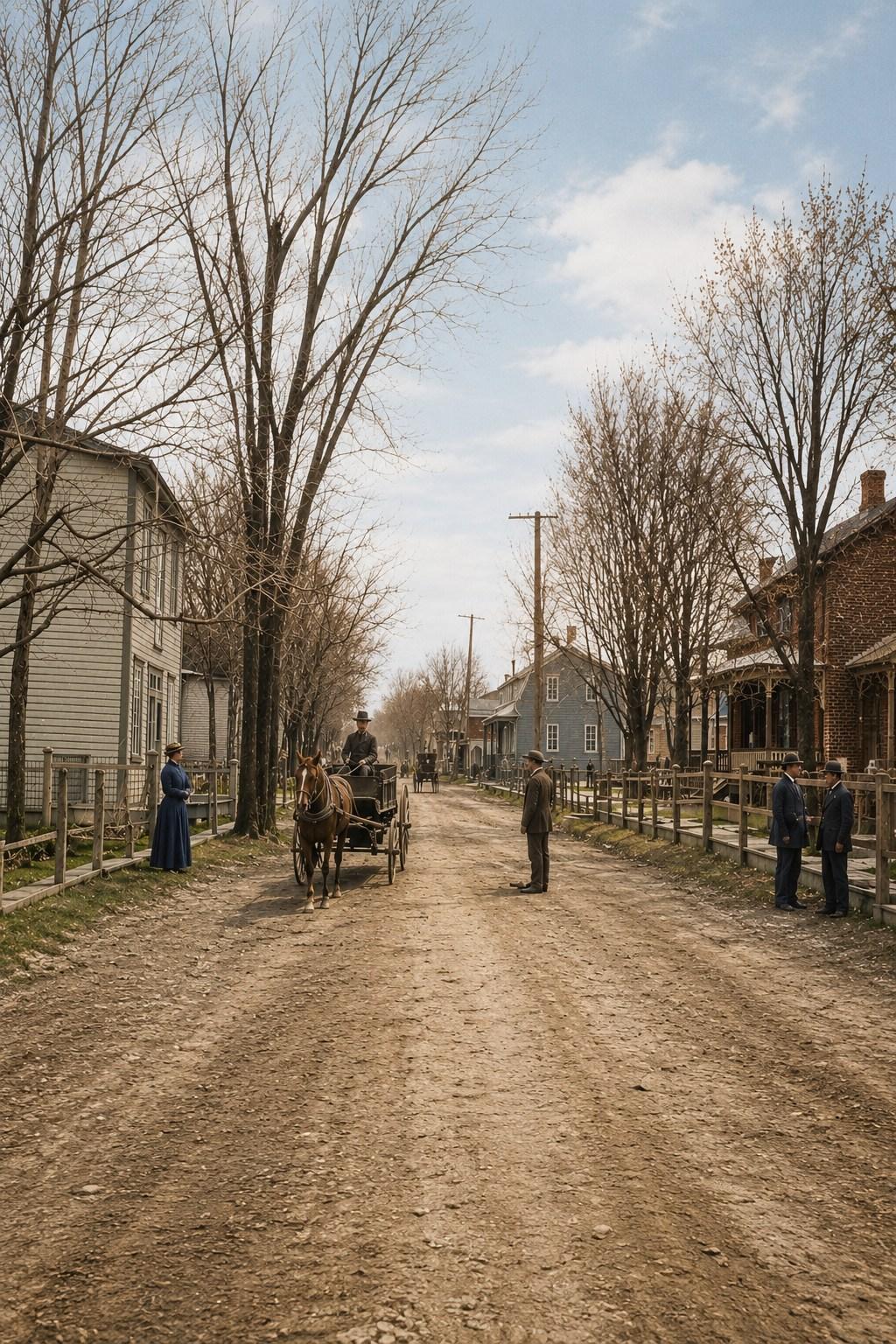
In Saint-Lazare, at the end of the 19th century, this reality took root in a territory still young, shaped by the labor of settlers and the solidarity of families. The main thoroughfares Côte Saint-Louis, Chemin Sainte-Angélique, Côte SaintCharles, and the depot district structured daily life. Along these routes, houses stretched out at regular intervals, forming small communities where everyone knew their neighbors.
On Côte Saint-Louis, it was not uncommon for the same midwife to have assisted in the birth of dozens of children, sometimes even several generations within the same family line. She became a living memory of the rang, a silent witness to the joys and hardships that marked family life. Along Chemin SainteAngélique, ties between neighbors were just as strong, and the midwife held a central place, called upon with trust and gratitude.
Côte Saint-Charles, with its slopes and challenges, was no exception to this tradition. There too, a woman stood out, recognized for her skill and dedication. As for the depot district, bustling with activity following the arrival of the railway, it saw tradition and modernity coexist. Despite this openness to the outside world, the presence of a midwife remained indispensable, a reminder that certain human realities transcend the changes of any era.
Thus, in each of these sectors, a woman carried within her a precious body of knowledge, inherited and passed on, rooted in lived experience rather than in books.
She did more than fulfill a practical role: she embodied continuity, a link between generations, a reassuring presence at a moment when life itself hangs in the balance.
Today, as most births take place in hospitals, the memory of these women endures like a gentle imprint upon our collective history. They left behind neither treatises nor monuments, yet their legacy lives on in every family, in every story shared around the table. The midwives of old, in Saint-Lazare as elsewhere in Quebec, were the quiet guardians of new life, weaving, thread by thread, the human fabric of their communities.
(Continued from the article on page 15)
Builder Stanley Roy Wilson
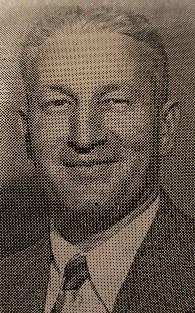
The photograph originally published is that of a friend of the Wilson family. We therefore present here the photograph of Stanley Roy Wilson, as it should have appeared.
We thank Mr. Keith Wilson for notifying us of this error and allowing us to correct it.