r
ei
g ma
ining
infrastr
uc
tu
re
Greening Greensburg A tornado-flattened town reinvents itself photogr a phs by Emmanuel Dunand t e x t by Pet er Brew it t
photogr aphs: getty i mages
O
n the evening of May 4, 2007, Greensburg, Kansas, was utterly demolished by a category EF5 tornado. Roaring up from the Texas panhandle, the 1.7-mile-wide monster tore through the town, flattening houses and flinging car parts onto the roof of the grain elevator. Residents had twenty-six minutes’ warning, allowing many of them to scramble for shelter. Nonetheless, the tornado destroyed 95 percent of the town and killed eleven people. Greensburg was determined to rebuild. The simple way to do it would have been to re-create essentially the same town as before. But despite being physically, emotionally, and economically shattered, residents managed to see the opportunity that followed in the twister’s path. They chose to rebuild not the simplest way, but the best way. Regional activist Daniel Wallach and mayor Lonnie McCollum envisioned how the new Greensburg could become a model of rural sustainability; Kathleen Sebelius, the governor at the time, lent support; and the rest of the town embraced the idea. Despite its name (the original Green was a nineteenth-century stagecoach driver), Greensburg was no hotbed of eco-activism. It was, and is, a conservative farm town, the seat of rural Kiowa County, where Mitt Romney got 86 percent of the vote. But sustainable rebuilding represents, as the townspeople like to say, “solid midwestern values.” Planning for the future, using water
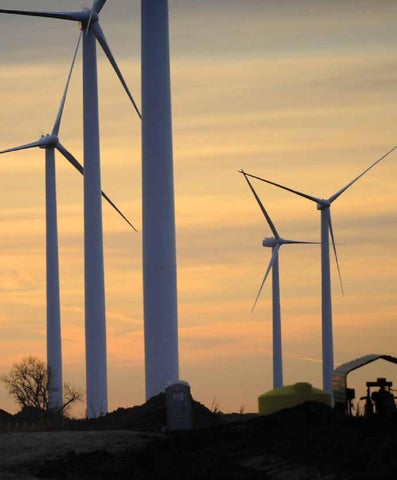
wisely, respecting the land, reducing waste: everyone could get behind those goals, and did. Even people well beyond the city limits of Greensburg contributed money, time, resources, and ideas to help remake the town. Fast forward to 2013. Greensburg farms the wind for its electricity, selling its surplus back to the grid. Most municipal buildings, including the city hall, school, and hospital, are LEED-certified, and the streets are now lit by LEDs. The town’s business community has bought in as well—the Best Western has its own wind turbine, the LEED-Platinum-certified John Deere dealership stores its waste oil to heat itself in winter, and Centera Bank, also LEED-certified, absorbs stormwater with its own bioswale. People come from all over the world to tour these facilities. According to Daniel Wallach, interest in the Greensburg model is so strong that GreenTown, the nonprofit organization that leads the tours, has fielded inquiries from hundreds of other towns and is now consulting for many of them. There may only be one Greensburg, Kansas, but the world is full of communities recovering from catastrophe, as well as those taking up the challenge of planning for a smart, sustainable future. They can find that future happening today in Greensburg. a See an audio slide show about “Greening Greensburg,” as well as other features from the Reimagining Infrastructure series, at www .orionmagazine.org/infrastructure. j a n ua r y
|
f e b r ua r y 2 0 1 4
O R I O N
33
34
O R I O N
j a n ua r y
|
f e b r ua r y 2 0 1 4
p r e v i o u s s p r e a d : The Greensburg Wind Farm consists of ten turbines, which generate enough energy to power four thousand homes. l e f t t o p : Part of the Main Street reconstruction is a business incubator that provides office and retail space for businesses destroyed in the tornado as well as new start-ups. l e f t m i d d l e : The Silo Eco-Home is a model structure that houses a bed and breakfast, showcases an array of sustainable living features, and boasts six-inch-thick walls that can withstand the winds of a tornado. l e f t b o t t o m : Greensburg is the first city in the U.S. to have 100 percent LED streetlighting. a b o v e : The Watering Can is part of Greensburg Cubed, a series of demonstration cubes conceived and built by Kansas State University students. Each cube has a practical function while also informing users about green technology.
j a n ua r y
|
f e b r ua r y 2 0 1 4
O R I O N
35
The 5.4.7 Arts Center, named for the date the tornado struck, is powered by solar panels, three small wind turbines, and a geothermal system. It was the first LEED Platinum certified project in the state of Kansas. r i g h t t o p : Greensburg’s new city hall incorporates bricks that were reclaimed from a power plant that was destroyed during the tornado. Featuring solar panels and a vegetated roof, it is the first newly constructed LEED Platinum city hall in the U.S. r i g h t m i d d l e : The new hospital in Greensburg boasts a geothermal heating and cooling system, two on-site wind turbines, and extensive daylighting features to maximize natural light, representing a 59 percent reduction in Âenergy costs. r i g h t b o t t o m : Construction workers build Greensburg’s new school, which has its own on-site wind-powered generator and a climate-control system that uses ninety-seven 410-foot wells to regulate indoor temperature.
above:
36
O R I O N
j a n ua r y
|
f e b r ua r y 2 0 1 4
j a n ua r y
|
f e b r ua r y 2 0 1 4
O R I O N
37