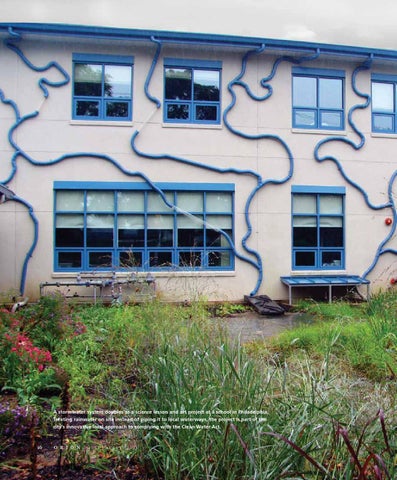
A stormwater system doubles as a science lesson and art project at a school in Philadelphia. Treating rainwater on site instead of piping it to local waterways, the project is part of the city’s innovative local approach to Âcomplying with the Clean Water Act.
16
O R I O N
july
|
au g u s t 2 0 1 3
r
ei
g ma
ining
infrastr
uc
tu
re
Water Works Communities imagine ways of making every drop count Cynthia Barnet t
On a wint er’s day in Seattle, a leaden monotony hangs over the Central Business District, dispiriting to this part of downtown. Contrary to reputation, the urban pallor is not born of rain, which falls almost imperceptibly from silvery clouds that match the nearby waters of Puget Sound. Rather, the gloom rises from the cement hardscape. The busy streets are paved dark gray, the wide sidewalks beside them light gray. The skyscrapers rise in shades of gray. The hulking freeways, ramps, and overpasses: gray. The monorail track and its elephantine pillars: gray. Trudge the sidewalks northwest to Seattle’s Belltown neighborhood, hang a left on Vine Street toward the sound, and a ten-foot-tall, bright blue rain tank pops from the dullness, tipped whimsically toward a red brick o;ce building. Atop the tank, green pipes in the shape of fingers and a thumb reach out, the stretched index finger connected to a downspout from the rooftop. Rainwater flows from roof to finger to palm to thumb, from which it pours to a series of descending basins built between the sidewalk and the street. They, in turn, cascade to landscaped wedges growing thick with woodland plants. For two blocks, as Vine slopes toward the sound, water trickles down a runnel and through street-side planters, shining stones, and stepped terraces, enlivening the roadway with greenery, public sculpture, and the sounds of falling water. The project, called Growing Vine Street, began as a small, grassroots effort among residents and property owners to turn their stretch of a former industrial neighborhood into an urban watershed. Twenty years later, it is a big part of the answer to the largest single source of pollution fouling Puget Sound and most of the major bays and freshwater ecosystems of the United States — stormwater. july
|
au g u s t 2 0 1 3
O R I O N
17
The gray shellac of a city repels more than the imagination. When rain flows along streets, parking lots, and rooftops rather than percolating into the ground, it soaks up toxic metals, oil and grease, pesticides and herbicides, feces, and every other scourge that can make its way to a gutter. This runo= impairs virtually every urban creek, stream, and river in Washington. It makes Pacific killer whales some of the most PCB-contaminated mammals on the planet. It’s driving two species of salmon extinct, and kills a high percentage of healthy coho within hours of swimming into Seattle’s creeks, before they’ve had a chance to spawn. Returning some of nature’s hydrology to the cityscape can make an enormous di=erence — or could — as more individ uals, businesses, and neighborhoods remake their bit of the terra firma. Washington State University scientists have found that streets with rain gardens clean up 90 percent or more of the pollutants flowing through on their way to the sound. Green roofs reduce runo= between 50 and 85 percent and can drop a building’s energy costs by nearly a third. Cisterns like the one on Vine Street solve two problems, reducing runo= and capturing water for outdoor irrigation — which in summer can account for half a city’s freshwater demand.
In the parlance of water professionals, projects like Growing Vine Street are known as “green infrastructure.” But the term does not do justice to the larger water revolution it represents. Across the nation, antiquated infrastructure like Seattle’s, swelling populations, and weather extremes are stressing our triplicate freshwater, stormwater, and wastewater systems like never before. Industry groups such as the American Society of Civil Engineers, American Water Works Association, National Association of Water Companies, and U.S. Chamber of Commerce repeat the mantra that the nation’s water systems are some of the oldest, most overused, and most seriously failing of all America’s infrastructure — worse o= than the nation’s bridges. The EPA estimates that repairing, replacing, and upgrading these aging water systems will cost between $300 billion and $1 trillion over the next two decades. Yet, too often, the engineers and the estimators aren’t taking into account that, rather than rebuilding waterworks in the twentieth-century tradition, an increasing number of communities are finding creative solutions that can be cheaper and better for the environment, and build resiliency to climate change. To halt sewage spills and comply with the Clean Water Act, Philadelphia
Carefully collecting stormwater and channeling it into planted streetscapes helps remediate runoff, which has become the number one source of pollution in America’s waterways. These creative examples are part of Seattle’s Growing Vine Street project.
18
O R I O N
july
|
au g u s t 2 0 1 3
waste from some 300 million Americans and their industries. (The two largest water users in the nation — agriculture and energy plants — extract their own water for the most part.) It’s a matrix designed with little thought to sustainability: pump a pristine waterway; pipe it in some cases hundreds of miles at substantial energy cost (for some Southern Californians, 444 miles and 3,000 feet up and over the Tehachapi Mountains); treat every drop to federal drinking-water standards; use it once, mostly for toilet flushing and lawn watering; clean it up again; then pipe it o= to another waterway. With much of the infrastructure subsidized and out of sight, until now, the average American hasn’t had to think about where their water came from, where it went after they used it, or question the logic. Why would we treat water to drinking stanI n 1 8 7 8 , a sanitary engineer named The nation’s water dards, then flush it? Why would we irriGeorge E. Waring Jr. ranted in The Ameri gate our lawns with this same designer can Architect about the nation’s sudsystems are some of the water? Why would thirsty metropolitan den craze for faucets on every bowl and areas such as Los Angeles and Miami, washbasin. The demand for freshwater oldest, most overused, desperate for new sources of freshwater, pipes coming into homes, waste pipes flush hundreds of millions of gallons of going out, and the luxury of hot and cold and most seriously rainwater a year to the sea? was so intense, plumbers were rushing Instead, we settled into the comfort of jobs, busting pipes, and causing boiler failing of all America’s abundance even as the rivers, the aquifers, accidents, in some cases scaring home and the aging pipes themselves began to owners back to sponge baths. infrastructure. reveal the illusion. Most dramatically, “In our desire to save labor so far as the Colorado River that shaped western possible, to procure in our houses the landscape and wildlife for more than 6 luxury of abundant water without the million years was whipped by America’s voracity in less than a task of carrying it in and out by hand, and to provide, even for hundred. Apportioned in archaic water rights and courtrooms to those classes of society which are little given to luxuries, the un40 million people and 4 million acres of irrigated farmland in told convenience of a free tap of water at every point, we have seven states and Mexico, along with 22 Native American Tribes, carried the possibilities of the industry to its utmost limit,” he 22 more national parklands, and 4,200 megawatts of hydro warned. power, the river cannot meet all of those obligations — much less Waring was all for the sanitation. Deadly epidemics of yelthose it once carried out to nature. Scientists say climate change low fever and cholera in major U.S. cities had drawn Americans, will widen the gap between supply and demand as a warming who previously feared submerging themselves, to a new idea: West means more evaporation, less snowpack, and continuing daily baths. The real coup was the loo. After 1900, flush toilets drought. A new Bureau of Reclamation study has analyzed hunjoined tubs in a new room all their own. America’s water and dreds of climate and population scenarios, and projects that by wastewater systems would go down among the greatest scientific 2060, the river will fall short of human demands by at least 3.2 achievements of the twentieth century, saving countless lives. So million acre-feet — more than five times the amount of water impressive were the health and sanitation gains — not to menconsumed today by the city of Los Angeles. tion the “luxury of abundant water” — that few complained as Even in the relatively wet East, population growth and lavengineers tapped most of the major rivers and aquifers in the ish water use have worn down the built infrastructure and the land and snaked water pipes underground thirty times the waters both. The smallest river in the nation to supply a major length of the U.S. highways. metro area’s drinking water, Georgia’s Chattahoochee is imBut Waring was right when he warned of the limits. The pounded fifty miles above Atlanta in a reservoir called Lake Latwentieth-century miracle has become a twenty-first-century nier. In 2008, it came within ninety days of disappearing and migraine as aging systems strain to rush freshwater to and rid
Photographs by stacy levy (previous spread), Buster Simpson (opposite left), carolyn geise (opposite right)
was looking at a $10 billion price tag for a massive storage tunnel under the Delaware River. Instead, the city will meet those aims with a $1.6 billion project to restore streams, remake everything from basketball courts to parking lots with porous pavement, and plant miles of vegetation along rooftops and city blocks. The water revolution reaches beyond the filtering and storage capacity of wetlands, plants, and trees to the way we perceive, use, and pay for H20. It involves seeing value in every kind of water — from irrigating with recycled water to finding energy in sewage. It sometimes eschews infrastructure altogether. It’s a promising new way of living with water that stands out from the old like Vine Street’s bright blue rain tank rising from the former grayscape.
july
|
au g u s t 2 0 1 3
O R I O N
19
were convinced the system could not meet the demands of a fastleaving more than half a million people high and dry. These growing population that, like most of America, used water as days, Atlantans have their Chattahoochee water. But its imif it were abundant as air. While many cities faced one water poundment during drought leaves the downstream ecosystems anxiety or another — dwindling supply, looming infrastructure of the Apalachicola River in Florida and the formerly rich oyscosts, flooding, sewage and stormwater overflows — Seattle, its ter fishery where it meets the Gulf without the freshwater they original waterworks so old it had been built with wooden stave need to survive. pipes, faced all of those and more. On the wastewater side, the story is the same. The more Managing water is a delicate balance. Hoarding too much can freshwater we pull into our homes and businesses, the more we unleash floods. Storing too little can mean shortages. In winter send down drains and toilets and into waste pipes that leak, spill, 1991–92, SPU spilled o= its reservoirs to guard against springand burst an average of 900 billion gallons of untreated sewage time floods. But spring rains were paltry. By summer, drought a year in the United States. Some of the largest sewage spills in bore down. Across the West, wildfires burned hundreds of thouAmerican history tainted U.S. waters not in the fetid days before sands of acres. The Cedar River shrank, environmental regulation, but in the past and the water quality plummeted too. decade. In Honolulu in 2006, a cement The utility, which had never done more pipe as big around as a breakfast table A profound than filter and fluoridate its pristine supgave way following heavy rains, forcing ply, now planned a multi-million-dollar 50 million gallons of untreated sewage shift has come in ozone-purification plant to get its cusinto the aquamarine waters of Waikiki. tomers through future droughts. LongThe disaster closed some of the most farecent years, as the term, it planned to spend $180 million mous beaches in the world for ten days for a project to siphon the north fork of and is suspected in the death of a surfer mentality of saving the Tolt River for additional supply. who became infected with flesh-eating To deal with the emergency at hand, bacteria. Not least, there are the carbon water gives way SPU banned lawn watering for the enemissions associated with pumping, tire summer. At first, losing their lawns heating, and treating water, and moving to living differently did not sit well with residents, who each it around our homes, cities, and regions. indulged in about 150 gallons of water a It all adds up to an estimated 10 percent with water. day through the 1980s (today’s average, of U.S. energy demand — more than it roughly, for most Americans). The city is takes to power our computers and the insurrounded by water. With the illusion of ternet. If we want to reduce energy use, abundance in panoramic view — lakes Washington and Union, living di=erently with water is a no-brainer. and Puget Sound — Seattleites saw little harm in cranking the Waring’s words ring true: We have pushed our nation’s water sprinklers before they left for work. But soon “people started figinfrastructure “to its utmost limit.” uring out the laws of surviving drought,” says twenty-year employee Ralph Naess, SPU’s director of watershed education. “A: S e att l e wa s among the first major American cities to You don’t need the water. B: You don’t have to pay for the water. accept that it had hit the limit. The Emerald City taps a clear And C: Everyone else has a brown lawn too.” mountain river called the Cedar, and a smaller river, the Tolt, to The drought showed residents they could live with much quench the thirst of 1.4 million urbanites and corporate giants less. But it was the region’s flashing silver amulet — the salmon from Amazon to Microsoft. The Cedar River begins in the cloudthat swim through culture as much as nature in the Pacific laced foothills of the Cascade Range, flows forty-five miles south Northwest — that convinced them why they should. While sewage to Seattle’s iconic Lake Washington, and ultimately to Puget and stormwater were killing salmon in the streams, the drinkingSound. Seattle’s leaders had the foresight to begin buying up water side of the equation had choked o= the fishes’ migration the river’s watershed for drinking water in the late 1800s; over up the Cedar River. Through the 1990s, the plight of the river’s a century, they’d preserved more than ninety thousand acres. At Chinook—the lunkers among Pacific salmon—gained urgency the upper reaches of the watershed, snowpack collects in winter, in the public’s awareness thanks to wildlife advocates, including then fills the city’s reservoirs for the dry summer. At the lower the Muckleshoot Indian Tribe, leading to a “threatened” listing end, the Landsburg Dam diverts the river for drinking water. under the Endangered Species Act. Beginning in the 1960s, Seattle Public Utilities (SPU) o;cials 20
O R I O N
july
|
au g u s t 2 0 1 3
Photograph courtesy Etera
Green roofs are becoming increasingly popular across the country. Not only are they extremely effective at capturing runoff, they also can reduce a building’s energy costs and carbon emissions. This one in Washington State is covered in an eye-catching succulent called sedum.
Over the decade, Seattle’s water use dropped even as its population climbed. As conservation caught on, the utility delayed plans for the new drinking-water project on the Tolt, as well as the ozone plant. SPU structured its water rates so that heavy summertime wasters paid more. New plumbing codes required e;cient toilets and faucets in all construction. Incentive programs rebated hundreds of thousands of residents and business owners who switched out wasteful old plumbing. Public education put saving water on par with recycling. The water industry had always viewed conservation as an emergency stopgap during drought. But now, Seattle and other cities, including San Antonio and Tucson, were proving the numbers could be huge. Conservation was the cheapest, most ecologically sound source of new water, and could supplant costlier infrastructure. Seattle residents’ daily Big Gulp has dropped steadily each decade, from a per-person high of 169 gallons in 1979 to 92 gallons today. A more profound shift has come in recent years, as the mentality of saving water gives way to living di=erently with water.
Rather than irrigate less, increasing numbers of residents don’t irrigate at all, or they rely on cisterns. Rather than cut back on the potable water flushed down toilets and churned in washing machines, more homes collect rain for those uses. Challenging century-old engineering traditions grounded in public health and safety was not easy. In 1998, when the Vine Street organizers presented their fifty-page plans to the city, the buildings, streets, and utility departments were highly skeptical. But over the years, as the culture of city government changed, the project amassed fifteen grants totaling $3 million to re-engineer Vine Street. Today, green infrastructure is a centerpiece of city water policy and championed by institutions as varied as Washington State University and the Boeing Charitable Trust. In 2011, WSU Extension and the nonprofit Stewardship Partners, along with dozens of other public, nonprofit, and private partners, launched a campaign to install twelve thousand rain gardens throughout the metro area. The Seattle Housing Authority has tackled the biggest green infrastructure project to date, building miles of pollution-soaking swales and july
|
au g u s t 2 0 1 3
O R I O N
21
other ecological filters through the largest public housing development in the city. The private market has followed. On the sprawling Eastside of Seattle, in the city of Issaquah, a new multifamily project called zHome sets out to prove market-rate developments can be carbon- and energy-neutral. The collaboration between a local builder and one of the largest home builders in Japan also shows how little potable water it takes to live in high style. The EPA certifies new homes for their “WaterSense” if they use 20 percent less than a typical new home. The zHomes use 70 percent less. Tucked behind each townhouse is a cistern to capture rainwater for flushing toilets and washing clothes. Outside, the pervious parking lot draws rainwater into the ground rather than sending it to storm gutters. Landscaping is sod-free and inspiring, with rain gardens and drought-tolerant plants that need no irrigation. No one claims the region will never need another major drinking-water project. A dozen years ago, five cities including Issaquah and two smaller water and sewer departments broke away from SPU to form their own water utility and give themselves some independence should the region endure another
water crisis — or a climate-change wildcard, such as an influx of environmental refugees. Cascade Water Alliance still buys its water from Seattle. But the upstart utility has also purchased a future water source and water rights at Lake Tapps, a former hydroelectric project in the shadow of Mount Rainier. No pipelines are imminent. Cascade, Seattle, and nearby Tacoma have signed agreements that no one will develop new sources “until we’ve maximized every last molecule,” says Cascade CEO Chuck Clarke. It is entirely possible, he adds, that will never happen. Ea sy enough, perhaps, to talk about living with less in wet Seattle, where the skies rain three feet of water every year. The arid West faces a more pronounced set of challenges. Scarce rain has become scarcer over a twelve-year stretch of drought, exposing cracks in the region’s hydraulic empire as clearly as the bathtub ring around Lake Mead. Formed by Hoover Dam, the nation’s largest reservoir reflects both the permanence of scarcity and many Americans’ obliviousness to it. The dam’s sculpted turrets are a reassuring symbol of the strength of infrastructure even as they rise above the mineral-bleached canyon
Conservation is the cheapest and most ecologically sound solution to water shortages. Seattle’s daily usage has dropped from a high of 169 gallons per person thirty-five years ago to 92 gallons today, thanks to new ways of engineering housing developments as well as ingenuity on the part of homeowners.
22
O R I O N
july
|
au g u s t 2 0 1 3
Photograph by jordan stead (opposite)
involves highly local, demand-side answers: conservation, walls of a weakened water source. In March, Lake Mead and the e;ciency, and reuse. other storage reservoirs on the Lower Colorado were 54 percent In the wake of the study, geoscientist Brad Udall, one of the full, compared with 64 percent a year before. most prominent water thinkers in the West, made an emperorThe historian and novelist Wallace Stegner said that civilizahas-no-clothes observation of the region’s water narrative. It tions try first to deny aridity, then to engineer it out of existence, is time, he suggested, to abandon the “we’re running out of and finally, to adapt. No doubt many western water managers are water” game long played by water purveyors, NGOs, scientists, still at door #2. and the press — which loves nothing so much as a drought Among the baroque proposals lawyering their way through story illustrated with oversized photos of cracked earth. Scarapproval, a Los Angeles–based company called Cadiz seeks to ing Americans with visions of a parched future has the pernipipe groundwater from the eastern Mojave Desert and sell it to cious outcome of seeing big supply projects as the only option, urban water agencies in Southern California. Cadiz’s engineers says Udall. insist they can draw fifty thousand acre-feet of groundwater a The study’s climate models point to year from land the company owns near an average 10 percent decline in the Joshua Tree National Park and Mojave river’s flow at mid-century. Factor in National Preserve with no damage to The most ecologically demand, and that means 85 percent the desert’s delicate hydrologic pastiche of today’s flow will remain, or nearly of aquifer and playas, springs and seeps. sound options involve 13-million acre-feet — “still a very large Federal hydrologists and scientists hired number,” Udall says. Sharing a smaller by environmental groups predict Cadiz working together to amount of water will be di;cult legally will mine the aquifer far in excess of its and politically. But those challenges ability to recharge. use less, rather than pale next to the ecological and social A little farther east, two days after costs inherent in big supply schemes, Christmas, the Bureau of Land Managefighting each other especially given the uncertainty of climent gave Las Vegas a long-wished-for mate change. gift. The Southern Nevada Water Authorto grab more. This doesn’t mean America’s most ity, which relies on the troubled Colorado populated metro areas will not have to for 90 percent of its supply, sought to resort to building alternative supply pump groundwater from rural valleys projects such as desalination plants. No doubt some will, and, three hundred miles upstate and pipe it south to Las Vegas. under industry pressure, sooner than they should — before For nearly twenty-five years, ranchers, local governments, Natechnologies become more cost- and energy-e;cient than they tive American tribes, and environmentalists protested the projare today. But there is no question that the easiest, cheapest, ect they compare to California’s Owens Valley, the once-bucolic and most ecologically sound options for communities involve home to orchards, farms, and ranches that turned to a near dust working together to use less, rather than fighting each other to bowl when Los Angeles tapped it at the turn of the last century. grab more. Statistics show Americans have been living with a The water authority insists the project, with its 306 miles of little less every year, certainly without diminishing quality of pipeline and 323 miles of power line, is a “critical safety net” for life. And the savings are but a drop in an enormous bucket of 2 million. But it could also become one of the last vestiges of potential. Before he left o;ce, former California governor ArAmerica’s twentieth-century water-industry tradition of finding nold Schwarzenegger put a plan in place to reduce residents’ a pristine new source of freshwater, extracting it with sacrifice to water use 20 percent by the year 2020. If the state reaches this an ecosystem, and burning the energy to move a liquid weighing goal, Californians will still be some of the most profligate wa8.3 pounds a gallon over hundreds of miles. ter users in the world — tapping around 154 gallons per person By comparison, the Colorado River Basin study released every day. last year — the government’s road map for navigating the dry Recycled water is another considerable and largely untimes ahead — collected more than 140 options for closing the tapped source. Increasingly, communities are recycling their gap between supply and demand. The suggestions include wastewater for uses such as cooling industrial plants and irplenty of 1950s-era schemes, such as pumping and piping rigating parklands and soccer fields. In northern California, floodwaters from the Missouri and Mississippi rivers to top the Western Recycled Water Coalition is a model for how local o= the Colorado. But the report’s largest category of options july
|
au g u s t 2 0 1 3
O R I O N
23
Creative ways of dealing with stormwater, as demonstrated by this installation at Seattle’s Growing Vine Street project, have a dramatic impact on water pollution while also educating citizens about water issues.
24
O R I O N
july
|
au g u s t 2 0 1 3
South Florida. Some plants already turn sludge into electricity through anaerobic digestion to power their facilities; in the future, they are likely to produce biofuels and other kinds of energy directly from the waste. “When you think about it, the water that follows the population is wastewater,” says Yeh. “So if we can tag this as a renewable resource, no region will ever run out of it.” At t he Ced a r River Wat ershed Education Center east of Seattle, SPU’s Ralph Naess says that more than any other factor, the betterment of Seattle’s water fortunes over the past two decades is the result of public awareness: “The invisible has become visible.” On both sides of the hundredth meridian that divides the moist East from the arid West, the communities that have most dramatically changed their water futures have done so by expanding the work of water conservation to all people. Water managers, water lawyers, engineers, and environmentalists are no longer enough. Water management in the twenty-first
Photograph by jordan stead
governments can work together to build and pay for the plants and pipelines. The twenty-two-member coalition grew out of a handful of San Francisco Bay–area cities and utilities that began pooling resources for recycled water projects in 2008. Five years later, the group has secured $38 million in federal funding and another $114 million in state and local money to build eight recycling projects and research fourteen more. The new projects will pipe water to data centers in Silicon Valley and to grapes in Napa Valley. Every drop reduces the amount of freshwater the region extracts from its long-fought-over rivers and delta. Some communities have built plants that wring drinking water from wastewater, as in the case of Orange County, California, which returns 70 million gallons of treated e=luent each day to the aquifer. The downside of the most treatmentintense technologies is energy demand. To make water and wastewater systems truly sustainable, the nation will come to mine both water and energy from sewage, says Daniel Yeh, an environmental engineering professor at the University of
century requires a sort of democratization. This cultural broadening can lead to local and regional solutions that put living di=erently with water on par with the centralized infrastructure on which we’ve become dependent. In Milwaukee, religious institutions, including the Islamic Society and Trinity Episcopal and Tippecanoe Presbyterian churches, have joined with the Milwaukee Metropolitan Sewerage District, American Rivers, and others to make retrofits to stem the city’s pervasive flooding and associated pollution that runs o= to local rivers and Lake Michigan. Students in the Islamic Society’s Salam School used to look out their secondfloor classroom windows at an ugly stretch of gravel ballast covering a six-thousand-square-foot gymnasium roof. Today, their vista is a green and red rooftop garden of low-growing succulents that bloom through spring and summer with starlike yellow flowers. This green roof and others like it have done their jobs so well that Wisconsin’s Department of Natural Resources recently granted the sewerage district a discharge permit that is among the first of its kind in the nation: one million gallons of water storage once provided by reservoirs, bedrock tunnels, and sewer pipes now will be met with wetlands, green roofs, and rain gardens. In San Antonio, Texas, stakeholders from colleges to building supervisors helped what was one of the most wasteful metro regions in the nation cut water use in half over twenty years. When a federal judge stepped in to stop San Antonio from overpumping the Edwards Aquifer in 1993, then–city manager Alexander Briseño recalls that it felt like “Armageddon.” Instead, the ruling became an impetus for real change. Industrial water users made the biggest di=erence, thanks to a massive commercial rebate program funded by the city-owned water utility. O;cials with the San Antonio Water System figure they’ve saved 121,000 acre-feet of water and deferred spending $3.3 billion on alternative supply projects since launching the rebates and other conservation strategies. But, like in Seattle and Milwaukee, the real change is a water ethic among residents who tend to use less, recycle what they use, and help their scant rainfall make its way back to the aquifer. One of the early idealists behind Seattle’s Vine Street project, local architect Carolyn Geise, compares the new ways of thinking about water to other urban revolutions such as the return to living downtown or growing local food in cities. The imaginative hand atop Growing Vine Street’s giant blue cistern reaches out as if acknowledging water “almost as a gift,” Geise says, “to treasure, use, and enjoy.” a
Advection, Nova Scotia It floated in on the edge of our sight like the ghosts of lost animals. We watched it gather on the ocean, drift over white steeples, red houses tiny as monopoly pieces on the peninsula below. We were eating lunch on the peak of Mount Franey, a peach, an apple, while it pushed its way up the peak. On the trail, it closed us in like puffs of smoke, like a bright moon vaporizing. A strange bird pecked at gray grasses. Everything had become a shade of gray and we walked like shades through these shades, the dark figures of trees emerging like soldiers from white fields, their rifles in their cradled arms shining. We saw we swore we saw a pink shape in the distance. An umbrella, a circle of people looking down at a map. They pointed at us and we pointed them in the direction of the cliffs. That is where they needed to go. A young boy dragged a stick leaving the forest behind. Willows hovered rootless and we floated beside each other in the glow of diffused light. Drops drizzled down my chin, down the insides of my thighs. Our hands met and though they were too wet to hold, we slipped into each other, into white woods where we’d heard the calls of moose, their bellows deep in our bellies, wings from the grasses their antlers rising.
Visit www.orionmagazine.org/infrastructure to see an audio slide show with more photos of the water revolution.
— Michelle Bonczek
july
|
au g u s t 2 0 1 3
O R I O N
25