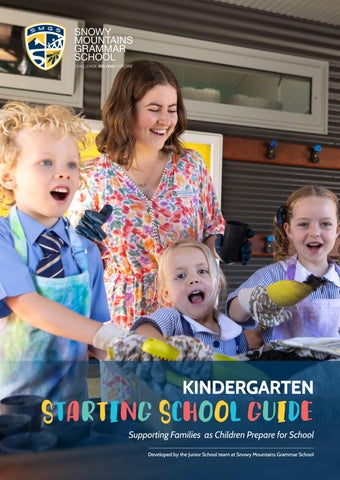
KINDERGARTEN
STARTING SCHOOL GUIDE
Supporting Families as Children Prepare for School Developed by the Junior School team at Snowy Mountains Grammar School
Kindergarten Readiness Guide for Families At Snowy Mountains Grammar School, we know that starting Kindergarten is a significant milestone for both children and their families. Parents and carers often ask how they can help prepare their child, and it is completely normal to feel unsure. The good news is that children do not need to arrive “ready-made” - our teachers are here to nurture, guide and teach the many new skills they will develop throughout their Kindergarten year. However, building a few simple foundations beforehand can help children feel more confident, independent and settled as they begin their school journey. To support, we have prepared a practical guide for your family and a simple checklist to help your child to be ready for this exciting new adventure.
Independence and Self Care Independence and self-care skills are some of the most important confidence-builders for young people. Focus on the following: Using the toilet independently (including managing clothing) Washing and drying hands Opening lunch boxes, packets, and drink bottles Recognising and managing their belongings (bag, hat, lunchbox) Understanding what’s in their school bag (e.g. identifying food for recess and food for lunch) Self-dressing (shoes, jumper, hat, buttons)
How to support this at home Practise these skills in everyday routines Say “You try first”, and “I love that you tried yourself first! I can help now.” Allow extra time so children can “have a go” themselves Practise dressing in their entire school uniform and have a fashion show! When confident with the basics, practise an entire morning routine and arrive-home routine stepby-step. You can even print a visual schedule. Use simple sequential steps. (e.g. First, brush teeth. Next, put on socks.) Expect effort, not perfection - these skills take time and they will get there!
Self-Understanding and Communication Skills Before children can communicate their needs, they need to notice and understand what their body is telling them. This awareness (sometimes called interoception) is a key building block for communication at school. When children can recognise and express internal cues, they are better able to use words to ask for help and feel safe and supported in the classroom. Children benefit from beginning to: Notice body cues (e.g. hunger, thirst, tiredness, needing the toilet, feeling overwhelmed) Express basic needs using simple words (“I’m thirsty”., “I need the toilet.”, “I’m tired”., “I need help.”) Name basic emotions (e.g. happy, excited, sad, worried) Ask an adult for help when unsure or stuck Understand and follow simple instructions
How to support this at home Name what you notice to help your child connect feelings and body signals with words, for example: “You look tired - is your body telling you it needs a rest?” “Your tummy is growling - do you feel hungry?” “Your hands are tight and your face looks cross - are you feeling frustrated?” Encourage your child to describe what’s happening in their body or how they feel Gently prompt them to use words for needs instead of anticipating everything for them Use everyday routines (mealtimes, getting ready, play) as opportunities to practise noticing, naming and expressing needs
Social and Friendship Skills Social skills are learned over time and take lots of practice. Children are not expected to manage friendships perfectly, but understanding basic social rules helps them build strong relationships and cope with the inevitable bumps in the road. Play alongside and with other children Take turns and share Tolerate short waits Cope when things don’t go their way
How to support this at home Arrange play opportunities with peers Model and talk through kindness, turn-taking, and problem-solving Speak kindly about other children and families Notice and praise pro-social behaviour, e.g. “I love how you both took turns!”, “It was so kind when you shared your toy.” Practise simple social phrases such as: “Can I play?” / “Would you like to play with me?” “Can I have a turn?” “Stop, I don’t like that.” Calmly debrief following an incident (meltdown, conflict). A simple, helpful structure is: “You felt … because … next time you could …” For example: “You felt angry because you wanted the toy and had to wait. Next time, you could say ‘Can I have a turn?’ or ask an adult for help.” “You felt upset because your body was tired and it was loud. Next time, you could tell someone ‘I need a break.” “Your body looked really wiggly and frustrated when it was time to pack up. That can happen when it’s hard to stop something fun.”
Emotional Readiness It is completely normal for children to feel big, mixed emotions about starting school. Confidence develops through manageable challenges, not avoidance. Children benefit from:
Being able to separate from a caregiver (even with some tears) Beginning to manage frustration with support Accepting reassurance and guidance from adults
How to support this at home Acknowledge feelings: “It’s okay to feel a bit worried, new things can feel big.” Practise basic feelings vocabulary Practise short separations Develop a short, consistent, calm goodbye routine Avoid “sneaking away” as this can make it harder next time. Be open and honest about when you will return
Supporting Yourself as a Parent Children take emotional cues from adults Stay calm and confident at drop-off Expect some initial nerves or tears - this is perfectly normal Allow time! Adjustment can take several weeks, but let your child’s teacher know if you’re concerned
When to talk to us for extra support… Speak with the school or a professional if your child: Has ongoing, intense distress after several weeks Is unable to separate at all Shows significant regression or withdrawal
Helping Your Child Prepare for School Life Attention and Learning Foundations Pre-teaching formal academics are not necessarily required, but these basics help children engage: Identifying and writing their name and exposure to; numbers 1-10, colours and basic shapes Sitting for short periods (e.g. during a story) Colouring inside lines Matching and sorting activities Listening and following simple directions
Build Familiarity Visit the school for events such as: • Storytime in the Kindergarten Classroom • Kindergarten Experience Visits • Kindergarten Information Mornings • The Kindergarten Readiness Program Talk through what a typical day might look like Read books about starting school (e.g. Daisy’s First Day) Establish Routines Gradually adjust sleep and morning routines Practise getting ready and leaving the house Set Realistic Expectations Keep the lead-up positive and reassuring, without overhyping the experience Use balanced language: “Some parts will be fun, some might feel tricky, and your teacher will help you.”
When to talk to us for extra support… Speak with the school or a professional if your child:
I’m getting ready for
Kindergarten! I’m a big kid because I can... Look after myself
Use my words
Go to the toilet by myself
Ask for help when I need it
Wash and dry my hands
Tell someone if I’m hungry, thirsty, or need the toilet
Open my lunch box and drink bottle
Follow simple instructions
Recognise my bag, hat, and lunchbox
Respond when my name is called
Try to put on my shoes, hat, and jumper
Be a good friend
Manage my feelings
Take turns (even if it’s tricky sometimes!) Try to share Play with other children or alongside them Wait for a short time or manage when I don’t get my way
Say goodbye to my grown-up (even if I feel a bit sad) Let another adult help and comfort me Name five feelings Try again when things feel hard
Get ready to learn Sit and listen for a short time Follow simple directions from a teacher Try new things, even if I’m not sure yet
And most importantly... I know school is a safe place and there are adults who will help me
I don’t have to do all of these perfectly. I’m learning and adults at school will help me. I can listen to my body
I can use my words
I notice when my tummy is hungry
I can tell someone when I need help
I notice when my body feels tired
I can say things like: “I’m thirsty.”, “I need the toilet.”, “I’m tired.”
I notice when I need the toilet I notice when my body feels wiggly, upset, or frustrated
I can keep calm and try again
I can say how I’m feeling I respond when my name is called
I can look after my things
I know big feelings are okay
I can go to the toilet by myself
I can slow my body with help from an adult
I can wash and dry my hands
I can try again when something feels tricky
I can open my lunch box and drink bottle
I can let a teacher help me feel better
I can recognise my bag, hat, and lunchbox I can put on my school uniform
I’m learning how to play with others I can play by myself, next to others, or with others I can take turns (even if it’s hard sometimes) I can share I can ask “Can I play?” I can ask “Would you like to play?”
I can use kind hands I can get help from an adult if something doesn’t feel okay
I’m ready to learn I can sit and listen for a short time I can follow simple instructions I can try new things, even if I feel unsure I know home and school have different rules
The Most Important Thing I know school is a safe place I know there are kind adults who will help me
I don’t have to do everything by myself
Snowy Mountains Grammar School 6339 Kosciuszko Road Jindabyne NSW 2627 02 6457 1022 info@smgs.nsw.edu.au
smgs.nsw.edu.au