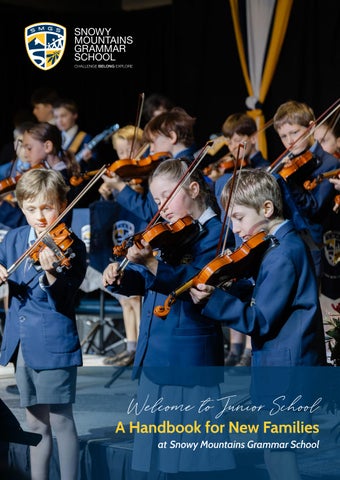
Welcome to Junior School
A Handbook for New Families at Snowy Mountains Grammar School
1
Starting at Snowy Mountains Grammar School A Guide for New Middle and Senior School Families
Contents 03
Welcome
04
School Information
05
Areas of Responsibility
06
Our Campus
07
Daily Routines and Procedures
09
The School Uniform
10
Our Values
11
Wellbeing
12
School Houses
13
Communications and Connections
14
Communication Platforms
15
Our Community
16
Learning in the Junior School
18
Sport
19
Co-curricular Activities
21
Student FAQs
22
Technology FAQs
23
Getting Started Checklilst
Policies Snowy Mountains Grammar School operates in accordance with a range of policies that guide the operation of the School and support the safety, wellbeing and learning of our community. Current policies are available on the School website: www.smgs.nsw.edu.au/policies
This document may be superseded by newer versions. Version 2 | June 2026
Welcome
to Snowy Mountains Grammar School Starting school is an exciting milestone for students and families. This guide has been designed to help you understand how the Junior School operates, what to expect and where to find information and support. Our goal is to ensure every child feels connected, confident and supported from their first day. We work closely with families to help students settle in quickly, build positive relationships and make the most of the opportunities available to them.
03
Inside this guide you will find information about: • Daily routines • Communication platforms • Learning, wellbeing • Uniform • Sport • Co-curricular activities • Community involvement. We look forward to partnering with your family and helping your child make a successful start. Mrs Kimberley Whitehead Head of Junior School kimberley.whitehead@smgs.nsw.edu.au
Starting at Snowy Mountains Grammar School A Guide for New Junior School Families
Contact Information Address Snowy Mountains Grammar School 6339 Kosciuszko Road Jindabyne NSW 2627, Australia
Who to Contact? Main Administration Office - Reception Office Hours: 8:30 am - 4:30 pm Monday - Friday (except public holidays) Phone: 02 6457 1022 Email: info@smgs.nsw.edu.au Junior School Administration Office - School Reception Office Hours: 8:30 am - 4:30 pm Monday - Friday (except public holidays) Phone: 02 6451 2450 Email: junior.school@smgs.nsw.edu.au Common enquiries include: • Academic matters • Student wellbeing • Attendance and absences • Co-curricular activities • Technology support • Uniform enquiries • General school information Principal Email: principal@smgs.nsw.edu.au
Social Media Facebook facebook.com/snowymtnsgrammar Instagram instagram.com/snowymountainsgrammarschool
School Hours Years K-3: 8:45 am - 3:15 pm Years 4-6: 8:45 am - 3:25 pm
Term Dates View the current term dates: www.smgs.nsw.edu.au/term-dates
04
Starting at Snowy Mountains Grammar School A Guide for New Junior School Families
Areas of Responsibility The table below outlines the staff members responsible for key areas of school life. Families are welcome to contact the Junior School Administrator, who will direct enquiries to the appropriate person.
05
Enquiry
Junior School
Classroom Learning
Classroom Teacher
Student Wellbeing
Classroom Teacher Head of Junior School
Education Support and Enrichment
Classroom Teacher Head of Education Support and Enrichment
Student Absences
Junior School Administration
First Aid
Junior School Administration
Lost Property
Junior School Administration
Technology (Years K-6)
Tech Support Team
Co-curricular Activities
Junior School Administration
Uniform Shop
Uniform Shop
Starting at Snowy Mountains Grammar School A Guide for New Junior School Families
Our Campus Nettin Circuit
N
W
P
Poley Cow Lane
N
Barry Way
J
G H
J
N
N N
F
Barry Way
G
T
N
Q L
K I
O
N
M
J
V
2
Junior School and Boarding Entrance
E
E
B
D C
Visitor Car Park
R A
S
U School Entrance ko Road Kosciusz
A
Main Administration and Reception
N Boarding Residences
B
The Snowy Shed
O Boarding Drying Room
C
Sports Administration
P
D Gymnasium E
Elizabeth Cornish Library and Classrooms (C1-C3)
F
Middle and Senior School Administration
G
Staff Offices
H Carruthers Classrooms (C5-C10)
Q Agricultural Technology Lab R
Curiosity Centre (Thredbo River Classrooms, Eucumbene River Classrooms, Snowy River Classrooms, Moonbah Classrooms, Murrumbidgee Classrooms)
S
Uniform Shop Multipurpose Courts
I
Junior School Oval
T
J
Junior School Paupong Classrooms (P1-P8)
U Sports Precinct and Oval
K
Junior School Administration
V
L
Eat Street
W Gidgillys Early Education and Care Centre
M Wellbeing Centre 06
Boarding Storage Shed
Starting at Snowy Mountains Grammar School A Guide for New Junior School Families
Agriculture Plot
Daily Routines and Procedures Absentees
Canteen
If your child will be absent, please notify the School through the Sentral Parent Portal.
The canteen operates during recess and lunch each day, except Wednesdays when it is closed.
Attendance is monitored in accordance with NSW Education Standards Authority (NESA) requirements. Regular attendance is important for student wellbeing, learning and engagement.
Students in Years 5-6 may purchase items directly from the canteen. For students in Kindergarten to Year 4, lunch orders must be placed online through FlexiSchools.
Please refer to our School Policies for more information. www.smgs.nsw.edu.au/policies
Lunch orders are delivered directly to classrooms and distributed to students during the day.
Arriving at School
Create a FlexiSchools account here: user.flexischools.com.au/register
Students may be dropped off from 8:30 am via the Junior School Kiss and Drop area at the end of Poley Cow Lane.
Daily Routine
Teachers welcome students each morning and assist younger students to their classrooms.
Birthdays We enjoy celebrating student birthdays in the classroom. Families wishing to provide a cake or shared treat should discuss arrangements with the class teacher in advance and provide an ingredients list to support the management of food allergies and dietary requirements.
Buses Transport for NSW provides free bus transport for eligible students at the start and end of the school day. Cooma Coaches Cooma, Berridale, Thredbo, Jindabyne and surrounding areas. Timetables: www.coomacoaches.com.au/time-table Alpine Charters Perisher and Kalkite, with connections to Dalgety via Snowliner Coaches. Timetables: www.alpinecharters.com.au/school-timetables www.snowliner.com.au/school-charters All students using school bus services must apply for a School Travel Pass or School Opal Card: www.transportnsw.info/school-travel-apply. Families who do not have access to free bus transport may be eligible for the School Drive Subsidy: www.transportnsw.info/tickets-fares/eligibility-concessions/ school-student-travel/apply-for-school-drive-subsidy
Arrival: 8:30 am – 8:45 am Classes Commence: 8:45 am Recess: 10:55 am – 11:15 am Lunch: 1:05 pm – 1:45 pm Departure: 3:15 pm (Years K-3) | 3:25 pm (Years 4-6)
Events, Celebrations and Special Days Throughout the year, students participate in a range of events, celebrations and community activities that enrich school life and create lasting memories. These may include: • Grandparents and Special Friends Day • Easter and Christmas celebrations • Mother’s Day and Father’s Day events • Book Week • Foundation Day • 100 Days of Kindergarten • Musical and Theatre Productions • Cre8ive Sessions • Academic and Special Focus Days • Mountain Biking, Snowsports and Equestrian programs • Co-curricular activities and showcases • Investiture and Year 12 Farewell Chapel • Speech Day Families are encouraged to attend and participate in these important community events whenever possible.
At the end of the school day, students travelling by bus are supervised and assisted to board the correct service for their destination. 07
Starting at Snowy Mountains Grammar School A Guide for New Junior School Families
Excursions Excursions are an important part of the learning program and provide students with opportunities to extend their learning beyond the classroom. Parents and carers will receive excursion information through Sentral, where permissions and relevant medical information can also be submitted.
Late Arrivals and Early Departures If your child will arrive late or needs to leave school early, please notify the School through the Sentral Parent Portal. Students arriving late or leaving early must sign in or out through the Junior School Administration Office.
Medical Care The School provides first aid, temporary care for unwell students and support for students requiring medication or individual health care plans. If your child becomes unwell during the school day, they will be taken to the Junior School Administration Office and parents or carers will be contacted if required. Parents and carers are responsible for ensuring their child’s Sentral Medical Profile is completed before commencement and kept up to date.
Recess and Play The Junior School provides a calm and engaging playground environment where students are encouraged to be active, creative and connected. During break times, students have access to a range of supervised activities and play spaces, including: • Oval and open play areas • Basketball and handball • Skipping ropes and hula hoops • Chess and other passive play activities • Lego and creative play spaces These opportunities encourage positive social interactions, physical activity and imaginative play.
Resource Fee The Resource Fee is an annual levy that covers many curriculum-related costs throughout the year, reducing the need for multiple additional charges.
08
The fee includes items such as the IT levy, Years K–2 stationery, Junior School textbooks and exercise books, and curriculum camps. Families will be advised in advance if an activity falls outside the Resource Fee and requires an additional charge. The Resource Fee is charged quarterly at the start of each term.
Technology and Devices Bring Your Own Device (BYOD) Students in Years 5-12 are required to bring their own laptop to school each day. Laptops are an important learning tool and support access to digital resources, online platforms and classroom learning. Students are responsible for the care and security of their device. Lockers are provided for safe storage during the school day. We strongly recommend that families consider accidental damage and theft insurance for student devices. Students should arrive at school each day with their device fully charged, as opportunities to charge devices during the day are limited. Depending on availability, a temporary loan device may be provided for up to 10 school days if a student’s device requires repair. The IT Support Team is available to assist students with the use of their device and the software and systems used by the School. While student-owned devices are not managed by the School, the IT team can provide basic troubleshooting for device-related issues. Families remain responsible for all maintenance, repairs, warranty claims and replacement of their child’s device. Digital Literacy and Citizenship As students begin using laptops in the Junior School, they are supported to use technology safely, responsibly and with confidence. Through classroom learning and everyday use of technology, students develop the skills to be respectful online, make informed choices and understand their responsibilities as digital citizens. With close teacher guidance, technology is used in a balanced and purposeful way to support learning, wellbeing and positive online behaviours.
Starting at Snowy Mountains Grammar School A Guide for New Junior School Families
Technology Requirements To ensure compatibility with school systems and learning programs, student devices must meet the minimum technology requirements outlined below. SPECIFICATION
REQUIREMENT
Screen Size
Minimum 11” (13” or larger recommended)
Operating System
Microsoft Windows or Apple macOS. Other systems (Chromebook, Linux, Android, iOS) are not supported.
Battery Life
Processor, Memory & Storage
Additional
Minimum 6 hours (8 hours recommended). Limited charging options are available at school. Standard specifications are suitable for most subjects. Students in subjects requiring high-performance software (e.g. Adobe Photoshop, Fusion 360) may need more advanced hardware. Students should bring own charger and headphones.
If you are unsure whether a device meets these requirements, please contact the IT Support Team for assistance: techsupport@smgs.nsw.edu.au | 02 6451 2460
The Uniform Students are expected to wear the correct school uniform and present themselves in accordance with the School’s Uniform Policy. For detailed information about uniform requirements, including hair and appearance expectations, families are encouraged to consult the Uniform Policy and Uniform Picture Guide, available on the school website. Uniform Policy: www.smgs.nsw.edu.au/our-school/policies Junior School Uniform Picture Guide: www.smgs.nsw.edu.au/uniform
Uniform Shop The uniform shop opening hours can be found on the school website. Visit the Online Uniform Shop here: www.shop.smgs.nsw.edu.au Appointments can be made outside of these hours. Please contact the Uniform Shop to arrange an appointment: uniformshop@smgs.nsw.edu.au | 02 6457 1022.
Used Uniforms
Used uniforms in good condition can be bought and sold on the Snowy Mountains Grammar School Used Uniforms and Equipment Facebook Group.
Treasures from Home To avoid items being lost or damaged, students are encouraged to leave toys at home unless requested by their teacher. Students are welcome to bring interesting objects that support classroom learning, such as rocks, shells, flowers or other items of interest. Pets may occasionally visit classrooms as part of learning experiences. Please speak with your child’s teacher prior to making arrangements.
09
Starting at Snowy Mountains Grammar School A Guide for New Junior School Families
Our Values At Snowy Mountains Grammar School, our community is guided by four core values known as CARE.
Courage Acting with conviction and taking responsibility for our actions.
Authenticity Being genuine, acting with integrity and staying true to ourselves.
Respect Valuing every member of our community and treating others with kindness and consideration.
Empathy Understanding and supporting others by appreciating different perspectives and experiences. These values shape how we learn, work together and contribute to our school community.
10
Starting at Snowy Mountains Grammar School A Guide for Junior School Families
Wellbeing At Snowy Mountains Grammar School, wellbeing is central to the Junior School experience. We believe students learn best when they feel safe, supported and connected. Our wellbeing program helps students develop positive relationships, confidence, resilience and the skills they need to thrive both at school and beyond. Through a range of age-appropriate programs and experiences, students are encouraged to build strong character, care for others and contribute positively to the school community.
4Peaks
Our wellbeing program is underpinned by 4Peaks, our school-wide positive behaviour program. Built around our CARE values of Courage, Authenticity, Respect and Empathy, 4Peaks helps students understand expectations, make positive choices and contribute to a respectful and inclusive school environment. Students are explicitly taught the behaviours and expectations associated with our CARE values through the 4Peaks program. Families will become familiar with these expectations through school communications, student recognition and everyday school life. View the Junior School 4Peaks Program
Mindfulness Once a week students engage in a Mindfulness session within the class timetable providing an opportunity to slow down, be present and to develop lifelong selfmanagement skills. These regular session support students to build focus, emotional awareness and strategies to manage varying emotional situations.
Brain Breaks Brain Breaks are incorporated throughout the school day to support student engagement and learning. These short movement or thinking activities help students refocus, recharge and return to learning with renewed concentration.
Peer Support Building connections across year groups is an important part of Junior School life. Kindergarten students are paired with both a Year 6 and Year 12 buddy who support them throughout their first year of school. Buddies regularly spend time together through activities, reading, games and playground interactions, helping younger students feel connected, supported and confident. 11
Tutor Tuesday and Read Aloud Wednesday are wholeschool programs that bring students together across year levels, fostering a strong sense of belonging and community. We are also pleased to welcome children from Gidgillys Preschool to participate in Read Aloud Wednesday each week.
Social Skills Support Targeted social skills programs are available for students who may benefit from additional support in developing positive peer relationships, communication skills and confidence in social situations. These small-group programs are facilitated by Education Support staff and are tailored to the needs of individual students.
Seasons for Growth Seasons for Growth is a voluntary small-group program designed to support students experiencing significant change or loss, such as family separation, grief or other life transitions. Facilitated by our School Counsellors on an as needs basis, the program helps students develop emotional awareness, resilience, communication skills and positive coping strategies.
Anti-Bullying Snowy Mountains Grammar School is committed to providing a safe, inclusive and respectful learning environment for all students. Bullying behaviour is not tolerated and is addressed promptly through clear reporting and response procedures. We work in partnership with students, families and staff to promote positive relationships, encourage respectful behaviour and support student wellbeing. Please refer to our School Policies for more information. www.smgs.nsw.edu.au/policies
Year 6 to Year 7 Transition Students in Year 6 participate in a transition program designed to support a confident move into Middle School. During Term 4, students experience a Year 7 school day, meet teachers, become familiar with key locations and begin building connections with their future cohort.
Starting at Snowy Mountains Grammar School A Guide for New Junior School Families
School Houses House Structures The House system is an important part of life at Snowy Mountains Grammar School, fostering school spirit, connection and a sense of belonging. Upon enrolment, each student is allocated to one of four Houses and remains in that House throughout their time at the School. Siblings are placed in the same House, and children of alumni and staff join their family House where possible. Throughout the year, students represent their House in a range of competitions and events, earning points towards the House Shield and House Spirit Shield. Major House events include: • Swimming Carnival • Cross Country Carnival • Athletics Carnival On competition days, students wear their House shirt, which can be purchased from the Uniform Shop.
Named after the waterfalls and river systems of the Snowy Mountains, Cascades (green) is represented by the snow gum leaf and reflects our connection to the natural environment.
Named after the historic Snowy Mountains township, Kiandra (white) is represented by the linked figures and symbolises community, connection and shared experiences.
Named after the Mowamba River, this House (blue) is represented by the flowing river and reflects adaptability, growth and life.
Named after Mount Twynam, one of Australia’s highest peaks, this House (Red) is represented by the mountain and symbolises challenge, resilience and adventure.
12
Starting at Snowy Mountains Grammar School A Guide for New Junior School Families
Communications and Connections Clear and timely communication helps families stay informed and connected to school life.
Key Communication Platforms Below are our key communication platforms outlined in detail on the following page. Platform
Purpose
Sentral
Absences, reports, permissions, school calendar, school notices and communications
SeeSaw
Classroom photos, videos and individual student work
Supporting Communication Platforms Communication with Teachers Snowy Mountains Grammar School values strong partnerships between home and school. Parents and carers can communicate with classroom teachers and the Head of Junior School through: • Sentral messages • Email • Phone calls (by appointment) SMS In the event of an emergency or time-sensitive situation, SMS notifications will be sent to nominated parent and carer contacts. Website The School website provides access to important information, policies, event details, publications and school news. www.smgs.nsw.edu.au
13
Aspects Aspects is our digital newsletter, sharing stories, updates and highlights from across the School. It features student learning experiences, upcoming events and community celebrations. We also encourage families to let us know if their child has achieved something worth sharing with our community. Celebrating student success is an important part of recognising the diverse talents and achievements of our students. Social Media The School maintains an active presence on Facebook and Instagram. These platforms showcase daily learning, school events and student achievements. Families are welcome to share photos or news for consideration on our official channels by contacting the Marketing Team at marketing@smgs.nsw.edu.au Parent/Teacher Interviews Parent/Teacher interviews are held each semester and provide an opportunity to discuss student progress with teachers. Additional meetings can be arranged throughout the year if required. Curriculum Information Evening Held early in the school year, Curriculum Information Evening provides families with an overview of year-level expectations, assessment requirements and curriculum programs. School Reports Reports are issued twice each year. Families will receive a notification through Sentral when reports become available.
Starting at Snowy Mountains Grammar School A Guide for New Junior School Families
Communication Platforms Administrative and Operational
Classroom Photos and Videos
Medical and Permission
Sentral
Sentral Student Portal
Sentral is the School’s Student Management System and is used by students, parents and staff to access important school information.
The Sentral Student Portal provides students in Years 5-12 with access to information relevant to their school experience, including: • Daily notices • Academic reports • Sport selections • Co-curricular activity selections
There are separate Student and Parent Portals, each designed to provide information and services relevant to the user.
Sentral Parent Portal Using the Sentral Parent Portal, parents and carers can: • Notify the School of student absences (whole or part day) • Access school reports • Message teachers • View the School Calendar and key dates • Update medical and emergency contact information • Provide permissions for excursions, sport and activities • Access school resources and important information • View student timetables • Receive notifications and communications from the School Access the Parent Portal: www.smgs.sentral.school/auth/portal
14
Access the Student Portal: www.smgs.sentral.school/auth/portal We encourage families to regularly check the Sentral Parent Portal and students to engage with the Student Portal as part of their organisation and school routine.
SeeSaw In the Junior School, SeeSaw provides a personalised window into your child’s school life, through photos and videos. Both students and teachers upload student work to this platform. Prior to your child’s first day, the preferred contact from your family will receive an invitation from your child’s teacher to join SeeSaw.
Starting at Snowy Mountains Grammar School A Guide for New Junior School Families
Our Community Parents and Friends Association
Community Engagement
The Snowy Mountains Grammar School Parents and Friends Association (P&F) supports the School through community events, fundraising and social activities.
Community involvement is an important part of life at Snowy Mountains Grammar School. Families are encouraged to participate in events and activities that strengthen connections across the school community.
The P&F welcomes all parents and carers and provides an opportunity to connect with other families and contribute to school life. Activities may include: • Trivia Night • Meet and Greet events • Community fundraising initiatives The P&F meets regularly throughout the year and welcomes all parents and carers. pandf@smgs.nsw.edu.au
Alumni Program The Snowy Mountains Grammar School Alumni Program helps graduates stay connected with the School and each other. Through events, networking opportunities and community initiatives, alumni continue to contribute to the life of the School and support future generations of students.
Opportunities to become involved may include: • Grandparents and Special Friends Day • Welcome Family Picnic • Cre8ive Sessions • School events and celebrations • Volunteering opportunities These experiences help build a strong and connected community where students and families feel welcomed, valued and supported.
Parent Liaison Program Each class has a Parent Liaison representative who supports communication and connection within the parent community. Parent Liaison representatives assist with welcoming new families, facilitating class communication and supporting community events throughout the year.
The Alumni Program provides opportunities for: • Connection with past and present members of the School community • Social events and celebrations • Supporting future students and school initiatives
15
Starting at Snowy Mountains Grammar School A Guide for New Junior School Families
Learning in the Junior School Our learning programs are based on the NSW Education Standards Authority (NESA) curriculum and provide students with a strong foundation across all areas of learning. Students learn across six key learning areas:: • English • Mathematics • Science and Technology • Human Society and its Environment (HSIE) • Creative and Performing Arts (CAPA) • Personal Development, Health and Physical Education (PDHPE)
Technology Technology is integrated into learning across the Junior School through age-appropriate experiences that encourage creativity, collaboration and problem solving. Students are introduced to coding, robotics and computational thinking through hands-on activities that build a strong foundation for future STEM learning.
NAPLAN Students in Years 3 and 5 participate in the National Assessment Program – Literacy and Numeracy (NAPLAN).
Our teachers create engaging and supportive learning experiences that encourage students to explore new ideas, develop confidence and achieve their personal best.
NAPLAN provides a snapshot of student progress in literacy and numeracy and is one of many assessment
Literacy
Homework
Strong literacy skills underpin success across all areas of learning. Students participate in a range of literacy experiences designed to develop reading, writing, speaking and listening skills. Early literacy screening and ongoing assessment help teachers identify student needs and provide targeted support to ensure every child makes progress along their learning journey.
Numeracy Numeracy learning focuses on developing strong mathematical understanding through hands-on experiences, problem solving and practical application. Students use a variety of learning tools and materials to build confidence and deepen their understanding of mathematical concepts..
tools used to support student learning and development.
Homework supports classroom learning and helps students develop organisation, responsibility and independent learning habits. Homework expectations vary across year levels and may include reading, revision, practice activities or preparation for class.
Community Partnerships Our community partnerships enrich student learning through meaningful local, national and international connections. Examples include our long-standing partnership with a school in South Korea and the Antarctica Project, which connects students with scientists working in Antarctica to explore real-world research and discovery.
Specialist Classes In addition to learning with their classroom teacher, students participate in specialist lessons, which may include: • Physical Education • German • Science • Creative and Performing Arts All Year 3 students also participate in the Junior School Violin Program delivered by specialist music staff.
16
Starting at Snowy Mountains Grammar School A Guide for New Junior School Families
Library Facility and Reading Culture Our library is a welcoming learning hub that supports reading, research and curiosity across all year levels. Students have access to a wide range of print and digital resources, quiet reading spaces and opportunities to develop a lifelong love of reading. Reading initiatives may include: • Premier’s Reading Challenge • Read Aloud Wednesday • Mystery Reader • Write a Book in a Day • Book Week
Educational Support and Enrichment Every student learns differently. Our teachers use assessment data, classroom observations and individual learning goals to ensure students are appropriately supported, challenged and encouraged to reach their potential. Through differentiated teaching and targeted support, learning experiences are tailored to meet the needs of students across all areas of the curriculum. The Education Support Team works closely with teachers, students and families to provide additional support where required. Students who require adjustments, targeted interventions or extension opportunities are supported through programs designed to meet their individual learning needs and help them achieve success at school.
17
Starting at Snowy Mountains Grammar School AAGuide Guidefor forNew NewJunior MiddleSchool and Senior Families School Families
Sport Sport is an important part of life at Snowy Mountains Grammar School, promoting teamwork, fitness, confidence and school spirit. Students have opportunities to participate in both individual and team sports while developing resilience, sportsmanship and healthy habits.
Pathways and Associations Snowy Mountains Grammar School is a member of the Heads of Independent Co-Educational Schools (HICES), providing students with opportunities to participate in representative sport at regional, state and national levels. The School also supports student participation in a range of sporting competitions and events throughout the year, including Interschools.
Swim and Survive Program As part of the Physical Education program, students participate in the nationally recognised Swim and Survive program delivered by Royal Life Saving. The program develops water safety skills, confidence and swimming ability through instruction from qualified coaches. Transport to and from the pool is provided by the School.
Snowsports Students in Kindergarten to Year 6 may participate in the Wednesday Snowsports Program during Term 3. Thredbo Resort: Years K-6 Perisher Resort: Years 3-6 Transport is provided to and from the resorts and students are placed into groups according to their age and ability.
Physicial Education and School Sport Students in Years K-4 participate in weekly Physical Education lessons with their year level. In addition, students in Years K-2 take part in a dedicated gross motor program focused on developing fundamental movement skills. Students in Years 5-6 participate in School Sport, which generally takes place during Periods 5 and 6 in Terms 1, 2 and 4. During Term 3, students participate in the Wednesday Snowsports Program. Wednesday Sport options may include: • Mountain Biking • Equestrian • Canoeing • Frolf • Pilates • Yoga • Tennis • Sailing • Stand Up Paddle Boarding • Trampolining • Air Bag • Fishing • Self-Defence • Fitness • Squash • Basketball • Netball Programs vary throughout the year and some activities may incur an additional cost.
A Snowsports Information Evening is held each year for participating families.
18
Starting at Snowy Mountains Grammar School A Guide for New Middle and Senior School Families
Co-curricular Activities Co-Curricular Program Students are encouraged to participate in a range of co-curricular activities that complement classroom learning, develop new skills and strengthen connections across the school community. Programs are offered across three broad areas: • Physical Activities • Heart and Mind Activities • Creative and Performing Arts • Lunchtime Activities Lunch Time Activities Activities may include: • Chess Club • Quiet Club Before and After-School Activities Activities may include: • Mountain Bike Club • STEM Design and Make Club • STEM Robotics Club • Cooking Club • Art Club • Cricket • Run Club • Writing Rulz • Strings in Motion Programs vary throughout the year and some activities may incur an additional cost. Families receive information about available activities prior to the start of each term. View the current Co-curricular Handbook: www.smgs.nsw.edu.au/publications
Music Tuition and Ensemble Private music tuition is available for students across a range of instruments. For further information, please contact the Junior School Administration Team: junior.school@smgs.nsw.edu.au | 02 6451 2450
19
Starting at Snowy Mountains Grammar School A Guide for New Junior School Families
Service Learning
Leadership
Service Learning helps students develop empathy, citizenship and an understanding of how they can make a positive contribution to their community.
Leadership opportunities are available to students across the Junior School and encourage students to develop confidence, responsibility and service to others.
Throughout the year, students participate in a range of initiatives that support local, national and international organisations. These experiences encourage students to connect classroom learning with real-world action and develop an appreciation for helping others.
Student leaders assist with assemblies, school events, peer support programs and community initiatives, while acting as positive role models for younger students.
Students have supported a range of service learning initiatives in the past, including Epilepsy Action Australia, Lifeline, Indigenous Literacy Foundation, Youth Off The Streets, Deadly Science and Light Up Timor.
20
Additional leadership opportunities are available through the Student Representative Council (SRC), which provides students from Kindergarten to Year 6 with opportunities to contribute ideas, represent their peers and help shape school life.
Starting at Snowy Mountains Grammar School A Guide for New Junior School Families
Student FAQS What do I do if I arrive late to school or need to leave early? If you arrive after 8:45 am or need to leave during the day, you must sign in or out through the Junior School Administration Office.
What should I do if I can’t complete my homework? Speak with your teacher. They will help you work through any challenges and make a plan to get back on track.
What if I don’t have the correct uniform? Visit the Junior School Administration Office and staff will assist you.
Who can I talk to if I am feeling sad, worried or overwhelmed? Speak to your teacher or any staff member you trust. We are here to help.
What if I forget my lunch? Tell your teacher or the Junior School Administration Office. Staff will help make arrangements.
What should I do if I feel sick at school? Tell your teacher or visit the Junior School Administration Office. Staff will care for you and contact your parents or carers if needed.
What should I do if I lose equipment or a uniform item? Tell your teacher or visit the Junior School Administration Office. We will help you look for it.
What should I do if I miss the bus? Tell your teacher or go to the Junior School Administration Office immediately. Staff will help contact your parents or carers and arrange a safe plan for getting home.
What should I do if I lose my bus pass? Most bus drivers will allow you to travel home. If there is a problem, tell your teacher or visit the Junior School Administration Office for assistance.
21
Starting at Snowy Mountains Grammar School A Guide for New Junior School Families
Technology FAQS (Years 5-6) Can my child use an iPad or tablet as their primary device? No. Students are required to use a laptop running Microsoft Windows or Apple macOS. Tablets such as iPads and Android devices are not suitable as a student’s primary device. Convertible devices, such as a Microsoft Surface Pro, may be used provided they have a keyboard and trackpad or mouse. If you are unsure whether a device meets the School’s requirements, please contact the IT Support Team: techsupport@smgs.nsw.edu.au | 02 6451 2460
Does the School provide access to software? Yes. Students receive access to Microsoft 365, including Microsoft Office and OneDrive cloud storage. Students in Years 5–12 also have access to Adobe Creative Cloud and a range of online learning platforms, including Canvas and Box of Books. Some specialist subjects may require additional software. If you have any questions about software requirements, please contact the Technology Support Team.
Can students charge their devices at school? Charging opportunities are limited. Students should arrive at school each day with their device fully charged and ready for use.
Can students store their devices safely at school? No. Students take devices home daily to charge of an evening ready for the following day.
Who can I contact for technology support? The IT Support Team can assist with device requirements, software access and general technology enquiries. techsupport@smgs.nsw.edu.au | 02 6457 1022
22
Starting at Snowy Mountains Grammar School A Guide for New Junior School Families
New Families Onboarding Checklist Before the First Day Review Term Dates and key events in the Sentral Parent Portal Calendar Complete your child’s Sentral Medical Profile and ensure all information is current Download the Sentral for Parents App and review the Communications Handbook Read key school policies, including: Uniform Policy, Attendance Policy, Acceptable Use of Technology and Mobile Devices Policy Label all uniform items and personal belongings Set up your FlexiSchools account for canteen orders Apply for a School Travel Pass or School Opal Card (if applicable) Prepare your child’s BYOD laptop if they are entering Year 5 or 6
During the First Term Encourage your child to arrive at school between 8:30 and 8:45 am each day Check Sentral regularly for notices, permissions, reports and calendar updates Stay connected through Aspects, social media and school communications Ensure absences and early departures are managed through Sentral Encourage participation in co-curricular activities, sport and school events Connect with your child’s classroom teacher if you have any questions or concerns
Ongoing Keep medical, contact and emergency information current in Sentral Check the Sentral Calendar regularly for updates and key dates Read school communications and newsletters to stay informed Reinforce the School’s CARE values of Courage, Authenticity, Respect and Empathy Encourage your child to make the most of the opportunities available to them at Snowy Mountains Grammar School
23
Starting at Snowy Mountains Grammar School A Guide for New Junior School Families A Guide for New Middle and Senior School Families
Snowy Mountains Grammar School 6339 Kosciuszko Road Jindabyne NSW 2627 02 6457 1022 info@smgs.nsw.edu.au
smgs.nsw.edu.au 24
Starting at Snowy Mountains Grammar School A Guide for New Middle and Senior School Families