CONTENTS SPRING/SUMMER 2026 2 4 8 16 19 27 32 34 40 42 49 FROM THE EDITOR THE GROWTH OF WOMEN IN ATHLETICS
NEWS AND VIEWS RETIREES ALUMNI ATHLETICS
CLASS NOTES LOOKING BACK THROUGH THE DECADES GRADUATE PROGRAMS EXPAND AND GROW FROM UNSURE TO SELF-ASSURED
EDITOR
Deb Nahrgang dnahrgan@smumn.edu
ALUMNI DIRECTOR
Tracy Heaser
CONTRIBUTING WRITERS
Ashly Bissen, Abbie Campion, Deb Nahrgang
PHOTOGRAPHERS
Rick Bush, Geoffrey DeMarsh, Deb Nahrgang
PRODUCTION
Megan French, Tim DeCelle
CREATIVE DIRECTOR
Bill Neumiller
ART DIRECTOR
Maria Beyerstedt
PRINTED BY La Crosse Graphics
ADDRESS CHANGES
Saint Mary’s Magazine
Saint Mary’s University of Minnesota 700 Terrace Heights #21 Winona, MN 55987-1399
ON THE WEB smumn.edu/magazine
ABOUT SAINT MARY’S UNIVERSITY OF MINNESOTA
Grounded in Lasallian Catholic values, Saint Mary’s University of Minnesota awakens, nurtures, and empowers learners to ethical lives of service and leadership. Whether in person or online, adult or undergraduate, students are treated with respect, taught with humanity, and supported by faculty and staff committed to their success in programs designed to prepare graduates for today’s and tomorrow’s careers. Founded in 1912 and accredited by the Higher Learning Commission, Saint Mary’s enrolls more than 3,500 students at its undergraduate and graduate programs on campuses in Minneapolis, Rochester, Winona, and online. Saint Mary’s offers a highly personal, real-world-ready educational experience that fully prepares students to work, lead, and serve with character and purpose. Learn more at smumn.edu. ON THE COVER
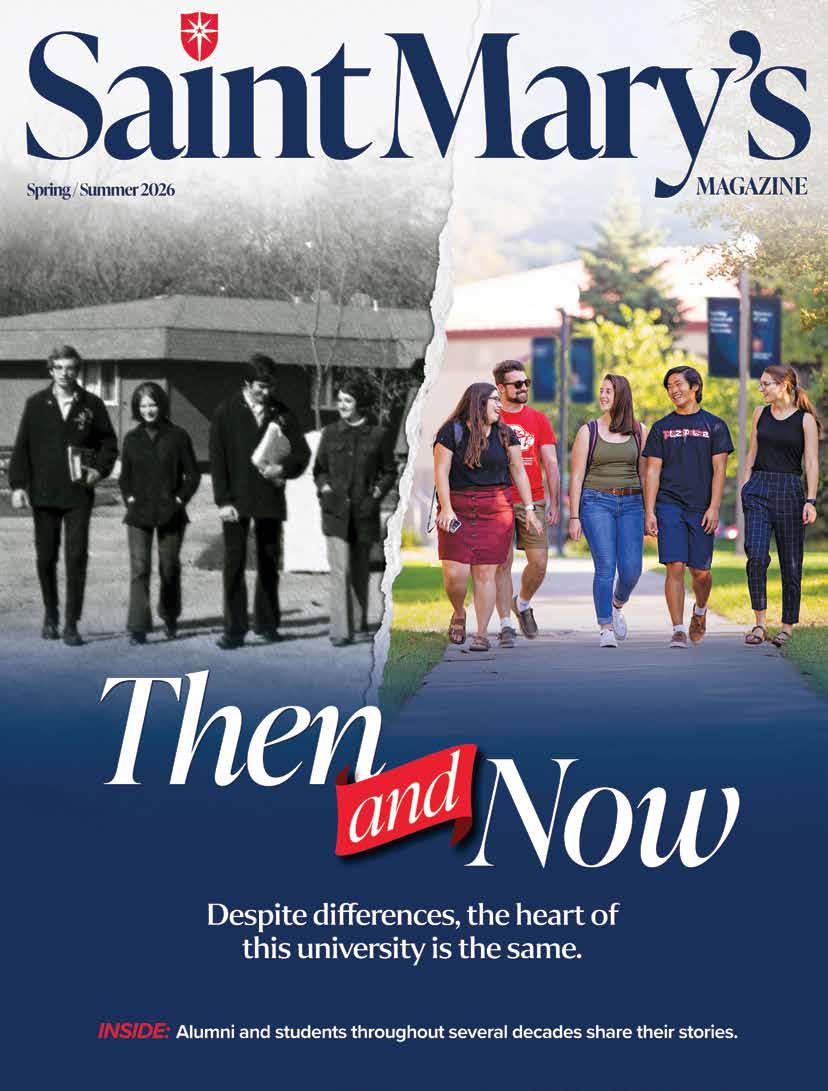
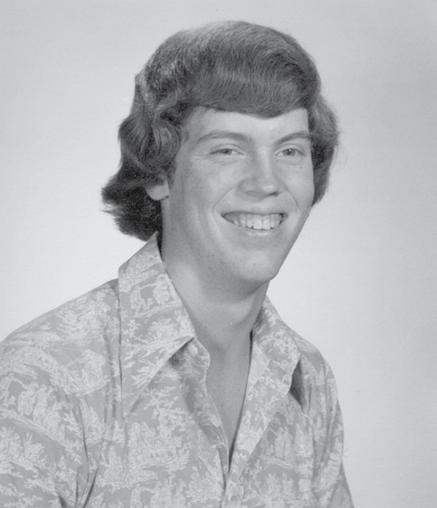
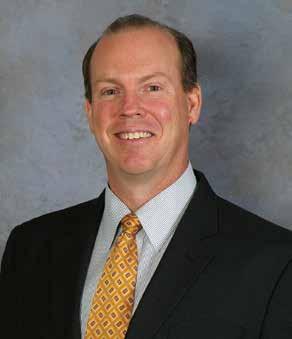
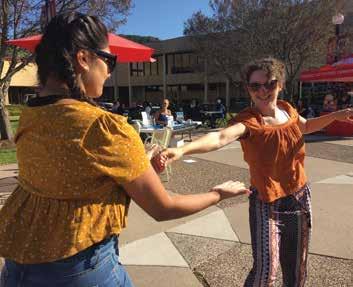
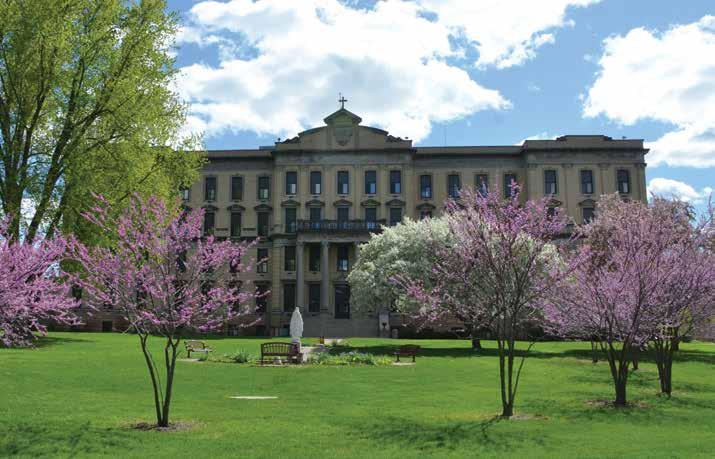
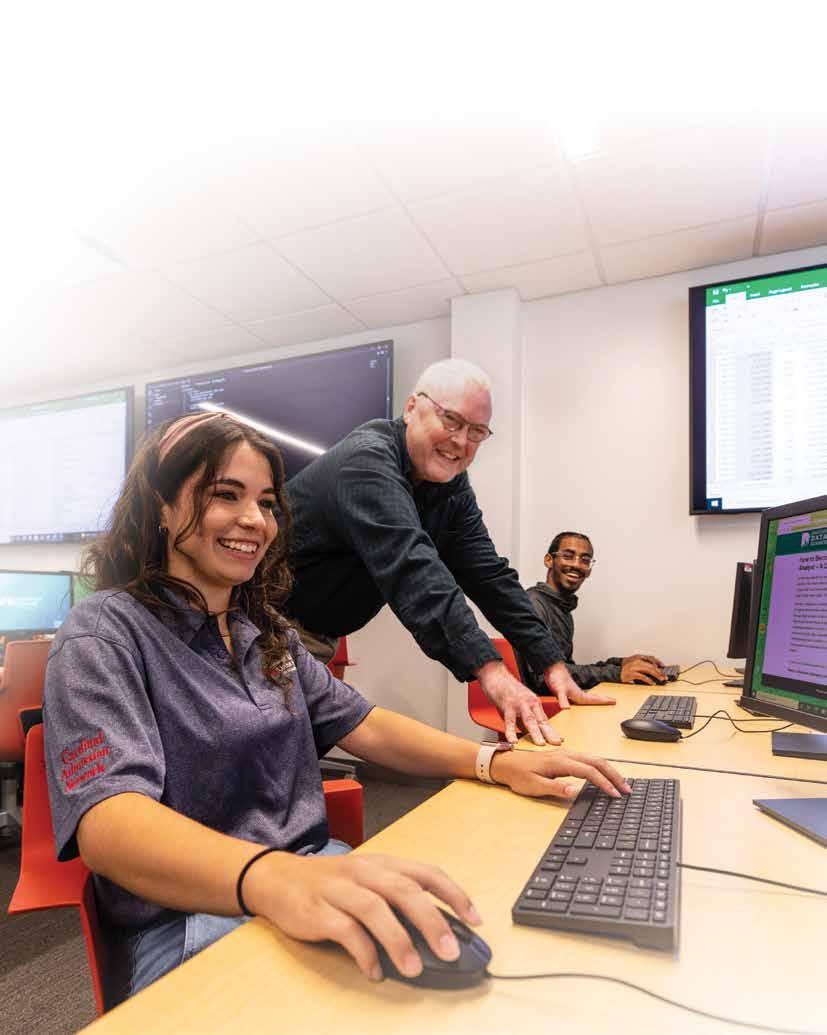
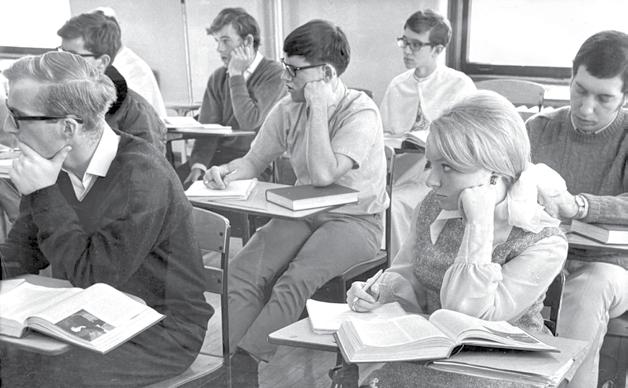
Photos of Saint Mary’s through the years depict many changes in campus buildings, as well as hairstyle and clothing choices, but it’s comforting to know the relationships built here, opportunities to grow, and faculty connections have not changed.
Then and Now
Ilove to hear alumni talk about their time at Saint Mary’s. Undergraduate alumni stories typically begin with lengthy names of faculty who were incredibly influential, and also sometimes strict (with a “for our own good” addendum). Going back in Saint Mary’s history, De La Salle Christian Brothers comprised the majority of these lists, as Brothers taught in the majority of the classrooms for decades until their numbers decreased. But, talking to students today, the Brothers still hold a big place in their hearts and in their memories of Saint Mary’s.
Next come the stories about classmates, ones who continue to gather together frequently, and not just at reunions, multiple decades past graduation. If I had a nickel for every time I heard that Saint Mary’s is the place where you build lifelong friendships, I’d be a rich woman.
I do consider myself rich, maybe not financially, but because of the 23 years I’ve been affiliated with this place. Is there a better career than getting to talk with alumni and students? It doesn’t matter when you graduated, whether you were an undergraduate or graduate student, what your major or area of study was, or what campus you attended; there is something about the people attracted to this university. They’re good people.
And those good people continue to look out for one another. Here people know your name, your aspirations, and your challenges, and they look forward to helping you achieve your goals. They attend games to cheer on studentathletes, and they stay connected.
So even though I hear about the many ways Saint Mary’s has changed physically, the core of what has made this place special is still the same — Then and Now.
On the Winona Campus, the Barracks, the White House, Cotter Hall, Aquinas (later Vlazny), Saint Edward’s, the Student Union, and what was then the Old and New Village are all gone or changed significantly. The gymnasium in Saint Joe’s once held athletic competitions, then was used for art classes. The chapel moved, as did many courses. Some people can hardly recognize the Winona Campus when they return after many decades.
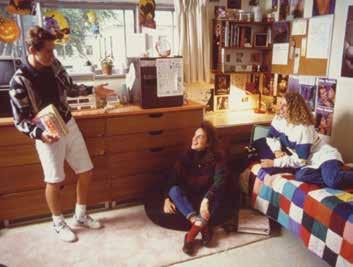
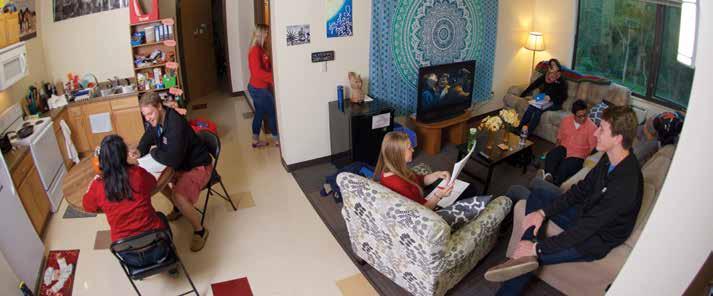
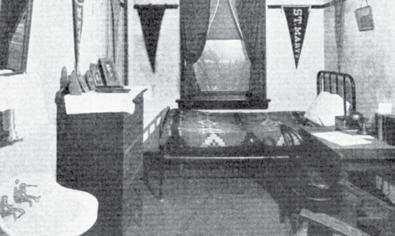
The residence halls, then equipped with one highly sought-after phone, no apartmentstyle kitchens or bathrooms, and certainly not air conditioning, nonetheless were home. It’s where shenanigans occurred (and I’ve heard quite a bit about those as well; believe it or not, the generation of now grandparents or great grandparents had their fair share.) TVs were few and far between, not to mention much smaller and black and white.
Many alumni had no cell phones. In fact, the only photos from their college experiences that exist are in yearbooks. Today, many students have entire libraries of photos from throughout their week.
Some alumni were told in high school by the Brothers that they would attend Saint Mary’s; they didn’t even know there were other options. Many never visited campus until orientation. Today, students visit an average of 10 colleges, looking for a good fit, the right amount of fun, and, of course, whether or not the school offers the academic options they are looking for.
Hairstyles and clothes through the years changed dramatically, from close cut or buzz cut hairstyles and ties to the long, shaggy hair of the ’70s, paired with ripped jeans. In fact, before women were allowed to enroll around 1970, Saint Mary’s was all male.
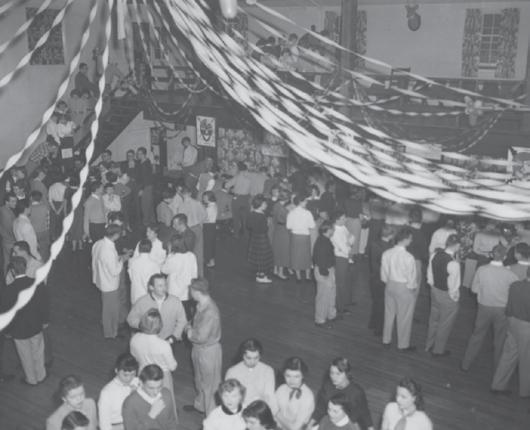
Before women came to Saint Mary’s, the men of Saint Mary’s fraternized with the women of the College of Saint Teresa across town. Many marriages were a result of those combined dances.
After Title IX, women were able to compete in athletics at a college level, and they showed everyone how much talent they had, paving the way for the student-athletes of today in women’s sports. But, as you’ll read in this issue, these women overcame more than a few obstacles so they could play.
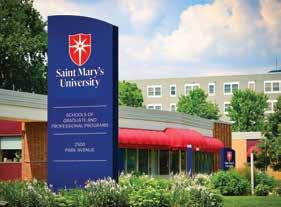
Our graduate campus and programs have also seen much change. In 1983, Saint Mary’s formed a partnership program with Abbott Northwestern Hospital, and that was the start of something big. Although the university had offered graduate programs for a decade or more, this partnership solidified Saint Mary’s presence in the Twin Cities. The first building, located at 2500 Park Ave. in Minneapolis, was purchased in the mid-1980s, and other buildings soon followed. Explosive growth occurred between 1985 and 1992, and with the early addition of online programs, Saint Mary’s became a pioneer in adult education.
Enjoy this look back at photos and memories of the way Saint Mary’s was back then, alongside perspectives from students today. I hope this issue helps you recall some of your memories, ones you haven’t visited for a while. And if you haven’t visited your alma mater, I hope we inspire you to do so. We’d love to welcome you home.
Come and see for yourself all the ways Saint Mary’s has changed, and the important ways it hasn’t changed.
ALUMNI, SEND US YOUR NEWS
We want your personal and professional news items – photos, news clippings, etc., as well as tips about fellow alums who might make good feature story subjects. For submission guidelines and how to submit your news, go to connect. smumn.edu/f/ class-notes.
Deb Nahrgang Saint Mary’s Magazine Editor
The growth of women in athletics
Alumnae pioneers pave the way
The early years of women’s athletics at Saint Mary’s can best be described as “cobbled together.” There were no concession stands, and though supported, the bleachers weren’t always full, particularly for volleyball and softball. Admittedly, they weren’t winning much in those early years, and many of the coaches weren’t exactly seasoned professionals. Jockeying for facilities with men’s sports was contentious, and the athletes themselves often did most of the recruiting and set up.
But those first women — determined, creative, and resilient — did what they had to in order to compete.
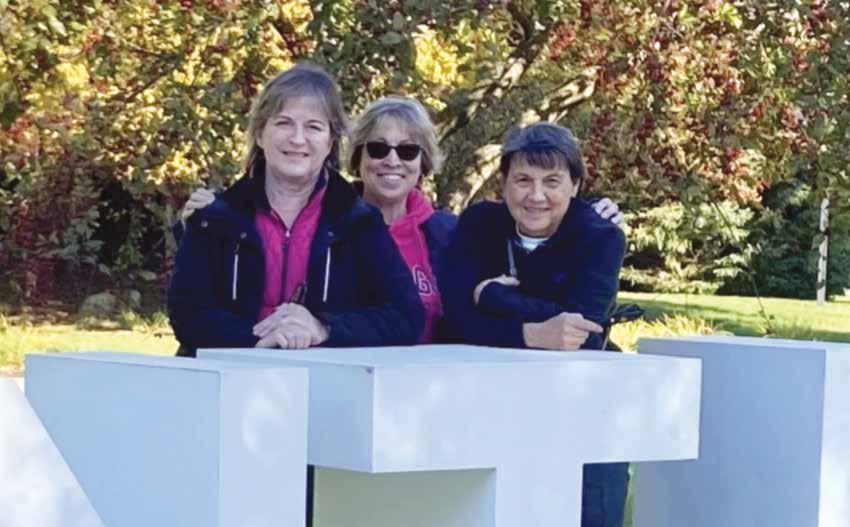
This is the story of some of those pioneering women at Saint Mary’s: Bruna Bucciarelli B’76 (basketball, cross country, and volleyball), Jane
(Troller) Wood B’78 (softball and volleyball), and Marge Nabzdyk ’79 (softball and volleyball).
Although Title IX — which prohibited sexbased discrimination in any education program or activity receiving federal financial assistance — was signed into law in 1972, it took a while for things to run smoothly for female athletes at Saint Mary’s.
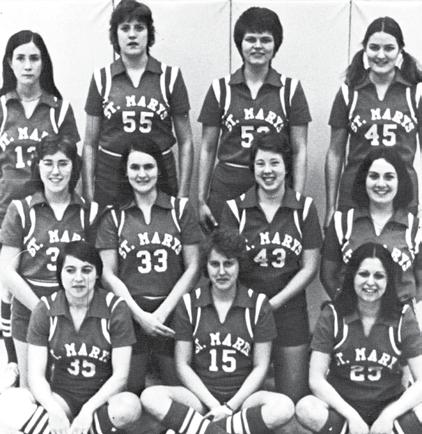
In 1974, Saint Mary’s first sport, women’s basketball, began a year after Bucciarelli transferred in. The team was coached by two seniors from cross-town Winona State. “It was very grassroots,” she admits. “They were basically our age. We didn’t realize it, because we didn’t make that connection.”
Just being part of the team helped Bucciarelli assimilate to her new school. “I think what it did was make you feel part of a group. You only
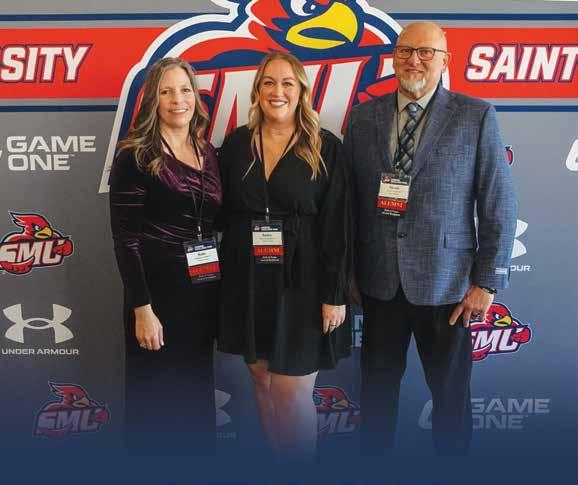
Jane (Troller) Wood B’78, Marge Nabzdyk ’79 and Bruna Bucciarelli B’76
hung out with certain people in class or in your dorm, so your social group was small. On a team, you were one. You played together as a team and you felt part of a greater community.
“That’s how I started feeling part of Saint Mary’s.”
Bucciarelli believes cross country was just a club in 1973 when she transferred in. “I asked Dr. Richard Jarvinen, ‘Can I run with you guys?’ And he was so accepting and just allowed me to be a part of the whole group. There weren’t many women, so I had to run with the guys. I did not win at any of the races, just in case you were wondering,” she said with a laugh.
By 1974, Wood also came to Saint Mary’s. As a student, she was named manager and trainer of the women’s basketball team. She learned to tape shin splints, but had no other official training. By 1975, when volleyball began, her qualifications earned her a spot as the trainer for that sport as well.
Also in 1975, women’s tennis and softball teams were formed. Gail James — described as a “short fireplug who didn’t take crap” — was hired to coordinate Title IX so Saint Mary’s was in compliance with legislation regarding scheduling practice times, locker rooms, facilities, etc.
“She fought very hard for our teams, including helping women’s sports to be noticed
and respected at Saint Mary’s,” Nabzdyk said, explaining that the women had to share spaces for practice with the men, including the gymnasium. “The guys thought it was really funny that we were assigned from 5:30-7 a.m. But we got up and did our thing for two weeks until Gail went to the men’s coach and said, ‘For the next two weeks, you have the gym at 5:30 and (the women) will have it in the afternoon.’ The guys didn’t think it was quite so funny anymore.”
That first year, tennis was coached by the men’s hockey coach, and volleyball was coached by a man who wore cowboy boots to practices and had never coached before. As a man who had played a sport, Bucciarelli said he was likely considered qualified back then. Wood and Bucciarelli were on that first team and remember they weren’t very good. But back then, it wasn’t as much about winning as having the opportunity to play.
“There was really nothing for women to do at Saint Mary’s, so having this opportunity kind of opened up our world,” Bucciarelli said. “The women at Saint Mary’s were hungry to do something as opposed to just going out on Saturday night.”
Wood explains that in the ’70s, the drinking age was 19, so the bar scene or keggers were popular on weekends, but they wanted something more. “Sports were another avenue for us to grow,” she said. “It was just exciting to be part of it, but a lot of the excitement was for us. It’s not like now where students are so used to having access to sports in high school, being good, and maybe even getting scholarships. We were just happy to be playing.”
In 1975 and the subsequent years, women’s softball was coached by Ken Wiltgen. Wood played, and Nabzdyk became the pitcher when she arrived at Saint Mary’s in 1975 (and she also played volleyball). Her qualifications, Nabzdyk said, were that she’d played powderpuff softball without a mitt in high school, but she had a glove and said she’d give it a whirl. “The coach asked if anyone could get a ball over the plate, and I told them, ‘I can get it over, but it’s going
We were starting from scratch. Most of us were new to sports. We were learning new skills, but it was exciting and something new, and we got to participate.
Jane (Troller) Wood B’78
The second, 1975 women’s basketball team, featuring Bruna Buccarelli B’76 as No. 35, front left.
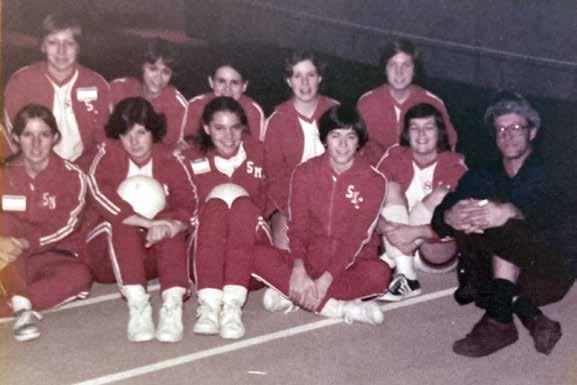
The second, 1976 volleyball team at Saint Mary’s included, from left, front: Dr. Deborah “Debbie” Haas B’79, Retsey (Ronk) Anderson B’80, Susan (Kauth) Ruen ’80, Jane (Troller) Wood B’78, Patricia (Berges) Karnick B’79, and Coach Jeffrey Kohner B’57; second row, Susan (Ruszkowski) Wilson B’79, Debra “Debbie” (Moore) Kummer B’80, Karen M. Oaster B’77, Mary Beth (O’Loughlin) Husfield B’80, and Margaret “Marge” Nabzdyk ’79.
to have an arc on it,’ and he said, ‘You’re up.’ Whenever someone would step up to the plate, they’d smack the heck out of it because it came in slower than molasses.”
Nabzdyk’s work-study duties were to wash uniforms, carry around equipment, and make sure everything was in place for games. “We did whatever we had to do to make our team happen,” she said. “Jane was the recruiter, when she would bring people in (to visit campus through admissions through her work-study position), she would ask, ‘Do you play volleyball or softball? Would you be interested in being on our women’s teams?’”
“We got to play our games on the guys’ practice field with a portable backstop and Marge and I chalking the lines,” Wood added. “We were starting from scratch. Most of us were new to sports. We were learning new skills, but it was exciting and something new, and we got to participate.”
Bucciarelli was inducted into the Sports Hall of Fame in 2023 for her pioneering work in those early years for women, but she wants to share the spotlight with Wood and Nabzdyk, and others, without whom women’s athletics wouldn’t be where it is today. She hopes one day this group will be recognized for their work in some way.
“I don’t feel like I did anything out of the ordinary back then. Only now I’m realizing what we did for Saint Mary’s,” Nabzdyk said. “We just went about our business to get the job done. Now we are realizing the impact we had on women’s sports.”
Wood added, “It contributed to our resiliency. You just had to keep going. Some of the young ladies must think, ‘How could you put up with that?’ We didn’t know any different, so we just kept going forward. It was a door being opened to us.”
The best part of those years for all three is the camaraderie — in short, each other. All three, living in different states, get together regularly and connect with other teammates.
“It solidified our relationship,” Bucciarelli said, adding, “It gave you confidence to learn new skills. And when we traveled to different places, our world expanded. It was those first steps to seeing the world in a bigger view.
“What helped me was the positive, reinforcing feelings that the Saint Mary’s community gave us. It just created a feeling that I was doing something good for me, but also good for the community and something to make people happy.”
Lettner grateful for alumnae whose tenacity benefited future athletes
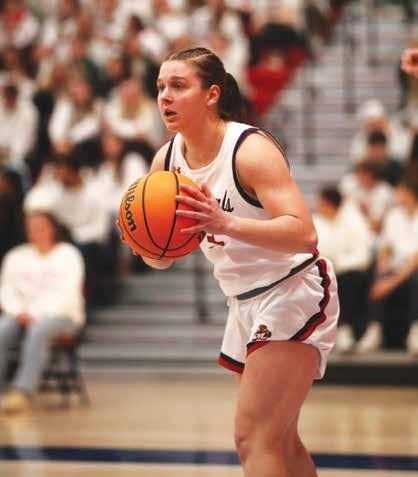
Lindsey Lettner B’26, an accounting and business intelligence major, graduated in May. With much to look back on during her college career, her basketball team winning the first MIAC playoff game in the quarterfinals is at the top of her list. Though they lost in the semifinals, they received an at-large NCAA bid because of their record and competition. Though they lost in the first round, they’re all memories she wouldn’t trade.
Lettner transferred to Saint Mary’s during her sophomore year, largely because of the strength of the accounting department, the community atmosphere, and because her brother also attended. But she said the fact that Saint Mary’s was closer to home was also a draw, because she knew her family could more easily support her at basketball games.
Her team was also the first to play in the new David R. Thies B’59 Arena. “We’re super grateful for David Thies to have donated that to us,” she said. “It really helps with the recruiting process, showing we have these nice facilities, but it’s also nice for the fans to enjoy their experience.”
If Lettner were to meet the “first women” in athletics, she said, she’d begin with a thank you. “They’re the women who came before us and paved the way to do what we love now. A lot of people don’t get the opportunity to play in college,” she said. “It’s a huge support system, having a group of teammates. It’s special that they set the tone for college athletics now. I know they faced more hardships than we did. I think the fact that they were able to get through all the adversity has benefited so many women like myself.”
Athletics, she said, has played a huge role in shaping her as a person. “I’m definitely known to be a hard worker among my peers,” she said. “Having athletics allows me to set goals for myself. It also helps with time management. Athletics makes me a well-rounded, hard
worker. It helped me when it came to the interview process. It shows your dedication to balance both your school work and athletics. It indicates that you can take that into your career after college, that you will put extra effort in and go above and beyond.”
Half a century later, the answer to the best part of being in athletics hasn’t changed. “I’d say definitely the team is the best part,” Lettner said, recalling fondly the bus rides after away games after a big win or the team dinners and activities. “Obviously you love your sport, but you become a family that you can depend on.
“The community was another big part of what I loved here. That last game, having students come out and support you makes it even more special,” she added. “Professors were also at every single home game. They’re always emailing after the game or mentioning it in class. It makes it special that everyone wants the best for each other, having that support system and love.”
Lindsey Lettner B’26 was part of the women’s basketball team, which hosted and won a first round MIAC playoff game this year.
How it hasn’t changed is the concern for the students.
That’s what the Christian Brothers are all about — an education of all people, of all economic backgrounds.
That’s still the No. 1 driving motive of Saint Mary’s, and I don’t think that’s changed at all.
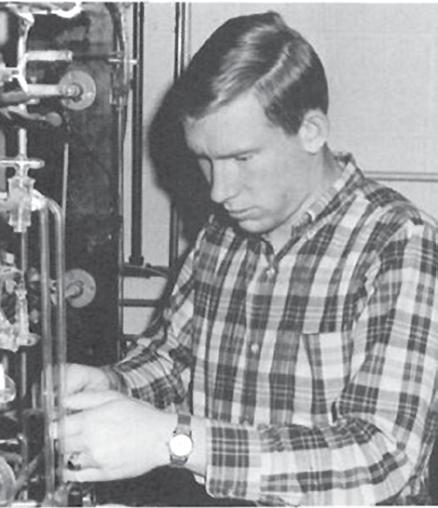
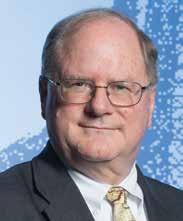
Michael Dooley B’66
Through the decades
Though much has changed, heart stays the same
Alumni ranging from the classes of 1966 to 2026 discussed the many ways Saint Mary’s has changed through the decades: from payphones to cell phones, group televisions to one in every room, and curfews — to lifelong friendships, transformational faculty and education, and the community feel that keeps them connected. Reminisce through their stories about all the ways this university has changed and, more importantly, the ways it hasn’t.
Choosing schools
Michael Dooley B’66 and Roger Haydock B’67, J.D. said they never visited Saint Mary’s Winona Campus prior to their arrivals as freshmen. But that wasn’t unusual back then.
Dooley said he doesn’t remember having any other choice of schools. As he attended a high school affiliated with the Christian Brothers, the continuation to Saint Mary’s (or another Christian Brother college) was more than encouraged. “I remember quite a few from my high school, 12 or 13, came to Saint Mary’s. I never stepped foot on campus until I got here.”
Haydock chose Saint Mary’s because he knew others who were attending. “I was attending Archbishop Quigley Preparatory Seminary in Chicago along with Robert Wheeler B’67. In April of our senior year, we decided not to continue on to minor seminary.
“Minnesota was the land of sky blue waters and a lovely place for a kid from Chicago. And Winona with the river and its bluffs was picturesque — as was the campus. I had just looked at pictures; I didn’t visit it, but Bob and I agreed to become roommates. I had a cousin going to Saint Mary’s as well, and I knew some other people. I have no recollection of looking elsewhere. There were no college trips or
anything back then; the first time I saw campus was when my parents slowed the car down. I got out with a big suitcase, and they left,” he said with a laugh. “I wanted to go to a smaller, Catholic university, and it just fit.”
By the time Joseph “Joe” Sweeney B’81 chose Saint Mary’s, there were more options, and he was able to visit and decide if Saint Mary’s was a good fit. It came down to one important difference between schools. “I was in my senior year of high school, and I was leaving the house to go to a party one night when my mother said, ‘Joe, you need to pick a college for next year.’ She had every college correspondence we’d received in the mail sitting on the table. I went through it all, and the correspondence from Saint Mary’s was the only one with a letter signed in ink by Dr. John Johnson.” Based on that, he and his family toured the Winona Campus. “I’m an outdoorsman, I love to trout fish, ski, and be outdoors. All that was available. Saint Mary’s was a good fit for me.”
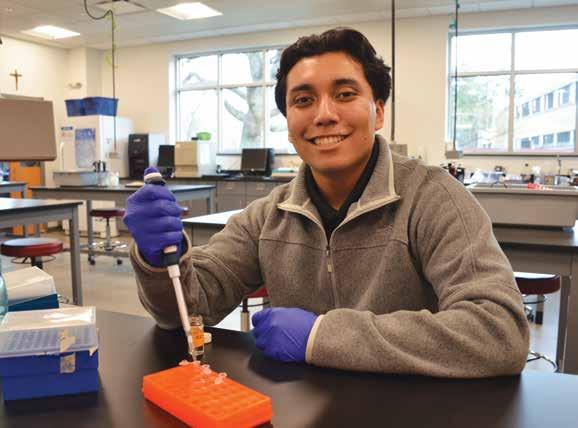
Javier Rodriguez Cifuentes B’26 doesn’t exactly fit the mold of most university students who visit an average of 10 schools (looking for whether it’s a good fit, fun, and have the majors they’re looking to study) before choosing one. Cifuentes transferred into Saint Mary’s during his sophomore year after receiving his associate’s degree. He never visited campus prior to orientation day, but he did his research.
“I was doing my own research to uncover what schools offered the opportunity to learn in a P.A. (physician assistant) program, and then it came down to financial aid and which schools would help me be able to achieve that goal realistically without going into a large amount of debt,” he said. “I knew about Saint Mary’s physician assistant program. I knew their education had a good reputation.”
For Cifuentes, his main focus was on academics. “I figured wherever I go, I’ll make it work. I’m pretty good at jumping into opportunities,” he said. “I got really lucky that Saint Mary’s has a lot of opportunities.”
Academics and the De La Salle Christian Brothers
Ignited by Sputnik, the first artificial satellite, Dooley chose to major in chemistry and minor in math.
Haydock’s degree was in social science, with a minor in English. He left Saint Mary’s during his junior year to attend law school. “All my roommates at Saint Mary’s all became lawyers, and my best friends that I hung around with went to law school as well, so there was something in the air. Back then, if you wanted to be a professional, you could be a doctor, but I wasn’t going to be a doctor. I received a ‘C’ in Biology from Brother Charles (Severin,
FSC, Ph.D.) and knew that was the end of my medical career,” he said with a laugh. “So, for me it was either be a lawyer or a CPA, and I was not fond of numbers.”
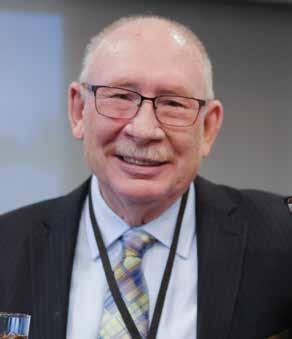
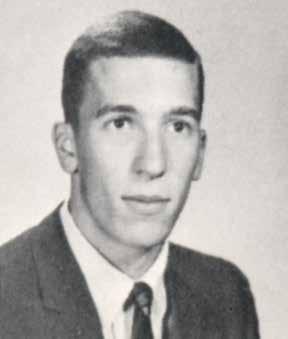
Sweeney majored in psychology and remembers his thesis and his internship. “My (high school academic grades) were pretty good, but I was challenged at Saint Mary’s. I graduated with a ‘B’ average and it’s benefited me for the rest of my life and career,” he said.
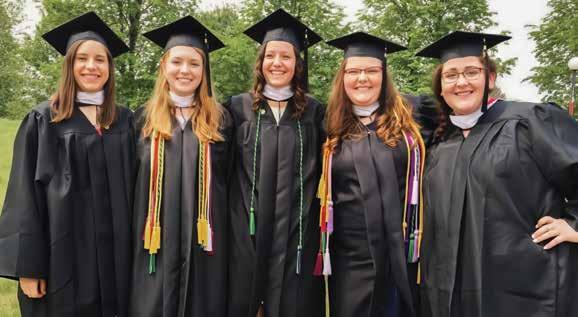
Cifuentes walked the commencement stage in May 2026 after majoring in biology with a focus on pre-physician assistant studies. Next, he will attend Northwestern College to earn a Master of Science in Physician Assistant Studies. “I feel like Saint Mary’s prepared me mentally for this challenge,” he said. “I wrote in my commencement speech that our time here has shown us we can fail a test but then learn from it and grow and say, ‘I will try again.’ It makes me feel confident that even if I don’t
Michael Dooley B’66
know the answer, I’ll be able to learn it, because of what I’ve done here.”
De La Salle Christian Brothers
All of them cite the Brothers as being instrumental in their education. Though their numbers have declined significantly throughout the decades, the Brothers continue to have a large influence on students and their development.
“Not to say the lay teachers weren’t great, but the Brothers were exceptional. Brother L. Michael Kump, FSC B’36 taught English composition,” Dooley said. “What I learned with them carried me through my whole life.
Brother Hermes Ebner, FSC taught logic. Dr. Earnest Kaufman, FSC was excellent. Then there were the Brothers who didn’t teach me but taught me about life, like Brother Frank Walsh, dean of men, in that regard. A lot of people respected him, and he had a big impact on many of my fellow alumni. Brother Raymond Long, FSC B’43 — same thing.”
Haydock remembers many memorable Christian Brothers, starting with Brother Raphael Erler, FSC. “He taught me how to write, literally, and I owe him my writing career. I have
co-authored and published over 120 law book editions for students and lawyers because of his influence. Brother J. Robert Lane, FSC, Ph.D., made history interesting, and Brother Frank Walsh, FSC, as dean of men, watched over us. They were bright and smart role models, with high standards and expectations. Saint Mary’s was a transformational time for me, and the Christian Brothers were the catalyst. We did our assignments because we believed it would make us more enlightened, but also because of the fear of not doing the work. Brother Hermes Ebner, FSC gave weekly quizzes, and we had a few minutes to answer the confounding question. Brother Raphael had each of us write a few paragraphs with several sentences, and he gave back a lengthy critique for each assignment.
“We had bed checks at night,” Haydock recalls. “Hall counselors came around with flashlights to check on us. For Sunday Mass, we dressed up in suit coat and tie. I didn’t feel regimented but comforted. The Christian Brothers shaped us into the men they hoped we’d become.”
Sweeney agrees. “Brother J. Raymond Long, FSC B’43 was a big influence on my life.
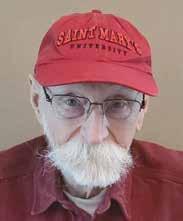
Roger Haydock
B’67, J.D.
He would encourage us to give speeches and be succinct in our messages; that’s a lifelong learning experience. Regarding my love of the outdoors, I remember Brother John Grover, FSC B’65 and Brother Finbar McMullen, FSC B’46. We went on canoe weekend campouts. And then Father Andrew Fabian’s logic class was memorable. People always tell the story of their first day of class and how we’d sit in a seat, not assigned, but he’d go down the roster and he’d look you right in the eye and acknowledge you like he recognized you. He challenged you to think critically and if you missed a class, he would come into the Pub in the evening and find you and tap you on the shoulder and say, ‘Mr. Sweeney, you were void in my life today.’
“I would say, to the Brothers’ credit, they looked out for you, and if you did miss a couple of classes, you were getting a phone call. You were not a number at Saint Mary’s; you were an individual. My son graduated in 2010, and there were Brothers who still looked out for the students. Even though their numbers have decreased, they still try to remain very much involved and have a presence on campus.”
Cifuentes said the times he spent with the Christian Brothers were some of the highlights
of his college career. “One of my favorite times is when we get to go and eat with the Brothers,” he said. “We often get invited to their home, meet them, and eat dinner with them. Brother Frank Carr, FSC B’66 always makes good food for Thanksgiving dinner. It’s interesting to listen to their history. They tell us what it was like when they were on campus.”
Buildings and facilities
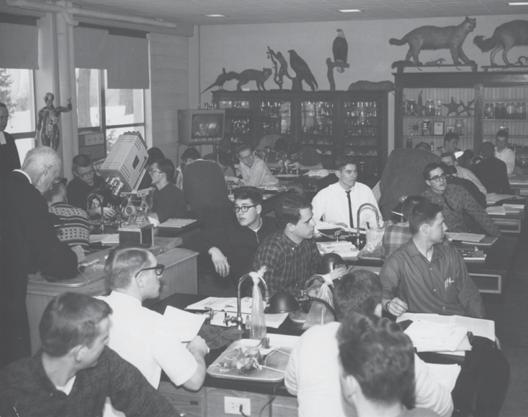
Dooley acknowledges science facilities have changed dramatically since he was a student, but says he thought they were more than adequate for the needs of the time. “We had all the labs and classroom space we needed,” he said. “We had nothing to compare it to.”
He recalls historic buildings, like the Barracks (where the Heffron parking lot is now located). “It’s hard to believe anyone would live there, but it was one of the most popular places on campus. They were World War II buildings like the Student Union, which was a military building, totally adequate for the time. The dorms today are astronomically superior to what we had back in my day, but again,
Joseph “Joe” Sweeney B’81
they felt fine at the time. We had to go down the hall for our shower and bath, and we were in a completely different situation than today.”
Beyond the former outdoor hockey rink on campus, Haydock commented on the big changes to residence hall rooms.
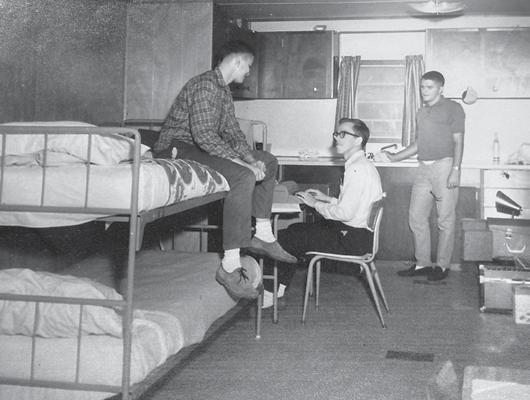
“Our rooms were small and sparse with bunk beds, which served us well as we were used to sharing small spaces. And there definitely were no ensuite bathrooms.”
Sweeney recalls living on the fourth floor of Saint Mary’s Hall, the “white house” by Damian Hall (which became Watters Hall), Saint Edward’s Hall (now green space), Cotter Hall (which burned down), and the Old Village (now largely community gardens and green space).
Though the Toner Student Center existed during his college years, Gostomski Fieldhouse was not yet built.
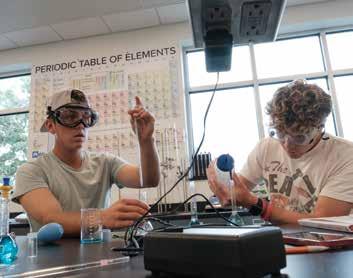
Cifuentes said he’s fortunate to have been able to study in the science building, Aquinas Hall. “The first time I saw Aquinas, I was
amazed at how new it looked,” he said, “The anatomy lab offered opportunities not offered by a lot of schools.”
As a resident assistant, he knows personally how great Saint Mary’s residence halls are. “Niche has ranked us No. 1 and No. 2 in the state for our dorms,” he said, adding that — beyond the updated spaces themselves — RAs work hard to create great environments and overall memorable experiences for students.
Extracurricular activities
All four alumni highlight how much students participate/participated in intramurals.
“Everybody played intramurals and Olympic Days. That was absolutely huge,” Dooley said. “It was very, very competitive. You wanted to be No. 1 in your division. We didn’t have a lot of varsity sports — baseball, basketball, and hockey are the ones I remember, but
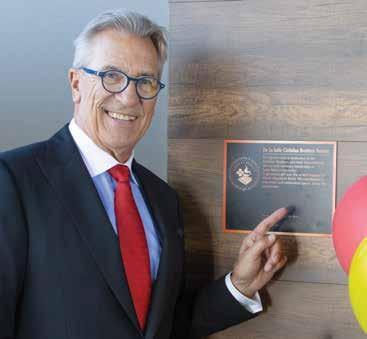
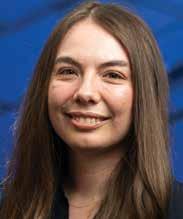
Javier Rodriguez Cifuentes B’26
intramurals were very competitive and very fun.”
Haydock said his claim to fame was earning the title of 1964 Saint Mary’s Shuffleboard Champion during the campus Winter Olympics.
Sweeney was on the intramural football team and remembers playing field hockey in the gym in Saint Joe’s. “A very high percentage of students participated in intramurals,” he said, “We’d support each other. The camaraderie was fantastic.”
Cifuentes says intramural sports are still very popular, but he didn’t find much time to play due to his other commitments. In addition to being a resident assistant, he volunteered at the Anthony ’59 and Sandra Adducci Family Makerspace and abroad, and served on the Student Senate for two years — first as a hall representative and then as vice president for campus affairs. He was also named Outstanding Senior this spring during Saint Mary’s Founders’ Day celebration.
His favorite activities have been The Perch and Plazapalooza, as well as Student Senate fundraising events and RA events. The LED sign of a Koi fish that he constructed in the Makerspace, he said, is a reminder of his favorite spot on campus.
Back in the ’60s, Saint Mary’s was still all male, so a popular extracurricular was the dances between Saint Mary’s men and College of Saint Teresa women across town.
“Clearly having females at Saint Mary’s was an excellent idea and certainly one of the major changes,” Dooley said, adding that he met his wife, Claudia (Drvota) CST’68, in college. At a Friday night sock hop in the gym, a friend told Dooley he was going to fix him up on Parent’s Weekend (one of the two days a year when women were allowed in the residence halls).
“I was studying at my desk when they arrived. There were five of them,” he recalls. “Lots of them came along to watch. But I didn’t ask the girl out that I was supposed to. I
didn’t know which one it was. I asked another one, Claudia. And 60 years later, here we are. Our first date was Oktoberfest in La Crosse. I kissed her on top of the Ferris wheel.”
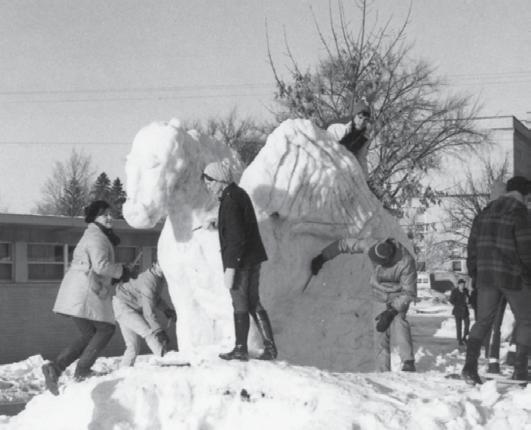
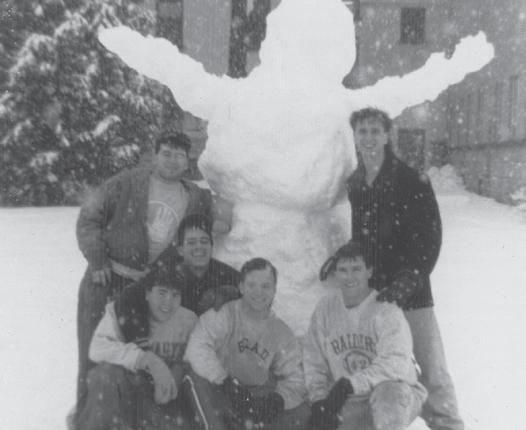
He also recalls some pretty heated snow sculpture contests. “Our hall, Aquinas (later Vlazny), built a Greek statue with speakers in it playing Greek music,” he said. “We used dump trucks to haul snow in. It was almost a full-time job. We worked on it at night for two weeks.”
Haydock remembers socializing at Holzinger Lodge and how those Saint Teresa mingler events paired up students pretty early in their college careers, leading to many marriages.
“Cars on campus weren’t allowed unless you had an exemption,” he said, which meant most students stayed around campus. He recalls having fun with Alpha Kappa Psi brothers (the business fraternity) and volunteering in the community.
Another of his claims to fame was starting the Troll newspaper with his roommate Thomas “Tom” Harvick B’67 their sophomore year. “We were co-editors, hand cranking our mimeo copies and placing them in the dorms. We were pretty proud of ourselves, but when we went to deliver the first few editions, the old editions were still there. Tom said we needed something to attract readers, and he came up with the idea of campus gossip. We recruited someone in every dorm, including Saint Teresa’s, to send us stories. We called it the ‘Hearsay’ column, and the paper took off. We also did interviews with the Brothers, administrators, and coaches. We added an ‘Opinion’ column so students could whine about something. We later had a faculty adviser assigned to try and monitor what we published. We never did get sued.”
The avid outdoorsman, Sweeney recalls canoeing and camping as a student, and the opportunity students had to learn about grilling from professors.
The small size allows us to form deeper relationships with our professors. We have the chance to talk with people who are experts in their fields, who talk to us individually.
Javier Rodriguez Cifuentes
B’26
Different, but the same
Dooley has stayed close to the university, serving as a Trustee, helping with Centennial, as a faithful benefactor, and in many other ways.
“How it hasn’t changed is the concern for the students,” he said. “That’s what the Christian Brothers are all about — an education of all people, of all economic backgrounds. That’s still the No. 1 driving motive of Saint Mary’s, and I don’t think that’s changed at all. If you go to Saint Mary’s, you’re going there because of the tremendous camaraderie that goes on on a campus of that size. You can learn so much more in a small university, for example leadership skills.
“The graduate campus is a whole different subject, and that has grown tremendously. Back in my day, you would never talk about academics and a job. That’s not the way it was thought of. Today it’s the opposite — you need to have majors that will lead to a job.”
He adds, “Alumni are still very loyal and proud they attended the school. We’ve gone
through some tough times of late, but we’re not alone in that.”
Haydock, who has served as a trustee and an adjunct faculty, adds, “It’s changed because society has, and the Saint Mary’s community reflects those changes. Its mission and character has stayed the same: preparing students to become virtuous leaders serving the community. The lay faculty embodies the Lasallian heritage and continues with the Brothers this grand educational work.
“Those of us who have stayed close feel beholden to the transformational experience we had. I tell my grandkids, ‘Make college last forever, because you’ll never have that time again.’
”
Sweeney, who worked at Saint Mary’s in development from 2007-2015, first as vice president and then director of major gifts, continues to stay active with his alma mater as well, particularly with his class, which celebrated their 45th at this year’s reunion.
“My time at Saint Mary’s is treasured, and because of it I have lifelong friends,” he said, stressing the connections built at Saint Mary’s.
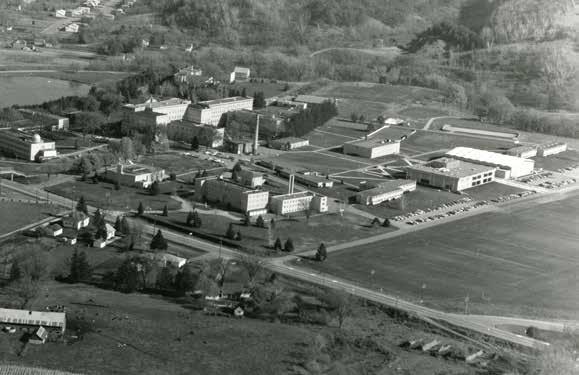
Saint Mary’s campus aerial photo from the 1970s
“During my time there, endowments were increased and the science building was built. I met with people who truly believed in Saint Mary’s and what the Christian Brothers were about.
“Academically, the institution has refined their focus so they can continue to support their academics budget-wise and draw students to the university who have an interest in those majors. I’m a believer that institutions, especially four-year colleges the size of Saint Mary’s have to adjust in today’s world. They have to meet the interests of incoming students. A lot of fine arts programs are no longer majors, although they are still present. Change is necessary for institutions to survive financially and to grow in their expertise of what they’re offering.
“Saint Mary’s is a university, and back then it was a college. Today they have doctoral programs, programs for training nurses, and growth of online programs. I hope it continues to remain strong so the institution remains for many many years to come.”
Cifuentes can’t speak to how Saint Mary’s has changed, but he believes the close relationships, caring faculty, and Lasallian influence make Saint Mary’s special.
“The small size allows us to form deeper relationships with our professors,” he said. “We have the chance to talk with people who are experts in their fields, who talk to us individually. If I were talking to people looking for a college to go to, that’s what I would advertise the most.”
He also reflects on benefactors who have so generously helped the university meet the needs of its students. “They loved this campus so much. Sophomore year, I realized how many buildings and spaces here were built through donations. I thought, ‘They must have loved their time here. Will I feel that way when I’m done?’ Now I understand; this is a good space for you to make lifetime memories, and a lot of that is due to the donors who walked so we can run. I feel blessed that they cared so much. I’m happy to contribute however I can to show my thanks.”
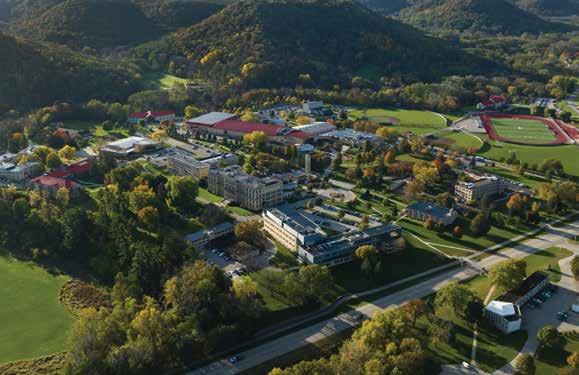
Most recent aerial photo of Saint Mary’s Winona Campus
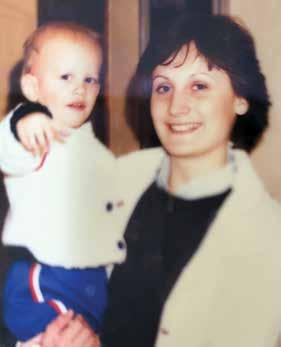
Janet Byrnes M’85 with her son, Nathan, who was just 6 months old when she started her graduate program at Saint Mary’s Byrnes at her retirement from Lyngblomsten Care Center a year ago
Graduate programs expand and grow Programs
adapt to needs of adult learners
Janet Byrnes earned her Master’s in Health and Human Services Administration in 1985. Her first courses were held at what is now M Health Fairview St. John’s Hospital and, about halfway through, she transferred to Saint Mary’s newly established graduate campus in Minneapolis.
Nearly 40 years later, in 2024, Melissa Markfort received her MBA from Saint Mary’s by attending online courses.
Though the method of learning and timeframe was very different for these alumnae, they share similar stories and experiences.
Janet Byrnes M’85
Janet Byrnes had just earned her undergraduate degree and was having trouble finding a full-time job. “I was working with my husband at an orthopedic clinic part time, doing cleaning,” she said. “One of the doctors there told me about the (Saint Mary’s) program, and I thought it was interesting. I thought I might as well go back to school.”
An undergraduate psychology major, she originally wanted to go into therapy; she thought a degree in health and human services was a nice blend of her interests and would help her work toward a future in administration.
She doesn’t recall many details about what it was like learning on a new campus that was transitioning and growing around her. For Byrnes, the intimate classroom experience is what she remembers the most.
“I attended classes one full Saturday or two a month and one evening a week, so it fit well,” she recalls. “At that time I had a new baby too. I had no complaints about the whole process. It was very positive and welcoming.” As the youngest in her cohort, Byrnes
recalls being one of the few who finished on schedule, which was a morale boost.
“Because I was so fresh out of school, it was all eye opening. I loved the fact that instructors were all working in the field,” she added. “I still remember them so fondly. I would love to connect with some of the people from my cohort. It gave me a really good foundation of information, and sometimes it just helps to have that additional M.A. after your name.”
After graduation, Byrnes, who lives in Brooklyn Park, landed a full-time job for six months at a long-term care facility and held her next one for 39 years at Lyngblomsten Care Center. She began as a laundry supervisor and worked her way up the ladder to become the assistant living director and assistant administrator — before retiring a year ago. “I didn’t necessarily need my advanced degree, but having it gave me more credibility, and I certainly got good information,” she said. “I remember some very key things that have carried me all the way through. I was able to obtain my LALD (License for Assisted Living Director) and LNHA (Licensed Nursing Home Administrator) with only a few more classes because of the classes I took at Saint Mary’s.”
Melissa Markfort M’24
As a result of COVID, Melissa Markfort — and countless others — began thinking about getting an advanced degree in their newfound free time at home.
“The idea of it was always there, but the timing was never right,” she said. “But with COVID, we had this time on our hands, and I heard lots of people were going back. I still sat with it for about a year. I thought about where I was in my life in terms of my life, career,
and family and thought, ‘Things will only continue to get more intense. If I wait for the right time, it will never get here.’ I had to build in some disciplines and guardrails to protect me from myself and help me reach my goal.”
When she started researching MBA programs, she discovered she knew a lot of alumni from Saint Mary’s. “When I started diving into research, it was very important to me that the institution have a diverse student work force and a proven track record in honoring flexible learning, knowing it was something I would absolutely need,” she said.
A wife and mother of two (in elementary and middle school) living in Robbinsdale, Minn., Markfort was in her late 30s and was also working full time. She knew online courses were the perfect way to help her reach her goals. Still, she got up at 4:30 a.m. to get her classwork done.
“But I didn’t stop living,” she said. “I didn’t stop showing up in these spaces. I would take group calls from hockey tournaments and write my organizational leadership papers while sitting on a cruise ship west of Cabo. It was about the balance of all of it.
“I ended up being able to pace myself,” she added. “What I appreciated the most was being able to reflect on what went well and didn’t go well each semester and carve out small changes.” One particular summer, there was so much going on in her personal life, she took a 1 credit course that spanned 16 weeks, so she could stay engaged and in student mode but still balance her life.
She also appreciated that what she was experiencing professionally and what she was learning overlapped. “I would immediately turn around and apply what
What started as one building grew into a campus in Minneapolis.
The fact that I pivoted in my career toward a place where I feel like I’m part of something bigger is such a huge gift. It was this reckoning that the degree did for me.
Melissa Markfort M’24
Melissa Markfort
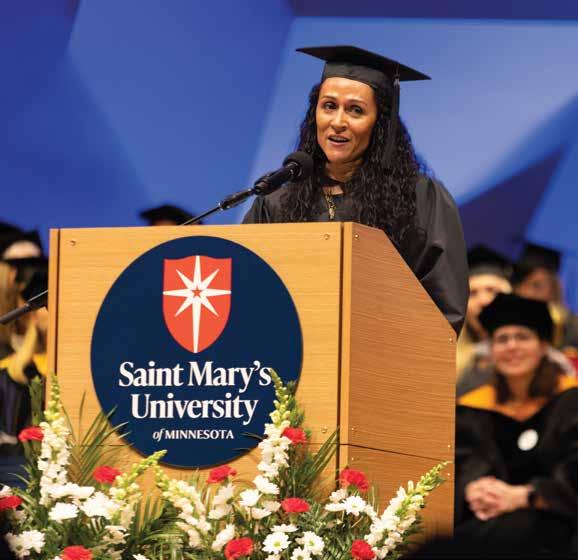
M’24 spoke at her commencement program in 2024.
I was learning into everyday practice,” she said. It even changed not only the trajectory of her career, but also her career itself.
She describes one of her courses as rocking her to her core. “In my previous for-profit organization, I was offered a VP position, and I ended up turning it down because I realized that being intrinsically tied to the work I was doing was something that really mattered to me. A year from finishing my degree, I paused to think about what I actually wanted to do with it. I ended up looking for mission-driven organizations as contenders for future employment.”
She found Children’s Minnesota — Minneapolis Hospital, and six months from graduating with her MBA, she was promoted to her dream job as director of employed provider practice.
“This is my favorite job ever. I get to partner with hospital chiefs and leaders. In my portfolio, I have 625 physicians and advanced practice providers who are impacted by my work,” she said, explaining that she deals with provider experience, governance structure, improvements, and other crucial areas in which she helps them have a voice at the table. “It’s a really rewarding gig. I report to the CEO. They look to me when navigating important and critical workforce cultural crossroads. I’m advancing work that defines who we want to be in the future.
“The fact that I pivoted in my career toward a place where I feel like I’m part of something bigger is such a huge gift,” she added. “It was this reckoning that the degree did for me.”
From unsure to self-assured
Saint Mary’s helps Shelton-Davies transform
Hannah (Friedrich) Shelton-Davies B’16, M’20 communicates for a living; in fact, her entire job is about meeting new people and building relationships. You’d never know the outgoing fundraising professional was a self-proclaimed introvert in high school.
She has found that life has led her in paths she didn’t necessarily plan, but it’s all about being open to the journey.
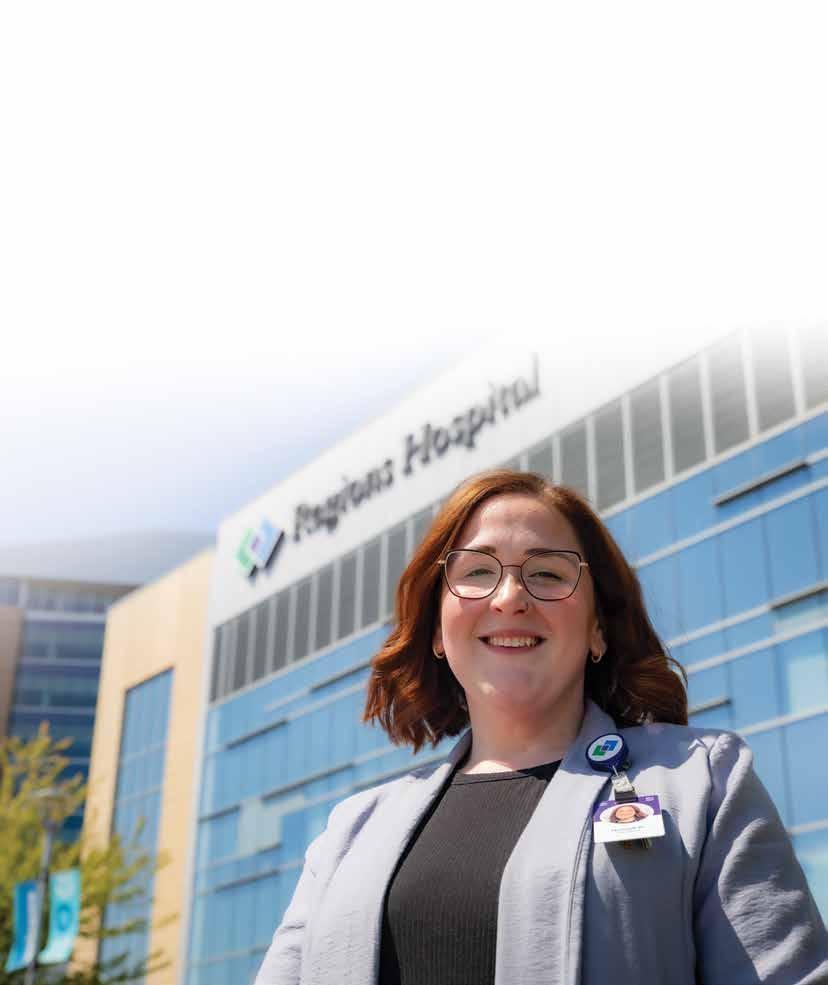
Hannah (Friedrich) Shelton-Davies B’16, M’20 said she was an introvert before attending Saint Mary’s. Now, as a major gift officer at Regions Hospital Foundation in Saint Paul (also as the current president of the Alumni Association), she uses her people skills to build relationships.
Back in high school, she didn’t know she wanted to attend Saint Mary’s until a friend asked Shelton-Davies to help her move onto its Winona Campus.
“Saint Mary’s wasn’t on my radar at all,” she admitted. “But I saw how beautiful it was, and I did a tour, and something about it really clicked. It felt right, and that’s what you hear most people say that something about it just
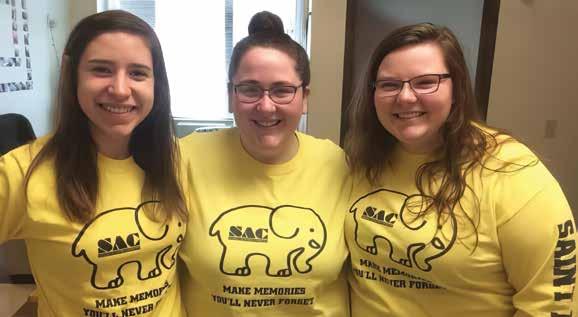
Shelton-Davies (center) with two fellow SAC friends, Catherine (Burgraff) Bassett B’16 and Kiya Virgin B’16, M’19, in college.
felt like home. The campus atmosphere is very comforting.”
Shelton-Davies also didn’t know what area of study to focus on, but she found both her voice at Saint Mary’s and her majors, choosing mass communication and public relations.
“I loved college. High school wasn’t my jam, but I always say I thrived in college. I always think it was because I was at Saint Mary’s,” she said. Shelton-Davies got involved right away her first year in student activities and in Campus Ministry. “SAC (the Student Activities Committee) helped me get to know people from all different grade levels and all different areas of study. I enjoyed the camaraderie that the group was able to build. I was able to grow. I ended up being president at one point and joined the Student Senate. It kept me very busy.”
Shelton-Davies said that forcing herself to be involved really helped her grow her communication skills and build community, and she appreciates the many opportunities she had at Saint Mary’s.
After graduation, she began working at a nonprofit as an office manager, which involved wearing a number of hats, including fundraising, and Shelton-Davies found herself back at Saint Mary’s for a second degree, this
time in Philanthropy and Development (P and D).
“I was looking at advancing my education, and I knew at some point I wanted to get a master’s, but I didn’t know what that was,” she said. A colleague had a relative who attended the P and D program at Saint Mary’s and spoke well of the experience, and then SheltonDavies moved into an advancement role at Mayo Clinic. “A lot of people there had gone through the program at Saint Mary’s as well. It was a natural next step in learning more about fundraising,” she said. “I knew the caliber of the professionals that Saint Mary’s is able to acquire for professors. The P and D program has a great reputation in the fundraising industry, and there’s a great reason for it.”
In her current role as a major gift officer at Regions Hospital Foundation in Saint Paul for the past three years, Shelton-Davies said she gets to work with grateful patients who had a good experience and want to give back. She is focused on relationships with donors and grateful patients at Regions Hospital. “It’s very rewarding when you hear positive stories and amazing outcomes from people who had intense medical situations which we often hear with a level 1 trauma center, and our burn center is doing phenomenal things. These are
cool stories that I get to be a part of, and that’s wonderful.”
Shelton-Davies admits she didn’t set out to be a fundraiser.
“No one grows up saying they want to be a fundraiser. No little kids say that, but I fell in love with it,” she said, adding, ”It’s relationship building. It’s listening to people’s stories and giving them the opportunity to make a difference somewhere and telling them the needs of the hospital.”
By serving on the alumni board, SheltonDavies is giving back to her alma mater, and she’s sharing the talents she’s acquired since graduating. She has recently taken over as president.
“When I got the call that they had reviewed my application to join, I confess I couldn’t remember filling out the application, but I must have filled it out at some point,” she said with a laugh. “I love being a part of the alumni board. It allows me to be more engaged with Saint Mary’s. I think this gives me a way to use my voice to give feedback and allows a little bit of buy-in to say I’m still invested. While I can’t give financially to a significant degree, I can give my time and my talent, and that’s by giving suggestions for fundraising, sharing my leadership knowledge and skillset of being on
a board. Also being one of the youngest board members, I bring that perspective to the table.
“I have the most recent experience with the campus as it is right now,” she said. “I find the meetings enriching, because I love hearing the stories of how it used to be back in the day. It sounds like a rip-roaring time. It’s also a cool way to build connections with alumni I never would have met otherwise.
“I speak to challenges the campus might be facing,” she added, adding that she feels it’s important to bring different perspectives to the table. “I stay engaged with Saint Mary’s because of the Lasallian aspect. What Lasallians believe in is, for me, what being a human is, and what life is all about. For me, it is about leading ethical lives of service and leadership.” SheltonDavies believes everyone can believe in the Lasallian mission.
“I’m invested because I love giving back to a place that changed me so tremendously. I built my closest friendships there … I got both degrees from there. I learned a lot from all my professors. I believe in the Lasallian tradition. That is truly what it means to be a good person in the world.”
(right) with friends at commencement, says Saint Mary’s is where she thrived.
her are,
Shelton-Davies
Joining
from left: Catherine (Burgraff) Bassett B’16; Jessica (Bjick) Lee B’16; Katie (LeTourneau) Harding B’16, M’21; and Kiya Virgin B’16, M’19.
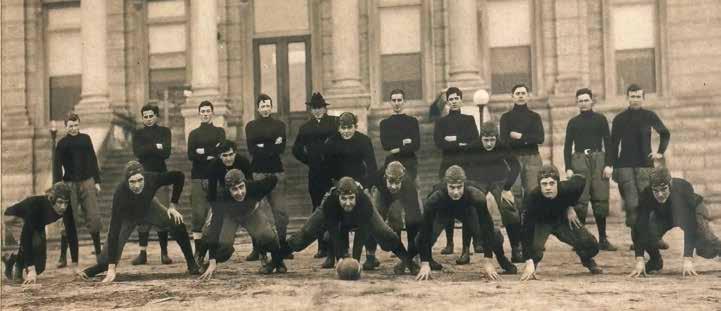
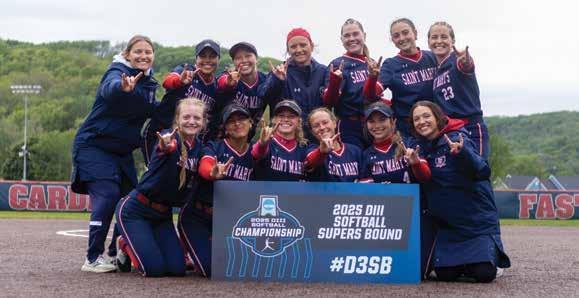
Saint Mary’s football team in the university’s early years and the 2025 Cardinal Fastpitch Softball team, which made it to the World Series (as did this year’s team).
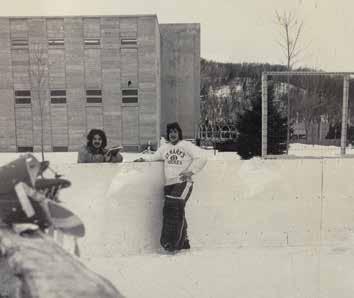
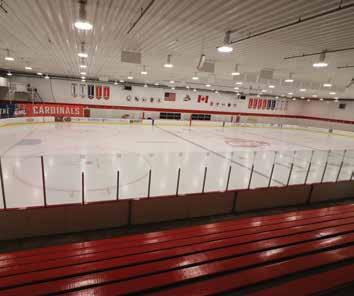
The university’s first hockey team practiced and competed in an outdoor rink. The current hockey rink features more practical amenities.
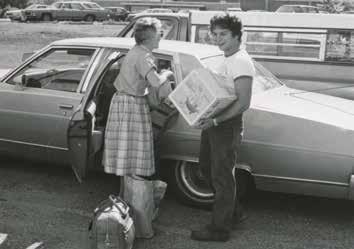
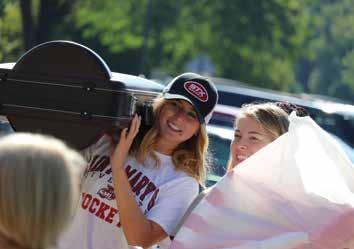
Move-in Day may look a little different, but parents are still packing their cars full of dorm essentials. But the large popcorn makers from this undated photo are gone and replaced with microwaveable popcorn bags. Also, now, as in this 2019 photo, Saint
help first-year students move in.
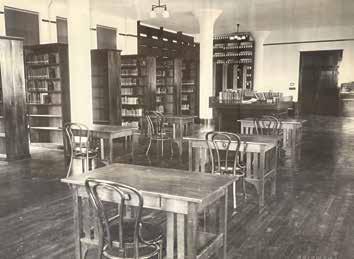
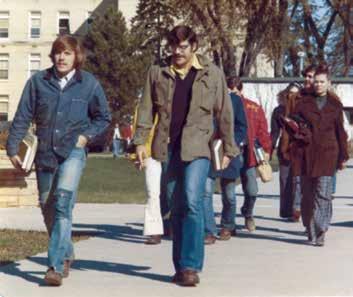
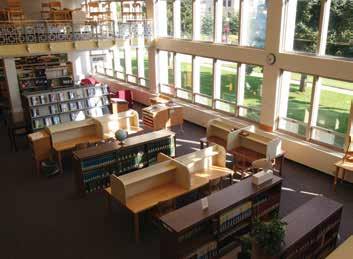
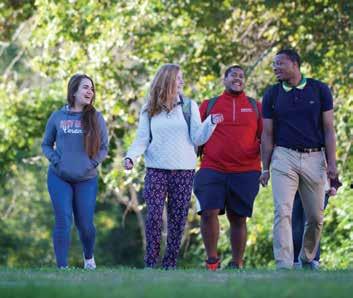
Above: An old, undated library photo compared to a recent one. Below: Students walking on campus and enjoying each others’ company hasn’t changed through the years; take a look at this photo, possibly from the 1970s, compared to a photo from 2016.
Mary’s athletes
be
Above: Residence Halls have greatly evolved in these three photos. Take a look at what we estimate to
the 1950s or ’60s, 1980s or ’90s, and 2016. Below: Snow sculpture competitions were huge and highly competitive in Saint Mary’s earlier years, but students throughout the decades have had fun creating snowmen on campus.
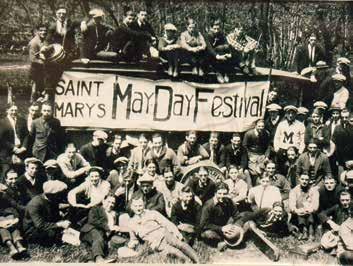
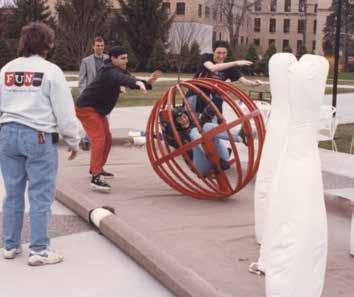
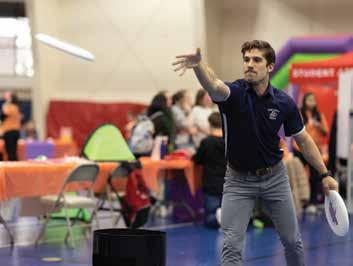
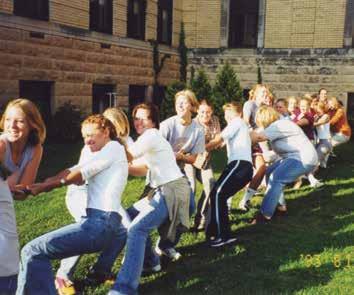
Student activities have always been important on the Winona Campus. From early May Day Festivals (top left) and dances with the College of Saint Teresa in the ’40s, ’50s, and ’60s, to human bowling and tug of war in the ’80s and ’90s, and the more recent Plaza Palooza in 2022 (top right) and student activities fair in 2020.
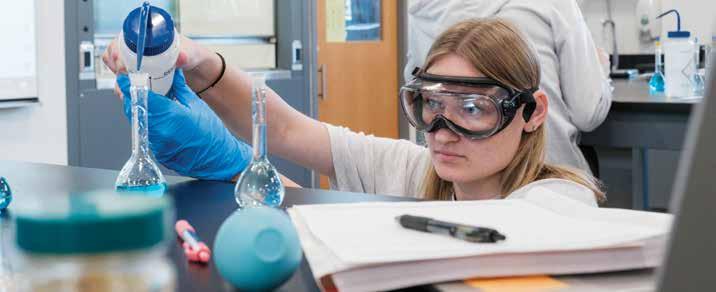
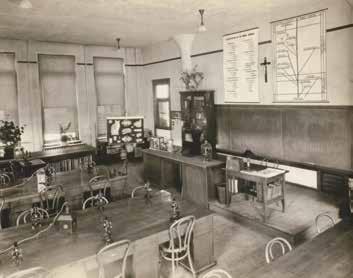
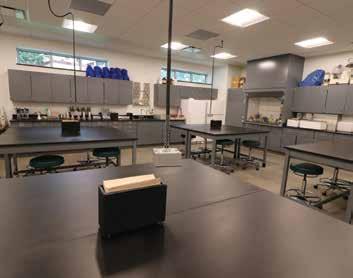
The sciences have always had a strong reputation for excellence at Saint Mary’s, and Brother Charles Severin, FSC (teaching, top left) was a legendary educator. Science facilities of the past, bottom left, are no longer recognizable. Labs in the current science building, Aquinas Hall, are featured top right, center, and bottom right — locations where new generations are learning to become the top in their fields.
Saint Mary’s surpasses $5 million matching gift challenge
Following the announcement of a transformative $5 million matching gift challenge from an anonymous alumnus and his family, Saint Mary’s is thrilled to announce that the university surpassed the matching challenge goal, thanks to an overwhelming response from across the Saint Mary’s community.
Since the challenge was introduced, alumni, benefactors, and friends of Saint Mary’s stepped forward with an inspiring level of engagement that demonstrates a deep, shared dedication to the university’s mission, ensuring it will continue to provide a vibrant, accessible education for future generations.
“I have chosen to support Saint Mary’s because it is a university that has been true to its ideals and mission. It continues to pursue academic rigor while maintaining its Lasallian faith-based focus,” commented Steve Rice, Saint Mary’s 1979 alumnus and matching challenge participant. “Saint Mary’s evokes a real feeling of community with excellent faculty who take a true personal interest in the development of their students.”
The enthusiasm across the Saint Mary’s network continued to build as the university entered the final stretch of this matching campaign, which concluded on July 1, 2026.
“We are profoundly grateful to this alumnus and his family for their extraordinary vision and belief in the future of Saint Mary’s and are deeply moved by the incredible generosity and swift response of our community,” said Saint Mary’s president, Father James P. Burns, IVD, Ph.D. “This matching gift is a call to action, and our alumni and partners have answered that call with remarkable spirit. Seeing our community unite so quickly in response to this generous match has been nothing short of inspiring, in the true Lasallian spirit. It demonstrates the profound dedication our alumni and friends have for Saint Mary’s, our mission, and our students.”
We are profoundly grateful to this alumnus and his family for their extraordinary vision and belief in the future of Saint Mary’s. Father James P. Burns, IVD, Ph.D.
Saint
Mary’s University of Minnesota expands 90-credit pathway — FastTrack 90™ — to include five additional degree paths
Following the launch of its innovative 90-credit online bachelor’s degree pathway — known as FastTrack 90™ — Saint Mary’s is proud to announce the addition of five new programs to the pathway’s portfolio, furthering the university’s commitment to providing an accessible, highquality, and career-aligned education for learners at all stages of life.
FastTrack 90 programs are designed to address the evolving needs of modern students by offering a more streamlined path to a degree. Alongside the initial launch of Saint Mary’s 90-credit B.S. in Applied Psychology, the university introduced five additional online programs into the FastTrack 90 model:
• B.S. in Business Administration
• B.S. in Criminal Justice Leadership
• B.S. in Healthcare Management
• B.S. in Human Resource Management
• B.S. in Information Technology
By focusing on core competencies and major-specific expertise, these online programs are designed for students who want to gain professional employment sooner while balancing work and life at home.
“Our goal at Saint Mary’s has always been to meet students where they are, and our FastTrack 90 programs are a continuation of that,” said Holly Tapper, J.D., dean of the School of Advancing Studies. “Through these additional programs, we are able to offer even more flexible options for those students who are looking for a different type of educational path to their undergraduate degree. They’re a fantastic option for adult learners who are starting — or returning — to finish their degree while balancing work, family responsibilities, and other commitments. They are also a great option for young graduates — those who have earned numerous college credits in high school or those who prefer to live at home, stay in their local communities, and work while pursuing their degree.”
With admissions now open for these new degree paths, Saint Mary’s continues to offer personalized degree options for today’s students as they prepare for the workforce of tomorrow.
For more information about the FastTrack 90 programs and to view the full list of offerings, visit smumn.edu/fasttrack90
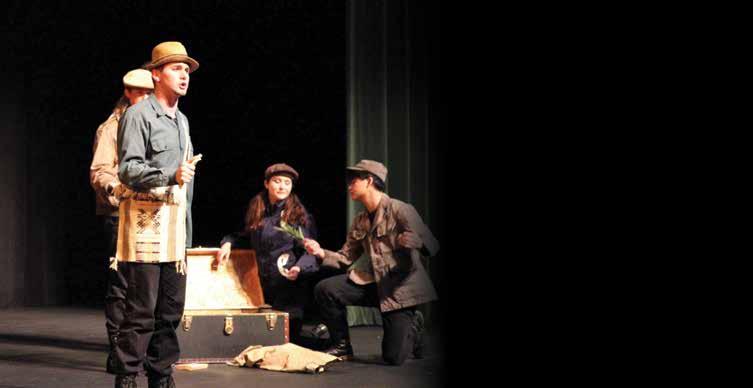
Following a series of workshops and a brilliant performance of “Twelfth Night” by renowned London theatre company, The Lord Chamberlain’s Men, Saint Mary’s students were inspired to further enmesh themselves in the works of William Shakespeare. Thanks to Saint Mary’s Co-Curricular Arts program and in partnership with the Great River Shakespeare Festival (GRSF), Saint Mary’s students performed selections from Shakespeare’s comedies and tragedies in March 2026. Stay tuned — the university will partner with GRSF again this year for an upcoming student performance of “Macbeth.”
The Lord Chamberlain’s Men returns to perform Othello on Oct. 2
As the first stop on this year’s American tour, The Lord Chamberlain’s Men returns to the Page Theatre to perform Othello on Oct. 2, 2026! Tickets are on sale now!
Photo courtesy Gabriel Hathaway, Winona Post
Four honored at Founders’ Day
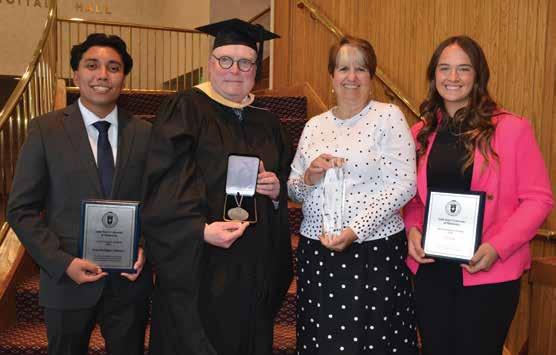
In celebration of its heritage, Saint Mary’s presented awards to one faculty member, one staff member, and two outstanding seniors at its annual Founders’ Day celebration March 17, on the Winona Campus.
Matthew Klosky, assistant professor of business and communications and director of the Kabara Institute for Entrepreneurial Studies, received the Distinguished Lasallian Educator Award. Presented each year, the award recognizes a member of the faculty, staff, or administration who exemplifies the ideals of Saint John Baptist de La Salle, expressed in the Twelve Virtues of a Good Teacher. The award is given by Lasallian institutions like Saint Mary’s in the Lasallian Region of North America of the De La Salle Christian Brothers to honor contributions and commitment to the Lasallian mission of education. In his role as director of the Kabara Institute for Entrepreneurial Studies and the Anthony B’59 and Sandra Adducci Family Makerspace, Klosky is routinely working with administration, staff and faculty, maintenance, and student groups to ensure multiple activities and events outside of the classroom are enjoyable for everyone at the university. He balances a strong presence in the classroom, the makerspace, numerous student-facing opportunities, committees, and stepped into announcing women’s hockey online when they asked for help. Not only does he encourage others to have a lifelong learner mindset, he is a lifelong learner himself. His faith and teaching is driven by the Twelve Virtues of a Good Teacher every single day, and he impacts the students positively both in and out of the classroom.
term commitment to the values of the university, and has been a model of the Lasallian spirit in interactions with colleagues and students. Merchlewitz has served the university for decades with steadfast devotion. She has helped the university delicately navigate issues — always with fairness, clear-sightedness, and a profound sense of duty and care for all parties. Her versatility is unmatched; she has filled many roles with aplomb, including executive vice president, vice president for Student Affairs, and interim president. She is both a constant presence at student events and athletic competitions as well as a tireless advocate for students at all levels, often utilizing her extensive experience and connections in law and business to provide mentorship to students.
The university also announced its Outstanding Male and Female Seniors during the Founders’ Day celebration. Outstanding Seniors have demonstrated the ideals of scholarship, character, leadership, service to colleagues and the university community, as well as genuine concern for the needs of others.
Matthew Klosky, center left, received the Distinguished Lasallian Educator Award; Ann Merchlewitz M’95, J.D., received the Bishop Patrick Heffron Award; and Javier Rodriguez Cifuentes B’26 and Zoe Fink B’26 received the Outstanding Senior Awards.
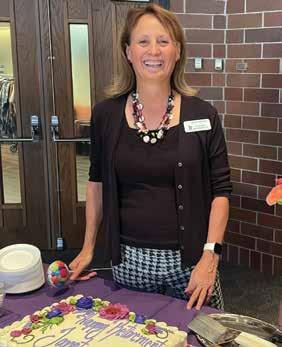
Ann Merchlewitz M’95, J.D., senior vice president and general counsel, received the Bishop Patrick Heffron Award. The Heffron Award — named after the founder of Saint Mary’s — is awarded every other year to an employee who has contributed positively to the life of the university, has demonstrated a long-
This year, the honor went to Javier Rodriguez Cifuentes of Austin, Minn., and Zoe Fink of Stevens Point, Wis. The eight other students nominated for Outstanding Senior included Jacob Fiala, Noah Lahner, Garrett Rotzien, Colin Tushie, Peyton Berg, Taryn Dornseif, Elizabeth Pike, and Melanie Wizenburg.
We are responsible for the people who lead us, and when we give up that responsibility and shy away from it, there are problems.
Joanne Ciulla, Ph.D.
Hendrickson Forum tackles the moral hazards of leadership
Nineteen years ago Saint Mary’s Hendrickson Forums began as a way to bring internal and external communities together to examine current issues through the lens of ethical leadership.
The hope is that attendees — enlightened by the lessons shared — will cooperate and collaborate with others, and be inspired to better the world – at home, at work, and in their communities.
This year, on April 10, Joanne Ciulla, Ph.D., professor and director of the Institute for Ethical Leadership at Rutgers University Business School and a pioneer in the field of leadership ethics, explored the pitfalls and temptations associated with being in a leadership role in her presentation, titled, “Leading with Integrity: Overcoming the Moral Hazards of Leadership.” An accomplished author, Dr. Ciulla also held the Coston Family Chair in Leadership and Ethics at the Jepson School of Leadership Studies (at the University of Richmond), where she was one of the school’s founders. She also has held academic appointments at Harvard Business School, The Wharton School, and LaSalle University. She has been an expert witness, consulted, and given lectures and seminars to business, government, and nonprofit organizations worldwide. She has received multiple Lifetime Achievement Awards for her work.
She began her presentation by questioning why it is difficult for leaders to be ethical. “If they can uncover some of the pitfalls, perhaps they might avoid them, and that’s been the focus of my work,” she said.
One difficulty for leaders is the huge pressure on them to be effective, she said. “We know that some leaders are effective but not ethical, and some leaders are ethical but not effective, so how do we get them both in the same package? One way might be to define, in business or anywhere else, ‘effective’ in moral terms.”
Dr. Ciulla used her research from throughout history in her presentation including the words of Niccolo’ Machiavelli. He addressed one of the biggest challenges leaders face, that they have to do bad to do good. “That’s part of what we hire them for, difficult decisions,” she said. “They’re the ones who get their hands dirty. You have to deal with terrorists to get the hostages back. You should feel disgusted when you have to do that. If you have to deal with a despicable
dictator to get something done … you should feel bad about it. Why is that so important? You don’t want to keep doing it again. In business, the company is losing money so you have to lay people off. You’re doing something bad in order to do something good, but you also know you inflict harm on people.”
Authors Dean C. Ludwig and Clinton Longenecker wrote an article called “The Bathsheba Syndrome,” which Dr. Ciulla said brings together several pathologies leaders often face. “It’s a mixture of power and success, and the ways in which they become corrupted is the Bathsheba Syndrome,” she explained, pointing out that these individuals become isolated, they can cover up things they do wrong, they lose strategic focus, and they have an inflated belief in their ability to control outcomes.
She stated that great leaders are individuals who bring people in, not keep people out, and that it’s important for leaders to surround themselves with honest people. “Good friends aren’t enablers, they look out for your moral character,” she said, concluding that we all play a role in helping leaders be good at their jobs: “We are responsible for the people who lead us, and when we give up that responsibility and shy away from it, there are problems.”
This year’s recipient of the Hendrickson Medal for Ethical Leadership, Tim Marx, J.D., counsel at Winthrop & Weinstine, has proven — in the more than 40 years he has worked to better our community and our state — that he is an inspiring servant leader.
Marx has demonstrated his prowess in building coalitions and attracting resources to address complex challenges that balance legal, financial, policy, and broader community interests. He currently serves as vice chair of the board of directors for Fairview Health Services, as a board member of the Twin Cities Housing Alliance, and as housing advisor to the Richard M. Schulze Family Foundation. He recently completed terms as vice-chair of the National Alliance to End Homelessness and as a member of the Community Advisory Board for the Federal Reserve Bank of Minneapolis. He is also a founding sponsor and run mentor with Mile in My Shoes, a running club for those who have experienced homelessness.
In 2022, he joined Winthrop & Weinstine as counsel in the firm’s housing, real estate, and government affairs/regulatory practices, where
he continues to contribute to the community, including in nonprofit leadership. In recognition of his dedicated service, in 2025 he was named as a “Notable Nonprofit Board Member” by Twin Cities Business.
Marx told the forum audience three reflections on ethical leadership:
Protecting and enhancing human dignity: “First, those who were at this forum in 2023, heard David Brooks challenge us to see every person we encounter as in the image and likeness of God. ... This is a bar, but it is the bar to which ethical leaders must adhere and strive for and lead us toward.”
Self knowledge: “An African proverb offers, the young walk faster but the elder knows the road. Good leaders recognize when they are fully seasoned but not fully spent and offer continued
support. Those who are in the prime of their leadership, at the top of their game, call on the wisdom of elders and the spark of youth. And those who are still seasoning, seek out wisdom and experience without sacrificing spiciness and an innovative spirit.”
Courage: “Third, ethical leaders speak truth to power, call out the nakedness of those who would claim to be emperors, and challenge supporters and friends when facts and circumstances demand,” he said. “This requires courage.”
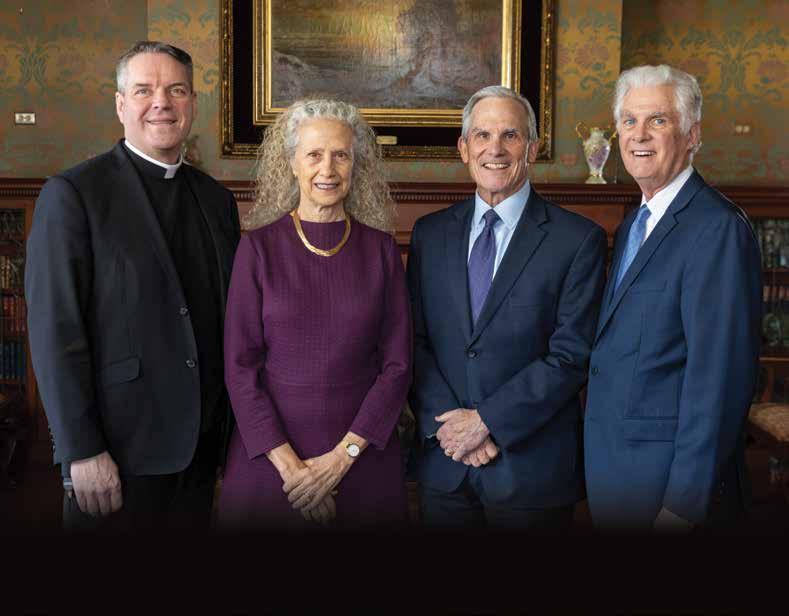
Father James P. Burns, IVD, Ph.D., president, left, and Gregory Stevens B’74, then chairman of the Board of Trustees, right, welcomed keynote speaker Joanne Ciulla, Ph.D., professor and director of the Institute for Ethical Leadership at Rutgers University Business School and a pioneer in the field of leadership ethics, and Hendrickson Medal recipient, Tim Marx, J.D., counsel at Winthrop & Weinstine.
Lawrence ‘Larry’ Price, J.D.
Job Title: Professor emeritus, Business and Communication Department
How many years have you worked at Saint Mary’s? I was teaching classes in 2001 with the Schools of Graduate and Professional Programs, first with the Master of International Business and then the Institute of Pastoral Ministry. In 2008, I joined the undergraduate College.
What do you enjoy/have you enjoyed most about teaching? My evolution as a college professor has changed in the way I view teaching over the years. My focus now is more relationship based in the sense that my main focus is to find out how I can help students to become better academics and better people. I really make a point to get to know the students in ways that I didn’t in my earlier career; that’s the Christian Brother and Lasallian influence, which emphasizes the dignity of every human person. This means that we care about each student. If a student gets a bad grade, I don’t immediately assume that it’s his or her fault. I’ll also look in the mirror and ask if it’s something I did or if there’s something going on in their personal lives I should be aware of.
How do you hope you are remembered/what will you most be remembered for? In the first place, I hope I was entertaining! If students are entertained, they pay attention. Early on, I really benefited from the series of CDs and DVDs by the very best college professors published by the Learning Company. I bought a bunch of those. They had an entertaining way of presenting the material that was really engaging and which focused on story telling. I teach dusty stuff, like contract law and bankruptcy, and so I looked for ways to put some life into my lecturing.
The Christian Brothers really had a big influence on me (like Brother Stephen Rusyn, FSC; Brother Larry Schatz, FSC; Brother Pat Conway, FSC B’75, M’80; and Brother Frank Carr, FSC B’66). They taught me to put the
students in a position to succeed, like a coach, but if they don’t practice, that’s on them. It’s very rewarding to see students grow and see them step up their game. In the Business and Communication Department, we put them through the ring of fire with the Strategies Competition, which involves a real world business problem and forces teamwork. I will continue to be a judge for that. I also got a lot from our Education Department; from people like Dr. Roger Peckover and Drs. Scott and Karen Sorvaag. They spoke about cognitive learning, and that students learn in the following order: 1. From giving the lesson themselves — so I ask them to do lots of presentations; 2. From discussing things with other students — so I set up group breakouts about tricky questions; and, 3. From listening to lectures — and it’s important to remember that’s third.
I hope my students will remember me as a professor who cared and who made coming to class enjoyable. I don’t know if they’ll remember the actual content, but hopefully they’ll remember some of the stories. And it should be said that my approach is pretty typical for many Saint Mary’s faculty.
What are you most proud of from your career?
I think I’m most proud of the fact I got some of my students excited about learning and they left Saint Mary’s with intellectual curiosity. College is just the beginning of lifelong learning. I’ve had students go on to do some really good things in their lives and careers.
What are your retirement plans? I’m hoping to keep adjunct teaching a couple of courses. I have lofty aspirations to write a book. As a professional musician, I hope to do some music composing. I lived in Europe for 12 years, and my daughter lives in Berlin, so we’re hoping to visit her regularly. Lately I have been focused on increasing my outreach to people in poverty. I’ve also been taking students to the Dorothy Day house in Rochester and to Winona’s Warming Center. They find out there’s no “us and them”; it’s just “us.” And I hope to still be involved on campus, attend sporting events and hanging around.
What do you/will you miss the most? I’ll just miss being full time and being around the people all the time. I enjoyed the camaraderie of being in the Business and Communication Department, and I actually enjoyed going to most of the faculty meetings! I’m praying and hoping for Saint Mary’s to have a bright future.
Mark Barber, Ph.D.
Job Title: Associate professor emeritus of philosophy
How many years have you worked at Saint Mary’s? 35 years
What do you enjoy/have you enjoyed most about teaching? I think what I enjoy most is how philosophy deals with really big and important ideas, seeing students engage in those important ideas in ways that are real to them. In philosophy, we can know a lot of philosophy, but until it becomes internalized — when students realize the questions in philosophy are actually their own questions, it’s a pivotal moment, and when that happens that’s very satisfying.
How do you hope you are remembered/what will you most be remembered for?
I suppose what I would like to be remembered for is being a presence on campus, whether to students or fellow colleagues. If a student asks a question in class, in a subsequent class, I will reengage that question. Students have appreciated when I’ve taken seriously a question I didn’t know the answer to, thought about it, and raised it again a class or two later.
What are you most proud of from your career?
Keeping a sense of humor. I think what I’d like to be remembered for is being someone who was on the job and showed up every day and did the best I could in a whole range of circumstances. At a place like Saint Mary’s, we’re called upon to teach a whole wide range of students in terms of majors and programs, and a wide range of students and their abilities. In terms of service to the institution, we do a wide range of services. In
More Retirees
my mind I think I always tried to be on the job. I tried to meet the needs of the students that I had. I tried to do what I could for the institution and for my colleagues. I feel like I was responsive and engaged with the people around me.
What are your retirement plans?
I have projects I want to do but haven’t done because of time and attention. Maintaining social connection is important. I have ways I think I do that but I’m curious to see two or three years from now what that circle looks like.
What will you miss/are you missing the most?
I’m still teaching one course, but I’ll miss teaching. What’s meaningful is engaging people in important questions, but what I enjoy is being in the classroom and having to respond to questions on the spot. When someone raises a question I don’t expect or connects it to something I didn’t expect, being able to respond to that in the moment is very satisfying, and there’s an intellectual challenge in that. I think, by and large, I do it well, and it’s something I really enjoy doing.
• John Jankord, adjunct assistant professor, 21 years
• Cynthia Kronebusch, assistant program director, Graduate School of Education, 25 years
• Dr. Susan Hines, vice president, Academic Affairs, 20 years
• Patrick Hennessey, tradesperson, eight years
• Sara Heinzen, associate director, Graduate School of Health and Human Services, 14 years
• Nancy Hershfield, senior director of major and planned gifts, 1 year
• Leslie McElmury, head of campus skilled trades, 41 years
• Veronica Murphy, academic credentialing specialist, 28 years
Tracy Heaser Senior Director of Alumni and Benefactor Engagement
Survey tells us alumni want to stay connected
There’s something special about summer on the Winona Campus — especially when it’s Reunion Weekend.
Just a few weeks ago, alumni from across the decades returned to Saint Mary’s to reconnect, reminisce, and celebrate. From the moment guests arrived, there was a familiar feeling of coming home. Whether it had been five years or 50, the connections formed here have a way of picking up right where they left off.
ALUMNI ENGAGEMENT
UPCOMING ALUMNI EVENTS
July 24
Alumni outing at Saint Paul Saints Game, Saint Paul, Minn.
Oct. 24
Lasallian Day of Service at various locations. Email alumni@ smumn.edu if you would like to host a service site.
To see what’s coming up next, visit connect. smumn.edu/ events.
This year, we welcomed milestone classes ending in ones and sixes, with a particularly meaningful celebration for the Class of 1976 as they marked their 50th Reunion. It was a joy to see classmates reconnect — sharing stories, laughter, and memories that felt just as vivid as they did decades ago. The celebration dinners on Friday evening were especially memorable, honoring the Class of ’76, as well as all alumni celebrating 50 or more years since their time at Saint Mary’s. It served as a powerful reminder of the enduring strength of this community.
Throughout the weekend, campus was alive with activity: class dinners, tours, spontaneous conversations, and longawaited reunions. Alumni often remarked on how much has changed, but even more so, how much has stayed the same. There is something grounding about returning to the places where your story began — but it is the people who make those places meaningful.
In many ways, Reunion Weekend reflected something we’ve been hearing more and more clearly from our alumni community.
Almost a year ago, more than 1,000 alumni shared their perspectives through our Engagement Survey. What we heard was both encouraging and instructive: alumni want to stay connected, and they simply need more accessible, meaningful ways to do so. Strong interest in social
SURVEY RESPONSES SURVEY SNAPSHOT
1079 5% 21k+ 5
RESPONSE
gatherings, lifelong learning opportunities, and opportunities to connect professionally all rose to the top. At the same time, many shared that distance, time, and awareness can make participation more challenging. Reunion Weekend is one of the clearest examples of what happens when those barriers fall away. When alumni are able to come together — in person, with intention — the sense of connection is immediate and lasting.
We are taking those insights seriously and looking at ways to grow regional gatherings, expand virtual and hybrid opportunities, and find new ways to connect alumni with one another and with current students such as through mentoring, networking, and lifelong learning programs. Simply put: we are working to meet alumni where they are.
At the same time, the strength of our alumni community is reflected not only in those who return to campus, but also in those who step forward to lead. We are pleased to welcome two new members to the Alumni Board: Chris J. Ebert B’20, C’22, M’23 of Rochester, Minn., and Grace T. Osterbauer M’21 of Columbia Heights, Minn. Their willingness to serve and represent our alumni community is deeply appreciated,
and we look forward to the perspective and energy they will bring to this important work.
And just as some alumni step forward to lead, others are just beginning their journey as alumni. This spring, we welcomed the Class of 2026 into the Alumni Association, joining a global network of more than 58,000 Saint Mary’s alumni. Each new class brings original ideas, strengthening the connections that define this community.
Reunion is not only about looking back, it’s about looking ahead. It’s about renewing relationships, creating new ones, and
continuing to build a community that supports one another in meaningful ways.
To all who joined us for Reunion Weekend, thank you. Your presence, your stories, and your continued engagement bring this community to life. And to those we missed, we hope to welcome you back soon.
Until then, I encourage you to stay connected, stay engaged, and continue to make the most of being part of this remarkable Saint Mary’s community.
UPDATE YOUR INFO
Make sure we have your most recent contact information, so you can stay on top of the latest news and events, and share your updates with other alumni at connect. smumn.edu/f/ class-notes.
Alumni Events
To see what’s coming up next, visit connect. smumn.edu/ events
Father James Burns, IVD, Ph.D., president of Saint Mary’s, joined more than 40 Florida area alumni, benefactors, and friends at The Club at Barefoot Beach in Bonita Springs, Fla., on Feb. 7, 2026. The event was held in celebration of Saint Mary’s and the success of the “Rooted in Faith, Growing our Future” campaign. Special thanks to alumnus Joseph “Joe” Ross B’67 for hosting this event.
Reunion Weekend Recap
Everywhere you turned during Reunion Weekend, there were hugs, handshakes, and photos being exchanged. With only a weekend to catch up, more than 300 alumni and families wasted no time in getting reacquainted with old friends.
This annual event is designed to not only be a time to reconnect and revisit old memories, it’s also a time to make new memories through a variety of activities.
The class of 1976, celebrating its 50th reunion, enjoyed a special reception and dinner, and alumni from 1975 and older were invited to an alma mater banquet. Alumni were invited to tour the campus and attend Mass together, as well as enjoy boat outings. A highlight of the weekend — everyone was invited to a campus picnic with barbecue on the menu.
Each year, during the alumni awards brunch and ceremony, alumni are recognized with special honors. Saint Mary’s honors alumni who have made outstanding achievements in their professional careers, who best exemplify the Lasallian charism Saint Mary’s was founded upon, and who have generously contributed time and
This year’s awardees include:
Thomas Killion B’74, Ph.D. Distinguished Alumnus Award
In October 2016, the North Atlantic Council (NAC) appointed Dr. Thomas Killion B’74, Ph.D., as its chief scientist. Now retired, in this distinguished role, he had three major responsibilities. First, he served as chair of the NATO Science and Technology Board. In this role, he served as the board’s representative to the secretary general and the NAC and was responsible for the effective coordination of NATO’s Science and Technology program. Second, he served as the senior scientific advisor to NATO leadership, ensuring that appropriate and timely advice is provided to NATO senior decision makers. Finally, he led the Office of the Chief Scientist at NATO headquarters.
Prior to this appointment, Dr. Killion — of Reston, Va. — was the director of technology at the Office of Naval Research within the U.S. Navy. During this time, he was responsible for policy, planning, resourcing and execution management
Thomas Killion B’74, Ph.D.
From 2010-2012, he served as the director of the Biometrics Identity Management Agency (BIMA), executing the secretary of the Army’s executive agent responsibilities for Department of Defense Biometrics.
And, from 2004 to 2010, Dr. Killion served as the deputy assistant secretary of the Army for Research and Technology chief scientist. In this position, he was responsible for developing an S&T strategy responsive to Army needs, from the near-term (less than 5 years) stretching out through the far-term (more than 20 years). He was also the principal scientific adviser to both the secretary of the Army and the assistant secretary of the Army for Acquisition, Logistics, and Technology. In support of major acquisition programs, Dr. Killion was responsible for providing independent assessments on the readiness of critical technologies for weapon systems programs approaching key program decision points.
Dr. Killion earned dual Bachelor of Arts degrees in psychology and English from Saint Mary’s in 1974. He received his Master of Science degree and Ph.D. in Experimental Psychology from the University of Oregon in 1977 and 1978. He was awarded the Meritorious Executive Presidential Rank Award in 2006 and the Army Exceptional Civilian Service Award in 2010.
Richard “Rick” Paul B’66, Ph.D. Distinguished Alumnus Award
Class valedictorian and a physics major at Saint Mary’s, Rick Paul B’66 went on to earn his Ph.D. from Harvard University, kicking off an illustrious career in biophysics, beginning as a teaching fellow, research fellow and instructor at Harvard during the 1960s-’70s. Focusing on physiology, he primarily spent his career at the University of Cincinnati, but he also worked globally at Universität Heidelberg, University College London, University of Leuven, and Monash University.
His research interests focus on the mechanisms underlying the control of smooth muscle contractility and its coordination with metabolism. Using gene-altered mice has opened new avenues for studying basic smooth muscle mechanisms and diseases from coronary artery vasospasm to hypertension.
Dr. Paul was named professor emeritus at the University of Cincinnati in 2012, the same year he and his wife Patricia “Pat” (Mostardi) CST’66, Ph.D., moved to Lawrenceburg, Ind. He remains active with the university, working with a master’s program to help students to successfully apply for medical school.
NOMINATE AN ALUM! Do you know a Saint Mary’s graduate deserving of an award? Nominate them! See page 39 for more info and nomination form or go to connect.smumn. edu/page/alumnirecognition
Richard “Rick” Paul B’66, Ph.D.
ALUMNI, SEND US YOUR NEWS
We want your personal and professional news items – photos, news clippings, etc., as well as tips about fellow alums who might make good feature story subjects. For submission guidelines and how to submit your news, go to connect.smumn.
edu/f/class-notes
Throughout his career, he published nearly 300 articles and received multiple national accolades, as well as substantial grants.
The Pauls have also focused time and talent on their community in multiple ways. Dr. Rick Paul is also involved in the area’s judicial panel, serving as chair. This panel reviews all citations issued by the sheriff’s deputies, boat patrol, architectural committee, and others.
The couple also volunteers at a food pantry called Dearborn County Clearinghouse. They (led by a program Pat developed) help put together 500 packages of weekend food and distribute them to nine eligible elementary schools in Dearborn County.
The couple has frequently generously contributed to Saint Mary’s (where Pat also attended), including to Aquinas Hall, establishing a seminar room in their name. More recently, they have supported the First Generation Initiative program, motivated by the fact they are both first generation graduates, and they plan to recognize Saint Mary’s in their will. The couple has expressed they want to recognize and honor the professors who inspired them as students at Saint Mary’s.
Maria Glenski B’14, Ph.D. Outstanding Recent Alumna Award
Maria Glenski B’14, Ph.D. of Richland, Wash., leads the Foundational Data Science group in the National Security Directorate’s Artificial Intelligence (AI) and Data Analytics division at the Pacific Northwest National Laboratory. The laboratory is dedicated to addressing critical national security challenges in areas of deeplearning, AI-enabled communications, natural language processing, visual analytics, and more. In her role, Dr. Glenski pilots multiple technical project teams focused on transformational research in areas including generative AI and human language technologies, characterizing how information spreads online, and novel methods of evaluating AI and machine learning to enable
trusted and responsible AI development or use. Her research has significant international impact in top-tier research communities, and — in recognition of her achievements — she has received multiple awards and is frequently invited to speak at various events.
Recipient of the Women in AI North America’s 2023 AI in Government AI Disruptor of the Year award, her innovative work has disrupted conventional paradigms, driving innovation, efficiency, and positive change. In 2022, she received the Core Value Award for Creativity from the National Security Directorate. And, in 2025, she received Gold Stevie Award for Mentor/ Coach of the Year honors in the government or nonprofit category, as well as the Bronze Stevie Award for Female Executive of the Year for her dedication to supporting the growth of her teams and impact in AI for national security missions.
Dr. Glenski earned her B.A. in Mathematics from Saint Mary’s and her Ph.D. in Computer Science from the University of Notre Dame, where she was an Arthur J. Schmitt Leadership in Science and Engineering Fellow. Outside of work, she enjoys volunteering with a local humane society, fostering small dogs.
Maria Glenski B’14, Ph.D.
Help us honor alumni
Do you know a Saint Mary’s alumnus/a who has made outstanding achievements in his/her career? Or, someone who has given significant time and commitment to the community or Saint Mary’s University? Does someone stand out in your memory as deserving of an alumni award? Can you remember an athlete or coach whose accomplishments brought honor to him/herself and Saint Mary’s University?
Each year, the Alumni Association of Saint Mary’s University bestows awards upon deserving alumni. We are now accepting nominees for Reunion Weekend for Distinguished Alumnus/a, Alumni Appreciation, Sports Hall of Fame, and Religious Service Awards. All nominations must come from alumni or employees of Saint Mary’s University.
Distinguished Alumnus/a Award Criteria
This award honors an alumnus/a for outstanding achievements in his/her chosen profession. This person’s daily life reflects the Christian ideals promulgated by the university. This person has distinguished him/herself in his/her chosen field or in another area of endeavor.
Alumni Appreciation Award Criteria
This award honors an alumnus/a of the university who, by their consistent and continuous volunteer efforts, have given their personal time and energies to further the goals and objectives of Saint Mary’s University. They must show exceptional personal commitment involving time and effort in any or all areas involving university functions supported by the Alumni Association. These areas include, but are not limited to, Career Services, Admissions Support, Chapter Development, Alumni Board, Chapter Involvement, and Regional Events and
Programs. Current employees of the university are ineligible for the award. Continuous personal contributions of time and effort are the primary criteria.
Lasallian Service Award Criteria
This award honors an alumnus/a for outstanding contributions to the Lasallian spirit of faith and zeal and exemplifies the highest of Lasallian values. This award will be given for personal achievements in the Lasallian charism.
Outstanding Recent Alumnus/a Award Criteria
This award will honor a recent alumnus/a for outstanding accomplishments within the first 10 years from graduation, whose professional accomplishments, service to alma mater, and/or selfless and caring work to benefit society are distinctive.
Sports Hall of Fame Criteria
This award honors individuals or teams who have made outstanding contributions to the Saint Mary’s intercollegiate athletic department as athletes, coaches, or administrators. An athlete must have attended Saint Mary’s for a minimum of four semesters. An athlete’s class must have graduated at least five years prior to selection. A coach or administrator must have served the university a minimum of five years and five years must have elapsed since the nominee last served in that capacity. If currently serving at the time of the nomination, the nominee must have had 20 years of continuous service. Five years must have elapsed since any team nominated competed at Saint Mary’s. A Hall of Fame nominee will have shown athletic and academic skills, teamwork, leadership, character or other attributes of an ideal Saint Mary’s student-athlete.
ALUMNI AWARD NOMINATION FORM (preliminary information)
I wish to nominate an individual for: (Please check type of award; photocopy to nominate in more than one category.) n Distinguished Alumnus/a n Sports Hall of Fame n Alumni Appreciation n Lasallian Service n Outstanding Recent Alumnus/a
Name of Nominee Class Year
Telephone (daytime)
Telephone (home)
Why do you think this individual should receive a Saint Mary’s University Alumni Award?
Name of Nominator
Does this person know he/she is being nominated?
Telephone (daytime) Telephone (home)
Email
To nominate a candidate for an award, complete this form and return. Saint Mary’s Alumni Relations staff will follow up with you as necessary. SEND TO: Alumni Relations, Saint Mary’s University, 700 Terrace Heights #21, Winona, MN 55987-1399 or fill out the form online at connect.smumn.edu/page/alumni-recognition.
Kate Jerman ’97 (women’s soccer), Bailey Edwards B’12 (women’s tennis), and Steven Brieske B’92 (baseball) were inducted into the
Three new members inducted to the Saint Mary’s Hall of Fame
The Saint Mary’s Athletic Department celebrated inducting three new members into its Sports Hall of Fame during the Cardinal Excellence Fund Dinner March 21.
Honored as part of this year’s class were Bailey Edwards B’12 (women’s tennis), Steven Brieske B’92 (baseball), and Kate Jerman ’97 (women’s soccer), and a strong crowd gathered to recognize their lasting impact on Cardinal athletics.
“It was a blast celebrating Bailey, Kate, and Steve alongside their friends, family, and the
Saint Mary’s athletics community,” said athletic director Brian Sisson. “Honoring these athletes on campus made it even more special, and it truly was a memorable night for everyone involved.”
Each inductee followed with heartfelt remarks, reflecting on their journeys and the honor of joining the Hall of Fame.
The evening served as a celebration of excellence, legacy, and the enduring spirit of Saint Mary’s athletics.
Sports Hall of Fame in March.
Introducing FastTrack 90™ .
Your 90-credit online bachelor’s degree path.
With just 90 credits — instead of 120 — you can earn your bachelor’s degree faster and gain more: time, money, and progress toward your goals.
FastTrack 90™ is built for adult learners transferring prior credits or starting from scratch. Find
Earn Bachelor of Science (B.S.) degrees in:
Applied Psychology
Business Administration
Criminal Justice Leadership
Healthcare Management
Human Resource Management
Information Technology
CLASS NOTES
1970s
Sister Barbara Bartek, OP M’73, Sinsinawa, Wis., will celebrate her 75th jubilee Oct. 24, 2026.
1980s
Raymond Hoffman B’83, M.D., Marydel, Md., began his role as president of the Contemporary Freudian Society (CFS) on April 1, 2025. The CFS trains psychoanalysts and psychoanalytic psychotherapists through training institutes in New York City and Washington, D.C., as well as internationally through online instruction. The society has over 200 psychoanalyst members and is a component society of the International Psychoanalytic Association.
Michelle (Emond) Wolfe B’86, Blaine, Minn., retired from a 35-year career in city management in 2025. She began working as an independent consultant, doing executive recruitment and consulting work for local government in March 2026.
Gregory Zimprich B’86, APR, Vitoria, Minn., founded Curtiss Partners LLC, a firm focused on executive communications and coaching. He also began his position as assistant director for curriculum and teaching faculty in the M.A. strategic communication program at the University of Minnesota’s Hubbard School of Journalism and Mass Communications.
1990s
William “Bill” Geheren B’90, Lake in the Hills, Ill., began his position as associate director at Lasallian Institute for the Formation of Teachers in March 2026.
Patrick Dempsey B’92, Hastings, Minn., began his position as association manager, billing and payments engine at Accenture in November 2025.
Michael “Mike” Farren B’93, Lakeville, Minn., began his position as senior operations manager at TLC Electronics, Inc. in February 2026.
Thomas Ramsden B’93, Des Plaines, Ill., began his position as major gifts officer at Marist High School Chicago in October 2025.
Barton “Bart” Wolkerstorfer B’93, M’08, Shoreview, Minn., began his position as business leader, P&L owner, global seasonings and ingredients at Land O’Lakes, Inc. in February 2026.
Deborah “Deb” Henton M’95, C’96, D’99, Stillwater, Minn., received the 2026 Minnesota Association of School Administrators Service Award. This statewide honor recognizes individuals who have made a lasting impact on Minnesota public education through leadership, advocacy, and a commitment to going above and beyond in service to students and school leaders. This award also recognizes Dr. Henton’s 37 years of dedicated service to Minnesota’s students, families, and educational leaders as she prepares for her retirement on June 30, 2026.
Jeanne Bain M’97, Minneapolis, Minn., began her position as mental health therapist at Interna Mental Health and Wellness in November 2025.
Brent Murphy B’99, New Lenox, Ill., began his position as recruiter at EPITEC in April 2026.
2000s
Aaron Dobosenski B’01, Excelsior, Minn., was promoted to partner at Faegre Drinker on Jan. 1, 2026.
Lisa (Grunewald) Schara ’01, Austin, Minn., began her position as retail sales manager at Planet Home Lending, LLC in December 2025.
Matthew “Matt” Smith B’01, Eden Prairie, Minn., was appointed police chief of the Burnsville Police Department in May 2026.
Michael “Mike” Bry B’05, Andover, Minn., began his position as senior account executive at Advance Shoring and Specialities Company in March 2026.
Sarah Beck B’07, Westfield, Ind., began her position as analyst at JM Tax Advocates in September 2025.
Courtney Beckers ’08, Carol Stream, Ill., began her position as sales executive at Wellness Coach in February 2026.
Brian Chaput B’09, Orlando, Fla., began his position as executive director at Wells Fargo in January 2026.
Kate Steiner M’09, Saint Paul, Minn., began her position as human resources manager at Minneapolis Radiation Oncology in February 2026.
2010s
Michael “Mike” McCoy B’10, Saint Paul, Minn., began his position as CI manager at C.H. Guenther in November 2025.
Michael “Mike” Soulen B’10, The Colony, Texas, began his position as principal consultant at Makse Group in January 2026.
Dy-anna (Stewart) Kunkel B’11, Nisswa, Minn., was awarded the 2025 Business Insurance Break Out Award.
Zachary “Zach” Cizek B’11, Stillwater, Minn., began his position as regional sales director at Baxter International Inc. in February 2026.
Alex Conover B’11, Saint Paul, Minn., began his position as content and communications specialist at DeLaSalle High School in November 2025.
Morgan Mellske B’11, Chicago, Ill., began his position as vice president at TMG Real Estate Advisors in November 2025.
Jennifer Teske M’11, CFRE, Rochester, Minn., began her position as director of institutional advancement at Rochester Catholic Schools in January 2026.
Dr. Diana E. Moran Thundercloud M’12, La Crosse, Wis., took a personal sabbatical during 2024-25 and spent nearly two years traveling throughout Latin America and beyond. Traveling primarily solo, she immersed herself in communities across Chile, Bolivia, Peru, Mexico, and Thailand, while continuing her work in education, leadership, and community engagement. Dr. Moran Thundercloud is currently studying the Aymara and Quechua languages to deepen her connections with Indigenous communities in the Lake Titicaca region of Peru and Bolivia, where she now spends part of her time. She completed her practicum at Chileda Institute in La Crosse and recently, she completed a Non-Profit Development Leadership Certificate. She also serves with the American Association of University Women (AAUW) in La Crosse as STEM coordinator and chair. Currently, Dr. Moran Thundercloud is working on a book exploring travel, Indigenous
ecological knowledge, geography, healing, art, and the natural world throughout the Americas. She is also developing an independent press dedicated to amplifying Indigenous artists, educators, writers, and photographers across Latin America and the United States. Now back in the Winona region, she is completing docent training at the Minnesota Marine Art Museum.
Ashley Blum B’12, Winona, Minn., represented OZ Lifting Products at the Winona Area Chamber of Commerce Awards ceremony, where the company received the 2025 Touchdown Award for Outstanding Achievement in Growth. In her role as marketing manager, she led industry and community outreach efforts around OZ’s 20th anniversary and move into a new facility, including organizing a grand opening open house. The open house drew strong community participation and industry attention, including media coverage both locally and internationally.
Adam Ellis B’12, Minneapolis, Minn., began his position as first officer at PSA Airlines, Inc. in December 2025.
Anna Johnson B’12, Austin, Minn., began her position as brand reputation supervisor at Treasure Island Resort & Casino in February 2026.
Frank Pullia III B’12, M’21, Minneapolis, Minn., began his position as commercial project manager, client implementations at HHAeXchange in January 2026.
Vincent Unklesbay B’12, Minnetrista, Minn., began his position as director of finance at TJM Labs in March 2026.
Juan Machado B’13, East Bethel, Minn., began his position as quality director — cardiac diagnostics at Boston Scientific in October 2025.
Michael McGreevey M’13, Big Lake, Minn., began his position as market development director at Amada Senior Care in October 2025.
Jacob Carroll M’14, San Diego, Calif., began his position as senior director, third-party risk at BlueVoyant in March 2026.
Thomas “Tom” Robaczewski B’14, Arlington Heights, Ill., began his position as senior director, creative services,
global partnerships at Legends Global in January 2026.
Jeffrey “Jeff” Walters B’14, Rollingstone, Minn., began his position as association sales executive at Thomson Reuters in April 2026.
Samantha (Casillas) Zdon B’14, West Saint Paul, Minn., began her position as service dispute analyst and project leader at 3M in January 2026.
Francesco “Frank” Cundari B’15, Oak Park, Ill., began his position as controller at Noland Sales in November 2025.
Christian Esposito B’15, Saint Charles, Ill., began his position as regional sales director at Vericel Corporation in January 2026.
Brenda Jacobson M’15, Cape Coral, Fla., began her position as system director central development at Lee Health Foundation in November 2025.
Corrine McCallum B’15, Minneapolis, Minn., began her position as experience director at Kozlak-Radulovich Funeral Homes in February 2026.
Adriana Paracencio M’15, Paris, France, began her position as HR manager at CAMP Systems International, Inc. in March 2026.
Nicholas “Nick” Wojtynek B’15, Amherst, N.H., began his position as medical director — dordaviprone at Jazz Pharmaceuticals in October 2025.
Timothy “Tim” Wolande B’15, Hoffman Estates, Ill., began his position as director, enterprise sales at Digital Realty in March 2026.
Lisa Viker M’15, Wabasha, Minn., began her position as director of national strategic accounts — restoration at Concrete Strategies LLC in October 2025.
Cody Balogh B’16, Batavia, Ill., began his position as director of development at Scannell Properties in April 2026.
Brittany Friedrich B’16, Rice, Minn., began her position as key account manager — biopharma at Parker Hannifin in January 2026.
Katelyn “Katie” Slaght B’16, Marshall, Mich., began her position as senior
manager, business development, global car partnerships at Capital One in April 2026.
Peter Liavas B’17, Jacksonville, Fla., began his position as account executive at Paysafe in November 2025.
Dzenan Berberovic M’17, Sioux Falls, S.D., began his position as chief development officer and foundation president at Avera Health in February 2026.
Alexandra (Spurlin) Hill B’17, Hastings, Minn., began her position as training facilitator at Bridgewater Bank in October 2025.
Olive Long-Johnston B’17, Minneapolis, Minn., began her position as senior accountant at Homesura in January 2026.
Zachery “Zach” Thielen B’17, Prior Lake, Minn., began his position as business process program manager at Medtronic in October 2025.
Molly Abraham B’18, Elkhart, Ind., began her position as middle school teacher at Elkhart Community Schools in January 2026.
Kali Aldrich B’18, Rochester, Minn., began her position as membership and communications director at Rochester Area Chamber of Commerce in October 2025.
Abby (Lafko) Cesarz B’18, Parma, Mich., began her position as enterprise process and project manager at HaFSBX in January 2026.
James Cullen B’18, Western Springs, Ill., began his position as senior partner manager at Walmart Connect in November 2025.
Jamie Dreher M’18, Twin Cities, Minn., began her position as director of underwriting — portfolio monitoring at American AgCredit in March 2026.
Landon Farrell B’18, Rochester, Minn., began his position as senior territory sales manager at ReviveRX in December 2025.
Garrett Grunke B’18, M’22, C’22, Eagan, Minn., began his position as senior manager — AI at Factor Motor Parts in January 2026.
CLASS NOTES
Clarice “Clare” (Tack) Grzanich B’18, Elgin, Ill., began her position as talent acquisition specialist at VelocityEHS in February 2026.
Tara Nagy B’18, M’24, C’24, Oak Lawn, Ill., began her position as sales analytics senior manager at ADP in January 2026.
Alexander Rabine M’18, Saint Paul, Minn., began his position as senior geographic information system analyst at Environmental Working Group in March 2026.
Ajibola “Bola” Agboola M’19, Rosemount, Minn., began her position as senior lead product manager at Wells Fargo in January 2026.
Nicole (Bartosz) Asta B’19, Darien, Ill., began her position as vice president at JPMorganChase in February 2026.
Paul Baglio M’19, Portland, Ore., began his position as account manager at Environments an Insidesource Company in December 2025.
Elizabeth Garcia M’19, Green Bay, Wis., began her position as executive director of Illinois Alliance of Boys & Girls Clubs in December 2025.
Bailey Wendt B’19, M’23, Rochester, Minn., began her position as assistant supervisor at Mayo Clinic in February 2026.
2020s
Annabeth Kerr B’20, Portland, Ore., made her professional theatre debut in Stumptown Stages’ production of “Oliver! the Musical,” which ran through December 2025. She thanks the training and opportunities she received at Saint Mary’s for being able to step onto the professional stage with confidence and gratitude. This milestone is a small reminder of how transformative arts education can be.
Bekki Babineau M’20, Superior, Wis., began her position as director of annual giving and philanthropic communications at Essentia Health Foundation in January 2026.
Ricardo Estrada Rodriguez B’20, Oronoco, Minn., began his position as assistant athletic director at St. Paul Academy and Summit School in October 2025.
William “Will” Matthews B’20, C’21, Winona, Minn., began his position as supply chain specialist at Fastenal in February 2026.
Misty Coonan M’20, C’20, Cologne, Minn., began her position as licensed outpatient therapist at Sagent Behavioral Health in October 2025.
Tong Thao B’21, C’23, M’23, Saint Paul, Minn., began his position as systems administrator at Actus Nutrition in January 2026.
Abigail “Abbey” Johnson B’22, Rochester, Minn., in her work as a medical laboratory scientist at the Mayo Clinic Transfusion Lab, helped write an abstract about preparing for downtimes in hospitals that was accepted into the National AABB conference held in San Diego in October 2025. The abstract is called “Nothing Works, What Now? Preparing for an Extended Network Downtime” and was published in The Journal of AABB Transfusion Vol.65, No.S2, in September 2025.
Anna (Swanson) Anstoetter B’22, Saint Croix Falls, Wis., began her position as medical surgical registered nurse at Fairview Lakes Medical Center in October 2025.
Jacob “Jake” Ewart B’22, Oconomowoc, Wis., began his position as manager at Hallman Lindsay Paints in November 2025.
Grace Gilles B’22, Jefferson City, Mo., began her position as morning news anchor for KRCG CBS-TV.
Abhishek Gupta C’22, M’22, Bhilai, Chhattisgarh, India, began his position as data solutions architect at Jean Martin in March 2026.
Dylan Bartlett B’23, Forest Park, Ill., began his position as sales representative at Breakthru Beverage Group in January 2026.
Michael Bharrat B’23, Farmington, Minn., began his position as senior personal banker at U.S. Bank in November 2025.
Caleb Gundberg B’23, Winona, Minn., began his position as software engineer at Cardinal Glass Industries in March 2026.
Lauren Kantrovich B’23, Mound, Minn., began their position as client care representative at Minnetonka Animal Hospital in November.
Colin Malay M’23, Winona, Minn., began his position as information technology project manager at RTP Company in February 2026.
Shawn Pruitt B’23, Chicago, Ill., began his position as qualified intellectual disabilities professional at El Valor in October 2025.
William Sepsis B’23, Austin, Texas, began his position as regional sales manager at Benchmark Products in April 2026.
Alicia Williamson M’23, Chisholm, Minn., began her position as human resources specialist at Mesabi Metallics in January 2026.
Marshall Briggs B’24, Phoenix, Ariz., began his position as chief technology officer at AI Rocket in April 2026.
Emily Nack B’24, Farmington, Minn., began her position as medical office coordinator at Hennepin Healthcare in October 2025.
Garret Nelson B’24, Trego, Wis., began his position as senior engineering site test technician at Collins Aerospace in November 2025.
Cerim Palislamovic B’24, Littleton, Colo., began his position as sales development representative at Todyl in March 2026.
Braidyn Ruetten B’24, La Crosse, Wis., began her position as physician assistant at Gundersen Health System in January 2026.
Jessica Schneider B’24, Minneapolis, Minn., began her position as senior business development representative at Infor in February 2026.
Katherine Valentine B’24, Chanhassen, Minn., began her position as case manager at Thomas Allen, Inc. in March 2026.
William “Bud” Winter B’24, Saint Louis, Mo., began his position as branch manager at Enterprise Mobility in January 2026.
Dane Brazil B’25, Lake Geneva, Wis., began his position as project engineer and construction data analyst at The Walsh Group — Walsh Construction and Archer Western in April 2026.
Abigail Hesse M’25, Roseville, Minn., began her position as clinical reimbursement manager at New Perspective Senior Living in February 2026.
Aidan Indahl B’25, Peterson, Minn., began his position as digital marketing and web specialist at Shrine of Our Lady of Guadalupe in January 2026.
Emily Stanze M’25, Woodbury, Minn., began her position as human resources generalist at Pheasants Forever and Quail Forever in February 2026.
MARRIAGES
Naomi (Rath) Melichar B’13 and Ryan Melichar, Zimmerman, Minn., were married on Sept. 6, 2025.
Grace (Van Beest) Cifelli B’17 and Johnny Cifelli, Flosmoor, Ill., were married on Dec. 20, 2025.
Aubrie (Cornell) Martel B’17 and Jake Martel, Bozeman, Mont., were married on July 26, 2025.
Celeste (Nygren) Mitchell B’18 and Robert Mitchell, Ocala, Fla., were married on Nov. 1, 2025.
BIRTHS
Eric Lusch B’13 and Kristin Abramo, Saint Paul, Minn., welcomed a son in March 2026.
Patricia “Trish” Nguyen B’14 and Bryce Werner, Saint Paul, Minn., welcomed a son, Chase, on Nov. 9, 2025.
Bjorn and Megan (Schulz) B’15 Bjorklund, Minneapolis, Minn., welcomed a son on Jan. 28, 2026.
Aaron and Megan (Vander Lugt) B’17 Peterson, Akron, Iowa, welcomed a son on Jan. 31, 2026.
Roxanne Eubank, Ed.D., was inspirational Lasallian educator
A Lasallian educator to her core, Roxanne Eubank, Ed.D., died Feb. 21, 2026. Her life and work have touched Lasallians around the world and have left an enduring influence on our mission and community.
Dr. Eubank was a longtime faculty member and academic administrator in the Doctor of Education program in the Schools of Graduate and Professional Programs on the Minneapolis Campus. She was part of the Saint Mary’s community from 1991-2020.
Widely recognized and deeply respected as a gifted professor, a devoted dissertation adviser, and a transformative mentor, Dr. Eubank also served as director of the Institute for Lasallian Studies. Dr. Eubank exemplified a true Lasallian educator and embodied the university’s commitment to wholeperson education. Her classroom was a place of intellectual challenge and genuine care, where students were invited not only to think more deeply, but also to grow in confidence, purpose, and integrity.
She was honored with an Outstanding Faculty Member Award in 2003, an Outstanding Advisor Award in 2006, and the Distinguished Lasallian Educator Award in 2011.
Over the years, in addition to her work at Saint Mary’s, she also became widely respected as a visionary voice for Lasallian higher education globally.
Among her many significant contributions to the International Association of La Salle Universities (IALU) and the wider Lasallian family, Dr. Eubank is perhaps best known for her leadership of the International Lasallian University Leadership Program in Rome. Under her direction, this formative program became a central experience in cultivating Lasallian identity, mission awareness, and collaborative leadership among faculty and administrators from universities around the world. The leadership program has shaped generations of Lasallian educators and strengthened bonds across our international network.
Dr. Eubank also played a pivotal role in the foundation of the International Lasallian Research Symposium and was a co-founder and editorial board member of AXIS: Journal of Lasallian Higher Education, deepening scholarly engagement. Her work upheld rigorous research while nurturing global dialogue on Lasallian mission, identity, and the role of Catholic education in the contemporary world.
Dr. Eubank’s legacy will continue through the many leaders she formed, the communities she enriched, and the global Lasallian network she helped shape.
She is survived by her husband, Scott Harlan.
CLASS NOTES
DEATHS
1950s
Frederick “Fred” Richter ’52, Wheeling, Ill., passed away on Oct. 10, 2025.
Arthur Maze ’54, Milwaukee, Wis., passed away on May 31, 2025.
Robert “Bob” Munns B’54, Naples, Fla., passed away on March 12, 2026.
James “Jim” Weis ’54, Decorah, Iowa, passed away on Jan. 13, 2026.
Raymond “Ray” Hoven B’56, Wadsworth, Ill., passed away on Feb. 18, 2026.
Thomas “Tom” Slaggie ’58, Winona, Minn., passed away on April 30, 2026.
1960s
Lawrence “Larry” Monnens B’60, Spicer, Minn., passed away on March 29, 2026.
Michael “Mike” Slaggie B’60, Winona, Minn., passed away on Dec. 21, 2025.
James “Jim” Fournier B’64, M’71, Saint Paul, Minn., passed away on Oct. 31, 2025.
James “Jim” Olson B’66, Duluth, Minn., passed away on March 15, 2026.
Michael “Mike” Updike B’87, Crystal Lake, Ill., passed away on Dec. 5, 2025.
1990s
Helen McDowell M’90, Melbourne, Fla., passed away on Dec. 4, 2025.
Brother Charles Burke, FSC B’57 devoted life to education
Brother Charles “Charlie” Burke, FSC B’57 faithfully devoted his life to education, and — even in death — he ensured this legacy will continue. He died peacefully in December 2025 at the age of 90. Brother Charles taught high school in several Lasallian schools, was director of Dunrovin Retreat Center, and spent several years at Saint Mary’s and Saint Mary’s Press. He worked in the Human Development program and in Student Life and was a writer, editor, teacher, and marketing coordinator at Saint Mary’s Press. After a debilitating stroke, he retired from ministry.
Each year, the Brother Charlie Burke Award is presented to a faculty or staff member who has made significant contributions to the entire Student Life Department. Award recipients have promoted the growth of the whole student through their exemplary standard of ethical service, dedication to creating developmental relationships, and their desire to promote lifelong learning.
He continued his life as an educator by donating his remains to the Mayo Clinic for research and further learning about the human body.
Alice Kaiser served as pseudo grandmother to Saint Mary’s students
Alice Kaiser of Chartwells passed away Jan. 7, 2026. A kind and gentle soul, she served as a pseudo “grandmother” to hundreds of Saint Mary’s students, greeting them as the friendly face in the cafeteria. She knew many students by name and got to know them well during her time at the university.
Dr. Cascio enthusiastically supported Saint Mary’s past 100th birthday
Dr. Samuel J. Cascio B’48, DDS — inspirational benefactor and enthusiastic supporter of Saint Mary’s — continued to attend Saint Mary’s events and stay active with his alma mater until very close to his death on Dec. 8, 2025, at the age of 101.
“Well done, good and faithful servant,” taken from Matthew 25:23, is a reflection of his life. He modeled servant leadership, generously supporting Saint Mary’s as a benefactor and with his time and talents. He served on the Board of Trustees from 1974-1984 and on the first President’s Council for 20 years (from 1974-1994) as well. He also chaired the Saint Mary’s College Chicagoland Area Capital Campaign with a $1.5 million goal.
In recognition of his dedication, he received the Alumni Appreciation Award in 1998.
The Cascio name is familiar on the Winona Campus. Through his generosity, the Cascio Family Court, located in the plaza, was established in honor of his commitment to the Brothers of the Christian Schools and their Lasallian mission. He also supported the Saint Mary’s Fund and, at the age of 98, he established the Dr. Samuel J. Cascio DDS B’48 Endowed Nursing Scholarship. In his death, his estate
gift will continue to support students and Saint Mary’s mission.
Dr. Cascio, of proud Italian heritage, was born to parents of modest means, but his father believed in providing his children with a Catholic education.
After one year at Saint Mary’s, he enlisted in the Navy. He served three and a half years in the Pacific as a radioman aboard the LST 281 during World War II. After an honorable discharge, he completed his education at Saint Mary’s under the GI Bill and received his Bachelor of Science degree in chemistry. He went on to Loyola School of Dentistry, where he received his DDS degree in 1952. Dr. Cascio credits his quality education from the Christian Brothers as laying the foundation for his successful 56-year career as a dentist on the northwest side of Chicago.
Highly celebrated for his work and a dedicated servant leader, Dr. Casio was frequently awarded for his service.
Sympathy to his sons Joseph Cascio B’74, Daniel Cascio B’80, Dr. Michael Cascio B’83, and daughter Geraldine “Geri” Limoncello. One granddaughter, Gabriela Limonciello ’20, also attended.
CLASS NOTES
2000s
Scott Etzel M’00, Milaca, Minn., passed away on Dec. 29, 2025.
Michael Rude M’01, New Richmond, Wis., passed away on Feb. 25, 2026.
2010s
Deacon Jerome A. Miller M’10, Iowa City, Iowa, passed away on Feb. 25, 2026.
Patrick TeVrucht M’17, Rosemount, Minn., passed away on Sept. 3, 2025.
Faculty/Staff
Colleen Dunne, former director of campus ministry, Browning, Mont., passed away on April, 26, 2026.
SYMPATHIES
1950s
Robert “Bob” Munns B’54, Mark Munns B’83, Emily Munns B’12, Rebecca “Becca” (Munns) Cage B’14, M’20, and Sarah (Munns) Derouin B’18, for the passing of their son, brother, and uncle, Paul Munns, on Dec. 6, 2025.
1970s
James Figliulo B’71, Donald “Don” Figliulo B’74, Robert M. B’76 and Kim (Febel) CST’76 Figliulo, John Figliulo B’78, David Figliulo B’83, Sharon Figliulo B’97, James Figliulo B’99, Michael Figliulo B’02, Regina Figliulo ’08, Joseph Figliulo B’10, Matthew Figliulo B’11, and Samuel Figliulo B’13, for the passing of their mother, motherin-law, and grandmother, Marguerite “Peggy” (Dunn) Figliulo CST’48, on Nov. 15, 2025.
Michael Klemke B’74, sympathy for the passing of his wife, Carol (Geldermann) Klemke B’74, on Jan. 10, 2026.
1980s
Mary (Rodell) Colwell B’82, for the passing of her mother, Jane Rodell, on Feb. 6, 2026.
Edward “Ed” O’Malley B’82, for the passing of his wife, Kathleen “Kathy” O’Malley B’84, on Nov. 21, 2025.
Mark Munns B’83, Emily Munns B’12, Rebecca “Becca” (Munns) Cage B’14, M’20, and Sarah (Munns) B’18 and Drew B’18 Derouin, for the passing of their father, grandfather, and grandfather-in-law, Robert “Bob” Munns B’54, on March 12, 2026.
Kathleen (Richter) Brady B’84 and Nancy (Richter) Doheny B’02, for the passing of their father, Frederick “Fred” Richter ’52, on Oct. 10, 2025.
Christine (Arnoldy) Olson CST’67, ’85, M’99, for the passing of her husband, James “Jim” Olson B’66, on March 15, 2026.
Helen “Ginny” (McDowell) Kinsey B’89 and Elisabeth “Lisa” McDowell B’90, for the passing of their mother, Helen McDowell M’90, on Dec. 4, 2025.
PHOTOS OF RESIDENCE HALLS BRING BACK MEMORIES
Dorms with all the comforts of home sound nice and comfy, certainly a step up from the late Saint Ed’s, and I loved the comparison with the 1930s photo of Heffron, so old fashioned.
However, when I moved onto third Heffron in the fall of 1964, it looked exactly the same as your photo, with the identical furniture. The one difference was that it had a bunk bed and two each of dressers and desks. We had to stack the dressers and step carefully around each other. Cozy. Oh and there were wasps and bats, as well — not to mention the ghost.
During my time, there was only one TV on campus that was available to students, a mid-size black and white attached to the balcony edge in the old wooden student union. We gathered on Wednesday nights on the main floor to watch Batman with Adam West. It was fun. We had Hootenanys in Skemp and played handball too. If I hadn’t been a biology major, I never would have left the building.
There was a pay phone outside the balcony level of Skemp that, if you camped out after supper, saved you a trip to the Union to try and reach someone at Saint Teresa’s between 9 and 10 p.m., the magic hour when the switchboard would put you through. We did also know the location and numbers of all the pay phones at CST, but the same rule applied. During senior year, I dated an RA who had her own phone. This year we will be married for 58 years.
I was on campus 1973-1975 and it was so much different. Although, with two kids, I didn’t live in a dorm.
Thanks for the work you do.
— John Shyne B’68, M’77
This undated photo of a class appears to be from the 1970s, as women are present, but still vastly outnumbered. Aside from hairstyles and clothes, classes today often look very different. This photo (below) shows one of Matt Klosky’s classes, which features the wide array of technology frequently involved in dayto-day learning.
If you have more information about these photos or would like to share your memories of service, contact Saint Mary’s Magazine editor, Deb Nahrgang.
Email dnahrgan@smumn.edu or mail comments to:
Saint Mary’s Magazine
Saint Mary’s University of Minnesota 700 Terrace Heights #36 Winona, MN 55987