FOCUS
ANDREW YE
KAYDEN ZHONG
WYATT AUER
The science behind dopamine and the dangers of dopamine stacking 08
Detrimental activities teenagers engage in
A look at AI therapy and its consequences
The strains and burdens that athletes face ART DIRECTOR
KIRAN PARIKH
RONIT KONGARA
EMILIANO MAYO MEJÍA
MICHAEL CHANG
NICHOLAS HUANG
CHRISTOPHER HUANG
KIRAN PARIKH
HOLDEN PURVIS
SHIV BHANDARI
RISHIK KAPOOR
SEBASTIAN GARCIA-TOLEDO
BENJAMIN YI
LUKE NGUYEN
DOMINIC LIAW
LUCAS PEI
JAY PANTA
ADVISER
JENNY DIAL CREECH
The game of juggling extracurriculars and schoolwork
Two personal experiences with depression
The consequences of chasing “perfection”
Cultural differences can create social isolation
How counseling has developed over the past three decades
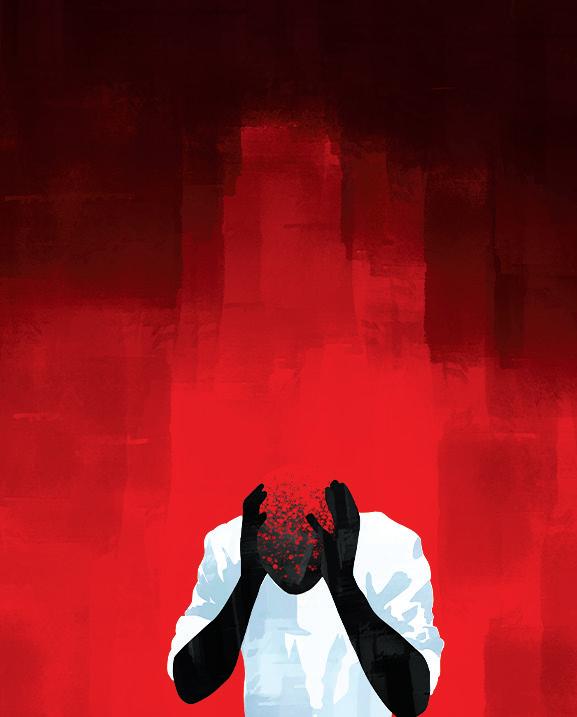

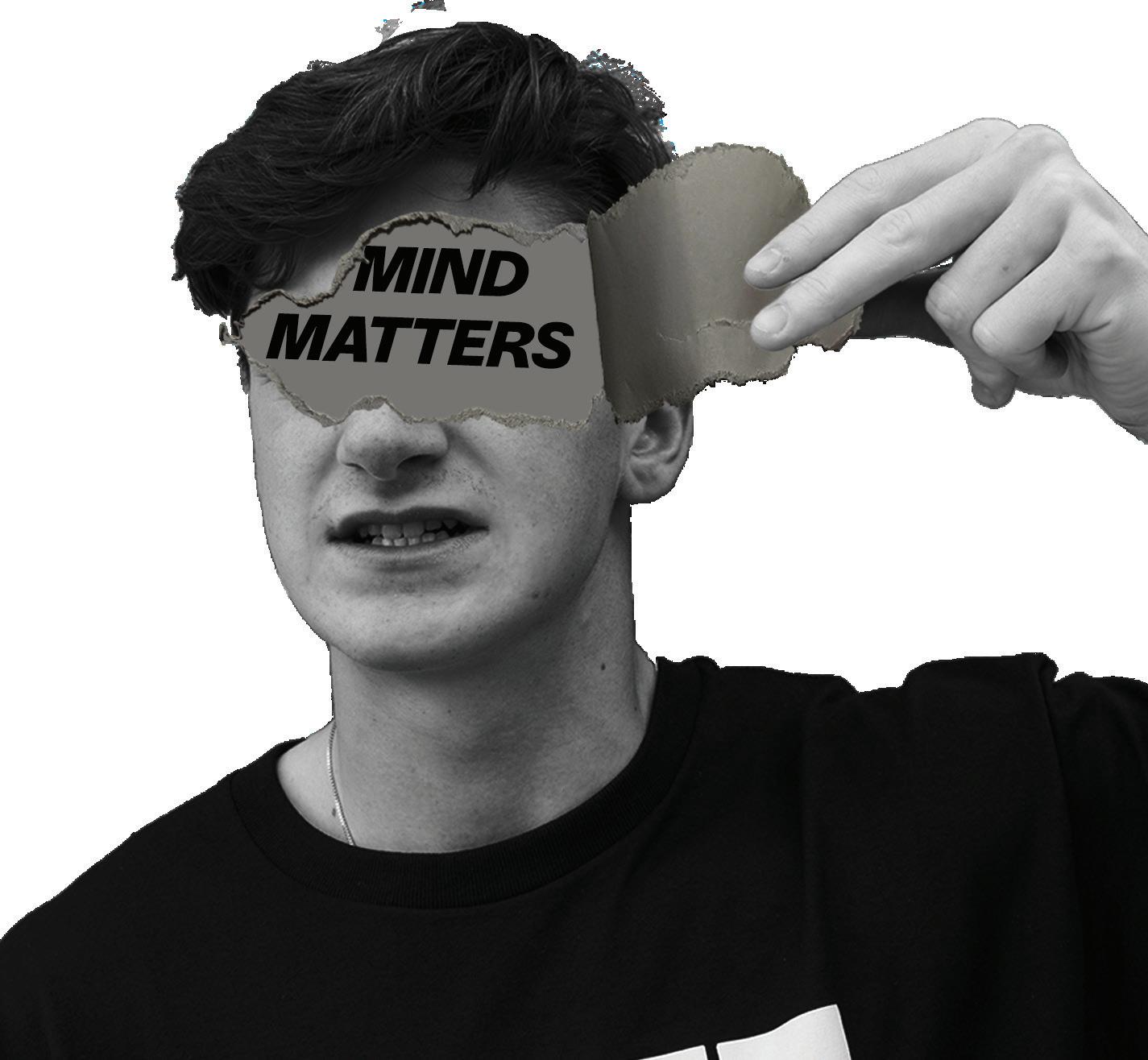
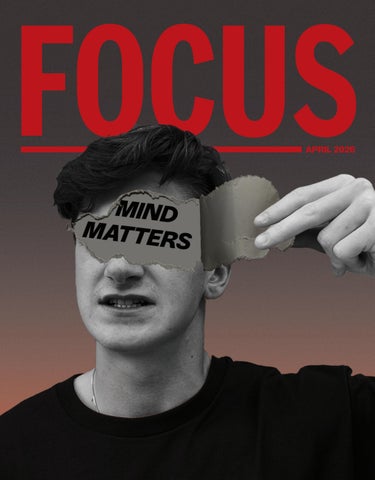
Depression. Trauma. Anxiety. Disorders. Therapy.
The simple ubiquity of terms like these discussing mental health speaks volumes. Gone are the days of “madness” or “possession”: for the first time in human history, in our broader cultural zeitgeist, we are discussing the quieter issues, the unspoken and the unseen, in frank and open terms, accessible to any person who might wish to engage with the topic on serious grounds.
Perhaps we owe more for this positive change to nothing else than the technological advancement that has enabled human communication and interaction on a much larger scale.
In this age of unrivaled human interconnectedness, given a myriad of tools and mediums by which we can confide in somebody else,
it should be no surprise that we are choosing to take advantage of them. If we can know the thoughts of our closest family members and friends at any given moment, then the innate stigma associated with talking about your deepest, most personal thoughts is diminished, if not dissolved entirely. That kind of confidence in other humans is, after all, the foundation on which trust is built on.
Yet our hopes, great or small, have scarcely been realized. Suicide remains one of the leading causes in the United States alone, and approximately one in five adolescents experiences some form of depression or other mental health disorder.
So, where have we taken a misstep? Is the global movement for more recognition of the importance of mental health lacking substance? Are we ill-equipped to help the most vulnerable? Can we do more?
These are broad questions. Maybe, for this magazine, the most important question is this: how are the conversations, dilemmas and debates happening at a national and international level, playing out here on campus?
Andrew Ye and Kayden Zhong Editors-in-Chief
From dopamine myths to risky coping habits, experts warn that viral mental health advice often oversimplifies complex science. As mental health advice floods social media, misinformation and misunderstood science are putting teens at risk.
BY MICHAEL CHANG AND NICHOLAS HUANG
With more and more adolescents using social media as one of their primary sources of information, mental health influencers have also transitioned to promoting their messages on apps like TikTok and Instagram. However, these self-proclaimed mental health experts can offer false or even dangerous suggestions to students.
Proponents of mental health education often throw around buzzwords like “dopamine” and “depression.” However, many high schoolers or young adults aren’t too familiar with the scientific reasoning behind these words. Dopamine, for example, is a complicated brain chemical that is often
misunderstood.
“Dopamine functions as a neurotransmitter and hormone,” James Calvert, lecturer in Psychology at the Southern Methodist University said. “Without it, you would die. The same with serotonin, norepinephrine, acetylcholine, and the many other neurotransmitters. You need them to do everything from breathing to having emotions to physically moving around.”
And as Director of Marksman Wellness Center Gabby Reed points out, dopamine actually dictates motivation; it isn’t an inherently harmful chemical.
“There’s a fantastic talk about dopamine receptors and the way that they work,” Reed
said. “People think of dopamine as a pleasure chemical, but it’s not actually a pleasure chemical. It’s a motivational chemical, so our body and our brain release dopamine when we do something pleasurable or fun or productive, which then motivates us to do that thing again. That’s what dopamine is. It’s not really happiness; it’s really more like motivation.”
Although dopamine itself may not be dangerous, stacking multiple addictive stimuli — which boosts motivation or focus in the short-term — can result in a physically painful crash. In fact, repeatedly stacking dopamine can lead to reduced brain sensitivity to pleasure, resulting in addition-like
ANDREW YE PHOTO
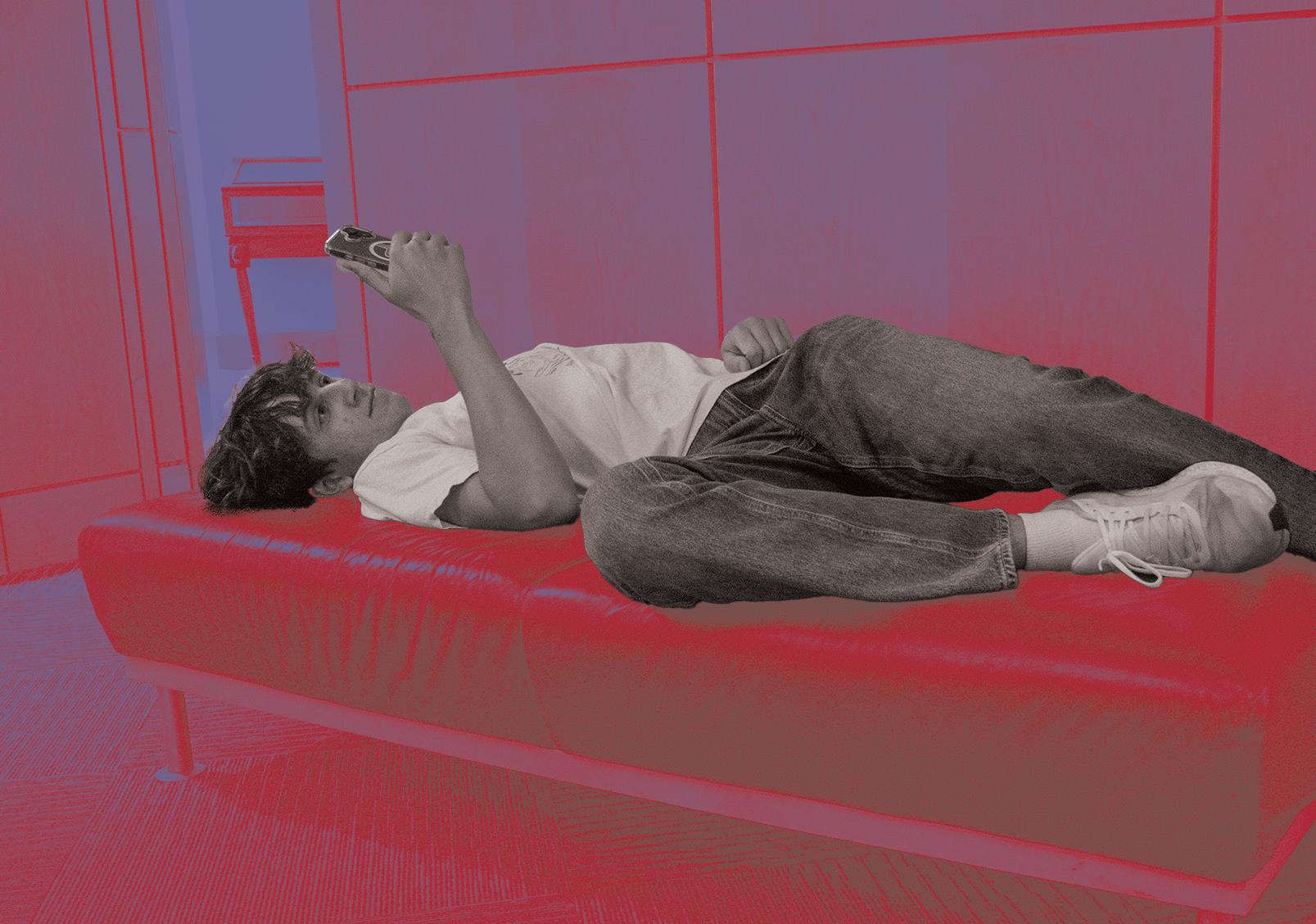
A student scrolls through social media on his phone on a couch, each new reel adding more minutes to his screen time and keeping his dopamine levels high.
behaviors, decreased satisfaction and a painful need for greater stimulation.
Take sports gambling, for example, which mixes a positive dopamine-releasing agent with a negative one. Reed notes that participating in sports gambling may shift one’s focus from the competition and joy of the game to the financial benefits, turning entertainment into stress.
“A lot of kids here live and breathe sports, right?” Reed said. “And a lot of you watch it, but when you start gambling on sports, you’ve now dopamine stacked. And so when you watch sports without having money in the game, it’s not fun anymore. And you see how awful that would be; you can basically

minutes is the daily average screentime of teenagers
erase your love of sports by adding gambling on top.”

Addictive behaviors like smoking, scrolling or gambling do fill the gaping holes left by excess dopamine — but they also deepen those holes, encouraging more destructive behavior and impeding the body’s homeostatic ability to ensure proper neural function, emotion and motivation.
Yet the science of mental health extends far deeper than just regulating dopamine. In fact, many topics surrounding mental health are still nebulous, and influencers on social media can often feed into viewers’ wrong assumptions.
“People who smoke say they just find it relaxing. It helps give them dopamine. And so when a smoker quits cold turkey, they have no other strategy, so they find themselves going back to cigarettes. It’s the same thing with your phone.
Gabby Reed, Director of Marksman Wellness Center
“There are tens of thousands of research studies published yearly on psychology and psychiatry,” Calvert said. “Most people are unaware that there is so much research on mental health issues. We hear whatever the popular press tells us, and much of that is either wrong or just barely touches the surface. As the research expands, we are constantly learning more about underlying causes.”
In fact, an often overlooked aspect of mental health is its deep connection with physical health. They are so interlinked that there may not even be that large of a difference between the two ideas. So, Calvert recommends that one of the most important aspects of improving mental health is actually first improving physical wellbeing.
“Exercise, getting good sleep,
65%
report participating in one form of gambling before
eating well (a Mediterranean diet has most consistently been found to be the best for mental health), making friends and doing things with them, engaging in multiple activities ranging from learning to music to sports, connecting to family, taking time to yourself to rejuvenate (not to withdraw as withdrawal is a problem), focusing on one’s strengths and building on those, and thinking flexibly are all key,” Calvert said.
However, sometimes treatment is necessary, but judging when mental health deteriorates into a problem can be tricky.
“Everyone experiences sadness or anxiety at times,” Calvert said. “It’s normal. But when those emotions or behaviors (e.g., withdrawal, angry lashing out) become prolonged or start interfering with typical functioning, then it’s important to seek help to identify the problem and get the best treatment.”
Ultimately, the burden of maintaining mental health doesn’t have to be the burden of one singular person. Parents, peers, and therapists can all lighten the weight of stress or anxiety.
“Parents can model and teach their children healthy ways of being,” Calvert said. “Good mental health starts at birth and is nurtured by the community. When things are not going well, as often happens in life, then we need to seek out support.”


BY RONIT KONGARA AND SEBASTIAN GARCIA-TOLEDO


Behind curated feeds and constant comparison, a growing number of teens are slipping into silent burnout and addiction. What starts as trying to belong can slowly turn into losing yourself.
Astudent sits on his phone during a free period, scrolling through TikTok. He’s not watching anything specific, just scrolling through. Around him, his friends are doing the same thing. Nobody is talking.
Later that night, someone at a party offers him a drink. He says yes.
It isn’t that simple. It never is. But for Dr. Haritha Maramreddy, a pediatric psychiatrist who works with high school students, the line between social pressure and self-destruction is shorter than most believe.
“They want to be at least one among the popular kids,” Maramreddy said. “In that train of things, they lose their self-esteem because they’re not themselves. They’re always trying to fit in, fit in, fit in.”
The fitting in has gotten harder, and the consequences of failing at it have gotten worse. Popularity used to live exclusively inside school walls. But now with social media, popularity can feel visible to everyone, with constant updates, and the gap between those who enjoy it and those who don’t feels permanent. The pressure that used to end at 3:30 p.m. now follows students home and compounds.
“They get depressed when they’re not able to fit in,” Maramreddy said. “They thrive on other people praising them. So in fact, they’re going downhill. That’s not their own self.”
And that depression doesn’t stay abstract for long. It needs somewhere to go
For a lot of students, somewhere is a drink, a hit, or a Zyn slipped between the
gum and lip before class starts. According to the National Institute on Drug Abuse, about 41.7 percent of high school seniors reported drinking alcohol in the past year, and roughly one in four sophomores reported using cannabis. Nicotine pouches’ numbers tell a similar story. According to a USC study published in JAMA Network Open, usage of products such as Zyn has nearly doubled among high school students between 2023 and 2024 alone.
What is driving this sort of addiction isn’t curiosity; it’s exhaustion.
“They have to balance the GPA, but they also have to keep up with the popularity,” Maramreddy said. “So they’re just exhausted.”
Exhaustion is where these habits form. According to the Addiction Center, teens struggling with depression and low self-esteem often turn to substances as a way to quiet feelings and emotions they don’t know how else to handle. Alcohol blunts the anxiety of fitting in at a party. Weed takes the edge off a difficult week. A Zyn offers relief when everything seems to be weighing you down. Each one on its own feels manageable. Until it isn’t.
Maramreddy has seen it build in her patients. The student who was making straight A’s slowly loses motivation. The student who used to care so much no longer shows up. It’s not because something drastic happened, it’s because the weight accumulated over time and nobody caught it.
“The kids who got straight A’s sophomore year,” Maramreddy said, “they’re like, ‘I don’t even want to go to college.’”
What makes it harder to catch is that usually, the student looks fine from the outside. A student keeping up appearances can be falling apart underneath. According to the Addiction Center, teens who struggle with mental health are significantly more likely to turn to substances as a coping mechanism, and that pattern tends to deepen the longer it goes unaddressed.
Maramreddy’s answer to this isn’t a program but something much quieter.
“A lot of kids say, ‘I feel like I’m a disappointment to my parents,’” Maramreddy said. “Parents should give them a little bit of the benefit of the doubt, because it’s a lot going on.”
A student who feels like a failure at home and invisible at school is left without many places to turn. Substances are one of the few places left to turn to. Students fall into this trap not because they are careless, but because the pressure stacked up and there wasn’t a safety net to catch them.
Maramreddy’s ask is simple: let kids be open. Let them figure out who they are without the worry of being considered a failure. Trust them with a C. Trust them with uncertainty.
“The kid who knows this is what I want to do,” Maramreddy said, “will thrive.”
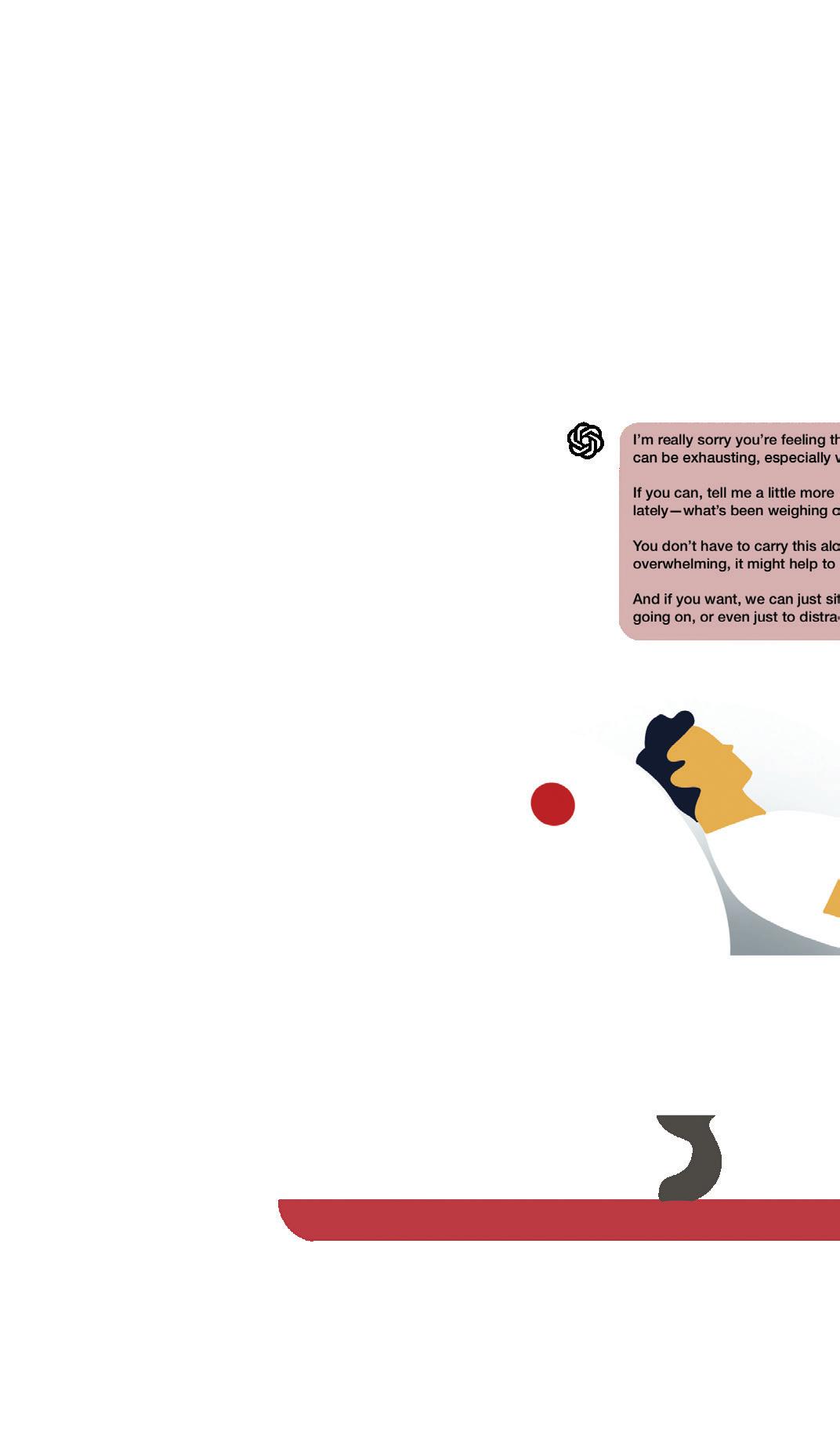
The popularization of therapy, coupled with increasing access to popular AI chatbots, such as ChatGPT or Gemini, that operate using a large language model (LLM), can lead some who are struggling to seek out and receive questionable advice and support from a program that isn’t necessarily tailored to one’s individual needs.
BY CHRISTOPHER HUANG AND SEBASTIAN GARCIA TOLEDO
In a 2025 study co-authored by researchers from the Brown University School of Public Health, Harvard Medical School and RAND, a nonprofit think tank, about one in eight adolescents and young adults in the United States have used generative AI chatbots, such as ChatGPT, as therapists and mental health counselors.
These rates – characterized by researchers as “remarkably high,” – reflect a growing national shift among the attitudes of middle school and high school students towards the usage of chatbots within the context of what the Center for Disease Control and Prevention (CDC) has labelled a youth mental health crisis. Roughly one in five adolescents have experienced a major depressive episode in the past year, with 40 percent receiving no mental health care.
Indeed, experts have argued that the coincidence of this mental health crisis with an unprecedented level of adolescent access to technology and the Internet has led to over-usage and even abuse of chatbots, often with dubious or unverifiable results. The relative ease of access to generative AI compared to the higher costs, social stigma and delays that can be associated with consulting with a human therapist has proven, according to the same Brown SPH study, to be attractive to a younger generation.
To understand these changes and the importance of seeking out deliberate, focused care, however, according to Upper School Counselor Dr. Mary Bonsu, it is important for students to first understand the importance of therapy, not just as treatment but as a proactive step in ensuring mental healthiness.
“Therapy is an opportunity for individuals to sit with a professional who is trained in listening and offering support and treatment interventions that are geared towards changing the course of a mental health concern,” Bonsu said. “Oftentimes, people will go into therapy for issues related to anxiety, depression (or) PTSD. Within therapy, you’re getting skills and tools, mindset shifting techniques to help reduce the symptoms if you were suffering with a mental illness.”
Overall, therapy has seen an increase in popularity due to multiple factors, including increasing awareness among younger generations about the importance of mental health. For many, these paid sessions with therapists serve as an opportunity to maintain and improve their mental health.
““It was really helpful because I could just empty my emotions and thoughts. If you have your emotions bottled up inside, you can accidentally lash out on someone you love,” Hockaday sophomore Kate Pauley said. “I would definitely recommend it to other people because a lot of people have beliefs around therapy. I think everyone should try it at least once or twice.”
This popularization, however, has meant that while more might be encouraged to seek out therapy, some might be hesitant to see a human counselor for a variety of reasons, among them accessibility. As such, individuals have been turning towards AI chatbots, such as ChatGPT or Google Gemini for therapy.
The supposed upsides of AI therapy are immediately obvious. These technological ‘therapists’ are essentially free, with the only cost upfront being ownership of a device, and they don’t charge per session. Additionally, accessing the chatbot interfaces is simple and available at all times of the day, without needing to schedule
In terms of the sophisticated, nuanced, real time tools that we use, and then also clinical judgment, (AI chatbots) are not really good at that. One of the popular ones, ChatGPT, has consistently failed in utilizing clinical judgment when it comes to people using it for advice and therapy.
Mary Bonsu, Upper School Counselor
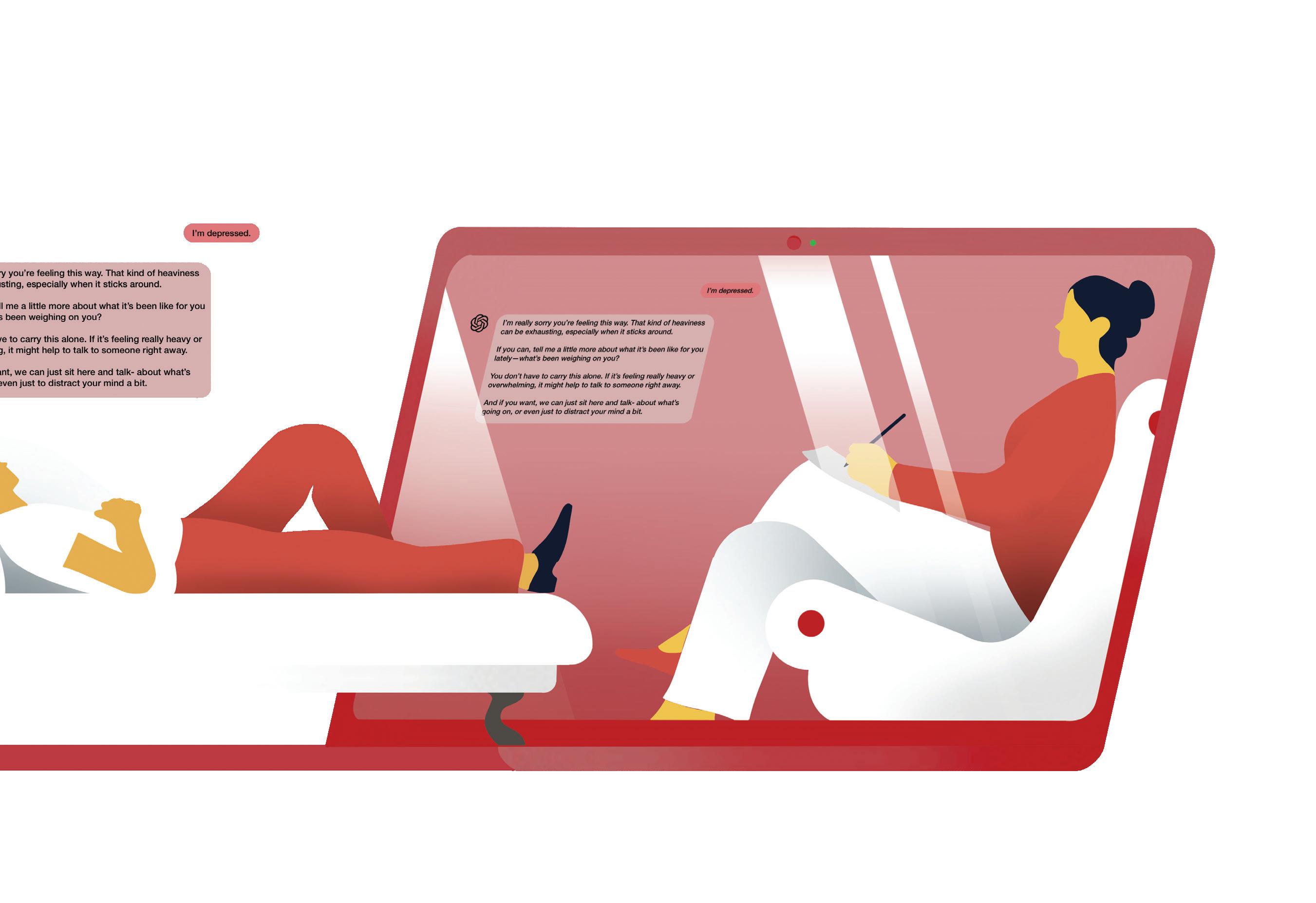
risks or fear of being judged.
However, while these AI therapists may seemingly have a huge advantage over human therapists in accessibility and availability, they still fall short in many important areas, and they can in fact be detrimental to mental health.
“There are limitations to the large language model approach to therapy at this time,” Bonsu said. “So while therapy does rely on the power of words to help individuals feel better, to help them relieve their suffering, there are certain modalities that a large language model cannot do.”
While many LLM AI chatbots have developed more robust speaking and conversational capabilities, many of them still fail to replicate the authentic experience of working with a real therapist. Despite how logical these chatbots can be, they still lack the emotional intelligence and understanding that comes with a trained human therapist.
“What I’m saying is that large language models, and even AI models with vocal capabilities, are able to do a lot of the basic
KIRAN PARIKH
For some who are unable to access proper care due to barriers such as cost or disability, or perhaps unwilling to seek out therapy, generative text-based AI can seem like a viable and useful alternative to human counselors.
at that. One of the popular ones, ChatGPT, has consistently failed in utilizing clinical judgment when it comes to people using it for advice and therapy.”
On top of their shortcomings, under their current architecture, chatbots will always be limited by the training data they use, and while some companies have developed specific therapy agents, many of the most popular options that consumers use for therapy are big-name chatbots like ChatGPT that are not specialized in any one field. Bonsu believes that this aspect also causes chatbots to sometimes be unreliable for therapy purposes.
“These models are also trained on information that’s all out there,” Bonsu said. “And we don’t really have a lot of good examples where companies are strictly developing these tools in a way where they’re only trained on a limited amount of information.”
While part of the problem lies in the restrictions and limitations that many of these chatbots have, another significant part of the problem also comes from uninformed
responses that fail to properly meet their needs.
“Sometimes the information is junk information, and if a person is suffering with a mental illness, and they’re not particularly versed in how to set up prompts so that they get the kind of responses they’re supposed to get that would mimic a therapist, then they’re kind of stuck,” Bonsu said. “So there’s a gap in even the understanding from the public of ‘how do you prompt an AI model so that it’s speaking to me like an expert, and not just like rehashing what it got from Reddit?’”
As AI chatbots continue to become more and more prominent in the lives of everyday individuals, people should be aware of the dangers of using these models for AI therapy. As recommended by the American Psychiatric Association, they should consider booking an appointment with a licensed therapist when faced with deep mental health challenges. FOCUS 04.17.2026 11
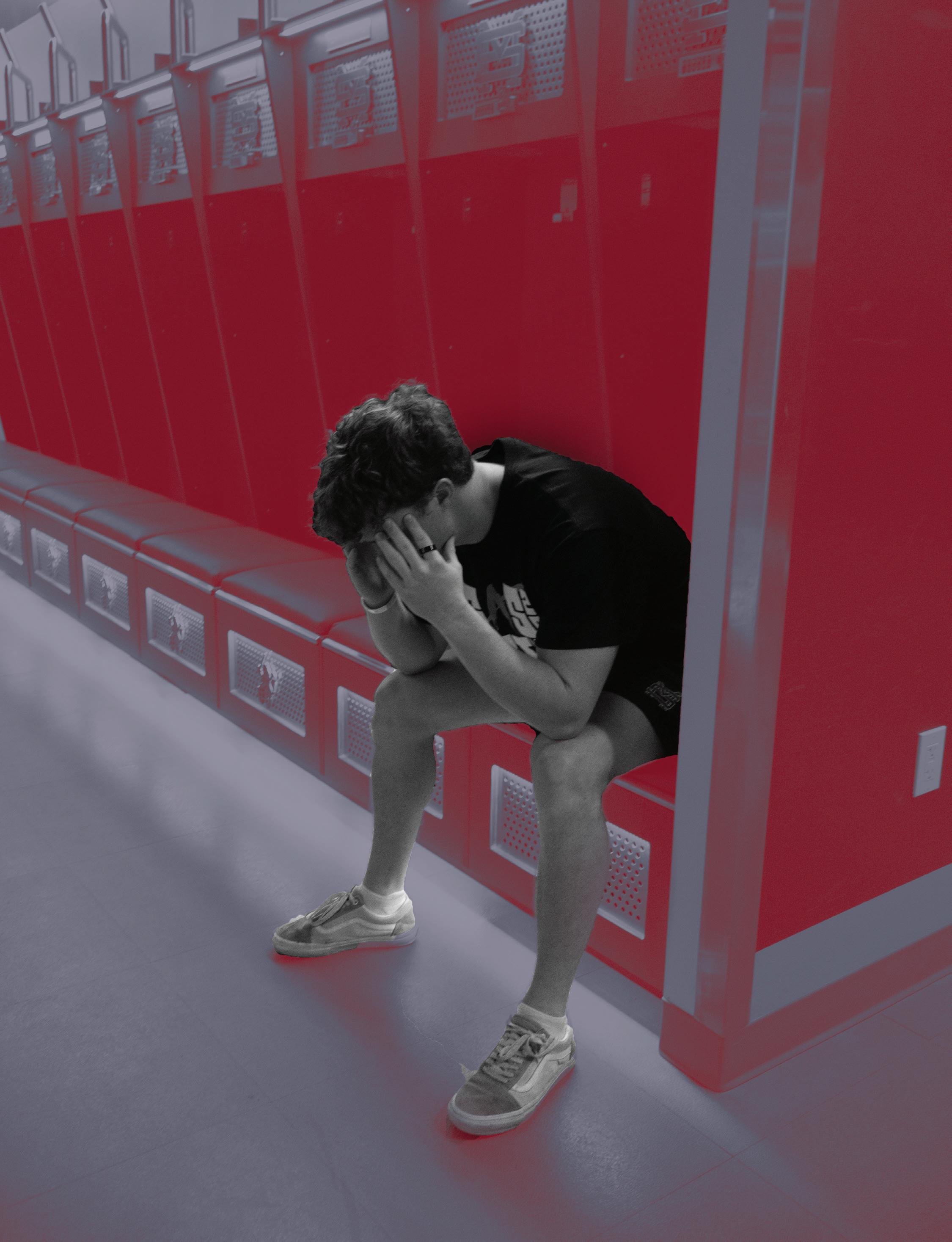
Athletes experience some of the highest pressures to achieve at high levels, and often, their successes can come at the expense of their mental health. Injuries can lead to feelings of isolation and stagnation, while failing to meet high expectations can create a sense of despair.
BY EMILIANO MAYO MEJÍA AND RISHIK KAPOOR
Nov. 1, 2024.
The crowd roared as the ESD football team failed to convert their 2-point conversion, solidifying St. Mark’s 1-point win.
From 21-0 down, to leading 28-27, the student section exploded in celebration after beating their bitter rivals for the first time in 10 years.
Watching the Lions football team run towards the stands to sing the alma mater with the home crowd that Friday night was a celebration of unfiltered emotion, one to be remembered for years to come.
But for current senior Marshall Bagley, besides joy and triumph, that night was tinged with frustration after watching the game on the sidelines as his teammates reached glory.
“It’s rough watching a loss,” Bagley said, “But I think it can be rougher watching a great win that you aren’t a part of or that you couldn’t really feel like you did something.”
At the start of his junior season in football, Bagley tore his ACL which marked the end of the season and a year of rehab. While his teammates continued to grind in the weightroom and in practice, Bagley remained stagnant.
“The sport moves on without you,” Bagley said, “So it’s very difficult because you have all your friends, all your teammates, who are still put in the work every day, trying to win games, trying to compete, but you’re kind of just stuck on the sideline.”
At first, Bagley’s lack of participation in the workouts led to a bitter feeling of missing out while everyone else kept getting better. However, with support from his teammates, coaches and mentors, he was able to keep his head up.
“I think all the teachers at St. Mark’s are really great about trying to stay updated with everyone and trying to know what’s going on,” Bagley said, “You see teachers who are concerned about me when I’m moving around quickly, and they want to make sure I’m not pushing myself too far.”
During his time off from the sport he loved, Bagley was able to focus on other parts of his life such as robotics. Although the love and passion for the sport remained, Bagley was still able to find a silver lining to his injury.
“(The injury) gave me the opportunity to really dive into other areas of my life that, maybe, football would have taken away from,” Bagley said, “The football aspect was rough, but I think with robotics and just kind of getting into my classes, and still being a member of the team socially, I think all of those aspects were still very positive.”
With his injury Bagley believes that he was able to appreciate every moment on the field and to have a more optimistic mindset when facing setbacks such as injuries or losses.
“Understand that one injury isn’t the end all be all,” Bagley said, “You can think about it similar to bombing a test in a class: it sets
you back, it puts you in a bad situation moving forward. But you can continue to work at it, and if you can really continue to just put in effort each day, if you just take your rest and sleep well, if you really take the time to put in with good recovery, you’ll get back to a good situation.”
Junior Asher Collins often faces mental health pressures related to basketball, as the constant expectations to perform at a high level, whether from his coaches, his parents or himself, can create a sense of stress or anxiety.
“One of the biggest pressures I face is performance,” Collins said. “I have to make sure I always stay consistent and always perform at a high level.”
For Collins, that pressure is only augmented by his dreams of playing basketball in college. This pressure is increased by the fact that he is in his junior year, meaning every game he plays is being watched by scouts and recruiters.
“Ever since I was a kid, playing basketball is something I wanted to do in college; especially the idea of continuing to play at a high level,” Collins said. “I know whatever I do, scouts can be watching me and my performance.”
To combat this stress, Collins employs several strategies that he utilizes before and during games to ensure that he stays calm while he plays.
“I have to make sure I’m in the best mental space before games,” Collins said. “I

dissipates as a result of the team aspect of the game of basketball, and he finds a sense of comfort in the camaraderie he feels with his teammates.
“We’re all in this together, and if we play well together, it’s a lot easier than if you’re out there on your own,” Collins said.
If Collins makes a mistake, he does not dwell on it or let it affect his mental health. Instead, he takes accountability and turns to his film to find areas of improvement.
“If I make a mistake or have a bad game, I’ll watch it on film,” Collins said. “I watch all my games, especially if I have a bad one. I always focus on what went wrong and what I can do better next time.”
In actively reviewing his performances, Collins finds a sense of control over his mistakes and his development. In doing so, he makes sure he avoids making a similar mistake and can show growth instead.
“I get a sense of relief knowing it’s under my control whether I get better or not,” Collins said. “I know I can

work to get better, and it’s my decision.”
“I get a sense of relief knowing it’s under my control whether I get better or not. I know I can work to get better, and it’s my decision.
junior, Asher Collins
Before every game and at the start of the season, Collins set goals for himself to reach in terms of his performance. By setting actionable metrics, he finds it easier to play well and avoid stress during games.
“Before every game, I usually remind myself to be more aggressive on rebounding, because that’s been the main focus of mine,” Collins said. “Others around me like my parents, trainers, and coaches remind me to keep a mentality of ‘it’s okay to make mistakes.’ I just need to move on to the next play.”
With that mindset, Collins has learned to focus on what he can control while blocking out unnecessary distractions. That perspective helps guide him on how to approach both his short-term goals and long-term development while avoiding mental strain.
“I have to be able to decide what’s important to me and what’s not,” Collins said. “I know what’s gonna help me right now, and what’s gonna help me in the long term and be best for me.”
This goal-oriented mindset has motivated Collins throughout his basketball journey, and it continues to motivate him whenever he faces adversity.
“Playing in college is something I wanted to do since I was a little kid. I want to make little Asher proud,” Collins said. “Having schools reach out motivates me to perform better, do better, and continue to grow every day.”
In fact, Collins views the pressure he faces as a privilege that can catalyze him to future growth and improvement.
“Pressure and stress motivates me to play even better. So even if it’s hard in the moment and I may struggle, I know I will grow from it,” Collins said.

With the rigorous demands of training and competition imposed on student athletes, some have found it difficult to manage their academic, social, and athletic obligations at the same time, thereby becoming prone to burnout and anxiety.
BY SHIV BHANDARI AND HOLDEN PURVIS
Most fans don’t see the 6 a.m. practices. Or the self-doubt creeping in during a slump. Or the athletes pushing through mounting fatigue. They only see the final product.
Student athletes are celebrated for their discipline and grit. But that same culture of toughness can make it hard to admit — or even recognize — when something’s wrong. When a packed schedule leaves little room for rest, a sport can gradually stop being something you play and transform into something you are.
And for many student athletes, the line between discipline and burnout is thin, and not always easy to see or change.
During the fall, senior Oliver Geheb practices water polo from 3:45 p.m. to 7:15 p.m. most days. Combined with two travel tournaments to California and many tournaments across Texas, the sport consumes enormous stretches of time. Some nights after competitions, he doesn’t get home past midnight before sitting down to work.
“If you want to get good grades and you’re doing water polo, then you are not going to get any free time during the week whatsoever,” Geheb said. “You’ve got to study right when you get home.”
Geheb swims in the winter and dedicates the same intensity toward club water polo in the spring. But he’s come to embrace the constant activity. The relentless schedule has become a baseline he’s grown to depend upon.
“I think I’m most productive during water polo season – I tend to get better grades just because I have to be laser focused,” Geheb said.
The packed calendar forces a kind of discipline and time management that lighter schedules simply don’t. With zero margin for wasted time, Geheb has learned to maximize productivity during free periods and at home. And although the schedule does come with some academic tradeoffs, the structure and skills it builds have proven more valuable than the free time it takes away.
“It definitely builds a routine,” Geheb said. “In the long run, you’re making yourself more efficient. You’re learning things that you can only learn through high level athletics. And the positives definitely outweigh the negatives on that part.”
So while athletes lose free time, some also lose comfort with free time, making a tight schedule necessary to maintain regularity.
“Even if I wasn’t playing water polo in college, I would need to fill my time with something because I think I get restless if it’s during the week and I don’t have something to do,” Geheb said. “It just feels wrong to me. I want to be doing something every day.”
For some athletes, the relentless pace is draining. For others like Geheb, it’s both necessary and sustainable. Whether an athlete’s structured life sharpens or wears one down ultimately comes down to the person living it.
Junior David Dickson shares similar experiences. A captain of the varsity football team, a player on the varsity lacrosse team and a to-be captain of the varsity soccer team, Dickson has had to find a way to balance his academic pursuits with all other areas of his life.
“Having the mental strength to win can be tough, it can be rough,” Dickson said. “But at the end of the day, you gotta remember that there is a reward, and that’s something that I hold on to.”
This mentality didn’t come programmed in Dickson, however. He had to learn it through the ups and downs of his career, by pushing past the adversity.
“You see all these smart people, and you start to question whether you should even play this sport,” Dickson said. “Should I focus on my grades? Focus on something else? But it comes with sacrifice, and I think that’s what builds discipline in people the most.”
Dickson advises other athletes to be aware of their mental and emotional state, which he believes can possibly get overlooked when caught up in the atmosphere that demands constant performance.
“At the end of the day, pressure is normal; feeling kind of anxious is normal,” Dickson said. “But it gets to a point that’s unhealthy, in the sense that if you really are not feeling well, things are bothering you, and it’s affecting you outside of other things.”
The following columns are stories of two individuals’ personal experiences with mental health. Mentions of suicide, suicide ideation or sensitive content around mental health might be difficult for some readers. More stories in this issue continue on page 22.
If I had to define a major depression in a single sentence, I would describe it as a ‘genetic/neurochemical disorder requiring a strong environmental trigger whose characteristic manifestation is an inability to appreciate sunsets.’”
During COVID, I left a lot of sunsets unappreciated. Weeks of asynchronous classes and social distancing were a welcome vacation for most of my classmates, but for me they were a tipping point. They were the initial stimulus, the first push, that plunged me into a self-reinforcing cycle of loneliness and rumination. I started to push well-meaning friends aside, stopped responding to texts or initiating calls, and spent more and more time cooped up, just thinking. This thinking was innocuous at first. It consisted of leapfrogging from one small, inoffensive anxiety to the next, never fixating on one problem per say, but this aimless thinking slowly formed itself into a body of particular thought. My dwellings began to whirlpool around the same core anxieties: fears about the future or a disconnected, sticky apathy for the present. This apathy would define my body of thought. It would eat me up and consume my consciousness and redefine every mental detour or idle reflection. I started to see meals and classes as temporary distractions from this default feeling of drowning internally. I found that, at a certain point, I could not stop thinking, even if I’d wanted to.
It was around this same time that I decided I was an atheist. I’d known this for a while, but the pandemic provided the perfect environment for me to realize this fully. Thoughts of religion and rationality intermixed with my apathetic ruminations and pushed me towards one terrible question: what is this all about? Why am I even here? A difficult question for a kid to answer, no doubt. This difficulty was suffocating and compounded with the drowning quality of the thoughts I was already inhabiting. The only comforting reprieve was that I was not the first person to wrestle with this dilemma: I had centuries of alternative religion and philosophy to inform my perspective and keep me afloat.
Unfortunately, I made the (in retrospect kind of hilarious) decision to approach my existential crisis like a math problem. I thought I could empirically determine an optimal approach to living, somehow derive a formula for happiness. As much as I could rationalize the inherent value in music, nature, or time with my family as things that should have made me happy, I could not wring sufficient joy out of any of these occupations. I remember vividly forcing myself to listen to my favorite Beatles song on my old radio CD player and staring into the speaker grille and feeling a solid nothing weighing down my guts. It felt empty yet dense, like the sheer absence of feeling was swelling and distending the walls of my stomach and sucking up everything inside of me until I felt like I might collapse in on myself. I sobbed quietly knowing that no Beatles song, no book, no sunset was going to ‘fix’ me. Looking back, I know now what was meant to fill that emptiness: it could have been spirituality, could have been a stronger network of friends and loved ones, could have been a more principle-driven life or a more authentic self-identity. But I lacked all of these things. I was hopelessly adrift.
That was the first time I considered taking my own life. It seemed like a logical escape and a solution so unyieldingly final that it would have no other choice but to evaporate all of my emptiness and apathy. This sparked what could only be described as an obsession. I thought
about escaping constantly; it adopted a similar all-consuming quality as my initial rumination. This obsession lasted for several bitter months until, at long last, school began to reopen. A return to in-person classes signaled a return to normalcy. I became once again preoccupied with wonderfully mundane problems: how do I do this homework? Which teacher should I choose for science next year? I wonder what’s for lunch today...
School provided a much-needed distraction and sense of belonging that, quite honestly, might have saved my life. While many of my anxieties dissolved or quietly masked themselves in the guise of more pedestrian concerns, that underlying inclination to ruminate is still part of me. I recognize in myself a kind of depth that has equally likely potential to violently implode or serve as the foundation for revitalizing convictions. I never stopped that vicious cycle of thinking; I just developed strategies to redirect those thoughts. I think we all come up against this at one time or another in our lives. Whether it’s confronting our previously held beliefs, surviving an upending catastrophe, or just choosing the road less traveled, we all have pivotal moments of self-reflection that have the potential to send us into deadly spirals. To paraphrase a Camusian idea, when we encounter these spirals, we’re faced with three options: we can bury our heads in the sand and trod forward in ignorant bliss; we can succumb; or we can face the spiral head-on and sculpt our own meaning out of the eddies and whirlpools of uncertainty.
Looking back, I know now what was meant to fill that emptiness: it could have been spirituality, could have been a stronger network of friends and loved ones, could have been a more principle-driven life or a more authentic self-identity. But I lacked all of these things. I was hopelessly adrift.
I will not pretend like the end of social distancing was the end of my problems. I’ve continued to grapple with depression throughout the years. But I’ve learned how important even one accountable, loyal friend can be. More than that, I’ve learned how much security comes from just knowing yourself better. If you’re still in the thick of adolescence and feeling any of the hopelessness I’ve hinted at here, give yourself time to discover who you are. You may not see the beauty in life at any particular moment in your development, but I guarantee you have the intellect to carve out that beauty for yourself. Sometimes it just takes time to discover what that carving out can look like and how you can invent your own sunset. FOCUS 04.17.2026 19
Iwas first asked to write this column while lying in bed one evening, a few minutes before I had planned to turn in.
“Why me?” then, was the unspoken question as I politely entertained the request, promising to return to the topic at some later date when I had sufficiently privately mulled it over. I am sure that for all the rosy gloss St. Mark’s paints its students and alumni in for the outsider looking in, there are not a few others who have passed through the same halls that I did and experienced the same quiet struggles that I did. Any one of them would be equally able, though maybe not as willing, to write about their own juvenile difficulties and offer their individual portions of advice to the readers of this magazine.
I find little shame in admitting that my first instinctive reaction was a kind of inward, fearful flinching. In my own thinking, I felt strongly that to put my experiences down into words would’ve been a resurfacing of old pain—now so far removed from my current thoughts—for a kind of perverse bestowing upon readers unknown to me. I worried that it was vanity, rather than charity or grace, that motivated me to write.
In truth, there are a great number of things that we, having lived through them, would much like to never think about again. We do not have to acknowledge anything about ourselves that others do not already know, and though mental struggle is universally an inevitable concern for all of us, we often consciously choose to make the excuse that if we feel embarrassed or melancholy when thinking back on our own personal struggles, then others would, naturally, be as well. So constructive or educational backand-forth breaks down, and it seems that the only times people would like to speak honestly on this topic are when they have either reached an age when their juvenile years are so distant that they might as well be as real as a passing dream, or under the condition of anonymity.
The latter condition is in effect as this column is presented. I don’t claim to be any higher or mightier than the other strugglers: as far as the reader is concerned, I am one of the masses. This could be the story of the man you walked by in the street, of the grandmother sitting across from you in the streetcar, of your colleague or your fellow student, of your parents, of your siblings, of,
maybe, you. And again, I have my doubts. What is the good in having a column such as this one end up in any publication of any sort? Awareness, education, comfort, whatever various motives might exist, I can only guarantee my own immediate relief at having finished writing. Similarly, I can only hope that this is of some help.
During my time at St. Mark’s, I attempted suicide twice. Nothing came of either: no hospitalizations, no scars, or lasting health issues. There will be no details. To this day only two people are aware that I made the attempts at all.
When a person is found dead, and suicide is suspected, the first thing that police look for is a note or last message of some sort. If none can be found, they interview relatives, friends, and neighbors, seeking a conclusive motive. In teenagers this is often attributed to depression, which can stem from a cocktail of any number of reasons: bad grades, family problems, health problems or social struggles. I am of the opinion that no issue, isolated, should ever be worth considering taking your own life, but I’m lucky to be in a position where I’ve never experienced anything that would actively make me want to seek out death as an escape. I digress to reemphasize the importance of supporting those who have experienced sexual assault, domestic abuse or other traumatic conflict.
But having conversed before with others who also experienced teenage struggle, I would make the generalization that, to the young mind, it can sometimes seem that there are no considerations beyond those of the present, and once hope for the future has been eclipsed by immediate despair regarding whatever might be going wrong, then injury and death are the only inevitable conclusions. Misery begets more misery.
So why did I struggle? The answer to this question is more difficult. Without pretense, outwardly, I probably had less issues than some of my peers. I was a good student, a decent athlete, and a passable musician. I had my own hobbies. I had close friends at school and associated with sizable friend groups. I was never bullied and never experienced the kind of extreme social jealousy of others that seems to stem from endemic use of social media. My parents never divorced and were kind to me, and we lived comfortably, without any kind of financial fears. Teachers liked or were ambivalent to me. I never drank nor
did drugs. I went to Homecoming, football games, house parties. Girls never worried me. All in all, a lot of factors that seem to effect depression were absent in my life.
I think that the main issue was, rather, this absence of things. Having never experienced dearth, I found myself thinking that what I had already was not enough. If a friend had received more attention in class for a poem of his, I felt both a quiet envy and a venomous kind of doubt in my own capabilities. If I found out that I hadn’t been invited to a particular gathering, I worried that my lack of invitation was a social critique. Every little gesture and statement became a point of worry and a potential indictment of me for one reason or another. Had I seen a doctor then, I would’ve probably been diagnosed with some form of acute paranoia but writing this now I realize how very narcissistic it all was.
We do not have to acknowledge anything about ourselves that others do not already know, and though mental struggle is universally an inevitable concern for all of us, we often consciously choose to make the excuse that if we feel embarrassed or melancholy when thinking back on our own personal struggles, then others would, naturally, be as well.
My first piece of advice, then, is to know when and where to take a step back. The sad and simple truth is that humans are, somewhat by nature, careless animals because of the importance that we place on the richness of our own lives. There’s a lot that we do subconsciously that we might not pick up on ourselves but will stick out to others, and vice versa. It could be true that John didn’t acknowledge your greeting in the hallway because he’s begun to resent you for taking the lead role in the school play, but it’s far more likely that he’s deep in thought about his algebra test tomorrow, and how his performance might decide
whether or not he gets a B or a C in the class. If something well and truly irks you, why not confront whatever that may be? Unless you’re sure that conversation will lead to some sort of public humiliation, there’s surely no harm in talking it through rather than letting resentment and dislike pool up.
Unfortunately, I did not heed this piece of advice as a teenager. Those who know me will know that I am a very private sort of person. I dislike confrontation and I dislike conflict more, so I quietly steeped in my juvenile concerns and hates. I began to suffer intense mood swings around this time, probably as the result of a rocky puberty, and I would find myself alternating between short periods of euphoric contentment and longer periods of vicious self-hatred. I would, as the old stereotype goes, lock myself in my room, lie on my bed, and listen to music on repeat until I could no longer hear myself think. At some point, it grew unbearable, and I would think and think until I grew sick of hearing myself and turned the music off.
At some later point, I grew rather desensitized to the idea of death, having revisited the topic so much in my waking and sleeping thoughts, and I began to think of it in vague, abstract terms. Visualizations of my limp body gave way to thoughts of heaven and the afterlife, and the instruments of death became conceptual—a gun symbolizing brutality, pills fraud, et cetera. In short, suicide became a dangerously alluring ideal rather than the violent, all-too-carnal act it actually is.
My second input is that suicide is not a noble thing. Death, by its very nature, is a tragic occurrence. It can be all too easy for a struggling teenager to see obituaries in the local newspapers, or to listen to a speech given as tribute at a funeral, and to internalize a belief that, in death, everybody begins to cherish, respect, and love you, and to then feel that by causing their own death they can attain those previously named benefits. What good is respect or love if you are not physically nor mentally there to accept it?
This was not the insight that eventually led me to cast away the thought of suicide. There’s a now well-known anecdote about how jumpers from the Golden Gate Bridge who survive almost universally say that they regret their decision the instant
they leave solid ground. In the few seconds that it takes for the jumper to fall the height of the bridge to the water below, they reconsider nearly everything in their lives and conclude that the problems that had seemed so monumental mere moments before were nothing compared to the prospect of death stretching out below them. Anything can be resolved or reduced given space and time. I would like to emphasize that it is only in living do you truly have the ability to make a change: in dying you surrender your autonomy, your free will, and everything that was given to you in the first place in order to allow you to make something beautiful of your life.
My last input is that, in the case all other arguments for the value of living have failed, on the brink of making a final decision, there will be something within your brain that screams and screams at you to pull back. Your senses might be dulled, and maybe these screams will be muffled by the thoughts you have built up over the course of many months in the minutes leading up to this brink, but at the very instant that your neurons fire, triggering some physical reaction in your body, and getting yourself ready to make a decision, everything but the screaming disappears. Listen.
It may be our own human innate sense of self-preservation, or it might be an input from God. Whatever it is, listen
I have little to say on the process of recovery. I came away from my depression with a fuller sense of self and a renewed zest for life. Having experienced the dearth that had driven me to the brink in the first place, I realized again how precious every waking moment truly was: I cherished time with friends and family more, I took more delight in doing unfamiliar things and traveling, and I found that I had more respect and love for my fellow man. In a roundabout sense, I’m thankful that I experienced such a crisis so early in my life, and that it took place in an environment where I had an extensive supportive framework. I was extraordinarily lucky.
For the reader: again, I reaffirm my best wishes for you. If you are struggling—I hope you find comfort. I hope that you will consider living a full, unabated life. I hope this has helped.
BY NICHOLAS HUANG AND DOMINIC LIAW
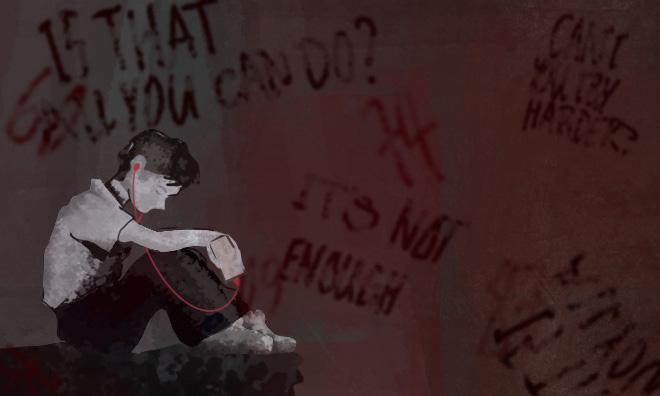
Grade Point Average. For students, it can sometimes feel like if that number isn’t high enough, they’ll end up ruining their own futures and being rejected from every single college. But realistically, the stress of GPA and academics tend to be blown out of proportion, often causing serious harm to a student’s mental health.
This effect of students assuming the worst
possible outcome is often termed “catastrophizing,” and is prevalent amongst anxious high school students. A student’s GPA doesn’t necessarily determine long-term success, but these external measures of success create unhealthy pressures, and often students sacrifice their sleep, mental health and physical health to stay afloat. Students face this self-inflicted pressure to succeed every single day, and
watching a grade fluctuate up and down can be extremely stressful and draining.
“When I was in school, to me, it felt like a little black rain cloud, that sort of follows you around,” Director of Marksman Wellness Center Dr. Gabby Reed said. “And anytime you’re trying to rest or relax, you’re like, ‘I could be writing that paper. I could be reading that chapter. I could be making those
flashcards.’ And that is a unique kind of stress in life.”
In addition, academic stress fluctuates from week to week: sometimes a student is barraged by four tests in a week and, other times, they don’t have a single assessment. This rings true especially for final exams; during April and May, AP tests and grade-deciding final exams pile up on each other, trapping a student under an inescapable burden.
“This place is a little bit like being in the ring with a boxer,” Reed said. “There’s punches coming at you from all sides. If you have planned ahead, if you’ve organized yourself, you can see the punch coming.”
Reed recommends the book Where You Go Is Not Who You’ll Be by Frank Bruni, where Bruni discovered that almost every successful career began with uncertainties and difficulties. Understanding that everything may not work out as expected can ease anxieties and pressures.
“He asks leading CEOs and top hedge fund managers and professors and presidents ‘How many of you had a direct path to your goal?’” Reed said. “‘(How many of) you knew you wanted to go straight from high school to Harvard, from Harvard to a big firm?’ And basically, the answer is none of them.”
To achieve excellent grades in the first place takes an enthusiasm and desire beyond simply a number. Without genuine enthusiasm, reaching goals solely for statistical measurements can feel like an impossible challenge.
“A student needs to find their love of learning,” Associate Director of College Counseling Josh Shandera said. “It’s really easy to get burned out if you’re not enjoying what you’re doing and you’re just focusing on the grades all the time.”
Passion for learning tends to be sidelined. Instead, it’s replaced with a grade-oriented mindset. This mindset creates a never-ending cycle of comparison and competition, even against friends and peers, and mental health tends to deteriorate.
“Grades aren’t everything,” Shandera said. “But I think sometimes it’s easy to get a little bit of tunnel vision and just focus on the grade, as opposed to what is the bigger picture: what is the learning, what is the expe-
rience.”
In addition, mental health issues tend to plague competitive high schools. Sometimes, in an environment of talented students, it can feel like a never-ending game of trying to catch up.
“Students here tend to be really motivated and high achieving students,” Shandera said. “And so because of that, there’s naturally a lot of pressure around grades.”
With so much pressure around getting good grades, a worse-than-expected exam score or a missed assignment can seem like the end of the world.
“Students get really stuck on numbers,” Reed said. “Even when one test or one quiz or one homework assignment doesn’t move the needle that much, they see the number and they freak out. The very best students can be almost like professional golfers. If a professional golfer misses the shot or misses the putt, they have to perform their best again on the very next hole. They have to be able to let it go, and catastrophizing does nothing to help you do better.”
Regular habits like or tendencies regarding school life can be more detrimental than many students might think. Accessing a performance merely off of what others scored, for example, degrades hard work. Because of this, students create false images of what might be considered worthy of praise.
“For students in particular, measuring themselves against each other can be a big mistake,” Reed said. “And there’s this idea that ‘I barely studied and I aced it,’ or ‘I slept 5 hours last night’ and it’s like a badge of honor. Those are frankly not true.”
Students in high pressure situations and tough environments may seek perfection even when perfection is unachievable. Expecting perfection is not only an unreasonable bar, but it’s unhealthy and may cause further stress and anxiety. As Director of Academic Success Julie Pechersky points out, shortcomings and setbacks are simply normal and part of a process of growth.
“You see (that mentality), especially in some of the younger boys,” Pechersky said. “They’re so hard on themselves when
things aren’t perfect, but if everything was that easy all the time and everything was perfect, ‘Where are you growing, how do you find out the things you’re really good at and the things you want to grow in?’”
Looking further, students tend to slide down the slippery slope of catastrophic thinking specifically when it comes to applying for college. An applicant’s GPA can often be one of the most important factors in whether or not they’ll be accepted into a university, so receiving a “bad grade” exacerbates stress and pressure.
“First and foremost, applying to college is applying to school,” Shandera said. “And so because of that, while there are a lot of pieces that are important in the process, the grades and the academic background are going to be sort of one of the first things that a college is looking at.”
Universities, especially prestigious colleges, are also extremely selective, meaning that a vast majority of students who apply will be rejected. And for students who sacrifice their mental well-being for a five percent chance to be accepted into college, the entire process can be extremely stressful. However, leaning on the school’s community, professors, counselors, and peers can alleviate this stress.
“Build a community around you that makes you feel supported,” Pechersky said. “I think those are the things that (matter) when you go. It’s not about your calculus, grades, or your GPA; while important, it’s all those foundational things and learning about yourself and building a healthy lifestyle that I think is what’s gonna make you get to where you want to be down the road.”
Students, especially in high school, tend to fixate and catastrophize. But by seeing a bigger picture and relying on the school’s extensive community and resources, students can learn to enjoy their time in high school rather than getting caught up in the grades.
“From a mental health standpoint, knowing that it’s not the end all be all, knowing that sleep is important, knowing that there is a bigger picture is important,” Shandera said. “And your Spanish grade is not going to dictate your future.”
Walk into any school cafeteria, and you will likely see the same thing: clusters of students sorted not just by grade or friend group, but by background, culture and identity. Many students find significant comfort in being around others sharing a similar culture, and navigating a school without those familiar presences can be a severe burden on their mental health.
The connection between cultural differences and psychological well-being is well-established; when a person’s identity or culture is ignored by the community around them, the result can be chronic stress accompanied by a persistent sense of not belonging. That experience can be especially damaging for developing adolescents.
At the heart of addressing this issue is something simple: the willingness to learn. Cultural awareness, or the genuine effort to understand and respect backgrounds different from one’s own, is one of the most direct ways a school community can protect the mental health of its students.
For Director of Inclusion, Diversity, and Human Resources Lorre Allen, the framing of that awareness matters just as much as the awareness itself.
“‘Cultural appropriation’ happens when you do something that isn’t respectful or is stereotypical and can sometimes be seen in a negative light. It should really
be framed more as ‘cultural appreciation,’” Allen said. “In a school environment, we’re lucky because we have an opportunity to learn. ‘Respect’ is the biggest word.”
Sophomore Eli Lin suggests that cultural appreci- ation is
often as beneficial to the person who engages in the act as it is to the recipient of that awareness.
“It’s definitely important to learn about different cultures,” Lin said. “By doing so, you can connect with other people more deeply if they have different backgrounds than you — you can diversify your views of the world.”

That connection matters more than it might seem on the surface. When students feel seen and valued by their peers, they are more likely to engage fully with their school community. But when that recognition is absent, the effects compound over time. A student who feels their background is invisible to those around them may begin to feel invisible themselves, pulling back from friendships, from classrooms and from the sense of safety that school is supposed to provide.
“You don’t want to feel invisible in a sea of many,” Allen said. “The best person to ask about me and my culture is me. Talk to me, ask me questions, but make sure it’s done with respect.”
The students most at risk are those from minority backgrounds, for whom the gap between their home culture and the
Walk into almost any school cafeteria, and the pattern is unmistakable: students cluster together not just by friendship, but by shared culture, background, and identity, creating spaces of both comfort and quiet division. For some, these groups provide a sense of belonging and familiarity, but for others, especially those who don’t see themselves reflected, the absence of that connection can feel isolating and emotionally draining.
dominant culture of their school can feel difficult to bridge.
Freshman Evan Rogers, having witnessed both cultural exclusion and cultural appreciation, spoke to that reality, drawing on his own understanding of what exclusion feels like and why it feels different than other forms of bullying.
“If you have a big friend group and it’s mostly made up of one (demographic) of people, the other minorities can feel left out if they aren’t a part of that,” Rogers said. “That should never happen. You can’t change your culture. That’s a part of yourself.”
The inability to change one’s culture is what really separates cultural exclusion from other social dynamics. A student can change their interests, their clothes and even their friend group. But students cannot change where they come from.
On a similar note, when belonging becomes synonymous with “assimilation,” the psychological cost is significant. Students are forced to choose between being themselves and being accepted, which can be both dangerous and discomforting.
“If you’re talking about different cultures, it’s important to have people from those cultures be part of the conversation,” Allen said. “Having students or people from that culture inside that conversation allows them to be seen, heard, valued and respected.”
Rogers added that the solution is less complicated than it might seem and that it starts with individuals deciding to show up for one another.
“I would say reach out to people,” Rogers said. “If someone came up to me and was
like, ‘Could I hang out with you guys?’ I would say yes because I know how it feels to be left out. And being left out because of your culture, that’s one of the worst reasons.”
Schools that seriously consider the cultural wellbeing of their students create environments where that kind of outreach is the norm. The school, as a result, particularly emphasizes bringing different cultural communities together through various activities and events, including Marksmen Multicultural Nights, open discussions and inclusive clubs. These events signal to students that their background has a place here.
“We have Marksman Multicultural Night, and it keeps growing,” Allen said. “This year we had nine countries represented, and students did research on the cuisines and cultures. The more we talk, the more we figure out what we have in common rather than what we do (differently).”
Freshman Campbell Timmermann has felt this sense of “cultural inclusion” firsthand. Timmermann, who performed with the school’s a cappella group at Marksmen Multicultural Night and has participated in Inclusion, Diversity and Leadership Council (IDLC) discussions, described what those experiences showed him about the true meaning of diversity.
“I think once we share our beliefs, we can come together and build and create even more ideas that are not just built around one person’s opinion, but multiple people’s opinions,” Timmermann said. “I think that’s what diversity is really about,
not so much race or sexuality, but different opinions and beliefs joining together.”
That spirit of collective growth is what drove the founding of IDLC in the first place.
“IDLC was started by a group of boys who wanted to create a space where everyone could come together and learn from each other,” Allen said. “And the Marksman Multicultural Night was born out of that idea.”
In the end, cultural appreciation is much more than simply learning traditions or celebrating differences. It’s about making sure that no one feels invisible, that no one walks across campus without a feeling of belonging and respect.
GRAPHIC KIRAN PARIKH

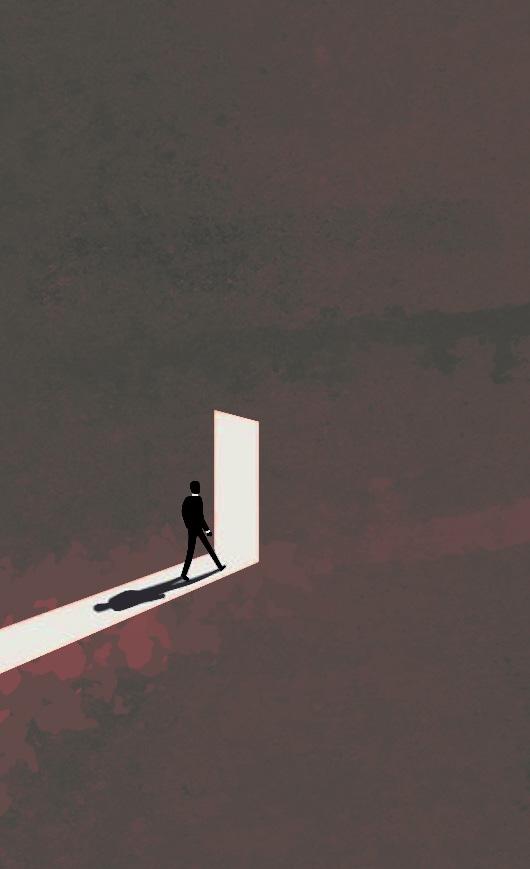
The office was down a dark hallway, in Wirt Davis Hall. Inside sat a single counselor with a sound machine humming outside—the kind of setup that announced, without saying a word, that whatever happened within it was private and serious. The doors stayed shut. Students, under typical circumstances, never had a reason to visit.
“You basically only went to talk to him if you were in distress,” Director of the Marksmen Wellness Center Dr. Gabby Reed said. “Someone made you go. Someone walked you there.”
That was the school counseling program not long ago: one person, one room and one model—wait for the crisis, then respond to it.
Today, that hallway is gone, demolished along with Davis Hall. As of August 2023, the Marksmen Wellness Center sits in the main thoroughfare of campus, Centennial Hall, with doors open and a soft couch inside, blankets folded on the armrest. Students wander in between classes, after tests and during lunch. The transformation from sound machine to Prague photos to warm blankets didn’t happen overnight. It took a decade of deliberate expansion, a pandemic that forced a reckoning and a complete rethinking of what a school guidance center is actually supposed to do.
When Reed joined the counseling team in 2014, the approach at the time was what clinicians call a triage model. Students came in when something went wrong, the counselor would assess the situation, provide im-
mediate support, and, if necessary, refer them elsewhere, whether to an outside therapist, a psychiatrist, or simply whoever could help. It was efficient and reactive, but meant that the relationships between counselors and students were thin by design.
“It’s like an ER doctor versus like a primary care doctor,” Reed said. “You’re there to take care of them in the moment and help them get to where they need to go.”
The triage model held for years. Then the pandemic arrived.
When the previous director, Barbara Van Drie, decided to retire at the beginning of COVID-19, Reed faced a choice about what kind of program to build in her place.
Rather than simply hiring a single replacement, she used the moment to expand her team entirely. Dr. Mary Bonsu joined as the Upper School counselor and Bridget Redondo-Doan joined as the counselor for the Lower School shortly after—both having worked with her at Children’s Medical Center before she came to the school, a professional relationship stretching back nearly 20 years. Soon after, Academic Wellness Specialist Eliza Rosenbloom joined, bringing together the clinical and academic sides of the center into a single role.
“We took advan - tage of
COVID to help us lean into the mental health of the campus,” Reed said.
Rebranding followed. The counseling office became the Marksmen Wellness Center, a name chosen deliberately to signal that what happened inside had outgrown the word counseling.
With a full team in place for the first time, Reed had the capacity to do something the old model couldn’t handle: to get ahead of the crisis before it arrived. Sending a student with test anxiety to an outside therapist, someone who would have to spend months building rapport and had never set foot in the school made no sense to her when she could help him herself, in fewer visits, and send him back out. The goal, she decided, was to build the skills students needed before they ever required intervention.
“We want to build the skills that the boys need before they ever need us,” Reed said.
This impetus had, in fact, been in discussion by school administrators and faculty for some time prior to COVID. In the Goals for St. Mark’s IV adopted by the Board of Trustees in 2017, the school outlined a number of initiatives for growth and development, to be accomplished in the following decade. Among these programs included a step towards developing “a more comprehensive health education curriculum in scope and sequence.”
“The goal is to create a really comprehensive, proactive educational environ-


ment that (utilizes) resources in a way that is mindful and cognizant of the importance of focusing on social (and) emotional well-being, as much as we put a similar emphasis on academic development,” Eugene McDermott Headmaster David Dini said.
Within the metaphor of physical health, Dini explained, the difference between the old reactive model and the new proactive one is like the difference between the emergency room and the specialist. In the former, something has already gone wrong, and the school is tasked with fixing the immediate symptoms and issues rather than the underlying causes, while the latter ensures that students will be much less likely to undergo a detrimental experience.
“What we’ve tried to do is bring collaboration and cooperation to all of these efforts, whether it’s in Character and Leadership development, class meetings, chapel or any other experience,” Dini said. “It’s all part of the same fundamental mission, and it requires a lot of effort and intentionality.”
These commitments became the foundation of a community health model built around presence in daily life. A health and wellness curriculum, written entirely in-house, now runs from Lower School through the Upper School. Counselors sponsor clubs, lead camp-outs, join field trips and work alongside fifth graders at community service events. Their aim is to be so integrated in the life of the school that when a student does need help, walking through the door doesn’t feel like an admission of anything.
“It’s not this dark alley that you go to when you’re in trouble,” Reed said. “It’s like, oh yeah, I know her. I’m comfortable talking to her. I’ve been in her class. I know she knows what she’s talking about.”
The academic and mental health sides of the program, Reed argues, should never be separated to begin with. Most schools
keep their learning specialists and counseling teams apart. Here, they share a space, so that a student who comes in struggling academically might leave with both a study plan and a referral for anxiety report, or a student in crisis might leave with both emotional support and a plan to help him continue succeeding in the classroom.
“If your mental health has gone down the tubes, your academic (wellness) is also going to go down the tubes,” Reed said. “It’s all connected.”
The results of that integration show up in the numbers. Seventy-five percent of seniors have visited the Marksmen Wellness Center at least once, as have 75 percent of juniors and 83 percent of sophomores—figures that most students would likely find surprising. The visits are not exclusively for serious intervention or long-term therapy. Students come in for any number of reasons: a bad test, a breakup, a fight with a friend, family issues or simply something they need to get off their chest.
The numbers matter beyond what they measure. They are, Reed hopes, an argument against the reluctance that still keeps some students away.
“Eighty percent of your classmates have been there,” Reed said. “If you go too, who cares?”
That question would have landed differently a generation ago. When Reed was in high school in the late 1990s, mental health was rarely discussed openly. School counselors were assigned by last name, split between crisis intervention and college prep and responsible for hundreds of students they couldn’t possibly know. Going to see one meant something was wrong.
“We just didn’t talk about it,” Reed said. “Mental health back then—we just didn’t (address it).”
That culture is changing, according to Reed and Dini, thanks to the efforts of in-
dividual Marksmen. Reed points to chapel talks where students share openly about their own struggles and panel discussions where students speak honestly about what they’re carrying. And speakers who stand in front of the school and describe not knowing what comes next and feeling lost.
“In a community like ours, which is so close-knit, you want to do everything possible to highlight that we all need care and support from one another,” Dini said. “(When) you’re struggling with a mental health challenge, there’s no stigma in that and it’s not a sign of weakness at all.”
According to the American Psychological Association, national efforts to destigmatize discussion of mental health and therapy has found relative success, with 83% of American adults saying that they are generally comfortable talking to others about their own mental health. The comfortability of men, in particular, to speak openly about mental health, Reed says, has evolved in ways she wouldn’t have predicted when she started.
“Mental health is health,” Reed said. “In the same way that everyone has a body that sometimes gets sick, everyone has a mind that sometimes needs attention.”
The stigma that made that dark hallway feel shameful is not gone. But it is lifting.
The sound machine is gone. The Prague photographs are gone. The closed door at the end of the dark hallway is gone. In their place: a soft couch, a folded blanket and an open door, games on the shelf and bowl of candy for those who need it. A friend, who, after spending their morning packing pasta with fifth graders, will sit with a senior, who just needs someone to talk to, in the afternoon.
And nobody had to walk him there.
Healing. Rest. Friendship. Resilience. Hope.
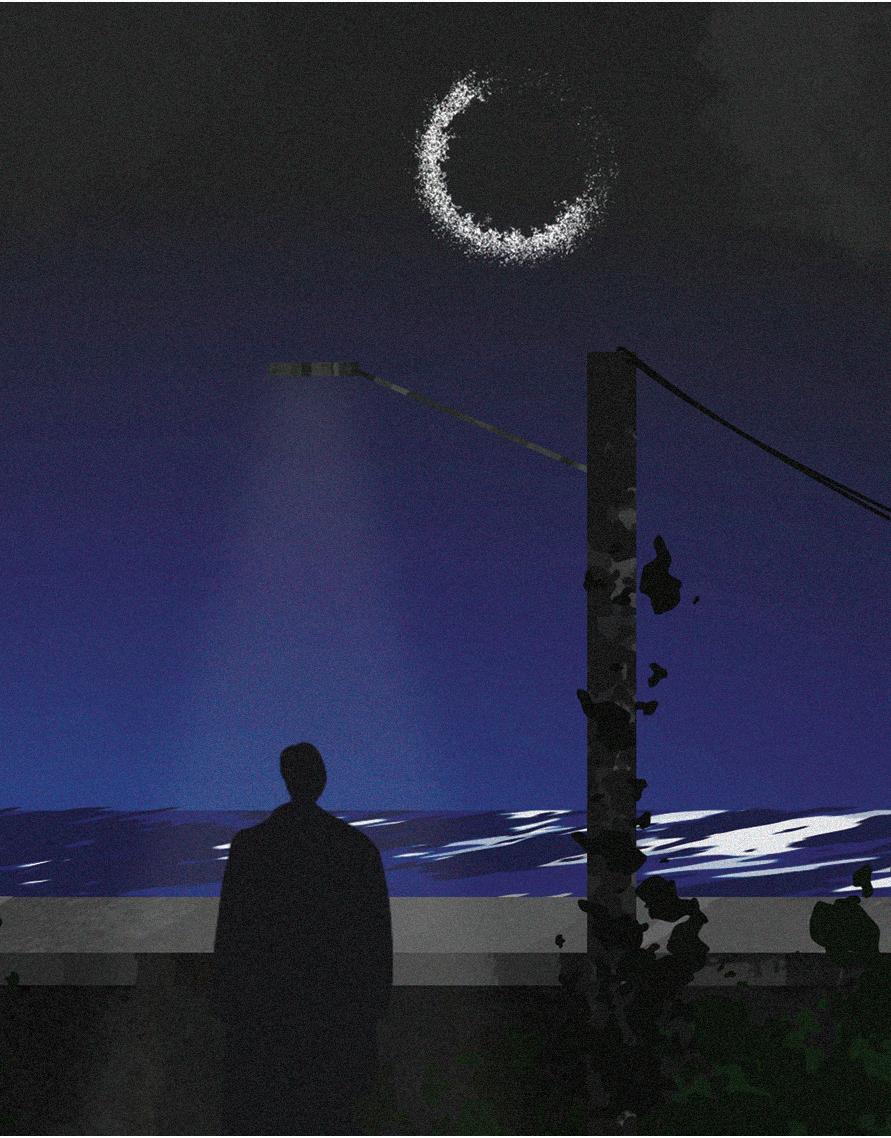
Stress is the force that fractures us into bits, but calm is what gathers the fallen pieces. Not all at the same time, but steadily and imperfectly. Calm is, by all means, not the complete absence of struggle. It’s the friend who reaches out a hand to help, the teacher who cares to chat and it’s the breath of fresh air in the night under the moon. For all the noise and chaos of modern life, there’s something beautifully human in our search for stillness, because, at the end of the day, each of us is similarly burdened by expectations, uncertainties and invisible battles that cannot always be named. Yet the same world that gives us overwhelming trials is the same world that gives us each other, gives us language for what hurts and language for what heals and gives us opportunities to not only be seen, but to see others more clearly.
And maybe that’s where hope
begins. The conversations surrounding mental health don’t just expose pain, but show us that pain isn’t the whole story, and that’s the reason why they are so incredibly valuable. There’s communion. There’s rest. There’s vulnerability. There’s strength.
Let this magazine serve as a reminder that every statistic is a person, and within every person is the possibility of renewal. On this campus and beyond it, the work of building a kinder and more attentive community is still unfinished. But it is in fact underway. And that might just be enough of a reason to be hopeful.
Andrew Ye and Kayden Zhong Editors-in-Chief