A REVIEW OF TOMMY HAYS’ LATEST: ‘THE MARRIAGE BED’
The Linville Gorge is Nature at its Wildest Dance, Paddle & Sip Your Way Across Northeast Tennessee
250 th Birthday CELEBRATING THE NATION’S
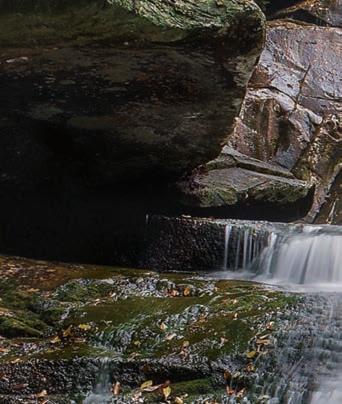
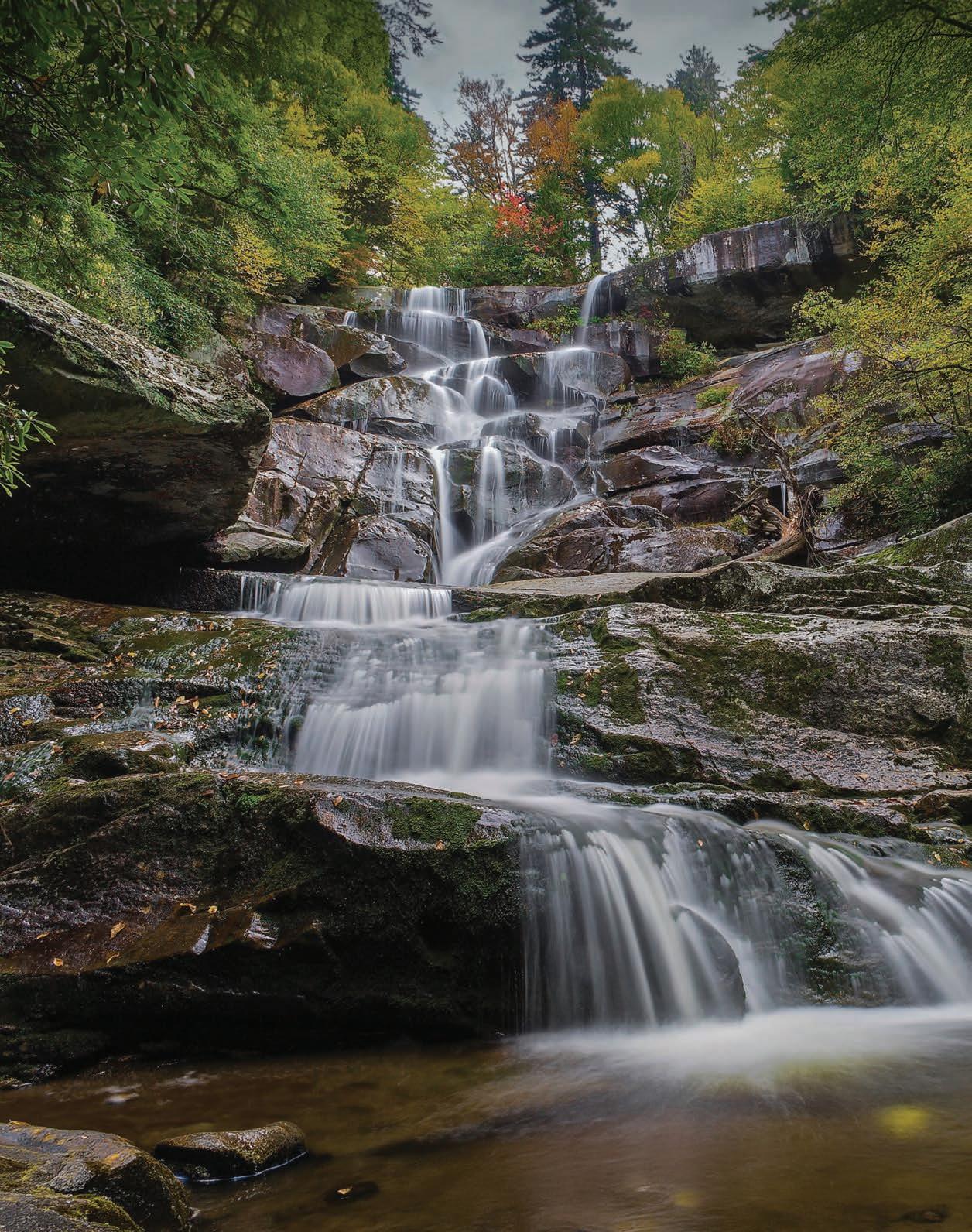
Hiking to the Park’s Tallest Waterfall
Her Weakness Was Thrifting for a Vintage Metal Glider
From mountain music to misty peaks, Northeast Tennessee invites you to explore its stories, festivals, flavors, and wild places. History, adventure, and culture combine to help you write your next great chapter.
The Nation’s 250th Birthday
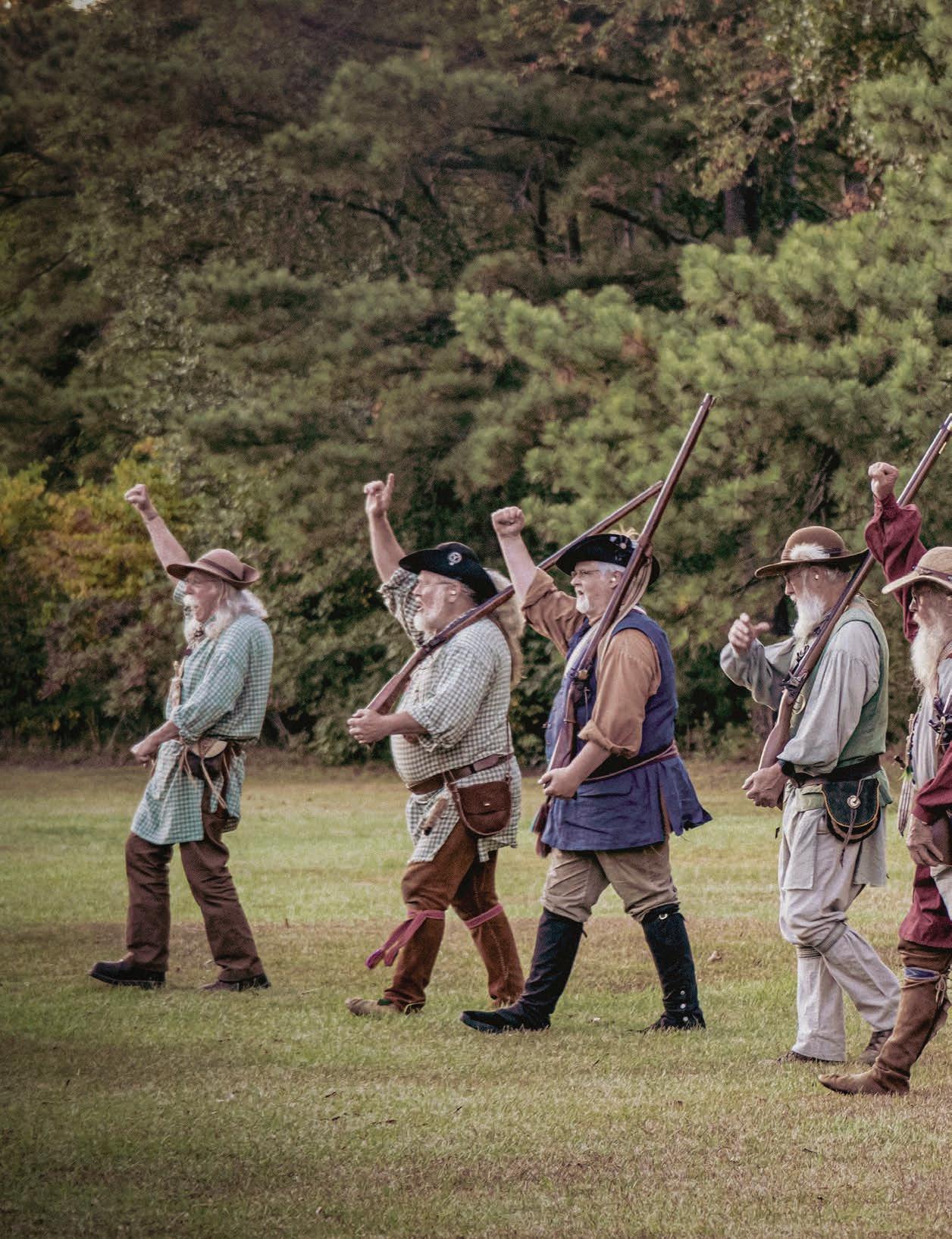
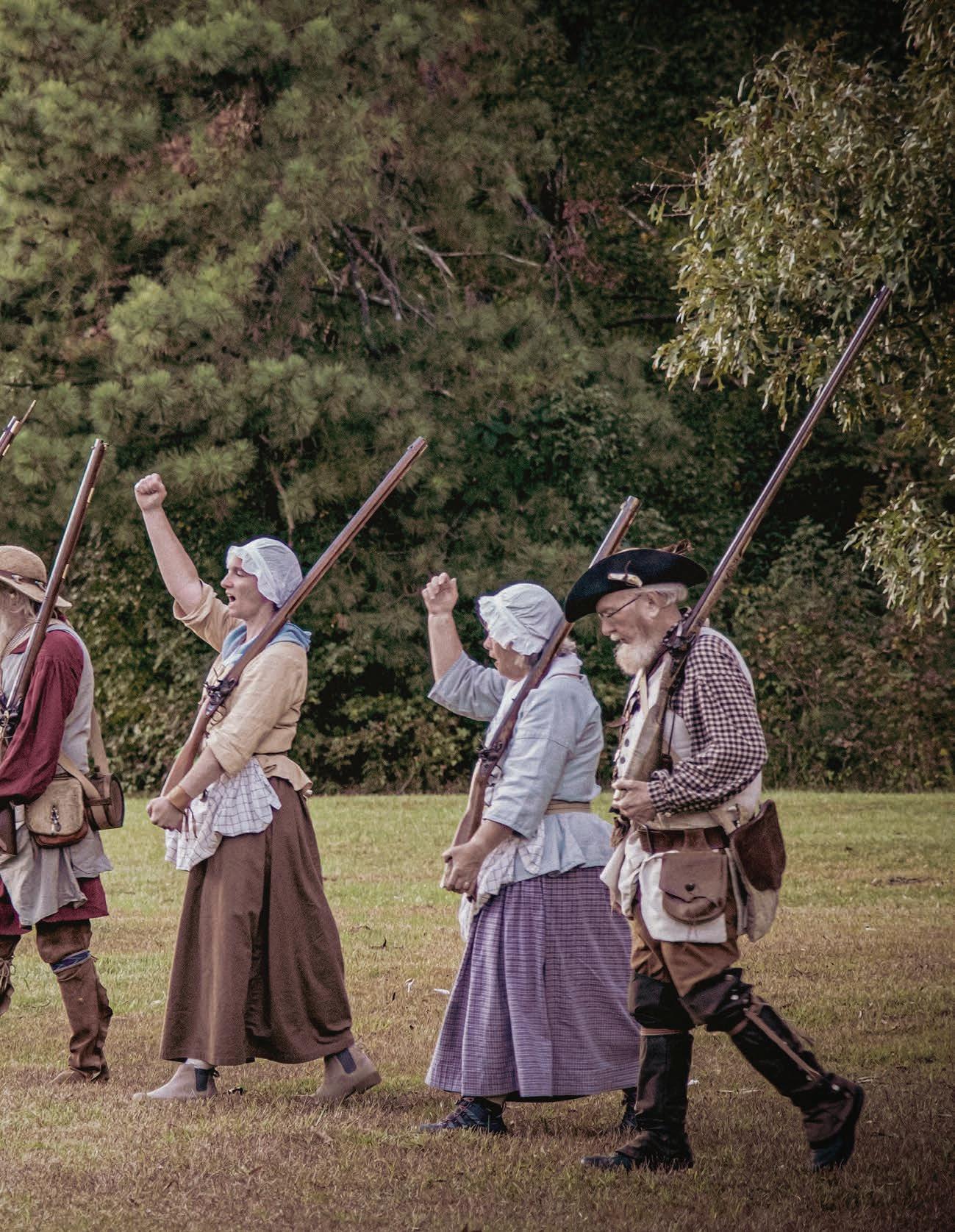
Leave the crowds behind and chase America’s fight for independence across rugged mountains and frontier roads. These Revolutionary-era sites invite you to hike, wander, and uncover the bold backcountry stories that helped ignite a nation.
Nature
its Wildest
Step into North Carolina’s wild heart at Linville Gorge, featuring sheer cli s, untamed trails, sweeping views, and deep history. Discover why the “Grand Canyon of the East” rewards curiosity and fiercely protects its wilderness spirit.
Family stories say the brothers drove at an early age—before turning 10—using their father’s truck to help haul water back for their mother from the spring located a few hundred yards away.
Oneglance at an auction listing for classic American trucks makes me think of my uncles.
Uncle Ellis and Uncle Billy and my aunts were some of our closest neighbors, as my mother and her siblings all built on land inherited from their parents in the Riceville area east of Asheville.
Family stories say the brothers drove at an early age—before turning 10—using their father’s truck to help haul water back for their mother from the spring located a few hundred yards away.
When I arrived decades later, they were master mechanics, keeping their vehicles running well.
Both served in the military in World War II, and I believe neither ever owned a brand new vehicle. Those I remember, however, were all styles I would love to own today.
You would think I could remember what make of truck Uncle Ellis drove, but, maybe I can blame my memory and age and just say it was a half-ton model from the 1940s—likely a Ford—with the rounded hood that opened from the side, and a rounded top to the cab. It had a split windshield and laminated glass. At some point over the years the cranked windows on both sides were cracked, but the metal frame that ran all the way around the glass and the laminate held the glass together.
To start the truck, Ellis would turn the key, adjust the choke on the le side of the steering wheel, then press down on a pedal that was to the right of the accelerator—the starter pedal. I remember thinking that was so cool.
The cab of his truck smelled like smoke and charcoal because Ellis o en carried his fire department turnout gear on board. For several years he was chief at Riceville Volunteer Fire Department, and he remained an active member long a er stepping down from that role.
At some point, likely around 1980, Ellis replaced the 1940s truck with a ‘70s Ford F-150 with a camper shell. It was a fine vehicle, as well, but I’d love to have thought at the time to o er him a couple hundred dollars for the old one.
Billy had a Chevrolet station wagon that he kept going from my earliest memories until I
was an adult. It was painted green—maybe what Chevrolet called Surf Green—and ran well enough that he and his family drove it from Asheville to Edisto Beach, South Carolina.
It was a comfortable car—I think the name on the rear fender was Bel Air, and it had tons of space inside.
Billy’s truck, a 1953 Chevrolet flat bed, was memorialized in song by a late friend, Dave Turner, who was a popular Asheville-area singersongwriter.
Now, the story was that Billy’s truck was an amalgamation of several di erent truck makes. I don’t know all what went into it, but the hood ornament was a unique bulldog with both front feet outstretched. It didn’t look like the Mack truck bulldog, nor the Brockway motors truck husky icon.
The Chevy didn’t go fast, which was fine when I was 13, riding in the bed with my pony, Pokey, as we moved him to a spring pasture further up Riceville Road.
You can see images of Billy’s truck, and the hood ornament, if you google “Billy Ray’s Chevrolet” and find the Youtube video Dave made.
Billy had a yellow ford Galaxy sedan that was bought for one of his daughters to drive. It was a solid car with a fairly big engine. Back then, though, few of us in the younger generation looked at those style cars or trucks.
One car I did like was the 1966 Ford Fairlane station wagon my mother drove.
I just googled it and saw the Fairlane described as “a functional, stylish family hauler with substantial cargo space.”
I spent many hours in that Ford, riding to school or waiting in the car while mom was shopping. Back then they thought nothing of having sixyear-old me in the front seat, and I baptized the so plastic dashboard of that wagon with a tooth mark when I was getting a new tooth.
That dent remained for years a erward.
—Jonathan Austin
Publisher Scott McLeod scott@smliv.com
Associate Publisher Greg Boothroyd & Advertising Director greg@smliv.com
Editor ................... Jonathan Austin jonathan@smliv.com
Contributing Writers Ben Anderson, Jim Casada, Nan K. Chase, Holly Kays, Iris Loehr, Marla Hardee Milling, Susi Gott Séguret, Sam Venable, Renea Winchester
Contributing Illustrator David Cohen
Smoky Mountain Living has made every e ort to ensure listings and information are accurate and assumes no liability for errors or omissions.
To subscribe, call 866.452.2251 or subscribe online at smliv.com.
For advertising information, contact Greg Boothroyd at 866.452.2251 or greg@smliv.com.
For editorial inquiries, contact Jonathan Austin at editor@smliv.com.
Smoky Mountain Living assumes no responsibility for unsolicited manuscripts or photographs.
Smoky Mountain Living (USPS 0000-8240) is published six times per year (February/March, April/May, June/July, August/September, October/November, December/January) by Smoky Mountain Living LLC, 144 Montgomery Street, Waynesville, NC, 28786. This is Volume 26, Issue No. 3. Subscriptions are $25 per year; single copies are $5.95. This is Periodical Postage paid at Waynesville, NC, and additional mailing o ces. Postmaster, please send address changes to Smoky Mountain Living, PO Box 629, Waynesville, NC, 28786.
Nan K. Chase
Nan K. Chase has been exploring the back woods of Western North Carolina, East Tennessee and Southwest Virginia since she and her husband moved to the region in 1981.
Her freelance writing has appeared in the New York Times, The Washington Post, the Wall Street Journal and dozens of magazines, including Air & Space and Southern Living.
She is the author of Asheville: A History and author or co-author of several other books, including Eat Your Yard! and Drink the Harvest, both about making the most of the edible, drinkable landscape. Her book Lost Restaurants of Asheville, highlighted in Smoky Mountain Living, documented the city’s 20th century social history through profiles of more than 30 iconic restaurants.
When she’s not hiking, Nan gardens and spends time with her grandchildren.
Ben Anderson
Ben Anderson was media relations director at Warren Wilson College from 1997 to 2015 before retiring. In 2017, he published the book Smokies Chronicle: A Year of Hiking in Great Smoky Mountains National Park (blairpub.com). He has been a Backcountry volunteer for the park for 25 years and has written numerous articles on our national parks for Smoky Mountain Living and other publications. He also has been a seasonal sales assistant for Great Smoky Mountains Association, working in GSMA stores and on the Smokies park information desk. A native of Atlanta, he holds degrees from the universities of Georgia and Florida.
Holly Kays
Holly Kays is the lead writer for the 29,000-member Smokies Life, a nonprofit dedicated to supporting the scientific, historical, and interpretive activities of Great Smoky Mountains National Park.
Formerly a reporter and outdoors section editor, she has won numerous awards for her work with The Smoky Mountain News. Originally from Maryland, Kays holds degrees in creative writing and natural resources conservation from Virginia Tech and got her start in newspapers working in Idaho and Wyoming.
When she’s not writing, she can often be found roaming the area’s many hiking trails, often with a camera strapped around her neck.
The Heavenly Strawberry
BY JIM CASADA
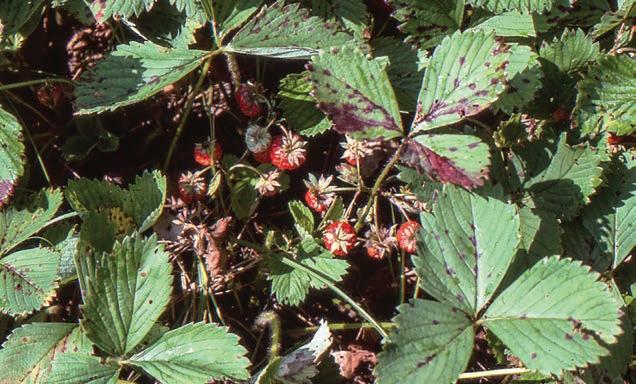
Inhis enduring classic on the joys of fishing, The Compleat Angler, Izaak Walton quotes noted physician Dr. Boteler (Butler) in what might well be reckoned the finest description of a food ever to appear in print. Stirred by the delights of wild strawberries he would have encountered in the course of a spring outing for trout, he shared Butler’s words: “Doubtless God could have made a better berry, but doubtless he never did.” Those words belong to the 17th century, but from the perspective of sheer culinary joy the passage of 400 years leaves that astute judgment as tried and true and the berry is tasty.
Wild strawberries have always been abundant in the southern Appalachians, and in an o -mentioned passage in his Travels botanical explorer William Bartram described riding for two miles through “strawberry plains” in what was then Cherokee territory in North Carolina, with “the fragrant delicious fruit” leaving the legs of his horses stained a deep red. While they remain seasonally available for those who know where to find them and have the gumption to pick them, diminutive, taste-laden wild strawberries have long since yield pride of place (or at least frequency of usage) to their much larger domestic cousins. Yet as any strawberry aficionado will readily tell you, no matter how large and luscious they might be, the tame versions can’t
quite match wild ones when it comes to taste.
That being duly recognized, domestic strawberries are available throughout the year on grocery store shelves, and each spring enterprising farmers sell fresh ones at roadside stands, through local markets, or in pick your own operations. Then too, we can enjoy strawberry jam and preserves, delicate strawberry liqueur, frozen berries, and other iterations in all seasons. From eye-catching, taste-tempting smoothies to scrumptious shortcakes, from trifles to jam-laden scones for a ernoon tea, this ruby red wonder of the berry world brings a multitude to pleasing experiences. The recipes that follow are but a sampling of the wonders to be wrought with strawberries.
STRAWBERRY/SPINACH SALAD
INGREDIENTS:
4 cups washed and torn spinach (other spring greens or chard can also be used)
1 cup hulled, washed, and sliced strawberries
1 kiwi, peeled and sliced (optional)
2/3 cup chopped macadamia nuts
PREPARATION:
Combine and set aside, then prepare a dressing using 2 tablespoons strawberry jam, 2 tablespoons cider vinegar, and 1/3 cup oil. Blend jam and vinegar then add oil gradually as you continue to process. Use this to dress the salad.
STRAWBERRY SHORTCAKE
INGREDIENTS:
1 quart strawberries, sliced
½ cup sugar
2 cups all-purpose flour
1 tablespoon plus 1 teaspoon baking powder
¼ teaspoon salt
¼ cup sugar
½ cup butter cut into small pieces
½ cup milk
2 large eggs separated
¼ cup sugar
Whipped cream or cool whip
PREPARATION:
Sprinkle sliced strawberries with 1/2 cup sugar, stir, cover and chill while preparing the cake. Combine flour, baking powder, salt, and ¼ cup sugar. Cut butter into flour mixture until mixture is crumbly. Combine milk and separated egg yolks (reserve the egg whites); beat well. Add to flour mixture and mix with a fork until a soft dough forms. Divide dough in half. Press each half into greased 9-inch cake pans. The dough is sticky, and wetting your fingers makes it easier to pat down. Beat reserved egg whites until sti . Half egg whites and gently spread over each dough layer. Sprinkle ¼ cups sugar atop the egg whites. Bake at 450 degrees for 8 minutes or until golden brown. Allow cakes to cool on wire rack. While cake is baking, whip up some homemade whipping cream or get your storebought whipped cream ready to use. If you’d like to serve the entire cake at a meal place one cake layer on a serving plate and spread half of the whipped cream over layer and arrange half of the sliced strawberries on top. Repeat with other layer. Alternately, whipped cream and
strawberries may be added to each piece of cake as it is served in order to prevent sogginess. Adding beaten egg whites sprinkled with sugar to the top of the dough really gives the cake a nice crunch that contrasts with the soft berries and creamy topping.
STRAWBERRY PUNCH BOWL CAKE
INGREDIENTS:
1 large angel food or sponge cake cut or broken into small cubes
1 box of powdered sugar
1 small can of evaporated milk
1 container of cool whip
1 container of sour cream (16-ounce)
Quart of strawberries with sugar to taste
PREPARATION:
Slice or chop strawberries and mix with the sugar and then set aside. The longer you let your strawberries set the juicier they will become. Mix powdered sugar, evaporated milk, cool whip, and sour cream together until smooth. Layer cake, strawberries, and powdered sugar mixture in bowl ending with strawberries on top. After assembling cake, allow to sit in refrigerator for several hours or overnight to let the strawberries and cream mixture soak into the cake pieces. While strawberries are my favorite fruit to use in this recipe, peaches, blackberries, raspberries and blueberries are also very tasty. NOTE: Adding whole strawberries as the top layer makes an especially pretty presentation. TIP: If you have a clear punch bowl the cake looks really pretty in it, but if you don’t just use a large bowl—the cake will still be every bit as tasty.
As any strawberry aficionado will readily tell you, no matter how large and luscious they might be, the tame versions can’t quite match wild ones when it comes to taste.
From eyecatching, taste-tempting smoothies to scrumptious shortcakes, from trifles to jamladen scones for afternoon tea, this ruby red wonder of the berry world brings a multitude to pleasing experiences.
usually a dessert, described as “larruping good.” That was high praise and perhaps explains the derivation of berry dishes known simply as larrup. Almost any tame or wild berry—not only strawberries but blackberries, dewberries, raspberries, elderberries, blueberries, or mulberries—can be used to make larrup. This basic recipe will work for any of them.
INGREDIENTS:
4 cups (or more) of berries
1 cup sugar for every four cups of berries
1/3 cup flour for every four cups of berries
(a bit of cornstarch can be used to thicken if necessary, although strawberries are normally “fleshy” enough the cornstarch will not be needed)
PREPARATION:
In a large saucepan bring the berries to a full boil and then add the sugar and flour. Stir steadily at a slow boil for five to seven minutes until a suitable thickness is reached. Serve hot as a topping for buttered biscuits, on pancakes, or as a topping for homemade vanilla ice cream.
STRAWBERRY MUFFINS
INGREDIENTS:
1 cup self-rising flour
¾ cup sugar
1 egg, beaten
¼ cup milk
¼ cup canola oil
1 cup strawberries, capped and cleaned
¼ cup sugar
-¼ teaspoon cinnamon
PREPARATION:
Using a spoon, mix all mu n ingredients except strawberries thoroughly. Then gently fold in the strawberries and fill sprayed mu n tin slots two-thirds full. Combine sugar and cinnamon and sprinkle atop mu ns. You can also use an egg wash if you wish. Bake at 375 degrees for 15 to 20 minutes or until lightly browned. Serve warm with strawberry butter or strawberry cream cheese. This is a great way to “stretch” a small quantity of wild strawberries while enjoying their delectable flavor, or you can “live large” with domestic berries.
STRAWBERRY BUTTER
INGREDIENTS:
1 cup salted butter (at room temperature—if you are blessed enough to have that great rarity in today’s world, home-churned butter, so much the better)
3 tablespoons powdered sugar
¾ cup strawberries, hulled, rinsed, and drained well
PREPARATION:
Cut butter into pieces and place in a blender. Pulse until flu y. Add powdered sugar and berries; blend until spread is light and soft. Refrigerate in a covered container. Delicious on toast or biscuits and a mighty fine way to top o a bagel. This is a fine approach to making a relatively quantity of berries go a long way.
STRAWBERRY TRIFLE
I
first enjoyed trifle when in Scotland almost 50 years ago. Talk about an eye-opening dessert! The basics of a trifle are simple—it’s a mixture of berries, cake, whipped cream, pudding, and, if you wish (and I do), a bit of rum. Many recipes call for angel food cake, but for my part I think an old-fashioned pound cake made with plenty of eggs is far better. Fill a trifle bowl (or any large bowl—it’s just that the clear ones made for trifles have a world of visual appeal) with successive layers of crumbled cake, pudding, sliced berries, and whipped cream until you reach the top or run out of ingredients. Anoint with a bit of rum and finish with whipped cream at the top before decorating it with some whole berries. Trifles are wonderful any time after they are made, but letting them “set” in the refrigerator for twelve hours or so allows the berry juice to mingle with the other ingredients in wonderful fashion.
INGREDIENTS:
1 container yellow cake mix, baked according to directions, or better still, make a pound cake
1 quart strawberries (cooked slightly with sugar and a splash or two of Grand Marnier if desired)
3 large vanilla pudding mixes (enough to require 6 cups of milk) mixed according to directions
2 large containers whipped topping (24 ounces total)
NOTE: This is a versatile recipe which also works well with other berries. If you particularly enjoy chocolate, substitute chocolate cake, chocolate pudding, and crushed to ee pieces. You’ll find that the mixed tastes of strawberries and chocolate blend quite nicely.
Classic Fare for the Road or the Trail
BY SG SÉGURET
KITCHEN MUSINGS FROM A FRENCH CHEF
Irecently compiled a book of recipes oriented towards the hiker, the camper, the boater, the beach-bud, the front porch entertainer; in sum, all of those wonderful outdoor summer activities that call for simple, transportable food to enrich the experience. While not usually the biggest fan of sandwiches (o en too dry, or too heavy), there are times in one’s life when the legendary John Montagu, the 4th Earl of Sandwich, has done us a tremendous favor in instigating the stack of meat between two slices of bread, to free up a hand for engaging activities.
Endlessly adaptable to ingredients on hand and to personal preference, sandwiches can be put together by children, thrown together by desperate mothers or fathers for a snack, or served at the most elegant of a airs. They’re great for the backpack, and equally grand for the cooler for a road trip or to a summer festival.
The recipes below will appear in the author’s forthcoming Adirondack Living Cookbook: 150 Recipes for Cabin, Camp & Beyond, published by Hatherleigh Press, which can be pre-ordered at your local book store or online.
CREAM CHEESE & OLIVE SANDWICHES
Hiking is always a good recipe for hunger, whether you are navigating the Appalachian Trail, the Mountains-to-Sea Trail, taking a day trip in the Smokies, or simply wandering a path around camp. Foods that fit in a pack and satisfy a rumbling stomach are friends on any day. For this recipe, a neutral bread and classic cream cheese will achieve the most delicious results. Olives stu ed with pimento are a good go-to here, but any kind of pitted olive will work.
INGREDIENTS:
Bread of choice
Cream cheese
Olives of choice
PREPARATION:
Spread cream cheese on bread and top with slivered olives, covering with a final layer of bread. You can also spread cream cheese on both sides of the bread, thereby enrobing the olives perfectly in the center. Wrap the sandwich for transportation, or halve (or quarter) on the diagonal and serve as an appetizer.
CUCUMBER & CREAM CHEESE SANDWICHES
My paternal grandmother, Marion Louise Porter Gott, was queen of the elegant sandwich. She bought the right bread (white), she cut the edges o the crust, she used just the right proportion of whatever ingredient she wielded, and she spread the ingredients all the way out to the edge of the bread, a key step to enjoying all bites of the sandwich. She often made several dozen at a time to feed her hungry crew. This was her classic favorite, a bit of a stretch of the imagination at the time to a girl the age of 10, or to her younger brother and ever-ravenous cousins.
INGREDIENTS:
Bread of choice, white being classic
Cream cheese, a block being best
Cucumbers, peeled and finely sliced (a mandolin produces the best results)
Salt and white pepper, to taste
Tarragon (optional; Grandma didn’t have access to this!)
PREPARATION:
Spread the cream cheese on the bread, being careful not to tear the bread itself. Slice cucumbers fine and layer on the sandwich with a sprinkling of salt and pepper, and tarragon, should you happen to have any on hand. Place the top slice on the sandwich, cut into four quarters after removing the crusts (if you haven’t already done so before), and serve as an hors d’oeuvre at a porch-side setting. This is good for the road, too, or for a picnic on the lake.
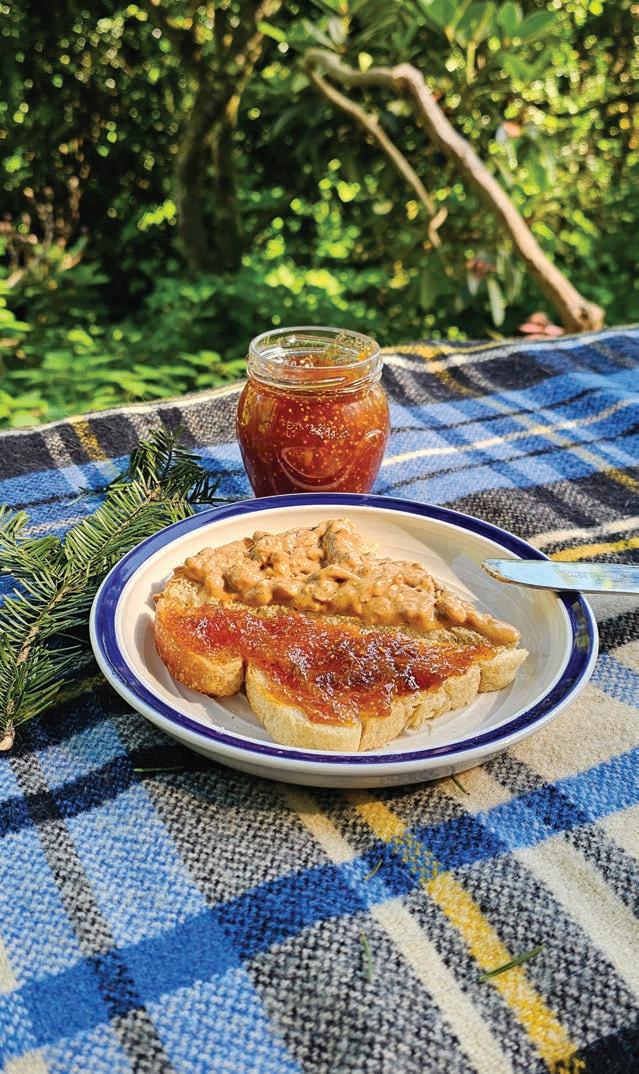
CLASSIC PB&J
Classic here is open to interpretation, but whatever household formed your first taste references, if you grew up in America, the PB&J is likely to have figured somewhere.
INGREDIENTS:
Bread of choice
Peanut butter of choice
Jelly of choice
PREPARATION:
Spread peanut butter on one slice of bread and jelly on another - all the way out to the edges - then press together and slice in triangles or quarters if you wish. Enjoy with your favorite
beverage; Milk might be the go-to but beer or champagne is just as fine.
The choice of bread, peanut butter and jelly are key to making your perfect PB&J. White, whole wheat, rye, sourdough; these all give the sandwich a di erent flavor. For the peanut butter, chunky or creamy, salty or sweet — these also make a big di erence in taste and texture. For jelly: grape is classic, with strawberry probably next in line, but even marmalade works, or a savory tomato jam!
Endlessly adaptable to ingredients on hand and to personal preference, sandwiches can be put together by children, thrown together by desperate mothers or fathers for a snack, or served at the most elegant of a airs.
MATER SAMMIES
The next most popular sandwich in America behind the PB&J is the tomato sandwich, or as it is fondly called in the South, a “‘mater” sandwich. These are especially good on the beach, even if a little bit of sand blows in as you are eating the soft, drippy mess.
INGREDIENTS:
Ripe, juicy tomatoes
Bread (white is really best for this)
Mayonnaise
Salt and pepper, to taste
Basil leaves (optional)
PREPARATION:
Choose your bread. Slice your tomatoes about a quarter-inch thick. Spread bread with mayonnaise and layer the tomatoes in place. Salt and pepper, put in place the top layer of bread, wrap for a picnic or eat immediately, with a few leaves of basil tucked in if you have them.
PIMENTO CHEESE SANDWICH
Purportedly born in New York City and popularized in the South, pimento (or pimiento) cheese has been a classic sandwich spread since the late 1800s when it was introduced to the American palate. Keep it simple or spice it up. Use only cream cheese or only mayonnaise,
or a mix of the two, to temper the cheddar. Try a smoky cheese or toss in some chopped herbs. Vary the quantity and proportions. Make it your own.
INGREDIENTS:
1-2 cups sharp cheddar cheese
4-8 ounces softened cream cheese
2-4 ounces roasted and drained pimento peppers
1-2 tablespoons mayonnaise
Dash of cayenne or a few finely-chopped jalapeños (optional)
Salt to taste
PREPARATION:
Grate cheddar and mix in other ingredients. Spread on bread, top and enjoy! You may toast the sandwich if you wish, or add some lettuce for crunch.
Here’s to your outdoor wanderings!
ABOUT THE AUTHOR: Susi Gott Séguret, CCP, CSW, hails from the depths of Appalachia in Madison County, North Carolina, but honed her culinary skills in France, where she resided for over 20 years, earning a diploma in Gastronomy and Taste from the Cordon Bleu and the Université de Reims. Author of several cookbooks including Appalachian Appetite, and Cooking with Tru es, Susi orchestrates multiple sensory experiences including the Seasonal School of Culinary Arts, the Asheville Tru e Experience, and the Appalachian Culinary Experience. Passionate about elements of taste and style, and how they extend from our palate into our daily lives, Susi strives to blend food, music, words and images into a tapestry for the senses. For more details, visit quintessentialtable.com.
It’s
A Great Day to Be Alive
A CONVERSATION WITH DARRELL SCOTT
BY GARRET K. WOODWARD
At age 66, legendary singer-songwriter and multi-instrumentalist Darrell Scott is having a career rebirth of sorts.
Though he’s always been known as a prolific and productive artist— whether in Nashville musical circles as a performer and producer or endless touring from coast-to-coast and beyond—this current chapter of his storied life has evolved into a full circle kind of thing, one where Scott is evaluating just what it means to create and cultivate in your autumn years.
Known as one of Nashville’s premier session musicians, Scott has written/co-written a slew of hit songs over the decades—Travis Tritt’s “It’s a Great Day to Be Alive,” The Chicks’ “Long Time Gone,” Garth Brooks’ “When There’s No One Around,” Sara Evans’ “Born to Fly”—has been Grammy-nominated four times aside from numerous other recognitions, including the 2025 Americana Music Honors “Lifetime Achievement Award.” He’s also collaborated with Robert Plant, Emmylou Harris, Steve Earle, Sam Bush, and countless others.
Scott caught up with Smoky Mountain Living and spoke at length about this current juncture of his life, the trajectory of his whirlwind career, and what it means to be a songwriter in the modern era.
ABOVE: Darrell Scott. Michael Weintrob photo
“For a while, I didn’t know if I was just old and in the way. But, it’s just not the truth. I have a lot more to say. I have a lot more music to put out and for some reason I’ve got the energy.”
As a songwriter and musician, what’s been your thought process as you’ve approached this age?
Well, oddly enough, I think I spent a couple of years wondering if I should just turn all this down and just stay out at my farm. But, in fact, I’m more energized than I’ve been in decades about music, projects, playing music and new ideas. So, when I was very much considering toning it all down, I’m doing the opposite. I’m working on [all kinds of] records right now. For whatever reason, I’m more energized than ever.
Well, it’s a whole other chapter that is unwritten.
Yeah. And that’s the way I feel. But you know, for a while, I didn’t know if I was just old and in the way. But, it’s just not the truth. I have a lot more to say. I have a lot more music to put out and for some reason I’ve got the energy. It seems like I’ve got the green light on all of that. I’m just going with all that stu and then putting out more music and videos. We’re kind of going a er it just because the energy seems to be there.
It comes down to such a simple thing—this is what you do and what you love, so why not?
Yeah. I finally turned that corner. I’m working on more things than any other period of my life. I can’t even think of anything that comes close and, very specifically, to it also being me putting out my own records. I’ve never done so much for myself than what I’m doing right now.
Do you think that was the inevitable, as in that’s just how things roll out?
It is that. And the other thing, it’s like Sherlock Holmes, where he was about the “science of deduction.” So, I deduced the things I don’t want to do. I get them out of the way and then all that’s le is the stu I want to do. And right now, it’s about working on my own stu and not really kind of watering it down by playing with other folks or being in their bands or being a studio musician in Nashville. Putting out a working on my own music—it’s really detoxifying.
And there has to be intrinsic value with that. There is. I think that’s where this energy of working harder on this stu than I ever have, is coming from. It’s because I don’t really have the other stu to be working on. I mean, it’s not that I’m sitting around, but I have to do away with the things I’m not going to spend my time on. And that leaves me with the things that I’m going to monkey with.
But, then what does that also reveal to you as your purpose as not only a musician, but an artist, in general?
Well, I would say it’s about time on one level, and then on the other hand, you could say, “Why didn’t I do this when I was 20 or 30?” [Back then], I always sort of had four or five irons in the fire—a session life, a songwriting life or road life, a family life. I get to work on what I want to work on. Something has basically given me full permission to just do this and, silently, I’m listening.
What is the role of the songwriter in the 21st century, in the digital age?
I think it moves around. I think for some it’s to write to have hits. For others, it’s to talk and comment about what’s going on in our world—the social, the political, the environmental, the emotional side of humanity.
So, the good news is it’s a bunch of things, there’s no one thing that it is. Some people will be chasing the hits and others will be trying to write about their mother that they lost when they were six years old.
Of course, my leaning is toward the latter. They’re writing about something that means something to you. That’s a very important expression to make. I’m way more interested in the expression than the hit climbing style.
It’s about making a connection about the human condition with another human being.
Yeah. And that’d be great. I mean, sometimes hits do that, too. But, it’s about the intention. I don’t think there’s one answer to it, but I’m really trying to answer that as to what I want to say and do as a songwriter—a maker of albums and makers of shows, of travel and all that stu . It’s becoming more personal to me. It always was, but now I’m not confused at all about that.
Want to go?
The Darrell Scott String Band (featuring Rob Ickes) will hit the stage at the 25th annual Bristol Rhythm & Roots Reunion, which will take place Sept. 11-13 in the heart of downtown Bristol, Tennessee/ Virginia. Other headlining acts to appear include Sierra Ferrell, St. Paul & The Broken Bones, Los Lobos, Marty Stuart & His Fabulous Superlatives, The War and Treaty, The Del McCoury Band, Braxton Keith, Mon Rovia, Clay Street Unit, Jim Lauderdale & The Game Changers, Acoustic Syndicate and many more. bristolrhythm.com.
Word from the Smokies
PEREGRINE FALCONS SOAR FROM BRINK OF EXTINCTION FOLLOWING REINTRODUCTION PROGRAM
BY HOLLY KAYS
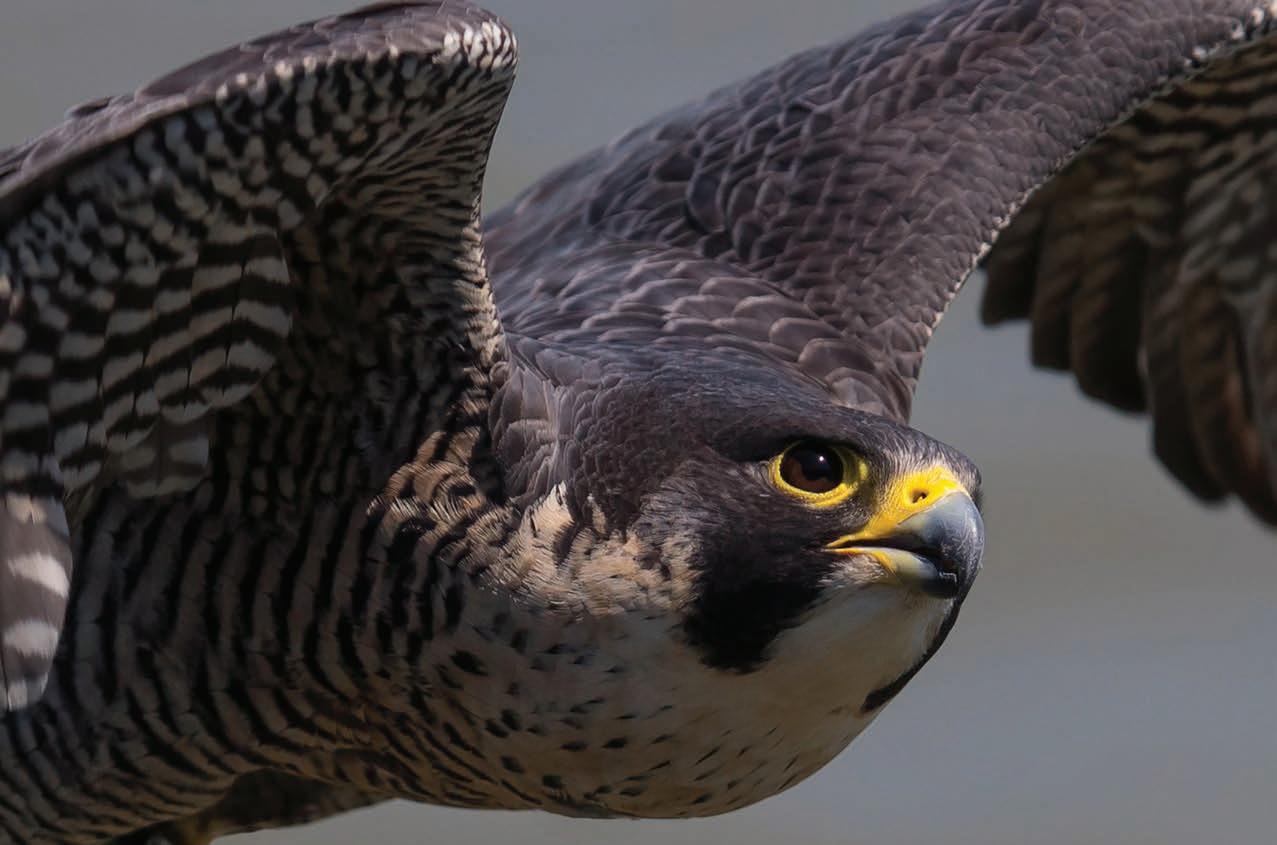
Withstriking white-and-gray plumage, yellow beaks and talons, and powerfully compact bodies, peregrine falcons (Falco peregrinus) are beautiful birds in any posture. But they’re downright magical in the air—aerial acrobats capable of reaching 200 mph as they dive down onto their prey. For Johnson City, Tennessee, ornithologist Rick Knight, such sightings are especially rich in meaning.
“It’s like watching one of my kids or grandkids making his own in the world,” he said.
In the summer of 1984, Knight was 28 years old, an East Tennessee farm boy with a bachelor’s degree in biology and an abiding love for the outdoors. When he learned about an opportunity to get paid to spend all summer camping in Great Smoky Mountains National Park, he jumped at the chance.
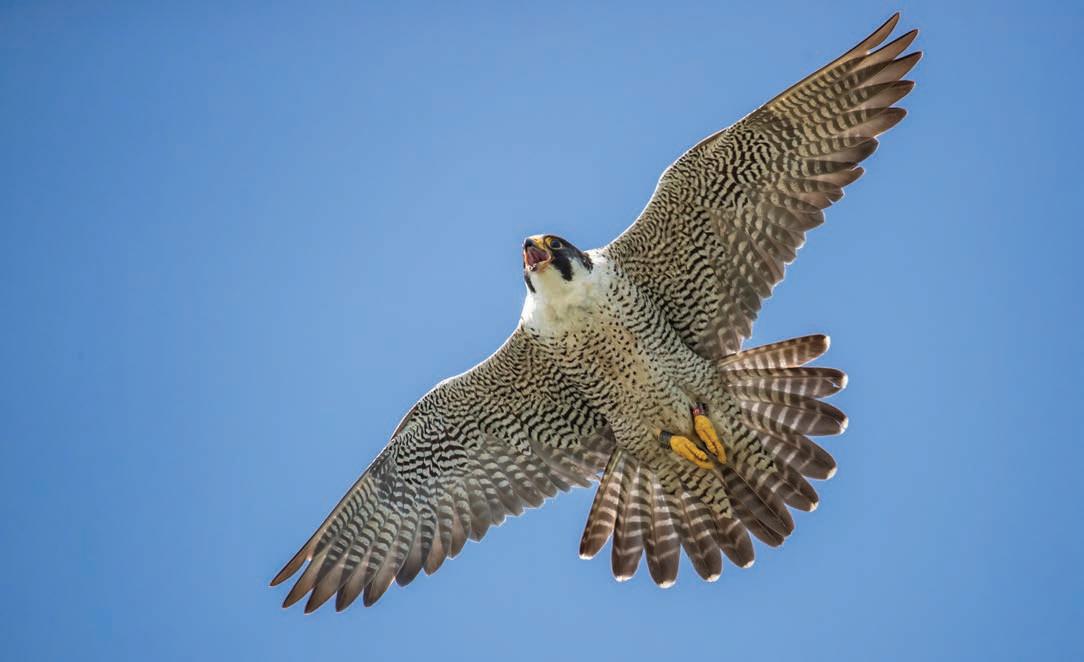
Peregrine falcons (Falco peregrinus) can reach speeds of 200 mph as they drop toward their prey but typically travel at 25–34 mph, accelerating to 69 mph in direct pursuit of prey.
The job revolved around four flu y peregrine falcon chicks, which wildlife managers hoped would become the first wild peregrines to soar over the Smokies in decades. The Smokies reintroduction was a joint e ort of the National Park Service, US Fish and Wildlife Service, Tennessee Valley Authority, Tennessee Wildlife Resources Agency, and The Peregrine Fund.
Due to the insecticide DDT, peregrine populations in the eastern United States began crashing in the 1950s and had vanished by the mid 1960s. The small birds that peregrines preyed upon began accumulating the chemical in their bodies when they consumed contaminated foods. When peregrines ate the birds, they also ate the built-up DDT. At such high levels, DDT disrupted the peregrine’s ability to create strong eggshells, resulting in weakwalled eggs that would inevitably be crushed during incubation.
DDT was banned in 1972, and when the Endangered Species Act passed the following year, the peregrine falcon—by now gone from the eastern US and su ering heavy declines in the West—was on the list of protected species. Meanwhile The Peregrine Fund, founded in 1970 by Cornell Uni-
Photo by Bryan Watts
versity ornithology professor Tom Cade, developed a process, called hacking, for releasing captive-bred chicks into the wild. In the Southeast, Great Smoky Mountains National Park was critical to the falcon’s resurgence, the release site for 13 of the 44 falcon chicks hacked in Tennessee.
“The overall plan was to saturate the region of Southern Appalachia with young falcons and hope they would return to the general area when they grew up to start nesting,” Knight said.
Knight and fellow “falcon-sitter” Bob Shumate hiked up to the hacking site on Greenbrier Pinnacle with their food and gear, together with National Park Service employees bearing the birds. A helicopter delivered the plywood box that would shelter the chicks over the coming weeks, as well as a long pipe that Knight and Shumate would use as a chute to deliver food unseen—secrecy necessary to ensure the birds would eventually start catching their own meals. For more than two months, Rick and Shumate lived at the release site, spending their days feeding the chicks and watching them from a nearby observation post, where they meticulously recorded notes about their behavior and developmental progress.
“It was a lot of fun,” Knight said. “I was sort of roughing it like one of the pioneers up in the mountains, getting to do something in the park that a lot of people aren’t able to do.”
For two weeks, the box stayed shut, protecting the birds while they were still too young to fly and teaching them to think of it as their home base.
Within a couple days of representatives from The Peregrine Fund opening the box, the young falcons had taken their first flight, instinctually learning how to hunt on the wing.
“I guess it was sort of like a parent watching their kids taking their first steps,” Knight said. “It was very gratifying. They were amazing flyers. Especially a er a couple of weeks they were very fast, very maneuverable.”
Initially, the birds still came back to the box for food, testing their skills chasing insects and other birds. But within a few weeks, they were catching their own meals.
“A er about the eighth or ninth week,” Knight said, “they would disperse from the site, and we wouldn’t see them anymore. We assumed they were on their own and hoped they would make it.”
It was a magical experience, so much so that Knight spent two more summers hacking subsequent clutches of peregrine chicks on Greenbrier Pinnacle.
Between 1984 and 1993, 44 peregrine chicks were released at four sites in Tennessee. The last of
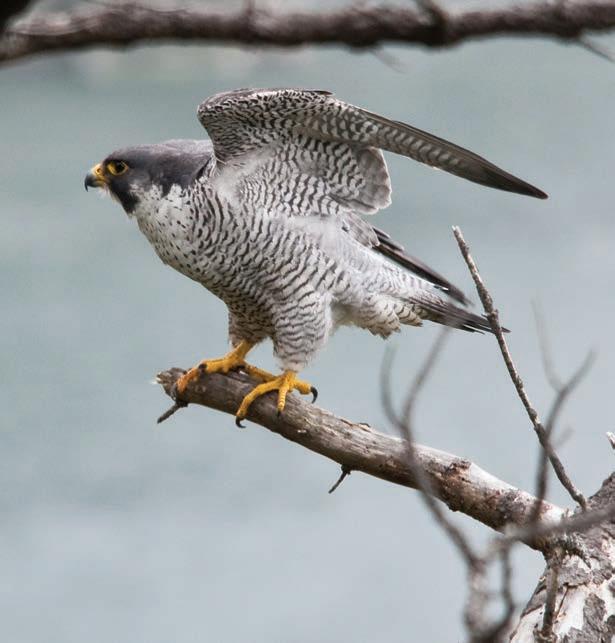
A male peregrine falcon
life and have high site fidelity, so
each
for takeo
Peregrines
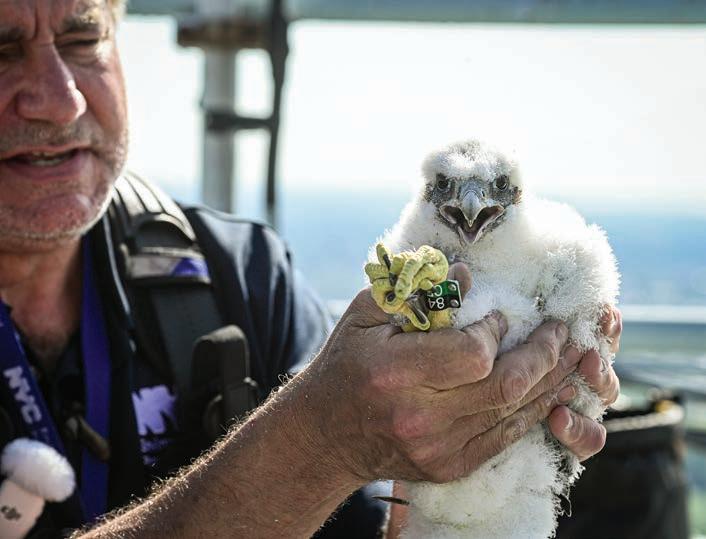
BELOW: A research scientist checks on a peregrine falcon that has recently hatched in a nest atop the Verrazzano–Narrows Bridge in New York City. Following their reintroduction, peregrine falcons have readily adapted to urban environments.
ABOVE:
prepares
.
mate for
the same pair will often return to the same location
year. Photo by Roy W. Lowe, courtesy of US Fish and Wildlife Service
Photo by Marc A. Hermann, courtesy of MTA via Flickr
the 92 birds to be released in North Carolina were hacked in 1997, and the state documented its first territorial peregrine falcon pair in 1986. Knight, under contract with TWRA to monitor the region for returning peregrines, recorded Tennessee’s first successful breeding pair in 1997 near Alum Cave Blu . Nationwide, The Peregrine Fund bred and released more than 4,000 falcons between 1974 and 1997.
By 1999, populations had recovered so well that the peregrine falcon was removed from listing under the Endangered Species Act. Today, it’s considered a species of “least conservation concern,” equally at home on sheer, rugged cli s as on urban bridges and skyscrapers.
“They made a remarkable comeback,” said retired migratory bird biologist Keith Watson, who spent much of the late ’80s and early ’90s helping to hack falcons in Shenandoah National Park before moving to the Smokies in the early 2000s.
In Great Smoky Mountains National Park, Inspiration Point on Alum Cave Trail is the best place to see a peregrine falcon. They’ve been nesting in that area “pretty much nonstop” since their reintroduction, said Paul Super, who recently retired as the park’s science coordinator. Peregrines mate for life; likely, it’s the same pair returning year a er year to raise their chicks.
“They don’t really build nests,” said Watson. “They just kind of scrape out a place on a ledge that they can drop a couple of eggs and then tenaciously defend that area. It’s pretty amazing to
watch. Sometimes when we go up there in June, especially a er the young ones have fledged, you can see the parents out teaching them how to fly and how to catch things in the air, and all kinds of aerial acrobatics. It’s a lot of fun.”
Though peregrine falcons aren’t apex predators—great horned owls will prey on them—they’re close to the top of the food chain. Their success indicates a harmonious ecosystem that’s functioning largely as intended.
“You need predators to keep your ecosystem healthy and keep biodiversity going, and so they’re serving that purpose,” Super said.
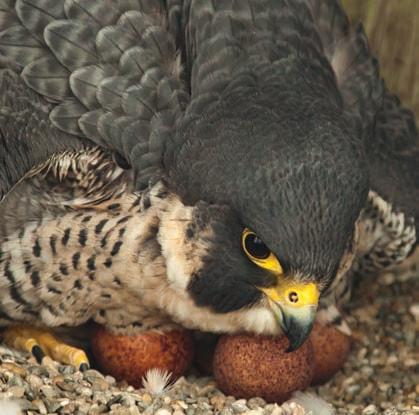
RIGHT: A peregrine falcon turns the eggs in its nest, helping ensure the chicks develop properly.
Photo by Bryan Watts
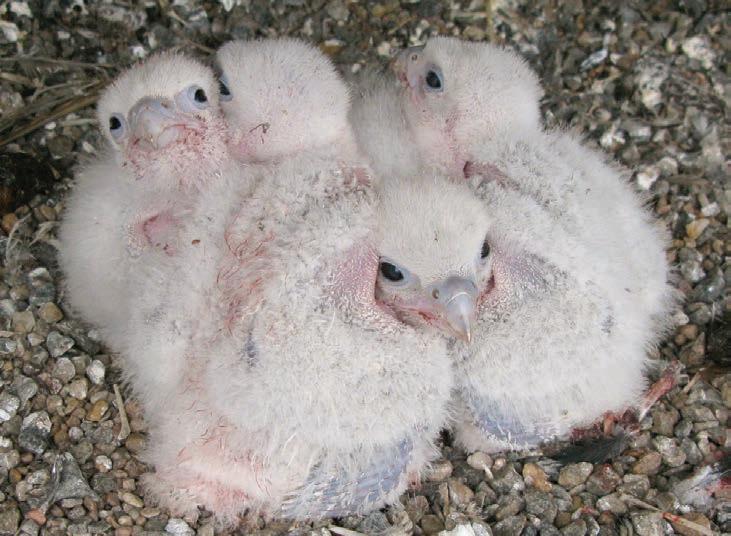
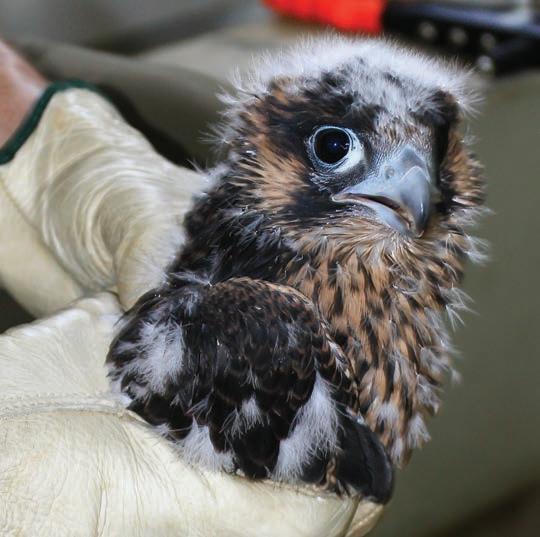
BELOW, LEFT: Peregrine falcon chicks peer up from their nest. Peregrines typically lay between two and five eggs in a clutch.
Photo by Bryan Watts
BELOW, RIGHT: A researcher holds a young peregrine falcon.
Photo by Bryan Watts
The peregrine’s comeback is a dramatic success story, paralleling that of other species whose populations were decimated by DDT, such as bald eagles, ospreys, and brown pelicans. These birds have all since shed their endangered species status and achieved stable populations.
But peregrine genetics still bear the marks of the past. Prior to the 1950s, three subspecies of peregrine falcon lived in North America—Falco peregrinus anatum in the east, Falco peregrinus pealei in the northwest, and Falco peregrinus tundrius in the north. DDT reduced anatum falcon populations so much that the captive breeding program used to produce chicks for reintroduction had to crossbreed the remaining anatum falcons with pealei and tundrius falcons, and, to a lesser extent, peregrine subspecies from other continents.
“The bird we have in the East now is not really the bird that was here before,” Watson said. “It’s a mix of genetics.”
It’s a similar story to that of the eastern elk (Cervus elaphus canadensis), the subspecies that was native to the Appalachians before being hunted to extinction. Several successful elk reintroductions have since taken place—including in the Smokies—using the closely related Manitoban subspecies (Cervus elaphus manitobensis). The
reintroduced animals are extremely similar to the original inhabitants, but the population’s genetic makeup is forever changed.
“It’s easier to save something when they’re still relatively common than when they’re critically endangered,” said Knight. “There’s a lesson there to be learned if we take the opportunity to learn that lesson.”
While peregrine falcons are doing quite well these days, many other bird species are not. A startling study published in 2019 found that nearly 3 billion fewer birds exist in North America today than in 1970.
“We’ve had some successes, but we can’t rest on our laurels,” Knight said. “There’s still work to be done for other species. We need to continue educating the public that conservation is a valuable issue and something that we can’t ignore. We need to continue pressing forward to make sure the world is a healthy place for all organisms, including ourselves.”
ABOUT THE AUTHOR: Holly Kays is the lead writer for the 29,000-member Smokies Life, a nonprofit dedicated to supporting the scientific, historical, and interpretive activities of Great Smoky Mountains National Park by providing educational products and services such as this column. Learn more at smokieslife.org or reach the author at hollyk@smokieslife.org.
By 1999, populations had recovered so well that the peregrine falcon was removed from listing under the Endangered Species Act.
A female peregrine falcon soars through the air.
Photo by Bryan Watts
BY BEN ANDERSON
Gofor a hike
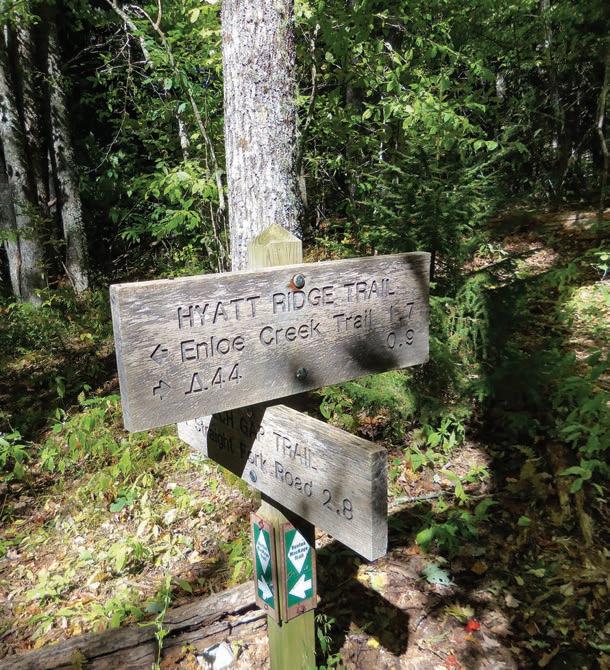
n Trailhead: Beech Gap West Trail on Straight Fork Road, 4.3 miles from park boundary.
n Length: 7.5 miles round trip.
n Di culty: Moderate.
Nearly all the 150 or so maintained trails in Great Smoky Mountains National Park end at another trail or at a road. One, the popular Ramsey Cascades Trail, terminates at the tallest- and highest-elevation waterfall in the park, in a thrilling natural theater. It’s one of the Smokies’ most memorable destinations; one that must be earned via a strenuous hike.
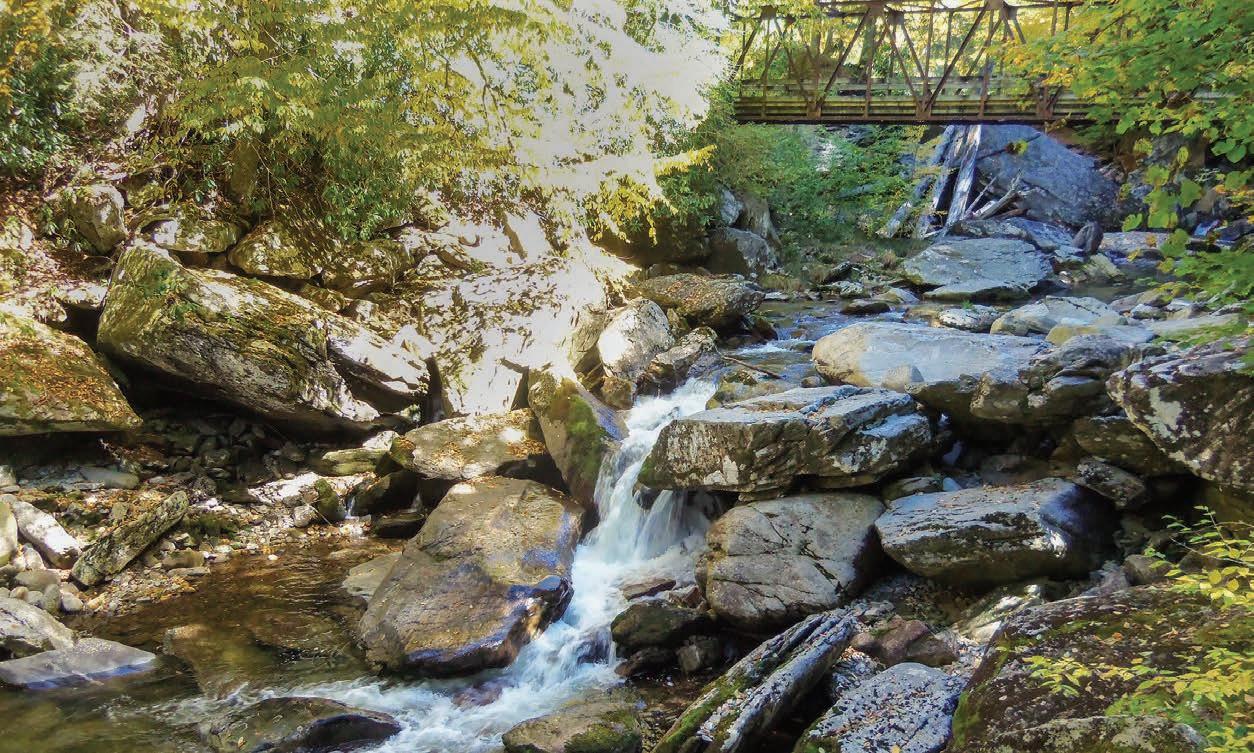
But a few paths in the Smokies’ 850-mile network of trails end at backcountry campsites. The highest (elev. 5,040’) and remotest of these is McGee Spring camp, the terminus of Hyatt Ridge Trail in the ruggedly beautiful Raven Fork section of the park.
At one time Hyatt Ridge Trail continued for another five miles to Mount Yonaguska near the Smokies crest. But some years ago, the park stopped maintaining the upper part of the path that is especially prone to blowdowns from fierce winds. Thus, McGee Spring campsite is now the end of the line unless you’re inclined and able to do some serious bushwhacking – not recommended.
The shortest hiking route to McGee Spring camp is actually via the connecting Beech Gap (West)
On the Trail in the Smokies
BEECH GAP (WEST) TRAIL TO HYATT RIDGE
Trail from Straight Fork Road, which was closed in 2025 because of Hurricane Helene damage. The road is typically open for the season from April 1 to November 1, but as of this writing a 2026 opening date had not yet been determined. Beech Gap West ends at Hyatt Ridge Trail, slightly less than a mile south of McGee Spring campsite.
The trailhead for Beech Gap West (aka Beech Gap II) begins just shy of a sturdy bridge crossing Straight Fork itself. Although the trail climbs a he y 1,600 feet in just under three miles, the path is well graded and not a brute to hike.
Right away, the trail climbs above Straight Fork on a moderate grade. In a few minutes, nearly total silence prevails, the sounds of the stream le behind as the trail climbs away from it. A er just over two miles, the path reaches a level, open area or slight gap; trail guides use the term “false gap” to describe the spot. False or not, it harbors a huge oak tree and a sizable log that begs a short rest.
The final push to the junction with Hyatt Ridge Trail is generally easygoing, as most of the ascent is completed at this point. Soon, you arrive at the junction with Hyatt Ridge Trail at nearly 5,000
feet elevation. It’s a lovely spot for lunch, with beautiful red spruce mixed among large and small hardwoods.
A er you turn right onto Hyatt Ridge Trail, the route to McGee Spring campsite ascends only slightly. The camp is wedged between Hyatt Ridge and the ominously named Breakneck Ridge, just above a tributary of the Right Fork of Raven Fork. The Right Fork leads to a stunning confluence known as the Big Pool of Raven Fork, but there’s no path leading to the pool. Any attempt to reach it from McGee Spring camp would be exceedingly di cult at best and extremely dangerous at worst.
The campsite is typically damp, lacking in dry spots to pitch a tent. But it’s a fine destination for either an overnight or day trip, producing a feeling of wilderness isolation unlike most any other place in the Smokies despite its relative proximity to Straight Fork Road.
ABOUT THE AUTHOR: Ben Anderson is author of Smokies Chronicle: A Year of Hiking in Great Smoky Mountains National Park (blairpub.com).
Dance, Paddle & Sip Your Way Across
In the northeast tip of Tennessee, rugged mountains shape daily life and most roads lead you to something interesting. It’s where events of the past are celebrated, and new stories are always welcome.
Across these eight counties that make up the core of the old State of Franklin, stories old and new are performed, celebrated, and passed along, whether in a nostalgic show at The Jackson Theatre in Jonesborough, at a mountain festival in Johnson City, or as you find yourself dancing to music that was born on Bristol’s State Street.
You can also head out to find something a little wilder, whether that’s climbing into the clouds atop Roan Mountain, riding a UTV through rugged wilderness near Mountain City, tasting Kingsport’s Long Island Iced Tea Trail, or simply enjoying a lazy dip in the Nolichucky River in Erwin.
In Northeast Tennessee, these destinations can help you forge a new chapter to your life story.
Birthplace of Country Music Museum
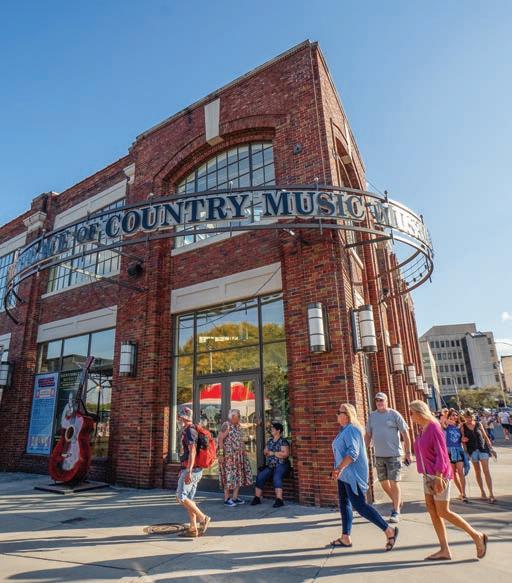
The award-winning Birthplace of Country Music Museum tells the rich story of the 1927 Bristol Sessions through glorious sight and sound. Modern, interactive permanent exhibits, evocative theater experiences, artifacts and rich displays make the story of country music’s
“big bang” come alive. The Smithsonian-a iated museum also houses an intimate, state-of-the-art theater and a special exhibits gallery, and hosts multiple educational events. Community programs include: Speaker Sessions, Square Dances, Songwriters Circle, Bluegrass Jams, Museum Story Time, JAM Kids, and more. birthplaceofcountrymusic.org
Bristol Rhythm & Roots Reunion
Bristol Rhythm & Roots Reunion is the annualmusic festival that will take place in historic downtown Bristol for the 25th time later this year from September 11-13. The three-day festival features a diversity of performers inrecognition of the fact that the 1927 Bristol Sessionswere influenced by and impacted many genres of musicin America, and that the roots of this music have grown deep and spread wide. Each year, the festival hosts numerous bands on multiple indoor and outdoor stages in downtown Bristol. Three days. Two States. One Reunion. bristolrhythm.com
BY JONATHAN AUSTIN
Bays Mountain Park & Planetarium
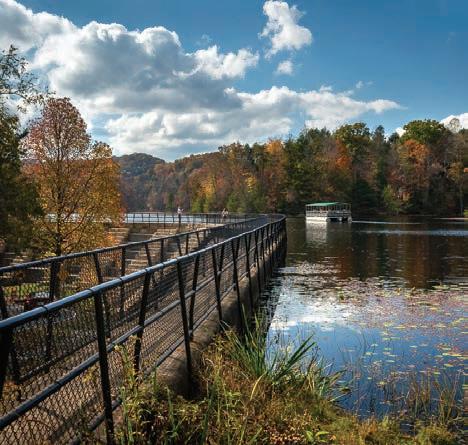
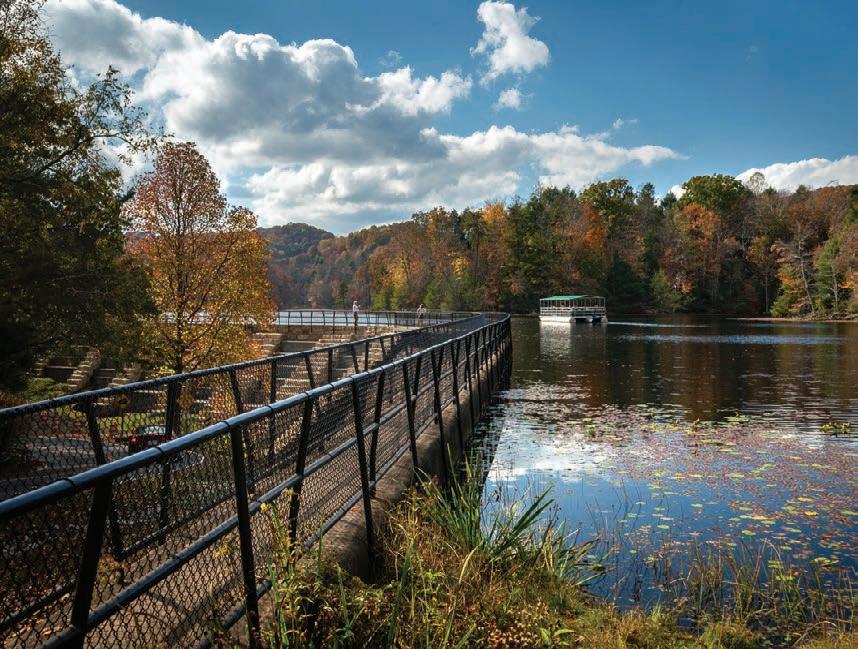
Nestled in the foothills of the Appalachians, Bays Mountain Park and Planetarium o ers a one-of-a-kind outdoor experience where nature and discovery go hand in hand. As the largest city-owned park in the state of Tennessee, this 3,788-acre preserve invites visitors to hike wooded trails, take a barge ride across the serene reservoir, or see native wildlife like wolves, bobcats and raptors. At its heart, the state-of-theart planetarium delivers immersive shows that bring the night sky to life in stunning detail. Families will love the hands-on nature programs that make learning feel like an adventure. Whether you’re exploring by day or stargazing by night, Bays Mountain Park is a must-visit destination that captures the spirit of Northeast Tennessee’s natural beauty.
Long Island Iced Tea Trail
Sip your way through a true taste of Tennessee on Kingsport’s Long Island Iced Tea Trail, a uniquely local experience rooted in the region’s surprising claim to fame. Born from a Prohibition-era recipe created right here in Kingsport, this legendary drink
has inspired a trail that blends history, flavor and creativity. Participating restaurants, bars and breweries put their own twist on the classic cocktail, with non-alcoholic options as well, making it accessible for every kind of traveler. Along the way, visitors can explore downtown shops, meet local makers, and discover the stories behind this iconic beverage. It’s more than a drink, it’s a flavorful journey through Kingsport’s culture, perfect for foodies, history bu s, and anyone looking to experience something unexpected.
Visit Tennessee’s Oldest Town
Jonesborough, founded in 1779, is Tennessee’s oldest town and o ers a unique blend of rich history and vibrant smalltown charm. Visitors can explore a lively downtown filled with local shops, restaurants, and a thriving arts scene, including performances at the International Storytelling Center. The town comes alive year-round with beloved events like the National Storytelling Festival, Jonesborough Days, and Christmas in Olde Jonesborough. Whether you are planning a weekend getaway or a day trip, Jonesborough delivers a memorable experience full of culture, community, and charm.
Across these eight counties that make up the core of the old State of Franklin, stories old and new are performed, celebrated, and passed along.
Experience the Jackson Theatre
Located in the heart of historic downtown Jonesborough, The Jackson Theatre is a beautifully restored venue that blends historic charm with a vibrant entertainment experience. Originally opened in the 1920s, the theatre has long been a cherished part of the community, bringing people together through live performances and events. Guests can enjoy live music, comedy shows, film screenings, and more in an intimate setting. Whether you are planning a date night or a night out with friends, The Jackson Theatre o ers a memorable experience in Tennessee’s oldest town.
A Scenic Ride Through Greene County
Join the 2026 Bike Ride Across Greene County on Sunday, October 25, for a scenic ride through East Tennessee’s autumn landscape. Departing from the Greene County Partnership office at 8:30 a.m., cyclists choose between the 23-mile Sprint, the 40-mile Roadrunner, or the 68-mile Classic. These routes wind through historic Greeneville and along the Nolichucky River, o ering a mix of gentle climbs and quiet country roads. As the final event of the Appalachian Autumn Festival, the ride celebrates the community’s vibrant seasonal beauty. discovergreenevilletn.com
Above the Clouds at Roan Mountain
Perched at over 5,500 feet on the border of Tennessee and North Carolina, the Rhododendron Gardens and Carver’s Gap along Roan Mountain State Park o er a high-alpine escape that feels more like the Scottish
Highlands than the American South. Roan Mountain offers a dramatic mountaintop experience that shi s beautifully with the seasons, from the vibrant June rhododendron blooms to the shimmering winter rime ice. Traverse this section of the Appalachian Trail for 360-degree views that remain spectacular whether covered in summer wildflowers or autumn gold. The nearby Rhododendron Gardens provide accessible, paved paths through ancient shrub forests that feel like a misty, prehistoric world year-round. Because the elevation stays significantly cooler than the valley, it serves as a refreshing summer escape and a snowy wonderland for cross-country skiing in the winter. No matter the month, the ever-changing weather and rugged landscape make it one of the most iconic destinations in the Blue Ridge Mountains.
Meet the Mountains Festival
Meet the Mountains is Northeast Tennessee’s premier outdoor recreation festival.Held on the lakefront at Winged Deer Park, this free festival invites people to dive into the adventure that defines Northeast Tennessee. Guests can try activities like kayaking, paddle boarding, mountain biking, climbing, and zip-lining while enjoying live music, local food trucks and vendors, and scenic views of the surrounding Appalachian Mountains. Education clinics and on-site events round out the experience, making Meet the Mountains a one stop shop for outdoor adventures.
Trailblazing at Doe Mountain Recreation Area
Spanning 8,700 acres of rugged Tennessee wilderness, Doe Mountain Recreation Area is a premiere multi-use destination known for its massive 120-mile trail network. Whether you are navigating the mountain by UTV, mountain bike, or on foot, the terrain o ers everything from leisurely forest rambles to technical “black diamond” climbs.
Summer visitors can explore lush hardwood canopies, scale the Kettle Foot Fire Tower for pan-
oramic three-state views, or test their aim at the onsite archery and axe-throwing ranges. Open year-round, the park serves as a massive outdoor playground where the scenery shi s from vibrant spring blooms to crisp autumn shows.
BONUS! Adventure and Relaxation on the Nolichucky River
Carving its way through the Appalachian Mountains, the Nolichucky River in Erwin delivers exciting and scenic river experiences in the Southeast.
Flowing from the high peaks of North Carolina into the rolling valleys of Unicoi County, the river o ers heart-pounding whitewater to peaceful stretches perfect for floating and fishing. Adventure seekers can tackle the legendary Nolichucky Gorge, where powerful Class III and IV rapids create an unforgettable whitewater surrounded by towering cli s. For a more relaxed pace, calmer sections of the river invite paddlers to explore by canoe, kayak, or paddle board. Anglers will find excellent opportunities to cast for smallmouth bass and other native species in the river’s clear, cool waters. And for those who simply want to unwind, the Nolichucky’s banks provide idyllic spots to spread out a picnic blanket, skip stones, and enjoy the soothing sounds of the river flowing through one of Tennessee’s most beautiful landscapes.
Downtown Jonesborough, Tennessee.
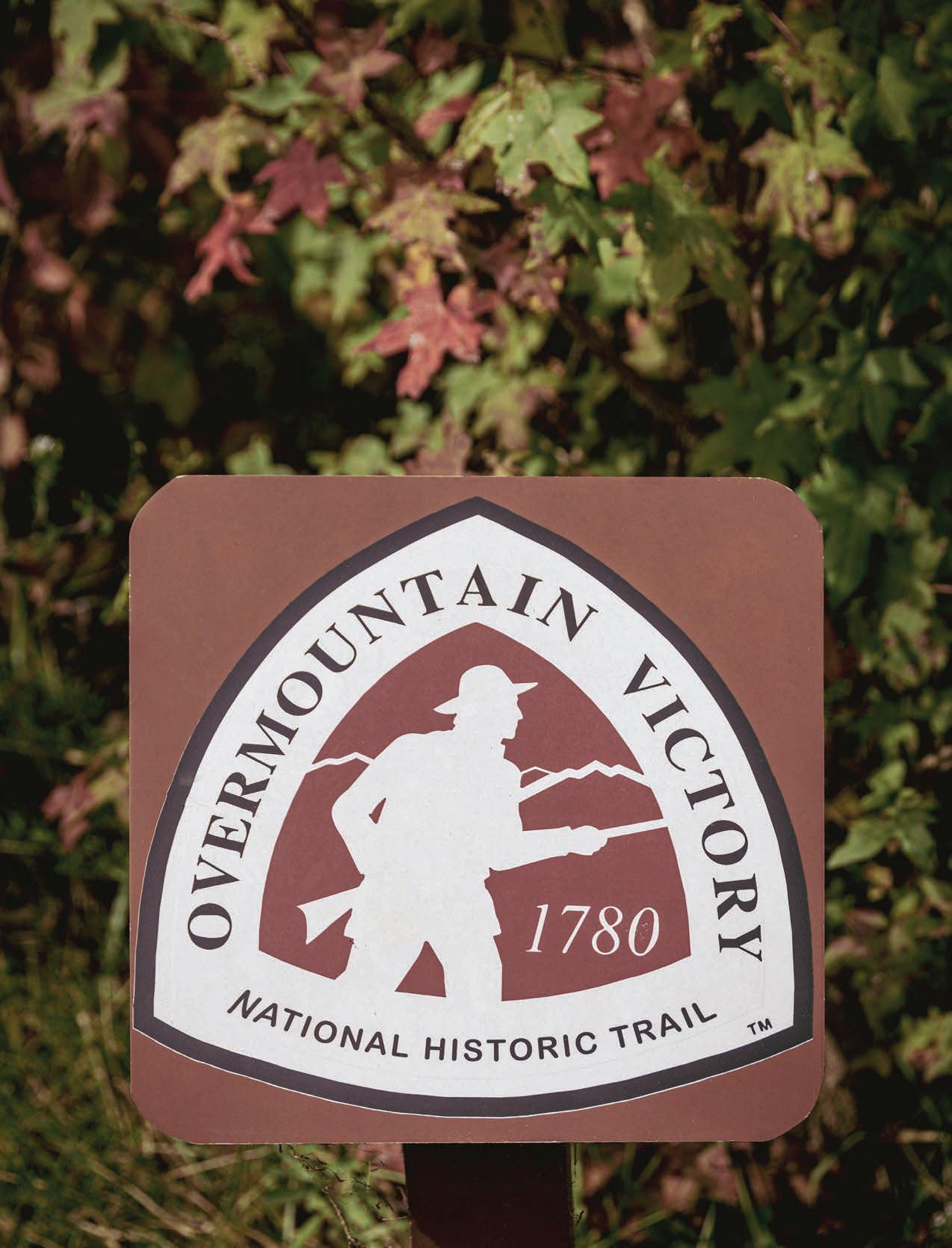
THE OVERMOUNTAIN VICTORY TRAIL:
Following the Route of Revolutionary Greatness
Of all the grueling challenges that led to patriot victory in the American Revolution, the one I find hardest to fathom is the 330-mile dash in the fall of 1780 by 400 militiamen from Abingdon, Virginia, over the high mountains of North Carolina to the Battle of Kings Mountain in South Carolina. Their presence, along with hundreds of reinforcements who joined them along the way, was the key that turned the war against the British.It took these Overmountain Men just two weeks to make the trek on horseback, averaging almost 25 miles a day in raw weather, through rugged countryside.
It took me years to retrace their steps.
Despite its importance, the Overmountain Victory Trail is less well known in the annals of Revolutionary heroics than places like Valley Forge, Bunker Hill, or Saratoga.
Fortunately, there’s a well-marked motor route that replicates their trail almost mile for mile, including a lengthy spur that the Surry County, North Carolina, patriot militia took to meet up with the main force at present-day Morganton. Traveling the entire motor route is a great way to appreciate the rigors of the campaign. And because the scenery is spectacular in many parts, it’s not a bad focus for a vacation road trip.
My husband and I, both American history bu s, have made it a point to drive the entire route, but in sections. Having lived in the North Carolina High Country for many years, we were already familiar with the highest elevations, in today’s Avery County, North Carolina—up to 6,285 feet at Roan Mountain.
As current residents of southwest Virginia, we have also visited the Muster Grounds in Abingdon several times. But we were missing big chunks of the trail, which, due to the devastation along the way from Hurricane Helene in 2024, took us longer than expected to complete.
When we finally got to the finish line at the Kings Mountain National Military Park last December we both got a bit teary as we learned how savage had been the brief battle between the patriot and loyalist forces: hand-to-hand combat with bayonets and tomahawks, in addition to musket and long rifle fire at close range.
HOW THE JOURNEY BEGAN
The origins of the Overmountain Victory Trail are complex, but the main narrative has the British Army frustrated by 1780 in failing to subdue the revolution on northern battlefields. They turned their e orts to a southern strategy that would rely on what they believed—mistakenly, as it turned
out—was a southern population loyal to the crown and willing to fight.
At first it worked, but British Major Patrick Ferguson then threatened to commit atrocities against colonists who refused to join the loyalist military e ort that was rolling through Georgia and South Carolina and heading toward North Carolina and a meet-up with the main British Army. He put it thus: “If you do not desist your opposition to the British arms, I shall march this army over the mountains, hang your leaders, and lay waste your country with fire and sword.”
In southwest Virginia, waves of Scots-Irish immigrants who arrived in the decade before the revolution had their own ideas about that kind of threat, and they soon organized, willing to take the fight to Ferguson rather than submit. These recent immigrants were proud, fearless, and able to live o the land in harsh conditions.
Those Virginia militias, with support from their brethren nearby in the North Carolina Piedmont, decided to march southward to thwart Ferguson and his loyalists who were near Charlotte, North Carolina.
Imagine organizing that kind of effort today, across hundreds of miles of sparsely populated
BY NAN K. CHASE
Despite its importance, the Overmountain Victory Trail is less well known in the annals of Revolutionary heroics than places like Valley Forge, Bunker Hill, or Saratoga.
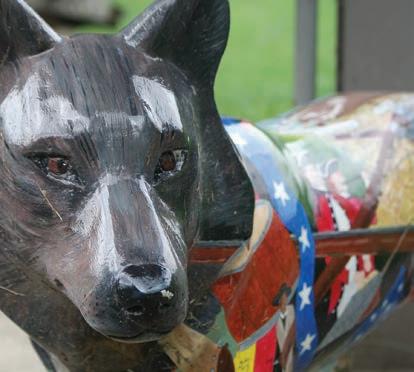
A statue of a wolf is decorated with scenes from the American Revolution in Abingdon, Virginia, a region formerly nicknamed “Wolf Hills.” NPS/WC
countryside, without paved roads, maps, telegraph or telephone, or any kind of navigational device. Yet, they did it, spreading the word through the wilderness and gathering a total of about 2,000 men, mostly on horseback, who would take on Ferguson at Kings Mountain.
Today, we can follow their route by car, RV, motorcycle, or bike. And there are numerous enhancements for modern visitors, in the form of camping and hiking opportunities, monuments and local museums, and nature preserves along the way. The Appalachian Trail even crosses the Overmountain trail near Elk Park, North Carolina.
STEP BY STEP
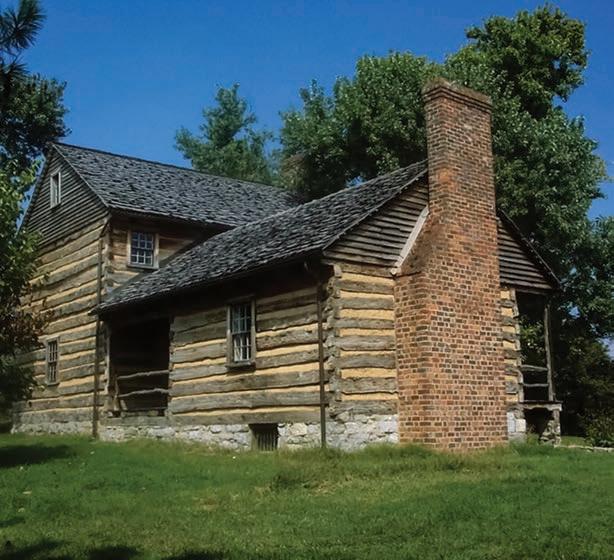
The main force of patriot militia mustered at a meadow in the colonial town of Abingdon on Sept. 24, 1780, and rode about 20 miles south to their first night’s encampment. Additional local militias mustered from the countryside nearby and joined forces at the second encampment, at Sycamore Shoals, Tennessee. Notable for today’s visitors in that vicinity are Rocky Mount State Historic Site—the rustic capital of the Southwest Territory, 1790-92—and Sycamore Shoals State Historic Site, with recreational amenities.
The third night they sheltered from heavy rain beneath Shelving Rock, near today’s Roan Mountain State Park, on the Tennessee-North Carolina
border, site of the “world’s largest natural rhododendron gardens.” Meanwhile, a second militia force mustered at today’s Elkin, North Carolina. They would ride four days to rendezvous at Quaker Meadows, near Morganton.
By the time the main force reached their fourth night’s encampment, above 5,000 feet elevation at Roaring Creek, near Elk Park, several inches of snow lay on the ground. It was an early winter. Two men deserted, sprinting ahead to warn Ferguson of the approaching force.
Today that area is crisscrossed with outstanding hiking trails, including the Appalachian Trail.
The next night’s encampment was another high elevation stop, at Grassy Creek, near today’s mining town of Spruce Pine. A must-see is the National Park Service’s visitor center at the Museum of North Carolina Minerals. There’s good hiking here, too.
Shortly after that, the militias split into two groups in an e ort to keep the deserters from reaching Ferguson. The following night, then, part of the force stayed at Turkey Cove, still in the high mountains, while the rest camped at North Cove, a steep canyon close to Linville Gorge Wilderness.
A er a night where all the men met at Quaker Meadows, they spent two nights in gentler country; as South Carolina, Georgia, and other North Carolina militias joined the force, they began their hot pursuit of Ferguson and his colonial loyalist militiamen. Because these were not British regulars, this phase of the war is known as “America’s first civil war.”
With all the militias assembled at Saunders’ Cowpens in South Carolina, on the eve of battle, American commanders chose the 900 “bestmounted and -armed men” to participate. They ate hastily and continued to the battlefield, a wooded promontory called Kings Mountain.
Only by visiting the battlefield’s visitor center and touring the trail system could I finally understand the ferocity of the short but important battle of Oct. 7, 1780. Ferguson had intended to rest his men on the high ground, but found himself encircled by the patriot frontiersmen. The fighting lasted just over an hour, resulting in Ferguson’s death and the loss of 120 of his men killed. Patriot losses were light.
The subsequent hangings of nine loyalists finally broke the will to resist and thus stymied the hopedfor British victory.
Now that I’ve ridden the entire Overmountain Victory National Historic Trail, I’m ready to do it again.
Rocky Mount
State Historic Site, Tennessee. A local gathering place for nearby patriot militia who joined with the main body of patriot troops at nearby Sycamore Shoals.
U.S. National Park Service photo
For more information:
Start your visit with a look at the Overmountain Victory National Historic Trail page on National Trails System website, nps.gov. More than a dozen organizations partner with the National Park Service to keep the Overmountain Victory Trail heritage alive.
The Muster Grounds in Abingdon and the Kings Mountain National Military Park—the starting and ending points of the trail—are both units of the National Park Service. Their visitor centers o er educational displays and are sta ed with skilled historical interpreters.
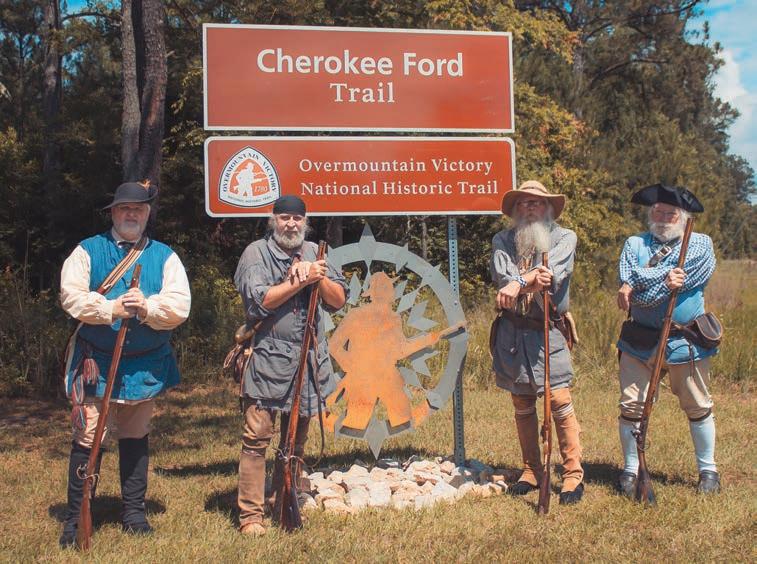
ABOVE: Members of the Overmountain Victory Trail Association assisted the dedication of the new Cherokee Ford Trail. NPS/WC
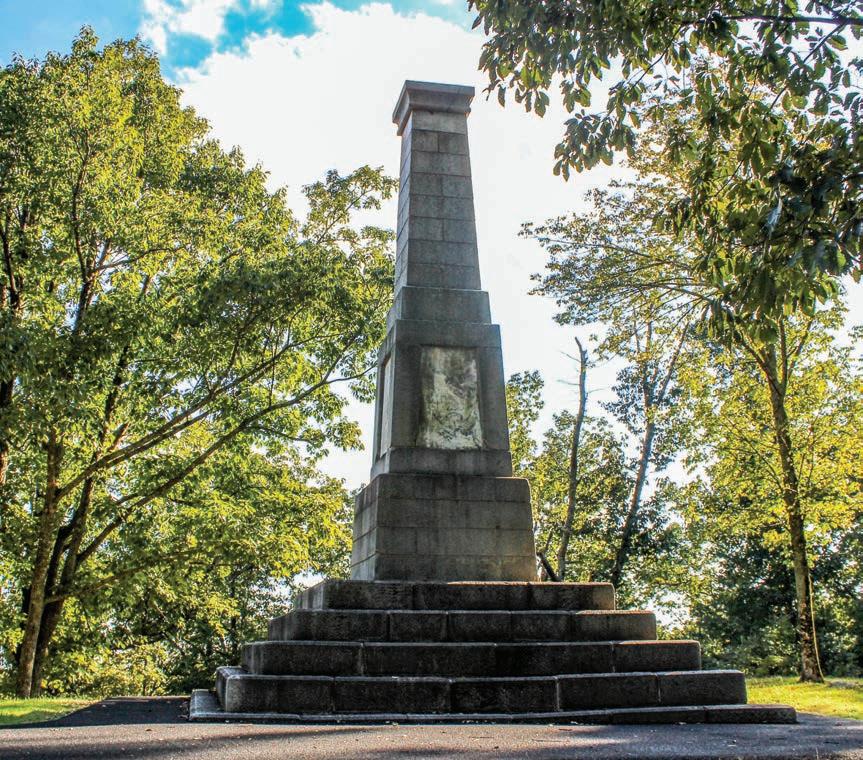
LEFT: A monument at the Kings Mountain National Military Park—the end of the Overmountain Victory Trail—stands in the setting sun. NPS / Victoria Stauffenberg
The Road to Independence
DISCOVERING THE REVOLUTION’S SOUTHERN ROOTS
BY NAN K. CHASE
The famous place names of the American Revolution are engraved on our hearts; Lexington and Concord, Valley Forge, Independence Hall, Boston Harbor, Yorktown.
However, this busy 250th birthday year of independence marks the perfect time to explore some of our regional historical sites that contributed to the unique American story. Away from the crowds, it’s easier to tread the ground the founders trod, to reach out and touch the very walls where history was made.
This list of important revolutionary places in our region can help guide history bu s to a deeper appreciation of our narrative. You may note that the final few on this list range outside our area, but o er important stories to the southern Revolutionary War history.
During 2026 many of these locales will o er special programming, so check online to make the most of the celebrations.
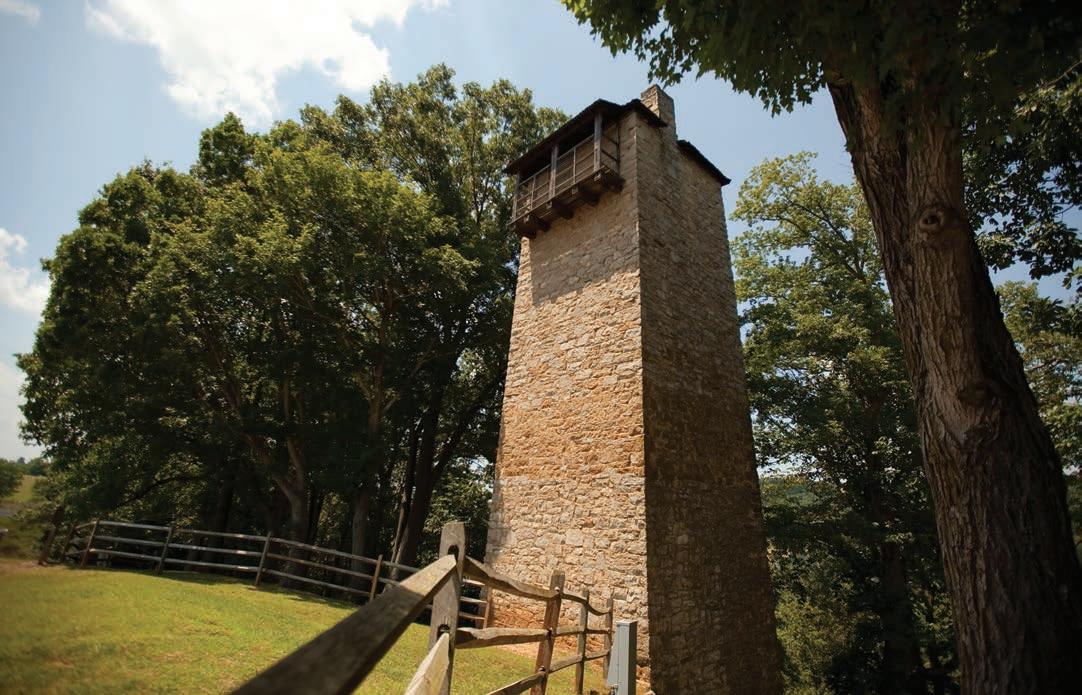
FINCASTLE RESOLUTIONS AT SHOT TOWER STATE PARK
Austinville, Virginia. Open year round. Free admission, parking fees apply.
The Fincastle Resolutions of 1775 weren’t really signed at today’s shot tower; there’s almost nothing to see at the actual signing place, where the one-time mining village Austinville now sits. The notable point is that some important revolutionary events took place in remote country where only the hardiest colonists lived.
In the winter of 1775, 15 otherwise loyal British subjects signed a document—the area was then in Fincastle County—swearing to fight to the death to resist the reviled Intolerable Acts. That bold act set the stage for total independence, predating the immortal Declaration of 1776 by 18 months.
The soaring early 1800s shot tower nearby is worth a visit to see how local lead deposits were processed to supply countrymen with shot.
ABINGDON, VIRGINIA
Walking tour maps available in town, other Washington County sites in driving distance.
An early town on the Wilderness Road, Abingdon has had various names, including Wolf Hills and Black’s Fort, reflecting its rough-and-tumble frontier character.
Despite strong colonial ties to England, when the call to arms sounded, hundreds of patriots mustered to march across high mountains in 1780 and join the pivotal Battle of King’s Mountain, in South Carolina.
Abingdon’s downtown has an antique grace. Notable historic places in town are the Muster Grounds, where the Overmountain Men assembled, the 250-year-old Sinking Springs Cemetery, a 1779 tavern now called The Tavern Restaurant, and a curious hole in the ground, Wolf Cave, where in 1760 Daniel Boone confronted a snarling pack.
The Muster Grounds, a National Park Service unit, has educational displays and a spirited interpretive program.
ABOVE: The Shot Tower was built more than 150 years ago to make ammunition for the firearms of early settlers. Lead from the nearby Austinville Mines was melted in a kettle atop the 75-foot tower and poured through a sieve, falling through the tower and an additional 75-foot shaft beneath the tower into a kettle of water. Bill Crabtree, Jr. / Virginia Tourism Corporation, www.Virginia.org
BELOW, LEFT: Montpelier is the lifelong home of James Madison, Father of the Constitution, Architect of the Bill of Rights, and fourth President of the United States; his beloved wife Dolley, America’s first “First Lady”; and six generations of enslaved individuals. Sunshine Sol @withsunshinesol / Virginia Tourism Corporation, www.Virginia.org
BELOW, RIGHT: Gunston Hall was the home of George Mason, father of the Bill of Rights, that was constructed circa 1755-1760 and continues to be an outstanding example of Georgian architecture. The Boxwood Gardens are also included on the plantation. Keith Lanpher / Virginia Tourism Corporation, www.Virginia.org
COWPENS NATIONAL BATTLEFIELD
Ga ney, South Carolina. Open daily. Free admission.
The Battle of Cowpens in January 1781, together with the nearby Battle of King’s Mountain three months earlier, was decisive in turning the tide of war toward the American cause and leading to the eventual conclusion at Yorktown.
Thanks to the open, meadow-like setting at Cowpens and excellent ranger-led walking tours— along with historic documentation at the visitors center—it’s easy to understand how American forces were able to thwart their British opponents with homegrown tactics.
Whereas the Battle of King’s Mountain was considered almost a “civil war” between British-led loyalist American militias and local patriot militias, Cowpens was a battle between trained armies.
The park’s 3.8-mile automobile loop is a popular place for bicyclists to stretch their legs. Set amidst gentle hills, the bloody battlefield seems unimaginable today.
GEORGE WASHINGTON’S OFFICE MUSEUM
Winchester, Virginia. Open April through October; not ADA accessible. Admission.
George Washington had to grow up fast. Bere of a father from an early age, as a teenager he honed his skills as a surveyor in the Virginia colony and
quickly rose in his profession. It was in the frontier village of Winchester—today barely clear of the Washington, D.C. suburbs—that he established his first professional office and where he commanded a Virginia regiment as a British o cer, years before he turned against the mother country.
That modest log building in the midst of downtown Winchester is a riveting small museum that even displays a lock of Washington’s hair. Visitors get a feel for the isolation of that frontier settlement and the perils its residents endured. Today the town wears a mantle of gentility.
WILDERNESS ROAD REGIONAL MUSEUM
Newbern, Virginia. Open Wednesdays through Saturdays. Free admission.
Imagine a super-highway where tra c traveled at the speed of an ox. That was the Great Wagon Road, which led settlers from Pennsylvania southward during the early 1700s. By 1774 an extension called the Wilderness Road took over south of Roanoke and led westward across the Appalachian Mountains. Thousands of recent immigrants thus began filling the American continent.
As the colonies grew into an independent nation, the rugged Wilderness Road provided local militias a way to traverse great distances in their quest for freedom, taking the battle to the British.
Today’s museum—at a onetime stopover called Newbern—consists of beautifully curated exhibits in a vintage cabin. Elsewhere on the property, farm buildings illustrate the rural way of life. This is also a research facility.
JAMES MADISON’S MONTPELIER
Montpelier Station, Virginia. Open Thursdays through Mondays. Admission varies by program.
Known as the Father of the Constitution, scholar James Madison devised the structure of our Constitution and Bill of Rights, contributed to the Federalist Papers, and served as the nation’s fourth president. He was a first-rate booster, and his intellect was a beacon during turbulent times.
His wife, Dolley Madison, was an important hostess in the nation’s early days, using the social sphere to help forge political cohesion at the highest levels.
The expansive estate called James Madison’s Montpelier today serves as a comprehensive center for Constitutional studies, and o ers visitors a stimulating experience based on research, archaeology,
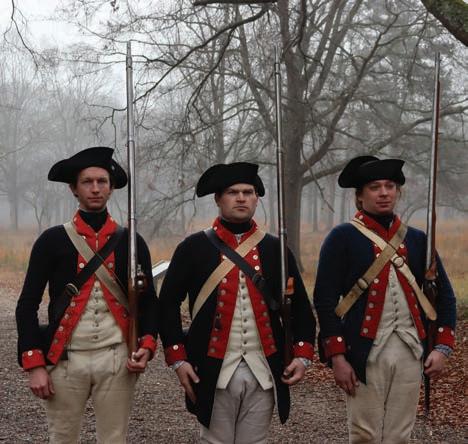
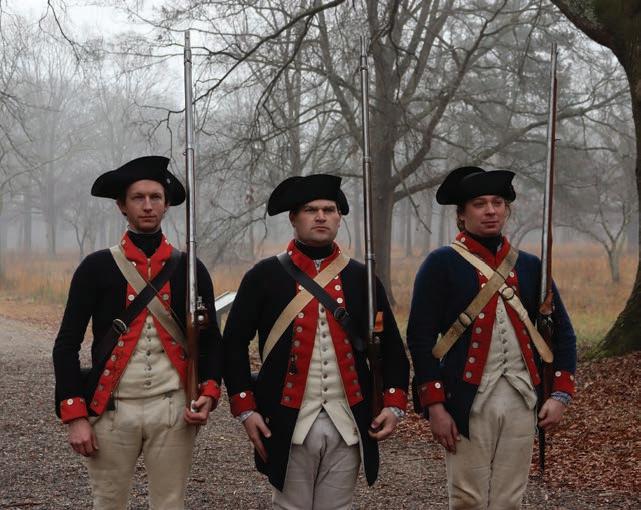
Living historians bring history to life. These three men are dressed as continental soldiers.
NPS/J Holzer
decorative arts, restoration, gardening, and more. The range of programs and tours is mind-boggling, all set in rolling countryside; walking trails fan out from the grand mansion.
GEORGE MASON’S GUNSTON HALL
Lorton, Virginia. Closed Wednesdays. Admission.
George Mason’s name may not be as famous as other members of the Constitutional Convention, but his earlier work as a Virginia patriot and legislator helped shape the meaning of individual rights
as the nation’s legal framework evolved.
His family home, close to Mount Vernon on the Potomac River, is modest on the outside but the interior was known as one of the most luxurious in colonial America. Visitors today marvel at the bright colors, bold patterns, and intricate woodworking.
Mason’s carefully executed landscape plan included a double allée of cherry trees leading the eye directly to the house; out back, formal gardens reflected an English sensibility. The open vista across the Potomac is breathtaking. Skip the crowds at Mount Vernon and visit Gunston Hall with a picnic lunch instead.
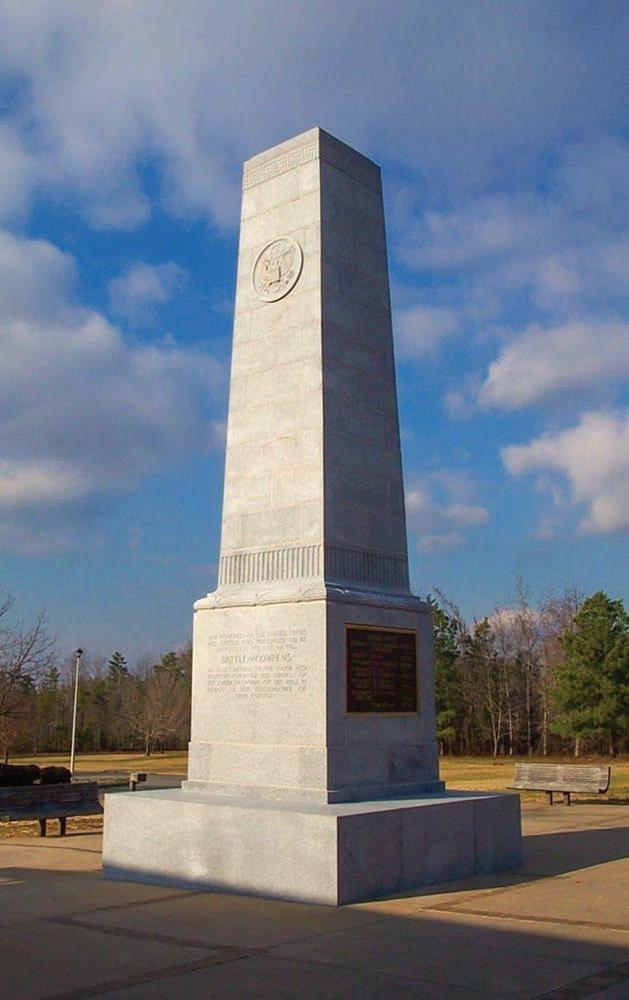
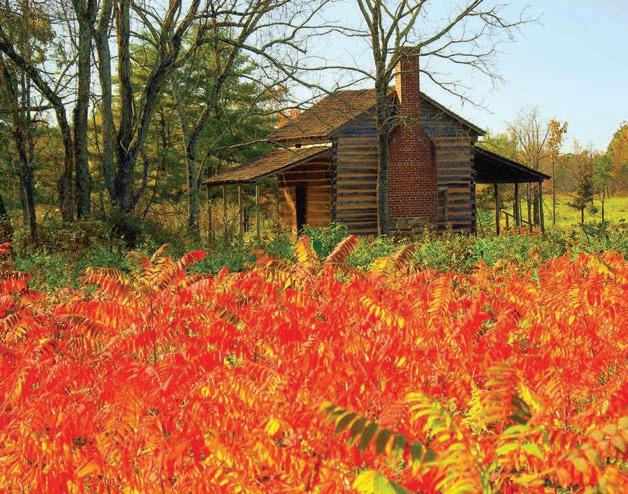
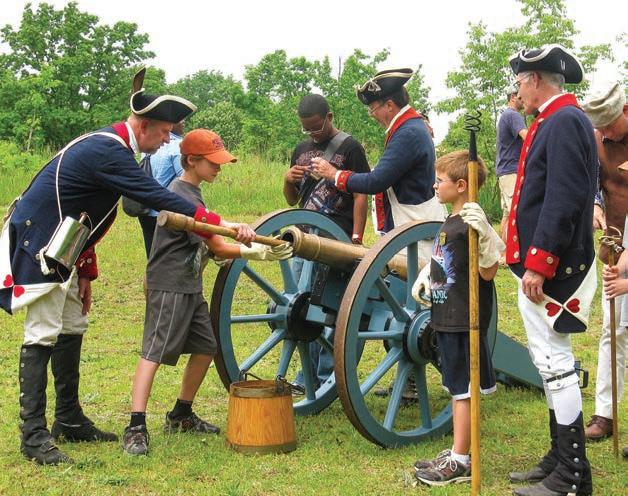
CLOCKWISE, FROM LEFT: The 1932 US Monument at Cowpens National Battlefield. The historic Robert Scruggs House at Cowpens National Battlefield. Reenactors at Cowpens teach children the 18th century artillery drill. NPS photos
Linville Gorge
WILD, PROTECTED AND UNFORGIVING
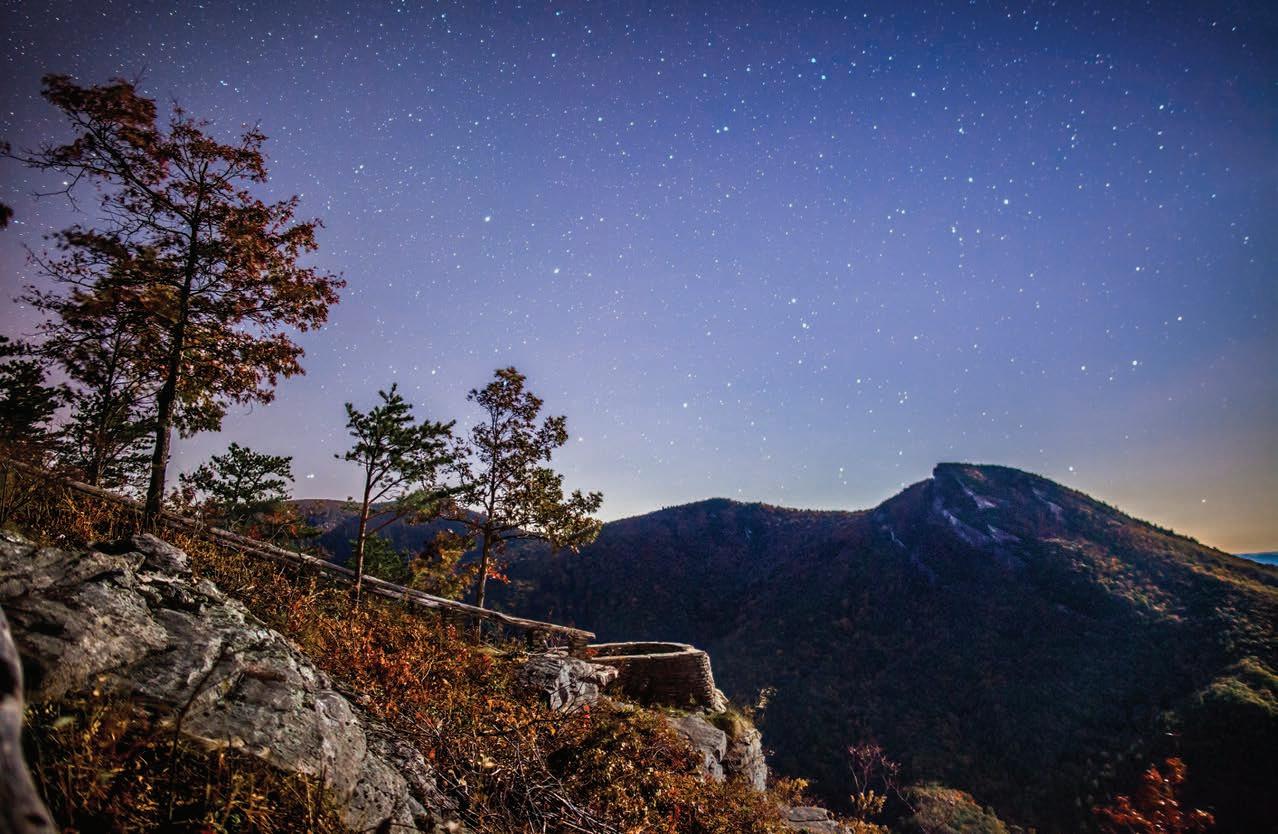
The Linville Gorge is one of those rare places where you can glimpse part of the North Carolina landscape in its wildest, most rugged form. Other than changes created by nature, it remains virtually the same as when it was part of Cherokee territory. It encompasses almost 12,000 acres within the Pisgah National Forest, maintained by the U.S. Forest Service.
While it’s a popular destination for hiking, rock climbing, fishing, hunting (certain weekends, permits required), and backpacking, it’s not for the faint of heart. Trails are barely marked and some remain closed following Hurricane Helene, which ravaged Western North Carolina in September 2024. The steep terrain makes physical activity especially challenging and also creates a situation where it’s easy to get lost.
It is possible, however, to enjoy the stunning views of Linville Gorge, which has been called “the Grand Canyon of the East” without too much e ort. Wiseman’s View o ers an incredible payo with a massive, panoramic view into the gorge. Sunrise is a popular time to visit. The trail is only 0.2 of a mile from the parking lot (located on Old NC 105) and is handicapped accessible.
Another way to get a glimpse of unique spots within the gorge is by viewing the images of skilled photographers such as Thomas Mabry. He dove into photography a er retiring from a career as a lawyer. He has captured images from precarious positions within the gorge, balancing his tripod and photographic equipment while traversing the unforgiving terrain.
“There’s a degree of di culty in taking some of the pictures,” Mabry said. “Some of the pictures I think are great aren’t the ones others think are great, but they don’t see the three miles of going up the mountain to get the photos. My best photo— it’s been on the cover of magazines and because of social media a lot of people have seen it—is called “A Hawksbill Dream.” He says he was at Wiseman’s View at sunrise looking for rhododendrons, but, “I found daisies instead, and those daises just lined up so pretty with a fog coming up from the river. I had to climb down to another view.”
Mabry said many people may never be able to get to the places he reaches in the gorge, but through his photography they get to see it through his lens.
“It’s not unusual for me to hang o the side of a mountain to get a photograph,” he said.
HISTORY LESSON
The Cherokee chose Ee-see-oh, which translates to “river of many cli s,” as the name for what’s now called the Linville River. Over centuries, the force of water carved a 2,000-foot-deep chasm through the Blue Ridge Mountains. The steep cli s and deep gorges made it impractical for settlements, but the Cherokee revered the area and used it as a seasonal camp for hunting, fishing, finding nuts and berries, and resource gathering. According to the Western Carolina University Digital Heritage Project, mica was one of those resources. The Cherokee used the mica for tools and also traded it with distant tribes.
Frontiersman William Linville was one of the early settlers who thrived in this outdoor environment, ripe with natural beauty and hunting opportunities. In the summer of 1766, he and a son were camping in the gorge when they were surrounded by a band of Shawnee, who were on their way to fight the Cherokee. Tradition says the Shawnee feared these hunters would alert the Cherokee to their presence, so they killed them. A er that, settlers referred to the area as Linville in honor of the two who lost their lives.
The U.S. Forest Service designated Linville Gorge a “Wild Area” in 1951, but the most important protection came on September 3, 1964, when President Lyndon B. Johnson signed the Wilderness Act into law and Linville Gorge was o cially designated as a federal wilderness area.
LIMITS ON MODERN INTRUSION
As a federal wilderness area, there are significant limitations as to what can occur within the boundaries. No motor vehicles are allowed (cars, ATVS, dirt bikes), no bicycles, no permanent roads, no new buildings or infrastructure, and no commercial logging or mining. Trail maintenance is intention-
BY MARLA HARDEE MILLING
FACING PAGE: Nature photographer Thomas Mabry said “those daises just lined up so pretty with a fog coming up from the river” at Linville Gorge when he captured this image he titled ‘A Hawksbill Dream.’ Photo courtesy Thomas Mabry instagram.com/ honeybadgerimages
ally minimal, and even with the destruction caused by Hurricane Helene, crews working within Linville’s designated wilderness area may not use chainsaws or any type of motorized equipment to clear debris.
The Blue Ridge Parkway Foundation provides funding to support many projects to protect the natural resources and enhance visitor experience—part of that is trail maintenance and trail construction. “We have a lot of projects we are working on and some are related to Helene damage,” says Jason Urroz, vice president of education at the foundation. “We provided a $430,000 grant to the Conservation Corps of North Carolina to rehabilitate trails. We also provided $150,000 to the Southern Appalachian Wilderness Stewards.
Go visit
Access to the Linville Gorge can be found in Western North Carolina via US 221, Old NC 105, NC 181 and NC 183. Milepost 316.4 on the Blue Ridge Parkway marks the entrance to the Linville Falls Visitor Center, however this section remained closed at press time due to Hurricane Helene damage. Check updates at www. nps.gov/blri/planyourvisit/roadclosures.htm
They use crosscut saws and old-fashioned saws as opposed to chainsaws. We’re doing six hitches with them. A hitch is eight days of work. They hike in on the first day with all their tools and set up camp. They live there for a week and work pretty much all day. They do their 8-day hitch and then go home. They’ll do six hitches.”
Another organization heavily involved in trail maintenance is Wild South, which works as a nonprofit partner to the U.S. Forest Service. Executive Director Kevin Massey admits the restrictions within the marked wilderness area make their work much more challenging, but he says the benefit is preserving a wild environment that so many people love.
When Helene passed through, thousands of trees went down in the gorge, along with mudslides and flooding. “If a tree is forced down, it tends to take landscape with it,” says Massey, “so there are big bites out of the trail where trees were pried up.” Near the river, chunks of trail were swept away in the flooding.
They rely on volunteers, and Massey says he’s seen an increase in the number of people signing up to help since the storm. Along with trail clearing and maintenance, his organization is also involved with river cleanup.
Autumn trees at night at Wiseman’s View at Linville Gorge.
He said the organization has been pulling out kerosene tanks and other heavy items that came downstream in the flooding. Locals who were training to be emergency first responder used the opportunity to simulate a rescue by hand-carrying a large air tank out of the gorge on a stretcher.
“We’re also lining up local rescue crews to take a big kerosene tank and practice getting a patient across the river.”
Community involvement is critical in working to restore the wilderness area that plays such a huge role in the WNC economy. “There were two disasters, natural and economic,” Massey said, noting numerous studies that show how billions of dollars come into the region because of the popularity of outdoor recreation and tourism. “It’s not a small thing.”
Massey recommends Wiseman’s View for enjoying the view of the gorge, but cautions the road leading to the parking lot remains a little rough. As for serious hikers, he says “they can expect that almost all the trails are back open, but they are more di cult, with more risks. There is one portion of the north end of the gorge that is deadly, but it is closed, with signs posted.”
SURROUNDING ATTRACTIONS
The Linville Gorge Wilderness Area spans Burke and McDowell counties, while the most famous features—Wiseman’s View, Hawksbill Mountain and Table Rock—sit on the Burke County side. A unique dining destination in the Linville area is Famous Louise’s Rockhouse Restaurant, which sits at the junction of three counties: Avery, Burke and McDowell. There are signs in the restaurant, so you can choose the county of your choice to dine in.
Close to the gorge are other sites with their own special attributes: Linville Caverns is a family-run business o ering guests the change to walk through active limestone caverns; Grandfather Mountain, an iconic peak with mile-high swinging bridge, animal habitats, and special events; and try to see the mysterious Brown Mountain Lights. For more than a century, residents and visitors have reported seeing mysterious lights near Brown Mountain, which is to the east of the gorge. Try Wiseman’s View or Table Rock to watch for the lights on the nearby mountainside a er nightfall.
When Helene passed through, thousands of trees went down in the gorge, along with mudslides and flooding. Near the river, chunks of trail were swept away in the flooding.
The Mile High Swinging Bridge at Grandfather Mountain at sunrise
courtesy of VisitNC.com
Photo
Covetousness
with a Dash of Contentment
BY RENEA WINCHESTER
Weare taught that coveting is wrong. It says so in the Good Book. It’s written on thin rice-paper pages, a command. “Thou shalt be happy with what you have.” A reminder that we should not let our wandering eyes want what our neighbor has.
His wife.
His donkey.
His vintage metal glider sitting on the porch.
By nature, I am a happy person. However, there are some things I have always wanted that I never obtained. As a child, I wanted a Mrs. Beasley Doll with a blue polka-dot dress and a pull-string between her shoulders that forced her to speak to lonely children across the world. Later, I wanted a cool record player, and then a horse to ride, and dare I forget crying at the end of every single Lassie episode as the credits brought the show to a close. Every evening a waterfall of tears dripped from my chin and my heart threatened to break into smith-
ereens. I was not a spoiled child, or I would have had a Mrs. Beasley doll, a record player and a reallive-horse. However, my parents were so worried about my weeping that they did bring home a collie, which of course we named Lassie. Mom let her have babies, which I had the responsibility of caring for and then crying over when they found new homes.
As an adult, I’ve been content with life and what I’ve not only earned by sweat and tears, but also the gi s the Good Lord bestowed, despite my unworthiness. However, I blame my covetousness for earthly possessions on a new found obsession: estate sales.
During a time when people are downsizing and decluttering, Renea says, “I can use that.” Just last week a friend asked if I might be interested in receiving ornament-making supplies. A loved one in her family had passed. No one in the family was cra y, or even cared about carrying on the tradition of making ornaments and gi ing them each year. Cra supplies are hard to find and if you can find them, they are expensive. These gi ed Styrofoam balls, beaded pins, and sequins will eventually come together to form a kaleidoscope of holiday colors that shimmer when placed on a tree. I don’t know why people don’t care about homemade items these days. I sure do. Homemade ornaments last longer than store-bought and carry fond memories with them.
For the record, I am not a hoarder, It’s just that I don’t like waste. Why toss something in the landfill when, given enough time, I can find a home for useful items? When people ask, “Could you use canning jars? Ornament-making supplies? Empty buckets? Heritage seeds? The response is always a resounding, YES!
However, estate sales can feel like a WWF wrestling match between Wahoo McDaniel (who was an Appalachian favorite), and Nature Boy, Rick Flair. One quickly finds herself picking through remnants of someone’s life with other like-minded folk who are all saying, “I can use that;” which, if we are honest is actually, “I can resell that item for a tidy profit.”
This particular sale was displayed online in hundreds of photographs. There was china and flatware, sheets and sandals, linens and lamps, couches and comforters. As I scrolled through the online gallery, my eyes locked onto a piece of furniture I’ve wanted for years.
A vintage metal glider.
Y’all remember them, right? Metal gliders were heavy as a boat anchor and sometimes featured patterns which were as decorative as stained glass. At the end of the day all across America, folk sat in gliders while sipping tea, lemonade, or even an adult beverage. They took just a few moments a er dinner to reflect at the end of a hard day and perhaps discuss their version of the American Dream.
Somewhere along the way, we stopped sitting on porches, stopped breathing in a little peace at the end of the day, stopped sipping a little beverage as we glide back and forth while surrounded by plush seat cushions. I aimed to fix that at my place.
These days, a vintage metal glider costs a fortune, as do the replicas. Fortunately, this estate sale had so many items, and limited parking. These barriers
forced the company to run this particular liquidation as an online-auction. With online sales, there is a limited window of opportunity. The sale opens, and ends, at a specific time. Bidders set a maximum amount for the item they hope to win, with the ability to rebid should their o er fall short due to another buyer who is more eager to purchase the item.
No one is more eager than me! There it was. Something I had wanted for years and possibly at an a ordable price. Admittedly, the glider had seen better days; heck, it had seen better decades. The item description clearly stated it was “o the track” and would not move. No gliding for me, but I didn’t care. Doing what I always do before I purchase a broken-down piece of something that others call junk, I visited poppa and pulled up the estate sale on his computer. Giving him a computer at age 82 was perhaps the best thing we ever did. Shoulder to shoulder, we sat, scrolling through the items. You know, just in case Poppa might also need something when the bidding began.
“Now this is what I’m getting,” I pointed to the screen. “I don’t care how much it costs. She’s coming home with me. And look, she’s yellow. That’s a sign if there ever was one that she belongs to me. Yellow makes me happy. And get a load of the pattern on the seats. Don’t you love her?”
Poppa leaned closer to the screen and we enlarged the photo. “Not much rust,” he said with a pause to spit in an empty 7Up bottle. “I can fix it.”
Of course he can. My Poppa can fix anything. Bidding began at midnight. I slept on the couch with an alarm set for 11:55 because all I needed was a computer glitch preventing me from logging into my account. I’d told my friends about the sale only a er they assured me they were not interested in purchasing my glider. Six other people were following my glider. I placed my bid and accomplished nothing that day as I monitored the sale until it ended at 7 p.m. As the sale closed, I was the highest bidder! It seems no one wanted a broken-downglider. Bless her unloved heart!
The following day, I rode with my co-worker to the property. She knew exactly where the property was located and had borrowed her husband’s truck. Within minutes we loaded the items she won into the back of the vehicle and then my beautiful, faded, broken-down glider no one wanted. I held the frame as Poppa repaired the broken track. She glides just like new thanks to four pieces of hardware totaling less than three dollars. I’ve contacted someone who is going to restore her color to a glorious sunny yellow.
I’ve never been happier.
Why toss something in the landfill when, given enough time, I can find a home for useful items? When people ask, “Could you use canning jars? Ornamentmaking supplies? Empty buckets? Heritage seeds? The response is always a resounding, YES!
Love and Loss in The Marriage Bed
sor at a small college in Asheville, North Carolina, comes home from work one evening to find his wife of 25 years, Betsy, in a strange mood. She confesses to him that she has feelings for someone else.
Distraught and bogged down by student papers, Asa stomps o to work and sleep in their garage apartment. Overhead, a storm is brewing. When he wakes in the morning, he finds Betsy dead in their bed, pierced through the heart by the branch of a fallen tree. His world is altered irrevocably.
In the wake of Betsy’s death, Asa is forced to confront the dysfunction at the core of many of his relationships. His marriage had been o -kilter for a while, and of his two adult children, he has a functional relationship with only one. When these children, Sarah and Mitchell, arrive in Asheville to prepare for their mother’s memorial, the intensity of the shared family grief threatens to push them even further apart.
With The Marriage Bed, Tommy Hays gives us an intimate and complex portrait of a family in the a ermath of tragedy, but he also asks us to consider the more mundane frictions and failures that precede it. In a flashback scene, Asa and Betsy go to a cabin in Bryson City for the weekend, and arrive to find it dusty and littered with mouse droppings. Asa refuses to stay, despite Betsy’s plea that they make the best of it. Although they ultimately find somewhere nicer, she tells him over dinner: “Your negativity wears me out … rejecting things outright before we’ve even had a chance to discuss them.”
BY IRIS LOEHR
Tommy Hays’ fi h novel, The Marriage Bed, marks an exciting return to adult fiction for the Asheville-based novelist. Hays is the founder and former executive director of the Great Smokies Writing Program, recipient of numerous literary awards, and a former book reviewer for Smoky Mountain Living.
With this most recent novel, he has cra ed a moving study of a family in the throes of grief.
The tale begins as Asa Flowers, a poetry profes-
For Asa, frictions that existed before Betsy’s death are intensified by her passing. For example, their son Mitchell has a girlfriend, Wendy, who is, as Sarah describes to her father, a “pro-life, proNRA, card-carrying member of That Party Which Must Not Be Named.” Asa is already frustrated by her presence at the home in the week leading up to the memorial, but this revelation crosses a line for him. At one point, he declares that “no son of mine is marrying a fundamentalist nut.” As they get closer and closer to the day of the service, Asa has to decide what’s more important to him: that his son conform to his own ideas about what to value in a relationship, or that his son have someone in his life who supports him unconditionally.
Part of what makes this novel so successful is its form. Told from many perspectives—most o en those of Asa, Sarah, Mitchell, and Wendy—it is able to interrogate the multiplicity of experiences that emerge out of a tragedy. Readers are asked to empathize and understand the perspectives of each family member in turn, and also to question
The Marriage Bed by Tommy Hays. Blair, 2026, 304 pages.
them. Although Asa o ers us entry into the novel and is most frequently our narrator, we are o en given glimpses of him from the outside. His children reflect on his coldness and his temper, o ering insight into his character that he himself does not reveal. The effect is humanizing, allowing the reader to understand how he fails as a father, but also to see how he tries.
The one Flowers family member we do not hear from is Betsy, who is arguably the central figure of the novel. A er all, it is her death that begins the narrative. Instead, we see her through the eyes of those who loved her. In Asa’s flashbacks, we see the night they met—Asa has driven to Charleston to interview for a teaching job he was never going to get, and Betsy is a student who meets him for dinner. As Asa retraces their lives together, he is forced to reckon with what she said to him the night she died: that neither of them are the people they were when they married. In the context of her confession and death, Asa’s recollections of her read like an attempt at dissecting the essence of their partnership.
At Betsy’s funeral in one of the novel’s final chapters, Sarah, Mitchell, and Asa each read a poem
Happiness isn't around the corner…
that Betsy had requested. Sarah reads from Emily Dickinson and Mitchell reads from Billy Collins, but Asa has been handed one of his own poems, one he wrote in the early days of his and Betsy’s relationship, called “All Our Belonging.” In the poem, a raccoon raids the Flowers home, leaving behind scattered books and jewelry and paw prints. They’ve seen him in the backyard before, and have called him Rocky. Asa reads from the poem:
“In bed that night you said Rocky’s visit was a blessing, a reminder of our belonging.
‘You mean belongings,’ I said, and you answered ‘Belongings, singular but plural. Apart but together. What we have. In each other.’”
This is a novel about relationships—romantic, platonic, and familial—and the e ort and humility it takes to maintain them. It is about what people have and find in one another. In The Marriage Bed, loss brings the members of the Flowers family together, but it is through reflection and care that they heal.
As Asa retraces their lives together, he is forced to reckon with what [Betsy] said to him the night she died: that neither of them are the people they were when they married.
The Challenge
BY SAM VENABLE
There aren’t many decisions to clutter your mind if you are a boy and it’s summer and a swimming hole beckons near your home.
Except one.
It involves the rope swing. The one which, year a er year, has swayed o the blu over the hole. There is no question about “if” you’re going to ride it into the water. Only one of when.
From below, this looks so easy, so graceful, so exciting. And oh-so-frightening. Those who have gone before you talk about the thrill of free-falling 25 feet into the aquatic abyss. You have imagined it and contemplated it, but always there were second thoughts.
Now, however, your mind is made up. This will be the day.
The face of the rocky blu does not represent a long climb; 20 feet, perhaps. Yet the gradient is steep. It requires you to find handholds in crevices all the way up. Roots and saplings that poke from the stone lend assistance.
There is fear and trembling. But you would never admit it to the 10-year-old peers who are treading water below, waiting for your initiation in this rite of the season.
When you finally reach the summit and turn to face the world, you would swear you have just scaled Mount Everest. The broad, deep swimming hole looks to be just a cup of green tea. Those mop-
headed dots afloat in the mixture are your bobbing buddies, shouting at you to go for broke and grab the rope.
Which you do, with one arm locked around the oak that holds the long strand in its crown. No time for second thoughts this year, you decide. The quicker you get this over, the better. With a death grip on the cord, you dart down the beaten path beside the tree and hurtle into empty space.
The wind roars in your ears. At first the world is nothing but a blur. All you can hear is your heart, which may very nearly thump itself right out of your chest.
But then a strange thing happens as you soar into the void. Everything seems to slow down. It is so peaceful, so deliberate. Maybe this is the sensation hawks feel as they sail lazily across the heavens.
A bolt of fear and a cheer from your buddies below snaps you back to reality. Another decision needs to be made. Do you merely ride the rope back to the oak and dismount? Or do you drop, now that the arc has reached its peak?
Your mind insists there is only a split second to decide. But things are going so slowly as you hang out here in space, it seems you have all morning to come to grips with the issue.
Drop, it will be.
Your fingers, clenched so forcefully they’ve lost color, spring open and you are catapulted back into the realm of speed once again. Back to the roar of wind in your ears. Back to the blur before your eyes. Back to wondering if this is what people go through as they die.
But there’s no time to ponder the situation endlessly, for the water is rushing toward your feet faster than a freight train. You gulp a deep breath. Close your eyes.
Whooooosh!
A hundred-million-jillion bubbles caress your skin in cool, soothing balm. It seems you will sink forever. At first there are concerns about hitting rocks, but you know the hole is deep. Within an instant, of course, you stop sinking and begin your ascent. Seconds later, your head bursts through the surface.
Your pals are all around. They are shouting and splashing water in your face. You realize you are laughing and yelling along with them.
Then you look back up at the rope, which flaps listlessly in the breeze. It doesn’t appear nearly as high as before. Here, below, this looks so easy, so graceful, so exciting. But certainly not frightening.
You swim back to the bank, climb the blu , and go o the rope swing again. And again and again and again.