A Work-Based Learning Toolkit
SMOKEY HOUSE CENTER Edited by Katie Ross and Corrie Miller Significant Content Contributions and Revision by Lynn Bondurant, Tim Parent, Kit Wallace, and PEER Associates, Inc.
Developed and published by Smokey House Center, with contributions to sections IV and V by PEER Associates, Inc. Smokey House is a 501(c)3 non-profit organization and employer in Danby, Vermont. Š 2011 BY SMOKEY HOUSE CENTER All rights reserved. This publication may be reproduced without permission for non-commercial educational purposes — provided its original form is maintained and proper credit given.
THE INSPIRATION OF THIS TOOLKIT Smokey House is a 501(c)3 non-profit organization and employer in Danby, Vermont. Our mission is to practice ecologically sound and economically productive land management in rural southern Vermont and engage local at-risk youth in our farm and forestry work so that they become confident and competent young people ready to assume productive roles in our communities. Over thirty-six years, our education programming has helped thousands of young people remain in school by enhancing their educational experience with Work- Based Learning and intensive training. The centerpiece of Smokey House’s timetested approach is the relationship between youth, land, and learning. Vermont’s Senator Bernie Sanders visited Smokey House in 2006 and, after speaking with our students and learning first hand of our success engaging at-risk youth and preventing dropout, he secured a federal grant that has enabled us to formalize our curriculum and compile our decades of experience into a toolkit which can be used by others to create similar programs. In 2011, Smokey House Center is reorganizing itself in order to create a more financially sustainable program which builds upon the historical strengths of its Youthwork program and serves a larger population. We sincerely hope that the insights contained herein will inspire others to replicate, in their own way, the supportive work and learning environment which defined Smokey House for nearly four decades.
A SPECIAL THANK YOU This toolkit is dedicated to Lynn Bondurant, Executive Director of Smokey House Center from 1989 to 2009, and to Tim Parent, crew leader and Youthwork Program Coordinator from 1990 to 2010. Smokey House Center has, for 36 years, been a beacon of hope for Vermont’s at-risk youth and for the parents and school staff who strive alongside them. Without the passion and commitment of these two individuals, hundreds of young people would have missed out on the transformative experience which is Smokey House. Lynn Bondurant (left) and youthworkers kneel to provide a ram with minerals in 2009. Tim Parent (right) congratulates a youthworker upon his completion of the summer program.
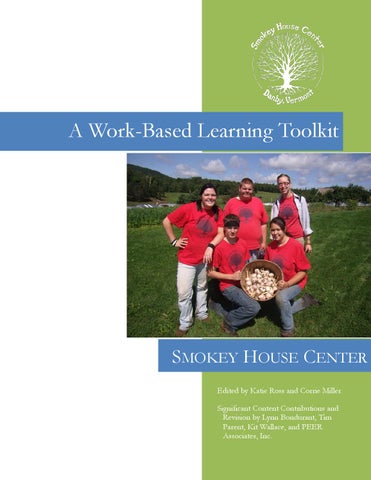
LOCAL HARVESTS – FOOD, FORECASTS AND THE FUTURE By Corrie Miller In early August, walking up the steps to the old milk house loft affords an unexpected sight. Rows of garlic bunches hang upside down from the rough hewn rafters. Beneath the ceiling of suspended garlic, five students and one crew leader (in red t-shirts) crowd together around three harvest baskets. They’re leaning in so closely it’s difficult to see what they’re doing. But, fragments of conversation—―that‘s five heads of firsts‖ and ―here are two seed garlics‖—reveal that these students are sorting and counting garlic. These five high school students are part of Smokey House Center’s Youthwork Program. Youthwork students help manage the organization’s farm and forest land; in the summer, they spend six hours each day growing organic vegetables, cutting firewood, raising livestock, or marketing products to the community. On this particular day the Youthwork crews are preparing for the weekly Community Supported Agriculture (CSA) delivery. Seven crews harvest, clean, and pack vegetables for delivery to fifty local families who have purchased a ―share‖ of Smokey House’s harvest. This week, the shares include organic cabbage, summer squash, zucchini, carrots, tomatoes, peppers, beets, corn, leeks, cucumbers, and, of course, garlic.
Stashia packs green beans into a CSA box.
The Red Crew has been in charge of the garlic crop all summer—they weeded, dug, and hung it to cure. For today’s CSA boxes, the students calculated that they need eighty garlic bulbs. The students have become proficient at looking for blemishes, counting cloves, and appraising bulb size in order to sort their harvest into three groups—seed garlic, firsts, and seconds. The students laugh with their crew leader, Kate, as she reminds them to save the ―biggest and most beautiful‖ garlic heads for Smokey House. Underlying their snickering at Smokey House’s apparent selfishness is the youths’ understanding that saving the best garlic for next year’s seed ensures another bountiful crop. When the youth have met their quota and head to the Produce Stand to pack it, they walk with an air of satisfaction. Because these students take pride in their crop and understand its value to customers, they strive to produce the best food possible. The farm’s bustle slows as students and staff lean closer to the nearest radio to hear the report. Walkie talkies among rows of beans, stacks of firewood, and acres of pasture sound out the familiar, ―Good morning Smokey House, this is Andrew of the Green Crew with your weather.‖ Though
the anchor’s voice is different each morning, the words are familiar—―maximum temperature,‖ ―barometric pressure,‖ ―Nimbostratus clouds,‖ ―today‘s forecast,‖ and ―rain.‖ The middle school students on the Green Crew are part of the Environmental Field Studies Program at Smokey House Center. They are spending their summer days collecting ecological data and submitting it to various state and national scientific studies. As with this weather broadcast, Field Studies students are also contributing scientific data to inform Smokey House’s land management. Earlier that morning, the Green Crew gathered at Smokey House’s weather station Alicia and Angel read an anemometer to measure wind to record data from thermometers, a speed. barometer, an anemometer, a compass, and a rain gauge. Together, they pieced this information into a picture of the previous day’s weather and a prediction of the weather to come, and returned to the classroom to script their forecast. Andrew drew a breath, prepared his anchorman voice, and delivered his report, adding ―Have a nice day!‖ Promptly, calls of ―thank you‖ crossed the airwaves. With the Green Crew’s information, the National Weather Service can improve its forecast accuracy and Smokey House staff and students know what to expect from the weather to prepare for their day outside. In the process of collecting and contributing information valued by the Weather Service and our local community, the students understand that their research is meaningful and are inspired to take detailed, accurate measurements. At Smokey House Center, the harvests are usually abundant — students produce locally grown organic foods and valuable ecological data. Nevertheless, the real ―harvest‖ in the Youthwork program is the students. Through their important work, they not only learn and apply academic skills, build relationships with positive role models, and practice working cooperatively with peers, they also become contributing members of their local community. Whether the harvest is food or forecasts, the ties between the young people’s work and the community who values it inspire them to work hard and produce quality products. Though they may not become garlic farmers or network news anchors, the students’ work and learning at Smokey House have nurtured their sense of belonging and encouraged their future academic and workplace success.
TABLE OF CONTENTS I.
A Primer in Work-Based Learning ........................................................................................................... 1 A.
The Work-Based Learning Model ............................................................................................................. 1
B.
Essential Principles and Practices of Work-Based Learning ................................................................. 4
C.
Work-Based Learning Program Logic Model.......................................................................................... 6
D.
Prevention and Recovery Efforts in the High School Dropout Issue: An Effective Solution to a Costly Problem ............................................................................................................................................ 8
E.
Work-Based Learning in Action: Varying Applications ....................................................................... 12
F.
Beyond the Worksite: A Review of Research that Supports Work-Based Learning Principles and Practices ...................................................................................................................................................... 15
II.
Tools for Building a Work-Based Learning Program .......................................................................... 20 A.
Developing a Work-Based Learning Program ...................................................................................... 20
B.
Program Tools ........................................................................................................................................... 30
C.
Crew Management ..................................................................................................................................... 49
D.
Integrating Work and Learning: Designing Standards-Based Curriculum for Work-Based Learning Programs .................................................................................................................................... 55
E.
The Balancing Acts of Work-Based Learning ....................................................................................... 64
III.
Tools for Assessing and Evaluating Student Work .............................................................................. 68
A.
Working Towards Goals: Assessment in Work-Based Learning........................................................ 68
B.
Benchmark Rubric ..................................................................................................................................... 71
IV.
Smokey House Center Program Evaluation ......................................................................................... 79
V.
A Work-Based Learning Evaluation Toolkit......................................................................................... 81 A.
School Records Data Analysis ................................................................................................................. 82
B.
Benchmark Rubric Analysis ..................................................................................................................... 84
C.
Developmental Assets Profile .................................................................................................................. 87
D.
School Staff Interviews ............................................................................................................................. 88
E.
Student Outcomes Tracker ...................................................................................................................... 89
F.
Data Analysis for Small Groups .............................................................................................................. 91
G.
Additional Evaluation Tools and Resources ......................................................................................... 93
VI.
Appendix .................................................................................................................................................... 94
A.
Citations ...................................................................................................................................................... 94
B.
Suggested Reading ..................................................................................................................................... 97
C.
Standards Reference List .......................................................................................................................... 99
D.
Activities Referenced in Toolkit ............................................................................................................ 102
E.
Example Application and Information Release .................................................................................. 110
F.
Benchmark Review Worksheet.............................................................................................................. 114
A Work-Based Learning Toolkit
I. A PRIMER IN WORK-BASED LEARNING A. The Work-Based Learning Model Meet Josh Short: Putting a Face on Work-Based Learning Pizza, a tool belt, and a walkie-talkie. Inconsequential to most, but to a young man named Josh Short, each is significant and represents three years of achievement. Pizza Josh started as a Smokey House Center youthworker during his ninth grade year. He and his family of seven had just moved to Danby after circumstances forced several temporary moves. Josh proudly recollects taking home his first paycheck, ―I bought my family pizza, from Domino‘s, for dinner. They liked it and it felt good to be able to help.‖ Josh remembers when Smokey House rehired him for a second semester, ―I knew I‘d done a good job and given a good first impression.‖ He advanced to spend a total of four semesters as a youthworker on general farm and forestry crews and learned valuable workplace, academic, and Josh helps a less experienced crew reshingle a roof. interpersonal skills. A Tool Belt Over the next two years, Josh was a carpentry student at the regional technical center, and an integral part of Smokey House’s new advanced carpentry crew. At Smokey House he helped build a barn, garden shed, and deck— practicing what he learned at the technical center while also learning new skills. Because of his carpentry experience, Josh found himself in a leadership role. ―The other kids on my crew looked to me when they had questions about their projects.‖ During his first summer, Josh saved enough money to purchase a tool belt. Since then, as earnings allow, Josh adds to his belt, confident that the ―tools‖ he accumulates prepare him for his future. A Walkie-Talkie The technical school encourages seniors to apply their training through internships; Smokey House was pleased to hear that Josh picked them for his internship site. Thinking back to his first day, Josh recalls how much it meant to him that he received a staff walkie-talkie. He is proud that three years of dedication and hard work have earned him a place alongside Smokey House staff. Josh has gained the respect of his peers, teachers, and family. He told Smokey House recently, ―It makes me happy to know that my father is proud of me for being the first in the family to have a job and stick with it.‖ Everyone at Smokey House is proud of Josh and looks forward to celebrating his future successes.
1
Smokey House Center Josh’s experience provides just one example of what Work-Based Learning can look like. But what exactly is Work-Based Learning (WBL)? Work-Based Learning is:
Learning about life cycles and reproduction by making sure pregnant ewes are receiving a balanced diet and helping those ewes deliver healthy lambs. Realizing that math can be applied to everyday life and real work: determining how many gallons of sap are needed to make a gallon of maple syrup, how to divide up 10 pounds of beans among 42 community supported agriculture (CSA) customers, or how much hay to feed the cows if they need to eat 2 percent of their body weight every day. Learning about germination by planting seeds in the greenhouse, and knowing that you have to do a good job because the tomatoes that come from those seeds will be sold at the local farmers’ market. Using the concept of right triangles to determine how long a support piece should be on a wood shed that the crew is building.
But Work-Based Learning is a lot more than just work and a lot more than just learning. Work-Based Learning is also:
A student who used to blow off school now regularly attending school and instructing a group of adults how to herd sheep. A young man who shows up for work every day, dressed in appropriate work attire. A student who started out the semester with violent outbursts and over time developed a positive relationship with the crew leader, to the point where the student was able to work independently and be a role model for other youth. A young woman who talks about issues with her co-workers in a positive, constructive way.
Work-Based Learning integrates real work and applied learning in a setting that provides youth with positive relationships and the support and motivation they need to be successful in school. Work-Based Learning can take many different forms, as long as these key components are involved. By combining school, work and positive social interaction, Work-Based Learning promotes personal growth, teaches students essential workplace skills, and enables academic success for students who would otherwise be at risk of dropping out of school.
―I have been working with Smokey House for 9 years. Truthfully, without Smokey House, many of my students would not have finished or stayed in school. It‘s the connection they make with crew leaders and other kids, and the style of learning. I have seen results physically and mentally. These kids are different people when they finish Smokey House than when they started. I‘m not saying all this to butter anything up. They learn cooperative attitudes, team building, working with others on a crew.‖ -Jim Walynak, Rutland Senior High Guidance
2
A Work-Based Learning Toolkit
Smokey House Center’s Youthwork Program: 36 Years of Youth, Land, and Learning Smokey House Center’s Youthwork program teaches academic, social and workplace skills to at-risk teens from Rutland County through hands-on forestry and farm work. Smokey House is a fully operating farm; youthworkers help produce and sell vegetables, meat, maple syrup, Christmas trees, yarn, and charcoal through a CSA (Community Supported Agriculture) and local Farmers’ Markets. Students, ages 14-18, attend classes in the morning and spend afternoons taking care of livestock, splitting wood, planting seedlings, managing woodlots, collecting sap, and filling vegetable orders. Teens are paid for their time and work in crews led by a crew leader, who acts as supervisor, teacher, and mentor to the students. The work provides myriad applied learning opportunities: science, math, ecology, communication, reading, writing, problem solving, critical thinking, teamwork and general work skills are woven into the work and highlighted by crew leaders. Because the work is real, with products being sold to the greater community, students are often more motivated to perform well and learn than they would be in school. Students take an active role in this learning community, working cooperatively and respectfully to set goals and solve problems.
Using this Toolkit The purpose of this toolkit is to share the lessons Smokey House Center has learned over the past 36 years as practitioners of Work-Based Learning programming. Inside you will find:
The key Principles and Practices of Work-Based Learning Examples of Work-Based Learning programs and implementation Research and other evidence of the positive impacts of Work-Based Learning programming Tools and processes that an organization can use to carry out and evaluate their own Work-Based Learning program
We hope that future and current practitioners of Work-Based Learning will use this document to build and strengthen their own programs, taking from it the pieces that will be relevant and helpful in shaping those programs. Together, we can create further applications of effective Work-Based Learning that help young people succeed and communities flourish.
―The program‘s emphasis on learning by doing has successfully engaged hundreds of students who were at risk of dropping out of school…Smokey House has become a national model for youth employment programs.‖ -Former Vermont Governor Howard Dean
3
Smokey House Center
B. Essential Principles and Practices of Work-Based Learning 1.
Meaningful Relationships with Skilled, Caring Adults – The relationship that develops between youth and adult leaders as they work together to accomplish mutual goals is the foundation for academic, social, and emotional learning. Youth work in small teams (ideally, six participants) with one skilled leader. This ratio of youth to adult leader ensures that participants receive individualized attention and provides opportunities for them to form a personal relationship with a caring, responsible adult. The adult leader acts in the roles of supervisor, mentor, and instructor. Leaders demonstrate, encourage, challenge, teach, and work alongside the youths; over time, the goal is to help youth develop the knowledge, skills, attitudes, and habits required to succeed in the adult workplace.
2.
Safe and Supportive Environment – Modeling an Farm Manager Sue Katt and a youthworker authentic workplace is balanced with the provision of a measure the syrup‘s density in the sugarhouse. safe and supportive environment that is necessary for learning. A supportive environment allows mistakes to be learning opportunities and empowers participants to take risks that help them grow socially and emotionally.
3.
Clear Expectations and Ongoing Assessment – Adult leaders establish clear guidelines for students’ participation and behavior. Using a Benchmarking system, leaders regularly assess and document youth participant’s progress toward meeting industry-based standards of job skills, attitudes and habits. With their leader, youth participants set individualized academic, social, and workplace goals, review progress towards them, and set new goals. These Benchmarks are the basis for school-awarded academic credit.
4.
Integrated and Applied Learning – Work projects require youth to integrate and apply their knowledge in ways that are not feasible in the confines of a classroom. On the job, participants use academic skills (e.g., reading, writing, math, science), social skills (e.g., communication, teamwork), and workplace skills (e.g., managing resources, time, and money) to solve real problems. In this way, they practice transferring knowledge between school and the workplace and learn how academic subjects are relevant beyond the classroom.
5.
Active Engagement with School and Service Providers – The Work-Based Learning provider actively engages school personnel, human service providers, and parents or guardians to support the participant’s learning goals and address any personal, family, or health issues that impede his or her ability to succeed.
6.
Real Work – Young people are engaged in work that is real; they make products or are involved in projects that support, or are valued by, the local community. When participants understand that community members are relying on them, they are inspired to produce quality work and meet adult 4
A Work-Based Learning Toolkit expectations. Through their work, youth take an active role in the community, building relationships with adults that nurture their sense of belonging and encourage continued success. 7.
Modeling the Employee/Employer Relationship – The relationship between youth participant and service provider is that of employee and employer. Youth voluntarily apply for the position, are compensated for their work, wear uniforms or job appropriate clothing, and are held to industry-based standards with real workplace consequences for exceeding, meeting, or not meeting expectations. Work-Based Learning models the real workplace so that applied learners develop appropriate workplace attitudes and habits.
8.
Distinct School/Service Provider Roles – A Work-Based Learning program augments but does not replace classroom learning. To ensure that students’ education spans all fields of knowledge and vital results (as laid out in Vermont‘s Framework of Standards and Learning Opportunities), schools and service providers work together to balance school-based learning and Work-Based Learning. Collaborative agreements establish policies supporting each organization’s distinct role - the school as education institution and the service provider as employer. Agreements specifically address academic credit for Work-Based Learning, define real workplace consequences for failure to meet expectations, and establish a ―no school, no work‖ policy.
―No program does a finer job of coming in and owning what they need to do and doing their part. [The Coordinator] comes in and finds kids, does applications, gets stuff from home, and never asks us for more than a piece of paper. They have their act together, and they are really great about working in the system.‖ -Guidance counselor, Rutland area high school
A youthworker presents vegetables he helped grow at a local farmers‘ market.
5
Smokey House Center
C. Work-Based Learning Program Logic Model A logic model is used to visually demonstrate how a program’s principles inform its activities, which in turn lead to specific results. It is helpful to create a logic model when designing a new WBL program to ensure that your planned activities logically lead to your intended outcomes and are aligned with your principles. The following WBL logic model can provide a template for creating a new logic model, but such a template should just be used as a starting point; the final logic model should reflect an organization’s specific mission and practices. Resources for creating logic models can be found at: http://www.uwex.edu/ces/pdande/evaluation/evallogicmodel.html http://managementhelp.org/np_progs/np_mod/org_frm.htm In this logic model, the Principles and Practices that are the foundation of Work-Based Learning are shown on the left, under the heading ―Work-Based Learning Programming.‖ This programming leads to Ongoing, Short Term, and Medium Term Outcomes, which are shown on the right side of the model under ―Intended Outcomes.‖ This logic model highlights three ―threads‖ of learning that are critical to Work-Based Learning: Interpersonal, Academic, and Work.
Logic Model Hypothesis: If youth who do not thrive in a traditional school setting participate in a Work-Based Learning program for two semesters or more, they are more likely to become confident and competent young people ready to assume productive roles in the community.
6
A Work-Based Learning Toolkit
7
Smokey House Center
D. Prevention and Recovery Efforts in the High School Dropout Issue: An Effective Solution to a Costly Problem A Challenge for Today’s Schools In today’s public school system, student dropout rates continue to present schools with a serious challenge. In 2007, eleven percent of 18-24 year-olds in the United States had not completed high school (Cataldi et al., 2009). Student dropout impacts both individual students and society as a whole. Some effects are direct: on average, high school graduates earn significantly higher incomes over their lifetimes; in 2005 the average annual income for a high school dropout was $17,299, compared to $26,933 for a high school graduate (U.S. Census Bureau, 2006). The effects, however, don’t stop there. High school graduates are more likely to live longer, and raise healthier, better educated children (Muennig, 2005; Alliance for Excellent Education, 2009). High-school dropouts, on the other hand, are more likely to commit crimes, be teenage parents, and rely on costly government services such as food stamps or housing assistance (Raphael, 2004; Haverman, Wolfe, and Wilson, 2001). These impacts are also recurrent: children of high school dropouts are at the highest risk of also dropping out, causing the costs to spiral through the generations (Ingels, et al. 2002). For society, the costs of high school dropouts are estimated in the billions of dollars in lost tax revenues, welfare programs, unemployment programs, underemployment, lost productivity, and crime prevention and prosecution (Christenson, Thurlow, 2004). It is estimated that over their lifetime, an individual high school dropout will cost the nation approximately $260,000 (Rouse, 2005). High school graduates, on the other hand, not only cost taxpayers less in services and contribute more in taxes, but also tend to engage more in civic activities such as volunteering and voting (Junn, 2005). The staggering personal and societal costs of dropping out demonstrate a need for both strategies that aim to prevent high school dropouts, as well as strategies that support students who have left school prematurely. Strategies that support high school dropouts are also known as recovery strategies. A 2009 report from the Massachusetts Department of Education exploring high school dropout prevention and recovery recommended that both tactics be used to increase high school completion rates. Together, prevention and recovery programs mitigate many of the personal and societal costs associated with dropping out of school.
Prevention through Intervention: Challenges and Benefits While it is often easier to see the direct benefits of money spent on recovery programs - such as attaining a GED - the impacts of prevention programs are often indirect and less clear. Vermont’s Department of Education, for example, does not collect information on dropout prevention programs operated by local school districts (Alderman, 2010). It is also difficult to determine which successful students would have dropped out had they not received early intervention efforts. It is thus challenging to clearly determine the overall cost effectiveness of prevention programs. Evidence exists, however, that suggests that the costs of early intervention provide an overall economic benefit to society. While programs such those that utilize Work-Based Learning practices can be costly, they are less expensive than the costs that an adult who has not graduated from high school poses to society. One study found that spending $10,038 on after-school 8
A Work-Based Learning Toolkit programs produces benefits of $89,000 to $129,000 per participant (Alliance for Excellent Education, 2009). Prevention efforts can take a number of different forms. They can include changes within the school, such as providing extra academic support, reducing class size, and providing guidance or mentoring programs. They can also include alternative schools, after-school programs, and other human and social services. Examples are found at federal, state and local levels of government. Nationally, the No Child Left Behind Act included a national dropout prevention program that distributed grants to support professional development, reduction in class sizes, and mentoring and tutoring for at-risk students (American Youth Policy Forum, 2006). At the state level, the Minnesota Department of Education developed a communitytailored guidance program for students at risk of dropping out (American Youth Policy Forum, 2006). An example of prevention efforts at the local level can be found in Rutland, Vermont’s SUCCESS School, an alternative therapeutic school designed to give students extra support through small teacher-to-student ratios, with the goal of helping at-risk students graduate from high school. Work-Based Learning programs often use prevention strategies: the mission of Smokey House Center’s Youthwork program is to help atrisk students graduate by providing a highly supportive alternative learning and work environment that will motivate them to complete school while gaining work readiness skills. Because prevention programs are relatively costly, it is important that such programs use methods that have been proven to work. One literature review of dropout prevention found that programs which engaged in early intervention and supported the transition to high school were especially successful in dropout prevention (Nelson, 1985). Another study found that mentoring, case management, and careeroriented or experiential learning approaches were among common elements of successful prevention programs (Tyler and Lofstrom, 2009). The same study also concluded that the successful programs reviewed passed a societal cost-benefit analysis, demonstrating that it is more cost-effective to society in the long run to implement prevention programs, rather than spend money on recovery efforts later on. State governments have also begun to realize that dropout prevention programs are an effective, positive way to meet the needs of at-risk students. A 2009 Massachusetts Department of Education report on dropout prevention claimed that career exploration and mentoring programs are especially effective as prevention approaches; Work-Based Learning programs represent a synthesis of these two best-practices strategies. A Vermont Department of Education study examining methods that have been effective in retaining at-risk students included early intervention programs that support struggling students as one of their Eight Characteristics of Effective Schools (2009). Additionally, Act 44, passed by the Vermont legislature in 2009, requires the development of individualized strategies to help at-risk students succeed in school. The act also promotes programs in which students acquire knowledge and skills through ―applied or workbased learning opportunities,‖ suggesting that such programs can help students successfully complete high school (Vermont Department of Education).
Recovery Efforts: An Important Complement to Prevention Programming While prevention programs represent a key element of reducing the financial and cultural costs associated with high school dropouts, recovery programs are important as well. Older adolescents who have dropped 9
Smokey House Center out of school are ―among the most neglected and at risk of our young people‖ (Steinberg and Almeida, 2004). Additionally, with the high percentage of students dropping out of school – the number is currently estimated at one-third of youth – the reality is that prevention strategies must continue to be complemented by recovery approaches. For these reasons, state educational systems must simultaneously use both prevention and recovery strategies in order to comprehensively address the issue of high school dropouts (Steinberg and Almeida, 2004). Recovery programming can take a wide variety of forms. Recovery can include programs within traditional public schools, alternative schools that cater to high school dropouts, alternative learning centers, community-based non-profit schools and programs, community college programs, adult education programs and other social services (American Youth Policy Forum, 2006). More specifically, recovery programs tend to fall into the following three categories: alternative high schools that allow youth to earn a diploma, programs such as Job Corps that offer youth help entering the job market, and Adult Education and community college programs that offer GED certificates and other academic learning opportunities (Steinberg and Almeida, 2004). Like prevention programming, examples of recovery programs can be found at the federal, state, and local levels. Job Corps and Conservation Corps are federal programs that provide older, disconnected youth with job training. The National External Diploma Program allows students to demonstrate high school level skills by ―applying their life experiences in real-life situations‖ (Tyler and Lofstrom, 2009). The Vermont Adult Learning program provides out-of-school students with opportunities to complete high school, achieve a ―Vermont Adult Diploma,‖ or earn their GED. Through the federally-funded Workforce Investment Act, the Vermont Department of Labor also provides a wide array of job training opportunities. These state and federal programs are supplemented by a variety of local recovery programs. New York City, for example, has thirty ―transfer high schools‖ that are designed for students who have dropped out of school (Tyler and Lofstrom, 2009). While Smokey House Center’s Youthwork program focuses on dropout prevention efforts, it also engages with out-of-school youth, especially during the summer. Research has shown that successful prevention programs include practices that are: comprehensive, sustained over time, grounded in the principles of youth development, connected to further education and career skills, and involved in helping youth with non-academic issues. Examples of such effective programs include ―Check and Connect,‖ an intensive program that coordinates school and other social services for at-risk middle school students; ―career academies,‖ small alternative schools that teach students vocational skills and provide students with work opportunities in the community; and ―high school reform models‖ that organize students into smaller, individually-tailored learning communities (Tyler and Lofstom, 2009).
Prevention and Recovery in the Form of Work-Based Learning Because prevention and recovery efforts have both been found to be effective intervention methods, it follows that they should be an integral part of public school funding (Vermont Department of Education, 2009; Nelson, 1985; Steinberg and Almeida, 2004). More specifically, Work-Based Learning combines many of the practices that have been found to be most effective in preventing and recovering student 10
A Work-Based Learning Toolkit dropout. The following practices and features have been found to be the most effective in preventing and recovering student dropout and are key features of Work-Based Learning (Steinberg and Almeida, 2004; North Central Regional Educational Library, 2003):
Career exploration
Academics that are connected to future work opportunities
Applied and experiential learning
Mentoring programs
Strong student support
Low student-teacher ratio
Programs with clear expectations of behavior
Shared sense of community
A number of specific Work-Based Learning programs, including the national YouthBuild program, have been documented to result in positive outcomes for disconnected youth (Stenberg and Almeida, 2004). Overall, the evidence suggests that dropout prevention programs, including those that use a Work-Based Learning approach, are among the most cost-effective, positive, and successful ways to help at-risk students succeed in school and later in life. Citations located in Appendix Section A.
11
Smokey House Center
E. Work-Based Learning in Action: Varying Applications The following programs are just a few examples of the many ways, outside Smokey House Center, that Work-Based Learning is being applied in New England and around the country.
ReSOURCE - ReTRAIN YouthBuild Program
Burlington and Barre, Vermont
http://www.retrainvt.org/retrain/services
Work Setting: Construction and Weatherization
In ReTRAIN’s YouthBuild program, youth are taught construction skills while building and weatherizing affordable housing and engaging in other community projects. Youth spend an equal amount of time developing educational and leadership skills in a classroom- and community-based learning program that supplements their work. Photo courtesy YouthBuild Burlington Students alternate between construction projects, weatherization projects, classroom time, and working on other ReTRAIN projects, practicing such skills as deconstruction for salvage, computer systems, retail management and office administration. Participants receive a stipend and usually earn their GED during the program. Staff work closely with trainees to ensure that individual needs are accommodated while product and service quality standards are maintained. Students might spend the day painting bird houses with first graders, building a ramp for a local community organization, installing insulation in a community member’s house, or putting together boxes of food at the local food shelf. YouthBuild serves the community on multiple levels: the program provides students with relevant learning experiences and job skills while providing the community with a variety of services.
Wisconsin State – Youth Apprenticeship
Wisconsin (Statewide)
http://dwd.wisconsin.gov/youthapprenticeship/
Work Setting: Variety
Wisconsin’s Youth Apprenticeship program reflects an apprenticeship model of Work-Based Learning. Part of a statewide school-to-work initiative, students get paid, on-the-job experience with local employers. The program combines hands-on learning with classroom instruction that relates to the work students perform in their apprenticeship. Students also continue their other academic classes required for graduation. Through apprenticeships, youth are able to practice and improve work, social, and technical skills and are paid for their work. Participants choose one of several program areas to focus on, including agriculture, construction, architecture, finance, health science, hospitality and tourism, information 12
A Work-Based Learning Toolkit technology, manufacturing, science technology, and transportation. Youth come out of the Youth Apprenticeship program with a certificate in their program area, as well as skills that will help them successfully secure and hold a job in the future.
Janus Youth Programs - Foodworks
Portland, Oregon
http://www.janusyouth.org/what-we-do/urban-agriculture-services.php
Work Setting: Agriculture and Business
Photos courtesy Foodworks
A collaboration between Janus Youth Programs and a local housing community, Foodworks is a youth employment program involving low-income youth in all aspects of planning, growing, and selling produce from a one-acre organic farm. Students, ages 14-21, work as a team, learning business, leadership, agricultural, work, and life skills. Students also donate produce to low-income community members. They receive school credit for their work and are supported in their academic goals and as they transition into other employment. On any given day you might find workers picking peas, selling potatoes at the farmers’ market, planning next year’s garden, leading nutrition workshops for local children, or washing lettuce. The program has been successful in improving students’ grades and a number have received scholarships from Janus and won community activism awards. The Foodworks program cultivates youth community involvement while empowering students with valuable responsibilities and work experience.
Vermont Youth Conservation Corps- Vermont Futures School Program
Vermont (Statewide)
http://www.vycc.org/about/programs_youthagriculture.html
Work Setting: Conservation
13
Smokey House Center The Vermont Futures School Program engages tenth grade high school students in a Work-Based Learning experience that inspires them to take personal responsibility for their own education. During the school year, students work in crews on conservation-based projects. Example projects include tree planting, tool repair, gardening, ski trail maintenance, and riverbank restoration. As part of the program students earn academic credits and are immersed in a dynamic work-related educational curriculum that includes leadership and teamwork skills. Crew members are also held to general workplace standards. Participants usually take one or two classes at their sending school and spend the rest of the day on a Vermont Youth Conservation Corps (VYCC) crew. While school-year program participants don’t get paid, they can transition to paid positions during the summer. Overall, the Vermont Futures program provides valuable real-life experience to students while also accomplishing vital conservation work for the local community.
A student reflects at the end of the work day. (Photo courtesy VYCC)
Youth Agriculture Project – Summer Work and Learn
Brattleboro and Bennington, Vermont
http://www.uvm.edu/extension/youth/?Page=yap_about.html#swl
Work Setting: Agriculture
The Youth Agriculture Project’s Summer Work and Learn program is an example of a successful WorkBased Learning program that has used Smokey House’s Youthwork program to inform its own programming. Eight years old, the Summer Work and Learn program is a job training program for youth ages 14-21. Youth grow crops, harvest and prepare snacks and meals, sell produce at the farmers’ market, and donate food to local food shelves. They also practice basic job skills such as teamwork and communication, and are involved in mentoring local children. Participants are paid for their work and take increasing responsibility for their tasks over the course of a summer. Through these experiences youth learn a great deal about farming and food security while gaining transferable employment skills.
Summer Work and Learn students (Photo courtesy Youth Agriculture Project)
14
A Work-Based Learning Toolkit
F. Beyond the Worksite: A Review of Research that Supports Work-Based Learning Principles and Practices The successes of Work-Based Learning programs like Smokey House Center’s are not the only evidence supporting Work-Based Learning. The Principles and Practices of Work-Based Learning are backed up by a wealth of scientific research. The following review highlights just some of the scholarly research that suggests that integrating work and learning in a positive, structured environment leads to successful outcomes for students. The research is organized into the principles highlighted in the Work-Based Learning logic model (found on page 7), which are derived from Work-Based Learning Principles and Practices (found on page 4). The research highlighted here demonstrates that Work-Based Learning leads to interpersonal, academic, and work-related positive outcomes and successes for young people struggling in the traditional classroom.
WBL Principle #1: Meaningful Relationships with Skilled Caring Adults (Interpersonal) The relationship that develops between youth and adult leaders as they work together to accomplish mutual goals is the foundation for academic, social, and emotional learning. Leaders demonstrate, encourage, challenge, teach, and work alongside the youths regularly; over time, the goal is to help them develop the knowledge, skills, attitudes, and habits required to succeed in the adult workplace.
In a review of studies of ten youth mentoring programs, researchers found that ―mentoring programs can be effective tools for enhancing the positive development of youth. Mentored youth are likely to have fewer absences from school, better attitudes towards school, fewer incidents of hitting others, less drug and alcohol use, more positive attitudes toward their elders and toward helping in general, and improved relationships with their parents.‖ In most of the programs reviewed other services such as academic support were also provided. (Jekielek, Moore, Hair, Scarupa, 2002)
In a longitudinal study of urban high school students, Linnehan (2003) found that students participating in a formal work-based mentoring program believed more strongly that school was relevant to work than those who worked without a mentor. Students who worked formally and informally with mentors reported higher self-esteem than students who did not work with mentors.
Thompson and Zand (2010) demonstrated that the quality of the mentor-youth bond significantly predicted other relationship-based outcomes including friendship with and self-disclosure to adults.
A review of drop-out prevention and intervention programs found that a commonality of effective programs was that they emphasized creating caring relationships (Christenson and Thurlow, 2004) and involved close mentoring of students (Tyler, 2008). The review cited one study which found that ―effective programs (that are) aimed at promoting school completion focus on building students’ relationships with teachers, parents, and peers‖ (McPartland, 1994).
15
Smokey House Center
Hamilton and Hamilton’s (2002) review of mentoring in the workplace found that working together to complete real work sets a positive stage for youth-adult mentoring relationships. Such workplace mentoring leads to both technical competencies such as learning work skills, and personal competencies, such as learning social skills and teamwork skills.
A qualitative study of three youth programs in which youth are connected to resource-bearing adults in the community found that structuring youth-adult activities around common goals facilitates the development of social capital (Jarrett, 2005).
WBL Principle #2: A Safe and Supportive Environment (Interpersonal) Modeling an authentic workplace is balanced with the provision of a safe and supportive environment that is necessary for learning. A supportive environment allows mistakes to be learning opportunities and empowers participants to take risks that help them grow socially and emotionally.
Researchers from the Search Institute tracked a sample of 370 high school students for three years to investigate the relationship between developmental assets and GPA. They found that increases in assets over the three years were significantly associated with increases in GPA. These assets included support, empowerment, boundaries and expectations, and constructive use of time. (Scales, 2006)
In a study of 1,741 high school seniors participating in a 60 hour work-based internship, Bennett (2007) found that ―opportunities to receive social support, especially having a mentor, contributed most to seniors’ future dispositions toward occupational engagement.‖ Bennett’s recommendations focused on the need for high schools ―to provide more access to supportive adults and personalized supportive learning environments.‖
A review of effective drop-out prevention and intervention programs found that ―effective programs that are aimed at promoting school completion…create a caring and supportive environment‖ (McPartland, 1994.)
A study of learning-disabled students found that a caring and supportive environment is a main component essential to school engagement (Williams and Riccomini, 2006).
―The crew leader is there to help you out. When you‘re having problems with other crew members they‘re there for you. They‘re there if you‘re having trouble with the job you‘re doing; they don‘t get mad that you can‘t do it. The crew leader is like your friend, too. You really get to know them. You have someone to talk to about work and also about personal things sometimes.‖ -Emmylou Bolster, former Smokey House youthworker
16
A Work-Based Learning Toolkit
WBL Principle #3: Setting Clear Expectations and Providing Ongoing Assessment (Interpersonal) Adult leaders establish clear guidelines for students‘ participation and behavior. Using a Benchmarking system, leaders regularly assess and document youth participants‘ progress toward meeting industry-based standards of job skills, attitudes and habits. With their leader, youth participants set individualized academic, social, and workplace goals, review progress towards them, and set new goals. These Benchmarks are the basis for school-awarded academic credit.
A review of Work-Based Learning programs found that successful programs should involve clear expectations of student activity in the workplace, and well-structured feedback on student performance (Lueckling and Gramlich, 2003).
A review of effective drop-out prevention and intervention programs found that systematic monitoring of students’ performance was an important element of successful programs (Christenson and Thurlow, 2004).
A literature review of dropout prevention programs found that ongoing evaluation was among several critical features of successful school drop-out prevention programs (Martin et al., 2002).
A review of student apprenticeship programs found that a key feature of successful programs is that expectations are clearly articulated. Such programs successfully teach technical and social skills (Powers, 1997). A different study of pre-employment training programs found that within successful training programs, trainers provided feedback to participants (Matt et al., 2006).
WBL Principle #4: Integrated and Applied Learning (Academic) Work projects require youth to integrate and apply their knowledge in ways that are difficult in the confines of a classroom. On the job, participants use academic skills (e.g., reading, writing, math, science), social skills (e.g., communication, teamwork), and workplace skills (e.g., managing resources, time, and money) to solve real problems. In this way, they practice transferring knowledge between school and the workplace and learn how academic subjects are relevant beyond the classroom.
A review of successful Work-Based Learning programs found that they involve connections between job and school-based learning (Lueckling and Gramlich, 2003).
A review of student apprenticeship and vocational programs found that work experience can provide a setting for learning academic material while better demonstrating why learning is important. Work-Based Learning opportunities such as apprenticeships thus give students the option of going on to college or entering the workplace (Powers, 1997).
A review of dropout prevention research found that interdisciplinary thematic units in academic areas, cooperative learning, and hands-on projects are critical features of school drop-out prevention programs (Martin, 2002). Another review of dropout prevention programs found that curricular reform toward a career-oriented, experiential approach was a common element of successful programs (Tyler, 2008).
17
Smokey House Center
In 2007, Choo found that activity-based learning trains students to solve real-world problems so they can handle complex problems in the workplace. ―Educators understand that some people learn better by doing than by sitting at a desk absorbing information and solving hypothetical problems. Working on real problems at Smokey House – how much grain for the sheep, how much lumber to build a new wood cart – many students who have felt frustrated, and eventually angry in school, experience feelings of accomplishment and success.‖ – Susan Keese, ―Working Toward a Good Start at Smokey House,‖ Vermont Life
WBL Principle #5: Active Engagement (Academic) Actively supporting students‘ learning goals improves the likelihood of academic and personal success. Such support can include providing personalized and flexible learning settings, working with schools to support students‘ learning goals, using a low teacher-to-student ratio, and requiring students to attend school in order to work.
A study of effective drop-out prevention and intervention programs found that personalized settings and individual learning plans were effective in lowering drop-out rates in alternative middle school programs (Christenson and Thurlow, 2004).
Williams and Riccomini found that carefully scaffolded instruction is part of research-validated effective instruction principles that are more likely to lead to engagement with school (2006).
A review of dropout prevention programs found that coordination with community agencies, selfpaced learning and flexibility to accommodate alternative learning styles are among the critical features of successful school drop-out prevention programs (Martin et al., 2002).
Research looking at successful drop-out prevention programs found that case management of individual students was a common element of successful programs (Tyler, 2008).
Looking at a youth apprenticeship work and learning program in Wisconsin, a study found that several factors contribute to the success of student participants. Among the key factors of such programs is consistent communication among stakeholders (Scholl and Mooney, 2003).
WBL Principles #6 and #7: Engaging in Real Work and Modeling the Employee/Employer Relationship (Work) Young people are engaged in work that is real; they produce products or are involved in projects that support, or are valued by, the local community. When participants understand that community members are relying on them, they are inspired to produce quality work and meet adult expectations. Through their work, youth take an active role in the community, building relationships with adults that nurture their sense of belonging and encourage continued success. 18
A Work-Based Learning Toolkit The relationship between the WBL organization and youth participant also models that of the relationship between employer and employee. This type of relationship helps replicate the workplace environment and prepare students for future stable employment.
Griffith (2001) examined the effects of participation in a Work-Based Learning program on 4050 high school students. He found that in the first year after graduation, students who had participated in a career and technical education program that included several semester-long job placements reported higher wages, higher total earnings and greater relevance of high school curriculum to their post-secondary education and employment. Participants in this program also felt better prepared for employment than non-participants both in terms of knowledge and workplace competencies.
A review of research found that low-intensity employment tends to have positive effects on youth, including increased post-school employment and enrollment in college (Hamilton and Hamilton, 2002).
Choo found that providing students with authentic contexts and activities that reflect real-life scenarios is a key characteristic of activity-based learning. Activity-based learning was found to have positive effects on cognitive development, as well as the learning of knowledge and skills (2007).
A review of service learning offered evidence that service-learning may benefit low-income students and schools. Service learning appears to decrease the achievement gap, demonstrating that low-income students who engage with their community do better academically than students who do not serve (Scales and Roehlkepartain, 2005).
A qualitative study evaluating the impact of service learning among educationally at-risk 7th and 8th graders in Delaware demonstrated that students who engaged with their community through service described the experience as positive and were increasingly engaged in school (Hecht, 2002).
A literature review found that Work-Based Learning has been shown to improve students’ selfesteem, teach and reinforce basic academic and technical skills, promote an understanding of workplace culture and expectations, and develop a network for future job searches (Lueckling and Gramlich, 2003).
A study found that graduates of a pre-employment training program showed significantly less depression and improved self-esteem and self-efficacy than before the training, in difficult-toemploy populations. Difficult-to-employ populations were defined as individuals with less education or those who were unemployed (Matt, 2006). ―I was real proud… looking back and saying ‗Yep, we did this. And other people will see what we‘ve done.‘ And I‘d be thinking ‗Yeah, I did do a good job,‘ and ‗Maybe I could do this for a future.‘ ‖ -former Smokey House youthworker
19
Smokey House Center
II. TOOLS FOR BUILDING A WORK-BASED LEARNING PROGRAM The Origin of Smokey House Center…Opportunity Knocks The Taconic Foundation is a non-profit philanthropic organization that, in the 1960s, primarily funded programs in New York City aiming to improve ―race relations‖ and to help disadvantaged, underserved youth gain the skills and education necessary to be employed. The Foundation received nearly 5,000 acres of land in Danby, Vermont as a bequest from Stephen and Audrey Currier, who died tragically in 1968. Recognizing that rural poverty in Vermont presented youth with difficulties similar to those faced by young New Yorkers (use of drugs or alcohol, classroom subjects irrelevant to their daily lives, disconnect with adult community, lack of job skills), the Taconic Board of Directors decided to look for ways that the land resource in Danby could best serve rural disadvantaged youth. They engaged a small group of education and natural resource experts to help with this research. From the natural resource experts, they learned that with ownership of forest and agriculture fields comes an enormous responsibility to steward the land. From the educators they learned that a significant percentage of students in Bennington and Rutland County were not motivated to learn in the classroom and were failing to complete high school. The Taconic Board concluded that the serendipitous gift of the land, the real work required to responsibly steward the forests and fields, and the documented needs of the local students presented an opportunity to develop a Work-Based Learning program for at-risk youth. This was the birth of the Youthwork program. The newly formed Smokey House Project (later renamed Smokey House Center) secured CETA (Comprehensive Employment and Training Act) and later JTPA (Job Training Partnership Act) and WIA (Workforce Investment Act) grants from the Departments of Labor and Education. From the onset, Smokey House worked with local schools to recruit students, hone the program’s academic goals and develop ways to document and assess student work. Since that time, full collaboration between Smokey House and sending schools – especially with school guidance counselors - has been essential to the success of Smokey House’s Work-Based Learning program.
A. Developing a Work-Based Learning Program The goal of this section is to help individuals, organizations or schools start a Work-Based Learning Program based on community needs and assets. Every new program in every new location will encounter a unique set of opportunities; understanding these opportunities will enable you to take full advantage of them and form a strong program. This section will examine a few important aspects to consider when developing a new program: to ensure that your program is relevant and has community support, an important step is to identify the needs and assets (or resources) of your local community; to focus your program development process, you will want 20
A Work-Based Learning Toolkit to determine the work setting(s), general program goals, and funding sources for your programming; and to foster your program’s sustainability, it will be important to foster community partnerships. It doesn’t matter where you start in this planning process and it is not necessary to go down the list of questions below in order. Rather, where you start may be driven by the needs that are your priority or opportunities you want to realize. Once you have figured out the building blocks that will provide the foundation and relevance of your program, you can dive into the Tools for Building a Work-Based Learning Program section to further develop and refine your programming.
Consideration #1: Community Inventory To ensure that your program is relevant and has community support, an essential step is to engage your stakeholders (youth, educators, family service providers, business and civic leaders, and local government agencies) to help identify local needs and assets (or resources). You may engage your stakeholders through surveys or meetings individually, in discrete groups (secondary and post secondary educators, family service providers, business leaders, parents, students) or collectively. However, it is necessary to consider the information you gather as a whole and to share the results with everyone who participates. Your goal is to discover disconnects in understanding and gaps in services and to identify potential interconnections between the needs and assets of your youth population and the broader community. Ensuring that the type of work your program engages in is valued by the community will help your program meet a key principle of WBL: Real Work. Although each stakeholder has specific, pertinent information, you want to ask the same questions of all stakeholders. Consensus and lack of consensus are equally as informative. Questions for stakeholders:
Do all the students in your region graduate from high school with the requisite skills to enter the workforce or attend college?
Are there students or groups of students who are not motivated to learn by existing educational opportunities? Are there specific groups of students who would benefit from Work-Based Learning?
What kind of work or activities interest students? What do the youth like to do?
What do young people do when they are not in school: after school and summers?
Are drugs, alcohol or gangs an issue in your community?
What knowledge, skills and training do students need to be prepared for jobs in the community?
What types of jobs are available to students in the community upon their graduation from high school? Note: the Department of Labor and/or a local Workforce Investment Board may have statistics and facts pertaining to future job growth.
21
Smokey House Center
Is there specific subject matter that educators would like to be reinforced?
Are there specific skill sets that educators find difficult to teach or would like to be reinforced?
Are educators concerned about meeting state standards? Which ones?
Do students have access to various learning opportunities that meet their individual learning styles? What opportunities are missing in your region?
Are there any existing Work-Based Learning programs in your region? What is their target population?
What other youth programs are offered in your community? For what ages?
Do student assessments suggest that students are lacking in specific skills?
What industry sectors are currently thriving or up and coming in your region?
Has your community identified specific needs or problems - civic, environmental, structural, etc.? (Some examples: elderly shut-ins in need of companionship, garbage being dumped along a river or stream bank, a local marsh with undocumented wildlife, churches without handicap access.)
Are there businesses interested in working with youth? What businesses already have a track record of working with youth? What ages?
What business/education partnerships exist in your region?
Are there agencies or community based organization interested in working with youth?
Are there other service organizations serving the same population that may be interested in a partnership or a combined effort?
Does your region have a Regional Development Plan?
What are your natural resources and existing capital?
Do you, and others working with you, have special interests, circumstances, and expertise?
In your region, are there any existing physical resources, like land, buildings or other infrastructure, tools, which might be available?
Are there other schools or community resources that might be helpful?
What are potential funding sources?
What resources, special skills or circumstances do you or others committed to developing the WBL program bring to the table?
22
A Work-Based Learning Toolkit Schools, parents, local government, organizations, community leaders, social service providers, and the students themselves are all sources of valuable information in determining the strengths and weakness of your youth population and gaps in community services for the young people. Social workers, school guidance counselors and administrators can be especially helpful in determining student needs. The key is to seek out individuals who work with students in the community and thus those who have ideas of what support or services would benefit the community’s youth. Because Work-Based Learning programs work in conjunction with schools, while assessing needs it is especially important to be aware of the goals and expectations of the schools with which you'll be working. Schools will expect students participating in a Work-Based Learning program to meet state educational standards. Local schools also may be struggling in certain areas and need help achieving specific learning goals. For instance, you may find that local test scores show that students have been struggling with literacy skills, and thus decide to incorporate literacy training into your Work-Based Learning program. The schools may be looking for a way to involve struggling students in community service, suggesting that your program should include a community service component. Another community may find that schools are looking for an alternative way to meet math or science standards. Meeting the expressed needs of local school systems can help you meet student’s needs, but also can help you foster a mutually-supportive relationship with the school. Vermont‘s Framework of Standards and Learning Opportunities is a valuable resource. It outlines Vital Results, general standards such as communication, problem-solving and personal development skills, that each student is expected to possess across all content areas, and Fields of Knowledge, the content in the subjects of Language Arts, Social Studies, Science, and Math that each student is expected to know. The document also lists learning opportunities and educational approaches that help accommodate various learning styles. Other states have similar standards to guide learning that public educators are expected to achieve. This document highlights the ways that WBL can be connected to state educational standards. Since an overarching goal of WBL is to prepare young people with the skills, habits and attitudes they need to succeed on a job, local businesses provide vital information and may become essential partners. These are the men and women who can tell you why they will, or will not, hire local youth. Do youth lack necessary technical skills or do they not know how to behave appropriately on the job? Would businesses like help providing additional structure in their workplaces that will help young people succeed at entry level positions? What are the industry’s expectations for quality and quantity of work? Local business partners may offer job tours or shadowing for student learners and may provide entry level jobs for WBL graduates. Civic groups, local state agencies, and service organizations all may have important information about youth needs and existing services. These groups can also be a wealth of information about existing community resources (buildings, land, individuals with specific expertise, funding sources, etc…) that might help support a WBL program. Remember to engage youth themselves in your community inventory and later program planning processes. This is an opportunity to gain youth emissaries. An essential element of WBL is that youth must participate by choice. Your most successful and cost-efficient recruiting method will be word of mouth from youth to youth. 23
Smokey House Center The findings of every community inventory will be unique in time and place. The information collected, whatever the findings, will help you to take the next steps in shaping your WBL program. In one community, the local business men and women said they couldn‘t hire high school students or recent graduates because the young people lacked an understanding of systems. In this community, a WBL setting that will provide young people the opportunity to experience multiple facets of a business and understand how they support and relate to one another will likely get support from industry leaders and help young people get and keep jobs in the local community. In another region, an organization might learn from local industry leaders that the construction trades have an aging workforce. There is a real and immediate need to attract young people to the construction trades – carpentry, excavation, plumbing, electrical, roofing, architecture, etc. Meanwhile the educators in the region believe that there will be no future jobs in construction because the newspaper reports that new building has slowed due to recession. A group of contractors offers to provide job shadowing, work experience, tools and equipment for a Work-Based Learning program that focuses on developing construction skills. An organization in a third region might find data demonstrating that female teens in the area have trouble finishing high school, suggesting that the organization should develop a program targeted at young women.
Assessing the needs of local students by consulting with a variety of community resources will help you shape an effective program while beginning to build partnerships that are often key to successful WorkBased Learning programming. Through this community inventory process you will gain the knowledge and relationships necessary to identify general programs goals and worksite setting(s). By engaging your various stakeholders early in the planning process, you begin to formulate the partnerships and support you will need to build and sustain your program. Once you can clearly articulate your general program goals and potential work setting(s), you are prepared to start solidifying partnerships and developing funding streams.
Consideration #2: Determine Work Setting(s), General Program Goals, and Fundin g Determine Work Setting(s) Based on the needs of local students, schools and business leaders and your own resources and skills, determine the type of general work the students will be doing. This consideration could be approached from several angles. What work environment will you offer students – a farm, a construction site, a hotel, a retail store, a restaurant? What work will engage your students – gardening, animal husbandry, forestry, construction, weatherization, hospitality, sales, cooking, trail work? What products would you like students to produce for the community – vegetables, meat, firewood, maple syrup, happy tourists, prepared meals, service, improved trails?
24
A Work-Based Learning Toolkit This is likely the most straightforward consideration as you may have an interest in one of the industries, may have access to a specific facility, or may have heard from business leaders that students need greater preparation in certain industries. Later, in section II-D, Integrating Work and Learning: Designing Standards-Based Curriculum for Work-Based Learning Programs, you will identify specific work tasks for students that integrate academic concepts and skills development; here your task is to determine your general work setting. Keep in mind that many of the skills and concepts you will be teaching are common to any industry, they are transferrable skills. A young person who learns teamwork laying stringers for a footbridge may someday be a distribution foreman using the same skills in the warehouse. Just because the vehicle for work and learning was constructing a bridge out of native timber doesn’t mean that your participants will become foresters or carpenters. In hammering out the generalities of your work setting(s), you will want to consider the following questions. [Note: Many of these questions may have already been answered while inventorying needs and resources, making your job that much easier.]
What are your skills and interests? Those of possible staff?
What work or products would be valued by the community?
What facilities do you have available?
What skills do business leaders expect from their entry-level employees? Which settings would provide learning opportunities for those skills?
Develop Program Goals Early in the program development process, it is important to draft your own Principles and Practices statement and Logic Model, based on the tenets of Work-Based Learning (see WBL Principles and Practices on page 4 and the WBL Logic Model on page 7, as well as local needs, goals, and resources, and the work project and academic goals you have decided to pursue. While your programming will likely change over time, developing clear goals early on will help guide and shape the rest of your program. It will also help you start to formulate an assessment process that should be put into place at the outset to help track program effectiveness.
Consider Funding Sources While you may have a clear picture of the type of work you want to engage students in, you may not yet know how to fund your program. Work-Based Learning programs, though they have the potential to be quite successful, can be rather expensive. Therefore, it is vital to think about how they will be funded or to identify possible funding streams before solidifying your program. There are five general categories of income to explore: 25
Smokey House Center
Fee for service (i.e. tuition from sending schools, program fees)
Income from the sale of products or services provided by the youth
Grants from private foundations, individuals, and government agencies
Donations (cash or in-kind) from individuals, organizations, or businesses
Income from special events related to the program
When considering funding, do not underestimate the importance of a detailed plan, clearly stated action steps, and carefully articulated program goals. If you can articulate a community need, how you are going to meet that need, what you require to meet that need, and how you will prove that you met that need, you will be well positioned to seek financial support. It is essential that you and your funders have common goals.
Consideration #3: Foster Community Relationships Build Relationships and Partnerships Once decisions about your targeted participants, work setting and learning goals are made, it is time to cement relationships and partnerships with schools and organizations. Aside from determining community needs, building these partnerships is perhaps the most important element of the program development process. Actively engaging with school and human service providers provides essential support for students and reflects an important principle of WBL. From your community inventory and needs assessment, you may have identified individuals in schools and other organizations interested in working with a Work-Based Learning program. It is likely that there are school staff members, such as superintendents, principals, and guidance counselors, with whom you'll want to start developing relationships. Once schools are interested and you have identified key staff members, you can work closely with them as you outline the learning goals of your programs, develop ways to document and evaluate student learning as well as the success of the program itself, and identify and recruit students. The process of laying out mutual expectations and working with partner schools and organizations will likely involve a continual series of discussions and conversations. It is helpful to view this as a process of strengthening relationships that must be continually fostered. Such relationship building is a key role of your program's coordinator. Questions to consider as you build relationships with schools and partner organizations include:
Who are possible partners within the schools? These may include guidance counselors, principals, teachers, or other support staff.
Are there other organizations with whom you will work? These might include community, state, or federal organizations. Who specifically will you work with in those organizations? 26
A Work-Based Learning Toolkit
What expectations does your WBL program have for the schools or partner organizations? What expectations do they have for you?
How will you be working with these partners? What will your role(s) be? What will their role(s) be?
Partner Agreements In order to make sure schools, social service providers, and your program have a shared understanding of roles and responsibilities, another key principle of WBL, it may be helpful to develop a Memorandum of Understanding (MoU). An MoU is a written, non-binding understanding or agreement between two parties. An agreement with the schools – whether in the more formal manner of an MoU or simply as an informal agreement – should define the roles of the WBL program, define the roles of the school, and lay out expectations for both the program and the school. In addition to MoUs, program handbooks for both student and staff can also be used to outline an overview of the program, including staff roles, policies, and procedures. The following topics should be included in an MoU or similar agreement:
School and program goals (including learning goals)
Criteria for selecting participants
Tuition agreements
Attendance requirements
Services such as transportation and tutoring
Program schedule
Format for documenting and assessing student learning and awarding academic credit
School and program responsibilities
Program staff roles
Overview of program
Program policies and procedures
Disciplinary plans
You will also want to develop an MoU or agreement with any other organizations with whom you are working. For instance, if local businesses or organizations are employing students, you will want to lay out expectations for them and define their role. Additional Resources 27
Smokey House Center The following resources and links may be helpful in the program development process that is outlined above:
Program Planning and Management, Free Management Library, Authenticity Consulting, 2010. http://www.managementhelp.org/prog_mng/prog_mng.htm This series of articles and list of additional resources includes how to undertake a feasibility study for new programs, basic guidelines for non-profit program design and marketing, and program evaluation.
Basic Guide to Non-Profit Financial Management, Free Management Library, Authenticity Consulting, 2010. http://managementhelp.org/finance/np_fnce/np_fnce.htm This topic will help you understand basic practices in financial management, and build the basic systems and practices needed in a healthy business.
Community Based Participatory Research: MoUs and MoAs, Community-Campus Partnerships for Health, 2010. http://depts.washington.edu/ccph/commbas.html#MOU This site includes links to sites that guide the development of community partnerships, as well as several examples of MouS and MoAs.
School-Community Partnerships: A Guide, Center for Mental Health in Schools, 2010. http://smhp.psych.ucla.edu/qf/Commout_tt/School-Com2-8.pdf This document provides a guide to developing partnerships between schools and community organizations. Relevant sections include: Making MoUs Meaningful: p. I-30, Tools for Mapping Resources: Appendix I, and Examples of Funding Sources: Appendix II.
The Next Phase - Developing Programming Once these broader WBL program goals and structures are outlined, the next step is to develop the nuts and bolts of your programming. The various sections in this toolkit will help guide you as you further develop your program:
The Program Tools section (II.-B., page 30) provides examples of various tools and structures the Smokey House Youthwork program uses to ensure that program goals are met. In this section you will find tools that you can use or adapt to start shaping your program. At the end of the Tools List is a section entitled Crew Management and Expectations. Crew management is also a vital tool, but is of a higher order than those previously described.
28
A Work-Based Learning Toolkit
The Integrating Work and Learning section (II.-D., page 55) provides a guide to integrating learning goals into work projects in a way that meets state educational standards. This section also provides examples of how Smokey House Center integrates work and learning in their Youthwork program.
The section entitled Work-Based Learning: A Continual Balancing Act (II.-E., page 64) discusses challenges that Smokey House has faced in the implementation of their Youthwork program, providing a glimpse of ―lessons learned‖ that you might find useful as you develop your own program.
The Evaluation and Assessment Toolkit section (III., page 68) provides tools and ideas to formulate an effective way to continually assess and evaluate participating students and the success of your program. While it may seem easy to delay this step, developing a process for student assessment and program evaluation from the outset is significantly easier than going back and doing it once the program has been established. Funders and schools generally want programs to plan program evaluation from the outset and be able to demonstrate specific results of their program.
29
Smokey House Center
B. Program Tools The following section provides a toolkit that implementers of Work-Based Learning can use to structure and inform their own programs. An essential feature of Work-Based Learning is that it does not ask educators to strictly follow a lockstep curriculum. Instead, WBL embraces key features, integrating meaningful work and applied learning in a setting that provides youth with positive relationships and the support they need to be successful in school. Educators have a certain amount of flexibility to adapt the program to their community and work projects. Developing a positive community and fostering healthy relationships between staff and youth are thus two essential and challenging components of Work-Based Learning. The following tools provide suggestions of structures and processes that can be used to instill a supportive, positive environment in which work and learning are successfully integrated, thus implementing the key Principles and Practices of Work-Based Learning that are outlined on page 4. Educators then have the flexibility to integrate different types of work in a variety of settings, depending on the character and realities of that place and student population. Many of these tools have been used with great success at Smokey House Center. At the end of this section you will find an index that links different tools with the roles those tools can play in a Work-Based Learning program. The tools are listed in alphabetical order.
The Tools Application and Interview Role: Communication, Life Skills, Workplace Standards, Writing Frequency: Before each term Students are required to fill out a work application if they’re interested in participating in Smokey House’s Youthwork programs. The application is modeled after a typical employment application and includes information about the student’s school and work history as well as essays demonstrating the student’s interests and experience. Once a student has filled out an application and has been determined to be eligible for the Youthwork program, the Youthwork coordinator then interviews the student, modeling the interview process after a typical job interview. Both the application and interview allow students to practice the skills they will need to secure a job after school. (Principle and Practices #7: Modeling the Employee/Employer Relationship.) See Appendix Section E for an example of Smokey House‘s youthworker application for work.
Attendance Policy Role: Workplace Standards Frequency: Ongoing
30
A Work-Based Learning Toolkit One especially important program expectation is coming to work every day. Smokey House upholds an attendance policy to encourage students to attend work. After two absences, the program coordinator has an ―attendance conference‖ with the student to find out why the student is missing work. If the crew member continues to be absent, the program coordinator creates an attendance contract with the student, and the student’s school and parents will be notified that absences are jeopardizing their job. The attendance contract spells out how many absences the student will be allowed during a certain time period for the student to pass their contract. If the student fails their contract, the program coordinator will again meet with the student’s parents and school to let them know the student’s job is in jeopardy. Often a second contract is attempted, with the coordinator working with the student and their school and family to help the student successfully complete the contract. Although each situation is different, the student will likely be fired if their attendance does not improve during the second contract or within a stated time period. Because the goal is to keep the student in the program, the process includes several steps where the student can improve their attendance, including an ―open door‖ policy that allows students to reapply to the Youthwork program after demonstrating commitment and ability to overcome their challenge. (Principles and Practices #3: Clear Expectations)
●
●
●
Chip had regularly been missing work at Smokey House. During the past two weeks, he had been at work 7 days out of 10. The Youthworker coordinator had already met with Chip to try and find out why he was missing work. Chip said he was oversleeping and not making it to school in the morning, and therefore not able to come to Smokey House. The Youthwork coordinator suggested that he try to get to sleep earlier and warned Chip that if he continued to miss work he‘d have to start an attendance contract, explaining that employers don‘t tolerate frequent absences. When two weeks passed and Chip was still regularly missing work, he and the program coordinator sat down to draft an attendance contract. Chip would be required to maintain a 90% attendance rate over the next month. They also developed strategies to combat Chip‘s oversleeping problem. Chip shared that his dad and step-mom were currently unemployed and usually stayed up late watching movies and admitted that he would often join them. The two discussed how Chip could be more pro-active about making it to school on time. They decided that Chip should buy an alarm clock with his paycheck to help himself wake up on time. He also made it a goal to get to bed by a certain time, even if his family was still awake. The contract also specified that if Chip nearly met his contract, achieving between 80 and 89% attendance, then he could try a second contract. Determined to continue working at Smokey House, Chip bought an alarm clock and, after a month had passed he had been to work 21 of 23 days, achieving 91% attendance. Chip had passed his contract and maintained his employment, while also learning and practicing problem-solving and goal-setting skills.
●
31
●
●
Smokey House Center
Benchmark Role: Communication, Feedback, Goal-setting, Learning Documentation, Learning Assessment, Motivation to Perform Quality Work, Personal Growth, Relationship Building, Self-confidence, Selfcorrection, Work Assessment, Writing Frequency: About every eight weeks (corresponding with the schools’ marking terms) The benchmark is a rubric that is designed to assess and document a youthworker’s progress at work. Students are evaluated along a scale for a number of skills in three categories: interpersonal, academic, and work outcomes. For example, the dependability and reliability category includes attendance, punctuality and appropriate dress. For attendance, a student is given an assessment on a scale from ―often absent without good reason‖ to ―regular attendance.‖ The various skills and standards a crew member is evaluated on documents for the school how the student is doing and helps the student improve during their time as a youthworker. As part of the benchmark process, crew leaders meet with students to review their Benchmark. Students then write a summary of the benchmark that includes goals for the next season. The rubric, summary and examples of the student’s work are collected and used to document the Smokey House experiences for schools, who use the Benchmark as a basis for grades. See Section III.-B., page 71 for a more thorough description of the Benchmark process and an example of a Benchmark Rubric. (Principles and Practices #3: Clear Expecations and Ongoing Assessment)
An excerpt of crew leader comments on a Smokey House Benchmark.
Bus Bills Role: Life Skills Frequency: Weekly
32
A Work-Based Learning Toolkit Smokey House provides a bus for students to commute from their school to our worksite, but youthworkers are responsible for paying a portion of this transportation cost. They receive a ―bus bill‖ once a week with their paycheck and are asked to pay that bill the following day. Requiring students to pay bus bills teaches students about the kinds of expenses that are part of having a job and allows them to practice personal responsibility and money management on a regular basis. (Principles and Practices #7: Modeling the Employee/Employer Relationship)
Circle Meeting Role: Communication, Community Building, Learning Assessment, Public Speaking, Safe Risktaking, Self-confidence Frequency: Weekly Circle meeting happens at the end of every week. All the crews come together and a representative from each crew shares what his/her crew has accomplished and learned that week. Crews also discuss upcoming work projects and if they anticipate needing help from other crews. Crews might additionally share interesting or funny stories that occurred during the week. This helps students gain experience speaking in front of others, reviewing their accomplishments and learning experiences from that week. Crew leaders can also take this opportunity to report on successes or challenges, commending one or more youth for particular actions or attitudes. (Principles and Practices #2: Safe and Supportive Environment)
Crews gather for a weekly circle meeting.
Crew Expectations Role: Structure and Support, Teamwork Frequency: Ongoing At the beginning of each term, a crew creates a list of crew expectations. Students share what they expect from each other as well as from the crew leader, and the crew leader shares what he or she expects from the students. The expectations are displayed where students will regularly be reminded of them. Crews often revisit expectations throughout the term or season, updating them as needed. Creating expectations helps develop a supportive environment where students know what is expected of them while participating in the creation of group norms. Crew expectations are often connected to Benchmark categories, and crew 33
Smokey House Center leaders will refer to them when providing feedback on benchmarks about how well students are meeting crew expectations. (Principles and Practices #3: Clear Expectations) Red Crew Expectations What we expect of Co-Workers No fighting or arguing No picking (stop when you’re asked)
What we expect of Tim Be on time Be prepared: have the work planned & ready when we get here Don’t let slacking go by Keep the work going so we can stay busy No yelling Be reasonable
What Tim expects of us Be here Be on time Be ready to work No talking when I’m talking Keep the meeting room neat Be safe on the job
Example of Red Crew‘s expectations of each other and of their crew leader, Tim.
Crew Debrief Role: Communication, Feedback, Public Speaking, Safe Risk-taking, Self-confidence, Self-evaluation, Structure and Support, Teamwork Frequency: Daily Debrief is a time at the end of the day when each student shares with the crew how their day went. Examples of questions that students might answer during debrief include:
How do you rate your day on a scale of 1-10?
What was the best and worst part of your day?
What is something you did today that you need to improve on?
What is something someone else did well today?
What is something you learned today?
Keeping debrief questions fairly consistent helps students know what to expect. Debrief provides a space in which students can practice expressing and evaluating themselves, reflecting on group interactions, speaking in public, and providing feedback to their peers in a consistent, structured setting. (Principles and Practices #2: Safe and Supportive Environment)
34
A Work-Based Learning Toolkit
―Getting along and working in groups is the biggest thing. Because you‘re not always by yourself in the real world… so I think being able to communicate is the biggest thing in being [at Smokey House].‖ -former Smokey House youthworker
Educational Activities Role: Integration of Work and Learning, Learning Assessment, Learning Documentation Frequency: Ongoing At Smokey House, students often receive math and science credit for their participation in the Youthwork program. Crew leaders integrate educational activities with work in order to highlight and augment the academics inherent in real work. Integrating learning with real-world work makes learning more meaningful and helps motivates students in their academics. Examples of educational activities include reading an article about the energy efficiency of burning different types of wood before heading out to split firewood; doing a worksheet to practice making change for customers at the farmers’ market; or making a poster for the barn wall that highlights the signs that a ewe is about to go into labor. Crew leaders also write a description of performance-based activities that would not otherwise be documented. For instance, when shingling the roof of a newly-built shed, a crew leader might write a description of what students did during the activity and how students applied concepts of measurement, problemsolving, and teamwork as part of the activity. Documentation of educational activities, including worksheets, readings, activity descriptions, posters, maps, or reports go into a student’s Benchmark Report to demonstrate the learning that occurred during work projects. (Principles and Practices #4: Integrated and Applied Learning) ―Smokey House is a great place to learn. We do a lot of math that‘s related to carpentry: how much siding to use, how to build stairs, how to find the area of a wall. In school you do those problems on paper. But with plywood and siding and tarpaper, it makes a lot more sense.‖ -Nate, former Smokey House youthworker
Eligibility Requirements Role: Structure and Support Frequency: Before each term At Smokey House students must meet a number of eligibility criteria. While some are dependent on funding sources, the two most important eligibility criteria that help ensure student success are:
35
Smokey House Center 
The student must choose to participate. Smokey House tries to ensure that students are not coerced into participating.

The student must have some basic stability in their lives. For instance, if a student and his family are homeless and moving about from place to place, they will likely be unable to attend work each day and would therefore be set up for failure. When a student applies without this basic stability, Smokey House works with family and human service agencies to establish stability before enrolling the student.
(Principles and Practices #2: Safe and Supportive Environment)
End of the Program Traditions Role: Community Building, Exposing Students to New Experiences, Feedback, Fun Frequency: Seasonal Smokey House celebrates the end of a program in a variety of ways. At the end of the school year or summer program an extended circle meeting is held, during which each crew leader acknowledges the work the crew accomplished during the season. Students who have an exemplary attendance record are recognized and those who have significantly improved or performed outstanding Hay bale toss game at annual Smokey House Games team competition. work receive a letter of commendation to acknowledge their accomplishments. Towards the end of the program, students and staff also participate in a fun activity, such as a cookout and games, or a trip to the local lake to go swimming. During the summer, on the last day of work Smokey House Games are held: crews participate in different work-related games, such as splitting an M & M with a maul, moving bales of hay from one wagon to another, or seeing who can most quickly divide 5.7 pounds of beans into 4 equal portions. These kinds of activities further develop a sense of community while celebrating students’ hard work and accomplishments. (Principles and Practices #1: Meaningful Relationships with Skilled Caring Adults and #2: Safe and Supportive Environment)
Games Role: Community Building, Fun, Relationship Building Frequency: Daily
36
A Work-Based Learning Toolkit Students usually arrive at Smokey House before the official workday begins, giving them time to change into their uniform and prepare for work. Just before and just after work students and staff often play games, such as basketball, hacky sack, volleyball or football. Staff work with students to make sure that they are playing fairly and everyone who wants to be is included. Playing games helps create a sense of community and fun and develops a positive relationship between crew leaders and crew members while also giving students the opportunity to engage in healthy interactions with peers. (Principles and Practices #1: Meaningful Relationships with Skilled Caring Students play a game of basketball after work.
Adults and #2: Safe and Supportive Environment)
Individual Projects Role: Personal Growth, Relationship Building, Structure and Support Frequency: Ongoing Projects – such as calculating bus bills, researching a healthy food recipe, putting together the Yearbook, or helping change a vehicle’s oil - arise throughout the year that require one student rather than a whole crew. These one-on-one projects are perfect for students who may need extra attention for a variety of reasons. Students often respond well to working individually with adults, and such one-on-one time can help foster positive relationships between students and staff members. Support staff, such as the office manager or director of maintenance, provide the additional adults needed for such personal attention. (Principles and Practices #1: Meaningful Relationships with Skilled Caring Adults)
Industry-Based Workplace Standards Role: Life Skills, Motivation to Perform Quality Work, Self-confidence, Self-correction, Structure and Support, Work Assessment, Workplace Standards Frequency: Ongoing
37
Smokey House Center Whenever possible it is helpful to incorporate industry-based standards or expectations into the work at hand. This is an excellent tool for helping students learn to self-assess. Standards are often first demonstrated to the student to show workers what is expected. For instance, before a crew starts to weed a garden patch, a crew leader will weed an area and say ―When you’re weeding you should be moving at about this pace, and when you’re done weeding, the bed should look just like this. This is what is normally expected when working on a farm.‖ Industry Standards provide the answer for the student to the question, ―How will I know when I have done a good job or the work is complete?‖ while also allowing them to adjust to real workplace expectations. (Principles and Practices #6: Real Work and #7: Modeling the Employee/Employer Relationship)
●
●
●
A Smokey House crew was assigned the task of building octagonal tables for one of the classroom spaces. To build the tables, it was necessary to miter the corners – two pieces of wood had to be cut at the proper angle so that when they were put together, they formed a smooth corner. The crew leader showed each student an example of a properly mitered corner, with no gaps or overhanging pieces of wood. Then she gave the students scraps of wood and asked them each to try a corner. When her student saw that his corner was not flush, rather than say, ―See, I did it‖ he said ―I almost got it right. Can you show me what I can do to get it right the next time?‖
●
●
●
Journals Role: Academic Skills, Personal Expression and Reflection, Personal Growth, Relationship Building, Selfconfidence, Writing Frequency: Daily Students are given a response journal that they write in on a regular basis. Crew leaders often create prompts or questions to which the students respond in their journals. Journaling usually happens at the beginning or end of the work day or during a break from work. Often crew leaders and students will write back and forth in a journal. Journals are private communications between the crew leader and student, allowing students the opportunity to share their thoughts, feelings or concerns about anything – work, school, family, or other personal issues. Journaling provides students the opportunity to practice expressing themselves in a positive and productive manner. Crew leaders in turn are able to provide feedback and support to students about work and personal issues. (Principles and Practices #1: Meaningful Relationships with Skilled Caring Adults) Note: It is essential that crew leaders understand that they must report any evidence or acknowledgement of abuse or other unsafe circumstances. At Smokey House, crew leaders would notify the program coordinator who would report the suspicions to social services. Crew leaders need established protocols to follow should they have knowledge of abuse.
38
A Work-Based Learning Toolkit
Letters of Commendation Role: Feedback, Leadership, Motivation to Perform Quality Work, Self-Confidence, Transition to Future Careers, Workplace Skills Frequency: Seasonal At the end of the school year and summer programs the program coordinator will ask the crew leaders to recommend exemplary crew members: young people who have outperformed expectations or achieved a notable accomplishment. The program coordinator then writes a letter of commendation for that student. This letter gives immediate, tangible recognition of the accomplishment and can be used by the student to document their capabilities when they apply for a future job or educational opportunity. The letter of commendation represents a valuable and useful way to reward students for especially outstanding work. (Principles and Practices #3: Clear Expectations and Ongoing Assessment)
Letters of Recommendation Role: Motivation to Perform Quality Work, Transition to Future Careers Frequency: As requested Whenever a past or current student applies for a new job or a next educational opportunity they may request a Letter of Recommendation from Smokey House. This letter will address the specific skill sets required for the opportunity at hand. (Principles and Practices #7: Modeling the Employee/Employer Relationship) Note: To maintain the support and confidence of the business community, it is important that letters of recommendation accurately reflect the student’s capabilities.
Mixed Experience Crews Role: Leadership, Personal Growth, Self-Confidence Frequency: Ongoing Prior to the summer, fall, and spring seasons, the members of each crew are carefully chosen in consideration of group dynamics and learning opportunities. Experienced and inexperienced crew members are often placed together on a crew. This allows the more experienced youthworkers to act as leaders to new crew members, teaching them technical skills and serving as role models. This practice helps the more experienced crew members practice leadership skills and gain selfconfidence and provides new crew members with role models. (Principles and Practices #2: Safe and Supportive Environment)
39
An all-girl crew can get goofy without the fear of ―looking bad.‖
Smokey House Center
Mixed and Single-Sex Crews Role: Personal Growth, Relationship Building, Self-Confidence, Structure and Support Frequency: Ongoing The Youthwork program regularly has both single-sex and mixed-sex crews. Students are placed on crews depending on their background, personality and experience. A more cautious female student may benefit from a supportive all-girls environment, while another may work just fine in a mixed crew. Single-sex work crews can allow students to learn work expectations while free from the social distractions that can occur in mixed-sex crews. (Principles and Practices #2: Safe and Supportive Environment)
Open House Role: Communication, Community Building, Learning Documentation, Safe Risk-taking, Self-confidence Frequency: Seasonal At the end of the school year, the Smokey House Youthwork program hosts an Open House. During the afternoon, members of the public and students’ friends, family, and teachers visit the worksite and watch demonstrations of what students have learned during the year. One student might A member of the Maroon crew, who was in charge of taking care of the show visitors how to properly split wood, while another group of students might sheep flock, presents to peers and parents. demonstrate how to herd sheep. Open House allows students to review and demonstrate what they have learned, practice public speaking skills, and connect the Youthwork program to the greater community. It also gives interested parents and teachers the opportunity to better understand what goes on at Smokey House. (Principles and Practices #4: Integrated and Applied Learning)
Opening Meeting Role: Structure and Support. Frequency: Daily During the Opening Meeting, crew leaders discuss what work needs to be done that day. If the group meets in a room with a white board, it is often helpful to write the day’s plan on the board as well. This helps students know what to expect and models two of the most essential skills of any workplace, planning 40
A Work-Based Learning Toolkit and organizing. By talking and writing about the day ahead an instructor can cater to both aural and visual learners. Opening Meeting may be accompanied by a discussion question, word of the day, journal writing, or another activity related to the day’s work. (Principles and Practices #2: Safe and Supportive Environment)
Paycheck Role: Life Skills, Motivation to Perform Quality Work, Self Confidence Frequency: Weekly
A crew room whiteboard tells students what to expect that day.
Students who participate in Smokey House’s Youthwork program are paid wages for their work. Being paid motivates students to come to work; because students must attend school in order to come to Smokey House, paychecks also motivate students to attend school. Receiving a weekly wage also allows students to practice money management skills. Students often contribute a portion of their wages to their family expenses, providing them with a sense of worth and pride. The paycheck is also a means for providing direct and tangible consequences for student behaviors that resemble the consequences they will encounter in the adult workplace. Should a student become unable to work, or choose not to engage in work, a natural consequence is the loss of some pay. (Principles and Practices #7: Modeling the Employee/Employer Relationship)
Reading Aloud Role: Academic Skills, Integration of Work and Learning, Personal Growth, Relationship Building, Structure and Support, Safe Risk-taking Frequency: Ongoing Crew leaders will often choose a novel to read aloud to their crew or to encourage students to take turns reading aloud during breaks from work. This can allow students to rest while still providing a structured activity. Having created a safe environment where students do not ridicule one another and effort is appreciated, students who may not participate in school activities can be encouraged to risk reading aloud to their crew. Depending on the book that is chosen, reading often provides an opening for crew leaders to discuss issues related to adolescence in a structured and caring environment. Reading aloud can also encourage youth to read on their own. (Principles and Practices #2 Safe and Supportive Environment and #4 Integrated and Applied Learning)
41
Smokey House Center
Seasonal Traditions Role: Community Building, Exposing Students to New Experiences, Fun Frequency: Seasonal
A Youthworker tests the sap from a homemade evaporator during the annual Sugaring Derby.
Various seasonal traditions are an important part of the Smokey House community. For instance, during Thanksgiving each crew prepares different dishes, trying to use as much food from the farm as possible. Crews and staff then come together to share in the Thanksgiving feast. Crews usually celebrate the winter holidays by doing a community service project, often delivering wreaths or making cookies for local families in need. The crews also jointly celebrate the holiday season with a small party centered around cookies and cocoa. As many students’ families are not able to celebrate holidays, the Smokey House seasonal traditions allow students to experience holiday festivities. Traditions such as these also help forge a sense of community and fun in the workplace. (Principles and Practices #1: Meaningful Relationships with Skilled, Caring Adults, and #2: Safe and Supportive Environment)
●
●
●
Thanksgiving at Smokey House and Its Meaning to Students On Thursday morning, the week before Thanksgiving Day, staff met at 8:00 a.m. to coordinate work space and ovens for the final preparation of the Smokey House Thanksgiving meal. The telephone rang during the meeting. On the line was a guidance counselor from one of the local schools. ―What‘s going on there today that is so important? Pete is here in my office. His English teacher assigned him a detention this afternoon and he is over the top angry that he will not be able to go to Smokey House today. I have never seen him this upset.‖ The Program Coordinator explained, ―Today is Thanksgiving at Smokey House, everyone has been working for weeks to plan the feast and set the tables.‖ The guidance counselor spoke to Pete, ―Why is this dinner so important to you?‖ ―I‘ve never had a sit-down dinner before. We don‘t have a kitchen table.‖ The Guidance Counselor understood that a detention that kept Pete from a first in his lifetime cultural event was too severe a consequence for his infraction in English class. The guidance counselor, program coordinator and student all agreed that provided he met all workplace expectations, Pete could come to Smokey House and take full part in the day (prepping, eating and cleaning up the meal) as a volunteer, without pay.
●
●
● 42
A Work-Based Learning Toolkit
Sign-in Sheet Role: Feedback, Personal Growth, Self-correction, Workplace Standards Frequency: Daily A sign-in sheet is akin to a workplace time clock. Students sign in each day that they work and record the time they start and finish, as well as how much time they worked. Students can then refer to their sign-in sheet when they fill out their timesheet at the end of the week. Often a crew leader will include a space underneath the spot they sign in to write comments to the student about their work that day. For instance, a crew leader might write: ―I would like to see you volunteer more when I am giving out different mowing jobs. I like the way that you work hard even when I can tell you’re in a bad mood. Keep it up!‖ Comments like these provide essential positive feedback and point out where improvements can be made. Sign-in sheets thus provide students with a way to continually track their progress at work. (Principles and Practices #3: Clear Expectations and Ongoing Assessment and #7: Modeling the Employee/Employer Relationship)
An example of a completed Sign-In Sheet
Thursday Lunch Role: Academic Skills, Community Building, Exposing Students to New Experiences, Fun, Life Skills, Teamwork Frequency: Weekly (during the summer) During the summer program, crews take turns making lunch for all of the students and staff on Thursdays. Together, the crew plans and cooks a menu that uses as much food from the farm as possible. Crews often use produce they helped to grow and meat from animals they helped raise, thus confirming the relevancy of their work. Visitors from the community are invited to attend as well, allowing students to showcase their hard work and strengthening connections and partnerships with the larger community. Thursday Lunch is thus another way to provide positive feedback for students and improve their self esteem, cementing the relevancy of the work projects. Overall, Thursday Lunch aims to instill a sense of 43
Smokey House Center community and teaches students about nutrition and cooking, skills which students might not learn at home. (Principles and Practices #1: Meaningful Relationships with Skilled, Caring Adults and 2: Safe and Supportive Environment)
This Thursday Lunch is a cookout, with potato salad, hamburgers, coleslaw, and blueberry cobbler, made mainly with food from the farm.
Uniforms Role: Teamwork, Workplace Standards Frequency: Ongoing As part of their employment, youthworkers are required to wear a uniform. At Smokey House, the work uniform consists of work pants, boots, and a Smokey House t-shirt. Each crew has a different t-shirt color, which helps contribute to the crew’s identity. Wearing a uniform also helps students learn that they must dress appropriately for a job. Clothing that is acceptable at home or school may not be acceptable in the workplace. Students are also expected to be dressed for the weather; they work in rain, snow, and sun and should wear weather-appropriate clothing. (Principles and Practices #7: Modeling the Employee/Employer Relationship) Blue crew members are easily recognizable as they move their calves between pastures.
44
A Work-Based Learning Toolkit
Transition Times Role: Community Building, Fun, Structure and Support Frequency: Ongoing Transitioning from one part of the day to another can be challenging for students. The Youthwork program recognizes this by building transition times into the crew day: once students arrive on the bus, they have 15 minutes to prepare for the work day. They might spend this time getting into their uniform and playing basketball with co-workers. Fifteen minutes are also provided at the end of the workday, before students load onto the bus. Students can unwind, change their clothes, and socialize with coworkers and crew leaders. These transition times help set students up for success during work time. (Principles and Practices #2: Safe and Supportive Environment)
Weekly Worker Summary Role: Feedback, Learning Documentation, Personal Growth and Improvement, Self-confidence, Selfcorrection, Work Documentation Frequency: Weekly Each week, crew leaders write a Weekly Summary of each youthworker’s performance. The summary highlights key points or issues from the student’s work that week, including things they did especially well, or areas where they need to improve. An excerpt from a student’s Weekly Worker Summary might read: ―I appreciate that you didn’t let any personal issues that came up this week get in the way of the quality of your work. I like that when you needed to have a few minutes away from the crew you volunteered to walk the mower across the property. That gave you time to cool off so you could work well when we came back together and kept you productive during that time.‖ Weekly Worker Summary comments are often linked to Benchmark skills. This comment, for instance, might be labeled with the skill ―judgment,‖ meaning the student used appropriate judgment to make decisions while working. The goal of the weekly summary is to help students improve their learning and work skills in a supportive, structured manner. (Principles and Practices #3: Clear Expectations and Ongoing Assessment)
Weekly Wrap-up Role: Academic Skills, Learning Assessment, Learning Documentation, Writing Frequency: Weekly Instructors often design a Weekly Wrap-up worksheet or activity to assess and document what students have learned that week. Examples of Weekly Wrap-up activities include: having students make a poster explaining the benefits of grass-fed meat, asking students to determine the volume of a tree by measuring its diameter and height, or asking students how many tomato plants will fit in a 100-foot row if the plants must be placed 36 inches apart. Weekly Wrap-up activities remind students how much they have learned, 45
Smokey House Center and help instructors assess and document students’ learning. (Principles and Practices #3: Clear Expectations and Ongoing Assessment and #4: Integrated and Applied Learning)
Work Summary Role: Work Documentation Frequency: Weekly At the end of each week, crew leaders write a summary of the work their crew completed. The Work Summary usually discusses each task and the academic subjects and skills learned and practiced. For instance, in a work summary a crew leader might say that their crew made 200 pounds of potting soil out of compost, green sand, perolite, and blood meal and, in so doing, practiced applying mathematical ratios. Weekly work summaries help document crew work and students’ learning processes for the schools. This is especially important because many teachers don’t have personal experience applying their subject matter on a job. For instance a math teacher who has never worked in a commercial nursery may not understand how a student will use ratios when making potting soil – ten parts compost, one part green sand, etc… Along with the Benchmark, Portfolio Work, and Weekly Worker Summary, the Work Summary provides information to schools for giving students grades and credit for their participation in the Youthwork program. (Principles and Practices #5: Active Engagement and #8: Distinct School/Service Provider Roles)
Example of Work Summary from one week of Summer Youthwork program.
46
A Work-Based Learning Toolkit
Yearbook Role: Academic Skills, Community Building, Relationship Building Frequency: Seasonal During the school year and summer programs the coordinator works with a few students to put together a yearbook. Each crew usually has pages that highlight each crew member and the work that crew accomplished. This gives a few students practice in computer and graphic design skills while also developing a sense of community. Students and staff sign each others’ yearbooks, helping to cement relationships and allowing another chance to provide positive feedback to students. (Principles and Practices #1 and Meaningful Relationships with Skilled, Caring Adults and #2: Safe and Supportive Environment)
Roles of Program Tools, an Index Academic Skills (Reading, Writing, Math, etc.): Benchmark, Educational Activities, Farmers’ Market, Journals, Reading Aloud, Thursday Lunch, Weekly Wrap-up, Yearbook
Communication: Application and Interview, Benchmark, Circle Meeting, Crew Debrief, Open House Community Building: Circle Meeting, End of the Program Traditions, Games, Open House, Seasonal Traditions, Thursday Lunch, Yearbook
Exposing Students to New Experiences: End of the Program Traditions, Seasonal Traditions, Thursday Lunch
Feedback: Benchmark, Crew Debrief, End of the Program Traditions, Letters of Recommendation, Sign-in Sheet, Weekly Worker Summary
Fun: End of the Program Traditions, Games, Seasonal Traditions, Thursday Lunch Integration of Work and Learning: Educational Activities, Reading Aloud Leadership: Farmer’s Market, Letters of Recommendation, Mixed Experience Crews Learning Assessment: Benchmark, Circle Meeting, Educational Activities, Weekly Wrap-up Learning Documentation: Benchmark, Educational Activities, Open House, Weekly Work Summary, Weekly Wrap-up
Life Skills: Application and Interview, Bus Bill, Industry-Based Workplace Standards, Paycheck, Thursday Lunch
Motivation to Perform Quality Work: Benchmark, Circle Meeting, Industry-Based Workplace Standards, Letter of Commendation, Letter of Recommendation, Paycheck
Personal Expression and Reflection: Journals 47
Smokey House Center
Personal Growth: Benchmark, Crew Debrief, Journals, Mixed Experience Crews, Mixed and Single-sex Crews, Reading Aloud, Sign-in Sheet, Weekly Worker Summary
Problem Solving: Crew Debrief, Educational Activities Public Speaking: Circle Meeting, Crew Debrief Relationship Building: Benchmarks, Games, Individual Projects, Journals, Mixed and Single-sex Crews, Reading Aloud
Safe Risk-taking: Circle Meeting, Crew Debrief, Open House, Reading Aloud Self-confidence: Benchmark, Circle Meeting, Crew Debrief, Journals, Industry-Based Workplace Standards, Letters of Recommendation, Mixed Experience Crews, Mixed and Single-sex Crews, Open House, Paycheck, Weekly Worker Summary
Self-correction: Benchmark, Crew Debrief, Industry-Based Workplace Standards, Managing Discipline, Sign-in Sheet, Weekly Worker Summary
Structure and Support: Crew Debrief, Crew Expectations, Eligibility Requirements, Individual Projects, Industry-Based Workplace Standards, Mixed and Single-sex Crews, Opening Meeting, Program Expectations, Reading Aloud
Teamwork: Crew Debrief, Crew Expectations, Thursday Lunch, Uniforms Transition to Future Careers: Letter of Commendation, Letter of Recommendation Work Assessment: Benchmark, Industry-Based Workplace Standards Work Documentation: Work Summary Workplace Standards: Application and Interview, Attendance Policy, Industry-Based Workplace Standards, Sign-in Sheet, Uniforms
Writing: Application and Interview, Benchmark, Educational Activities, Journals, Weekly Wrap-up
48
A Work-Based Learning Toolkit
C. Crew Management Program Expectations Setting clear expectations for students (Principles and Practices #3) helps create the structure and support that can help students thrive: another key Principle and Practice of Work-Based Learning programs is to create a safe, stable environment in the midst of what can be an otherwise hectic and unpredictable life. Smokey House Center provides a set of expectations that all youthworkers must follow. Some of these are intended to keep participants safe, some model workplace expectations to students, while others help create a positive community. General program expectations are combined with the crew expectations that each crew develops on their own at the beginning of the term. The following are among Smokey House’s Youthwork program expectations; these provide an example of how Work-Based Learning programs might set expectations for student participants:
Expectation #1 – Respect yourself, others, SHC property, and the property of others. An instructor can introduce this expectation by asking students the following questions:
What are examples of disrespectful behavior? Examples of respectful behavior?
How can someone not respect themselves?
Is violent behavior disrespectful?
Expectation #2 – Be free of alcohol or drugs at work and while traveling to and from work. This includes possession of drugs or alco hol. An instructor can introduce this expectation by asking students the following questions:
Is this expectation fair?
Why do we include this expectation? What would happen if we allowed students to use drugs or alcohol at work?
Expectation #3 – There will be no sexual behavior or apparent relationships at work or on the bus. An instructor can introduce this expectation by asking students the following questions:
What is meant by ―sexual behavior‖? What kinds of behavior does it include?
Is sexual behavior bad?
Why don’t we want sexual behavior on the job?
What makes a relationship ―apparent‖ to those around you?
49
Smokey House Center
Expectation #4 – Do your best. An instructor can introduce this expectation by asking students the following questions: What things in your life do you put the most effort into? How will a supervisor react if you work hard and do your best? How will they react if you don’t?
A crew leader discusses expectations with the White carpentry crew.
●
●
●
At Smokey House, we have learned not to assume that young people understand the concept of doing their best. If a young person has never had clear expectations for performance in school or behavior at home, they may not understand the concept of striving to do their best. Furthermore, schools do not require students‘ best work to pass a grade level; if a student does C level work, they receive a C on their report card. For these reasons, many students may genuinely not understand the concept of doing their best work. To help students, Smokey House developed a simple exercise. On a sheet of paper, ask students to write their name three times – the first in the sloppiest possible way, the second as they would on any everyday occasion, and the third time, using their best possible penmanship. This allows you to discuss the difference between the three signatures by asking them what they did differently each time that yielded a different result. You can keep this paper in their Benchmark Portfolio to remind students of the effort required to do their best work.
●
●
●
Expectation #5 – Come to work every day. An instructor can introduce this expectation by asking students the following questions:
What happens if you don’t go to work? How does it affect the workplace? How does it affect you?
How does your absence affect your employer? What are the consequences for you?
Expectation #6 – Each day, you must attend school in the morning in order to come to work at Smokey House in the afternoon. 50
A Work-Based Learning Toolkit An instructor can introduce this expectation by asking students the following questions:
Why do you think Smokey House wants you to go to school?
How does going to school benefit you besides helping you keep your job at Smokey House?
Expectation #7 – In addition to attending school, you must stay current with your classroom assignments. If the school informs Smokey House that a student hasn’t completed an assignment, the student may either have an excused absence from work to stay at school to do their homework or they may come to Smokey House and do the assignment before joining their crew (and off the clock). Smokey House provides a tutor when appropriate. An instructor can introduce this expectation by asking students the following questions:
How might skills you learn at school help you do better work at Smokey House?
Why might Smokey House want employees who are interested in learning?
Expectation #8 – There are natural consequences for not meeting expectations. It is important that the consequences in the WBL program mirror those in the actual workplace or adult world and are not simply ―punishments‖ unrelated to the infraction. An instructor can introduce this expectation by asking students the following questions:
Why do you think consequences are important to an employer?
What would happen on your crew or on a job if there were expectations but no consequences?
●
●
●
One brutally hot day in June, John arrived at work with the sleeves of his Smokey House t-shirt cut off and the length shortened to just below the chest. His Crew Leader greeted him and, taking him aside of the other students, observed that his shirt didn‘t meet uniform standards. John responded by saying, ―They let me wear it at school. It‘s my right. I can wear anything I want to!‖ The Crew Leader responded. ―You‘re right. You do get to choose what you wear. And, Smokey House gets to choose who works here. Smokey House only employs people who wear the uniform. If you don‘t want to wear the uniform, it‘s okay. I‘ll respect your choice and let Tim know he will have to hire someone else. Of course, I would rather work with you. You already know where to find tools and you are really good with the animals. Why don‘t you take a few minutes to think about what you want to do.‖ Ten minutes later John arrived in the crew meeting space to sign in for the day. He was wearing a full length Smokey House t-shirt with sleeves. His Crew Leader nodded, smiled, and started a discussion about the day‘s goals.
● 51
●
●
Smokey House Center
Discipline Process At Smokey House, there are times when youthworkers violate crew or program expectations. Crew leaders approach discipline issues through a three-tiered process of teaching, warning, and carrying out consequences.
Teach When a crew member first violates crew or program expectations, the crew leader will take a break to teach the student the expected behavior by reminding, re-teaching, re-directing, or problem solving the unwanted behavior. For example, if Suzy is staring off into space for an extended time when she should be cleaning the barn, the crew leader could chat with the crew member, finding out what’s wrong, but also reminding the student what the expected work involves. At this point it can help to also show the students the expected behavior. For example, in Suzy’s case, the crew leader might say, ―This is how you should be contributing to the crew’s work,‖ and model for Suzy the appropriate way to move hay into the wheelbarrow. The crew leader also might work with Suzy for a while to make sure she is getting the task and doesn’t get distracted.
Give Formal Warning If the behavior continues, the crew leader will next give the student a formal warning, making it clear what the warning is, what the crew member is doing wrong, and how the crew member’s behavior must change. For example, ―Suzy, it’s a crew expectation that everyone try their best and contribute to work during crew time. We aren’t taking a break right now. We’re cleaning the barn, so I expect to see you moving hay into the wheelbarrow like I showed you before. If I continue to see you taking a break, I’m going to have to take you off the clock. Do you understand?‖
Implement Tiered Consequences If the unwanted behavior still continues, the crew leader will then carry out the consequence he or she warned about. Generally consequences are also carried out in a tiered fashion and are established by each crew leader as a part of crew expectations. When implementing consequences, a crew leader might first take a crew member off the clock for 5 minutes. If the unwanted behavior does not change when the student returns to work, the crew leader then might send the crew member to the Program Coordinator or another staff person in a central location. This removes the student from the crew until the coordinator decides the student is ready to return. This time is unpaid. If a student continues to violate crew expectations for the same behavior on a regular basis and the consequence of removing that student from a crew doesn’t change the behavior, the program coordinator may decide to enact a contract with the student. A
Many people are needed to trim ewe hooves. 52
A Work-Based Learning Toolkit contract will spell out, in a written document, exactly how the student is violating crew or program expectations, the steps a student must take to keep their job, and the actions that will result in the student losing their job. An example of a contract can be seen on the following page. If a student fails to meet the contract’s expectations and must be terminated, the program coordinator will clearly discuss the grounds for termination with the student. He also will also counsel students on steps they could take to demonstrate that they are ready to address their issue and be rehired. This ―open door‖ policy allows students to reapply at the start of the next session. For instance, a student who is terminated from the program because she failed to come to work consistently may use her attendance rate at school as evidence that she is now able to follow through on a commitment. Most students who reapply and are rehired are successful in the Youthwork program the second time. . In many cases, experiencing the natural consequence to their actions, and then being given the opportunity to make a different decision, is crucial learning that helps students learn valuable lessons about the consequences of their behavior. In summary, tiered consequences could include: 1. Sending student ―off the clock,‖ away from the working crew for a specific amount of time, 2. Sending student to the office or program director for an open-ended amount of time, 3. Entering into a contract with the student that spells out what the worker needs to do to keep his job, 4. Suspending or firing the student, 5. Open door policy allowing rehiring at start of new session. At Smokey House, students are given multiple chances so that they can learn expectations, adapt their behavior, and ultimately succeed here and in future jobs. It is important to make consequences clear at the outset of the program and to follow through if expectations are not met; this is a key part of setting clear expectations. Providing expectations, following through on consequences, fostering positive relationships, and being consistent provides students with much needed stability so they can learn how to succeed in the workplace and at school.
―Even last year, we had three boys that ended up not making it in the Smokey House program. This year they have been successful in getting into [the technical center] or have been doing better. They still benefited. They still gained good skills that have helped them this year.‖ -Guidance counselor, Rutland area school
53
Smokey House Center
Attendance Contract for N. G. The Problem: N has an attendance rate of 66% for the last four weeks of work. N is failing his classes at school and may have to repeat them. As a pre-tech worker, N’s goal is to be accepted to the technical center, but these problems stand in the way. We need N’s attendance and grades to improve in order to continue working with him toward this goal. N does not want to be at Smokey House. He is coming to work because he must in order to earn credits and get a recommendation for technical school. Assets: N is a very capable worker who can do good quantities of high quality work. N is physically capable of all the work we do at Smokey House. We want N to be at Smokey House and are willing to help him. Solutions: Effort will make a difference. If you put effort in to your school work you will succeed. We will help you study or do homework at Smokey House if you let us know when you need help. Use class time to get school work done. Shoot for the pizza! Your crew will appreciate it. Sometimes you have to jump some hurdles in order to get where you want to go, but jumping half the hurdles is a waste of time and effort. N’s absences for counseling will not be counted against him for this contract. I understand that he has counseling on April 6th, 20th, and 27th. Consequences: for the next four work weeks (17 days)… If N has 90% attendance or better and shows effort and improvement in school… Then this contract will end, and Tim will personally deliver a pizza to N’s crew. N will stay at Smokey House and continue to work toward acceptance at Stafford. If N shows improvement at work by raising his attendance rate to 80%, but is not yet up to 90%, and shows improved grades in school… Then we will continue this contract for another ten days to give him more time to show improvement. If N does not improve his attendance or school work… Then he will lose his fall term job and his place in the pre-tech program. Youthworker Signature: ________________________ Date: ____________ Coordinator Signature: ________________________ Date: ____________
Example of Attendance Contract for youthwork student, N.G.
54
A Work-Based Learning Toolkit
D. Integrating Work and Learning: Designing Standards-Based Curriculum for Work-Based Learning Programs Designing a Work-Based Learning Curriculum Work-Based Learning presents learning opportunities that are both active and relevant, combining two main Principles and Practices of WBL: Integrated and Applied Learning and Real Work. Connecting learning to work that is real and useful helps motivate and engage students in ways that the traditional schools often do not. While some initial legwork is required, it is generally easy to connect work projects to the state and local educational standards that students are expected to achieve. If anything, Work-Based Learning presents so many learning opportunities that it can be challenging to decide which standards to highlight. By intentionally planning out your curriculum, you can decide which learning goals you want to focus on, thus ensuring that those goals will be achieved. The following section does not mimic a traditional environmental education curriculum guide, which often provides the reader with many specific learning activities. Work-Based Learning, on the other hand, varies depending on the work projects that are being done and students’ learning needs. We thus present a process you can use to design a Work-Based Learning Curriculum that is connected to your educational standards or learning goals. In illustrating the process, we share an example from Smokey House’s Youthwork program curriculum.
The number of youth participants in Smokey House‘s farm and forestry-based Youthwork program varies from year to year and from semester to semester. Because the farm has many diversified products and because the Youthwork program engages anywhere from 12 to 42 students at any given time, students are involved in a number of different farm and forestry projects. These projects include growing and selling organic vegetables and Christmas trees, producing maple syrup, raising livestock, and processing firewood, among countless others. Due to the seasonal nature of farm products, work projects vary from season to season as well. At the beginning of each season, crew leaders and the Youthwork coordinator divide work projects among crews. Work projects consist of larger jobs that a crew is responsible for completing during the term; examples include caring for the chickens, maple sugaring, or raising vegetables in part of the garden. Assigning crews with specific work project responsibilities adds a sense of relevancy and meaning to the work that students do. Knowing that real customers depend on their quality work as well as knowing that their crew alone is responsible for getting that specific work done motivates student workers. During the school year program, students work in crews of six alongside a crew leader, working three hours per day in the afternoons, five days each week. Between two and five crews participate in the school year program, which runs from early October through the end of May. Most students receive math or science credit for their participation in the program and are paid an hourly wage by Smokey House Center or the Vermont Department of Labor. The example represents one crew‘s work for one month during the late winter.
55
Smokey House Center We take the following example from Smokey House’s winter curriculum.
Step 1: List work projects Start by making a list of work or research projects. As discussed above, when making a crew’s work project list it is useful to consider a variety of factors – seasonal or time-sensitive nature, the work of other crews or community members, tool and transportation availability, and student interest and experience. Keep in mind that the varying nature of work projects provides opportunities to learn and practice distinct skill sets: daily chores, because they are repetitive, provide youth the opportunity to develop work habits (research has shown that habits are not acquired through learning, but through practice); short term projects, because results are seen quickly, can help a student experience work as gratifying and help them learn to stay motivated on longer term undertakings; long term projects, because they require planning, a sequence to the work, coordination and continual assessment, provide opportunities for students to practice organizational and management skills; and individual projects, because they allow students to work one-on-one with adult leaders, provide the opportunity for students to stay engaged or practice leadership skills even when they’re having difficulty working with their crew. Other things to consider when making a crew work list include:
Can you complete the tasks within the given time frame?
Can the work projects be broken down in a way that effectively involves all the students in the group?
Do you have the necessary tools and equipment to complete the project and do a quality job?
For example, a Smokey House winter crew would have the following work assignments: 1. Maple Sugaring (long term goal is for all of the crews to produce 500 gallons of maple syrup in the spring to sell at farmers’ markets)
Mark trees to be tapped (may be done over a period of weeks)
Tap trees (short term project over several days)
Collect sap (daily chore during the sugaring season)
Boil sap (an individual project that allows interested students to work closely with farm managers)
Bottle syrup (possible individual project for student)
2. Firewood (long term goal is to process 5 cords of firewood for the following winter’s heat)
Manage woodlot according to management plan, and mark trees for removal (may be done over a period of weeks)
Split wood (may be done over a period of weeks)
Stack wood (may be done over a few days) 56
A Work-Based Learning Toolkit 3. Laying Hens (long-term care of egg-producing hens)
Feed and water hens (daily chore)
Collect and wash eggs (daily chore)
Package eggs for farmers’ market (individual project as needed)
Clean coop (short-term project on regular schedule)
Prepare eggs for market
A youthworker adds split wood to the truck to be stacked for winter.
Step 2: Brainstorm Related Skills or Concepts Brainstorm all the skills, concepts, behaviors and attitudes that are associated with those work projects. This can be done in list form or as a concept map. [A concept map is a way to map out ideas: on a piece of paper (a big piece can make it easier to see everything) write down your work projects and then, arrayed around the paper and around each work project, list all the skills and concepts that could be connected to that work project.] State educational standards can often be a useful resource to help you make your own list as inclusive as possible. Once you have finished brainstorming, compile everything into a list of work projects with associated academic skills and concepts. 1. Maple Sugaring
57
Geometry: Diameter, Radius, Pi
Math: Measuring
Ecology: Tree identification
Ecology: Tree physiology
Smokey House Center
Personal Development: Teamwork, Perseverance, Appropriate dress, Communication, Planning skills, Leadership skills
Physical Science: Evaporation, Solutions and mixtures, Density, Vacuums
2. Firewood
Ecology: Forest succession, Wildlife habitat, Symbiosis, Forest management
Geometry: Diameter, Pi, Radius, Calculating area
Physical Science: Thermal efficiency
Personal Development: Working efficiently, Working safely, Organizing skills, Caring for tools and equipment
Physical Education: Performing physically active jobs
3. Laying Hens
Biology: Animal growth and development, Biological systems
Economics: Marketing products
Personal Development: Dependability, Empathy
―I have seen kids make the decision that it is a good thing to put effort into work. One student was very close to quitting at the beginning of her first term. She dragged her feet, complained constantly, and behaved like she felt that effort was not at all worth anything. The hook for her was working with the sheep. Something in her changed and she became a gung-ho shepherd. Her positive attitude toward work with the sheep carried over into everything else she did. She went from gloomy, negative, and lazy to happy, confident, and productive.‖ -Tim Parent, Smokey House Youthwork Coordinator
Step 3: Identify Learning Standards and Identify Theme From the work project list and concept map brainstorming, develop a list of learning goals and/or specific state educational standards that students will achieve during the season or unit. As a part of this list you might want to create an overall theme or guiding question that connects your work projects and learning goals together. Focus on a handful of standards so that you can realistically achieve all of them; you might want to focus on a couple of ―major‖ standards in addition to a few ―minor‖ standards that will also be achieved during the unit. If students are getting academic credit, your local school district may have specific standards they want met by the program. If you know you need to meet specific state educational standards and your work projects are flexible, you may want to choose your standards first and then pick the work projects that will best meet those standards. In this example, we have identified associated
58
A Work-Based Learning Toolkit standards from Vermont‘s Framework of Standards and Learning Opportunities. The complete standard is listed in Section VI.-C., page 99. Major Standards – 4.5 Continuity and Change, 7.16 Natural Resources. Minor Standard – 3.6 Physically Active Lifestyle Choices, 3.7 Informed Decisions, 7.7 Geometric and Measurement Concepts. Unit Theme – Product Paths: Where do the products we make originate? How does extracting natural resources impact the environment?
Step 4: Outline Weekly Work Schedule Create a weekly outline of the work project tasks that will be done each week. If there are multiple crews working together on a single project (which often occurs on larger projects), you will have to coordinate the weekly outline with those crews. At Smokey House Center, crew leaders and farm staff hold a work project meeting at the beginning of each week to discuss work that involves multiple crews. See ―Work Project‖ column in Table 1 below.
Step 5: Outline Weekly Supplemental Activities To your weekly plans add lessons, projects, or learning activities that will be done in addition to, or along with, the work projects so that the standards or academic goals you are focusing on will be met. These activities can be divided into three categories: 1. Activities that provide students with background information they need before starting the work project.
What information do students need to know before they can accomplish work project tasks?
2. General supplementary activities done alongside the work project to highlight or emphasize a learning goal or standard, including ongoing assessment activities.
What supplemental activities will make the learning that is associated with work projects richer?
Do activities need to be added to achieve specific learning goals or state standards?
Do these activities cater to a variety of learning styles, intelligences or other special learning needs?
Are there supplemental activities that could act as forms of ongoing assessment for the crew leader, indicating what students are learning or missing along the way, as projects progress?
3. Final assessment activities done after the work project, to assess and document what students have learned. It is usually helpful to use forms of assessment that focus on specific content you are trying to teach (such as having students make a poster that explains why rotational grazing reduces parasites), as well as more general assessment tools that determine student progress on ―big picture‖ goals.
59
Smokey House Center Both ongoing and final assessment should take a variety of forms to cater to different student learning styles; forms of assessment can include performance-based assessment, observation, tests and quizzes, projects, and rubrics. The Benchmark on page 72 is an example of the rubric that Smokey House uses to assess the ―big picture‖ progress of students in its Youthwork program. See Section IIIA, Working Towards Goals: Assessment in Work-Based Learning for a more thorough overview of different types of assessments that can be used when designing curriculum. Whatever format you use, it is important to make it clear to students from the outset how they will be assessed.
How will students' learning be assessed?
How will students’ learning be documented?
Are students’ individual needs and learning styles considered in the design of assessment tools?
See ―Supplemental Activities or Projects‖ column in Table 1below.
Step 6: Connect Weekly Work and Activities to Learning Standards Next connect your weekly activities and tasks to the learning goals or standards they achieve. See ―VT Standards Met‖ column in Table 1below.
60
A Work-Based Learning Toolkit Table 1: Outline of Work Projects and Connected Activities and Standards Week # 1
Work Project Clean sugaring buckets
VT Standards Met
Tree Diameter activity^# Tree Identification exercise# Sap Release background reading Sugaring Weather tracking exercise^# Forest Succession scavenger hunt#
4.5 Continuity and Change 7.16 Natural Resources
Define goal for woodlot management
Research Forest Management
4.5 Continuity and Change
Chicken chores
Begin Chicken Grain research project
7.16 Natural Resources 7.16 Natural Resources
Tour woodlot
2
Supplemental Activities or Projects
Clean coop Mark and tap trees Measure and mark trees in woodlot
Tapping Guidelines reading^ Sugaring Throughout History activity# Sugaring Weather tracking exercise^# Tree Identification exercise#
7.7 Geometry
3.7 Informed Decisions 4.5 Continuity and Change 7.16 Natural Resources 7.7 Geometry 7.16 Natural Resources 4.5 Continuity and Change
Chicken chores
Continue Chicken Grain research project
Clean coop 3
Collect sap
Limb trees that have been felled Chicken chores 4
Clean coop Collect sap
3.7 Informed Decisions Solutions, Mixtures, and Density demonstration
7.7 Geometry
Sugarhouse tour
7.16 Natural Resources 4.5 Continuity and Change 7.16 Natural Resources
Chicken Grain findings presentation*
7.16 Natural Resources
Sugaring Impacts on Trees reading Sugaring skits#* Maple Syrup Jeopardy game^#
Split wood
Succession and Disturbance inquiry^*
Chicken chores
Come to crew consensus about grain purchase decision
Clean coop
7.16 Natural Resources
3.7 Informed Decisions 7.16 Natural Resources 4.5 Continuity and Change 7.16 Natural Resources 4.5 Continuity and Change 3.7 Informed Decisions 7.16 Natural Resources
^ Activity described in more detail below # Ongoing Assessment Activity * Final Assessment Activity or Project (Note: Benchmarks will also be filled out at the end of the four week period to assess students’ progress)
61
Smokey House Center
Step 7: Check yourself Standards Check to make sure the unit’s projects and activities achieve the standards or learning goals you aim to meet in a balanced way. Major Standards: 4.5 Continuity and Change – 7 activities 7.16 Natural Resources – 12 activities Minor Standards: 7.7 Geometric and Measurement Concepts – 3 activities 3.7 Informed Decisions – 4 activities Benchmarks Also check to make sure your unit’s plan reflects the criteria assessed in the Benchmark Rubric, including some measurable aspects. While some benchmark criteria, especially those in the workplace and interpersonal categories, are built into day-to-day work or are implicit in most activities, others, such as math, writing, or leadership, often need to be intentionally planned for and then observed during the unit. In this example, the assessment of how well a student is achieving the Math criteria on the Benchmark Rubric can be measured through the following evidence: Tree Diameter activity: How well can a student measure diameter and calculate area? Mark and tap trees: How well can a student apply DBH and tapping information to correctly mark trees? Measure and mark trees in woodlot: How well can a student apply DBH information to correctly measure trees in woodlot? Grain Project/Presentation: Does student effectively and accurately use arithmetic processes? Learning Styles It is also important to make sure that planned activities cater to a variety of learning styles. If not, go back and change your activities accordingly. In this example a variety of learning styles/intelligences are involved: Linguistic: 6 activities Kinesthetic: 11 activities. Visual: 10 activities Spatial: 7 activities Logical: 6 activities 62
A Work-Based Learning Toolkit Interpersonal: 10 activities Intrapersonal: 10 activities Summary This unit is fairly well balanced, with the major standards emphasized more than the minor ones, and with a variety of learning styles engaged. Furthermore, assessment in the Benchmark will supplement ongoing and final assessment activities. Through this work and these activities a student can master the intended standards.
A Little More Detail The following provides more detail about a few of the supplemental and assessment activities done as part of the sample unit described on the previous pages. These activities are described, and actual worksheets/handouts are provided, in Section D of the Appendix at the end of the toolkit. Each activity is connected to standards from Vermont‘s Framework of Standards and Learning Opportunities that are met through that lesson.
63
A1. Exploring Diameter in Trees (7.7 Geometric and Measurement Concepts, 7.10 Mathematical Problem Solving and Reasoning) – in this worksheet students explore the relationship between diameter and circumference by measuring actual trees and performing mathematical calculations.
A2. Tapping Guidelines (1.3 Reading Comprehension, 3.9 Sustainability, 7.7 Geometric and Measurement Concepts) – this reading outlines the main things that students need to know before they tap trees for maple sugaring.
A3. Exploring Succession and Disturbance in the Woodlot (4.5 Continuity and Change, 7.13 Organisms, Evolution, and Interdependence) – this is a hands-on inquiry that asks students to explore evidence of disturbance and succession in the woodlot.
A4. Tracking Sugaring Weather (7.1 Scientific Method) – this worksheet connects weather to maple sugaring, asking students to predict when the sap will flow based on weather forecasts and to then record actual weather data and sap flow.
A5. Maple Syrup Jeopardy (7.16 Natural Resources) – this is a game to review key concepts from a maple sugaring unit and assess what students have gotten out of the unit.
Smokey House Center
E. The Balancing Acts of Work-Based Learning It‘s Tuesday morning. As a crew leader for Smokey House‘s Youthwork program, you arrive at work for the day and already have four or five things floating around in your head to remember. The sheep need to be moved. You need to remind your crew members to bring in permission slips for next week‘s overnight camping trip. One of the girls on your crew hasn‘t been eating lunch and you want to make sure you find time to talk with her, one-on-one. You‘re also thinking about the learning goals you want to highlight while weeding the garden this afternoon, and how you will emphasize them. As a staff member of a Work-Based Learning program, there are a lot of things to think about and process all at once on any given day. And the student workers haven‘t even arrived yet… Work-Based Learning contains a lot of moving parts – in addition to ensuring that students’ academic and interpersonal goals are being met, it is also critical to make sure that work is completed, and done well. For staff members, the responsibility of making sure everything is running smoothly presents a constant balancing act. A Work-Based Learning instructor has to strike a balance between priorities that are equally important yet sometimes feel at odds with one another: between production and education, between being a student worker’s friend and their supervisor, and between work and fun. Navigating these balances is a recurrent struggle and acknowledging this fact is the first step towards successfully operating a WorkBased Learning program.
Production and Education
A crew leader and youthworker do some quick calculations to determine CSA box contents.
One of the beauties of Work-Based Learning is that it makes learning relevant and active by integrating it with work (reflected in WBL Principle #6: Real Work). A major focus of WBL is that the projects that students participate in involve work that is valued by the community; students are selling vegetables and syrup at Farmers’ Markets, weatherizing community members’ houses, and making wreaths for local customers. Students recognize that doing high-quality work – planting seeds in straight rows or raising healthy lambs – have real and important consequences because customers will be expecting high-quality products. Because learning is integrated with this real work, students are also more motivated to learn and continue attending school. Engaging students with real work projects provides a lynch pin that often improves students’ engagement with both their learning process and their communities.
While this is one of WBL’s biggest strengths, it can also be the source of one of its biggest challenges: the challenge of balancing production (completing quality work projects in a timely manner) and education (students are learning). At Smokey House, staff members are responsible for ensuring that a variety of work projects are completed, in addition to being in charge of the educational experiences of the students who work on those projects. 64
A Work-Based Learning Toolkit While education remains the main priority, it is important that farm and forest products– such as maple syrup, charcoal and vegetables – are of the highest quality possible, so that student workers are part of authentic work experiences and because the products are an important source of income that supports the program. The Youthwork program allows students to practice workplace work standards in a supportive environment, learning over time what kind of productivity and quality is expected by employers. ―It’s challenging to fit all the work in and still include lots of academics while also meeting individual student needs, but I wouldn’t take any of it out either,‖ said one crew leader during a program debrief. It can be helpful to remember that helping students learn and grow is generally the priority of Work-Based Learning programming. ―For most of my time as a Youthwork crew leader I did struggle with the balance of production and education. Once I started thinking about the youth as our ―product,‖ I think that helped keep the dayto-day farm work in perspective. The youth are after all the most important piece of the program. As time went on I learned that every youth had their own level of production and that this level could not be measured by the others in the group, but rather, by the individual‘s improvement over time. One thing that was always proven was that the more positive the youth, the more productive they would be. So taking time out of the day‘s work to address any personal issues did usually positively affect the group‘s production.‖ -Nicole Cina, former crew leader
Friend and Supervisor One of the main goals of Work-Based Learning is to create a realistic workplace environment while also allowing students to experience stable, meaningful relationships with adult staff. Doing so teaches workplace skills while providing students with positive adult role models. These two goals present yet another balancing act between being a student’s workplace supervisor and their friend. While balancing between the two is a dynamic process, a number of measures can be taken to help Work-Based Learning staff be effective work supervisors while also fostering positive Crew leaders and youthworkers celebrate success together. relationships with students. Crew leaders working with students in Smokey House’s Youthwork program have suggested a number of ways to balance the friend-supervisor roles, based on their experience: 65
Smokey House Center
Be consistent with your expectations and consequences. If one of your expectations is that students cannot use cell phones during work, then do not let one student occasionally use their phone. This will help you avoid playing favorites and encourage students to respect you as a supervisor.
Lead by example. Adolescents are hyper-aware of adult behavior, so it is important to model the expectations that you’ve communicated with your crew. Modeling the behavior you expect of students will be more effective than anything you tell them.
If you must lean to one side or the other, err on the side of being more of a supervisor than a friend. This way, adjusting your relationship with students by ―loosening up‖ is simpler than trying to become more strict.
Have fun but maintain professional formality. Playing games before or after work or chatting with students about appropriate topics are ways that you can have fun with students while still being professional.
Talk to students on a personal level, keeping abreast of their lives at work, at school, and at home.
If students need help resolving personal issues, discuss options and different sides of the issue they’re dealing with, allowing them to make an informed choice. Crew leaders will likely benefit from training that helps them understand when to encourage and assist the student to get professional or other help.
Overall, this requires walking the thin line between being a professional supervisor while also developing a positive, friendly relationship with students that help them feel supported and feel at ease discussing issues they’re having at work, school and home. Providing students with structure, consistency, and someone who will listen will lead to mutual respect and help foster this type of positive relationship. ―Balancing the aspect of friendship with professionalism was always tough. It seemed to me that youth were always pushing to establish me as a friend. It was clear to me, however, that what they needed more than friendship was someone who was consistent in their lives, who they could confide in, who they respected.‖ -Nicole Cina, former crew leader
Work and Fun Similar to the balance between playing the roles of supervisor and friend, Work-Based Learning programs must also strike a balance between providing work and fun. In Smokey House’s Youthwork program, crew leaders must model a work environment while also incorporating a spirit of fun into the work. Having fun often helps students to be more engaged in work and learning, developing a positive attitude towards both 66
A Work-Based Learning Toolkit that will continue beyond Smokey House. In addition to the advice above, the following approaches help instill a sense of fun while continuing to model a workplace environment:
Model a positive attitude.
Try turning the work into light-hearted, healthy competition.
If the work allows, play games (such as Twenty Questions) while you’re working.
Set goals for particular activities (such as splitting a certain amount of wood) and offer fun rewards (such as sledding or swimming or making pizza) if students meet the goals. Use this strategy sparingly to avoid establishing student expectation of rewards, and causing the resulting disappointment if they aren’t forthcoming.
Keep an eye out for spontaneous opportunities for fun.
Incorporate fun events, such as an after-work field trip or an end-of-the-season cookout, into the program. ―If the youth perceive us as a valuable role model, they will strive to meet our standards of production and the balancing act goes away. If we compromise principle, act unpredictably, show favoritism, etc…, the concept of authority becomes very muddled for the youthworkers.‖ -Chad Virkler, crew leader and head of maintenance
At a talent show, students and staff alike have the opportunity to show off bizarre talents, and in this case zucchini carving was on the lineup.
67
Smokey House Center
III. TOOLS FOR ASSESSING AND EVALUATING STUDENT WORK A. Working Towards Goals: Assessment in Work-Based Learning Work-Based Learning programs generally use a variety of tools to assess the needs and progress of students and share students’ work with their schools. Because providing students with a Safe and Supportive Environment as they grow and learn is a key Principle and Practice of WBL, these assessment tools are often geared toward opening up the dialogue between students and their instructor to provide students with ongoing feedback. Daily assessment tools, such as journaling and crew debrief, are combined with weekly and monthly assessment that gives students an idea of how they are doing from a bigger-picture perspective, achieving the WBL Principle and Practice of providing students with Clear Expectations and Ongoing Assessment. Assessment can be divided into two main types, ongoing assessment and final assessment. Ongoing assessment reflects activities and tools that help show a crew leader (and school guidance counselors or teachers through the portfolio) what students are learning, allowing them to shape future teaching and lessons based on feedback from assessment. Final assessment represents assessment tools that are used towards the end of a unit to evaluate a student’s progress and performance. Final assessments tend to document student progress and take a more summative form, showing an overall view of what the student has gained during that unit; a student’s grade is generally based on final assessment tools. Both types, however, can take a variety of forms, which can include: Tests and quizzes: Quizzes and tests are a way to assess whether students have mastered specific content. They can take a variety of forms, including short answer, multiple choice, or essays. Observation: Crew leader observations are usually made daily and over an extended period of time. More formal examples include sign-in sheet comments, weekly worker summaries and Benchmark comments. Performance-based assessment: This represents tangible evidence of a student’s application of knowledge and skills. An example includes asking a student to divide 13 pounds of beans into 4 equal piles during Smokey House Games. Projects: Projects include tangible products that show others what a student has learned by participating in a work project. Examples include writing a newsletter about grass-fed beef for the beef CSA shareholders, or making and presenting a poster about a carpentry project at Open House. Portfolios: Portfolios include a collection of a student’s work from a specific unit or over a given period of time. Smokey House uses a written work portfolio to help document the academic skills attained by the student. Rubrics: A rubric is a checklist that communicates a variety of standards or skills that students are expected to achieve, and assesses how well students are meeting those standards. A description of the Benchmark Rubric, the main rubric that the Youthwork program uses, is found in the following section. Overall it is best for curriculum to include forms of assessment that involve measurable criteria, or easily measured criteria that show a crew leader has met standards or learning goals. For instance, a 68
A Work-Based Learning Toolkit performance-based assessment might involve taking a trip to the woodlot and asking students to correctly identify at least 8 out of 10 trees. The specific tools any single Work-Based Learning program will use to assess its students’ needs and progress will likely vary depending on that program’s context. Whatever format you use, it is important to make it clear to students from the outset how they will be assessed. The tools below are those that Smokey House uses to assess its students.
Daily Response Journal Daily journal entries are an opportunity for the worker to record each day's events, communicate thoughts, feelings, or concerns to the crew leader, and to gain practice at effective self-expression. Journals also are a key part of building positive relationships between crew leaders and individual students. The crew leader responds regularly to journal entries, maintaining an on-going written dialogue with each worker.
Sign-in Sheet Students sign in every day they work, reporting the time they started and ended work that day. Crew leaders often provide daily feedback on students’ sign-in sheets, communicating what each student did well and areas for improvement based on that day’s work.
Weekly Weekly Crew Summary A written summary of work projects, activities and skills practiced by the crew. Usually written by the crew leader and sent to the students’ sending schools, this summary serves to document work and learning activities that occur at Smokey House.
Weekly Youthworker Summary A written summary of each student worker's performance, in the context of the week's activities. Written by the crew leader, the summary is used to document students’ weekly progress for the sending schools. Youthworker summaries are also shared with students, providing weekly feedback about their progress, especially in relation to their own goals.
69
Smokey House Center
Monthly – the Benchmark Process At Smokey House, the main system for assessment is the Benchmark, a process during which staff employ various tools to engage the student workers in setting goals, receiving feedback, and reflecting on their progress. The central tool, the Benchmark Rubric, is a checklist that rates student progress towards specific skills, qualities, and achievement in three broad categories of the Work-Based Learning logic model: Interpersonal Skills, Work Skills and Academic Skills (the complete Benchmark is located in the following section). At Smokey House, Benchmark Rubrics are completed by crew leaders every four weeks and include comments that highlight a student’s strengths as well as suggestions for improvement. An Individual Benchmark Conference follows the crew leader’s completion of the Rubric. At this time, students read through their crew leader’s comments and then meet with the crew leader (one-on-one) to discuss the comments and set goals for the upcoming weeks, in advance of the next Benchmark. To summarize his response to the Benchmark, his upcoming goal(s), and his plan to achieve the goal(s), each student then fills out a Benchmark Worksheet and then writes a Benchmark Summary based on responses to the worksheet. An example of the Benchmark Worksheet is located in Section VI.-F., page 114. The ways in which the Smokey House Benchmark is used by sending schools varies from student to student, and from school to school. The Benchmark process can be used as a basis for a specific grade, as documentation for receiving pass/fail credit, or simply to inform guidance counselors or teachers about students’ progress at Smokey House. For each student a Written Work Portfolio is compiled, collecting work-related lessons, worksheets, readings, activities, other evidences of accomplishment, and the Benchmark Rubric and Summary, demonstrating the application of academic skills that a student completed during the Benchmark period.
―I cannot believe how fast the year went, but here I am writing to thank you for the successful year we had with Derek. I just finished going over the last benchmark and I can say without hesitation that Derek has made significant progress since this time in 1997… Everyone seemed very aware of Derek‘s needs, and they were informative in pointing out areas of strengths and weaknesses. Their feedback is most helpful! Derek‘s improvements carry over into the classroom as well, and we are very enthusiastic about how far this momentum can take him.‖ -Dan Flanagan, Special Educator
70
A Work-Based Learning Toolkit
B. Benchmark Rubric The Benchmark Report is a portfolio designed to document a student worker's progress over a four-week period, adding another layer of the Principle and Practice of providing students with Clear Expectations and Ongoing Assessment. The Report includes a Benchmark Rubric that addresses the worker's progress in three main categories: interpersonal skills, work skills, and academic skills, as tied to the logic model. As discussed in the previous section introducing assessment, in Work-Based Learning a variety of assessment techniques are used to chart the progress of each worker toward individually established goals. The Benchmark Report includes copies of all written summaries, the Benchmark Rubric, and the Written Work Portfolio. The benchmarking system serves as a basis for awarding academic credit for a student's participation in a Work-Based Learning program, helping to Actively Engage with school staff to meet students’ learning needs, another key Principle and Practice of WBL. Each category is connected to standards from the Vermont's Framework of Standards and Learning Opportunities.
This rubric - based on the benchmark the Smokey House Center’s Youthwork program uses - provides an example of what a Work-Based Learning benchmark might look like. Programs will likely want to tailor the benchmark to meet their program’s needs and context.
71
Smokey House Center
Benchmark Rubric: Interpersonal Communication The ability to express oneself, explain concepts to others, and ask questions in order to understand and perform tasks.
Does not demonstrate ability to express self or ask questions on the job
Makes an effort to explain concepts and asks questions relevant to the job
Regularly explains concepts, asks questions necessary to understand and perform tasks
1.13 Clarification and Restatement: Students listen actively and respond to communications. 1.15 Speaking: Students use verbal and nonverbal skills to express themselves effectively. 2.1 Types of Questions: Students ask a variety of questions. Following Instructions Unable or unwilling Sometimes has Usually follows Ability and to follow difficulty following instructions the first willingness to act as instructions time instructed on the job instructions 1.13 Listening: Students listen actively and respond to communications. 3.3 Respect: Students demonstrate respect for themselves and others. 3.14 Dependability and Productivity: Students demonstrate dependability, productivity, and initiative. Respect for Property Abusive and Lax in care of Usually responsible Careful treatment destructive tools/equipment or for tools and and maintenance of respect for property equipment tools and equipment
Clearly expresses self and offers to explain concepts to others. Asks relevant questions when appropriate
Follows instructions accurately and cheerfully
Careful and considerate with tools and equipment. Respectful of others' property
3.3 Respect: Students demonstrate respect for themselves and others. 3.5 Healthy Choices: Students make informed, healthy choices that positively affect the health, safety, and well-being of themselves and others. Courtesy The polite, respectful, and considerate attention one gives to others
Disrespectful, inconsiderate of others
Sometimes tactless
Polite and willing to help
Respectful and considerate of others
3.3 Respect: Students demonstrate respect for themselves and others. 3.11 Interactions: Students interact respectfully with others, including those with whom they have differences. Teamwork Cooperating to get work done.
May hinder the group from achieving goals
Teams well with some workers, but not with everyone
Cooperates, lends a hand, looks for ways to help out
Brings energy and team spirit to the crew, helps others be team players
72
A Work-Based Learning Toolkit 3.10 Teamwork: Students perform effectively on teams that set and achieve goals, conduct investigations, solve problems, and create solutions. 3.11 Interactions: Students interact respectfully with others, including those with whom they have differences. 3.12 Conflict Resolution: Students use systematic and collaborative problem-solving processes, including mediation, to negotiate and resolve conflicts. Attitude The voice, expressions and actions that show how you feel
Negative attitude often gets in the way of work
Attitude varies a lot
Usually has a positive attitude
Always positive; helps others be positive, too
Frequently takes initiative to guide and direct others
Motivates and directs others to a positive end
3.3 Respect: Students demonstrate respect for themselves and others. Leadership Taking initiative to guide and direct others toward a positive end
Does not guide or direct others
Sometimes takes initiative in group of peers
3.10 Teamwork: Students perform effectively on teams that set and achieve goals, conduct investigations, solve problems, and create solutions. 3.13 Roles and Responsibilities: Students analyze their roles and responsibilities in their family, their school, and their community. Acceptance of Criticism Rejects any critical Sometimes responds Responds in a Appreciates critical The response a commentary well to opinions positive way to review of work; gets worker has to offered by comments from involved in the someone passing supervisor supervisor evaluation process judgment on their work 1.13 Clarification and Restatement: Students listen actively and respond to communications. 3.2 Learning Strategies: Students assess how they learn best, and use additional learning strategies to supplement those already used. Comments:
73
Smokey House Center
Benchmark Rubric: Work Personal Appearance Personal hygiene Careful about Always clean and sometimes needs appearance well groomed attention 3.3 Respect: Students demonstrate respect for themselves and others. 3.5 Healthy Choices: Students make informed, healthy choices that positively affect the health, safety, and well-being of themselves and others. Attendance Clean and wellgroomed
Consistent in coming to work daily
Poor hygiene
Usually present, excused absences only 3.14 Dependability and Productivity: Students demonstrate dependability, productivity, and initiative. Punctuality Consistent in reporting to work prepared and on time
Often absent without good reason
Lax in attendance
Habitually late/ unprepared
Often late/unprepared
Usually on time & prepared
Regular attendance
Always on time & prepared
3.14 Dependability and Productivity: Students demonstrate dependability, productivity, and initiative. Appropriate Dress Being fully uniformed and prepared for the weather
Often out of uniform or unprepared for the weather
Sometimes out of uniform or unprepared for the weather
Usually in uniform and prepared for the weather
Always in uniform and prepared for the weather
3.5 Healthy Choices: Students make informed, healthy choices that positively affect the health, safety, and well-being of themselves and others. Independence Ability to do jobs with minimal supervision
Requires constant supervision
Needs prompting or reminding in order to complete tasks
Trustworthy on independent assignments
Excellent independent worker
3.14 Dependability and Productivity: Students demonstrate dependability, productivity, and initiative. Physical Fitness The ability to work energetically
Tires easily, Meets physical Energetic, alert, completes tasks with demands of the job seldom tires difficulty 3.5 Physically Active Lifestyle Choices: Students demonstrate competency in many and proficiency in a few of the skills and concepts needed for a lifetime of physical activity. Safety Free of risk, danger, injury
Physically unable to complete the job
Malicious or destructive behavior
Unthinking; a hazard at a work site
Occasionally forgets or ignores safety rules
Careful about worksite conduct
74
A Work-Based Learning Toolkit 3.5 Healthy Choices: Students make informed, healthy choices that positively affect the health, safety, and well-being of themselves and others 3.7 Informed Decisions: Students make informed decisions. Job Knowledge Understanding of information concerning work duties
Very limited understanding
Lacks knowledge of some jobs performed
Understands purpose of job
Understands both how and why jobs are performed
3.13 Roles and Responsibilities: Students analyze their roles and responsibilities in their family, their school, and their community. Quality of Work Producing work that meets an employer’s expectations
Not concerned with quality
Sometimes careless; cuts corners
Usually meets quality standards, may need help with details
Amount of work one completes in a work day
Does not earn pay
Does only enough to ―get by‖
Volume of work is good
Consistently produces high quality work that is thorough and accurate 3.1 Goal-Setting: Students assess their own learning by developing rigorous criteria for themselves, and use these to set goals and produce consistently high-quality work. 3.14 Dependability and Productivity: Students demonstrate dependability, productivity, and initiative. Quantity of Work
2.9 Persevering: Students persevere in the face of challenges and obstacles. 3.14 Dependability and Productivity: Students demonstrate dependability, productivity, and initiative. Comments:
75
Very industrious; consistently does more than required
Smokey House Center
Benchmark Rubric: Academics Math The ability to perform math skills necessary to accomplish daily tasks
Does not Demonstrates demonstrate understanding of understanding of some math skills math skills required on the job Circle the standards that were met during this benchmark period:
Applies math skills to daily work
Uses math skills to solve complex problems
2.2 Problem Solving Process: Students use reasoning strategies, knowledge, and common sense to solve complex problems related to all fields of knowledge. 2.5 Mathematics Dimensions: Students produce solutions to mathematical problems requiring decisions about approach and presentation. 2.6 Application: Students apply prior knowledge, curiosity, imagination, and creativity to solve problems. 7.6 Arithmetic, Number, and Operation Concepts: Students understand arithmetic in computation, and they select and use, in appropriate situations, mental arithmetic, pencil and paper, calculator, and computer. 7.7 Geometric and Measurement Concepts: Students use geometric and measurement concepts. 7.10 Applications: Students use concrete, formal, and informal strategies to solve mathematical problems, apply the process of mathematical modeling, and extend and generalize mathematical concepts. Students apply mathematics as they solve scientific and technological problems or work with technological systems. Other(s): Reading The ability to interpret written materials necessary to perform daily tasks
Does not demonstrate reading skills required on the job
Demonstrates some Reads and Uses reading and ability to read and comprehends the comprehension comprehend materials presented skills to solve materials presented daily complex problems on the job 1.1 Reading Strategies: Students use a variety of strategies to help them read. 1.2 Reading Accuracy: Students read grade-appropriate material, with 90%+ accuracy, in a way that makes meaning clear. 1.3 Reading Comprehension: Students read for meaning, demonstrating both initial understanding and personal response to what is read. Problem Solving & Critical Thinking Understands Identifies problems Brings creativity to The ability to identify Does not understand problems when and their causes; problem solving problems, their problems or share explained, shares ideas for using skills, causes, and create occasionally shares solutions knowledge and appropriate solutions solutions solutions other resources
76
A Work-Based Learning Toolkit Circle the standards that were met during this benchmark period: 2.2 Problem Solving Process: Students use reasoning strategies, knowledge, and common sense to solve complex problems related to all fields of knowledge. 2.6 Application: Students apply prior knowledge, curiosity, imagination, and creativity to solve problems. 2.7 Information: Students respond to new information by reflecting on experience and reconsidering their opinions and sources of information. 2.10 Fluency: Students generate several ideas using a variety of approaches. 2.12 Flexibility: Students modify or change their original ideas and/or the ideas of others to generate innovative solutions. Other(s): Science The ability to understand and apply scientific concepts required on the job
Does not Demonstrates some demonstrate understanding of understanding of concepts; has science concepts difficulty applying required on the job concepts on the job Circle the standards that were met during this benchmark period:
Understands science concepts and regularly applies knowledge on the job
Uses knowledge of science to solve complex problems
1.17 Notation and Representation: Students interpret and communicate using mathematical, scientific, and technological notation and representation. 2.2 Problem Solving Process: Students use reasoning strategies, knowledge, and common sense to solve complex problems related to all fields of knowledge. 3.9 Sustainability: Demonstrate understanding that natural and human communities are part of a larger system. 7.11 Analysis: Students analyze and understand living and non-living systems (e.g., biological, chemical, electrical, mechanical, optical) as collections of interrelated parts and interconnected systems. 7.12 Matter, Motion, Forces, and Energy: Students understand forces and motion, the properties and composition of matter, and energy sources and transformations. 7.13 Organisms, Evolution, and Interdependence: Students understand the characteristics of organisms, see patterns of similarity and differences among living organisms, understand the role of evolution, and recognize the interdependence of all systems that support life. 7.15 Theories, Systems and Forces: Students demonstrate understanding of the earth and its environment, the solar system and the universe in terms of the systems that characterize them, the forces that affect and shape them over time, and the theories that currently explain their evolution. 7.16 Natural Resources: Students understand how natural resources are extracted, distributed, processed and disposed of. Other(s): Judgment The ability to make an informed decision or form an opinion objectively and wisely
Does not consider the consequences of decisions; impulsive.
Has difficulty identifying basis for decisions
Good common sense; comfortable making decisions
Excellent at identifying and weighing pros and cons
3.7 Informed Decisions: Students make informed decisions. 3.8 Personal Economics: Students demonstrate an understanding of personal economic decisions, and account for those decisions.
77
Smokey House Center Goals The ability to set a personal goal, make a plan to achieve that goal, and then take action to achieve goal.
Does not set specific goal or attempt to achieve personal goal.
Sets a fairly vague goal and plan and partly attempts to achieve goal.
Good common sense; comfortable making decisions
Excellent at identifying and weighing pros and cons; sound skill
3.1 Goal-Setting: Students assess their own learning by developing rigorous criteria for themselves, and use these to set goals and produce consistently high-quality work. Student Goals from Last Benchmark period:
Comments:
78
A Work-Based Learning Toolkit
IV. SMOKEY HOUSE CENTER PROGRAM EVALUATION An Overview of Program Evaluation at Smokey House Center Past Since Smokey House’s Youthwork program started in 1974, staff members have collected anecdotes from current and past participants, staff, and school guidance counselors about the impact of the Youthwork program. Common past indicators of the program’s effectiveness for students include decreased truancy, improved academic performance, changed social and interpersonal behavior, development of work skills and habits, bolstered self-esteem, and improved problem-solving skills and decision-making facilities. This collection of anecdotes provided a wealth of qualitative (descriptive) data suggesting the success of the Youthwork program. Such testimony, though, lacked a quantitative evaluation approach; Smokey House began to realize that a study which gathered different kinds of evidence would provide a more balanced picture of the Youthwork program’s outcomes. In 1990, Dr. Andrew Hahn, a professor with the Heller Graduate School at Brandeis University, published A Study of Post-Program Experiences of Smokey House Youthwork Participants from 1974-1987. The study, which tracked 121 former youthworkers, found that more than 80% of SHC youthworkers had completed high school. Given that the Vermont Department of Labor expects a 58% graduation rate among ―at-risk‖ youth, this is a remarkable success rate. Nearly all the study participants reported being employed and economically self-sufficient and 98% of participants reported that SHC had played a significant role in their development. Student workers especially valued the relationships with caring adults that were part of the program, as well as the various skills that they gained through the job. While this study represented a singular approach to program evaluation, it provided initial quantitative evidence that Smokey House was achieving positive outcomes for youthworkers.
Present In 2009, with twenty years having passed since Dr. Hahn’s Brandeis study, Smokey House decided to undertake an extensive program evaluation that provided both qualitative and quantitative analyses of the Youthwork program outcomes. Because staff members did not possess expertise in program evaluation, Smokey House decided to partner with PEER Associates Inc., a Vermont-based firm that specializes in conducting program evaluations for educational non-profits. Contracting with a specialist can allow small organizations and programs to perform an effective, unbiased program evaluation regardless of staffing limitations. The program evaluation that was developed in concert with PEER included a literature review of current research in the field, interviews of school guidance counselors and an analysis of school records, thus including complementary qualitative and quantitative elements. This recent evaluation is available as a separate document for those interested in a more detailed window into the program evaluation process, including its various challenges and successes.
79
Smokey House Center
Findings A wealth of anecdotal evidence suggests that the Principles and Practices that guide Smokey House Center’s Youthwork program successfully result in intended interpersonal, academic and work-related outcomes for students. This evidence was especially present in interviews with guidance counselors from students’ sending schools. This support for Work-Based Learning methods as a way to increase the success of students struggling in the traditional school systems was also reflected in a review of relevant literature and journals. The same evidence of success was not found in the Benchmark Rubric data analysis. This may in part be due to weaknesses in the Benchmark Rubric system itself. Recommendations were made to improve the Benchmark Rubric process as a more effective student assessment and program evaluation tool. Similarly, a lack of access to students’ school records resulted in a volume of data that was too small to draw conclusions. Recommendations from this evaluation thus set up the Youthwork program for more effective and balanced program evaluations in the future. Along with recommendations for improving the Benchmark Rubric process, Benchmark data analysis, and student school records analysis, tools were also developed to improve Smokey House Center’s future evaluation efforts. A Youthwork program logic model was created to make explicit how the program’s Principles and Practices lead to specific student outcomes. This model will guide future program activities to ensure they are connected to intended outcomes. Additionally, a student outcomes tracker was developed to more systematically track anecdotes of student successes that are observed by program staff. Overall, the program evaluation suggests that the experience and practices of Smokey House Center make it well-suited to continue engaging local at-risk youth in Work-Based Learning programming. The evaluation has provided a framework to improve student assessment and program evaluation practices, further strengthening an already successful program.
80
A Work-Based Learning Toolkit
V. A WORK-BASED LEARNING EVALUATION TOOLKIT In a nutshell, program evaluation is the systematic collection of data to provide useful feedback about a program. There are many reasons to do evaluation and many ways to do it, but the most common program evaluations provide feedback on how well a program is implementing its Principles and Practices and achieving its intended outcomes for participants. For more information on evaluation, from a basic overview to an in-depth manual, please explore the links in Section G: Evaluation Tools and Resources. The purpose of this section is to provide a useful starting point for someone interested in evaluating a Work-Based Learning program by describing tools and approaches used by Smokey House Center in evaluating their Youthwork program. The following evaluation tools can be used as part of a Work-Based Learning program evaluation:
School Records Data Analysis: Analyzing students’ school records can provide evidence that Work-Based Learning is impacting behaviors connected to school, such as attendance and behavior incidents.
Benchmark Rubric Analysis: An analysis of the content of Benchmark Rubrics or another assessment tool can quantify student progress. If the sample size is large enough, Benchmarks can be analyzed for change over time in student workers.
Developmental Assets Profile (DAP): The DAP is a survey developed by the Search Institute intended to quantify personal growth outcomes.
School Staff Interviews: School staff members that work with student workers can be interviewed to gather anecdotal evidence of a program’s impact on student outcomes.
Student Outcomes Tracker: The outcome tracker is a form used to record staff observations of student growth and other outcomes.
The evaluation toolkit also provides suggestions for data analysis for small groups of fewer than 20 students. The tools that a program decides to use depend upon that program’s size, history and context. Newly forming programs are encouraged to plan program evaluation methods from the start. Planning program evaluation early on results in an ongoing and more intentional data collection process, which makes the evaluation process itself much easier and more effective. The sections that follow will briefly introduce each of these methods and offer advice on when and how to use them.
81
Smokey House Center
A. School Records Data Analysis A student’s school records can provide a vital source of data before, during, and after program participation. The advantages of school records are that they are already being collected and that many stakeholders may consider them to be the highest ―standard of evidence‖ to document program success. The disadvantages of school records are that their interpretation will vary from school to school, they may not capture the most essential program impacts, and some data such as graduation rates will have little meaning without a comparison group.
What to Collect What data to collect depends on what is available as well as the prioritized outcomes of program stakeholders. Schools are likely to keep readily accessible data on attendance, disciplinary action, grade point average, content area grades, credit completion, graduation, college or technical school attendance, and standardized test scores. Ideally, to gauge the impact of a Work-Based Learning program, school records should be collected for the year prior to program participation, during program participation, and for subsequent years until graduation.
Collecting Data Permission for access to previous and future school records should be obtained upon a student’s entry into the program. Program implementers should familiarize themselves with the privacy regulations that are applicable to the collection and use of such data. An example of the records release that Smokey House Center uses is found within the youthworker application in Section E of the Appendix. Based on Smokey House’s recent experiences, the following process is recommended when attempting to collect and analyze school records data:
To allow for the possibility of including past students' school records in an evaluation, make sure students sign a school records release form that does not expire.
Rather than collecting several years of data all at once - which is quite time consuming - it is recommended that programs set up a system to collect school records at the end of each school year.
Compile a list of current students and the school they attend, from Youthwork coordinator records and/or the youthworker database. Make copies of each student's records release form.
Contact each school’s guidance counselor. Fax a list of students and the information you’re looking for and then make an appointment with each guidance counselor to pick up records. It’s possible the records can be faxed, especially after the first year records are gathered, but guidance 82
A Work-Based Learning Toolkit counselors often like to hand off records in person.
School guidance offices are generally pretty busy in May and June; July or August are often better months to work with guidance counselors.
Once records are gathered, new information pertaining to each student can be entered into an ongoing database or Excel sheet. Using a database (such as Microsoft Access) is preferable because it makes it easier to see and access all of a student’s information in one central location (rather than maintaining a number of different Excel files).
Comparison Groups Some school records can be useful without comparison data to put them into context. For example, comparing an individual’s attendance and discipline records before, during, and after the program may show trends that suggest program effectiveness. Graduation rates, however, will require some larger population data to compare them against. It may be sufficient to compare graduation rates of program participants against school-level graduation rates, or it may be possible to obtain graduation rates for a group of students who are identified as demographically similar to the program participants. Designing a comparison group study may require the assistance of a program evaluator.
Data Analysis The simplest analysis of school data would compare pre-program and post-program data. Tips on conducting such an analysis are offered in the subsequent section on data analysis for small groups. School data from the period of a student’s participation in a Work-Based Learning program should be carefully examined in light of how the program alters a standard school day. For example, a student might have fewer disciplinary referrals during that period simply because they are at the school for less time. Additionally, a GPA based on grades earned through the Work-Based Learning program may not make a valid comparison with a GPA based on grades given by the sending school.
83
Smokey House Center
B. Benchmark Rubric Analysis The Benchmark Rubric is a tool originally designed to facilitate goal setting and reflection on student progress toward specific skills, qualities, and achievements within the broad categories addressed by the complete Benchmark (see page 72). Because the scores are easily quantified, the Benchmark Rubric may also serve as a program evaluation tool for documenting participant changes over time. The recommendations that follow are based on analysis of over 900 Benchmark Rubrics collected during twelve years of operations at Smokey House Center.
Consistent Administration In order to make progress toward outcomes more comparable across students, the Benchmark Rubric should be completed as consistently as possible across different program staff members. The measures on the Benchmark Rubrics are highly subjective, so there should be adequate staff training to build collective understanding of what is intended by the Checklist items and the different points on the scoring rubrics. For example, the number of places that a mark can be made to score each item should be limited. It may also be valuable to periodically review and discuss the process with staff members who are completing the checklists. Analysis of the Benchmark Rubric from Smokey House suggests that allowing for scoring on each of the rubric points as well as in between should be sufficient. The important thing is that the rubric scoring method be commonly understood. Consistent completion of the form will facilitate more consistent scoring and more accurate data entry.
Data Entry In order to conduct any sort of statistical analysis, the scores on the Benchmark Rubric need to be converted to numbers. For example, if the category ―Communication‖ includes four scores, ranging from ―Does not demonstrate ability to express self,‖ to ―Clearly expresses self,‖ then the lower criteria might be scored as a one and the highest criteria might be scored as a four, with the criteria in between being scored as a two and three. Data can be entered into a spreadsheet, a database, or an online survey tool. Using an online survey tool as a data entry template may be the simplest way to reduce or eliminate data entry errors such as entering 35 instead of 3.5.
Exploration of Baseline Scores The early Benchmark Rubric data taken during the beginning of a program may also serve as formative data. For example, it may become evident that a group of students have particular strengths or weaknesses that suggest curriculum adaptations to best meet those needs. From an evaluation perspective, it is also worth observing where students score highly at the outset of the program so that documentation of improvement in those areas will not be anticipated.
84
A Work-Based Learning Toolkit
Data Reduction When working with data from an instrument with numerous individual items such as the Benchmark Rubric, it is desirable to reduce the data into subscales. These subscales are assembled from items that are intended to measure a larger construct. For example, in the case of the Benchmark Rubric, measures of courtesy, teamwork, attitude, leadership, judgment and acceptance of criticism intend to measure the larger construct of ―worksite relationships.‖ There are two main reasons for reducing the data from individual items to summary scores. One is simply ease of understanding and interpreting the results—it’s easier to think in terms of a few larger constructs than the much more numerous individual items. The second reason for data reduction is that it lowers the risk of statistical error. For each of the three categories on the Benchmark Rubric — Interpersonal, Work and Academics — a summary score should be calculated. Calculating an average of the items within each category generates an easily understood score from one to four. A quick synopsis of change over time in performance on the Benchmark Rubrics can be summed up using these three scores.
Data Analysis If the sample is large enough (more than 20 students) to consider conducting an analysis that tests for statistical significance, this should be conducted by an individual with experience in these techniques. If a program staff member without this background wishes to analyze the data, there are a number of options to consider. With a small number of students, the simplest approach would be to graph the scores on the four Benchmark Rubric categories over time for each individual. These graphs will give an immediate sense of how each student is progressing and could then be described by comparing and contrasting them. It might be useful to share these graphs with the students during the process to provide a quick snapshot of their progress toward goals (Figure 1).
85
Smokey House Center Figure 1 – Sample graph of Benchmark Checklist categories Benchmark Checklists 4
3.5
Score
Dependability/Reliability Work Related Academics
3
Worksite Relationships Job Performance
2.5
2 1
2
3
4
5
Benchmark Period
.
To generate summative evaluation data about program effectiveness with the Benchmark Rubrics, the scores from the first period can be compared to the scores for the last period; these differences can then be described. The section on advice for data analysis for small groups provides a detailed example of how to approach this. Using not just the first and last but the entire time series of Benchmark Rubrics in statistical analysis requires professional assistance. The Smokey House Center Benchmark Rubric data suggest that about half of participants show increases in the four categories, and about half show decreases. Thus, when the data is looked at in terms of group averages, there appears to be very little change. This provides an example where a richer understanding of change is seen by examining individual rather than group level performance on the Benchmark Rubric.
86
A Work-Based Learning Toolkit
C. Developmental Assets Profile The Developmental Assets Profile (DAP) is a tool developed by the Search Institute - a nonprofit organization that works to create healthy communities for people - to measure Developmental Assets, a well-established framework for positive youth development. The DAP offers a rigorous approach to quantifying the personal growth outcomes intended by a Work-Based Learning program. To learn more about Development Assets, visit the Search Institute website: www.search-institute.org/developmentalassets. The DAP is a 58 item survey that should take about ten minutes to complete. It is available for purchase through the Search Institute and comes with a complete guide that describes how to administer and score the DAP and how to interpret the findings. The DAP, at the minimum, should be administered prior to youth participation and upon program completion. The Search Institute recommends that the time span between successive administrations of the DAP be no less than three months. One advantage of the DAP is that it can also serve as a needs assessment for an incoming group of students. Examining group scores in the different Asset categories will give program staff additional insight into aspects of positive youth development where the students may benefit from additional attention and support. DAP scores can also be compared with national-level data. One disadvantage of the DAP is that it measures many facets of youth development that are outside the scope of the intended impact of a Work-Based Learning curriculum. Additionally, in order to suggest that changes measured by the DAP could be attributable to the program intervention, it may also be necessary to collect data from a comparison group of similar students not participating in the program.
87
Smokey House Center
D. School Staff Interviews Interviews are likely to provide the richest data, and may serve to triangulate findings from other more quantitative data sources. Depending on the types of questions asked, interviews may be conducted by program staff or by an impartial third party. Interviews conducted by an external agent such as a program evaluator may avoid bias and give interviewees more freedom to speak their opinions. Nevertheless, they can still be done by program staff and may also serve as a useful tool for checking in with the school personnel. Interviews should be conducted with the school staff most familiar with the students. In most cases this may be guidance counselors, but principals or other school personnel may also have valuable observations and opinions. Tips on conducting interviews are available at these websites: http://aea365.org/blog/?p=131 http://www.tc.umn.edu/~rkrueger/evaluation_interviewing.html http://ag.arizona.edu/sfcs/cyfernet/cyfar/Intervu5.htm
88
A Work-Based Learning Toolkit
E. Student Outcomes Tracker A student outcomes tracker log was developed for use by Smokey House Center in the future. The function of this log is for staff members in daily contact with the students to methodically record observations related to anticipated outcomes. This could be done at anytime, and should also be tied to regularly scheduled activities when staff reflect on and document student participation. Program staff members are likely to frequently observe instances that are illustrative of program outcomes, such as personal growth. Anecdotal documentation of these events and direct quotes from students can supplement findings from other data sources. Ideally, observations will be associated with outcomes specified in the program logic model. A sample student outcomes tracker log, developed for Smokey House’s Youthwork program, is provided on the following page.
89
Smokey House Center
90
A Work-Based Learning Toolkit
F. Data Analysis for Small Groups In many evaluations of small programs there is often insufficient data to perform analyses that test for what is called ―statistical significance.‖ For example, in comparing pre and post program data a difference is often noted. Statistical tests can determine if this difference is likely to be true, or if the difference is just due to chance. With small sample sizes, such as a group of fewer than twenty students, it is not advisable to conduct such analyses. Without further discussion of statistics, this section will offer suggestions on how to analyze evaluation data for small samples. There are many ways to present data, and the examples that follow are not offered as the ―right‖ way, only as one possible way.
Benchmark Rubrics When only a small number of students have useful data, it may be useful to prepare a chart showing scores for the first and final evaluation periods, with a column noting the difference. Table 2: Sample Benchmark Rubric Data Table Format for Youthwork Job Performance Student ID
Job Performance Fall 2009
Job Performance Spring 2010
Difference
1
3.5
2.8
-0.7
2
2.8
3.9
1.1
3
3.7
3.7
0.0
4 Etc.
Etc.
Etc.
Etc.
Group Average
3.2
3.2
0.0
A table such as this is the simplest way to present the data. When data show that some students increased and some decreased, the average change for the group as a whole may be zero. As this is not a very compelling summary, it may be of interest to provide further analysis to help summarize the table. By counting the numbers of students who increased, decreased, and showed no change one could offer a summary such as: In the category of Job Performance, 50% of participating students showed an increase over the course of participation in the program, 36% showed a decrease, and 14% showed no change. Further detail could be added by including the average increase or decrease, or the maximum and minimum increase or decrease. A table summarizing the findings of the Benchmark Rubrics could look something like this:
91
Smokey House Center Table 3: Sample Benchmark Data: Individual Change in Interpersonal, Academic and Work Criteria Scale
youthworkers decreasing
youthworkers with no change
youthworkers increasing
maximum maximum decrease increase
Interpersonal
45%
15%
40%
-1.0
+0.8
Academics
36%
11%
53%
-1.5
+1.0
Work
44%
11%
45%
-0.8
+0.6
If the data showed only positive change, the first table would probably be sufficient. A similar approach could be taken for the presentation of student survey data or school records such as unexcused absences or GPA.
92
A Work-Based Learning Toolkit
G. Additional Evaluation Tools and Resources A wealth of information on program evaluation is available on the Internet. Anyone interested in conducting a program evaluation would be well served by some basic background reading. The following sites offer some useful starting points and links to further resources: http://teacherpathfinder.org/School/Assess/assess.html http://wilderdom.com/evaluation.html#Why http://edl.nova.edu/secure/evasupport/evaluationbasics.html
An extensive evaluation handbook is available from the Kellogg Foundation: http://www.wkkf.org/knowledge-center/resources/2010/W-K-Kellogg-Foundation-EvaluationHandbook.aspx
Additional evaluation tools such as surveys that may be useful are available at the following sites: http://www.communityschools.org/resources/data_collection_instrument_guide.aspx http://cart.rmcdenver.com/
93
Smokey House Center
VI. APPENDIX A. Citations Prevention and Recovery Efforts in the High School Dropout Issue: An Effective Solution to a Costly Problem Alderman,T. Director of Adult Learning. Vermont Department of Education. Personal communication. 5/13/10. Alliance for Excellent Education. 2009. Issue Brief: The High Cost of High School Dropouts: What the Nation Pays for Inadequate High Schools. Retrieved on 8/6/10 from http://www.all4ed.org/files/HighCost.pdf American Youth Policy Forum. 2006. Issue Brief: Dropout Prevention and Recovery. Retrieved on 8/5/10 from: http://www.aypf.org/projects/briefs/DropoutPreventionRecovery.htm Cataldi, E.F. et al. 2009. High School Dropout and Completion Rates in the United States: 2007 Compendium Report. U.S. Department of Education. Retrieved on 8/6/10 from: http://www.dropoutprevention.org/stats/docs/high_school_dropout_and_copletion_rates_2007.pdf Christenson, S. and M. L. Thurlow. 2004. School Dropouts: Prevention Considerations, Interventions, and Challenges. Current Directions in Psychological Science. 13: 36-39. Haveman, R., B. Wolfe, and K. Wilson. 2001. Childhood Events and Circumstances Influencing High School Completion. Demography. 28. Ingels, S.J., et al. 2002. Coming of Age in the 1990s: The Eighth Grade Class of 1988 12 Years Later. U.S. Department of Education. Retrieved on 8/6/10 from: http://nces.ed.gov/pubsearch/pubsinfo.asp?pubid=2002321. Junn, J. 2005. The Political Costs of Unequal Education. Paper prepared for the Symposium on the Social Costs of Inadequate Education. Teachers College. Columbia University. Massachusetts Graduation and Dropout Prevention and Recovery Commission. 2009. Making the Connection. Retrieved on 8/6/10 from: http://www.mass.gov/Eeoe/docs/Dropout_Commission_Report_10_21_2009.pdf Muennig, P. 2005. Health Returns to Education Interventions. Paper prepared for the Symposium on the Social Costs of Inadequate Education. Teachers College. Columbia University. Nelson, E. 1985. Dropout Prevention. ERIC Clearinghouse on Educational Management. 14. North Central Regional Educational Library. 2003. Understanding and Addressing the Issue of the High School Dropout Age: Forms of Dropout Prevention. Retrieved on 8/5/10 from: http://www.ncrel.org/policy/pubs/html/second/forms.htm Raphael, S. 2004. The Socioeconomic Status of Black Males: The Increasing Importance of Incarceration. Goldman School of Public Policy. University of California, Berkeley. 94
A Work-Based Learning Toolkit
Rouse, C.E. 2005. Labor Market Consequences of an Inadequate Education. Paper prepared for the Symposium on the Social Costs of Inadequate Education. Teachers College, Columbia University. Steinberg, A. and C. Almeida. 2004. The Dropout Crisis: Promising Approaches in Prevention and Recovery. Jobs for the Future. 1-11. Tyler, J. and M. Lofstrom. 2009. Finishing High School: Alternative Pathways and Dropout Recovery. Future of Children. 19: 77-103. U.S. Census Bureau. 2006. Income in 2005 by Educational Attainment of the Population 18 Years and Over. Table 8. Retrieved on 8/6/10 from: http://www.census.gov/population/www/socdemo/education/cps2006.html. Vermont Department of Education. 2009. Roots of Success: Effective Practices in Vermont Schools. Retrieved on 8/6/10 from: http://rootsofsuccess.files.wordpress.com/2009/09/rootsofsuccess_short1.pdf Vermont Department of Education. 2009. Act 44: Flexible Pathways to Graduation Resources. Retrieved on 8/6/10 from: http://education.vermont.gov/new/pdfdoc/laws/act_44_related/educ_act_44_flexible_pathways_resour ces.pdf
Beyond the Worksite: A Review of Research that Supports Work-Based Learning Principles and Practices Bennet, J. 2007. Work-Based Learning and Social Support: Relative Influences on High School Seniors’ Occupational Engagement Orientations. Career and Technical Education Research. 32(3): 187-214 Choo, C. B. 2007. Activity-based Approach to Authentic Learning in a Vocational Institute. Educational Media International. 44: 185–205 Christenson, S. L., & Thurlow. M. L. 2004. School Dropouts: Prevention Considerations, Interventions and Challenges. Current Directions in Psychological Science, 13: 36–39. Griffith, James. 2001. An Approach to Evaluating School-to-work Initiatives: Post-Secondary Activities of High School Graduates of Work-Based Learning. Journal of Vocational Education & Training. 53: 37-60 Hamilton, M. and S. Hamilton. 2002. Why Mentoring in the Workplace Works. New Directions for Youth Development. 2002. 93: 59-89 Harris, D. 2005. Cooperative Work Experience Education Program. Community College Journal of Research and Practice. 29: 629-630 Hecht, D. 2002. The Missing Link: Exploring the Context of Learning in Service-Learning. Presentation at 2nd International Service-Learning Research conference, Nashville, TN. Jarrett, R. et al. 2005. Developing Social Capital through Participation in Organized Youth Programs: Qualitative Insights from Three Programs. Journal of Community Psychology. 33: 41-55. 95
Smokey House Center Jekielek, S., Moore, K., Hair, E, & Scarupa, H. 2002. Mentoring: A Promising Strategy for Youth Development. (Research Brief). Washington, DC: Child Trends. Linnehan, F. 2003. A Longitudinal Study of Work-Based, Adult–Youth Mentoring. Journal of Vocational Behavior. 63: 40–54 Lueckling, R. and M. Gramlich. 2003. Quality Work-Based Learning and Postschool Employment Success. Issue Brief: Examining Current Challenges in Secondary Education and Transition. 2: 1-5. Martin, E. et al. 2002. Current Information on Dropout Prevention: Ideas for Practitioners and the Literature. Preventing School Failure. 47: 10-17. Matt, G. et al. 2006. Psychological Resources and Mental Health Among the Difficult-to-Employ: Can a Pre-employment Training Program Make a Difference? Journal of Vocational Rehabilitation. 24: 33-43. McPartland, J.M. 1994. Dropout Prevention in Theory and Practice. In R.J. Rossi (Ed.), Schools and students at risk: Context and framework for positive change. New York: Teachers College: pp. 255-276. Powers, M. 1997. Next Stop, the Workplace. Human Ecology. 25: 12-16 Scales P., et al. 2006. The Role of Developmental Assets in Predicting Academic Achievement: A Longitudinal Study. Journal of Adolescence. 29: 691–708. Scales, P.C. & Roehlkepartain, E.C. 2005. Can Service-Learning Help Reduce the Achievement Gap? In J. Kielsmeier & M. Neal (Eds.). Growing to Greatness 2005: The State of Service-Learning Project. Saint Paul, MN: National Youth Leadership Council. Thomson, NR & Zand, D. 2010. Mentees’ Perceptions of their Interpersonal Relationships: The Role of the Mentor–Youth Bond. Youth & Society. 41: 434-445. Tyler, J. 2008. Dropout Prevention Programs: What Research Has to Say about What Works. Delivered at the Virginia Family Impact Seminar. Williams, L. and P. Riccomini. 2006. Effective Instruction: An Inconspicuous Strategy for Dropout Prevention. Remedial and Special Education. 27: 301-311.
96
A Work-Based Learning Toolkit
B. Suggested Reading For further reading on Work-Based Learning and relevant topics, we recommend the following books:
Adolescence Real Boys by William Pollack Real Boys Workbook by William S. Pollack and Kathleen Cushman Reviving Ophelia by Mary Pipher
Communication The Creative Journal for Children by Lucia Cappacchione How to Talk So Kids Will Listen and Listen So Kids Will Talk by Adele Faber
Curriculum Using Standards in Your Classroom: A Teacher Resource Guide by Vermont Department of Education Starting From Scratch: One Classroom Builds Its Own Curriculum by Steven Levy The Vermont Guide to Education for Sustainability by Vermont Education for Sustainability, http://www.vtefs.org/resources/index.html
Engaging with Students Check & Connect: A Comprehensive Student Engagement Intervention Manual by S. L. Christenson et al. Control Theory by William Glasser Control Theory in the Classroom by William Glasser Emotional Intelligence by Daniel Goleman
Poverty Bridges Out of Poverty: Strategies for Professionals and Communities by Ruby Payne A Framework for Understanding Poverty by Ruby Payne
School-to-Work Career Ladders: Transition from High School to Adult Life by Shepherd Siegl et al. 97
Smokey House Center How to Facilitate Workplace Mentoring: A Guide for Teachers to Support Student Workers by M. Gramlich Learning Well at Work: Choices for Quality by Mary Agnes Hamilton and Stephen Hamilton, http://youthwork.human.cornell.edu/pubs/guide.pdf
The Transition Handbook: Strategies High School Teachers Use that Work by Carolyn Hughes and Eric Carter
98
A Work-Based Learning Toolkit
C. Standards Reference List The following educational standards, from Vermont‘s Framework of Standards and Learning Opportunities, are referenced within the WBL toolkit. The entire publication can be referenced on Vermont Department of Education‘s website. These standards represent the content and skills that students attending Vermont public schools are expected to attain. The standards listed here provide a framework for Smokey House‘s programming and curriculum. Reference your state‘s specific standards, as standards vary from state to state.
Communication Standards 1.1 Reading Strategies: Students use a variety of strategies to help them read. This is evident when students use a combination of strategies. 1.2 Reading Accuracy: Students read grade-appropriate material, with 90%+ accuracy, in a way that makes meaning clear. 1.3 Reading Comprehension: Students read for meaning, demonstrating both initial understanding and personal response to what is read. 1.12 Writing: Personal Essays: In personal essays, students make connections between experiences and ideas. 1.13 Listening: Clarification and Restatement: Students listen actively and respond to communications. 1.15 Expression: Speaking: Students use verbal and nonverbal skills to express themselves effectively. 1.17 Notation and Representation: Students interpret and communicate using mathematical, scientific, and technological notation and representation. 1.19 Research: Students use organizational systems to obtain information from various sources (including libraries and the Internet).
Reasoning and Problem Solving Standards 2.1 Types of Questions: Students ask a variety of questions. 2.2 Problem Solving Process: Students use reasoning strategies, knowledge, and common sense to solve complex problems related to all fields of knowledge. 2.5 Mathematics Dimensions: Students produce solutions to mathematical problems requiring decisions about approach and presentation. 2.6 Application: Students apply prior knowledge, curiosity, imagination, and creativity to solve problems. 2.7 Information: Students respond to new information by reflecting on experience and reconsidering their opinions and sources of information. 2.9 Persevering: Students persevere in the face of challenges and obstacles. 2.10 Fluency: Students generate several ideas using a variety of approaches.
99
Smokey House Center 2.12 Flexibility: Students modify or change their original ideas and/or the ideas of others to generate innovative solutions.
Personal Development Standards 3.1 Goal-Setting: Students assess their own learning by developing rigorous criteria for themselves, and use these to set goals and produce consistently high-quality work. 3.2 Learning Strategies: Students assess how they learn best, and use additional learning strategies to supplement those already used. 3.3 Respect: Students demonstrate respect for themselves and others. 3.5 Healthy Choices: Students make informed, healthy choices that positively affect the health, safety, and well-being of themselves and others. 3.6 Physically Active Lifestyle Choices: Students demonstrate competency in many and proficiency in a few of the skills and concepts needed for a lifetime of physical activity. 3.7 Informed Decisions: Students make informed decisions. 3.8 Personal Economics: Students demonstrate an understanding of personal economic decisions, and account for their decisions. 3.9 Sustainability: Students make decisions that demonstrate understanding of natural and human communities, the ecological, economic, political, or social systems within them, and awareness of how their personal and collective actions affect the sustainability of these interrelated systems. 3.10 Teamwork: Students perform effectively on teams that set and achieve goals, conduct investigations, solve problems, and create solutions (e.g., by using consensus-building and cooperation to work toward group decisions). 3.11 Interactions: Students interact respectfully with others, including those with whom they have differences. 3.12 Conflict Resolution: Students use systematic and collaborative problem-solving processes, including mediation, to negotiate and resolve conflicts. 3.13 Roles and Responsibilities: Students analyze their roles and responsibilities in their family, their school, and their community. 3.14 Dependability and Productivity: Students demonstrate dependability, productivity, and initiative.
Civil/Social Responsibility Standards 4.5 Continuity and Change: Students understand continuity and change.
100
A Work-Based Learning Toolkit
Arts, Language and Literature Standards 5.9 Types of Literature: Students read a variety of types of literature, fiction and nonfiction (e.g., poetry, drama, essays, folklore and mythology, fantasy and science fiction, and public documents, such as newspapers and periodicals).
Science, Mathematics, and Technology Standards 7.1 Scientific Method: Students use scientific methods to describe, investigate, explain phenomena, and raise questions in order to:
Generate alternative explanations — hypotheses — based on observations and prior knowledge;
Design inquiry that allows these explanations to be tested;
Deduce the expected results;
Gather and analyze data to compare the actual results to the expected outcomes; and
Make and communicate conclusions, generating new questions raised by observations and readings.
7.6 Arithmetic, Number, and Operation Concepts: Students understand arithmetic in computation, and they select and use, in appropriate situations, mental arithmetic, pencil and paper, calculator, and computer. 7.7 Geometric and Measurement Concepts: Students use geometric and measurement concepts. 7.8 Function and Algebra Concepts: Students use function and algebra concepts. 7.9 Statistics and Probability Concepts: Students use statistics and probability concepts. 7.10 Applications: Students use concrete, formal, and informal strategies to solve mathematical problems, apply the process of mathematical modeling, and extend and generalize mathematical concepts. Students apply mathematics as they solve scientific and technological problems or work with technological systems. 7.11 Analysis: Students analyze and understand living and non-living systems (e.g., biological, chemical, electrical, mechanical, optical) as collections of interrelated parts and interconnected systems. 7.12 Matter, Motion, Forces, and Energy: Students understand forces and motion, the properties and composition of matter, and energy sources and transformations. 7.13 Organisms, Evolution, and Interdependence: Students understand the characteristics of organisms, see patterns of similarity and differences among living organisms, understand the role of evolution, and recognize the interdependence of all systems that support life. 7.15 Theories, Systems, and Forces: Students demonstrate understanding of the earth and its environment, the solar system, and the universe in terms of the systems that characterize them, the forces that affect and shape them over time, and the theories that currently explain their evolution. 7.16 Natural Resources: Students understand how natural resources are extracted, distributed, processed, and disposed of.
101
Smokey House Center
D. Activities Referenced in Toolkit These activities are referenced in the curriculum example given in section II. D. Integrating Work and Learning. Brief descriptions of the activities are followed by sample worksheets for the activities. A1. Exploring Diameter in Trees Being able to measure a tree’s diameter is an important part of maple sugaring to make sure that trees are large enough before they are tapped, ensuring the future health of the forest. This activity introduces the geometrical concept of diameter in the context of sugaring, connecting diameter to Pi and circumference through hands-on measurement. A2. Tapping Guidelines These guidelines give students practice in reading comprehension by sharing the practices that are important to remember when tapping sugar maple trees during sugaring season. By describing how to tap trees while keeping them healthy, the guidelines cover concepts of ecology, integrate math concepts such as measurement, angles, and diameter, and refine students’ decision making skills. A3. Exploring Succession and Disturbance in the Woodlot Crews at Smokey House have traditionally taken responsibility for managing a woodlot. Woodlots can be managed for a variety of reasons, such as wildlife, or a future sugarbush; firewood is usually harvested as well. This activity asks students to explore signs of disturbance and succession in a crew’s woodlot. A4. Tracking Sugaring Weather Because maple sap flows in specific weather conditions, sugaring season presents a prime opportunity to collect and interpret weather data. This activity involves collecting weather data during sugaring season and then interpreting that data to predict when sap will flow. A5. Maple Syrup Jeopardy Maple Syrup Jeopardy is like the television version of Jeopardy, except all the questions are about Maple Sugaring. You can use the game as a way to assess what students have learned about maple sugaring. In a twist, you could have students make up all or some of the questions themselves. This could easily be used for other work projects as well.
102
A Work-Based Learning Toolkit
A1. Exploring Diameter in Trees 1. Find three stumps in the woodlot. 2. Draw a bird’s eye view of your stumps in the space below. Label them 1, 2, and 3. Give each of them a name if you want!
3. Now measure the distance across the stumps: 1.___________ inches 2.___________ inches 3.___________ inches This measurement is the diameter of the trees.
4. Now measure the distance around the stumps: 1.___________ inches 2.___________ inches 3.___________ inches This is the circumference of the tree.
5. Now see if you can figure out the relationship between the diameter and the circumference of the tree. In other words: (The diameter) x (???) = (The circumference)
103
Smokey House Center
Figure out the value of ??? for each stump: 1.____________ 2.____________ 3.____________
6. Do you see any pattern in the ??? that you found?
7. Now measure around the stumps with the DBH side of the DBH tape. 1.______________inches 2.______________inches 3.______________inches
What measuring method, circumference or diameter, does this method match?
8. What answers above do your DBH answers match?
-2-
104
A Work-Based Learning Toolkit
A2. Tree Tapping Guidelines When a healthy tree is tapped properly it remains healthy. Improper tapping, such as drilling too many holes or drilling holes too close together, damages a tree. Here are Smokey House’s current guidelines for how to tap the maple trees for their continued health. 1. Do I tap this tree? Just because a tree has a tap or bucket next to it doesn’t mean you will tap it. The driller needs to examine the tree and decide if the tree is healthy and in good shape for tapping. Look at the tree, all the way around. Is it alive? Is it healthy? Are there wounds on the trunk? Does it have a sizeable crown? We want to tap healthy trees. If a tree is showing signs of being stressed, give it a rest and don’t tap it. How many old, open tap holes are there on the tree? After 2 years, holes should be mostly closed, especially with the health spouts. If a tree is big enough for 1 tap and there are 3 or more open holes on it, or if it is big enough for 2 taps and there are 5 or more open holes, don’t tap it. If a tree is obviously very stressed and dying, go ahead and tap it. Giving it a rest isn’t going to be enough for it to become healthy again. If you are uncertain about a 2-tap tree you can always compromise and give it 1 instead of 2 taps. 2. How many taps? Standard Spout (buckets) 7/16” hole:
Health Spouts (tubing) 5/16” hole:
Less than 12” diameter = no taps
Less than 10” diameter = no taps
12-20” diameter = 1 tap
10-18” diameter = 1 tap
20” + diameter = 2 taps
18” + diameter = 2 taps
* If part of the tree’s shell is dead, subtract that portion of the tree plus 6” on either side when measuring diameter. The idea is to determine the number of taps based on the live area of the tree. 3. Where to tap? It is most important to spread out tap holes, both horizontally and vertically. New tap holes must be well away from old tap holes because when a tree is tapped the wood around the tap hole dies. This dead zone extends above and below the hole more than beside it. Clustering tap holes creates a dead zone on tree. Tapping too close together or too close to old tap holes also decreases the amount of sap received. Tap in living, healthy wood. Do not tap in dead wood. If giving a tree 2 taps, place them well away from each other. Put them on different sides of the tree, one higher and one lower. When tapping tubing, tap above the lateral line because sap flows more easily down than up. On a high snow year it can be helpful to tap high (other years you won’t be able to reach as high so there is probably clear wood). Likewise on
105
Smokey House Center
low snow years it can be good to tap low to find clear wood. Find a potential tap spot and mentally draw a diamond around it, going 18” above and below for bucket spouts (7/16”) and 12” above and below for health (5/16”) spouts, and 6” side to side for all sized spouts. There should be no old tap holes within the diamond. 4. Drilling the hole In tapping the tubing think about keeping the sap running downhill. Tap above the lateral line. Tap so that the lateral line runs downhill continuously. BEFORE drilling any holes for tubing taps check and make sure the lateral line is hooked onto the high tensile wire. When you pull on the lateral line you want the stress of the pull on the wire, not on the plastic multi-fitting Point your drill slightly up, at about 10° angle, as you drill. If you angle up too much the taps fall out. Drill 1½” deep into tree for 7/16” bucket taps. Drill 1-1¼” deep for tubing and 5/16” bucket taps. 5. Setting the tap Health Spouts: Tap gently using a wooden or 6-8 oz rubber mallet until the pitch of the mallet noise deepens. Plink, plink, plink, PLUNK. Stop. This is only about 5 or 6 taps. If the tap is set too far it will seal off the cambium, the part of the tree that gives the sap. If the tap is set either too far or not far enough it will leak and you will see a wet spot on the bark below the tap. If there are any unused drops bend them over and put them in their holders. Otherwise sap can leak out of them, wasting sap and compromising the vacuum that develops in the tubing. Bucket spouts: Put the ring on the spout first. You need a place to hang your bucket. Hammer spout in GENTLY using spout driver. The spouts are soft and will bend if hammered directly. Hammer until the tap feels and sounds solid. The ring is generally about ¼ - ½” from the tree. Hammering the spout too far causes the hole to split and can also cause the taps themselves to split open. It the tap isn’t set in far enough the hole can leak or the tap can fall out of the tree under the weight of a full bucket. In general, it is better to err on the side of not tapping in enough rather than to overdrive the tap and cause extra damage to the tree. 6. Hanging Buckets The object is to get the bucket hanging on the hook and a lid on the bucket. Some people like to put the lid on first. Others like to hang the bucket and then put on the lid. Find what works best for you. -2-
106
A Work-Based Learning Toolkit
A3. Exploring Succession and Disturbance in the Woodlot 1. Find the stump of a large tree we’ve cut down and count the rings to figure out the tree’s age. Because of this forest’s history, this number is also a good estimate of the forest’s age. Our tree has ___ rings We think the woodlot forest is ___ years old. A disturbance is an event or change in the environment that alters the makeup of a ecological community such as a forest. There are two types of disturbances: A natural disturbance is caused by a force in nature. Examples include hurricanes, fires, or storms. Signs of fire: Scars at the base of trees, on their uphill side. Signs of hurricane or storms: Uprooted trees that all fell in the same direction. 2. The sign of a natural disturbance we found is __________________________________________. What kind of natural disturbance does this suggest? ____________________________________ _______________________________________________________________________________. A man-made disturbance has been caused by humans. Examples include farming, trail work, logging, and tapping trees for syrup. Signs of tapping: Tap holes in maple trees, leftover tubing. Signs of farming: Stone walls, really flat ground, barbed wire. Signs of trail work: Trails, trail signs, trail markers in trees. Signs of logging: Stumps, scars at the base of trees along the road. 3. The sign of a man-made disturbance we found is_______________________________________. What kind of man-made disturbance does this suggest? _________________________________ _______________________________________________________________________________. 4.
For one of these disturbances, think of two ways that kind of disturbance would change the forest: _______________________________________________________________________________ _______________________________________________________________________________.
5. On the back, draw two parts of the forest that are at different stages of succession.
107
Smokey House Center
A4. Tracking Sugaring Weather 1. On the Internet, look up the weather for the next five days on two different weather sites (www.weather.com and www.weather.gov are options). In the chart below, write in the weather forecast. In forecast column, write in the type of weather (sunny, cloudy, etc). For now leave the last three columns blank.
Date
Website One Forecast
Predicted Hi/Low Temp
Website Two Forecast
Predicted Hi/Low Temp
Actual Weather
Hi/Low
Did sap run?
Temp
(Y/N)
2. Now, based on what we’ve learned about sugaring, put a star next to the days you think the sap is going to run.
3. How does temperature affect the quality and quantity of sap?
4. Now track the actual weather and hi/low temperatures, and whether the sap ran, filling in the boxes above. How many days were you right? _______________________________________
108
A Work-Based Learning Toolkit
A5. Maple Syrup Jeopardy Basic Setup: There are four categories relating to maple sugaring, like “Tapping,” “Collecting,” “General Sugaring,” and “Solutions and Density.” Each category has five questions, each worth $100 through $500. The questions are written on index cards and laid out in a grid (taped on a wall or chalkboard, or flat on a table) so that each category makes up a different column, with the $100 questions in the first row and the $500 questions in the bottom row. One question is secretly marked as the “Daily Double.” Rules: 1. The crew leader will divide the crew into two or three teams. 2. Flip a coin to determine which team goes first. That team gets to pick the first question. 3. The crew leader reads that question. If you think you know the answer, raise your hand. The crew leader calls on the first person to raise their hand. 4. If you answer a question correctly you get the amount of money on the card and if you answer it wrong, you lose that amount of money. 5. If you choose a card with a Daily Double card underneath it, your team can wager up to the amount of money you have. 6. For Final Jeopardy, the crew leader tells the group the category, and then each group says how much money they’re going to wager; they can wager up to the amount of money they have. 7. The team with the most money when all the questions have been answered wins. Example Questions:
If last night’s low was 38°F and the high today is 55°F, will the sap flow today?
If you just collected 120 gallons of sap, how many gallons of syrup will that make?
What do you call a mixture of liquid that is the same throughout?
Which is more dense, syrup or sap?
Name two processes that will remove water from sap.
109
Smokey House Center
E. Example Application and Information Release The following is the employment application that students must fill out to apply for the Youthwork program. It also includes a records release that does not expire, which allows the program to collect data about a student after they have left the program.
Application for Employment Smokey House Center, 426 Danby Mountain Rd, Danby, VT, 05739
Summer Season ___ Fall Season ___ Spring Season ___ Name _____________________________ Age _____
Date of Birth __________________
Address ____________________________ City _____________
Zip Code ____________
Phone _________________ Social Security # _____-____-______ T-shirt size: S M L XL
What kind of position are you applying for? (If you are interested in more than one kind of work, number your choices starting with “1” for your favorite.) __ Forestry: firewood, Christmas trees, charcoal, maple sugaring, cow or pig care, farm chores. __ Agriculture: vegetable gardens, sheep or poultry care, farm chores. __ Landscaping (summer only, must be 16): mowing lawns, haying, pruning trees, firewood. __ Carpentry (summer only): building repair, painting, light construction.
School Information School _____________________________________________
Grade _________________
Guidance Counselor __________________________________
Grade point average ______
What classes are you best in? _________________________________________________________ What classes are your hardest?
________________________________
What kind of position are you applying for? (If you are interested in more than one kind of work, number your choices starting with “1” for your favorite.) __ Forestry: firewood, Christmas trees, charcoal, maple sugaring, cow or pig care, farm chores. __ Agriculture: vegetable gardens, sheep or poultry care, farm chores. __ Landscaping (summer only, must be 16): mowing lawns, haying, pruning trees, firewood. __ Carpentry (summer only): building repair, painting, light construction.
110
A Work-Based Learning Toolkit
Work History Please list any work you have done, paid or volunteer: Job
Employer
Employer’s phone #
1) __________________________ _____________________________ _______________ 2) __________________________ _____________________________ _______________ 3) __________________________ _____________________________ _______________ List two jobs you might be interested in after you finish high school: 1. _________________________________
2. _________________________________
List three things you are good at: 1. _______________________________________________________________________ 2. _______________________________________________________________________ 3. _______________________________________________________________________ List three things that you need to improve at: 1. _______________________________________________________________________ 2. _______________________________________________________________________ 3. _______________________________________________________________________ Why do you want a job at Smokey House? _________________________________________________________________________ _________________________________________________________________________ _________________________________________________________________________ Why would you be a good person for Smokey House to hire? _________________________________________________________________________ _________________________________________________________________________ _________________________________________________________________________ 111
Smokey House Center
Parent/Guardian The following information is needed to help establish eligibility for subsidized wages and will be kept in strict confidence. Name of Parent/Guardian __________________________________________________ Relationship to Applicant: ___ Parent
___ Foster Parent
___ Other
Please list the names and ages of all members of the applicant’s family living at home: __________________________________ ____________________________________ __________________________________ ____________________________________ __________________________________ ____________________________________ Do you or your family now receive any of the following forms of assistance? ___ Unemployment payments ___ A.N.F.C. ___ Food Stamps
___ Social Security payments ___ More than 6 months of A.N.F.C. ___ Free hot lunch at school
List the total income for each employed family member for the last six months: Family Member Place of Employment 6 Months Income __________________________ _______________________________ ______________ __________________________ _______________________________ ______________ __________________________ _______________________________ ______________ Health and Medical Information Applicant’s general health: (please circle one) Excellent
Good
Poor
Jobs at Smokey house involve outdoor, physical work. Does your child have any health or physical problems, which require that he/she limit his/her physical activities? YES ___ NO ___ If YES, please explain: ________________________________________________________ ___________________________________________________________________________ ___________________________________________________________________________
112
A Work-Based Learning Toolkit
Parent/ Guardian Consent for Participation and Release of School Records. This is to certify that I consent to my son/daughter/ward’s participation on school day afternoons, and/or summer work experience, at Smokey House Center under the conditions and schedules established by their school and Smokey House Center. I authorize first aid and/or emergency medical care, including surgery if deemed necessary by a competent medical authority, to be performed at the nearest adequate facility. I hereby hold Smokey House Center harmless for any liability or injury or physical problems that may result from a condition or disorder that existed prior to my son/daughter/ward’s employment at Smokey House Center. I authorize my child’s school to release information to Smokey House for the purpose of determining eligibility for the program or to help Smokey House better understand the needs of my child. I fully understand and consent to the above conditions.
Parent/Guardian’s Signature: __________________________________ Date ____________
1. 2. 3. 4. 5. 6. 7.
Tips for filling out this application Have your school office photocopy the first two pages. Use a pencil and practice on spare copy. If you mess up on the final copy get another blank application and do it over. No cross outs, erasing or errors on the good copy! Use a black or blue pen on your good copy. Don’t leave any questions blank. If a question doesn’t apply to you write “N/A”, which means “doesn’t apply to me.” Your application represents you! Make it look good. Take time on the writing, make it your best. Don’t have someone else write it for you. Only fold the application twice, like this:
8. HINT: the last question on page 2 is the most important. Take more space if you need to. 9. Attach photocopies of your birth certificate and social security card to your application.
113
Smokey House Center
F. Benchmark Review Worksheet This is an example of the Benchmark review worksheet that students fill out as part of the Benchmark process. The answers to these questions provide the basis for a student’s Benchmark summary.
Benchmark Review Worksheet Name ____________________________________ Date ___________ 1.
List some things your benchmark shows that you do well.
2.
List some things your benchmark shows that you can improve on.
3. Give one example of good work you’ve done that was not mentioned on your benchmark.
4. What is your goal for the next benchmark period? How will you meet your goal?
5.
What can you do to meet your goal?
114