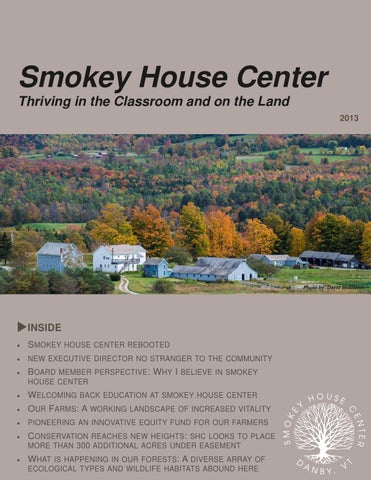
Smokey House Center Smokey House Center Thriving in the Classroom and on the Land 2013
Photo by: David Middleton
INSIDE
SMOKEY
NEW EXECUTIVE DIRECTOR NO STRANGER TO THE COMMUNITY
BOARD
WELCOMING BACK EDUCATION AT SMOKEY HOUSE CENTER OUR FARMS: A WORKING LANDSCAPE OF INCREASED VITALITY
PIONEERING AN INNOVATIVE EQUITY FUND FOR OUR FARMERS
C ONSERVATION
WHAT
HOUSE CENTER REBOOTED
MEMBER PERSPECTIVE: HOUSE CENTER
W HY I
BELIEVE IN SMOKEY
REACHES NEW HEIGHTS: SHC LOOKS TO PLACE MORE THAN 300 ADDITIONAL ACRES UNDER EASEMENT IS HAPPENING IN OUR FORESTS: A DIVERSE ARRAY OF ECOLOGICAL TYPES AND WILDLIFE HABITATS ABOUND HERE
Smokey House Center Rebooted President’s Message I’m happy to report that a lot has been going on behind the scenes over the past two and a half years in the interim of Smokey House Center’s educational programming. The Board of Directors has undertaken a comprehensive planning initiative with the help of people from outside the organization to craft a clear Mission and Vision for Smokey House Center that will move us forward in a much more financially sustainable way. The Case Statement, adopted by the Board in March, provides a framework for utilizing the 5000+ acres of forest and farmland by forging pioneering partnerships with private entities involved in agriculture and education, and will serve as the springboard for developing a three-year strategic plan. We believe strongly in the power of land, agriculture and learning. I hope you will get excited as you read the articles in the following pages. Among others, in “Welcoming Back Education at Smokey House Center— YouthWork and Learn” you will see how through our new partnership with the 40-year old Tutorial Center in Bennington and Manchester, Smokey House continues to provide our community’s youth with an outdoor classroom. In “Our Farms: A Working Landscape of Increased Vitality” read about our three private farming operations on the property and in “Conservation Reaches New Heights” hear about how we are protecting prime building lots on the side of the mountain from future development pressures. I want to personally thank the Smokey House Center Board for their tireless efforts to chart a course for Smokey House Center. They have worked closely with Dr. Nancy Grossman who drove the work researching sustainable educational models, as well as with Greg Horner who looked at agricultural initiatives. I also wish to thank John M. Whalen who temporarily took on the role of Administrator during this transition. Smokey House Center has achieved maturity in its 40 years by a commitment to its long-standing purpose with regard to land, agriculture, youth and learning. As we emerge from a challenging economic period, we aim to develop an organization with the leadership and financial stability that builds on our rich history. - Paul Beaulieu
Photos by: David Middleton
New Executive Director No Stranger to the Community By Paul Beaulieu Over the past six months, the Board undertook an exhaustive search for a person to lead Smokey House Center (SHC) as it expands its programming by integrating several agricultural and educational partnerships. Working with Isaacson, Miller, a national non-profit search firm, our extensive process culminated in October in the hiring of Jesse Pyles as our new Executive Director. Jesse Pyles is no stranger to Southern Vermont or SHC. His wife Laura was a Crew Leader here from 2005 to 2009, while Jesse lived on the property and worked at Green Mountain College and Merck Forest and Farmland Center. In 2009 Jesse and his family moved to Unity, Maine where he served Unity College over the past five years as Director of Sustainability. Bringing his deep experience gained at Unity College, with its national reputation as a leader in Environmental Sustainability, we are excited to have Jesse driving our next steps. Jesse earned a BA in Environmental Studies from Pace University and an MS in Environmental Education at the Expedition Education Institute at Lesley University. Originally from West Virginia, he and his wife Laura have two children, Addis and Hazel.
BOARD MEMBER PERSPECTIVE:
Why I Believe in Smokey House Center Twenty years ago, when I was new to Manchester, my family and I took an autumn drive, leaf peeping up over Danby Mountain Road. After we had passed all the houses of Dorset rising up the mountain road, we traveled through the woods and then emerged into the most beautiful high valley of fields and farmsteads surrounded by embracing peaks. This was my introduction to the lands of Smokey House Center (SHC). Over the years I came to know the work and mission of Smokey House Center: Land, Agriculture, and Learning. I have bought their produce at farmers markets, have come to know the farmers working the land and seen how the land produces a valuable work ethic in the lives of youth. Last January when board president Paul Beaulieu asked me to join the board, I surprised him and myself by accepting without hesitation. I realized that the SHC mission combines all of my major passions: conservation of working lands, educational opportunities for at-risk youth and sustainable
local agriculture. And the chance for me to work with the board as they re-launched the education program was too good to be missed.
By Consie West
This coming year SHC will mark its 40th year of operation. I am excited to be a part of this as we ensure that these lands are fully protected, that they are accessible to and fully utilized by our young, entrepreneurial farmers and that a new generation of youth will benefit from both the learning and the working experiences provided by them.
Consie West, SHC’s newest board member, developed a passion for conservation early in life, growing up in northern Delaware where suburban pressures gnawed at the edges of the meadows and woodlands she played in. Through careful planning, she and her siblings were able to preserve those lands for the enjoyment of all. Since then she has lived in Alaska and Wisconsin, and has spent the last 30 years in Vermont where she has been involved in conservation projects with the Vermont Land Trust and the Vermont Chapter of the Nature Conservancy.
Photo: Sarah DeJong
Photo by Sarah Dejong
Welcoming Back Education at Smokey House Center — YouthWork and Learn By Juanita Burch‐Clay Behind the old Milk House, students have carved a new garden from the rocky, weedy field. In the kitchen they’ve made dandelion jelly, fresh salsa, and pumpkin bread from homegrown ingredients. Stop by on a school day to find herbs drying downstairs while students are upstairs writing blog posts. The best learning is active, and these students are fully engaged. After a two-year hiatus dedicated to reflection and research, education is back at Smokey House, alive and growing due to a new partnership between The Tutorial Center (TTC) of Manchester and Bennington and the Smokey House Center. The centerpiece of this partnership is a program for high school students who are not thriving in the traditional classroom. An interdisciplinary, experiential approach to learning, YouthWork and Learn takes the best aspects of the former, muchacclaimed Smokey House Youthwork program and combines it with The Tutori-
al Center’s decades of expertise in education (including the awardwinning Youth Agriculture Project). The result is a fullday educational program that uses real-world work skills and relevant projects to move students toward rigorous academic and personal goals. FOUNDED IN 1971, THE TUTORIAL CENTER IS A NATIONALLY RECOGNIZED NONPROFIT THAT ENHANCES LITERACY, WORK READINESS, AND OTHER BASIC SKILLS OF YOUTH AND ADULTS IN SOUTHERN VERMONT AND UPPER NEW YORK STATE. The pilot program for YouthWork and Learn began last spring, when high school students spent two days a week at Smokey House, gaining valuable work experience as well as knowledge about the practice and business of agriculture in Vermont. Since then the
Students arrive at SHC on opening day
program has expanded to provide more project-based learning opportunities. In the meantime, the Field Studies Program, begun in 1994, has continued under TTC instructors, turning local students into young scientists purposefully monitoring invasive species, investigating animal activity, and checking water quality. 7th graders from Dorset School continue to come for two weeks of intensive environmental science work each spring, and now TTC is reaching out to provide inquiry-based science experiences for other local schools. The community is
also excited about the potential for collaboration between local scientists, farmers and land managers, students, and community members around accumulated field studies data. The ecological diversity at Smokey House along with accumulated field studies data from the past decades as well as today is an important resource. It is an exciting time to be involved with The Tutorial Center at Smokey House. Every day provides new opportunities for staff and students’ learning, innovation, and development. For more information, please contact Juanita Burch-Clay at juanitabc@tutorialcenter.org
Students learn in the field
Our Farms A Working Landscape of Increased Vitality By Ryan Yoder with contributions from Sue Katt and Caleb Smith
From Jersey cows and apples to the sugarbush, our farmers have been hard at work making their farms even more environmentally sustainable and productive. Here is a peek:
Photo by Jess Smith
Caleb and Jess Smith of Dorset Peak Jerseys continue to expand their herd of registered Jersey cows, now counting a full 140 head on STOP BY THE NEW the farm. In May, the farm began its transition to a true no-till system AND IMPROVED for crop and forage production, saving time and fuel while protecting FARM STAND TO soil and water quality. Twenty-one cows are due between now and the new year. The owners are grateful to share their lives with these PICK UP special animals every day. PRODUCTS OF ALL THREE FARMS. At Yoder Farm, Rachel, Ryan and Asa have been busy following the ups and downs of the season. On the downside, the relatively wet, dark summer caused DAILY FROM many early triages, led to some loss of beans and popcorn crops, and dealt a death blow to the last third of the strawberry crop. On the upside, our new high 8 AM TO 8 PM. tunnel allowed us to get bumper crops of both snap peas and tomatoes, and new tillage and cultivation equipment created efficiencies that will allow the farm to expand for the next several years. Looking forward, our prototype vinegar tank is almost ready to fill up for the first time and turn out some tasty vinegar, there is a bumper crop of apples out there and we are now expanding by making many of our products at a licensed facility in Sunderland. Two Dog Farm expanded its operation in 2013 with the purchase of a round baler and wrapper in order to be more efficient in making its own feed for the beef cattle. The cattle herd is growing, six calves born this summer. In addition, the farm brought on a full-time employee, Michael Gates, with the hopes of moving the vegetable and berry operation to the next level. Excitingly, 2014 holds plans for additional taps, which will follow this year’s expansion in the sugarbush. Are your taste buds watering? Join the national artisan food movement and stop by the new and improved farm stand to pick up products of all three farms. The farm stand is self-serve and open to the public daily from 8 am to 8 pm. For more information, check out the farms’ websites: twodogfarmvt.com and dorsetpeakjerseys.com Photos by: David Middleton
Pioneering an Innovative Equity Fund for Our Farmers By John Whalen Historically, many farmers at the end of their careers were provides that annually over the course of the lease, a sum left with no alternative but the sale of their farmland to (the amount depending on the investment performance of developers in order to provide for the equity fund) is earmarked for payment THE IDEA IS TO CREATE A themselves and their families. If farmers to the farmer at the end of the lease did not own the land they farmed but term. Hence the idea is to create a RETIREMENT-LIKE FUND, NOT instead were leasing it, they were retirement-like fund, not unlike the UNLIKE THE CONCEPT frequently left in the unfortunate position of concept behind a 401(k), for the farmers BEHIND A 401(K), FOR THE facing their latter years with meager so that at the end of their farming career, FARMERS SO THAT AT THE resources. In either case, development on they will have accumulated some equity END OF THEIR FARMING the lands or a scrape-by existence, the on which to fall back. situation was not an attractive one. CAREER, THEY WILL HAVE It is an expectation of SHC that the ACCUMULATED SOME For years, Smokey House Center has conservation of the Lewis Farm will bring EQUITY ON WHICH TO FALL leased its farms to different farmers. Now, additional financial support so that equity with the benefit of a grant from the funds and agreements can be established BACK. Castanea Foundation, SHC has created for the other two farms at SHC. an equity fund and from it developed the concept of an equity agreement for one of its farms. This agreement Photos by: David Middleton
Conservation Reaches New Heights SHC looks to place more than 300 additional acres under easement By Consie West Conservation of lands has a long history at Smokey House Center. In the late 1950s and early 1960s, Stephen and Audrey Currier began assembling what would become Smokey House Center by buying up farms and forest land surrounding their original farmstead property. Although modern conservation easements did not exist then, they built a de facto land trust by creating this large block of land. Their work was cut short by their tragic death, but the conservation continued under the administration of the Taconic Foundation. In 1995 the lands of Smokey House were conveyed from the Taconic Foundation to Smokey House Center. Then in 2003, after a thorough strategic planning THE BOARD HAS process, the Board of AFFIRMED ITS Smokey House placed COMMITMENT TO conservation easements on CONSERVATION. the major portion of the forest and agricultural lands, legally limiting use of the land in order to protect its conservation values in perpetuity. These easements are held by the New England Forestry Foundation. At that point, there were excluded a number of potentially developable lots that could be sold in the future, if needed. These were called “banked lots.” Most recently, the Board has affirmed its commitment to conservation by voting to place conservation easements on the banked lots and also on the large Lewis Farm, a total of more than 300 acres of agricultural lands. The funds raised to conserve this acreage will be used to add to the equity funds for the farmers’ retirements, creating a new model for farming in Vermont, that of young farmers leasing affordable land while being able to save for a comfortable retirement.
Photo by: David Middleton
What is Happening in Our Forests A diverse array of ecological types and wildlife habitats abound here By Cur s Rand Walk the 4,700 acre Smokey House forest and you’ll notice how it ranges in elevation from 800’ to 3500’ and includes a diverse array of ecological types and wildlife habitats.
professional foresters carefully manage the forest to provide periodic income and support for the regional timber economy. In order to ensure we are managing the forests optimally, this past year we updated DEPENDING ON our forest THE SHOES OF management plan, which the state of THE PERSON IN Vermont approved WHICH YOU ARE in the fall. WALKING, YOU
You will see alpine conditions as well as rich lower elevation forests on WILL SEE UNIQUE limestone soils. For students of all VALUE IN OUR If you are lucky, ages, the forest FORESTS. you will spy provides an numerous important species that educational need large, unbroken habitats resource, serving as a handswhich they find in the Smokey on learning tool. And finally, House Center forest. And and equally noteworthy, is the because the entire forest has significant watershed value been permanently protected, that is provided by the you’ll see flourishing rare forested headwaters at plant and animal species. Smokey House Center that eventually reach Otter Creek Depending on the shoes of and beyond- though flippers, the person in which you are rather than shoes, may be walking, you will see unique best for that view. value in our forests. Smokey House Center and Photo by: David Middleton
Our Mission
Land. Agriculture. Learning. Smokey House Center encompasses more than 5,000 acres of mostly conserved forest and farmland in Southern Vermont. In addition to managing conserved forest and farmland, Smokey House Center’s fundamental purpose is to maintain a working landscape that promotes sustainable agricultural and forestry practices while engaging people in meaningful ways. This includes providing educational programming that enables people to develop the skills needed to be productive and self-sufficient members of their communities.
Contact us Smokey House Center, 426 Danby Mountain Road, Danby, VT 05739 (802) 293-2300 info@smokeyhouse.org www.smokeyhouse.org
Dear Friends of Smokey House Center, The Smokey House Center Board of Directors has been working diligently to reshape our Mission and Vision to ensure that the 5,000 acre landscape in Danby, Vermont is protected in perpetuity while being put to productive use. The ideas at their core – of land, agriculture and learning – continue through many exciting endeavors.
Jesse Pyles Executive Director
BOARD OF DIRECTORS AND OFFICERS
First and foremost, the Board is excited to bring educational programming back to the Danby property in a financially sustainable way. We have launched a collaboration to promote the farm and forestland as an outdoor classroom through a pioneering partnership with The Tutorial Center (www.tutoringvermont.org) located in Bennington and Manchester. The Tutorial Center leases Smokey House Center property to serve our region’s youth with generous grants from the Canaday Family Charitable Trust, Smokey House Center and others.
Paul J. Beaulieu President
Curtis G. Rand Vice President Treasurer
Holly Darzen Secretary
Amanda Dixon Constance F. West John Whalen
HONORARY DIRECTORS Ralph F. Colin, Jr. L.F. Boker Doyle Nancy B. Doyle Jane Lee J. Eddy Hugo H. John Casey Murrow John G. Simon Sidney S. Whelan Polly P. Wright
Secondly, Smokey House Center is fully committed to conservation. The Board has undertaken a process to ensure that several prime building lots and the Lewis Farm are permanently protected by conservation easements and shielded from future development pressures. To accomplish this, we are actively soliciting public and private funding to cover the expenses associated with conserving land and to expand our agricultural and educational initiatives. Last but not least, Smokey House Center is a champion for sustainable independent farming operations that provide fresh produce, meat, specialty products and milk to the local community. Three farms, operating as independent for-profit ventures, are established on the property: Dorset Peak Jerseys (www.dorsetpeakjerseys.com), Two Dog Farm (www.twodogfarmvt.com) and Yoder Farm. Smokey House Center provides affordable leases to these farmers and is now working to provide them with modest retirement plans, lifting the financial burden of land ownership off them and truly re-envisioning family farming. To fulfill this commitment, we look to our supporters to help us endow the retirement plans and to fund infrastructure improvements such as building repairs, maintenance, construction of shared processing facilities and farmer education programs. While the past two and a half years have provided a number of challenges for the Smokey House Center Board of Directors, they have also afforded us an opportunity to research a variety of operating models and provided much needed time for the endowment to recover from the 2008 downturn. The Board has worked hard to put Smokey House Center on sound financial footing and continuously seeks to forge innovative partnerships that maximize the dollars spent directly on conservation, agriculture and education while minimizing the administrative burden.
I encourage you to come to Danby to visit Smokey House Center and meet Jesse Pyles, our new Executive Director. You can also witness The Tutorial Center’s programming on the property and visit the farm stand for maple syrup, produce and grass-fed beef. Also check out our recently updated www.smokeyhouse.org to see many of our exciting new endeavors that just wouldn’t fit in the attached newsletter. We are re-launching our annual fund this year to support all of these developments. Your generous donations are always welcome and greatly appreciated. You can make a tax deductible donation to Smokey House Center directly through the website (www.smokeyhouse.org) or by mailing it to Smokey House Center, 426 Danby Mountain Rd. Danby, VT 05739. Thank you for your generosity. Paul J. Beaulieu, President Smokey House Center