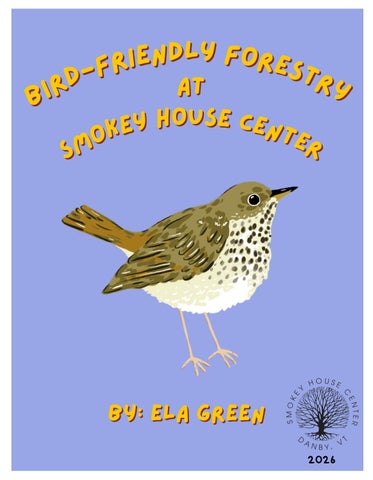
dly Fore n e i r F str d at r y i B ouse Cen H y e k t o er m S
By: Ela Green 2026
What is Bird-Friendly Forestry? Bird-friendly forestry is the use of forest management practices designed to create specific types of bird habitat. North American birds have declined by almost 30% since 1970, primarily due to habitat loss. Each forest bird species has unique habitat requirements based on the season and what they use the habitat for, so we try to keep birds in mind when we practice forestry! Lets look at some examples of bird species found at Smokey House Center, and how we can manage our forest to help them out!
What bird habitats can be found at Smokey House Center?
The main components of a forest that we manipulate to create different bird habitats are: 1. Tree species composition 2. Forest structure (understory, midstory, and overstory) 3. Presence of deadwood
Forest management often involves cutting trees. It’s important to remember that cutting trees is not always a bad thing! Removing trees can create habitat for birds that require open spaces, and it can make room for new trees to grow. A “messy” forest is a healthy one!
Certain birds prefer some TREE SPECIES over others, for food, shelter, and nesting purposes. For example...
Some birds prefer a coniferous (evergreen) forest...
like a Blackthroated Green Warbler!
...or a deciduous (leaf-dropping) forest!
Explanation about species composition
like an Eastern Wood-Pewee!
STRUCTURE is another important part of a bird’s habitat. Some birds need forests with an understory, midstory or overstory that are structured in a certain way (sparse, patchy, or dense). This structure helps each bird meet their needs! For example...
Some birds nest in a mature forest with a high canopy...
like a Scarlet Tanager!
...or forage in forest edges and gaps...
like a Hermit Thrush!
...or find shelter in early successional (recently disturbed) habitat! like a Ruffed Grouse!
DEADWOOD can come in many forms, such as standing dead trees (snags), trees with cavities, and fallen trees (coarse woody material). Foresters can leave existing deadwood where it is, or create deadwood by leaving cut trees to decompose in the forest. Many birds depend on deadwood for shelter and food! For example...
Some birds nest inside snags with cavities...
like an Eastern Screech Owl!
...or forage for insects in downed, decomposing trees! like a Winter Wren!
It’s not just about about birds. Bird-friendly practices such as leaving deadwood can help other wildlife, too!
like a Red Eft!
Bird-friendly maple Another way Smokey House Center practices BirdFriendly Forestry is participating in Audubon Vermont’s Bird-Friendly Maple program! Historically, sugarbushes have been monocultures of only large Sugar Maple trees, with very few dead or downed trees left in the forest. That management may be efficient for producing maple sap, but it’s not the best practice for wildlife. Guidelines for a Bird-Friendly Maple sugarbush: Include at least 25% non-Sugar Maple trees Create structural diversity by keeping trees of various sizes Leave behind some snags and coarse woody material
See for yourself! What birds can you find at Smokey House Center? Grab some binoculars, explore the property and make a list! Try using the Merlin Bird ID app if you need help with sound identification. Do you notice different bird species in different areas of the forest? Are some birds interacting with their habitat in unique ways?
Acknowledgements: This guide was heavily informed by these resouces: Audubon Vermont Cornell Lab - All About Birds Merlin Bird ID National Audubon Society