12 CENTERSPREAD 10-11 GRAPHICS
2 FEATURE
OPINION
voting rights act
THE VOL. 61, NO. 9
guide to nail art
MISSION SAN JOSE HIGH SCHOOL
May 29, 2026
41717 PALM AVENUE, FREMONT, CA 94539
T o prepare for the contest, the MSJ Science Bowl team’s five students held weekly training sessions at the homes of Co-Captain Senior Advaith Mopuri and Co-Captain Junior Roshan Annamalai. The team spent between two and ten hours each week prior to the competition, practicing questions and attending online competitions. “Most of us [were] just preparing for [STEM Olympiads] for the majority of the year, and our studying kind of just carried over to Science Bowl,” said Junior Theenash Sengupta, who was the team’s top scorer. In addition to practicing the curriculum for the contest, which spans broad areas of science, such as chemistry, biology, physics, math, and earth and space science, these practices also provided the team to practice their game strategy and buzzing speed. Competing in such a competition was nothing new to the team members. Many of the players had been part of William Hopkins Middle School Science Bowl or competed in various national olympiads. The team “put a lot of effort into this over four or five years. All the team members were more experienced [this year], and [there were] some amazing sophomores,” Annamalai said. In addition to MSJ Science Bowl’s rigorous training, some team members believe that luck was also on their side this year. “We had [Montgomery Blair High School] in our round robin bracket, and they were the last na-
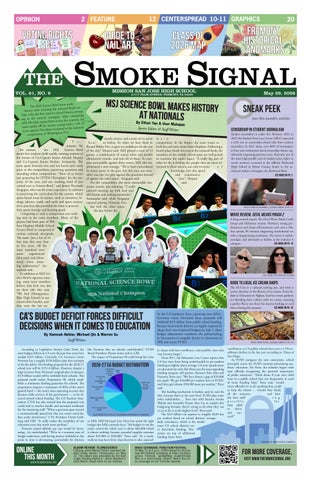
MSJ Science Bowl makes history at Nationals By Ethan Yan & Veer Ma
tionals winner and a team we’ve never beaten before. So when we beat them in Round Robin Two, it gave us confidence for the rest of the day,” Mopuri said. MSJ played a total of 13 games, a combination of round robin and double elimination rounds, and won all of them. To compete successfully against these teams, MSJ also implemented a new strategy. “We’ve been intimidated by many teams in the past, but this year, our mentality was just [to] play against the questions instead of against the other team,” Sengupta said. For the competitors, the most memorable moments weren’t just winning. “I really enjoyed meeting up with new and old friends and making memories,” Annamalai said, while Sengupta enjoyed playing Ultimate Frisbee with the other teams the day before the
into this month’s articles:
censorship in student journalism
m a i n competition. In the future, the team wants to look for and train talent from Hopkins. Following a fourth place finish this year at the national finals, the members of the middle school team are well poised to continue the team’s legacy. “A really big part of what we do is finding the people that are most interested in those talents, not only in terms o f knowledge, but also speed and communication,” Mopuri said.
Student journalism is under fire. Between 2022 to 2025 the Student Press Law Center (SPLC) reported a 42% rise in censorship-related calls from student journalists. In 2021 alone, over 60% of newspapers at four-year institutions faced censorship claims, significantly surpassing previous years. Recently, one of the most high-profile tests of student press rights in recent memory occurred at the affluent Redwood High School in Marin County, home to the acclaimed student newspaper the Redwood Bark. See more on pg. 3
PHOTO FROM TALON MARKS, LICENSED UNDER CC BY 3.0
movie review: devil wears prada 2 A long-awaited sequel, The Devil Wears Prada 2 with Streep and Hathaway returns. However, strong performances and sharp self-awareness can’t save a film that spends 90 minutes diagnosing institutional rot with a disappointing resolution. The movie is stylish, nostalgic, and ultimately as hollow as the industry it critiques. See more on pg. 10
Staff Writers
STILL FROM 20TH CENTURY STUDIOS
guide to local ice cream shops
PHOTOS FROM FLICKR
By Hamnah Akhtar, Michael Qin & Warren Su
Staff Writers According to Legislative Analyst Gabe Petek, the state budget deficits in CA over the past four years have totaled $125 billion. Currently, CA Governer Gavin Newsom has a roughly $350 billion plan that attempts to fix the deficit. His funding proposal for the 2026-27 school year will be $151.6 billion. However, despite a large increase from Newsom’s original plan in January, $3.9 billion would still be withheld from schools. This proposal could violate Proposition 98, which establishes a minimum funding guarantee for schools. The proposition requires a minimum of 40% of the state’s general fund — the state’s main operating account that finances daily services of the government — to be directed toward school funding. The CA Teachers Association (CTA) has also warned that the proposed cuts could lead to teacher layoffs and increased workloads for the remaining staff. “When a governor goes around a constitutionally passed law that our voters voted for, that sends shockwaves,” CTA President David Goldberg told CBS. “It really makes the instability of our education even that much more perilous.” Fremont school officials say cuts would be devastating…bc underfunded. “We’re in a constant state of budget reductions, and having money withheld at this point in time is devastating, particularly for districts
sneak peek
hajan
Sports Editor & Staff Writer
CA’s budget deficit forces difficult decisions when it comes to education
www.thesmokesignal.org
fremont historical landmarks
Class of 2026 map
SMOKE SIGNAL
team made The MSJ Science Bowl ional finals on nat the history after winning l history, emergoo sch in e May 4 for the first tim er competing Aft ngest. ing as the nation’s stro country, the the oss acr m with 68 other teams fro h a 144-52 wit son strong team ended off the sea national the at my ade Ac score against Davidson C. ngton D. competition in Washi
Online THIS MONTH
20
like Fremont that are already underfunded,” FUSD Board President Dianne Jones said to CBS. The impact of Proposition 98 could bring hits close
2026-27 CA budget distribution
DATA FROM THE STATE OF CALIFORNIA DEPARTMENT OF FINANCE
to MSJ. MSJ Principal Amy Perez has noted the tight budget that MSJ currently faces. “My budget to run the entire school the whole year is about $64,000 which is almost nothing, because custodial supplies consume about $25,000 to $30,000,” Perez said. “As a result, students may have fewer class electives to take, especial-
ALBUM REVIEW: FLORESCENCE Folk-pop artist Maisie Peters released her third studio album, Florescence, on May 22. The album was preceded by the lead single “Audrey Hepburn,” which debuted in early March. Read more on our website.
As the CA legislature faces a growing state deficit, Governor Gavin Newsom’s latest proposals will withhold $3.9 billion from public school funding. Because local school districts are legally required to adopt their own balanced budgets by July 1, these budget adjustments transform the policymaking in Sacramento to tangible shocks in classrooms at MSJ and across FUSD. ly classes with low enrollment, and possibly, class sizes may become larger.” From 2017, the Education Law Center reports that CA has risen from being underfunded in per-student funding to slightly above average. CA now spends more on education by total. But Perez says the issue regarding funding inequity still persists. Between Palo Alto and Fremont, Perez says, “We have almost a gap of $20,000 per pupil. We get $16,000 per student here in FUSD, and [they get] almost $20,000 more per student,” Perez said. The funding mechanism is broken, and we can’t fix that, because that’s at the state level. FUSD plus some other stakeholders … have met with Senator Ayesha Wahab and Assembly Person Alex Lee to explain this budgeting formula, they’re trying to do what they can to try to fix it at the highest level,” Perez said. The $3.9 billion cut equates to roughly $630 lost per student based on school districts’ average daily attendance, which is the model most CA school districts use to determine funding. This comes on top of additional funding losses from
VIDEO COVERAGE: FUSD FILM FESTIVAL
On May 21 at 5 p.m., FUSD hosted it’s first annual film festival screening at three locations across Fremont, spotlighting student-made films in a district-wide contest. Watch the video coverage on our YouTube channel.
The Tri-City is a cultural melting pot, and with it comes diversity in the flavors of ice cream. From Indian to Taiwanese to Afghan, local ice cream parlours are blending their culture with ice cream, ensuring a perfect flavor out there for anyone looking to cool down during the summer. See more on pg. 16
PHOTO FROM FLICKR, LICENSED UNDER CC BY 2.0
enrollment, as CA public schools have seen a 1.3% enrollment decline in the last year according to Times of San Diego. As FUSD navigates the new constraints, school principals across the FUSD continue prioritizing students’ education. For Perez, the solution begins with state officials recognizing the personal importance of public education. “Think about if your own child went to a public school that was desperately in need of some funding help,” Perez said, “would [state officials] try to do anything they could to help the school … [would they fund] all the resources and have the best staffi n g possible for their child to thrive and succeed?”
GRAPHICS BY NEWS EDITOR JENNIFER LI
For more coverage, visit www.thesmokesignal.org
2 Opinion
The Smoke Signal Friday, May 29, 2026
WWW.THESMOKESIGNAL.ORG
Louisiana v. Callais sets civil rights back by decades By Eleanor Chen, Veer Mahajan, Warren Su & Matthew Zhang Staff Writers In its recent 6-3 ruling in the case Louisiana v. Callais, the Supreme Court struck down Louisiana’s congressional redistricting map after challenges about the state’s use of race in drawing districts. The court’s decision is the latest in a long line of major changes that have significantly reshaped the Voting Rights Act in America, starting with Shelby County v. Holder in 2013. Across the country, Louisiana v. Callais has sparked heated debate over how courts must balance race, representation, and fairness in redistricting decisions.
1960s: Civil Rights Acts During the 1960s, the civil rights movement greatly improved rights for many Americans. Shortly after Martin Luther King Jr.’s speech in Washington, DC, the Civil Rights Act of 1964 was passed. After that came the Voting Rights Act of 1965, which was created to stop voting practices that discriminated based on race. Immediately after the act was signed, the number of Black Representatives precipitously increased, and voter registration doubled in much of the South. Section 2 allowed courts to challenge district maps based on discriminatory effects rather than requiring proof of discriminatory intent, enabling minority communities to challenge electoral structures that weaken their voting strength.
1800s-1950s: Reconstruction
2013: Shelby County v. Holder
After the Civil War, a period known as Reconstruction began, during which several new constitutional amendments were passed to strengthen newly established rights. These amendments abolished slavery, solidified citizenship, and prohibited racial discrimination in voting in the Fifteenth Amendment. However, the Reconstruction era did not fully secure those rights. In the years after, governments at every level instituted discriminatory practices by segregating races and creating impossible voting eligibility tests. The difficulty of voting disenfranchised groups, and, in some states such as Mississippi, Black voter registration was less than 10% in 1964, according to the Fair Elections Center.
However, the first cracks in the Voting Rights Act began to show in 2013. In a 5-4 decision on Shelby County v. Holder, the Supreme Court ruled that Section 4(b) of the Act were unconstitutional. These sections had previously protected historically suppressed places and required federal approval for voting law changes in local and state governments. The Voting Rights Act was already significantly weakened by this decision.
2023: Allen v. Milligan
2026: Louisiana v. Callais
In 2023, the Supreme Court made a decision on another case in which the Voting Rights Act was at stake. In this case, Allen v. Milligan, Alabama’s district maps came under scrutiny for marginalizing Black voters. The Supreme Court ruled 5-4 against Alabama, deciding that Alabama’s new district map was unconstitutional and discriminatory, violating Section 2 of the Voting Rights Act. Two conservative-appointed justices, Chief Justice John Roberts and Associate Justice Brett Kavanaugh, joined the liberal-appointed justices. The Voting Rights Act had survived, and minority districts would be protected.
However, the Voting Rights Act would not hold for much longer. On April 29, the Supreme Court ruled in Louisiana v. Callais that Louisiana’s newly drawn map — which was designed under Section 2 of the Voting Rights Act — was unconstitutional. The Court’s Louisiana v. Callais ruling threatens these protections by requiring proof of intentional discrimination, making it easier for gerrymandered maps to be upheld, and essentially backtracks on section 2 of the Voting Rights Act. Lawmakers may be able to justify their decisions using political or geographic reasons rather than explicitly racial considerations, making claims of intentional discrimination by the lawmakers or state officials more difficult to prove. To make matters worse, the Supreme Court also allowed the ruling to take effect immediately rather than delaying its implementation, meaning its effects on minority voters in Louisiana could be felt right away. The court’s justification for limiting Section 2 protections has been criticized as insufficient by voting-rights advocates, as it seeks to weaken the voting strength of minorities. No clear rationale has been provided as to why eroding voting rights is justified, with only vague mentions of the Fourteenth or Fifteenth Amendment — the Equal Protections Clause and prohibition of racial discrimination in voting — offered in support.
Protecting representation Section 2 has defended minority representation for decades, particularly in southern states with long histories of minority voter suppression. It is among the most important and effective tools to counter racial gerrymandering, the practice of drawing voting district boundaries to benefit specific political interests. Gerrymandering is encouraged under the Court’s new rationale from the Brnovich v. Democratic National Committee court case in 2021 to adopt a narrower interpretation of voting-rights protections, making it more difficult to challenge election laws based on their unequal effects alone. In practice, this means states can prioritize helping one political party win more seats even at the cost of minority representation. The Court effectively prioritizes partisan goals over protecting minority voting power, allowing mapmakers to justify district lines based on politics, not representation. With fewer protections left, this will inevitably lead to an increasing erosion of voting rights for minorities, who often need them most. Eliminating results-based claims also removes one of the easiest ways to prove discrimination in court, further exacerbating the issue. The effects of this ruling are already apparent in the South, extending past Louisiana. For instance, in Tennessee, a map that was recently put into action early this May, split majority-Black Shelby County into three different districts, ultimately diluting the voting power of Black residents while helping Republicans gain control over all three seats in majority-black Memphis and all nine seats statewide. Blatant power grabs like this are also occurring in other states, including South Carolina, Alabama, and Mississippi, and in other ways — middecade redistricting, ethically dubious at best, is now turning into a stan-
dard, and even the structure of primary elections is undergoing modification for political ends. Minorities, particularly African Americans, have historically shown a significant preference for the Democratic Party, so weakening their voting power effectively also weakens Democratic political power and artificially inflates Republican strength. Doing so further tightens conservative influence, artificially tipping the balance of even the national political scales toward the conservatives.
Misinterpreting voting rights The court justified the ruling using the Fifteenth Amendment, the same amendment enacted to protect voting rights after the Civil War. The amendment says that states cannot deny citizens the right to vote based on race and gives Congress the power to enforce those protections through legislation. The Voting Rights Act was created to do just that. However, the Court has used a very narrow definition of the wording itself, which limits Congress’s ability to protect minority voters. In the majority opinion, Associate Justice Samuel Alito frames the Fifteenth Amendment as a limit to Congress’s legislative power. In doing so, he restricts the Amendment’s power to only protecting voters from intentional discrimination, even though the Fifteenth Amendment never clearly says discrimination must be intentional for congress to act. This interpretation makes it harder for Congress to pass laws protecting minority voters, such as Section 2 of the Voting Rights Act. The ruling willfully distorts and perverts the meaning and intent of the Fifteenth Amend-
ment’s words, replacing an interpretation well-accepted for centuries prior with a fringe interpretation and gross mischaracterization. Ultimately, without Section 2 protections, it will become significantly more difficult to challenge discriminatory district maps. States can now defend maps as political or geographical rather than racial, even if minority communities are harmed.
Impact CA’s protections limit the immediate effects of Louisiana v. Callais, but representation still affects education, public policy, and political power. The districts drawn today will shape our voices in the future. Though many MSJ students cannot yet vote, they can still make a difference by paying attention to redistricting decisions, discussing inequalities in their communities, and participating in civic engagement efforts to raise awareness and educate voters about the ruling and its consequences. Understanding how district maps are drawn and who benefits from them is also an important step in protecting fair representation in the future.
Conclusion The danger of the Supreme Court ruling in Louisiana v. Callais goes beyond making discriminatory district maps harder to challenge — it weakens one of the country’s strongest protections against minority voter suppression. By allowing partisan goals to outweigh minority representation, the decision threatens to steadily erode the political power and voices of long-marginalized minority communities while deepening polarization and partisan division across the country. ▪
PHOTOS BY FLICKR.COM. GRAPHICS BY OPINION EDITOR JANET GUAN
Friday, May 29, 2026
WWW.THESMOKESIGNAL.ORG
The Smoke Signal
Opinion 3
Student journalism under siege: censorship at Redwood High By Alex Duan, Erika Liu & Luna Bichon Staff Writers
Student journalism is under fire. Between 2022 to 2025 the Student Press Law Center (SPLC) reported a 42% rise in censorshiprelated calls from student journalists. In 2021 alone, over 60% of newspapers at four-year institutions faced censorship claims. Recently, one of the most high-profile tests of student press rights in recent memory occurred at the affluent Marin County Redwood High School, home to the acclaimed student newspaper the Redwood Bark. Administrators at Redwood High School twice violated state laws that protect the First Amendment rights of high schoolers. Despite the national attention, students achieved little vindication, with many administrators holding their ground on punitive measures. The controversy dates back to February, when the Bark, which had hoped to localize a national controversy, published the names of more than 500 Marins who had been referenced in the Epstein Files on Instagram. Soon after, the school’s principal, Barnaby Payne, received an email from one of the Marins, threatening to sue if her name wasn’t removed. Payne acted swiftly. “I have a directive from the cabinet and superintendent to redact the one name immediately from the post,” Payne wrote in an email to the Bark’s adviser — an aggressive move in explicit violation of CA Education Code Section 48907(a) (1977), which protects freedom of speech and of the press in public schools, regardless of if school newspapers are directly funded by the school. Nevertheless, students complied. The second instance involved a cover photo taken at a student protest in San Francisco Mission Dolores Park, featuring students holding a sign protesting Zionism. The photo was met with a formal district investigation
with emails revealing school officials interrogating student journalists about their editorial process. The Bark quickly apologized, with the papers’ three Editors-in-Chief issuing a formal statement shortly after, which detailed an apology but made it clear that they cannot alter news photos to selectively exclude a specific sign as that would undermine the Bark’s journalistic integrity and ethical standards. They also elaborated that inclusion in a news photo is not an attempt to endorse the subject matter, but an attempt to represent reality objectively. The Bark’s adviser Erin Schneider had raised concerns about “press censorship and unethical oversight from the district out of alignment” before, only to be ignored — she is currently on unpaid leave until 2027. The disregard both the Bark and Schneider faced as someone with decades of experience in the field has been reiterated locally. Mountain View Los Altos High School’s paper the Oracle published an article calling out sexual harassment at school in 2024, only to be pressured into censorship by the principal — who wanted to portray the school in a positive and uplifting light — and then punished anyway, with their Introduction to Journalism program being cut and their adviser being fired and replaced. “I wish they had trusted us a little more,” Oracle writer and current Editor-in-Chief Renukee Mungee said. “I have been hesitant to write about certain topics ever since.”In San Francisco Unified School District, the Lowell High School administration suspended their news-
paper’s adviser, Eric Gustafson, following the publication of a student article trying to shed light on teacher misconduct. In each case, officials weren’t redacting content because it was offensive or hindered student learning — they were trying to save face. As Gustafson said, administrators “don’t know anything about journalism.” With many of these cases carried out under zero legal analysis, it’s evident that schools are finding it increasingly acceptable to impose their will upon student newspapers as they like. The state of student journalism is even worse on a broader scale. Free expression organization PEN America tracked 47 educational gag orders enacted between 2021 and 2024 — most notably, President Donald Trump’s 2025 “Compact for Academic Excellence in Higher Education,” which restricted political discussion in schools and abolished departments that “belittled” conservative ideals. According to the US Press Freedom Tracker, more student journalists were assaulted, detained, denied access, or faced legal orders in 2025 versus any other year in their database. Earlier in March 2025, Tufts University student Rümeysa Öztürk was arrested by the Department of Homeland Security for pub-
lishing a pro-Palestinian op-ed for her university newspaper. Öztürk’s detention stands as one of the most frightening examples of the suppression of academic freedom and political opinion. Her detention shows the extremes that people with power have gone to in order to silence freedom of the student press. It’s not the duty of student journalists to ensure that topics are presented as gently and appeasingly as possible. Their job is to present the truth. Heavy-handed administrative attempts to censor student voices go against not only integrity in education but also trust in journalism. Combined with the surge in AI, propaganda, and misinformation online, youth today are being taught that facts are malleable; that reportage is only valued when it is pleasing to everyone else. Student publications serve a watchdog function, analogous to real-life papers. They hold actual administrations accountable — as in the case of the Redwood Bark articles — but also foster a general ability to conduct independent thinking in future writers and readers. Journalists at any scale can generate social change; they’re one of the most vital instruments students have against censorship. Teaching students from a young age that transparency is optional can go on to pollute journalistic standards in professional environments. A non-negligible percentage of student journalists go on to write for real publications once they graduate. It is these same journalists who are currently being taught by school administrations to choose silence over scrutiny in their own reportage. Censorship, evidently, sets a harmful standard. It prepares future writers to acquiesce to suppression in the real world, where free speech arguably matters the most. ▪
Military Draft Registration
-./0#1#%!
GRAPHICS BY STAFF WRITER ERIKA LIU
Automatic registration for the military draft has gone into effect within 46 states and territories — with the last draft being called during the Vietnam War in 1972. By December, male US citizens and immigrants ages 18-26 will be automatically registered for the military draft within 30 days of their 18th birthday. In states that don’t have automatic registration configured yet, eligible men must register on their own, with failure to register a felony punishable by a maximum $250,000 fine and 5 years in prison.
!"
“It might impact my friends, because I have a lot of friends who are guys, and they will be turning 18 soon, so they could be automatically registered. In some cases, the process is ethical, like if we were attacked or if the war $#%&#'(#" i s ) justified, but in this specific case, I don’t think a draft is jus- #" tified because the war itself isn’t justified. It would mean that a lot more people get drafted, and you have a larger pool of people who can potentially go to war. It’s coming now because we have a lot of technological advancements, so we can use a lot more voter data. We have access to a lot more compartmentalized [data], so you can see what segments of the population are male and will be turning 18. Those are some of the things that make it more streamlined ... I think registration does affect the average citizen a lot because it means that ... you have the chance of dying ... and also harms the perceived safety. A lot of people are at risk of being drafted, so they feel like their safety is compromised because they could be at risk of a draft. I think it’s more beneficial to eliminate a mandatory draft. The draft is unnecessary, especially because the war is unnecessary in this specific case. Military strength needs to be emboldened, but you shouldn’t be forcing people into something they don’t want to do. I feel like that’s kind of like forced labor.” th is
%%%%%%%%%%%%%% %% %%%%%
CORRECTIONS
“There’s a lot of males in my family, and I just turned 18, so I’m going to be drafted along with my brother and my dad and [the] rest of my family. It would pretty much leave [my family] torn, because it would just be my sister and my mom at home, alone. I don’t think anything regarding war is ever ethical, like forcing people to like leave their families and join a war that they don’t want to be part of ... [And] considering it’s been decades since it’s been in use, it can be a bit outdated ... No one’s going to want to register ... because no one wants to take part in it in the first place. It puts [people] in danger, really, because there’s a lot of people who are not cut out for this, so just throwing them into the military is not a good idea at all.”
% %%%%%%%%%%%% %%%%%%%%%%%%%%%%% %%%%% %
“There’s a lot of students at Mission who are probably in the current age [range who] probably have their own dreams and aspirations that they want to fol*%9 # low ... There’s some people who would be willing to fight, but 4 they’re not getting the opportunity to do it. There’s others being forced to fight, and they’re not able to fight. So, it would be better to put the people who can fight on the front line ... There’s a lot of political tensions going on, possibilities of huge wars, so they’re just trying to prepare for the future. It could increase our country’s safety, because we’re having more people to protect us. But it could also decrease it, because families are losing vital members, and they might not be as stable as before. The country could go into financial instability because of this. I think it should be willing fighters who fight.”
678$#%6#8
News P1. Coach Peter Vaz should be former Coach Peter Vaz News P2. There are more than 65 locations named after Chavez across CA, not only the Bay Area News P2. Guion Bluford was the first Black man to go to space, not Victor Glover News P2. Valentina Tereshkova was the first woman to go to space, not Christina Koch News P2. “Free Indian cultural performances” should be “free Bengali cultural performances” Opinion P3. Renee Good was killed by ICE, not CBP Opinion P3. Republican Congressman Lee Terry should be former Republican Congressman Lee Terry Opinion P4. The Opinion Editor masthead credit should be Janet Guan, not Jiazheng Dou Opinion P5. Three women have publicly come forward about Cesar Chavez’s sexual assaults and abuse, not four; Esmeralda Lopez’s and Cynthia Bells’ cases fall under sexual harassment Opinion P5. The New York Times investigation was five years long, not one Opinion P5. Trump was accused by at least 28 women of sexual misconduct, which includes but is not necessarily rape Opinion P7. Anjali Anna is a junior, not a senior Opinion P17. Swalwell represented CA’s 14th Congressional District for roughly three years, not 13 Opinion P17. The statistic that more than 80% of rape cases go unreported comes from US not global data and encompasses rape and sexual assault cases A&E P13. Ryland Grace in Project Hail Mary teaches in middle school, not high school A&E P15. Mariam Koodarappally should be spelled as such A&E P15. Jasmine Sokko should be spelled as such Sports P16: California School for the Deaf should be written as such Sports P17. The pull quote “for people who do not know how to swim, it's a valuable initiative” should be attributed to Neha not Chengry Sports P17. The swim unit had an eight-year hiatus Sports P17.The MSJ pool has 12 lanes Graphics P20. Niles Essanay Silent Film Museum should be spelled as such Graphics P20. Lacis Museum of Lace and Textiles should be spelled as such Graphics P20. His Night Out should be A Night Out
%%%%%%%%%%%%%%%%%%% ,%%%%%% %%%% *%+
FOR THE MAY 1, 2026 ISSUE
4)*%+5 3# ( 2
PHOTOS BY STAFF WRITERS AMY HAN, ABIGAILE LEI & FINN MCCARTHY
4 Opinion
The Smoke Signal Friday, May 29, 2026
WWW.THESMOKESIGNAL.ORG
THE SMOKE SIGNAL Mission San Jose High School Est. 1964 Vol. 61, No.9 May 29, 2026 www.thesmokesignal.org 41717 Palm Ave. Fremont, CA 94539 510-657-3600, ext. 37088 MISSION STATEMENT The Smoke Signal ’s mission is to represent the voices of the MSJ community and serve the public by providing accurate, meaningful, and engaging information presented through print and digital media. SCHOOL POPULATION 1878 students EDITORS-IN-CHIEF Padma Balaji, Alice Zhao NEWS Jennifer Li, Cham Yu OPINION Janet Guan, Vikram Mahajan FEATURE Ariel Duong, Trisha Parikh CENTERSPREAD Naisha Koppurapu, Ariana Yi A&E Navya Chitlur, Brittany Lu SPORTS Michael Qu, Ethan Yan GRAPHICS Hannah Bi, Emily Zhang WEB Scarlett Huang, Ekasha Sikka PUBLICITY/TECH Aaqib Zishan BUSINESS Gaurasundara Amarnani CIRCULATION Alex Duan, Abigaile Lei ADVERTISING Fiona Yang EVENTS Dhaeshna Booma, Felicity He WRITERS & PHOTOGRAPHERS Hamnah Akhtar, Luna Bichon, Jessica Cao, Eleanor Chen, Cecilia Cheng, Kanupriya Goyal, Amber Halvorsen, Amy Han, Kayla Li, Erika Liu, Varun Madhavan, Veer Mahajan, Finnegan McCarthy, Joseph Miao, Mansi Mundada, Saesha Prabhakar, Michael Qin, Kelly Shi, Warren Su, Aarav Vashisht, Megha Vashisht, Prisha Virmani, Leland Yu, Andy Zhang, Lucas Zhang, Matthew Zhang ADVISER YC Low The Smoke Signal's name originated from traditional forms of long-distance communication and honors cultures around the world, including China, Greece, and Rome. To advertise in the Smoke Signal, email ads@thesmokesignal.org. Advertising that is included on the pages of, or carried within, the Smoke Signal, is paid advertising, and as such is independent of the news and feature content. The Smoke Signal 's right to freedom of speech and press is protected by the First Amendment of the US Constitution and California Education Code Section 48907. To stay updated with our online content, see our Facebook page at www.facebook.com/msjsmokesignal. All policies on distribution, corrections, and bylines can be found at www.thesmokesignal.org/about. Send letters to the editor at opinion@thesmokesignal.org.
Janet's Journal
Vikram's Viewpoint
Trust rather than belong
Friendship beyond the friend group
By Janet Guan Opinion Editor
By Vikram Mahajan Opinion Editor
Since freshman year, the highlight of my day has been the precious half hour I sit down with my friends during lunch. In the last three years, our group has undoubtedly changed. We’ve seen people come and go, and most of us can no longer make it every day. The dynamic, however, has stayed the same: silly, loud, and nonsensical at times but a place that I’ve never been afraid to be myself at. A lot of us can point to a place or a person that makes us feel truly whole. Beyond my little lunch group, I’ve found the same warmth at the Smoke Signal, with the kids I’ve grown up competing in math contests with, and at home with my family. For the longest time, I was used to splitting myself into two between these sources of familiarity and the rest of the world. Outside of my bubbles of comfort, I kept the most familiar versions of myself tucked within. I convinced myself to enjoy being quiet. Being the listener in any new conversation, I reasoned, gave me the time to observe and understand the people I interacted with. What I didn’t want to acknowledge was that beneath my habit of quiet listening was the fear of being perceived. I was afraid of saying the wrong thing and making the painful error of sticking out. My desire to understand people — to pry a life open with a gentle conversation or steady attention — was really a way to mold myself. I thought that by observing a person like a puzzle or piece of artwork I could reshuffle myself to suit their intricacies. That, if I held my breath, I would no longer be afraid because I would finally understand.
It’s exhausting to constantly listen. It’s exhausting to constantly shield yourself from imagined conflicts and confrontations. It’s been a long journey, but I’ve begun to dismantle my habit of silence. I’ve come to realize that people aren’t meant to be completely understood, that no amount of observation can fully capture the complexity of another human being. Caution doesn’t provide happiness. Rather, the best friendships and connections I’ve formed have come from a leap of faith and solid trust: trust that the people I’m with will accept me for exactly who I am. It’s laughing at the dumbest joke with my friends beneath the afternoon sun, beaming at a newspaper that I’ve poured my heart into with a fellow Smokie, pitching a book for the fourth time to my completely unbothered younger brother. Authenticity comes with trust, believing that the right people will support the rawest parts of you and loving that sincerity yourself. We like to say that the humanity within us yearns for belonging. But constant affirmation is a type of resignation itself. By treading solely within the boundaries of safety, we lose the most beautiful parts of ourselves. The best communities are the ones that you don’t need belonging within because you grow with them. So, with my final entry of Janet’s Journal, I hope that I’ve given a voice to my most genuine self. And from these last nine entries, I want you to take away at least this: embrace your inner journal. Write down the things that make you click, find the people willing to listen, and forever cherish that honesty. ▪
As the school year draws to a close, most of the senior class tries to maximize the time we spend with our friends, whether it’s grabbing Angry Chickz for an evening snack, shooting hoops at the park, or even just walking around campus during class. Going through these familiar, but sadly finite, experiences, I’ve sometimes considered the friends I’ve shared those experiences with, the people I’ve become fondest of. Over the past four years, I’ve made many new friendships: some short, some long-lasting; some long-gone, some strong as ever even today. Some of those friendships were made when I started as a freshman at MSJ, having moved to Fremont only months before. Others have been formed just this year, even within the last few months. Some came from common classes, others from lunch meetup spots (read: the N-wing), and a large number from my clubs. I’ve always appreciated my friends as individuals and as a whole, for the friend groups they provide. That’s always been true, but only this year have I come to see how varied my group of friends is. Not only do their origin stories range broadly from one person to the next — as evidenced above — but for some of them, their personalities couldn’t be more different, either. It’s something I’ve sometimes felt ambivalent about. How could I be friends with X, if X is so diametrically opposite to Y? Or how could I be friends with A, if A and B don’t much like each other? At times, I’ve felt that some of those friendships must inherently be inauthentic; for them to si-
multaneously exist seems self-contradictory. But recently, as I’ve reflected on the different people I’m friends with and multitudinous groups I’m a part of, I’ve come to appreciate that diversity in friendships. It enriches my own experiences, perspective, and even dayto-day hangouts. It’s allowed me to explore and to develop more than one side of my own personality. Another thing I’ve considered is how random some of these friendships appear to be. They don’t fit neatly within the confines of any one friend group; in fact, it’s sometimes hard to explain how they came about in the first place. But really, as it turns out, the appeal of many of my friendships comes from the very fact that they aren’t part of any well-defined friend group. The beauty is in the spontaneity. Even if the friendship doesn’t necessarily make sense on the surface, there’s some connection that keeps it together. It’s actually the very fact these friendships may defy conventional wisdom: it’s a feature rather than a bug, evidence of a genuine connection, something not artificially forced by the pressures of mutual friends or a broader friend group. Those friendships exist for their own sake, and therein lies their beauty. Perhaps it’s needlessly contemplative, and perhaps there’s no point in over-analyzing my friendships at all. In fact, that’s the conclusion all my contemplation has led me to: to stop overthinking the why or the how in my friendships and start appreciating each of them, in the present moment, as they are, for all the time I can. ▪
Opinion of the Smoke Signal Editorial Board: Love, our graduating seniors As the year draws to a close and the Class of 2026 prepares embark upon the next chapter of their lives, the Senior Editorial Board has taken a step back to reflect on the experiences at MSJ that have shaped them, the communities that have welcomed them, and the opportunities they had never imagined to have. Brittany Lu: If I’ve learned anything at all here at MSJ, it is that the right people show up exactly when you need them. My ASB and DECA officer teams stayed up with me through late nights, my volleyball teammates showed me how to lose gracefully (and win even better), and my older mentors gave me the advice I needed during my hardest times. And of course, my Smokie family made BSI and deadlines bearable — maybe even fun. Beyond the accolades, breakdowns, and losses, it is always the people who walk alongside you who truly matter. Vikram Mahajan: What I’ll miss most about MSJ is the clubs I’ve joined (and even helped create) — from Civics Club and Mock Trial to Model UN and, of course, the Smoke Signal. These clubs taught me communication and collaboration, critical thinking and resourcefulness. Not only did they help me develop these skills, they also became the communities that gave me some of my closest friends. The connections I’ve made and lessons I’ve learned will stay with me long after high school ends, and for that as much as anything else, MSJ — with all its flaws — has my sincere gratitude. Michael Qu: It’s easy to find faults in things, and MSJ is no exception. But it’s only in these past months have I come to realize this school’s enormous role in shaping the person I’m
proud to be today. Critical thinking, collaboration, self-care — skills like these develop to their fullest potential amidst the backdrop of exams, sports, and, of course, the intense yet rewarding work in the Smoke Signal. I’ll miss high school water polo and this wonderful Smokie community the most, and remain sincerely grateful for all the memories made along the way. Naisha Koppurapu: It goes without saying that MSJ yields strong, passionate students; my journey in discovering my own niche would not have been possible without the constant shoving from my peers — one of MSJ’s many faults, yet something to also be grateful for. Joining the Smoke Signal family, performing alongside my friends on stage, and becoming a pro baller are some of the many extremely rewarding opportunities I never would have expected I’d take on. Though I will miss the connections I have made, I am glad to part ways with the naive, single-minded freshman I was four years ago. Alice Zhao: When I started at MSJ, graduation couldn’t come soon enough. As a sparsely-motivated student in the process of rediscovering her love for the humanities I was scared of feeling out of place next to all of my AIME-grinding aspiringsoftware-engineer friends, who had breezed through the STEM classes that I’d struggled so much to pass. Those fears turned out to be completely unfounded. The community I’ve found amidst countless mid-MUNconference lunch debriefs, hour-long Smoke Signal backroom bondings, midnight AP Calculus BC study sessions, Mock Trial BART rides, and student-run open mics has given me amazing memories and (hopefully)
lifelong friendships. Even outside policy and writing-centric clubs, MSJ’s social and academic environment has driven me to constantly improve myself as a student, writer, speaker, and friend. While my four years at MSJ were not the easiest, I’m sure that my time here has prepared me well for the future — no matter where it may take me. Padma Balaji: Entering MSJ felt a little like I was getting squeezed into a pressure cooker. Why wasn’t I into math? Or biology? Or engineering? I kept racking my brain, trying to figure out if something was wrong with me, while it seemed like my peers were racing light years ahead. It took a while, but in the end, I decided that, even if people looked at me a little strange every time I announced I was going into journalism or policy instead of something more profitable or STEM-like — I’d stay on my own path, unwavering. MSJ taught me how to stay true to my own values. But more importantly, MSJ taught me gratitude. I used to scoff at our title as one of the best high schools in the state. But even if we do have asbestos in the walls and a chronic funding issue, the teachers I’ve had, the education I’ve been granted, and the learning opportunities I’ve received in high school are not something everybody has the privilege to experience. When I look back on my four years at MSJ, despite its flaws and my countless crashouts, I’m choosing to be grateful — not resentful — for the experience I’ve had and the person it’s shaped me into. Navya Chitlur: MSJ is in all honesty unkind to its students, and I have felt the effects of that throughout my years here. However, in this environment, I learned to adapt and find op-
portunities and a path for myself with the limited resources I had been given, and as someone passionate about the arts, I’ve found that the lack of resources at MSJ opened up doors for me to initiate everything that was not already available, whether through hosting my own open mics or partaking in independent projects. I leave now with the knowledge that despite MSJ’s STEM foundation, I’ve found a way to grow and develop as an artist regardless and that you will always be able to find your niche of people to rely on and relate to, no matter where you are. MSJ has taught me that though life feels constantly isolating, when you look closer, you will find that almost everything you need is right there beside you. Ethan Yan: Going into MSJ, I was a shy middle schooler who struggled to know his place in the world. In interacting with people in the clubs I joined and in the Smoke Signal family, I grew into someone unafraid to embrace new experiences. I realized that life wasn’t fixed on what everyone around me was doing but rather a journey of self-exploration and personal discovery. Albeit slightly competitive, the MSJ environment ultimately pushed me to become the best version of myself, and I’ll be forever grateful. Hannah Bi: Notorious for its toxic culture, it’s not hard to detest the competitive nature in the MSJ bubble. Yet, along the way, I’ve realized that beyond the negativity surrounding our school lie many opportunities to carve my own path and discover my own passions. Yes, MSJ is competitively difficult and has at times made it hard not to compare myself to peers succeeding in areas where I felt I was
falling behind, but it’s just another landscape I’ve learnt to navigate and grown to thrive in. Despite the tears I’ve shed, I will always be grateful for the late nights and sticky situations I’ve overcome to achieve my goals and make myself proud. Jennifer Li: Being a student at MSJ for the past four years has definitely been a journey with ample ups and downs, but I’m glad to leave with so many amazing memories and important lessons learned. Though the endless cramming and applications as well as the nightmare of a sophomore year have felt unforgiving at times, I met so many awesome people and became who I am today through my unforgettable experiences in the Smoke Signal, ASB, clubs, and more. If I could offer a piece of advice to MSJ students, it would be to prioritize pursuing what’s meaningful to you and live life to the fullest. Trisha Parikh: When I first started high school, I had just moved to the Bay Area, and MSJ’s competitive and STEM-focused reputation honestly really overwhelmed me. However, over time, I truly did find my people. Whether it was through late night conversations at deco meetings or with my second family at the Smoke Signal that always has my back, I slowly but surely found a community that made the Bay Area and MSJ feel like home. If the last four years have taught me anything, it is that while the toxic and stressful side of MSJ does exist, you don’t have to let it define your experience here. I’m incredibly grateful for the person MSJ helped me become, and I’m proud to say I’ll soon be an alum, as even though my time here is ending, a part of me isn’t ready to let go just yet. ▪
Friday, May 29, 2026
The Smoke Signal
WWW.THESMOKESIGNAL.ORG
GUIDE TO Composed by Finn McCarthy & Saesha Prabhakar
Feature 5
At MSJ, nail art has grown beyond cosmetics — it has become a creative outlet, side business, and form of self-expression for many students. Armed with kits, Pinterest boards, and steady hands, student nail techs spend hours perfecting details, recreating intricate designs, and building loyal client bases out of their homes and busy schedules.
Staff Writers This year brought moments of change, reflection, and growth for many MSJ students. In this month’s edition of Feature’s “The Question Man,” students were asked: “What is something this year took from you, and what is something it gave in return?"
By Jessica Cao & Amber Halvorsen Staff Writers
@klawedbykylie Sophomore Kylie Hsu recalls her first time creating a nail set for her friend; she sat next to a window where the sun quickly dried her gel paint. What began as an experimental phase inspired by TikTok nail trends soon shifted when friends started asking her to do their nails. Since then, Hsu has transformed nail art into a business. While many nail artists base their nail art from online inspiration, Hsu’s clients are welcome to design their own nails and ask for any modifications. Despite the hours she spends hunched over at her table buffing her client’s nails, cutting their cuticles, and creating intricate designs, Hsu finds her clients’ smiles after the strenuous sessions to be worth the work. “The most rewarding part is definitely seeing the final result and seeing their faces and how happy they are with their nails,” Hsu says.
"This year took away some of my certainty and comfort because junior year challenged me in ways I did not expect. There were times when stress, responsibilities, and pressure made things feel overwhelming. In return, though, it gave me resilience, confidence, and friendships." — Saanvi Basu, 12
@emmas_.nails Sophomore Emma Cai’s experience as an artist has helped her stand out as a nail tech. She has come a long way since her first time doing a nail set for her friend’s birthday. She has learned to focus on small details that make her sets look better. She has also invested more into getting materials while also asking her friends for advice. “Sometimes I do custom sets for people that aren’t found online.” Cai said, emphasizing how she values originality in her work. As of right now, the majority of Cai’s clients are her friends, but she hopes to expand the reach of her business in the future. “There aren't any specific money goals that I want to achieve, but I just hope to do more nails for more people, because I find it really fun, too,” Cai says.
@setsby.debs
"I think senior year is definitely very tiring at the start, but feels very rewarding at the end. Obviously you have the college application cycle, but then you have everything that comes along with it. You have social pressure, you have academic pressure, you have your assignments on top of it, you have financial stuff, you have to decide where you want to go — you have to decide your future. This year has given me the realization that you will exceed anywhere you go, as long as you put your mind to it. You shouldn't be too hung up on feeling bad about your acceptance or rejection or anything else. And you know, college is just college — it's not the end of the world. Have fun, don't stress out too much." — Aleena Gao, 12
Sophomore Deborah Wang never planned to become a nail tech — $60 for simple french tips was enough to send her to Amazon instead, where she purchased her first kit and began teaching herself from scratch. A year later, Wang has built a nail business out of her home. She specializes in Gel-X, builder gel, and 3D sculpting — learned entirely through hours of practice and a perfectionist streak that still pushes her to fix every uneven edge before a client ever notices. Unlike a traditional salon, she offers her clients a lot of room for customization. “With the artistic background I have, I'm able to provide the exact inspiration or trending idea that my clients ask me to do” Wang says. Beyond her growing client base, Wang’s nail transition videos have also attracted millions of views outside her immediate circle, helping her build an online presence for her business.
@nailedbyaimi While most are still figuring out high school, freshman nail artist Aimi Herdt is already making money through custom Gel-X sets and detailed nail art. Herdt says her work stands out through careful application and the effort she puts into every set. She still remembers how “bad” her first attempt looked, but through trial and error, she learned that improvement comes with consistency. “It’s not going to be perfect on the first try, so you have to keep on persisting and practicing,” Herdt said. Now, instead of localizing her speciality in simplicity, she receives increasingly creative requests that push her outside her comfort zone — something she’s come to enjoy most. Looking ahead, she hopes to grow her business enough to one day become a nail influencer and collaborate with major nail brands. COURTESY PHOTO BY KYLIE HSU, EMMA CAI, DEOBRAH WANG & AIMI HERDT. GRAPHICS BY FEATURE EDITOR ARIEL DUONG
6 Advertisement
The Smoke Signal
WWW.THESMOKESIGNAL.ORG
Friday, May 29, 2026
MAKE
YOUR
COLLEGE
APPLICATIONS
SHINE
Online & In-Person Programs for Students in Grades 5–12
Test Preparation
Tutoring + GPA Boost
Courses For Credit
Academic Enrichment
Unique Extracurriculars
College Consulting
Elite Prep Fremont www.eliteprep.com
155 Anza St. • Fremont, CA 94539 (510) 979-0808 fremont@eliteprep.com
Everything you need to get into the college of your dreams • Learn more at eliteprep.com
Friday, May 29, 2026
WWW.THESMOKESIGNAL.ORG
The Smoke Signal
By Luna Bichon Staff Writer
Prom attire is known for beautiful, sparkling dresses and typically dark, classy tuxedos or suits. For couples, one equally important aspect of prom are prom corsages and boutonnieres — arrangements of flowers and other decorative materials that are worn on the wrist or suit lapel respectively. In this Dear Diary, a corsage and boutonniere couple go through the process of being carefully arranged to await their destined pair of wearers. Suddenly, I was overwhelmed with feeling. My existence prior was different, separated into different objects. However, the fates spoke to me like a choir descending from the throes of heaven. I felt I was destined to be made, to be alongside someone, something, with visions of gleaming light, satin, silky fabrics, intertwined. As I peered across my current environment hazily, I saw beautiful kaleidoscopes of semi-translucent petals adorned atop wiry stems. There were people assembling and cutting them into delightful arrangements. At that moment I felt confident that I was destined for greatness. It was all surreal, and nerve-wracking. As I pondered over the purpose of my existence among murmured orders given by florists, undoubtedly, one stood out. A person named Jess had ordered a corsage and boutonniere set. Parts of me were jolted awake, as I felt myself move in different directions and I was placed carefully into a bouquet-like shape.
Once I was fully assembled, wrapped by a silk band and pinned into shape, I was put at ease and excited all at once. Across from me was a lovely arrangement of flowers. Corsage. That must be what she was — the set was what we were — her beauty, her fine lace and rosy-pink complexion, graced by white daffodils. She was breath-taking and at once my worries eased. My newfound soulmate, Beau, graciously introduced themselves to me, and I informed them of my name, Cors. They spoke in a worried manner about the whole ordeal that, while charming, produced anxiety. I began to be nervous that Jess may not be fully content with how we looked. Yet my heart held onto the belief that everything would work out for us. However, my heart skipped a beat when Jess arrived. The florist entrusted us to Jess to be admired, their eyes glittered mistily in the dim fluorescent light. Feeling the hands that held us tremble — even I, as confident as I usually was — still felt uneasy. Yet, Jess smiled wide, exclaiming, “It’s perfect.” We let out a huge sigh of relief, embracing in our new five-star suite, a lovely box lined with a blushy pink velvet. We had been brought to what appeared to be a safe refuge and put on Jess’ bed-side table. Jess began to talk about their date, face flush with warmth, and emotion. It was heartening and my petals fluttered hearing their deep admiration for their soulmate, just like I felt with Cors. Regardless, it was time to pick her up, and as Jess held our temporary abode, we peered through the
Feature 7
cracks. As Jess knocked on the door we met the mysterious date, — Stacy was her name. I felt proud. She was delighted to see them, even getting her family to send them off. She wore my dear Cors, with the utmost happiness and gratitude in her eyes for Jess. The night went off without a hitch, just as I had known from the beginning. My dear Beau looked lovely, and so did Jess and Stacy as we danced. The lovebirds enjoyed lots of fun conversations and laughs. As the night closed, I was reunited with my Beau as Stacy placed her hand on Jess’ lapel and began to slow dance. I wiped my symbolic eye filled with tears of joy with one of my petals and told Beau, “I’m happy we were able to be a part of this.” Beau smiled and said, “Yes.” As twilight grew closer and the breeze swayed our petals, we both stayed still, appreciating the lovely journey we went on. Although their memories of prom may fade, I knew the love they have for each other would never go away, just as I knew the care I grew to have for my kindred spirit, Beau, would never leave me. PHOTO COURTESY RIN LONG FLOWERS
Want to read the FULL 21 Questions w/ Aarushi Agarwal spotlight? Scan to view this story and similar articles!
Compiled by Cecilia Cheng & Fiona Yang Staff Writers
Junior Aarushi Agarwal turned a hobby of making pipe cleaner flowers in her bedroom into her own business: Bluma Flowers. Today, she creates everlasting flower bouquets for holidays, birthdays, and special events while balancing school and extracurriculars. Let’s explore how Aarushi built her business, the challenges and rewards of entrepreneurship, and how Bluma Flowers has brought creativity and happiness to the MSJ community.
Did your business turn out how you first imagined it to be? “At first, I didn't imagine people to actually buy it. I haven't publicized it as much, but I did get a lot of orders, especially around Mother's Day and Valentine's Day. I made like a couple bouquets, so it was pretty good. It wasn't really what I expected, but I got a lot of orders, and I do want to continue it in the future and publicize more for all these like more events.”
How did you begin hand crafting bouquets?
How do you hope your business helps other people?
“I went to Vietnam, and I saw a bunch of different art crafts and stuff, so I was like, ‘Wow, I saw these small businesses creating mini bracelets and some kinds of fake flowers. I really want to start something like this.’ So then after that, I did some research, and I decided that this could be where I put some time and effort. And then I started the business.
“I hope it inspires other people to go for stuff. For example, as I said before, I'm not known to be an artist or a really creative person, but I found something that I enjoy doing, so I think people should just know you can go for whatever you want.”
GRAPHICS BY FEATURE EDITOR TRISHA PARIKH. PHOTOS COURTESY AARUSHI AGARWAL
8 Centerspread
WWW.THESMOKESIGNAL.ORG
The Smoke Signal
Friday, May 29, 2026
Friday, May 29, 2026
WWW.THESMOKESIGNAL.ORG
The Smoke Signal
Class of 2026’s Future Aspirations distribution across states (%) above 10%
1-3%
3.1-10%
under 1%
As graduation caps are ready to fly and the school year comes to an end, the Class of 2026 prepares for the next chapter of their lives. From opportunities across California to adventures around the world, graduating seniors are taking the next step towards their goals and aspirations. The Smoke Signal has compiled a list of where seniors are headed as well as the passions and professions they hope to pursue in the future
By Dhaeshna Booma, Saesha Prabhakar, Prisha Virmani & Andy Zhang
Staff Writers
In-State
This spread is a representation of students who volunteered their aspirations by May 20, 2026.
Out-of-State
Northern California Northern California Angel Li - Engineering
Aaron Li - Physics & Astrophysics Ekaterina Gerasimova - Pre-nursing Ekaterina Gerasimova - Pre-nursing ElainaXuXu - Undecided Elaina - Undecided Elin Situ Neuroscience Elin Situ - Neuroscience EllenChen Chen - Undeclared Ellen - Undeclared EthanMak Mak - Computer Science Ethan - Computer Science EthanYan Yan - Electrical Engineering Ethan - Electrical Engineering & & Computer Science Computer Science HannahBiBi - Business Administration Hannah - Business Administration IanYong Yong- Chemical - Chemical Engineering Ian engineering Jasmine - Mathematics & Dance JasmineLiLi - Mathematics & Dance Jaylyn Wong Nursing Jaylyn Wong - Nursing Jennifer - Neuroscience JenniferLiLi - Neuroscience Joyce Zhu Joyce ZhuMicrobiology - Microbiology Krithi - Computer Science KrithiTandyala Tandyala - Computer Science Kyle Leung Engineering Kyle Leung - Engineering Kylie TranTran - Business Management Kylie - Business Management Economics Economics
Lindsi Sanchez - Political Science Manasa Thankasala - Psychology
Max Dou - Physics
Lindsi Sanchez - Political Science Nerissa Huang - Physics Manasa Thankasala - Psychology Nikko Le - Statistics & Max Dou - Physics Computer Science Nerissa Huang - Physics Padma Balaji&- Computer Urban Nikko Le - Statistics ScienceStudies & Journalism Chinta PadmaSahasra Balaji - Urban Studies & Immunology & Microbiology Journalism Sahir Gupta - Statistics Sahasra Chinta - Immunology & Samantha Castilla - Anthropology Microbiology Sahir Gupta - Statistics Sanskriti Pandey - Business
New York Flora Hsu - Communicative
Sciences & Disorders Jason Wei - Economics Kanupriya Goyal - Business in the Political Economy Nikhil Cidambi - Computer Engineering Soham Kukday - Economics & Mathematics Yiwen Gong - Education Studies & Computer Science Zachary Easow - Computer Engineering
Samantha Castilla - Anthropology Administration Sanskriti Pandey - Business Administration Shriya Prabhudev - Computer Science Shriya Sophie Prabhudev - Computer Choi - BiologyScience Sophie Choi - Biology Tommy Josh Baria - Theatre Tommy Josh Baria - Theatre Trinabh Suraj - Genetics and Plant Trinabh Suraj - Genetics and Plant Biology Biology Troy Yang - Computer Science Troy- Data Yang - Computer Science Victor Luo Science
Victor Luo - Data Science
Southern California Southern California Kartheek Kavali- Electrical - BusinessEngineering Aditi Nuggehalli Aditi Nuggehalli- Public - PublicHealth HealthSciences Sciences Lucas Zhang Lucas Zhang Electrical Aleena Gao Design Aleena Gao - Design Maximiliano EspinozaEngineering - Construction Maximiliano Alex Duan Political Science Alex Duan - Political Science ManagmentEspinoza - Construction Managment Andrea Ishananto Andrea Ishananto- Psychobiology - Psychobiology Megan Sisson - Animal Science Megan Sisson Animal Science Aniketh Gujulas Aniketh Gujulas- Biochemistry - Biochemistry Michael Qu -- Computer Science & Michael Qu - Computer Science & Anusha Mishra Anusha Mishra- Biology - Biology Linguistics Linguistics Arnav Gupta - Molecular Arnav Gupta - Molecularand andCell CellBiology Biology Neha Okhade - Sociology & Administrative Asmi Jain - DataScience Science Studies Neha Okhade - Sociology & Asmi Jain - Data Bhavika Mehndiratta- Computer - Computer Science & Administrative Nityasri Kotla - Computer Science Studies Bhavika Mehndiratta Business PrishaKotla Virmani - Biochemistry Nityasri - Computer Science Science & Business Bhavya Babbellapati- Electrical - Electrical Engineering Prisha Rishabh Shah- -Biochemistry Computer Science Virmani Bhavya Babbellapati Daojing Lin - Economics Rohin Shah Vig - Physics Rishabh - Computer Science Engineering David Gao Computer Science Roland - Mechanical Engineering Rohin Vig Lee - Physics Daojing Lin - Economics DiyaGao Velji- -Computer KinesiologyScience Sakshi Dixit - ComputerEngineering Science & Business Roland Lee - Mechanical David Edan Chuang - Computer Science Samyak Patel Biological Sciences Sakshi Dixit - Computer Science & Diya Velji - Kinesiology Elizabeth Yu - Chemical Engineering Scarlett Xu - Education Sciences Business Edan Chuang - Computer Science Fiona Yang - Computer Engineering Sri Sasha Polisetty - Biology Samyak Patel - Biological Sciences Elizabeth Yu - Chemical Engineering Gavia Grewal - Public Policy & Economics Sydney Healy - Kinesiology Scarlett Xu - Education Sciences Fiona Yang - Computer Engineering Gia Ginjupalli - Animal Science Tara Popli - Human Biology Sri Sasha Polisetty - Biology Gavia Grewal Public Policy & Economics Hansitha Muppalla - Computer Science & Yanlin Lu - Computer Engineering Sydney Healy Kinesiology GiaEngineering Ginjupalli - Animal Science Yash Miryala - Business Analytics Tara PopliSyeda - Human Biology Science Hansitha - Computer Science JocelynMuppalla Phung - Psychology Zainab - Computer Yanlin Lu Computer Engineering & Engineering Kartheek Kavali - Business Yash Miryala - Business Analytics Jocelyn Phung - Psychology Zainab Syeda - Computer Science
Centerspread 9
Ohio Jennifer Xu - Nursing Georgia
Dhaeshna Booma - Neuroscience & Biology Emma Zhou - Pre-med Vishal Lakshmanan - Business Administration & Information
Illinois
Aarush Laddha - Computer Science & Economics Arush Borole - Computer Engineering Kevin Chen - Computer Science & Economics Kevin Liu - Applied Math Luis He - Economics Naisha Koppurapu - Biochemistry Ria Agrawal - Computer Science & Economics Sahithya Srinivasan - Physics Vikram Mahajan - Public Policy Zhixing Tang - Mechanical Engineering
Indiana
Andrew Yu - Business Evan Cai - Computer Science Harini Nidumolu - Computer Science Ishita Jalan - Public Policy Analysis Joyce Ling - Brain & Cognitive Science Manya Jain - Computer Science Rohan Pardeshi - Computer Science
Ryan Kumar - Psychological Science Scient Chen - Public Financial Management Tessa Aries - Psychological Sciences
Neha Sharma - Neuroscience Roshan Markar - Biology Sera Jung - Music Performance & Psychology Sidharth Vitthanala - Biology Tze Yao Chan - Mechanical Engineering
Iowa
Oregon Ima Nissler - Biology
Maryland
Pennsylvania Anaisha Makode - Information Systems
Akansha Hariharan - Aerospace
Connie Li - Molecular & Cell Biology
Massachusetts
Avni Goyal - Computer Science Brandon Wang - Mechanical Engineering Shubham Bhadra - Data & Computer Science Richard Wan - Math & Computer Science Shwathi Asokumar - International Relations & Politics
Minnesota
Alice (Wanru) Zhao - English Suhani Kumar Architecture
Advaith Mopuri - Mathematics Maya Dao - Business Administration Romir Sharma - Mechanical Engineering
Nolan Lee - Nursing
Missouri
Alavya Patnaik - Public Health Anthony Wong - Pre-med Arielle Wang - Education Studies Guhan Gopinathan - Biology Haasini Bhupalam - Bioengineering Shivani Palanikumar - Electrical & Computer Engineering Shubham Bhadra - Data & Computer Science Zaky Salhi - Chemical Engineering
Washington D.C.
Aarush Krishnamohan - Political Science Ashwin Vaidyanathan - Politics, Policy & Law Justin Wiedenmann - Public Policy Trisha Parikh - Journalism
Wisconsin
Aditi Pangal - Mechanical Engineering Jaden Cheung - Computer Science
Out-Of-Country Canada
Adam Fahmy - Buisness Commerce & Economics Diba Ghods - Psychology Friend Meng-Brown - English
Rhode Island
Texas
Aravind Muralidharan - Biology
Joyce Yan - Biosciences
New Jersey
Virginia Hsien-En Wu - Biomedical
Nishita Deshpande - Psychology Sebastian Maung - Biotechnology
Washington
Engineering
GRAPHICS BY STAFF WRITER JESSICA CAO & CENTERSPREAD EDITOR ARIANA YI
10 Arts & Entertainment
The Smoke Signal
WWW.THESMOKESIGNAL.ORG
Friday, May 29, 2026
C R I T I C S’ C O R N E R
The Great Divide captures the loneliness of moving on By Amy Han Staff Writer Home is associated with permanence, but it is turned upside down in indie-alternative-folk artist Noah Kahan’s latest album, The Great Divide, where he explores his struggle to preserve the people and spaces that once defined him. Kahan has built a reputation for reflective lyricism, seeking artistic inspiration from his Vermont roots and smalltown life. His fourth studio album, The Great Divide, debuted on April 24, redefining the idea of home by blending its typical comfort with the bittersweet reflection that comes with change. It symbolizes a new direction for Kahan’s music, full of deliberative tension between Kahan’s desire to seek fame and recognition and his desire to hold onto past relationships. After more than a decade of making music, Kahan experienced a sudden breakthrough with Stick Season in 2022, a rise to fame that emotionally distanced him from the familiarity of his childhood. This sense of change is shaped through the album’s clear progression of time. This deliberate chronological arc mirrors Kahan’s emotional journey. Kahan describes hustling for his big break in “American Cars” in the beginning of the album to the final track, “Dan,” where Kahan recognizes his current physical separation from Vermont. His voice is gravelly, with a heartfelt desperation that combined with the chronology of the album, instantly immerses listeners into Kahan’s lyrical worldbuilding.
BOOKBYTES By Kanupriya Goyal Staff Writer Student Recommendation Title: Mr. Greedy Author: Roger Hargreaves Genre: Fiction, Fantasy Mr. Greedy, a round, pink character, lives in a roly-poly house and spends his days dreaming of and consuming massive amounts of food.
Michael biopic Not Quite Thrilling By Varun Madhavan Staff Writer
UNIVERSALMUSIC.CA
Lyrics like “You know I think about you all the time / And my deep understanding of your life / And how bad it must have been for you back then” in “The Great Divide” further reinforce this intimacy as Kahan adopts an almost confessionary tone, enhancing the emotional weight of the tracks in The Great Divide. The album’s emotional depth reaches its peak with “Spoiled.” While tracks like “Haircut” and “Willing and Able” focus on past reflection, “Spoiled” expands the album’s idea of home by introducing a more futuristic perspective. Lyrics like “Just hope my children get spoiled when they got old /So they can f*ck up all they want and blame it all on their dad” shift the focus of past reflection to future generations and inherited experiences, moving the timeline of the album forward. While this shift does not entirely align with the rest of the album’s perspective, that contrast makes it feel more impactful, expanding its emotional scope. There is no emotional resolution
in this album. Kahan revisits the same themes of hometown nostalgia and fractured relationships, so frequently that the reflection begins to feel circular rather than cathartic. Instead of guiding the listener through clear emotional progression, the album jumps between regret, anger, longing, acceptance, and fear without committing to any perspective. While this emotional inconsistency appears intentional, reflecting the reality that there is rarely a conclusion to reflection, the sequencing disrupts the album’s cohesion. The abrupt shifts of tone between albums make certain tracks feel disconnected from the larger picture the album is trying to create. Although Kahan’s lyric remains emotionally vulnerable, the album’s repetitive structure and timeline weakens its emotional progression. Ultimately, The Great Divide leaves listeners suspended between sincere nostalgia and change, trapped in reflection that never quite reaches acceptance. Grade: A-
May 2026 Student Faves MOVIE: Barbie — Daniel Go, 12 TV SHOW: White Collar — Sunayna Mamidi , 11 ALBUM: Beethoven: Complete Piano Sonatas by Ludwig van Beethoven — Phillip Zeng, 12 BOOK: Tuesdays with Morrie by Mitch Albom — Melina Chin, 10 GAME: Plants vs. Zombies — Roujia Guo, 9
Jaafar Jackson, nephew of the late singer Michael Jackson, pays tribute to the King of Pop’s legacy through the biographical musical drama Michael. Yet, the film falls flat with deliberate omissions in an effort to course correct old and new Michael Jackson controversies, erratic pacing, and character exaggerations. Beginning with his family band Jackson 5 and concluding with his Bad tour, Michael, directed by Antoine Fuqua, reiterates Michael Jackson’s fame and impressive career in a grand, dramaticized biopic. Throughout the film, the audience is immersed by reproductions of Jackson’s performances of career defining hits, “Billie Jean,” “Beat it,” and “Smooth Criminal.” Unsurprisingly, Jaafar Jackson’s impeccable and uncanny performance as his uncle Michael Jackson was the film’s highlight. Jaafar, who has been obsessed with his uncle’s career since childhood, perfectly portrayed his uncle in mannerisms and emotions. His twoyear intensive training to physically and vocally recreate his uncle’s behaviors and his blended vocals with original master tracks showcase the film’s creativity in choreography, costume design, set design, and sound production. Paired with behind the scenes footage of pre-concerts and clips of Michael Jackson creating his performances, the cinematography and production perfectly adds a layer of novelty to the film. However, the film’s pacing unfortunately holds the film back, disrupting its immersive feel.. The film feels slow in some areas, yet too fast — especially around Jackson’ s performances, arguably the most iconic moments of the film, undoubtedly leaving the audience wanting more. The film not only features Michael Jackson himself, but also highlights key figures in his life, including his mother Katherine Jackson
MICHAEL.MOVIE
(Nia Long). Long’s acting as Jackson’s mother was extremely nuanced and built on her co-stars to faithfully recreate the Jackson family. On the other hand, Joe Jackson (Colman Domingo) felt cartoonishly evil, diminishing the significance of the familial abuse Jackson experienced by removing any depth and replacing it instead with a basic, oversimplified arc. While the film tried to be fully accurate, it was held back by one gaping flaw: the intentional avoidance of Jackson’s 1980s sexual abuse scandal. By omitting any mention of controversy from the film, despite it taking place during the same time period, it becomes clear the film’s purpose is to strengthen Jackson’s legacy amongst audiences. Without adding the real flaws to Michael’s character, the movie’s purpose becomes reduced to a manipulative and biased cash grab. Michael, with great acting and a great idea, had all the parts to create a cohesive film, but crumbled in execution. Ultimately, the plot’s glaring omissions detracted from the film’s potential. The story of Michael Jackson does not properly lend itself to being a feature film when told from such a biased perspective. Grade: C-
The Devil Wears Prada 2 knows the world has moved on
“I really like the little fantastical drawings. I think in this one, there’s a huge giant and a huge plate of food. And then Mr. Greedy eats all of the giant’s food. So, it’s a really fun story.” — Jaylyn Wong, 12 Staff Recommendation Title: The Sapling Cage Author: Margaret Killjoy Genre: Fantasy, Queer, Fiction Lorel switches places with her best friend to join a coven of witches and begins training her magic as a blight called the colddead decimates the kingdom’s forests, turning trees to unmelting ice. Witches are blamed for this ecological disaster, leaving Lorel to grapple with threats to her new family as well as her own self-identity.
20THCENTURYSTUDIOS.COM
metrics, and content. With nowhere viced to visibly desperate. The fashion, in the final twenty. The proposed soluBy Kayla Li else to turn, her return to Runway, now which should function as the film’s vi- tion is not that institutions can be saved Staff Writer answering to a billionaire tech-media sual argument — costume as character, by collective effort or cultural reckonThere is a version of fashion tyrant conglomerate that speaks exclusively in clothing as power — is instead uneven ing, but rather that they can be saved Miranda Priestly (Meryl Streep) that the language of disruption, is framed as in ways that feel more like a failure of by the correct wealthy patron. The film the original The Devil Wears Prada never both capitulation and survival, and for a nerve than a directorial choice. Some mistakes this for pragmatism when it is had to reckon with: the one who loses. while, the movie earns that ambivalence. scenes where fashion takes center stage really just naivety. Not to a rival, not to a protégée, but to And yet there is something in this Hathaway is excellent here, wearing retain flashes of the original film’s preci“The main character and her something more diffuse and therefore Andy’s new confidence like a well-bro- sion, while others resemble an expensive movie — in its awareness that the thing friends are teenagers. For me, it defi- humiliating: a media landscape that has ken-in coat, and her chemistry with Em- but curiously lifeless campaign spread. it is nostalgic for is already gone, that nitely reminds me of when I was a simply stopped requiring her specific ily Charlton (Emily Blunt), now a for- And where the original’s famous open- Runway and serious journalism and the teen, and the things you go through, kind of terror. The Devil Wears Prada 2 midable power broker on the brand side ing montage between the fashionable specific kind of terrifying women who so, as you’re reading it, you’re like, ‘Oh opens in this version of the world, and of fashion, generates the film’s best en- and the mundane had an argument em- ran them, are artifacts of a world that yeah, I remember I was feeling that Meryl Streep, to her considerable credway when I was younger.’” — Digital it, does not play it for sympathy. She ergy. Their dynamic has reversed beau- bedded within it, the equivalent passag- algorithm has quietly eaten — that tifully: where once Emily sneered down es in the sequel are pretty and forgetta- message resonates beyond its execution. Photography Teacher Michelle Boire plays it as a woman who understands at Andy from her gatekeeping perch, the ble, stitched together like a particularly The question the film leaves unresolved what is happening and refuses, on prin- two now recognize each other as profes- airless aggregation. is whether its hollowness is intentional, Smokie Recommendation ciple, to pretend otherwise. It is the sionals cut from the same fraying fabBut the deepest failure is the ending. whether the movie recognizes that nosTitle: Not Even Bones funniest performance in the film, and, ric. Their reunion works because both Streep does extraordinary work in min- talgia itself has become another marAuthor: Rebecca Schaeffer Genre: Fantasy, Horror, Young less noticeably, the saddest. women now understand the compro- iature — and the small humiliations she ketable product, or whether it simply Adult The original The Devil Wears Prada mise beneath it: neither fully believes in is asked to absorb really land — but the stumbled into resonance by accident. Nita dissects supernatural beings understood fashion as a theater of absoThe answer is probably somewhere for her mother’s black market business lute power. The sequel understands it as the industry anymore, yet both remain screenplay too often protects her from trapped performing competence within full vulnerability. It then rescues the in between. That ambiguity ultimately until she helps a victim escape and is whole apparatus with a third-act resolu- becomes the sequel’s most honest qualsold in his place — forcing her to con- a theater of managed decline — which systems already decaying. The film never quite lives up to its tion involving a good billionaire whose ity. Like the institutions it elegizes, The front her own morality and fight for is a more interesting subject, arguably, survival in the same market she once though the movie only intermittently own ambitions. It knows, at least con- benevolent intervention in the journal- Devil Wears Prada 2 survives through profited from. has the nerve to follow where it leads. ceptually, that Miranda’s terror was ism crisis reads as something between style, professionalism, and muscle memThe film starts off with Andy Sachs never just vanity but a kind of violent a fantasy and a shrug. The film’s most ory, still capable of producing moments “I really love the plot and twists (Anne Hathaway) laid off from seri- insistence on quality in an industry damning contradiction lies in the fact of genuine beauty, still moving elegantly and the turns of the story. When I ous journalism. The industry that was was younger, it was one of my favorite supposed to vindicate her flight from that would have preferred comfortable that it spends ninety minutes building in the direction of its own irrelevance, mediocrity — and yet it never musters an argument about structural rot: insti- and still ringing faintly enough for the books to read. I’d read it over and over again, so I’m just very familiar with the Runway — the high-fashion magazine the nerve to fully follow that argument. tutions hollowed out by corporate con- faithful to hear. plot, and it just gets me every time.” — where she once worked as Miranda’s The romance subplot is decorative and solidation, taste flattened into content assistant — has curdled into the same chemically inert; the callbacks to the strategy, and authority replaced by anAbigaile Lei, 11 Grade: B churn she escaped: clicks, engagement original range from pleasurably fan-ser- alytics. That argument is then dissolved SMOKIE PLAYLIST: ALICE: “Greek Tragedy” by The Wombats | ARIANA: “A Strange Kind Of Beautiful” by Bruno Major | ARIEL: “lover’s grip” by Them & I | BRITTANY: “affection” by BETWEEN FRIENDS | CHAM: “Bad” by Michael Jackson | EKASHA: “Heart To Heart” by Mac DeMarco | EMILY: “Angelina” by Pinegrove | MSJ May ETHAN: “Iron” by Woodkid | HANNAH: “Sunday” by Harriette | JANET: “Tightrope” by Michelle Williams | JENNIFER: “Coming Home” by beabadoobee | MICHAEL: “Sunset Alpha 100 Hz -108 Hz” by Ookean | NAISHA: “What Once Was” by Her’s | NAVYA: “Emily I’m Sorry” by boygenius | PADMA: “Ribs” by Lorde | SCARLETT: “Miss This” by Starrah | TRISHA: “Bad Love” by Battleme | VIKRAM: “Long Way 2 Go” by Cassie | TR. LOW: “Vienna” by Billy Joel
Friday, May 29, 2026
The Smoke Signal
WWW.THESMOKESIGNAL.ORG
Arts & Entertainment & Sports 11
Student band Truancy redefines local indie rock TRUANCY OPENING FOR ECHO EFFECT Friday, May 29, 2026
By Erika Liu & Finn McCarthy Staff Writers WWW .THESMOKESIGNAL Arts & Entertainment & Sports 11 pand their base, though — by adopting and Chitlur want to find.ORG a distinct musia unique style, posting to social media, cal style for Truancy, release original songs, and taking advantage of each member’s and catch bigger gigs. Despite these varydiverse musical background, members ing musical interests, all members emphaare confident that the band will be able sized a sense of cohesion within Truancy. to grow in the future. At its core, Tru“It’s a little cliche, but [the most important ancy remains grounded in passion. “We part of Truancy’s identity] is definitely the like school, we definitely value our edufeeling of community,” He said. cation,” Deshpande said, regarding the “[The most important part of Truanband’s name. “[The name Truancy] cy’s identity] is definitely the feeling applies to every aspect of community.” — Sunny He, 11 of life, not just school.” ▪ On May 29, the band will perform at C120 with MSJ Syncos and then as a solo act at Hops and Beans Cafe the next day. The cafe has its own indie artist scene as it hosts local musicians to play live. Truancy members, frequent visitors to the cafe, are familiar with the indie scene there and want to find opportunities to collaborate and connect. Deshpande recalled seeing the performance of one band called Laughing Face at Hops and Beans Cafe. “After their show, we were able to approach them. We’re probably going to get together and jam with them,” Deshpande said. They did mention, however, the age barrier Truancy faced as a newer act trying to enter the local scene. With most local bands being college-aged, Truancy has found it difficult to garner momentum as teenage artists. The band has plans to ex-
The Smoke Signal
An airy, rhythmic cover of Arctic Monkeys’ “505;” a funny skit filmed outside a suburban garage; five teenagers finding camaraderie over music — in fleeting glimpses on social media, MSJ student-founded indie-rock band Truancy has already begun to assert itself as a recognizable addition to the local indie music scene. With members drawing from years of interest and experience in alternative music, Truancy, despite the band’s novelty and members’ youth, rises with a strong passion and hopes of experimentation and expansion alike to redefine what it means to be a high school band. Truancy’s inception can be traced back to a summer camp bassist Junior Elka Lichman attended, where she first played and fell in love with bass. “Afterward… I [wanted] to play this for more than just this camp,” Lichman said. She, along with the Truancy guitarist Sophomore Naman Chitlur — whom Lichman had been in a band with before — began the creation of the band more than six months ago, finalizing recruitments in early 2026. Junior Sunny He was brought in as the drummer, with prior experience on percussion instruments. Chitlur and Sophomore Aarav Ahuja were friends before the formation of Truancy, and with a shared love for guitar, Ahuja became the band’s second guitarist. Senior Nishita Deshpande, who had been
singing Indian classical music since they were young, had performed with Chitlur in the past and subsequently became the front singer of Truancy in January. Truancy owes its inception not only to the web of connections but also to its members’ common passion for alternative music. Chitlur found his inspiration locally, emphasizing the role that the former MSJ rock band Oddity played in his decision to create the band. Oddity posted a mix of covers and original songs on their social media and music platforms across four years before releasing one last project in September 2025. “One of the things, at least for me, that kept me going and wanting to complete having a band was Oddity,” Chitlur said. Outside of high school bands, though, other inspiration for keeping the band alive can be found. Lichman, an avid fan of Canadian indie rock band Good Kid, had the opportunity to attend their May 6 concert in Oakland along with Chitlur and He. Using their VIP passes, the trio was able to head home with more than just memories. Chitlur now practices with Good Kid’s guitar picks, and He exchanged drumsticks with Good Kid’s drummer. Being able to see a band live that holds influence over their sound and path is inspiring, especially for nascent groups like Truancy. So far, the five-person act has only posted covers of songs from established bands on their Instagram. In the future, however, Truancy has more ambitious plans. Deshpande wants to branch out into multilingual songs; He would like to take a stab at metal; Ahuja
TRUANCY PRACTICING IN A GARAGE PHOTOS COURTESY TRUANCY BAND & NAVYA CHITLUR. GRAPHICS BY AE EDITOR NAVYA CHITLUR & STAFF WRITER KAYLA LI PHOTOS COURTESY AGNESWHITE_PHOTOGRAPHY
Dance Fusion spreads dance passion in Bay Area By Felicity He & Lucas Zhang Staff Writers For Dance Fusion Vice President Senior Jasmine Li, dance has always been a huge part of her life. She has demonstrated this passion on stage during Homecoming Week and the Multicultural Assembly and has always aimed to spread her love of such an art form in her community. The high prices for dance classes drove her to join forces with fellow high schoolers and other locals from the Bay Area to establish Dance Fusion. “I think challenging price barriers is important in any extracurricular activity. And for me, that was dance,” Li said. Dance Fusion is an offshoot of Eternity Band, a Bay Area community music and volunteer organization that offers free workshops to the public in various dance genres, with options ranging from hip-hop and jazz to K-pop and Latin dance. In a typical 90-minute workshop, one of the organization’s student instructors opens the lesson with 30 minutes of cardio before teaching a self-choreographed combination. Dance Fusion started off with weekly workshops at Central Park known as “Dance in the
Park,” but it has since expanded to workshops by getting sponsorships with local businesses, including Nature’s Organic Ice Cream and Mr. Sun Tea Fremont. These collaborations have allowed Dance Fusion to rent out indoor venues to help the organization to combat low turnout at outdoor venues during colder months. Their most recent collaboration took them to Rise Martial Arts, where they held their hip-hop workshops from April 19 to May 10. Aside from dance, Dance Fusion also hosts one-time special guest workshops featuring other forms of exercise like pilates, modeling, kung fu, and yoga. “I’m proud of the amount of people that we’ve been able to teach … it’s a very diverse range of people, from two-yearolds to Asian grandmas,” Li said.
“I’m proud of the amount of people that we’ve been able to teach … it’s a very diverse range of people, from two-year-olds to Asian grandmas.” — SENIOR JASMINE LI
Li and the other dancers strike a dramatic pose.
In the future, Dance Fusion hopes to expand the reach of their programs beyond the Bay Area. Such projects would be similar to the semester-long program they hosted with California School for the Deaf (CSD), in which Dance Fusion taught a hip-hop and Latin dance workshop to 15 students and faculty members. Li recalls one class at the CSD program during which the students taught the instructors a line dance called the Church Clap. In return, the instructors taught the students a line dance that they are unfamiliar with before the lesson during the following session. “That experience was very rewarding … the exchange of dancing was very fun and insightful,” Li said. Dance Fusion instructors learn
to appreciate their own progress and passion for dancing by teaching classes. Li recalls teaching her first hip-hop class and going in not confident about her skill in that genre but ending up witnessing students excited while practicing the choreography she had spent hours arranging. “I think that made me feel better about my skill level, even as a teacher,” Li said. As time slips away to summer, the instructors at Dance Fusion hope to return to their roots dancing at Central Park, hopefully attracting more community members to join them. “I hope that people are more inclined to want to try dance … I just want everyone in general to be unafraid of trying something new,” Li said.
Li and her fellow instructors lead students in choreography. PHOTOS COURTESY THEDANCEFUSION_. GRAPHICS BY SPORTS EDITOR MICHAEL QU
12 Advertisement
The Smoke Signal
WWW.THESMOKESIGNAL.ORG
Friday, May 29, 2026
SAT Summer Intensive Courses Enjoy 4 Months Free of Practice Tests & Online Review Sessions
Use code SIGNAL50 to get $50 off your course!
What’s Included?
Fremont June 8th to June 14th Monday - Friday 9AM - 12PM
SAT Guaranteed 300+ point increase
Live-Online
9 full-length practice exams with review sessions
June 8th to July 13th Monday - Friday 10AM - 1PM July 6th to August 6th Monday - Friday 5PM - 8PM
24 sessions, 3 hours each
Get A Head Start for Fall with our AP Preview Courses! Subjects we offer: Biology Computer Science A Physics 1
English Language French US History
Calculus AB Precalculus
We also offer:
1-on-1 Tutoring (In-Person and Online)
Free Diagnostic Test
4160 Technology Dr Fremont, CA 94538 (510) 490-7000 | info@exceltest.com | www.exceltest.com
Friday, May 29, 2026
www.thesmokesignal.org
The Smoke Signal
Sports 13
SPRING SPORTS RECAP Softball
By Veer Mahajan, Leland Yu, & Aaqib Zishan Staff Writers
Navigating a building season, MSJ Softball finished with a 4-11 overall record and 4-9 league record, placing 6th in the division. With numerous new players on the roster, the team dedicated the early season to building team chemistry and learning how to play as a whole. Their hard work culminated in a dramatic victory against American High School, which stood out as a memorable game for the year. Entering the matchup missing almost half of the varsity roster due to AP testing conflicts, many younger players stepped up, with Freshman Maya Aguirre and Sophomore Jalyn Yau playing key roles in the victory. Throughout the season’s ups and downs, the team relied heavily on Senior Neha Okhade, who shouldered a massive responsibility as the team’s only pitcher all year while simultaneously being one of the top hitters on the roster. Looking forward, the team hopes that incoming members maintain their confidence on the plate and show up ready to learn. “Our team has grown a lot, especially in experience and chemistry,” Okhade said. “Everyone encouraged each other both on and off the field, which helped us improve as a team.”
Track and Field
MSJ Track and Field has concluded yet another season full of growth and success. Under the leadership of seasoned players like Co-Captain Junior Kaylin Teo, the team saw broad improvements across the board despite facing major setbacks. Midseason, Senior Luis He suffered an injury while playing basketball, but returned by MVALs and broke 50 seconds in the 400-meter dash with a time of 49.96, while Senior Stephanie Yu set a personal record of 49.01 seconds in the 300-meter hurdles. Sophomore Ray Guo also did remarkably well in the season, making NCS as a first-year in hurdles and in the track team. An especially notable performance was that of Junior Hannan Khattak, who “did very well. He went to the Arcadia and Stanford Invitational, so I think he was probably our most competitive athlete this year,” Teo said. To aspiring track and field athletes, Teo’s words were simple: “show up to practice and you’ll improve. Just put in the time.”
Boys Volleyball A thrilling season has just ended for MSJ Boys Volleyball. With a tight overall record of 17-17 and finishing 4th (8-6 record) within the league, the team grew significantly as a unit, both in their physical capabilities and mentality. One memorable instance was during the Sanger High School tournament they played in Fresno; though lacking several players who were at a DECA conference, MSJ prevailed against their taller, more experienced opponents. Trying their best and letting go of the pressure, they developed a new approach that has served them well this season, and will hopefully take them to new heights in the next. According to Co-Captain Junior Roman Suleman, who was also the MVAL All-League Most Valuable Player, “the way [the team] cohesively performed is different from how we started … the vision from the beginning was to make our team better for the future.” In this regard, the season has certainly been a success, nurturing players like Freshman Arjun Bhatia. “[Bhatia’s] growth was remarkable. I saw him [go from] picking up a volleyball for the first time to becoming a key player on the court,” Suleman said.
Boys Tennis Having won first place in MVALs and finishing with an overall record of 15-4 and a 12-2 record in the local league, MSJ Boys Tennis has once again demonstrated its strength and achieved great success in the season, despite often being short on players. They have emerged as a tight-knit team uniting both seasoned veterans like Co-Captain Junior Matthew Li and rising stars like Freshman Harvey Qian, demonstrating a great deal of resilience along the way. In their first match against American High School, MSJ lost in a tight 3-4 encounter. They took this as a learning experience, however, and won in their second meet. “I think the most memorable game was when we beat American the second time, because we [were able to get] revenge,” Li said. Though the team could not compete due to AP exam conflicts in the NCS quarterfinals, it performed well regardless. With so many promising underclassmen on the team, Boys Tennis has high hopes for next year, since “everyone [is] more confident in their roles, especially when it [comes] time to execute them during big matches,” Li said.
Swim Ending the season undefeated with an impressive 7-0 record, MSJ Swim placed first overall in MVAL. Despite starting one week late into the season and adjusting to first year coaches Lawrence Tolentino and Fabian Taplin, the team quickly found its rhythm and built momentum through the season. “We were really at odds because we had a late start. We almost had no coaches, and it was just a rough start,” Senior Captain Alavya Patnaik said. The head coaches faced early challenges, including navigating unfamiliar timing equipment. However, with consistent communication between the swimmers and staff, the team was able to overcome these obstacles. Through organized pasta feeds and team dinners, MSJ Swim built a community centered around friendship and growth. Swimmers came together and pushed one another to improve their personal records and win meets. Several competitors qualified for NCS, including the Men’s A relay, an event that involves all four types of stroke by four different swimmers, that broke a school record time for the Medley Relay — 1:36.67 by Senior Ryan Kumar, Senior Patrick Ho, Junior Joseph Miao, and Sophomore Chengry Hsien. As for individual events, Freshmen Katherine Chen and Junior Joseph Miao both qualified for the 100-yard breaststroke. By the end of the season, MSJ Swim has not only exceeded its competitive goals but also strengthened its sense of unity, leaving behind a season of resilience and longevity.
Badminton
Historically one of MSJ’s strongest performers, MSJ Badminton did not disappoint in the 2026 season. Despite several key players leaving the team due to other commitments, strong teamwork and frequent practice honed newer players into powerful competitors on the court. With team bonding events after meets and tournaments, the team grew closer as the season progressed, especially at senior night, where the team celebrated close to a dozen seniors. Though MSJ performed worse than usual in the regular season, MVAL performances like Co-Captain Junior Brianna Lee’s first place in girls singles, Co-Captain Junior Andy Zhang and Sophomore Justin Liaw’s second place boys doubles finish, and Senior Elaina Xu and Junior Emily Zhang’s girls doubles first place set the stage for another season of dominance. These players all also advanced to CIF after strong performances in NCS, with Lee — a former Girls Singles Champion — finishing first. Lee’s advice to new players is to “try your best and become friends with everyone on the team … [have] courage!”
Baseball
MSJ Baseball continued to focus on growth and team culture this year. Under the oversight of first-year head coach and Social Sciences Teacher Matthew Bullington, the team is mixed with experienced ball players and new athletes, causing some initial challenges in the program. Many talented athletes often choose neighboring schools to pursue their student-athlete career, causing the Warriors to struggle in building team depth and skill. However, despite these setbacks, the team continued to work hard and establish a stronger culture around baseball. Bullington credited many seniors for helping maintain morale. “I feel like we’re a brotherhood out there,” Bullington said. Rather than focusing on just wins and losses, Bullington emphasized the celebration of individual performances and using practice as an opportunity to learn from mistakes. As for standout players, Captain Senior Roshan Markar played a significant role as one of the team’s biggest leaders, setting expectations both on and off the field, earning himself the MVP title. The young team hopes to use this season and the improved team chemistry as a launch pad for future success.
Boys Golf
With no seniors remaining on the team and many new players on the roster, MSJ Boys Golf’s goal in 2026 was to train newer players and create a strong roster for the 2027-28 season. Led by Co-Captains Juniors Ethan Chen and Caleb Ma, the team navigated a season of growth and adjustments, steadily improving as new players gained experience. Though their season performance was certainly not up to par, and included them losing their seven year streak of going undefeated in the regular season, they still won a majority of their games, resulting in a valuable and memorable experience for players. Their successes “came with the dedication and responsibility each individual varsity golf member had towards the team. They all put in the effort, came to all the practices, and wanted to improve, [and] that’s the most important part,” Chen said. Chen also recommended new players to try out for the team next year, emphasizing the importance of them gaining more experience on the course and enjoying the game. PHOTOS COURTESY KEVIN HWANG & ETHAN CHEN. GRAPHICS BY SPORTS EDITOR ETHAN YAN
14 Advertisement
The Smoke Signal
WWW.THESMOKESIGNAL.ORG
Friday, May 29, 2026
2026 WHO WE ARE
www.asdrp.org
The Aspiring Scholars Directed Research Program (ASDRP) is a 501(c)(3) nonprofit, private research institution in Fremont, CA. ASDRP is the Bay Area's premier precollegiate research & development institution, run by a consortium of highly skilled scientists, engineers, and researchers with years of academic and industry experience who collectively seek to push forward the current frontiers in biology, chemistry, physics, computer science, psychology, medicine, engineering, and more. We mentor high school students - budding scientists in 9th through 12th grade - who come from every corner of the greater Bay Area, California, and across the United States. We seek student researchers who are passionate, who are unafraid of a steep learning curve, and who want to be involved in real science that has real impact on society.
WHAT WE DO Quite simply, we do research. Our investigators and student researchers strive to make impact in fields ranging from cancer biology, drug discovery, environmental science, and computer-guided drug design to radioastronomy, machine learning, and urban sustainability. As in any other R&D establishment, we publish papers, present work at conferences, and generate intellectual property. Check out some of our latest preprints, publications, and conference proceedings online at https://www.asdrp.org/pubs.
MISSION & VISION
[Scan to read past student work]→
ASDRP is not a class, not a tutoring center, and not a summer camp. We are scientists and engineers who aim to push the frontiers of scientific discovery through rigorous and cutting edge basic & applied research across the life sciences, physical sciences, and engineering, while bringing out the best in the aspiring scientists we mentor.
What kind of research is performed at ASDRP? Research at ASDRP is divided into three Departments - Biological, Human, and Life Sciences; Chemistry, Biochemistry & Physics; and Computer Science & Engineering. Our scientists are involved in developing novel therapies against cancer, using data science to understand the impact of climate change on society, synthesizing the next generation of antibiotics, developing machine learning platforms for drug discovery, understanding mechanisms of memory acquisition, probing the universe for ultrafast radioburst signals, and much, much more. Read more about our research online at www.asdrp.org/research.
Research @ ASDRP at a Glance → 31 research faculty members across the biological and chemical sciences, neuroscience, computer science, drug discovery, and applied engineering → 250+ ongoing research projects across three departments → 78 research grade instruments, including mass spectrometry, nuclear magnetic resonance spectroscopy, and electron microscopy capabilities → 15,000 sq. ft. R&D campus divided into 16 unique laboratory spaces
Application Details Spring 2026 Early Application Deadline: November, 2025 Final Applications Due: December 30, 2025
Summer 2026 Applications Open: October 2025 Early Deadline: February 1, 2026 Final Applications Dues: April 15, 2026 Applications are competitive, and each term, ASDRP receives far more applicants than there are open research positions. Apply online at www.asdrp.org/apply. Interested in finding out more? RSVP for an informational webinar at www.asdrp.org/rsvp. E-mail: admissions@asdrp.org 46307 Warm Springs Blvd. Fremont, CA 94539
Apply online:
Join us at our next open house:
Friday, May 29, 2026
The Smoke Signal
WWW.THESMOKESIGNAL.ORG
Sports & Photo 15
Junior Caden Wang smashes into success By Kelly Shi & Fiona Yang Staff Writers The morning alarm blared, and seven-yearold Caden pushed himself to roll out of bed for a morning workout. Starting from a young age, Junior Caden Wang trained alongside older players of the United Badminton Club, pushing through two-mile conditioning runs and intense footwork drills. But for him, the reward came after, as he followed the other members into a next door milk tea shop, where exhaustion and soreness gave way to laughter and the sweet taste of earned relief. What started as inspiration from following his older brother soon became a spark that blazed into Wang’s athletic journey. His older brother Kyle Wang stood among the top four in the country for boys and mixed doubles. Caden Wang admired his brother, but at the same time felt the need to prove himself. “I felt a lot of pressure growing up until this year, [which] honed [me] to work the best I could and push [myself] in every single training,” Wang said.
“I felt a lot of pressure growing up until this year, [which] honed [me] to work the best I could and push [myself] in every single training.” — CADEN WANG, 11 In ninth grade, Wang spent countless hours on court, ensuring he would work harder than his teammates. But this competitive mindset
took away the fun from badminton, where Wang couldn’t help but to compare himself to fellow players. “After I entered my junior year, when school got hard and I couldn’t spend as much time o n b a d minton … I began to open up my mind and think that badminton is not just there to prove someone wrong, it’s to enjoy,” Wang said. As Wang’s mindset grew, he achieved much success as an athlete. The years of Wang’s sweat, blood, and tears came to fruition: in April, Wa n g qualified for Badmint o n World Federation’s World Junior Championships — the highest echelon in badminton and a feat he designates as one of his biggest dreams. In more ways than one, Wang experienced drastic growth in his journey. Alongside balancing tournaments, Wang has learned that being a student-athlete requires fulfilling the responsibilities of
In the future, Wang does not foresee himself pursuing badminton as a career, but he hopes to compete in adult championships. Wang eagerly looks forward to the next chapter of his life, racket by his side. “I’ll forever keep the sport as a hobby. [In the future], I see so many things in the world that I want to learn, so many things I want to fix, so many people I want to meet.”
“I’ll forever keep the sport as a hobby. [In the future], I see so many things in the world that I want to learn, so many things I want to fix, so many people I want to meet.” — CADEN WANG, 11
Wang poses for the photo with his badminton community.
both, such as both having to train and finishing school work. After competing in World Junior Championships and reveling in glorious achievement, Wang suddenly remembered “that Mr. Umit had a test waiting on the following Wednesday and had no choice but to start learning those volumes, conics, and rotations.” The constant physical and mental drive of being a student-athlete is something Wang takes pride in and thoroughly enjoys.
“After I entered my junior year … I began to open up my mind and think that badminton is not just there to prove someone wrong, it’s to enjoy.” — CADEN WANG, 11
Wang readies his racket, ready for the next shot.
PHOTOS COURTESY SWOOSHPAPI. GRAPHICS BY SPORTS EDITOR MICHAEL QU
California Nursery Historical Park
Long before Fremont had streets, it had this land. The grounds of California Nursery Historical Park were home to the Muwekma Ohlone, then Spanish missionaries, then Mexican rancheros, before becoming one of California’s most significant commercial nurseries in 1884 with its major role as the center of agricultural activity and plant cultivation. Today the park preserves some of the site’s remaining historic buildings, its rich collection of trees, and artifacts and documents all tended to by volunteers from those periods. One of the site’s most recognizable structures is the Vallejo Adobe, a Spanish-style clay adobe building dating back to the mid-1800s that remains from the ranchero period. . “When I was young, I used to come here after school; it’s a quiet place. There’s a lot of trees, and . . . you can come [and] take a look at different birds when they chirp here, because it’s quite nice,” Fremont resident Nagris said. Surrounded by newBy Eleanor Chen, Kayla Li, Mansi Mundada er development, the park remains one of the city’s few preserved connections to Fremont’s earlier history. Staff Writers
Shinn Historical Park & Arboretum
Fremont’s artistic identity has never been limited to film. In 1856, James and Lucy Shinn, who came to manage a 250 acre ranch for Lucy’s brother, settled along Alameda Creek, and the four acres that remain of their ranch is now Shinn Historical Park & Arboretum. The 1876 redwood Victorian house at its center is surrounded by rare trees and plants collected from around the world such as the Morten Bay Fig and Gingko, and has drawn photographers, painters, and historians for decades such as architectural historian Micheal Corbett and photographer Scott Capen. Today, the site remains one of Fremont’s preserved historical properties and is maintained by volunteers and the City of Fremont.
Walk down Niles Boulevard on a quiet afternoon, and it is easy to miss the small theater tucked where the street bends toward Niles Canyon Road. But over a century ago, this stretch of Fremont was a film set — and the man walking through it was Charlie Chaplin, filming five movies in ten weeks. That legacy lives on at the Niles Essanay Silent Film Museum. The city’s artistic history extends beyond film into landscape and design. Sites like Fremont landmarks like Shinn Historical Park and California Nursery Historical Park show a different type of creative legacy rooted in historic architecture and preserved gardens and natural spaces. The artistic history of Fremont runs deeper than most residents realize, and it is still being written.
Niles Essanay Silent Film Museum Before Hollywood existed as we know it, Fremont was already making movies. In January 1915, Charlie Chaplin arrived at Essanay Studios in Niles, directing multiple movies including The Tramp — a movie whose melancholy and humor would define comedy for a generation. The museum is housed in the original Edison Theater, which — before being repurposed into the museum —was a historic movie theater that was just half a block from the former site of Niles Essanay Studios where Chaplin filmed in the 1910s. Inside, classic movie posters hang in frames such as the 1913 film poster for Signal Lights and antique silent film cameras stand like sentinels guarding the films“I and workmemorabilia with thedifferent archivefairs behind them the holding 10,000 silent films. at … across state roughly and different For one’s museum Michael that local cities ... this prettyvolunteer fun. It’s cool, there’sBonham, a lot connection is what makes the site matter. of people, and they’re really nice. [Our family goes] all around different little of the “Nottowns. everyWe citytake canallsay there was a movie games, all of the rides, all together.” – Vendor Brielle said. Preservstudio here in town,” Bonham Murrietta ing that history keeps Fremont connected to a chapter of film history most cities never had. PHOTOS BY STAFF WRITERS ELEANOR CHEN, KAYLA LI, MANSI MUNDADA. GRAPHICS BY GRAPHICS EDITOR EMILY ZHANG
16 20 Photo
The Smoke Signal
WWW.THESMOKESIGNAL.ORG
The inside scoop on local ice cream shops
Friday, May 29, 2026
Pints of Joy
By Finn McCarthy, Joseph Miao & Aarav Vashisht Staff Writers The Tri-City is a cultural melting pot of Asian and Latino backgrounds, and with it comes a variety in the flavors of ice cream. From Indian to Taiwanese to Afghan, local ice cream parlours are blending their culture with ice cream, ensuring a perfect flavor out there for anyone looking to cool down during the summer.
“I think Indian sweets have a very distinct flavor, and so when different cultures or people of different cultures try — for example, kulfi ice cream — they get that Indian experience or get to see into our culture. [Cultural ice cream] merges very different people through ice cream.” Meet Fresh is the dessert — Shaina place where customers can meet fresh, TaiwanArora, 12 ese flavors in hundreds of different ways. Tucked away in the corner of Pacific Commons Shopping Center, the chain dessert shop is renowned for its shaved ice series, which are flooded with red beans and caramel pudding before being topped with a generous scoop of ice cream. The store insists on preserving traditional flavor, offered through shaved ice signatures like Black Sugar Boba Milky and Q Mochi Milk. Meet Fresh aims to maintain authenticity, with goals for their flavors to make customers feel sentimental and reminiscent of their childhood. “It’s nice to have nostalgic memories of food we grew up eating, especially since my brother’s gone in college,” Junior Samantha Sheng said, who used to have a tradition of enjoying Meet Fresh with her older brother after dentist appointments.
M
sh
eet Fre
As the name suggests, Pints of Joy not only serves pints of ice cream, but also pints of happiness. Located on Capitol Avenue in the Central District, the women-owned, self-proclaimed “best ice cream parlour in Fremont” serves scoops from classic vanilla to those inspired by Indian desserts. Inside the brightly lit Fremont location is handcrafted, small-batch, eggless ice cream with nostalgic flavors for everyone to enjoy. Their most popular include Alphonso mango and gulab jamun: one marking the spring season with a vibrant, creamy taste and the other a staple of South Asian festivals and celebrations. With flavors that hold deep significance for many Fremont residents, Pints of Joy aims to bring nostalgic cultura l flavors to customers. “We offer so many varieties, and that’s one of the reasons people come back,” Pints of Joy employee Dhrumini Patel said. “They have curiosity, and I think we have the answer for [their] curiosity.”
Kabul Barf “As an avid ice cream consumer, I really liked the cultural flavors at pints of joy. My friends and I often go here for a quick bite after our track meetings and the place definitely has lived up to its high reviews.” — Kaiwei Parks, 11
F
t rui
d Ice n a s
Cream La Mi
choa can Located on Newark Boule-
aIc e
Often renowned as the hidden gem of ice cream spots across Fremont, Kabul Barfi offers a wide variety of traditional Afghan sweets. The shop opened in early March in 2024, and has grown popular for their Afghan fusion barfi sweets and traditional ice cream flavors. Specifically, their customer favorites include the Sheeryakh and Zhala, which each are staples that originate from Kabul, Afghanistan. Each flavor presented in the store is personally handcrafted, with a majority consisting of notes of saffron, cardamom, or pistachio. Customers commend the lively environment within the store itself as well as their ice cream’s culturally accurate taste. “Overall, I really like the setup inside and the flavors presented. It honestly reminds me of the times when I used to get Afghan ice cream with my family in my home country,” Junior Lara Abdin said.
vard, Fruits and Ice Cream La Michoacana brings a lavish taste of authentic Mexican dessert culture to Newark. This shop serves homemade ice cream alongside paletas, sorbets, shakes, and other fruit-based frozen treats, making it a classic refreshment stop for locals. Most Michoacana-style creamery stores offer traditional classics such as chocolate, vanilla, and strawberry. However, Fruits and Ice Cream La Michoacana specializes in tropical flavors, offering popular fruits like mango and coconut. The shop also serves unique options such as piñon, mamey, and tamarind, which are often used in Mexican desserts to add a buttery or sweet flavor. For many customers, La Michoacana’s ice cream tastes authentic and fresh. “This place genuinely reminds me of Mexican fruit stands and fresh desserts,” Senior Adam Fahmy, an avid fan, said. “Their ice cream is one of the creamiest and most refreshing summer treats I’ve ever had.” “I would want ube [ice cream in my shop] because you can’t have a Brandy Baddie without a Swagapino — shout out Laila Rose ... I [would also] want tangyuan flavored ice cream. I have very fond memories of eating tangyuan, which is this type of Chinese dessert, at my grandma’s house. I think it would be really nice to have it in ice cream form, because it’s a hot dessert, which means you can’t really have it in like 90 degree weather.” — Carol McCarthy, 11 PHOTOS BY STAFF WRITERS FINN MCCARTHY, JOSEPH MIAO & AARAV VASHISHT. GRAPHICS BY GRAPHICS EDITOR HANNAH BI & STAFF WRITER CECILIA CHENG