

siri lawsuit dhth: stand-up comedy

history of the smoke signal

SMOKE SIGNAL
“Cities like Fremont were not originally designed or equipped to handle homelessness, yet we are now doing more than ever to address this crisis. Counties were supposed to provide safety net services, and homelessness was intended to be funded through counties, state, and federal funds. However, the lack of adequate resources and funding at these levels has left cities like Fremont to step in and fill the gap. In the coming months, Fremont will focus on expanding shelter capacity and services to ensure that enforcement of public camping bans is humane and e ective.” — Fremont Mayor Raj Salwan
BACKGROUND
In recent years, homelessness has become a pressing issue in Fremont, mirroring similar trends throughout the Bay Area. According to a press release by the Governor’s o ce, in 2023, approximately 181,000 Californians dealt with homelessness, with around 90,000 living without shelter, meaning they were found on the street, in vehicles, or abandoned buildings without access to an emergency shelter.
CA Governor Gavin Newsom and CA legislators have taken steps to mitigate the crisis on a broader state-wide scale, employing a multi-departmental approach addressing encampments, houses, and services for those in need. In August of last year, Newsom signed two laws to address homelessness: AB 2835, which enhances stability for those in need by extending the use of hotels and motels for emergency shelters beyond 30 days, and AB 3057, which simplifies and streamlines the process of constructing junior accessory dwelling units, which are small, independent living spaces within an existing single-family dwelling.
Since 2019, the state has invested over $40 billion to boost a ordable housing, creating more than 7,500 housing units for CA families through the Housing Accountability Unit at the California Department of Housing and Community Development created in 2022. The state has also allocated $27 billion to support local governments in preventing homelessness and providing housing, including $3.3 billion for the Homekey program, $1 billion in Encampment Resolution Funding, and $4.85 billion in Homelessness Housing Assistance Program funds.
Legal precedents also shape homelessness policies. On June 28, 2024, the Supreme Court ruled in Grants Pass v. Johnson that people experiencing homelessness can be arrested and fined for sleeping outside even when there are no safe alternatives. Additionally, the court ruled that local governments can enforce laws prohibiting public camping and sleeping without violating the Eighth Amendment, which prohibits the government from imposing cruel and unusual punishments.
By Dhaeshna Booma,
RECENT POLICIES & DEVELOPMENTS
On May 21, 2024, the City of Fremont adopted the Fremont Homelessness Response Plan, a comprehensive initiative designed to address the root causes of homelessness, reallocate funding toward prevention and long-term solutions, and improve the e ectiveness of support services. The plan aims to eliminate the 23% annual growth rate of people experiencing homelessness and double the proportion of people served by the homeless response system. A significant aspect of the plan involves reallocating funds for services and programs. At the time of the plan’s adoption, 79% of the City’s spending for addressing homelessness went to crisis support services and mitigation activities, which manage homelessness rather than prevent or solve it. “[The Fremont Homelessness Response Plan’s] first step is to evaluate our current investments and see if there is anywhere to re-allocate or move our funding around to serve better and reinforce the most beneficial programs,” City of Fremont Homeless Services Manager Laurie Flores said.
Meanwhile, recent legislation, such as the Citywide Camping Ban on Public Property Ordinance, though not yet signed into law, reflects a more restrictive approach to the homelessness crisis. However, city government o cials emphasized that these measures will be implemented in the future with consideration for the homeless population. “In the coming months, Fremont will focus on expanding shelter capacity and services to ensure that enforcement of public camping bans is humane and e ective,” Fremont Mayor Raj Salwan said.
Implications & Further Discussions
Fremont’s recent measures, including approving the camping ban, depart from the city’s previous approach to addressing homelessness. Historically, Fremont has allocated most of its homelessness-related funding toward shortterm solutions such as emergency shelters and street-level services. In contrast, the new policies reflect a shift toward prevention and long-term strategies, emphasizing the reallocation of resources to more sustainable programs. However, funding uncertainties remain a barrier to fully implementing these strategies. “We haven’t added any more beds or anything like that, because it really depends on investment and funding which had in the past couple months has not become available yet,” Flores said.
If passed, the new ordinances aim to regulate RV parking and public encampments while shifting resources toward preventive services such as rental assistance and housing subsidies. These changes align with regional efforts, including Alameda County’s Home Together 2026 plan released in 2021. It builds on the Centering Racial Equity in Homeless System Design report, which supports housing with services and rental subsidies. Fremont’s participation in these initiatives, including outreach programs and housing applications, is designed to streamline access to services. Broader Bay Area challenges, such as reliance on temporary funding, impact these efforts. For example, 40% of Alameda County’s homelessness funding is nonrecurring, raising questions about long-term resource stability. Additionally, Fremont survey data from the 2024 Fremont Homelessness Response Plan reveals that 46% of unhoused individuals had not accessed services, highlighting the importance of improving outreach and trust-building efforts. Future directions include enhancing coordination with nonprofits and supporting profoundly affordable housing development, contingent on funding availability and developer participation. These measures would address immediate needs and systemic gaps in the city’s homelessness response.
COMMUNITY PERSPECTIVES
Conversely, measures like the Citywide Camping Ban’s approval were criticized for being more punitive, making it di cult to reconcile the competing legal imperatives, community demands, and resources. MSJ students involved in community organizations like MSJ Poverty Patchup have expressed their voices on this issue. “We believe that they want to push this ban so the police have more power to clear the streets and put up a fight against people they want to persecute. It wouldn’t be fair if it was passed since they would never know if they are going to be persecuted or not,” MSJ Poverty Patchup President Sophomore Abirami Palaniappan said.
Further, local activists speak out against the ordinance’s moral basis and potential ine ectiveness. “The camping ban ordinance, if passed, will likely not reduce homelessness … The city adopted certain principles of compassion in enacting public policy, and this camping ban … violates these principles of compassion,” Fremont For Everyone Leadership Team member David Bonaccorsi said.
While Fremont’s new e orts align with broader regional goals, the e ectiveness of these measures remains uncertain, especially given the limited long-term funding and concerns about their potential to displace rather than solve the crisis. Ultimately, whether these policies can balance enforcement with compassion will determine their success in alleviating homelessness in the Bay Area.

Jennifer Li, Kaiwei Parks & Aarav Vashisht
MSJ DECA takes sweeping success at SVCDC
MSJ DECA leaves with 73 top-10 wins at regional conference
By Alex Duan & Fiona Yang Sta Writers
On January 10-12, MSJ DECA competed in the Silicon Valley Career Development Conference (SVCDC) at the Santa Clara Marriott. SVCDC is the frst of three conferences that MSJ DECA competes in every year, with the following two being the State Career Development Conference (SCDC) and the International Career Development Conference (ICDC). This year, more than 1,000 students from 11 different high schools competed in SVCDC to win glass, the highest award offered in the competition. MSJ DECA sent 144 members to the conference, with 40 members winning glass and medals across multiple events.
DECA is a global organization aiming to prepare students in various leadership, managerial, and entrepreneurial roles throughout multiple areas such as hospitality and tourism, fnance, marketing, and entrepreneurship. In conferences, students primarily compete in roleplays, in which they analyze case study scenarios and give on-the-spot presentations, and written events, which involve preparing a business report and presenting it at conferences. Contestants also have to take a one and a half-hour multiple-choice test in either
fnance, hospitality and tourism, marketing, entrepreneurship, personal fnancial literacy, or business management and administration, which then factors into the competitor’s overall score. In addition to competition, DECA offers leadership development opportunities, professional networking with real industry professionals, and professional skill development that members can apply to real-world opportunities.
“[The members] have been working on [events preparation] for the past several months, and we’ve been giving them thorough feedback and advice to make sure that our members can perform the best they can.”
— Director of Logistics Junior Avni Goyal
Although SVCDC was a three-day event, members prepared months in advance. Even before the school year started, many competitors were hard at work creating their written reports, studying for the exams, and practicing roleplays. Through weekly workshops held in C-120 after school, members received valuable advice on specifc aspects of the competitive


events. On Dec. 4, 2024, MSJ DECA held a two-hour simulated mock conference in which participants competed in a shortened version of a roleplay presentation and exam. Furthermore, offcers and leadership team members held open sessions over winter break as an opportunity for members to receive extra practice and one-on-one feedback. “[The members] have been working on [events preparation] for the past several months, and we’ve been giving them thorough feedback and advice to make sure that our members can perform the best they can,” Director of Logistics Junior Avni Goyal said.
On the frst day of the conference, competitors arrived at the Santa Clara Marriott in the afternoon and completed their exams. The next day contained the bulk of the competitive events, where contestants competed in their roleplay and written events. As the events came to a close, students had time to meet competitors from other school chapters and explore the surrounding conference area. Concluding
News in brief
Compiled by Navya Chitlur, Ekasha Sikka, Ariana Yi & Aaqib Zishan Sta Writers

Magnus Carlsen disquali ed from a tournament for wearing jeans
During the 2024 FIDE World Rapid & Blitz Championship in New York, Norwegian Grandmaster Magnus Carlsen walked away from the tournament over a dispute involving his jeans. Carlsen was asked to change his attire immediately and fned $200 after violating the dress code by wearing jeans. Seeing the situation as a matter of principle, Carlsen paid the fne but refused to change until the next day, and consequentially, was not paired for the following round of chess. The International Chess Federation issued statement emphasized that the dress code is enforced to all participants before tournaments. However, the tournament’s governing body proceeded to loosen its dress code to allow Magnus to return to the championships the following week.

Jimmy Carter, the 39th President, passes away at 100 years old
Former President Jimmy Carter, the 39th President of the United States, passed away on December 29, 2024, at the age of 100 in his hometown of Plains, Georgia. In honor of his passing, a funeral was held at the Washington National Cathedral on January 9. All fve living presidents attended, with current President Biden delivering a eulogy, where he highlighted Carter’s dedication to public service. In addition, the service recognized his exceptional post-presidential efforts, such as his work in Habitat for Humanity where he helped build and repair homes for low-income families worldwide. Additionally, Carter was committed to tackling global health crises, such as eradicating Guinea worm disease, further improving the lives of the underprivileged.

the conference, the award ceremony was held on Sunday, with the top three winners in each category of both the test and the presentation receiving medals and the overall top three given glass.
Compared to the previous four years, this year’s SVCDC marked MSJ DECA’s largest delegation. “This year, we defnitely scored so much better than the past three years I’ve been in DECA. I know this year we won the most [compared to previous years], which is really exciting, and I hope our members can carry it on through [SCDC] as well,” MSJ DECA President Senior Keerti Koya said. Looking forward, members will be competing from February 27 to March 2 at SCDC in Anaheim, CA, where the top fve in each roleplay category and the top four in the written event category will qualify to compete at ICDC against students from around the world from April 2629 in Orlando, Florida. ▪

LOCAL
e raging Los Angeles wild res leave thousands of families displaced A devastating fre raging across Los Angeles, displacing thousands of people and killing 27, began on January 7 due to Santa Ana winds. Since then, it has destroyed more than 12,000 buildings, consuming most of Palisades, Eaton, Kenneth, and Hurst, and garnering an economic loss of around $250 billion. Recently, a red fag warning was issued, along with more evacuation orders in high-risk areas. With a lack of government funding, frefghters, damages, and shortages in necessities like lodging, food, and water, the situation has worsened, leading to citizens raising funds through nonprofts and donations. On January 13, Gov. Gavin Newsom announced a future plan to raise $2.5 billion for Los Angeles resources and recovery.

South Korean citizens show their support for President Yoon Suk Yeol’s arrest.
South Korean President Yoon Suk Yeol arrested at his home
On January 14, South Korean authorities arrested impeached President Yoon Suk Yeol at his residence in Seoul, following a dramatic standoff, as Yoon’s security forces forced law enforcement to scale barricades and cut through barbed wire in order to access Yoon’s compound and arrest him. Yoon has become the frst sitting South Korean leader to be held by criminal investigators after his attempt to declare martial law. Yoon was held on charges of insurrection and abuse of power, as he later ignored three summonses from the Corruption Investigation Offce for High-ranking Offcials, believing that the investigation was illegal. His arrest has sparked widespread political polarization across South Korea, raising concerns about the future of South Korea’s democratic institutions.
MSJ DECA members pose with their glass and DECA sign after the awards ceremony.
MSJ DECA of cer team and adviser Bellamy Liu pose for a picture after the awards ceremony.
Misha Friedman/Getty Images
Magnus Carlsen plays Michael Bezold on the rst day of the championship.
Etienne Laurent/Getty Images
Fire ghters from the Los Angeles Fire Department ght to contain the multiple res.
Samuel Corum/Sipa/Bloomberg
Former President Jimmy Carter’s funeral was held on January 9 at the National Cathedral.

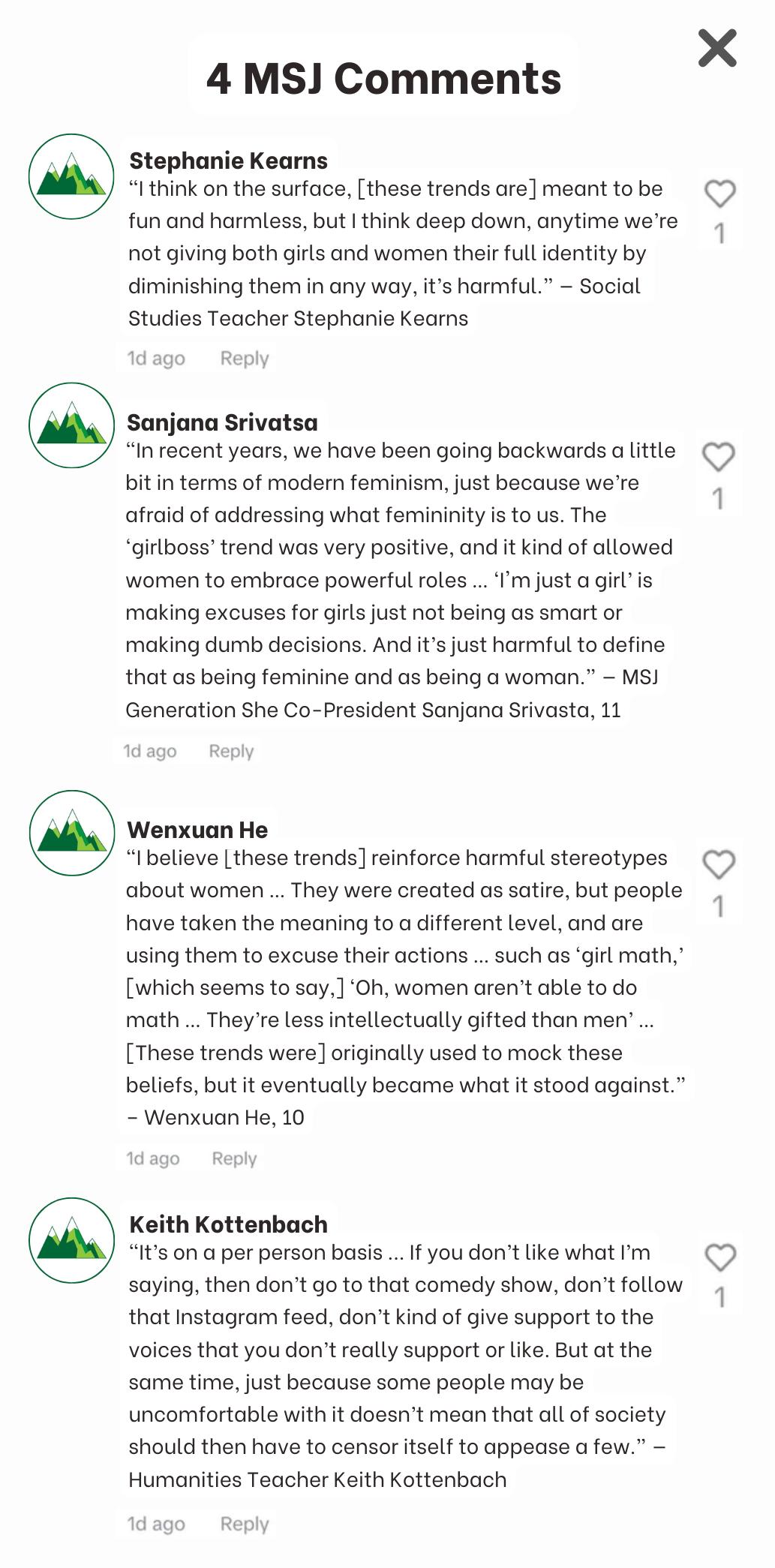
“I’m just a girl” is just another weight on feminine identity
By Janet
INTRODUCTION
“POV — you want to save money, but you’re just a girl.” “I didn’t buy four iced cofees this week, so I made money according to girl math.” “Watch me explain football in girl terms.” Afer the Internet shifed away from the controversial “girlboss feminism” era of the 2010s, which was accused of perpetuatng rigid stereotypes about successful women, yet another wave of feminist trends struck mainstream media. From “girl math” to “I’m just a girl,” TikTok users are sharing new ideas about what it means to be a woman in modern society.
The appeal of these trends lies in their satrical humor, seeming to ofer a playful and exaggerated take on gender roles that many fnd amusing. The frst few “girl dinner” videos depict ing meals consistng of ice cubes and a single slice of cheese on us ers’ For You page may appear quirky and harmless, but as more of these vid eos are created and go viral, an underlying theme starts to reveal itself. Beneath the irony, these trends subtly perpetuate the stereotypes they mock by framing women as frivolous, indecisive, and incapable of living independently, masking the harmful impact these messages have on perceptons of feminist causes and younger generatons.
REGRESSION OF FEMINISM


Social media is a precarious platorm where humor, relatability, and popular culture intersect to generate trends that can mutate in meaning. The “I’m just a girl” trend arose from the lyrics from “Just a Girl,” an upbeat pop song released in 1995 by the band No Doubt. The song became popular on TikTok through an audio clip, where users pair it with content refectng on personal experiences atributed to women that many fnd relatable. Ironically, the song heavily satrizes the phrase “just a girl” and uses it to critcize misogynistc standards. Many of the trends associated with the “just a girl” phenomenon stem from the idea of “girlhood,” which originally revolved around celebratng the experiences, challenges, and joys of femininity and growing up as a woman. The focus of these trends eventually shifed towards the demeaning efect that social expecta tons have on women, resultng in the in fux of satrical videos about femininity.
SATIRE OR FUEL FOR STEREOTYPES?
Like most Internet trends, phrases such as “I’m just a girl” and videos of “girl math” were popularized for their humor. However, as a satre of the stereotypes women face in society, many of these trends ultmately rely on a constant associaton between traditonally feminine traits and being a woman. While the sarcasm of women using “girl math” to call irresponsible splurging with cash “free” may be apparent to viewers familiar with the trend, for the larger demographic, they appear as yet another example of women being incompetent and having poor decision-making abilites. Instead of calling atenton to the absurdity of feminine stereotypes, they appear to only ratonalize them. Furthermore, even for women and girls who understand the joke, these trends can have a serious impact on their self-percepton. In videos featuring “I’m just a girl,” women are ofen depicted carrying six or seven shopping bags full of clothing, crashing their cars into walls, and admitng to thousands of dollars of debt, all while wearing glamorous clothes, makeup, and a bright smile on their faces. The constant glorifcaton of naivety, irresponsibility, and ignorance subconsciously encourages women and girls to take pride in possessing stereotypic, negatve traits and treat them as inevitable byproducts of their femininity. “One thing I love about being a girl is you can do and say just about anything with an excuse or a reason,” TikTok creator Victoria Lit said. WHAT NEEDS TO BE
From a broader perspectve, these recent trends represent a harmful regression in the movement for gender equality in media, undermining hardfought societal progress. Over the past decade, the feminist movement has gained tremendous momentum, empowering women to break free from the constraints of a patriarchal society. Despite this progress, the growing popularity of regressive ideologies refects a troubling shif backward. According to a 2022 study on 20 countries by the United Natons, 68% of respondents believed that the media portrays women in stereotypically female roles, such as wives, mothers, or caregivers, a 14 percentage-point increase since 2018. One manifestaton of this downturn is the “trad wife” ideology, which glorifes women’s role as caretakers and housewives. It paints an idyllic image of traditonal domestcity, encouraging women to return to their “natural” role in society. Creators like Nara Smith and Ballerina Farm have been gaining online infuence along with this movement for the past few years, postng content that advertses a return to conventonal caregiving as an ideal for women. While these portrayals may seem harmless on the surface, they glamorize societal roles that have historically oppressed women and reduced them to dependents of men. Similar to the “just a girl” aesthetc, which trivializes feminist struggles by reducing them to cutesy yet ignorant punchlines disguised as satre, the “trad wife” trend capitalizes on romantcized imagery to downplay the autonomy and capability of women, drawing them back to subservience.
IMPACT ON YOUNGER GENERATIONS

“I’m just a girl” is a pervasive ideal that has become more than just a trend and closer to being a widespread mentality. In fact, researchers have found that hateful ideologies and misogynistc tropes impact how teens and youth are treated in schools. According to a 2017 study by UK Feminista and the Natonal Educaton Union, “64% of teachers in mixed-sex secondary schools hear sexist language in school on at least a weekly basis” in the United Kingdom. In the short term, trends like “girl dinner” can have harmful efects on teen psyches and health. “Girl dinner” efectvely romantcizes the act of eatng less, labeling the acton itself as something inherently female. By trivializing unhealthy eatng habits, these trends promote potental eatng disorders. These trends exclude and ostracize those who do not conform to its expectatons and ideas, forcing teens, who are overly susceptble to peer pressure, to make a choice between health and acceptance. Younger generatons are falling for the allure of the idyllic lifestyles portrayed by these trends without recognizing the potental ramifcatons of conforming to such trends. Seeing online creators play into harmful stereotypes of female traits normalizes these belitling ideologies, reinforcing the idea that misogyny is natural and acceptable. The packaging of “I’m just a girl,” “girl dinner,” or “girl math” as cute, relatable trends allows the Internet to frame misogyny and infantlizaton as acceptable and appealing. These trends bring together women, especially girls, through relatable, short videos, and create a sense of camaraderie and community that appeals to teens and young adult women, who typically lack a truly supportve network in real life. Society should work toward forming more communites where women feel included and supported without having to play into the tropes of misogyny.
While there is nothing inherently wrong with using social media as a place to bond over commonalites and share laughs over lighthearted content, it’s important to be aware of when the thin line between satre and genuinely harmful implicatons is crossed. We can achieve this by asking ourselves about the purpose of the content we are exposed to and their impact on audiences. We are responsible for objectvely examining the media we consume, recognizing when problematc rhetoric is used for the sake of trendiness, and speaking out. MSJ students interested in learning more about modern feminism can partcipate in clubs such as MSJ Exit Zine, which publishes its own feminist magazine. Students can also join MSJ Generaton She, MSJ Girls Who Code, or MSJ Women in STEM, communites that serve as safe spaces for students to explore felds that women are traditonally discouraged from entering.
The unrestricted reign of recent feminist trends is now seeing repercussions beyond the short term, as both girls and women are internalizing their implicatons and applying them to the way they perceive and experience the world. For “I’m just a girl” to become a truly harmless phrase, we as a society need to stop giving power to rhetoric that restricts the individuality of women in society, whether it be the current “trad wife” videos that critcize women for abandoning domestcity or the 2010s “girlboss” trends that isolated women who didn’t ft the “corporate feminism” mold. It’s tme to fnally let women lead their own lives without the Internet constantly redefning who they are supposed to be.

Guan, Scarlett Huang, Jennifer Li & Michelle Qu Sta Writers
THE SMOKE SIGN AL
Mission San Jose High School Est. 1964
Vol. 60, No. 2 October 18, 2024
www.thesmokesignal.org
41717 Palm Ave. Fremont, CA 94539 510-657-3600, ext. 37088
MISSION STATEMENT The Smoke Signal’s mission is to represent the voices of the MSJ community and serve the public by providing accurate, meaningful, and engaging information presented through print and digital mediums.
SCHOOL POPULATION 1796 students
EDITORS-IN-CHIEF Kaylee Liu, Callie Yuan
NEWS Shuhan Jin, Catherine Qin
OPINION Padma Balaji, Keerti Koya
FEATURE Tanvi Deshmukh, Trisha Parikh
CENTERSPREAD Naisha Koppurapu, Ashley Pang
A&E Goonja Basu, Brittany Lu
SPORTS Howard Lu, Ethan Yan
GRAPHICS Hannah Bi, Ivy Lu
WEB Sarah Hu, Alice Zhao
PUBLICITY/TECH Fiona Yang
BUSINESS Rajorshi Chatterjee
CIRCULATION Novak Chen, Tushara Devapatla
ADVERTISING Angelina Chen
EVENTS Navya Chitlur
WRITERS & PHOTOGRAPHERS
Gaurasundara Amarnani, Roshan Annamalai, Dhaeshna Booma, Rajorshi Chatterjee, Angelina Chen, Novak Chen, Navya Chitlur, Tushara Devapatla, Alex Duan, Ariel Duong, Kanupriya
Goyal, Janet Guan, Felicity He, Scarlett Huang, Abigaile Lei, Jennifer Li, Varun Madhavan, Vikram Mahajan, Kaiwei Parks, Michael Qu, Michelle Qu, Ekasha Sikka, Rishab Shah, Kaylin Teo, Aarav Vashisht, Luna Venturo, Prisha Virmani, Fiona Yang, Ariana Yi, Cham Yu, Aaqib Zishan, Emily Zhang, Lucas Zhang
PROFESSIONAL DEVELOPMENT TEAM
Eleanor Chen, Muyang Li, Megha Vashisht, Matthew Zhang
ADVISER YC Low
To advertise in the Smoke Signal, email ads@thesmokesignal.org. Advertising that is included on the pages of, or carried within, the Smoke Signal, is paid advertising, and as such is independent of the news and feature content.
The Smoke Signal’s right to freedom of speech and press is protected by the First Amendment of the Constitution.
To stay updated with our online content, see our Facebook page at www.facebook.com/msjsmokesignal
All policies on distribution, corrections, and bylines can be found at www.thesmokesignal.org/about

Keerti's Key meets Padma's Perspective

From the monthly array of Noah’s Bagels on distribution day to collapsing on the M2 couch after a long week, every day as a Smokie is a new experience. Since the day we turned in our applications years ago, the Smoke Signal has become an integral part of our lives. Whether it’s trudging through the infamous mock week or enjoying bagels alongside the latest edition, we’ve built lasting memories, formed lifelong friendships, and learned valuable lessons throughout our time with the paper. With applications approaching in just a couple days, we wanted to share the reasons why we love the Smoke Signal and why you should too.
Keerti: I still vividly remember sitting on a bean bag in my room six years ago reading the latest cycle of the Smoke Signal my older sister brought home. I would ip straight to Feature’s DieHard TryHards to see what silly competition was held, and then to Centerspread to marvel at the bright colors and intricate shapes. Yet somehow, I found myself always back in the Opinion section. Reading the everyday events described in columns, challenging myself with di cult words in the articles, and analyzing the fun Graphic Opinions never failed to captivate me. Coming into the Smoke Signal , I naturally gravitated towards Opinion. Yet, it was my involvement in everything from News Investigative Reports to Graphics photo coverages that shaped the way I view the organization. After attending my very rst event coverage, I realized that — despite living in Fremont my entire life — I knew so little about my own hometown. rough the Smoke Signal , I attended everything from well-known haunted
Love letter to the Smoke Signal
By Padma Balaji & Keerti Koya Co-Opinion Editors
houses to small business fairs to community walkathons, discovering my own community and growing connections with those around me in the process. As Tech Manager in junior year, I was able to see the inner workings of creating the nal product that would get sent o to the printing press. Serving as the Opinion Copyeditor last year allowed me to appreciate the wealth of research and statistics in creating strong arguments. And, of course, being Opinion Editor has been an immensely rewarding experience through which I not only get to lay out the spreads for Sta Writer Voices to be heard but also feature the opinions of the Editorial Board and broader community. Looking back now, I know the Keerti from six years ago, who admired the Opinion Editors’ work, would never have expected to be in that very place. All it took was a leap of faith, and now, I’m a part of a family I wouldn’t trade for the world.
Padma: When I applied to the Smoke Signal two years ago, and got in, I was terri ed of being a journalist. Although I loved journalism, having been an avid NPR nerd all my life, the idea of interviewing complete strangers or writing an article in just a few days was daunting to say the least, my social anxiety blaring every time I asked the inevitable, “Excuse me, can I interview you?” Yet, as I faced my fears time and time again to talk to attendees at a festival or interview students for voices, I grew to love them; every person I talked to had their own incredible story, each interview I conducted giving me glimpses into worlds I never knew existed.
Now, as an Opinion Editor, I’ve learned priceless lessons about what it means to be
The Opinion of the Smoke Signal Editorial Board
BookTok and the performance of reading
Book reviews, hauls, and reading essentials: the one-stop shop for all things bookish is #BookTok. Amassing more than 200 billion views, the hashtag has drawn the attention of readers across the globe. is platform is only powerful for readers, as well as authors with bookstores setting up displays speci cally to showcase trending books for shoppers to locate easily. Evidently, BookTok has established itself as an important pillar of the reading community.
However, with the growing popularity of BookTok, reading has become intertwined with the performative, commercial nature of social media. Certainly, BookTok has encouraged people to nd new ways of enjoying reading in a period with concerningly low student literacy levels — according to the Hechinger Report, nearly two-thirds of American students were unable to read at grade level even pre-pandemic, However, the platform blurs the line between using social media as an avenue to share a literary experience versus an aesthetic performance, causing some people to lose sight of the very purpose of books.
Central to the problem of BookTok’s performative reading trends lies in consumerism. Like many other hobbies that have gained traction on social media, BookTok has commercialized reading. Social media places a constant pressure on readers to maintain a certain aesthetic, pushing them to consume products deemed “necessary” for reading. BookTok has become a marketplace for bookish products, with videos
advertising book accessories that have accumulated millions of views. Many of these videos include hidden sponsorships that, if realized, would expose the deep roots of consumerism within the community.
Moreover, this subculture encourages procuring books for an aesthetic, a problem tracing back to the 20th century. In F. Scott Fitzgerald’s e Great Gatsby, he emphasizes that owning unread books doesn’t emanate an intellectual appearance, but rather acts as a facade. e phenomenon of appearing well-read has recently spread through BookTok, with viral videos of people pretending to read in front of co ee shops under hashtags such as #darkacademia and #downtowngirl. Not only does this cause people to devalue the act of reading, which o ers important skills such as literary analysis, but it also encourages the overconsumption of aesthetic goods, including books themselves, in order to build an appearance. Famous BookTok in uencers can be seen ling viral videos of book hauls amounting to hundreds of dollars and starting trends among the community to do the same.
ese trends might have resulted in positive growth of the market — according to the Berkeley Economic Review, since the rise of BookTok in 2019, bookstores have seen a rise of around 21%, compared to only three to four percent pre-pandemic. However, BookTok ultimately encourages a super cial, consumerist approach to an inherently intellectual hobby. Reading does not need to be
expensive. However, as bookstore sales have increased in recent years, according to IBIS World Analysts, library use has even dipped slightly with a three percent revenue decrease towards the end of 2024.
e community also has a history of ignoring sensitive and serious topics worth discussing, such as domestic violence and abusive relationships, opting to instead romanticize possibly problematic books and focus on their aesthetics. It’s a cyclical issue: when readers brush over the deeper meaning behind works of writing, concerned only about a romanticized version of the books, there is a loss of media literacy. is folly ultimately leads to people trivializing sensitive topics. Not only does this make the many young people of this community vulnerable to potentially facing these issues in real life, but it is also insensitive to real victims.
It is both sad and ironic to see that reading has not escaped the claw of commercialization and instead has begun to fuel the same vices of social media it is the antithesis of. Rather than perform for social media, students should seek to browse their local libraries and explore titles that may not be as popular, engaging their intellectual curiosity and critical thinking skills. Simply pursuing reading for personal interests is much more ful lling than curating an aesthetic to live up to. BookTok as a concept is an excellent place to nd other readers, but in practice, people ultimately must not lose sight of the personal ful llment and knowledge books o er. ▪

a leader and team member, and above all, the value of taking on new challenges. From publishing my very own column in the paper to leading our monthly editorial meetings to crafting spreads in Adobe InDesign, the Smoke Signal has given me the chance to step out of my comfort zone. It’s allowed me to step into a space where I’ve grown, not only as a journalist, but as a storyteller, a leader, and above all, a person.
Above all, I’ve found an incredible community that have truly turned into my #SmokieFamily. Whether it’s attending event coverages with co-writers, sitting on the beloved M2 couch with my best friends, or going through pitches with co-editors, I’m constantly surrounded by an amazing group of people that not only push me to be better, but support me through the process.
At the Smoke Signal , we’re no stranger to taking chances: we take a small leap of faith evey time we pitch a story or take initiative to write a breaking news article, and we encourage you to do the same by applying, no matter how uncertain it may feel. We are, however, certain that M2 will guarantee you a shared community of students passionate about giving back and amplifying the voices of our student body. At the Smoke Signal , you’ll grow as a writer, learner, and above all, a person. If a warm couch, a passionate community, and of course, free bagels sound like your cup of tea, we’re certain you’ll nd it at the Smoke Signal . So give the application at tinyurl.com/smokesignalapp2526 your best shot, and we couldn’t be more excited about the possibility of welcoming you into the Smokie family. ▪

By Hannah Bi & Luna Venturo Graphics Editor & Sta Writer


Apple's Siri lawsuit and the importance of regulating data privacy
By Navya Chitlur, Tushara Devapatla & Cham Yu Sta Writers
INTRODUCTION
In early January, Apple agreed to pay $95 million to setle a class acton lawsuit alleging that Siri listened in on users’ conversatons and breached consumer privacy. Over the past several years, Siri has been accused of infringing on the users’ rights to privacy by listening in on private moments, using keywords to trigger personalized targeted ads to users. While Apple claims to only listen to recordings for quality assessments, reinforcing the same stance they made to courts in 2019 as a part of the same lawsuit, they contnued to exploit this privilege to unethically gather user data, partally due to customers allowing iPhone apps to access the microphone feature. To prevent future privacy violatons, companies should face greater repercussions for mishandling client data along with expanded federal regulatons, while users can minimize risk by thoroughly examining privacy agreements.
Apple was frst accused of privacy breaches in 2019 for having stored recordings of users’ private conversatons without consent. The accusaton was brought up in an investgaton by The Guardian in August 2019, which outlined numerous instances where privacy violatons were commited. Subsequently, the class acton lawsuit Lopez et al. v. Apple Inc. was fled in the same month. Alleged privacy violatons included Apple’s us age of Siri’s user data to push targeted advertsements, with the lead plaintf receiving an ad of Air Jordans immediately following verbal conversaton of the brand, raising concerns about third-party involvement. The $3.58 trillion-worth Cupertno company responded by apologizing to users afected and promising to delete all stored recordings from previous years. Apple reiterated its commitment to improvement of service and denied any motvaton from economic gain. Part of the suit was dismissed in February 2021 for the plaintf’s overt speculaton, but was subsequently readmited in an amendment in the September of the same year, adding factual allegatons to the plaintf’s arguments. The company then agreed to the $95 million setlement in 2024 to prevent further litgaton, thereby resolving the lawsuit.

The lawsuit’s plaintfs have accused Apple of failing to prevent recordings of user interactons with Siri, a blatant violaton of its 2019 pledges and other privacy regulatons, as the company contnued to proft of of selling user data to third-party apps and services which catered targeted advertsements to users. Although the resoluton of the lawsuit pressures Apple to acknowledge its business practces, the setlement of a meager $95 million pales in comparison to the company’s gargantuan $391 billion annual revenue. Ultmately, the lawsuit does not prevent Apple from commitng the same privacy violatons in the future, and with the low repercussions of million-dollar fnes for a trillion-dollar company, the company may contnue to exploit user data. Apple’s contnued proft from monopolized user data was garnered using subversive means, and should have faced harsher repercussions in the form of a higher setlement or an expansion of government regulaton to prevent further exploitaton.
History of Tech lawsuits
Alongside Apple, other tech companies have had histories of user privacy breaches. In 2022, a $1.4 billion Texas lawsuit accused Meta of privacy breaches pertaining to facial and biometric data, which they had allegedly recorded and stored over tme. Meta’s tag suggestons feature had allegedly violated a Texan law that requires companies to request user permission before using facial recogniton tools. In January 2023, Meta sued Bright Data, a global technology and web company, for unethically scraping data from Meta services. However, Bright Data claimed they only used informaton
publicly accessible to them, proving that the private informaton of all Meta’s users were available online, meaning its security and data preservaton policies have barely changed or improved despite previous accusatons. Privacy breaches such as these can be incredibly harmful as they showcase that third-party companies can use private data from users without their consent and that citzens have an absolute lack of control over their online privacy. In the case of Apple, the company would have been able to obtain any informaton from their users at any given tme, making privacy almost impossible for anyone with the Siri functon. Similarly, the company VIZIO, a TV design company, faced a $17 million lawsuit for the illegal collecton and preservaton of user data, including watchlist history, account informaton, users' digital identtes. According to 22 research statstcs from Proton, companies receive hefy profts from selling private user data, with Amazon earning $38 billion from advertsement companies alone. The sum of money companies make heavily outweighs the money they lose over setlements and lawsuits, leading to a repettve cycle devoid of any substantal change. Though Apple has been sued and accused of data collecton in the past, the company faced insignifcant repercussions, such as setlement by a promise to delete all previously accumulated data, and were thus able to contnue to exhibit the same behavior. Despite the majority of users being unafected by data breaches, the violaton leaves users vulnerable to online atacks from hackers, with many users having been in situatons where their banking accounts, personal or health issues, or high-level security informaton were leaked. In a 2024 data breach in Infosys McCamish, Bank of America’s fnancial sofware provider, led to the banking informaton of 57,028 users being compromised, which was then accessed by a ransomware group, LockBit. Afected customers were then given a promise of compensaton from the bank, which they have struggled to deliver, causing a simple data breach due to poor privacy policies to impact the economic standpoints of thousands of people all over the country. In order to prevent future incidents like the Infosys breach and cement users’ data privacy rights, there needs to be more signifcant legisla ton to ensure companies are forced to take ac countability for choosing to exploit personal data from their users.
Proposed regulations
The rise of poor data privacy and megacorpora ton malpractces warrants the strengthening of punishments for ofending tech companies. While there are state laws that advocate for regula tons and securing data privacy, more federal regulaton is needed to prevent abuse of data privacy. This can be done through the federal adaptaton of cur rent state laws, such as the California Consumer Privacy Act which gives California consumers more control over their private data, ensuring that users are aware of how to delete their informaton online, and al lowing them to opt-out of the sale of their personal infor maton.
The current absence of a uniform federal standard on privacy, according to the Centre for Informaton Policy Leadership “[has] lef organiza tons in the United States wres tling with inconsistent legal obligatons regarding the collecton and use of per sonal data.” To tackle issues regarding data privacy, the federal government could adopt
strategies like the European Union’s General Data Protecton Regulaton, which requires companies to have inbuilt data safety guards in their products to ensure that users’ personal data is protected from the very beginning. Existng federal protectons, such as the Children’s Online Privacy Protecton Act (COPPA) prevents the collecton and disclosure of informaton about children, but remains sorely unequipped to combat privacy breaches against other demographics. By expanding bills like COPPA, more pressure would be placed on tech companies to change their data collecton systems.
COUNTERARGUMENTS
Many experts argue that privacy violatons are avoidable as long as Internet users clearly read privacy agreements online. However, it is unreasonable to blame users for the exploitaton of their data, especially as companies consistently utlize opaque methods and deliberately confusing agreements to prevent users understanding how to protect their data. A 2019 Pew Research Poll found that only 9% of Americans always read privacy policies before agreeing to them, indicatng that a vast majority of users do not clearly examine its complex technical jargon within privacy agreements. Privacy agreements are not of use if they’re long-winded and tedious to read, and blame cannot be placed on the user. Instead, corporatons must ensure that its agreements and methods to protect one’s data privacy are straightorward and able to easily be implemented.
conclusion
To ensure veritable user control over personal data, companies should maintain their integrity and repudiate malpractces like storing and exploitng personal data without clear user consent. While corporatons must take signifcant responsibility, federal legislaton is also necessary to ensure companies don’t contnue to repeat privacy violatons, as there are very few consequences that regulate companies' behavior. Federal legislaton can exist through expanded state legislaton to ensure accountability for companies. Customers should strive to thoroughly review and understand the terms and conditons of privacy agreements, and reject them when necessary, though it may be tedious. Other

For me, privacy agreements are too long...If customers are agreeing, that's kind of their fault…I think it's both the customers and Apple's fault, because they should be making shorter privacy agreements because they know consumers are not going to read it. But also, if consumers care that much about their privacy, they should take tme out of their day to go over what they're agreeing to. But I... don't take tme to read privacy agreements, and that's my bad." — Gavia Grewal, 11
"I don't know if there's much that users can do. We’re at the mercy of large corporatons like Google or Apple because they can't reject the privacy agreements — you usually have to accept them to contnue using the app. So unless you just go of all of social media or something like that and you go of the grid, they’re probably going to be tracking you, and there’s not a lot you can really do about it."
— Arushi Singh, 12


S taff C olumn

Tackling socioeconomic inequality with equity
By Cham Yu Sta Writer
“Not everything that is faced can be changed, but nothing can be changed until it is faced,” civil rights activist James Baldwin said. We often comfort ourselves with empty notions of racial progress as residents of the Bay Area — the heart of American progressivism — but words alone can’t break us out of our bubble of privilege. The Bay Area produces $654.73 billion worth of services in a year and is home to 57 of the nation’s largest companies. Silicon Valley’s glamor of prosperity, however, overshadows the socioeconomic inequality that pushes those impoverished into further destitution. The result? An affluent Peninsula to the west, juxtaposed with relative poverty in the East Bay. Racial disparities and continued segregation are still evident through all nine counties of the Bay Area.
The mismatch between words and reality is a reflection of an atavistic feeling of discomfort when dealing with race and socioeconomic inequality. It’s often convenient to support change, but it can be difficult to accept the reality of progress. Even as Americans continue to declare uniform support for racial equity, the share of minority enrollments in higher education continues to slide without substantial changes to policy. To address the legacy of marginalization, current socioeconomic systems must be reformed to reduce racial disparities, not with words.
While segregation may seem like a distant historical notion, its legacy can be still observed throughout the Bay Area. Prior to the region’s explosion of Asian immigrants in recent decades, a collection of historically Black communities once dotted the Peninsula, East Bay, and San Francisco. These marginalized communities were deliberately segregated from more prosperous districts, and signs of disparities still remain to this day.
East Palo Alto serves as a prominent exam-
Luigi Mangione Support
ple of persistent racial disparities. The city was once a predominantly Black neighborhood that still experiences lower income levels, educational attainment, and lower life expectancy by more than 13 years compared to the rest of the county. Like other historically Black-majority communities, the city once struggled with redlining — an institutional rejection of mortgages that systemically clustered minorities — leaving Black communities without generational wealth others collect through homeownership. Communities facing restrictions often lacked adequate educational and career opportunities, perpetuating racial disparities. The Bayshore Freeway separates the city from Palo Alto, one of the wealthiest cities in the country and a hotspot of technological innovation, a stark disparity stemming from discriminatory housing policy. According to the US Census Bureau, the median household income in Palo Alto remains double that of East Palo Alto to this day.
The legacy of discriminatory policies, such as redlining, is exemplified by widespread patterns of inequality in household income and living conditions. A 2019 study by the Othering and Belonging Institute at UC Berkeley found that the Bay Area is segregated to a higher extent than the 1970s, an observation that may be the result of skyrocketing cost of living from Silicon Valley’s burgeoning technology industry. Those in segregated communities earn nearly 40% less income and are 22% more likely to be impoverished. These sustained racial disparities are a stark reminder against further political passivity in the face of deeply-rooted injustice.
Unfortunately, it has become exceedingly popular to acknowledge racism and turn a blind eye when difficult changes are necessary to combat inequality, especially when personal stakes are involved. A classic example of inac-
tion is former San Francisco Supervisor Aaron Peskin, a self-proclaimed defender of racial minorities whose 23 years of service is tied to the persistent delays of new housing construction. While a large and burdensome shadow cast by a townhome conversion project may be enough for Peskin to reject new housing, a sustained housing shortage leaves disadvantaged minorities with little chance of homeownership. Housing developments have been delayed without end as zoning complaints and frivolous lawsuits rattled throughout the city. Only 16 new homes were approved for construction within a six-month period in 2023 — an embarrassing setback for the city’s ambitious housing goal of 82,000 new units by 2031.
To address our nation’s widening racial disparities, policymakers must be bold to implement equitable socioeconomic policy that increases employment and household income. These may come in the form of tax exemptions, affirmative action, subsidized healthcare, and other spending programs that directly alleviate poverty and inequality that often plague minority communities. However, public opinion has soured toward these initiatives in recent years, a testament to the difficulty of implementing change on sacrosanct socioeconomic systems. Claremont Mckenna College’s Professor Ronald E. Riggio, in a 2024 Psychology Today article, provides a possible explanation: uncertainty often accompanies change and may inspire resistance from those affected. With systemic change being necessary for racial equity, discomfort in response to change means that targeted policies continue to be a risky political endeavor.
Along with the purported goal of equity, regressive trends of public discourse have become increasingly mainstream , where society is viewed as a racial zero-sum game. In other words, the idea of equity remains popular, but the steps to achieve it are not. A result of the shift in discourse can be the end of affirmative action in college admissions by the Supreme Court. The notion of affirmative action can be incompatible with a conventional view of equality, given that the percentage enrollment

On Dec. 4, 2024, UnitedHealthcare CEO Brain ompson was assassinated by 26-year-old Luigi Mangione. In a three-page manifesto recovered by authorities, Mangione expressed his frustration towards the health insurance company, claiming that it consistently prioritized pro t over patient well-being. Following the incident, the Internet expressed tremendous support for Mangione and his actions, with many sympathizing towards his frustration with UnitedHealthcare and the general state of healthcare in America. Many romanticized Mangione, expressing romantic a ection, making thirst trap edits, and writing fan ction. Supporters were able to raise more than $200,000 for him and contributed to signi cant sales in related merchandise, including the Nordstrom sweater Mangione wore to court.
Do you think the support for Mangione is justi ed or understandable? Is it more important to focus on the violence of the crime and grieve the victim or focus on the motivations behind Mangione’s actions? Does the support for Mangione unfairly normalize violence or trivialize the victim’s life? Do you think thirst traps or fan ction written about Mangione are problematic considering his actions?
“I mean murder is excessive, and we shouldn’t have to go to that to prove that something is wrong. But we should really focus on the motivation behind it, because, I think there is a legitimate reason to be upset and frustrated. Our healthcare is kind of messed up compared to other countries. It costs a lot and people can’t afford it. It’s kind of slow for myself and my family, so we’ve always had trouble with getting health stuff to actually work. It’s so frustrating for us. So, I understand it, but murder is a little excessive. Violence is not necessary. If [the public] is writing fanfictions and doing thirst traps, that’s romanticizing Mangione and the violence, but if [they’re] actually supporting Mangione because of [their] frustration, then it’s valid support.” — Ima Nissler, 11

of white students decreased when implemented. Yet blind equality is inherently unequal without equity. Minority students continue to possess a tangible disadvantage in college admissions in terms of wealth and environment. In a 2016 report, the American Federation of Teachers found that Black students are twice as likely as their white peers to be in funding-deficient school districts. The lack of Advanced Placement examinations and financial aid, according to a USA Today report, contributed to a 22% drop in college enrollment for Black students. Equity policies can help reduce these disparities and may promote a more equal playing field for all students. Unfortunately, apathy would only feed into our society’s systems of inequality where minorities are less likely to attend college and more likely to be impoverished, perpetuating our unequal institutions. It becomes clear that equality cannot be achieved without equity.
A successful example of racial integration policies are the equity policies implemented by Singapore. Since 1980, the government slowly advocated for racial integration between the Chinese, Indian, and Malay populations in the face of mutual distrust, in part by subsidizing direct support for disadvantaged Malay students. Today, polls held by the National University of Singapore find that more than 90% of Chinese residents are comfortable with Indians and Malays as neighbors and coworkers, while the country’s Gini Coefficient, used to measure economic inequality, is an impressive 0.371 compared to the US’ 0.485. Singapore is a foreign city-state with different societal dynamics, but its success in combating socioeconomic inequality demonstrates the feasibility of government programs in pursuing equity. Inequality is a complex issue. It will not disappear with apathy, and addressing it may require altruistic compromises from certain sectors of society. Yet equality will forever remain a faraway goal unless equity can be achieved. As policy proposals stagnate, minority groups will only continue to struggle in economic marginalization with no end. Perhaps it’s time for a change. ▪
“The killing cannot be justified. No matter what the problem was, no human being should be killed, though the problem of healthcare has been increasing because people are unable to pay for their healthcare. There’s still no need to kill someone just because of that. People should focus more about the motivations behind his actions, because healthcare is a really big issue, but just because it is does not mean he should have taken someone else’s life. People who idolize Mangione aren’t really using a nuanced view of things — they aren’t seeing what he was actually trying to do, because by no means should taking someone’s life be accepted.” — Siri Lakshmi Rao, 10
“Although I believe that violence is very rarely justifiable, I do think that the support for Luigi is certainly very understandable. Within our societal structure, there are a surplus of individuals who’ve had to face the painful reality of insurance rejection during already difficult times for their families. As such, I do think that it is important to focus the motivations behind Mangione’s actions — his decision and the support of him reflect the underlying deeper issues with prof itized healthcare. I don’t know that the content being created on the basis of Mangione’s physical appearance is so much problematic as it is interesting; it does at least stir up more discourse about the health industry as a whole, which I consider generally positive. I’m curious to see what the outcome of the case will be because it certainly will be interesting either way.” — Ashwika Jani, 12


“No, I don’t think it’s justified because it normalizes murder, which is a violent crime, it makes it understandable and undermines the significance of murdering the healthcare CEO. I think you have to consider [the importance of focusing on the violence of the crime and grieve the victim, and focus on the motivations behind Mangione’s actions]. But you can’t just focus on the motivation, because then people forget that a man died, which is something that we should grieve and think about in the scope of the world. [Furthermore], making thirst traps of the murderer makes, creates support for him, inportraying him as the murderer that he is and should be considered [as]. Rather than punishing his actions, people are normalizing it and trivializing it by showing that it’s an understandable thing to do when murder is not understandable at all.” — Abhinav Deshpande, 9

WHO WE ARE
2025
www.asdrp.org
The Aspiring Scholars Directed Research Program (ASDRP) is a 501(c)(3) nonprofit, private research institution in Fremont, California.

Application Details
ASDRP is the Bay Area's premier precollegiate research & development institution, run by a consortium of highly skilled scientists, engineers, and researchers with years of academic and industry experience who collectively seek to push forward the current frontiers in biology, chemistry, physics, computer science, psychology, medicine, engineering, and more.
We mentor high school students - budding scientists in 9th through 12th grade - who come from every corner of the greater Bay Area, California, and across the United States. We seek student researchers who are passionate, who are unafraid of a steep learning curve, and who want to be involved in real science that has real impact on society
WHAT WE DO
Quite simply, we do research. Our investigators and student researchers strive to make impact in fields ranging from cancer biology, drug discovery, environmental science, and computer-guided drug design to radioastronomy, machine learning, and urban sustainability.
As in any other R&D establishment, we publish papers, present work at conferences, and generate intellectual property. Check out some of our latest preprints, publications, and conference proceedings online.
MISSION & VISION
ASDRP is not a class, not a tutoring center, and not a summer camp. We are scientists and engineers who aim to push the frontiers of scientific discovery through and cutting edge basic & applied research sciences, physical sciences, and engineering, while bringing out the best in the aspiring scientists we mentor.
queries: admissions@asdrp.org Administrative services: asdrp.admin@asdrp.org
Spring 2025
Early Application Deadline: November 15, 2024
Final Applications Due: December 30, 2024 @ 11:59 PM PST
Summer 2025
Early Application Deadline: February 1, 2025
Final Applications Due: April 15, 2025 @ 11:59 PM PST
Applications are competitive, and each term, ASDRP receives far more applicants than there are open research positions. Apply online at www.asdrp.org/apply.



iehard tryhards:
nd-Up Comedy
By Ariel Duong, Scarlett Huang, Michael Qu & Aaqib Zishan Sta Writers

Stand-up comedy is a form of entertainment in which performers deliver humorous monologues or anecdotes to the audience, incorporating timing, relatability, and the ability to read a room. In this edition of DieHard TryHards, four Smokies will perform a short stand-up comedy act, competing for the most laughs from the judges. Will this challenge be a chance to discover hidden comedic talents, or will it be an unfortunate series of comical failures?


Aaqib 1 Ariel 3 4
As the funniest member in my friend group and someone who is constantly mistaken for Hasan Minhaj, my comedic talent is simply unmatched. My perfectly timed delivery paired with rich punchlines makes it challenging not to laugh. is DieHard TryHards will be a walk in the park — I can already hear the applause and the taste of a sweet rst-place victory. I have no worries when it comes to comedy, as I know I’ll “stand out.”
“I WENT TO THE GYM TO COOK SOME ELDERLY MEN IN BASKETBALL, BUT WHEN I SAW A 6’6” ATHLETE DUNK ON TWO GUYS, I CALLED MY MOM TO GO HOME.”
Come on man! at’s too easy — shoutout to LeBron for inspiring my jokes. All of those people who mistook me for Hasan Minhaj clearly had a reason behind it; I am a natural at comedy. I always knew my detailed storytelling abilities and comedic con dence would easily carry me to victory. Standup comedy may be a challenge for some, but for me? It’s just another day of being the funniest person in the room. Now, if you’ll excuse me, Net ix called, and I’ve got to start writing my comedy special.

I’m not worried about this competition in the least. As a veteran of DieHard TryHards, I’ll overcome this challenge with ease, drawing on the quick wit I’ve sharpened from past challenges. Additionally, my countless hours watching stand-up specials have taught me all the comedic techniques I need. Whether it’s observational humor, wordplay, or self-deprecation, I’ve got my comedic arsenal ready. With my humor polished and my con dence high, there’s no stopping me now.
“I’M ALMOST LIKE THE BATMAN OF SOFA SURFING. HE’S LIKE ‘WHERE’S THE JOKER?’AND I’M LIKE ‘WHERE’S THE REMOTE?’”
I’m not disappointed about getting second place in the least, as I know I faced this challenge headon and gave it my all. While rst place wasn’t mine this time, those hours spent watching stand-up specials still paid o . I was able to apply some of my comedic techniques, like when I acted out a scene or paused before delivering a punchline. With this performance under my belt, I’m de nitely going to bring my A-game to the next DieHard TryHards. Watch out because second place is just my start!

Michael 2 scarlett
I’ll preface this much — I’m not a funny person. In fact, instead of laughing with me, people laugh at me. From my awkward stature to my dad jokes, I have little hope for this DieHard TryHards. I’m no Matt Rife or Jimmy O. Yang, but I’m up for the challenge nevertheless. With endless millennial references in my back pocket, I aim to make the most of this experience. My goal for this show will be to learn, grow, and never touch a comedy act again.
“MY STUDENTS SAID I WASN’T THE WORST TUTOR IN THE WORLD ... I DIDN’TEVEN KNOW I WAS A CANDIDATE FOR THAT!”
Well, that experience wasn’t the worst. While my act wasn’t a show-stopping Net ix feature, I was rewarded by a handful of half-hearted chuckles, which is better than a dead silent crowd. e humiliation taught me a lot about punchline, timing, understanding your audience, and my very apparent lack of comedic skills. is experience may have decimated my con dence just a little, but don’t worry — next time you see me, I will return better, stronger, and maybe even a little funnier.

My past experience with comedy can be summed up in one exchange: “ at wasn’t funny.” “Yeah, I know.” is DieHard TryHards will be nothing short of social suicide. However, my ego and narcissism won’t allow me to go down without a ght. I have faith that my chronically online status and occasionally funny Instagram feed will give me the fuel I need to stumble my way through this challenge.
“I APPLIED TO TEACH KIDS, BUT WHEN I TURNED IN MY RESUME TO THE RECEPTIONIST, SHE SAID ‘SORRY DEAR, THE MENTORS AREN’T HERE YET!’”
I’ll admit it — I absolutely deserved this loss. Whether it was nerves or just my pure lack of natural humor, this experience has bruised my ego on a spiritual level. On the bright side, I’ve ruled out one more possible career. Comedy is NOT my calling. My fellow comedians were worthy opponents, but it’ll de nitely be a while until I’m brave enough to attempt to make another joke. However, this is not to say I won’t be back — I refuse to let one setback de ne my future in DieHard TryHards challenges!
SCHOOL
The Presents
Smoke Signal Smoke Signal
60th Anniversary History of the
By Dhaeshna Booma, Janet Guan, Ekasha Sikka, Fiona Yang & Ariana Yi Staff Writers
In honor of its 60th anniversary, the Smoke Signal explored the newspaper’s name, awards and achievements, and inner workings such as a typical newspaper cycle and the different roles of the organization’s members.
“[When
Name Origins
“When think of
The Smoke Signal was established in 1964 when MSJ was first founded. Since then, the paper has been passed down to a number of different advisers, each one with a unique vision for the publication. Former adviser Sandra Cohen began overseeing the organization in 2004. Under Cohen’s oversight, the paper decided to use color in at least four of its pages every issue. The paper’s reporting style gradually increased in depth as well with the adoption of new article types, including Investigative Reports and Special Reports. The Smoke Signal continues to preserve decades-old traditions, including the business structure and student-run aspect of its organization and the variety of its content.

Key Points of a Cycle
At the start of a cycle, staff writers and editors pitch for Beats Story Ideas (BSI) — updates from MSJ organizations and departments and two story ideas for each of the eight newspaper sections — which editors then choose from for articles. The following day, staff writers pitch to write the cycle’s articles and are chosen after consideration by editors. The rough draft (RD) to final draft (FD) process is broken down into several stages. Starting from RD0.5, a basic guideline of necessary action steps, to FD, writers must keep track of deadlines, often with quick turnarounds. To create spreads, editors add visual graphics and formatting to completed articles. Finished spreads are sent to the Publicity/Tech Manager who then compiles all the pages into a PDF and sends it to FolgerGraphics for printing. On delivery day, staff writers gather to organize the hundreds of printed newspapers, and on the following day, Distribution Day, each member passes out copies of the finished newspaper to their assigned classrooms. The Smoke Signal then celebrates the end of the cycle with bagels.

Awards & Achievements
The Smoke Signal has consistently earned recognition for its commitment to quality student journalism. Over the years, the publication has amassed an impressive array of accolades from prestigious organizations. Among its most notable honors, the Columbia Scholastic Press Association has awarded the Smoke Signal multiple Gold Medals and Crown Awards, including the Gold Crown for Digital News in 2020-21. The National Scholastic Press Association has also recognized the publication as All-American several times, often with multiple Marks of Distinction for its website. In addition, the Smoke Signa has received several podium placements at the Ohlone College Contemporary Communications Conference, including first-place honors for General Excellence in the 2001-02 and 2002-03 school years. Other distinctions include first-place awards and recognition for investigative reporting from the American Scholastic Press Association.

surrounded by people who truly cared not only about me, but also about our overall mission and goal of delivering high quality news to the general student body.” — 2017-18 Editor-in-Chief Carolyn Ge
EDITORS MANAGERS
All the Smoke Signal operations are supervised by the Editor-in-Chiefs and adviser. Under their oversight, the eight newspaper sections — News, Opinion, Feature, Centerspread, A&E, Sports, Graphics, and Web — each have two editors. Editors manage their respective sections’ articles from rough drafts to completing the newspaper spread as well as ensuring staff writers keep up with article deadlines. Additionally, each section is unique; for example, Web editors are in charge of the organization’s online presence and running the Smoke Signal’s official website. From guiding staff writers to creating a finished spread, editors play a crucial role for the Smoke Signal
Managers assume responsibility of similar integral parts of the Smoke Signal. Managers roles include the Advertising Manager, Business Manager, Publicity/Tech Manager, Events Manager, and Circulation Manager. While preparing for distribution, the Advertising Manager handles all the advertising in the newspaper, and the Publicity/Tech Manager compiles and submits the finished PDFs for printing every month. Following its printing, the Circulation Manager ensures smooth distribution of newspapers to the school during every cycle and facilitates mailed circulation for subscribers. All five of the manager roles fulfill critical responsibilities in keeping the Smoke Signal coordinated.


— Sports Editor Howard Lu
where does the name “Smoke Signal” come from?
Ancient China
In ancient China, smoke signals were primarily used for military purposes, as defensive communication was transmitted between special beacon towers. These beacon towers were used frequently on the Great Wall against foreign invasion. Tower guards would send smoke signals to the next, relaying the warning across the entire wall. For maximum visibility, typical smoke signals were crafted from carefully proportioned ingredients, including wolf excrements. This later inspired the idiom “wolf smoke is rising from all directions,” describing the start of war.

While specific names or tribes associated with the origin of smoke signals in Africa are not universally documented, indigenous African groups have used fire and smoke for signaling for centuries. They used these methods to alert others of danger, send messages across long distances, and mark events. In Southern Africa, tribes like the Zulu, were known to use smoke as part of their broader communication systems, including drum signaling. Similarly, in North Africa, Berber
Native Americans Ancient Greeks and Romans African Tribes
Indigenous peoples across different regions, including the Ohlone and the Great Plains communities, used smoke signals to transmit messages across far ranges, dating back to 2,000 years from today. Each smoke signal was uniquely created to serve a specific purpose. For emergency signaling, one smoke puff demanded attention, two puffs indicated peace, and three puffs was a cry for help. This method of communication was the most efficient and secretive over long distances for the indigenous peoples.


While specific names or tribes associated with the origin of smoke signals in Africa are not universally documented, indigenous African groups have used fire and smoke for signaling for centuries. They used these methods to alert others of danger, send messages across long distances, and mark events. In Southern Africa, tribes like the Zulu, were known to use smoke as part of their broader communication systems, including drum signaling. Similarly, in North Africa, Berber communities in mountainous regions occasionally relied on fire or reflective sunlight for signaling.

The Smoke Signal derives its name from traditional forms of long-distance communication and honors cultures around the world.
By Lucas Zhang Sta Writer
Dear Diary: Lion Dancer
As Lunar New Year approaches on January 29, cultural traditions become widespread spectacles throughout the streets of San Francisco, especially the traditional Chinese lion dance. is series of diary entries follows one particular lion dancer named Lin from the neglect he faces during the Western holidays of Christmas and New Year’s Day to the two weeks of festive performances during the Lunar New Year.
December 25, 10 a.m.
Every single year, I struggle to understand the hype behind Christmas all around San Francisco. With Lunar New Year just a month away, how do other Chinatown residents like me have the audacity to orient their street decorations toward obnoxiously tall trees and jingling bells for this Western occasion? ese meaningless assets should be reserved for the rest of the city. I surely hope they do not replace the animals representing each year in our cultural calendar with Rudolph the Reindeer next.
January 1, 7 a.m.
All the talk about “New year, new me” seems like old news, especially as I dust out the same lion dance costume that I have recycled for the past 12 years. Its ferocious head and elegant tail remain perfectly intact, yet, right now, this suit is only a disguise that makes my weak self be able to let out a roar. With only four weeks left before the dancing season commences, why have my coaches not announced any training sessions yet? I hope they did not

In October 2024, Juniors Claribel Chen and Brittany Lu took their respective passions for art and business to a new level and launched their small business, Turtle Cases. Together, they create hand-painted phone cases, o ering both custom and premade designs under the tagline, “signature shells for your phone.”

e idea to found Turtle Cases emerged during a late-night call, in spired by a case Chen had painted as a birthday gift for Lu. bined their strengths — Lu handling the business aspect, and Chen heading the artistic produc tion — to start the business’s journey. Lu’s love for marketing and project manage ment, paired with Chen’s passion for creating art for others, made Turtle Cases the perfect venture for them. “I think the expe
rule out my act, a fearsome gure who can pilot a lettuce-grinding machine meant to be controlled by two people, after my previous showing.
January 12, 7 p.m.
With less than three weeks left, I still haven’t received any noti cations about the lion dance from my coaches. Although my rst name, Lin, means “forest” in Mandarin, staying put like a tree might not be the best move right now. Taking extreme measures, I let myself loose to roam around Chinatown as a one-member pride, (hopefully) seeking assistance from more educated locals there. After an entire town of people immediately rushed inside their doors upon seeing me, one store owner welcomed me into his shop to have a secret discussion. Much to my surprise, he immediately agreed to help me de-rust to prepare for my Lunar New Year performances by both cleaning my worn-out costume and re-teaching me crucial moves. anks to him, I feel the courage to continue my lion dance legacy despite a tighter time constraint and an increasingly tighter suit.
January 20, 3 p.m.
Today honors Martin Luther King Jr. and his dream to advance civil rights in this country. Likewise, I slept peacefully last night with a dream that everyone was suddenly no longer scared of my bold costume — we are truly cut from the same cloth. I began practicing daily with my new mentor in the back of his shop, re ning my kung fu moves and performing the traditional act of cai qing. His guidance and reassurance that I would get a partner to split roles with felt too generous to be true — could this be the year’s Lunar New Year
miracle happening right in front of me? I learned my way around the intricacies of the large-scale dance moves, prepared to wow the crowd regardless of where the dance organizers place me in the suit. My mentor assured me that no one watching my dance will be frightened because my golden lion suit stands for good fortune, not something to run away from. Next week, everyone should be able to con dently watch me spring into action as I kick o the Year of the Snake.
January 29, 5 p.m.
My rst day performing in a park ooded with spectators was much more thrilling than I had ever thought it would be. As a pleasant surprise, I did not have to make the hundreds of people here (s)care(d) about me through a solo performance. Other enormous lions joined me and helped my act out, and I used them as vaults and hurdles to perform tricks on. In the eight hours of showtime today — which felt more like eight minutes — I only had two states of mind: focus while perfecting my movements during my time onstage and awe in response to how us dancers cooperated with exquisite synergy while I was o stage watching my peers. Our united movements inside the massive lion costume reminded me of the mythical creatures in Chinese origin stories that my parents used to read to me as a kid, taking me back in time. With this successful performance under my belt, as I look ahead, my goal is to try to perform more frequently at festivals other than Lunar New Year celebrations.
Fe uary 12, 6 p.m.
Before I knew it, the nal days of my Lunar New Year lion dancing came along, ending
Spotlight: Turtle Cases
By Ekasha Sikka & Ariana Yi Sta Writers
rience of creating phone cases [is] really enjoyable ... Honestly, I just like [making] stu for people,” Chen said.
“I think the experience of creating phone cases [is] really enjoyable ... Honestly, I just like making stuf for people.”
— J UNIOR C LARIBEL C HEN
e logistical process of establishing the business went smoothly, and within a week they had registered, gathered materials, and set up their brand. eir Instagram account @turtlecases.co has been their primary method of marketing and collecting orders, as well as a platform to showcase their unique designs. Since then, the business has


Instagram followers by hosting a custom case giveaway, in which users who interacted with their post were added to a ra e. e giveaway further propelled the growth of the business, introducing it to a larger audience through reposts. To date, they have sold 14 cases, including their trademark oral or bow patterns as well as their custom cases, with designs ranging from painted pets to an Illenium-themed case.

Building the business has not come entirely without challenges, however. Chen and Lu recall their early experience with a hydrophobic phone case that made painting nearly impossible, leading them to go through a process of trial and error before nally identifying a reliable brand. Each order has since re ned their workow and skills, as they continue to turn obstacles into opportunities for growth.
with the Lantern Festival performance marathon. Although I feel bummed that I received my last set of red envelopes for 11 months today, I am secretly glad to get a break from wearing my bulky costume. My trainer promised to watch my last performance to see my progress, claiming a front-row seat to admire the uid nature of my routine. After my dance, he told me that the performance felt like a blessing of spectacular lion dancers from the Chinese gods. I felt relieved hearing this from my coach, now knowing that the month from when I met him to nishing this series of performances was not spent in vain. On this night, I would typically forget about this experience until next year, but the memories of this past dancing season will stay with me forever. Forget the Year of the Dragon or the Year of the Snake; to me, every year is the Year of the Lion.


e future of Turtle Cases appears bright, fueled by Chen and Lu’s passions and shared determination. Cur rently, they are focused on expanding their business by establishing an online Etsy shop to reach new customers past their local community. ey hope to also expand their product line to diversify their selection of phone cases and include matching sets and accessories like phone charms. Turtle Cases stands as a testament to the potential of young entrepreneurs driven by enthusiasm and creativity. Looking ahead, Chen and Lu foresee Turtle Cases growing alongside them, not just serving as a source of passive income, but primarily as a relaxing and ful lling creative outlet.

“It’s a hobby for both of us; she enjoys painting, and I enjoy marketing ... Once we’re in college and have more control of our own schedule, we can expand this even further,” Lu said. ▪
“It’s a hobby for both of us; she enjoys painting, and I enjoy marketing ... Once we’re in college and have more control of our own schedule, we can expand this even further.”
Juniors Brittany Lu and Claribel Chen posing for a picture.
Turtle Cases custom phone case.
Ancient Egypt
Mancala is a two-player tabletop game believed to have been commonly played in ancient Egypt around 1400 B.C.E. e name “mancala” comes from the Arabic word “manqala,” meaning “to move,” which re ects the game’s dynamic style. Variations of the game were played in many cultures across Africa, the Middle East, and Asia, with more than 800 names and versions documented. Each version consists of a board with rows of pits and is typically played with small stones, seeds, or beans. Players take turns picking up all the pieces from one pit and distributing them one by one into subsequent pits, aiming to capture the opponent’s pieces by landing their last piece in an empty pit on their side, showcasing strategic planning and counting skills. Today, mancala is enjoyed in both


K
ea
Gonggi is a traditional Korean game for children often referred to as Korean Jacks or jackstones. Players speculate that the game dates back to the reign of King Heonjong (1834-1849) in the historical text "Ojuyeonmunjangjeonsanggo," in which it refers to “a game where children play with round stones called gong-gi … where players throw stones in the air, catch them with the palm side of their hand.” e stones were traditionally real pebbles, but today are more commonly colorful plastic ones known as gonggitdol.
Recently, gonggi has regained popularity because of the new season of Squid Game and is slowly on the rise to becoming an international sensation enjoyed by all ages.
India
Carrom is a captivating tabletop game that mirrors its name — derived from the term meaning “to strike and rebound”— with its fast-paced icks and strategic ricochets. Originating in the Indian subcontinent during the 18th century, the game blends both dexterity and strategy. Played by up to four players, the game involves icking wooden discs, known as carrom men, into four corner pockets of a square board to score points. While India is credited with its creation, variations have spread to many di erent countries, including Sri Lanka, Pakistan, and even parts of Europe. Today, carrom remains a popular pastime in South Asia, with tournaments frequently hosted in clubs and cafés.


ance
Initially named La Conquête du Monde, the popular game Risk was rst created by French lm director Albert Lamorisse as a way to showcase themes of global con ict and politics. In the game, players form alliances with one another and use their armies to collect territories, all of which are based around the real world and include countries such as the United States and Canada. By taking risks, a player wins by successfully capturing all the territories that their opponents possess. Since its creation, Risk has released di erent versions of the game correlating to di erent political changes and historical periods.
Guide to Tabletop Games
By Tushara Devapatla, Abigaile Lei & Prisha Virmani
and across
USA
When Monopoly was released in 1935, the iconic board game became an instant hit. e predecessor to Monopoly, e Landlord's Game, was based on locations around Atlantic City, New Jersey, as it was a central hub for migrants and independent thinkers. Many current players are drawn to Monopoly for its nostalgic appeal, as it is often tied to fond memories of family gatherings and childhood. ere are more than 300 versions of Monopoly, with copies having been sold in 114 countries around the world and translated into 47 languages.

Ancient China
Played on the same board as Go, this board game has origins which trace back to ancient China. Gomoku is similar to Tic Tac Toe, but instead of aligning three in a row, players must connect ve in a row on a grid with 361intersections. When introduced to Japan around 270 BC, the game quickly became a national pastime, and by the 19th century, almost every Japanese citizen knew its rules. Although the tabletop game seems straightforward at rst glance, it has gained a reputation for its di cult logistics. While it has gained some recognition worldwide, it still remains the most popular in East Asia.

China
Originating in China in the mid-to-late 1800s, this Chinese tabletop game directly translates to “sparrow” in southern Chinese dialects, likely a reference to the clicking sounds made when reshu ing game pieces. Typically played between four players, mahjong combines elements of both luck and skill. While the tiles that a player starts with often shape the course of the game, making bold decisions can turn a poor hand into a winning one. Over time, the game spread from China to Italy, eventually landing in the West with the immigration of Chinese people. Mahjong has since been adapted in various ways around the world, including Mahjong Solitaire in the Americas, a Cantonese-style version in Hong Kong, and a

board games played internationally.

“MyfavoritetabletopgameisJenga because it is very lighthearted and an easy game to play with almost everybody. You need lots of skills, like having steady hands and concentration. I have lots of memories from playing with my family and friends that I met on vacation a while back. Jenga really helped me connect more with them because theconcentrationneededtoplayit takes away the need for awkward smalltalk.”—JaylynYao,9
“My favorite board game isaprobablyScotlandYardbecauseit's gamethattakesalmosthoursbut at the same time it's extremely engaging so you get lost in the play… I learned how to play this game in India last summer and that summer was the rstiiiiii time all of my cousins on my dad's side were in India, so wehourswouldallsitandplaythatgamefor every day it would be really hilarious to watch whoever theeveryrobberwasthatroundfreakingout time we trapped them.” — NavyaChitlur,11


Texas“Myfavoritetabletopgameisprobably Hold 'em because I’ve gotten really good at remembering the cards,loveandhonestly,Iwinmostofthetime.I howthegameisamixofstrategy and luck, and it’s so much fun trying to out what everyone else is thinking. ere’s nothing better thaniiiiiii making a great move and winning.iiiiii iiiiiWinning just makes it more exciting, but evenplaywhenIlose,it’sstillfuntohangoutand with friends and family. It justnevergetsoldforme.”—JoyceLi,10
For centuries
many countries, board games have allowed people to come together to test their skills, all while having fun. From mahjong to carrom, the Smoke Signal has compiled seven di erent
Mahjong
Gomoku
Risk
Carrom
Mancala Monopoly
Wallace & Gromit: Vengeance Most Fowl is about as interesting as clay
By Felicity He Staf Writer
e beloved Wallace & Gromit franchise returns after nearly 16 years with Wallace & Gromit: Vengeance Most Fowl e movie was released in the US on Dec. 18, 2024, and globally on Net ix on January 3. Rated PG, the newest addition to Wallace & Gromit is a slapstick comedy primarily catered towards children. Using the same charming stop motion and claymation tech- niques as its predecessors, the lm continues to follow the adventures of Wallace (Ben Whitehead), an eccentric yet good-hearted inventor, and his intelligent and sensitive dog, Gromit. e lm follows a similar plotline as earlier movies as well, with Wallace’s inventions yet again landing him in trouble that Gromit has to save him from.
e movie picks up a few years after the events of Wallace & Gromit: e Wrong Trousers e villainous penguin Feathers McGraw, returning from the previous movie, has been imprisoned in a zoo for stealing the blue diamond from the museum. Meanwhile, Wallace and Gromit get ready for the day, rely- ing on Wallace’s inventions. Wallace creates a nifty robot gnome named Norbot (Reece Shearsmith) to help with gardening. Unbeknownst to Wallace, McGraw takes control of Norbot and builds himself a Norbot army, leading to a string of burglar- ies around the town. Wallace quick- ly comes under suspicion of the law with the ready-to-retire Chief In- spector Mackintosh (Peter Kay) and overzealous rookie P.C. Mukherjee (Lauren Patel) on his case.
Despite two of the most import-
UNDER THE RADAR
By Gaura Amarnani Staf Writer
Singer-songwriter millkzy, a rising star in the R&B and hip-hop worlds, has been making a name for himself through his lyrically intricate songs over the past years. Although millkzy creates lovesick R&B melodies and head-bobbing rhythms that show his diverse prole, it is his meaningful lyrics that have truly made him stand out in the saturated music industry.
millkzy's journey rst began in 2023 with his debut extended play, Floetry, a combination of ow and poetry that created a smooth and soulful experience. His January 2024 release, EVER SINCE SHEFFIELD, truly showed his musical growth with unpredictable transitions from jazzy instrumentals to insightful lyrics. Singles like “ROSE IN THE WINTER” and “RUSSIAN ROULETTE (I ADORE YOU)” immediately left a mark on listeners with touching and relatable lyrics. His next release, an extended play titled bites, displayed a delicate and introspective style in his music using themes of love, identity, and perception. Introspective lines like “It only seems she hurting you in times she should be healing” and “I wonder how I got a lead in plays I ain’t auditions in” emphasize his intricate thought process and highlight his ability to transform raw emotion into meaningful lyrics. millkzy discography concludes with his three singles “Yin & Yang,” a balanced collaboration with R&B singer Leandra Delle, “A BEAST WITH BEAUTY,” and “7 MINUTES IN HEAVEN.” e releases fully display millkzy’s growth through the build on his distinctive sound, ever-increasing versatility, and lyrical depth. Inspired by artists like Cleo Sol and J. Cole, millkzy's music often feels like an open diary through his introspection and emotional maturity. His extreme innovation, versatility, and depth have carved millkzy into the world of music, with great anticipation for what comes next. ▪


ant characters, Gromit and Feathers McGraw, lacking spoken lines, Wallace & Gromit: Vengeance Most Fowl excels at portraying their emotions and characteristics. Gromit’s body language and facial expressions are sculpted with extreme detail, from his wide eyes to his expressive ears. ese features e ectively convey Gromit’s thoughts and emotions.
On the other hand, it is di cult to tell that Feathers McGraw is the antagonist at rst due to his adorable and funny appearance coupled with his expressionless face; however, this is remedied e ectively with an ominous score playing in the back- ground during his scenes, evoking a sinister undertone.
Another strong aspect of the lm is the heartwarming relationship be- tween Wallace and Gromit. At rst, Gromit feels left out and abandoned since Wallace focuses more on Norbot and his other inventions, but as they face challenges together, their bond grows
However,stronger. the lm fails to include signi cant character development. Apart from Mukherjee, none of the characters display much depth or growth. Wallace brie y grapples with some everyday tasks after los- ing his technology, but then he gets
all his trinkets back by the end of the movie and returns to his previ- ous way of life, rendering his subplot pointless. Meanwhile, Gromit re- mains completely stagnant through- out the movie. Mukherjee did un- dergo an arc, going from cautious and ‘by the book’ to trusting her instincts, but viewers do not have a reason to care about her growth as her struggles are not shown. In general, the two police characters, Mukherjee and Mackintosh, added little to the story except for a few boring scenes, and Feather McGraw, although entertaining, falls at as a character due to one-dimensional, unexplained motivations. Due to its weak character arcs, the storyline also takes a hit, feeling hollow and incomplete.
Overall, Wallace & Gromit: Vengeance Most Fowl is a wholesome, easy watch with endearing anima- tion, a humorous villain, and a sweet bond between a man and his dog. Although the lm has its fair share of pitfalls, such as underdeveloped characters and boring subplots, it is still a delightful lm as a whole. ▪
Grade: B-
January 2025 Student Faves
WHAM : A tribute to Resilience
By Gaura Amarnani Staf Writer
Released on January 3, Lil Baby’s WHAM (Extended Version) is a tribute to resilience and the rapper’s growth. rough energetic melodies and introspective lyrics, the album discusses Lil Baby’s journey into the world of music. Consisting of 15 tracks, the album attempts to explore raw emotion with relatable and personal lyrics, but fails to substantially develop its themes.
WHAM (Extended Version) delves into Lil Baby’s journey of struggles and successes while balancing introspection and assertion lyrically. e energetic opener, “Listen Up,” discusses the adversity he faced in his journey into the music industry. Lines like “I move with a purpose, give ‘em the right in uence, that’s how I’m the big dog” and “I took the lil’ bros and I mold ‘em, they know to hold it down” highlight Lil Baby’s dedication to uplifting others. Conversely, he also describes the challenges he faces in “By Myself (feat. Rod Wave & Rylo Rodriguez),” in which Lil Baby raps, “I got money, thought they’d be happy for me / ey’d rather see me in shackles,” displaying the duality of fame with his transition from victories to struggles. “Stu (feat. Travis Scott)” is one of the highlights of the album, bringing a hypnotic cadence blended with melodic beats. Travis Scott’s signature style of ambient instrumentals and intricate layering perfectly complements Lil Baby’s raw lyrics like “I’ve been puttin’ on this stu since my baby frame / Walk around with a dollar, that’s pocket change,” revealing personal victories like nancial advancement. ematically, WHAM (Extended Version) does a respectable job highlighting the duality of fame. Lil Baby discusses his struggles through his journey while o ering connection to listeners with lyrics like “ ey might have a lot to say, but ain’t gon’ never face you / You gotta learn to em-

brace it, don’t let it break you” from “Streets Colder.” However, the album ends up leaving a lot to be desired, with the occasional emotional lyricism overshadowed by material displays. Most of the tracks feature lyr- ics that aunt Lil Baby’s wealth, from “‘Supercar-drivin’, Gulf Stream-yin’, designer-wearin’ golden child, you know?” from “Dum, Dumb, and Dumber (with Young ug & Future)” to “I’m so D-boy and I stay fresh, went Louis Vuitton on my Timb'” from “Redbone (with GloRilla).” Small snippets of meaningful lyrics pop up throughout the tracks, exciting listeners, before returning to super cial gloating. As a result, in the context of his career, WHAM (Extended Version) feels incomplete, leaving an un nished narrative. e album has the potential to be a story of growth from a matured Lil Baby; however, it often fails to meet the mark. Content is repeated at times and there is nothing that truly stands due to substantial lyrics being overshadowed by shallow ones.
Overall, WHAM (Extended Version) is a notable addition to Lil Baby’s discography with his vocal progression and rich beats despite issues with emotionally-lacking lyrics. While there are aspects that WHAM could improve in like depth, it is still worth listening to due to its vibrant layering and powerful features. ▪
Grade: B
Ethel Cain Dives Into Another Level of Darkness With Perverts

By Navya Chitlur Staf Writer
Released on January 8, Perverts is the second studio album of Hayden Silas Anhedonia, or Ethel Cain, and consists of a dark, slowed with reverb ambience, chilling and masterful lyrics, and experimental production. e hour-and-a-half long project was a standout work of art, experimenting with unique sounds such as TV and stereo static, winds, and mu ed voices, paired with deep, analytical lyricism that told stories of several outcasts or titular perverts in society, creating an exploration of human nature and perversion tied together with religious themes. However, due to long pauses of white noise and ten-minutelong songs, the album was overall a di cult experience and not one that warranted repeated listening. e album opens with “Perverts,” featuring a distorted version of a hymn called “Nearer, my God, to ee,” juxtaposing holiness to the sin of perversion Cain explores later
in the song, through repeating lyrics such as “Heaven has forsaken the masturbator.” e song re ects her storytelling mastery as Cain compels listeners to contemplate the repercussions of self-grati cation in a stark and raw re ection on humanity. Her monotonous and blurred voice blends with the background static and beeping, creating an atmospheric, gloomy feeling, which she continues to use throughout the album. She followed a similar theme in her single “Punish,” her darkest song at the time of its release, with a storyline following a pedophile shot by a child’s father who lives in exile, repeatedly stimulating the pain from the bullet wound. Cain explores the contrast and confusion between perversion and love, and the gut wrenching pain and insanity that comes with the lust that drives humans, with repeating lyrics such as “I am punished by love.”
However, despite her remarkable and thought-provoking lyricism, the singer fails to create a sonically captivating album due to the long
periods of plain sounds that eventually morph into white noise. While each standalone song is gripping and blood-curling, each song is around ten minutes long and many have minimal lyrics or sounds apart from static, causing listeners to eventually lose their attention and making the album as a whole di cult to listen to. In songs like “Etienne,” which is an eight-minute long song with more than three-quarters of the song being tediously repetitive white noise, it becomes incredibly di cult to appreciate the sound experimentation due to the sheer quantity featured.
Since the noise and overall tone rarely changes throughout the album, “ atorchia,” a seven-minute long piano instrumental, and “Amber Waves,” stand out in particular.
In “Amber Waves,” Cain deviates from the murky tones in the rest of the album by crafting a song tying back to a similar music style to her previous album, Preacher’s Daughter, which had grappled with dark themes of family and religious trau-
ma, sexual exploration, and love and death. rough lyrics like “Yet here I am empty / Watching love of mine leave / But I’ll be alright / Me and my amber waves,” Cain closes the album with a beautifully somber song with softer and more emotional tunes. Her slow singing, matched with a piano backing track, allows listeners to connect to the softer side of humanity, giving them a break from the consistent, nightmarish static and tunes from the rest of the album. Overall, Ethel Cain’s Perverts showcases her talent in lyricism, production, and experimental music, acting as a work of art that dives into the darkest depths of humanity with themes of lust and perversion, and the drive of desire, love, and pain. With its sound experimentation, deep lyricism, and unique styles, Perverts creates a remarkable and thought provoking experience, though not quite an obsession-worthy listen. ▪
Grade: B+
ALICE: “Lovesick” by Laufey | ASHLEY: “Tears in Brasil” by Piero Piccioni | BRITTANY: “deep in it” by berlioz, Ted Jasper | CALLIE: “ at Old Feeling” by Chet Baker | CATHERINE: “Fly Me to the Moon” by Bart Howard, Eddie Calvert | ETHAN: “Cry Me a River” by Michael Bublé | GOONJA: "Juna" by Clairo | HANNAH:
“False God” by Taylor Swift | HOWARD: "Samurai" by Lupe Fiasco | IVY: "Huit octobre 1971" by Cortex | KAYLEE: “Planetarium” by Justin Hurwitz | KEERTI:
“symptom of life" by WILLOW | NAISHA: “L-O-V-E” by Nat King Cole | PADMA: “Black and Tan Fantasy” by Duke Ellington | SARAH: “My Way” by Frank Sinatra | SHUHAN: “By Your Side” by Sade | TANVI: “Misty” by Ella Fitzgerald | TRISHA: “Runing” by Norah Jones | TR. LOW: “So What” by Miles Davis
Timog: Where Filipino tradition meets modern dining
With an elegant yet warm atmosphere and offering staple Filipino dishes, Timog brings an array of unique favors to the Bay Area.
By Kaylin Teo & Prisha Virmani Sta Writers
Located in Lion Market Shopping Center in Newark, Timog serves authentic, affordable, and “Lutong bahay” (homecooked) style Filipino cuisine. The Philippine has one of the most unique foods, known as an original fusion cuisine. Filipino dishes reflect a combination of Spanish, Japanese, Chinese, Western, and Pacific Islander flavors, most of which come from the 16th to 20th centuries during Spanish colonialism. Filipino cui-
sweetness from naturally sweet fruits like bananas and sugar. Beyond its flavors, Filipino cuisine extends to their people’s values in living of freshness, balance, and communal life.
Walking into Timog, the restaurant’s interior was clean and well adorned with simple, elegant yet casual decor that created a relaxed ambience. The warm light fixtures paired beautifully with the faux plants and green foliage hanging from the ceilings, giving the small restaurant a pleasant, modern aesthetic. While this style of decoration takes on a more modern approach, a bit of Filipino culture shines through with a black and

“Walking into Timog, the restaurant’s interior was clean and well adorned with simple, elegant yet casual decor that created a relaxed ambience. The warm light fxtures paired beautifully with the faux plants and green foliage hanging from the ceilings.”
white wall mural depicting traditional architecture of the Philippines giving off an authentic feel.
Timog offers a delightful exploration of Filipino flavors through a thoughtful menu with a diverse range of dishes,
including family-size options. The Lumpia, or Lumpiang Shanghai ($14.99), is great as a crispy and piping-hot appetizer with its thin, golden wrapper encasing a vegetable filling of carrots, onions, cabbage, and aromat ic spices. However, while the portion is generous, the flavor feels slightly underwhelming, and the price seems steep for only spring rolls. In contrast, the Bangus Sisig ($20.99) truly shines. This dish of flaked milkfish blended with citrus juices and peppers delivers a medley of tangy, savory, and spicy flavors that is both satisfying and versatile. While it could have been served warmer, its vibrant taste and satisfying portion size make it a standout choice on the menu.
Timog’s authentic Filipino flavors, inviting setting with lovely decor, and convenient location with ample parking appeals to many. Located inside a food center, it’s easy to access and provides a relaxed, friendly dining experience. While the portions are generous, dish es, including the stand-out, flavorful Bangus Sisig, fall on the pricier side. Though the cost may not seem ideal, Timog is worth a visit for those seeking quality Filipino cuisine.
Rating: B+


2025: Yet another year of sequels
With more than 30 sequels scheduled to hit theaters this year, whether or not these flms are valuable comes to question.
By Varun Madhavan & Vikram Mahajan Sta Writers
Film has grown to be one of the greatest storytelling mediums due a combination of immersive visuals, captivating sound design, and engaging actor performances. Through new, creative, and fresh ideas, directors like George Lucas, James Cameron, and Steven Spielberg revolutionized the cinematic landscape. However, with more than 30 sequels hitting theaters in 2025, Hollywood’s reliance on franchises and nostalgia seems to have hit a new high. From Zootopia 2 and Freaky Friday 2 to Avatar 3 and Happy Gilmore 2, these often unnecessary and unoriginal sequels stifle bold and creative new films.
The industry’s heavy investment in
more frequently as of recently. According to film data researcher Stephen Follows, in the 1990s, film sequels accounted for less than 11.7% of all box office revenue in Hollywood. In stark contrast, by 2023, more than 45% of box office revenue was generated from film sequels. As movie sequels take up larger and larger percentages of the market, studios shift away from innovative, daring works in order to keep releasing more and more sequels and remakes.
While sequels may make a lot of money quickly, the problem with lack of substance many suffer from leads to significant discrepancies between box office and ratings. For example, Star Wars: The Rise of Skywalker, the 10th big screen continuation of the original Star Wars: A New Hope, impressively grossed more than a billion dollars. Yet critics and audiences alike agree that the movie has little value, as it simply rehashes old and overused motifs. For example, the Rotten Tomatoes score fell from 93% for the original to just 51% to the latest sequel. This is to be expected; even the most cherished childhood stories can become cloying when rebooted or reproduced for the third or fourth time. Because audiences have high expectations from their emotional attachment to the originals, when the movie inevitably doesn’t live up to their hopes, they are left dis-

New films spur innovation in the industry, and without them, the film industry cannot grow and evolve. For instance, the original Toy Story film was produced in 1995 using cutting-edge computer-generated imaging (CGI) tech-
nology and became the first full-length feature film ever to do so. The film also explored a novel concept, with walking and talking toys as the main characters that conveyed a valuable lesson of friendship and teamwork. Yet four films later, although animation technology has continued to improve, the franchise has simply reused the same characters and ideas in each successive film. This reflects the main problems with sequels and remakes: They hinder new story potential, and instead, lead to more redundant films and a muddled cinematic landscape. A film’s appearance isn’t all that it offers. An example of this is, again, the Toy Story sequels, often praised for their graphics but criticized for superficial and uncompelling plotlines.
“This refects the main problems with sequels and remakes: They hinder new story potential, and instead, lead to more redundant flms and a muddled cinematic landscape. A flm’s appearance isn’t all that it ofers. An example of this is, again, the Toy Story sequels, often praised for their graphics but criticized for superfcial and uncompelling plotlines.”
Ultimately, it is clear that the growing abundance of sequels comes at a cost. While studios are searching for safe bets and profits, the obsession with rehashing successful ideas has wider implications for the film industry and audiences alike. From creative stagnation to oversaturating the market, this trend shapes the
kinds of stories seen screen and the collective mindset of society, deterring industry leaders from supporting original sto rylines and independent creators, and instead, choose the same producers to make the same films with the same casts and characters. It is much easier to piggyback off old ideas, and the longer producers rely on reusing classics, the less likely they are to be willing to branch out and create new ones.

Hollywood’s overreliance on nostalgia and familiar franchises is a calculated cash grab that exacerbates a “brain drain” in the industry, where creative talent is stifled by uninspired franchises rather than bolstered by new ideas. Hollywood should prioritize artistry and originality over easy cash — not only do new films promote artistic growth within the film industry, they also refresh audiences and have the potential to become classics themselves. Moviegoers, too, should resist the temptation to watch a sequel or a reboot of an old classic, and instead try some new, unique independent films. Because ultimately, only the audience can compel Hollywood producers to move in a new direction.
PHOTOS BY STAFF

Guide to Sports Goal-Setting
By Roshan Annamalai, Kanupriya Goyal & Aaqib Zishan Staf Writers
2025 is the year to replace generic, performative New Year’s resolutions with New Year’s goals — specifically, setting attainable, realistic sports goals. Goal-setting is a vital part of an athlete’s success both on and o the field. However, they should be set with sincerity and in the right direction, as well as executed with the discipline to have an impact. The right goals will encompass all aspects of a specific sport, leading to athletic success.
SMART Goals — Specific, Measurable, Achievable, Relevant, and Time-bound — are a great strategy to achieve athletic milestones while building a solid foundation for personal growth. SMART goals provide direction and accountability by breaking down challenges into manageable steps, creating long-term progression. “Using SMART goals to accurately pinpoint what to accomplish and how to achieve it is crucial. You need a plan, a timeline, and accountability from others who share your mindset,” CSU Monterey Bay Water Polo Athlete and Class of 2024 Alumna Marissa White said. Setting standards and achievable goals creates a healthy mindset, encouraging reflection and building clarity on personal values. Most importantly, SMART goals help athletes stay motivated during di cult times in the process. When challenges arise, having specific goals helps individuals stay on track, ensuring that they are always working toward their purpose instead of feeling overwhelmed by the di culties they face.
Self-Discipline SMART Goals
Self-discipline is one of the attributes that is vital to an athlete’s success when it comes to accomplishing goals. Establishing attainable objectives and having the determination to commit to them can be di cult. While accountability from others is important, intrinsic motivation is key for student-athletes when it comes to staying consistent with their goals. “If you want to advance you have to set your own goals. Somebody can’t do it for you,” MSJ Girls Soccer and Boys Golf Coach Terry Dalziel said. Yet, it’s not simply about setting the goal and leaving it to simmer. The follow-through is the most impactful part and quite possibly where athletes struggle the most to maintain their initial dedication, especially when it comes to meaningful goals. MSJ Wrestling Coach and Math Teacher Freddy Saldaña truly emphasized the importance of stepping away from materialistic measures of success in the process. “You can’t really base it on wins and losses. I think a lot of kids want to quantify everything… [but] it’s got to have some other measure of growth,” he said.
Why Goals?
Since a landmark 1985 paper in the Journal of Sport and Exercise Psychology that indicated goal-setting could be a powerful technique for improving athletic performance, it has been a topic of fervent discussion amongst sport psychologists, coaches, and athletes. According to the American Psychological Association, more than 80% of the studies regarding goal-setting concluded that it improved motor performance. Moreover, a 2017 study by the European Federation of Sport Psychology determined participants who set goals showed greater accuracy during games than those who did not. Athletes who set goals benefit from significantly increased levels of self-confidence, allowing them to perform better mentally in high-stakes situations. “[Goals] drive athletes to push themselves beyond their expectations, setting the framework for future accomplishments … Without setting goals, I would go through the motions of playing the sport without actually seeing much improvement,” MSJ Boys Volleyball Co-Captain Junior Landen Chu said.
Short Term vs. Long Term
Goals can be classified as short-term, ranging from hours to weeks, or long-term, spanning up to numerous years. While long-term goals focus on the final achievement, short-term goals target the stepping stones along a journey. “I think it’s very important to set … short-term goals for conditioning and practice … and to have a long-term goal beyond this season. Wrestlers write down their short-term goals and long-term goals … to share out with the team,” Saldaña said. Short-term goals can be as simple as going for a daily run while pursuing the long-term goal of running a marathon. Although the two types of goals di er in magnitude and di culty, studies show that both are essential for success, often failing without the other. Long-term goals provide athletes something to constantly strive for, keeping them motivated throughout their endeavors. Meanwhile, short-term goals facilitate the development of specific skills and serve as easily achievable milestones to keep the athlete on track.
Importance of Reflection
Taking time to think back on past experiences is essential as reflection allows individuals to evaluate their strengths, pinpoint areas for improvement, and understand what methods have worked or failed. This process creates a strong foundation for setting meaningful, achievable, and realistic goals. Being an athlete is a holistic journey where rest and reflection help sustain proper physical and mental success. A 2022 study published in the Journal of Sport and Exercise Psychology suggests that athletes with reflective abilities are 11 times more likely to reach elite levels of competition. Additionally, watching game footage or seeking feedback from coaches allows athletes to identify specific aspects of their game they need to work on. Reflection fosters a growth mindset, encouraging the idea that setbacks are a part of the process of improvement and can be seen as a learning opportunity. Additionally, reflection helps reduce stress levels and boosts self-confidence as athletes build emotional clarity through useful methods such as journaling, frequent check-ins with teammates, and meditation. Reflection is not just a tool for improvement but also serves as a guide to creating a healthy, sustainable lifestyle.

By Rishab Shah & Luna Venturo Staff Writers
As a four-year Varsity Girls Volleyball setter and three-year Co-Captain, Senior Melissa Jin climbed and labored to get where she is today to thrive in her athletic journey. She has played on NorCal’s Black club team for three years and received the MSJ’s Fall Athlete of the Season award in both 2023 and 2024. Not only does Jin excel in athletics, but she also balances a rigorous academic schedule and extracurriculars.
Jin began her athletic journey playing volleyball in fifth grade when her mother introduced her to the sport. After participating recreationally during her childhood, she started playing competitively in her freshman year. “I started competing pretty late compared to most people. I had to fail when I was trying a new form in order to get better,” Jin said. To address the issues she noticed in her volleyball form, Jin began an intense daily personal practice routine, including

Athlete Spotlight: Melissa Jin

“Everyone has the same amount of [team] practice time, so what you put in outside of practice separates good players from great players.”
— melissa jin, 12
500 consecutive sets against a wall, jump sets, side sets, and one-handed sets. Her hours of dedication outside of scheduled team practices demonstrate her commitment to improving her skills and resulted in progress. “Everyone has the same amount of [team] practice time, so what you put in outside of practice separates good players from great players,” Jin said. As a setter and captain, she learned to communicate effectively, lead her teammates, stay calm in stressful situations, and work through conflicts. The role required athletic ability and mental fortitude, as Jin had to make split-second decisions while leading the offense. Balanc-
ing the academic demands of MSJ and being a varsity volleyball player, Jin emphasizes that managing time is essential. “There are things that are important but not urgent. And there’s things that are urgent, not as important. Just being able to understand and balance that is helpful,” Jin said. She had to study on car rides, during tournaments, at the hotel, on the plane, and wherever else she could find time.
Her dedication and perseverance paid off when she led her team to four consecutive NCS


playoff appearances. Aside from the school team, Jin played on the NorCal 18-1 Black club team — the number one travel team for NorCal’s girls’ volleyball — for four years, which inspired her to play at Carnegie Mellon University. Her club experience was particularly memorable as she helped her team qualify for nationals in the Open Division during her first season, where they continued to place in the top 20 nationally. Jin was the only newcomer on that team, but she quickly became a valuable member. As she improved, her team grew to believe in her skill and leadership. “[I found] the confidence to lead them through both success and adversity,” Jin said.

Outside of volleyball and MSJ, Jin is a 4-time American Invitational Mathematics Examination qualifier and dedicates her time to tutoring low-income students. She aims to further a substantial career in software engineering in quantitative analysis and play volleyball in college with no regrets. Jin said, “Volleyball can’t last forever. [I want to] just have fun and be able to look back on the memories instead of being regretful of something that I didn’t do.” ▪
MSJ’s Wrestling Wall of Fame: Preserving athletic history
By Rajorshi Chatterjee & Cham Yu Staff Writers
The Wrestling Wall of Fame at MSJ was a longstanding collection of photos and trophies of MSJ wrestlers displayed in the Mini-gym — until its removal in late December 2024. The memorabilia is slated to be exhibited in the FUSD District Office if the weight room cannot be used for display. Coach Thomas Thomsen created the Wall 40 years ago to motivate aspiring wrestlers by highlighting notable history for the sport in MSJ. The decades-long tradition was a storied testament to the athletic commitment of wrestling in MSJ, celebrating its outstanding wrestlers and their achievements.
According to an email sent to Fox News by FUSD Public Information Officer Anh Pham, the accolades have been stored away and are planned to be moved to a “safer location and potentially a more equitable and space-efficient way of display.” On December 18, 2024, Oakland-based KTVU FOX 2 aired a segment reporting on the removal. It has so far garnered more than 130,000 views on YouTube, generating criticism from online commentators. The removal has since garnered significant pushback from members of the MSJ wrestling community who consider the display an embodiment of wrestling athleticism and history. The team has experienced decreased enrollment in recent years, especially amongst girls. “It definitely served as a motivator, seeing the amount of girls we used to have on the
team,” Girls Wrestling Team Member Sophomore Elka Lichman said.
Many members of the MSJ community, including Wrestling Team Co-Captain Junior Sofia Acero, find the administration’s concerns unjustified in the context of the decades-long historical significance of the iconic school monument. School administrators, meanwhile, emphasize a lack of facility space for sports that is exacerbated by the Wall’s obstruction of ball-related gameplay in the room. They have advocated for the safe use of the Mini-gym for sports beyond wrestling. While overuse of campus facilities and genuine safety concerns may justify the Wall’s removal, it is important to ensure that athletic achievement is respected, and a viable alternative must be implemented with clear communication from school officials.
The Wall of Fame’s removal was found to be necessary by school administrators due to the hazard it posed to ball-related gameplay, as well as other activities such as color guard which involve throwing objects. The concern reflects a general lack of appropriate sports facilities for MSJ athletes. While the Wall’s removal may have been necessary in order to allow for other sports to take place in the Mini-gym, the monument could eventually be reinstated with future expansion of sports facilities. This could directly be addressed by the recently-passed Measure M, a voter approved ballot measure that authorized $919 million in bonds for funding towards school facilities. According to Principal Amy Perez, Measure M funds could be potentially used to


construct new facilities. “In terms of Measure M and what our plans are, ideally, I would want one room for wrestling,” Perez said.
The balance between preserving MSJ Wrestling’s athletic history and allowing equitable access to Sports facilities must also be made with clear communication from all parties involved. Transparency is especially important amidst possible miscommunication. Namely, the frequently cited KTVU FOX 2 segment misleadingly suggested that administrators removed the Wall primarily due to equity concerns. This led to false implications that the Wall was removed because of concerns about racial diversity.
Much of the existing confusion could have been avoided with more thorough communication between the school administration and the school wrestling team. In the case of MSJ Wrestling, members were led to believe that the Wall’s removal was a lead-up to the wrestling team’s closure. “At the time, I thought it was due to them trying to kill off the wrestling program because … the wrestling program has kind of been dying over the years,” Lichman said. Perez has firmly denied these claims. Ultimately, better communication should have been implemented prior to the Wall’s removal, no matter how legitimate efficiency and safety concerns were.
MSJ Wrestling is entitled to a way to meaningfully preserve their athletic history. Measure M,
which would involve renovations to the school campus and ideally give MSJ Wrestling their own space, would realistically take years to implement. In the meantime, other alternatives that preserve the weight and significance of the monument must be pursued. An alternative like a digital display does solve logistical concerns but does not hold the same weight as a physical monument. “It kind of just makes the portraits just another thing MSJ is displaying. Having a physical thing does make a huge impact, especially when it is on display in the room where we’re all wrestling every day,” Lichman said. At the same time, while preserving athletic history is important, the Wall’s removal is not permanent and it is also necessary to open the space for other MSJ organizations to hold their activities. Ultimately, the Wrestling Wall of Fame’s removal allowed for more equitable use of the scarce athletic space in school. However, the Wall’s removal does not have to spell the permanent loss of a monument with a long and meaningful history behind it. In the short term, preserving the Wall’s heritage can be done through alternative locations of display where it will not pose a hazard to students. In the long term, it can be pursued through the expansion of MSJ’s sports facilities. Either way, MSJ students deserve equitable access to school facilities, while MSJ athletes deserve to preserve their athletic histories.
jin delivers a powerful serve to start the play
the wrestling wall of fame in the mini-gym before its removal
jin playing for the norcal s black club team
THE SMOKIE CROSSWORD

ACROSS
1. _ _ _ _ _ _ _ _ ideology paints an idyllic image of traditional domesticity, encouraging women to return to their “natural” role in society.
2. Filipino cuisine focuses on balancing three main avors: tamis (sweet), alat (salty), and _ _ _ _ (tangy or sour).
3. “If you want to advance you have to set your own goals. Somebody can’t do it for you,” said MSJ Girls Soccer and Boys Golf Coach _ _ _ _ _ Dalziel.
4. Stand-up _ _ _ _ _ _ is a form of entertainment where performers utilize humorous monologues or anecdotes to the audience to be funny.
DOWN
1. The Ruth _ _ _ _ _ _ _ _ Garden and Nursery holds an annual Garden of D’Lights event.
2. According to the American _ _ _ _ _ _ _ _ _ _ _ _ _ Association, more than 80% of the studies regarding goal-setting concluded that it improved motor performance.
3. The idiom “wolf _ _ _ _ _ is rising from all directions,” describes the start of war.
4. On Dec. 17, 2024, Fremont’s City Council narrowly approved the _ _ _ _ _ _ _ _ Caming Ban on Public Property Ordinance.
5. _ _ _ _ _ goals are speci c, measurable, achievable, relevant, and time-bound.
6. In ancient China, smoke signals were primarily used for _ _ _ _ _ _ _ _ purposes.


Color Me Mine
Guide to Craft Shops
By Kaiwei Parks, Michelle Qu & Emily Zhang
Sta Writers
Creative hands-on activities, such as arts and cra s, are a pleasant way to relieve stress or spend an a ernoon with friends. To nd the best places for DIY art, the Smoke Signal visited several cra stores in the Bay Area.
The Hot Spot
Opening just last year, e Hot Spot Studio marks a new addition to the Bay Area’s growing collection of DIY cra stores. However, unlike many other similar shops, aside from o ering pottery or canvas painting, the Hot Spot provides customers with an opportunity to create candles, mosaics, gnome or fairy succulent gardens, and slime as well. ese projects are separated into di erent labeled stations scattered around the shop, with the supplies necessary to complete each one neatly organized on racks. is wide range of activities attracts children and adults alike, o ering a unique way to explore their creative aspirations. Bright orange tables; a snack rack lled with chips and drinks; and displays of ceramic objects, both colored intricately and ones still available to paint shape e Hot Spot’s animated and vibrant ambience. O en booked out for children’s birthday parties or packed with lively patrons, e Hot Spot truly has become a hot spot in Fremont, drawing in both artists and those who have just begun their creative journey.
Located on Main Street in Pleasanton, Color Me Mine is surrounded by restaurants, co ee shops, and is within walking distance of iconic downtown attractions. e DIY ceramics shop is part of a larger franchise that has studios across Western US, although this particular Color Me Mine has a special story to tell — despite the coronavirus pandemic, store owner Tony Boudames has kept the Pleasanton location open for more than ve years. Color Me Mine o ers a wide variety of objects available for painting, including piggy banks, ceramic animals, mugs, and more. Vibrant yellow walls and bookshelves full of ceramic objects create a warm and comforting environment inside the shop. Welcoming sta ready to assist customers at all times make Color Me Mine an especially enjoyable location to spend an a ernoon exercising creativity and working on artistic pieces.


Located in Willow Glen, San Jose, Glow Candle Lounge allows customers to create personalized candles. Despite the high ceilings and the spacious interior, the shop maintains a warm, studio-like atmosphere. e store is fairly populated, and people of all ages sit inside and chat as they work on their candles. Racks of candle wax of assorted colors line the walls, and a shelf of personalized candles ready for pick-up stands o to the side. e candle molds o ered span a great range of sizes and shapes, from small square candles to large crescent or starshaped candles. Many di erent inclusions for the candle, like glass pebbles or little wax animal cutouts, are o ered as well. Customers are also able to add scents to their candles, which range from traditional scents like eucalyptus to more uncommon ones like chocolate.


Specializing in rug tu ing and hydro dipping, 528 Entertainment, located in San Jose, provides a cozy, lively atmosphere in which friends and family can create quality artistic rugs. e store boasts an impressive selection of yarn, varying in colors and arranged on the innermost wall in a rainbow-like pattern, adding to its inviting aesthetic. e store is also beginner-friendly, with a designated practice area where newcomers can hone their tu ing, a form of rug texturing, before starting on their own projects. Furthermore, attentive sta are readily available throughout the duration of the creative process, providing personalized assistance and guidance to ensure every customer feels supported. While a less popular activity, hydro dipping is another creative cra provided by this establishment. Customers are able to dip adorable bear statues, canvases, and other items into a thin layer of paint, resulting in vibrant, whimsical creations.


Glow Candle Lounge
528 En r inment